Next Article in Journal
Detection of Small Impact Craters via Semantic Segmenting Lunar Point Clouds Using Deep Learning Network
Next Article in Special Issue
Geophysical Signal Detection in the Earth’s Oblateness Variation and Its Climate-Driven Source Analysis
Previous Article in Journal
Uncertainty of Drone-Derived DEMs and Significance of Detected Morphodynamics in Artificially Scraped Dunes
Previous Article in Special Issue
Earth’s Time-Variable Gravity from GRACE Follow-On K-Band Range-Rates and Pseudo-Observed Orbits
 
 
Correction published on 24 November 2022, see Remote Sens. 2022, 14(23), 5938.
Article

An Innovative Slepian Approach to Invert GRACE KBRR for Localized Hydrological Information at the Sub-Basin Scale

by
Guillaume Ramillien
1,2,*,
Lucía Seoane
1,3 and
José Darrozes
1,3
1
Géosciences Environnement Toulouse (GET), Observatoire Midi-Pyrénées (OMP), 31400 Toulouse, France
2
Centre National de la Recherche Scientifique (CNRS), 75016 Paris, France
3
Earth Sciences Department, Université Paul Sabatier Toulouse, 31062 Toulouse, France
*
Author to whom correspondence should be addressed.
Remote Sens. 2021, 13(9), 1824; https://doi.org/10.3390/rs13091824
Submission received: 10 March 2021 / Revised: 16 April 2021 / Accepted: 1 May 2021 / Published: 7 May 2021 / Corrected: 24 November 2022
(This article belongs to the Special Issue GRACE Satellite Gravimetry for Geosciences)

Abstract

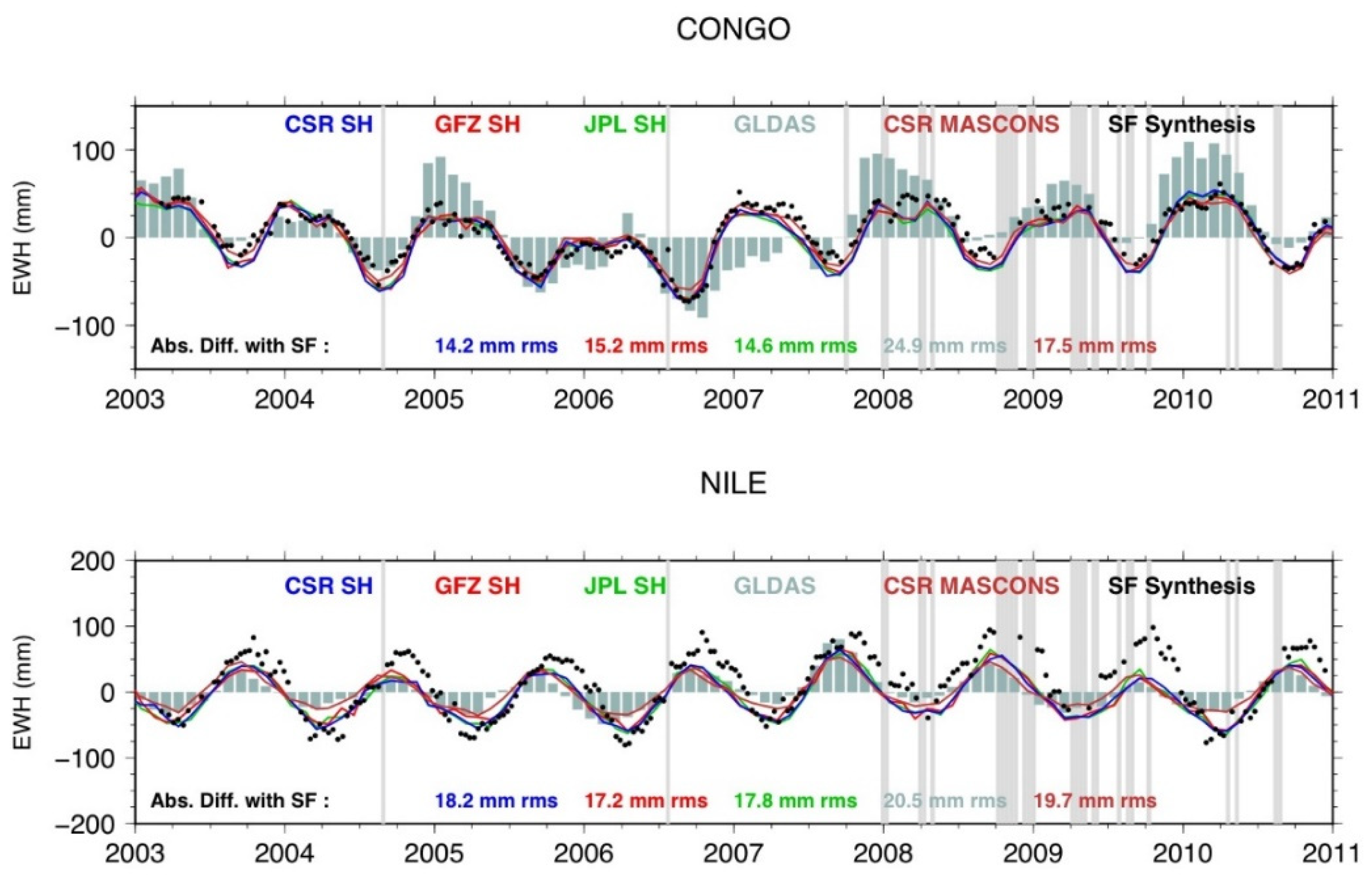
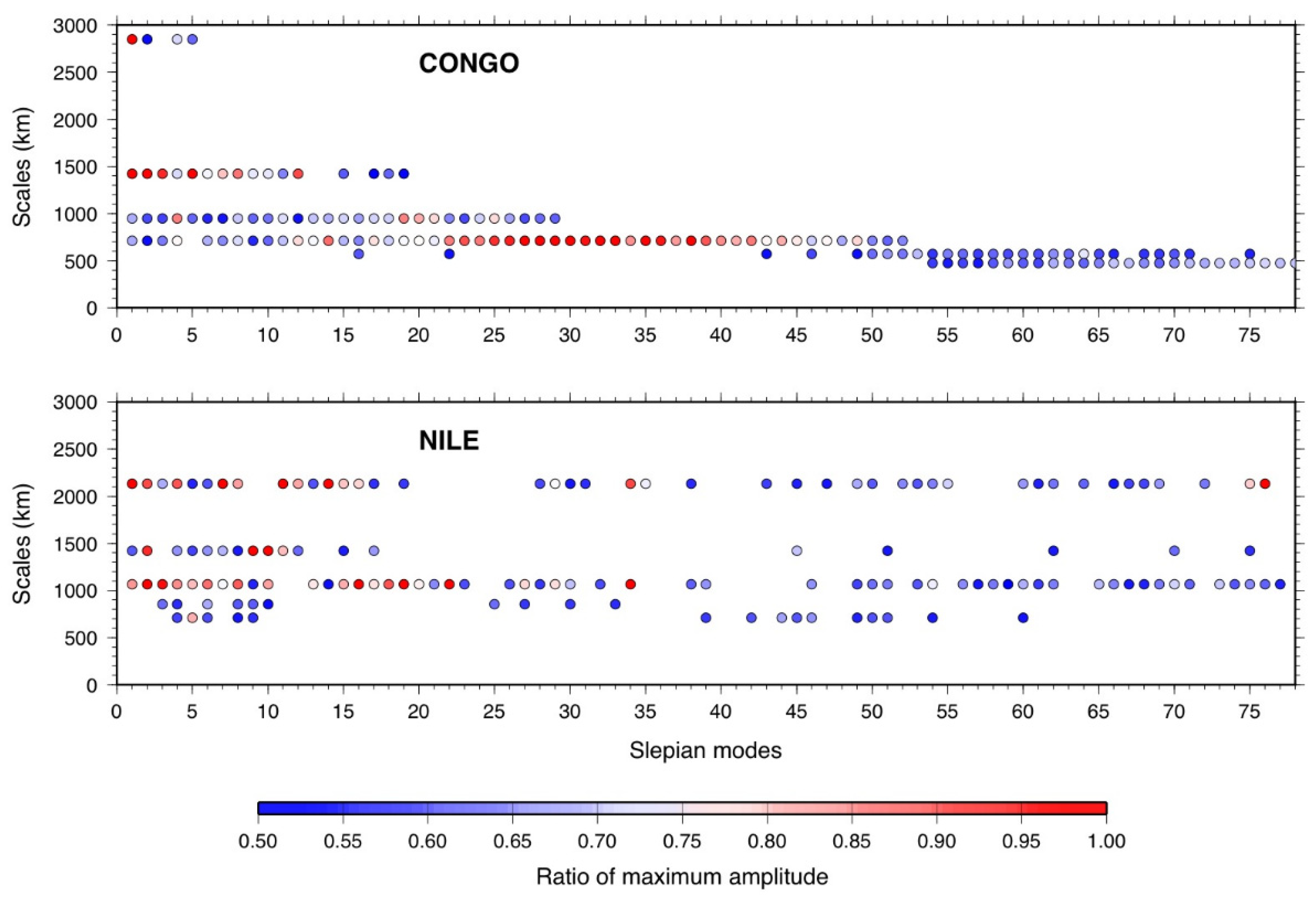
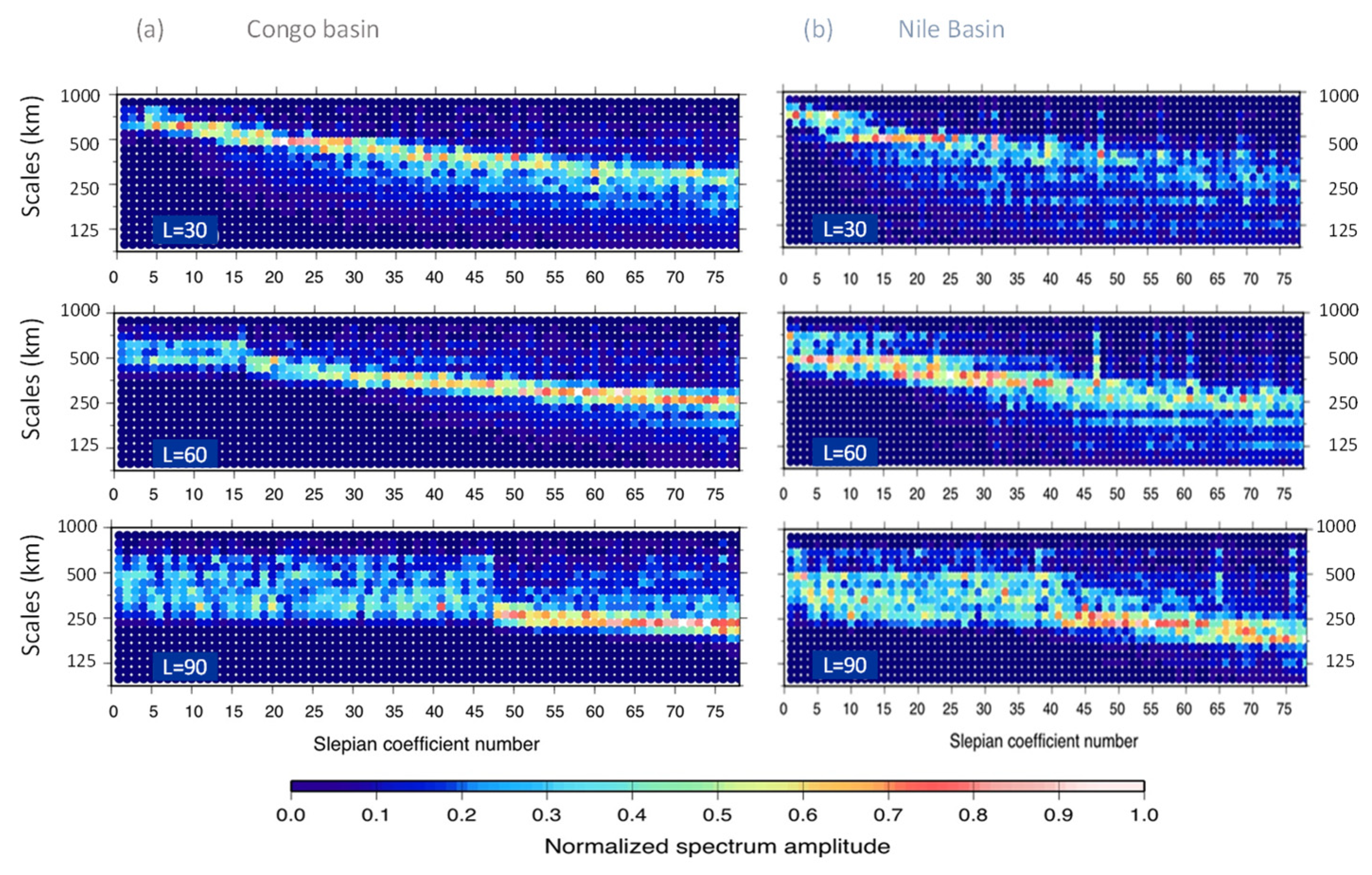
GRACE spherical harmonics are well-adapted for representation of hydrological signals in river drainage basins of large size such as the Amazon or Mississippi basins. However, when one needs to study smaller drainage basins, one comes up against the low spatial resolution of the solutions in spherical harmonics. To overcome this limitation, we propose a new approach based on Slepian functions which can reduce the energy loss by integrating information in the spatial, spectral and time domains. Another advantage of these regionally-defined functions is the reduction of the problem dimensions compared to the spherical harmonic parameters. This also induces a drastic reduction of the computational time. These Slepian functions are used to invert the GRACE satellite data to restore the water mass fluxes of different hydro-climatologic environments in Africa. We apply them to two African drainage basins chosen for their size of medium scale and their geometric specificities: the Congo river basin with a quasi-isotropic shape and the Nile river basin with an anisotropic and more complex shape. Time series of Slepian coefficients have been estimated from real along-track GRACE geopotential differences for about ten years, and these coefficients are in agreement with both the spherical harmonic solutions provided by the official centers CSR, GFZ, JPL and the GLDAS model used for validation. The Slepian function analysis highlights the water mass variations at sub-basin scales in both basins.
Keywords: Slepian functions; GRACE; hydro-climatic changes; Africa Slepian functions; GRACE; hydro-climatic changes; Africa