Article

Marine Heatwaves in Siberian Arctic Seas and Adjacent Region
Institute of Computational Mathematics and Mathematical Geophysics, SB RAS, 630090 Novosibirsk, Russia
*
Author to whom correspondence should be addressed.
Remote Sens. 2021, 13(21), 4436; https://doi.org/10.3390/rs13214436
Submission received: 20 September 2021 / Revised: 31 October 2021 / Accepted: 2 November 2021 / Published: 4 November 2021

Abstract

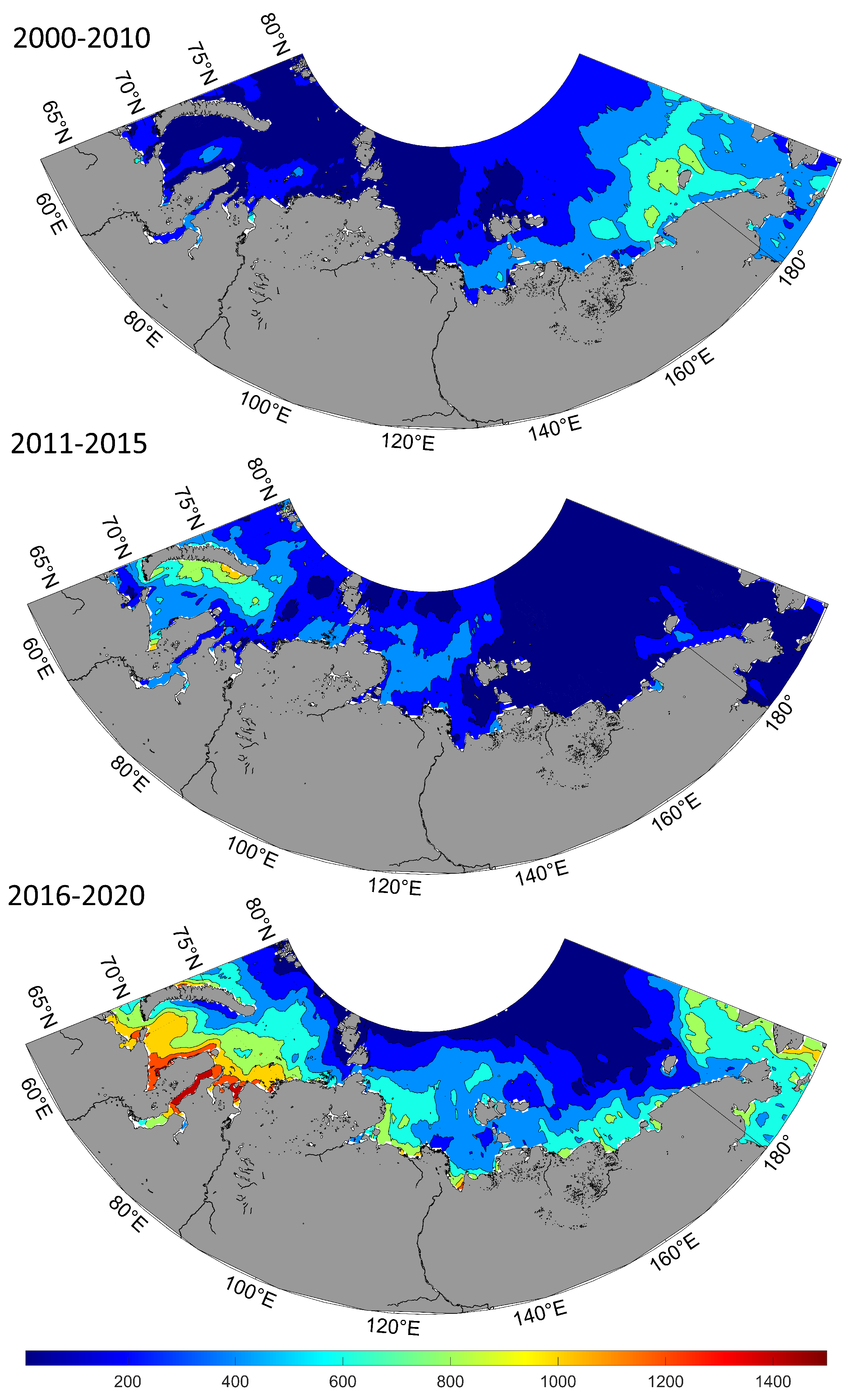
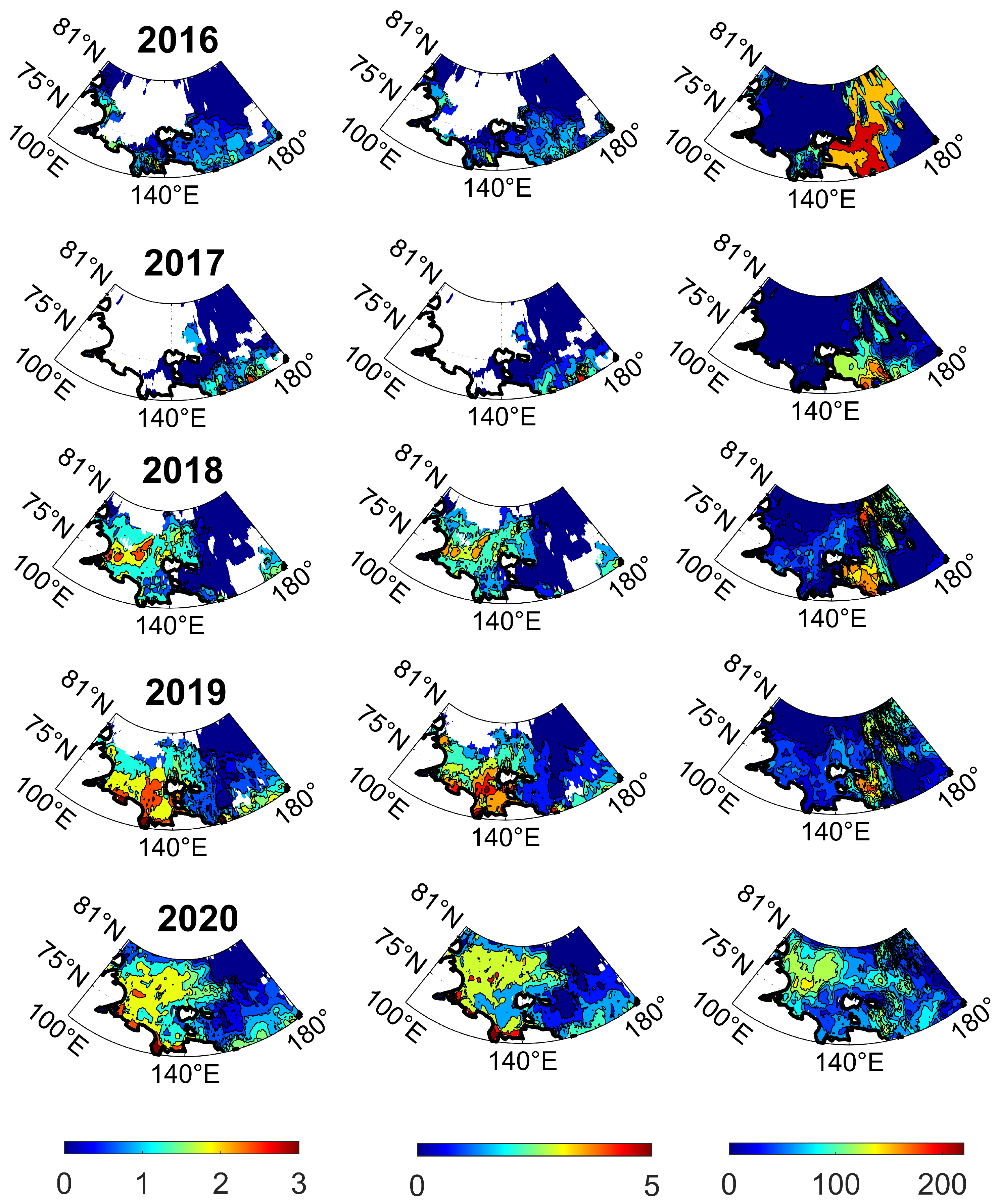
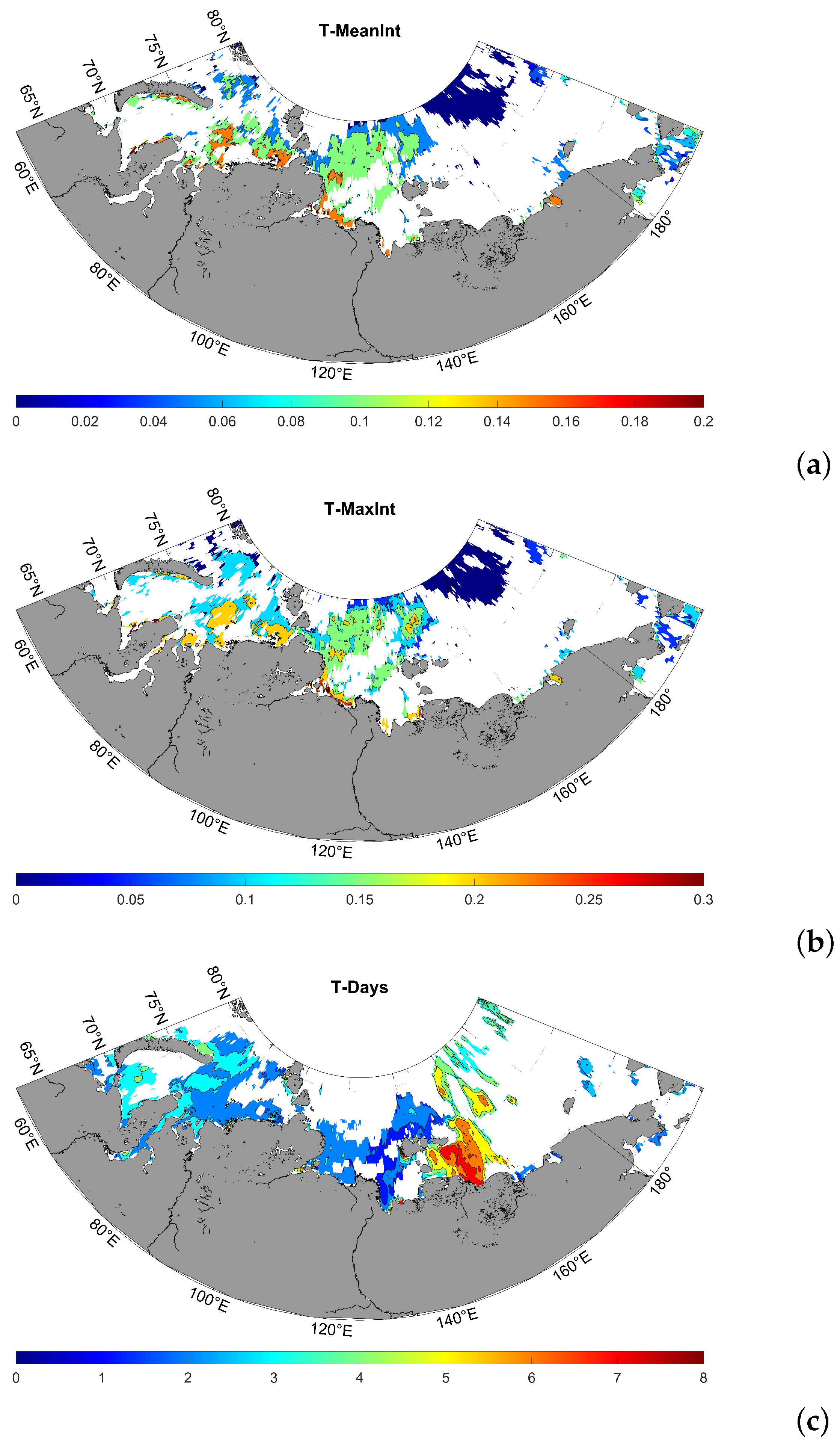
We used a satellite-derived global daily sea surface temperature (SST) dataset with resolution 0.25 × 0.25 to analyze interannual changes in the Arctic Shelf seas from 2000 to 2020 and to reveal extreme events in SST distribution. Results show that the second decade of the 21st century for the Siberian Arctic seas turned significantly warmer than the first decade, and the increase in SST in the Arctic seas could be considered in terms of marine heatwaves. Analyzing the spatial distribution of heatwaves and their characteristics, we showed that from 2018 to 2020, the surface warming extended to the northern deep-water region of the Laptev Sea 75 to 81N. To reveal the most important forcing for the northward extension of the marine heatwaves, we used three-dimensional numerical modeling of the Arctic Ocean based on a sea-ice and ocean model forced by the NCEP/NCAR Reanalysis. The simulation of the Arctic Ocean variability from 2000 to 2020 showed marine heatwaves and their increasing intensity in the northern region of the Kara and Laptev seas, closely connected to the disappearance of ice cover. A series of numerical experiments on the sensitivity of the model showed that the main factors affecting the Arctic sea-ice loss and the formation of anomalous temperature north of the Siberian Arctic seas are equally the thermal and dynamic effects of the atmosphere. Numerical modeling allows us to examine the impact of other physical mechanisms as well. Among them were the state of the ocean and winter sea ice, the formation of fast ice polynias and riverine heat influx.
Keywords: Siberian Arctic seas; climate changes; marine heatwaves; numerical modeling Siberian Arctic seas; climate changes; marine heatwaves; numerical modeling