Article

Source Model for Sabancaya Volcano Constrained by DInSAR and GNSS Surface Deformation Observation


by
Gregorio Boixart
1,
Luis F. Cruz
2,3,
Rafael Miranda Cruz
2,
Pablo A. Euillades
4,
Leonardo D. Euillades
4 and
Maurizio Battaglia
5,6,*
1
Instituto de Estudios Andinos, Universidad de Buenos Aires-CONICET, Buenos Aires 1428, Argentina
2
Escuela Profesional de Ingeniería Geofísica, Universidad Nacional de San Agustín de Arequipa, Arequipa 04001, Peru
3
Observatorio Vulcanológico del INGEMMET, Instituto Geológico Minero y Metalúrgico, Arequipa 04001, Peru
4
Facultad de Ingeniería, Instituto CEDIAC & CONICET, Universidad Nacional de Cuyo, Mendoza M5502JMA, Argentina
5
US Geological Survey, Volcano Disaster Assistance Program, NASA Ames Research Center, Moffett Field, CA 94035, USA
6
Department of Earth Sciences, Sapienza-University of Rome, 00185 Rome, Italy
*
Author to whom correspondence should be addressed.
Remote Sens. 2020, 12(11), 1852; https://doi.org/10.3390/rs12111852
Submission received: 23 April 2020 / Revised: 2 June 2020 / Accepted: 3 June 2020 / Published: 8 June 2020
(This article belongs to the Special Issue Ground Deformation Patterns Detection by InSAR and GNSS Techniques)

Abstract

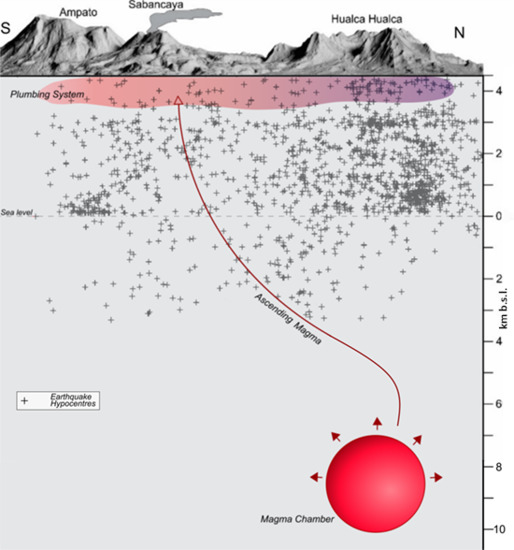
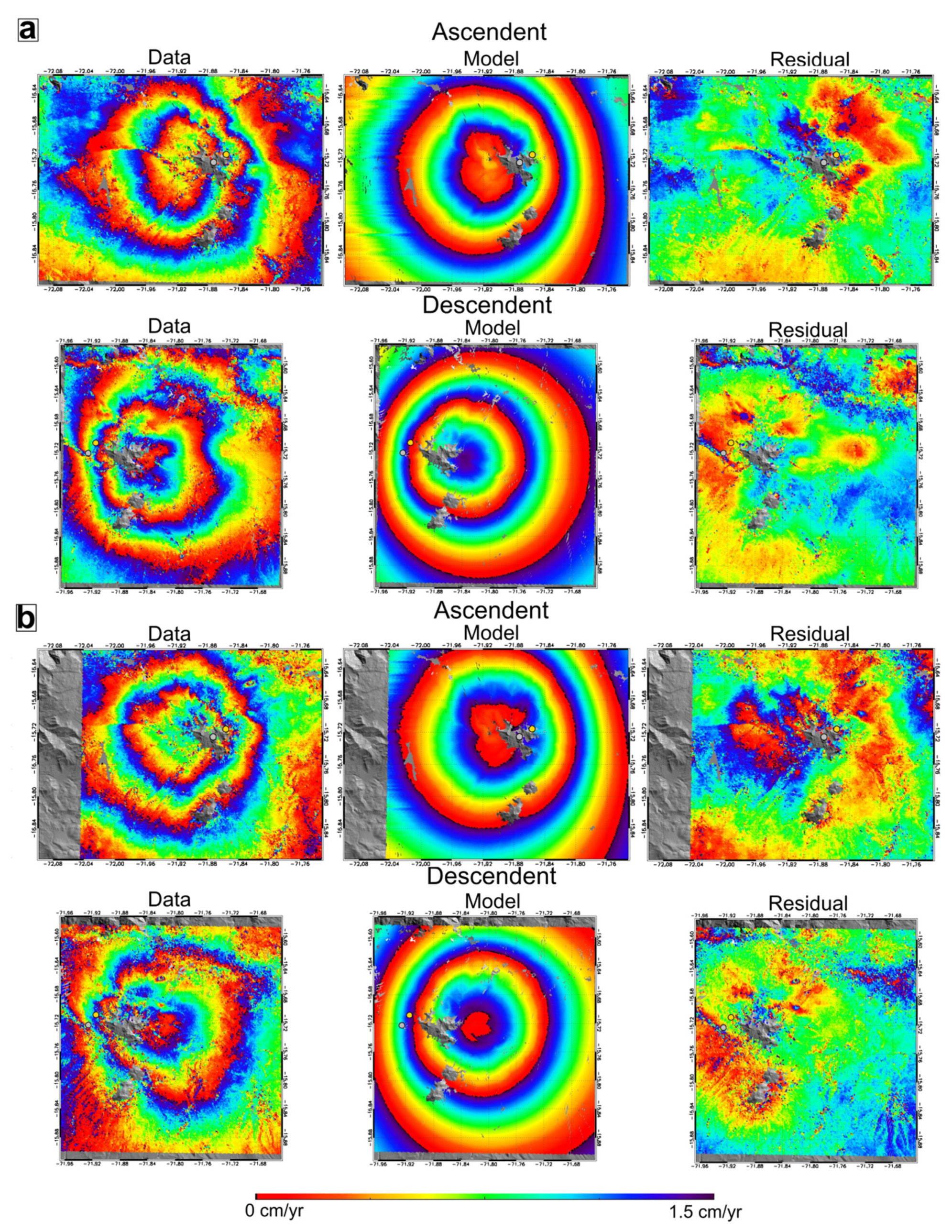
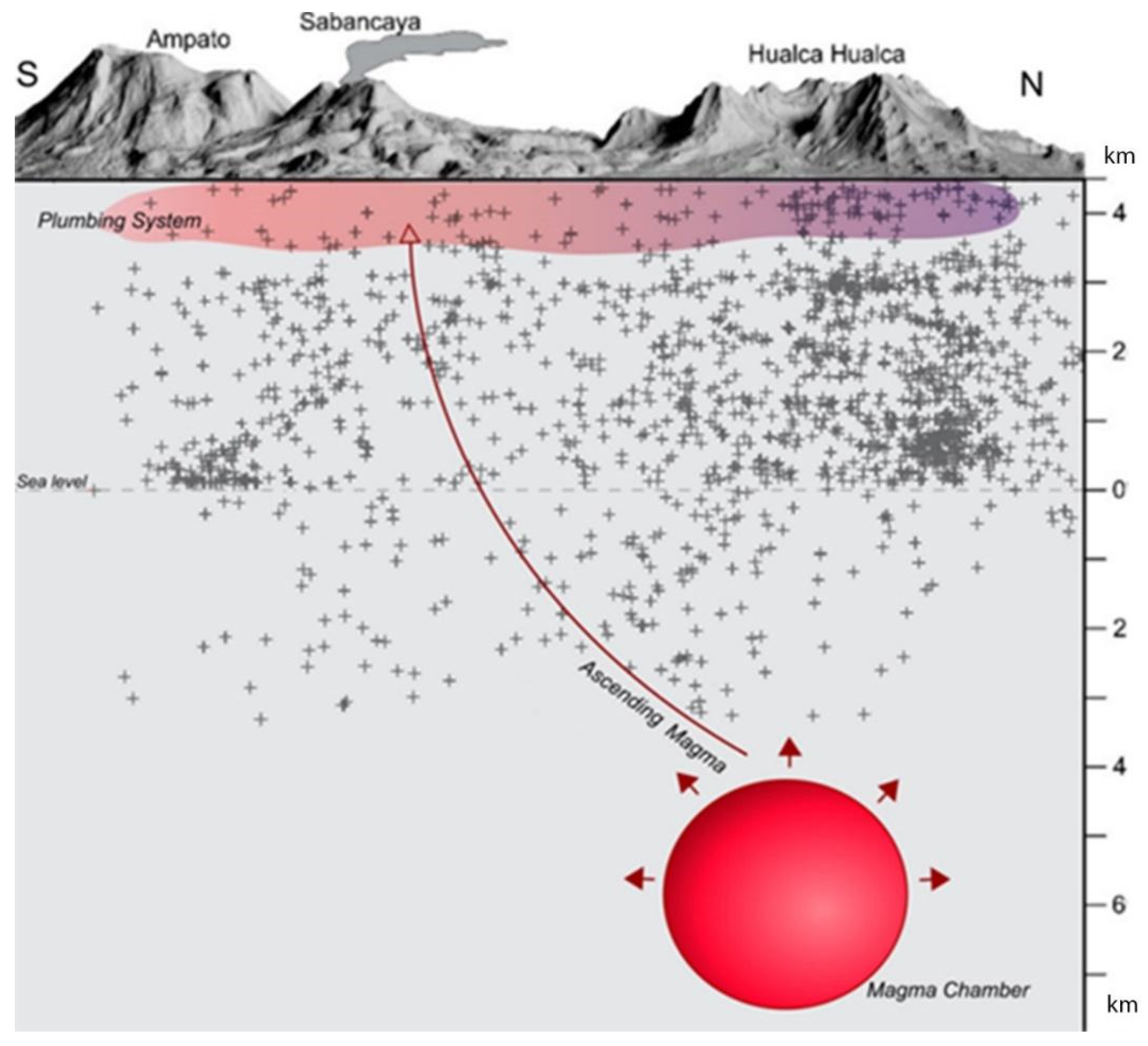
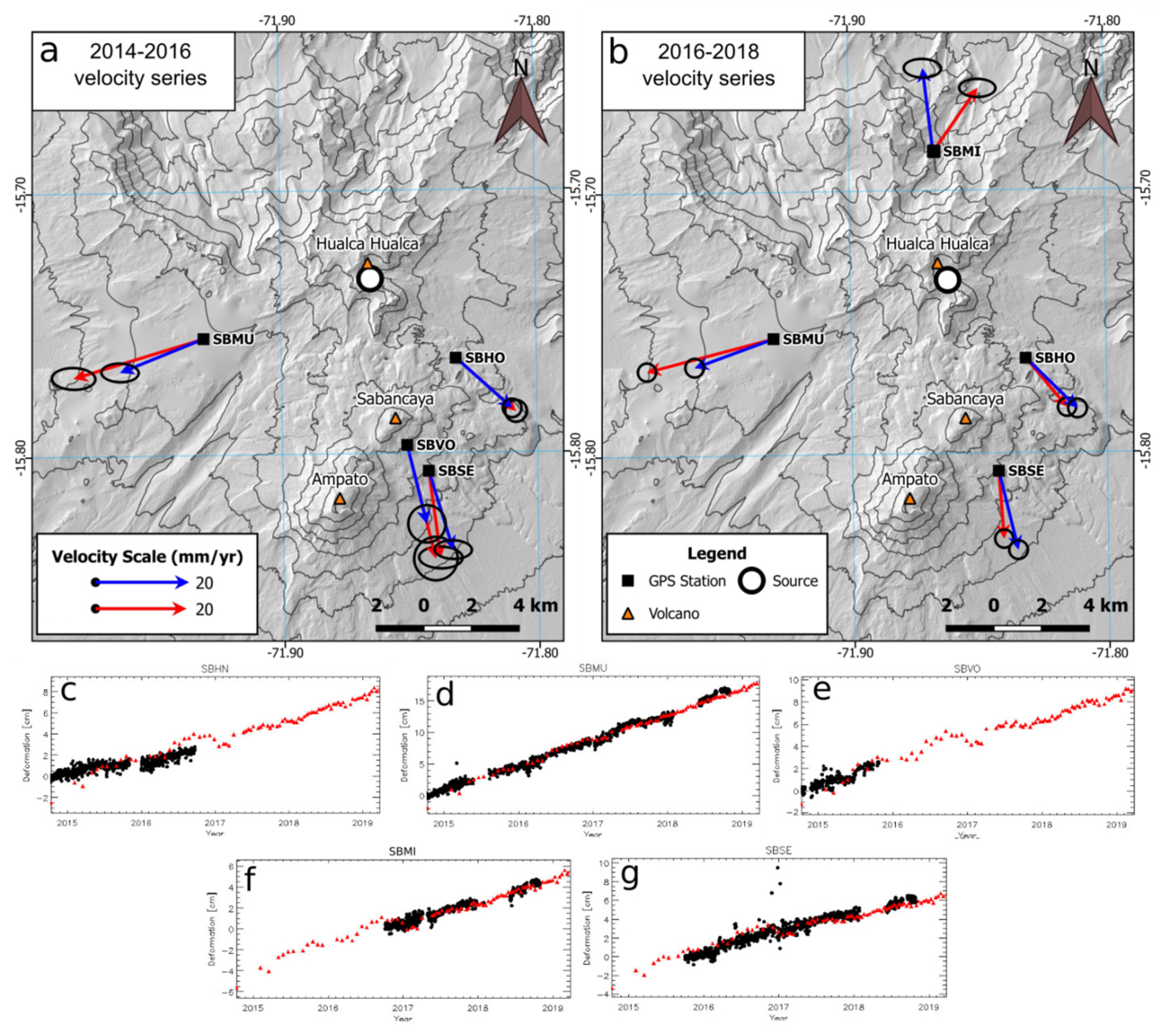
Sabancaya is the most active volcano of the Ampato-Sabancaya Volcanic Complex (ASVC) in southern Perú and has been erupting since 2016. The analysis of ascending and descending Sentinel-1 orbits (DInSAR) and Global Navigation Satellite System (GNSS) datasets from 2014 to 2019 imaged a radially symmetric inflating area, uplifting at a rate of 35 to 50 mm/yr and centered 5 km north of Sabancaya. The DInSAR and GNSS data were modeled independently. We inverted the DInSAR data to infer the location, depth, and volume change of the deformation source. Then, we verified the DInSAR deformation model against the results from the inversion of the GNSS data. Our modelling results suggest that the imaged inflation pattern can be explained by a source 12 to 15 km deep, with a volume change rate between 26 × 106 m3/yr and 46 × 106 m3/yr, located between the Sabancaya and Hualca Hualca volcano. The observed regional inflation pattern, concentration of earthquake epicenters north of the ASVC, and inferred location of the deformation source indicate that the current eruptive activity at Sabancaya is fed by a deep regional reservoir through a lateral magmatic plumbing system.
Keywords: volcano deformation; interferometric synthetic aperture radar; ground deformation modelling; GNSS; volcano geodesy volcano deformation; interferometric synthetic aperture radar; ground deformation modelling; GNSS; volcano geodesy
Graphical Abstract