Article

Artificial Intelligence and Sustainable Aviation Manufacturing: A Perspective from Green Innovation in China

1
Aviation Industry Development Research Center of China, Beijing 100029, China
2
School of Business, Renmin University of China, Beijing 100872, China
3
School of Economics and Management, Fuzhou University, Fuzhou 350108, China
*
Author to whom correspondence should be addressed.
These authors contributed equally to this work.
Sustainability 2026, 18(9), 4298; https://doi.org/10.3390/su18094298
Submission received: 10 March 2026 / Revised: 19 April 2026 / Accepted: 24 April 2026 / Published: 26 April 2026

Abstract

In the pursuit of global industrial sustainable development and carbon neutrality goals, the aviation manufacturing sector serves as a strategic pillar for advancing global economic growth, driving technological innovation and enhancing national competitiveness. Its green innovation has thus become a critical pathway to achieving carbon neutrality targets and spearheading the sustainable transformation of the industrial sector. This study investigates the enabling effect of artificial intelligence (AI) on green innovation within aviation manufacturing enterprises. The findings indicate that AI exerts a promotional impact on green innovation via three primary channels: technological empowerment, labor structure optimization and resource access improvement. Specifically, AI drives the digital transformation of operational processes in aviation manufacturing, rationalizes the human resource framework of the sector, and eases the financing pressures confronted by aviation manufacturing enterprises. A heterogeneity analysis reveals that regional resource endowments, enterprise production attribute characteristics and external market attention can form synergistic interactions with AI technology. What is more prominent is that the positive influence of AI on green innovation is especially distinct in three scenarios: in economically developed urban areas, among enterprises with traditional production attributes, and for enterprises that garner high levels of analyst attention.

1. Introduction

Aviation manufacturing constitutes the strategic apex of contemporary industrial systems, demonstrating significance through reinforcement of national comprehensive power and profound modulation of global technological innovation trajectories [1]. From a technological standpoint, this sector serves as a convergent innovation platform for advanced technologies. Its research and development initiatives yield substantive advancements in materials science, fluid dynamics, and intelligent manufacturing systems, thereby generating robust technological externalities that catalyze value chain modernization across interdependent industries [2]. In strategic terms, aviation transportation infrastructure underpins the structural architecture of global economic connectivity [3,4]. Concurrently, indigenous innovation capacity in aviation technologies bears direct implications for national security, sovereignty and geopolitical influence [5,6,7]. Notwithstanding its role in facilitating global factor mobility, conventional aviation operations engender non-negligible environmental externalities through greenhouse gas emissions [8,9,10,11,12,13,14]. Projected increases in global air transport demand suggest an accelerated accumulation of environmental impacts over decadal timescales. This trajectory portends not only intensified climate change dynamics but also potential proliferation of regulatory mechanisms, including international carbon taxation and route allocation systems, thereby introducing systemic sustainability challenges [15,16,17]. Under conditions of escalating environmental constraints [18,19,20], the imperative for carbon mitigation renders green innovation an operational necessity within aviation manufacturing [9,21,22,23,24,25]. Such innovation constitutes both a compliance requirement under global climate governance regimes and a critical developmental pathway for sustainable operations within ecological boundaries.
Contemporary research on green innovation exhibits substantial methodological and theoretical limitations that warrant critical examination. At the methodological level, predominant scholarship predominantly employs large-sample empirical analyses to extrapolate universal patterns governing green innovation [26,27,28]. This homogenized analytical paradigm fails to account for fundamental disparities in techno-economic characteristics and competitive dynamics across industrial sectors. As a capital- and technology-intensive industry, aviation manufacturing demonstrates fundamentally distinct green innovation pathways compared to labor- or resource-intensive industries [8,15]. Nevertheless, extant studies frequently adopt undifferentiated analytical frameworks that conflate heterogeneous industrial contexts, consequently diminishing the practical applicability and policy relevance of research findings. The literature further reveals critical gaps in examining how emerging technologies reconfigure green innovation ecosystems. Insufficient attention has been devoted to investigating moderating variables such as regional innovation system heterogeneity and corporate strategic orientation differentials. This oversight is particularly problematic during the current pivotal phase of artificial intelligence (AI) proliferation, wherein AI technologies are fundamentally restructuring global economic paradigms and emerging as central pillars of national competitive strategies [29,30]. Despite AI’s transformative potential, scholarly exploration of its sector-specific integration within green innovation regimes remains underdeveloped. This theory–practice disjunction engenders multifaceted challenges: technological supply–demand mismatches constrain industrial upgrading efficiency and policy frameworks lack evidentiary precision for targeted intervention. Ultimately, the full transformative potential of AI in facilitating green transitions remains unrealized. These systemic deficiencies exacerbate the inherent tensions between technological innovation trajectories and sustainability imperatives.
Building upon the preceding analysis, we examine how AI empowers green innovation in aviation manufacturing enterprises. Our findings reveal that AI exerts a positive impact on aviation manufacturing enterprises’ green innovation. The underlying transmission mechanisms manifest through three distinct channels: technological empowerment, labor optimization, and resource acquisition. Specifically, AI drives digital transformation in aviation manufacturing, optimizes its workforce structure, and alleviates financing constraints. To address endogeneity concerns, we employ instrumental variable (IV) regression using the “Broadband China” policy. Furthermore, our analysis reveals that regional resource endowments, enterprise productivity characteristics, and external attention levels all create synergistic effects with AI. Our results indicate that AI’s green innovation effects are more pronounced in developed urban regions, among enterprises with traditional production paradigms, and in enterprises with more analyst attention.
Our potential contributions are threefold. First, we extend research on AI’s economic consequences. Existing AI studies predominantly focus on computer science, while finance research incorporating AI remains relatively underdeveloped. By integrating AI with corporate finance, we demonstrate its enabling effects on green innovation and identify specific mechanisms through which AI operates in aviation manufacturing. Thereby, we contribute to the AI–corporate finance research domain. Second, we advance the literature examining antecedents of corporate green innovation. Current green innovation research primarily investigates the economic consequences of environmental policies. We empirically validate that emerging technologies can drive corporate green innovation through industrial practices, providing valuable references for related research fields. Finally, we offer novel methodological guidance for sustainable aviation manufacturing development. We elucidate AI’s pivotal role in facilitating green transformation within aviation manufacturing, thereby supplying crucial practical insights for governments to formulate differentiated industrial policies. Additionally, we contribute empirical evidence from emerging economies to address global aviation’s carbon neutrality challenges.

2. Literature Review and Research Hypothesis

2.1. Literature Review

2.1.1. Literature Review of Artificial Intelligence

The existing literature has explored the economic consequences of AI for enterprises. In the dimension of production factor reconfiguration, Acemoglu and Restrepo [29] demonstrate that AI, through deep integration into corporate production and operational systems, enables substitutive innovation of traditional labor and restructures production factor combinations. This technological penetration significantly reduces enterprises’ reliance on conventional resources, thereby driving business model transformation toward efficiency prioritization.
Regarding knowledge acquisition and innovation, Tumbas et al. [31] argue that knowledge acquisition constitutes the key driver of corporate AI innovation. Within enterprises, Firk et al. [32] confirm that top management teams’ professional backgrounds facilitate internal knowledge sharing and enhance AI application capabilities. Externally, Kohli and Melville [33] emphasize the promoting effect of industrial chain collaboration on technology diffusion. Additionally, Hanelt et al. [34] reveal, through M&A case studies, the effectiveness of cross-organizational knowledge transfer in AI technology development.
In the dimensions of enterprise performance and market response, Babina et al. [35] show, through industry panel data analysis, that AI investment exhibits a significant positive correlation with enterprise performance, with scale heterogeneity in this relationship. Liu and Wang [36] further discover that AI applications reduce financing costs for technology enterprises by optimizing risk management. Gulmez [37] and Hu and Wang [38] extend the research to capital markets, verifying the role of AI algorithms in enhancing market efficiency. These studies collectively reveal multiple mechanisms through which AI influences economic activities [39,40,41,42], forming a mutually reinforcing research framework.
In addition to the research in the field of economics and management, AI has also been widely involved in other fields. In the field of social services, AI applications are more diverse [43,44,45]. It is used in intelligent translation to address semantic bias and improve translation quality, as suggested [46]. AI is also applied in the judicial field to assist civil trials and improve judicial efficiency [47]. In mental health and medical screening [48,49], AI is used to optimize college students’ psychological evaluations [50] and design early screening tools for children’s autism [51], enhancing the efficiency and accuracy of related services. In physical education teaching, Li and Sun [52] propose an AI-based automatic evaluation algorithm using computer vision to solve the problems of subjectivity and low accuracy in evaluating students’ sports action standardization. In addition, Liu [53] puts forward a structure-aware intelligent icon generation method based on an AI diffusion model, which improves the quality, structural clarity and style consistency of generated icons. Zeng [54] develops a fraud detection framework combining an AI-based heterogeneous graph neural network and an XGBoost model, which significantly improves the accuracy and recall rate of cross-border trade fraud detection.
In urban research, Xu [55] develops a deep reinforcement learning signal control algorithm based on AI to optimize carbon emissions, realizing collaborative optimization of traffic efficiency and emission reduction and providing an intelligent solution for low-carbon urban traffic management. Li and Ma [56] propose an AI-based graph neural network algorithm for urban growth boundary delineation, effectively capturing urban spatial structure characteristics and providing technical support for territorial spatial planning. In addition, Zhang [57] explores the application of an AI-based convolutional neural network in scene understanding, which enhances the real-time environmental perception ability of autonomous driving systems and provides decision support for safe driving.

2.1.2. Literature Review of Green Innovation

Recent years have witnessed deepening research on green innovation, forming a relatively systematic analytical framework. Javed et al. [58] reveal, through gender comparisons, that female CEOs demonstrate significant advantages in promoting green innovation, particularly in state-owned enterprises, enterprises in developed regions, and large corporations within environmentally sensitive industries. This finding echoes Hao and He [59]’s research on board gender composition, which confirms that when female directors reach a critical mass, their positive impact on green product innovation becomes particularly pronounced.
Further studies demonstrate that both internal and external corporate governance mechanisms influence innovation effectiveness. Hao and He [59] uncover the positive effect of corporate social responsibility performance, while Zhou, Song and Huang [26] systematically examine the dual mechanisms of environmental regulations. These regulations not only promote innovation through increasing patent quantity and quality but also generate market crowding-out effects.
The impact of policy environments exhibits complex characteristics. Bai, Du, Xu and Abbas [27] and Cui et al. [60] present contrasting findings: the former identifies that climate policy uncertainty stimulates innovation by encouraging R&D investment, whereas the latter shows that economic policy uncertainty generally exerts inhibitory effects, though government environmental subsidies can effectively mitigate these negative consequences.
Regarding market mechanisms, Dong and Yu [61] validate the transmission pathway through which green bonds promote energy sector innovation by alleviating financing constraints. Jin et al. [62] complement this by demonstrating the synergistic effect between institutional investors’ ESG activism and media coverage. Notably, Liu and Li [63]’s study on carbon trading pilots and Zhao et al. [64]’s analysis of environmental regulation heterogeneity collectively indicate that policy effectiveness is multi-dimensionally moderated by enterprise ownership, industry characteristics, and regional development levels.
These studies progressively construct a multi-level analytical framework encompassing individual characteristics, organizational structures, and institutional environments. By examining micro-mechanisms such as CEO hometown identity [65] and stakeholder pressure [66], they provide systematic theoretical explanations for understanding the driving mechanisms of green innovation.

2.1.3. Literature Summary and Research Gap

Based on an existing literature analysis, while current research on AI and green innovation has developed a relatively systematic theoretical framework, it generally suffers from limited industry-specific applicability. This “broad but not specialized” research paradigm results in most conclusions remaining at the macro level, making it difficult to penetrate the operational contexts and technological characteristics of specific industries. Such limitations hinder accurate identification of key differences across industries in terms of technology adoption pathways, innovation transformation mechanisms, and policy response sensitivities. Moreover, they constrain the provision of precise practical guidance for various strategically significant complex industries.
The aviation manufacturing sector, as a benchmark for national high-end equipment manufacturing, exhibits unique characteristics including long industrial chains, high technological density, and stringent safety standards. These traits determine that the integration of AI and green innovation in this field will follow a distinctive evolutionary trajectory. Focusing research on this specific industry not only fills a gap in industry segmentation within the existing literature but also reveals the synergistic patterns between digital transformation and green transformation in large-scale, complex manufacturing. This, in turn, provides theoretical foundations for developing industry solutions that balance technological advancement with environmental sustainability.
Building upon this understanding, we attempt to use China’s aviation manufacturing sector as a research sample to empirically examine how AI enables green innovation development in this industry.

2.2. Artificial Intelligence and Green Innovation

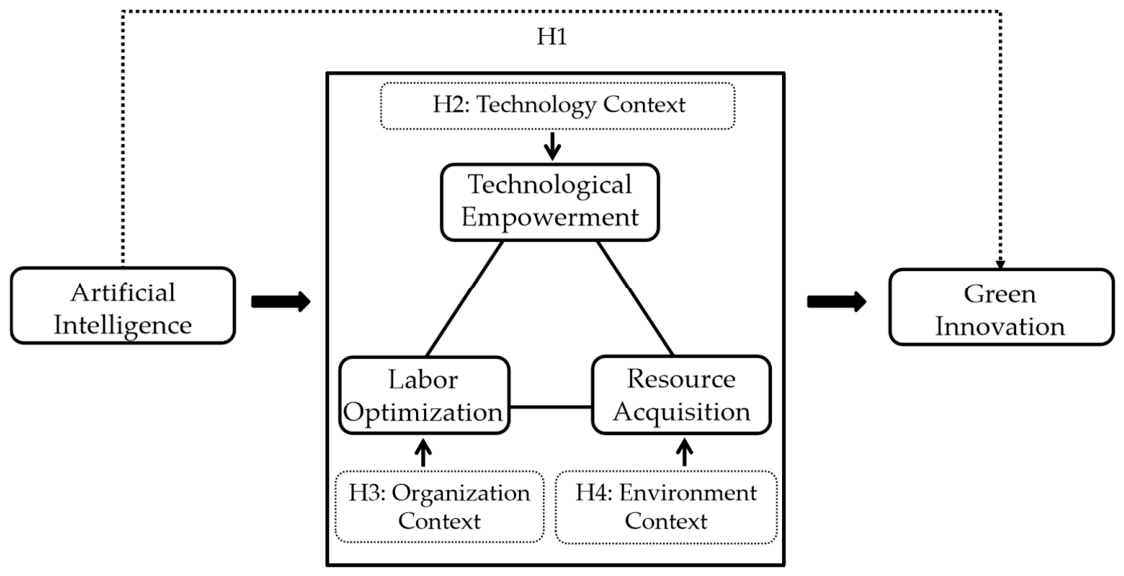
The TOE (Technology–Organization–Environment) framework provides a systematic theoretical lens to explore how AI influences green innovation in aviation manufacturing enterprises. This framework emphasizes the joint effects of technological context, organizational conditions, and external environment on the adoption and consequences of emerging technologies [67,68,69]. Against this theoretical background, this study analyzes the influencing mechanism of AI on green innovation from three interconnected dimensions consistent with the TOE framework: technological empowerment, organizational labor optimization, and external resource acquisition.
From the perspective of technological empowerment, AI systematically restructures the value creation model of aviation manufacturing enterprises. By establishing intelligent systems that span R&D, production, and operational processes, AI facilitates a fundamental shift from experience-based to data-driven decision-making mechanisms [70,71,72,73,74,75,76,77,78,79]. This digital transformation not only enhances resource allocation efficiency but also constructs a quantifiable analytical framework for environmental performance, laying the foundation for green innovation paradigm shifts [80]. Digital twin technology, as a critical enabler of digital transformation [81], renders environmental impacts across product lifecycles visually traceable, thereby deeply integrating ecological constraints into innovation processes [71,82]. Concurrently, machine learning algorithms identify energy-saving opportunities overlooked by conventional methods through operational data pattern recognition, establishing continuous optimization loops [83,84,85,86]. These technological effects ultimately transform aviation manufacturers’ innovation ecosystems. By breaking organizational silos and data barriers, AI shifts enterprises from regulatory compliance to sustainability leadership, converting green innovation from a cost factor into a competitive advantage [87].
From the perspective of labor optimization, AI’s impact on human capital manifests through selective labor market reconfiguration. Intelligent system deployment gradually replaces repetitive, low-skilled positions, driving structural workforce adjustments through elevated technical requirements [71,88,89]. Specifically, the implementation of AI in enterprises effectively eliminates the low-level labor force that lacks technical competence and production efficiency, which were previously engaged in simple and repetitive production tasks. As low-level labor is phased out, enterprises tend to shift their recruitment focus toward a high-level labor force with strong professional skills, interdisciplinary literacy and innovative thinking. This substitution effect of AI fundamentally optimizes the corporate human resource structure, upgrading the overall quality of the workforce and enhancing the enterprise’s human capital reserve. The introduction of a high-level labor force further promotes the improvement of the green innovation level through multiple channels. They are more capable of integrating AI technology into green R&D, optimizing environmental management processes, and developing innovative green technologies and production methods that reduce energy consumption and environmental pollution. While displacing inefficient labor, AI creates demand for multidisciplinary roles (e.g., data analysts, AI system engineers) requiring interdisciplinary integration and continuous learning capabilities [90,91]. This talent influx provides intellectual capital for green innovation, embedding environmental management into R&D processes. The optimized workforce establishes a virtuous cycle: skilled teams better leverage AI for green innovation, while innovation demand further attracts top talent [92]. This transition shifts aviation manufacturers from scale-driven growth to talent-driven sustainability, making green innovation a core competitive dimension.
From the perspective of resource acquisition, AI enhances green innovation by reshaping resource acquisition mechanisms. As a strategic technology endorsed by capital markets and governments [29,30], AI adoption signals innovation capability to investors, particularly when applied to green technology R&D, attracting venture capital [36] and policy support [93]. This dual resource injection (market and policy) alleviates financing constraints, enabling breakthrough environmental technologies. Continued external resources reinforce innovation capacity, creating a virtuous cycle that transforms traditional manufacturing into green intelligent paradigms. Based on the above analysis, we propose the following hypotheses (as shown in Figure 1).
H1. 
Artificial intelligence positively promotes green innovation in aviation manufacturing enterprises.
H2. 
Artificial intelligence can promote the digital transformation (technological empowerment) of aviation manufacturing enterprises, thereby promoting green innovation.
H3. 
Artificial intelligence can improve the labor structure (labor optimization) of aviation manufacturing enterprises, thereby promoting green innovation.
H4. 
Artificial intelligence can optimize the financing environment (resource acquisition) of aviation manufacturing enterprises, thereby promoting green innovation.

3. Research Design

3.1. Data Source

We selected Chinese aviation manufacturing-listed enterprises from 2010 to 2024 as our research sample. We collected green patent data from the CNRDS (Chinese Research Data Services Platform, https://www.cnrds.com/), and gathered enterprise-level artificial intelligence data as well as control variable data from CSMAR (China Stock Market & Accounting Research Database, https://www.csmar.com/). The selection of the sample period is based on two reasons. First, CSMAR began to disclose corporate AI-related data in 2010. Earlier AI data are therefore unavailable for this study. Second, most listed enterprises in China have not officially released their financial reports for 2025. Data for years after 2024 cannot be obtained from databases at present. We excluded data with missing values for key variables and removed ST-category data [94,95,96]. Ultimately, we obtained 284 enterprise-year observations from 36 aviation manufacturing enterprises.

3.2. Variable Description

Our independent variable is AI, and the dependent variable is green innovation. We use “AI investment/total assets” as a proxy variable to reflect the level of AI application in aviation manufacturing enterprises. This measurement method is reasonable because it aligns with the research practice of existing innovation-related literature. Existing studies often use R&D investment as a proxy variable to measure the corporate innovation level [97,98,99]. Our study follows this mature and widely accepted research paradigm, which ensures the validity and comparability of the measurement results. Additionally, we use the number of green patent applications as a proxy variable to measure green innovation [28,100,101]. Other control variables are detailed in Table 1.

3.3. Model Setting

To explore the empowering effect of AI on green innovation of aviation manufacturing enterprises, we have constructed the following model. We controlled for enterprise and year fixed effects, with clustered standard errors at the enterprise-year level. Controls represents all control variables in Table 1.
GIi,t = β0 + β1AIi,t + Controlsi,t + ∑Yeart + ∑Enterprisei,t + εi,t

4. Results

4.1. Descriptive Statistics

Table 2 presents the descriptive statistics for the variables. The dependent variable (GI) exhibits a mean value of 2.320, with a minimum of 0 and a maximum of 19. This range indicates significant heterogeneity in green innovation levels across aviation manufacturing enterprises. The independent variable (AI) shows a mean of 0.004, with values ranging from 0 to 0.121, suggesting considerable variation in AI investment intensity among enterprises. Additionally, the mean values of control variables align closely with those reported in prior studies, which indirectly supports the reliability of our sample data sources.

4.2. Benchmark Regression

Table 3 presents the main regression results examining the relationship between AI and green innovation of aviation manufacturing enterprises. Column (1) controls solely for enterprise and year fixed effects. Column (2) incorporates additional control variables related to corporate financial characteristics, while Column (3) further includes governance-related control variables. The results consistently demonstrate statistically significant positive coefficients for AI across all specifications, indicating that AI enhances green innovation levels of aviation manufacturing enterprises (i.e., H1 holds).

4.3. Endogeneity Test

To mitigate potential endogeneity issues associated with the link between AI and green innovation, this research adopts an exogenous policy shock, namely the “Broadband China” initiative, as our IV for validation [94,102,103]. The Chinese government formally launched the “Broadband China” policy in 2013, and successively selected 120 demonstration cities across the country in 2014, 2015, and 2016 to advance the construction of network infrastructure. The “Broadband China” initiative is widely regarded as an important strategy impetus for urban digital transformation and provides essential infrastructure support for enterprises to conduct digital-related practices [104,105]. As such, this strategy is likely to exert a substantial influence in facilitating corporate AI adoption. In addition, the designation of “Broadband China” demonstration cities is not determined by individual enterprises, which guarantees the exogenous attribute of this policy [94,102,103]. This feature effectively meets the exclusion restriction condition required for valid instrumental variables. Therefore, using the “Broadband China” policy as an IV provides an effective empirical strategy for identifying the causal effect of AI on green innovation.
Against this backdrop, we construct the instrumental variable AI_policy, which equals 1 if an enterprise is headquartered in a “Broadband China” demonstration city in or after the year of official designation, and 0 otherwise. As shown in Column (1) of Table 4, the implementation of the “Broadband China” policy (AI_policy) presents a significantly positive effect on corporate AI development. Meanwhile, Column (2) indicates that the fitted value of AI (AI_fitted) contributes to a notable improvement in corporate green innovation performance.
Based on the overall results in Table 4, endogeneity concerns about the relationship between AI and green innovation in aviation manufacturing are effectively alleviated.

4.4. Robust Test

4.4.1. Replacing Artificial Intelligence Measurement

This section employs enterprises’ total AI investment (AI_total) as the proxy of artificial intelligence for robust tests. The regression results (Column (1) of Table 5) demonstrate that the coefficient of AI_total remains statistically significantly positive. In addition, we use the number of artificial intelligence patent applications to remeasure enterprise artificial intelligence (AI_alter). Relevant regression results appear in Column (2) of Table 5, and AI_alter still significantly promotes green innovation in aviation manufacturing enterprises.

4.4.2. Including More Control Variables

To ensure the robustness of the main regression results, this section incorporates additional control variables. Specifically, Column (3) of Table 5 introduces supplementary enterprise-specific control variables, including asset turnover ratio (AT), fixed asset ratio (Fixed), Tobin’s Q (TobinQ), and enterprise age (Age). Column (4) further incorporates corporate governance controls comprising board size (Board) and the proportion of independent directors (Indep). The coefficient for AI remains statistically significant, confirming the positive effect of AI on green innovation of aviation manufacturing enterprises.

4.4.3. Changing Sample Time Range

We conduct a robust test by excluding samples from 2019 to 2021 that may have been affected by COVID-19 (Column (1) of Table 6). The results demonstrate that the coefficient of AI remains significantly positive, confirming the robust relationship between AI and green innovation of aviation manufacturing enterprises.

4.4.4. Winsorization

To verify the robustness of our results, our continuous variables are winsorized at the top and bottom 1% (Column (2) of Table 6). The results demonstrate that the coefficient of AI remains significantly positive, confirming the robust relationship between AI and green innovation of aviation manufacturing enterprises.

4.5. Mechanism Analysis

4.5.1. Technological Enablement

To examine the technological empowerment mechanism, we employ corporate digital transformation as a mediating variable between AI and green innovation of aviation manufacturing [106]. We obtain enterprise-level digital transformation metrics (Digi) from CSMAR and regress Digi on AI (Column (1) of Table 7). AI demonstrates a statistically significant positive effect on digital transformation of aviation manufacturing enterprises, thereby supporting the validity of the technological empowerment mechanism (i.e., H2 holds).

4.5.2. Labor Optimization

To investigate the labor optimization mechanism, we adopt corporate human resource composition as a mediating variable [96]. Specifically, we obtain enterprise-level employee education data from CSMAR and examine the relationship between AI and workforce educational structure (Column (2) of Table 7). It can be found that the implementation of AI technologies significantly reduces the proportion of employees with below-bachelor’s degrees (Labor) in aviation manufacturing enterprises, thereby validating the labor optimization mechanism (i.e., H3 holds).

4.5.3. Resource Acquisition

To examine the resource acquisition mechanism, we utilize corporate financing constraints as a mediating variable [96]. Specifically, we obtain FC indices from CSMAR to proxy for financing constraint levels and regress FC on AI (Column (3) of Table 7). It can be found that the implementation of AI technologies significantly alleviates financing constraints, thereby validating the resource acquisition mechanism (i.e., H4 holds).

4.6. Heterogeneity Analysis

4.6.1. Urban Endowment

The positive impact of AI on green innovation of aviation manufacturing may be more pronounced in regions with superior urban endowments. From a technological empowerment perspective, well-developed innovation infrastructure in high-endowment cities provides an optimal platform for AI technology development and application [107,108], thereby significantly enhancing the synergistic efficiency between digital technologies and environmental protection.
From a labor optimization perspective, high-endowment cities concentrate substantial high-skilled talent pools [109,110]. This facilitates the establishment of a novel paradigm where human capital and intelligent tools co-evolve through knowledge spillover effects, generating sustained endogenous momentum for industrial green transformation.
From a resource acquisition perspective, the policy support systems and market-oriented mechanisms prevalent in high-endowment cities create synergistic effects [19,111,112]. These institutional arrangements optimize innovation resource allocation, providing both institutional safeguards and capital support for AI-driven green innovation.
To empirically validate the positive moderating effect of urban endowment on the AI–green innovation relationship, we construct a moderating variable (First) based on city–tier classification. Specifically, First equals 1 if an enterprise is headquartered in a first-tier city, and 0 otherwise. We incorporate an interaction term (AI_First) between AI and First into our regression model (Column (1) of Table 8). The significantly positive coefficient of AI_First confirms that urban endowment positively moderates AI’s effect on green innovation of aviation manufacturing enterprises.

4.6.2. Enterprise Characteristic

In traditional productivity enterprises, AI may exhibit a more pronounced effect in promoting green innovation in aviation manufacturing. This fundamentally stems from the complementary restructuring between AI and labor-intensive production modes characterized by low-quality labor inputs. Traditional productivity enterprises’ long-term dependence on repetitive tasks creates clear substitution scenarios for AI technologies [113,114]. Through standardized process reengineering, intelligent systems can reduce labor costs while simultaneously liberating innovation resources previously constrained by inefficient labor allocation [115,116].
From a technological empowerment perspective, traditional enterprises’ relatively simple technical architectures enable AI algorithms to be rapidly integrated into existing production processes. This integration facilitates a hybrid model combining human expertise with intelligent decision-making [117,118], representing an incremental innovation approach better aligned with traditional enterprises’ technological absorption capabilities.
Regarding labor optimization, the predominance of low-skilled workers in traditional enterprises amplifies AI’s marginal benefits. Intelligent tools not only replace repetitive tasks but also reconstruct knowledge transmission pathways through data accumulation, enabling the digital preservation of tacit experience.
In terms of resource acquisition, AI applications optimize production processes and reduce resource waste [119,120], thereby releasing financial and material resources previously trapped in inefficient operations and providing a more robust resource foundation for sustainable development.
To verify the positive moderating effect of enterprise characteristics on the AI-green innovation relationship, we construct a dummy variable Productivity based on enterprises’ new-quality productive forces data from CSMAR [121]. Specifically, Productivity equals 0 for enterprises above the sample median in new-quality productive forces, and 1 otherwise. We create an interaction term AI_Pro by combining AI with Productivity and include it in our regression model. As shown in Column (2) of Table 8, the significantly positive coefficient of AI_Pro confirms that enterprises’ characteristics positively moderate AI’s effect on green innovation in aviation manufacturing.

4.6.3. External Attention

In enterprises with greater analyst coverage, AI may demonstrate a more substantial effect in promoting green innovation. High-coverage enterprises establish market trust mechanisms through continuous information disclosure [122,123,124,125], enabling capital markets to accurately evaluate both the strategic intentions and implementation outcomes of their AI initiatives. This enhanced visibility not only reduces information asymmetry risks for external investors [126,127], but also attracts more innovation resources toward green technologies through reputation effects.
Furthermore, analysts’ in-depth interpretation and dissemination amplify the demonstration effects of corporate AI transformation [106], encouraging active participation from supply chain partners, research institutions, and other stakeholders in collaborative innovation. This process fosters an ecosystem-oriented cooperation network centered on technological upgrading. Additionally, market monitoring pressures compel high-coverage enterprises to prioritize allocating AI-generated efficiency gains toward green innovation [19,128]. Such resource allocation preferences not only align with ESG investment criteria [95,129], but also reinforce market position through sustainability narratives, ultimately achieving dual improvements in technological innovation and value creation.
To examine the positive moderating effect of external attention on the AI-green innovation relationship, we construct a dummy variable Analyst using coverage data from CSMAR. Specifically, Analyst equals 1 for enterprises with above-median analyst coverage and 0 otherwise. We create an interaction term AI_Ana by combining AI with Analyst and include it in our regression model (Column (3) of Table 8). The significantly positive coefficient of AI_Pro confirms that external attention positively moderates AI’s effect on green innovation in aviation manufacturing.

5. Conclusions, Implications, and Limitations

5.1. Conclusions

This study empirically examines the relationship between AI and green innovation using a sample of China’s aviation manufacturing listed enterprises. Our findings demonstrate that AI significantly enhances green innovation in the aviation manufacturing sector, with this relationship remaining robust across various sensitivity tests. Furthermore, IV regression based on the “Broadband China” policy helps mitigate endogeneity concerns regarding AI’s role in fostering green innovation.
Our mechanism analysis reveals that AI primarily facilitates green innovation through three channels: technological empowerment, labor optimization, and resource acquisition. Specifically, AI drives digital transformation, improves human capital structure, and alleviates financing constraints in aviation manufacturing enterprises. Additionally, we identify synergistic effects arising from urban endowment, enterprises’ characteristics, and external attention. The results show that AI’s positive impact on green innovation is more pronounced in enterprises located in high-endowment cities, traditional productivity enterprises, and enterprises with greater analyst coverage.

5.2. Theoretical Implications

Our study enriches and extends the TOE framework by exploring the enabling effect of AI on green innovation in aviation manufacturing enterprises. We verify the framework’s applicability to AI-driven green innovation within the aviation manufacturing sector. We also expand the framework’s connotation by clarifying the interactive mechanisms between its three core dimensions, which align with our research findings. Specifically, our study accurately supplements the three core contexts of the TOE framework. We extend the technological context by linking it to digital transformation, thereby facilitating technology–innovation linkages. We enrich the organizational context by associating it with human resource optimization, highlighting AI’s role in optimizing labor structures. Additionally, we expand the environmental context by equating it with external financing improvement, identifying synergistic interactions between external financing factors and AI. This clarification of the framework’s boundary conditions enhances its theoretical and practical value in sustainable innovation research.

5.3. Practical Implications

Our study provides important insights into the mechanisms through which AI promotes green innovation, offering valuable implications for achieving sustainable development goals and facilitating the green transition in aviation manufacturing. First, policymakers should establish comprehensive industry standards and develop scientific environmental benefit assessment frameworks to guide objective evaluation of AI’s role in green transformation. Simultaneously, enhanced industry–academia–research collaboration is needed to accelerate the application of AI in green innovation commercialization. Second, differentiated policy support systems should be implemented according to regional characteristics and enterprise types, with targeted measures focusing on core technology development and application. From an enterprise development perspective, aviation manufacturers should establish coordinated mechanisms integrating AI and green innovation. Specifically, enterprises need to deeply incorporate AI technologies into their green development strategies and establish intelligent governance systems encompassing the entire value chain from R&D to operations management. Regarding human capital development, enterprises should prioritize cultivating and recruiting interdisciplinary talents. By optimizing workforce composition, enterprises can systematically enhance employees’ professional competencies in both digital technologies and sustainable development domains.

5.4. Limitations and Future Research

This study has several limitations that should be acknowledged, and these limitations also provide directions for future research. First, regarding the measurement of AI, this study uses AI investment/total assets as a proxy variable to reflect the level of AI application in aviation manufacturing enterprises. This measurement method is consistent with the practice in the existing innovation-related literature, which often uses R&D investment to measure corporate innovation level. It has also been verified through robustness tests using AI patent applications. However, different AI methods such as deep learning, digital twin and computer vision have distinct impacts on green manufacturing. They can reduce waste and save energy in different ways. Due to data availability constraints for listed enterprises, we were unable to obtain segmented data on specific AI methods adopted by aviation factories. This makes it impossible to analyze the heterogeneous effects of different AI types on green innovation.
Second, the measurement of green innovation is limited to the number of green patent applications. Although this is a widely accepted practice in management and economics research, it fails to capture many actual green improvements in aviation manufacturing that are not patented. These unpatented green improvements (such as optimized tool path planning, reduced material scrap, and lower energy consumption per part) are also important manifestations of green innovation, and the inability to include them may lead to a potential bias in the measurement of green innovation.
Third, this study focuses on the positive enabling effect of AI on green innovation, but it does not fully discuss the potential risks and failure scenarios of AI applications in real factory settings. As noted, AI projects in actual aviation manufacturing may fail due to poor data quality, changing production conditions, or difficulties in connecting with old equipment. The lack of discussion on these risks limits the comprehensiveness of the research findings and their practical applicability.
Against the background of these limitations, future research can be carried out in the following directions. First, with the improvement in data availability, future studies can obtain segmented data on specific AI methods adopted by aviation manufacturing enterprises, clarify the application scenarios of different AI technologies in aviation factories, and explore their heterogeneous effects on green innovation. Second, future research can integrate more engineering metrics to measure green innovation, combining green patent data with actual production indicators to comprehensively reflect the level of green innovation in aviation manufacturing enterprises. Third, future studies can further explore the risk factors affecting the effectiveness of AI applications in green innovation, analyze the mechanisms and conditions of AI project failures, and put forward targeted solutions to improve the practical effect of AI-driven green innovation in aviation manufacturing.

Author Contributions

Conceptualization, G.S., Y.S. and D.X.; methodology, G.S.; software G.S.; validation, G.S.; formal analysis, G.S., Y.S., J.X. and D.X.; data curation, G.S. and D.X.; writing—original draft preparation, G.S.; writing—review and editing, G.S., Y.S. and D.X.; supervision, G.S., Y.S., J.X. and D.X. All authors have read and agreed to the published version of the manuscript.

Funding

This paper is supported by the Outstanding Innovative Talents Cultivation Funded Programs 2025 of Renmin University of China.

Institutional Review Board Statement

Not applicable.

Informed Consent Statement

Not applicable.

Data Availability Statement

The data presented in this study are available on request from the corresponding author.

Conflicts of Interest

The authors declare no conflicts of interest.

References

  1. Mus, R.L.; Rodeck, R.; Wende, G. Initial and Continued Airworthiness: Commonalities and Differences Between Civil and Military Aviation. Aerospace 2025, 12, 23. [Google Scholar] [CrossRef]
  2. Gisario, A.; Kazarian, M.; Martina, F.; Mehrpouya, M. Metal additive manufacturing in the commercial aviation industry: A review. J. Manuf. Syst. 2019, 53, 124–149. [Google Scholar] [CrossRef]
  3. Lavallée, C. The Single European Sky: A window of opportunity for EU–NATO relations. Eur. Secur. 2017, 26, 415–434. [Google Scholar] [CrossRef]
  4. Kulanovic, A.; Nordensvärd, J.; Urban, F. The discursive silos of transport discourse in Sweden: Using future storylines to understand the polarization and politicization of sustainable aviation transitions. Futures 2026, 176, 103755. [Google Scholar] [CrossRef]
  5. Kulanovic, A.; Nordensvärd, J. Exploring the Political Discursive Lock-Ins on Sustainable Aviation in Sweden. Energies 2021, 14, 7401. [Google Scholar] [CrossRef]
  6. Huete, J.; Nalianda, D.; Zaghari, B.; Pilidis, P. A Strategy to Decarbonize Civil Aviation A phased innovation approach to hydrogen technologies. IEEE Electrif. Mag. 2022, 10, 27–33. [Google Scholar] [CrossRef]
  7. Pavez, D.R.; Ortiz, C.R. Commercial Aviation Firms and the Agricultural Sector in Chile, 1948–1973. Hist. Crit. 2023, 69–92. [Google Scholar] [CrossRef]
  8. Baroutaji, A.; Wilberforce, T.; Ramadan, M.; Olabi, A.G. Comprehensive investigation on hydrogen and fuel cell technology in the aviation and aerospace sectors. Renew. Sustain. Energy Rev. 2019, 106, 31–40. [Google Scholar] [CrossRef]
  9. Qiu, R.; Hou, S.; Chen, X.; Meng, Z. Green aviation industry sustainable development towards an integrated support system. Bus. Strategy Environ. 2021, 30, 2441–2452. [Google Scholar] [CrossRef]
  10. Rajiani, I.; Kot, S. The Prospective Consumers of the Indonesian Green Aviation Initiative for Sustainable Development in Air Transportation. Sustainability 2018, 10, 1772. [Google Scholar] [CrossRef]
  11. Bruce, A.; Spinardi, G. On a wing and hot air: Eco-modernisation, epistemic lock-in, and the barriers to greening aviation and ruminant farming. Energy Res. Soc. Sci. 2018, 40, 36–44. [Google Scholar] [CrossRef]
  12. Nazeer, S.; Saleem, H.M.N. Role of agility, adaptability and alignment on green supply chain management practices: A case of aviation industry of Pakistan. Int. J. Sustain. Aviat. 2024, 10, 234–252. [Google Scholar] [CrossRef]
  13. Suwaileh, W.; Bicer, Y.; Al Hail, S.; Farooq, S.; Yunus, R.M.; Rosman, N.N.; Karajagi, I. Exploring hydrogen fuel as a sustainable solution for zero-emission aviation: Production, storage, and engine adaptation challenges. Int. J. Hydrog. Energy 2025, 121, 304–325. [Google Scholar] [CrossRef]
  14. Shen, T.; Cai, Y.; Liu, L. Green supply chain with strategic retailers: Transportation-based carbon penalty. Energy Econ. 2025, 145, 108411. [Google Scholar] [CrossRef]
  15. Afonso, F.; Sohst, M.; Diogo, C.M.A.; Rodrigues, S.S.; Ferreira, A.; Ribeiro, I.; Marques, R.; Rego, F.F.C.; Sohouli, A.; Portugal-Pereira, J.; et al. Strategies towards a more sustainable aviation: A systematic review. Prog. Aerosp. Sci. 2023, 137, 100878. [Google Scholar] [CrossRef]
  16. Wei, T.; Kallbekken, S. Estimating carbon leakage from aviation by combining sectoral and general equilibrium models. Methodsx 2024, 13, 102975. [Google Scholar] [CrossRef] [PubMed]
  17. Yan, Z.; Zhang, J.; Wang, Z.; Du, Z. Does international coordinated industrial policy stimulate regional low-carbon aviation development? Evidence from CORSIA and the APEC developing economies. Energy Econ. 2025, 143, 108220. [Google Scholar] [CrossRef]
  18. Sun, G.; Cao, X.; Chen, J.; Li, H. Food Culture and Sustainable Development: Evidence from Firm-Level Sustainable Total Factor Productivity in China. Sustainability 2022, 14, 8835. [Google Scholar] [CrossRef]
  19. Yang, K.; Sun, G.; Hu, X.; Wang, Y. Environmental Courts and Supply Chain Financing in China. Sustainability 2025, 17, 10723. [Google Scholar] [CrossRef]
  20. Sun, G.; Guo, C.; Li, B.; Li, H. Cultural inclusivity and corporate social responsibility in China. Humanit. Soc. Sci. Commun. 2023, 10, 670. [Google Scholar] [CrossRef]
  21. Yusaf, T.; Mahamude, A.S.F.; Kadirgama, K.; Ramasamy, D.; Farhana, K.; Dhahad, H.A.; Abu Talib, R.A. Sustainable hydrogen energy in aviation—A narrative review. Int. J. Hydrog. Energy 2024, 52, 1026–1045. [Google Scholar] [CrossRef]
  22. Huang, X.; Ma, Y. Research on collaborative development and innovation strategies for green deliverable aviation equipment product. Asia Pac. J. Mark. Logist. 2025, 1–20. [Google Scholar] [CrossRef]
  23. Kumar, B.; Kumar, J.; Amjad, A.Q.; Kumar, L.; Sassanelli, C. Sustainable aviation finance: Integration of environmental impact mitigation and green investment strategies. Res. Transp. Bus. Manag. 2025, 61, 101410. [Google Scholar] [CrossRef]
  24. Nair, S.; Paulose, H. Emergence of green business models: The case of algae biofuel for aviation. Energy Policy 2014, 65, 175–184. [Google Scholar] [CrossRef]
  25. Alreshidi, M.A.; Yadav, K.K.; Gacem, A.; Padmanabhan, S.; Ganesan, S.; Mahalingam, S.; Kumar, T.V.; Saravanan, P.; Thajudeen, K.Y.; Fallatah, A.M.; et al. Zero-emission transportation and aviation through green hydrogen innovation. Mater. Today Sustain. 2025, 32, 101264. [Google Scholar] [CrossRef]
  26. Zhou, P.; Song, F.M.; Huang, X. Environmental regulations and firms’ green innovations: Transforming pressure into incentives. Int. Rev. Financ. Anal. 2023, 86, 102504. [Google Scholar] [CrossRef]
  27. Bai, D.; Du, L.; Xu, Y.; Abbas, S. Climate policy uncertainty and corporate green innovation: Evidence from Chinese A-share listed industrial corporations. Energy Econ. 2023, 127, 107020. [Google Scholar] [CrossRef]
  28. Wang, Y.; Feng, X.; Sun, G.; Xu, D. Impact of conglomerates on corporate green innovation in China. J. Innov. Knowl. 2026, 12, 100915. [Google Scholar] [CrossRef]
  29. Acemoglu, D.; Restrepo, P. The Race between Man and Machine: Implications of Technology for Growth, Factor Shares, and Employment. Am. Econ. Rev. 2018, 108, 1488–1542. [Google Scholar] [CrossRef]
  30. Feng, C.; Ye, X.; Li, J.; Yang, J. How does artificial intelligence affect the transformation of China’s green economic growth? An analysis from internal-structure perspective. J. Environ. Manag. 2024, 351, 119923. [Google Scholar] [CrossRef]
  31. Tumbas, S.; Berente, N.; vom Brocke, J. Digital innovation and institutional entrepreneurship: Chief Digital Officer perspectives of their emerging role. J. Inf. Technol. 2018, 33, 188–202. [Google Scholar] [CrossRef]
  32. Firk, S.; Gehrke, Y.; Hanelt, A.; Wolff, M. Top management team characteristics and digital innovation: Exploring digital knowledge and TMT interfaces. Long Range Plan. 2022, 55, 102166. [Google Scholar] [CrossRef]
  33. Kohli, R.; Melville, N.P. Digital innovation: A review and synthesis. Inf. Syst. J. 2019, 29, 200–223. [Google Scholar] [CrossRef]
  34. Hanelt, A.; Firk, S.; Hilebrandt, B.; Kolbe, L.M. Digital M&A, digital innovation, and firm performance: An empirical investigation. Eur. J. Inf. Syst. 2021, 30, 3–26. [Google Scholar] [CrossRef]
  35. Babina, T.; Fedyk, A.; He, A.; Hodson, J. Artificial intelligence, firm growth, and product innovation. J. Financ. Econ. 2024, 151, 103745. [Google Scholar] [CrossRef]
  36. Liu, X.; Wang, Y. Artificial intelligence technology, risk taking, and financing costs of technology-based firms. Financ. Res. Lett. 2025, 85, 107873. [Google Scholar] [CrossRef]
  37. Gulmez, B. Stock price prediction with optimized deep LSTM network with artificial rabbits optimization algorithm. Expert Syst. Appl. 2023, 227, 120346. [Google Scholar] [CrossRef]
  38. Hu, Z.; Wang, P. Investment output decision problem solved based on multi-dynamic combination algorithm. Int. Sci. Tech. Econ. Res. 2025, 3, 63–79. [Google Scholar] [CrossRef]
  39. Zhang, Z. Research on China’s environmental governance based on GA-BP neural network and TOPSIS method. Int. Sci. Tech. Econ. Res. 2025, 3, 55–62. [Google Scholar] [CrossRef]
  40. Chen, G. Research on algorithm improvement of ARIMA-LSTM hybrid model in time series prediction of inflation rate. Int. Sci. Tech. Econ. Res. 2026, 4, 90–122. [Google Scholar] [CrossRef]
  41. Wang, H. Supply Chain Digital Integration and Operational Resilience: An Empirical Study Based on Matched Data Between Manufacturing and Logistics Firms in Central and Eastern Europe. Int. Sci. Tech. Econ. Res. 2026, 4, 23–46. [Google Scholar] [CrossRef]
  42. Li, C.; Liu, Z. Research on Multi-Agent Collaborative Decision-Making Algorithm for Supply Chain Management. Int. Sci. Tech. Econ. Res. 2026, 4, 21–50. [Google Scholar] [CrossRef]
  43. Jiao, P.; Yan, P.; Zhang, J.; Zhao, Z.; Su, F.; Zhang, W. Mining user features with hyperbolic representations for diffusion prediction. Neural Netw. 2026, 200, 108855. [Google Scholar] [CrossRef]
  44. Lv, J.; Wang, C.; Xie, L. Distributed output-feedback leader-following consensus of nonlinear multiagent systems. Automatica 2025, 177, 112281. [Google Scholar] [CrossRef]
  45. Lv, J.; Wang, C.; Xie, L. Adaptive distributed observer design for nonlinear multiagent systems. Automatica 2026, 183, 112625. [Google Scholar] [CrossRef]
  46. Feng, C. Analysis of Semantic Deviation in AI Translation and Linguistic Optimization Paths. Int. Sci. Tech. Econ. Res. 2025, 3, 65–72. [Google Scholar] [CrossRef]
  47. Li, Z. Practical inspection and exploration of assistive positioning and generative artificial intelligence empowering civil trials. Int. Sci. Tech. Econ. Res. 2025, 3, 23–35. [Google Scholar] [CrossRef]
  48. Chu, Y.; Zhou, L.; Luo, G.; Kang, K.; Dong, S.; Han, Z.; Wu, L.; Meng, X.; Yang, C.; Guo, X.; et al. HorusEye: A self-supervised foundation model for generalizable X-ray tomography restoration. Nat. Comput. Sci. 2026. [Google Scholar] [CrossRef]
  49. Jiang, R.; Tong, S.; Wu, J.; Hu, H.; Zhang, R.; Wang, H.; Zhao, Y.; Zhu, W.; Li, S.; Zhang, X. A novel EEG artifact removal algorithm based on an advanced attention mechanism. Sci. Rep. 2025, 15, 19419. [Google Scholar] [CrossRef]
  50. Liao, X.; Chen, Y.; Wang, H.; Duan, G.; Li, M.; Liao, J. Application of artificial intelligence in the field of psychological evaluation and intervention of college students. Int. Sci. Tech. Econ. Res. 2025, 3, 15–22. [Google Scholar] [CrossRef]
  51. Sun, J. Design and verification of an AI-based interactive tool for early screening of autism in children. Int. Sci. Tech. Econ. Res. 2025, 3, 38–48. [Google Scholar] [CrossRef]
  52. Li, H.; Sun, Y. Research on Automatic Evaluation Algorithm of Students’ Sports Action Standardization Based on Computer Vision. Int. Sci. Tech. Econ. Res. 2026, 4, 188–199. [Google Scholar] [CrossRef]
  53. Liu, L. Research on Intelligent Generation Algorithm of Interface Icon Based on Diffusion Model. Int. Sci. Tech. Econ. Res. 2026, 4, 149–167. [Google Scholar] [CrossRef]
  54. Zeng, X. Cross-Border Trade Fraud Detection via Integrated Heterogeneous Graph Neural Network and XGBoost. Int. Sci. Tech. Econ. Res. 2026, 4, 47–69. [Google Scholar] [CrossRef]
  55. Xu, H. A Deep Reinforcement Learning Signal Control Algorithm for Traffic Carbon Emission Optimization. Int. Sci. Tech. Econ. Res. 2026, 4, 200–221. [Google Scholar] [CrossRef]
  56. Li, Y.; Ma, X. Intelligent delineation algorithm of urban development boundary based on graph neural network. Int. Sci. Tech. Econ. Res. 2026, 4, 123–148. [Google Scholar] [CrossRef]
  57. Zhang, H. Application of Convolutional Neural Networks in Autonomous Driving Scene Understanding. Int. Sci. Tech. Econ. Res. 2025, 3, 105–114. [Google Scholar] [CrossRef]
  58. Javed, M.; Wang, F.; Usman, M.; Gull, A.A.; Zaman, Q.U. Female CEOs and green innovation. J. Bus. Res. 2023, 157, 113515. [Google Scholar] [CrossRef]
  59. Hao, J.; He, F. Corporate social responsibility (CSR) performance and green innovation: Evidence from China. Financ. Res. Lett. 2022, 48, 102889. [Google Scholar] [CrossRef]
  60. Cui, X.; Wang, C.; Sensoy, A.; Liao, J.; Xie, X. Economic policy uncertainty and green innovation: Evidence from China. Econ. Model. 2023, 118, 106104. [Google Scholar] [CrossRef]
  61. Dong, X.; Yu, M. Green bond issuance and green innovation: Evidence from China’s energy industry. Int. Rev. Econ. Financ. 2024, 94, 103281. [Google Scholar] [CrossRef]
  62. Jin, C.; Monfort, A.; Chen, F.; Xia, N.; Wu, B. Institutional investor ESG activism and corporate green innovation against climate change: Exploring differences between digital and non-digital firms. Technol. Forecast. Soc. Change 2024, 200, 123129. [Google Scholar] [CrossRef]
  63. Liu, M.; Li, Y. Environmental regulation and green innovation: Evidence from China’s carbon emissions trading policy. Financ. Res. Lett. 2022, 48, 103051. [Google Scholar] [CrossRef]
  64. Zhao, Z.; Zhao, Y.; Lv, X.; Li, X.; Zheng, L.; Fan, S.; Zuo, S. Environmental regulation and green innovation: Does state ownership matter? Energy Econ. 2024, 136, 107762. [Google Scholar] [CrossRef]
  65. Ren, S.; Wang, Y.; Hu, Y.; Yan, J. CEO hometown identity and firm green innovation. Bus. Strategy Environ. 2021, 30, 756–774. [Google Scholar] [CrossRef]
  66. Singh, S.K.; Del Giudice, M.; Chiappetta Jabbour, C.J.; Latan, H.; Sohal, A.S. Stakeholder pressure, green innovation, and performance in small and medium-sized enterprises: The role of green dynamic capabilities. Bus. Strategy Environ. 2022, 31, 500–514. [Google Scholar] [CrossRef]
  67. Alnoor, A.; Abbas, S.; Sadaa, A.M.; Chew, X.; Bayram, G.E. Navigating the power of blockchain strategy: Analysis of technology-organization-environment (TOE) framework and innovation resistance theory using PLS-SEM and ANN insights. Technol. Forecast. Soc. Change 2025, 214, 124044. [Google Scholar] [CrossRef]
  68. Chatterjee, S.; Rana, N.P.; Dwivedi, Y.K.; Baabdullah, A.M. Understanding AI adoption in manufacturing and production firms using an integrated TAM-TOE model. Technol. Forecast. Soc. Change 2021, 170, 120880. [Google Scholar] [CrossRef]
  69. AL-khatib, A.w. Drivers of generative artificial intelligence to fostering exploitative and exploratory innovation: A TOE framework. Technol. Soc. 2023, 75, 102403. [Google Scholar] [CrossRef]
  70. Sjödin, D.; Parida, V.; Palmié, M.; Wincent, J. How AI capabilities enable business model innovation: Scaling AI through co-evolutionary processes and feedback loops. J. Bus. Res. 2021, 134, 574–587. [Google Scholar] [CrossRef]
  71. Haefner, N.; Wincent, J.; Parida, V.; Gassmann, O. Artificial intelligence and innovation management: A review, framework, and research agenda. Technol. Forecast. Soc. Change 2021, 162, 120392. [Google Scholar] [CrossRef]
  72. Zhou, W. Applications of MEMS sensors in industrial equipment condition sensing and the Internet of Things. Int. Sci. Tech. Econ. Res. 2025, 3, 121–128. [Google Scholar] [CrossRef]
  73. Shan, H.; Su, Y.; Xu, N. Construction of Self-Optimization and Quality Prediction Model for Intelligent Die Casting Unit Process Parameters. Int. Sci. Tech. Econ. Res. 2025, 3, 111–120. [Google Scholar] [CrossRef]
  74. Chen, Z.; Ma, Z.; Chen, C. Research on the Application Logic and Ethical Boundaries of Artificial Intelligence in Systemic Financial Risk Early Warning. Int. Sci. Tech. Econ. Res. 2025, 3, 64–70. [Google Scholar] [CrossRef]
  75. Chen, Z.; Ma, Z.; Kang, C. Research on Business Models and Risk Governance Frameworks for Fintech-Enabled Financing of Micro and Small Enterprises. Int. Sci. Tech. Econ. Res. 2025, 3, 54–63. [Google Scholar] [CrossRef]
  76. Qi, J.; Karimi, H.R.; Uhlmann, Y.; Chen, Z.; Li, W.; Schullerus, G. Uncertainty-aware sensorless anomaly detection using a reliable indicator from position-guided multi-step deep decomposition network. Reliab. Eng. Syst. Saf. 2026, 271, 112258. [Google Scholar] [CrossRef]
  77. Chen, Z.; Shen, J.; Xia, J.; He, J.; Lin, H.; Gao, Y.; Li, Z.; Li, W.; Liu, Q. MS-DAWCAE: Multi-scale deep adversarial wavelet convolutional autoencoder toward unseen fault diagnosis with limited data. Mech. Syst. Signal Process. 2026, 249, 114042. [Google Scholar] [CrossRef]
  78. Lin, H.; Huang, X.; Chen, Z.; He, G.; Xi, C.; Li, W. Matching Pursuit Network: An Interpretable Sparse Time-Frequency Representation Method Toward Mechanical Fault Diagnosis. IEEE Trans. Neural Netw. Learn. Syst. 2025, 36, 12377–12388. [Google Scholar] [CrossRef] [PubMed]
  79. Hu, Y.; Jiang, P. Multi-Stage Network Optimization Model and Decomposition Algorithm for Improving the Efficiency of Enterprise Production System under the Background of Digital Economy. Int. Sci. Tech. Econ. Res. 2026, 4, 168–187. [Google Scholar] [CrossRef]
  80. Zhang, H.; Wu, J.; Mei, Y.; Hong, X. Exploring the relationship between digital transformation and green innovation: The mediating role of financing modes. J. Environ. Manag. 2024, 356, 120558. [Google Scholar] [CrossRef]
  81. Sun, J. Research on iterative design of human-machine interface of intelligent agricultural machinery based on digital twin. Int. Sci. Tech. Econ. Res. 2025, 3, 58–67. [Google Scholar] [CrossRef]
  82. Zhang, Y.; Wang, M.; Zhou, J. Framework for the Application of Digital Twin Technology in Intelligent Production Line Condition Monitoring and Predictive Maintenance. Int. Sci. Tech. Econ. Res. 2025, 3, 138–146. [Google Scholar] [CrossRef]
  83. Konstantopoulos, G.; Koumoulos, E.P.; Charitidis, C.A. Digital Innovation Enabled Nanomaterial Manufacturing; Machine Learning Strategies and Green Perspectives. Nanomaterials 2022, 12, 2646. [Google Scholar] [CrossRef]
  84. Pan, H. Lightweight Design and Implementation of Machine Learning Models in Time Series Forecasting. Int. Sci. Tech. Econ. Res. 2025, 32, 160–171. [Google Scholar] [CrossRef]
  85. Pan, H. Algorithm acceleration technology of machine learning in financial time series forecasting. Int. Sci. Tech. Econ. Res. 2025, 3, 148–159. [Google Scholar] [CrossRef]
  86. Yang, D.; Wang, M.; Chen, Z.; Gao, H. A causal learning framework integrating LASSO and information theory for source localization in power system forced oscillations. Adv. Eng. Inform. 2026, 72, 104441. [Google Scholar] [CrossRef]
  87. Bag, S.; Pretorius, J.H.C.; Gupta, S.; Dwivedi, Y.K. Role of institutional pressures and resources in the adoption of big data analytics powered artificial intelligence, sustainable manufacturing practices and circular economy capabilities. Technol. Forecast. Soc. Change 2021, 163, 120420. [Google Scholar] [CrossRef]
  88. Yang, C.-H. How Artificial Intelligence Technology Affects Productivity and Employment: Firm-level Evidence from Taiwan. Res. Policy 2022, 51, 104536. [Google Scholar] [CrossRef]
  89. Lan, S. Research on the promotion strategy of teachers’ digital literacy under the background of education digital transformation. Int. Sci. Tech. Econ. Res. 2025, 3, 136–147. [Google Scholar] [CrossRef]
  90. Hunjra, A.I.; Zhao, S.; Goodell, J.W.; Liu, X. Digital economy policy and corporate low-carbon innovation: Evidence from a quasi-natural experiment in China. Financ. Res. Lett. 2024, 60, 104910. [Google Scholar] [CrossRef]
  91. Yang, M.; Ma, L.; Gu, Y.; Wu, W. The impacts of green bonds on the green innovation: Evidence from the corporate green transformation in China. Energy Policy 2025, 65, 101252. [Google Scholar] [CrossRef]
  92. Yang, X.; Ran, R.; Chen, Y.; Zhang, J. Does digital government transformation drive regional green innovation? Evidence from cities in China. Energy Policy 2024, 187, 114017. [Google Scholar] [CrossRef]
  93. Xu, C.; Lin, B. Embracing Artificial Intelligence: How Does Intelligent Transformation Affect the Technological Innovation of New Energy Enterprises? IEEE Trans. Eng. Manag. 2025, 72, 703–716. [Google Scholar] [CrossRef]
  94. Sun, G.; Xu, D.; Hu, X. Digital Innovation and Supply Chain Financing in China. Digital 2026, 6, 12. [Google Scholar] [CrossRef]
  95. Sun, G.; Hu, X.; Chen, X.; Xiao, J. Sustainability Uncertainty and Supply Chain Financing: A Perspective Based on Divergent ESG Evaluations in China. Systems 2025, 13, 850. [Google Scholar] [CrossRef]
  96. Mao, L.; Sun, G.; He, Y.; Zheng, S.; Guo, C. Regional cultural inclusiveness and firm performance in China. Humanit. Soc. Sci. Commun. 2024, 11, 1003. [Google Scholar] [CrossRef]
  97. Wang, Y.; Xu, D.; Sun, G. ESG rating divergence and corporate R&D investment in China. Humanit. Soc. Sci. Commun. 2026. [Google Scholar] [CrossRef]
  98. Bahoo, S.; Cucculelli, M.; Qamar, D. Artificial intelligence and corporate innovation: A review and research agenda. Technol. Forecast. Soc. Change 2023, 188, 122264. [Google Scholar] [CrossRef]
  99. Sun, G.; Guo, C.; Ye, J.; Ji, C.; Xu, N.; Li, H. How ESG Contribute to the High-Quality Development of State-Owned Enterprise in China: A Multi-Stage fsQCA Method. Sustainability 2022, 14, 15993. [Google Scholar] [CrossRef]
  100. Bi, Q.; Feng, S.; Qu, T.; Ye, P.; Liu, Z. Is the green innovation under the pressure of new environmental protection law of PRC substantive green innovation. Energy Policy 2024, 192, 114227. [Google Scholar] [CrossRef]
  101. Zhou, J.; Lei, X.; Yu, J. ESG Rating Divergence and Corporate Green Innovation. Bus. Strategy Environ. 2024, 33, 2911–2930. [Google Scholar] [CrossRef]
  102. Xue, Y.; Tang, C.; Wu, H.; Liu, J.; Hao, Y. The emerging driving force of energy consumption in China: Does digital economy development matter? Energy Policy 2022, 165, 112997. [Google Scholar] [CrossRef]
  103. Wang, T.; Li, R.; Zhang, Q.; Sun, S. Digitalization and urban carbon emissions: Unraveling the mechanisms of agglomeration economics. J. Environ. Manag. 2025, 387, 125855. [Google Scholar] [CrossRef] [PubMed]
  104. Wang, Q.; Hu, A.; Tian, Z. Digital transformation and electricity consumption: Evidence from the Broadband China pilot policy. Energy Econ. 2022, 115, 106346. [Google Scholar] [CrossRef]
  105. Feng, Y.; Chen, Z.; Nie, C. The effect of broadband infrastructure construction on urban green innovation: Evidence from a quasi-natural experiment in China. Econ. Anal. Policy 2023, 77, 581–598. [Google Scholar] [CrossRef]
  106. Chen, X.; Song, Y.; Hu, X.; Sun, G. Sustainability Uncertainty and Digital Transformation: Evidence from Corporate ESG Rating Divergence in China. Sustainability 2025, 17, 6515. [Google Scholar] [CrossRef]
  107. Chen, Y.; Tan, J.; Yang, R. Technological relatedness, technological complexity and the development of digital technology in Chinese cities. Appl. Geogr. 2025, 179, 103635. [Google Scholar] [CrossRef]
  108. Shi, Y.; Du, B.; Yang, B. How does digital inclusive finance affect common prosperity: Empirical evidence from China’s underdeveloped and developed regions. Cities 2025, 158, 105640. [Google Scholar] [CrossRef]
  109. Reiner, C.; Meyer, S.; Sardadvar, S. Urban attraction policies for international academic talent: Munich and Vienna in comparison. Cities 2017, 61, 27–35. [Google Scholar] [CrossRef]
  110. Li, X.; Chen, Z.; Chen, Y. The Impact of Digital Talent Inflow on the Co-Agglomeration of the Digital Economy Industry and Manufacturing. Systems 2024, 12, 317. [Google Scholar] [CrossRef]
  111. Jabareen, Y. The increasing emission divide between cities of the Global North and Global South: Towards adjustable mitigation scenarios at the city level. Urban Stud. 2023, 60, 2369–2383. [Google Scholar] [CrossRef]
  112. Liu, X.; Li, Y.; Chen, X.; Liu, J. Evaluation of low carbon city pilot policy effect on carbon abatement in China: An empirical evidence based on time-varying DID model. Cities 2022, 123, 103582. [Google Scholar] [CrossRef]
  113. He, B.; Bai, K.-J. Digital twin-based sustainable intelligent manufacturing: A review. Adv. Manuf. 2021, 9, 1–21. [Google Scholar] [CrossRef]
  114. Chen, S.; Zhang, H. Does digital finance promote manufacturing servitization: Micro evidence from China. Int. Rev. Econ. Financ. 2021, 76, 856–869. [Google Scholar] [CrossRef]
  115. Wang, S.; Wen, W.; Niu, Y.; Li, X. Digital transformation and corporate labor investment efficiency. Emerg. Mark. Rev. 2024, 59, 101109. [Google Scholar] [CrossRef]
  116. Huang, Q.; Xu, C.; Xue, X.; Zhu, H. Can digital innovation improve firm performance: Evidence from digital patents of Chinese listed firms. Int. Rev. Financ. Anal. 2025, 89, 102810. [Google Scholar] [CrossRef]
  117. Liu, Q.; Leng, J.; Yan, D.; Zhang, D.; Wei, L.; Yu, A.; Zhao, R.; Zhang, H.; Chen, X. Digital twin-based designing of the configuration, motion, control, and optimization model of a flow-type smart manufacturing system. J. Manuf. Syst. 2021, 58, 52–64. [Google Scholar] [CrossRef]
  118. Zhou, G.; Zhang, C.; Li, Z.; Ding, K.; Wang, C. Knowledge-driven digital twin manufacturing cell towards intelligent manufacturing. Int. J. Prod. Res. 2020, 58, 1034–1051. [Google Scholar] [CrossRef]
  119. Liu, Y.; Dong, J.; Mei, L.; Shen, R. Digital innovation and performance of manufacturing firms: An affordance perspective. Technovation 2023, 119, 102458. [Google Scholar] [CrossRef]
  120. Wen, H.; Zhong, Q.; Lee, C.-C. Digitalization, competition strategy and corporate innovation: Evidence from Chinese manufacturing listed companies. Int. Rev. Financ. Anal. 2022, 82, 102166. [Google Scholar] [CrossRef]
  121. Zhang, S.; Pan, Z.; Zhang, Y.; Zhang, X. Optimization Strategies for Enterprise Production and Development under the Guidance of New-Quality Productivity. Int. Sci. Tech. Econ. Res. 2025, 3, 168–180. [Google Scholar] [CrossRef]
  122. Gillan, S.L.; Koch, A.; Starks, L.T. Firms and Social Responsibility: A Review of ESG and CSR Research in Corporate Finance. J. Corp. Financ. 2021, 66, 101889. [Google Scholar] [CrossRef]
  123. Wang, Y.; Sun, G.; Yan, X.; Zhang, Y. Interest rate marketization and corporate social responsibility. Financ. Res. Lett. 2025, 83, 107745. [Google Scholar] [CrossRef]
  124. Xu, S.; Dong, M.; Chen, X. Information transparency of government environmental supervision and corporate green innovation in Chinese highly polluting sectors. Environ. Dev. Sustain. 2024. [Google Scholar] [CrossRef]
  125. Mao, L.; Lu, C.; Sun, G.; Zhang, C.; Guo, C. Regional culture and corporate finance: A literature review. Humanit. Soc. Sci. Commun. 2024, 11, 59. [Google Scholar] [CrossRef]
  126. Sun, G.; Lin, X.; Chen, J.; Xu, N.; Xiong, P.; Li, H. Cultural inclusion and corporate sustainability: Evidence from food culture and corporate total factor productivity in China. Humanit. Soc. Sci. Commun. 2023, 10, 159. [Google Scholar] [CrossRef]
  127. Li, B.; Li, H.; Sun, G.; Tao, J.; Lu, C.; Guo, C. Speculative culture and corporate high-quality development in China: Mediating effect of corporate innovation. Humanit. Soc. Sci. Commun. 2024, 11, 870. [Google Scholar] [CrossRef]
  128. Ren, X.; Li, W.; Li, Y. Climate risk, digital transformation and corporate green innovation efficiency: Evidence from China. Technol. Forecast. Soc. Change 2024, 209, 123777. [Google Scholar] [CrossRef]
  129. Mao, L.; Sun, G.; He, Y.; Chen, H.; Guo, C. Culture and Sustainability: Evidence from Tea Culture and Corporate Social Responsibility in China. Sustainability 2024, 16, 4054. [Google Scholar] [CrossRef]
Figure 1. TOE research framework.
Sustainability 18 04298 g001
Table 1. Variable definition.
VariableDefinition
GIAnnual number of green patent applications by enterprises
AITotal investment in artificial intelligence/total assets
SizeNatural logarithm of total assets
LevLiabilities/total assets
ROAMarket value/book value
CashCash and cash equivalents/total assets
GrowthRevenue growth rate
DualIf the chairman and CEO are the same person, it is 1; otherwise, it is 0
Top_1Shareholding ratio of the largest shareholder
Table 2. Descriptive statistics.
VariableNum.Ave.Std.Min.Med.Max.
GI2842.3203.9570.0000.00019.000
AI2840.0040.0080.0000.0020.121
Size28422.1001.10919.65622.06225.132
Lev2840.3600.1940.0430.3270.804
ROA2840.0450.047−0.1620.0360.197
Cash2840.0300.060−0.2080.0260.356
Growth2840.1660.331−0.7430.1322.789
Dual2840.1510.3590.0000.0001.000
Top_12840.3000.1190.0750.3090.601
Note: Num., Ave., Std., Min, Med., and Max. denote sample number, mean, standard deviation, minimum, median, and maximum, respectively.
Table 3. Benchmark regression: artificial intelligence and green innovation of aviation manufacturing enterprises.
(1)(2)(3)
GIGIGI
AI51.133 ***72.369 ***70.978 ***
(2.621)(2.961)(2.881)
Size 0.5350.627
(1.148)(1.235)
Lev −2.024−2.524
(−0.930)(−1.076)
ROA −1.636−2.155
(−0.315)(−0.421)
Cash 8.364 *8.380 *
(1.724)(1.751)
Growth −0.409−0.463
(−0.870)(−0.995)
Dual 0.224
(0.387)
Top_1 −5.607
(−1.323)
Constant−0.918−11.700−11.231
(−0.890)(−1.238)(−1.167)
N284284284
Note: ***, * indicate significant statistical significance at 1% and 10%, respectively.
Table 4. Instrumental variable regression: “Broadband China” Policy.
(1)(2)
AIGI
First StageSecond Stage
AI_policy0.002 *
(1.699)
AI_fitted 657.449 **
(2.327)
Size−0.001 ***2.244 ***
(−2.869)(4.783)
Lev0.009 ***−5.209 *
(2.690)(−1.852)
ROA0.001−0.884
(0.113)(−0.153)
Cash−0.022 ***13.543 *
(−2.646)(1.932)
Growth0.001−1.454 *
(0.820)(−1.905)
Dual0.001−0.069
(1.074)(−0.091)
Top_10.0010.630
(0.138)(0.331)
Constant0.031 ***−48.091 ***
(2.964)(−4.614)
N284284
Note: ***, **, * indicate significant statistical significance at 1%, 5%, and 10%, respectively.
Table 5. Robust test: variable level.
(1)(2)(3)(4)
GIGIGIGI
AI_total2.609 ***
(2.994)
AI_alter 0.182 ***
(8.009)
AI 74.026 ***280.481 ***
(2.996)(3.060)
Size0.4162.9320.8560.775
(0.855)(1.528)(1.217)(1.008)
Lev−2.676−13.804 ***−2.534−1.892
(−1.269)(−3.326)(−0.924)(−0.746)
ROA−5.417−14.452 *−3.025−2.565
(−1.122)(−1.705)(−0.451)(−0.398)
Cash7.706 **10.660 **8.969 *8.475 *
(2.233)(2.080)(1.874)(1.826)
Growth−0.471−0.084−0.471−0.310
(−1.106)(−0.111)(−0.995)(−0.612)
Dual0.2761.4640.173−0.221
(0.491)(1.346)(0.294)(−0.379)
Top_1−4.460−1.372−5.870−5.239
(−0.849)(−0.218)(−1.421)(−1.193)
AT 1.3010.616
(0.403)(0.185)
Fixed 0.981−0.251
(0.290)(−0.073)
TobinQ −0.236 **−0.183
(−1.995)(−1.561)
Age −5.710−3.360
(−1.200)(−0.740)
Board −3.073
(−1.163)
Indep −0.102
(−1.129)
Constant−6.028−60.082−2.6953.985
(−0.668)(−1.417)(−0.162)(0.187)
N284150284278
Note: ***, **, * indicate significant statistical significance at 1%, 5%, and 10%, respectively.
Table 6. Robust test: sample level.
(1)(2)
GIGI
AI67.357 ***56.036 **
(2.684)(2.586)
Size0.5370.273 **
(0.852)(2.309)
Lev−2.655−0.226
(−0.906)(−0.493)
ROA1.5960.430
(0.240)(0.366)
Cash9.7710.798
(1.414)(0.997)
Growth−0.440−0.100
(−0.699)(−0.817)
Dual0.1580.018
(0.235)(0.145)
Top_1−4.320−1.586
(−0.820)(−1.638)
Constant−10.002−5.196 **
(−0.821)(−2.216)
N204284
Note: ***, ** indicate significant statistical significance at 1% and 5%, respectively.
Table 7. Mechanism analysis: green governance effect.
(1)(2)(3)
DigiLaborFC
Technological EnablementLabor OptimizationResource Acquisition
AI14.067 ***−1.559 ***−1.285 ***
(3.450)(−3.258)(−2.626)
Size0.478 ***−0.022−0.235 ***
(4.493)(−1.390)(−10.361)
Lev0.6720.282 ***−0.348 ***
(1.434)(4.980)(−5.647)
ROA−1.6760.1150.322 *
(−0.995)(0.646)(1.780)
Cash−0.252−0.124−0.175
(−0.364)(−1.553)(−1.449)
Growth−0.1020.028 **0.013
(−0.829)(2.436)(0.891)
Dual0.346 ***0.029−0.025
(2.671)(1.640)(−1.579)
Top_11.035−0.124−0.115
(1.076)(−1.107)(−0.592)
Constant−10.290 ***1.230 ***5.752 ***
(−4.595)(3.661)(11.579)
N284279284
Note: ***, **, * indicate significant statistical significance at 1%, 5%, and 10%, respectively.
Table 8. Heterogeneity analysis.
(1)(2)(3)
GIGIGI
Urban EndowmentEnterprise CharacteristicExternal Attention
AI_First49.317 ***
(2.798)
AI_Pro 63.049 ***
(3.025)
AI_Ana 356.769 ***
(2.741)
Size0.6301.174 *0.535
(1.226)(1.823)(0.794)
Lev−2.242−6.402 **−2.703
(−0.943)(−1.996)(−0.996)
ROA−1.851−6.346−8.096
(−0.359)(−0.980)(−1.247)
Cash7.8968.755 *8.312
(1.623)(1.737)(1.598)
Growth−0.428−0.291−0.108
(−0.904)(−0.397)(−0.190)
Dual0.1430.192−0.350
(0.243)(0.252)(−0.491)
−5.811−5.349−7.679
N284218241
Note: ***, **, * indicate significant statistical significance at 1%, 5%, and 10%, respectively.
Disclaimer/Publisher’s Note: The statements, opinions and data contained in all publications are solely those of the individual author(s) and contributor(s) and not of MDPI and/or the editor(s). MDPI and/or the editor(s) disclaim responsibility for any injury to people or property resulting from any ideas, methods, instructions or products referred to in the content.