Article

Green Workplace Mindfulness and Employee Productivity in Healthcare: Unpacking the Roles of Work Engagement and Green Climate Perception

Department of Business Administration, Cyprus Health and Social Sciences University, 99700 Güzelyurt, Turkey
*
Author to whom correspondence should be addressed.
Sustainability 2026, 18(8), 4144; https://doi.org/10.3390/su18084144
Submission received: 22 February 2026 / Revised: 6 April 2026 / Accepted: 14 April 2026 / Published: 21 April 2026

Abstract

This study examines the relationships between green workplace mindfulness, employee productivity, green work engagement, and perceptions of a green workplace climate within healthcare organizations. Green workplace mindfulness (GWM) refers to employees’ awareness of how their daily work activities influence environmental sustainability and resource use. Drawing on the Job Demands–Resources (JD-R) and Conservation of Resources (COR) theoretical perspectives, the study proposes that sustainability-oriented mindfulness may function as a personal resource associated with employee engagement and work outcomes. Data were collected through a cross-sectional survey of 473 employees working in public and private hospitals in Libya. The study employed Partial Least Squares Structural Equation Modeling (PLS-SEM) to examine the relationships among the study variables. The findings indicate that green workplace mindfulness is positively associated with employee productivity, both directly and indirectly through green work engagement (GWE). In addition, perceptions of a supportive green work climate (GWC) perception strengthen the relationships between mindfulness, engagement, and productivity. Specifically, the indirect association between mindfulness and productivity through engagement becomes stronger when employees perceive stronger environmental support within their organizations. These findings contribute to sustainability and organizational behavior research by demonstrating how individual awareness of environmental responsibility and supportive workplace climates jointly relate to employee engagement and productivity in healthcare settings. From a practical perspective, the results suggest that healthcare organizations can encourage sustainable performance by promoting environmental awareness among employees and by developing workplace climates that support environmentally responsible practices. Such initiatives may help healthcare institutions improve operational effectiveness while contributing to broader sustainability goals.

1. Introduction

Healthcare systems worldwide are under unprecedented pressure to maintain high levels of employee productivity while addressing systemic challenges related to workforce stress, burnout, and sustainability. The post-COVID-19 era has intensified workforce shortages, resource constraints, and rising patient demands, creating an environment where productivity is essential yet increasingly difficult to sustain [1]. At the same time, healthcare organizations are expected to reduce their environmental impact and align their operations with sustainability goals [2]. Consequently, hospitals must balance two critical priorities: maintaining employee productivity while promoting both human well-being and environmental responsibility [3]. Against this backdrop, employee productivity has become not only an operational priority but also a strategic determinant of sustainable healthcare delivery [4].
A growing body of research highlights that persistent stress and high job demands undermine healthcare employees’ performance. Burnout, emotional exhaustion, and compassion fatigue are increasingly common, resulting in decreased productivity and poorer patient outcomes [5]. Empirical evidence suggests that healthcare employees experiencing continuous strain often disengage from their work, leading to absenteeism, presenteeism, and high turnover [6]. These conditions create a productivity paradox: organizations demand higher performance, yet the psychological strain of these demands reduces employees’ ability to perform effectively [7]. Traditional productivity models also tend to overlook environmental sustainability considerations, focusing primarily on operational efficiency rather than the preservation of both human and ecological resources within healthcare systems [8]. This limitation highlights the need for new frameworks that integrate employee well-being, environmental responsibility, and productivity outcomes [9].
One promising approach to address this dual challenge lies in the application of mindfulness in the workplace. Mindfulness is commonly defined as a state of present-centered, non-judgmental awareness that enables individuals to regulate their attention and emotions more effectively [10,11]. Prior studies demonstrate that workplace mindfulness contributes to reduced stress, enhanced emotional regulation, and improved work performance [12,13]. However, most research conceptualizes mindfulness primarily as a psychological resource, without explicitly linking it to sustainability practices within organizations [14,15]. To address this limitation, the present study introduces the concept of Green Workplace Mindfulness (GWM), which reflects employees’ mindful awareness of both their work tasks and the environmental consequences of their actions within the organization [16,17].
In healthcare settings, GWM can manifest through daily practices that combine attentive work behavior with environmentally responsible decision-making. For instance, healthcare employees may consciously minimize medical waste, optimize the use of disposable materials, follow hospital recycling protocols, or adopt energy-saving practices in clinical and administrative activities [18]. Hospitals may also promote such behavior through sustainability training programs, green procurement policies, and waste-reduction initiatives that encourage employees to remain mindful of environmental impacts during routine work tasks [19]. Through these practices, GWM links individual attentional awareness with broader organizational sustainability goals.
Although research on mindfulness has expanded significantly over the past two decades, most studies emphasize outcomes such as reduced stress, improved job satisfaction, and emotional regulation [10,20]. More recent work has also linked mindfulness to employee creativity, resilience, and innovative behavior [21,22]. Nevertheless, limited attention has been given to how mindfulness contributes to sustainable productivity in healthcare organizations, particularly when mindfulness is framed through environmental responsibility. While workplace mindfulness has been validated as a personal resource [23], few studies examine its role in fostering environmentally oriented engagement and productivity outcomes [24].
The Job Demands–Resources (JD-R) theory provides a useful framework for examining these relationships. According to JD-R, employee well-being and performance depend on the balance between job demands and job resources [25,26,27]. Within this framework, personal resources such as mindfulness help employees manage demanding work conditions while sustaining motivation and engagement. In this study, GWM is conceptualized as a green personal resource that enables employees to regulate attention, conserve psychological energy, and remain focused on meaningful work tasks while supporting sustainability goals [28,29]. These capabilities can stimulate Green Work Engagement (GWE), which refers to employees’ vigor, dedication, and absorption directed toward environmentally responsible work activities [30].
Complementing JD-R, the Conservation of Resources (COR) theory provides further explanatory insight [31]. COR theory suggests that individuals seek to obtain, retain, and protect valuable resources such as energy, attention, and emotional stability [32,33]. From this perspective, GWM helps employees conserve psychological resources by reducing stress and improving attentional control, allowing them to reinvest these resources into productive and sustainable work behaviors [34]. For example, mindful employees may allocate their effort more efficiently, reduce unnecessary resource consumption, and remain focused on tasks that align with both patient care and environmental responsibility [35]. As a result, mindfulness framed through a sustainability lens can contribute to long-term productivity outcomes in healthcare organizations [36].
Building on these theoretical perspectives, this study proposes that GWM enhances Employee Productivity both directly and indirectly. First, GWM may directly improve productivity by enabling employees to maintain attention, reduce errors, and work more efficiently under demanding conditions. Second, GWM may influence productivity indirectly through green work engagement, as mindfulness provides the psychological resources necessary for sustained motivation and commitment [37]. Additionally, the role of green work climate (GWC) perception is critical. A supportive organizational climate that emphasizes environmental responsibility may strengthen the positive effects of GWM by signaling that sustainability-oriented behaviors are valued and encouraged within the organization [38].
Despite growing interest in both mindfulness and green organizational practices, empirical research examining the relationship between green workplace mindfulness and employee productivity in healthcare settings remains limited. Addressing this gap, the present study investigates how GWM influences employee productivity through green work engagement and how these relationships are strengthened by green work climate perception. By integrating sustainability-oriented mindfulness with established motivational theories, the study contributes to a deeper understanding of how healthcare organizations can simultaneously promote employee well-being, environmental responsibility, and sustainable productivity. Accordingly, the study is guided by the following research questions:
RQ1: How does green workplace mindfulness influence employee productivity in healthcare settings?
RQ2: Does green work engagement mediate the relationship between green workplace mindfulness and employee productivity?
RQ3: Does green work climate perception moderate the effect of green workplace mindfulness on green work engagement and the indirect effect on employee productivity?

2. Literature Review and Theoretical Background

2.1. Underpinning Theories: JD-R and COR

The Job Demands–Resources (JD-R) theory provides the primary theoretical lens for this study. JD-R posits that employee outcomes are shaped by the balance between job demands (e.g., workload, emotional pressure, and time urgency) and job resources (e.g., autonomy, supervisory support, and personal resources) [26,39]. Within this framework, resources serve a dual function: they buffer the negative effects of high demands and activate motivational pathways that foster engagement and performance. In healthcare organizations, job demands often include heavy workloads, emotional labor associated with patient care, and time pressure in clinical decision-making. These demands can deplete employees’ psychological resources if they are not balanced by adequate personal and organizational resources [40]. In such environments, personal resources become particularly important because they help employees sustain attentional control, emotional balance, and task effectiveness under pressure.
In this study, green workplace mindfulness (GWM) is positioned as a sustainability-oriented personal resource grounded not only in green human resource management research but also in the broader organizational mindfulness literature. Specifically, GWM reflects a work-based cognitive-attentional orientation through which employees remain aware of the environmental consequences of their routine activities while staying psychologically present during task execution [17,41]. This positioning is important because it distinguishes GWM from stable traits or general environmental attitudes and instead conceptualizes it as an ongoing work-process resource that shapes how employees attend to and interpret environmentally consequential tasks. By strengthening attentional regulation and fostering meaning in sustainability-related work practices, GWM supports employees’ ability to remain psychologically present and engaged in environmentally responsible activities [16]. As a result, GWM is expected to stimulate green work engagement (GWE), which refers to vigor, dedication, and absorption directed toward environmentally responsible work goals, ultimately contributing to higher employee productivity (EP). Recent studies affirm that mindfulness functions as a valuable personal resource within the JD-R framework, supporting engagement and reducing strain in demanding work contexts [36,42,43].
While JD-R explains the motivational pathway from GWM to engagement and productivity, the Conservation of Resources (COR) theory provides a complementary perspective by emphasizing how employees acquire, preserve, and reinvest resources [31,44]. COR posits that individuals strive to protect valued resources and that stress occurs when resources are threatened, lost, or insufficient to meet situational demands [45]. From this perspective, GWM enables employees to conserve critical psychological resources such as attention, energy, and emotional stability, all of which are frequently depleted by the demanding nature of healthcare work. By maintaining mindful awareness, employees can allocate their cognitive and emotional resources more effectively, thereby reducing depletion and improving their ability to perform complex tasks [29,46]. In this sense, mindfulness is treated consistently as a personal resource rather than a job demand, which aligns more closely with both JD-R and COR assumptions.
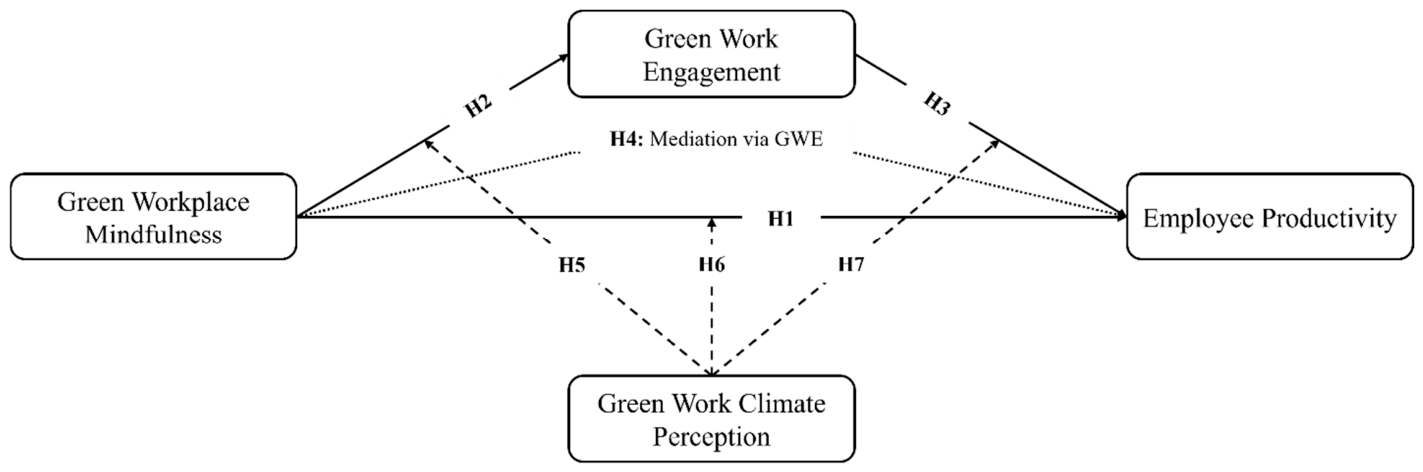
Moreover, COR theory suggests that individuals do not only protect resources but also invest them to generate future gains. Accordingly, mindfulness framed through sustainability values allows employees to reinvest conserved psychological resources into proactive engagement and productive work behaviors. Recent empirical studies support this perspective, demonstrating that mindfulness facilitates resource conservation and encourages employees to direct their psychological capacities toward meaningful and sustainable performance outcomes [41,47]. Integrating JD-R and COR therefore provides a comprehensive explanation of how sustainable productivity may emerge in healthcare organizations. JD-R explains the motivational process through which personal resources stimulate engagement and performance, while COR clarifies how mindfulness enables employees to conserve and reinvest psychological resources under demanding conditions. Based on this integrated framework, this study examines how GWM is related to EP through the mediating role of GWE and the moderating influence of green work climate (GWC) perception. By integrating personal resources, motivational processes, and contextual enablers, the proposed framework provides a multi-level explanation of how sustainable productivity may be fostered in healthcare organizations (Figure 1). The hypotheses (H1–H7) capture direct, indirect, and conditional relationships reflecting the interaction between individual behaviors and organizational contexts.

2.2. Green Workplace in the Healthcare Sector

Healthcare organizations operate in environments characterized by exceptionally high job demands, emotional intensity, and limited resources. Healthcare professionals, particularly nurses and physicians, frequently face long working hours, complex decision-making, and emotionally demanding patient interactions [48]. These pressures have intensified following the COVID-19 pandemic, which has left many healthcare systems facing workforce shortages, heightened stress levels, and increasing expectations for service quality [5]. As a result, healthcare employees must sustain productivity while managing demanding clinical responsibilities and maintaining psychological well-being. At the same time, hospitals are expected to respond to growing global calls for environmental sustainability, placing additional expectations on healthcare institutions to reduce their ecological footprint while maintaining service quality [49].
The healthcare sector is among the most resource-intensive industries, generating large volumes of medical waste and consuming substantial energy resources [50]. Consequently, many hospitals are adopting “green hospital” initiatives aimed at reducing environmental impact through waste management systems, energy-efficient infrastructure, and sustainable procurement practices [51]. Examples of such initiatives include hospital recycling programs for medical materials, energy-saving clinical equipment, sustainable procurement of medical supplies, and staff training programs designed to promote environmentally responsible workplace behavior [52,53]. These initiatives demonstrate that environmental sustainability in healthcare depends not only on organizational policies but also on employees’ awareness and daily behaviors within the workplace.
Within this context, GWM refers to employees’ mindful awareness of how their work activities affect both organizational outcomes and environmental sustainability [41]. Unlike general trait mindfulness, which primarily reflects an individual’s dispositional capacity for present-moment awareness, GWM specifically focuses on attentiveness to work tasks within an environmental and organizational sustainability context [28]. In other words, GWM emphasizes mindful attention to work processes while simultaneously recognizing their ecological implications within healthcare operations. This definition places GWM closer to organizational mindfulness as an ongoing mode of attending to consequential work activity than to a stable personal disposition [54].
Importantly, GWM is conceptually distinct from related constructs such as environmental concern and green self-efficacy [17]. Environmental concern reflects individuals’ attitudes toward environmental protection, whereas green self-efficacy represents confidence in one’s ability to perform environmentally responsible behaviors. In contrast, GWM focuses on cognitive awareness and attentional presence during work activities that involve environmental consequences [55]. Thus, GWM is best understood as a process-oriented workplace cognition: it does not capture whether employees care about the environment in general, nor whether they feel capable of acting green, but rather whether they remain attentively aware of environmental implications while carrying out their daily work. This distinction is theoretically important because attitudes, efficacy beliefs, and attentional orientations may coexist, but they do not represent the same nomological mechanism [29].
In healthcare settings, the application of GWM can manifest through routine work behaviors that integrate attentional focus with environmental responsibility. For example, healthcare professionals practicing GWM may remain attentive to reducing unnecessary medical waste, optimizing the use of disposable materials, adhering to hospital recycling protocols, or minimizing energy consumption during clinical procedures [56]. Such mindful awareness ensures that employees remain focused on patient care tasks while simultaneously supporting sustainability initiatives within the hospital environment [57]. By encouraging employees to remain attentive to both operational efficiency and ecological responsibility, GWM supports the development of sustainable productivity practices in healthcare organizations.
Furthermore, the healthcare sector provides a particularly relevant setting for examining the practical significance of GWM because of the direct consequences that employee performance has for patient safety and quality of care [58]. In highly demanding clinical environments, lapses in attention or disengagement can have immediate and serious implications for patient outcomes. Embedding GWM within hospital practices therefore has the potential to simultaneously enhance employee attentional capacity, reduce burnout, and encourage environmentally responsible behaviors that align with global sustainability standards [53]. At the same time, this context also suggests that the effects of GWM should not be assumed to be uniform across settings, because hospitals in developing and resource-constrained systems may face stronger implementation barriers than organizations operating in more stable environments [59]. In this way, GWM connects individual psychological awareness with broader organizational sustainability objectives while also remaining sensitive to the institutional realities of healthcare work.

2.3. Green Workplace Mindfulness and Employee Productivity

GWM represents employees’ capacity to maintain present-focused awareness of their tasks while simultaneously recognizing the ecological and organizational implications of their work activities [16]. Unlike traditional mindfulness, which emphasizes nonjudgmental awareness of the present moment [60], GWM integrates attentional awareness with sustainability-oriented values that guide employees to align their daily behaviors with organizational environmental objectives [59]. In healthcare settings, where accuracy, attentiveness, and responsible resource management are critical, GWM serves as an important personal resource that supports both operational efficiency and ecological responsibility. Employees who practice GWM are better able to focus on patient care tasks, minimize errors, and make environmentally responsible decisions such as reducing unnecessary medical waste and conserving energy resources during clinical operations [41].
Employee productivity in healthcare is a multidimensional construct encompassing efficiency, accuracy, and quality of service delivery. In hospital settings, productivity extends beyond simple output measures to include timely decision-making, reduced error rates, effective patient management, and sustainable use of resources [7]. However, productivity is frequently undermined by stress, fatigue, and attention fragmentation, all of which deplete employees’ psychological resources and impair performance. A growing body of empirical research demonstrates that mindfulness enhances cognitive functioning, attentional control, and emotional regulation, which are critical mechanisms underlying improved work performance. Studies have shown that employees who practice mindfulness exhibit greater task focus, improved decision-making, and higher levels of job performance compared with less mindful employees [61,62,63]. Nevertheless, most of this evidence is drawn from general organizational or non-green contexts, and only a limited number of studies have examined whether mindfulness remains equally relevant when work performance is tied to environmental responsibility and resource stewardship [28,54]. This limitation is particularly important in healthcare, where productivity pressures, patient-care demands, and environmental sustainability obligations coexist in ways not fully captured by prior mindfulness research.
From the perspective of the JD-R theory, GWM functions as a personal resource that supports motivation and buffers the negative effects of demanding work environments. In high-pressure healthcare contexts, employees frequently encounter intense workloads, emotional strain, and time pressure [30]. Mindfulness helps employees regulate their cognitive and emotional responses to these demands, allowing them to remain focused and engaged in their work tasks. Empirical evidence suggests that mindfulness contributes to higher levels of engagement, attentional stability, and work effectiveness, all of which contribute to improved productivity outcomes [62,64]. However, prior findings are not entirely uniform, as the strength of these associations appears to vary according to work context, resource availability, and organizational support [56,65,66]. This suggests that mindfulness should not be treated as a universally sufficient explanation of productivity, but rather as a resource whose value may depend on the surrounding work environment. In this way, GWM strengthens employees’ ability to sustain productive work behavior even under demanding circumstances.
Complementing this perspective, COR theory suggests that individuals seek to protect and accumulate valuable psychological resources such as energy, attention, and emotional stability [47]. Mindfulness enables employees to conserve these resources by reducing cognitive overload and emotional exhaustion, thereby preventing resource depletion. When employees maintain mindful awareness of their tasks, they allocate their cognitive resources more efficiently, which supports sustained performance and reduces productivity losses associated with stress and distraction [29]. In addition, mindfulness encourages employees to reinvest conserved resources into proactive behaviors that enhance both individual performance and organizational sustainability outcomes. In developing-country healthcare systems such as Libya, this resource-conservation logic may be especially salient because employees often operate under greater institutional pressure and more limited operational support than those studied in much of the existing literature [67,68].
Integrating these perspectives, GWM can be understood as a sustainability-oriented personal resource that is positively associated with employee productivity through improved attentional control, emotional regulation, and resource conservation. By remaining mindful of both work tasks and environmental consequences, employees may perform their duties more efficiently while simultaneously supporting organizational sustainability initiatives [41]. At the same time, the present study responds to a contextual gap in the literature by examining these relationships in a healthcare system marked by resource constraints and environmental pressure, where the productivity implications of sustainability-oriented mindfulness remain underexplored. Consequently, employees who exhibit higher levels of GWM are expected to report higher levels of productivity in healthcare settings. Therefore, the following hypothesis is proposed:
H1: 
Green workplace mindfulness positively influences employee productivity.

2.4. Green Workplace Mindfulness and Green Work Engagement

Green work engagement (GWE) extends the traditional concept of work engagement by directing employees’ vigor, dedication, and absorption toward environmentally responsible work practices [30]. Traditional work engagement refers to a positive and fulfilling work-related psychological state characterized by vigor, dedication, and absorption in work tasks [69]. However, GWE differs conceptually from general work engagement because it reflects employees’ motivation to invest their cognitive, emotional, and behavioral energy specifically in activities that support environmental sustainability within the organization [70]. While traditional engagement focuses on enthusiasm for work roles in general, GWE emphasizes employees’ active involvement in sustainability-oriented initiatives and environmentally responsible behaviors in the workplace [49]. Thus, the “green” quality of engagement lies not in greater effort alone, but in the direction of that effort toward environmental responsibility in routine organizational practice.
In healthcare organizations, this ecological dimension of engagement becomes particularly important because hospitals are resource-intensive institutions that generate substantial medical waste and consume significant energy and materials [49]. Employees who demonstrate GWE are not only dedicated to patient care but also actively support environmentally responsible practices such as waste reduction, efficient use of medical supplies, energy conservation, and adherence to hospital sustainability protocols [71,72]. In this way, GWE reflects employees’ willingness to integrate sustainability considerations into their daily professional activities while maintaining strong commitment to their organizational responsibilities. At the same time, prior studies on engagement have been conducted largely in hospitality, education, or general organizational settings, which means that the operation of GWE in healthcare, particularly in developing and resource-constrained systems, remains comparatively underexplored [30].
GWM plays an essential role in fostering such sustainability-oriented engagement. Mindfulness enhances employees’ ability to regulate attention and emotions, helping them remain present and focused even under pressure [36]. When mindfulness is framed within a sustainability perspective, employees become more attentive not only to their work tasks but also to the environmental consequences of their actions [24]. This heightened awareness enables employees to recognize the broader ecological implications of organizational activities and motivates them to align their behaviors with sustainability objectives. As a result, employees who practice GWM often experience stronger psychological meaning in their work, which enhances their intrinsic motivation and engagement [20]. Conceptually, this suggests a process in which mindfulness first sharpens attentional presence, then deepens employees’ sense of meaning in sustainability-relevant tasks, and subsequently encourages a more focused form of environmental engagement.
From the perspective of the JD-R theory, GWM functions as a personal resource that activates the motivational pathway leading to engagement. Employees who maintain mindful awareness of their work are better equipped to manage high job demands, redirect their attention toward meaningful aspects of their roles, and sustain the vigor required for engagement in demanding healthcare environments [73]. Within the framework of COR theory, GWM also helps employees conserve psychological resources by reducing stress and preventing emotional depletion [47]. By conserving these resources, employees can reinvest their energy into engagement behaviors that support both productivity and environmentally responsible organizational practices. Nevertheless, the strength of this process may vary across contexts, because mindfulness is unlikely to generate the same engagement outcomes where sustainability priorities are weak or organizational support is limited.
Empirical research supports this relationship. Mindfulness has been shown to enhance employee engagement by strengthening attentional focus, emotional regulation, and intrinsic motivation across diverse organizational settings [41]. When sustainability values are integrated into mindfulness practices, this motivational process extends beyond traditional engagement and encourages employees to actively participate in environmental initiatives within their organizations [28,57]. However, much of this evidence remains indirect, as relatively few studies have examined whether mindfulness contributes specifically to green engagement in healthcare settings. Consequently, employees who demonstrate higher levels of GWM are expected to experience stronger levels of GWE, as mindfulness helps employees connect their daily work activities with broader sustainability goals. Therefore, the following hypothesis is proposed:
H2: 
Green workplace mindfulness positively influences green work engagement.

2.5. Green Work Engagement and Employee Productivity

GWE is a motivational state characterized by vigor, dedication, and absorption in work activities, with a specific emphasis on sustainability-oriented practices [30]. In healthcare settings, engagement is essential not only for sustaining employee well-being but also for ensuring reliable, safe, and high-quality patient care. Engaged healthcare professionals are more likely to display persistence, enthusiasm, and proactive problem-solving when facing demanding clinical situations, which contributes to higher efficiency, accuracy, and service quality [7]. Unlike general work engagement, GWE reflects employees’ psychological investment in work activities that simultaneously support organizational performance and environmentally responsible practices [71,72]. By aligning personal energy with organizational sustainability initiatives, GWE encourages employees to integrate ecological awareness into their daily tasks while maintaining high levels of professional commitment [49].
From the JD-R perspective, engagement represents a key motivational pathway through which personal and job resources translate into improved performance outcomes [26]. Employees who experience strong engagement invest greater psychological energy into their work, resulting in improved focus, resilience, and productivity. When this engagement is oriented toward sustainability, employees are more likely to adopt environmentally responsible work routines, such as minimizing unnecessary resource consumption, supporting waste-reduction initiatives, and following sustainable operational procedures within healthcare facilities [30,74]. Through these behaviors, GWE contributes not only to improved individual performance but also to more efficient and responsible use of organizational resources. This point is especially relevant in healthcare because productivity is shaped not only by task speed or output, but also by accuracy, continuity of care, and disciplined use of scarce resources [66].
The COR theory further explains how engagement contributes to productivity. COR suggests that individuals seek to protect and invest valuable resources in ways that generate future gains [75]. Engagement reflects such resource investment, as employees channel their cognitive and emotional resources into task accomplishment and organizational contribution. In demanding healthcare environments, GWE enables employees to transform conserved psychological resources into productive work behaviors, such as sustained attentional focus, reduced operational errors, and consistent task completion [41]. By directing their effort toward both performance excellence and environmentally responsible practices, employees experiencing high GWE can generate productivity outcomes that are both operationally effective and environmentally sustainable. At the same time, previous research linking engagement and productivity has often focused on general work settings, so the specific contribution of green-oriented engagement to productivity in healthcare remains less established and requires stronger contextual examination [76].
Taken together, these perspectives suggest that GWE functions as an important mechanism linking employee motivation with productive performance outcomes in healthcare organizations. Engaged healthcare professionals are better equipped to cope with demanding working conditions, maintain resilience, and deliver high-quality services while supporting sustainability initiatives. In conceptual terms, once mindfulness has directed employees’ attention and meaning toward sustainability-related work, GWE represents the energized motivational state through which that awareness is translated into concrete productivity-relevant behavior. Therefore, the following hypothesis is proposed:
H3: 
Green Work Engagement positively influences Employee Productivity.

2.6. Mediating Role of Green Work Engagement

While GWM can directly enhance Employee Productivity (EP), its effects are also likely to operate indirectly through GWE. Engagement reflects the motivational pathway through which personal resources are transformed into tangible performance outcomes [26]. Employees who practice mindfulness are more capable of managing stress, sustaining attention, and aligning their daily work with sustainability values, which heightens their engagement. In this study, GWE refers specifically to engagement directed toward environmentally responsible work practices, rather than general work engagement [71]. This sustainability-oriented engagement then translates into improved productivity by enabling employees to invest their energy, focus, and dedication into work tasks that support both patient care and environmentally responsible organizational practices [49]. Thus, GWE represents a critical mediating mechanism linking GWM to sustainable productivity outcomes in healthcare. In conceptual sequence, GWM sharpens awareness, this awareness fosters sustainability-oriented meaning and attentional commitment, and GWE channels that commitment into productive work behavior.
The JD-R framework provides a strong theoretical basis for this mediation. According to JD-R, personal resources such as mindfulness trigger motivational processes that ultimately influence work outcomes [26]. GWM enhances employees’ cognitive clarity and emotional regulation, increasing their capacity to engage meaningfully with their work. When employees experience sustainability-oriented engagement, they are more likely to channel their vigor, dedication, and absorption into tasks that simultaneously improve work performance and support environmental initiatives within healthcare organizations. In turn, this engagement promotes sustained effort, attentional focus, and proactive problem-solving behaviors, which are essential for maintaining productivity in demanding healthcare environments [30]. This process is theoretically plausible, yet it remains underexamined in healthcare systems where environmental priorities compete with heavy clinical pressures and limited organizational resources.
The COR theory further explains this mediating process. COR posits that individuals invest conserved psychological resources to generate future gains [75]. By practicing GWM, employees conserve resources such as attention, emotional stability, and cognitive energy, thereby reducing resource depletion. These conserved resources can then be reinvested into engagement behaviors such as sustained effort, task focus, and proactive environmental responsibility. Through this process, mindful employees are able to translate their conserved psychological resources into engaged work behaviors that enhance both productivity and environmentally responsible performance. Over time, this cycle of resource conservation and reinvestment allows employees to maintain productivity even under demanding working conditions [36]. This COR-based explanation is particularly relevant in developing-country healthcare contexts, where employees often work under stronger resource constraints and therefore may rely more heavily on psychological resource conservation to sustain performance [77].
Empirical evidence also supports the mediating role of engagement in the mindfulness–performance relationship. Prior research demonstrates that mindfulness enhances engagement by fostering attentional focus, emotional regulation, and meaningfulness at work, which subsequently improves performance outcomes [20,41]. In sustainability-oriented contexts, engagement directed toward environmental practices has been shown to strengthen the relationship between green organizational initiatives and employee performance outcomes [78]. However, these two streams of evidence are not fully integrated in existing literature, and few studies have examined whether mindfulness contributes to productivity specifically through green-oriented engagement in healthcare organizations. Taken together, these arguments suggest that GWM enhances employee productivity indirectly by stimulating sustainability-oriented engagement among healthcare professionals. Based on this reasoning, we propose the following hypothesis:
H4: 
Green work engagement mediates the relationship between green workplace mindfulness and employee productivity.

2.7. Moderating Role of Green Work Climate Perception

GWC perception refers to employees’ shared belief that their organization values and supports environmentally sustainable practices [79]. In healthcare settings, this may include initiatives such as waste reduction programs, energy-efficient facility management, sustainable procurement policies, and environmentally responsible healthcare practices. When employees perceive that their organization prioritizes green practices, they are more likely to align their attitudes and behaviors with these values [80]. Such climates not only promote ecological responsibility but also create a supportive organizational environment that amplifies the effectiveness of personal resources such as GWM. Consequently, GWC perception is expected to strengthen the relationship between GWM and GWE by reinforcing the relevance of sustainability-oriented mindfulness within the organizational context [81,82,83].
The JD-R framework highlights the importance of organizational climate as a contextual resource that enhances the motivational potential of personal resources. When healthcare professionals perceive a strong green climate, their mindfulness practices are more likely to be recognized and supported by the organization, increasing their willingness to translate mindful awareness into engagement behaviors [26]. Conversely, in workplaces where green values are weak or absent, even mindful employees may perceive that sustainability-oriented behaviors are undervalued, which weakens the translation of mindfulness into engagement [16]. Therefore, GWC perception functions as a boundary condition that influences the strength of the relationship between GWM and GWE.
From the perspective of the COR theory, supportive organizational climates help employees protect and accumulate valuable psychological resources [49]. When employees perceive that their organization genuinely supports environmental initiatives, they experience greater alignment between personal values and organizational practices. This alignment reduces psychological tension and enables employees to invest their cognitive and emotional resources more effectively in engagement behaviors such as sustained effort, dedication, and proactive patient care. Empirical studies provide support for this moderating effect. For example, Afridi [80] demonstrated that psychological green climate strengthens the relationship between leadership and green commitment, while Yuan [84] found that green climate perceptions enhance the relationship between human resource practices and voluntary green behavior. In healthcare organizations, where sustainability and resilience are increasingly critical, a strong green climate can ensure that mindfulness practices translate more effectively into both engagement and productivity outcomes [40,85]. Based on this reasoning, the following hypotheses are proposed:
H5: 
Green work climate perception moderates the relationship between green workplace mindfulness and green work engagement, such that the relationship is stronger when green work climate perception is high.
H6: 
Green work climate perception moderates the relationship between green workplace mindfulness and employee productivity, such that the relationship is stronger when green work climate perception is high.

2.8. Moderated Mediation Effect

The preceding hypotheses established two important mechanisms. First, green work engagement mediates the relationship between green workplace mindfulness and employee productivity (H4). Second, GWC perception strengthens the relationship between GWM and GWE (H5). Taken together, these relationships suggest a moderated mediation process in which the indirect effect of GWM on EP through GWE depends on the level of GWC perception. In other words, when employees perceive a strong green organizational climate, the pathway linking mindfulness to productivity through engagement becomes stronger [86].
The JD-R theory supports this integrated perspective by emphasizing that personal and contextual resources jointly shape motivational processes. While mindfulness operates as a personal resource that encourages engagement, a green work climate functions as a contextual resource that validates and reinforces sustainability-oriented behaviors [26]. When employees perceive strong organizational support for environmental initiatives, they are more likely to channel their mindful awareness into sustainability-oriented engagement behaviors, which subsequently enhance productivity [87]. Conversely, when the perceived green climate is weak, employees may feel that environmentally responsible behaviors are undervalued, which reduces the strength of the indirect pathway between mindfulness and productivity.
The COR theory further explains this conditional process. COR suggests that individuals are more willing to invest psychological resources when they perceive that such investments will generate positive outcomes [41,75,88]. Through GWM, employees conserve cognitive and emotional resources such as attention, resilience, and psychological stability. These resources can then be reinvested into engagement behaviors that contribute to performance outcomes. A strong green climate signals that environmentally responsible engagement will be supported and rewarded, thereby strengthening the cycle of resource conservation and reinvestment that ultimately enhances productivity. In contrast, when employees perceive limited organizational support for sustainability, the motivational value of mindfulness may remain underutilized, weakening the overall indirect relationship.
Empirical research provides support for this integrated framework. Afridi [80] demonstrated that psychological green climate strengthens the relationship between leadership and green commitment. Similarly, Yuan [84] showed that green climate perceptions reinforce the link between human resource practices and voluntary green behaviors. Extending these findings to the healthcare context, the present study proposes that green work climate perception strengthens the mediating role of green work engagement, thereby amplifying the indirect effect of mindfulness on employee productivity. Based on this reasoning, the following hypothesis is proposed:
H7: 
The indirect effect of green workplace mindfulness on employee productivity via green work engagement is stronger when green work climate perception is higher.

3. Methods

3.1. Research Design and Study Context

This study adopted a quantitative, cross-sectional survey design, an approach frequently employed in healthcare management research to examine theoretically grounded relationships between workplace resources, employee attitudes, and performance outcomes [89,90]. A cross-sectional design enables researchers to capture employees’ perceptions of workplace conditions and behavioral outcomes at a specific point in time, making it suitable for testing the structural relationships proposed in the conceptual model.
The research was conducted in the Libyan healthcare sector, a context marked by significant political and economic instability since 2011, which has disrupted service delivery and intensified workforce challenges [91,92]. Once considered a model healthcare system among developing countries, Libya’s health sector has experienced increasing institutional fragmentation, resource shortages, and growing unmet treatment needs. These challenges place substantial pressure on healthcare professionals to sustain service quality and productivity under demanding working conditions.
Despite these systemic constraints, Libya continues to host several major public hospitals alongside an expanding number of private healthcare facilities. This environment provides a relevant context for examining how individual psychological resources, such as GWM, and organizational contextual factors, such as GWC perception, influence employee engagement and productivity in healthcare settings. Investigating these relationships in fragile healthcare systems contributes to extending organizational behavior and sustainability research to under-explored contexts in the Global South.

3.2. Sample and Data Collection

The study population comprised employees working in public and private hospitals across Libya, including doctors, nurses, allied health professionals, and administrative staff. Participants were required to have at least two years of professional experience to ensure familiarity with hospital operations, organizational practices, and sustainability-related initiatives [93]. Hospitals were selected to capture institutional diversity in terms of size, ownership, and specialization, including Tripoli Central Hospital (1200 beds, the largest public trauma and teaching hospital), Libyan European Hospital (150-bed private facility), Saint James Hospital (50-bed multidisciplinary hospital), Ibn Sina Cardiac Hospital (100 beds, the country’s only dedicated cardiac hospital), and the Libyan German Hospital (60-bed intensive care and surgical hospital).
According to the Libyan Ministry of Health, the country’s healthcare system comprises 96 hospitals, 25 specialized departments, 1355 medical centers, 37 clinics, and 17 quarantine departments [94,95]. Due to limited accessibility and ongoing regional instability, purposive sampling was initially employed to select 16 hospitals across Libya’s eastern, western, and southern regions to ensure representation from both public and private sectors. Within these hospitals, a non-probability convenience sampling strategy was adopted. Although convenience sampling may introduce potential self-selection bias, it is widely used in healthcare management research where institutional, logistical, and political constraints limit the feasibility of probability-based sampling methods [40]. This approach allowed access to healthcare professionals working in diverse organizational environments while maintaining practical feasibility in a fragile healthcare context [96].
Because reliable data on the total number of hospital employees were unavailable, the sample size was determined using Cochran’s formula [97], n = ( z 2 p ( 1 p ) ) / e 2 , where z = 1.96 (95% confidence level), p = 0.5 (assumed population proportion), and e = 0.05 (margin of error). The minimum required sample was approximately 385 respondents. To enhance representation and account for non-responses, 1250 questionnaires were distributed, and 473 valid responses were returned, yielding a response rate of 37.8%. This response rate falls within the commonly accepted range for organizational survey research, particularly in healthcare settings where response rates typically range between 30% and 40% [98].
Data were collected between March and May 2025 through an online survey administered with the assistance of hospital administrators who facilitated communication with potential participants. Specifically, an online survey questionnaire was administered via a Google Forms link and disseminated through the hospital’s WhatsApp group, as well as via email to all healthcare professionals. Following established survey administration practices [99], two reminder messages were sent one and two weeks after the initial invitation to improve participation rates. The final sample size exceeded the minimum threshold recommended for Structural Equation Modeling (SEM), ensuring sufficient statistical power to test the proposed mediation and moderation relationships [100].
Table 1 presents the demographic characteristics of the respondents. The sample shows balanced gender representation, with most participants aged between 25 and 44 years and holding at least a bachelor’s degree. The majority of respondents were nurses or doctors with several years of professional experience, indicating strong familiarity with hospital practices and operational routines. The distribution of participants across job roles, hospital types, and geographical regions reflects the structural composition of the Libyan healthcare workforce, supporting the contextual representativeness of the sample.

3.3. Measures

The measurement instrument was developed using validated scales from prior studies to ensure reliability and construct validity. As the research was conducted in an Arabic-speaking context, all survey items were originally developed in English and then translated into Arabic using the back-translation procedure recommended in cross-cultural research [101]. In this process, the questionnaire was first translated into Arabic by a bilingual expert and then independently translated back into English by another bilingual researcher to verify conceptual equivalence between the two versions. This approach helps minimize translation bias and ensures that the meaning of the original items is preserved across languages.
To further strengthen content validity, a pilot test involving 30 healthcare employees in Libya—who shared similar characteristics with the target population but were not included in the final sample—was conducted. Feedback obtained through two rounds of pretesting was used to improve wording clarity and contextual relevance of several questionnaire items. This pilot testing process ensured that respondents clearly understood the survey questions and that the measurement items accurately captured the intended constructs within the Libyan healthcare context.
All study variables were measured using multi-item reflective scales rated on a five-point Likert scale ranging from 1 (“strongly disagree”) to 5 (“strongly agree”), a format widely used in organizational research because it improves response variability and reduces central tendency bias [90]. Employee Productivity (EP) was measured using a ten-item scale adapted from Hanaysha [102] and Kassa and Worku [103], capturing dimensions such as task accomplishment, efficiency, work quality, and organizational commitment. Green Work Engagement (GWE) was measured using six items adapted from Aboramadan [104], Noor Faezah et al. [105], and Tran [106], reflecting vigor, absorption, and dedication toward environmentally responsible work activities.
Green Workplace Mindfulness (GWM) was assessed using six items adapted from Chen et al. [17] and Xu and Li [107], which capture employees’ attentiveness to environmental issues, openness to discussing ecological concerns, and proactive sharing of environmental information within the workplace. Green Work Climate (GWC) perception was measured using eight items adapted from Norton et al. [108] and Housheya and Atikbay [88], reflecting employees’ perceptions of organizational environmental commitment and co-workers’ environmentally responsible behaviors. Using established measurement scales improves construct validity and allows meaningful comparison with prior studies in organizational behavior and sustainability research.

3.4. Data Analysis

This study employed Partial Least Squares Structural Equation Modeling (PLS-SEM) using SmartPLS version 4.1.0.9 to test the hypothesized relationships, while SPSS version 25.0 was used to compute descriptive statistics and summarize respondents’ demographic characteristics. PLS-SEM was selected because of its predictive and explanatory orientation, its robustness in testing mediation and moderation relationships, and its suitability for complex research models involving multiple latent constructs [100,109]. Unlike covariance-based structural equation modeling, PLS-SEM does not require strict data normality assumptions and is therefore appropriate for prediction-oriented studies in organizational and management research [110].
Following established analytical guidelines [100], the analysis proceeded in two stages. First, the measurement model was evaluated to assess indicator reliability, internal consistency reliability, convergent validity, and discriminant validity. Indicator reliability was assessed using outer loadings, internal consistency reliability using composite reliability values, and convergent validity using the average variance extracted (AVE). Discriminant validity was examined using the Fornell–Larcker criterion and the heterotrait–monotrait (HTMT) ratio.
Second, the structural model was analyzed to test the hypothesized relationships among the study variables. Path coefficients, coefficient of determination (R2), and predictive relevance were evaluated to determine the explanatory power of the model. To assess the statistical significance of the hypothesized relationships, a bootstrapping procedure in SmartPLS version 4.1.0.9 with 5000 resamples was applied to generate standard errors, t-values, and confidence intervals [111]. This procedure enabled a rigorous examination of the direct, mediating, moderating, and moderated mediation relationships proposed in the research framework.

3.5. Common Method Bias

In survey-based research, common method variance (CMV)—also referred to as common method bias (CMB)—represents the spurious variance that arises from the measurement method rather than from the constructs under investigation. Such variance may artificially inflate or distort observed relationships between variables when data are collected from the same respondents using a single instrument [90]. To minimize this potential risk, several procedural remedies were implemented during the design and administration of the survey. Specifically, participants were assured of anonymity and confidentiality and were encouraged to provide honest responses without fear of evaluation or reprisal. These procedures reduce respondents’ evaluation apprehension and help limit socially desirable responding, thereby mitigating potential method bias [112]. In addition, all questionnaire items were adapted from previously validated scales and were carefully pretested to ensure clarity and contextual appropriateness, reducing ambiguity and improving measurement accuracy.
To statistically assess the potential presence of CMV, both traditional and complementary diagnostic tests were conducted. First, Harman’s single-factor test was performed by loading all measurement items into an exploratory factor analysis. The results indicated that the largest factor explained 33.47% of the total variance, which is below the commonly accepted threshold of 50%. This finding suggests that a single dominant factor does not account for the majority of covariance among the measures, indicating that CMV is unlikely to represent a serious threat to the validity of the results [90].
However, because Harman’s test alone may not provide a sufficiently rigorous assessment, an additional statistical procedure suitable for variance-based structural equation modeling was also applied. Specifically, the full collinearity variance inflation factor (VIF) approach recommended by Kock [113] was used. Following the “random dependent variable” technique, a randomly generated categorical variable (0–1) was introduced into the model as an endogenous construct. The resulting VIF values ranged from 1.113 to 2.093, which are well below the conservative threshold of 3.3. According to Kock [113], VIF values below this threshold indicate that common method bias is unlikely to contaminate the model estimates.
Taken together, both the procedural remedies implemented during the survey design and the statistical diagnostics applied during the analysis provide strong evidence that common method bias does not pose a significant threat to the validity of the study’s findings.

4. Results

4.1. Measurement Model Assessment

The measurement model was evaluated to ensure the reliability and validity of the constructs before examining the structural relationships. Following established guidelines in PLS-SEM [100,109], the evaluation included indicator reliability, internal consistency reliability, convergent validity, and discriminant validity.
As shown in Table 2, the factor loadings ranged from 0.617 to 0.890. Although the commonly recommended threshold for indicator loadings is 0.70, loadings between 0.60 and 0.70 are considered acceptable in exploratory or early-stage research when other reliability indicators meet the required thresholds [100,110]. Accordingly, the items GWE5 (0.617) and GWC5 (0.617) were retained because the constructs demonstrated satisfactory composite reliability and convergent validity.
During the evaluation process, item GWC2 was removed due to its low loading, which fell below the acceptable threshold and reduced the construct’s reliability. Removing this item improved the internal consistency and validity of the green work climate construct. After deletion, the remaining indicators showed satisfactory loadings and contributed positively to the measurement model.
Internal consistency reliability was assessed using Cronbach’s alpha and composite reliability. The Cronbach’s alpha values ranged between 0.792 and 0.894, while the composite reliability values ranged from 0.795 to 0.897, both exceeding the recommended threshold of 0.70 [100,114]. These results confirm that the constructs exhibit strong internal consistency reliability.
Convergent validity was assessed using the average variance extracted (AVE). The AVE values ranged from 0.591 to 0.650, exceeding the recommended threshold of 0.50, which indicates that each construct explains more than half of the variance of its indicators [115]. Although the AVE value for the green work climate construct (0.591) is relatively close to the minimum acceptable threshold, it remains within the acceptable range suggested in PLS-SEM literature, confirming adequate convergent validity [100].
Multicollinearity was examined using the variance inflation factor (VIF). As reported in Table 2, all VIF values were below 3.3, indicating that multicollinearity was not a concern in the measurement model [113].
Model fit was further examined using global fit indices for the saturated model. The Chi-square value (χ2 = 1046.289), Normed Fit Index (NFI = 0.954), and Standardized Root Mean Square Residual (SRMR = 0.060) all met the recommended threshold values (NFI > 0.90; SRMR < 0.08), indicating an acceptable overall model fit [116,117].
Discriminant validity was assessed using both the Fornell–Larcker criterion and the heterotrait–monotrait (HTMT) ratio [118]. As reported in Table 3, all HTMT values ranged between 0.553 and 0.642, which are below the conservative threshold of 0.85, indicating that each construct is empirically distinct from the others [118]. These findings confirm that the measurement model demonstrates satisfactory reliability, convergent validity, and discriminant validity, thereby supporting the suitability of the constructs for structural model evaluation.

4.2. Structural Model Assessment

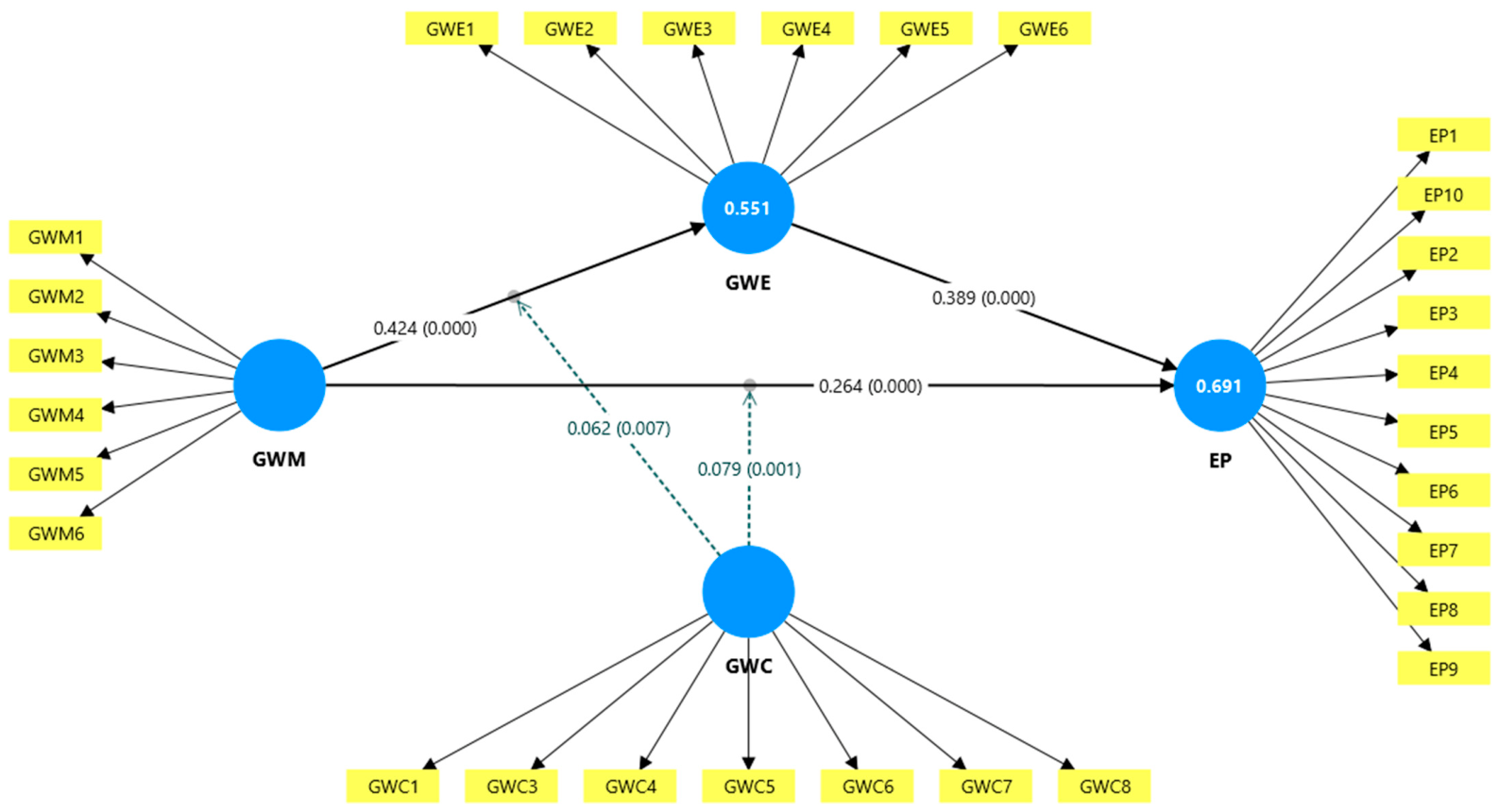
The structural model in PLS-SEM was evaluated to examine the hypothesized relationships among the constructs in the proposed framework. At this stage, path analysis was used to estimate the strength and direction of the relationships between the variables, alongside assessments of model fit, collinearity, and predictive power [109]. As shown in Table 4 and Figure 2, all variance inflation factor (VIF) values were below the recommended threshold of 3.3, indicating that multicollinearity was not a concern among the constructs [113]. The estimated model demonstrated satisfactory overall fit, as reflected by the Chi-Square value (χ2 = 1025.238), Normed Fit Index (NFI = 0.959), and Standardized Root Mean Square Residual (SRMR = 0.062), all of which fall within the acceptable threshold ranges (NFI > 0.90; SRMR < 0.08) recommended for variance-based structural equation modeling [116]. Furthermore, the R2 values for the endogenous constructs—green work engagement (R2 = 0.551) and employee productivity (R2 = 0.691)—indicate moderate explanatory power, while the Q2 values ranging between 0.536 and 0.601 suggest strong predictive relevance of the model [110].
Because the study employs a cross-sectional research design, the reported relationships should be interpreted as statistical associations rather than causal effects. Accordingly, the results are described in terms of relationships between constructs rather than causal influence [119,120].
The results of the bootstrapping procedure with 5000 resamples revealed that the hypothesized relationships were statistically significant. First, green workplace mindfulness was positively associated with employee productivity (β = 0.264, p < 0.001, f2 = 0.101, CI [0.161, 0.369]), providing support for H1. Similarly, green workplace mindfulness was positively related to green work engagement (β = 0.424, p < 0.001, f2 = 0.218, CI [0.308, 0.531]), supporting H2. The results further indicate that green work engagement was positively associated with employee productivity (β = 0.389, p < 0.001, f2 = 0.220, CI [0.278, 0.490]), thereby supporting H3.
Regarding the mediation analysis (H4), the results indicate that green work engagement statistically mediated the relationship between green workplace mindfulness and employee productivity (β = 0.165, p < 0.001, CI [0.096, 0.236]). This finding suggests that higher levels of green workplace mindfulness are associated with stronger green work engagement, which in turn is associated with higher levels of employee productivity.
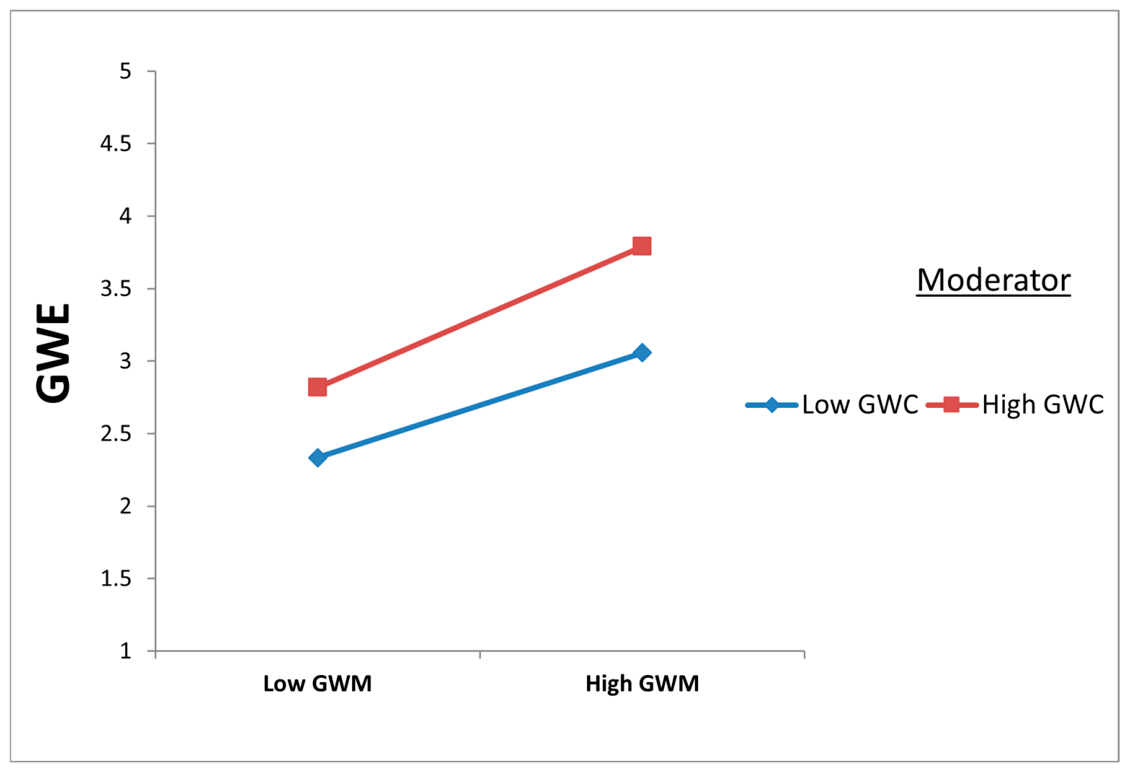
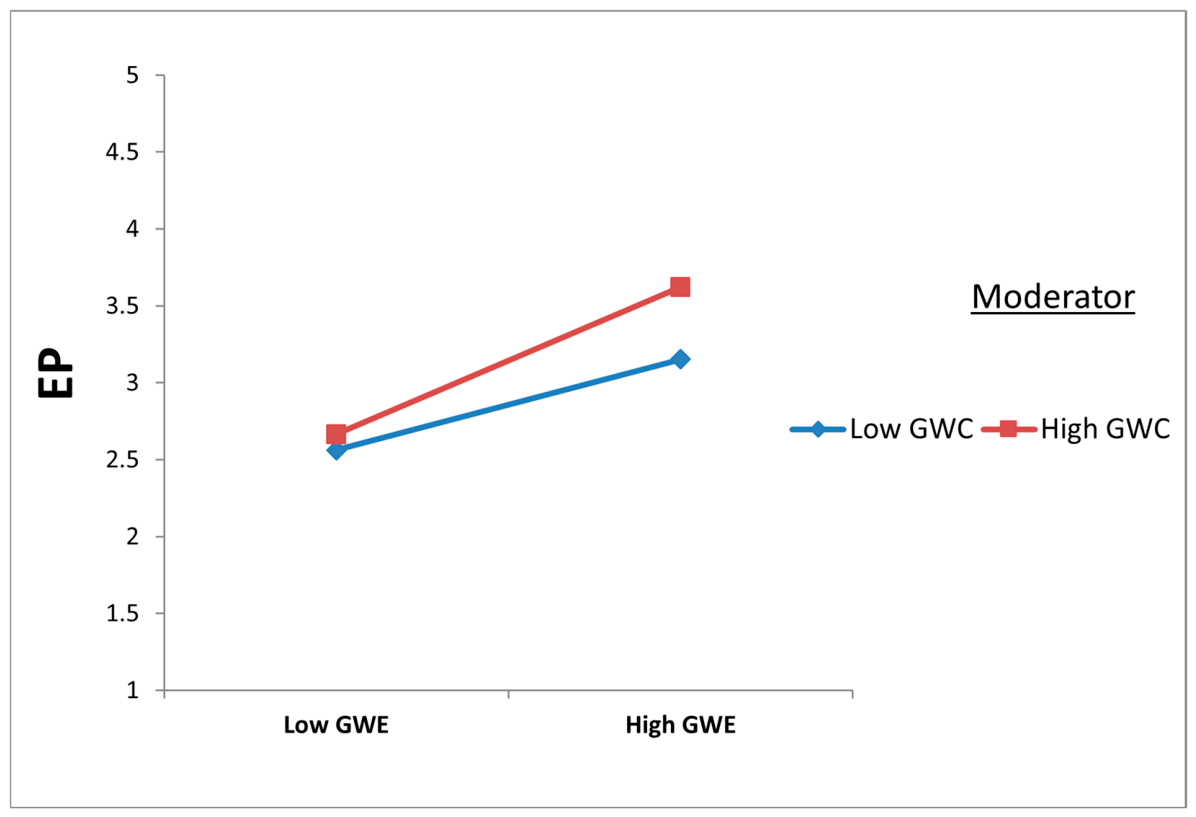
Moderation effects were tested using the product indicator interaction approach in PLS-SEM [121,122], with significance evaluated through the bootstrapping procedure. The results for H5 show that green work climate perception moderated the relationship between green workplace mindfulness and green work engagement (β = 0.062, p = 0.007, f2 = 0.031, CI [0.035, 0.125]). Although the effect size of the moderating relationship is relatively small (f2 = 0.031), it remains statistically significant and indicates that the strength of the association between mindfulness and engagement varies depending on employees’ perceptions of the organizational green climate. As illustrated in Figure 3, the positive association between green workplace mindfulness and green work engagement becomes stronger when green work climate perception is higher.
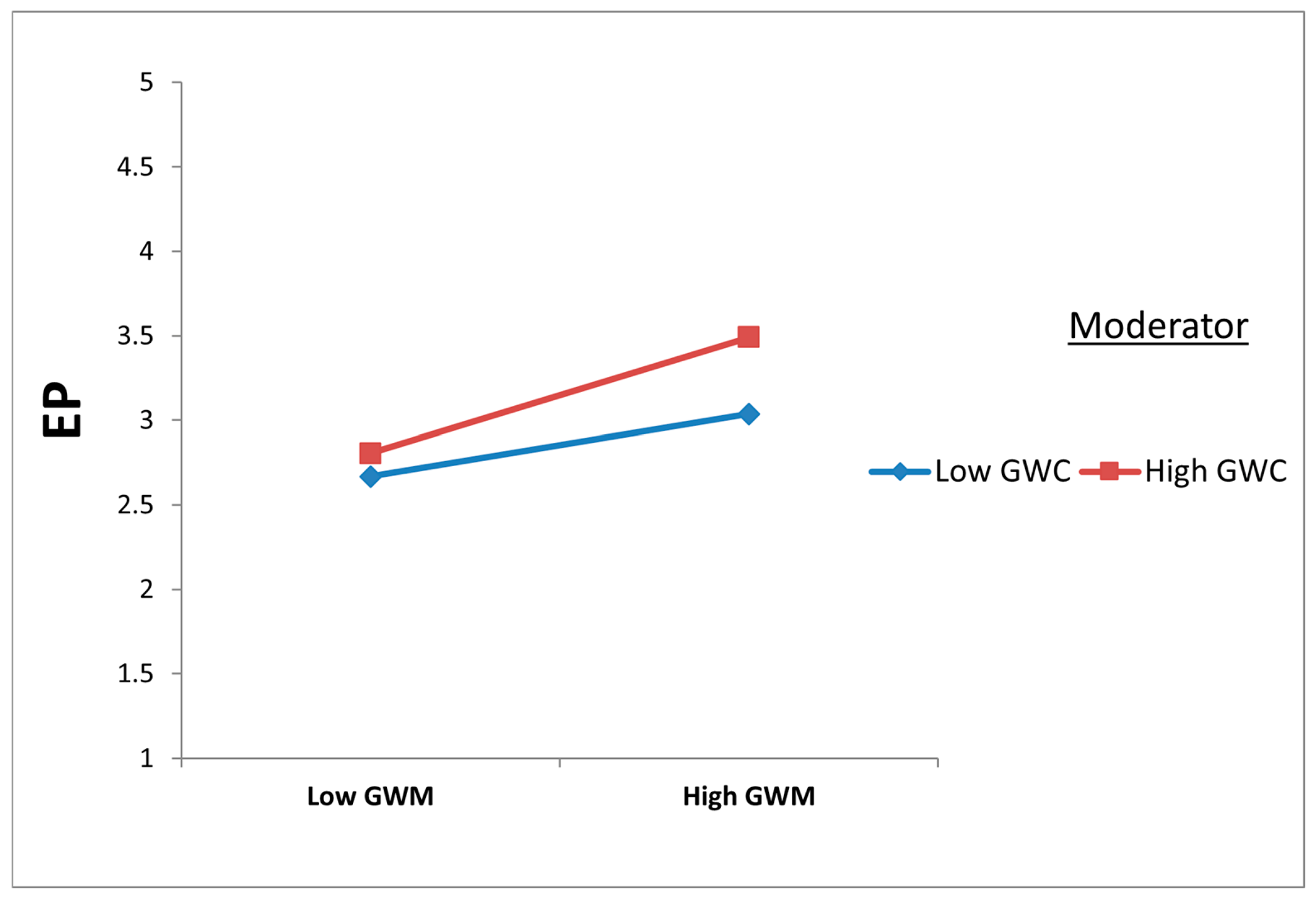
Finally, the moderation results for H6 indicate that green work climate perception also moderated the association between green workplace mindfulness and employee productivity (β = 0.079, p = 0.001, f2 = 0.073, CI [0.048, 0.144]). This finding suggests that employees who perceive a stronger organizational green climate exhibit a stronger relationship between mindfulness and productivity. As shown in Figure 4, the positive association between green workplace mindfulness and employee productivity is more pronounced under conditions of higher green work climate perception.

4.3. Moderated Mediation Analysis

To examine Hypothesis 7, which proposed that the indirect relationship between green workplace mindfulness (GWM) and employee productivity (EP) through green work engagement (GWE) would vary depending on the level of green work climate (GWC) perception, a moderated mediation analysis was conducted. The analysis followed the bootstrapping procedure with 5000 resamples and bias-corrected 95% confidence intervals, as recommended by Hayes [123]. As shown in Table 5, the analysis employed PROCESS macro Model 14 [124] to simultaneously estimate the mediating and moderating mechanisms within a conditional process framework. This approach enables the estimation of indirect effects at different levels of the moderator while avoiding strict distributional assumptions. However, because the data are cross-sectional, the resulting indirect effects should be interpreted as statistical estimates of co-variation among the study variables rather than as direct evidence of a temporal or causal process [119,120].
The results revealed a significant moderated mediation index of 0.147 (95% CI [0.071, 0.251]), indicating that the indirect association between GWM and EP through GWE varies depending on employees’ perceptions of the green work climate. More specifically, the conditional indirect effect of GWM on EP through GWE was statistically significant at high levels of GWC perception (+1 SD; β = 0.232, 95% CI [0.148, 0.320]), whereas the indirect effect was not statistically significant at low levels of GWC perception (−1 SD; β = 0.117, 95% CI [−0.037, 0.192]). These findings therefore suggest a conditional pattern of association that is consistent with moderated mediation, rather than demonstrating a psychological sequence unfolding over time. These findings indicate that the mediating role of green work engagement becomes meaningful primarily when employees perceive a stronger organizational green climate. Under lower levels of green climate perception, the indirect relationship between mindfulness and productivity becomes weaker and statistically non-significant. As illustrated in Figure 5, the conditional process plot further supports this pattern by showing that higher levels of GWC perception strengthen the positive association between green workplace mindfulness and green work engagement, which is subsequently associated with higher levels of employee productivity. Taken together, these results provide partial support for H7, indicating that the indirect association between green workplace mindfulness and employee productivity through green work engagement depends on the level of green work climate perception.

5. Discussion and Implications

5.1. Discussion of Key Findings

This study examined the relationships between green workplace mindfulness (GWM), green work engagement (GWE), green work climate (GWC) perception, and employee productivity (EP) in the Libyan healthcare sector. Overall, the findings provide support for most of the proposed hypotheses (H1–H6), while H7 received partial support depending on the level of green work climate perception. Given the cross-sectional nature of the data, the results should be interpreted as associations rather than causal relationships. These findings contribute to the growing literature on sustainable workplace practices by demonstrating how environmental awareness, employee engagement, and organizational climate are associated with productivity outcomes in healthcare organizations.
Regarding H1, the findings indicate that green workplace mindfulness is positively associated with employee productivity. This result suggests that healthcare employees who report greater awareness of environmental sustainability practices also tend to report higher levels of productivity. This interpretation is consistent with prior research indicating that mindfulness is related to improved attentional regulation, emotional stability, and adaptive performance in demanding work environments such as healthcare [20,36,42]. Within the Libyan healthcare context, where employees frequently experience high workloads and workplace stress, mindfulness may function as a psychological resource that helps employees maintain focus and emotional balance while performing their professional duties. From the perspective of Conservation of Resources (COR) theory, mindfulness can serve as a personal resource that enables individuals to conserve psychological energy and maintain effective work functioning [29,33,35]. These findings are also consistent with broader research suggesting that mindfulness-based awareness contributes to improved employee functioning and performance outcomes in organizational contexts [61,62].
The findings related to H2 and H3 highlight the motivational role of green work engagement. The results indicate that green workplace mindfulness is positively related to green work engagement and that green work engagement is positively associated with employee productivity. These results suggest that employees who demonstrate stronger awareness of sustainability practices tend to experience higher levels of vigor, dedication, and involvement in environmentally responsible work activities [125]. Moreover, the findings support H4, indicating that green work engagement functions as a mediating mechanism linking mindfulness and productivity. More precisely, the bootstrapped indirect effect for H4 should be interpreted as a pattern of co-variation consistent with mediation, rather than as direct evidence of a psychological mechanism unfolding over time. This pattern is consistent with the JD-R theory, which proposes that personal resources stimulate motivational processes that enhance work engagement and subsequent performance outcomes [26]. Employees who feel psychologically connected to sustainability values may experience stronger motivation and commitment toward their work roles, which is associated with improved productivity outcomes [7,30]. These results are consistent with earlier research indicating that engagement acts as a key mechanism linking personal resources with performance-related outcomes [126]. At the same time, the present data do not establish temporal ordering among mindfulness, engagement, and productivity, and therefore the mediation finding should be understood as analytically suggestive rather than process-confirming.
The results further support H5 and H6 concerning the moderating role of green work climate perception. Specifically, the findings indicate that green work climate perception strengthens the association between green workplace mindfulness and green work engagement and also strengthens the association between green workplace mindfulness and employee productivity. In practical terms, these results suggest that the relationships between mindfulness and employee outcomes become stronger when employees perceive that their organization supports environmentally responsible practices. When healthcare organizations promote sustainability-oriented values and environmental responsibility, employees may perceive greater alignment between their personal environmental values and organizational priorities [79,80]. From a JD-R perspective, such organizational climates represent contextual resources that reinforce the motivational influence of personal resources such as mindfulness [26]. These findings are also consistent with research suggesting that pro-environmental organizational climates play a critical role in encouraging employee engagement in sustainability-related activities [88,108].
Finally, the results related to H7 indicate partial support for the proposed moderated mediation relationship. The analysis shows that the indirect association between green workplace mindfulness and employee productivity through green work engagement was statistically significant only when green work climate perception was high, whereas the indirect effect was not statistically significant when the perception of green work climate was low. As with H4, this conditional indirect effect should be interpreted as evidence of differential co-variation across levels of green work climate perception, not as proof of a sequential causal process. This finding indicates that the mediating role of engagement operates more strongly in organizational contexts where employees perceive strong environmental support. Consequently, H7 is only partially supported, as the conditional indirect relationship emerges primarily under conditions of a supportive green work climate. This pattern suggests that mindfulness alone may not be sufficient to generate strong engagement-based productivity outcomes unless employees also perceive organizational support for sustainability practices. These findings are consistent with prior research emphasizing the importance of organizational climate in shaping employee engagement in environmental initiatives [41,84].
Overall, the results suggest that green workplace mindfulness, green work engagement, and green work climate perception represent interconnected factors associated with employee productivity in healthcare organizations. By integrating insights from COR and JD-R theories, this study contributes to the literature on sustainable human resource management by illustrating how individual psychological resources and organizational environmental climates jointly relate to employee outcomes. These findings highlight the importance of cultivating both individual sustainability awareness and supportive organizational climates to encourage environmentally responsible behavior and productive work practices in healthcare institutions.

5.2. Theoretical Contributions

This study makes several important theoretical contributions to the growing literature on sustainable human resource management and green organizational behavior. First, it extends the JD-R theory [26] by introducing GWM as a sustainability-oriented personal resource that is associated with employee engagement and productivity. Traditional JD-R research has primarily focused on cognitive, emotional, and social resources that help employees cope with job demands. However, relatively limited attention has been given to psychological resources that originate from environmental awareness and sustainability values [127]. By conceptualizing green workplace mindfulness as a sustainability-related personal resource that promotes attentional focus, emotional balance, and environmental awareness, this study broadens the theoretical scope of JD-R to incorporate sustainability-oriented psychological mechanisms [36,42]. The findings suggest that mindfulness rooted in environmental awareness may function as a resource that helps employees remain attentive and engaged while performing sustainability-related work tasks.
Second, this study advances COR theory [33,45] by demonstrating how sustainability-oriented mindfulness may support the preservation and investment of psychological resources in demanding work environments. COR theory proposes that individuals seek to obtain, retain, and protect valuable resources in order to maintain well-being and performance [29]. In this study, green workplace mindfulness is associated with employees’ ability to preserve attentional focus, emotional stability, and psychological energy, which are important resources in high-pressure professional contexts such as healthcare. The results further suggest that employees who maintain higher levels of mindfulness toward sustainability practices tend to report stronger work engagement, which represents a potential resource gain process [36,47]. In this way, the findings extend COR theory by highlighting how sustainability-oriented psychological awareness may be linked to both resource conservation and engagement-related resource investment [35,41].
Third, this study contributes to the green organizational behavior literature by clarifying the mechanisms through which individual and organizational sustainability factors are associated with employee outcomes. Specifically, the findings highlight the mediating role of GWE and the moderating role of GWC perception in shaping the relationship between mindfulness and productivity. This framework demonstrates that sustainability-related employee behaviors emerge from the interaction between individual psychological awareness and organizational environmental support [30,88]. In other words, when employees perceive that their organization promotes environmentally responsible practices, the positive association between mindfulness and engagement becomes stronger [80,84]. By integrating these mechanisms, the study provides a clearer explanation of how JD-R and COR perspectives jointly explain sustainability-related employee behavior [31].
Finally, this study contributes to theory by examining these relationships within the healthcare sector, which remains relatively underexplored in sustainability-oriented organizational research. Healthcare organizations are characterized by high job demands, emotional labor, and resource constraints [128,129], making them an important context for examining how psychological and organizational resources interact. By validating the proposed framework in this demanding environment, the study demonstrates that sustainability-oriented psychological resources such as mindfulness may be relevant for understanding employee engagement and productivity in high-pressure service sectors. Consequently, this research extends sustainability management theory by illustrating how individual awareness, engagement mechanisms, and organizational climate conditions jointly relate to environmentally responsible and productive work behaviors.

5.3. Practical Implications

The findings of this study provide several practical implications for government authorities, hospital administrators, and healthcare professionals seeking to improve productivity while promoting environmentally responsible healthcare practices. In practical terms, GWM refers to employees’ awareness of how their daily clinical activities affect environmental resources—for example, being attentive to waste reduction, responsible use of medical supplies, and energy conservation in hospital operations. Encouraging such awareness can help healthcare organizations simultaneously improve operational efficiency and environmental sustainability.
First, hospital administrators can promote green workplace mindfulness by introducing simple and cost-effective sustainability practices within daily healthcare routines. For example, hospitals can implement waste-segregation systems for medical materials, encourage responsible use of disposable equipment, and promote energy-saving behaviors such as switching off unused devices or optimizing lighting and ventilation systems. Short training workshops or staff briefings can also be used to raise awareness about environmentally responsible clinical practices without requiring large financial investments, which is particularly important in resource-constrained healthcare systems such as those in Libya.
Second, the findings highlight the importance of green work engagement, which reflects employees’ psychological involvement in environmentally responsible work activities. Healthcare managers can strengthen such engagement by integrating sustainability objectives into staff training, job roles, and recognition systems. For instance, hospitals may recognize employees who propose waste-reduction ideas, participate in recycling initiatives, or identify ways to reduce unnecessary medical supply consumption. Creating small “green teams” within hospital departments can also encourage staff participation in sustainability initiatives, helping employees feel personally involved in improving hospital practices.
Third, the study emphasizes the importance of green work climate perception, which refers to employees’ perceptions that their organization genuinely supports environmentally responsible practices. Hospital leadership can strengthen this climate by establishing visible environmental policies and communicating sustainability goals clearly to staff. Practical initiatives may include sustainable procurement policies, hospital recycling programs, reduced use of paper documentation through digital records, and campaigns encouraging efficient water and electricity use. Even small actions, such as posting sustainability reminders in clinical areas or including environmental goals in staff meetings, can help reinforce the perception that environmental responsibility is part of the organization’s culture.
Fourth, the findings also have implications for national healthcare policymakers in Libya. Government health authorities can support sustainability transitions by encouraging hospitals to adopt “green hospital” guidelines that integrate environmental responsibility into healthcare management. This may involve developing national sustainability standards for hospitals, providing training programs on environmentally responsible healthcare management, and encouraging hospitals to monitor resource consumption such as energy, water, and medical waste. Such initiatives can improve resource efficiency and reduce operational costs, which is particularly valuable in healthcare systems facing financial and infrastructure constraints.
Finally, the study highlights the important role of healthcare employees themselves in supporting environmentally responsible practices. Doctors, nurses, and hospital staff can contribute by adopting mindful daily practices such as minimizing unnecessary resource use, participating in hospital sustainability initiatives, and sharing ideas for improving environmental efficiency in clinical procedures. Encouraging open communication channels where employees can propose sustainability improvements may help hospitals identify practical solutions that improve both environmental performance and operational productivity.
Overall, the findings suggest that improving environmental awareness, engagement, and organizational support for sustainability can help healthcare institutions strengthen employee productivity while promoting responsible resource use. By adopting practical and low-cost sustainability initiatives, hospitals in Libya can begin implementing environmentally responsible practices even within limited resource conditions.

5.4. Limitations and Future Research Directions

This study provides useful insights into the relationships between GWM, GWE, GWC perception, and employee productivity in the healthcare sector; however, several limitations should be acknowledged. First, the study employed a cross-sectional research design, which limits the ability to draw causal conclusions from the observed relationships. Therefore, the findings should be interpreted as associations rather than cause-and-effect relationships. Future research should consider longitudinal or experimental research designs to better examine how sustainability-oriented workplace practices evolve over time and how they are associated with employee outcomes. This limitation applies not only to the direct relationships but also to the indirect effects reported in the study. In particular, the bootstrapped mediation estimate (β = 0.165, p < 0.001) should be understood as an estimate of co-variation patterning among mindfulness, engagement, and productivity rather than as conclusive evidence of a psychological process unfolding over time. Accordingly, the mediation and moderated mediation findings should be interpreted with epistemological caution, because cross-sectional mediation does not establish temporal sequencing or analytical validity for process claims. Second, the study relied on self-reported data collected through questionnaires, which may introduce common method bias despite the procedural and statistical controls applied in this research. Future studies may improve measurement validity by incorporating multiple data sources, such as supervisor evaluations, objective productivity indicators, or environmental performance metrics.
Third, the study used a convenience sampling approach and was conducted exclusively in Libya between March and May 2025, which may limit the generalizability of the findings. Libya’s healthcare sector operates under unique economic, institutional, and infrastructural conditions, including ongoing recovery from political instability and limited healthcare resources. As a result, the findings should be interpreted cautiously when applied to other national or institutional contexts. Future research should therefore conduct comparative studies across multiple countries or healthcare systems to determine whether the observed relationships remain consistent in different cultural and institutional environments. Additionally, future studies could extend the model by examining other relevant theoretical perspectives—such as Self-Determination Theory or Green Human Resource Management frameworks—to further explain how sustainability-oriented psychological resources relate to employee outcomes. Expanding research to include additional organizational outcomes such as innovation, quality of patient care, or environmental performance would also contribute to a more comprehensive understanding of sustainability practices in healthcare organizations.

6. Conclusions

This study provides an integrated understanding of the relationships between green workplace mindfulness, green work engagement, green work climate perception, and employee productivity in the Libyan healthcare sector. The findings suggest that employees who report stronger mindfulness toward environmentally responsible practices also tend to report higher levels of engagement and productivity. In addition, the results indicate that a supportive environmental workplace climate strengthens these relationships, highlighting the importance of organizational context in promoting sustainability-oriented work behaviors. Drawing on JD-R and COR perspectives, the study demonstrates that sustainability-related psychological awareness can function as a valuable personal resource that is associated with employee motivation, engagement, and productive work outcomes in healthcare settings.
The study also highlights the broader importance of developing organizational environments that support environmentally responsible work practices. Healthcare organizations that encourage sustainability awareness, promote engagement in environmentally responsible activities, and communicate clear environmental goals may create conditions that support both employee well-being and operational effectiveness. Although the findings are based on the Libyan healthcare sector, they provide useful insights for organizations seeking to integrate sustainability into workplace practices. Future research should continue to examine sustainability-oriented workplace behavior using longitudinal designs and cross-country comparisons to better understand how environmental awareness, employee engagement, and organizational climate interact across different institutional contexts.

Author Contributions

Conceptualization, R.E.A.; supervision, S.M.; project administration, A.A. and S.M.; Validation, R.E.A. and A.A.; Writing—original draft, R.E.A.; Writing—review and editing, R.E.A. and S.M. All authors have read and agreed to the published version of the manuscript.

Funding

This research received no external funding.

Institutional Review Board Statement

This study was conducted in accordance with the Declaration of Helsinki and received ethical approval from the Cyprus Health and Social Sciences University Institutional Review Board.

Informed Consent Statement

All participants in this study provided their informed consent.

Data Availability Statement

The data from this study can be requested from the corresponding author, Ryad Ehmouda Alghwail.

Conflicts of Interest

The authors report no conflicts of interest.

References

  1. Hill, J.E.; Harris, C.; Danielle, L.C.; Boland, P.; Doherty, A.J.; Benedetto, V.; Gita, B.E.; Clegg, A.J. The Prevalence of Mental Health Conditions in Healthcare Workers during and after a Pandemic: Systematic Review and Meta-Analysis. J. Adv. Nurs. 2022, 78, 1551–1573. [Google Scholar] [CrossRef] [Scilit] [PubMed]
  2. Selvakumar, P.; Muralidharan, V.; Kumar, G.S.; Kumar, D.S.; Anand, T.; Manjunath, T.C. Reducing the Carbon Footprint in Healthcare. J. Environ. Nanotechnol. 2025, 14, 453–463. [Google Scholar] [CrossRef] [Scilit]
  3. Bobini, M.; Cicchetti, A. Chasing Environmental Sustainability in Healthcare Organizations: Insights from the Italian Experience. BMC Health Serv. Res. 2025, 25, 978. [Google Scholar] [CrossRef] [Scilit]
  4. Chemkomnerd, N.; Pannakkong, W.; Tanantong, T.; Huynh, V.-N.; Karnjana, J. A Scenario-Driven Simulation Approach to Sustainable Hospital Resource Management: Aging Society, Pandemic Preparedness and Referral Enhancement. BMC Health Serv. Res. 2025, 25, 982. [Google Scholar] [CrossRef] [Scilit] [PubMed]
  5. Hur, W.-M.; Shin, Y.; Kim, J.Y. Service Employees’ Mindfulness and Job Crafting amid COVID-19: The Roles of Resilience, Organizational Health Climate, and Health-Oriented Leadership. Curr. Psychol. 2024, 43, 16979–16991. [Google Scholar] [CrossRef] [Scilit]
  6. Yang, S.; Tian, L.; Fan, J.; Wu, Y.; Li, S.; Yu, M.; Liu, Y. A Qualitative Research Exploring Clinical Nurses’ Experience with Nurse Employee Assistance Program Promoted by Hospitals in China. BMC Nurs. 2025, 24, 1137. [Google Scholar] [CrossRef] [Scilit]
  7. Abdelwahed, N.A.A.; Doghan, M.A.A. Developing Employee Productivity and Performance through Work Engagement and Organizational Factors in an Educational Society. Societies 2023, 13, 65. [Google Scholar] [CrossRef] [Scilit]
  8. Yu, J.; Liu, Z.; Zhang, T.; Hatab, A.A.; Lan, J. Measuring Productivity of Healthcare Services under Environmental Constraints: Evidence from China. BMC Health Serv. Res. 2020, 20, 673. [Google Scholar] [CrossRef] [Scilit]
  9. Yang, Z.; Solangi, Y.A. Analyzing the Relationship between Natural Resource Management, Environmental Protection, and Agricultural Economics for Sustainable Development in China. J. Clean. Prod. 2024, 450, 141862. [Google Scholar] [CrossRef] [Scilit]
  10. Brown, K.W.; Ryan, R.M. The Benefits of Being Present: Mindfulness and Its Role in Psychological Well-Being. J. Personal. Soc. Psychol. 2003, 84, 822–848. [Google Scholar] [CrossRef] [Scilit]
  11. Lustig, J.; Cardaciotto, L.; Moon, S.; Spokas, M. Conceptualizations of Mindfulness Among Experienced Practitioners. Mindfulness 2024, 15, 819–834. [Google Scholar] [CrossRef] [Scilit]
  12. Gip, H.; The Khoa, D.; Guchait, P.; Fernando Garcia, R.L.; Pasamehmetoglu, A. Employee Mindfulness and Creativity: When Emotions and National Culture Matter. Serv. Ind. J. 2022, 42, 383–411. [Google Scholar] [CrossRef] [Scilit]
  13. Wang, X.; Wen, X.; Paşamehmetoğlu, A.; Guchait, P. Hospitality Employee’s Mindfulness and Its Impact on Creativity and Customer Satisfaction: The Moderating Role of Organizational Error Tolerance. Int. J. Hosp. Manag. 2021, 94, 102846. [Google Scholar] [CrossRef] [Scilit]
  14. Gomez-Olmedo, A.M.; Aranega, A.Y.; Berenguer, K.U. Mindfulness and Sustainable Consumption: A Bibliometric and Systematic Literature Review of Empirical Findings. | EBSCOhost. Available online: https://openurl.ebsco.com/contentitem/gcd:177686159?sid=ebsco:plink:crawler&id=ebsco:gcd:177686159 (accessed on 24 September 2025).
  15. Saleem, M.S.; Isha, A.S.N.; Awan, M.I. Exploring the Pathways to Enhanced Task Performance: The Roles of Supportive Leadership, Team Psychological Safety, and Mindful Organizing. J. Hosp. Tour. Insights 2024, 7, 2560–2581. [Google Scholar] [CrossRef] [Scilit]
  16. Zhao, M.; Yao, L.; Ma, R.; Sarmad, M.; Orangzab; Ayub, A.; Jun, Z. How Green Mindfulness and Green Shared Vision Interact to Influence Green Creative Behavior. Psychol. Res. Behav. Manag. 2023, 16, 1707–1723. [Google Scholar] [CrossRef] [Scilit]
  17. Chen, Y.-S.; Chang, C.-H.; Yeh, S.-L.; Cheng, H.-I. Green Shared Vision and Green Creativity: The Mediation Roles of Green Mindfulness and Green Self-Efficacy. Qual. Quant. 2015, 49, 1169–1184. [Google Scholar] [CrossRef] [Scilit]
  18. Lattanzio, S.; Stefanizzi, P.; D’ambrosio, M.; Cuscianna, E.; Riformato, G.; Migliore, G.; Tafuri, S.; Bianchi, F.P. Waste Management and the Perspective of a Green Hospital—A Systematic Narrative Review. Int. J. Environ. Res. Public Health 2022, 19, 15812. [Google Scholar] [CrossRef] [Scilit]
  19. Owusu, E.A.; Zhou, L.; Sarpong, F.A.; Sampene, A.K.; Antwi, H.A.; Arboh, F.; Fiergbor, D.D.; Osei, S.B.; Gyasi, P.A.; Yunus, A. Exploring the Impact of Green Performance on Employees’ Pro-Environmental Behaviors: A Multi-Group Analysis from Developed and Emerging Economies Healthcare Industries. Bus. Strategy Environ. 2025, 34, 4717–4746. [Google Scholar] [CrossRef] [Scilit]
  20. Chen, L.; Li, X.; Xing, L. From Mindfulness to Work Engagement: The Mediating Roles of Work Meaningfulness, Emotion Regulation, and Job Competence. Front. Psychol. 2022, 13, 997638. [Google Scholar] [CrossRef] [Scilit]
  21. Khan, S.M.; Abbas, J. Mindfulness and Happiness and Their Impact on Employee Creative Performance: Mediating Role of Creative Process Engagement. Think. Ski. Creat. 2022, 44, 101027. [Google Scholar] [CrossRef] [Scilit]
  22. Akhtar, S.; Li, C.; Sohu, J.M.; Rasool, Y.; Hassan, M.I.U.; Bilal, M. Unlocking Green Innovation and Environmental Performance: The Mediated Moderation of Green Absorptive Capacity and Green Innovation Climate. Environ. Sci. Pollut. Res. 2024, 31, 4547–4562. [Google Scholar] [CrossRef] [Scilit] [PubMed]
  23. Zheng, X.; Ni, D.; Liu, X.; Liang, L.H. Workplace Mindfulness: Multidimensional Model, Scale Development and Validation. J. Bus. Psychol. 2023, 38, 777–801. [Google Scholar] [CrossRef] [Scilit]
  24. Kumprang, K.; Suriyankietkaew, S. Mechanisms of Organizational Mindfulness on Employee Well-Being and Engagement: A Multi-Level Analysis. Adm. Sci. 2024, 14, 121. [Google Scholar] [CrossRef] [Scilit]
  25. Alkish, I.; Iyiola, K.; Alzubi, A.B.; Aljuhmani, H.Y. Does Digitization Lead to Sustainable Economic Behavior? Investigating the Roles of Employee Well-Being and Learning Orientation. Sustainability 2025, 17, 4365. [Google Scholar] [CrossRef] [Scilit]
  26. Bakker, A.B.; Demerouti, E. Job Demands–Resources Theory: Frequently Asked Questions. J. Occup. Health Psychol. 2024, 29, 188–200. [Google Scholar] [CrossRef] [Scilit]
  27. Chua, J.L.; Mougammadou, Z.; Lim, R.B.T.; Tung, J.Y.M.; Sng, G.G.R. In the Shoes of Junior Doctors: A Qualitative Exploration of Job Performance Using the Job-Demands Resources Model. Front. Psychol. 2024, 15, 1412090. [Google Scholar] [CrossRef] [Scilit]
  28. Chen, C.; Rasheed, A.; Ayub, A. Does Green Mindfulness Promote Green Organizational Citizenship Behavior: A Moderated Mediation Model. Sustainability 2023, 15, 5012. [Google Scholar] [CrossRef] [Scilit]
  29. Wang, D.; Mao, W.; Lu, Z.; Sun, C.; Hu, Y. Mindfulness Empowers Employees’ Green Performance: The Relationship and Cross-Level Mechanisms between Green Mindfulness Leadership and Employees’ Green Behavior. J. Environ. Psychol. 2025, 103, 102585. [Google Scholar] [CrossRef] [Scilit]
  30. Satria, F.; Sutawijaya, A.H.; Ramli, A.H.; Wahyudi, T.A. Advancing Green Work Engagement in Healthcare: A Systematic Review and Future Research Directions. J. Ilm. Manaj. Kesatuan 2025, 13, 1253–1266. [Google Scholar] [CrossRef] [Scilit]
  31. Bon, A.T.; Shire, A.M. Review of Conservation of Resources Theory in Job Demands and Resources Model. Int. J. Glob. Optim. Its Appl. 2022, 1, 236–248. [Google Scholar] [CrossRef] [Scilit]
  32. Mirabito, A.M.; Solnet, D.; Cockburn, B.S.; Golubovskaya, M.; Hu, X.J.; McClelland, L.E.; Robinson, R.N.S. Crafting the Road to Well-Being for Precarious Frontline Workers: Explicating the Role of Jolts and Resources. J. Vocat. Behav. 2025, 157, 104097. [Google Scholar] [CrossRef] [Scilit]
  33. Radford, K. Conservation of Resources Theory. In A Guide to Key Theories for Human Resource Management Research; Hutchings, K., Michailova, S., Wilkinson, A., Eds.; Edward Elgar Publishing: Cheltenham, Glos, UK; Northampton, MA, USA, 2024; pp. 59–66. ISBN 978-1-0353-0876-7. [Google Scholar]
  34. Sentin, I.; Metin Camgoz, S.; Bayhan Karapinar, P.; Miski Aydin, E.; Tayfur Ekmekci, O. Does Mindfulness Matter on Employee Outcomes? Exploring Its Effects via Perceived Stress. BMC Psychol. 2025, 13, 295. [Google Scholar] [CrossRef] [Scilit] [PubMed]
  35. Bashirun, S.N.; Noranee, S.; Hasan, Z. Employee Green Behavior at Work: Toward Organizational Environmental Sustainability. In Sustainable Green Infrastructure: Materials and Technologies; Shaffie, E., Hassan, R., Arshad, A.K., Bhkari, N.M., Sidek, M.N.M., Eds.; Springer Nature: Singapore, 2025; pp. 269–283. ISBN 978-981-96-1486-8. [Google Scholar]
  36. Wu, T.-J.; Liang, Y.; Wang, Y. The Buffering Role of Workplace Mindfulness: How Job Insecurity of Human-Artificial Intelligence Collaboration Impacts Employees’ Work–Life-Related Outcomes. J. Bus. Psychol. 2024, 39, 1395–1411. [Google Scholar] [CrossRef] [Scilit]
  37. Nusraningrum, D.; Rahmawati, A.; Wider, W.; Jiang, L.; Udang, L.N. Enhancing Employee Performance through Motivation: The Mediating Roles of Green Work Environments and Engagement in Jakarta’s Logistics Sector. Front. Sociol. 2024, 9, 1392229. [Google Scholar] [CrossRef] [Scilit]
  38. Jurek, P.; Wyszomirska-Góra, M. The Role of a Communal Workplace Climate in Occupational Well-Being: Associations with Lower Burnout and Higher Work Engagement. Health Psychol. Rep. 2025, 13, 271–283. [Google Scholar] [CrossRef] [Scilit]
  39. Awwad, R.I.; Aljuhmani, H.Y.; Hamdan, S. Examining the Relationships Between Frontline Bank Employees’ Job Demands and Job Satisfaction: A Mediated Moderation Model. Sage Open 2022, 12, 21582440221079880. [Google Scholar] [CrossRef] [Scilit]
  40. Al’Ararah, K.; Çağlar, D.; Aljuhmani, H.Y. Mitigating Job Burnout in Jordanian Public Healthcare: The Interplay between Ethical Leadership, Organizational Climate, and Role Overload. Behav. Sci. 2024, 14, 490. [Google Scholar] [CrossRef] [Scilit]
  41. Li, Y.; Li, Y. Enhancing Pro-Environmental Behavior Through Green HRM: Mediating Roles of Green Mindfulness and Knowledge Sharing for Sustainable Outcomes. Sustainability 2025, 17, 2411. [Google Scholar] [CrossRef] [Scilit]
  42. Dong, Y.; Cao, C.; Dong, N. The Spillover of Daily Job Crafting onto Employees’ Work-Family Experiences: The Role of Daily Harmonious Passion and Trait Mindfulness. Curr. Psychol. 2024, 43, 32759–32773. [Google Scholar] [CrossRef] [Scilit]
  43. puspa Gustiah, I.; Nurhayati, M. The Role of GHRM in Driving Green Work Engagement for Better Green Employee Performance. Asean Int. J. Bus. 2023, 2, 65–75. [Google Scholar] [CrossRef] [Scilit]
  44. Yekini, M.K. A Conceptualization of the Role of Economic Characteristics in Resources Conservation: An Application to the Study of Work Engagement. Ph.D. Thesis, Newcastle University, Newcastle upon Tyne, UK, 2022. [Google Scholar]
  45. Jeong, J.; Kim, B.-J.; Lee, J. Navigating AI Transitions: How Coaching Leadership Buffers against Job Stress and Protects Employee Physical Health. Front. Public Health 2024, 12, 1343932. [Google Scholar] [CrossRef] [Scilit] [PubMed]
  46. Abaker, M.; Noureldin, A.; Aboueldahab, M.; Fakhfakh, A.; Al-Hariry, B. Mindfulness and Work Engagement: How Emotional Intelligence Bridges the Gap. J. Manag. World 2025, 2025, 320–332. [Google Scholar] [CrossRef] [Scilit]
  47. Kamil, N.L.M.; Wan Mohamad Nordin, W.N.A. How Does Ethical Climate Attract Employees’ Low-Carbon Behaviour? The Role of Environmental Passion and Green Mindfulness. J. Manag. Organ. 2025, 31, 103–121. [Google Scholar] [CrossRef] [Scilit]
  48. Fernandes, C.; Barros, C.; Baylina, P. Burnout Among Healthcare Workers: Insights for Holistic Well-Being. Healthcare 2025, 13, 3298. [Google Scholar] [CrossRef] [Scilit]
  49. Sunny, C.T.; Muttungal, P.; Davidson, B. Greening the Workplace: Can Sustainable Practices Reduce Anxiety and Enhance Meaningful Work Engagement? Northeast J. Complex Syst. (NEJCS) 2025, 7, 6. [Google Scholar] [CrossRef] [Scilit]
  50. Rojas-Rueda, D. Green Hospitals: Maximizing Health and Climate Benefits Globally. Sci. Total Environ. 2025, 982, 179692. [Google Scholar] [CrossRef] [Scilit]
  51. Lee, S.M.; Lee, D. Effective Medical Waste Management for Sustainable Green Healthcare. Int. J. Environ. Res. Public Health 2022, 19, 14820. [Google Scholar] [CrossRef] [Scilit]
  52. Swieai, W.; Alzubi, A.B.; Aljuhmani, H.Y.; Topal, H. Unpacking the Role of Proactive Personality in Enhancing Safety Behavior: A Moderated Mediation Model in Turkish Healthcare Organizations. J. Health Organ. Manag. 2025, 1–29. [Google Scholar] [CrossRef] [Scilit]
  53. Vallée, A. Green Hospitals Face to Climate Change: Between Sobriety and Resilience. Heliyon 2024, 10, e24769. [Google Scholar] [CrossRef] [Scilit]
  54. Ho, Y.-H.; Wang, C.-K.; Lin, C.-Y. Antecedents and Consequences of Green Mindfulness: A Conceptual Model. Int. J. Environ. Res. Public Health 2022, 19, 6367. [Google Scholar] [CrossRef] [Scilit]
  55. Fu, L.; Tang, J.; Zhou, H.; Zeng, G. Inclusive Climate or Innovative Climate? The Mechanism of Green Transformational Leadership Motivating Green Mindfulness. J. Environ. Manag. 2025, 378, 124750. [Google Scholar] [CrossRef] [Scilit] [PubMed]
  56. Micklitz, K.; Wong, G.; Howick, J. Mindfulness-Based Programmes to Reduce Stress and Enhance Well-Being at Work: A Realist Review. BMJ Open 2021, 11, e043525. [Google Scholar] [CrossRef] [Scilit] [PubMed]
  57. Mandal, V.; Pal, D. Green Mindfulness and Organizational Citizenship: Unveiling the Role of Intrinsic Motivation in Healthcare Sustainability. In Advances in Human Resources Management and Organizational Development; Şeker, C., Örücü, E., Kaya, A., Eds.; IGI Global: Hershey, PA, USA, 2025; pp. 395–422. ISBN 979-8-3693-8824-2. [Google Scholar]
  58. Rowan, N.J. How Can We Potentially Improve Medical Device Reuse, Recycling and Waste Management in Healthcare for a More Sustainable Future? Earth Environ. Sustain. 2025, 1, 3–20. [Google Scholar] [CrossRef] [Scilit]
  59. Chen, Y.-S.; Chang, C.-H.; Lin, Y.-H. Green Transformational Leadership and Green Performance: The Mediation Effects of Green Mindfulness and Green Self-Efficacy. Sustainability 2014, 6, 6604–6621. [Google Scholar] [CrossRef] [Scilit]
  60. Tsaur, S.-H.; Yen, C.-H.; Wang, J.-T. Mindfulness and the Psychological Well-Being of Mountain Tourists: Sequential Mediating Effects of Spirituality and Awe. J. Hosp. Tour. Manag. 2024, 60, 105–115. [Google Scholar] [CrossRef] [Scilit]
  61. Good, D.J.; Lyddy, C.J.; Glomb, T.M.; Bono, J.E.; Brown, K.W.; Duffy, M.K.; Baer, R.A.; Brewer, J.A.; Lazar, S.W. Contemplating Mindfulness at Work: An Integrative Review. J. Manag. 2016, 42, 114–142. [Google Scholar] [CrossRef] [Scilit]
  62. Hülsheger, U.R.; Alberts, H.J.E.M.; Feinholdt, A.; Lang, J.W.B. Benefits of Mindfulness at Work: The Role of Mindfulness in Emotion Regulation, Emotional Exhaustion, and Job Satisfaction. J. Appl. Psychol. 2013, 98, 310–325. [Google Scholar] [CrossRef] [Scilit]
  63. Reb, J.; Narayanan, J.; Ho, Z.W. Mindfulness at Work: Antecedents and Consequences of Employee Awareness and Absent-Mindedness. Mindfulness 2015, 6, 111–122. [Google Scholar] [CrossRef] [Scilit]
  64. Dane, E.; Brummel, B.J. Examining Workplace Mindfulness and Its Relations to Job Performance and Turnover Intention. Hum. Relat. 2014, 67, 105–128. [Google Scholar] [CrossRef] [Scilit]
  65. Menardo, E.; Di Marco, D.; Ramos, S.; Brondino, M.; Arenas, A.; Costa, P.; Vaz de Carvalho, C.; Pasini, M. Nature and Mindfulness to Cope with Work-Related Stress: A Narrative Review. Int. J. Environ. Res. Public Health 2022, 19, 5948. [Google Scholar] [CrossRef] [Scilit]
  66. Matthias, C.; Bu, C.; Cohen, M.; Jones, M.V.; Hearn, J.H. The Role of Mindfulness in Stress, Productivity and Wellbeing of Foundation Year Doctors: A Mixed-Methods Feasibility Study of the Mindful Resilience and Effectiveness Training Programme. BMC Med. Educ. 2024, 24, 834. [Google Scholar] [CrossRef] [Scilit] [PubMed]
  67. Elkalmi, R.M. Transforming Healthcare in Libya—The Need for Clinical Practice Guidelines in Disease Management. J. Pharm. Policy Pract. 2025, 18, 2565419. [Google Scholar] [CrossRef] [Scilit]
  68. Bermejo, M.M.; Barbi, C. A Sector in Crisis: Seeking Healthcare in Libya a Decade After the Revolution. Conflu. Méditerranée 2024, 128, 51–68. [Google Scholar] [CrossRef] [Scilit]
  69. Schaufeli, W.B.; Salanova, M.; González-romá, V.; Bakker, A.B. The Measurement of Engagement and Burnout: A Two Sample Confirmatory Factor Analytic Approach. J. Happiness Stud. 2002, 3, 71–92. [Google Scholar] [CrossRef] [Scilit]
  70. Abdou, A.H.; Al Abdulathim, M.A.; Hussni Hasan, N.R.; Salah, M.H.A.; Ali, H.S.A.M.; Kamel, N.J. From Green Inclusive Leadership to Green Organizational Citizenship: Exploring the Mediating Role of Green Work Engagement and Green Organizational Identification in the Hotel Industry Context. Sustainability 2023, 15, 14979. [Google Scholar] [CrossRef] [Scilit]
  71. Sharma, S.; Albishri, N.; Zafar, H.; Singhal, A.B.; Singh, G. Shades of Green and Transformational Leadership: Predicting Employees’ Green Creativity and Green Work Engagement at Work. Acta Psychol. 2025, 259, 105393. [Google Scholar] [CrossRef] [Scilit]
  72. Bhutto, T.A.; Farooq, R.; Talwar, S.; Awan, U.; Dhir, A. Green Inclusive Leadership and Green Creativity in the Tourism and Hospitality Sector: Serial Mediation of Green Psychological Climate and Work Engagement. J. Sustain. Tour. 2021, 29, 1716–1737. [Google Scholar] [CrossRef] [Scilit]
  73. Slemp, G.R.; Vella-Brodrick, D.A. Optimising Employee Mental Health: The Relationship Between Intrinsic Need Satisfaction, Job Crafting, and Employee Well-Being. J. Happiness Stud. 2014, 15, 957–977. [Google Scholar] [CrossRef] [Scilit]
  74. Shaban, M.M.; Alanazi, M.A.; Mohammed, H.H.; Mohamed Amer, F.G.; Elsayed, H.H.; Zaky, M.E.; Ramadan, O.M.E.; Abdelgawad, M.E.; Shaban, M. Advancing Sustainable Healthcare: A Concept Analysis of Eco-Conscious Nursing Practices. BMC Nurs. 2024, 23, 660. [Google Scholar] [CrossRef] [Scilit]
  75. Ritchie, L.A.; Gill, D.A. 25: Conservation of Resources Theory. In Encyclopedia of Technological Hazards and Disasters in the Social Sciences; Edward Elgar Publishing Ltd.: Cheltenham, Glos, UK, 2024; ISBN 978-1-80088-220-1. [Google Scholar]
  76. Sahoo, M.; Kumar, A.; Thakur, V. Promoting Green Healthcare Initiatives: A Systematic Literature Review, Conceptual Framework and Future Research Agenda. J. Clean. Prod. 2025, 498, 145024. [Google Scholar] [CrossRef] [Scilit]
  77. Alvaro, C.; Lyons, R.F.; Warner, G.; Hobfoll, S.E.; Martens, P.J.; Labonté, R.; Brown, R.E. Conservation of Resources Theory and Research Use in Health Systems. Implement Sci. 2010, 5, 79. [Google Scholar] [CrossRef] [Scilit] [PubMed]
  78. Verma, A.; Sharma, G.; Mahendru, N. Sustainable Human Resource Management and Organizational Performance: A Systematic Literature Review on Green Human Resource Practices and Impact on Corporate Sustainability. Corp. Soc. Responsib. Env. 2025, csr.70369. [Google Scholar] [CrossRef] [Scilit]
  79. Dumont, J.; Shen, J.; Deng, X. Effects of Green HRM Practices on Employee Workplace Green Behavior: The Role of Psychological Green Climate and Employee Green Values. Hum. Resour. Manag. 2017, 56, 613–627. [Google Scholar] [CrossRef] [Scilit]
  80. Afridi, S.A.; Shahjehan, A.; Zaheer, S.; Khan, W.; Gohar, A. Bridging Generative Leadership and Green Creativity: Unpacking the Role of Psychological Green Climate and Green Commitment in the Hospitality Industry. Sage Open 2023, 13, 21582440231185759. [Google Scholar] [CrossRef] [Scilit]
  81. Dibattista, I.; Berdicchia, D.; Mazzardo, E.; Masino, G. Green Norms in the Workplace to Promote Environmental Sustainability: The Positive Effect on Green Innovative Work Behaviors and Person-Environment Relationship. Front. Sustain. 2025, 5, 1506804. [Google Scholar] [CrossRef] [Scilit]
  82. Zientara, P.; Zamojska, A. Green Organizational Climates and Employee Pro-Environmental Behaviour in the Hotel Industry. J. Sustain. Tour. 2018, 26, 1142–1159. [Google Scholar] [CrossRef] [Scilit]
  83. Farnana, K.; Alzubi, A.B.; Aljuhmani, H.Y.; Khadem, A. Fostering a Green Workplace: How Responsible Leadership Inspires Voluntary Green Behavior through Perceived Insider Status and Green Work Climate. Kybernetes 2026, 1–31. [Google Scholar] [CrossRef] [Scilit]
  84. Yuan, Y.; Ren, S.; Tang, G.; Ji, H.; Cooke, F.L.; Wang, Z. How Green Human Resource Management Affects Employee Voluntary Workplace Green Behaviour: An Integrated Model. Hum. Resour. Manag. J. 2024, 34, 91–121. [Google Scholar] [CrossRef] [Scilit]
  85. Din, A.U.; Yang, Y.; Zhang, Y. The Psychological Benefits of Green HRM: A Study of Employee Well-Being, Engagement, and Green Behavior in the Healthcare Sector. Acta Psychol. 2025, 254, 104823. [Google Scholar] [CrossRef] [Scilit]
  86. Shamsi, S.Z.F.; Haider, S.Z.; Ali, M.; Javed, I. The Impact of Green Transformational Leadership on Green Work Engagement: Examining the Mediating Role of Green Organizational Climate. Contemp. J. Soc. Sci. Rev. 2025, 3, 628–644. [Google Scholar]
  87. Gusmerotti, N.M.; Todaro, N.M.; Tosi, D.; Testa, F. Green Work Climate, Work Meaningfulness and Supervisor Environmental Priority: A Social Exchange Perspective on Employees’ Eco-Initiatives. J. Clean. Prod. 2023, 415, 137889. [Google Scholar] [CrossRef] [Scilit]
  88. Housheya, N.; Atikbay, T. The Role of Green HRM in Promoting Green Innovation: Mediating Effects of Corporate Environmental Strategy and Green Work Climate, and the Moderating Role of Artificial Intelligence. Sustainability 2025, 17, 7238. [Google Scholar] [CrossRef] [Scilit]
  89. Creswell, J.W. Research Design: Qualitative, Quantitative, and Mixed Methods Approaches, 4th ed.; SAGE Publications: Thousand Oaks, CA, USA, 2014; ISBN 978-1-4522-2609-5. [Google Scholar]
  90. Podsakoff, P.M.; MacKenzie, S.B.; Podsakoff, N.P. Sources of Method Bias in Social Science Research and Recommendations on How to Control It. Annu. Rev. Psychol. 2012, 63, 539–569. [Google Scholar] [CrossRef] [Scilit] [PubMed]
  91. Allen, L.N.; Hatefi, A.; Kak, M.; Herbst, C.H.; Mallender, J.; Karem, G. A Rapid Mixed-Methods Assessment of Libya’s Primary Care System. BMC Health Serv. Res. 2024, 24, 721. [Google Scholar] [CrossRef] [Scilit]
  92. Aloshaiby, A.; Gaber, A.; Arheiam, A. The Oral Health Care System in Libya: A Case Study. BMC Oral Health 2024, 24, 888. [Google Scholar] [CrossRef] [Scilit]
  93. Elkhweildi, M.; Vetbuje, B.; Alzubi, A.B.; Aljuhmani, H.Y. Leading with Green Ethics: How Environmentally Specific Ethical Leadership Enhances Employee Job Performance Through Communication and Engagement. Sustainability 2025, 17, 7923. [Google Scholar] [CrossRef] [Scilit]
  94. Abdelsalam, M.K.; Egdair, I.M.M.; Begum, H.; Md. Jadi, D.; Al Issa, H.-E.; Abrika, O.S.S.; Alam, A.S.A.F. The Key Organizational Factors in Healthcare Waste Management Practices of Libyan Public Hospitals. Sustainability 2021, 13, 12785. [Google Scholar] [CrossRef] [Scilit]
  95. Mabrouk, F.A.E. Medical Waste Management in Libya Northeastern Region Hospitals as a Case Study. Middle East 2015, 1, 3–10. [Google Scholar]
  96. Etikan, I.; Musa, S.A.; Alkassim, R.S. Comparison of Convenience Sampling and Purposive Sampling. Am. J. Theor. Appl. Stat. 2016, 5, 1–4. [Google Scholar] [CrossRef] [Scilit]
  97. Cochran, W.G. Sampling Techniques; John Wiley and Sons: New York, NY, USA, 1977; ISBN 978-0-471-16240-7. [Google Scholar]
  98. Baruch, Y.; Holtom, B.C. Survey Response Rate Levels and Trends in Organizational Research. Hum. Relat. 2008, 61, 1139–1160. [Google Scholar] [CrossRef] [Scilit]
  99. Dillman, D.A.; Smyth, J.D.; Christian, L.M. Internet, Phone, Mail, and Mixed-Mode Surveys: The Tailored Design Method, 4th ed.; Wiley: Hoboken, NJ, USA, 2014; ISBN 978-1-118-45614-9. [Google Scholar]
  100. Hair, J.F.; Risher, J.J.; Sarstedt, M.; Ringle, C.M. When to Use and How to Report the Results of PLS-SEM. Eur. Bus. Rev. 2019, 31, 2–24. [Google Scholar] [CrossRef] [Scilit]
  101. Brislin, R.W. The Wording and Translation of Research Instruments. In Field Methods in Cross-Cultural Research; Cross-Cultural Research and Methodology Series; Sage Publications, Inc.: Thousand Oaks, CA, USA, 1986; Volume 8, pp. 137–164. ISBN 978-0-8039-2549-6. [Google Scholar]
  102. Hanaysha, J. Improving Employee Productivity through Work Engagement: Empirical Evidence from Higher Education Sector. Manag. Sci. Lett. 2016, 6, 61–70. [Google Scholar] [CrossRef] [Scilit]
  103. Kassa, B.Y.; Worku, E.K. The Impact of Artificial Intelligence on Organizational Performance: The Mediating Role of Employee Productivity. J. Open Innov. Technol. Mark. Complex. 2025, 11, 100474. [Google Scholar] [CrossRef] [Scilit]
  104. Aboramadan, M. The Effect of Green HRM on Employee Green Behaviors in Higher Education: The Mediating Mechanism of Green Work Engagement. Int. J. Organ. Anal. 2020, 30, 7–23. [Google Scholar] [CrossRef] [Scilit]
  105. Noor Faezah, J.; Yusliza, M.Y.; Ramayah, T.; Johar, E.R.; Rosli, N. Top Management Support as a Catalyst: Unpacking the Influence of Green Culture, Green HRM, and Green Work Engagement on Employee Ecological Behaviour. J. Manag. Dev. 2025, 44, 534–562. [Google Scholar] [CrossRef] [Scilit]
  106. Tran, N.K.H. An Empirical Investigation on the Impact of Green Human Resources Management and Green Leadership on Green Work Engagement. Heliyon 2023, 9, e21018. [Google Scholar] [CrossRef] [Scilit]
  107. Xu, H.; Li, W. The Impact of Green Human Resource Management on Green Mindfulness and Employee Well-Being: A Self-Determination Perspective. Curr. Psychol. 2025, 44, 13297–13307. [Google Scholar] [CrossRef] [Scilit]
  108. Norton, T.A.; Zacher, H.; Ashkanasy, N.M. Organisational Sustainability Policies and Employee Green Behaviour: The Mediating Role of Work Climate Perceptions. J. Environ. Psychol. 2014, 38, 49–54. [Google Scholar] [CrossRef] [Scilit]
  109. Sarstedt, M.; Hair, J.F.; Cheah, J.-H.; Becker, J.-M.; Ringle, C.M. How to Specify, Estimate, and Validate Higher-Order Constructs in PLS-SEM. Australas. Mark. J. 2019, 27, 197–211. [Google Scholar] [CrossRef] [Scilit]
  110. Hair, J.; Hult, G.T.M.; Ringle, C.M.; Sarstedt, M. A Primer on Partial Least Squares Structural Equation Modeling, 3rd ed.; SAGE Publications, Inc.: Los Angeles, CA, USA, 2021; ISBN 978-1-5443-9640-8. [Google Scholar]
  111. Streukens, S.; Leroi-Werelds, S. Bootstrapping and PLS-SEM: A Step-by-Step Guide to Get More out of Your Bootstrap Results. Eur. Manag. J. 2016, 34, 618–632. [Google Scholar] [CrossRef] [Scilit]
  112. Chang, S.-J.; van Witteloostuijn, A.; Eden, L. From the Editors: Common Method Variance in International Business Research. J. Int. Bus. Stud. 2010, 41, 178–184. [Google Scholar] [CrossRef] [Scilit]
  113. Kock, N. Common Method Bias: A Full Collinearity Assessment Method for PLS-SEM. In Partial Least Squares Path Modeling: Basic Concepts, Methodological Issues and Applications; Latan, H., Noonan, R., Eds.; Springer International Publishing: Cham, Switzerland, 2017; pp. 245–257. ISBN 978-3-319-64069-3. [Google Scholar]
  114. Nunnally, J.C.; Bernstein, I.H. Psychometric Theory, 3rd ed.; McGraw-Hill: New York, NY, USA, 1994; ISBN 978-0-07-047849-7. [Google Scholar]
  115. Fornell, C.; Larcker, D.F. Evaluating Structural Equation Models with Unobservable Variables and Measurement Error. J. Mark. Res. 1981, 18, 39–50. [Google Scholar] [CrossRef] [Scilit]
  116. Hu, L.; Bentler, P.M. Cutoff Criteria for Fit Indexes in Covariance Structure Analysis: Conventional Criteria versus New Alternatives. Struct. Equ. Model. A Multidiscip. J. 1999, 6, 1–55. [Google Scholar] [CrossRef] [Scilit]
  117. Alashiq, S.; Aljuhmani, H.Y. From Sustainable Tourism to Social Engagement: A Value-Belief-Norm Approach to the Roles of Environmental Knowledge, Eco-Destination Image, and Biospheric Value. Sustainability 2025, 17, 4353. [Google Scholar] [CrossRef] [Scilit]
  118. Henseler, J.; Ringle, C.M.; Sarstedt, M. A New Criterion for Assessing Discriminant Validity in Variance-Based Structural Equation Modeling. J. Acad. Mark. Sci. 2015, 43, 115–135. [Google Scholar] [CrossRef] [Scilit]
  119. Cole, D.A.; Maxwell, S.E. Testing Mediational Models with Longitudinal Data: Questions and Tips in the Use of Structural Equation Modeling. J. Abnorm. Psychol. 2003, 112, 558–577. [Google Scholar] [CrossRef] [Scilit]
  120. Rajhi, M.; Aljuhmani, H.Y. Fostering Sustainable Innovation Through Communication Quality: The Sequential Role of Trust in Leadership and Organizational Commitment in Team-Based Enterprises. Sustainability 2026, 18, 554. [Google Scholar] [CrossRef] [Scilit]
  121. Henseler, J.; Fassott, G. Testing Moderating Effects in PLS Path Models: An Illustration of Available Procedures. In Handbook of Partial Least Squares: Concepts, Methods and Applications; Esposito Vinzi, V., Chin, W.W., Henseler, J., Wang, H., Eds.; Springer: Berlin/Heidelberg, Germany, 2010; pp. 713–735. ISBN 978-3-540-32827-8. [Google Scholar]
  122. Enbaia, E.; Alzubi, A.; Iyiola, K.; Aljuhmani, H.Y. The Interplay Between Environmental Ethics and Sustainable Performance: Does Organizational Green Culture and Green Innovation Really Matter? Sustainability 2024, 16, 10230. [Google Scholar] [CrossRef] [Scilit]
  123. Hayes, A.F. Introduction to Mediation, Moderation, and Conditional Process Analysis: A Regression-Based Approach, 3rd ed.; Methodology in the Social Sciences; The Guilford Press: New York, NY, USA; London, UK, 2022; ISBN 978-1-4625-4903-0. [Google Scholar]
  124. Hayes, A.F.; Rockwood, N.J. Regression-Based Statistical Mediation and Moderation Analysis in Clinical Research: Observations, Recommendations, and Implementation. Behav. Res. Ther. 2017, 98, 39–57. [Google Scholar] [CrossRef] [Scilit]
  125. Gustiah, I.P.; Nurhayati, M. The Effect of Green Transformational Leadership on Green Employee Performance through Green Work Engagement. Sch. J. Econ. Bus. Manag. 2022, 9, 159–168. [Google Scholar] [CrossRef] [Scilit]
  126. Bakker, A.B.; Demerouti, E. Job Demands–Resources Theory: Taking Stock and Looking Forward. J. Occup. Health Psychol. 2017, 22, 273–285. [Google Scholar] [CrossRef] [Scilit]
  127. Dumitriu, S.; Bocean, C.G.; Vărzaru, A.A.; Al-Floarei, A.T.; Sperdea, N.M.; Popescu, F.L.; Băloi, I.-C. The Role of the Workplace Environment in Shaping Employees’ Well-Being. Sustainability 2025, 17, 2613. [Google Scholar] [CrossRef] [Scilit]
  128. Riemma, F.; Buonocore, F.; de Gennaro, D. Staying Afloat in the Storm: Coping with Work-Related Stress in Healthcare Professions. Pers. Rev. 2025, 54, 2273–2285. [Google Scholar] [CrossRef] [Scilit]
  129. Wright, T.; Mughal, F.; Babatunde, O.O.; Dikomitis, L.; Mallen, C.D.; Helliwell, T. Burnout among Primary Health-Care Professionals in Low- and Middle-Income Countries: Systematic Review and Meta-Analysis. Bull. World Health Organ. 2022, 100, 385–401A. [Google Scholar] [CrossRef] [Scilit]
Figure 1. Conceptual model.
Sustainability 18 04144 g001
Figure 2. Structural Model. Note: Dashed arrows indicate moderation effects; solid arrows indicate direct paths.
Sustainability 18 04144 g002
Figure 3. The moderating effect of green work climate perception on the association between green workplace mindfulness and green work engagement.
Sustainability 18 04144 g003
Figure 4. The moderating effect of green work climate perception in the association between the green workplace mindfulness and employee productivity.
Sustainability 18 04144 g004
Figure 5. Indirect effect of green workplace mindfulness on employee productivity via green work engagement under the level of green work climate.
Sustainability 18 04144 g005
Table 1. Demographic Characteristics of the Respondents.
Demographic VariableCategoryFrequency (n)Percentage (%)
GenderMale24952.6
Female22447.4
AgeBelow 25 years5812.3
25–34 years16835.5
35–44 years15232.1
45–54 years7215.2
55 and above234.9
Educational LevelDiploma7415.6
Bachelor’s Degree23850.3
Master’s Degree11724.7
Doctorate449.4
Job PositionDoctor12626.6
Nurse21745.9
Allied Health/Technician9219.5
Administrative Staff388.0
Work ExperienceLess than 2 years5411.4
2–5 years20142.5
More than 5 years21846.1
Type of HospitalPublic30163.6
Private17236.4
RegionWestern Libya20743.8
Eastern Libya15633.0
Southern Libya11023.2
Total473100%
Table 2. Validation of the measurement model.
ConstructsItemsOuter LoadingsVIFAlphaCRAVE
Green Workplace Mindfulness (GWM)GWM10.8761.8980.8360.8430.650
GWM20.8581.844
GWM30.8211.616
GWM40.7931.682
GWM50.8051.692
GWM60.8901.728
Green Work Engagement (GWE)GWE10.7181.1410.8200.8550.623
GWE20.8121.435
GWE30.8021.391
GWE40.8211.401
GWE50.6171.113
GWE60.8591.444
Green Work Climate (GWC) perceptionGWC10.7581.1800.7920.7950.591
GWC2Deleted-
GWC30.7561.345
GWC40.7101.323
GWC50.6171.135
GWC60.7861.209
GWC70.7751.221
GWC80.7571.168
Employee Productivity (EP)EP10.7601.5610.8940.8970.612
EP20.8261.854
EP30.7431.608
EP40.8722.049
EP50.8401.869
EP60.8561.888
EP70.7261.457
EP80.8531.911
EP90.8352.093
EP100.8121.861
Note: Variance Inflation Factor (VIF), Composite Reliability (CR), Average Variance Extracted (AVE).
Table 3. Discriminant Validity (HTMT ratio).
Factors1234
1. Employee productivity0
2. Green Work Climate0.5530
3. Green work engagement0.6000.6350
4. Green workplace mindfulness0.5920.6420.6040
Table 4. Path Analysis Results.
PathsRelationshipsSample EstimateStandard ErrorT-StatisticsVIFf2CIsp-ValuesDecision
2.5%97.5%
Direct effect
H1GWM → EP0.2640.0534.9872.2350.1010.1610.3690.000Supported
H2GWM → GWE0.4240.0577.4381.8350.2180.3080.5310.000Supported
H3GWE → EP0.3890.0547.1492.2250.2200.2780.4900.000Supported
Indirect effect
H4GWM → GWE → EP0.1650.0364.5741.000-0.0960.2360.000Supported
Moderation effect
H5GWM × GWC → GWE0.0620.0232.7051.5050.0310.0350.1250.007Supported
H6GWM × GWC → EP0.0790.0243.4291.5330.0730.0480.1440.001Supported
Note: Green Workplace Mindfulness (GWM), Green Work Engagement (GWE), Green Work Climate (GWC), Employee Productivity (EP), Variance Inflation Factor (VIF), Confidence Intervals (CIs).
Table 5. Results of H7 Moderated Mediation Analysis.
Independent VariableMediatorLevel of ModeratorConditional Indirect EffectLower BoundUpper Bound
GWMGWELow GWC0.117−0.0370.192
High GWC0.2320.1480.320
Note: Green Workplace Mindfulness (GWM), Green Work Engagement (GWE), Green Work Climate (GWC).
Disclaimer/Publisher’s Note: The statements, opinions and data contained in all publications are solely those of the individual author(s) and contributor(s) and not of MDPI and/or the editor(s). MDPI and/or the editor(s) disclaim responsibility for any injury to people or property resulting from any ideas, methods, instructions or products referred to in the content.