Sustainable Lignocellulosic Biosorbent Derived from Asplenium scolopendrium Leaves for the Adsorptive Removal of Methylene Blue from Aqueous Solutions

 ,
, 
 , ,
, , 
Abstract
1. Introduction
2. Materials and Methods
3. Results and Discussion
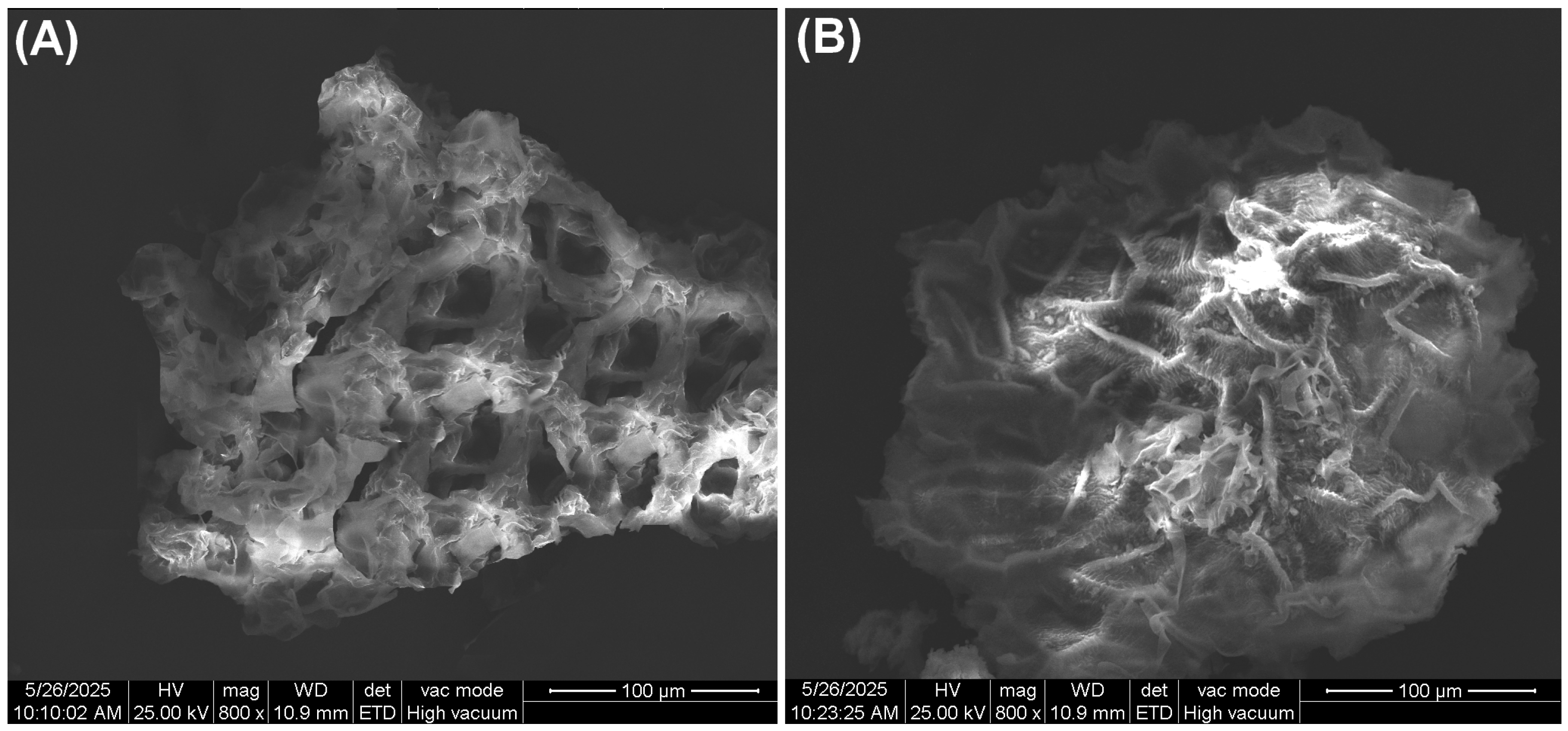
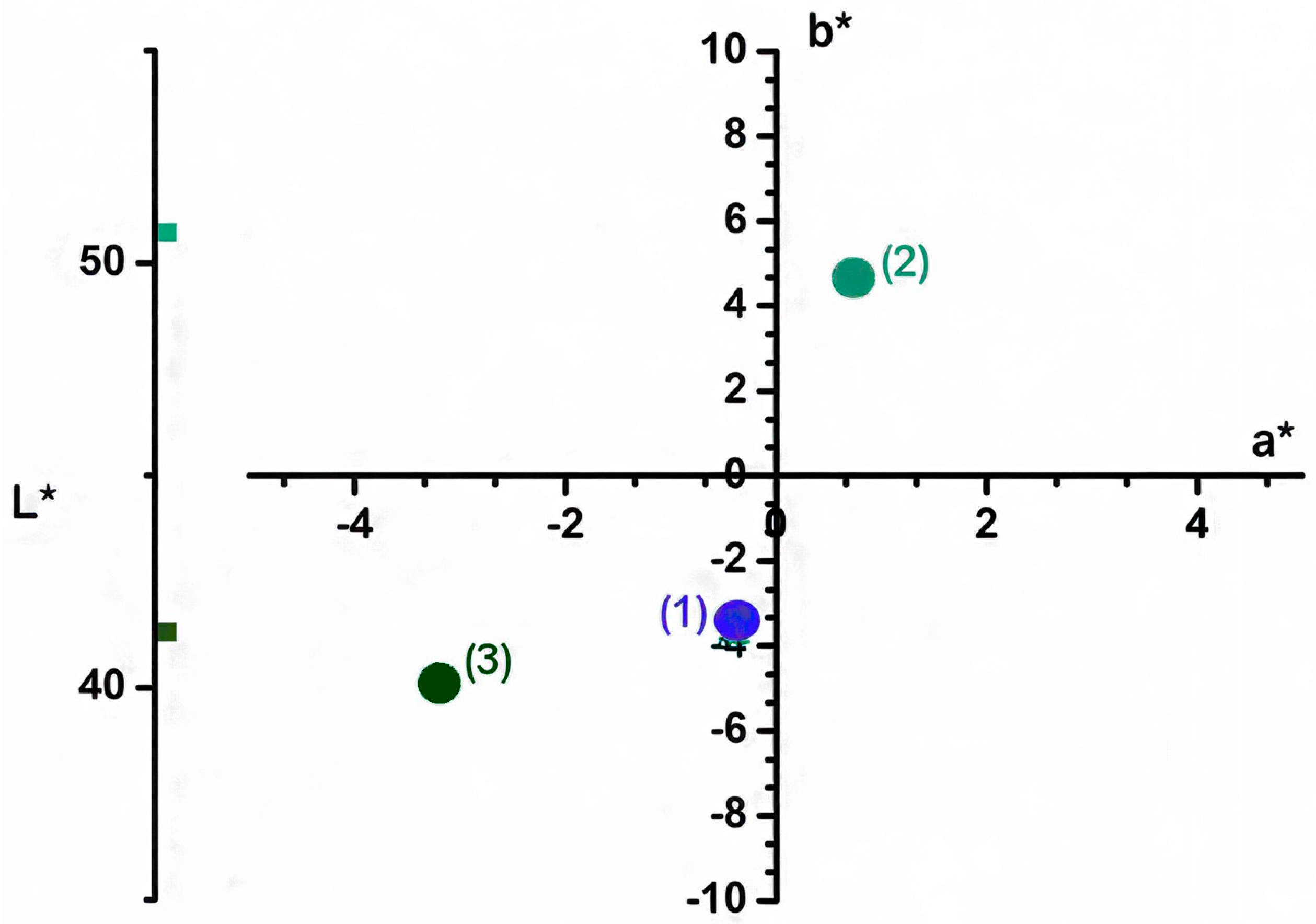
3.1. SEM and Color Analysis
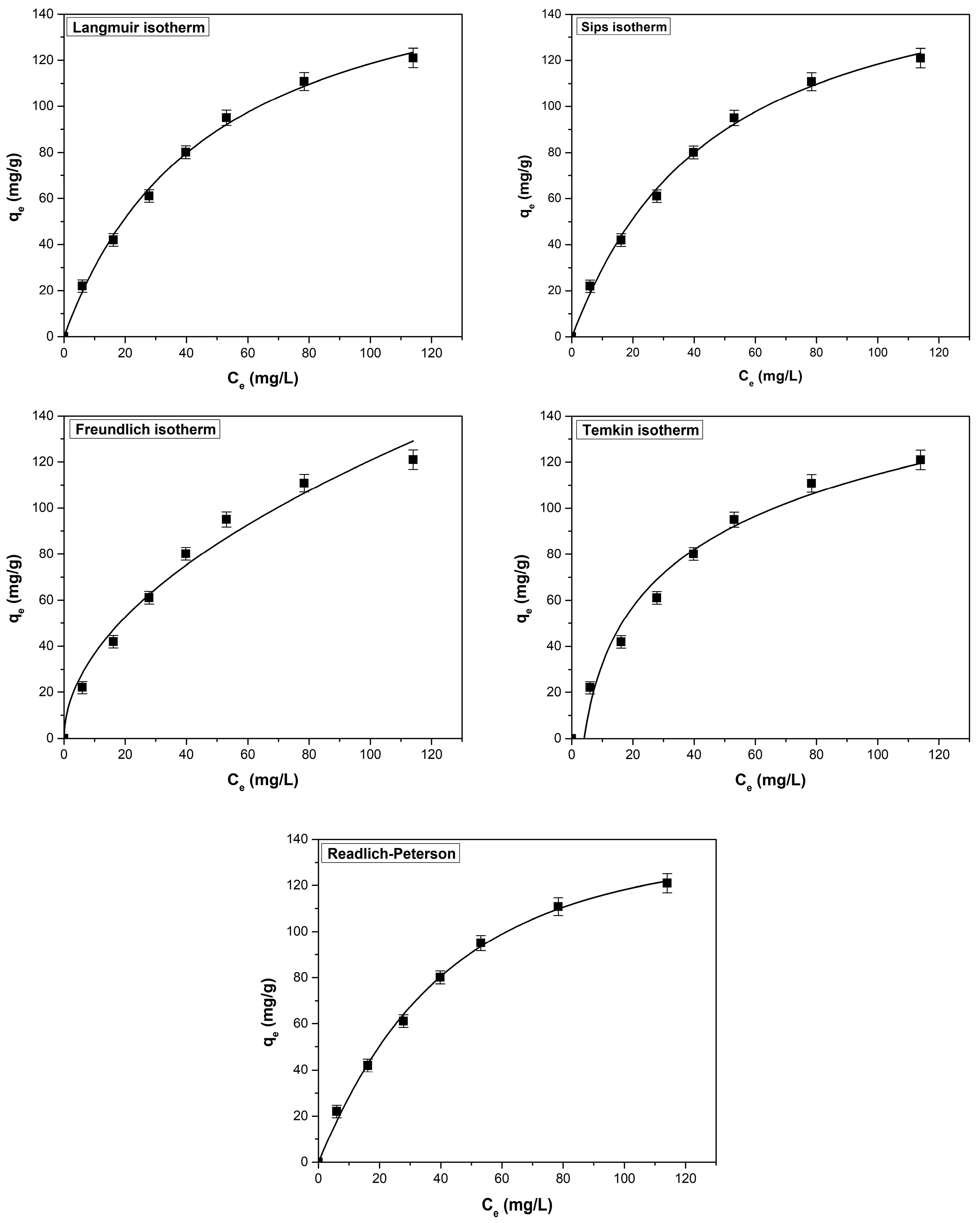
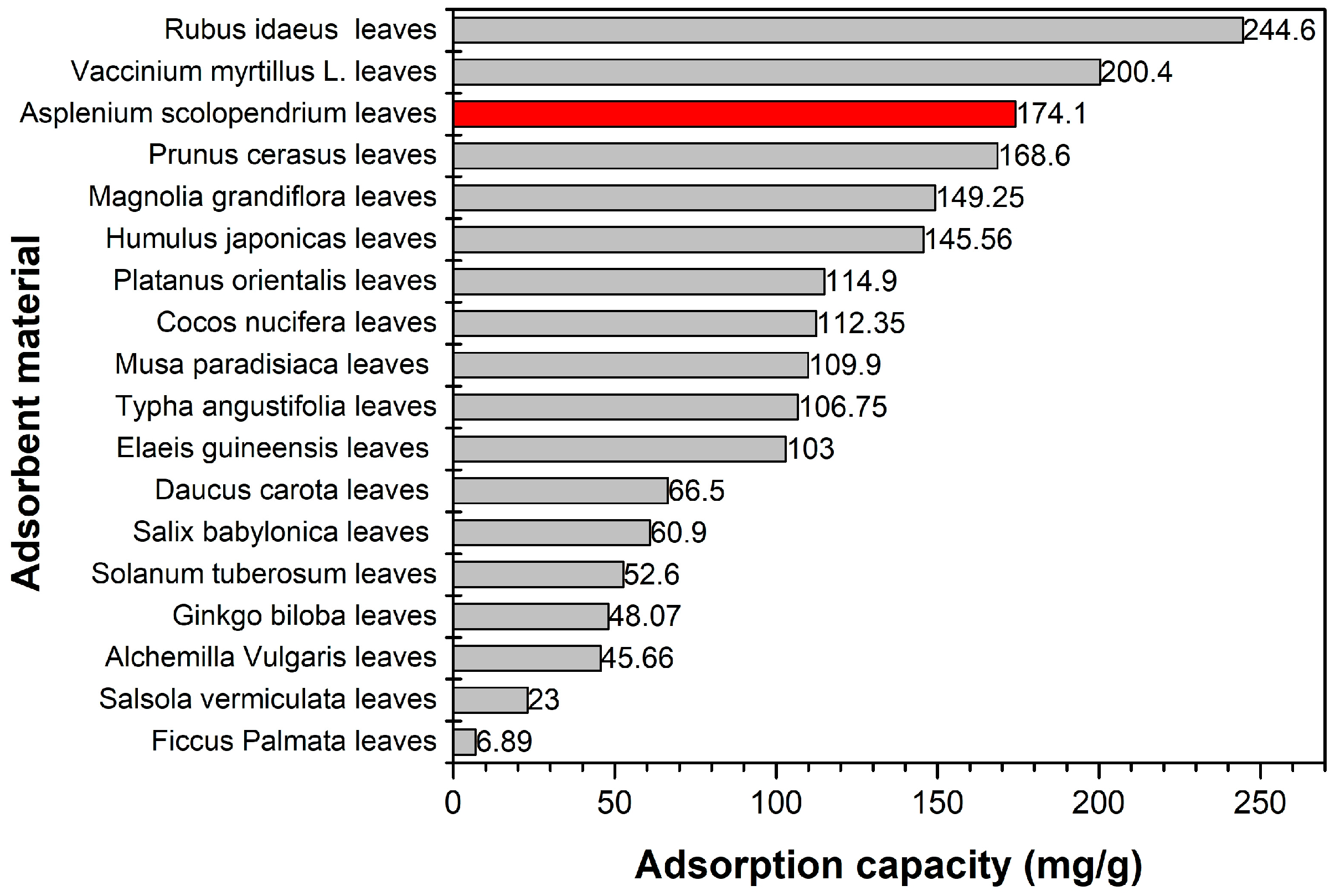
3.2. Adsorption Equilibrium Isotherms
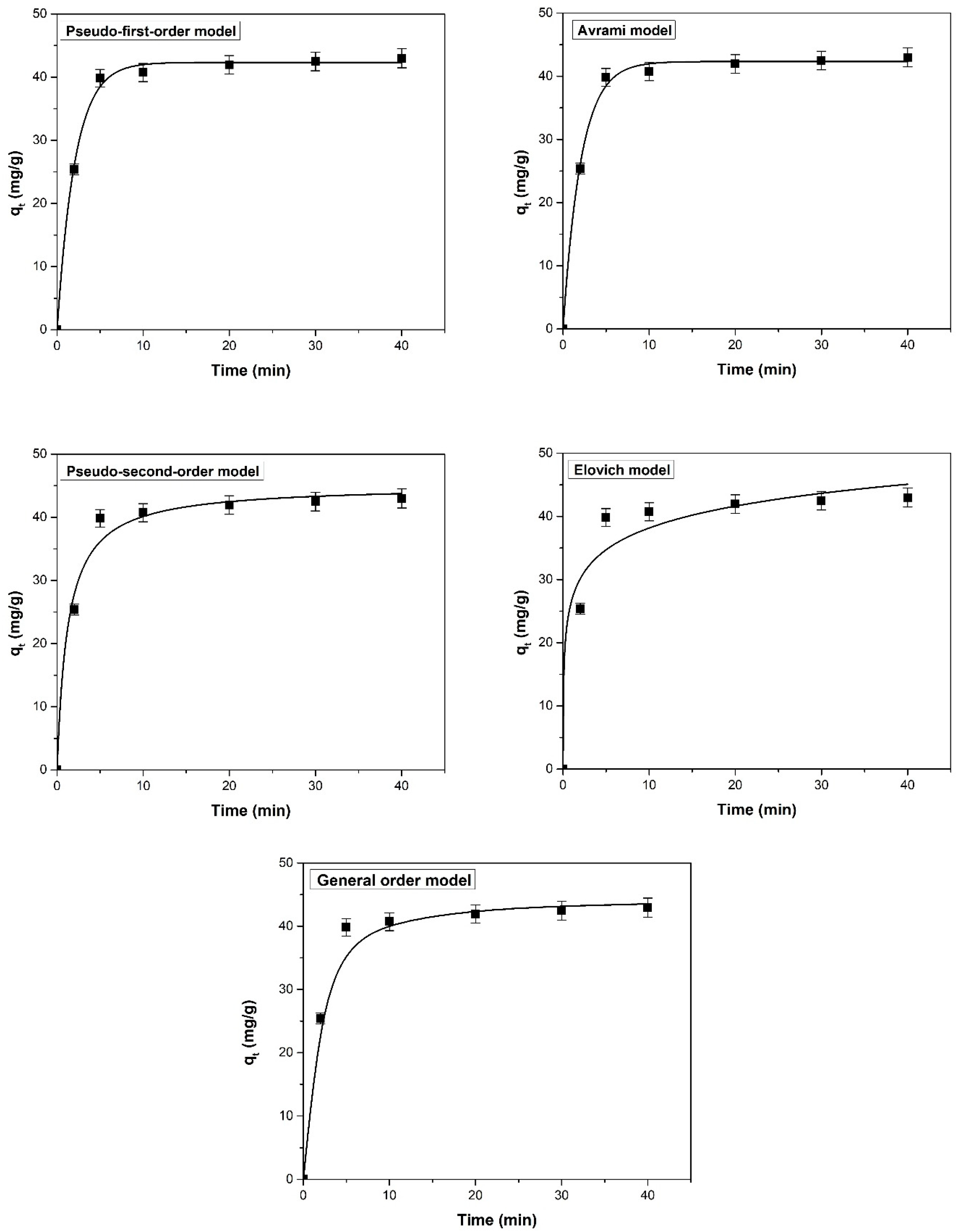
3.3. Adsorption Kinetic Models
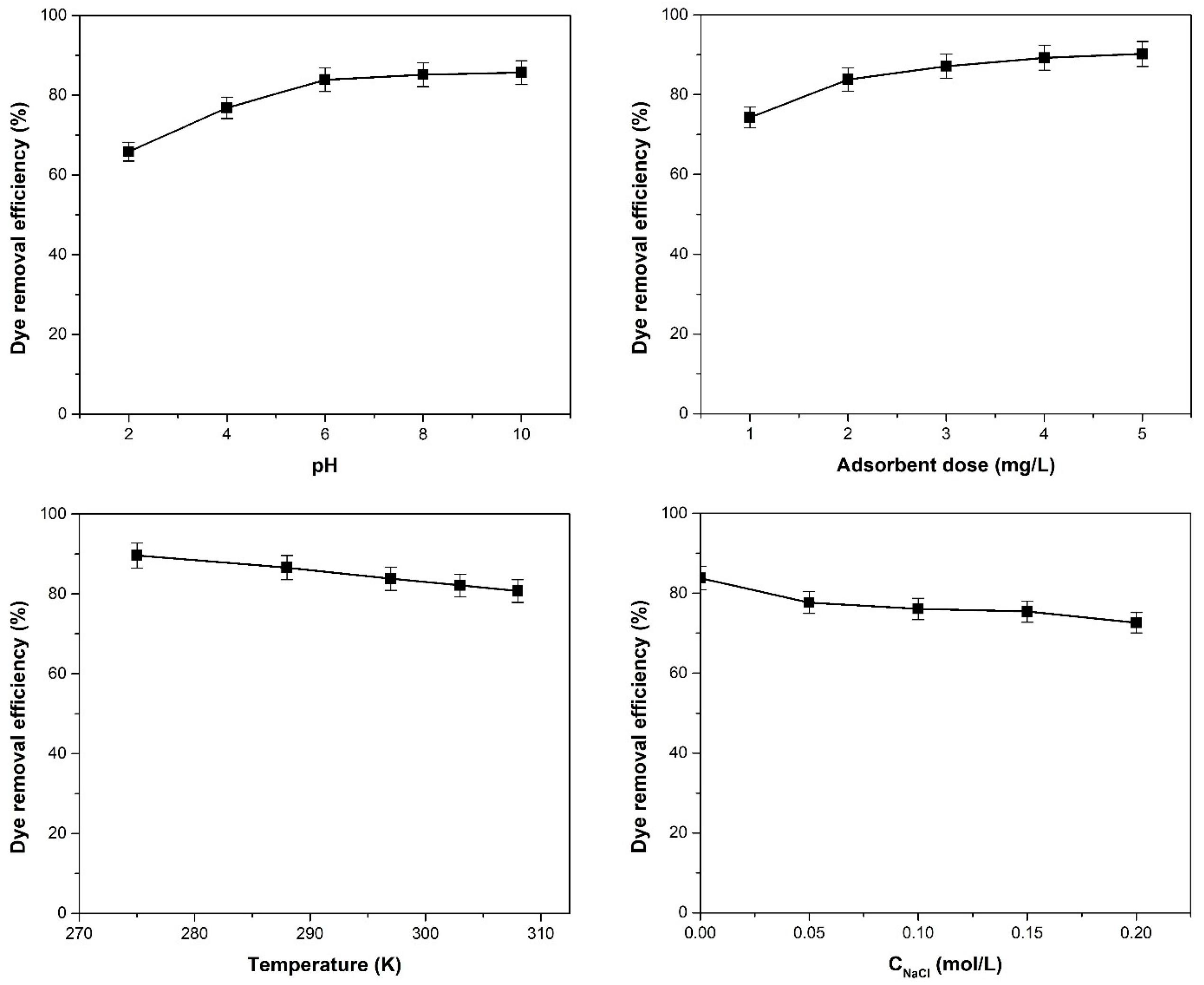
3.4. The Effects of pH, Ionic Strength, and Adsorbent Dosage on Dye Removal Efficiency
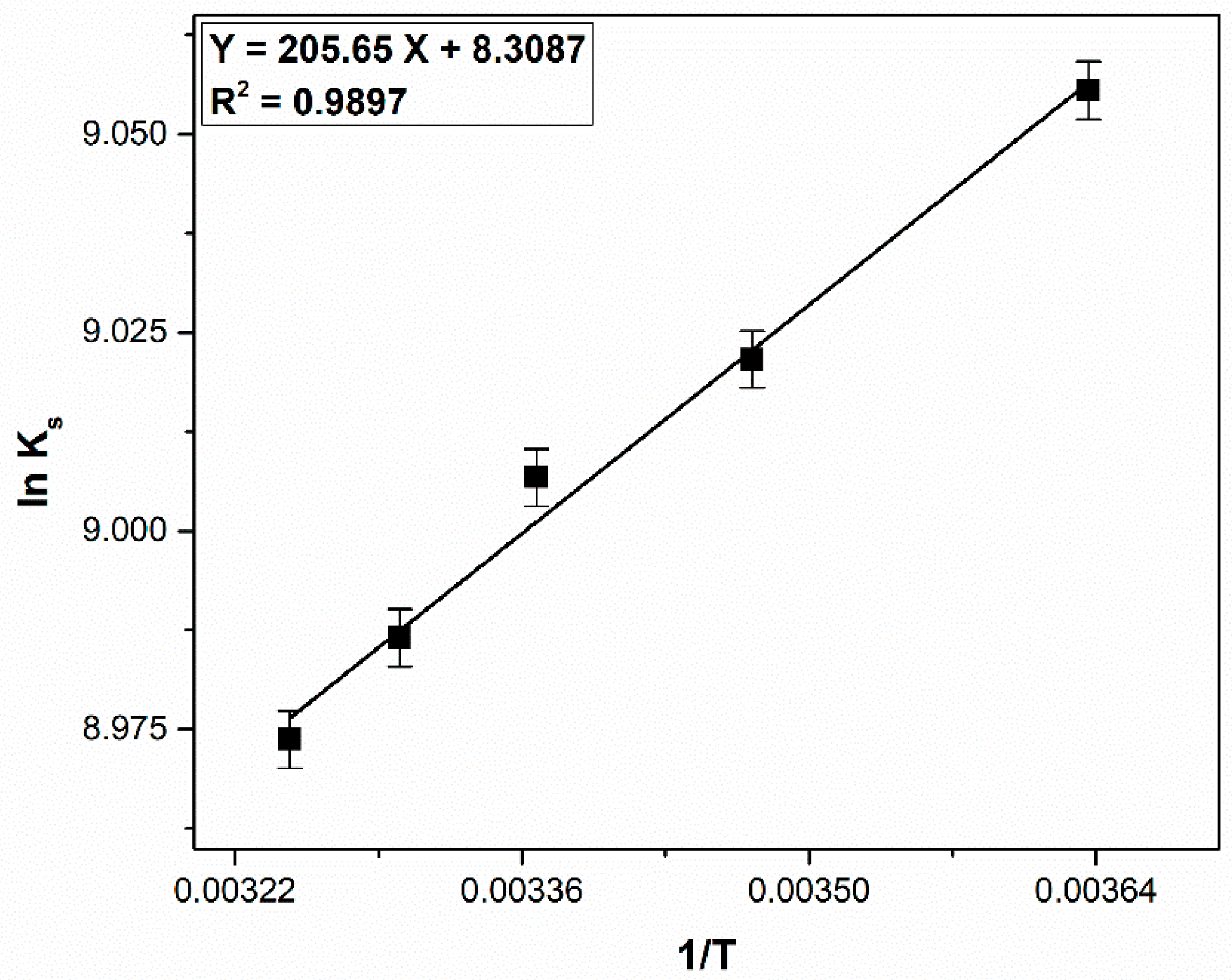
3.5. Thermodynamic Parameters Analysis
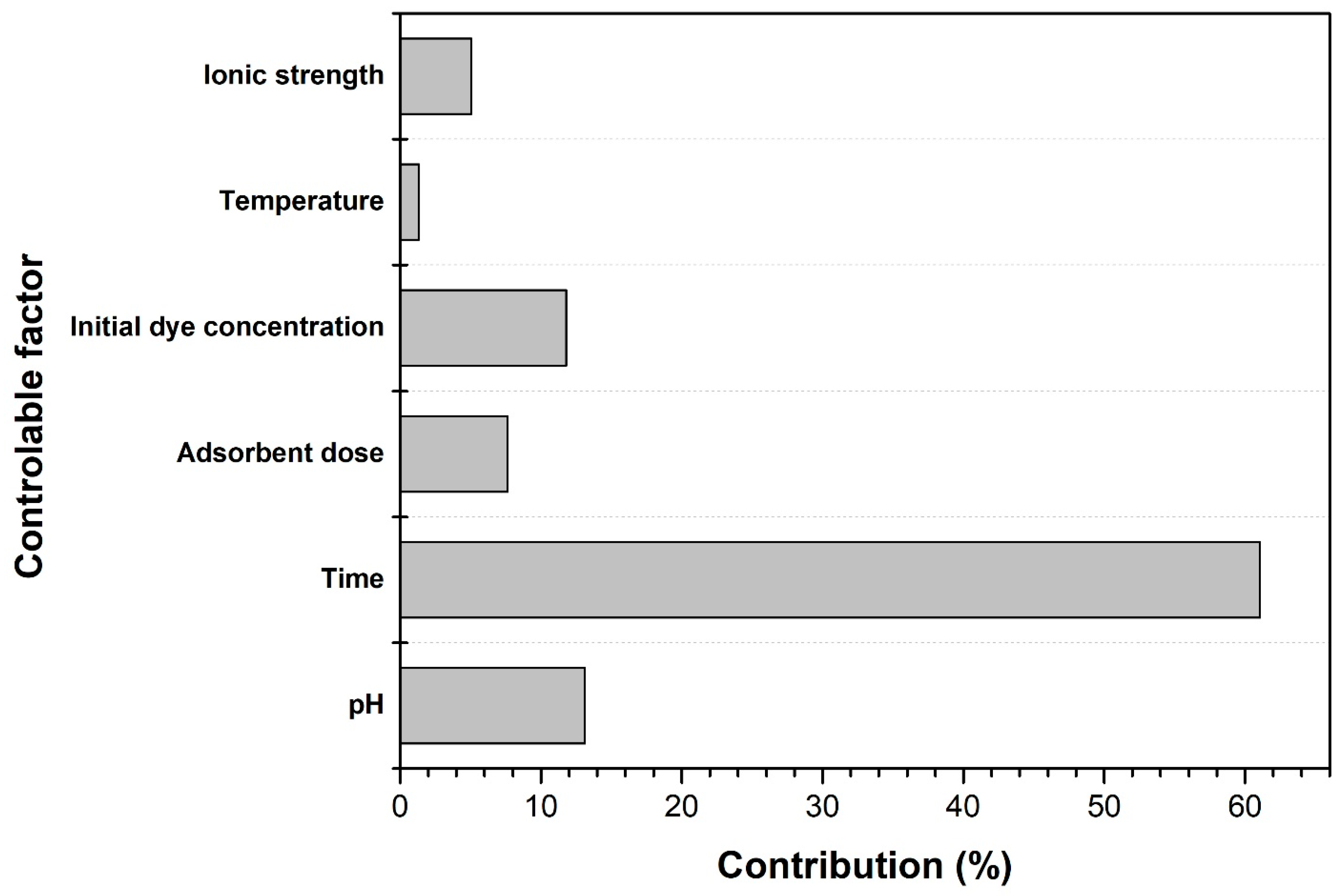
3.6. Taguchi Optimization
3.7. Desorption Study
4. Conclusions
Supplementary Materials
Author Contributions
Funding
Institutional Review Board Statement
Informed Consent Statement
Data Availability Statement
Conflicts of Interest
References
- Al-Tohamy, R.; Ali, S.S.; Li, F.; Okasha, K.M.; Mahmoud, Y.A.-G.; Elsamahy, T.; Jiao, H.; Fu, Y.; Sun, J. A critical review on the treatment of dye-containing wastewater: Ecotoxicological and health concerns of textile dyes and possible remediation approaches for environmental safety. Ecotoxicol. Environ. Saf. 2022, 231, 113160. [Google Scholar] [CrossRef]
- Akhtar, N.; Syakir Ishak, M.I.; Bhawani, S.A.; Umar, K. Various Natural and Anthropogenic Factors Responsible forWater Quality Degradation: A Review. Water 2021, 13, 2660. [Google Scholar] [CrossRef]
- Khan, I.; Saeed, K.; Zekker, I.; Zhang, B.; Hendi, A.H.; Ahmad, A.; Ahmad, S.; Zada, N.; Ahmad, H.; Shah, L.A.; et al. Review on methylene blue: Its properties, uses, toxicity and photodegradation. Water 2022, 14, 242. [Google Scholar] [CrossRef]
- Mosoarca, G.; Popa, S.; Vancea, C.; Dan, M.; Boran, S. Modelling and Optimization of Methylene Blue Adsorption Process on Leonurus cardiaca L. Biomass Powder. Processes 2023, 11, 3385. [Google Scholar] [CrossRef]
- Mosoarca, G.; Vancea, C.; Popa, S.; Radulescu-Grad, M.E.; Dan, M.; Tanasie, C.; Boran, S. Adsorption of Methylene Blue onto Environmentally Friendly Lignocellulosic Material Obtained from Mature Coltsfoot (Tussilago farfara) Leaves. Polymers 2025, 17, 1549. [Google Scholar] [CrossRef]
- Su, X.; Wang, X.; Ge, Z.; Bao, Z.; Lin, L.; Chen, Y.; Dai, W.; Sun, Y.; Yuan, H.; Yang, W.; et al. KOH-activated biochar and chitosan composites for efficient adsorption of industrial dye pollutants. Chem. Eng. J. 2024, 486, 150387. [Google Scholar] [CrossRef]
- Kathing, C.; Saini, G. A review of various treatment methods for the removal of dyes from textile effluent. Recent Prog. Mater. 2022, 4, 21. [Google Scholar] [CrossRef]
- Sahu, D.; Pervez, S.; Karbhal, I.; Tamrakar, A.; Mishra, A.; Verma, S.R.; Deb, M.K.; Ghosh, K.K.; Pervez, Y.F.; Shrivas, K.; et al. Applications of different adsorbent materials for the removal of organic and inorganic contaminants from water and wastewater—A review. Desalin. Water Treat. 2024, 317, 100253. [Google Scholar] [CrossRef]
- Iwuozor, K.O.; Ighalo, J.O.; Ogunfowora, L.A.; Adeniyi, A.G.; Igwegbe, C.A. An empirical literature analysis of adsorbent performance for methylene blue uptake from aqueous media. J. Environ. Chem. Eng. 2021, 9, 105658. [Google Scholar] [CrossRef]
- Shakoor, S.; Nasar, A. Removal of methylene blue dye from artificially contaminated water using citrus limetta peel waste as a very low cost adsorbent. J. Taiwan Inst. Chem. Eng. 2016, 66, 154–163. [Google Scholar] [CrossRef]
- Ungureanu, E.L.; Mocanu, A.L.; Stroe, C.A.; Panciu, C.M.; Berca, L.; Sionel, R.M.; Mustatea, G. Agricultural Byproducts Used as Low-Cost Adsorbents for Removal of Potentially Toxic Elements from Wastewater: A Comprehensive Review. Sustainability 2023, 15, 5999. [Google Scholar] [CrossRef]
- Mosoarca, G.; Vancea, C.; Popa, S.; Dan, M.; Boran, S. The Use of Bilberry Leaves (Vaccinium myrtillus L.) as an Efficient Adsorbent for Cationic Dye Removal from Aqueous Solutions. Polymers 2022, 14, 978. [Google Scholar] [CrossRef]
- Bulgariu, L.; Escudero, L.B.; Bello, O.S.; Iqbal, M.; Nisar, J.; Adegoke, K.A.; Alakhras, F.; Kornaros, M.; Anastopoulos, I. The utilization of leaf-based adsorbents for dyes removal: A review. J. Mol. Liq. 2019, 276, 728–747. [Google Scholar] [CrossRef]
- Yadav, M.; Singh, N.; Annu; Khan, S.A.; Raorane, C.J.; Shin, D.K. Recent Advances in Utilizing Lignocellulosic Biomass Materials as Adsorbents for Textile Dye Removal: A Comprehensive Review. Polymers 2024, 16, 2417. [Google Scholar] [CrossRef]
- Yekefallah, M.; Raofie, F. Preparation of stable nanosuspensions from Asplenium colopendrium leaves via rapid expansion of supercritical solution into aqueous solutions (RESSAS). J. Drug Deliv. Sci. Technol. 2021, 64, 102566. [Google Scholar] [CrossRef]
- Mosoarca, G.; Vancea, C.; Popa, S.; Dan, M.; Boran, S. Utilizing Novel Lignocellulosic Material from Hart’s-Tongue Fern (Asplenium scolopendrium) Leaves for Crystal Violet Adsorption: Characterization, Application, and Optimization. Polymers 2023, 15, 3923. [Google Scholar] [CrossRef]
- Bremer, P.; Eelke Jongejans, E. Frost and Forest Stand Effects on the Population Dynamics of Asplenium scolopendrium. Popul. Ecol. 2009, 52, 211–222. [Google Scholar] [CrossRef]
- Al-Ghouti, M.A.; Da’ana, D.A. Guidelines for the use and interpretation of adsorption isotherm models: A review. J. Hazard. Mater. 2020, 393, 122383. [Google Scholar] [CrossRef] [PubMed]
- Piccin, J.S.; Cadaval, T.R.S.; de Pinto, L.A.A.; Dotto, G.L. Adsorption isotherms in liquid phase: Experimental, modeling, and interpretations. In Adsorption Processes for Water Treatment and Purification; Bonilla-Petriciolet, A., Mendoza-Castillo, D., Reynel-Avila, H., Eds.; Springer: Cham, Switzerland, 2017; pp. 19–51. [Google Scholar]
- Dotto, G.L.; Salau, N.P.G.; Piccin, J.S.; Cadaval, T.R.S.; de Pinto, L.A.A. Adsorption kinetics in liquid phase: Modeling for discontinuous and continuous systems. In Adsorption Processes for Water Treatment and Purification; Bonilla-Petriciolet, A., Mendoza-Castillo, D., Reynel-Avila, H., Eds.; Springer: Cham, Switzerland, 2017; pp. 53–76. [Google Scholar]
- Wanga, J.; Guo, X. Adsorption kinetic models: Physical meanings, applications, and solving methods. J. Hazard. Mater. 2020, 390, 122156. [Google Scholar] [CrossRef] [PubMed]
- Mosoarca, G.; Vancea, C.; Popa, S.; Dan, M.; Boran, S. A Novel High-Efficiency Natural Biosorbent Material Obtained from Sour Cherry (Prunus cerasus) Leaf Biomass for Cationic Dyes Adsorption. Materials 2023, 16, 4252. [Google Scholar] [CrossRef]
- Mosoarca, G.; Popa, S.; Vancea, C.; Dan, M.; Boran, S. Removal of Methylene Blue from Aqueous Solutions Using a New Natural Lignocellulosic Adsorbent—Raspberry (Rubus idaeus) Leaves Powder. Polymers 2022, 14, 1966. [Google Scholar] [CrossRef]
- Guo, D.; Li, Y.; Cui, B.; Hu, M.; Luo, S.; Ji, B.; Liu, Y. Natural adsorption of methylene blue by waste fallen leaves of Magnoliaceae and its repeated thermal regeneration for reuse. J. Clean. Prod. 2020, 267, 121903. [Google Scholar] [CrossRef]
- Huang, Z.G.; Wang, T.; Yi, H.Y.; Li, X.B. Study on the adsorption of methylene blue from dye wastewater by Humulus japonicas leaves. In E3S Web of Conferences; EDP Sciences: Ulis, France, 2021; Volume 236, p. 03028. [Google Scholar]
- Peydayesh, M.; Rahbar-Kelishami, A. Adsorption of methylene blue onto Platanus orientalis leaf powder: Kinetic, equilibrium and thermodynamic studies. J. Ind. Eng. Chem. 2015, 21, 1014–1019. [Google Scholar] [CrossRef]
- Jawad, A.H.; Rashid, R.A.; Mahmuod, R.M.A.; Ishak, M.A.M.; Kasim, N.N.; Ismail, K. Adsorption of methylene blue onto coconut (Cocos nucifera) leaf: Optimization, isotherm and kinetic studies. Desalin. Water Treat. 2015, 57, 8839–8853. [Google Scholar] [CrossRef]
- Krishni, R.R.; Foo, K.Y.; Hameed, B.H. Adsorptive removal of methylene blue using the natural adsorbent-banana leaves. Desalin. Water Treat. 2014, 52, 6104–6112. [Google Scholar] [CrossRef]
- Boumaza, S.; Yenounne, A.; Hachi, W.; Kaouah, F.; Bouhamidi, Y.; Trari, M. Application of Typha angustifolia (L.) Dead leaves waste as biomaterial for the removal of cationic dye from aqueous solution. Int. J. Environ. Res. 2018, 12, 561–573. [Google Scholar] [CrossRef]
- Setiabudi, H.D.; Jusoh, R.; Suhaimi, S.F.R.M.; Masrur, S.F. Adsorption of methylene blue onto oil palm (Elaeis guineensis) leaves: Process optimization, isotherm, kinetics and thermodynamic studies. J. Taiwan Inst. Chem. Eng. 2016, 63, 363–370. [Google Scholar] [CrossRef]
- Kushwaha, A.K.; Gupta, N.; Chattopadhyaya, M.C. Removal of cationic methylene blue and malachite green dyes from aqueous solution by waste materials of Daucus carota. J. Saudi Chem. Soc. 2014, 18, 200–207. [Google Scholar] [CrossRef]
- Khodabandehloo, A.; Rahbar-Kelishami, A.; Shayesteh, H. Methylene blue removal using Salix babylonica (Weeping willow) leaves powder as a low-cost biosorbent in batch mode: Kinetic, equilibrium, and thermodynamic studies. J. Mol. Liq. 2017, 244, 540–548. [Google Scholar] [CrossRef]
- Gupta, N.; Kushwaha, A.K.; Chattopadhyaya, M.C. Application of potato (Solanum tuberosum) plant wastes for the removal of methylene blue and malachite green dye from aqueous solution. Arab. J. Chem. 2016, 9, S707–S716. [Google Scholar] [CrossRef]
- Singh, R.; Singh, T.S.; Odiyo, J.O.; Smith, J.A.; Edokpayi, J.N. Evaluation of methylene blue sorption onto low-cost biosorbents: Equilibrium, kinetics, and thermodynamics. J. Chem. 2020, 2020, 8318049. [Google Scholar] [CrossRef]
- Reçber, Z. Adsorption of methylene blue onto spent Alchemilla vulgaris leaves: Characterization, isotherms, kinetic and thermodynamic studies. Int. J. Environ. Sci. Technol. 2022, 19, 4803–4814. [Google Scholar] [CrossRef]
- Bestani, B.; Benderdouche, N.; Benstaali, B.; Belhakem, M.; Addou, A. Methylene blue and iodine adsorption onto an activated desert plant. Bioresour. Technol. 2008, 99, 8441–8444. [Google Scholar] [CrossRef]
- Fiaz, R.; Hafeez, M.; Mahmood, R. Ficcus palmata leaves as a low-cost biosorbent for methylene blue: Thermodynamic and kinetic studies. Water Environ. Res. 2019, 91, 689–699. [Google Scholar] [CrossRef]
- Mukhlish, M.Z.B.; Khan, M.R.; Bhoumick, M.C.; Paul, S. Leaf powder: Novel adsorbent for removal of methylene blue from aqueous solution. Water Air Soil Pollut. 2012, 223, 4949–4958. [Google Scholar] [CrossRef]
- Sid, D.; Salem, Y.; Baitiche, M.; Djerboua, F.; Boukhalfa, N.; Boutahala, M. Removal of methylene blue dye from water with low cost Nigella sativa seeds waste: Kinetic, isotherm, and statistical modeling. Desalin. Water Treat. 2020, 197, 358–367. [Google Scholar] [CrossRef]
- Xuan Cuong, N. Study on Adsorption of Methylene Blue from Aqueous Solution by Biochar Derived from Mimosa Pigra Plant. VNU J. Sci. Earth Environ. Sci. 2021, 37, 43–54. [Google Scholar] [CrossRef]
- Han, X.; Wang, W.; Ma, X. Adsorption characteristics of methylene blue onto low cost biomass material lotus leaf. Chem. Eng. J. 2011, 171, 1–8. [Google Scholar] [CrossRef]
- Crini, G. Non-conventional low-cost adsorbents for dye removal: A review. Bioresour. Technol. 2006, 97, 1061–1085. [Google Scholar] [CrossRef] [PubMed]
- Gupta, V.K. Suhas Application of low-cost adsorbents for dye removal—A review. J. Environ. Manag. 2009, 90, 2313–2342. [Google Scholar] [CrossRef]
- Alghamdi, W.M.; El Mannoubi, I. Investigation of seeds and peels of Citrullus colocynthis as efficient natural adsorbent for Methylene blue dye. Processes 2021, 9, 1279. [Google Scholar] [CrossRef]
- Amrhar, O.; Berisha, A.; El Gana, L.; Nassali, H.; Elyoubi, M.S. Removal of methylene blue dye by adsorption onto Natural Muscovite Clay: Experimental, theoretical and computational investigation. Int. J. Environ. Anal. Chem. 2023, 103, 2419–2444. [Google Scholar] [CrossRef]
- Yagub, M.T.; Sen, T.K.; Afroze, S.; Ang, H.M. Dye and its removal from aqueous solution by adsorption: A review. Adv. Colloid Interface Sci. 2014, 209, 172–184. [Google Scholar] [CrossRef] [PubMed]
- Fernandez-Lopez, J.A.; Angosto, J.M.; Roca, M.J.; Doval Minarro, M. Taguchi design-based enhancement of heavy metals bioremoval by agroindustrial waste biomass from artichoke. Sci. Total Environ. 2019, 653, 55–63. [Google Scholar] [CrossRef] [PubMed]
- Razmi, B.; Ghasemi-Fasaei, R. Investigation of Taguchi optimization, equilibrium isotherms, and kinetic modeling for phosphorus adsorption onto natural zeolite of clinoptilolite type. Adsorpt. Sci. Technol. 2018, 36, 1470–1483. [Google Scholar] [CrossRef]
- Zolgharnein, J.; Rastgordani, M. Optimization of simultaneous removal of binary mixture of indigo carmine and methyl orange dyes by cobalt hydroxide nano-particles through Taguchi method. J. Mol. Liq. 2018, 262, 405–414. [Google Scholar] [CrossRef]





| Equilibrium Isotherm | Parameters | Value |
|---|---|---|
| Langmuir | KL (L/mg) | 0.020 ± 0.004 |
| qmax (mg/g) | 175.64 ± 18.24 | |
| R2 | 0.9968 | |
| χ2 | 0.80 | |
| SSE | 40.79 | |
| ARE (%) | 4.47 | |
| Freundlich | Kf (mg/g)(L/mg)1/n | 11.22 ± 2.14 |
| 1/n | 0.51 ± 0.09 | |
| R2 | 0.9818 | |
| χ2 | 3.70 | |
| SSE | 240 | |
| ARE (%) | 8.75 | |
| Temkin | KT (L/mg) | 0.25 ± 0.07 |
| b (kJ/g) | 68.98 ± 10.4 | |
| R2 | 0.9804 | |
| χ2 | 6.64 | |
| SSE | 251 | |
| ARE (%) | 13.26 | |
| Sips | Qsat (mg/g) | 174.1 ± 14.93 |
| KS (L/mg) | 0.021 ± 0.003 | |
| n | 1.01 | |
| R2 | 0.9975 | |
| χ2 | 0.77 | |
| SSE | 32.2 | |
| ARE (%) | 4.36 | |
| Redlich–Peterson | KRP (L/g) | 3.12 ± 0.62 |
| aRP (L/mg) | 0.006 ± 0.001 | |
| βRP | 1.18 ± 0.11 | |
| R2 | 0.9970 | |
| χ2 | 1.36 | |
| SSE | 41.7 | |
| ARE (%) | 5.15 |
| Kinetic Model | Parameters | Values |
|---|---|---|
| Pseudo-first order | k1 (1/min) | 0.57 ± 0.11 |
| qe,calc (mg/g) | 42.09 ± 4.52 | |
| R2 | 0.9924 | |
| χ2 | 0.43 | |
| SSE | 13.19 | |
| ARE (%) | 16.86 | |
| Pseudo-second order | k2 (1/min) | 0.017 ± 0.004 |
| qe,calc (g/mg·min) | 45.09 ± 4.42 | |
| R2 | 0.9859 | |
| χ2 | 0.63 | |
| SSE | 21.44 | |
| ARE (%) | 4.22 | |
| Elovich | a (g/mg) | 0.19 ± 0.04 |
| b (mg/g·min) | 1029 ± 214 | |
| R2 | 0.9598 | |
| χ2 | 1.94 | |
| SSE | 61.09 | |
| ARE (%) | 20.75 | |
| General order | kn (1/min) (g/mg)1/n | 7.98 ± 1.87 |
| qn (mg/g) | 44.50 ± 3.42 | |
| n | 1.23 ± 0.34 | |
| R2 | 0.9926 | |
| χ2 | 0.31 | |
| SSE | 11.13 | |
| ARE (%) | 2.41 | |
| Avrami | kAV (1/min) | 0.83 ± 0.17 |
| qAV (mg/g) | 42.32 ± 3.75 | |
| nAV | 0.57 ± 0.16 | |
| R2 | 0.9970 | |
| χ2 | 0.11 | |
| SSE | 4.45 | |
| ARE (%) | 1.57 |
| ΔG (KJ/mol) | ΔH (KJ/mol) | ΔS (J/molK) | ||||
|---|---|---|---|---|---|---|
| 275 K | 288 K | 297 K | 303 K | 308 K | ||
| −20.7 | −21.6 | −22.2 | −22.6 | −23.1 | −0.02 | 8.3 |
| Factor | Level 1 | Level 2 | Level 3 | Level 4 | Level 5 |
|---|---|---|---|---|---|
| pH | 2 | 4 | 6 | 8 | 10 |
| Time (min) | 2 | 10 | 20 | 30 | 40 |
| Adsorbent dose (g/L) | 1 | 2 | 3 | 4 | 5 |
| Initial dye concentration (mg/L) | 50 | 100 | 150 | 250 | 350 |
| Temperature (K) | 275 | 288 | 297 | 303 | 308 |
| Ionic strength (mol/L) | 0 | 0.05 | 0.1 | 0.15 | 0.2 |
| pH | Time (min) | Adsorbent Dose (g/L) | Initial Dye Concentration (mg/L) | Temperature (K) | Ionic Strength (mol/L) | Dye Removal Efficiency (%) | S/N Ratio |
|---|---|---|---|---|---|---|---|
| 2 | 2 | 1 | 50 | 275 | 0 | 44.36 | 33.13 |
| 2 | 10 | 2 | 100 | 288 | 0.05 | 68.13 | 36.79 |
| 2 | 20 | 3 | 150 | 297 | 0.1 | 67.19 | 36.41 |
| 2 | 30 | 4 | 250 | 303 | 0.15 | 65.46 | 36.45 |
| 2 | 40 | 5 | 350 | 308 | 0.2 | 54.22 | 34.84 |
| 4 | 2 | 2 | 150 | 303 | 0.2 | 42.9 | 32.44 |
| 4 | 10 | 3 | 250 | 308 | 0 | 78.13 | 37.81 |
| 4 | 20 | 4 | 350 | 275 | 0.05 | 72.6 | 37.33 |
| 4 | 30 | 5 | 50 | 288 | 0.1 | 91.88 | 39.16 |
| 4 | 40 | 1 | 100 | 297 | 0.15 | 59.92 | 35.63 |
| 6 | 2 | 3 | 350 | 288 | 0.15 | 44.14 | 32.69 |
| 6 | 10 | 4 | 50 | 297 | 0.2 | 87.86 | 38.75 |
| 6 | 20 | 5 | 100 | 303 | 0 | 98.5 | 39.78 |
| 6 | 30 | 1 | 150 | 308 | 0.05 | 72.69 | 37.36 |
| 6 | 40 | 2 | 250 | 275 | 0.1 | 87.26 | 38.73 |
| 8 | 2 | 4 | 100 | 308 | 0.1 | 53.68 | 34.77 |
| 8 | 10 | 5 | 150 | 275 | 0.15 | 76.27 | 37.75 |
| 8 | 20 | 1 | 250 | 288 | 0.2 | 70.64 | 37.04 |
| 8 | 30 | 2 | 350 | 297 | 0 | 77.21 | 37.66 |
| 8 | 40 | 3 | 50 | 303 | 0.05 | 96.27 | 39.61 |
| 10 | 2 | 5 | 250 | 297 | 0.05 | 54.34 | 34.51 |
| 10 | 10 | 1 | 350 | 303 | 0.1 | 58.73 | 35.51 |
| 10 | 20 | 2 | 50 | 308 | 0.15 | 86.83 | 38.83 |
| 10 | 30 | 3 | 100 | 275 | 0.2 | 93.13 | 39.31 |
| 10 | 40 | 4 | 150 | 288 | 0 | 98.87 | 39.93 |
| Level | pH | Time | Adsorbent Dose | Initial Dye Concentration | Temperature | Ionic Strength |
|---|---|---|---|---|---|---|
| 1 | 35.53 | 33.51 | 35.74 | 37.90 | 37.25 | 37.67 |
| 2 | 36.48 | 37.33 | 36.89 | 37.26 | 37.13 | 37.13 |
| 3 | 37.46 | 37.88 | 37.17 | 36.78 | 36.60 | 36.92 |
| 4 | 37.37 | 37.99 | 37.45 | 36.91 | 36.76 | 36.27 |
| 5 | 37.62 | 37.75 | 37.21 | 35.61 | 36.73 | 36.48 |
| Delta | 2.10 | 4.48 | 1.71 | 2.29 | 0.66 | 1.39 |
| Rank | 3 | 1 | 4 | 2 | 6 | 5 |
Disclaimer/Publisher’s Note: The statements, opinions and data contained in all publications are solely those of the individual author(s) and contributor(s) and not of MDPI and/or the editor(s). MDPI and/or the editor(s) disclaim responsibility for any injury to people or property resulting from any ideas, methods, instructions or products referred to in the content. |
© 2026 by the authors. Licensee MDPI, Basel, Switzerland. This article is an open access article distributed under the terms and conditions of the Creative Commons Attribution (CC BY) license.
Share and Cite
Mosoarca, G.; Vancea, C.; Popa, S.; Radulescu-Grad, M.E.; Dan, M.; Tanasie, C.; Boran, S. Sustainable Lignocellulosic Biosorbent Derived from Asplenium scolopendrium Leaves for the Adsorptive Removal of Methylene Blue from Aqueous Solutions. Sustainability 2026, 18, 4145. https://doi.org/10.3390/su18084145
Mosoarca G, Vancea C, Popa S, Radulescu-Grad ME, Dan M, Tanasie C, Boran S. Sustainable Lignocellulosic Biosorbent Derived from Asplenium scolopendrium Leaves for the Adsorptive Removal of Methylene Blue from Aqueous Solutions. Sustainability. 2026; 18(8):4145. https://doi.org/10.3390/su18084145
Chicago/Turabian StyleMosoarca, Giannin, Cosmin Vancea, Simona Popa, Maria Elena Radulescu-Grad, Mircea Dan, Cristian Tanasie, and Sorina Boran. 2026. "Sustainable Lignocellulosic Biosorbent Derived from Asplenium scolopendrium Leaves for the Adsorptive Removal of Methylene Blue from Aqueous Solutions" Sustainability 18, no. 8: 4145. https://doi.org/10.3390/su18084145
APA StyleMosoarca, G., Vancea, C., Popa, S., Radulescu-Grad, M. E., Dan, M., Tanasie, C., & Boran, S. (2026). Sustainable Lignocellulosic Biosorbent Derived from Asplenium scolopendrium Leaves for the Adsorptive Removal of Methylene Blue from Aqueous Solutions. Sustainability, 18(8), 4145. https://doi.org/10.3390/su18084145