Sustainable Artificial Intelligence Integration in Early Childhood Education: The Role of Teachers’ Thinking Styles in Shaping Attitudes

Abstract
1. Introduction
2. Literature Review
2.1. The Role of Artificial Intelligence in Education
2.2. Analytical and Holistic Thinking
2.3. The Relationship Between Thinking Styles and Attitudes Toward Artificial Intelligence
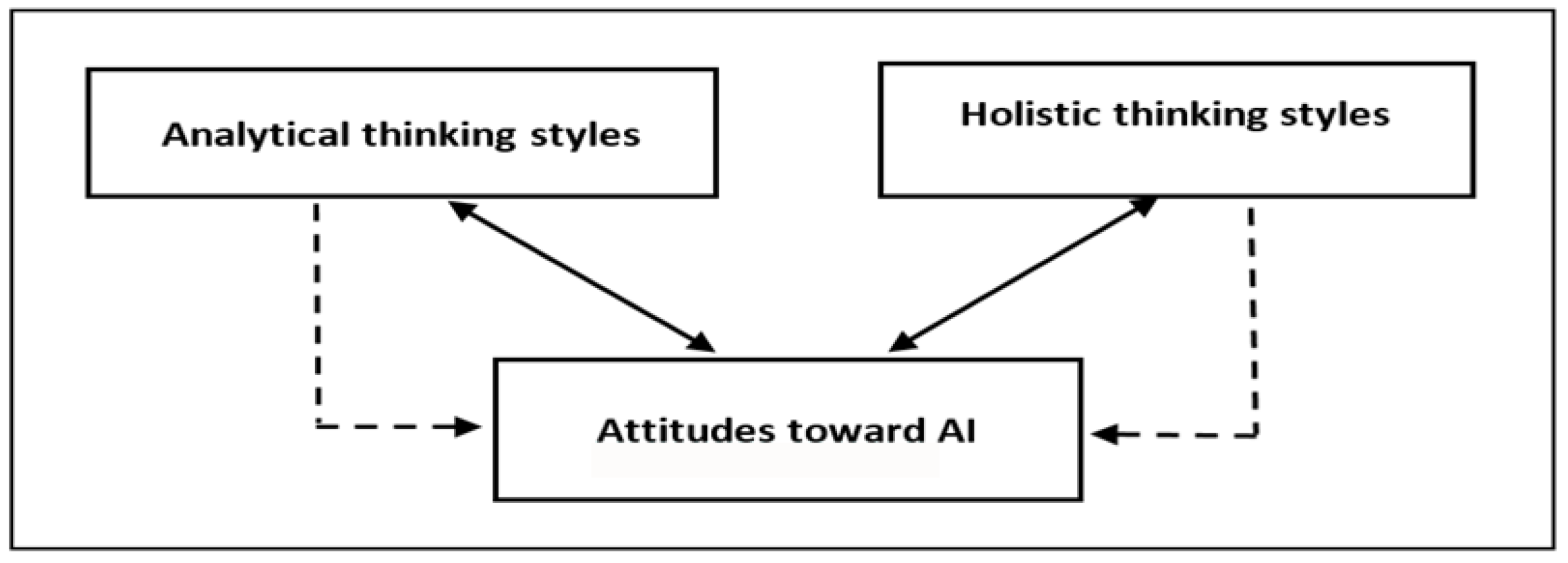
2.4. Theoretical Framework and Research Questions
- RQ1.
- What are the levels of preschool teachers’ overall attitudes toward AI, their positive and negative attitude sub-dimensions, and their analytic and holistic thinking tendencies?
- RQ2.
- Is there a statistically significant difference between preschool teachers with analytic and holistic thinking orientations in terms of their attitudes toward AI?
- RQ3.
- Is there a significant relationship between preschool teachers’ thinking styles and their attitudes toward AI?
- RQ4.
- To what extent are analytical and holistic thinking styles associated with negative attitudes toward AI?
3. Methodology
3.1. Research Model
3.2. Participants and Procedure
3.3. Instruments
3.4. Data Analysis
4. Results
5. Discussion
6. Implications
7. Limitations of the Study
8. Conclusions
Author Contributions
Funding
Institutional Review Board Statement
Informed Consent Statement
Data Availability Statement
Conflicts of Interest
References
- Aggarwal, D.; Sharma, D.; Saxena, A.B. Exploring the role of artificial intelligence for augmentation of adaptable sustainable education. Asian J. Adv. Res. Rep. 2023, 17, 179–184. [Google Scholar] [CrossRef]
- Kim, J. Artificial intelligence in achieving sustainable development: Expectations of undergraduate students. TechTrends 2025, 69, 138–148. [Google Scholar] [CrossRef]
- United Nations. Transforming Our World: The 2030 Agenda for Sustainable Development. 2015. Available online: https://sdgs.un.org/2030agenda (accessed on 9 January 2026).
- Tuomi, I. The Impact of Artificial Intelligence on Learning, Teaching, and Education; Publications Office of the European Union: Luxembourg, 2018. [Google Scholar] [CrossRef]
- Kasneci, E.; Seßler, K.; Küchemann, S.; Bannert, M.; Dementieva, D.; Fischer, F.; Gasser, U.; Groh, G.; Günnemann, S.; Hüllermeier, E.; et al. ChatGPT for good? On opportunities and challenges of large language models for education. Learn. Individ. Differ. 2023, 103, 102274. [Google Scholar] [CrossRef]
- Chan, C. Holistic competencies and AI in education: A synergistic pathway. Australas. J. Educ. Technol. 2024, 40, 1–12. [Google Scholar] [CrossRef]
- Kamalov, F.; Santandreu Calonge, D.; Gurrib, I. New era of artificial intelligence in education: Towards a sustainable multifaceted revolution. Sustainability 2023, 15, 12451. [Google Scholar] [CrossRef]
- Sousa, M.; Almeida, M.F.; Calili, R. Multiple criteria decision making for the achievement of the UN sustainable development goals: A systematic literature review and a research agenda. Sustainability 2021, 13, 4129. [Google Scholar] [CrossRef]
- Yim, I.H.Y.; Wegerif, R. Teachers’ perceptions, attitudes, and acceptance of artificial intelligence (AI) educational learning tools: An exploratory study on AI literacy for young students. Future Educ. Res. 2024, 2, 318–345. [Google Scholar] [CrossRef]
- Choi, I.; Koo, M.; Choi, J.A. Individual differences in analytic versus holistic thinking. Personal. Soc. Psychol. Bull. 2007, 33, 691–705. [Google Scholar] [CrossRef]
- Lacko, D.; Prošek, T.; Čeněk, J.; Helísková, M.; Ugwitz, P.; Svoboda, V.; Šašinka, Č. Analytic and holistic cognitive style as a set of independent manifests: Evidence from a validation study of six measurement instruments. PLoS ONE 2023, 18, e0287057. [Google Scholar] [CrossRef]
- Zhang, L.F. Thinking styles and model of thinking: Implications for education and research. J. Psychol. 2002, 136, 245–261. [Google Scholar] [CrossRef]
- San Martin, A.; Schug, J.; Maddux, W.W. Relational mobility and cultural differences in analytic and holistic thinking. J. Personal. Soc. Psychol. 2019, 116, 495–518. [Google Scholar] [CrossRef]
- Ahmad, S.F.; Rahmat, M.K.; Mubarik, M.S.; Alam, M.M.; Hyder, S.I. Artificial intelligence and its role in education. Sustainability 2021, 13, 12902. [Google Scholar] [CrossRef]
- Al-Abdullatif, A.M. Modeling teachers’ acceptance of generative artificial intelligence use in higher education: The role of AI literacy, intelligent TPACK, and perceived trust. Educ. Sci. 2024, 14, 1209. [Google Scholar] [CrossRef]
- Zawacki-Richter, O.; Marín, V.I.; Bond, M.; Gouverneur, F. Systematic review of research on artificial intelligence applications in higher education: Where are the educators? Int. J. Educ. Technol. High. Educ. 2019, 16, 39. [Google Scholar] [CrossRef]
- Filiz, O.; Kaya, M.H.; Adiguzel, T. Teachers and AI: Understanding the factors influencing AI integration in K–12 education. Educ. Inf. Technol. 2025, 30, 17931–17967. [Google Scholar] [CrossRef]
- McCarthy, J. From here to human-level AI. Artif. Intell. 2007, 171, 1174–1182. [Google Scholar] [CrossRef]
- Saxena, R. Role of artificial intelligence in Indian education system. Integr. J. Res. Arts Humanit. 2022, 2, 104–107. [Google Scholar] [CrossRef]
- Luo, S.; Zhu, Y.; Han, S. Functional connectome fingerprint of holistic–analytic cultural style. Soc. Cogn. Affect. Neurosci. 2022, 17, 172–186. [Google Scholar] [CrossRef]
- Martin, F.; Dennen, V.P.; Bonk, C.J. A synthesis of systematic review research on emerging learning environments and technologies. Educ. Technol. Res. Dev. 2020, 68, 1613–1633. [Google Scholar] [CrossRef]
- Vorobyeva, K.I.; Belous, S.; Savchenko, N.V.; Smirnova, L.M.; Nikitina, S.A.; Zhdanov, S.P. Personalized learning through AI: Pedagogical approaches and critical insights. Contemp. Educ. Technol. 2025, 17, ep574. [Google Scholar] [CrossRef] [PubMed]
- Law, L. Application of generative artificial intelligence (GenAI) in language teaching and learning: A scoping literature review. Comput. Educ. Open. 2024, 6, 100174. [Google Scholar] [CrossRef]
- Bartolomé, A.; Castañeda, L.; Adell, J. Personalisation in educational technology: The absence of underlying pedagogies. Int. J. Educ. Technol. High. Educ. 2018, 15, 14. [Google Scholar] [CrossRef]
- Nuroso, H.; Siswanto, J.; Huda, C. Developing a learning model to promote the skills of analytical thinking. J. Educ. Learn. (EduLearn) 2018, 12, 775–780. [Google Scholar] [CrossRef]
- Holmes, W. Artificial Intelligence in Education. In Encyclopedia of Education and Information Technologies; Tatnall, A., Ed.; Springer: Cham, Switzerland, 2020. [Google Scholar] [CrossRef]
- Fan, J.; Zhang, L.F.; Chen, C. Thinking styles: Distinct from personality? Personal. Individ. Differ. 2018, 125, 50–55. [Google Scholar] [CrossRef]
- Sternberg, R.J. Styles of thinking and learning. Can. J. Sch. Psychol. 1998, 13, 15–40. [Google Scholar] [CrossRef]
- Sternberg, R.J.; Zhang, L.F. Styles of thinking as a basis of differentiated instruction. Theory Into Pract. 2005, 44, 245–253. [Google Scholar] [CrossRef]
- Holmes, W.; Bialik, M.; Fadel, C. Artificial Intelligence in Education: Promises and Implications for Teaching and Learning; Center for Curriculum Redesign: Boston, MA, USA, 2019; Available online: https://curriculumredesign.org/wp-content/uploads/AIED-Book-Excerpt-CCR.pdf (accessed on 9 January 2026).
- Chiu, T.K. The impact of generative AI (GenAI) on practices, policies and research direction in education. Interact. Learn. Environ. 2024, 32, 6187–6203. [Google Scholar] [CrossRef]
- Li, B.; Li, Z.; Wang, X.; Lin, H. Early career teachers’ thinking styles and teacher expectations. Educ. Psychol. 2025, 45, 18–42. [Google Scholar] [CrossRef]
- Xue, L.; Ghazali, N.; Mahat, J. A systematic review of UTAUT and UTAUT2 for AI adoption in education. Int. J. Hum.–Comput. Interact. 2025, 42, 5666–5690. [Google Scholar] [CrossRef]
- Kopecka, H.; Such, J.; Luck, M. Preferences for AI explanations based on cognitive style and socio-cultural factors. Proc. ACM Hum.–Comput. Interact. 2024, 8, 1–32. [Google Scholar] [CrossRef]
- Schepman, A.; Rodway, P. Initial validation of the general attitudes towards artificial intelligence scale. Comput. Hum. Behav. Rep. 2020, 1, 100014. [Google Scholar] [CrossRef] [PubMed]
- Kaya, F.; Aydın, F.; Schepman, A.; Rodway, P.; Yetişensoy, O.; Demir, K. The roles of personality traits, AI anxiety, and demographic factors in attitudes toward artificial intelligence. Int. J. Hum.–Comput. Interact. 2022, 40, 497–514. [Google Scholar] [CrossRef]
- Kavak, B.; Kazancı Sunaoğlu, Ş.; Taner, N. An examination of adopters’ holistic and analytic approaches for smartphones. J. Mark. Mark. Res. 2017, 10, 179–200. [Google Scholar]
- Tabachnick, B.G.; Fidell, L.S. Using Multivariate Statistics, 7th ed.; Pearson: London, UK, 2019. [Google Scholar] [CrossRef]
- Humble, N.; Mozelius, P. The threat, hype, and promise of artificial intelligence in education. Discov. Artif. Intell. 2022, 2, 22. [Google Scholar] [CrossRef]
- Guzey, C.; Cakir, O.; Athar, M.H.; Yurdaoz, E.; Saad, S. Content analysis of research on artificial intelligence in education. J. Inf. Commun. Technol. 2023, 5, 66–77. [Google Scholar] [CrossRef]
- Seldon, A.; Abidoye, O. The Fourth Education Revolution: Will Artificial Intelligence Liberate or Infantilise Humanity? The University of Buckingham Press: London, UK, 2018. [Google Scholar] [CrossRef]
- Alwaqdani, M. Investigating teachers’ perceptions of artificial intelligence tools in education: Potential and difficulties. Educ. Inf. Technol. 2024, 30, 2737–2755. [Google Scholar] [CrossRef]
- Kim, J.; Michael, W.B. The relationship of creativity measures to school achievement and preferred learning and thinking style. Educ. Psychol. Meas. 1995, 55, 60–74. [Google Scholar] [CrossRef]
- Okabayashi, H.; Torrance, E.P. Role of style of learning and thinking in achievement. J. Learn. Disabil. 1984, 17, 104–107. [Google Scholar] [CrossRef]
- Kanaki, K.; Chatzakis, S.; Kalogiannakis, M. Fostering algorithmic thinking and environmental awareness via bee-bot activities in early childhood education. Sustainability 2025, 17, 4208. [Google Scholar] [CrossRef]
- Hijón-Neira, R.; Pizarro, C.; Borrás-Gené, O.; Cavero, S. AI-generated context for teaching robotics to improve computational thinking in early childhood education. Educ. Sci. 2024, 14, 1401. [Google Scholar] [CrossRef]
- Palma-Luengo, M.; Martin, N.L.S.; Ossa-Cornejo, C. Emotional intelligence and critical thinking: Relevant factors for training future teachers in a Chilean pedagogy program. J. Intell. 2025, 13, 17. [Google Scholar] [CrossRef]
- An, M.Y.; Shin, K.S. Effects of Teachers’ Media Utilization and Computational Thinking on Sustainable Development in Early Childhood Education. Sustainability 2024, 16, 5773. [Google Scholar] [CrossRef]
- Cimino, S.; Maremmani, A.G.I.; Cerniglia, L. The Use of Artificial Intelligence (AI) in Early Childhood Education. Societies 2025, 15, 341. [Google Scholar] [CrossRef]
- Çayak, S. Investigating the relationship between teachers’ attitudes toward artificial intelligence and their artificial intelligence literacy. J. Educ. Technol. Online Learn. 2024, 7, 367–383. [Google Scholar] [CrossRef]
- Mart, M.; Kaya, G. The examination of preschool teacher candidates’ attitudes towards artificial intelligence. Edutech Res. 2024, 2, 91–109. [Google Scholar]
- Seyrek, M.; Yıldız, S.; Emeksiz, H.; Şahin, A.; Türkmen, M.T. Teachers’ perceptions on the use of artificial intelligence in education. Int. J. Soc. Humanit. Sci. Res. 2024, 11, 845–856. [Google Scholar] [CrossRef]
- Regan, P.M.; Jesse, J. Ethical challenges of edtech, big data and personalized learning. Ethics Inf. Technol. 2019, 21, 167–179. [Google Scholar] [CrossRef]
- Nemorin, S. Affective capture in digital school spaces. Emot. Space Soc. 2017, 24, 11–18. [Google Scholar] [CrossRef]
- Ismail, A.; Aliu, A.; Ibrahim, M.; Sulaiman, A. Preparing teachers of the future in the era of artificial intelligence. J. Artif. Intell. Mach. Learn. Neural Netw. 2024, 44, 31–41. [Google Scholar] [CrossRef]


| Scale and Subscales | N | Min | Max | SD | Value | |
|---|---|---|---|---|---|---|
| Artificial ıntelligence | 236 | 26.0 | 77.0 | 52.67 | 12.06 | 2.63 |
| 1st subscale: positive attitudes | 236 | 12.0 | 52.00 | 28.43 | 12.45 | 2.36 |
| 2nd subscale: negative attitudes | 236 | 10.0 | 40.0 | 24.29 | 7.50 | 3.03 |
| Analytical and holistic thinking | 236 | 5.0 | 13.0 | 9.87 | 2.19 | 2.62 |
| N | SD | Df | t | p | |||
|---|---|---|---|---|---|---|---|
| Artificial intelligence | Analytical | 126 | 52.91 | 11.22 | 234 | 0.257 | 0.797 |
| Holistic | 110 | 52.37 | 13.91 | ||||
| Positive attitudes | Analytical | 126 | 27.32 | 11.55 | 234 | −1.210 | 0.228 |
| Holistic | 110 | 29.91 | 13.50 | ||||
| Negative attitudes | Analytical | 126 | 25.58 | 7.09 | 234 | 2.465 | 0.015 |
| Holistic | 110 | 22.45 | 7.70 |
| [1] | [2] | [3] | [4] | |
|---|---|---|---|---|
| Attitude towards AI [1] | 1.00 | |||
| Attitude towards AI_positive attitudes [2] | 0.812 ** | 1.00 | ||
| Attitude towards AI_negative attitudes [3] | 0.259 ** | −0.352 ** | 1.00 | |
| Analytical and holistic thinking [4] | −0.035 | 0.108 | −0.236 ** | 1.00 |
| Dependent Variable | Independent Variables | St. Beta | t | p | R2 | Flat. R2 | F |
|---|---|---|---|---|---|---|---|
| Model Negative Attitude toward AI | Constant | 31.84 | 11.08 | 0.000 | 0.058 | 0.049 | 7.98 |
| Analytical and Holistic Thinking | −0.808 | −2.29 | 0.005 |
Disclaimer/Publisher’s Note: The statements, opinions and data contained in all publications are solely those of the individual author(s) and contributor(s) and not of MDPI and/or the editor(s). MDPI and/or the editor(s) disclaim responsibility for any injury to people or property resulting from any ideas, methods, instructions or products referred to in the content. |
© 2026 by the authors. Licensee MDPI, Basel, Switzerland. This article is an open access article distributed under the terms and conditions of the Creative Commons Attribution (CC BY) license.
Share and Cite
Eker, C.; Eroğlu, B.E. Sustainable Artificial Intelligence Integration in Early Childhood Education: The Role of Teachers’ Thinking Styles in Shaping Attitudes. Sustainability 2026, 18, 4143. https://doi.org/10.3390/su18084143
Eker C, Eroğlu BE. Sustainable Artificial Intelligence Integration in Early Childhood Education: The Role of Teachers’ Thinking Styles in Shaping Attitudes. Sustainability. 2026; 18(8):4143. https://doi.org/10.3390/su18084143
Chicago/Turabian StyleEker, Cevat, and Burcu Ertek Eroğlu. 2026. "Sustainable Artificial Intelligence Integration in Early Childhood Education: The Role of Teachers’ Thinking Styles in Shaping Attitudes" Sustainability 18, no. 8: 4143. https://doi.org/10.3390/su18084143
APA StyleEker, C., & Eroğlu, B. E. (2026). Sustainable Artificial Intelligence Integration in Early Childhood Education: The Role of Teachers’ Thinking Styles in Shaping Attitudes. Sustainability, 18(8), 4143. https://doi.org/10.3390/su18084143