Article

Sustainable Artificial Intelligence Integration in Early Childhood Education: The Role of Teachers’ Thinking Styles in Shaping Attitudes

1
Eregli Faculty of Education, Zonguldak Bülent Ecevit University, 67100 Zonguldak, Türkiye
2
Ministry of National Education, 67100 Zonguldak, Türkiye
*
Author to whom correspondence should be addressed.
Sustainability 2026, 18(8), 4143; https://doi.org/10.3390/su18084143
Submission received: 27 February 2026 / Revised: 15 April 2026 / Accepted: 16 April 2026 / Published: 21 April 2026

Abstract

Artificial intelligence (AI) is increasingly integrated into educational contexts; however, its effective implementation in early childhood education depends largely on teachers’ cognitive and attitudinal readiness. Despite the growing body of research on AI in education, limited attention has been given to the role of cognitive thinking styles in shaping teachers’ attitudes toward AI. This study examines the relationship between preschool teachers’ analytical and holistic thinking styles and their attitudes toward artificial AI. A quantitative correlational design was employed, and data were collected from 236 preschool teachers. The data were analyzed using descriptive statistics, Pearson product–moment correlation, and simple linear regression analysis. The findings indicate that teachers’ attitudes toward AI are at a moderate level, with relatively lower levels of positive attitudes and moderate levels of negative perceptions. While no significant relationship was found between thinking styles and overall or positive attitudes, a small but statistically significant negative relationship was identified between thinking styles and negative attitudes (r = −0.236, p < 0.01). Regression analysis further showed that thinking styles explain a limited proportion of variance in negative attitudes (R2 = 0.058). These results suggest that cognitive thinking styles are associated with resistance-related dimensions of attitudes toward AI; however, their explanatory power is limited. The findings highlight the importance of considering additional cognitive, technological, and contextual variables in understanding teachers’ attitudes toward AI integration in early childhood education.

1. Introduction

Artificial intelligence (AI) is increasingly recognized as a general-purpose technology that is shaping various aspects of contemporary life, including communication systems, transportation infrastructures, and digital environments. In the field of education, AI offers new opportunities for personalized learning, adaptive instructional design, and data-driven decision-making processes [1]. In this regard, the integration of AI into education is increasingly discussed within the broader framework of sustainability, particularly in relation to its potential to support inclusive, equitable, and future-oriented learning systems. Within the broader framework of sustainable education, AI is increasingly regarded as a tool that can support equitable access to learning, enhance educational quality, and contribute to the long-term effectiveness of educational systems [2]. However, the realization of this potential depends not only on technological advancement but also on how such innovations are interpreted and implemented within pedagogical contexts.
Within the global sustainability agenda, education is positioned as a central driver of long-term social development. In this regard, the United Nations’ Sustainable Development Goal 4 (SDG 4) emphasizes the importance of ensuring inclusive, equitable, and quality education while promoting lifelong learning opportunities for all [3]. In this context, the integration of emerging technologies such as AI has been increasingly associated with the potential to support these goals by enhancing educational accessibility, quality, and effectiveness. Therefore, understanding the factors that influence teachers’ adoption and evaluation of AI is not only a pedagogical concern but also relevant within the broader framework of sustainable education, particularly in relation to how such technologies are interpreted and enacted by educators in practice.
As a general-purpose technology, AI exerts far-reaching influence across social and economic systems [4]. Nevertheless, education remains fundamentally human-centered, relying on interaction, interpretation, and pedagogical judgment. Therefore, the effectiveness of AI in educational settings is largely contingent upon teachers’ readiness to adopt, evaluate, and meaningfully integrate these technologies into their instructional practices. Existing research highlights that teachers often face challenges related to AI literacy, pedagogical preparedness, and the effective integration of AI tools into educational contexts, which may hinder implementation processes [5]. At the same time, AI-based applications such as adaptive learning platforms, automated assessment systems, and learning analytics offer significant potential to reduce administrative workload and support instructional decision-making [6,7].
Despite these opportunities, the integration of AI into educational contexts is accompanied by important challenges. Issues related to ethics, data privacy, algorithmic bias, and equitable access have been widely emphasized in the literature [8]. These concerns highlight that teachers’ responses to AI are shaped not only by technical or functional considerations but also by their perceptions, beliefs, and evaluative judgments. In this respect, teachers’ attitudes toward AI emerge as a critical factor influencing whether these technologies are effectively adopted or resisted in educational environments [9]. A lack of alignment between technological developments and teachers’ cognitive and psychological readiness may result in superficial or unsustainable integration processes.
Although prior research has primarily focused on external and contextual determinants of AI adoption, such as AI literacy, institutional support, and technological competence [9], relatively limited attention has been given to internal cognitive characteristics that shape how teachers interpret technological innovations. In particular, cognitive thinking styles, which reflect stable individual differences in information processing and decision-making, may influence how teachers evaluate the risks, benefits, and pedagogical implications of AI [10,11,12]. Analytical thinking is typically associated with rule-based reasoning, systematic evaluation, and a focus on technical accuracy, whereas holistic thinking emphasizes contextual interpretation, relational understanding, and integrative judgment [13]. These distinct cognitive orientations suggest that teachers may approach AI not only as a technological tool but also as a complex pedagogical phenomenon requiring different modes of evaluation.
Emerging research indicates that teachers’ attitudes toward AI are shaped by a combination of cognitive, affective, and contextual variables, including perceived usefulness, trust, risk perception, and technological competence [14,15]. However, the role of cognitive thinking styles in shaping these evaluative processes remains underexplored, particularly in early childhood education contexts. This gap is significant, as prior research has predominantly focused on AI applications in higher education and technology-oriented contexts, with relatively limited attention given to early childhood settings [5,16]. Given that early childhood education involves highly interaction-based, context-sensitive, and developmentally responsive pedagogical practices, teachers working in this field may interpret and evaluate AI in somewhat different ways compared to educators in other educational levels, suggesting the importance of further investigation in this context.
This study aims to examine the relationship between preschool teachers’ analytical and holistic thinking styles and their attitudes toward artificial intelligence (AI). By conceptualizing cognitive style as a distal yet meaningful factor influencing evaluative processes, the study seeks to contribute to a more comprehensive understanding of individual differences in AI acceptance. In addition, early childhood education represents a foundational stage for the development of lifelong learning competencies and sustainability-oriented values. From a sustainability perspective, integrating AI at this level is not merely a technological issue but also a long-term educational investment that may shape future learning ecosystems. Therefore, focusing on preschool teachers is particularly important for understanding how sustainable and developmentally appropriate AI integration can be achieved in early educational contexts. Furthermore, rather than positioning sustainability as a direct outcome, this study addresses sustainability by identifying cognitive factors that may influence the long-term adoption of and resistance to AI in educational contexts [17]. In this respect, sustainability is conceptualized as an indirect and process-oriented outcome shaped by teachers’ evaluative responses to AI.

2. Literature Review

2.1. The Role of Artificial Intelligence in Education

AI in education is increasingly conceptualized not merely as a technological innovation, but as a pedagogical tool that can support teaching, learning, and decision-making processes. Rather than focusing solely on its computational capabilities, contemporary educational research defines AI as a set of adaptive systems that interact with learners and educators to enhance instructional processes and learning outcomes [18,19]. In this sense, AI is positioned within educational contexts as a means of augmenting, rather than replacing, human-centered teaching practices.
Within education, AI applications are primarily discussed in relation to their capacity to support personalized learning, adaptive instruction, and data-informed pedagogical decision-making. Tools such as intelligent tutoring systems, learning analytics, and generative AI applications enable the continuous monitoring of student progress and the adaptation of instructional content to individual learner needs [16,20]. Empirical studies have shown that such systems can contribute to improved academic performance, increased engagement, and more efficient learning processes by aligning instruction with learners’ cognitive characteristics [21,22].
However, the recent literature emphasizes that the integration of AI in education should be understood as a socio-pedagogical process rather than a purely technical one. AI systems influence not only how content is delivered, but also how teaching roles, classroom interactions, and learning environments are structured [23]. In particular, AI-driven tools may shift teachers’ roles from information transmitters to facilitators of learning, requiring new forms of pedagogical knowledge and digital competence [24,25]. At the same time, concerns related to data privacy, algorithmic bias, and ethical use remain central issues in the educational use of AI [26].
The role of AI becomes even more complex in early childhood education, where learning processes are highly interaction-based, developmentally sensitive, and grounded in social and emotional engagement. Unlike higher education contexts, early childhood education prioritizes play-based learning, teacher child interaction, and holistic development. Therefore, the integration of AI in this context raises specific pedagogical considerations. Recent studies indicate that while AI tools can support individualized learning experiences and early skill development, their effectiveness depends on careful alignment with developmental needs and pedagogical principles [5]. In early childhood settings, AI has been explored in areas such as adaptive learning applications, language development tools, and interactive educational technologies that respond to children’s learning pace and behavior. However, research also highlights concerns regarding the potential reduction in human interaction, over-reliance on technology, and ethical issues related to data use and child privacy [26].
Taken together, the literature indicates that the role of AI in education is best understood as a context dependent and pedagogically mediated process. Its effectiveness depends not only on technological capabilities but also on how educators interpret, evaluate, and integrate these tools within specific educational settings. In early childhood education in particular, this requires balancing technological opportunities with developmental, ethical, and relational considerations. Therefore, examining teacher-related factors, especially those related to cognition, decision-making, and attitudes, becomes essential for understanding the successful and sustainable integration of AI in educational practice. Despite the growing body of research on AI in education, studies focusing specifically on early childhood education remain limited. However, this stage is critical, as early learning experiences play a key role in shaping long-term cognitive, social, and learning trajectories.

2.2. Analytical and Holistic Thinking

Cognitive thinking styles represent stable patterns in how individuals perceive, process, and evaluate information. Among these, analytical and holistic thinking constitute two fundamental yet contrasting cognitive orientations. Analytical thinking is characterized by rule based reasoning, categorization, and the systematic analysis of discrete elements, enabling individuals to engage in structured problem solving and evidence based decision making [25,27]. In educational contexts, this cognitive style supports teachers in conducting objective assessments, interpreting data, and making consistent instructional decisions.
In contrast, holistic thinking emphasizes contextual interpretation, relational reasoning, and the integration of multiple perspectives into a coherent whole [10,13]. Individuals with a holistic orientation tend to focus on relationships between elements rather than isolated components, allowing them to consider broader contextual and social factors. In educational settings, this approach facilitates the development of inclusive, flexible, and context-sensitive pedagogical practices [28]. Recent interdisciplinary research suggests that these cognitive styles are associated with distinct information-processing mechanisms and may even reflect differences in neural functioning [20]. Importantly, rather than functioning as mutually exclusive categories, analytical and holistic thinking are increasingly conceptualized as complementary dimensions that can be flexibly employed depending on contextual demands [29].
The relevance of these thinking styles has become more pronounced with the increasing integration of AI into education. While analytical thinking supports the evaluation of AI systems in terms of accuracy, reliability, and performance, holistic thinking enables educators to consider broader implications related to ethics, pedagogy, and social impact [30]. For example, although learning analytics tools provide detailed performance data, interpreting these data in a pedagogically meaningful way requires contextual and integrative reasoning. Therefore, the ability to balance analytical and holistic thinking is emerging as an important competency for educators navigating complex, technology-rich learning environments, particularly in contexts where both technical accuracy and pedagogical sensitivity are required.

2.3. The Relationship Between Thinking Styles and Attitudes Toward Artificial Intelligence

Teachers’ attitudes toward AI are widely recognized as a key factor influencing the successful integration of technology into educational contexts. In line with technology acceptance frameworks, attitudes toward AI are shaped by multiple interrelated variables, including perceived usefulness, perceived risk, trust, and technological competence [14]. However, these models primarily focus on perceptual and contextual factors and provide limited insight into how individuals cognitively process and interpret technological information.
In this respect, cognitive thinking styles offer an important complementary perspective. Thinking styles reflect relatively stable individual differences in how information is perceived, processed, and evaluated [12]. Among these, analytical and holistic thinking represent two distinct but complementary cognitive orientations. Analytical thinking is associated with rule-based reasoning, systematic evaluation, and a focus on discrete elements, whereas holistic thinking emphasizes contextual interpretation, relational reasoning, and the integration of multiple perspectives [13]. These cognitive differences may play a meaningful role in shaping how teachers evaluate AI technologies, particularly in complex and uncertain educational environments.
Analytical thinkers may be more inclined to focus on technical accuracy, system limitations, and potential risks, whereas holistic thinkers may interpret AI within broader pedagogical and contextual frameworks. Recent research supports the idea that individuals’ evaluations of AI are not solely based on objective system characteristics but are also influenced by how information is cognitively framed and interpreted [31]. For example, individuals who emphasize contextual and integrative reasoning may be more likely to balance perceived risks with potential benefits, whereas those with a more analytical orientation may focus more strongly on uncertainties and limitations.
The relevance of this relationship becomes more pronounced in early childhood education contexts, where teaching requires sensitivity to developmental needs, flexibility, and context-dependent decision-making. Therefore, how teachers cognitively interpret AI technologies may influence whether these tools are perceived as supportive or problematic within pedagogical practice. While AI applications may offer opportunities for individualized learning and support, their evaluation in early childhood contexts involves additional considerations related to interaction, social development, and ethical responsibility [5].
Despite these theoretical considerations, empirical research examining the direct relationship between cognitive thinking styles and attitudes toward AI remains limited. Existing studies tend to focus on variables such as AI literacy, technological competence, and institutional support [32], while overlooking the role of cognitive processing tendencies. Accordingly, examining analytical and holistic thinking styles together provides a theoretically grounded framework for understanding variation in teachers’ attitudes toward AI. Rather than assuming a direct and strong effect, cognitive styles may be conceptualized as underlying factors that shape how teachers interpret specific dimensions of AI, particularly those related to uncertainty, risk, and resistance, thereby aligning with a more nuanced understanding of technology adoption.

2.4. Theoretical Framework and Research Questions

The adoption of AI in education has predominantly been examined through technology acceptance frameworks such as the Technology Acceptance Model (TAM) and the Unified Theory of Acceptance and Use of Technology (UTAUT). These models emphasize constructs such as perceived usefulness, perceived ease of use, performance expectancy, and facilitating conditions as key determinants of technology adoption. More recent extensions have incorporated additional variables, including trust, perceived risk, and ethical concerns, to better capture the complexity of AI systems [14,17,33]. However, despite their explanatory value, these models primarily focus on external and perceptual variables and provide limited insight into the cognitive mechanisms underlying individuals’ evaluations of technology. In particular, they do not sufficiently explain how teachers interpret AI-related uncertainty, risk, and pedagogical implications, which are critical in educational contexts.
In this respect, Cognitive Style Theory offers a complementary perspective by explaining how individuals process information, interpret stimuli, and form evaluative judgments [12]. Within this framework, cognitive style is conceptualized as a distal variable that shapes how teachers interpret key determinants of technology acceptance, such as perceived usefulness, perceived risk, and trust. Analytical thinking is expected to emphasize systematic evaluation, logical reasoning, and sensitivity to potential risks, whereas holistic thinking is expected to support integrative, context-sensitive, and relational interpretation. Emerging evidence suggests that cognitive styles influence preferences for AI explanations, as well as evaluations of technological uncertainty and risk, thereby supporting the theoretical linkage proposed in this study [34]. Accordingly, cognitive styles may play a critical role in shaping how teachers balance perceived risks and benefits when evaluating AI in educational environments.
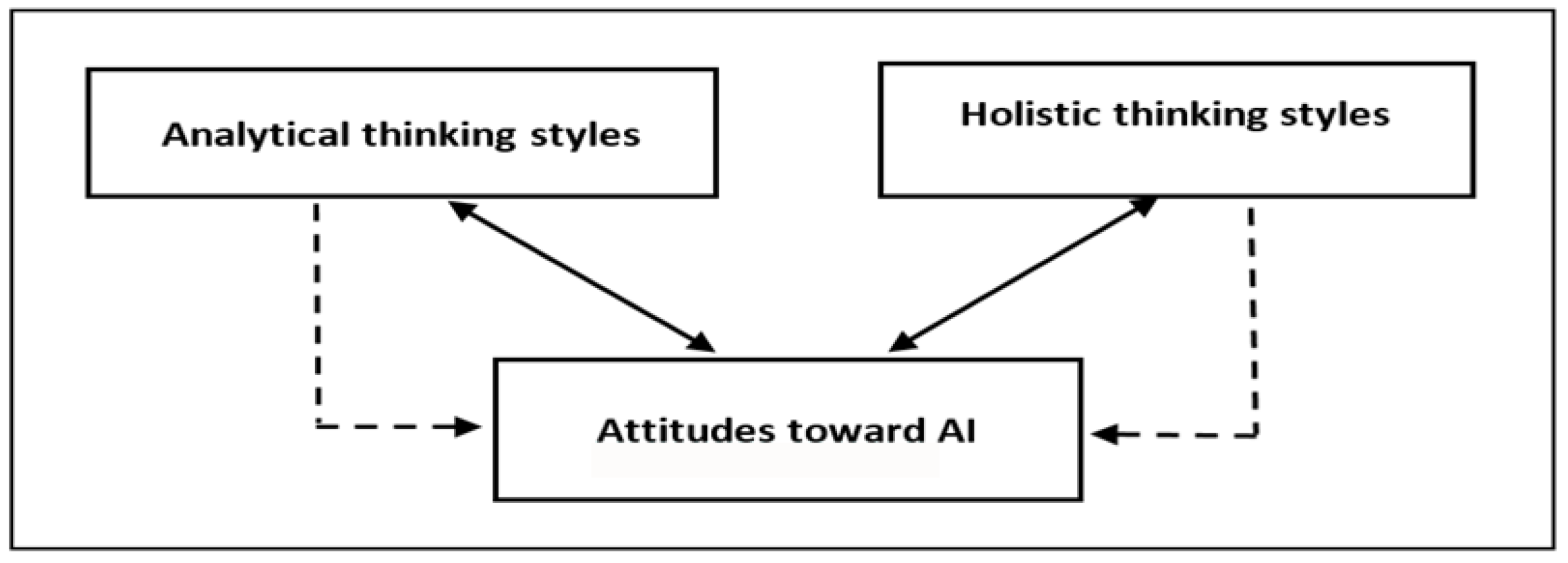
By integrating technology acceptance models with Cognitive Style Theory, this study proposes a more comprehensive framework for understanding teachers’ attitudes toward AI. This integration extends existing models by incorporating cognitive processing tendencies as underlying explanatory mechanisms, thereby addressing a key limitation in prior research. Within this framework, attitudes are not solely shaped by perceived characteristics of the technology but are also influenced by how individuals cognitively process and interpret AI-related information. In other words, cognitive styles function as interpretive filters through which teachers evaluate AI, potentially shaping both positive and negative attitudinal responses. The conceptual model of the study, illustrating the hypothesized relationships between analytical and holistic thinking styles and teachers’ attitudes toward AI, is presented in Figure 1.
As shown in Figure 1, analytical and holistic thinking styles are conceptualized as independent variables associated with teachers’ attitudes toward AI. The model assumes that these cognitive styles are related to how teachers cognitively process and interpret AI-related information, particularly in relation to perceived risks, potential benefits, and pedagogical appropriateness. In this respect, analytical thinking may be associated with a more systematic and critical evaluation of AI, with a stronger focus on technical limitations and potential risks. In contrast, holistic thinking may be associated with a more integrative and context-sensitive evaluation, enabling teachers to consider broader pedagogical implications and potential benefits of AI within educational settings. Accordingly, the model reflects an associative and non-causal framework in which teachers’ attitudes toward AI are not formed solely based on external characteristics of the technology, but are also related to internal cognitive processing tendencies. Within this framework, cognitive styles are conceptualized as interpretive mechanisms that may contribute to how teachers make sense of AI-related information, particularly under conditions of uncertainty and limited prior experience. Furthermore, the bidirectional representation in the model indicates that attitudes toward AI may be shaped through ongoing evaluative processes, rather than representing fixed or static outcomes.
Therefore, the proposed framework is consistent with the correlational design of the study and does not imply causal or predictive relationships. Instead, it emphasizes that cognitive styles are associated with variation in teachers’ evaluative responses to AI, particularly in relation to resistance-related dimensions of attitudes. Based on this theoretical perspective, the following research questions were formulated:
RQ1.
What are the levels of preschool teachers’ overall attitudes toward AI, their positive and negative attitude sub-dimensions, and their analytic and holistic thinking tendencies?
RQ2.
Is there a statistically significant difference between preschool teachers with analytic and holistic thinking orientations in terms of their attitudes toward AI?
RQ3.
Is there a significant relationship between preschool teachers’ thinking styles and their attitudes toward AI?
RQ4.
To what extent are analytical and holistic thinking styles associated with negative attitudes toward AI?
This framework positions cognitive style as a theoretically grounded explanatory variable that contributes to understanding teachers’ evaluative responses to AI in early childhood education contexts, while acknowledging that such relationships are associative rather than causal.

3. Methodology

3.1. Research Model

This study employed a quantitative correlational research design to examine the relationships between preschool teachers’ analytical and holistic thinking styles and their attitudes toward AI. Correlational designs are appropriate for identifying the direction and strength of relationships among naturally occurring variables without implying causal inference. In this context, the study aimed to explore whether cognitive thinking styles are associated with teachers’ attitudes toward AI and to what extent they are related to variation in these attitudes. Within this framework, both correlational and regression-based analyses were conducted. Pearson product–moment correlation analysis was used to examine the relationships between analytical–holistic thinking style and different dimensions of attitudes toward AI. In addition, a simple linear regression model was employed to examine whether analytical–holistic thinking style is associated with negative attitudes toward AI. Given that a single predictor variable was included in the model, the use of simple regression was considered appropriate. In the proposed model, analytical and holistic thinking style was treated as the independent variable, while attitudes toward AI particularly the negative attitude dimension were defined as the dependent variable. This approach allowed for the examination of associative relationships and the extent to which the independent variable is related to variation in the dependent variable, without implying causality. It should be noted that the study is cross-sectional and correlational in nature. Therefore, the findings should be interpreted as associative rather than causal relationships. The results indicate statistical relationships between variables; however, no causal inferences can be drawn regarding the direction of these relationships.

3.2. Participants and Procedure

The participants consisted of 236 preschool teachers working in various educational institutions during the 2025–2026 academic year. Of these, 68.9% (n = 165) were female and 30.1% (n = 71) were male. Participants were selected using convenience sampling, which involves recruiting individuals who are readily accessible to the researcher. While this method allows for efficient data collection, it limits the generalizability of the findings and may introduce sampling bias. Therefore, the results should be interpreted with caution and cannot be generalized beyond similar contexts. Prior to data collection, ethical approval was obtained from the relevant Ethics Committee (protocol no.: 402, dated 6 November 2025). Participants were informed about the purpose of the study and their rights, including voluntary participation and the ability to withdraw at any time without consequences. Informed consent was obtained from all participants. To ensure anonymity, no identifying personal information was collected.

3.3. Instruments

Attitudes Toward AI Scale: Teachers’ attitudes toward AI were measured using the General Attitudes toward AI Scale developed by [35] and adapted into Turkish by [36]. The instrument consists of 20 items rated on a five-point Likert scale and includes two sub-dimensions: Positive Attitudes (12 items) and Negative Attitudes (8 items). In the present study, the scale demonstrated high internal consistency (α = 0.97 for Positive Attitudes; α = 0.94 for Negative Attitudes). Confirmatory factor analysis (CFA) supported the two-factor structure, with acceptable model fit indices: χ2/df = 1.77, RMSEA = 0.057, CFI = 0.953, TLI = 0.946, and SRMR = 0.049. Standardized factor loadings ranged from 0.54 to 0.84 (p < 0.001). Composite reliability (CR = 0.93–0.96) and average variance extracted (AVE = 0.58–0.62) values indicated satisfactory convergent validity.
Analytic and Holistic Thinking Style Scale: Cognitive thinking styles were assessed using the Analytic and Holistic Thinking Style Scale developed by [10] and adapted into Turkish by [37]. The scale consists of eight items measuring individuals’ tendencies toward analytic and holistic thinking. The internal consistency coefficient in this study was acceptable (α = 0.76). CFA results confirmed the unidimensional structure with acceptable fit indices: χ2/df = 1.74, RMSEA = 0.056, CFI = 0.961, TLI = 0.947, and SRMR = 0.044. Factor loadings ranged from 0.49 to 0.76 (p < 0.001), and CR (0.78) and AVE (0.51) values supported construct validity. It should be noted that although the scale provides a continuous measure of cognitive style, categorizing individuals into distinct analytical or holistic groups may lead to a loss of information and reduced statistical power. Therefore, analyses were primarily conducted using continuous scores, and interpretations were made cautiously.

3.4. Data Analysis

Data were analyzed using both descriptive and inferential statistical techniques. Descriptive statistics, including mean, standard deviation, minimum, and maximum values, were calculated to summarize participants’ responses. The analyses were conducted on data obtained from the final sample of 236 preschool teachers, as described in the Participants section. To assess whether the data met the assumptions of parametric tests, normality was evaluated using skewness and kurtosis coefficients as well as visual inspection of histogram distributions. According to commonly accepted criteria, skewness and kurtosis values within the range of ±1.5 indicate approximate normal distribution [38]. In the present study, all variables fell within this range, and histogram inspections further supported the assumption of normality. Accordingly, parametric statistical methods were employed. Pearson product–moment correlation analysis was conducted to examine the relationships between analytical and holistic thinking style and attitudes toward AI, including overall attitudes and their sub-dimensions. In addition, a simple linear regression analysis was performed to assess whether analytical and holistic thinking style is associated with negative attitudes toward AI. The use of simple regression was considered appropriate, as a single predictor variable was included in the model. Prior to the regression analysis, key statistical assumptions were systematically examined. Linearity was assessed through scatterplot inspection, normality of residuals was evaluated using standardized residual distributions, and homoscedasticity was checked based on the distribution of residuals across predicted values. In addition, the absence of multicollinearity was confirmed, as the model included a single predictor variable. The results indicated no serious violations of these assumptions, supporting the suitability of the applied analyses. Statistical significance was evaluated at the 0.05 level.

4. Results

RQ1. 
What are the levels of preschool teachers’ overall attitudes toward AI, their positive and negative attitude sub-dimensions, and their analytic and holistic thinking tendencies?
Descriptive statistics were calculated to determine preschool teachers’ levels of overall attitudes toward AI, its sub-dimensions (positive and negative attitudes), and analytical holistic thinking style. As presented in Table 1, the mean score for overall attitudes toward AI was ( X ¯ = 52.67; SD = 12.06). When converted to a five-point Likert scale metric, this corresponds to an average item score of 2.63. For the sub-dimensions, the mean score for positive attitudes was ( X ¯ = 28.43; SD = 12.45), corresponding to an average item score of 2.36. The mean score for negative attitudes was ( X ¯ = 24.29; SD = 7.50), corresponding to an average item score of 3.03. With respect to cognitive style, the mean score for analytical–holistic thinking was ( X ¯ = 9.87; SD = 2.19). Considering that lower scores indicate a stronger analytical orientation and higher scores indicate a stronger holistic orientation (range: 5–15), the observed mean falls near the midpoint of the scale.
RQ2. 
Is there a statistically significant difference between preschool teachers with analytic and holistic thinking orientations in terms of their attitudes toward AI?
To examine whether attitudes toward AI differ according to thinking style orientation, participants were grouped based on their analytical holistic thinking scores. Independent samples t-tests were conducted to compare overall attitudes, as well as positive and negative attitude sub-dimensions, between analytical and holistic groups. As shown in Table 2, there was no statistically significant difference between analytical and holistic groups in terms of overall attitudes toward AI, t(234) = 0.257, p = 0.797. Similarly, no significant difference was found for positive attitudes, t(234) = −1.210, p = 0.228. However, a statistically significant difference was observed for negative attitudes, t(234) = 2.465, p = 0.015.
RQ3. 
Is there a significant relationship between preschool teachers’ thinking styles and their attitudes toward AI?
Pearson product moment correlation analysis was conducted to examine the relationships between analytical holistic thinking style and attitudes toward AI. As presented in Table 3, no statistically significant relationship was found between thinking style and overall attitudes toward AI (r = −0.035, p > 0.05). Similarly, no significant relationship was observed between thinking style and positive attitudes (r = 0.108, p > 0.05). A statistically significant negative correlation was found between analytical–holistic thinking style and negative attitudes toward AI (r = −0.236, p < 0.01). According to conventional criteria, this correlation represents a small effect size.
RQ4. 
To what extent are analytical and holistic thinking styles associated with negative attitudes toward AI?
Based on the correlation findings, a simple linear regression analysis was conducted to examine whether analytical holistic thinking style is related to negative attitudes toward AI. As shown in Table 4, the regression model was statistically significant, F(1, 234) = 7.98, p = 0.005. Analytical–holistic thinking style explained 5.8% of the variance in negative attitudes (R2 = 0.058, adjusted R2 = 0.049). Analytical–holistic thinking style was found to be a statistically significant predictor of negative attitudes (β = −0.24, t = −2.29, p = 0.005).

5. Discussion

The present study examined the relationship between preschool teachers’ analytical and holistic thinking styles and their attitudes toward AI. The findings indicate that teachers’ overall attitudes toward AI are moderate, characterized by relatively low levels of positive attitudes and a moderate presence of negative perceptions. This pattern suggests that teachers tend to adopt a cautious and ambivalent stance toward AI rather than demonstrating clear acceptance or rejection, which is consistent with recent literature indicating that educators often recognize both the potential benefits and inherent risks associated with AI integration in educational contexts [2,16,26]. One possible explanation for this ambivalence may be related to the pedagogical nature of early childhood education, which is inherently interaction-driven and emphasizes socio-emotional development, human relationships, and contextual responsiveness. Consequently, teachers may approach AI integration with caution, particularly due to concerns regarding reduced human interaction, changes in professional roles, and uncertainties about pedagogical appropriateness [39,40,41]. Previous studies similarly report that teachers often perceive AI both as a supportive instructional tool and as a potential source of disruption, particularly in relation to trust, reliability, and professional identity [42].
Regarding differences based on thinking style (RQ2), the findings indicate that analytical and holistic thinking orientations do not significantly differentiate teachers’ overall or positive attitudes toward AI. However, a statistically significant difference was observed in negative attitudes, with analytically oriented teachers reporting higher levels of negative perceptions. This finding suggests that cognitive style may be associated with resistance-related dimensions of attitudes rather than general acceptance. In line with Cognitive Style Theory, analytical thinkers tend to prioritize rule-based reasoning, systematic evaluation, and error detection, which may be related to increased sensitivity to uncertainty, system limitations, and ethical risks associated with AI [11,12]. The results of the correlation analysis (RQ3) further support this interpretation. While no statistically significant relationships were found between thinking styles and overall or positive attitudes, a small but statistically significant negative relationship was identified between analytical and holistic thinking and negative attitudes (r = −0.236), indicating that higher levels of holistic thinking are associated with lower levels of negative perceptions toward AI. Holistic thinking, characterized by contextual, integrative, and relational reasoning, may enable teachers to evaluate AI not only in terms of risks but also in relation to its pedagogical affordances and broader educational implications [10,13].
This finding can be more clearly interpreted within the framework of Cognitive Style Theory, which suggests that individuals differ in how they process and evaluate complex information [10]. In the context of AI, analytical thinkers may focus more on system limitations, risks, and technical aspects, whereas holistic thinkers may adopt a broader perspective that incorporates contextual, pedagogical, and relational considerations. This distinction may help explain why cognitive styles appear to be more strongly associated with resistance-related dimensions of attitudes rather than general acceptance.
These findings are consistent with previous research suggesting that individuals who adopt more integrative and flexible cognitive approaches may be better able to balance perceived risks and benefits when evaluating emerging technologies [26,31]. Furthermore, studies have shown that creativity-oriented and complex thinking styles are positively associated with holistic thinking and negatively associated with rigid, rule-based cognitive processing [43,44], which may help explain why holistic thinking is associated with lower levels of negative attitudes toward AI.
Recent studies conducted in early childhood education contexts further support the growing role of AI and related cognitive competencies in shaping educational processes. For instance, research indicates that AI-supported robotics activities can foster both algorithmic thinking and environmental awareness among young learners, highlighting the pedagogical potential of AI-integrated practices [45]. Similarly, AI-generated learning environments and robotics-based instruction have been shown to support the development of computational thinking skills in early childhood settings, emphasizing the importance of developmentally appropriate and context-sensitive AI applications [46].
In addition, studies examining broader cognitive and affective dimensions suggest that variables such as emotional intelligence and critical thinking may be associated with teachers’ professional competencies and their ability to evaluate complex technological environments [47]. This is consistent with the present study’s emphasis on cognitive processing tendencies as factors related to attitudes toward AI. Furthermore, recent findings indicate that teachers’ media use and computational thinking skills are associated with sustainable development outcomes in early childhood education, reinforcing the idea that cognitive and technological competencies should be considered together within sustainability-oriented educational frameworks [48].
Finally, the increasing use of AI in early childhood education contexts has been associated with both opportunities and challenges, particularly in relation to pedagogical adaptation, ethical considerations, and developmental appropriateness [49]. These findings collectively suggest that understanding teachers’ attitudes toward AI requires a multidimensional perspective that integrates cognitive styles with broader technological, pedagogical, and contextual factors.
The regression analysis (RQ4) indicates that analytical–holistic thinking style is statistically associated with negative attitudes toward AI; however, the proportion of explained variance is limited (R2 = 0.058). This suggests that although cognitive style contributes to understanding resistance-related perceptions, its explanatory power remains modest. This effect should be interpreted as small and limited in practical significance. Consistent with the broader literature, attitudes toward AI appear to be associated with multiple interrelated factors, including AI literacy, technological self-efficacy, institutional support, and perceived risk [15,50,51]. Accordingly, cognitive style should be considered as one component within a multidimensional framework rather than as a primary determinant.
In addition, the findings indicate that teachers’ negative attitudes toward AI may also be associated with practical and contextual concerns frequently reported in the literature, including insufficient knowledge of AI, lack of training opportunities, concerns about data privacy and security, perceived threats to professional roles, and uncertainties regarding implementation processes [39,52,53]. For instance, concerns related to data misuse and privacy have been identified as important barriers to AI adoption in educational settings [54], while issues such as unequal access to technological resources and potential impacts on student creativity and autonomy have also been highlighted as contributing factors to resistance [46]. From a broader perspective, these findings suggest that reducing negative attitudes toward AI may require not only cognitive readiness but also structural and pedagogical support. The literature suggests that enhancing AI literacy, providing continuous professional development, and fostering ethical awareness may support teachers’ acceptance and effective use of AI in educational contexts [50,51,55].
Finally, although this study is framed within a sustainability perspective, the findings should be interpreted with caution. From the perspective of the present study, cognitive styles are not interpreted as determinants of sustainable outcomes; rather, they are considered as factors associated with teachers’ resistance-related attitudes toward AI. In this respect, the findings contribute indirectly to the sustainability discourse by identifying cognitive factors that may be related to resistance, which is relevant for the long-term and stable integration of AI in educational contexts. Accordingly, reducing negative perceptions through cognitive and professional development may contribute to more stable and sustainable adoption processes in education [8,16].

6. Implications

The findings of this study may offer several implications for the implementation of AI in early childhood education. Professional development programs may benefit from extending beyond a narrow focus on the technical use of AI tools to include cognitively informed components, as the results indicate that analytical and holistic thinking styles are associated with negative attitudes toward AI, although this relationship is limited in strength. In this context, professional learning activities such as reflective case analyses, discussions of ethical considerations, and data-informed pedagogical decision-making practices may help inform teachers’ evaluative processes regarding AI. In addition, teacher education programs may consider incorporating elements such as AI literacy, ethical awareness, data security, and critical digital competencies into their curricula. While the present findings do not directly examine these variables, prior research suggests that such factors are relevant in shaping attitudes toward emerging technologies, and their integration may support teachers in developing a more balanced understanding of AI in educational contexts. Furthermore, within educational policy frameworks, AI may be positioned as a complementary tool that supports human-centered pedagogy rather than replacing teachers, which may support the consideration of teachers’ professional roles and their engagement in technology integration processes. However, the extent to which such approaches influence attitudes toward AI requires further empirical investigation. Overall, these implications should be interpreted with caution, as the findings indicate a limited but statistically significant relationship between cognitive styles and negative attitudes toward AI. Future research is needed to further examine how different variables interact in shaping teachers’ responses to AI in early childhood education.

7. Limitations of the Study

Despite its contributions, this study has several limitations that should be acknowledged. First, the use of a convenience sampling method and the inclusion of preschool teachers from a specific geographical context limit the generalizability of the findings. Future studies should include larger and more diverse samples across different regions and educational levels to enhance external validity. Second, the cross-sectional and correlational design of the study precludes causal inferences. The relationships identified should therefore be interpreted as associative rather than causal. Longitudinal or experimental research designs would be beneficial for examining how thinking styles influence the development of attitudes toward AI over time. Third, the study relied exclusively on self-report measures, which may be subject to social desirability bias and individual perception limitations. Future research could incorporate qualitative methods, such as interviews or classroom observations, or mixed-method approaches to provide a more comprehensive understanding of teachers’ cognitive and contextual evaluations of AI. Additionally, although analytical and holistic thinking styles were found to explain a small but statistically significant proportion of variance in negative attitudes toward AI, the overall explanatory power of the model was limited (R2 = 0.058). This suggests that other variables not included in the present study such as AI literacy, technological self-efficacy, institutional support, prior experience with AI tools, and perceived risk may play a more substantial role in shaping teachers’ attitudes. Accordingly, future research should adopt more comprehensive and integrative theoretical frameworks that incorporate cognitive, affective, and contextual variables in order to better understand the complexity of AI integration in early childhood education.

8. Conclusions

This study examined the relationship between preschool teachers’ analytical and holistic thinking styles and their attitudes toward AI within the context of early childhood education. The findings indicate that teachers’ attitudes toward AI are moderate, reflecting a cautious and ambivalent orientation characterized by relatively low levels of positive attitudes and a moderate presence of negative perceptions. The results further indicate that thinking styles are not significantly associated with overall or positive attitudes toward AI. However, a small but statistically significant relationship was identified between thinking styles and negative attitudes, with higher levels of holistic thinking being associated with lower levels of negative perceptions. Despite this relationship, the low explained variance (R2 = 0.058) indicates that cognitive styles are associated with only a limited proportion of variation in teachers’ attitudes toward AI.
These findings suggest that analytical and holistic thinking styles should not be interpreted as primary determinants of AI acceptance. Rather, they may be considered some of the several factors associated with how teachers interpret and respond to AI-related challenges, particularly in relation to resistance and negative perceptions. In this respect, teachers’ attitudes toward AI appear to be associated with a broader set of interacting factors, including pedagogical considerations, contextual conditions, and individual differences.
From a theoretical perspective, this study contributes to the literature by integrating Cognitive Style Theory with technology acceptance approaches and by indicating that cognitive processing tendencies are more closely associated with resistance-related dimensions of attitude than with general acceptance. From a practical perspective, the findings highlight the importance of adopting a multidimensional approach to understanding teachers’ attitudes toward AI, emphasizing the need to consider not only cognitive characteristics but also broader contextual and pedagogical factors. Within the framework of sustainable educational transformation, the findings suggest that reducing negative perceptions and supporting teachers’ adaptive responses to AI may contribute to more stable and long-term integration processes. However, such implications should be interpreted with caution, as sustainable AI integration is associated with the interaction of multiple structural, pedagogical, and individual factors rather than any single variable.
In conclusion, understanding teachers’ attitudes toward AI requires comprehensive and integrative models that reflect the complexity of technology adoption in educational settings. Future research may benefit from incorporating additional variables and more comprehensive analytical frameworks to better explain the multidimensional nature of AI integration, particularly within early childhood education contexts.

Author Contributions

During the research process, the determination of the research topic and the study design were carried out collaboratively by all authors. C.E. contributed to the conceptualization of the study, development of the methodology, formal analysis, investigation, drafting of the manuscript, and visualization. B.E.E. contributed to the conceptualization of the study, development of the methodology, data curation, and the review and editing of the manuscript. All authors have read and agreed to the published version of the manuscript.

Funding

This research received no external funding.

Institutional Review Board Statement

The study was conducted in accordance with the Declaration of Helsinki and was approved by the Human Research Ethics Committee of Zonguldak Bülent Ecevit University (Turkey) with protocol number 402 on 6 November 2025.

Informed Consent Statement

Informed consent was obtained from all the individual participants who were included in the study.

Data Availability Statement

The data that support the findings of this study are available from the corresponding author upon reasonable request.

Conflicts of Interest

The authors declare no conflicts of interest.

References

  1. Aggarwal, D.; Sharma, D.; Saxena, A.B. Exploring the role of artificial intelligence for augmentation of adaptable sustainable education. Asian J. Adv. Res. Rep. 2023, 17, 179–184. [Google Scholar] [CrossRef]
  2. Kim, J. Artificial intelligence in achieving sustainable development: Expectations of undergraduate students. TechTrends 2025, 69, 138–148. [Google Scholar] [CrossRef]
  3. United Nations. Transforming Our World: The 2030 Agenda for Sustainable Development. 2015. Available online: https://sdgs.un.org/2030agenda (accessed on 9 January 2026).
  4. Tuomi, I. The Impact of Artificial Intelligence on Learning, Teaching, and Education; Publications Office of the European Union: Luxembourg, 2018. [Google Scholar] [CrossRef]
  5. Kasneci, E.; Seßler, K.; Küchemann, S.; Bannert, M.; Dementieva, D.; Fischer, F.; Gasser, U.; Groh, G.; Günnemann, S.; Hüllermeier, E.; et al. ChatGPT for good? On opportunities and challenges of large language models for education. Learn. Individ. Differ. 2023, 103, 102274. [Google Scholar] [CrossRef]
  6. Chan, C. Holistic competencies and AI in education: A synergistic pathway. Australas. J. Educ. Technol. 2024, 40, 1–12. [Google Scholar] [CrossRef]
  7. Kamalov, F.; Santandreu Calonge, D.; Gurrib, I. New era of artificial intelligence in education: Towards a sustainable multifaceted revolution. Sustainability 2023, 15, 12451. [Google Scholar] [CrossRef]
  8. Sousa, M.; Almeida, M.F.; Calili, R. Multiple criteria decision making for the achievement of the UN sustainable development goals: A systematic literature review and a research agenda. Sustainability 2021, 13, 4129. [Google Scholar] [CrossRef]
  9. Yim, I.H.Y.; Wegerif, R. Teachers’ perceptions, attitudes, and acceptance of artificial intelligence (AI) educational learning tools: An exploratory study on AI literacy for young students. Future Educ. Res. 2024, 2, 318–345. [Google Scholar] [CrossRef]
  10. Choi, I.; Koo, M.; Choi, J.A. Individual differences in analytic versus holistic thinking. Personal. Soc. Psychol. Bull. 2007, 33, 691–705. [Google Scholar] [CrossRef]
  11. Lacko, D.; Prošek, T.; Čeněk, J.; Helísková, M.; Ugwitz, P.; Svoboda, V.; Šašinka, Č. Analytic and holistic cognitive style as a set of independent manifests: Evidence from a validation study of six measurement instruments. PLoS ONE 2023, 18, e0287057. [Google Scholar] [CrossRef]
  12. Zhang, L.F. Thinking styles and model of thinking: Implications for education and research. J. Psychol. 2002, 136, 245–261. [Google Scholar] [CrossRef]
  13. San Martin, A.; Schug, J.; Maddux, W.W. Relational mobility and cultural differences in analytic and holistic thinking. J. Personal. Soc. Psychol. 2019, 116, 495–518. [Google Scholar] [CrossRef]
  14. Ahmad, S.F.; Rahmat, M.K.; Mubarik, M.S.; Alam, M.M.; Hyder, S.I. Artificial intelligence and its role in education. Sustainability 2021, 13, 12902. [Google Scholar] [CrossRef]
  15. Al-Abdullatif, A.M. Modeling teachers’ acceptance of generative artificial intelligence use in higher education: The role of AI literacy, intelligent TPACK, and perceived trust. Educ. Sci. 2024, 14, 1209. [Google Scholar] [CrossRef]
  16. Zawacki-Richter, O.; Marín, V.I.; Bond, M.; Gouverneur, F. Systematic review of research on artificial intelligence applications in higher education: Where are the educators? Int. J. Educ. Technol. High. Educ. 2019, 16, 39. [Google Scholar] [CrossRef]
  17. Filiz, O.; Kaya, M.H.; Adiguzel, T. Teachers and AI: Understanding the factors influencing AI integration in K–12 education. Educ. Inf. Technol. 2025, 30, 17931–17967. [Google Scholar] [CrossRef]
  18. McCarthy, J. From here to human-level AI. Artif. Intell. 2007, 171, 1174–1182. [Google Scholar] [CrossRef]
  19. Saxena, R. Role of artificial intelligence in Indian education system. Integr. J. Res. Arts Humanit. 2022, 2, 104–107. [Google Scholar] [CrossRef]
  20. Luo, S.; Zhu, Y.; Han, S. Functional connectome fingerprint of holistic–analytic cultural style. Soc. Cogn. Affect. Neurosci. 2022, 17, 172–186. [Google Scholar] [CrossRef]
  21. Martin, F.; Dennen, V.P.; Bonk, C.J. A synthesis of systematic review research on emerging learning environments and technologies. Educ. Technol. Res. Dev. 2020, 68, 1613–1633. [Google Scholar] [CrossRef]
  22. Vorobyeva, K.I.; Belous, S.; Savchenko, N.V.; Smirnova, L.M.; Nikitina, S.A.; Zhdanov, S.P. Personalized learning through AI: Pedagogical approaches and critical insights. Contemp. Educ. Technol. 2025, 17, ep574. [Google Scholar] [CrossRef] [PubMed]
  23. Law, L. Application of generative artificial intelligence (GenAI) in language teaching and learning: A scoping literature review. Comput. Educ. Open. 2024, 6, 100174. [Google Scholar] [CrossRef]
  24. Bartolomé, A.; Castañeda, L.; Adell, J. Personalisation in educational technology: The absence of underlying pedagogies. Int. J. Educ. Technol. High. Educ. 2018, 15, 14. [Google Scholar] [CrossRef]
  25. Nuroso, H.; Siswanto, J.; Huda, C. Developing a learning model to promote the skills of analytical thinking. J. Educ. Learn. (EduLearn) 2018, 12, 775–780. [Google Scholar] [CrossRef]
  26. Holmes, W. Artificial Intelligence in Education. In Encyclopedia of Education and Information Technologies; Tatnall, A., Ed.; Springer: Cham, Switzerland, 2020. [Google Scholar] [CrossRef]
  27. Fan, J.; Zhang, L.F.; Chen, C. Thinking styles: Distinct from personality? Personal. Individ. Differ. 2018, 125, 50–55. [Google Scholar] [CrossRef]
  28. Sternberg, R.J. Styles of thinking and learning. Can. J. Sch. Psychol. 1998, 13, 15–40. [Google Scholar] [CrossRef]
  29. Sternberg, R.J.; Zhang, L.F. Styles of thinking as a basis of differentiated instruction. Theory Into Pract. 2005, 44, 245–253. [Google Scholar] [CrossRef]
  30. Holmes, W.; Bialik, M.; Fadel, C. Artificial Intelligence in Education: Promises and Implications for Teaching and Learning; Center for Curriculum Redesign: Boston, MA, USA, 2019; Available online: https://curriculumredesign.org/wp-content/uploads/AIED-Book-Excerpt-CCR.pdf (accessed on 9 January 2026).
  31. Chiu, T.K. The impact of generative AI (GenAI) on practices, policies and research direction in education. Interact. Learn. Environ. 2024, 32, 6187–6203. [Google Scholar] [CrossRef]
  32. Li, B.; Li, Z.; Wang, X.; Lin, H. Early career teachers’ thinking styles and teacher expectations. Educ. Psychol. 2025, 45, 18–42. [Google Scholar] [CrossRef]
  33. Xue, L.; Ghazali, N.; Mahat, J. A systematic review of UTAUT and UTAUT2 for AI adoption in education. Int. J. Hum.–Comput. Interact. 2025, 42, 5666–5690. [Google Scholar] [CrossRef]
  34. Kopecka, H.; Such, J.; Luck, M. Preferences for AI explanations based on cognitive style and socio-cultural factors. Proc. ACM Hum.–Comput. Interact. 2024, 8, 1–32. [Google Scholar] [CrossRef]
  35. Schepman, A.; Rodway, P. Initial validation of the general attitudes towards artificial intelligence scale. Comput. Hum. Behav. Rep. 2020, 1, 100014. [Google Scholar] [CrossRef] [PubMed]
  36. Kaya, F.; Aydın, F.; Schepman, A.; Rodway, P.; Yetişensoy, O.; Demir, K. The roles of personality traits, AI anxiety, and demographic factors in attitudes toward artificial intelligence. Int. J. Hum.–Comput. Interact. 2022, 40, 497–514. [Google Scholar] [CrossRef]
  37. Kavak, B.; Kazancı Sunaoğlu, Ş.; Taner, N. An examination of adopters’ holistic and analytic approaches for smartphones. J. Mark. Mark. Res. 2017, 10, 179–200. [Google Scholar]
  38. Tabachnick, B.G.; Fidell, L.S. Using Multivariate Statistics, 7th ed.; Pearson: London, UK, 2019. [Google Scholar] [CrossRef]
  39. Humble, N.; Mozelius, P. The threat, hype, and promise of artificial intelligence in education. Discov. Artif. Intell. 2022, 2, 22. [Google Scholar] [CrossRef]
  40. Guzey, C.; Cakir, O.; Athar, M.H.; Yurdaoz, E.; Saad, S. Content analysis of research on artificial intelligence in education. J. Inf. Commun. Technol. 2023, 5, 66–77. [Google Scholar] [CrossRef]
  41. Seldon, A.; Abidoye, O. The Fourth Education Revolution: Will Artificial Intelligence Liberate or Infantilise Humanity? The University of Buckingham Press: London, UK, 2018. [Google Scholar] [CrossRef]
  42. Alwaqdani, M. Investigating teachers’ perceptions of artificial intelligence tools in education: Potential and difficulties. Educ. Inf. Technol. 2024, 30, 2737–2755. [Google Scholar] [CrossRef]
  43. Kim, J.; Michael, W.B. The relationship of creativity measures to school achievement and preferred learning and thinking style. Educ. Psychol. Meas. 1995, 55, 60–74. [Google Scholar] [CrossRef]
  44. Okabayashi, H.; Torrance, E.P. Role of style of learning and thinking in achievement. J. Learn. Disabil. 1984, 17, 104–107. [Google Scholar] [CrossRef]
  45. Kanaki, K.; Chatzakis, S.; Kalogiannakis, M. Fostering algorithmic thinking and environmental awareness via bee-bot activities in early childhood education. Sustainability 2025, 17, 4208. [Google Scholar] [CrossRef]
  46. Hijón-Neira, R.; Pizarro, C.; Borrás-Gené, O.; Cavero, S. AI-generated context for teaching robotics to improve computational thinking in early childhood education. Educ. Sci. 2024, 14, 1401. [Google Scholar] [CrossRef]
  47. Palma-Luengo, M.; Martin, N.L.S.; Ossa-Cornejo, C. Emotional intelligence and critical thinking: Relevant factors for training future teachers in a Chilean pedagogy program. J. Intell. 2025, 13, 17. [Google Scholar] [CrossRef]
  48. An, M.Y.; Shin, K.S. Effects of Teachers’ Media Utilization and Computational Thinking on Sustainable Development in Early Childhood Education. Sustainability 2024, 16, 5773. [Google Scholar] [CrossRef]
  49. Cimino, S.; Maremmani, A.G.I.; Cerniglia, L. The Use of Artificial Intelligence (AI) in Early Childhood Education. Societies 2025, 15, 341. [Google Scholar] [CrossRef]
  50. Çayak, S. Investigating the relationship between teachers’ attitudes toward artificial intelligence and their artificial intelligence literacy. J. Educ. Technol. Online Learn. 2024, 7, 367–383. [Google Scholar] [CrossRef]
  51. Mart, M.; Kaya, G. The examination of preschool teacher candidates’ attitudes towards artificial intelligence. Edutech Res. 2024, 2, 91–109. [Google Scholar]
  52. Seyrek, M.; Yıldız, S.; Emeksiz, H.; Şahin, A.; Türkmen, M.T. Teachers’ perceptions on the use of artificial intelligence in education. Int. J. Soc. Humanit. Sci. Res. 2024, 11, 845–856. [Google Scholar] [CrossRef]
  53. Regan, P.M.; Jesse, J. Ethical challenges of edtech, big data and personalized learning. Ethics Inf. Technol. 2019, 21, 167–179. [Google Scholar] [CrossRef]
  54. Nemorin, S. Affective capture in digital school spaces. Emot. Space Soc. 2017, 24, 11–18. [Google Scholar] [CrossRef]
  55. Ismail, A.; Aliu, A.; Ibrahim, M.; Sulaiman, A. Preparing teachers of the future in the era of artificial intelligence. J. Artif. Intell. Mach. Learn. Neural Netw. 2024, 44, 31–41. [Google Scholar] [CrossRef]
Figure 1. Conceptual model illustrating the relationships between analytical and holistic thinking styles and teachers’ attitudes toward AI (Source: Authors).
Sustainability 18 04143 g001
Table 1. Descriptive statistics related to cognitive flexibility level.
Scale and SubscalesNMinMax X ¯ SDValue
Artificial ıntelligence23626.077.052.6712.062.63
1st subscale: positive attitudes23612.052.0028.4312.452.36
2nd subscale: negative attitudes23610.040.024.297.503.03
Analytical and holistic thinking2365.013.09.872.192.62
p < 0.05.
Table 2. Comparison of attitudes towards AI according to analytical and holistic thinking styles.
N X ¯ SDDftp
Artificial intelligenceAnalytical12652.9111.222340.2570.797
Holistic11052.3713.91
Positive attitudesAnalytical12627.3211.55234−1.2100.228
Holistic11029.9113.50
Negative attitudesAnalytical12625.587.092342.4650.015
Holistic11022.457.70
p < 0.05.
Table 3. Relationships between attitudes towards AI and analytical and holistic thinking styles.
[1][2][3][4]
Attitude towards AI [1]1.00
Attitude towards AI_positive attitudes [2]0.812 **1.00
Attitude towards AI_negative attitudes [3]0.259 **−0.352 **1.00
Analytical and holistic thinking [4]−0.0350.108−0.236 **1.00
** p < 0.01.
Table 4. Analytical and holistic thinking styles predicting attitudes towards AI.
Dependent VariableIndependent VariablesSt. BetatpR2Flat. R2F
Model Negative Attitude
toward AI
Constant31.8411.080.0000.0580.0497.98
Analytical and Holistic Thinking−0.808−2.290.005
p < 0.05.
Disclaimer/Publisher’s Note: The statements, opinions and data contained in all publications are solely those of the individual author(s) and contributor(s) and not of MDPI and/or the editor(s). MDPI and/or the editor(s) disclaim responsibility for any injury to people or property resulting from any ideas, methods, instructions or products referred to in the content.