Beyond Adoption: Sustainability and Resilience Dimensions of Household Biogas Systems in West Java, Indonesia




Abstract
1. Introduction
Biogas Development in Indonesia
2. Materials and Methods
2.1. Study Design and Data Collection
2.2. Variables
2.2.1. Adoption Indicator
- Herd size: Number of dairy cattle owned by the household, representing manure availability for biogas production.
- Household income: Log of annual household income, capturing the household’s financial capacity.
- Education of household head: Years of formal schooling completed by the household head.
- Access to credit: Binary indicator reflecting whether the household has access to formal or informal credit.
- Participation in training: Binary variable equal to 1 if the household attended at least one biogas-related training session in the past 24 months.
- Training intensity: Number of training sessions attended, used to explore variation in technical exposure where data are available.
- Asset index (PCA): Composite indicator of household wealth constructed using principal component analysis.
- Distance to cooperative: Distance to the nearest cooperative or technical service provider, representing access to institutional support.
- District fixed effects: Dummy variables included to control for unobserved district-level differences.
- Average marginal effects (AMEs): Reported to facilitate interpretation of the logistic regression results.
2.2.2. Structural Variables
- Herd size (number of dairy cattle): Measures livestock ownership and potential manure availability for biogas production.
- Log of annual household income: Log-transformed annual household income used to capture financial capacity while reducing skewness in income distribution.
- Education of household head (years of schooling): Total years of formal education completed by the household head, representing human capital.
- Asset index (constructed via principal component analysis): Composite indicator of household wealth derived from ownership of productive and household assets using PCA.
2.2.3. Institutional Variables
- Participation in technical training (number of sessions attended)—Measured as a binary indicator equal to 1 if the household attended at least one biogas-related training session in the past 24 months. This variable captures exposure to training but does not reflect differences in duration, quality, or technical depth. Estimated effects should therefore be interpreted as general exposure and may be subject to attenuation bias.
- Access to cooperative-based maintenance services—Binary indicator reflecting whether the household has access to maintenance support from a local cooperative.
- Distance to nearest technical service provider—Distance from the household to the nearest biogas technician or service provider, representing accessibility of technical support.
- Economic exposure—Measured as the share of LPG expenditure relative to annual household income, capturing household exposure to cooking-fuel costs.
2.2.4. Outcome Variables
- Monthly LPG consumption (kg): Quantity of LPG used per month, indicating reliance on commercial cooking fuel.
- Monthly firewood use (kg): Amount of firewood consumed per month as a traditional household energy source.
- Annual chemical fertilizer purchases (kg): Quantity of chemical fertilizers purchased annually, reflecting input substitution after biogas adoption.
- Time spent collecting fuel (hours/week): Weekly time devoted to collecting fuelwood or other traditional fuels.
- Self-reported ability to conduct minor maintenance: Household’s reported capability to perform basic biogas digester maintenance tasks.
2.3. Empirical Strategy
2.3.1. Adoption Model
2.3.2. Treatment Effects
2.3.3. Econometric Analysis of Adoption Determinants
2.3.4. Sustainability–Resilience Interpretation
2.3.5. Sustainability–Resilience Framework
3. Results
3.1. Descriptive Characteristics of Adopters and Non-Adopters
3.2. Determinants of Biogas Adoption
3.3. Synthesis of Adoption Patterns and Implications for Causal Loop Analysis
3.4. Treatment Effects and Matching Diagnostics
3.5. Heterogeneous Treatment Effects
4. Discussion
4.1. Adoption as a Function of Capability Rather than Wealth
4.2. Livestock Ownership and the Robustness of Household Energy Systems
4.3. Fuel-Cost Pressure and the Limits of Economic Incentives
4.4. Implications for Sustainability and Resilience Outcomes
4.5. Positioning Within the Biogas Impact Literature
5. Recommendation
5.1. Policy Implications
5.2. Institutional Implications
5.3. Research Implications
6. Conclusions
Author Contributions
Funding
Institutional Review Board Statement
Informed Consent Statement
Data Availability Statement
Acknowledgments
Conflicts of Interest
References
- Heracleous, C.; Michael, A.; Savvides, A.; Hayles, C. A Methodology to Assess Energy-Demand Savings and Cost-Effectiveness of Adaptation Measures in Educational Buildings in the Warm Mediterranean Region. Energy Rep. 2022, 8, 5472–5486. [Google Scholar] [CrossRef] [Scilit]
- IPCC. Climate Change 2022—Mitigation of Climate Change; Cambridge University Press: Cambridge, UK, 2023; ISBN 9781009157926. [Google Scholar]
- Hu, X.; Jaraitė, J.; Kažukauskas, A. The Effects of Wind Power on Electricity Markets: A Case Study of the Swedish Intraday Market. Energy Econ. 2021, 96, 105159. [Google Scholar] [CrossRef] [Scilit]
- Chipango, E.F. Why Do Capabilities Need Ubuntu? Specifying the Relational (Im)Morality of Energy Poverty. Energy Res. Soc. Sci. 2023, 96, 102921. [Google Scholar] [CrossRef] [Scilit]
- Galster, H.S.; Van der Wal, A.J.; Batenburg, A.E.; Koning, V.; Faaij, A.P.C. A Comprehensive Review of Integrating Behavioral Drivers of Technology Adoption and Energy Service Use in Energy System Models. Renew. Sustain. Energy Rev. 2025, 214, 115520. [Google Scholar] [CrossRef] [Scilit]
- Jack, M.W.; Mirfin, A.; Anderson, B. The Role of Highly Energy-Efficient Dwellings in Enabling 100% Renewable Electricity. Energy Policy 2021, 158, 112565. [Google Scholar] [CrossRef] [Scilit]
- Yang, X.; Wang, S.; He, Y. Review of Catalytic Reforming for Hydrogen Production in a Membrane-Assisted Fluidized Bed Reactor. Renew. Sustain. Energy Rev. 2022, 154, 111832. [Google Scholar] [CrossRef] [Scilit]
- TRANSrisk Project. Biogas Development in Indonesia: Household Scale Evaluation of Indonesian Transition Pathways in Biogas Utilisation. Available online: https://www.transrisk-project.eu/sites/default/files/TRANSrisk_WP3_Indonesia_Biogas_Final.pdf (accessed on 29 January 2026).
- Mutaqin, M.I.; Widyarani; Hamidah, U.; Janetasari, S.A.; Muchlis; Sintawardarni, N. Biogas Consumption Pattern in Indonesia: (A Case Study of Sumedang Community Biogas Plant, Indonesia). In Proceedings of the 2019 International Conference on Sustainable Energy Engineering and Application (ICSEEA); IEEE: New York, NY, USA, 2019; pp. 113–118. [Google Scholar]
- Günther, A.; Engel, L.; Hornsey, M.J.; Nielsen, K.S.; Roy, J.; Steg, L.; Tam, K.-P.; van Valkengoed, A.M.; Wolske, K.S.; Wong-Parodi, G.; et al. Psychological and Contextual Determinants of Clean Energy Technology Adoption. Nat. Rev. Clean Technol. 2025, 1, 547–565. [Google Scholar] [CrossRef] [Scilit]
- Indonesia Domestic Biogas Programme (BIRU). Indonesia Domestic Biogas Programme (BIRU): Report 2021; Yayasan Rumah Energi: Jakarta, Indonesia, 2022. [Google Scholar]
- Pambudi, N.A.; Firdaus, R.A.; Rizkiana, R.; Ulfa, D.K.; Salsabila, M.S.; Suharno; Sukatiman. Renewable Energy in Indonesia: Current Status, Potential, and Future Development. Sustainability 2023, 15, 2342. [Google Scholar] [CrossRef] [Scilit]
- International Institute for Environment and Development. The Indonesia Domestic Biogas Programme: Can Carbon Financing Promote Sustainable Agriculture? Available online: https://www.iied.org/sites/default/files/pdfs/migrate/16597IIED.pdf (accessed on 29 January 2026).
- SNV Netherlands Development Organisation. Feasibility of a National Programme on Domestic Biogas in Indonesia Final Report. Available online: https://www.bibalex.org/search4dev/files/338059/171535.pdf (accessed on 29 January 2026).
- Wahyudi, J. The Determinant Factors of Biogas Technology Adoption in Cattle Farming: Evidences from Pati, Indonesia. Int. J. Renew. Energy Dev. 2017, 6, 235–240. [Google Scholar] [CrossRef] [Scilit]
- Hivos; SNV Netherlands Development Organisation. Indonesia Domestic Biogas Program–Annual Report 2024; Biogas Rumah (BIRU): Jakarta, Indonesia, 2025. [Google Scholar]
- Dinas Energi dan Sumber Daya Mineral Provinsi Jawa Barat. Jumlah Biogas Berdasarkan Kabupaten/Kota Di Jawa Barat (2020); Dinas Energi Dan Sumber Daya Mineral Provinsi Jawa Barat: Bandung, Indonesia, 2020.
- SNV; Hivos. Indonesia Domestic Biogas Program–Annual Report 2023; Yayasan Rumah Energi: Jakarta, Indonesia, 2024. [Google Scholar]
- Praditya, A.; Abdilla, T.; Damayanti, A.H.; Marciano, I.; Simamora, P.; Mursanti, E.; Arinaldo, D.; Giwangkara, J.; Adiatma, J.C. Indonesia Clean Energy Outlook Tracking Progress and Review of Clean Energy Development in Indonesia. Available online: https://jin.ngo/images/jin/publications/JIQ_Special_Nov2016_TRANSrisk_biogas_pathways_Indonesia.pdf (accessed on 29 January 2026).
- Ahmad Romadhoni Surya Putra, R.; Liu, Z.; Lund, M. The Impact of Biogas Technology Adoption for Farm Households – Empirical Evidence from Mixed Crop and Livestock Farming Systems in Indonesia. Renew. Sustain. Energy Rev. 2017, 74, 1371–1378. [Google Scholar] [CrossRef] [Scilit]
- Langer, J.; Quist, J.; Blok, K. Review of Renewable Energy Potentials in Indonesia and Their Contribution to a 100% Renewable Electricity System. Energies 2021, 14, 7033. [Google Scholar] [CrossRef] [Scilit]
- Rao, P.V.; Baral, S.S.; Dey, R.; Mutnuri, S. Biogas Generation Potential by Anaerobic Digestion for Sustainable Energy Development in India. Renew. Sustain. Energy Rev. 2010, 14, 2086–2094. [Google Scholar] [CrossRef] [Scilit]
- Bond, T.; Templeton, M.R. History and Future of Domestic Biogas Plants in the Developing World. Energy Sustain. Dev. 2011, 15, 347–354. [Google Scholar] [CrossRef] [Scilit]
- Budya, H.; Yasir Arofat, M. Providing Cleaner Energy Access in Indonesia through the Megaproject of Kerosene Conversion to LPG. Energy Policy 2011, 39, 7575–7586. [Google Scholar] [CrossRef] [Scilit]
- Vanvanhossou, S.F.U.; Dossa, L.H.; König, S. Sustainable Management of Animal Genetic Resources to Improve Low-Input Livestock Production: Insights into Local Beninese Cattle Populations. Sustainability 2021, 13, 9874. [Google Scholar] [CrossRef] [Scilit]
- Roubík, H.; Mazancová, J. Suitability of Small-Scale Biogas Systems Based on Livestock Manure for the Rural Areas of Sumatra. Environ. Dev. 2020, 33, 100505. [Google Scholar] [CrossRef] [Scilit]
- Badan Informasi Geospasial (BIG) Ina-Geoportal (Tanah Air Indonesia Portal). Available online: https://tanahair.indonesia.go.id (accessed on 15 January 2026).
- Akter, S.; Kabir, H.; Akhter, S.; Hasan, M.M. Assessment of Environmental Impact and Economic Viability of Domestic Biogas Plant Technology in Bangladesh. J. Sustain. Dev. 2021, 14, 44. [Google Scholar] [CrossRef] [Scilit]
- Liebetrau, J.; Reinelt, T.; Agostini, A.; Linke, B.; Murphy, J.D. Methane Emissions from Biogas Plants: Methods for Measurement, Results and Effect on Greenhouse Gas Balance of Electricity Produced; IEA Bioenergy Task 37; IEA Bioenergy Programme: Paris, France, 2017; ISBN 9781910154359. [Google Scholar]
- Sarker, S.A.; Wang, S.; Adnan, K.M.M.; Sattar, M.N. Economic Feasibility and Determinants of Biogas Technology Adoption: Evidence from Bangladesh. Renew. Sustain. Energy Rev. 2020, 123, 109766. [Google Scholar] [CrossRef] [Scilit]
- Mengistu, M.G.; Simane, B.; Eshete, G.; Workneh, T.S. Factors Affecting Households’ Decisions in Biogas Technology Adoption, the Case of Ofla and Mecha Districts, Northern Ethiopia. Renew. Energy 2016, 93, 215–227. [Google Scholar] [CrossRef] [Scilit]
- Appau, S.; Awaworyi Churchill, S.; Smyth, R.; Trinh, T.-A. The Long-Term Impact of the Vietnam War on Agricultural Productivity. World Dev. 2021, 146, 105613. [Google Scholar] [CrossRef] [Scilit]
- Feder, G.; Umali, D.L. The Adoption of Agricultural Innovations: A Review. Technol. Forecast. Soc. Change 1993, 43, 215–239. [Google Scholar] [CrossRef] [Scilit]
- Mata-Alvarez, J.; Macé, S.; Llabrés, P. Anaerobic Digestion of Organic Solid Wastes. An Overview of Research Achievements and Perspectives. Bioresour. Technol. 2000, 74, 3–16. [Google Scholar] [CrossRef] [Scilit]
- Mohamed Ali, A.; Alam, M.Z.; Mohamed Abdoul-latif, F.; Jami, M.S.; Gamiye Bouh, I.; Adebayo Bello, I.; Ainane, T. Production of Biogas from Food Waste Using the Anaerobic Digestion Process with Biofilm-Based Pretreatment. Processes 2023, 11, 655. [Google Scholar] [CrossRef] [Scilit]
- Bappeda Provinsi Jawa Barat. West Java Provincial Spatial Planning Map (RTRW) 2024–2045: GIS-Based Thematic Maps; Government of West Java Province: Bandung, Indonesia, 2024.
- Situmeang, R.; Mazancová, J.; Roubík, H. Technological, Economic, Social and Environmental Barriers to Adoption of Small-Scale Biogas Plants: Case of Indonesia. Energies 2022, 15, 5105. [Google Scholar] [CrossRef] [Scilit]
- Paramonova, K.; Mazancová, J.; Roubík, H. Dis-Adoption of Small-Scale Biogas Plants in Vietnam: What Is Their Fate? Environ. Sci. Pollut. Res. 2023, 30, 2329–2339. [Google Scholar] [CrossRef] [Scilit]
- International Energy Agency (IEA). Africa Energy Outlook 2022; IEA: Paris, France, 2022. [Google Scholar]
- Gielen, D.; Saygin, D.; Rigter, J.; International Renewable Energy Agency. Renewable Energy Prospects: Indonesia; International Renewable Energy Agency: Abu Dhabi, United Arab Emirates, 2017; ISBN 9789295111189. [Google Scholar]
- Watson, A. Designing Low Carbon Innovation Organisations: The Energy Technologies Institute Experience. Environ. Innov. Soc. Transit. 2021, 39, 173–190. [Google Scholar] [CrossRef] [Scilit]
- Rosenbaum, P.R.; Rubin, D.B. The Central Role of the Propensity Score in Observational Studies for Causal Effects. Biometrika 1983, 70, 41–55. [Google Scholar] [CrossRef]
- Rose, D.C.; Sutherland, W.J.; Barnes, A.P.; Borthwick, F.; Ffoulkes, C.; Hall, C.; Moorby, J.M.; Nicholas-Davies, P.; Twining, S.; Dicks, L.V. Integrated Farm Management for Sustainable Agriculture: Lessons for Knowledge Exchange and Policy. Land Use Policy 2019, 81, 834–842. [Google Scholar] [CrossRef] [Scilit]
- Walekhwa, P.N.; Mugisha, J.; Drake, L. Biogas Energy from Family-Sized Digesters in Uganda: Critical Factors and Policy Implications. Energy Policy 2009, 37, 2754–2762. [Google Scholar] [CrossRef] [Scilit]
- Natural Earth Admin 1—States and Provinces (1:10m Scale). Available online: https://www.naturalearthdata.com (accessed on 26 February 2026).
- GADM. Database of Global Administrative Areas (Version 4.1). 2023. Available online: https://gadm.org (accessed on 26 February 2026).
- Wahyudi, J.; Kurnani, T.B.A.; Clancy, J. Biogas Production in Dairy Farming in Indonesia: A Challenge for Sustainability. Int. J. Renew. Energy Dev. 2015, 4, 219–226. [Google Scholar] [CrossRef] [Scilit]
- Ali, J. Factors Affecting the Adoption of Information and Communication Technologies (ICTs) for Farming Decisions. J. Agric. Food Inf. 2012, 13, 78–96. [Google Scholar] [CrossRef] [Scilit]
- Poeschl, M.; Ward, S.; Owende, P. Prospects for Expanded Utilization of Biogas in Germany. Renew. Sustain. Energy Rev. 2010, 14, 1782–1797. [Google Scholar] [CrossRef] [Scilit]
- Gao, M.; Wang, D.; Wang, H.; Wang, X.; Feng, Y. Biogas Potential, Utilization and Countermeasures in Agricultural Provinces: A Case Study of Biogas Development in Henan Province, China. Renew. Sustain. Energy Rev. 2019, 99, 191–200. [Google Scholar] [CrossRef] [Scilit]
- Kaygusuz, K. Energy for Sustainable Development: A Case of Developing Countries. Renew. Sustain. Energy Rev. 2012, 16, 1116–1126. [Google Scholar] [CrossRef] [Scilit]
- Mottaleb, K.A.; Rahut, D.B. Biogas Adoption and Elucidating Its Impacts in India: Implications for Policy. Biomass Bioenergy 2019, 123, 166–174. [Google Scholar] [CrossRef] [Scilit]
- International Renewable Energy Agency. Market Report Series: Renewables 2018; International Renewable Energy Agency: Abu Dhabi, United Arab Emirates, 2018. [Google Scholar]
- Luna-Reyes, L.F.; Andersen, D.L. Collecting and Analyzing Qualitative Data for System Dynamics: Methods and Models. Syst. Dyn. Rev. 2003, 19, 271–296. [Google Scholar] [CrossRef] [Scilit]
- Rahman, M.S.; Majumder, M.K.; Sujan, M.H.K. Adoption Determinants of Biogas and Its Impact on Poverty in Bangladesh. Energy Rep. 2021, 7, 5026–5033. [Google Scholar] [CrossRef] [Scilit]
- Chuang, J.H.; Wang, J.H.; Liou, Y.C. Farmers’ Knowledge, Attitude, and Adoption of Smart Agriculture Technology in Taiwan. Int. J. Environ. Res. Public Health 2020, 17, 7236. [Google Scholar] [CrossRef] [Scilit] [PubMed]
- Shallo, L.; Sime, G. Impacts of Biogas Technology Adoption on Rural Household Energy Expenditure in South Ethiopia. Sci. World J. 2025, 2025, 2846569. [Google Scholar] [CrossRef] [Scilit]
- Hovmand, P.S. Community Based System Dynamics; Springer: New York, NY, USA, 2014. [Google Scholar]
- Forrester, J.W. Industrial Dynamics—A Major Breakthrough for Decision Makers. Harv. Bus. Rev. 1958, 36, 37–66. [Google Scholar]
- Lwiza, F.; Mugisha, J.; Walekhwa, P.N.; Smith, J.; Balana, B. Dis-Adoption of Household Biogas Technologies in Central Uganda. Energy Sustain. Dev. 2017, 37, 124–132. [Google Scholar] [CrossRef] [Scilit]
- Fernandes, A.A.T.; Filho, D.B.F.; da Rocha, E.C.; da Silva Nascimento, W. Read This Paper If You Want to Learn Logistic Regression. Rev. De Sociol. Politica 2020, 28, 1–19. [Google Scholar] [CrossRef] [Scilit]
- Matin, H.H.A.; Wahyuningtyas, J.; Ramadhani, G.; Budiyono, B.; Wahyono, Y.; Halim, M.A.R. Distribution Mapping and Accessibility Analysis of Biogas Digester Units Using Spatial Analysis Methods in Central Java, Indonesia. E3S Web Conf. 2025, 50, 01013. [Google Scholar] [CrossRef] [Scilit]
- Eichsteller, M.; Njagi, T.; Nyukuri, E. The Role of Agriculture in Poverty Escapes in Kenya—Developing a Capabilities Approach in the Context of Climate Change. World Dev. 2022, 149, 105705. [Google Scholar] [CrossRef] [Scilit]
- Darnhofer, I.; Lamine, C.; Strauss, A.; Navarrete, M. The Resilience of Family Farms: Towards a Relational Approach. J. Rural Stud. 2016, 44, 111–122. [Google Scholar] [CrossRef] [Scilit]
- Tahir, F.; Rasheed, R.; Fatima, M.; Batool, F.; Nizami, A.-S. Sustainability Analysis of Commercial-Scale Biogas Plants in Pakistan vs. Germany: A Novel Analytic Hierarchy Process—SMARTER Approach. Sustainability 2025, 17, 2168. [Google Scholar] [CrossRef] [Scilit]
- Abadi, N.; Gebrehiwot, K.; Techane, A.; Nerea, H. Links between Biogas Technology Adoption and Health Status of Households in Rural Tigray, Northern Ethiopia. Energy Policy 2017, 101, 284–292. [Google Scholar] [CrossRef] [Scilit]
- Getaneh, A.; Eba, K.; Tucho, G.T. Assessment of Biomass Energy Potential for Biogas Technology Adoption and Its Determinant Factors in Rural District of Limmu Kossa, Jimma, Ethiopia. Energies 2024, 17, 2176. [Google Scholar] [CrossRef] [Scilit]
- Budiman, I. The Tangled Thread: Fragmentation of Biogas Governance in Indonesia. Available online: https://edepot.wur.nl/473100 (accessed on 29 January 2026).
- Bedi, A.S.; Sparrow, R.; Tasciotti, L. The Impact of a Household Biogas Programme on Energy Use and Expenditure in East Java. Energy Econ. 2017, 68, 66–76. [Google Scholar] [CrossRef] [Scilit]
- Bößner, S.; Devisscher, T.; Suljada, T.; Ismail, C.J.; Sari, A.; Mondamina, N.W. Barriers and Opportunities to Bioenergy Transitions: An Integrated, Multi-Level Perspective Analysis of Biogas Uptake in Bali. Biomass Bioenergy 2019, 122, 457–465. [Google Scholar] [CrossRef] [Scilit]
- Hasan, M.H.; Mahlia, T.M.I.; Nur, H. A Review on Energy Scenario and Sustainable Energy in Indonesia. Renew. Sustain. Energy Rev. 2012, 16, 2316–2328. [Google Scholar] [CrossRef] [Scilit]



| Indicator | Indonesia | Southeast Asia (Regional Average/ASEAN) | Source |
|---|---|---|---|
| Access to electricity (% of population) | 99–100% | 90% | World Bank WDI—Access to electricity (% of population) [9] |
| Access to clean cooking fuels (% of population) | 80–90% | 60–70% | World Bank WDI—Clean fuels indicator [9] |
| Household reliance on traditional biomass (solid fuels) | 26% | 40% | OECD/IEA regional report (2017) [9,10] |
| Renewable energy share in final energy consumption (includes bioenergy) | 12–15% | 23% | World Bank WDI; IRENA report [9,10,11] |
| Fuel Type | Estimated GHG Emissions (CO2-eq per Year) |
|---|---|
| Firewood | 122.5 t CO2 eq annual (for sample households) |
| Cow dung | 47.3 t CO2 eq annual (for sample households) |
| Biogas | 1.9 t CO2 eq annual (net emission per biogas unit) |
| Characteristic | Category | Adopters (n = 101) | % | Non-Adopters (n = 100) | % |
|---|---|---|---|---|---|
| Gender of household head | Male | 78 | 77.2 | 82 | 82.0 |
| Female | 23 | 22.8 | 18 | 18.0 | |
| Education level | No schooling/Illiterate | 6 | 5.9 | 23 | 23.0 |
| Primary school | 21 | 20.8 | 37 | 37.0 | |
| Secondary education | 54 | 53.5 | 33 | 33.0 | |
| Post-secondary/Vocational/University | 20 | 19.8 | 7 | 7.0 | |
| Household size (persons) | 1–3 | 22 | 21.8 | 38 | 38.0 |
| 4–6 | 61 | 60.4 | 49 | 49.0 | |
| ≥7 | 18 | 17.8 | 13 | 13.0 | |
| Age of household head (years) | 25–34 | 9 | 8.8 | 22 | 22.0 |
| 35–44 | 41 | 40.6 | 28 | 28.0 | |
| 45–54 | 31 | 30.7 | 29 | 29.0 | |
| 55–64 | 15 | 14.9 | 13 | 13.0 | |
| ≥65 | 5 | 5.0 | 8 | 8.0 | |
| Number of cattle owned | 1–4 | 11 | 10.9 | 32 | 32.0 |
| 5–8 | 59 | 58.4 | 53 | 53.0 | |
| ≥9 | 31 | 30.7 | 15 | 15.0 | |
| Landholding size (ha) | <0.25 | 7 | 6.9 | 22 | 22.0 |
| 0.25–0.50 | 25 | 24.8 | 36 | 36.0 | |
| 0.51–1.00 | 33 | 32.7 | 28 | 28.0 | |
| 1.01–1.50 | 23 | 22.8 | 10 | 10.0 | |
| >1.50 | 13 | 12.8 | 4 | 4.0 |
| Variable | Type | Description | Operationalization | Sign | Justification |
|---|---|---|---|---|---|
| X1 Age | Continuous (centered, scaled) | Age of household head (years) | (Age − mean)/SD | ± | Mixed: younger HH heads more open to innovation, older may have resources but risk-aversion. |
| X2 Gender | Categorical | Gender of household head (male =1, female =0) | Dummy | + | Male heads more likely to control resources, but female-led HH may value timesaving strongly. |
| X3 Family size | Continuous (centered, scaled) | Number of household members | Raw count, standardized | + | Larger HH consume more energy → higher incentive to adopt biogas. |
| X4 Education | Continuous (years of schooling) | Years of formal schooling of household head | Centered/scaled | ± | Theory: higher education improves technology uptake; empirical (West Java) showed negative results due to LPG substitution. |
| X5 Household income | Continuous (annual, million Rupiah) | Annual HH income | Log-transformed | + | Higher income eases upfront investment and maintenance costs. |
| X6 Electricity access | Categorical | Access to grid electricity (1 = yes, 0 = no) | Dummy | − | Grid electricity/LPG access can substitute biogas → reduces adoption probability. |
| X7 Fuel-cost pressure | Categorical | Household perceives fuel costs as high | Dummy (1 = yes) | + | Strong predictor: high fuel burden motivates biogas adoption. |
| X8 Livestock ownership | Continuous (cow equivalents) | Number of cattle owned | Centered/scaled | + | Provides feedstock for biogas, but diminishing returns if herd size too large. |
| X9 Timesaving | Categorical | Household reports time saved due to biogas | Dummy (1 = yes) | + | Major driver; particularly valued by women (fuelwood collection, cooking). |
| X10 Training on biogas technology | Categorical | Hands-on training received in last 24 months | Dummy (1 = yes) | + | Increases technical knowledge, reduces digester failure risk, improves adoption odds. |
| Variable | β | OR | SE | z | p | Significance |
|---|---|---|---|---|---|---|
| Constant | −3.212 | — | 0.88 | –3.64 | <0.001 | <0.001 |
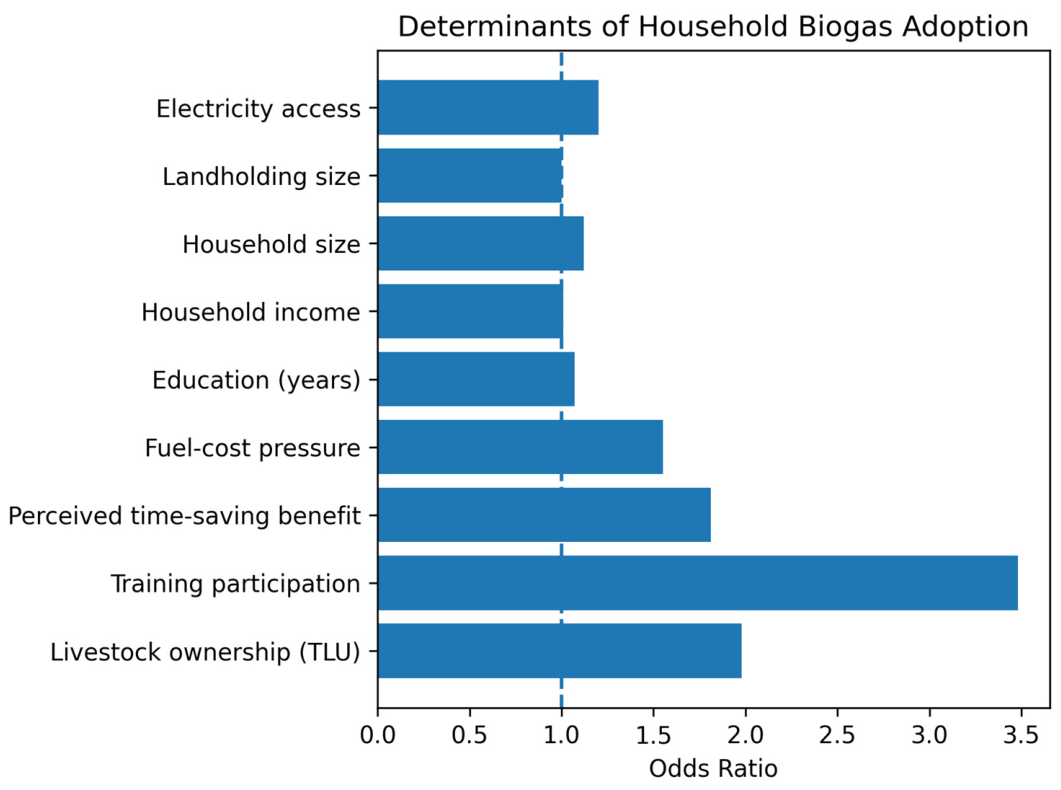
| Livestock ownership (TLU) | 0.684 | 1.98 | 0.21 | 3.25 | 0.001 | ≤0.01 |
| Training participation (1 = yes) | 1.247 | 3.48 | 0.34 | 3.65 | <0.001 | <0.001 |
| Perceived time-saving benefit | 0.593 | 1.81 | 0.18 | 3.29 | 0.001 | ≤0.01 |
| Fuel-cost pressure | 0.441 | 1.55 | 0.15 | 2.94 | 0.003 | ≤0.01 |
| Education (years) | 0.067 | 1.07 | 0.05 | 1.34 | 0.181 | >0.05 |
| Household income (IDR million/month) | 0.014 | 1.01 | 0.02 | 0.62 | 0.534 | >0.05 |
| Household size | 0.112 | 1.12 | 0.10 | 1.12 | 0.262 | >0.05 |
| Landholding (m2) | 0.00003 | 1.00 | 0.00 | 1.01 | 0.311 | >0.05 |
| Electricity access (1 = yes) | 0.185 | 1.20 | 0.39 | 0.47 | 0.639 | >0.05 |
| Covariate | SMD Before | SMD After |
|---|---|---|
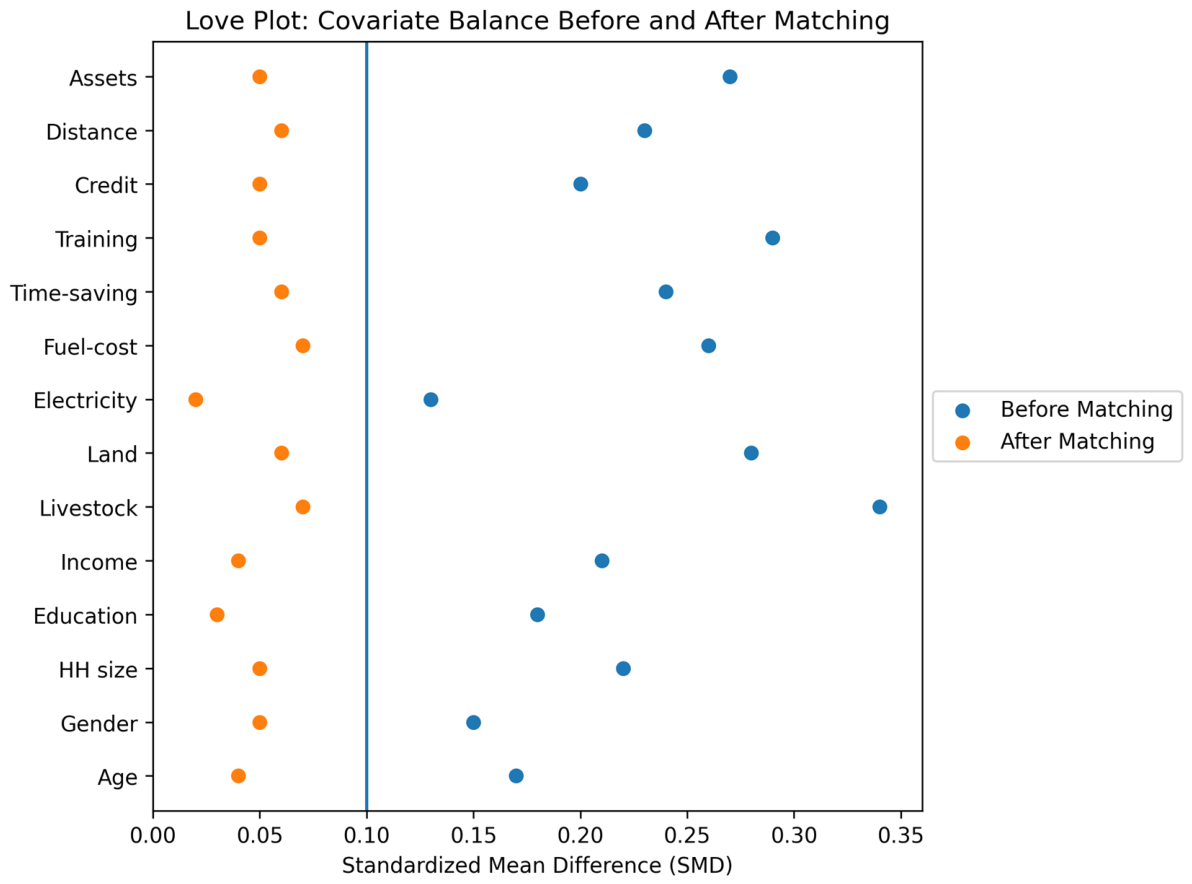
| Livestock ownership | 0.34 | 0.07 |
| Training participation | 0.29 | 0.05 |
| Fuel-cost pressure | 0.26 | 0.06 |
| Time-saving perception | 0.24 | 0.05 |
| Household income (log) | 0.21 | 0.04 |
| Education (years) | 0.18 | 0.03 |
| Household size | 0.22 | 0.05 |
| Age of household head | 0.17 | 0.04 |
| Gender of household head | 0.15 | 0.03 |
| Landholding size | 0.28 | 0.06 |
| Electricity access | 0.13 | 0.02 |
| Access to credit | 0.20 | 0.05 |
| Distance to cooperative | 0.23 | 0.06 |
| Asset index (PCA) | 0.27 | 0.05 |
Disclaimer/Publisher’s Note: The statements, opinions and data contained in all publications are solely those of the individual author(s) and contributor(s) and not of MDPI and/or the editor(s). MDPI and/or the editor(s) disclaim responsibility for any injury to people or property resulting from any ideas, methods, instructions or products referred to in the content. |
© 2026 by the authors. Licensee MDPI, Basel, Switzerland. This article is an open access article distributed under the terms and conditions of the Creative Commons Attribution (CC BY) license.
Share and Cite
Situmeang, R.; Mazancová, J.; Roubík, H. Beyond Adoption: Sustainability and Resilience Dimensions of Household Biogas Systems in West Java, Indonesia. Sustainability 2026, 18, 4140. https://doi.org/10.3390/su18084140
Situmeang R, Mazancová J, Roubík H. Beyond Adoption: Sustainability and Resilience Dimensions of Household Biogas Systems in West Java, Indonesia. Sustainability. 2026; 18(8):4140. https://doi.org/10.3390/su18084140
Chicago/Turabian StyleSitumeang, Ricardo, Jana Mazancová, and Hynek Roubík. 2026. "Beyond Adoption: Sustainability and Resilience Dimensions of Household Biogas Systems in West Java, Indonesia" Sustainability 18, no. 8: 4140. https://doi.org/10.3390/su18084140
APA StyleSitumeang, R., Mazancová, J., & Roubík, H. (2026). Beyond Adoption: Sustainability and Resilience Dimensions of Household Biogas Systems in West Java, Indonesia. Sustainability, 18(8), 4140. https://doi.org/10.3390/su18084140