1. Introduction
Inconsistent teacher behavior undermines emotionally sustainable learning environments, equitable educational experiences, and long-term socio-emotional development. Teachers serve as primary role models in students’ behavioral development, regardless of whether behaviors are classified as positive, negative, desired, or undesired. Their behaviors and attitudes, both in and out of the classroom, significantly contribute to the formation of sustainable behavioral patterns in students [
1,
2]. Conversely, when teachers convey inconsistent messages, students may experience confusion, reduced trust, and difficulty comprehending behavioral expectations [
3,
4]. Recent evidence further suggests that positive school climate is closely associated with students’ social–emotional development, perceptions of equity, and overall well-being, highlighting the importance of consistent and supportive interactions across school contexts [
5,
6].
Schools function with both explicit and implicit rules, requiring students to navigate multiple behavioral norms. Although teachers set the tone for conduct, research shows that disciplinary and supportive responses vary not only among teachers but also across contexts. Despite the documented effectiveness of various management approaches, a persistent gap exists between theory and practice, often attributed to insufficient pre-service training or ongoing professional support. Reinke et al. [
7] observe that teachers typically receive limited training in the uniform application of evidence-based techniques across school settings. While classroom-level reliability has been examined, few studies investigate how teachers maintain or lose coherence in their responses across locations such as hallways, playgrounds, and dismissal areas. Marzano, Marzano, and Pickering [
3] identify four essential components of effective classroom management: “
(1) clearly defined rules and procedures; (2) systematic approaches to disciplinary interventions; (3) positive teacher–student relationships; and (4) teachers’ mental set or ‘frame of mind’ toward proactive engagement” (pp. 2–3).
Evertson and Emmer [
2], along with Simonsen et al. [
8], support the above argument by claiming that management should not be viewed as a toolbox of separate techniques, but rather as a sustained continuation of pedagogical orientations in which instructional and behavioral goals are effortlessly merged. For example, behaviorism is the foundation for many management models. The Good Behavior Game, for instance, splits the class into teams and gives or takes away points depending on the observance of rules. Meta-analytic reviews confirm its powerful impact on reducing disruptive behavior and increasing on-task engagement [
9]. Such conditions, as in Class-Wide Function-Related Intervention Teams (CW-FIT), involve teaching social skills, group contingencies, and teacher praise within a multi-tiered support framework. They also indicate that the School-Wide Positive Behavioral Interventions and Supports (SW-PBIS) framework applies these concepts not only in the classroom but also in the whole school. Bradshaw, Mitchell, and Leaf [
10], along with Debnam, Pas, and Bradshaw [
11], have shown that reductions in problem behaviors at the secondary and tertiary levels in SW-PBIS programs are associated with higher rates of behavior-specific praise and rule-consistent sustainability in those schools. Snell et al. [
12] further advocate for culturally responsive PBIS adaptation, arguing that including students in rule-setting and using teacher-student culturally relevant communication improves both the teacher’s acceptance of the rules and the fairness of outcomes.
Socio-cognitive and social–emotional learning (SEL) perspectives are gradually overtaking research on purely behaviorist models. The former stresses the importance of external processes and peer interaction. Social and emotional learning (SEL) is the practice of teaching emotional intelligence and self-regulation. SEL has five competencies: self-awareness, self-management, social awareness, relationship skills, and responsible decision-making. When integrated into daily school life, these competencies lead to diminished aggression and increased academic performance [
13,
14]. To foster cooperation among students, teachers may use cooperative learning situations, in which the outcomes of each individual depend on the group as a whole, and every individual is responsible for their personal contribution. Students involved in positive interdependence and individual accountability not only become more cognitively engaged but also develop socially, as prosocial expectations are embedded in academic behavior [
15]. Current trends favor a smooth transition from universal to targeted supports. Rathel et al. [
16] treat Positive Behavior Support (PBS) as a methodological approach encompassing the systematic implementation of this philosophy across the whole school. They suggest that teachers’ organization of functional behavior assessments (FBAs) is the starting point for creating sustainable personal support. Recent reviews have further demonstrated that SEL implementation is most effective when social–emotional competencies are reinforced consistently across everyday school interactions rather than delivered solely through isolated programs, underscoring the importance of coherent teacher responses across multiple school contexts [
6]. Recent evidence continues to emphasize that SEL implementation is most effective when social–emotional competencies are integrated into everyday school practices and reinforced consistently across multiple educational contexts [
17].
Collectively, these frameworks and models suggest that effective classroom management encompasses more than a limited set of disciplinary practices. It requires the consistent integration of proactive design (e.g., environmental setup and posting expectations), socio-cognitive instruction (such as social–emotional learning and group learning), behavior-analytic interventions (including reinforcement and group contingencies), and systemic supports (such as leadership, coaching, and data systems), all tailored to the cultural and developmental context of the students.
1.1. The Importance of Consistent Teacher Behavior
Teachers’ behavioral consistency toward their students is universally accepted as a prerequisite for sustainable classroom management, as it directly influences students’ perceptions of justice, predictability, and emotional safety. Evertson and Weinstein [
2] argue, “how a teacher achieves order is as important as whether a teacher achieves order” (p. 4), since unpredictable responses to similar behaviors erode trust and diminish the quality of the learning climate. It is evident that rules and their consequences, when inconsistently applied, misapplied, or not applied at all, have clear costs. Teachers who mainly rely on the negative side of discipline—through reprimands or office referrals—without applying any positive supports inadvertently signal that rules are negotiable and that authority is divided. According to Webster-Stratton et al. [
10], the imbalanced situation leads to stress and emotional exhaustion for both teachers and students, resulting in reactivity and inconsistency and creating a negative feedback loop in the classroom. Jennings and Greenberg [
18] discuss that teachers’ inconsistency in disciplinary practices has negative effects on students’ intrinsic motivation and on their anxiety, especially in the case of students with externalizing behaviors. Snell et al. [
12] note that the discussion of consistency should be sustainable, emphasizing that the uniform application of behavioral supports must align with students’ cultural norms. They claim that if teachers not only impose but also acknowledge and appreciate cultural differences, they can create an atmosphere of justice that lessens the disproportionate punishment of minority groups. Lohrmann and his colleagues [
19] present a similar example in their article focused on function-based intervention strategies in classrooms with diverse cultures. They reveal that the combination of consistent and culturally responsive adaptations leads to the best outcomes for all students.
Longitudinal studies have provided additional evidence on the effect of teachers’ behavioral consistency on positive learning outcomes and sustainable behavior management. A study by SW-PBIS by Bradshaw, Mitchell, and Leaf [
20], a randomized controlled trial, showed that schools that maintained high fidelity throughout the study period not only had lower office discipline referrals but also reported improvements in school climate, teacher retention, and student academic achievement. Stormont and Reinke [
21] conducted mixed-methods research showing that teachers’ reflective journals, combined with peer-observation cycles, led to gradual increases in the consistent use of precorrection and praise. Thus, it can be concluded that ongoing reflection strengthens consistency in teacher behavior.
Overall, the research demonstrates that teacher behavioral consistency—achieved through the application of rules and procedures, prioritization of proactive methods, culturally responsive adaptations, and the integration of coaching and feedback—is a critical factor in sustainable classroom management. These practices not only reduce disruptive behavior but also support students’ socio-emotional development, thereby fostering a positive and equitable learning environment.
Although classroom management, School-Wide Positive Behavioral Interventions and Supports (SW-PBIS), social–emotional learning (SEL), restorative practices, and school climate have been extensively examined in the literature [
2,
3,
8,
14,
20,
22], research has predominantly focused on teachers’ practices in formal classroom settings. Existing studies have demonstrated the importance of consistent rules, proactive support for behavior, and positive teacher–student relationships for promoting effective learning environments [
2,
3,
8]. Similarly, research on SW-PBIS has highlighted the value of schoolwide behavioral expectations and implementation fidelity [
20,
22,
23,
24], while SEL studies have emphasized the role of social and emotional competencies in fostering positive educational outcomes [
14,
18,
25]. However, comparatively little attention has been paid to whether teachers maintain similar behavioral responses when confronted with comparable student behaviors across different school spaces, such as classrooms, corridors, playgrounds, and dismissal areas. Furthermore, although values such as respect, empathy, fairness, and community responsibility are frequently identified as essential components of positive school climate and sustainable educational environments [
12,
14,
18], limited research has examined the extent to which these values are reflected consistently in teachers’ behavioral responses across contexts. Therefore, the contribution of the present study lies not in proposing a new behavior-management model, but in examining behavioral consistency across classroom and informal school spaces, integrating a values-oriented perspective into the analysis of teacher responses, and interpreting these patterns within the broader framework of sustainable school climate in the Turkish middle-school context.
1.2. Study Purpose
Previous research has primarily examined classroom management practices, schoolwide behavior-support systems, social–emotional learning, and restorative approaches as distinct areas of inquiry [
3,
8,
14,
20,
22], with limited attention to how teachers translate these principles into consistent behavioral responses across diverse school settings. While most studies evaluate the effectiveness of specific interventions or programs, the present study focuses on the coherence of teachers’ responses to comparable student behaviors in both structured and unstructured school environments. By analyzing behavioral consistency alongside values-oriented responses, this research extends the literature beyond the implementation of behavior-support frameworks and investigates how consistency contributes to the development of a sustainable school climate. The primary objective is to systematically examine the alignment between the behavior-management strategies employed by middle-school teachers and the integration of core values such as respect, empathy, and community responsibility across structured (classroom) and unstructured (corridors, playgrounds, dismissal areas) settings. The study investigates the extent to which teachers consistently implement behavioral interventions (e.g., proximity cues, verbal redirection, restorative follow-up practices) in response to comparable student behaviors and explores how these patterns vary by teacher gender, professional experience, and school socioeconomic context. Although situated within Turkish educational settings, the findings may inform broader discussions on sustainable school climate, equitable behavioral practices, and consistent teacher responses across educational environments. The observed distinction between planned classroom routines and more spontaneous reactions in less structured contexts, as well as the influence of cultural norms such as respect for hierarchy or collective values, may be relevant for educators and policymakers internationally. This study offers practical insights for teachers and teacher educators.
Considering the objectives of the research, we pose the following questions:
How consistent are middle-school teachers’ behavior-management strategies when they react to the same student behaviors in the classroom and outside the classroom?
In what way are teacher traits, like gender, experience, and the school’s socio-economic level, related to the degree of consistency and values-orientation of their strategies within different contexts?
2. Materials and Methods
2.1. Research Design and Rationale
An exploratory sequential mixed-methods design (Creswell & Plano Clark, 2011 [
26]) was used for this research: (1) comprising
qualitative field observations to get a complete insight into teachers’ reactions to students’ behaviors, and (2)
open-ended vignette responses to understand teachers’ behavioral patterns. The sequential structure permits the rich themes emerging from the observation phase to guide the construction of realistic scenarios, whereas the vignette phase enables assessment of how widely those patterns and practices occur across different contexts. This design was selected because it combines contextual depth with generalizability, thereby answering both the questions of “how” and “how consistently” teachers apply the same strategies across different settings.
2.2. Research Context and Participants
2.2.1. Local Observations and Analysis (Phase 1)
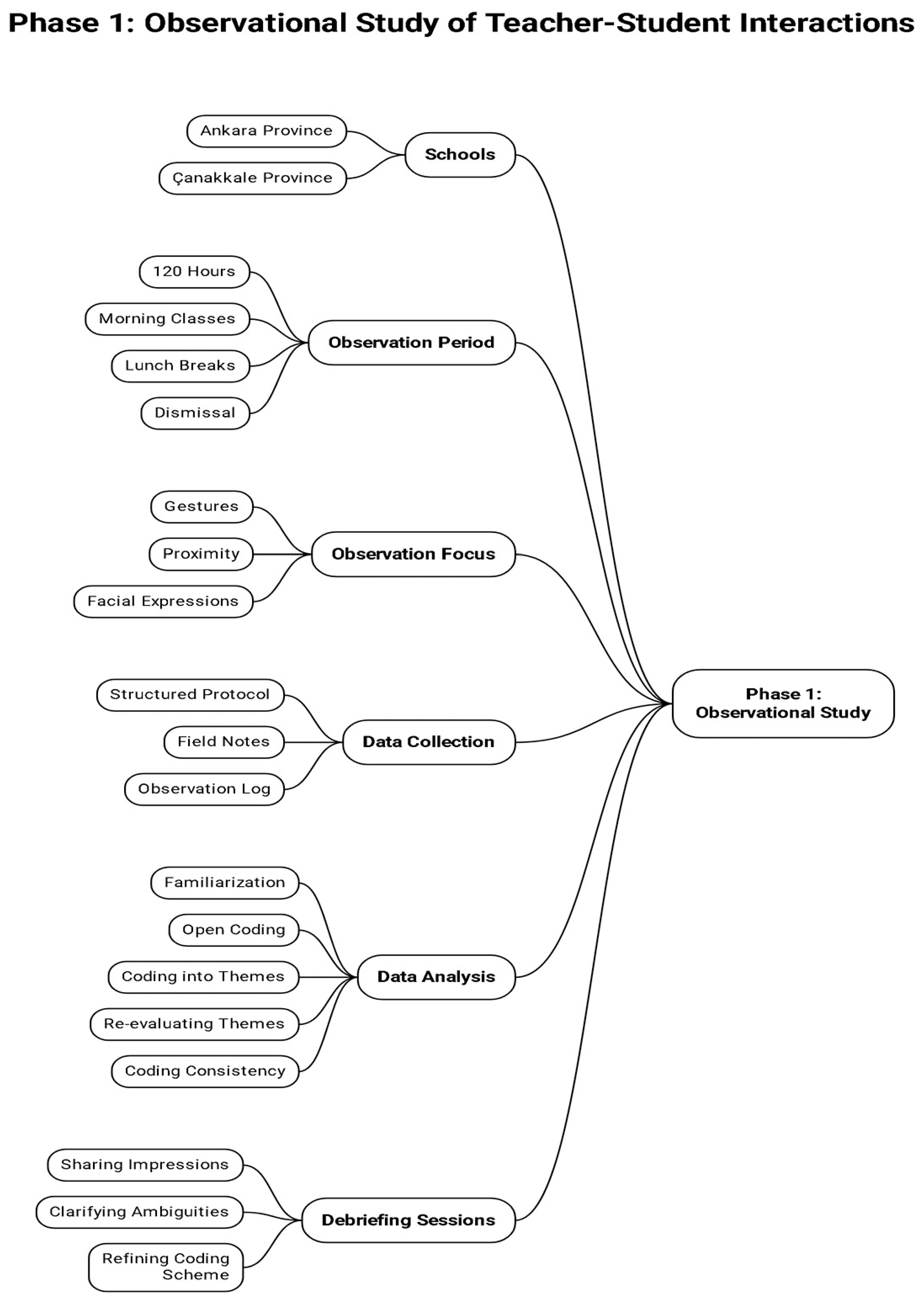
Phase 1 was conducted in four public middle schools in Ankara and Çanakkale Provinces, selected through purposive sampling to ensure variation in socioeconomic characteristics and school contexts. Over sixteen weeks, the two researchers completed 120 h of systematic observation during classroom lessons, lunch breaks, corridor transitions, playground activities, and dismissal periods. Observations focused on teachers’ verbal and nonverbal behavioral-management responses, including gestures, proximity, tone of voice, facial expressions, procedural reminders, and follow-up actions, while the researchers maintained a peripheral observer role to minimize observer effects. A structured protocol guided the documentation of behavioral incidents, contextual variables, teacher responses, and researcher reflections in narrative, tabular, and journal formats. More than 250 teacher–student interactions were recorded. Detailed field notes were completed following each observation session and subsequently organized through a structured observation log to improve consistency in documenting teacher behaviors, student actions, contextual conditions, and researcher reflections. All observation records were transferred into digital text files and organized for thematic analysis. The observation logs served as the primary empirical source for identifying recurring behavioral management patterns and for informing the development of the vignette scenarios used in Phase 2.
All observation notes and reflective memos were coded using the five-step thematic procedure outlined by Braun and Clarke [
27]. First, the researchers familiarized themselves with the data by reading each document and making annotations. Second, open coding was conducted, yielding 72 initial codes including verbal redirection, nonverbal proximity cues, neglect of minor infractions, behavior-specific praise, and procedural reminders. Third, these codes were grouped into 12 preliminary themes, including proactive scaffolding and context-specific inconsistency. Fourth, the preliminary themes were reviewed in relation to the raw data and refined through researcher discussions, resulting in six final themes, each supported by exemplar text. Finally, coding consistency was strengthened through comparison of coding decisions and discussion-based resolution of discrepancies (
Table 1).
These six themes served as the conceptual foundation for the vignette scenarios developed for Phase 2. Particular attention was given to themes reflecting cross-context consistency, values-oriented responses, and adaptations to different school environments (
Figure 1). Figures were generated with the assistance of Google NotebookLM (Google LLC, web-based version accessed in 8 June 2026,
https://notebooklm.google.com). The authors provided the conceptual description and key elements of the research design and reviewed and finalized the figure to ensure its accuracy and consistency with the manuscript.
2.2.2. Vignette Survey Development and Analysis (Phase 2)
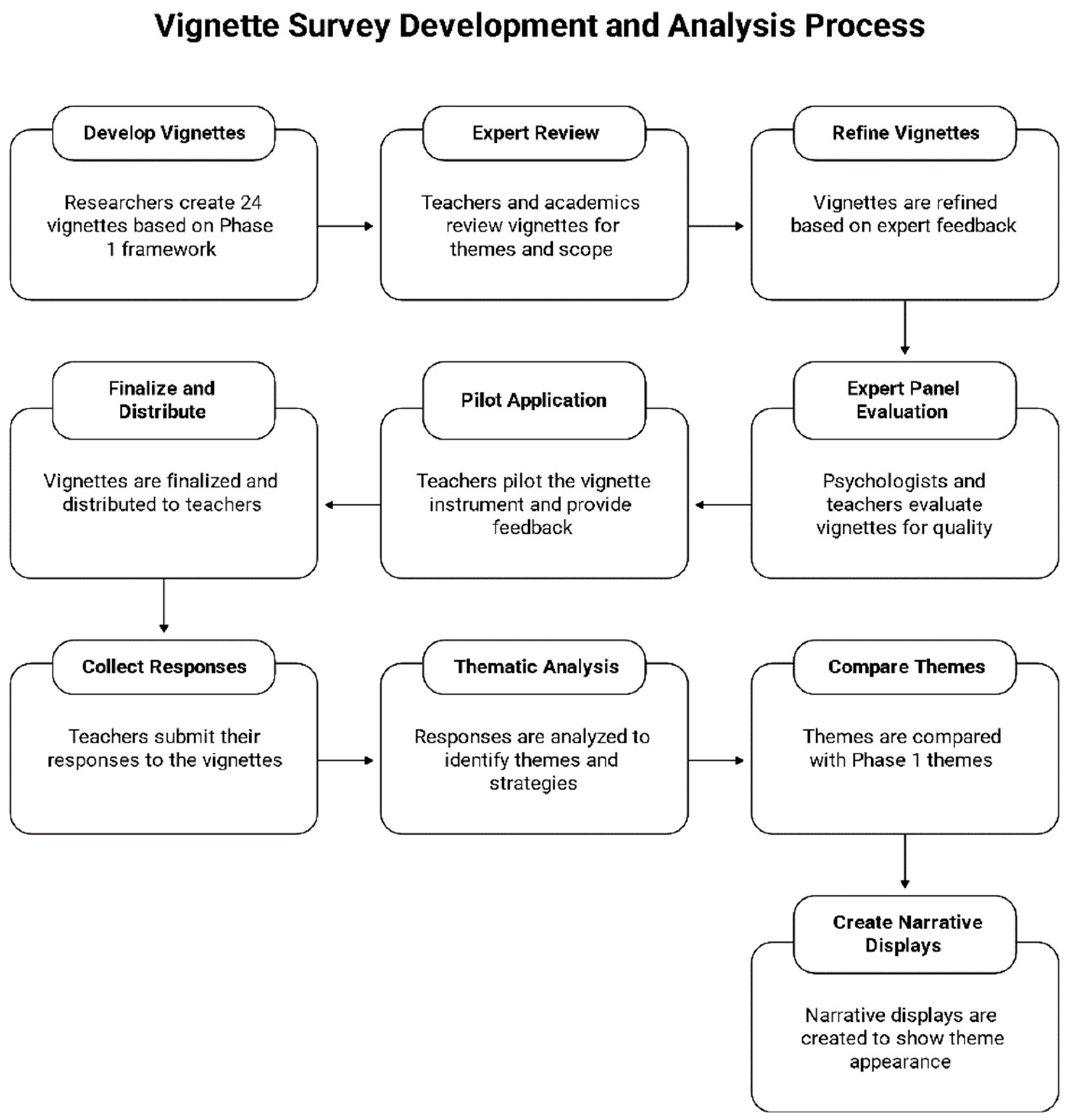
Drawing directly on the thematic framework developed in Phase 1, the researchers drafted 24 vignettes, such as in
Table 2.
In the next phase of the instrument development process, a pool of 24 vignettes was sent to six teachers and two academics for expert review. The academic specialists were those who taught classroom management courses at the Faculty of Education. The reviewers provided open-ended comments to classify the scenarios: whether their themes overlapped, whether they were in/out of the study’s scope, whether they were redundant, or whether their inclusion in the vignette was not worth it. The reviewers’ substantive feedback was used to develop a focused, ten-item scenario instrument for use in the main study.
Then an expert panel of educational psychologists and senior teachers evaluated each draft of 10 items for quality, realism, and cultural resonance; revisions were made to ensure clarity and validity. The reduction in the initial 24 vignettes to the final 10-item instrument was guided by three criteria: relevance to the study objectives, representativeness of the themes identified during Phase 1, and avoidance of conceptual overlap among scenarios. Expert reviewers evaluated each vignette for clarity, authenticity, contextual relevance, and alignment with the emerging thematic framework. Scenarios that were considered redundant, insufficiently distinctive, or only weakly connected to the study’s focus on behavioral consistency were excluded from the final instrument. A pilot study involving 10 middle school teachers was conducted prior to the main study. Participants were asked to complete the vignette instrument and provide feedback regarding clarity, comprehensibility, realism, and response burden. Minor revisions were subsequently made to improve wording, reduce ambiguity, and enhance the contextual authenticity of several scenarios before large-scale distribution.
The scenarios were finalized, prepared, and distributed via email, Google Forms, WhatsApp, and Telegram (v12.7.3). Over 8 weeks, 300 teachers from 20 Turkish provinces received the data-gathering instrument. Two reminder messages were sent out every two weeks. In total, 204 teachers (68% response rate), with an average of 8.5 years of teaching experience, representing grades 5–8 across different school contexts, submitted complete written responses of at least 50 words per vignette.
The complete collection of 2040 written replies to the ten vignettes underwent thematic analysis, starting from the Phase 1 codebook as a basic framework. Initially, the researchers sought to get an understanding of the main strategies that the teachers suggested by reading all responses. Afterward, open coding was performed on each response, with segments representing various intervention strategies, values-oriented considerations (such as invoking respect or community responsibility), or follow-up actions being marked. New codes were introduced as needed to convey the subtleties of the imaginary setting.
After the coding process was complete, the researchers returned to the list of codes and grouped similar codes into themes such as “immediate de-escalation techniques,” “restorative follow-up,” and “values-driven framing.” Then these themes were compared and contrasted with the Phase 1 observational themes to identify areas of convergence (e.g., the use of proximity cues) and divergence (e.g., greater emphasis on parental or administrative involvement in vignettes). A series of narrative joint displays was created that showed how each theme appeared in both the classroom and school environment scenarios.
Combined, these qualitative analyses of both phases create a rich, textured account of consistent behavior management practices, identifying not only what strategies are employed but also how context and reflective practice influence their deployment. Six volunteer teaching assistants from the Faculty of Education assisted only with data organization and preliminary checklist-based categorization. They were not involved in the formal coding or scoring process. The formal consistency scoring was conducted independently by the researchers, who served as coders, using the three-point framework presented in
Table 3. Prior to coding, both coders participated in a calibration session during which coding criteria, category definitions, coding examples, and decision rules were reviewed and discussed. A subset of pilot responses was coded independently and subsequently compared to establish a shared interpretation of the coding framework. Following calibration, all responses were independently coded by both coders. Any discrepancies were resolved through discussion and consensus meetings. This procedure was implemented to enhance coding reliability, reduce interpretive inconsistencies, and strengthen the credibility and trustworthiness of the findings. This metric was subsequently applied to the dataset for multiple complementary analyses. Because the primary purpose of this exploratory sequential mixed-methods study was to identify patterns of behavioral consistency across contexts, the quantitative consistency scores were used descriptively rather than inferentially. The scoring system was designed to summarize similarities and differences in teachers’ responses across paired scenarios and to support the interpretation of qualitative findings. Therefore, the quantitative results are reported as descriptive distributions and patterns rather than as tests of statistical significance or causal relationships. Consistency scores were first disaggregated by teacher demographics—gender, years of experience, and school socioeconomic context (
Table 4)—to identify descriptive patterns of variation across teacher and school characteristics.
Table 4 presents a descriptive comparison of behavioral consistency patterns across classroom and school-environment vignettes.
Figure 2 explicates the second phase of the study.
3. Results
Results are presented in a table and explanation format.
Table 3 indicates that when many 0 scores occur, teachers treat the same student behavior very differently depending on where it occurs. For instance, a teacher could use a soft, close-range signal in the classroom while issuing a loud verbal reprimand outside the classroom. The scoring system, which ranges from 0 to 2, not only reflects this variance but also identifies the points of inconsistency. To evaluate behavioral consistency across paired classroom and school-environment scenarios, each teacher’s response was independently reviewed by the two researchers, who served as trained coders, using the consistency framework presented in
Table 3. Prior to formal coding, both coders participated in a calibration session to establish a shared understanding of the scoring criteria, category definitions, and decision rules. Responses were compared across paired scenarios involving comparable student behaviors, and scores were assigned according to the degree of similarity in the sequence, nature, and underlying rationale of the proposed intervention strategies. A score of 0 was assigned when no meaningful overlap was identified between responses, 1 when some common elements were present alongside context-specific adaptations, and 2 when teachers proposed highly similar or equivalent intervention approaches across settings. Coding disagreements were discussed and resolved through consensus meetings involving the research team. This procedure was implemented to enhance consistency in coding decisions and strengthen the trustworthiness of the analysis.
Teachers of varying genders, experience levels, and socio-economic backgrounds demonstrated differing levels of behavioral consistency. Male teachers showed a higher proportion of no-overlap responses (40%) than female teachers (30%). Descriptive comparisons suggest that behavioral consistency patterns may vary across teacher characteristics; however, these observations should be interpreted cautiously because no inferential analyses were conducted.
Descriptive comparisons suggest variation in behavioral consistency across teacher and school characteristics. Female teachers showed a higher proportion of high-coherence responses (30%) than male teachers (20%), whereas male teachers showed a greater proportion of no-overlap responses. Teachers with more than ten years of experience exhibited the highest level of behavioral consistency, while those with fewer than five years of experience displayed the greatest proportion of no-overlap responses. Similar descriptive patterns were observed across school socioeconomic contexts, with high-SES schools displaying a greater proportion of high-coherence responses than low-SES schools. Because no inferential analyses were conducted, these findings should be interpreted as descriptive patterns rather than statistically verified differences (
Table 5).
Descriptive comparisons indicate lower levels of behavioral consistency in school-environment vignettes than in classroom vignettes. Classroom scenarios showed a higher proportion of high-coherence responses (30%) and a lower proportion of no-overlap responses (20%). In contrast, school-environment scenarios demonstrated a greater proportion of no-overlap responses (40%) and fewer high-coherence responses (15%). These patterns suggest that teachers may apply behavioral-management strategies more consistently in structured classroom settings than in less structured school environments. However, because the analysis was descriptive, these findings should be interpreted as indicative patterns rather than statistically verified differences. Analysis of the preceding tables indicates considerable descriptive variation in teachers’ behavioral consistency across contexts. The relatively high frequency of no-overlap scores may point to the potential value of schoolwide behavioral frameworks, reflective practice, and professional development initiatives to support the consistent application of behavior-management strategies across school settings.
Table 6 presents representative excerpts from teachers’ written responses to the vignette scenarios, illustrating the behavioral-management strategies and values-oriented practices reflected in the coded responses.
The scenarios indicate context-driven variability. Educators employ a wider range of strategies in unstructured situations, such as corridor fights, playground incidents, or after-bell crowding, compared to classroom disruptions. Approximately 25% of responses to pencil-tapping or whispering scenarios showed no overlap in strategy, while nearly 50% of responses to corridor fights and playground breaches fell into the “no overlap” category. This suggests that many teachers rely on ad hoc, context-specific tactics rather than a unified protocol outside the classroom.
In contrast, scenarios that invoked well-established norms—such as chronic lateness—produced the strongest coherence: only 10% of the teachers fully switched their methods, while 40% took very similar steps no matter the context. This difference indicates that when the school’s expectations are clear and universally taught, teachers are much more likely to respond consistently across different environments. Values-oriented language has a similar pattern to that of the scenario. Close to 50% of the responses to lateness (50%) and refusal-to-participate (45%) scenarios made a reference to the values of respect, empathy, or community responsibility, while only 25–35% of responses to the more chaotic or safety-focused scenarios did so. In difficult or unclear situations, the immediate control of behavior often takes precedence over the core values being embedded.
Illustrative quotes underscore these disparities. One veteran teacher states, “I lean in and place my hand gently on the desk—same in every setting,” while another notes, “In the yard I shout; in class I talk quietly—no overlap.” Variations in comfort, safety requirements, and the existence or absence of protocols influence teachers’ immediate decisions. These findings suggest the potential value of shared behavior-management strategies that can be applied across different school settings. Such approaches may contribute to greater consistency in teacher responses and to a more predictable and equitable school climate.
4. Discussion
From a sustainability perspective, behavioral consistency is a fundamental component of sustainable educational environments, extending beyond classroom management skills. Sustainable schools rely on predictable, equitable, and emotionally safe interactions across all contexts, including informal areas such as corridors, playgrounds, and cafeterias. Inconsistent teacher responses across settings may result in student uncertainty, relational insecurity, and unequal access to emotional support, thereby undermining the long-term development of trust, belonging, and social–emotional competencies. Consequently, consistency in teacher behavior directly supports the sustainability of school climate and the creation of inclusive and supportive educational ecosystems. Recent evidence further indicates that positive school climate, student well-being, and perceptions of equity are enhanced through predictable and supportive interactions across multiple school contexts, rather than within classrooms alone [
28,
29]. Recent scholarship also suggests that sustainable school climate should be understood as a relational and organizational condition rather than merely as a general perception of school life. From this perspective, students’ experiences of fairness, belonging, and emotional safety are shaped by the everyday consistency of teacher–student interactions across multiple school spaces [
28,
29]. The present findings extend this line of work by showing that consistency may weaken in informal, less structured settings, where school climate is often enacted through immediate teacher responses rather than through formal classroom routines.
Rather than interpreting behavioral consistency solely as disciplinary coherence, this study conceptualizes it as a form of relational sustainability that enables continuity in students’ emotional experiences across school environments. The variability in teachers’ responses to identical or similar student behaviors, as documented across ten realistic vignettes, highlights a persistent tension between current classroom management practices and consistent teacher behavior. Although teachers possess a range of evidence-based strategies (e.g., proximity cues, behavior-specific praise, restorative follow-up), their use is often limited to traditional lesson time. Recent schoolwide behavior-support research similarly highlights that implementation fidelity frequently declines in less structured school environments, reducing the effectiveness of otherwise evidence-based behavioral practices [
8,
17]. Nearly 50% of teachers in the research sample employed entirely different interventions for conflicts or disruptions in corridors or playgrounds compared to those in the classroom. This pattern aligns with findings by Bradshaw, Mitchell, and Leaf [
20], who report that fidelity to schoolwide positive behavior supports (SW-PBIS) often declines in informal settings, and supports Marzano, Marzano, and Pickering’s [
3] assertion that the teacher’s “
frame of mind” is a key determinant of consistent practice. This finding is also relevant to recent discussions of whole-school behavioral frameworks and inclusive education. When behavioral expectations are implemented consistently across classrooms, corridors, playgrounds, and dismissal areas, they may provide greater predictability for students who require additional social, emotional, or behavioral support [
17]. Conversely, inconsistent responses across settings may reproduce unequal access to support, particularly for students who depend on clear routines, relational security, and predictable adult responses. Thus, the issue is not only classroom management fidelity but also the inclusive and equitable organization of behavioral support across the whole school.
The findings further connect behavioral consistency with restorative and values-oriented practices. Although several teachers referred to respect, empathy, and community responsibility, these values appeared less frequently in more chaotic or safety-focused scenarios. This suggests that restorative communication may be more difficult to sustain in informal school spaces where teachers feel pressure to respond quickly. Recent SEL and school-climate scholarship emphasizes that social–emotional competencies are strengthened when values are embedded in everyday interactions rather than treated as isolated program content [
5,
6]. In this sense, the present study suggests that a sustainable school climate requires not only explicit rules but also consistent relational practices that carry restorative and values-oriented language across school contexts.
Our research also points out the inconsistent incorporation of basic social–emotional values into behavior modification techniques. The difference in this pattern is in line with Durlak et al.’s [
14] finding, which states that social–emotional learning (SEL) interventions are most effective when values are integrated into everyday practice, and it also corresponds to Bowman-Perrott et al.’s [
9] conclusion that positive behavior games without restorative follow-up might turn into mere compliance exercises. More recent evidence continues to demonstrate that SEL outcomes are strongest when social–emotional competencies are reinforced through everyday teacher–student interactions and schoolwide practices rather than isolated instructional programs [
5,
6].
Descriptive comparisons suggested variation in behavioral consistency across teacher and school characteristics. Teachers with greater professional experience appeared to demonstrate more consistent responses across contexts, while differences were also observed across school socioeconomic settings. However, because the study was exploratory and relied primarily on descriptive analyses, these patterns should be interpreted cautiously. Future research employing inferential analyses and additional contextual variables may help clarify the factors associated with behavioral consistency across school environments. This interpretation is consistent with contemporary research indicating that school climate, organizational conditions, and contextual characteristics may shape how educators enact behavioral expectations across settings, although the underlying mechanisms require further investigation [
29].
The findings indicate that sustainable teacher education should encompass not only instructional competence but also the cultivation of relational consistency, restorative communication skills, and context-sensitive behavioral practices. Consequently, the findings may have implications for teacher preparation and professional development initiatives seeking to promote more consistent, equitable, and socially responsive school cultures. In this respect, strengthening teachers’ capacity to apply values-oriented behavioral practices across school settings may contribute to broader efforts associated with Sustainable Development Goal 4 (Quality Education). This perspective aligns with recent scholarship linking sustainable educational development to inclusive school climates, relational well-being, and the consistent enactment of equitable educational practices [
28].
5. Conclusions
In summary, although some teachers consistently apply shared values and management styles across settings, such practices remain uncommon. The divide between structured classrooms and unstructured areas limits students’ access to predictable, respectful support, hindering the development of social–emotional competencies. Taken together, the findings suggest that greater attention to schoolwide consistency in behavioral practices may help develop more predictable and supportive learning environments. Future efforts to integrate values-oriented communication, restorative approaches, and cross-context behavioral expectations may help strengthen coherence across school settings.
6. Limitations
Despite the rigor of the mixed-methods design, several limitations should be acknowledged. First, the use of vignette-based surveys relies on teachers’ self-reported responses rather than direct observation of their practices in authentic work settings. Although vignettes capture reflective decision-making, social desirability and recall biases may lead participants to overstate their consistency or values orientation. Future research could triangulate self-reports with video analysis or momentary ecological assessments to validate intended versus actual behavior.
Second, our qualitative observations and vignette responses were collected from a purposive sample of middle-school teachers who volunteered and had access mostly to digital communication channels. This convenience sampling may limit generalizability, particularly in more remote or under-resourced contexts where technological barriers or differing cultural norms could affect both teacher behavior and survey participation. Randomized sampling across additional provinces would strengthen external validity.
Third, the cross-sectional study does not allow for causal inferences about how the professional development or policy changes impact teacher consistency over time. A more effective approach might involve longitudinal designs that measure the same teachers before and after receiving training in cross-context behavior protocols.
Fourth, while the study controlled for several important demographic variables (gender, experience, and school SES), other variables that could potentially affect teacher consistency (such as class size, subject area, or individual teacher beliefs about discipline) were not controlled. A more nuanced multivariate approach could potentially clarify the relative importance of these variables in impacting teacher consistency and values orientation.
Fifth, the study was limited to measuring teacher perspectives on teacher consistency, without obtaining related data from the student perspective. A more complete approach could potentially assess the impact of teacher consistency on creating a more predictable learning environment.
Finally, although we grounded our instrument in contextual observations and expert feedback, the ten vignettes necessarily represent a subset of possible scenarios. Additional contexts—such as special education settings, parent–teacher interactions, or digital classrooms—may reveal further nuances in consistency and in the application of values. Expanding the vignette pool to encompass diverse educational environments will enhance the comprehensiveness of future investigations.
7. Implications
The results of this study may have several implications for practice, policy, and future research. The creation and distribution of unified behavior-management procedures that specifically cover classroom, hallway, playground, and dismissal settings should be a top priority for teacher education and school leadership teams at a systemic level. A schoolwide policy that incorporates explicit de-escalation scripts and values language will reduce context-driven variability and help all teachers internalize a shared set of tactics.
Professional development programs need to include scenario-based rehearsal of cross-context interventions in addition to single-setting training. Teachers’ mental “frame of mind” can be strengthened through workshops that use video vignettes, peer-observation cycles, and reflective coaching. This will ensure that proximity cues, restorative follow-up, and value-driven language become second nature, regardless of where they are.
Teacher preparation programs in schools of education should include courses on the importance of consistency and culture, emphasizing the connection between community values, respect, and collective responsibility, and research-based interventions to promote positive student behavior. By learning about a cohesive, schoolwide approach to values and behavior management early on, new teachers will be better prepared to apply the concepts to all school environments. To ensure the sustainability and effectiveness of the new approach, school administrators can also use measures such as ongoing fidelity checks, including analysis of the student behavior management log and values orientation, and incorporate these into teacher performance reviews. By rewarding these values-based approaches, school administrators can further emphasize the importance of consistency and respect in the entire school environment. In addition, to study the long-term effects of increased behavior consistency on student outcomes, such as socioemotional development, school climate, and engagement, longitudinal and multi-informant approaches can be used in future studies. By demonstrating the connection between teacher values-based behavior management and increased student outcomes, further research can be conducted to build a strong case for funding values-based approaches to student behavior management programs.
Author Contributions
Conceptualization, S.B.Y.Y. and E.K.; methodology, E.K. and S.B.Y.Y.; formal analysis, E.K. and S.B.Y.Y.; investigation, S.B.Y.Y. and E.K.; data curation, S.B.Y.Y.; validation, E.K.; writing—original draft preparation, S.B.Y.Y. and E.K.; writing—review and editing, E.K. and S.B.Y.Y.; visualization, E.K.; supervision, E.K. S.B.Y.Y. contributed to the conceptualization and design of the study, coordinated participant recruitment and data collection, conducted the initial literature review, and participated in qualitative coding and data interpretation. E.K. led the methodological design and validation processes, supervised the development and refinement of the vignette instrument, contributed to data analysis and interpretation, and coordinated the preparation and revision of the manuscript. All authors have read and agreed to the published version of the manuscript.
Funding
This research received no external funding.
Institutional Review Board Statement
The study was conducted in accordance with the Declaration of Helsinki, and approved by the Scientific Research and Publication Ethics Commission, Çanakkale Onsekiz Mart University (protocol code 06/28, 24 April 2024).
Informed Consent Statement
Informed consent was obtained from all subjects involved in the study.
Data Availability Statement
The data presented in this study are available on request from the corresponding author.
Acknowledgments
AI was used for language accuracy, grammar check (Grammarly,
https://www.grammarly.com/), and figure development (Figures were generated with the assistance of Google NotebookLM (Google LLC, web-based version accessed in May 2026).
Conflicts of Interest
The authors declare no conflicts of interest.
References
- Akar, H.; Tantekin-Erden, F.; Tor, D.; Şahin, İ.T. Study on teachers’ classroom management approaches and experiences. Elem. Educ. Online 2010, 9, 792–806. [Google Scholar]
- Evertson, C.M.; Weinstein, C.S. Handbook of Classroom Management: Research, Practice, and Contemporary Issues; Lawrence Erlbaum Associates: Mahwah, NJ, USA, 2006. [Google Scholar]
- Marzano, R.J.; Marzano, J.S.; Pickering, D.J. Classroom Management That Works: Research-Based Strategies for Every Teacher; ASCD: Alexandria, VA, USA, 2003. [Google Scholar]
- Noltemeyer, A.; Kunesh, C.E.; Hostutler, C.A.; Frato, P.; Sarr Kerman, B.J. The effects of student and teacher characteristics on teacher impressions of—and responses to—student behaviors. Int. Educ. Stud. 2012, 5, 96–111. [Google Scholar] [CrossRef]
- Chen, Y.; Wang, H.; Jiang, Y.; Zhang, H.; Chen, C. Social emotional learning competencies and their interaction with perceived attachments to parents and peers on Chinese adolescent academic burnout. Sch. Psychol. Rev. 2025, 55, 369–390. [Google Scholar] [CrossRef]
- Collaborative for Academic, Social, and Emotional Learning (CASEL). 2024 Social and Emotional Learning Year in Review; CASEL: Chicago, IL, USA, 2024; Available online: https://casel.org/blog/2024-social-and-emotional-learning-year-in-review/ (accessed on 1 June 2026).
- Reinke, W.M.; Herman, K.C.; Darney, D.; Pitchford, J.; Becker, K.; Dimitrovich, C.; Lalongo, N.; Newcomer, L. Using the Classroom Check Up model to support implementation of PATHS to PAX. Adv. Sch. Ment. Health Promot. 2012, 5, 220–232. [Google Scholar] [CrossRef]
- Simonsen, B.; Fairbanks, S.; Briesch, A.; Myers, D.; Sugai, G. Evidence-based practices in classroom management: Considerations for research to practice. Educ. Treat. Child. 2008, 31, 351–380. [Google Scholar] [CrossRef]
- Bowman-Perrott, L.J.; Burke, M.D.; Zaini, S.; Zhang, N.; Vannest, K.J. Promoting positive behavior using the Good Behavior Game: A meta-analysis of single-case research. J. Posit. Behav. Interv. 2016, 18, 180–190. [Google Scholar] [CrossRef]
- Webster-Stratton, C.; Reinke, W.M.; Herman, K.C.; Newcomer, L.L. The Incredible Years Teacher Classroom Management Training: The methods and principles that support fidelity of training delivery. Sch. Psychol. Rev. 2011, 40, 509–529. [Google Scholar] [CrossRef]
- Debnam, K.J.; Pas, E.T.; Bradshaw, C.P. Secondary and tertiary support systems in schools implementing School-Wide Positive Behavioral Interventions and Supports: A preliminary descriptive analysis. J. Posit. Behav. Interv. 2012, 14, 142–152. [Google Scholar] [CrossRef]
- Snell, M.E.; Voorhees, M.D.; Berlin, R.A.; Stanton-Chapman, T.L.; Hadden, S.; McCarty, J. Use of interview and observation to clarify reported practices of Head Start staff concerning problem behavior: Implications for programs and training. J. Posit. Behav. Interv. 2011, 14, 108–117. [Google Scholar] [CrossRef]
- Dunlap, G.; Kincaid, D.; Horner, R.H.; Knoster, T.; Bradshaw, C.P. A comment on the term “positive behavior support”. J. Posit. Behav. Interv. 2014, 16, 133–136. [Google Scholar] [CrossRef]
- Durlak, J.A.; Weissberg, R.P.; Dymnicki, A.B.; Taylor, R.D.; Schellinger, K.B. The impact of enhancing students’ social and emotional learning: A meta-analysis of school-based universal interventions. Child Dev. 2011, 82, 405–432. [Google Scholar] [CrossRef] [PubMed]
- Johnson, D.W.; Johnson, R.T. An educational psychology success story: Social interdependence theory and cooperative learning. Educ. Res. 2009, 38, 365–379. [Google Scholar] [CrossRef]
- Rathel, J.M.; Drasgow, E.; Brown, W.H.; Marshall, K.J. Increasing induction-level teachers’ positive-to-negative communication ratio and use of behavior-specific praise through e-mailed performance feedback and its effect on students’ task engagement. J. Posit. Behav. Interv. 2013, 16, 219–233. [Google Scholar] [CrossRef]
- Walker, V.L.; Conradi, L.A.; Strickland-Cohen, M.K.; Johnson, H.N. School-wide positive behavioral interventions and supports and students with extensive support needs: A scoping review. Int. J. Dev. Disabil. 2023, 69, 13–28. [Google Scholar] [CrossRef]
- Jennings, P.A.; Greenberg, M.T. The prosocial classroom: Teacher social and emotional competence in relation to student and classroom outcomes. Rev. Educ. Res. 2009, 79, 491–525. [Google Scholar] [CrossRef]
- Lohrmann, S.; Forman, S.; Martin, S.; Palmieri, M. Understanding school personnel’s resistance to adopting schoolwide positive behavior support at a universal level of intervention. J. Posit. Behav. Interv. 2008, 10, 256–269. [Google Scholar] [CrossRef]
- Bradshaw, C.P.; Mitchell, M.M.; Leaf, P.J. Examining the effects of School-Wide Positive Behavioral Interventions and Supports on student outcomes: Results from a randomized controlled effectiveness trial in elementary schools. J. Posit. Behav. Interv. 2010, 12, 133–148. [Google Scholar] [CrossRef]
- Stormont, M.; Reinke, W.M. Implementing Tier 2 social behavioral interventions: Current issues, challenges, and promising approaches. J. Appl. Sch. Psychol. 2013, 29, 121–125. [Google Scholar] [CrossRef]
- Sugai, G.; Horner, R.H. Responsiveness to intervention and school-wide positive behavior supports: Integration of multi-tiered system approaches. Exceptionality 2009, 17, 223–239. [Google Scholar] [CrossRef]
- Pas, E.T.; Bradshaw, C.P. Examining the association between implementation and outcomes: State-wide scale-up of School-Wide Positive Behavior Intervention and Supports. J. Behav. Health Serv. Res. 2012, 39, 417–433. [Google Scholar] [CrossRef] [PubMed]
- Stormont, M.; Reinke, W.M. Enhancing the outcomes of Tier 2 interventions through planful adaptations. J. Appl. Sch. Psychol. 2020, 36, 227–234. [Google Scholar] [CrossRef]
- Reinke, W.M.; Stormont, M.; Tracey, A.; Latimore, A.; Herman, K.C. Differentiating Tier 2 social behavioral interventions according to function of behavior. J. Appl. Sch. Psychol. 2013, 29, 148–166. [Google Scholar] [CrossRef]
- Creswell, J.W.; Plano Clark, V.L. Designing and Conducting Mixed Methods Research, 2nd ed.; SAGE Publications: Thousand Oaks, CA, USA, 2011. [Google Scholar]
- Braun, V.; Clarke, V. Using thematic analysis in psychology. Qual. Res. Psychol. 2006, 3, 77–101. [Google Scholar] [CrossRef]
- Castro, C.; Barata, M.C.; Alexandre, J. Does school climate affect students’ social and emotional skills? The importance of relationships. Eur. J. Psychol. Educ. 2025, 40, 111. [Google Scholar] [CrossRef]
- Welsh, R.O.; Rodriguez, L.A.; Joseph, B. Examining student perceptions of school climate, school personnel, and school discipline: Evidence from New York City. J. Sch. Psychol. 2024, 107, 101361. [Google Scholar] [CrossRef] [PubMed]
| Disclaimer/Publisher’s Note: The statements, opinions and data contained in all publications are solely those of the individual author(s) and contributor(s) and not of MDPI and/or the editor(s). MDPI and/or the editor(s) disclaim responsibility for any injury to people or property resulting from any ideas, methods, instructions or products referred to in the content. |