


Abstract
In response to the reduced system inertia and increased frequency security risks in high-renewable power systems, as well as the limitations of single energy storage technologies, a coordinated optimal scheduling method for electrochemical energy storage (EES) and compressed air energy storage (CAES) considering the minimum inertia requirement (MIR) is proposed. The method constructs a coordination framework, leveraging the fast response of EES and the sustained support and equivalent inertia contribution of CAES. An MIR evaluation model considering RoCoF and frequency nadir constraints is established, and the inertia deficit is converted into fast reserve demand, forming an inertia–reserve coupling mechanism. To address nonlinear frequency constraints, an adaptive piecewise linearization method is adopted to transform the model into a mixed-integer linear programming problem. Case studies show that, compared with the benchmark hybrid energy storage scheduling strategy without inertia–reserve coordination, the proposed method reduces thermal generation cost by 4.5% and renewable curtailment by 74.8%. Moreover, the proposed APWL method improves computational efficiency by 47% compared with the conventional PWL method.
1. Introduction
With the continuous advancement of the “dual-carbon” strategy, the installed capacity and generation share of renewable energy sources such as wind power and photovoltaic power have increased rapidly in modern power systems, providing significant support for the low-carbon transformation of the energy structure [1]. However, most renewable generation units are connected to the grid through power electronic interfaces and therefore cannot provide the rotational inertia and inherent damping characteristics of conventional synchronous generators. As a result, the system’s dynamic buffering capability against active power disturbances is significantly weakened. Moreover, this structural vulnerability is severely exposed under extreme conditions, such as severe weather and wildfire risks, making the development of resilient power systems a critical frontier [2]. Consequently, resilience enhancement strategies leveraging multi-microgrids [3] and comprehensive mathematical modeling of sustainable renewable integration with hybrid energy storage under extreme weather [4] have become increasingly indispensable.
Meanwhile, renewable energy output exhibits multi-timescale characteristics, including high-frequency stochastic fluctuations and long-term accumulation of deviations. The former may lead to an excessive RoCoF, while the latter may cause the frequency nadir to approach or even exceed the security threshold before primary frequency regulation becomes fully effective [5]. With the gradual retirement of synchronous generators and the increasing prevalence of low-inertia operating conditions, the frequency security problem has evolved from insufficient frequency regulation resources to a compound risk involving weakened inertia support and mismatched response timing of frequency regulation resources. This has become a critical factor restricting the secure and economic operation of power systems with high renewable penetration.
Existing studies on inertia maintenance and frequency-constrained scheduling can generally be categorized into two main research approaches. The first approach introduces indirect frequency indicators to maintain frequency dynamic performance. For example, RoCoF constraints are embedded into unit commitment or economic dispatch models [6], and wind power inertia control or frequency regulation strategies are designed based on frequency deviation indicators [7]. Although such methods can improve the dynamic feasibility of scheduling solutions to some extent, they usually lack an explicit modeling of the MIR. Consequently, it is difficult to establish a safety boundary under extreme disturbance conditions and ultra-low-inertia scenarios. In addition, although some studies incorporate multiple frequency constraints simultaneously [8], the unified representation of frequency response mechanisms under multi-timescale renewable fluctuations remains insufficient. Furthermore, the strong nonlinearity of frequency constraints significantly increases the computational complexity of mixed-integer scheduling models.
The second research approach directly constructs MIR evaluation models to overcome the limitations of indirect constraints. For instance, some studies develop MIR assessment methods considering both RoCoF and frequency nadir constraints [9], while others analyze the spatiotemporal coupling characteristics of inertia and their impact on frequency stability [10]. Although these studies have made progress in quantifying inertia demand, most of them focus primarily on the evaluation stage. They rarely integrate MIR with flexible resources capable of providing frequency support—especially energy storage—within the same optimization framework that simultaneously considers physical constraints, availability, and operational strategies. As a result, it remains difficult to address both RoCoF constraints and frequency nadir constraints, which correspond to different timescale risks, at the scheduling level.
Energy storage systems are widely used for frequency support and reserve provision due to their controllable, fast power regulation capabilities. EES features millisecond-to-second response speed and is suitable for suppressing rapid frequency variations in the early stage of disturbances while providing fast reserve (FR) [11]. Furthermore, optimal battery storage configuration has been proven essential for high-proportion renewable power systems to adequately meet these minimum inertia requirements [12]. However, due to limitations in energy capacity and state-of-charge constraints, its sustained support capability is limited, which may lead to insufficient regulation in long-duration deviation scenarios. Among large-scale energy storage technologies, pumped hydro storage (PHS) and compressed air energy storage (CAES) can both provide inertia support through synchronous rotating equipment, but PHS is often constrained by geographical conditions. In contrast, CAES offers large-scale energy storage capacity and strong long-duration discharge capability, enabling it to undertake long-term energy regulation and SR provision [13].
Nevertheless, due to thermal processes and operating-mode switching constraints, its rapid dynamic response is relatively limited, making it difficult to independently meet the fast frequency-response requirements under RoCoF constraints. Some studies have explored hybrid energy storage configurations, such as combined CAES–battery control strategies [14], and multi-layer intelligent control strategies for multi-regional power systems utilizing deep reinforcement learning [15]. However, these studies primarily focus on power-balancing optimization in microgrids or local control layers. System-level frequency security scheduling for large-scale power systems with high renewable penetration still faces two major limitations. First, there is a lack of a unified safety-constraint framework centered on MIR to describe the coupling between inertia security limits and frequency regulation requirements. Second, the roles and coordination mechanisms of EES and CAES in providing frequency support across different timescales have not been clearly defined in optimization scheduling, which prevents the advantages of hybrid energy storage from being fully utilized at the system operation level.
To address the aforementioned frequency security issues caused by low inertia in high-renewable power systems, this paper proposes a coordinated optimal scheduling framework for a hybrid energy storage system comprising electrochemical energy storage (EES) and compressed air energy storage (CAES). To achieve this goal, the main contributions are as follows: First, this paper establishes a minimum inertia requirement (MIR) evaluation model that simultaneously incorporates Rate of Change of Frequency (RoCoF) and frequency nadir constraints, providing a clear safety boundary for the coordinated control of the hybrid energy storage. Secondly, a coordination framework is constructed by leveraging the fast response characteristics of EES and the sustained support and equivalent inertia capabilities of CAES. Within this framework, an inertia–reserve coupling mechanism is established to convert the physical inertia deficit of the system into the fast reserve demand of EES, thereby achieving an optimized division of labor and coordinated control. Finally, to address the nonlinearity and computational difficulty introduced by the frequency security constraints, an adaptive piecewise linearization (APWL) method is adopted. This method transforms the original problem into a mixed-integer linear programming (MILP) model, thereby significantly improving the solvability and computational efficiency of the coordinated scheduling model.
The main contributions of this paper are as follows:
- (1)
- A coordinated optimization scheduling method incorporating compressed air hybrid energy storage is proposed. For systems with a high proportion of new energy and low inertia, the rapid frequency support capability of EES and the continuous backup and equivalent inertia support capability of CAES are uniformly considered. A coordinated control framework for hybrid energy storage under different time scales is constructed.
- (2)
- To achieve the above coordinated control, a frequency safety constraint and inertia-standby coupling mechanism is established. By establishing an MIR evaluation model that simultaneously takes into account RoCoF and frequency minimum point constraints, and further converting the inertia gap into a rapid standby demand, the coordinated control of hybrid energy storage can simultaneously meet the system frequency safety requirements and resource division needs.
- (3)
- To improve the solvability of the coordinated scheduling model, an APWL solution method is proposed. The nonlinear frequency constraints are transformed into a MILP form, enabling efficient solution of the coordinated scheduling model with compressed air hybrid energy storage.
2. Optimal Scheduling Model Considering MIR
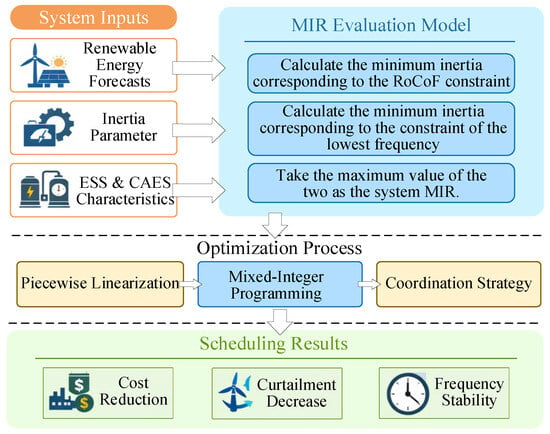
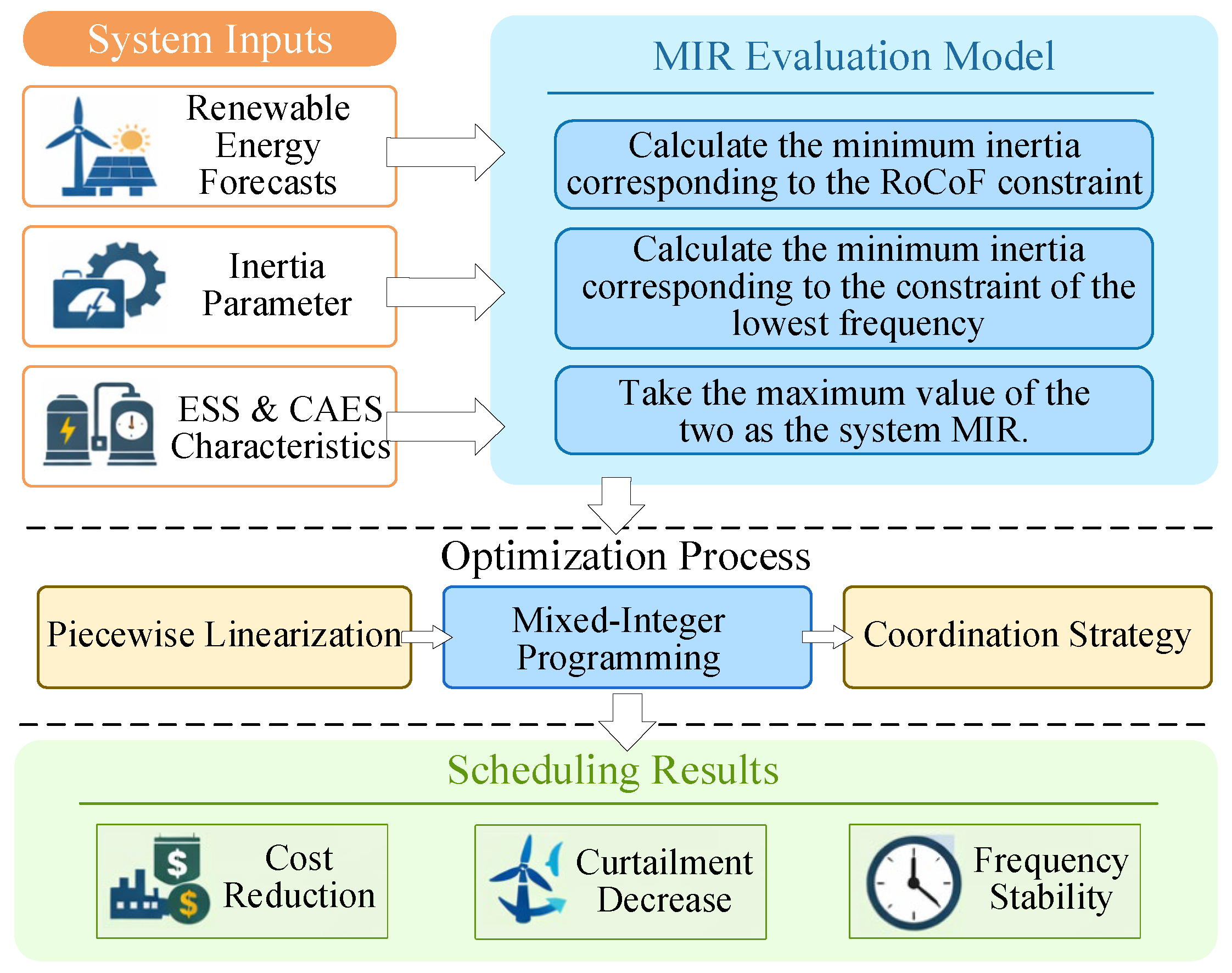
To address the challenges of low inertia and insufficient frequency-regulation resources in high-renewable-penetration power systems, the overall workflow of the proposed hybrid energy storage scheduling framework is illustrated in Figure 1.
Figure 1.
Flowchart of the optimal scheduling process for hybrid energy storage considering minimum inertia requirement.
As shown in Figure 1, the process begins with system inputs, including renewable generation forecasts, load demands, generator inertia parameters, and the characteristics of EES and CAES. These inputs feed into the MIR evaluation module, which calculates the minimum inertia requirement based on RoCoF and frequency nadir constraints and converts any inertia deficit into fast-reserve demands. Following this, the optimization process employs mixed-integer linear programming (MILP) combined with adaptive piecewise linearization (APWL) to coordinate EES and CAES, ensuring that fast and slow reserves are appropriately allocated. The output consists of optimized dispatch schedules for thermal units and hybrid storage, along with system-level metrics such as total operating cost, renewable energy accommodation, and frequency stability. On this basis, a MILP scheduling model is developed to minimize the total system operating cost over a defined scheduling horizon and time step, explicitly incorporating conventional power balance and equipment operating constraints along with inertia security and reserve-coupling constraints. The reported inertia and frequency-security results are intended to reflect scheduling-level security performance based on equivalent inertia and reserve requirements, rather than exact real-time transient behavior.
2.1. Objective Function
To simultaneously account for economic efficiency, low-carbon operation, and system reliability, the objective function is defined as the minimization of the sum of the thermal unit operating cost, carbon emission cost, hybrid energy storage system (HESS) operation and maintenance cost, and penalty cost [16]:
where is the total objective cost; is the number of scheduling periods; is the time index; is the thermal unit operating cost at time period ; is the carbon emission cost at time period ; is the operating cost of the HESS at time period ; and is the penalty cost at time period .
The detailed composition and calculation logic of each cost term are given as follows.
- (1)
- Thermal Unit Operating Cost
The thermal generation cost constitutes the major portion of system expenditure and consists of the coal-fired generation cost, unit start-up/shut-down cost, and ramping wear cost caused by load fluctuations [17]. Among them, the generation cost is generally approximated as a linear or quadratic function of output power, while start-up and shut-down costs are incurred only during state transitions:
where denotes the set of thermal units; is the thermal unit index; is the power output of unit at time period ; is the unit commitment status variable, with 1 indicating on and 0 indicating off; and are the fuel cost characteristic coefficients of unit ; and are the start-up and shut-down costs of unit at time period , respectively; and is the ramping penalty coefficient.
- (2)
- Carbon Emission Cost
To satisfy the requirement of low-carbon dispatch, a carbon trading mechanism is introduced, whereby the carbon emissions of thermal units are converted into economic cost through the carbon price [18]:
where is the carbon trading price and is the carbon emission intensity per unit of electricity generated by unit .
- (3)
- Hybrid Energy Storage Operating Cost
The operating cost of energy storage systems is mainly reflected in the operation and maintenance losses associated with charging and discharging power, while the initial investment cost is not considered:
where denotes the set of HESS; is the storage unit index; is the O&M cost coefficient of storage unit ; is the charging power of storage unit at time period ; and is the discharging power of storage unit at time period .
- (4)
- Penalty Cost
To ensure system flexibility and reliability, penalties are imposed on curtailed wind and photovoltaic power as well as on insufficient reserve capacity:
where is the penalty coefficient for renewable energy curtailment; and are the curtailed wind power and photovoltaic power at time period , respectively; and are the penalty coefficients for insufficient FR and SR, respectively; and and are the slack variables representing insufficient FR and SR at time period , respectively.
2.2. Constraints
- (1)
- System Power Balance Constraint
The system must maintain real-time supply–demand balance, that is, the sum of thermal generation, actual grid-connected renewable generation, and net discharging power of energy storage must equal the total load demand:
where and are the forecast available wind power and photovoltaic power at time period , respectively, and is the system load demand at time period .
- (2)
- Thermal Unit Operating Constraints
The operating constraints of thermal units, including generation limits, minimum up-time constraints, and ramping limits, are modeled using standard unit commitment formulations widely adopted in the literature [19]
where and are the minimum and maximum output limits of unit , respectively; is the cumulative on-time of unit up to time period ; is the minimum up-time requirement of unit ; and and are the ramp-down and ramp-up limits of unit , respectively.
- (3)
- Physical Constraints of HESS
Both EES and CAES must satisfy basic charging/discharging power constraints, mutually exclusive operating-state constraints, and time-coupled state-of-charge constraints:
where and are the charging and discharging state variables of storage unit , respectively; is the maximum charging/discharging power of storage unit ; and are the stored energy of storage unit at time periods and , respectively; is the self-discharge rate of storage unit ; and are the charging and discharging efficiencies of storage unit , respectively; and and are the minimum and maximum energy limits of storage unit , respectively.
In addition, since CAES consists of two independent mechanical subsystems, namely the compressor and the expander, additional ramping constraints during operating-mode transitions are required to reflect the regulation delay caused by mechanical inertia.
- (4)
- System Minimum Inertia Security Constraint
To prevent insufficient disturbance resilience caused by high renewable penetration, the real-time synthetic inertia of the system must not be lower than the MIR determined by frequency security criteria [19]:
where is the total synthetic inertia of the system at time period and is the MIR at time period satisfying both RoCoF and frequency nadir security constraints.
3. Power–Capacity Complementary Coordination Mechanism of EES and CAES
The collaborative advantage of a HESS lies not only in the qualitative complementarity of physical characteristics, but more importantly in the quantitative characterization of the regulation capabilities of EES and CAES over different time scales through mathematical models, thereby enabling an optimal division of responsibilities based on the inertia–reserve coupling relationship.
3.1. Quantification Model of Regulation Capability
The physical constraints of different energy storage technologies determine their respective roles in the frequency regulation process. EES is more strongly constrained by energy capacity, whereas CAES is more strongly constrained by power capability. Therefore, the regulation capabilities of the two technologies should be modeled separately.
- (1)
- EES: Fast Power Response Capability
EES features millisecond-level power response speed and is thus well-suited to cope with instantaneous frequency fluctuations. However, due to its relatively limited energy capacity, its maximum upward reserve capability is often constrained by how long it can sustain discharge. For FR requirements with very short durations, such as 15 s to 1 min, the power advantage of EES can be maximized:
where is the maximum upward reserve capability of EES at time period ; is the maximum charging/discharging power of EES; and are the discharging and charging power of EES at time period , respectively; is the stored energy of EES at time period ; is the minimum allowable stored energy of EES; is the required duration of FR; and is the discharging efficiency of EES.
This equation indicates that, over short time scales, EES is mainly constrained by its power limit rather than its energy capacity.
- (2)
- CAES: Sustained Energy Support Capability
CAES has a large air storage volume and is therefore suitable for providing SR over long durations. Its maximum upward reserve capability is calculated as follows [20]:
where is the maximum upward reserve capability of CAES at time period ; is the maximum charging/discharging power of CAES; and are the discharging and charging power of CAES at time period , respectively; is the stored energy of CAES at time period ; is the minimum allowable stored energy of CAES; is the duration of SR; and is the discharging efficiency of CAES.
3.2. Inertia–Reserve Coupling Constraint
In low-inertia systems, the lack of physical inertia leads to an excessively high RoCoF. To compensate for this physical deficiency, faster active power injection must be introduced. Therefore, establishing the coupling relationship between the inertia deficit and FR is the core of the proposed coordination mechanism.
First, the system inertia gap at time period , denoted as , is defined as the difference between the MIR and the actual synthetic inertia [21]:
where is the inertia gap of the system at time period .
Then, this physical inertia gap is converted into an equivalent FR requirement . This conversion is based on the frequency response mechanism, namely that faster power response can effectively substitute part of the physical inertia in suppressing RoCoF [22]:
where is the additional FR requirement induced by inertia deficiency at time period ; is the inertia–reserve conversion coefficient; is the system base capacity; and is the nominal system frequency.
This equation establishes a strong coupling between CAES, which provides , and EES, which provides FR.
3.3. Multi-Timescale Reserve Balance Constraints
Based on the above quantification and coupling models, a reserve balance constraint framework including both base reserve demand and coupling-induced demand is established.
- (1)
- FR Balance
The total FR supply of the system must cover both the base demand caused by load forecast errors and the additional demand induced by insufficient inertia. Considering the stringent response-speed requirement, this reserve is mainly provided by EES:
where is the FR provided by storage unit at time period ; is the FR provided by thermal unit at time period ; is the base FR demand at time period ; and is the slack variable for insufficient FR at time period .
- (2)
- SR Balance
SR is mainly used to address long-duration power fluctuations or unit outages and is jointly provided by energy-abundant CAES and thermal units:
where is the SR provided by storage unit at time period ; is the SR provided by thermal unit at time period ; is the base SR demand at time period ; and is the slack variable for insufficient SR at time period .
- (3)
- Physical Limits of Reserve Capacity
For any device, the sum of reserve capacities allocated to different reserve categories must not exceed the physical regulation limit calculated in Section 3.1:
where is the maximum reserve capability of storage unit at time period .
4. Inertia Modeling and Solution of Nonlinear Frequency Constraints
4.1. System Synthesis of Inertia Modeling
The total system inertia is the core kinetic energy reserve that resists frequency fluctuations, mainly derived from synchronous rotating components. In the new power system, it is composed of the inherent rotational inertia of thermal power units and the equivalent inertia of compressed air energy storage [23].
Thermal power units, as traditional synchronous power sources, have their inertia varying dynamically with the status of the online units. This can be estimated based on the rated capacity of the units and the inertia time constant. CAES operates based on synchronous motors and has actual rotational mass, which can be regarded as a standard inertia source. It can provide instantaneous power support when the grid frequency changes, thereby suppressing frequency drops.
Considering that CAES only contributes to the inertia when in grid-connected mode, the total inertia of the system can be expressed as [24]:
where is the rated power of CAES; and are the charging and discharging state variables of CAES at time period , respectively.
In this study, the equivalent inertia constant of CAES is treated as a fixed parameter under a given operating mode. This assumption is adopted because the proposed model focuses on the day-ahead scheduling timescale, where the inertia contribution of CAES can be reasonably approximated as a steady-state parameter to preserve model tractability. It should be noted that, in practical applications, the equivalent inertia of CAES may vary with compressor–expander configurations, operating conditions, and control strategies.
4.2. Evaluation of MIR
To ensure frequency security, the reserved system inertia must simultaneously satisfy the RoCoF constraint during disturbance initiation and the frequency nadir constraint during frequency decline. Therefore, the maximum of the two derived requirements is taken as the security boundary [25]:
where is the MIR derived from the RoCoF constraint and is the MIR derived from the frequency nadir constraint.
- (1)
- MIR Based on RoCoF Constraint
At the instant a disturbance occurs, the RoCoF is determined only by the power deficit and the total system inertia. To prevent RoCoF from exceeding the security threshold , the system inertia should satisfy
where denotes the maximum credible power loss and is the allowable upper limit of the RoCoF.
- (2)
- MIR Based on Frequency Nadir Constraint
During the primary frequency response stage, the frequency nadir is jointly determined by inertia, reserve capacity, and system damping. Its functional relationship is usually represented as a complex nonlinear implicit function:
where is the frequency nadir at time period ; is the total available reserve at time period ; is the equivalent governor response parameter; is the equivalent load damping coefficient; and denotes the nonlinear mapping relationship among these variables.
To guarantee , the inverse-derived inertia requirement () cannot be directly expressed in a linear analytical form and therefore must be handled algorithmically.
- (3)
- APWL of Frequency Constraints
The frequency nadir function is highly nonlinear and nonconvex and thus cannot be directly embedded into the MILP model. To address this issue, an APWL method is adopted following an “offline fitting–online calling” strategy.
The APWL procedure is as follows.
- (1)
- Sampling and Clustering
First, Latin hypercube sampling is used to generate samples of inertia and reserve within the feasible parameter region. Then, the K-means algorithm is employed to partition the sample space into subregions, ensuring that the curvature characteristics of the function remain similar within each subregion.
Where and are the sampled inertia and reserve variables, respectively; is the number of subregions.
The number of segments K in the APWL method is selected following the piecewise linearization strategy in [26].
- (2)
- Hyperplane Fitting in Each Subspace
Within each subregion , a linear hyperplane of frequency deviation is fitted using the least squares method:
where is the approximated frequency nadir deviation; , , and are the fitting coefficients of subregion ; and is the subregion index.
- (3)
- MILP Reformulation
By introducing binary variables and the big- method, the above piecewise linear model is transformed into standard linear constraints:
where is a binary variable indicating whether the operating point at time period falls into subregion ; is a sufficiently large positive constant used in the big- reformulation; and is the allowable upper bound of the frequency deviation.
These constraints force the optimization model to automatically locate the most accurate linear hyperplane for security verification according to the real-time values of and , thereby significantly improving computational efficiency while maintaining solution accuracy.
5. Case Studies
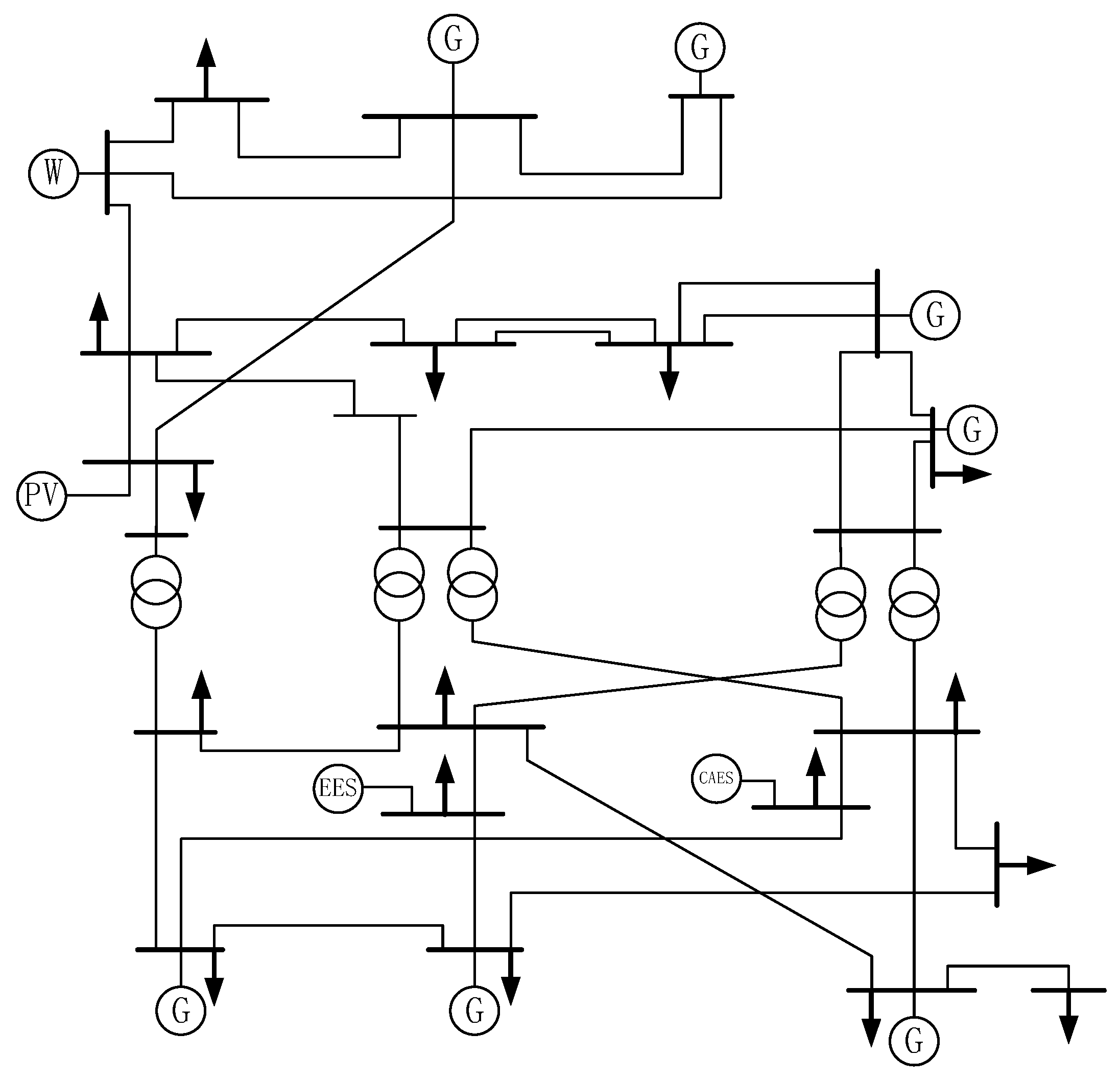
To verify the effectiveness of the proposed optimal scheduling model under low inertia conditions and to demonstrate the collaborative advantages of heterogeneous energy storage systems, we conducted a case study on a modified IEEE RTS-24 power grid system. Due to its representative structure and publicly available data, the modified IEEE RTS-24 system was used as the benchmark test system to enable a controllable and repeatable evaluation of the proposed method. The system topology and detailed simulation parameters are provided in Appendix A, including the parameters of energy storage systems (EES), compressed air energy storage (CAES), wind power generation, photovoltaic units, and thermal power generation units, the baseline settings of APWL’s hyperparameters, a 24-h scheduling period, and a 15-min time step. The proposed model was implemented in MATLAB R2023b and solved using Gurobi Optimizer version 10.0.1. All simulations are carried out on a computer equipped with an Intel(R) Core(TM) i9-14900HX processor (2.20 GHz) and 32 GB RAM under a 64-bit operating system.
The modified IEEE RTS-24 system is adopted as a benchmark test system with representative structure and publicly available data, enabling controlled and reproducible evaluation of the proposed method.
To quantitatively evaluate the economic and security performance of different strategies, six comparative cases are defined as follows:
Case 0: Conventional unit commitment without any energy storage and without inertia constraints.
Case 1: Hybrid energy storage is included, but only the SR constraint is considered, while FR and inertia requirements are neglected.
Case 2: The proposed optimization model considering EES/CAES coordination and inertia–reserve coupling.
Case 3: Based on Case 2, an explicit frequency nadir constraint modeled by APWL is further introduced.
Case 4: CAES is removed, and only EES, together with thermal units, is used for system regulation.
Case 5: EES is removed, and only CAES, together with thermal units, is used for system regulation.
5.1. Overall Economic Performance and Renewable Energy Accommodation
The impacts of different scheduling strategies on system operating cost, carbon emissions, renewable energy accommodation, and frequency security indicators for the considered cases are summarized in Table 1, where all data are obtained from simulations conducted in this study.
Table 1.
Comparison of system economy and renewable energy accommodation under different scenarios.
A comparative analysis of the data in Table 1 shows that the proposed coordinated optimization strategy in Case 2 exhibits significant advantages across all key indicators. First, from the perspective of economy and renewable energy accommodation, compared with the benchmark Case 0 without energy storage, Case 2 exploits the coordinated mechanism of hybrid energy storage to reduce the total operating cost from 854.2 thousand USD to 798.6 thousand USD, corresponding to a reduction of 6.51%. At the same time, the curtailed wind and solar energy is sharply reduced from 2150.5 MWh to 322.6 MWh, and the renewable energy accommodation rate increases to 98.3%, effectively alleviating the source–load mismatch problem.
Second, in terms of system security, facing the risk of insufficient inertia in high-renewable-penetration systems, Case 2 enhances the minimum inertia margin from the dangerous negative value in Case 0 to a secure level of 1.85 s through the physical inertia support provided by CAES, while the frequency nadir deviation is strictly controlled within 0.03 Hz. In addition, the ablation studies further confirm the limitations of a single storage technology. In Case 4, where CAES is removed, the lack of long-duration energy throughput capability results in renewable curtailment of up to 1650.2 MWh. In Case 5, where EES is removed, the absence of millisecond-level power response prevents an effective reduction in the start-up and shut-down cost of thermal units. Finally, although the rigorous reference case, Case 3, achieves the best frequency deviation control by introducing explicit high-accuracy frequency constraints, the increase in computational complexity and the slight cost increase of 0.3% indicate that the strategy adopted in Case 2 achieves the best balance among economy, security, and computational efficiency in practical engineering applications.
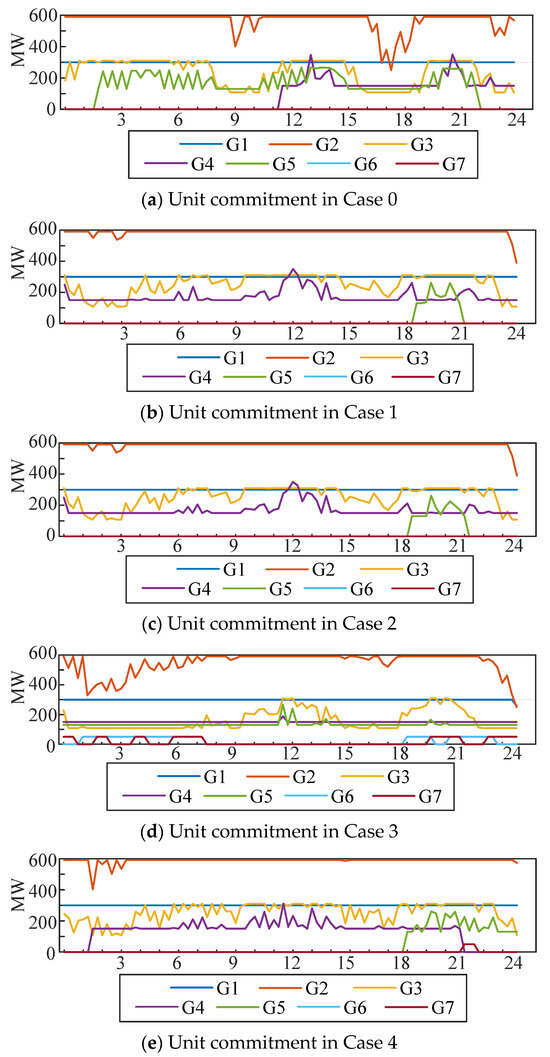
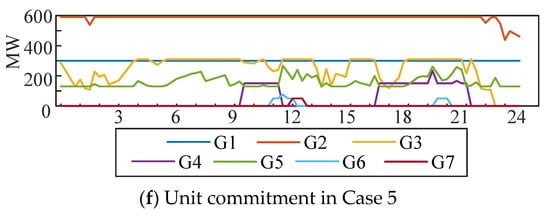
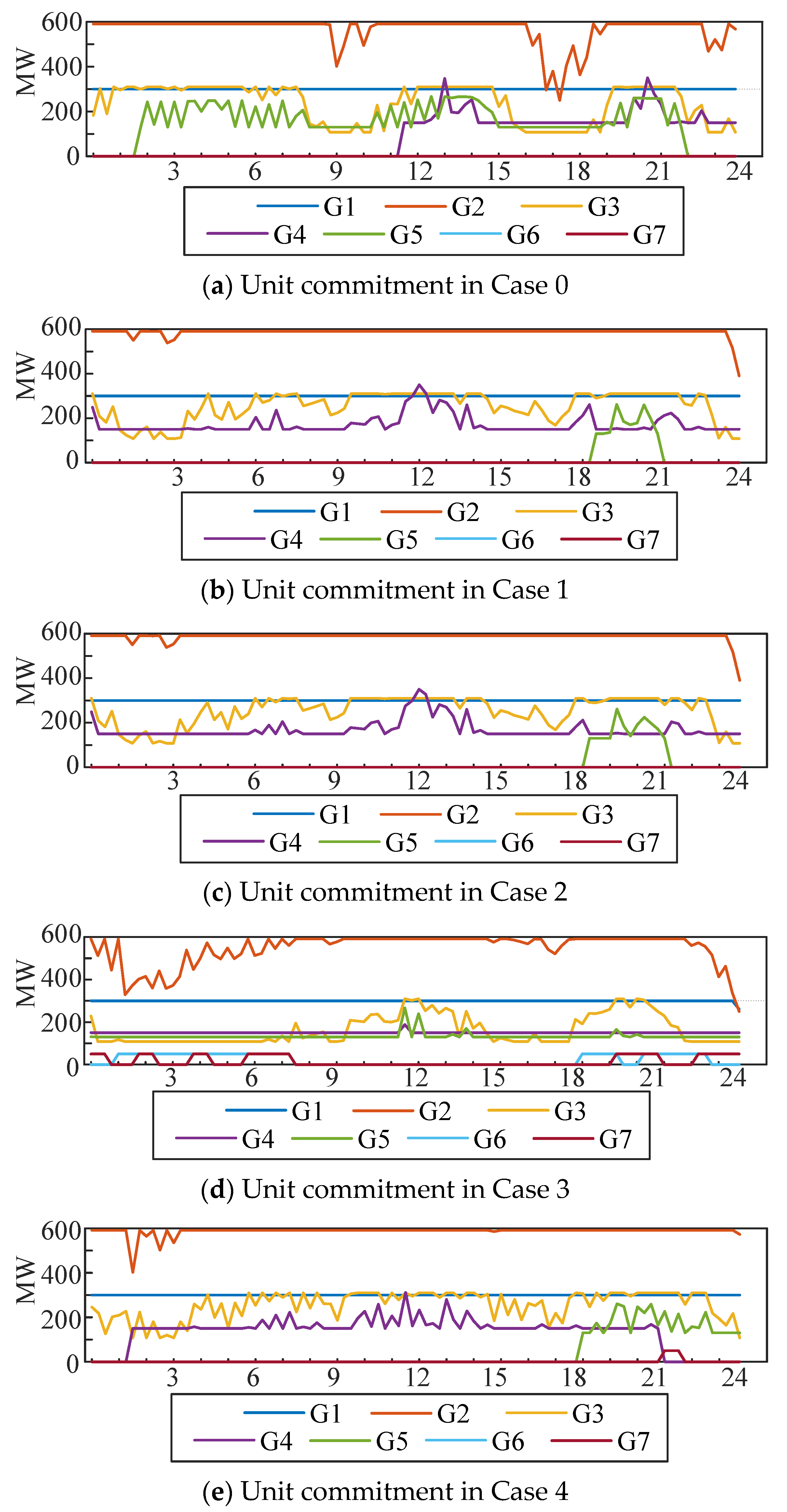
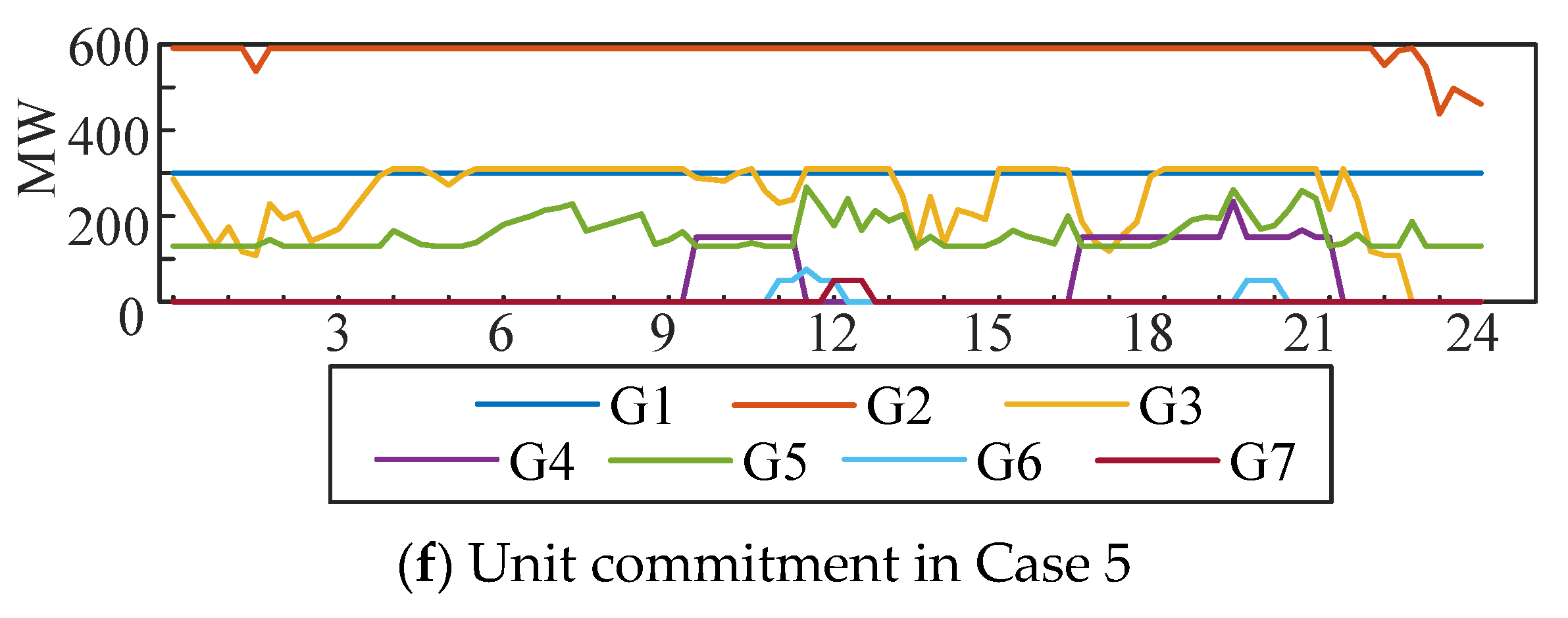
To illustrate the impacts of different strategies on the output behavior of thermal units, Figure 2 presents unit commitment results for several representative scenarios.
Figure 2.
Unit commitment results under different scenarios.
From the output curves in Figure 2, it is evident that different scheduling strategies result in markedly different operational behaviors of thermal units in terms of output smoothness, ramping intensity, online capacity retention, and inter-unit coordination. In the benchmark Case 0, where no energy storage is available, thermal units are forced to directly track the full fluctuation of net load caused by renewable variability. As a result, several units exhibit frequent and sharp output adjustments, and some units operate in a highly oscillatory manner over consecutive periods. This indicates that, in the absence of flexible auxiliary resources, thermal generators must simultaneously assume energy balancing and frequency-support-related regulation pressure, which leads to large ramping amplitudes, increased cycling stress, and higher operating costs.
In Case 1, after spinning reserve (SR) is introduced, the overall scheduling pattern becomes more conservative. Compared with Case 0, the outputs of major units become relatively less erratic, and the system maintains a higher level of committed thermal capacity during many periods. This reflects that the reserve requirement improves operational reliability, but it also forces some thermal units to remain online even when their energy contribution is not strictly necessary. Consequently, although the system obtains a more secure reserve margin, part-load operation of thermal units increases, which weakens the economic benefit and limits the ability of the system to fully accommodate renewable power.
Case 2 clearly demonstrates the advantage of the proposed inertia–reserve coupling mechanism and the coordinated scheduling of EES and CAES. Compared with Cases 0 and 1, the thermal unit output trajectories in Case 2 are visibly smoother, especially for those units that are sensitive to short-term net-load fluctuations. This indicates that the fast-response capability of EES effectively absorbs high-frequency power imbalances that would otherwise be imposed on thermal generators. At the same time, CAES undertakes long-duration energy shifting and sustained reserve support, thereby reducing the need for thermal units to remain in a high-flexibility but economically inefficient operating state. As a result, the hybrid storage system separates short-timescale fluctuation suppression from long-timescale energy balancing, allowing thermal units to operate in a more stable and economical manner. This not only reduces ramping requirements and start-up/shut-down frequency, but also alleviates mechanical wear and improves the overall dispatch flexibility of the system.
The operating pattern in Case 3 is generally similar to that in Case 2, but several units retain more upward regulation margin during specific periods. This reflects the effect of the explicitly imposed frequency nadir constraint. To satisfy stricter dynamic security requirements, the scheduling solution becomes slightly more conservative, and some thermal units are prevented from operating too close to their economic dispatch points. Therefore, although the output curves remain smooth, the system intentionally preserves additional flexibility and reserve headroom during critical intervals. This explains why Case 3 achieves better frequency-security performance than Case 2 at the expense of a slight increase in operating cost.
The ablation cases further highlight the necessity of heterogeneous storage coordination. In Case 4, where CAES is removed, the system loses an important source of long-duration energy support. Although EES can still mitigate rapid fluctuations, its limited energy capacity makes it difficult to sustain regulation over extended periods. Consequently, thermal units still need to assume a substantial share of medium- and long-timescale balancing tasks, and the output curves remain relatively uneven in several time intervals. In Case 5, where EES is removed, CAES can provide energy support and some reserve capability, but its slower response characteristics make it less effective in suppressing rapid short-term fluctuations. Therefore, thermal units are still exposed to more instantaneous regulation pressure than in the hybrid-storage case. Overall, the comparison among Cases 2, 4, and 5 confirms that neither EES nor CAES alone can fully provide the multi-timescale flexibility required by high-renewable systems. Only their coordinated operation can simultaneously reduce rapid ramping stress, maintain adequate reserve support, and smooth the generation profiles of thermal units.
In summary, Figure 2 verifies that the proposed hybrid EES–CAES scheduling framework significantly reshapes the operational role of thermal units. Instead of passively following renewable fluctuations, thermal units in the coordinated cases are dispatched closer to stable and economically efficient trajectories, while storage resources absorb the majority of fast and sustained balancing tasks according to their physical characteristics. This operational restructuring is a key reason why the proposed strategy can simultaneously improve the economy, renewable energy accommodation, and frequency security.
5.2. Robustness and Sensitivity Analysis
With the development of modern power systems, the penetration of renewable energy will continue to increase. Therefore, system performance under different renewable penetration levels is a key criterion for evaluating model robustness. Table 2 shows the variation in system performance as the renewable penetration level increases from 30% to 50%.
Table 2.
Comparison of the economy and security under different renewable penetration levels.
As shown in Table 2, with increasing renewable penetration, the system regulation pressure grows nonlinearly. In particular, when the penetration level reaches 50%, the conventional scheduling strategy without energy storage in Case 0 faces a risk of systemic collapse: the minimum inertia margin drops to −1.80 s, and the frequency deviation diverges severely, indicating that thermal units alone can no longer maintain frequency stability. In contrast, the proposed Case 2 shows strong adaptability. Even under the extremely high-penetration condition of 50%, the coordinated support of hybrid energy storage maintains a minimum inertia margin of 0.95 s and keeps the renewable energy accommodation rate at 95.8%. These results fully demonstrate that combining the physical inertia support provided by CAES with the fast power response of EES is a key technical means to ensure both frequency stability and economic operation in future high-renewable power systems.
In addition to changes in renewable penetration, the system must also be able to withstand sudden, large power deficits. Table 3 analyzes the specific impacts of different disturbance magnitudes on system regulation requirements and security indicators.
Table 3.
Impact of disturbance levels on regulation requirements and costs.
The results in Table 3 show that as the disturbance magnitude increases from 200 MW to 400 MW, the accumulated demand for FR and SR grows approximately linearly, which in turn drives up the total cost. It is noteworthy that under the extreme disturbance of 400 MW, the rigorous reference case, Case 3, demonstrates the theoretical security boundary of the system. By forcing the scheduling of more reserve resources, it successfully limits the frequency of extreme deviation to −0.08 Hz. By contrast, although Case 2, which does not explicitly impose the frequency constraint, performs slightly better economically, its frequency extreme deviation reaches −0.28 Hz, approaching the security limit. This comparison clearly reveals the trade-off boundary between security and cost. Case 3 represents the theoretical upper bound of ensuring security regardless of cost, whereas Case 2 achieves nearly the same security performance as Case 3 under normal operating conditions at a lower cost, demonstrating the high engineering applicability of the proposed model in non-extreme scenarios.
The configuration scale of energy storage directly determines the system’s return on investment and operating performance. Table 4 shows the impact of different energy storage scales on system performance.
Table 4.
Impact of energy storage scale on economy and accommodation.
The results in Table 4 reveal the law of diminishing marginal benefits of energy storage configuration. When the scale is only 0.5 times the base value, the system is constrained by a capacity bottleneck and cannot fully absorb renewable energy during peak generation periods, leading to high renewable curtailment and elevated costs. When the configuration is increased to the base level of 1.0 times, the accommodation rate rises sharply to 98.3%, the total cost decreases significantly, and the system reaches its optimal performance balance. However, when the scale is further increased to 1.5 times, although the inertia margin improves, the renewable energy accommodation rate increases by only 1.3%, while the reduction in total cost is very limited. This indicates that the configuration adopted in this study is the optimal choice under the current test conditions in terms of both economy and security.
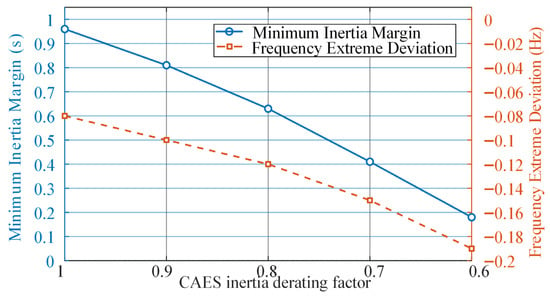
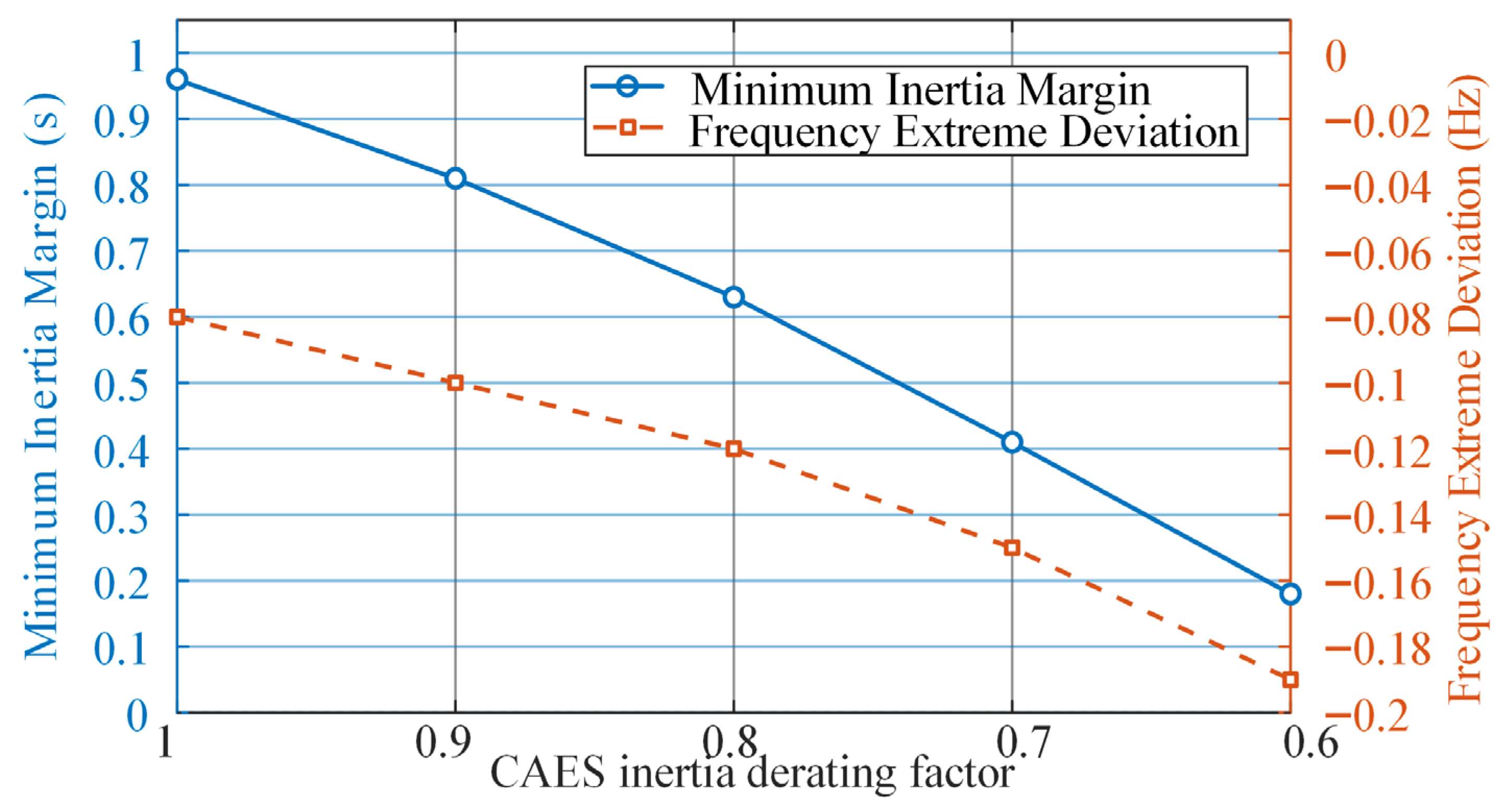
To further verify the security of the recommended scheduling scheme under extreme events and to address the concern that the fixed equivalent inertia assumption of CAES may overestimate system resilience, an additional sensitivity analysis is carried out without changing the original optimization model or scheduling structure. Specifically, the representative 400 MW extreme disturbance case is selected, and the equivalent inertia constant of CAES is multiplied by a derating factor , where and . This is used to represent the possible reduction in CAES dynamic inertia support caused by compressor-expander interaction, transient control delay, and severe fault conditions. Under each derating scenario, the minimum inertia margin and the frequency extreme deviation are examined to evaluate the frequency-security robustness of the recommended scheduling scheme under degraded CAES dynamic response.
As shown in the Figure 3, when the CAES inertia derating factor decreases from 1.0 to 0.6, the minimum inertia margin drops from 0.96 s to 0.18 s, indicating that the available inertia security margin is gradually reduced as the dynamic inertia contribution of CAES weakens. At the same time, the frequency extreme deviation worsens from Hz to Hz, which means that the frequency response becomes weaker under the same extreme disturbance. These results suggest that the fixed equivalent inertia assumption does somewhat overestimate the security margin, but this effect is mainly reflected in a tighter safety boundary rather than a loss of overall security.
Figure 3.
Security under CAES inertia degradation.
More importantly, the minimum inertia margin remains positive in all tested cases, and the frequency extreme deviation, although larger, does not show any abrupt instability trend. This indicates that the recommended scheduling scheme can still keep the system within an acceptable security range through the existing reserve allocation and coordinated scheduling mechanism, even when the dynamic response capability of CAES is reduced. In other words, the added sensitivity study shows that the proposed scheduling framework is not only effective under the idealized fixed-inertia assumption, but also remains reasonably robust under practical dynamic degradation.
It is also observed that when falls below 0.7, the minimum inertia margin decreases more rapidly and the frequency deviation becomes noticeably worse. This suggests that the marginal impact of CAES dynamic inertia on system security becomes stronger in the lower-response range. Therefore, although the recommended scheduling scheme remains secure within the tested derating range, its security margin is clearly reduced as the CAES dynamic performance deteriorates. In practical applications, if a more severe response delay of CAES is expected under extreme conditions, additional fast reserves or a more detailed dynamic inertia model may be needed for a more conservative security assessment.
5.3. Reserve Support Function of Energy Storage
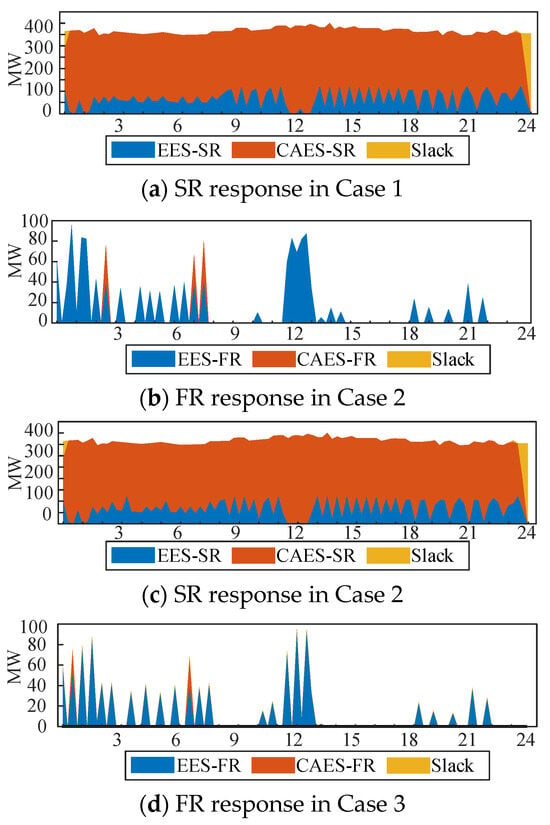
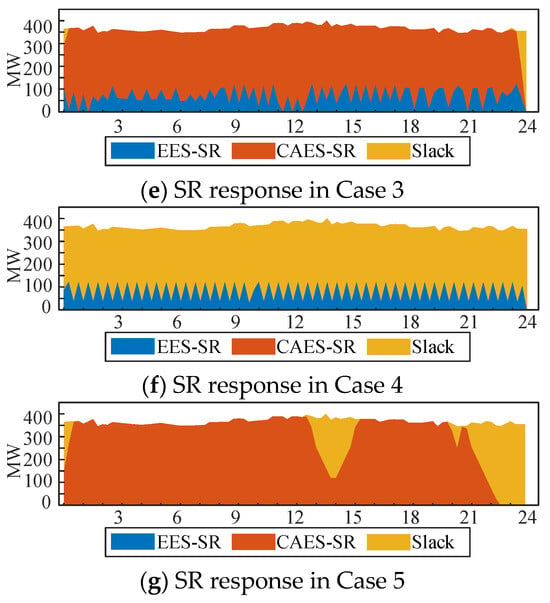
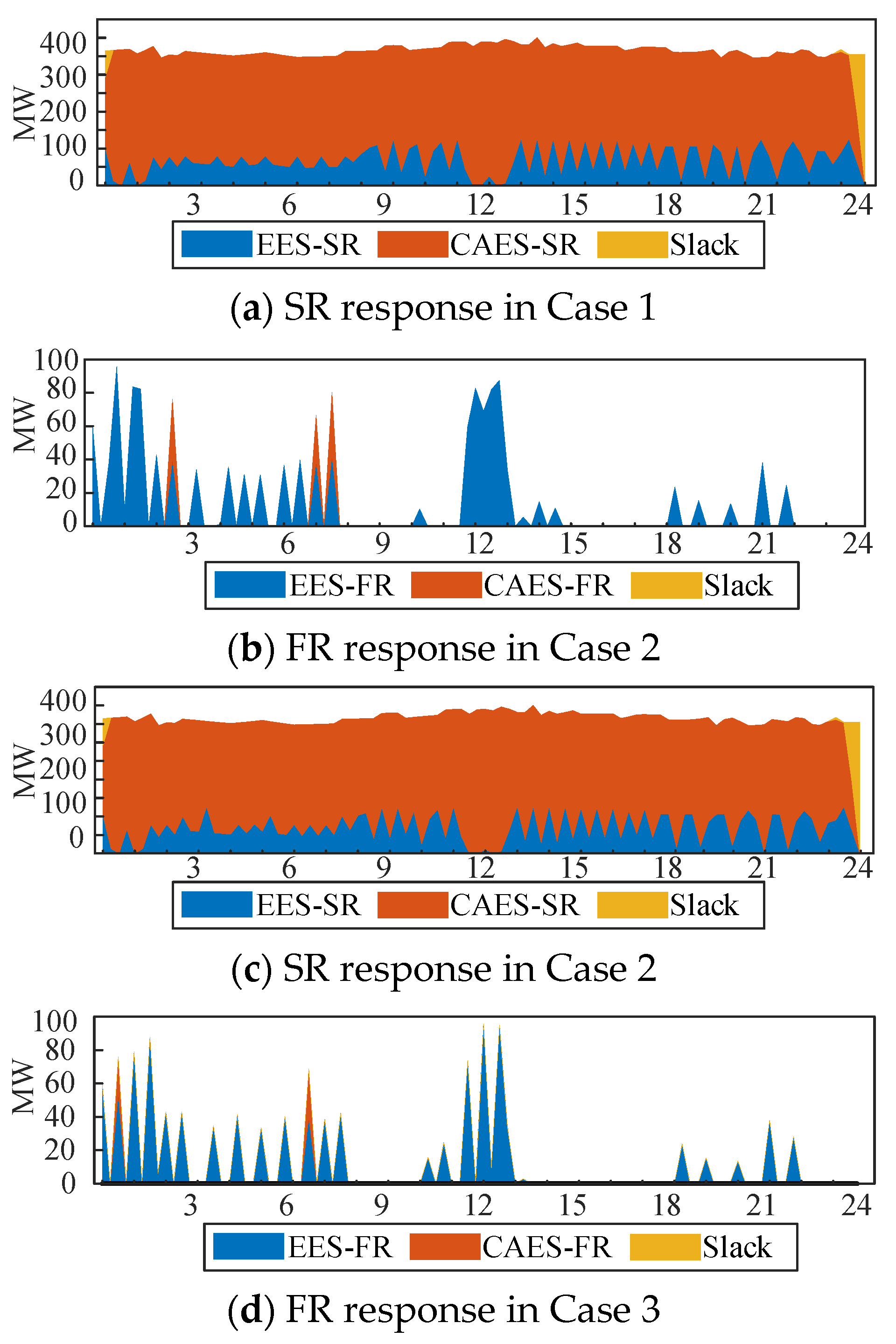
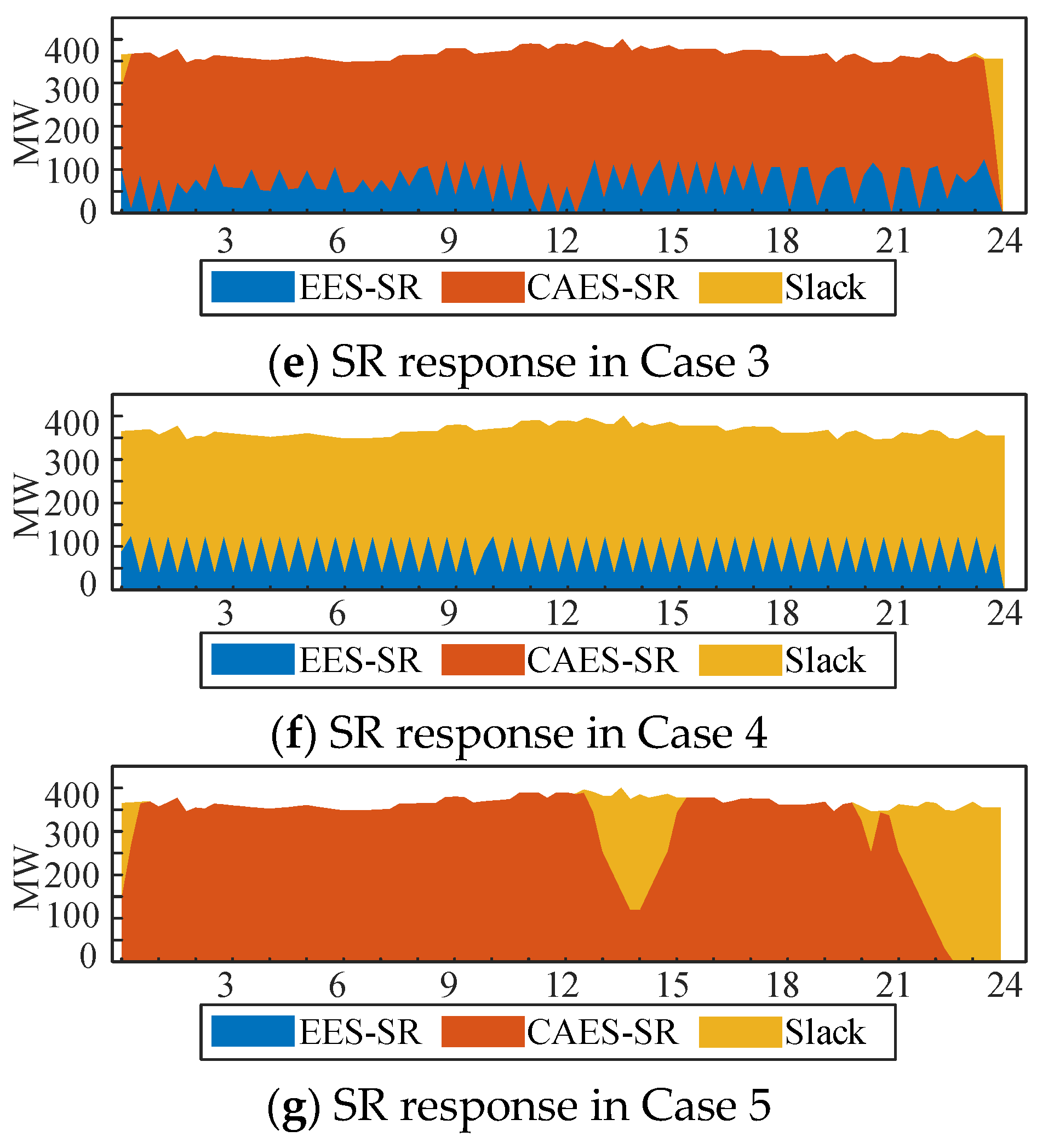
Figure 4 illustrates the FR and SR output profiles of the hybrid energy storage system under different scheduling strategies. While Figure 2 focuses on the output trajectories of representative thermal units, reflecting their commitment and ramping behavior, Figure 4 highlights the reserve response of the hybrid energy storage system, thereby revealing the multi-timescale coordination between EES and CAES.
Figure 4.
Comparison of reserve response characteristics of hybrid energy storage under different scenarios.
An analysis of the response curves in Figure 4 shows that different scheduling constraint mechanisms directly determine the dispatch patterns of storage resources. In Case 1, where only the SR constraint is considered, the SR supply is almost entirely undertaken by CAES over a long duration, forming a smooth and stable reserve foundation, while the SR output of EES mainly appears as small and rapid sawtooth-like compensation, primarily used to track short-term fluctuations or correct reserve margins near boundary periods. At this stage, the overall system reserve shortage is very small, indicating that under a single SR constraint, the system mainly relies on the energy-shifting and long-duration discharge capabilities of CAES.
When the inertia–reserve coupling mechanism is introduced in Case 2, the responsibilities of the two storage technologies become highly distinct. The FR exhibits clear pulse-like peaks and is mainly handled by EES, which leverages its millisecond-level response advantage to cope with instantaneous power disturbances, while CAES provides only auxiliary support in a few extreme periods. Meanwhile, the SR is still mainly provided by CAES, with EES playing a supplementary role, and the reserve shortage is almost negligible. This shows that the proposed mechanism successfully realizes a clear division of labor across fast and slow time scales, assigning rapid-response tasks to EES and long-duration support tasks to CAES, thereby satisfying reserve demands across multiple time scales and reducing passive dependence on thermal units.
When stricter frequency constraints are introduced in Case 3, the peaks in the FR curve become denser and more concentrated during critical periods, indicating that tightening the frequency security boundary directly increases the system’s demand for fast power support. At the same time, SR continues to be supplied mainly by CAES as a stable foundation, and the overall reserve shortage remains low. This demonstrates that the coordinated hybrid energy storage mechanism remains operationally feasible even under more stringent frequency security constraints.
Finally, the ablation cases further confirm the necessity of heterogeneous energy-storage complementarity. In Case 4, where CAES is removed, the system loses its main source of SR and long-duration energy support, and the SR that should have been provided by CAES can no longer be covered by the remaining resources over long durations, leading to significant reserve shortages in the curves. In Case 5, where EES is removed, the system lacks a primary fast-response resource. Due to the switching time between charging and discharging modes, ramp-rate limits, and operating-state constraints, CAES cannot provide sufficient FR during all critical periods, and obvious power deficits also arise. In summary, Figure 4 fully confirms that the coordinated mode, in which EES dominates fast responses while CAES dominates long-duration support, is the optimal choice for ensuring frequency security in high-renewable-penetration power systems.
5.4. Comparison of Inertia Regulation Capability Under Different Scenarios
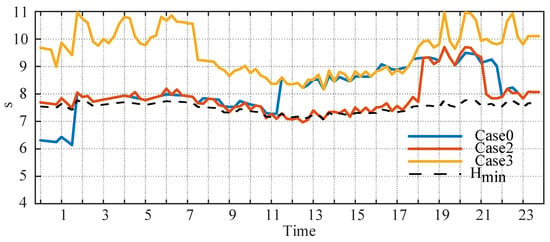
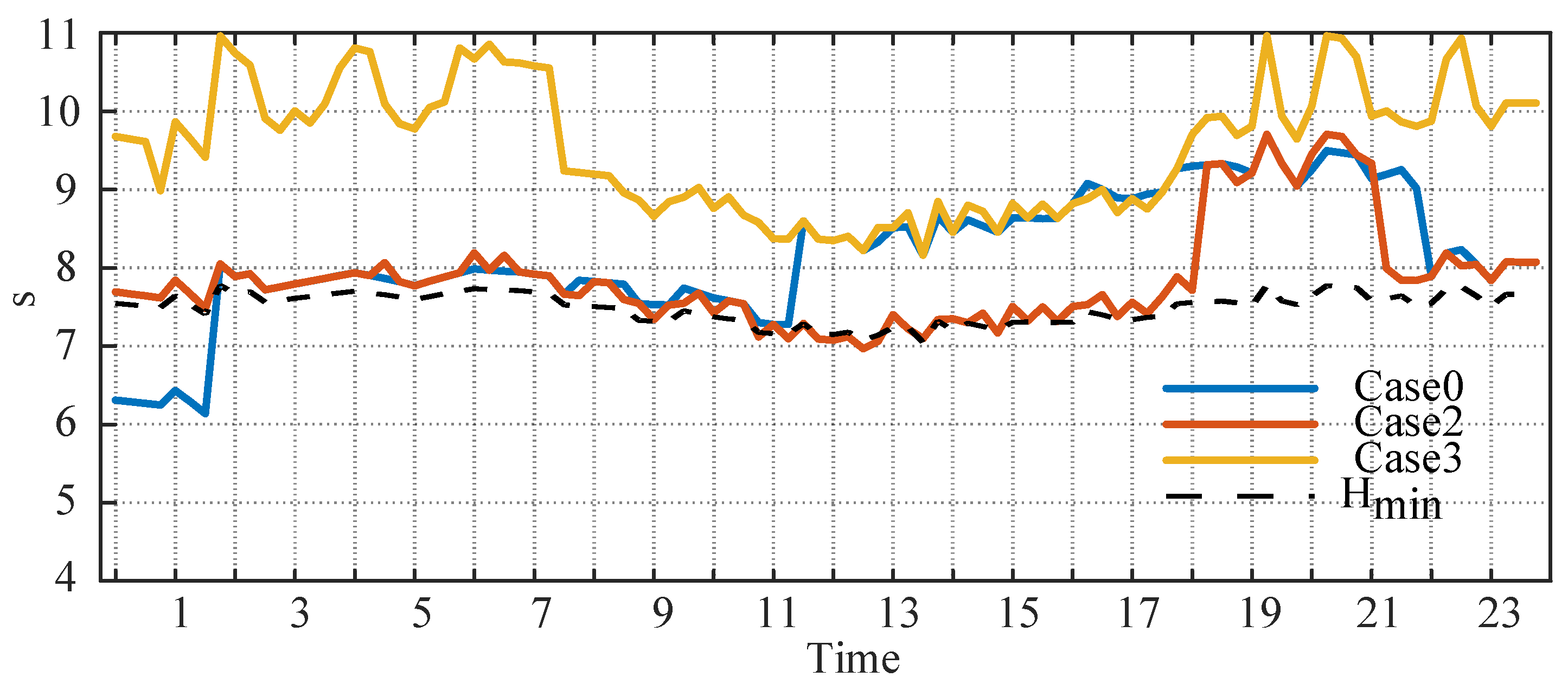
To further investigate the internal coordination mechanism of heterogeneous energy storage, Figure 5 shows the variation in system synthetic inertia under different scenarios.
Figure 5.
Comparison of system synthetic inertia under four scenarios.
Combined with the reserve response analysis in Figure 5, it can be seen that in Case 0, the inertia fluctuates significantly and approaches the minimum requirement (Hmin), indicating limited regulation capability. In Case 2, the coordinated operation of EES and CAES effectively improves inertia stability. EES provides fast-reserve (FR) response to mitigate short-term fluctuations, while CAES supplies sustained reserve (SR) and physical inertia support, maintaining the inertia above Hmin. Case 3 further enhances this effect, achieving the most stable inertia profile with reduced fluctuations. Overall, the results demonstrate that coordinated hybrid energy storage significantly improves system inertia stability compared with non-coordinated scenarios.
5.5. Validation of Nonlinear Constraint Treatment
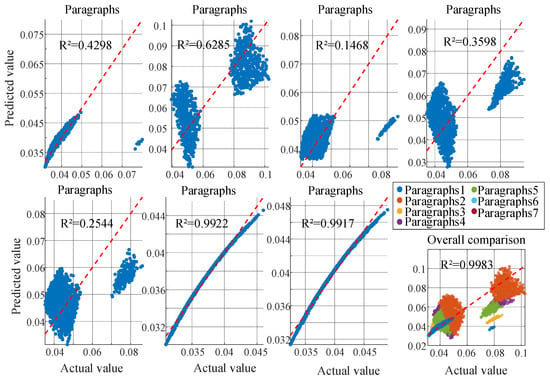
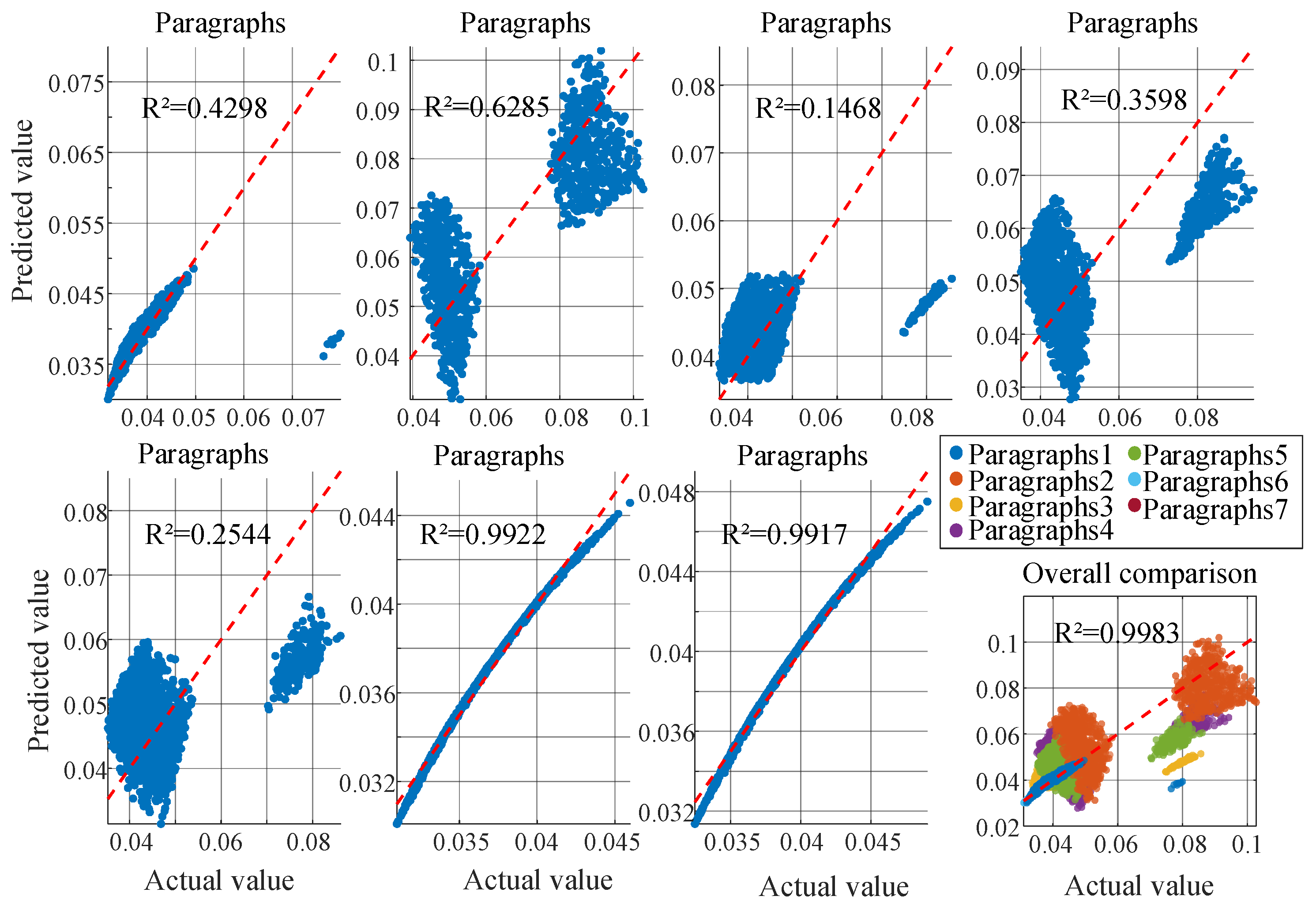
The predictive performance of the APWL method is verified in Figure 6, which primarily presents modeling accuracy by comparing predicted and actual values across seven segments and the overall dataset. In each subfigure, scatter points show the distribution of actual versus predicted values for the corresponding segment, and the linear model’s predictive capability is quantified by the fitted line and the coefficient of determination R2.
Figure 6.
Validation of the adaptive piecewise linearization method.
As shown in Figure 6, the prediction accuracy varies across different segments. Segments 6 and 7 exhibit data points that are highly concentrated around the diagonal line, with values close to 1, indicating that the fitted linear models provide an excellent approximation in these regions. By contrast, Segments 1–5 show more dispersed point distributions and relatively lower values, implying that the local relationships in these regions are more nonlinear and more sensitive to variations in operating conditions.
This difference in dispersion reflects the heterogeneity of the frequency-response characteristics over the full operating space. In some regions, the relationship between the actual and predicted values is nearly linear, leading to tightly clustered points, whereas in other regions the coupling among inertia, reserve, and frequency-response variables is stronger and more complex, resulting in a wider spread of data points. Therefore, the fitting accuracy is segment-dependent rather than uniform across the entire dataset.
In the lower-right subfigure, all segments are aggregated for overall validation. Although dispersion remains visible in several individual segments, the overall is still very high, indicating that the segmented modeling strategy can effectively capture the global nonlinear behavior through local linear approximations. This result further confirms the necessity and effectiveness of the proposed adaptive piecewise linearization method, since a single linear model would be insufficient to represent the different response characteristics across all operating regions.
Under the same hardware environment, a comparative test is conducted using the conventional piecewise linearization method reported in [26] as the benchmark in order to provide a fair comparison with the proposed APWL method.
The comparison of solving speed between APWL and PWL is presented in Table 5.
Table 5.
Solving speed comparison between APWL and PWL.
As shown in Table 5, the average solving time of the APWL method is 28.9 s, which is significantly lower than the 42.6 s required by the PWL method. The computational speedup ratio reaches 1.47, corresponding to an improvement in computational efficiency of approximately 47%. This is mainly because the APWL method adaptively partitions the parameter space through K-means clustering, which better fits the nonlinear distribution characteristics of the frequency function and reduces the complexity of mixed-integer programming while maintaining solution accuracy.
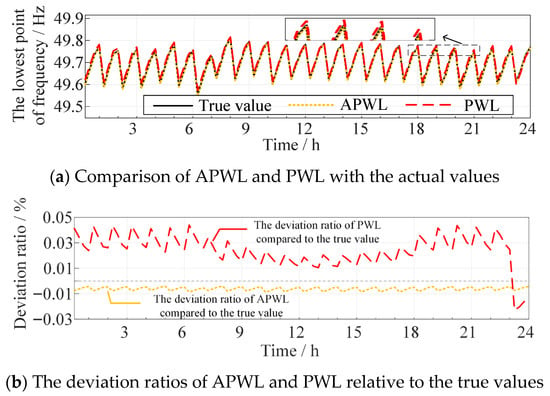
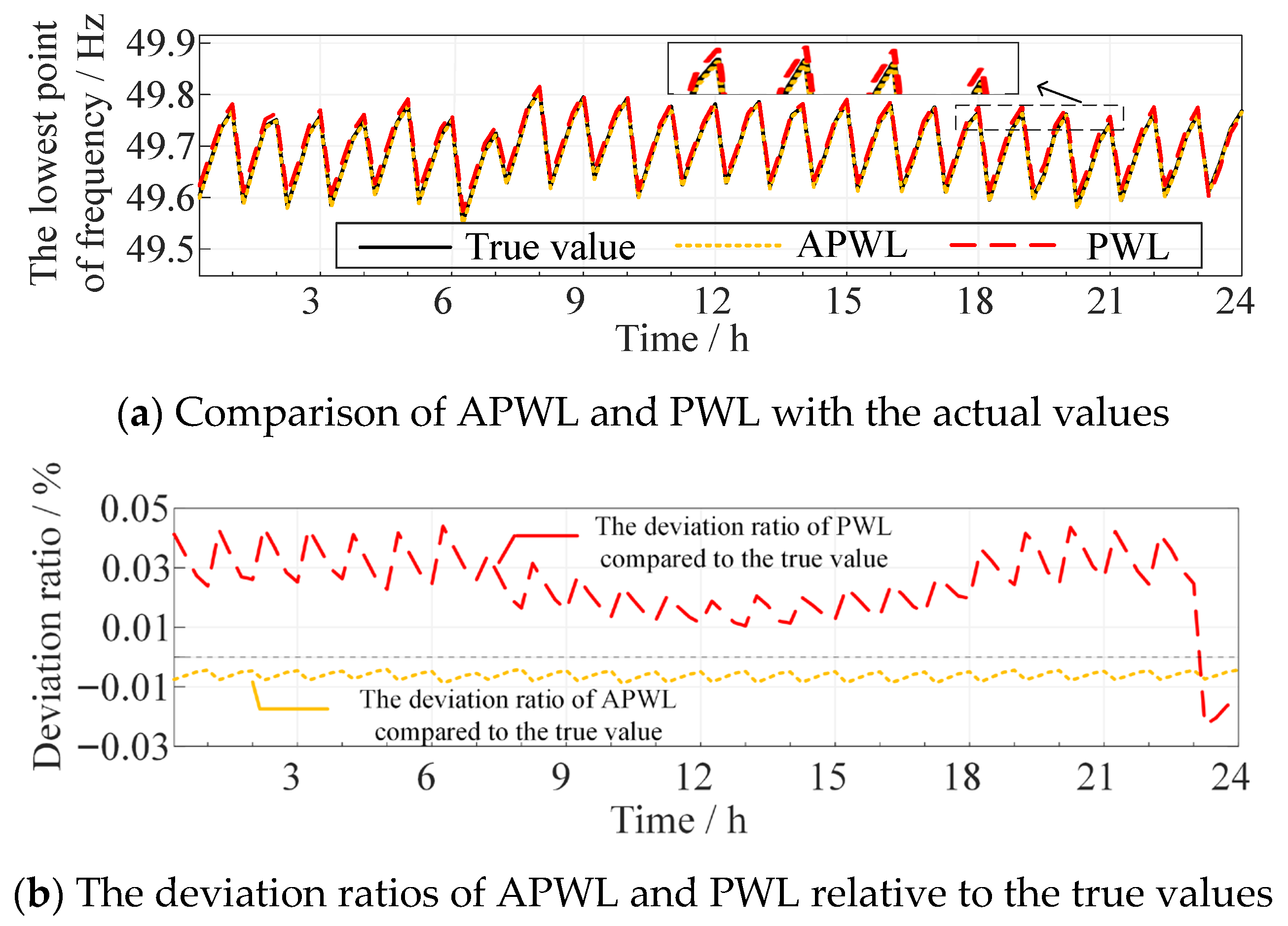
To further evaluate the fitting performance of the proposed APWL method, an additional comparison is conducted based on the operating conditions obtained from Case 3. Under the same scheduling results, the frequency response is approximated using both APWL and conventional PWL, and their fitting accuracy is compared. The results are shown in Figure 7.
Figure 7.
Comparison of APWL and PWL fitting curves.
As shown in Figure 7, the fitting performance of APWL and conventional PWL is compared under the operating conditions of Case 3. In Figure 7a, both methods capture the general trend of the true frequency response, while APWL provides a closer fit, especially during periods with stronger nonlinear behavior. In contrast, PWL shows larger deviations in these regions. Figure 7b further compares the relative deviation ratios. APWL maintains smaller and more stable errors throughout the time horizon, whereas PWL exhibits larger and more fluctuating deviations. This indicates that APWL achieves higher accuracy and better robustness across varying conditions. Combined with the computational results in Table 5, these results demonstrate that APWL improves fitting accuracy while significantly reducing computation time, achieving an effective balance between accuracy and efficiency.
6. Conclusions
This paper presents an optimal scheduling method for high-renewable-penetration power systems using a hybrid energy storage system with EES and CAES under the minimum inertia requirement. The main conclusions are as follows:
- (1)
- Coordinated hybrid energy storage scheduling. The framework integrates the fast-response capability of EES and the sustained support of CAES, enabling multi-timescale reserve allocation. Case studies show that this coordination reduces total operating cost and renewable curtailment and smooths thermal unit outputs.
- (2)
- Frequency safety and inertia–standby coupling. The MIR evaluation and inertia–standby coupling mechanism maintain frequency security under low-inertia conditions. Simulations show that the minimum inertia margin and frequency deviation are significantly improved compared with conventional strategies.
- (3)
- Efficient solution via APWL. Nonlinear frequency constraints are transformed into a MILP problem using the APWL method, achieving faster solution times without sacrificing accuracy.
Future work will extend the proposed framework to intra-day and real-time scheduling such as rolling optimization and model predictive control and to larger systems with uncertainties and additional flexible resources. The impact of communication delays and interruptions will also be investigated to enhance system robustness.
Author Contributions
Conceptualization, Y.Z. and L.S.; Methodology, Y.Z.; Software, Y.Z. and F.W.; Validation, Y.Z.; Formal analysis, Y.Z.; Investigation, Y.Z.; Resources, S.Y.; Writing—original draft, Y.Z.; Writing—review & editing, L.S.; Project administration, L.S. All authors have read and agreed to the published version of the manuscript.
Funding
This work was supported by the National Natural Science Foundation of China, grant number U23B20140.
Institutional Review Board Statement
Not applicable.
Informed Consent Statement
Not applicable.
Data Availability Statement
The data presented in this study are available on request from the corresponding author.
Conflicts of Interest
Author Shun Yao is employed by Huai’an Power Supply Branch, State Grid Jiangsu Electric Power Co., Ltd. The remaining authors declare that the research was conducted in the absence of any commercial or financial relationships that could be construed as a potential conflict of interest.
Nomenclature
Description of some of the symbols in this article
| 1. Abbreviations | |
| OS | Optimal Scheduling (the proposed coordinated scheduling model considering minimum inertia requirement and hybrid energy storage coordination) |
| EES | Electrochemical Energy Storage |
| CAES | Compressed Air Energy Storage |
| HESS | Hybrid Energy Storage System |
| MILP | Mixed-Integer Linear Programming |
| MIR | Minimum Inertia Requirement |
| APWL | Adaptive Piecewise Linearization |
| RoCoF | Rate of Change of Frequency |
| FR | Fast Reserve |
| SR | Spinning Reserve |
| SOC | State of Charge |
| 2. Indices and Sets | |
| Index for time periods | |
| Total number of scheduling periods | |
| Index for thermal units | |
| Set of thermal units | |
| Index for energy storage systems | |
| Set of hybrid energy storage systems, i.e., {EES, CAES} | |
| Index for subregions in the adaptive piecewise linearization method | |
| Total number of partitioned subregions | |
| 3. Parameters and Constants | |
| Time step duration | |
| Fuel cost characteristic coefficients of thermal unit | |
| Single start-up and shut-down costs of thermal unit | |
| Penalty coefficient for ramping wear | |
| Carbon trading price | |
| Carbon emission intensity per unit of electricity for unit | |
| Operation and maintenance (O&M) cost coefficient of storage | |
| Penalty coefficient for renewable energy curtailment | |
| Penalty coefficients for insufficient fast reserve and spinning reserve | |
| Forecast available wind and PV power at time | |
| System base load demand at time | |
| Minimum and maximum power output limits of unit | |
| Minimum up-time requirement of unit | |
| Ramp-down and ramp-up rate limits of unit | |
| Maximum charging/discharging power limit of storage | |
| Self-discharge rate of storage | |
| Charging and discharging efficiencies of storage | |
| Minimum and maximum energy capacity limits of storage | |
| Required sustaining duration for fast response and spinning reserve | |
| Inertia-reserve conversion coefficient | |
| System base capacity | |
| Nominal system frequency | |
| Base demands for fast reserve and spinning reserve at time | |
| Inertia time constant of thermal unit | |
| Rated power of thermal unit | |
| Moment of inertia of the CAES rotor | |
| Nominal steady-state mechanical angular velocity | |
| Physical inertia constant of CAES | |
| Rated kinetic energy of the CAES rotor | |
| Rated power of CAES | |
| Allowable upper safety limit of the rate of change of frequency | |
| Maximum credible power loss | |
| Minimum allowable frequency nadir limit | |
| Maximum allowable frequency deviation | |
| Linear hyperplane fitting coefficients in subregion | |
| Sufficiently large positive constant for the big-M method | |
| 4. Variables | |
| Total system operating cost | |
| Thermal unit operating cost and carbon emission cost at time | |
| HESS O&M cost and penalty cost at time | |
| Actual power output of thermal unit at time | |
| Commitment status variable of unit at time (1 if on, 0 otherwise) | |
| Charging and discharging power of storage at time | |
| Charging and discharging state variables of storage at time | |
| Curtailed wind and PV power at time | |
| Slack variables representing insufficient fast and spinning reserve at time | |
| Continuous on-time of unit up to time | |
| Stored energy of storage at time | |
| Total synthetic inertia of the system at time | |
| Minimum inertia requirement (MIR) of the system at time | |
| Maximum upward reserve capacity provided by EES and CAES at time | |
| System inertia gap at time | |
| Additional fast reserve requirement induced by the inertia gap | |
| Fast reserve provided by storage and unit at time | |
| Spinning reserve provided by storage and unit at time | |
| Synthetic inertia provided by thermal units at time | |
| MIR derived from the RoCoF constraint and frequency nadir constraint | |
| Frequency nadir during the primary frequency response at time | |
| Total available reserve capacity of the system at time | |
| Binary variable indicating whether the operating point at time falls into subregion | |
Appendix A
Table A1.
Energy storage parameters.
Table A2.
Wind power parameters.
Table A3.
Photovoltaic parameters.
Table A4.
Operational parameters of thermal power units.
Table A5.
Hyperparameter settings for APWL.
Figure A1.
Topology of the IEEE 24-node system.
References
- Ulbig, A.; Borsche, T.S.; Andersson, G. Impact of Low Rotational Inertia on Power System Stability and Operation. IFAC Proc. Vol. 2014, 47, 7290–7297. [Google Scholar] [CrossRef] [Scilit]
- Fan, P.; Li, S.; Bu, S.; Wen, Y.; Chung, C. Resilient Power Systems against Wildfire Risks: Towards a Human-Centric and Secure Future. CSEE J. Power Energy Syst. 2025, 11, 2553–2575. [Google Scholar] [CrossRef] [Scilit]
- Churchill, M.; Monroe, J.; Bristow, D.; Crawford, C. Using Electric Vehicles to Enhance Power Outage Resilience – An Agent-Based Modeling Approach. Heliyon 2024, 10, e32104. [Google Scholar] [CrossRef] [Scilit]
- Kumar, L.; Sharma, K.; Pathak, P.; Khedlekar, U.K. Mathematical Modeling of Resilient and Sustainable Renewable Energy Integration with Hybrid Energy Storage, Emission Constraints, and Extreme Weather Conditions. Int. J. Syst. Sci. Oper. Logist. 2025, 12, 2548435. [Google Scholar] [CrossRef] [Scilit]
- Gu, H.; Yan, R.; Saha, T.K.; Muljadi, E. System Strength and Inertia Constrained Optimal Generator Dispatch Under High Renewable Penetration. IEEE Trans. Sustain. Energy 2020, 11, 2392–2406. [Google Scholar] [CrossRef] [Scilit]
- Karbouj, H.; Rather, Z.H.; Flynn, D.; Qazi, H.W. Non-Synchronous Fast Frequency Reserves in Renewable Energy Integrated Power Systems: A Critical Review. Int. J. Electr. Power Energy Syst. 2019, 106, 488–501. [Google Scholar] [CrossRef] [Scilit]
- Badesa, L.; Teng, F.; Strbac, G. Simultaneous Scheduling of Multiple Frequency Services in Stochastic Unit Commitment. IEEE Trans. Power Syst. 2019, 34, 3858–3868. [Google Scholar] [CrossRef] [Scilit]
- Daly, P.; Flynn, D.; Cunniffe, N. Inertia Considerations within Unit Commitment and Economic Dispatch for Systems with High Non-Synchronous Penetrations. In Proceedings of the 2015 IEEE Eindhoven PowerTech, Eindhoven, The Netherlands, 29 June–2 July 2015; pp. 1–6. [Google Scholar]
- Tielens, P.; Van Hertem, D. The Relevance of Inertia in Power Systems. Renew. Sustain. Energy Rev. 2016, 55, 999–1009. [Google Scholar] [CrossRef] [Scilit]
- Hurtado, M.; Jafarian, M.; Kerci, T.; Tweed, S.; Escudero, M.V.; Kennedy, E.; Milano, F. Stability Assessment of Low-Inertia Power Systems: A System Operator Perspective. In Proceedings of the 2024 IEEE Power & Energy Society General Meeting (PESGM), Seattle, WA, USA, 21–25 July 2024. [Google Scholar]
- Zhao, H.; Wu, Q.; Hu, S.; Xu, H.; Rasmussen, C.N. Review of Energy Storage System for Wind Power Integration Support. Appl. Energy 2015, 137, 545–553. [Google Scholar] [CrossRef] [Scilit]
- Guo, X.; Li, Y.; Wu, F.; Shi, L.; Chen, Y.; Wang, H. Optimal Battery Storage Configuration for High-Proportion Renewable Power Systems Considering Minimum Inertia Requirements. Sustainability 2024, 16, 7830. [Google Scholar] [CrossRef] [Scilit]
- Agyekum, E.B.; Abdullah, M.; Rashid, F.L.; Pravenkumar, S.; Ameen, A. Compressed Air Energy Storage (CAES) Systems: Technological Progress, Challenges, and Future Prospects in Renewable Energy Grids. Energy Convers. Manag. X 2025, 28, 101402. [Google Scholar] [CrossRef] [Scilit]
- Olivares, D.E.; Mehrizi-Sani, A.; Etemadi, A.H.; Cañizares, C.A.; Iravani, R.; Kazerani, M.; Hajimiragha, A.H.; Gomis-Bellmunt, O.; Saeedifard, M.; Palma-Behnke, R.; et al. Trends in Microgrid Control. IEEE Trans. Smart Grid 2014, 5, 1905–1919. [Google Scholar] [CrossRef] [Scilit]
- Fan, P.; Yang, J.; Ke, S.; Wen, Y.; Ding, L.; Liu, X.; Tahmeed, U.; Crisostomi, E. A Multi-Layer Intelligent Control Strategy for Multi-Regional Power System with Electric Vehicles: A Deep Reinforcement Learning Approach. J. Energy Storage 2024, 103, 114381. [Google Scholar] [CrossRef] [Scilit]
- Yang, X.Y.; Yang, C.; Peng, J.; Miu, G.; Yuan, S.; Zhu, Z. Coordinated optimal scheduling method for wind–thermal–storage systems considering energy storage cycling cost. Acta Energiae Solaris Sin. 2024, 45, 122–130. [Google Scholar]
- Zhang, X.Y.; Li, H.; Fu, Y. Dynamic stability analysis and adaptive voltage inertia control of DC microgrid with a novel virtual generator. High Volt. Eng. 2021, 47, 2865–2873. [Google Scholar]
- Deng, M.; Jiang, T.; Bai, Z.; Lin, J. Multi-source coordinated scheduling method for islanded microgrid considering converter frequency support and capacity constraints. Shandong Electr. Power Technol. 2025, 52, 10–21+51. [Google Scholar]
- Wen, Y.; Li, W.; Huang, G.; Liu, X. Frequency dynamics constrained unit commitment with battery energy storage. IEEE Trans. Power Syst. 2016, 31, 5115–5125. [Google Scholar] [CrossRef] [Scilit]
- Li, Y.; Miao, S.; Luo, X.; Ying, B.; Wang, J. Day-ahead and intraday coordinated scheduling strategy for power system with compressed air energy storage. Proc. CSEE 2018, 38, 2849–2860. [Google Scholar]
- Jiang, Y.; Xia, Y.; Shi, L.; Fan, C.; Yao, J.; Wang, Q. Inertia configuration method based on frequency spatial characteristics and sensitivity analysis. Electr. Power Autom. Equip. 2025, 45, 209–217. [Google Scholar]
- Zhang, X.; Hu, J.; Fu, Y.; Jin, Z. Virtual inertia demand and coordinated support of wind–storage combined systems. Trans. China Electrotech. Soc. 2024, 39, 672–685. [Google Scholar]
- Li, D.D.; Liu, Q.; Xu, B.; Sun, Y. Critical inertia calculation method for new energy power systems considering frequency stability constraints. Power Syst. Prot. Control 2021, 49, 24–33. [Google Scholar]
- Lu, M.; Guan, J.; Wu, H.; Chen, H.; Gu, W.; Wu, Y.; Ling, C.; Zhang, L. Day-Ahead Optimal Dispatching of Multi-Source Power System. Renew. Energy 2022, 183, 435–446. [Google Scholar] [CrossRef] [Scilit]
- Wang, B.; Sun, H.; Li, W.; Yan, J.; Yu, Z.; Yang, C. Minimum inertia assessment of power systems considering dynamic frequency constraints. Proc. CSEE 2022, 42, 114–126. [Google Scholar]
- Zhang, Z.; Zhou, M.; Wu, Z.; Liu, S.; Guo, Z.; Li, G. A frequency security constrained scheduling approach considering wind farm providing frequency support and reserve. IEEE Trans. Sustain. Energy 2022, 13, 1086–1098. [Google Scholar] [CrossRef] [Scilit]

Disclaimer/Publisher’s Note: The statements, opinions and data contained in all publications are solely those of the individual author(s) and contributor(s) and not of MDPI and/or the editor(s). MDPI and/or the editor(s) disclaim responsibility for any injury to people or property resulting from any ideas, methods, instructions or products referred to in the content. |
© 2026 by the authors. Licensee MDPI, Basel, Switzerland. This article is an open access article distributed under the terms and conditions of the Creative Commons Attribution (CC BY) license.