An Exploratory Study of Airborne Fungal Contamination and Its Association with Microclimate Conditions as Regards Sustainable Zoo Development

 , ,
, ,  , , , , and
Abstract
1. Introduction
2. Materials and Methods
2.1. Research Framework and Location
2.2. Data Collection
2.3. Statistical Analysis
3. Results
4. Discussion
5. Conclusions
Author Contributions
Funding
Institutional Review Board Statement
Informed Consent Statement
Data Availability Statement
Conflicts of Interest
References
- Matković, K.; Vučemilo, M.; Vinković, B. Dust and endotoxin in laying hen dwellings. Turk. J. Vet. Anim. Sci. 2012, 36, 189–195. [Google Scholar] [CrossRef]
- Kim, K.-H.; Kabir, E.; Jahan, S.A. Airborne bioaerosols and their impact on human health. J. Environ. Sci. 2018, 67, 23–35. [Google Scholar] [CrossRef]
- Chmielowiec-Korzeniowska, A.; Trawińska, B.; Tymczyna, L.; Bis-Wencel, H.; Matuszewski, Ł. Microbial contamination of the air in livestock buildings as a threat to human and animal health—A review. Ann. Anim. Sci. 2021, 21, 417–431. [Google Scholar] [CrossRef]
- Zhang, X.; Ma, Z.; Hao, P.; Ji, S.; Gao, Y. Characteristics and health impacts of bioaerosols in animal barns: A comprehensive study. Ecotoxicol. Environ. Saf. 2024, 278, 116381. [Google Scholar] [CrossRef]
- Lu, H.; Xie, Y.; Chen, L.; Song, Y.; Zhang, L.; Li, R.; Nie, X.; Liu, Y.; Zhu, G.; Ding, X.; et al. Microbial aerosols in livestock farming environment: A threat that cannot be ignored. Vet. Sci. 2025, 12, 1147. [Google Scholar] [CrossRef]
- Erkyihun, G.A.; Alemayehu, M.B. One Health approach for the control of zoonotic diseases. Zoonoses 2022, 2, 963. [Google Scholar] [CrossRef]
- Vergara-Alert, J. Zoonotic diseases: Can the transmission of pathogens between animals and humans be controlled? Mètode Sci. Stud. J. 2023, 13, 119–123. [Google Scholar] [CrossRef]
- Ostović, M.; Matković, K.; Ekert Kabalin, A.; Menčik, S.; Pavičić, Ž.; Rudan, N.; Horvatek Tomić, D.; Beneta, D.; Bata, I. Towards zoo sustainability: Assessment of indoor and outdoor bacterial air contamination levels and their correlations with microclimate parameters. Sustainability 2025, 17, 10517. [Google Scholar] [CrossRef]
- Wang, F.; Xiang, L.; Sze-Yin Leung, K.; Elsner, M.; Zhang, Y.; Guo, Y.; Pan, B.; Sun, H.; An, T.; Ying, G.; et al. Emerging contaminants: A One Health perspective. Innovation 2024, 5, 100612. [Google Scholar] [CrossRef]
- Correia, G.; Calheiros, D.; Rosa, N.; Rodrigues, L.; Cunha, S.; Santiago, L.M.; Costa, J.; Gameiro da Silva, M.; Gonçalves, T. Indoor air quality and airborne transmission under the One Health lens: A scoping review. One Health 2025, 21, 101160. [Google Scholar] [CrossRef]
- Grzyb, J.; Lenart-Boroń, A. Size distribution and concentration of fungal aerosol in animal premises of a zoological garden. Aerobiologia 2020, 36, 233–248. [Google Scholar] [CrossRef]
- Gębarowska, E.; Pusz, W.; Kucińska, J.; Kita, W. Comparative analysis of airborne bacteria and fungi in two salt mines in Poland. Aerobiologia 2018, 34, 127–138. [Google Scholar] [CrossRef]
- Plewa-Tutaj, K.; Krzyściak, P.; Dobrzycka, A. Mycological air contamination level and biodiversity of airborne fungi isolated from the zoological garden air—Preliminary research. Environ. Sci. Pollut. Res. Int. 2024, 31, 43066–43079. [Google Scholar] [CrossRef]
- Rivas, A.E.; Dykstra, M.J.; Kranz, K.; Bronson, E. Environmental fungal loads in an indoor-outdoor African penguin (Spheniscus demersus) exhibit. J. Zoo Wildl. Med. 2018, 49, 542–555. [Google Scholar] [CrossRef]
- Álvarez-Pérez, S.; García, M.E.; Martínez-Nevado, E.; Blanco, J.L. Presence of Aspergillus fumigatus with the TR34/L98H Cyp51A mutation and other azole-resistant aspergilli in the air of a zoological park. Res. Vet. Sci. 2023, 164, 104993. [Google Scholar] [CrossRef] [PubMed]
- Omar, S.; Jalaludin, F.A.; Yee, J.M.; Kamarudin, Z.; Jayaseelan, K.; Khlubi, A.N.M.; Madaki, Y.L.; Hassan, H.; Ramli, M.N.; Topani, R.; et al. Mycological isolation from animal enclosures and environments in National Wildlife Rescue Centre and National Zoo, Malaysia. J. Vet. Med. Sci. 2020, 82, 1236–1242. [Google Scholar] [CrossRef]
- Seyedmousavi, S.; Bosco, S.M.G.; de Hoog, S.; Ebel, F.; Elad, D.; Gomes, R.R.; Jacobsen, I.D.; Jensen, H.E.; Martel, A.; Mignon, B.; et al. Fungal infections in animals: A patchwork of different situations. Med. Mycol. 2018, 56, S165–S187. [Google Scholar] [CrossRef]
- Gnat, S.; Łagowski, D.; Nowakiewicz, A.; Dyląg, M. A global view on fungal infections in humans and animals: Opportunistic infections and microsporidioses. J. Appl. Microbiol. 2021, 131, 2095–2113. [Google Scholar] [CrossRef]
- Wilson, S.C.; Holder, H.W.; Martin, J.M.; Brasel, T.L.; Andriychuk, L.A.; Wu, C.; Straus, D.C.; Aguilar, R. An indoor air quality study of an alligator (Alligator mississippiensis) holding facility. J. Zoo Wildl. Med. 2006, 37, 108–115. [Google Scholar] [CrossRef]
- Debergh, H.; Becker, P.; Vercammen, F.; Lagrou, K.; Haesendonck, R.; Saegerman, C.; Packeu, A. Pulmonary aspergillosis in Humboldt penguins–Susceptibility patterns and molecular epidemiology of clinical and environmental Aspergillus fumigatus isolates from a Belgian zoo, 2017–2022. Antibiotics 2023, 12, 584. [Google Scholar] [CrossRef]
- Zoo Zagreb. Available online: https://zoo.hr/about/ (accessed on 22 December 2025).
- Večernji List. Available online: https://www.vecernji.hr/zagreb/zagrebacki-zoo-slavi-stoti-rodendan-prvi-su-stanari-stigli-u-zelenom-sesiru-a-hit-su-bili-stefek-i-zenica-1871990?utm_source=chatgpt.com (accessed on 18 March 2026). (In Croatian)
- Plewa-Tutaj, K.; Twarużek, M.; Kosicki, R.; Soszczyńska, E. Analysis of mycotoxins and cytotoxicity of airborne molds isolated from the zoological garden–screening research. Pathogens 2024, 13, 294. [Google Scholar] [CrossRef] [PubMed]
- Plewa-Tutaj, K.; Chmielewska, Z.; Twarużek, M.; Kosicki, R.; Soszczyńska, E. An analysis of the mycotoxins, cytotoxicity, and biodiversity of airborne molds belonging to Aspergillus genera isolated from the zoological garden. Pathogens 2025, 14, 332. [Google Scholar] [CrossRef]
- Kidd, S.; Halliday, C.; Alexiou, H.; Ellis, D. Descriptions of Medical Fungi, 3rd ed.; Newstyle Printing: Adelaide, SA, Australia, 2016; pp. 231–233. [Google Scholar]
- Mycology. Available online: https://mycology.adelaide.edu.au/fungal-descriptions-and-antifungal-susceptibility (accessed on 19 March 2026).
- Grzyb, J.; Lenart-Boroń, A. Bacterial bioaerosol concentration and size distribution in the selected animal premises in a zoological garden. Aerobiologia 2019, 35, 253–268. [Google Scholar] [CrossRef]
- Grzyb, J.; Pawlak, K. Impact of bacterial aerosol, particulate matter, and microclimatic parameters on animal welfare in Chorzów (Poland) zoological garden. Environ. Sci. Pollut. Res. Int. 2021, 28, 3318–3330. [Google Scholar] [CrossRef] [PubMed]
- Jerez, S.B.; Cheng, Y.; Bray, J. Exposure of workers to dust and bioaerosol on a poultry farm. J. Appl. Poult. Res. 2014, 23, 7–14. [Google Scholar] [CrossRef]
- Coleine, C.; Stajich, J.E.; Selbmann, L. Fungi are key players in extreme ecosystems. Trends Ecol. Evol. 2022, 37, 517–528. [Google Scholar] [CrossRef]
- Corona Ramirez, A.; Bregnard, D.; Junier, T.; Cailleau, G.; Dorador, C.; Bindschedler, S.; Junier, P. Assessment of fungal spores and spore–like diversity in environmental samples by targeted lysis. BMC Microbiol. 2023, 23, 68. [Google Scholar] [CrossRef] [PubMed]
- Occupational Safety and Health Administration. Indoor Air Quality Investigation. Available online: https://www.osha.gov/otm/section-3-health-hazards/chapter-2 (accessed on 29 December 2025).
- Crameri, R.; Garbani, M.; Rhyner, C.; Huitema, C. Fungi: The neglected allergenic sources. Allergy 2014, 69, 176–185. [Google Scholar] [CrossRef]
- Sandoval-Denis, M.; Sutton, D.A.; Martin-Vicente, A.; Cano-Lira, J.F.; Wiederhold, N.; Guarro, J.; Gené, J. Cladosporium species recovered from clinical samples in the United States. J. Clin. Microbiol. 2015, 53, 2990–3000. [Google Scholar] [CrossRef]
- Weryszko-Chmielewska, E.; Kasprzyk, I.; Nowak, M.; Sulborska, A.; Kaczmarek, J.; Szymanska, A.; Haratym, W.; Gilski, M.; Jedryczka, M. Health hazards related to conidia of Cladosporium-biological air pollutants in Poland, central Europe. J. Environ. Sci. 2018, 65, 271–281. [Google Scholar] [CrossRef]
- Monpierre, L.; Soetart, N.; Valsecchi, I.; Brément, T.; Brunelat, P.; Drut, A.; David, M.; Roux, C.; Hubert, F.; Razafimandimby, B.; et al. Penicillium and Talaromyces spp. emerging pathogens in dogs since 1990s. Med. Mycol. 2023, 61, myad087. [Google Scholar] [CrossRef]
- Perrone, G.; Susca, A. Penicillium species and their associated mycotoxins. In Mycotoxigenic Fungi; Moretti, A., Susca, A., Eds.; Methods in Molecular Biology; Humana Press: New York, NY, USA, 2017; Volume 1542, pp. 107–119. [Google Scholar] [CrossRef]
- Khan, R.; Anwar, F.; Ghazali, F.M. A comprehensive review of mycotoxins: Toxicology, detection, and effective mitigation approaches. Heliyon 2024, 10, e28361. [Google Scholar] [CrossRef]
- García-Esparza, M.Á.; Mateo, E.M.; Robles, J.A.; Capoferri, M.; Jiménez, M.; Soria, J.M. Unveiling the neurotoxic effects of ochratoxin A and its impact on neuroinflammation. Toxins 2025, 17, 264. [Google Scholar] [CrossRef]
- Publications Office of the European Union. Commission Directive (EU) 2019/1833 of 24 October 2019 amending Annexes I, III, V and VI to Directive 2000/54/EC of the European Parliament and of the Council as regards purely technical adjustments. Off. J. Eur. Union 2019, L 279, 54–79. [Google Scholar]
- Abrehame, S.; Manoj, V.R.; Hailu, M.; Chen, Y.-Y.; Lin, Y.-C.; Chen, Y.-P. Aflatoxins: Source, detection, clinical features and prevention. Processes 2023, 11, 204. [Google Scholar] [CrossRef]
- Fromme, H.; Gareis, M.; Völkel, W.; Gottschalk, C. Overall internal exposure to mycotoxins and their occurrence in occupational and residential settings—An overview. Int. J. Hyg. Environ. Health 2016, 219, 143–165. [Google Scholar] [CrossRef] [PubMed]
- Marcelloni, A.M.; Pigini, D.; Chiominto, A.; Gioffrè, A.; Paba, E. Exposure to airborne mycotoxins: The riskiest working environments and tasks. Ann. Work. Expo. Health 2024, 68, 19–35. [Google Scholar] [CrossRef]
- Derz, W.; Elsinghorst, P.W. From mold to mycotoxins: An LC-MS/MS method for quantifying airborne mycotoxins in indoor environments. Anal. Bioanal. Chem. 2025, 417, 4637–4648. [Google Scholar] [CrossRef]
- Sánchez, P.; Vélez-del-Burgo, A.; Suñén, E.; Martínez, J.; Postigo, I. Fungal allergen and mold allergy diagnosis: Role and relevance of Alternaria alternata Alt a 1 protein family. J. Fungi 2022, 8, 277. [Google Scholar] [CrossRef] [PubMed]
- Sáenz, V.; Alvarez-Moreno, C.; Pape, P.L.; Restrepo, S.; Guarro, J.; Ramírez, A.M.C. A One Health perspective to recognize Fusarium as important in clinical practice. J. Fungi 2020, 6, 235. [Google Scholar] [CrossRef]
- Ahmadikia, K.; Aghaei Gharehbolagh, S.; Fallah, B.; Naeimi Eshkaleti, M.; Malekifar, P.; Rahsepar, S.; Getso, M.I.; Sharma, S.; Mahmoudi, S. Distribution, prevalence, and causative agents of fungal keratitis: A systematic review and meta-analysis (1990 to 2020). Front. Cell. Infect. Microbiol. 2021, 11, 698780. [Google Scholar] [CrossRef]
- Gautam, M.; Lal, B.; Patel, S.; Mohan, R.R.; Barathi, A.; Yadav, N.; Verma, S.K.; Nyodu, R.; Sampath, A.; Koshti, D.; et al. An emerging global threat of mycotic keratitis caused by uncommon fungal species: A systematic review and meta-analysis. Transl. Vis. Sci. Technol. 2025, 14, 4. [Google Scholar] [CrossRef] [PubMed]
- Rick, E.M.; Woolnough, K.; Pashley, C.H.; Wardlaw, A.J. Allergic fungal airway disease. J. Investig. Allergol. Clin. Immunol. 2016, 26, 344–354. [Google Scholar] [CrossRef] [PubMed]
- Priyamvada, H.; Singh, R.K.; Akila, M.; Ravikrishna, R.; Verma, R.S.; Gunthe, S.S. Seasonal variation of the dominant allergenic fungal aerosols—One year study from southern Indian region. Sci. Rep. 2017, 7, 11171. [Google Scholar] [CrossRef] [PubMed]
- Asseng, S.; Spänkuch, D.; Hernandez-Ochoa, I.M.; Laporta, J. The upper temperature thresholds of life. Lancet Planet. Health 2021, 5, e378–e385, Erratum in Lancet Planet. Health 2021, 5, e578. https://doi.org/10.1016/S2542-5196(21)00205-9. [Google Scholar] [CrossRef]
- Albelda-Estellés Ness, M.C. Indoor relative humidity: Relevance for health, comfort, and choice of ventilation system. In Proceedings of the 3rd Valencia International Biennial of Research in Architecture, Valencia, Spain, 9–11 November 2022; pp. 218–228. [Google Scholar] [CrossRef]
- Peterková, J.; Michalčíková, M.; Novák, V.; Slávik, R.; Zach, J.; Korjenic, A.; Hodná, J.; Raich, B. The influence of green walls on interior climate conditions and human health. MATEC Web Conf. 2019, 282, 02041. [Google Scholar] [CrossRef]
- Tomazin, R.; Matos, T. Mycological methods for routine air sampling and interpretation of results in operating theaters. Diagnostics 2024, 14, 288. [Google Scholar] [CrossRef]
- Association of Zoos and Aquariums (AZA). AZA Green Guide: Building and Measuring Zoo & Aquarium Sustainability Plans; AZA: Silver Spring, MD, USA, 2013; Volume 2, Available online: https://assets.speakcdn.com/assets/2332/aza_green_guide_volume_2.pdf (accessed on 9 January 2026).



| Parameter | Monkey House | Tropical House | Rainy Africa | Bird House |
|---|---|---|---|---|
| Year of Construction | 1996 renovated | 1974 | 1999 | 1978 |
| Indoor Area for Animals (m2) | 102 | 350 | 162 | 42 |
| Indoor Area for Visitors and Employees (m2) | 32 | 230 | 20 | 44 |
| Animals (n) | 14 | ~358 (crocodiles: 3; caimans: 2; other reptiles: 55; amphibians: 10; fish: ~270; birds: 4; mammals: 14) | 45 (pygmy hippopotamuses: 3; birds: 2; reptiles: 10; fish: 30) | 20 |
| Type of Ventilation | Air conditioning chambers (always on) | Air conditioning chambers (always on) | Air conditioning chambers (always on) | Natural |
| Type of Bedding in Animal Enclosures | No bedding | Shredded bark + sand | Shredded bark; no bedding (pygmy hippopotamuses) | No bedding |
| Type of Flooring/Bedding in Area for Visitors and Employees | Ceramic tiles | Concrete + stone | Shredded bark | Concrete |
| Fungi | Monkey House (I) | Tropical House (I) | Rainy Africa (I) | Bird House (I) | Control (O) |
|---|---|---|---|---|---|
| CFU/m3 Median (Min–Max) | |||||
| Alternaria spp. | 0 (0–1.50 × 10²) | 0 (0–1.00 × 10²) | 0 (0–2.00 × 10²) | 0 (0–1.00 × 10²) | 0 (0–2.00 × 10²) |
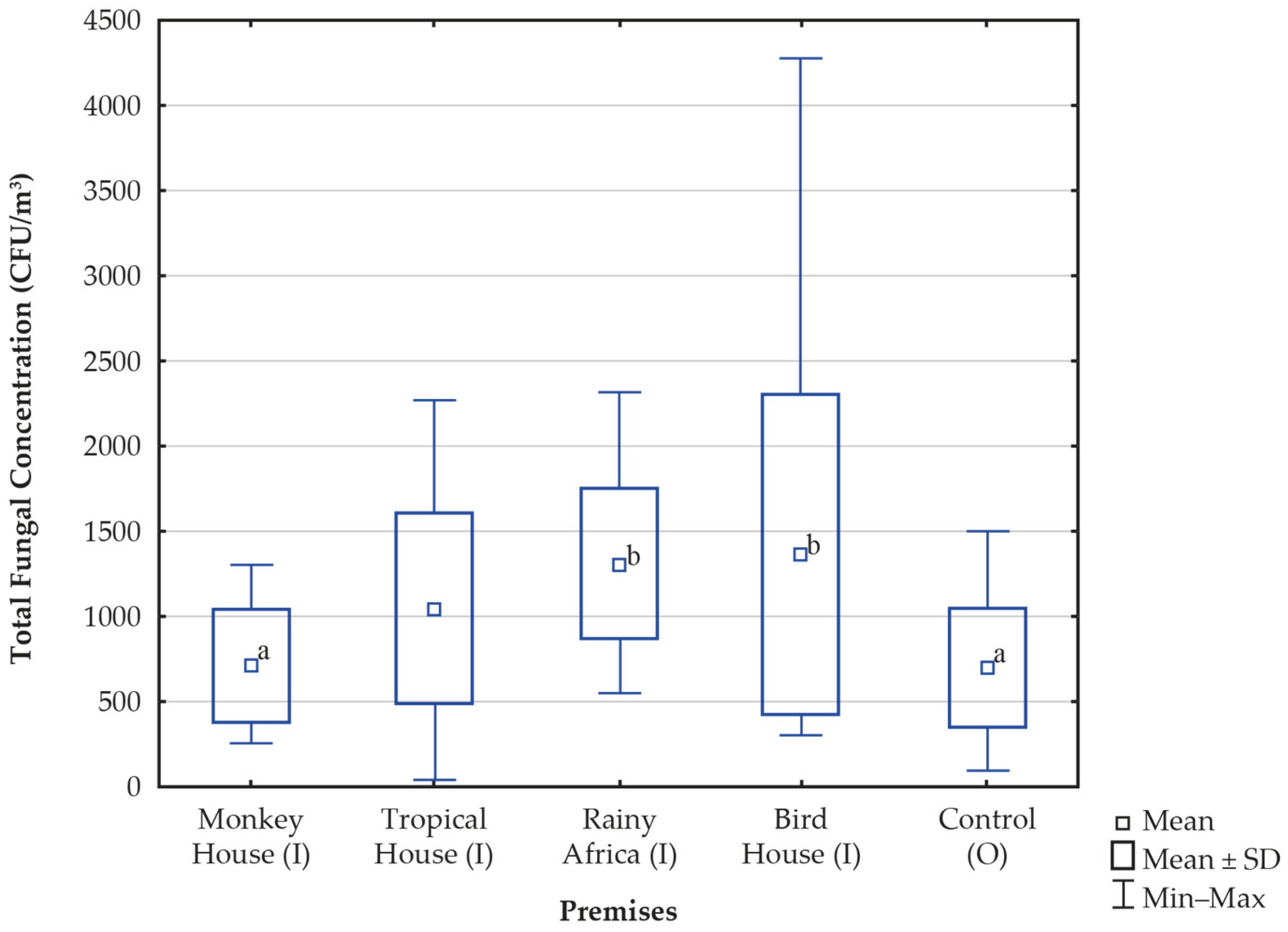
| Aspergillus spp. | 50 a (0–3.50 × 10²) | 1.75 × 10² b (0–1.70 × 10³) | 50 a (0–2.50 × 10²) | 50 a (0–3.00 × 10²) | 0 a (0–1.50 × 10²) |
| A. section Flavi | 0 (0–1.00 × 10²) | 25 (0–2.00 × 10²) | 0 (0–2.50 × 10²) | 0 (0–1.00 × 10²) | 0 (0–1.00 × 10²) |
| A. section Fumigati | 0 (0–2.50 × 10²) | 0 (0–1.50 × 10²) | 0 (0–2.50 × 10²) | 0 (0–1.50 × 10²) | 0 (0–1.50 × 10²) |
| A. section Nigri | 0 (0–1.00 × 10²) | 0 (0–2.00 × 10²) | 0 (0–1.00 × 10²) | 0 (0–1.00 × 10²) | 0 (0–50) |
| A. section Circumdati | 0 (0–2.00 × 10²) | 50 a (0–1.70 × 10³) | 0 (0–2.00 × 10²) | 0 b (0–50) | 0 b (0–0) |
| A. section Terrei | 0 (0–50) | 0 (0–1.00 × 10²) | 0 (0–1.50 × 10²) | 0 (0–50) | 0 (0–0) |
| Cladosporium spp. | 3.25 × 10² a (0–1.10 × 10³) | 4.25 × 10² a (50–1.20 × 10³) | 5.25 × 10² b (2.50 × 10²–2.25 × 10³) | 7.00 × 10² b (1.50 × 10²–2.85 × 10³) | 4.50 × 10² (0–1.25 × 10³) |
| Diplosporium spp. | 0 (0–0) | 0 (0–0) | 0 (0–0) | 0 (0–1.00 × 10²) | 0 (0–0) |
| Fusarium spp. | 0 (0–0) | 0 (0–0) | 0 (0–0) | 0 (0–0) | 0 (0–50) |
| Mucor spp. | 0 (0–50) | 0 (0–50) | 0 (0–1.50 × 10²) | 0 (0–1.00 × 10²) | 0 (0–50) |
| Penicillium spp. | 1.50 × 10² (0–5.00 × 10²) | 1.75 × 10² (0–1.10 × 10³) | 2.75 × 10² a (0–8.50 × 10²) | 2.75 × 10² a (0–7.50 × 10²) | 1.00 × 10² b (0–2.50 × 10³) |
| Rhizopus spp. | 0 (0–50) | 0 (0–1.00 × 10²) | 0 (0–50) | 0 (0–50) | 0 (0–0) |
| Yeasts | 0 (0–2.50 × 10²) | 0 (0–1.00 × 10²) | 0 (0–5.50 × 10²) | 0 (0–1.50 × 10²) | 0 (0–2.50 × 10²) |
| Unidentified | 0 (0–0) | 0 (0–0) | 0 (0–1.00 × 10²) | 0 (0–50) | 0 (0–0) |
| Parameter | Monkey House (I) | Tropical House (I) | Rainy Africa (I) | Bird House (I) | Control (O) |
|---|---|---|---|---|---|
| Mean ± SD (Min–Max) | |||||
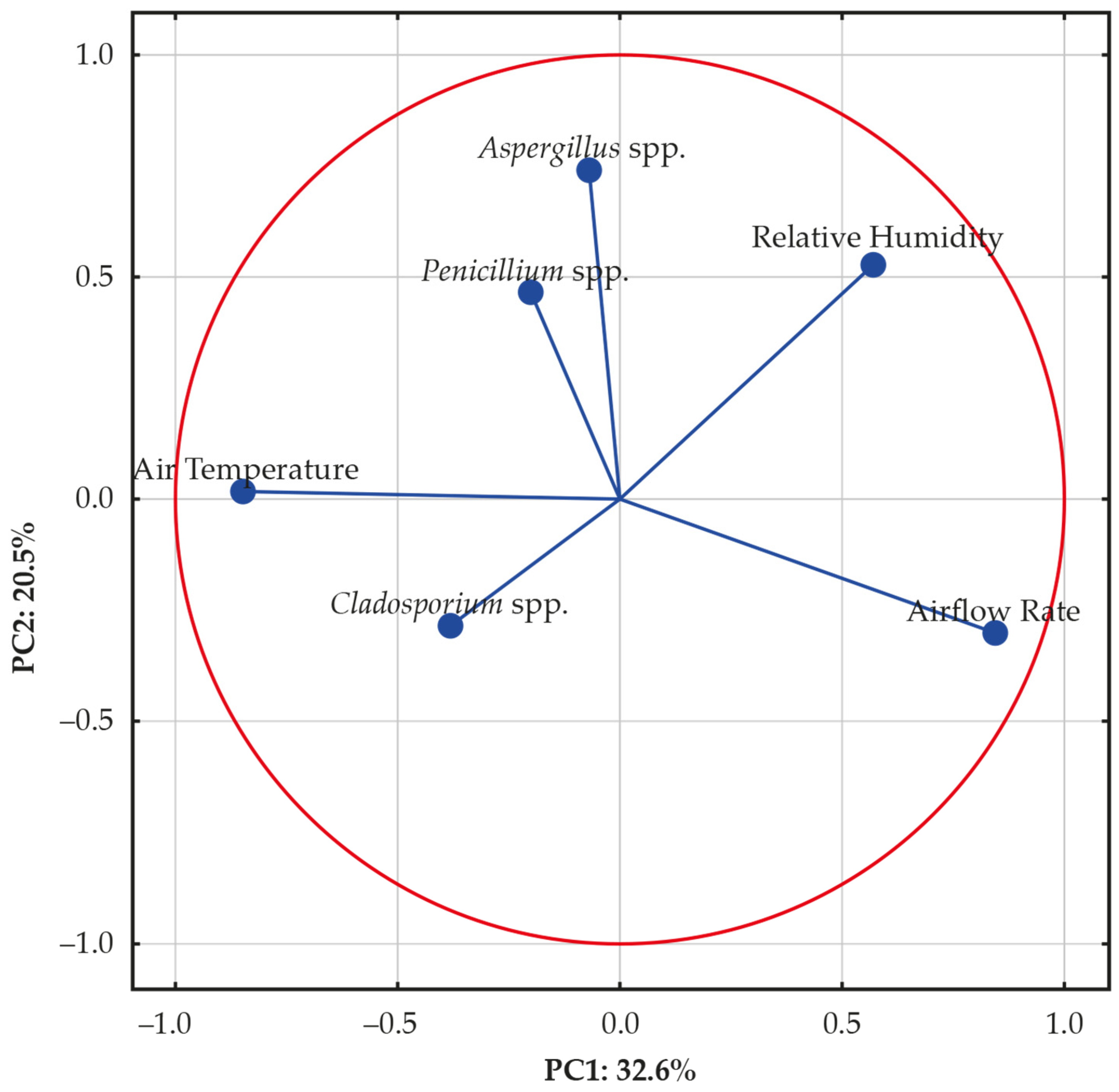
| Air Temperature (°C) | 21.89 a ± 1.51 (19.30–24.50) | 21.30 a, b ± 1.98 (16.50–24.40) | 19.76 b ± 2.11 (16.00–23.30) | 22.24 a ± 2.43 (16.10–25.50) | 15.82 c ± 4.31 (6.90–20.20) |
| Relative Humidity (%) | 59.01 a ± 8.02 (43.00–67.20) | 68.95 b ± 9.36 (53.30–82.80) | 71.45 b ± 8.51 (55.90–83.20) | 56.79 a ± 5.67 (46.00–64.30) | 71.33 b ± 9.48 (51.80–81.40) |
| Airflow Rate (m/s) | 0.08 a ± 0.04 (0.01–0.17) | 0.08 a ± 0.05 (0.01–0.18) | 0.11 a ± 0.08 (0.01–0.40) | 0.06 a ± 0.05 (0.01–0.25) | 0.49 b ± 0.22 (0.23–1.16) |
Disclaimer/Publisher’s Note: The statements, opinions and data contained in all publications are solely those of the individual author(s) and contributor(s) and not of MDPI and/or the editor(s). MDPI and/or the editor(s) disclaim responsibility for any injury to people or property resulting from any ideas, methods, instructions or products referred to in the content. |
© 2026 by the authors. Licensee MDPI, Basel, Switzerland. This article is an open access article distributed under the terms and conditions of the Creative Commons Attribution (CC BY) license.
Share and Cite
Ostović, M.; Pučko, I.; Ekert Kabalin, A.; Horvatek Tomić, D.; Menčik, S.; Pavičić, Ž.; Rudan, N.; Bata, I.; Beneta, D.; Matković, K. An Exploratory Study of Airborne Fungal Contamination and Its Association with Microclimate Conditions as Regards Sustainable Zoo Development. Sustainability 2026, 18, 4007. https://doi.org/10.3390/su18084007
Ostović M, Pučko I, Ekert Kabalin A, Horvatek Tomić D, Menčik S, Pavičić Ž, Rudan N, Bata I, Beneta D, Matković K. An Exploratory Study of Airborne Fungal Contamination and Its Association with Microclimate Conditions as Regards Sustainable Zoo Development. Sustainability. 2026; 18(8):4007. https://doi.org/10.3390/su18084007
Chicago/Turabian StyleOstović, Mario, Ivica Pučko, Anamaria Ekert Kabalin, Danijela Horvatek Tomić, Sven Menčik, Željko Pavičić, Nevenka Rudan, Ingeborg Bata, Dijana Beneta, and Kristina Matković. 2026. "An Exploratory Study of Airborne Fungal Contamination and Its Association with Microclimate Conditions as Regards Sustainable Zoo Development" Sustainability 18, no. 8: 4007. https://doi.org/10.3390/su18084007
APA StyleOstović, M., Pučko, I., Ekert Kabalin, A., Horvatek Tomić, D., Menčik, S., Pavičić, Ž., Rudan, N., Bata, I., Beneta, D., & Matković, K. (2026). An Exploratory Study of Airborne Fungal Contamination and Its Association with Microclimate Conditions as Regards Sustainable Zoo Development. Sustainability, 18(8), 4007. https://doi.org/10.3390/su18084007