1. Introduction
Time headway (THW) is an essential microscopic parameter that characterizes car-following behavior via the time gap between a follower and its leader [
1]. It plays a central role in traffic flow theory, road capacity evaluation, and safety analysis. The variation in time headway distributions directly affect traffic flow-state identification and traffic simulation accuracy. It also influences the safety margin and stability control of intelligent driving systems [
2].
Traditional time headway data collection relies primarily on two methods: Fixed and mobile monitors. Fixed monitors, such as roadside cameras, inductive loops, and infrared detectors, provide long-term continuous observations. However, their limited installation locations and fixed viewpoints result in small spatial coverage and potential occlusions and identification errors in complex scenarios [
3]. Mobile monitors, such as Global Positioning System (GPS) devices and mobile phone location systems, often suffer from unstable sampling rates and severe trajectory discretization [
4]. This makes it difficult to obtain complete and continuous time headway sequences [
5]. Unmanned Aerial Vehicle (UAV) aerial photography technology has been widely used for traffic flow observation. Its overhead perspective effectively avoids ground obstructions. This allows for the acquisition of large amounts of vehicle trajectory data with high spatial and temporal resolution [
6]. HighD dataset and other highway drone trajectory datasets have shown the advantages of aerial measurement methods. These methods outperform traditional detection methods in terms of scene diversity and trajectory accuracy [
7].
Numerous studies have employed single distribution models, such as negative exponential, Lognormal, Log-logistic, Weibull, and Gamma distributions, to model time headway distribution. These models are used to describe time headway characteristics under different road and traffic conditions [
8]. These single distribution models often achieve good fitting results in low-density traffic or simple road conditions. Under mixed traffic and high-density conditions, observed time headways often exhibit substantial skewness, heavy tails, and sometimes even multimodal distributions. This makes it difficult for a single distribution to accurately fit both the main peak and the tail simultaneously [
9]. To improve the modeling of complex distribution shapes, some studies differentiate vehicle types or driving states. By selecting appropriate probability distributions, they enhance the fitting accuracy for complex time headway characteristics [
10]. Other studies have used non-parametric estimation and kernel density methods to characterize time headway for different vehicle types, reducing reliance on prior distribution forms [
11]. Recently proposed unified distribution models based on general exponential functions systematically compared time headway in heterogeneous and mixed traffic. They showed that traditional single distributions have clear deficiencies in fitting accuracy across various scenarios [
12]. At the same time, stochastic dynamic time headway models describe how drivers respond to surrounding vehicles and traffic conditions from a temporal perspective, enabling the explicit modeling of the correlation in time headway sequences [
13]. It should be noted that such unified or complex models typically require the prior specification of function families or structural forms, and the model selection and parameter estimation process remains highly empirical [
14]. In terms of goodness-of-fit testing, most existing studies on time headway distributions have used the Kolmogorov–Smirnov (K-S) test as the primary criterion, with less emphasis on simultaneously considering other statistical measures such as the Anderson–Darling (A-D) test and the Chi-square test. Some works have compared multiple candidate distributions using information criteria such as AIC and BIC, but there is still a relative lack of systematic comparison of K-S, A-D, and Chi-square tests in the context of time headway modeling [
15].
A practical implication of this limitation is that a model may appear acceptable under the K–S test while still exhibiting non-negligible errors in the lower tail of the THW distribution. Safety evaluation often depends on tail-related quantities, such as the probability of dangerously short gaps for a safety-relevant threshold , or lower-tail quantiles. If tail deviations are not detected, these risk-related predictions can be biased, potentially leading to unreliable conclusions for safety-oriented assessment and car-following control design. Therefore, K–S results should not be interpreted alone for safety-critical inference; this motivates our use of the Anderson–Darling test (more tail-sensitive) and Chi-square test as complementary measures.
Regarding influencing factors, many existing studies still treat the overall traffic flow sample as the modeling object. Alternatively, they distinguish road types and traffic conditions only at a macro level, which makes it difficult to reveal subtle differences among lane positions and vehicle type combinations. From the vehicle type perspective, existing studies have constructed time headway distribution models for various lead-follow vehicle combinations, confirming significant differences in distribution shapes and safety margins between combinations such as car–car, car–truck, truck–car, and truck–truck [
10]. Further work has conducted time headway analysis for vehicle-type-specific conditions under two-lane mixed traffic, revealing the differences in following behavior among various vehicle categories in complex traffic flows [
16]. However, most existing studies have not integrated lane position and vehicle type combinations into a unified modeling framework, and there remains a relative lack of systematic comparison and quantitative characterization considering both lane position and vehicle type combinations [
17].
To further analyze the characteristics of the headway distribution, this study not only explores traditional distribution models but also focuses on the application of trajectory data methods in traffic flow research. In recent years, the application of trajectory data methods has gained widespread attention. Chen, S. et al. proposed using trajectory data methods to study the microscopic behaviors of traffic flow, providing a more accurate perspective [
18]. Modern sensing technologies such as unmanned aerial vehicles (UAVs) can collect high-resolution vehicle trajectory data, offering a more precise and dynamic viewpoint for traffic flow modeling [
19,
20]. Additionally, other studies have focused on mixed traffic flow modeling, such as Lan, Z.Z. et al. who emphasized the importance of traffic flow modeling under heterogeneous vehicle conditions [
21].
With the development of intelligent transportation technologies, significant progress has been made in vehicle tracking and behavioral analysis within complex traffic flows. For example, Zhai, C. et al. explored the application of UAV trajectory data in mixed traffic flow modeling, studying how such data can provide more dynamic and realistic traffic flow data [
22]. Furthermore, Yang, M. et al. advanced traffic analysis methods based on UAV data, applying them to the real-time monitoring of mixed traffic flows [
23]. These methods not only offer more precise traffic behavior modeling but also provide a more flexible framework for the application of various traffic flow models.
In the application of different traffic flow models, Liu, Y. et al. provided a novel probabilistic model to describe heterogeneous behaviors in mixed traffic, offering more precise theoretical support for traffic flow simulation [
24]. Wang, P. et al. studied the heterogeneity in mixed traffic flow through trajectory data, revealing the dynamic relationship between headway and traffic density [
25]. These studies provide strong support for this research, enabling a more realistic analysis of headway distribution in traffic environments, thus improving the reliability of traffic safety assessments and intelligent driving strategies [
26].
Recent studies have further emphasized the importance of trajectory data and interaction-aware modeling in traffic analysis. Existing works have shown that lane-changing risk and driving decisions are closely related to microscopic variables such as time headway, relative speed, and vehicle interactions, highlighting the role of behavioral heterogeneity in complex traffic environments [
27,
28,
29]. In addition, incorporating lane topology and spatio-temporal interactions have been proven to improve the accuracy of trajectory modeling and prediction [
30]. From a statistical perspective, recent studies have also indicated that flexible distribution forms and multi-criterion goodness-of-fit evaluation can better capture heterogeneous and tail-sensitive data than traditional single distributions [
31,
32]. These advances further support the need for modeling THW by jointly considering lane position, vehicle-type interactions, and robust statistical evaluation methods.
To make the narrative review more transparent and to facilitate cross-study comparison, a structured summary of representative THW distribution studies cited in this paper is provided in
Appendix A Table A1. The appendix table compares previous studies in terms of data source/context, stratification level, candidate distributions or modeling approaches, model selection methods, and key methodological gaps. This supplementary comparison helps clarify how THW has been modeled under different traffic conditions and where important gaps remain in the literature.
As summarized in
Appendix A Table A1, prior THW studies have generally relied on either aggregated samples or a limited set of stratification factors, such as traffic state or vehicle class alone, and model evaluation has often been based on a single goodness-of-fit (GOF) criterion or other context-specific choices. In particular, joint stratification by lane position and follower–leader vehicle-type pairing has not been systematically examined within a unified framework. These observations motivate the present study to (i) model THW distributions under lane- and vehicle-type-related heterogeneity and (ii) evaluate candidate models using multiple complementary GOF tests to support more robust model selection.
This study examines how THW distributions vary under lane–vehicle type heterogeneity on highways. We address three research questions:
1. Do THW distributions differ systematically between the inner and outer lanes?
2. How do follower–leader vehicle-type pairs (car–car, car–truck, truck–car, truck–truck) influence the shape and tail behavior of THW distributions?
3. Is a single parametric distribution sufficient across all lane–vehicle-type subsets, or is subset-specific distribution selection necessary?
The main contributions of this study are summarized as follows:
Lane–vehicle-type joint modeling framework: We develop a two-dimensional time headway distribution modeling framework stratified by lane position (inner vs. outer) and follower–leader vehicle-type pairs (car–car, car–truck, truck–car, truck–truck), and empirically demonstrate that the interaction between lane position and vehicle type leads to significant THW distributional heterogeneity.
Multi-test fusion with entropy weighting: We propose a comprehensive goodness-of-fit evaluation scheme that integrates K–S, A–D, and Chi-square tests via entropy-weighted aggregation, effectively mitigating the limitation of relying on a single statistic (e.g., K–S) that can be relatively insensitive to THW tail deviations.
Scenario-specific modeling and engineering relevance: Using UAV-based trajectory data, we perform scenario-specific THW distribution fitting and model selection across lane–vehicle-type subsets, providing practical inputs for highway traffic simulation and for optimizing intelligent-driving (car-following) strategies.
The remainder of this paper is organized as follows.
Section 2 describes the dataset and preprocessing.
Section 3 presents the candidate distribution models and GOF evaluation, and reports the comparative results across lane–vehicle-type subsets.
Section 4 discusses implications and limitations, and
Section 5 concludes the paper.
2. Data Description and Statistical Analysis
This study utilizes highway monitoring data from the HighD (Highway Driving Dataset) public dataset [
6]. The videos captured by drones in the HighD dataset have a 4K (4096 × 2160) resolution and contain frame-level vehicle trajectory data at 25 frames per second. The structured trajectory data includes detailed information for each frame and each vehicle, such as vehicle position, lane ID, vehicle type, speed and acceleration in all directions, surrounding vehicle IDs, and vehicle information.
2.1. Data Processing
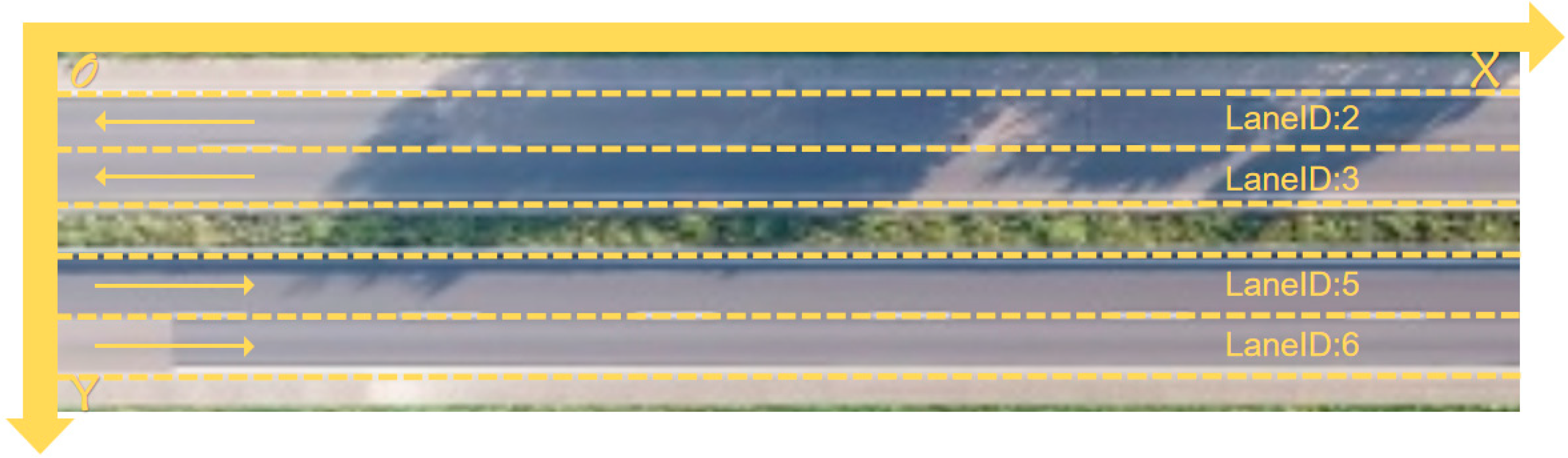
The HighD dataset originates from drone-captured records taken at six different locations near Cologne, Germany, during 2017–2018. Advanced computer vision algorithms were used to extract the driving trajectories of vehicles from these recordings. The trajectory data and location information were divided into 60 segments, numbered 1–60. Each segment contains aerial images of the recording location, metadata, single-vehicle tracking information, and per-frame trajectory records for a total of 69,751 cars and 16,211 trucks over more than 16.5 h, covering approximately 420 m across six road sections. The road sections (from Sections 1–6) have different numbers of lanes and speed limits. For this study, we selected trajectory data from Section 2 of the HighD dataset, extracting 378,751 vehicle–frame trajectory data points from the video. Section 2 is a bidirectional, 4-lane road, with a schematic of Section 2 shown in
Figure 1. Lanes 5 and 6 are designated as Direction 1. The HighD dataset uses a global coordinate system with the origin at the upper-left corner of the image. Therefore, in Direction 1, vehicles recorded along the X-axis have negative speeds, and when acceleration is greater than 0, it indicates deceleration.
This study aims to model THW distributions under lane–vehicle-type heterogeneity, which requires high-resolution trajectories with reliable lane identification and vehicle-type labels. The HighD dataset provides drone-based overhead recordings and processed trajectories (25 Hz) with lane ID, vehicle type, and kinematic variables, enabling accurate THW extraction and consistent stratification by lane position and follower–leader vehicle-type pairs.
We use Section 2 of HighD (a multi-lane highway segment) and apply basic plausibility filters (e.g., removing unrealistic speeds and restricting THW to a meaningful range) to focus on typical car-following behavior. Descriptive statistics show clear lane functionality: Inner-lane THW is generally smaller and more concentrated, whereas outer-lane THW has larger mean values and higher dispersion, consistent with common operational patterns on multi-lane expressways. Basic sample characteristics (e.g., sample size and lane-wise THW summaries) are reported in
Table 1, supporting the representativeness of the selected data for highway THW distribution modeling.
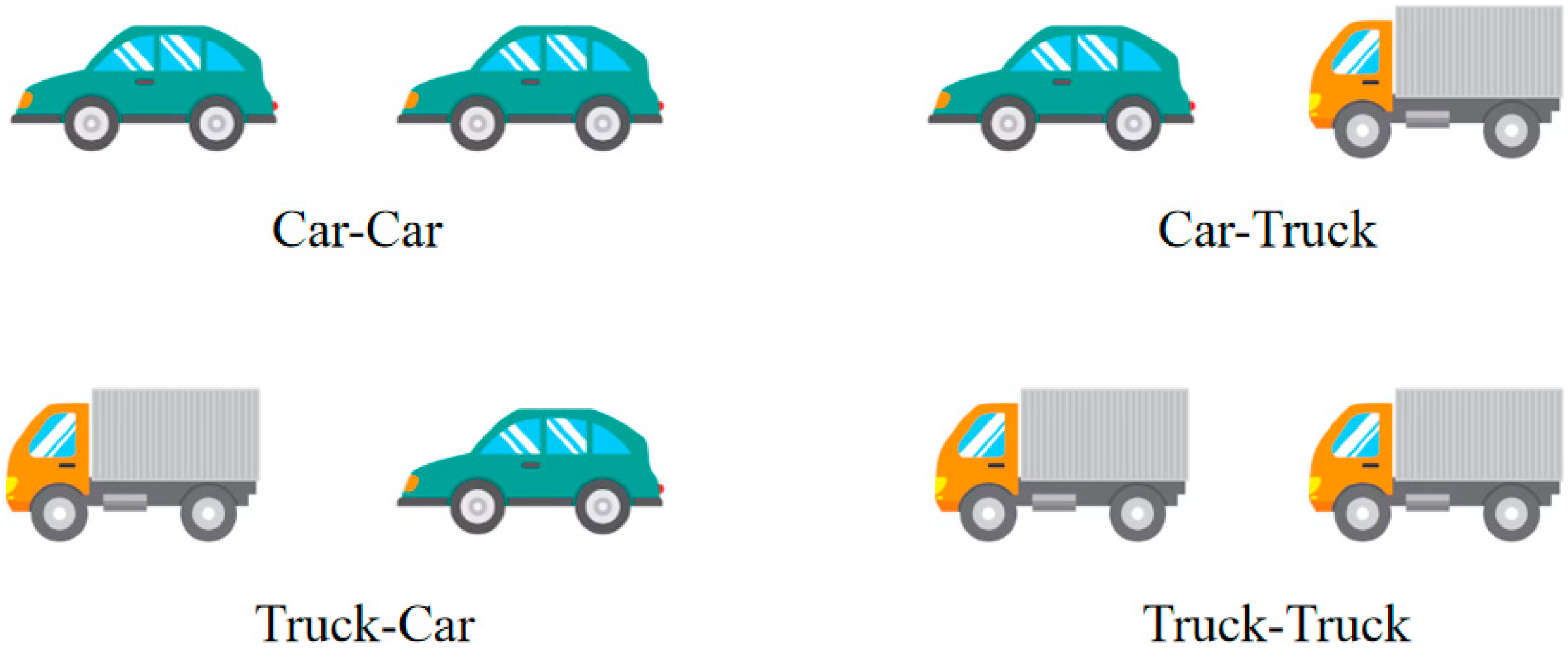
To analyze the time headway distributions under different vehicle types and lane conditions, all vehicles in the HighD dataset were divided into subsets based on vehicle type and lane. The HighD dataset includes two vehicle types: Car and truck. Therefore, there are four vehicle type combinations for time headway data: Car–car, car–truck, truck–car, and truck–truck, as shown in
Figure 2. In the lane_id field, records with values of 3 and 5 were selected (denoted as L1), corresponding to the left lane, and records with values of 2 and 6 were selected (denoted as L2), corresponding to the right lane. Note that HighD lane IDs are direction-specific: Lane IDs (2,3) belong to one travel direction and (5,6) belong to the opposite direction. In this study, we pool the corresponding lanes across directions (L1: 3&5; L2: 2&6) to form two lane-position groups (left vs. right) because our focus is on lane-position effects and vehicle-type interactions rather than direction-dependent differences. Pooling increases the sample size in each subset and improves the stability of distribution fitting and GOF comparisons. Thus, the filtered data was divided into the following eight subsets: (C–C, L1), (C–C, L2), (C–T, L1), (C–T, L2), (T–C, L1), (T–C, L2), (T–T, L1), and (T–T, L2).
After the initial vehicle type and lane selection, further removal of outliers and discontinuous records is necessary to ensure the accuracy of subsequent time headway calculations. First, considering the high-frequency sampling and occasional misdetections during the target recognition process, it is possible that the same vehicle could be recorded multiple times within a very short period. To address this, the following rule was applied to eliminate duplicate frames: If the same vehicle ID appears multiple times within an interval of less than 40 ms (i.e., less than 1 frame, with a frame rate of 25 fps), these are considered duplicate detections within the same frame. Only the earliest timestamp is retained, and the subsequent duplicate records are deleted.
In this study, time headways were restricted to the range of 1–8 s, based on the following considerations: On one hand, according to highway driving safety regulations and a large amount of empirical data, time headways under 1 s typically correspond to emergency braking or overly aggressive following behavior, which are neither representative of typical driving scenarios nor likely to be caused by measurement errors or abnormal driving behavior. On the other hand, time headways greater than 8 s typically reflect scenarios where vehicles are in congestion or temporary stop-and-go conditions, which do not represent typical high-speed driving behavior [
33]. Limiting time headway to the range of 1–8 s not only helps eliminate outliers and measurement noise but also covers the majority of typical following behavior under normal driving conditions [
34].
HighD provides a frame-level time headway (THW) variable associated with each leader–follower pair. In this study, we directly use the dataset-provided THW for distribution fitting and do not re-compute THW from trajectories. For completeness, THW is defined as:
where
is the longitudinal gap between the leader and follower and
is the follower speed at time
.
THW sample extraction from HighD.
HighD provides a frame-level time-gap THW variable together with the preceding vehicle identifier (leader ID), where the leader denotes the immediately preceding vehicle in the same lane. In this study, we directly use the dataset-provided THW and do not recompute it from trajectories.
1. Read HighD trajectory records (25 Hz) with vehicle ID, lane ID, vehicle type, leader ID (preceding vehicle identifier), and the provided THW field.
2. Keep records where a valid leader exists and lane/type labels are available.
3. Extract THW directly from the provided THW field.
4. Apply plausibility filters (e.g., valid speed range; THW within [1, 8] s).
5. Assign each sample to lane–vehicle-type subsets and aggregate for fitting/GOF evaluation.
Lane-change handling: Lane-change events are not explicitly excluded (or: Are excluded, if you did). We treat each observation according to its frame-level lane ID and note this setting for reproducibility.
Finally, a validity check was performed on the vehicle speed field. For speed records, values below 1 m/s could indicate a stationary vehicle or measurement errors, while values exceeding 80 m/s are clearly outside the reasonable range for highway driving. Therefore, records with speed below 1 m/s or above 80 m/s were treated as outliers and removed.
To assess the sensitivity of our results to threshold choices, we conducted a simple robustness check by varying the filtering thresholds. Specifically, we repeated key descriptive statistics and distribution ranking with (i) a wider THW range [0.8, 10] s instead of [1, 8] s, and (ii) a more restrictive speed range [0, 30] m/s instead of [1, 80] m/s. The main patterns—relative lane-level difference in mean THW and the top-ranked distributions across lane–vehicle-type subsets—remain largely consistent across these alternative thresholds, indicating that the main conclusions are not sensitive to reasonable threshold variation.
2.2. Descriptive Statistics of the Data
Table 1 presents some basic statistical results for different data subsets. From the statistics in
Table 1, several patterns can be observed: In all vehicle type combinations, the average time headway and median for the outer lane (L2) are higher than those for the inner lane (L1), with a larger standard deviation, indicating that vehicle-following in the outer lane is more dispersed and the headway is more relaxed. For same-type vehicle following (C–C, T–T), the car–car combination has the smallest average THW on both lanes, with 2.10 s (L1) and 2.73 s (L2), while the truck–truck combination has a slightly higher average THW, with 2.28 s (L1) and 3.17 s (L2). For mixed vehicle following, the time headway when a car follows a truck (C–T) is similar to the same-type car–car following, while the THW when a truck follows a car (T–C) increases significantly, especially in the outer lane (3.36 s).
Table 1.
Traffic representativeness summary.
Table 1.
Traffic representativeness summary.
| Data Subset | Sample Size | Mean (s) | Median (s) | Standard Deviation (s) |
|---|
| (C–C, L1) | 58,142 | 2.102 | 1.640 | 1.334 |
| (C–C, L2) | 25,388 | 2.725 | 2.240 | 1.645 |
| (C–T, L1) | 2139 | 2.097 | 1.670 | 1.419 |
| (C–T, L2) | 10,498 | 2.673 | 2.150 | 1.618 |
| (T–C, L1) | 2501 | 2.346 | 2.0 | 1.157 |
| (T–C, L2) | 11,862 | 3.356 | 2.670 | 1.931 |
| (T–T, L1) | 1641 | 2.283 | 1.510 | 1.668 |
| (T–T, L2) | 22,300 | 3.173 | 2.460 | 1.979 |
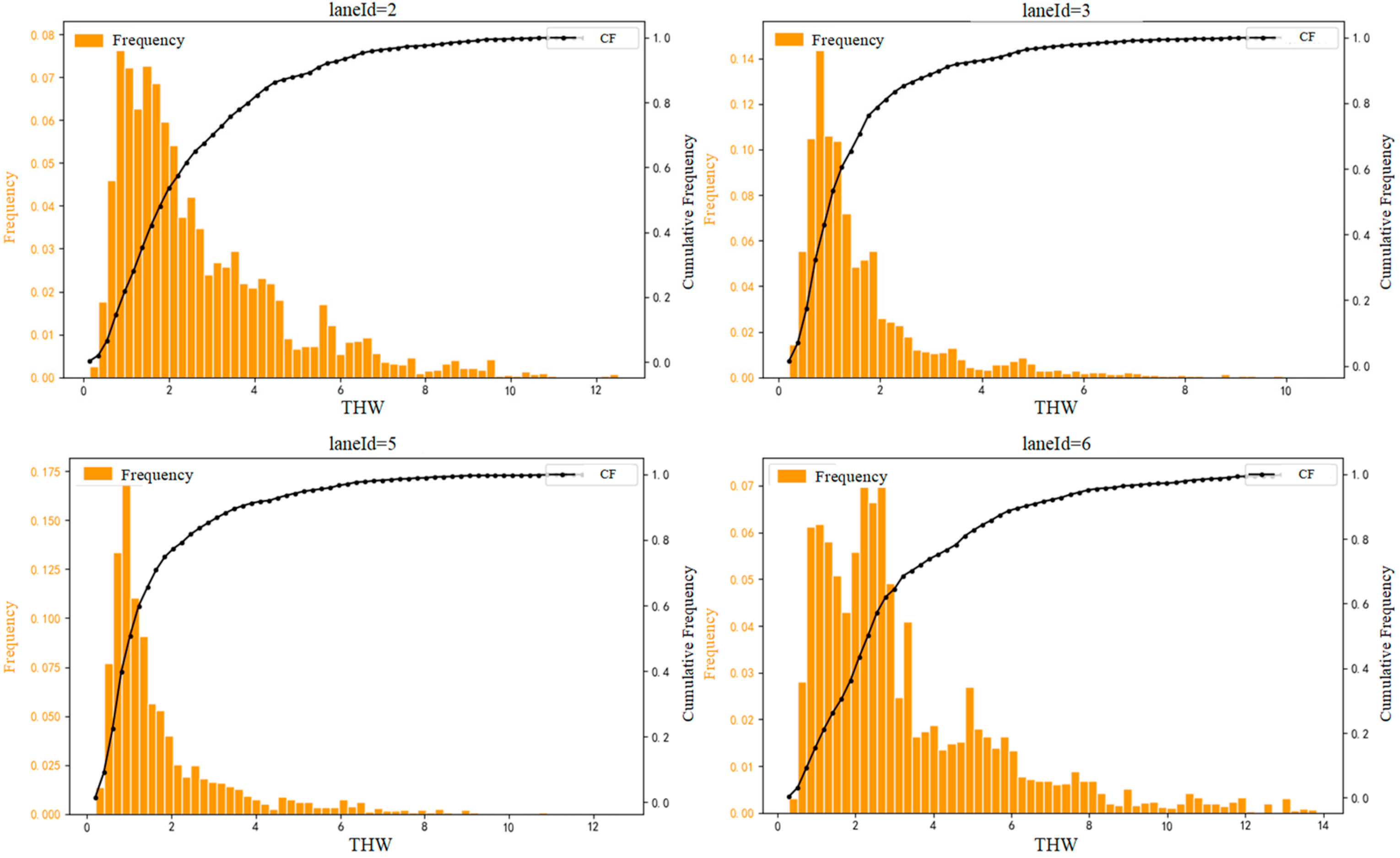
As shown by the time headway frequency distribution plots in
Figure 3, vehicles in the inner lanes (laneId = 3, 5) exhibit THW that are primarily concentrated between 0.5 and 1.5 s. This sharp distribution indicates pronounced and well-defined car-following behavior. The higher frequency suggests that the vehicle gaps are relatively small, which poses a higher potential collision risk. Especially in laneId = 5, the peak of the THW distribution reaches 17.5%, with most vehicles maintaining a time headway around 1 s. In contrast, the outer lanes (laneId = 2, 6) exhibit a wider distribution range and longer tail, particularly in laneId = 6, where the THW mean is higher and the distribution is more gradual. Over 50% of vehicles maintain a time headway of more than 2 s, suggesting that driving behavior in the outer lanes is relatively more conservative, with more ample safety space [
17].
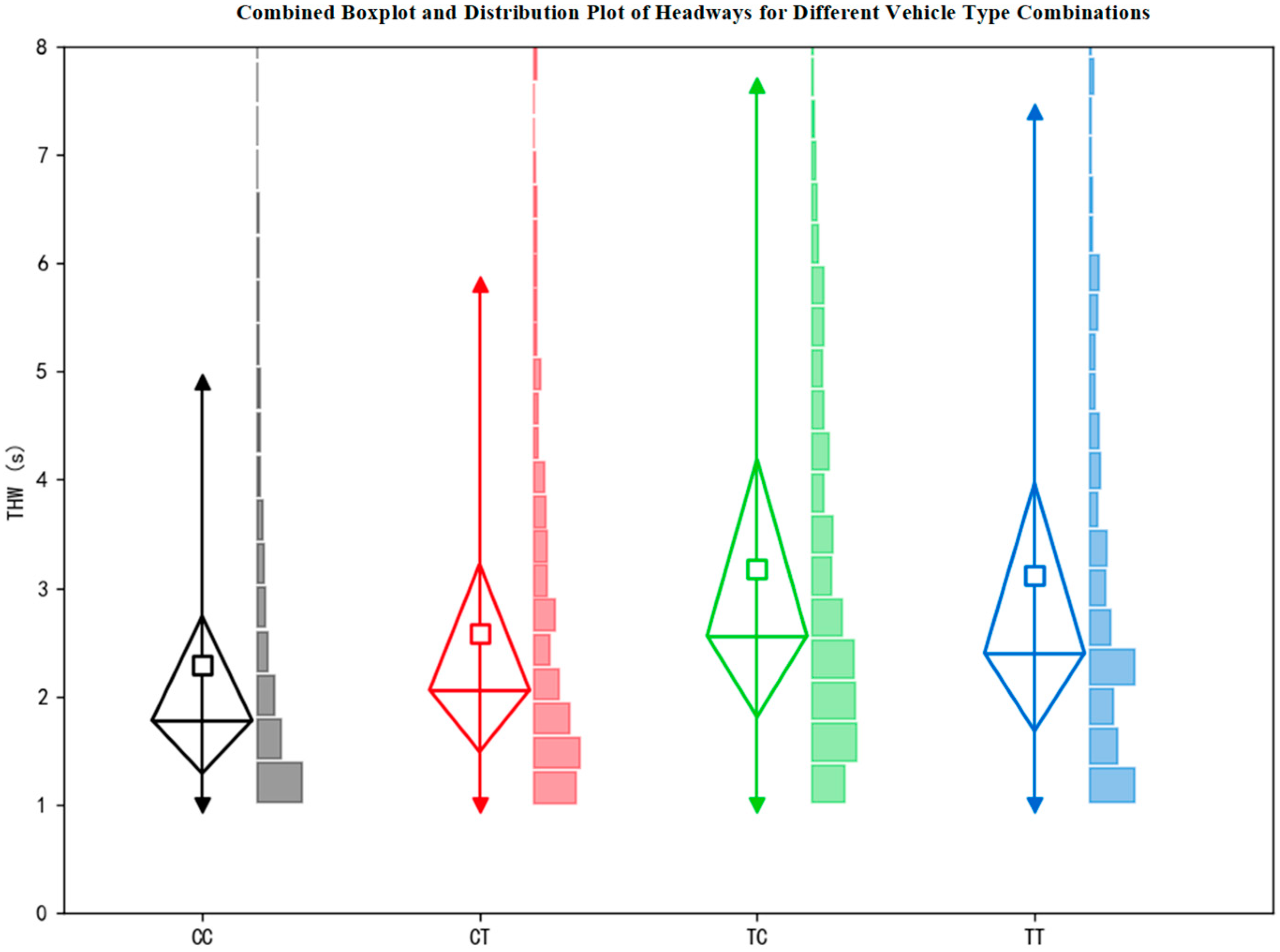
In
Figure 4, the two triangles indicate the 1st percentile (P1) and the 99th percentile (P99), and the interval between them corresponds to the central 98% of the samples (P1–P99). The open square denotes the sample mean. Additionally, the upper and lower vertices of the diamonds represent the upper and lower quartile, and the middle line within the diamond represents the median. The boundaries of the upper and lower halves indicate the limits after removing outliers. The boxplot distribution joint in the figure clearly shows the differences in following behavior under four vehicle type combinations. The THW median for the CC group is the lowest, with a concentrated distribution, indicating that cars following other cars tend to maintain shorter headway, leading to a relatively higher potential collision risk. The THW median for the CT and TT groups is slightly higher, with following behavior being relatively more cautious. In contrast, the TC group has the widest THW distribution and the highest median, showing that trucks generally maintain a larger headway when following cars, reflecting a more conservative driving strategy. The headway characteristics under different vehicle type combinations are of significant reference value for traffic safety analysis and autonomous driving strategy development.
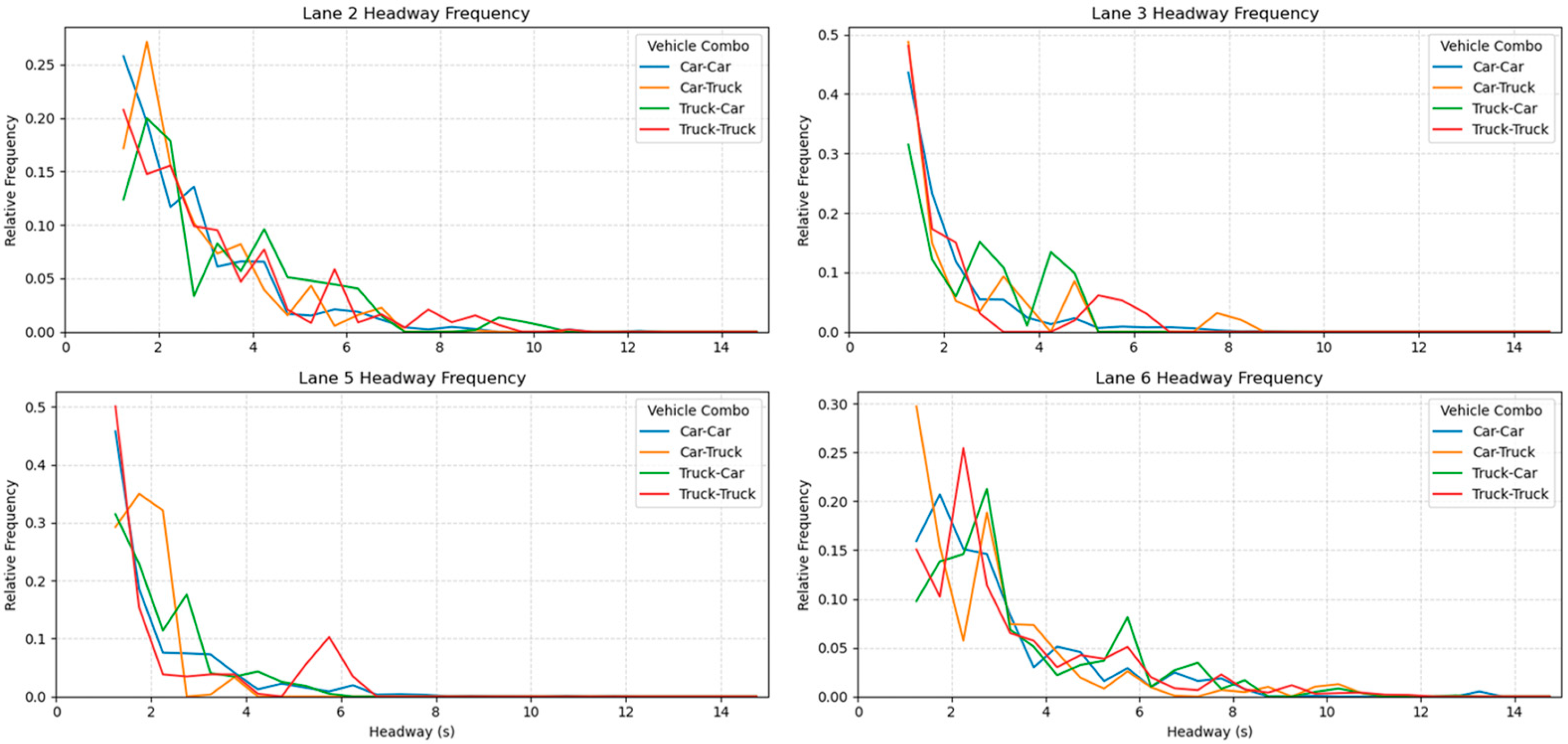
To further analyze the distribution structure of THW, this study constructs line plots based on frequency statistics for different vehicle type combinations in lanes 2, 3, 5, and 6, as shown in
Figure 5. The results show that the inner lanes (3 and 5) exhibit higher time headway concentration, with peak values for the car–car and truck–truck combinations concentrated between 1.0 and 2.0 s, indicating compact and continuous following behavior, especially for the TT group. In contrast, in the outer lanes (2 and 6), the distribution differences between vehicle type combinations are reduced, and the tail extension characteristics are more pronounced. Particularly in lane 6, the truck–car and truck–truck combinations still show stable occurrences beyond 6 s, reflecting the conservative and stable traffic behavior of this lane.
3. Probability Distribution Models and Experimental Results Analysis
In this experiment, several probability distribution models were selected to accurately fit the time headway data. The selection was based on the inherent characteristics of the data as well as variations in vehicle type combinations and lane conditions. The selected models include Lognormal, Log-logistic, Burr, Weibull, Gamma, and Logistic distributions [
17].
Table 2 presents the chosen probability distribution models. Below is the rationale for model selection and its applicability analysis.
3.1. Models and Methods
The experiment comprehensively considers the right-skewness, tail characteristics, model flexibility, and prior research application experiences to select an appropriate distribution model for time headway data [
17]. Time headway data typically exhibits a right-skewed distribution, and for different vehicle type combinations (e.g., trucks and cars) and lanes, the data may have large extreme values. Therefore, it is crucial to choose models that effectively capture the tail characteristics and right-skewed distribution.
When selecting the models, the flexibility of each distribution was considered. Different distribution models have distinct shape characteristics and fitting capabilities, allowing them to adapt to different data forms. The Burr distribution, due to its strong flexibility, can accommodate various tail characteristics. Based on prior research that fitted traffic flow and time headway data, we selected widely used distribution models, such as the Weibull and Gamma distributions, which have shown good fitting performance in reliability and data analysis [
35].
To ensure that the selected models provide the best fitting results, the experiment selected candidate models based on a comprehensive summary of relevant literature [
36]. We acknowledge that shifted negative exponential, inverse Gaussian, and Erlang models are also commonly used in headway studies. In this paper, we restrict the comparison to six widely adopted and flexible parametric families to keep the multi-subset, multi-test evaluation tractable; moreover, Erlang is a special case of the Gamma family, which is already included. Incorporating additional baselines (e.g., shifted exponential or inverse Gaussian) is left for future work. These comparisons helped ensure that the chosen models would provide the best fit across different subsets of the data. Ultimately, we selected six commonly used probability distribution models to fit the time headway data, specifically:
Lognormal(3P),
where
= location parameter;
= scale parameter;
= shift parameter.
Log-logistic(3P),
where
= shape parameter;
= scale parameter;
= shift parameter.
Burr(4P),
where
= shape parameter;
= shape parameter;
= scale parameter;
= shift parameter.
Weibull(3P),
where
= shape parameter;
= scale parameter;
= shift parameter.
Gamma(3P),
where
= shape parameter;
= scale parameter;
= shift parameter;
= Gamma function.
Logistic,
where
is the location parameter,
is the scale parameter.
These models effectively describe the skewness, tail characteristics, and various distribution patterns of the time headway data, providing strong support for subsequent analysis.
In this study, we utilize the Logistic distribution to model the THW, with the data filtered to the range of 1–8 s. The Logistic distribution has continuous support from (−∞, ∞), which allows us to model a broad range of THW behavior effectively, despite the data being filtered for practical reasons. The tail characteristics of the Logistic distribution remain useful for capturing both short and long headways, and the truncation to the 1–8 s range does not significantly distort the distribution’s overall behavior.
In this experiment, the maximum likelihood method was used to fit the time headway data to the selected distributions. By maximizing the log-likelihood function of each distribution, we were able to estimate the optimal parameters for the distribution. The estimated parameters help us better understand the distribution characteristics of time headway, allowing for effective predictions of traffic flow and vehicle behavior.
Specifically, the experiment first selected several common probability distribution models, then used the maximum likelihood method to estimate the parameters of each model. By calculating the log-likelihood values of each model on the time headway data, the model that best fit the actual data was ultimately chosen as the optimal distribution.
3.2. Time Headway Distribution Model Fitting and Analysis
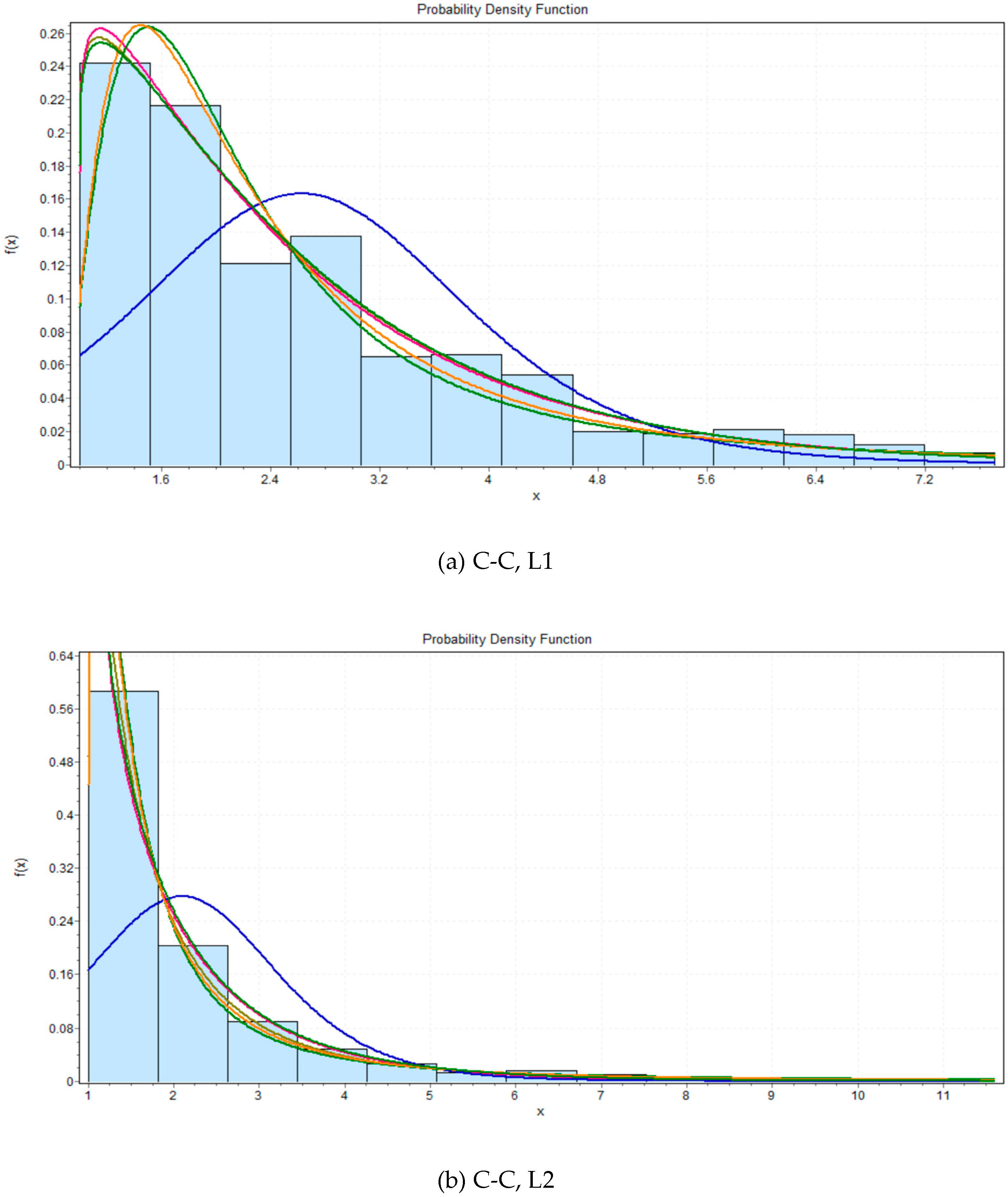
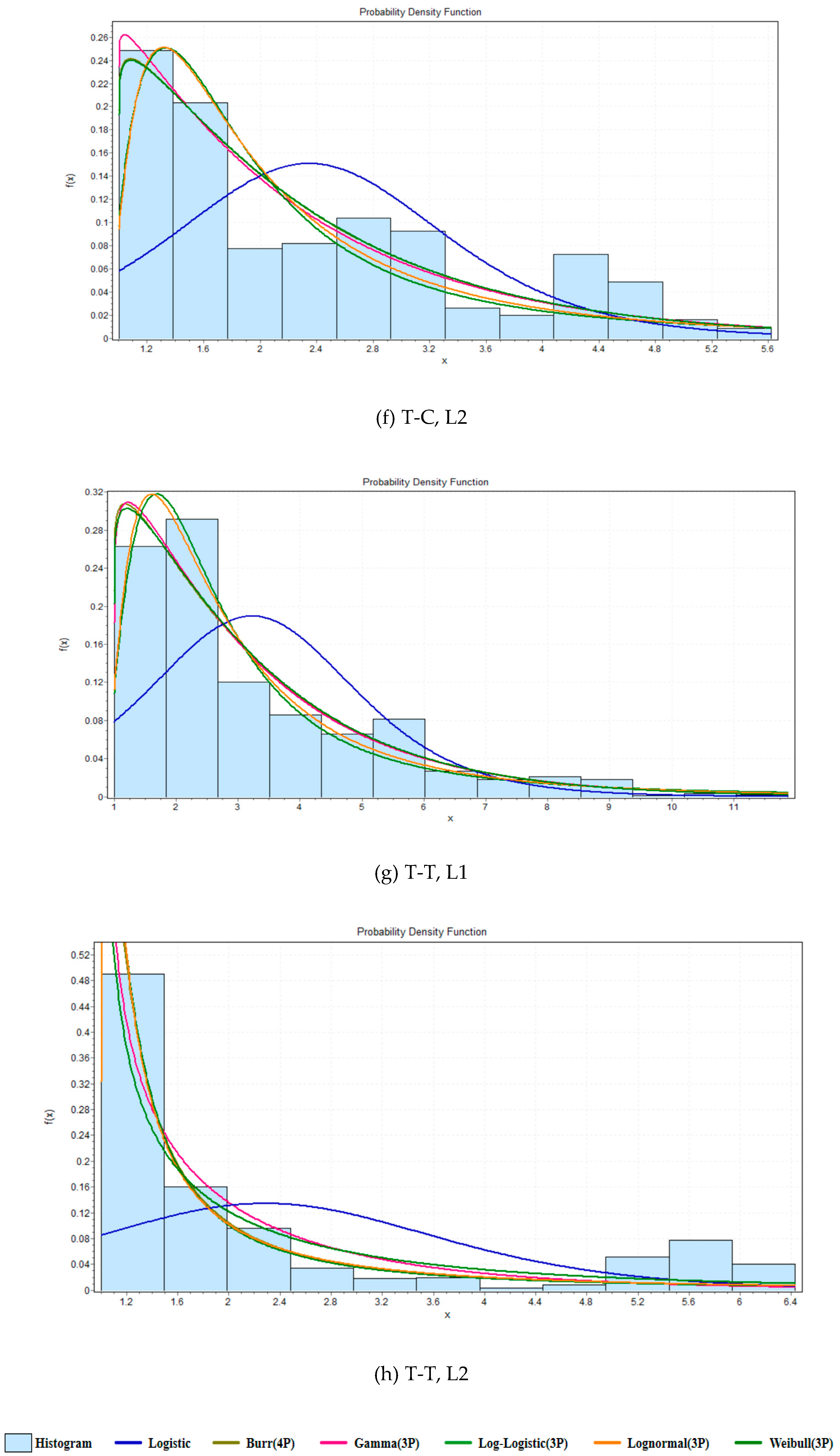
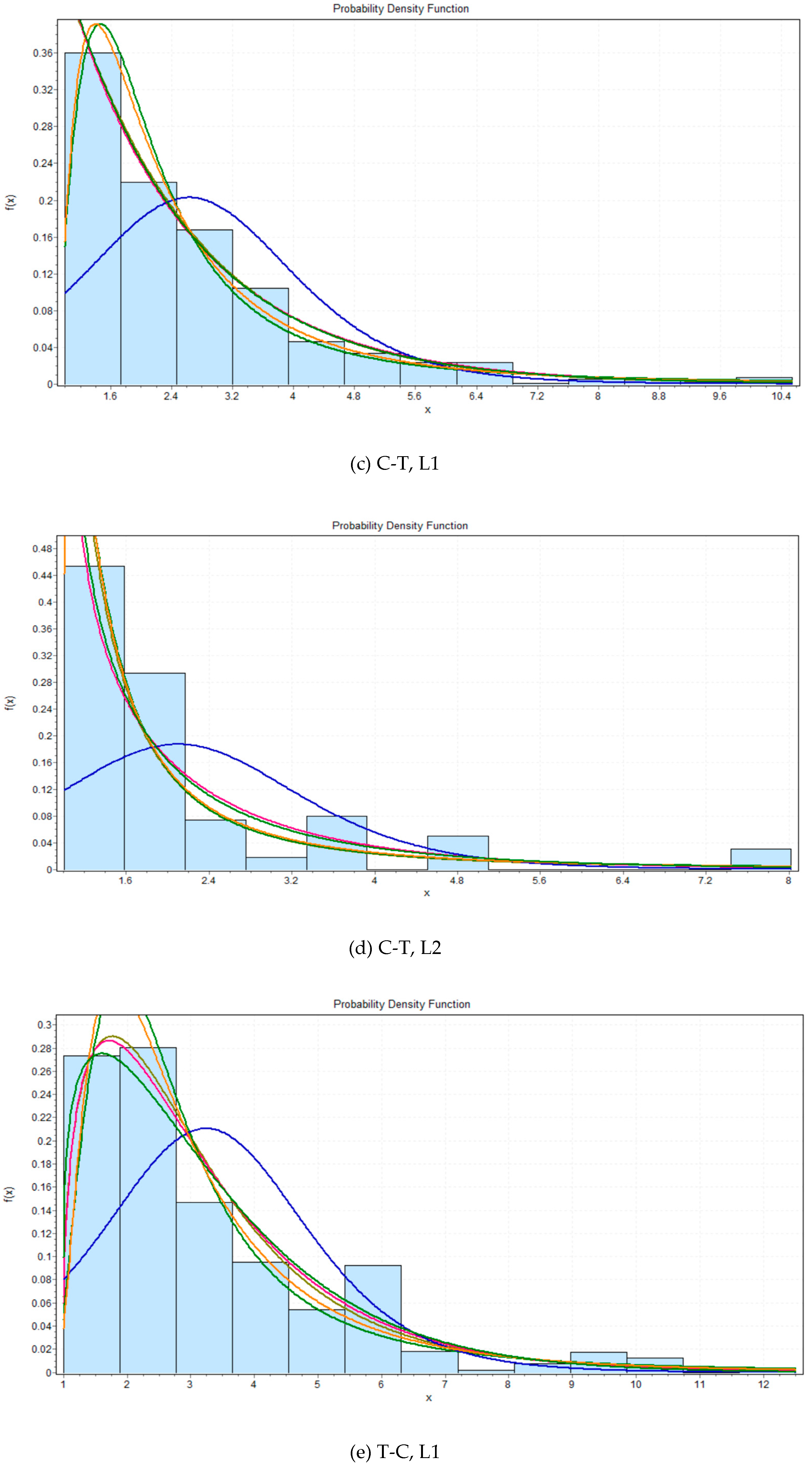
In this experiment, the maximum likelihood estimation method was used to fit eight different datasets, and the resulting frequency distribution histograms are shown in
Figure 6. The parameters for each fitted model are presented in
Table 2.
Table 2.
Parameters of Each Model.
Table 2.
Parameters of Each Model.
| Model | Subset | Parameters | Subset | Parameters |
|---|
| Lognormal(3P) | (C–C, L1) | σ = 0.90508, μ = 0.2633, γ = 0.84049 | (C–C, L2) | σ = 1.2158, μ = −0.51809, γ = 0.96905 |
| Log-Logistic(3P) | α = 1.68, β = 1.218, γ = 0.93608 | α = 1.2902, β = 0.57945, γ = 0.99352 |
| Burr(4P) | k = 1068.9, α = 1.0352, β = 1474.4, γ = 0.99976 | k = 4.2791, α = 0.95869, β = 3.5003, γ = 1.0 |
| Gamma(3P) | α = 1.047, β = 1.6468, γ = 0.99967 | α = 0.81595, β = 1.3011, γ = 1.0 |
| Weibull(3P) | α = 1.0358, β = 1.7484, γ = 0.99975 | α = 0.82209, β = 0.92353, γ = 1.0 |
| Logistic | σ = 0.90339, μ = 2.7238 | σ = 0.72951, μ = 2.0964 |
| Lognormal(3P) | (C–T, L1) | σ = 0.84469, μ = 0.29336, γ = 0.79813 | (C–T, L2) | σ = 1.3508, μ = −0.63856, γ = 0.98086 |
| Log-Logistic(3P) | α = 1.8152, β = 1.2388, γ = 0.90013 | α = 1.1635, β = 0.53337, γ = 0.99745 |
| Burr(4P) | k = 1077.3, α = 1.0427, β = 1371.6, γ = 0.99978 | k = 1.8443, α = 0.95185, β = 1.0754, γ = 1.0 |
| Gamma(3P) | α = 1.0576, β = 1.5779, γ = 0.99967 | α = 0.65062, β = 1.6782, γ = 1.0 |
| Weibull(3P) | α = 1.0427, β = 1.6964, γ = 0.99976 | α = 0.75823, β = 0.9486, γ = 1.0 |
| Logistic | σ = 0.87931, μ = 2.6684 | σ = 0.78267, μ = 2.0966 |
| Lognormal(3P) | (T–C, L1) | σ = 0.75178, μ = 0.7067, γ = 0.71686 | (T–C, L2) | σ = 0.92144, μ = 0.01432, γ = 0.88022 |
| Log-Logistic(3P) | α = 2.0258, β = 1.849, γ = 0.88161 | α = 1.5856, β = 0.93544, γ = 0.96329 |
| Burr(4P) | k = 57.488, α = 1.2448, β = 64.966, γ = 0.99707 | k = 7723.0, α = 1.0533, β = 6744.6, γ = 0.9993 |
| Gamma(3P) | α = 1.4452, β = 1.6413, γ = 0.98968 | α = 1.029, β = 1.3087, γ = 0.99969 |
| Weibull(3P) | α = 1.2319, β = 2.5329, γ = 0.9974 | α = 1.0561, β = 1.3746, γ = 0.99928 |
| Logistic | σ = 1.0744, μ = 3.3617 | σ = 0.63809, μ = 2.3463 |
| Lognormal(3P) | (T–T, L1) | σ = 0.86004, μ = 0.53467, γ = 0.77821 | (T–T, L2) | σ = 1.6974, μ = −0.85965, γ = 0.99842 |
| Log-Logistic(3P) | α = 1.7802, β = 1.5867, γ = 0.90663 | α = 0.96298, β = 0.42326, γ = 1.0 |
| Burr(4P) | k = 2626.4, α = 1.0876, β = 3123.3, γ = 0.99953 | k = 1.134, α = 0.92942, β = 0.53439, γ = 1.0 |
| Gamma(3P) | α = 1.1422, β = 1.9021, γ = 0.9991 | α = 0.61429, β = 1.6054, γ = 1.0 |
| Weibull(3P) | α = 1.0877, β = 2.2426, γ = 0.99953 | α = 0.67446, β = 1.1516, γ = 1.0 |
| Logistic | σ = 1.0895, μ = 3.1717 | σ = 0.91998, μ = 2.2827 |
Some subsets, such as C–T L1 and T–T L1, have relatively small sample sizes. However, the main findings of lane–vehicle-type interaction effects and the relative ranking of models remain consistent across alternative thresholds. To verify the robustness of the conclusions, we have performed a bootstrapping test to ensure that the THW distribution model fitting is stable even with these small sample sizes.
From the
Figure 6, it can be seen that in the outer lanes, regardless of the vehicle type combination, the time headway distribution generally exhibits a right-skewed shape with a long tail. The histograms show that most samples are concentrated in the 1–3 s range, but there is still a certain proportion of long-tail data. This reflects the more complex driving environment in the outer lanes: Some vehicles maintain very short headways for overtaking or aggressive following, while others, after changing lanes, opt for larger safety distances, creating a long-tail characteristic. In the distribution model fitting, Burr(4p), Lognormal(3p), and Log-logistic(3p) provide better tail characterization, resulting in overall better fitting performance; however, the Logistic distribution clearly deviates, failing to capture the right-skew and long-tail characteristics.
As shown in the figure, the time headway distribution in the outer lanes exhibits a generally right-skewed shape with a long tail. This pattern is observed consistently across different vehicle type combinations. This indicates that driving in the inner lanes is characterized by steady traffic flow, with more consistent driver behavior and lower frequencies of extreme values. The fitting results show that Weibull(3p) and Gamma(3p) perform better in the inner lanes, accurately capturing the peak location and the rapid decay characteristics. Burr(4p) still shows strong adaptability in the tail but is less significant in the inner lanes.
From the perspective of vehicle type combinations, car–car time headways are relatively short and highly concentrated. In particular, the distribution in the inner lane is more regular, whereas the outer lane exhibits certain long-tail characteristics. Statistically, Weibull and Gamma perform best in the inner lane, while Burr and Log-logistic perform best in the outer lane. This reflects that passenger cars in the inner lane tend to maintain stable gaps, whereas in the outer lane, the gap increases due to overtaking and lane-changing behaviors. For the car–truck combination, the peak in the outer lane is more concentrated, indicating that passenger cars often follow trucks closely when overtaking, posing a higher risk. Therefore, Gamma and Weibull fit the concentrated peaks better. In contrast, the tail in the inner lane is longer, and Lognormal(3p) provides a better fit, indicating that drivers in mixed traffic tend to increase the gap for safety.
For the truck–car combination, the outer lane distribution is more dispersed with a significant long-tail, and Burr and Log-logistic better capture the differentiated driving behaviors. In the inner lane, the distribution is more concentrated, and Gamma and Weibull provide a better fit, suggesting that trucks maintain a more stable following distance in the inner lane, with less variability when passenger cars follow.
For the truck–truck combination, both the inner and outer lanes show strong right skewness, but the tail is more pronounced in the outer lane, where Burr(4p) better captures the long tail. The distribution in the inner lane is more concentrated, with Lognormal and Log-logistic providing better fits. This is consistent with real-world conditions: In the outer lanes, truck driving behaviors vary greatly, while in the inner lanes, trucks often form “truck convoys” with more consistent gaps.
3.3. Cumulative Frequency Distribution Comparison of Distribution Models
The study conducted a comparative analysis of cumulative frequency distributions for different distribution models. By fitting the sample data to six distribution models, the fitting performance of each model to the actual data can be observed.
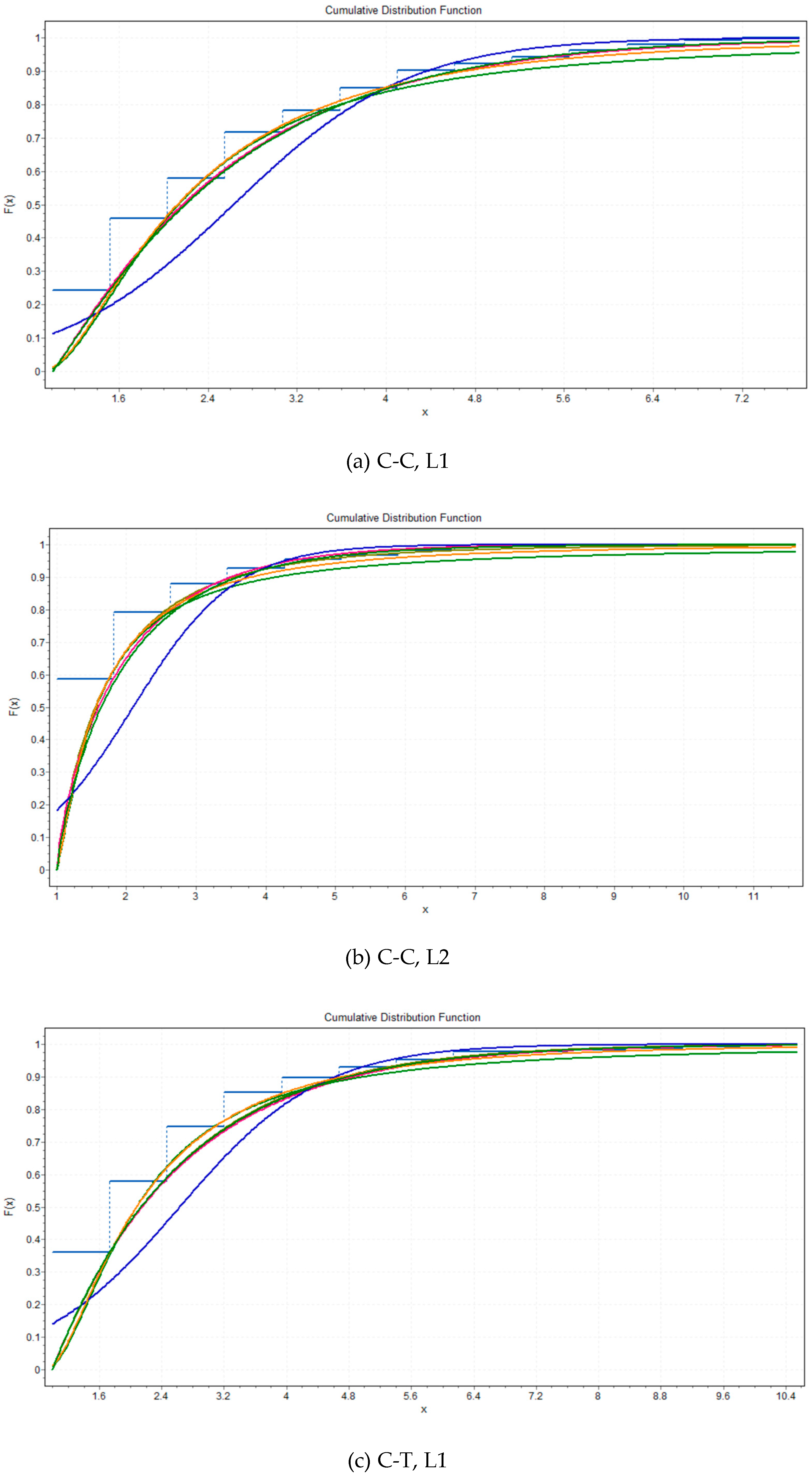
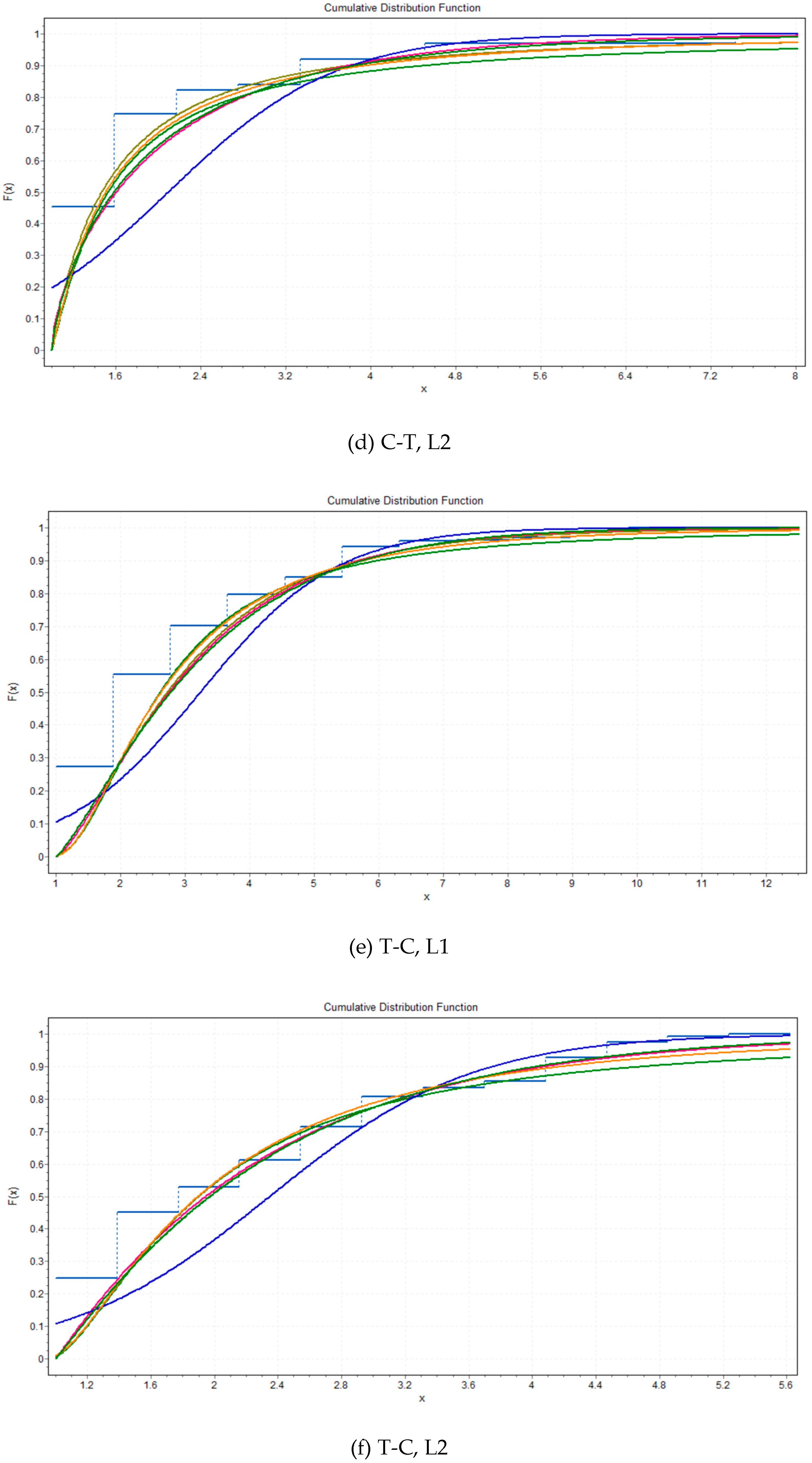
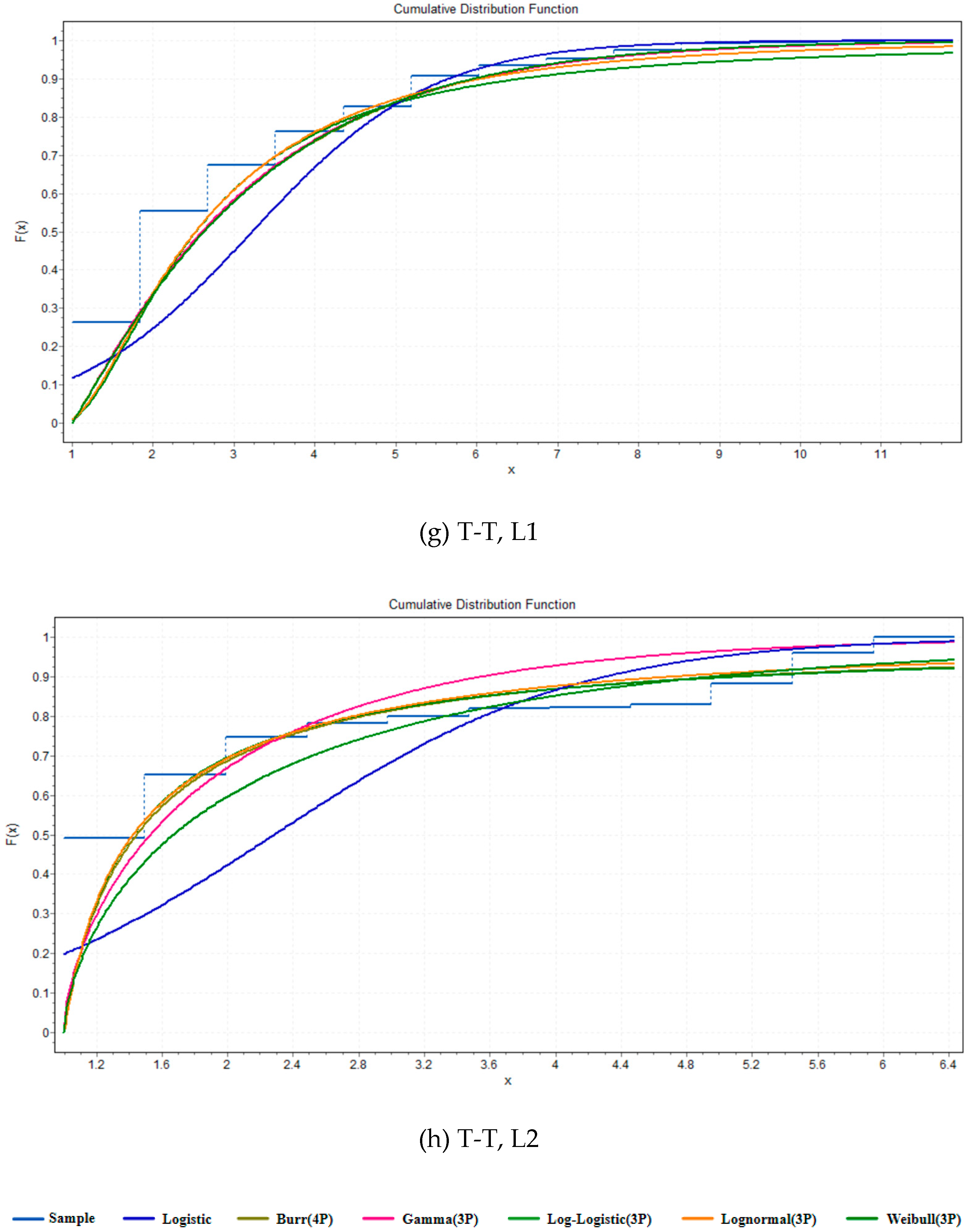
Figure 7 shows the results of cumulative frequency distribution fitting using different distribution models, including Logistic, Burr(4P), Gamma(3P), Log-logistic(3P), Lognormal(3P), and Weibull(3P). The fitting performance of each model is visualized through the cumulative probability distribution (CDF). Each curve in the figure represents the fitting performance of different models on different datasets, with the vertical axis representing cumulative probability and the horizontal axis representing the observed values of the samples.
As shown by the cumulative distribution curves of the eight subsets in
Figure 7, the empirical distribution function (Sample) in the outer lanes increases more rapidly in the low time headway range. This indicates that vehicles in the outer lanes are more likely to exhibit shorter headways. The overall distribution is more right-skewed. This is consistent with the conclusions from the histograms, suggesting that drivers in the outer lanes exhibit more aggressive driving and following behavior. In the fitting results, Burr(4p), Lognormal(3p), and Log-logistic(3p) provide a good fit to the empirical distribution, particularly in the tail section where extreme values are more accurately represented. However, the Logistic distribution fitting curve deviates overall, underestimating the cumulative probability of short headways, and provides the worst fit.
In contrast, the empirical distribution function in the inner lanes rises more gradually, and the theoretical distribution fits better in the mid-to-high time headway range. This indicates that vehicle headways in the inner lanes are more concentrated, and drivers tend to maintain a safer distance. In this case, Weibull(3p) and Gamma(3p) provide the best fit to the cumulative distribution, accurately capturing the “concentrated distribution and rapid convergence” characteristics, while the advantages of the Burr distribution are less obvious.
The CDF curve for the car–car combination indicates that headways between passenger cars are generally short, as reflected by the rapid increase in the cumulative distribution. This pattern is particularly evident in the outer lanes, where a higher proportion of short headways is observed. The fitting results show that Burr and Lognormal are better suited for the outer lanes, while Weibull better characterizes the inner lanes. This reflects that passenger cars in the outer lanes engage in closer following behavior due to lane changes and overtaking, while in the inner lanes, they tend to maintain a more stable gap.
For the car–truck combination, the CDF in the outer lane rises sharply around 2 s, indicating frequent short headways when passenger cars overtake trucks. The tail in the inner lane is longer, showing that some drivers actively increase the gap in mixed traffic. In the fitting results, Gamma and Weibull provide a good fit for the concentrated peak in the outer lane, while Lognormal is better suited for the tail in the inner lane.
The CDF curve for the truck–car combination in the outer lane exhibits a greater spread, with a slower increase in the cumulative distribution. This indicates notable differences in passenger car following behavior when trailing trucks, along with a higher probability in the tail region. In contrast, the distribution in the inner lane is more concentrated, and the CDF shows better agreement with the Weibull curve. This corresponds to the varying avoidance behaviors of passenger cars in the outer lane when following trucks, while the headway is more stable in the inner lane.
The CDF for truck–truck in the outer lane clearly deviates in the tail, with a pronounced long-tail phenomenon, and Burr provides a better fit. In the inner lane, the CDF rises quickly and is more concentrated, indicating that truck convoys maintain more consistent headways, and Lognormal and Log-logistic accurately characterize this behavior.
3.4. Q–Q Plot Analysis and Model Evaluation
A Q–Q plot is a commonly used statistical graph that visually compares the quantiles of sample data with the quantiles of a theoretical distribution to assess the fitting performance of a model. If the sample data distribution aligns with the theoretical distribution, the points in the Q–Q plot will roughly fall along a straight line. Otherwise, it indicates that there is a deviation in the model fit.
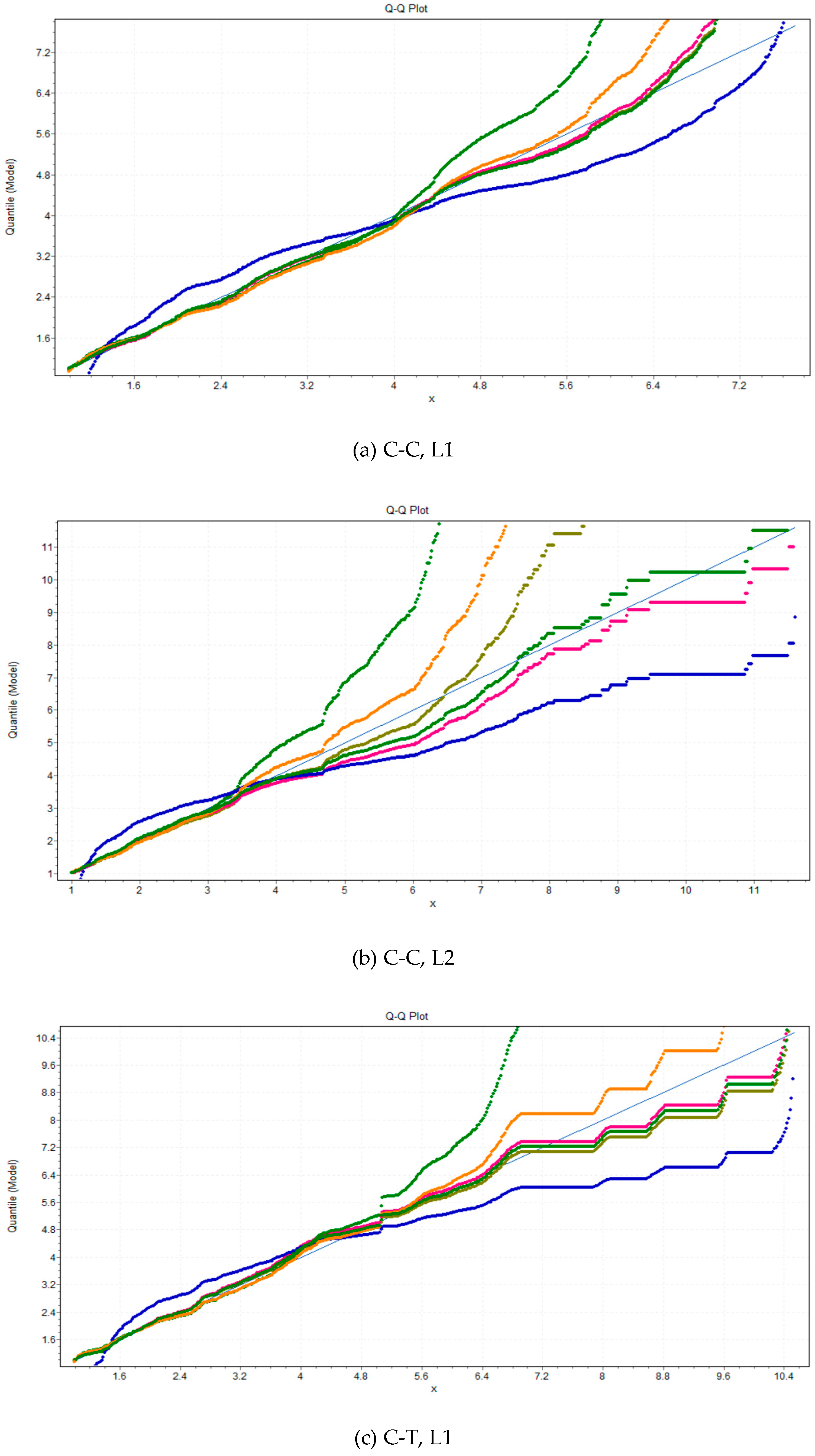
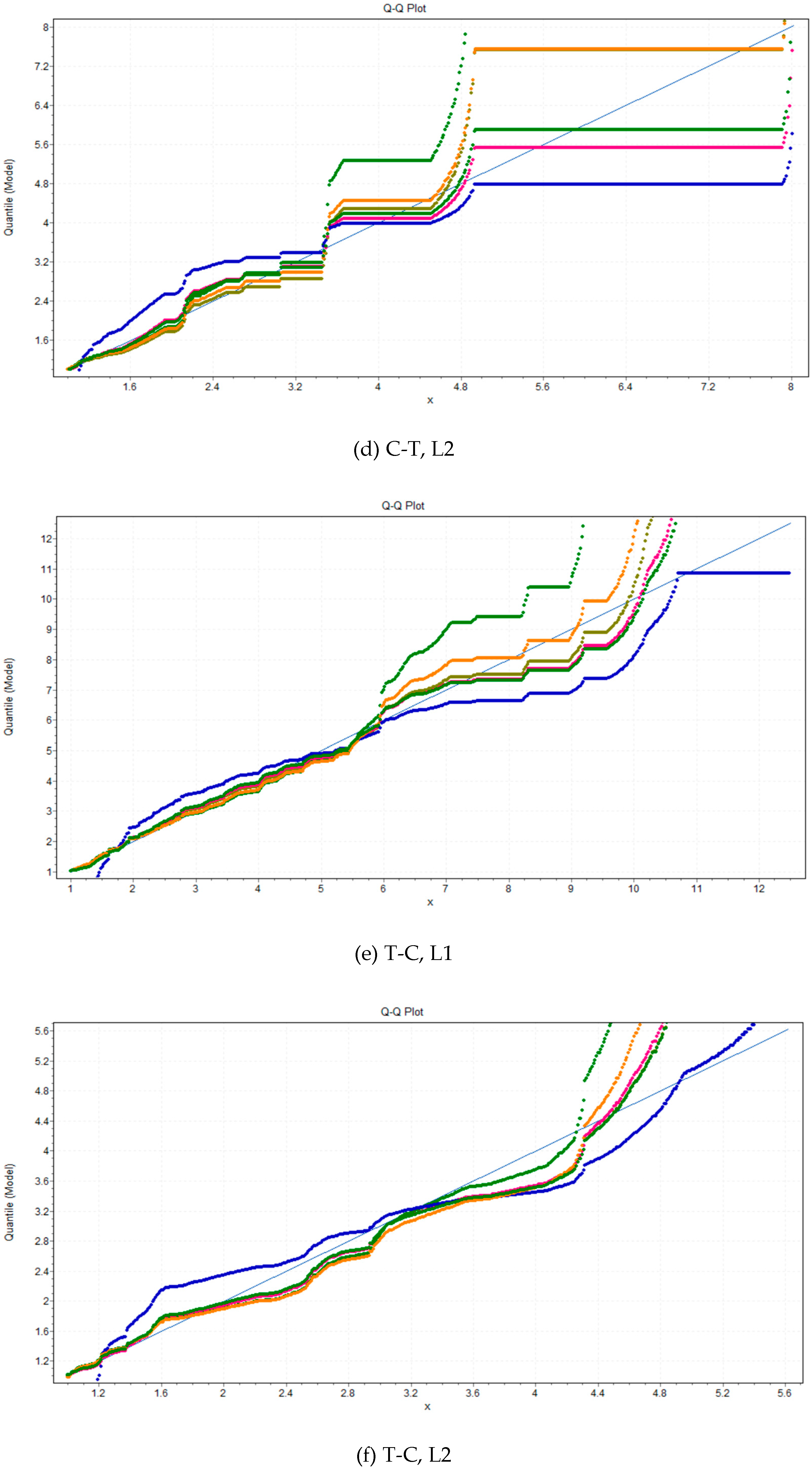
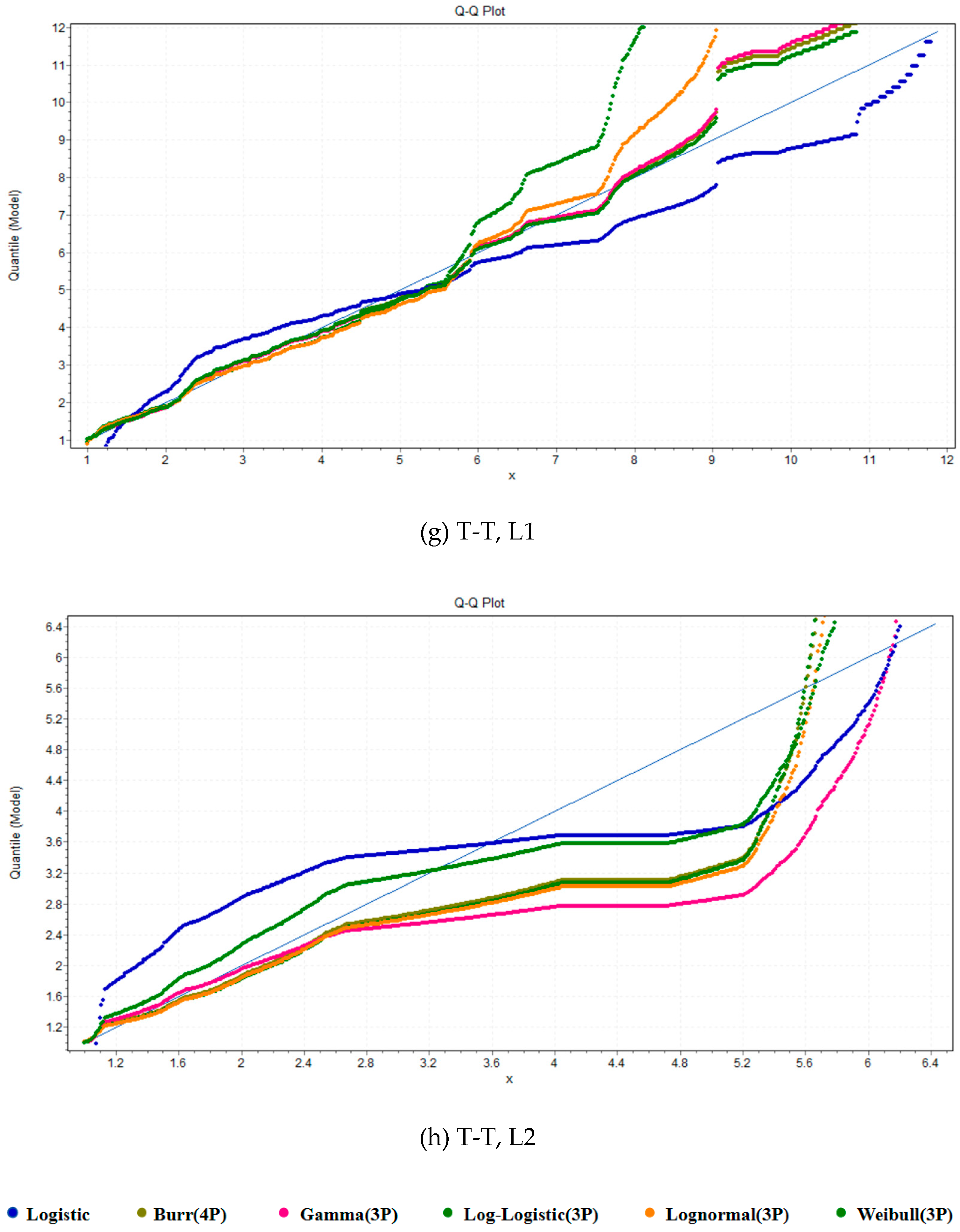
Figure 8 shows the Q–Q plots for each distribution model across different datasets, where the horizontal axis represents the quantiles of the theoretical distribution and the vertical axis represents the quantiles of the sample data.
As shown by the Q–Q plots of the eight subsets in
Figure 8, the outer-lane data exhibit substantial deviations from the reference line in the short headway region. This deviation is particularly pronounced for the Logistic distribution, which underestimates the probability of short headways and consequently yields the poorest fit. Burr(4p), Lognormal(3p), and Log-logistic(3p) closely align with the diagonal line in most quantile ranges, showing good fit performance, though there is still some deviation in the long-tail section, indicating limited ability to capture extreme values.
In the inner lane, the data points are generally closer to the straight line, showing a more concentrated and stable distribution. Weibull(3p) and Gamma(3p) provide good fit in the middle quantile range, with an even distribution of the Q–Q plot points. However, Burr performs relatively better in the tail section. This is consistent with the results from the histograms and CDFs, indicating that the inner lane is better suited for models with concentrated distributions, while the outer lane relies more on models with stronger flexibility in the tail.
For the car–car combination, the points are generally distributed near the straight line, indicating that the headway between passenger cars is more regular. The fit is better in the inner lane than in the outer lane, reflecting that passenger cars maintain more stable headways in the inner lane. The Q–Q plots for car–truck and truck–car show significant deviations in the tail section (for longer headways), especially in the outer lane. This suggests that when trucks and passenger cars are combined, there is greater variability in the headway, with more extreme values, making Burr and Log-logistic more advantageous in the tail.
For the truck–truck combination, significant deviations are observed in the tail section of the Q–Q plots, regardless of the lane, reflecting the large differences in truck convoy headways in the long-tail range. This is particularly prominent in the outer lane, confirming that trucks exhibit greater headway variability and higher risk under high-speed conditions.
3.5. Multiscale Test Comprehensive Evaluation and Optimal Model Selection Method
To comprehensively evaluate the fitting performance of each candidate distribution, this study employs three testing methods: K–S, A–D, and Chi-Square (X2) tests, as shown in
Table 3. The K–S test is used to assess the overall goodness-of-fit of the model; the A–D test focuses more on the fit of the tail distribution; and the Chi-Square test evaluates the model’s adaptability based on the comparison between observed frequencies and expected frequencies.
While we acknowledge that the K–S and A–D tests may require correction when using estimated parameters, we observed that these tests provided stable results across subsets. Given the ample sample sizes and the consistency of the MLE estimates, we believe the results remain robust, and no additional corrections were necessary.
K–S, A–D, and Chi-square reflect goodness-of-fit from complementary perspectives. When aggregating multiple GOF indicators into a single score, equal weighting implicitly assumes identical importance across tests and subsets, whereas expert-assigned weighting introduces subjectivity and is difficult to justify consistently. We therefore adopt entropy weighting as an objective, data-driven scheme: Indicators with stronger discriminative power (larger information content across candidate models) receive higher weights, while less informative indicators receive lower weights, yielding a transparent and reproducible composite ranking.
The three types of experimental results obtained from the group of models are processed as follows:
(1) Normalization processing:
The three experimental results are normalized using the following formula:
where
refers to the model’s test result under the respective condition, with a normalization coefficient. Next, the calculation of the experimental data is standardized for normalization using the conversion
.
(2) Information calculation:
The different test indicators have varying abilities to distinguish the model fitting. To objectively determine the weight of each test, this paper uses information entropy to determine the weights.
The test value effect is calculated as follows:
The calculation of the entropy value and information utility of the test is as follows:
where M is the number of candidate models. The final weights are distributed based on the proportion of the information utility of each test.
When there is a large difference in a test across different models, its entropy value is low, and its information utility is high, resulting in an increase in its weight.
(3) Handling of Missing Values and Robustness
For cases where the chi-square test statistic is missing (N/A) in individual models, a model-specific weight re-scaling method is used.
Let the set of available tests for model m be denoted as A(m), then:
That is, the weights of the available tests are re-normalized to ensure that the weighted results remain comparable.
At the same time, to validate the robustness of the method, this paper includes a comparative analysis using only the combined results of the K–S and A–D tests. If the ranking results are consistent, it indicates that the method is insensitive to missing values.
(4) Comprehensive Scoring and Optimal Model Determination
Considering the weights and utility scores of the three tests, the weighted comprehensive score for each candidate model is defined as:
The higher the comprehensive score, the better the overall fitting effect of the model. Ultimately, the model with the maximum S(m) is determined as the optimal fitting distribution model for the subset.
In this study, we applied min–max normalization per test to scale the goodness-of-fit (GOF) statistics. While we acknowledge that min–max normalization can sometimes overemphasize small differences, we have found that such differences do not significantly affect the overall model ranking in our analysis. Additionally, we tested the robustness of our results by using alternative normalization techniques (e.g., z-score standardization and rank-based scaling) in preliminary checks, and the main conclusions were consistent. Therefore, we believe that the use of min–max normalization is justified in this context, as it does not lead to an overstatement of differences.
The resulting entropy weights for K–S, A–D, and Chi-square are reported in
Table 4.
Based on the experimental results and the comprehensive evaluation using K–S, A–D, and X
2 goodness-of-fit tests, as shown in
Table 5, the optimal fitting models for each subset are determined. For the CC1 subset, Lognormal(3P) performs the best in all three tests, achieving the lowest values in K–S, A–D, and X
2, indicating that the Lognormal distribution effectively captures the right-skewness and long-tail characteristics of this dataset. In the CC2 subset, Burr(4P) achieves the smallest values in K–S and X
2 tests, suggesting it fits the tail of the distribution more accurately, while the A–D test slightly favors Lognormal(3P). Overall, Burr(4P) better characterizes the tail features of CC2.
For the CT1 subset, the Lognormal(3P) model achieves the highest entropy-weighted composite score (
Table 5), indicating the best overall fit under the multi-test evaluation. For the CT2 subset, the comprehensive evaluation selects Burr(4P) as the optimal model.
In the TC1 subset, all three goodness-of-fit tests—K–S, A–D, and X2—identify the Lognormal (3P) model as the optimal fit. This result indicates that the time headway distribution in this subset exhibits pronounced right-skewness and long-tail characteristics, which are effectively captured by the Lognormal distribution. For the TC2 subset, both the A–D and X2 tests recommend Gamma(3P), although K–S slightly favors Burr(4P). However, considering all three tests, Gamma(3P) remains the more balanced choice.
In the TT1 subset, the entropy-weighted composite ranking identifies Weibull(3P) as the optimal fit. This suggests that the tail behavior of the Log-logistic distribution provides a better representation of the extreme values in this subset. The results for TT2 are similar to those for CC1, with Lognormal(3P) being dominant in all three tests, suggesting it provides the best overall fit for this subset.
4. Discussion
In a multi-lane highway context, Ye and Zhang classified time headways into C–C, C–T, and T–T categories based on empirical data. They then evaluated six candidate probability distributions across different traffic states and lane positions. The results showed that the C–C and T–T combinations were generally better represented by the Lognormal distribution [
37]. Roy and Saha, in a two-lane mixed traffic scenario, found that lognormal and Log-logistic performed better in high-flow rate intervals when comparing overall time headway distributions [
8]. Das and Maurya’s research on a two-way, two-lane road further indicated that under mixed traffic conditions, the C–C combination often displayed a right-skewed unimodal distribution with moderate heavy tails, with lognormal being relatively robust overall [
38]. Saha and Roy’s work on “vehicle type-based headway” indicated that, under the condition of not differentiating lanes, the probability of short headways in the car–car combination was significantly higher than in other combinations, which also tended to improve the overall fitting performance of the lognormal-type distribution [
39].
In contrast to these conclusions based on “merged lane samples,” this study found that for the C–C combination, the optimal models for “L1: Lognormal(3P), L2: Burr(4P)” were identified, mainly due to the different subset division dimensions. Previous studies merged the C–C samples from different lanes, mixing “high-speed following” and “loose following” behaviors in the same dataset. This averaged out the tail behavior, where Lognormal or Log-logistic models generally had an advantage in capturing the overall distribution [
38]. However, this study, after separating lanes, split these two behaviors into CC1 (with shorter headways and lighter tails) and CC2 (with larger average headways and thicker tails), leading to more targeted models of Lognormal(3P) and Burr(4P) that better capture different tail characteristics.
In the absence of lane differentiation, Wang et al.’s research on four vehicle combinations in multi-lane observational data indicated that the THW for C–C and C–T is generally closer to the Log-logistic distribution [
37]. Roy and Saha, when modeling different vehicle combinations in different flow rate intervals, found that when passenger cars follow trucks, distributions such as Lognormal and Erlang alternately performed better in different density intervals, often characterized by relatively heavy tails [
8]. Saha and Roy’s research on “vehicle type-based headway” suggested that when passenger cars follow trucks, drivers tend to maintain larger headways in the presence of slower vehicles but use shorter headways when overtaking opportunities are abundant, forming a “moderate peak + heavy tail” distribution structure [
11]. Dong et al.’s study on vehicle-specific headways in work zone scenarios emphasized significant differences in the tail shape for the car–truck combination under different traffic states [
11]. In comparison to these studies, this study presents Gamma(3P) as the unified optimal model for the C–T combination in both L1 and L2, partly due to the fact that this research, based on the HighD drone trajectory data from highways, removed obvious free-flow and extreme long headway samples, resulting in a C–T dataset with weaker tail behavior compared to urban arterial or low-speed-limit highway environments. Furthermore, lane-based modeling reduces the “mixing effect” of lane functional differences on the distribution shape of the same vehicle combination, allowing Gamma(3P) to provide a better compromise between “medium-short headways” and “moderate heavy tails” without relying on Log-logistic, a distribution with heavier tails, to absorb the large number of long-headway observations from the outer lanes [
39].
In their multi-lane highway study accounting for car–truck interactions, Ye and Zhang merged the C–T and T–C cases into a unified C/T category. Their results showed that the headway distribution for the C/T type was better described by the inverse Gaussian distribution, whereas the C–C and T–T types were still predominantly characterized by the Lognormal distribution [
37]. Saha and Roy, in their study on “vehicle type-based headway,” further pointed out significant differences in headway distributions for car–truck and truck–car combinations under different traffic volumes and compositions, with T–C showing larger means and variances when truck proportions were higher [
40]. Regarding truck behavior, Abdi et al. systematically analyzed heavy vehicle headways in congested signalized intersections, finding that the average headway for trucks was approximately 2.3 times that of passenger cars and showed significant fluctuation with changes in truck proportions and congestion levels, supporting the judgment that “trucks as following vehicles will significantly increase the headway” [
41]. Wang et al.’s vehicle combination study indicated that T–C and T–T headways were more suited to Gamma-type distributions and emphasized that the mean and variance for the “truck-following” type were significantly higher than for the C–C combination [
10].
In contrast, this study distinguishes the “L1: Lognormal(3P), L2: Gamma(3P)” model for the T–C combination, which can be understood as further revealing the applicability of the conclusion “Gamma fits truck-following types” in different lanes: In the inner lane of high-speed roads, the headway level and variance for T–C have not yet reached the “extreme heavy tail” degree, so Lognormal is sufficient to capture the main peak [
37]; whereas in the outer lane, the truck-passenger car combination’s tail characteristics are more pronounced, and Gamma(3P) fully reflects the advantages emphasized in previous research [
10].
In the existing literature, one line of research tends to classify the THW of the T–T vehicle combination as following a Gamma-type distribution when performing overall modeling across different vehicle combinations. This classification reflects the relatively large mean and variance associated with the T–T time headway distribution [
10]. Another type of research, such as Ye and Zhang’s work, introduces “car–truck interaction + lane management” in multi-lane highways, finding that in most scenarios, C–C and T–T are best represented by the Lognormal model, while C/T types are closer to the inverse Gaussian distribution [
37]. Saha and Roy, in their headway analysis for classified vehicle types, pointed out that when the proportion of heavy vehicles is high, the headway distribution for T–T combinations exhibit significant heavy tails and higher variances in high-density states, and this characteristic is typically captured by Gamma or lognormal distributions [
40]. Dong et al., in their research on highways under construction, further pointed out that when non-parametric estimation was applied to the truck–truck combination, the results showed long tails and highly right-skewed shapes, which also aligns with the conclusion that Gamma or lognormal are preferred in parameterized models [
41]. The differences observed in the T–T combination in this study arise from two main aspects: First, the data source and lane management systems differ. This study, based on German highway drone trajectories, clearly differentiates lane functions, and the differences in truck driving strategies between the inner and outer lanes are further amplified; second, the model set and testing strategy are more comprehensive, adding the A–D test and using entropy-based weighting, which increases the weight of tail-fitting ability in the overall evaluation. As a result, Log-logistic(3P), which is more sensitive to extreme tail values, is selected for the T–T, L1 subset, while Lognormal remains the optimal model for the T–T, L2 subset in the overall sense.
In this study, we focus on evaluating parametric distributions using maximum likelihood estimation (MLE) and goodness-of-fit tests (K–S, A–D, Chi-square). Although we acknowledge the importance of using a non-parametric baseline (such as KDE or mixture models) to further support the choice of parametric models, we have not incorporated these methods in the current study due to the large sample sizes and the robust performance of the parametric models across subsets. However, we recognize that such methods could provide additional insights into model selection and will consider including them in future research to further validate the robustness of the chosen models.
THW distributions can vary with traffic state (e.g., density/LOS). This study does not stratify samples by traffic state; therefore, the reported fits should be interpreted as state-aggregated within each lane–vehicle-type subset, and traffic-state stratification is left for future work. Future research will extend this framework by considering more flexible distributional baselines, such as finite mixture models to capture multi-modality and regime switching, and Bayesian nonparametric methods (e.g., Dirichlet-process mixture models) to model THW heterogeneity without fixing the number of components a priori. We will also explore traffic-state stratification (e.g., density/LOS bins) within the same lane–vehicle-type framework. Additionally, incorporating more external factors (such as weather, traffic control, and driver behavior differences) to model and predict the dynamic changes in time headway distributions could provide more comprehensive theoretical support for the design and optimization of intelligent transportation systems. A practical application of the subset-specific THW distributions is ACC/ADAS calibration. Instead of using a single fixed desired time gap, an ACC controller can switch to lane- and leader-type-aware spacing policies by referencing the fitted THW distribution for the current context (lane position and follower–leader vehicle types). This provides an empirically grounded way to configure context-dependent following behavior.
In addition, the fitted THW distributions can be used in microscopic simulation to generate lane- and vehicle-aware headway samples, improving the realism of operational analysis compared with using one aggregated headway model.
The identified heterogeneity of THW distributions across lane position and follower–leader vehicle-type pairs has practical implications for traffic engineering and operations. First, for microscopic simulation and car-following model calibration, using lane- and vehicle-pair-specific THW distributions can improve realism compared with a single aggregated distribution, leading to more reliable estimates of lane-level capacity, queue evolution, and traffic stability. Second, operational evaluation (e.g., performance and reliability under mixed traffic) is sensitive not only to average THW but also to dispersion and tail behavior; the differences observed across lanes and vehicle-pair scenarios suggest that lane composition and vehicle interactions should be explicitly reflected in scenario testing and operational assessments. Third, safety-oriented analysis and control design (e.g., ACC/ADAS parameterization) can benefit from distribution-based quantiles to define probabilistic spacing benchmarks under heterogeneous conditions rather than relying solely on deterministic thresholds. Overall, the results support lane-aware and vehicle-aware THW modeling for engineering design, operational analysis, and intelligent-driving strategy development.
5. Conclusions
This study focuses on the time headway distribution characteristics under different vehicle type combinations and lane conditions. Six common probability distribution models—Lognormal, Log-logistic, Burr, Weibull, Gamma, and Logistic—were used, and parameters were estimated using the maximum likelihood method. The fitting performance was systematically evaluated using the K–S test, A–D test, and Chi-square test. The main conclusions are as follows:
First, at the lane level, there are significant and stable differences in time headways. For the four vehicle type combinations, the average time headway in the outer lane (L2) is clearly higher than in the inner lane (L1). Specifically, for the C–C combination, the average increased from 2.102 s in L1 to 2.725 s in L2; for the C–T combination, from 2.097 s to 2.673 s; for the T–C combination, from 2.346 s to 3.356 s; and for the T–T combination, from 2.283 s to 3.173 s. Additionally, the standard deviation in L2 is generally between 1.6 and 2.0 s, which is higher than the 1.1 to 1.7 s in L1, indicating that following behavior in the outer lane is more dispersed and drivers tend to maintain a larger time gap.
Second, at the vehicle type combination level, the differences in both the average and dispersion of time headways for the four leader-follower combinations are significant. The same-type passenger car following (C–C) has the smallest average time headways in both lanes (2.102 s and 2.725 s). Same-type truck following (T–T) and “truck following passenger car” (T–C) generally have larger averages and standard deviations. Specifically, (T–C, L2) is the combination with the largest average and standard deviation (3.356 s, 1.931 s), reflecting that trucks tend to maintain a larger gap when following passenger cars, exhibiting a more conservative longitudinal control strategy.
Third, from the probability distribution fitting results, the optimal distribution for the eight subsets shows clear structural differences. The inner lanes are more likely to be best fitted by skewed unimodal distributions like Lognormal(3P) and Log-logistic(3P), while the outer lanes tend to be better fitted by distributions with heavier tails or more flexible shape parameters, such as Burr(4P) and Gamma(3P). After introducing the K–S, A–D, and Chi-square tests and applying the entropy weighting method, a single optimal model was consistently selected for all eight subsets, demonstrating that the “multiple models + multiple tests + entropy weighting” approach is robust and generalizable in complex traffic flow scenarios.
The theoretical contribution of this study lies in the development of a novel THW modeling framework, which combines lane position and follower–leader vehicle-type combinations, and systematically analyzes their heterogeneous effects on THW distributions. Additionally, the multi-test composite score method used in this study offers a more robust model selection criterion, addressing the limitations of relying on a single GOF test.
From a practical perspective, this study provides new data-driven insights for intelligent driving systems, particularly in defining scenario-specific time headway targets based on lane and vehicle type. This research also contributes to highway traffic flow management and microscopic traffic simulation, offering a theoretical foundation for improving traffic safety and operational efficiency.
However, the study has certain limitations. First, the study uses the HighD dataset, which is specific to a certain highway in Germany, limiting the generalizability of the findings. Second, although we explored lane and vehicle-type heterogeneity, we did not investigate the influence of traffic state (e.g., density, LOS) on THW distributions. Future work could incorporate data from multiple regions to validate the results and explore traffic state stratification.
Overall, this study provides a fresh perspective and methodology for traffic flow modeling and intelligent driving strategy optimization, and it can be extended in future research to more complex traffic environments.