The Impact of Blockchain Technology on Sustainable Environmental Performance: The Moderating Role of Environmental Management Accounting


 and
and
Abstract
1. Introduction
2. Theoretical Framework
3. Literature Review
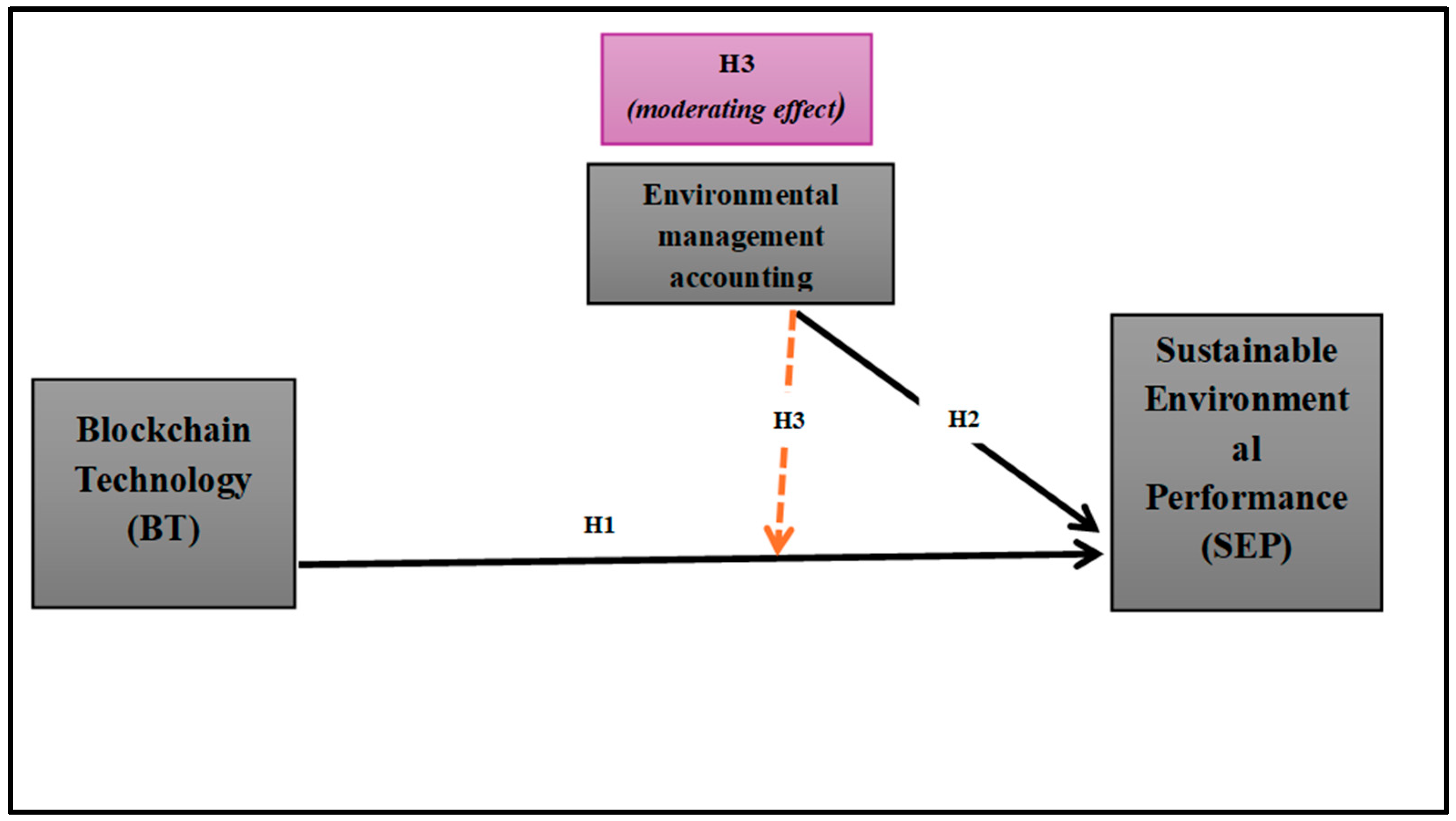
3.1. BT Impact on SEP
3.2. EMA and SEP
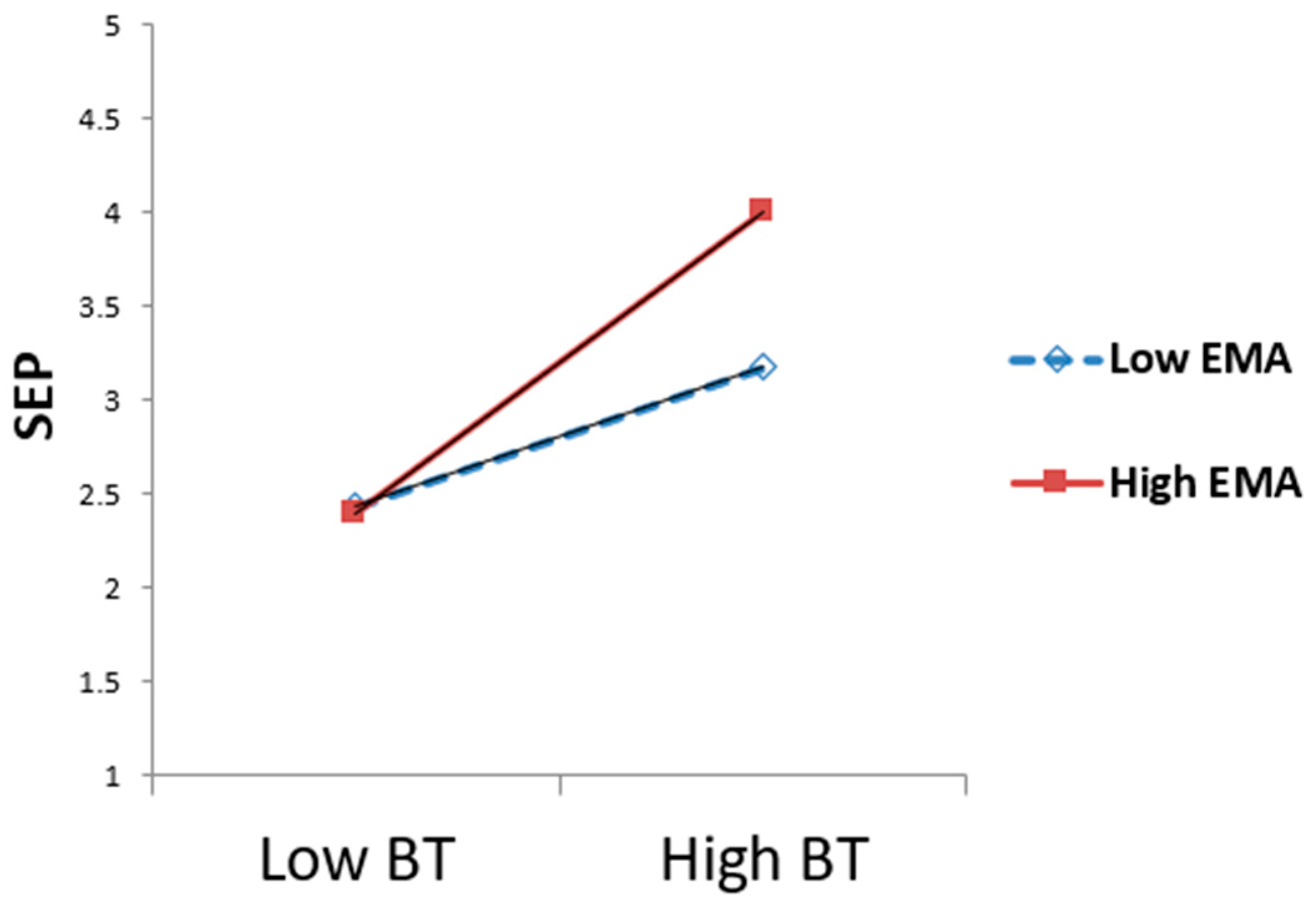
3.3. Moderation Effect of EMA
4. Research Methodology
4.1. Data Collection and Survey Design
4.2. Measures and Scale Development
4.3. The Common Method Bias (CMB)
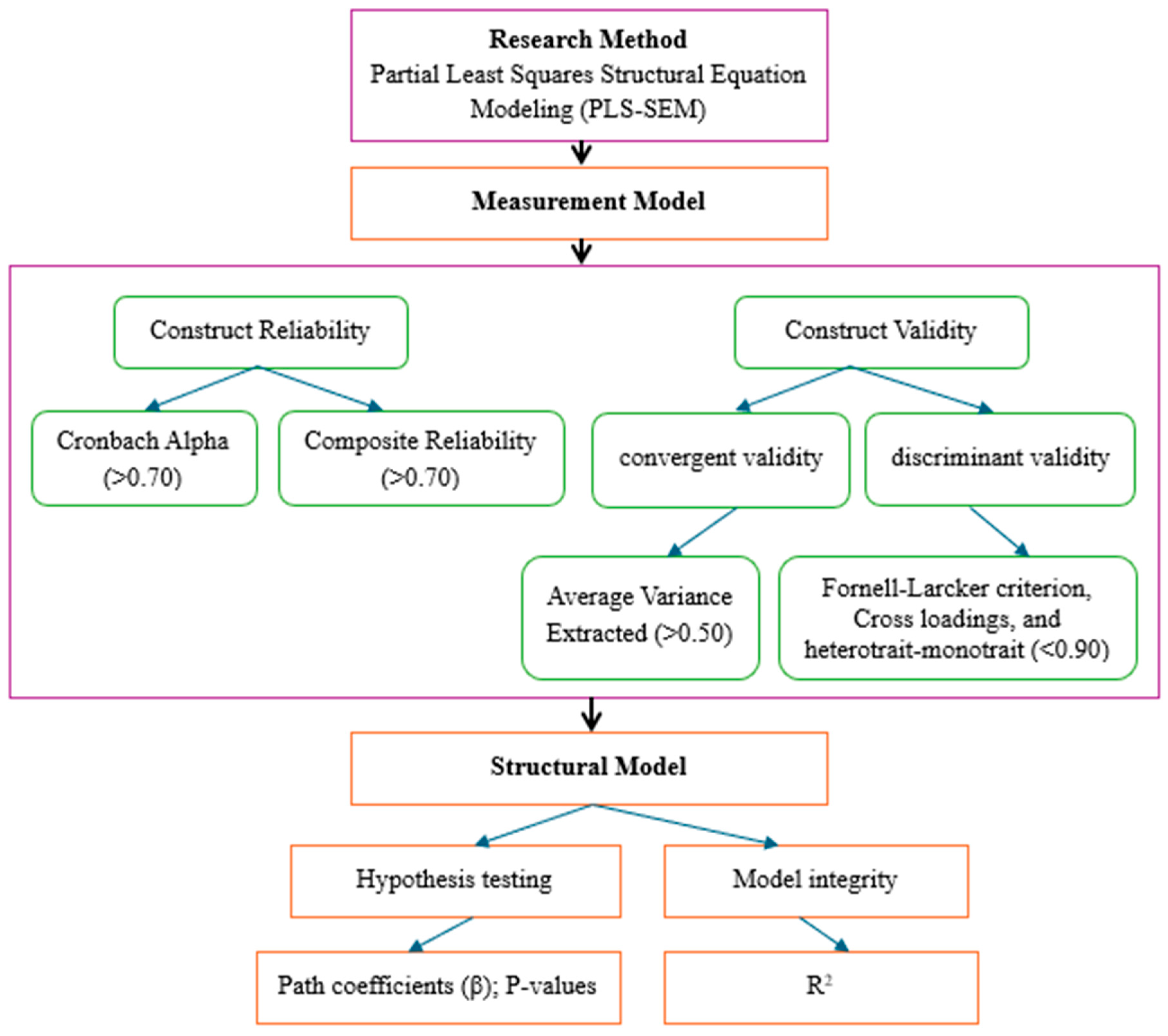
4.4. Data Analysis Methods
5. Main Results
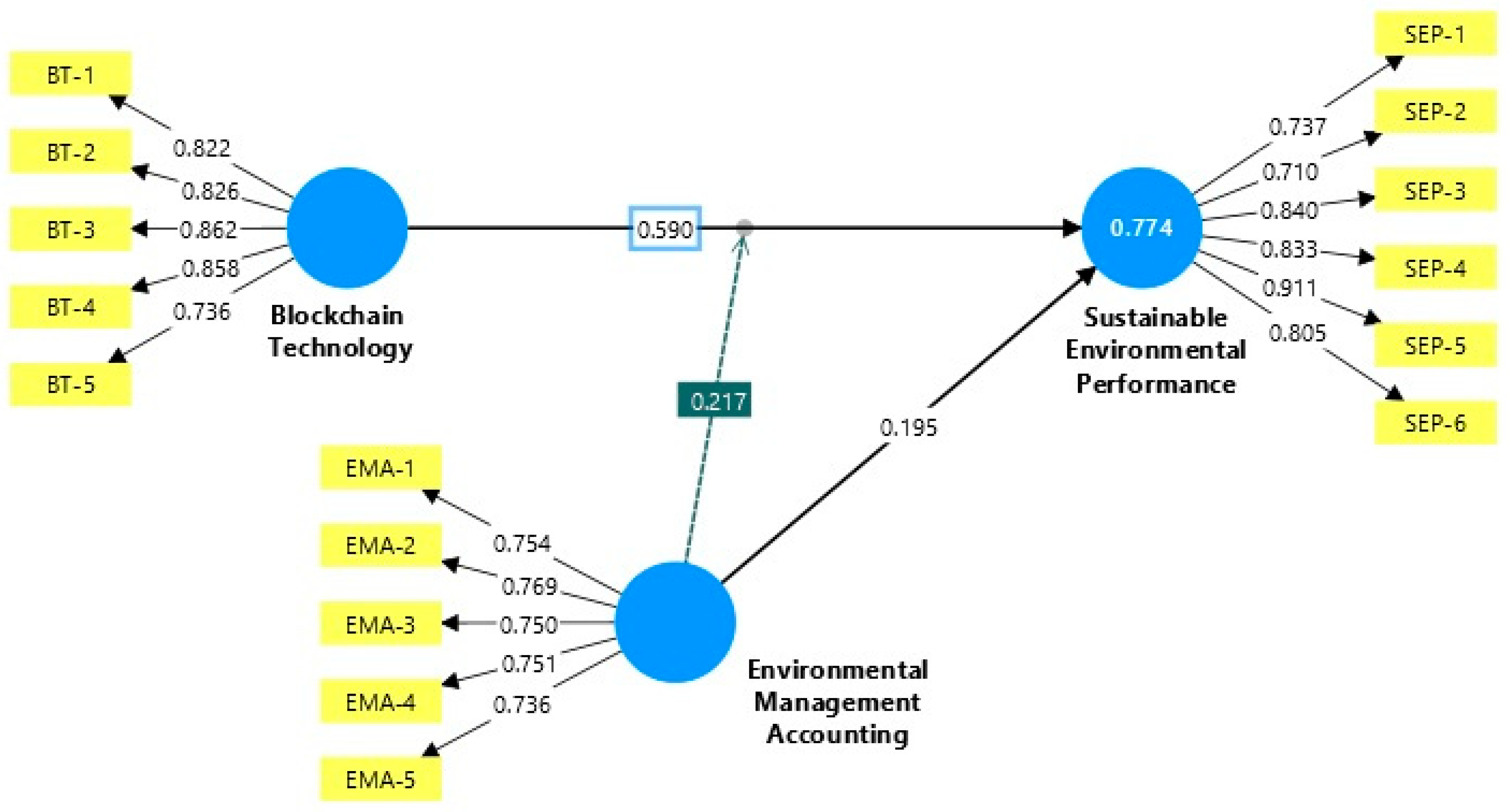
5.1. Measurement Model Assessment
5.2. Hypotheses Testing
6. Discussion
7. Conclusions, Limitations, and Future Research
Author Contributions
Funding
Institutional Review Board Statement
Informed Consent Statement
Data Availability Statement
Conflicts of Interest
References
- Burritt, R.L.; Hahn, T.; Schaltegger, S. Towards a Comprehensive Framework for Environmental Management Accounting—Links Between Business Actors and Environmental Management Accounting Tools. Aust. Account. Rev. 2008, 12, 39–50. [Google Scholar] [CrossRef]
- Alnaim, M.; Metwally, A.B. Board Gender Diversity and the Value Effect of Climate Change Reporting: Empirical Evidence from an Emerging Market. Int. J. Financ. Stud. 2026, 14, 57. [Google Scholar] [CrossRef]
- Hammami, H.; Othmani, L. Adopting sustainable manufacturing practices: The relationship between environmental performance and corporate reputation. Int. J. Organ. Anal. 2024, 33, 3025–3046. [Google Scholar] [CrossRef]
- Nishitani, K.; Jannah, N.; Kaneko, S.; Hardinsyah. Does corporate environmental performance enhance financial performance? An empirical study of indonesian firms. Environ. Dev. 2017, 23, 10–21. [Google Scholar] [CrossRef]
- Akhimien, O.G.; Adekunle, S.A. Technological environment and sustainable performance of oil and gas firms: A structural equation modelling approach. Future Bus. J. 2023, 9, 24. [Google Scholar] [CrossRef]
- Metwally, A.B.; Hasanein, A.M. Unpacking the Role of Green Process Innovation as a Linking Mechanism Between Environmental Management Accounting and Environmental Performance in the Oil Sector. Adm. Sci. 2026, 16, 125. [Google Scholar] [CrossRef]
- Hart, S.L. A Natural-Resource-Based View of the Firm. Acad. Manag. Rev. 1995, 20, 986–1014. [Google Scholar] [CrossRef]
- Appannan, J.S.; Mohd Said, R.; Ong, T.S.; Senik, R. Promoting sustainable development through strategies, environmental management accounting and environmental performance. Bus. Strategy Environ. 2023, 32, 1914–1930. [Google Scholar] [CrossRef]
- Alnaim, M.; Metwally, A.B. Institutional Pressures and Environmental Management Accounting Adoption: Do Environmental Strategy Matter? Sustainability 2024, 16, 3020. [Google Scholar] [CrossRef]
- Martínez-Peláez, R.; Ochoa-Brust, A.; Rivera, S.; Félix, V.G.; Ostos, R.; Brito, H.; Félix, R.A.; Mena, L.J. Role of Digital Transformation for Achieving Sustainability: Mediated Role of Stakeholders, Key Capabilities, and Technology. Sustainability 2023, 15, 11221. [Google Scholar] [CrossRef]
- Burritt, R.; Christ, K. Industry 4.0 and environmental accounting: A new revolution? Asian J. Sustain. Soc. Responsib. 2016, 1, 23–38. [Google Scholar] [CrossRef]
- Hanifah, I.A.; Ismail, T.; Clyde, V. Management Accounting System as Mediating the Relationship of Blockchain Technology and Strategic Management Accounting on Sustainability Performance. J. Cult. Anal. Soc. Change 2025, 10, 372–382. [Google Scholar] [CrossRef]
- Wamba, S.F.; Queiroz, M.M. Blockchain in the operations and supply chain management: Benefits, challenges and future research opportunities. Int. J. Inf. Manag. 2020, 52, 102064. [Google Scholar] [CrossRef]
- Kumar, A.; Liu, R.; Shan, Z. Is Blockchain a Silver Bullet for Supply Chain Management? Technical Challenges and Research Opportunities. Decis. Sci. 2020, 51, 8–37. [Google Scholar] [CrossRef]
- Bai, C.; Sarkis, J. A supply chain transparency and sustainability technology appraisal model for blockchain technology. Int. J. Prod. Res. 2020, 58, 2142–2162. [Google Scholar] [CrossRef]
- Buhaya, M.I.; Metwally, A.B.M. Green intellectual capital and green supply chain performance: Do external pressures matter? Cogent Bus. Manag. 2024, 11, 2349276. [Google Scholar] [CrossRef]
- Ali, M.A.; Elshaer, I.A.; Montash, A.A.; Metwally, A.B. The Role of Technological Readiness in Enhancing the Quality of Audit Work: Evidence from an Emerging Market. J. Risk Financ. Manag. 2024, 17, 489. [Google Scholar] [CrossRef]
- Di Vaio, A.; Varriale, L. Blockchain technology in supply chain management for sustainable performance: Evidence from the airport industry. Int. J. Inf. Manag. 2020, 52, 102014. [Google Scholar] [CrossRef]
- Li, X.; Lai, P.-L.; Yang, C.-C.; Yuen, K.F. Determinants of blockchain adoption in the aviation industry: Empirical evidence from Korea. J. Air Transp. Manag. 2021, 97, 102139. [Google Scholar] [CrossRef]
- Chen, Y.; Zhao, Y.; Wu, Y. Recent progress in air traffic flow management: A review. J. Air Transp. Manag. 2024, 116, 102573. [Google Scholar] [CrossRef]
- Chomachaei, F. The Impact of Blockchain-Based Technology on Airport Operational and Environmental Performance: Empirical Evidence From European Airports. J. Bus. Logist. 2025, 46, e70029. [Google Scholar] [CrossRef]
- Park, A.; Li, H. The Effect of Blockchain Technology on Supply Chain Sustainability Performances. Sustainability 2021, 13, 1726. [Google Scholar] [CrossRef]
- Jan, A.; Salameh, A.A.; Rahman, H.U.; Alasiri, M.M. Can blockchain technologies enhance environmental sustainable development goals performance in manufacturing firms? Potential mediation of green supply chain management practices. Bus. Strategy Environ. 2024, 33, 2004–2019. [Google Scholar] [CrossRef]
- Kouhizadeh, M.; Sarkis, J. Blockchain Practices, Potentials, and Perspectives in Greening Supply Chains. Sustainability 2018, 10, 3652. [Google Scholar] [CrossRef]
- Truby, J. Decarbonizing Bitcoin: Law and policy choices for reducing the energy consumption of Blockchain technologies and digital currencies. Energy Res. Soc. Sci. 2018, 44, 399–410. [Google Scholar] [CrossRef]
- Saberi, S.; Kouhizadeh, M.; Sarkis, J.; Shen, L. Blockchain technology and its relationships to sustainable supply chain management. Int. J. Prod. Res. 2019, 57, 2117–2135. [Google Scholar] [CrossRef]
- Hasan, M.R.; Shiming, D.; Islam, M.A.; Hossain, M.Z. Operational efficiency effects of blockchain technology implementation in firms: Evidence from China. Rev. Int. Bus. Strategy 2020, 30, 163–181. [Google Scholar] [CrossRef]
- Singh, A.K.; Kumar, V.R.P.; Shoaib, M.; Adebayo, T.S.; Irfan, M. A strategic roadmap to overcome blockchain technology barriers for sustainable construction: A deep learning-based dual-stage SEM-ANN approach. Technol. Forecast. Soc. Change 2023, 194, 122716. [Google Scholar] [CrossRef]
- Sari, R.N.; Pratadina, A.; Anugerah, R.; Kamaliah, K.; Sanusi, Z.M. Effect of environmental management accounting practices on organizational performance: Role of process innovation as a mediating variable. Bus. Process Manag. J. 2020, 27, 1296–1314. [Google Scholar] [CrossRef]
- Alnaim, M.; Metwally, A.B. Green Intellectual Capital and Corporate Environmental Performance: Does Environmental Management Accounting Matter? Adm. Sci. 2024, 14, 311. [Google Scholar] [CrossRef]
- Asiaei, K.; Jusoh, R.; Barani, O.; Asiaei, A. How does green intellectual capital boost performance? The mediating role of environmental performance measurement systems. Bus. Strategy Environ. 2022, 31, 1587–1606. [Google Scholar] [CrossRef]
- Nguyen, N.M.; Abu Afifa, M.; Van Bui, D. Blockchain technology and sustainable performance: Moderated-mediating model with management accounting system and digital transformation. Environ. Dev. Sustain. 2025, 27, 7255–7277. [Google Scholar] [CrossRef]
- Jović, M.; Tijan, E.; Žgaljić, D.; Aksentijević, S. Improving Maritime Transport Sustainability Using Blockchain-Based Information Exchange. Sustainability 2020, 12, 8866. [Google Scholar] [CrossRef]
- Parmentola, A.; Petrillo, A.; Tutore, I.; De Felice, F. Is blockchain able to enhance environmental sustainability? A systematic review and research agenda from the perspective of Sustainable Development Goals (SDGs). Bus. Strategy Environ. 2022, 31, 194–217. [Google Scholar] [CrossRef]
- Wu, J.; Ding, Y.; Zhang, F.; Li, D. How to improve environmental performance of heavily polluting companies in China? A cross-level configurational approach. J. Clean. Prod. 2021, 311, 127450. [Google Scholar] [CrossRef]
- Sadenova, A.; Martínez-Falcó, J.; Sánchez-García, E.; Marco-Lajara, B.; Saltanat, S.; Kozlova, M.V. Green intellectual capital and green competitive advantage: Examining the role of green technological innovation and environmental management accounting. VINE J. Inf. Knowl. Manag. Syst. 2025, 56, 728–751. [Google Scholar] [CrossRef]
- Buhaya, M.I.; Metwally, A.B. The Interplay Between Digital Technologies and Sustainable Performance: Does Lean Manufacturing Matter? Sustainability 2024, 16, 10002. [Google Scholar] [CrossRef]
- Teece, D.J.; Pisano, G.; Shuen, A. Dynamic capabilities and strategic management. Strateg. Manag. J. 1997, 18, 509–533. [Google Scholar] [CrossRef]
- Barney, J. Firm Resources and Sustained Competitive Advantage. J. Manag. 1991, 17, 99–120. [Google Scholar] [CrossRef]
- Hart, S.L.; Dowell, G. Invited Editorial: A Natural-Resource-Based View of the Firm: Fifteen Years After. J. Manag. 2011, 37, 1464–1479. [Google Scholar] [CrossRef]
- Galbraith, J. Designing complex organizations. Sloan Manag. Rev. 1973, 15, 103. [Google Scholar]
- Mishra, P.; Yadav, M. Environmental capabilities, proactive environmental strategy and competitive advantage: A natural-resource-based view of firms operating in India. J. Clean. Prod. 2021, 291, 125249. [Google Scholar] [CrossRef]
- Nonaka, I. A Dynamic Theory of Organizational Knowledge Creation. Organ. Sci. 1994, 5, 14–37. [Google Scholar] [CrossRef]
- Grant, R.M. Toward a knowledge-based theory of the firm. Strateg. Manag. J. 1996, 17, 109–122. [Google Scholar] [CrossRef]
- Bergendahl, J.A.; Sarkis, J.; Timko, M.T. Transdisciplinarity and the food energy and water nexus: Ecological modernization and supply chain sustainability perspectives. Resour. Conserv. Recycl. 2018, 133, 309–319. [Google Scholar] [CrossRef]
- Hunt, S.D. A General Theory of Competition: Resources, Competences, Productivity, Economic Growth; Sage Publications: Thousand Oaks, CA, USA, 1999. [Google Scholar]
- Wu, I.-L.; Chiu, M.-L. Organizational applications of IT innovation and firm’s competitive performance: A resource-based view and the innovation diffusion approach. J. Eng. Technol. Manag. 2015, 35, 25–44. [Google Scholar] [CrossRef]
- Li, Y.; Dai, J.; Cui, L. The impact of digital technologies on economic and environmental performance in the context of industry 4.0: A moderated mediation model. Int. J. Prod. Econ. 2020, 229, 107777. [Google Scholar] [CrossRef]
- Pan, X.; Pan, X.; Song, M.; Ai, B.; Ming, Y. Blockchain technology and enterprise operational capabilities: An empirical test. Int. J. Inf. Manag. 2020, 52, 101946. [Google Scholar] [CrossRef]
- Alkhudary, R. Is blockchain truly improving supply chain information quality? A positivist case study research. Int. J. Logist. Manag. 2024, 36, 1039–1062. [Google Scholar] [CrossRef]
- Andersén, J. A relational natural-resource-based view on product innovation: The influence of green product innovation and green suppliers on differentiation advantage in small manufacturing firms. Technovation 2021, 104, 102254. [Google Scholar] [CrossRef]
- Lohmer, J.; Bugert, N.; Lasch, R. Analysis of resilience strategies and ripple effect in blockchain-coordinated supply chains: An agent-based simulation study. Int. J. Prod. Econ. 2020, 228, 107882. [Google Scholar] [CrossRef] [PubMed]
- Wiklund, J.; Shepherd, D. Knowledge-based resources, entrepreneurial orientation, and the performance of small and medium-sized businesses. Strateg. Manag. J. 2003, 24, 1307–1314. [Google Scholar] [CrossRef]
- Curado, C.; Bontis, N. The knowledge-based view of the firm and its theoretical precursor. Int. J. Learn. Intellect. Cap. 2006, 3, 367–381. [Google Scholar] [CrossRef]
- Solovida, G.T.; Latan, H. Linking environmental strategy to environmental performance: Mediation role of environmental management accounting. Sustain. Account. Manag. Policy J. 2017, 8, 595–619. [Google Scholar] [CrossRef]
- Latan, H.; Chiappetta Jabbour, C.J.; Lopes de Sousa Jabbour, A.B.; Wamba, S.F.; Shahbaz, M. Effects of environmental strategy, environmental uncertainty and top management’s commitment on corporate environmental performance: The role of environmental management accounting. J. Clean. Prod. 2018, 180, 297–306. [Google Scholar] [CrossRef]
- Jain, D.; Sharma, H. Does innovative work behavior and digital transformation drive employee performance? A sequential mediation approach. Int. J. Product. Perform. Manag. 2025, 75, 930–952. [Google Scholar] [CrossRef]
- Ensign, P.C. A resource-based view of interrelationships among organizational groups in the diversified firm. Strateg. Change 2004, 13, 125–137. [Google Scholar] [CrossRef]
- Semenova, V. Technology adoption theories in examining the uptake of blockchain technology in the framework of functionalist and interpretive paradigms. Bp. Manag. Rev. 2020, 51, 26–38. [Google Scholar] [CrossRef]
- Dutta, P.; Choi, T.-M.; Somani, S.; Butala, R. Blockchain technology in supply chain operations: Applications, challenges and research opportunities. Transp. Res. Part E Logist. Transp. Rev. 2020, 142, 102067. [Google Scholar] [CrossRef] [PubMed]
- Chang, V.; Baudier, P.; Zhang, H.; Xu, Q.; Zhang, J.; Arami, M. How Blockchain can impact financial services—The overview, challenges and recommendations from expert interviewees. Technol. Forecast. Soc. Change 2020, 158, 120166. [Google Scholar] [CrossRef] [PubMed]
- Dong, X.; Hao, X.; Cai, C.; Li, X.; Wang, K.; Zhang, J. The impact of blockchain adoption in supply chain systems on corporate performance: A technology–organization–environment framework. Prod. Plan. Control 2025, 36, 1431–1452. [Google Scholar] [CrossRef]
- Chaudhari, R.S.; Rane, S.B.; Mahajan, S.K.; Phanden, R.K.; Mogal, Y.K. Integrated IoT-Blockchain architecture for sustainable green supply chains in agriculture equipment manufacturing industries: A TOPSIS approach. Int. J. Comput. Integr. Manuf. 2026, 39, 151–182. [Google Scholar] [CrossRef]
- Zhang, Y.; Yu, J.; Wang, J.; Song, Y. Blockchain technology, information asymmetry and corporate ESG performance: Evidence from China. Energy Econ. 2026, 155, 109150. [Google Scholar] [CrossRef]
- Gafsi, N.; Hamdouni, A.; Smaoui, A. Digital Technologies and Sustainable Development: Evidence from FinTech, AI, and Blockchain Adoption in G20 Economies. Sustainability 2026, 18, 2484. [Google Scholar] [CrossRef]
- Bakarich, K.M.; Castonguay, J.J.; O’Brien, P.E. The Use of Blockchains to Enhance Sustainability Reporting and Assurance. Account. Perspect. 2020, 19, 389–412. [Google Scholar] [CrossRef]
- Metwally, A.B.; Ali, H.A.; Aly, S.A.; Ali, M.A. The Interplay between Digital Technologies, Supply Chain Resilience, Robustness and Sustainable Environmental Performance: Does Supply Chain Complexity Matter? Sustainability 2024, 16, 6175. [Google Scholar] [CrossRef]
- Tijjani, B.; Yahaya, O.A. Blockchain Technology Adoption and Environmental Performance. J. Financ. Technol. Regul. 2025, 14, 701–738. [Google Scholar]
- Zhang, Q.; Ouyang, Y.; Li, L. How do digital oriented firms perform superior environmental performance? A natural resource based view. Chin. Manag. Stud. 2025, 19, 1708–1727. [Google Scholar] [CrossRef]
- Tawiah, V.; Zakari, A.; Li, G.; Kyiu, A. Blockchain technology and environmental efficiency: Evidence from US-listed firms. Bus. Strategy Environ. 2022, 31, 3757–3768. [Google Scholar] [CrossRef]
- Qadri, H.M.-u.-D.; Ali, H.; Mustafa, A.U.L. Relationship between environmental performance indices and blockchain-based sustainability-focused companies: Evidence from countries in Europe and America. Reg. Sustain. 2025, 6, 100214. [Google Scholar] [CrossRef]
- Russo-Spena, T.; Di Paola, N.; Mele, C. Blockchain and business performance: Paving the way to economic, social and environmental goals. Technol. Anal. Strateg. Manag. 2026, 38, 229–243. [Google Scholar] [CrossRef]
- Shan, B.; Nisar, Q.A.; Ali, I. Leveraging blockchain technology and process innovation for green supply chain performance in environmentally sensitive industries. Technol. Forecast. Soc. Change 2026, 224, 124505. [Google Scholar] [CrossRef]
- Joshi, C. An Overview of Emerging Updates in Blockchain Technology: Analysis and Recommendations. In Blockchain in Digital Healthcare; Joshi, C., Arya, K.V., Shukla, A.K., Shree, R., Pandey, R.P., Shukla, V., Dhadwal, M.K., Eds.; Taylor & Francis Group: New York, NY, USA, 2021; Volume 1, pp. 1–14. [Google Scholar]
- Ronaghi, M.H.; Mosakhani, M. The effects of blockchain technology adoption on business ethics and social sustainability: Evidence from the Middle East. Environ. Dev. Sustain. 2022, 24, 6834–6859. [Google Scholar] [CrossRef] [PubMed]
- Indrayani, S.V.; Rahayu, S.; Putra, W.E. From Environment to Profit: The Impact of Green Accounting and Environmental Performance on Financial Performance. J. Sos. Dan. Sains 2025, 5, 990–1001. [Google Scholar] [CrossRef]
- Al-Hattami, H.M.; Mady, K.; Al-Bukhrani, M.A. Green digital accounting and sustainable entrepreneurship in emerging economies: Impacts on financial sustainability and performance. Cogent Bus. Manag. 2026, 13, 2601944. [Google Scholar] [CrossRef]
- Mohammed, A.; Sulaiman, S.; Zin, N.M. The Role of Management Accounting System to Enhance The Sustainable Financial Reporting. In Proceedings of the International Conference in Technology, Humanities and Management (ICTHM 2023), Istanbul, Turkey, 12–13 June 2023; pp. 1193–1210. [Google Scholar]
- Hanif, S.; Ahmed, A.; Younas, N. Examining the impact of Environmental Management Accounting practices and Green Transformational Leadership on Corporate Environmental Performance: The mediating role of Green Process Innovation. J. Clean. Prod. 2023, 414, 137584. [Google Scholar] [CrossRef]
- Sinuraya, C.; Augustine Sudibyo, Y. Implementation of environmental management accounting and strategy for competitive advantage with the role of green innovation as an intervening variable. Asian J. Manag. Entrep. Soc. Sci. 2026, 6, 327–348. [Google Scholar]
- Borodin, A.; Shash, N.; Panaedova, G.; Frumina, S.; Kairbekuly, A.; Mityushina, I. The impact of the publication of non-financial statements on the financial performance of companies with the identification of intersectoral features. Entrep. Sustain. Issues 2019, 7, 1666–1685. [Google Scholar] [CrossRef] [PubMed]
- Alonzei, Y.D.A.; Jarraya, B. Investigating the Impact of Environmental Management Accounting Practices on Sustainability of Companies in High Impact Industries: A Look into the Current Evidence. Saudi J. Bus. Manag. Stud. 2026, 11, 1–7. [Google Scholar] [CrossRef]
- Xia, L.; Fatema, N.; Rahman, M.M.; Hossain, A. Nexus of environmental management accounting, and carbon emission management on environmental, social, and governance performance: Evidence from symmetrical and asymmetrical approach. Humanit. Soc. Sci. Commun. 2025, 12, 1073. [Google Scholar] [CrossRef]
- Al-Baghdadi, E.N.; Alrub, A.A.; Rjoub, H. Sustainable Business Model and Corporate Performance: The Mediating Role of Sustainable Orientation and Management Accounting Control in the United Arab Emirates. Sustainability 2021, 13, 8947. [Google Scholar] [CrossRef]
- Cosma, S.; Leopizzi, R.; Nobile, L.; Schwizer, P. Revising the Non-Financial Reporting Directive and the role of board of directors: A lost opportunity? J. Appl. Account. Res. 2021, 23, 207–226. [Google Scholar] [CrossRef]
- Bresciani, S.; Rehman, S.U.; Giovando, G.; Alam, G.M. The role of environmental management accounting and environmental knowledge management practices influence on environmental performance: Mediated-moderated model. J. Knowl. Manag. 2022, 27, 896–918. [Google Scholar] [CrossRef]
- Ningrum, A.L.S.; Hendarmin, R.; Pebriani, R.A. Integration of Green Accounting, Sustainability Disclosure, and Stakeholder Engagement on Company Performance. Gold. Ratio Audit. Res. 2026, 6, 586–598. [Google Scholar] [CrossRef]
- Al-Hattami, H.M.; Hashed, A.A.; Kabra, J.D. Effect of AIS success on performance measures of SMEs: Evidence from Yemen. Int. J. Bus. Inf. Syst. 2021, 36, 144–164. [Google Scholar] [CrossRef]
- Ibrahim, A.; Abdullah, A.; Khalik, A.; Putra, A.H.P.K. The Mediating Role of Green Accounting Management on Financial Performance: Integrated Stakeholder Theory and Natural Resource-Based View. Int. J. Energy Econ. Policy 2025, 15, 245–261. [Google Scholar] [CrossRef]
- Liem, V.T.; Hien, N.N. The Impact of Green Transformational Leadership on Green Production Strategy, Environmental Management Accounting and Environmental Performance: The Moderator Role of Perceived Environmental Uncertainty. Sage Open 2026, 16, 1–18. [Google Scholar] [CrossRef]
- Borhani, S.A.; Babajani, J.; Raeesi Vanani, I.; Sheri Anaqiz, S.; Jamaliyanpour, M. Adopting blockchain technology to improve financial reporting by using the technology acceptance model (TAM). Int. J. Financ. Manag. Account. 2021, 6, 155–171. [Google Scholar]
- Reddivari, A.; Paramita, M.W.; Safira, S.; Payamta, P. Corporate governance structures and carbon disclosure quality: A dynamic panel analysis with environmental performance moderation. Proceeding Int. Conf. Account. Financ. 2026, 4, 197–211. [Google Scholar]
- Magableh, K.N.; Kannan, S.; Hmoud, A.Y. Innovation Business Model: Adoption of Blockchain Technology and Big Data Analytics. Sustainability 2024, 16, 5921. [Google Scholar] [CrossRef]
- Thanh Thuy Ngoc, T. Unlocking environmental management accounting and environmental performance: A mediated moderation model through green technology innovation and environmental strategy. Meditari Account. Res. 2025, 33, 733–758. [Google Scholar] [CrossRef]
- Handoko, B.L.; Arfianti, F.; Marlinda, S. The Utilization of Blockchain Technology on Remote Audit to Ensure Audit Data Integrity in Detecting Potential Fraudulent Financial Reporting. In Proceedings of the 2022 6th International Conference on Software and e-Business, Shenzhen, China, 9–11 December 2022; pp. 104–112. [Google Scholar]
- Saleh, I.; Marei, Y.; Ayoush, M.; Abu Afifa, M.M. Big Data analytics and financial reporting quality: Qualitative evidence from Canada. J. Financ. Report. Account. 2022, 21, 83–104. [Google Scholar] [CrossRef]
- Zhao, R.; Mou, Y.; Yu, X. Analysis of the moderating effects of environmental regulations on green accounting information disclosure and financial performance of heavily polluting enterprises. Financ. Res. Lett. 2025, 72, 106493. [Google Scholar] [CrossRef]
- Metwally, A.B.M.; Diab, A. Risk-based management control resistance in a context of institutional complexity: Evidence from an emerging economy. J. Account. Organ. Change 2021, 17, 416–435. [Google Scholar] [CrossRef]
- Aljumah, A.I. Investigating the Impact of Blockchain Technology on Social Sustainability and the Mediating Role of Ethics and CSR. Sustainability 2023, 15, 15510. [Google Scholar] [CrossRef]
- Riaz, A.; Cepel, M.; Ferraris, A.; Ashfaq, K.; Rehman, S.U. Nexus among green intellectual capital, green information systems, green management initiatives and sustainable performance: A mediated-moderated perspective. J. Intellect. Cap. 2024, 25, 297–327. [Google Scholar] [CrossRef]
- Khan, S.A.R.; Godil, D.I.; Jabbour, C.J.C.; Shujaat, S.; Razzaq, A.; Yu, Z. Green data analytics, blockchain technology for sustainable development, and sustainable supply chain practices: Evidence from small and medium enterprises. Ann. Oper. Res. 2025, 350, 603–627. [Google Scholar] [CrossRef]
- Lin, J.; Zeng, Y.; Wu, S.; Luo, X. How does artificial intelligence affect the environmental performance of organizations? The role of green innovation and green culture. Inf. Manag. 2024, 61, 103924. [Google Scholar] [CrossRef]
- Phan, T.N.; Baird, K.; Su, S. The use and effectiveness of environmental management accounting. Australas. J. Environ. Manag. 2017, 24, 355–374. [Google Scholar] [CrossRef]
- Latif, B.; Mahmood, Z.; Tze San, O.; Mohd Said, R.; Bakhsh, A. Coercive, Normative and Mimetic Pressures as Drivers of Environmental Management Accounting Adoption. Sustainability 2020, 12, 4506. [Google Scholar] [CrossRef]
- Podsakoff, P.M.; Organ, D.W. Self-Reports in Organizational Research: Problems and Prospects. J. Manag. 1986, 12, 531–544. [Google Scholar] [CrossRef]
- Alhasan, S.A.; Naser, D.M.; Al-Taha, S.M.M.; Hasan, A.A.; AL-Husseini, Z.; Salman, H.A.; Kalaf, G.A. The impact of supply chain management capabilities and total quality management on corporate sustainable performance with moderating role of operational performance: A cross-sectional study on Iraq textile companies. Int. J. Oper. Quant. Manag. 2022, 28, 441–460. [Google Scholar]
- Kock, N. Common method bias in PLS-SEM: A full collinearity assessment approach. Int. J. E-Collab. 2015, 11, 1–10. [Google Scholar] [CrossRef]
- Hair, J.F.; Risher, J.J.; Sarstedt, M.; Ringle, C.M. When to use and how to report the results of PLS-SEM. Eur. Bus. Rev. 2019, 31, 2–24. [Google Scholar] [CrossRef]
- Hair, J.F.; Hult, G.T.M.; Ringle, C.M.; Sarstedt, M.; Danks, N.P.; Ray, S. An Introduction to Structural Equation Modeling. In Partial Least Squares Structural Equation Modeling (PLS-SEM) Using R: A Workbook; Hair, J.F., Jr., Hult, G.T.M., Ringle, C.M., Sarstedt, M., Danks, N.P., Ray, S., Eds.; Springer International Publishing: Cham, Switzerland, 2021; pp. 1–29. [Google Scholar] [CrossRef]
- Henseler, J.; Ringle, C.M.; Sarstedt, M. A new criterion for assessing discriminant validity in variance-based structural equation modeling. J. Acad. Mark. Sci. 2015, 43, 115–135. [Google Scholar] [CrossRef]
- Gunarathne, A.D.N.; Lee, K.-H.; Hitigala Kaluarachchilage, P.K. Institutional pressures, environmental management strategy, and organizational performance: The role of environmental management accounting. Bus. Strategy Environ. 2021, 30, 825–839. [Google Scholar] [CrossRef]
- Metwally, A.B.; Almulhim, A.; Halim, Y.T.; El-Deeb, M.S. Exploring the Nexus Between Economic Utility, Perceived Risk, Organizational Characteristics, and Supply Chain Performance. Adm. Sci. 2025, 15, 85. [Google Scholar] [CrossRef]



| Freq. | % | ||
|---|---|---|---|
| Gender | Female | 92 | 22.2 |
| Male | 323 | 77.8 | |
| Total | 415 | 100 | |
| Years of experience | 1–5 years | 12 | 2.9 |
| 6–10 years | 78 | 18.8 | |
| 11–15 years | 110 | 26.5 | |
| More than 15 years | 215 | 51.8 | |
| Total | 415 | 100 | |
| Educational Level | Bachelor | 118 | 28.4 |
| Masters | 205 | 49.4 | |
| PhD | 92 | 22.2 | |
| Total | 415 | 100 | |
| Industry | Food, Beverages, and Tobacco | 70 | 16.9 |
| Industrial Goods, Services and Automobiles | 77 | 18.5 | |
| Basic Resources | 68 | 16.4 | |
| Healthcare & Pharmaceuticals | 75 | 18.1 | |
| Textile & Durables | 40 | 9.6 | |
| Building Materials | 85 | 20.5 | |
| Total | 415 | 100 | |
| Scale Variables and Items | Outer Loading | Alpha | CR | AVE |
|---|---|---|---|---|
| Blockchain Technology (BT) | 0.887 | 0.914 | 0.678 | |
| BT is used by our company to improve sustainability reporting and environmental data transparency. | 0.822 | |||
| Data on compliance and environmental performance are safely recorded using blockchain systems. | 0.826 | |||
| BT enhances raw material traceability and facilitates supply chain environmental effect monitoring. | 0.862 | |||
| Blockchain-supported smart contracts make it easier to adhere to environmental laws and norms. | 0.858 | |||
| Stakeholder trust in environmental practices and sustainability efforts is increased by BT. | 0.736 | |||
| Environmental Management Accounting (EMA) | 0.821 | 0.869 | 0.568 | |
| Our company’s accounting system carefully records and captures all physical inputs and outputs, including materials, energy, water, wastes, and emissions. | 0.754 | |||
| Product inventory analysis, product improvement evaluations, and product environmental impact assessments are all possible with our company’s accounting system. | 0.769 | |||
| The accounting system of our business is able to recognize, categorize, and project environmental costs and liabilities. | 0.750 | |||
| The ability to generate and utilize environment-related expense accounts is part of our company’s accounting system. | 0.751 | |||
| The accounting system of our business is able to allocate environmental charges to individual items. | 0.736 | |||
| Sustainable Environmental Performance (SEP) | 0.895 | 0.921 | 0.658 | |
| Our company has reduced waste and pollution in the air. | 0.737 | |||
| The energy and water consumption of our company has decreased. | 0.710 | |||
| Our organization now purchases fewer non-renewable resources, chemicals, and components. | 0.840 | |||
| At our company, environmental mishaps have become less frequent. | 0.833 | |||
| Our company has improved its environmental position by following environmental regulations. | 0.911 | |||
| Our company provides environmental education to its employees as well as the general public. | 0.805 |
| Fornell–Larcker | HTMT | |||||
|---|---|---|---|---|---|---|
| BT | EMA | SEP | BT | EMA | SEP | |
| 1. BT | 0.822 | |||||
| 2. EMA | 0.598 | 0.752 | 0.660 | |||
| 3. SEP | 0.731 | 0.639 | 0.809 | 0.821 | 0.708 | |
| BT | EMA | SEP | |
|---|---|---|---|
| BT-1 | 0.822 | 0.466 | 0.510 |
| BT-2 | 0.826 | 0.411 | 0.527 |
| BT-3 | 0.862 | 0.519 | 0.452 |
| BT-4 | 0.858 | 0.508 | 0.468 |
| BT-5 | 0.736 | 0.469 | 0.516 |
| EMA-1 | 0.282 | 0.754 | 0.325 |
| EMA-2 | 0.391 | 0.769 | 0.442 |
| EMA-3 | 0.369 | 0.750 | 0.384 |
| EMA-4 | 0.523 | 0.751 | 0.552 |
| EMA-5 | 0.508 | 0.736 | 0.517 |
| SEP-1 | 0.541 | 0.460 | 0.737 |
| SEP-2 | 0.534 | 0.521 | 0.710 |
| SEP-3 | 0.470 | 0.453 | 0.840 |
| SEP-4 | 0.522 | 0.504 | 0.833 |
| SEP-5 | 0.486 | 0.526 | 0.911 |
| SEP-6 | 0.504 | 0.518 | 0.805 |
| Hypotheses | Beta (β) | T-Statistics | p-Values | Results | |
|---|---|---|---|---|---|
| H-1 | BT -> SEP | 0.590 *** | 14.622 | 0.000 | Accepted |
| H-2 | EMA -> SEP | 0.195 *** | 5.339 | 0.000 | Accepted |
| H-3 | BT × EMA -> SEP | 0.217 *** | 7.411 | 0.000 | Accepted |
Disclaimer/Publisher’s Note: The statements, opinions and data contained in all publications are solely those of the individual author(s) and contributor(s) and not of MDPI and/or the editor(s). MDPI and/or the editor(s) disclaim responsibility for any injury to people or property resulting from any ideas, methods, instructions or products referred to in the content. |
© 2026 by the authors. Licensee MDPI, Basel, Switzerland. This article is an open access article distributed under the terms and conditions of the Creative Commons Attribution (CC BY) license.
Share and Cite
Metwally, A.B.M.; Ali, M.A.S.; Ellelly, N.N.A.M. The Impact of Blockchain Technology on Sustainable Environmental Performance: The Moderating Role of Environmental Management Accounting. Sustainability 2026, 18, 3974. https://doi.org/10.3390/su18083974
Metwally ABM, Ali MAS, Ellelly NNAM. The Impact of Blockchain Technology on Sustainable Environmental Performance: The Moderating Role of Environmental Management Accounting. Sustainability. 2026; 18(8):3974. https://doi.org/10.3390/su18083974
Chicago/Turabian StyleMetwally, Abdelmoneim Bahyeldin Mohamed, Mohamed Ali Shabeeb Ali, and Nouran Nabil Abdelsalam Mahmoud Ellelly. 2026. "The Impact of Blockchain Technology on Sustainable Environmental Performance: The Moderating Role of Environmental Management Accounting" Sustainability 18, no. 8: 3974. https://doi.org/10.3390/su18083974
APA StyleMetwally, A. B. M., Ali, M. A. S., & Ellelly, N. N. A. M. (2026). The Impact of Blockchain Technology on Sustainable Environmental Performance: The Moderating Role of Environmental Management Accounting. Sustainability, 18(8), 3974. https://doi.org/10.3390/su18083974