Article

How Does Rural Digitalization Affect the Resilience of the Swine Industry? A Sustainable Development Perspective

College of Economics and Management, Northeast Agricultural University, Harbin 150030, China
*
Author to whom correspondence should be addressed.
Sustainability 2026, 18(9), 4251; https://doi.org/10.3390/su18094251
Submission received: 18 March 2026 / Revised: 21 April 2026 / Accepted: 23 April 2026 / Published: 24 April 2026
(This article belongs to the Special Issue Digital Transformation and Sustainable Growth)

Abstract

Understanding the impact of rural digitalization on the resilience of the swine industry is crucial to promoting its transformation toward efficient and low-carbon production. However, existing research has not yet clarified how rural digitalization influences the resilience of the swine industry, and there is a particular lack of discussion regarding potential nonlinear relationships. Based on panel data from 30 Chinese provinces for the period 2011–2023, we employed the entropy method to measure the level of rural digitalization and the resilience of the swine industry. Two-way fixed-effects, mediation, and threshold models were adopted to empirically examine the relationship and underlying mechanisms. The findings indicated that rural digitalization significantly enhances the resilience of the swine industry, and this finding remained robust after multiple robustness checks and endogeneity treatments. This effect is primarily mediated by two pathways: industrial-scale expansion and industrial agglomeration. Additionally, well-designed environmental policies and higher rural household incomes can strengthen the beneficial effect of rural digitalization on industrial resilience. Heterogeneity analysis further reveals that the positive influence is stronger in regions with poor transportation infrastructure and in central and western China, where digitalization effectively strengthens the industry’s shock resistance and adaptive capacity. This study offers meaningful implications for policymakers seeking to accelerate rural digitalization and promote high-quality development of the swine industry in the digital age.

1. Introduction

The swine industry is a vital component of agriculture, and its sustainable development is directly linked to national food security and stable income growth for farmers [1]. In recent years, the overall production capacity of China’s swine industry has steadily increased. In 2025, the number of swine slaughtered reached 719 million, and pork production reached 59.38 million metric tons, ranking first globally and demonstrating a clear scale advantage [2]. However, the overall performance of China’s swine industry still lags behind that of other countries, and it is currently at a critical stage of transformation and upgrading. Compounded by multiple external shocks—including tightening environmental policies, recurrent disease outbreaks, and cyclical market fluctuations—the uncertainties and potential risks confronting the industry continue to escalate [3]. Against this backdrop, the resilience of the swine industry (Resi)—defined as the comprehensive capacity of farming entities to withstand external shocks, maintain core production functions, and proactively explore pathways for transformation—is becoming increasingly important [4]. Accurately assessing and enhancing Resi is not only a practical necessity for effectively addressing various uncertainties and stabilizing swine production, but also an essential requirement for accelerating the modernization of the swine industry and achieving high-quality and sustainable development.
Digital technology has emerged as a key driver in reshaping production models and enhancing industrial resilience. Since 2012, rural digitalization (Dig) has drawn substantial attention from policymakers, industry stakeholders, and researchers. Several national policies, such as the “Action Plan for the Development of Digital Villages (2022–2025)” and the “Guidelines for Digital Village Construction 2.0”, have explicitly emphasized accelerating the digital transformation of agricultural production and promoting the application of analytical and control technologies and equipment. Globally, the impact of digitalization on industrial resilience has become a prominent research focus in academia [5]. Scholars have focused on two core themes, digital empowerment of industrial development and industrial resilience, laying an important theoretical foundation for this study. From the perspective of digitalization empowering industrial development, the application of digital technologies in swine production can transform the traditional swine industry into a digitally enabled production model across the entire industrial chain [6]. The establishment of an “Internet Plus Swine Industry Chain” service platform facilitates the effective management of production and market risks through big data [7], playing a crucial role in promoting the sustainable development of the swine industry [8]. Furthermore, by collaborating with “Smart Agriculture Platforms” and leveraging the platforms’ data advantages, financial institutions can drive digital financial innovation across the swine industry chain [9], effectively lowering financing barriers for the industry chain [10], and thereby enhancing the stability of the industry chain [11].
Research on Resi has primarily focused on two dimensions: conceptual definition and pathways for enhancement. First, regarding the conceptual definition and measurement of industrial resilience, Hua et al. [4] introduced the concept of resilience into the swine industry, constructed a conceptual framework for Resi, and measured it from three perspectives: resistance, recovery, and regeneration. Giglio et al. [12], adopting an “evolutionary resilience” perspective, focused on the industry’s capacity to drive evolutionary improvements among farming entities following shocks. Zhang et al. [13] constructed a comprehensive evaluation index system for Resi based on four dimensions: resistance, recovery, innovation, and reorganization. Second, regarding pathways to enhance industrial resilience, existing research has primarily analyzed these pathways from the perspectives of risk management, industrial chain extension, and policy changes. From the risk management perspective, improving the disease risk management capabilities of swine farming enterprises helps enhance the resilience of the industrial chain [14]. From the perspective of supply chain extension, extending the supply chain can reduce transaction costs and losses across various links [15], while simultaneously fostering a production relationship of shared benefits and shared risks, thereby enhancing the risk defense capabilities of each link [16]. From the perspective of policy changes, some scholars argue that unreasonable policy changes may hinder the transition of swine production toward optimal output [17], thereby undermining industrial resilience.
Existing research indicates that the enabling role of rural digitalization in the sustainable development of the swine industry is widely recognized; however, significant shortcomings remain. On the one hand, current studies have not yet established uniform metrics for measuring Resi, and there is a lack of a universally accepted evaluation framework. On the other hand, existing research has not explicitly explored the core relationship and scope of influence between Dig and Resi, which has become a weak point in current research.
In view of the above research gaps, the marginal contributions of this study are as follows: First, using provincial panel data, we construct an evaluation index system for Dig, laying the foundation for analyzing its impact on Resi. Second, we employ a fixed-effects model to examine the enabling effects of Dig on Resi, a mediation model to analyze its underlying mechanism, and a threshold model to test its operational boundaries, and thereby this study effectively addresses the shortcomings of existing research methods. Third, we investigate the differential impacts of Dig on various dimensions of Resi, as well as its heterogeneous effects under different transportation conditions and natural endowments, providing practical guidance for context-specific digitalization and targeted resilience enhancement.

2. Theoretical Analysis

2.1. Defining the Resilience of the Swine Industry

Evolutionary economics defines Resi as the ability of producers to maintain production capacity and explore new development pathways when faced with external shocks such as market price fluctuations, animal diseases, and policy adjustments. Specifically, it encompasses three dimensions: resistance capacity, recovery capacity, and transformation capacity [18]. Resistance capacity reflects the core capacity of the swine industry to maintain the stable operation of its production system and prevent damage to its functional integrity when facing external shocks. Recovery capacity measures the industry’s ability to rapidly restore production capacity and return to normal production conditions following adverse impacts. Transformation capacity embodies the industry’s ability to transition from passively responding to risks to actively preventing them, thereby achieving long-term high-quality development through structural optimization, technological innovation, and policy support.

2.2. Direct Impact of Rural Digitalization on the Resilience of the Swine Industry

Dig is the result of the deep integration of the digital economy and rural development. It reshapes industrial production, management, and governance models through digital technologies [19], thereby influencing Resi. Based on the theory of complex adaptive systems, this study analyzes Resi from three dimensions.
First, regarding the resistance capacity of Resi, the swine industry faces multiple risks, including animal diseases, market fluctuations, and environmental policies, while livestock producers lack sufficient capacity to respond to these risks [20]. The development of Dig facilitates the application of digital technologies in production, thereby reducing both the probability and severity of various risks. The development of smart platforms helps livestock producers shift from passively responding to risks to actively managing them, effectively enhancing the industry’s risk resistance capacity. Second, regarding the recovery capacity of Resi, swine production is characterized by cyclicality and time lags; supply adjustments lag behind price changes [21], amplifying the impact of market risks. By transforming the operation and management models of farming entities, digital technologies help them quickly secure financial support [22], thereby enhancing their ability to resume production following a shock [23]. Finally, regarding the transformation capacity of Resi, the sector has long relied on extensive inputs. Given the finite nature of these resources, this model has left the industry facing the dual challenges of tight production resources and environmental pollution. The precise transmission of data enables the government to promptly grasp the industry’s supply-demand dynamics, epidemic risks, and manure treatment status, facilitating the introduction of targeted support policies, the optimization of farming layouts, and the guidance of farming entities toward standardization and intensification, thereby alleviating resource constraints. At the same time, farming entities can address production problems through online channels, while technical guidance platforms can overcome spatial and temporal constraints. Through online training and other approaches, these platforms promote advanced technologies such as precision feeding and green disease prevention and control, further boosting the industry’s transformation capacity.
Based on the above analysis, Hypothesis 1 is proposed as follows:
H1. 
Dig enhances Resi.

2.3. Indirect Effects of Rural Digitalization on the Resilience of the Swine Industry

Theories of economies of scale and industrial agglomeration in industrial organization economics suggest that Dig can effectively expand and promote industrial agglomeration among livestock producers [24,25]; large-scale production and industrial agglomeration are key drivers of increased profits for these producers. Specifically in the swine industry, large-scale farming represents horizontal expansion, whereas industrial agglomeration corresponds to vertical integration of the production chain. By acting on these two key dimensions, Dig indirectly enhances Resi.
(1) With respect to horizontal expansion, Dig provides a platform for the digital transformation of the swine industry. By lowering technological barriers and alleviating financing constraints, it drives the transition of farming entities from small-scale, scattered operations toward moderate-scale operations, thereby strengthening industrial resilience. On the one hand, Dig accelerates the dissemination of new production models and technologies among farming entities [26], breaks down information silos, expands access to cutting-edge technologies, and lays the foundation for large-scale farming. At the same time, digital production renders swine production data transparent and traceable, supporting the implementation of livestock collateral guarantees, easing financing constraints, and providing financial support for farming entities to expand their scale. On the other hand, expanding farming scale enhances market competitiveness. By leveraging economies of scale, it reduces average production costs and improves resource utilization efficiency, thereby increasing production profits [27]. It also addresses the challenges faced by small-scale farmers operating in isolation [28], strengthens their bargaining power and risk-management capability, reduces transaction costs, and further strengthens the industry’s resilience.
(2) With regard to vertical integration, Dig establishes a digital coordination system covering the entire swine production chain. By leveraging digital technology upgrades, it promotes industrial clustering, reduces risks for farming entities, improves the quality of swine products, and thereby enhances the industry’s resilience. On the one hand, digital technologies such as artificial intelligence permeate the entire swine industry chain, accelerating resource integration and driving industrial agglomeration. At the same time, farming entities along the industry chain can readily access market information through digital technology platforms, facilitating information exchange across all stages of swine farming and reinforcing the agglomeration effect. On the other hand, industrial agglomeration reduces the costs of supply chain integration, minimizes resource waste, and lowers the risk of disease transmission. Furthermore, it facilitates the vertical dissemination of specialized knowledge, narrows the technological gap, and promotes technical exchange and collaboration, thereby accelerating the generation of new knowledge and technologies [29]. Technological innovation, in turn, diversifies swine product types and improves product quality, enhancing industrial resilience at the product level [30].
Based on the above analysis, hypotheses H2a and H2b are proposed as follows:
H2a. 
Dig enhances Resi by promoting horizontal scale expansion.
H2b. 
Dig enhances Resi by promoting industrial agglomeration.

2.4. Threshold Effect of Rural Digitalization on the Resilience of the Swine Industry

The impact of Dig on enhancing Resi is not an unbounded linear process. According to evolutionary competition theory, the interaction between internal and external environments determines the magnitude and boundaries of its effects. Internal constraints primarily stem from the rural economic environment, while external constraints arise from policy adjustments affecting production and operations.
From the perspective of internal constraints, the rural economic environment is primarily reflected in the income levels of rural residents. The net income of rural residents not only reflects the level of rural economic development [31], but also directly determines the capacity of rural areas to accumulate economic and human capital, thus constituting a major internal constraint on digitalization and the transformation and upgrading of the swine industry. In regions with low income levels, farming entities prioritize financial resources for basic production activities, limiting their ability to adopt digital facilities and technologies and leaving them at risk of being excluded from the benefits of digital transformation [32]. At the same time, low incomes lead to large-scale rural outmigration [33], particularly the loss of young and middle-aged laborers and highly skilled talent, which hinders the enhancement of industrial resilience. Once income levels surpass a critical threshold, rural residents possess a more solid economic foundation, which enables them to gain competitive advantages in digital network access, information application, and the expansion of supply and demand channels [34]; simultaneously, more favorable economic conditions also broaden the range of options available to farming entities for coping with uncertain shocks [35], thus acting as a key driver for strengthening industrial resilience.
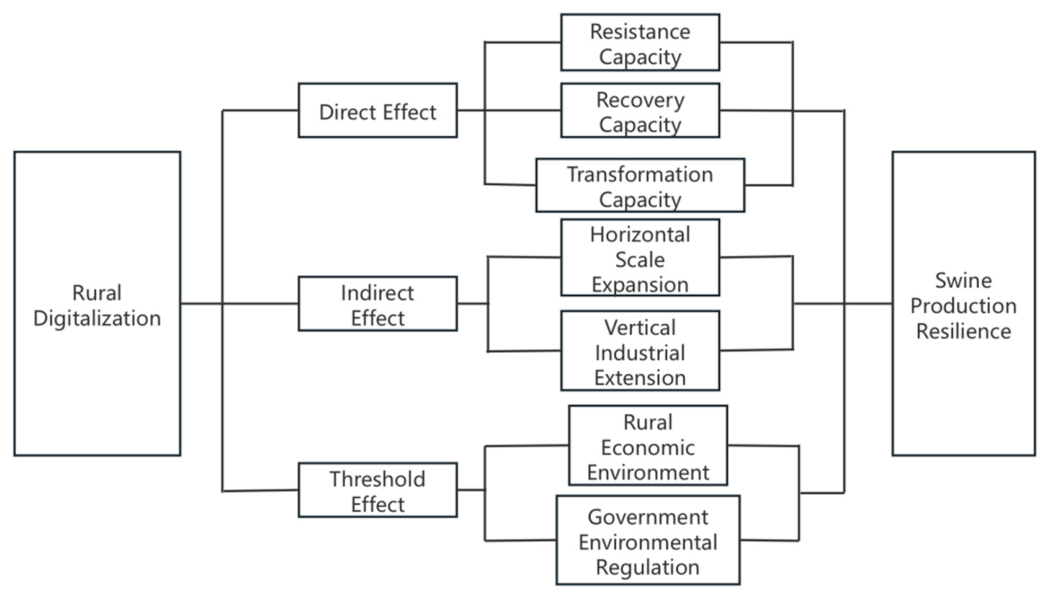
From the perspective of external constraints, the policy environment primarily influences the relationship between Dig and Resi through the stringency of environmental regulations. According to Porter’s hypothesis, moderate environmental regulations can incentivize swine farmers to upgrade equipment, improve production conditions, enhance resource utilization and production efficiency, offset environmental protection costs, and boost long-term competitiveness [36]. Meanwhile, appropriate environmental regulations stimulate technological innovation among swine farming entities, promote shifts in production technologies and management models, and have a positive impact on enhancing Resi. However, excessively stringent or poorly designed environmental regulations can increase farming costs, crowd out investment in productive factors, and even cause some farming entities to exit the market, thereby increasing the risk of disruptions in swine production and undermining the enhancement of industrial resilience [37] (Figure 1).
Based on the above analysis, hypotheses H3a and H3b are proposed as follows:
H3a. 
The impact of Dig on Resi has a nonlinear relationship with the level of rural economic development.
H3b. 
The impact of Dig on Resi has a nonlinear relationship with changes in the policy environment.

3. Study Design

3.1. Variable Selection

3.1.1. Dependent Variable

Based on the Pressure–State–Response (PSR) framework, the dependent variable in this study is Resi, and drawing on three dimensions—resistance capacity, recovery capacity, and transformation capacity—this study systematically constructs an evaluation index system for Resi. Integrating the characteristics of the swine industry’s production chain, risk transmission pathways, and policy orientations [38], the system comprises three first-level indicators, six second-level indicators, and twenty-one third-level indicators. The selection criteria for each indicator are detailed as follows:
(1) Resistance capacity: This dimension is closely linked to the stable operation of the production system and the assurance of product supply. This study constructs an indicator system based on two dimensions: production coordination and production stability. Indicators such as feed grain production, the number of designated swine slaughterhouses, the level of veterinary expertise, and the value added in the animal husbandry service sector reflect the completeness of supporting industrial services. These indicators reflect factors that help effectively mitigate the risk of supply chain disruptions and ensure production continuity; the live swine slaughter rate and the swine production price index reflect the efficiency of production organization and the stability of production rhythms, providing a direct measure of production stability. All of the aforementioned indicators are positive indicators that collectively assess the industry’s adaptability to risks; enhancing this capability is essential for ensuring the stable operation of the swine industry.
(2) Recovery capacity: This capacity relates to the industry’s ability to recover production and conserve resources following a shock. This study selects indicators such as the breeding sow inventory, the growth rate of the swine farming industry’s output value, and per capita pork production to reflect the speed of industrial recovery and the level of restored production capacity; total pollution, water consumption per head, and energy consumption per head are all related to resource consumption during the swine farming process and serve as negative indicators. Higher resource consumption increases the costs of resuming production and the operational burden, which hinders the industry’s rapid recovery. Thus, recovery capacity essentially reflects the swine industry’s ability to rebuild and achieve environmentally sustainable recovery following a shock.
(3) Transformation capacity: This capacity is manifested in two dimensions—government and financial support, and technological progress—and depends on factors such as government support, financial support, and technological innovation. This study uses the number of livestock stations, local fiscal expenditure on agriculture, forestry and water affairs, and the ratio of agricultural insurance revenue to swine shipments to reflect government and financial support; funding for agricultural research activities, the number of research projects, and the total power of livestock machinery reflect the level of technological innovation and the modernization of swine production. Transformation capacity reflects the swine industry’s ability to transition from passively responding to shocks to actively adapting and achieving high-quality development.
The specific indicators are shown in Table 1. In this context, pollutants from the swine farming industry refer to swine manure, and the total pollutant emissions refer to the comprehensive emission load of five pollutants. Based on existing research [39], this study calculates the total pollutant emissions using manure emission factors. Finally, the formula for determining the total pollutant emissions is as follows:
T o t a l p o l l u t a n t s = i = 1 5 E m i s s i o n f a c t o r s f o r p o l l u t a n t s i × F e e d i n g d a y s × A c t u a l w e i g h t R e f e r e n c e W e i g h t
where i denotes five pollutants: chemical oxygen demand, total phosphorus, total nitrogen, zinc, and copper. The emission factors and data on the standard live weight are sourced from the Manual of Emission Factors for the First National Pollution Source Census; data on the average slaughter weight and the average rearing duration are sourced from the Compilation of Cost and Revenue Data for Agricultural Products.

3.1.2. Core Explanatory Variables

The core explanatory variable in this paper is Dig. Drawing on existing research on the evaluation dimensions of Dig development levels [40,41], and considering its impact on Resi, this paper constructs a comprehensive index system from three aspects: digital infrastructure in rural areas, digitalization of the rural economy, and rural digital service platforms. The measurement methods are consistent with those for Resi.
(1) Digital infrastructure in rural areas: This dimension serves as the cornerstone for supporting the stable operation of industries and mitigating various risks. The number of rural broadband internet subscribers directly reflects the coverage and penetration of network infrastructure in rural areas—infrastructure that constitutes the core hardware support for the efficient transmission of digital information; the size of the agricultural technical workforce directly reflects the depth of rural digital talent reserves and the capacity to provide technical services; fixed-asset investment in transportation measures the development of modern rural logistics infrastructure and is a key component of the digital circulation system; rural per capita electricity consumption, as a key proxy indicator of rural modernization, reflects the adoption rate of smart livestock farming equipment in rural production, thereby laying a solid foundation for the digital transformation of the swine industry. Collectively, the indicators within this dimension form the underlying support system for rural digital development, and the development level of this dimension directly determines the foundational conditions and potential scope of the swine industry’s digital transformation.
(2) Digitalization of the rural economy: This dimension focuses on measuring the empowering effects of digitization across all stages of the swine industry and serves as the core driver for enhancing the industry’s resilience. The Digital Inclusive Finance Index reflects the accessibility of rural digital financial services, which can effectively strengthen the industry’s financial resilience in the face of market fluctuations; the number of Taobao Villages, along with e-commerce sales and procurement volumes, indicates the scale of rural e-commerce development. These metrics quantify the scale and level of rural digital transactions, demonstrating the practical value of the industry’s digital transformation; the length of rural delivery routes measures the reach of the rural logistics and distribution network, reflecting the actual service radius of digital distribution technologies. Improving the level of rural economic digitization is a key driver for enhancing Resi and promoting its high-quality, sustainable development.
(3) Rural digital service platforms: This dimension reflects the software support provided by digital services for the digital transformation of the swine industry. Per capita expenditure on transportation, communications, and consumer services reflects residents’ willingness and ability to consume information services, directly determining the efficiency with which swine farming entities access market information and other data. The total volume of telecommunications services, the comprehensive television coverage rate in rural areas, and the number of mobile phone subscriptions reflect the scale of regional information and communications service provision, thereby providing the necessary communication conditions for digital services in swine farming. This dimension is critical for strengthening the foundation of industrial digitalization and enhancing the industry’s capacity for long-term stable development. All indicators are positive. The specific indicators selected are shown in Table 2:

3.1.3. Control Variables

To ensure the rationality of this study, the control variables are selected as follows: pork production capacity (Cap), local fiscal autonomy (Fin), environmental awareness of swine farmers (Env), and per capita pork consumption (Cons).
Specifically, Cap is measured as the share of pork production in total meat production at the provincial level. A higher share of the swine industry in the regional agricultural economy indicates stronger foundational capacity to resist external shocks and greater resource allocation ability, which in turn affects the resilience level of the industry.
Fin is measured by the ratio of local budgetary revenue to budgetary expenditure. Local fiscal autonomy determines the intensity of government support for the swine industry. Greater fiscal autonomy enhances the local government’s capacity to underpin industry development, thus serving as a crucial external factor influencing industrial resilience.
Env is proxied by the ratio of regional fertilizer application to effectively irrigated area. This indicator indirectly reflects regional agricultural environmental input and the extent of green development. Stronger environmental awareness among swine farmers promotes the green transformation of swine farming, thereby affecting Resi.
Cons is measured as the natural logarithm of per capita pork consumption. Regional consumption capacity and demand intensity directly shape market expectations, the speed of production capacity adjustment, and price fluctuation risks. Differences in market demand thus exert a significant impact on industrial resilience.

3.1.4. Mediating Variables

Dig can effectively reduce information and transaction costs, thereby encouraging swine farmers to expand their operations and fostering industrial agglomeration within the swine sector. At the same time, scale and agglomeration can enhance the industry’s risk resilience and operational efficiency, which is crucial for enhancing Resi through digital technologies. Therefore, we select the scale of the swine industry and industrial agglomeration as mediating variables. Specifically, the scale of the swine industry (Size) is measured using the method proposed by Guo H [42], calculated as the ratio of each province’s swine slaughter volume to the national total; the industrial agglomeration (Agg) is measured using the method proposed by Zhang H [43], employing location entropy to quantify the level of industrial concentration. The specific calculation formula is shown in (2):
A g g i t = e i t e j t E i t E j t
Here, j represents the national level, i represents the 30 provinces, t represents the year, eit represents the output value of the swine industry in each province, and Eit represents the national total output value.

3.1.5. Threshold Variable

Environmental regulations of differing stringency change the cost structure and technology selection decisions in swine production, thereby generating nonlinear effects in the relationship between digital transformation and industrial resilience. For this reason, governmental environmental regulation (Er) is chosen as a threshold variable in this study. Meanwhile, rural income levels directly determine the popularization of digital infrastructure in rural areas and farmers’ ability to adopt digital technologies. Accordingly, the per capita net income of rural residents (Inc) is employed as a second threshold variable.
Specifically, environmental regulation (Er) is measured following the method of Feng J [44], defined as the ratio of local fiscal environmental protection expenditure to total local general budgetary expenditure. The per capita net income of rural residents is deflated by the rural consumer price index to eliminate price fluctuations.

3.2. Data Sources

Considering data availability, we selected data from 30 Chinese provinces (excluding Tibet, Hong Kong, Macao, and Taiwan) from 2011 to 2023 as the sample for our empirical analysis. Data sources include the China Statistical Yearbook. Data on digital financial inclusion were obtained from the Digital Financial Inclusion Index released by the Institute of Digital Finance, Peking University, and some missing values were imputed using linear interpolation. Descriptive statistical analyses of each variable are presented in Table 3.

3.3. Model Construction

3.3.1. Benchmark Regression Model

To investigate the direct impact of Dig on Resi, a benchmark regression model was constructed as follows:
R e s i i t = α 0 + α 1 D i g i t + α 2   C o n t r o l i t + μ i t + ε i t
In Formula (3), Resi represents the level of Resi, Dig represents the level of Dig, Control is the control variable, α is the corresponding coefficient, μ i t is the unobservable individual effect for each province, and ε i t is the random error term of the model.

3.3.2. Mediation Effect Model

To further explore the mechanism of Dig on Resi, drawing on Mallinckrodt’s [45] analysis of mediation effects, we constructed a panel regression model for mediation analysis based on the baseline regression as follows:
R e s i i t = α 0 + α 1 D i g i t + α 2 C o n t r o l i t   + μ i t + ε i t
Z i t = β 0 + β 1 D i g i t + β 2   C o n t r o l i t + μ i t + ε i t
R e s i i t = φ 0 + φ 1 D i g i t + φ 2 Z i t + φ 3   C o n t r o l i t + μ i t + ε i t
In Formulas (4)–(6), Zit represents mediator variables. In this study, the primary focus is on Size and Agg, while other variables are defined as above.

3.3.3. Threshold Effect Model

To further examine whether the impact of Dig on Resi exhibits nonlinear characteristics, the following threshold model was constructed.
R e s i i t = α i + β 1 D i g i t I ( q i t γ ) + β 2 D i g i t I ( q i t > γ ) + C o n t r o l i t + δ t + μ i t
Among them, qit denotes the threshold variables, namely Er and Inc; γ is the estimated threshold value; I(.) is the indicator function, representing the different influence mechanisms arising from the threshold effect; β 1 and β 2 are the parameters to be estimated.

3.3.4. Difference-in-Differences Model

To more robustly assess whether Dig has strengthened Resi, we regard the “Broadband China” pilot program as a quasi-natural experiment and employ a difference-in-differences (DID) specification to identify its causal impact on industry resilience. Specifically, a province is defined as a “Broadband China” pilot province if any of its cities is designated as a pilot site. Following the approach of Wang [46], we construct a multi-period DID model accounting for the staggered implementation of the policy across pilot provinces.
R e s i i t = α 0 + α 1 P r i t + C o n t r o l i t + μ i t + ε i t
Among them, Pr indicates whether a province has any cities selected for the “Broadband China” demonstration city list; if province i is selected in year t, Pr is set to 1 in year t and thereafter, otherwise it is 0, while the definitions of other variables remain consistent with those previously discussed.

4. Empirical Testing

4.1. Analysis of Rural Digitalization and Resi Measurement Results

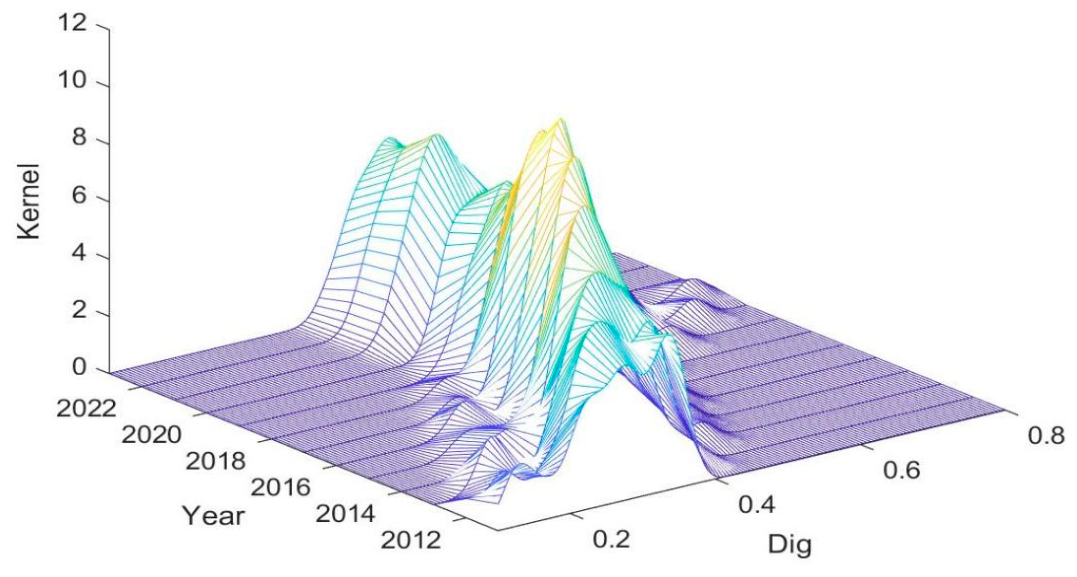
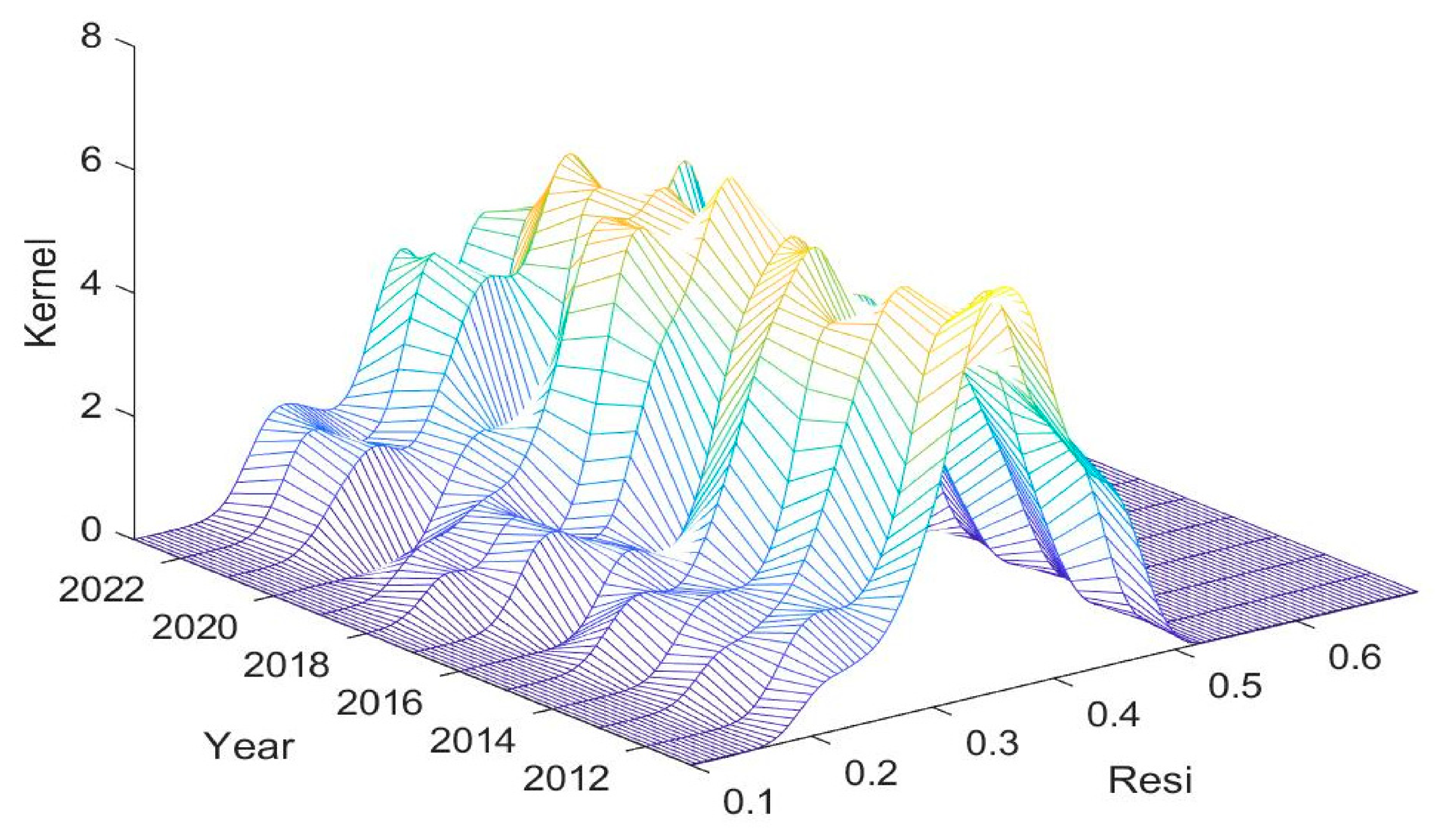
This study uses MATLAB 2021b and adopts a nonparametric kernel density estimation approach based on the Gaussian kernel function to estimate the distribution dynamics of Dig and industrial resilience from 2011 to 2023. The horizontal axis represents Dig and Resi respectively, and the vertical axis denotes the kernel density value. We aim to reveal their overall distribution patterns and dynamic evolution characteristics, as shown in Figure 2 and Figure 3.
Figure 2 presents the kernel density distribution of Dig levels. Overall, the kernel density curves across years show an evolutionary pattern of “single peak–multi peak–single peak” with the peak height rising notably in the early stage and then stabilizing. Specifically, the main peak shifts continuously rightward over the sample period, reflecting a steady increase in Dig levels. After 2018, the peak becomes narrower and higher, indicating that regional disparities in rural digital development have narrowed. Furthermore, from 2011 to 2018, the distribution evolves from clustering on the left to clustering on the right, and returns to a single-peak pattern after 2018, implying that regional polarization first appeared and then gradually eased.
Figure 3 depicts the kernel density distribution of industrial resilience. During the entire sample period, the curve maintains a pronounced multi-peak pattern, with the peak values displaying a fluctuating upward trend. Specifically, the main peak shifts slightly rightward over time, indicating an overall increase in the level of industrial resilience. Since 2011, the maximum peak height has declined while the peak width has widened considerably, implying that regional disparities in industrial resilience have grown increasingly pronounced. Furthermore, the kernel density curve has exhibited a bimodal distribution since 2011, suggesting that a relatively severe polarization trend has persisted.

4.2. Benchmark Regression Results of Rural Digitalization

Using Stata 18.0, we empirically analyzed the impact of Dig on Resi. Before regression estimation, multicollinearity tests were conducted for all variables. The results show that the VIF (Variance Inflation Factor) values of all variables are less than 10, suggesting no severe multicollinearity in the model and appropriate variable selection. The Hausman test yields a statistic of 34.72 (p < 0.01), so we reject the null hypothesis and choose the fixed-effects model.
Table 4 presents the results of the baseline regression. Model (1) includes only core explanatory variables; the coefficient for Dig is 0.074 and is significantly positive at the 5% significance level, indicating that, when the effects of other factors are not considered, Dig has a significant positive impact on Resi. Model (2) further introduces control variables based on Model (1). The results show that the coefficient for digitalization increases to 0.089 and is significantly positive at the 1% level; for every one-unit increase in Dig, Resi increases by 0.089 units.
To mitigate estimation biases caused by individual heterogeneity, Models (3) and (4) further include fixed effects. The regression results show that the coefficients of Dig are 0.065 and 0.085, respectively, with their direction and significance remaining largely unchanged. This indicates that Dig significantly increases Resi, thereby confirming Hypothesis 1. In terms of model fit, the goodness-of-fit statistic improves from 0.368 to 0.412 after introducing control variables, suggesting that these variables effectively strengthen the model’s explanatory power.
In terms of control variables, Cap has a significant positive effect on Resi; sufficient investment in physical capital provides a solid foundation for improving Resi. Fin is significantly negative at the 1% level, indicating that it exerts a significant inhibitory effect on Resi, possibly due to factors such as the irrational allocation of financial resources and the poor suitability of financial services. Env is significantly positive at the 5% level, suggesting that increased environmental awareness can effectively drive improvements in Resi. Cons is significantly positive at the 5% level; improvements in Cons boost demand, thereby promoting the growth of Resi.

4.3. Robustness Test Results

4.3.1. Endogeneity Test

Both reverse causality and omitted variables may cause model endogeneity. First, Dig significantly increases Resi, but the rise in Resi may in turn further stimulate increases in Dig across regions. Second, while the baseline regression controls for individual and time effects, some variables that influence Resi are not included in the control variables; the omission of these variables may also introduce endogeneity issues. To address potential endogeneity issues, this paper conducts endogeneity tests from the following two perspectives.
(1) Endogeneity issues caused by reverse causality. Following the approach in Zhang Y [47], we use the previous period’s Dig level (L.Dig) as an instrumental variable (IV1) and conduct regression tests using the two-stage least squares (2SLS) method. The previous period’s Dig level influences the current period’s Resi, but the current period’s Resi has little effect on the previous period’s Dig level. The regression results are presented in Column (1) of Table 5. The results show that L.Dig passes the under-identification test and the weak identification test. Furthermore, the estimated coefficient of L.Dig is consistent with the baseline regression results in terms of direction of effect and significance level, indicating that the conclusion that Dig enhances Resi remains valid even after accounting for endogeneity.
(2) Handling the issue of omitted variables. Drawing on existing research [48,49], we use the interaction of terrain ruggedness and the one-period lagged logarithm of national broadband access ports, as well as the interaction term between terrain ruggedness and the time variable, as instrumental variables (IV2) and (IV3) for the development of Dig. The flatness of terrain is directly related to the construction of network infrastructure such as information transmission, and the Dig model presupposes the existence of sound network infrastructure. Meanwhile, the number of Internet broadband access ports reflects the scale of regional Internet service supply, satisfying the correlation assumption; regional terrain undulation is a variable independent of the economic system and has no direct impact on current-period Resi, satisfying the exogeneity assumption.
Based on the empirical test results reported in columns (2) and (3) of Table 5, both sets of instrumental variables pass the under-identification test and the weak identification test. Accordingly, the selection of these instrumental variables is theoretically and empirically justified. Moreover, the estimated coefficient of Dig is significant at the 5% level for IV2 and at the 10% level for IV3, indicating that Dig exerts a positive and significant effect on Resi.

4.3.2. Exogenous Shock Test

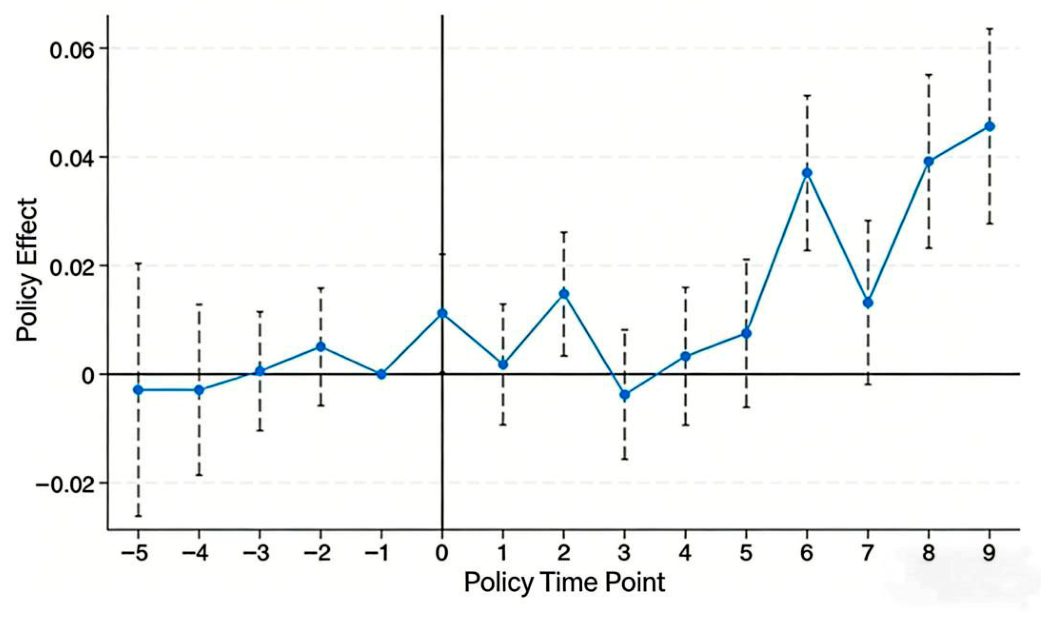
To more rigorously assess whether Dig enhances Resi, this paper employed a DID approach to examine the impact of the “Broadband China” pilot policy on Resi. Before conducting the regression analysis, this study tested the parallel trends assumption of the model using event study methods. As shown in Figure 4, the trends were parallel between the two groups before the policy implementation, while a divergence emerged afterward. This indicated that the parallel trends assumption held for the “Broadband China” pilot program, and the conclusions of the DID model are reliable. In terms of the dynamic effects of policy implementation, the intensity of the policy’s impact on industrial resilience gradually strengthened as the policy was continuously advanced. Column (4) of Table 5 presents the regression results. The results indicate that the pilot policy has a positive impact on enhancing Resi, and this effect is significant at the 1% level. Therefore, the “Broadband China” strategy exerts a significant positive effect on Resi, further demonstrating that Dig can enhance Resi.

4.3.3. Other Robustness Tests

This study also employed other methods for robustness tests. Table 6 presents the results. First, we adjusted the study period. Following the outbreak of African swine fever in 2018, the live swine market experienced great volatility, and the impact of Dig on Resi may have changed accordingly. Therefore, this study excluded the period from 2018 onwards from the analysis. Second, recognizing the potential limitations of the entropy weighting method in reflecting comprehensive evaluation results, we re-weighted the evaluation indicators of Dig and Resi using the entropy-weighted TOPSIS method before re-regression. Third, we trimmed all variables at the 1% level before conducting the regression. Finally, recognizing that the four municipalities of Beijing, Chongqing, Shanghai, and Tianjin differ significantly from other provinces in terms of rural digital economic infrastructure and other basic conditions, we excluded these municipalities from the sample and re-ran the regression. The regression results from all four methods confirmed the robustness of the conclusion that Dig exerts a positive impact on Resi.

4.4. Results of the Impact Mechanism Test

To examine whether Dig affects Resi through the two channels described above, this study employs a three-step mediation model.
Column (1) of Table 7 shows that the regression coefficient of Dig on Resi is 0.085 and significantly positive at the 1% level, indicating that Dig can directly enhance Resi, thereby preliminarily validating the positive relationship between the two. Column (2) presents a regression with swine farming scale as the dependent variable; the coefficient is 1.118 and significant at the 5% level, confirming that Dig can effectively promote the expansion of swine farming scale. In Column (3), after incorporating the mediating variable of farming scale, the coefficients of both Dig and farming scale remain significant positive, indicating that scale expansion plays a significant mediating role in the process whereby Dig improves industrial resilience. Thus, Dig can directly strengthen Resi through technological empowerment and optimal resource allocation, while also providing an indirect impetus by expanding the scale of industrial operation. The mediating mechanism is verified, and Hypothesis H2a is supported.
As shown in Column (4) of Table 7, the regression coefficient of Dig on swine industry agglomeration is 0.541, and it is significant at the 1% level, indicating that Dig has a positive effect on swine industry agglomeration. Column (5) shows that after simultaneously including Dig and industrial agglomeration, both have a significant positive impact on Resi, indicating that industrial agglomeration plays a significant mediating role between Dig and industrial resilience. This indicates that Dig can not only directly enhance Resi but also provide indirect empowerment by optimizing spatial layout and promoting industrial agglomeration. This mediating mechanism is effectively established, and Hypothesis H2b is verified.

4.5. Threshold Effect Test Results

Theoretical analysis suggests that the effect of Dig on enhancing Resi has certain limitations. We use the intensity of environmental regulations and the level of rural residents’ net income as threshold variables to verify the nonlinear effect of Dig on Resi.
To examine the presence of the threshold effect, the bootstrap method was employed with 300 replications; the resulting p-values and F-statistics are shown in Table 8. The single threshold for the intensity of environmental regulations passed the significance test at the 5% level. Therefore, we analyzed the single threshold for environmental regulation, with a threshold value of 2.404. Meanwhile, the single threshold for rural residents’ per capita net income passed the significance test at the 5% level, while the double threshold test was not significant. Consequently, we analyzed the single-threshold model for rural residents’ net income, with a threshold value of 9.277.
As shown in Table 9, when the intensity of environmental regulations is below the threshold, the coefficient of Dig on Resi is 0.092 and significant; however, when it exceeds the threshold, the estimated coefficient decreases to 0.042, which is also significant at the 5% level. This implies that the threshold effect of environmental regulation intensity exhibits a diminishing nonlinear spillover effect. Moderate environmental regulation helps farming entities better adapt to market changes and cope with competitive pressures, whereas excessively stringent environmental regulation impedes further improvements in Resi.
When rural residents’ per capita net income falls below the threshold, the coefficient of Dig on Resi is 0.042 and significant. Once the threshold is crossed, the estimated coefficient increases to 0.085, which is significant at the 1% level. This indicates that the threshold effect of rural residents’ per capita net income exhibits an increasing nonlinear relationship: higher income levels among rural residents enable farming entities to better implement technological innovations and adapt to market demands, thereby enhancing Resi.
In summary, the extent to which Dig enhances Resi depends not only on the development levels of digital technology and the swine industry but is also influenced by the stringency of government environmental regulations and the income levels of rural residents; thus, hypotheses H3a and H3b have been confirmed.

4.6. Heterogeneity Analysis Results

To further investigate how Dig affects Resi, this study decomposes the Resi index into three core dimensions: resistance capacity, recovery capacity, and transformation capacity. By incorporating regional characteristics such as transportation conditions and resource endowments across China’s provinces, we perform a multidimensional heterogeneity test. The regression results are presented in Table 10.

4.6.1. Heterogeneity Across Resilience Dimensions

Based on the heterogeneity tests across the three dimensions of Resi, the enabling effects of Dig on different resilience dimensions vary significantly. In terms of resistance capacity and transformation capacity, Dig exerts a significant positive impact on both dimensions. A comparison of the regression coefficients shows that Dig has a stronger promotional effect on transformation capacity than on resistance capacity, indicating that Dig primarily enhances Resi through technological innovation in swine production and internal and external coordination. However, the recovery capacity dimension does not pass the significance test; external shocks reduce swine production efficiency, thereby weakening the effectiveness of Dig in promoting swine production.

4.6.2. Distinguishing Traffic Conditions

To reduce the risk of disease transmission during production and distribution, an increasing number of provinces have shifted from the traditional “live swine transportation” practice to a “slaughter + cold-chain logistics” model of “meat transportation”, making transportation infrastructure a core foundation for the circulation of pork products. Drawing on the calculation method proposed by Wang [50], this study uses the median value of transportation infrastructure as the threshold to split the sample into two subsamples: regions with relatively developed transportation infrastructure and regions with underdeveloped transportation infrastructure. As shown in Table 10, Dig exerts a significant positive impact on Resi regardless of transportation conditions. The comparison of coefficients shows that the effect of Dig on enhancing Resi is stronger in regions with underdeveloped transportation infrastructure. In these regions, the swine industry faces more prominent constraints related to logistics and market information transmission.

4.6.3. Distinguishing Resource Endowments

China exhibits substantial regional disparities in resource endowments, including feed, land, and water resources. To investigate the heterogeneity arising from these resource endowment differences, following the method of Luo et al. [51], the sample is divided into two subsamples: the eastern region, and the central and western regions. As presented in Table 10, the coefficient of Dig on Resi in the central and western regions is significantly positive at the 5% level, whereas the coefficient of Dig on Resi in the eastern region is insignificant. Benefiting from advantages such as their own breeding scale and economic development foundations, the central and western regions exhibit a more pronounced effect of Dig on enhancing industrial resilience. In contrast, the eastern region, with its large market capacity and a swine industry dominated by large-scale, modernized farming, has limited room for Dig to empower industrial resilience.

4.7. Discussion of Results

This study aligns with some existing research in recognizing the positive enabling effect of Dig on agricultural industry resilience. However, it also differs in several aspects: it constructs an evaluation index system for the relationship between Dig and Resi, clarifies the mediating roles of farming scale and industrial agglomeration, and addresses the shortcomings of existing research that often focuses on direct effects while neglecting transmission mechanisms. Additionally, by introducing two threshold variables, this study reveals the nonlinear moderating effects of environmental regulations and rural residents’ income on the digital empowerment effect, thereby enriching research on the boundary conditions of digital empowerment for agricultural industry resilience. Finally, through multidimensional heterogeneity analysis, this study details the regional and dimensional variations in digital empowerment, providing more precise empirical evidence for designing differentiated policies.

5. Research Conclusions and Policy Recommendations

5.1. Research Conclusions

Using panel data of 30 provinces in China from 2011 to 2023, this study measures Resi and the level of Dig and systematically analyzes the impact of Dig on Resi, as well as its mechanisms and boundary conditions. The results are as follows: First, Dig significantly enhances Resi. Second, the positive impact of Dig on Resi is realized through two channels: the horizontal expansion of the swine industry and the vertical extension of the industrial chain. Third, a moderate level of environmental regulation combined with higher rural incomes can have a positive impact on the effectiveness of Dig in enhancing Resi. Fourth, Dig primarily enhances industrial resilience by improving the swine industry’s shock resistance capacity and transformation capacity; its impact is particularly significant in regions with underdeveloped transportation infrastructure and in the central and western regions of China.
Admittedly, this study is not without limitations, which to some extent affect the generalizability and rigor of its conclusions: First, this study relies on aggregated provincial-level data in China and focuses on the country’s specific institutional environment and industrial context, making it difficult to fully reflect the micro-level differences in swine farming at the county level. Second, the measurement of Resi and Dig levels relies on composite indices. Although the selection of indicators incorporates existing research and industrial realities, a certain degree of subjectivity may still exist. Third, this study does not fully explore the differentiated impacts of various dimensions of digital technology on industrial resilience, and the depth of the analysis needs to be further enhanced.
While this study is China-focused, its conclusions are to some extent applicable to other developing economies as well. Countries face similar risks and challenges, including regional development disparities, heightened disease risks, disruptions to supply chain flows, and limited industrial resilience. The mechanisms identified in this study may provide valuable insights for other economies striving to enhance the resilience of their swine industries. However, due to differences in institutional environments and resource endowments, these conclusions should be adopted selectively based on specific national conditions.

5.2. Policy Recommendations

Based on the findings of the above study, the following policy recommendations are presented:
First, promote rural digitalization of the swine industry. Focusing on major swine-producing regions, we should increase investment in digital infrastructure. The digital upgrading of farming facilities should be advanced, and the widespread adoption of digital equipment should be promoted to reduce farming costs while improving production efficiency and product quality. With the support of professional institutions, farming operators can receive digital skills training to improve their capacity in operating digital equipment and utilizing data analysis. Furthermore, the structure of fiscal support should be optimized and targeted funding increased for the digital transformation of the swine industry, with a focus on long-term areas such as infrastructure construction, technology R&D, and application, so as to leverage the inclusive and empowering role of digital technology.
Second, boost the coordinated development of large-scale and clustered operations in the swine industry. Small and medium-sized breeding entities should be guided to expand their scale through mergers and acquisitions, and leading enterprises capable of large-scale and standardized breeding should be cultivated to strengthen their risk resilience. Moreover, regional resource endowments should be leveraged to plan and develop swine industry clusters, improve supporting infrastructure and public services, attract upstream and downstream enterprises to agglomerate, establish industrial collaboration platforms, and thereby enhance the coordination efficiency of the industrial chain.
Third, implement targeted measures to optimize environmental regulations and raise rural residents’ income levels. Taking the environmental regulation intensity threshold of 2.404 as a benchmark, differentiated regulatory policies should be implemented: for regions below this threshold, environmental supervision should be strengthened appropriately to drive the upgrading of environmental protection facilities; for regions above the threshold, policy implementation should be optimized to reduce the compliance costs of breeding operations through technical guidance and financial subsidies. Similarly, taking 9.277 as the reference threshold for rural residents’ per capita net income, income-generating channels should be expanded via industrial support, skills training, and policies encouraging rural entrepreneurship and returnee entrepreneurship, so as to further amplify the effects of rural digital empowerment.
Fourth, given regional heterogeneity, the targeted application of digital technology should be strengthened to improve industrial resilience. With a focus on enhancing the resilience and transformation capacity of the swine industry, investment in scientific research should be increased, multi-skilled agricultural and livestock professionals cultivated, and a digital risk early-warning and disease prevention system established. In regions with underdeveloped transport infrastructure, digital investment should be expanded to prioritize the improvement of key production and logistics facilities. In regions with advanced transportation networks, efforts should be made to alleviate the constraints of marginal diminishing returns from digital empowerment, with greater emphasis placed on the application of emerging digital technologies. Policies should be tailored to regional endowments: in central and western regions, financial and technical support should be increased to construct large-scale standardized digital breeding bases; in economically developed regions, priority should be given to brand building, the development of high-quality pork products, and the stimulation of consumer markets.

Author Contributions

Conceptualization, G.W.; methodology, G.W.; software, X.Z.; validation, G.W. and X.Z.; formal analysis, X.Z.; investigation, X.Z.; resources, X.Z.; data curation, X.Z.; writing—original draft preparation, G.W. and X.Z.; writing—review and editing, X.Z.; visualization, X.Z.; supervision, G.W.; project administration, G.W.; funding acquisition, G.W. All authors have read and agreed to the published version of the manuscript.

Funding

This research received no external funding.

Institutional Review Board Statement

Not applicable.

Informed Consent Statement

Not applicable.

Data Availability Statement

The original contributions presented in the study are included in the article, further inquiries can be directed to the corresponding author.

Conflicts of Interest

The authors declare no conflicts of interest.

References

  1. Deng, Y.; Tan, Y.; Lu, Q. Impact of Market Price Volatility on Expected Operating Income and Income Risk for Swine Farmers in China: An Analysis of the Effectiveness of Spatiotemporal Sales Strategy Selection. Agribusiness 2025, 4, 26. [Google Scholar] [CrossRef]
  2. Zhou, D.; Zhang, J.; Huan, H.; Hu, N.; Li, Y.; Cheng, J. Assessing the Impact of External Shocks on Prices in the Live Pig Industry Chain: Evidence from China. Sustainability 2025, 17, 1934. [Google Scholar] [CrossRef]
  3. Jia, Y.; Sun, W.; Su, G.; Hua, J.; He, Z. The Threshold Effect of Swine Epidemics on the Pig Supply in China. Animals 2022, 12, 2595. [Google Scholar] [CrossRef] [PubMed]
  4. Hua, J.; Ma, C.; Li, W.; He, Z.; Zhu, P. Effects and mechanisms of digitalization to enhance the resilience of the hog breeding industry: Evidence from China. Front. Sustain. Food Syst. 2024, 10, 1467162. [Google Scholar] [CrossRef]
  5. Xing, W.; Imran, A. Financial and Technological Drivers of Sustainable Development: The Role of Communication Technology, Financial Efficiency and Education in BRICS. Sustainability 2025, 17, 2326. [Google Scholar] [CrossRef]
  6. Guo, H.; Aye, Y.N.; Wang, H. The digital divide and hog industry: The impact of digital technology levels on the sustainability of the hog industry in China. J. Clean. Prod. 2026, 538, 147370. [Google Scholar]
  7. Benjamin, M.; Yik, S. Precision livestock farming in swine welfare: A review for swine practitioners. Animals 2019, 9, 133. [Google Scholar] [CrossRef]
  8. Wang, H.; Chen, Y.; Xie, J.; Liu, C. Research on digital empowerment, innovation vitality and manufacturing supply chain resilience mechanism. PLoS ONE 2025, 20, e0316183. [Google Scholar] [CrossRef]
  9. Zhou, K.; Wang, H.; Wu, J.; Li, J. Effect of digital economy on large-scale pig farming: An empirical study from China. Cogent Food Agric. 2023, 9, 2238985. [Google Scholar] [CrossRef]
  10. Feng, J.; He, S.; Wan, C.; Liu, J.; Xie, F. The effect of swine insurance participation on swine production efficiency: Evidence from China. PLoS ONE 2025, 20, e0317759. [Google Scholar] [CrossRef]
  11. Xie, Y.; Yang, Y.; Yang, L. How do digital knowledge resources affect the carbon emission intensity of the pig industry? J. Knowl. Manag. 2025, 1, 24. [Google Scholar] [CrossRef]
  12. Giglio, L.; Rousing, T.; Łodyga, D.; Reyes-Palomo, C.; Sanz-Fernández, S.; Soffiantini, C.S.; Ferrari, P. Economic Resilience in Intensive and Extensive Pig Farming Systems. Sustainability 2025, 17, 7026. [Google Scholar] [CrossRef]
  13. Zhang, X.; Tian, C. Measurement and influencing factors of regional economic resilience in China. Sustainability 2024, 16, 3338. [Google Scholar] [CrossRef]
  14. Hu, Y.; Yu, Y. Scale Difference from the Impact of Disease Control on Pig Production Efficiency. Animals 2022, 12, 2647. [Google Scholar] [CrossRef]
  15. He, J.; Fan, M.; Fan, Y. Digital transformation and supply chain efficiency improvement: An empirical study from a-share listed companies in China. PLoS ONE 2024, 19, e0302133. [Google Scholar] [CrossRef]
  16. Wang, G.; Wang, J.; Chen, S.; Zhao, C. Vertical integration selection of Chinese pig industry chain under African swine fever—From the perspective of stable pig supply. PLoS ONE 2023, 18, e0280626. [Google Scholar] [CrossRef]
  17. Ma, M.; Wang, H.H.; Hua, Y.; Qin, F.; Yang, J. African swine fever in China: Impacts, responses, and policy implications. Food Policy 2021, 102, 102065. [Google Scholar] [CrossRef]
  18. Martin, R.; Sunley, P.; Tyler, P. Local growth evolutions: Recession, resilience and recovery. Camb. J. Reg. Econ. Soc. 2015, 8, 141–148. [Google Scholar] [CrossRef]
  19. Lu, S.; Zhuang, J.; Sun, Z.; Huang, M. How can rural digitalization improve agricultural green total factor productivity: Empirical evidence from counties in China. Heliyon 2024, 10, e35296. [Google Scholar] [CrossRef] [PubMed]
  20. Fredeen, H.T.; Harmon, B.G. The Swine Industry: Changes and Challenges. J. Anim. Sci. 1983, 57, 100–118. [Google Scholar]
  21. Han, M.; Yu, W.; Clora, F. Boom and bust in China’s pig sector during 2018–2021: Recent recovery from the ASF shocks and longer-term sustainability considerations. Sustainability 2022, 14, 6784. [Google Scholar] [CrossRef]
  22. Yu, Y.; Li, Q.; Bao, Y.; Fu, E.; Chen, Y.; Ni, T. Research on the Measurement and Influencing Factors of Carbon Emissions in the Swine Industry from the Perspective of the Industry Chain. Sustainability 2024, 16, 2199. [Google Scholar] [CrossRef]
  23. Ambrogio, G.; Filice, L.; Longo, F.; Padovano, A. Workforce and supply chain disruption as a digital and technological innovation opportunity for resilient manufacturing systems in the COVID-19 pandemic. Comput. Ind. Eng. 2022, 169, 108158. [Google Scholar] [CrossRef]
  24. De Roest, K.; Ferrari, P.; Knickel, K. Specialisation and economies of scale or diversification and economies of scope? Assessing different agricultural development pathways. J. Rural Stud. 2018, 59, 222–231. [Google Scholar] [CrossRef]
  25. Marić, K.; Gvozdanović, K.; Djurkin Kušec, I.; Kušec, G.; Margeta, V. Smart Pig Farms: Integration and Application of Digital Technologies in Pig Production. Agriculture 2025, 15, 937. [Google Scholar] [CrossRef]
  26. Mahfuz, S.; Mun, H.-S.; Dilawar, M.A.; Yang, C.-J. Applications of smart technology as a sustainable strategy in modern swine farming. Sustainability 2022, 14, 2607. [Google Scholar] [CrossRef]
  27. Zhang, X.; Fan, D. Can agricultural digital transformation help farmers increase income? An empirical study based on thousands of farmers in Hubei Province. Environ. Dev. Sustain. 2023, 26, 14405–14431. [Google Scholar] [CrossRef] [PubMed]
  28. Xie, Y.; Yang, Y.; Xie, Y. The impact of industrial agglomeration on new quality productive forces enhancement in China’s pig farming industry. Sci. Rep. 2025, 15, 18591. [Google Scholar] [CrossRef]
  29. Xu, Z.; Hu, X.; Xu, F.; Zhang, H.; Zhou, H. The impact of swine diseases on total factor productivity of pig farms of different scales in China. Porc. Health Manag. 2026, 15, 9. [Google Scholar] [CrossRef] [PubMed]
  30. Papatsiros, V.G.; Tsekouras, N.; Papakonstantinou, G.I.; Kamvysi, K.; Eliopoulos, C.; Fotos, L.; Arapoglou, D.; Meletis, E.; Michailidis, G.; Gougoulis, D. The Use of Food Industry By-Products in Pig Diets as a Challenge Option to Reduce the Environmental Footprint. Agriculture 2025, 15, 2390. [Google Scholar] [CrossRef]
  31. Lythreatis, S.; Singh, S.K.; El-Kassar, A.-N. The digital divide: A review and future research agenda. Technol. Forecast. Soc. Change 2022, 175, 121359. [Google Scholar] [CrossRef]
  32. Kerras, H.; Contreras, M.F.R.; Bautista, S.; Gómez, M.D.D.-M. Is the rural population caught in the whirlwind of the digital divide. Agriculture 2022, 12, 1976. [Google Scholar] [CrossRef]
  33. Long, Y.; Li, Y.; Yu, X.; Zou, S. Human resource service industry and regional economic growth. Financ. Res. Lett. 2026, 100, 109556. [Google Scholar] [CrossRef]
  34. Depaoli, P.; Za, S.; Scornavacca, E. A model for digital development of SMEs: An interaction-based approach. J. Small Bus. Enterp. Dev. 2020, 27, 1049–1068. [Google Scholar] [CrossRef]
  35. Wang, G.; Shen, Y.; Li, C.; Zhu, Q.; ZhanBota, A. The regulatory effect of herd structure on pig production under the environmental regulation. PLoS ONE 2022, 17, e0266687. [Google Scholar] [CrossRef]
  36. Wang, Z.; Wei, W. Regional economic resilience in China: Measurement and determinants. Reg. Stud. 2021, 55, 1228–1239. [Google Scholar] [CrossRef]
  37. Vonderohe, C.E.; Brizgys, L.A.; Richert, J.A.; Radcliffe, J.S. Swine production: How sustainable is sustainability? Anim. Front. 2022, 12, 7–17. [Google Scholar] [CrossRef] [PubMed]
  38. Tian, Y.; Liu, Q.; Ye, Y.; Zhang, Z.; Khanal, R. How the rural digital economy drives rural industrial revitalization—Case study of China’s 30 provinces. Sustainability 2023, 15, 6923. [Google Scholar] [CrossRef]
  39. Asante, B.O.; Villano, R.A.; Battese, G.E. Integrated crop-livestock management practices, technical efficiency and technology ratios in extensive small-ruminant systems in Ghana. Livest. Sci. 2017, 201, 58–69. [Google Scholar] [CrossRef]
  40. Feng, L.; Yang, W.; Hu, J.; Wu, K.; Li, H. Exploring the nexus between rural economic digitalization and agricultural carbon emissions: A multi-scale analysis across 1607 counties in China. J. Environ. Manag. 2025, 373, 123497. [Google Scholar] [CrossRef] [PubMed]
  41. Zhang, Z.; Sun, C.; Wang, J. How can the digital economy promote the integration of rural industries—Taking China as an example. Agriculture 2023, 13, 2023. [Google Scholar] [CrossRef]
  42. Guo, H.; Li, S.; Pan, C.; Xu, S.; Lei, Q. Analysis of spatial and temporal characteristics of carbon emission efficiency of pig farming and the influencing factors in China. Front. Public Health 2023, 11, 1073902. [Google Scholar] [CrossRef]
  43. Zhang, H.; Zhang, J.; Song, J. Analysis of the threshold effect of agricultural industrial agglomeration and industrial structure upgrading on sustainable agricultural development in China. J. Clean. Prod. 2022, 341, 130818. [Google Scholar] [CrossRef]
  44. Feng, J.; Wang, Y. Does digital inclusive finance promote agricultural development? A test based on threshold and spillover effects. Financ. Res. Lett. 2024, 69, 106104. [Google Scholar] [CrossRef]
  45. Mallinckrodt, B.; Abraham, W.T.; Wei, M.; Russell, D.W. Advances in testing the statistical significance of mediation effects. J. Couns. Psychol. 2006, 53, 372–378. [Google Scholar] [CrossRef]
  46. Wang, S.; Song, Y.; Du, A.M.; Liang, J. The digital economy and entrepreneurial dynamics: An empirical analysis of urban regions in China. Res. Int. Bus. Financ. 2024, 71, 102459. [Google Scholar] [CrossRef]
  47. Zhang, Y.; Xie, W.; Ding, B. Research on the impact mechanism and spatial effects of digital technology empowering rural revitalization. Sustainability 2025, 18, 230. [Google Scholar] [CrossRef]
  48. Zhang, Y.; Zang, W.; Sun, C. Riding the terrain: Geographic influence on household adoption of digital finance. Int. Rev. Econ. Financ. 2025, 105, 104816. [Google Scholar] [CrossRef]
  49. Arronte Ledo, A.; Holl, A. Ultrahigh-Speed Fixed Broadband and Rural Development. Tijdschr. Econ. Soc. Geogr. 2023, 114, 479–500. [Google Scholar] [CrossRef]
  50. Cai, M.; Huang, G.; Tan, Y.; Jiang, J.; Zhou, Z.; Lu, X. Decoding the complexity of large-scale pork supply chain networks in China. Ind. Manag. Data Syst. 2020, 120, 1483–1500. [Google Scholar] [CrossRef]
  51. Luo, R.; Zhou, N. Dynamic evolution, spatial differences, and driving factors of China’s provincial digital economy. Sustainability 2022, 14, 9376. [Google Scholar] [CrossRef]
Figure 1. Impact Mechanism of Dig on Resi.
Sustainability 18 04251 g001
Figure 2. Kernel density map of Dig from 2011 to 2023.
Sustainability 18 04251 g002
Figure 3. Core Density Map of Resi from 2011 to 2023.
Sustainability 18 04251 g003
Figure 4. Parallel trend test plot.
Sustainability 18 04251 g004
Table 1. Resilience Evaluation Index System for Swine Industry.
First-Level IndicatorSecond-Level IndicatorThird-Level IndicatorIndicator ConnotationIndicator Direction
Resistance capacityProduction coordinationFeed grain productionProvincial feed grain output+
Number of designated slaughterhousesNumber of designated swine slaughterhouses+
Level of veterinary expertiseTotal veterinary technicians/Total employees+
Value added in the service sectorValue added by animal husbandry/Value added by the primary sector+
Production stabilityNumber of employeesNumber of employees in animal husbandry × (Output value of the swine industry/Output value of animal husbandry)+
Fixed asset investment in animal husbandryFixed investment in animal husbandry/Total fixed investment+
Live swine slaughter rateNumber of swine marketed this year/Swine inventory at the end of last year+
Production price stabilitySwine production price index+
Recovery capacityProduction recoveryStock of breeding sowsBreeding sow inventory+
Growth rate of output value in swine industry(Current-year output value/Previous-year output value) − 1+
Expenditures on disease control in swine farmingLivestock healthcare expenses/Material and service expenses+
Per capita pork productionPork production/Total population+
Resource consumptionTotal pollutionCalculated according to Formula (1)
Water consumption per headWater costs/number of swine marketed
Energy consumption per headFuel and power costs/number of swine marketed
Transformation capacityGovernment and financial supportLivestock service supportNumber of livestock stations+
Financial support for agricultureLocal fiscal expenditure on agriculture, forestry and water affairs+
Ratio of agricultural insurance revenue to swine shipmentsInsurance income of agricultural insurance/Swine marketed+
Technological advancementFunding for agricultural research activitiesInternal R&D expenditures × Total output value of swine/Regional gross output value+
Number of researchersNumber of R&D personnel × Total output value of swine/Regional gross output value+
Mechanization level in swine farmingLivestock machinery and power+
Table 2. Evaluation Index System for Dig Development Levels.
First-Level IndicatorSecond-Level IndicatorThird-Level IndicatorIndicator Direction
Digital infrastructure in rural areasInternet infrastructureNumber of rural broadband internet subscribers+
Digital talent supportNumber of agricultural technical personnel+
Logistics infrastructure investmentFixed asset investment in postal services+
Rural modernization equipmentPer capita electricity consumption in rural areas+
Digitalization of the rural economyDigital finance developmentDigital inclusive finance index+
Rural e-commerceNumber of Taobao Villages+
Logistics distribution coverageLength of rural delivery routes+
Level of digital transactionsE-commerce sales and purchases+
Rural digital service platformsInformation service consumptionPer capita expenditure on transportation and communications by rural households+
Information technology servicesTotal volume of telecommunications services+
Television penetration rateComprehensive television coverage rate in rural areas+
Smartphone penetration rateNumber of mobile phones per million rural households at year-end+
Table 3. Statistical description of variables.
VariableObservationsMean ValueStandard DeviationMinimumMaximum
Resi3900.3680.0750.1670.607
Dig3900.4180.1080.0510.769
Size3903.3252.6790.03310.653
Agg3900.9550.3800.0831.725
Er3903.9343.1510.36327.832
Inc3908.9960.4087.97110.176
Cap39058.94817.01010.00087.368
Fin3903.8550.467−0.4294.736
Env3906.7160.4255.3557.609
Cons3902.8410.5450.2623.882
Table 4. Benchmark Regression Results of Dig on Resi.
Variable(1)(2)(3)(4)
ResiResiResiResi
Dig0.074 **
(0.033)
0.089 ***
(0.032)
0.065 **
(0.033)
0.085 ***
(0.033)
Cap 0.001 **
(0.000)
0.001 **
(0.000)
Fin −0.011 ***
(0.004)
−0.011 ***
(0.004)
Env 0.031 ***
(0.011)
0.031 **
(0.012)
Cons 0.015 *
(0.008)
0.018 **
(0.009)
Constant0.339 ***
(0.015)
0.090
(0.081)
0.341 ***
(0.009)
0.081
(0.088)
Obs390390390390
R20.3680.4120.3680.412
Fixed effectNoNoYesYes
Note: ***, **, * represent significance levels of 1%, 5% and 10%, respectively, with standard errors in parentheses. Resi: the resilience of the swine industry; Dig: rural digitalization; Cap: pork production capacity; Fin; local fiscal autonomy; Env: environmental awareness of swine farmers; Cons: per capita pork consumption.
Table 5. Results of Endogeneity Test and the Impact of the “Broadband China” Pilot on swine Production Resilience.
Variable(1) IV1(2) IV2(3) IV3(4) DID
First StageSecond StageFirst StageSecond StageFirst StageSecond Stage
Dig 0.146 *** (0.043) 0.295 ** (0.126) 0.275 *
(0.148)
IV10.796 ***
(0.466)
IV2 0.012 *** (0.002)
IV3 0.002 *** (0.000)
“Broadband China” Pilot 0.050 ***
(0.024)
Unrecognized test74.434 ***21.458 ***21.356 ***
Weak Instrument Variable Test804.24327.53424.380
K-Prk Wald F291.81233.23633.106
Control variableYesYesYesYes
Fixed effectYesYesYesYes
N360390390390
R20.078−0.030−0.0100.192
Note: ***, **, * represent significance levels of 1%, 5% and 10%, respectively, with standard errors in parentheses.
Table 6. Various Robustness Test Results.
Variable(1) Adjust the Sample Period(2) Topsis(3) Winsorize(4) Exclude Municipalities
ResiResiResiResi
Dig0.088 *
(0.052)
0.059 **
(0.023)
0.087 ***
(0.032)
0.052 **
(0.024)
Constant0.271 ***
(0.089)
0.198 ***
(0.720)
0.015 *
(0.008)
0.373 ***
(0.101)
Control variableYesYesYesYes
Fixed effectYesYesYesYes
Obs210390359338
R20.1390.9040.4290.130
Note: ***, **, * represent significance levels of 1%, 5% and 10%, respectively, with standard errors in parentheses. Resi: the resilience of the swine industry; Dig: rural digitalization.
Table 7. Mediation Effect Regression Results.
Variable(1)(2)(3)(4)(5)
ResiSizeResiAggResi
Dig0.085 ***
(0.033)
1.118 **
(0.451)
0.070 **
(0.032)
0.541 ***
(0.130)
0.055 *
(0.033)
Size 0.013 ***
(0.004)
Agg 0.056 ***
(0.013)
Constant0.081
(0.088)
1.422
(1.214)
0.062
(0.086)
−0.328
(0.350)
0.099
(0.086)
Control variableYesYesYesYesYes
Fixed effectYesYesYesYesYes
N390390390390390
R20.4120.1470.4330.4100.442
Note: ***, **, * represent significance levels of 1%, 5% and 10%, respectively, with standard errors in parentheses. Resi: the resilience of the swine industry; Dig: rural digitalization; Size: the scale of the swine industry; Agg: the industrial agglomeration.
Table 8. Threshold Effect Test.
ModelF-Valuep-ValueBS TimesThreshold Value
ErSingle threshold37.330.0373002.404
Double threshold12.870.2133003.458
IncomeSingle threshold25.840.0333009.277
Double threshold9.900.2073008.981
Table 9. Threshold Regression Results.
VariableThreshold Estimation Coefficient
E r ≤ 2.4040.092 ***
(0.022)
Er > 2.4040.043 **
(0.021)
Inc ≤ 9.2770.042 *
(0.022)
Inc > 9.2770.085 ***
(0.009)
Control variableYes
Obs390
Note: ***, **, * represent significance levels of 1%, 5% and 10%, respectively, with standard errors in parentheses. Er: governmental environmental regulation; Inc: per capita net income of rural residents.
Table 10. Heterogeneity Analysis.
VariableFull SampleTraffic AccessibilityResource Endowment
(1)(2)(3)(4)(5)(6)(7)
Resistance CapacityRecovery CapacityTransformation CapacityDevelopedUnderdevelopedEasternCentral and Western
Dig0.012 ***
(0.004)
0.020
(0.017)
0.053 **
(0.026)
0.118 *
(0.063)
0.135 ***
(0.042)
−0.013
(0.067)
0.097 **
(0.038)
Constant0.005 ***
(0.001)
0.141 ***
(0.045)
−0.052
(0.071)
−0.122
(0.184)
0.209 **
(0.085)
−0.51
(0.210)
0.118
(0.095)
Control variableYesYesYesYesYesYesYes
Fixed effectYesYesYesYesYesYesYes
Obs390390390195195143247
R20.6920.4370.3600.4210.5230.3920.473
Note: ***, **, and * indicate significance at the 1%, 5%, and 10% levels, respectively, with standard errors in parentheses.
Disclaimer/Publisher’s Note: The statements, opinions and data contained in all publications are solely those of the individual author(s) and contributor(s) and not of MDPI and/or the editor(s). MDPI and/or the editor(s) disclaim responsibility for any injury to people or property resulting from any ideas, methods, instructions or products referred to in the content.