1. Introduction
A structural paradigm shift is currently unfolding across the global energy sector, driven by two interrelated imperatives: achieving deep decarbonization and reinforcing energy security. Within this transition, hydrogen has emerged as a systemic catalyst for a net-zero future. As a versatile and low-carbon energy carrier, hydrogen is indispensable for decarbonizing sectors that are difficult to abate, in which direct electrification is either technically or economically infeasible. These sectors include heavy industries such as steel and chemical manufacturing, maritime shipping, and long-duration energy storage [
1]. By leveraging hydrogen produced from low-carbon sources, policymakers and industrial stakeholders aim to simultaneously mitigate greenhouse gas emissions, diversify energy supply portfolios, and foster new drivers of economic growth [
2]. Consequently, the transition toward a hydrogen economy represents a vital pathway for the development of resilient energy systems capable of resolving the “energy trilemma”: balancing environmental sustainability, energy security, and energy equity [
3].
The strategic significance of hydrogen is underscored by an unprecedented surge in financial commitments and policy support across major economies. According to the Hydrogen Council, the pipeline of announced hydrogen projects globally represented a potential investment of USD 320 billion through 2030 as of early 2024, signaling a decisive transition from pilot initiatives to industrial-scale commercialization [
4]. The European Union has set out one of the most ambitious policy frameworks worldwide. Its REPowerEU plan defines a binding 2030 target for 10 million tonnes of domestically generated renewable hydrogen, paired with a further 10 million tonnes to be imported, with delivery enabled by the Innovation Fund and the operational framework of Important Projects of Common European Interest [
5]. In a concurrent policy development, the United States adopted the Inflation Reduction Act in 2022, a federal statute that creates a production tax credit via Section 45V, providing as much as 3.00 US dollars per kilogram for clean hydrogen output. This fiscal instrument is widely regarded as a game-changer that could render U.S. clean hydrogen the most cost-competitive in the world. In Asia, Japan revised its Basic Hydrogen Strategy in 2023, aiming to invest JPY 15 trillion over 15 years to establish international supply chains [
6]. Meanwhile, China has promulgated the Medium and Long-Term Plan for the Development of Hydrogen Energy Industry spanning 2021 to 2035. This strategic policy document clearly positions hydrogen as an indispensable constituent of the national energy system, and sets a definitive target for an annual renewable hydrogen production capacity ranging from 100,000 to 200,000 tonnes by the year 2025 [
2].
Fueled by these evolving market conditions, the global hydrogen policy regime has advanced at a striking pace. Governments worldwide are rolling out holistic national strategic roadmaps that encapsulate varied governance principles, ranging from market-based implementation models to state-guided industrial development regimes [
7]. These strategies employ a heterogeneous mix of instruments—including supply-side R&D subsidies, demand-side carbon contracts for difference (CCfD), and regulatory mandates—shaped by distinct national resource endowments and political priorities [
8].
While the widespread rollout of national hydrogen policy measures has accelerated globally, existing research still lacks a systematic and comparable framework for evaluating the structural effectiveness of hydrogen governance across countries. This gap raises a critical question: how can multidimensional policy design be quantitatively assessed and compared in a theoretically grounded manner? Although the literature on the hydrogen economy has expanded significantly, important deficiencies remain in the systematic evaluation of governance frameworks [
9]. The complexity of building a hydrogen ecosystem requires an analytical approach that transcends techno-economic analysis to integrate political and institutional dimensions. Existing scholarly inquiry has extensively explored specific aspects of the hydrogen transition, such as supply chain optimization, life-cycle assessment (LCA), and levelized cost of hydrogen (LCOH) analysis [
10,
11]. However, comparative assessments of holistic policy frameworks remain scarce [
12]. Most extant policy studies employ qualitative case studies or descriptive reviews that, while rich in detail, lack systematic, quantifiable frameworks for benchmarking effectiveness across diverse jurisdictions [
13,
14].
Addressing these limitations requires a structured and multidimensional analytical framework capable of capturing the internal configuration of policy design in a comparable manner across jurisdictions. In this context, this study offers a comparative assessment of hydrogen governance frameworks across major economies, with a particular focus on the Group of Twenty (G20) member states, through a four-dimensional analytical approach based on official policy documents. Rather than focusing on ex post outcomes such as hydrogen production, emissions reduction, infrastructure deployment, or market penetration, it evaluates the structural characteristics embedded in policy design.
Structural effectiveness is understood here as the extent to which policy frameworks define objectives, establish institutional support, deploy policy instruments, and specify implementation actors in a coherent manner. This design-oriented perspective reflects the current stage of hydrogen governance, where many national frameworks remain in their formative stages and comparable cross-national outcome data are still limited.
By decomposing policy frameworks into these four dimensions, the analysis aims to illuminate cross-national variation in governance structures among G20 countries and to provide a structured basis for comparative interpretation. On this basis, the study further explores differentiated improvement orientations across governance configurations, while refraining from advancing prescriptive or universally applicable policy conclusions.
The article addresses two central research questions: how national hydrogen policy frameworks differ in their governance structure across major economies, and which dimensions of policy design contribute most significantly to variation within the constructed comparative index. While the study develops theoretical expectations regarding the relative importance and interaction of governance dimensions, it does not seek to establish causal inference or formally test nonlinear threshold effects. Instead, it adopts a structured comparative design that emphasizes interpretive validity and analytical transparency in the assessment of policy design quality. This limitation reflects the inherent constraints of document-based comparative analysis and points to future research directions incorporating econometric or mixed-method approaches.
3. Research Design
3.1. A Systemic Four-Dimensional Policy Analysis Framework
This study undertakes a comparative evaluation of hydrogen energy policies across G20 economies with the objective of identifying the structural determinants of sustainable policy effectiveness. Rather than focusing solely on policy ambition or declared targets, the analysis emphasizes institutional coherence, implementation capacity, instrument configuration, and stakeholder integration within national hydrogen governance systems. The framework does not incorporate implementation performance as an independent analytical dimension, because it is conceptually treated as an outcome conditioned by these structural factors and methodologically constrained by the limited availability of comparable cross-national data at the current stage of hydrogen development. To achieve this objective, we construct a systemic Four-Dimensional Policy Analysis Framework grounded in classical policy implementation theory, particularly the structural determinants identified by Sabatier and Mazmanian [
35]. Their framework underscores that policy success depends not merely on goal articulation, but on the interaction among legal authority, implementation structures, and actor compliance. Building upon this theoretical foundation, the present study adapts and operationalizes these insights for the governance of hydrogen energy transitions.
The proposed analytical framework conceptualizes hydrogen policy structural effectiveness as an emergent property of structural alignment among four interdependent dimensions: Policy Objectives, Policy Intensity, Policy Tools, and Policy Subjects. These dimensions represent antecedent structural conditions that shape the feasibility and direction of policy implementation, whereas realized implementation performance, such as production capacity or market penetration, is treated as a downstream outcome rather than a constitutive component of the framework itself. These dimensions correspond respectively to strategic orientation, institutional authority, operational mechanisms, and stakeholder engagement. Together, they form a comprehensive governance architecture capable of supporting long-term hydrogen system development. The framework moves beyond descriptive policy comparison by embedding hydrogen governance within a systemic logic that links normative ambition to institutional feasibility and actor responsiveness.
The four-dimensional analytical structure demonstrates particular flexibility, forward-looking capacity, and contextual relevance when applied to hydrogen energy governance. Hydrogen policy operates within a rapidly evolving techno-economic environment characterized by high uncertainty, infrastructure dependence, cross-sector integration, and geopolitical sensitivity. Unlike conventional energy policies confined to a single fuel or technology, hydrogen development entails systemic coordination across electricity markets, industrial processes, transport systems, international trade regimes, and environmental regulation. As a result, the structural effectiveness of hydrogen policy cannot be adequately assessed through single-indicator metrics such as subsidy magnitude or emission targets alone. At the same time, the inclusion of outcome-based indicators such as realized hydrogen production, infrastructure deployment, or emissions reduction is not pursued in this framework, because such variables depend on ex post developments and are not consistently observable within policy documents, thereby limiting their suitability for document-based comparative analysis. The four-dimensional framework is uniquely suited to this complexity because it integrates strategic orientation, institutional hierarchy, instrument diversity, and stakeholder inclusion within a unified evaluative architecture. Its flexibility lies in its capacity to accommodate heterogeneous governance models among G20 countries, ranging from market-oriented systems to state-coordinated industrial strategies. Its forward-looking character stems from its emphasis on implementation structures and actor alignment, which are decisive for long-term hydrogen ecosystem formation rather than short-term policy announcements. Its relevance derives from the structural features of hydrogen governance itself, where infrastructure investment, certification standards, cross-border supply chains, and industrial adoption require synchronized policy design. Accordingly, the framework is not merely transferable from other energy domains but intrinsically compatible with the systemic and transitional nature of assessing the structural effectiveness of hydrogen policy.
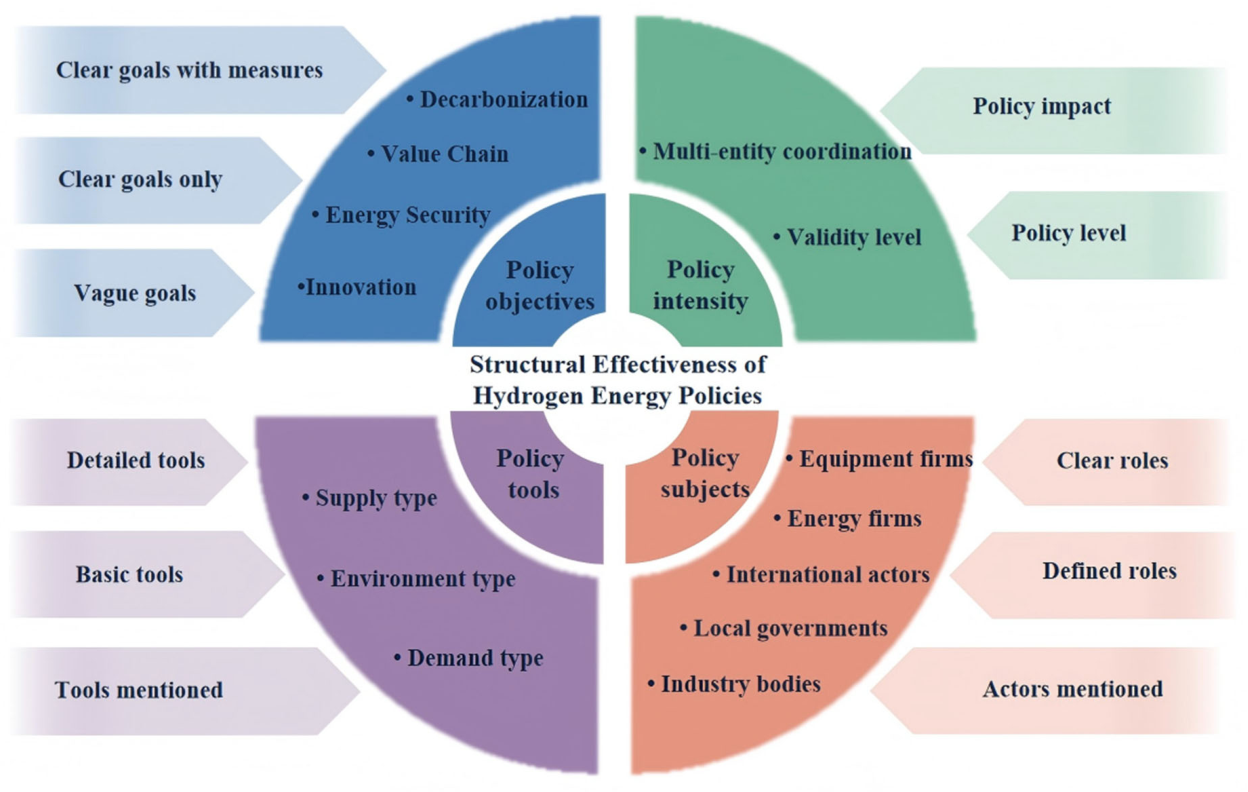
As presented in
Figure 1, the analytical framework organizes policy assessment around four key components. These components cover Policy Objectives, Policy Intensity, Policy Tools, and Policy Subjects. Each dimension reflects an essential part of policy formulation and delivery capacity.
3.1.1. Policy Objectives
Policy objectives constitute the directional core of hydrogen governance. In the context of sustainable energy transition, goal clarity reduces regulatory uncertainty, stabilizes investment expectations, and enhances cross-sector coordination [
37]. Hydrogen strategies frequently articulate ambitions related to decarbonization, industrial competitiveness, energy security, and technological leadership; however, their effectiveness ultimately depends on the degree of specificity and operational precision with which these objectives are defined. Accordingly, this study evaluates policy objectives based on the degree to which they articulate measurable emission reduction targets in hard-to-abate sectors, specify production or deployment benchmarks, define cost-reduction pathways such as levelized cost of hydrogen targets, and integrate industrial development or supply chain localization strategies. Within this dimension, the indicator Advance Technological Innovation and Standardization refers specifically to the extent to which policy frameworks articulate concrete technological development pathways, including support for hydrogen production technologies, storage and transport systems, and industrial application scenarios, as well as the establishment of standardization and certification systems such as guarantees of origin, carbon accounting methodologies, technical standards, and interoperability frameworks that enable market coordination and cross-border exchange. From an implementation theory perspective, clearly defined objectives strengthen accountability mechanisms and reduce interpretive ambiguity among implementing agencies. Ambiguous or aspirational goals, by contrast, tend to weaken institutional coordination and dilute enforcement capacity [
38].
3.1.2. Policy Intensity
Policy intensity indicates the hierarchical authority and implementation capability contained in the design of hydrogen policies [
39]. This dimension captures the extent to which hydrogen governance is supported by binding legal instruments, high-level administrative endorsement, and cross-ministerial coordination mechanisms. The hierarchical status of a policy document—whether enacted as legislation, cabinet-level regulation, or ministerial guideline—serves as an indicator of its institutional durability and legal enforceability. Higher-ranking instruments typically mobilize stronger fiscal commitments, establish clearer compliance requirements, and exhibit greater policy stability over time. In addition, hydrogen development inherently spans multiple sectors, including energy, transport, industry, environment, and trade. The presence of formal coordination mechanisms or joint issuance by multiple ministries signals a whole-of-government approach, enhancing implementation coherence and reducing fragmentation. Consistent with Sabatier and Mazmanian’s theoretical proposition that hierarchical integration strengthens implementation success, policy intensity in this framework functions as a proxy for political prioritization and institutional commitment.
3.1.3. Policy Tools
Policy tools constitute the operational mechanisms through which hydrogen strategies are translated into concrete outcomes [
40]. Drawing upon the classical classification proposed by Rothwell and Zegveld, policy instruments are understood as comprising supply-oriented, environment-shaping, and demand-creating measures. In hydrogen governance, supply-oriented tools typically include research and development subsidies, capital expenditure grants for electrolyzers or infrastructure, pilot project funding, and industrial cluster support mechanisms. Environment-shaping tools focus on constructing regulatory and market conditions conducive to hydrogen deployment, including certification schemes, safety standards, guarantees of origin, carbon pricing frameworks, and technical standardization processes. Demand-creating tools aim to stimulate market uptake through instruments such as contracts for difference, public procurement mandates, industrial usage quotas, or fiscal incentives. The balanced integration of these instruments is essential for overcoming the structural “chicken-and-egg” dilemma inherent in hydrogen markets, where supply expansion depends on credible demand signals and demand formation requires reliable production capacity. Policy structural effectiveness in this dimension is therefore evaluated not merely by instrument presence, but by diversity, specificity, and complementarity across categories.
3.1.4. Policy Subjects
Policy subjects represent the actors directly engaged in or affected by hydrogen policy implementation. Hydrogen policy implementation involves a wide range of public and private actors across production, infrastructure, manufacturing, territorial governance, trade, regulation, and standard setting [
41]. Effective governance requires that these actors be explicitly identified within policy documents and assigned clear roles, rights, and obligations [
42]. The theoretical discussion therefore begins from a broad conception of policy subjects. For purposes of cross national operationalization, however, the indicator system selects five actor groups that recur most consistently across the sampled national frameworks and that represent the principal interfaces of hydrogen policy implementation. These are hydrogen infrastructure construction enterprises, hydrogen equipment manufacturing enterprises, international cooperation and trade entities, local governments and regional management authorities, and industry associations and standard setting bodies.
This selection does not imply that other actors are unimportant. Financial institutions, research organizations, downstream industrial users, and civil society actors may also influence hydrogen transitions in specific contexts. They were not included in the final indicator system because they were not referenced with sufficient consistency and comparability across the full sample. The final operationalization therefore reflects a balance between theoretical breadth and empirical comparability. From a systemic perspective, omission of key value-chain actors can generate implementation gaps and undermine policy credibility. For example, infrastructure expansion without corresponding industrial adoption incentives may result in stranded assets, while production subsidies without downstream market integration may fail to generate sustained demand. Stakeholder inclusiveness therefore serves as a structural indicator of governance completeness and implementation feasibility.
The interaction among the four dimensions forms the analytical core of the framework. Clear objectives without sufficient institutional authority may lack enforceability, while strong legal instruments without diversified policy tools may prove operationally ineffective. Comprehensive instrument design without stakeholder integration risks misalignment between policy intent and actor capability. Conversely, inclusive stakeholder engagement without measurable objectives may result in fragmented or incoherent development pathways. Hydrogen policy structural effectiveness is thus conceptualized as systemic coherence across dimensions rather than the strength of any single component. This integrative logic allows the framework to capture potential nonlinear threshold effects, whereby significant deficiencies in one dimension may disproportionately weaken overall policy performance.
By structuring hydrogen governance analysis within this four-dimensional architecture, the framework provides both theoretical rigor and empirical operability. The exclusion of implementation performance as a separate dimension ensures that all evaluated indicators remain grounded in policy text content and preserves cross-national comparability under conditions of uneven data availability across countries. It establishes a coherent basis for subsequent quantitative evaluation through the entropy-weighted TOPSIS method, ensuring that cross-national comparisons remain grounded in policy implementation theory while maintaining objective measurement standards. The framework thereby enables a systematic diagnosis of governance strengths and structural weaknesses across G20 hydrogen strategies, offering a replicable analytical tool for sustainability-oriented energy policy evaluation.
3.2. Research Methods
This study uses an integrated multi-criteria decision method to assess structural effectiveness of hydrogen energy policies across G20 economies. The approach combines entropy weighting with the Technique for Order Preference by Similarity to Ideal Solution, known as TOPSIS. The selection of this method reflects the multidimensional and structurally heterogeneous nature of hydrogen governance. Because hydrogen policy structural effectiveness is not reducible to a single quantitative outcome such as production volume or subsidy size, an analytical framework capable of synthesizing multiple qualitative and semi-quantitative indicators into a unified comparative index is required. The entropy-weighted TOPSIS model offers a robust solution by integrating objective weight determination with distance-based performance ranking. At the same time, the analytical implications of this method should be stated with appropriate caution. TOPSIS produces a relational ranking based on each case’s relative proximity to a constructed ideal solution within the observed sample. It therefore does not provide a direct measure of absolute policy quality, nor does it independently demonstrate realized policy effectiveness in practice. Rather, it offers a structured comparative assessment of the relative configuration of policy design features across cases.
The entropy weight method originates from Shannon’s information theory, which conceptualizes entropy as a measure of uncertainty or information dispersion within a dataset [
43]. In the context of policy evaluation, entropy weighting determines the relative importance of each indicator based on the degree of variation it exhibits across evaluation units. Indicators with greater variability contain more discriminative information and are therefore assigned higher weights, whereas indicators with limited variation receive lower weights. This mechanism avoids subjective bias that may arise from expert-based weighting systems such as the Analytic Hierarchy Process, particularly in cross-national studies where normative judgments may differ across institutional contexts. By allowing the data itself to determine indicator weights, the entropy method enhances objectivity, replicability, and methodological transparency in the assessment of hydrogen policy structures. However, these empirically derived weights should not be equated with intrinsic theoretical importance. A higher entropy weight indicates stronger differentiating power within the observed dataset, but it does not necessarily imply that the indicator is more important in a normative, causal, or conceptual sense. This distinction is essential for the proper interpretation of the weighting results.
Entropy-weighted TOPSIS ranks national hydrogen policies by measuring their distance from an ideal and a worst solution, with relative closeness indicating structural effectiveness. This method is suitable for hydrogen policy evaluation because it integrates heterogeneous dimensions such as legal authority, policy tools, and stakeholder arrangements within a unified framework. Entropy weighting emphasizes indicators with greater cross-national variation, avoiding distortion from uniformly distributed dimensions. TOPSIS captures overall structural coherence rather than isolated strengths, reflecting the interdependence of hydrogen value chains. It also reduces subjective bias by deriving weights from data dispersion. Together, the method enables a consistent and comparative assessment of governance structures across countries.
The entropy-weight TOPSIS method is illustrated as below.
(a) Basic Definition: Assume there are evaluation units (policies) and evaluation indicators (from the four-dimensional framework). The original data matrix is denoted as , where represents the raw value of the -th indicator of the -th evaluation unit.
(b) Indicator Normalization: To eliminate dimensional effects, the original matrix is normalized using the extremum method, resulting in a standardized matrix
where:
(c)–(e) Entropy Weight Determination: The entropy weight method [
44] is employed to objectively assign weights based on the informational value of each indicator.
(c) The proportion
pij of the
j-th indicator for the
i-th policy is calculated as:
(d) The entropy
of the
-th indicator is:
Note that when .
(e) The weight
of each indicator is then derived as:
(f) Weighted Normalized Matrix: Using the entropy-derived weights, the weighted normalized matrix:
(g)–(i) TOPSIS Evaluation: The positive ideal solution
and the negative ideal-solution
are determined as:
(h) Compute the Euclidean distances of all evaluation units from the positive and negative ideal-solutions (
and
), as shown in Equations (8) and (9), respectively:
(i) Calculate the relative closeness degrees
of the evaluation units:
The higher the relative closeness degree, the better the evaluation unit.
3.3. Selection of Hydrogen Energy Policy Texts
The validity of cross-national policy comparison depends on the representativeness, comparability, and authority of the selected policy texts. Given that hydrogen energy policy remains an evolving field characterized by heterogeneous institutional maturity across G20 nations, a rigorous and transparent screening process was essential to ensure analytical consistency. This study therefore adopted a structured multi-stage selection protocol to identify nationally authoritative hydrogen policy documents that accurately reflect each country’s strategic orientation and implementation architecture.
In this study, the unit of analysis is not merely individual policy documents, but the most authoritative nationally operative hydrogen policy framework in each country. While these frameworks differ in legal type and documentary form, they perform a comparable governance function in guiding hydrogen development.
The initial stage involved systematic document identification. Official government portals, legislative databases, energy ministry websites, and national development planning platforms were searched using standardized keywords such as “hydrogen strategy,” “clean hydrogen,” “hydrogen roadmap,” “hydrogen economy,” and “green hydrogen mission.” Only documents explicitly positioning hydrogen as a core energy vector were retained. Policies in which hydrogen appeared merely as a marginal element within broader renewable or energy transition plans were excluded to preserve thematic precision. At the same time, a small number of broader national planning documents were retained when hydrogen constituted a distinct and codable governance component within the text, supported by identifiable objectives, policy instruments, and actor arrangements. This applied most clearly to Brazil and Saudi Arabia, whose inclusion was intended to preserve variation in governance form while remaining within the limits of document comparability.
The second stage consisted of jurisdictional authority screening. To ensure institutional comparability, only national-level policy instruments were included. Subnational strategies, pilot programs, or private-sector initiatives were excluded unless formally endorsed by central authorities. This step was particularly important given the diversity of governance systems among G20 members. Restricting the sample to nationally authoritative documents ensured that the evaluation reflects official state-level commitment rather than localized experimentation.
The third stage assessed structural completeness in relation to the four-dimensional analytical framework developed in
Section 3.1. Policy texts were examined to confirm that they addressed strategic objectives, implementation instruments, coordination mechanisms, and stakeholder delineation. Documents consisting solely of aspirational statements without operational measures were excluded. This criterion ensured that each selected text possessed sufficient structural depth to support multidimensional evaluation through the entropy-weighted TOPSIS model.
This approach ensures that the selected policy texts are comparable across countries despite differences in institutional context. More specifically, the comparability is based on functional equivalence rather than formal uniformity. Although the selected documents include both dedicated hydrogen strategies and broader national policy frameworks, each document serves as the principal national instrument for defining hydrogen development objectives, structuring policy tools, and coordinating implementation actors. Accordingly, the inclusion of documents with different formal characteristics is justified by their shared functional role within national governance systems.
The fourth stage addressed temporal validity and policy relevance. Only documents that remained operative or officially updated as of January 2026 were retained. Given the rapid evolution of hydrogen governance, earlier pilot-stage documents that had been superseded were excluded. However, foundational strategies predating 2020 were retained if they continued to function as operative national frameworks. This approach balanced recency with structural continuity.
Applying these criteria resulted in the selection of eighteen nationally representative hydrogen policy documents, as presented in
Table 1. The sample reflects diverse governance models, development stages, and strategic orientations, but it does not encompass every formal member of the G20. The European Union was not treated as a separate case because the unit of analysis in this article is the sovereign national policy framework rather than supranational governance. South Africa was not included in the final sample because the available policy materials, although clearly relevant to hydrogen development, did not provide a single nationally operative text with sufficient codable specificity across all fourteen indicators adopted in this study. This boundary was maintained in order to preserve cross national equivalence in document coding and to avoid mixing highly integrated national strategies with more programmatic or dispersed policy materials. In addition to identifying policy texts and issuance time,
Table 1 also incorporates information on the indicative economic scale of national hydrogen programs and their temporal planning horizons, thereby providing a more comprehensive overview of policy ambition and implementation orientation.
Several representative cases illustrate the inclusion rationale. Germany’s National Hydrogen Strategy (November 2023) was selected as a mature and institutionally embedded governance model integrating climate targets, industrial policy coordination, and European regulatory alignment. Japan’s Basic Hydrogen Strategy (June 2023) was included due to its long-term supply chain orientation and technological leadership in hydrogen carriers. The United States’ U.S. National Clean Hydrogen Strategy and Roadmap (June 2023) was retained because it operationalizes hydrogen development through federal coordination mechanisms and fiscal instruments linked to the Inflation Reduction Act.
China’s Medium- and Long-Term Plan for Hydrogen Energy Industry (March 2022) was selected due to its strategic integration of hydrogen within national industrial planning, including quantified targets and demonstration clusters. France’s National Hydrogen Decarbonization Strategy 2025 (April 2025) reflects a forward-looking approach emphasizing decarbonization of hard-to-abate sectors and innovation-driven deployment.
Certain cases were retained to preserve analytical breadth despite atypical features. Saudi Arabia’s National Transformation Program 2030 (Energy Digitalization & Renewable Energy) (April 2016) predates the global acceleration of hydrogen strategies but remains embedded in Vision 2030 and guides export-oriented positioning. Mexico’s Green Hydrogen in Mexico: Towards a Decarbonization of the Economy (November 2021) functions primarily as a strategic orientation framework with relatively limited binding force, yet its inclusion contributes necessary variance in policy intensity. Russia’s Hydrogen Energy Development Vision of the Russian Federation (August 2021) articulates export ambitions and strategic positioning despite geopolitical constraints. Australia’s updated National Hydrogen Strategy (September 2024) illustrates policy evolution within a renewable-export-oriented governance model. Brazil’s Ten-Year Energy Development Plan (July 2023) and Indonesia’s National Hydrogen and Ammonia Roadmap (April 2025) were included as representative cases of emerging hydrogen planning frameworks. These documents were treated as boundary cases in the sample, and their inclusion was subsequently examined through an additional sensitivity analysis in order to test whether lower issue specificity materially altered the comparative results.
Collectively, the eighteen selected policy documents provide a balanced representation of industrialized importers, renewable exporters, manufacturing-oriented economies, and transitional governance systems. The heterogeneity captured in
Table 1 is methodologically necessary for entropy-based differentiation and theoretically valuable for identifying the structural determinants of hydrogen policy structural effectiveness. By adhering to transparent screening standards while retaining both high-intensity and lower-intensity frameworks, the sample construction ensures analytical rigor, dimensional variability, and cross-national comparability, thereby establishing a robust empirical foundation for subsequent evaluation.
Table 1.
Selected Hydrogen Energy Policy Documents of G20 Nations.
Table 1.
Selected Hydrogen Energy Policy Documents of G20 Nations.
| Number | Country | Policy Name | Publication Time | Indicative Economic Scale | Temporal Horizon |
|---|
| T1 | France | National Hydrogen Decarbonization Strategy 2025 | April 2025 | Approx. EUR 9 billion public investment commitment | Medium to long term |
| T2 | South Korea | Hydrogen Economy Roadmap of Korea | January 2019 | Approx. KRW 43 trillion planned investment | Long term |
| T3 | Canada | Hydrogen Strategy for Canada | December 2020 | Multi-billion investment framework with public private participation | Medium to long term |
| T4 | United States | U.S. National Clean Hydrogen Strategy and Roadmap | June 2023 | Up to USD 9.5 billion federal funding and tax incentives | Short to long term |
| T5 | Mexico | Green Hydrogen in Mexico: towards a decarbonization of the economy | November 2021 | Indicative investment potential under development | Short to medium term |
| T6 | Japan | Basic Hydrogen Strategy | June 2023 | Approx. JPY 15 trillion planned investment | Long term |
| T7 | Saudi Arabia | Saudi Arabia National Transformation Program 2030 (Energy Digitalization & Renewable Energy) | April 2016 | Large scale national transformation funding framework | Long term |
| T8 | Turkey | Turkey Hydrogen Technologies Strategy and Roadmap | January 2023 | Indicative national R&D and deployment funding | Medium to long term |
| T9 | Italy | National Hydrogen Strategy | November 2024 | Approx. EUR 10 billion investment including EU funds | Short to medium term |
| T10 | India | National Green Hydrogen Mission | January 2023 | Approx. USD 2.4 billion initial funding allocation | Short to medium term |
| T11 | Indonesia | National Hydrogen and Ammonia Roadmap | April 2025 | Indicative investment framework under development | Long term |
| T12 | United Kingdom | UK Hydrogen Strategy | August 2021 | Approx. GBP 12 billion projected investment leverage | Medium to long term |
| T13 | China | Medium- and Long-Term Plan for Hydrogen Energy Industry | March 2022 | Large scale industrial planning with state support | Medium to long term |
| T14 | Argentina | National Strategy for the Development of the Hydrogen Economy | September 2023 | Indicative large scale export oriented investment potential | Long term |
| T15 | Australia | National Hydrogen Strategy | September 2024 | Multi-billion export oriented investment framework | Long term |
| T16 | Brazil | Ten-Year Energy Development Plan | July 2023 | Indicative investment within broader energy planning | Short to medium term |
| T17 | Germany | National Hydrogen Strategy | July 2023 | Approx. EUR 13 billion public investment commitment | Medium to long term |
| T18 | Russia | Hydrogen Energy Development Vision of the Russian Federation | August 2021 | Indicative large scale export oriented investment potential | Long term |
3.4. Construction of the Evaluation Index System
Building on the analytical structure set out in
Section 3.1, this study establishes a complete three-tier evaluation index system for measuring the performance of hydrogen energy policies. The first tier defines the overarching assessment goal, which is the structural effectiveness of national hydrogen policies under sustainability-centered governance. The second tier comprises four core analytical dimensions derived from the theoretical framework. These dimensions include Policy Objectives, Policy Intensity, Policy Tools, and Policy Subjects. The third tier converts these four dimensions into fourteen concrete assessment indicators that support quantitative analysis using the entropy-weighted TOPSIS model. This hierarchical architecture establishes a coherent progression from abstract theoretical constructs to empirically observable policy attributes, ensuring methodological transparency and internal logical consistency.
The construction of the three-tier structure is grounded in both theoretical considerations and the institutional realities of hydrogen governance. The first level evaluation target in this study is defined as the structural effectiveness of hydrogen energy policy frameworks. This concept refers to governance quality and implementation oriented capacity embedded in policy design rather than realized policy outcomes. It captures the extent to which national hydrogen frameworks are structured to support effective implementation through strategic clarity, institutional authority, instrument diversity, and stakeholder specification. By defining effectiveness in structural terms, the study avoids conflating policy design with ex post performance, which is subject to time lag, contextual differences, and data limitations across countries.
The second-level dimensions correspond directly to the four-dimensional framework derived from policy implementation theory. Policy Objectives capture strategic clarity and normative direction. Policy Intensity reflects institutional authority and enforcement credibility, and the extent to which a policy framework embeds formal coordination capacity across competent public bodies. In this dimension, Validity level captures the hierarchical and legal status of the policy instrument, whereas Multi-entity coordination captures the degree of institutionalized coordination reflected either in joint issuance arrangements or in formally designated interdepartmental mechanisms within the policy text. Policy Tools represent the operational mechanisms through which strategies are executed. Policy Subjects assess stakeholder integration and governance inclusiveness. These four dimensions were selected because hydrogen development is inherently systemic and cannot be adequately explained by single-factor variables such as subsidy scale or emission targets. Hydrogen governance requires alignment across goals, authority, instruments, and actors. Consequently, these dimensions collectively represent the minimum structural components necessary for implementation feasibility in a complex socio-technical transition.
The third tier includes fourteen specific indicators developed to translate the four core dimensions into measurable terms for quantitative comparison. These indicators are selected based on both theoretical foundations and empirical evidence from current hydrogen policy practices. Each indicator reflects a key structural attribute widely recognized in public policy research and energy governance application.
Within the Policy Objectives dimension, indicators were selected to measure goal specificity, quantifiability, and multidimensional integration. Hydrogen strategies frequently articulate broad ambitions such as carbon neutrality or industrial competitiveness, yet only some specify measurable production targets, sectoral decarbonization benchmarks, cost-reduction pathways, or timelines [
45]. Indicators under this dimension therefore evaluate whether policies include explicit hydrogen production capacity goals, defined emission reduction targets in hard-to-abate sectors, cost or efficiency benchmarks, and articulated industrial development objectives. These indicators were chosen because goal clarity directly influences investment predictability and implementation accountability, as established in policy implementation theory.
Under the Policy Intensity dimension, indicators were selected to capture both hierarchical authority and cross-sector coordination capacity. Hydrogen policy often intersects with energy regulation, industrial planning, transport decarbonization, and trade policy [
46]. Consequently, the legal status of a document and the degree of inter-ministerial issuance serve as measurable proxies for institutional commitment. Indicators assess whether the policy is enacted through legislation, executive regulation, or strategic guidance, and whether it involves joint issuance or formal coordination mechanisms across ministries. These variables were selected because empirical studies of policy implementation consistently demonstrate that higher legal validity and integrated administrative structures enhance enforceability and resource mobilization capacity.
Within the Policy Tools dimension, indicators reflect the diversity and specificity of supply-oriented, environment-shaping, and demand-creating instruments. Hydrogen market formation requires production subsidies, infrastructure investment support, certification frameworks, safety standards, carbon pricing mechanisms, and demand-side stimulation such as contracts for difference or procurement mandates [
47]. The selected indicators evaluate the presence and comprehensiveness of these instrument categories. Their inclusion is justified by the structural “chicken-and-egg” dilemma in hydrogen deployment, where imbalance among instrument types can lead to market stagnation. Measuring tool diversity and specificity therefore captures a fundamental determinant of policy operability.
The Policy Subjects dimension incorporates indicators that assess stakeholder identification, role delineation, and participation mechanisms [
48]. Hydrogen governance spans producers, infrastructure operators, industrial consumers, research institutions, and regulatory agencies. Indicators under this dimension evaluate whether policy documents clearly specify actor responsibilities, define rights and obligations, and incorporate mechanisms for stakeholder consultation or coordination. These indicators were selected because inclusive governance structures enhance compliance legitimacy and reduce implementation gaps across the hydrogen value chain.
Across all fourteen indicators, two guiding principles governed selection. The first principle was theoretical relevance. Each indicator must correspond to a structural variable recognized in policy implementation literature as affecting effectiveness. The second principle was measurability and cross-national comparability. Indicators were formulated so that document-level coding could be conducted consistently across different legal systems and governance traditions. This balance between theoretical depth and empirical operability ensures that the index system retains conceptual validity while remaining compatible with entropy-based weighting and TOPSIS ranking.
The hierarchical design also enhances methodological robustness. By separating the conceptual dimensions at the second level from the operational indicators at the third level, the framework avoids collapsing complex governance attributes into overly simplified metrics. Instead, it preserves structural nuance while enabling systematic quantification. Furthermore, the use of multiple indicators within each dimension allows entropy weighting to empirically determine the discriminative contribution of each structural feature across G20 nations, thereby strengthening objectivity in cross-national comparison.
In the context of hydrogen policy evaluation, this three-level index system captures both the normative ambition and the institutional architecture necessary for sustainable implementation. It reflects the understanding that hydrogen policy structural effectiveness depends on the interplay between strategic clarity, authoritative endorsement, instrument diversity, and actor integration. By translating these structural determinants into fourteen measurable indicators, the index system establishes a rigorous foundation for subsequent quantitative analysis using the entropy-weighted TOPSIS method. The evaluation system is presented in
Table 2. A detailed indicator numbering scheme and the complete scoring matrix for all eighteen countries across the fourteen indicators are provided in the
Supplementary Materials (Tables S1 and S2).
3.5. Standard for Quantifying Indicators
Policy quantification centers on assigning scores to relevant indicators using consistent criteria. To strengthen analysis of hydrogen energy policies, precise scoring was applied to policy documents across the dimensions of policy objectives, policy intensity, policy tools, and policy subjects. Separate scoring rules were developed for each indicator according to its attribute and influence on hydrogen policy performance. The resulting quantification criteria are presented in
Table 3,
Table 4,
Table 5 and
Table 6. The full scoring results for all evaluated policy documents are available in the
Supplementary Materials (Table S2). To reduce interpretive subjectivity, the distinction between scores of 3, 2, and 1 was anchored in the presence or absence of concrete textual features, including quantified targets, implementation timelines, designated responsible authorities, funding arrangements, monitoring provisions, coordination mechanisms, and compliance procedures.
(For policy objectives, we select four evaluation indicators: ① Deploy Hydrogen for Decarbonizing Hard-to-Abate Sectors to Achieve Net-Zero; ② Foster Hydrogen Value Chain and Job Creation; ③ Enhance Energy Security and Supply Chain Autonomy; ④ Advance Technological Innovation and Standardization.)
The scoring of policy objectives is grounded in the principle that goal specificity enhances implementation accountability and reduces interpretive ambiguity [
49]. Policy characterization is marked by a well-defined goal accompanied by detailed execution procedures, such as quantified targets, defined timelines, and clearly specified implementation pathways. Example: a policy stating specific hydrogen production capacity targets with implementation schedules is coded as 3. Policy characterization is marked by a well-defined goal yet lacking detailed execution procedures, such as general policy direction without operational timelines or quantified targets. Example: a policy that declares support for hydrogen development without specifying implementation steps is coded as 2. Policy characterization is marked by an ambiguous goal and an absence of detailed execution procedures, such as broad references to energy transition without explicit hydrogen-related objectives. Example: a policy that only mentions hydrogen in general terms without clear policy direction is coded as 1. This gradation reflects the theoretical linkage between goal clarity and effective policy implementation.
Table 4.
Judgment criteria for policy intensity.
Table 4.
Judgment criteria for policy intensity.
| Evaluation Indicator | Evaluation Criterion | Score |
|---|
| Validity level | Laws | 5 |
| Administrative Regulations | 4 |
| Departmental Regulations | 3 |
| Normative documents | 2 |
| Policies | 1 |
| Multi-entity coordination | Presence of formal coordination arrangements involving three or more national-level entities, whether through joint issuance, designated interdepartmental councils, or clearly institutionalized cross-ministerial implementation mechanisms | 3 |
| Presence of formal coordination arrangements involving two national-level entities, or clear designation of one lead authority with a structured coordination mandate linking other competent bodies | 2 |
| Single-agency issuance without explicit evidence of formalized cross-entity coordination mechanisms in the policy text | 1 |
The scoring of the validity level indicator is grounded in the principle that hierarchical legal authority directly affects policy enforceability, durability, and implementation credibility [
50]. Hydrogen energy development requires long-term capital investment, infrastructure deployment, cross-sector coordination, and international cooperation. Under such conditions, the legal status of a policy instrument significantly influences investor confidence, inter-agency compliance, and administrative accountability. Laws enacted by national legislatures receive the highest score because they possess binding force, procedural stability, and superior legal status within the normative hierarchy, thereby providing the strongest institutional guarantee for sustained hydrogen governance. Administrative regulations issued by central executive authorities are assigned a slightly lower score, reflecting their high but subordinate legal authority and their ability to mobilize cross-ministerial implementation mechanisms. Departmental regulations are scored at a mid-level because they demonstrate formal authority within a specific administrative domain but may lack comprehensive cross-sector binding force. Normative documents are assigned a lower score due to their limited legal enforceability and relatively weaker accountability mechanisms. Finally, policy guidance documents receive the lowest score because they typically function as strategic orientations without binding legal force or mandatory compliance requirements. This hierarchical scoring structure reflects the doctrine of legal superiority and recognizes that stronger legal validity enhances institutional commitment, implementation stability, and long-term structural effectiveness in hydrogen energy governance.
The scoring of policy intensity captures both legal hierarchy and institutional coordination capacity. Validity level and Multi-entity coordination are therefore related but analytically distinct indicators. The former evaluates the formal legal rank and enforceability of the policy instrument, while the latter evaluates whether the policy text embeds structured coordination across competent public authorities. In coding Multi-entity coordination, co-issuance by multiple ministries was treated as one important indicator, but not the exclusive one. Equivalent evidentiary weight was also given to formally designated interdepartmental committees, cabinet-level coordination platforms, lead-agency mechanisms with explicit cross-sector mandates, or other clearly specified arrangements that institutionalize whole-of-government implementation. This scoring logic aligns with implementation theory, which emphasizes the importance of both hierarchical integration and administrative coherence for effective governance.
Table 5.
Judgment criteria of policy tools.
Table 5.
Judgment criteria of policy tools.
| Evaluation Indicator | Evaluation Criterion | Score |
|---|
| Supply type | It encompasses the provision of essential resources including funding, talent, infrastructure, technology, and information, and is accompanied by concrete operational provisions such as identified funding channels, implementation arrangements, designated institutions, or measurable deployment measures to accomplish policy aims. | 3 |
| It entails the allocation of essential resources, such as funding, talent, and technology, for policy goal attainment, accompanied by identifiable but only partial regulatory or implementation support, without sufficiently specific arrangements regarding responsibility, timing, scale, or monitoring. | 2 |
| It is confined to the basic allocation of indispensable resources, including funds, personnel, and technology, required to meet policy objectives. | 1 |
| Environment type | This level encompasses the deployment of specific policy instruments, including target planning, fiscal subsidies, regulatory oversight, standardized protocols, and performance evaluation. These tools are essential for creating an enabling environment to attain policy objectives. The framework is complemented by concrete and traceable implementation provisions, such as designated supervisory bodies, compliance procedures, technical standards, or evaluation mechanisms. | 3 |
| This level encompasses the deployment of specific policy instruments, including target planning, fiscal subsidies, regulatory oversight, standardized protocols, and performance evaluation. These tools are essential for creating an enabling environment to attain policy objectives. The framework is complemented by basic regulatory support or general implementation guidance, but without sufficiently specific compliance, supervision, or evaluation arrangements. | 2 |
| This level is limited to the identification of necessary policy instruments, such as target planning and fiscal subsidies, which are required to establish a foundational environment for achieving policy objectives. | 1 |
| Demand type | This level encompasses the deployment of specific policy instruments, including service procurement, international collaboration, and policy subsidies. These tools are essential for achieving policy objectives and are supported by concrete implementation provisions such as designated procurement pathways, subsidy mechanisms, market access conditions, or institutional responsibilities. | 3 |
| This level encompasses the deployment of specific policy instruments, including service procurement, international collaboration, and policy subsidies. These tools are essential for achieving policy objectives and are supported by general but still incomplete regulatory or implementation provisions that do not yet specify responsibility, scale, timetable, or enforcement clearly. | 2 |
| This level is limited to identifying necessary policy instruments, such as service procurement and policy subsidies, which are required to achieve core policy objectives. | 1 |
The scoring of policy tools reflects the structural necessity of instrument diversity in hydrogen market formation. It encompasses the provision of essential resources including funding, infrastructure programs, and technology deployment measures supported by clearly specified policy instruments. Example: explicit subsidy schemes or dedicated hydrogen infrastructure programs are coded as 3. It entails the allocation of essential resources accompanied by general policy support measures without detailed implementation mechanisms. Example: general financial support or policy encouragement without instrument specification is coded as 2. It is confined to minimal or implicit support with no clearly defined policy instruments. Example: indirect or symbolic references to support are coded as 1. This differentiation is particularly important in hydrogen governance, where imbalances between supply, regulatory, and demand mechanisms may inhibit ecosystem formation.
Table 6.
Criteria for policy subjects.
Table 6.
Criteria for policy subjects.
| Evaluation Criterion | Score |
|---|
| The text clearly delineates the responsibilities, functions, or obligations of relevant entities and links them to concrete coordination, consultation, implementation, or compliance arrangements. | 3 |
| The text identifies key stakeholders and indicates their expected roles, but without sufficiently concrete role allocation, procedural linkage, or implementation detail. | 2 |
| The text merely references the principal actors involved without assigning substantive responsibilities or connecting them to actionable governance arrangements. | 1 |
(For policy subjects, we select five evaluation indicators: ① Hydrogen Infrastructure Construction Enterprises; ② Hydrogen Equipment Manufacturing Enterprises; ③ International Cooperation and Trade Entities; ④ Local Governments and Regional Management Authorities; ⑤ Industry Associations and Standard-Setting Bodies.)
The scoring of policy subjects is designed to capture stakeholder inclusiveness and governance completeness. The text delineates the entitlements and responsibilities of relevant entities with clearly assigned roles and implementation obligations. Example: explicit designation of responsibilities for infrastructure operators or local governments is coded as 3. The text addresses the roles of key stakeholders but without clear allocation of responsibilities. Example: listing actors such as enterprises or agencies without specifying duties is coded as 2. The text only references actors in general terms without functional roles. Example: broad mentions of stakeholders without operational detail are coded as 1. This gradation reflects the empirical observation that hydrogen implementation requires synchronized action among producers, infrastructure operators, industrial users, and regulatory authorities.
3.6. Policy Scoring Protocol and Robustness Assurance
To ensure methodological rigor and cross-national comparability, a structured policy scoring protocol was established prior to empirical evaluation. The objective of this protocol was to translate qualitative hydrogen policy documents into standardized quantitative indicators while minimizing interpretive bias and ensuring replicability. Given that hydrogen governance structures vary substantially across legal traditions, administrative systems, and strategic cultures, the scoring process required a consistent operational framework grounded in the predefined evaluation criteria set out in
Section 3.5.
The scoring procedure was conducted in three stages. First, each selected national hydrogen policy document was systematically reviewed and coded according to the fourteen third-level indicators. Coders were provided with a detailed coding manual specifying indicator definitions, scoring thresholds, and illustrative examples to reduce subjective interpretation. Each indicator was assessed based on explicit textual evidence contained within the official policy document. When an aspect relevant to a given indicator was absent or mentioned only in a highly general manner without sufficient substantive support, the document was assigned the minimum score of 1 rather than being excluded from consideration for that indicator. When ambiguity arose regarding the interpretation of policy language, priority was given to verifiable provisions such as quantified targets, legally binding clauses, formally designated coordination mechanisms, or explicitly identified stakeholder responsibilities.
Second, to strengthen reliability, independent dual coding was implemented. Two trained researchers with expertise in public policy and energy governance evaluated each document separately. After the initial coding phase, inter-rater consistency was calculated using Cohen’s kappa coefficient. The initial round produced a Cohen’s kappa value of 0.76, indicating a substantial level of agreement and strong consistency in indicator interpretation across evaluators. Discrepancies were subsequently discussed in structured reconciliation sessions, during which coders referred back to the official policy texts and predefined scoring standards. Most discrepancies concerned borderline distinctions between general policy mention and sufficiently specified policy content, particularly where a document referred to an objective, instrument, or stakeholder group without providing measurable targets, operational measures, or clear role allocation. Final scores were determined through consensus, ensuring that all indicator values reflected documented policy content rather than subjective inference. Nevertheless, the analysis remains partly dependent on interpretative judgment. Even with clearly defined coding rules, the assignment of policy content to discrete scores requires evaluative decisions regarding the specificity, comprehensiveness, and institutional meaning of textual formulations. While the use of standardized coding procedures enhances consistency, it does not fully eliminate interpretative dependence.
Third, a consistency review was conducted across the dataset to ensure that scoring thresholds were applied uniformly among countries. Particular attention was given to indicators related to policy intensity and instrument comprehensiveness, as variations in administrative terminology across jurisdictions could potentially introduce coding inconsistencies. For example, documents labeled as “strategies” in one country may carry different levels of legal authority than similarly titled documents elsewhere. In such cases, scoring was based on functional authority and legal status rather than document title alone, thereby preserving cross-national equivalence.
In addition to procedural reliability, robustness assurance was incorporated at the quantitative analysis stage. Because the entropy-weighted TOPSIS method relies on indicator dispersion for weight calculation, sensitivity analysis was conducted to evaluate whether minor scoring variations would materially affect ranking outcomes. Alternative distance metrics, including Manhattan distance and Chebyshev distance, were applied to test whether the relative closeness coefficients were sensitive to the choice of distance calculation method. The resulting rankings demonstrated high stability across alternative specifications, indicating that the evaluation results were not artifacts of a particular metric assumption.
Furthermore, normalization procedures were examined to ensure that extreme values in any single indicator did not disproportionately distort composite scores. The extremum normalization method was selected because it preserves relative differentiation across countries while maintaining bounded comparability. The entropy weight distribution was also inspected to confirm that no single indicator dominated the composite index in a manner inconsistent with theoretical expectations. The weight distribution reflected meaningful variation across dimensions, consistent with the multidimensional nature of hydrogen governance structures.
Taken together, the structured scoring protocol, inter-rater reliability verification, reconciliation procedures, and quantitative sensitivity tests collectively strengthen the credibility of the evaluation results. By combining qualitative coding discipline with statistical robustness analysis, the study ensures that the entropy-weighted TOPSIS outcomes reflect substantive structural differences in hydrogen policy design rather than procedural bias or computational artifacts. This integrated reliability framework enhances confidence in the cross-national comparative findings and supports the validity of subsequent empirical interpretations regarding the determinants of hydrogen policy structural effectiveness.
4. Empirical Analysis of Policy Evaluation
4.1. Indicator System and Entropy Weight Determination
Empirical assessment of hydrogen policies among G20 economies follows the four-dimensional analytical framework established in
Section 3.1. This framework encompasses Policy Objectives, Policy Intensity, Policy Tools, and Policy Subjects. These dimensions are operationalized through fourteen third-level indicators that capture the structural attributes of hydrogen governance in policy texts, including goal specificity, institutional authority, instrument design, and stakeholder coverage. The purpose of this indicator system is to measure document-level implementation capacity and governance completeness, rather than ex post market outcomes such as hydrogen production volume or investment scale, thereby preserving cross-national comparability across heterogeneous development stages.
To determine indicator weights objectively, this study employs the entropy weight method, which allocates weights according to the information content embodied in each indicator’s dispersion across the sample [
51]. Indicators with larger cross-national variation possess stronger discriminative power and thus receive higher weights, whereas indicators exhibiting convergence across countries receive lower weights. These weights should therefore be interpreted as indicators of comparative differentiation within the sample rather than as direct evidence of substantive importance or causal influence on policy success.
The entropy results in
Table 7 reveal a weight distribution with two dominant drivers. Policy Objectives account for the largest share of the total weight at 0.318, closely followed by Policy Subjects at 0.315. This near-parity indicates that differentiation among G20 hydrogen governance systems is explained simultaneously by the clarity and structure of strategic targets and by the extent to which policies embed key actors across the hydrogen value chain. Within Policy Objectives, “Advance Technological Innovation and Standardization” exhibits the highest individual weight at 0.128, suggesting that countries diverge most strongly in whether they translate hydrogen ambition into technology pathways, standardization arrangements, and innovation-oriented governance architectures. In this context, technological innovation refers to the presence of clearly articulated development trajectories for hydrogen production, storage, transport, and end-use technologies, while standardization refers to the establishment of formal systems for certification, carbon intensity measurement, technical interoperability, and regulatory harmonization. Together, these elements capture the extent to which policy frameworks move beyond declarative goals toward operationally defined innovation ecosystems and coordinated market infrastructures. By contrast, decarbonization (0.044), value chain and jobs (0.079), and energy security (0.067) display lower discriminative power, implying broader convergence in these goal narratives.
Policy Intensity contributes 0.219, with “Multi-entity coordination” (0.156) far outweighing “Validity level” (0.063). This pattern indicates that what most differentiates hydrogen governance is not the formal legal rank of documents alone, but whether hydrogen policy is institutionally organized through cross-ministerial and cross-sector coordination mechanisms capable of resolving the strong interdependencies among energy, industry, transport, and trade [
52]. Policy Tools carry a total weight of 0.148, within which demand-side instruments (0.074) contribute more than environment-shaping (0.051) and supply-side tools (0.023). This implies that cross-national divergence is driven more by market-creation design, such as procurement, offtake support, or demand guarantees, than by production subsidies that are comparatively similar or less explicitly codified across documents.
Within Policy Subjects, “Industry Associations and Standard-Setting Bodies” has the highest weight at 0.097, while international cooperation and trade entities (0.073) and local governments (0.073) also show strong differentiating capacity. This distribution reflects a core feature of hydrogen transitions: implementation hinges on governance networks that can coordinate standards, certify low-carbon attributes, and align domestic deployment with cross-border trade and regional execution. Overall, the entropy results empirically substantiate that effective hydrogen policy systems in the G20 are differentiated primarily by the depth of technology-and-standards orientation, the strength of coordination architectures, the credibility of demand formation mechanisms, and the institutionalization of intermediary and standard-setting actors.
Table 7.
Entropy weight value of policy evaluation index.
Table 7.
Entropy weight value of policy evaluation index.
| Evaluation Indicator | Itemize | Weight (w) |
|---|
| Policy objective | Deploy Hydrogen for Decarbonizing Hard-to-Abate Sectors to Achieve Net-Zero | 0.044 | 0.318 |
| Foster Hydrogen Value Chain and Job Creation | 0.079 |
| Enhance Energy Security and Supply Chain Autonomy | 0.067 |
| Advance Technological Innovation and Standardization | 0.128 |
| Policy intensity | Validity level | 0.063 | 0.219 |
| Multi-entity coordination | 0.156 |
| Policy tools | Supply type | 0.023 | 0.148 |
| Environment type | 0.051 |
| Demand type | 0.074 |
| Policy subjects | Hydrogen Infrastructure Construction Enterprises | 0.040 | 0.315 |
| Hydrogen Equipment Manufacturing Enterprises | 0.032 |
| International Cooperation and Trade Entities | 0.073 |
| Local Governments and Regional Management Authorities | 0.073 |
| Industry Associations and Standard-Setting Bodies | 0.097 |
4.2. Cross-National Performance via TOPSIS
Using the entropy-weighted TOPSIS approach, this study identifies considerable differences in the structural effectiveness of hydrogen policies across the eighteen G20 economies analyzed. The relative closeness coefficient reflects the degree to which each national policy system approximates the multidimensional ideal configuration derived from the weighted indicator matrix. The variation observed in
Table 8 is not merely quantitative but indicative of deeper differences in strategic coherence, institutional coordination, instrument architecture, and stakeholder integration within hydrogen governance systems. Higher-ranking countries are characterized by relatively balanced performance across all four dimensions, while lower-ranking countries tend to exhibit structural gaps or imbalances in one or more dimensions. The ranking positions should therefore be interpreted as indicators of overall structural coherence rather than as absolute measures of policy success.
As shown in
Table 8, the distribution of relative closeness values forms a clear gradient across countries, ranging from highly integrated policy systems to more fragmented governance structures. Countries at the top of the ranking demonstrate consistent alignment among objectives, institutional authority, policy tools, and stakeholder specification, whereas those at the lower end of the ranking display more limited integration, weaker coordination mechanisms, or less developed instrument portfolios. This pattern provides an empirical basis for the following tiered interpretation.
Table 8.
Comprehensive evaluation value of Hydrogen Energy Policy.
Table 8.
Comprehensive evaluation value of Hydrogen Energy Policy.
| Number | Policy Name | Relative Closeness
Degree | Sort |
|---|
| T1 | National Hydrogen Decarbonization Strategy 2025 | 0.758 | 4 |
| T2 | Hydrogen Economy Roadmap of Korea | 0.505 | 8 |
| T3 | Hydrogen Strategy for Canada | 0.644 | 5 |
| T4 | U.S. National Clean Hydrogen Strategy and Roadmap | 0.949 | 1 |
| T5 | Green Hydrogen in Mexico: towards a decarbonization of the economy | 0.146 | 14 |
| T6 | Basic Hydrogen Strategy | 0.608 | 6 |
| T7 | Saudi Arabia National Transformation Program 2030 (Energy Digitalization & Renewable Energy) | 0.322 | 12 |
| T8 | Turkey Hydrogen Technologies Strategy and Roadmap | 0.138 | 15 |
| T9 | National Hydrogen Strategy | 0.412 | 9 |
| T10 | National Green Hydrogen Mission | 0.335 | 11 |
| T11 | National Hydrogen and Ammonia Roadmap | 0.073 | 16 |
| T12 | UK Hydrogen Strategy | 0.772 | 2 |
| T13 | Medium- and Long-Term Plan for Hydrogen Energy Industry | 0.553 | 7 |
| T14 | National Strategy for the Development of the Hydrogen Economy | 0.051 | 17 |
| T15 | National Hydrogen Strategy | 0.367 | 10 |
| T16 | Ten-Year Energy Development Plan | 0.037 | 18 |
| T17 | National Hydrogen Strategy | 0.772 | 3 |
| T18 | Hydrogen Energy Development Vision of the Russian Federation | 0.269 | 13 |
4.2.1. Tier I: Synergistic Governance Systems
The first group consists of the six highest-ranked policies: the United States’ U.S. National Clean Hydrogen Strategy and Roadmap (0.949), the United Kingdom’s UK Hydrogen Strategy (0.772), Germany’s National Hydrogen Strategy (0.772), France’s National Hydrogen Decarbonization Strategy 2025 (0.758), Canada’s Hydrogen Strategy for Canada (0.644), and Japan’s Basic Hydrogen Strategy (0.608). These policies exhibit strong multidimensional alignment across objectives, coordination structures, instrument portfolios, and stakeholder integration. Their placement at the top of the ranking indicates not only the presence of ambitious hydrogen agendas, but also the existence of comparatively complete governance architectures capable of translating strategic intent into institutionally supported policy action.
The United States ranks first, reflecting exceptional structural coherence. Its framework combines technological innovation targets, regional hydrogen hub development, fiscal incentives, lifecycle emissions standards, and inter-agency coordination, producing a highly balanced governance architecture. This high ranking indicates that the United States performs strongly across all four evaluated dimensions, with no major structural deficiencies, thereby approximating the multidimensional ideal configuration more closely than other countries in the sample. The United Kingdom and Germany follow closely, demonstrating strong integration between innovation-oriented objectives and institutionalized regulatory systems, particularly in certification, industrial decarbonization pathways, and standard-setting engagement. Although their relative closeness values are identical, their policy profiles are not entirely the same. The United Kingdom benefits from a particularly coherent market-building orientation, while Germany performs strongly through strategic integration of technological development, industrial transformation, and coordinated public support. France’s 2025 decarbonization strategy performs strongly due to its explicit focus on hard-to-abate sector transformation and technological deployment mechanisms. Its position immediately below the United Kingdom and Germany indicates a highly competitive policy structure, especially in technology-oriented objectives and standard-related governance capacity. Canada’s strategy shows balanced alignment across value-chain development and institutional coordination. Its ranking suggests strong structural completeness, although with slightly less intensity or differentiation than the leading European and North American cases. Japan, while slightly lower within this group, demonstrates significant technological depth and long-term supply chain positioning, particularly through hydrogen carrier development and international partnerships, sustaining its placement among the leading cohort. Its lower relative closeness within Tier I suggests that a strong strategic and technological vision can still be accompanied by somewhat less balanced performance across the full set of institutional and stakeholder dimensions.
4.2.2. Tier II: Partial Alignment with Implementation Gaps
The second group comprises South Korea’s Hydrogen Economy Roadmap of Korea (0.505), China’s Medium- and Long-Term Plan for Hydrogen Energy Industry (0.553), Italy’s National Hydrogen Strategy (0.412), Australia’s National Hydrogen Strategy (0.367), India’s National Green Hydrogen Mission (0.335), and Saudi Arabia’s National Transformation Program 2030 (Energy Digitalization & Renewable Energy) (0.322). These policies demonstrate identifiable structural strengths but reveal imbalances across one or more key dimensions. Their intermediate ranking positions reflect partial alignment within the four-dimensional framework, where strengths in certain dimensions such as technological ambition or policy objectives are offset by weaker performance in coordination mechanisms, stakeholder specification, or demand-side instrument design.
China and South Korea display strong technological ambition and industrial orientation, yet their differentiation is moderated by comparatively uneven stakeholder institutionalization or coordination depth. China’s ranking above South Korea suggests somewhat stronger overall structural integration, but both cases remain clearly below the leading group, indicating that industrial ambition alone is insufficient when the broader governance architecture is less evenly articulated. Italy and Australia articulate clear strategic positioning, particularly in renewable integration and export potential, but exhibit narrower coordination mechanisms or limited demand-side instrument diversification. Their intermediate to lower-middle positions reflect policy frameworks that are directionally coherent yet not fully operationalized across all four dimensions. India’s Green Hydrogen Mission reflects ambitious decarbonization goals and emerging market-creation mechanisms, although its governance architecture remains in a developmental phase. Its placement below Australia and Italy suggests that strategic ambition and mission-oriented language still require stronger institutional embedding and clearer actor coordination to raise overall policy coherence. Saudi Arabia emphasizes export positioning and large-scale transformation initiatives, but its framework relies more heavily on overarching programmatic planning than on diversified regulatory instruments. Its position at the lower end of this tier indicates that broad strategic commitment does not automatically translate into a highly differentiated or institutionally dense policy structure. Collectively, this group reflects meaningful structural capacity, yet lacks the fully integrated governance coherence observed in Tier I.
4.2.3. Tier III: Fragmented Approaches
The third group includes Russia’s Hydrogen Energy Development Vision of the Russian Federation (0.269), Mexico’s Green Hydrogen in Mexico: Towards a Decarbonization of the Economy (0.146), Turkey’s Hydrogen Technologies Strategy and Roadmap (0.138), Indonesia’s National Hydrogen and Ammonia Roadmap (0.073), Argentina’s National Strategy for the Development of the Hydrogen Economy (0.051), and Brazil’s Ten-Year Energy Development Plan (0.037). These policies display comparatively fragmented governance architectures and lower multidimensional coherence. Their lower ranking positions indicate that deficiencies are not limited to a single dimension but often extend across multiple aspects of policy design, resulting in reduced proximity to the ideal configuration defined by the evaluation framework.
Russia’s framework emphasizes export positioning and strategic vision but lacks balanced domestic instrument deployment and stakeholder integration. Its ranking above the remaining Tier III countries indicates that strategic orientation alone can preserve some degree of structural visibility, but not enough to approach the middle group without stronger internal coordination and implementation architecture. Mexico and Turkey demonstrate limited policy intensity and relatively modest instrument diversity. Their proximity in ranking suggests similar governance constraints, especially in the transition from strategic acknowledgement to institutionally supported policy design. Indonesia and Argentina rely largely on planning-oriented or roadmap-style documents with limited enforceability and incomplete operational mechanisms. Their very low relative closeness values indicate substantial distance from the ideal configuration across multiple dimensions simultaneously. Brazil’s Ten-Year Energy Development Plan, while relevant to hydrogen development, does not embed hydrogen within a fully articulated governance architecture, resulting in the lowest overall score. Its final position in the ranking reflects the fact that hydrogen remains embedded within a broader planning framework rather than structured as a dedicated and multidimensionally developed national policy system.
Overall, the three-tier grouping indicates that higher-performing hydrogen governance systems tend to exhibit a combination of technology-oriented objectives, cross-sector coordination, diversified instrument design, and inclusive stakeholder integration. Middle-tier systems appear to reflect selective strengths accompanied by structural imbalances, while lower-tier policies are generally associated with more limited institutional depth and less complete systemic integration. Viewed together, the rankings in
Table 8 show that the decisive distinction among countries is not whether hydrogen appears on the policy agenda, but whether it is embedded within a governance framework that is sufficiently specific, authoritative, coordinated, and actor-oriented to support sustained policy implementation.
4.3. Dimensions That Most Strongly Differentiate Policy Configurations
To clarify the comparative meaning of the entropy results, this section interprets the weight distribution as an indication of which dimensions and indicators most strongly differentiate hydrogen policy configurations across the sampled countries, rather than as evidence of causal determinants of policy success. The weight distribution reported in
Table 7 indicates that Policy Objectives account for 0.318 of the total weight, followed closely by Policy Subjects at 0.315. Policy Intensity contributes 0.219, while Policy Tools account for 0.148. This distribution suggests that comparative differentiation among G20 hydrogen governance systems is most visible in the clarity and technological orientation of strategic objectives, alongside the depth of stakeholder institutionalization.
Within the Policy Objectives dimension, “Advance Technological Innovation and Standardization” exhibits the highest individual weight at 0.128, substantially exceeding other objective-related indicators. This finding indicates that cross-national variation is most pronounced in the extent to which hydrogen strategies articulate concrete technology pathways, cost-reduction mechanisms, and standardization architectures. While most G20 countries reference decarbonization commitments, as reflected in the comparatively lower weight of 0.044 for hard-to-abate sector decarbonization, meaningful differentiation arises when objectives extend beyond aspirational climate targets toward operationalized innovation ecosystems. Similarly, value chain development and energy security considerations carry moderate weights of 0.079 and 0.067, indicating that industrial positioning and supply chain autonomy contribute to policy distinction but are less decisive than technological system design.
Policy Subjects emerge as the second most strongly differentiating dimension, with a total weight of 0.315. Notably, “Industry Associations and Standard-Setting Bodies” hold the highest weight within this dimension at 0.097, underscoring the central role of intermediary governance actors in hydrogen transitions. International cooperation entities and local governments, each weighted at 0.073, further highlight the importance of networked governance structures that bridge domestic implementation with cross-border certification and regional execution [
53]. In contrast, infrastructure construction enterprises and equipment manufacturers carry comparatively lower weights, suggesting that variation across countries lies less in recognizing industrial actors per se and more in embedding them within coordinated institutional frameworks. These results confirm that hydrogen policy structural effectiveness depends heavily on structured stakeholder ecosystems capable of supporting certification harmonization, infrastructure deployment, and technology diffusion.
Policy Intensity contributes 0.219 to overall explanatory power, with multi-entity coordination weighted at 0.156 significantly exceeding validity level at 0.063. This pattern indicates that cross-sector coordination mechanisms are more decisive than formal legal hierarchy alone [
54]. In hydrogen governance, which spans energy, industry, transport, and trade systems, coordinated administrative structures provide greater differentiation than statutory status in isolation. Finally, Policy Tools account for 0.148, with demand-side instruments weighted at 0.074 exceeding environment-shaping and supply-side tools. This suggests that countries diverge most in their ability to construct credible market-creation mechanisms rather than in basic production support measures.
Taken together, the findings indicate that the sampled countries differ most visibly in technology-oriented strategic clarity and in the institutionalization of inclusive stakeholder networks. These dimensions therefore possess greater comparative discriminative power within the present dataset, although the entropy results alone do not establish that they are causally prior to all other conditions of policy success. While legal authority and instrument design remain important, they play a secondary role relative to the structural integration of innovation pathways and governance actors. These results reinforce the theoretical proposition that hydrogen transitions require systemic alignment between strategic vision and implementation architecture, rather than isolated policy strengths.
4.4. Methodological Robustness
To examine whether the evaluation results are sensitive to the choice of distance metric, the TOPSIS analysis was recalculated using Euclidean distance, Manhattan distance, and Chebyshev distance, and the detailed results are reported in
Table 9. Because Euclidean distance reflects overall geometric proximity to the ideal solution [
55], Manhattan distance emphasizes cumulative deviation across all indicators [
56], and Chebyshev distance captures the maximum deviation in any single dimension [
57], comparing rankings under these three specifications allows a systematic robustness assessment.
The results in
Table 9 demonstrate strong overall stability, particularly at the top and bottom of the ranking spectrum. The United States’ U.S. National Clean Hydrogen Strategy and Roadmap consistently ranks first under all three distance measures, confirming that its leading position is structurally robust and independent of metric choice. The United Kingdom’s UK Hydrogen Strategy remains second under Euclidean and Manhattan distances and retains a top-four position under Chebyshev distance. Germany’s National Hydrogen Strategy ranks third under Euclidean and Manhattan distances and shifts slightly to fifth under Chebyshev distance, indicating high but balanced multidimensional performance. France’s National Hydrogen Decarbonization Strategy 2025 moves from fourth under Euclidean and Manhattan distances to second under Chebyshev distance, suggesting strong peak performance in one or more highly weighted dimensions. This improvement is primarily associated with its strong performance in the indicator Advance Technological Innovation and Standardization, which carries the highest individual weight within the Policy Objectives dimension, as well as its comparatively well-developed stakeholder and standard-setting arrangements that enhance its score in dimensions related to policy subjects and coordination.
Canada’s Hydrogen Strategy for Canada shows moderate sensitivity, ranking fifth under Euclidean distance, sixth under Manhattan distance, and improving to third under Chebyshev distance. This shift indicates that Canada performs particularly well in at least one dominant indicator emphasized by the maximum-deviation metric. Japan’s Basic Hydrogen Strategy remains relatively stable, ranking sixth under Euclidean and Chebyshev distances and fifth under Manhattan distance, reflecting limited metric sensitivity.
Among middle-tier countries, China’s Medium- and Long-Term Plan for Hydrogen Energy Industry consistently ranks seventh across all three metrics, and South Korea’s Hydrogen Economy Roadmap of Korea remains eighth throughout. India’s National Green Hydrogen Mission holds the eleventh position under all distance calculations. These cases confirm strong stability in the middle cluster.
More noticeable variations appear in the lower-middle range. Russia’s Hydrogen Energy Development Vision of the Russian Federation improves from thirteenth under Euclidean and Manhattan distances to ninth under Chebyshev distance, indicating strong performance in at least one high-weight dimension that becomes more visible under maximum-deviation assessment. Italy’s National Hydrogen Strategy shifts from ninth to tenth under Chebyshev distance, while Australia’s National Hydrogen Strategy declines from tenth to twelfth, suggesting relatively uneven dimensional balance. Saudi Arabia’s National Transformation Program 2030 (Energy Digitalization & Renewable Energy) moves from twelfth to thirteenth under Chebyshev distance, reflecting similar structural sensitivity.
At the lower end, strong robustness is observed. Mexico’s Green Hydrogen in Mexico: Towards a Decarbonization of the Economy consistently ranks fourteenth. Turkey’s Hydrogen Technologies Strategy and Roadmap remains fifteenth, Indonesia’s National Hydrogen and Ammonia Roadmap stays sixteenth, Argentina’s National Strategy for the Development of the Hydrogen Economy remains seventeenth, and Brazil’s Ten-Year Energy Development Plan consistently ranks eighteenth. The stability of these positions confirms that their comparatively weak structural coherence is not a result of methodological specification.
Overall, although minor rank exchanges occur among adjacent positions—particularly under Chebyshev distance, which accentuates dimension-specific strengths—the broader tiered structure remains unchanged. High-performing policies such as those of the United States, the United Kingdom, Germany, France, and Canada consistently occupy leading positions, middle-tier policies remain clustered in intermediate ranks, and structurally weaker frameworks persist at the bottom. The limited magnitude of ranking variation demonstrates that the entropy-weighted TOPSIS evaluation results are methodologically robust and substantively reliable. A further sensitivity check was conducted to assess whether the inclusion of broader and less hydrogen specific policy texts materially affected the findings. For this purpose, the model was recalculated after excluding Brazil’s Ten-Year Energy Development Plan and Saudi Arabia’s National Transformation Program 2030, which represent the two least hydrogen specific documents in the final sample. The restricted sample did not alter the substantive interpretation of the results. The leading and lagging groups remained stable, and the central conclusion that stronger hydrogen governance depends on the alignment of strategic objectives, coordination structures, policy instruments, and stakeholder specification was preserved. This supplementary test indicates that the comparative results are not driven by a small number of boundary case documents and that the main findings remain valid under a stricter document specificity threshold.
Table 9.
Comparison of policy evaluation results under different distance metrics.
Table 9.
Comparison of policy evaluation results under different distance metrics.
| Number | Policy Name | Euclidean Distance (Rank) | Manhattan Distance (Rank) | Chebyshev Distance (Rank) |
|---|
| T1 | National Hydrogen Decarbonization Strategy 2025 | 0.758 (4) | 0.877 (4) | 0.663 (2) |
| T2 | Hydrogen Economy Roadmap of Korea | 0.505 (8) | 0.679 (8) | 0.385 (8) |
| T3 | Hydrogen Strategy for Canada | 0.644 (5) | 0.714 (6) | 0.620 (3) |
| T4 | U.S. National Clean Hydrogen Strategy and Roadmap | 0.949 (1) | 0.984 (1) | 0.907 (1) |
| T5 | Green Hydrogen in Mexico: towards a decarbonization of the economy | 0.146 (14) | 0.076 (14) | 0.219 (14) |
| T6 | Basic Hydrogen Strategy | 0.608 (6) | 0.812 (5) | 0.449 (6) |
| T7 | Saudi Arabia National Transformation Program 2030 (Energy Digitalization & Renewable Energy) | 0.322 (12) | 0.305 (12) | 0.318 (13) |
| T8 | Turkey Hydrogen Technologies Strategy and Roadmap | 0.138 (15) | 0.060 (15) | 0.219 (15) |
| T9 | National Hydrogen Strategy | 0.412 (9) | 0.501 (9) | 0.337 (10) |
| T10 | National Green Hydrogen Mission | 0.335 (11) | 0.331 (11) | 0.337 (11) |
| T11 | National Hydrogen and Ammonia Roadmap | 0.073 (16) | 0.032 (16) | 0.114 (16) |
| T12 | UK Hydrogen Strategy | 0.772 (2) | 0.922 (2) | 0.620 (4) |
| T13 | Medium- and Long-Term Plan for Hydrogen Energy Industry | 0.553 (7) | 0.695 (7) | 0.449 (7) |
| T14 | National Strategy for the Development of the Hydrogen Economy | 0.051 (17) | 0.016 (17) | 0.093 (17) |
| T15 | National Hydrogen Strategy | 0.367 (10) | 0.404 (10) | 0.337 (12) |
| T16 | Ten-Year Energy Development Plan | 0.037 (18) | 0.012 (18) | 0.069 (18) |
| T17 | National Hydrogen Strategy | 0.772 (3) | 0.922 (3) | 0.620 (5) |
| T18 | Hydrogen Energy Development Vision of the Russian Federation | 0.269 (13) | 0.183 (13) | 0.380 (9) |
4.5. Implications for Policy Optimization
The empirical findings provide differentiated pathways for optimizing national hydrogen policy frameworks. Given that Policy Objectives and Policy Subjects together account for more than sixty percent of the total entropy weight, policy improvement should prioritize strengthening technological orientation and deepening stakeholder institutionalization, while reinforcing coordination mechanisms and demand-side instruments where necessary.
For high-performing countries, including the United States, the United Kingdom, Germany, France, Canada, and Japan, policy optimization should focus on consolidation and refinement rather than structural overhaul. These countries already demonstrate strong technological roadmaps and relatively balanced governance architectures. Future improvements should center on enhancing demand-side market credibility, including long-term offtake mechanisms, contracts for difference, and carbon-accounting interoperability across jurisdictions. In addition, further institutionalization of industry associations and standard-setting bodies will be critical for maintaining technological leadership and facilitating cross-border certification alignment. For countries such as Canada and France, whose rankings improve under Chebyshev distance due to strong peak performance in innovation-oriented objectives, ensuring greater balance across remaining dimensions may further stabilize long-term competitiveness.
For middle-tier countries, including South Korea, China, Italy, Australia, India, and Saudi Arabia, the priority lies in correcting structural imbalances. While many of these countries articulate ambitious hydrogen objectives, improvements in multi-entity coordination and stakeholder specification would significantly enhance systemic coherence. In operational terms, strengthening Policy Intensity may involve institutionalizing formal inter-ministerial coordination mechanisms through joint issuance procedures, legally mandated coordination committees, or centralized implementation platforms that integrate energy, industry, and transport authorities. Strengthening Policy Subjects requires moving beyond general stakeholder recognition toward clearly defined role allocation, including specifying which entities are responsible for infrastructure deployment, industrial adoption, certification, and international cooperation. Expanding demand-side instruments beyond production incentives is also essential to overcome the market formation bottleneck identified in the entropy analysis. This may include the introduction of long-term offtake agreements, public procurement programs, or sector-specific usage mandates that provide stable demand signals. For example, Italy and Australia, which show sensitivity to maximum-deviation metrics, may benefit from reducing uneven performance across dimensions through more integrated instrument portfolios.
For lower-performing countries, including Mexico, Turkey, Indonesia, Argentina, Brazil, and Russia, more foundational reforms are required. In these contexts, hydrogen policies often function primarily as planning or guideline documents with limited legal intensity and incomplete stakeholder integration. Elevating strategic documents into more authoritative regulatory instruments, embedding measurable technological targets, and establishing clear accountability mechanisms should be prioritized. In practical terms, strengthening Policy Intensity may involve upgrading hydrogen strategies from advisory policy documents to formally endorsed cabinet-level programs or legally binding regulatory instruments, accompanied by clearly designated lead ministries and inter-ministerial coordination bodies responsible for implementation oversight. Strengthening Policy Subjects requires the explicit identification and formal inclusion of key actors across the hydrogen value chain, including infrastructure operators, industrial users, standard-setting bodies, and regional authorities, with clearly defined roles, responsibilities, and coordination mechanisms. For example, assigning implementation responsibilities to specific sectoral agencies and establishing regular coordination platforms among government, industry, and research institutions can reduce fragmentation and enhance policy coherence. Particular attention should be given to incorporating intermediary institutions such as industry associations and regional authorities into formal governance structures, as these actors were identified as high-impact dimensions in the comparative analysis. Developing credible demand-creation mechanisms alongside supply support will also be essential to avoid fragmented policy development.
Across all performance tiers, the results reinforce a core insight from policy implementation theory: hydrogen transition governance is inherently systemic. Excellence in isolated dimensions cannot compensate for deficiencies in technological clarity or stakeholder coordination. Policymakers should therefore adopt adaptive governance approaches that integrate iterative evaluation, institutional learning, and multi-actor collaboration. This includes establishing continuous policy review mechanisms, linking pilot projects with formal regulatory adjustment processes, and embedding stakeholder consultation into routine governance procedures. By aligning technological ambition with coordinated administrative structures and inclusive implementation networks, countries can enhance the resilience and long-term effectiveness of their hydrogen transition strategies.
To further operationalize the above recommendations and to align the empirical findings with country-level policy design,
Table 10 provides a concise mapping of improvement directions for each of the eighteen countries included in the analysis. The recommendations are derived directly from the four-dimensional evaluation results and highlight the most salient areas for structural enhancement in each national policy framework. By linking comparative evaluation outcomes with country-specific policy priorities, this table strengthens the practical applicability of the analytical framework and ensures that the identified improvement pathways are directly actionable within diverse governance contexts.
5. Conclusions and Recommendations
5.1. Conclusions
This research performs a structured assessment of hydrogen policies across eighteen G20 economies using a four-dimensional analytical framework. The framework includes Policy Objectives, Policy Intensity, Policy Tools, and Policy Subjects. The entropy-weighted TOPSIS method is applied to produce comparative performance rankings. The results reveal substantial structural divergence in hydrogen governance effectiveness, confirming that structural effectiveness of policy design is determined by multidimensional institutional alignment.
The entropy analysis indicates that Policy Objectives account for 31.8 percent of total weight, with technological innovation and standardization as the most decisive factors. Policy Subjects follow at 31.5 percent, highlighting the role of structured stakeholder systems. Policy Intensity contributes 21.9 percent, driven mainly by coordination capacity, while Policy Tools account for 14.8 percent, with demand-side measures showing stronger influence.
The TOPSIS rankings further reveal a clear tiered structure among the eighteen countries. The top tier consists of the United States, the United Kingdom, Germany, France, Canada, and Japan. These countries demonstrate high relative closeness values and balanced multidimensional alignment. Their hydrogen strategies combine technology-oriented objectives, coordinated institutional frameworks, diversified policy instruments, and well-defined stakeholder architectures. The United States ranks first, reflecting exceptional integration of fiscal incentives, innovation pathways, and cross-agency coordination. The United Kingdom and Germany follow closely with strong regulatory coherence and standardization mechanisms, while France and Canada exhibit comprehensive value-chain strategies supported by institutional coordination. Japan’s placement within this leading group reflects its long-term technological roadmap and international supply chain positioning.
The middle tier includes South Korea, China, Italy, Australia, India, and Saudi Arabia. These countries exhibit identifiable structural strengths but demonstrate partial imbalances across dimensions. In several cases, strategic objectives are clearly articulated, yet coordination mechanisms or stakeholder integration remain less comprehensive. Their rankings suggest transitional governance systems with emerging institutional capacity but incomplete systemic alignment.
The lowest tier comprises Russia, Mexico, Turkey, Indonesia, Argentina, and Brazil. Policies within this group display fragmented governance structures, limited coordination intensity, or insufficient stakeholder specification. Many rely on planning-oriented documents with constrained legal authority or narrow instrument diversity. Their lower performance reflects systematic multidimensional structural gaps rather than isolated or singular weaknesses.
In conclusion, hydrogen policy structural effectiveness across the G20 is primarily shaped by the clarity and technological depth of strategic objectives and by the institutionalization of inclusive governance networks. Countries that integrate innovation pathways, coordinated administrative structures, diversified market instruments, and structured stakeholder participation within a coherent policy architecture achieve superior performance. These findings underscore that hydrogen policy effectiveness is fundamentally a function of multidimensional institutional alignment rather than the strength of individual policy instruments. This underscores the importance of systemic governance design in sustainability transitions, where interdependencies across policy domains necessitate coordinated and structurally coherent frameworks.
5.2. Recommendations
Based on the tiered ranking results and the identified structural determinants of hydrogen policy structural effectiveness, differentiated policy recommendations are proposed for the three performance groups. These recommendations emphasize strengthening technological orientation, coordination mechanisms, and stakeholder institutionalization, consistent with the empirical finding that Policy Objectives and Policy Subjects exert the greatest influence on overall performance.
For the top-tier countries, including the United States, the United Kingdom, Germany, France, Canada, and Japan, the primary task is strategic refinement of policy design structures rather than foundational overhaul. These countries already demonstrate strong technological roadmaps and coordinated governance structures; therefore, future efforts should focus on incorporating more sophisticated demand-side mechanisms into the policy framework, such as explicit provisions for hydrogen offtake guarantees or long-term contracts for difference, to enhance the structural completeness and market-formation logic embedded within the policy itself. Furthermore, these countries should further formalize the roles of industry associations, standard-setting bodies, and international trade entities within their policy texts to accelerate the structural harmonization of safety and lifecycle carbon accounting frameworks.
For the middle-tier countries, including South Korea, China, Italy, Australia, India, and Saudi Arabia, policy upgrading should concentrate on strengthening coordination mechanisms and formalizing stakeholder integration. While many of these nations articulate ambitious hydrogen objectives, implementation coherence can be improved by establishing clearer inter-ministerial mandates and legally embedded coordination platforms. Enhancing the operational depth of technological innovation pathways, particularly through national standardization bodies and industrial cluster programs, will increase structural differentiation and long-term effectiveness. Furthermore, expanding demand-side instruments and clarifying the roles of local governments and intermediary institutions can reduce fragmentation and strengthen ecosystem formation.
For the lower-tier countries, including Russia, Mexico, Turkey, Indonesia, Argentina, and Brazil, more fundamental structural adjustments are required. Policy frameworks in this group would benefit from elevating hydrogen strategies from planning-oriented documents to more authoritative regulatory instruments with defined implementation timelines and accountability mechanisms. Clarifying stakeholder responsibilities, especially for industry associations and regional authorities, is essential to avoid governance gaps. Developing balanced instrument portfolios that combine production support with credible market-creation mechanisms will also be critical. International technical cooperation and knowledge exchange may accelerate capacity building and institutional learning in these contexts.
Across all tiers, policymakers should recognize that hydrogen transitions are systemic and require balanced alignment among objectives, coordination structures, instruments, and actors. Adaptive governance mechanisms, supported by transparent evaluation systems, will be indispensable for ensuring long-term policy resilience.
5.3. Limitations and Future Research
This study has several methodological limitations that should be explicitly acknowledged. First, the evaluation relies on entropy-weighted TOPSIS, which generates a relational ranking based on comparative proximity to an ideal solution within the observed sample. The resulting scores therefore indicate relative position rather than absolute policy quality. They should not be interpreted as direct measures of realized policy success, implementation effectiveness, or substantive national performance in hydrogen development.
Second, the entropy weighting procedure assigns greater empirical weight to indicators that exhibit stronger variation across the sample. This improves differentiation among cases, but it does not necessarily correspond to the theoretical or normative importance of those indicators. As a result, the weighting structure should be interpreted as data-sensitive rather than theory-determinative.
Third, the analysis is based on standardized coding of policy document content. Although coding rules, double coding, and reliability checks were used to improve consistency, the scoring process remains partly dependent on researchers’ interpretative judgments. The identification of whether a policy provision is limited, partial, or comprehensive cannot be entirely separated from textual interpretation.
Fourth, the documents included in the sample are functionally comparable as nationally operative hydrogen policy frameworks, but they are not formally identical in legal type, scope, or documentary style. This means that cross-national comparison remains analytically useful yet methodologically imperfect.
Fifth, more detailed policy documents may contain more explicit references to objectives, instruments, and actors, which may partly affect scores within a document-based framework. In this respect, the analysis may capture documentary comprehensiveness alongside governance design quality.
Finally, the study is cross-sectional and reflects the policy landscape as observable up to January 2026. The findings should therefore be understood as a time-bound analytical snapshot rather than as a stable or permanent ranking of hydrogen policy frameworks.
Future research can build on this framework in several directions. One important path is to connect structural policy evaluation with empirical implementation evidence, including investment flows, project pipelines, electrolyzer deployment, renewable hydrogen production, certification systems, and sectoral decarbonization outcomes. Another priority is to refine the coding system through expanded transparency in coding examples and possible normalization for document scope and detail. Longitudinal research could further examine how changes in policy design over time relate to shifts in implementation performance and strategic adaptation across national hydrogen systems.