Article

Utilization of Abandoned Farmland in China: A Four-Actor Evolutionary Game Analysis of Local Government–Village Collective–Family Farm–Farmer Interactions

1
School of Management, Wuhan Institute of Technology, Wuhan 430205, China
2
Enterprise and Environment Coordinated Development Research Center of Hubei Province, Wuhan 430205, China
3
College of Public Administration, Central China Normal University, Wuhan 430079, China
4
Department of Culture Industry, Jin Zhong University, Jinzhong 030619, China
*
Authors to whom correspondence should be addressed.
Sustainability 2026, 18(8), 3902; https://doi.org/10.3390/su18083902
Submission received: 8 January 2026 / Revised: 1 April 2026 / Accepted: 3 April 2026 / Published: 15 April 2026
(This article belongs to the Special Issue Sustainable Land Use and Management, 2nd Edition)

Abstract

Promoting the effective use of abandoned farmland has become a key policy priority for strengthening food security in China. However, disentangling the decision-making processes among diverse participating actors is a foundational prerequisite for addressing the governance challenge of abandoned farmland utilization. Building on this, the present study employs a four-actor evolutionary game model and sensitivity analysis of key parameters to systematically examine the interactions among four key actors—local governments, village collectives, family farms, and farmers—and to identify the corresponding evolutionarily stable strategies (ESSs) across different stages of abandoned farmland utilization. The results show that: (1) Multi-actor strategic interactions in abandoned farmland utilization exhibit a multi-stage evolutionary trajectory, in which all actors gradually shift their strategic choices under changing cost–benefit structures, regulatory intensity, and coordination conditions, leading to different evolutionary stable equilibria across governance stages. (2) The configuration in which local governments adopt loose regulation, the village collective plays an active coordinating role, family farms pursue long-term operations, and farmers choose recultivation is a key condition for achieving a Pareto-optimal equilibrium. (3) Although farmers’ production willingness and behavioral choices form the basis for the utilization of abandoned farmland, spontaneous individual action alone is insufficient to address the structural contradictions currently facing abandoned farmland utilization in China. To effectively promote the evolution of abandoned farmland governance toward a stable collaborative equilibrium and ultimately realize sustainable utilization, it is necessary to further optimize governmental administrative control models and incentive mechanisms, strengthen the organizational and coordinating functions of village collectives, and improve long-term operational support systems for family farms. This study systematically elucidates the underlying logic of China’s abandoned farmland utilization from the perspective of multi-actor behavioral decision-making, providing policy-referential insights for optimizing policy design, reducing coordination costs, and improving the efficiency of abandoned farmland utilization.

1. Introduction

Global food security is confronting unprecedented challenges. On the one hand, the international landscape has become increasingly volatile, with escalating geopolitical conflicts intensifying disruptions in grain trade and undermining the fragile balance of global food supply chains. On the other hand, the world population has surpassed 8 billion, and rapid demographic growth continues to amplify pressure on food demand. Meanwhile, the compounding effects of frequent extreme weather events and slowing economic growth have further exacerbated instability in food supply systems. Moreover, food loss and waste across the supply chain further reduce the effective availability of food [1], aggravating the contradiction between constrained supply and rising demand. Against this background, improving the effective utilization of underused land resources, including abandoned farmland, is important not only for expanding agricultural production potential but also for enhancing overall resource-use efficiency within the food system. According to the 2025 Global Report on Food Crises released by the Food and Agriculture Organization of the United Nations (FAO), the number of people experiencing severe food insecurity has risen markedly for six consecutive years, increasing by 13.7 million in 2024 alone to reach 295.3 million worldwide [2].
Although arable land is widely recognized as the cornerstone of food security, farmland abandonment has emerged as a persistent global phenomenon since the early twentieth century, first observed in developed regions such as Europe and Japan and later spreading worldwide. In this study, farmland refers to arable land used for crop production, excluding rural construction land, forests, grasslands, and other non-agricultural land-use types. Recent estimates suggest that abandoned farmland now covers approximately 100 million hectares, accounting for nearly 6% of global arable land. Asia has become one of the most severely affected regions, representing nearly one-third of global abandoned farmland [3]. As the world’s largest developing country and a major grain producer, China has not been immune to this trend. Since the 1980s, farmland abandonment in China has continued to intensify and has gradually expanded from mountainous and hilly areas to plains and major grain-producing regions. Latest data indicate that the long-term abandonment rate of cultivated land in China has reached 5.94%; when short-term and seasonal abandonment are also taken into account, the overall proportion of abandoned cultivated land exceeds 20.79% [4,5]. This is estimated to result in a grain production loss of approximately 49.23 million tons, which could potentially feed around 123 million people [5,6]. Meanwhile, China’s farmland is approaching the limits of its ecological carrying capacity, a constraint reflected in three major aspects. First, land endowments are highly uneven. According to the National Bulletin on Cultivated Land Quality, nearly one-third of the country’s farmland is located in mountainous areas, and only 31.24% is classified as high-quality, with the remainder consisting predominantly of medium-quality and low-quality land [7]. Second, farmland resources are limited on a per capita basis. The China Natural Resources Bulletin (2024) reports that China’s per capita farmland area is only 0.091 ha, significantly below the global average of 0.16 ha [8]. Third, the potential for expanding farmland reserves is constrained. Due to China’s long agricultural history, reserve farmland amounts to only approximately 5.35 million ha, indicating limited scope for further expansion. Moreover, these reserves consist largely of grassland, saline–alkali land, and bare land; they are spatially fragmented and primarily distributed in economically less developed regions of central and western China, as well as in ecologically fragile areas, where resource quality is relatively low, thereby constraining development potential. From the perspective of ecological carrying capacity, driven by dietary transitions and rising grain demand, China’s farmland has long operated under high input pressure. Fertilizer application intensity has exceeded the internationally referenced warning line of 225 kg per hectare, and the average fertilization rate per hectare is more than three times the global average. Under current production conditions, further intensification faces increasingly binding ecological and environmental constraints [9,10]. Accordingly, the production potential of abandoned farmland should be evaluated in relation to land suitability rather than assumed uniformly. Not all abandoned plots are appropriate for recultivation; for parcels constrained by steep slopes, poor soil quality, ecological fragility, or prohibitively high reclamation costs, alternative land-use pathways such as afforestation, ecological restoration, or agroforestry may be more sustainable than conventional agricultural reclamation. Against this backdrop, improving the effective utilization of abandoned farmland has become an urgent priority for consolidating China’s food security foundation.
From a theoretical perspective, existing studies have advanced valuable insights into farmland abandonment from the perspectives of geography, ecology, economics, and management [11]. Existing studies have primarily addressed the conceptual clarification of abandoned farmland, its spatiotemporal patterns and evolutionary trajectories, and its driving factors, impacts, and underlying mechanisms. In China, farmland abandonment has been reported to follow a “T-shaped” spatial configuration: the horizontal axis runs along the east–west belt of the middle and lower reaches of the Yangtze River, while the vertical axis extends from southeastern Gansu to western Guizhou and northern Yunnan, forming a north–south belt [12,13]. A growing body of empirical evidence suggests that natural conditions, socioeconomic changes, policy interventions, and household structure jointly shape decisions regarding farmland abandonment [14,15,16,17]. Nevertheless, the fundamental driver of farmland abandonment in China is the widening income gap between off-farm employment and farming, which increases the opportunity cost of cultivation and reduces farmers’ incentives to continue production [18]. Importantly, farmland abandonment represents a “double-edged sword.” The consequences of farmland abandonment are complex and cannot be reduced to a simple ecological–economic trade-off. Under certain conditions, farmland abandonment may contribute to soil recovery and biodiversity conservation, and biodiversity enhancement may support ecosystem functioning and long-term productivity. However, in the context of farmland governance and food security, persistent abandonment can still reduce the effective cultivated area, lower grain output, and weaken land-use efficiency, especially in the short to medium term [12]. In addition, some studies have begun to examine abandoned farmland utilization from the perspectives of influencing factors, policy coordination, suitability evaluation, and allocation strategies [19]. However, in practice, large-scale efforts to bring abandoned farmland back into cultivation have often failed to produce lasting results, as recultivated plots are soon abandoned again. In some regions of China, marginal plots have become effectively uncultivable, yet institutional constraints still prevent their formal withdrawal from cultivation. Overall, while the literature provides a solid foundation for identifying where abandonment occurs, why it happens, and what its consequences are, significant theoretical gaps remain regarding how abandoned farmland can be utilized in a stable, sustainable, and effective manner.
From a practical perspective, although the Chinese government has incorporated the coordinated utilization of abandoned farmland to support agricultural production into its broader strategies for national development and food security, a four-actor model of abandoned farmland utilization and governance involving local governments, village collectives, family farms, and farmers has gradually taken shape. In this governance framework, local governments influence land-use outcomes through regulatory arrangements, policy incentives, and administrative interventions; village collective economic organizations act as organizational intermediaries by consolidating fragmented land resources and coordinating contractual arrangements; family farms, as representative new agricultural business entities, incorporate transferred land into scaled agricultural production systems; and farmers directly participate in the recultivation of abandoned farmland. However, practical experience suggests that policies aimed at promoting the recultivation of abandoned farmland often struggle to achieve lasting effects. In some regions of China, recultivated farmland is soon abandoned again, giving rise to a low-efficiency cycle of “abandonment–recultivation–re-abandonment–re-recultivation”. There are problems such as one-size-fits-all ecological restoration mandates, debt-financed land reclamation, the direct involvement of village committees in farming activities, the relocation of cultivated land to ecologically unsuitable upland areas, renewed abandonment after the receipt of recultivation subsidies, and formalistic or inflated reporting of recultivation outcomes [20,21].
In fact, the root of this set of issues lies in the fact that the utilization of abandoned farmland is a complex systemic undertaking, whose outcomes are not determined by the behavior of any single actor, but rather by the evolutionary game process and collaborative outcomes among multiple actors, including local governments, village collectives, family farms, and farmers, under the combined influence of expected returns, cost considerations, risk assessments, and policy constraints. While existing studies have generated important insights by identifying statistically significant relationships among micro-level variables, they are less able to capture the broader logic of multi-actor decision-making. Therefore, this study shifts the analytical focus from isolated factor identification to the behavioral logic underlying actor interactions in abandoned farmland utilization. Through an evolutionary game model, this study examines how actors adapt their strategies through policy incentives, payoff comparisons, experiential learning, and repeated interactions, thereby reconstructing the gradual transition from fragmented decisions to collaborative coordination in China’s abandoned farmland governance context. In this way, the study offers a more holistic theoretical explanation of the behavioral foundations of abandoned farmland utilization and provides policy-relevant insights for optimizing policy design, reducing coordination costs, and improving utilization efficiency. Specifically, using evolutionarily stable strategy (ESS) analysis and numerical simulations, we seek to uncover the underlying strategic logic that shapes the utilization of abandoned farmland and address two key questions: (1) Can multi-actor coordination facilitate effective utilization, and what evolutionary trajectories characterize such strategic interactions? (2) Which actor plays the decisive role in steering the system toward a Pareto-optimal equilibrium? This study examines the interactions among key actors involved in abandoned farmland utilization, including farmers, local governments, village collectives, and family farms, to identify the mechanisms influencing farmland abandonment and subsequent farmland utilization. A theory-driven evolutionary game model is constructed to analyze the dynamic evolution of actor behaviors under alternative governance arrangements, using evolutionarily stable strategy (ESS) analysis and numerical simulations. Model parameters are informed by institutional arrangements, policy practices, and stylized facts from the existing literature rather than calibrated to a specific empirical dataset. Accordingly, the analysis is not confined to a particular location or time period, but aims to reveal generalizable interaction mechanisms within the Chinese farmland governance context.
Compared with existing studies, this paper makes contributions in three respects. First, it shifts the analytical focus from farmland abandonment as an individual farmer’s cultivation decision or a simple government–farmer supervision problem to abandoned farmland utilization as a multi-actor governance process embedded in China’s collective land system. On this basis, the paper constructs an integrated analytical framework linking local governments, village collectives, family farms, and farmers. Second, the study reveals that abandoned farmland governance does not converge directly to a single optimal outcome, but instead evolves through four distinct stages: initial coordination, policy-driven recultivation, regulation-dependent collaboration, and endogenous collaboration. Third, the analysis identifies the institutional conditions under which sustainable utilization becomes possible. In particular, the results show that long-term governance does not primarily depend on intensifying administrative punishment alone, but on whether village collectives can reduce coordination and transaction costs and whether family farms can form stable expectations regarding long-term operation. In this way, the paper provides a more policy-relevant explanation of how abandoned farmland governance can move from short-term administrative intervention toward durable collaborative utilization.

2. Research Review

2.1. Research on the Actors Involved in the Utilization of Abandoned Farmland

Abandoned farmland refers to land that was previously cultivated but is currently left uncultivated and has become idle. However, there is no universally accepted criterion regarding the duration of non-cultivation required for land to be classified as abandoned farmland. Different definitions have been proposed, including a one-year threshold by Japan’s Ministry of Agriculture, a two-year threshold suggested in the International Workshop on Land Consolidation and Land Banking, and a five-year threshold adopted by the Food and Agriculture Organization of the United Nations [22,23]. In terms of typology, abandoned farmland can be categorized into explicit versus implicit abandonment, as well as seasonal versus permanent abandonment [24]. The utilization of abandoned farmland refers to the process of restoring its agricultural production functions through systematic planning, technological interventions, and policy guidance [3,25].
A broad consensus in the literature suggests that farmland abandonment is not the outcome of decisions made by a single actor, but rather the result of interactions among multiple stakeholders under specific institutional and economic conditions. Farmers are widely regarded as the direct decision-makers of abandonment. As rational economic agents, their decisions to cultivate or abandon land depend on comparisons of production costs and expected agricultural returns, alternative off-farm employment opportunities, labor constraints, and plot-level natural conditions. Empirical studies indicate that labor outmigration, increased engagement in off-farm and part-time employment, and rising agricultural opportunity costs are among the key drivers of farmers’ abandonment decisions [26,27,28]. From this perspective, abandonment can be interpreted as a livelihood choice made by farmers after rationally weighing competing income opportunities. Nevertheless, as research has progressed, scholars have increasingly recognized that farmer-centered explanations alone are insufficient to account for the spatial clustering, recurrence, and dynamic “abandonment–recultivation–re-abandonment” processes observed in many regions. Consequently, a growing number of studies have situated farmland abandonment and its reutilization within broader land governance and agricultural management systems, incorporating local governments, village collectives, and emerging agricultural business entities into analytical frameworks. In the Chinese institutional context, both central and local governments are widely viewed as the primary actors responsible for achieving farmland protection and food security goals. They influence farmers’ land-use behavior through administrative, economic, and legal instruments, thereby exerting substantial impacts on farmland conservation outcomes [29]. Existing evidence further suggests that local governments adopt heterogeneous governance strategies in response to assessment pressures, fiscal capacity, and administrative cost constraints, which in turn shape the effectiveness of abandoned farmland governance [30,31].
Distinct from Western systems of private land ownership, China operates under a dual regime of state and collective land ownership. Farmers obtain land management rights primarily through contractual arrangements with village collectives (i.e., village-level collective economic organizations) [32]. Drawing on transaction cost theory and the rural governance literature, village collectives occupy a central institutional position in land contracting, functioning both as collective landowners and as contracting-out agents. Their involvement generates institutional advantages in organizing land transfers, coordinating information, enforcing contracts, and mediating disputes. By reducing transaction costs associated with reallocating land factors, village collective participation provides an organizational foundation for the reutilization of abandoned farmland [33]. In practice, some village collectives have achieved large-scale utilization of abandoned land through centralized land transfers, unified leasing arrangements, or the introduction of new agricultural operators [34]. Recent studies further highlight that family farms—characterized by household-based management and moderate-scale operation—possess comparative advantages in absorbing transferred land, achieving economies of scale, and adopting modern management practices [35]. The entry of family farms and other emerging agricultural entities can improve land-use efficiency and reduce the likelihood of abandonment [36].

2.2. Research on the Game Process of Actors’ Interactions in the Utilization of Abandoned Farmland

Compared with the extensive literature on the drivers and consequences of farmland abandonment, relatively few studies have applied game-theoretic approaches to examine the utilization of abandoned farmland. Existing work has largely relied on “dyadic” or “triadic” game structures to analyze land-use governance. For instance, existing studies developed dyadic game models between governments and farmers, demonstrating how policy design can reshape farmers’ expected returns and risk structures, thereby influencing their land-use decisions [37,38]. Building on the government–farmer framework, some studies further extend the analysis to triadic games. Existing studies employing a “government–enterprise–consumer” tripartite model have clarified the underlying mechanisms through which subsidies for low-carbon urban land use, regulatory penalties, and consumer participation interact [39].
In the context of farmland use, the literature has primarily focused on triadic strategic interactions among the central government, local governments, and farmers. Evidence suggests that efforts to curb the “non-grain” conversion of cultivated land reflect a three-party game shaped by political–economic cost–benefit trade-offs. Specifically, the intensity of local governments’ enforcement depends on the central government’s supervisory strength, the magnitude of grain subsidies, and local grain production profitability, whereas farmers’ decisions are largely driven by the relative payoffs of grain subsidies versus non-grain production [40]. Similarly, research on Shanghai’s farmland governance indicates that, in the absence of effective upper-level supervision, neither local governments nor farmers will spontaneously choose to protect farmland, and the evolutionary dynamics of this game process vary across policy stages [41]. In particular, under conditions of high governance costs, low expected returns, and low compliance costs for farmers, local governments and farmers may adopt antagonistic strategies or engage in “collusive compliance,” resulting in inefficient farmland governance [42].
Beyond these government-centered models, a growing strand of research argues that village collectives and family farms play irreplaceable roles in multi-actor land-use games. In evolutionary games involving local governments, village collectives, and farmers, village collectives are often conceptualized as a pivotal institutional intermediary linking policy implementation with farmers’ behavioral responses. Through organizational mobilization, information transmission, and coordination functions, village collectives can reduce farmers’ participation costs and, in turn, shape the intensity of local governments’ regulatory enforcement [43]. Moreover, grassroots organizations and village governance structures profoundly influence the on-the-ground implementation of policies and farmers’ engagement [44]. However, once family farms are incorporated as key operators, farmers’ land disposition decisions are shaped not only by governmental incentives and penalties but also by the availability of trustworthy tenants, the convenience and stability of land transfers, and the extent of technical and market support [36].

2.3. Current Research Progress and Gaps

Overall, there is a broad consensus that the utilization and governance of abandoned farmland cannot be explained as a solely farmer-driven behavior. Rather, farmland abandonment emerges from the joint interactions among farmers, local governments, village collectives, and emerging agricultural operators under specific institutional and economic contexts. The analytical focus has gradually shifted from early farmer-centered decision models toward multi-actor and multi-level governance perspectives. Drawing on farmers’ livelihood transitions, governmental governance constraints, the functional roles of collective organizations, and the scale-operation advantages of new agricultural entities such as family farms, existing studies have provided a systematic account of the formation and governance of abandoned farmland. With respect to strategic interactions, dyadic and triadic game models—most notably, the “government–farmer” and “central government–local government–farmer” frameworks—have effectively revealed how actors’ land disposition strategies are shaped by performance assessment pressures, fiscal capacity, governance costs, and cost–benefit constraints. These approaches also help explain why land-use outcomes remain suboptimal and why policy implementation often deviates from intended targets in some regions, thereby establishing a solid theoretical foundation for understanding farmland abandonment.
Nevertheless, under China’s current rural land institutional arrangements, the relationships among local governments, village collectives, family farms, and farmers cannot be reduced to simple hierarchical control or market exchange. Instead, these actors operate within a nested and interactive governance network in which administrative constraints, collective governance, and market mechanisms are simultaneously embedded. Although some studies have explored land-use decision-making through vertical dyadic or triadic frameworks (e.g., government–farmer) [11,41], such models remain insufficient for capturing the multi-actor governance structure that characterizes abandoned farmland utilization in China. In particular, village collectives and family farms are frequently overlooked or only partially incorporated, and their proactive strategic choices—as well as their behavioral linkages with other actors—have not yet been systematically theorized. As a result, the existing literature provides limited explanatory power for practical institutional dilemmas, such as why large-scale and effective utilization of abandoned land cannot be reliably achieved through centralized land transfers, unified leasing arrangements, or the introduction of new agricultural operators.
Moreover, from a methodological standpoint, much of the game-theoretic literature remains oriented toward static equilibrium conditions or final convergence outcomes. Although some studies have adopted evolutionary game frameworks, their strategy sets and payoff structures are often designed to serve a single policy objective (e.g., curbing “non-grain” conversion or improving regulatory efficiency), while paying insufficient attention to long-term interactive dynamics, potential path dependence, and governance failures that may arise during repeated stakeholder interactions. Consequently, these models tend to offer strong explanatory power for short-term policy effectiveness but provide weaker guidance for designing durable institutional mechanisms for the sustained utilization of abandoned farmland.
To address these limitations, this study incorporates local governments, village collectives, family farms, and farmers into a unified analytical framework and develops a multi-actor evolutionary game model. By systematically characterizing the strategic interactions among stakeholders and identifying their stability conditions, the study aims to offer a more holistic theoretical explanation for the heterogeneity and recurrence of abandoned farmland governance outcomes and to generate more targeted policy implications for building long-term mechanisms for effective abandoned farmland utilization.

3. Methods

3.1. Model Assumptions

The utilization of abandoned farmland is not a one-off decision, but a repeated and adaptive governance process involving local governments, village collectives, family farms, and farmers. In practice, these actors operate under incomplete information and bounded rationality, and therefore do not instantaneously select globally optimal strategies. Instead, they adjust their behavioral choices over time in response to realized payoffs, policy feedback, and interactions with other stakeholders.
(1)
In the utilization of abandoned farmland, local governments, village collectives, family farms, and farmers form an interdependent multi-actor system whose decisions jointly shape land-use dynamics. Local governments design and enforce policies aimed at safeguarding farmland and stabilizing agricultural production; their regulatory intensity influences collective coordination, while village collectives’ organizational capacity affects the operating costs faced by family farms. The production decisions of farms and farmers, in turn, feed back into regulatory performance and policy effectiveness. Incentive compatibility among actors can generate virtuous governance cycles. Accordingly, effective governance hinges on whether these actors converge on a stable cooperative configuration, which can be facilitated through well-calibrated policy incentives, strengthened grassroots coordination, risk-reduction measures, and improved income prospects for farmers.
(2)
Behavioral strategies of game subjects. Let x denote the probability that the local governments adopt strict regulation, and 1 x the probability of lenient regulation. Let y represent the probability that the village collective engages in active coordination, and 1 y the probability of passive response. Let z be the probability that family farms choose long-term operation, and 1 z the probability of pursuing short-term opportunistic behavior. Finally, let m denote the probability that farmers recultivate the farmland, and 1 m the probability of abandonment. These strategy choices jointly constitute the fundamental strategy space of the four actors in the evolutionary game framework, and the associated probabilities represent population shares rather than directly observed quantities.
(3)
Basic model assumptions.
Assumption 1.
The four actors in the game are the local governments, village collectives, family farms, and farmers. All actors are assumed to be boundedly rational: rather than solving a fully informed optimization problem, they adjust strategies based on limited information, past experience, and observed payoffs from repeated interactions. Under imperfect information and environmental disturbances, actors cannot identify the optimal strategy ex ante; instead, they learn over time by comparing the relative performance of alternative strategies. In the model, this adaptive learning process is captured by replicator dynamics, whereby the probability of adopting a strategy increases when it yields a higher payoff than the alternative and decreases otherwise.
Assumption 2.
The farmland-use system is characterized by decentralized decision-making, in which local governments, village collectives, family farms, and farmers interact under a relatively competitive agricultural environment. The number of family farms and farmers is sufficiently large that the behavior of any single actor does not fundamentally alter overall land-use outcomes. Governmental regulatory intensity and policy orientation directly influence the governance behavior of village collectives, while the coordination capacity of village collectives shapes the operational conditions and strategic choices of family farms. At the same time, farmers’ participation in recultivation affects the feasibility and expected returns of family farms’ long-term operation strategies. The willingness of farmers to engage in cultivation is further influenced by government policy incentives and collective organizational support. Although the effective utilization of abandoned farmland generates positive externalities such as enhanced food security and rural stability, it may involve higher short-term coordination and production costs for grassroots organizations and agricultural operators.
Assumption 3.
If the village collective chooses passive cooperation, the local governments may impose punitive measures such as reductions in operational funding, denoted by F 1 . Conversely, when the village collective actively coordinates, or farmers engage in recultivation, the local governments grant policy-based subsidies or rewards to the collective and farmers, denoted by T 1 and T 3 , respectively. If the family farms adopt short-term opportunistic behavior, the local governments impose a sanction denoted by F 4 . By contrast, when the local governments choose lenient regulation, governance deficiencies may result in reputational losses due to failure in performance evaluation, denoted by S 1 . Under such conditions, if farmers abandon farmland, the village collective responds passively, or the family farm engages in short-term opportunism—thereby amplifying governance failure—the upper-level government may impose accountability penalties on the local government, denoted by F 3 .
Assumption 4.
The village collective that chooses proactive coordination obtains material rewards (e.g., performance-evaluation credits) and reputational gains, denoted by E 2 and E c , respectively, while bearing implementation costs related to organization, coordination, and mobilization, denoted by C 2 . It is assumed that E 2   +   E c > C 2 . If the family farms engage in short-term opportunism, the village collective may deter such behavior through contractual liability mechanisms and impose a penalty denoted by F 2 . If the village collective adopts passive compliance, it may incur losses due to inadequate policy implementation, including formal criticism or reductions in fiscal rewards and transfers, denoted by S 2 . Furthermore, when the village collective remains passive and family farms engage in short-term opportunism that obstructs farmers’ recultivation, the collective may face accountability risks. This additional loss is expressed as α S 5 where α reflects the probability or intensity of accountability enforcement.
Assumption 5.
If the family farms choose long-term operation, they earn stable agricultural production returns, denoted by E 3 , while incurring operational costs, such as land rental payments, equipment investment, and production expenditures, denoted by C 3 . If the family farms instead adopt short-term operation, they may obtain short-run gains through subsidy-seeking behavior, denoted by E n . However, such behavior also generates losses associated with declining land-use efficiency and deteriorating cooperative relationships, denoted by S 3 . In addition, short-term opportunism undermines the overall effectiveness of abandoned farmland governance, thereby imposing an additional loss on the local governments, denoted by W 1 .
Assumption 6.
When farmers engage in recultivation, they obtain agricultural income from product sales, denoted by E 4 , while bearing production costs related to labor and agricultural inputs, denoted by C 4 . If the family farms engage in short-term opportunism, farmers’ recultivation costs increase and their expected returns decline, resulting in an additional loss denoted by E a . If farmers abandon their contracted land, they may earn off-farm wage income, denoted by E h , but incur losses such as soil fertility degradation and potential erosion of land-use rights, denoted by S 4 . Farmers’ abandonment further increases governance difficulty and imposes an additional loss on the local governments, denoted by W 2 .
Based on the above assumptions, the definitions and values of all parameters are summarized in Table 1.

3.2. Construction of the Four-Actor Payoff Matrix

Based on the assumptions and parameter settings established in Section 3.1, an evolutionary game payoff matrix involving four actors—local governments, village collectives, family farms, and farmers—can be derived, as shown in Table 2. Table 2 presents not only the full set of strategy combinations, but also the underlying governance externalities generated by interactions among the four actors. Local governments’ regulation shapes the incentive and sanction environment faced by village collectives and family farms, thereby influencing their willingness to coordinate and operate in a sustained manner. The strategic response of village collectives affects land consolidation efficiency and transaction costs, which in turn reshape the operating conditions of family farms. The behavior of family farms further influences farmers’ expected returns from cultivation as well as their perceptions of production risk. Farmers’ decisions to recultivate or abandon farmland then feed back into government performance, collective governance outcomes, and the overall effectiveness of abandoned farmland utilization.

4. Model Establishment and Solution

4.1. Model Establishment

Within an evolutionary game framework, the likelihood that a given strategy will be adopted increases when its expected payoff exceeds the average payoff of the strategy population, and declines otherwise. In this sense, the replicator-dynamic equations characterize the process through which local governments, village collectives, family farms, and farmers continuously adjust their strategic behavior in response to relative payoff differentials. Rather than assuming instantaneous optimization, this formulation captures an adaptive process of strategy revision driven by bounded rationality, interactive feedback, and repeated institutional engagement.

4.1.1. Local Governments

The expected payoff for the local governments that choose strict regulation:
U 11 = y z m ( E 1 + E z + T 2 C 1 T 1 T 3 ) + 1 y z m E 1 + E z + T 2 + F 1 C 1 T 1 + y z 1 m E z C 1 T 3 W 2 + 1 y z 1 m E z + F 1 C 1 W 2 + y 1 z m E 1 + E z + T 2 + F 4 C 1 T 1 T 3 W 1 + 1 y 1 z m E 1 + E z + T 2 + F 1 + F 4 C 1 T 1 W 1 + y 1 z 1 m E z + F 4 C 1 T 3 W 1 W 2 + 1 y 1 z 1 m E z + F 1 + F 4 C 1 W 1 W 2
The expected payoff for the local governments that choose loose regulation:
U 12 = y z m E 1 S 1 + 1 y z m E 1 S 1 + y z 1 m S 1 F 3 W 2 + 1 y z 1 m S 1 F 3 W 2 + y 1 z m E 1 S 1 W 1 + 1 y 1 z m E 1 S 1 W 1 + y 1 z 1 m S 1 F 3 W 1 W 2 + 1 y 1 z 1 m S 1 F 3 W 1 W 2
The average expected payoff for the local governments:
F x = d x / d t = x U 11 U 1 ¯ = x ( 1 x ) ( E z C 1 + F 1 + F 3 + F 4 + S 1 y ( F 1 + T 3 ) m ( F 3 + T 1 T 2 ) z F 4 )

4.1.2. Village Collectives

The expected payoff for the village collectives that choose active coordination:
U 21 = x z m ( E 2 + E c + T 3 C 2 ) + ( 1 x ) z m E 2 + E c C 2 + x z ( 1 m ) E 2 + E c + T 3 C 2 + ( 1 x ) z ( 1 m ) E 2 + E c C 2 + x ( 1 z ) m E 2 + E c + T 3 + F 2 C 2 + ( 1 x ) ( 1 z ) m E 2 + E c + F 2 C 2 + x ( 1 z ) ( 1 m ) E 2 + E c + T 3 + F 2 C 2 + ( 1 x ) ( 1 z ) ( 1 m ) E 2 + E c + F 2 C 2
The expected payoff for the village collectives that choose passive cooperation:
U 22 = x z m ( S 2 F 1 ) + ( 1 x ) z m S 2 + x z ( 1 m ) S 2 F 1 + ( 1 x ) z ( 1 m ) S 2 + x ( 1 z ) m S 2 F 1 S 5 + ( 1 x ) ( 1 z ) m S 2 α S 5 + x ( 1 z ) ( 1 m ) S 2 F 1 + ( 1 x ) ( 1 z ) ( 1 m ) S 2
The average expected payoff for the village collective:
F y = d y / d t = y U 21 U 2 ¯ = y ( 1 y ) ( E 2 C 2 + E c + F 2 + S 2 + x ( F 1 + T 3 ) z F 2 + m α S 5 + x m S 5 ( 1 α ) z m α S 5 x z m S 5 ( 1 α )

4.1.3. Family Farms

The expected payoff for the family farms that choose long-term operation:
U 31 = x y m ( E 3 C 3 ) + x ( 1 y ) m E 3 C 3 + ( 1 x ) y m E 3 C 3 + ( 1 x ) ( 1 y ) m E 3 C 3 + x y ( 1 m ) E 3 C 3 + x ( 1 y ) ( 1 m ) E 3 C 3 + ( 1 x ) y ( 1 m ) E 3 C 3 + ( 1 x ) ( 1 y ) ( 1 m ) E 3 C 3
The expected payoff for the family farms that choose short-term operation:
U 32 = x y m ( E n S 3 F 4 F 2 ) + x 1 y m E n S 3 F 4 + 1 x y m E n S 3 F 2 + 1 x 1 y m E n S 3 + x y 1 m E n S 3 F 4 F 2 + x 1 y 1 m E n S 3 F 4 + 1 x y 1 m E n S 3 F 2 + 1 x 1 y 1 m E n S 3
The average expected payoff for the family farms:
F z = d z / d t = z U 31 U 3 ¯ = z ( 1     z ) ( E 3 C 3 E n + S 3 + x F 4 + y F 2 )

4.1.4. Farmers

The expected payoff for farmers who choose re-cultivation:
  U 41 = x y z ( E 4 + T 1 C 4 ) + x ( 1 y ) z E 4 + T 1 C 4 + ( 1 x ) y z E 4 C 4 + ( 1 x ) ( 1 y ) z E 4 C 4 + x y ( 1 z ) E 4 + T 1 E a C 4 + x ( 1 y ) ( 1 z ) E 4 + T 1 E a C 4 + ( 1 x ) y ( 1 z ) E 4 E a C 4 + ( 1 x ) ( 1 y ) ( 1 z ) E 4 E a C 4
The expected payoff for farmers who choose farmland abandonment:
U 42 = x y z ( E h S 4 ) + x ( 1 y ) z E h S 4 + ( 1 x ) y z E h S 4 + ( 1 x ) ( 1 y ) z E h S 4 + x y ( 1 z ) E h S 4 + x ( 1 y ) ( 1 z ) E h S 4 + ( 1 x ) y ( 1 z ) E h S 4 + ( 1 x ) ( 1 y ) ( 1 z ) E h S 4
The average expected payoff for farmers:
F z = d z / d t = z U 31 U 3 ¯ = z ( 1     z ) ( E 3 C 3 E n + S 3 + x F 4 + y F 2 )    

4.2. Four-Actor Evolutionary Stability Analysis

By setting F ( x ) = 0 , F x = 0, F y = 0, F z = 0, F m = 0, multiple feasible equilibrium solutions can be obtained. Since the stable solutions in multi-population evolutionary games correspond to strict Nash equilibria, Lyapunov’s first method is adopted to analyze the stability of the 16 pure-strategy Nash equilibrium solutions.
J = F x x F x y F x z F x m F y x F y y F y z F y m F z x F z y F z z F z m F m x F m y F m z F m m
In accordance with realistic conditions, this study assumes that when the local governments or the village collectives adopt strict supervision and active implementation, farmers’ re-cultivation can be effectively guaranteed. Specifically, when C 1 + T 1 + T 3 < E z + S 1 + T 2 or C 2 < E 2 + E c + S 2 , it follows that E 4 C 4 > E h S 4 . As shown in Table 3, within the four-actor evolutionary game involving the local governments, village collectives, family farms, and farmers, four potential equilibrium points may exist, namely E 6 0 , 1 , 0 , 1 , E 8 0 , 1 , 1 , 1 , E 14 1 , 1 , 0 , 1 ,   E 16 1 , 1 , 1 , 1 . These equilibrium configurations suggest that abandoned farmland governance does not move directly toward a single optimal outcome, but instead progresses through four distinct stages. In particular, E 6 ( 0 , 1 , 0 , 1 ) represents initial coordination, E 14 ( 1 , 1 , 0 , 1 ) reflects policy-driven recultivation, E 16 ( 1 , 1 , 1 , 1 ) characterizes regulation-dependent collaboration, and E 8 ( 0 , 1 , 1 , 1 ) corresponds to endogenous collaboration.
When C 4     E 4   +   E a   +   E h     S 4   <   0 ,   E 3     C 3     E n   +   F 2   +   S 3   <   0 ,   C 2     E 2     E c     F 2     S 2     α S 5   < 0 , E z     C 1   +   F 4   +   S 1     T 1   +   T 2     T 3   < 0 the evolutionary stable strategy (ESS) is E 6 0 , 1 , 0 , 1 , which indicates that the local governments adopt loose regulation, the village collectives undertake active coordination, the family farms choose short-term operation, and farmers choose recultivation. In this configuration, village collectives can facilitate recultivation and alleviate part of the coordination problem, while farmers still regard recultivation as a feasible option. However, because regulatory constraints remain weak and the incentives for long-term operation are insufficient, family farms continue to favor short-term strategies.
When C 4     E 4   +   E h     S 4   < 0 , C 2     E 2     E c     S 2   < 0 ,   C 3     E 3   +   E n     F 2     S 3   < 0 , E z     C 1   +   S 1     T 1   +   T 2     T 3   < 0 the evolutionary stable strategy (ESS) is E 8 0 , 1 , 1 , 1 , implying that the local governments adopt loose regulation, the village collectives undertake active coordination, the family farms choose long-term operation, and farmers choose recultivation. This outcome is more likely to arise when village collectives are able to reduce transaction costs, stabilize land-transfer relationships, and enhance operational certainty, thereby making long-term operation more attractive to family farms than short-term opportunistic behavior. Under such conditions, farmers’ expected returns from recultivation also improve, and the system becomes less reliant on continued government intervention. The results further indicate that effective village collective coordination constitutes a necessary institutional condition for the emergence of a Pareto-optimal governance state, as it aligns regulatory goals, farm-level operational incentives, and farmers’ recultivation decisions within a mutually reinforcing framework. In this sense, strong village collective involvement can, to some extent, reduce the need for high-intensity administrative regulation.
When C 4     E 4   +   E a   +   E h     S 4     T 1   < 0 , E 3     C 3     E n   +   F 2   +   F 4   +   S 3   < 0 ,   C 1     E z     F 4     S 1   +   T 1     T 2   +   T 3   < 0 ,   C 2     E 2     E c     F 1     F 2     S 2     S 5     T 3 < 0 the evolutionary stable strategy (ESS) is E 14 1 , 1 , 0 , 1 , implying that the local governments adopt strict regulation, the village collectives undertake active coordination, the family farms choose short-term operation, and farmers choose recultivation. In this configuration, strong government intervention and collective mobilization are sufficient to curb abandonment and promote recultivation in the short term. However, the continued preference of family farms for short-term operation indicates that the market and contractual conditions required for sustained agricultural investment have not yet been fully established. Although this governance arrangement can be effective in the short run, its long-term sustainability remains constrained.
When C 4     E 4   +   E h     S 4     T 1   < 0 ,   C 1     E z     S 1   +   T 1     T 2   +   T 3   < 0 ,   C 3     E 3   +   E n     F 2     F 4     S 3   < 0 ,   C 2     E 2     E c     F 1     S 2     T 3 < 0 , the evolutionary stable strategy (ESS) is E 16 1 , 1 , 1 , 1 , which corresponds to strict regulation by the local governments, active coordination by the village collectives, long-term operation by the family farms, and recultivation by farmers. In this configuration, regulatory pressure, collective organization, and market-oriented operation reinforce one another, creating favorable conditions for sustained farmland utilization. When accountability pressure, regulatory sanctions, and collective support jointly increase the relative attractiveness of compliant behavior, the four actors are more likely to converge toward active strategies.

5. Numerical Simulation Analysis

5.1. Benchmark Parameter Settings and Initial Conditions

In China, rural farmland is subject to a collective ownership system, under which land ownership is generally exercised by village-level collective economic organizations, while farmers obtain land contractual management rights through internal contracting arrangements within the collective. Under this institutional framework, local governments serve as the primary policymakers and implementers of farmland protection and abandoned farmland governance policies, bearing responsibilities related to supervision, performance evaluation, and incentive and constraint mechanisms. The village collective occupies an intermediate position linking policy objectives with actual land-use behaviors. It is responsible for translating higher-level policies into village-level institutional arrangements and organized actions, including the organization of re-cultivation, coordination of land transfer, and routine land management and maintenance. Consequently, the interaction between local governments and village collectives constitutes the most critical institutional interface in the governance of abandoned farmland. Based on this institutional background, this study constructs a four-actor evolutionary game model involving the local government, village collectives, family farms, and farmers. On this basis, numerical simulation analysis is conducted with particular emphasis on the local government and the village collectives.
To provide an intuitive illustration of the evolutionary dynamics and to validate the proposed model, we focus on the fully coordinated strategy profile E 16 = ( 1 , 1 , 1 , 1 ) . Under the following conditions: (i) C 4 E 4 + E h S 4 T 1 < 0 ; (ii) C 1 E z S 1 + T 1 T 2 + T 3 < 0 ; (iii) C 3 E 3 + E n F 2 F 4 S 3 < 0 ; and (iv) C 2 E 2 E c F 1 S 2 T 3 < 0 , parameter values are specified following established parameterization practices in related studies [45,46]. Numerical simulations are performed in MATLAB 2018, with a particular focus on the local governments- and village collectives-related parameters, to examine the evolutionarily stable strategies (ESSs) of the four actors. The detailed parameter values are reported in Table 4.
.

5.2. Stability and Convergence Analysis

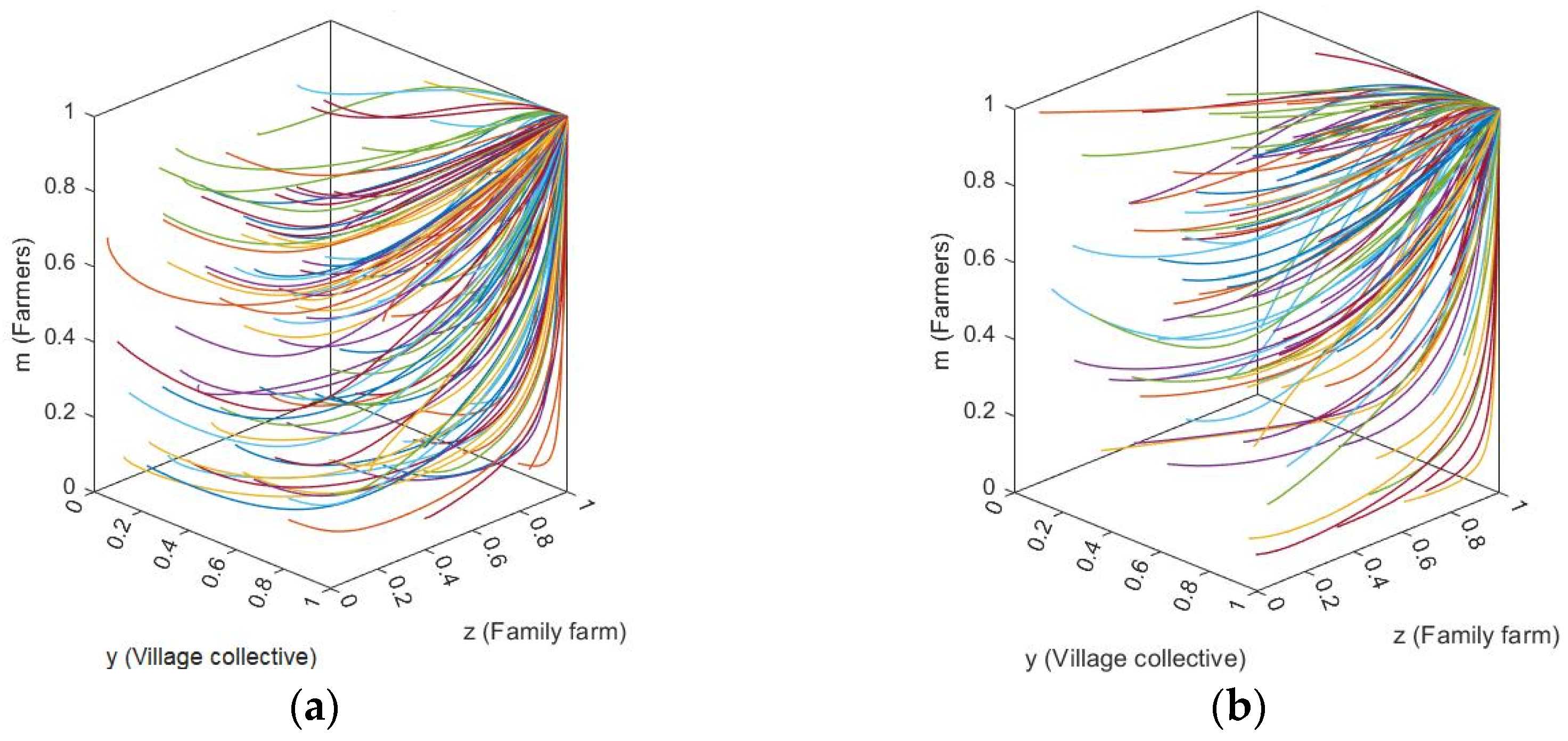
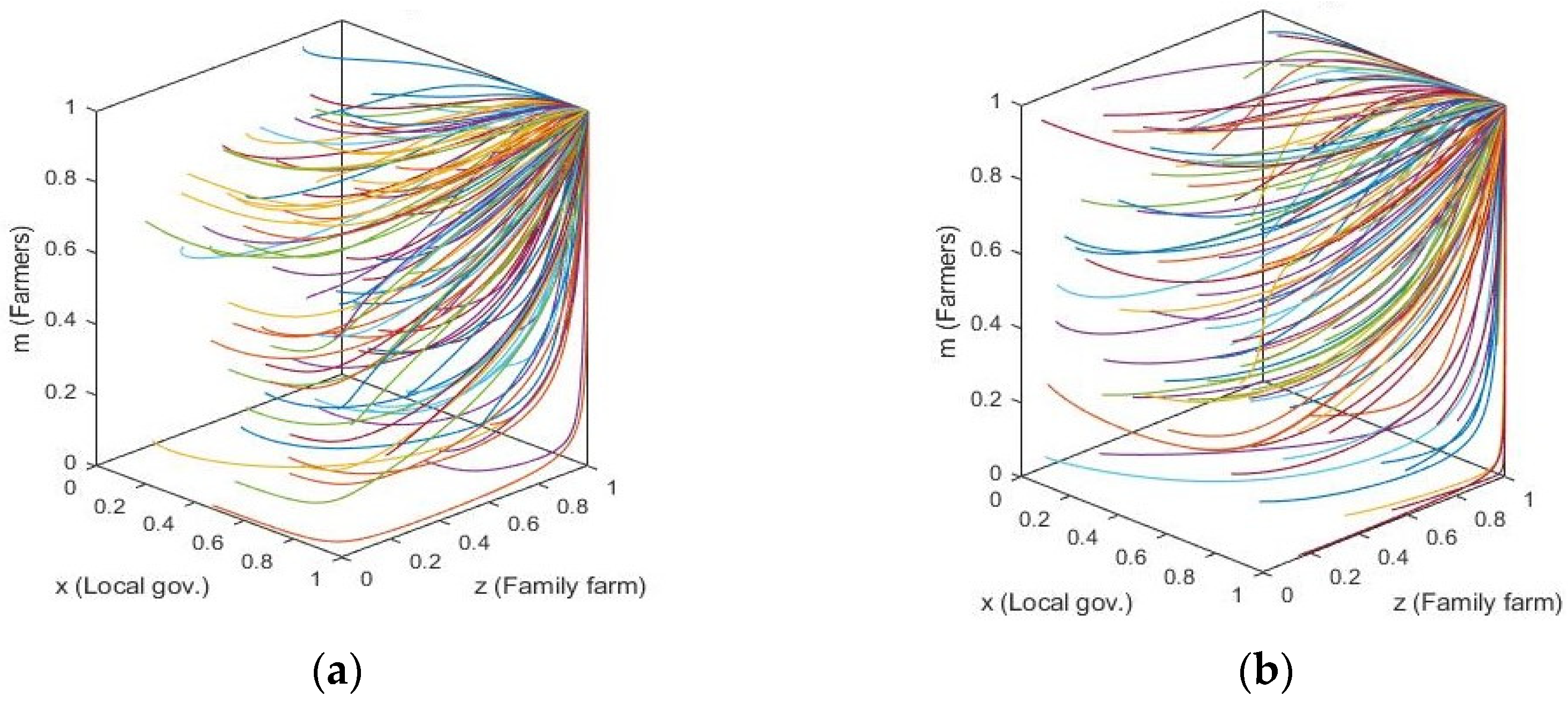
To further investigate the stability and convergence characteristics of the four-actor evolutionary system, Figure 1 presents three-dimensional phase portraits under different initial strategic configurations. Each trajectory represents the evolution of strategy adoption probabilities by the local government ( x ), village collective ( y ), family farm ( z ), and farmer ( m ) from randomly selected initial states.
Figure 1 illustrates the evolutionary dynamics when the local governments’ initial probability of active participation is fixed at different levels ( x 0 = 0.3 and x 0 = 0.9 ), with the state space defined by ( y , z , m ) . The results show that a higher initial commitment by the local governments significantly accelerates convergence toward the stable equilibrium. When x 0 is relatively low, trajectories exhibit greater dispersion in the early stages, indicating a slower coordination process among non-governmental actors. By contrast, a higher x 0 markedly compresses the evolutionary paths and enlarges the basin of attraction, suggesting that early government engagement plays a catalytic role in stabilizing multi-player cooperation.
Figure 2 depicts the corresponding dynamics when the village collective’s initial probability is varied ( y 0 = 0.3 and y 0 = 0.9 ), with the phase space spanned by x z m . Compared with changes in x 0 , increases in y 0 also promote convergence toward the same pure-strategy equilibrium, but the adjustment process is more gradual and exhibits relatively smoother trajectories. This indicates that proactive coordination by village collectives contributes to stabilizing the system primarily through incremental reinforcement of cooperation among the non-government players, rather than through rapid shifts in the government’s behavior.
Overall, both sets of phase diagrams confirm that the system converges to a unique pure-strategy equilibrium under the benchmark parameterization. However, differences in convergence speed and trajectory structure highlight the asymmetric roles of the local governments and village collectives in the early stages of the evolutionary process. Strong initial government participation exerts a more pronounced coordinating effect, while village collectives mainly facilitate steady and sustained alignment among non-governmental stakeholders.
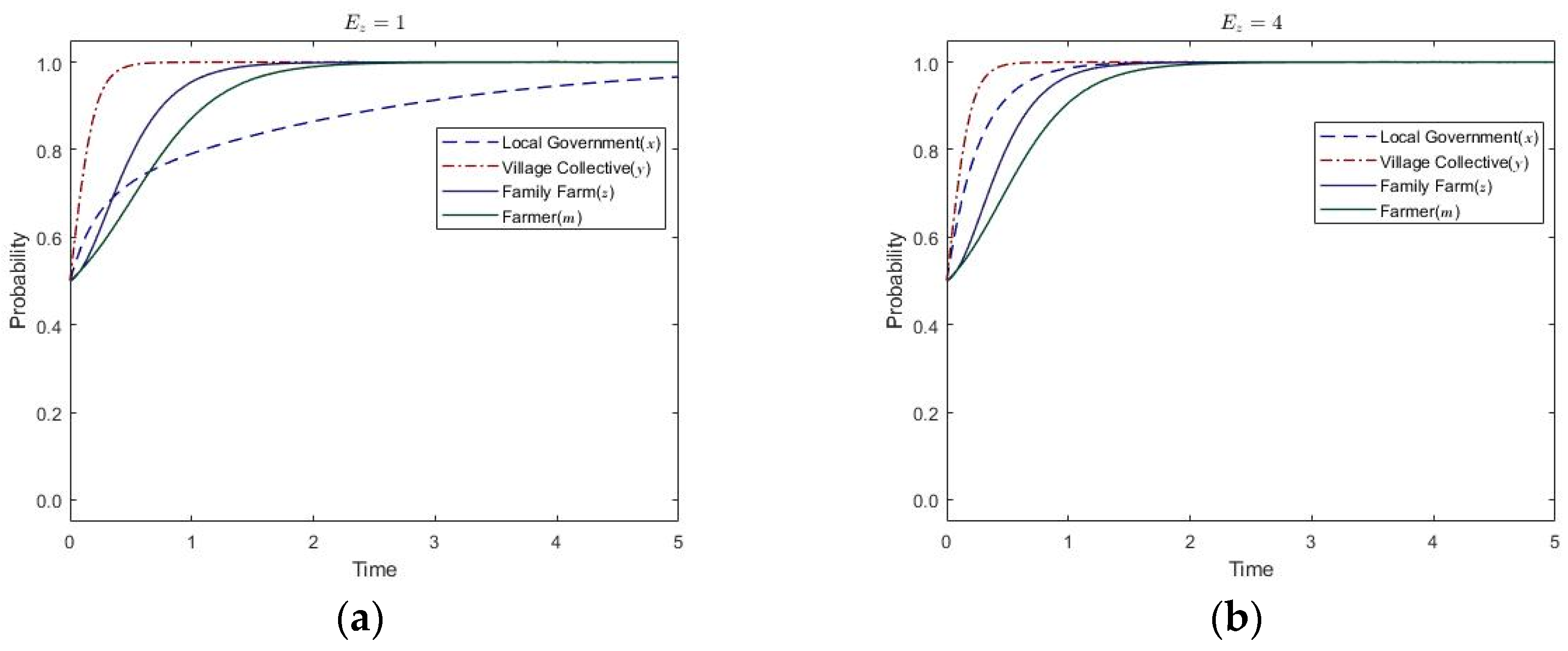
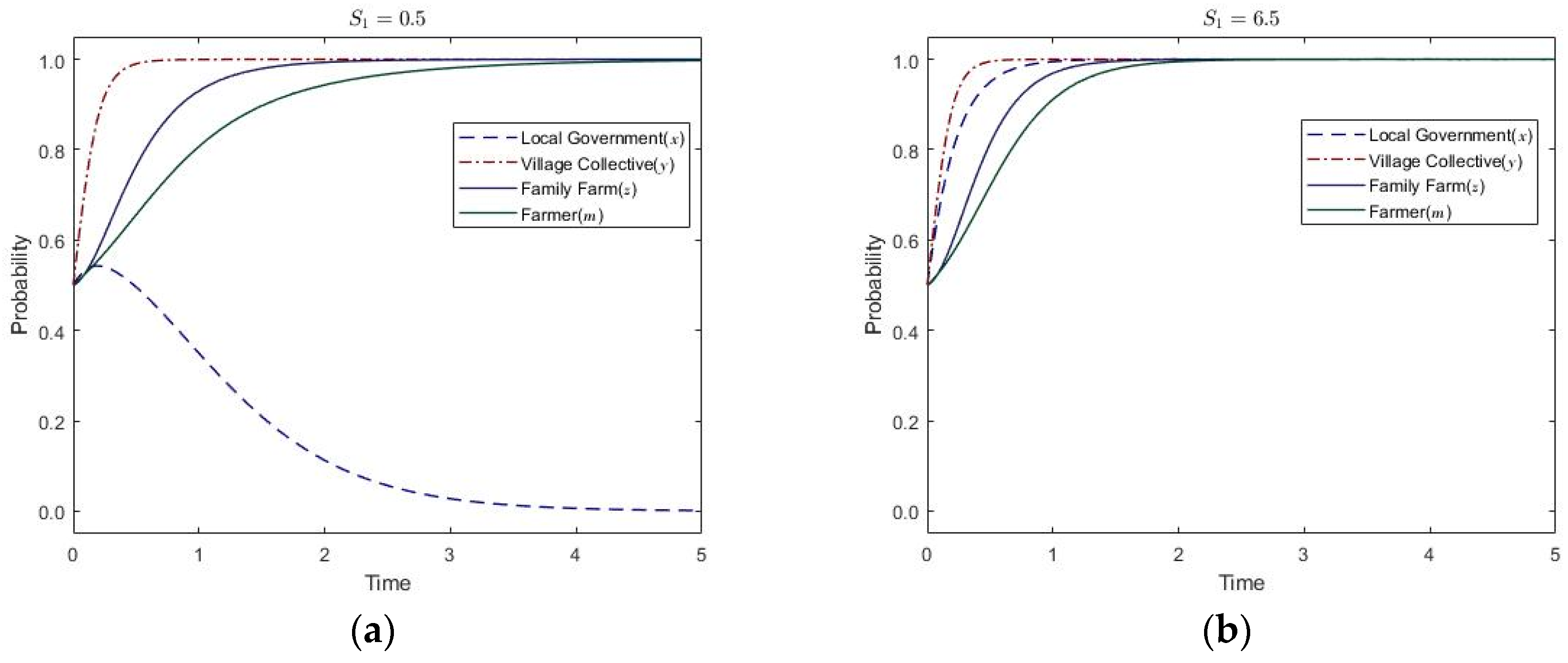
Note: In Figure 1, Figure 2, Figure 3, Figure 4, Figure 5 and Figure 6, x , y , z , and m denote the probabilities that the local governments choose strict regulation, the village collective chooses active coordination, the family farms choose long-term operation, and farmers choose recultivation, respectively. All parameter abbreviations are defined in Table 1.

5.3. Sensitivity Analysis of Key Parameters

In the four-actor evolutionary game framework, S 1 represents the losses incurred by local governments that choose lenient regulation, primarily stemming from accountability pressure as well as potential risks to food security and social stability. Holding all other parameters constant, Figure 3 compares the evolutionary dynamics under two scenarios, S 1 = 0.5 and S 1 = 6.5 . The two values of S 1 are designed to represent contrasting governance environments. Specifically, a low value ( S 1 = 0.5 ) corresponds to a weak-accountability scenario in which the political and reputational consequences of lenient regulation are limited, such as under relaxed performance evaluation or insufficient supervisory enforcement. By contrast, a high value ( S 1 = 6.5 ) reflects a strong accountability regime, where governance failures related to abandoned farmland are more likely to trigger substantial political pressure, penalties, and reputational losses. In Figure 3, Figure 4, Figure 5 and Figure 6, time represents the evolutionary time of the replicator dynamics, reflecting the gradual adjustment of strategies through learning and imitation. The probability corresponds to the share of agents choosing a specific strategy at a given time.
When S 1 = 0.5 , the share of governments adopting active regulation ( x ) gradually declines and converges to zero, indicating that lenient regulation becomes the preferred strategy when the associated losses are relatively low. In contrast, the village collectives’ proactive coordination ( y ), family farms’ long-term operation ( z ), and farmers’ active cultivation ( m ) all rapidly converge to one. This outcome suggests that a cooperative equilibrium driven by self-organization among non-governmental actors can still emerge in the absence of strong public oversight. However, such a configuration—characterized by a passive government and active participation by the other three parties—is inherently fragile and susceptible to external shocks.
When S 1 increases to 6.5, the evolutionary trajectory of x changes markedly: the share of governments choosing active regulation rises rapidly and stabilizes at one. Correspondingly, the system converges to the fully coordinated equilibrium ( 1 , 1 , 1 , 1 ) , indicating that higher regulatory losses under lenient governance effectively incentivize government intervention and facilitate comprehensive coordination among all stakeholders.
E z denotes the social benefits accrued by local governments when adopting a strict regulatory strategy. As shown in Figure 4, when E z remains at a relatively low level, the probability that local governments adopt strict regulation ( x ) increases only gradually, indicating the presence of policy inertia under limited external governance returns. Meanwhile, the strategies of village collectives ( y ), family farms ( z ), and farmers ( m ) continue to converge toward higher levels, suggesting that grassroots coordination and market-based incentives can partially sustain cooperative outcomes. Nevertheless, in the absence of strong governmental commitment, such cooperation tends to be more fragile and vulnerable to external disturbances.
As E z increases, the attractiveness of strict regulation for local governments rises markedly. The evolution of x accelerates and quickly stabilizes at a high level, driving the system toward the fully coordinated optimal equilibrium. This finding indicates that enhanced social benefits serve as a key structural driver by transforming strict regulation into tangible governance returns, thereby motivating a shift in government strategy from relative passivity to proactive engagement.
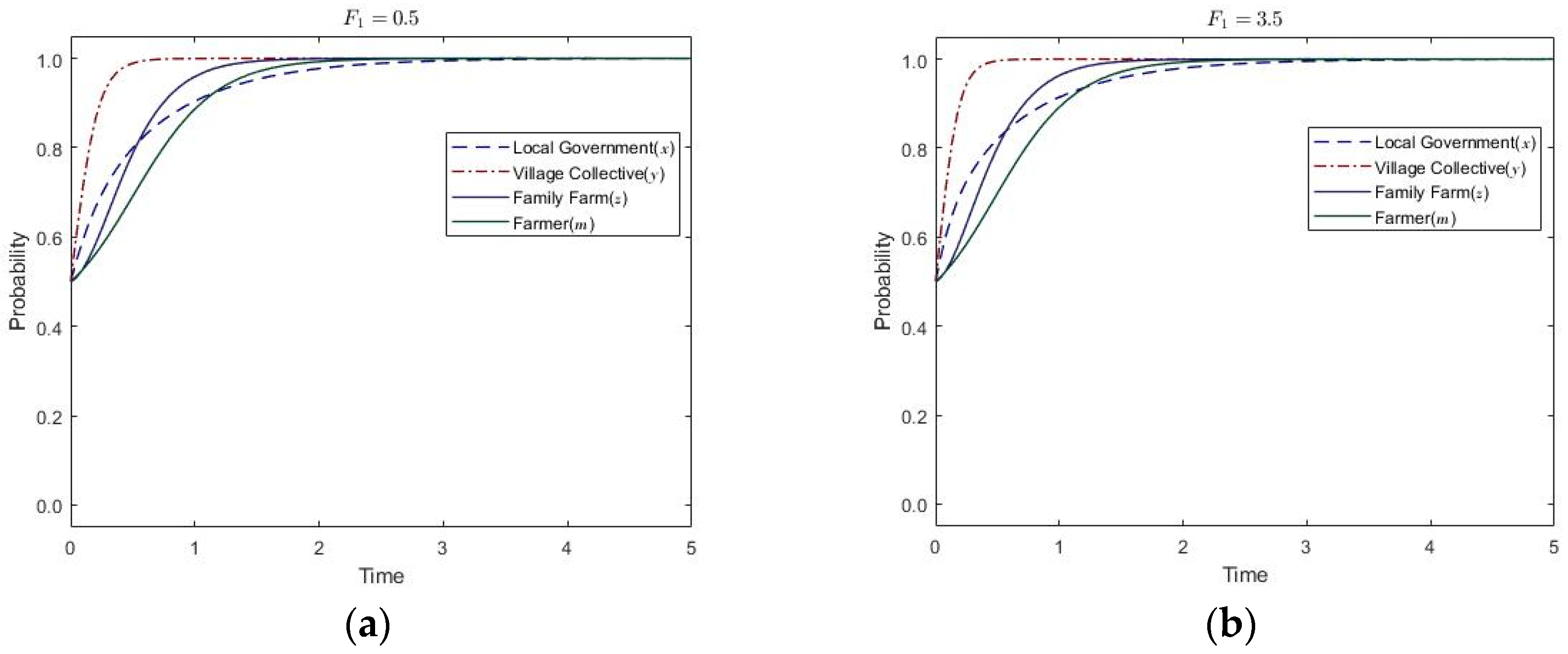
Figure 5 examines the sensitivity of the evolutionary system to changes in F 1 , the penalty imposed by the local governments on village collectives engaging in passive compliance under strict regulation. Compare the evolutionary outcomes under different parameter values while holding all other parameters constant. Overall, the system converges to a stable state dominated by active strategies in both scenarios; however, noticeable differences emerge in the speed and trajectory of strategy evolution across players.
When the F 1 takes a relatively low value, the probability that the local governments adopt the active strategy ( x ) increases at a slower pace. In contrast, the strategies of village collectives ( y ), family farms ( z ), and farmers ( m ) converge more rapidly toward higher levels. This pattern suggests that, even under weaker governmental incentives or constraints, grassroots coordination and market-driven behavior can partially sustain cooperative outcomes, although governmental adjustment remains sluggish.
As the parameter value increases, the evolutionary dynamics of the local governments change markedly. The share of governments choosing the active strategy rises more rapidly and stabilizes at a high level, accompanied by synchronized convergence of the other three actors. This indicates that higher parameter values strengthen the incentives for proactive government behavior, shorten the adjustment process, and facilitate coordinated evolution among all participants, thereby enhancing the stability of the overall system.
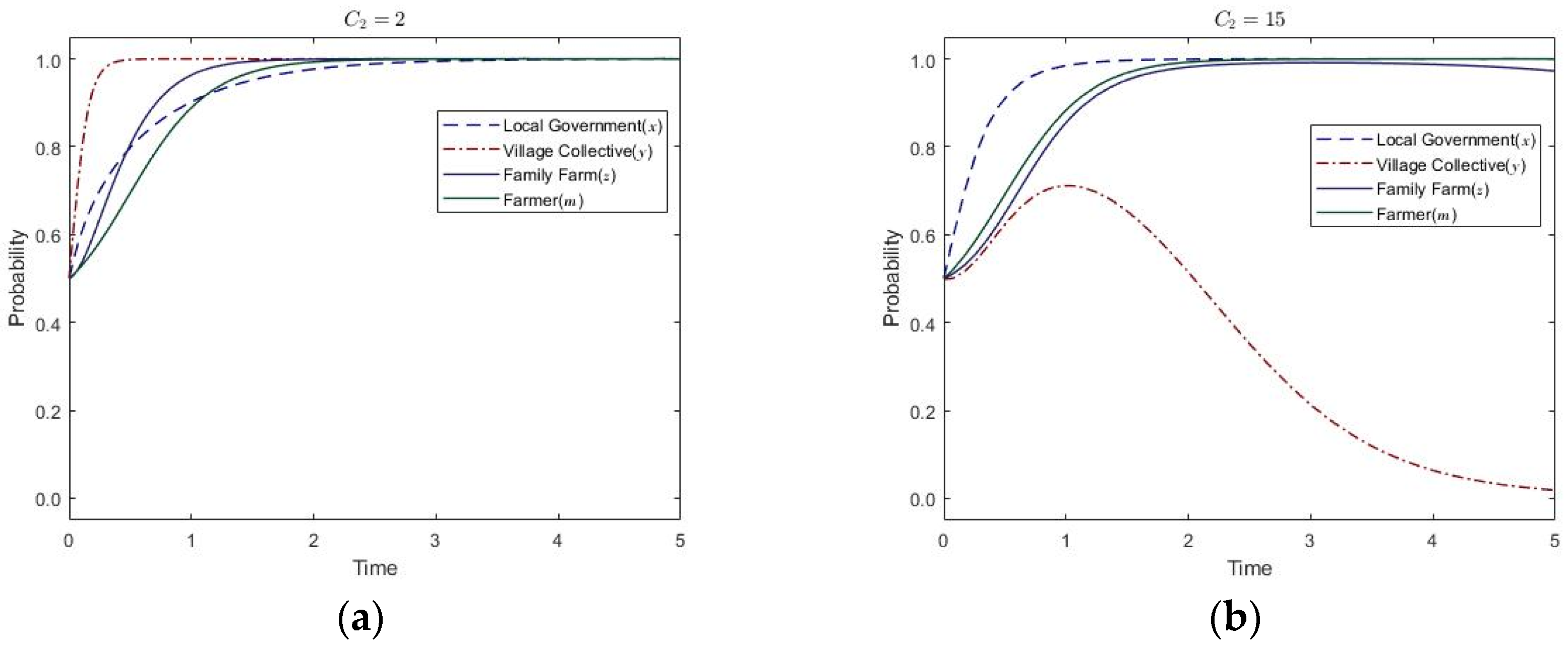
C 2 measures the costs of proactive coordination borne by village collectives, including explicit mobilization and coordination inputs as well as implicit opportunity costs. Figure 6 shows that when C 2 is low, y rises rapidly and stabilizes at a high level, accompanied by synchronized convergence of x , z , and m . This suggests that manageable coordination costs enhance land consolidation efficiency, reduce transaction costs, and strengthen expected returns, thereby creating a virtuous cycle of coordination. When C 2 is high, y increases initially but later declines and converges to a low level, revealing a strong crowding-out effect. Although x , z , and m may still converge toward proactive strategies due to strong regulation and improved market returns, the withdrawal of collective coordination weakens the organizational foundation of land consolidation and increases structural fragility, making system stability more dependent on external policy rigidity and market performance.
Taken together, the sensitivity analysis shows that the four parameters play differentiated roles in shaping the evolutionary dynamics of the multi-actor governance system. Parameters associated with the government’s payoff structure—namely, the losses from lenient regulation ( S 1 ) and the social benefits of strict regulation ( E z )—primarily determine whether the system converges toward a high-governance cooperative equilibrium or instead evolves into a second-best configuration with weakened governmental oversight. Specifically, a low S 1 or a low E z reduces the government’s incentive to maintain strict regulation, which may lead to a governance regime characterized by government passivity and proactive participation by the other three parties. Although such a self-organized equilibrium can still sustain land recultivation under certain institutional and market conditions, it remains vulnerable to external shocks due to the absence of robust regulatory commitment.
By contrast, parameters capturing grassroots accountability and organizational capacity—namely, the penalty intensity imposed on passive collectives ( F 1 ) and the collective’s coordination cost ( C 2 )—mainly affect the speed, efficiency, and robustness of convergence rather than the equilibrium direction itself. A higher F 1 significantly accelerates the emergence of proactive collective coordination, thereby shortening the time required for system-wide cooperation to stabilize. Meanwhile, C 2 exhibits a pronounced crowding-out effect: when coordination costs become excessive, village collectives are more likely to shift from proactive coordination to long-term passive compliance, weakening the organizational foundation of land consolidation and increasing structural fragility. Notably, under such conditions, strong government regulation and improved market returns may partly substitute for collective coordination; however, the system’s stability becomes increasingly dependent on regulatory stringency and market performance.
Overall, these findings point to a clear hierarchy of policy levers. Enhancing the accountability costs associated with regulatory failure and improving the extent to which social benefits translate into tangible governmental returns are essential for sustaining proactive regulation. In parallel, strengthening grassroots accountability while reducing collective coordination costs, through fiscal support, institutional empowerment, and administrative burden reduction, can substantially improve the efficiency and resilience of coordinated governance. Together, these measures facilitate the system’s evolution toward the fully coordinated equilibrium x , y , z , m ) = ( 1 , 1 , 1 , 1 and support the long-term effective use of abandoned farmland.

5.4. Further Validation and Interpretation Through Case Studies

To connect the model findings with observed practice and to demonstrate the practical implications of the four-actor governance framework developed in this paper, the following county-level case from Zizhong County in Sichuan Province is briefly discussed as an empirical illustration of how local governments, village collectives, family farms, and farmers interact in the utilization of abandoned farmland.
According to the Sichuan Provincial Department of Agriculture and Rural Affairs, the county established a dynamic ledger for abandoned farmland suitable for recultivation, relied on app-assisted identification and follow-up management, and combined administrative supervision with village-level implementation [47]. By March 2024, Zizhong had dynamically identified 50.22 ha of abandoned farmland, had recorded 1853.33 ha of treated abandoned farmland since 2022, and had signed five-year rent-free agreements covering 83.33 ha [47]. At the village level, farmers were encouraged to choose among self-recultivation, cultivation with assistance from relatives or neighbors, transfer-based recultivation, and collective trusteeship. For plots that farmers were unwilling or unable to cultivate, some land was returned to village collectives through five-year rent-free agreements and then managed through “village collective+” arrangements, including direct collective management, cooperative operation, transfer-based operation, and trusteeship by family farms. Analytically, the case does not merely reflect administrative intervention; rather, it highlights the coordinating role of village collectives in assembling fragmented plots, organizing contractual arrangements, and linking farmers with operational actors under conditions of fragmented tenure and uneven willingness to cultivate.
At the same time, for example, research on village collective participation shows that village collective involvement can reduce the transaction costs associated with the formation and operation of farmland-scale management arrangements, and recent evidence from Guangxi indicates that stronger rural collective action significantly promotes farmland-use-right transfer [48]. In parallel, survey evidence from 117 family farms in Anhui and Hubei shows that formal contracts and longer lease durations significantly strengthen family farms’ long-term land-protection and management behavior, indicating that stable tenure expectations are critical for sustained operation [49].
Taken together, existing cases and related studies further substantiate the core proposition of the four-actor evolutionary game model advanced in this paper: the sustainable and effective utilization of abandoned farmland, on the one hand, requires coordinated interaction among local governments, village collectives, family farms, and farmers, rather than relying solely on the actions of any single actor; on the other hand, effective governance of abandoned farmland cannot depend exclusively on administrative intervention, but instead requires a stronger role for village collectives together with enhanced operational support for family farms.

6. Discussion

6.1. Conclusions

Against the background of the current realities of abandoned farmland utilization in China, this study constructs a four-actor evolutionary game model involving the governments, village collectives, family farms, and farmers. By examining the strategic evolution paths of different actors across various governance stages, and by combining numerical simulations with parameter sensitivity analysis, this study systematically reveals the internal mechanisms underlying multi-actor collaborative governance of abandoned farmland. The main conclusions are as follows.
First, the strategic choices of multiple actors are jointly driven by the cost–benefit structure. The strategy evolution of all four actors is significantly influenced by changes in their expected benefits and costs. The intensity of government regulation, together with incentive and constraint mechanisms, directly shapes the behavioral adjustments of village collectives, family farms, and farmers. The results indicate that reliance solely on punitive measures has limited effectiveness in promoting long-term governance outcomes, whereas reducing organizational coordination costs and increasing participation returns are more conducive to fostering stable cooperation among actors. Expectations regarding long-term operational returns constitute a key driving force for family farms and farmers to engage in abandoned farmland utilization.
Second, abandoned farmland governance exhibits a stage-specific evolutionary pattern, with village collectives playing a pivotal coordinating role. Different evolutionary stable equilibria correspond to distinct governance stages and levels of governance effectiveness. In current practice, government-led governance can suppress farmland abandonment in the short term; however, it relies heavily on administrative inputs and thus lacks sustainability. When village collectives effectively reduce uncertainties in land transfer and operation through organizational coordination, property rights integration, and benefit-sharing mechanisms, family farms and farmers are more inclined to adopt long-term operation and recultivation strategies. This, in turn, facilitates the transformation of the governance structure from externally enforced regulation to endogenous collaborative governance.
Third, the participation willingness of family farms constitutes a critical variable for achieving long-term and stable governance. Whether family farms choose long-term operation depends not only on policy subsidies and regulatory intensity, but also on their comprehensive assessment of land tenure stability, investment returns, and transaction costs. When village collectives are able to provide unified land transfer arrangements, supporting infrastructure, and service guarantees, the willingness of family farms to participate in abandoned farmland governance is significantly enhanced. This further induces farmers’ recultivation behavior and improves overall governance efficiency.

6.2. Recommendations

First, government intervention should move beyond a regulation-based approach and place greater emphasis on incentive-based governance. Although administrative supervision remains necessary to curb farmland abandonment and maintain basic governance order, a governance arrangement that relies excessively on continuous administrative input is unlikely to remain stable over time. Policy design should therefore shift from compulsory recultivation toward incentive-compatible mechanisms that enhance the expected returns to participation for family farms and farmers. Measures such as fiscal subsidies, tax relief, and risk-sharing arrangements can increase the relative attractiveness of recultivation and long-term participation, thereby reducing the long-term governance burden on local governments and facilitating a more sustainable governance trajectory [50,51].
Second, the institutional role of village collectives should be strengthened, as collaborative governance depends critically on their capacity to reduce coordination costs and organize fragmented land resources. In the context of abandoned farmland utilization, village collectives function as the key intermediary linking land transfer, interest coordination, and local mobilization. Policy support should therefore reinforce their role in land consolidation, property-rights integration, and benefit coordination, particularly where transaction frictions and organizational weakness continue to constrain effective utilization [52]. Centralized land transfer and the provision of supporting agricultural infrastructure can reduce transaction costs and improve the confidence of both family farms and farmers in recultivation [53]. At the same time, a more effective benefit-sharing mechanism is needed to strengthen the endogenous motivation of village collectives and sustain cooperative relationships among participating actors [54].
Third, policy support for family farms should focus more explicitly on the conditions required for long-term operation. The durability of abandoned farmland governance depends not only on initial participation but also on whether family farms can maintain stable operation beyond short-term engagement. In this regard, temporary subsidies alone are insufficient. Greater attention should be given to land-tenure stability, expected investment returns, and transaction costs, all of which shape the feasibility of sustained agricultural operation [55]. A more comprehensive support system should therefore improve guarantees for land transfer duration, strengthen agricultural infrastructure, expand financial access, and broaden agricultural insurance coverage, so as to reduce the uncertainty associated with long-term operation. In addition, village collectives should be encouraged to provide unified land transfer services and upfront investment support, thereby lowering entry barriers and reinforcing the transition from short-term participation to sustained operation for family farms.

6.3. Research Prospect

This study conducts numerical simulation analysis based on evolutionary game theory to reveal the strategy evolution mechanisms among the local governments, village collectives, family farms, and farmers in abandoned farmland governance, and to provide policy implications for multi-actor collaborative governance of abandoned farmland. In terms of government governance logic and the organizational role of village collectives, the findings are consistent with the existing literature, while the inclusion of family farms as a key operational actor extends the analytical perspective of abandoned farmland governance. Nevertheless, several limitations remain. The model parameters are primarily specified based on cost–benefit assumptions and do not fully capture the effects of different policy instruments or regional heterogeneity. In addition, behavioral and psychological heterogeneity related to family farms’ long-term operation willingness and farmers’ recultivation decisions is not explicitly modeled. Moreover, due to limited micro-level data availability, parameter values are mainly based on scenario assumptions and simulation analyses. Future research could incorporate empirical data to calibrate key parameters and further test the robustness of the model’s conclusions.


Author Contributions

Conceptualization, Z.Z. and P.L.; methodology, P.L., B.Q. and L.S.; software, L.Z. and B.Q.; formal analysis, L.S. and B.Q.; data curation, B.Q.; writing—original draft preparation, P.L., L.Z. and L.S.; writing—review and editing, L.Z. and L.S.; supervision, Z.Z.; funding acquisition, Z.Z. All authors have read and agreed to the published version of the manuscript.

Funding

This study was supported by the National Social Science Fund of China (Grant No. 25BJY127).

Institutional Review Board Statement

Not applicable.

Informed Consent Statement

Not applicable.

Data Availability Statement

The data that support the findings of this study are available from the corresponding author upon reasonable request.

Acknowledgments

The authors express gratitude to the reviewers for their hard work.

Conflicts of Interest

The authors declare no conflicts of interest.

References

  1. Food Waste Index Report 2024. Available online: https://www.unep.org/resources/publication/food-waste-index-report-2024 (accessed on 15 March 2026).
  2. Food and Agriculture Organization of the United Nations (FAO). Global Report on Food Crises 2025; FAO: Rome, Italy, 2025; Available online: https://www.fao.org/ (accessed on 20 November 2025).
  3. Economic Daily. Analysis of the Scale and Regional Distribution of Abandoned Farmland Worldwide Reprinted by the Supervision and Protection Center for Cultivated Land Quality and Farmland Engineering, Ministry of Agriculture and Rural Affairs. 2024. Available online: https://iarrp.caas.cn/ysdt/mtbd/53946d743cc746f6a9e0df1842267eac.htm (accessed on 12 November 2025).
  4. Zhang, X.; Xin, X. The impact and mechanisms of digital literacy on farmers’ farmland abandonment decisions. World Agric. 2025, 12, 55–67. (In Chinese) [Google Scholar]
  5. Economic Daily. Identifying Root Causes to Address the Challenge of Abandoned Farmland Remediation. 26 September 2024. Available online: https://www.ce.cn/xwzx/gnsz/gdxw/202409/26/t20240926_39151447.shtml (accessed on 30 December 2025).
  6. Zhu, X.; Xiao, G.; Zhang, D.; Guo, L. Mapping abandoned farmland in China using time series MODIS NDVI. Sci. Total Environ. 2021, 755, 142651. [Google Scholar] [CrossRef]
  7. Ministry of Agriculture and Rural Affairs of the People’s Republic of China. Bulletin on the National Cultivated Land Quality Grades in 2019. Available online: https://ntjss.moa.gov.cn/zcfb/202006/P020200622573390595236.pdf (accessed on 15 March 2026).
  8. Ministry of Natural Resources of the People’ s Republic of China (MNR). China Natural Resources Bulletin 2024; MNR: Beijing, China, 2025. Available online: https://www.gov.cn/lianbo/bumen/202503/content_7015063.htm (accessed on 1 November 2025). (In Chinese)
  9. Hu, Y.; Liu, Y. Impact of fertilizer and pesticide reductions on land use in China based on crop-land integrated model. Land Use Policy 2024, 137, 107155. [Google Scholar] [CrossRef]
  10. van Wesenbeeck, C.F.A.; Keyzer, M.A.; van Veen, W.C.M.; Qiu, H. Can China’s overuse of fertilizer be reduced without threatening food security and farm incomes? Agric. Syst. 2021, 190, 103093. [Google Scholar] [CrossRef]
  11. Sun, Y.; Miao, Y.; Xie, Z.; Jiang, X. Address the challenge of cultivated land abandonment by cultivated land adoption: An evolutionary game perspective. Land Use Policy 2025, 149, 107412. [Google Scholar] [CrossRef]
  12. Wang, Y.; Yang, J.; Li, X. Progress and prospects of terrace abandonment research. Geogr. Res. 2024, 43, 3418–3430. (In Chinese) [Google Scholar]
  13. Li, T.; Liu, C.; Wang, Y. Continuous monitoring of farmland abandonment in China since the 21st century: Interpreting spatiotemporal trajectories and characteristics. Land 2025, 14, 2203. [Google Scholar] [CrossRef]
  14. Deng, X.; Xu, D.; Zeng, M.; Qi, Y. Landslides and farmland abandonment in China’s mountainous areas: Spatial distribution, empirical analysis and policy implications. Sustainability 2018, 10, 3909. [Google Scholar] [CrossRef]
  15. Chen, Z.; Chen, Y.; Zhu, C.; Zhang, Y.; Kong, X. Determinants of farmland abandonment among peasants in scattered villages: The impact of family structure and social policies in Southern China. Land 2025, 14, 877. [Google Scholar] [CrossRef]
  16. Li, J. Temporal and spatial evolution characteristics, influencing factors and classified management countermeasures of cultivated land abandonment: Take Sichuan Province as an example. World Reg. Stud. 2024, 33, 180–188. (In Chinese) [Google Scholar]
  17. Xie, H.; Shi, J.; Leng, K. Differences in farmland abandonment behavior among farming households and influencing factors from the perspective of family life cycle: A case study of the hilly and mountainous areas in Jiangxi province. Resour. Sci. 2023, 45, 2170–2182. (In Chinese) [Google Scholar] [CrossRef]
  18. Li, S.; Li, X. Progress and prospect on farmland abandonment. J. Geogr. Sci. 2016, 71, 370–389. (In Chinese) [Google Scholar]
  19. Liang, Z.; Lin, H. Wasteland governance: An explanation of synergy theory taking Z village in Guangdong as an example. Issues Agric. Econ. 2024, 07, 90–104. (In Chinese) [Google Scholar]
  20. Chen, X. De-embedding and re-embedding: Behavioral adjustment of young village officials’ participation in village governance: Based on field investigation in S town. Decis. Inf. 2024, 12, 29–39. (In Chinese) [Google Scholar]
  21. Dang, Y.; Liao, Y.; Kong, X.; Zhao, J. Discussion on the top-level design and optimization of the system of cultivated land requisition-compensation balance. Nat. Resour. Econ. China 2022, 35, 43–48+88. (In Chinese) [Google Scholar]
  22. Long, Y.; Sun, J.; Wellens, J.; Colinet, G.; Wu, W.; Meersmans, J. Mapping the spatiotemporal dynamics of farmland abandonment and land-use transition in China based on multi-source remote sensing data. J. Remote Sens. 2024, 16, 1052. [Google Scholar] [CrossRef]
  23. Luo, B. Farmland abandonment and its governance: Existing research and further development. J. Huazhong Agric. Univ. (Soc. Sci. Ed.) 2025, 1, 1–7. (In Chinese) [Google Scholar]
  24. Yu, Z.; Liu, L.; Zhang, H.; Liang, J. Exploring the factors driving seasonal farmland abandonment: A case study at the regional level in Hunan province, central China. Sustainability 2017, 9, 187. [Google Scholar] [CrossRef]
  25. Subedi, Y.; Kristiansen, P.; Cacho, O. Drivers and consequences of agricultural land abandonment and its reutilisation pathways: A systematic review. Environ. Dev. 2022, 42, 100681. [Google Scholar] [CrossRef]
  26. Ma, L.; Zong, Y.; Wang, X.; Shi, Z.; Zhang, W. Farmland use behavior and its influencing factors from the perspective of population migration. J. Geogr. Sci. 2024, 34, 439–458. [Google Scholar] [CrossRef]
  27. Xu, D.; Deng, X.; Guo, S.; Liu, S. Labor migration and farmland abandonment in rural China: Empirical results and policy implications. J. Environ. Manag. 2019, 232, 738–750. [Google Scholar] [CrossRef]
  28. Jiang, J.; Song, C.; Ye, S.; Gao, P.; Ren, S. Comparison and application of the spatial sampling methods for assessing the quality of arable land resources in Qinghai-Tibet Plateau. Trans. Chin. Soc. Agric. Eng. (Trans. CSAE) 2023, 39, 246–257. (In Chinese) [Google Scholar]
  29. Zu, J.; Hao, J.; Chen, L.; Zhang, Y.; Wang, J.; Kang, L.; Guo, J. Analysis on trinity connotation and approach to protect quantity, quality and ecology of cultivated land. J. China Agric. Univ. 2018, 23, 84–95. (In Chinese) [Google Scholar]
  30. Yu, F.; Dai, M.; Lin, S. Cultivated land protection based on bottom line thinking of food security: Current situation, difficulties and countermeasures. Econ. Rev. J. 2022, 12, 9–16. (In Chinese) [Google Scholar]
  31. Li, Y.; Shan, Y.; Chen, Y. Analysis of farmland abandonment and government supervision traps in China. Int. J. Environ. Res. Public Health 2021, 18, 1815. [Google Scholar] [CrossRef]
  32. Li, L.; Tan, R.; Wu, C. Reconstruction of China’s farmland rights system based on the “Trifurcation of Land Rights” Reform. Land 2020, 9, 51. [Google Scholar] [CrossRef]
  33. Lu, W.; Lv, Y.; Zhou, X.; Wu, Y.; Gu, X. The Impact of Governance Structures on the Distribution of Land Consolidation Benefits in Urban Areas: Case Studies in ningbo, China. Land 2024, 13, 46. [Google Scholar] [CrossRef]
  34. Zhang, J.; Zhu, P.; Nan, G. Farmland transfer patterns and household long-term agricultural investment behavior:based on surveys of four counties in Jiangsu province. J. Nanjing Agric. Univ. (Soc. Sci. Ed.) 2019, 19, 96–104+158–159. (In Chinese) [Google Scholar]
  35. Wu, F.; Guo, X. Research on the income-increasing mechanisms of standardized production in family farms. J. South China Agric. Univ. (Soc. Sci. Ed.) 2025, 24, 26–44. (In Chinese) [Google Scholar]
  36. Zheng, L. Big hands holding small hands: The role of new agricultural operating entities in farmland abandonment. Food Policy 2024, 123, 102605. [Google Scholar] [CrossRef]
  37. Tian, M.; Zheng, Y. How to promote the withdrawal of rural land contract rights? An evolutionary game analysis based on prospect theory. Land 2022, 11, 1185. [Google Scholar] [CrossRef]
  38. Sun, Q. A Study on the game process between local governments and peasants in the suburban land taking. J. Anhui Norm. Univ. (Hum. Soc. Sci.) 2025, 53, 50–63. (In Chinese) [Google Scholar]
  39. Wu, H.; Mao, D.; Feng, L. Research on the construction of the optimum tourism circle in Jingjinji region based on GIS. Areal Res. Dev. 2015, 2, 125–130. (In Chinese) [Google Scholar]
  40. Zhang, H.; Wang, C. Under the background of rural revitalization, can the regulation of land transfer use suppress the tendency of non-food effectively? J. Sichuan Norm. Univ. (Soc. Sci. Ed.) 2020, 47, 59–65. (In Chinese) [Google Scholar]
  41. Wang, L.; LI, Z.; Yuan, C.; Liu, L. Exploration on the reasons for low efficiency of arable land protection policy in China: An evolutionary game theoretic model. Environ. Dev. Sustain. 2024, 26, 25173–25198. [Google Scholar] [CrossRef]
  42. Cheng, L.; Huang, H.; Sun, Y.; Li, Z.; Du, H. The Evolutionary Game in Regulating Non-Agricultural Farmland Use within the Integrated Development of Rural Primary, Secondary, and Tertiary Industries. Land 2024, 13, 1600. [Google Scholar] [CrossRef]
  43. Wang, Z.; Shang, H. Tripartite evolutionary game and simulation analysis of agricultural non-point source pollution control. PLoS ONE 2024, 19, e0305191. [Google Scholar] [CrossRef]
  44. Shen, M.; Shen, J. Evaluating the cooperative and family farm programs in China: A rural governance perspective. Land Use Policy 2018, 79, 240–250. [Google Scholar] [CrossRef]
  45. Chen, Y.; Huang, C. Government intervention and corporate technological innovation: An evolutionary game theory analysis framework. J. Harbin Univ. Commer. (Soc. Sci. Ed.) 2025, 05, 61–73. (In Chinese) [Google Scholar]
  46. Xiong, Y.; Gong, J.; Li, M. An evolutionary game analysis and policy optimization of central land authority of territorial space use control based on land development right allocation. China Land Sci. 2023, 37, 11–22. (In Chinese) [Google Scholar]
  47. Zizhong County Promotes the Recultivation and Replanting of Abandoned Farmland Through Multiple Measures. Available online: https://nynct.sc.gov.cn/nynct/gdzljs/2024/3/29/423fea138b2849d0b0cc5da7efce6c5c.shtml (accessed on 15 March 2026).
  48. Zhou, J.; Liu, Y.; Rao, F.; Shi, X. Impact of village collective participation on the transaction costs of formation and operation of farmland scale management modes: Based on comparative analysis of case. China Land Sci. 2022, 36, 114–123. (In Chinese) [Google Scholar]
  49. Shang, H.; Yi, X.; Yin, C.; Chen, Y.; Zhang, Z. How does the stability of land management right (SLMR) affect family farms’ cultivated land protection and quality improvement behavior (CLPQIB) in China? Land 2021, 10, 1052. [Google Scholar] [CrossRef]
  50. Sun, Y.; Jiang, H.; Zhu, X. Drivers, constraints, and policy regulation strategies for the abandonment of farmland: Insights from China. Land 2024, 13, 2096. [Google Scholar] [CrossRef]
  51. Zhong, Z.; Jia, F.; Long, W.; Chen, K. Risk sharing, benefit distribution and cooperation longevity: Sustainable development of dairy farmer cooperatives in China. Int. J. Agric. Sustain. 2022, 20, 982–997. [Google Scholar] [CrossRef]
  52. Zhou, L.; de Vries, W.T.; Guo, G.; Gao, F.; Fang, C. The effectiveness of voluntary collective action in China’s rural land development. Habitat Int. 2024, 145, 103121. [Google Scholar] [CrossRef]
  53. Jia, R.; Lu, Q. Land transfer, collective action and the adoption of soil and water conservation measures in the Loess Plateau of China. Nat. Hazards 2020, 102, 1279–1304. [Google Scholar] [CrossRef]
  54. Su, Y.; Huang, Q.; Shu, Q.; Wang, Y.; Qi, X. Mechanism of land trusteeship promoting farmers’ collective action: A study based on social–ecological systems framework. J. Rural. Stud. 2025, 103, 103622. [Google Scholar] [CrossRef]
  55. Zhou, Y.; Li, Y.; Xu, C. Land consolidation and rural revitalization in China: Mechanisms and paths. Land Use Policy 2019, 87, 104379. [Google Scholar] [CrossRef]
Figure 1. Numerical simulation: (a) x 0 = 0.3 ; (b) x 0 = 0.9 .
Sustainability 18 03902 g001
Figure 2. Numerical simulation: (a) y 0 = 0.3 ; (b) y 0 = 0.9 .
Sustainability 18 03902 g002
Figure 3. The effect of S1 in the evolutionary game. (a) S 1 = 0.5 ; (b) S 1 = 6.5 .
Sustainability 18 03902 g003
Figure 4. The effect of E z in the evolutionary game. (a) E z = 1 ; (b) E z = 4 .
Sustainability 18 03902 g004
Figure 5. The effect of F 1 in the evolutionary game. (a) F 1 = 1 ; (b) F 1 = 3.5 .
Sustainability 18 03902 g005
Figure 6. The effect of C 2 in the evolutionary game. (a) C 2 = 2; (b) C 2 = 15.
Sustainability 18 03902 g006
Table 1. Definitions of model variables and parameters used in the evolutionary game and numerical simulations.
ParameterDescriptionNotes
x Probability that the local governments adopt strict regulation. 0 x , y , z , m 1
y Probability that the village collective engages in proactive coordination.
z Probability that the family farms choose long-term operation.
m Probability that farmers engage in recultivation.
E 1 Material benefits to the local governments from farmers’ recultivation (e.g., tax revenues).
C 1 Regulatory cost borne by the local governments under strict regulation.
E z Reputational and social benefits gained by the local governments from strict regulation.
F 1 Penalties imposed by the local governments on non-cooperative village collectives under strict regulation (e.g., reductions in operational funding).
S 1 Reputational losses incurred by the local governments due to underperformance under lenient regulation.
W 1 Additional losses imposed on the local governments due to the family farms’ short-term operation.
W 2 Additional losses borne by the local governments due to farmers’ land abandonment.
E 2 Baseline benefits accruing to the village collective from proactive implementation.
C 2 Implementation costs incurred by the village collective under proactive coordination.
F 2 Contractual penalties collected by the village collective from family farms engaging in short-term operation (e.g., breach-of-contract fines).
E c Reputational and social benefits obtained by the village collective from proactive implementation.
S 2 Loss of policy-related resources (e.g., subsidies or transfers) due to the village collective’s passive compliance.
E 3 Returns to the family farms from long-term operation.
C 3 Baseline operational costs of long-term operation for the family farms (e.g., land rental fees and fixed equipment investment).
S 3 Losses associated with upfront inputs under short-term operation (e.g., land rent and equipment costs).
E n Short-term gains from subsidy-seeking behavior under short-term operation.
E 4 Returns to farmers from recultivation.
E a Additional costs and reduced returns for farmers’ recultivation arising from the family farms’ short-term opportunism.
C 4 Cultivation costs borne by farmers under recultivation.
E h Off-farm income benefits gained by farmers from land abandonment (e.g., migrant wage earnings).
S 4 Losses associated with land abandonment, including soil fertility degradation and potential erosion of land-use rights.
T 1 Policy-based recultivation subsidies provided by the local governments to farmers under strict regulation.
T 2 Performance-related social benefits to the local governments arising from farmers’ recultivation (e.g., improved governance outcomes).
F 3 Accountability penalties imposed by upper-level authorities on local governments adopting lenient regulation when land abandonment increases.
F 4 Regulatory constraints and sanctions imposed by the local governments on family farms engaging in short-term opportunism, in accordance with relevant regulation.
T 3 Rewards granted by the local governments to proactive village collectives under strict regulation.
S 5 Probability that the village collective is held accountable when farmers report grievances to upper-level authorities under passive collective compliance, particularly when recultivation costs rise due to the family farm’s short-term opportunism.Probability of being held accountable under strict regulation a = 1 , Probability of being held accountable under lenient regulation 0 a 1
Table 2. Strategy and return matrix.
Strategy ChoiceLocal Governments Enforcing Strict Regulation
(x)
Local Governments Enforcing Loose Regulation
(1 − x)
Village Collectives Choose Active Coordination
(y)
Village Collectives Choose Passive Cooperation
(1 − y)
Village Collectives Choose Active Coordination
(y)
Village Collectives Choose Passive Cooperation
(1 − y)
Family Farms choose long-term operation
(z)
Farmers choose to resume cultivation (m) E 1 + E z + T 2 C 1 T 1 T 3 E 1 + E z + T 2 + F 1 C 1 T 1 E 1 S 1 E 1 S 1
E 2 + E c + T 3 C 2 S 2 F 1 E 2 + E c C 2 S 2
E 3 C 3 E 3 C 3 E 3 C 3 E 3 C 3
E 4 + T 1 C 4 E 4 + T 1 C 4 E 4 C 4 E 4 C 4
Farmers choose to abandon cultivation (1 − m) E z C 1 T 3 W 2 E z + F 1 C 1 W 2 S 1 F 3 W 2 S 1 F 3 W 2
E 2 + E c + T 3 C 2 S 2 F 1 E 2 + E c C 2 S 2
E 3 C 3 E 3 C 3 E 3 C 3 E 3 C 3
E h S 4 E h S 4 E h S 4 E h S 4
Family Farms choose short-term operation
(1 − z)
Farmers choose to resume cultivation (m) E 1 + E z + T 2 + F 4 C 1 T 1 T 3 W 1 E 1 + E z + T 2 + F 1 + F 4 C 1 T 1 W 1 E 1 S 1 W 1 E 1 S 1 W 1
E 2 + E c + T 3 + F 2 C 2 S 2 F 1 S 5 E 2 + E c + F 2 C 2 S 2 α S 5
E n S 3 F 4 F 2 E n S 3 F 4 E n S 3 F 2 E n S 3
E 4 + T 1 E a C 4 E 4 + T 1 E a C 4 E 4 E a C 4 E 4 E a C 4
Farmers choose to abandon cultivation (1 − m) E z + F 4 C 1 T 3 W 1 W 2 E z + F 1 + F 4 C 1 W 1 W 2 S 1 F 3 W 1 W 2 S 1 F 3 W 1 W 2
E 2 + E c + T 3 + F 2 C 2 S 2 F 1 E 2 + E c + F 2 C 2 S 2
E n S 3 F 4 F 2 E n S 3 F 4 E n S 3 F 2 E n S 3
E h S 4 E h S 4 E h S 4 E h S 4
Table 3. Eigenvalues and stability analysis of equilibrium points.
StateEquilibrium Tr   ( λ 1 , λ 2 , λ 3 , λ 4 ) Result
Local government Enforcing Strict Regulation E 1 0 , 0 , 0 , 0 E 3 C 3 E n + S 3
E 2 C 2 + E c + F 2 + S 2
E 4 C 4 E a E h + S 4 4
E z C 1 + F 1 + F 3 + F 4 + S 1
Unstable
E 2 0 , 0 , 0 , 1 E 3 C 3 E n + S 3
C 4 E 4 + E a + E h S 4
E 2 C 2 + E c + F 2 + S 2 + α S 5
E z C 1 + F 1 + F 4 + S 1 T 1 + T 2
Unstable
E 3 0 , 0 , 1 , 0 E 4   C 4 E h + S 4
C 3 E 3 + E n S 3
E 2 C 2 + E c + S 2
E z C 1 + F 1 + F 3 + S 1
Unstable
E 4 0 , 0 , 1 , 1 C 4 E 4 +   E h   S 4
C 3 E 3 + E n S 3
E 2 C 2 + E c + S 2
E z C 1 + F 1 + S 1 T 1 + T 2
Unstable
E 5 0 , 1 , 0 , 0 C 2 E 2 E c F 2 S 2
E 3 C 3 E n + F 2 + S 3
E 4 C 4 E a E h + S 4
E z C 1 + F 3 + F 4 + S 1 T 3
Unstable
E 6 0 , 1 , 0 , 1 C 4 E 4 +   E a + E h S 4
E 3 C 3 E n + F 2 + S 3
C 2 E 2 E c F 2 S 2 α S 5
E z C 1 + F 4 + S 1 T 1 + S 2 T 3
ESS
E 7 0 , 1 , 1 , 0 E 4 C 4 E h + S 4
C 2 E 2 E c S 2
E z C 1 + F 3 + S 1 T 3
C 3     E 3   + E n     F 2   S 3
Unstable
E 8 0 , 1 , 1 , 1 C 4 E 4 + E h S 4
C 2 E 2 E c S 2
C 3 E 3 + E n F 2 S 3
E z C 1 + S 1 T 1 + T 2 T 3
ESS
Local Governments Enforcing Loose Regulation E 9 1 , 0 , 0 , 0 E 3 C 3 E n + F 4 + S 3
E 4 C 4   E a E h + S 4 + T 1
C 1 E z   F 1   F 3 F 4 S 1
E 2 C 2 + E c + F 1 + F 2 + S 2 + T 3
Unstable
E 10 1 , 0 , 0 , 1 E 3 C 3 E n + F 4 + S 3
C 4 E 4 +   E a + E h S 4 T 1
C 1 E z F 1   F 4 S 1 + T 1   T 2
E 2 C 2 + E c   + F 1   + F 2 + S 2   +   S 5 +   T 3
Unstable
E 11 1 , 0 , 1 , 0 C 1 E z F 1 F 3 S 1
E 4 C 4 E h + S 4 + T 1
C 3     E 3 +   E n   F 4 S 3
E 2 C 2   + E c   + F 1 + S 2 + T 3
Unstable
E 12 1 , 0 , 1 , 1 C 3 E 3 + E n F 4 S 3
C 4 E 4 + E h S 4 T 1
E 2 C 2   + E c + F 1 + S 2 + T 3
C 1 E z F 1 S 1 + T 1 T 2
Unstable
E 13 1 , 1 , 0 , 0 E 4 C 4 E a E h + S 4 + T 1
C 1   E z F 3 F 4 S 1 + T 3
E 3 C 3 E n + F 2 + F 4 + S 3
C 2     E 2   E c F 1 F 2 S 2 T 3
Unstable
E 14 1 , 1 , 0 , 1 C 4 E 4 + E a + E h S 4 T 1
E 3 C 3 E n + F 2 + F 4 + S 3
C 1   E z F 4 S 1 + T 1 T 2 + T 3
C 2     E 2   E c F 1 F 2 S 2 S 5     T 3
ESS
E 15 1 , 1 , 1 , 0 E 4 C 4 E h + S 4 + T 1
C 1 E z F 3 S 1 +   T 3
C 3 E 3 + E n F 2   F 4 S 3
C 2     E 2   E c F 1 F 2 T 3
Unstable
E 16 1 , 1 , 1 , 1 C 4 E 4 + E h S 4   T 1
C 1 E z S 1 + T 1 T 2 + T 3
C 3   E 3 + E n F 2   F 4 S 3
C 2     E 2   E c F 1 S 2 T 3
ESS
Table 4. Initial Parameter Settings.
Parameter C 1 E z F 1 S 1 E 2 C 2 F 2 E c S 2 E 3 C 3 S 3
Value6223.53552.53944
Parameter E n E 4 E a C 4 E h S 4 T 1 T 2 F 3 F 4 T 3 S 5
Value12422.554.5275237
Notes: α = 0.5 .
Disclaimer/Publisher’s Note: The statements, opinions and data contained in all publications are solely those of the individual author(s) and contributor(s) and not of MDPI and/or the editor(s). MDPI and/or the editor(s) disclaim responsibility for any injury to people or property resulting from any ideas, methods, instructions or products referred to in the content.