Article

Model Predictive Control of Energy Storage System for Suppressing Bus Voltage Fluctuation in PV–Storage DC Microgrid

by
Ming Chen
1,
Shui Liu
1,
Zhaoxu Luo
2,* and
Kang Yu
2
1
Huizhou Power Supply Bureau of Guangdong Power Grid Co., Ltd., Huizhou 516000, China
2
School of Transportation and Electrical Engineering, Hunan University of Technology, Zhuzhou 412007, China
*
Author to whom correspondence should be addressed.
Sustainability 2026, 18(8), 3903; https://doi.org/10.3390/su18083903
Submission received: 11 March 2026 / Revised: 12 April 2026 / Accepted: 13 April 2026 / Published: 15 April 2026
(This article belongs to the Special Issue Advance in Renewable Energy and Power Generation Technology)

Abstract

Ensuring DC bus voltage stability is a key enabler for the sustainable development of photovoltaic-storage DC microgrids (PV–storage DC MGs), which are regarded as critical infrastructure for high-penetration renewable energy utilization. However, the inherent randomness of PV power generation seriously threatens this stability. This paper proposes a novel model predictive control (MPC) scheme for the energy storage system (ESS) to mitigate voltage fluctuations and enhance system stability. To improve the model precision, a forgetting-factor-augmented recursive least squares (RLS) algorithm is employed for online identification and correction of the estimated equivalent impedance between the ESS and the DC bus. Rigorous Lyapunov stability analysis is performed to obtain the sufficient stability conditions and quantitative tuning rules for the weighting coefficients, which transforms the qualitative parameter selection into a theoretical constrained optimization. The state of charge (SOC) of the ESS is set as a security constraint to avoid excessive charge/discharge and extend battery service life. A distinguished advantage of the proposed strategy is that it generates ESS power commands solely based on local measurements, eliminating the dependence on external communication and improving system reliability. Simulation results on MATLAB R2021b/Simulink and hardware-in-the-loop experiments based on RT-Lab and DSP demonstrate that the proposed MPC method significantly reduces the DC bus voltage deviation, accelerates the dynamic recovery process, and maintains stable ESS operation under both normal PV fluctuations and sudden PV outage conditions.

1. Introduction

As global energy demand continues to grow and fossil energy resources are depleting, finding clean and renewable energy alternatives has become a global focus for sustainable development [1,2,3]. Photovoltaic (PV) power generation, with its abundant resources and pollution-free advantages, has become an important component of the renewable energy sector [4,5,6,7]. DC microgrids, as an emerging power system structure, have received increasing attention due to their high efficiency, flexibility, and ease of integration with distributed PV, which reduces converter losses, improves efficiency, and lowers construction and maintenance costs [8,9,10,11]. Meanwhile, in the energy system architecture for future smart cities, hybrid AC/DC microgrid clusters are recognized as a critical paradigm, which enables efficient accommodation of high-penetration renewable energy and reliable power supply through multiple self-sufficient AC/DC subgrids [12]. As a core component of such an architecture, DC microgrids exhibit distinct advantages in control simplification and improving the integration efficiency of DC-type sources and loads. However, DC microgrids still suffer from the random fluctuation and intermittency of photovoltaic power generation, which poses a critical threat to the stability of the DC bus voltage.
The configuration of an appropriate energy storage system (ESS) in DC microgrids is a primary solution to address bus voltage fluctuations [13,14,15]. Reference [16] proposed a flexible power control strategy for PV systems that dynamically adjusts PV output power through the flexible power point tracking (FPPT) algorithm to reduce the reliance on ESS in standalone DC microgrids. This strategy regulates the bus voltage mainly through PV, with the battery acting as a backup, significantly reducing the number of charge/discharge cycles. The method combines adaptive voltage step adjustment to improve dynamic performance and sets SOC thresholds to extend battery life. However, the FPPT algorithm may introduce power oscillations when operating to the right of the maximum power point (MPP). Reference [17] utilized an improved particle swarm optimization algorithm to maintain DC bus voltage stability and optimize distribution, but it is complex for practical implementation due to its reliance on multiple control layers and optimization algorithms. Efficient control of ESS charging and discharging and the suppression of power fluctuations caused by PV generation remain challenges.
In recent years, model predictive control (MPC) has been widely recognized as an effective approach to address these issues, owing to its ability to explicitly handle system constraints, accommodate uncertainties through receding-horizon optimization, and achieve multi-objective control within a unified framework [18]. Reference [19] combined MPC with consensus algorithms to achieve energy management in distributed DC microgrids, offering flexibility without central control. It reduced bus voltage fluctuations through prediction, enhancing system robustness and dynamic response. Reference [20] proposed a multi-objective optimization method that uses MPC to optimize self-use power, reduce grid congestion, and minimize battery degradation, integrating prediction and decision-making while considering prediction uncertainties to avoid conservative decisions. Reference [21] proposed a hybrid strategy combining artificial neural networks (ANNs) and MPC to improve the dynamic stability of PV-battery DC microgrids. The algorithm reduces real-time computation burdens, and by training the ANN with the robustness of MPC, it achieves quick bus voltage damping and power balance, significantly reducing steady-state oscillations and response time. Reference [22] introduced an MPC-based three-level bidirectional DC/DC converter control method for hybrid energy storage systems in DC microgrids. This method regulates bus voltage and power distribution through a two-layer control structure, separating high- and low-frequency power fluctuations without requiring filters, while reducing current ripple. Reference [23] adopts model predictive control to coordinate multiple PV strings and battery energy storage systems. Through predictive optimization and cost function design, a balance is achieved between maximum power point tracking and voltage stability, thereby improving the system dynamic response and operational reliability. To reduce reliance on communication, Reference [24] employs MPC to coordinate bidirectional DC–DC and AC–DC converters. By optimizing switching states via prediction, it compensates for power fluctuations of renewable energy sources and matches load demand, thus enhancing the voltage stability and dynamic response of the microgrid. However, the MPC methods in these references require data communication with external systems, which could be affected by data delay or loss.
In the DC microgrid investigated in this paper, the energy sources exhibit diversified characteristics, primarily including PV generation, the ESS, and flexible loads. As the primary power source, the PV output power is significantly affected by irradiance, ambient temperature, humidity, and maximum power point tracking (MPPT) efficiency, thus showing obvious randomness and intermittency. These characteristics are the primary causes of DC bus voltage instability. To mitigate DC bus voltage fluctuations, the ESS serves as a buffer and support unit; its state of charge (SOC) and charge/discharge power capability determine the depth and duration of the system’s response to disturbances. In addition, flexible loads can participate in supply–demand balancing as virtual energy storage by adjusting their schedulable power range. In such a multi-source collaborative network, key electrical parameters—including the nominal bus voltage, line impedance, voltage regulation strategy and coordinated control coefficients of converters—constitute the core factors governing the system’s dynamic response. Appropriate configuration of these parameters is a crucial prerequisite for achieving a high-quality DC power supply.
To address the aforementioned issues, this paper first investigates the mechanism underlying bus-voltage deviation generation and compensation in PV–storage DC microgrids, and then proposes an MPC-based control strategy for the ESS. The proposed method regulates the ESS output power in response to PV power fluctuations, thereby maintaining DC bus-voltage stability and substantially suppressing voltage variations. In addition, a recursive least squares (RLS) algorithm with a forgetting factor is employed to update the model parameters of the estimated impedance between the ESS and the grid. A notable advantage of the proposed approach is that the ESS operates without communication with external systems; instead, it directly derives power control commands from local measurements, which reduces communication overhead and enhances system stability. Moreover, the state of charge (SOC) of the ESS is incorporated as a constraint to guarantee the safe and reliable operation of the energy storage unit. Both simulation and experimental results demonstrate that the proposed method effectively mitigates bus-voltage fluctuations induced by PV power variations, improves the power quality of the DC microgrid, keeps the ESS SOC within an appropriate range, and ensures system safety and reliability.

2. System Description and Modeling

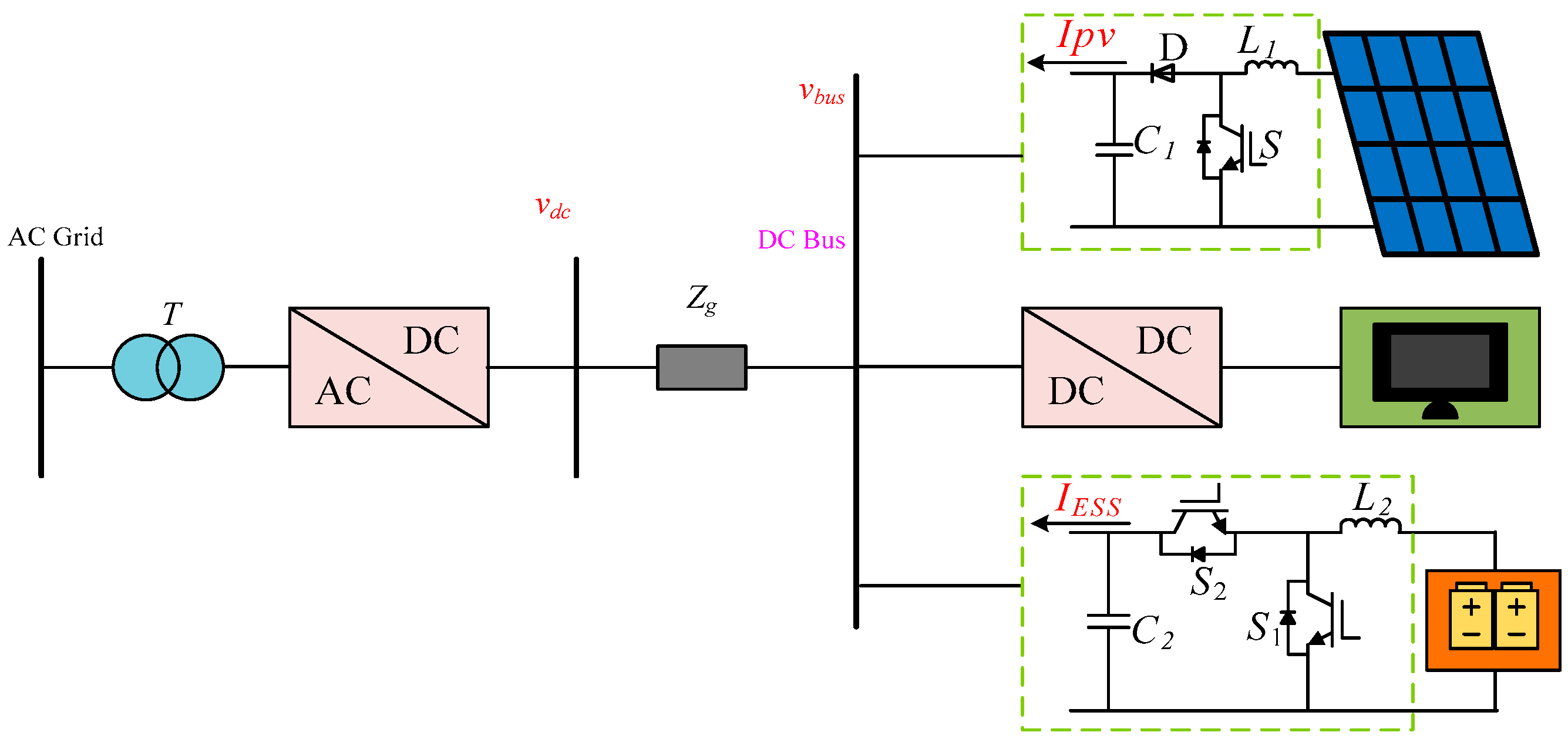
The PV–storage DC microgrid considered in this paper is illustrated in Figure 1. The PV array is connected to the DC bus through a boost converter to implement maximum power point tracking, while the energy storage system (ESS) is interfaced with the DC bus via a bidirectional DC-DC converter to enable bidirectional charging and discharging. The AC utility grid is coupled to the DC bus through a bidirectional AC-DC converter, and the local load is directly supplied by the common DC bus. In this study, the converters are regarded as power interfaces between the corresponding sources and the DC bus; therefore, their detailed switching dynamics are not explicitly considered in the proposed control strategy.
When the energy storage system (ESS) is not connected, the output power of the photovoltaic (PV) system is inherently influenced by external factors such as solar irradiance, temperature, and other environmental conditions. This variability in PV generation results in fluctuations of the DC bus voltage. Denoting the equivalent impedance between the PV system and the DC microgrid as ZPV, the resulting bus-voltage deviation induced by PV power variations can be expressed as
Δ v = P PV v bus Z PV
where PPV is the output power of the PV system, and vbus is the DC bus voltage.
According to Figure 1, the voltage deviation is
Δ v = v bus v dc
where vdc denotes the voltage regulated by the AC-DC converter interfacing with the AC main grid, which can be regarded as constant. Combining Equations (1) and (2), the DC bus voltage of the microgrid can be expressed as
v bus = v dc + Δ v = v dc + P PV Z PV v bus
Clearly, when ZPV is large, vbus exhibits weak-grid characteristics and thus becomes more susceptible to fluctuations in PPV.
Then, when the ESS and load are connected to the system, according to the superposition principle, Equation (3) can be rewritten as
v bus = v dc + P ESS Z ESS + ( P PV Z PV P L Z L ) v bus
where PESS is the output power of the energy storage system, PL is the load power, ZESS is the equivalent impedance between the ESS and the DC grid, and ZL is the equivalent impedance between the load and the DC grid.
Equation (4) characterizes the power-balance relationship of the DC bus in terms of the net power exchanged with the bus. It can be observed that variations in PPV or PL will inevitably induce fluctuations in vbus. Only when Equation (5) is satisfied does vbus = vdc. Therefore, by appropriately regulating PESS, the power imbalance injected into the bus can be compensated, thereby effectively mitigating DC bus-voltage fluctuations.
P ESS = P PV Z PV P L Z L Z ESS
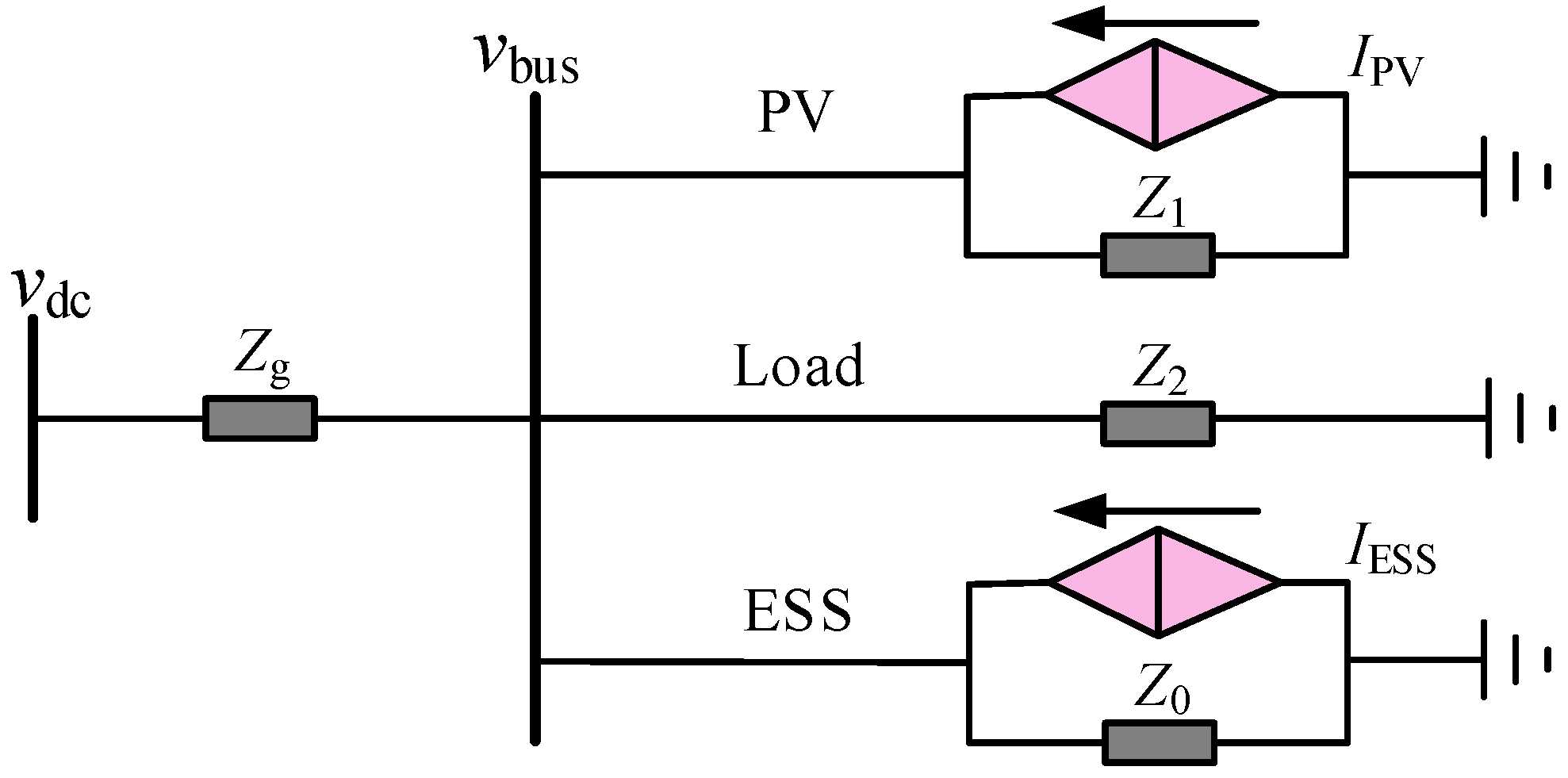
To further clarify the definition of ZESS, the PV–storage DC microgrid is analyzed under the assumption that both the ESS and the PV operate in grid-following mode with constant power control, while the load is modeled as a constant-impedance component. Under these conditions, the ESS and PV can be equivalently represented as controlled current sources in parallel with their respective internal impedances Z0 and Z1, whereas the load is modeled as an equivalent impedance Z2. Based on these assumptions, the simplified equivalent circuit of the PV–storage DC microgrid is illustrated in Figure 2.
As shown in Figure 2, the equivalent input impedance of the ESS is determined by the parallel combination of the DC line impedance Zg, the load equivalent impedance Z2, the PV equivalent impedance Z1, and the internal impedance of the ESS Z0. Accordingly, the equivalent impedance ZESS can be expressed as
Z ESS = Z 0 / / Z 1 / / Z 2 / / Z g
The magnitude of ZESS is highly dependent on the operating conditions of the system as well as the control strategies adopted by the associated converters, rendering its direct measurement challenging. Therefore, an accurate estimation of ZESS is of critical importance for the predictive model.
Since the proposed predictive control strategy relies exclusively on locally measured data from the ESS, variations in PPV and PL can be treated as external disturbances. Accordingly, Equation (4) can be reformulated as
v bus = v dc + P ESS Z ESS v bus + d
where d is the voltage disturbance term caused by variations in PPV or PL. It should be noted that the time scale associated with d is over one order of magnitude larger than the system control period Ts; otherwise, the disturbance rejection performance would be poor.
Discretizing Equation (7), the predicted DC bus voltage can be written as
v bus p ( k + 1 ) = v dc + P ESS ( k + 1 ) Z ESS ( k ) v bus ( k + 1 ) + d   v dc + P ESS ( k + 1 ) Z ESS ( k ) v bus ( k )
where v bus p (k + 1) denotes the predicted DC bus voltage at the next sampling instant, vbus(k) represents the measured bus voltage at the current sampling instant, ZESS(k) is the estimated equivalent input impedance of the ESS at the current instant, and PESS(k + 1) denotes the ESS power-reference command at the next instant. Accordingly, the variation between v bus p (k + 1) and vbus(k) can be expressed as
Δ v bus ( k + 1 ) = v bus p ( k + 1 ) v bus ( k ) = v dc + P ESS ( k + 1 ) Z ESS ( k ) v bus ( k ) v dc + P ESS ( k ) Z ESS ( k ) v bus ( k ) = Δ P ESS ( k + 1 ) Z ESS ( k ) v bus ( k )
Then, the predicted DC bus voltage can be expressed as
v bus p ( k + 1 ) = v bus ( k ) + Δ P ESS ( k + 1 ) Z ESS ( k ) v bus ( k )
From Equation (10), it can be observed that, provided ZESS(k) is accurately estimated, the DC bus voltage deviation ∆vbus(k) can be effectively regulated by adjusting the variation in ESS output power ∆PESS(k + 1). In this way, the deviation between vbus and the reference voltage v b u s * can be eliminated.

3. Model Predictive Control Strategy for ESS

The key implementation process of MPC in this paper includes three steps: establishing a dynamic prediction model for the control system; computing the control input commands; and modifying the model parameters based on feedback measurement data.

3.1. Establishing the Prediction Model

Different from conventional switching-state MPC applied at the converter level, the proposed MPC is formulated at the power-reference level. The control objective is to regulate the DC-bus voltage through optimal scheduling of the ESS power. Accordingly, the prediction model is established based on the dynamic relationship between the DC-bus voltage and ESS power, rather than the discrete switching states of the converters. By discretizing the control-oriented model, the resulting optimization problem can be solved analytically with respect to the control increment u(k), thereby avoiding the need to enumerate converter switching states. The relationship between the input u and output Y for the MPC can be defined as follows:
u ( k ) = Δ P ESS ( k ) = P ESS ( k ) P ESS ( k 1 )
Y ( k ) = v bus ( k )
By substituting Equations (11) and (12) into Equation (10), the relationship between the MPC input and output variables can be written as:
Y ( k + 1 ) = Y ( k ) + u ( k + 1 ) Y ( k ) Z ESS ( k )
At the initial stage, a reasonable engineering initial value is assigned to ZESS(0) based on the nominal operating condition of the PV–storage DC microgrid. This initial value is used only to initialize the online identification process and does not affect the ultimate accuracy of parameter estimation.

3.2. Calculation of Control Input Commands

To calculate the optimal control input u(k + 1), the objective function for MPC needs to be defined. The two control objectives for MPC are: Ensuring that the ESS’s state of charge (SOC) remains within a reasonable range and suppressing bus voltage fluctuations. The objective function can then be expressed as:
J = min λ 1 S S O C * S S O C 2 + λ 2 v bus * v bus p 2
where SSOC is the state of charge of the ESS, with its reference value denoted as S S O C * ; v bus p is the predicted value of the bus voltage, with its reference value denoted as v bus * ; λ1 and λ2 are the weight coefficients of the two major optimization objectives, determined by the output power fluctuation characteristics of the PV and the capacity of the ESS. In practical implementation, the selection of weighting coefficients can be guided by the following principles. First, the initial values of λ1 and λ2 can be chosen to achieve a basic trade-off between SOC regulation and DC-bus voltage stability (e.g., λ1 + λ2 = 1). Subsequently, these coefficients can be tuned according to specific performance requirements. If the DC-bus voltage fluctuation exceeds the allowable range, λ2 should be increased to enhance voltage regulation capability. Conversely, if the SOC variation becomes excessive or approaches its operational limits, λ1 should be increased to prioritize ESS protection. The SSOC of the ESS can be predicted as:
S SOC ( k + 1 ) = S SOC ( k ) T s P ESS ( k + 1 ) C ESS
where CESS is the battery capacity of the ESS.
Different from conventional switching-state MPC applied at the converter level, the proposed MPC is formulated at the power-reference level. Specifically, the control objective is to determine the optimal ESS power reference by minimizing the DC-bus voltage deviation while maintaining the ESS SOC within a desired range. Accordingly, the prediction model is established based on the dynamic relationship between the DC-bus voltage, ESS power, and SOC, rather than the switching states of the converters. By discretizing the control-oriented model, the objective function can be transformed into an explicit optimization problem with respect to the control increment u(k), enabling the optimal power command of the ESS to be obtained analytically instead of through enumeration of converter switching states. By substituting Equations (13) and (15) into Equation (14), the objective function J(k) can be expressed as
J ( k + 1 ) = λ 2 X V 2 ( k ) + ( λ 1 T s 2 C ESS 2 + λ 2 Z ESS 2 ( k ) v bus 2 ( k ) ) u 2 ( k + 1 ) + 2 λ 1 T s 2 P ESS ( k ) C ESS 2 2 λ 1 T s X SOC ( k ) C ESS + 2 λ 2 Z ESS ( k ) X V ( k ) v bus ( k ) u ( k + 1 ) + λ 1 X SOC 2 ( k ) + T s 2 P ESS 2 ( k ) C ESS 2 2 T s X SOC ( k ) P ESS ( k ) C ESS
where XSOC(k) and XV(k) are the deviations of the SOC and the bus voltage, respectively, which are given by Equations (17) and (18) as follows:
X SOC ( k ) = S SOC S SOC *
X V ( k ) = v bus p v bus *
From Equation (16), the control input that minimizes the objective function J can be obtained as
u ( k + 1 ) = [ λ 1 T s X SOC ( k ) C ESS v bus 2 ( k ) λ 1 T s 2 P ESS ( k ) v bus 2 ( k ) λ 2 X V ( k ) Z ESS ( k ) C ESS 2 v bus ( k ) ] / [ λ 1 T s 2 v bus 2 ( k ) + λ 2 Z ESS 2 ( k ) C ESS 2 ]
From Equations (11) and (19), the ESS power command at the next sampling instant can be expressed as
P ESS ( k + 1 ) = u ( k + 1 ) + P ESS ( k )
when PESS > 0, the battery is in the discharging state, and when PESS < 0, the battery is in the charging state.
Since the selection of weighting coefficients has a significant influence on control performance, a Lyapunov function is constructed by taking the bus-voltage deviation X(k) and the SOC deviation XSOC(k) as state variables:
V ( k ) = 1 2 ( λ 1 X SOC 2 ( k ) + λ 2 X V 2 ( k ) )
According to the Lyapunov stability criterion, V(k) must be monotonically decreasing; i.e., ΔV(k) = V(k + 1) − V(k) ≤ 0. Substituting Equations (10) and (15) into Equation (21) and rearranging the terms yields the quadratic form:
Δ V ( k ) = 1 2 X SOC ( k ) X V ( k ) Q X SOC ( k ) X V ( k )
Q = λ 1 2 T s λ 1 C ESS T s 2 λ 1 2 C ESS 2 T s λ 1 λ 2 C ESS Z ESS λ 1 λ 2 v bus * T s λ 1 λ 2 C ESS Z ESS λ 1 λ 2 v bus * λ 2 2 Z ESS λ 2 v bus * Z ESS 2 λ 2 2 v bus * 2
Matrix Q must satisfy the conditions that its principal diagonal elements are negative definite and its determinant is positive definite. Further rearrangement yields the sufficient condition for system stability and the corresponding selection criteria for λ1 and λ2:
λ 1 < 2 C ESS T s , λ 2 < 2 v bus * Z ESS , λ 1 λ 2 < v bus * 2 C ESS 2 Z ESS 2 T s 2

3.3. Model Parameter Correction

To determine the optimal ESS power, the control system must accurately obtain the model parameter ZESS(k). In this paper, a recursive least squares (RLS) method with a forgetting factor is employed to update ZESS(k). This classical adaptive filtering algorithm offers fast convergence and stable estimation performance. From (10), the voltage prediction error can be expressed as
v bus p ( k + 1 ) v bus ( k + 1 ) = u ( k ) v bus ( k ) [ Z ESS ( k + 1 ) Z ESS ( k ) ]
where ZESS(k + 1) is the impedance value after correction, v bus p (k + 1) is the predicted bus voltage at step k, vbus(k + 1) is the measured value at step k + 1, and ZESS(k + 1) is the impedance value after correction. The input–output model of the system to be identified can be expressed as
y ( k ) = φ T ( k ) θ ( k ) + ε ( k )
y ( k ) = v bus p ( k + 1 ) v bus ( k + 1 )
φ T ( k ) = u ( k ) v bus ( k )
θ ( k ) = Z ESS ( k )
where y(k) is the k-th observed value of the system output; ε(k) is the measurement noise of the system; θ(k) is the parameter vector to be identified; and φ(k) is the input–output observation vector.
The recursive least squares (RLS) formula with a forgetting factor is as follows:
θ ˙ ( k + 1 ) = θ ˙ ( k ) + K ( k + 1 ) y ( k + 1 ) φ T ( k + 1 ) θ ˙ ( k ) K ( k + 1 ) = P ( k ) ϕ ( k + 1 ) γ + φ T ( k + 1 ) P ( k ) φ ( k + 1 ) P ( k + 1 ) = 1 γ [ I K ( k + 1 ) φ T ( k + 1 ) ] P ( k )
where θ ˙ ( k + 1 ) and θ ˙ ( k ) are the identification results at steps k + 1 and k, respectively; φ ( k + 1 ) is the observation vector of the system’s input–output at step k + 1; y(k + 1) represents the observed value of the system output at step k + 1; I is the identity matrix; K(k + 1) is the Kalman gain; and P(k + 1) and P(k) are the covariance matrices at steps k + 1 and k, respectively, representing the confidence level for ZESS. At initialization, P(0) is set as a large-valued diagonal matrix with P(0) = 1000I to enhance the initial adaptation gain and accelerate convergence at the onset of the identification process. γ is the forgetting factor, where γ ∈ (0, 1). In this study, γ = 0.98 is selected to balance the transient tracking speed and steady-state estimation robustness.
During initialization, appropriate initial values of θ ˙ ( k ) and P(0) are selected based on prior knowledge or empirical experience of the system, and then substituted into Equation (30) for recursive computation. The parameter ZESS(k) is updated according to the voltage prediction error. When the difference between the actual voltage vbus(k + 1) and the predicted voltage v bus p (k + 1) is sufficiently small, it indicates that the control performance is satisfactory and the model parameters have been identified with high accuracy.
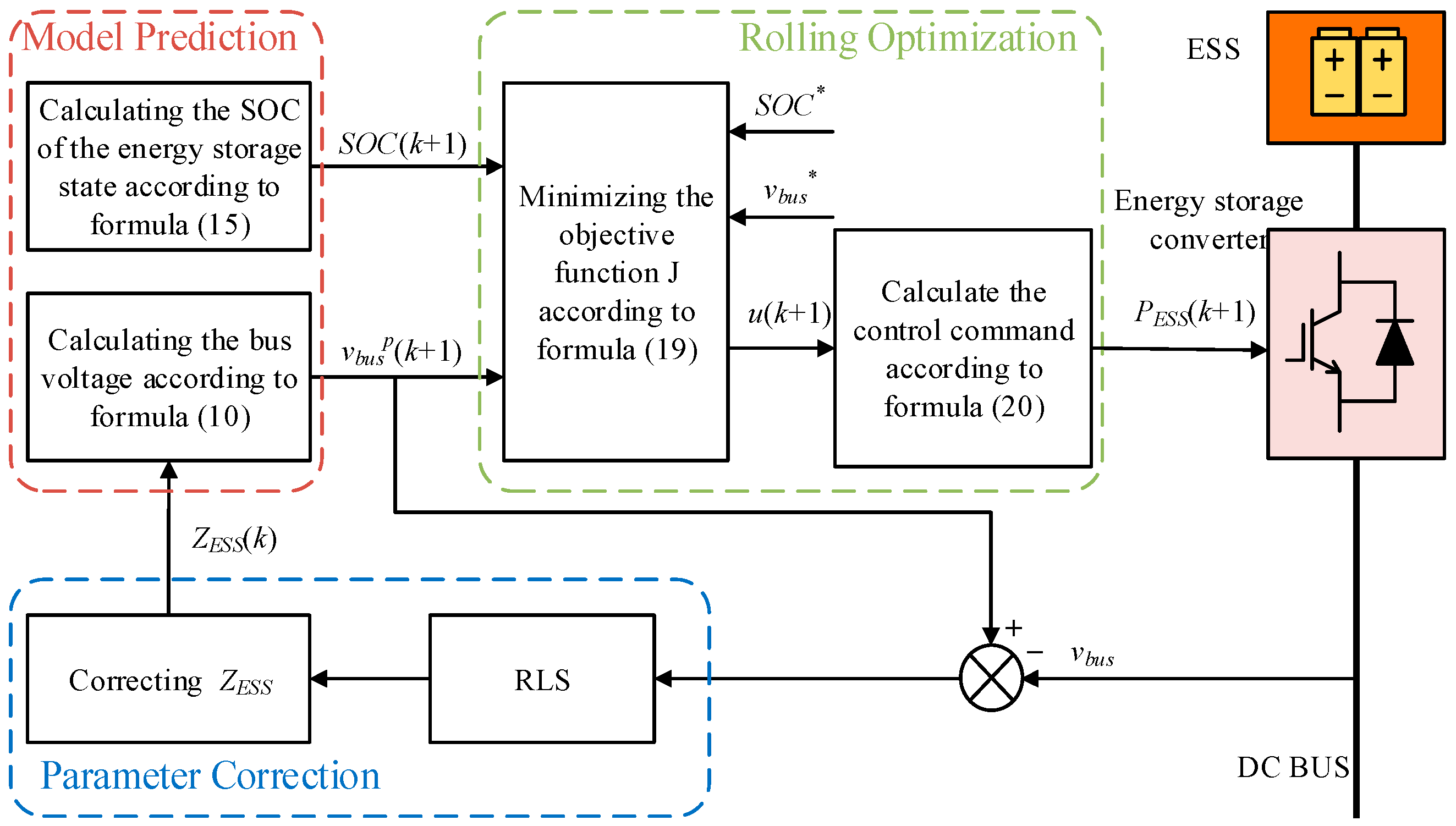
The control flowchart of the ESS is shown in Figure 3. At sampling instant k, the predicted values of the energy storage state and DC bus voltage are calculated, and the ESS charging/discharging power PESS(k + 1) is obtained by minimizing the cost function J. After the actual bus voltage vbus(k + 1) is measured at instant k + 1, the equivalent impedance parameter ZESS(k) is updated online via recursive least squares with a forgetting factor. This online adaptation improves impedance estimation accuracy, enhances ESS power control performance, and ensures DC bus-voltage stability.

3.4. Control Constraints

In the MPC method, in order to ensure the safety of the battery and maintain system stability, the power limits of the ESS should be considered. Additionally, the calculation of the SOC is not only treated as an optimization objective but also serves as a constraint condition for control. The SOC of each battery module in the ESS must be limited within a certain range. Considering these factors, the constraints of the control method can be expressed as
P IN - MAX * < P ESS ( k + 1 ) < P OUT - MAX *
0.2 < S SOC ( k + 1 ) < 0.8
where P IN - MAX * denotes the maximum charging power of the battery, and P OUT - MAX * denotes the maximum discharging power of the battery. These constraints are imposed not only to ensure system stability, but also to prevent overcharging and deep discharging, thereby reducing battery stress and prolonging service life. The initial state of charge (SOC) of the ESS is set to 70% for the following reasons. First, this value lies within the middle of the safe operating range (20–80%), leaving sufficient charge and discharge margin to support bus-voltage regulation under PV power fluctuations. In addition, an initial SOC of 70% is widely adopted in PV–storage DC microgrid simulations, which facilitates a fair comparison with conventional control methods.

4. Simulation Verification

To verify the effectiveness of the proposed algorithm, a PV–storage DC microgrid, as shown in Figure 1, is constructed in the MATLAB/Simulink environment, and the main parameters are listed in Table 1.

4.1. PV Output Power Fluctuation Test

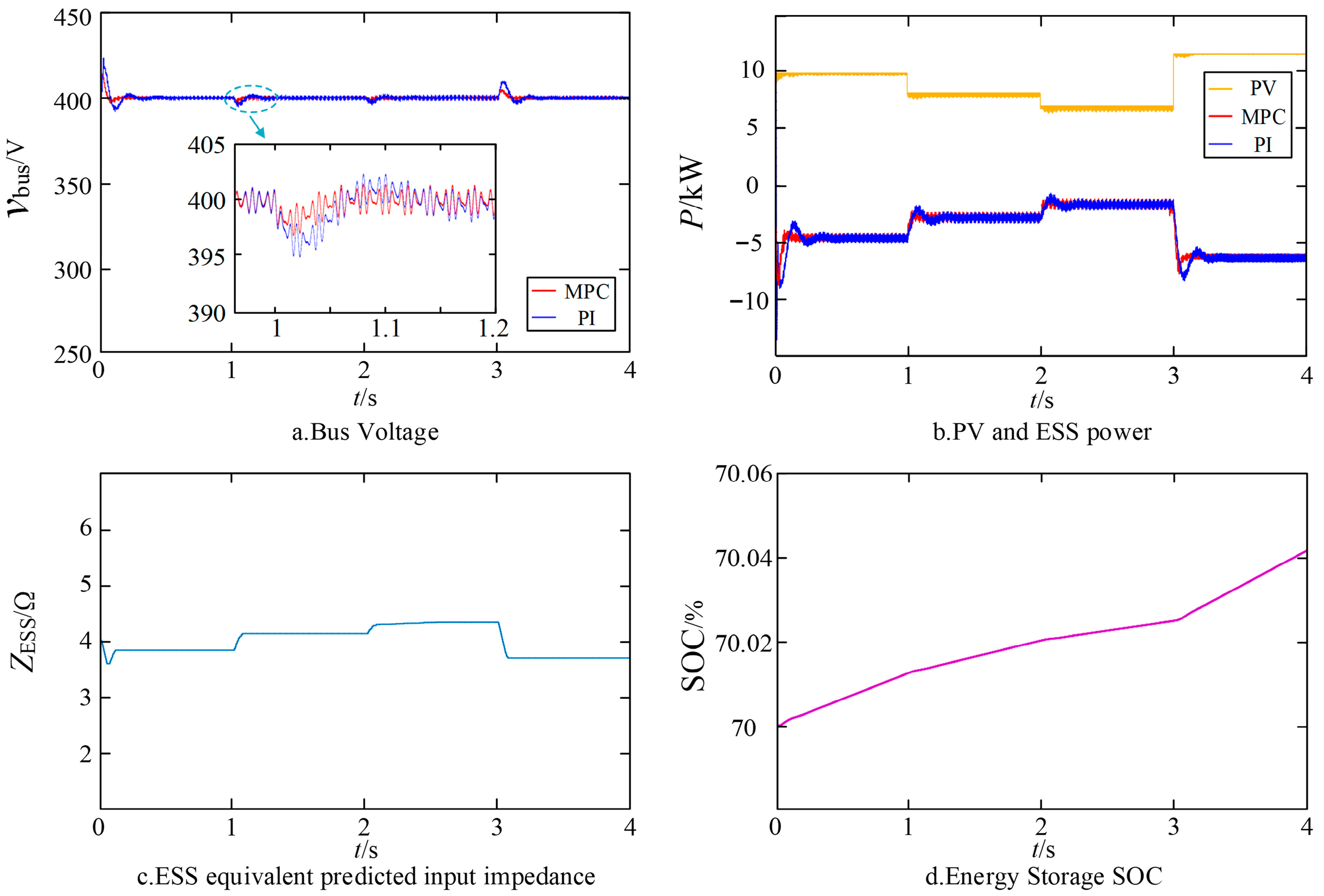
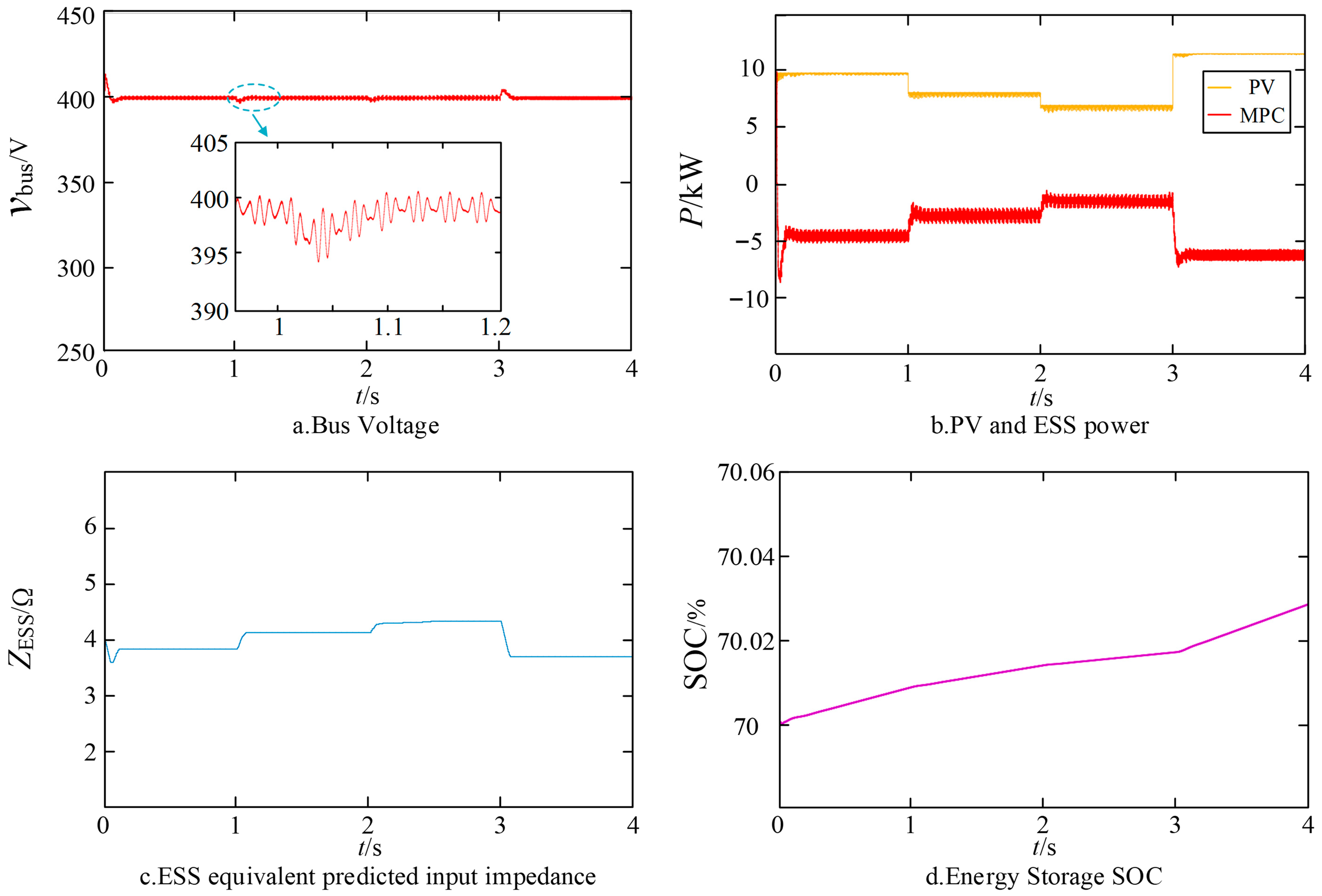
To evaluate the ability of the ESS to suppress DC bus-voltage fluctuations, PV power variations are emulated by changing the solar irradiance. The simulation setup is as follows: at t = 0, 1, 2, 3 (s), the irradiance levels are set to 850, 700, 600, and 1000 (W/m2), respectively; the weighting coefficients are selected as λ1 = 0.1 and λ2 = 0.9. To highlight the superiority of the proposed MPC strategy, a comparative study with the conventional PI control scheme is conducted. The simulation results are presented in Figure 4.
Figure 4a shows the bus-voltage fluctuation suppression performance of the two control methods. It can be observed that, following PV power variations, both controllers are able to regulate the bus voltage to 400 V, indicating satisfactory steady-state performance. At t = 1, 2, 3, 4 (s), the bus-voltage fluctuation ranges under the PI controller are 5.1 V, 4.0 V, and 9.9 V, respectively, and the corresponding recovery times to the rated voltage are 0.35 s, 0.30 s, and 0.35 s. Under the proposed MPC scheme, the corresponding voltage fluctuation ranges are reduced to approximately 3.2 V, 2.6 V, and 5.1 V, while the recovery times are shortened to 0.11 s, 0.10 s, and 0.14 s, respectively. These results demonstrate that the proposed MPC method effectively suppresses bus-voltage fluctuations and significantly improves transient performance.
Figure 4b presents the ESS power response under PV power variation. Compared with the conventional PI controller, the proposed MPC exhibits a faster response and smaller overshoot in ESS output power. The results indicate that the proposed control strategy can regulate the ESS more effectively and promptly.
Figure 4c shows the predicted trajectory of the ESS equivalent input impedance ZESS. The initial value of ZESS is set to 4 Ω. It can be seen that, as the PV output fluctuates, the bus voltage varies accordingly, and the predicted value of ZESS is updated adaptively. Once the bus voltage is restored to its rated value and stabilized, the predicted value of ZESS remains essentially unchanged. This confirms the correctness of the proposed ZESS estimation method. With rolling optimization and accurate model parameter identification, stable and precise bus voltage regulation can be achieved.
Figure 4d illustrates the SOC variation in the ESS. The initial SOC is set to 70%. The simulation results show that the SOC remains within a reasonable range throughout the entire process, with no overcharging or deep-discharge behavior, thereby ensuring the safe and healthy operation of the ESS.
The proposed MPC scheme outperforms the conventional PI controller for three main reasons. First, it is formulated at the power-reference level and obtains the optimal control command through analytical derivation, rather than through exhaustive enumeration of switching states as in traditional switching-state MPC, thereby significantly reducing computational burden. Second, it enables multi-objective optimization within a unified framework by simultaneously considering DC bus-voltage stability, SOC constraints, and ESS power limits, which cannot be achieved by conventional PI control. Third, the proposed strategy relies solely on local measurements without external communication, which reduces communication overhead and further improves dynamic response.

4.2. Weight Coefficient Adjustment Test

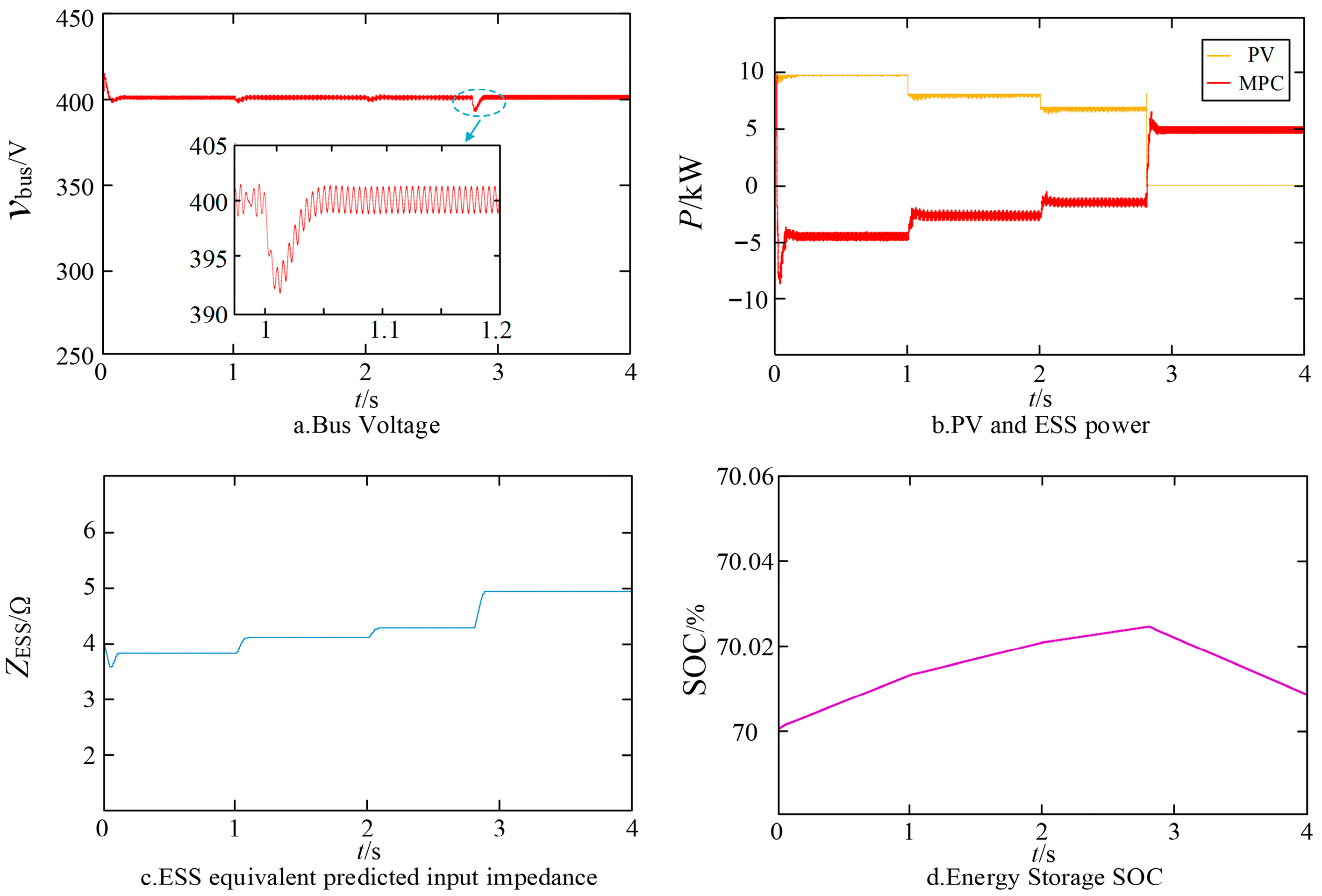
To analyze the impact of the weight coefficients λ 1 and λ 2 , a control experiment is conducted, where the SOC weight coefficient is increased, setting λ1 = 0.3 and λ2 = 0.7. The simulation results are shown in Figure 5.
By comparing Figure 5d with Figure 4d, it can be observed that when λ1 is increased, the SOC varies more slowly. However, at t = 1, 2, and 3 s, the bus voltage deviations in Figure 5a are 6.5 V, 5.1 V, and 9.6 V, respectively, which are larger than those in Figure 4a. These results indicate that a trade-off exists between DC bus-voltage regulation and ESS SOC variation. Specifically, increasing λ2 enhances voltage stability but may induce more aggressive ESS power fluctuations, whereas increasing λ1 improves SOC stability at the expense of larger bus-voltage deviations. Therefore, the weighting coefficients should be selected according to the specific application requirements, such as voltage regulation accuracy and battery-lifetime considerations. For microgrids with a larger ESS capacity, a relatively larger λ2 may be adopted, since sufficient energy margin is available to support bus-voltage regulation. In contrast, for small-scale systems with limited storage capacity, a larger λ1 is preferred to avoid excessive charge/discharge stress.

4.3. PV Sudden Power-Off Test

To further verify the robustness of the proposed control strategy, the PV system is turned off at t = 2.8 s. The corresponding simulation results are shown in Figure 6.
As shown in 6a, the bus-voltage fluctuation remains within 10 V, indicating that the proposed method can effectively maintain bus voltage stability even under PV outage conditions. Figure 6b shows that the ESS operating mode switches from charging to discharging, thereby fully assuming the role of bus-voltage support during the PV outage.
From Figure 6c, it can be seen that within 0.1 s after the sudden PV power-off event, the predicted value of ZESS is rapidly adjusted, ensuring the stable operation of the DC bus voltage. Figure 6d shows that after the PV shutdown, the ESS begins to discharge power to the bus, and the SOC decreases accordingly.
Overall, the simulation results demonstrate that the proposed control strategy can effectively mitigate bus-voltage fluctuations during PV outage events, exhibits strong robustness, and ensures the stable operation of the DC microgrid.

5. Experimental Verification

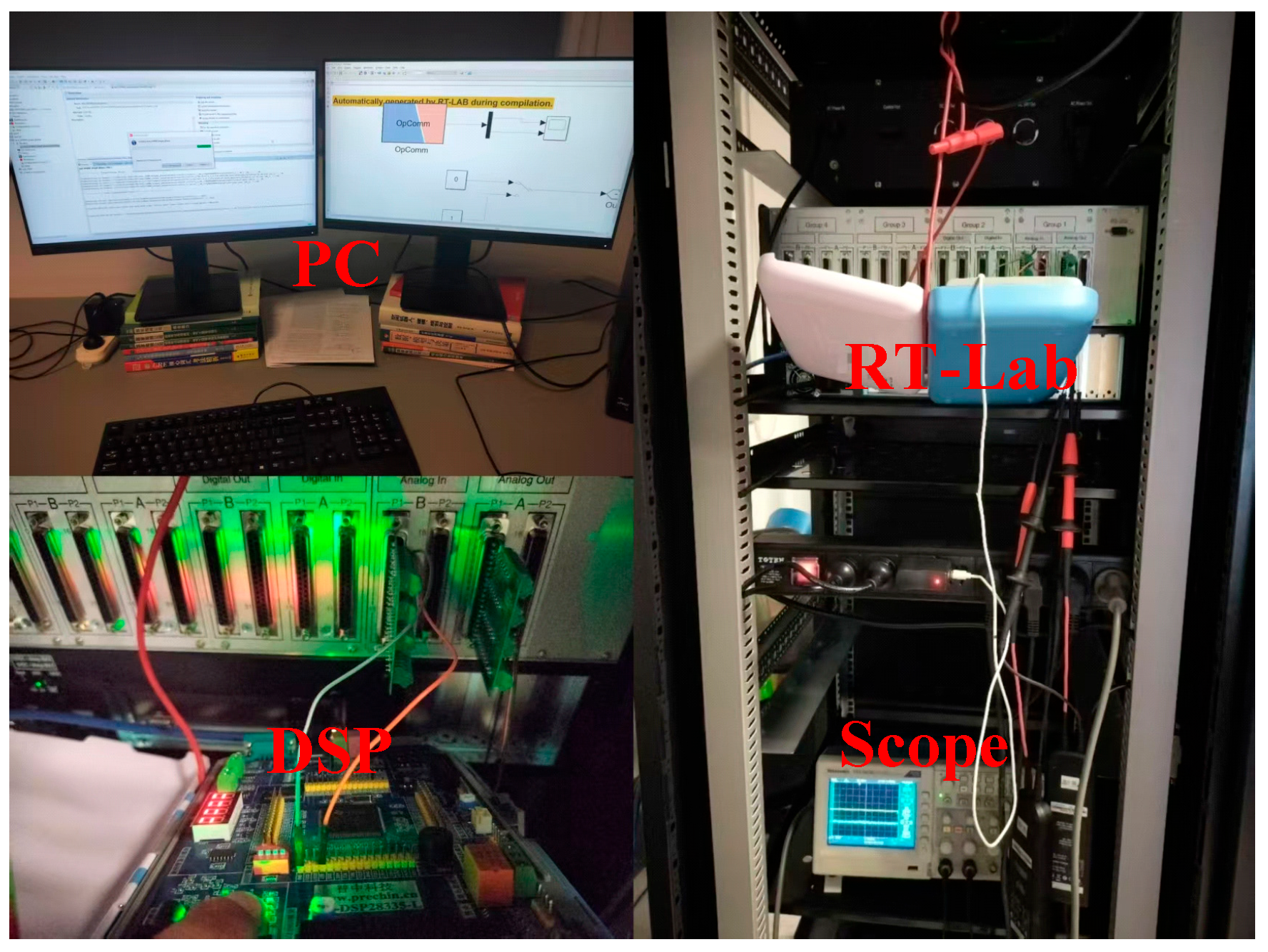
To further verify the correctness and effectiveness of the proposed MPC strategy for the ESS, a hardware-in-the-loop (HIL) experiment was carried out on the RT-Lab real-time simulation platform in conjunction with the DSP TMS320F28335. The experimental setup is illustrated in Figure 7.
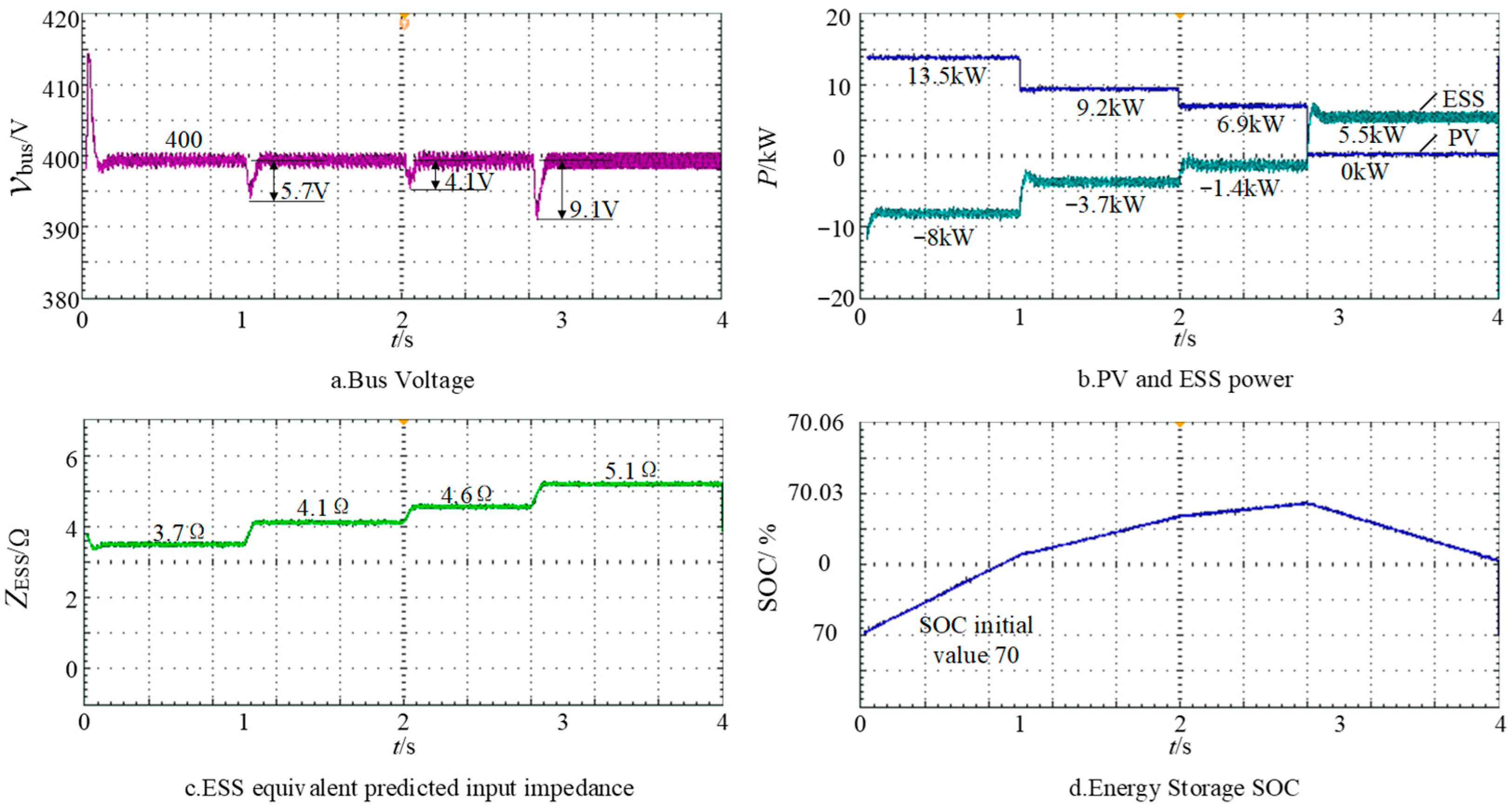
The system parameters were kept consistent with those used in the simulation study. Specifically, the irradiance levels were set to 850, 700, and 600 (W/m2) at t = 0, 1, 2 (s), respectively, and the PV system was switched off at t = 2.8 s. The experimental results are presented in Figure 8, including the waveforms of the bus voltage, ESS and PV output powers, ESS equivalent input impedance, and SOC.
From the experimental results, it can be observed that, before the PV system is shut down, the ESS is able to adjust its output power in real time in response to irradiance variations, thereby effectively mitigating the impact of PV power fluctuations on the DC bus voltage. After the PV system is turned off, the bus-voltage fluctuation reaches a maximum of 9.1 V. At this point, the ESS operating mode switches from charging to discharging, indicating that the proposed control strategy can still maintain DC bus-voltage stability effectively under PV fault conditions. Although the proposed MPC-based strategy is computationally more demanding than conventional PI control, its feasibility has been validated on the RT-Lab platform combined with the DSP TMS320F28335. Moreover, since the proposed method relies solely on local measurements without external communication links, it reduces implementation complexity and improves system reliability. These experimental results further confirm that the proposed strategy significantly enhances DC bus-voltage regulation and dynamic performance under both PV fluctuation and fault conditions.

6. Conclusions

From the perspective of sustainable development of PV–storage DC microgrids, maintaining stable bus voltage under intermittent PV generation is of critical importance. In response to the voltage fluctuations induced by the stochastic variability of PV output, the proposed ESS MPC scheme exhibits excellent performance in both simulation and experimental studies. By employing rolling-horizon optimization, the method can accurately estimate model parameters and generate appropriate predictive control commands, thereby substantially suppressing DC bus-voltage fluctuations. Even under sudden PV outages, the control system can still regulate the ESS adaptively to stabilize the bus voltage, ensuring the continuous and reliable operation of the DC microgrid and thus improving the sustainability of the energy supply. Furthermore, because the proposed method does not depend on communication between the ESS and external systems, it reduces control-implementation cost and enhances system reliability, which is beneficial for the long-term deployment of microgrids.

Author Contributions

Conceptualization, M.C.; methodology, M.C. and S.L.; formal analysis, writing—review and editing, Z.L.; software, validation, K.Y.; All authors have read and agreed to the published version of the manuscript.

Funding

This research was funded by the National Natural Science Foundation of China, grant number 52477188; China Southern Power Grid Co., Ltd. Technology Project, grant number GDKJXM20230303.

Institutional Review Board Statement

Not applicable.

Informed Consent Statement

Not applicable.

Data Availability Statement

The data that support the findings of this study are available from the corresponding author upon reasonable request.

Conflicts of Interest

Author Ming Chen and Shui Liu were employed by the company Huizhou Power Supply Bureau of Guangdong Power Grid Co., Ltd. The remaining authors declare that the research was conducted in the absence of any commercial or financial relationships that could be construed as a potential conflict of interest. And the authors declare that this study received funding from China Southern Power Grid Co., Ltd. The funder was not involved in the study design, collection, analysis, interpretation of data, the writing of this article or the decision to submit it for publication.

References

  1. Hassan, Q.; Viktor, P.; Al-Musawi, T.J.; Ali, B.M.; Algburi, S.; Alzoubi, H.M.; Al-Jiboory, A.K.; Sameen, A.Z.; Salman, H.M.; Jaszczur, M. The renewable energy role in the global energy Transformations. Renew. Energy Focus 2024, 48, 100545. [Google Scholar] [CrossRef]
  2. Ismaila, Z.; Falode, O.A.; Diji, C.J.; Ikumapayi, O.M.; Awonusi, A.A.; Afolalu, S.A.; Akinlabi, E.T. A global overview of renewable energy strategies. AIMS Energy 2022, 10, 718–775. [Google Scholar] [CrossRef]
  3. Breyer, C.; Khalili, S.; Bogdanov, D.; Ram, M.; Oyewo, A.S.; Aghahosseini, A.; Gulagi, A.; Solomon, A.A.; Keiner, D.; Lopez, G.; et al. On the history and future of 100% renewable energy systems research. IEEE Access 2022, 10, 78176–78218. [Google Scholar] [CrossRef]
  4. Qiu, T.; Wang, L.; Lu, Y.; Zhang, M.; Qin, W.; Wang, S.; Wang, L. Potential assessment of photovoltaic power generation in China. Renew. Sustain. Energy Rev. 2022, 154, 111900. [Google Scholar] [CrossRef]
  5. Hasan, K.; Yousuf, S.B.; Tushar, M.S.H.K.; Das, B.K.; Das, P.; Islam, S. Effects of different environmental and operational factors on the PV performance: A comprehensive review. Energy Sci. Eng. 2022, 10, 656–675. [Google Scholar] [CrossRef]
  6. Luo, L.; Abdulkareem, S.S.; Rezvani, A.; Miveh, M.R.; Samad, S.; Aljojo, N.; Pazhoohesh, M. Optimal scheduling of a renewable based microgrid considering photovoltaic system and battery energy storage under uncertainty. J. Energy Storage 2020, 28, 101306. [Google Scholar] [CrossRef]
  7. Wang, P.; Zhang, S.; Pu, Y.; Cao, S.; Zhang, Y. Estimation of photovoltaic power generation potential in 2020 and 2030 using land resource changes: An empirical study from China. Energy 2021, 219, 119611. [Google Scholar] [CrossRef]
  8. Al-Ismail, F.S. DC microgrid planning, operation, and control: A comprehensive review. IEEE Access 2021, 9, 36154–36172. [Google Scholar] [CrossRef]
  9. Jabr, R.A. Mixed-integer convex optimization for DC microgrid droop control. IEEE Trans. Power Syst. 2021, 36, 5901–5908. [Google Scholar] [CrossRef]
  10. Peng, J.; Fan, B.; Liu, W. Voltage-based distributed optimal control for generation cost minimization and bounded bus voltage regulation in DC microgrids. IEEE Trans. Smart Grid 2020, 12, 106–116. [Google Scholar] [CrossRef]
  11. Liu, X.K.; Wang, Y.W.; Lin, P.; Wang, P. Distributed supervisory secondary control for a DC microgrid. IEEE Trans. Energy Convers. 2020, 35, 1736–1746. [Google Scholar] [CrossRef]
  12. Kazerani, M.; Tehrani, K. Grid of hybrid AC/DC microgrids: A new paradigm for smart city of tomorrow. In Proceedings of the 2020 IEEE 15th International Conference of System of Systems Engineering (SoSE); IEEE: New York, NY, USA, 2020; pp. 175–180. [Google Scholar]
  13. Shen, L.; Cheng, Q.; Cheng, Y.; Wei, L.; Wang, Y. Hierarchical control of DC micro-grid for photovoltaic EV charging station based on flywheel and battery energy storage system. Electr. Power Syst. Res. 2020, 179, 106079. [Google Scholar] [CrossRef]
  14. Vettuparambil, A.; Chatterjee, K.; Fernandes, B.G. A multiport converter interfacing solar photovoltaic modules and energy storage with DC microgrid. IEEE Trans. Ind. Electron. 2020, 68, 3113–3123. [Google Scholar] [CrossRef]
  15. Sinha, S.; Bajpai, P. Power management of hybrid energy storage system in a standalone DC microgrid. J. Energy Storage 2020, 30, 101523. [Google Scholar] [CrossRef]
  16. Yan, H.W.; Narang, A.; Tafti, H.D.; Farivar, G.G.; Ceballos, S.; Pou, J. Minimizing energy storage utilization in a stand-alone DC microgrid using photovoltaic flexible power control. IEEE Trans. Smart Grid 2021, 12, 3755–3764. [Google Scholar] [CrossRef]
  17. Li, Q.; Zhao, F.; Zhuang, L.; Wang, Q.; Wu, C. Research on the control strategy of DC microgrids with distributed energy storage. Sci. Rep. 2023, 13, 20622. [Google Scholar] [CrossRef] [PubMed]
  18. Shahzad, S.; Abbasi, M.A.; Chaudhry, M.A.; Hussain, M.M. Model predictive control strategies in microgrids: A concise revisit. IEEE Access 2022, 10, 122211–122225. [Google Scholar] [CrossRef]
  19. Ali, S.U.; Waqar, A.; Aamir, M.; Qaisar, S.M.; Iqbal, J. Model predictive control of consensus-based energy management system for DC microgrid. PLoS ONE 2023, 18, e0278110. [Google Scholar] [CrossRef]
  20. Nair, U.R.; Sandelic, M.; Sangwongwanich, A.; Dragicevic, T.; Costa-Castello, R.; Blaabjerg, F. An analysis of multi objective energy scheduling in PV-BESS system under prediction uncertainty. IEEE Trans. Energy Convers. 2021, 36, 2276–2286. [Google Scholar] [CrossRef]
  21. Akpolat, A.N.; Habibi, M.R.; Baghaee, H.R.; Dursun, E.; Kuzucuoglu, A.E.; Yang, Y.; Dragicevic, T.; Blaabjerg, F. Dynamic stabilization of DC microgrids using ANN-based model predictive control. IEEE Trans. Energy Convers. 2021, 37, 999–1010. [Google Scholar] [CrossRef]
  22. Chen, S.; Yang, Q.; Zhou, J.; Chen, X. A model predictive control method for hybrid energy storage systems. CSEE J. Power Energy Syst. 2021, 7, 329–338. [Google Scholar]
  23. Xiao, S.; Shadmand, M.B.; Balog, R.S. Model predictive control of multi-string PV systems with battery back-up in a community dc microgrid. In Proceedings of the 2017 IEEE Applied Power Electronics Conference and Exposition (APEC); IEEE: New York, NY, USA, 2017; pp. 1284–1290. [Google Scholar]
  24. Shan, Y.; Hu, J.; Chan, K.W.; Fu, Q.; Guerrero, J.M. Model predictive control of bidirectional DC-DC converters and AC/DC interlinking converters-A new control method for PV-wind-battery microgrids. IEEE Trans. Sustain. Energy 2018, 10, 1823–1833. [Google Scholar] [CrossRef]
Figure 1. Schematic diagram of DC microgrid structure.
Sustainability 18 03903 g001
Figure 2. Simplified equivalent circuit diagram of hybrid system.
Sustainability 18 03903 g002
Figure 3. Control strategy flow chart.
Sustainability 18 03903 g003
Figure 4. Simulation results when changing PV output power.
Sustainability 18 03903 g004
Figure 5. Simulation results when changing weight coefficient.
Sustainability 18 03903 g005
Figure 6. Waveform diagram of sudden photovoltaic power failure.
Sustainability 18 03903 g006
Figure 7. RT-Lab experimental platform.
Sustainability 18 03903 g007
Figure 8. RT-lab experimental results.
Sustainability 18 03903 g008
Table 1. Model parameters.
ParameterSymbolValue
Rated voltage of DC bus/V v d c 400
Battery terminal voltage/V v b 96
Rated capacity of battery/Ah C E S S 100
Energy storage DC-side resistance/Ω R L b 0.01
DC-side capacitor for energy storage/ μ F C L b 1000
DC-side inductance for energy storage/mH L L b 3.3
Initial value of SOC/%SOC70
Rated power of energy storage/kWPESS-n10
Rated power of photovoltaic system/kWPPV-n15
Local DC load power/kWPload5.5
Disclaimer/Publisher’s Note: The statements, opinions and data contained in all publications are solely those of the individual author(s) and contributor(s) and not of MDPI and/or the editor(s). MDPI and/or the editor(s) disclaim responsibility for any injury to people or property resulting from any ideas, methods, instructions or products referred to in the content.