Landscape Ecological Risk Assessment and Multi-Scenario Simulation of Land Use Based on the Markov-FLUS Model: A Case Study of the Hexi Corridor


Abstract
1. Introduction
2. Materials and Methods
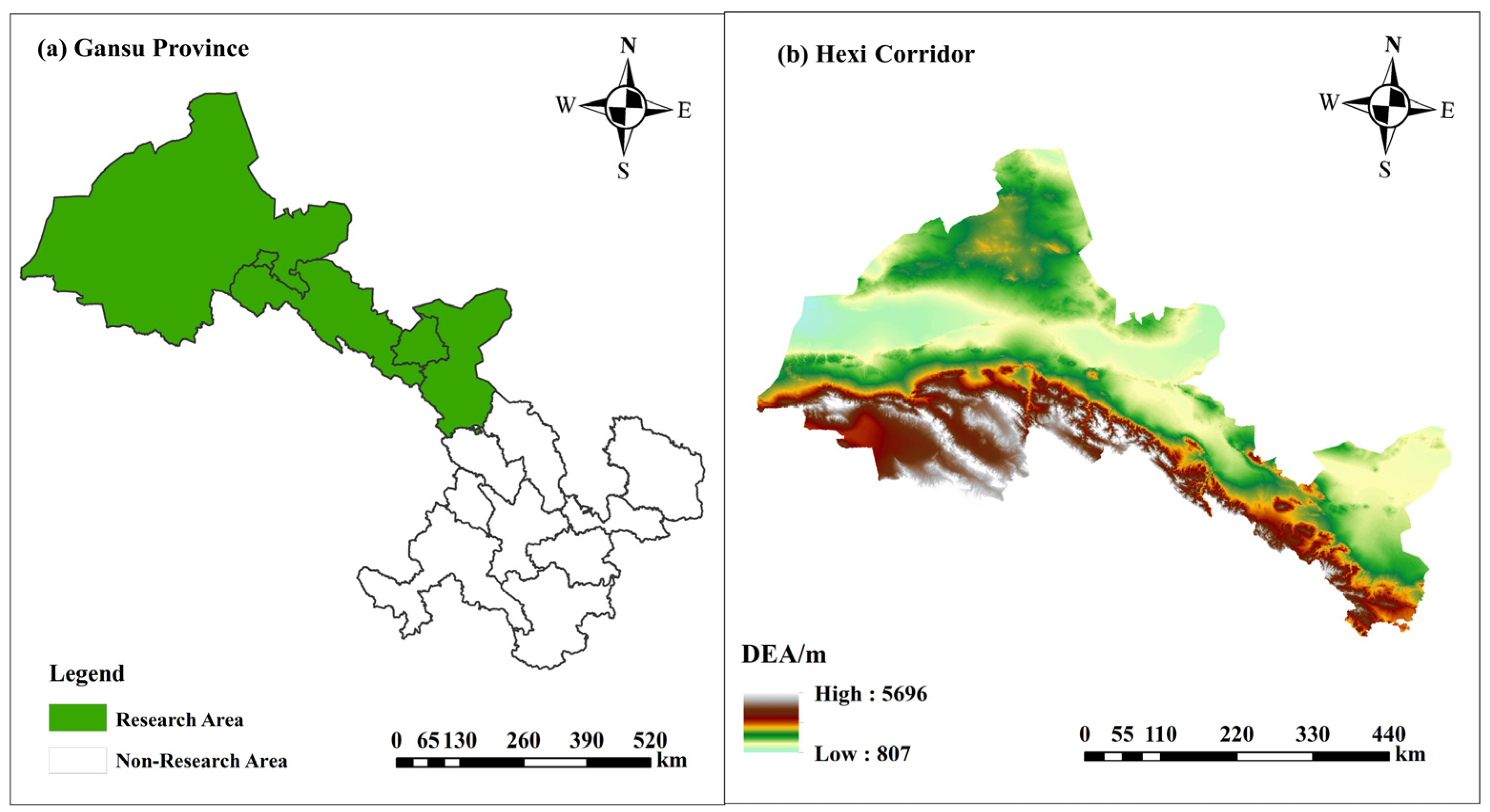
2.1. Study Area
2.2. Data Sources
2.3. Research Methods
2.3.1. LER Assessment

| Number | Index | Formula | Meaning |
|---|---|---|---|
| 1 | Landscape Fragmentation | ni represents the number of patches of landscape type i; Ai represents the area of landscape type i [7,29]. | |
| 2 | Landscape Isolation | A represents the total area of the landscape [11]. | |
| 3 | Landscape Dominance | Qi represents the number of patches i appearing in the sample plots/total sample plots; Mi represents the number of patches i/total patches; Li represents the area of patch i/total sample plot area [40]. | |
| 4 | Landscape Disturbance | a, b, and c represent the weights of fragmentation, isolation, and dominance, respectively, with values assigned as 0.5, 0.3, and 0.2 based on existing literature [9,37]. | |
| 5 | Landscape Vulnerability | Normalized data | The six landscape types are assigned the values 4, 2, 3, 5, 1, and 6, respectively, and then normalized to obtain the vulnerability of each landscape type [9,37]. |
| 6 | Landscape Loss Degree | Ri represents the product of the disturbance degree and the loss degree [36]. |
2.3.2. XGBoost-SHAP Interpretable Machine Learning
2.3.3. Markov-FLUS Model
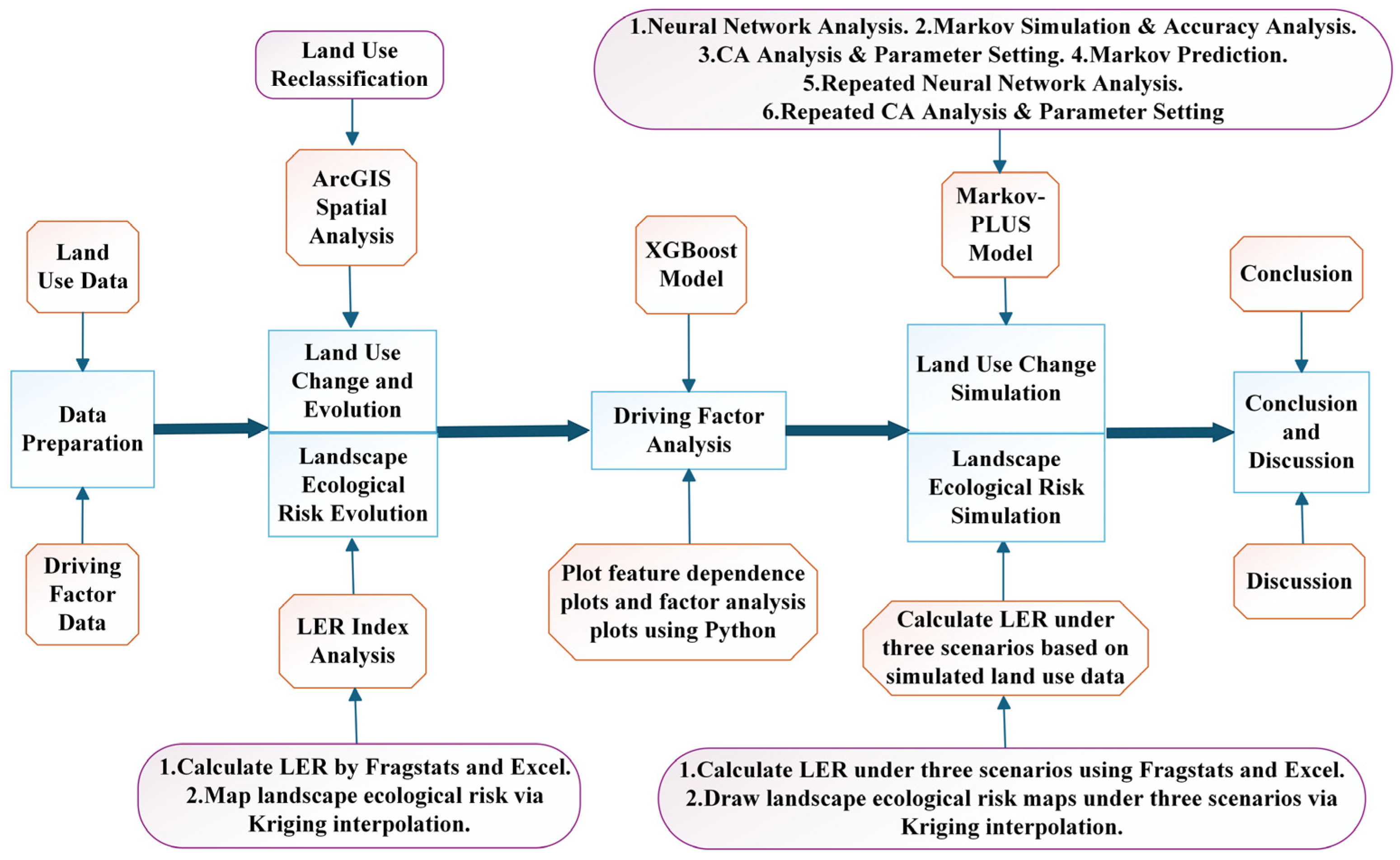
2.4. Technical Framework
3. Results
3.1. Spatiotemporal Evolution of LU and LER
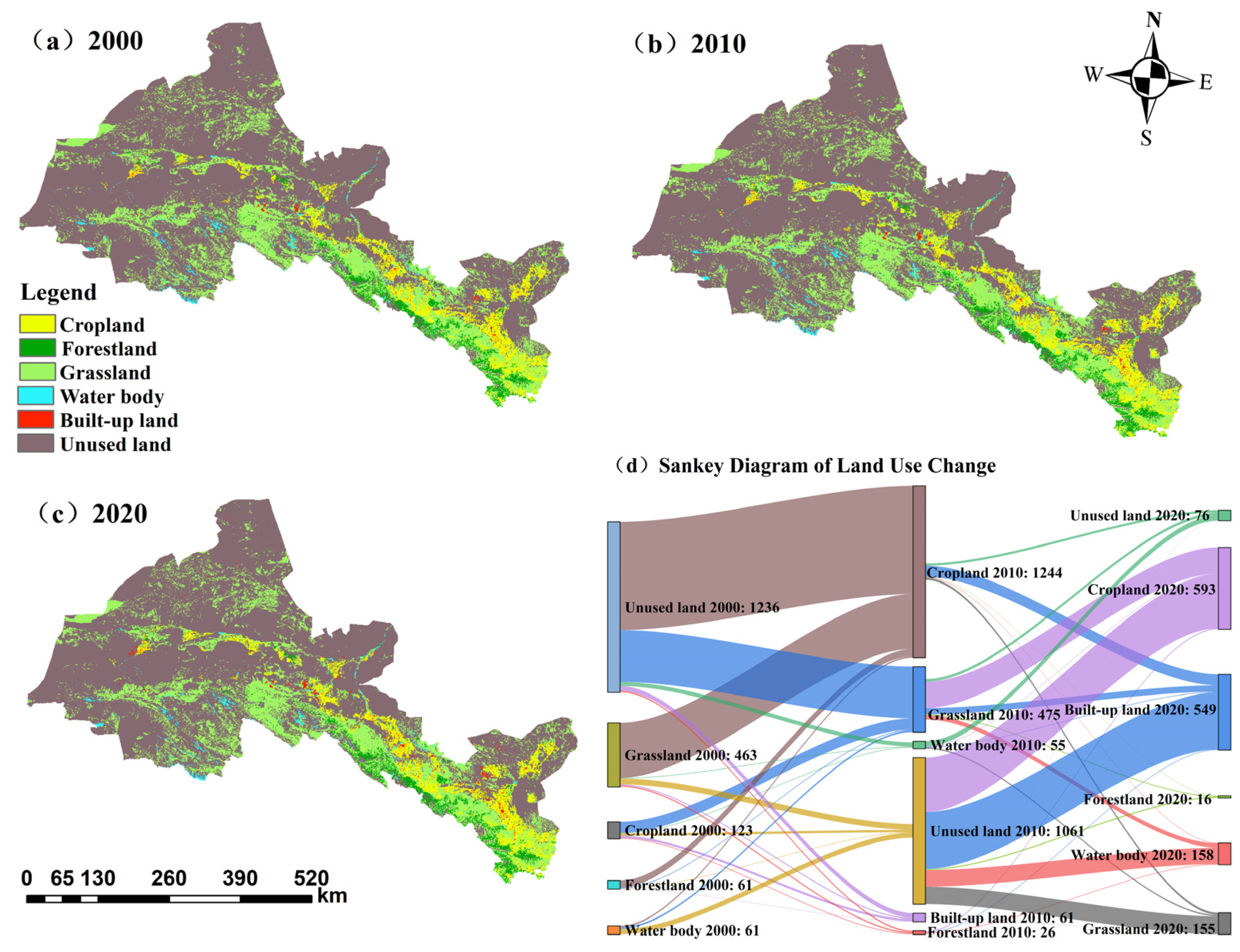
3.1.1. Spatiotemporal Evolution of LU
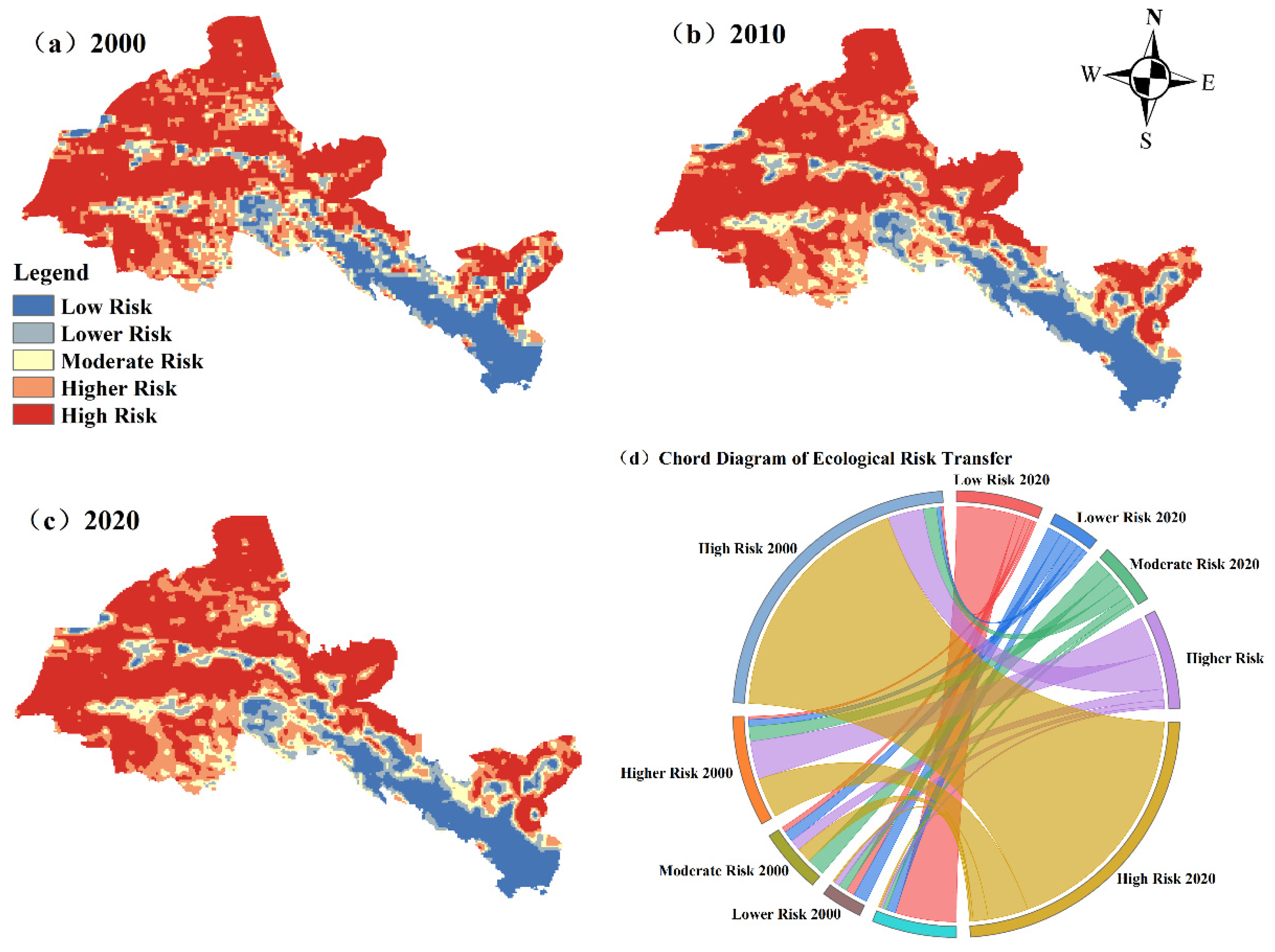
3.1.2. Spatiotemporal Evolution of LER
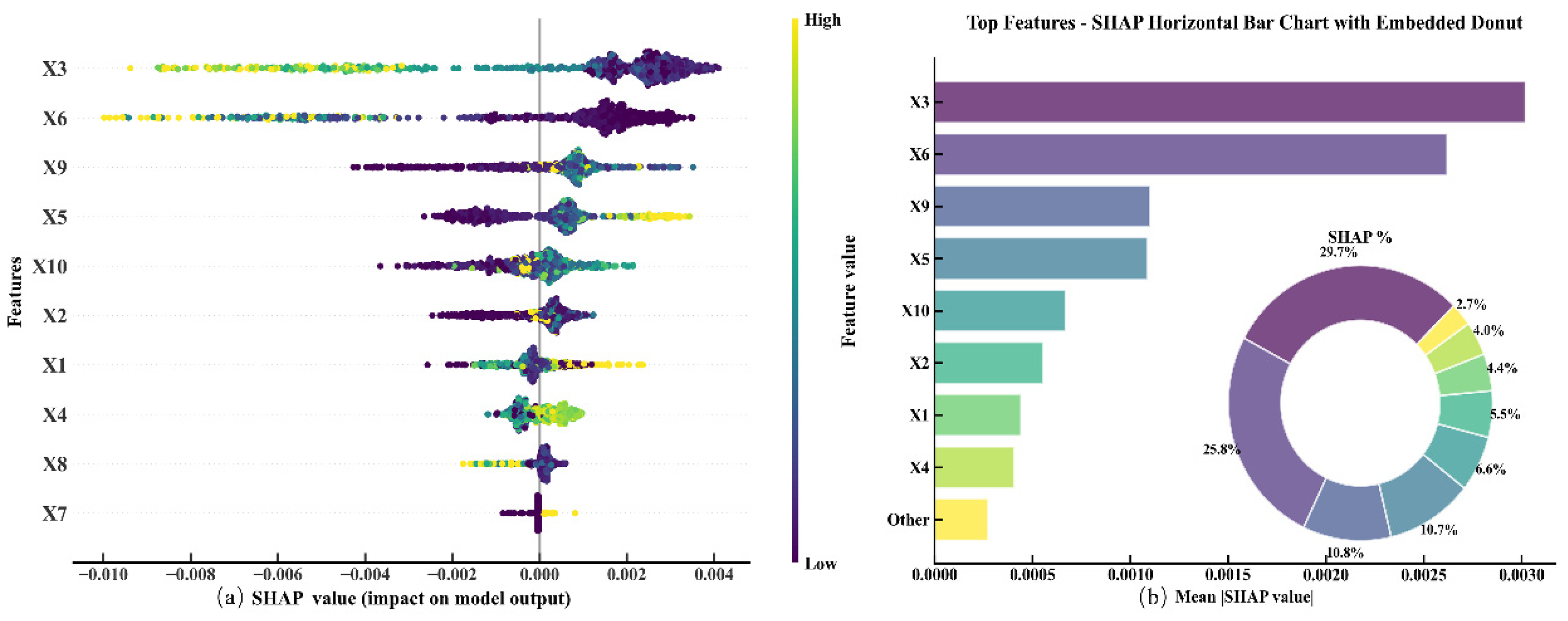
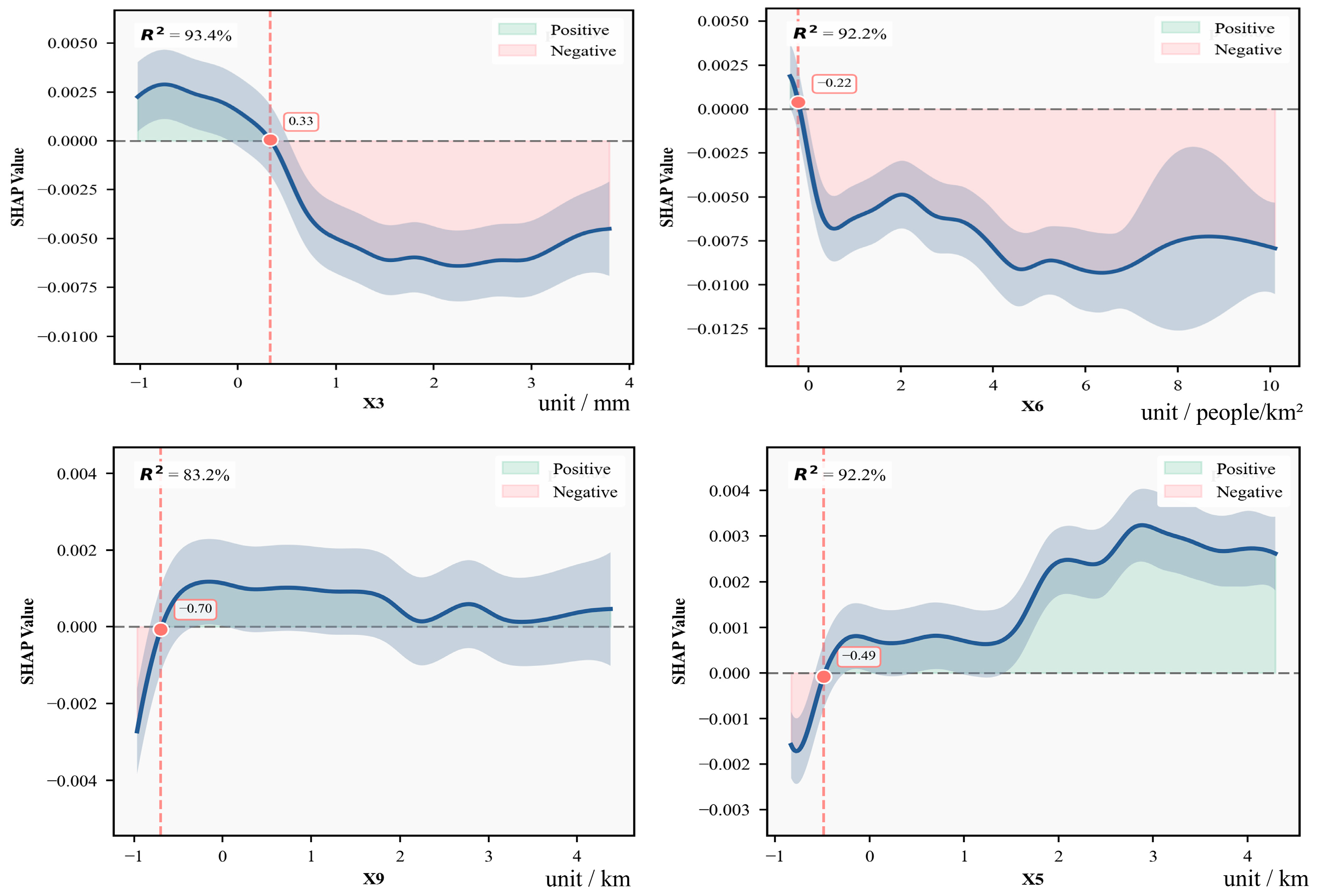
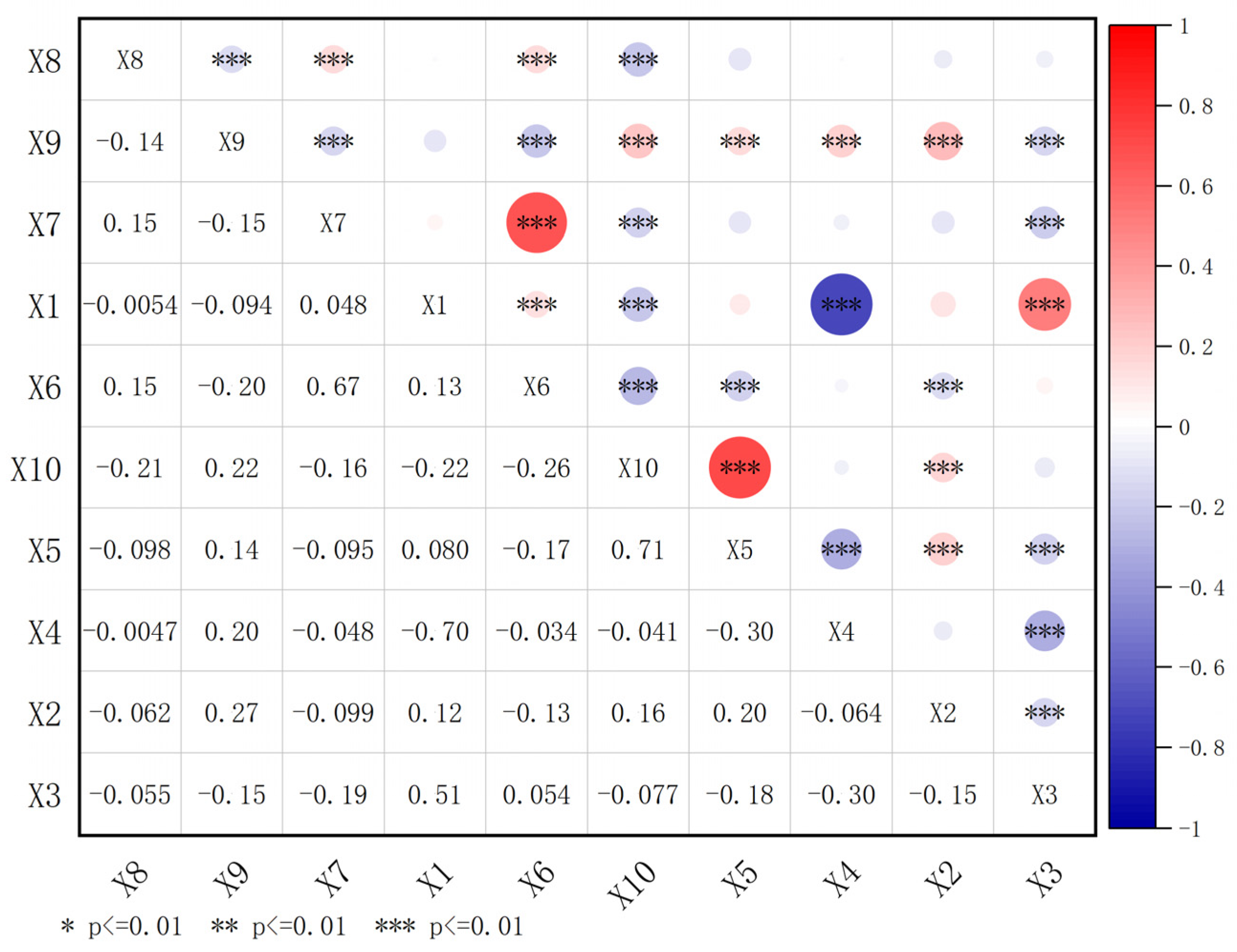
3.2. Driving Factors of LER
3.3. Multi-Scenario LU and LER Simulation and Prediction
3.3.1. Model Accuracy Verification
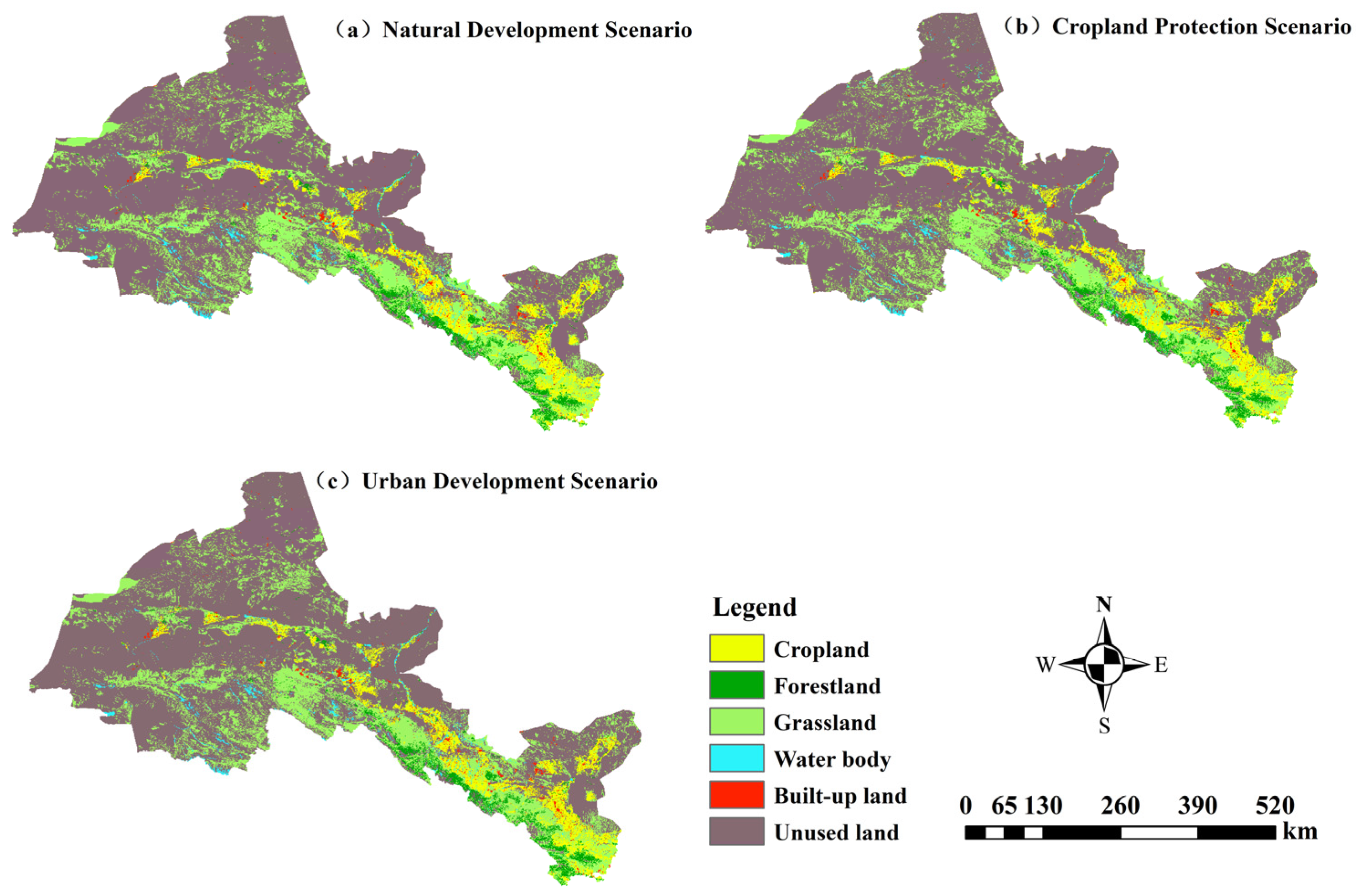
3.3.2. Multi-Scenario LU Simulation and Prediction
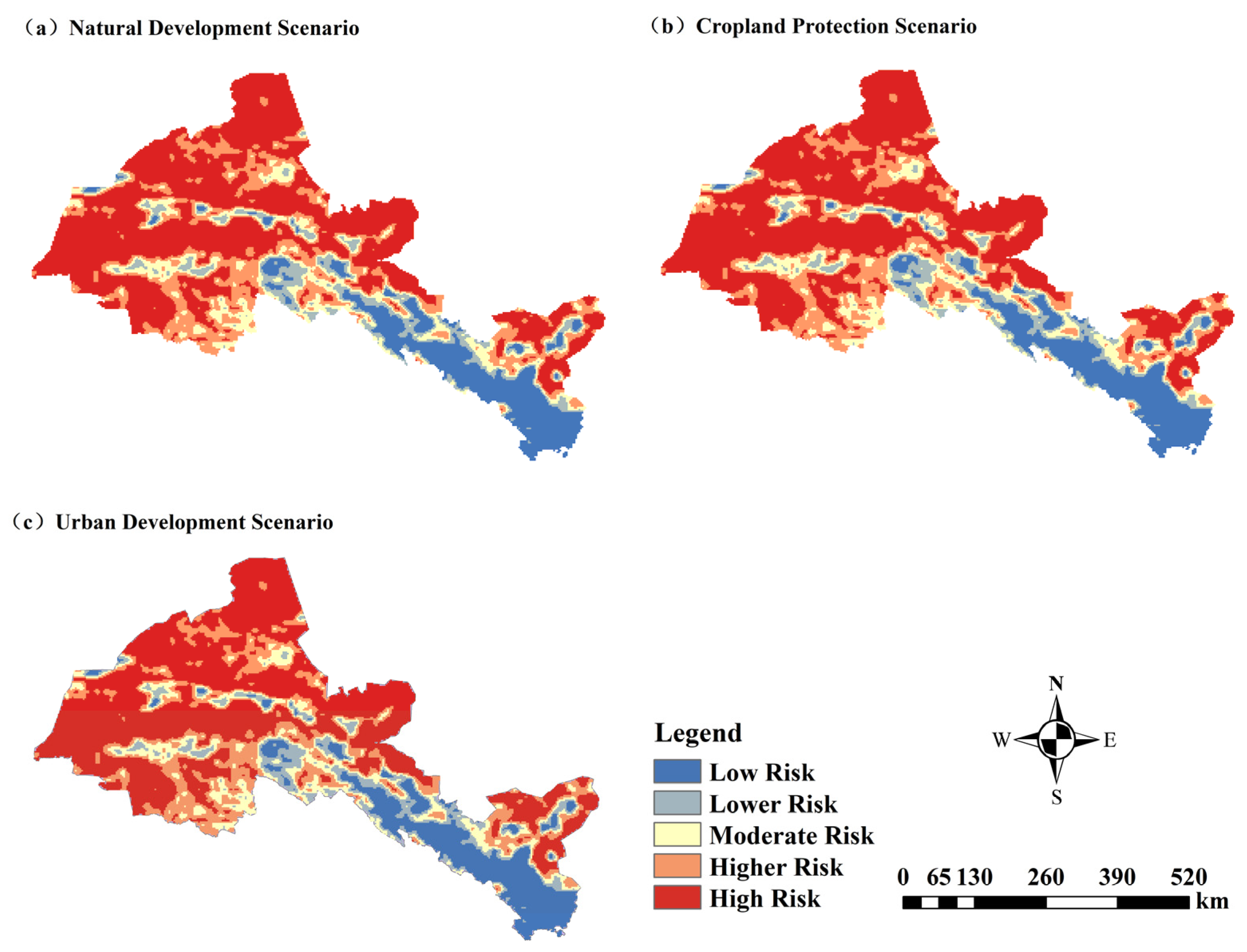
3.3.3. Multi-Scenario LER Simulation and Prediction
4. Discussion and Conclusions
4.1. Discussion
4.1.1. Analysis of Spatiotemporal Evolution of LU and LER
4.1.2. Analysis of LER Drivers
4.1.3. Future LU and LER Simulation Prediction Analysis
4.1.4. Policy Implications
4.1.5. Limitations of the Study
4.2. Conclusions
Author Contributions
Funding
Institutional Review Board Statement
Informed Consent Statement
Data Availability Statement
Conflicts of Interest
References
- Zhang, W.; Chang, W.J.; Zhu, Z.C.; Hui, Z. Landscape Ecological Risk Assessment of Chinese Coastal Cities Based on Land Use Change. Appl. Geogr. 2020, 117, 102174. [Google Scholar] [CrossRef]
- Kang, L.; Yang, X.; Gao, X.; Zhang, J.; Zhou, J.; Hu, Y.; Chi, H. Landscape Ecological Risk Evaluation and Prediction Under a Wetland Conservation Scenario in the Sanjiang Plain Based on Land Use/Cover Change. Ecol. Indic. 2024, 162, 112053. [Google Scholar] [CrossRef]
- Zhang, D.; Wang, X.; Qu, L.; Li, S.; Lin, Y.; Yao, R.; Zhou, X.; Li, J. Land Use/Cover Predictions Incorporating Ecological Security for the Yangtze River Delta Region, China. Ecol. Indic. 2020, 119, 106841. [Google Scholar] [CrossRef]
- Wang, J.; Wang, J.; Zhang, J. Optimization of Landscape Ecological Risk Assessment Method and Ecological Management Zoning Considering Resilience. J. Environ. Manag. 2025, 376, 124586. [Google Scholar] [CrossRef] [PubMed]
- Li, M.; Wang, X.; Liu, H.; Wang, C. Predicting Ecological Security Patterns and Network Resilience Under Land-Use Change: Hexi Inland River Basin, China. Land Use Policy 2026, 164, 107949. [Google Scholar] [CrossRef]
- Wang, Q.; Yan, Z.; Li, W. Synergistic Optimization of Land Use and Ecosystem Services in Arid Regions: Scenario Simulation of the Hexi Corridor Based on the PLUS Model. Land 2026, 15, 414. [Google Scholar] [CrossRef]
- Xu, H.; Song, Y.; Tian, Y. Simulation of Land-Use Pattern Evolution in Hilly Mountainous Areas of North China: A Case Study in Jincheng. Land Use Policy 2022, 112, 105826. [Google Scholar] [CrossRef]
- Li, G.; Jiang, C.; Gao, Y.; Du, J. Natural Driving Mechanism and Trade-off and Synergy Analysis of the Spatiotemporal Dynamics of Multiple Typical Ecosystem Services in Northeast Qinghai-Tibet Plateau. J. Clean. Prod. 2022, 374, 134075. [Google Scholar] [CrossRef]
- Nie, X.; Wang, C.; Li, K.; Gao, F.; Huang, W.-Z.; Li, X. Spatiotemporal Analysis of Landscape Ecological Risk and Its Influencing Factors Based on Land Cover Changes in the Hexi Corridor, Northwest China, 2000–2020. Environ. Sustain. Indic. 2025, 28, 100888. [Google Scholar] [CrossRef]
- Liu, Y.; Yao, X.; Tian, Z.; Zhang, Y. Evaluation of the Importance of Ecological Service Function and Analysis of Influencing Factors in the Hexi Corridor from 2000 to 2020. Land 2024, 13, 1283. [Google Scholar] [CrossRef]
- Wang, S.-Y.; Liu, J.-S.; Ma, T.-B. Dynamics and Changes in Spatial Patterns of Land Use in Yellow River Basin, China. Land Use Policy 2010, 27, 313–323. [Google Scholar] [CrossRef]
- Zhang, Z.; Li, J. Spatial Suitability and Multi-Scenarios for Land Use: Simulation and Policy Insights from the Production-Living-Ecological Perspective. Land Use Policy 2022, 119, 106219. [Google Scholar] [CrossRef]
- Ding, M.; Liu, W.; Xiao, L.; Zhong, F.; Lu, N.; Zhang, J.; Zhang, Z.; Xu, X.; Wang, K. Construction and Optimization Strategy of Ecological Security Pattern in a Rapidly Urbanizing Region: A Case Study in Central-South China. Ecol. Indic. 2022, 136, 108604. [Google Scholar] [CrossRef]
- Zhou, T.; Li, Y.; Zhang, Y.; Lin, L.; Zhou, R.; Ma, A.; Chen, J. Identification of Township-Scale Ecological Restoration Priority Areas Based on Ecological Security Pattern and Multi-Method Integration. Land 2026, 15, 274. [Google Scholar] [CrossRef]
- Shan, W.; Jin, X.; Ren, J.; Wang, Y.; Xu, Z.; Fan, Y.; Gu, Z.; Hong, C.; Lin, J.; Zhou, Y. Ecological Environment Quality Assessment Based on Remote Sensing Data for Land Consolidation. J. Clean. Prod. 2019, 239, 118126. [Google Scholar] [CrossRef]
- Miao, C.; Sun, L.; Yang, L. The Studies of Ecological Environmental Quality Assessment in Anhui Province Based on Ecological Footprint. Ecol. Indic. 2016, 60, 879–883. [Google Scholar] [CrossRef]
- Huang, Q.; Ma, D.; Wang, T.; Wang, Q.; Xu, H. Effects of LUCC Changes on Ecosystem Service Supply and Trade-off–Synergy Relationships in the Bohai Rim Region. J. Environ. Manag. 2025, 396, 128035. [Google Scholar] [CrossRef]
- Wang, J.; Wu, W.; Yang, M.; Gao, Y.; Shao, J.; Yang, W.; Ma, G.; Yu, F.; Yao, N.; Jiang, H. Exploring the Complex Trade-Offs and Synergies of Global Ecosystem Services. Environ. Sci. Ecotechnol. 2024, 21, 100391. [Google Scholar] [CrossRef]
- Sánchez-Pinillos, M.; Dakos, V.; Kéfi, S. Ecological Dynamic Regimes: A Key Concept for Assessing Ecological Resilience. Biol. Conserv. 2024, 289, 110409. [Google Scholar] [CrossRef]
- Farley, J.; Voinov, A. Economics, Socio-Ecological Resilience and Ecosystem Services. J. Environ. Manag. 2016, 183, 389–398. [Google Scholar] [CrossRef]
- Hulme, P.E. Adapting to Climate Change: Is There Scope for Ecological Management in the Face of a Global Threat? J. Appl. Ecol. 2005, 42, 784–794. [Google Scholar] [CrossRef]
- Wang, W.; Chen, Y.; Du, Z.; Bi, S.; Zhang, Q.; Ye, T. Ecological Restoration Zoning and Its Driving Factors in Beijing-Tianjin-Hebei Based on Landscape Ecological Risk and Ecosystem Services. Ecol. Indic. 2025, 178, 114086. [Google Scholar] [CrossRef]
- Hu, W.; Zhang, Z.; Mu, G. Revealing the Ecological Transitions and Driving Mechanisms in Plateau Lake Wetlands Conservation through a Three-Decade Landscape Ecology Analysis. J. Clean. Prod. 2025, 495, 145066. [Google Scholar] [CrossRef]
- Ran, P.; Hu, S.; Frazier, A.E.; Qu, S.; Yu, D.; Tong, L. Exploring Changes in Landscape Ecological Risk in the Yangtze River Economic Belt from a Spatiotemporal Perspective. Ecol. Indic. 2022, 137, 108744. [Google Scholar] [CrossRef]
- Plnedo-Vasquez, M.; Zarin, D.; Jipp, P. Land Use in the Amazon. Nature 1990, 348, 397. [Google Scholar] [CrossRef]
- Beroho, M.; Briak, H.; Cherif, E.K.; Boulahfa, I.; Ouallali, A.; Mrabet, R.; Kebede, F.; Bernardino, A.; Aboumaria, K. Future Scenarios of Land Use/Land Cover (LULC) Based on a CA-Markov Simulation Model: Case of a Mediterranean Watershed in Morocco. Remote Sens. 2023, 15, 1162. [Google Scholar] [CrossRef]
- Kueppers, L.M.; Snyder, M.A.; Sloan, L.C.; Cayan, D.; Jin, J.; Kanamaru, H.; Kanamitsu, M.; Miller, N.L.; Tyree, M.; Du, H. Seasonal Temperature Responses to Land-Use Change in the Western United States. Glob. Planet. Change 2008, 60, 250–264. [Google Scholar] [CrossRef]
- Wang, Q.; Guan, Q.; Sun, Y.; Du, Q.; Xiao, X.; Luo, H.; Zhang, J.; Mi, J. Simulation of Future Land Use/Cover Change (LUCC) in Typical Watersheds of Arid Regions under Multiple Scenarios. J. Environ. Manag. 2023, 335, 117543. [Google Scholar] [CrossRef]
- Liu, X.; Liang, X.; Li, X.; Xu, X.; Ou, J.; Chen, Y.; Li, S.; Wang, S.; Pei, F. A Future Land Use Simulation Model (FLUS) for Simulating Multiple Land Use Scenarios by Coupling Human and Natural Effects. Landsc. Urban Plan. 2017, 168, 94–116. [Google Scholar] [CrossRef]
- Zhang, Z.; Jiang, W.; Ling, Z.; Guo, X.; Song, J.; Xiao, Z.; Yin, X. Urban Land Use Prediction and Construction Effectiveness Assessment Supporting SDG 11.3.1 and Regional Planning Goals. Land Use Policy 2026, 162, 107893. [Google Scholar] [CrossRef]
- Wu, A.; Wang, Z. Multi-Scenario Simulation and Carbon Storage Assessment of Land Use in a Multi-Mountainous City. Land Use Policy 2025, 153, 107529. [Google Scholar] [CrossRef]
- Gao, L.; Tao, F.; Liu, R.; Wang, Z.; Leng, H.; Zhou, T. Multi-Scenario Simulation and Ecological Risk Analysis of Land Use Based on the PLUS Model: A Case Study of Nanjing. Sustain. Cities Soc. 2022, 85, 104055. [Google Scholar] [CrossRef]
- Liu, J.; Li, J.; Qin, K.; Zhou, Z.; Yang, X.; Li, T. Changes in Land-Uses and Ecosystem Services under Multi-Scenarios Simulation. Sci. Total Environ. 2017, 586, 522–526. [Google Scholar] [CrossRef] [PubMed]
- He, P.; Wang, L.; Zhai, S.; Guo, Y.; Huang, J. Assessment of Landscape Risks and Ecological Security Patterns in the Tarim Basin, Xinjiang, China. Land 2025, 14, 1221. [Google Scholar] [CrossRef]
- Gao, C.; Zhang, W.; Li, C.; Fan, Y. Landscape Ecological Risk Assessment and Analysis of Driving Factors in the Zhang-Wei River Basin, North China Plain. Sustainability 2026, 18, 2170. [Google Scholar] [CrossRef]
- Wei, Y.; Zhou, P.; Zhang, L.; Zhang, Y. Spatio-Temporal Evolution Analysis of Land Use Change and Landscape Ecological Risks in Rapidly Urbanizing Areas Based on Multi-Situation Simulation—A Case Study of Chengdu Plain. Ecol. Indic. 2024, 166, 112245. [Google Scholar] [CrossRef]
- Yao, L.; Zhang, X.; Luo, J.; Li, X. Identification of Ecological Management Zoning on Arid Region from the Perspective of Risk Assessment. Sustainability 2023, 15, 9046. [Google Scholar] [CrossRef]
- Mu, H.; Guo, S.; Zhang, X.; Yuan, B.; Li, C.; Du, P. Quantifying the Anthropogenic Sensitivity of Ecological Patterns in Arid Urban Agglomeration. Appl. Geogr. 2025, 178, 103595. [Google Scholar] [CrossRef]
- Wu, Q.; Cao, Y.; Zhang, Y.; Su, D.; Fang, X. Linking Ecosystem Services Trade-Offs, Human Preferences and Future Scenario Simulations to Ecological Security Patterns: A Novel Methodology for Reconciling Conflicting Ecological Functions. Appl. Geogr. 2025, 176, 103534. [Google Scholar] [CrossRef]
- Zhou, X.; Ji, G.; Wang, F.; Ji, X. Identification and Simulation of Ecological Zoning in the Yangtze River Delta (YRD) Urban Agglomeration Based on Ecological Service Value (ESV)–Landscape Ecological Risk (LER). J. Clean. Prod. 2025, 516, 145778. [Google Scholar] [CrossRef]
- Zhang, L.; Han, J.; Xu, J.; Yang, W.; Peng, B.; Wei, M. Assessment and Prediction of Land Use and Landscape Ecological Risks in the Henan Section of the Yellow River Basin. Sustainability 2025, 17, 7890. [Google Scholar] [CrossRef]
- Zhan, D.; Quan, B.; Liao, J. The Spatiotemporal Evolution and Coupling Coordination of LUCC and Landscape Ecological Risk in Ecologically Vulnerable Areas: A Case Study of the Wanzhou-Dazhou-Kaizhou Region. Sustainability 2025, 17, 4399. [Google Scholar] [CrossRef]
- Yan, S.; Zhang, X.; Yan, R.; Luo, Y.; Wang, H.; Xing, B.; Liu, C.; Xu, D.; Liao, G. Identification of Ecological Restoration Zones Based on Ecological Security Pattern and Ecological Risk Assessment-a Case Study of Liaoning Province. Sustainability 2025, 18, 204. [Google Scholar] [CrossRef]
- Zhang, S.; Yang, P.; Xia, J.; Wang, W.; Cai, W.; Chen, N.; Hu, S.; Luo, X.; Li, J.; Zhan, C. Land Use/Land Cover Prediction and Analysis of the Middle Reaches of the Yangtze River under Different Scenarios. Sci. Total Environ. 2022, 833, 155238. [Google Scholar] [CrossRef]
- Lü, F.; Zhang, Y.; Song, S.; Xie, W.; Chen, X.; Han, L.; Dong, S. Forest Expansion Reduces Landscape Fragmentation and Improves Habitat Quality: An XGBoost-SHAP Driver Analysis in the Qinhe River Basin (1990–2022). Ecol. Indic. 2025, 179, 114213. [Google Scholar] [CrossRef]
- Huang, X.; Liu, X.; Jin, Y.; Gao, X.; Chen, Y. Identification and Attribution Analysis of Integrated Ecological Zones Based on the XGBoost-SHAP Model: A Case Study of Chengdu, China. Ecol. Indic. 2025, 177, 113787. [Google Scholar] [CrossRef]
- Lai, Y.; Wan, G.; Qin, X. Decoding China’s New-Type Industrialization: Insights from an XGBoost-SHAP Analysis. J. Clean. Prod. 2024, 478, 143927. [Google Scholar] [CrossRef]
- Li, C.; Shi, J.; Chen, Y.; Zou, W.; Chen, A.; Pan, Y. Assessment and Simulation of Urban Ecosystem Resilience by Coupling the RAR and Markov-FLUS Models: A Case Study of the Jinan Metropolitan Area. Sustainability 2025, 17, 5305. [Google Scholar] [CrossRef]
- Lin, X.; Wang, Z. Landscape Ecological Risk Assessment and Its Driving Factors of Multi-Mountainous City. Ecol. Indic. 2023, 146, 109823. [Google Scholar] [CrossRef]
- Shi, L.; Lin, H.; Tan, B. The Impact of the Coupling Coordination between New-Type Urbanization and the Digital Economy on Ecological Efficiency. Int. Rev. Financ. Anal. 2025, 105, 104427. [Google Scholar] [CrossRef]
- Yan, Y.; Wang, C.; Quan, Y.; Wu, G.; Zhao, J. Urban Sustainable Development Efficiency towards the Balance between Nature and Human Well-Being: Connotation, Measurement, and Assessment. J. Clean. Prod. 2018, 178, 67–75. [Google Scholar] [CrossRef]
- Nie, C.; Lee, C.-C. Synergy of Pollution Control and Carbon Reduction in China: Spatial–Temporal Characteristics, Regional Differences, and Convergence. Environ. Impact Assess. Rev. 2023, 101, 107110. [Google Scholar] [CrossRef]
- Zhu, C.; Su, Y.; Fan, R.; Qin, M.; Fu, H. Exploring Provincial Carbon-Pollutant Emission Efficiency in China: An Integrated Approach with Social Network Analysis and Spatial Econometrics. Ecol. Indic. 2024, 159, 111662. [Google Scholar] [CrossRef]
- Wei, W.; Nan, S.; Xie, B.; Liu, C.; Zhou, J.; Liu, C. The Spatial-Temporal Changes of Supply-Demand of Ecosystem Services and Ecological Compensation: A Case Study of Hexi Corridor, Northwest China. Ecol. Eng. 2023, 187, 106861. [Google Scholar] [CrossRef]
- Yang, Y.; Bao, W.; Liu, Y. Scenario Simulation of Land System Change in the Beijing-Tianjin-Hebei Region. Land Use Policy 2020, 96, 104677. [Google Scholar] [CrossRef]
- Liu, D.; Zheng, X.; Wang, H.; Zhang, C.; Li, J.; Lv, Y. Interoperable Scenario Simulation of Land-Use Policy for Beijing–Tianjin–Hebei Region, China. Land Use Policy 2018, 75, 155–165. [Google Scholar] [CrossRef]
- Zou, L.; Liu, Y.; Wang, J.; Yang, Y.; Wang, Y. Land Use Conflict Identification and Sustainable Development Scenario Simulation on China’s Southeast Coast. J. Clean. Prod. 2019, 238, 117899. [Google Scholar] [CrossRef]
- Wang, S.; Xie, Z.; Wu, R.; Feng, K. How Does Urbanization Affect the Carbon Intensity of Human Well-Being? A Global Assessment. Appl. Energy 2022, 312, 118798. [Google Scholar] [CrossRef]
- Zhang, Q.; Kong, Q.; Zhang, M.; Huang, H. New-Type Urbanization and Ecological Well-Being Performance: A Coupling Coordination Analysis in the Middle Reaches of the Yangtze River Urban Agglomerations, China. Ecol. Indic. 2024, 159, 111678. [Google Scholar] [CrossRef]
- Cui, Y.; Liu, Y.; Liu, Y.; Liu, D.; Hua, X.; Chen, L.; Liu, Q. Cropland Change Simulation in Arid Regions Based on Coupled Prediction and Spatial Allocation Models: A Case Study of Ningxia. Land 2026, 15, 339. [Google Scholar] [CrossRef]
- Li, S.; Wang, H.; Ao, H.; Yuan, X. Ecological Stability Status and Zoning Prediction of the Ordos Plateau: Coupling Analysis of Landscape Ecological Risk and Ecosystem Service Value. Land 2026, 15, 292. [Google Scholar] [CrossRef]
- Shamuxi, A.; Han, B.; Jin, X.; Wusimanjiang, P.; Abudukerimu, A.; Chen, Q.; Zhou, H.; Gong, M. Spatial Pattern and Driving Mechanisms of Dryland Landscape Ecological Risk: Insights from an Integrated Geographic Detector and Machine Learning Model. Ecol. Indic. 2025, 172, 113305. [Google Scholar] [CrossRef]
- Yang, Y.; Yu, C.; Liu, M.; Wei, H. Uncovering the Coupling Relationships and Key Factors Linking Ecosystem Services to Human Well-Being through System Dynamics: A Case Study in the Qinghai-Tibet Plateau. Ecol. Indic. 2024, 166, 112408. [Google Scholar] [CrossRef]
- Li, H.; Zhang, S.; Zeng, Y.; Xu, Z.; Yang, X.; Liu, Y. Multiscale Landscape Ecological Risk Response to Natural and Social Factors in China: Thresholds Identification. Habitat Int. 2026, 168, 103691. [Google Scholar] [CrossRef]
- Song, Y.; Li, M.; Duo, L.; Chen, N.; Lu, J.; Yang, W. Multi-Scenario Simulation and Assessment of Ecological Security Patterns: A Case Study of Poyang Lake Eco-Economic Zone. Sustainability 2025, 17, 4017. [Google Scholar] [CrossRef]





| LU Type | 2000 | 2010 | 2020 | |||
|---|---|---|---|---|---|---|
| Area/km2 | Proportion/% | Area/km2 | Proportion/% | Area/km2 | Proportion/% | |
| Cropland | 14,402 | 5.76% | 15,523 | 6.21% | 15,996 | 6.40% |
| Forestland | 7467 | 2.99% | 7432 | 2.97% | 7433 | 2.97% |
| Grassland | 53,782 | 21.52% | 53,794 | 21.53% | 53,655 | 21.47% |
| Water body | 2696 | 1.08% | 2673 | 1.07% | 2776 | 1.11% |
| Built-up land | 1175 | 0.47% | 1236 | 0.49% | 1783 | 0.71% |
| Unused land | 170,372 | 68.18% | 169,236 | 67.72% | 168,251 | 67.33% |
| Risk Types | 2000 | 2010 | 2020 | |||
|---|---|---|---|---|---|---|
| Area/km2 | Proportion/% | Area/km2 | Proportion/% | Area/km2 | Proportion/% | |
| Low Risk | 32,987 | 13.20% | 34,139 | 13.66% | 34,907 | 13.97% |
| Lower Risk | 18,739 | 7.50% | 19,251 | 7.70% | 19,507 | 7.80% |
| Moderate Risk | 23,670 | 9.47% | 23,542 | 9.42% | 25,294 | 10.12% |
| Higher Risk | 41,639 | 16.66% | 40,956 | 16.39% | 40,213 | 16.09% |
| High Risk | 132,906 | 53.17% | 132,053 | 52.83% | 130,020 | 52.02% |
| LU Type | Cropland | Forestland | Grassland | Water Body | Built-Up Land | Unused Land |
|---|---|---|---|---|---|---|
| Cropland | 1,1,1 | 1,0,1 | 1,0,1 | 1,0,1 | 1,0,1 | 1,0,1 |
| Forestland | 1,1,1 | 1,1,1 | 1,1,1 | 0,0,0 | 1,0,1 | 1,0,0 |
| Grassland | 1,1,1 | 1,1,1 | 1,1,1 | 1,1,1 | 1,0,1 | 1,0,1 |
| Water body | 0,1,1 | 0,0,0 | 1,1,1 | 1,1,1 | 0,0,1 | 0,0,0 |
| Built-up land | 1,1,0 | 1,1,0 | 1,1,0 | 0,0,0 | 1,1,1 | 1,0,0 |
| Unused land | 1,1,1 | 1,1,1 | 1,1,1 | 1,1,1 | 1,0,1 | 1,1,1 |
| Neighborhood weights | 0.176 | 0.062 | 0.02 | 0.238 | 0.491 | 0.012 |
| LU Type | Natural Development Scenario | Cropland Protection Scenario | Urban Development Scenario | |||
|---|---|---|---|---|---|---|
| Area/km2 | Proportion/% | Area/km2 | Proportion/% | Area/km2 | Proportion/% | |
| Cropland | 15,965 | 6.39% | 16,122 | 6.45% | 15,966 | 6.39% |
| Forestland | 7434 | 2.97% | 7434 | 2.97% | 7434 | 2.97% |
| Grassland | 53,517 | 21.42% | 53,926 | 21.58% | 53,507 | 21.41% |
| Water body | 2876 | 1.15% | 2875 | 1.15% | 2876 | 1.15% |
| Built-up land | 1847 | 0.74% | 1781 | 0.71% | 1973 | 0.79% |
| Unused land | 168,255 | 67.33% | 167,756 | 67.13% | 168,138 | 67.28% |
| Risk Types | Natural Development Scenario | Cropland Protection Scenario | Urban Development Scenario | |||
|---|---|---|---|---|---|---|
| Area/km2 | Proportion/% | Area/km2 | Proportion/% | Area/km2 | Proportion/% | |
| Low Risk | 35,514 | 14.21% | 35,706 | 14.29% | 34,420 | 13.77% |
| Lower Risk | 18,798 | 7.52% | 18,670 | 7.47% | 19,387 | 7.76% |
| Moderate Risk | 25,589 | 10.24% | 25,845 | 10.34% | 25,375 | 10.15% |
| Higher Risk | 40,546 | 16.22% | 40,484 | 16.20% | 41,516 | 16.61% |
| High Risk | 129,478 | 51.81% | 129,219 | 51.70% | 129,226 | 51.71% |
Disclaimer/Publisher’s Note: The statements, opinions and data contained in all publications are solely those of the individual author(s) and contributor(s) and not of MDPI and/or the editor(s). MDPI and/or the editor(s) disclaim responsibility for any injury to people or property resulting from any ideas, methods, instructions or products referred to in the content. |
© 2026 by the authors. Licensee MDPI, Basel, Switzerland. This article is an open access article distributed under the terms and conditions of the Creative Commons Attribution (CC BY) license.
Share and Cite
Zhang, Z.; Song, X. Landscape Ecological Risk Assessment and Multi-Scenario Simulation of Land Use Based on the Markov-FLUS Model: A Case Study of the Hexi Corridor. Sustainability 2026, 18, 3892. https://doi.org/10.3390/su18083892
Zhang Z, Song X. Landscape Ecological Risk Assessment and Multi-Scenario Simulation of Land Use Based on the Markov-FLUS Model: A Case Study of the Hexi Corridor. Sustainability. 2026; 18(8):3892. https://doi.org/10.3390/su18083892
Chicago/Turabian StyleZhang, Zaijie, and Xiaoxiao Song. 2026. "Landscape Ecological Risk Assessment and Multi-Scenario Simulation of Land Use Based on the Markov-FLUS Model: A Case Study of the Hexi Corridor" Sustainability 18, no. 8: 3892. https://doi.org/10.3390/su18083892
APA StyleZhang, Z., & Song, X. (2026). Landscape Ecological Risk Assessment and Multi-Scenario Simulation of Land Use Based on the Markov-FLUS Model: A Case Study of the Hexi Corridor. Sustainability, 18(8), 3892. https://doi.org/10.3390/su18083892