Article

Health Effects of Ecological Civilization Construction: Evidence from China’s Ecological Civilization Pilot Zones

School of Economics and Management, East China Jiaotong University, Nanchang 330013, China
*
Author to whom correspondence should be addressed.
Sustainability 2026, 18(8), 3893; https://doi.org/10.3390/su18083893
Submission received: 3 March 2026 / Revised: 8 April 2026 / Accepted: 11 April 2026 / Published: 15 April 2026

Abstract

Ecological civilization construction (ECC) represents a critical pathway for improving public health and advancing sustainable social development, exerting a positive and profound influence on population health. This study treats the establishment of national ecological civilization pilot zones as a quasi-natural experiment. Drawing on microdata from the 2014–2020 China Family Panel Studies (CFPS) and applying a difference-in-differences (DID) model, it investigates the impact of ECC on residents’ physical and mental health. The results reveal that (1) ECC significantly improves residents’ physical and mental health, and this finding remains robust after a series of validation tests; (2) mechanism analysis shows that ECC enhances health primarily through three channels: environmental, livelihood, and economic effects; (3) heterogeneity analysis demonstrates that ECC can effectively mitigate health inequalities associated with gender, urban–rural divides, and social status differences. In summary, the study provides valid empirical evidence that ECC can contribute to improvements in population health, reductions in health disparities, and the sustainable development of a healthy society.

1. Introduction

The public health risks arising from ecological degradation and pollution have become a major challenge to global sustainable development [1]. The World Health Statistics 2024 report released by the World Health Organization (WHO) indicates that air pollution, as a significant environmental hazard, contributes to both acute and chronic diseases, including respiratory illnesses, cardiovascular diseases, and lung cancer, causing an estimated 6.7 million deaths worldwide in 2019 [2]. Chronic non-communicable diseases have emerged as a leading cause of mortality, while expenditures on digestive system disorders associated with dietary hygiene have imposed a substantial economic burden. Since the reform and opening-up, China’s rapid industrialization has been accompanied by severe environmental challenges, including air and water pollution as well as land degradation. The China Environmental Development Report (2010) emphasized that after decades of rapid growth, the health risks posed by environmental pollution have become increasingly evident, reaching levels characterized by concentrated outbreaks and frequent occurrences. In 2011, the Chinese Research Academy of Environmental Sciences reported that environmental pollution accounted for as much as 21% of the disease burden costs among Chinese residents, a proportion 8% higher than that in the United States. Non-communicable chronic diseases linked to environmental factors such as air and water pollution have become critical determinants of population health and socioeconomic development in China. Addressing the health consequences of environmental pollution has therefore become an urgent priority.
The Healthy China 2030 Planning Outline highlights that rapid industrialization and population aging, together with profound changes in ecological environments and lifestyles, have posed major challenges to the physical and mental health of Chinese residents. The Outline explicitly calls for accelerating the development of Healthy China 2030 by advancing the construction of healthy cities, thereby promoting the coordinated development of urban economies and public health [3]. The healthy growth of cities is inseparable from the development of urban ecosystems and the protection of urban ecological environments [4]. Residents’ physical and mental health is shaped not only by internal factors such as genetic predispositions [5] and behavioral habits [6,7] but also by external environments, including residential conditions [8,9] and ecological quality [10,11]. A sound ecological environment has thus become a key benchmark for urban health development, closely tied to population health and reflecting society’s pursuit of a better life.
Current academic research has provided relatively comprehensive discussions on the relationship between ecological civilization construction (ECC) and health levels. Some scholars have examined the impact of ecological quality on health, with particular emphasis on the effects of air pollution. Among studies examining the relationship between ecological quality and health, research on air pollution is the most extensive. Drawing on data from various countries and contexts, existing studies consistently show that air pollution has a significant negative impact on public health. From the perspective of physical health, air pollution is widely recognized as the fourth leading global risk factor for mortality [12,13], and it significantly worsens health outcomes [14,15]. For example, Chen et al. exploit a quasi-natural experiment based on heating policies and find that high concentrations of air pollutants lead to a reduction in life expectancy [16]. From the perspective of mental health, the literature suggests that long-term exposure to polluted environments significantly reduces mental well-being [17,18], whereas improvements in air quality are associated with better mental health outcomes [19,20]. Moreover, recent studies further extend this line of inquiry by considering exposure intensity and pollution types. Evidence indicates that prolonged exposure duration and industrial pollutant emissions exacerbate health risks [21,22]. For instance, sustained exposure to highly polluted environments increases the incidence of childhood asthma [23], while water pollution also has substantial health consequences, with deteriorating water quality in China significantly increasing mortality from gastrointestinal cancers [24]. Overall, the literature consistently demonstrates that environmental pollution exerts systemic negative effects on public health through multiple pathways, encompassing both physical and mental health dimensions. Another strand of the literature examines these health effects from the perspective of ECC. As a development strategy, ECC prioritizes improvements in ecological and environmental quality, aiming to enhance overall well-being [25]. A sound ecological environment serves as both a fundamental condition and an essential safeguard for public health, exerting a significant influence on residents’ physical and mental well-being [26]. Current research on ECC and health mainly follows two approaches. The first focuses on constructing composite indices to measure the level of ecological civilization and examining their relationship with health outcomes. These studies typically develop multidimensional index systems incorporating factors such as land-use optimization, green transformation, and resource efficiency [27], or assess ecological civilization levels based on ecological resource endowment, utilization, and governance capacity [28]. Overall, this line of research generally finds a significant association between ECC and public health [29]. The second approach employs empirical strategies, such as quasi-natural experiments, to identify the causal effects of ecological civilization policies. Using policy shocks such as ecological civilization pilot zones or demonstration cities, studies applying methods such as difference-in-differences (DID) have found that ECC significantly improves environmental quality and, in turn, enhances residents’ health [30,31]. Overall, the existing literature has made meaningful progress in identifying the causal relationship between ECC and public health.
In summary, the existing literature has extensively explored the relationship between ECC and public health. Nevertheless, several limitations remain. First, much of the existing literature remains at the level of normative analysis or policy interpretation, with limited emphasis on rigorous causal identification. Although some empirical studies construct ecological civilization indices for analysis, they tend to focus on correlations rather than identifying the causal effects of ECC on residents’ health based on exogenous policy shocks. Second, prior research predominantly concentrates on physical health outcomes, with relatively limited attention to mental health. As a result, there is a lack of studies that systematically assess the comprehensive health effects of ECC from both physical and mental health perspectives. Third, the mechanisms through which ECC influences residents’ health remain insufficiently explored. Existing studies mainly emphasize the single pathway of environmental quality improvement, while systematic analyses of multidimensional channels, such as improvements in livelihoods and economic development, remain relatively scarce. Fourth, although some studies have begun to examine the health effects of ECC and their underlying mechanisms, few have investigated its potential role in promoting health equity across different population groups from the perspective of health inequalities.
In light of the above discussion, this study addresses the following research questions: How does ECC affect individuals’ physical and mental health at the micro level? Through which mechanisms does this effect operate? Does ECC contribute to the reduction in health inequalities? To answer these questions, this study adopts a micro-level perspective, utilizing data from the China Family Panel Studies (CFPS) from 2014 to 2020. It constructs a quasi-natural experiment based on the establishment of national ecological civilization pilot zones and applies a DID model to quantitatively examine the impact of ECC on residents’ health and the underlying mechanisms. The main contributions of this study are as follows: First, by treating the National Ecological Civilization Pilot Zones as a quasi-natural experiment and linking them with CFPS data, this study identifies the impact of ECC on residents’ health at the micro-individual level, thereby providing a novel empirical framework for analyzing the health effects of ECC. Second, by jointly examining physical and mental health outcomes, this study offers a more comprehensive assessment of the health effects of ECC, addressing the limitation of prior research that focuses primarily on single physical health indicators. Third, this study develops an analytical framework encompassing environmental, livelihood, and economic dimensions to systematically identify the mechanisms through which ECC affects residents’ physical and mental health, thereby revealing its multidimensional impact pathways. Fourth, through heterogeneity analyses across gender, urban–rural status, and social status, this study shows that ECC not only improves overall health outcomes but also contributes to reducing health inequalities across different population groups.

2. Institutional Background and Research Hypotheses

2.1. Institutional Background

In recent years, as environmental pressures have intensified and resource constraints have tightened, the conflict between traditional economic growth models and the carrying capacity of the ecological environment has become increasingly pronounced, creating an urgent need to explore new pathways for advancing ECC through institutional and systemic reforms. Since the 18th National Congress of the Communist Party of China, the Chinese government has implemented systematic strategic initiatives to promote ECC. In April 2015, the “Opinions on Accelerating the Advancement of Ecological Civilization” established the central role of ECC in transforming the economic development model and achieving high-quality development. Subsequently, in September 2015, the “Overall Plan for Institutional Reform of Ecological Civilization” provided a comprehensive top-level design for constructing the relevant institutional framework. Against this backdrop, the government approved the establishment of two batches of National Ecological Civilization Pilot Zones. In August 2016, the “Opinions on Establishing Unified and Standardized National Ecological Civilization Pilot Zones” explicitly designated Fujian, Jiangxi, and Guizhou provinces as pilot zones. These zones serve as comprehensive platforms for experimental reforms and innovations in ECC, focusing on institutional innovation in areas such as territorial and spatial management, ecological and environmental governance, natural resource administration, and green development systems, thereby providing practical references for developing an institutional framework for ECC. In May 2019, Hainan Province was also included in the pilot program, further promoting improvements in ecological quality and the green transformation of production and lifestyles. Overall, the pilot zones aim to address pressing ecological and environmental challenges through systematic reforms, generate replicable and scalable institutional outcomes, and advance the establishment of mechanisms for ECC that align with the requirements of high-quality development. Therefore, ECC is not only crucial for optimizing governance structures in both ecological and economic sectors but also provides a key institutional foundation for improving residents’ living environments, enhancing public service provision, and promoting health and well-being [32].

2.2. Theoretical Analysis and Research Hypotheses

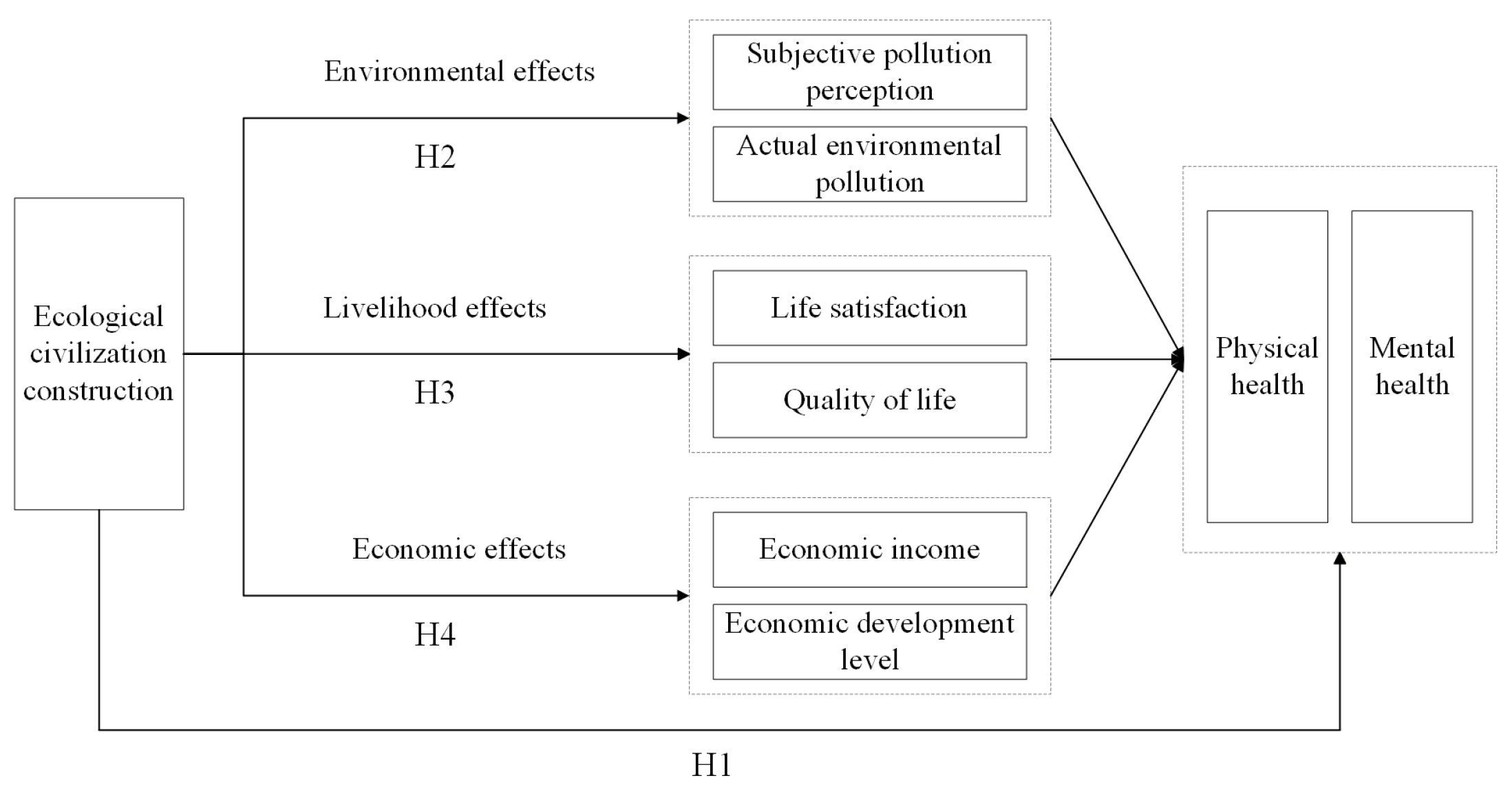
Based on the preceding policy context and literature review, this study develops a theoretical framework and proposes corresponding research hypotheses. The establishment of national ecological civilization pilot zones is intended to generate ecological benefits through pollution and emission reductions, economic benefits by fostering green development, and social benefits by enhancing public welfare. ECC not only directly improves residents’ health but also indirectly affects it through multiple mechanisms. To capture these mechanisms, this study draws on the Social Determinants of Health (SDH) model, a widely recognized theoretical framework that emphasizes health as the outcome of long-term interactions among diverse social factors [33]. Expanding on this model, Dahlgren and Whitehead’s Rainbow Model further highlights that health is shaped by the combined effects of macro-level environments, cultural and economic conditions, and individual behaviors [34]. Informed by the SDH framework and existing research, this study constructs three dimensions across environmental, livelihood, and economic domains, integrating both macro and micro perspectives to examine the mechanisms linking ECC to public health. Furthermore, the WHO’s Action Framework on the SDH, derived from this model, serves as a key theoretical foundation for explaining health disparities across populations. This framework has been widely applied by scholars and institutions to identify policy measures for mitigating health inequalities [35]. Accordingly, this study employs the action framework to analyze health heterogeneity from both individual and societal levels and to further assess whether ECC can effectively reduce health inequalities.

2.2.1. ECC and Residents’ Physical and Mental Health

With the growing emphasis on global sustainable development, ECC has emerged as a critical pathway for advancing environmental protection and social sustainability. As a key strategic initiative, the establishment of national ecological civilization pilot zones aims not only to reduce environmental pollution and accelerate ecological restoration but also to improve residents’ health and overall quality of life. Health status serves as both an essential indicator of social development and a reflection of people’s pursuit of well-being. At present, health extends beyond the absence of disease to encompass a comprehensive state of physical and mental well-being. Empirical studies demonstrate that a favorable ecological environment significantly enhances health status [36]. For example, improvements in air quality [37], reductions in solid waste [38], and decreases in wastewater discharge [39] brought about by ECC contribute directly to better physical health. At the same time, reductions in air pollution [40] and improvements in ecological quality [41] help alleviate negative emotions, thereby fostering mental well-being. Moreover, prior research employing ecological civilization demonstration zones as quasi-natural experiments and applying DID models found that ECC exerts a substantial and positive influence on both physical and mental health [30]. Therefore, this study posits that ECC can enhance residents’ physical and mental health. Based on this, the following hypothesis is proposed:
H1. 
ECC can effectively improve residents’ physical and mental health.

2.2.2. Environmental Effects

ECC represents a crucial pathway toward green, low-carbon, and sustainable development [42]. In China, it has been elevated to a national strategy, aiming to foster harmonious coexistence between humanity and nature by systematically addressing ecological and environmental challenges [43]. Existing studies suggest that ECC not only alleviates objective environmental pollution [44] but also shapes individuals’ subjective perceptions of pollution. A substantial body of research has shown that ECC generates ecological benefits, including energy conservation and emission reduction [45], improved air quality [46], and industrial restructuring [47], thereby serving as a vital means of reducing environmental degradation. However, individuals differ in their sensitivity to environmental pollution [48], leading to considerable variation in subjective perceptions even under identical levels of objective pollution. Compared with objective indicators, subjective perceptions provide a more direct and nuanced understanding of the intrinsic link between environmental conditions and residents’ health awareness [49]. Evidence shows that improvements in objective environmental factors, such as air quality [50], soil quality [51], and drinking water safety [52], significantly enhance both physical and mental health [53]. At the same time, adverse environmental conditions may undermine public health through negative perceptions [54]. When individuals perceive pollution as harmful, such perceptions often trigger stress responses and health impairments, thereby diminishing overall well-being [55,56]. Populations with poorer perceptions of environmental quality are more likely to experience heightened anxiety, mental disorders, and neurological problems, ultimately hindering healthy lifestyles [57]. Accordingly, this study proposes that ECC can improve residents’ physical and mental health by reducing both objective environmental pollution and subjective perceptions of pollution. Based on this, the following hypothesis is proposed:
H2. 
ECC improves physical and mental health by reducing subjective perceptions of pollution and objective environmental pollution.

2.2.3. Livelihood Effects

Large developing countries such as China and India seek to enhance residents’ quality of life and welfare through ECC, thereby fostering safer and more livable social environments [58]. As an essential means of improving well-being, ECC not only supports livelihood development [59] but also contributes to higher health standards. Existing studies highlight the intrinsic connection between the natural living environment and people’s livelihoods. Measures such as pollution control [60], energy conservation and emission reduction [61], natural resource protection [62], infrastructure upgrades [63], and overall ecological improvement have been shown to significantly enhance residents’ quality of life and life satisfaction [64], thereby advancing social well-being and promoting high-quality development. Moreover, a growing body of evidence shows that improvements in consumption patterns [65], stricter food safety standards [66], better sleep quality [67], and higher levels of subjective well-being [68] all reflect enhanced living standards. These advancements not only improve the overall quality of life but also reduce psychological stress, producing tangible benefits for both physical and mental health. Based on this reasoning, this study posits that ECC can promote physical and mental health by simultaneously improving residents’ life satisfaction and actual living quality. Accordingly, the following hypothesis is proposed:
H3. 
ECC improves physical and mental health by enhancing residents’ life satisfaction and quality of life.

2.2.4. Economic Effects

With the growing recognition of the principle that “lucid waters and lush mountains are invaluable assets,” the integrated development of ecology and economy embedded in ECC has attracted increasing scholarly and policy attention. The United Nations Environment Programme emphasized in its 2016 report “Lucid Waters and Lush Mountains Are Invaluable Assets: China’s Ecological Civilization Strategy and Action” that ECC plays a vital role in advancing economic development. In 2021, the Chinese government for the first time proposed the dual objective of promoting ECC and economic development in parallel [69]. As ECC advances, the realization of ecological product value is expected to contribute to sustained regional economic growth and improved economic efficiency [70]. On the one hand, the land intensification promoted by ECC, together with the implementation of green economic policies, fosters the expansion and efficiency of ecological industries, thereby generating economies of scale and enhancing the level of regional economic development [71]. On the other hand, the commodification of ecological resources under ECC directly increases household income through resource monetization [72]. At the same time, the effective alignment of ecological resources with financial services brought about by ECC enhances the accessibility and convenience of realizing ecological products’ value, further strengthening household economic conditions at the micro level [73]. A growing body of research demonstrates that economic development and rising household income resulting from ECC significantly enhance residents’ physical and mental health [74]. Specifically, regional economic growth provides a solid foundation for improving living environments, expanding employment opportunities, and upgrading healthcare services [75]. At the same time, higher household income reduces living pressures, improves dietary quality, raises educational attainment, and strengthens self-efficacy [76,77]. Collectively, these factors contribute to notable improvements in both the physical and mental health of residents. Therefore, this paper posits that ECC can promote residents’ health through both regional economic development and residents’ income growth. Accordingly, the following hypothesis is proposed:
H4. 
ECC improves physical and mental health by enhancing residents’ household income and regional economic development.
Based on these hypotheses, the research model presented in Figure 1 is constructed.

3. Methods and Data Sources

3.1. Data Sources and Samples

The micro-level data used in this study were drawn from the CFPS, conducted by the China Social Science Survey Center at Peking University. Since 2010, the CFPS has been updated biennially and covers 25 provinces, municipalities, and autonomous regions across mainland China. It tracks household, individual, and community-level data, providing a comprehensive reflection of changes in residents’ living conditions and socioeconomic development trends. Due to substantial differences in sampling design and questionnaire content between the 2010 wave and subsequent waves, as well as considerable missing data in several items from the 2012 wave, this study employed data from the 2014, 2016, 2018, and 2020 surveys. The adult and household databases were matched using sample codes, and unreasonable or missing entries were excluded. Individuals younger than 16 or older than 65 were also removed prior to the empirical analysis. The final dataset consisted of 19,696 observations from 2014, 23,408 from 2016, 19,974 from 2018, and 13,966 from 2020, yielding a total of 77,044 valid individual-level records. In addition, provincial-level data were obtained from the respective provincial statistical yearbooks.

3.2. Identification Strategy and Model Construction

3.2.1. Identification Strategy

Previous studies have empirically examined the relationship between ECC and residents’ well-being using the quasi-natural experiment of National Ecological Civilization Demonstration Zones [31]. Building on this, the present study treated the National Ecological Civilization Pilot Zones as a quasi-natural experiment and employed a DID model to assess the impact of ECC on residents’ physical and mental health. Specifically, since the CFPS database does not cover Hainan Province, which was designated as a National Ecological Civilization Pilot Zone in 2019, this study defined individuals residing in provinces included in the first batch of pilot zones established in 2016 as the experimental group, while individuals in provinces not included in the pilot program during 2014–2020 served as the control group. The core logic of this identification strategy lies in the fact that the National Ecological Civilization Pilot Zone policy was formulated by national authorities and implemented at the provincial level. This policy responds to the contemporary need to promote harmony between humans and nature and seeks to advance the coordinated development of ecological civilization and social well-being. From the household perspective, the policy represents a macro-level shock over which households have limited influence, making it highly exogenous. Consequently, the implementation of the National Ecological Civilization Pilot Zone policy can be regarded as a quasi-natural experiment, providing a robust framework for identifying its micro-level effects on individual residents.

3.2.2. Baseline Regression Model

To examine the impact of ECC on residents’ physical and mental health, the model is set up as follows:
Y i , j , t = α 0 + β 0 T r e a t j × P o s t t + δ 0 C o n t r o l s + μ i + γ t + ε i , j , t
Here, i, j, and t denote the individual, province, and year, respectively; Y i , j , t represents the physical and mental health status of individual i in province j at time t; T r e a t j denotes the policy dummy variable, which takes the value 1 if province j is designated as a pilot province and 0 otherwise; P o s t t denotes the time dummy variable, which equals 1 for periods after the policy implementation and 0 for periods before. The T r e a t j × P o s t t interaction term represents the DID and serves as the core explanatory variable of this study, namely ECC. The coefficient β 0 captures the differential change in residents’ health in the treatment group before and after policy implementation, relative to the control group. Controls represent the set of control variables. μ i and γ t denote the individual and year fixed effects, respectively, while ε i , j , t represents the random error term.

3.2.3. Mechanism Analysis Model

To further examine the mediating mechanisms linking ECC to residents’ physical and mental health, this study constructs the following model:
M i , j , t = α 1 + β 1 T r e a t j × P o s t t + δ 1 C o n t r o l s + μ i + γ t + ε i , j , t
Here, M i , j , t denotes the mediating variables, which include subjective pollution perception and actual environmental pollution at the environmental level; residents’ life satisfaction and quality of life at the livelihood level; and residents’ economic income and regional economic development at the economic level. Other variables retain the same definitions as in Equation (1). Subjective pollution perception is measured by residents’ assessment of the severity of China’s environmental issues on a scale from 1 to 10, with higher scores indicating more severe pollution. Actual environmental pollution is proxied by standardized wastewater discharge volume to eliminate dimensional differences. Residents’ life satisfaction is measured by self-reported satisfaction with one’s life on a 1–5 scale, where higher scores indicate greater satisfaction. Quality of life is calculated using the resident consumption structure upgrade index, following Chan and Xu [78], which involves weighted calculations across three consumption levels: primary, intermediate, and advanced. Residents’ economic income is measured by household per capita income, while regional economic development is captured by provincial per capita GDP. All empirical analyses in this study were conducted using Stata 17.

3.3. Variable Selection

3.3.1. Dependent Variables

The dependent variables in this study are residents’ physical and mental health. Physical health is measured using the CFPS question: “How would you rate your health?” Responses are coded from 1 (“Very healthy”) to 5 (“Unhealthy”), with lower scores indicating better physical health. Mental health is assessed using the CES-D scale adopted by CFPS. Specifically, the 2016 CFPS employed the CES-D20, whereas the 2018 and 2020 waves used the CES-D8 scale. Previous studies indicate no significant difference in reliability or validity between the two versions, with the CES-D8 offering higher response efficiency. To ensure consistency, this study uses the CES-D8 results uniformly. Within the CES-D8, the items “I feel cheerful” and “I enjoy life” are positive items, and the remaining six are negative; responses to the positive items were reverse-scored. The 2014 CFPS used the K6 Psychological Distress Scale, with response options from 1 (“almost every day”) to 5 (“never”), which is reversed relative to the CES-D8. To maintain consistency across waves, K6 responses were reverse-scored. Finally, to standardize measurements, the numerical responses for each item were summed and normalized, such that lower values correspond to better mental health.

3.3.2. Explanatory Variable

The core explanatory variable in this study is ECC, measured by whether a province has been designated as a national ecological civilization pilot zone. These pilot zones were established in two batches, in 2016 and 2019. Since Hainan Province was designated as a pilot in 2019 but is not covered by the CFPS dataset, only the 2016 pilot provinces, namely Jiangxi, Fujian, and Guizhou, were assigned to the treatment group, while all other provinces constituted the control group.

3.3.3. Control Variables

To ensure the robustness of the empirical results and mitigate potential omitted variable bias, this study followed established practices by incorporating a set of control variables at both the individual and household levels that may affect physical and mental health [79]. Specifically, the individual-level controls included gender, urban–rural residence, political affiliation, household registration status, napping behavior, trust in doctors, and alcohol consumption frequency. Differences in gender, urban–rural residence, political affiliation, and household registration status may lead to disparities in access to healthcare resources and the distribution of health benefits. In addition, behavioral and attitudinal factors, such as napping, trust in doctors, and alcohol consumption, may directly influence individuals’ health outcomes. At the household level, the control variables included household size, healthcare expenditures, and wage income. Higher income generally enables households to access better healthcare services and insurance coverage, while healthcare expenditures and household size may have more complex effects on health. These factors jointly shape the availability of healthcare resources and the financial burden of medical expenses within households, thereby exerting heterogeneous effects on individuals’ physical and mental health. Detailed definitions and measurements of all control variables are provided in Table 1.

3.3.4. Descriptive Statistics of Variables

Descriptive statistics for all variables are presented in Table 2. The standard deviations of physical and mental health were 1.199 and 0.993, respectively, indicating considerable variation in both physical and mental health across the sample.

4. Results

4.1. Benchmark Regression Analysis

The regression results for Equation (1) are presented in Table 3. Columns (1) and (4) use physical health and mental health as dependent variables, respectively, while controlling for individual and time fixed effects. The results show that residents in pilot regions for ECC exhibit significantly higher levels of both physical and mental health compared to those in non-pilot regions. Specifically, ECC improves physical health by 0.086 units and mental health by 0.175 units, with both effects being statistically significant at conventional levels. These findings indicate that ECC can meaningfully enhance residents’ physical and mental well-being. Building on this, Columns (2) and (5) further incorporate individual-level control variables, while Columns (3) and (6) additionally include household-level controls. The results reveal that, as more control variables are added, the coefficients of the core explanatory variables remain statistically significant and, in absolute terms, increase compared to Columns (1) and (4). This suggests that after accounting for individual and household characteristics, the positive effect of ECC on residents’ physical and mental health is further strengthened. It also implies that the baseline model, which excludes these controls, may suffer from omitted variable bias, potentially underestimating the true effect of the policy. Overall, whether or not control variables are included, ECC consistently demonstrates a significant and robust positive impact on residents’ physical and mental health, thereby supporting Hypothesis 1.
These findings are consistent with those of Xie et al., who similarly reported a significant positive impact of ECC on individual health [80]. However, their study relied on CGSS cross-sectional data, which cannot capture dynamic changes at the individual level. In contrast, the CFPS longitudinal data used in this study allow for more precise tracking of individual health trajectories over time, thereby enhancing the reliability and accuracy of the regression results.

4.2. Robustness Tests

4.2.1. Parallel Trends Test

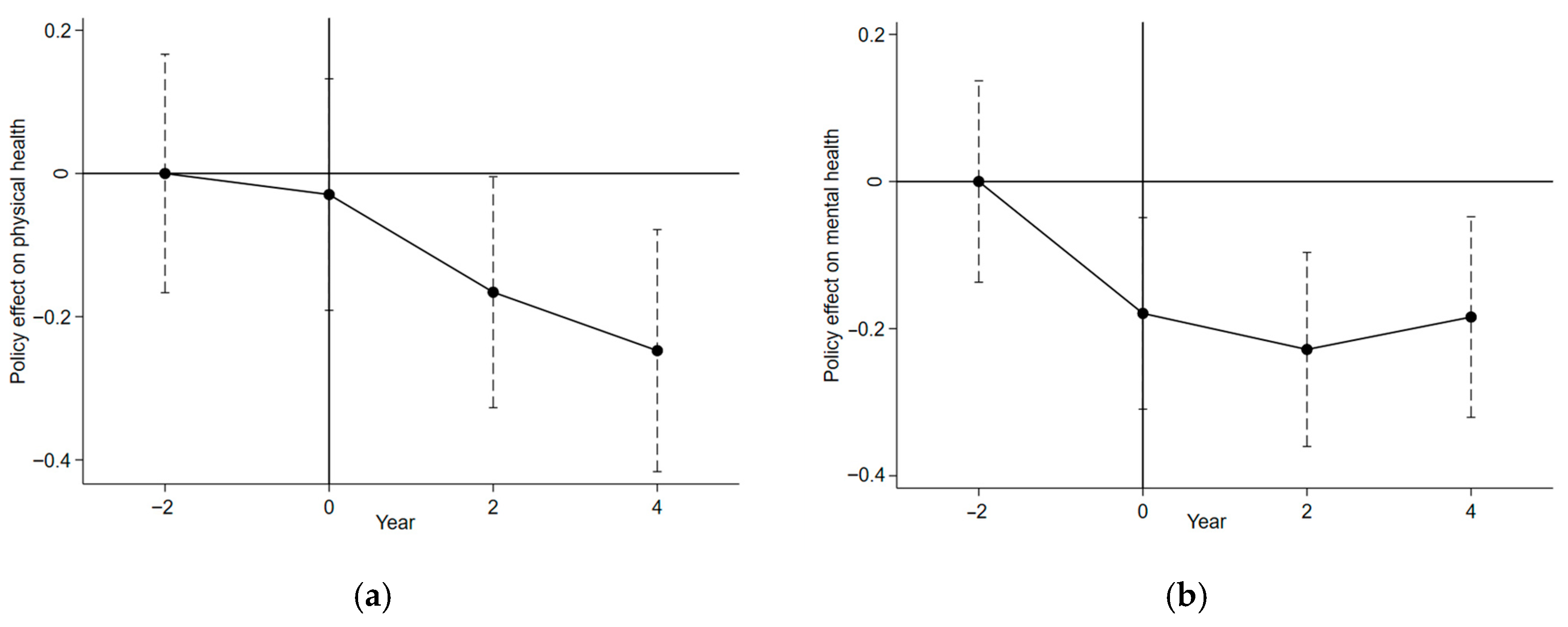
A prerequisite for the validity of the DID model is that health outcomes in the treatment and control groups follow similar trends prior to policy implementation; that is, the parallel trends assumption must hold. To verify this assumption, we adopted an event study approach to examine the pre-policy trends and constructed Equation (3):
Y i , j , t = α 2 + k = 2 4 β k T r e a t j × P o s t t k + δ 2 C o n t r o l s + μ i + γ t + ε i , j , t
In Equation (3), P o s t t k includes P o s t t 2 , P o s t t 0 , P o s t t 2 , and P o s t t 4 , which correspond to the second year prior to policy implementation, the year of implementation, and the second and fourth years after implementation, respectively. The definitions of the remaining variables are consistent with those in Equation (1). The results are presented in Figure 2. Before the establishment of the National Ecological Civilization Pilot Zones, the coefficients for both physical and mental health were insignificant, indicating no discernible differences between the treatment and control groups. After the establishment of the pilot zones, however, both physical and mental health showed significant negative correlations and persistent downward trends, thereby satisfying the parallel trends assumption.

4.2.2. Placebo Test

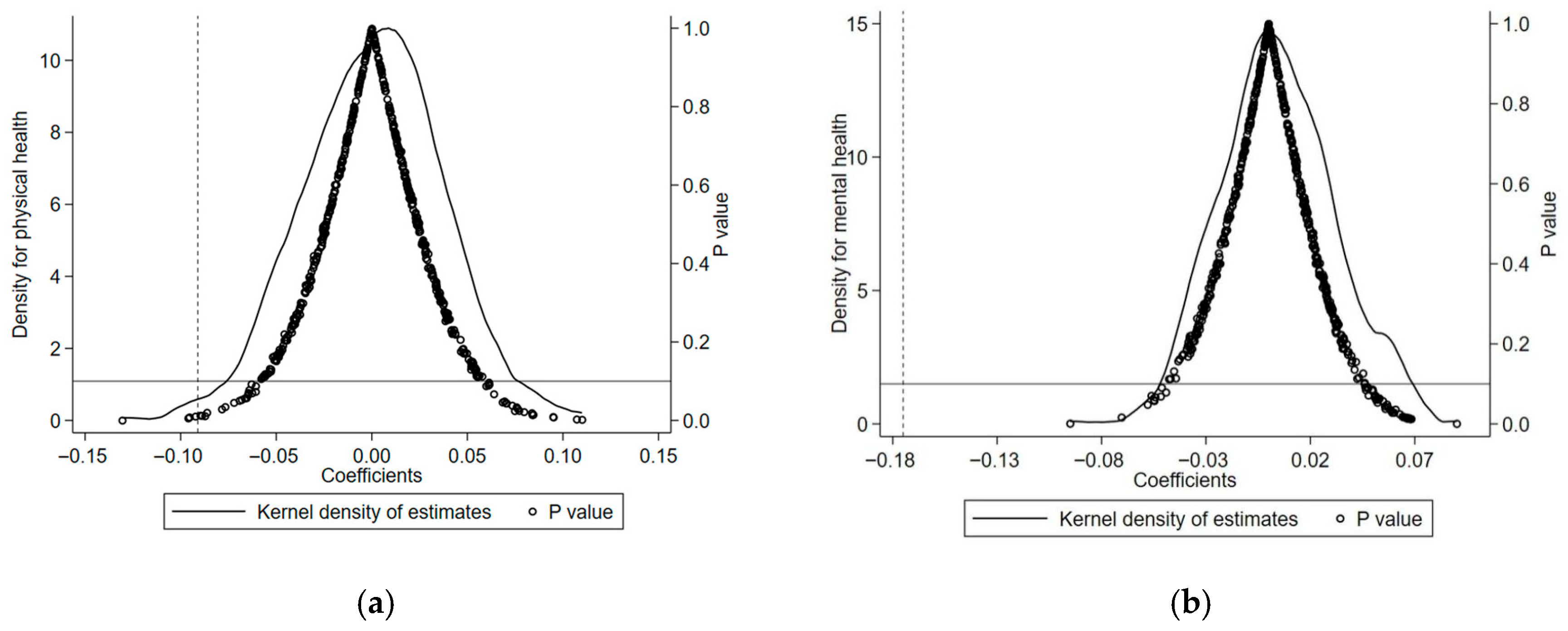
To address potential regression bias from omitted variables, we conducted a placebo test using a fictitious treatment group. Specifically, while keeping the sample size and time structure unchanged, we randomly selected a group of individuals from the full sample, with the same size as the original treatment group, to construct a placebo treatment group, while the remaining individuals served as the control group. Based on this assignment, a placebo policy dummy variable is generated. This placebo policy variable is then interacted with the time dummy variable in Equation (1) to form a new interaction term, which replaces the original core interaction term in the baseline specification. The DID model in Equation (1) is subsequently re-estimated, and the coefficient and statistical significance of the placebo interaction term are recorded. This procedure is repeated 500 times to obtain the distribution of estimated coefficients and their corresponding significance levels across the simulations. The results, shown in Figure 3, present placebo estimates for physical and mental health, respectively. As illustrated, the coefficients cluster around zero and are generally insignificant. Moreover, the actual coefficients differ markedly from the placebo estimates, confirming that the main regression results are not driven by randomness and reinforcing their robustness.

4.2.3. Propensity Score Matched DID

To mitigate potential selection bias, this study applies a propensity score-matched DID model for robustness testing. Following the approach of Cui et al. [81], a hybrid strategy combining pooled matching with period-by-period matching is adopted. The control variables in Equation (1) serve as covariates, and a nearest-neighbor 1:3 matching method is used in both matching strategies. Columns (1) through (4) of Table 4 report that the estimated coefficients of ECC on physical and mental health remain significantly negative. Compared with the traditional DID estimates, the magnitudes of the coefficients obtained from the PSM-DID approach are larger than those in the baseline regression. These results suggest that, after accounting for differences between the treatment and control groups as well as potential sample selection bias, the positive impact of ECC on residents’ physical and mental health becomes more pronounced. Overall, the findings further confirm the robustness of the baseline results.

4.2.4. Controlling for Other Policy Interferences

To minimize the potential influence of concurrent policies, we systematically reviewed provincial-level policy pilots implemented before and after 2016. The analysis indicates that the comprehensive provincial healthcare reform pilot launched in 2015 may have affected residents’ health status, thereby introducing possible bias into the regression results. To isolate the effect of ECC, this study incorporates healthcare reform policies as controls in the baseline regression. As reported in Columns (5) and (6) of Table 4, the coefficient of the core explanatory variable ECC remains significantly negative, with its magnitude and statistical significance largely consistent with the baseline results. This indicates that, even after controlling for the potential influence of other relevant policies, the positive effect of ECC on residents’ physical and mental health remains robust and statistically significant.

4.2.5. Excluding Municipalities Directly Under Central Government Jurisdiction

Economic development levels and infrastructure differ substantially across provinces, with municipalities directly under central government jurisdiction holding distinctive political statuses. Their larger economic scale and higher population density generally provide them with greater advantages and development opportunities. Including such municipalities in the sample could therefore bias the estimated effects for other provinces. To address this, the analysis excludes these municipalities and re-estimates the model using the remaining provinces. As reported in Columns (7) and (8) of Table 4, the estimated coefficients for the impact of ECC on physical and mental health remain significantly negative. Moreover, the magnitudes of these coefficients are broadly comparable to those reported in the baseline regression in Table 3. These results indicate that, even after excluding samples from municipalities directly under the central government, ECC continues to significantly improve the physical and mental health of residents, thereby further confirming the robustness of the estimated policy effects.

4.2.6. Substituting the Dependent Variable

Since self-reported physical health may be subject to individual cognitive biases and measurement error, it could potentially bias the estimation results. To enhance the objectivity of the physical health measure, this study employs the entropy method, following Zhao et al., to construct a provincial-level indicator of residents’ health, which is then used as a proxy for physical health in the robustness test [82]. Notably, mental health in this study is measured using well-established and widely accepted standardized psychological assessment tools and thus does not rely on typical self-reported subjective measures. Therefore, no alternative measure is introduced for mental health. As reported in Column (9) of Table 4, the health level of residents in ecological civilization pilot regions is higher than that in non-pilot regions, and the difference is statistically significant at the 10% level. These results indicate that ECC significantly improves residents’ health, which is consistent with the baseline findings and further confirms the robustness of the main results.

4.3. Mechanism Analysis

4.3.1. Testing for Environmental Effects

The results for the environmental effects are reported in Columns (1) and (2) of Table 5. Specifically, subjective pollution perception and actual environmental pollution are introduced as mediating variables in Equation (2), respectively. The results show that ECC has a significantly negative effect on individuals’ perceived pollution at the 1% level and on actual environmental pollution at the 10% level. These findings suggest that ECC not only reduces individuals’ perceptions of environmental pollution, which indirectly reflects improvements in environmental quality, but also lowers objective pollution levels to some extent, thereby contributing to overall ecological improvement. This result is consistent with prior studies [83,84], further supporting the important role of ECC in enhancing environmental quality. Accordingly, this study concludes that improvements in ecological and environmental quality constitute a key transmission channel through which ECC promotes residents’ physical and mental health, thereby supporting Hypothesis 2.

4.3.2. Testing for Livelihood Effects

The results for the livelihood effects are presented in Columns (3) and (4) of Table 5. Specifically, life satisfaction and quality of life are included as mediating variables in Equation (2). The estimated coefficients of ECC are 0.156 and 0.032, respectively, both statistically significant at the 10% level. This indicates that ECC has a positive effect on residents’ life satisfaction and overall quality of life, with a stronger effect observed for life satisfaction. These findings are consistent with Wang et al. and further suggest that continued progress in ECC can improve residents’ living standards and subjective well-being [85]. Based on these results, this study concludes that improvements in life satisfaction and quality of life represent important channels through which ECC enhances residents’ physical and mental health, thereby supporting Hypothesis 3.

4.3.3. Testing for Economic Effects

The results for the economic effects are reported in Columns (5) and (6) of Table 5. Specifically, individual economic income and regional economic development are incorporated as mediating variables in Equation (2). The results indicate that ECC is positively associated with both individual income at the micro level and regional economic development at the macro level, with both effects being statistically significant at the 10% level. Moreover, the estimated effects are relatively consistent across different levels. These findings align with those of Li et al. and further highlight the role of ECC in promoting coordinated ecological and economic development [86]. Accordingly, this study suggests that ECC improves residents’ physical and mental health by fostering economic development at both the micro and macro levels, thereby supporting Hypothesis 4.
In summary, this study finds that improvements in environmental quality, enhancements in residents’ well-being, and increases in economic development are key mechanisms through which ECC promotes residents’ physical and mental health. Building on existing research, this study adopts an integrated macro- and micro-level perspective, incorporating environmental quality, public welfare, and economic development into the analytical framework of ecological civilization construction and public health, thereby providing a more comprehensive examination of the mechanisms linking the two [83,85]. It should also be noted that the R2 values reported in Columns (2), (4), and (6) are relatively high. This is primarily because the dependent variables in these specifications, namely actual environmental pollution, quality of life, and regional economic development, are measured at the provincial level, resulting in limited within-individual variation. After controlling for individual and year fixed effects, a substantial proportion of the variation is absorbed by these fixed effects, leading to relatively high R2 values. This is a common feature in regressions combining macro-level variables with micro-level data and does not undermine the validity of the empirical results.

4.4. Heterogeneity Analysis

The preceding benchmark regressions and robustness tests have established that ECC significantly improves residents’ health. However, variations in social groups and external environments may result in heterogeneous policy effects. Therefore, this study further examines the differential impacts of ECC on residents’ physical and mental health.
Existing research demonstrates that individual attributes, natural environments, and socioeconomic conditions all exert significant influences on health status [87]. For example, inherent differences in physiological traits, family stress, and risk perception contribute to gender disparities in health. Women often occupy relatively disadvantaged positions in society, making them more vulnerable to health risks and disease [88], thereby widening gender-based health inequalities [89]. Similarly, extensive studies identify the urban–rural divide as a major driver of health disparities [90]. Substantial gaps in healthcare resources, health literacy, and environmental quality between urban and rural areas translate into unequal physical and mental health status among residents [91]. In addition, income inequality affects health by limiting access to medical services, constraining consumption capacity, delaying the acquisition of health information, and increasing life stress [92,93]. As a result, socioeconomic status within the same environment significantly shapes health status, generating marked disparities across groups [94]. Consistent with this, the SDH model argues that health disparities stem from the interplay of individual attributes and complex societal factors, while its action framework highlights that improving living environments, strengthening healthcare systems, and raising economic standards can effectively reduce health inequalities.
Based on existing research on health inequalities, this study adopts the theoretical framework of the SDH model to analyze the heterogeneous “health effects” of ECC. Specifically, it examines whether such effects can help mitigate health disparities across three dimensions: gender, urban–rural residence, and social status. In the analysis, males are coded as 1 and females as 0. Individuals’ actual places of residence are classified as urban or rural. Social status is determined using self-assessed scores from the CFPS questionnaire, where scores of 1–3 represent the low-status group and scores of 4–5 the high-status group. Based on these classifications, the study investigates how ECC influences health status across different groups.
Columns (3) and (4) of Table 6 indicate that the mental health levels of both male and female individuals in ecological civilization pilot regions have improved relative to those in non-pilot regions, with the effects being statistically significant at the 10% level. Moreover, no significant gender differences are observed in these improvements. In contrast, Columns (1) and (2) show that ECC significantly enhances female individuals’ physical health, while its effect on male individuals’ physical health is not statistically significant [95]. Prior research suggests that female individuals are generally more vulnerable to health risks in daily life and tend to report poorer physical health than male individuals, which often contributes to gender-based health inequalities. Therefore, the significant improvement in female individuals’ physical health driven by ECC may help to narrow the gender health gap to some extent. A possible explanation is that female individuals’ relatively weaker physical constitution makes them more attentive to health issues and more sensitive to environmental pollution. Consequently, improvements in air quality, reductions in waste emissions, and ecological enhancements brought about by ECC directly benefit female individuals’ physical health. By contrast, male individuals’ physical health is more strongly shaped by household habits and workplace conditions, which are less immediately influenced by ecological policies. Nonetheless, improvements in environmental quality and greater social participation increase overall living comfort, thereby enhancing psychological well-being for both male and female individuals and improving population health as a whole.
Columns (1) and (2) of Table 7 show that ECC has a significantly positive effect on the physical health of rural residents, while its impact on the physical health of urban residents is not statistically significant. Meanwhile, the results in Columns (3) and (4) indicate that ECC also significantly improves the mental health of rural residents but has no significant effect on that of urban residents. Previous research suggests that urban residents generally benefit from superior healthcare resources, higher health literacy, greater household incomes, and better living conditions, resulting in comparatively better health status than rural populations [96]. Taken together, these findings suggest that ECC significantly enhances the health status of rural residents and, to some extent, helps narrow the urban–rural health gap. This disparity may be attributed to the generally underdeveloped living environments and poorer ecological conditions in rural areas, where residents are more dependent on local environmental quality. Consequently, both the direct improvements in environmental conditions and the indirect economic benefits arising from ECC have a more immediate and noticeable impact on rural residents’ physical and mental health. In contrast, urban residents, who typically enjoy better living environments and stricter environmental regulations, perceive ecological improvements more slowly, and ongoing pressures from work and daily life limit the short-term impact on their health.
Columns (1) and (2) of Table 8 show that ECC significantly improves the physical health of the lower-social-status group at the 10% significance level, while its effect on the physical health of the higher-social-status group is not statistically significant. Meanwhile, as reported in Columns (3) and (4), ECC has a significantly positive effect on the mental health of both groups; however, the magnitude of the coefficients and the level of statistical significance are greater for the lower-social-status group. Prior research suggests that higher-social-status individuals generally enjoy better access to healthcare resources, higher social participation, superior education, and higher economic income, leading to disparities in health status between social strata [97]. Taken together, these findings indicate that ECC exerts a stronger and more pronounced effect on both the physical and mental health of the lower-social-status group. This suggests that ECC plays a more important role in improving the health outcomes of relatively disadvantaged populations and, to some extent, helps mitigate health inequalities associated with differences in social status. This disparity may be explained as follows: lower-social-status groups typically experience poorer living conditions, quality of life, and baseline health, making them more responsive to environmental improvements. The implementation of universal ecological policies directly affects their daily lives and work, leading to substantial gains in both physical and mental health. In contrast, higher-social-status groups generally have better living environments and health baselines, limiting short-term improvements in physical health. Nevertheless, improvements in environmental quality still enhance their psychological comfort and sense of security, contributing to better mental well-being.
In summary, this study finds that ECC can, to some extent, alleviate health inequalities associated with gender, urban–rural, and social status disparities. The implementation of related policies is therefore of considerable importance for promoting coordinated economic and social development and improving public health. Building on existing research on health inequalities, this paper further confirms the role of ECC in mitigating such disparities, thereby broadening the research perspective and deepening the theoretical understanding of the relationship between ECC and public health [87].

5. Conclusions

This study uses four waves of data from the CFPS spanning 2014–2020. Treating the establishment of national ecological civilization pilot zones as a quasi-natural experiment, it employs a DID model to assess the impact of ECC on residents’ physical and mental health, as well as the underlying mechanisms. The findings are as follows: First, ECC has a positive impact on residents’ physical and mental health. This effect remains robust when applying random sampling, controlling for other policy interventions, and excluding municipalities directly under central government jurisdiction. Second, ECC can positively impact residents’ health through three channels: reducing environmental pollution, improving people’s well-being, and promoting economic development. Third, the impact of ECC on health varies across different groups. Its health-improving effects are more pronounced among women, rural residents, and individuals with lower social status, helping to alleviate health inequalities arising from differences in gender, urban–rural status, and social status to a certain extent.
Based on the above findings, this paper proposes the following policy implications: First, efforts should continue to advance ECC and fully leverage its comprehensive benefits for public health. In particular, it is essential to strengthen the supervision of pollution emissions and environmental information disclosure, improve governance and evaluation mechanisms for ecological and environmental management, and continuously enhance air quality and environmental standards, thereby providing a solid ecological foundation for public health. Second, a coordinated governance system integrating environmental protection and public health should be established to strengthen the prevention and control of environmental health risks. Policy priorities should shift from a narrow focus on single pollution indicators to a population health-oriented approach. This includes promoting coordination between environmental and health authorities, expanding monitoring networks for air and water quality in communities and rural areas, strengthening pollutant emission controls, and raising standards for drinking water safety and environmental sanitation, thereby reducing residents’ exposure to environmental risks and achieving simultaneous improvements in environmental quality and health outcomes. Third, greater emphasis should be placed on improving livelihoods to enhance overall well-being. Policy design should prioritize optimizing public service provision and living environments, such as improving waste management and sanitation systems, expanding public green spaces and recreational facilities, and upgrading community infrastructure. These measures can improve daily living conditions, enhance well-being, and provide a strong foundation for better health outcomes. Fourth, efforts should be made to translate ecological and economic gains into tangible health benefits. In advancing ECC, priority should be given to developing green industries, creating high-quality employment opportunities, and promoting industrial upgrading. These efforts can, in turn, support improvements in public services such as healthcare and elderly care, transforming ecological advantages into welfare gains that directly enhance residents’ physical and mental health. Fifth, differentiated policy interventions should be implemented to improve policy precision. Policymakers should design targeted measures based on variations in environmental exposure and access to resources across population groups. For example, optimizing the distribution of community green and open spaces can enhance environmental quality and opportunities for physical activity, while prioritizing infrastructure development and public health interventions in less-developed areas can address existing disparities. Such targeted approaches help ensure that the health benefits of ECC are more equitably distributed, thereby contributing to the reduction in health inequalities.
This study has several limitations. First, this study treats the establishment of National Ecological Civilization Pilot Zones as a quasi-natural experiment and employs a DID model for empirical analysis. However, the identification of causal effects may still be subject to potential confounding factors, such as unobserved regional or individual characteristics. Moreover, as the policy is implemented at the provincial level, the empirical findings inevitably rely on provincial administrative boundaries, and the selection of pilot provinces may involve endogeneity concerns. Future research could further address potential endogeneity arising from policy selection bias by incorporating a richer set of control variables, utilizing more granular policy information at the city and county levels, and adopting advanced methodologies such as double machine learning. Second, due to limitations in the intertemporal availability and consistency of variables in the CFPS, some indicators used in this study serve as proxy variables for residents’ health. Although these proxies provide indirect measurements, they remain a reasonable and widely accepted approach under current data constraints. Future research could integrate data from multiple disciplines and sources and introduce more direct and comprehensive variables to improve the precision of policy effect estimation. Third, this study conducts empirical analysis based on micro-level individual data from the CFPS in combination with provincial-level policy pilot programs in China. As a result, the findings are primarily applicable within the Chinese institutional context and have not yet been validated in other countries or institutional settings. Future research could extend the analysis to different countries or regions while incorporating interdisciplinary perspectives, such as those from medicine and geography, to more comprehensively examine the health effects of ecological civilization construction, thereby enhancing the external validity and generalizability of the findings.


Author Contributions

Conceptualization, H.X. and J.C.; methodology, H.X.; software, J.C.; validation, J.C.; formal analysis, J.C.; investigation, J.C.; resources, H.X.; data curation, J.C.; writing—original draft preparation, J.C.; writing—review and editing, H.X.; visualization, J.C.; supervision, H.X.; project administration, H.X.; funding acquisition, H.X. All authors have read and agreed to the published version of the manuscript.

Funding

This research was funded by the National Natural Science Foundation of China under grant number 72364014, the Jiangxi Provincial Social Science Foundation of China under grant number 25JL06, the Special Project of Humanities and Social Sciences Research for Universities in Jiangxi Province under grant number HSWH25003, the Research Project on Graduate Education and Degree Teaching Reform in Jiangxi Province under grant number 2025XYJG107, and the Graduate Student Innovation Special Fund Project of Jiangxi Province under grant number YC2025-S130.

Institutional Review Board Statement

Not applicable.

Informed Consent Statement

Not applicable.

Data Availability Statement

The data presented in this study are available upon request from the corresponding author.

Acknowledgments

We appreciate the editor and the reviewers for their constructive feedback.

Conflicts of Interest

The authors declare no conflicts of interest.

References

  1. Barouki, R.; Kogevinas, M.; Audouze, K.; Belesova, K.; Bergman, A.; Birnbaum, L.; Boekhold, S.; Denys, S.; Desseille, C.; Drakvik, E.; et al. The COVID-19 pandemic and global environmental change: Emerging research needs. Environ. Int. 2021, 146, 106272. [Google Scholar] [CrossRef]
  2. World Health Organization. World Health Statistics 2024: Monitoring Health for the SDGs, Sustainable Development Goals; World Health Organization: Geneva, Switzerland, 2024; Available online: https://www.who.int/publications/i/item/9789240094703 (accessed on 20 April 2025).
  3. Zhao, M.; Qin, W.; Zhang, S.; Qi, F.; Li, X.; Lan, X. Assessing the construction of a healthy city in China: A conceptual framework and evaluation index system. Public Health 2023, 220, 88–95. [Google Scholar] [CrossRef]
  4. Pukowiec-Kurda, K. The urban ecosystem services index as a new indicator for sustainable urban planning and human well-being in cities. Ecol. Indic. 2022, 144, 109532. [Google Scholar] [CrossRef]
  5. López-Uribe, M.M.; Ricigliano, V.A.; Simone-Finstrom, M. Defining pollinator health: A holistic approach based on ecological, genetic, and physiological factors. Annu. Rev. Anim. Biosci. 2020, 8, 269–294. [Google Scholar] [CrossRef] [PubMed]
  6. Mestre, J. Parsing through paradigms: Uncertainty and decision-making in human information behavior. J. Doc. 2024, 80, 39–53. [Google Scholar] [CrossRef]
  7. Wang, Q.; Wu, K.J.; Tseng, M.L.; Zong, J.; Wang, L.; Lu, C.; Bing, Y. Data-driven assessment framework of health cities for elderly individuals in China. Sustain. Cities Soc. 2022, 80, 103782. [Google Scholar] [CrossRef]
  8. Mao, Y.; Xia, T.; Hu, F.; Chen, D.; He, Y.; Bi, X.; Zhang, Y.; Cao, L.; Yan, J.; Hu, J.; et al. The greener the living environment, the better the health? Examining the effects of multiple green exposure metrics on physical activity and health among young students. Environ. Res. 2024, 250, 118520. [Google Scholar] [CrossRef]
  9. Xu, J.; Liu, N.; Polemiti, E.; Garcia-Mondragon, L.; Tang, J.; Liu, X.; Lett, T.; Yu, L.; Nöthen, M.M.; Feng, J.; et al. Effects of urban living environments on mental health in adults. Nat. Med. 2023, 29, 1456–1467. [Google Scholar] [CrossRef]
  10. Son, J.Y.; Lane, K.J.; Miranda, M.L.; Bell, M.L. Health disparities attributable to air pollutant exposure in North Carolina: Influence of residential environmental and social factors. Health Place 2020, 62, 102287. [Google Scholar] [CrossRef]
  11. Taniguchi, K.; Takano, M.; Tobari, Y.; Hayano, M.; Nakajima, S.; Mimura, M.; Tsubota, K.; Noda, Y. Influence of external natural environment including sunshine exposure on public mental health: A systematic review. Psychiatry Int. 2022, 3, 91–113. [Google Scholar] [CrossRef]
  12. Murray, C.J.L.; Aravkin, A.Y.; Zheng, P.; Abbafati, C.; Abbas, K.M.; Abbasi-Kangevari, M.; Abd-Allah, F.; Abdelalim, A.; Abdollahi, M.; Abdollahpour, I.; et al. Global burden of 87 risk factors in 204 countries and territories, 1990–2019: A systematic analysis for the Global Burden of Disease Study 2019. Lancet 2020, 396, 1223–1249. [Google Scholar] [CrossRef]
  13. Santos, U.D.P.; Arbex, M.A.; Braga, A.L.F.; Mizutani, R.F.; Cançado, J.E.D.; Terra-Filho, M.; Chatkin, J.M. Environmental air pollution: Respiratory effects. J. Bras. Pneumol. 2021, 47, e20200267. [Google Scholar] [CrossRef]
  14. Mushtaq, Z.; Bangotra, P.; Gautam, A.S.; Sharma, M.; Suman; Gautam, S.; Singh, K.; Kumar, Y.; Jain, P. Satellite or ground-based measurements for air pollutants (PM2.5, PM10, SO2, NO2, O3) data and their health hazards: Which is most accurate and why? Environ. Monit. Assess. 2024, 196, 342. [Google Scholar] [CrossRef]
  15. Feng, Y.; Castro, E.; Wei, Y.; Jin, T.; Qiu, X.; Dominici, F.; Schwartz, J. Long-term exposure to ambient PM2.5, particulate constituents and hospital admissions from non-respiratory infection. Nat. Commun. 2024, 15, 1518. [Google Scholar] [CrossRef] [PubMed]
  16. Chen, Y.; Ebenstein, A.; Greenstone, M.; Li, H. Evidence on the impact of sustained exposure to air pollution on life expectancy from China’s Huai River policy. Proc. Natl. Acad. Sci. USA 2013, 110, 12936–12941. [Google Scholar] [CrossRef]
  17. Lyons, S.; Nolan, A.; Carthy, P.; Griffin, M.; O’Connell, B. Long-term exposure to PM2.5 air pollution and mental health: A retrospective cohort study in Ireland. Environ. Health 2024, 23, 54. [Google Scholar] [CrossRef]
  18. Zhang, L.; Zhou, S.; Zheng, Z. Impacts of environmental exposures on the mental health of floating and registered populations from the perspective of daily activities. Prog. Geogr. 2024, 43, 1570–1584. [Google Scholar] [CrossRef]
  19. Tra, C.I. A discrete choice equilibrium approach to valuing large environmental changes. J. Public Econ. 2010, 94, 183–196. [Google Scholar] [CrossRef]
  20. Bhui, K.; Newbury, J.B.; Latham, R.M.; Ucci, M.; Nasir, Z.A.; Turner, B.; O’Leary, C.; Fisher, H.L.; Marczylo, E.; Douglas, P.; et al. Air quality and mental health: Evidence, challenges and future directions. BJPsych Open 2023, 9, e120. [Google Scholar] [CrossRef] [PubMed]
  21. Kishor, R.; Purchase, D.; Saratale, G.D.; Saratale, R.G.; Ferreira, L.F.R.; Bilal, M.; Chandra, R.; Bharagava, R.N. Ecotoxicological and health concerns of persistent coloring pollutants of textile industry wastewater and treatment approaches for environmental safety. J. Environ. Chem. Eng. 2021, 9, 105012. [Google Scholar] [CrossRef]
  22. Espinosa-Ortiz, E.J.; Rene, E.R.; Gerlach, R. Potential use of fungal-bacterial co-cultures for the removal of organic pollutants. Crit. Rev. Biotechnol. 2022, 42, 361–383. [Google Scholar] [CrossRef]
  23. Han, K.; Ran, Z.; Wang, X.; Wu, Q.; Zhan, N.; Yi, Z.; Jin, T. Traffic-related organic and inorganic air pollution and risk of development of childhood asthma: A meta-analysis. Environ. Res. 2021, 194, 110493. [Google Scholar] [CrossRef]
  24. Ebenstein, A. The consequences of industrialization: Evidence from water pollution and digestive cancers in China. Rev. Econ. Stat. 2012, 94, 186–201. [Google Scholar] [CrossRef]
  25. Cai, C.; Tang, J.; Li, Z. The synergistic evolution of tourism development and ecological civilization construction in the Yellow River Basin. J. Nat. Resour. 2025, 40, 3048–3072. [Google Scholar] [CrossRef]
  26. Huang, J. Xi Jinping’s ecological civilization thought based on life and health dimension. J. China Univ. Geosci. (Soc. Sci. Ed.) 2022, 22, 9–17. [Google Scholar] [CrossRef]
  27. Deng, Z.B.; He, R.F.; Chen, Z.; Zhu, F. Study on regional differences and convergence of ecological civilization development in eight comprehensive economic areas of China. Quant. Tech. Econ. Res. 2020, 37, 3–25. [Google Scholar] [CrossRef]
  28. Duan, L.; Wang, L. How does the construction of China’s ecological civilization affect the health burden of urban and rural residents? Chin. J. Popul. Resour. Environ. 2022, 20, 369–382. [Google Scholar] [CrossRef]
  29. Guo, Y.N.; Yang, L.; Wang, L.; Li, H.; Ge, Q. Assessment of ecological civilization construction from the perspective of environment and health in China. Eco-Environ. Health 2024, 3, 281–289. [Google Scholar] [CrossRef]
  30. Zhang, Z.; Xu, H.; Shan, S.; Lu, Y.; Duan, H. The impact of ecological civilization construction on environment and public health—Evidence from the implementation of ecological civilization demonstration area in China. Int. J. Environ. Res. Public Health 2022, 19, 5361. [Google Scholar] [CrossRef]
  31. Li, J.; Xie, H.J. The happiness effect of Chinese ecological civilization construction: Evidence from a quasi-natural experiment. Environ. Dev. Sustain. 2024, 26, 17069–17082. [Google Scholar] [CrossRef]
  32. Liu, F.; Gu, J. The impact of ecological civilization construction on rural household income: Empirical evidence from national ecological civilization pilot zones. Shanghai Econ. Res. 2025, 6, 18–29. [Google Scholar] [CrossRef]
  33. Yao, Q.; Zhang, X.D.; Gao, J.; Wu, Y. Health disparities between urban and rural residents in China under high-quality development: Measurement and decomposition based on a national PBICR survey. China Soft Sci. 2025, 3, 176–190. [Google Scholar] [CrossRef]
  34. Dahlgren, G.; Whitehead, M. The Dahlgren–Whitehead model of health determinants: 30 years on and still chasing rainbows. Public Health 2021, 199, 20–24. [Google Scholar] [CrossRef]
  35. Marmot, M.; Friel, S.; Bell, R.; Houweling, T.A.; Taylor, S.; Commission on Social Determinants of Health. Closing the gap in a generation: Health equity through action on the social determinants of health. Lancet 2008, 372, 1661–1669. [Google Scholar] [CrossRef]
  36. Sathish, T.; Maheswari, S.U.; Balaji, V.; Nirupama, P.; Panchal, H.; Li, Z.; Tlili, I. Coastal pollution analysis for environmental health and ecological safety using deep learning technique. Adv. Eng. Softw. 2023, 179, 103441. [Google Scholar] [CrossRef]
  37. Lu, X.; Zhang, S.; Xing, J.; Wang, Y.; Chen, W.; Ding, D.; Wu, Y.; Wang, S.; Duan, L.; Hao, J. Progress of air pollution control in China and its challenges and opportunities in the ecological civilization era. Engineering 2020, 6, 1423–1431. [Google Scholar] [CrossRef]
  38. Li, H.L.; Jiang, X. Transboundary inflow of solid waste: Governance and improvement path in China. Chin. J. Popul. Resour. Environ. 2021, 19, 182–192. [Google Scholar] [CrossRef]
  39. Kesari, K.K.; Soni, R.; Jamal, Q.M.S.; Tripathi, P.; Lal, J.A.; Jha, N.K.; Siddiqui, M.H.; Kumar, P.; Tripathi, V.; Ruokolainen, J. Wastewater treatment and reuse: A review of its applications and health implications. Water Air Soil Pollut. 2021, 232, 208. [Google Scholar] [CrossRef]
  40. Yang, J.; Gao, Q.; Liu, M.; Ji, J.S.; Bi, J. Same stimuli, different responses: A pilot study assessing air pollution visibility impacts on emotional well-being in a controlled environment. Front. Environ. Sci. Eng. 2023, 17, 20. [Google Scholar] [CrossRef]
  41. Chen, K.; Cao, B.; Pan, X.; Wang, Y.; He, D. Study on the influence of the ecological environment on the subjective well-being of farmers around nature reserves: Mediating effects based on environmental cognition. Sustainability 2025, 17, 1546. [Google Scholar] [CrossRef]
  42. Wang, N.; Guo, J.; Zhang, J.; Fan, Y. Comparing eco-civilization theory and practice: Big-data evidence from China. J. Clean. Prod. 2022, 380, 134754. [Google Scholar] [CrossRef]
  43. Wu, M.; Liu, Y.; Xu, Z.; Yan, G.; Ma, M.; Zhou, S.; Qian, Y. Spatio-temporal dynamics of China’s ecological civilization progress after implementing national conservation strategy. J. Clean. Prod. 2021, 285, 124886. [Google Scholar] [CrossRef]
  44. Gao, H.Y.; Wang, H.; Wen, H.Y. Enterprise ESG performance under ecological rule of law: Evidence from China’s intermediate environmental courts. Financ. Res. 2024, 50, 76–91. [Google Scholar] [CrossRef]
  45. Bai, D.; Hu, J.; Irfan, M.; Hu, M. Unleashing the impact of ecological civilization pilot policies on green technology innovation: Evidence from a novel SC-DID model. Energy Econ. 2023, 125, 106813. [Google Scholar] [CrossRef]
  46. Liu, M.; Zhao, X. Adding to the woes: Heterogeneous effects of air pollution on pandemic patients. Health Econ. 2025, 34, 655–676. [Google Scholar] [CrossRef] [PubMed]
  47. Hu, J.; Wu, Y.; Irfan, M.; Hu, M. Has the ecological civilization pilot promoted the transformation of industrial structure in China? Ecol. Indic. 2023, 155, 111053. [Google Scholar] [CrossRef]
  48. Wang, R.; Wu, H.; Chiles, R. Ecosystem benefits provision of green stormwater infrastructure in Chinese sponge cities. Environ. Manag. 2022, 69, 558–575. [Google Scholar] [CrossRef]
  49. Liao, P.; Shaw, D.; Lin, Y. Environmental quality and life satisfaction: Subjective versus objective measures of air quality. Soc. Indic. Res. 2015, 124, 599–616. [Google Scholar] [CrossRef]
  50. Hautekiet, P.; Saenen, N.D.; Demarest, S.; Keune, H.; Pelgrims, I.; Van der Heyden, J.; De Clercq, E.M.; Nawrot, T.S. Air pollution in association with mental and self-rated health and the mediating effect of physical activity. Environ. Health 2022, 21, 29. [Google Scholar] [CrossRef]
  51. Ahmad, W.; Iqbal, J.; Nasir, M.J.; Ahmad, B.; Khan, M.T.; Khan, S.N.; Adnan, S. Impact of land use/land cover changes on water quality and human health in district Peshawar, Pakistan. Sci. Rep. 2021, 11, 16526. [Google Scholar] [CrossRef]
  52. Sohail, M.T.; Ehsan, M.; Riaz, S.; Elkaeed, E.B.; Awwad, N.S.; Ibrahium, H.A. Investigating the drinking water quality and associated health risks in metropolis area of Pakistan. Front. Mater. 2022, 9, 864254. [Google Scholar] [CrossRef]
  53. Manisalidis, I.; Stavropoulou, E.; Stavropoulos, A.; Bezirtzoglou, E. Environmental and health impacts of air pollution: A review. Front. Public Health 2020, 8, 14. [Google Scholar] [CrossRef] [PubMed]
  54. Li, Y.; Guan, D.; Tao, S.; Wang, X.; He, K. A review of air pollution impact on subjective well-being: Survey versus visual psychophysics. J. Clean. Prod. 2018, 184, 959–968. [Google Scholar] [CrossRef]
  55. Hao, G.; Zuo, L.; Xiong, P.; Chen, L.; Liang, X.; Jing, C. Associations of PM2.5 and road traffic noise with mental health: Evidence from UK Biobank. Environ. Res. 2022, 207, 112221. [Google Scholar] [CrossRef]
  56. Honold, J.; Beyer, R.; Lakes, T.; van der Meer, E. Multiple environmental burdens and neighborhood-related health of city residents. J. Environ. Psychol. 2012, 32, 305–317. [Google Scholar] [CrossRef]
  57. Gu, L.; Xie, J.; Long, J.; Chen, Q.; Pan, R.; Yan, Y.; Wu, G.; Liang, B.; Tan, J.; Xie, X.; et al. Epidemiology of major depressive disorder in mainland China: A systematic review. PLoS ONE 2013, 8, e65356. [Google Scholar] [CrossRef]
  58. Long, L.J. Performance evaluation and international comparison of ecological civilization construction from a comprehensive welfare perspective in China. Nat. Resour. Acad. J. 2019, 34, 1259–1272. [Google Scholar] [CrossRef]
  59. Zhang, H.; Xu, Y. Persisting and strengthening party leadership to achieve historic, transformative, and overall changes in ecological civilization construction. Manag. World 2022, 38, 1–11. [Google Scholar] [CrossRef]
  60. Han, B. Associations between perceived environmental pollution and health-related quality of life in a Chinese adult population. Health Qual. Life Outcomes 2020, 18, 198. [Google Scholar] [CrossRef]
  61. Cao, P.; Chen, R. Research on the impact path of ecological civilization construction on carbon emission based on fsQCA method. Front. Ecol. Evol. 2023, 11, 1172180. [Google Scholar] [CrossRef]
  62. Piao, X.; Managi, S. Altruistic behavior for environmental conservation and life satisfaction: Evidence from 37 nations. Environ. Dev. Sustain. 2025, 27, 1–27. [Google Scholar] [CrossRef]
  63. Grum, B.; Kobal Grum, D. Concepts of social sustainability based on social infrastructure and quality of life. Facilities 2020, 38, 783–800. [Google Scholar] [CrossRef]
  64. Rehdanz, K.; Maddison, D. Local environmental quality and life-satisfaction in Germany. Ecol. Econ. 2008, 64, 787–797. [Google Scholar] [CrossRef]
  65. Xu, Z.; Ge, R. The impact of energy consumption revolution on farmers’ happiness: An empirical analysis from China. Front. Public Health 2022, 10, 778002. [Google Scholar] [CrossRef]
  66. Kaplan, R.M.; Hays, R.D. Health-related quality of life measurement in public health. Annu. Rev. Public Health 2022, 43, 355–373. [Google Scholar] [CrossRef]
  67. Bener, A.; Morgul, E.; Tokac, M.; Ventriglio, A.; Jordan, T.R. Sleep quality, quality of life, fatigue, and mental health in COVID-19 post-pandemic Türkiye: A cross-sectional study. Front. Public Health 2024, 12, 1250085. [Google Scholar] [CrossRef]
  68. Karimi, M.; Brazier, J. Health, health-related quality of life, and quality of life: What is the difference? Pharmacoeconomics 2016, 34, 645–649. [Google Scholar] [CrossRef] [PubMed]
  69. Xie, T.; Yuan, Y. Go with the wind: Spatial impacts of environmental regulations on economic activities in China. J. Dev. Econ. 2023, 164, 103139. [Google Scholar] [CrossRef]
  70. Wu, H.; Zhang, G.C.; Duan, Z.Y. Economic effects of ecological product value realization: A case study of Northeast China. Chin. J. Popul. Resour. Environ. 2025, 35, 167–176. [Google Scholar]
  71. Li, S.; Fu, M.; Tian, Y.; Xiong, Y.; Wei, C. Relationship between urban land use efficiency and economic development level in the Beijing–Tianjin–Hebei region. Land 2022, 11, 976. [Google Scholar] [CrossRef]
  72. Du, Y.; Wang, J.; Li, J. How can ecological product value realization sustainably enhance the well-being of farmers? A case study of Xingyuan Village in China. Forests 2024, 15, 1457. [Google Scholar] [CrossRef]
  73. Wang, K.; Liu, P.; Sun, F.; Wang, S.; Zhang, G.; Zhang, T.; Chen, G.; Liu, J.; Wang, G.; Cao, S. Progress in realizing the value of ecological products in China and its practice in Shandong province. Sustainability 2023, 15, 9480. [Google Scholar] [CrossRef]
  74. Zeng, W.P.; Li, L.; Yin, Z.H. The impact of economic agglomeration on public health in Chinese cities. Chin. J. Popul. Resour. Environ. 2023, 33, 204–214. [Google Scholar]
  75. Luo, Y.; Wang, S. Urban living and chronic diseases in the presence of economic growth: Evidence from a long-term study in southeastern China. Front. Public Health 2022, 10, 1042413. [Google Scholar] [CrossRef]
  76. Newman, D.B.; Gordon, A.M.; Mendes, W.B. Income and education show distinct links to health and happiness in daily life. Nat. Hum. Behav. 2025, 9, 2299–2312. [Google Scholar] [CrossRef]
  77. Kurotani, K.; Shinsugi, C.; Takimoto, H. Diet quality and household income level among students: 2014 National Health and Nutrition Survey Japan. Eur. J. Clin. Nutr. 2021, 75, 969–975. [Google Scholar] [CrossRef]
  78. Chan, J.; Xu, Z.Z. Consumption structure upgrading, government support, and regional technological innovation capability: An analysis from a spatial perspective. Sci. Technol. Prog. Policy 2020, 37, 28–35. [Google Scholar] [CrossRef]
  79. Zhang, Y.; Liu, P.; Li, T.; Zhao, L. Fiscal incentives and health risk protection: How central–local fiscal relations shape rural households’ medical burden in China. Healthcare 2026, 14, 649. [Google Scholar] [CrossRef] [PubMed]
  80. Xie, T.Z.G.; Ma, L.L. The impact of ecological civilization construction on residents’ health. J. Xi’an Jiaotong Univ. (Soc. Sci. Ed.) 2024, 44, 87–98. [Google Scholar] [CrossRef]
  81. Cui, H.Y.; Wang, B.Z.; Xu, Y. Green financial innovation, financial resource allocation, and corporate pollution reduction. China Ind. Econ. 2023, 10, 118–136. [Google Scholar] [CrossRef]
  82. Zhao, X.; Wang, W.; Wan, W. Regional inequalities of residents’ health level in China: 2003–2013. Acta Geogr. Sin. 2017, 72, 685–698. [Google Scholar] [CrossRef]
  83. Lyu, L.; Kan, D.; Yao, W.; Huang, W. Has China’s pilot policy of water ecological civilization city construction reduced water pollution intensity? Land 2022, 11, 1999. [Google Scholar] [CrossRef]
  84. Dong, Y.; Qin, S.; Li, Y. Do National Ecological Civilization Pilot Zones improve public environmental satisfaction? Evidence from China. Front. Environ. Sci. 2025, 13, 1676321. [Google Scholar] [CrossRef]
  85. Wang, J.; Tang, D.; Boamah, V. Environmental governance, green tax and happiness—An empirical study based on CSS (2019) data. Sustainability 2022, 14, 8947. [Google Scholar] [CrossRef]
  86. Li, Y.; Liu, B.; Zhao, P.; Peng, L.; Luo, Z. Can China’s ecological civilization strike a balance between economic benefits and green efficiency? A preliminary province-based quasi-natural experiment. Front. Psychol. 2022, 13, 1027725. [Google Scholar] [CrossRef] [PubMed]
  87. Cushing, L.; Morello-Frosch, R.; Wander, M.; Pastor, M. The haves, the have-nots, and the health of everyone: The relationship between social inequality and environmental quality. Annu. Rev. Public Health 2015, 36, 193–209. [Google Scholar] [CrossRef] [PubMed]
  88. Wohlgemuth, K.J.; Arieta, L.R.; Brewer, G.J.; Hoselton, A.L.; Gould, L.M.; Smith-Ryan, A.E. Sex differences and considerations for female specific nutritional strategies: A narrative review. J. Int. Soc. Sports Nutr. 2021, 18, 27. [Google Scholar] [CrossRef] [PubMed]
  89. Braveman, P. Health disparities and health equity: Concepts and measurement. Annu. Rev. Public Health 2006, 27, 167–194. [Google Scholar] [CrossRef]
  90. Zhu, D.; Ye, X.; Li, W.; Ding, R.; He, P. Urban health advantage or urban health penalty? Urban-rural disparities in age trajectories of physiological health among Chinese middle-aged and older women and men. Health Place 2021, 69, 102559. [Google Scholar] [CrossRef]
  91. Reilly, M. Health disparities and access to healthcare in rural vs. urban areas. Theory Action 2021, 14, 6–27. [Google Scholar] [CrossRef]
  92. Kamimura, A.; Christensen, N.; Tabler, J.; Ashby, J.; Olson, L.M. Patients utilizing a free clinic: Physical and mental health, health literacy, and social support. J. Community Health 2013, 38, 716–723. [Google Scholar] [CrossRef] [PubMed]
  93. Lu, J.; Yu, Y.; Zhao, Y.; Jenkin, M. The correlation between workers’ working pressure and physical and mental health analyzed by the job demand-resource stress model. Work 2021, 69, 573–583. [Google Scholar] [CrossRef] [PubMed]
  94. Phelan, J.C.; Link, B.G.; Diez-Roux, A.V.; Kawachi, I.; Levin, B. “Fundamental causes” of social inequalities in mortality: A test of the theory. J. Health Soc. Behav. 2004, 45, 265–285. [Google Scholar] [CrossRef]
  95. Boerma, T.; Hosseinpoor, A.R.; Verdes, E.; Chatterji, S. A global assessment of the gender gap in self-reported health with survey data from 59 countries. BMC Public Health 2016, 16, 675. [Google Scholar] [CrossRef]
  96. Li, J.; Shi, L.; Liang, H.; Ding, G.; Xu, L. Urban–rural disparities in health care utilization among Chinese adults from 1993 to 2011. BMC Health Serv. Res. 2018, 18, 102. [Google Scholar] [CrossRef]
  97. Hosseinpoor, A.R.; Stewart Williams, J.A.; Itani, L.; Chatterji, S. Socioeconomic inequality in domains of health: Results from the World Health Surveys. BMC Public Health 2012, 12, 198. [Google Scholar] [CrossRef] [PubMed]
Figure 1. Theoretical analytical framework of the impact of ECC on residents’ physical and mental health.
Sustainability 18 03893 g001
Figure 2. Results of the parallel trend test: (a) the parallel trends for physical health; (b) the parallel trends for mental health. Note: The black solid dots represent the estimated coefficients, and the two ends of the dashed lines indicate the 5th and 95th percentile confidence bounds.
Sustainability 18 03893 g002
Figure 3. Results of the placebo test: (a) the placebo test for physical health; (b) the placebo test for mental health. Note: Hollow black circles represent the placebo estimated coefficients. The black curve shows the kernel density distribution of these estimates. The solid horizontal black line indicates the p-value threshold of 0.1, while the vertical dashed black line denotes the estimated coefficient from the baseline regression.
Sustainability 18 03893 g003
Table 1. The definition of variables.
Variable TypeVariableDefinition
Dependent VariablesPHIndividuals self-assess their health status on a scale from 1 to 5, with higher values indicating worse health.
MHCalculate the sum of all items on the scale and standardize the resulting score.
Explanatory VariableECCThis variable takes a value of 1 if an individual’s province was designated as a National Ecological Civilization Pilot Zone in a given year, and 0 otherwise.
Control VariablesGenderMale = 1; Female = 0.
UrbanUrban residence = 1; Rural residence = 0.
PartyParty member = 1; otherwise = 0.
HukouAgricultural household registration = 1; otherwise = 0.
NapTakes a lunch break = 5; otherwise = 0.
TrustTrust in doctors = 0–10, with higher scores indicating greater trust.
DrinkConsumed alcohol more than three times per week in the past month = 1; otherwise = 0.
Family_sizeTotal number of household members
Health_expLogarithm of household healthcare expenditure plus 1
Wage_incomeLogarithm of household wage income plus 1
Note: PH and MH denote physical health and mental health, respectively. ECC represents ecological civilization construction. Control variables include individual characteristics (Gender, Urban, Party, Hukou, Nap, Trust, and Drink) and household characteristics (Family_size, Health_exp, and Wage_income). Detailed definitions and measurements of all variables are reported in the table.
Table 2. Descriptive statistical results.
VariableObsMeanStd. Dev.MinMax
PH77,0442.9061.19915
MH77,0440.0240.993−1.8144.363
Gender77,0440.4830.50001
Urban77,0440.4880.50001
Party77,0440.0360.18601
Hukou77,0440.7450.43601
Nap77,0441.9041.95805
Trust77,0446.8132.340010
Drink77,0440.1410.34801
Family_size77,0444.3571.964121
Health_exp77,0446.9292.716013.837
Wage_income77,0448.8284.038016.156
Table 3. Benchmark regression results.
Variable(1)(2)(3)(4)(5)(6)
PHPHPHMHMHMH
ECC−0.086 **−0.088 ***−0.091 ***−0.174 ***−0.174 ***−0.175 ***
(0.033)(0.033)(0.033)(0.028)(0.028)(0.028)
Constant2.910 ***2.913 ***2.853 ***0.031 ***0.021−0.001
(0.003)(0.072)(0.075)(0.003)(0.044)(0.047)
Individual controlsNOYESYESNOYESYES
Household controlsNONOYESNONOYES
Individual FEYESYESYESYESYESYES
Year FEYESYESYESYESYESYES
Obs77,04477,04477,04477,04477,04477,044
R20.6570.6570.6590.7180.7180.718
Note: Individual FE and Year FE denote individual fixed effects and year fixed effects, respectively. ** p < 0.05 and *** p < 0.01; with the figures in parentheses representing clustered robust standard errors.
Table 4. Robustness test results.
Variable(1)(2)(3)(4)(5)(6)(7)(8)(9)
PHMHPHMHPHMHPHMHResidents’ Health Level
Pooled MatchingPeriod-by-Period MatchingPolicy Interference ControlsExcl. Direct-Admin. MunicipalitiesReplace the Dependent Variable
ECC−0.171 ***−0.180 ***−0.106 *−0.193 ***−0.092 ***−0.172 ***−0.087 ***−0.171 ***0.037 ***
(0.051)(0.042)(0.054)(0.046)(0.033)(0.028)(0.033)(0.028)(0.001)
Constant3.073 ***0.390 **2.847 ***0.372 **2.856 ***−0.012.858 ***−0.0220.355 ***
(0.289)(0.166)(0.248)(0.164)(0.075)(0.047)(0.079)(0.050)(0.002)
ControlsYESYESYESYESYESYESYESYESYES
Individual FEYESYESYESYESYESYESYESYESYES
Year FEYESYESYESYESYESYESYESYESYES
Obs768276827574757477,04477,04471,05271,05277,044
R20.7030.7330.7050.7250.6590.7180.6590.7150.868
Note: PH and MH denote physical health and mental health, respectively. * p < 0.1, ** p < 0.05, and *** p < 0.01; with the figures in parentheses representing clustered robust standard errors.
Table 5. Mechanism analysis results.
Variable(1)(2)(3)(4)(5)(6)
PPEPLSLQEIED
ECC−0.160 *−0.063 ***0.156 ***0.032 ***0.089 ***0.070 ***
(0.088)(0.018)(0.032)(0.001)(0.032)(0.006)
Constant6.500 ***0.0083.488 ***1.127 ***9.115 ***10.788 ***
(0.192)(0.032)(0.064)(0.002)(0.084)(0.013)
ControlsYESYESYESYESYESYES
Individual FEYESYESYESYESYESYES
Year FEYESYESYESYESYESYES
Obs77,04477,04477,04477,04477,04477,044
R20.5030.9560.5660.9340.7410.965
Note: PP denotes subjective pollution perception; EP denotes actual environmental pollution; LS denotes life satisfaction; LQ denotes quality of life; EI denotes individual economic income; and ED denotes regional economic development. * p < 0.1 and *** p < 0.01; with the figures in parentheses representing clustered robust standard errors.
Table 6. Gender heterogeneity.
Variable(1)(2)(3)(4)
MaleFemaleMaleFemale
PHMH
ECC−0.014−0.181 ***−0.211 ***−0.136 ***
(0.046)(0.048)(0.038)(0.041)
Constant2.831 ***3.060 ***0.0000.047
(0.050)(0.049)(0.037)(0.038)
ControlsYESYESYESYES
Individual FEYESYESYESYES
Year FEYESYESYESYES
Obs37,14139,82737,14139,827
R20.6570.6540.7270.707
Note: PH and MH denote physical health and mental health, respectively. *** p < 0.01; with the figures in parentheses representing clustered robust standard errors.
Table 7. Urban–rural heterogeneity.
Variable(1)(2)(3)(4)
UrbanRuralUrbanRural
PHMH
ECC−0.016−0.146 ***−0.068−0.234 ***
(0.055)(0.045)(0.042)(0.040)
Constant2.843 ***2.862 ***0.047−0.043
(0.106)(0.106)(0.060)(0.074)
ControlsYESYESYESYES
Individual FEYESYESYESYES
Year FEYESYESYESYES
Obs35,96437,94935,96437,949
R20.6630.6670.7430.703
Note: PH and MH denote physical health and mental health, respectively. *** p < 0.01; with the figures in parentheses representing clustered robust standard errors.
Table 8. Social status heterogeneity.
Variable(1)(2)(3)(4)
Lower Social StatusHigher Social StatusLower Social StatusHigher Social Status
PHMH
ECC−0.098 **−0.176−0.193 ***−0.183 **
(0.038)(0.108)(0.033)(0.089)
Constant2.870 ***2.683 ***−0.012−0.029
(0.101)(0.123)(0.051)(0.120)
ControlsYESYESYESYES
Individual FEYESYESYESYES
Year FEYESYESYESYES
Obs55,04310,62955,04310,629
R20.6800.7020.7350.749
Note: PH and MH denote physical health and mental health, respectively. ** p < 0.05 and *** p < 0.01; with the figures in parentheses representing clustered robust standard errors.
Disclaimer/Publisher’s Note: The statements, opinions and data contained in all publications are solely those of the individual author(s) and contributor(s) and not of MDPI and/or the editor(s). MDPI and/or the editor(s) disclaim responsibility for any injury to people or property resulting from any ideas, methods, instructions or products referred to in the content.