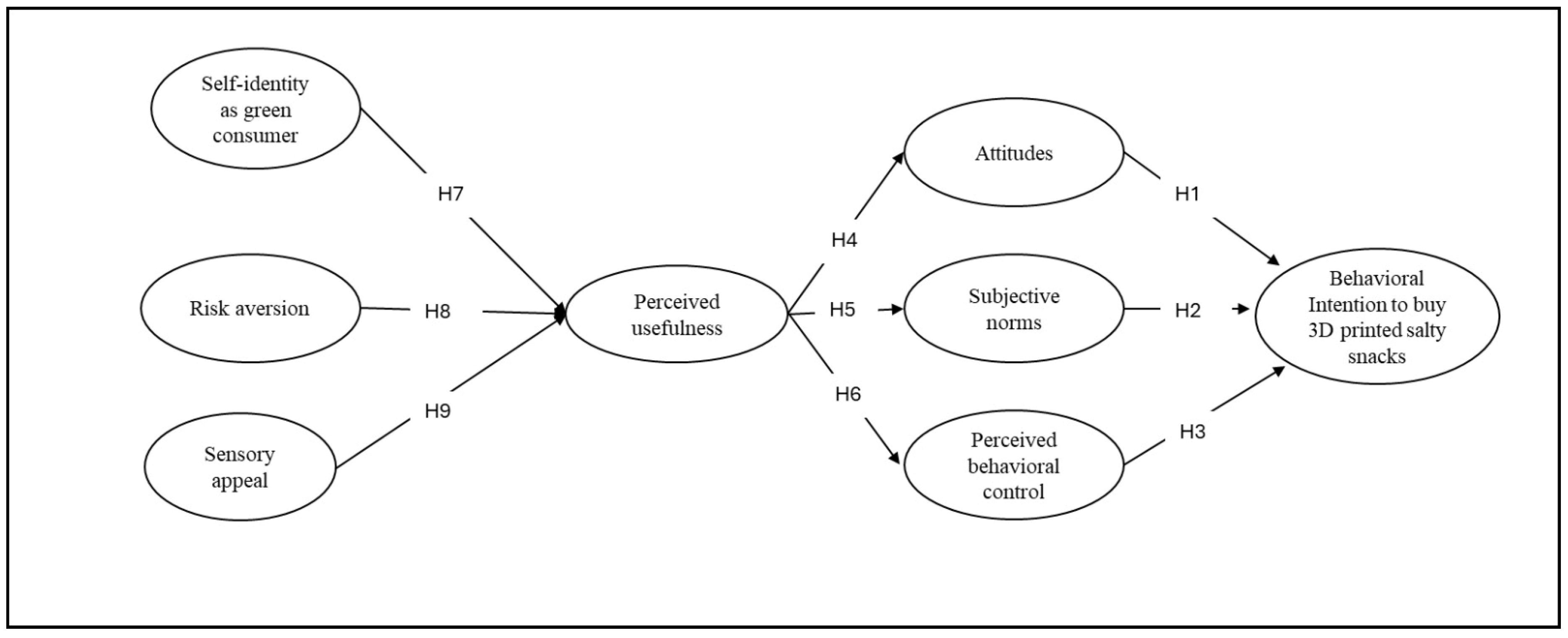
Understanding Italian Consumers’ Intentions Toward Sustainable 3D-Printed Savory Snacks: An Extended Theory of Planned Behavior Approach

 , , , ,
  , and
, and
Abstract
1. Introduction
2. Theoretical Background
3. Materials and Methods
3.1. Questionnaire Description
3.2. Data Analysis Methods
4. Results
4.1. Descriptive Statistics
4.2. PLS-SEM Results
5. Discussion
6. Conclusions
Supplementary Materials
Author Contributions
Funding
Institutional Review Board Statement
Informed Consent Statement
Data Availability Statement
Conflicts of Interest
Abbreviations
| TPB | Theory of Planned Behavior |
| ATT | Attitude |
| SI | Self identity as green consumer |
| BI | Behavioral intention |
| PU | Perceived usefulness |
| RA | Risk Aversion |
| SN | Subjective Norms |
| SA | Sensory Appeal |
| PBC | Perceived Behavioral Control |
| QE | Quadratic effects |
References
- Borah, A.; Sahu, S.; Srivastava, R.P.; Singh, M.; Tyagi, D.B. Exploring the Economic Challenges Threatening Global Agriculture and Food Security. Ecol. Environ. Conserv. 2024, 30, S193–S199. [Google Scholar] [CrossRef] [Scilit]
- Sharma, R.; Nguyen, T.T.; Grote, U. Changing Consumption Patterns-Drivers and the Environmental Impact. Sustainability 2018, 10, 4190. [Google Scholar] [CrossRef] [Scilit]
- Yuan, L.; Ding, Z.; Pan, X.; Shi, C.; Lao, F.; Grundmann, P.; Wu, J. Greenhouse Gas Emissions and Reduction Potentials in the Crop Processing By-Products Utilization Chains: A Review on Citrus and Sugarcane by-Products. Renew. Sustain. Energy Rev. 2025, 217, 115758. [Google Scholar] [CrossRef] [Scilit]
- FAO. The International Day of Awareness of Food Loss and Waste; FAO: Rome, Italy, 2025. [Google Scholar]
- European Commission Food Waste. Available online: https://food.ec.europa.eu/food-safety/food-waste_en (accessed on 16 December 2025).
- Walsh, P.P.; Banerjee, A.; Murphy, E. The UN 2030 Agenda for Sustainable Development. In Partnerships and the Sustainable Development Goals; Springer International Publishing: Cham, Switzerland, 2022; pp. 1–12. [Google Scholar]
- Motoki, K.; Park, J.; Spence, C.; Velasco, C. Contextual Acceptance of Novel and Unfamiliar Foods: Insects, Cultured Meat, Plant-Based Meat Alternatives, and 3D Printed Foods. Food Qual. Prefer. 2022, 96, 104368. [Google Scholar] [CrossRef] [Scilit]
- Chang, M.Y.; Hsia, W.J.; Chen, H.S. Breaking Conventional Eating Habits: Perception and Acceptance of 3D-Printed Food among Taiwanese University Students. Nutrients 2024, 16, 1162. [Google Scholar] [CrossRef] [Scilit]
- Yadav, S.; Samadhiya, A.; Kumar, A.; Luthra, S.; Kumar, V.; Garza-Reyes, J.A.; Upadhyay, A. The Interplay Effects of Digital Technologies, Green Integration, and Green Innovation on Food Supply Chain Sustainable Performance: An Organizational Information Processing Theory Perspective. Technol. Soc. 2024, 77, 102585. [Google Scholar] [CrossRef] [Scilit]
- Villanueva Orbaiz, M.L.; Arce-Urriza, M. The Role of Active and Passive Resistance in New Technology Adoption by Final Consumers: The Case of 3D Printing. Technol. Soc. 2024, 77, 102500. [Google Scholar] [CrossRef] [Scilit]
- Baiano, A. 3D Printed Foods: A Comprehensive Review on Technologies, Nutritional Value, Safety, Consumer Attitude, Regulatory Framework, and Economic and Sustainability Issues. Food Rev. Int. 2022, 38, 986–1016. [Google Scholar] [CrossRef] [Scilit]
- Dancausa Millán, M.G.; Millán Vázquez de la Torre, M.G. An Economic Perspective on the Implementation of Artificial Intelligence in the Restaurant Sector. Adm. Sci. 2024, 14, 214. [Google Scholar] [CrossRef] [Scilit]
- Tyupova, A.; Harasym, J. Valorization of Fruit and Vegetables Industry By-Streams for 3D Printing—A Review. Foods 2024, 13, 2186. [Google Scholar] [CrossRef] [Scilit]
- Bigliardi, B.; Filippelli, S. A Review of the Literature on Innovation in the Agrofood Industry: Sustainability, Smartness and Health. Eur. J. Innov. Manag. 2022, 25, 589–611. [Google Scholar] [CrossRef] [Scilit]
- Sharma, M.; Parihar, P.; Dubey, A.D.; Shukla, S.S.; Soni, R. Additive Manufacturing in the Food Industry: Innovations in Customised Fabrication and Personalised Nutrition. Food Humanit. 2024, 3, 100402. [Google Scholar] [CrossRef] [Scilit]
- Stratakos, A.; Vyrkou, A.; Fatola, O.; Angelis-Dimakis, A. Assessing the Economic Feasibility and Environmental Sustainability of 3D Printed Dysphagic Food. Clean. Environ. Syst. 2025, 19, 100341. [Google Scholar] [CrossRef] [Scilit]
- Sun, J.; Peng, Z.; Yan, L.; Fuh, J.Y.H.; Hong, G.S. 3D Food Printing—An Innovative Way of Mass Customization in Food Fabrication. Int. J. Bioprint. 2015, 1, 27–38. [Google Scholar] [CrossRef] [Scilit]
- Bareen, M.A.; Prakash, S.; Sahu, J.K.; Bhandari, B.; Naik, S. Understanding the Intention of Consumers towards 3D Food Printing: Exploratory Study of Psychological Factors and Sensory Analysis. J. Food Sci. Technol. 2025, 1–12. [Google Scholar] [CrossRef] [Scilit]
- Siegrist, M.; Hartmann, C. Consumer Acceptance of Novel Food Technologies. Nat. Food 2020, 1, 343–350. [Google Scholar] [CrossRef] [Scilit]
- Barilla. BluRhapsody 3D-Printed Finger Pasta—BluRhapsody. Available online: https://blurhapsody.com/?srsltid=AfmBOorG-y2YsY4tlzwTU3XSCOZ30Z-CpQLkrDK0E2IiF_LFBtHJVy0X (accessed on 30 March 2026).
- NovaMeat 3D-Printed Plant-Based Meat. Available online: https://www.novameat.com/products (accessed on 30 March 2026).
- Derossi, A.; Caporizzi, R.; Paolillo, M.; Severini, C. Programmable Texture Properties of Cereal-Based Snack Mediated by 3D Printing Technology. J. Food Eng. 2021, 289, 110160. [Google Scholar] [CrossRef] [Scilit]
- Derossi, A.; Caporizzi, R.; Azzollini, D.; Severini, C. Application of 3D Printing for Customized Food. A Case on the Development of a Fruit-Based Snack for Children. J. Food Eng. 2018, 220, 65–75. [Google Scholar] [CrossRef] [Scilit]
- Johansson, L.; Badager, I.; Krona, A.; Abdollahi, M. Printability and Interfacial Performance of Emulsion Gels and Bigels in Multi-Material Dual and Coaxial Food 3D Printing. Food Hydrocoll. 2026, 172, 111964. [Google Scholar] [CrossRef] [Scilit]
- Chen, Q.; Wu, Y.; Lin, H.; Chen, S.; Zhao, Y.; Xiang, H.; Long, X.; Wang, Y. 3D-Printed Flaxseed Gum-Myofibrillar Protein Gel for Elderly Dysphagia: Multi-Scale Structural Modulation via Molecular Interaction and Lycopene Release in Bionic Dynamic Digestion. Food Hydrocoll. 2026, 172, 111927. [Google Scholar] [CrossRef] [Scilit]
- Shao, J.; Zheng, Z.; Hu, J.; Sriboonvorakul, N.; Lin, S. 3D-Printed Foods for Dysphagia: A Bibliometric Review. Foods 2025, 14, 2058. [Google Scholar] [CrossRef] [Scilit]
- Le Tan, H. 3D Food Printing Technologies for Functional Foods: Applications and Antioxidant Integration. Food Humanit. 2025, 5, 100694. [Google Scholar] [CrossRef] [Scilit]
- Shigi, R.; Seo, Y. Acceptance of 3D Printed Foods among Senior Consumers in Japan. Food Qual. Prefer. 2024, 118, 105213. [Google Scholar] [CrossRef] [Scilit]
- Sun, J.; Zhou, W.; Huang, D.; Fuh, J.Y.H.; Hong, G.S. An Overview of 3D Printing Technologies for Food Fabrication. Food Bioprocess Technol. 2015, 8, 1605–1615. [Google Scholar] [CrossRef] [Scilit]
- Hooi Chuan Wong, G.; Pant, A.; Zhang, Y.; Kai Chua, C.; Hashimoto, M.; Huei Leo, C.; Tan, U.X. 3D Food Printing—Sustainability through Food Waste Upcycling. Mater. Today Proc. 2022, 70, 627–630. [Google Scholar] [CrossRef] [Scilit]
- Burke-Shyne, S.; Gallegos, D.; Williams, T. 3D Food Printing: Nutrition Opportunities and Challenges. Br. Food J. 2021, 123, 649–663. [Google Scholar] [CrossRef] [Scilit]
- Verma, V.K.; Kamble, S.S.; Ganapathy, L.; Belhadi, A.; Gupta, S. 3D Printing for Sustainable Food Supply Chains: Modelling the Implementation Barriers. Int. J. Logist. Res. Appl. 2023, 26, 1190–1216. [Google Scholar] [CrossRef] [Scilit]
- Ben-Ner, A.; Siemsen, E. Decentralization and Localization of Production. Calif. Manag. Rev. 2017, 59, 5–23. [Google Scholar] [CrossRef] [Scilit]
- Vecchio, R.; Cavallo, C. Increasing Healthy Food Choices through Nudges: A Systematic Review. Food Qual. Prefer. 2019, 78, 103714. [Google Scholar] [CrossRef] [Scilit]
- Ajzen, I. From Intentions to Actions: A Theory of Planned Behavior. In Action Control; SSSP Springer Series in Social Psychology; Springer: Berlin/Heidelberg, Germany, 1985; pp. 11–39. [Google Scholar] [CrossRef] [Scilit]
- Chen, M.-F. Modeling an Extended Theory of Planned Behavior Model to Predict Intention to Take Precautions to Avoid Consuming Food with Additives. Food Qual. Prefer. 2017, 58, 24–33. [Google Scholar] [CrossRef] [Scilit]
- Lourenco, C.E.; Porpino, G.; Araujo, C.M.L.; Vieira, L.M.; Matzembacher, D.E. We Need to Talk about Infrequent High Volume Household Food Waste: A Theory of Planned Behaviour Perspective. Sustain. Prod. Consum. 2022, 33, 38–48. [Google Scholar] [CrossRef] [Scilit]
- Nassivera, F.; Sillani, S. Consumer Perceptions and Motivations in Choice of Minimally Processed Vegetables. Br. Food J. 2015, 117, 970–986. [Google Scholar] [CrossRef] [Scilit]
- Ricci, E.C.; Banterle, A.; Stranieri, S. Trust to Go Green: An Exploration of Consumer Intentions for Eco-Friendly Convenience Food. Ecol. Econ. 2018, 148, 54–65. [Google Scholar] [CrossRef] [Scilit]
- Sillani, S.; Nassivera, F. Consumer Behavior in Choice of Minimally Processed Vegetables and Implications for Marketing Strategies. Trends Food Sci. Technol. 2015, 46, 339–345. [Google Scholar] [CrossRef] [Scilit]
- Stranieri, S.; Ricci, E.; Banterle, A. The Theory of Planned Behaviour and Food Choices: The Case of Sustainable Pre-Packed Salad. In Proceedings of the 2016 International European Forum (151st EAAE Seminar), Innsbruck-Igls, Austria, 15–19 February 2016. [Google Scholar]
- Stranieri, S.; Ricci, E.C.; Stiletto, A.; Trestini, S. How about Choosing Environmentally Friendly Beef? Exploring Purchase Intentions among Italian Consumers. Renew. Agric. Food Syst. 2023, 38, e2. [Google Scholar] [CrossRef] [Scilit]
- Ateş, H. Merging Theory of Planned Behavior and Value Identity Personal Norm Model to Explain Pro-Environmental Behaviors. Sustain. Prod. Consum. 2020, 24, 169–180. [Google Scholar] [CrossRef] [Scilit]
- Choi, D.; Johnson, K.K.P. Influences of Environmental and Hedonic Motivations on Intention to Purchase Green Products: An Extension of the Theory of Planned Behavior. Sustain. Prod. Consum. 2019, 18, 145–155. [Google Scholar] [CrossRef] [Scilit]
- Govindharaj, G.; Gowda, B.; Sendhil, R.; Adak, T.; Raghu, S.; Patil, N.; Mahendiran, A.; Rath, P.C.; Kumar, G.A.K.; Damalas, C.A. Determinants of Rice Farmers’ Intention to Use Pesticides in Eastern India: Application of an Extended Version of the Planned Behavior Theory. Sustain. Prod. Consum. 2021, 26, 814–823. [Google Scholar] [CrossRef] [Scilit]
- Califano, G.; Spence, C. Consumer Preference and Willingness to Pay for 3D-Printed Chocolates: A Discrete Choice Experiment. Future Foods 2024, 9, 100378. [Google Scholar] [CrossRef] [Scilit]
- Ajzen, I. The Theory of Planned Behavior. Organ. Behav. Hum. Decis. Process. 1991, 50, 179–211. [Google Scholar] [CrossRef] [Scilit]
- Wong, S.L.; Hsu, C.C.; Chen, H.S. To Buy or Not to Buy? Consumer Attitudes and Purchase Intentions for Suboptimal Food. Int. J. Environ. Res. Public Health 2018, 15, 1431. [Google Scholar] [CrossRef] [Scilit]
- Tunca, S.; Budhathoki, M.; Brunsø, K. European Consumers’ Intention to Buy Sustainable Aquaculture Products: An Exploratory Study. Sustain. Prod. Consum. 2024, 50, 20–34. [Google Scholar] [CrossRef] [Scilit]
- Yang, M.; Gao, J.; Yang, Q.; Al Mamun, A.; Masukujjaman, M.; Hoque, M.E. Modeling the Intention to Consume and Willingness to Pay Premium Price for 3D-Printed Food in an Emerging Economy. Humanit. Soc. Sci. Commun. 2024, 11, 274. [Google Scholar] [CrossRef] [Scilit]
- Kamrath, C.; Wensing, J.; De Steur, H.; Bröring, S. Explaining the Intention to Consume 3D-Printed Food via the Food Technology Acceptance Model and Trust Dynamics. Int. J. Consum. Stud. 2025, 49, 1–18. [Google Scholar] [CrossRef] [Scilit]
- Hellali, W.; Korai, B. Understanding Consumer’s Acceptability of the Technology behind Upcycled Foods: An Application of the Technology Acceptance Model. Food Qual. Prefer. 2023, 110, 104943. [Google Scholar] [CrossRef] [Scilit]
- Davis, F.D. Perceived Usefulness, Perceived Ease of Use, and User Acceptance of Information Technology. MIS Q. Manag. Inf. Syst. 1989, 13, 319–339. [Google Scholar] [CrossRef] [Scilit]
- Venkatesh, V.; Davis, F.D. Theoretical Extension of the Technology Acceptance Model: Four Longitudinal Field Studies. Manag. Sci. 2000, 46, 186–204. [Google Scholar] [CrossRef] [Scilit]
- Hellali, W.; Korai, B.; Lambert, R. Food from Waste: The Effect of Information and Attitude towards Risk on Consumers’ Willingness to Pay. Food Qual. Prefer. 2023, 110, 104945. [Google Scholar] [CrossRef] [Scilit]
- Carfora, V.; Cavallo, C.; Caso, D.; Del Giudice, T.; De Devitiis, B.; Viscecchia, R.; Nardone, G.; Cicia, G. Explaining Consumer Purchase Behavior for Organic Milk: Including Trust and Green Self-Identity within the Theory of Planned Behavior. Food Qual. Prefer. 2019, 76, 1–9. [Google Scholar] [CrossRef] [Scilit]
- Bao, Y.; Zhou, K.Z.; Su, C. Face Consciousness and Risk Aversion: Do They Affect Consumer Decision-Making? Psychol. Mark. 2003, 20, 733–755. [Google Scholar] [CrossRef] [Scilit]
- Armitage, C.J.; Conner, M. Distinguishing Perceptions of Control from Self-Efficacy: Predicting Consumption of a Low-Fat Diet Using the Theory of Planned Behavior. J. Appl. Soc. Psychol. 1999, 29, 72–90. [Google Scholar] [CrossRef] [Scilit]
- Ajzen, I.; Sheikh, S. Action versus Inaction: Anticipated Affect in the Theory of Planned Behavior. J. Appl. Soc. Psychol. 2013, 43, 155–162. [Google Scholar] [CrossRef] [Scilit]
- Contini, C.; Boncinelli, F.; Marone, E.; Scozzafava, G.; Casini, L. Drivers of Plant-Based Convenience Foods Consumption: Results of a Multicomponent Extension of the Theory of Planned Behaviour. Food Qual. Prefer. 2020, 84, 103931. [Google Scholar] [CrossRef] [Scilit]
- Fotopoulos, C.; Krystallis, A.; Vassallo, M.; Pagiaslis, A. Food Choice Questionnaire (FCQ) Revisited. Suggestions for the Development of an Enhanced General Food Motivation Model. Appetite 2009, 52, 199–208. [Google Scholar] [CrossRef] [Scilit]
- Taber, K.S. The Use of Cronbach’s Alpha When Developing and Reporting. Res. Instrum. Sci. Educ. 2018, 48, 1273–1296. [Google Scholar] [CrossRef] [Scilit]
- Manstan, T.; Chandler, S.L.; McSweeney, M.B. Consumers’ Attitudes towards 3D Printed Foods after a Positive Experience: An Exploratory Study. J. Sens. Stud. 2021, 36, 12619. [Google Scholar] [CrossRef] [Scilit]
- Süzer, Ö. The Perception of Professional Cooks on 3D Printer Adoption: An Analysis Through the Lens of the Technology Acceptance Model. J. Culin. Sci. Technol. 2025, 23, 668–691. [Google Scholar] [CrossRef] [Scilit]
- Manstan, T.; McSweeney, M.B. Consumers’ Attitudes towards and Acceptance of 3D Printed Foods in Comparison with Conventional Food Products. Int. J. Food Sci. Technol. 2020, 55, 323–331. [Google Scholar] [CrossRef] [Scilit]
- Şenel, P.; Turhan, H.; Sezgin, E. The Relations among the Dimensions of 3D-Printed Food: A Case of Z and Y Generations’Preferences. J. Hosp. Tour. Technol. 2024, 15, 449–464. [Google Scholar] [CrossRef] [Scilit]
- Sundarsingh, A.; Zhang, M.; Mujumdar, A.S.; Li, J. Research Progress in Printing Formulation for 3D Printing of Healthy Future Foods. Food Bioprocess Technol. 2024, 17, 3408–3439. [Google Scholar] [CrossRef] [Scilit]


| Constructs | Items | References |
|---|---|---|
| Behavioral intention to buy 3D-printed food. | I intend to purchase customized 3D-printed savory snacks in the next month, if available. | [42,56,58] |
| I am planning to purchase customized 3D-printed savory snacks in the next month, if available. | ||
| I will purchase customized 3D-printed savory snacks in the next month, if available. | ||
| It would be important for me to find customized 3D-printed savory snacks in the next month, if available. | ||
| It would be important for me to consume customized 3D-printed savory snacks in the next month. | ||
| Attitude | Purchasing customized 3D-printed savory snacks would be a bad/good choice. | [56,58,59,60] |
| Purchasing customized 3D-printed savory snacks would be a harmful/healthy choice. | ||
| Purchasing customized 3D-printed savory snacks would be an unpleasant/pleasant choice. | ||
| Purchasing customized 3D-printed savory snacks would be an undesirable/desirable choice. | ||
| Purchasing customized 3D-printed savory snacks would be an impossible/possible choice. | ||
| Purchasing customized 3D-printed savory snacks would be a dissatisfying/satisfying choice. | ||
| Purchasing customized 3D-printed savory snacks would be a negative/positive choice. | ||
| Subjective Norms | If personalized 3D-printed savory snacks were available, the people important to me would think that I should buy them. | [56,58,59] |
| If personalized 3D-printed savory snacks were available, the people important to me would approve of me buying them. | ||
| If personalized 3D-printed savory snacks were available, the people important to me would want me to buy them. | ||
| If personalized 3D-printed savory snacks were available, I would feel social pressure to buy them. | ||
| Perceived Behavioral Control | For me, it would be easy to purchase customized 3D-printed savory snacks. | [59] |
| I am confident that if I wanted to, I could purchase customized 3D-printed savory snacks. | ||
| Whether or not I purchase customized 3D-printed savory snacks is entirely up to me. | ||
| Perceived usefulness | I think 3D printers bring convenience. | [28] |
| 3D printers are a socially desirable technology. | ||
| I think 3D-printed foods are beneficial for people’s health. | ||
| I think 3D-printed food products contribute to the development of the food industry. | ||
| Self-Identity as Green Consumer | I consider myself an environmentally conscious consumer. | [56] |
| I see myself as a person interested in sustainable/environmentally friendly consumption. | ||
| I consider myself a person who is very concerned about environmental issues. | ||
| Risk Aversion | I am cautious about trying new or different products. | [57] |
| I prefer to stick with a brand I usually buy rather than try something I am not sure about. | ||
| I never buy something unfamiliar if there is a risk of making a mistake. | ||
| Sensory Appeal | It is important to me that the food I eat in a typical day has a good smell. | [61] |
| It is important to me that the food I eat in a typical day looks appealing. | ||
| It is important to me that the food I eat in a typical day has a pleasant texture. | ||
| It is important to me that the food I eat in a typical day tastes good. |
| Variable | Category | n | % |
|---|---|---|---|
| Gender | Female | 197 | 48.88 |
| Male | 145 | 35.96 | |
| Prefer not to answer | 16 | 3.97 | |
| Other | 7 | 1.74 | |
| No answer | 38 | 9.43 | |
| Age group (years) | 18–29 | 45 | 11.17 |
| 30–39 | 117 | 29.03 | |
| 40–49 | 105 | 26.05 | |
| 50–59 | 38 | 9.43 | |
| 60–69 | 29 | 7.20 | |
| Over 69 | 27 | 6.70 | |
| No answer | 42 | 10.42 | |
| Education level | High school diploma | 125 | 31.02 |
| Bachelor’s degree | 63 | 15.6 | |
| Master’s degree | 91 | 22.59 | |
| Postgraduate degree/PhD | 52 | 12.9 | |
| No answer | 38 | 9.43 | |
| Frequency of savory snack consumption | More than once a week | 160 | 39.7 |
| Once a week | 145 | 35.98 | |
| Once a month | 77 | 19.11 | |
| Once a year | 21 | 5.21 | |
| Frequency of savory snack purchase | 1–2 times per week | 106 | 26.30 |
| 1–3 times per month | 175 | 43.42 | |
| 3–4 times per week | 24 | 5.96 | |
| 5 times per week or more | 7 | 1.74 | |
| Less than once per month | 91 | 22.58 | |
| Main place of purchase | Supermarket | 277 | 68.7 |
| Discount store | 46 | 11.4 | |
| Hypermarket | 41 | 10.17 | |
| Vending machine | 12 | 2.98 | |
| Coffee bar | 15 | 3.72 | |
| Tobacco shops | 3 | 0.74 | |
| Other | 7 | 1.74 | |
| Knowledge of 3D printing technology | Aware of how it works | 241 | 59.80 |
| Not aware | 138 | 34.24 | |
| No answer | 24 | 5.96 | |
| Heard about 3D food printing | Yes | 219 | 54.3 |
| No | 160 | 39.7 | |
| No answer | 24 | 5.96 | |
| Ever consumed 3D-printed food | Yes | 22 | 5.46 |
| No | 357 | 88.59 | |
| No answer | 24 | 5.96 | |
| Intended occasion for buying 3D-printed snacks | Only occasionally/to try | 216 | 53.6 |
| Special events | 47 | 11.66 | |
| Daily consumption | 30 | 7.4 | |
| In certain situations | 68 | 16.87 | |
| No answer | 42 | 10.4 | |
| Preferred purchase place for 3D-printed snacks | Supermarket | 192 | 47.6 |
| Specialized store | 77 | 19.1 | |
| Vending machine | 62 | 15.4 | |
| Pharmacy | 13 | 3.2 | |
| Other/no answer | 59 | 14.7 | |
| Perceived suitable consumers for 3D-printed snacks | Athletes with specific needs | 277 | 68.73 |
| Children | 165 | 40.94 | |
| Willingness to pay | Same price as traditional snacks | 229 | 56.8 |
| Lower price | 100 | 24.8 | |
| Higher price | 48 | 11.9 | |
| No answer | 26 | 6.5 | |
| Food allergies/intolerances | No | 274 | 67.99 |
| Yes | 88 | 21.84 | |
| No answer | 41 | 10.17 | |
| Family food allergies/intolerances | No | 247 | 61.29 |
| Yes | 115 | 28.54 | |
| No answer | 41 | 10.17 | |
| Gastrointestinal diseases | No | 297 | 73.7 |
| Yes | 65 | 26.3 | |
| No answer | 41 | 10.17 | |
| Family gastrointestinal diseases | No | 276 | 68.5 |
| Yes | 86 | 21.34 | |
| No answer | 41 | 10.17 |
| Constructs | Codes | Mean | SD | Outer Loadings | AVE | CR (rhoc) | Cronbach’s Alpha |
|---|---|---|---|---|---|---|---|
| Attitude (ATT) | 0.84 | 0.97 | 0.97 | ||||
| ATT1 | 3.28 | 1.91 | 0.91 | ||||
| ATT2 | 3.36 | 1.85 | 0.92 | ||||
| ATT3 | 3.48 | 1.97 | 0.94 | ||||
| ATT4 | 3.41 | 2.00 | 0.92 | ||||
| ATT5 | 3.59 | 2.01 | 0.86 | ||||
| ATT6 | 3.49 | 1.94 | 0.93 | ||||
| ATT7 | 3.60 | 1.97 | 0.94 | ||||
| Self identity as green consumer (SI) | 0.85 | 0.95 | 0.91 | ||||
| SI1 | 4.51 | 1.82 | 0.91 | ||||
| SI2 | 4.85 | 1.80 | 0.93 | ||||
| SI3 | 4.53 | 1.81 | 0.92 | ||||
| Behavioral intention (BI) | 0.86 | 0.97 | 0.96 | ||||
| BI1 | 2.87 | 2.05 | 0.92 | ||||
| BI2 | 2.79 | 1.97 | 0.95 | ||||
| BI3 | 2.69 | 1.95 | 0.94 | ||||
| BI4 | 2.91 | 2.04 | 0.92 | ||||
| BI5 | 2.63 | 1.93 | 0.92 | ||||
| Perceived usefulness (PU) | 0.75 | 0.92 | 0.89 | ||||
| PU1 | 3.97 | 2.01 | 0.87 | ||||
| PU2 | 4.02 | 1.97 | 0.88 | ||||
| PU3 | 3.51 | 1.98 | 0.87 | ||||
| PU4 | 4.01 | 2.03 | 0.86 | ||||
| Risk Aversion (RA) | 0.61 | 0.74 | 0.78 | ||||
| RA2 | 3.83 | 1.98 | 0.97 | ||||
| RA3 | 3.65 | 2.00 | 0.50 | ||||
| Subjective Norms (SN) | 0.83 | 0.94 | 0.90 | ||||
| SN1 | 2.91 | 1.98 | 0.89 | ||||
| SN2 | 3.22 | 2.00 | 0.93 | ||||
| SN3 | 3.05 | 1.99 | 0.91 | ||||
| Sensory Appeal (SA) | 0.77 | 0.93 | 0.90 | ||||
| SA1 | 5.61 | 1.49 | 0.89 | ||||
| SA2 | 5.37 | 1.64 | 0.93 | ||||
| SA3 | 5.61 | 1.40 | 0.91 | ||||
| SA4 | 6.07 | 1.34 | |||||
| Perceived Behavioral Control (PBC) | 0.68 | 0.81 | 0.55 | ||||
| PBC1 | 3.28 | 2.00 | 0.92 | ||||
| PBC3 | 2.74 | 1.71 | 0.72 |
| ATT | BI | PBC | PU | RA | SI | SA | SN | |
|---|---|---|---|---|---|---|---|---|
| ATT | ||||||||
| BI | 0.797 | |||||||
| PBC | 0.925 | 0.829 | ||||||
| PU | 0.882 | 0.714 | 0.933 | |||||
| RA | 0.101 | 0.062 | 0.041 | 0.093 | ||||
| SI | 0.357 | 0.264 | 0.489 | 0.456 | 0.095 | |||
| SA | 0.156 | 0.052 | 0.192 | 0.171 | 0.186 | 0.274 | ||
| SN | 0.757 | 0.709 | 0.735 | 0.729 | 0.064 | 0.229 | 0.056 |
| ATT | BI | PBC | PU | RA | SI | SA | SN | |
|---|---|---|---|---|---|---|---|---|
| ATT | 2.857 | |||||||
| BI | ||||||||
| PBC | 2.070 | |||||||
| PU | 1.000 | 1.000 | 1.000 | |||||
| RA | 1.034 | |||||||
| SI | 1.072 | |||||||
| SA | 1.107 | |||||||
| SN | 2.037 |
| Original Sample (O) | Sample Mean (M) | Standard Deviation (STDEV) | T Statistics (|O/STDEV|) | p Values | |
|---|---|---|---|---|---|
| QE (ATT) → BI | 0.196 | 0.193 | 0.039 | 5.001 | 0.000 |
| QE (PBC) → BI | 0.025 | 0.027 | 0.039 | 0.628 | 0.530 |
| QE (PERCEIVED USEFULNESS) → ATT | 0.034 | 0.033 | 0.026 | 1.320 | 0.187 |
| QE (PERCEIVED USEFULNESS) → PBC | −0.018 | −0.018 | 0.034 | 0.539 | 0.590 |
| QE (PERCEIVED USEFULNESS) → SUBJECTIVE NORMS | −0.024 | −0.024 | 0.040 | 0.603 | 0.546 |
| QE (RISK AVERSION) → PERCEIVED USEFULNESS | 0.008 | 0.005 | 0.059 | 0.130 | 0.896 |
| QE (SELF IDENTITY) → PERCEIVED USEFULNESS | −0.136 | −0.137 | 0.048 | 2.807 | 0.005 |
| QE (SENSORY APPEAL) → PERCEIVED USEFULNESS | −0.000 | 0.009 | 0.032 | 0.009 | 0.993 |
| QE (SUBJECTIVE NORMS) → BI | −0.182 | −0.182 | 0.045 | 4.006 | 0.000 |
| Coefficients | ||||
|---|---|---|---|---|
| Path | Linear Model | Nonlinear Model | ||
| ATT → BI | 0.49 | *** | 0.44 | *** |
| PBC → BI | 0.18 | *** | 0.16 | *** |
| PU → ATT | 0.82 | *** | 0.82 | *** |
| PU → PBC | 0.68 | *** | 0.68 | *** |
| PU → SN | 0.66 | *** | 0.66 | *** |
| RA → PU | −0.14 | −0.13 | ||
| SI → PU | 0.40 | *** | 0.34 | *** |
| SA → PU | 0.09 | ** | 0.08 | ** |
| SN → BI | 0.21 | *** | 0.32 | *** |
| QE (ATT) → BI | - | 0.21 | *** | |
| QE (SI) → PU | - | −0.13 | ** | |
| QE (SN) → BI | - | −0.18 | *** | |
| R2 | ||||
| BI | 0.63 | 0.67 | ||
| BIC | ||||
| BI | −382.294 | −408.368 | ||
| Hypothesis | Relationship | Result |
|---|---|---|
| H1 | Attitude → Behavioral intention to buy 3D-printed food | Confirmed |
| H2 | Subjective norms → Behavioral intention to buy 3D-printed food | Confirmed |
| H3 | Perceived behavioral control → Behavioral intention to buy 3D-printed food | Confirmed |
| H4 | Perceived usefulness → Attitude | Confirmed |
| H5 | Perceived usefulness → Subjective norms | Confirmed |
| H6 | Perceived usefulness → Perceived behavioral control | Confirmed |
| H7 | Self-Identity as Green Consumer → Perceived usefulness | Confirmed |
| H8 | Risk Aversion → Perceived usefulness | Not confirmed |
| H9 | Sensory Appeal → Perceived usefulness | Confirmed |
Disclaimer/Publisher’s Note: The statements, opinions and data contained in all publications are solely those of the individual author(s) and contributor(s) and not of MDPI and/or the editor(s). MDPI and/or the editor(s) disclaim responsibility for any injury to people or property resulting from any ideas, methods, instructions or products referred to in the content. |
© 2026 by the authors. Licensee MDPI, Basel, Switzerland. This article is an open access article distributed under the terms and conditions of the Creative Commons Attribution (CC BY) license.
Share and Cite
Cammarelle, A.; Russo, I.; di Santo, N.; De Salvo, M.; Seccia, A.; Sisto, R.; Viscecchia, R.; De Devitiis, B. Understanding Italian Consumers’ Intentions Toward Sustainable 3D-Printed Savory Snacks: An Extended Theory of Planned Behavior Approach. Sustainability 2026, 18, 3874. https://doi.org/10.3390/su18083874
Cammarelle A, Russo I, di Santo N, De Salvo M, Seccia A, Sisto R, Viscecchia R, De Devitiis B. Understanding Italian Consumers’ Intentions Toward Sustainable 3D-Printed Savory Snacks: An Extended Theory of Planned Behavior Approach. Sustainability. 2026; 18(8):3874. https://doi.org/10.3390/su18083874
Chicago/Turabian StyleCammarelle, Antonella, Ilaria Russo, Naomi di Santo, Maria De Salvo, Antonio Seccia, Roberta Sisto, Rosaria Viscecchia, and Biagia De Devitiis. 2026. "Understanding Italian Consumers’ Intentions Toward Sustainable 3D-Printed Savory Snacks: An Extended Theory of Planned Behavior Approach" Sustainability 18, no. 8: 3874. https://doi.org/10.3390/su18083874
APA StyleCammarelle, A., Russo, I., di Santo, N., De Salvo, M., Seccia, A., Sisto, R., Viscecchia, R., & De Devitiis, B. (2026). Understanding Italian Consumers’ Intentions Toward Sustainable 3D-Printed Savory Snacks: An Extended Theory of Planned Behavior Approach. Sustainability, 18(8), 3874. https://doi.org/10.3390/su18083874