A Qualitative Case Study of Socio-Scientific Reasoning in the En-ROADS Climate Simulation



Abstract
1. Introduction
What is the nature of undergraduate students’ socio-scientific reasoning as they engage with possible actions to address global climate change?
1.1. Literature Review
1.1.1. Socio-Scientific Issues
1.1.2. Socio-Scientific Reasoning
1.1.3. Climate Simulations
1.2. Theoretical Framework
2. Materials and Methods
2.1. Context
2.2. Curricular Context
2.3. Participants
2.4. Research Design
2.5. Data Collection
2.6. Data Analysis
3. Results
3.1. Stakeholder Group Level SSR
3.1.1. Complexity
While there will be an initial cost to implement these changes, in the long run, we will save resources such as water and sustain economic activity on degrading land because farms will operate more efficiently and emit fewer greenhouse gases.
One of our goals is to increase taxation on carbon emissions, while this change may negatively impact oil and gas companies profit-wise and might cause a slight spike in price, however we feel the positive impacts of decreasing global warming definitely outweigh the negatives.
3.1.2. Perspective-Taking
3.1.3. Inquiry
3.1.4. Skepticism
3.1.5. Affordance of Science
3.1.6. Multiple Perspective-Taking
3.2. Individual Level SSR
3.2.1. Complexity
However, this policy was environmentally effective while having numerous economic and social consequences. From an economic perspective, raising carbon prices would increase production costs and put pressure on industries that are dependent on fossil fuels. Socially, my team and I realized that the impact would not be evenly distributed. Richer nations and corporations could afford the new taxes and transition more easily to clean technologies, while developing countries and smaller businesses might struggle to do that.
When we considered policies like increasing taxes on coal, we immediately had to think about the economic impact on business owners, the social burden placed on low-income populations through higher prices, and the environmental benefit of reducing carbon emissions.
The En-ROADS simulation showed me how challenging it is to balance between the three components of the triple bottom line: people, profit, and the planet. Every time we adjust any of the strategies, the others get affected. For example, environmentally friendly actions such as reducing waste, leakage and cutting emissions often come with additional expenses and needed adjustments to the companies and their staff. On the other hand, focusing only on the economy typically resulted in increasing pollution and health issues for people.
3.2.2. Perspective-Taking
I think that conventional energy would respond to moving to 100% renewable energy saying that it’s not realistic. For example, using solar energy panels requires sunlight, which is present only during daytime. This will create a problem of limited work hours. Also, the weather may affect the efficiency of renewable energy sources.
If the climate justice hawks demanded moving to 100% renewable energy, the conventional energy group would strongly oppose that. From conventional energy’s point of view, a transition as such would threaten the entire industry and millions of jobs related to fossil fuels. Although we realize the need to reduce emissions and how important it is, we would argue for a more gradual transition that allows room for technological improvements or adaptations rather than fully moving to renewable energy. In my opinion, I think conventional energy would respond by promoting actions like CO2 removal technologies or reducing waste and leakage as mentioned before. This would lower emissions without fully eliminating fossil fuel use. In this way, they would still be aligned with the goals they have.
3.2.3. Inquiry
We would have benefited from a clearer view on how carbon taxes might affect employment rates and consumer prices. We also needed more information about job creation opportunities in the clean energy area compared to job losses in fossil fuel industries. Overall I think having such data would make it easier to analyze whether the transition would cause harm or deliver benefits and combining it with more real world socioeconomic data would make it powerful and realistic.
The simulation lacked sector and region specific information which is why I was not entirely confident with all my actions, although the simulation was very valuable at a global scale. The model only presented global averages, but within each country the energy dependencies, industrial structures, and economic capabilities vary widely. For instance, developed nations could easily implement a universal carbon tax, however, poorer nations which are dependent on coal could be heavily disadvantaged. More background data on regions within Africa, Asia or Europe would have made the decision making far more informed and fair.
3.2.4. Skepticism
Politically, governments must come together to set a fair and coordinated carbon pricing system. Formulating universal frameworks for carbon policies, global markets, and fair enforcement mechanisms would be important (S2, Agriculture, Forest and Land Management)
Politically, the government should support companies that try to implement clean work by cutting taxes or placing subsidies because this will motivate businesses to take action (S9, Conventional Energy).
Economically, governments need to offer subsidies and incentives to industries and consumers to help them transition smoothly. This might include investing in renewable infrastructure, supporting clean tech startups, and providing tax breaks for sustainable innovations. It is also important to ensure that carbon tax revenues are reinvested into the green economy (S6, Clean Tech).
For the economic aspect we must ensure that there is funding for anyone who is contributing to achieving this action, there must be rewards for those who reach the targets set for them, the prices for the technology needed for such an action has to be realistic and it mustn’t have a negative effect on the economy of any country (S10, Conventional Energy).
Socially, there should be social support to aid the public in understanding the concepts of carbon pricing and its positive impact for the future. People need to understand that there is more to pricing carbon than taxes, there is a future with a cleaner environment associated with it. There will be societal support when there is proper education, incentives to live a greener lifestyle, and policies to monitor positive change in the air and actively create jobs in clean technology (S7, Clean Tech).
Socially, people would need to change their behavior, choosing electric vehicles, supporting wind and solar projects in their communities, and accepting that fossil fuel jobs may decline as renewable jobs grow (S13, Developed Nation).
Socially, people must understand why reducing emissions matters and support sustainable lifestyles (S19, Climate Justice Hawks).
3.2.5. Affordance of Science
My knowledge in biology was critical, it allowed me to understand the positive feedback loops … I know that although a 0.3 degree celsius change due to reduction in waste and leakage might seem insignificant, a change like that could mean the difference between ice thawing which is one of the main positive feedback loops increasing warming.
3.2.6. Multiple Perspective-Taking
The Climate Justice Hawks spoke more on the social and ethical aspects of climate action and how the increasing energy costs would unfairly affect vulnerable people while we of the Clean Tech spoke more on innovation, market, and the long-term profitability of renewable solution economics. We, therefore, fully supported a strategic plan of a gradual increase in carbon prices, while also improving or developing tech in clean energy.
Their goals were maintaining energy reliability, protecting existing fossil-fuel jobs, and minimizing economic disruption, while we wanted mainly to accelerate the transition to renewable energy and reduce emissions. So initially, both goals were contradicting, seeming almost impossible to find common ground.
4. Discussion
5. Conclusions
6. Implications
Supplementary Materials
Author Contributions
Funding
Institutional Review Board Statement
Informed Consent Statement
Data Availability Statement
Conflicts of Interest
Abbreviations
| En-ROADS | Energy Rapid Overview and Decision Support |
| SSR | Socio-Scientific Reasoning |
| SSI | Socio-Scientific Issue |
References
- Rooney-Varga, J.N.; Hensel, M.; McCarthy, C.; McNeal, K.; Norfles, N.; Rath, K.; Sterman, J.D. Building consensus for ambitious climate action through the world climate simulation. Earth’s Future 2021, 9, e2021EF002283. [Google Scholar] [CrossRef]
- Rayhan, M. Climate Change and Sustainable Development–Public Awareness Measure with Climate Simulator En-ROADS. Master’s Thesis, University of South-Eastern Norway, Notodden, Norway, 2022. [Google Scholar]
- Owens, D.C.; Petitt, D.N.; Lally, D.; Forbes, C.T. Cultivating water literacy in STEM education: Undergraduates’ socio-scientific reasoning about socio-hydrologic issues. Water 2020, 12, 2857. [Google Scholar] [CrossRef]
- Sadler, T.D.; Barab, S.A.; Scott, B. What do students gain by engaging in socioscientific inquiry? Res. Sci. Educ. 2007, 37, 371–391. [Google Scholar] [CrossRef]
- Mukherjee, I. Optimizing Climate Policy through C-ROADS and En-ROADS Analysis. arXiv 2023, arXiv:2311.03546. [Google Scholar]
- Carleton, T.A.; Hsiang, S.M. Social and economic impacts of climate. Science 2016, 353, aad9837. [Google Scholar] [CrossRef] [PubMed]
- Kumar, V.; Choudhary, S.K.; Singh, R. Environmental socio-scientific issues as contexts in developing scientific literacy in science education: A systematic literature review. Soc. Sci. Humanit. Open 2024, 9, 100765. [Google Scholar] [CrossRef]
- Abrori, F.M.; Lavicza, Z.; Anđić, B. Enhancing socio-scientific reasoning of elementary school students through educational comics: A comprehensive exploration across diverse domain of knowledge. Education 3-13 2023, 53, 1299–1320. [Google Scholar] [CrossRef]
- Owens, D.C.; Sadler, T.D.; Petitt, D.N.; Forbes, C.T. Exploring undergraduates’ breadth of socio scientific reasoning through domains of knowledge. Res. Sci. Educ. 2022, 52, 1643–1658. [Google Scholar] [CrossRef]
- Romine, W.L.; Sadler, T.D.; Kinslow, A.T. Assessment of scientific literacy: Development and validation of the Quantitative Assessment of Socio-Scientific Reasoning (QuASSR). J. Res. Sci. Teach. 2017, 54, 274–295. [Google Scholar] [CrossRef]
- Pleasants, J. Inquiring into the nature of STEM problems: Implications for pre-college education. Sci. Educ. 2020, 29, 831–855. [Google Scholar] [CrossRef]
- Gulacar, O.; Zowada, C.; Burke, S.; Nabavizadeh, A.; Bernardo, A.; Eilks, I. Integration of a sustainability-oriented socio-scientific issue into the general chemistry curriculum: Examining the effects on student motivation and self-efficacy. Sustain. Chem. Pharm. 2020, 15, 100232. [Google Scholar] [CrossRef]
- Sadler, T.D.; Romine, W.L.; Topçu, M.S. Learning science content through socio-scientific issues-based instruction: A multi-level assessment study. Int. J. Sci. Educ. 2016, 38, 1622–1635. [Google Scholar] [CrossRef]
- Kahn, S.; Zeidler, D.L. A conceptual analysis of perspective taking in support of socioscientific reasoning. Sci. Educ. 2019, 28, 605–638. [Google Scholar] [CrossRef]
- Eggert, S.; Nitsch, A.; Boone, W.J.; Nückles, M.; Bögeholz, S. Supporting students’ learning and socioscientific reasoning about climate change—The effect of computer-based concept mapping scaffolds. Res. Sci. Educ. 2017, 47, 137–159. [Google Scholar] [CrossRef]
- Chang, H.Y.; Hsu, Y.S.; Wu, H.K.; Tsai, C.C. Students’ development of socio-scientific reasoning in a mobile augmented reality learning environment. Int. J. Sci. Educ. 2018, 40, 1410–1431. [Google Scholar] [CrossRef]
- Ariza, M.R.; Christodoulou, A.; van Harskamp, M.; Knippels, M.C.P.; Kyza, E.A.; Levinson, R.; Agesilaou, A. Socio-scientific inquiry-based learning as a means toward environmental citizenship. Sustainability 2021, 13, 11509. [Google Scholar] [CrossRef]
- Ozturk, N.; Roehrig, G.H. Effects of an Integrated STEM Unit Designed around Socioscientific Issues on Middle School Students’ Socioscientific Reasoning. Int. J. Sci. Math. Educ. 2024, 23, 1493–1518. [Google Scholar] [CrossRef]
- Zeidler, D.L.; Herman, B.C.; Sadler, T.D. New directions in socioscientific issues research. Discip. Interdiscip. Sci. Educ. Res. 2019, 1, 11. [Google Scholar] [CrossRef]
- Ben-Horin, H.; Kali, Y.; Tal, T. The fifth dimension in socio-scientific reasoning: Promoting decision-making about socio-scientific issues in a community. Sustainability 2023, 15, 9708. [Google Scholar] [CrossRef]
- Ardh, K.; Fujii, H.; Iwata, K.; Ogura, Y.; Koeda, M.; Teramoto, T. Implementation and Evaluation of Climate Change Education in School Science and Science Teacher Training Using Simulation as Teaching Materials. JSSE Res. Rep. 2025, 39, 43–48. [Google Scholar]
- Burger, J.; Clark, R.; Preece, D.; Webb, H. Simulated climate solutions: Using the EN-ROADS simulator. Teach. Geogr. 2023, 48, 114–116. [Google Scholar]
- Harvard Business School Online. The Triple Bottom Line: What It Is & Why It’s Important. Business Insights Blog. Available online: https://online.hbs.edu/blog/post/what-is-the-triple-bottom-line (accessed on 9 February 2026).
- Romine, W.L.; Sadler, T.D.; Dauer, J.M.; Kinslow, A. Measurement of socio-scientific reasoning (SSR) and exploration of SSR as a progression of competencies. Int. J. Sci. Educ. 2020, 42, 2981–3002. [Google Scholar] [CrossRef]
- Kinslow, A.T.; Sadler, T.D.; Nguyen, H.T. Socio-scientific reasoning and environmental literacy in a field-based ecology class. Environ. Educ. Res. 2019, 25, 388–410. [Google Scholar] [CrossRef]
- Karahan, E.; Roehrig, G. Secondary school students’ understanding of science and their socio scientific reasoning. Res. Sci. Educ. 2017, 47, 755–782. [Google Scholar] [CrossRef]
- Sadler, T.D. Situated learning in science education: Socio-scientific issues as contexts for practice. Stud. Sci. Educ. 2009, 45, 1–42. [Google Scholar] [CrossRef]
- Owens, D.C.; Sadler, T.D. Socio-scientific issues as contexts for the development of STEM literacy. In Handbook of Research on STEM Education; Routledge: New York, NY, USA, 2020; pp. 210–222. [Google Scholar]
- Smit, R.; Rietz, F.; Büchel, D. Using the socioscientific issue approach to foster secondary students’ argumentation skills, science self-efficacy beliefs and science interest. Int. J. Sci. Educ. 2025, 1–17. [Google Scholar] [CrossRef]
- Namdar, B.; Namdar, A.O. Fostering students’ values through role play about socioscientific issues. Phys. Teach. 2021, 59, 497–499. [Google Scholar] [CrossRef]
- Feurzeig, W.; Roberts, N. Modeling and Simulation in Science and Mathematics Education; Springer Science & Business Media: New York, NY, USA, 1999; Volume 1. [Google Scholar]
- Khademolhosseini, M.S. Impacts of global warming on the whole environment and suggestions for solving them by EN-ROADS model. Environ. Eng. Manag. J. 2023, 22, 429–438. [Google Scholar] [CrossRef]
- Wyatt, S.N.; Sullivan-Watts, B.K.; Watts, D.R.; Sacks, L.A. Facilitating Climate Change Action in the Ocean Sciences Using the Interactive Computer Model En-ROADS. Limnol. Oceanogr. Bull. 2022, 31, 92–94. [Google Scholar] [CrossRef]
- Adedoyin, O.B.; Soykan, E. COVID-19 pandemic and online learning: The challenges and opportunities. Interact. Learn. Environ. 2023, 31, 863–875. [Google Scholar] [CrossRef]
- Marhraoui, M.A.; Ojubanire, O.A. Smart Learning and Climate Change Awareness: A Simulation-Based Case Study in Morocco. Eur. J. Educ. 2025, 60, e12917. [Google Scholar] [CrossRef]
- Rooney-Varga, J.N.; Kapmeier, F.; Sterman, J.D.; Jones, A.P.; Putko, M.; Rath, K. The climate action simulation. Simul. Gaming 2020, 51, 114–140. [Google Scholar] [CrossRef]
- Howell, T. A Climate Policy Primer. Open Educ. Resour. 2022, 28, 1–5. [Google Scholar]
- World Climate Simulation for Classrooms. Available online: https://www.uml.edu/research/climate-change/resources/education/simulation-based-learning/world-climate-simulation-classroom.aspx (accessed on 6 February 2026).
- Interactive, C. En-ROADS Climate Solutions Simulator, Climate Interactive. United States of America. Available online: https://coilink.org/20.500.12592/562k19 (accessed on 10 May 2025).
- Karabiyik, T.; Jaiswal, A.; Thomas, P. Assessing Climate Literacy in Engineering Undergraduate Students Through Simulation-Based Learning. In Proceedings of the 2024 IEEE Frontiers in Education Conference (FIE), Washington, DC, USA, 13–16 October 2024; pp. 1–7. [Google Scholar]
- Hensel, M.; Bryan, J.; McCarthy, C.; McNeal, K.S.; Norfles, N.; Rath, K.; Rooney-Varga, J.N. Participatory approaches enhance a sense of urgency and collective efficacy about climate change: Qualitative evidence from the world climate simulation. J. Geosci. Educ. 2023, 71, 177–191. [Google Scholar] [CrossRef]
- Shepardson, D.P.; Niyogi, D.; Choi, S.; Charusombat, U. Students’ conceptions about the greenhouse effect, global warming, and climate change. Clim. Change 2011, 104, 481–507. [Google Scholar] [CrossRef]
- Lave, J. Cognition in Practice: Mind, Mathematics and Culture in Everyday Life; Cambridge University Press: Cambridge, UK, 1988. [Google Scholar]
- Brown, J.S.; Collins, A.; Duguid, P. Situated cognition and the culture of learning. Educ. Res. 1989, 18, 32–42. [Google Scholar] [CrossRef]
- EL-Deghaidy, H. Education for sustainability in Egypt: Participants’ perspectives. In Proceedings of the 2016 NARST Annual International Conference, Baltimore, MD, USA, 14–17 April 2016. [Google Scholar]
- Yin, R.K. Case Study Research: Design and Methods, 5th ed.; Sage: Thousand Oaks, CA, USA, 2014. [Google Scholar]


| Module No | Content |
|---|---|
| Module 1 | Sustainable Development Goals (SDGs), ESD and its goals, ESD at the regional and global levels. |
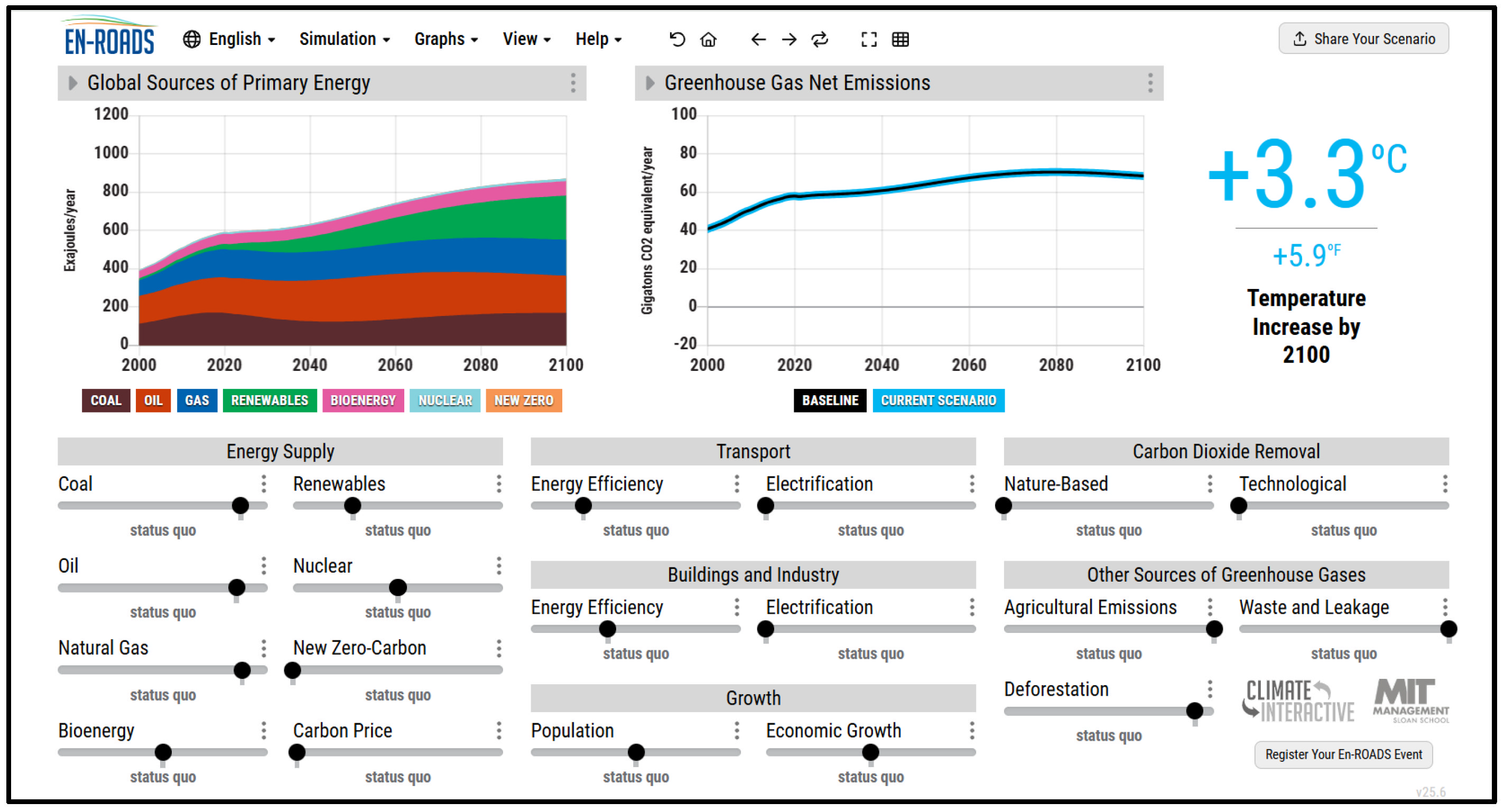
| Module 2 | Climate action through a climate change simulation (En-ROADS). |
| Module 3 | STEM/STEAM education: its goals, strategies, and elements. Integration of ESD and STE2AM in curriculum development. |
| Module 4 | Pedagogical approaches and assessment suitable for ESD/STEM/STEAM. |
| Module 5 | STE2AM in action through group projects. |
| Stakeholder Groups | Students and Their Majors |
|---|---|
| Agriculture, Forestry and Land Management | S1 (Computer science) S2 (Psychology) S3 (Business and Entrepreneurship) S4 (Architectural Engineering) |
| Clean Tech | S5 (Middle East Studies) S6 (Electronics and Communications Engineering) S7 (Accounting) |
| Conventional Energy | S8 (Biology) S9 (Business) S10 (Sociology) |
| Developed Nations | S11 (Integrated Marketing Communication) S12 (Business and Entrepreneurship) S13 (Finance, TRG & MES) S14 (Computer Engineering) |
| Developing Nations | S15 (Biology) S16 (Mechanical Engineering) S17 (Psychology) |
| Climate Justice Hawks | S18 (Chemistry) S19 (Computer Engineering) S20 (Integrated Marketing Communication) |
| Write an individual reflection (1000–1500 words) addressing the following questions, from your point of view. Reflection questions
How do you think developing countries would respond to this? Explain.
|
| SSR Dimension | Definition and Rubric |
|---|---|
| Complexity | Recognizing that global climate change action presents a complex problem without straightforward solutions and cannot be resolved without consideration of the three pillars of sustainability (economic, social, and environmental) factors and their interactions. B—Views addressing global climate actions as a simple problem with straightforward solutions without considering any negative impacts. A—Acknowledges some complexity related to interactions between two or more pillars of sustainability. M—Fully acknowledges complexity amongst the three pillars of sustainability and the trade-offs between them. |
| Perspective-taking | Each stakeholder has their own priorities, values, and preconceptions towards positive climate actions. Understanding an assigned stakeholder’s view is essential. B—Suggested actions are not aligned with stakeholder goals. A—Suggested actions are partially aligned with stakeholder goals. M—Suggested actions are fully aligned with stakeholder goals. |
| Inquiry | Acknowledging that positive climate actions include inherent uncertainty and ambiguity that requires ongoing investigation and inquiry. B—Accepts the provided information and outcomes of climate actions without question, showing no recognition of uncertainty or need for further inquiry. A—Expresses some awareness that the outcomes of climate actions may be uncertain, but the description of what inquiry or data would be needed remains unclear or vague. M—Explicitly acknowledges uncertainty in the outcomes of proposed climate actions and clearly identifies the types of inquiry, evidence, or data needed to investigate and address that uncertainty. |
| Skepticism | Exhibiting skepticism when assessing the likelihood of the outcomes of chosen climate actions in the practical world. B—Students accept the modelled outcomes of their chosen climate actions without question. A—Students identify some issues that might impact the modelled outcome of their proposed climate action, but the issues are not clearly explained. M—Students clearly identify and explain issues that might impact the modelled outcome of their climate action. |
| Affordance of science | Identifying how scientific knowledge, data, and/or methods can contribute to decisions and actions related to global climate change. B—Students demonstrate no understanding of how science informs decisions/actions towards global climate change. A—Students show some understanding of how science informs decisions/actions towards global climate change. However, they are not fully able to articulate the role of science in decision making. M—Students are able to clearly identify and articulate how science informs their decision making related to global climate actions. |
| Multiple perspective-taking | Different stakeholders have different positions on socio-scientific issues based on their priorities, professional backgrounds, values, and preconceptions. Including multiple stakeholders’ perspectives is important in making decisions related to global climate change. B—Students do not demonstrate an understanding of other stakeholders’ views or possible reactions to suggested climate actions. A—Students demonstrate understanding of other stakeholders’ views but show minimal understanding of working with different views to develop consensus about possible climate actions. M—Students demonstrate understanding of other stakeholders’ views and the reality of working with different views to develop consensus about possible climate actions. |
| Stakeholder Group | Complexity | Perspective Taking | Inquiry | Skepticism | Affordance of Science | Multiple Perspective-Taking |
|---|---|---|---|---|---|---|
| Agriculture, Forestry, and Land Management | M | A | B | B | A | M |
| Clean Tech | A | M | B | B | B | A |
| Conventional Energy | M | M | B | A | A | M |
| Developing Countries | M | A | B | A | A | M |
| Developed Countries | M | M | B | A | A | M |
| Climate Justice Hawks | M | M | B | A | M | M |
| SSR Dimension | Number of Students Categorized as Beginning | Number of Students Categorized as Approaching | Number of Students Categorized as Meets |
|---|---|---|---|
| Complexity | 0 | 2 | 18 |
| Perspective-taking | 0 | 9 | 11 |
| Inquiry | 0 | 7 | 13 |
| Skepticism | 0 | 2 | 18 |
| Affordance of Science | 3 | 7 | 10 |
| Multiple perspective-taking | 0 | 6 | 14 |
Disclaimer/Publisher’s Note: The statements, opinions and data contained in all publications are solely those of the individual author(s) and contributor(s) and not of MDPI and/or the editor(s). MDPI and/or the editor(s) disclaim responsibility for any injury to people or property resulting from any ideas, methods, instructions or products referred to in the content. |
© 2026 by the authors. Licensee MDPI, Basel, Switzerland. This article is an open access article distributed under the terms and conditions of the Creative Commons Attribution (CC BY) license.
Share and Cite
Rahman, S.; Roehrig, G.; EL-Deghaidy, H. A Qualitative Case Study of Socio-Scientific Reasoning in the En-ROADS Climate Simulation. Sustainability 2026, 18, 3873. https://doi.org/10.3390/su18083873
Rahman S, Roehrig G, EL-Deghaidy H. A Qualitative Case Study of Socio-Scientific Reasoning in the En-ROADS Climate Simulation. Sustainability. 2026; 18(8):3873. https://doi.org/10.3390/su18083873
Chicago/Turabian StyleRahman, Shuvra, Gillian Roehrig, and Heba EL-Deghaidy. 2026. "A Qualitative Case Study of Socio-Scientific Reasoning in the En-ROADS Climate Simulation" Sustainability 18, no. 8: 3873. https://doi.org/10.3390/su18083873
APA StyleRahman, S., Roehrig, G., & EL-Deghaidy, H. (2026). A Qualitative Case Study of Socio-Scientific Reasoning in the En-ROADS Climate Simulation. Sustainability, 18(8), 3873. https://doi.org/10.3390/su18083873