Review

Modular and Industrialized Timber Housing in Europe: A Review of the Potentials of Local Poplar Wood Through the VICHO Project Framework


by
Jaime Vergara-Muñoz
1,*,
Adelaida Martín Martín
1,
Ignacio de Teresa Fernández-Casas
2,
Roser Martínez-Ramos e Iruela
1 and
Miguel Martínez-Monedero
2
1
Department of Building Construction, University of Granada, 18011 Granada, Spain
2
Department of Architectural and Engineering Graphic Expression, University of Granada, 18011 Granada, Spain
*
Author to whom correspondence should be addressed.
Sustainability 2026, 18(8), 3875; https://doi.org/10.3390/su18083875
Submission received: 2 February 2026 / Revised: 25 March 2026 / Accepted: 31 March 2026 / Published: 14 April 2026

Abstract

Housing industrialization and modularization have gained traction as responses to two pressing challenges in the construction sector: the chronic shortage of affordable housing and the substantial environmental footprint of conventional building methods. Yet prevailing modular housing models in Europe remain constrained by dependence on global supply chains, production concentrated in large industrial operators, and insufficient adaptation to local material and territorial conditions. This article presents a state-of-the-art review of modular timber housing in Europe, examining technological typologies, market structures, and national regulatory frameworks. The methodology integrates a systematic literature and market review, a comparative country analysis, and an embedded case study. Findings indicate that the viability of modular timber housing depends not only on material performance but on its embeddedness in coherent industrial systems, business strategies, and regulatory contexts. Against this backdrop, the VICHO project is introduced as a case study exploring an open, proximity-based industrialization model that valorizes local poplar timber in southern Europe, in alignment with circular bioeconomy principles and the New European Bauhaus.

1. Introduction

The European construction sector faces a convergence of three structural challenges: the climate emergency, a persistent shortage of affordable housing, and chronically low industrial productivity. Buildings in the European Union account for approximately 40% of final energy consumption and 36% of greenhouse gas emissions [1,2]. Regulatory frameworks have long prioritized reductions in operational energy use; however, growing evidence highlights the significance of embodied carbon—that is, the emissions generated during the manufacture, transport, and assembly of building materials [3]. Timber and other bio-based materials have consequently emerged as strategic alternatives, capable of substituting carbon-intensive products and functioning as temporary carbon stores over the building life cycle, provided that robust traceability and chain-of-custody certification underpin their supply [4]. The housing affordability crisis is compounded by a conventional construction model that is slow, labour-intensive, and waste-generating. Industrialized Modular Construction (IMC) addresses these limitations by relocating production to controlled factory settings, thereby improving quality control and enabling more efficient use of resources [5,6].
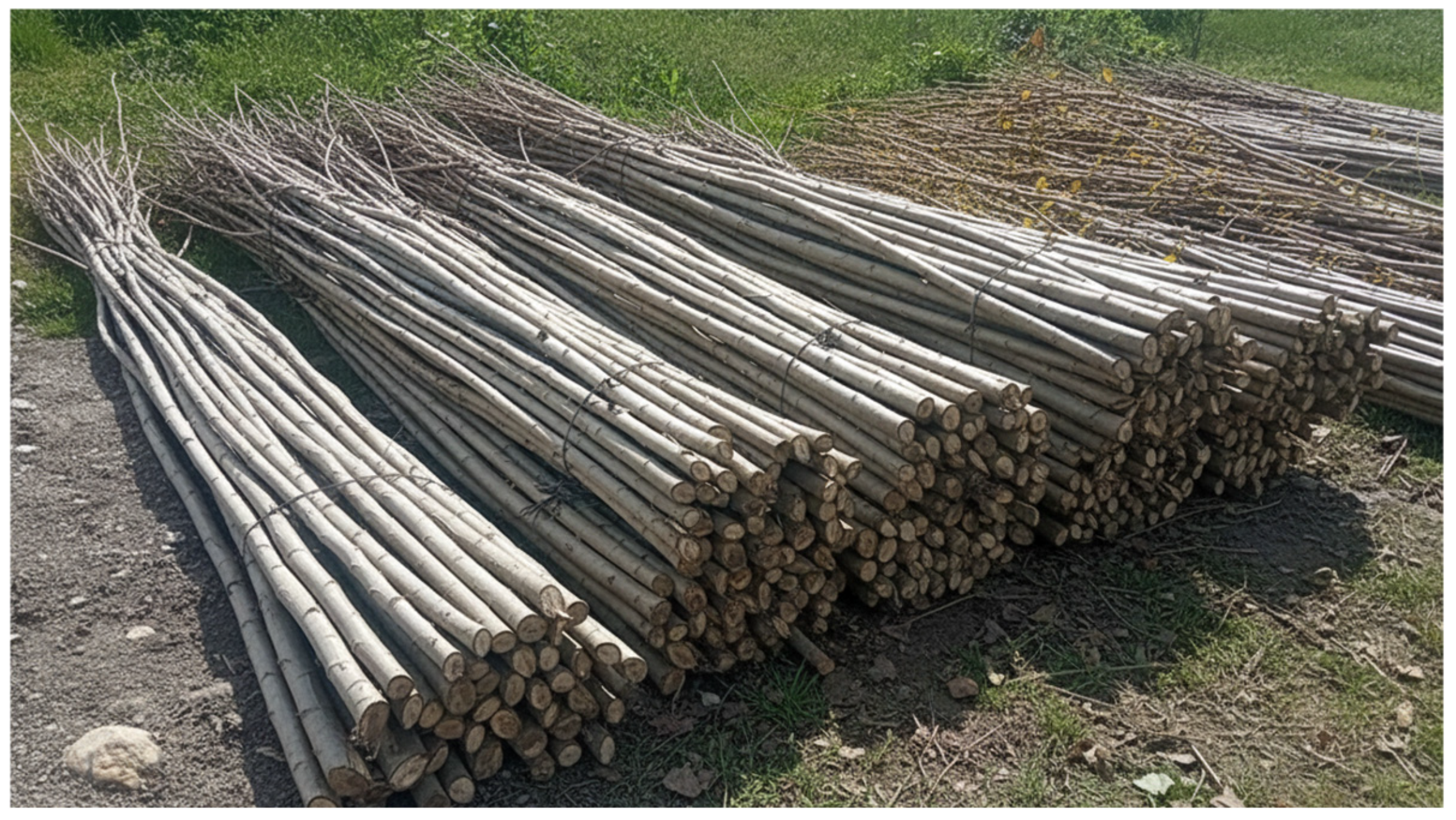
A fundamental paradox, however, undermines the transition towards sustainable construction in southern Europe. Despite the environmental advantages of timber, regional markets remain heavily reliant on imported coniferous products—principally cross-laminated timber (CLT) manufactured from Central European spruce. This dependency implies long-distance freight, which amplifies embodied emissions and generates structural supply-chain vulnerabilities often described as “carbon leakage” [7]. Genuine sustainability thus demands a territorial logic that favours nearby resources and short supply chains, mobilising local species such as poplar (Populus x euramericana) (Figure 1) to bridge the gap between resource availability and industrial production [8,9]. Poplar is especially relevant for its rapid growth, high carbon sequestration rate, and favourable strength-to-weight ratio, making it a credible candidate for industrialized structural applications [10,11].
This transition is underpinned by a maturing strategic and policy framework. At the European level, the New European Bauhaus (NEB) envisions a built environment that is circular, climate-neutral, and socially inclusive [12]. At the regional scale, the Andalusian Urban Agenda 2030 translates these principles into territorial objectives, including the promotion of green economies and the activation of local bio-based value chains [2]. Within this context, the poplar plantations of the Vega de Granada constitute a largely underutilized forest resource whose structural potential for modular housing is currently being re-evaluated through initiatives such as LIFE Wood for Future [13].
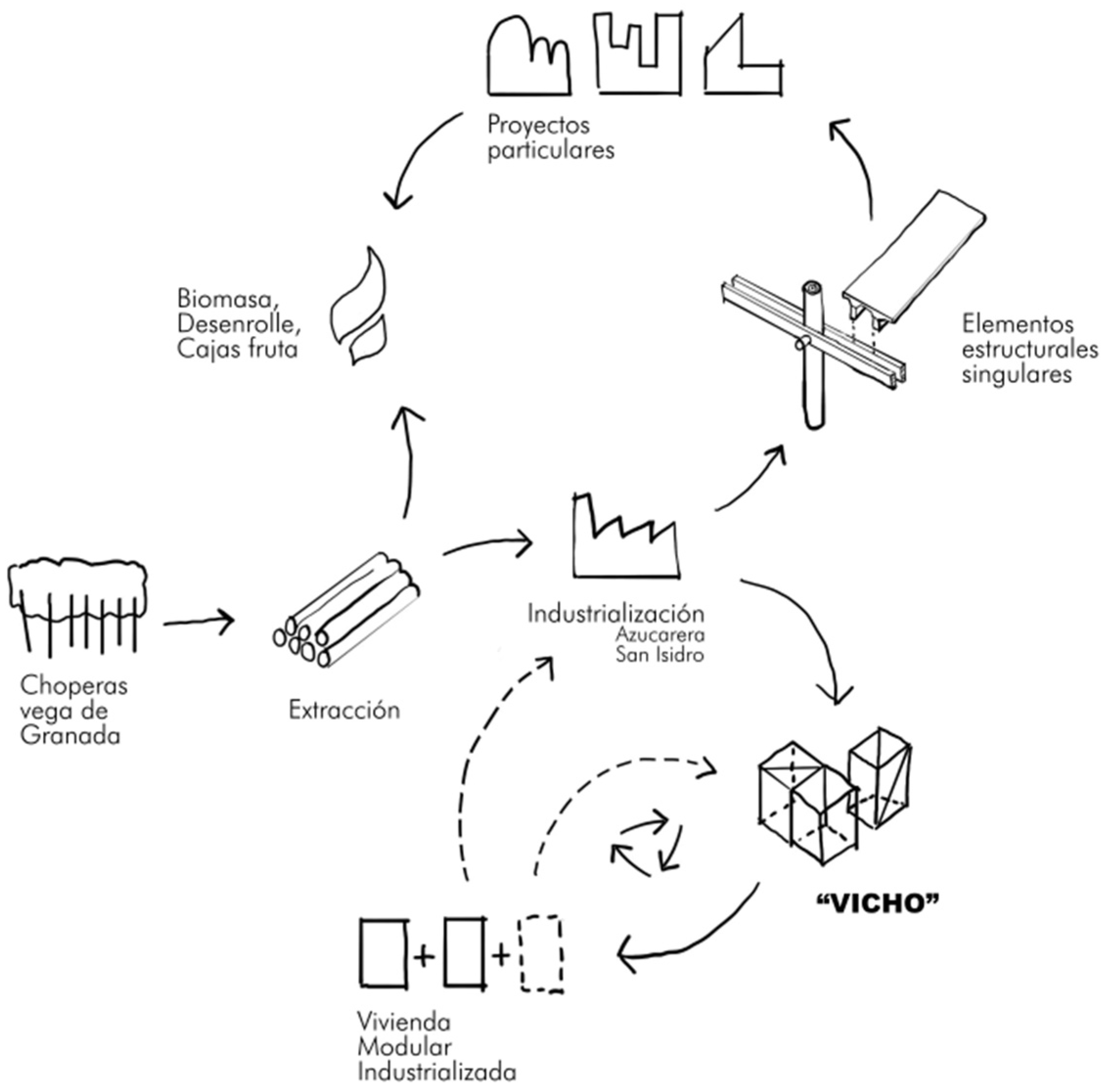
Against this backdrop, the VICHO project (Modular Housing in Local Poplar Timber) is an applied research initiative developing a serially industrialized modular housing system with a structural framework of local poplar [14]. The study proceeds from the hypothesis that modular housing systems grounded in local poplar resources can mitigate the supply-chain vulnerabilities inherent to imported timber products while delivering measurable reductions in environmental impact (Figure 2). The principal aim is to provide a critical review of modular timber housing in Europe and to identify the key barriers and opportunities for transitioning towards proximity-based industrialization models within the strategic framework of the NEB and the Andalusian Urban Agenda 2030. The article is structured as follows: Section 2 describes the materials and methods; Section 3 reviews the state of the art on modular timber housing in Europe; Section 4 presents the findings organized according to the three research methods, namely systematic literature and market review, comparative country analysis, and the VICHO embedded case study; Section 5 discusses the implications for proximity-based modular timber housing in southern Europe; and Section 6 draws conclusions.

2. Materials and Methods

The methodological design combines a systematic literature and market review with a comparative country analysis and an embedded case study of the VICHO project. This multi-method approach links the European trajectory of modular timber housing to the specific challenges and opportunities of developing a proximity-based industrialization model around local poplar resources in Spain (Figure 3).

2.1. Systematic Literature and Market Review

A systematic review was conducted to map the state of modular and industrialized timber housing in Europe and to identify the prevailing technological, economic, and environmental trends. The search spanned 2015–2025 and was carried out in major scientific databases (Scopus, Web of Science) and complementary sources (Google Scholar), using combinations of keywords and Boolean operators such as (“modular timber housing” OR “industrialized construction”) AND (“poplar” OR “bio-based materials”) in English and, where relevant, in other European languages.
Sources were restricted to peer-reviewed journal articles, conference papers, official institutional reports [2,10,12], and audited corporate or sectoral documents from leading industrial actors [15,16]. Inclusion criteria required that documents: (1) address modular or industrialized housing systems with a significant timber component; (2) provide quantitative or qualitative data on market structure, supply chains, or environmental performance [7]; or (3) examine policy instruments related to bio-based construction and decarbonization. The resulting corpus was supplemented with technical literature on the mechanical characterization and standardization of poplar timber in Europe [8,10,11], including outputs from regional initiatives and international research projects [13].

2.2. Comparative Country and Case Selection

Three national contexts were selected for in-depth comparative analysis within the broader European overview: the United Kingdom, France, and Italy. Selection was based on their representative roles in the European timber and modular construction market and on their particular relevance for drawing transferable lessons for the Spanish context.
The United Kingdom was chosen due to its advanced regulatory framework for off-site manufacturing (OSM) in housing and the high concentration of volumetric (3D) timber-based modular industries, which provide a mature reference for large-scale industrialization [5]. France was included as a pioneer in regulatory instruments such as RE2020, which explicitly promote the use of bio-based materials in buildings, and for its consolidated poplar value chain that links forestry, panel production, and construction [9]. Italy was selected both as an example of high-end timber prefabrication and for its climatic, cultural, and forestry similarities with Mediterranean Spain, which make it a useful benchmark for evaluating the transferability of solutions. For each country, the analysis focused on: (1) prevailing modular timber typologies and business models; (2) regulatory and policy drivers; and (3) the role of local versus imported timber in construction supply chains.

2.3. VICHO Project as Embedded Case Study and Research by Design

Alongside the European and comparative analysis, the VICHO project (Vivienda Modular en Madera de Chopo Local), developed in Spain, was treated as an embedded case study to examine how a proximity-based industrialization model might be articulated around local poplar resources [14]. The case study draws on multiple source types: scientific–technical project documentation, design and engineering reports, prototyping and testing data for hybrid poplar-based structural elements [11], and complementary materials from related research on the mechanical characterization and grading of Spanish poplar [10,17].
The VICHO case study is framed within a research-by-design paradigm in which iterative design and technical development serve as instruments for structuring and evaluating alternative modular housing configurations. The focus here, however, is not on presenting architectural solutions in detail, but on distilling from the project those elements most pertinent to: (1) validating local poplar as a viable structural resource; (2) defining an open, component-based industrialization model consistent with Design for Manufacturing and Assembly (DfMA) principles; and (3) articulating a strategic framework aligned with European and regional policy objectives [2,12]. This cross-scale integration connects European market and policy trends to a concrete territorial experiment.

2.4. Use of Generative Artificial Intelligence (GenAI)

Generative artificial intelligence (ChatGPT-4o) was used selectively to assist with the preliminary organization and synthesis of information from secondary sources, and with the initial structuring of the State-of-the-Art section. It also supported the exploratory phase of the literature review, facilitating the identification and thematic classification of relevant scientific literature on Life Cycle Assessment (LCA) of timber buildings, with particular attention to stage A4 (transport) and its contribution to Global Warming Potential (GWP) in southern European contexts. In all instances, the systematic database searches (Web of Science and Scopus), final source selection, critical literature analysis, interpretation of results, and manuscript writing were performed exclusively by the authors, who verified the accuracy, relevance, and scientific integrity of all information incorporated.

3. State of the Art on Modular Timber Housing in Europe

This section reviews the existing body of knowledge on industrialized modular housing in Europe, drawing on the systematic literature and market review described in Section 2.1. It provides a critical synthesis of the state of the art, with progressive emphasis on timber-based construction systems. The analysis examines the evolution of market shares, costs, and trends in volumetric (3D) versus panelized (2D) prefabrication [18], interpreting these systems not merely as technical solutions but as components of specific industrial and territorial ecosystems shaped by distinct logistical, regulatory, productive, and market conditions [8]. The empirical findings derived from this review are presented separately in Section 4.1.
To this end, the review combines data from national sectoral associations—such as the Bundesverband Deutscher Fertigbau (BDF) in Germany, Trä-och Möbelföretagen (TMF) in Sweden and the Association des Constructeurs Industriels de Maisons (ACIM) in France—with audited financial reports and corporate documentation from major European industrial groups [19,20,21]. This source triangulation strategy enables a well-grounded understanding of the technical, economic and organisational feasibility of timber prefabrication, while identifying its limits and opportunities in regions located outside the Central European core.

3.1. Overview of the Evolution of the European Market (2015–2025)

Over the past decade, housing industrialization has functioned not only as a technological response to construction sector inefficiencies but also as a stabilizing mechanism against the volatility of conventional real-estate markets. While traditional construction contracted sharply in 2023–2024 under inflationary pressure and rising interest rates, the performance of industrialized systems has been uneven, varying substantially with the maturity of each national market.
Table 1 presents the evolution of market penetration of industrialized housing (predominantly timber and off-site systems) as a share of total new-build permits across major European markets.
  • The German “safe haven”: Germany represents the most robust case. According to BDF, and despite the severe overall contraction in residential construction, prefabricated housing reached a record market share of 26.2% in 2024. This success is explained by the Fertighaus model, which combines high energy efficiency with Festpreisgarantie (fixed-price guarantee), a key factor in a context of material inflation [21].
  • The saturation of the Swedish market: Sweden, one of the pioneering markets, is undergoing a demand crisis. TMF’s Trähusbarometern reports a 47% drop in orders for single-family houses in 2023. As this is a market where prefabrication is already the norm (around 90%), the sector cannot gain further share over conventional construction and is directly affected by the general economic downturn [23].
  • The British paradox: The United Kingdom presents a stark mismatch between political ambition—an estimated requirement of 300,000 new homes per year—and market reality. Despite sustained institutional support, the volumetric (3D) modular segment has experienced the collapse of several key operators, exposing the difficulty of sustaining high-capital-intensity factories under irregular demand conditions [19].
This landscape is indispensable context for understanding the divergent national trajectories of modular timber housing systems across Europe. A comprehensive survey of 350 European multi-storey timber projects built between 2000 and 2021 documents this trajectory in detail, illustrating how structural typologies have shifted from simple timber frame systems towards hybrid assemblies of CLT, LVL, and glulam across a wide range of building programmes and national regulatory contexts [24].

3.2. Cost Structure and Territorial Heterogeneity of Industrialised Housing in Europe

Cost data across European regions challenge one of the sector’s most persistent assumptions: industrialized housing in Western Europe does not systematically reduce direct costs relative to conventional construction in the 2024–2025 period. A typical cost premium of 5–10% reflects structural factors, including logistics associated with transporting large volumetric units and deploying heavy-lift cranes, the inherent structural redundancy of self-supporting modules, and recent increases in energy and processed material costs.
However, the main economic value of off-site construction does not lie in direct costs, but in indirect financial savings linked to time-to-market. The reduction in construction time—typically between 30% and 50%—allows earlier building occupancy, lowers the developer’s financial costs, and improves cash flow, especially in contexts of high interest rates.
Table 2 reveals considerable territorial and typological heterogeneity across markets, with meaningful differences between high-cost urban markets, consolidated industrialized systems, and export-oriented production regions. This reinforces the central argument of this article: the economic viability of industrialized housing—and of timber-based systems in particular—depends critically on contextual adaptation. Panelized systems and lightweight component-based models consistently demonstrate greater resilience to price volatility and logistical constraints than their volumetric counterparts. A recent comparative embodied carbon analysis confirms this pattern quantitatively, showing that panelized construction achieves substantially lower cradle-to-end-of-use carbon values than volumetric systems across high-rise configurations [25].
Beyond aggregate market shares and costs, it is instructive to examine how specific modular housing operators configure their structural systems and source timber. The analysis focuses on representative firms in the UK, France, Italy, and Spain, which together illustrate the prevailing dependence on spruce-based solutions and long-distance supply chains across European modular housing [27]. Data on structural systems (2D panelized, 3D volumetric, and hybrid), predominant timber products, and production locations are drawn from Environmental Product Declarations and corporate technical reports by leading manufacturers such as KLH Massivholz, Wolf Haus, and Arquima, supplemented by sectoral statistics from national modular construction associations [19,20,26,27,28].
Table 3 illustrates the material and logistical dependence of modular timber housing in southern Europe by comparing selected timber-based modular systems operated by leading European companies. The table summarizes predominant structural systems, timber products, and indicative transport distances to a reference Mediterranean location in Andalusia. Distance estimates are based on geodesic measurements between production sites in Austria, the UK, France, and Italy, consistent with recent life-cycle assessments documenting the significant contribution of long-distance freight to the embodied carbon of CLT and other mass-timber products [27]. The data show that operators in the UK, France, and Italy rely predominantly on spruce-based products manufactured well outside Mediterranean markets, despite the availability of regional softwoods and, in the Spanish context, local poplar resources. The VICHO concept is positioned as a proximity-based counterpart, with a component-based system drawing on poplar and pine resources located within 50 km of the Vega de Granada [14].
These sourcing patterns reflect a structural dependence on long-distance, Central European spruce supply chains—a configuration that perpetuates the “sustainability paradox” described in the introduction and underpins transport-related embodied emissions identified in recent LCA studies [29]. The following subsections examine how this configuration relates to the distinct business models and territorial logics observed across mature and emerging modular housing markets in Europe.

3.3. Technical Segmentation: Crisis of the Volumetric Model and Consolidation of the Panelized System

The performance of different industrialized housing systems is intelligible only when examined within their specific economic and territorial contexts. From both a technical and a business perspective, the European market exhibits a clear tripartite differentiation [18,21]:
  • Volumetric (3D modular) construction: Three-dimensional modules leave the factory at 80–95% completion [30]. While this approach concentrates a high share of value added within the industrial process, it demands substantial capital investment in factories and machinery and requires sustained high production volumes to remain viable. This structural inflexibility under demand contraction has driven the collapse of major UK operators such as Ilke Homes and Legal & General Modular, as well as significant financial losses at firms like TopHat (approximately £46 million in 2023). (The recent collapse of several UK volumetric modular operators has been extensively documented in industry literature. Ilke Homes entered administration in 2023 after accumulating high levels of debt and relying on a capital-intensive production model. Similarly, Legal & General Modular Homes ceased its industrial activity in the same year following recurrent losses and the closure of its production plant. In the case of TopHat, financial statements for 2023 reveal operating losses of around £46 million, highlighting the vulnerability of highly capitalized volumetric models to demand contraction. These situations have been analyzed in reports by Make UK, specialized economic press, and studies on Modern Methods of Construction in the United Kingdom.)
  • Panelized (2D) systems: The dominant model in Germany and Scandinavia, panelized construction, achieves a more stable balance between industrial efficiency and architectural flexibility. Transporting flat panels rather than closed volumetric units reduces logistical costs significantly. This model has consistently demonstrated superior financial resilience and adaptability to demand fluctuations.
  • Hybrid systems and component pods: Combining conventional structures with high-value-added industrialized elements—such as bathroom pods, kitchen modules, or prefabricated façade units—has served as a low-threshold entry point into industrialization for large developers in emerging markets such as Spain.
Recent systematic reviews of modular timber construction provide important context for these structural trajectories and document the broader European evolution of the technologies discussed in this article. A comprehensive review of structural design strategies for multi-storey modular timber buildings across Europe identifies hybrid typologies—combining volumetric units, panelised elements, and post-and-beam frames, supported by advanced connection systems—as the most flexible and structurally efficient solutions for mid-rise applications [31]. At a different scale, the potential of modular CLT systems for rapidly deployable housing in seismic zones has been examined, demonstrating that panelised and hybrid configurations offer superior on-site adaptability and structural resilience compared with closed volumetric systems [18]. A decade-long trend towards greater integration of timber materials within circular economy frameworks has been documented, highlighting the growing emphasis on design for reuse, adaptability, and end-of-life recovery as performance criteria increasingly placed alongside structural and cost metrics [32]. Taken together, these reviews reinforce a central finding of the present analysis: the European modular timber sector is undergoing a structural evolution away from capital-intensive closed systems and towards lighter, more flexible, and more territorially adaptable approaches—a direction that frames and contextualises the comparative country analysis developed in the following subsection.

3.4. Comparative Country Analysis of the European Modular Housing Market

The comparative analysis reveals markedly distinct national configurations of the modular housing market, as summarized in Table 4 and examined in the subsections below. Table 4 provides a synthetic characterization of representative modular housing companies by country and production typology, enabling identification of the dominant construction systems and industrial models across national contexts. It serves as the comparative foundation for the detailed market analysis that follows.
Analysis of these operators reveals the coexistence of highly centralized, vertically integrated models alongside more flexible, specialized approaches—distinctions that are examined below with reference to the principal European national contexts.

3.4.1. Nordic Countries (Sweden and Finland): Industrial Maturity and the Limits of Vertical Integration

Sweden exemplifies the most advanced mature market, with historically industrialized shares exceeding 80% of single-family housing output, sustained by large integrated groups with roots in both the forest and construction industries, such as Skanska, operating large-scale serial production platforms [5,23].
Recent reports nonetheless signal a phase of structural adjustment, marked by declining output, plant closures, and the outsourcing of production. This reconfiguration exposes the limits of rigid vertical integration under conditions of demand contraction and is driving a shift towards more flexible, less capital-intensive production systems.

3.4.2. Germany: Resilience of Panelized Systems and Industrial Specialization

The German market is distinguished by a highly organized industrial structure and the well-established dominance of timber panelized systems (Fertighaus). BDF data document steadily rising market penetration even through adverse economic cycles, making Germany the most stable major market in the European context [21].
Companies such as Goldbeck exemplify a model based on advanced standardization, diversification of building typologies, and logistical optimization, with significantly lower exposure to risk than 3D volumetric systems [23,48]. This environment has facilitated the gradual incorporation of structural timber solutions while maintaining high levels of quality and competitiveness.

3.4.3. United Kingdom: Institutional Push and Business Instability

In the United Kingdom, the growth of modular housing has been strongly driven by policies promoting Modern Methods of Construction (MMC). This growth has nonetheless been accompanied by pronounced business volatility, a direct consequence of capital-intensive production models dependent on large and stable output volumes [10,19].
Make UK Modular reports document significant bankruptcies and restructuring in the volumetric segment, accelerating a gradual shift towards panelized and hybrid solutions better suited to timber-based supply chains and territorial specificities [19,49].

3.4.4. France: Environmental Regulation as a Driver of Change

In France, market transformation has been closely linked to environmental regulation, particularly the RE2020 framework, which has provided strong incentives for industrialized systems with lower carbon profiles [20]. This regulatory environment has supported greater timber penetration in off-site solutions, although the sector continues to be dominated by large construction groups and established developers [10,49].
The French case illustrates that regulatory pressure can be a powerful driver of structural change, though the literature also notes that high corporate centralization constrains flexibility and territorial innovation.

3.4.5. Spain: Emerging Market and the Driving Role of Developers

Spain still exhibits a low penetration of industrialized housing, although with a sustained upward trend. Unlike other European countries, sectoral momentum comes mainly from large real estate developers, such as AEDAS Homes [50], which have progressively and partially incorporated off-site solutions [15].
The associated industrial fabric is fragmented and specialized, which creates favorable conditions for open industrialization models and for integrating local timber solutions without prohibitive upfront investment—consistent with patterns observed in more resilient European markets [10].

3.4.6. Central and Eastern Europe: Cost Competitiveness and Export Orientation

Countries such as Poland and Lithuania have established export-oriented production platforms, leveraging competitive labor costs and high standardization. While commercially attractive, these models carry strong logistical dependencies and weak territorial integration, limiting their compatibility with proximity-based sustainability strategies and the local bioeconomy [16,51].
The comparative analysis confirms that the competitive structure of each national market decisively shapes the adoption of timber solutions and the viability of alternative industrialization models (Table 5). Mature markets expose the limits of rigid vertical integration; emerging markets display greater receptivity to distributed, specialized approaches. Within this landscape, the VICHO project positions itself as consistent with the most resilient market models, particularly in Mediterranean regions where the valorization of local resources and open industrialization carry clear strategic advantages [48,52].

3.5. Business Ecosystem: Key Players, Successes and Exits

The business ecosystem analysis challenges the notion that construction industrialization is primarily driven by technology start-ups. The most durable and commercially successful models are systematically linked either to established construction groups or to business-to-business (B2B) market strategies.

3.5.1. The IKEA Case (BoKlok): An Industrial Pioneer in Retrenchment

Although often portrayed as an emerging player, BoKlok—a joint venture between Skanska and IKEA—has amassed more than 30 years of experience. However, its recent trajectory serves as a warning for the sector. After posting operating losses of SEK 614 million in 2024, Skanska acquired IKEA’s stake in 2024 and sold the historic Gullringen factory, signalling a strategic shift away from owning industrial assets towards a model focused on design and brand management [53]. This move illustrates how factory ownership can become a liability in adverse economic cycles [5].

3.5.2. The Success of the B2B Model

In contrast to the difficulties prevalent in the B2C residential segment, companies serving corporate clients or the public sector have demonstrated markedly stronger performance:
  • Goldbeck (Germany) [54]: With a turnover of EUR 6.4 billion in the 2023/24 financial year, its success is based on the standardization of systems for non-residential buildings such as offices, logistics facilities, and car parks.
  • Reds10 (United Kingdom) [55]: Recorded revenue growth of around 70% in 2024, driven by long-term public sector contracts (education, defence), which reduce exposure to speculative risk in the private housing market.

3.5.3. Sector Development in Spain

In Spain, a specific industrial ecosystem has emerged, driven mainly by demand from large developers [56]:
  • AEDAS Homes [50]: The leading player in industrialized housing development. In the 2024/25 financial year, more than 60% of its units incorporated off-site elements, with the goal of fully industrializing 30% of its developments by 2026.
  • Industrial fabric: Specialized firms such as Casas inHAUS (premium segment), together with industrial divisions of major groups such as Porcelanosa Offsite (Butech) and Lignum Tech (Corporación Vía Ágora, focused on façades), have consolidated their presence [57,58]. Technological innovation is further reinforced by initiatives such as Room2030 [59] (Asturias), which originated from R&D projects in collaboration with ArcelorMittal.

Table 5. Comparative analysis of prices and performance.
CompanyCountry (Headquarters)Main TechnologyEstimated Revenue (2023/24)Market SegmentStatus/Key Recent Event
DFH [35]GermanyTimber (panelized)~500–600 M€Economic to premiumMarket leader by volume; post-2022 peak adjustment
WeberHausGermanyTimber (panelized)337.6 M€ (2024)High-end/custom5% growth in 2024; high average selling price (~465 k€)
Casas inHAUS [33]SpainConcrete/steel16.5 M€ (2023)High-end41% growth; strong export activity
Casas Cube [34]SpainConcrete(not available)
(high volume)
Mid-rangeCompetitive prices (~1500 €/m2)
Unihouse (Unibep) [60]PolandTimber (modular)2.610 M PLN (Grupo ‘24)Multifamily/exportReturn to profitability in 2024; strong presence in Scandinavia
Cougnaud [61]FranceSteel/concrete344 M€ (2024)B2B/institutionalStable market leader in France; industrial focus
VDL De Meeuw [62]NetherlandsHybrid~180 M€ (2022)Flexible/B2BAcquired by VDL Groep in 2024
Daiwa House EU [63]NetherlandsSteel/timber357 M€ (2024)Residential/institutionalRevenue growth (+11%) but margin challenges
TopHatUnited KingdomVolumetric10.9 M£ (2023)ResidentialCeased operations (Nov 2024); large operating losses
Ilke HomesUnited KingdomVolumetricN/AResidentialLiquidated; near-total loss for state creditors
AST GroupeFranceTimber178.7 M€ (2023)Mid-rangeInsolvency in 2024; assets acquired by Hexaom/Trecobat
Source: Authors, based on financial reports, corporate documentation, official websites, and specialized industry sources (2022–2024).

3.6. Projections and Future Trends (2025–2030)

Forecasts indicate that the European industrialized housing market will continue to grow in the coming years and could exceed USD 60 billion around the mid-2020s, with an approximate annual growth rate of 6% [51]. This growth is not primarily driven by an overall increase in construction activity, but rather by technological substitution, fuelled by shortages of skilled labor and the tightening of environmental regulations [52].
A key driver will be the growing weight of ESG-related regulations and national frameworks such as RE2020 in France and the QNG quality seal in Germany. The ability to certify environmental performance at the manufacturing stage is increasingly a decisive commercial differentiator—often outweighing cost considerations—and opens access to green financing instruments. (The growing relevance of ESG criteria in the building sector is underpinned by regulatory frameworks such as RE2020 in France (https://www.ecologie.gouv.fr/reglementation-environnementale-re2020 (accessed on 16 January 2026), the QNG seal in Germany—linked to green financing from the public bank KfW (https://www.qng.info (accessed on 6 January 2026))—and the EU Taxonomy for Sustainable Activities (https://finance.ec.europa.eu/sustainable-finance/tools-and-standards/eu-taxonomy-sustainable-activities (accessed on 16 January 2026), which make environmental certification a key condition for the eligibility of sustainable investments.).
In parallel, the sector is converging on platform-based models grounded in Product-based Design for Manufacturing and Assembly (P-DfMA). Circular economy principles are increasingly shaping this platform logic. A systematic review of CE strategies in modern methods of timber construction identifies design for reuse, deconstruction, and renewable material sourcing as the most widely adopted approaches and highlights the central role of industrialized timber as an enabler of closed material loops [64]. Supply chain configuration is equally critical: recent research on modular integrated construction identifies supply-chain management as a decisive determinant of project outcomes, with proximity of material sourcing emerging as a key resilience factor [65]. By enabling different building projects to share standardized component sets, this approach achieves genuine economies of scale that project-by-project conventional models have rarely been able to realize.
Taken together, the state-of-the-art review demonstrates that the viability of modular timber housing rests not on technical or environmental performance alone, but on its integration into specific industrial structures, business models, and national contexts. Experiences observed in different European markets reveal the limitations of closed, highly capital-intensive industrialization models and highlight the potential of more flexible, specialized, and territorially rooted approaches. From this perspective, the VICHO project should not be understood as an isolated experimental initiative, but as a strategic response consistent with the most resilient models in the sector, particularly in Mediterranean regions that still possess underutilized local forest resources [21].

4. Findings

This section presents the findings derived from the three research methods described in Section 2: the systematic literature and market review (Section 4.1), the comparative country analysis (Section 4.2), and the embedded VICHO case study (Section 4.3). Each subsection corresponds directly to one of the methodological components, enabling a structured reading of the empirical outputs of this research.

4.1. Findings from the Systematic Literature and Market Review

The systematic literature and market review (Section 3) yields four principal findings. First, industrialized housing has demonstrated greater economic stability than conventional construction during market downturns, although its performance varies substantially with national market maturity: Germany shows sustained growth to a record 26.2% market share in 2024, Sweden faces demand saturation, and the United Kingdom reveals the structural fragility of capital-intensive volumetric models. Second, industrialized housing in Western Europe does not systematically reduce direct construction costs—as a typical premium of 5–10% persists—but generates significant indirect savings through reduced construction time (30–50%), earlier occupancy, and improved cash flow. Third, the European market is undergoing a technical transition from closed volumetric (3D) systems—which proved vulnerable to demand contraction—towards panelized (2D) and hybrid component-based approaches, which offer superior logistical efficiency and adaptability. Fourth, the most commercially durable models are systematically linked to established construction groups or to business-to-business (B2B) strategies oriented towards corporate or public-sector clients, rather than to start-up-driven consumer-facing ventures.

4.2. Findings from the Comparative Country Analysis

The comparative country analysis (Section 3.4) reveals that national market configurations decisively shape both the adoption of timber solutions and the viability of proximity-based models. The Nordic markets—and Sweden in particular—demonstrate that high industrialization rates do not insulate a sector from demand-driven contraction, and that rigid vertical integration becomes a structural liability under adverse economic conditions. Germany illustrates that stable panelized systems, organized around standardized platforms and B2B strategies, represent the most resilient model in the European context. The United Kingdom reveals the limits of institutional support in the absence of commercially sustainable business models. France demonstrates the catalytic role that mandatory environmental regulation (RE2020) can play in accelerating the adoption of bio-based building systems. Spain emerges as a fragmented but receptive market where the absence of dominant large players creates favorable conditions for open, component-based industrialization models. Central and Eastern European countries, while cost-competitive, exhibit weak territorial integration incompatible with proximity-based sustainability strategies. Collectively, these findings reinforce the central argument of this article: the economic viability of timber-based modular housing depends critically on contextual adaptation—industrial, regulatory, and territorial—rather than on technical performance alone.

4.3. Findings from the Embedded VICHO Case Study

The principal output of this research is not a specific building, but the definition of an open, adaptable, and potentially replicable construction system grounded in local poplar resources. The VICHO project integrates material innovation, advanced structural design, and a proximity-based production model into a coherent applied research framework. This section presents the main theoretical and technical findings, examining how modular timber housing can be reorganized around local bio-based resources in the southern European context.

4.3.1. Structural System Configuration: From Rigid Volumetrics to Component-Based Architecture

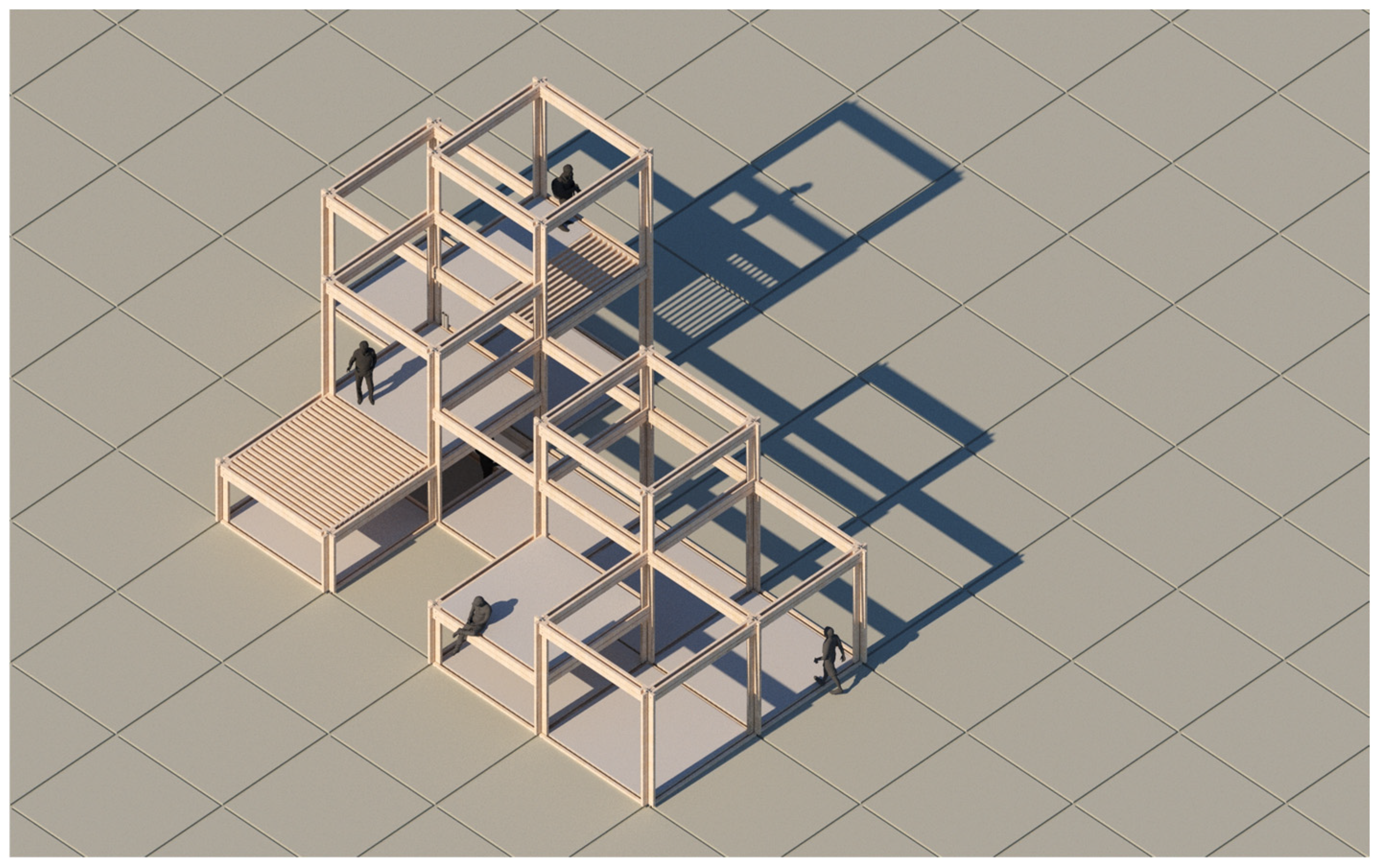
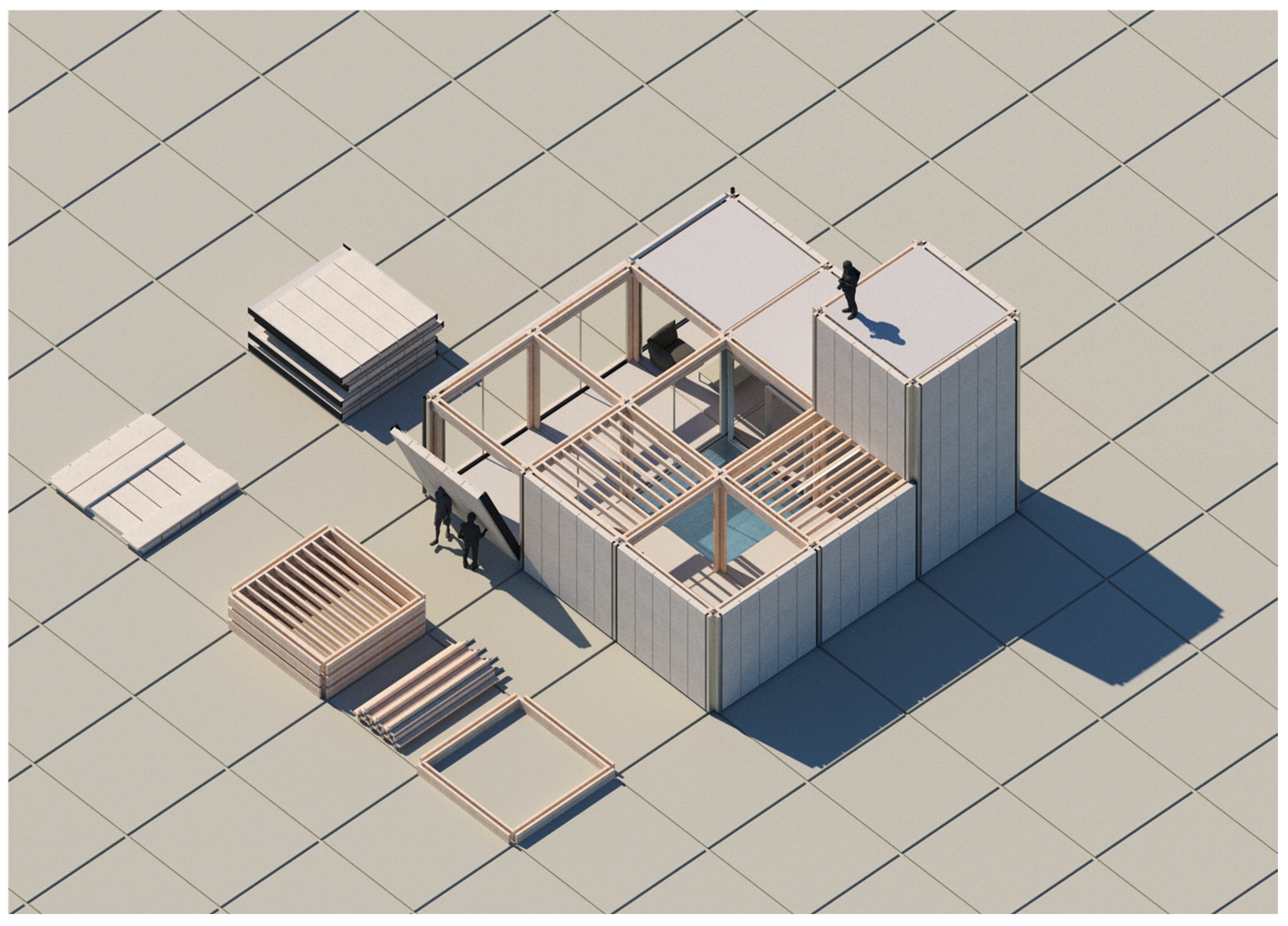
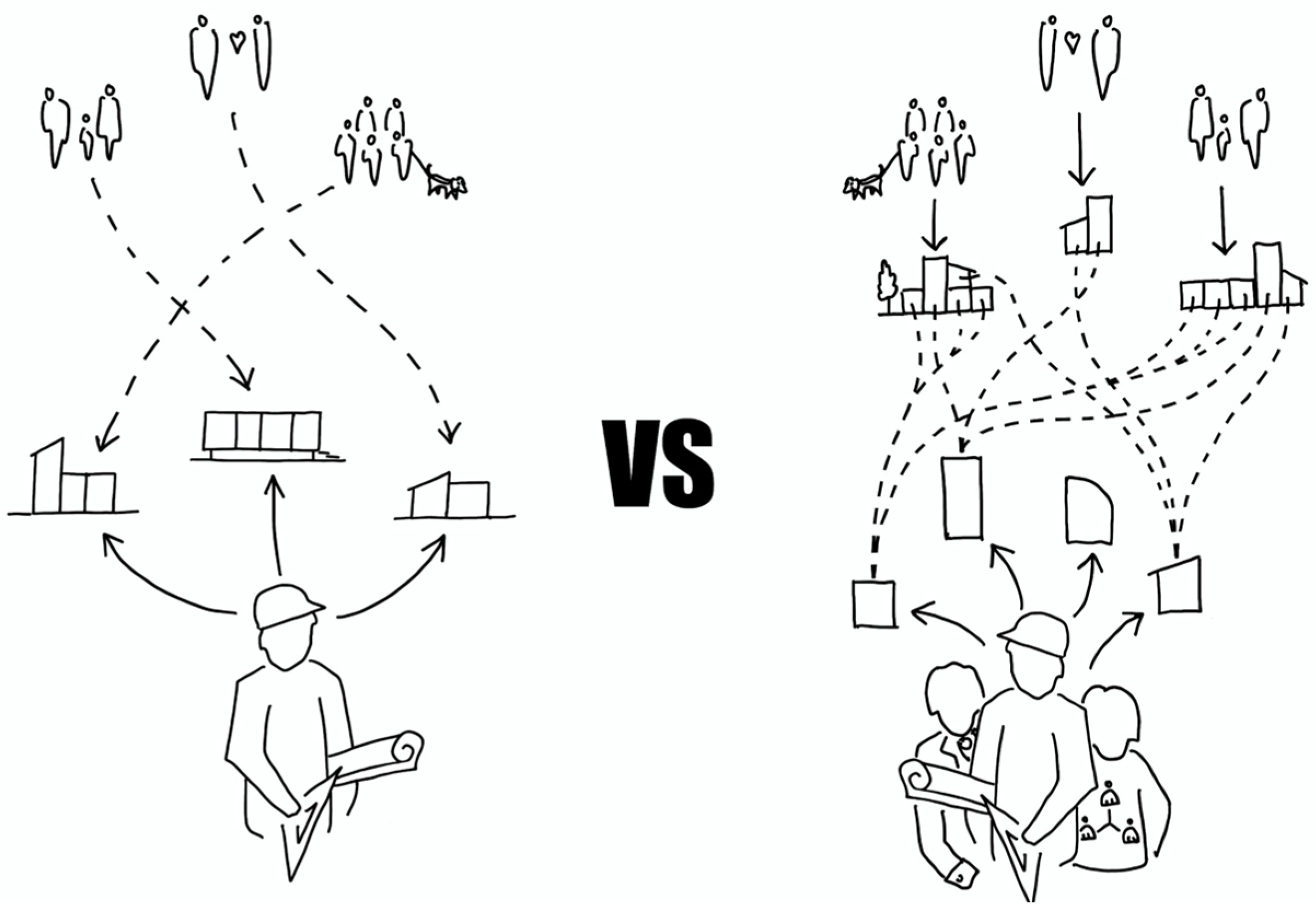
Drawing on the limitations identified in prevailing volumetric modular construction—including the logistical inefficiency of transporting large sealed units and significant design rigidity—VICHO adopts a disaggregated, component-based industrialization model (Figure 4 and Figure 5). Rather than closed volumetric units, the system is organized around three independent yet mutually compatible subsystems that enable greater architectural flexibility and simplified dry assembly:
  • Linear elements (the chassis). A catalogue of standardized beams and columns is under development to configure structures across varying spans and heights. Unlike conventional solid-timber members, these are engineered products fabricated from structural laminated poplar, hybridized with a higher-strength-class species—typically Corsican pine from Andalusia—to enhance dimensional stability and ensure more predictable structural behaviour.
  • Planar elements (the envelope). Floor slabs and walls are resolved using structural laminated poplar panels. These components perform a dual function: they support vertical loads and act as rigid diaphragms against horizontal actions such as wind or seismic loads, taking advantage of poplar’s favourable strength-to-weight ratio [11].
Connection system (the interface). Rigid and semi-rigid joints are designed to minimize reliance on complex metal connectors, prioritizing precise timber machining—through interlocking geometries and digital carpentry—combined with reversible mechanical fasteners. This is consistent with recent advances in connection design for reuse (DfR), where interlocking systems for CLT modules have been shown to enhance assembly efficiency, facilitate disassembly, and improve end-of-life material circularity [66]. More broadly, designing timber structures explicitly for disassembly is increasingly recognised as a cornerstone of 21st-century sustainable construction, enabling component recovery and value retention across multiple building life cycles [67].
All components can thus be manufactured under CNC digital control in local workshops and transported in flat-pack format, significantly improving logistical efficiency and aligning the structural system with the proximity-based strategy established in the methodological framework.

4.3.2. Material Innovation: MCLam Technology as a Hybridization Strategy

A central finding of the VICHO case study is the validation of a timber hybridization strategy specifically tailored to the mechanical profile of local poplar [68]. Prior characterization studies of poplar clones I-214 and MC reveal a modulus of elasticity (6000–7500 MPa) considerably lower than that of commonly imported conifers (The modulus of elasticity of these poplar clones is in the range of 6000–7500 MPa, compared with 11,000–12,000 MPa for C24 spruce) (11,000–12,000 MPa for C24 spruce), which constrains their exclusive use in long-span structural elements due to excessive deflection [17].
To address this limitation, the project incorporates MCLam (Mixed Cross-Laminated) technology, developed in collaboration with the Andalusian Wood Research Unit (UIMA). Drawing on composite-material design principles, this approach optimizes structural performance through strategic material placement [69]:
  • Outer layers (flanges). Corsican pine (Pinus nigra) or radiata pine, species present in Andalusian mountain ranges with good mechanical properties, are used in the outer layers, where bending stresses are highest.
  • Inner layers (web). Poplar from the Vega de Granada is used in the inner layers, taking advantage of its low density in zones where stresses are lower [14].
Finite element simulations and laboratory tests on prototype MCLam beams demonstrate that a configuration comprising approximately 60–70% poplar and 30–40% pine achieves strength and stiffness values within the performance range of a homogeneous GL24h or higher-class glulam beam, while substantially reducing self-weight. This hybridization strategy allows abundant local resources to be valorized while reserving the higher-performance material for structurally critical zones. Comparable hybridization principles applied to poplar LVL beams reinforced with carbon and basalt fibre have demonstrated analogous improvements in bending performance, confirming the structural potential of poplar when combined with higher-strength complementary materials [70].

4.3.3. Production Model: Open and Proximity-Based Industrialization

At the production level, VICHO findings point to a partial relocalization of the value chain, in contrast to the highly centralized CLT factory model dominant in Central Europe (European CLT production is largely concentrated in large industrial plants located in Austria and southern Germany, operated by groups such as KLH Massivholz, Binderholz, Stora Enso, Hasslacher Group, Mayr-Melnhof Holz, and Pfeifer Group; these highly automated, high-capacity factories supply international markets and constitute the centralized core of the CLT industrial model in Europe) [71]. The organisation of supply relies on collective forest management and certification structures, strengthening resource continuity and traceability from the territory to the final product (producer cooperatives and chain-of-custody schemes) [4,18]. Conceptually, the system follows a distributed-industry logic consistent with the principles of Industry 4.0 and Km0 circular logics in Mediterranean contexts [72]:
  • Proximity sourcing. Structural timber is drawn from the poplar plantations of the Vega de Granada, located within approximately 50 km of the planned processing centres (Láchar and Santa Fe), substantially reducing the project’s exposure to long-distance supply chains [4]. In parallel, the integration of digital tools for grading and material traceability facilitates quality control and supply-chain transparency, which are critical aspects for scaling a proximity-based industrialization model. In Granada, the MARJAL Producers’ Association coordinates the collective management of poplar groves (≈1400 ha), improving supply stability and the capacity for certification and traceability [13,73].
  • Digital fabrication. CNC machining enables production in medium-sized local workshops—modernised sawmills or industrial joinery firms—supporting skilled employment and strengthening the regional productive fabric [11].
  • Mass customization. Parametric design tools linked directly to fabrication workflows allow dwellings to be adapted to diverse requirements—size, budget, orientation—without significant cost penalties, overcoming the typological rigidity characteristic of conventional prefabrication.

4.3.4. Metric Sustainability: Decarbonization and Circular Economy

From an environmental standpoint, the VICHO system is designed to offer measurable advantages over both conventional construction and prefabrication based on imported structural timber, particularly regarding embodied carbon and circularity. Poplar’s rapid growth rate supports high atmospheric CO2 uptake during the rotation cycle, and the shift from typical international supply routes of over 2500 km to local transport distances of under 50 km can reduce stage A4 transport-related emissions by more than 90%, based on standard freight emission factors.
Consistent with New European Bauhaus principles, the system has been designed according to Design for Disassembly (DfD) criteria. The avoidance of wet joints and irreversible adhesives ensures that, at end of service life, components can be dismantled and either reused in new configurations or recycled, returning materials to technical or biological cycles without generating toxic waste. Under DfD criteria, the VICHO housing stock functions as a long-term material bank, enabling high-quality component reuse and strengthening the alignment between modular housing and circular-economy objectives [74,75]. LCA evidence from comparable CLT systems corroborates these projections: a study of hybrid CLT mid-rise construction in the US Pacific Northwest found significant reductions in global warming potential versus conventional concrete frames, attributable primarily to material substitution and biogenic carbon storage [76]. A more recent cradle-to-cradle assessment of a modular CLT residential building designed for disassembly and reuse confirmed that DfD strategies can reduce embodied carbon substantially compared with traditional wood-frame construction, validating the environmental case for reversible component-based systems [77].

5. Discussion

The VICHO project extends well beyond validating a single material; it calls for a fundamental rethinking of how housing is produced in southern Europe. By contrasting the findings presented in Section 4.1 and Section 4.2 with those of Section 4.3, three main lines of discussion emerge: (1) material sovereignty versus dependence on long-distance supply chains, (2) a renewed understanding of architectural quality aligned with the principles of the New European Bauhaus (NEB), and (3) the main obstacles to the industrial scalability of a proximity-based system.
The findings synthesized in Table 3 provide empirical evidence of a structural vulnerability in the current configuration of modular timber supply chains serving Mediterranean markets. Leading modular housing operators in the United Kingdom, France, and Italy rely predominantly on spruce-based structural systems manufactured well outside southern Spain, with supply routes frequently exceeding 1500–2000 km. As demonstrated by D’Amico and Pomponi [78], road freight of heavy timber products over such distances substantially penalizes the embodied carbon profile of the resulting building, often negating the initial environmental advantage of wood over conventional materials [3,79]. This configuration generates transport-related embodied emissions in LCA stage A4 [9,11] that sit in direct tension with the decarbonization and proximity objectives promoted by the NEB [74,80]. By explicitly mapping production locations, timber species, and indicative transport distances, this study argues that reliance on imported conifers represents not merely a logistical circumstance but a strategic vulnerability—particularly in light of supply-chain risk factors identified for modular integrated construction in recent research [81].
The VICHO system is designed to improve the carbon balance of modular housing relative to both conventional construction and long-distance timber solutions [8]. Sourcing timber from within a 50 km radius is expected to substantially reduce stage A4 transport emissions [9], while poplar’s rapid growth and high carbon sequestration capacity enhance the system’s potential as a long-term territorial carbon store [13]. Additionally, upgrading poplar to structural applications through MCLam beams and laminated panels increases the economic value of timber at source, creating incentives for local producers and helping to counteract land-use change and the progressive abandonment of poplar groves in the Vega de Granada [82].
Concerns about the structural suitability of local species are addressed by the MCLam hybridization results. The experimental and numerical analyses reported here [9,83] indicate that a structural element comprising approximately 60–70% local poplar and 30–40% pine attains strength and stiffness values within the performance range of homogeneous GL24h spruce glulam beams while reducing self-weight [84]. The transition to local poplar is therefore not speculative but a technically substantiated pathway that aligns regional industrial capacity with structural safety requirements and circular bioeconomy objectives [2,74].
From a socio-economic standpoint, the discussion of the Andalusian Urban Agenda 2030 [2] suggests that technological innovation in timber construction can act as a catalyst for regional industrial identity and territorial cohesion. While “identity” was not the primary focus of the mechanical tests, the strategic alignment between the MARJAL Producers’ Association, local sawmills and digital fabrication workshops points towards a proximity-based model that reinforces the regional productive fabric and contributes to the “inclusivity” and “closeness” pillars of the NEB [80,85]. In this sense, VICHO should not be understood solely as a construction solution, but as an instrument for activating a circular bioeconomy that links agricultural landscapes, industrial innovation and housing policy in southern Spain [82].

5.1. Convergence with the New European Bauhaus Towards an Open, Contextual Industrialization Model

Analysis of the VICHO project against the New European Bauhaus conceptual framework reveals a substantive alignment that extends beyond conventional sustainability metrics centred on energy efficiency or operational performance. VICHO explicitly integrates environmental and technical criteria with cultural, social, and territorial dimensions, engaging directly with the three core NEB values: sustainability, aesthetics, and inclusion [31].
From a sustainability standpoint, the system replaces high-carbon materials—concrete, steel, and imported structural timber—with hybrid solutions based on local poplar and proximate pine, reducing transport-related emissions and enabling the carbon cycle to be managed at a territorial scale. In addition, the adoption of Design for Disassembly (DfD) principles ensures that buildings are conceived as assemblies of reversible components, approximating the idea of a “material bank” in which structural and envelope elements can be reused or recycled without generating toxic waste at the end of their service life. In the case of poplar, this dimension includes the recovery of the poplar groves as a cultural landscape of the Vega and their translation into warmer, healthier living spaces, where materiality and territory become integral to the architectural experience [85].
Looking beyond the specific territorial context of this study, recent reviews offer a broader perspective on how modular timber systems are evolving in Europe [31]. These studies show that contemporary multi-storey modular timber buildings increasingly rely on hybrid structural strategies that combine volumetric units, panelised elements and post-and-beam frames, supported by advanced connection systems [31]. Further work highlights the potential of modular CLT solutions for rapidly deployable housing in seismic zones, emphasising the value of panelised and hybrid configurations in reducing on-site time and improve resilience [18,86]. Within a circular-economy perspective, further work underlines that volumetric modular timber buildings can significantly contribute to circular construction when standardised units and reversible joints are used to enable reuse and functional adaptability over time [32]. The VICHO framework builds on these trends while reorienting them towards proximity-based supply chains and the valorisation of underutilised local poplar resources in Mediterranean contexts.
The aesthetic dimension is approached from a cultural rather than a purely formal standpoint. The project challenges the traditional perception of poplar as a low-value timber associated with secondary uses by incorporating it visibly into the structural system and architectural language, thereby re-signifying its role in contemporary housing. This choice reconnects architecture with the agrarian landscape of the Vega de Granada and with local productive practices, strengthening the relationship between territory, identity and inhabitation in line with the NEB emphasis on beauty understood as experiential and relational quality.
On the dimension of inclusion, VICHO operates through both its production model and its spatial system. The proposed industrialization reduces construction times and improves cost predictability—two factors critical for affordable and social housing delivery under financial volatility [2,12]. Simultaneously, the open, modular character of the system allows dwellings to adapt to diverse household configurations and to evolve over time, enabling greater user participation and responding to contemporary social diversity in a manner consistent with NEB principles of accessibility and equity.
This alignment with the New European Bauhaus is further reinforced by an industrialization model that deliberately departs from dominant rigid volumetric (3D) prefabrication. Although volumetric systems offer rapid on-site assembly, they present significant limitations in Mediterranean contexts, including high logistical costs associated with transporting large volumes, the need for substantial upfront investment and limited suitability for compact, consolidated urban fabrics [87]. By contrast, the open, component-based model developed in VICHO—built around lightweight, CNC-machined poplar elements—reduces entry barriers for small and medium-sized local enterprises and enables distributed production closer to demand centers [88]. The result is a more resilient industrial ecosystem, better adapted to site-specific conditions and capable of transcending the typological rigidity and architectural monotony commonly associated with conventional prefabrication [89].
Taken together, VICHO constitutes a proposal coherent with the NEB values of sustainability, aesthetics, and inclusion, while also offering a contextualised and socially engaged industrialization model capable of addressing the environmental, productive, and housing challenges of southern Europe (Figure 6).

5.2. Challenges and Barriers to Implementation

Despite its solid theoretical and experimental foundations, VICHO’s deployment at market scale faces several barriers that merit critical acknowledgment:
  • Cultural and market barriers. Deep-seated prejudices in the construction sector regarding poplar—widely perceived as a “soft” and structurally unsuitable timber—may impede adoption [52]. Overcoming this stigma requires not only robust technical evidence, such as that provided by MCLam, but also demonstrator projects that showcase long-term performance in real housing environments.
  • Natural durability. Poplar’s low natural resistance to biological agents requires a protection-by-design approach: avoiding moisture accumulation and critical exposure conditions, supplemented by low-impact protective treatments that ensure a service life comparable to that of conventional systems.
  • Industrial scalability. Although raw material availability is not a constraint, secondary processing infrastructure in Andalusia—specifically for producing hybrid laminated beams and structural panels—remains limited [13,14,90]. Large-scale viability depends on targeted investment in automated grading, structural adhesive bonding, and CNC machining, complemented by coordinated business models capable of aggregating demand at a viable scale [91].
  • Regulatory certification. Despite recent advances in the structural grading and standardization of Spanish poplar [92], introducing new hybrid poplar–pine products to market requires European Technical Assessments and CE-marking processes that impose time and cost burdens particularly challenging for locally focused enterprises [71].
In sum, this discussion suggests that innovation in modular housing lies not solely in automation or robotics, but in the capacity to reinterpret local resources through advanced yet accessible industrial systems. Poplar from the Vega de Granada, transformed via MCLam technology and integrated into an open industrialization model, exemplifies the potential of a circular bioeconomy that links agricultural tradition with contemporary industry. Within this framework, the VICHO project illustrates that it is possible to develop affordable, high-quality housing without structurally depending on long-distance supply chains, thereby advancing towards greater material sovereignty in the architecture of southern Europe.

6. Conclusions

This article has provided a critical review of modular and industrialized timber housing in Europe and examined the potentials of a proximity-based model grounded in local poplar resources through the VICHO project framework. The state-of-the-art analysis demonstrates that, in key European markets—the United Kingdom, France, and Italy—modular housing systems remain predominantly dependent on spruce-dominated products manufactured at distances often exceeding 1500–2000 km from Mediterranean regions. As shown in Table 3, this configuration entrenches long-distance supply chains, limits the integration of nearby forest resources, and raises substantive concerns regarding transport-related embodied emissions and supply-chain resilience in southern European contexts.
Against this backdrop, the VICHO project has been examined as an embedded case study that explores an alternative, proximity-based industrialization pathway for modular housing in Spain [13,14]. The results indicate that local poplar, when combined with regional pine through hybrid MCLam technology and integrated into a component-based structural system, can meet the mechanical requirements of light modular construction while reducing self-weight and shortening supply chains. From an environmental standpoint, sourcing timber within a radius of less than 50 km and applying Design for Disassembly principles is expected to significantly improve the carbon balance of modular housing compared with conventional solutions and long-distance timber products, aligning the system with the decarbonisation and circularity objectives of the New European Bauhaus and the Andalusian Urban Agenda 2030 [2].
The VICHO framework also illustrates how modular housing can contribute to regional development by upgrading an underused resource, supporting local processing industries, and reinforcing producer organizations such as the MARJAL association [73]. Although cultural and social identity dimensions were not directly measured in this study, the alignment between local forestry, digital fabrication, and housing policy suggests that proximity-based models can meaningfully strengthen territorial cohesion and industrial fabric in Mediterranean regions, consistent with current European and regional strategies.
The study also identifies significant barriers to large-scale implementation, including persistent market prejudices concerning poplar, the need to ensure adequate durability through protection-by-design strategies, limited secondary processing infrastructure, and the costs inherent in certifying novel hybrid products. Addressing these challenges will require coordinated effort across public policy, industry, and research, alongside demonstrator projects that validate performance under real-world conditions.
Overall, the study suggests that the future of modular and industrialized housing in southern Europe lies less in replicating centralized volumetric models dependent on imported spruce, and more in developing context-specific systems that couple advanced industrialization with nearby bio-based resources. The VICHO project should be understood as an initial contribution to a broader research and innovation agenda on modular housing in local poplar timber—not as a definitive solution, but as a foundation for further work on long-term performance monitoring, life-cycle assessment, and the social reception of proximity-based timber architectures [14].

Author Contributions

Conceptualisation, M.M.-M., J.V.-M., A.M.M. and I.d.T.F.-C.; methodology, J.V.-M., M.M.-M. and R.M.-R.e.I.; formal analysis, I.d.T.F.-C., M.M.-M., R.M.-R.e.I. and J.V.-M.; investigation, J.V.-M., M.M.-M., I.d.T.F.-C., A.M.M. and R.M.-R.e.I.; resources, M.M.-M. and R.M.-R.e.I.; writing—original draft preparation, J.V.-M.; writing—review and editing, J.V.-M., A.M.M. and M.M.-M.; visualisation, I.d.T.F.-C.; supervision, M.M.-M.; project administration, M.M.-M.; funding acquisition, M.M.-M. All authors have read and agreed to the published version of the manuscript.

Funding

This research was funded by the Regional Government of Andalusia (Junta de Andalucía) under the project “DISEÑO Y DESARROLLO DE SISTEMA DE VIVIENDA MODULAR, INDUSTRIALIZADA EN SERIE, CON ESTRUCTURA DE MADERA DE CHOPO LOCAL (GRANADA)” (VICHO), grant number UGR.24-21.

Institutional Review Board Statement

Not applicable.

Informed Consent Statement

Not applicable.

Data Availability Statement

No new data were created or analyzed in this study. All data presented in the tables are derived from previously published sources and publicly available industry reports, which are cited in the reference list. Data sharing is not applicable to this article.

Acknowledgments

This research was developed within the framework of the VICHO project (UGR.24-21), led by the University of Granada and carried out at the Higher Technical School of Architecture of Granada. The authors acknowledge the institutional support of the University of Granada, as well as the scientific and technical collaboration of the Andalusian Structural Timber Research Unit (UIMA) and Iberolam Timber & Technology, whose expertise in structural timber and material testing contributed to the development of the project.

Conflicts of Interest

The authors declare no conflicts of interest.

References

  1. European Commission. A Renovation Wave for Europe—Greening Our Buildings, Creating Jobs, Improving Lives (COM/2020/662 Final); European Commission: Brussels, Belgium, 2020. [Google Scholar]
  2. Junta de Andalucía. Agenda Urbana de Andalucía 2030; Consejería de Medio Ambiente y Ordenación del Territorio: Sevilla, Spain, 2018. [Google Scholar]
  3. Andersen, C.E.; Rasmussen, F.N.; Habert, G.; Birgisdóttir, H. Embodied GHG emissions of wooden buildings—Challenges of biogenic carbon accounting in current LCA methods. Front. Built Environ. 2021, 7, 729096. [Google Scholar] [CrossRef]
  4. FSC-STD-40-004 V3-1; Chain of Custody Certification. FSC: Bonn, Germany, 2021.
  5. Interconnection Consulting. IC Market Tracking®: Prefabricated Houses in Europe 2024; Interconnection Consulting: Vienna, Austria, 2024. [Google Scholar]
  6. Budding-Polo Ballinas, M.; García Chávez, L. Linking the European Housing Demand to Sustainable Wood Construction Materials: Wooden Housing Prototype; Report/Wageningen Food & Biobased Research 2432; Wageningen Food & Biobased Research: Wageningen, The Netherlands, 2023. [Google Scholar] [CrossRef]
  7. Hemmati, M.; Messadi, T.; Gu, H. Life cycle assessment of cross-laminated timber transportation from three origin points. Sustainability 2022, 14, 336. [Google Scholar] [CrossRef]
  8. Al-Najjar, A.; Dodoo, A.; Gustavsson, L. Modular multi-storey construction with cross-laminated timber: Life cycle environmental implications. Wood Mater. Sci. Eng. 2023, 18, 525–539. [Google Scholar] [CrossRef]
  9. Peñaloza, D.; Erlandsson, M.; Falk, A. Exploring the climate impact effects of increased use of bio-based materials in buildings. Constr. Build. Mater. 2016, 125, 219–226. [Google Scholar] [CrossRef]
  10. Gallego, A.; Ripoll, M.; Timbolmas, C.; Rescalvo, F.; Suarez Vargas, E.; Valverde-Palacios, I.; Rodríguez, M.; Navarro, F.; Merlo, E. Modulus of elasticity of I-214 young poplar wood from standing trees to sawn timber: Influence of the age and stand density. Eur. J. Wood Wood Prod. 2021, 79, 1225–1239. [Google Scholar] [CrossRef]
  11. Rescalvo, F.J.; Timbolmas, C.; Bravo, R.; Gallego, A. Experimental and numerical analysis of mixed I-214 poplar/Pinus sylvestris laminated timber subjected to bending loadings. Materials 2020, 13, 3134. [Google Scholar] [CrossRef]
  12. European Commission. New European Bauhaus Investment Guidelines; European Commission & European Investment Bank: Brussels, Belgium, 2024. [Google Scholar]
  13. LIFE Wood for Future. The Project: Valorización del Chopo Local; UGR: Granada, Spain, 2025. [Google Scholar]
  14. Martínez-Monedero, M.; Gallego Molina, A.; De Teresa Fernández-Casas, I.; Rescalvo Fernández, F.J.; García Nofuentes, J.F.; Martín Martín, A. Memoria Científico-Técnica del Proyecto VICHO: Diseño y Desarrollo de Sistema de Vivienda Modular, Industrializada en Serie, con Estructura de Madera de Chopo Local (Granada); Unpublished Technical Report; Universidad de Granada: Granada, Spain, 2025. [Google Scholar]
  15. Aedas Homes. Resultados Anuales 2024–2025 y Balance de Industrialización; Aedas Homes: Madrid, Spain, 2024. [Google Scholar]
  16. Arquima. Memoria de Sostenibilidad y Sistema Constructivo SEA; Arquima: Barcelona, Spain, 2024. [Google Scholar]
  17. Baño, V.; Godoy, D.; Figueredo, D.; Vega, A. Characterization and structural performance in bending of CLT panels made from small-diameter logs of loblolly/slash pine. Materials 2018, 11, 2436. [Google Scholar] [CrossRef]
  18. Bhandari, S.; Riggio, M.; Jahedi, S.; Fischer, E.C.; Luo, Z. A review of modular cross laminated timber construction: Implications for design. J. Build. Eng. 2023, 63, 105485. [Google Scholar] [CrossRef]
  19. Make UK Modular; Savills. The Modular Housing Report: Cost, Capacity and Future Projections; Savills: London, UK, 2024. [Google Scholar]
  20. ACIM. Rapport D’activité et Statistiques du Marché Français de la Construction Modulaire; ACIM: Paris, France, 2025. [Google Scholar]
  21. Bundesverband Deutscher Fertigbau (BDF). Pressemitteilungen: Fertighausanteil zum Halbjahr 2025 auf Rekordkurs; BDF: Bad Honnef, Germany, 2024. [Google Scholar]
  22. Make UK Modular. Green Shoots: The Impact of the Modular Sector; Make UK: London, UK, 2024. [Google Scholar]
  23. TMF (Trä- och Möbelföretagen). Trähusbarometern 2024: Market Statistics for the Swedish Wood Housing Industry; TMF: Stockholm, Sweden, 2024. [Google Scholar]
  24. Svatoš-Ražnjević, H.; Orozco, L.; Menges, A. Advanced Timber Construction Industry: A Review of 350 Multi-Storey Timber Projects from 2000–2021. Buildings 2022, 12, 404. [Google Scholar] [CrossRef]
  25. Wu, X.; Shen, G.Q.; Teng, Y.; Jiang, R. Comparative cradle to end-of-use embodied carbon analysis of high-rise concrete buildings using volumetric modular and panelized construction. J. Build. Eng. 2025, 100, 111736. [Google Scholar] [CrossRef]
  26. Plataforma para la Industrialización de Viviendas (PIV). Informe del Estado de la Construcción Industrializada en España; Fundación Laboral de la Construcción: Madrid, Spain, 2024. [Google Scholar]
  27. Wolf System. Technical Specifications and Corporate Sustainability Report; Wolf System: Bolzano, Italy, 2023. [Google Scholar]
  28. KLH Massivholz GmbH. KLH® Cross-Laminated Timber (CLT) Wiesenau—Environmental Product Declaration, EPD-IES-0027209:001; The International EPD® System: Stockholm, Sweden, 2026; Available online: https://environdec.com/library/epd27209 (accessed on 17 March 2026).
  29. Skullestad, J.L.; Bohne, R.A.; Lohne, J. High-rise timber buildings as a climate change mitigation strategy—A comparative LCA of structural systems. Energy Procedia 2016, 96, 112–123. [Google Scholar] [CrossRef]
  30. Huß, W.; Kaufmann, M.; Merz, K. Building in timber—Room modules. In Manual of Multi-Storey Timber Construction; Kaufmann, M., Krötsch, S., Winter, S., Eds.; DETAIL: Munich, Germany, 2019; pp. 216–235. [Google Scholar] [CrossRef]
  31. Tenório, M.; Ferreira, R.; Belafonte, V.; Sousa, F.; Meireis, C.; Fontes, M.; Vale, I.; Gomes, A.; Alves, R.; Silva, S.M.; et al. Contemporary Strategies for the Structural Design of Multi-Story Modular Timber Buildings: A Comprehensive Review. Appl. Sci. 2024, 14, 3194. [Google Scholar] [CrossRef]
  32. Haigh, R.; Li, L. Decade Review of Modular Construction Systems in the Building and Construction Industry: Research Trends toward the Development and Utilisation of Timber Materials within the Context of a Circular Economy. Wood Mater. Sci. Eng. 2026, 1–20. [Google Scholar] [CrossRef]
  33. Casas inHAUS. Available online: https://www.casasinhaus.com/ (accessed on 6 January 2026).
  34. Casas Cube. Available online: https://www.casasprefabricadascube.com/ (accessed on 6 January 2026).
  35. DFH Deutsche Fertighaus Holding. Available online: https://www.dfh-gruppe.de/ (accessed on 6 January 2026).
  36. SchwörerHaus. Available online: https://www.schwoererhaus.de/ (accessed on 6 January 2026).
  37. WeberHaus. Available online: https://www.weberhaus.de/ (accessed on 6 January 2026).
  38. KLEUSBERG. Available online: https://www.kleusberg.de/ (accessed on 6 January 2026).
  39. Lindbäcks Bygg. Available online: https://www.lindbacks.se/ (accessed on 6 January 2026).
  40. BoKlok. Available online: https://www.boklok.com/ (accessed on 6 January 2026).
  41. Ilke Homes. Available online: https://ilkehomes.co.uk/ (accessed on 6 January 2026).
  42. TopHat. Available online: https://tophat.io/ (accessed on 6 January 2026).
  43. Ossabois. Available online: https://www.ossabois.fr/ (accessed on 6 January 2026).
  44. Woodeum. Available online: https://www.altarea.com/marques/cogedim/ (accessed on 6 January 2026).
  45. Rubner Haus. Available online: https://www.rubner.com/en/haus/ (accessed on 6 January 2026).
  46. Casa Attiva. Available online: https://www.casaattiva.it/ (accessed on 6 January 2026).
  47. Finch Buildings. Available online: https://finchbuildings.com/ (accessed on 6 January 2026).
  48. Goldbeck GmbH. Annual Report 2023/24: A Positive Outlook in Challenging Times; Goldbeck: Bielefeld, Germany, 2024. [Google Scholar]
  49. Spherical Insights. Europe Prefabricated Housing Market Size, Share, and Forecast to 2033; Spherical Insights: Pune, India, 2024. [Google Scholar]
  50. AEDAS Homes. Available online: https://www.aedashomes.com/ (accessed on 6 January 2026).
  51. Gutiérrez, N.; Negrão, J.; Dias, A.; Guindos, P. Bibliometric review of prefabricated and modular timber construction from 1990 to 2023: Evolution, trends, and current challenges. Sustainability 2024, 16, 2134. [Google Scholar] [CrossRef]
  52. Hemström, K.; Mahapatra, K.; Gustavsson, L. Perceptions, attitudes and interest of Swedish architects towards the use of wood frames in multi-storey buildings. Resour. Conserv. Recycl. 2011, 55, 1013–1021. [Google Scholar] [CrossRef]
  53. Skanska AB. Annual and Sustainability Report 2023: Interim Report Q4 2024; Skanska AB: Stockholm, Sweden, 2024. [Google Scholar]
  54. Goldbeck GmbH. Available online: https://www.goldbeck.de/ (accessed on 6 January 2026).
  55. Reds10. Available online: https://reds10.com/ (accessed on 6 January 2026).
  56. Sánchez González, J.C. Construcción Modular Ligera Energéticamente Eficiente. Ph.D. Thesis, Universidad Politécnica de Madrid, Madrid, Spain, 2016. Available online: https://oa.upm.es/40342/1/JUAN_CARLOS_SANCHEZ_GONZALEZ.pdf (accessed on 22 May 2024).
  57. Lignum Tech. Available online: https://lignumtech.es/ (accessed on 6 January 2026).
  58. Porcelanosa Offsite (Butech). Available online: https://www.porcelanosa.com/porcelanosa-offsite/ (accessed on 6 January 2026).
  59. Room2030. Available online: https://www.room2030.com/ (accessed on 6 January 2026).
  60. Unihouse (Unibep Group). Available online: https://unihouse.pl/ (accessed on 6 January 2026).
  61. Cougnaud. Available online: https://www.cougnaud.com/ (accessed on 6 January 2026).
  62. VDL De Meeuw. Available online: https://www.vdldemeeuw.com/ (accessed on 6 January 2026).
  63. Daiwa House Modular Europe. Available online: https://daiwahousemodular.eu/ (accessed on 6 January 2026).
  64. Ghobadi, M.; Sepasgozar, S.M.E. Circular economy strategies in modern timber construction as a potential response to climate change. J. Build. Eng. 2023, 77, 107229. [Google Scholar] [CrossRef]
  65. Hussein, M.; Eltoukhy, A.E.E.; Karam, A.; Shaban, I.A.; Zayed, T. Modelling in off-site construction supply chain management: A review and future directions for sustainable modular integrated construction. J. Clean. Prod. 2021, 310, 127503. [Google Scholar] [CrossRef]
  66. Li, Z.; Tsavdaridis, K.D.; Katenbayeva, A. Reusable timber modular buildings, material circularity and automation: The role of inter-locking connections. J. Build. Eng. 2024, 98, 110965. [Google Scholar] [CrossRef]
  67. Mañes-Navarrete, D.; Redón-Santafé, M.; Paya-Zaforteza, I. Timber structures designed for disassembly: A cornerstone for sustainability in 21st century construction. J. Build. Eng. 2024, 96, 110619. [Google Scholar] [CrossRef]
  68. Vergara-Muñoz, J.; Martínez-Monedero, M.; Martín Martín, A.; López Berenguer, R.; Sánchez Samos, M.; De Teresa Fernández-Casas, J.I. Project Vega-Chopera: A constructive-structural system based on poplar wood. VLC Arquit. 2025, 12, 203–228. [Google Scholar] [CrossRef]
  69. Hematabadi, H.; Madhoushi, M.; Khazaeyan, A.; Ebrahimi, G.; Hindman, D.; Loferski, J. Bending and shear properties of cross-laminated timber panels made of poplar (Populus alba). Constr. Build. Mater. 2020, 265, 120326. [Google Scholar] [CrossRef]
  70. Rescalvo, F.J.; Duriot, R.; Pot, G.; Gallego, A.; Denaud, L. Enhancement of bending properties of Douglas-fir and poplar laminate veneer lumber (LVL) beams with carbon and basalt fibers reinforcement. Constr. Build. Mater. 2020, 263, 120185. [Google Scholar] [CrossRef]
  71. EN 1912:2024; Structural Timber—Strength Classes—Assignment of Visual Grades and Species. CEN: Brussels, Belgium, 2024.
  72. Domingo-Calabuig, D.; Rivera-Linares, J.; Lizondo-Sevilla, L.; Alapont-Ramón, J.L. Design strategies for circularity: Km0 architecture in the Spanish Mediterranean. Open House Int. 2024, 49, 927–942. [Google Scholar] [CrossRef]
  73. Agrupación de Productores Marjal Chopo de Granada. Chopo Granada. Available online: https://chopomarjal.es/ (accessed on 19 March 2026).
  74. Sáez-de-Guinoa, A.; Zambrana-Vasquez, D.; Fernández, V.; Bartolomé, C. Circular economy in the European construction sector: A review of strategies for implementation in building renovation. Energies 2022, 15, 4747. [Google Scholar] [CrossRef]
  75. Zhan, H.; Hwang, B.G.; Jovan, L. Barriers and strategies in implementing design for disassembly and adaptability principles in Singapore: A pathway to circular economy in the construction industry. Sustain. Dev. 2024, 33, 3858–3878. [Google Scholar] [CrossRef]
  76. Pierobon, F.; Huang, M.; Simonen, K.; Ganguly, I. Environmental benefits of using hybrid CLT structure in midrise non-residential construction: An LCA based comparative case study in the U.S. Pacific Northwest. J. Build. Eng. 2019, 26, 100862. [Google Scholar] [CrossRef]
  77. McCord, K.H.; Dillon, H.E.; Hu, A.; Carlson, S.; Phillips, A.R.; Jung, Y.J.; Gunderson, P.; Tarufelli, B.; Antonopoulos, C.A. Comparative life cycle assessment of a modular cross-laminated timber residential building designed for disassembly and reuse versus traditional wood frame construction. J. Clean. Prod. 2025, 528, 146541. [Google Scholar] [CrossRef]
  78. D’Amico, B.; Pomponi, F.; Hart, J. Global potential for material substitution in building construction: The case of cross laminated timber. J. Clean. Prod. 2021, 279, 123487. [Google Scholar] [CrossRef]
  79. Hart, J.; D’Amico, B.; Pomponi, F. Whole-life embodied carbon in multistorey buildings: Steel, concrete and timber structures. J. Ind. Ecol. 2021, 25, 403–418. [Google Scholar] [CrossRef]
  80. Rosado-García, M.J.; Kubus, R.; Argüelles-Bustillo, R.; García-García, M. A New European Bauhaus for a culture of transversality and sustainability. Sustainability 2021, 13, 11844. [Google Scholar] [CrossRef]
  81. Arshad, H.; Zayed, T. Critical Influencing Factors of Supply Chain Management for Modular Integrated Construction. Autom. Constr. 2022, 144, 104612. [Google Scholar] [CrossRef]
  82. Weiss, G.; Ludvig, A.; Živojinović, I. Four decades of innovation research in forestry and the forest-based industries—A systematic literature review. For. Policy Econ. 2020, 120, 102288. [Google Scholar] [CrossRef]
  83. Fuentes García, Y. Caracterización Mecánica de Clones de Chopo MC y Luisa Avanzo y su Viabilidad para Laminados Estructurales. Master’s Thesis, Universidad de Granada, Granada, Spain, 2025. Available online: https://hdl.handle.net/10481/103197 (accessed on 22 May 2024).
  84. Sedlar, T.; Ištok, I.; Orešković, G.; Stojnić, S.; Goršić, E.; Šefc, B. Physical properties of wood in white poplar clone “L-12” grown in Republic of Croatia and Serbia. Topola 2019, 203, 45–51. [Google Scholar]
  85. Johansson, M. Circular tectonics, users and local culture. In Architectural Research Addressing World Challenges; Manuel, J., Ed.; CRC Press: Boca Raton, FL, USA, 2017; pp. 113–118. [Google Scholar] [CrossRef]
  86. Brandner, R.; Flatscher, G.; Ringhofer, A.; Schickhofer, G.; Thiel, A. Cross Laminated Timber (CLT): Overview and Development. Eur. J. Wood Wood Prod. 2016, 74, 331–351. [Google Scholar] [CrossRef]
  87. Trębacz, P. Implementation of New European Bauhaus ideas in a housing environment on the example of a refugee settlement concept in Lviv. Sr. Mieszk. Hous. Environ. 2024, 49, 139–151. [Google Scholar] [CrossRef]
  88. Wierzbicka, A.M.; Trębacz, P.; Jóźwik, R.; Duda, M. The conceptualization of a modular residential settlement project emerging in a displacement situation due to war in the context of sustainable development requirements. Sustainability 2024, 16, 5971. [Google Scholar] [CrossRef]
  89. Moncaster, A.; Malmqvist, T.; Forman, T.; Pomponi, F.; Anderson, J. Embodied carbon of concrete in buildings, Part 2: Are the messages accurate? Build. Cities 2022, 3, 334–355. [Google Scholar] [CrossRef]
  90. Ministerio de Transportes, Movilidad y Agenda Urbana. Estrategia a Largo Plazo para la Rehabilitación Energética en el Sector de la Edificación en España (ERESEE 2020); Gobierno de España: Madrid, Spain, 2020. [Google Scholar]
  91. McKinsey & Company. Modular Construction: From Projects to Products; Capital Projects & Infrastructure: New York, NY, USA, 2019. [Google Scholar]
  92. Goulding, J.S.; Arif, M. Off-Site Production and Manufacturing for Innovative Construction; Routledge: London, UK, 2013. [Google Scholar]

Figure 1. Poplar plantations in Granada.
Sustainability 18 03875 g001
Figure 2. Process diagram.
Sustainability 18 03875 g002
Figure 3. Poplar whips extracted from a nursery to be planted and grown into mature trees.
Sustainability 18 03875 g003
Figure 4. Axonometric view of the VICHO structural system, composed of prefabricated linear elements (beams and columns) and planar elements (floor slabs).
Sustainability 18 03875 g004
Figure 5. Axonometric view of the assembly of planar enclosure elements onto the timber structural frame.
Sustainability 18 03875 g005
Figure 6. Comparative diagram of traditional production of bespoke or hard-to-replicate housing models.
Sustainability 18 03875 g006
Table 1. Evolution of the market share of industrialized housing in Europe (2015–2024).
Country20152019202120232024Trend and ObservationsSource
Sweden85%90%88%85%80–85%Market saturation and sharp correction due to the decline in first-home demandTMF
Germany17%20.8%23.1%25.2%26.2%Structural growth and resilience in the face of the general housing crisis (“safe haven”)BDF
United Kingdom5–7%8–10%10–12%8–10%<10%Stagnation and correction following the collapse of major volumetric construction manufacturersMake UK/Savills
France3–4%5–6%6–7%7–8%8–9%Growth driven by the RE2020 environmental regulationACIM/Market studies
Spain<1%1.2%1.5%2%2–3%Accelerated growth from a low baseline, driven by large developersSector platforms
Source: Based on data from BDF (Germany), TMF (Sweden), Make UK (UK), and the Platform for Industrialization (Spain) [19,21,22,23].
Table 2. Estimated costs of industrialized housing in Europe (2024).
Country/RegionPrice Range (€/m2)Dominant Product TypeNotes on PriceSource
Switzerland/Luxembourg>3000–4500 €Premium timber panelizedExtremely high labor and transport costsInterconnection
Germany2500–3200 €Schlüsselfertig (turnkey)Includes high energy standards (QNG/KfW 40). Does not include complex foundations or landHanse Haus/BDF
United Kingdom2000–3300 €Volumetric/hybrid modularEquivalent to £1700–£2800/m2. Similar to conventional constructionCheckatrade/Studies
Sweden2200–2800 €Timber panelizedHighly efficient, but affected by material inflation in 2022–2023TMF/Analysts
France1800–2500 €Concrete/steel modularImpacted by RE2020 regulation, which increases the cost of high-carbon materialsSpherical Insights/ACIM
Spain1600–2300 €Industrialized concrete/timberCompetitive compared with conventional construction (~2250 €/m2). Upper mid-range segmentInarquia/Modular Home
Poland/Lithuania1200–1800 €Timber panelized (export)Lower production costs. Highly competitive “ex-works” (factory gate) prices.Namuku
Source: Based on Strategic Research Report [26]. Prices refer to construction costs only (housing delivered ex-factory or assembled on site, excluding land).
Table 3. Main characteristics of selected European modular timber housing systems and their reliance on distant versus local timber resources (The logistics data and material provenance summarized in Table 3 are derived from official Environmental Product Declarations (EPD) [16,19,20,27,28]. These sources confirm the prevalence of Central European spruce (Picea abies) as the primary structural resource for the analyzed industrial groups).
CountryCompany/SystemMain Structural System (2D/3D/Hybrid)Predominant Structural Timber ProductProduction Location of Main ProductApprox. Transport Distance to S. Spain (km Range)Availability of Comparable Local Timber Resource
AustriaKLH Massivholz2D panelisedSpruce CLTAustria (Styria/Carinthia)2000–2500 kmLimited (structural spruce mostly imported)
United KingdomTopHat3D volumetricSpruce/Pine light timber frame & CLTUnited Kingdom (Derbyshire)2000–2500 kmYes—regional softwoods
FranceOssaboisHybrid (2D/3D)Spruce/Fir timber frame & CLTFrance (Auvergne-Rhône-Alpes/Vosges)1200–1600 kmYes—regional softwoods
ItalyWolf Haus2D panelisedSpruce timber frame & GlulamItaly (South Tyrol)1800–2200 kmLimited (structural spruce mostly imported)
SpainArquima2D panelisedSawn Spruce/Light timber frameSpain (Catalonia)700–900 kmYes—regional softwoods
SpainVICHO (concept)2D component-basedPoplar-pine MCLam, laminated poplarLocal (Vega de Granada, Andalusia)<50 kmYes (local poplar plantations)
Table 4. Representative modular housing companies in Europe: classification by production typology. (The companies listed in Table 4 were selected through purposive sampling based on: (i) their relevance in their respective national markets; (ii) their representativeness of the main production typologies (3D volumetric, 2D panelized, and hybrid); and (iii) the availability of sufficient public information. The table is descriptive and not exhaustive.)
Country/RegionCompanyConstruction SystemMain Structural MaterialDegree of IndustrializationIndustrial Integration ModelSource
SpainCasas inHAUS [33]VolumetricIndustrialized concreteHighVertical integrationhttps://www.casasinhaus.com/ (accessed on 6 January 2026).
Casas Cube [34] VolumetricIndustrialized concreteMedium–highPartial integrationhttps://www.casasprefabricadascube.com/ (accessed on 6 January 2026).
GermanyDFH [35] (Deutsche Fertighaus Holding)PanelizedTimberHighVertical integrationhttps://www.dfh-gruppe.de/ (accessed on 6 January 2026).
SchwörerHausPanelized [36]Local timberHighVertical integrationhttps://www.schwoererhaus.de/ (accessed on 6 January 2026).
WeberHaus [37]PanelizedStructural timberHighVertical integrationhttps://www.weberhaus.de/ (accessed on 6 January 2026).
KLEUSBERG [38]Volumetric/hybridTimber/mixedHighVertical integrationhttps://www.kleusberg.de/ (accessed on 6 January 2026).
SwedenLindbäcks Bygg [39]VolumetricTimberHighVertical integrationhttps://www.lindbacks.se/ (accessed on 6 January 2026).
BoKlok [40]PanelizedTimberMedium–highVertical integrationhttps://www.boklok.com/ (accessed on 6 January 2026).
United KingdomIlke Homes [41]VolumetricSteel/mixedHighVertical integrationhttps://ilkehomes.co.uk/ (accessed on 6 January 2026).
TopHat [42]VolumetricSteel/timberHighVertical integrationhttps://tophat.io/ (accessed on 6 January 2026).
FranceOssabois [43]PanelizedTimberHighVertical integrationhttps://www.ossabois.fr/ (accessed on 6 January 2026).
Woodeum [44]HybridEngineered timberMedium–highPartial integrationhttps://www.woodeum.com/ (accessed on 6 January 2026).
ItalyRubner Haus [45]PanelizedTimber (CLT)HighVertical integrationhttps://www.rubner.com/en/haus/ (accessed on 6 January 2026).
Casa Attiva [46]PanelizedTimberMediumPartial integrationhttps://www.casaattiva.it/ (accessed on 6 January 2026).
NetherlandsFinch Buildings [47]Volumetric/hybridTimberMedium–highPartial integrationhttps://finchbuildings.com/ (accessed on 6 January 2026).
Source: Based on a review of sectoral reports, specialized technical literature, and publicly available information from the official corporate websites of the companies listed. The table is descriptive and not exhaustive.
Disclaimer/Publisher’s Note: The statements, opinions and data contained in all publications are solely those of the individual author(s) and contributor(s) and not of MDPI and/or the editor(s). MDPI and/or the editor(s) disclaim responsibility for any injury to people or property resulting from any ideas, methods, instructions or products referred to in the content.