Article

Quality of the Amazon Açaí Waste Stored Under Different Conditions over Time for Pyrolysis and Combustion Aimed at Bioenergy Recovery Systems


by
Thayane Duarte Costa
1,
Fernanda Yukari de Souza Sakuma
1,
Juliana Livian Lima de Abreu dos Santos
2,
Thiago de Paula Protásio
3,
Michael Douglas Roque Lima
4,
Mario Vanoli Scatolino
5,
Lourival Marin Mendes
3,
Eunice Gonçalves Macedo
6,
Tiago Marcolino de Souza
7,
Breno Marques da Silva e Silva
5 and
Lina Bufalino
1,*
1
Institute of Agricultural Sciences, Federal Rural University of Amazonia–UFRA, Belém 66077-901, PA, Brazil
2
Forest Engineering Faculty, Federal University of Pará–UFPA, Altamira 68440-000, PA, Brazil
3
Department of Forest Sciences, Federal University of Lavras-UFLA, Lavras 37203-202, MG, Brazil
4
Agricultural Sciences Center, State University of the Tocantina Region of Maranhão-UEMASUL, Imperatriz 65900-001, MA, Brazil
5
Forest Engineering School, State University of Amapá-UEAP, Macapá 68900-030, AP, Brazil
6
Wood Technology Department, University of Pará State–UEPA, Belém 66050-540, PA, Brazil
7
Chemical Engineering School, State University of Amapá State–UEAP, Macapá 68900-070, AP, Brazil
*
Author to whom correspondence should be addressed.
Sustainability 2026, 18(8), 3730; https://doi.org/10.3390/su18083730
Submission received: 27 February 2026 / Revised: 2 April 2026 / Accepted: 2 April 2026 / Published: 9 April 2026

Abstract

The Amazonian açaí waste is promising for producing charcoal through pyrolysis and bioenergy through combustion, but the property losses from its poor disposal in the environment remain unknown. Therefore, this work aimed to analyze how different storage conditions of the açaí waste over time, which mimic the reality throughout the Amazon, modify its bioenergetic properties. The samples were stored in a covered greenhouse for nine months in the following conditions: immersed in water, on the soil, and in open plastic bags. The biomass was analyzed by Fourier-transformed near-infrared spectroscopy, physical properties, stereomicroscopy, proximate composition, and thermogravimetry. The degraded waste showed endocarp attack and fungi proliferation. The chemical groups of primary cell wall components were concentrated, unlike water-soluble materials, raising the fixed carbon from 22% to 25% after 30 days. Consequently, higher heating values were kept (≈19 MJ/kg). However, water immersion storage sharply decreased the waste basic density from 0.81 g/cm3 to 0.56 g/cm3, dropping the energy density from 12 GJ/m3 to 8 GJ/m3. Moreover, storage raised ash content from 1.1% up to 1.9%. The storage hindered the start of the main phases of combustion and pyrolysis, which were later intensified, especially for soil-stored waste. Therefore, more stable combustion and pyrolysis require fresh waste. Besides natural drying, plastic bag storage over time kept the waste quality closer to that of the fresh waste.

1. Introduction

The growing demand for açaí fruit pulp has contributed significantly to the agro-industrial development of the Amazon region, going from R$ 2,603,349.00 in 2018 to 7,770,712.00 in 2024, with a production of 1,741,775.00 t in the latter year [1]. However, this progress is followed by an increase in the generation of post-processing waste, which is inappropriately discarded in the environment, causing pollution problems in natural and urban landscapes instead of being reused or recycled [2].
Such concerns have stimulated new studies for the appropriate use of açaí waste, such as açaí fiber-reinforced polymeric composites [3] and the reinforcement of mortars [4]. In addition to bioproducts, the sustainable bioenergetic use of açaí waste is supported by its wide availability and high energy density [5,6]. This non-wood raw material is promising to produce clean energy, creating an alternative source of income, and contributing to the local economy [7]. Açaí fruit mass mainly consist of waste (71–91%) comprising an inner seed covered by lignocellulosic fibers, with an average basic density varying from 0.753 g/cm3 to 0.812 g/cm3 [6]. The waste has a high moisture content (66.6% and 76.2%) but reaches 10% to 21% when room-dried at 30 °C [6,8]. Its extractive content of 10.7%, lignin content of 22.6%, and low ash content of 1.4% qualifies açaí waste for combustion and pyrolysis, resulting in an energy density of 6.94 GJ/m3 [5]. The proximate composition of the waste was 88% to 91% of volatile materials, 1.3% to 2.9% of ash, and 6% to 10% of fixed carbon [8].
Despite the promising technological properties, there are serious socioeconomic difficulties in promoting the adequate use of açaí waste in Amazonian cities. A survey of workers in the açaí markets in the Amazonian city Belém revealed that only 46.25% of them knew about its socio-environmental management and socio-environmental impact. Most workers claimed that the obligation to dispose of açaí waste correctly lies with the city hall and that, currently, the waste is inappropriately sent to landfills [9].
Thus, dumping and storing açaí waste for long periods in open fields is a common practice, which can unpredictably change its physical and chemical properties. When stored, biomass undergoes beneficial and detrimental changes in its properties. For instance, wood from the Caatinga biome stored for 15 days showed improved energy quality [10]. On the other hand, commercial charcoal derived from wood showed the depreciation of bioenergetic attributes with storage, including decreased contents of volatile materials and fixed carbon and increased ash content [11]. Therefore, it is necessary to analyze whether açaí waste maintains the minimum favorable properties to produce bioenergy after storage or whether it should be used immediately after its generation. There is only one work in the literature related to the storage of this waste but without controlling for the environment and time [12].
If losses of bioenergy potential of açaí waste were avoided in both forest-living and urban environments, it could contribute enormously to the improvement of energy supply throughout the Amazon. The uniqueness of the region concerning the topography, dense rainforest, and large rivers challenges the efficiency of the National Interconnected System in reaching remote, sparsely populated areas demanding low amounts of energy [13]. Consequently, such communities have no or sporadic access to energy and often rely on diesel-supplied generators for electricity [14]. Replacing the most used fossil fuels with local biomass in such isolated systems is a greener alternative towards net-zero emissions by 2050 [13]. Moreover, the industrial utilization of açaí waste as an energy source is already in practice in Pará state, the world’s largest açaí producer.
In this work, it is hypothesized that, depending on the environment, the waste moisture content is beneficially reduced by natural drying, while its morphological, chemical, and physical properties can be adversely or beneficially altered by natural degradation. Therefore, this work aimed to analyze how different storage conditions of the açaí waste over time, which mimic the reality throughout the Amazon, modify its bioenergetic properties.

2. Materials and Methods

2.1. Collection and Storage of Material

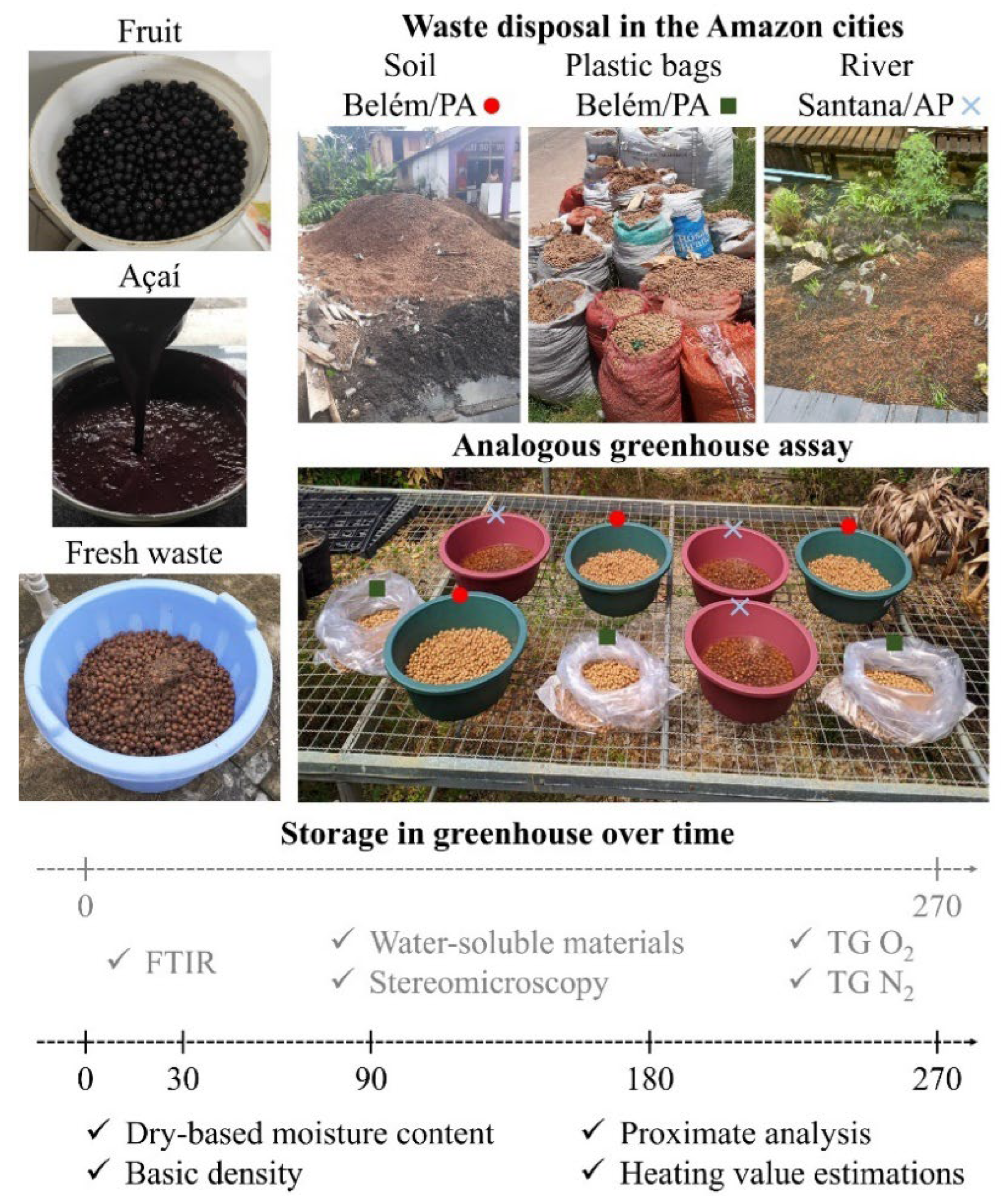
Approximately 20 kg of freshly processed waste was collected from an açaí seller located in the city of Belém-PA, Brazil. The waste was washed under running water to remove residual fruit pulp. The material was stored in three different conditions: immersed in 3 L of deionized water in basins, on 1.69 kg of soil in basins, and in open transparent plastic bags with a 30.0 kg capacity. For each condition, three replications were prepared containing 1.60 kg of waste each, stored in a natural climatized greenhouse covered with transparent plastic for nine months (July 2020 to April 2021), during which the average temperature was 29.7 °C and the relative humidity was 82.7%. The conditions corresponded to practical ways the açaí waste is disposed of or stored in Amazon cities.
The physical properties (density and dry mass-based moisture content) and bioenergetic properties (proximate composition, higher heating value, and energy density) were determined on day 0 (zero) with the fresh waste and after 30, 90, 180, and 270 days of storage. The remaining analyses were carried out with the fresh waste and at the end of the assay, i.e., after 270 days of storage (Figure 1). The waste stored on the soil was brushed to remove excess dirt before analysis.

2.2. Waste Characterization by Fourier Transform Infrared Spectroscopy (FTIR)

The samples were previously dried at 50 °C in an oven for about 24 h and incorporated into KBr in a 1:100 (m:m) ratio by crushing, homogenization, and compaction. The analyses were performed on a Spectrometer model 1000 (Perkim Elmer®, Wellesley, MA, USA). Spectra were obtained using 32 scans per sample between 400 and 4.000 cm−1 and a resolution of 2 cm−1.

2.3. Level of Water-Soluble Materials

The açaí wastes were crushed in an A1 Basic analytical mill (Ika®, Staufen, Germany) and sieved to select the fractions retained between 40 mesh (0.420 mm) and 60 mesh (0.250 mm). The content of materials soluble in hot and cold water was determined following the NBR 14577 standard from the Brazilian National Standards Organization (ABNT) [15], tested in triplicate. Extraction in cold water was carried out with static immersion for 48 h and later transferred to n° 2 porous crucible for filtering. The hot water extraction was carried out with continuous washing with boiling water and filtering for 3 h in n° 2 filter crucibles. An analytical balance with a precision of 0.001 g was used for the analysis.

2.4. Dry Mass-Based Moisture Content

The moisture content was determined following ABNT NBR 14929 [16] after seed washing. Ten waste units of each batch, from each storage condition and time, were randomly selected, totaling 30 replicates for each treatment per time. The samples were weighed on a semi-analytical balance with an accuracy of 0.01 g to obtain the wet mass and then dried in an oven at a temperature of 100 ± 5 °C until completely dry. Moisture content was calculated based on the dried mass.

2.5. Basic Density of the Wastes

Ten waste units for each batch from each storage condition and time were randomly selected, totaling 30 replicates for each treatment per time. The samples were immersed in deionized water for eight days until complete saturation. Then, the saturated volume of the seeds was determined by water displacement, using the Archimedes principle in a semi-analytical balance with an accuracy of 0.01 g. The seeds were then dried in an oven at 100 ± 5 °C until they reached 0% moisture content and weighed with a precision of 0.001 g. The determination of the basic density was carried out by dividing the completely dried mass by the saturated volume according to ABNT NBR 11941 [17].

2.6. Stereomicroscopy of the Açaí Seed Waste Endosperm

For each treatment (fresh waste and 270 days after storage), 50 units of waste (berries) were randomly selected at different levels of degradation with visually observable characteristics. The selected samples were cut in half with a scalpel to observe the seed endosperm. The selected seeds were positioned on the base of a CV11 stereomicroscope (Zeiss®, Oberkochen, Germany) to photograph seed integrity, color, brightness, and the presence or absence of fungi. The images were obtained using Software—Tcapture 5.1.1 from Tucsen® (Fuzhou, China).

2.7. Proximate Composition of the Wastes

About 15 g of açaí waste from each storage condition and time were crushed with an analytical mill (Ika A1 Basic) and sieved to select the fractions retained between 40 and 60 mesh. The proximate analysis was conducted in triplicate following D1762/84 from the American Society for Testing and Materials (ASTM) [18] to obtain the contents of volatile materials, ash, and fixed carbon. An analytical balance with a precision of 0.001 g was used.
The content of volatile materials was determined in previously dried samples (1.5 h at 100 ± 5 °C) that were positioned on the lid of the muffle furnace previously heated to 950 ± 10 °C, remaining in that position for 2 min. After this period, the crucibles were positioned at the entrance to the muffle furnace for 3 min and then inside the muffle furnace with the door closed for 6 min. After cooling, the crucibles were weighed, and the content of volatile materials was determined. In the second stage, the crucibles were placed again in a muffle furnace for 6 h at 750 ± 10 °C. After cooling, the crucibles were weighed again, and the ash content was calculated. The fixed carbon content was calculated by subtracting the sum of the volatile materials and ash contents from 100%.

2.8. Heating Values and Energy Density of the Wastes

The higher heating value (HHV) was estimated using Equation (1) based on the proximate chemical composition [19]. The lower heating value (LHV) and net heating value (NHV) were calculated using Equations (2) and (3), according to DIN EN 14918 [20]. The energy density (ED) of the wastes was determined by the product of the net heating value in MJ/kg and the basic density in g/cm3:
HHV   =   19.2880 0.2135   ×   VM FC   +   0.0234 × FC AS     1.9584 × AS VM
LHV = HHV ( 206 × H )
NHV = [ ( LHV × 1 0.01 × WBM ] ( 23.05 × WBM )
where HHV is the higher heating value (MJ/kg), FC is the fixed carbon (% based on dry mass—db.), VM is the volatile matter (% db.), AS is the ash content (% db.), LHV is the lower heating value (MJ/kg), H is the hydrogen content (% db.), NHV is the net heating value (MJ/kg), and WBM is the wet-based moisture content.

2.9. Thermogravimetric (TG) Analyses of the Wastes

TG analyses were conducted in a thermal analyzer DTG-60H (Shimadzu®, Kyoto, Japan) to evaluate the behavior of biomass in combustion and pyrolysis. For the first analysis, the tests were performed in an air-containing (O2) atmosphere with a flow of 50 mL/min, varying from room temperature (20–35 °C) to 600 °C and a heating rate of 5 °C/min. The analysis of the behavior of biomass in pyrolysis was conducted in an inert N2 atmosphere with a flow rate of 50 mL/min from room temperature (20–35 °C) to 600 °C and a heating rate of 10 °C/min.
In the oxidative atmosphere, the TG and DTG curves allowed for the identification and calculation of the following parameters: mass loss (Tmax1st, Tmax2nd, and Tmax3td) and temperature of maximum mass loss (Tmax1st, Tmax2nd, and Tmax3td) of the first, second, and third stages of combustion; ignition temperature (Tig), ignition time (tig), mean combustion rate (dm/dt) mean, maximum combustion rate (dm/dt) max, time corresponding to the maximum combustion rate (tp), burning temperature (Tb), flammability index (C), ignition index (D), and combustion index (S). The following parameters of the TGA analyses were calculated with Equations (4)–(6):
S   =   dm dt max   dm dt   mean T i 2   ×   T b
D = dm dt max t p   ×   t i g
C = dm dt max T i 2
where S is the combustion index (%2/min2 °C3), D is the ignition index (%/min3), C is the flammability index (%/min °C2), (dm/dt) max is the maximum combustion rate (%/min), (dm/dt) mean is the average combustion rate (%/min), Ti is the ignition temperature (°C), Tb is the burnout temperature (°C), tp is the time corresponding to the maximum combustion rate (min), and tig is the ignition time (min).
In an inert atmosphere, the peaks observed in the DTG curves indicated the maximum degradation temperature (Tmax) and the maximum thermal degradation rate [(dm/dt) max]. The initial degradation temperature (Tonset) was obtained by mutual and crossed projections of the segment before (horizontal) and after (vertical) the point of intersection of the TG and DTG curves. The residual mass was obtained at the end point of the TG curve (at 600 °C). Mass losses at fixed temperature ranges (up to 200 °C, 200–300 °C, 300–400 °C, 400–500 °C, and 500–600 °C) were obtained.

2.10. Statistical Analyses

Firstly, the dataset was submitted to Levene’s test for testing homogeneity of variance, which was confirmed for all variables, except dry-based moisture content and NHV, for which only descriptive analysis was provided (Table S1). The data was evaluated based on a completely randomized scheme. Cold and hot water-extractable materials variables were submitted to univariate analyses of variance (Table S2) followed by the Tukey test. Remaining variables were submitted to variance analysis in the subdivided plot scheme, in which the type of storage (S) was the plot and time (T) the subplot (Tables S3 and S4). When S × T interaction was significant, the unfolding was carried out (Tables S5 and S6), while isolated analyses were performed for single significant effects. Storage effect was evaluated by the Tukey test, and time effect by regression analysis. All analyses were performed at 5% significance with R Core Team software, version 4.4.0.

3. Results and Discussion

3.1. Chemical Groups of the Fresh and 270-Day Stored Açaí Waste

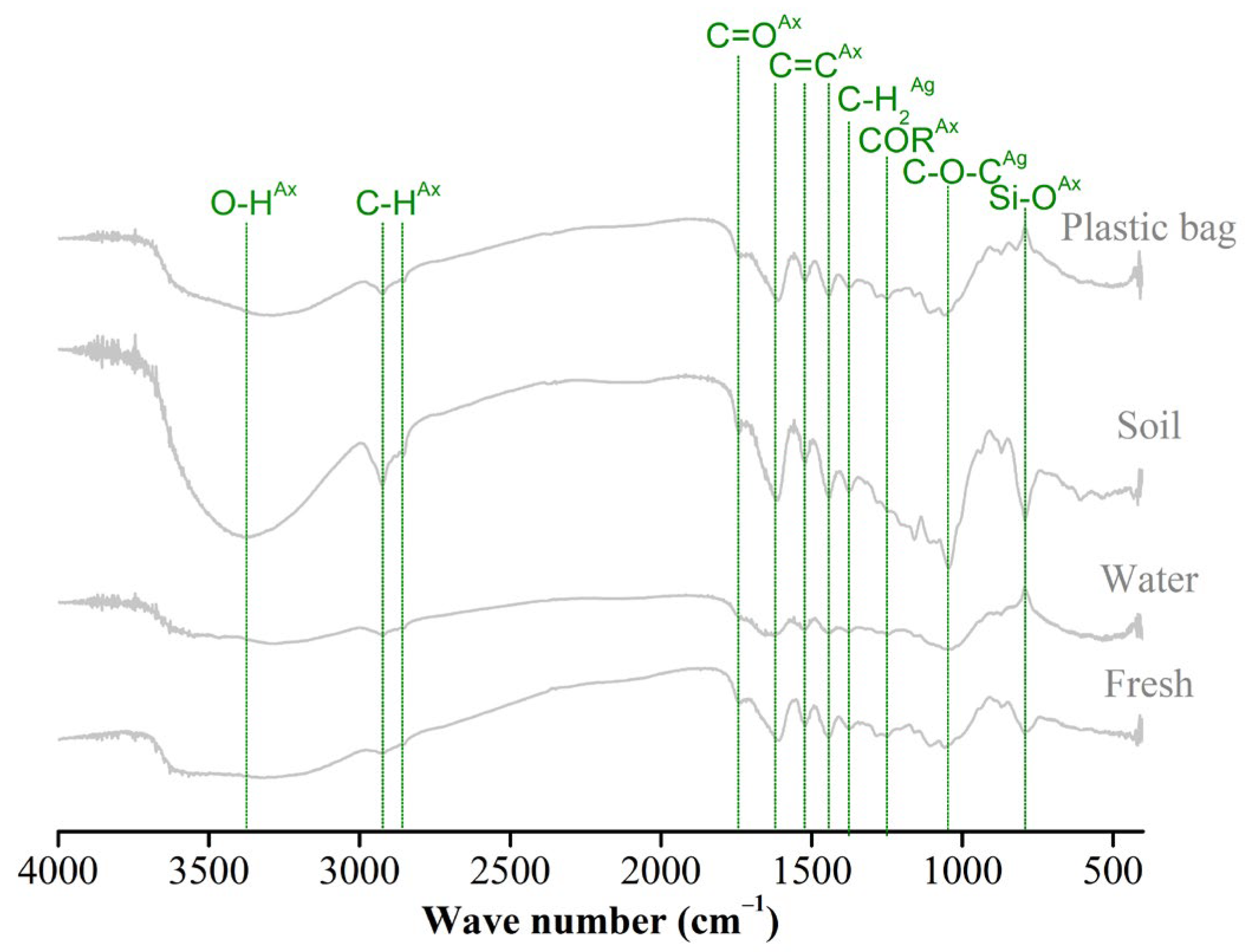
The FTIR analysis revealed changes in the chemical structure of the waste after 270 days of storage concerning the fresh waste, especially for soil storage (Figure 2). The broad peak at the beginning of all spectra at approximately 3200–3799 cm−1 corresponds to the axial deformation of the hydroxyl group (OH), typical of polysaccharides, mainly intra- and intermolecular hydrogen bonds in cellulose [21,22], but also occurring in hydrolyzed lignin [23]. It became far sharper for the soil-stored waste.
The weak bands at 2850 and 2924 cm−1 concern the symmetric and asymmetric CH2 stretching of aliphatic bonds, respectively [24]. The bands that appear at approximately 1032 cm−1 correspond to the axial deformation of the C-O and C-C-O bonds, which originate from all structural components of biomass [25]. The intensification of these peaks in the wastes stored on the soil and in plastic bags indicated an increase in the concentration of structural components at the expense of non-structural components. The same did not occur for storage in water.
The bands at 1750 cm−1 and 1240 cm−1 correspond to the stretching of the carbonyl (C=O) and acetyl (COR) groups of hemicelluloses, respectively [26,27]. These bands were similar for the fresh waste and the waste stored in plastic bags, but they softened for storage in water. Native hemicelluloses are sparingly soluble in water [28] and were likely leached out in water immersion.
The bands at 1590 cm−1 and 1505 cm−1 correspond to the vibrations and stretching, respectively, of the C=C groups in the lignin aromatic ring. Moreover, deformations of the lignin C-H bonds are observed close to 1380 cm−1 [25]. Therefore, storage in soil and plastic bags increased the proportion of lignin compared to the proportions of cellulose and hemicelluloses. Those structural sugars are more easily consumed by aerobic degradation than lignin [29]. The water cleaves the intermolecular linkages and dissolves hemicelluloses [30], explaining this result.

3.2. Level of Water-Soluble Materials of the Fresh and 270-Day Stored Açaí Waste

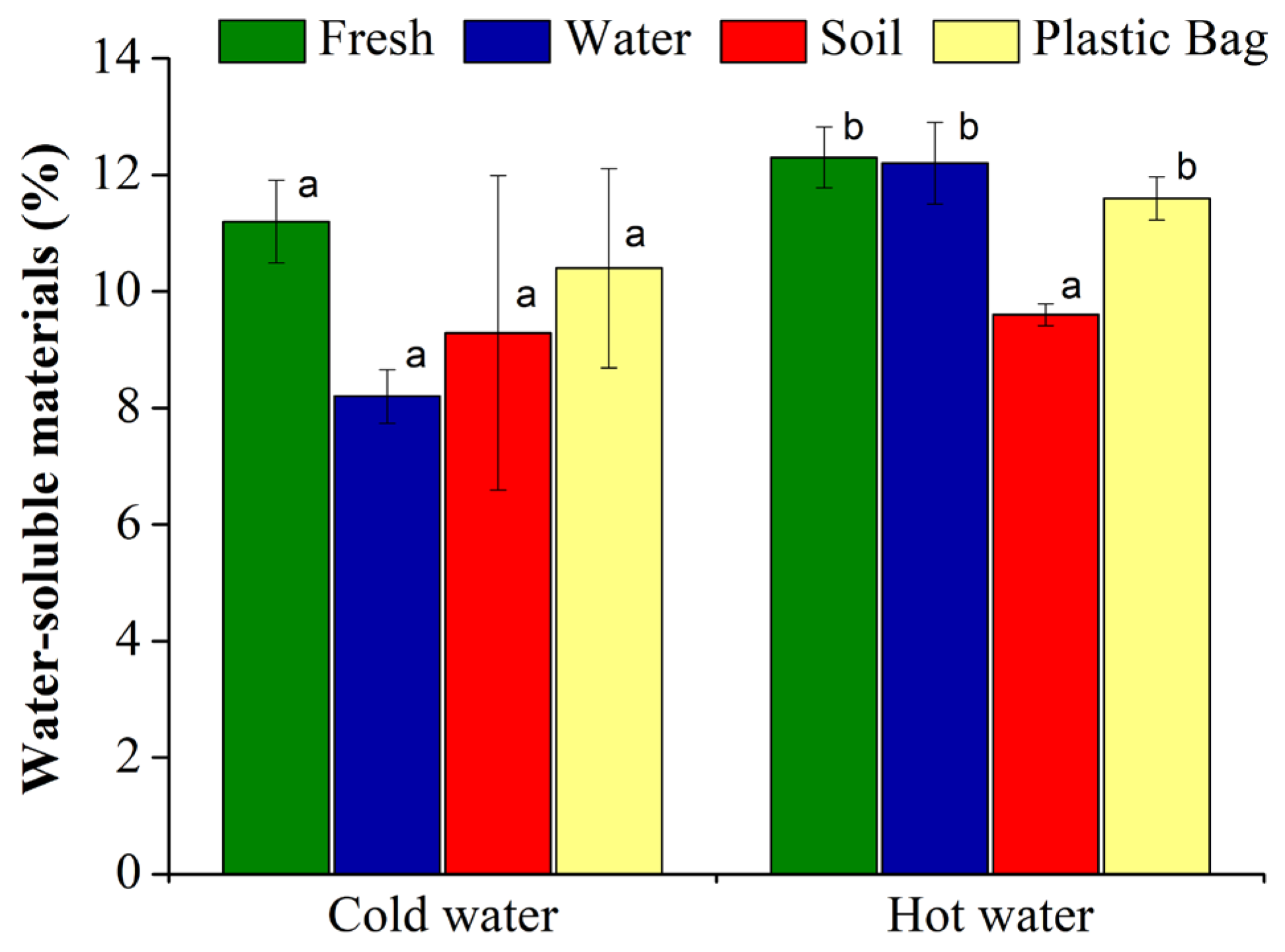
There were no significant changes in the level of cold water-soluble materials between stored waste and fresh waste. Nevertheless, the average of this property for the water-stored açaí was much lower than that of the fresh waste. The soil-stored waste had statistically lower hot water-soluble materials than the other conditions, which had similar values (Figure 3).
During biomass storage, the chemical components are decomposed, and complex structures are degraded, forming simpler and more removable compounds [31], explaining the overall reduction in water-soluble materials of açaí waste. Extractives are non-structural components of biomass that do not comprise the cell wall [32]. Some oxidize and evaporate [31] and are water-soluble and leachable, besides being consumable by fungi [33]. The boiling temperature of hot water improves the hydrolysis of biomass components such as fats, waxes, alkaloids, and phenols [34]; hence, it extracts more materials than cold water. Açaí waste stored in water likely had cold water-soluble extractives dissolved and leached out while preserving hot water-soluble extractives.
Meanwhile, extractives’ biodegradation, along with thermal–chemical oxidation and evaporation [35], explain the reduced water-soluble components of the açaí wastes stored in plastic bags and on the soil. The high superficial area of particulate biomass, such as açaí waste, and high air temperatures and relative humidity, such as the Amazon’s climate, favor the microbial growth of bacteria and fungi [35]. Besides extractives, the structural cell wall components, polysaccharides, and lignin may also undergo fungal decay [36] and natural oxidation [37]. For instance, the decrease in water-removable hemicelluloses [30] during storage contributes to a decrease in water-soluble materials.
In another study, açaí waste showed 10.8% of hot-water extractable materials, which is slightly lower than the result found herein for the fresh biomass [38]. The effect of storage on extractives’ content from 11.83 to 7.83% was reported for spruce bark after eight weeks of storage [31].
The level of extractives in biomass is an important factor for producing bioenergy, as high percentages can be fundamental in the initial reactions of combustion and pyrolysis. In addition, some of them increase the heating value of the biomass [39].

3.3. Changes in the Physical Properties of the Stored Açaí Waste over Time

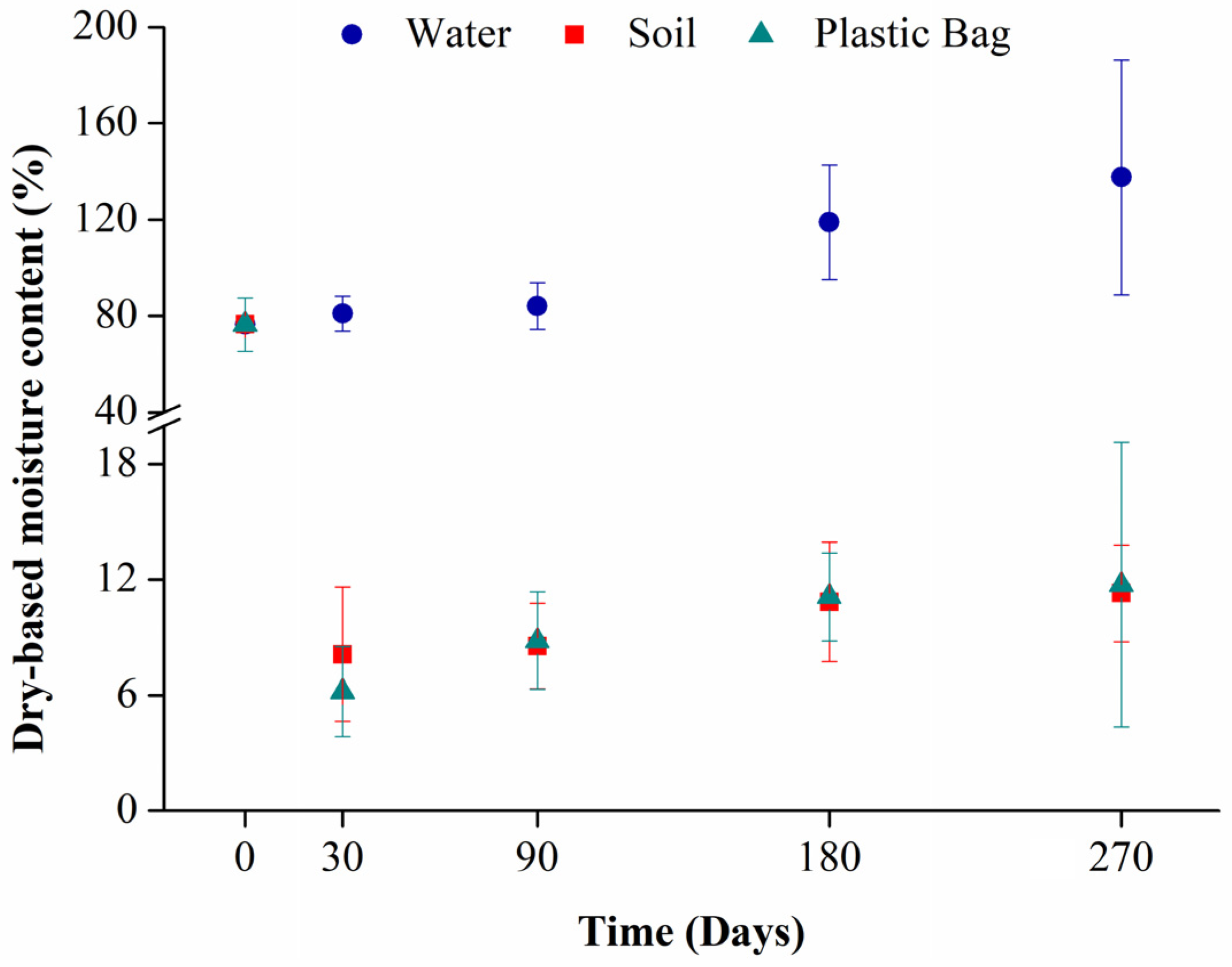
For storage in water, dry-based moisture content (DBM) increased over time. The DBM of waste stored in water reached 137% after 270 days. Overall, storage on the soil and in plastic bags reduced the DBM of waste on the 30th day but slightly increased it after that (Figure 4).
Apart from water immersion, storage can reduce or increase the moisture content of lignocellulosic biomasses, as they are hygroscopic. The temperature and relative humidity of the environment determine the equilibrium moisture content of the biomass. If the current moisture content is above or below the equilibrium moisture content at each moment, it will increase or decrease, respectively [40]. The lowest moisture contents for the storage of soil and plastic bags occurred from August to October (30 and 90 days), which comprise the “Amazonian summer”, the least rainy period in the region. Meanwhile, the moisture content slightly increased from January to April (180 and 270 days), known as the most humid “Amazonian winter” [41]. When stored in water, dry base moisture values above 100% after 180 days indicate a gain in porosity of the açaí waste, which promotes the capacity to contain more water than its biomass for a unit of volume. As the açaí seed is quite compact, this is another indication of degradation.
The values found for storage in plastic bags and on the soil are close to the values found by Arede et al. [12], which are up to 12% (DBM) for the stored açaí waste. The lower the moisture content, the better the biomass for energy generation in addition to reducing transportation costs [42,43]. Simulations indicated that the reduction in moisture during transport increased the income for wood suppliers from € 3.6 to 30.0 per truck, which corresponds to an annual financial profit of up to € 23,810 [42]. In our study, natural drying on soil and plastic bags promoted by storage for up to 30 days was advantageous and could result in energy and revenue gains. Although the combustion of any biomass is theoretically possible, moisture contents below 50% are more likely to be feasible [44].
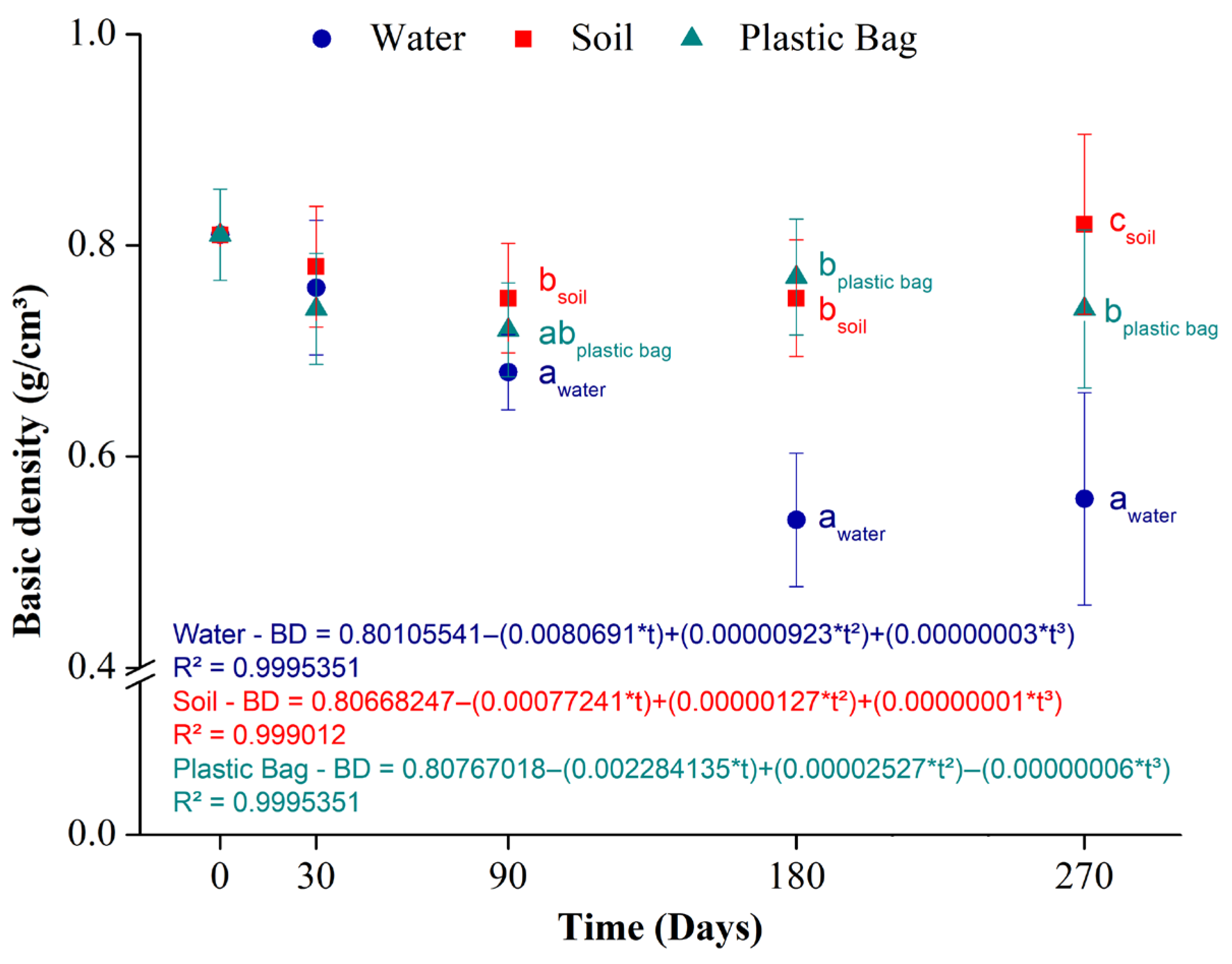
The basic density of the wastes under different storage conditions varied from the 90th day on, with the water immersion condition causing the greatest loss of this property. After 90 days, the basic density reached a 31% reduction on the 270th day of storage compared to the fresh waste. The same occurred for the waste stored in the soil, but with less intensity, reaching a higher density on the last day of storage than the fresh waste. The waste stored in plastic bags showed an 11% reduction in density up to 90 days, increasing again in the 180th and 270th days (Figure 5).
The drastic drop in the basic density of waste stored in water corroborates the possibility of an increase in waste porosity discussed above. The greater the biomass density, the greater the energy stock and combustion time [43]. The natural variation within the diaspores within a storage condition, as well as the variation in biodegradation mechanisms, may have led to a slight increase in basic density in the waste on the soil. Thus, except for soil storage maintenance for 270 days, this property rapidly depreciated due to storage. A basic density decrease was also observed for other biomasses stored over time, such as the bark of Norway spruce [31] and beech timber [45].
Despite the drop in basic density concerning the fresh condition, the açaí waste stored over time showed a higher density than other biomasses normally destined for bioenergy production, such as Eucalyptus wood (0.4 g/cm3–0.5 g/cm3) and sugar cane bagasse (0.104 g/cm3–0.120 g/cm3). On the other hand, it had a lower basic density than that of the babassu coconut waste of 1.3 g/cm3 [46].

3.4. Visual Analysis of the Fresh and 270-Day Stored Açaí Waste

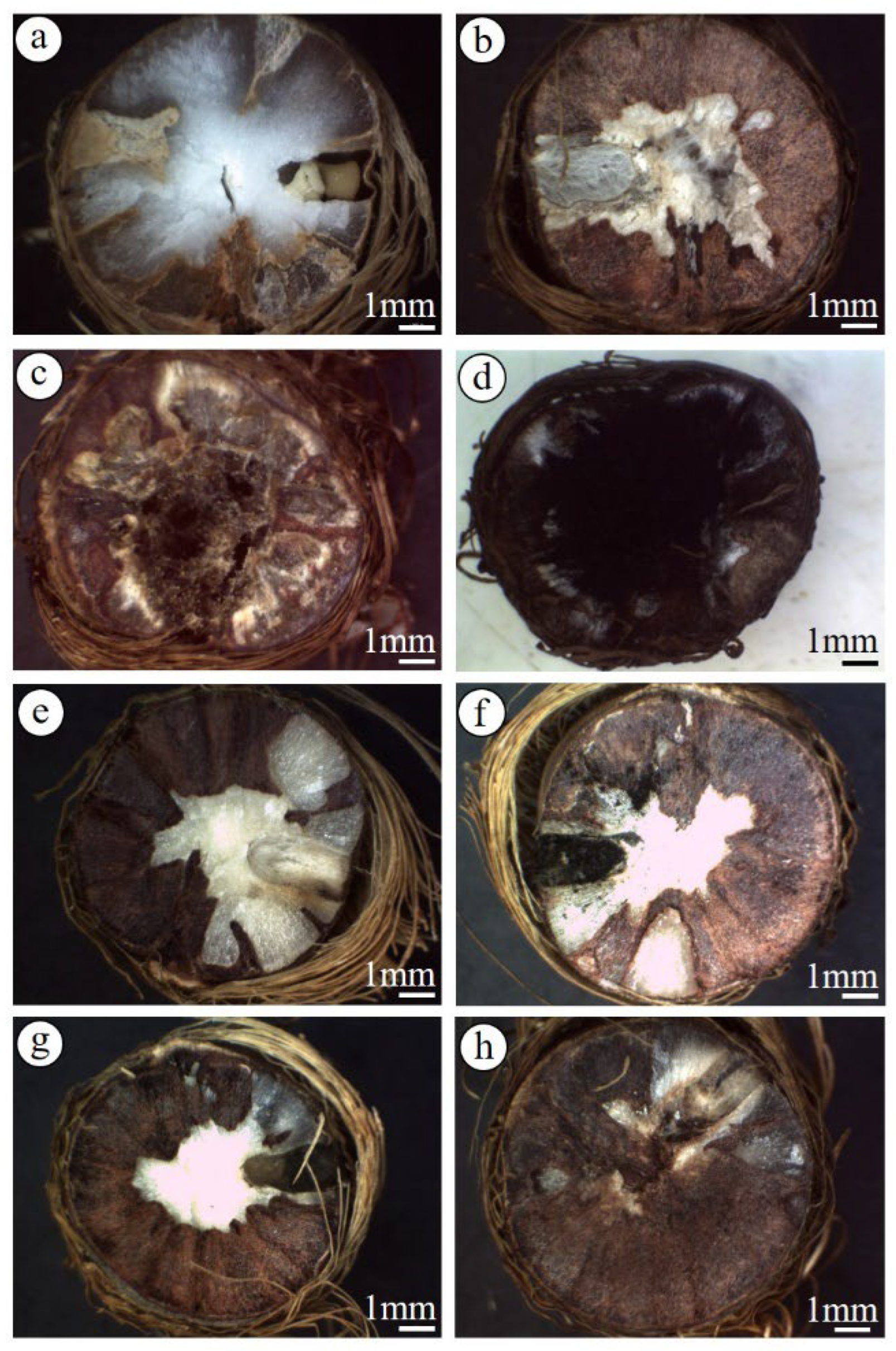
Regardless of storage type, the açaí wastes visually deteriorated compared to the initial wastes, since there were color changes, as well as modifications of texture and consistency, and eventually the absence of the ruminate endosperm [47,48] and the seed embryo (Figure 6).
The waste immersed in water were more deteriorated, as there was a change in color from brown to dark brown of the endocarp and tegument (ruminated endosperm) and a partial or total change from white to brown of the endosperm and/or embryo (Figure 6c,d). In addition, there was a partial or total loss of the endosperm and/or embryo. The endosperm comprises parenchymatic cells of thickened walls (pectin, cellulose, and hemicelluloses) storing lipid substances (essential oils/resins) and, mainly, polysaccharides such as pectin [47,48], while the embryo comprises thin-walled parenchymatic cells (starch, only in the apical meristems of the stem, and pectin and protein bodies in the other structures) and non-lignified tissues at the differentiation beginning, i.e., protoderm and protoxylem [47,48]. Those components are easily hydrolyzed and degraded by water and fungi, which is compatible with the moisture content increase in the waste immersed in water.
The waste stored on the soil (Figure 6e,f) in not-hermetically sealed plastic bags (Figure 6g,h) deteriorated less. There was a color change from brown to dark brown of the endocarp and tegument (ruminated endosperm), while the endosperm and embryo changed partially or totally from white to brown. Such alterations in the plastic bag-stored waste are compatible with the significant decrease in moisture content until hygroscopic equilibrium is reached by the waste but without a significant reduction in its density despite the presence of fungi. A similar result was observed for the açaí waste kept on the soil, except for the absence of fungi and the opening of the diaspore operculum.

3.5. Changes in the Energetic Properties of the Stored Açaí Waste over Time

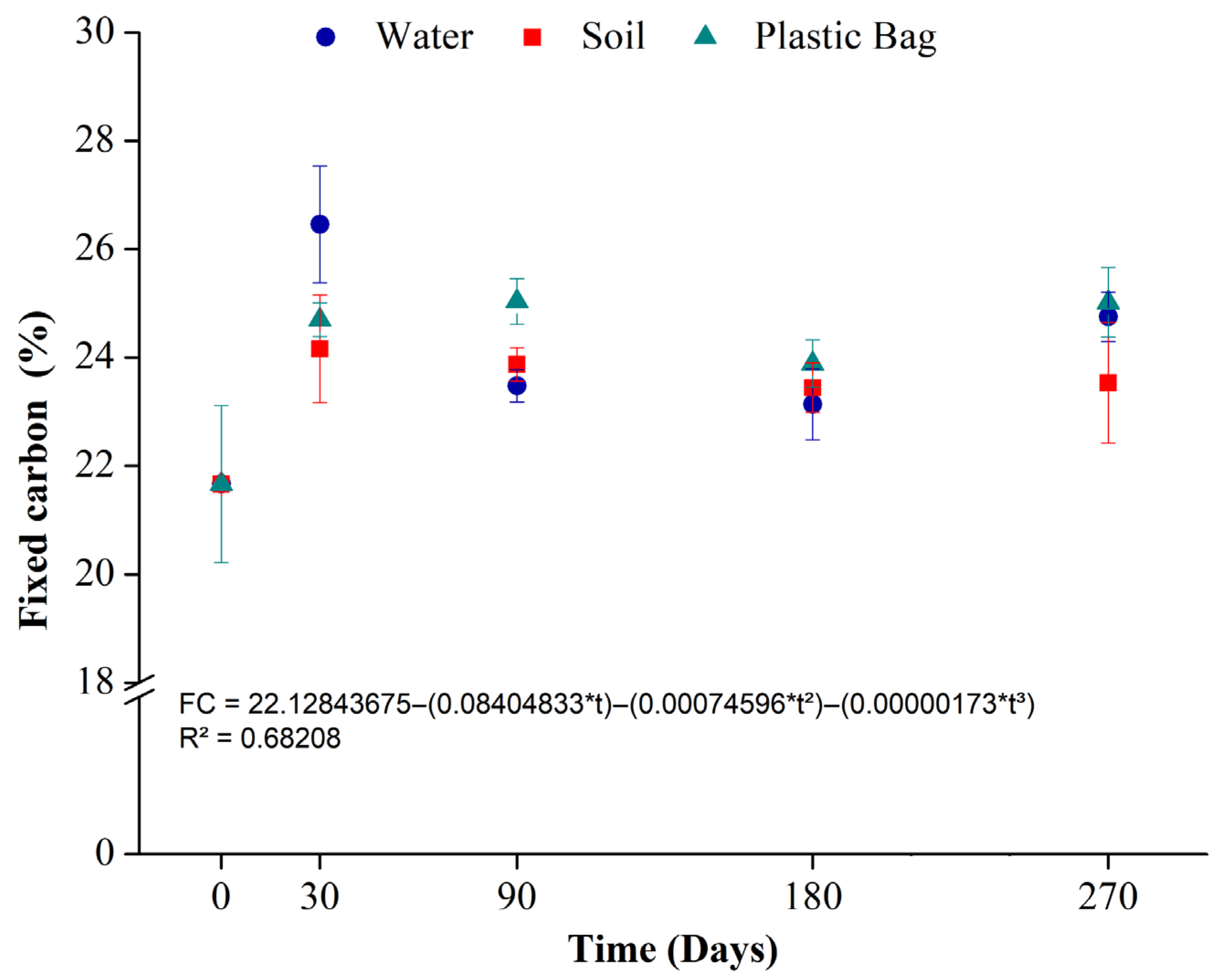
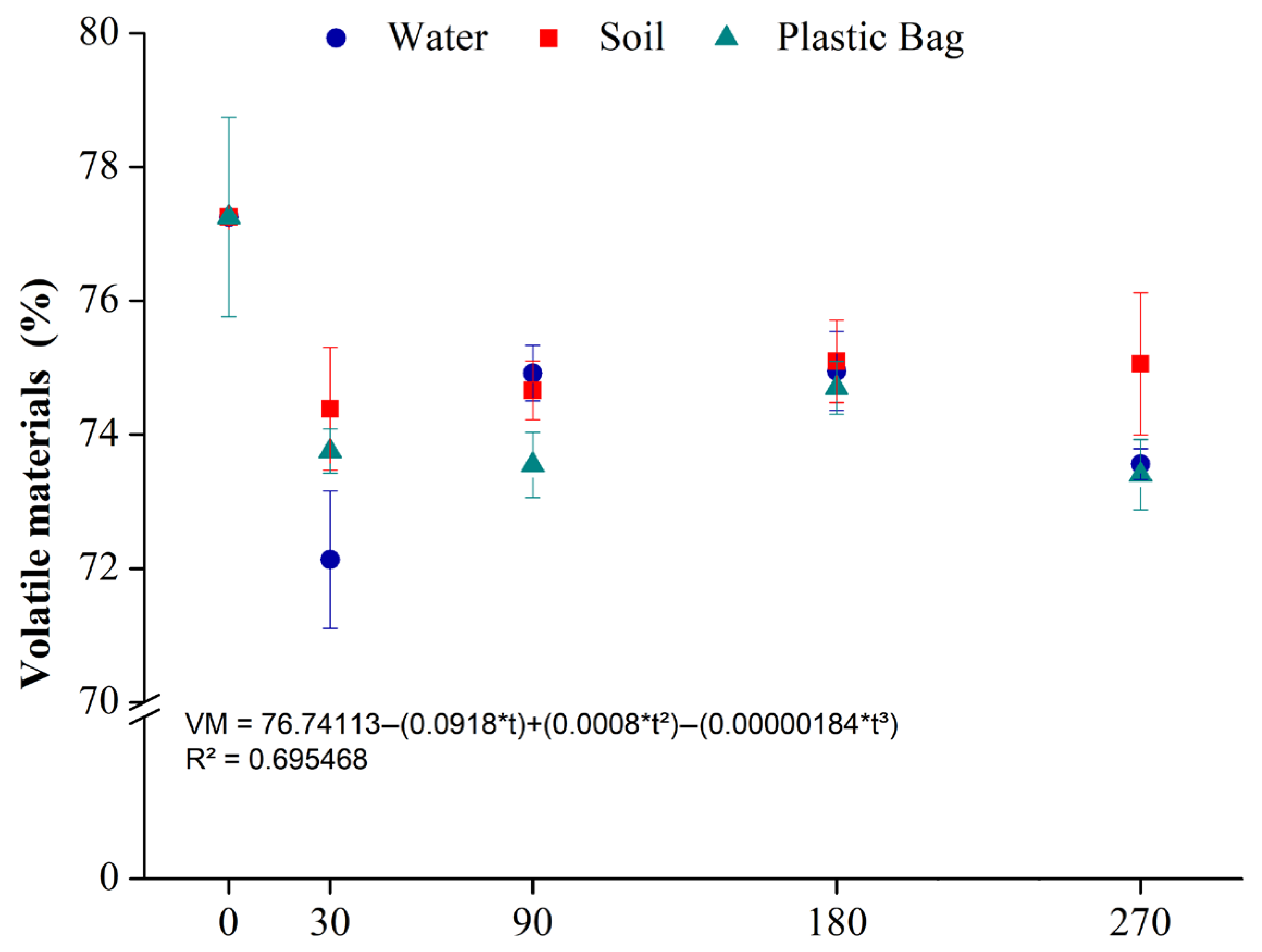
Regardless of the method, the storage of açaí waste caused an increase in fixed carbon content and a proportional decrease in the content of volatile materials over time, without a significant difference among the methods (Figure 7 and Figure 8).
High levels of fixed carbon in biomass are advantageous for combustion, as they positively impact the quality and energy efficiency of the biofuel. The storage times of 30 days for the waste kept in water and on the soil, as well as 90 days in plastic bags, corresponded to the most considerable increases in fixed carbon. Depending on other variables (e.g., extractives, density, and moisture content), these conditions imply greater energy and slower energy production in combustion reactors [49,50]. The greater the carbon stock in biomass, the greater the production of bioenergy. The increase in fixed carbon content was compatible with the concentration of lignin in the stored waste [51].
The reduction in the content of volatile materials with an increase in the storage period can result in a decrease in the combustion reactivity of açaí waste in addition to making their ignition difficult [52]. The decrease in volatile materials and the resulting rise in fixed carbon may be linked to the reduction in hemicelluloses’ content in the parenchymatic cells of the diaspore endosperm [53].
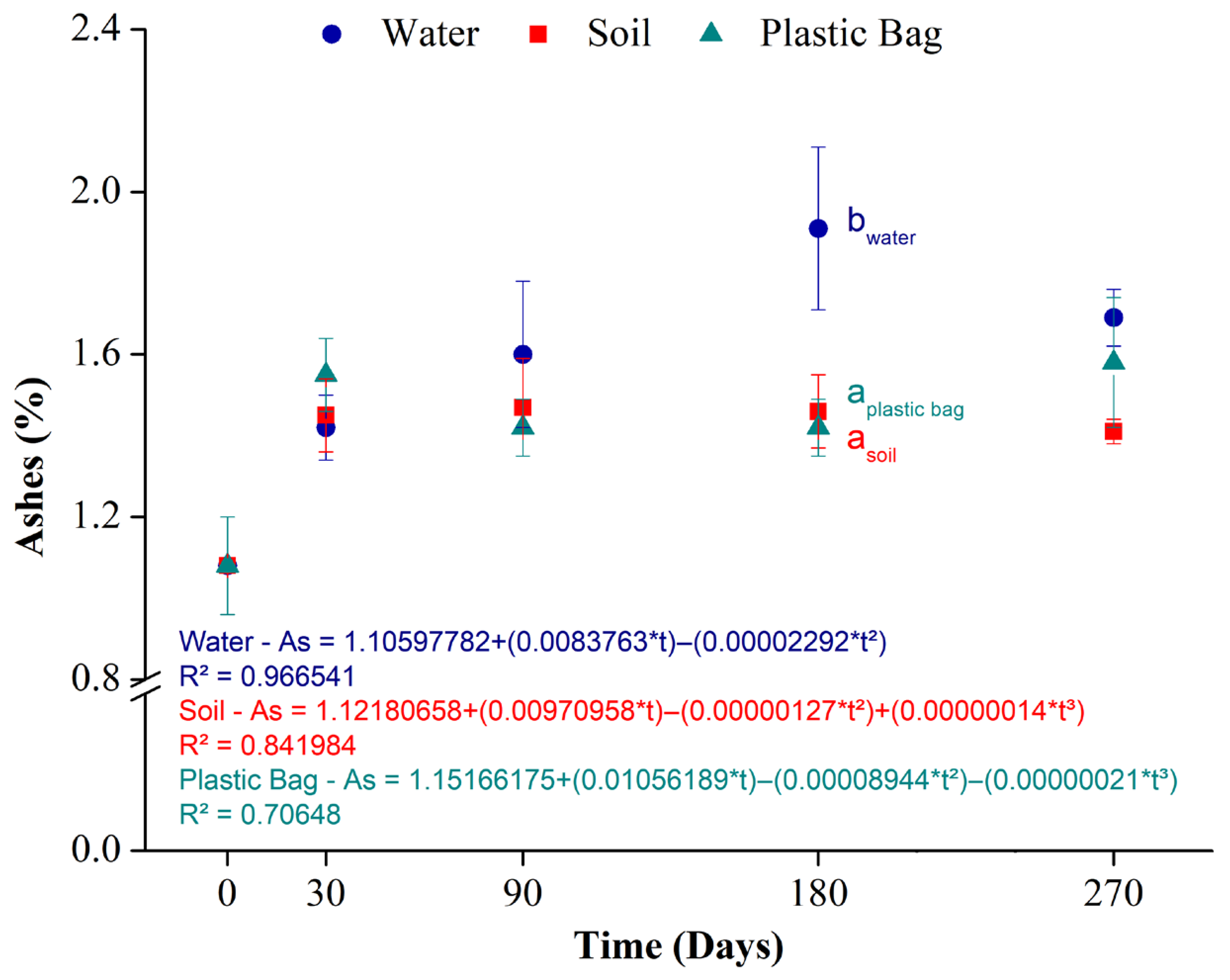
Overall, the content of ashes increased over time, except for the 270th day, when it decreased for the water immersion condition. A significant difference among conditions was found only on the 180th day (Figure 9).
The decomposition of organic materials, such as extractives, can culminate in an increase in the percentage of inorganic materials (ash) [54,55]. Moreover, traces of soil in the waste stocked in this condition possibly contributed to the increase in ash. The ash content represents the inorganic residue remaining after fixed carbon combustion. Increasing ash content can reduce energy efficiency [56], cause operational issues such as sintering, incrustations, and slag, affect heat transfer, and even corrode the combustion equipment [57,58,59]. Negative implications of high average ash values in wood wastes from the species Licania canescens, Vantanea parviflora, Pouteria sp., and Eschweilera grandiflora were reported in the higher heating value [43]. Therefore, lower ash levels are desirable in biomass for energy purposes. However, the average ash values in all storage periods were below 5%, indicating the possibility of using the waste for energy.
Agricultural wastes tend to have a lower content of volatile materials and a higher ash content than wood [5,60]. Protásio et al. [61] found levels of volatile materials from 81.6 to 84% and an ash range from 0.13% to 0.27% in Eucalyptus clones. The values found in this study are close to those found by Costa et al. [5] and Arede et al. [12] for the açaí waste for the three fractions of the proximate composition. Moreover, the fixed carbon content was higher than that found for coffee waste (19%) and pine shavings (13%).
Higher heating value (HHV), lower heating value (LHV), and net heating value (NHV) significantly changed over time, but these properties were not influenced by the storage conditions (Table 1).
The regression analysis indicates a significant effect of the time (t) regardless of the storage condition.
Heating value is an important index for evaluating fuel for generating thermal energy, as it indicates the amount of energy or heat released by complete combustion per unit mass of fuel [62]. The heating value positively relates to fixed carbon content [63] and negatively relates to volatile matter and ash contents [57]. The storage methods evaluated herein for açaí waste increased the fixed carbon to volatile matter ratio but simultaneously increased the ash content. Therefore, through compensation, the heating values (HHV, LHV, and NHV) only slightly changed.
The HHV results are within the range of 17.41 to 19.36 MJ/kg found for species of Eucalyptus sp. [64], E. pellita [65], and E. urophylla [66]. This similarity indicates that açaí waste, regardless of the storage period evaluated in this study, is promising for bioenergy. Açaí waste can generate electricity through thermochemical processes, especially direct combustion. Based on the HHV range found herein (18.80–19.07 MJ/kg), açaí waste can generate between 1.83 (waste stored in water for 180 days) and 1.85 MWh/ton (waste stored in the soil for 30 days), which is higher than the bioelectric potential of 5-year-old E. pellita wood of 1.71 MWh/ton [67].
Costa et al. [5] found an LHV of 18.98 MJ/kg for açaí waste, which is close to the value found in this study. The LHV of fourteen clones of Eucalyptus, a species traditionally used as an energy raw material, varied between 17.66 for E. urophylla × E. camaldulensis and E. urophylla and 18.27 MJ/kg for the E. camaldulensis hybrid [61], which are close to the values found in this study.
The lowest NHVs occurred for the water-stored waste. Naturally, moisture content has a negative correlation with the heating value [43], indicating that the greater the amount of water in the biomass, the lower the thermal energy to be released. Therefore, storing it in water is not recommended. However, the drying process is recommended for wet biomasses for energy optimization.
In 2024, 1,741,757 t of açaí were produced in Brazil [1]. Considering 83% of this mass became waste [6], around 1,445,658 t of waste is estimated for the same year. Such an amount corresponds to around 26,857,892,940 MJ available in the açaí waste if it were used fresh, with little variation compared to the stored waste, even after 270 days. Moreover, formal production estimates consider that açaí comes both from plantations and well-known and organized extractivism sources, but the whole chain is complex and involves community and small-scale production as well [68], which likely increase the stored energy. Nevertheless, environmental and technological solutions must also consider collection, transportation, and transshipment to avoid the waste from being improperly dumped in the environment or even unnecessarily sent to landfills [69]. For instance, in the largest Amazon capitals, Manaus and Belém, the waste is scattered throughout urban environments, and traffic would certainly hinder its collection. On the other hand, larger amounts of açaí waste are available in industries and cooperatives.
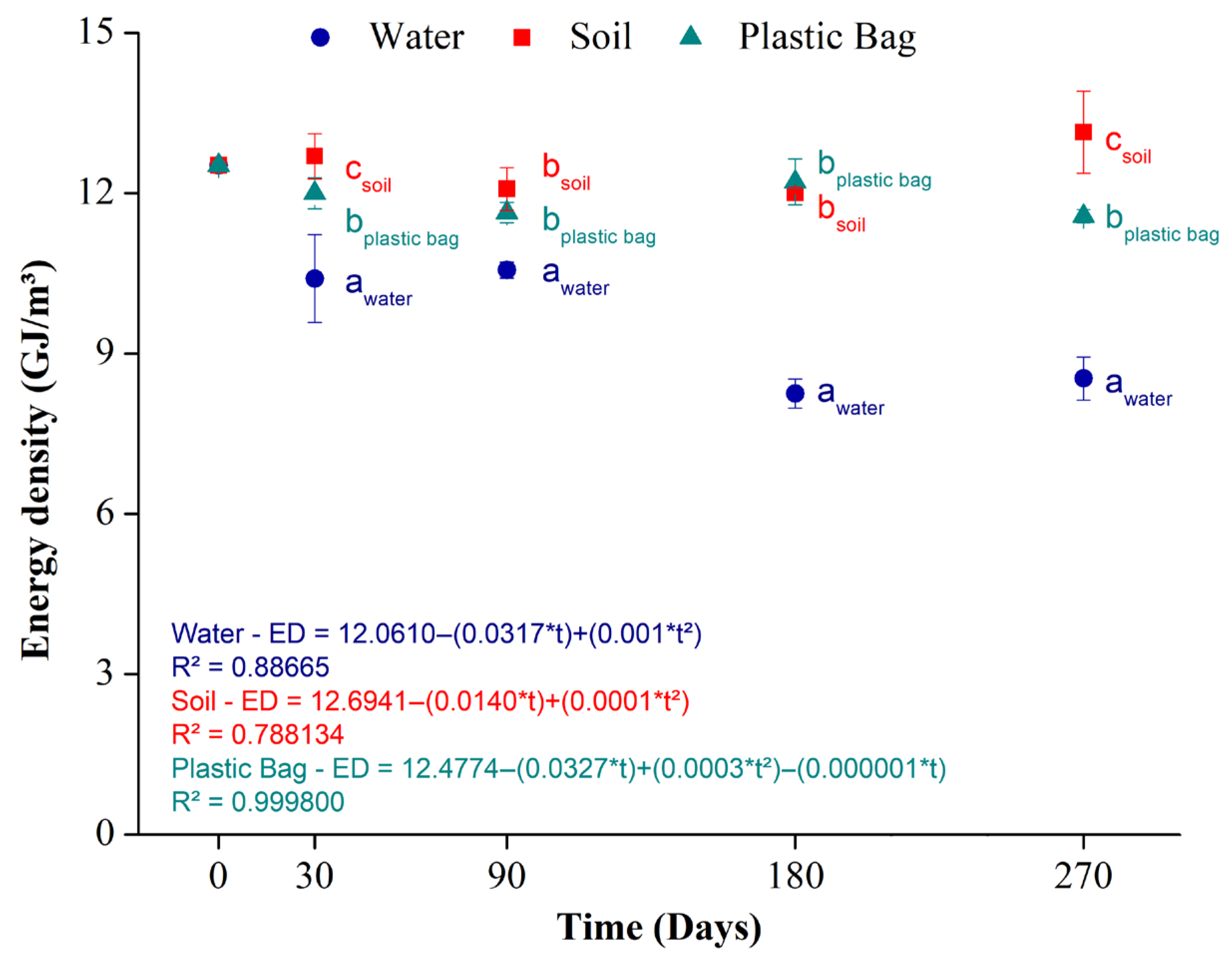
The energy density greatly varied among the storage conditions and over time. Its intense reduction from the 30th on for the water-immersed waste stood out. Reductions were slight but significant for the other storage conditions, and the energy density even increased for the soil-stored waste on the last day (Figure 10).
Given the low variation in HHV, LHV, and NHV, the energy density is an improved decision tool to define the best strategy for the energy use of açaí waste, since it reflects the available energy per volume of biomass [65]. The variation in energy density over time is justified by the behavior of the basic density of the açaí waste, overcoming the heating values. It proves the negative effect of moisture on the physical and energetic characteristics of açaí waste, which can negatively influence logistical and operational costs to enable energy use through thermochemical routes, such as combustion and carbonization. Thus, storage in plastic bags and on the soil showed better quality based on higher energy densities and lower ash contents. Storing the açaí waste on the soil requires care to avoid its contamination by minerals that can increase the ash content.

3.6. TG Analysis in an Oxidative Atmosphere of the Fresh and 270-Day Stored Açaí Waste: Combustion Behavior

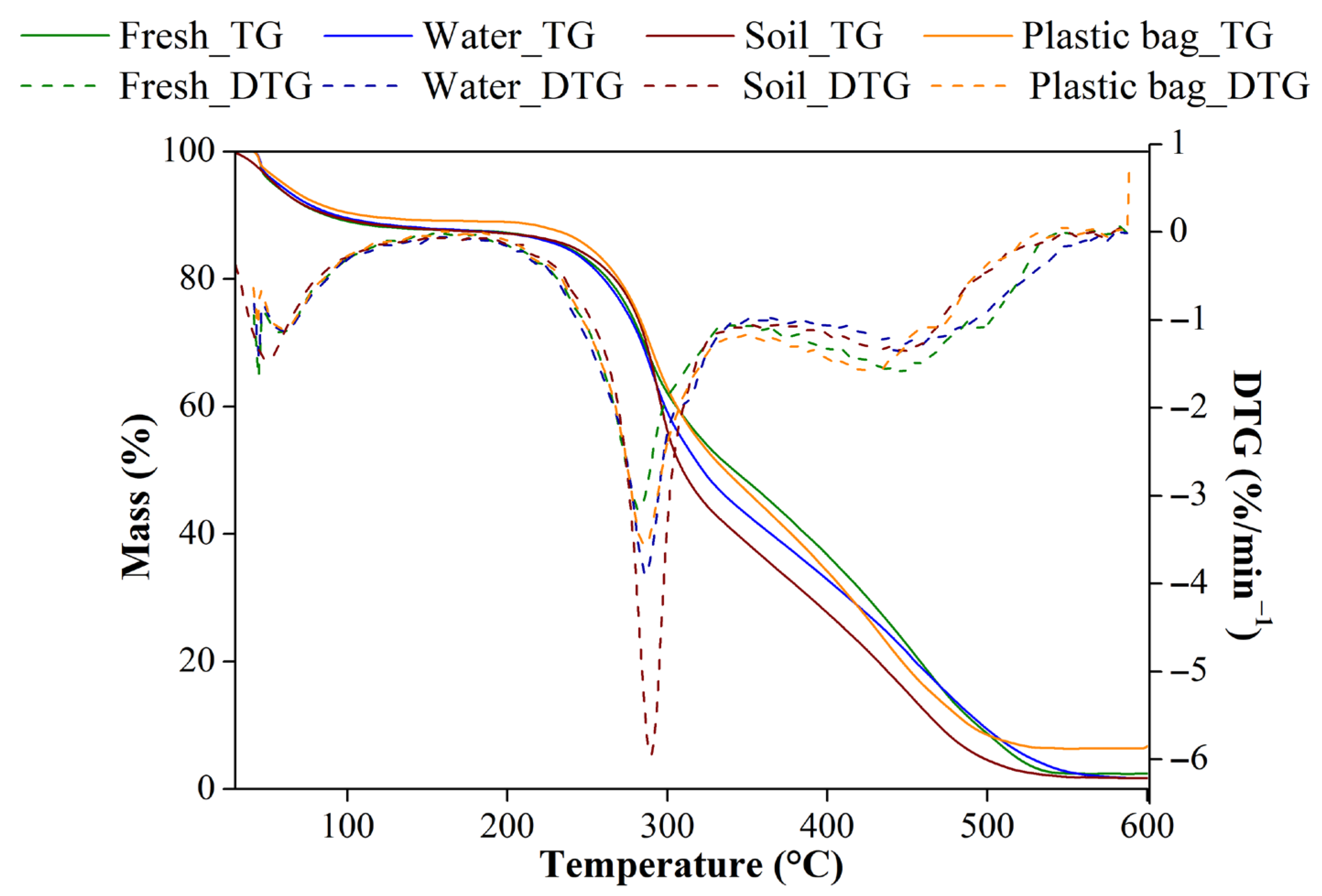
The TG and DTG curves of the fresh and stored waste in the oxidative atmosphere showed typical lignocellulosic behavior but prominent differences. The TG showed that all stored wastes had higher mass losses for a given temperature than the fresh waste after around 290 °C. Soil storage stood out with a higher and sharper peak of the DTG curve corresponding to the maximum mass loss (≈290 °C), followed by the water-stored, plastic bag-stored, and fresh waste (Figure 11).
Most combustion parameters greatly varied among the conditions, especially between the fresh and soil-stored wastes. The plastic bag and water-stored wastes mainly showed values that were intermediate between the fresh and soil-stored wastes or closer to the fresh waste (Table 2).
During combustion, biomass goes through moisture loss (first stage), devolatilization and volatile matter combustion (second and main stage), and char combustion (third stage), which are revealed in the DTG curves through intense peaks of mass loss [5]. In the first stage, the biomass absorbs heat to evaporate free or adsorbed water [70], in addition to releasing light volatiles [71]. Therefore, the similarity of mass loss among the fresh, soil-stored, and water-stored wastes indicated that, after material preparation for TG analysis, they had reached a similar moisture content, while the plastic bag-stored waste, without direct contact with soil or water, dried slightly more. Moreover, the soil-degraded waste required 49 °C, the lowest maximum temperature, to reach maximum mass loss in the first stage among the conditions. As shown by FTIR analysis, the lignin concentrated over the cellulose and hemicelluloses of the waste stored on the soil, explaining why there was less bonding water with the structural polysaccharides; meanwhile, free water evaporates rather fast at lower temperatures [72].
The ignition starts the second stage of biomass combustion, and it is defined as a transition from a slow fuel oxidation rate to the rapid oxidation of either the volatiles or the biofuel surface [73]. It was previously verified that more hot water extractives decreased the ignition temperature and ignition time [5]. Such an explanation is in accordance with the results herein, since the contents of hot water extractives were similar among the fresh (12.3%), water-stored (12.2%), and plastic bag-stored (11.6%) wastes, which had similar and close ignition times and temperatures. In opposition, soil-stored waste had lower hot water extractives (9.6%) and exhibited much higher values of the ignition parameters.
In the second stage, the devolatilization and combustion reactions of the volatilized compounds take place [5]. The greatest content of volatile materials explains the slightly higher mean combustion rate of the fresh waste [74]. Moreover, lower values of this parameter with lower contents of hot water-soluble extractives have been reported [5], as observed herein for the soil-stored waste On the other hand, the maximum combustion rate had contrasting results with the mean combustion rate.
Although not measured in this work, it is probable that, besides cold and water-soluble extractives, the stored waste, especially on soil, also lost acetone-soluble extractives. These components increase the fixed carbon and thermal stability of biomass and prolong their combustion time [61]; hence, their preservation in the fresh waste possibly slightly reduced its maximum combustion ratio. Moreover, excluding the fresh waste, the soil-stored wastes had the highest volatile material/fixed carbon ratio (75/23%) after 270 days of storage, which positively and directly relates to the maximum combustion ratio [75]. The FTIR analysis revealed a tendency of lignin concentration over a possible ongoing degradation of the structural carbohydrate that perhaps contributed to intensifying the maximum combustion ratio of the soil-stored waste.
The lowest peak temperature of the fresh waste at the second stage (Tmax2nd) was promoted by the lower temperature of the combustion by the water-soluble extractives [5]. Plastic bag storage caused less loss of water-soluble materials than soil and water storage; hence, it had the second lowest temperature to reach maximum mass loss. Moreover, this phase mainly corresponds to the combustion of hemicelluloses and cellulose [76] and partially of lignin and extractives [5]. Therefore, the losses of leachable water-soluble materials and concentration of structural cellulose, hemicelluloses, and lignin in the soil-stored waste caused the sharpest and highest maximum mass loss peak of the soil-stored waste during combustion. This explanation is once again highly supported by the highest volatile materials (75%) found for soil storage among the three storage methods.
The variations in maximum combustion rate, time to reach it, and ignition temperature caused remarkable differences in flammability and ignition indexes among the waste conditions. Despite requiring the lowest temperature (250 °C) to reach ignition, the lowest flammability index (0.50%/min °C2) of the fresh waste indicates its lowest reacting ability [77] among the conditions. The water and plastic bag-stored waste had intermediate results, while soil-stored wastes stood out with the highest flammability index (0.91%/min °C2). Moreover, a higher ignition index, as observed for the water and soil-stored wastes, implies easier ignition and more stable combustion [77,78]. Once again, among stored conditions, plastic bags were the storage type with the most similar combustion behavior to the fresh waste.
The burn-out temperature of combustion is also determined as the final pyrolysis temperature [79]. This parameter ranks fresh waste as the most promising biofuel since its longer combustion is a favorable bioenergy indicator [5]. Moreover, the fresh waste had the lowest total mass loss (37.7%) in the second stage; hence, they formed more char for the third stage. This result showed the importance of preserving the extractives of biomass for bioenergy, since some of them increase resistance to thermal degradation and extend the combustion [61]. Therefore, all storage conditions harmed the temperature range of the second stage of combustion.
Ultimately, a higher combustion index indicates the efficiency of the combustion conversion of biomass [80]. Therefore, all stored wastes showed better biofuel to bioenergy conversion than fresh waste, starting from soil, water, and then plastic bag storage. However, longer combustion based on a wider temperature range, as shown by the fresh waste, can overcome the lowest combustion index when selecting the most promising biomass for thermochemical systems [5].
During the third stage, the oxidation of lignin char gasification occurs [81]. In opposition to the second stage, fresh waste had the highest mass loss of the fresh wastes (47.5%) at this stage; hence, more char was formed for the fresh ones. The extractives, which are preserved in fresh waste, greatly contribute to a higher rate of mass loss at this stage [5] by increasing the fixed carbon [61].
Moreover, among the stored wastes, there were slight variations in mass loss, but the temperature of maximum degradation was similar among all the conditions since, in this stage, lignin is the main component of conversion [82]. The char conversion is complex and depends on the biofuel surface area, surface accessibility, carbon active sites, catalytic active sites, initial or added inorganic matter, the material chemistry and porosity, and the gasification agent [79]. Therefore, the overall decrease in the basic density and water extractives and increase in ashes possibly anticipated char conversion for the stored wastes, corroborating the lower burnout temperatures compared to the fresh waste.

3.7. TG Analysis in Inert N2 Atmosphere of the Fresh and 270-Day Stored Açaí Wastes: Pyrolysis Behavior

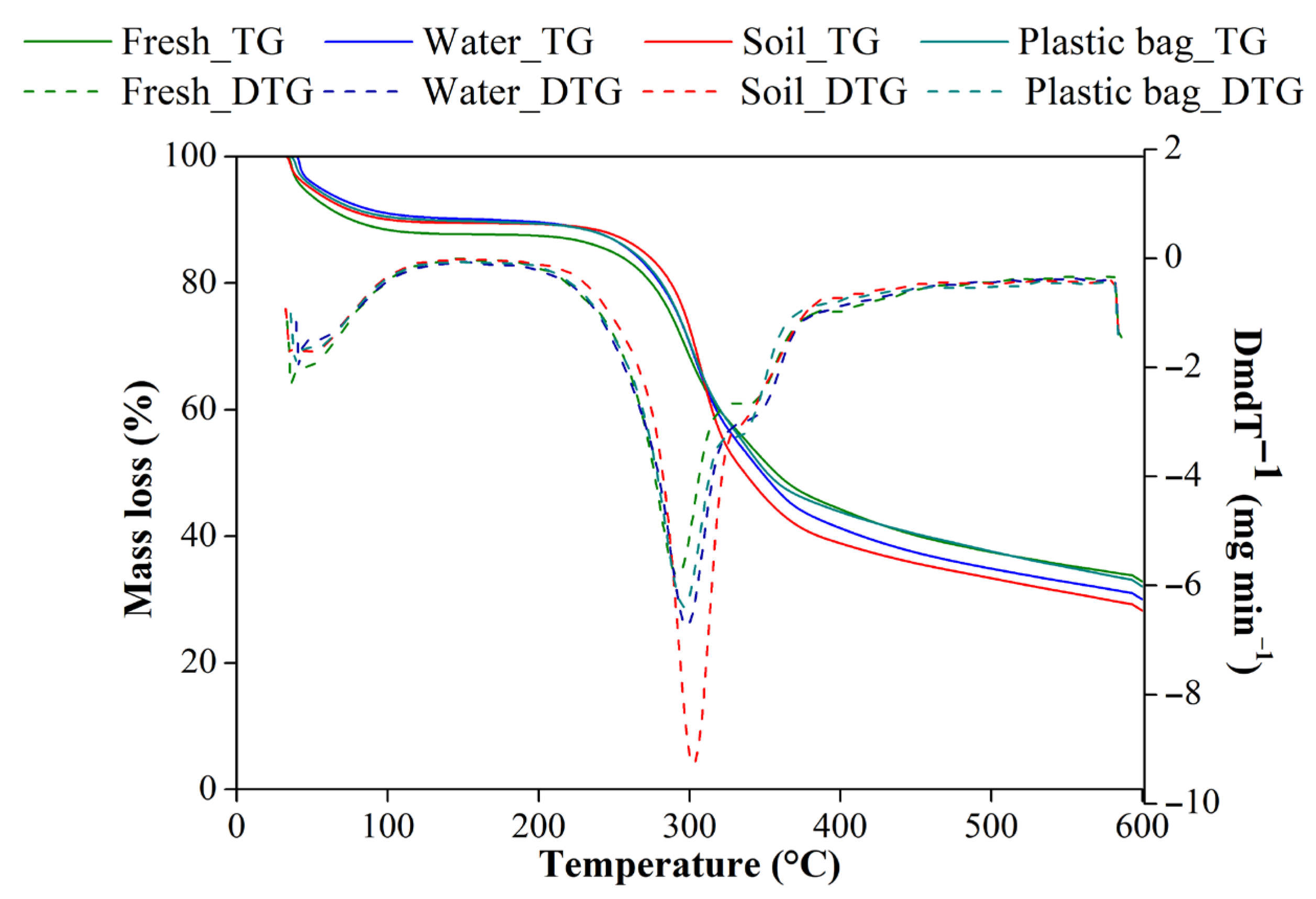
The fresh and stored wastes depicted different behaviors in the TG analysis under an inert (N2) atmosphere. Concerning TG curves, before the intense mass drop beginning at around 260 °C, the fresh waste had a higher mass loss than all the stored wastes. Afterward, the behavior changed, with the fresh and plastic bag-stored wastes having lower mass losses than the other two conditions. The soil-stored waste showed the sharpest peak at around 300 °C in its DTG curve. In contrast, the lowest peak occurred for the fresh waste (Figure 12).
The fresh waste had a slightly higher initial mass loss (up to 200 °C) than the stored waste, which was similar. In the 200–300 °C range, the soil-stored waste stood out with the lowest mass loss. However, the opposite occurred in the 300–400 °C range, at which the four conditions greatly varied. In the 400–500 °C range, once again, the wastes on the soil stood out with the lowest mass loss. At the highest temperature range (500–600 °C), the fresh waste had the lowest mass loss, contrasting with the waste stored in plastic bags with the highest mass loss (Table 3).
The onset temperature varied from 264 to 279 °C, while the maximum temperature ranged from 297 to 308 °C. The maximum rate of thermal degradation widely varied from 5.82 to 9.27%/min. For all parameters, the fresh waste had the lowest values, while the waste stored on the soil had the highest values. The wastes stored in plastic bags and water had onset temperatures closer to that of the fresh waste but maximum degradation temperatures closer to the soil-stored waste The wastes under those conditions had intermediate maximum rates of thermal degradation (Table 4).
The first peak in the DTG curve is mainly attributed to the volatilization of water and light compounds [83], indicating a similar initial moisture content of the stored samples and stability up to the onset temperature. Nevertheless, the soil-stored waste depicted a higher onset temperature than the other conditions, possibly due to the partial leaching of extractives and degradation of hemicelluloses [84]. Partially losing extractives increases the decomposition rate of biomass [85], as observed for the soil-stored waste in contrast to the fresh waste and intermediate values of the other two storage methods. Moreover, the behavior of the soil-stored waste agreed with the highest content of volatile materials among the three types of storage.
The peak of maximum mass loss at 297–308 °C (Tmax) mainly corresponds to the maximum decomposition rate of the polysaccharides that break down into lower-molecular-weight compounds and form a high amount of volatile matter up to 500 °C [83]. Glucose is the main monosaccharide of the fibers (30%), while the seeds have mannose (75%) with the highest proportion [8], indicating that mannan-type hemicellulose content overcomes cellulose content in the seeds.
Similarly to the results found herein, a sharp peak between 250 °C and 350 °C appeared in the TG analysis of the mannan-rich ivory nut [86]. Moreover, the seed corresponds to about 95% of the açaí waste [87]. Consequently, the cellulose and hemicellulose peaks overlap in the DTG curves of açaí waste, with the cellulose one appearing as a second shoulder [82], corresponding to its decomposition into levoglucosan and furan groups [88]. The peak and shoulder shifted to a higher temperature (308 °C) for the soil-stored waste regarding the other conditions, possibly because of partial hemicellulose loss.
The degradation of the phenolic lignin occurs above 500 °C, forming char at the final stage [83]. As it decomposes in a large range of weight loss under a slow decomposition rate [82], no sharp peaks appeared in the inert atmosphere analysis. The final mass is in accordance with the fixed carbon results and is a predictor of charcoal yield at the end of pyrolysis [38], indicating the advantage of using fresh and plastic bag-stored wastes instead of water and soil-stored wastes.

4. Conclusions

The three storage conditions degraded açaí waste and altered its quality for combustion and pyrolysis, but plastic bag storage was the least harmful one over time.
The benefits of storage included natural drying (plastic bag and soil storage), with the dry-based moisture content decreasing from 76% to 11% in 270 days and an increase in fixed carbon content from 22% up to 26% (all storage conditions) through the concentration of structural chemical components and partial loss of water-soluble components. Consequently, the heating value of the biomass was kept or even increased, while the ash content disadvantageously increased. However, ultimately, energy density was harmed by the decrease in basic density with storage in water and plastic bags over time.
The decrease in water-soluble components in all storage conditions hinders the start of the main phases of combustion and pyrolysis. In contrast, such processes are intensified once they begin, especially for soil-stored waste. Therefore, for more stable combustion and pyrolysis, any storage should be avoided, but pre-drying the fresh waste would benefit its use. Nevertheless, even degraded açaí waste is promising for bioenergy.

Supplementary Materials

The following supporting information can be downloaded at: https://www.mdpi.com/article/10.3390/su18083730/s1, Table S1: Results from Levene’s test; Table S2: Summary of the analyses of variance of the cold and hot water-soluble extractives; Table S3: Summary of the analyses of variance of the basic density and proximate analysis; Table S4: Summary of the analyses of variance for the energetic properties; Table S5: Calculated F of the unfolding of basic density, ashes, and energy density storage conditions within time; Table S6: Calculated F of the unfolding of basic density, ashes, and energy density time within storage conditions.

Author Contributions

T.D.C.: Conceptualization, Methodology, Formal analysis, Writing—original draft preparation, Writing—review and editing; F.Y.d.S.S.: Conceptualization, Methodology, Formal analysis; J.L.L.d.A.d.S.: Writing—review and editing; T.d.P.P.: Writing—original draft preparation, Writing—review and editing; M.D.R.L.: Writing—original draft preparation, Writing—review and editing; M.V.S.: Formal analysis, Writing—review and editing; L.M.M.: Writing—review and editing, Funding acquisition, Resources, Supervision, E.G.M.: Formal analysis, Writing—review and editing, Funding acquisition, Resources; T.M.d.S.: Writing—review and editing; B.M.d.S.e.S.: Writing—original draft preparation, Writing—review and editing; L.B.: Conceptualization, Methodology, Formal analysis, Writing—original draft preparation, Writing—review and editing, Funding acquisition, Resources, Supervision. All authors have read and agreed to the published version of the manuscript.

Funding

The research was funded by the National Council for Scientific and Technological Development—CNPq (grant numbers 308819/2021-7 and 304165/2022-0) and the Brazilian Federal Agency for Support and Evaluation of Graduate Education CAPES, Coordination for the Improvement of Higher Education Personnel (grant number 001).

Institutional Review Board Statement

Not applicable.

Informed Consent Statement

Not applicable.

Data Availability Statement

All information was constructed by the authors and can be published by the journal.

Conflicts of Interest

The authors have no conflicts of interest to declare.

References

  1. Brazilian Institute of Geography and Statistics. Acai Production (Cultivation). IBGE; 2024. Available online: https://www.ibge.gov.br/explica/producao-agropecuaria/acai-cultivo/br (accessed on 13 March 2026).
  2. Cardoso, F.; Vaz Junior, S.; Doria, M.; Borschiver, S. A technology roadmap for the açaí value-chain valorization. Sustainability 2025, 17, 9448. [Google Scholar] [CrossRef]
  3. Braga, D.G.; Bezerra, P.G.F.; Lima, A.B.F.D.; Pinheiro, H.A.; Gomes, L.G.; Fonseca, A.S.; Bufalino, L. Chitosan-based films reinforced with cellulose nanofibrils isolated from Euterpe oleraceae MART. Polym. Renew. Resour. 2021, 12, 46. [Google Scholar] [CrossRef]
  4. Azevedo, A.R.G.; Rocha, D.L.; Lima, T.E.S.; Marvila, M.T.; Zanelato, E.B.; Alexandre, J.; Monteiro, S.N.; Colorado, H. Characterization of Mortar in Fresh State with the Addition of Açai Fiber; Minerals, Metals and Materials Series; Springer: Cham, Switzerland, 2022; pp. 247–255. [Google Scholar]
  5. Costa, J.S.; Silva, M.G.; Scatolino, M.V.; Lima, M.D.R.; Assis, M.R.; Bufalino, L.; Numazawa, S.; Trugilho, P.F.; Protásio, T.P. Relating features and combustion behavior of biomasses from the Amazonian agroforestry chain. Biomass Convers. Biorefin. 2023, 13, 321–341. [Google Scholar] [CrossRef]
  6. Bufalino, L.; Guimarães, A.A.; Silva, B.M.S.E.; Souza, R.L.F.; Melo, I.C.N.A.; Oliveira, D.N.P.S.; Trugilho, P.F. Local variability of yield and physical properties of açaí waste and improvement of its energetic attributes by separation of lignocellulosic fibers and seeds. J. Renew. Sustain. Energy 2018, 10, 053102. [Google Scholar] [CrossRef]
  7. Rocha, J.H.A.; Siqueira, A.A.; de Oliveira, M.A.B.; Castro, L.S.; Caldas, L.R.; Monteiro, N.B.R.; Toledo Filho, R.D. Circular bioeconomy in the Amazon Rainforest: Evaluation of Açaí Seed Ash as a Regional Solution for Partial Cement Replacement. Sustainability 2022, 14, 14436. [Google Scholar] [CrossRef]
  8. Lima, A.C.P.; Bastos, D.L.R.; Camarena, M.A.; Bon, E.P.S.; Cammarota, M.C.; Teixeira, R.S.S.; Gutarra, M.L.E. Physicochemical characterization of residual biomass (seed and fiber) from açaí (Euterpe oleracea) processing and assessment of the potential for energy production and bioproducts. Biomass Convers. Biorefin. 2021, 11, 925–935. [Google Scholar] [CrossRef]
  9. Moreira, M.A.; Sousa, A.L.F. Treatment and analysis of acai residues production: A study from by the optics of ecoefficiency. Rev. Ambiente Contáb. 2020, 12, 279–287. [Google Scholar] [CrossRef]
  10. Brand, M.A.; Lacerda, S.R.; Oliveira, J.; Lopes, G.P.R.D.; Casagrande, N.B. Storage of caatinga forest biomass to improve the quality of wood for energy. Cienc. Rural 2016, 46, 1178–1184. [Google Scholar] [CrossRef][Green Version]
  11. Wang, L.; Barta-Rajnai, E.; Hu, K.; Higashi, C.; Skreiberg, Ø.; Grønli, M.; Czégény, Z.; Jakab, E.; Myrvågnes, V.; Várhegyi, G.; et al. Biomass charcoal properties changes during storage. Energy Procedia 2017, 105, 830–835. [Google Scholar] [CrossRef]
  12. Arede, R.S.C.; Batista, E.S.; Bezerra, J.B.; Souza, T.M.; Bufalino, L. Energetic potential ofthe açaí depulping wasteunder different storing conditions. Rev. Ciênc. Agrár. 2020, 63, 1. [Google Scholar]
  13. Hampl, N. Energy systems for Brazil’s Amazon: Could renewable energy improve indigenous livelihoods and save forest ecosystems? Energy Res. Soc. Sci. 2024, 112, 103491. [Google Scholar] [CrossRef]
  14. Torres, N.N.S.; Ledesma, J.J.G.; Cavallari, M.R.; Ando Junior, O.H. Amazon kit: Proposal for an innovative energy generation and storage solution for sustainable development of isolated communities. Sustainability 2024, 16, 6280. [Google Scholar] [CrossRef]
  15. NBR 14577; Cellulose Pulp and Wood—Determination of Water-Soluble Material. Brazilian National Standards Organization Standard; ABNT: Rio de Janeiro, Brazil, 2003.
  16. NBR 14929; Wood—Determination of Moisture Content of Chips: Oven Drying Method. Brazilian National Standards Organization Standard; ABNT: Rio de Janeiro, Brazil, 2017.
  17. NBR 11941; Wood—Determination of Basic Density. Brazilian National Standards Organization Standard; ABNT: Rio de Janeiro, Brazil, 2003.
  18. D1762-84; Standard Test Method for Chemical Analysis of Wood Charcol. ASTM International: Philadelphia, PA, USA, 2013.
  19. Nhuchhen, D.R.; Abdul Salam, P. Estimation of higher heating value of biomass from proximate analysis: A new approach. Fuel 2012, 99, 55–63. [Google Scholar] [CrossRef]
  20. EN 14918; Determination of Calorific Value. Deutsches Institut für Normung; CEN: Berlin, Germany, 2010.
  21. Rosa, M.F.; Medeiros, E.S.; Malmonge, J.A.; Gregorski, K.S.; Wood, D.F.; Mattoso, L.H.C.; Glenn, G.; Orts, W.J.; Imam, S.H. Cellulose nanowhiskers from coconut husk fibers: Effect of preparation conditions on their thermal and morphological behavior. Carbohydr. Polym. 2010, 81, 83–92. [Google Scholar] [CrossRef]
  22. Popescu, M.-C.; Popescu, C.-M.; Lisa, G.; Sakata, Y. Evaluation of morphological and chemical aspects of different wood species by spectroscopy and thermal methods. J. Mol. Struct. 2011, 988, 65–72. [Google Scholar] [CrossRef]
  23. Li, Z.; Ge, Y. Antioxidant activities of lignin extracted from sugarcane bagasse via different chemical procedures. Int. J. Biol. Macromol. 2012, 51, 1116–1120. [Google Scholar] [CrossRef] [PubMed]
  24. Liu, Y.; He, Z.; Shankle, M.; Tewolde, H. Compositional features of cotton plant biomass fractions characterized by attenuated total reflection fourier transform infrared spectroscopy. Ind. Crops Prod. 2016, 79, 283–286. [Google Scholar] [CrossRef]
  25. Lazzari, E.; Schena, T.; Marcelo, M.C.A.; Primaz, C.T.; Silva, A.N.; Ferrão, M.F.; Bjerk, T.; Caramão, E.B. Classification of biomass through their pyrolytic bio-oil composition using ftir and pca analysis. Ind. Crops Prod. 2018, 111, 856–864. [Google Scholar] [CrossRef]
  26. Sun, X.F.; Xu, F.; Sun, R.C.; Fowler, P.; Baird, M.S. Characteristics of degraded cellulose obtained from steam-exploded wheat straw. Carbohydr. Res. 2005, 340, 97–106. [Google Scholar] [CrossRef]
  27. Sena Neto, A.R.; Araujo, M.A.M.; Souza, F.V.D.; Mattoso, L.H.C.; Marconcini, J.M. Characterization and comparative evaluation of thermal, structural, chemical, mechanical and morphological properties of six pineapple leaf fiber varieties for use in composites. Ind. Crops Prod. 2013, 43, 529–537. [Google Scholar] [CrossRef]
  28. Abik, F.; Palasingh, C.; Bhattarai, M.; Leivers, S.; Ström, A.; Westereng, B.; Mikkonen, K.S.; Nypelö, T. Potential of wood hemicelluloses and their derivates as food ingredients. J. Agric. Food Chem. 2023, 71, 2667–2683. [Google Scholar] [CrossRef]
  29. Darr, M.J.; Shah, A. Biomass storage: An update on industrial solutions for baled biomass feedstocks. Biofuels 2012, 3, 321–332. [Google Scholar] [CrossRef]
  30. Luo, Y.; Li, D.; Li, R.; Li, Z.; Hu, C.; Liu, X. Roles of water and aluminum sulfate for selective dissolution and utilization of hemicellulose to develop sustainable corn stover-based biorefinery. Renew. Sustain. Energy Rev. 2020, 122, 109724. [Google Scholar] [CrossRef]
  31. Routa, J.; Brännström, H.; Laitila, J. Effects of storage on dry matter, energy content and amount of extractives in norway spruce bark. Biomass Bioenergy 2020, 143, 105821. [Google Scholar] [CrossRef]
  32. Santos, M.B.; Sillero, L.; Gatto, D.A.; Labidi, J. Bioactive molecules in wood extractives: Methods of extraction and separation, a review. Ind. Crops Prod. 2022, 186, 115231. [Google Scholar] [CrossRef]
  33. Sampaio, J.S.; Andrade, F.W.C.; Moutinho, V.H.P.; Santos, M.R.P.; Ferreira, J.S.S. Crystallinity and chemical structure of amazon wood species in a log yard after natural degradation. Bioresources 2024, 19, 1136–1149. [Google Scholar] [CrossRef]
  34. Chauhan, K.; Sharma, K.R.; Dutt, B. Variation in hot and cold water soluble extractive content in gymnosperms from Western Himalayas. J. Pharmacogn. Phytochem. 2020, 9, 1151–1154. [Google Scholar] [CrossRef]
  35. Krigstin, S.; Wetzel, S. A Review of mechanisms responsible for changes to stored woody biomass fuels. Fuel 2016, 175, 75–86. [Google Scholar] [CrossRef]
  36. Martín, J.A.; López, R. Biological deterioration and natural durability of wood in Europe. Forests 2023, 14, 283. [Google Scholar] [CrossRef]
  37. Mi, X.; Li, Y.; Qin, X.; Li, J. Effects of natural weathering on aged wood from historic wooden building: Diagnosis of the oxidative degradation. Herit. Sci. 2023, 11, 109. [Google Scholar] [CrossRef]
  38. Protásio, T.P.; Costa, J.S.; Scatolino, M.V.; Lima, M.D.R.; Assis, M.R.; Silva, M.G.; Bufalino, L.; Dias Junior, A.F.; Trugilho, P.F. Revealing the influence of chemical compounds on the pyrolysis of lignocellulosic wastes from the Amazonian production chains. Int. J. Environ. Sci. Technol. 2022, 19, 4491–4508. [Google Scholar] [CrossRef]
  39. Nezu, I.; Sawada, N.; Nihei, M.; Kato, S.; Aizawa, M.; Aruga, K.; Ohshima, J.; Yokota, S.; Ishiguri, F. Quantity and quality of stem wood concerning biofuel production from young Paulownia species planted in Tochigi, Japan. Bioenergy Res. 2025, 19, 6. [Google Scholar] [CrossRef]
  40. Zhan, T.; Sun, F.; Lv, C.; He, Q.; Wang, X.; Xu, K.; Zhang, Y.; Cai, L. Evaluation of moisture diffusion in lignocellulosic biomass in steady and unsteady states by a dynamic vapor sorption apparatus. Holzforschung 2019, 73, 1113–1119. [Google Scholar] [CrossRef]
  41. Moraes, B.C.; Costa, J.M.N.; Costa, A.C.L.; Costa, M.H. Spatial and temporal variation of precipitation in the state of Pará. Acta Amazon. 2005, 35, 207–214. [Google Scholar] [CrossRef]
  42. Gendek, A.; Nurek, T.; Zychowicz, W.; Moskalik, T. Effects of intentional reduction in moisture content of forest wood chips during transport on truckload price. Bioresources 2018, 13, 4310–4322. [Google Scholar] [CrossRef]
  43. Lima, M.D.R.; Patrício, E.P.S.; Barros Junior, U.O.; Assis, M.R.; Xavier, C.N.; Bufalino, L.; Trugilho, P.F.; Hein, P.R.G.; Protásio, T.P. Logging wastes from sustainable forest management as alternative fuels for thermochemical conversion systems in Brazilian Amazon. Biomass Bioenergy 2020, 140, 105660. [Google Scholar] [CrossRef]
  44. Kumar, A.; Kumar, N.; Baredar, P.; Shukla, A. A Review on biomass energy resources, potential, conversion and policy in India. Renew. Sustain. Energy Rev. 2015, 45, 530–539. [Google Scholar] [CrossRef]
  45. Tomczak, A.; Grodziński, G.; Jakubowski, M.; Jelonek, T.; Grzywiński, W. Effects of short-term storage method on moisture loss and weight change in beech timber. Croat. J. For. Eng. 2018, 39, 35–43. [Google Scholar]
  46. Protásio, T.P.; Trugilho, P.F.; César, A.A.S.; Napoli, A.; Melo, I.C.N.A.; Silva, M.G. Babassu nut residues: Potential for bioenergy use in the North and Northeast of Brazil. Springerplus 2014, 3, 124. [Google Scholar] [CrossRef]
  47. Pereira, J.A.F.; Coutinho, Í.A.C.; Soares, E.L.; Soares, A.A.; Caetano, A.P.S.; Campos, F.A.P. Morphoanatomical and histochemical studies of the seed development of Euterpe oleracea (Arecaceae). Rodriguésia 2021, 72, e01832019. [Google Scholar] [CrossRef]
  48. Paula, J.E. Anatomia de Euterpe oleracea Mart. (Palmae da Amazônia). Acta Amazon. 1975, 5, 265–278. [Google Scholar] [CrossRef][Green Version]
  49. Yang, X.; Wang, H.; Strong, P.; Xu, S.; Liu, S.; Lu, K.; Sheng, K.; Guo, J.; Che, L.; He, L.; et al. Thermal properties of biochars derived from waste biomass generated by agricultural and forestry sectors. Energies 2017, 10, 469. [Google Scholar] [CrossRef]
  50. Brun, E.J.; Bersch, A.P.; Pereira, F.A.; Silva, D.A.; Barba, Y.R.; Dorini Junior, J.R. Characterization energy of wood of three genetic materials of Eucalyptus sp. Floresta 2018, 48, 87–92. [Google Scholar] [CrossRef]
  51. Morico, A.; Lavarias, J.; Mateo, W.; Barroga, A.; Denson, M.; Papa, K.; Valentin, M.; Białowiec, A. Response-surface-based optimization of pyrolysis parameters for enhanced fixed-carbon content and high heating value of pili (Canarium ovatum Engl.) nutshell-derived biochar. Biomass 2026, 6, 22. [Google Scholar] [CrossRef]
  52. Zhou, C.; Liu, G.; Wang, X.; Qi, C.; Hu, Y. Combustion characteristics and arsenic retention during co-combustion of agricultural biomass and bituminous coal. Bioresour. Technol. 2016, 214, 218–224. [Google Scholar] [CrossRef]
  53. Canabal, A.I.; Castiñeiras, J.P.; Añón, J.A.R.; Fraga, C.E.; Soalleiro, R.R. Elemental composition of raw and torrefied pellets made from Pine and Pine-Eucalyptus Blends. Biomass Bioenergy 2023, 177, 106951. [Google Scholar] [CrossRef]
  54. Thörnqvist, T. Drying and storage of forest residues for energy production. Biomass 1985, 7, 125–134. [Google Scholar] [CrossRef]
  55. Brand, M.A.; Muñiz, G.I.B.; Quirino, W.F.; Brito, J.O. Influence of storage time on the quality of biomass for energy production in humid subtropical regions. Cerne 2010, 16, 531–537. [Google Scholar] [CrossRef]
  56. Klasnja, B.; Kopitovic, S.; Orlovic, S. Wood and bark of some poplar and willow clones as fuelwood. Biomass Bioenergy 2002, 23, 427–432. [Google Scholar] [CrossRef]
  57. Hytonen, J.; Nurmi, J. Heating value and ash content of intensively managed stands. Wood Res. 2015, 60, 71–82. [Google Scholar]
  58. Niu, Y.; Tan, H.; Hui, S. Ash-related issues during biomass combustion: Alkali-induced slagging, silicate melt-induced slagging (ash fusion), agglomeration, corrosion, ash utilization, and related countermeasures. Prog. Energy Combust. Sci. 2016, 52, 1–61. [Google Scholar] [CrossRef]
  59. Santos, E.V.; Lima, M.D.R.; Dantas, K.G.F.; Carvalho, F.I.M.; Gonçalves, D.A.; Silva, A.R.; Sun, H.; Ferreira, M.J.; Bufalino, L.; Hein, P.R.G.; et al. The inorganic composition of Tachigali vulgaris wood: Implications for bioenergy and nutrient balances of planted forests in the Amazonia. Bioenergy Res. 2023, 17, 114–128. [Google Scholar] [CrossRef]
  60. Soponpongpipat, N.; Sittikul, D.; Sae-Ueng, U. Higher heating value prediction of torrefaction char produced from non-woody biomass. Front. Energy 2015, 9, 461–471. [Google Scholar] [CrossRef]
  61. Protásio, T.P.; Scatolino, M.V.; Araújo, A.C.C.; Oliveira, A.F.C.F.; Figueiredo, I.C.R.; Assis, M.R.; Trugilho, P.F. Assessing proximate composition, extractive concentration, and lignin quality to determine appropriate parameters for selection of superior Eucalyptus firewood. Bioenergy Res. 2019, 12, 626–641. [Google Scholar] [CrossRef]
  62. Reis, J.S.; Araujo, R.O.; Lima, V.M.R.; Queiroz, L.S.; Costa, C.E.F.; Pardauil, J.J.R.; Chaar, J.S.; Rocha Filho, G.N.; Souza, L.K.C. Combustion properties of potential amazon biomass waste for use as fuel. J. Therm. Anal. Calorim. 2019, 138, 3535–3539. [Google Scholar] [CrossRef]
  63. Fahrussiam, F.; Lestari, D.; Ningsih, R.V. Calorific value of several types of wood through proximate analysis and chemical components approach. J. Biol. Trop. 2023, 23, 355–359. [Google Scholar] [CrossRef]
  64. Romão, E.L.; Conte, R.A. Energy gains of Eucalyptus by torrefaction process. Maderas. Cienc. Tecnol. 2020, 23, 1. [Google Scholar] [CrossRef]
  65. Haqiqi, M.T.; Hudaya, D.; Septiana, H.A.; Ramadhan, R.; Yuliansyah, Y.; Suwinarti, W.; Amirta, R. Short communication: Analysis of the ultimate wood composition of a forest plantation species, Eucalyptus Pellita, to estimate its bioelectricity potency. Biodiversitas 2022, 23, 2389–2394. [Google Scholar] [CrossRef]
  66. Silva, B.I.P.; Santos, A.C.; Silva, M.F.; Moraes, M.D.A.; Sette, C.R. Bioenergy yield of Eucalyptus urophylla clones and its relationship with the mean annual increment of wood volume. Can. J. For. Res. 2021, 51, 1381–1385. [Google Scholar] [CrossRef]
  67. Xue, S.; Lewandowski, I.; Wang, X.; Yi, Z. Assessment of the production potentials of Miscanthus on marginal land in China. Renew. Sust. Energ. Rev. 2016, 54, 932–943. [Google Scholar] [CrossRef]
  68. Barbosa, J.R.; Carvalho Junior, R.N. Food sustainability trends—How to value the açaí production chain for the development of food inputs from its main bioactive ingredients? Trends Food Sci. Technol. 2022, 124, 86–95. [Google Scholar] [CrossRef]
  69. Miranda, L.V.A.; Mochiutti, S.; Cunha, A.C.; Cunha, H.F.A. Discarding and final destination of açaí in the Oriental Amazon—Brazil. Ambiente Soc. 2022, 25, e01382. [Google Scholar] [CrossRef]
  70. Jia, G. Combustion characteristics and kinetic analysis of biomass pellet fuel using thermogravimetric analysis. Processes 2021, 9, 868. [Google Scholar] [CrossRef]
  71. Garcia, E.; Ejim, I.F.; Liu, H. Thermogravimetric analysis of co-combustion of a bituminous coal and coffee industry by-products. Thermochim. Acta 2022, 715, 179296. [Google Scholar] [CrossRef]
  72. Burhenne, L.; Damiani, M.; Aicher, T. Effect of feedstock water content and pyrolysis temperature on the structure and reactivity of spruce wood char produced in fixed bed pyrolysis. Fuel 2013, 107, 836–847. [Google Scholar] [CrossRef]
  73. Rybak, W.; Moroń, W.; Wach, J. Ignition studies on high-vitrinite and high-inertinite coals using TGA/DSC, DTIF, EFR, and 20 L dust explosive chamber. Energies 2021, 14, 3601. [Google Scholar] [CrossRef]
  74. Wei, Y.; Chen, M.; Niu, S.; You, X.; Xue, F. Evaluation on oxy-fuel co-combustion behavior of chinese lignite and Eucalyptus bark. J. Therm. Anal. Calorim. 2016, 123, 1667–1684. [Google Scholar] [CrossRef]
  75. Protásio, T.P.; Guimarães Junior, M.; Mirmehdi, S.; Trugilho, P.F.; Napoli, A.; Knovack, K.M. Combustion of biomass and charcoal made from babassu nutshell. Cerne 2017, 23, 1–10. [Google Scholar] [CrossRef]
  76. Galina, N.R.; Luna, C.M.R.; Arce, G.L.A.F.; Ávila, I. Comparative study on combustion and oxy-fuel combustion environments using mixtures of coal with sugarcane bagasse and biomass sorghum bagasse by the thermogravimetric analysis. J. Energy Inst. 2019, 92, 741–754. [Google Scholar] [CrossRef]
  77. Chen, B.; Wang, M.; Liu, B.; Lu, C.; Jia, G.; Chao, Y.; Zhong, C. Comparison of combustion characteristics of tars produced with tobacco stem biomass gasification. J. Renew. Mater. 2024, 12, 119–129. [Google Scholar] [CrossRef]
  78. Paniagua, S.; García-Pérez, A.I.; Calvo, L.F. Biofuel consisting of wheat straw–poplar wood blends: Thermogravimetric studies and combustion characteristic indexes estimation. Biomass Convers. Biorefin. 2019, 9, 433–443. [Google Scholar] [CrossRef]
  79. Jayaraman, K.; Gökalp, I. Pyrolysis, combustion and gasification characteristics of Miscanthus and Sewage Sludge. Energy Convers. Manag. 2015, 89, 83–91. [Google Scholar] [CrossRef]
  80. Zou, H.; Evrendilek, F.; Liu, J.; Buyukada, M. Combustion behaviors of pileus and stipe parts of lentinus edodes using thermogravimetric-mass spectrometry and fourier transform infrared spectroscopy analyses: Thermal conversion, kinetic, thermodynamic, gas emission and optimization analyses. Bioresour. Technol. 2019, 288, 121481. [Google Scholar] [CrossRef] [PubMed]
  81. Yang, Q.; Wang, T.; Wang, J.; Sui, Z.; Wang, L.; Zhang, Y.; Pan, W.-P. Combustion, emission and slagging characteristics for typical agricultural crop straw usage in heating plants. Thermochim. Acta 2021, 702, 178979. [Google Scholar] [CrossRef]
  82. Alves, J.L.F.; Silva, J.C.G.; Mumbach, G.D.; Domenico, M.D.; Silva Filho, V.F.; Sena, R.F.; Machado, R.A.F.; Marangoni, C. Insights into the bioenergy potential of jackfruit wastes considering their physicochemical properties, bioenergy indicators, combustion behaviors, and emission characteristics. Renew. Energy 2020, 155, 1328–1338. [Google Scholar] [CrossRef]
  83. Mishra, R.K.; Mohanty, K. Pyrolysis characteristics and kinetic parameters assessment of three waste biomass. J. Renew. Sustain. Energy 2018, 10, 013102. [Google Scholar] [CrossRef]
  84. Tong, S.; Xiao, L.; Li, X.; Zhu, X.; Liu, H.; Luo, G.; Worasuwannarak, N.; Kerdsuwan, S.; Fungtammasan, B.; Yao, H. A gas-pressurized torrefaction method for biomass wastes. Energy Convers. Manag. 2018, 173, 29–36. [Google Scholar] [CrossRef]
  85. Ghonjizade-Samani, F.; Haurie, L.; Malet, R.; Realinho, V. The Components’ Roles in Thermal Stability and Flammability of Cork Powder. Materials 2023, 16, 3829. [Google Scholar] [CrossRef]
  86. Ghysels, S.; Léon, A.E.E.; Pala, M.; Schoder, K.A.; Van Acker, J.; Ronsse, F. Fast Pyrolysis of mannan-rich ivory nut (Phytelephas aequatorialis) to valuable biorefinery products. Chem. Eng. J. 2019, 373, 446–457. [Google Scholar] [CrossRef]
  87. Oliveira, D.N.P.S.; Matos, L.C.; Souza, T.M.; Aráujo, E.S.; Silva, M.G.; Cabral, C.P.T.; Mendes, L.M.; Rocha, Q.S.; Bufalino, L. Methods for separating the lignocellulosic fibers from the açaí pulping waste: Quality for kraft pulping. Cerne 2024, 30, e103376. [Google Scholar]
  88. Jia, W.; Zhang, H.; Liu, B.; Xiao, J.; Yang, H.; Chen, H. Pyrolytic Interactions in Biomass: A Review across Molecular, Component, and Feedstock Scales. Energy Fuels 2025, 39, 22463–22488. [Google Scholar] [CrossRef]
Figure 1. Schematic presentation of the research: açaí fractions, practical disposal in Amazon cities, greenhouse assay, and analyses.
Sustainability 18 03730 g001
Figure 2. Infrared spectrum of the fresh and 270-day stored açaí waste showing axial (Ax) and angular (Ag) deformations of the functional chemical groups of the fresh and 270-day stored açaí waste.
Sustainability 18 03730 g002
Figure 3. Levels of water-extractable materials of the fresh and 270-day-stored açaí waste. Averages followed by the same letter for cold and hot water-soluble analyses are statistically equal by the Tukey test at 5%.
Sustainability 18 03730 g003
Figure 4. Dry-based moisture content of the fresh and stored açaí waste over time.
Sustainability 18 03730 g004
Figure 5. Basic density (BD) of the fresh and stored açaí waste over time. Averages followed by different letters in the vertical indicate that the storage conditions are statistically different by the Tukey test at 5%; Regression analyses indicate a significant effect of the time (t) within each storage condition.
Sustainability 18 03730 g005
Figure 6. Morphological characterization of the fresh and 270-day stored açaí waste: (a) fresh; (bd) are water-stored; (e,f) are soil-stored; and (g,h) are plastic bag-stored.
Sustainability 18 03730 g006
Figure 7. Content of fixed carbon (FC) of the fresh and stored açaí waste over time. The regression analysis indicates a significant effect of the time (t) regardless of the storage condition.
Sustainability 18 03730 g007
Figure 8. Content of volatile materials (VM) of the fresh and stored açaí waste over time. The regression analysis indicates a significant effect of the time (t) regardless of the storage condition.
Sustainability 18 03730 g008
Figure 9. Content of ashes (As) of the fresh and stored açaí waste over time. Averages followed by different letters in the vertical indicate that the storage conditions are statistically different by the Tukey test at 5%; Regression analyses indicate a significant effect of the time (t) within each storage condition.
Sustainability 18 03730 g009
Figure 10. Energy (ED) of the fresh and stored açaí waste over time. Averages followed by different letters in the vertical indicate that the storage conditions are statistically different by the Tukey test at 5%; Regression analyses indicate a significant effect of the time (t) within each storage condition.
Sustainability 18 03730 g010
Figure 11. TG and DTG curves of fresh and stored açaí waste in the O2 atmosphere.
Sustainability 18 03730 g011
Figure 12. TG and DTG curves of the fresh and stored açaí wastes in the N2 atmosphere.
Sustainability 18 03730 g012
Table 1. Higher heating value (HHV), lower heating value (LHV), net heating value (NHV), and energy density (ED) of fresh and stored waste over time.
DayStorageHHV (MJ/kg)LHV (MJ/kg)NHV (MJ/kg)
0Fresh18.97 ± 0.0917.73 ± 0.0915.46 ± 0.08
30Soil19.07 ± 0.0417.83 ± 0.0416.27 ± 0.02
Plastic bag18.95 ± 0.0117.72 ± 0.0116.22 ± 0.01
Water19.05 ± 0.0317.81 ± 0.0313.68 ± 0.84
90Soil18.92 ± 0.0117.69 ± 0.0116.11 ± 0.02
Plastic bag18.99 ± 0.0117.76 ± 0.0116.17 ± 0.08
Water18.96 ± 0.0117.72 ± 0.0115.54 ± 0.17
180Soil18.99 ± 0.0117.75 ± 0.0116.01 ± 0.02
Plastic bag19.03 ± 0.0217.79 ± 0.0215.86 ± 0.15
Water18.80 ± 0.0317.56 ± 0.0315.28 ± 0.05
270Soil19.05 ± 0.0417.81 ± 0.0416.02 ± 0.08
Plastic bag18.99 ± 0.0217.75 ± 0.0215.63 ± 0.09
Water18.93 ± 0.0217.69 ± 0.0215.23 ± 0.08
HHV = 18.9310 − (0.0091 × t) + (0.0001 × t2), R2 = 0.8698
LHV = 17.6374 − (0.0043 × t) + (0.0001 × t2), R2 = 0.722098
Table 2. Combustion parameters of the fresh and stored açaí wastes in the O2 atmosphere.
ParametersFreshWaterSoilPlastic Bag
Mass loss1st (%)12.412.212.510.9
Mass loss2nd (%)37.747.046.042.0
Mass loss3td (%)47.538.739.740.4
Tmax1st (°C)59614960
Tmax2nd (°C)287291294291
Tmax3td (°C)455454454450
Tig (°C)250247256250
tig (min)41.140.447.141.4
(dm/dt) mean (%/min)0.880.870.840.83
(dm/dt) max (%/min)3.173.905.953.57
tp (min)48.048.954.449.2
C × 104 (%/min °C2)0.500.640.910.57
D × 103 (%/min3)1.62.02.31.8
Tb (°C)509499478483
S × 107 (%2/min2 °C3)0.861.131.590.98
Tig is the ignition temperature; tig is the ignition time; (dm/dt) max is the maximum combustion rate; (dm/dt) mean is the average combustion rate; tp is the time corresponding to the maximum combustion rate; C is the flammability index; D is the ignition index; Tb is the burnout temperature; and S is the combustion index.
Table 3. Mass loss per temperature range and residual mass of the fresh and stored açaí waste in the N2 atmosphere.
Temperature RangeMass Loss (%)
FreshSoilPlastic BagWater
Environment-200 °C12.510.710.610.4
200–300 °C18.816.018.518.8
300–400 °C24.334.427.029.5
400–500 °C6.85.56.26.4
500–600 °C4.65.15.54.8
Residual mass (%)32.628.032.030.0
Table 4. Pyrolysis parameters of the fresh and stored açaí waste in the N2 atmosphere.
Parameters/ConditionFreshSoilPlastic BagWater
Tonset (°C)264279265268
Tmax (°C)297308301303
(dm/dt) max (%/min)5.829.276.396.75
Tonset is the initial degradation temperature; Tmax is the maximum degradation temperature; and (dm/dt) max is the maximum rate of thermal degradation in pyrolysis.
Disclaimer/Publisher’s Note: The statements, opinions and data contained in all publications are solely those of the individual author(s) and contributor(s) and not of MDPI and/or the editor(s). MDPI and/or the editor(s) disclaim responsibility for any injury to people or property resulting from any ideas, methods, instructions or products referred to in the content.