Review

Technical, Legal, and Health Aspects for Noise Disturbance Mitigation in Human-Centric Environments

by
Pedro Pinto Ferreira Brasileiro
1,2,3,*,
Maria Carolina Silva Leite Brasileiro
4,
Rafaela Moura Eloy
5,
Ketllyn Mayara Amorim dos Santos
6,
Leonie Asfora Sarubbo
1,3 and
Leonardo Machado Cavalcanti
2
1
Chemical Engineering Department, Communication and Technology School—ICAM-Tech, Catholic University of Pernambuco (UNICAP), Príncipe Street, 526, Recife 50050-900, PE, Brazil
2
Artificial Intelligence Department, Communication and Technology School—ICAM-Tech, Catholic University of Pernambuco (UNICAP), Príncipe Street, 526, Recife 50050-900, PE, Brazil
3
Advanced Institute of Technology and Innovation (IATI), Potira Street, n. 31, Recife 50751-310, PE, Brazil
4
Law Department, Legal Science School, Catholic University of Pernambuco (UNICAP), Príncipe Street, 526, Recife 50050-900, PE, Brazil
5
Law Department, University Center of João Pessoa (UNIPÊ), BR-230, João Pessoa 58053-000, PB, Brazil
6
Mathematics Department, State University of Paraíba (UEPB), Baraúnas Street, 351, Campina Grande 58429-500, PB, Brazil
*
Author to whom correspondence should be addressed.
Sustainability 2026, 18(8), 3726; https://doi.org/10.3390/su18083726
Submission received: 10 February 2026 / Revised: 3 April 2026 / Accepted: 7 April 2026 / Published: 9 April 2026

Abstract

Noise disturbances can cause conflicts in several areas, such as residences, civil constructions, highways, subways, and airports, measured by different scales of acoustic comfort for community well-being evaluation. These disturbances also have signatures such as frequency, amplitude, and temporal patterns to compare acoustic comfort with real-time parameters. In addition, acoustic sensors should be chosen based on accuracy, price, and calibration method, and acoustic insulation should be applied with the aim of achieving reliable measurements in indoor and outdoor environments for sustainable urban living. In some situations, the lack of noise control can lead to several human disorders, from hearing loss to cardiovascular complications. Therefore, legislation and regulation should be carefully studied and applied to achieve an equilibrium between energy-efficient and healthy building designs in entertainment, work, and rest activities with measured parameters visualized through the design of interface tools that should enable the collection and organization of sound data, with proper presentation for the final user. Finally, intellectual property registrations bring recent industrial applications with aspects of noise mitigation. All these features constitute noise disturbance mitigation in a multi-dimensional integration framework of technology, health, and law to improve the quality of life in human-centric environments.

1. Introduction

The continuous conflict between people that wish for calmness and people that have a noisy lifestyle can cause several neighbors to experience undesirable scenarios. Daily situations such as dragging a chair for eating, dragging heavy furniture such as a bed or a couch for cleaning or to pick up an object that fell during the early hours of the morning, playing soccer inside the house, slamming a door without using the handle and without door weatherstripping, and playing music at unsuitable hours are examples of noise disturbances in residential areas or in attached houses [1].
Noise disturbances present a signature identification by means of variables such as frequency, amplitude, and temporal pattern. These variables, based on the urban history, can assist in the choice of sensors with suitable calibration to collect essential data for indoor or outdoor monitoring [2].
Under conditions of no acoustic control, noise disturbances can cause damage to the auditory system, cardiovascular system, endocrine system, gastric system, and human psyche, as well as in pregnancy. These disorders can vary according to different levels of acoustic discomfort, from temporary hearing loss to human fetus complications. For these reasons, legislation should exist to guarantee rights for citizens enjoy either periods of peace and relaxation or periods of noisy activities. These rules should not only be written or published, but should also be inspected widely with heavy fines for those who fail to comply with rules [3,4].
To support acquisition and visualization of data, some platforms can be utilized to improve data collection adequately, and the presentation format will provide clearer information for users in chosen interfaces. In this sense, the design of interfaces has the purpose of translation of required acoustic information [5].
Therefore, this work had the general objective to integrate technical, health, and legislative elements in order to enhance the mitigation of noise disturbances in distinct types of human-centric environments, to ensure community well-being evaluation, and to maintain an energy-efficient and healthy building design.

2. Methods

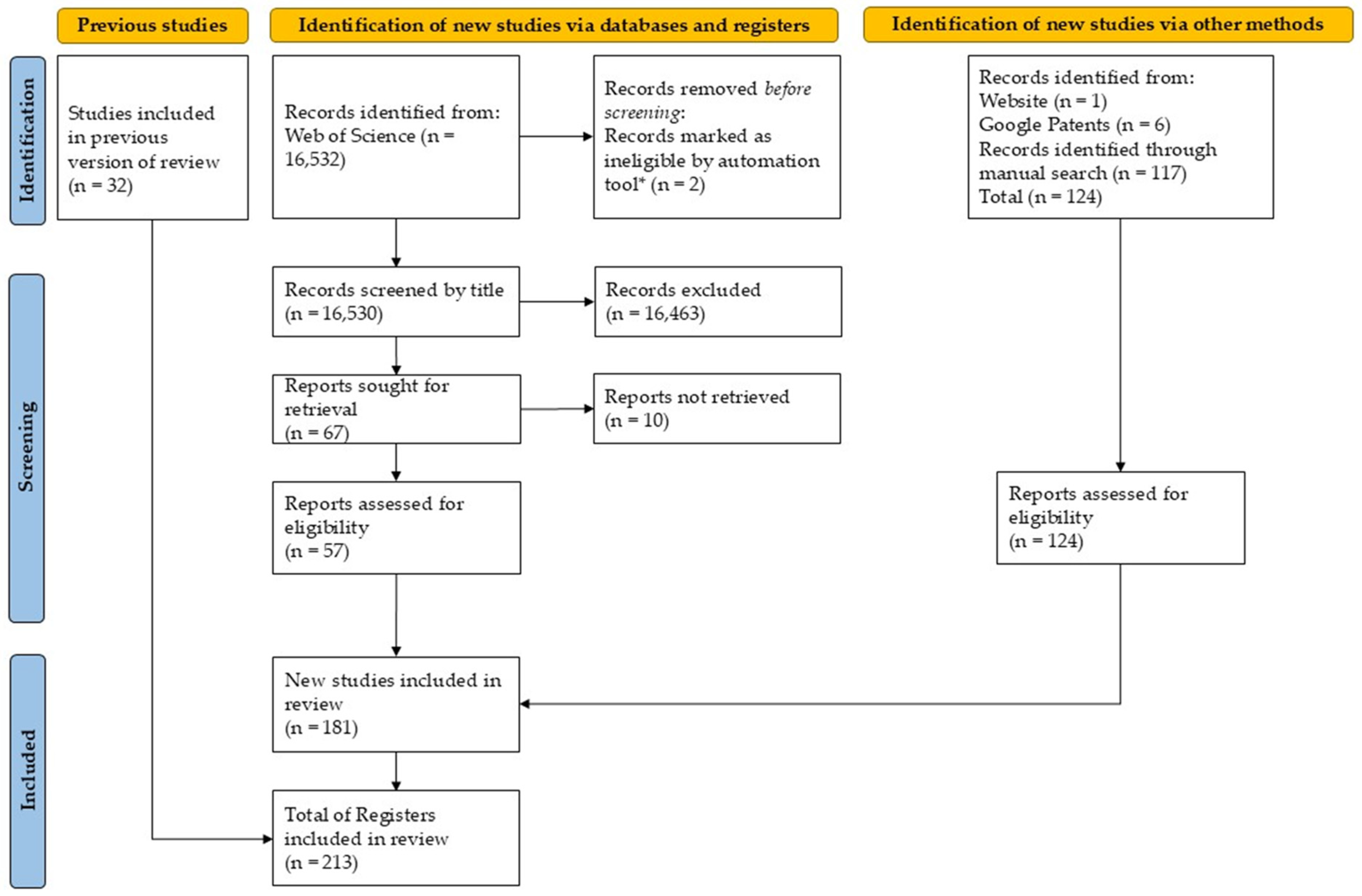
This study was conducted through an integrative review that brings together distinct theoretical and experimental studies, supported by guidelines of the PRISMA 2020 protocol (Supplementary Materials), in order to ensure transparency and reproducibility through 4 phases of identification, screening, inclusion, and data extraction. The integrative review allows the incorporation of additional relevant documents, enabling a balance between the rigorous scientific methodology and a multidisciplinary, creative, and strategic perspective on scientific research. In Figure 1, the flowchart presents the steps of the PRISMA 2020 protocol [6,7].
During the identification phase, for previous registers, 32 records were included. For new registers, a total of 16,532 records were retrieved from the Web of Science database on 31 March 2026, with 2 records removed using Mendeley Reference Manager (version 2.144.0) by RIS format list. The studies ranged from 2017 to 2026 and included review articles, original research articles, and book chapters, with an additional filter for English language. The open-access criterion was not applied, as a substantial number of relevant articles and book chapters required institutional access. The final search string was a combination of terms related to noise and synonyms, aligned with the relevant themes presented in the article: (“noise” OR “acoustic” OR “sound”) AND (“health” OR “environmental” OR “exposure” OR “urban” OR “pollution” OR “evaluation” OR “measurement” OR “policy” OR “assessment” OR “public” OR “sustainable” OR “comfort” OR “buildings” OR “construction” OR “hearing” OR “thermal” OR “traffic” OR “city” OR “simulation” OR “indoor” OR “outdoor” OR “stations” OR “railway” OR “district” OR “metro” OR “review” OR “aircraft”). For patents, site, and individual records, the strings were not applied. Instead, the process was conducted manually.
During the screening phase, from the 16,530 records identified in the databases, 67 records were selected after filtering based only on titles followed by full-text reading. This phase was conducted at the authors’ discretion after the initial application of the inclusion and exclusion criteria. After full-text assessment, non-relevant articles were excluded due to lack of compatibility, insufficient clarity, and/or an absence of scientific rigor, according to the authors’ evaluation. A similar procedure was applied to records not subjected to the inclusion/exclusion criteria, except for websites, which were reviewed in full. Any disagreements among the authors were resolved by consensus.
During the inclusion phase, the records obtained from all search engines were combined, totaling 213 records. The data extraction analysis focused on records that presented statistically significant data along with the identification of research gaps and opportunities for innovation.

3. Noise Pollution and Acoustic Comfort

Noise pollution represents the undesirable sounds that disturb people’s daily activities such as studying, sleeping, talking, and relaxing. In the face of the high-speed responsibilities that human beings have been taking on to survive, the disrespect of noise community rules, when they exist, occurs frequently in a diversity of environments, such as the construction sector, residences with high-volume music and domestic activities, industrial operations, road, subway, railway, and air traffic, and other sectors [8].
In contrast, acoustic comfort is the degree of satisfaction with noise disturbance in an environment, being a psychosocial condition that aggregates noise’s explicit and implicit characteristics for a specific context. Explicit characteristics can be direct measurements of noise patterns such as amplitude, whereas implicit characteristics can be exemplified as spatial organization of an environment, secondary sounds (such as birdsong), and any other element that can be interpreted by local users as pleasant and unpleasant. Therefore, acoustic comfort does not reflect the absence of sounds, but points to the balance between explicit and implicit factors in order to make an environment adequate and satisfactory in terms of noise perception [9,10].
As implicit factors are sometimes subjective, the suitable way to measure acoustic comfort levels is through measurement scales such as user satisfaction questionnaires. Among the most utilized scales, there are five-point, three-point, seven-point, and percentage scales, such as Key Performance Indicators (KPI) [11].
The five-point scale is widely employed in several contexts, including specific noise sources with a range between −2 and +2 (or 1 and 5) and single steps, where the lowest level of −2 (or 1) is very uncomfortable, level −1 (or 2) is uncomfortable, level 0 (or 3) is neither comfortable nor uncomfortable (or neutral), level +1 (or 4) is comfortable, and level +2 (or 5) is very comfortable. Some studies, however, can reverse the order [12].
When the evaluation level requires better detail, reaching extreme points, the seven-point scale is more suitable, because it can cover two more levels than the five-point scale, from −3 (extremely uncomfortable) to +3 (extremely comfortable) [13]. On the other hand, the three-point scale has a range from 1 (uncomfortable) to 3 (comfortable) and has the advantage that interviewees can choose an option in a questionnaire rapidly, minimizing intermediate questions and preventing confusion. In some cases, it is possible to convert from seven-point to three-point scales to simplify an analysis [14]. Finally, the percentage scale is a workable option because it shifts from discrete to continuous variables, meaning that studies can estimate values such as media and standard deviation, enabling normality tests to understand if a noise disturbance mitigation action is statistically significant or not [15].
The World Health Organization (WHO), an entity of the United Nations (UN), defines quality of life as a set of people’s perceptions regarding roles assumed in society within diverse cultural contexts and with different objectives. This definition includes some features such as mental health, independence level, psychological state, physical environment, and social relationships to describe people’s satisfaction [16]. In this sense, the WHO suggests two questionnaires to measure quality of life: World Health Organization Quality of Life Instruments Brief Version (WHOQOL-BREF, with 26 questions) and World Health Organization Quality of Life Instruments (WHOQOL-100, with 100 questions). Assessment ranges from 1 to 5, with higher values representing a higher quality of life. Among the questions included in WHOQOL-100 are “How satisfied are you with your physical environment (e.g., pollution, climate, noise, and attractiveness)?” and “How concerned are you with the noise in the area you live in?”. Therefore, similarly to the five-point scale, the WHO recognizes that noise disturbance is a parameter that requires further investigation, and application of these questionnaires containing questions about environmental comfort is the institutional metric used by the UN to understand the levels of people’s satisfaction [17].
The World Happiness Report, published annually since 2012 by the UN, evaluates the level of happiness among citizens in more than 140 countries, including per capita income, social support, life expectancy, freedom to make life decisions, generosity, and perceptions of corruption. Although environmental quality is not a parameter directly measured, this report considers air pollution, climate conditions, presence of green areas, and noise pollution [18]. For example, air pollution is a factor that shows an inversely proportional relationship between high concentrations of NO2 and SO2 and low levels of happiness [19]. In contrast, high levels of noise pollution are not always associated with low happiness indices, because these indices depend on explicit and implicit factors of each environment. Different classifications may serve as determining metrics through the usability of each environment to understand the balance between extremely quiet and extremely noise places, thereby helping to improve the overall happiness of a country [20].
In the construction sector, some equipment can cause elevated acoustic discomfort, such as demolition and foundation (e.g., pile-driving) machines, compressors, generators, excavators, hydraulic hammers, concrete mixer trucks, pavement cutters, and drills, among others. Normally, these machines can induce three types of noise disturbance: continuous, intermittent, and rapid pulses. The continuous type occurs with drills with a constant noise disturbance; the intermittent type occurs with hydraulic hammers with constant pulses; and rapid pulses occur with pile-driving machines with an isolated noise disturbance time lower than 1 s; the rapid pulse type is the worst in terms of acoustic discomfort sensation [21]. In civil construction, involving metallic components such as compressors and generators in bridges and ship hulls, the sound velocity is propagated quickly by the lower energy dissipation, being reflected in an elevated acoustic discomfort [22].
Road traffic can also cause excessive acoustic discomfort in the face of certain factors. These are proximity between residential houses/buildings and roadways, roadway length above 22 m, absence of vegetable barriers to absorb sound and to attract some animals that can make sounds such as birdsong, presence of crowds, traffic volume measured by roadway average velocity, roadway vehicle composition measured by presence of heavy vehicles, and roadway geometry (level roads, with curves, with ascending and descending slopes, or with barriers such as tunnels that channel sound). The Calculation of Road Traffic Noise (CRTN) permits the compilation of these parameters. In addition, other methods can be applied, such as Common Noise Assessment Methods in Europe (CNOSSOS-EU) and ASJ RTN in Japan [23,24,25,26].
In a comparation between subway and roadway traffic, acoustic barriers and material types constitute distinctive elements. In terms of acoustic barriers, subway stations generally are more compact than roadways, channeling and reflecting the sound through the lines. In terms of material types, rail tracks are metallic, allowing friction between wheels and tracks that transmits sound along subway lines, because of lower energy dissipation in metallic structures [27].
Furthermore, subway system improvement not only transfers the sound underground, but can provide reductions in private vehicle circulation and in greenhouse gas emissions. In Delhi, India, the inclusion of a subway system could reduce the number of private vehicles by 12% over 10 years. In Ahmedabad, India, this reduction was even more significant, around 15% [28]. In Dubai, United Arab Emirates, the subway project can reduce the CO2 emissions by 19.42 kton, whereas in Medellin, Colombia, the subway reduced CO2 by 188 kton [29,30].
In air traffic, the main factor that contributes to acoustic discomfort is turbulent aerodynamics from collision between airflow and internal components (such as motors, gears, propellers, and auxiliary systems) or aircraft fuselage [31]. As an aggravating aspect, generally there is not a quiet period at airports, requiring that the nearby urban area adapts some acoustic insulation to fulfill daily needs such as sleeping or talking, mainly during landing and takeoff of aircraft, when acoustic discomfort is elevated [32].

4. Noise Disturbance Signatures

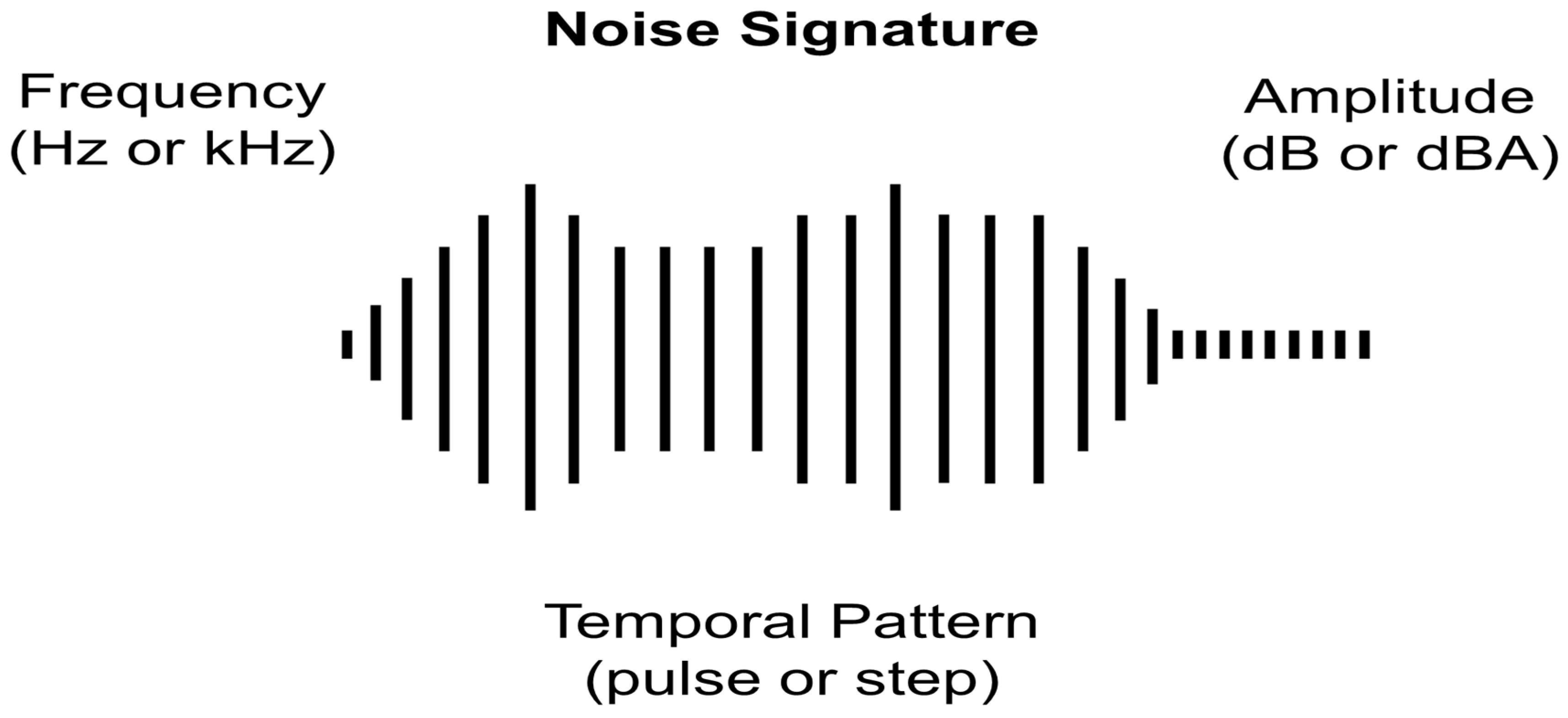
A noise disturbance can show three characteristics: frequency, amplitude, and acoustic temporal pattern. Frequency corresponds to the number or oscillations or vibrations by time units, being measured generally in Hertz (Hz), and reflects how sound can be perceived or distinguished, from high to low tones [2]. Human audition can detect frequencies from 20 to 20,000 Hz, mainly between 1000 and 4000 Hz. Generally, when there is an interval between two frequency values, the lower frequency receives the unit HzA and the higher receives the unit HzB. In some situations, it is possible to define frequency bands, for example, initial band HzA (20–30 Hz) and final band HzB (200–300 Hz). Frequencies that are under 20 Hz (infrasound) and that are above 20,000 Hz (ultrasound) are inaudible to human beings [33].
In terms of infrasound, there are natural and anthropologic sources of this frequency classification. The natural sources can be volcanic eruptions, earthquakes, thunder, tsunamis, aurora borealis, meteor falls, and avalanches, whereas anthropologic sources can be nuclear explosions, wind turbine movement, and aircraft sounds [34]. As advantages, it is possible to estimate parameters of hazardous phenomena, such as how high an avalanche’s velocity can reach or the volume and form of a volcanic eruption. These hazardous phenomena have rapid and destructive power, spreading large quantities of mass and energy in a short period of time. Therefore, infrasound sensor application can estimate the evolution of size and velocity of an avalanche or a tsunami through a monitored section, being critically important for residents of these areas [35].
In terms of audible sound, there are several classifications: mode of production, perceptual valence, color, acoustic structure, and specialization. In mode of production, the classification occurs more intuitively: natural sounds (wind, rain, and animals), human being sounds (conversations, footsteps, crying, laugher, and singing), artificial and mechanical sounds (vehicles, construction, alarms, and ventilation), and cultural sounds (music and fireworks) [36].
In perceptual valence, the classification is according to sound interpretation, being positive (insects, birds, flowing water, and wind), neutral (music, equipment noise, and crowd), or negative (traffic and construction sector sounds). This classification has relevance because it indicates the sounds that can improve people’s health. Negative and neutral (during quiet periods) sounds can cause either acoustic discomfort or critical complications for the human body [37].
In classification by colors, there is an association between sound power (energy density by time) and sound frequency. This classification is widely used in acoustic engineering and in sound design, being created for the perception of two human senses: hearing and vision. White color or independent per-channel white Gaussian noise represents a minimal variation in frequency, such as analog television or radio station hiss when a channel is not tuned in [38]. Pink color represents an auditory smoothness with applications in acoustic correction tests, where the sound power is inversely proportional to frequency [39]. Brown (or red, or Brownian) can concentrate a high-level energy density in low frequencies (power inversely proportional to squared frequency), being employed in masking bass sounds, like heavy rain. However, it is understudied in the literature [40,41]. Blue color has energy density proportional to frequency, contrary to white color, with a higher-pitched sound, utilized for sound synthesis in elevated frequencies, or artificial sounds generated as electronic music [42]. Violet color has power proportional to frequency squared, with a higher-pitched sound, utilized in auditory adjustments, and according to complexity degree has difficulty in behavior prediction [43]. Gray color is similar to white color; however, gray color is more uniform and well-balanced. Results of psychoacoustic test results evaluate the lowest sound a person can hear, the location of the sound source, and auditory preference and fatigue [44,45]. Finally, black color is characterized by extended pauses, with power inversely proportional to frequency cubed; it is infrequent and presents hazardous peaks, such as in earthquakes [46].
In classification by acoustic structure, sounds are classified according to frequency recurrence and can be periodic (such as musical notes), aperiodic (such as wind and water noise), and transient (such as impacts and clicks) [47]. In classification by specialization, heart sounds related to systole (S1) and diastole (S2) can be an example, where S1 is a lower-pitched sound with a longer duration and S2 is a higher-pitched sound with a shorter duration [48].
In terms of ultrasound, there are two classifications: (a) frequencies between 20,000 and 100,000 Hz (power ultrasound), with some industrial applications, such as surface cleaning, multicomponent homogenization, polymeric welding, and crystallization with high-purity crystals, as well as increases in interfacial reaction rates, such as in adhesive applications [49], and (b) frequencies between 1,000,000 and 10,000,000 Hz (diagnostic ultrasound) that are applied in more than 25% of imaging tests in cardiology, oncology, urology, gynecology, and ophthalmology. Diagnostic ultrasound has a lower-penetration power advantage that can generate images without damaging the human body [50,51].
There are also isolated classifications: impulsive, speech interference, line interference, environmental, and thermal types. The impulsive type causes a significant impact within a short period of time (between microseconds and milliseconds), being linked to explosions and hammer strikes [52]. Speech interference is present in specific spectra, e.g., 500, 1000, and 2000 Hz, used to evaluate speech intelligibility through Preferred Speech Interference Level (PSIL). This measurement can estimate noise disturbance levels through the amplitude arithmetic mean of these spectra. An increase in the amplitude mean of these spectra leads to a higher probability of masking human speech [40,53]. The line interference type occurs when an electromagnetic disturbance masks power line frequency, causing signal distortions in electrocardiograms, electroencephalograms, electroretinograms, and other diagnostics tests that measure the conditions of the human body. These disturbances can vary from country to country due to historic reasons. In countries such as Brazil and India, the power line frequency is 50 Hz, whereas in the USA it is 60 Hz. Therefore, line interference impacts these spectra in harmonics of 50 and 60 Hz [54]. Notch filters, adaptative filters, and signal decomposition techniques are generally combined to avoid interference, implying real medical consequences for patients [55]. The environmental type refers to sounds produced by either nature or daily life, such as vehicles and alert sirens [56]. Finally, the thermal type is similar to the line interference type; however, this classification occurs with temperature differences, such as an increase in the temperature of certain circuits, causing electron motion and generating fluctuations in mechanical and electronic equipment, either by vibration in electronic components or by spring displacement [57].
In terms of environment, the metric Speech Transmission Index (STI) reflects speech intelligibility between emitter and receiver, ranging from 0 to 1, where the closer the index is to 1, the greater the environmental conditions are for promoting adequate communication. If the result of this index is greater than or equal to 0.6, the conditions for adequate communication are considered ideal. This metric is considered in international standards such as IEC 60268-16:2020 and is employed to determine or to compare the quality of environments in which communication is essential, such as classrooms, offices, and theaters, among others [58,59,60,61,62].
According to various types, a noise disturbance can exist in multiple classifications, and specific sounds should be grouped into a new classification. In Table 1, some noise disturbances are grouped based on common frequency interval.
Sound amplitude corresponds to the maximum intensity or maximum sound pressure magnitude at the same frequency. This unit is generally converted to logarithmic scale because a human ear is able to discern changes in amplitude on a logarithmic scale, as can be seen in embedded volume potentiometers inside circuits, such as in mobile phones and remote controllers. The minimum and maximum limits of human audible sound pressure are 20 µPa and 140 Pa (ear pain onset), which are converted to decibel scale (dB). Through Equation (1), units of Pa can be converted to units of dB by sound pressure level (SPL) as a function of evaluated pressure (p) and reference pressure (pref, 20 µPa), which is the minimum limit of human hearing [70,71].
S P L = 20 · log 10 p p r e f
Decibel range can vary between 1 and 140 dB, whereas human hearing can start to detect variations from 3 dB. An increase of 10 dB means a multiplication of 10 times in reference pressure. Despite the term “dB” after the number, the SPL is a dimensionless quantity, because it compares the measured pressure with reference pressure. In addition, audible sounds can also coexist with infrasound [72,73].
There is a scale of audible frequencies denominated as dBA, or a scale with an A-weighted filter. For example, a certain motor can exert a sound pressure of 120 dBA, which represents the major fraction of sound magnitude that a human can perceive, and 5 dB, which corresponds to infra- or ultrasound. This dBA scale is utilized for health, for occupational safety, and for health legislation, because it reflects human perception of pure tones aligned with an isophonic curve of 40 phons. This curve reflects the required amplitude in a frequency (based on 40 dB and 1 kHz) for human perception of sound pressure [74]. As examples of different decibel levels, whispered speech has 40 dBA in 30 cm, a propeller-driven aircraft has 100 dBA in 30 m, and a jet aircraft taking off has 120 dBA [75,76].
When classifications of acoustic comfort are compared with acoustic disturbance signatures, these comparisons may or may not include additional aspects. Yang and Kang [77] observed that a difference of 6 dBA between spaces in a museum in London, which typically presents a high level of acoustic comfort, resulted in a variation of only 0.1 point on a five-point scale. This difference indicates that the perception of noise was practically not noticed by visitors of the museum. In quiet environments such as museums and libraries, a five-point scale is not appropriate because noise disturbance is extremely low, resulting in minimal variation. In these settings, it would be necessary to determine whether the level of noise disturbance has reached a plateau, where even environmental change, such as the arrival of new historical exhibits that attract larger audiences, would not lead to significant variation. A percentage-based scale would likely be more suitable, as it would allow for the identification not only of greater average variations, but also of potential standard deviations, thereby enabling a better understanding of the acoustic comfort curve profile.
Guo et al. [78] exposed 30 children with hearing loss to three distinct speech stimuli (55, 65, and 75 dB), using the Parents’ Evaluation of Aural/Oral Performance of Children (PEACH, five-point scale) questionnaire combined with the analysis of Cortical Auditory Evoked Potentials (CAEPs, sensory response) to verify adjustments in hearing aids. The authors verified that a variation of 10 dB was clinically applicable as the step for increasing sound intensity in hearing aids for children, as validated by the PEACH questionnaire. Hearing aids that are not properly fitted during the critical stages of speech development may result in reduced auditory input through the human ear. This reduction can lead to incomplete speech development modeling, a more limited vocabulary, lower levels of text comprehension, and poorer performance on grammatical assessments [79,80].
Jeon et al. [81] simulated virtual environments of indoor, arcade (semi-opened), and outdoor types, evaluating both perceptual acoustic classification using a five-point scale and sound amplitude (dB). The experiments were conducted with and without video. The results showed that simulated experiments with video statistically influenced participants to report lower acoustic perceptions. Therefore, the video did not change sound amplitude, but video caused a psychoacoustic perception of lower intensity. This study demonstrated that the brain does not interpret sound in isolation. Rather, this perception is modulated by other senses even when simulated. Sounds that are expected to occur are perceived as less disturbing. In contrast, scenes in horror films that begin in a calm setting with ambient sound can suddenly shift to abrupt images and sounds featuring disturbing characters, creating an acoustic startle effect in the audience. This effect is an intentional element of the genre and contributes to attracting the target audience [82].
Noise disturbance generally occurs in pulses or in amplitude steps. The modeling of temporal pattern can be achieved either by statistical analysis or by temporal templates. In graphical analysis of a noise disturbance, the first step is the definition of homogenous (constant pattern) and heterogenous (disturbance) spectra. Afterwards, amplitude threshold should be defined either by the user experience or by the literature. Finally, the noise disturbance should be observed to define whether the pattern is cyclic or random. This result should be employed in activities such as monitoring, machine learning, or notification [83,84]. In Figure 2, there is scheme of the three qualities that comprise a sound signature.

5. Context About Acoustic Sensors, Calibration Methods, and Acoustic Insulation

From the necessity of evaluating mainly the amplitude because of rapid variation in quantities, acoustic sensors are required in each situation, such as microphones, ultrasonic emission sensors, and membrane sensors (piezoelectric elements). Microphones can capture the environment sound either by recording or by voice recognition. Ultrasonic emission sensors can measure distances and can identify objects. Membrane sensors can be made by salts such as lithium niobate and lithium tantalate and can be strained by sound pressure. This deformation is converted into an electrical signal, either by voltage or by current; however, in short distances voltage is preferred because it has a higher sensibility [85]. These sensors may vary in terms of cost, accuracy, and stability, and may be incorporated into other sensors such as cameras that become an acoustic visor or as a Global Position System (GPS) which enables acoustic monitoring in a specific region [86].
The sensor ZTS-ZS-BZ-TTL-05 is microphone that allows a direct measurement from 30 to 120 dBA with a frequency range between 20 and 12,500 Hz, a temperature range between 20 and 60 °C, a humidity range between 0 and 80%, and a voltage range between 4.5 and 5.5 V. This sensor is ideal to measure the amplitude in residential areas with a cost of $ 8.00 [87].
The KY-037 sensor works through a diaphragm, which constitutes the central component of sensor, acquiring sound signals; an amplifier to raise sound signals; and a transducer to convert sound to electrical signals. The cost of this sensor is less than $ 2.00, but it requires short distances to capture sound signals even with a potentiometer for basic applications [88].
An acoustic visor is an ordered array of acoustic sensors which can register distinct amplitudes, generating colored graphs with different levels of amplitude on a bidimensional scale (2D). In this sense, the Bionic XS-56 sensor, CAE Software und Systems GmbH, Stolberg, Germany, has 56 integrated microphones, being a dynamic and portable sensor [89].
An acoustic map has a spatial distribution with contours or colors. The investigated locale can be an indoor area, a neighborhood, a street, a city, or an area that the map can cover. Acoustic maps also provide the advantages of investigating the past and the present and predicting simulated situations, being utilized for design and quantity validation against noise disturbances [90,91]. Among acoustic maps, two examples are SONYC (Sounds of New York) in the United States and Smart Citizen all over the world. SONYC combines the results of urban mapping with machine learning techniques to predict simulated situations, integrating acoustic comfort opinions in these results [92]. The Smart Citizen site is an open-access world map, where everyone who is logged in can share information about amplitude, temperature, relative humidity, and several parameters by the Smart Citizen Kit (less than $200.00) [93].
The CNOSSOS-EU model can be used for urban noise mapping based on amplitude, frequency bands, and temporal patterns, and obtained by acoustic sensors with compatibility with open-access software. The main advantage lies in the distribution of frequency bands: for road and rail traffic, these typically range from 125 to 4000 Hz, for air traffic, from 50 to 10,000 Hz, and for industrial environments, from 63 to 4000 Hz. CNOSSOS-EU presents uncertainties of up to 10 dB, requiring detailed input data, such as vehicle type (including electric vehicles), vehicle speed, meteorological conditions, and road surface characteristics, in order to accurately estimate noise signatures [94,95]. Artificial intelligence methodologies, such as machine learning and neural networks, have been applied in conjunction with the CNOSSOS-EU model to predict noise disturbance signatures with greater accuracy by analyzing nonlinear relationships among statistically significant variables using large datasets. This represents a research gap that contrasts with the current predominant use of the method based on linear regression modeling approaches [96].
The ASJ RTN model employs a stationary calculation over specific periods, in which dynamic changes are not accounted for as this model is based on traffic volume, average vehicle distribution, and average vehicle speed. Therefore, this type of method is more suitable for highways rather than complex urban environments, where intermittent traffic, traffic signals, and unpredictable events are common. Humans tend to experience higher levels of acoustic discomfort due to peak noise events, such as honking, braking, and vehicle acceleration, which are typically less pronounced on highways due to the more continuous or regulated flow of traffic [97].
Active Noise Canceling (ANC) is a technique that measures the amplitudes of unwanted sound disturbances and generates sound waves of similar amplitude, but with symmetrically opposite phases for the user. In other words, ANC produces destructive interference in the wave, thereby canceling the noise, although some residual noise may remain. Acoustic sensors are responsible for detecting the sound, while digital signal processors invert the phase and transmit the signal to a loudspeaker or actuator to emit the cancelation sound. Some systems employ an error microphone and adaptive algorithms, using control strategies such as feedback and feedforward to adjust the control signal in real time, particularly for low-frequency noise [98].
Kwong et al. [99] analyzed the impact of ANC technology on 83 children on the autism spectrum, aged between 7 and 12 years, using 36 different types of acoustic stimuli ranging from 40 to 90 dB. The evaluation compared headphones with and without ANC filters, using a five-point scale implemented via a mobile application as the assessment metric for participants. For most stimuli, acoustic comfort results were higher and statistically significant for children who used headphones equipped with ANC filters. This also influenced parent perceptions of children’s behavior for up to three weeks following the tests. The study highlights the importance of ANC technology not only for immediate acoustic comfort, but also for the therapeutic potential in improving the quality of life of children on the autism spectrum.
A calibration method certifies that measured quantities are reliably accepted in a statistical confidence interval. Sometimes a sensor is affected by changes such as movement, oxidation, and thermal expansion through months or years, mainly portable sensors. This evaluation is made by recognized metrology institutions with protocols to verify how much the instrumented sensing approaches the real value [100].
Among calibration methods of acoustic sensors, there are the Pencil Lead Breaker (PLB) test, the acoustic interference test, interferometry by laser sources or by ultrasonic transducers, and the hydrostatic test with comparison to a reference hydrophone. The PLB test occurs by a fracture of a pencil tip on a sensor surface and in a controlled environment in order to obtain a repeatable amplitude signal [101]. The acoustic interference test consists of a fixed emitter, a fixed or mobile reflector, and a fine membrane or a vibrational material. An emitter with a reflector generates a controlled acoustic field, whereas membrane or vibrational material is displaced by acoustic pressure [102].
A laser can make ultrasonic waves by two mechanism types: thermoelastic, when a material undergoes a thermal expansion from low-power pulses, generating ultrasonic waves, or ablation effects by plasma formation from any liquid evaporation by laser, also generating ultrasonic waves with surface damages. Through an interferometer, acoustic pressure is converted into dB [103].
In subaquatic environments, constant hydrostatic pressure with piezoelectric elements, being deformed to generate distinct electrical voltages, can receive variable acoustic pressure for deformation beyond hydrostatic pressure. This value is converted proportionally into an electrical signal, and afterwards into dB [104]. In Table 2, sensor characteristics have been compiled for better selection.
In terms of technical standards, for outdoor environments, sensors should include wind correction and a wide temperature range for applications such as highways, railways, airports, and industrial areas (ISO 1996-1:2016), as well as energy autonomy, remote communication, and protection against interference. In indoor environments, sensors with higher accuracy classes should be prioritized in terms of selection and with a dynamic range (IEC 61672-1:2013), acoustic calibration (IEC 60942:2017), sensitivity to background noise, and integration with acoustic analysis (ISO 3382-1:2009) [105,106,107,108].
In order to mitigate the impacts of noise disturbances, acoustic insulation methods, materials or structures capable of preventing sound propagation can be implemented using different materials to achieve adequate acoustic control. Acoustic insulation generally presents an index known as Sound Reduction Index (R), which reflects the difference in dB between incident and transmitted amplitudes. The criteria for selecting materials include type (natural, synthetic, composite, or recycled), density, and thickness of material, structural type (open or closed), and the presence or absence of air cavities [109].
Applications of acoustic insulation include civil construction, such as in walls, ceilings, floors, and windows for both residential and commercial use; in industry in general to reduce noise from machinery; and underwater to prevent sensors from experiencing interference from freshwater or marine environments [110,111]. Individually, acoustic insulation materials present a parameter known as Sound Absorption Coefficient (α), defined as the ratio between incident and transmitted amplitudes at different frequencies, ranging from 0 to 1 and with higher values indicating greater sound absorption. Materials with coefficients higher than 0.5 are considered acoustic absorbers. In noisy environments, the separation of spaces with noise sources should be achieved through the combination of high-density materials (such as bricks, concrete, gypsum, and drywall) and layered low-density materials. These layers arranged in series can reduce the noise disturbance from the source [112]. In Table 3, there are different acoustic absorber materials with frequencies and Sound Absorption Coefficients:
In energy-efficient buildings, there are several advantages to application of acoustic absorbers. The main benefit is to provide acoustic comfort in residential or commercial environments for users to efficiently carry out activities in harmonious balance, ensuring sound privacy. As additional synergies, these materials may also provide dual insulation (acoustic and thermal), thereby reducing energy consumption for climate control, particularly in contexts of energy vulnerability. Furthermore, these materials may present fire-resistant properties and can incorporate waste materials into composition across different frequency ranges [120]. As disadvantages these materials generally require greater thicknesses (cm), which may limit the applicability, especially in space constraints, and need to be used in layered internal constructions, since these materials do not exhibit typically high mechanical resistances or an appropriate aesthetic for external cladding [121]. In terms of cost, acoustic absorber materials can increase the overall construction cost by approximately 10–30% compared to traditional cement-based materials; however, there is an improvement of 25–30% in acoustic comfort [66].
In this context, acoustic sensors are necessary to identify the source and the type of noise disturbance with proper calibration. Based on this identification, new constructions can be designed, and existing constructions can be adapted using acoustic absorber materials to provide not only acoustic comfort across different frequencies, but also thermal comfort.

6. Human Disorders Due to Excess Noise Disturbance

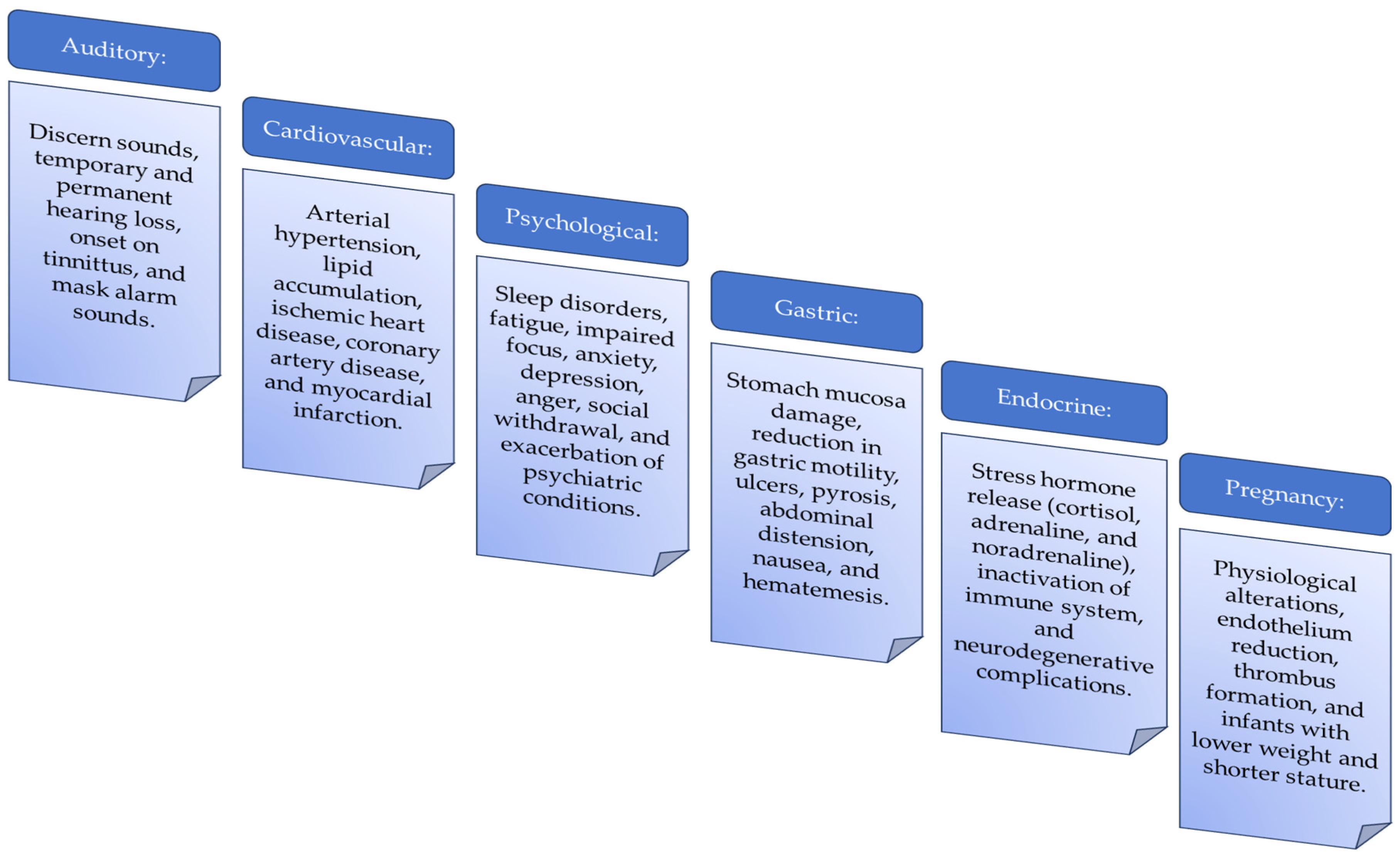
Without minimal acoustic control, noise disturbances can cause damage in citizens who live or work in the vicinity of noise sources. The disorders can vary according to the part of the human body affected—auditory health, the cardiovascular system, the endocrine system, the gastric system, the human psyche—and can also affect pregnancy. In terms of auditory health, Saleh et al. [122] found that at least 40% of civil construction workers in four leading construction companies were exposed to noise disturbances beyond 85 dBA. This exposure reflects some diseases, covering cases from the simplest to the most severe. At the lowest levels, difficulties in discerning sounds and attempts to express ideas under a normal amplitude level, at a deliberate pace, and in the same language of receiver are some types of symptoms. At intermediate levels, noise disturbance can cause temporary hearing loss or onset of tinnitus, and can also mask alarm sounds that are critical for safety, similar to a valve releasing under high-pressure conditions in a pressure cooker, or to an ambulance siren triggered. At extreme levels, noise disturbance can completely damage auditory health with permanent hearing loss. For example, in the civil construction sector, 19% of hearing loss cases (temporary or permanent) come from workers that were exposed to excessive noise disturbances [4,123].
Humes [124] applied a five-point-scale questionnaire to evaluate the auditory well-being of more than 10,000 adults over the age of 50, comparing sounds heard at acoustic thresholds of 500, 1000, 2000, and 4000 Hz. The research concluded that the questionnaire alone was statistically significant in predicting hearing loss without the need to perform audiometry, which is particularly important because many social and physical factors may hinder people from visiting specialized clinics to undergo audiometric examinations. Among the social factors, there remains a stigma associated with the use of hearing aids, particularly among individuals over the age of 50, as hearing aids are often linked to aging and the perceived loss of physical and mental autonomy. However, the purpose of hearing aids is precisely to restore auditory autonomy. Among the physical factors, issues include discomfort related to the geometry of certain devices, the need for periodic removal for cleaning, and battery recharging, as well as the risk of device damage or loss [125,126].
In terms of cardiovascular health, noise disturbances can often activate the autonomic nervous system, which regulates involuntary body functions such as heart rate and arterial pressure. This excess can cause arterial hypertension, which is a chronic condition and is an asymptomatic disease with elevation of arterial pressure, hindering blood circulation, impairing vascular integrity, and affecting oxygen and nutrient distribution inside the human body. When an artery has any damage, the vessel also loses covering and becomes more flexible and predisposed to lipid accumulation. This increase is associated with several behavioral conditions can cause ischemic heart disease and coronary artery disease, which are disorders due to obstruction of blood vessels by lipid accumulation and/or by thrombi, blocking blood circulation. Furthermore, lipid accumulation can cause myocardial infarction, which consists of cell death in cardiac muscle [127].
Li et al. [128] found that high-amplitude noise disturbances (≥80 dBA) increased the risk of hypertension over a period of up to 10 years in a vulnerable population of industrial workers. Values below this time threshold were not statistically significant. The high-frequency noise generated by industrial machinery requires workers to use Personal Protective Equipment (PPE), such as earplugs, earmuffs, and custom-molded plugs, which should ensure both comfort and protection, typically providing noise reduction between 10 and 30 dB. However, several barriers contribute to improper use, including discomfort due to unpleasant tactile sensations and incompatibility with the auditory canal, interference with communication in already demanding work routines that require clear information exchange to avoid operational issues, and psychological factors such as peer influence in the workplace. In this context, training and awareness programs on hearing health should be implemented in industrial settings to promote proper adherence to protective equipment [129,130].
Xie et al. [131] compared the effects of acoustic perception (five-point scale) and physiological and psychological responses in 156 hospitalized patients with coronary heart disease, with and without the introduction of artificial sounds such as running water, birdsong, and forest environments, while measuring only the environmental dBA levels in the hospital setting. A difference of approximately 2 dBA resulted in lower annoyance from noise disturbance of hospital machines, improved psychological state of patients, and improved heart rate and blood pressure. This acoustic biophilia involves implicit factors, as natural sounds, even when artificially generated, can deactivate the body’s vigilance mechanisms, preventing noise disturbance from acting as a contributing factor to cardiovascular diseases, but instead acting as a supportive agent in the recovery of hospitalized patients.
In terms of psychological health, noise disturbances can cause sleep disorders, affecting the community through fatigue and impaired daytime focus. Ottoz et al. [132] evaluated 291 Italian families in Milan and in Turin, finding that families changed residential common activities such as sleep to be in the most silent room (some families slept in the kitchen) or utilized hearing protectors to alleviate noise disturbances in metropolitan areas. Around 88.7% of families in Milan and 95.5% in Turin are affected by insomnia because of noise disturbances. In addition, sound excess can lead to anxiety effects, depression, anger, social withdrawal, and exacerbation of psychiatric conditions. Patients can present poor adherence to medication consumption due to financial, cultural, and/or cognitive reasons [133].
Yazdanirad et al. [134] observed that 8 h/day of noise disturbances above 80 dB were sufficient to cause insomnia in distinct types of vulnerable populations such as drivers, professors, students, and industrial workers. This routine period of work under intense noise pollution can lead to driver inattention and a heightened risk of accidents, as driving requires adequate physical and mental rest to properly assess the driving environment and operate the vehicle safely in urban streets, both to avoid and to prevent traffic incidents. Globally, fatigue-related traffic accidents result in approximately 1.25 million deaths per year and cause non-fatal injuries to an estimated 20 to 50 million people annually [135]. In order to investigate fatigue caused by psychological stress in traffic in a practical manner, considering acoustic amplitude levels, Brink et al. [136] investigated the relationship between noise disturbance exposure and changes in velocity limits from 50 to 30 km/h across 15 road segments, using eleven-point questionnaires (where 11 represents the highest level of acoustic discomfort) applied both before and after the intervention along with acoustic amplitude analysis. Despite a modest reduction of only 1.6 dB during the day and 1.7 dB at night, acoustic discomfort levels decreased significantly from 6 to 2 (on the eleve-point scale), and sleep disturbance levels dropped from 7 to 1 (on the same scale). These findings highlight how traffic planning measures can substantially impact acoustic comfort.
Kubba [137] reports that the Occupational Safety and Health Administration (OSHA) does not recommend noise disturbances above 65 dB for any worker during an 8 h period, because this level of disturbance can initiate stress symptoms. Furthermore, noise disturbances at levels of 85 dB or higher can cause severe stress reactions for workers, increasing risks of workplace accidents, aggression, and antisocial behavior. Work overload, role conflicts, poor working conditions, long working hours, and effort–reward imbalance are also causes of occupational stress, which can generate substantial costs for governments and private entities, for example, due to absenteeism due to symptoms of depression and anxiety, increasing healthcare expenditures. In a context with many interacting variables, companies should assess acoustic comfort in the workplace to determine whether there is an impact not only on how employees feel in an environment but also on productivity, particularly when changes such as the implementation of acoustic insulation materials are introduced [138,139].
Pandya and Guayvat [140] analyzed audio segments ranging from 2 to 10 s in a single residence, using a dataset of over 2000 audio samples and KY-037 microphones to identify 22 types of common household acoustic events, such as water leaks, shower operation, television and radio use, chair dragging, door impacts, and refrigerator door opening and closing. These events were selected with the purpose of enabling Smart Living, that is, the use of technologies to improve not only environmental comfort and quality of life but also to monitor and control excessive consumption of energy, water, and gas, leading to the development of an Acoustic Event Detection and Classification System. This system achieved an accuracy of 77% in matching real-world sounds with the reference dataset. Given the low cost of these sensors, there is strong potential for residential system applications aimed at Smart Living, not only for monitoring indoor acoustic environments but also for capturing external sounds, such as daily urban traffic and occasional construction activities that may impact residents’ acoustic comfort. The system can be further improved not only by enhancing the compatibility between measured sounds and the dataset but also by incorporating environmental comfort questionnaires, such as the WHOQOL-100 or acoustic-specific tools like five-point scales. Based on initial environmental comfort assessments, acoustic insulation measures can be implemented, followed by reapplication of questionnaires to evaluate the psychological impacts on residents.
In terms of gastric health, elevated noises can produce more gastric secretion, inducing greater damage by HCl in stomach mucosa and a reduction in gastric motility as a reaction seeking to return to equilibrium. This motility is the mechanical movement that the human body offers to mix and to transport digested food. Furthermore, ulcer development may also be observed with complications such as pyrosis, abdominal distension, nausea, and hematemesis [141,142].
Min and Min [141] evaluated data from the National Health Insurance Service—National Sample Cohort (NHIS-NSC) in South Korea between 2002 and 2013, involving a substantial population of over 1 million across eight different metropolitan regions. The study aimed to investigate the relationship between nighttime environmental noise disturbance and diagnoses of gastric and duodenal ulcers. The effect observed between groups exposed to nighttime noise, compared to a control group with lower exposure, was 12% for gastric ulcers and 17% for duodenal ulcers. As major limitations, not all districts were analyzed, and sound amplitude levels were not directly measured at the locations where individuals lived, worked, or engaged in social activities. Instead, these data were obtained from the National Noise Information System (NNIS) for the municipalities studied. Therefore, future research could be conducted with smaller, more controlled study groups to directly evaluate the relationship between different noise signatures and the onset of ulcers.
In terms of endocrine health, stress hormones such as cortisol, adrenaline, and noradrenaline may be released in response to noise disturbances, affecting patient habitual activities in the form of sleep disorders [143]. Cortisol is a neurotransmitter produced by the adrenal gland and has functions in biological stress response, including immune system regulation through inflammatory actions [144]. Adrenaline is also a neurotransmitter, which acts by activating the immune system and utilizes cortisol to promote the body’s defense against foreign pathogens. Regular release of this hormone can cause inactivation of immune function [145]. Noradrenaline is linked with rapid biological stress response, affecting heart rate and blood pressure constriction. An excess of noradrenaline is often linked to neurodegenerative complications such as Alzheimer’s disease. Therefore, these three hormones function as regulators of body homeostasis. However, their release in excess can cause immunological and cardiovascular disfunctions [146].
Tobías et al. [147] reported that 3% of ischemic heart disease cases are from noise disturbances in highway traffic of metropolitan areas. Barceló et al. [148] also reported a cause-and-effect relationship between noise disturbance and highway traffic, mainly in the vicinity of airports. Despite the relatively low percentage of 3%, this finding should be highly impactful at the population level, as ischemic heart disease is a long-term and often silent condition. The activation of the sympathetic nervous system in residential or workplace environments, triggered by external vehicle traffic, can keep the body in a state of alert even within indoor settings, leading to stress peaks due to the release of stress hormones. After the noise disturbance from traffic subsides, the body returns to a relaxed state in an attempt to restore homeostasis. However, in noisy environments, this cycle may occur so frequently that the organism enters a constant state of vigilance, with periodic release of stress hormones, increased blood vessel pressure, reduced vascular elasticity, and a greater predisposition to fat accumulation. Over time, these effects may contribute to the development of ischemic heart disease.
In terms of pregnancy, either the pregnant mother or the fetus can be affected by negative impacts, mainly at beginning of the period, which can trigger sudden physiological alterations, leading to complications in circulatory and endocrine systems. Noise disturbances release hormones such as catecholamines (adrenaline, noradrenaline, and dopamine) and cytokines (proteins that stimulate the immunological system to be active, producing leukocytes). These alterations can reduce the cellular thin layer which covers blood vessels and endothelium, can increase arterial pressure, and can lead to thrombus formation [149]. As consequences, infants can be born with lower weight and shorter stature, possibly undergoing preterm delivery, which are associated with cardiovascular and respiratory diseases [150]. The distinct complications of each health area affected by noise disturbances can be seen in Figure 3.
All relationships cited between complications and noise disturbances have scientific evidence that chronic noise exposure leads to various conditions, affecting cardiovascular health, psychological well-being, pregnancy, and themes mentioned. However, as research gaps, studies aimed at understanding the biological mechanisms which cause these disorders remain limited. Furthermore, research identifying the most effective interventions and how implicit factors interact antagonistically with noise disturbances is underexplored, representing themes for future research [151,152].

7. Acoustic Legislation

Daily technology dynamics reflect changes in law to address public demands. These technologies should be aligned with a harmonic coexistence between citizens to ground urban development in technical problems and not in personal problems. In this sense, noise disturbance laws in defined time periods are essential to maintain an equilibrium between silent and loud activities. Each country and each city has defined legislation according to cultural differences, allowing nocturnal periods with high-volume music in festivals such as year-end celebrations at a global level, or Carnival or Saint’s John Festival at a regional level. Noise ordinances of each locale define loud time slots, generally between early morning and late evening. Inside this restriction, civil construction activities have a short period, whereas a raised-voice conversation has a prolonged period [3].
The WHO establishes that, at nocturnal times, noise disturbances should not exceed 45 dB. In Greece, in residential areas such as cities, settlements, villages, and monasteries, the noise disturbance limit is fixed at 45 dB during nocturnal times, whereas in Vienna (Austria), this limit is even lower at 40 dB. In the European Union, there is a noise directive denominated “Directive on the Assessment and Management of Environmental Noise 2002/49/CE”, which indicates that noise disturbances should be often mapped, and noise simulations should be done in order to identify and to mitigate these types of disturbances in densely populated regions with more than 100,000 inhabitants. Based on this ordinance, the European Member States have a self-governance to sanction federal and municipal laws, respecting each country’s sovereignty and foreseeing conflicts of interest. This directive instructs Member States to estimate the population exposed to different levels of acoustic amplitude using geolocation data for proper noise mapping. Based on this mapping, mitigation measures should be implemented, and the information should be made publicly available to ensure data transparency [153,154,155].
In The Netherlands, the first major regulatory milestone addressing noise disturbance emerged when the queen enacted the Noise Nuisance Act in 1979, with unanimous approval from the Dutch parliament. This legislation reflected a strong political and administrative commitment to controlling noise disturbances in designated areas such as airports and zones classified as silent zones, including military airfields. Outside these areas, in order to respect the interests of the local population, the Act established that noise limits were required to be observed. The central government could mandate the application of acoustic insulation materials and was responsible for funding measures to prevent acoustically undesirable developments, supported by fees collected from airport users. This law served as a precursor to subsequent noise control regulations, particularly those governing construction near residential areas. In such cases, if a development does not meet acceptable acoustic levels, based on calculation methods such as the Regulation for Calculation and Measurement for road and rail traffic, permits for construction or expansion may be denied or postponed [156,157].
The Dutch political system is characterized by a social consensus model, known as the polder model, in which economic development is expected to be accompanied by a strong social safety net. This framework encourages the Dutch government to treat the population with respect, aiming to prevent abuses and social grievances. Dutch society has historically been marked by pluralism and religious tolerance, allowing different groups to pursue their identities and rights. The country also maintains a highly developed healthcare system, covering approximately 99% of the population through state-supported services focused on primary and long-term care. The Dutch historical context reflects a monarchy oriented toward respect and public welfare, fostering reduced social conflict through negotiation among government, businesses, and society. This approach prioritizes prevention over remediation, contributing to improved management of chronic conditions, including those associated with noise disturbance [158,159].
In France, Urban Planning Law 85-696 of 1985 established the mandatory development of noise disturbance maps for airports, along with their dissemination to users. This was a pioneering European regulation to impose transparency through public access to information, with the objectives of informing the population about sound amplitude levels and raising awareness to encourage behavioral changes. This Law also enabled the public to encourage decision-makers to participate more actively in urban planning processes. As a justification for implementing stricter noise regulations, the rapid urbanization of Paris, which quadrupled between 1800 and 1870, resulted in the concentration of 18.2% of the French population, 23.3% of jobs, and 36% of all executives in the country within the capital [160,161,162].
This rapid urbanization in Paris required the creation of entities capable of monitoring, mapping, and analyzing environmental noise, leading to the emergence of the non-governmental organization BruitParif, Paris, France. This organization is responsible for integrating databases from local authorities and government services across multiple municipalities, covering various sources of acoustic noise related to road, rail, and air transport. These data typically range from 30 to 80 dBA and are made available through dynamic online maps with daily updates, supported by 50 high-quality monitoring stations complemented by 350 lower-cost stations. Such data can also contribute synergistically with other observatories, such as Airparif, which focuses on air pollution monitoring [163,164].
In terms of technical standards, France establishes NFS 31 199:2016, which recommends acoustic amplitude levels for open-plan office environments, spaces without walls or physical partitions, across four distinct types of activities: telephone-related tasks (48 to 52 dB), activities emphasizing face-to-face communication (45 to 50 dB), tasks requiring individual concentration (40 to 45 dB), and reception areas (≤55 dB) [165]. Furthermore, minimum requirements for sound insulation reduction depend on the location of residential buildings, with stricter limits applied in areas with higher noise pollution. For new buildings, reductions of at least 30 dB are required, while older buildings (over 50 years old) and major renovations must comply with the French Building and Housing Code, which includes conditions related to location, floor area, and air renewal, integrating acoustics, ventilation, and architectural design in built environments [166,167].
In Switzerland, road traffic constitutes the main source of noise disturbance, affecting approximately 1.1 million people who commute daily for routine activities but exceed the exposure limits established by the Noise Abatement Ordinance. This regulation is based on the user/polluter-pays principle, taking into account vehicle mass, noise emissions, and engine pollutant levels in order to encourage the adoption of more sustainable vehicles. Additionally, there has been a growing preference for semi-dense asphalt pavement, which reduces noise disturbances. However, this type of asphalt still lacks commercially sustainable and technically competitive alternatives compared to traditional stone mastic asphalt, as its production process results in higher greenhouse gas emissions. Furthermore, approximately 250 km of noise barriers have been constructed, along with insulated windows, across more than 5000 km of Swiss railways. These barriers, typically around 2 m above the tracks, can produce multiple effects: visual impacts on the urban landscape due to obstruction of natural light, alterations in ventilation, and maintenance challenges, resulting from the accumulation of dust and microorganisms [168,169,170].
In India, within a context where road traffic accounts for approximately 55% of noise disturbance, arising from engine noise, exhaust systems, horns, narrow streets, and tall buildings that enhance sound reflection, the Noise Pollution (Regulation and Control) Rules have been established. The limits defined by these regulations specify permissible levels for different zones: industrial areas (75 dB during the day and 70 dB at night), commercial areas (65 dB during the day and 55 dB at night), residential areas (55 dB during the day and 45 dB at night), and silent zones, such as areas near hospitals and educational institutions (50 dB during the day and 40 dB at night) [171,172].
In the United States, the Noise Control Act of 1972 designated the Environmental Protection Agency (EPA) as the authority responsible for regulating noise-related issues. The agency established the Office of Noise Abatement and Control (ONAC) to monitor how noise disturbances affect the quality of life of Americans. The EPA has been recognized for its exemplary educational efforts, particularly in schools, promoting awareness initiatives to encourage noise-reduction behaviors among children [173]. Within a federal system, U.S. states maintain their own legislation for mitigating noise disturbances. For example, in New York City, the NYC Noise Code regulates activities such as construction, nightlife, and residential noise. In the construction sector, activities are typically permitted between 7:00 a.m. and 6:00 p.m., and construction sites must present specific noise mitigation plans, particularly for operations such as the unloading of building materials like concrete. The Department of Environmental Protection is responsible for measuring noise disturbance levels, when prompted, and for issuing violation notices. However, major challenges in one of the world’s most populous countries include insufficient enforcement of noise regulations, the banning of sirens on ordinary vehicles, and the implementation of acoustic barriers near designated silent zones [174,175].
Brazil utilizes the technical standard ABNT 10151:2019 to evaluate noise disturbances, but this country does not enforce a national policy as an approach to combating this social problem. This protocol has the aim of the establishment of guidelines to measure and to evaluate different noise disturbances in residential, commercial, and industrial areas. The Brazilian National Environmental Council (CONAMA) cites this technical standard as guideline, yet does not provide any legal instrument to encourage the protection of quietness by citizens [176].
Among Brazilian cities, São Paulo stands as the wealthiest city nationally and in Latin America. Historically, with Northeast-to-Southeast migration in Brazil during the 20th century, the city of São Paulo grew in a disorderly fashion, with a high population density, a large number of automobiles, and numerous industries [177]. According to Raess et al. [178], in São Paulo city the weekly audiometric average is 65 dBA in the face of high-traffic, informal and unplanned settlements, the biggest airport of Latin America (Guarulhos airport), and countless industrial activities. Municipal decree n. 58,737 enforces development and promotion of the Municipal Urban Noise Map for urban planning and for noise pollution control, integrating Departments of Urban Development, Transportation, Environment, and Innovation and Technology [179].
As a possible primary historical reason for the need to create an acoustic map, the city of São Paulo experienced an uncontrolled increase in population density between 1970 and 1980, accompanied by severe urban planning deficiencies, such as inadequate urban services, resulting in congestion not only on roadways, but also at airports, which were overcrowded. This unregulated population growth further intensified socioeconomic aspects, including social exclusion and income inequality, as well as urban governance issues, with strong private sector influence over environmental decisions, such as nightclubs lacking acoustic insulation [180,181].
In Guangzhou, China, residences near automobile industries exceeded sound limits by up to 6.7 dBA [182], and in Dessie, Ethiopia, a residential area showed that 25% of the 20 monitored points had weekly averages of up to 72 dB, exceeding limits set by the WHO [183]. Conversely, in steel plants, an investigation in Salem Industrial District, India, reported noise levels up to 233% above the permitted limit (8 h/day, limit of 90 dBA) due to compressors, fans, pneumatic tools, and various pieces of equipment [184].
Similarly to the urban growth of São Paulo, the city of Guangzhou also experienced a historical period of accelerated urban development driven by employment opportunities, being a city with higher per capita incomes in China. This population density increased the expansion of airports, located further from major urban centers to reduce exposure to noise disturbances, as well as vertical construction development, which contributed to exposure to noise disturbances [185,186].
In Dessie, similar socioeconomic aspects of urban growth and business opportunities are possible causes of noise disturbances, particularly related to transportation activities. In terms of urban governance, the lack of land-use planning and the absence of spatial transitions between residential and industrial areas are critical shortcomings, resulting in high sound intensities in areas such as roadways, squares, and markets [183].
Monitoring gaps aligned with numerous regulation exist: a major difficulty in implementing guidelines across countries, differing threshold levels of sound amplitudes in various nations, limited access to advanced noise control technologies, lack of public awareness regarding health risks, and insufficient training of local authorities for proper enforcement, in addition to a shortage of resources to be allocated [187].

8. Design of Interfaces in Noise Disturbance Measurement

Every message requires an emitter, a receiver, and a channel through which this message should pass with minimal information losses. A channel or an interface is a route that offers a potential solution for the secure and objective passage of data, which can be either physical or digital, depending on the receiver’s needs. Key principles that govern an interface are user usability principles, which address simplicity, information consistency, accessibility, inclusive design, and prototyping from low to high fidelity [5].
Sound parameters which characterize a noise disturbance (frequency, amplitude, and temporal pattern) associated with visual parameters (images and videos) and geolocation should be registered periodically by competent governmental authorities or by private companies through public–private partnership. Preliminarily, there is a requirement to define the objectives of these data: an area screening, an investigation of any environmental agency, police investigation, and/or an improvement in acoustic comfort. These collected data can also be assisted by citizen engagement through testimonies, incident reports, images, and videos, which can be sent to public platforms with easy access, contributing new data or opening new spots of noise disturbances. As a short-term return, incentives like reductions in taxes or utility fees, including for water, energy, or internet, can be offered for those who contribute in a verifiable manner [188].
In contrast, there are two security mechanisms against the spread of false information, including fines and incarceration. In a world with exponential technological growth, mainly with artificial intelligence, pranks are progressively more advanced and hazardous. When there is a possibility of short-term gain, the creativity of individuals with malicious intent emerges. Therefore, technological resources should verify unofficial information with the possibility of administrative and/or legal penalties for spreading false information [189]. In addition, technical parameters should respect current legislation for personal data protection. Noise disturbance data should describe the location of loud spots, specifying type and magnitude. However, this information should also respect personal data such as images and videos [190].
Sound data visualization with reliable local real-time data for the entire population enables more democratic dialog, allowing active participation in decision-making processes, making urban spaces more accessible to residents, and increasing transparency in management of policymakers [191,192]. These data can be monitored in real time, using fixed and/or mobile methods. In case of fixed sensors, weather-resistant devices are necessary, with periodic calibration, and high-quality wireless transmission. For mobile sensors, connectivity across various parts of cities is essential, with periodic and simple maintenance, and with integration into public platforms [193]. This data visualization must be versatile in terms of user accessibility, providing not only quantitative and qualitative metrics, or the relationship between noise disturbance signatures and what these signatures represent in reality, but also a field for user validation regarding the perceived sounds and on which scale this noise disturbance affects the acoustic comfort [194].
Filtered and collected data should be published in official vehicles supported by social media, either for new platform campaigns, or for release of results obtained in a delimited period. Promotion of what is happening with comprehensible numbers for citizens is essential for a higher conscientization degree of acoustic comfort due to life quality improvements [195]. A marketing power example in Brazil was the extensive anti-smoking campaign, highlighting harmful consequences of smoking in the human body and leading to a reduction in cigarette consumption [196].
Some aesthetic aspects of interfaces should include
  • Analysis of suitable color for emotional response, respecting combinations between warm and cool colors and cultural color aspects [197];
  • Legible typefaces, either in uppercase to reduce reading rhythm or in lowercase to encourage smooth reading and either in serif fonts for printed media or in sans-serif fonts for digital media [198];
  • Semiotic Engineering with signals, graphs, icons, symbols, and whatever elements express nonverbal and instantaneous meaning [199];
  • User-friendly, secure, and open-access platforms either for exhibition of noise situation, or for data sharing between citizens and competent authorities [200].
Some platforms utilized for registration, structuration, and/or exhibition of noise disturbances include
  • Arduino 2.3.8: an open-source prototyping platform through a microcontroller based on C/C++ language, with elevated integration with low-cost sensors, and digital platforms [201];
  • Python 3.14.4: an open-source software, with its own simple language and a larger development community for general utilization. However, Python has limitations in graphical tools with different languages, mainly in rapid measurements as in acoustic parameters [202];
  • LabVIEW 2026 Q1: a commercial software from National Instruments for high-precision industrial sensors that enhances graphical interface, with block diagrams well-defined, facilitated human interaction through drag-and-drop logic for components, and real-time monitoring [203];
  • MATLAB® R2026a: a commercial software from MathWorks with own language (some similarities with Python and C), with mathematical tools for simulation, data analysis and control as well as the graphical toolbox Simulink, which is sold separately. In comparation with LabVIEW, MATLAB has a complex interface, but is less user-friendly [204];
  • Figma 7.5.0: a commercial interface with application focused on high-fidelity prototyping that can import layouts, graphs, and dashboards to promote an interactive and a multidisciplinary user experience [205].
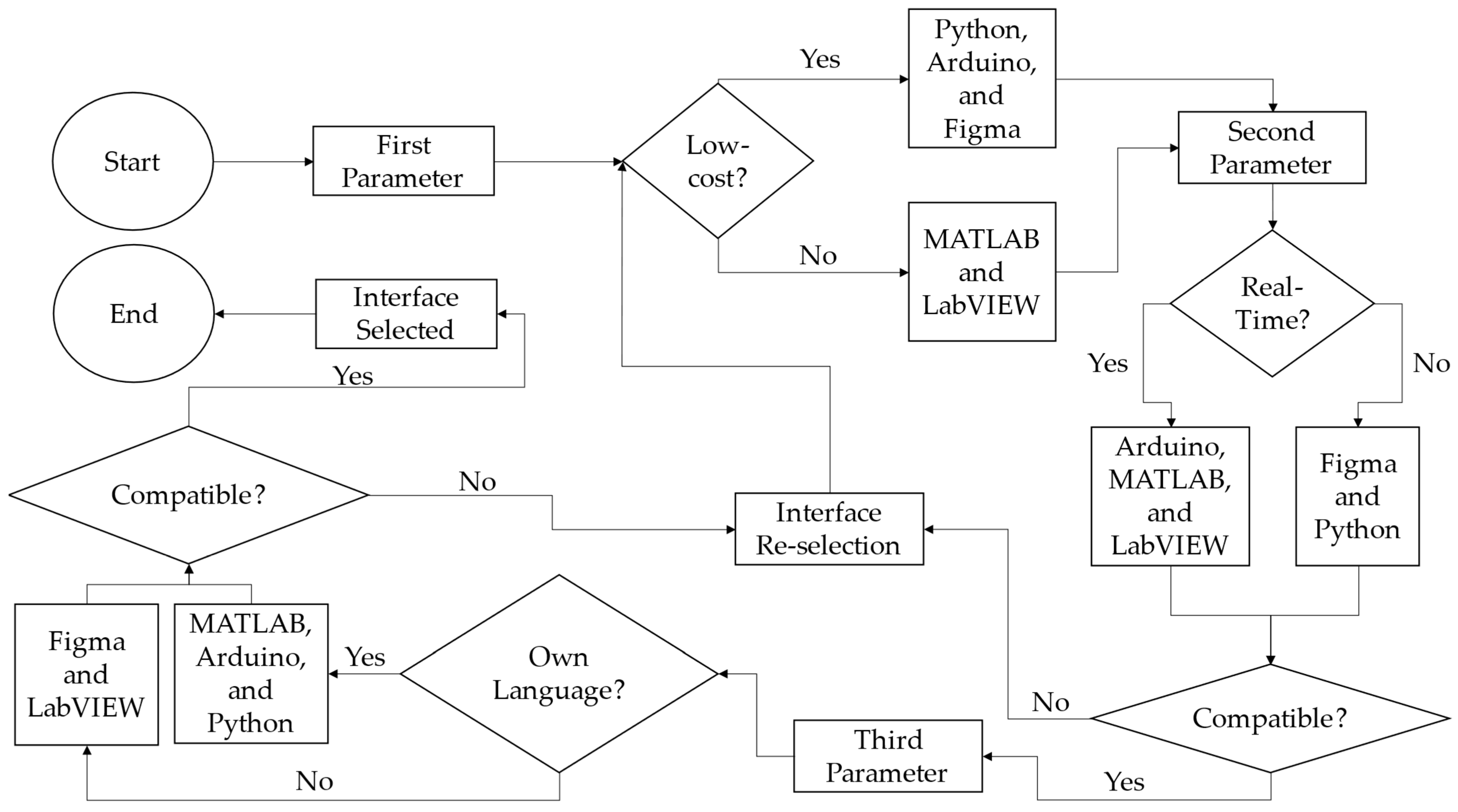
In Figure 4, a flowchart is exemplified for selecting a single-platform solution based on reported platforms, although the best combination of interfaces depends on the objective and on the technical and financial resources. If a development team is habituated to utilize a channel, the feasibility of acquiring or receiving training on another channel may be limited.
Barros et al. [45] analyzed psychoacoustic indicators in Belgium using microphones installed in more than 2000 vehicles of different types, including cars, vans, and heavy-duty vehicles. The study employed a MATLAB-based environment and examined the influence of temperature indicators and vehicle speed. Data collection periods ranged from 2 to 4 days across three distinct locations. Measurements were taken at 4 s intervals, which is suitable for monitoring overall traffic conditions over time but not adequate for capturing instantaneous variations, such as collisions or horn usage. The machine learning model achieved an 84% accuracy rate in vehicle classification, enabling the development of predictive analyses for aspects such as preferred vehicle types on specific urban roads, long-term asphalt wear, appropriate maximum velocity limits for different vehicle categories, and the most suitable pavement types for these roads. These findings can support not only urban road maintenance strategies but also improvements in acoustic comfort in nearby residential and industrial areas, either through modular adaptations, using sound insulation materials in existing buildings, or through comprehensive acoustic design in new constructions.

9. Intellectual Property Registrations About Noise Disturbance Mitigation

In Private Law, intellectual property registrations grant inventors and institutions the right to benefit from the materialized ideas through legal protection against unauthorized copying. They foster innovation, enhance the value of institutions that supported the invention, and enable the monetization of creative outputs. Many companies rely on these mechanisms to protect inventions that are typically embedded in commercialized products. Concepts related to the mitigation of noise disturbances integrate technical, legal, and health aspects within such inventions. These must be critically discussed in terms of advantages and disadvantages in order to assess the relevance of intellectual property registrations and practical applications [206].
Patent JP7653714B2 addresses ANC technology for headphones with two forms of noise cancelation: a traditional approach that targets external noise disturbances and a complementary approach that focuses on residual sounds passing through the ear cushions into the so-called air chambers. Many ANC headphones consider only external sounds, whereas hybrid noise-canceling systems are capable of detecting both external disturbances and internal acoustic leakage. However, such systems often require complex and costly circuitry that combines signal generation inside and outside the air chambers. Conventional noise-canceling circuits typically assume that the ear cushions are properly sealed against the human ear, attenuating high-frequency noises through the cushion material and reducing low-frequency noise through signal cancelation. In practice, however, due to geometry, material properties, and user movement, the cushions may shift, allowing ambient noises of varying frequencies to pass through this barrier and reducing the effectiveness of noise cancelation. The headphones described in this patent achieve noise reduction between 8 and 30 dB in the low-frequency range (30 to 500 Hz). The key innovation lies in the introduction of an additional microphone integrated into the ANC system, combined with a second buffer amplifier unit that functions as a filter to reduce noise in the temporal domain [207].
Patent EP2362381B1 also addresses ANC technology, yet presents different physical and signal-processing characteristics. A key consideration is the presence of a hermetic seal between the ear cushion and the ear, which may cause user discomfort due to the pressure required to achieve effective sealing. While this improves the capture and processing of external signals, the ear cushion may not adequately account for user comfort. The device consists of a shell-shaped chamber, an internal microphone, and an internal loudspeaker, but the system does not provide a clearly defined geometry or a technical drawing closely aligned with real-world design. In operation, ambient sound is captured by the microphone, processed, transmitted to the loudspeaker, and delivered to the human ear, resulting in a noise attenuation of approximately 27 dB at 1000 Hz [208].
Patent US8833510B2 developed an architecture based on the periodic arrangement of existing phononic materials, incorporating inclined 2D and 3D elements in shapes such as propeller blades, helical forms, and square geometries, rather than relying solely on straight elements. The design also includes a hierarchical structure, in which smaller elements are embedded within larger ones, enabling acoustic insulation across multiple frequency ranges. Through this architecture, the patent defines which frequencies are allowed to pass, allowing phononic materials to be coupled with different structural materials. This patent is versatile, as it supports a wide variety of structural materials available in both construction and renovation contexts, including components produced via 3D printing, and is theoretically efficient, with simulations indicating potential reductions of up to 30 dB in acoustic amplitude. Particularly in silent zones, such as schools, universities, and hospitals, acoustic studies could be conducted to identify the main sources of noise disturbance and enable passive noise control without the need for electronic systems. However, experimental validation through field testing is still required [209].
Patent DE202021104614U1 developed a rectangular acoustic insulation structure specifically designed for industrial applications, particularly for lateral coupling to blowing/drying machines, where a standard frequency of approximately 200 Hz is observed. This metallic structure consists of multiple layers, including an inner layer made of polyurethane foam for acoustic absorption, intermediate layers with a zigzag geometry to promote multiple reflections and enhance sound dissipation, and an outer layer featuring elongated or triangular micro-perforations designed to prevent liquid ingress while allowing sound waves to pass through for attenuation. This modular utility model enables the structure not only to absorb sound effectively but also to operate in humid environments, as this structure is washable and hygienic. The system can achieve a noise reduction of up to 3 dBA at a frequency of 200 Hz [210].
Patent US12080266B2 combines an acoustic simulation of road noise emission with an ANC system in automotive vehicles, enabling the measurement and optimization of the delay between sounds captured outside and inside the vehicle. For example, a known vibration in a car is detected externally, and a loudspeaker inside the vehicle emits a destructively interfering signal at an optimized time delay. The emitted sounds are based on a database of pre-recorded audio signals, and a key advantage of this patent is that it enables preliminary testing under various simulated road conditions without requiring the vehicle to be in motion. This reduces maintenance costs and travel time while providing a controlled testing environment. Noise reduction in automotive systems requires careful consideration, as auditory cues such as sirens and horns are essential for preventing accidents. Notably, the patent lacks numerical data regarding noise reduction levels (in dB), applicable frequency ranges, and time delay parameters [211].
Patent US9984673B2 combines the use of two types of sensors within ANC technology. Prior to relying on microphone-based sensors, commonly present in wearable electronic devices, the system proposes measuring existing structural vibrations to determine whether active noise cancelation should be applied. If significant structural vibration is detected, the actual noise disturbance signal may be misinterpreted. For example, impacts within a device housing may result in the generation of an acoustic signal that differs from the original disturbance. In such cases, the ANC system prioritizes the vibration sensor signal rather than the microphone signal. Otherwise, the system disregards vibration and generates a phase-inverted signal based on the microphone input. This patent presents some limitations, including variability in calibration thresholds depending on the type of device used. If the device is worn or has loose components, these thresholds may shift, potentially impairing system performance. Additionally, in complex sensor systems, the inclusion of an additional real-time sensor requires battery optimization for portable devices and may increase overall costs for the end user [212].
Patent US11917368B2 integrates a hearing protection device with ANC technology and signal processing to detect sudden noise disturbances (impulsive sounds such as door slams and shouting) and respond by reducing acoustic amplitude in real time. This is achieved through a combination of mechanical strategies, such as the opening and closing of physical orifices, and ANC techniques. The system is based on parameters including sound amplitude (80–120 dB) and unsafe amplitude growth rates (≥5 dB/s). Acoustic disturbances with lower growth rates (below 5 dB/s) are considered less critical, as individuals can more easily perceive gradual changes and react protectively. In contrast, growth rates equal to or greater than 5 dB/s are typically associated with impulsive sounds, which may cause increased discomfort, or even temporary or permanent hearing loss, depending on the amplitude. Among the advantages of this patent are automatic noise protection with reductions of up to 50% in volume and an innovative approach that protects users without significantly impairing the perception of relevant sounds such as conversations. However, the patent does not clearly distinguish between hazardous and essential sounds such as alarms, nor does it provide detailed reduction limits across different frequency ranges. Noise disturbances cause conflicts in human-centric environments, from residential to industrial areas. These disturbances can affect the community well-being and are evaluated either by acoustic signature (frequency, amplitude, and temporal pattern), or by secondary elements related to acoustic comfort with different scales. Acoustic sensors can map indoor and outdoor environments; however, these elements require adequate calibration methods to closely approximate measured quantities to real conditions [213].
Therefore, intellectual property registrations span from simulation-based approaches to technologies already embedded in devices with the primary advantage of reducing noise disturbances, although they often present unintended or undesirable side effects. Computational sound simulation is a valuable tool in the prototyping of such devices. However, simulation requires field validation to ensure proper implementation, so that the benefits of the technology outweigh the potential drawbacks.

10. Conclusions

Noise disturbances cause conflicts in human-centric environments, from residential to industrial areas. These disturbances can affect the community well-being and are evaluated either by acoustic signature (frequency, amplitude, and temporal pattern), or by secondary elements related to acoustic comfort with different scales. Acoustic sensors can map indoor and outdoor environments; however, these elements require adequate calibration methods to closely approximate measured quantities to real conditions.
The excess of noise disturbances leads to human complications such as hearing loss, sleep disorders, arterial hypertension, ulcer development, release of stress hormones, and weight and stature alterations in infants. Noise ordinances are the legal instruments to prevent these diseases and to guarantee the equilibrium between quiet and noisy periods for acoustic comfort. Therefore, standards and laws should be even more stringent in accordance with the WHO and national limits, and noise maps should be developed, such as SONYC and Smart Citizen.
The generated data should be in a channel that can register, structure, and transmit the information to end users. Design of such a channel is essential for ensuring that investments culminate in a single objective: providing acoustic comfort for citizens for sustainable urban living.
Intellectual property registrations are key milestones of innovation for companies seeking to legally validate the value of their investments and recognize the contributions of professionals, thereby enhancing brand value. In the context of noise disturbance mitigation, knowledge is highly integrated across multiple domains, ensuring that users of these technologies can benefit from improved acoustic comfort.
The research gaps identified in this study are as follows: (1) There is a lack of studies that simultaneously consider technical, legal, and health perspectives, particularly from a commercial standpoint, involving intellectual property registrations, and existing studies tend to adopt either single or dual-thematic approaches. (2) Active Noise Canceling (ANC) technology has been a significant ally in mitigating noise disturbances, particularly because it operates across a wide frequency range and offers portability, avoiding construction-related costs. However, ANC still presents limitations such as ergonomics and selectivity that need to be minimized for each specific application in order to protect users and ensure that complete information reaches the users. (3) Health impacts are more strongly supported in terms of psychological and auditory effects; however, the mechanisms that trigger these complications still require further investigation. (4) In some countries, there are more guidelines than enforceable laws requiring compliance with acoustic limits, and only a few cases include awareness campaigns on noise pollution. (5) There is a need to unify state-level interface design platforms so that the population can access real-time data and engage policymakers with evidence-based arguments, enabling the development of more effective laws. (6) Patented solutions often do not present sufficient numerical results; some report only isolated values or ranges, while others provide solely theoretical results without experimental validation.

Supplementary Materials

The following supporting information can be downloaded at: https://www.mdpi.com/article/10.3390/su18083726/s1, PRISMA 2020 Checklist.

Author Contributions

Conceptualization, P.P.F.B. and L.M.C.; methodology, P.P.F.B. and L.A.S.; software, P.P.F.B. and L.M.C.; validation, L.A.S. and L.M.C.; formal analysis, P.P.F.B.; investigation, P.P.F.B., M.C.S.L.B., R.M.E. and K.M.A.d.S.; resources, L.A.S.; data curation, P.P.F.B. and L.A.S.; writing—original draft preparation, P.P.F.B., M.C.S.L.B., R.M.E. and K.M.A.d.S.; writing—review and editing, P.P.F.B. and L.A.S.; visualization, P.P.F.B., M.C.S.L.B., R.M.E., K.M.A.d.S., L.A.S. and L.M.C.; supervision, L.A.S. and L.M.C.; project administration, L.A.S.; funding acquisition, L.A.S. All authors have read and agreed to the published version of the manuscript.

Funding

This research was funded by the National Council for Scientific and Technological Development (CNPq), grant number 151467/2025-0, the Coordination for the Improvement of Higher Education Personnel (CAPES), the Foundation for the Support of Science and Technology of the State of Pernambuco (FACEPE), and the Catholic University of Pernambuco (UNICAP).

Institutional Review Board Statement

Not applicable.

Informed Consent Statement

Not applicable.

Data Availability Statement

No new data were created or analyzed in this study. Data sharing is not applicable to this article.

Acknowledgments

The authors acknowledge the National Council for Scientific and Technological Development (CNPq), the Coordination for the Improvement of Higher Education Personnel (CAPES), the Foundation for the Support of Science and Technology of the State of Pernambuco (FACEPE), and the Catholic University of Pernambuco (UNICAP).

Conflicts of Interest

The authors declare no conflicts of interest.

Abbreviations

The following abbreviations are used in this manuscript:
ANCActive Noise Canceling
CAEPCortical Auditory Evoked Potential
CAPESCoordination for the Improvement of Higher Education Personnel
CNPqNational Council for Scientific and Technological Development
CONAMABrazilian National Environmental Council
CRTNCalculation of Road Traffic Noise
EPAEnvironmental Protection Agency
FACEPEFoundation for the Support of Science and Technology of the State of Pernambuco
GPSGlobal Position System
IATIAdvanced Institute of Technology and Innovation
KPIKey Performance Indicator
ONACOffice of Noise Abatement and Control
OSHAOccupational Safety and Health Administration
pEvaluated Pressure
PEACHParents’ Evaluation of Aural/Oral Performance of Children
PLBPencil Lead Breaker
prefReference Pressure
PSILPreferred Speech Interference Level
RSound Reduction Index
SONYCSounds of New York
SPLSound Pressure Level
UEPBState University of Paraíba
UNUnited Nations
UNICAPCatholic University of Pernambuco
UNIPÊUniversity Center of João Pessoa
WHOWorld Health Organization
WHOQOL-100World Health Organization Quality of Life Instruments
WHOQOL-BREFWorld Health Organization Quality of Life Instruments Brief Version
αSound Absorption Coefficient

References

  1. Hou, L.; Easthope, H.; Burgess, M. Measurement and assessment for child-related noise in apartments: A systematic review. Build. Environ. 2026, 287, 113837. [Google Scholar] [CrossRef]
  2. Sharma, S.; Shah, D.N. Hearing Disorders. In International Encyclopedia of Public Health, 3rd ed.; Quah, S.R., Ed.; Academic Press: London, UK, 2025; Volume 4, pp. 523–537. [Google Scholar] [CrossRef]
  3. Nguyen, Q.C.; Chu, A.T.T.; Truong, B.G.; Nguyen, D.H.T. Noise pollution in developing countries: Loopholes and recommendations for Vietnam law. City Environ. Interac. 2025, 25, 100187. [Google Scholar] [CrossRef]
  4. Rodrigues, P.B.; Becerik-Gerber, B.; Soibelman, L.; Lucas, G.M.; Roll, S.C. Impact of selective environmental sound attenuation on operator performance, stress, attention, and task engagement in teleoperated demolition. Automat. Constr. 2025, 169, 105876. [Google Scholar] [CrossRef]
  5. Arora, L.; Choudhary, A.; Bhatt, M.; Kaliappan, J.; Srinivasan, K. A comprehensive review on NUI, multi-sensory interfaces and UX design for applications and devices for visually impaired users. Front. Public Health 2024, 12, 1357160. [Google Scholar] [CrossRef]
  6. Page, M.; McKenzie, J.E.; Bossuyt, P.M.; Hoffman, T.C.; Mulrow, C.D.; Shamseer, L.; Tetzlaff, J.M.; Akl, E.A.; Brennan, S.E.; Chou, R.; et al. The PRISMA 2020 statement: An updated guideline for reporting systematic reviews. Hum. Res. Rep. 2021, 372, 71. [Google Scholar] [CrossRef]
  7. Silva, M.G.C.; Medeiros, A.O.; Roque, B.A.C.; Santos, M.R.; Bezerra, K.G.O.; Almeida, F.C.G.; Sarubbo, L.A. Next-Generation Bioinputs: A Systematic Review of Biosurfactants in Sustainable Agriculture and Research Frontiers with Bacterial Cellulose. Processes 2026, 14, 398. [Google Scholar] [CrossRef]
  8. Nwanaji-Enwerem, U.; Mwenda, K.M.; Dunsiger, S.; Grigsy-Toussaint, D. Assessment of Noise Exposure in United States Urban Public Parks: A Scoping Review. Int. J. Environ. Res. Public Health 2025, 22, 1882. [Google Scholar] [CrossRef] [PubMed]
  9. Mohammadzadeh, N.; Karimi, A.; Brown, R.D. The influence of outdoor thermal comfort on acoustic comfort of urban parks based on plant communities. Build. Environ. 2023, 228, 109884. [Google Scholar] [CrossRef]
  10. Verma, A.; Gupta, V.; Nihar, K.; Jana, A.; Jain, R.K.; Deb, C. Tropical climates and the interplay between IEQ and energy consumption in buildings: A review. Build. Environ. 2023, 242, 110551. [Google Scholar] [CrossRef]
  11. Lu, X.; Xie, Z.; Zhu, P.; Dai, X.; Zhang, Y.; Tao, W.; Wang, S. Comparative evaluation of soundscapes in human activities spatial contexts of pedestrian spaces adjacent to arterial roads. Sci. Total Environ. 2024, 928, 172198. [Google Scholar] [CrossRef] [PubMed]
  12. Wu, Y.; Kang, J.; Zheng, W.; Wu, Y. Acoustic comfort in large railway stations. Appl. Acoust. 2020, 160, 107137. [Google Scholar] [CrossRef]
  13. Sun, X.; Wu, H.; Wu, Y. Probability mass functions forecasting of occupants’ sensation votes under the effects of temperature, illuminance, and sound level based on ANN. J. Build. Eng. 2021, 43, 102882. [Google Scholar] [CrossRef]
  14. Amoatey, P.; Al-Saadi, S.; Al-Harthy, I.; Al-Jabri, K.; Al-Azki, S. Indoor environmental quality in high school buildings during mild winter season: Students’ perception and field measurements. Adv. Build. Energy Res. 2025, 19, 177–198. [Google Scholar] [CrossRef]
  15. Claudi, L.; Arnesano, M.; Chiariotti, P.; Battista, G.; Revel, G.M. A soft-sensing approach for the evaluation of the acoustic comfort due to building envelope protection against external noise. Measurement 2019, 146, 675–688. [Google Scholar] [CrossRef]
  16. Puciato, D.; Bączkowicz, D.; Rozpara, M. Correlations between physical activity and quality of life in entrepreneurs from Wrocław, Poland. BMC Sports Sci. Med. Rehabil. 2023, 15, 13. [Google Scholar] [CrossRef]
  17. Allardi-Poesi, F.; Matos, L.B.S.; Massu, J. Not all types of nature have an equal effect on urban residents’ well-being: A structural equation model approach. Health Place 2022, 74, 102759. [Google Scholar] [CrossRef]
  18. Song, J.; Li, L. The road to happiness: The effect of the belt and road initiative on residents’ well-being in participating countries. Transnatl. Corp. Rev. 2025, 17, 200144. [Google Scholar] [CrossRef]
  19. Guo, W.; Schwanen, T.; Brand, C.; Chai, Y. The associations of real-time and perceived air pollution exposure with episode-level subjective wellbeing: A case study of a suburban community in Beijing. Health Place 2025, 94, 103477. [Google Scholar] [CrossRef] [PubMed]
  20. Okimiji, O.P.; Okafor, A.T.; Fasona, M.I.; Atoro, T.; Aborisade, M.A.; Simon, J.S. Proliferation of noise pollution: Implication on health and community perception in coastal slums. Appl. Acoust. 2023, 214, 109713. [Google Scholar] [CrossRef]
  21. Lee, S.C.; Kim, J.H.; Hong, J.Y. Characterizing perceived aspects of adverse impact of noise on construction managers on construction sites. Build. Environ. 2019, 152, 17–27. [Google Scholar] [CrossRef]
  22. Jefferson, T.A.; Hung, S.K.; Würsig, B. Protecting small cetaceans from coastal development: Impact assessment and mitigation experience in Hong Kong. Mar. Policy 2009, 33, 305–311. [Google Scholar] [CrossRef]
  23. Khan, J.; Ketzel, M.; Kakosimos, K.; Sørensen, M.; Jensen, S.S. Road traffic air and noise pollution exposure assessment—A review of tools and techniques. Sci. Total Environ. 2018, 634, 661–676. [Google Scholar] [CrossRef] [PubMed]
  24. Liu, F.; Kang, J. Relationship between street scale and subjective assessment of audio-visual environment comfort based on 3D virtual reality and dual-channel acoustic tests. Build. Environ. 2018, 129, 35–45. [Google Scholar] [CrossRef]
  25. Khan, D.; Burdzik, R. Measurement and analysis of transport noise and vibration: A review of techniques, case studies, and future directions. Measurement 2023, 220, 113354. [Google Scholar] [CrossRef]
  26. Lai, P.; Koh, W.S.; Golapan, H.; Liu, H.; Leong, D.; Lee, H.; Goh, J.; Lim, J.Y.; Ang, J.; Peh, G.; et al. Outdoor environmental comfort evaluation for retail planning in a tropical business district using Integrated Environmental Modeller. PLoS ONE 2023, 18, e0282106. [Google Scholar] [CrossRef]
  27. Wang, Q.; Hongwei, W.; Xiong, W.; Yang, C. Developing multivariate models for predicting the level of dissatisfaction due to a specific metro noise masked with four specific water sounds. Appl. Acoust. 2022, 200, 109082. [Google Scholar] [CrossRef]
  28. Tanwar, R.; Agarwal, P.K. Multimodal integration in India: Opportunities, challenges, and strategies for sustainable urban mobility. Multimodal Transp. 2025, 4, 100210. [Google Scholar] [CrossRef]
  29. Martínez-Jaramillo, J.E.; Arango-Aramburo, S.; Álvarez-Uribe, K.C.; Jaramillo-Álvarez, P. Assessing the impacts of transport policies through energy system simulation: The case of the Medellin Metropolitan Area, Colombia. Energy Policy 2017, 101, 101–108. [Google Scholar] [CrossRef]
  30. Al-Thawadi, F.E.; Al-Ghamdi, S.G. Evaluation of sustainable urban mobility using comparative environmental life cycle assessment: A case study of Qatar. Transp. Res. Interdiscip. Persp. 2019, 1, 100003. [Google Scholar] [CrossRef]
  31. Liu, Z.; Zhang, R. Intrinsic mechanism, preparation and application of noise reduction polymer-based composites for aviation noise: A mini-review. Compos. A Appl. Sci. Manuf. 2025, 199, 109246. [Google Scholar] [CrossRef]
  32. Mahmoud, N.S.A.; Jung, C.; Qassimi, N.A. Evaluating the aircraft noise level and acoustic performance of the buildings in the vicinity of Dubai International Airport. Ain Shams Eng. J. 2023, 14, 102032. [Google Scholar] [CrossRef]
  33. Collum, B. Safety. In Nuclear Facilities: A Designer’s Guide; Collum, B., Ed.; Woodhead Publishing: Duxford, UK, 2017; Volume 1, pp. 405–453. [Google Scholar] [CrossRef]
  34. Murayama, T.; Kanao, M.; Yamamoto, M.; Ishihara, Y.; Matsushima, T.; Kakinami, Y.; Okada, K.; Miyamachi, H.; Nakamoto, M.; Takeuchi, Y.; et al. Time–space variations in infrasound sources related to environmental dynamics around Lützow–Holm Bay, east Antarctica. Polar Sci. 2017, 14, 39–48. [Google Scholar] [CrossRef]
  35. Johnson, J.B.; Anderson, J.F.; Yedinak, K. Infrasound produced by a small pile fire. Appl. Acoust. 2025, 231, 110559. [Google Scholar] [CrossRef]
  36. Fan, Q.; He, Y.; Hu, L. Soundscape evaluation and construction strategy of park road. Appl. Acoust. 2021, 174, 107685. [Google Scholar] [CrossRef]
  37. Zhen, M.; Yuan, X.; Gao, L.; Xia, W.; Nan, K.; Zhang, M. Outdoor thermal comfort of urban plaza space under thermoacoustic interactions—Taking Datang Everbright City as an example. Build. Environ. 2025, 267, 112327. [Google Scholar] [CrossRef]
  38. Jia, X.; Tong, R.; Ye, Z. A joint time-space-frequency filtering framework for multichannel speech enhancement via complex-valued tensor representations. Appl. Acoust. 2019, 145, 245–254. [Google Scholar] [CrossRef]
  39. Huang, K.; Dai, L.; Fan, Y. Characterization of noise reduction capabilities of porous materials under various vacuum conditions. Appl. Acoust. 2020, 161, 107155. [Google Scholar] [CrossRef]
  40. Fastl, H.; Zwicker, E. Psychoacoustics: Facts and Models, 3rd ed.; Springer: Berlin/Heidelberg, Germany, 2007; pp. 61–110. [Google Scholar] [CrossRef]
  41. Gordienko, Y.; Gordienko, N.; Taran, V.; Rojbi, A.; Telenyk, S.; Stirenko, S. Effect of natural and synthetic noise data augmentation on physical action classification by brain–computer interface and deep learning. Front. Neuroinform. 2025, 19, 1521805. [Google Scholar] [CrossRef]
  42. Scarciglia, A.; Bonanno, C.; Valenza, G. Physiological noise: A comprehensive review on informative randomness in neural systems. Phys. Life Rev. 2025, 53, 281–293. [Google Scholar] [CrossRef]
  43. Masoudi, O.; Mazzoccoli, A.; Vellucci, P. Exploring cryptocurrency price dynamics and predictability with ordinal networks. Phys. A Stat. Mech. Appl. 2025, 674, 130752. [Google Scholar] [CrossRef]
  44. Idrobo-Ávila, E.; Loaiza-Correa, H.; Muñoz-Bolaños, F.; Noorden, L.; Vargas-Cañas, R. A Proposal for a Data-Driven Approach to the Influence of Music on Heart Dynamics. Front. Cardiovasc. Med. 2021, 19, 699145. [Google Scholar] [CrossRef] [PubMed]
  45. Barros, A.; Geluykens, M.; Pereira, F.; Freitas, E.; Faria, S.; Goubert, L.; Vuye, C. Beyond noise levels: Vehicle classification using psychoacoustic indicators from pass-by road traffic noise and their correlations with speed and temperature. Appl. Acoust. 2023, 214, 109716. [Google Scholar] [CrossRef]
  46. Bòdiz, R.; Schneider, B.; Ujma, P.P.; Horváth, C.G.; Dresler, M.; Rosenblum, Y. Fundamentals of sleep regulation: Model and benchmark values for fractal and oscillatory neurodynamics. Prog. Neurobiol. 2024, 234, 102589. [Google Scholar] [CrossRef]
  47. Patterson, R.D.; Robinson, K.; Holdsworth, J.; McKeown, D.; Zhang, C.; Allerhand, M. Complex Sounds and Auditory Images. In Auditory Physiology and Perception—Proceedings of the 9th International Symposium on Hearing Held in Carcens; Cazals, Y., Horner, K., Demany, L., Eds.; Pergamon Press: Oxford, UK, 1992; Volume 1, pp. 429–446. [Google Scholar] [CrossRef]
  48. Milani, M.G.M.; Abas, P.G.E.; Silva, L.C.; Nanayakkara, N.D. Abnormal heart sound classification using phonocardiography signals. Smart Health 2021, 21, 100194. [Google Scholar] [CrossRef]
  49. Zhou, Z.; Chen, C. Research advances in the ultrasonic–assisting adhesive bonding. J. Manuf. Process. 2024, 110, 134–160. [Google Scholar] [CrossRef]
  50. Haar, G.T.; Shaw, A.; Pye, S.; Ward, B.; Bottomley, F.; Nolan, R.; Coady, A. Guidance on Reporting Ultrasound Exposure Conditions for Bio-Effects Studies. Ultrasound. Med. Biol. 2011, 37, 177–183. [Google Scholar] [CrossRef] [PubMed]
  51. Elnagar, M.; Upadhye, I.; Varadpande, M.; James, M.W.; Nayar, M. Role of Endoscopic Ultrasound in the Diagnosis and Management of Liver Diseases. J. Clin. Med. 2025, 14, 8700. [Google Scholar] [CrossRef]
  52. Merchant, N.D.; Putland, R.L.; André, M.; Baudin, E.; Felli, M.; Slabbekoorn, H.; Dekeling, R. A decade of underwater noise research in support of the European Marine Strategy Framework Directive. Ocean Coast. Manag. 2022, 228, 106299. [Google Scholar] [CrossRef]
  53. Yao, D.; Zhang, J.; Wang, R.; Chen, C.; Zhang, Y.; Zhao, Y.; Pang, J. A systematic evaluation of helicopter cabin noise: Case study of Robinson R44 RAVEN II. Chin. J. Aeronaut. 2025, 38, 103314. [Google Scholar] [CrossRef]
  54. Liao, L.; Yan, D.; Zhang, G. An identification method of human joint interaction torque based on discrete EMG signals. Front. Bioeng. Biotechnol. 2025, 13, 1596180. [Google Scholar] [CrossRef]
  55. Zhang, X.; Chen, C.; Zhang, M.; Ma, C.; Zhang, Y.; Wang, H.; Guo, Q.; Hu, T.; Liu, Z.; Chang, Y.; et al. Detection and analysis of MEG signals in occipital region with double-channel OPM sensors. J. Neurosci. Methods 2020, 346, 108948. [Google Scholar] [CrossRef] [PubMed]
  56. López-Pacheco, M.G.; Sánchez-Fernández, L.P.; Molina-Lozano, H.; Sánchez-Pérez, L.A. Predominant environmental noise classification over sound mixing based on source-specific dictionary. Appl. Acoust. 2016, 112, 171–180. [Google Scholar] [CrossRef]
  57. Uchiyama, T.; Tomaru, T.; Tatsumi, D.; Miyoki, S.; Ohashi, M.; Kuroda, K.; Suzuki, T.; Yamamoto, A.; Shintomi, T. Mechanical quality factor of a sapphire fiber at cryogenic temperatures. Phys. Lett. A 2000, 273, 310–315. [Google Scholar] [CrossRef]
  58. Steeneken, H.J.M.; Houtgast, T. Mutual dependence of the octave-band weights in predicting speech intelligibility. Speech Commun. 1999, 28, 109–123. [Google Scholar] [CrossRef]
  59. Steeneken, H.J.M.; Houtgast, T. Phoneme-group specific octave-band weights in predicting speech intelligibility. Speech Commun. 2002, 38, 399–411. [Google Scholar] [CrossRef]
  60. IEC 60268-16:2020; Sound system equipment — Part 16: Objective rating of speech intelligibility by speech transmission index. International Electrotechnical Commission: Geneva, Switzerland, 2020.
  61. Boubel, A.; Garoum, M.; Bousshine, S.; Bybi, A. Investigation of loose wood chips and sawdust as alternative sustainable sound absorber materials. Appl. Acoust. 2021, 172, 107639. [Google Scholar] [CrossRef]
  62. Hara, R.; Shimizu, T. The effect of room sound absorption on a teleconference system and the differences in subjective assessments between elderly and young people. Appl. Acoust. 2021, 179, 108050. [Google Scholar] [CrossRef]
  63. Guo, W.; Bai, R.; Shi, S.; Tian, Z.; Zhao, R. Tunnel drilling seismic record of drilling jumbo reconstruction gain method and its engineering application. J. Appl. Geophys. 2025, 242, 105918. [Google Scholar] [CrossRef]
  64. Li, X.; Jiang, X.; Li, H.; Liu, Q. A hybrid IMSE-FE-BE method coupled with RSM for vibro-acoustic analysis and optimization of an I-shaped steel beam damped with constrained layer damping. Appl. Acoust. 2022, 201, 109098. [Google Scholar] [CrossRef]
  65. Sanyal, T.; Palanisamy, P.; Nag, T.C.; Roy, T.S.; Wadhwa, S. Effect of prenatal loud music and noise on total number of neurons and glia, neuronal nuclear area and volume of chick brainstem auditory nuclei, field L and hippocampus: A stereological investigation. Int. J. Dev. Neurosci. 2013, 31, 234–244. [Google Scholar] [CrossRef] [PubMed]
  66. Moges, K.A.; Dalila, N.; Plaskota, P.; Pyo, S. Evaluation methods, testing standards, and simulation techniques of sound absorption capabilities of cementitious materials: A review. J. Build. Eng. 2024, 96, 110468. [Google Scholar] [CrossRef]
  67. Deng, R.; Zhou, G.; Tang, L.; Yang, C.; Chen, A. E-DOCRNet: A multi-feature fusion network for dog bark identification. Appl. Acoust. 2024, 220, 109950. [Google Scholar] [CrossRef]
  68. Genescà, M. Directional monitoring terminal for aircraft noise. J. Sound Vib. 2016, 374, 77–91. [Google Scholar] [CrossRef]
  69. Hong, T.; Park, S.; Lee, J. Roles of subway speed and configuration on subway-induced seismic noises in an urban region. J. Appl. Geophys. 2022, 202, 104668. [Google Scholar] [CrossRef]
  70. Elbert, K.E.K.; Kroemer, H.B.; Hoffman, A.D.K. Chapter 5—Human Senses. In Ergonomics—How to Design for Ease and Efficiency, 3rd ed.; Elbert, K.E.K., Kroemer, H.B., Hoffman, A.D.K., Eds.; Academic Press: London, UK, 2018; Volume 1, pp. 171–252. [Google Scholar] [CrossRef]
  71. Jiang, G.; Yang, Y.; Xu, W.; Yu, M.; Liu, Y. Convective heat exchange characteristics of acoustic-induced flows over a sphere: The role of acoustic streaming. Appl. Acoust. 2021, 177, 107915. [Google Scholar] [CrossRef]
  72. Xiao, H.; Zhang, W.; Fu, S. One-step synthesis, electromagnetic and microwave absorbing properties of α-FeOOH/polypyrrole nanocomposites. Compos. Sci. Technol. 2010, 70, 909–915. [Google Scholar] [CrossRef]
  73. Baker, M. Reduction of MRI acoustic noise achieved by manipulation of scan parameters—A study using veterinary MR sequences. Radiography 2013, 19, 11–16. [Google Scholar] [CrossRef]
  74. Almaghrabi, S.A.; Clark, S.R.; Baumert, M. Bio-acoustic features of depression: A review. Biomed. Signal Process. Control 2023, 85, 105020. [Google Scholar] [CrossRef]
  75. Zambrano-Monserrate, M.A.; Ruano, M.A. Does environmental noise affect housing rental prices in developing countries? Evidence from Ecuador. Land Use Policy 2019, 87, 104059. [Google Scholar] [CrossRef]
  76. Murphy, E.; King, E. Chapter 2—Principles of Environmental Noise. In Environmental Noise Pollution—Noise Mapping, Public Health, and Policy, 2nd ed.; Murphy, E., King, E., Eds.; Elsevier: Amsterdam, The Netherlands, 2022; Volume 1, pp. 9–51. [Google Scholar] [CrossRef]
  77. Yang, T.; Kang, J. Subjective evaluation of sequential spaces. Appl. Acoust. 2020, 161, 107139. [Google Scholar] [CrossRef]
  78. Guo, Q.; Meng, C.; Lyu, J.; Li, Y.; Chen, X. Objective evaluation of hearing aids fitting efficacy in pediatric populations using cortical auditory evoked potentials. Int. J. Pediatr. Otorhinolaryngol. 2026, 200, 112651. [Google Scholar] [CrossRef] [PubMed]
  79. Soleimani, M.; Rouhbakhsh, N.; Rahbar, N. Towards early intervention of hearing instruments using cortical auditory evoked potentials (CAEPs): A systematic review. Int. J. Pediatr. Otorhinolaryngol. 2021, 144, 110698. [Google Scholar] [CrossRef]
  80. Barrera, S.; Kalil, G.; Mckee, E.; Paul, O.; Grillis, A.; Carron, J. Direct Bluetooth connectivity results in better hearing aid compliance in children. Int. J. Pediatr. Otorhinolaryngol. 2023, 175, 111745. [Google Scholar] [CrossRef] [PubMed]
  81. Jeon, J.; Kim, G.; Kondo, M.; Nagayama, K.; Heo, J.; Hong, J. Impact of visual environment on soundscape in urban commercial spaces. Build. Environ. 2026, 291, 113903. [Google Scholar] [CrossRef]
  82. Acosta, E.A.M.; Sears, D.R.W. (Re)Considering the jump scare in four elements. Front. Psychol. 2026, 16, 1569394. [Google Scholar] [CrossRef] [PubMed]
  83. Paulino, E.; Schlerf, M.; Röder, A.; Stoffels, J.; Udelhoven, T. Forest disturbance characterization in the era of earth observation big data: A mapping review. Int. J. Appl. Earth Obs. Geoinf. 2024, 128, 103755. [Google Scholar] [CrossRef]
  84. Zou, C.; Hu, J.; Li, X.; Chen, J.; He, W. Noise exposure assessment of over-track buildings induced by train operations. Appl. Acoust. 2024, 225, 110170. [Google Scholar] [CrossRef]
  85. Yaoguo, M.; Changfeng, Y.; Liang, T.; Minchao, C.; Junxue, R.; Ming, L.; Wenfeng, D.; Jun, W.; Jikang, Z. Research progress on intelligent monitoring of machining condition based on indirect method. Adv. Eng. Inform. 2025, 67, 103518. [Google Scholar] [CrossRef]
  86. Chong, Y.B.; Chen, Z.; Li, Y.; Lim, K.M.; Lee, H.P. Acoustic metamaterial using hollowed star-shaped structure with slits. Appl. Acoust. 2025, 240, 110893. [Google Scholar] [CrossRef]
  87. Shandong Jianda Renke. Sensor ZTS-ZS-BZ-TTL-05. Available online: https://save.jnrsmcu.com/%E4%BB%81%E6%8B%93%E4%BA%A7%E5%93%81/%E5%99%AA%E5%A3%B0%E6%A8%A1%E5%9D%97/RT-ZS-BZ%E6%9D%BF%E8%BD%BD%E5%99%AA%E5%A3%B0%E6%A8%A1%E5%9D%97%E4%BD%BF%E7%94%A8%E8%AF%B4%E6%98%8E%E4%B9%A6.pdf (accessed on 8 November 2025).
  88. Arshad, J.; Siddiqui, T.A.; Sheikh, M.I.; Waseem, M.S.; Nawaz, M.A.B.; Eldin, E.T.; Rehman, A.U. Deployment of an intelligent and secure cattle health monitoring system. Egypt. Inform. J. 2023, 24, 265–275. [Google Scholar] [CrossRef]
  89. Kumar, S.; Singh, S.K.; Jha, S.; Baskaran, K.; Srinivasan, K.; Narayanan, S. On the reductions of airfoil broadband noise through circular dimples. Appl. Acoust. 2024, 217, 109819. [Google Scholar] [CrossRef]
  90. Alam, P.; Ahmad, K.; Khan, A.H.; Khan, N.A.; Dehghani, M.H. 2D and 3D mapping of traffic induced noise near major roads passing through densely populated residential area of South Delhi, India. PLoS ONE 2021, 16, e0248939. [Google Scholar] [CrossRef]
  91. Arenas, J.P. Noise pollution in urban environments: Causes, effects, and solutions. Adv. Chem. Pollut. Environ. Manag. Protect. 2025, 14, 281–314. [Google Scholar] [CrossRef]
  92. Caratù, M.; Pigliautile, I.; Piselli, C.; Fabiani, C. A perspective on managing cities and citizens’ well-being through smart sensing data. Environ. Sci. Policy 2023, 147, 169–176. [Google Scholar] [CrossRef]
  93. Chen, J.; González, Ó.; O’Connor, D.; Tallon, L.; Pilla, F. Assessment of IoT low-cost sensor networks for long-term outdoor and indoor air quality monitoring: A case study in Dublin. Atmos. Pollut. Res. 2025, 16, 102651. [Google Scholar] [CrossRef]
  94. Kephalopoulos, S.; Paviotti, M.; Anfosso-Lédée, F.; Maercke, D.V.; Shilton, S.; Jones, N. Advances in the development of common noise assessment methods in Europe: The CNOSSOS-EU framework for strategic environmental noise mapping. Sci. Total Environ. 2014, 482–483, 400–410. [Google Scholar] [CrossRef] [PubMed]
  95. Bouttout, A.; Rouibah, N. In-situ measurements of traffic noise on several roads in Algeria. Appl. Acoust. 2025, 236, 110748. [Google Scholar] [CrossRef]
  96. Sun, B.; Wang, H.; Zhang, Q.; Shi, H.; Mao, H. An energy-based framework for predicting vehicle noise source intensity: From energy consumption to noise. J. Environ. Manag. 2024, 369, 122334. [Google Scholar] [CrossRef] [PubMed]
  97. Selemat, F.S.; Tagusari, J. Assessing health risk reduction from road traffic noise: The impact of vehicle composition and traffic speed in the transition to electric vehicles—A prediction in Sapporo City, Japan. Hyg. Environ. Health Adv. 2025, 14, 100125. [Google Scholar] [CrossRef]
  98. Sujbert, L. Application of extra reference signals for feedforward active noise control. Appl. Acoust. 2025, 240, 110956. [Google Scholar] [CrossRef]
  99. Kwong, T.C.; Mung, S.W.Y.; Yuan, H.; Chu, H.K.H.; Lai, Y.Y.C.; Chan, C.C.H.; Yu, H.M.; Choy, Y.S. Auditory-perception-based tuneable noise control approach for improving acoustic comfort and behaviour of autistic individuals in indoor/outdoor environments. Build. Environ. 2026, 290, 114179. [Google Scholar] [CrossRef]
  100. Trevathan, J.; Schmidtke, S. Open-source Internet of Things remote aquatic environmental sensing. HardwareX 2022, 12, e00336. [Google Scholar] [CrossRef] [PubMed]
  101. Yildirim, K.; Nagarajan, B.; Tjahjowidodo, T.; Castagne, S. Review of in-situ process monitoring for ultra-short pulse laser micromanufacturing. J. Manuf. Process. 2025, 133, 1126–1159. [Google Scholar] [CrossRef]
  102. Zhang, H.; Liu, Z.; Meng, X. Noise reduction characteristics of asphalt pavement based on indoor simulation tests. Constr. Build. Mater. 2019, 215, 285–297. [Google Scholar] [CrossRef]
  103. Jodhani, J.; Handa, A.; Gautam, A.; Ashwni; Rana, R. Ultrasonic non-destructive evaluation of composites: A review. Mater. Today Proc. 2023, 78, 627–632. [Google Scholar] [CrossRef]
  104. Wang, W.; Wang, M.; Xing, G.; Wang, Y.; Wang, K.; He, L.; Yang, P. Low-frequency calibration of hydrophones based on laser interferometry using a zoom-averaging method. Measurement 2026, 258, 119216. [Google Scholar] [CrossRef]
  105. ISO 3382-1:2009; Acoustics—Measurement of Room Acoustic Parameters—Part 1: Performance Spaces. International Organization for Standardization: Geneva, Switzerland, 2009.
  106. IEC 61672-1:2013; Electroacoustics—Sound Level Meters—Part 1: Specifications. International Electrotechnical Commission: Geneva, Switzerland, 2013.
  107. ISO 1996-1:2016; Acoustics—Description, Measurement and Assessment of Environmental Noise—Part 1: Basic Quantities and Assessment Procedures. International Organization for Standardization: Geneva, Switzerland, 2016.
  108. IEC 60942:2017; Electroacoustics—Sound calibrators. International Electrotechnical Commission: Geneva, Switzerland, 2017.
  109. Liu, C.; Ning, Y.; Dai, T.; Pu, C.; Cen, K. Experimental and numerical investigations on the noise reduction performance and mechanism of the perforated sleeve in a natural gas station pressure reducing valve. Flow. Meas. Instrum. 2026, 107, 103088. [Google Scholar] [CrossRef]
  110. Ramlee, N.A.; Naveen, J.; Jawaid, M. Potential of oil palm empty fruit bunch (OPEFB) and sugarcane bagasse fibers for thermal insulation application—A review. Const. Build. Mater. 2021, 271, 121519. [Google Scholar] [CrossRef]
  111. Liang, C.; Wang, M.; Yang, H.; Zhong, J.; Zheng, Z.; Wang, Y.; Xu, S.; Wen, J. Pressure-resistant metastructures based on sliced-TPMS lattices for waterborne sound insulation. Int. J. Mech. Sci. 2025, 307, 110851. [Google Scholar] [CrossRef]
  112. Shi, P.; Chen, Y.; Wei, J.; Xie, T.; Feng, J.; Sareh, P. Design and low-velocity impact behavior of an origami-bellow foldcore honeycomb acoustic metastructure. Thin-Walled Struct. 2024, 197, 111607. [Google Scholar] [CrossRef]
  113. Saaidia, R.; Othmane, A.B.; Ayed, L.; Boumediene, N.; Bouabidi, A. Thermal, Acoustic, and mechanical characterization of sheep Wool-Based Bio-Composites for sustainable construction. Energy Build. 2026, 350, 116602. [Google Scholar] [CrossRef]
  114. Tarabini, M.; Roure, A.; Pinhede, C. Active control of noise on the source side of a partition to increase its sound isolation. J. Sound Vib. 2009, 320, 726–743. [Google Scholar] [CrossRef]
  115. Shen, S.; Jiang, Z.; Lu, Y.; Feng, K.; Wu, Y.; Zhou, K.; Zhang, D.; Zhang, Y. Elastic aerogels prepared by cyclic freeze casting for broadband sound absorption and sleep health monitoring. Nano Energy 2026, 147, 111591. [Google Scholar] [CrossRef]
  116. Lim, Z.Y.; Putra, A.; Nor, M.J.M.; Yaakob, M.Y. Sound absorption performance of natural kenaf fibres. Appl. Acoust. 2018, 130, 107–114. [Google Scholar] [CrossRef]
  117. Tlaijii, G.; Ouldboukhitine, S.; Pennec, F.; Biwole, P. Thermal and mechanical behavior of straw-based construction: A review. Constr. Build. Mater. 2022, 316, 125915. [Google Scholar] [CrossRef]
  118. Abdallah, H.; Tannous, J.H.; Abu-Jdayil, B. Innovative approach for making cellulose aerogels via deep eutectic solvent and ionic liquid for thermal and acoustic insulation in buildings. Dev. Built Environ. 2025, 24, 100773. [Google Scholar] [CrossRef]
  119. Dong, C.; Liu, Z.; Pierce, R.; Liu, X.; Yi, X. Sound absorption performance of a micro perforated sandwich panel with honeycomb-hierarchical pore structure core. Appl. Acoust. 2023, 203, 109200. [Google Scholar] [CrossRef]
  120. Neri, M.; Cuerva, E.; Levi, E.; Pujadas, P.; Müller, E.; Guardo, A. Thermal, acoustic, and fire performance characterization of textile face mask waste for use as low-cost building insulation material. Dev. Built Environ. 2023, 14, 100164. [Google Scholar] [CrossRef]
  121. Khosravipour, M.; Derakhshanjarazi, M.; Raei, M.; Nejatian, M. Sustainable gellan gum/microcrystalline cellulose foams: Preparation, characterization, and acoustic performance. Int. J. Biol. Macromol. 2026, 351, 151112. [Google Scholar] [CrossRef] [PubMed]
  122. Saleh, S.; Woskie, S.; Bello, A. The Use of Noise Dampening Mats to Reduce Heavy-Equipment Noise Exposures in Construction. Saf. Health Work 2017, 8, 226–230. [Google Scholar] [CrossRef] [PubMed]
  123. Mir, M.; Nasirzadeh, F.; Lee, S.; Cabrera, D.; Mills, A. Construction noise management: A systematic review and directions for future research. Appl. Acoust. 2022, 197, 108936. [Google Scholar] [CrossRef]
  124. Humes, L.E. An Approach to Self-Assessed Auditory Wellness in Older Adults. Ear Hear. 2021, 42, 745–761. [Google Scholar] [CrossRef]
  125. Sachse, M.; Hortschitz, W.; Stifter, M.; Steiner, H.; Sauter, T. Design of an implantable seismic sensor placed on the ossicular chain. Med. Eng. Phys. 2013, 35, 1399–1405. [Google Scholar] [CrossRef]
  126. Marzo, S.J.; Sappington, J.M.; Shohet, J.A. The Envoy Esteem Implantable Hearing System. Otolaryngol. Clin. N. Am. 2014, 47, 941–952. [Google Scholar] [CrossRef]
  127. Wicki, B.; Vienneau, D.; Schwendinger, F.; Schmidt-Trucksäss, A.; Wurderli, J.; Schalcher, S.; Röösli, M. Associations of exposure to transportation noise with sleep and cardiometabolic health: Exploration of pathways. Environ. Res. 2025, 279, 121805. [Google Scholar] [CrossRef] [PubMed]
  128. Li, X.; Dong, Q.; Wang, B.; Song, H.; Wang, S.; Zhu, B. The Influence of Occupational Noise Exposure on Cardiovascular and Hearing Conditions among Industrial Workers. Sci. Rep. 2019, 9, 11524. [Google Scholar] [CrossRef]
  129. Hsu, Y.; Huang, C.; Yo, C.; Chen, C.; Lien, C. Comfort evaluation of hearing protection. Int. J. Ind. Ergon. 2004, 33, 543–551. [Google Scholar] [CrossRef]
  130. Leung, R.; Cook, M.M.; Capra, M.F.; Johnstone, K.R. Do non-healthcare workers report physical, physiological, psychological or communication impacts associated with wearing hearing and respiratory protection? Int. J. Ind. Ergon. 2024, 101, 103595. [Google Scholar] [CrossRef]
  131. Xie, H.; Tian, Y.; Xiao, K.; Lv, W.; Liu, C. Environmental noise exposure and natural sound intervention in hospital interventional therapy rooms: Effects on patient perception, physiological and psychological outcomes. Build. Environ. 2025, 280, 113149. [Google Scholar] [CrossRef]
  132. Ottoz, E.; Rizzi, L.; Nastasi, F. Recreational noise: Impact and costs for annoyed residents in Milan and Turin. Appl. Acoust. 2018, 133, 173–181. [Google Scholar] [CrossRef]
  133. Duarte, A.S.M.; Ng, R.T.Y.; Carvalho, G.M.; Guimarães, A.C.; Pinheiro, L.A.M.; Costa, E.A.; Gusmão, R.J. High levels of sound pressure: Acoustic reflex thresholds and auditory complaints of workers with noise exposure. Braz. J. Otorhinolaryngol. 2015, 81, 374–383. [Google Scholar] [CrossRef]
  134. Yazdanirad, S.; Khoshakhlagh, A.H.; Al Sulaie, S.; Drake, C.L.; Wickwire, E.M. The effects of occupational noise on sleep: A systematic review. Sleep Med. Rev. 2023, 72, 101846. [Google Scholar] [CrossRef] [PubMed]
  135. Guo, F.; Zhou, Y.; Wang, X.; Li, W.; Cai, J. Literature review of driving fatigue research based on bibliometric analysis. J. Traffic Transp. Eng. 2024, 11, 1401–1419. [Google Scholar] [CrossRef]
  136. Brink, M.; Mathieu, S.; Rüttener, S. Lowering urban speed limits to 30 km/h reduces noise annoyance and shifts exposure–response relationships: Evidence from a field study in Zurich. Environ. Int. 2022, 170, 107651. [Google Scholar] [CrossRef]
  137. Kubba, S. Chapter 7—Indoor Environmental Quality (IEQ). In LEED v4 Practices, Certification, and Accreditation Handbook, 2nd ed.; Kubba, S., Ed.; Butterworth-Heinemann: Oxford, UK, 2016; Volume 4, pp. 303–378. [Google Scholar] [CrossRef]
  138. Kefelew, E.; Hailu, A.; Teshome, A.; Dawite, F.; Abebe, M. Prevalence and associated factors of stress and anxiety among female employees of hawassa industrial park in sidama regional state, Ethiopia. BMC Psychiatry 2023, 23, 103. [Google Scholar] [CrossRef]
  139. Thankachen, S.; Kabir, Z.; Sadath, A. A cross-sectional analysis of occupational stress and mental health among migrant healthcare workers in Ireland. J. Migr. Health 2025, 11, 100325. [Google Scholar] [CrossRef]
  140. Pandya, S.; Ghayvat, H. Ambient acoustic event assistive framework for identification, detection, and recognition of unknown acoustic events of a residence. Adv. Eng. Inform. 2021, 47, 101238. [Google Scholar] [CrossRef]
  141. Min, J.; Min, K. Cumulative exposure to nighttime environmental noise and the incidence of peptic ulcer. Environ. Int. 2018, 121, 1172–1178. [Google Scholar] [CrossRef] [PubMed]
  142. Udin, M.S.; Tewari, D.; Mamun, A.A.; Kabir, M.T.; Niaz, K.; Wahed, M.I.I.; Barreto, G.E.; Ashaf, G.M. Circadian and sleep dysfunction in Alzheimer’s disease. Ageing Res. Rev. 2020, 60, 101046. [Google Scholar] [CrossRef] [PubMed]
  143. Eminson, K.; Cai, Y.S.; Chen, Y.; Blackmore, C.; Rodgers, G.; Jones, N.; Gulliver, J.; Fenech, B.; Hansell, A.L. Does air pollution confound associations between environmental noise and cardiovascular outcomes?—A systematic review. Environ. Res. 2023, 232, 116075. [Google Scholar] [CrossRef]
  144. Herrera-Martínez, A.D.; Román, Á.R.; Corrales, E.P.; Idrobo, C.; Ramírez, P.P.; Rojas, P.M.; Lázaro, C.R.; Araujo-Castro, M. Adrenal incidentalomas, cortisol secretion and cancer: Is there a real crosstalk? Front. Endocrinol. 2023, 14, 1335202. [Google Scholar] [CrossRef]
  145. Raza, M.L. Chapter Twelve—The stress-immune system axis: Exploring the interplay between stress and immunity. In Progress in Brain Research, 1st ed.; Moradikor, N., Orish, C., Eds.; Elsevier: Amsterdam, The Netherlands, 2025; Volume 291, pp. 289–317. [Google Scholar] [CrossRef]
  146. Emran, M.Y.; Shenashen, M.A.; Elmarakbi, A.; Selim, M.M.; El-Safty, S.A. Nitrogen-doped carbon hollow trunk-like structure as a portable electrochemical sensor for noradrenaline detection in neuronal cells. Anal. Chim. Acta 2022, 1192, 339380. [Google Scholar] [CrossRef] [PubMed]
  147. Tobías, A.; Recio, A.; Díaz, J.; Linares, C. Health impact assessment of traffic noise in Madrid (Spain). Environ. Res. 2015, 137, 136–140. [Google Scholar] [CrossRef] [PubMed]
  148. Barceló, M.A.; Varga, D.; Tobias, A.; Diaz, J.; Linares, C.; Saez, M. Long term effects of traffic noise on mortality in the city of Barcelona, 2004–2007. Environ. Res. 2016, 147, 193–206. [Google Scholar] [CrossRef]
  149. Wang, Z.; Qian, R.; Xiang, W.; Sun, L.; Xu, M.; Zhang, B.; Yang, L.; Zhu, S.; Zeng, L.; Yang, W. Association between noise exposure during pregnancy and pregnancy complications: A meta-analysis. Front. Psychol. 2022, 13, 1026996. [Google Scholar] [CrossRef]
  150. Selander, J.; Rylander, L.; Albin, M.; Rosenhall, U.; Lewné, M.; Gustavsson, P. Full-time exposure to occupational noise during pregnancy was associated with reduced birth weight in a nationwide cohort study of Swedish women. Sci. Total Environ. 2019, 651, 1137–1143. [Google Scholar] [CrossRef]
  151. Ravindra, K.; Singh, T.; Tripathy, J.P.; Mor, S.; Munjal, S.; Patro, B.; Panda, N. Assessment of noise pollution in and around a sensitive zone in North India and its non-auditory impacts. Sci. Total Environ. 2016, 566–567, 981–987. [Google Scholar] [CrossRef]
  152. Ma, J.; Zhang, J.; Zhang, Y.; Wang, Z. Causal effects of noise and air pollution on multiple diseases highlight the dual role of inflammatory factors in ambient exposures. Sci. Total Environ. 2024, 951, 175743. [Google Scholar] [CrossRef]
  153. Lawrence, B.; Beschi, S.; Dehqan, F.; Strugovshchikova, S.; Khalil, I.; Blioka-Sotiriou, M.; Tribble, R.; Frücht, A.; Gruehn, D. Quiet routes to alleviate noise annoyance and promote active mobility. J. Transp. Health 2026, 44, 102142. [Google Scholar] [CrossRef]
  154. Gkeka-Serpetsidaki, P.; Tsoutsos, T. A methodological framework for optimal siting of offshore wind farms: A case study on the island of Crete. Energy 2022, 239, 122296. [Google Scholar] [CrossRef]
  155. Morawetz, U.B.; Klaiber, H.A.; Zhao, H. The impact of traffic noise on the capitalization of public walking area: A hedonic analysis of Vienna, Austria. J. Environ. Manag. 2024, 353, 120060. [Google Scholar] [CrossRef]
  156. Evers, F.W.R. Noise zoning around airports in the Netherlands. J. Sound Vib. 1980, 68, 281–294. [Google Scholar] [CrossRef]
  157. Duin, J.H.R.; Heijden, R.E.C.M. Towards governance on noise between municipality and terminal operator by the use of simulation modelling. J. Comput. Sci. 2012, 3, 216–227. [Google Scholar] [CrossRef]
  158. Hoekman, L.M.; Smits, M.M.V.; Koolman, X. The Dutch COVID-19 approach: Regional differences in a small country. Health Policy Technol. 2020, 9, 613–622. [Google Scholar] [CrossRef] [PubMed]
  159. Sanders, M.C.; Sanders, C.E. A world’s dilemma ‘upon which the sun never sets’: The nuclear waste management strategy (part III): Australia, Belgium, Czech Republic, Netherlands, and Romania. Prog. Nucl. Energy 2021, 142, 104014. [Google Scholar] [CrossRef]
  160. Gasco, L.; Asensio, C.; Arcas, G. Communicating airport noise emission data to the general public. Sci. Total Environ. 2017, 586, 836–848. [Google Scholar] [CrossRef]
  161. Augiseau, V.; Kim, E. Spatial characterization of construction material stocks: The case of the Paris region. Resour. Conserv. Recycl. 2021, 170, 105512. [Google Scholar] [CrossRef]
  162. Coën, A.; Pourcelot, A.; Malle, R. Macroeconomic shocks and ripple effects in the Greater Paris Metropolis. J. Hous. Econ. 2022, 56, 101823. [Google Scholar] [CrossRef]
  163. Mydlarz, C.; Salamon, J.; Bello, J.P. The implementation of low-cost urban acoustic monitoring devices. Appl. Acoust. 2017, 117, 207–218. [Google Scholar] [CrossRef]
  164. Kreuzberger, N.; Chaix, B.; Brondeel, R.; Méline, J.; El Aarbaoui, T. Transport-related noise exposure in a representative sample of Île-de-France residents: A data-enrichment approach. J. Transp. Health 2019, 12, 220–228. [Google Scholar] [CrossRef]
  165. Yadav, M.; Cabrera, D.; Kim, J.; Fels, J.; Dear, R. Sound in occupied open-plan offices: Objective metrics with a review of historical perspectives. Appl. Acoust. 2021, 177, 107943. [Google Scholar] [CrossRef]
  166. NFS 31 199:2016; Acoustics—Acoustic Performances of Open-Plan Offices. Association Française de Normalisation: Paris, France, 2016.
  167. Alonso, A.; Patricio, J.; Suárez, R.; Escadón, R. Acoustical retrofit of existing residential buildings: Requirements and recommendations for sound insulation between dwellings in Europe and other countries worldwide. Build. Environ. 2020, 174, 106771. [Google Scholar] [CrossRef]
  168. Redondo, J.; Peiró-Torres, M.P.; Llnares, C.; Bravo, J.M.; Pereira, A.; Amado-Mendes, P. Correlation between objective and subjective assessment of noise barriers. Appl. Acoust. 2021, 172, 107640. [Google Scholar] [CrossRef]
  169. García-Martín, M.; Kolecka, N.; Hunziker, M.; Graz, L.; Dopico, J.; Schäffer, B.; Wunderli, J.M.; Tobias, S. The role of greenness and road traffic noise for psychological restoration in everyday environments. A participatory mapping approach. Landsc. Urban Plann. 2025, 259, 105339. [Google Scholar] [CrossRef]
  170. Gu, R.; Wang, Q.; Pei, J.; Fini, E.H.; Wang, H.; Lyu, L.; Poulikakos, L.D. Long-tail pollution from asphalt pavements in the context of sustainable urban development. Transp. Res. D Transp. Environ. 2026, 150, 105095. [Google Scholar] [CrossRef]
  171. Konbattulwar, V.; Velaga, N.R.; Jain, S.; Sharmila, R.B. Development of in-vehicle noise prediction models for Mumbai Metropolitan Region, India. J. Traffic Transp. Eng. 2016, 3, 380–387. [Google Scholar] [CrossRef]
  172. Mohamed, A.O.; Paleologos, E.K.; Howari, F.M. Chapter 19—Noise pollution and its impact on human health and the environment. In Pollution Assessment for Sustainable Practices in Applied Sciences and Engineering; Mohamed, A.O., Paleologos, E.K., Howari, F.M., Eds.; Butterworth-Heinemann: Oxford, UK, 2021; Volume 4, pp. 975–1026. [Google Scholar] [CrossRef]
  173. Cohen, B.S.; Bronzaft, A.L. Air Transportation and Human Health. In Encyclopedia of Environmental Health, 2nd ed.; Nriagu, J., Ed.; Elsevier: Amsterdam, The Netherlands, 2019; Volume 1, pp. 71–81. [Google Scholar] [CrossRef]
  174. Ramphal, B.; Dworkin, J.D.; Pagliaccio, D.; Margolis, A.E. Noise complaint patterns in New York City from January 2010 through February 2021: Socioeconomic disparities and COVID-19 exacerbations. Environ. Res. 2022, 206, 112254. [Google Scholar] [CrossRef] [PubMed]
  175. Lettieri, J.; Logie, K.; Paccione-Frometa, J. Noise Complaints and Land Rezoning as a Predictor of Hate Crimes in a New York City Borough. J. Interpers. Violence 2023, 38, 8645–8667. [Google Scholar] [CrossRef]
  176. ABNT 10151:2019; Acoustics—Measurement and Evaluation of Sound Pressure Levels in Inhabited Areas—General Application. Associação Brasileira de Normas Técnicas: Rio de Janeiro, Brasil, 2019.
  177. Paiva, K.M.; Cardoso, M.R.A.; Zannin, P.H.T. Exposure to road traffic noise: Annoyance, perception and associated factors among Brazil’s adult population. Sci. Total Environ. 2019, 650, 978–986. [Google Scholar] [CrossRef]
  178. Raess, M.; Brentani, A.; Campos, B.L.A.; Flückiger, B.; Hoogh, K.; Fink, G.; Röösli, M. Land use regression modelling of community noise in São Paulo, Brazil. Environ. Res. 2021, 199, 111231. [Google Scholar] [CrossRef] [PubMed]
  179. Mulfarth, R.C.K.; Gonçalves, J.C.S.; Michalski, R.L.X.N.; Shimomura, A.R.P.; Souza, B.N.; Cunha, G.R.M.; Marcondes-Cavaleri, M.P.; Monroy, M.A.G. The environmental response of office buildings from the Brazilian bioclimatic modernism in São Paulo: The case study of Complexo Conjunto Nacional—CCN (1962). Sol. Energy 2020, 220, 617–634. [Google Scholar] [CrossRef]
  180. Cardoso, L. The Politics of Noise Control in São Paulo. J. Lat. Am. Stud. 2016, 49, 917–945. [Google Scholar] [CrossRef]
  181. Menezes, E.; Maia, A.G.; Carvalho, C.S. Effectiveness of low-carbon development strategies: Evaluation of policy scenarios for the urban transport sector in a Brazilian megacity. Technol. Forecast. Soc. Chang. 2017, 114, 226–241. [Google Scholar] [CrossRef]
  182. Wang, Y.; Xie, J.; Lee, H.M.; Lee, H.P. Industrial noise reduction measures based on the Italian prioritisation index. J. Build. Eng. 2025, 99, 111642. [Google Scholar] [CrossRef]
  183. Bogale, G.G.; Sisay, T.; Mekonen, A.M.; Aemiro, M.T. Spatial distribution of health-risky road traffic noise pollution in Dessie City, North East Ethiopia. PLoS ONE 2025, 17, e0270589. [Google Scholar] [CrossRef]
  184. Sakthivel, R.; Kamalakannan, L.P.; Shanmugam, R.; Venugopal, V. Nonauditory Impacts of Industrial Noise Exposures: A Case Study From a Steel Manufacturing Industry. Saf. Health Work 2025, 16, 243–248. [Google Scholar] [CrossRef] [PubMed]
  185. Xiao, F.; Dobruszkes, F.; Mo, H.; Wang, J. Why a multi-airport system? A tale of three metropolitan areas in China. J. Air Transport Manag. 2025, 128, 102847. [Google Scholar] [CrossRef]
  186. Zheng, G.; Chen, X.; Huang, K.; Mölter, A.; Liu, M.; Zhou, B.; Fang, Z.; Zhang, H.; He, F.; Chen, H.; et al. Mapping environmental noise of Guangzhou based on land use regression models. J. Environ. Manag. 2025, 373, 123931. [Google Scholar] [CrossRef] [PubMed]
  187. Orikpete, O.F.; Dennis, N.M.; Kikanme, K.N.; Ewim, D.R.E. Advancing noise management in aviation: Strategic approaches for preventing noise-induced hearing loss. J. Environ. Manag. 2024, 363, 121413. [Google Scholar] [CrossRef]
  188. Shäfer, S.; Schemer, C. Informed participation? An investigation of the relationship between exposure to different news channels and participation mediated through actual and perceived knowledge. Front. Psychol. 2023, 14, 1251379. [Google Scholar] [CrossRef]
  189. Polyzou, M.; Kiefer, D.; Baraliakos, X.; Sewerin, P. Addressing the spread of health-related misinformation on social networks: An opinion article. Front. Med. 2023, 10, 1167033. [Google Scholar] [CrossRef]
  190. He, M.; Chen, Y. Personal data protection in China: Progress, challenges and prospects in the age of big data and AI. Telecomm. Policy 2025, 49, 103076. [Google Scholar] [CrossRef]
  191. Kwak, Y.; Chen, S.; Deal, B. Transitioning complex socioeconomic modeling to informed and visualized decision-making: A tightly coupled planning support system. Appl. Geogr. 2024, 169, 103332. [Google Scholar] [CrossRef]
  192. Egerer, M.; Annighöfer, P.; Arzberger, S.; Bahlmann, T.; Burger, S.; Coenen, M.; Fairbairn, A.; Fiebig, A.; Heckner, F.; Hisada, N.; et al. Social-ecological relationships on biodiverse and health-promoting city soundscapes. Basic Appl. Ecol. 2026, 90, 73–88. [Google Scholar] [CrossRef]
  193. Zhang, Z.; Yang, X.; Jiang, C.; Lu, L.; Li, X.; Rong, X.; Huang, Z. Improving equity through barrier-free transportation: An evaluation of Shanghai metro stations. Front. Public Health 2025, 12, 1463824. [Google Scholar] [CrossRef] [PubMed]
  194. Morillas, J.M.B.; González, D.M.; Vílchez-Gómez, R.; Rey-Gonzalo, G. Percentile-level examination of ten acoustic indicators pinpoints urban noise factors affecting noise effects on pedestrians. Build. Environ. 2025, 285, 113572. [Google Scholar] [CrossRef]
  195. Ishtiaque, F.; Miya, M.T.I.; Mashrur, F.R.; Rahman, K.M.; Vaidyanathan, R.; Anwar, S.F.; Sarker, F.; Ali, N.A.; Tat, H.H.; Mamun, K.A. Machine learning-based viewers’ preference prediction on social awareness advertisements using EEG. Front. Hum. Neurosci. 2025, 19, 1542574. [Google Scholar] [CrossRef]
  196. Amaral, L.M.; Ronzani, T.M.; Cruvinel, E.; Richter, K.; Andrade, R.O.; Lanzieri, I.O.; Macêdo, Â.C.D.A.D.; Leite, I.C.G. Text messaging interventions to support smoking cessation among hospitalized patients in Brazil: A randomized comparative effectiveness clinical trial. BMC Res. Notes 2022, 15, 119. [Google Scholar] [CrossRef] [PubMed]
  197. Tao, D.; Ren, X.; Liu, K.; Mao, Q.; Cai, J.; Wang, H. Effects of color scheme and visual fatigue on visual search performance and perceptions under vibration conditions. Displays 2024, 82, 102667. [Google Scholar] [CrossRef]
  198. Odushegun, L. Aesthetic semantics: Affect rating of atomic visual web aesthetics for use in affective user experience design. Int. J. Hum. Comput. Stud. 2023, 171, 102978. [Google Scholar] [CrossRef]
  199. Lopes, A.D.; Pereira, V.C.; Maciel, C. An analysis of deictic signs in computer interfaces: Contributions to the Semiotic Inspection Method. J. Vis. Lang. Comput. 2017, 40, 51–64. [Google Scholar] [CrossRef]
  200. Ha, S.; Park, Y.; Kim, J.; Kim, S. Research trends of digital platforms: A survey of the literature from 2018 to 2021. Telecommun. Policy 2023, 47, 102543. [Google Scholar] [CrossRef]
  201. Cakir, M.; Guvenc, M.A.; Mistikoglu, S. The experimental application of popular machine learning algorithms on predictive maintenance and the design of IIoT based condition monitoring system. Comput. Ind. Eng. 2021, 151, 106948. [Google Scholar] [CrossRef]
  202. Francis, B.; Brasington, A.; Godbold, M.; Harik, R. A digital environment for simulating the automated fiber placement manufacturing process. Manuf. Lett. 2024, 40, 146–149. [Google Scholar] [CrossRef]
  203. Fitzpatrick, D.E.; Ley, S.V. Engineering chemistry for the future of chemical synthesis. Tetrahedron 2018, 74, 3087–3100. [Google Scholar] [CrossRef]
  204. King, A.P.; Aljabar, P. Graphical user interfaces. In Matlab® Programming for Biomedical Engineers and Scientists, 2nd ed.; King, A.P., Aljabar, P., Eds.; Academic Press: London, UK, 2023; Volume 1, pp. 295–322. [Google Scholar] [CrossRef]
  205. Krajcovic, M.; Demcak, P.; Kuric, E. Is usability testing valid with prototypes where clickable hotspots are highlighted upon misclick? J. Syst. Softw. 2025, 226, 112446. [Google Scholar] [CrossRef]
  206. Du, Z.; Wang, Q. Digital infrastructure and innovation: Digital divide or digital dividend? J. Innov. Knowl. 2024, 9, 100542. [Google Scholar] [CrossRef]
  207. Tamamura, A.; Matsui, H. Noise Cancelling Headphones. JP7653714B2, 31 March 2025. Available online: https://patents.google.com/patent/JP7653714B2/en?oq=JP+7653714+B2+2025.3.31 (accessed on 25 March 2026).
  208. Christoph, M.; Wurm, M.; Perkmann, M. Active Noise Reduction System. EP2362381A1, 18 December 2019. Available online: https://patents.google.com/patent/EP2362381A1/zh (accessed on 25 March 2026).
  209. Koh, C.Y.; Jorba, D.A.; Thomas, E.L. Phononic Metamaterials for Vibration Isolation and Focusing of Elastic Waves. US8833510B2, 16 September 2014. Available online: https://patents.google.com/patent/US8833510B2/fi (accessed on 25 March 2026).
  210. Markl, T.; Sigl, M. Device for Blowing off Containers with Soundproofing. DE202021104614U1, 29 November 2022. Available online: https://patents.google.com/patent/DE202021104614U1/en (accessed on 25 March 2026).
  211. Oh, C.S.; Yee, K.D. Simulation Method and System for Noise Environment of Vehicle. US12080266B2, 3 September 2024. Available online: https://patents.google.com/patent/US12080266B2/en?oq=US12080266B2 (accessed on 25 March 2026).
  212. Jung, Y. Method of Cancelling Noise and Electronic Device Therefor. US9984673B2, 29 May 2018. Available online: https://patents.google.com/patent/US9984673B2/en?oq=US9984673B2 (accessed on 25 March 2026).
  213. Candelore, B.; Nejat, M. Hearing Aids Providing Protection Against Sudden Loud Sounds. US11917368B2, 27 February 2024. Available online: https://patents.google.com/patent/US11917368B2/en (accessed on 25 March 2026).
Figure 1. Flowchart of identification, screening, and inclusion of records according to the PRISMA 2020 protocol. * Mendeley Reference Manager (Version 2.144.0) Source: Page et al. [6]. This work is licensed under CC BY 4.0. To view a copy of this license, visit https://creativecommons.org/licenses/by/4.0/ (accessed on 25 March 2026).
Sustainability 18 03726 g001
Figure 2. Components of a noise signature.
Sustainability 18 03726 g002
Figure 3. Human complications from noise disturbance.
Sustainability 18 03726 g003
Figure 4. Flowchart of interface selection between Python, Arduino, Figma, and LabVIEW.
Sustainability 18 03726 g004
Table 1. Common noise disturbances in urban centers.
Noise DisturbanceFrequency IntervalReference
Drill Machine20–120Guo et al. [63]
Hammer Strike50–2000Li et al. [64]
Loud Music100–4000Sanyal et al. [65]
Ignition of Combustion-engine Vehicles100Moges et al. [66]
Dog Barking1000–2000Deng et al. [67]
Aircraft Landing≤200Genescà [68]
Subway20–90Hong et al. [69]
Table 2. Comparation of different acoustic technologies, accuracy, cost, calibration procedures and application scenarios.
TechnologyAccuracyCostCalibration
Procedures
Application Scenarios
Microphone-based acoustic sensors [85]High sensitivity to sound pressure levels, typically between 30 and 120 dBA and with frequency variation between 20 and 12,500 HzLow–mediumComparative calibration with a reference sensor and laser interferometryMonitoring of environmental noise disturbances in residential areas, traffic noise, and continuous urban noise
Ultrasonic emission sensors [85]High sensitivityLow–mediumControlled acoustic field with an emitter and a reflectorDetection of mechanical noise disturbances from equipment and monitoring of structural noise and industrial environments
Piezoelectric membrane sensors [85] Very high sensitivity to deformations caused by acoustic pressureLow–mediumUltrasonic interferometry and hydrostatic testing with a reference hydrophoneDetection of mechanical noise disturbances from equipment and monitoring of structural noise in underwater and industrial environments
Acoustic visor (microphone array) [86]High spatial resolution through multiple microphonesMedium–HighMultipoint calibration and array synchronizationLocalization of dominant noise disturbance sources and mapping of urban noise hotspots
Table 3. Acoustic absorbers, Sound Absorption Coefficients, and frequencies.
MaterialSound Absorption Coefficient (α)Frequency (Hz)Reference
Sheep Wool Composite0.851000Saaidia et al. [113]
Glass Wool0.13–0.1850–300Tarabini et al. [114]
0.901000Shen et al. [115]
Kenaf Fiber0.50400Lim et al. [116]
0.801500
Straw0.601600Tlaijii et al. [117]
Cellulose Aerogel (2%)0.973500Abdallah et al. [118]
Cellulose Aerogel (3%)0.903000
Cellulose Aerogel (4%)0.904000
Cellulose Aerogel (5%)0.802000
Carbonized Cotton0.651000 and 5000Dong et al. [119]
Carbonized Cotton0.802000 and 3000
Carbonized Cotton0.704000
Disclaimer/Publisher’s Note: The statements, opinions and data contained in all publications are solely those of the individual author(s) and contributor(s) and not of MDPI and/or the editor(s). MDPI and/or the editor(s) disclaim responsibility for any injury to people or property resulting from any ideas, methods, instructions or products referred to in the content.