Label-Centric Review of Food Labeling Interventions for Reducing Food Waste: A Motivation–Opportunity–Ability Framework-Based Perspective



Abstract
1. Introduction
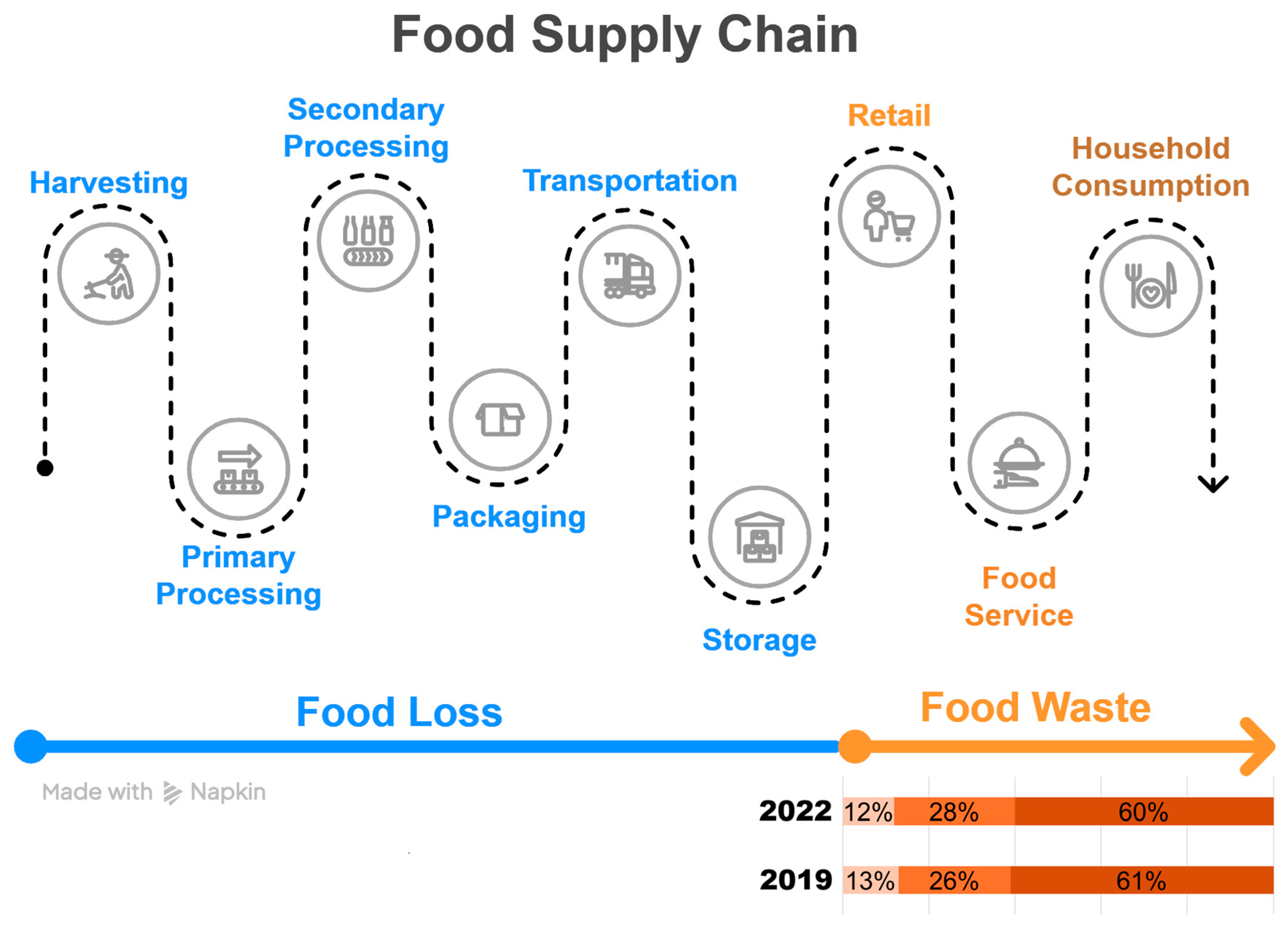
1.1. Global Challenge of Food Waste
1.2. Critical Role of Food Labeling
1.3. Contributions of This Study
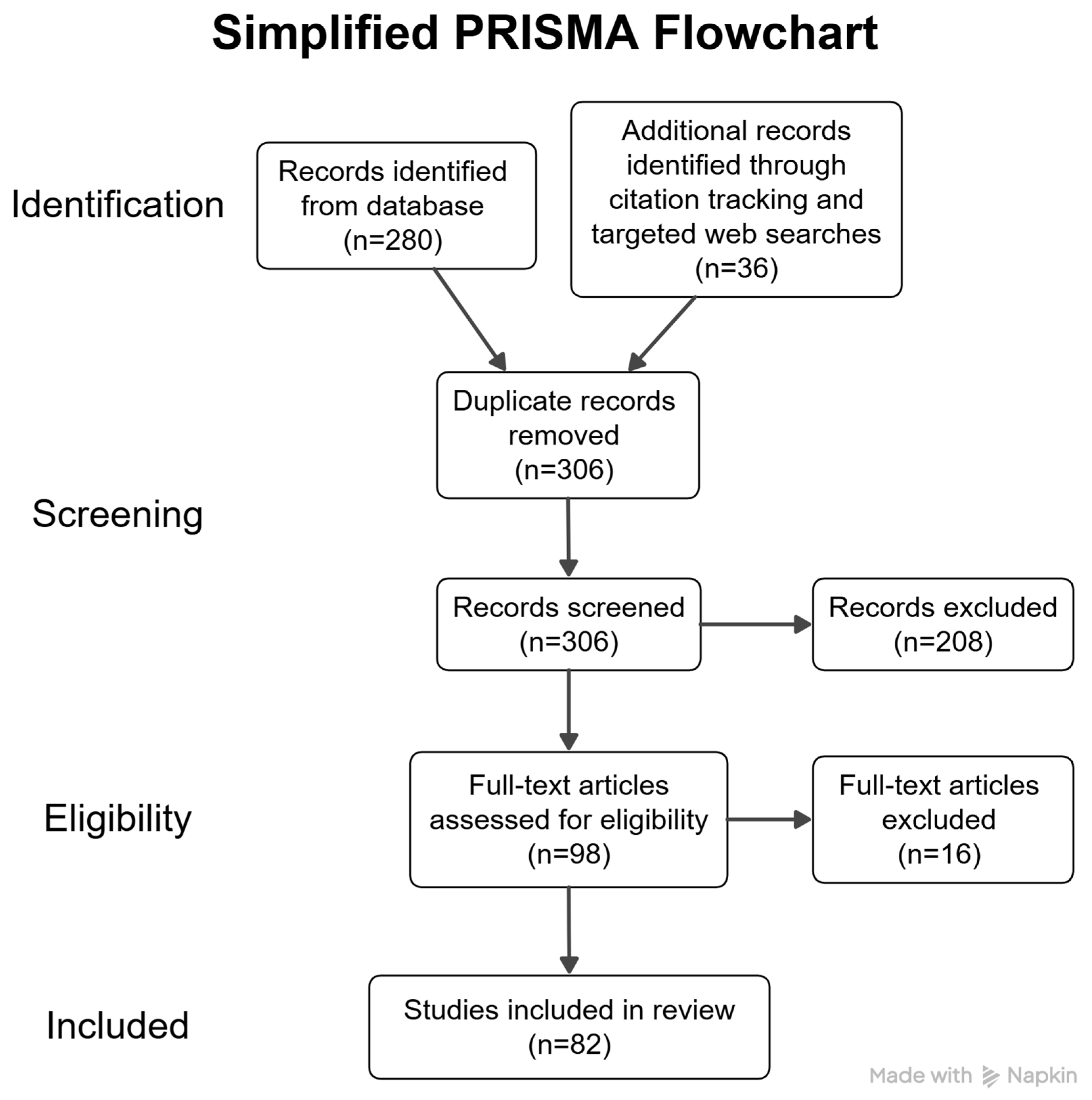
2. Research Methods
3. Results
3.1. Motivation
3.1.1. Negative Motivation
3.1.2. Positive Motivation
3.1.3. Economic Motivation
3.2. Opportunity
3.2.1. Design
3.2.2. Technology
3.2.3. Policy
3.3. Ability
3.3.1. Fundamental Comprehension
3.3.2. Technical Knowledge
3.3.3. Practical Skills and Efficacy
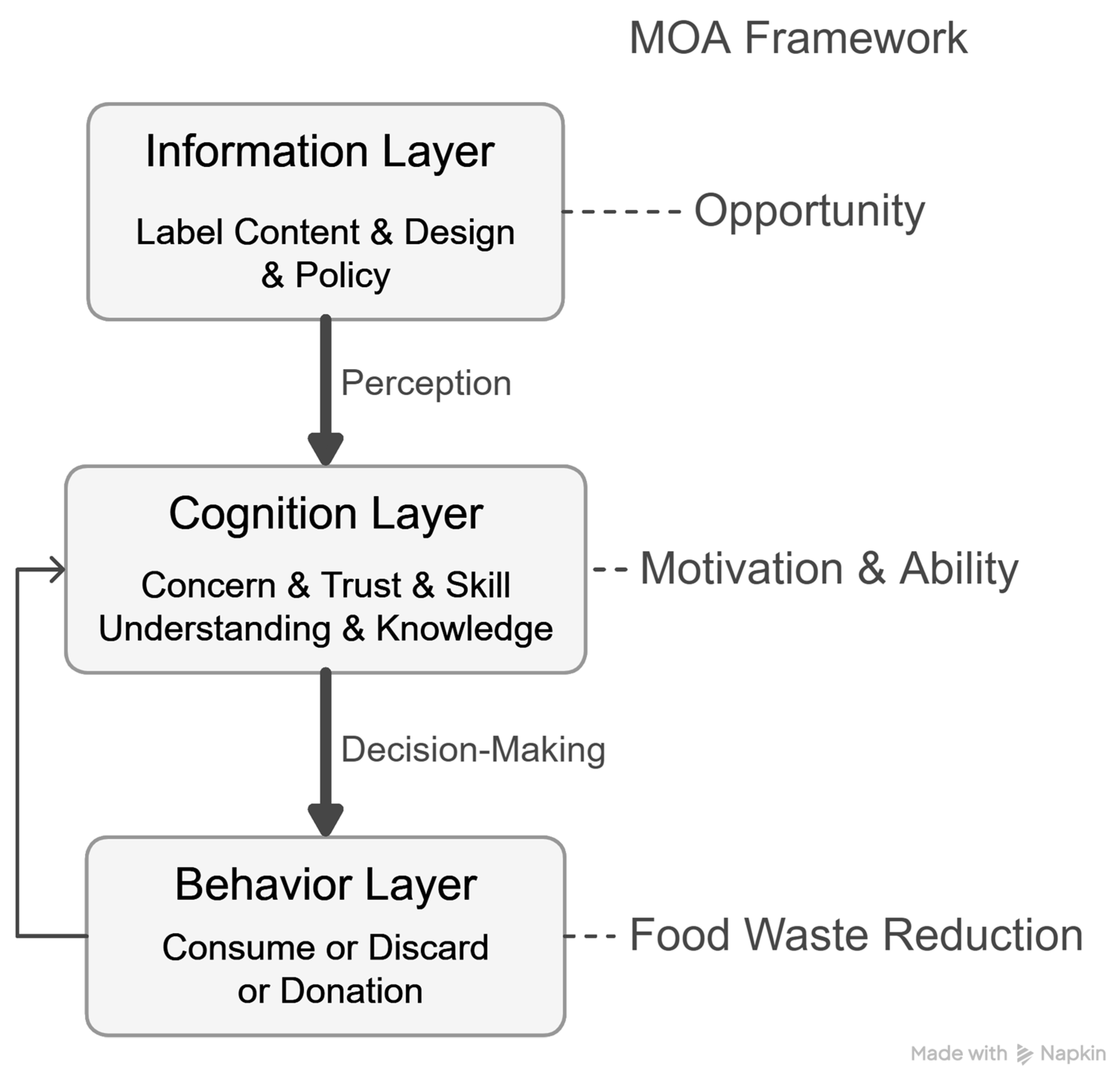
3.4. MOA Framework
4. Discussion
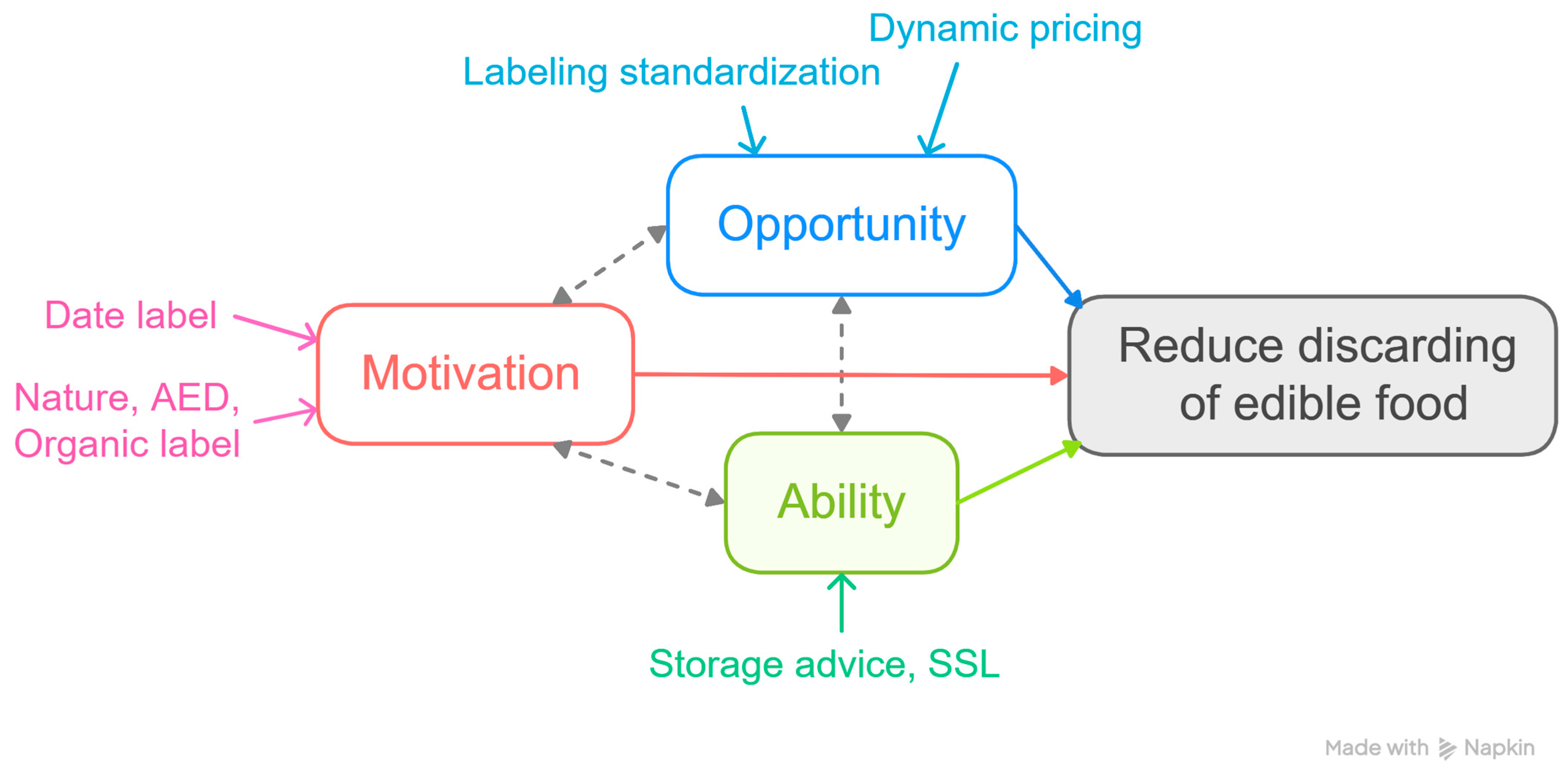
4.1. Interactions Among the Three MOA Components
4.2. Cross-Dimensional Interventions: Extending Shelf Life
4.3. Cross-Dimensional Interventions: Food Donation
4.4. Limitations and Recommendations
5. Conclusions
Author Contributions
Funding
Institutional Review Board Statement
Informed Consent Statement
Data Availability Statement
Acknowledgments
Conflicts of Interest
Abbreviations
| MOA | Motivation–opportunity–ability |
| WRAP | Waste and Resources Action Programme |
| AED | Approaching Expiration Date |
| SSL | Secondary shelf life |
| FBO | Food business operator |
Appendix A

| Author | No. | Research Context | Methodology | Key Findings | MOA Dimension |
|---|---|---|---|---|---|
| Daelman et al., 2013 | [82] | 874 valid questionnaires from Belgium | Consumer survey | Only 53.3% fully respect “use by” dates. Those ignoring dates are also less likely to follow reheating instructions. | Ability |
| Van Boxstael et al., 2014 | [85] | 907 residents from Belgium | Online survey | About 80% were familiar with labels but less than 50% considered the differences when judging edibility. | Ability |
| Samotyja, 2015 | [84] | 110 participants from Poland | Sensory panel evaluation and consumer testing | Shelf-life labels significantly affect perception of crispness and oxidized flavor. | Ability |
| Liang, 2016 | [37] | 507 valid questionnaires from Taiwan | Survey-based a linear structural equation model | Trust in labels and attitudes positively impact purchase intention. Price moderates these relationships, with higher prices requiring more consumer confidence. | Motivation |
| Ceuppens et al., 2016 | [80] | 1477 pre-packed refrigerated products from Belgium | Inventory snapshot and challenge test | Label inconsistency within categories causes consumer confusion and waste. Challenge tests showed some products with quality labels posed safety risks, highlighting need for stricter labeling standards. | Ability |
| Wilson et al., 2017 | [31] | 200 subjects from United States | Between-subject, laboratory experiment | Willingness to waste is greatest for “Use by” labels due to safety hints. “Sell by” has lowest willingness to waste but causes highest consumer confusion. | Motivation/Ability |
| Hooge et al., 2017 | [38] | 4214 consumers from five Northern European countries | Online choice experiment | Willingness to buy suboptimal products is lower in supermarkets than at home. Preferences vary by sub-optimality type. | Motivation/Opportunity |
| Maza et al., 2018 | [52] | 170 consumers from Spain | Choice experiment | Consumers value vacuum packaging, but primarily when coupled with protected geographical indication certification. New labels were not valued more than traditional ones. | Opportunity |
| Roe et al., 2018 | [59] | 88 regular milk drinkers from Ohio, United States | Sensory assessment, hypothetical choice experiments, and survey | Presence of a date label increased discard intention by 28%. Without labels, consumers rely on sensory assessment. | Opportunity/Ability |
| Schanes et al., 2018 | [8] | Systematic literature review; 60 academic articles | Systematic literature review | Food waste as a complex and multi-faceted issue driven by socio-demographic, psycho-social factors, and behaviors. | Motivation/Ability |
| EU, 2018 | [100] | 2296 products from Germany, Greece, Hungary, Netherlands, Poland, Slovakia, Spain, Sweden | Desk research, market survey, and stakeholder consultations | 10% of EU food waste is linked to date marking; 96% of products comply with FIC Regulation but 11% have poor legibility; significant variation exists between member states in usage of “use by” and “best before” for same products. | Opportunity |
| Alongi et al., 2019 | [47] | 700 subjects from Italy | Laboratory analysis and survival analysis | Expiry date presence significantly increases rejection and wasting risk regardless of temperature. | Opportunity/Ability |
| WRAP, 2019 | [68] | Synthesizes WRAP’s empirical research and consumer insights with expert input and food law to establish best practice guidance for retail and manufacture | Not applicable | Apply “Use By” only for safety and “Best Before” for quality; remove dates for uncut produce and strengthen advice for fridge storage below 5 °C. | Opportunity |
| Neff et al., 2019 | [79] | 1029 respondents from United States | Online survey | 84% of consumers discard food near label dates. Misunderstanding meanings is associated with more discards. | Ability |
| Aschemann-Witzel et al., 2019 | [39] | Synthesizes various studies | Not applicable | Consumers accept suboptimal food significantly more at home than in-store. Price reduction is the most common retail strategy, but aesthetic standards and logistics remain key barriers. | Motivation/Opportunity |
| Yuan et al., 2019 | [26] | 21 participants from Texas, United States | Focus groups | Consumers identify as Influencers or Learners. Key themes include food safety, price sensitivity, and the need for targeted education. | Motivation/Ability |
| Kavanaugh et al., 2020 | [78] | 1042 respondents from United States | Online survey | Majority use labels but lack understanding; correct knowledge correlates with reduced food waste behaviors. | Ability |
| Kim et al., 2020 | [96] | Multi-stage studies from Australia | Co-design, online survey, and fridge audit | Consumers prefer leftover-reuse targeting and tech-based strategies. Fruit and vegetables are most wasted. | Ability |
| Zielinska et al., 2020 | [75] | 1115 participants survey and 4 food types laboratory tests from Poland | Survey and laboratory tests | Many struggle with date terms. Laboratory tests confirmed products remain safe 6 months after “best before” date. | Ability |
| Dordevic et al., 2020 | [90] | 1107 respondents from Czech Republic | Questionnaires, in-person and online | Changing “best before” to “Date of highest quality” was highly accepted, but there was no evidence to suggest that the label reduced food waste. | Ability |
| Patra et al., 2020 | [16] | Scientometrics analysis of records to evaluate global trends, interdisciplinarity, and outreach efforts | Scientometrics analysis | Research has gained momentum recently and is highly interdisciplinary, but lacks integrated multi-stakeholder perspectives. | Motivation/Opportunity/Ability |
| van Geffen et al., 2020 | [21] | 147 participants from Germany, Hungary, Netherlands, Spain | Focus groups | Household food waste results from balancing competing goals. | Motivation/Opportunity/Ability |
| Dusoruth et al., 2020 | [86] | 333 subjects from Minnesota, United States | Interactive survey and conjoint task | Likelihood to discard increases as appearance deteriorates for both Planners and Extemporaneous Consumers. Skills in identifying edibility reduce waste. | Motivation/Ability |
| EFSA BIOHAZ Panel et al., 2020 | [66] | Scientific opinion and guidance development from European Union | Not applicable | Developed a risk-based decision tree to assist FBOs in deciding between “best before” or “use by” dates. Decisions should be product-specific, considering hazards, characteristics, and storage. | Opportunity |
| Toma et al., 2020 | [72] | Analyzed Flash Eurobarometer 425 data using structural equation models across regional models for Western, Eastern, and Mediterranean Europe | Structural equation models | Understanding of date labels and frequency of checking date labels are key behavioral determinants. The stated understanding is a key influence in models and explains a consistent fifth of the variance in behavior. | Opportunity/Ability |
| Bilska et al., 2020 | [77] | 1115 respondents from Poland | Computer-assisted personal interviews and multidimensional cluster analysis | Identified three segments. Misunderstanding dates and improper storage drive waste. Targeted education is recommended. | Ability |
| Chu et al., 2020 | [15] | 27 papers and 24 reports reviewed, 10 consumer workshops, and 10 industry practitioner interviews from Sweden, Australia, and global literature | Systematic literature review, consumer workshops, and industry practitioner interviews | Identified 12 tensions consumers face, such as confusion over terminology. Proposed 16 actions including improved on-pack presentation, knowledge communication, and technological innovations like smart labels. | Motivation/Opportunity/Ability |
| Paterson et al., 2020 | [91] | 100 participants from Iowa, United States | Experimental auctions, sensory evaluation, and survey | Consumers failed to distinguish fresh milk from near-end milk blindly, but paid premiums for fresh dates when visible. Education did not increase value and unexpectedly lowered overall bids. | Ability |
| Liegeard et al., 2020 | [61] | A review article evaluating the evolution of date labeling laws, shelf-life determination, and developments in intelligent packaging and IoT appliances | Review | Intelligent applications improve inventory management but face hurdles like high cost, privacy risks, and consumer trust. | Opportunity |
| Gil-Pérez et al., 2020 | [49] | A review on how imagery features influence consumer behavior | Review | Packaging imagery elicits sensory associations and influences consumption intent. | Opportunity |
| Soma et al., 2021 | [22] | 44 participants from Toronto, Canada | Focus groups and Qualitative approach | Awareness interventions improved motivation and ability but were less effective in providing opportunities. Promotions and urban sprawl remain barriers. | Motivation/Opportunity/Ability |
| Weis et al., 2021 | [62] | 579 participants from United States and 583 participants from United Kingdom | Split-plot experimental design and online survey | Safety-based labels like “Use By” lead to more waste than quality-based labels. Freshness Indicators significantly decrease discard rates. | Opportunity |
| EFSA BIOHAZ Panel et al., 2021 | [67] | Scientific opinion and guidance development from European Union | Not applicable | Developed a decision tree to help FBOs determine secondary shelf-life after opening. Provided technical guidance on thawing and preventing cross-contamination. | Opportunity |
| Samotyja et al., 2021 | [83] | 180 participants from Poland | Consumer sensory study and questionnaire | Date type significantly influences rejection. Consumer behavior is irrational by rejecting safe expired food or accepting risky ones. | Ability |
| Turvey et al., 2021 | [76] | 2607 respondents from United States | Online survey with random message variations | Education significantly improved label understanding, but no specific messaging frame or narrative strategy was significantly more effective than others. | Ability |
| Jürkenbeck et al., 2021 | [50] | 924 respondents from Germany | Discrete Choice Experiments | Sensory quality signals are important; sensory descriptions are preferred over variety names. | Opportunity |
| Yu et al., 2021 | [71] | Constructs a theoretical model of rational food waste and examine New York City’s new policy | Difference-in-difference and structural model | The results provide empirical verification on the influence of sell-by dates on consumption behavior. | Opportunity |
| Langley et al., 2021 | [45] | 87 participants from Australia | Journey Mapping and In-depth Interviews | Packaging designs that offer clear storage information and resealability help reduce household food waste. | Opportunity |
| Brennan et al., 2021 | [46] | Systematised literature review of 345 papers and reports | Systematic review | Consumers see packaging as a negative but ignore its waste-reduction potential. Acceptance of smart packaging is low due to poor knowledge. Design should use life cycle assessment and consider household demographics to reduce waste. | Opportunity/Ability |
| Samotyja, 2021 | [43] | 1145 respondents from Poland | Face-to-face interviews with questionnaire | 94% check dates but 40% have trouble finding them. Youths struggle with interpretation, while elderly struggle with small font. | Opportunity/Ability |
| Carolan, 2021 | [34] | 102 residents from Colorado, United States | Triangulation of surveys, records/reports, and focus groups | Waste is driven by human-material assemblages, identity performance as a “good parent,” storage capacity, and car-dependent mobility. | Motivation |
| Chan, 2022 | [93] | A review of 43 publications | Review | Packaging acts as both a driver and solution; date-labels and overly large pack sizes are key drivers. | Ability |
| Champions 12.3, 2022 | [10] | Champions 12.3 has collated this guide to help key actors in the food system to focus on how they can help consumers reduce food waste through behaviors change | Not applicable | The causes of food waste at household level are complex; lasting change requires multi-stakeholder collaboration and a mix of interventions targeting motivation, ability, and opportunity. | Motivation/Opportunity/Ability |
| Shamim et al., 2022 | [74] | 389 participants from India | Online questionnaire | High label usage but low understanding. “Best Before” is often misunderstood as safety indicator. | Ability |
| Block et al., 2022 | [7] | Literature review and conceptual organization | Review | Consumer (mis)perception of food safety and (mis)estimation of food for consumption as the dominant mechanisms underlying food waste | Motivation/Ability |
| Tang et al., 2022 | [40] | 336 participants from China | Two separate survey | Retailer’s voluntary AED labeling increases patronage intention by making consumers perceive higher concern for their well-being. | Motivation |
| WRAP, 2022 | [70] | Combined laboratory shelf-life testing of five produce items, online consumer surveys on disposal decisions, and household behavioral modeling | Not applicable | Selling loose and removing date labels of five produce items could prevent of food waste; storing produce in fridges below 5 °C significantly extends shelf life. | Opportunity/Ability |
| WRAP, 2022 | [12] | Surveyed high-waste products across 11 major retailers in United Kingdom | Store visits and product artwork review | Improved freezing advice on meat but confusing statements still present. | Opportunity/Ability |
| Nicosia et al., 2022 | [94] | 2 brands UHT milk, multiple domestic environments from Italy | Domestic use simulation and laboratory analysis | Actual secondary shelf life is 6–7 days, nearly double current labels. Reassessing labels can reduce domestic waste. | Ability |
| Chang et al., 2022 | [30] | 569 valid questionnaires from Taiwan | 2 × 2 × 2 factorial between-subject experiment | Perishability and discount levels significantly affect perceived value. Familiarity with expiration date-based pricing enhances purchase intention. | Motivation |
| Santi et al., 2022 | [44] | Over 35 experts from Italy | Literature review and expert workshops | Developed the Food Packaging Sustainability Framework as an operational tool for packaging design, assessment, and supply chain coordination. | Opportunity |
| Patra et al., 2022 | [81] | A needs assessment survey of 123 stakeholders in United States | Stakeholder needs assessment survey | 75% of respondents are confused by labels and link them to safety. Standardized labels and tech-based education are recommended. | Ability |
| Gong et al., 2022 | [25] | 660 individuals from United States | Mixed-design experiment | Date labels affect consumption via quality and safety concerns. Sensory information and storage guidance significantly increase consumption intentions. | Motivation/Ability |
| Nicosia et al., 2023 | [95] | 10 households’ domestic use simulation from Italy | Domestic use simulation and laboratory analysis | Secondary shelf life can be 13 days, 2–3 times longer than the label. Extending this information on labels can reduce waste. | Ability |
| WRAP, 2023 | [11] | A pilot to add the DAY on the DATE label (DoDL) label | A pilot | Participants were positive about the inclusion of DoDL, but there was no evidence to suggest that DoDL reduced food waste. | Ability |
| Wang et al., 2023 | [35] | 510 participants from China | Three online experimental studies | “Natural” labels increase purchase intention for unattractive produce by activating beliefs that natural food is tastier and healthier. | Motivation |
| WRAP, 2023 | [73] | 2024 respondents from United Kingdom | Adapted Implicit Test and online survey | Consumers treat “Use By” and “Best Before” dates labels similarly. Trusting sensory judgement can reduce waste. | Ability |
| Endara et al., 2023 | [41] | 498 respondents from United States | Choice-based conjoint study via online survey | Consumers pay premiums for longer shelf life but dislike smart labels. Messaging increases willingness to pay for ecolabels. | Motivation/Opportunity/Ability |
| Su et al., 2023 | [29] | Two studies and total of 480 valid responses from Taiwan | Between-subjects design | Interaction between shape and organic labeling affects intention. | Motivation |
| Vasko et al., 2023 | [88] | 514 valid questionnaires from Montenegro | Online survey and cluster analysis | Consumers are responsible with low waste levels and maintain traditional home cooking habits, but confuse date labels. | Ability |
| Vittuari et al., 2023 | [9] | Drivers and levers of consumer food waste are identified, categorized, analyzed, and discussed in line with the revised MOA framework | Review | Identified 13 behavioral drivers and connected levers, highlighting consumer segmentation as vital for impactful interventions. | Motivation/Opportunity/Ability |
| Sielicka-Rozynska et al., 2023 | [60] | 110 participants from Poland | Consumer sensory study | Date labels, not sensory quality, determine perceived food value. Expired labels lead consumers to unreasonably believe sensory attributes are altered, causing waste. | Ability |
| WRAP, 2023 | [69] | WRAP’s empirical research on five key items | Empirical research | Selling loose and removing date labels could prevent over 100,000 tonnes of household food waste annually; fridge storage below 5 °C was proven to treble product shelf life. | Opportunity |
| Karanth et al., 2023 | [63] | A comprehensive review article identifying and synthesizing research on microbial spoilage mechanisms, QMSRA, smart packaging, IoT, and date labeling | Literature review and risk assessment framework analysis | QMSRA and smart labels provide scientific, dynamic shelf-life predictions, helping resolve consumer misunderstanding of date labels and reduce waste. | Opportunity |
| Liu et al., 2023 | [42] | 334 respondents from Australia | Survey, principal component analysis, and econometric modeling | Affluent, waste-conscious consumers with children who eat out frequently still waste food. Economic cost concerns are key factors in waste reduction. | Motivation/Opportunity/Ability |
| Badiger et al., 2023 | [58] | 68 participants from Ohio, United States | Eye tracking study and survey | Participants fixated on the date over 3 times longer than the phrase. Over 50% of decisions involved no visual fixation on the phrase at all. | Opportunity/Ability |
| Chang et al., 2024 | [36] | 624 valid samples from Taiwan | Full factorial between-subjects experiment and survey | Interaction between price and discount presentation exists. Ethical labeling improves purchase willingness on suboptimal food. | Motivation |
| Neubig et al., 2024 | [24] | 1135 respondents from Germany | Online survey, IAT, and priming experiment | Consumers have negative implicit associations with dairy products beyond the best-before date. Reduction in safety and health perception is a direct predictor of willingness to consume products beyond the best-before date. | Motivation |
| Pandey et al., 2024 | [27] | 400 consumers from Denmark | Online questionnaire | Perceived quality, safety, and price are key drivers of purchase intention. | Motivation |
| Chen et al., 2024 | [28] | 353 valid samples from China | Survey with structural equation model | Perceived behavioral control is the primary driver. Visual packaging elements affect it positively, while health consciousness negatively impacts purchase intention. | Motivation/Opportunity |
| Shan et al., 2024 | [48] | 680 valid questionnaires from China | Quantitative analysis | A gap exists between intention and behavior. Environment, emotional information, and ability moderate positively, while face consciousness moderates negatively. | Motivation/Opportunity/Ability |
| Wallnoefer et al., 2024 | [51] | 397 participants from Austria | Online experiment and food lab experiment | Look–smell–taste labels did not significantly increase overdate acceptance, though consumers preferred them over text-only options. | Opportunity/Ability |
| Champions 12.3, 2024 | [54] | Uses the “Target-Measure-Act” roadmap as an assessment framework to track the progress of global governments and businesses against milestones | Not applicable | Global progress is currently insufficient to reach 2030 targets; while the private sector outpaces governments, overall action needs massive scaling. | Opportunity |
| President Chain Store Corporation, 2024 | [56] | President Chain Store Corporation presents its sustainability outcomes and future plans | Not applicable | “i-Sharing Food” reduced over 17,000 tons of food waste; achieved record-high consolidated revenue | Opportunity |
| Heidig et al., 2025 | [92] | 536 participants from Germany and 529 participants from South Africa | Quantitative descriptive approach, cross-sectional survey, and regression | The ability to reduce food waste (habits, knowledge) has a strong influence; motivation (attitudes, values) had the lowest impact on reported behavior. | Motivation/Opportunity/Ability |
| Bonioli et al., 2025 | [65] | A review of 36 articles | systematic literature review | Significant barriers to smart labels persist including consumer unfamiliarity, lack of trust, and usability concerns. External factors, such as perceived regulatory effectiveness, technical challenges, and cost implications, also impact consumer acceptance. | Opportunity |
| Llagas et al., 2025 | [64] | A mixed-methods approach to evaluate pilot design concepts for date labels and storage advice through seven collective intelligence workshops. | Collective intelligence workshops | Consumers focus on usability and waste reduction, while stakeholders care about compliance and safety. Both agree clear visual cues improve clarity. | Opportunity |
| Wilson et al., 2025 | [33] | 200 respondents from Alabama and New York, United States | Inperson experimental auction and risk preference elicitation | “Use by” labels lead to more premeditated waste than “Best by.” Higher loss aversion correlates with higher waste rates. | Motivation |
| Parker et al., 2025 | [53] | 125 consumer interviews and 6 stakeholder groups from Australia | Literature review, consumer interviews, design concepts, and stakeholder workshops | Consumers find date labels confusing. Clear, consistent, and legible labels along with detailed storage advice reduce waste. | Opportunity/Ability |
| Grendstad et al., 2025 | [87] | A mixed-methods approach including focus groups (n = 16) and an online survey (n = 298) with a conjoint experiment testing from Norway | Focus groups and online conjoint test | Date labels and appearance significantly influenced willingness to consume, while instructions had no effect. | Ability |
| Mu et al., 2025 | [89] | 513 valid questionnaires from China | Online questionnaire | Packaging design factors like visual or functional attributes positively influence waste refusal attitudes. Negative factors such as information overload or improper sizing have a more significant impact on waste behavior than positive factors. | Motivation/Ability |
| Cheng et al., 2025 | [32] | 4221 participants from China | Quasi-natural intervention experiment | Information intervention significantly improved label cognition and tended to extend intended discard dates. | Motivation/Ability |
References
- UN. The Sustainable Development Goals Report; United Nations: New York City, NY, USA, 2024.
- UN. The Sustainable Development Goals Report; United Nations: New York City, NY, USA, 2025.
- UN. The Sustainable Development Goals Report; United Nations: New York City, NY, USA, 2022.
- UNEP. Food Waste Index Report; United Nations Environment Programme (UNEP): Nairobi, Kenya, 2021.
- UNEP. Food Waste Index Report; United Nations Environment Programme (UNEP): Nairobi, Kenya, 2024.
- UN. The Sustainable Development Goals Report; United Nations: New York City, NY, USA, 2023.
- Block, L.; Vallen, B.; Austin, M. Food waste (mis)takes: The role of (mis)perception and (mis)estimation. Curr. Opin. Psychol. 2022, 46, 101327. [Google Scholar] [CrossRef] [PubMed]
- Schanes, K.; Dobernig, K.; Gözet, B. Food waste matters—A systematic review of household food waste practices and their policy implications. J. Clean Prod. 2018, 182, 978–991. [Google Scholar] [CrossRef]
- Vittuari, M.; Herrero, L.; Masotti, M.; Iori, E.; Caldeira, C.; Qian, Z.; Bruns, H.; van Herpen, E.; Obersteiner, G.; Kaptan, G.; et al. How to reduce consumer food waste at household level: A literature review on drivers and levers for behavioural change. Sustain. Prod. Consump. 2023, 38, 104–114. [Google Scholar] [CrossRef]
- Champions 12.3. Changing Behaviour to Help More People Waste Less Food: A Guide; World Resources Institute (WRI): Washington, DC, USA, 2022. [Google Scholar]
- WRAP. Behaviour Change Intervention: Day on the Date Label; WRAP: Banbury, UK, 2023. [Google Scholar]
- WRAP. Retail Survey 2021/22 Reducing Household Food Waste Through Changes to the Retail Environment; WRAP: Banbury, UK, 2022. [Google Scholar]
- WRAP. Consumer Insight: Date Labels and Storage Guidance; WRAP: Banbury, UK, 2011. [Google Scholar]
- ReFED. Food Waste Impacts-Date Labeling. Available online: https://refed.org/food-waste/date-labeling/ (accessed on 18 November 2025).
- Chu, W.J.; Williams, H.; Verghese, K.; Wever, R.; Glad, W. Tensions and Opportunities: An Activity Theory Perspective on Date and Storage Label Design through a Literature Review and Co-Creation Sessions. Sustainability 2020, 12, 1162. [Google Scholar] [CrossRef]
- Patra, D.; Leisnham, P.T.; Tanui, C.K.; Pradhan, A.K. Evaluation of global research trends in the area of food waste due to date labeling using a scientometrics approach. Food Control 2020, 115, 10. [Google Scholar] [CrossRef]
- Patra, D.; Feng, S.; Howard, J.W. Confusion of food-date label with food safety—Implications for food waste. Curr. Opin. Food Sci. 2022, 48, 100917. [Google Scholar] [CrossRef]
- Llagas, B.; Jenkins, E.; Brennan, L.; Parker, L.; Schivinski, B.; Lockrey, S. Consumer perceptions of date labelling and storage advice and its relationship with food waste: A systematic scoping review of the academic & grey literature. Future Foods 2025, 11, 100577. [Google Scholar] [CrossRef]
- Hutt, C.A.; Gonzalez, M. Food Labeling. In Encyclopedia of Agriculture and Food Systems; Van Alfen, N.K., Ed.; Academic Press: Oxford, UK, 2014; pp. 167–185. [Google Scholar]
- Roche, K.A. Food Labeling: Applications. In Encyclopedia of Food and Health; Caballero, B., Finglas, P.M., Toldrá, F., Eds.; Academic Press: Oxford, UK, 2016; pp. 49–55. [Google Scholar]
- van Geffen, L.; van Herpen, E.; Sijtsema, S.; van Trijp, H. Food waste as the consequence of competing motivations, lack of opportunities, and insufficient abilities. Resour. Conserv. Recycl. X 2020, 5, 100026. [Google Scholar] [CrossRef]
- Soma, T.; Li, B.; Maclaren, V. An evaluation of a consumer food waste awareness campaign using the motivation opportunity ability framework. Resour. Conserv. Recycl. 2021, 168, 105313. [Google Scholar] [CrossRef]
- Maclnnis, D.J.; Moorman, C.; Jaworski, B.J. Enhancing and measuring consumers’ motivation, opportunity, and ability to process brand information from ads. J. Mark. 1991, 55, 32–53. [Google Scholar] [CrossRef]
- Neubig, C.; Roosen, J. Can I still eat this? Using implicit and explicit measures to explore consumer behavior toward food products with date labels. Appetite 2024, 200, 107556. [Google Scholar] [CrossRef] [PubMed]
- Gong, Z.; Su, L.; Zhang, J.; Chen, T.; Wang, Y. Understanding the association between date labels and consumer-level food waste. Food. Qual. Prefer. 2022, 96, 104373. [Google Scholar] [CrossRef]
- Yuan, J.; Yi, S.; Williams, H.; Park, O. US consumers’ perceptions of imperfect “ugly” produce. Br. Food J. 2019, 121, 2666–2682. [Google Scholar] [CrossRef]
- Pandey, S.; Bohl, A.; Favari, V.; Mora, P.; Phuyal, S.; Sojkova, E.; Budhathoki, M.; Thomsen, M. Consumers’ willingness to buy meat and seafood products close to the expiry date: An exploratory study from Denmark. Front. Nutr. 2024, 11, 10. [Google Scholar] [CrossRef]
- Chen, B.; Hua, W.; Wu, S. Examining the impact of the packaging design of nearly expired food on consumer purchase intentions. Hum. Soc. Sci. Commun. 2024, 11, 1687. [Google Scholar] [CrossRef]
- Su, Y.-L.; Ngamsom, P.; Wang, J.-H. Factors affecting Taiwanese consumers’ intention to purchase abnormally shaped produce. Sustainability 2023, 15, 7715. [Google Scholar] [CrossRef]
- Chang, H.; Su, J. Sustainable consumption in Taiwan retailing: The impact of product features and price promotion on purchase behaviors toward expiring products. Food. Qual. Prefer. 2022, 96, 104452. [Google Scholar] [CrossRef]
- Wilson, N.L.; Rickard, B.J.; Saputo, R.; Ho, S.-T. Food waste: The role of date labels, package size, and product category. Food. Qual. Prefer. 2017, 55, 35–44. [Google Scholar] [CrossRef]
- Cheng, S.; Lu, Y.; Ren, Y.; Jiang, Z.; Zhao, M. Which food date label brings us the most excellent opportunity to reduce food waste? Evidence from a quasi-natural intervention experiment in urban China. Agric. Food Econ. 2025, 13, 14. [Google Scholar] [CrossRef]
- Wilson, N.; Miao, R. Food waste, date labels, and risk preferences: An experimental exploration. Appl. Econ. Perspect. Policy 2025, 47, 1029–1057. [Google Scholar] [CrossRef]
- Carolan, M.S. What is driving consumer food waste: Socio-material assemblages of household consumption practices. Appetite 2021, 166, 10. [Google Scholar] [CrossRef] [PubMed]
- Wang, H.; Li, H.; Zhao, Y.; Xi, N. Being natural is aesthetic: The effects of “natural” labeling on lay beliefs and the purchase intention of unattractive produce. Asia Pac. J. Market. Logist. 2023, 35, 1759–1773. [Google Scholar] [CrossRef]
- Chang, H.; Lu, L.; Kuo, T. Are discounts useful in promoting suboptimal foods for sustainable consumption and production? The interaction effects of original prices, discount presentation modes, and product types. J. Retail. Consum. Serv. 2024, 79, 103881. [Google Scholar] [CrossRef]
- Liang, R. Predicting intentions to purchase organic food: The moderating effects of organic food prices. Br. Food J. 2016, 118, 183–199. [Google Scholar] [CrossRef]
- Hooge, I.E.d.; Oostindjer, M.; Aschemann-Witzel, J.; Normann, A.; Loose, S.M.; Almli, V.L. This apple is too ugly for me! Consumer preferences for suboptimal food products in the supermarket and at home. Food. Qual. Prefer. 2017, 56, 80–92. [Google Scholar] [CrossRef]
- Aschemann-Witzel, J.; de Hooge, I.E.; Almli, V.L. Suboptimal food? Food waste at the consumer–retailer interface. In Saving Food; Elsevier: Amsterdam, The Netherlands, 2019; pp. 347–368. [Google Scholar]
- Tang, Y.; Kuang, Y.; Li, H.; Cao, B.; Qing, P. Labelling or not: Influence of food retailer’s approaching the expiration date labelling on consumers’ patronage intention. Br. Food J. 2022, 124, 2817–2832. [Google Scholar] [CrossRef]
- Endara, P.; Wiedmann, M.; Adalja, A. Consumer willingness to pay for shelf life of high-temperature, short-time-pasteurized fluid milk: Implications for smart labeling and food waste reduction. J. Dairy Sci. 2023, 106, 5940–5957. [Google Scholar] [CrossRef]
- Liu, H.; McCarthy, B. Sustainable lifestyles, eating out habits and the green gap: A study of food waste segments. Asia Pac. J. Market. Logist. 2023, 35, 920–943. [Google Scholar] [CrossRef]
- Samotyja, U. The system of date labelling in the food supply chain—The weak links from the perspective of final consumers. Logforum 2021, 17, 331–339. [Google Scholar] [CrossRef]
- Santi, R.; Garrone, P.; Iannantuoni, M.; Del Curto, B. Sustainable Food Packaging: An Integrative Framework. Sustainability 2022, 14, 45. [Google Scholar] [CrossRef]
- Langley, S.; Phan-Le, N.T.; Brennan, L.; Parker, L.; Jackson, M.; Francis, C.; Lockrey, S.; Verghese, K.; Alessi, N. The Good, the Bad, and the Ugly: Food Packaging and Consumers. Sustainability 2021, 13, 12409. [Google Scholar] [CrossRef]
- Brennan, L.; Langley, S.; Verghese, K.; Lockrey, S.; Ryder, M.; Francis, C.; Phan-Le, N.T.; Hill, A. The role of packaging in fighting food waste: A systematised review of consumer perceptions of packaging. J. Clean Prod. 2021, 281, 13. [Google Scholar] [CrossRef]
- Alongi, M.; Sillani, S.; Lagazio, C.; Manzocco, L. Effect of expiry date communication on acceptability and waste of fresh-cut lettuce during storage at different temperatures. Food Res. Int. 2019, 116, 1121–1125. [Google Scholar] [CrossRef]
- Shan, L.; Lu, Q.; Tong, X. How to improve the consistency of consumers’ food waste reduction intentions and behaviors? An analysis based on the expanded Motivation–Opportunity–Ability framework. Humanit. Soc. Sci. Commun. 2024, 11, 1530. [Google Scholar] [CrossRef]
- Gil-Pérez, I.; Rebollar, R.; Lidón, I. Without words: The effects of packaging imagery on consumer perception and response. Curr. Opin. Food Sci. 2020, 33, 69–77. [Google Scholar] [CrossRef]
- Jürkenbeck, K.; Spiller, A. Importance of sensory quality signals in consumers ‘ food choice. Food. Qual. Prefer. 2021, 90, 104155. [Google Scholar] [CrossRef]
- Wallnoefer, L.M.; Meixner, O.; Riefler, P. Look-smell-taste labels on food date marking: Assessing their effectiveness for reducing food waste at a consumer level as part of the European Green Deal. Food. Qual. Prefer. 2024, 120, 105253. [Google Scholar] [CrossRef]
- Maza, M.T.; Gracia, A.; Saied, M. Consumers’ valuation of two packaging aspects for fresh lamb meat: Vacuum and information labels. Packag. Technol. Sci. 2018, 31, 123–132. [Google Scholar] [CrossRef]
- Parker, L.; Brennan, L.; Jenkins, E.; Llagas, B.R.; Lockey, S.; Schivinski, B. National Date Labelling And Storage Advice Project—Phase 1 Final Report; End Food Waste Australia: Adelaide, Australia, 2025. [Google Scholar]
- Champions 12.3. SDG Target 12.3 on Food Loss and Waste: 2024 Progress Report; World Resources Institute (WRI): Washington, DC, USA, 2024. [Google Scholar]
- Wasteless. Cut Waste. Grow Profits. Available online: https://www.wasteless.com/ (accessed on 2 October 2025).
- President Chain Store Corporation. Sustainability Report; 7-Eleven: Taipei, Taiwan, 2024. [Google Scholar]
- FamilyMart Co., Ltd. 17:00 Cherish Food. Available online: https://nevent.family.com.tw/cherishfood/ (accessed on 2 October 2025).
- Badiger, A.; Katz, T.; Simons, C.T.; Roe, B.E. When considering whether to waste food, consumers focus attention on food label dates rather than phrases. Waste Manag. 2023, 168, 230–234. [Google Scholar] [CrossRef]
- Roe, B.E.; Phinney, D.M.; Simons, C.T.; Badiger, A.S.; Bender, K.E.; Heldman, D.R. Discard intentions are lower for milk presented in containers without date labels. Food. Qual. Prefer. 2018, 66, 13–18. [Google Scholar] [CrossRef]
- Sielicka-Rozynska, M.; Samotyja, U. Influence of “best before” dates on expected and actual food liking. Br. Food J. 2023, 125, 1317–1334. [Google Scholar] [CrossRef]
- Liegeard, J.; Manning, L. Use of intelligent applications to reduce household food waste. Crit. Rev. Food Sci. Nutr. 2020, 60, 1048–1061. [Google Scholar] [CrossRef]
- Weis, C.; Narang, A.; Rickard, B.; Souza-Monteiro, D. Effects of Date Labels and Freshness Indicators on Food Waste Patterns in the United States and the United Kingdom. Sustainability 2021, 13, 7897. [Google Scholar] [CrossRef]
- Karanth, S.; Feng, S.Y.; Patra, D.; Pradhan, A.K. Linking microbial contamination to food spoilage and food waste: The role of smart packaging, spoilage risk assessments, and date labeling. Front. Microbiol. 2023, 14, 17. [Google Scholar] [CrossRef]
- Llagas, B.R.; Brennan, L.; Parker, L.; Jenkins, E.L.; Phan-Le, N.T.; Lockrey, S.; Schivinski, B. Date Labelling and Storage Advice Collective Intelligence Workshops: Position Paper; RMIT University & End Food Waste Cooperative Research Centre: Melbourne, Australia, 2025. [Google Scholar]
- Bonioli, M.; Bazzani, C. Consumer behaviour toward “smart” food labels: A systematic literature review using the Technology Acceptance Model. Trends Food Sci. Technol. 2025, 165, 105256. [Google Scholar] [CrossRef]
- EFSA BIOHAZ Panel; Koutsoumanis, K.; Allende, A.; Alvarez-Ordonez, A.; Bolton, D.; Bover-Cid, S.; Chemaly, M.; Davies, R.; De Cesare, A.; Herman, L.; et al. Guidance on date marking and related food information: Part 1 (date marking). Efsa J. 2020, 18, 74. [Google Scholar] [CrossRef]
- EFSA BIOHAZ Panel; Koutsoumanis, K.; Allende, A.; Alvarez-Ordóñez, A.; Bolton, D.; Bover-Cid, S.; Chemaly, M.; Davies, R.; De Cesare, A.; Herman, L.; et al. Guidance on date marking and related food information: Part 2 (food information). Efsa J. 2021, 19, e06510. [Google Scholar] [CrossRef]
- WRAP. Labelling Guidance: Best Practice on Food Date Labelling and Storage Advice; WRAP: Banbury, UK, 2019. [Google Scholar]
- WRAP. Label Better, Waste Less: When to Sell Uncut Fruit and Vegetables Loose; WRAP: Banbury, UK, 2023. [Google Scholar]
- WRAP. Reducing Household Food Waste and Plastic Packaging; WRAP: Banbury, UK, 2022. [Google Scholar]
- Yu, Y.; Jaenicke, E.C. The effect of sell-by dates on purchase volume and food waste. Food Policy 2021, 98, 101879. [Google Scholar] [CrossRef]
- Toma, L.; Font, M.; Thompson, B. Impact of consumers’ understanding of date labelling on food waste behaviour. Oper. Res. 2020, 20, 543–560. [Google Scholar] [CrossRef]
- WRAP. Citizen Insights on Use by and Best Before Dates on Dairy Products; WRAP: Banbury, UK, 2023. [Google Scholar]
- Shamim, K.; Ahmad, S.; Alam, M. Consumer understanding of food date labels: Preventing food wastage. Br. Food J. 2022, 124, 3116–3132. [Google Scholar] [CrossRef]
- Zielinska, D.; Bilska, B.; Marciniak-Lukasiak, K.; Lepecka, A.; Trzaskowska, M.; Neffe-Skocinska, K.; Tomaszewska, M.; Szydlowska, A.; Kolozyn-Krajewska, D. Consumer Understanding of the Date of Minimum Durability of Food in Association with Quality Evaluation of Food Products After Expiration. Int. J. Environ. Res. Public Health 2020, 17, 1632. [Google Scholar] [CrossRef]
- Turvey, C.; Moran, M.; Sacheck, J.; Arashiro, A.; Huang, Q.; Heley, K.; Johnston, E.; Neff, R. Impact of Messaging Strategy on Consumer Understanding of Food Date Labels. J. Nutr. Educ. Behav. 2021, 53, 389–400. [Google Scholar] [CrossRef] [PubMed]
- Bilska, B.; Tomaszewska, M.; Kolozyn-Krajewska, D.; Piecek, M. Segmentation of Polish Households Taking into Account Food Waste. Foods 2020, 9, 379. [Google Scholar] [CrossRef]
- Kavanaugh, M.; Quinlan, J. Consumer knowledge and behaviors regarding food date labels and food waste. Food Control 2020, 115, 107285. [Google Scholar] [CrossRef]
- Neff, R.; Spiker, M.; Rice, C.; Schklair, A.; Greenberg, S.; Leib, E. Misunderstood food date labels and reported food discards: A survey of US consumer attitudes and behaviors. Waste Manag. 2019, 86, 123–132. [Google Scholar] [CrossRef]
- Ceuppens, S.; Van Boxstael, S.; Westyn, A.; Devlieghere, F.; Uyttendaele, M. The heterogeneity in the type of shelf life label and storage instructions on refrigerated foods in supermarkets in Belgium and illustration of its impact on assessing the Listeria monocytogenes threshold level of 100 CFU/g. Food Control 2016, 59, 377–385. [Google Scholar] [CrossRef]
- Patra, D.; Henley, S.C.; Benefo, E.O.; Pradhan, A.K.; Shirmohammadi, A. Understanding and addressing food waste from confusion in date labeling using a stakeholders’ survey. J. Agric. Food Res. 2022, 8, 100295. [Google Scholar] [CrossRef]
- Daelman, J.; Jacxsens, L.; Membre, J.M.; Sas, B.; Devlieghere, F.; Uyttendaele, M. Behaviour of Belgian consumers, related to the consumption, storage and preparation of cooked chilled foods. Food Control 2013, 34, 681–690. [Google Scholar] [CrossRef]
- Samotyja, U.; Sielicka-Rozynska, M. How date type, freshness labelling and food category influence consumer rejection. Int. J. Consum. Stud. 2021, 45, 441–455. [Google Scholar] [CrossRef]
- Samotyja, U. Influence of shelf life labelling on the sensory acceptability of potato snacks. Br. Food J. 2015, 117, 222–233. [Google Scholar] [CrossRef]
- Van Boxstael, S.; Devlieghere, F.; Berkvens, D.; Vermeulen, A.; Uyttendaele, M. Understanding and attitude regarding the shelf life labels and dates on pre-packed food products by Belgian consumers. Food Control 2014, 37, 85–92. [Google Scholar] [CrossRef]
- Dusoruth, V.; Peterson, H.H. Food waste tendencies: Behavioral response to cosmetic deterioration of food. PLoS ONE 2020, 15, e0233287. [Google Scholar] [CrossRef]
- Grendstad, A.; Berget, I.; Porcellato, D.; Kraggerud, H.; Varela, P. Reducing food waste: The role of yogurt appearance and package information across consumer segments. Food. Qual. Prefer. 2025, 131, 105575. [Google Scholar] [CrossRef]
- Vasko, Z.; Berjan, S.; El Bilali, H.; Allahyari, M.; Despotovic, A.; Vukojevic, D.; Radosavac, A. Household food wastage in Montenegro: Exploring consumer food behaviour and attitude under COVID-19 pandemic circumstances. Br. Food J. 2023, 125, 1516–1535. [Google Scholar] [CrossRef]
- Mu, J.; Zhou, L.; Yang, C. Research on the influence mechanism of food packaging on consumers’ behavioral intention to refuse food waste based on behavioral reasoning theory. Front. Psychol. 2025, 16, 1630861. [Google Scholar] [CrossRef]
- Dordevic, D.; Cazalilla, R.M.; Javurkova, Z.; Buchtova, H.; Jancikova, S. Consumers’ response to different shelf life food labelling. Qual. Assur. Saf. Crop. Foods 2020, 12, 24–34. [Google Scholar] [CrossRef]
- Paterson, M.; Clark, S. Use of auctions to assess consumer value for fresh and end-of-code milk. J. Dairy Sci. 2020, 103, 4138–4150. [Google Scholar] [CrossRef]
- Heidig, W.; Dobbelstein, T.; Mason, R. Beyond the Bin: The Influence of Motivation, Opportunity, and Ability on Food Waste Behavior in Households. Sustain. Dev. 2025, 33, 3151–3169. [Google Scholar] [CrossRef]
- Chan, R. A review of packaging-related studies in the context of household food waste: Drivers, solutions and avenues for future research. Packag. Technol. Sci. 2022, 35, 3–51. [Google Scholar] [CrossRef]
- Nicosia, C.; Fava, P.; Pulvirenti, A.; Licciardello, F. Secondary shelf life assessment of UHT milk and its potential for food waste reduction. Food Packag. Shelf Life 2022, 33, 8. [Google Scholar] [CrossRef]
- Nicosia, C.; Mezza, I.; Pulvirenti, A.; Licciardello, F. Assessment of the secondary shelf life of Bolognese sauce based on domestic use simulation. Food Packag. Shelf Life 2023, 40, 101172. [Google Scholar] [CrossRef]
- Kim, J.; Rundle-Thiele, S.; Knox, K.; Burke, K.; Bogomolova, S. Consumer perspectives on household food waste reduction campaigns. J. Clean Prod. 2020, 243, 118608. [Google Scholar] [CrossRef]
- Reyes, V.; Cahill, E.; Solval, K. The Potential for Reducing Food Waste through Shelf-Life Extension: Actionable Insights from Data Digitization. Sustainability 2024, 16, 2986. [Google Scholar] [CrossRef]
- Settier-Ramirez, L.; López-Carballo, G.; Hernandez-Muñoz, P.; Tinitana-Bayas, R.; Gavara, R.; Sanjuán, N. Assessing the environmental consequences of shelf life extension: Conventional versus active packaging for pastry cream. J. Clean Prod. 2022, 333, 130159. [Google Scholar] [CrossRef]
- Demirel, U. Innovative Technologies in Shelf Life Extension: Recent Developments in The Food Industry. Selcuk J. Agric. Food Sci. 2025, 39, 708–720. [Google Scholar] [CrossRef]
- EU. Market Study on Date Marking and Other Information Provided on Food Labels and Food Waste Prevention—Final Report; Publications Office of the European Union: Luxembourg, 2018.


| Country/Region | Authority/Regulation | Year (Announced/Implemented) | Key Policy or Guideline | Regulatory Nature |
|---|---|---|---|---|
| USA | USDA Food Safety and Inspection Service | Existing | Food manufacturers and retailers that apply product dating use a “Best if Used By” date | Recommended |
| Australia, Canada, Japan, Mexico, New Zealand, Singapore, and South Korea, etc. | Regulations | Existing | Require labeling formats (such as year/month/day) to improve information readability | Mandatory |
| Australia, Canada, China, EU, India, Japan, Mexico, New Zealand, and Taiwan, etc. | Regulations | Existing | Packaged food must be labeled with storage conditions | Mandatory |
| UK | WRAP Guidance | 2017–2023 | A series of guidance on how to use food date labels and how UK law applies throughout the life cycle of a food product | Recommended |
| India | Food Safety and Standards (Labelling and Display) Regulations | 2020 | Requires “Date of manufacture or packaging” and “Expiry/Use by” together; “Best before” as optional or additional information | Mandatory |
| EU | European Food Safety Authority Guidance | 2020 | Decision tree to help food businesses decide on the type of date label | Recommended |
| EU | European Food Safety Authority Guidance | 2021 | Help food businesses develop appropriate storage conditions and expiration dates for opened and thawed foods | Recommended |
| South Korea | Enforcement Rule of the Act on Labeling and Advertising of Foods | 2023 | Replaces “Sell-by” with “Use-by” | Mandatory |
| California, USA | The Food and Agricultural Code Amendment | 2024/2026 | Standardizes “BEST if Used by” and “USE by”; bans “Sell by” | Mandatory |
| China | General Principles for Labeling of Prepackaged Foods Amendment | 2025/2027 | Requires YYYY-MM-DD; adds “consumption guarantee period” | Mandatory |
| USA | S.2541-Food Date Labeling Act of 2025 | Introduced in Senate (30 July 2025) | Standardizes “BEST if Used by” and “USE by” | Bill proposal to law |
| EU | Regulation (EU) No. 1169/2011 Amendment | Preparing the proposal | Review the Farm to Fork strategy and revise existing EU rules on date marking | Proposal for a regulation |
| The Dimensions of MOA | Label Characteristics | Key Impacts | Expected Outcomes | Interventions | Evidence Strength |
|---|---|---|---|---|---|
| Motivation | date label | risk perception | premature discarding of edible food | optimization of product shelf life | ★★★ |
| natural, AED, organic label | increase favorability and trust | promote purchasing/consuming | add relevant labels | ★★★ | |
| health food | social role | promote purchasing | educational campaigns | ★ | |
| Opportunity | font was too small; information was difficult-finding and unreadable | difficulties with getting information | reject purchasing/consuming | improves design and printing technology | ★★ |
| emotional information | create empathy and recognition | reduce food waste | marketing strategies | ★ | |
| visual imagery; distinct colors | increase readability | promote purchasing/consuming | packaging design | ★ | |
| discount | economic incentives | promotion of suboptimal product sales | dynamic pricing at the retail level | ★★★ | |
| freshness indicators | assess edibility | avoidance of premature disposal | smart/intelligent visual labels | ★ | |
| standardization of label phrases and format | mitigating consumer confusion; enhancing comprehension | improved household food utilization | policy innovation; official guidelines | ★★★ | |
| Ability | storage advice; SSL | keep at its best | optimizing food management practices | clear and explicit storage recommendations | ★★★ |
| often good after look–smell–taste | facilitating sensory judgement | avoidance of premature disposal | increased labeling; awareness campaigns | ★ | |
| recipe instruction | improvement of cooking skills | improved household food utilization | online tutorials | ★ | |
| educational information | enhancement of understanding | optimizing food management practices | printed materials; awareness campaigns | ★★ |
Disclaimer/Publisher’s Note: The statements, opinions and data contained in all publications are solely those of the individual author(s) and contributor(s) and not of MDPI and/or the editor(s). MDPI and/or the editor(s) disclaim responsibility for any injury to people or property resulting from any ideas, methods, instructions or products referred to in the content. |
© 2026 by the authors. Licensee MDPI, Basel, Switzerland. This article is an open access article distributed under the terms and conditions of the Creative Commons Attribution (CC BY) license.
Share and Cite
Chen, P.-Y.; Chau, C.-F. Label-Centric Review of Food Labeling Interventions for Reducing Food Waste: A Motivation–Opportunity–Ability Framework-Based Perspective. Sustainability 2026, 18, 3725. https://doi.org/10.3390/su18083725
Chen P-Y, Chau C-F. Label-Centric Review of Food Labeling Interventions for Reducing Food Waste: A Motivation–Opportunity–Ability Framework-Based Perspective. Sustainability. 2026; 18(8):3725. https://doi.org/10.3390/su18083725
Chicago/Turabian StyleChen, Po-Ya, and Chi-Fai Chau. 2026. "Label-Centric Review of Food Labeling Interventions for Reducing Food Waste: A Motivation–Opportunity–Ability Framework-Based Perspective" Sustainability 18, no. 8: 3725. https://doi.org/10.3390/su18083725
APA StyleChen, P.-Y., & Chau, C.-F. (2026). Label-Centric Review of Food Labeling Interventions for Reducing Food Waste: A Motivation–Opportunity–Ability Framework-Based Perspective. Sustainability, 18(8), 3725. https://doi.org/10.3390/su18083725