Article

Waste Management Routes for Oil and Gas Decommissioned Flexible Pipelines in Brazil: A Comparative Life Cycle Assessment (LCA)

by
Isabela Fernandes de Oliveira
1,*,
Ana Carolina Maia Angelo
2,
Lucas Rosse Caldas
3 and
Marcelo Igor Lourenço de Souza
4
1
Department of Production Engineering, COPPE, Federal University of Rio de Janeiro (UFRJ), Rio de Janeiro 21941-972, Brazil
2
Department of Production Engineering, Volta Redonda School of Industrial and Metallurgical Engineering, Federal Fluminense University (UFF), Volta Redonda 27255-125, Brazil
3
Civil Engineering Program, Faculty of Architecture and Urbanism, COPPE, Federal University of Rio de Janeiro (UFRJ), Rio de Janeiro 21941-972, Brazil
4
Ocean Engineering Department, COPPE, Federal University of Rio de Janeiro (UFRJ), Rio de Janeiro 21941-972, Brazil
*
Author to whom correspondence should be addressed.
Sustainability 2026, 18(8), 3648; https://doi.org/10.3390/su18083648
Submission received: 30 January 2026 / Revised: 21 February 2026 / Accepted: 2 March 2026 / Published: 8 April 2026

Abstract

Decommissioning poses a challenge for decision-makers. As an aspect of decommissioning that is not explicitly outlined in regulations, waste management for decommissioned materials is a special challenge. In Brazil, a large amount of the decommissioned subsea infrastructure is composed of flexible pipelines, with interlocked structures that increase the recycling challenge. This study identified two technological routes to dismantle the pipes. These routes (A and B), consisting of processes centered on the shredding and the manual dismantling of the pipes, respectively, were analyzed through a comparative Life Cycle Assessment (LCA) study. This study offers valuable insight into the waste management of decommissioned subsea infrastructure by quantifying the potential environmental impacts associated to the two main pre-processing strategies for the recycling of decommissioned flexible pipes in Brazil. Each route presented different levels of mechanization, energy consumption, productivity, labor intensity, types and levels of occupational hazards and recycling options for the resulting polymeric materials. The results from this study indicate that Route B is more aligned with the principles of a circular economy, enabling the mechanical recycling of 98% of the polymeric material and presenting substantially lower potential environmental impacts. In particular, Route B represents approximately 9.6% of the global warming impact (kg CO2 eq) associated with Route A. Overall, its impacts vary from 1.47% (marine eutrophication) to 12.18% (ozone formation) of those associated with Route A across the different impact categories.

1. Introduction

Despite the rapid growth of renewable energy sources, fossil fuels remain dominant in the global energy mix, with oil and natural gas together accounting for more than half of the global primary energy supply, contributing approximately 30% and over 20%, respectively [1]. In Brazil, even though the participation of renewable energy is higher than the global average, oil and gas were still responsible for 43.6% of the total energy supply in the country in 2024 [2]. The commodity is the most important in the country’s energy matrix [3], representing 10% of gross domestic product (GDP) and placing Brazil as one of the biggest oil and gas exporters in the world [4].
Offshore oil and gas fields, however, have a finite production lifespan, and the end of life of the associated infrastructure has become a worldwide concern [5]. The necessary activities to end operations, including deactivating the facilities, plugging the wells, dismantling the components of the structures, retrieving the subsea pipelines and directing these components for reuse, recycling or final disposal or leaving them in situ, are defined as decommissioning [6,7,8,9].
In Brazil, decommissioning is governed by Resolution No. 817 of 24 April 2020, issued by the National Agency of Petroleum [9], which requires the complete removal of structures—except under exceptional circumstances. Considering this principle and the number of platforms planned to be deactivated by 2030 [10], complete removal and sustainable decommissioning of a significant amount of subsea infrastructure, including pipelines, will need to be accomplished in the period.
Regulation demands that decommissioning activities minimize exposure of human life and the natural environment to risks, managing waste adequately according to applicable law, but refrains from explicitly outlining detailed waste management requirements and procedures for decommissioned materials [9]. According to the main directive for waste management in the country, the Brazilian National Solid Waste Policy [11], a hierarchy of strategies regarding waste management must be followed—non-generation, reduction, reutilization, recycling, solid waste treatment and environmentally adequate disposal—in alignment with the principles of a circular economy [12].
This means that the recovery of materials should be facilitated by the design of facilities and equipment themselves. Because of the high risks involved in offshore operation, however, facility design in the oil and gas industry has historically been more focused on safety, resilience and operational efficiency. As a result, oil and gas decommissioning is not a truly circular practice, but it can contribute to the growth of the circular economy through the recovery and recycling of materials from decommissioning waste streams [13].
In the Brazilian context, over 75% of the oil produced in 2023 came from pre-salt reservoirs [14]. In other words, most of the oil produced in the country comes from deep and ultradeep waters, increasing the complexity of decommissioning subsea installations [5] and leading to a large-scale deployment of flexible pipes [15,16]. Flexible pipes are widely used in offshore oil and gas production and transportation operations. They are composed of multiple layers of metallic and polymeric materials, whose combination ensures the overall performance required for such applications [17].
The metallic layers, including the carcass, the pressure armor, and the tensile armors, provide the necessary strength to withstand external loads. The polymeric layers ensure system sealing, while the anti-wear tapes minimize friction between the metallic components. The number of layers in flexible pipes varies according to operational requirements [18], which makes flexible pipes particularly versatile. The most common polymeric materials that make up the inner liner and external sheath of the flowlines are high-density polyethylene (HDPE), crosslinked polyethylene (XLPE), polyamide (PA) and polyvinylidene fluoride (PVDF) [19,20]. Consequently, the removal of these pipelines produces a substantial number of materials that are highly recyclable, including high-performance polymers, and could be used for other purposes [21].
The recycling of flexible pipes depends, however, on the effective separation of the different materials that make up their layers—a separation that is a challenge in and of itself, due to the multilayer structure characteristic of flexible pipes [18]. While rigid pipes might be transported directly from the port to be recycled in the steel industry, flexible pipes need to be taken to specialized organizations to be submitted to a dismantling process. In Brazil two different dismantling methods are applied to perform such a separation, namely shredding and manual dismantling of the pipes.
The two methods involve different levels of mechanization, energy consumption, productivity, volumes of initial investment, labor intensity, types and levels of occupational hazards and recycling options for the polymeric materials once they are separated. Therefore, the energy intensity of these processes must be considered when choosing an end-of-life (EOL) strategy [22], along with other potential environmental impacts—local and short-term impacts, as well as global and more permanent impacts, like greenhouse gas emissions (GHG) contributing to climate change [23,24,25].
Since 1950 the production of polymers has grown exponentially [26], leading to a growing concern over the management of plastic waste [27]. The fast and inadequate discarding of polymers leads to broadly spread environmental impacts that affect marine life [28,29] and, consequently, affect human life through the food chain [30]. In this context, the relevance of enhancing the circularity of polymeric materials is highlighted. Through chemical recycling a polymer with mechanical properties resembling virgin grades can be obtained, but the process is energy intensive and poses risks related to handling, storage and disposal [31]. Mechanical recycling, on the other hand, results in products with lower mechanical properties, but avoids the risks of the chemical process and conserves resources, diverting polymers from landfill disposal and incineration [32]. The choice of dismantling method has direct consequences with respect to the amount of polymeric material that can be directed to mechanical recycling.
In this context, the application of a Life Cycle Assessment (LCA) can serve as a vital and powerful decision-making tool to quantify the potential environmental impacts and benefits of each option of dismantling, including the resulting recycling options. Moreover, an LCA is a powerful methodology that allows for several impact categories to be considered, allowing for a comprehensive approach [33] appropriate to address the potential environmental impact of decommissioning activities [8,23,34] and the variety of compositions that can be found amongst subsea equipment [5], which turn the impact estimation into a complex task [35,36]. A better understanding of the potential environmental impacts associated with each route might prove especially useful to the decommissioning decision-making process, since both Brazilian and international guides to decommissioning refrain from explicitly outlining detailed procedures for dismantling decommissioned flexible pipes [13,37].
This study consisted of a comparative analysis between shredding and manual dismantling strategies for oil and gas (O&G) decommissioned flexible pipelines, including the potential environmental impacts of the resulting recycling options in a Brazilian context. To achieve this goal, the processes of organizations specializing in both dismantling techniques were mapped, and the collected primary data was used to develop the LCA.
This research is particularly relevant in the context of the circular economy (CE), as it evaluates waste management routes that can transform decommissioned flexible pipelines from the O&G sector from environmental liabilities into potential resources based on quantitative data (that are very scarce in scientific literature). Although the study was applied to a Brazilian context, the findings can provide technical support for decision-making by industry stakeholders, researchers and policymakers, aligning decommissioning practices with the circular economy and the sustainable development of the O&G sector.

2. Materials and Methods

This LCA study conducts a comparative analysis between shredding and manual dismantling strategies as pre-treatment to recycle decommissioned flexible pipes of the O&G industry, specifically adapted to Brazilian conditions. The LCA study adheres to ISO 14040 and 14044 standards for LCA [38,39], being carried out through four iterative phases: (i) goal and scope definition, (ii) life cycle inventory analysis, (iii) life cycle impact assessment, and (iv) interpretation of results. To perform the LCA, Simapro LCA Software 9.4.0.2 (https://simapro.com/ accessed on 23 December 2025), a widely adopted tool for modeling environmental impact, was used, enabling the assessment of impacts under regional conditions. Relevant datasets were sourced from the Ecoinvent v3.11 database, and primary data were collected through process observations conducted with respect to companies involved in the dismantling and recycling of submarine pipelines in Brazil.

2.1. Goal and Scope Definition

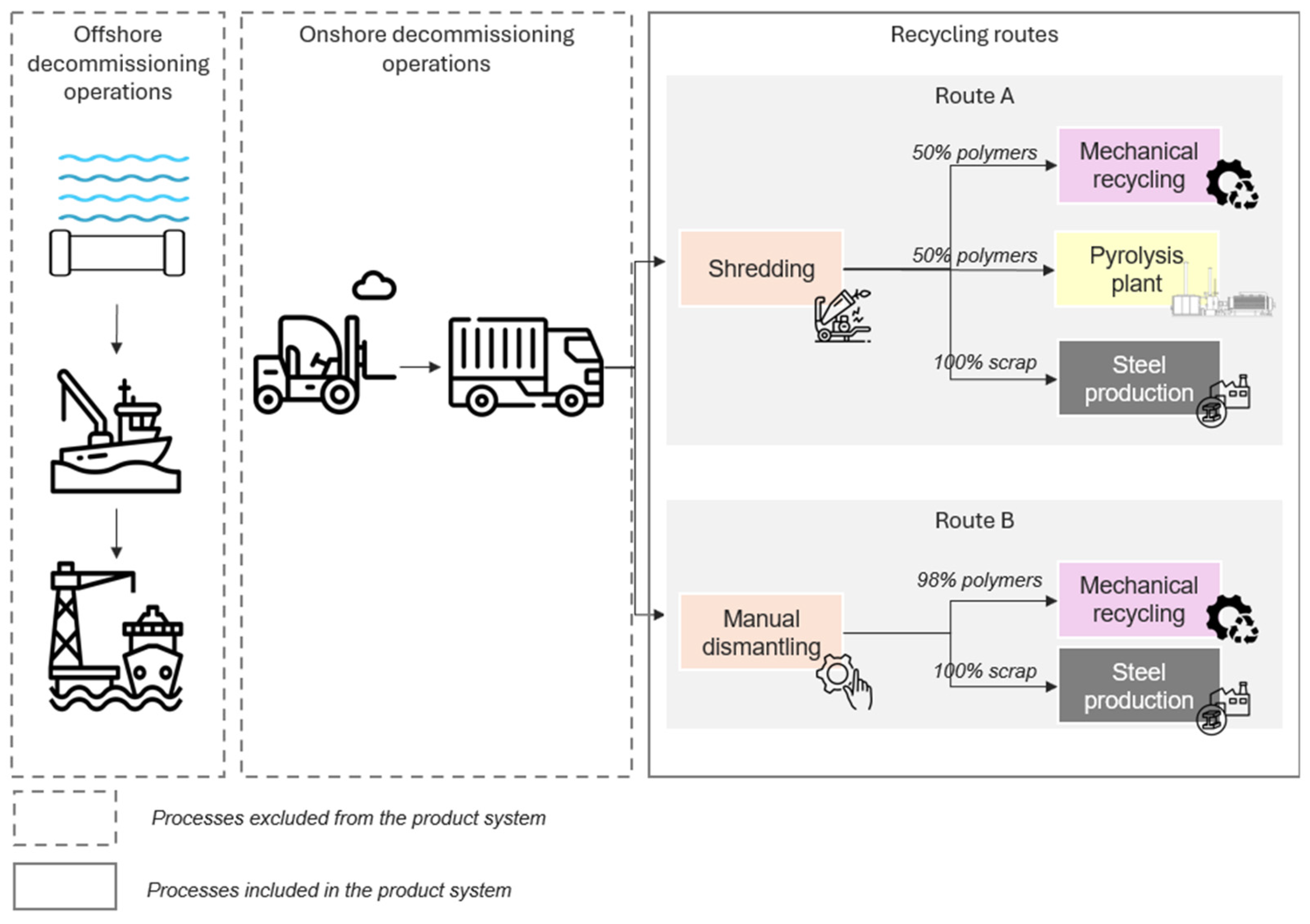
The objective of this LCA study is to compare two end-of-life (EoL) treatment routes for decommissioned flexible pipelines in the O&G sector—manual dismantling and shredding—within a Brazilian context. To this end, two routes were assessed:
Route A: shredding of the pipeline, with polymers directed to mechanical recycling and pyrolysis, and steel forwarded as scrap to the steel industry.
Route B: manual dismantling of the pipeline, with polymers sent for mechanical recycling and steel forwarded as scrap to the steel industry.
The ReCiPe method was used for impact assessment, considering the following impact categories [40]: global warming (GW), stratospheric ozone depletion (SOD), ionizing radiation (IRAD), ozone formation—human health (OFH), fine particulate matter formation (FPMP), ozone formation—terrestrial ecosystems (OFT), terrestrial acidification (TAC), freshwater eutrophication (FEU), marine eutrophication (MEU), terrestrial ecotoxicity (TEC), freshwater ecotoxicity (FEC), marine ecotoxicity (MEC), human carcinogenic toxicity (HCTO), human non-carcinogenic toxicity (HNCTO), land use (LUSE), mineral resource scarcity (MRS), fossil resource scarcity (FRS) and water consumption (WCO). Although various methods have been developed and are available for the assessment of environmental impacts in LCAs, the ReCiPe method was selected not only because it provides a comprehensive suite of midpoint indicators, with a global coverage [41], but also because it is the most widely used method in the O&G sector [42,43,44,45]. In this study, the impact assessment was conducted at the midpoint level to enable a transparent comparison across categories without aggregation. As a result, since normalization and weighting are optional in LCAs according to ISO 14044, they were not applied.
Technology-specific primary data collected during field visits and technical consultations were used to model the foreground system, including dismantling and shredding operations and their associated energy use and operational parameters. The background system was modeled using average market datasets representing electricity generation, fuel production, and upstream material supply.
The product system is described in Figure 1. The functional unit (FU) adopted in this study is the treatment of “1 ton of decommissioned and cleaned flexible pipeline”. Initially the modeling adopted 1 km of flexible pipeline as the functional unit. As the analysis of technical documentation of flexible pipelines employed in Brazilian facilities progressed, however, it was identified that flexible pipelines present significant variability in diameter and structural configuration, leading to substantial differences in material mass per unit length. As a result, to ensure consistent inventory scaling and reduce variability associated with geometric characteristics, the functional unit was reformulated to a mass-based unit, as is largely adopted in waste management LCAs.
Besides the large variation in diameter and structural configuration, O&G flexible pipeline production facilities comprise a wide range of materials; therefore, based on the characterization of the main flexible pipelines employed in Brazilian facilities and information obtained from technical documentation, the following material composition was considered: 90% steel, 5.5% high-density polyethylene (HDPE), 3.5% polyamide (PA), and 1.0% polyvinylidene fluoride (PVDF). The material composition is expressed on a mass basis and was used to define the mass flows modeled in the life cycle inventory, consistent with the functional unit adopted. Although volume may be relevant for logistical considerations, the environmental assessment was conducted exclusively on a mass basis. It should be noted that the material composition was derived from technical documentation provided by subsea equipment manufacturers and therefore constitutes primary data. Since steel scrap from both processes is sent to the same recycling process, the associated environmental impacts would be identical for both routes. Therefore, this analysis did not include the impacts from steel recycling.
The system boundaries encompass the onshore pre-processing operations associated with each end-of-life route, including unloading, sorting, dismantling or shredding, and intermediate handling of material fractions. Offshore removal activities, pre-cleaning of the pipelines, and final downstream recycling processes were excluded from the system boundaries, as they are either identical for both routes or fall outside the comparative decision context of this study. Auxiliary consumables (e.g., lubricants and tool wear) were excluded based on ISO 14044 cut-off criteria due to their negligible expected contribution relative to electricity and fuel consumption, which dominate recycling-related impacts according to the literature [46,47,48].
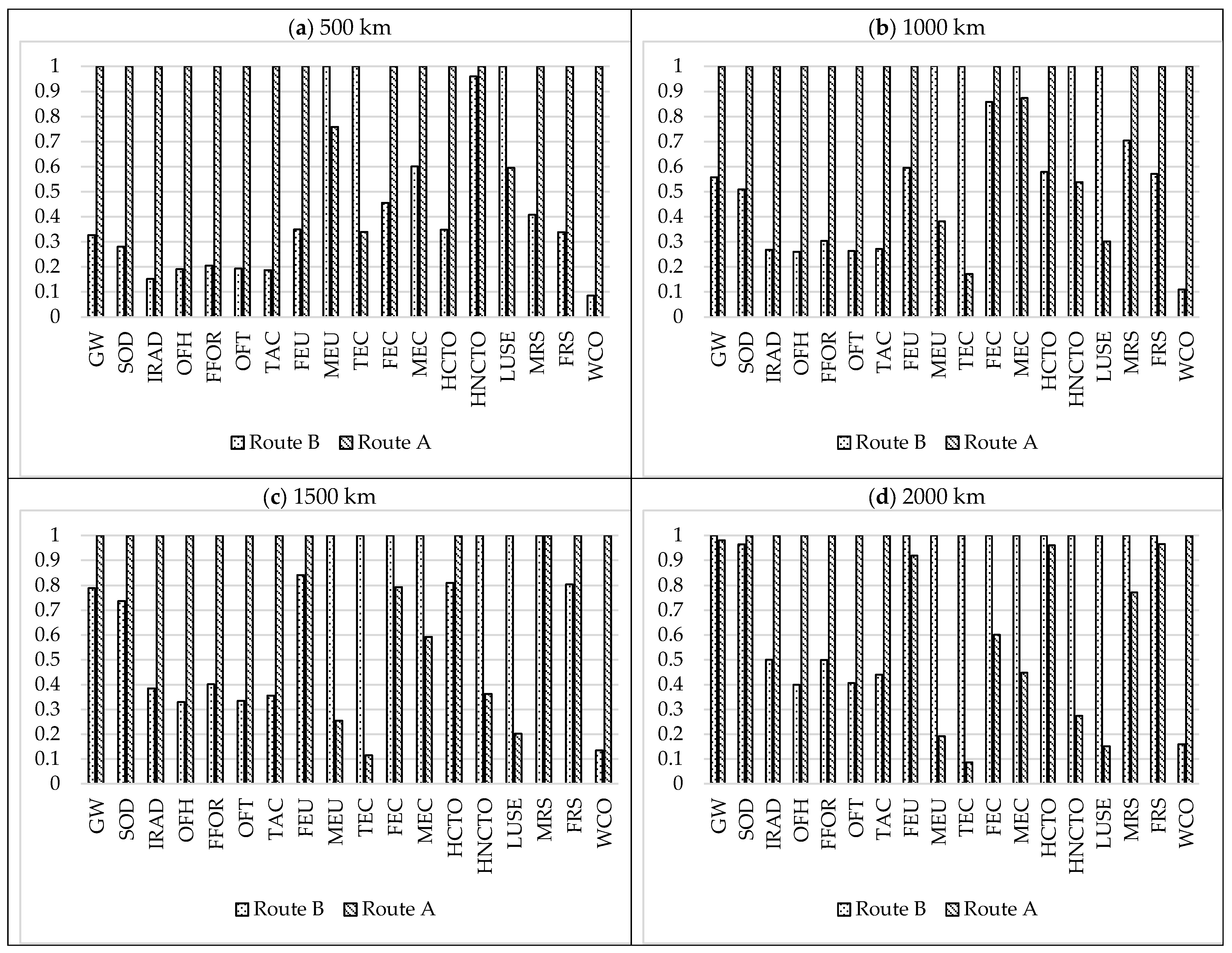
Additionally, transportation was modeled separately from the core dismantling and shredding processes to isolate the intrinsic environmental performance of each technological route. As a result, this analysis was carried out as a sensitivity analysis to identify threshold distances that may influence the comparative environmental performance. This choice aims to avoid obscuring the differences associated with the industrial processes themselves, since transportation distances are highly context-dependent and may vary significantly depending on logistical configurations. This approach allows decision-makers to first evaluate the environmental efficiency of each processing technology, assessing how transportation distances may influence the final outcome separately. The sensitivity analysis was performed focusing on the contribution of transportation to the total environmental impacts. Four alternative scenarios were defined, in which Route B was assumed to require additional road transport distances of 500 km, 1500 km, and 2000 km, respectively, compared to Route A.

2.2. Description of Processes

2.2.1. Route A

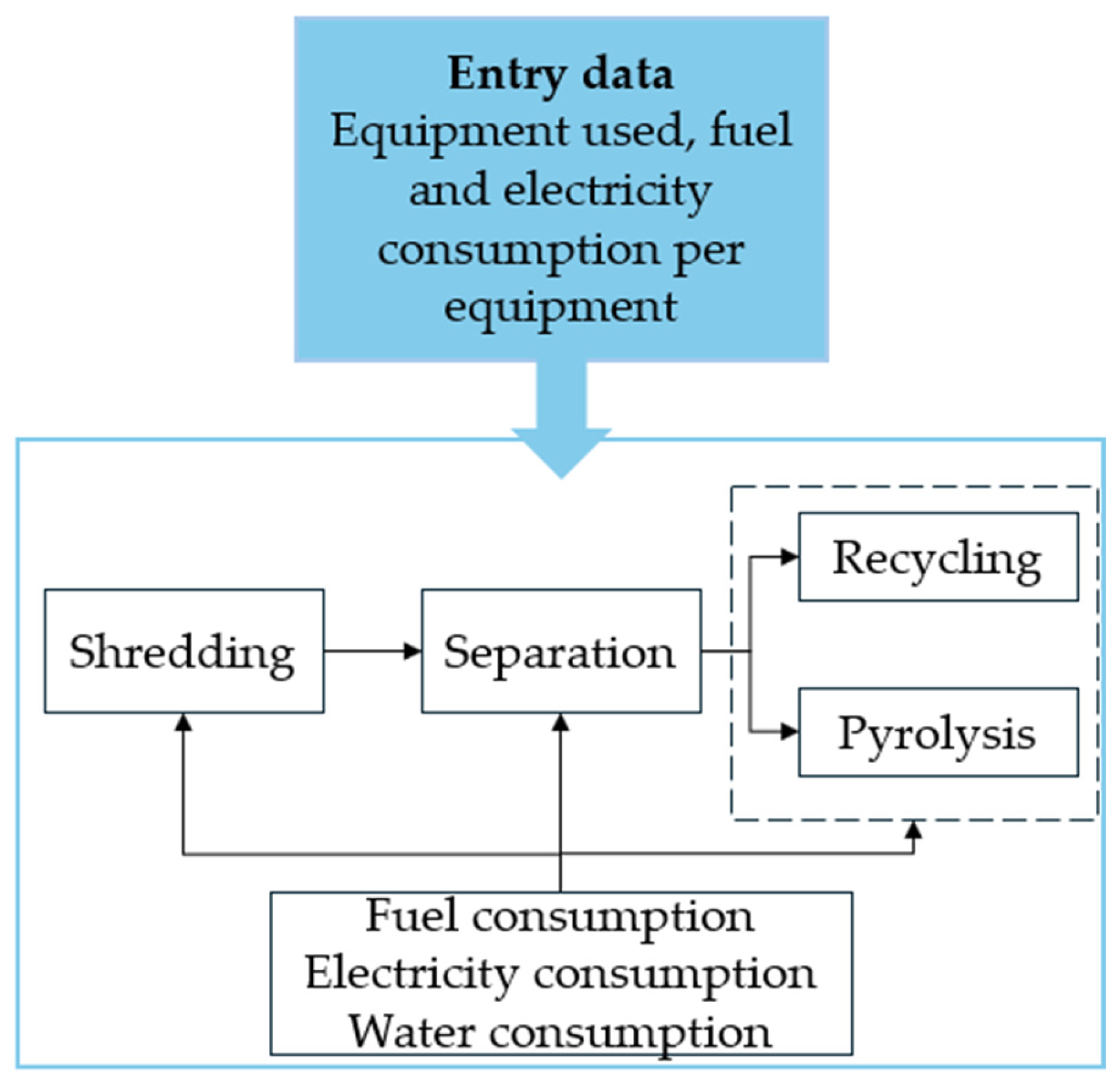
Route A is based on the shredding of flexible pipes, and its main entry data are illustrated in Figure 2. Only energy and water consumption data was accounted for, based on the access provided by the companies. Other inventory data were not disclosed due to protection as a trade secret. However, the data collected here is valuable, since this kind of data specifically for recycling flexible pipelines is not found in the literature.
In the first stage of the process, flexible pipes, cut into pieces approximately 6 m in length, are received by land transport and unloaded in a paved and waterproofed yard equipped with an oil containment and collection system. The pipes are cut into smaller fragments using an industrial hydraulic shear attached to a backhoe. Metallic components, such as fittings and other accessories that may be attached to the pipes, are removed prior to shredding and sent directly for steel recycling.
The cut fragments are then fed into the shredding equipment with the aid of recycling grapples, initiating the shredding process itself. Inside the equipment, the material is subjected to the impact of eight hammers and then filtered according to size through a screening grid. The feed flow is coordinated by the control room operator, who signals the equipment’s availability to receive a new batch of material. The shredded material is transported along a conveyor attached to the shredder, where a magnetic separation system removes the carbon steel, which is then directed to a specific collection point. The remaining material, a mixture of stainless steel and polymers, proceeds to a second conveyor where operators manually separate the stainless steel, placing it into a designated container. In an 8 h long shift supported by a team of nine workers, up to 100 tons of flexible pipes are processed, resulting in separate piles of stainless steel, carbon steel and mixed polymers.
Once the pipes are shredded, the carbon steel and stainless steel fractions, separated magnetically and manually, respectively, are stored for subsequent shipment to the steel industry. The polymer mass undergoes an additional manual sorting stage, during which a portion is selected for mechanical recycling. This process recovers approximately 50% of the total polymer mass contained in the shredded pipes. The remaining polymers, which are too degraded for mechanical recycling, are loaded onto trucks and transported to the pyrolysis area, where they are fed into the pyrolysis reactor with the aid of forklifts.
The forklifts are diesel-powered. The reactor is powered by the gas generated by the pyrolysis process itself, which is stored on site, combined with diesel when necessary. Data on gas consumption and the proportion of gas and diesel used in the reactor was not available, so it was assumed that the reactor was diesel-powered. Inside the reactor, the polymers are converted into three distinct products at the end of each batch of six tons of material: approximately 3,000 L of oil additive, combustible gas for use within the pyrolysis process itself, and about one ton of carbon black. Roughly 50% of the residue is transformed into the oily product, while the remaining mass is divided between the other two products. The reactor processes an average of six tons of polymers per day, operating in 14-h shifts.

2.2.2. Route B

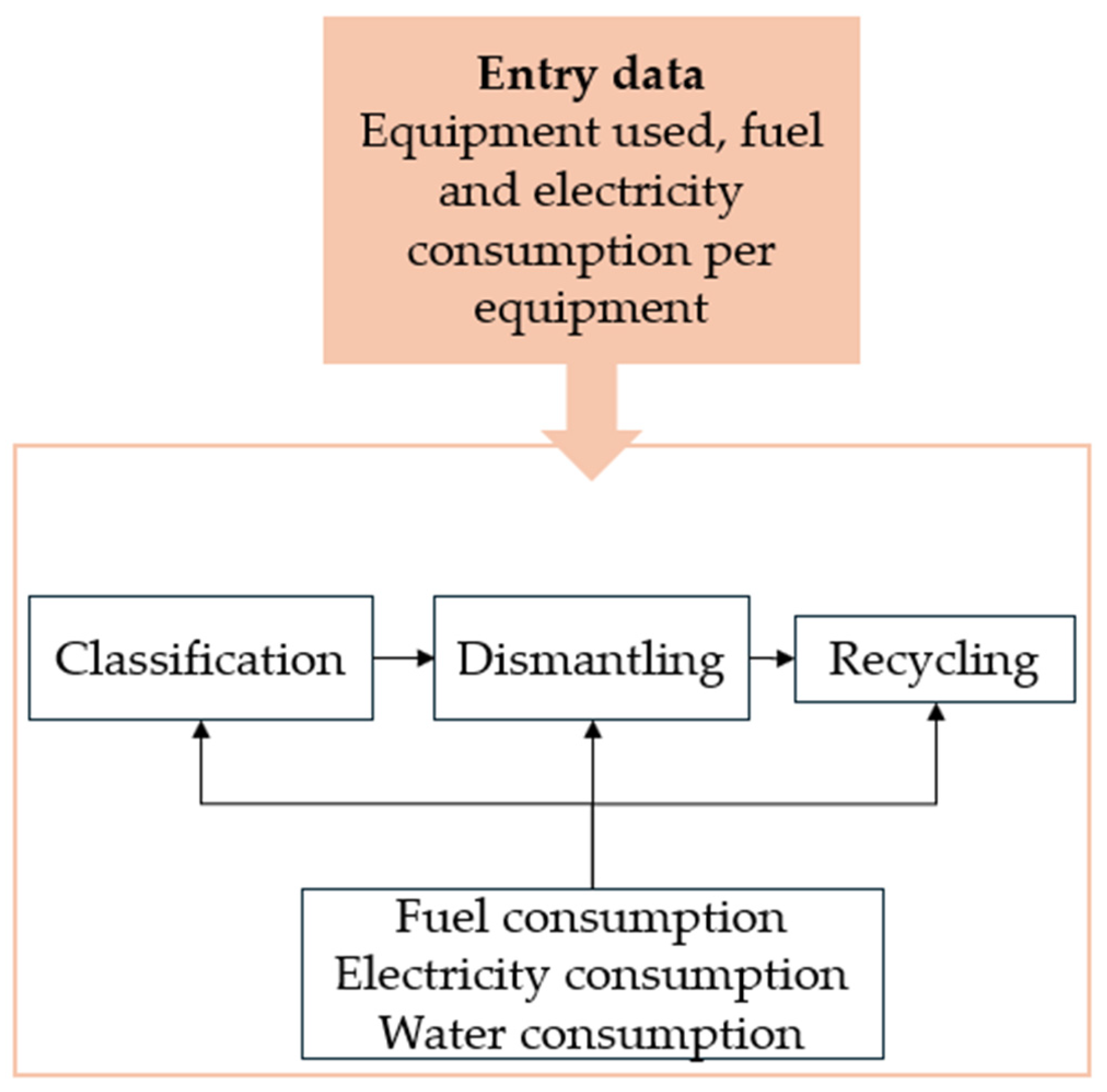
Route B is based on the manual dismantling of pipes and its main entry data are illustrated in Figure 3 (using the same approach as Route A).
The process begins with the unloading, separation and classification of flexible pipes according to size, diameter and color. The pipes are unloaded directly onto the ground, and the sorting is performed by workers operating both electrical-powered and LPG-powered forklifts. This stage of the process is crucial to guarantee that the pipe sections will be separated into groups with similar characteristics, since these characteristics will impact directly the techniques and tools employed in the dismantling, and different pipes may present significantly diverse profiles. The wider the variety in one shipment of pipes, the longer the classification step will be.
Once the pipes are separated and classified the manual dismantling process itself can begin, separating each layer of the flexible pipe from the outside in. The first layer to be removed is the outer sheath, composed of thick polymeric material. The removal of this layer relies on the use of circular saws to perform a longitudinal cut. The cutting of the layer can only be performed, however, if there are no dented sections on the pipe. Consequently, before the cut, a visual inspection is conducted and if dented sections are identified they are removed through a crosscut, to eliminate the compromised parts. Once there are no dented sections the first longitudinal cut can be performed, beginning the process of separating the layers.
After the outer sheath each section will be removed either by longitudinal cuts or manual unrolling. In general, the removal of thick polymeric layers relies on longitudinal cuts, while metallic layers may be removed either by manual unrolling or longitudinal cuts, depending on their shape and structure. Whenever manual unrolling techniques are applied, they are aided by forklifts, which elevate the pipes to allow for the unrolling of the layer, while longitudinal cuts are performed with the pipes on the ground and rely on circular saws as the only necessary equipment. The decision regarding whether to cut the layers or manually unspool them is guided by the workers’ experience and accumulated knowledge. Route B dismantles 115 tons of flexible pipe per day on average, relying on 10-h long shifts supported by a team of 50 workers.
This process results in a complete separation of the layers that compose the flexible pipe, with carbon steel, stainless steel and each polymeric layer being sent for recycling separately, and 98% of the polymers being sold to be mechanically recycled. The remaining polymeric mass is sent to landfills. All the equipment used in the process is either electrical-powered, fed by grid mix electricity, or LPG-powered.
The recycling rate adopted for the polymeric material in Route B reflects the operational performance reported by the dismantling company during the field visit and subsequent technical consultations. The primary data collected, together with direct process observations, indicated that approximately 98% of the polymeric fraction was suitable for mechanical recycling under the specific material conditions and separation procedures observed. It should be noted that this value represents the performance of the specific industrial case assessed in this study and should not be interpreted as a universal recycling efficiency. Recycling rates may vary depending on factors such as material degradation, contamination levels, and local recycling infrastructure.

2.2.3. Life Cycle Inventory (LCI)

As mentioned earlier, the data from manual dismantling and shredding operations are primary data, originating from the decommissioned flexible pipeline pre-processing plants that perform this work in Brazil, consisting of productivity data, energy and fuel consumption, and the number of machines and tools. Data regarding the road transport of materials reflect the specification of diesel used in trucks in Brazil, considering a mixture of 15% biodiesel with fossil diesel [49]. Table 1 summarizes the primary data. The Ecoinvent database was used to model basic inputs such as electricity, fossil diesel, natural gas, and tap water, as well as processes including iron ore beneficiation, to estimate avoided emissions from scrap recycling, plastic pipe extrusion, and freight transport. The detailed LCI is provided in the Supplementary Materials [50,51,52].

3. Results and Discussion

Route A is composed of four main stages, namely shredding, separation, recycling and pyrolysis. The potential environmental impacts regarding separation, however, stem from the energy consumption of the conveyor belt, which was included in the analysis of the potential environmental impacts resulting from shredding, since both activities are inextricably connected. Thus, the potential environmental impacts were modeled for shredding, pyrolysis and mechanical recycling.
Route B, on the other hand, is composed of three main stages: classification, dismantling and recycling. Since the potential environmental impacts from classification are associated with energy consumption from the use of forklifts that are also used to enable the dismantling stage, these impacts were considered inside the dismantling stage analysis. The mechanical recycling process is the same process that was modeled in the analysis of the shredding process, differing only in the amount of material processed. As a result, the effort to model the manual dismantling process was composed of modeling the dismantling stage itself. The potential environmental impacts associated with each route, per impact category, are presented in Table 2.
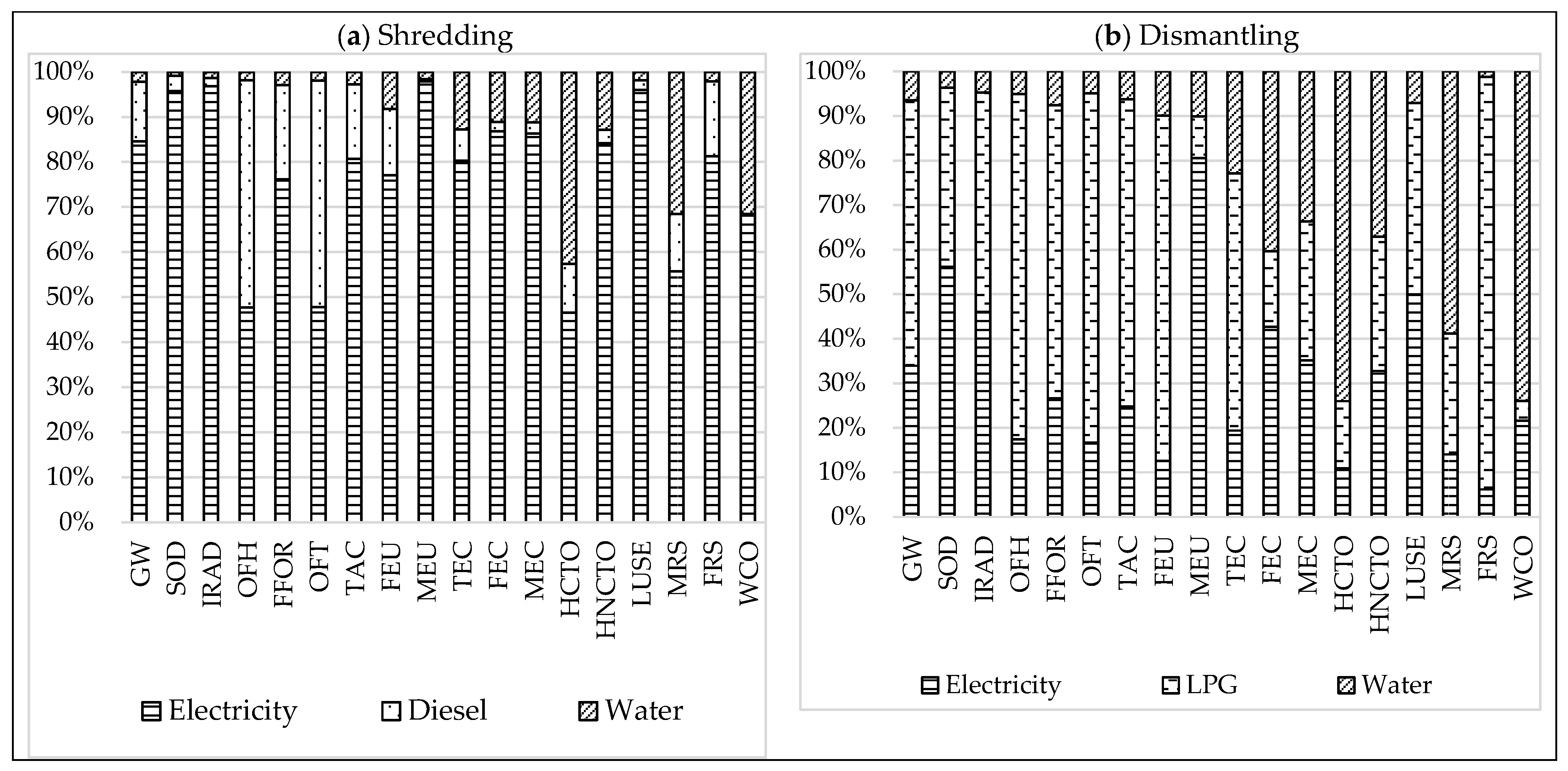
This section will present the contributions of different activities in terms of potential environmental impact across the chosen impact categories for the shredding, pyrolysis, mechanical recycling and dismantling stages that comprise Routes A and B. The contributions of different processes to potential environmental impacts from each route can be observed in Figure 4.
In the shredding activity electricity consumption is responsible for the main contributions to most impact categories, being superseded by diesel consumption only in the impact category of ozone formation (50%). The predominance of electricity consumption’s contributions in terms of potential environmental impacts is to be expected, considering that the main equipment, responsible for a larger share of energy consumption, is powered by electricity. The significance of diesel consumption’s contributions to some of the impact categories, despite the process being largely powered by electricity, however, highlights the relevance of the environmental impacts tied to fossil-fuel consumption and suggests that the impacts related to shredding could be reduced by adopting exclusively electrical equipment.
The manual dismantling process, alternatively, relies on a different energy matrix, powered by both grid mix electricity and LPG, which leads to a different distribution amongst the sources of potential environmental impact. Although the main activity—the manual dismantling of the pipes—is electricity-based and the forklifts are powered by both electricity and LPG, LPG consumption is shown to be responsible for the main contributions to most of the impact categories (global warming, 60%; ozone formation, human health, 77%; fine particulate matter formation, 66%; ozone formation, terrestrial ecosystems, 78%; terrestrial acidification, 69%; freshwater eutrophication, 77%; terrestrial ecotoxicity, 58%; and fossil resource scarcity, 93%). Electricity, on the other hand, is only responsible for the main contributions regarding land use by a slim margin when compared to LPG consumption (50%, while LPG is responsible for 43%). These results highlight how the energy intensity of the manual dismantling process is low, with a larger share of the potential environmental impacts of the process resulting from the use of forklifts to move the material.
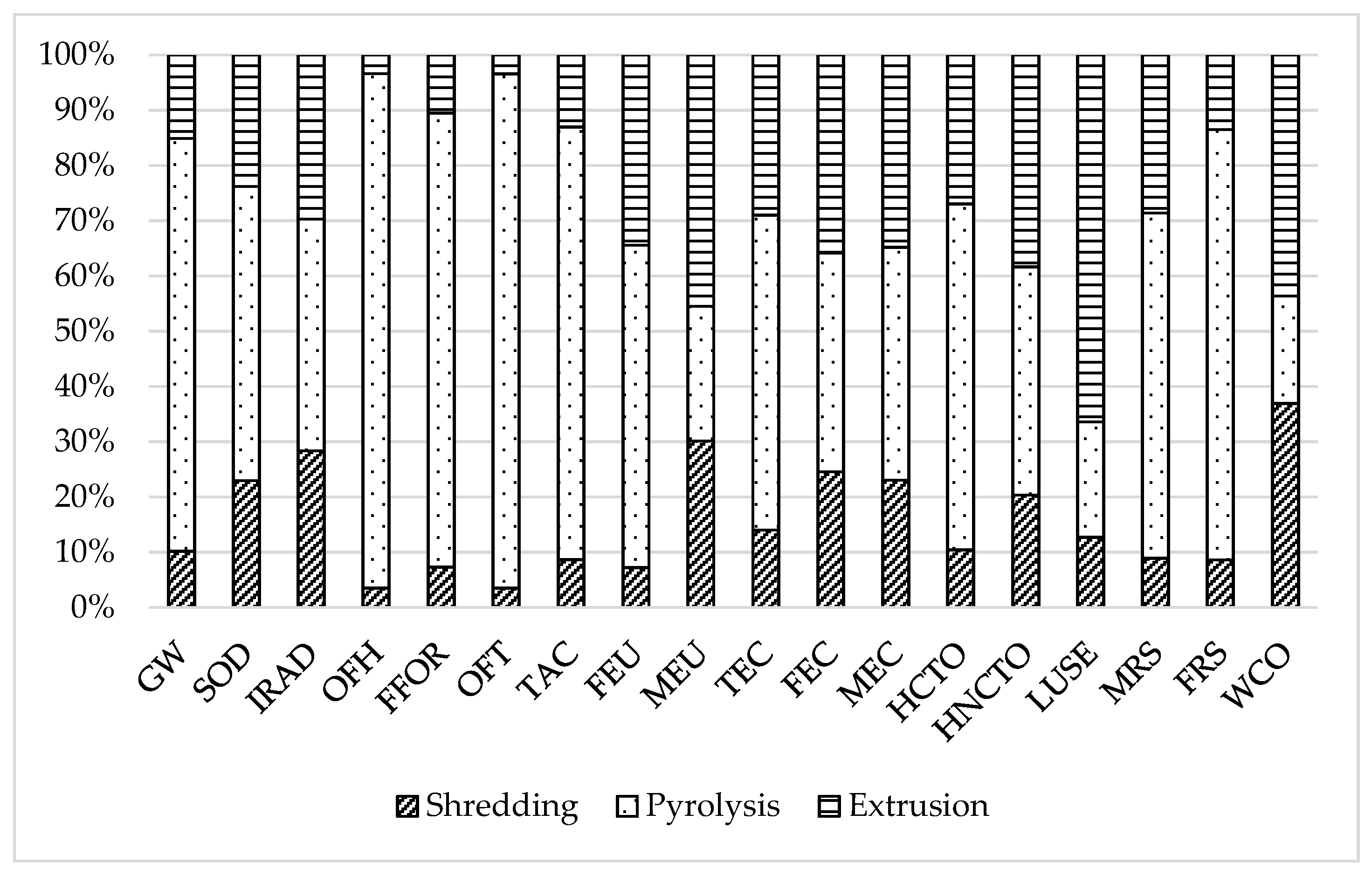
When the two processes are compared it becomes clear that the shredding process results in higher emissions than the dismantling process across all impact categories, with the potential environmental impacts from shredding in terms of the global warming impact category reaching values more than two hundred times higher than the ones resulting from dismantling. These results stem from the fact that the shredding process relies on heavier machinery, leading to higher energy consumption (0.265 kWh per FU, when manual dismantling only consumes 0.0005 kWh per FU) and associated emissions. The two routes do not, however, end with shredding or manual dismantling, and the entire processes are composed of more stages. The distribution of potential environmental impacts per process distributed across impact categories for Route A can be observed in Figure 5.
For most of the impact categories the potential environmental impact resulting from the pyrolysis process far supersedes the contribution of every other process. The cause for this is the high diesel consumption of the reactor (10.7MJ per FU). For the impact categories of water consumption and land use, on the other hand, the same is observed for the mechanical recycling process. Since in mechanical plastic recycling the extrusion process is the primary process determining the overall impact of recycled plastic production [53], the analysis of mechanical recycling considered the potential environmental impacts of plastic extrusion. These results indicate that even though there is a large difference between the potential environmental impacts from shredding and dismantling (with potential impacts from dismantling varying from 0.29% to 2.27% of the impacts associated with shredding), a far larger difference exists between the emissions from pre-processing and recycling—either mechanical or in the form of pyrolysis.
This indicates that the choice of recycling techniques would be more critical to reducing emissions than the choice between pre-processing routes. Based on the potential environmental impacts of both processes, mechanical recycling figures as the process with lower impacts on most of the considered impact categories, in consonance with findings in the literature [54,55].
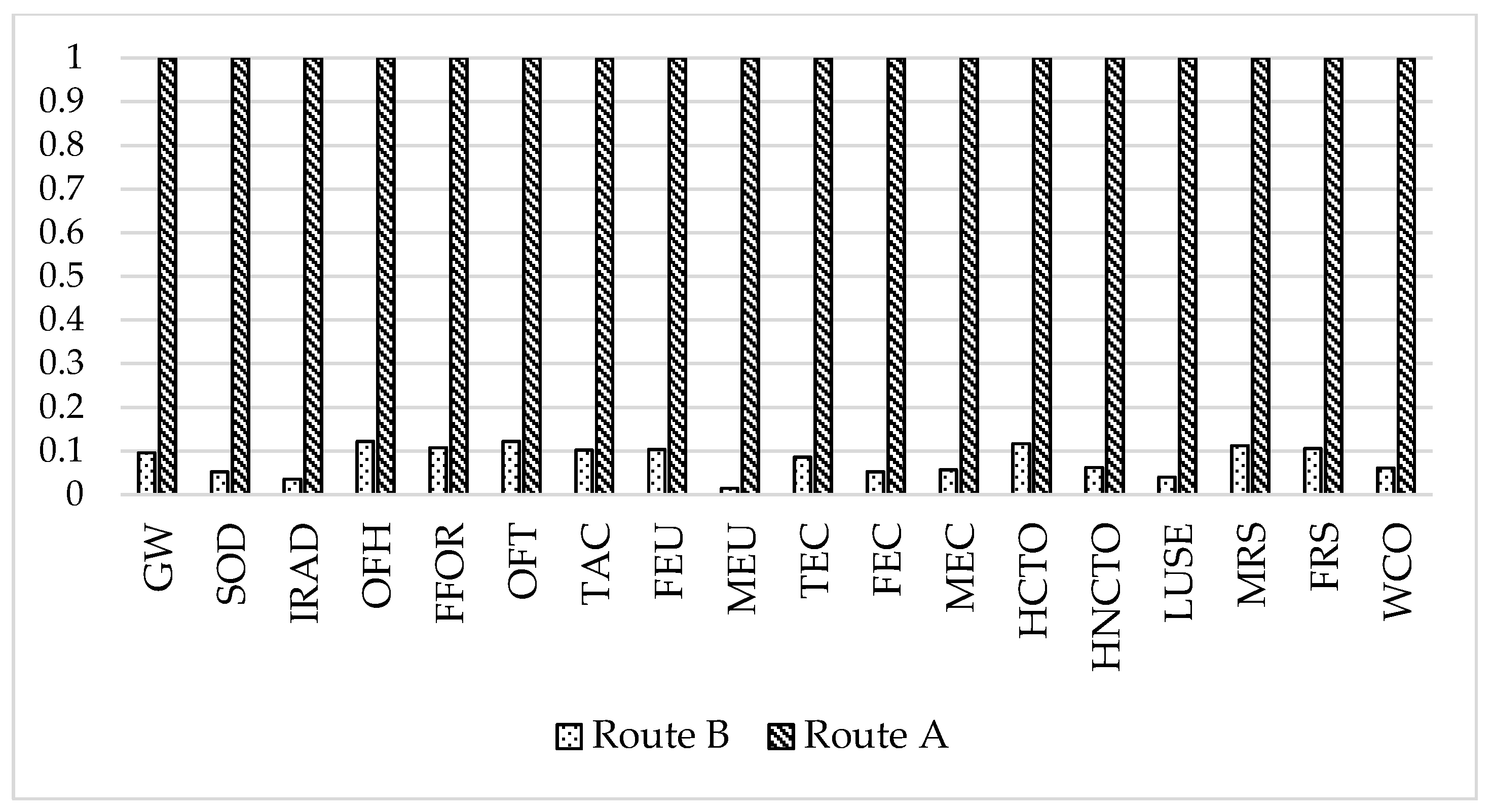
The choice of pre-processing and recycling technique cannot, however, be separated entirely. The shredding process in Route A is only able to mechanically recycle up to 50% of the polymeric mass. In summary, this means Route A not only relies on the pre-processing method with higher emissions, but it also directs half of the polymeric mass to the recycling process with higher potential environmental impacts. The normalized potential environmental impacts of Route B compared to Route A can be observed in Figure 6.
As expected, the potential environmental impacts from Route A are far higher, with potential environmental impacts from Route B varying from 1.47% to around 12% of the impacts associated with Route A. The main cause of the differences is the high energy demand of shredding and pyrolysis in Route A. Pyrolysis requires sustained high temperatures, leading to significant fuel consumption. In contrast, Route B relies primarily on manual dismantling, with low associated energy consumption and preserving of polymer fractions for mechanical recycling, which avoids thermochemical processing and its associated upstream burdens [54]. It is important to notice, however, that aspects such as the power source of the equipment in each process, differences in road transport and process adaptations could affect these results.
In this study, an LCA was applied to compare two different routes in terms of end-of-life strategies for decommissioned flexible pipes considering 18 impact categories. In the Brazilian regulatory and policy context, however, a few of these impact categories have particular relevance. The global warming potential indicator aligns directly with the National Policy on Climate Change [56] and Brazil’s commitments under its Nationally Determined Contribution (NDC), which aim to reduce greenhouse gas emissions by significant percentages relative to 2005 levels [57].
Toxicity-related categories such as freshwater and terrestrial ecotoxicity, alternatively, are pertinent within frameworks that guide soil and water quality management [58]. Finally, water consumption is an important consideration within Brazil’s National Water Resources Policy [59], which promotes sustainable use and protection of water resources, and resource scarcity indicators relate directly to policies that encourage recycling and circular economy strategies, including incentive mechanisms [60].
The results point unequivocally to Route B as the one with the lower associated potential environmental impacts, as expected, since the route combines a dismantling process that is less energy intensive and a recycling route with lower associated impacts leading to greater circularity of materials [54,55].
Nonetheless, in the context of polymer waste valorization, pyrolysis has become one of the most recognized technologies, capable of generating products such as char, oil, wax and gas, which are often commercialized at attractive prices. The main obstacle to the pyrolysis process remains the high energy input required, responsible for the high potential environmental impacts identified in this study, as well as the inconsistency in product yield and integrity [17].
While the problem of the high energy input can be potentially mitigated by using catalysts [17], mechanical recycling stands out as an environmentally preferable option in the context of pushing forward the circular economy—especially for engineering and high-performance polymers, such as the ones present in flexible pipes—leading to the reinsertion of the material in the production chain, which is hierarchically preferable [61,62].
However, while Route A as a whole and particularly the shredding process is more energy intensive, it is more easily replicable and less work intensive, with the artisanal aspects of the dismantling process leading to a high dependence on the experience and practical knowledge of the workers.
The dismantling process was observed in a region with a historical background in informal waste picking and recyclable material separation. Many of the workers currently employed in the facility previously engaged in informal waste sorting activities, which contributed to the development of practical expertise in material identification and manual separation techniques. This pre-existing experiential knowledge facilitated the transition to the dismantling of flexible pipelines. Workers demonstrated the ability to distinguish polymer types based on visual and tactile characteristics, such as color, thickness, and surface texture, which is critical to ensuring high mechanical recycling rates. The process also depends on tacit operational knowledge related to safe cutting procedures, including the assessment of internal stresses within the pipe layers to prevent hazardous release of metallic components, the appropriate selection of cutting tools, and the application of manual unspooling techniques when feasible.
Because these capabilities are largely experience-based and developed through practice rather than formal technical training, replicating the same performance in other regions may require significant training effort and time, potentially representing a barrier to scalability.
This challenge could be addressed by transporting the equipment to the already established manual dismantling organizations. This alternative would, however, increase the emissions associated with manual dismantling. To assess the magnitude of the impact that road transport would have in terms of the total impact, four scenarios were analyzed that considered Route B entailing an additional 500 km, 1000 km, 1500 km and 2000 km respectively when compared to Route A. The normalized potential environmental impacts of Routes A and B considering the different road transport scenarios can be observed in Figure 7.
In scenarios (a) and (b) the potential environmental impacts of Route A remain significantly higher in most impact categories. In scenario (c) Route B still presents lower potential environmental impacts in most categories, but it starts presenting the worst results for six of the 18 impact categories and a smaller difference in the values of the remaining impact categories. Finally, in scenario (d), the road transportation emissions associated with Route B cause it to present worse potential environmental impacts than Route A in most impact categories. In other words, as the difference in road transportation distance grows the environmental benefits of choosing Route B diminish, and when this difference corresponds to 2000 km or more Route B ceases to present the lowest impacts for most impact categories.
Considering Brazilian ports that have historically supported the decommissioning of subsea structures and the geographic location of the dismantling facility analyzed in this study, typical road transport distances would not exceed approximately 520 km. However, with the expansion of decommissioning activities towards the North and Northeast regions of Brazil, potential transport distances may substantially increase and, in some cases, exceed 2000 km.
Given the rapidly evolving decommissioning landscape in Brazil and in order to preserve the anonymity of the industrial actors involved, this study did not base the sensitivity scenarios on exact port-to-facility distances. Instead, the selected transport distances (500, 1500 and 2000 km) represent a plausible range of short, medium and long-haul logistics configurations that may become relevant under current and anticipated future decommissioning projects.
Additionally, the expansion of decommissioning projects to the North and Northeastern regions of the country could lead to the installation of manual dismantling and shredding facilities in these regions. The facilities that were visited during this study are in the Southeastern region, and the modeling of the processes considered the country’s energy grid mix. However, to directly compare facilities in the aforementioned regions, variations in the energy grid tied to regional particularities should be considered. With that goal, a sensitivity analysis was conducted.
Given both processes are located in the same region, Route B remains environmentally preferable, since Route A’s higher impacts are tied to higher energy consumption. This sensitivity analysis aims to evaluate how the results would be impacted if a facility that relies on the Route A process was in a region in which the energy grid mix is associated with lower potential environmental impacts. Since the shredding process could be more easily replicated, possibly extending more rapidly to new regions, this scenario aims to stress the boundaries of the conditions for Route B to remain preferable in a case where shredding facilities are installed in other regions, presumably closer to new decommissioning projects and reliant on less impactful energy grids.
Considering that Route A activities would be carried out in the North region and Route B activities would remain in the Southeast region, some variations can be observed in terms of the potential environmental impacts in some categories, but the order or preference between the two routes remains unchanged. Despite Route B starting to present higher impacts in some impact categories (terrestrial ecotoxicity, human non-carcinogenic toxicity and land use) in scenario (a), and not only in scenario (c) as was observed when both processes were assumed to be powered by the country’s average electricity mix, Route B still presents lower impacts for most impact categories in the first three scenarios.
Considering Route A activities taking place in the Northeast region, similarly, leads to some changes in the first three scenarios, with Route B presenting higher potential environmental impacts than Route A in eight impact categories (stratospheric ozone depletion, ionizing radiation, marine eutrophication, terrestrial ecotoxicity, freshwater ecotoxicity, marine ecotoxicity, human non-carcinogenic toxicity and land use) in scenario (c) instead of six impact categories as observed previously, Route A remains responsible for higher potential environmental impacts in most impact categories for the first three scenarios. This lack of a more expressive change is not unexpected. As highlighted in Figure 6, the potential environmental impacts associated with Route A far supersede the ones associated with Route B and as shown in Figure 5, the largest share of the potential environmental impacts associated with Route A are tied to the pyrolysis process, which is diesel powered. Additionally, the change in electricity mix led to variations in the potential impacts associated with Route B from only 0.11% (freshwater ecotoxicity) to 2.19% (marine eutrophication), resulting in only marginal changes in the results.
Beyond the number of impact categories in which each route presents the highest potential environmental impacts, however, decision-makers should also consider the impact categories themselves. As previously stated, global warming, toxicity-related impact categories and water consumption are impact categories particularly relevant in the Brazilian regulatory and policy context. If, for instance, greater importance is afforded to toxicity-related impact categories, Route A might be considered preferable when compared to Route B in scenario (c), given that the Route A facility is located in the Northeast region and Route B is in the Southeast region. Alternatively, if all impact categories are given the same weight, Route B remains preferable for scenarios (a), (b) and (c) and is superseded in performance by Route A in scenario (d) regardless of the location of the facilities.
It should also be kept in mind that every process has a limit to its productive capacity, and the artisanal aspects that prevent the manual dismantling process from being replicated in other regions might also be an obstacle for the installed capacity to be expanded. As a result, it is possible that the existing facilities for manual dismantling do not have the capacity to absorb all the decommissioned flexible pipes, or that they are located too far away from the port for the environmental advantages to justify the transportation effort. Furthermore, the environmental disadvantages of Route A could be mitigated by removing the outer sheath of the pipe before shredding, reducing the amount of polymeric material that is degraded and sent to pyrolysis and increasing the percentage of polymeric material sent to mechanical recycling.
This would lead to reductions in potential environmental impacts varying from 13% to 24% across impact categories, and to Route A becoming environmentally preferable to Route B with differences in road transportation corresponding to scenario (c). Additional reductions in the potential environmental impacts of Route A could also be achieved by adopting a different energy source for the pyrolysis process, but the quantitative analysis of this improvement falls beyond the scope of this study.
Moreover, there are other aspects that should be considered when comparing the two routes. The manual dismantling process relies on longer shifts supported by bigger teams to process similar masses of flexible pipes when compared to shredding. The need for a bigger workforce can be a driver of job creation, but at the same time workers in the manual dismantling process are exposed to more pronounced biomechanical, cutting, and cognitive risks, which are inherent to the labor-intensive and artisanal nature of the work and lead to process safety and physical integrity issues. Additionally, the two processes will present different cost structures, with shredding probably demanding higher initial investment and dismantling leading to higher operation costs due to the large workforce. While Route A is characterized by higher capital and energy intensity but lower dependence on skilled manual labor, which could favor scalability, Route B relies on a labor-intensive dismantling process requiring tacit knowledge and experienced workers, which may pose scalability constraints but generate local employment opportunities. A qualitative summary of these aspects can be observed in Table 3.
Although this study is centered on environmental performance, additional dimensions such as economic costs, occupational safety and operational feasibility are critical for industrial decision-making. Decommissioning and all its stages, including waste management, is an intrinsically complex process that should consider criteria such as social impacts, economic costs, worker exposure to health and safety hazards, logistic complexity, technical and economic viability and many other criteria. These issues are essential to define CE pathways for the decommissioning of the O&G sector. This study limits itself to furthering the understanding of the potential environmental impacts of the two processes identified as the main end-of-life strategies for decommissioned flexible pipes.

4. Conclusions

This study has evaluated the potential environmental impacts associated with two different technological routes to dismantle and recycle flexible pipes in Brazil. To accomplish this goal, primary data collected through process observations and semi-structured interviews conducted with companies involved in the dismantling and recycling of submarine pipelines in Brazil were used.
The results show that Route A, based on shredding the pipes and dividing the polymeric material between pyrolysis (50%) and mechanical recycling (50%), presents the highest associated potential environmental impacts. It should be noted, however, that the present study considered a diesel-powered reactor for the pyrolysis process. Since the pyrolysis process was responsible for the larger share of Route A, a change in the power source of the pyrolysis process could potentially impact these results. Additionally, differences in road transportation distances affect the potential environmental impacts associated with each route.
Variations in environmental performance were observed in all scenarios, but only scenario (d) (difference in road transportation distance of 2000 km) led to a change big enough to cause Route B to no longer be environmentally preferable. If the process of Route A were adapted to include the removal of the outer sheath before shredding the pipe, reductions in potential environmental impacts varying from 13% to 24% across impact categories could be achieved, and scenario (c) (difference in road transportation distance corresponding to 1500 km) would be enough for Route A to become environmentally preferable to Route B.
Besides showing that between the two mapped and compared routes Route B is environmentally preferable, these results indicate that the environmental performance of each route depends on many factors and can be enhanced or hindered by aspects such as power source and geographic location in relation to the port that will receive the decommissioned pipes. Additional care should be taken in terms of LCA modeling and the choice of LCI and datasets used. Future research further analyzing the impacts of these factors over the potential environmental impacts of each technological route could prove valuable for the decision-making process of decommissioning actors and for the scientific community, especially in the context of the circular economy. Additionally, we suggest that future studies should focus on including cost aspects (through a Life Cycle Cost Assessment, or LCCA) and social aspects (through a Social Life Cycle Assessment, or SLCA).
Decision-making in the context of decommissioning is an intrinsically complex process that should consider various criteria. This study offers valuable insight into the waste management of decommissioned subsea infrastructure by presenting primary data on the two pre-processing routes for the recycling of flexible pipes in Brazil and quantifying the potential environmental impacts associated with them.

Supplementary Materials

The following supporting information can be downloaded at: https://www.mdpi.com/article/10.3390/su18083648/s1.

Author Contributions

Conceptualization, I.F.d.O.; methodology, L.R.C. and A.C.M.A.; software, L.R.C.; validation, A.C.M.A.; investigation, I.F.d.O.; data curation, A.C.M.A.; writing—original draft preparation, I.F.d.O. and L.R.C.; writing—review and editing, I.F.d.O., A.C.M.A. and M.I.L.d.S.; project administration, M.I.L.d.S. All authors have read and agreed to the published version of the manuscript.

Funding

The study was mainly supported by Petrobras S.A., Brazil’s leading energy company, under Cooperation Agreement 58500105843179. Petrobras’s involvement followed the application of financial resources defined in the Research, Development, and Innovation (RDI) clauses of the “Agência Nacional do Petróleo, Gás Natural e Biocombustíveis (ANP)”—Project 20605-2. Additional funding was provided by the National Council for Scientific and Technological Development (CNPq), through grant number 315752/2023-8.

Institutional Review Board Statement

Not applicable.

Informed Consent Statement

Not applicable.

Data Availability Statement

The data presented in this study are openly available in Zenodo at http://doi.org/10.5281/zenodo.18431908. Further inquiries can be directed to the corresponding author.

Acknowledgments

We would like to acknowledge the National Council for Scientific and Technological Development (CNPq), the National Council for the Improvement of Higher Education (CAPES), the National Agency of Petroleum, Natural Gas and Biofuels (ANP), and the Petróleo Brasileiro S.A. (PETROBRAS) that technically and financially supported the authors in preparing the work. We would like to thank the reviewers for their attention and expertise, which contributed to improving the quality of this study.

Conflicts of Interest

The authors declare that this study received funding from Petrobras S.A. The funder was not involved in the study design, collection, analysis, interpretation of data, the writing of this article or the decision to submit it for publication.

Abbreviations

The following abbreviations are used in this manuscript:
EoLEnd of life
FECFreshwater ecotoxicity
FEUFreshwater eutrophication
FPMFFine particulate matter formation
FRSFossil resource scarcity
GDPGross domestic product
GHGGreenhouse gas
GWGlobal warming
HCTOHuman carcinogenic toxicity
HDPEHigh-density polyethylene
HNCTOHuman non-carcinogenic toxicity
IRADIonizing radiation
LCALife Cycle Assessment
LCCALife Cycle Cost Assessment
LPGLiquefied petroleum gas
LUSELand use
MECMarine ecotoxicity
MRSMineral resource scarcity
OFHOzone formation, human health
OFTOzone formation, terrestrial ecosystems
PAPolyamide
PVDFPolyvinylidene fluoride
SLCASocial Life Cycle Assessment
SODStratospheric ozone depletion
TACTerrestrial acidification
TECTerrestrial ecotoxicity
WCOWater consumption
XLPECrosslinked polyethylene

References

  1. IEA. World Energy Outlook 2025, Paris, 2025. Available online: https://www.iea.org/reports/world-energy-outlook-2025 (accessed on 7 January 2026).
  2. EPE. National Energy Balance, May 2025. Available online: https://www.epe.gov.br/en/publications/publications/brazilian-energy-balance-2025 (accessed on 2 December 2025).
  3. Ferreira, P.; Pereira, É.; Silva, M. The relationship between oil prices and the Brazilian stock market. Phys. A Stat. Mech. Its Appl. 2020, 545, 123745. [Google Scholar] [CrossRef]
  4. IBP. Panorama Geral do Setor de Petróleo e Gás: Uma Agenda para o Futuro, Jan. 2024. Available online: https://www.ibp.org.br/documents/276/panorama-geral-do-setor-de-og-portugues.pdf (accessed on 5 October 2025).
  5. Martins, I.D.; Bahiense, L.; Infante, C.E.D.; Arruda, E.F. Dimensionality reduction for multi-criteria problems: An application to the decommissioning of oil and gas installations. Expert Syst. Appl. 2020, 148, 113236. [Google Scholar] [CrossRef]
  6. Techera, E.J.; Chandler, J. Offshore installations, decommissioning and artificial reefs: Do current legal frameworks best serve the marine environment? Mar. Policy 2015, 59, 53–60. [Google Scholar] [CrossRef]
  7. Fam, M.L.; Konovessis, D.; Ong, L.S.; Tan, H.K. A review of offshore decommissioning regulations in five countries—Strengths and weaknesses. Ocean Eng. 2018, 160, 244–263. [Google Scholar] [CrossRef]
  8. Carneiro, P.R.F.; Fasca, H.; Cordeiro, M.; Martingil, M.; do Valle, L.V.; de Souza, M.I.; Salomon, P.S. A methodological approach for an objective environmental impact assessment to support the decision-making in the decommissioning of oil and gas subsea installations in Brazil. J. Nat. Conserv. 2024, 79, 126619. [Google Scholar] [CrossRef]
  9. ANP. Resolução ANP n° 817; Agência Nacional do Petróleo, Gás Natural e Biocombustíveis: Rio de Janeiro, Brazil, 2020. Available online: https://atosoficiais.com.br/anp/resolucao-n-817-2020-dispoe-sobreo-descomissionamento-de-instalacoes-de-exploracao-e-de-producao-de-petr (accessed on 5 December 2025).
  10. ANP; FGV. Descomissionamento Offshore no BRASIL—Oportunidades, Desafios e Soluções; FGV Energia: Rio de Janeiro, Brazil, 2021; Volume 11. [Google Scholar]
  11. Brasil Política Nacional de Resíduos Sólidos, August 2010. Available online: https://www.gov.br/ibama/pt-br/assuntos/emissoes-e-residuos/residuos/politica-nacional-de-residuos-solidos-pnrs (accessed on 5 December 2025).
  12. Ellen Macarthur Foundation. Towards the Circular Economy; Ellen Macarthur Foundation: Cowes, UK, 2013. [Google Scholar]
  13. CODA. Decommissioning Waste Disposal Pathways, February 2025. Available online: www.decommissioning.org.au (accessed on 10 December 2025).
  14. EPE. Decarbonization Scenarios for E&P, July 2025. Available online: http://www.epe.gov.br (accessed on 8 January 2026).
  15. Heerema, E.P.; A Group. Recent Achievements and Present Trends in Deepwater Pipe-Lay Systems, 2005. Available online: https://onepetro.org/OTCONF/proceedings-abstract/05OTC/05OTC/OTC-17627-MS/29703 (accessed on 10 December 2025).
  16. Wang, L.; Ju, M.; Xing, X.; Yun, F.; Wang, X. Dynamic behavior of the deepwater flexible pipeline during pipe laying process. J. Mar. Sci. Eng. 2020, 8, 286. [Google Scholar] [CrossRef]
  17. H’ng, Y.N.; Pasbakhsh, P.; Duan, X.A.; Sofi, M. Pyrolysis of Polymeric Materials from Decommissioned Subsea Flowlines: A Review. Polym. Rev. 2025, 66, 306–404. [Google Scholar] [CrossRef]
  18. Ye, W.; Xie, J.; Lu, W.; Li, X.; Dai, T.; Xie, P. Finite element study on the wet collapse mechanism of a flexible pipe with eroded carcass. Ocean Eng. 2025, 329, 121124. [Google Scholar] [CrossRef]
  19. Tronc, F.; Bourdel, S.; Brun, E.; David, E.; Guillerme, J.F.; Levet, A. Qualification of a New Robust and Cost-Effective Polymer for Flexible Pipe Pressure Sheath. In Proceedings of the Offshore Technology Conference Asia, Kuala Lumpur, Malaysia, 22–25 March 2016. OTC-26506-MS. [Google Scholar]
  20. Khalid, H.U.; Ismail, M.C.; Nosbi, N. Permeation Damage of Polymer Liner in Oil and Gas Pipelines: A Review. Polymers 2020, 12, 2307. [Google Scholar] [CrossRef]
  21. Tang, M. Flexible Pipes. In Pipeline Engineering—Design, Failure, and Management; IntechOpen: London, UK, 2023. [Google Scholar] [CrossRef]
  22. Hartley Anderson Limited. ‘Jacky Decommissioning—Environmental Impact Assessment’, 2018. Available online: https://assets.publishing.service.gov.uk/government/uploads/system/uploads/attachment_data/file/685284/Jacky_Environmental_Impact_Assessment.pdf (accessed on 8 December 2025).
  23. Davies, A.J.; Hastings, A. Quantifying greenhouse gas emissions from decommissioned oil and gas steel structures: Can current policy meet NetZero goals? Energy Policy 2022, 160, 112717. [Google Scholar] [CrossRef]
  24. Marchetti, B.; Corvaro, F.; Rossi, M. Energy Implications and Environmental Analysis of Oil Rigs Decommissioning Options Using LCA Methodology. Energies 2025, 18, 3372. [Google Scholar] [CrossRef]
  25. Davies, A.J.; Hastings, A. Greenhouse Gas Emissions from Decommissioning Manmade Structures in the Marine Environment; Current Trends and Implications for the Future. J. Mar. Sci. Eng. 2023, 11, 1133. [Google Scholar] [CrossRef]
  26. Abrahms-Kavunenko, S. Toward an anthropology of plastics. J. Mater. Cult. 2023, 28, 3–23. [Google Scholar] [CrossRef]
  27. Dokl, M.; Copot, A.; Krajnc, D.; Van Fan, Y.; Vujanović, A.; Aviso, K.B.; Tan, R.R.; Kravanja, Z.; Čuček, L. Global projections of plastic use, end-of-life fate and potential changes in consumption, reduction, recycling and replacement with bioplastics to 2050. Sustain. Prod. Consum. 2024, 51, 498–518. [Google Scholar] [CrossRef]
  28. Hamed, M.; Martyniuk, C.J.; Naguib, M.; Lee, J.S.; Sayed, A.E.D.H. Neurotoxic effects of different sizes of plastics (nano, micro, and macro) on juvenile common carp (Cyprinus carpio). Front. Mol. Neurosci. 2022, 15, 1028364. [Google Scholar] [CrossRef] [PubMed]
  29. Hamed, M.; Osman, A.G.M.; Badrey, A.E.A.; Soliman, H.A.M.; Sayed, A.E.D.H. Microplastics-Induced Eryptosis and Poikilocytosis in Early-Juvenile Nile Tilapia (Oreochromis niloticus). Front. Physiol. 2021, 12, 742922. [Google Scholar] [CrossRef]
  30. Hamed, M.; El-Sherif, D.M.; Iheanacho, S.C.; Hasan, A.K.M.M.; Niaz, K.; Khaled, M.A. Microplastics in food chains: Global evidence, bioaccumulation, spatial distribution and health risks. Food Control 2026, 182, 111836. [Google Scholar] [CrossRef]
  31. Maisels, A.; Hiller, A.; Simon, F.G. Chemical Recycling for Plastic Waste: Status and Perspectives. ChemBioEng Rev. 2022, 9, 541–555. [Google Scholar] [CrossRef]
  32. Shamsuyeva, M.; Endres, H.J. Plastics in the context of the circular economy and sustainable plastics recycling: Comprehensive review on research development, standardization and market. Compos. Part C Open Access 2021, 6, 100168. [Google Scholar] [CrossRef]
  33. Angelo, A.C.M.; Saraiva, A.B.; Clímaco, J.C.N.; Infante, C.E.; Valle, R. Life Cycle Assessment and Multi-criteria Decision Analysis: Selection of a strategy for domestic food waste management in Rio de Janeiro. J. Clean. Prod. 2017, 143, 744–756. [Google Scholar] [CrossRef]
  34. Burdon, D.; Barnard, S.; Boyes, S.J.; Elliott, M. Oil and gas infrastructure decommissioning in marine protected areas: System complexity, analysis and challenges. Mar. Pollut. Bull. 2018, 135, 739–758. [Google Scholar] [CrossRef] [PubMed]
  35. Tan, Y.; Li, H.X.; Cheng, J.C.; Wang, J.; Jiang, B.; Song, Y.; Wang, X. Cost and environmental impact estimation methodology and potential impact factors in offshore oil and gas platform decommissioning: A review. Environ. Impact Assess. Rev. 2021, 87, 106536. [Google Scholar] [CrossRef]
  36. Chen, D.; Chen, L.; Zhang, Y.; Wang, X.; Wang, J.; Wen, P. Decommissioning offshore oil and gas facilities in China: Process and environmental impacts. Ocean Eng. 2024, 296, 116887. [Google Scholar] [CrossRef]
  37. SEPA. Regulation of Offshore Oil and Gas Waste, 2018. Available online: https://www.sepa.org.uk/media/369293/wst-g-059-offshore-og-guidance.pdf (accessed on 15 January 2026).
  38. ISO 14044:2006; Environmental Management—Life Cycle Assessment—Requirements and Guidelines. International Organization for Standardization: Geneva, Switzerland, 2006.
  39. ISO 14040:2006; Environmental Management—Life Cycle Assessment—Principles and Framework. International Organization for Standardization: Geneva, Switzerland, 2006.
  40. Huijbregts, M.A.; Steinmann, Z.J.; Elshout, P.M.; Stam, G.; Verones, F.; Vieira, M.; Zijp, M.; Hollander, A.; Van Zelm, R. A Harmonized Life Cycle Impact Assessment Method at Midpoint and Endpoint Level Report I: Characterization; National Institute for Public Health and the Environment: Bilthoven, The Netherlands, 2016; Available online: https://www.semanticscholar.org/paper/ReCiPe-2016.-A-harmonized-life-cycle-impact-method-Huijbregts-Steinmann/b70aeb1db5636d50b32da5ec66e9cba18bae65df (accessed on 21 January 2026).
  41. Wahl, A. Life Cycle Impact Assessment—Which Are the LCIA Indicator Sets Most Widely Used by Practitioners? Available online: https://go.ipoint-systems.com/blog/lcia-indicator (accessed on 21 January 2026).
  42. van Zelm, R.; Hennequin, T.; Huijbregts, M.A.J. Performing life cycle impact assessment with the midpoint and endpoint method ReCiPe. Nat. Protoc. 2025, 20, 3400–3411. [Google Scholar] [CrossRef]
  43. Emborg, M.; Gebara, C.H.; Olsen, S.I. Using process-based life cycle assessment to help companies identify emission reduction potentials in their value chain: A case study in the petroleum industry. Carbon Manag. 2025, 16, 2445242. [Google Scholar] [CrossRef]
  44. Prasetyo, S.A. Life Cycle Assessment (LCA) Study on Crude Oil and Natural Gas Production Process for Environmental Impact Analysis and Decarbonization Support in East Java. Riwayat Educ. J. Hist. Humanit. 2025, 8, 3231–3243. [Google Scholar] [CrossRef]
  45. Carvalho, B.C.; Souza, H.R.A.; Soares, S.R.; Fontes, M.A.; Gomes, E.J.; Marinho, L.S.; Junior, W.F.C.; Calderari, M.R.C.M. Life Cycle Assessment of Oil and Gas Drilling Activities. In Proceedings of the Offshore Technology Conference, Houston, TX, USA, 6–9 May 2024. OTC-35145-MS. [Google Scholar] [CrossRef]
  46. Pei, Y.; Kumar, D.; Han, B.; Adams, S.D.; Khoo, S.Y.; Norton, M.; Kouzani, A.Z. Environmentally informed modelling and optimisation of shredding performance for recycling waste tyres. J. Clean. Prod. 2025, 515, 145696. [Google Scholar] [CrossRef]
  47. Swinnerton, S.; Su, J.; Tsai, C.S.J. The emission and physicochemical properties of airborne microplastics and nanoplastics generated during the mechanical recycling of plastic via shredding. Sci. Rep. 2024, 14, 24755. [Google Scholar] [CrossRef]
  48. Shan, C.; Pandyaswargo, A.H.; Onoda, H. Environmental Impact of Plastic Recycling in Terms of Energy Consumption: A Comparison of Japan’s Mechanical and Chemical Recycling Technologies. Energies 2023, 16, 2199. [Google Scholar] [CrossRef]
  49. MME. Resolução N° 8, de 25 de Junho de 2025; Ministério de Minas e Energia: Brasilia, Brazil, 2025.
  50. Calculated Based on Data from Equipment Manual. Available online: https://www.cat.com/pt_BR/products/new/attachments/grapples/demolition-and-sorting-grapples/121580.html (accessed on 5 October 2025).
  51. Calculated Based on Data from Market Report (Stationary Industrial Shredder Market Size & Share Forecast 2025). Available online: https://www.credenceresearch.com/report/industrial-shredders-market/ (accessed on 5 October 2025).
  52. Garcia-Garcia, G.; Martín-Lara, M.Á.; Calero, M.; Blázquez, G. Environmental impact of different scenarios for the pyrolysis of contaminated mixed plastic waste. Green Chem. 2024, 26, 3853–3862. [Google Scholar] [CrossRef]
  53. Gu, F.; Guo, J.; Zhang, W.; Summers, P.A.; Hall, P. From waste plastics to industrial raw materials: A life cycle assessment of mechanical plastic recycling practice based on a real-world case study. Sci. Total Environ. 2017, 601, 1192–1207. [Google Scholar] [CrossRef]
  54. Jeswani, H.; Krüger, C.; Russ, M.; Horlacher, M.; Antony, F.; Hann, S.; Azapagic, A. Life cycle environmental impacts of chemical recycling via pyrolysis of mixed plastic waste in comparison with mechanical recycling and energy recovery. Sci. Total Environ. 2021, 769, 144483. [Google Scholar] [CrossRef]
  55. Karrech, A.; Zhou, H. A systematic review on the recycling of polyurethane products from offshore applications. Circ. Econ. 2025, 4, 100129. [Google Scholar] [CrossRef]
  56. Institui a Política Nacional sobre Mudança do Clima. Brazil Lei No. 12.187, de 29 de Dezembro de 2009; Institui a Política Nacional sobre Mudança do Clima: Brasília, Brazil, 2009.
  57. United Nations Climate Change. Brazil Nationally Determined Contribution (NDC)—2023 Update, Brasília, Brazil, 2023. Available online: https://www4.unfccc.int/sites/NDCStaging/pages/Party.aspx?party=BRA (accessed on 17 February 2026).
  58. CONAMA. Resolution No. 420, of 28 December 2009, Establishes Criteria and Guideline Values for Soil Quality and Management of Contaminated Areas; CONAMA: Brasília, Brazil, 2009.
  59. Institui a Política Nacional de Recursos Hídricos. Brazil Lei No. 9.433, de 8 de Janeiro de 1997; Institui a Política Nacional de Recursos Hídricos: Brasília, Brazil, 1997.
  60. Institui Incentivos à Reciclagem. Brazil Lei No. 14.260, de 8 de Dezembro de 2021; Institui Incentivos à Reciclagem: Brasília, Brazil, 2021.
  61. Schwarz, A.E.; Ligthart, T.N.; Bizarro, D.G.; De Wild, P.; Vreugdenhil, B.; van Harmelen, T. Plastic recycling in a circular economy; determining environmental performance through an LCA matrix model approach. Waste Manag. 2021, 121, 331–342. [Google Scholar] [CrossRef]
  62. Ellen MacArthur Foundation. The New Plastics Economy—Rethinking the Future of Plastics, 2017. Available online: https://www.ellenmacarthurfoundation.org/the-new-plastics-economy-rethinking-the-future-of-plastics (accessed on 5 January 2026).
Figure 1. Product system.
Sustainability 18 03648 g001
Figure 2. Route A—entry data.
Sustainability 18 03648 g002
Figure 3. Route B—entry data.
Sustainability 18 03648 g003
Figure 4. Contribution of different activities to potential environmental impacts from pre-processing: (a) Shredding route (electricity, diesel, and water consumption); (b) Manual dismantling route (electricity, LPG, and water consumption).
Sustainability 18 03648 g004
Figure 5. Contributions from each process for Route A.
Sustainability 18 03648 g005
Figure 6. Potential environmental impacts from Routes A and B.
Sustainability 18 03648 g006
Figure 7. Road transport sensitivity analysis: (a) Route B entailing additional 500 km when compared to Route A; (b) Route B entailing additional 1000 km when compared to Route A; (c) Route B entailing additional 1500 km when compared to Route A; (d) Route B entailing additional 2000 km when compared to Route A.
Sustainability 18 03648 g007
Table 1. Primary data used in the LCI.
InputRouteValueUnit
Electricity (shredding)A265kWh/ton
Energy consumption from hydraulic sheersA51.6kWh/ton
LPG (forklifts)B0.25kg/ton
Electricity (manual dismantling)B0.382kWh/ton
Water consumption (manual dismantling)B30L/ton
Table 2. Potential environmental impacts from processing 1 ton of flexible pipe with respect to Routes A and B.
Impact CategoryUnitRoute BRoute ARoute B/Route A (%)Lower Impact Route
Global warming (GW)kg CO2 eq27.52869.61%Route B
Stratospheric ozone depletion (SOD)kg CFC11 eq1.65 × 10−50.0003155.25%Route B
Ionizing radiation (IRAD)kBq Co-60 eq0.3419.523.58%Route B
Ozone formation, human health (OFH)kg NOx eq0.332.7112.18%Route B
Fine particulate matter formation (FFOR)kg PM2.5 eq0.07670.71210.77%Route B
Ozone formation, terrestrial ecosystems (OFT)kg NOx eq0.3352.7512.18%Route B
Terrestrial acidification (TAC)kg SO2 eq0.1531.4910.25%Route B
Freshwater eutrophication (FEU)kg P eq0.004260.041210.34%Route B
Marine eutrophication (MEU)kg N eq0.0001080.007381.47%Route B
Terrestrial ecotoxicity (TEC)kg 1,4-DCB36.94288.63%Route B
Freshwater ecotoxicity (FEC)kg 1,4-DCB0.1683.235.22%Route B
Marine ecotoxicity (MEC)kg 1,4-DCB0.2544.485.69%Route B
Human carcinogenic toxicity (HCTO)kg 1,4-DCB1.3111.211.64%Route B
Human non-carcinogenic toxicity (HNCTO)kg 1,4-DCB3.4154.56.26%Route B
Land use (LUSE)m2 a crop eq0.41410.34.04%Route B
Mineral resource scarcity (MRS)kg Cu eq0.05190.46411.20%Route B
Fossil resource scarcity (FRS)kg oil eq9.0485.410.58%Route B
Water consumption (WCO)m30.5679.346.07%Route B
Table 3. Qualitative comparison of Route A and Route B.
DimensionRoute ARoute B
Environmental performanceHigher impactsLower impacts
Labor intensityLowHigh
Energy intensityHighLow
Occupational risk profileMachinery-related risksManual handling + cutting risks
Skill dependencyLow to moderateHigh (tacit knowledge required)
ScalabilityHigh (industrialized)Potentially constrained
Capital investmentHigh (equipment-intensive)Moderate
Operating costsEnergy-drivenLabor-driven
Disclaimer/Publisher’s Note: The statements, opinions and data contained in all publications are solely those of the individual author(s) and contributor(s) and not of MDPI and/or the editor(s). MDPI and/or the editor(s) disclaim responsibility for any injury to people or property resulting from any ideas, methods, instructions or products referred to in the content.