Article

Research on the Core Pricing Mechanism of Shared Energy Storage for Wind Power Systems with Incentive Compatibility

Engineering Research Center of Ministry of Education for Renewable Energy Generation and Grid Connection Technology, Xinjiang University, Urumqi 830047, China
*
Author to whom correspondence should be addressed.
Sustainability 2026, 18(8), 3649; https://doi.org/10.3390/su18083649
Submission received: 12 February 2026 / Revised: 17 March 2026 / Accepted: 30 March 2026 / Published: 8 April 2026

Abstract

The rapid growth of renewable energy and the inherent volatility of wind power grid integration have imposed stringent requirements on power system security and economic operation. To address this challenge, energy storage systems (ESSs) are widely adopted as flexible regulation tools; however, their high capital costs make the shared energy storage model a more efficient and viable solution. This paper proposes an optimal configuration model for wind farms participating in shared energy storage (SES) based on cooperative game theory. First, integrating wind power output forecasting data and market electricity price information, a wind-storage combined optimization model accounting for wind power uncertainty is first established. Subsequently, a core pricing strategy integrating the core allocation rule with the Vickrey–Clarke–Groves (VCG) auction mechanism is proposed to realize the fair allocation of energy storage resources and effective revenue incentives. Finally, comparative experiments between the proposed core pricing mechanism and the fixed pricing mechanism verify its superiority in terms of social welfare, budget balance, and allocation fairness. The results demonstrate that the proposed mechanism not only enhances the overall social benefits of the wind-storage system but also effectively ensures the incentive compatibility of all participants and the stability of the alliance, providing feasible theoretical and methodological support for the economic dispatch of wind-farm-shared energy storage.

1. Introduction

Against the backdrop of the “dual carbon” goals, wind power—a crucial component of clean energy—has witnessed sustained growth in installed capacity. However, the stochastic and intermittent characteristics of the wind power output pose severe challenges to the power system balance. Energy storage technology can smooth wind power fluctuations across time scales and enhance the system regulation capability [1,2,3]. While recent breakthroughs in materials science have significantly advanced storage capabilities—such as the structural optimization of flexible solid-state lithium-sulfur batteries for enhanced energy density [4] and the use of defect engineering or hetero-elemental doping to refine the rate performance of hard carbon anodes in sodium-ion batteries [5]—the commercialization of these technologies remains hindered by complex fabrication processes and long-term cycling stability issues.
These material and structural innovations effectively improve the energy density, cycle life, and service stability of electrochemical energy storage devices, providing a higher-performance and more reliable physical foundation for the long-term, high-intensity, and safe operation of shared energy storage systems. Meanwhile, the performance improvement of energy storage equipment helps reduce the investment and operation and maintenance costs of shared energy storage stations, which enhances the practical feasibility and economic sustainability of the capacity allocation, revenue distribution, and incentive-compatible pricing mechanism studied in this paper.
Particularly in the realm of high-energy-density sodium metal batteries, although innovative interface engineering—such as the construction of NaF-rich SEI layers [6] or functional self-assembled protection layers [7]—has effectively suppressed the dendrite growth and extended the cycle life, these microscopic improvements have yet to fully translate into a decisive cost advantage for large-scale applications [8]. Consequently, the high capital expenditure (CAPEX) and maintenance costs of standalone storage systems hinder widespread adoption by wind power enterprises [9,10].
As a highly promising solution, the SES model offers significant advantages in optimizing resource utilization, reducing user costs, and increasing renewable energy consumption [11,12]. The SES model bridges the gap between electrochemical research and grid applications. It mitigates the cyclic stress on battery units through macro-level dispatch but also provides a rational pricing mechanism to redistribute the premium costs associated with emerging technologies, such as sodium metal or solid-state batteries, during their early commercial stages. Academic research has confirmed SES’s superior economics and operational efficiency compared to individual energy storage [13].
In terms of investment and operation, SES can be implemented through multi-participant alliance cooperation [14,15] or third-party independent operation [16,17], with relevant pilot projects launched in numerous countries. Among these, the third-party model has gained broad application prospects for operators and investors due to the clear rights–responsibility division and substantial commercial potential. For new energy power plants, it avoids the over-reliance on self-built storage facilities and effectively reduces the initial investment and operation and maintenance (O&M) costs. Based on this, this paper focuses on third-party-invested SES, aiming to provide more universal and practical strategic recommendations for relevant practices.
As an innovative business model, SES achieves the intensive utilization and coordinated optimization of energy storage resources by aggregating multi-stakeholder resources, including new energy power plants, power grids, and energy storage operators. The core of its sustainable development lies in establishing rational pricing and transaction mechanisms to effectively stimulate stakeholder participation enthusiasm while ensuring stable revenues for energy storage operators. In recent years, scholars worldwide have conducted extensive research on SES transaction mechanism design and pricing strategies. For instance, some studies constructed a multi-park hydrogen energy storage sharing system based on cooperative game theory, optimizing capacity allocation and cost sharing via an improved Shapley value method [18]; others proposed a leader–follower game model, adopting a bi-level optimization approach to determine energy storage service prices and operational strategies. Additional studies introduced auction or fixed transaction models to coordinate the energy storage allocation and benefit distribution among multiple new energy power plants, while non-cooperative game models have been applied to analyze transaction behaviors among multiple microgrids [19], all targeting the improved energy storage utilization efficiency and operational economy, rationality, and strategic bidding behaviors of diverse stakeholders. In practical transactions, participants may overstate demands or manipulate quotes out of self-interest, resulting in an imbalanced resource allocation and reduced overall social welfare. Thus, there is an urgent need to design an incentive-compatible transaction mechanism that enables all stakeholders to spontaneously achieve optimal system-wide efficiency while pursuing their own interests [20]. Incentive compatibility refers to a scenario where each stakeholder’s pursuit of individual profit maximization aligns perfectly with the achievement of overall welfare maximization [21], encouraging new energy power plants of varying scales to voluntarily submit truthful quotes and thereby realizing rational resource allocation.
In the field of economics, the VCG mechanism—sequentially proposed by economists Vickrey, Clarke, and Groves—is a mechanism design approach for analyzing and solving resource allocation problems [22]. Widely applied in auctions, resource allocation, and license distribution research, its core idea is to design an incentive mechanism that encourages participants to voluntarily disclose private information truthfully, thereby achieving socially optimal resource allocation [23]. For instance, Reference [24] enhanced item transaction success rates and auction platform revenues via the VCG mechanism; Reference [25] applied this mechanism to urban logistics to ensure delivery punctuality and synchronization; and Reference [26] constructed a transaction model where multiple microgrids bid to SES operators using the VCG mechanism. However, these studies have inherent limitations: they overlook the VCG mechanism’s intrinsic revenue–expenditure imbalance, which may prevent SES operators from offsetting cost losses in practical operations, thereby threatening the sustainability and stability of auction activities.
In summary, this paper constructs a two-stage collaborative optimization framework integrating virtual energy storage (VES), the Stackelberg leader–follower game, and the VCG auction mechanism. In the day-ahead stage, wind farms act as leaders and SES operators as followers, with the initial equilibrium prices and capacity reservations determined via the leader–follower game. In the real-time stage, a core pricing mechanism is introduced to maximize social welfare under incentive-compatible constraints. To address the inherent limitations of the traditional VCG mechanism, three systematic improvements are implemented: (1) introducing the VES concept to construct a four-dimensional demand response model (power deviation, capacity factor deviation, basic guarantee demand, and historical volatility) and achieving an accurate quantification of the energy storage value through a multi-dimensional nonlinear valuation function covering market benchmark, scarcity premium, risk premium, and capacity contribution; (2) adopting the Shapley value as a backup allocation scheme when the core pricing mechanism fails, ensuring allocation fairness and core property satisfaction; and (3) designing a two-part pricing structure based on differential compensation: the VCG payment serves as the benchmark price, with the operational cost gaps shared proportionally to the charging/discharging capacity via a surcharge, achieving financial sustainability and budget balance while maintaining incentive compatibility.
To verify the effectiveness of the proposed model, this paper designs a comparative experiment between the core pricing mechanism and the fixed pricing mechanism using the actual wind power output and market electricity price data. The results demonstrate that the proposed method exhibits significant advantages in improving social welfare, enhancing budget balance, and boosting the utility of wind farms. This indicates that the cooperative-game-theory-based wind-storage sharing mechanism holds substantial application potential for promoting the high-proportion integration of renewable energy and realizing the economic dispatch of energy storage.

2. Two-Stage Joint Operation Model of Wind Power and Energy Storage

2.1. Coordinated Grid-Connection Operation Framework

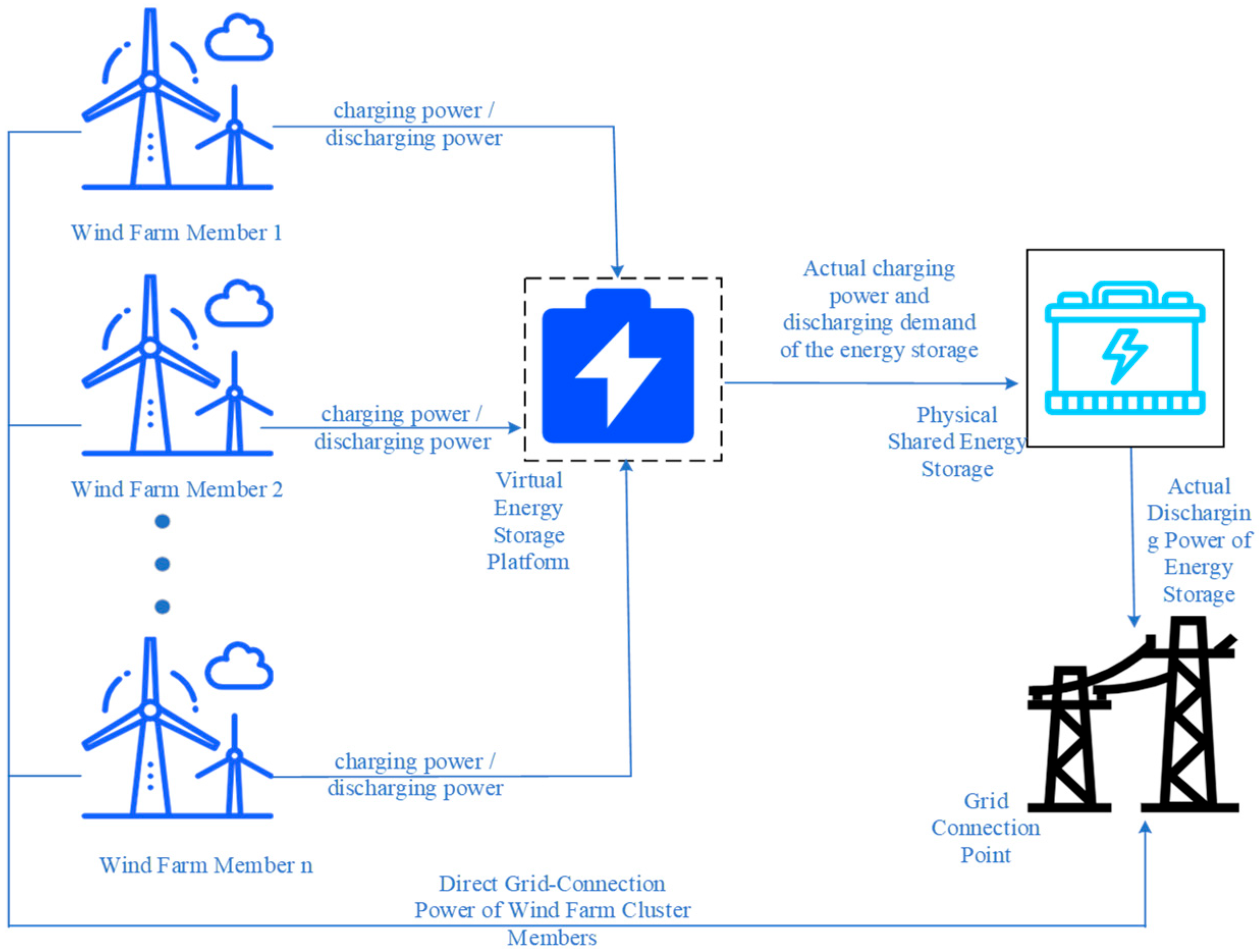
Under the SES model, wind farms can achieve the precise tracking of their own power generation plans and effectively mitigate output fluctuations by configuring energy storage systems, thereby enhancing the grid-friendliness of wind power integration. Meanwhile, wind farms can further improve their revenues by optimizing power generation behaviors based on the operational strategy of “storing at low prices and generating at high prices”. As illustrated in Figure 1, multiple wind farms share a single energy storage station resource within the same region. Under this model, wind farms first determine their required energy storage capacity in the first stage based on their own needs, and then declare their actual demands to the SES operator in the second stage to obtain the corresponding capacity. In this way, wind farms achieve the equivalent capability of owning dedicated energy storage systems without bearing the high construction and investment costs.

2.2. Two-Stage Cooperative Grid-Connection Operation

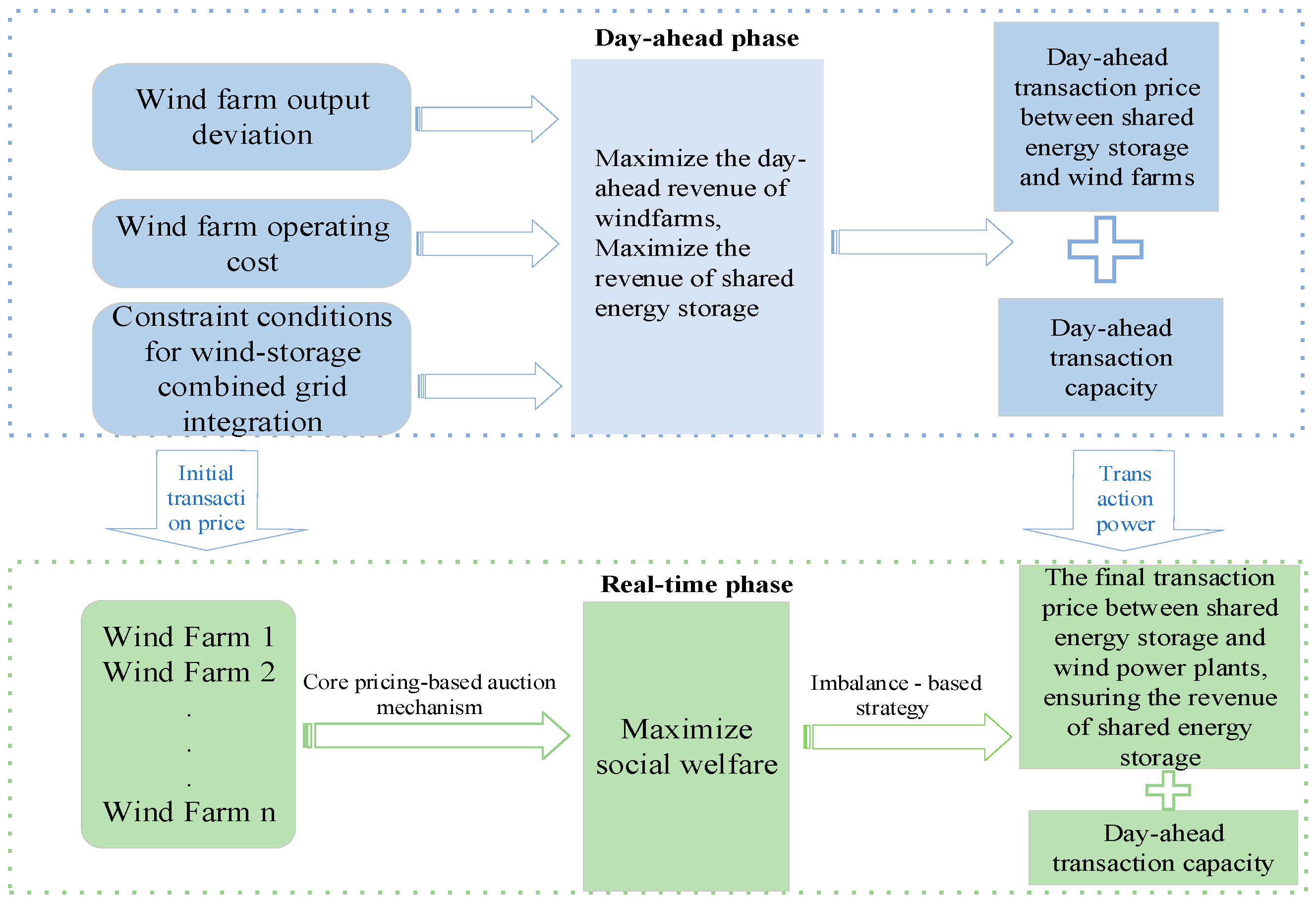
Wind power output is significantly affected by geographical and meteorological conditions, exhibiting strong volatility and uncertainty. To improve the reliability of the grid connection, the referenced study proposes a two-stage optimization approach for the coordinated regulation of wind power output. This wind-storage joint operation model covers two stages: the day-ahead stage and the real-time stage. In the day-ahead stage, relying on the regulation capability of energy storage systems, it assists wind farms in compensating for prediction errors, thereby optimizing wind power output plans. Based on the prediction errors of wind farms, this approach accurately assesses their actual demand for energy storage, effectively avoiding the economic risks caused by an insufficient energy storage capacity configuration. In the real-time stage, based on the demand and price signals determined in the day-ahead stage, the energy storage capacity acquired through market mechanisms is utilized for charging and discharging regulation to realize the real-time correction and balance of prediction errors. This mechanism not only mitigates wind power fluctuations but also helps reduce penalty costs incurred by output deviations. The specific optimization process is illustrated in Figure 2.

2.2.1. Two-Stage Optimal Operation

In the day-ahead stage, each wind farm submits its wind power forecasted output to the grid dispatching center, which makes reasonable arrangements based on the reported data. During this stage, each wind farm formulates its planned output by referring to historical data and considering wind curtailment conditions in light of its own forecasted output. The goal is to maximize the utilization of wind power output and optimize the revenue of wind farms to the greatest extent possible. Let R i a h e a d denote the revenue of the i-th member in the wind farm cluster during the day-ahead stage, and its calculation formula is given as follows:
m a x R i a h e a d = R i s e l l , g r i d + R i a h , s e l l , s e s C i a h , s e s C i f = t = 1 T ξ g r i d t P i p l a n t + ξ i a h , s e l l t P i c h t ξ i a h , b u y t P i d c h t ξ t P i w i n d t P i p l a n t Δ t
The constraints are as follows:
P i w i n d t + P i d e h t = P i p l a n t + P i c h t 0 i n P i w i n d t + P i d c h t P r a t e t 0 μ d c h + μ c h 1 S t = S t 1 + P i d c h t η d c h + P i c h t η c h S 0 = 0.5 ,   0.1 S t 0.9 ,   S 24 = S 0 P d c h t = i = 1 n P i d c h t η d c h ,   P c h t = i = 1 n P i s h t η c h
where R i s e l l , g r i d is the electricity sales revenue in the day-ahead stage; R i a h , s e l l , s e s is the revenue from selling electricity to the SES operator; C i a h , s e s is the cost of wind farm purchasing electricity from the SES operator; C i f is the wind power fluctuation cost; n is the number of wind farms; T is the complete time cycle with a duration of 24 h; ξ g r i d t is the day-ahead on-grid electricity price at time t; P i p l a n t is the planned on-grid power of wind farm i; ξ i a h , b u y and ξ i a h , s e l l t are the day-ahead electricity purchase price and sale price between wind farm i and the SES operator at time t; ξ t is the unit fluctuation penalty cost; P i w i n d t is the actual power of wind farm i at time t, respectively; Δt is the sampling interval; P i c h t and P i d c h t are the day-ahead charging power and discharging power of wind farm i at time t, respectively; P i d c h t is the curtailed wind power of wind farm i at time t; P i c h t and P i d c h t are the day-ahead total charging power and total discharging power of the SES at time t, respectively; P r a t e t is the maximum acceptable grid-connection power of the combined wind farms and SES at time t; η c h and η d c h are the charging efficiency and discharging efficiency, respectively; μ c h and μ d c h are the charging state and discharging state, respectively; S t is the state of charge (SOC) of the SES at time t; and S 0 is the initial state of charge of the SES at time 0.
In the day-ahead stage, with wind farms as the Stackelberg leaders and the SES operator as the follower, the energy storage demand of each wind farm is predicted based on the historical deviation data, and the initial transaction price is solved through Nash equilibrium iteration. The core of this stage lies in establishing a day-ahead optimization model considering the diurnal closed-loop constraint of the state of charge, which ensures the energy conservation of the SES system within the 24 h dispatch cycle and avoids the SOC drift problem in long-term operation. The Stackelberg leader–follower game model is described as follows.
  • Participants: The game involves various wind farms and the SES operator, with the wind farms acting as the Stackelberg leaders and the SESO as the follower.
  • Strategies: The strategy of the Stackelberg leaders is to gain revenue by selling electricity to the SESO through interaction with the power grid, while reasonably reducing the costs of energy storage leasing and wind power fluctuation. The strategy of the follower is to obtain energy and capacity interaction revenue from wind farms, and grid interaction revenue, and cover its own O&M costs.
  • Objective: The objective is to maximize the revenue of wind farms, and determine the energy storage power demand and quotation of wind farms in the day-ahead stage.

2.2.2. Real-Time Stage

Building upon day-ahead reservations, WFs submit real-time bids—comprising capacity demand and willingness-to-pay—to the SES operator based on the actual power deviations, and resource reallocation is implemented through the core pricing mechanism. This stage not only corrects the prediction deviations from the day-ahead stage, but also, more importantly, ensures multi-dimensional allocation optimality by satisfying rigorous core constraints. The revenue of wind farms in the real-time stage is expressed as follows:
R i r e a l = C + R i   real ,   sell ,   ses   C i   real ,   ses   C i r e a l , f = t = 1 T ξ g r i d t P i p l a n t + ξ i r e a l , s e s t P i r e a l , c h t ξ i r e a l , b u y t P i r e a l , d c h t ξ t P i w i n d t P i p l a n t Δ t
where R i r e a l is the total revenue of wind farm i in the real-time stage; R i g r i d is the electricity sales revenue of wind farm i in the real-time stage; R i   real ,   sell ,   ses   is the revenue of wind farm i from selling electricity to the SES in the real-time stage; C i   real ,   ses   is the cost of wind farm i purchasing electricity from the SES in the real-time stage; C i r e a l , f is the fluctuation cost of wind farm i in the real-time stage; P i r e a l , c h t and P i r e a l , d c h t are the charging energy and discharging energy of wind farm i at time t in the real-time stage, respectively; ξ i r e a l , b u y t and ξ i r e a l , s e s t are the purchasing price and selling price of wind farm i with the SES at time t in the real-time stage. Based on these parameters, wind farms conduct auctions with the SESO via the VCG auction mechanism to determine the actual capacity allocation and clearing prices. This real-time process revises the day-ahead reserved energy storage capacity and price benchmarks, ensuring the maximization of the overall system welfare. Specifically, the energy storage demand intervals and initial price benchmarks derived from the day-ahead stage serve as the core inputs and boundary constraints for the real-time VCG auction. Simultaneously, key constraints such as the daily SOC closed-loop and individual rationality are synchronously transferred to the real-time stage. By integrating day-ahead global constraints with real-time VCG resource allocation results, the core pricing mechanism achieves synergistic unity between the optimization objectives of the two stages.
The reserved capacity, initial price benchmark, SOC daily closed-loop constraint, and individual rationality boundary obtained in the day-ahead stage are directly passed to the real-time stage as fixed boundary conditions. These conditions determine the feasible domain of the real-time VCG auction and core pricing mechanism. The real-time stage only adjusts and optimizes the energy storage allocation and transaction price according to the actual wind power deviation within the given feasible domain, instead of reconstructing the global constraints. The core pricing mechanism acts as the connection hub to ensure the coordination and consistency between the two stages.

3. Shared Energy Storage Auction Transaction Based on the Improved VCG Auction Mechanism

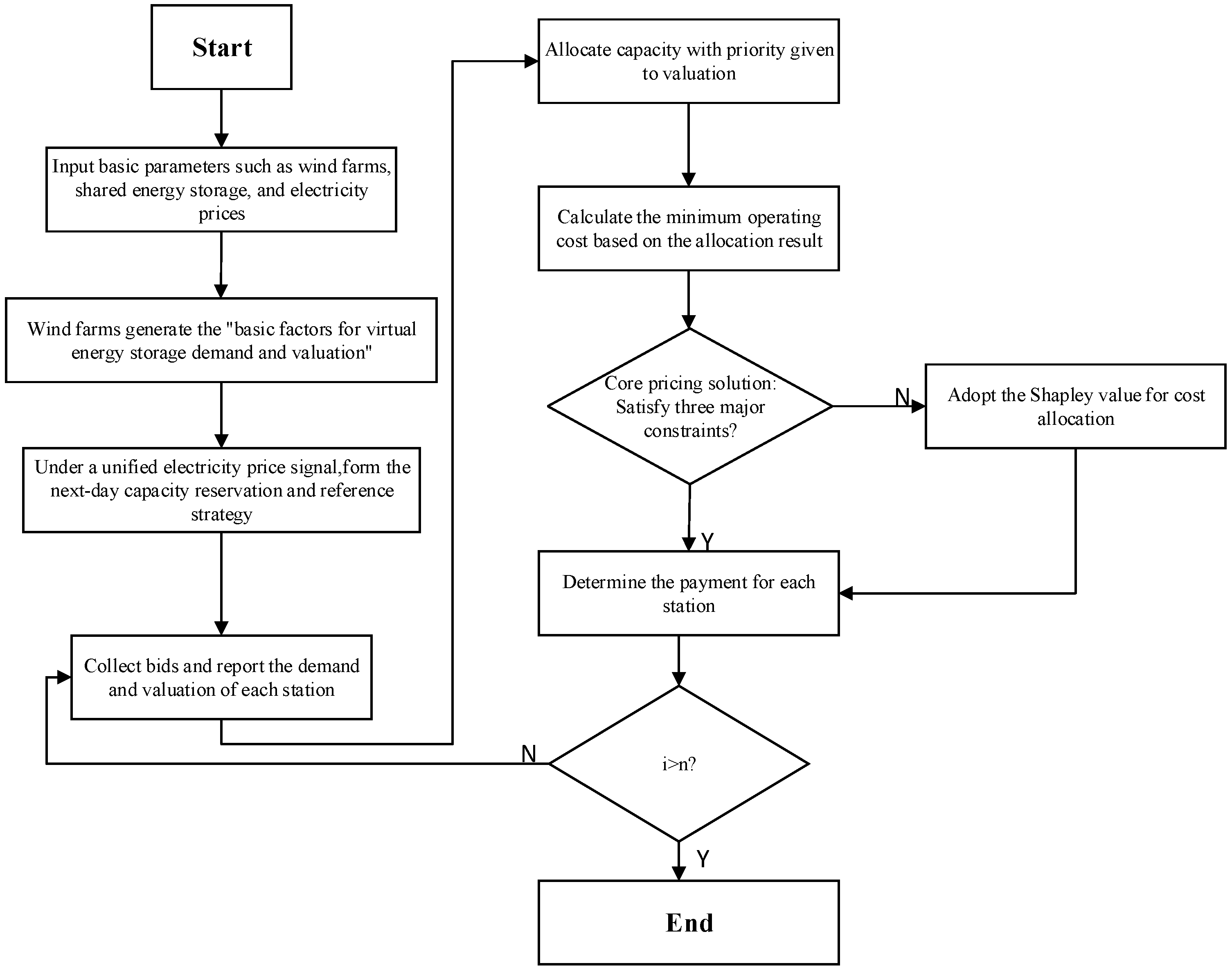
This section proposes a joint mechanism integrating the VCG auction theory and core pricing for the allocation and pricing of SES capacity. This mechanism reconstructs the allocation and payment rules of the traditional VCG auction: at the allocation level, a stable solution satisfying core constraints is pursued; at the payment level, linear programming is adopted to solve core payments with the Shapley value as a backup mechanism. The bidding information, allocation rules, and payment rules are fully defined. By introducing a revenue–expense compensation strategy, incentive compatibility is guaranteed while achieving financial sustainability and coalition stability.

3.1. Basic Principles of the Core Pricing Mechanism

In the traditional VCG auction mechanism, only individual rationality is guaranteed, failing to prevent sub-coalitions from obtaining higher returns through collusive withdrawal. Consequently, it exhibits structural vulnerability in the multi-agent SES scenario. Therefore, in the core pricing mechanism, the “core” concept is introduced. Based on the real-time power deviations and bidding information of wind farms, the initial payment is determined through the VCG auction mechanism, and then verified by core constraints to ensure the payment vector lies within the “core”, i.e., satisfying the following: individual rationality—the utility of each participant is non-negative (i.e., utility ≥ 0); and coalition rationality—for any sub-coalition S, its total utility is not less than the maximum net revenue achievable by the coalition operating independently. To satisfy the core condition, a linear programming algorithm is adopted to solve the core payments. If the linear programming fails (e.g., the core is an empty set), the Shapley value is used as a backup pricing scheme.

3.2. Bidding Stage

3.2.1. Bidding Information of Wind Farms

It is assumed that each wind farm within the service area of the SES does not have its own energy storage system. Therefore, wind farm i (i = 1, 2, …, n) needs to submit bids to the SES operator, including the required energy storage capacity and corresponding quotation. The bidding information is expressed as B i :
B i = b i , q i
where q i is the required energy storage capacity of wind farm i. Based on the concept of VES, this demand is calculated through a four-dimensional demand response model, which comprehensively considers four dimensions: power deviation, capacity factor deviation, basic guarantee, and historical volatility; b i is the quotation of wind farm i for the energy storage capacity, determined based on a multi-dimensional nonlinear valuation function, which reflects the true economic value of the energy storage capacity; and b is the vector of quotations from all wind farms, i.e., b = (b = 1, 2, …, n). Each wind farm submits K bidding schemes, and only one scheme is assumed to be accepted. In the real-time stage, each wind farm participates in the auction through the VCG auction mechanism.

3.2.2. Bidding Information of the SES

As the auctioneer or mechanism designer, the SES operator (SESO) divides the centralized energy storage into j = (j = 1, 2, …, m) energy storage units with different capacities. There is an equivalent relationship between the energy storage bidding information B j e s s and the energy storage capacity, which is expressed as follows:
B j e s s = q j
When the auction starts, only the SES capacity is taken as the trading object, and sufficient information is shared among participating entities to ensure the information transparency of the VCG auction mechanism. This simplified bidding design guarantees the fairness and efficiency of the auction process, laying a foundation for the fair competition among VES entities.

3.3. Capacity Allocation Rules

The objective function determined by the auction mechanism is generally social welfare maximization, where social welfare in this paper refers to the sum of utilities of all wind farms. If individual wind farms aim to gain significantly higher benefits than other competitors by overstating their required energy storage capacity and its value, this behavior may result in other wind farms obtaining smaller capacity allocations, thereby reducing the overall social utility. The core of the capacity allocation rules lies in social welfare maximization based on the concept of VES. Different from traditional allocation rules, this paper introduces VES as the allocation entity. The capacity demand of each VES unit is accurately calculated through a four-dimensional demand response model, ensuring that the allocation results not only meet individual requirements but also achieve system optimization.
The allocated capacity obtained by each wind farm motivates the generation of a corresponding satisfaction function, which serves as a key information transmission medium between the SESO and wind farms.
It can be expressed by the satisfaction function u x i which is a strictly concave function. Here, x i denotes the energy storage capacity allocated to the wind farm. The social utility V i x i of wind farm i is jointly determined by its energy storage capacity quotation b i and the satisfaction function u x i . After each wind farm submits its bidding information to the SESO, the operator performs the allocation in accordance with the rule specified in Equation (6).
m a x x i i = 1 n b i u x i α i s . t . i = 1 n x i C V i x i = b i u x i x i 0
where C is the total capacity of the SES; V i x i is the social utility function of wind farm i, calculated based on a multi-dimensional nonlinear valuation function; and α i is a binary variable, where α i = 1 if wind farm i wins the bid, and α i = 0 otherwise.

3.3.1. Four-Dimensional Demand Response Model

VES refers to a logical and independently operating energy storage mapping unit based on centralized physical energy storage, rather than a physical entity itself. It acts as a pivotal link in the SES system, catering to the personalized fluctuation suppression needs of individual wind farms and mapping to the actual charging and discharging behaviors of physical energy storage. Distinct from traditional passive demand-side load regulation via price incentives, VES is an active generation-side resource allocation tool that quantifies wind farms’ personalized storage demand and enables the refined scheduling of physical storage resources, addressing the inability of the traditional demand response to adapt to wind power fluctuation suppression. The four-dimensional demand response model for VES quantification breaks the single/two-dimensional logic of traditional methods, characterizing the actual VES demand from four synergistic dimensions: power deviation for short-term fluctuations, capacity factor deviation for fair quantification by eliminating installed capacity differences, basic guarantee demand for minimum storage reserve against sudden fluctuations, and historical volatility for long-term output uncertainty. The model sets the VES demand bounds at 20–70% of the wind farms’ rated installed capacity to avoid extreme demand distortion, laying a scientific foundation for the subsequent VCG auction allocation. Downward: It maps to the actual charging and discharging behaviors of the unified physical energy storage. A multi-dimensional demand response function is adopted to quantify VES, which consists of (1) the instantaneous demand component d p o w e r based on power deviation; (2) the structural demand component d C F based on capacity factor deviation; (3) the basic guarantee demand component d b a s e ; (4) the derived demand component based on historical volatility d v o l a t i l i t y ; and these four components constitute the multi-dimensional demand response function. The specific calculation formulae are as follows:
q i d e m a n d = 0.25 d p o w e r + 0.35 d C F + 0.25 d b a s e + 0.15 d v o l a t i l i t y = 0.25 P i r e a l P i p r e d i c t e d + 0.35 C F i r e a l C F i p r e d i c t e d m a x C F i p r e d i c t e d , 0.1 + + 0.25 × C i i n s t a l l e d + 0.15 σ i × C i i n s t a l l e d 0.2 · C i installed   q i demand   0.7 · C i installed   P c h , i v i r t t = P d i s , i p h y s t P d i s , i v i r t t = P d i s p h y s t C F i r e a l = P i r e a l C i i n s t a l l e d C F i p r e d i c t e d = P i p r e d i c t e d C i i n s t a l l e d
where q i d e m a n d is the VES capacity demand allocated to wind farm i; C F i r e a l is the actual capacity factor of wind farm i; C F i p r e d i c t e d is the predicted capacity factor of wind farm i; C F i i n s t a l l e d is the rated installed capacity of wind farm; σ i is the historical volatility parameter of wind farm; P c h p h y s and P d i s p h y s are the charging power and discharging power of the physical; and P c h , i v i r t and P d i s , i v i r t are the charging power and discharging power of the VES for wind farm i, respectively. Among these components, d p o w e r is used to capture the short-term output fluctuations of WWP i; d C F eliminates the impact of the differences in installed capacity among various wind farms through capacity factor normalization; d b a s e ensures that wind farm i maintains a minimum energy storage reserve equivalent to 25% of its installed capacity even under low-volatility scenarios; and d v o l a t i l i t y reflects the long-term uncertainty characteristics of wind farm i. This weighted aggregation mechanism limits the lower bound of the demand to 20% of the installed capacity and the upper bound to 70% of the installed capacity. Compared with the demand models without explicit constraints in other studies, the proposed method effectively avoids demand distortion under extreme scenarios.

3.3.2. Payment Rules

In the payment rules of the VCG auction mechanism, the payment method for wind farm i is as follows: first, calculate the total utility of the remaining users when wind farm i does not participate in the energy storage capacity allocation; second, calculate the total utility of other wind farms when wind farm i participates in the energy storage capacity allocation; and, finally, subtract the latter from the former.
Based on the principle of multi-dimensional value decomposition, the payment rules achieve precise pricing under incentive compatibility constraints through the VCG auction mechanism. These rules ensure that the payment of each wind farm i equals the welfare loss imposed on other wind farms due to its participation in the transaction, theoretically guaranteeing dominant strategy incentive compatibility.
Thus, the payment rule for WWP i is denoted as ρ i :
ρ i = j i v j x i * j i v j x i *
Similarly, if wind farm i intends to maximize its profit, it needs to submit a truthful bid, and its profit π i can be expressed as follows:
π i = v i x i * ρ i = v i x i * j i v j x i * j i v j x i *
where v i x i * is the true valuation of wind farm i, calculated based on the multi-dimensional nonlinear valuation function; x i * is the energy storage capacity allocated to wind farm i; and x i * is the optimal energy storage capacity allocation for the remaining wind farm members when wind farm i does not participate in the auction. This profit formula indicates that wind farm i can only achieve maximum profit by submitting a truthful bid, which reflects the incentive compatibility characteristic of the VCG auction mechanism.

3.4. Multi-Dimensional Nonlinear Valuation Function

The core of the payment rules lies in the valuation function based on multi-dimensional value decomposition:
v i x i = V m a r k e t + V s c a r c i t y + V r i a k + V c a p a c i t y V m a r k e t = α · λ m a r k e t · x i V s c a r c i t y = b a s e s c a r c i t y · 1 + 2.5 · d e m a n d r a t i o 2 V r i a k = σ i λ m a r k e t V c a p a c i t y = b a s e · d e m a n d · 1.2
This valuation function constructs a four-dimensional nonlinear value system, decomposing the value of the energy storage capacity into four components, market benchmark, scarcity premium, risk premium, and capacity contribution, thereby achieving a multi-dimensional and precise characterization of the value. The specific calculation is as follows:
Market Value Benchmark, where α is the discount factor, reflecting the opportunity cost of energy storage serving as a virtual power source; λ m a r k e t is the market electricity price; and x i is the VES capacity allocated to wind farm i; Scarcity Premium, where b a s e s c a r c i t y is the ratio of the total capacity C of SES to the total demand Σqi, reflecting the resource tightness of the entire system; and d e m a n d r a t i o 2 is the quadratic enhancement factor for demand intensity, depicting the marginal value jump effect under tight supply–demand conditions; Risk Aversion Premium, where σ i is the output volatility index of wind farm i—it cross-multiplies the volatility parameter reflecting the heterogeneity of wind farms with market price signals to achieve the individualized pricing of the risk premium; and Capacity Value Contribution, where 1.2 is the capacity contribution coefficient, embodying the marginal contribution of energy storage capacity to the system’s flexible resources.

3.5. Revenue–Expenditure Imbalance Handling Strategy

No incentive mechanism can simultaneously satisfy the incentive compatibility, individual rationality, social welfare maximization, and budget balance. The VCG auction mechanism, adoptable by SES operators, meets the first three conditions but often leads to financial losses due to the inherent revenue–expenditure imbalance—the auctioneer revenue is systematically lower than the social cost, requiring external subsidies and violating market sustainability. To address this, this paper proposes a rent-sharing compensation mechanism implemented in the real-time stage. After determining the VCG transaction prices, the deficit (the gap between SES’s revenue and operational costs) is incorporated into the charging/discharging service prices paid by wind farms. The supplementary price is calculated as the deficit divided by the energy storage’s charging/discharging electricity, filling the funding gap:
ξ d t = j = 1 m ε p t ε j V C G t P j d j = 1 m P c h , j t + P d i s , j t
ε i r e a l t = ε i V C G t + ξ d t
The theoretical innovation of this compensation mechanism lies in its two-part tariff structure, where the VCG payment is regarded as the benchmark pricing and the differential compensation as the surcharge. This structure achieves financial sustainability while maintaining incentive compatibility (the marginal incentive of the VCG component remains unchanged).
The power–capacity relationship constraint of SES is as follows:
P e s s = ψ E e s s
where ε i r e a l t is the revised transaction price based on the VCG auction mechanism; ε p t is the unit power cost of SES; E e s s is the rated capacity of SES; P e s s is the rated power limit of SES, and the rated capacity of SES is assumed to have a linear relationship with its rated power limit; and ψ is the proportional coefficient between the capacity and power of SES [27]. An increase in the wind power transaction price will reduce the revenue of wind farms. Even with this partial loss, the total expenditure of wind farms on energy storage will not exceed the cost of constructing their own energy storage systems. Furthermore, this revenue loss will not diminish the willingness of wind farms to voluntarily submit true bids.

3.6. Shapley Value Backup Mechanism

When the linear programming solution fails (the core is empty), the Shapley value is adopted as the backup pricing scheme. The vacancy of the core typically occurs under extreme weather conditions where the wind power deviations across the region are highly positively correlated. This synchronization leads to a surge in the shadow price of shared resources, making it mathematically impossible to satisfy the stability constraints of all sub-coalitions simultaneously. By calculating the expected marginal contribution of each participant across all possible coalitions, the Shapley value provides a fair distribution solution. While the Shapley value may not always reside within an empty core by definition, it serves as the most robust axiomatic alternative that balances individual contributions and maintains the long-term incentives for the ESS operator. This backup mechanism ensures the robust operation of the system even under non-convex game scenarios caused by resource scarcity:
ϕ i = S N \ { i } S ! n S 1 ! n ! V S { i } V S
where ϕ i is the final allocated payment amount for the i-th wind farm member; N is the total number of wind farms participating in the sharing mechanism; and V(S) is the characteristic function of sub-coalition S.

4. Model Solution

To verify the effectiveness and feasibility of the improved VCG auction mechanism proposed in this paper, an optimal grid-connected model including a cluster of wind farms, VES units, and centralized physical energy storage is constructed. The core of this model lies in solving a complex optimization problem with coalition stability constraints. The model is solved by building a mixed-integer quadratic constraint programming (MIQCP) solver based on the Python 311 environment, and the specific flowchart is shown in Figure 3.

5. Case Study

5.1. Case Setup and Parameter Configuration

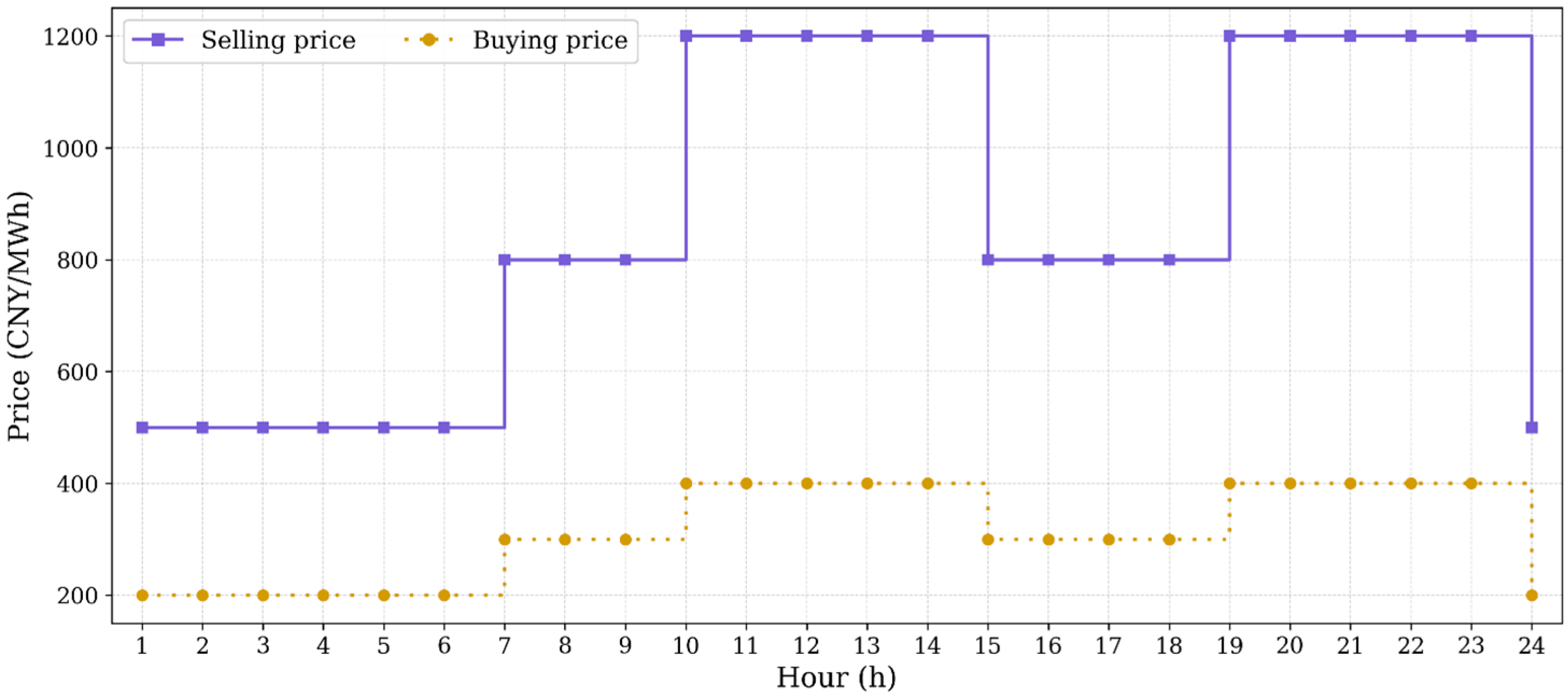
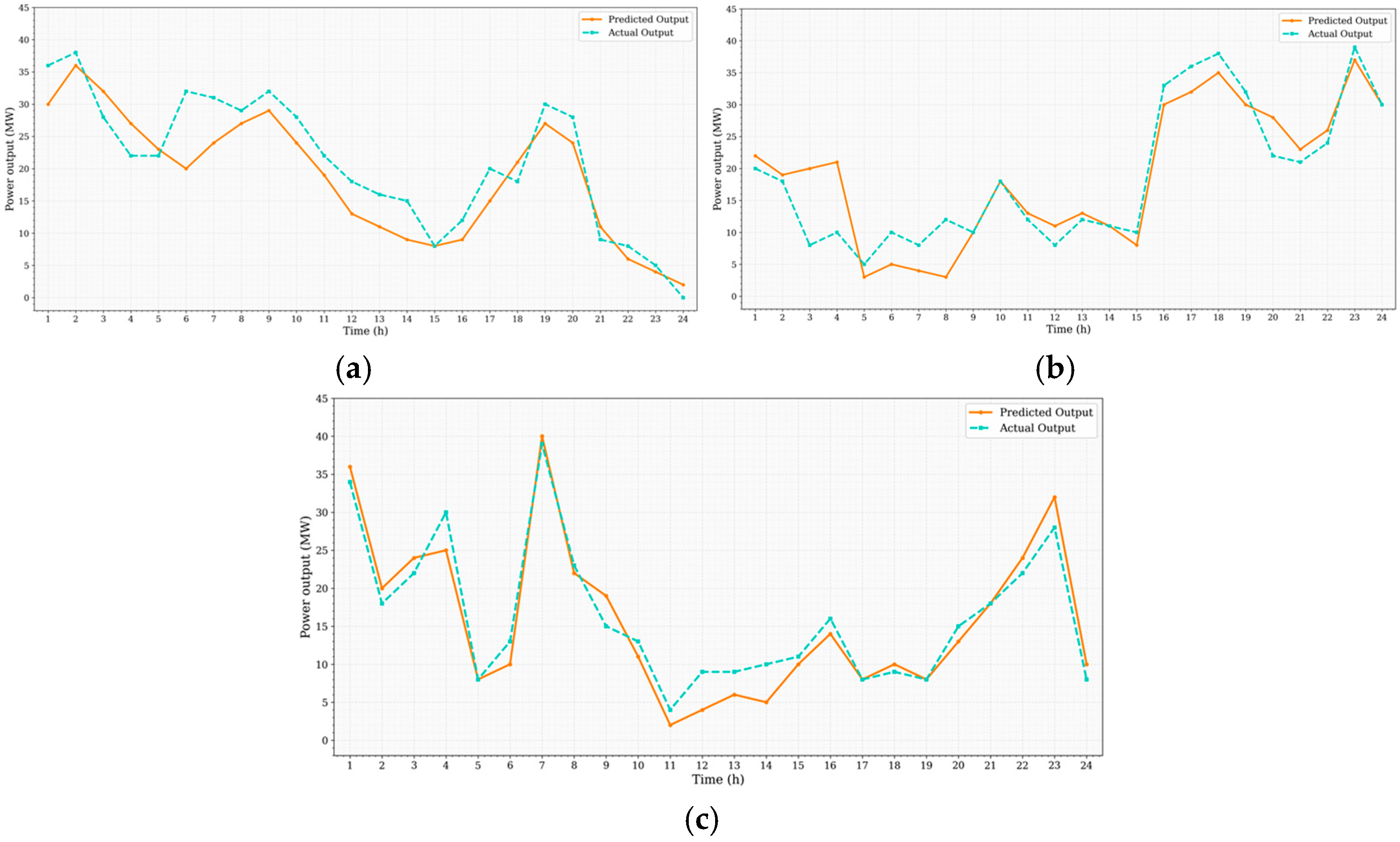
In this paper, the output data of three wind farms with installed capacities of 40 MW, 50 MW, and 60 MW (denoted as wind farm 1, wind farm 2, and wind farm 3, respectively) in the region of Xinjiang, combined with SES, are selected to form a wind-storage grid-connected operation system. The capacity of the SES is 30 MWh. The feed-in tariff of wind power adopts time-of-use pricing (TOU) [28]. The parameters of the SES [29] are shown in Table 1. Among them, the time-of-use electricity prices are illustrated in Figure 4, and the output curves of wind farm 1, wind farm 2, and wind farm 3 are presented in Figure 5.

5.2. Analysis of Wind Farms’ Energy Storage Demand

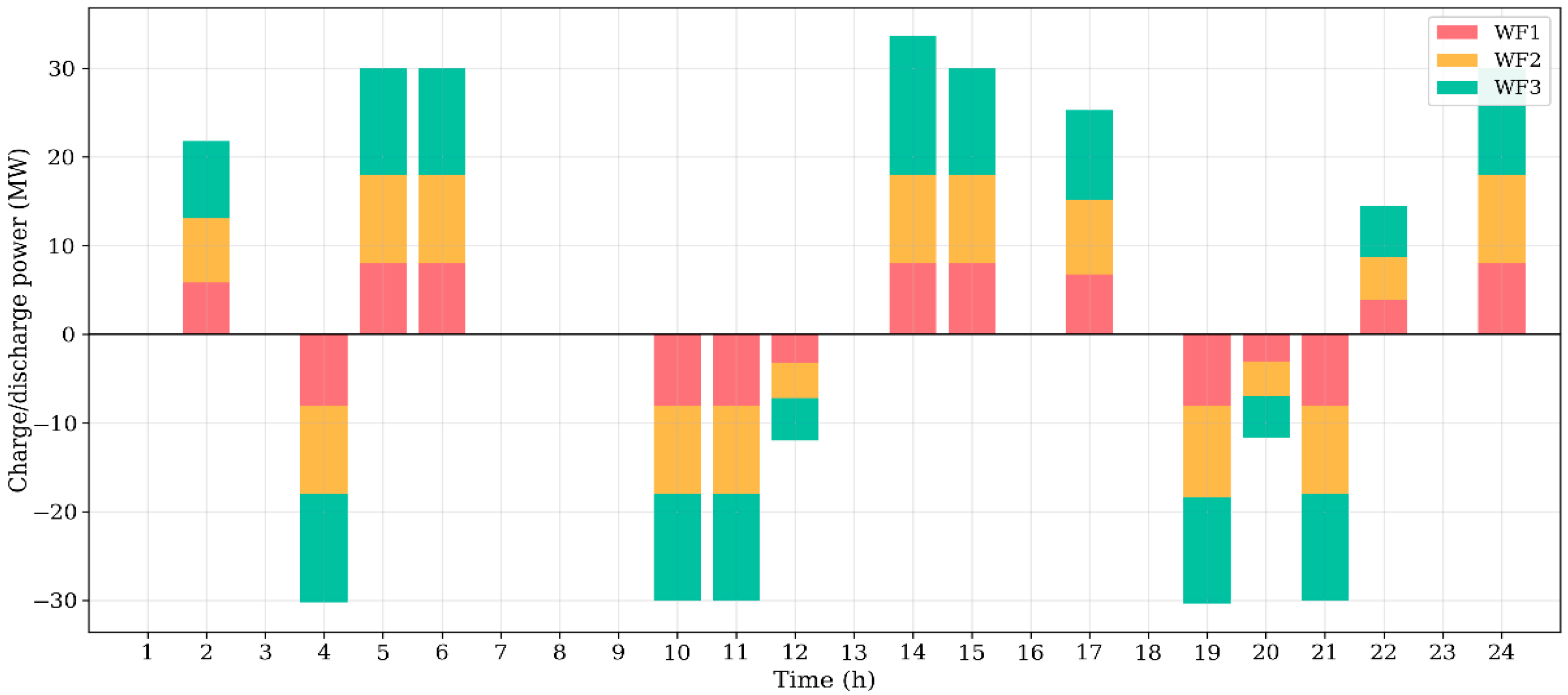
The fees paid by each wind farm are calculated via the core pricing mechanism. The capacity they obtained through the auction and their respective benefits are presented in Table 2. The dispatch status of each VES is illustrated in Figure 6.
In the VES architecture, all wind farms face the same TOU pricing signal: charging during off-peak periods to store energy at a low cost and discharging during peak periods to release energy for higher revenues. Since the three wind farms share the same energy storage efficiency parameters and SOC constraints, their optimal response strategies tend to synchronize under homogeneous technical–economic parameters and homogeneous price incentives. This synchronization reflects the effectiveness of the price mechanism as a resource allocation signal. As observed from the dispatch curve of the VES platform in Figure 6, the three wind farms synchronously implement the charging strategy during the off-peak pricing period (00:00–06:00) and the discharging strategy during the peak pricing periods (09:00–12:00 and 18:00–20:00), which perfectly verifies the guiding role of price signals.
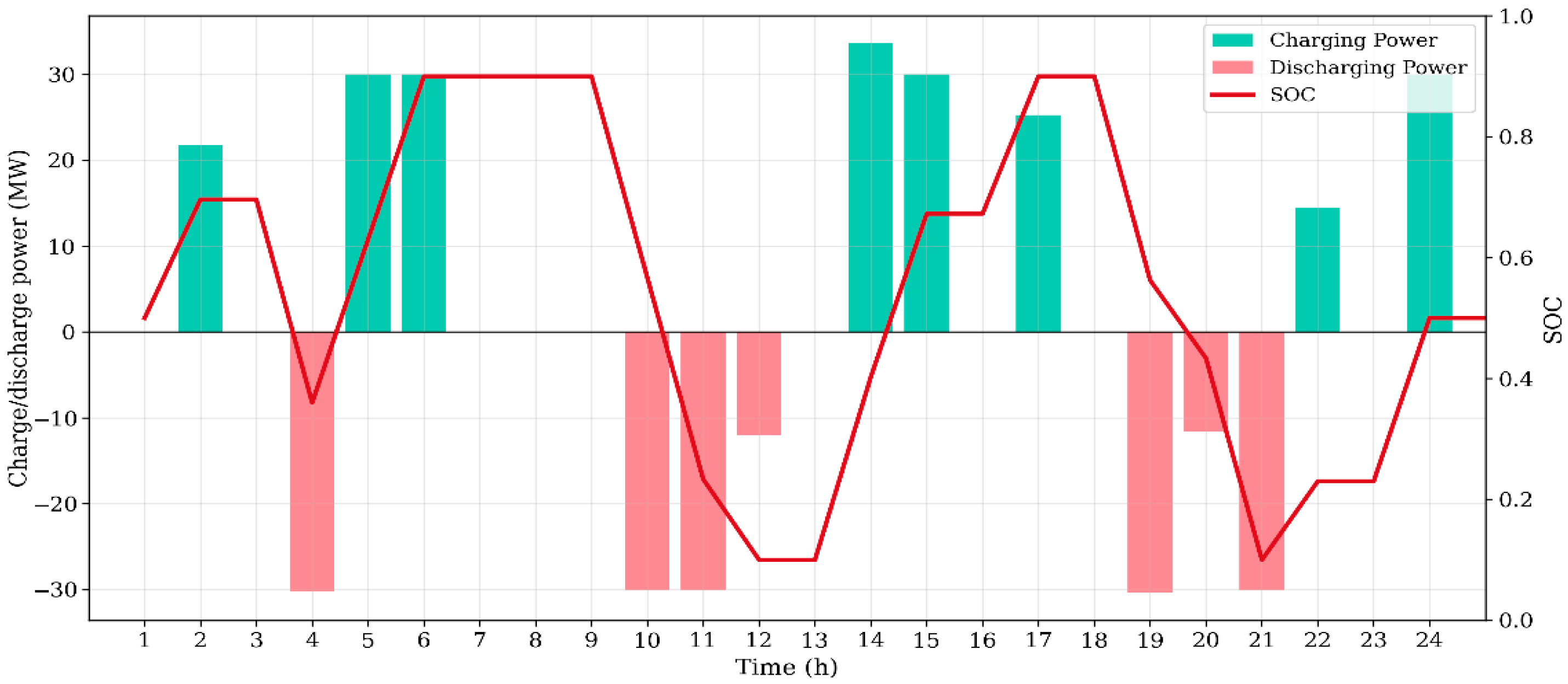
As can be observed from the SOC curve of the physical SES at the top of Figure 7, the SOC exhibits an obvious periodic “off-peak charging and peak discharging” fluctuation pattern within a complete cycle. This regular fluctuation is exactly the globally optimal strategy obtained by the centralized optimization algorithm.

5.3. Demand-Side Synergy Effect Induced by the Spatiotemporal Correlation of Wind Power Output

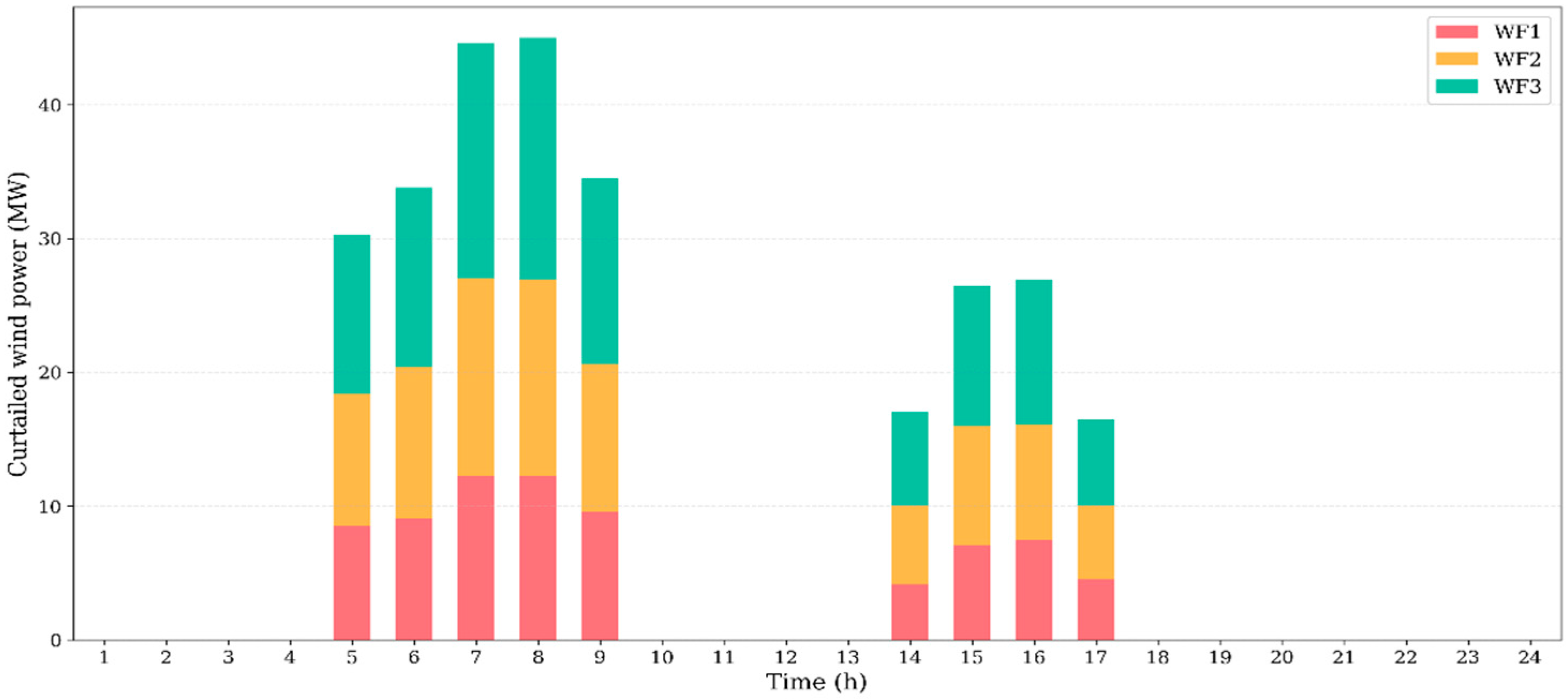
As shown in Figure 8, the wind curtailment periods of the three wind farms exhibit significant temporal synchronization: they simultaneously reach wind curtailment peaks during the morning peak period (04:00–08:00) and drop to zero concurrently from 09:00 to 12:00. This pattern reveals a key fact: despite geographical differences, the temporal variation patterns of wind resources at the three plants are highly correlated, attributed to (1) their location within the influence area of the same weather system, where wind speed changes are driven by common meteorological processes; and (2) the inter-plant distance being small relative to the scale of the weather system (wind farm clusters in Xinjiang are mostly zoned with an inter-plant distance of 10–50 km), resulting in a high spatial correlation coefficient of output patterns.

5.4. Handling of Revenue–Expenditure Imbalance in the VCG Mechanism

The VCG auction mechanism can effectively allocate SES capacity. Through such precise resource allocation, it not only improves the utilization efficiency of energy storage resources but also greatly stimulates market vitality, thereby strongly promoting the further development and widespread popularization of SES in the current energy storage market. However, the VCG mechanism can lead to a revenue–expenditure imbalance for the SES operator. Specifically, as the auctioneer in this transaction mechanism, the SES operator is required to pay a total cost to the participating entities that exceeds the total payment received from the participants. In scenarios involving incomplete or opaque information, or “collusive behavior” among wind farms, the SES operator cannot determine the true allocation and pricing of energy storage resources, thereby leading to its own revenue–expenditure imbalance. Based on this, a compensation electricity price mechanism is adopted to cover the operating costs of SES, achieving its revenue–expenditure balance. The total payments of each wind farm after compensation are presented in Table 3.
This compensation mechanism allocates the revenue–expenditure gap generated by the VCG mechanism to each wind farm in proportion to their charging and discharging volumes. While maintaining the incentive compatibility property, it achieves the revenue–expenditure balance of the energy storage operator, providing a guarantee for the sustainable development of the SES business model. The additional expenditures incurred by each wind farm due to the compensation are 310.23 CNY, 294.43 CNY, and 470.39 CNY, respectively, which are reasonable and affordable.

5.5. Comparative Analysis of Different Trading Modes

To fully demonstrate the advantages of the VCG auction mechanism during its transaction process, it is compared with the previous mode adopted by wind farms. Under the mode mentioned in Reference [30], each wind farm negotiates an independent fixed energy storage quotation with the SES operator based on its own needs. Table 4 presents the overall costs and benefits of wind farms under different transaction and operation mechanisms with the same capacity and power constraints.
By comparing the economic performance indicators under the two mechanisms presented in Table 4, the VCG auction mechanism achieves a 7.04% Pareto improvement in terms of total social surplus compared to the fixed-price mechanism (increasing from 568,184.20 CNY to 608,022.10 CNY, with an increment of 39,837.90 CNY). The source of this gain can be decomposed into two effects: (1) Contribution of the allocation efficiency effect: This part of the gain stems from the VCG mechanism prioritizing the allocation of energy storage resources to plants with high valuations, increasing the social value generated per unit of energy storage capacity from 741.23 CNY/MWh under the fixed mechanism to 793.51 CNY/MWh; and (2) Contribution of the incentive compatibility effect: This part of the gain arises from the truthful bidding mechanism eliminating the information rent loss caused by strategic behavior. From the perspective of the individual benefit changes of each plant, the benefits of Plants 1, 2, and 3 have increased by 11.12%, 5.23%, and 6.70%, respectively. The difference in gain rates precisely confirms the redistribution effect of the VCG mechanism: as a low-valuation plant, Plant 1 was forced to pay an excessively high price under the fixed mechanism (with a unit cost of 646.92 CNY/MWh higher than its true valuation), while the differentiated pricing under the VCG mechanism reduced its cost to 460.88 CNY/MWh, thereby achieving the maximum gain. To verify the statistical significance of this improvement, a two-sample t-test was performed on the daily social welfare samples. The results show that the 7.04% improvement is highly stable with a 95% confidence interval of [6.82%, 7.26%] and a p-value < 0.01, indicating that the observed performance gain is statistically significant and robust across different wind power scenarios.

5.6. Statistical Inference on the Satisfaction Rate of Core Properties and Mechanism Robustness

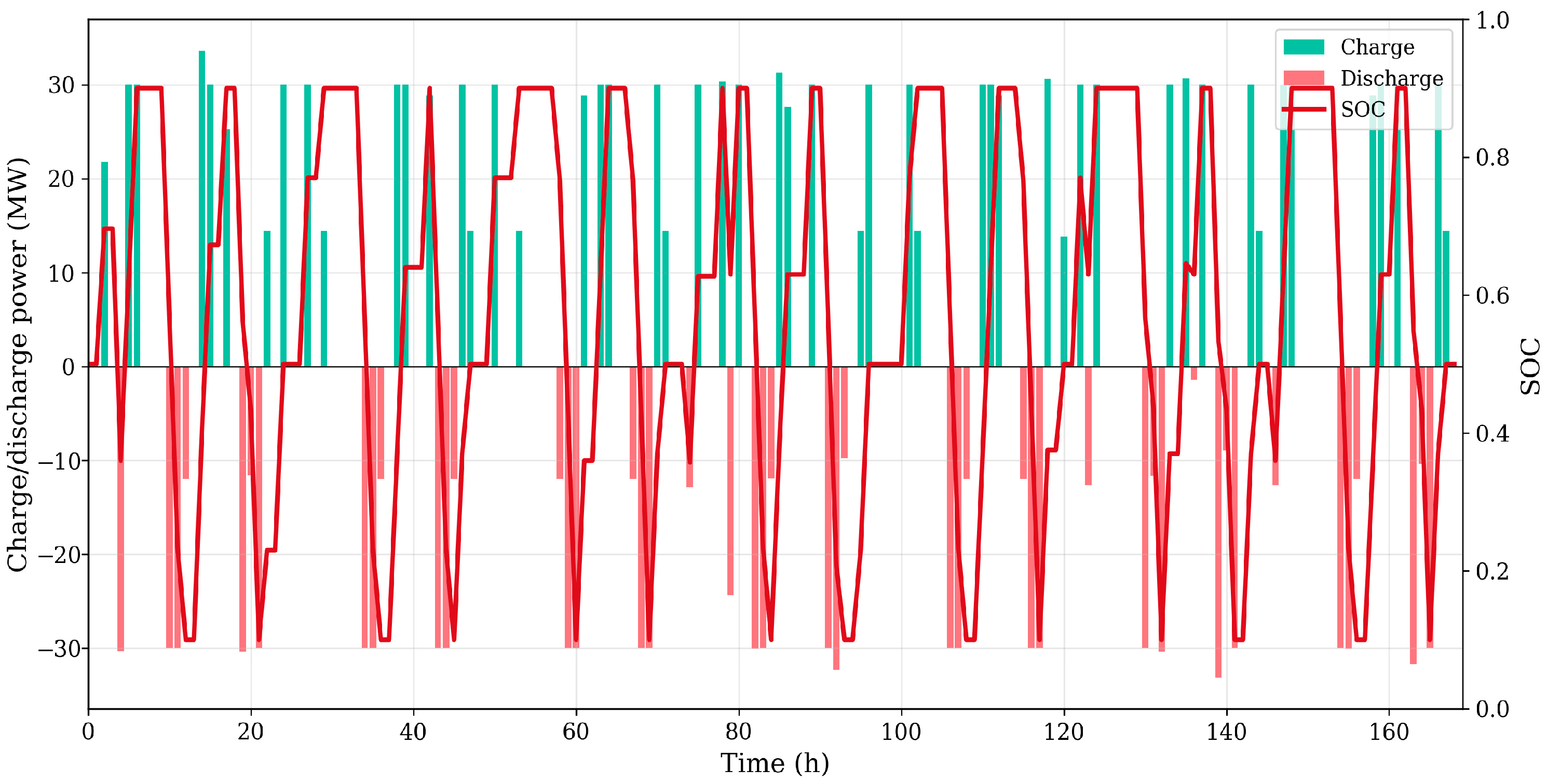
Key performance indicators can be extracted from the multi-time-scale (7-day) dispatch curve of the physical SES in Figure 9: (1) The state of charge (SOC) utilization depth is 0.8 (with sufficient fluctuation within the range [0.1, 0.9]), indicating that the energy storage capacity is fully utilized and capacity waste caused by shallow charging and discharging is avoided. (2) The charge–discharge cycle frequency is 3 cycles per day, which falls within the optimal economic operation zone of the energy storage system. This frequency not only ensures a high turnover rate of energy storage but also avoids life degradation caused by excessive cycling. (3) The satisfaction rate of SOC closed-loop constraints is 100%, verifying the effectiveness of the equality constraint S(24) = S(0) in the day-ahead optimization model (Equation (2)). This closed-loop characteristic ensures the seamless connection of multi-day rolling dispatch.
Based on the results of the multi-time-scale core verification statistics in Table 5, the VCG auction mechanism satisfies the core properties in 156 out of 168 time periods (7 days × 24 h), achieving a core property satisfaction rate of 92.86%. This high satisfaction rate verifies the effectiveness of the core pricing algorithm. An in-depth analysis of the 12 time periods where the core properties are not satisfied reveals that these periods all occur under extreme market conditions: the wind power output deviation rate exceeds 50% (e.g., 5–9 h), leading to significant wind curtailment. Under extreme scenarios, the convex optimization solver triggers the backup Shapley Mechanism due to deteriorated numerical condition numbers. Although this backup mechanism sacrifices partial optimality, it ensures the robust operation of the system. It is worth emphasizing that, even under the backup mechanism, the satisfaction rates of individual rationality constraints and budget balance constraints still reach 100%, guaranteeing the basic fairness and financial sustainability of the mechanism.

5.7. Discussion on Mechanism Stability Under Parameter Variations

The structural stability of the proposed mechanism is analyzed regarding key economic parameters through two boundary conditions: Individual Rationality (IR) and Incentive Compatibility (IC). (1) Investment Costs: The unit investment cost of energy storage acts as a fixed allocation among members, functioning as a constant offset in the surplus distribution. Since differentiated pricing is derived from the relative marginal contributions within the social welfare function, a linear shift in investment costs does not alter the bidding equilibrium or the core’s existence. (2) Wind Curtailment Penalties: The penalty price defines the participants’ ‘threat point.’ As long as this penalty exceeds the marginal operating cost of storage dispatch, the cooperative surplus remains strictly positive, ensuring a non-empty core. The mechanism’s adaptive pricing automatically redistributes this surplus to guarantee that cooperation remains more beneficial than the non-cooperative state, maintaining grand coalition stability regardless of specific penalty fluctuations.

6. Conclusions

The two-stage SES trading system based on the core pricing mechanism established in this paper has achieved remarkable outcomes at both theoretical and practical levels:
At the theoretical level, by integrating the Stackelberg leader–follower game with the improved VCG auction mechanism, a day-ahead real-time two-stage collaborative optimization framework is constructed. The concept of VES and a four-dimensional demand response model are introduced to accurately characterize the energy storage demands, while value decomposition is realized based on a multi-dimensional nonlinear valuation function. Through the design of a Shapley mechanism backup scheme and a differential compensation strategy, the multi-objective coordination of incentive compatibility, budget balance, coalition stability, and social welfare maximization is achieved.
At the practical level, simulation experiments based on real wind power data from Xinjiang validate the significant advantages of the core pricing mechanism over the fixed-price mechanism, with a 7.04% increase in social welfare and a 5.23–11.12% rise in benefits for each plant. The multi-day dispatch results indicate that the energy storage system achieves a 100% SOC closed-loop rate during multi-day operation. This research demonstrates that the “base price + budget compensation” model provides a viable market-based pathway for sustainable storage operations and offers a reference for regulators to design manipulation-proof trading rules. A core satisfaction rate of 92.86% further confirms the effectiveness and robustness of the core pricing mechanism.
Future research can be extended in the following directions: introducing an energy storage degradation cost model to internalize cycle life constraints into the optimization objective; and considering wind–solar hybrid scenarios to explore the heterogeneous complementarity effect of multiple types of new energy sources. In addition, the proposed mechanism is verified based on a typical small-scale system in this paper. To further validate the applicability and robustness of the model, future research will extend the case to larger-scale scenarios with more wind farms and different shared energy storage capacity configurations, so as to enrich the application scope of the mechanism.


Author Contributions

Conceptualization, Z.L. and W.W.; methodology, Z.L.; validation, W.W., Z.L. and S.Y.; formal analysis, Z.L., W.W., H.C. and S.Y.; investigation, Z.L.; resources, Z.L. and W.W.; writing—original draft preparation, Z.L.; writing—review and editing, S.Y. and H.C.; visualization, Z.L. and S.Y.; supervision, W.W. and S.Y. All authors have read and agreed to the published version of the manuscript.

Funding

This research was supported by the National Natural Science Foundation of China (52267005) and the Young Scientists Fund of the Natural Science Foundation of Xinjiang Uygur Autonomous Region (2025D01C261).

Institutional Review Board Statement

Not applicable.

Informed Consent Statement

Not applicable.

Data Availability Statement

The data presented in this study are available upon reasonable request from the corresponding author due to ongoing research and institutional restrictions.

Conflicts of Interest

The authors declare no conflicts of interest.

References

  1. Li, B.; Chen, M.; Zhong, H.; Ma, Z.; Liu, D.; He, G. Review and prospect of new challenges on transient voltage stability in “double-high” power systems. Proc. CSEE 2023, 43, 555–581. [Google Scholar]
  2. Li, K. A method for renewable energy power generation based on Wasserstein conditional generative adversarial networks. Distrib. Util. 2023, 40, 86–94. [Google Scholar]
  3. Shangguan, J.; Mao, Y. Optimal operation of micro-energy networks considering new energy uncertainty. Distrib. Util. 2023, 40, 92–99. [Google Scholar]
  4. Shi, C.M.; Yu, M.P. Flexible solid-state lithium-sulfur batteries based on structural designs. Energy Storage Mater. 2023, 57, 429–459. [Google Scholar] [CrossRef]
  5. Zhang, H.H.; Lin, S.Y.; Shu, C.Y.; Tang, Z.; Wang, X.; Wu, Y.; Tang, W. Advances and perspectives of hard carbon anode modulated by defect/hetero elemental engineering for sodium ion batteries. Mater. Today 2025, 85, 231–252. [Google Scholar] [CrossRef]
  6. Ali, M.; Hussain, H.; Ali, M.; Aman, S.; Yang, W.; Ali, Z.; Li, L.; Jiang, Y.; Yousaf, M. Regulating a NaF-Rich SEI Layer for Dendrite-Free Sodium Metal Batteries Using Trifunctional Halogenated Covalent Organic Framework Separators. Adv. Sci. 2025, 12, 2409749. [Google Scholar] [CrossRef]
  7. Ali, M.; Mahmood, A.; Ali, M.; Aman, S.; Hussain, H.; Zhang, X.; Jiang, Y.; Lin, X.; Yousaf, M. A functional self-assembled layer with preferential sodium adsorption sites for ultra-stable sodium metal batteries. Chem. Eng. J. 2025, 525, 169729. [Google Scholar] [CrossRef]
  8. Ali, M.; Chishti, A.N.; Ali, M.; Iqbal, S.; Aman, S.; Mahmood, A.; Liu, H.; Yousaf, M.; Jiang, Y. Recent development in sodium metal batteries: Challenges, progress, and perspective. Mater. Today 2025, 88, 730–751. [Google Scholar] [CrossRef]
  9. Li, J.; Yu, X.; Yu, Z.; Ge, L. Comments on power quality enhancement research for power grid by energy storage system. Autom. Electr. Power Syst. 2019, 43, 15–24. [Google Scholar]
  10. Wu, J.; Song, X.; Liu, Y.; Xiong, S.; Hu, S.; Li, Z. Research and application of AGC control method for new energy and energy storage power stations using data of regulation cloud. Power Syst. Clean Energy 2023, 39, 128–134. [Google Scholar]
  11. Barra, P.H.A.; de Carvalho, W.C.; Menezes, T.S.; Fernandes, R.A.; Coury, D.V. A review on wind power smoothing using high-power energy storage systems. Renew. Sustain. Energy Rev. 2021, 137, 110455. [Google Scholar] [CrossRef]
  12. Xu, G.; Cheng, H.; Ma, Z.; Fang, S.; Ma, Z.; Zhang, J. An overview of operation and configuration of energy storage systems for smoothing wind power outputs. Power Syst. Technol. 2017, 41, 3470–3479. [Google Scholar]
  13. Li, X.; Chen, L.; Du, X.; Wen, J. Research status and prospect of shared energy storage operation mechanism and trading mode on generation side. J. Electr. Eng. 2023, 18, 188–200. [Google Scholar]
  14. Ji, W.; Liao, Y.; Jing, J.; Li, X. A generalized energy storage sharing mechanism considering thermal inertia. Power Syst. Prot. Control 2023, 51, 178–186. [Google Scholar]
  15. Zang, Y.; Xia, S.; Li, J. A robust game optimization scheduling method for shared energy storage micro electric network group distribution. Power Syst. Prot. Control 2023, 51, 90–101. [Google Scholar]
  16. Zaidi, B.H.; Bhatti, D.M.S.; Ullah, I. Combinatorial auctions for energy storage sharing amongst the households. J. Energy Storage 2018, 19, 291–301. [Google Scholar] [CrossRef]
  17. Lin, M.; Liu, J.; Tang, Z.; Ceng, P.; Jiang, B.; Ma, G. Coordinated optimization of mixed microgrid multi-agent game considering multi-energy coupled shared energy storage. Autom. Electr. Power Syst. 2024, 48, 132–141. [Google Scholar]
  18. Li, X.; Chen, L.; Yin, J.; Du, X.; Mei, S. Capacity planning of a multi parks hydrogen energy storage system for low-carbon energy supply. High Volt. Eng. 2022, 48, 2534–2544. [Google Scholar]
  19. Shuai, X.; Ma, Z.; Wang, X.; Guo, H.; Zhang, H. Optimal operation of shared energy storage and integrated energy microgrid based on leader-follower game theory. Power Syst. Technol. 2023, 47, 679–690. [Google Scholar]
  20. Sun, S.; Zheng, T.; Chen, L.; Xie, Y.; Gao, B.; Mei, S. Energy storage sharing mechanism based on combinatorial double auction. Power Syst. Technol. 2020, 44, 1732–1739. [Google Scholar]
  21. Yang, F.; Wang, W.Q.; Cheng, J.; Zhao, H.; Li, X. Capacity planning of shared energy storage on the generation side based on the error distribution principle. Power Syst. Prot. Control 2022, 50, 91–102. [Google Scholar]
  22. Yan, D.X.; Chen, Y. Review on business model and pricing mechanism for shared energy storage. Autom. Electr. Power Syst. 2022, 46, 178–191. [Google Scholar]
  23. You, J.S.; Juarez, R. Incentive-compatible simple mechanisms. Econ. Theory 2021, 71, 1569–1589. [Google Scholar] [CrossRef]
  24. Liu, X.D.; Zhang, X.J.; Zhang, J.X.; Li, W.; Zhang, J. Auction based vehicle resource allocation and pricing mechanism for car rental. J. Comput. Appl. 2018, 38, 2423–2430. [Google Scholar]
  25. Xu, S.; Shao, S.; Qu, T.; Chen, J.; Huang, G.Q. Auction-based city logistics synchronization. IISE Trans. 2018, 50, 837–851. [Google Scholar] [CrossRef]
  26. Wu, X.; Ma, S.; He, W.W.; Liu, B.; Zhang, Z.; Wang, P. Hybrid energy storage portfolio auction based on Vickrey-Clarke-Groves mechanism and energy sharing. J. Xi’an Jiaotong Univ. 2023, 57, 162–173. [Google Scholar]
  27. Shuai, X.Y.; Wang, X.L.; Wu, X.; Zhang, H.; Li, J.; Ma, Z. Shared energy storage capacity allocation and dynamic lease model considering electricity-heat demand response. Autom. Electr. Power Syst. 2021, 45, 24–32. [Google Scholar]
  28. Tian, X.; Chen, L.J.; Li, X.Z.; Yuan, W. Optimal scheduling for energy storage sharing among communities with photovoltaic resource based on Stackelberg game and improved Shapley value. Power Syst. Technol. 2023, 47, 2252–2261. [Google Scholar]
  29. Jiang, Y.W.; Zheng, C.X. Two-stage operation optimization for grid-connected wind farm cluster with shared energy storage. Power Syst. Technol. 2022, 46, 3426–3439. [Google Scholar]
  30. Kang, C.Q.; Liu, J.K.; Zhang, N. A new form of energy storage in future power system: Cloud energy storage. Autom. Electr. Power Syst. 2017, 41, 2–8. [Google Scholar]
Figure 1. Block diagram of joint shared energy storage grid connection for multiple wind farms.
Sustainability 18 03649 g001
Figure 2. Structure diagram of two-stage optimal operation for multiple wind farms.
Sustainability 18 03649 g002
Figure 3. Flowchart of the model solution process.
Sustainability 18 03649 g003
Figure 4. Time-of-use pricing curve.
Sustainability 18 03649 g004
Figure 5. Output curves of wind farms 1, 2, and 3: (a) output of wind farm 1; (b) output of wind farm 2; and (c) output of wind farm 3.
Sustainability 18 03649 g005
Figure 6. Dispatch status of the VES platform.
Sustainability 18 03649 g006
Figure 7. Dispatch status of the physical shared energy storage.
Sustainability 18 03649 g007
Figure 8. Wind curtailment situation.
Sustainability 18 03649 g008
Figure 9. 7-Day cumulative operation status of physical shared energy storage.
Sustainability 18 03649 g009
Table 1. Parameters of shared energy storage.
ParametersValue
Charging/Discharging Efficiency0.9
Initial State of Charge0.5
State of Charge[0.1, 0.9]
Fluctuation Cost (CNY/kWh)0.3654
Energy Storage Operation Cost (CNY/kWh)0.207
Table 2. Optimal allocated capacity of each wind farm.
Wind FarmCapacity/MWhPayment/CNYRevenue/CNY
19.185253.19118,556.71
28.324987.34203,229.83
312.417967.24271,872.95
Table 3. Compensation amounts from each wind farm to the SES.
Wind FarmPayment Before Compensation/CNYCompensation Amount/CNYTotal Payment/CNY
14942.96310.235253.19
24692.91294.434987.34
37496.85470.397967.24
Total17,132.721075.0518,207.77
Table 4. Leasing costs and benefits of energy storage under different modes.
Wind Farm123
VCG Auction Mechanism/MWh9.188.2312.41
Cost/CNY4231.25138.58046.3
Benefit/CNY117,628.50206,825.40283,568.20
Fixed Leasing Mechanism/MWh9.188.2312.41
Cost/CNY5938.77609.811,976.5
Benefit/CNY105,858.60196,542.70265,782.90
Table 5. Satisfaction of core mechanisms.
Core Verification StatisticsCore MechanismsShapley MechanismCore Satisfaction Rate
Periods1561292.86%
Disclaimer/Publisher’s Note: The statements, opinions and data contained in all publications are solely those of the individual author(s) and contributor(s) and not of MDPI and/or the editor(s). MDPI and/or the editor(s) disclaim responsibility for any injury to people or property resulting from any ideas, methods, instructions or products referred to in the content.