Building Smart Economy: How Digitalization, Artificial Intelligence, and Innovation Are Shaping a Diversified Future

Abstract
1. Introduction
2. Literature Review
2.1. Theoretical Support
2.2. Literature Review and Hypotheses Development
3. Research Methods
3.1. Research Design
3.2. Population and Sampling
3.3. Instrument Development
3.4. Data Collection Procedures
3.5. Data Analysis Techniques
3.6. Reliability and Validity
3.7. Ethical Considerations
4. Data Analysis and Results
4.1. Instrument Design
4.2. Demographic Description
4.3. Data Analysis
4.4. Discriminant Validity

| Original Sample (O) | Sample Mean (M) | Standard Deviation (STDEV) | T Statistics (|O/STDEV|) | p Values | |
|---|---|---|---|---|---|
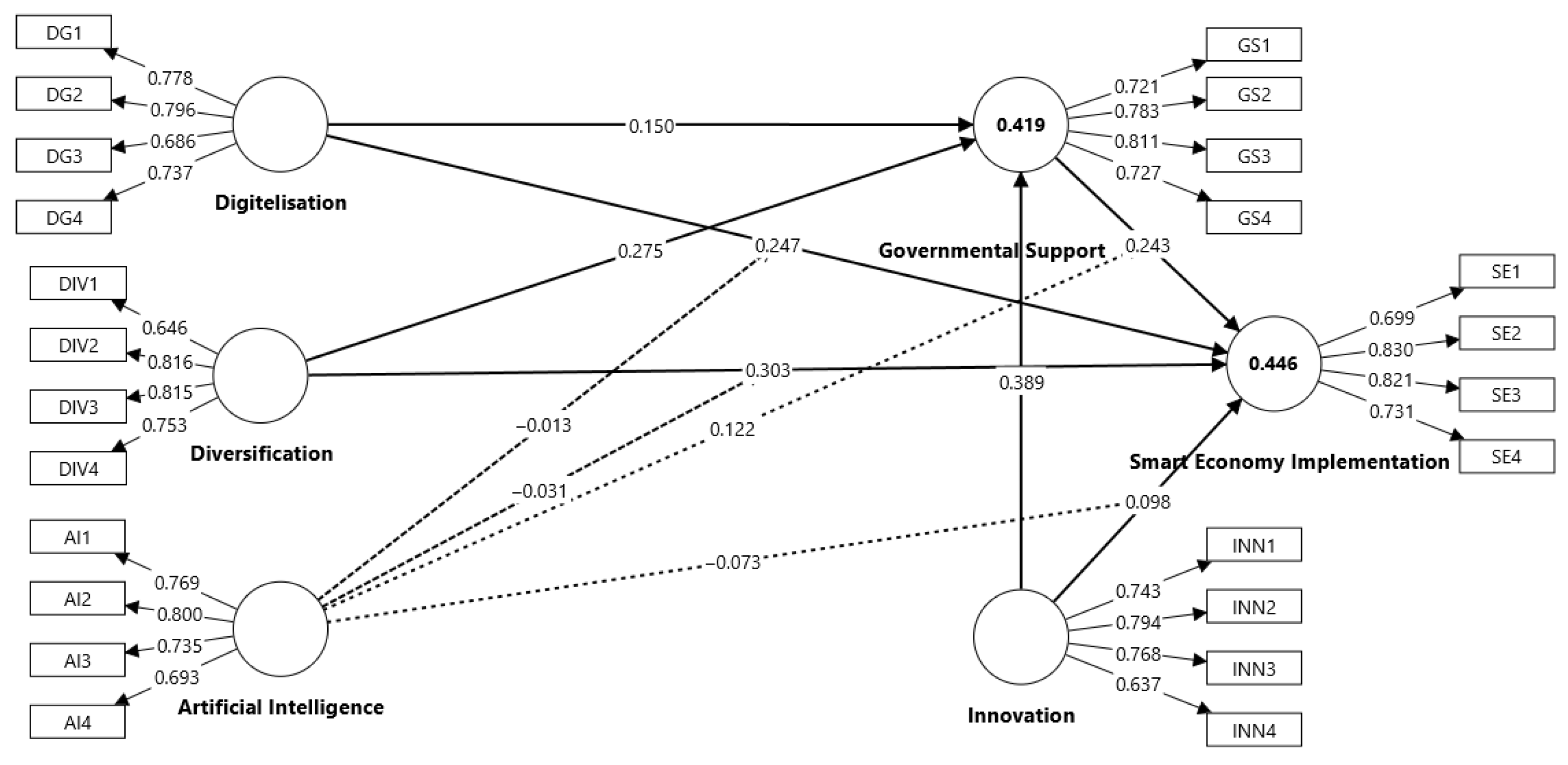
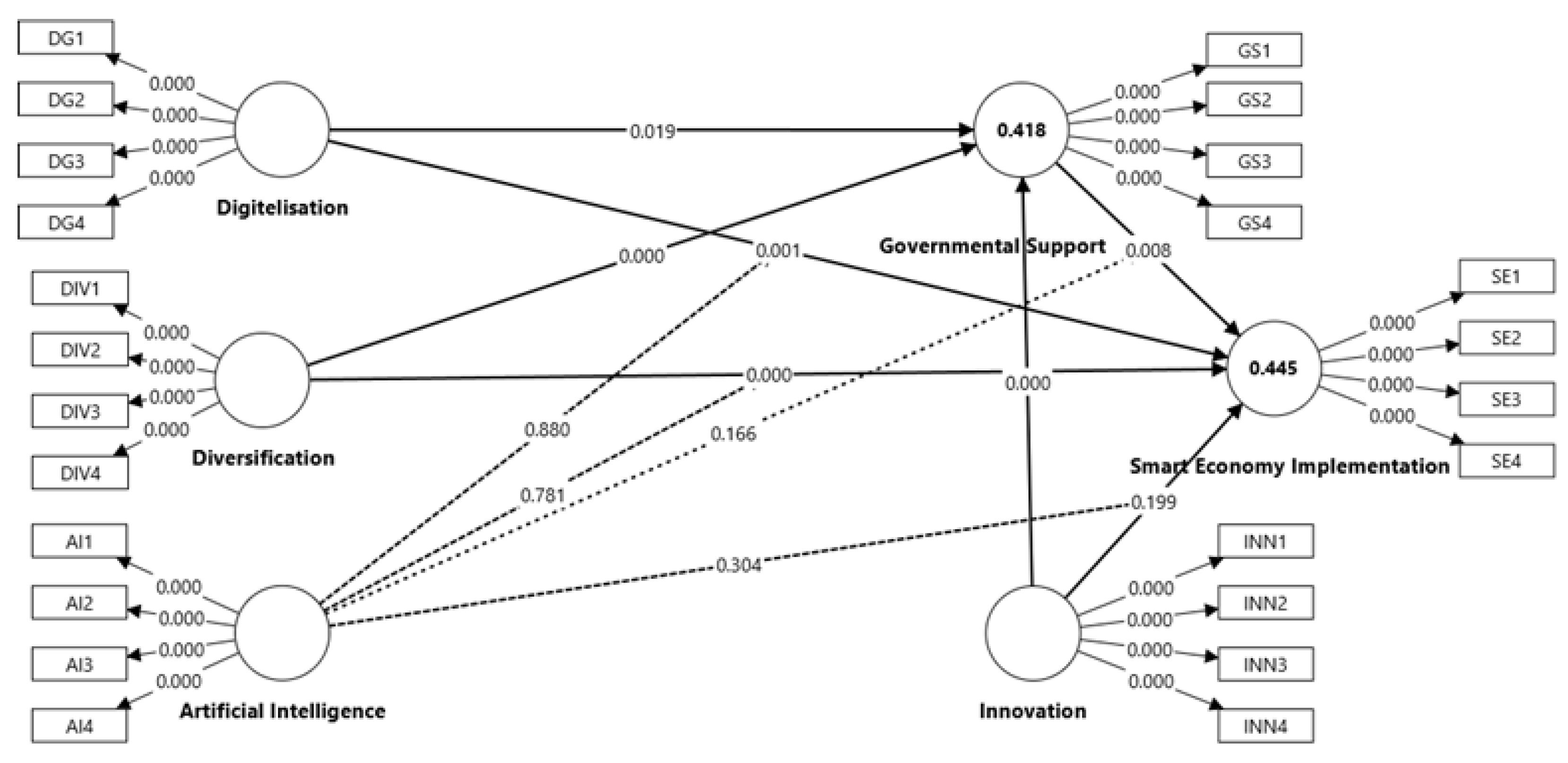
| Artificial Intelligence -> Smart Economy Implementation | −0.052 | −0.035 | 0.079 | 0.658 | 0.510 |
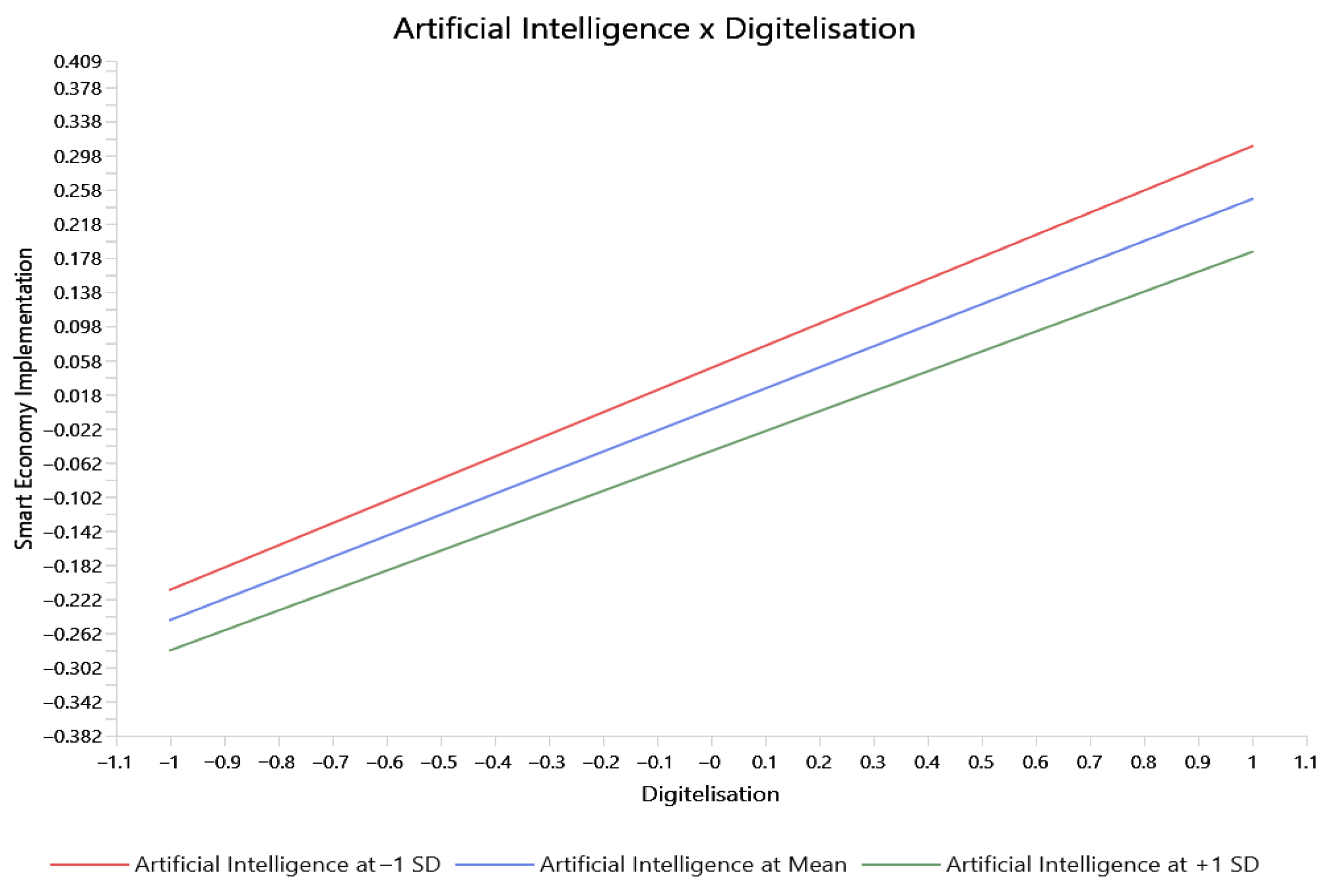
| Artificial Intelligence × Digitization -> Smart Economy Implementation | −0.015 | −0.033 | 0.096 | 0.151 | 0.880 |
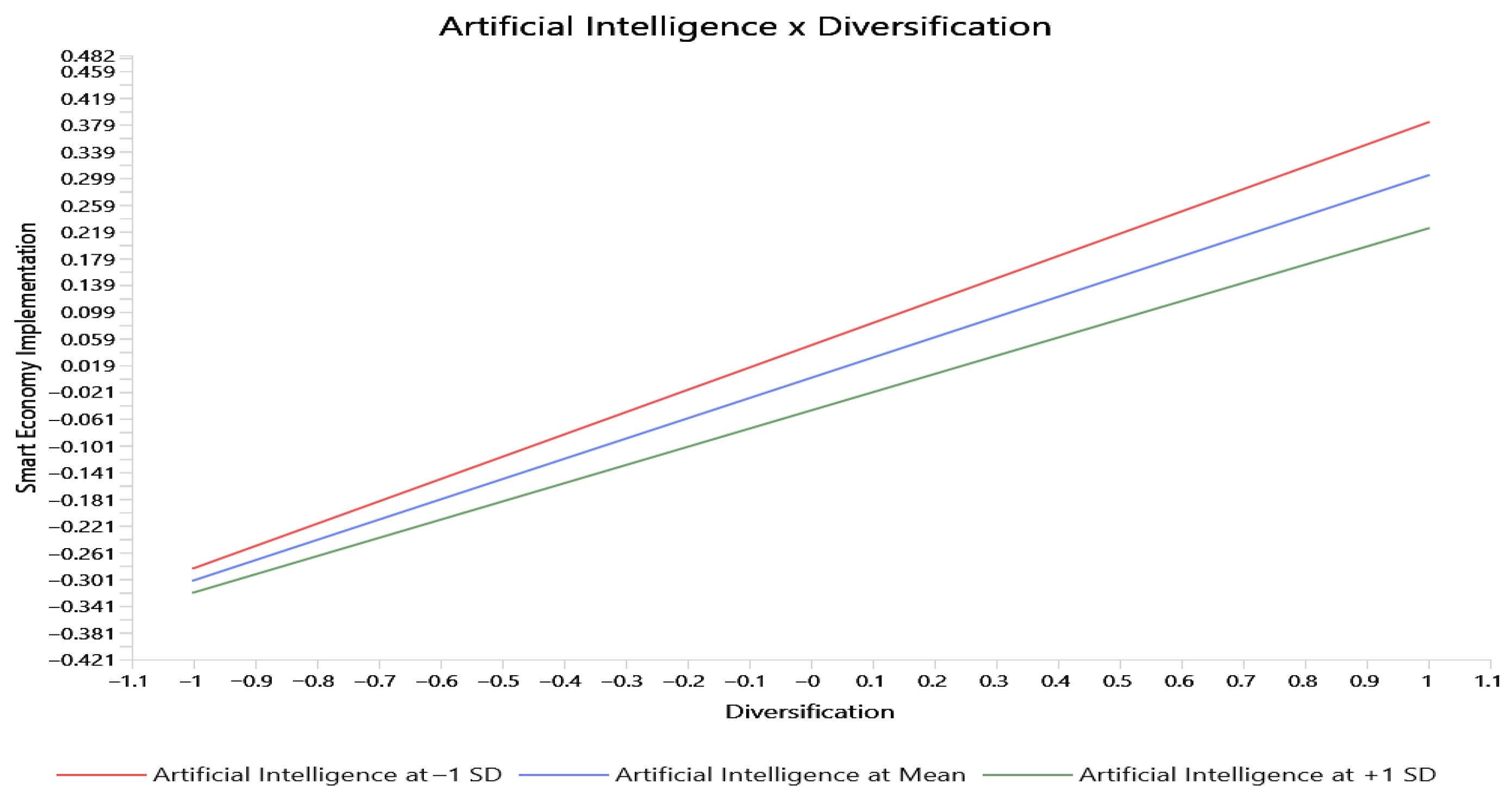
| Artificial Intelligence × Diversification -> Smart Economy Implementation | −0.028 | −0.021 | 0.101 | 0.278 | 0.781 |
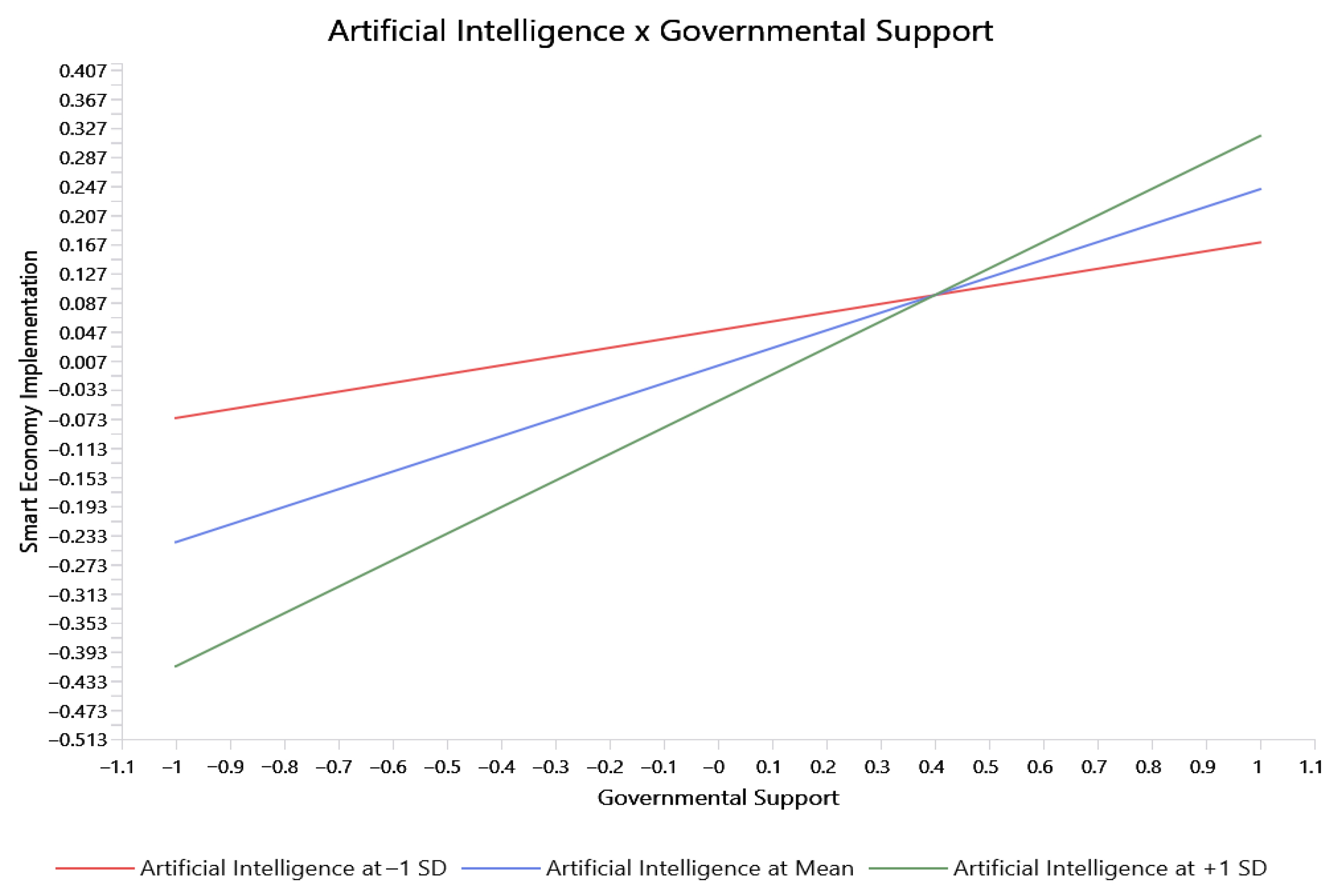
| Artificial Intelligence × Governmental Support -> Smart Economy Implementation | 0.123 | 0.139 | 0.089 | 1.384 | 0.166 |
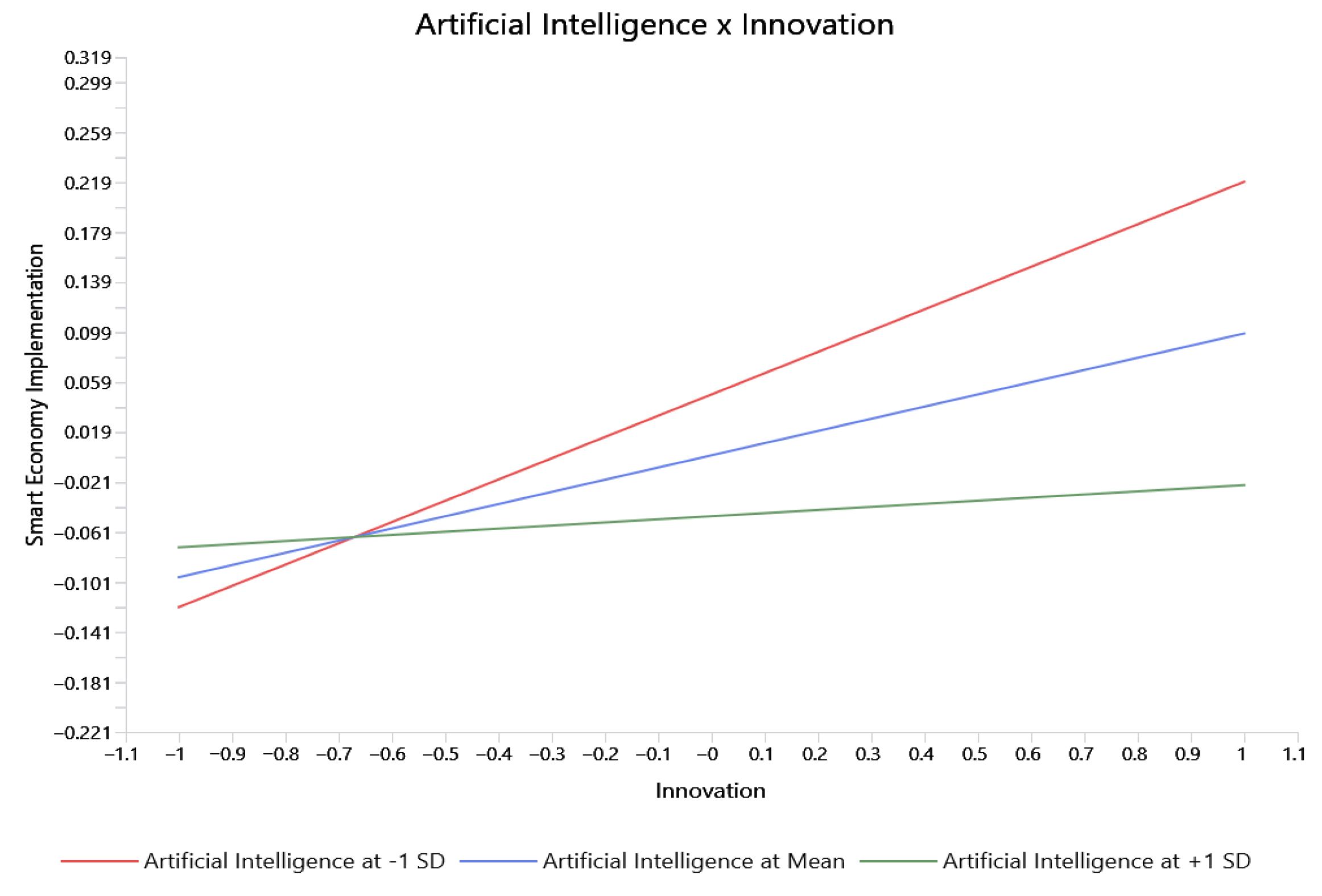
| Artificial Intelligence × Innovation -> Smart Economy Implementation | −0.074 | −0.065 | 0.072 | 1.027 | 0.304 |
| Digitization -> Governmental Support | 0.151 | 0.153 | 0.064 | 2.350 | 0.019 |
| Digitization -> Smart Economy Implementation | 0.242 | 0.249 | 0.070 | 3.451 | 0.001 |
| Diversification -> Governmental Support | 0.274 | 0.274 | 0.067 | 4.070 | 0.000 |
| Diversification -> Smart Economy Implementation | 0.305 | 0.306 | 0.085 | 3.567 | 0.000 |
| Governmental Support -> Smart Economy Implementation | 0.246 | 0.228 | 0.092 | 2.668 | 0.008 |
| Innovation -> Governmental Support | 0.389 | 0.388 | 0.074 | 5.268 | 0.000 |
| Innovation -> Smart Economy Implementation | 0.098 | 0.104 | 0.077 | 1.283 | 0.199 |
| Original Sample (O) | Sample Mean (M) | Standard Deviation (STDEV) | T Statistics (|O/STDEV|) | p Values | |
|---|---|---|---|---|---|
| Digitalization -> Governmental Support -> Smart Economy Implementation | 0.037 | 0.034 | 0.020 | 1.817 | 0.069 |
| Diversification -> Governmental Support -> Smart Economy Implementation | 0.067 | 0.063 | 0.031 | 2.155 | 0.031 |
| Innovation -> Governmental Support -> Smart Economy Implementation | 0.096 | 0.088 | 0.039 | 2.478 | 0.013 |
5. Discussion
5.1. Findings
5.2. Recommendations
5.3. Limitations and Future Research
Author Contributions
Funding
Institutional Review Board Statement
Informed Consent Statement
Data Availability Statement
Acknowledgments
Conflicts of Interest
Abbreviations
| RBV | Resource-Based View |
| IDT | Innovation Diffusion Theory |
| AI | Artificial Intelligence |
| SE | Smart Economy |
| SEM | Structure Equation Modeling |
| INN | Innovation |
References
- Purnomo, A.; Dian Sano, A.V.; Nindito, H.; Madyatmadja, E.D.; Sianipar, C.P.M. Mapping of Smart Economy Research Themes: A Nine-Year Review. In 2021 International Conference on ICT for Smart Society (ICISS); IEEE: Bandung, Indonesia, 2021; pp. 1–7. [Google Scholar]
- Abu-Rayash, A.; Dincer, I. Development of an integrated model for environmentally and economically sustainable and smart cities. Sustain. Energy Technol. Assess. 2025, 73, 104096. [Google Scholar] [CrossRef] [Scilit]
- Yang, X.; Zou, X.; Li, M.; Wang, Z. The Decarbonization Effect of the Urban Polycentric Structure: Empirical Evidence from China. Land 2024, 13, 173. [Google Scholar] [CrossRef] [Scilit]
- Cheng, K.; Liu, S.; Teng, M. Towards the Equalization of Basic Public Services in Chinese Cities: Investigating the Role of Urban Polycentric Structure. Appl. Spat. Anal. Policy 2025, 18, 143. [Google Scholar] [CrossRef] [Scilit]
- John, J.; David Amar Raj, R.; Karimi, M.; Nazari, R.; Yanamala, R.M.R.; Pallakonda, A. Artificial Intelligence for Smart Cities: A Comprehensive Review Across Six Pillars and Global Case Studies. Urban Sci. 2025, 9, 249. [Google Scholar] [CrossRef] [Scilit]
- Jiang, H. Impact of Heterogeneous FTA on Service Trade in the Context of Smart Economy. J. Phys. Conf. Ser. 2020, 1533, 042063. [Google Scholar] [CrossRef] [Scilit]
- Klein, C.; Kaefer, G. From smart homes to smart cities: Opportunities and challenges from an industrial perspective. In International Conference on Next Generation Wired/Wireless Networking; Springer: Berlin/Heidelberg, Germany, 2008; p. 260. [Google Scholar]
- Marsá-Maestre, I.; López-Carmona, M.A.; Velasco, J.R.; Navarro, A. Mobile Agents for Service Personalization in Smart Environments. J. Netw. 2008, 3, 30–41. [Google Scholar] [CrossRef] [Scilit]
- Kumar, V. Smart environment for smart cities. In Smart Environment for Smart Cities; Springer: Berlin/Heidelberg, Germany, 2020; pp. 1–53. [Google Scholar]
- Sharifi, A.; Allam, Z.; Bibri, S.E.; Khavarian-Garmsir, A.R. Smart cities and sustainable development goals (SDGs): A systematic literature review of co-benefits and trade-offs. Cities 2024, 146, 104659. [Google Scholar] [CrossRef] [Scilit]
- Du, M.; Antunes, J.; Wanke, P.; Chen, Z. Ecological efficiency assessment under the construction of low-carbon city: A perspective of green technology innovation. J. Environ. Plan. Manag. 2022, 65, 1727–1752. [Google Scholar] [CrossRef] [Scilit]
- Alhasnawi, B.N.; Hashim, H.K.; Zanker, M.; Bureš, V. The rising, applications, challenges, and future prospects of energy in smart grids and smart cities systems. Energy Convers. Manag. X 2025, 27, 101162. [Google Scholar] [CrossRef] [Scilit]
- Rahmawati, D.; Arvitrida, N.I.; Lastomo, D.; Kusnadi; Rindawati. Smart economy for coastal resource management in Surabaya City. IOP Conf. Ser. Earth Environ. Sci. 2019, 340, 012016. [Google Scholar] [CrossRef] [Scilit]
- Bressanelli, G.; Adrodegari, F.; Pigosso, D.C.A.; Parida, V. Towards the Smart Circular Economy Paradigm: A Definition, Conceptualization, and Research Agenda. Sustainability 2022, 14, 4960. [Google Scholar] [CrossRef] [Scilit]
- Kristoffersen, E.; Mikalef, P.; Blomsma, F.; Li, J. Towards a business analytics capability for the circular economy. Technol. Forecast. Soc. Change 2021, 171, 120957. [Google Scholar] [CrossRef] [Scilit]
- Anand, P.B.; Navío-Marco, J. Governance and economics of smart cities: Opportunities and challenges. Telecommun. Policy 2018, 42, 795–799. [Google Scholar] [CrossRef] [Scilit]
- Popova, Y.; Popovs, S. Impact of Smart Economy on Smart Areas and Mediation Effect of National Economy. Sustainability 2022, 14, 2789. [Google Scholar] [CrossRef] [Scilit]
- Ionescu, R.V.; Zlati, M.L.; Antohi, V.M. Smart Cities from Low Cost to Expensive Solutions Under an Optimal Analysis. In Blockchain, Crypto Assets, and Financial Innovation; Kou, G., Li, Y., Zhang, Z., Zhao, J.L., Zhuo, Z., Eds.; Springer Nature: Singapore, 2025; pp. 483–522. [Google Scholar]
- Khalid, A.H. Investigating the Factors Influencing on the Development of Leaders for Smart City in Duqm: A Special Economic Zone in Oman. Solid State Technol. 2021, 64, 345–375. [Google Scholar]
- Yang, J.; Zhang, Y.; Yuan, Y.; Ma, K.; Li, J. Energy Trading and Power Allocation Strategies for Relay-Assisted Smart Grid Communications: A Three-Stage Game Approach. IEEE Trans. Mob. Comput. 2023, 22, 7438–7450. [Google Scholar] [CrossRef] [Scilit]
- Ma, K.; Yang, J.; Liu, P. Relaying-Assisted Communications for Demand Response in Smart Grid: Cost Modeling, Game Strategies, and Algorithms. IEEE J. Sel. Areas Commun. 2020, 38, 48–60. [Google Scholar] [CrossRef] [Scilit]
- Bibri, S.E. Data-driven smart eco-cities and sustainable integrated districts: A best-evidence synthesis approach to an extensive literature review. Eur. J. Futur. Res. 2021, 9, 16. [Google Scholar] [CrossRef] [Scilit]
- Al-Roubaier, A.; Hamdan, A.; Sarea, A.M. Economic Diversification in a Digital Economy. In Proceedings of the International Conference on Artificial Intelligence and Computer Vision (AICV2020); Advances in Intelligent Systems and Computing; Hassanien, A.E., Azar, A.T., Gaber, T., Oliva, D., Tolba, F.M., Eds.; Springer International Publishing: Cham, Switzerland, 2020; Volume 1153, pp. 665–671. [Google Scholar]
- Barney, J. Firm Resources and Sustained Competitive Advantage. J. Manag. 1991, 17, 99–120. [Google Scholar] [CrossRef] [Scilit]
- Peteraf, M.A. The cornerstones of competitive advantage: A resource-based view. Strateg. Manag. J. 1993, 14, 179–191. [Google Scholar] [CrossRef] [Scilit]
- Lubis, N.W. Resource Based View (RBV) in Improving Company Strategic Capacity. Res. Horiz. 2022, 2, 587–596. [Google Scholar] [CrossRef] [Scilit]
- Ramon-Jeronimo, J.M.; Florez-Lopez, R.; Araujo-Pinzon, P. Resource-Based View and SMEs Performance Exporting through Foreign Intermediaries: The Mediating Effect of Management Controls. Sustainability 2019, 11, 3241. [Google Scholar] [CrossRef] [Scilit]
- Leviäkangas, P.; Sønvisen, S.; Casado-Mansilla, D.; Mikalsen, M.; Cimmino, A.; Drosou, A.; Hussain, S. Towards smart, digitalised rural regions and communities—Policies, best practices and case studies. Technol. Soc. 2025, 81, 102824. [Google Scholar] [CrossRef] [Scilit]
- Vărzaru, A.A. The Digital Economy and Sustainable Development Goals: A Predictive Analysis of the Interconnection Between Digitalization and Sustainability in EU Countries. Systems 2025, 13, 398. [Google Scholar] [CrossRef] [Scilit]
- Rogers. Diffusion of Innovations, 5th ed.; Free Press: New York, NY, USA, 2003. [Google Scholar]
- Skvarciany, V.; Lapinskaite, I.; Stasytyte, V. Efficiency of Digital Economy in the Context of Sustainable Development: DEA-Tobit Approach. Prague Econ. Pap. 2023, 32, 129–158. [Google Scholar] [CrossRef] [Scilit]
- Constantin, A.; Cetulean, M.; Radu, C.G.; Dumitra, E.C.; Iacob, A.T. The Impact of Digitalisation on Supply Chain Competitiveness: A Multi-Country Comparative Approach. Sustainability 2025, 17, 4038. [Google Scholar] [CrossRef] [Scilit]
- Alshubiri, F. The Impact of the Digital Economy Paradigm on Investment Sustainability in Oman. In Green Finance Instruments, FinTech, and Investment Strategies; Naifar, N., Elsayed, A., Eds.; Springer International Publishing: Cham, Switzerland, 2023; pp. 169–189. [Google Scholar]
- Oprean-Stan, C.; Oncioiu, I.; Iuga, I.C.; Stan, S. Impact of Sustainability Reporting and Inadequate Management of ESG Factors on Corporate Performance and Sustainable Growth. Sustainability 2020, 12, 8536. [Google Scholar] [CrossRef] [Scilit]
- Kraus, S.; Durst, S.; Ferreira, J.J.; Veiga, P.; Kailer, N.; Weinmann, A. Digital transformation in business and management research: An overview of the current status quo. Int. J. Inf. Manag. 2022, 63, 102466. [Google Scholar] [CrossRef] [Scilit]
- Vial, G. Understanding digital transformation: A review and a research agenda. J. Strateg. Inf. Syst. 2019, 28, 118–144. [Google Scholar] [CrossRef] [Scilit]
- Pypenko, I.S.; Melnyk, Y.B. Principles of digitalisation of the state economy. Int. J. Educ. Sci. 2021, 4, 42–50. [Google Scholar] [CrossRef] [Scilit]
- Kraus, S.; Breier, M.; Dasí-Rodríguez, S. The art of crafting a systematic literature review in entrepreneurship research. Int. Entrep. Manag. J. 2020, 16, 1023–1042. [Google Scholar] [CrossRef] [Scilit]
- Scuotto, V.; Arrigo, E.; Candelo, E.; Nicotra, M. Ambidextrous innovation orientation effected by the digital transformation: A quantitative research on fashion SMEs. Bus. Process Manag. J. 2019, 26, 1121–1140. [Google Scholar] [CrossRef] [Scilit]
- Bai, X. Digital Platforms in Manufacturing: Past, Present and Future. BCP Bus. Manag. 2022, 23, 982–996. [Google Scholar] [CrossRef] [Scilit]
- Gkika, E.C.; Kargas, A.; Salmon, I.; Drosos, D. Unveiling Digital Maturity: Key Drivers of Digital Transformation in the Greek Business Ecosystem. Adm. Sci. 2025, 15, 96. [Google Scholar] [CrossRef] [Scilit]
- Zhou, D.; Kohtamäki, M.; Peng, X.; Kong, X. How digital orientation impacts service innovation in hotels: The role of digital capabilities and government support. Tour. Econ. 2025, 31, 221–244. [Google Scholar] [CrossRef] [Scilit]
- Omar, N.; Qasim, N.; Kawad, R.; Kalenychenko, R. The role of digitalization in improving accountability and efficiency in public services. Rev. Investig. Oper. 2024, 45, 203–224. [Google Scholar]
- Umbach, G.; Tkalec, I. Evaluating e-governance through e-government: Practices and challenges of assessing the digitalisation of public governmental services. Eval. Program Plan. 2022, 93, 102118. [Google Scholar] [CrossRef] [Scilit] [PubMed]
- Peng, Z.; Huang, Y.; Liu, L.; Xu, W.; Qian, X. How government digital attention alleviates enterprise financing constraints: An enterprise digitalization perspective. Finance Res. Lett. 2024, 67, 105883. [Google Scholar] [CrossRef] [Scilit]
- Kashob, H.S.; Chakor, A. Economic diversification in oman: Progress, challenges, and strategies towards vision 2040. Policies Adm. Mark. J. 2025, 1, 59–82. [Google Scholar]
- Wu, J.; Reimer, J.J. Pollution mobility, productivity disparity, and the spatial distribution of polluting and nonpolluting firms. J. Reg. Sci. 2016, 56, 615–634. [Google Scholar] [CrossRef] [Scilit]
- Ghobakhloo, M. Industry 4.0, digitization, and opportunities for sustainability. J. Clean. Prod. 2020, 252, 119869. [Google Scholar] [CrossRef] [Scilit]
- Hartmann, D.; Bezerra, M.; Pinheiro, F.L. Identifying Smart Strategies for Economic Diversification and Inclusive Growth in Developing Economies. The Case of Paraguay. SSRN Electron J. 2019. Available online: https://www.ssrn.com/abstract=3346790 (accessed on 14 February 2026).
- Demirel, D. The Impact of Managing Diversity on Building the Smart City A Comparison of Smart City Strategies: Cases from Europe, America, and Asia. SAGE Open 2023, 13, 21582440231184971. [Google Scholar] [CrossRef] [Scilit]
- Yang, C.; Liu, Q. Driving Green Innovation Through Digital Transformation: Empirical Insights on Regional Variations. Sustainability 2024, 16, 10716. [Google Scholar] [CrossRef] [Scilit]
- Mu, X.; Chen, D.; Zhang, H. The impact of digital transformation on the sustainable development of enterprises: An analysis from the perspective of digital finance. J. Appl. Econ. 2025, 28, 2464488. [Google Scholar] [CrossRef] [Scilit]
- Ma, J.; Shang, Y.; Liu, L. Green image, digital transformation, and corporate green innovation. Int. Rev. Financ. Anal. 2025, 106, 104518. [Google Scholar] [CrossRef] [Scilit]
- Wernerfelt, B. A resource-based view of the firm. Strateg. Manag. J. 1984, 5, 171–180. [Google Scholar] [CrossRef] [Scilit]
- ElMassah, S.; Mohieldin, M. Digital transformation and localizing the Sustainable Development Goals (SDGs). Ecol. Econ. 2020, 169, 106490. [Google Scholar] [CrossRef] [Scilit]
- Sharma, G.; Shrestha, S.; Kunwar, S.; Tseng, T.M. Crop Diversification for Improved Weed Management: A Review. Agriculture 2021, 11, 461. [Google Scholar] [CrossRef] [Scilit]
- Elshaiekh, N.E.; Al-Hijji, K.; Shehata, A.; Alrashdi, S.M.A. An Empirical Analysis of Factors Motivating Unemployed Individuals to Engage in Digital Entrepreneurship in Oman: Focus on Technological Infrastructure. Sustainability 2023, 15, 12953. [Google Scholar] [CrossRef] [Scilit]
- Wang, R.; Wan, W.; Bai, D.; Wang, J. Digital transformation and corporate diversification: Evidence from China’s A-share listed companies. Econ. Model. 2025, 150, 107142. [Google Scholar] [CrossRef] [Scilit]
- Janssen, M.; Hartog, M.; Matheus, R.; Yi Ding, A.; Kuk, G. Will Algorithms Blind People? The Effect of Explainable AI and Decision-Makers’ Experience on AI-supported Decision-Making in Government. Soc. Sci. Comput. Rev. 2022, 40, 478–493. [Google Scholar] [CrossRef] [Scilit]
- Kuziemski, M.; Misuraca, G. AI governance in the public sector: Three tales from the frontiers of automated decision-making in democratic settings. Telecommun. Policy 2020, 44, 101976. [Google Scholar] [CrossRef] [Scilit] [PubMed]
- Zhyvko, Z.; Stadnyk, M.; Shehynska, A.; Zhyvko, O. Management of innovative development of enterprises in the smart economy. Econ. Financ. Manag. Rev. 2024, 2, 44–50. [Google Scholar] [CrossRef] [Scilit]
- Guo, Q.; Zhong, J. The effect of urban innovation performance of smart city construction policies: Evaluate by using a multiple period difference-in-differences model. Technol. Forecast. Soc. Change 2022, 184, 122003. [Google Scholar] [CrossRef] [Scilit]
- Ratten, V. Entrepreneurship, Innovation and Smart Cities, 1st ed.; Routledge Frontiers of Business Management; Routledge: Abingdon, UK; New York, NY, USA, 2017; Volume 11. [Google Scholar]
- Bosco, G.; Riccardi, V.; Sciarrone, A.; D’Amore, R.; Visvizi, A. AI-driven innovation in smart city governance: Achieving human-centric and sustainable outcomes. Transform. Gov. People Process Policy. 2024. Available online: https://www.emerald.com/insight/content/doi/10.1108/TG-04-2024-0096/full/html (accessed on 14 February 2026).
- Audretsch, D.B.; Belitski, M.; Caiazza, R.; Lehmann, E.E. Knowledge management and entrepreneurship. Int. Entrep. Manag. J. 2020, 16, 373–385. [Google Scholar] [CrossRef] [Scilit]
- Dabić, M.; Stojčić, N.; Simić, M.; Potocan, V.; Slavković, M.; Nedelko, Z. Intellectual agility and innovation in micro and small businesses: The mediating role of entrepreneurial leadership. J. Bus. Res. 2021, 123, 683–695. [Google Scholar] [CrossRef] [Scilit]
- Kusi-Sarpong, S.; Orji, I.J.; Gupta, H.; Kunc, M. Risks associated with the implementation of big data analytics in sustainable supply chains. Omega 2021, 105, 102502. [Google Scholar] [CrossRef] [Scilit]
- Hervas-Oliver, J.L.; Sempere-Ripoll, F.; Boronat-Moll, C. Technological innovation typologies and open innovation in SMEs: Beyond internal and external sources of knowledge. Technol. Forecast. Soc. Change 2021, 162, 120338. [Google Scholar] [CrossRef] [Scilit]
- Deakin, M. (Ed.) Creating Smart-er Cities; Routledge: Oxford, UK; New York, NY, USA, 2013. [Google Scholar]
- Zhang, J.; Li, J.; Yan, Y.; Xie, Z. Concentration in cross-border research collaborations and MNCs’ knowledge creation in a host country. Strat. Manag. J. 2026, 47, 555–582. [Google Scholar] [CrossRef] [Scilit]
- Petrin, T. A Literature Review on the Impact and Effectiveness of Government Support for R & D and Innovation; ISIGrowth: Pisa, Italy, 2018; Volume 5. [Google Scholar]
- Nast, C.; Broekel, T.; Entner, D. Fueling the fire? How government support drives technological progress and complexity. Res. Policy 2024, 53, 105005. [Google Scholar] [CrossRef] [Scilit]
- Meng, Q.; Jin, X.; Luo, F.; Wang, Z.; Hussain, S. Distributionally Robust Scheduling for Benefit Allocation in Regional Integrated Energy System with Multiple Stakeholders. J. Mod. Power Syst. Clean Energy 2024, 12, 1631–1642. [Google Scholar] [CrossRef] [Scilit]
- Paskaleva, K.; Evans, J.; Martin, C.; Linjordet, T.; Yang, D.; Karvonen, A. Data Governance in the Sustainable Smart City. Informatics 2017, 4, 41. [Google Scholar] [CrossRef] [Scilit]
- Wang, X.; Zheng, J. The evolution of sustainable economic development: Trends, trade-offs and trajectories for balanced economic activities. Sustain. Econ. 2024, 2, 12. [Google Scholar] [CrossRef] [Scilit]
- Hinterhuber, A.; Vescovi, T.; Checchinato, F. (Eds.) Managing Digital Transformation: Understanding the Strategic Process, 1st ed.; Routledge: Abingdon, UK; New York, NY, USA, 2021. [Google Scholar]
- Ammara, U.; Rasheed, K.; Mansoor, A.; Al-Fuqaha, A.; Qadir, J. Smart Cities from the Perspective of Systems. Systems 2022, 10, 77. [Google Scholar] [CrossRef] [Scilit]
- Caragliu, A.; Del Bo, C.F. Smart innovative cities: The impact of Smart City policies on urban innovation. Technol. Forecast. Soc. Change 2019, 142, 373–383. [Google Scholar] [CrossRef] [Scilit]
- Madhiarasan, M.; Louzazni, M. Analysis of Artificial Neural Network: Architecture, Types, and Forecasting Applications. J. Electr. Comput. Eng. 2022, 2022, 5416722. [Google Scholar] [CrossRef] [Scilit]
- Afandy, D.; Gunawan, A.; Stoffers, J.; Kornarius, Y.P.; Caroline, A. Improving Knowledge-Sharing Intentions: A Study in Indonesian Service Industries. Sustainability 2022, 14, 8305. [Google Scholar] [CrossRef] [Scilit]
- Al-Tarawneh, D.K.I. The impact of artificial intelligence on improving smart management: An applied study at the ministry of digital economy and entrepreneurship in jordan. Lex Localis J. Local Self-Gov. 2025, 23, 602–621. [Google Scholar] [CrossRef] [Scilit]
- Alam, J.R.; Sajid, A.; Talib, R.; Niaz, M. A review on the role of big data in business. Int. J. Comput. Sci. Mob. Comput. 2014, 3, 446–453. [Google Scholar]
- Russell, S.J.; Norvig, P. Artificial Intelligence: A Modern Approach; [the Intelligent Agent Book]; Prentice Hall: Upper Saddle River, NJ, USA, 1995. [Google Scholar]
- Zanella, A.; Bui, N.; Castellani, A.; Vangelista, L.; Zorzi, M. Internet of Things for Smart Cities. IEEE Internet Things J. 2014, 1, 22–32. [Google Scholar] [CrossRef] [Scilit]
- Li, L.; Xia, Y.; Ren, S.; Yang, X. Homogeneity Pursuit in the Functional-Coefficient Quantile Regression Model for Panel Data with Censored Data. Stud. Nonlinear Dyn. Econ. 2025, 29, 323–348. [Google Scholar] [CrossRef] [Scilit]
- Marchesani, F.; Ceci, F.; McCarthy, I.P. The impact of digital technologies and social media on the urban attractiveness of smart cities. Technol. Forecast. Soc. Change 2026, 222, 124396. [Google Scholar] [CrossRef] [Scilit]
- Xu, Y.; Tiwari, S.; Kazemzadeh, E.; Ghosh, S.; Doğan, B. How does smart cities and digital economy facilitate energy security and energy transition? Empirical evidence from China. Energy Build. 2025, 351, 116639. [Google Scholar] [CrossRef] [Scilit]
- Shevtshenko, E.; Maas, R.; Murumaa, L.; Karaulova, T.; Oluwole Raji, I.; Popell, J. Digitalisation of Supply Chain management system for customer quality service improvement. J. Mach. Eng. 2022, 22, 78–90. [Google Scholar] [CrossRef] [Scilit]
- Clancy, R.; Bruton, K.; O’Sullivan, D.T.J.; Cloonan, A.J. The HyDAPI framework: A versatile tool integrating Lean Six Sigma and digitalisation for improved quality management in Industry 4.0. Int. J. Lean Six Sigma 2024, 15, 1127–1154. [Google Scholar] [CrossRef] [Scilit]
- Elg, M.; Birch-Jensen, A.; Gremyr, I.; Martin, J.; Melin, U. Digitalisation and quality management: Problems and prospects. Prod. Plan. Control. 2021, 32, 990–1003. [Google Scholar] [CrossRef] [Scilit]
- Saviotti, P.P.; Pyka¤, A.; Jun, B. Diversification, structural change, and economic development. J. Evol. Econ. 2020, 30, 1301–1335. [Google Scholar] [CrossRef] [Scilit]
- Nguyen-Thi-Huong, L.; Van Nguyen, D.; Xuan Tran, L. Diversification, government support, and firm performance. Cogent Bus. Manag. 2023, 10, 2215072. [Google Scholar] [CrossRef] [Scilit]
- Alletto, L.; Vandewalle, A.; Debaeke, P. Crop diversification improves cropping system sustainability: An 8-year on-farm experiment in South-Western France. Agric. Syst. 2022, 200, 103433. [Google Scholar] [CrossRef] [Scilit]
- Viguier, L.; Cavan, N.; Bockstaller, C.; Cadoux, S.; Corre-Hellou, G.; Dubois, S.; Duval, R.; Keichinger, O.; Toqué, C.; de Cordoue, A.-L.T.; et al. Combining diversification practices to enhance the sustainability of conventional cropping systems. Eur. J. Agron. 2021, 127, 126279. [Google Scholar] [CrossRef] [Scilit]
- Zhou, C.; Li, X. Impact of Smart Cities on Urban Resilience: The Roles of Land Green Utilization Efficiency and Industrial Structure Transformation. Land 2025, 14, 1373. [Google Scholar] [CrossRef] [Scilit]
- Edvardsson, B.; Enquistm, B. Quality improvement in governmental services: The role of change pressure exerted by the “market”. TQM Mag. 2006, 18, 7–21. [Google Scholar] [CrossRef] [Scilit]
- Yu, H.; Wang, J.; Hou, J.; Yu, B.; Pan, Y. The effect of economic growth pressure on green technology innovation: Do environmental regulation, government support, and financial development matter? J. Environ. Manag. 2023, 330, 117172. [Google Scholar] [CrossRef] [Scilit]
- Bokhari, S.A.A.; Myeong, S. Use of Artificial Intelligence in Smart Cities for Smart Decision-Making: A Social Innovation Perspective. Sustainability 2022, 14, 620. [Google Scholar] [CrossRef] [Scilit]
- Mora, L.; Gerli, P.; Ardito, L.; Messeni Petruzzelli, A. Smart city governance from an innovation management perspective: Theoretical framing, review of current practices, and future research agenda. Technovation 2023, 123, 102717. [Google Scholar] [CrossRef] [Scilit]
- Chu, Z.; Li, W.; Chen, X.; Huang, G. Indirect eco-innovation effects of smart cities: A look across policy mix. Cities 2026, 169, 106549. [Google Scholar] [CrossRef] [Scilit]
- Bernardo, M. Integration of management systems as an innovation: A proposal for a new model. J. Clean. Prod. 2014, 82, 132–142. [Google Scholar] [CrossRef] [Scilit]
- Ockwell, D.; Byrne, R. Improving technology transfer through national systems of innovation: Climate relevant innovation-system builders (CRIBs). Clim. Policy 2016, 16, 836–854. [Google Scholar] [CrossRef] [Scilit]
- Vodă, A.I.; Radu, L.D. Artificial intelligence and the future of smart cities. BRAIN Broad Res. Artif. Intell. Neurosci. 2018, 9, 110–127. [Google Scholar]
- Dash, B.; Sharma, P. Role of artificial intelligence in smart cities for information gathering and dissemination (a review). Acad. J. Res. Sci. Publ. 2022, 4, 58–75. [Google Scholar] [CrossRef] [Scilit]
- Qin, Z.; Zhang, J.; Wang, W.; Gu, M. Adaptive AI-driven incentive framework using GCN-GRU and multi-objective optimization for sustainable urban behavior in smart cities. Sustain. Cities Soc. 2025, 135, 106972. [Google Scholar] [CrossRef] [Scilit]
- Wolniak, R.; Stecuła, K. Artificial Intelligence in Smart Cities—Applications, Barriers, and Future Directions: A Review. Smart Cities 2024, 7, 1346–1389. [Google Scholar] [CrossRef] [Scilit]
- Lamdjad, B. Edge AI-driven adaptive maintenance for manufacturing systems: Improving decision-making and reducing energy consumption. J. Intell. Manuf. Spéc. Equip. 2025, 6, 312–326. [Google Scholar] [CrossRef] [Scilit]
- Robinson, S.; Alifantis, T.; Edwards, J.S.; Ladbrook, J.; Waller, A. Knowledge-based improvement: Simulation and artificial intelligence for identifying and improving human decision-making in an operations system. J. Oper. Res. Soc. 2005, 56, 912–921. [Google Scholar] [CrossRef] [Scilit]
- Hao, R.; Yang, X. Multiple-output quantile regression neural network. Stat. Comput. 2024, 34, 89. [Google Scholar] [CrossRef] [Scilit]
- Hair, J.F., Jr.; Sarstedt, M.; Hopkins, L.; Kuppelwieser, V.G. Partial least squares structural equation modeling (PLS-SEM): An emerging tool in business research. Eur. Bus. Rev. 2014, 26, 106–121. [Google Scholar] [CrossRef] [Scilit]
- Subhaktiyasa, P.G. PLS-SEM for Multivariate Analysis: A Practical Guide to Educational Research using SmartPLS. EduLine J. Educ. Learn. Innov. 2024, 4, 353–365. [Google Scholar] [CrossRef] [Scilit]
- Van Der Merwe, J.; Wahid, S.M.; Cesna, G.P.; Prabowo, D.A. Improving Natural Resource Management through AI: Quantitative Analysis using SmartPLS. Int. Trans. Artif. Intell. 2024, 2, 135–142. [Google Scholar] [CrossRef] [Scilit]
- Sekaran, U.; Wiley, J. Research Methods for Business; Wiley: Chichester, UK, 2013. [Google Scholar]
- Ghanbar, H. Using SmartPLS for Structural Equation Modeling in Applied Linguistics: A Method Note. Educ. Methods Psychom. 2024, 2, 40–52. [Google Scholar] [CrossRef] [Scilit]
- Plisky, P.; Schwartkopf-Phifer, K.; Huebner, B.; Garner, M.B.; Bullock, G. Systematic Review and Meta-Analysis of the Y-Balance Test Lower Quarter: Reliability, Discriminant Validity, and Predictive Validity. Int. J. Sports Phys. Ther. 2021, 16, 1190–1209. [Google Scholar] [CrossRef] [Scilit]
- Shrestha, N. Factor Analysis as a Tool for Survey Analysis. Am. J. Appl. Math. Stat. 2021, 9, 4–11. [Google Scholar] [CrossRef] [Scilit]
- Yusif, S.; Hafeez-Baig, A.; Soar, J.; Teik, D.O.L. PLS-SEM path analysis to determine the predictive relevance of e-Health readiness assessment model. Heal. Technol. 2020, 10, 1497–1513. [Google Scholar] [CrossRef] [Scilit]
- De Mello, L.; Ter-Minassian, T. Digitalisation challenges and opportunities for subnational governments. In OECD Working Papers on Fiscal Federalism; OECD Publishing: Paris, France, 2020. [Google Scholar]
- Chen, C.L.; Lin, Y.C.; Chen, W.H.; Chao, C.F.; Pandia, H. Role of Government to Enhance Digital Transformation in Small Service Business. Sustainability 2021, 13, 1028. [Google Scholar] [CrossRef] [Scilit]
- Tishchenko, I. The impact of digitalisation on changing forms of economic relations. Three Seas Econ. J. 2025, 6, 86–91. [Google Scholar] [CrossRef] [Scilit] [PubMed]
- Francis, B.; Hasan, I.; Zhu, Y. Diversification and the economy: The role of government in enhancing the industrial base. In Breaking the Oil Spell: The Gulf Falcons’ Path to Diversification; International Monetary Fund: Washington, DC, USA, 2016. [Google Scholar]
- Zhao, J.; Lu, J. The crowding-out effect within government funding: Implications for within-source diversification. Nonprofit Manag. Leadersh. 2019, 29, 611–622. [Google Scholar] [CrossRef] [Scilit]
- Kim, S.J.; Kim, E.M.; Suh, Y.; Zheng, Z. The effect of service innovation on R & D activities and government support systems: The moderating role of government support systems in Korea. J. Open Innov. Technol. Mark. Complex. 2016, 2, 1–13. [Google Scholar]
- Naphade, M.; Banavar, G.; Harrison, C.; Paraszczak, J.; Morris, R. Smarter Cities and Their Innovation Challenges. Computer 2011, 44, 32–39. [Google Scholar] [CrossRef] [Scilit]
- Tura, N.; Ojanen, V. Sustainability-oriented innovations in smart cities: A systematic review and emerging themes. Cities 2022, 126, 103716. [Google Scholar] [CrossRef] [Scilit]
- Gonzales, J.T. Implications of AI innovation on economic growth: A panel data study. J. Econ. Struct. 2023, 12, 13. [Google Scholar] [CrossRef] [Scilit]
- Sun, W.; Ren, S.; Tang, G. In the era of responsible artificial intelligence and digitalization: Business group digitalization, operations and subsidiary performance. Ann. Oper. Res. 2025, 354, 223–245. [Google Scholar] [CrossRef] [Scilit]
- Cannavale, C.; Claudio, L.; Koroleva, D. Digitalisation and artificial intelligence development. A cross-country analysis. Eur. J. Innov. Manag. 2025, 28, 112–130. [Google Scholar] [CrossRef] [Scilit]
- Huynh, T.L.; Hille, E.; Nasir, M.A. Diversification in the age of the 4th industrial revolution: The role of artificial intelligence, green bonds and cryptocurrencies. Technol. Forecast. Soc. Change 2020, 159, 120188. [Google Scholar] [CrossRef] [Scilit]
- Khaki, A.R.; Bakry, W.; Deo, N.; Al-Mohamad, S. Re-thinking diversification: Harnessing the diversification potential of AI stocks and cryptocurrencies using portfolio optimization. Int. Rev. Econ. Finance 2025, 104, 104775. [Google Scholar] [CrossRef] [Scilit]
- Cho, S.; Hur, J.Y.; Kim, D. Bridging trust in AI and its adoption: The role of organizational support in AI chatbot implementation in Korean government agencies. Gov. Inf. Q. 2025, 42, 102081. [Google Scholar] [CrossRef] [Scilit]
- Sharma, A.; Singh, S.N.; Serratos, M.M.; Sahu, D.; Strezov, V. Urban energy transition in smart cities: A comprehensive review of sustainability and innovation. Sustain. Futur. 2025, 10, 100940. [Google Scholar] [CrossRef] [Scilit]
- Feng, L.; Hu, J.; Huang, M.; Irfan, M.; Hu, M. From algorithms to invention: AI’s impact on corporate innovation output and efficiency. Q. Rev. Econ. Finance 2025, 104, 102042. [Google Scholar] [CrossRef] [Scilit]
- Wael AL-khatib, A. Drivers of generative artificial intelligence to fostering exploitative and exploratory innovation: A TOE framework. Technol. Soc. 2023, 75, 102403. [Google Scholar] [CrossRef] [Scilit]
- Gibson, C.B.; Birkinshaw, J. The antecedents, consequences, and mediating role of organizational ambidexterity. Acad. Manag. J. 2004, 47, 209–226. [Google Scholar] [CrossRef] [Scilit]
- Townsend. Smart Cities: Big Data, Civic Hackers and the Quest for a New Utopia. WW Norton & Company. 2013. Available online: https://books.google.com.om/books?id=PSsGAQAAQBAJ&lpg=PA1&ots=xcxnYzeoLB&dq=Smart%20Cities%3A%20Big%20Data%2C%20Civic%20Hackers%2C%20and%20the%20Quest%20for%20a%20New%20Utopia.&lr&pg=PA1#v=onepage&q=Smart%20Cities:%20Big%20Data,%20Civic%20Hackers,%20and%20the%20Quest%20for%20a%20New%20Utopia.&f=false (accessed on 6 December 2025).
- Bokhari, S.A.A.; Myeong, S. Artificial Intelligence-Based Technological-Oriented Knowledge Management, Innovation, and E-Service Delivery in Smart Cities: Moderating Role of E-Governance. Appl. Sci. 2022, 12, 8732. [Google Scholar] [CrossRef] [Scilit]
- Pangestu, R.P.A.G.; Sudibyo, D.P.; Nugroho, R.A. Evaluation of Surabaya Smart City implementation in realizing smart government, smart economy, smart environment, smart living, smart people, and smart mobility. In Advances in Social Science, Education and Humanities Research; Atlantis Press: Amsterdam, The Netherlands, 2021; pp. 320–327. [Google Scholar]


| Smart Economy | System Improvement | |
|---|---|---|
| Digitalization | Li et al. (2025), [85] Marchesani et al. (2026) [86] Xu et al. (2025) [87] | Shevtshenko et al. (2022) [88] Clancy et al. (2024) [89] Elg et al. (2021) [90] |
| Diversification | Saviotti & Pyka, (2020) [91] Nguyen-Thi-Huong et al. (2023) [92] | Sharma et al. (2021) [56] Alletto et al. (2022) [93] Viguier et al. (2021) [94] |
| Government Support | Kuziemski & Misuraca (2020) [60] Bosco et al. (2024) [64] Zhou & Li (2025) [95] | Edvardsson & Enquist (2006) [96] Yu et al. (2023) [97] |
| Innovation | Bokhari & Myeong (2022) [98] Mora et al. (2023) [99] Chu et al. (2026) [100] | Bernardo (2014) [101] Ockwell & Byrne (2016) [102] |
| Artificial Intelligence | Vodă & Radu (2018) [103] Dash & Sharma (2022) [104] Qin et al. (2025) [105] Wolniak & Stecuła (2024) [106] | Lamdjad (2025) [107] Robinson et al. (2005) [108] |
| Specifics | Description | Percentage |
|---|---|---|
| Gender | Male Female | 54% 46% |
| Age | 18–24 years 25–34 years 35–44 years 45 years or more | 32.5% 46.5% 15% 6% |
| Education level | Diploma degree Bachelor’s degree Master’s degree Doctoral degree | 24.5% 54.5% 16.5% 4.5% |
| Nationality | Omani Non-Omani | 93% 7% |
| Cronbach’s Alpha | Composite Reliability (rho_a) | Composite Reliability (rho_c) | Average Variance Extracted (AVE) | |
|---|---|---|---|---|
| Artificial Intelligence | 0.748 | 0.762 | 0.837 | 0.563 |
| Digitalization | 0.745 | 0.760 | 0.837 | 0.563 |
| Diversification | 0.754 | 0.771 | 0.845 | 0.578 |
| Governmental Support | 0.757 | 0.761 | 0.846 | 0.580 |
| Innovation | 0.720 | 0.729 | 0.826 | 0.545 |
| Smart Economy Implementation | 0.773 | 0.775 | 0.855 | 0.597 |
| AI | DIG | DIV | GS | INNO | SE | AI × DIV | AI × DIG | AI × GS | AI × INNO | |
|---|---|---|---|---|---|---|---|---|---|---|
| AI1 | 0.769 | 0.423 | 0.494 | 0.423 | 0.332 | 0.365 | −0.330 | −0.308 | −0.362 | −0.317 |
| AI2 | 0.800 | 0.398 | 0.347 | 0.370 | 0.394 | 0.316 | −0.298 | −0.344 | −0.248 | −0.294 |
| AI3 | 0.735 | 0.339 | 0.393 | 0.436 | 0.437 | 0.297 | −0.334 | −0.263 | −0.309 | −0.272 |
| AI4 | 0.693 | 0.348 | 0.228 | 0.384 | 0.385 | 0.185 | −0.293 | −0.280 | −0.289 | −0.321 |
| DG1 | 0.374 | 0.778 | 0.372 | 0.323 | 0.263 | 0.450 | −0.178 | −0.300 | −0.218 | −0.177 |
| DG2 | 0.326 | 0.796 | 0.367 | 0.355 | 0.345 | 0.454 | −0.109 | −0.235 | −0.166 | −0.200 |
| DG3 | 0.387 | 0.686 | 0.273 | 0.276 | 0.308 | 0.223 | −0.252 | −0.326 | −0.283 | −0.308 |
| DG4 | 0.460 | 0.737 | 0.406 | 0.339 | 0.262 | 0.329 | −0.199 | −0.307 | −0.232 | −0.196 |
| DIV1 | 0.330 | 0.373 | 0.646 | 0.276 | 0.257 | 0.365 | −0.102 | −0.166 | −0.208 | −0.220 |
| DIV2 | 0.396 | 0.368 | 0.816 | 0.462 | 0.369 | 0.439 | −0.183 | −0.184 | −0.214 | −0.199 |
| DIV3 | 0.386 | 0.363 | 0.815 | 0.429 | 0.269 | 0.444 | −0.125 | −0.119 | −0.148 | −0.153 |
| DIV4 | 0.442 | 0.357 | 0.753 | 0.328 | 0.300 | 0.423 | −0.217 | −0.193 | −0.179 | −0.197 |
| GS1 | 0.332 | 0.294 | 0.275 | 0.721 | 0.425 | 0.410 | −0.164 | −0.161 | −0.239 | −0.255 |
| GS2 | 0.449 | 0.310 | 0.395 | 0.783 | 0.425 | 0.376 | −0.274 | −0.228 | −0.279 | −0.287 |
| GS3 | 0.455 | 0.341 | 0.461 | 0.811 | 0.461 | 0.393 | −0.263 | −0.314 | −0.278 | −0.318 |
| GS4 | 0.389 | 0.370 | 0.379 | 0.727 | 0.382 | 0.430 | −0.211 | −0.290 | −0.240 | −0.303 |
| INN1 | 0.467 | 0.320 | 0.367 | 0.402 | 0.743 | 0.386 | −0.250 | −0.241 | −0.269 | −0.269 |
| INN2 | 0.315 | 0.361 | 0.336 | 0.437 | 0.794 | 0.361 | −0.257 | −0.315 | −0.306 | −0.320 |
| INN3 | 0.368 | 0.225 | 0.270 | 0.417 | 0.768 | 0.235 | −0.217 | −0.228 | −0.305 | −0.326 |
| INN4 | 0.349 | 0.225 | 0.164 | 0.384 | 0.637 | 0.212 | −0.235 | −0.206 | −0.326 | −0.326 |
| SE1 | 0.209 | 0.262 | 0.390 | 0.451 | 0.353 | 0.699 | −0.059 | −0.171 | −0.122 | −0.219 |
| SE2 | 0.286 | 0.335 | 0.449 | 0.404 | 0.308 | 0.830 | −0.124 | −0.173 | −0.119 | −0.201 |
| SE3 | 0.327 | 0.456 | 0.443 | 0.387 | 0.295 | 0.821 | −0.171 | −0.190 | −0.151 | −0.168 |
| SE4 | 0.405 | 0.478 | 0.414 | 0.392 | 0.324 | 0.731 | −0.219 | −0.223 | −0.207 | −0.204 |
| AI × DIG | −0.399 | −0.379 | −0.215 | −0.330 | −0.339 | −0.247 | 0.719 | 1.000 | 0.738 | 0.747 |
| AI × DIV | −0.419 | −0.232 | −0.208 | −0.302 | −0.326 | −0.191 | 1.000 | 0.719 | 0.772 | 0.692 |
| AI × GS | −0.404 | −0.288 | −0.243 | −0.341 | −0.405 | −0.197 | 0.772 | 0.738 | 1.000 | 0.853 |
| AI × INNO | −0.397 | −0.280 | −0.248 | −0.383 | −0.417 | −0.256 | 0.692 | 0.747 | 0.853 | 1.000 |
| AI | DIG | DIV | GS | INN | SE | AI × DIV | AI × DIG. | AI × GS | AI × INN | |
|---|---|---|---|---|---|---|---|---|---|---|
| AI | ||||||||||
| DIG | 0.682 | |||||||||
| DIV | 0.647 | 0.634 | ||||||||
| GS | 0.708 | 0.570 | 0.646 | |||||||
| INNO | 0.700 | 0.527 | 0.521 | 0.755 | ||||||
| SE | 0.499 | 0.628 | 0.721 | 0.694 | 0.544 | |||||
| AI × DIV | 0.482 | 0.284 | 0.238 | 0.345 | 0.384 | 0.211 | ||||
| AI × DIG | 0.458 | 0.449 | 0.251 | 0.375 | 0.396 | 0.279 | 0.719 | |||
| AI × GS | 0.463 | 0.346 | 0.284 | 0.391 | 0.483 | 0.221 | 0.772 | 0.738 | ||
| AI × INNO | 0.462 | 0.338 | 0.292 | 0.439 | 0.496 | 0.292 | 0.692 | 0.747 | 0.853 |
Disclaimer/Publisher’s Note: The statements, opinions and data contained in all publications are solely those of the individual author(s) and contributor(s) and not of MDPI and/or the editor(s). MDPI and/or the editor(s) disclaim responsibility for any injury to people or property resulting from any ideas, methods, instructions or products referred to in the content. |
© 2026 by the authors. Licensee MDPI, Basel, Switzerland. This article is an open access article distributed under the terms and conditions of the Creative Commons Attribution (CC BY) license.
Share and Cite
Al Balushi, S.; Khalil, M.K. Building Smart Economy: How Digitalization, Artificial Intelligence, and Innovation Are Shaping a Diversified Future. Sustainability 2026, 18, 2911. https://doi.org/10.3390/su18062911
Al Balushi S, Khalil MK. Building Smart Economy: How Digitalization, Artificial Intelligence, and Innovation Are Shaping a Diversified Future. Sustainability. 2026; 18(6):2911. https://doi.org/10.3390/su18062911
Chicago/Turabian StyleAl Balushi, Siham, and Muhammad Khuram Khalil. 2026. "Building Smart Economy: How Digitalization, Artificial Intelligence, and Innovation Are Shaping a Diversified Future" Sustainability 18, no. 6: 2911. https://doi.org/10.3390/su18062911
APA StyleAl Balushi, S., & Khalil, M. K. (2026). Building Smart Economy: How Digitalization, Artificial Intelligence, and Innovation Are Shaping a Diversified Future. Sustainability, 18(6), 2911. https://doi.org/10.3390/su18062911