Article

How Safety Ritual Sense Affects Construction Workers’ Behavior: The Mediating Role of Safety Psychological Capital

School of Resources & Safety Engineering, Central South University, Changsha 410083, China
*
Author to whom correspondence should be addressed.
Sustainability 2026, 18(11), 5391; https://doi.org/10.3390/su18115391
Submission received: 31 March 2026 / Revised: 13 May 2026 / Accepted: 19 May 2026 / Published: 27 May 2026

Abstract

Building a sustainable workplace necessitates a fundamental commitment to employee safety and psychological well-being, particularly in high-risk sectors like construction. While individual unsafe behavior is a primary cause of accidents, the psychological mechanisms linking organizational practices to safety outcomes remain underexplored from an industrial-organizational psychology perspective. This study examines the relationship between safety ritual sense (a psychological outcome of socio-affective organizational practices) and the safety behavior of construction workers, with safety psychological capital (a positive psychological resource) tested as a mediator. Data were collected via questionnaire surveys from 444 construction employees in China and analyzed using structural equation modeling. The results confirm a significant positive correlation between safety ritual sense and safety behavior. Furthermore, safety psychological capital significantly partially mediates this relationship, with its four dimensions—confidence, optimism, hope, and resilience—each playing distinct mediating roles. This research elucidates a critical psychological pathway through which ritualized organizational practices enhance safety performance. It provides empirical evidence that fostering safety rituals to cultivate employees’ psychological capital is an effective industrial-organizational psychology intervention, contributing directly to the development of safer, healthier, and more sustainable modern workplaces.

1. Introduction

Building a sustainable workplace requires a foundational commitment to employee safety, health, and psychological well-being—core social dimensions of sustainability. The construction industry, a cornerstone of economic development, presents a critical challenge in this regard, as it consistently records the highest accident rates across industrial sectors [1]. In China alone, residential construction and municipal engineering projects reported 6707 fatal accidents (including both individual and collective incidents) between 2009 and 2019, resulting in 8128 deaths [2]. These alarming statistics underscore the urgent need to address safety to achieve truly sustainable work environments. Research confirms that unsafe worker behaviors account for 70–90% of construction fatalities [3], a finding echoed by U.S. Occupational Safety and Health Administration (OSHA) data linking the most common accidents to unsafe actions. Recent research in the equally high-risk mining industry further corroborates that both organizational structures (e.g., workgroup faultlines) and individual psychological states are decisive factors in safety performance [4]. Complementing this, recent studies in the construction sector have also emphasized the joint determination of safety behavior by organizational factors and individual psychological resources [5]. This reality compels a critical question: beyond regulatory compliance and engineering controls, how can organizations more effectively cultivate and sustain the intrinsic motivation for safety among workers? Addressing this requires a shift in focus from external mandates to the internal psychological processes that underlie safe behavior.
Extensive research has linked organizational factors to safety outcomes primarily through two interrelated yet distinct constructs: safety climate and safety culture. Safety climate refers to employees’ shared perceptions of the relative priority of safety versus competing demands (e.g., productivity), capturing the enacted alignment between espoused policies and daily practices at a given time [6,7]. Safety culture, by contrast, constitutes a deeper subset of organizational culture, encompassing shared values, beliefs, assumptions, and norms that shape fundamental attitudes toward risk and safety [8,9]. While these frameworks have substantially advanced our understanding of how organizational contexts shape behavior, they have predominantly emphasized cognitive perceptions or static cultural elements. Consequently, they offer limited insight into the dynamic socio-affective processes through which everyday organizational practices—particularly ritualized ones—influence employees’ emotional engagement and psychological resources.
Recent advances in the psychology and sociology of rituals offer a valuable lens for addressing this limitation. Scholars have long affirmed the central role of emotion in ritual processes. Émile Durkheim [10] and Randall Collins [11] established that rituals generate collective effervescence and emotional energy through intense interaction, strengthening individual identification, belonging, and group integration. These ideas have been extended in more recent work [12,13,14].
Research on ritual sense functions has centered on two core mechanisms: emotional energy and identity formation. Rituals awaken, channel, and regulate intense emotions to sustain group commitment and cooperation [15,16], while simultaneously creating symbolic boundaries that enhance group solidarity and reinforce members’ sense of identity and status [17,18].
These theoretical foundations have been applied across organizational and consumer contexts. Studies show that ritual sense functions as an emotional bond that alters behavioral intentions [19] and shapes perception, commitment, and prosocial behavior [20,21]. Building on these insights, safety ritual sense (SRS) emerges as a contextualized adaptation of the ritual sense framework derived from workers’ participation in and understanding of symbolic safety activities (e.g., daily briefings, oath-taking ceremonies). SRS represents an affect-laden state cultivated through organizational practices and is recognized for strengthening emotional engagement and normative safety behaviors. However, while its qualitative value is acknowledged, quantitative research exploring the underlying psychological pathways through which SRS influences safety behavior (SB) remains scarce. While a recent systematic review has robustly established psychological capital as a pivotal antecedent of safety behavior [22], and cutting-edge models alongside context-specific empirical studies identify it as one of the top three factors driving construction worker safety [23,24], the specific affective mechanism—how safety ritual sense cultivates this critical psychological resource—is underexplored.
To address this gap, the present study develops and tests a conceptual model from an industrial-organizational psychology perspective. It posits safety ritual sense (SRS) as the independent variable, safety psychological capital (SPC)—comprising confidence, hope, optimism, and resilience—as the mediating variable, and safety behavior (SB) as the dependent variable. By investigating this mediated pathway, the study provides empirical evidence on how ritualized practices build psychological resources to enhance safety, offering actionable insights for safer, healthier, and more sustainable workplaces.
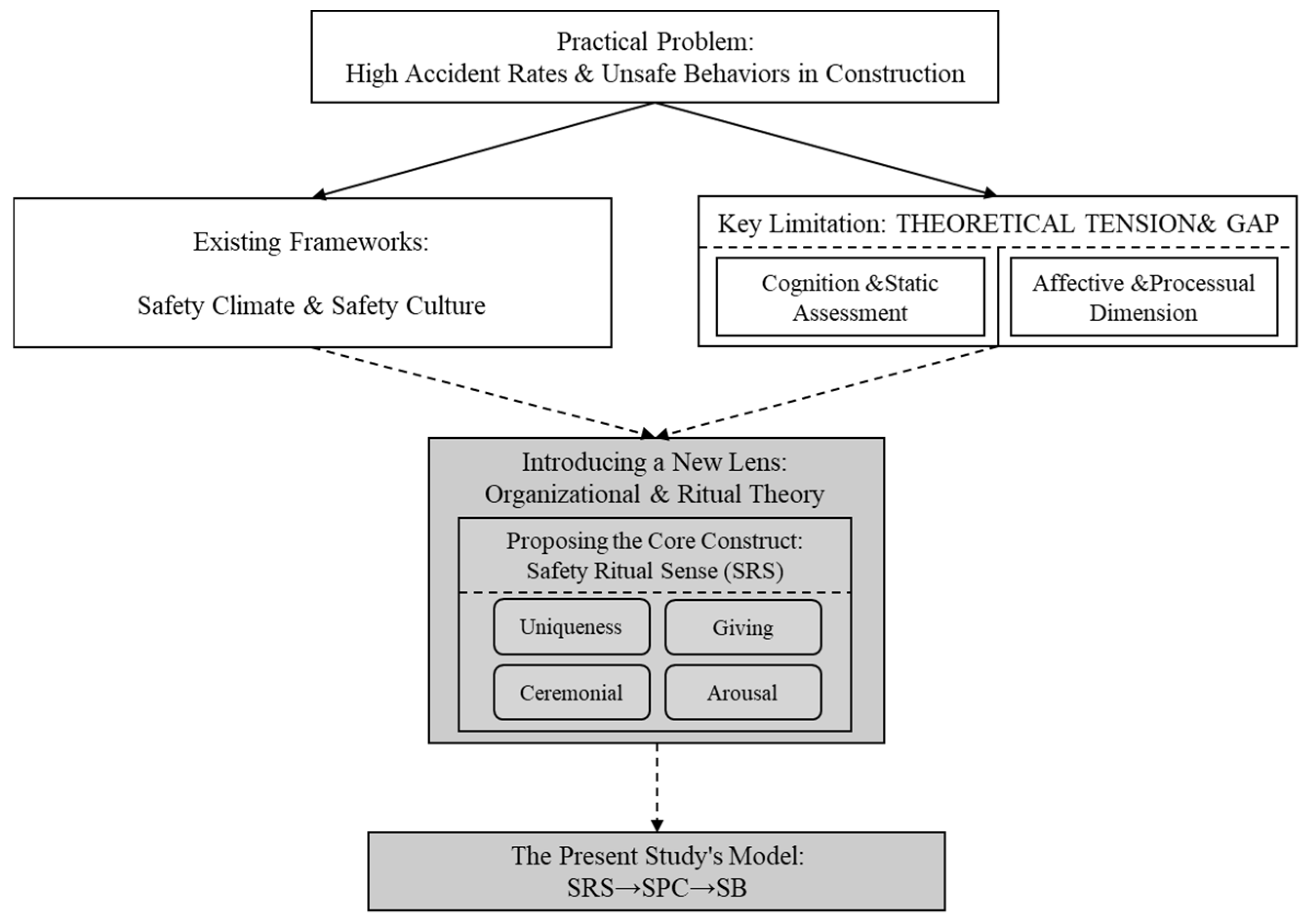
Figure 1 illustrates the logical flow motivating the present study. It begins with the persistent practical problem of high accident rates in the construction industry, which is primarily attributed to unsafe behaviors. While existing organizational frameworks like safety climate and culture offer partial explanations, they are limited by their cognitive and static nature, creating a theoretical gap regarding the affective and processual mechanisms. Drawing on ritual theory, this study introduces Safety Ritual Sense (SRS) as a contextualized adaptation of the ritual sense framework to address this gap. Finally, the specific research model tested in this study is presented, which posits that SRS influences Safety Behavior (SB) through the mediation of Safety Psychological Capital (SPC).

2. Theoretical Background and Hypotheses

From an industrial-organizational psychology perspective, building sustainable safety—defined here as the long-term integration of safety practices into everyday work processes to continuously protect workers’ physical and psychological well-being, prevent accidents, and foster resilient, proactive safety behaviors that contribute to both individual health and broader workplace sustainability—requires understanding the interactive mechanisms among organizational practices, employees’ psychological states, and behavioral outcomes. This study focuses on the high-risk construction industry and draws explicitly on Social Cognitive Theory [25] and Psychological Capital Theory [26] to examine how a specific organizational practice—safety rituals—shapes workers’ psychological experiences and resources, thereby promoting sustainable safety performance. This section first synthesizes the core concepts and then proposes hypotheses grounded in these theories.

2.1. Conceptual Elaboration of Safety Ritual Sense

2.1.1. Rituals and Ritual Sense

Rituals are structured, symbolic activities that enable participants to express and share emotions, thereby fostering social cohesion and emotional energy [11]. Building on foundational work by Durkheim [10] and Turner [27], interaction ritual chain theory [11] posits that rituals generate collective effervescence—a shared emotional charge—that enhances individual confidence, belonging, and purposeful action. Ritual sense, the subjective emotional experience arising from such participation, encompasses feelings of belonging, reverence, and motivation. In high-risk industries such as construction, this concept underpins safety ritual sense (SRS), which channels emotional energy into safety-compliant behaviors and provides the theoretical foundation for linking organizational practices to individual psychological resources.

2.1.2. Safety Rituals and Safety Ritual Sense

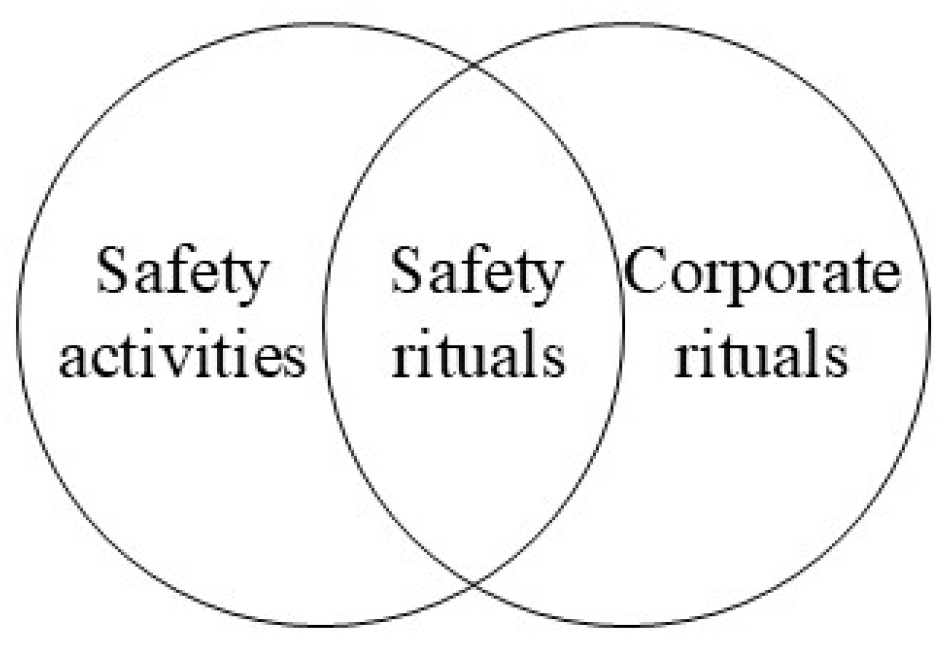
Safety rituals represent a specialized category of safety activities that enterprises systematically implement through structured procedural patterns to achieve workplace safety objectives (see Figure 2). These include complete ceremonies (e.g., safety oath-taking) or embedded components within broader initiatives (e.g., daily briefings). From an organizational perspective, they function as conscious socio-emotional interventions that shape employees’ safety cognition, attitudes, and behavioral patterns.
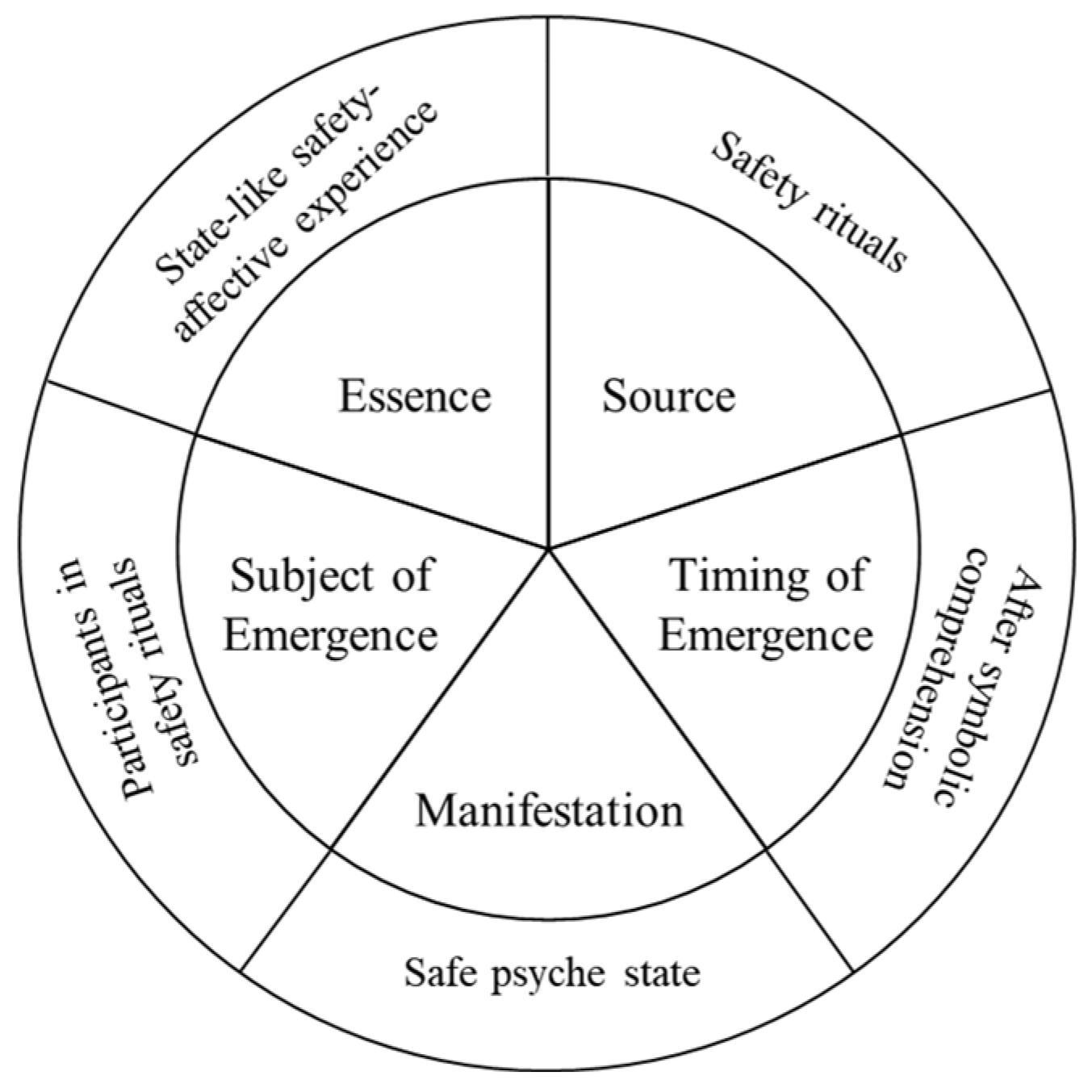
Safety Ritual Sense (SRS) is the affect-laden psychological outcome of participating in and comprehending these rituals. As illustrated in Figure 3, SRS originates from ritual participation, forms within individuals’ psyches, crystallizes through symbolic meaning, manifests as a time-varying affective state (passion, mood, enthusiasm), and ultimately guides behavior. Critically, SRS is conceptually distinct from related constructs in the safety literature. Safety climate refers to employees’ shared perceptions of the relative priority of safety versus competing demands at a specific point in time [7]—a relatively unstable ‘snapshot.’ Safety culture, by contrast, comprises deeper, enduring shared values, beliefs, assumptions, and norms [8]. While both climate and culture emphasize cognitive and normative elements, SRS is dynamic and affective, arising from recurring ritual interactions that generate emotional energy and symbolic boundaries. SRS also differs from routine safety procedures (which are primarily instrumental and compliance-driven) and from safety engagement (behavioral involvement) by foregrounding the emotional and motivational pathway.
Drawing on the above conceptual dimensions and distinctions, this study defines Safety Ritual Sense (SRS) as a state-like, positive affective experience. It refers to the dynamic affective state wherein organizational employees, through participation in safety rituals and comprehension of their symbolic meanings, develop positively valenced emotional responses (e.g., a sense of belonging, responsibility, and enthusiasm) that guide safety-compliant behaviors. Therefore, SRS is essentially a positive workplace psychological state elicited by organizationally initiated ritualistic practices, serving as a key psychological nexus that translates external organizational interventions into internal behavioral motivation.
Note: While Interaction Ritual Chain Theory characterizes ritual sense as a “dynamic” process of emotional energy generation, this study’s cross-sectional design limits our ability to empirically test temporal characteristics. Here, “dynamic” refers strictly to the theoretical mechanism of affective response generation rather than empirically tracked temporal changes.
Building upon this definition, and to preempt potential conceptual conflation, we explicitly position SRS against neighboring constructs. To establish the uniqueness of Safety Ritual Sense (SRS), it is crucial to distinguish it from related constructs: organizational identification, safety motivation, safety climate, and safety culture. Their core nature and formation differ fundamentally.
SRS vs. Organizational Identification: Organizational identification is a stable self-concept of belonging to the organization [28]. In contrast, SRS is a context-specific affective experience arising from participation in discrete safety rituals. It concerns the immediate emotional energy of the ritual, not a lasting redefinition of self.
SRS vs. Safety Motivation: Safety motivation is classically defined as the internal drive or intention to exert effort to enact safety behaviors [29]. SRS, however, is the positive affective experience itself from ritual participation. This experience can fuel motivation but is distinct from it; SRS provides the “emotional why” behind the “cognitive why” of motivation.
SRS vs. Safety Climate & Safety Culture: Safety culture encompasses shared values and practices, while safety climate is its measurable, perceptual manifestation [30]. Both are cognitive and normative. SRS introduces a critical affective and process-oriented dimension. It captures the theoretically dynamic, emotional process through which shared commitments are generated and renewed in real-time via rituals, complementing the more static snapshots (climate) or deep-seated background (culture).
In summary, SRS is distinct as it captures the in situ, affect-laden (emotionally charged) experience of ritualized interactions, offering a unique pathway to building resources and shaping behavior—a pathway not fully explained by the other constructs.

2.1.3. Safety Rituals, Ritual Sense, and Organizational Safety Management: A Tripartite Framework

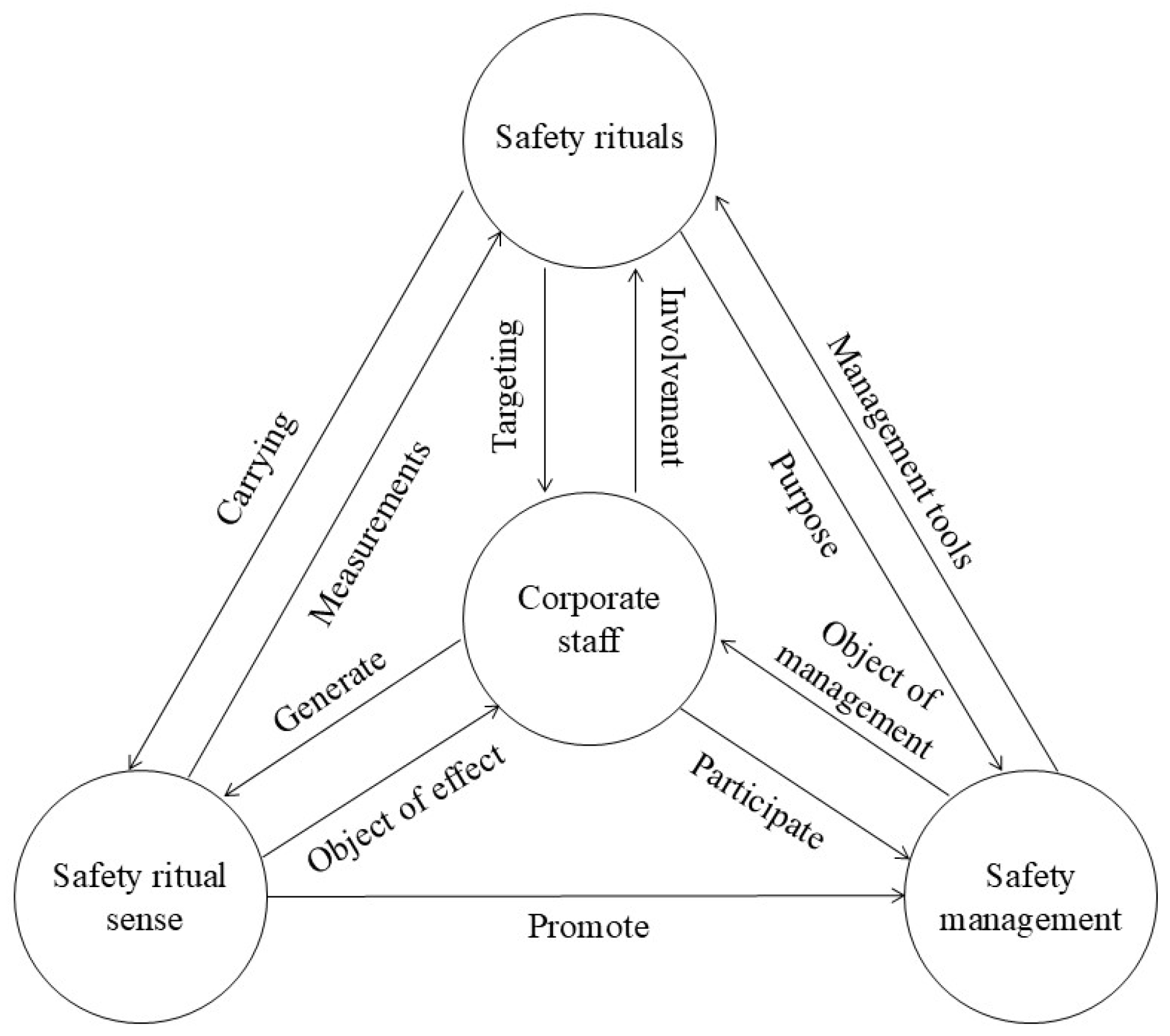
As shown in Figure 4, safety rituals, SRS, and safety management form a tripartite framework centered on frontline workers and safety managers. Organizations implement rituals (input), employees generate SRS (psychological process), and enhanced safety performance follows (output). This model aligns with SCT by illustrating how external socio-affective inputs shape internal psychological states that drive behavior, thereby contributing to sustainable workplaces through reduced accidents and improved well-being.

2.2. Hypotheses

Building on the industrial-organizational psychology theories and conceptual foundations discussed earlier (Social Cognitive Theory, Psychological Capital Theory, and Interaction Ritual Chain Theory), we develop the following hypotheses. These theories explain how safety ritual sense (SRS) functions as a motivational catalyst: it bridges organizational safety rituals with employees’ internal psychological resources (safety psychological capital, SPC), ultimately driving safety behavior (SB) and contributing to sustainable safety in the high-risk construction industry. SRS, as an affect-laden experience derived from participation in safety rituals, fosters robust psychological resources and transitions individuals from emotional responses to volitional safety actions. In line with SCT, external socio-affective inputs such as SRS influence behavior indirectly through psychological states, where optimism and resilience promote proactive safety performance. Psychological Capital Theory further posits that such resources—confidence, hope, optimism, and resilience—are measurable, developable, and directly linked to behavioral outcomes.
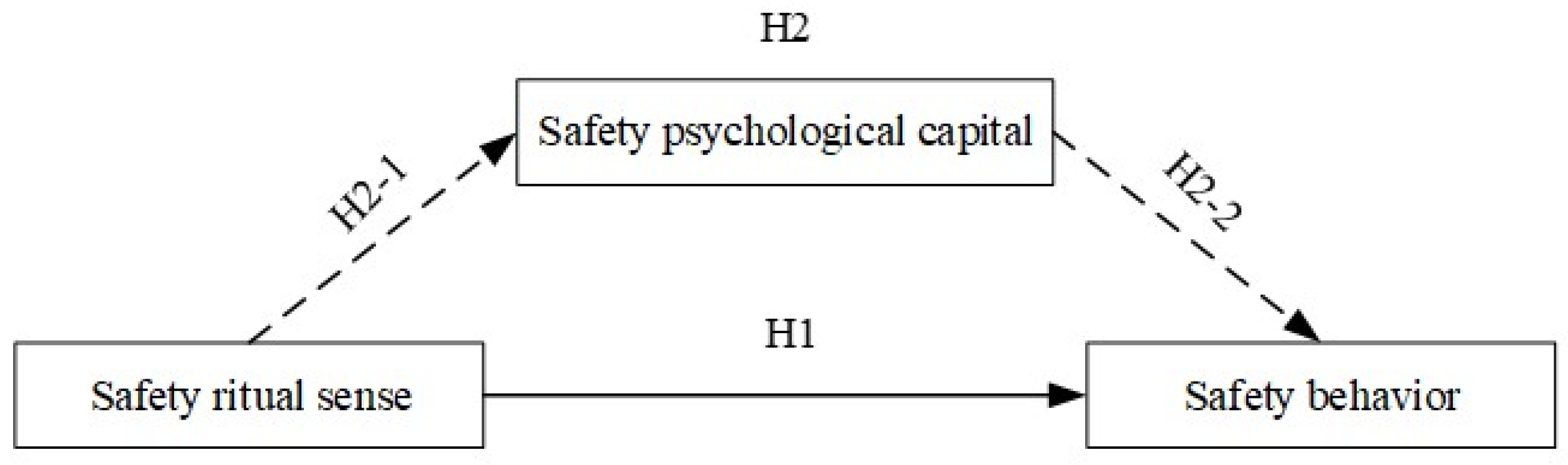
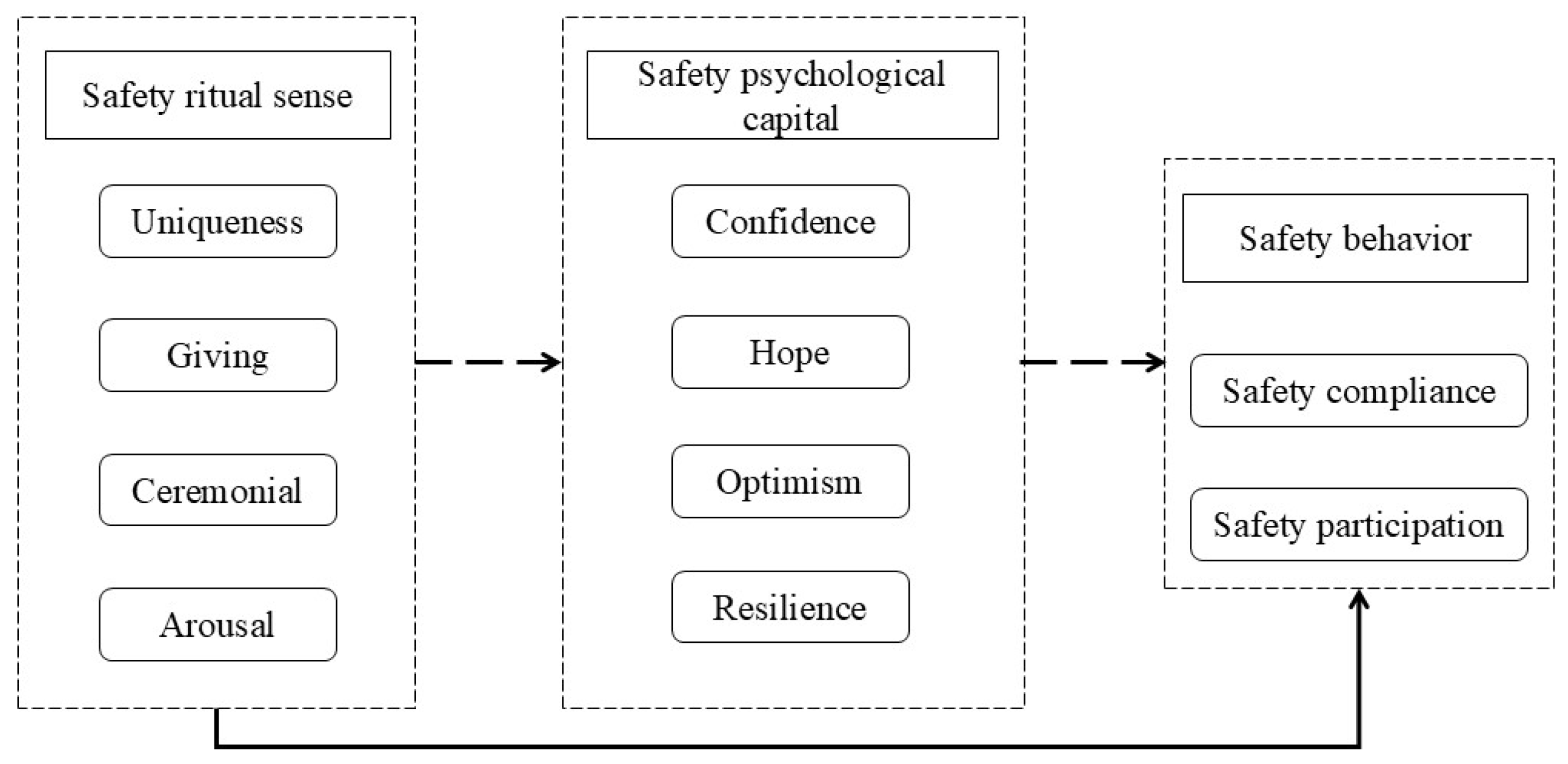
To empirically examine these mechanisms, this study proposes a mediated model (Figure 5) with safety ritual sense (SRS) as the independent variable, safety psychological capital (SPC) as the mediator, and safety behavior (SB) as the dependent variable. The model illustrates how SRS enhances SPC, which subsequently promotes compliance and participation in safety behaviors.

2.2.1. Hypotheses of Direct Influence Relationship

Drawing on Interaction Ritual Chain Theory [11], safety rituals create shared focus and emotional energy that strengthen group solidarity and regulate individual behavior. SRS, arising from participation in rituals such as daily safety briefings and oath-taking ceremonies, generates positive emotions responses including belonging, responsibility, and mission. These emotions align workers with organizational safety goals. According to Interaction Ritual Chain Theory, this alignment is achieved because the emotional energy generated by rituals is directly channeled into the group’s common focus—here, safety—thereby motivating congruent actions. Positive emotions have been shown to directly enhance behavioral performance by fostering emotional bonds and group commitment [13,14]. In the context of China’s high-risk construction industry, where unsafe behaviors predominate, SRS is expected to increase workers’ sense of responsibility and commitment to safety protocols.
Thus, we propose:
H1: 
Safety ritual sense has a significant positive effect on safety behavior among construction employees.

2.2.2. Hypotheses of Indirect Influence Relationship

Psychological capital represents psychological attributes that influence productivity or performance [31], defined by Luthans et al. [26] as a positive, measurable, developable, and manageable state. Based on this, we define safety psychological capital (SPC) as a measurable and developable safety-oriented psychological state or ability that contributes to safety behavior in work processes. Social cognitive theory (SCT) indicates that individual behavior is influenced by both external environments and psychological states; the environment shapes behavior patterns and intensity, while states like self-efficacy (confidence), optimism, and hope guide them [25]. In construction’s high-risk settings, external factors such as safety ritual sense (SRS) may directly affect safety behavior (SB) and indirectly through SPC, where SRS elevates SPC levels, which in turn promote SB.
Drawing on these insights, we propose the following hypothesis:
H2: 
Safety psychological capital plays a mediating role between the safety ritual sense and the safety behavior.
The antecedents of safety ritual sense (SRS) as key factors for improving safety psychological capital (SPC) have been confirmed by research; for instance, Bergheim et al. [32] demonstrated that perceptions of safety atmosphere are significantly and positively related to psychological capital, while related studies suggest positive safety emotions enable employees to respond to work difficulties with enthusiasm [33]. The elaborate design of safety rituals creates a safe atmosphere, triggers emotional resonance, and signals organizational emphasis on safety, integrating employees and inevitably transforming their psychological states. SRS awakens memory, thinking, and imagination during ritual interactions, causing changes in SPC and enhancing consciousness, self-discipline, resilience, determination, confidence, and persistence for safe production.
A consensus exists that psychological capital promotes safety behaviors; individuals with stronger psychological capital better cope with adversities [34], and a stable psychological state guarantees safe behaviors in construction workers [35]. Qin et al. [36] and He et al. [37] both showed psychological capital’s significant positive effect on safety behavior, with the latter focusing on construction workers. Building on this foundation and grounding our logic in Psychological Capital Theory, we posit that the affect-laden experience of SRS serves as a critical resource-building context that cultivates the four facets of SPC (e.g., the uniqueness and ceremonial nature of rituals can bolster safety confidence; the giving of effort reinforces safety hope and optimism; and the arousal helps build safety resilience). Consequently, in construction’s demanding environment—characterized by long hours of repetitive and monotonous labor—a robust SPC, fostered by such rituals, is essential as an optimistic and resilient mindset alleviates negative emotions and helps prevent unsafe behaviors. While our primary hypothesis follows the “SRS→SPC→SB” pathway, Social Cognitive Theory also accommodates reciprocal determinism, suggesting that improved safety behavior may feedback to reinforce psychological capital and subsequent ritual participation. This potential reverse causality is acknowledged as a theoretical nuance, though not the focus of the present study.
Using SPC as a mediator, we propose the following hypotheses:
H2-1: 
Safety ritual sense has a significant positive effect on the safety psychological capital of employees in the construction industry.
H2-2: 
Safety psychological capital has a significant positive influence on the safety behavior of employees in the construction industry.

2.2.3. Hypothetical Model

Integrating the direct (H1) and mediating (H2) pathways, Figure 6 depicts the hypothesized structural model of how SRS influences construction workers’ safety behavior (SB) through SPC, including both direct and indirect effects. This model provides a coherent framework grounded in the aforementioned industrial-organizational psychology theories. Figure 6 integrates these hypotheses into a coherent model grounded in our core theories: Interaction Ritual Chain Theory explains the source of SRS; Psychological Capital Theory accounts for the key mediating resources it fosters; and Social Cognitive Theory frames the entire ‘environmental input (SRS) → psychological state (SPC) → behavior (SB)’ pathway.

3. Research Methodology

3.1. Questionnaire Design

This study targeted Chinese construction workers, selected due to the industry’s high accident rates [2], and used a questionnaire survey to test the hypothesized relationships. The questionnaire measured three constructs: safety ritual sense (SRS), safety psychological capital (SPC), and safety behavior (SB), with all scales adapted for construction safety contexts. Scales were validated for reliability (Cronbach’s α > 0.9) and validity using Kaiser–Meyer–Olkin (KMO) and Bartlett’s tests. All subscales achieved KMO > 0.9 and Bartlett’s p < 0.001, indicating strong inter-variable correlations and suitability for factor analysis.
  • Safety Ritual Sense (SRS) Measurement: The SRS scale, adapted from existing ritual sense framework [38], comprised 10 items across four dimensions: uniqueness (2 items, e.g., ‘The experience brought by safety rituals is unique and irreplaceable.’), giving (3 items), ceremonial (3 items), and arousal (2 items).
  • Safety Psychological Capital (SPC) Assessment: Based on Luthans et al.’s [26] psychological capital framework, a 12-item SPC scale was developed, tailored to construction safety. It assessed four dimensions: safety confidence (3 items, e.g., ‘At work, I believe I can effectively communicate safety information to my colleagues.’), safety optimism (3 items), safety hope (3 items), and safety resilience (3 items).
  • Safety Behavior (SB) Evaluation: The SB scale, adapted from Neal et al. [39], included 8 items equally distributed across two domains: safety compliance (4 items, e.g., ‘At work, I consistently use safety protective equipment in a standardized manner.’) and safety participation (4 items, e.g., ‘I actively propose suggestions for improving safety at work.’).
The measurement of Safety Ritual Sense (SRS) was adapted from the consumer ritual sense scale developed by Fei, Huang, and Huang [38]. The source scale, developed and validated through a rigorous process of exploratory and confirmatory factor analysis, initially identified a structure comprising the dimensions of Uniqueness, Commitment, Ceremoniality, and Nonfunctionality. Our adaptation followed a theory-driven process to ensure contextual validity for the high-reliability construction safety domain, resulting in a focused four-dimensional model.
First, theoretical grounding and dimension selection: We retained and refined three core dimensions that directly align with the mechanisms of interaction ritual chains and safety-specific psychology in a workplace setting.
  • Uniqueness: This dimension was directly retained. It captures the distinctiveness and special value of safety activities, which aligns with the source scale’s definition that unique processes and experiential value differentiate ritualistic consumption. In safety, this translates to the perceived irreplaceability and detail-oriented nature of safety rituals.
  • Commitment → Giving: The source scale’s Commitment dimension, defined as the consumer’s investment of time, energy, and expectations, was conceptually translated and re-emphasized as Giving. This reframing underscores a key theoretical insight for safety: compliance is not passive but can be experienced as an active, meaningful contribution (giving) of one’s effort and attention to collective safety, resonating with social exchange theory.
  • Ceremoniality → Ceremonial: This dimension was retained, capturing the formality, procedure, and cultural connotation of safety activities. It reflects the source scale’s emphasis on traditional customs and ritual culture, which in a safety context pertains to the formal, respectful, and inherited procedures of safety protocols.
  • Arousal (Innovation for Safety Context): We introduced the Arousal dimension to address the high-stakes, alertness-demanding nature of construction work. While not directly named in the source scale’s final four factors, the concept is supported by the literature’s discussion on rituals enhancing focus, emotional engagement, and the ‘emotional activation’ necessary for safety. This dimension captures the emotional and attentional activation elicited by safety rituals, a critical component for hazard vigilance.
Second, item contextualization: All retained and newly developed items were systematically reworded. The referent was shifted from general consumption (e.g., ‘this product/service’) to specific safety rituals and outcomes (e.g., ‘the experience brought by safety rituals’). The language was tailored to reflect workplace safety participation, psychological experience, and the consequential nature of safety behaviors.
Third, innovation highlight: The primary innovation of the adapted SRS scale lies in its successful transposition and contextualization of the ritual sense framework from the consumer psychology domain to the high-stakes context of occupational safety. This adaptation not only validates the core ritual dimensions in a novel setting but also enriches the construct by emphasizing Giving as proactive contribution and introducing Arousal to capture the vital affective-cognitive state required for safety performance. The final adapted scale consisted of 10 items across these four dimensions, as reported in the manuscript.
The adapted 10-item SRS scale was first examined using Exploratory Factor Analysis (EFA). The EFA (Principal Component Analysis with Varimax rotation) extracted four factors with eigenvalues greater than 1, which collectively explained 85.55% of the total variance. All items loaded cleanly (loadings > 0.5) onto their theoretically expected factors, providing initial empirical support for the four-dimensional structure (Uniqueness, Giving, Ceremonial, Arousal) in the construction safety context. Subsequently, Confirmatory Factor Analysis (CFA) was conducted for further validation.

3.2. Questionnaire Development and Research Implementation

The questionnaire comprised four sections. Part 1 collected demographic data (age, gender, marital status, education). Parts 2–4 used 5-point Likert scales (1 = strongly disagree, 5 = strongly agree) to measure SRS, SPC, and SB, respectively, with higher scores indicating stronger agreement.
Prior to the formal survey, a preliminary review was conducted to validate the questionnaire’s rationality and identify potential influencing factors. Safety science professors, researchers, and construction enterprise safety management personnel were consulted via email or SMS to solicit feedback for questionnaire refinement. The formal survey was administered online, with anonymity ensured to protect respondent privacy and encourage candid responses.
Participants were 444 construction workers (82% response rate from 541 distributed questionnaires) recruited from multiple project sites within a single large-scale construction enterprise in China. The sample included 61.3% males and 38.7% females, with 65.1% aged under 40 years (30% under 30, 35.1% aged 31–40). Additionally, 68.5% were married, and most had high school education or above. Work tenure was predominantly 6–10 years (41%), with 69% frontline workers and 31% safety managers. The analysis of demographic variables confirms that the sample distribution is consistent with the current status of the labor force in the construction industry, meeting the requirements for sampling and supporting the validity of further statistical analysis.
The survey was administered to construction workers at project sites in Hunan Province, China. It is important to note that while the data collection was geographically focused, the workforce in China’s construction industry is highly mobile, with workers often migrating across provinces for employment. Therefore, the sampled population, though located in Hunan, may reflect a broader demographic of frontline construction workers in China. This potential representativeness is pertinent given that China’s construction workforce, as a whole, faces high accident rates [2], suggesting our findings could offer insights for similar high-risk occupational contexts. Regarding demographic composition, the sample was predominantly Han Chinese. Future research should include greater ethnic diversity to enhance the generalizability of the findings.

3.3. Statistical Analysis Tool

The data were analyzed using SPSS 24.0 and AMOS 7.0 statistical software to assess reliability and validity. To test the research hypotheses, correlation and regression analyses were performed in SPSS 24.0. Pearson’s correlation coefficient was employed to examine the relationships between variables, while standardized regression coefficients (Beta) were used to determine the extent to which one variable predicted changes in another.
To test the research hypotheses, we selected appropriate statistical tests based on the data characteristics and research questions. First, descriptive statistics (means, standard deviations) were used to summarize sample characteristics. Second, reliability analysis (Cronbach’s α) and validity tests (KMO, Bartlett’s test, confirmatory factor analysis) were conducted to ensure the quality of the measurement instruments. Then, Pearson correlation analysis was employed to preliminarily examine the associations between variables. Finally, to test the direct and mediating effects in the theoretical model, multiple regression analysis using the SPSS PROCESS macro coupled with the Bootstrap method (with 5000 resamples) was applied, which provides robust confidence intervals for indirect effects.

3.4. Control of Common Method Bias and Generalizability

To mitigate potential common method bias, procedural remedies were employed. Specifically, respondent anonymity was guaranteed, and scale items for different constructs were presented in a mixed order to reduce patterned responses. Regarding generalizability, while findings are based on a sample from the Chinese construction industry, the theoretical framework (integrating ritual theory and psychological capital) and the core mechanisms explored are intended to be transferable to other high-reliability organizations. The explicit discussion of the sample’s context and the study’s limitations aims to provide clear boundaries for interpretation and avenues for future cross-validation in different cultural or industrial settings.

3.5. Ethical Approval

This study was a non-interventional survey research. In accordance with the national laws of China and institutional guidelines, ethical approval was not required for this study. However, informed consent was obtained from all participants prior to survey administration, with anonymity assured. All procedures followed the principles stated in the Declaration of Helsinki.

4. Results

4.1. Variable Score Description

To provide an initial overview of the sample, Table 1 presents the descriptive statistics (means and standard deviations) for the core variables—safety ritual sense (SRS), safety psychological capital (SPC), and safety behavior (SB)—and their respective sub-dimensions.
As presented in Table 1, construction workers reported favorable SRS perceptions (M = 3.83, SD = 1.10), with uniqueness (M = 3.90) highest, followed by arousal (M = 3.86), ceremonial (M = 3.84), and giving (M = 3.72). Uniqueness showed the least variability (SD = 0.94), indicating consensus on the distinctiveness of safety rituals, while giving’s higher variability (SD = 1.23) may reflect role differences between safety managers and frontline workers, pending group comparison.
Regarding safety psychological capital (SPC), employees reported a moderate mean score of 3.60, suggesting room for enhancement in confidence, optimism, hope, and resilience during safety operations—a finding potentially linked to the inherently high-risk nature of construction work. The considerable variation (SD = 1.30) in SPC scores reflects substantial inter-individual differences in psychological states among construction workers.
Safety behavior (SB) measurements yielded a mean score of 3.70, indicating intermediate performance levels. Notably, safety participation (M = 3.72) slightly exceeded safety compliance (M = 3.68), with compliance demonstrating greater variability (SD = 1.25 vs. 1.19 for participation). This result aligns with practical observations, as compliance behaviors typically exhibit more individual variation compared to participation.

4.2. Reliability and Validity Test of Sample Data

Prior to hypothesis testing, we assessed the reliability and validity of the measurement instruments to ensure data quality. Reliability and validity analyses were conducted using SPSS 24.0 and AMOS 7.0 respectively. The reliability analysis yielded Cronbach’s alpha coefficients of 0.854 for the safety ritual sense scale, 0.876 for the safety psychological capital scale, and 0.903 for the safety behavior scale, all meeting the acceptable standard of 0.8. Further examination revealed that the alpha values for each scale remained above 0.8 following item deletion, while being lower than the standardized alpha values, confirming the scales’ robust internal consistency. All corrected item-total correlation (CITC) values surpassed the critical threshold of 0.3, demonstrating strong correlations between individual items and their respective constructs.
For validity assessment, the Kaiser–Meyer–Olkin (KMO) measures of sampling adequacy were 0.786, 0.833, and 0.899 for the three variables, all above the acceptable level of 0.7. Bartlett’s test of sphericity yielded significant results (p < 0.001), indicating adequate intercorrelations for factor analysis. Confirmatory factor analysis conducted in AMOS 7.0 demonstrated satisfactory convergent validity, as evidenced by the fit indices presented in Table 2. All model fit indices either met or approached established criteria, confirming the questionnaire’s validity and the model’s appropriateness for the collected data. These results, reflecting China’s high-risk construction settings, support the data’s validity for hypothesis testing.

4.3. Correlation Analysis of Variables

To provide initial statistical support for the study’s hypotheses, bivariate correlations were computed to examine the relationships between safety ritual sense (SRS), safety psychological capital (SPC), and safety behavior (SB).
  • Correlation between safety ritual sense and safety behavior
Table 3 presents correlations between SRS, its dimensions (uniqueness, giving, ceremonial, arousal), and SB’s dimensions (compliance, participation). Overall, SRS strongly correlated with SB (r = 0.670, p < 0.01), within the strong range (0.6 < r < 0.8). At the dimensional level, uniqueness, giving, and arousal showed moderate correlations (0.4 < r < 0.6) with both SB dimensions, while ceremonial had weaker but significant correlations (0.2 < r < 0.4), possibly due to less emphasis on formal rituals in China’s high-risk construction settings. These findings support H1, confirming positive SRS–SB linkages.
2.
The correlation between safety ritual sense and safety psychological capital
Table 4 presents correlations between SRS (uniqueness, giving, ceremonial, arousal) and SPC (confidence, hope, optimism, resilience) among Chinese construction workers. Overall SRS strongly correlated with SPC (r = 0.633, p < 0.01), within the strong range (0.6 < r < 0.8). This provides preliminary support for H2-1. Furthermore, all four dimensions of SRS showed significant positive correlations (r > 0.2, p < 0.01) with each of the four dimensions of SPC, indicating consistent positive associations at the component level.
3.
The correlation between safety psychological capital and safety behavior
Table 5 presents correlations between SPC (confidence, optimism, hope, resilience) and SB (compliance, participation) among Chinese construction workers. Overall SPC strongly correlated with SB (r = 0.684, p < 0.01), within the strong range (0.6 < r < 0.8). At the dimensional level, all SPC dimensions showed significant positive correlations (r > 0.2, p < 0.01) with both compliance and participation. These findings provide empirical support for H2-2, confirming robust SPC–SB linkages in the construction industry context.

4.4. Inspection of Safety Psychological Capital Mediating Effect

Building on the correlation results, we employed regression analysis and the Bootstrap method to formally test the mediating role of SPC (H2). Using Model 4 in the SPSS PROCESS macro, we tested a simple mediation model with SRS as the independent variable, SB as the dependent variable, and SPC as the mediator. Control variables included age, gender, marital status, education level, work tenure, and safety manager status. The results are presented in Table 6.
Based on the regression results in Table 6:
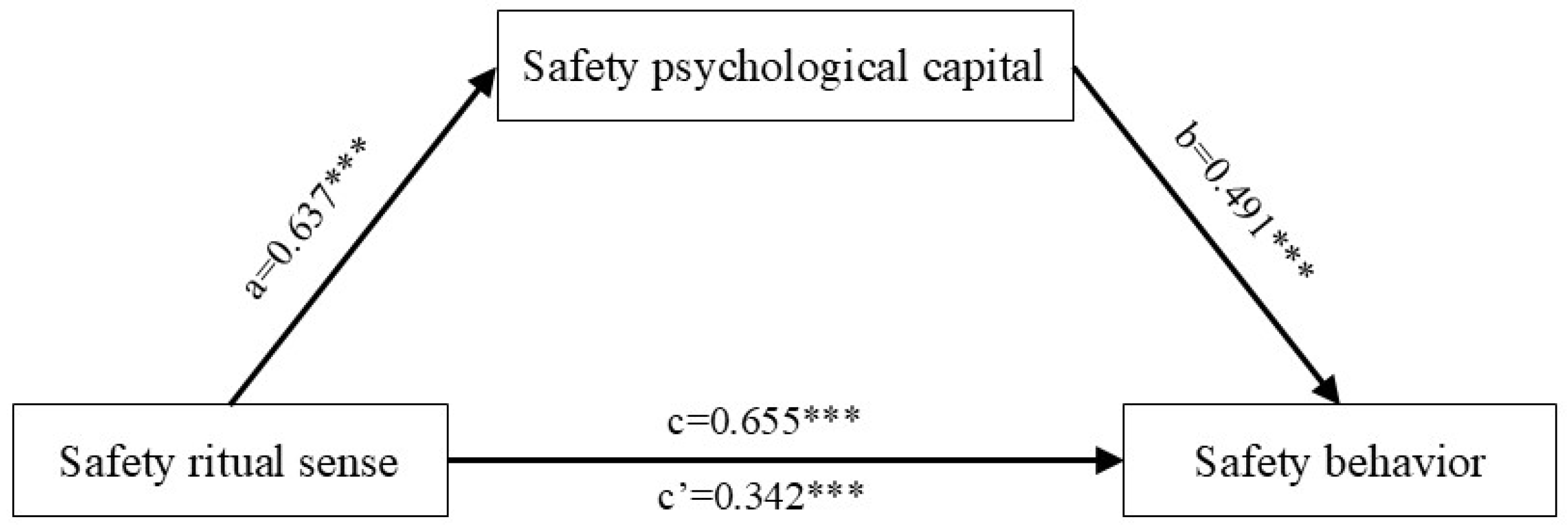
H1 is supported. Safety ritual sense was a significant positive predictor of safety behavior (β = 0.655, t = 18.341, p < 0.001).
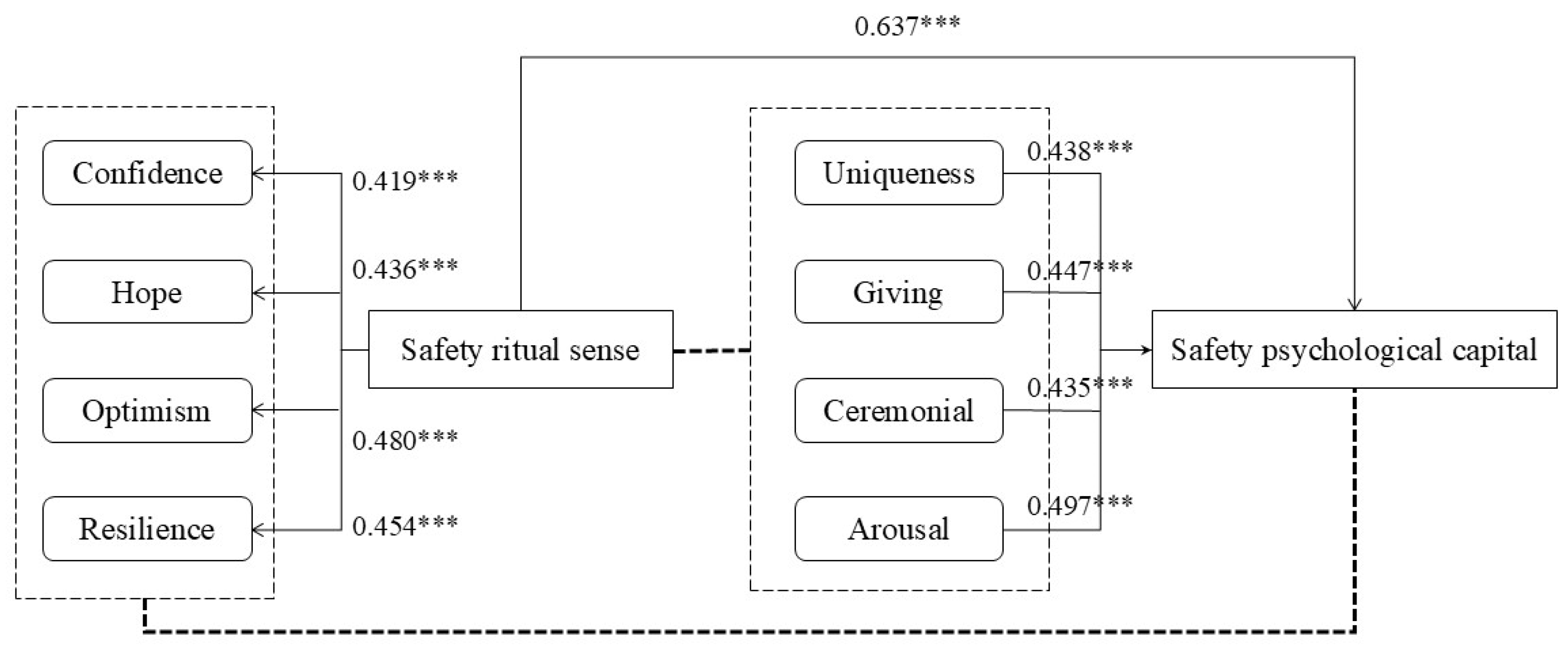
H2-1 is supported. Safety ritual sense also significantly and positively predicted safety psychological capital (β = 0.637, t = 17.825, p < 0.001).
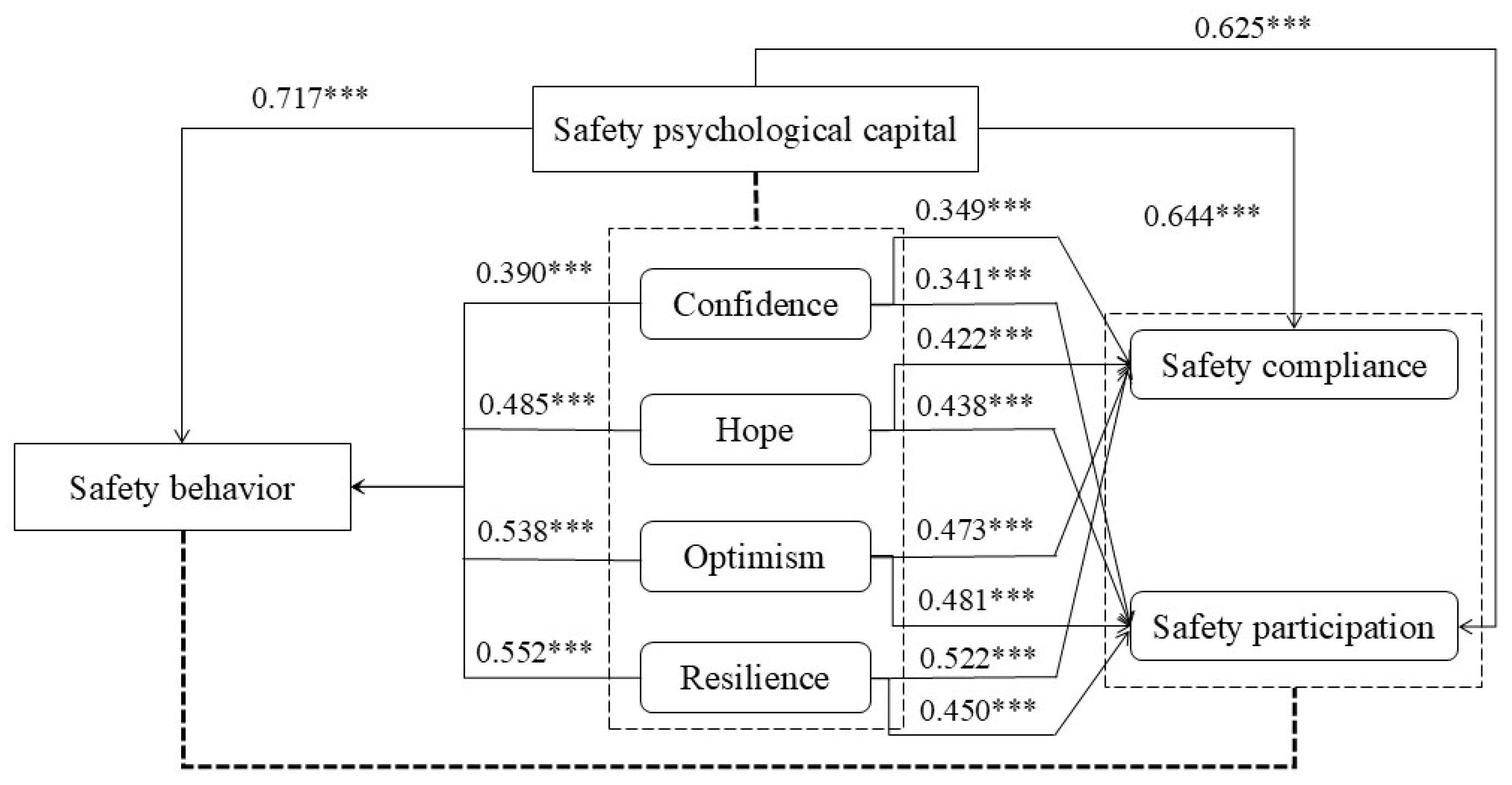
H2-2 is supported. Safety psychological capital was a significant positive predictor of safety behavior (β = 0.491, t = 11.757, p < 0.001).
The statistical conditions for testing mediation were therefore satisfied.
Upon introducing SPC as a mediator, the direct association of SRS with SB remained significant but decreased in magnitude (β = 0.342, t = 8.362, p < 0.001), suggesting the presence of partial mediation.
To precisely quantify the indirect association, a Bootstrap analysis with 5000 resamples was conducted. The results (Table 7) revealed a significant indirect effect (indirect association), as the bias-corrected 95% confidence interval did not include zero. The standardized total association between SRS and SB (0.668) can be decomposed into a direct component (0.349) and an indirect component mediated by SPC (0.319). Referencing Cohen’s conventions for effect sizes (≥0.5 = large effect, 0.3–0.49 = medium effect), the total effect constitutes a large practical impact, while the indirect effect is medium-to-large and the direct effect is medium. This indicates that the direct and indirect paths accounted for approximately 52.2% and 47.8% of the total association, respectively. Taken together, these results are consistent with H2 and support the theoretical model in which safety psychological capital plays a significant partial mediating role in the relationship between safety ritual sense and safety behavior.

5. Discussion

5.1. The Association Between Safety Ritual Sense and Safety Behavior

This study initially explored the direct effect of safety ritual sense on the safety behavior of construction employees. The results suggest a significant positive association between safety ritual sense and safety behavior, supported by a regression coefficient of 0.655 (t = 18.341, p < 0.001), indicating its substantial influence. Individuals perceive, share, and express emotions and experiences through safety rituals, fostering a collective group safety ritual sense. This group-level safety ritual sense is likely to shape individual safety ritual sense, which in turn may influence individual behavior. These findings align with the emotional mechanism proposed by Manzoor and Treur [40], which emphasizes the role of shared emotional experiences in behavioral outcomes.
Drawing on social exchange theory, which posits that exchange activities yielding perceived benefits—such as emotional support or safety assurance—tend to govern individual behavior [41], this study analyzed the mechanism through which safety ritual sense influences safety behavior. The safety ritual sense derived from safety rituals establishes a reciprocal and equivalent relationship with the safety behaviors exhibited by individuals, where participation in rituals may be perceived as a benefit that prompts a reciprocal mindset. This mindset encourages individuals to adjust their safety-related exchange behaviors, such as adhering to safety protocols, in return for the emotional and social gains from the rituals.
The positive association of safety ritual sense with safety behavior, as observed in our model, can be interpreted through three key aspects. First, the intense and meaningful emotions elicited by safety rituals fulfill individuals’ emotional safety needs, mitigating negative emotions detrimental to safe production and fostering higher-level safety requirements [42]. Second, upon satisfying these emotional needs, safety ritual sense activates its motivational function, encouraging individuals to adhere to safety ritual arrangements, respect their order, appreciate their symbolic meaning, and develop accurate safety cognition. This is supported by Mathews and Mackintosh [43], who highlighted how sensory emotions shape cognitive dispositions and enhance cognitive efficiency, and by Ilies, Scott, and Judge [44], who demonstrated that positive emotions accelerate cognitive reaction speed. Finally, safety emotions may stimulate safety intentions, and safety cognition guides production practices, a process reinforced by the integration of emotions, cognition, and behavior to ensure rational decision-making and reduce unsafe behaviors during hazardous situations.
Although previous studies on safety behavior have largely focused on individual psychological factors or organizational safety climate, they have paid limited attention to collective mechanisms that generate shared emotional experiences through rituals. While emotions are often treated as static individual states in existing research, the present study extends the emotional mechanism framework [40] by empirically examining safety ritual sense as a shared, affect-laden process rooted in recurring ritual interactions. This approach addresses a key theoretical gap by conceptualizing ritual sense as a domain-specific adaptation within the occupational safety framework and advances safety behavior theory toward a more collectively shared, ritual-driven model. Such a perspective is especially valuable for sustaining safe behaviors in high-risk, long-term construction environments, where emotional synchrony and team cohesion play critical roles in maintaining psychological resources over time.

5.2. The Mediating Role of Safety Psychological Capital

  • The role of safety ritual sense in shaping employees’ safety psychological capital
Following data validation (Cronbach’s α > 0.8, KMO > 0.7) and correlation analyses (SRS–SPC: r = 0.633; SPC–SB: r = 0.684; SRS–SB: r = 0.670), this study confirmed that safety ritual sense (SRS)is strongly and positively associated with safety psychological capital (SPC) among Chinese construction workers (r = 0.633, β = 0.637, t = 17.825, p < 0.001), supporting Hypothesis H2-1. The effect path and coefficients of SRS on SPC are illustrated in Figure 7. Grounded in Psychological Capital Theory, which posits that contextual factors like SRS bolster resources such as confidence [11], this positive relationship also extends to safety behavior, with SRS showing a significant effect (β = 0.637).
The findings indicate that safety ritual sense is positively associated with employees’ safety psychological capital levels, with this psychological resource demonstrating progressive augmentation as safety ritual sense intensifies.
2.
The role of safety psychological capital in influencing employees’ safety behavior
SPC is strongly and positively associated with SB among Chinese construction workers (r = 0.684, β = 0.717, t = 11.757, p < 0.001), supporting Hypothesis H2-2. Figure 8 illustrates paths from SPC to SB. Results show SB levels increase with SPC, driven by dimensions like confidence and resilience, reflecting rigorous safety training in Chinese construction sites.
3.
The mediating effect of safety psychological capital
SPC significantly partially mediates the relationship between SRS and SB. The total effect of SRS on SB (0.655) comprises a direct effect (0.342) and an indirect effect via SPC (0.312), with the direct and indirect paths accounting for 52.37% and 47.63% of the total effect, respectively. These results support H2-2 and suggest that Chinese construction enterprises can enhance SPC through targeted safety training, thereby amplifying the beneficial link between SRS and SB and leveraging collective safety culture to reduce unsafe behaviors. The mediating model is depicted in Figure 9.
This study investigates the mediating effect of safety psychological capital (SPC) in the relationship between safety ritual sense (SRS) and safety behavior (SB), offering insights into how SRS positively influences SB from a psychological perspective while elucidating the generative mechanisms underlying SB. The findings are consistent with a partial mediation model: SRS is associated with SB both directly and indirectly through its association with SPC. This supports prior research suggesting that ritual sense, as a positive emotion, influences individuals’ conscious control over their thoughts and behaviors [14,19]. The results indicate that enhancing the quality of SRS and SPC can effectively reduce the likelihood of unsafe behaviors among construction employees.
Beyond confirming the mediating role of SPC, this study advances Psychological Capital Theory by identifying safety ritual sense as an important upstream contextual factor that cultivates psychological resources. While previous research [45,46] has primarily focused on the direct effects of PsyCap sub-dimensions on safety behavior or examined its mediating role through individual-level variables (such as safety motivation or communication competence), few studies have investigated collective ritual processes as precursors to these resources. By revealing the ‘ritual sense → psychological resource → behavior’ chain in high-risk, prolonged construction settings, the present study enriches the integration of emotional-cognitive-behavioral frameworks and bridges social exchange theory with psychological capital theory.
The study further confirms a strong positive association between SRS and SPC. SRS helps construction workers sustain higher levels of SPC, which cultivates positive and optimistic emotions at work and subsequently shapes their behavior, job performance, and job satisfaction. SPC emerges as a critical determinant of SB [39]. Higher SPC is associated with increased confidence, optimism, hope, and resilience in hazardous environments, enabling employees to adopt effective safety strategies and reduce accident risks [46]. In contrast, lower SPC impairs emotional regulation and may exacerbate negative psychological states such as depression and anxiety, leading to maladaptive coping strategies—for instance, overlooking hazards due to fatigue or making erroneous decisions under anxiety. These findings underscore SPC’s pivotal role in shaping construction employees’ safety behavior and highlight the value of targeting shared ritual experiences as an upstream intervention.

5.3. Implications for Organizational Processes and Safety Management Practices

The findings of this study offer several concrete, theory-grounded implications for safety management in the construction industry. These recommendations are not generic but are specifically derived from and target the validated pathways (SRS → SPC → SB) in our research model.
First, regarding the design and implementation of safety rituals, organizations should move beyond routine procedures to create affectively charged collective practices that directly enhance Safety Ritual Sense (SRS) and its influence on Safety Behavior (SB). Drawing on Interaction Ritual Chain Theory, rituals should be designed to generate successful interaction rituals that foster “collective effervescence” and “emotional energy.” For example, brief daily pre-shift “safety commitment rituals” could incorporate not just rule reminders but also shared moments of reflection, symbolic oath-taking, or emotionally resonant sharing of near-miss experiences. This design should intentionally emphasize the uniqueness and arousal dimensions of SRS, transforming safety compliance from an obligation into a group commitment and emotional alignment. This practice directly targets the pathway where SRS influences SB (supporting H1).
Second, leadership practices on-site should be enhanced to reinforce the role of SRS in building Safety Psychological Capital (SPC). Supervisors and managers should act as “ritual facilitators” and “resource cultivators.” By regularly organizing small-group safety reflection sessions framed around themes of “giving” and mutual support, leaders can strengthen the giving dimension of the ritual experience. Grounded in Social Exchange Theory, this practice reinforces a perception of reciprocity, where employees’ investment of effort in safety is perceived as a meaningful contribution to the group’s well-being, reciprocated by organizational care. This experience of giving is posited to directly nurture workers’ safety hope and safety optimism (dimensions of SPC), making them believe that their and the group’s efforts lead to a safer future (supporting the theorized link in H2-1 between the giving dimension of SRS and the hope/optimism dimensions of SPC).
Third, safety-oriented training programs should be integrated to simultaneously boost ritual participation and develop the specific facets of SPC, thereby maximizing its mediating potency (H2-2). Training should employ “experiential learning” designs that target the development of each SPC dimension:
To build safety confidence (efficacy), incorporate ritualized simulations of high-risk scenarios where successfully navigating a virtual hazard provides a mastery experience.
To foster safety optimism, institutionalize “safety milestone celebrations” that guide workers to make positive, stable attributions about safety successes.
To enhance safety resilience, combine “resilience workshops” teaching coping strategies with restorative rituals following incident reviews, helping teams collectively recover and maintain focus.
Such targeted training ensures that the psychological resources cultivated by SRS are effectively converted into both safety compliance and proactive safety participation behaviors (supporting H2-2).
In summary, these recommendations are rooted in the core mechanism—‘affective experience (SRS) → psychological resources (SPC) → safety behavior (SB)’—revealed by this study. By deliberately designing safety rituals, leadership practices, and training programs that correspond to specific paths in this model, managers can translate abstract theoretical linkages into actionable, evaluable interventions. This provides a scientific blueprint for moving from “knowing” the model to “doing” effective safety management, contributing directly to safer and more sustainable workplaces.

6. Conclusions

This study, grounded in industrial-organizational psychology, proposes and empirically tests a model in which safety ritual sense is positively associated with safety psychological capital (β = 0.637), which in turn is positively associated with safety behavior. Safety ritual sense exerts both a direct effect on safety behavior (β = 0.655) and an indirect effect through safety psychological capital (indirect effect = 0.312, accounting for 47.63% of the total effect). These findings illustrate how structured organizational practices, such as safety rituals, can cultivate the psychological resources essential for sustained employee well-being and safety performance—a core dimension of workplace sustainability.
Specifically, the findings indicate that:
  • Safety psychological capital plays a partial mediating role between the safety ritual sense and safety behavior. Safety ritual sense influences safety behavior through both direct and indirect pathways. The study found a significant positive direct association (β = 0.655) between safety ritual sense and safety behavior, as well as a partial mediating role of safety psychological capital (indirect effect = 0.312). This mechanism underscores the value of collective, shared emotional processes in shaping individual safety outcomes.
  • Construction enterprises should prioritize the design and implementation of high-quality safety rituals that emphasize uniqueness, dedication, etiquette, and emotional arousal. By effectively integrating safety ritual sense with safety psychological capital, organizations can foster employees’ confidence, hope, optimism, and resilience in safety-related tasks, thereby reducing unsafe behaviors and enhancing overall workplace safety.
Despite these contributions, the study has several limitations that warrant critical reflection. First, its cross-sectional design limits causal inferences; the observed paths and partial mediation should be interpreted as robust correlational evidence rather than definitive causality. Specifically, while our theoretical framework prioritizes the “SRS → SPC → SB” pathway, Social Cognitive Theory accommodates reciprocal determinism—meaning improved safety behavior may feedback to reinforce psychological capital and subsequent ritual participation. The cross-sectional data cannot exclude such reverse causality or reciprocal effects. Second, reliance on self-reported questionnaire data raises concerns about common method bias and social desirability responding. Third, the sample was drawn exclusively from Chinese construction workers, which may constrain generalizability due to cultural and industry-specific factors. Additionally, this study lacked comprehensive robustness checks, such as outlier analysis, subsample validation, and alternative estimation method comparisons. While we controlled for demographic variables and used bootstrapping, the sensitivity of the mediation effect estimates to model specification and the potential impact of unobserved confounders were not quantitatively assessed. Furthermore, although the high variability (SD = 1.23) in the ‘Giving’ dimension of safety ritual sense suggests potential differences between roles (e.g., safety managers vs. frontline workers), this study did not include formal group comparison analyses (e.g., t-tests) to empirically examine these differences, which represents a limitation in the depth of subgroup analysis. In addition, while safety rituals offer clear benefits, overly formalized or repetitive practices risk becoming symbolic routines with limited practical effectiveness if they are not meaningfully embedded in everyday organizational processes and daily work routines.
Future research should directly build on these findings by adopting longitudinal or experimental designs to establish causality in the ‘ritual sense → psychological capital → safety behavior’ chain. Studies could also expand to diverse industries and cultural contexts, test boundary conditions such as the quality of ritual embedding, and incorporate additional moderators (e.g., organizational support for rituals) or mediators to further clarify the mechanisms underlying safety behavior.
In summary, this study advances both theory and practice by demonstrating how safety ritual sense, through safety psychological capital, contributes to safer workplaces. It provides a foundation for developing more effective, psychologically grounded safety interventions in high-risk industries.

Author Contributions

Conceptualization, C.Y. and Q.L.; methodology, S.G.; validation, C.Y. and W.X.; formal analysis, S.G.; investigation, C.Y. and S.G.; resources, Q.L.; data curation, W.X.; writing—original draft preparation, C.Y.; writing—review and editing, W.X.; supervision, Q.L.; project administration, Q.L.; funding acquisition, Q.L. All authors have read and agreed to the published version of the manuscript.

Funding

This work was supported by the Natural Science Foundation of Hunan Province (NO. 2025JJ50332).

Institutional Review Board Statement

Ethical review and approval were waived for this study by the Ethics Committee of Central South University. This study was waived for ethical review because it involved the collection and analysis of completely anonymized survey data, which does not involve sensitive personal information or commercial interests, in accordance with Article 32, Clause 2 of the “Measures for Ethical Review of Life Science and Medical Research Involving Humans” (National Health Commission, Education, Science and Technology, and State Administration of Traditional Chinese Medicine, Order No. 4, 2023) of the People’s Republic of China. All procedures followed the principles stated in the Declaration of Helsinki.

Informed Consent Statement

Informed consent was obtained from all subjects involved in the study.

Data Availability Statement

The raw data supporting the conclusions of this article will be made available by the authors upon request.

Conflicts of Interest

The authors declare no conflicts of interest.

Abbreviations

The following abbreviations are used in this manuscript:
SRSSafety ritual sense
SPCSafety psychological capital
SBSafety behavior

References

  1. Fang, D.P.; Wu, C.L.; Wu, H.J. Impact of the Supervisor on Worker Safety Behavior in Construction Projects. J. Manag. Eng. 2015, 31, 04015001. [Google Scholar] [CrossRef]
  2. Gu, J.; Guo, F. How fatigue affects the safety behaviour intentions of construction workers an empirical study in Hunan. Saf. Sci. 2022, 149, 105684. [Google Scholar] [CrossRef]
  3. Yang, J.; Ye, G.; Xiang, Q.; Kim, M.; Liu, Q.; Yue, H. Insights into the mechanism of construction workers’ unsafe behaviors from an individual perspective. Saf. Sci. 2021, 133, 105004. [Google Scholar] [CrossRef]
  4. Wang, X.; Zhang, Z.; Liang, S.; Yang, Z.; Su, C. Faultlines and Miners’ Safety Behaviour: Role of Emotional Exhaustion and Safety Self-Efficacy. Small Group Res. 2026, 57, 1–25. [Google Scholar] [CrossRef]
  5. Tang, T.; Liu, Z.; Yuan, M.; Guo, Y.; Lin, X.; Li, J. Exploring Organizational and Individual Determinants of Construction Workers’ Safety Behavior: An Interpretable Machine Learning Approach. Buildings 2026, 16, 191. [Google Scholar] [CrossRef]
  6. Zohar, D. Safety climate in industrial organizations: Theoretical and applied implications. J. Appl. Psychol. 1980, 65, 96–102. [Google Scholar] [CrossRef]
  7. Zohar, D. Thirty years of safety climate research: Reflections and future directions. Accid. Anal. Prev. 2010, 42, 1517–1522. [Google Scholar] [CrossRef]
  8. Guldenmund, F.W. The nature of safety culture: A review of theory and research. Saf. Sci. 2000, 34, 215–257. [Google Scholar] [CrossRef]
  9. Choudhry, R.M.; Fang, D.; Mohamed, S. The nature of safety culture: A survey of the state-of-the-art. Saf. Sci. 2007, 45, 993–1012. [Google Scholar] [CrossRef]
  10. Durkheim, E. The Elementary Forms of Religious Life; Fields, K.E., Translator; Free Press: New York, NY, USA, 1995. [Google Scholar]
  11. Collins, R. Interaction Ritual Chains; Princeton University Press: Princeton, NJ, USA, 2004. [Google Scholar]
  12. Bowie, F. Anthropology of religion. Relig. Compass 2008, 2, 862–874. [Google Scholar] [CrossRef]
  13. Hobson, N.M.; Schroeder, J.; Risen, J.L.; Xygalatas, D.; Inzlicht, M. The psychology of rituals: An integrative review and process-based framework. Pers. Soc. Psychol. Rev. 2018, 22, 260–284. [Google Scholar] [CrossRef]
  14. Stein, D.H.; Hobson, N.M.; Schroeder, J. A sacred commitment: How rituals promote group survival. Curr. Opin. Psychol. 2021, 40, 114–120. [Google Scholar] [CrossRef]
  15. Watson-Jones, R.E.; Legare, C.H. The functions of ritual in social groups. Behav. Brain Sci. 2016, 39, e26. [Google Scholar] [CrossRef]
  16. Kapferer, B. Victor Turner and the ritual process. Anthropol. Today 2019, 35, 1–2. [Google Scholar] [CrossRef]
  17. Maloney, P. Online networks and emotional energy: How pro-anorexic websites use interaction ritual chains to (re)form identity. Inf. Commun. Soc. 2013, 16, 105–124. [Google Scholar] [CrossRef]
  18. Rothem, N.; Fischer, S. Reclaiming Arnold Van Gennep’s Les rites de passage (1909): The structure of openness and the openness of structure. J. Class. Sociol. 2018, 18, 255–265. [Google Scholar] [CrossRef]
  19. DeVellis, R.F. Scale Development: Theory and Applications; Sage Publications: Thousand Oaks, CA, USA, 1991. [Google Scholar]
  20. Joo, D.; Tasci, A.D.A.; Woosnam, K.M.; Maruyama, N.U.; Hollas, C.R.; Aleshinloye, K.D. Residents’ attitude towards domestic tourists explained by contact, emotional solidarity and social distance. Tour. Manag. 2018, 64, 245–257. [Google Scholar] [CrossRef]
  21. Bargeman, B.; Richards, G. A new approach to understanding tourism practices. Ann. Tour. Res. 2020, 84, 102993. [Google Scholar] [CrossRef]
  22. Margheritti, S.; Negrini, A.; Miglioretti, M. Can psychological capital promote safety behaviours? A systematic review. Int. J. Occup. Saf. Ergon. 2023, 29, 1451–1459. [Google Scholar] [CrossRef] [PubMed]
  23. He, C.; Wu, C.; McCabe, B.; Hu, Z.; Shen, Y.; Jia, G.; Sun, J. A Bayesian network model integrating organizational, individual and psychological factors for strengthening construction worker safety behavior. Int. J. Occup. Saf. Ergon. 2024, 30, 1058–1068. [Google Scholar] [CrossRef] [PubMed]
  24. Gao, W.; Yan, X.; Chen, H. A Study of the Relationship Between Psychological Capital and Unsafe Behavior of Construction Workers. In Proceedings of the 27th International Symposium on Advancement of Construction Management and Real Estate, CRIOCM 2022, Hong Kong, China, 5–6 December 2022; Li, J., Lu, W., Peng, Y., Yuan, H., Wang, D., Eds.; Lecture Notes in Operations Research; Springer: Singapore, 2023; p. 21. [Google Scholar] [CrossRef]
  25. Rakib, M.A.; Chang, H.J.; Jones, R.P. Effective Sustainability Messages Triggering Consumer Emotion and Action: An Application of the Social Cognitive Theory and the Dual-Process Model. Sustainability 2022, 14, 2505. [Google Scholar] [CrossRef]
  26. Luthans, F.; Luthans, K.W.; Luthans, B.C. Positive psychological capital: Beyond human and social capital. Bus. Horiz. 2004, 47, 45–50. [Google Scholar] [CrossRef]
  27. Turner, V. The Ritual Process: Structure and Anti-Structure; Aldine Publishing Company: New York, NY, USA, 1969. [Google Scholar]
  28. Mael, F.; Ashforth, B.E. Alumni and their alma mater: A partial test of the reformulated model of organizational identification. J. Organ. Behav. 1992, 13, 103–123. [Google Scholar] [CrossRef]
  29. Brondino, M.; Bazzoli, A.; Peiró, J.M.; Pasini, M. Safety climate, safety behaviors, and workplace accidents: What are the mechanisms? A multi-level lagged study. J. Saf. Res. 2025, 94, 459–468. [Google Scholar] [CrossRef] [PubMed]
  30. Fargnoli, M.; Vigoroso, L.; Giavara, G.; Caffaro, F. A resilience and safety climate analysis of cabin crew members. Saf. Sci. 2026, 199, 107199. [Google Scholar] [CrossRef]
  31. Goldsmith, A.H.; Veum, J.R.; Darity, W., Jr. The impact of psychological and human capital on wages. Econ. Inq. 1997, 35, 815–829. [Google Scholar] [CrossRef]
  32. Bergheim, K.; Nielsen, M.B.; Mearns, K.; Eid, J. The relationship between psychological capital, job satisfaction, and safety perceptions in the maritime industry. Saf. Sci. 2015, 74, 27–36. [Google Scholar] [CrossRef]
  33. Wang, B.; Liu, Y.; Qian, J.; Parker, S.K. Achieving effective remote working during the COVID-19 pandemic: A work design perspective. Appl. Psychol. 2021, 70, 16–59. [Google Scholar] [CrossRef] [PubMed]
  34. Zu, S.; Zhang, J.; Sun, Y. The Effect of University Researchers’ Achievement Motivation on Job Achievement: The Mediating Role of Psychological Capital. Psychology 2021, 12, 1529–1541. [Google Scholar] [CrossRef]
  35. Liu, Q. Influence mechanism of construction workers’ safety psychology on their safety behavior based on event-related potentials. NeuroQuantology 2018, 16, 55–61. [Google Scholar] [CrossRef][Green Version]
  36. Qin, K.Y.; Jia, Z.N.; Lu, T.J.; Liu, S.F.; Lan, J.J.; You, X.Q.; Li, Y. The Role of Work Engagement in the Association between Psychological Capital and Safety Citizenship Behavior in Coal Miners: A Mediation Analysis. Int. J. Environ. Res. Public Health 2021, 18, 9303. [Google Scholar] [CrossRef]
  37. He, C.Q.; McCabe, B.; Jia, G.S. Effect of leader-member exchange on construction worker safety behavior: Safety climate and psychological capital as the mediators. Saf. Sci. 2021, 142, 105401. [Google Scholar] [CrossRef]
  38. Fei, X.; Huang, Y.; Huang, Q. Research on scale development of consumption rituals. J. Contemp. Mark. Sci. 2021, 4, 132–160. [Google Scholar] [CrossRef]
  39. Neal, A.; Griffin, M.A.; Hart, P.M. The impact of organizational climate on safety climate and individual behavior. Saf. Sci. 2000, 34, 99–109. [Google Scholar] [CrossRef]
  40. Manzoor, A.; Treur, J. An agent-based model for integrated emotion regulation and contagion in socially affected decision making. Biol. Inspired Cogn. Archit. 2015, 12, 105–120. [Google Scholar] [CrossRef]
  41. Moilanen, S.; Ikaheimo, S. Managerial intentions for and employee perceptions of group-based incentives Social exchange theory-based interpretations. J. Account. Organ. Change 2019, 15, 605–625. [Google Scholar] [CrossRef]
  42. Wang, B.; Wu, C.; Huang, L. Emotional Safety Culture: A New and Key Element of Safety Culture. Process Saf. Prog. 2018, 37, 134–139. [Google Scholar] [CrossRef]
  43. Mathews, A.; Mackintosh, B. A cognitive model of selective processing in anxiety. Cogn. Ther. Res. 1998, 22, 539–560. [Google Scholar] [CrossRef]
  44. Ilies, R.; Scott, B.A.; Judge, T.A. The interactive effects of personal traits and experienced states on intraindividual patterns of citizenship behavior. Acad. Manag. J. 2006, 49, 561–575. [Google Scholar] [CrossRef]
  45. He, C.; McCabe, B.; Jia, G. Impact of Psychological Capital on Construction Worker Safety Behavior: Communication Competence as a Mediator. J. Saf. Res. 2019, 71, 231–241. [Google Scholar] [CrossRef]
  46. Chen, Q.S.; Kong, Y.R.; Niu, J.; Gao, W.Y.; Li, J.Y.; Li, M.S. How Leaders’ Psychological Capital Influence Their Followers’ Psychological Capital: Social Exchange or Emotional Contagion. Front. Psychol. 2019, 10, 1578. [Google Scholar] [CrossRef]
Figure 1. Graphical Abstract of the Research Rationale.
Sustainability 18 05391 g001
Figure 2. Definition logic diagram of safety ritual.
Sustainability 18 05391 g002
Figure 3. Definition logic diagram of safety ritual sense.
Sustainability 18 05391 g003
Figure 4. The logical relationship between safety ritual, safety ritual sense and safety management.
Sustainability 18 05391 g004
Figure 5. Theoretical model of the impact of safety rituals sense on staff safety behavior.
Sustainability 18 05391 g005
Figure 6. Hypothetical model.
Sustainability 18 05391 g006
Figure 7. Predictive path and coefficients of safety ritual sense on safety psychological capital. Note: *** denotes p < 0.001. The same notation applies to Figure 8 and Figure 9.
Sustainability 18 05391 g007
Figure 8. Predictive path and coefficients of safety psychological capital on safety behavior. Note: *** denotes p < 0.001.
Sustainability 18 05391 g008
Figure 9. Model depicting the mediating role of safety psychological capital. Note: *** denotes p < 0.001.
Sustainability 18 05391 g009
Table 1. Mean and standard deviation of variables and dimensions.
VariablesDimensionsItemMeanStandard Deviation
SRSUniqueness2103.903.830.941.10
Giving33.721.23
Ceremonial33.841.14
Arousal23.861.11
SPCConfidence3123.533.601.161.30
Hope33.611.39
Optimism33.611.33
Resilience33.671.31
SBSafety compliance483.683.701.251.22
Safety participation43.721.19
Table 2. Data and structural model fit test for each variable.
Fitting IndicesFitting StandardSRSSPCSB
RMR<0.050.0220.0340.021
RMSEA<0.080.0250.0210.026
GFI>0.900.9840.9790.986
AGFI>0.900.9700.9650.974
NFI>0.900.9870.9860.990
RFI>0.900.9790.9810.985
IFI>0.900.9970.9980.998
TLI>0.900.9950.9970.996
CFI>0.900.9970.9980.998
PGFI>0.500.5190.6020.520
PNFI>0.500.6360.7170.671
PCFI>0.500.6430.7260.677
CN>200510500539
χ2/df<31.2761.2041.304
Table 3. Correlation analysis of safety ritual sense and safety behavior.
VariablesSRSUniquenessGivingCeremonialArousal
SB0.670 **0.496 **0.492 **0.433 **0.512 **
Safety compliance0.601 **0.422 **0.443 **0.398 **0.461 **
Safety participation0.584 **0.459 **0.426 **0.366 **0.445 **
Note: ** denotes significance at p < 0.01 level. The same notation applies to Table 4 and Table 5.
Table 4. Correlation analysis of safety ritual sense and safety psychological capital.
VariablesSRSUniquenessGivingCeremonialArousal
SPC0.633 **0.437 **0.441 **0.447 **0.493 **
Confidence0.417 **0.284 **0.306 **0.282 **0.322 **
Hope0.440 **0.295 **0.315 **0.309 **0.339 **
Optimism0.469 **0.357 **0.320 **0.326 **0.354 **
Resilience0.453 **0.293 **0.300 **0.337 **0.371 **
Note: ** denotes significance at p < 0.01 level.
Table 5. Correlation analysis of safety psychological capital and safety behavior.
VariablesSPCConfidenceOptimismHopeResilience
SB0.684 **0.393 **0.485 **0.525 **0.511 **
Safety compliance0.613 **0.352 **0.423 **0.460 **0.483 **
Safety participation0.596 **0.343 **0.436 **0.470 **0.417 **
Note: ** denotes significance at p < 0.01 level.
Table 6. Inspection of safety psychological capital mediating effect on safety ritual sense- safety behavior.
Regression AnalysisFitting Indices Significance
Effect PathControl Variables &
Arguments
RR2Fβtp
SRS → SB 0.6790.46153.206
Age 0.0070.1780.859
Sex 0.0651.8110.071
Marital status −0.075−1.8590.064
Education 0.0230.6510.515
Work experience (years) 0.0391.0000.318
Whether is a safety officer −0.015−0.4070.684
SRS 0.655 ***18.3410.000
SRS → SPC 0.6780.46053.068
Age 0.020.4660.642
Sex −0.207 ***−5.8130.000
Marital status −0.036−0.9020.368
Education −0.048−1.3650.173
Work experience (years) 0.0160.4000.689
Whether is a safety officer −0.088 *−2.4520.015
SRS 0.637 ***17.8250.000
SRS & SPC → SB 0.7690.59178.488
Age −0.002−0.0590.953
Sex 0.166 ***5.1530.000
Marital status −0.057−1.6230.105
Education 0.0471.5120.131
Work experience (years) 0.0310.9210.357
Whether is a safety officer 0.0290.9080.364
SRS 0.342 ***8.3620.000
SPC 0.491 ***11.7570.000
Note: *** denotes p < 0.001. * denotes significance at p < 0.05 level.
Table 7. Decomposition of total, direct, and indirect associations.
EffectBoot SEBoot LLCIBoot ULCIProportion Effect
Total effect0.6680.0360.5970.740
Direct effect0.3490.0420.2670.43252.29%
Intermediary effect0.3190.0340.2520.38547.74%
Note: Boot SE = bootstrap standard error; Boot LLCI and Boot ULCI denote the lower and upper limits of 95% bias-corrected confidence intervals for indirect effects. All values are rounded to two decimal places.
Disclaimer/Publisher’s Note: The statements, opinions and data contained in all publications are solely those of the individual author(s) and contributor(s) and not of MDPI and/or the editor(s). MDPI and/or the editor(s) disclaim responsibility for any injury to people or property resulting from any ideas, methods, instructions or products referred to in the content.