Article

Sustainable Digital Transformation of E-Mobility: A Socio–Technical Systems Model of Users’ Adoption of EV Battery-Swapping Platforms with Trust–Risk Mediation


1
Department of Smart Experience Design, Graduate School of Techno Design, Kookmin University, Seoul 02707, Republic of Korea
2
School of Economics and Management, Yanshan University, Qinhuangdao 066004, China
*
Author to whom correspondence should be addressed.
Sustainability 2026, 18(6), 2872; https://doi.org/10.3390/su18062872
Submission received: 30 November 2025 / Revised: 7 March 2026 / Accepted: 12 March 2026 / Published: 14 March 2026
(This article belongs to the Special Issue Sustainable Digital Transformation in Transport Systems)

Abstract

The rapid growth of electric vehicles (EVs) is reshaping transport systems and accelerating the sustainable digital transformation of smart mobility. EV battery-swapping, delivered through platform-based, data-driven service networks, offers a low-carbon alternative to conventional refueling and plug-in charging by shortening replenishment time and enabling centralized battery management. However, the behavioral mechanisms driving user adoption of this digitally enabled infrastructure remain insufficiently understood. This study develops a socio-technical system (STS) model in which social and technical drivers influence users’ intention to adopt EV battery-swapping services via the dual mediation of perceived trust and perceived risk. Using a three-stage mixed-methods design that combines a PRISMA-based literature review, expert interviews with user-journey mapping, and a large-scale user survey, the study identifies six social and technical antecedents of EV battery-swapping adoption. Based on 565 valid responses from EV users in the Beijing–Tianjin–Hebei region, partial least squares structural equation modeling and multi-group analysis are employed to test the proposed framework. The results show that all six antecedents significantly affect perceived trust and perceived risk, which in turn mediate their impacts on adoption intention, with notable heterogeneity across income and usage-frequency groups. The findings provide a mechanism-based extension of STS theory for digitally mediated battery-swapping infrastructure by showing how socio-technical conditions shape adoption via trust and risk, and they offer actionable implications for operators and policymakers to build secure, user-centered swapping services within intelligent transport systems.

1. Introduction

Under global carbon-neutrality targets and the broader shift toward sustainable transport, electric vehicles (EVs) are increasingly regarded as a core measure to mitigate environmental pollution and reduce dependence on fossil energy because of their zero tailpipe emissions and relatively high energy efficiency [1]. In China, EVs have already become a mainstream choice in new-car sales; however, large-scale adoption remains constrained by the limitations of energy-replenishment infrastructure [2]. Traditional plug-in charging still faces challenges, including range anxiety, long charging times, high battery costs, and uneven infrastructure distribution—issues that are particularly critical for high-frequency operators such as taxis and ride-hailing services [3].
Battery-swapping technology (BST) has become a promising alternative. By decoupling the vehicle from the battery through automated replacement systems, BST can complete a full battery swap in about three minutes [4], thereby reducing downtime and easing charging constraints. Batteries can be charged and maintained under controlled conditions to extend service life and improve resource utilization. As a digitally coordinated solution, BST enables real-time monitoring and data-driven optimization of battery use, making it a representative form of sustainable digital infrastructure in intelligent mobility systems. China has been at the forefront of BST deployment; however, widespread adoption depends not only on operational feasibility but also on users’ perceptions of safety uncertainty, platform dependence, and social-value cues [5].
Although prior studies have examined these aspects, their scope remains limited. Technical research mainly focuses on standardization and station scheduling optimization [6], often overlooking users’ perceptions and adoption intentions. Social-level research emphasizes green values [7] and social influence but is frequently modeled in isolation, making it difficult to capture how social cues shape users’ interpretation of technical performance. At the psychological level, perceived trust and perceived risk are widely recognized as proximal determinants of user behavior, yet existing work lacks a coherent explanation of how socio-technical conditions translate into adoption intention through these two mechanisms in BST services [8]. In addition, user heterogeneity (e.g., gender, age, income, and usage frequency) and the linkage between BST adoption and the sustainable digital transformation of mobility systems remain underexplored.
Battery swapping should therefore be understood as a socio-technical service system rather than the adoption of a single technology, because it couples platform operations with physical infrastructure, service processes, and safety governance. To address these gaps, this study adopts a three-stage mixed-methods design—PRISMA-based systematic literature review (SLR), semi-structured expert interviews, and user journey mapping—to identify and refine key adoption drivers and to contextualize critical touchpoints across the pre-, in-, and post-swapping experience. Building on this evidence chain, the proposed model is tested using questionnaire data from 565 users in the Beijing–Tianjin–Hebei region, and structural equation modeling (SEM) and multi-group analysis (MGA) are used to examine hypothesized relationships and subgroup differences.
Guided by a socio-technical systems (STS) perspective, this study examines how socio-technical drivers shape users’ adoption intention through two psychological mechanisms—perceived trust and perceived risk. Specifically, this research addresses three questions: (1) What socio-technical factors significantly influence users’ intention to adopt battery-swapping services? (2) How do perceived trust and perceived risk affect adoption intention? (3) Do structural differences exist across user groups such as gender, age, income, and usage frequency?
This study makes three main contributions. First, it advances an STS-based explanation of BST adoption in sustainability-oriented digital mobility infrastructure by organizing common adoption constructs into interacting social (environmental concern, social influence, platform lock-in) and technical (battery safety, time efficiency, swapping convenience) subsystems, and by demonstrating that these socio-technical cues operate through a dual trust–risk gateway to shape adoption intention. Second, it offers a replicable integrative process that leverages a triangulated evidence chain (PRISMA-based SLR, expert interviews, and user journey mapping) to translate qualitative insights into a testable model. Third, the multi-group analysis reveals mechanism heterogeneity across income and usage-frequency segments, introducing boundary conditions that support segment-specific explanations and platform strategies. The remainder of this article is organized as follows: Section 2 reviews the relevant literature and develops the research hypotheses; Section 3 describes the research methods and data; Section 4 reports the empirical results; Section 5 discusses theoretical and practical implications; and Section 6 concludes the paper and outlines future research directions.

2. Literature Review

Socio-Technical Systems (STS) theory highlights how technical systems and social systems interact to shape the adoption of innovations. It argues that the successful implementation of any technology depends on jointly considering “technical factors” (e.g., performance, efficiency) and “social factors” (e.g., norms, values) [9]. In the context of EV battery-swapping services, adoption-related perceptions and attitudes are jointly shaped by social-level drivers, such as environmental orientation, social influence, and platform lock-in, and by technical-level drivers, such as battery safety, time efficiency, and swapping convenience [10]. Related acceptance research in intelligent mobility has similarly highlighted public acceptance as a prerequisite for large-scale diffusion of emerging technologies such as autonomous vehicles [11].

2.1. Electric Vehicles and Battery-Swapping Technology

Electric vehicles (EVs) are widely regarded as a more sustainable alternative to conventional internal combustion engine vehicles, offering environmental and health benefits such as zero tailpipe emissions, lower noise, and higher energy efficiency [12].
However, large-scale EV adoption still faces structural barriers, including limited charging convenience, range anxiety, high battery costs, and long charging times. Battery-swapping technology (BST) has therefore gained attention as a replenishment solution. At battery-swapping stations, automated systems enable users to replace depleted battery packs within minutes [13]. Compared with plug-in charging, BST can substantially reduce replenishment time and mitigate upfront vehicle costs through a “vehicle–battery separation” model. Moreover, swapped batteries can be recharged under controlled conditions, which may extend battery life and improve overall resource utilization [14]. Despite these advantages, BST deployment still encounters practical constraints such as standardization issues, uneven station distribution, and high infrastructure costs, and users’ adoption decisions are shaped by both technical service performance and social-level influences.

2.2. Socio-Technical Systems Theory

Socio-technical systems (STS) theory provides a lens for analyzing how technological innovations are embedded in and shaped by broader social structures. Originating in organizational research and later extended in sustainability-transition studies [15], STS emphasizes that system success depends not only on technical performance but also on alignment with user needs, institutional arrangements, and prevailing social values. In sustainable transportation and energy systems, STS has been used to explain how innovations diffuse and become stabilized within socio-institutional contexts [16].
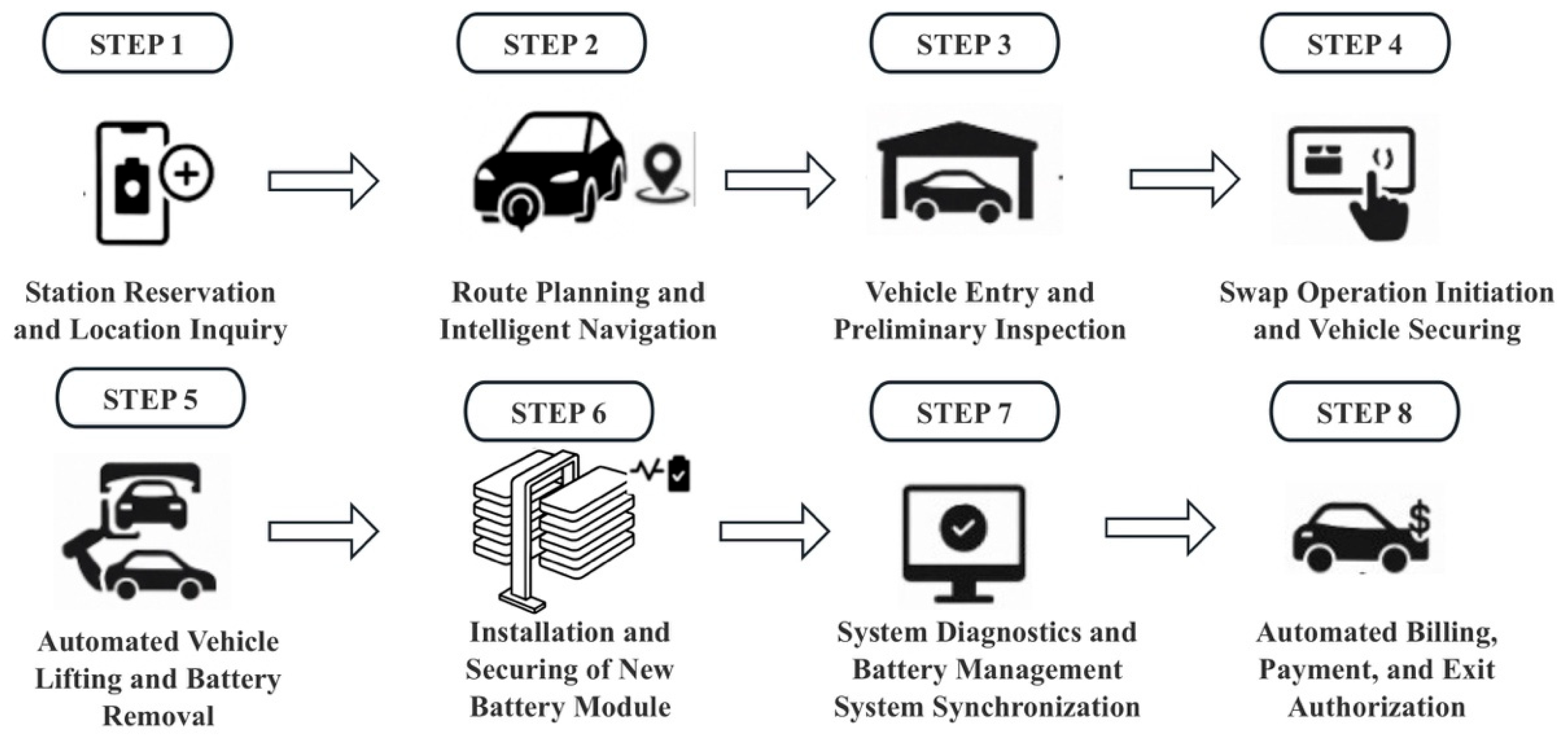
From an STS viewpoint, battery swapping can be conceptualized as an integrated service system composed of interacting technical and social subsystems. The technical subsystem concerns reliability and performance cues such as standardization, automation, and station deployment [17], whereas the social subsystem concerns legitimacy and dependency cues such as platform reputation, regulatory expectations, platform dependence, and environmental identity [18]. Figure 1 presents a typical battery-swapping scenario, covering key stages such as arriving at the station, equipment identification, battery replacement, and system confirmation. Overall, STS highlights that users’ adoption decisions are shaped by the joint influence of these technical and social conditions across the service process.

2.3. Perceived Risk (PR) and Perceived Trust (PT)

In the battery-swapping context, perceived risk (PR) and perceived trust (PT) represent two central psychological mechanisms shaping users’ decisions under uncertainty. Beyond purely rational evaluation, these perceptions capture users’ sense of psychological security and confidence in an emerging platform-based service where experience and information may be limited [19].
Perceived risk refers to users’ subjective expectation that adopting battery swapping may lead to unfavorable outcomes. In BST services, risk perceptions commonly relate to battery safety, equipment compatibility, process transparency, potential service failures, and uncertainty regarding data handling [20]. Such concerns may be amplified in real use situations by issues such as delayed station response, equipment malfunction, and insufficient information disclosure, thereby weakening users’ willingness to adopt the service.
Perceived trust reflects users’ positive expectation that the battery-swapping platform will deliver reliable services, assure battery quality, and safeguard user interests despite information asymmetry and limited user control. Trust is typically reinforced by credible quality assurance—such as robust testing protocols and certified battery sources—together with adequate station coverage and responsive user support.
Prior studies suggest a reciprocal relationship between PR and PT: higher perceived risk tends to erode trust and suppress adoption intention, whereas stronger trust can attenuate risk-related discomfort and increase acceptance of the technology [21].
Therefore, promoting battery swapping requires addressing both risk salience and trust formation. Platforms should proactively identify and mitigate core perceived risks while strengthening trust through technical measures, including standardization and diagnostics, and through complementary organizational mechanisms, including communication, information disclosure, and service experience optimization [22].

3. Research Methodology

3.1. Overview of Research Design

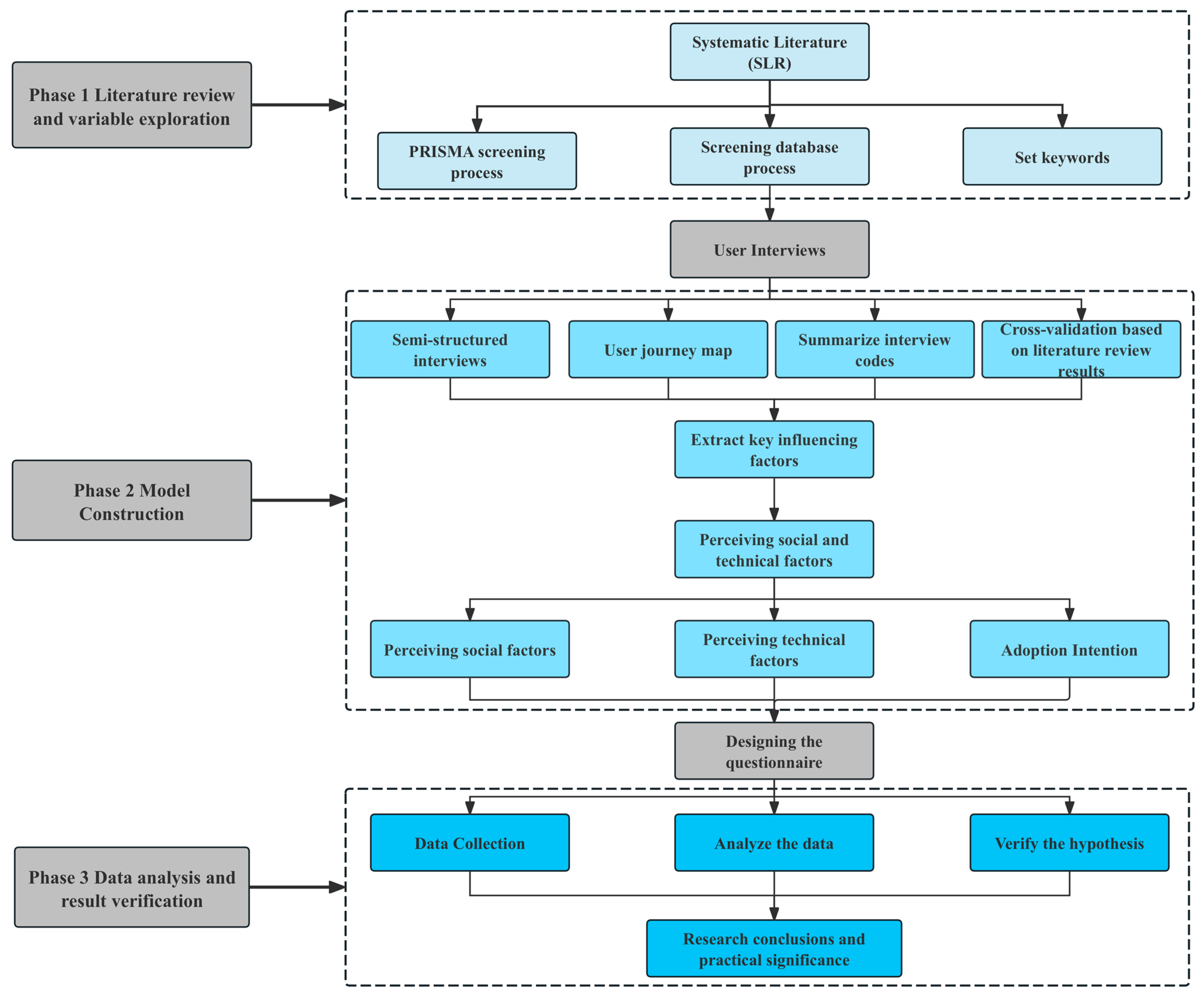
This study employed a three-phase mixed-methods design to develop and test a user adoption model for NEV battery-swapping services under a socio-technical systems (STS) lens. The study proceeded sequentially through a systematic literature review to identify candidate adoption factors, qualitative triangulation (semi-structured interviews and user journey mapping) to refine constructs and specify the conceptual model, and a survey-based empirical test to validate the hypothesized relationships (Figure 2). In Phase 1, evidence was synthesized following a PRISMA-guided review to generate an initial pool of constructs. In Phase 2, interview insights and journey touchpoints were used to contextualize and consolidate constructs into social and technical dimensions. In Phase 3, a structured questionnaire was administered and the model was statistically evaluated to verify hypotheses and derive empirical implications.

3.2. Phase 1: Literature Review and Variable Exploration

In Phase 1, we conducted a systematic literature review (SLR) to synthesize existing evidence on battery-swapping technologies and user adoption. Following the PRISMA protocol, we specified search keywords, retrieved and screened records, and analyzed eligible studies to identify high-frequency themes and candidate variables. This process produced a preliminary framework of influencing factors, including candidate constructs and associated keywords, which informed subsequent stages of model development.

3.2.1. Systematic Literature Review (SLR)

A systematic literature review (SLR) was conducted to establish the theoretical basis of the study variables and to synthesize prior evidence on battery-swapping adoption. SLR is valued for its procedural rigor and replicability, particularly in emerging domains where conceptual structures remain under development [23]. Following the four-phase PRISMA process—identification, screening, eligibility assessment, and inclusion—we searched Web of Science, Scopus, and Google Scholar for English-language studies published between 2015 and 2025.
The search strategy combined terms related to battery swapping with adoption-related and socio-technical keywords. Battery-swapping terms included “battery swapping”, “battery swap”, and “battery swap station”, while adoption-related and socio-technical terms captured both behavioral and psychological themes, such as “adoption”, “acceptance”, “intention”, “trust”, “risk”, “service efficiency”, “accessibility”, “social influence”, “platform lock-in”, and “environmental orientation”. Studies were retained if they explicitly addressed battery swapping (or battery-swapping services) and examined user-centered adoption-related constructs or variables relevant to users’ decision-making.
During the screening stage, duplicate records were removed, and irrelevant or methodologically insufficient items were excluded, including abstract-only entries, patents, and studies from unrelated fields. During the eligibility assessment stage, we further excluded studies that lacked a user-centered perspective, did not clearly specify adoption-related variables, or were only marginally related to battery swapping. The final literature corpus comprised core studies meeting all inclusion criteria and was retained for subsequent in-depth analysis.
For analysis, we employed content analysis with thematic coding (open coding, axial coding, and selective coding) to extract recurring adoption dimensions and to identify high-frequency and representative topics. The SLR output was an initial pool of candidate constructs and associated conceptual cues, which provided a traceable basis for subsequent qualitative refinement and instrument development.

3.2.2. Expert Interviews

To complement the systematic literature review (SLR) and improve the contextual relevance of the candidate variables, semi-structured expert interviews were conducted. The interviews were used to validate adoption-related factors in real battery-swapping settings and to refine construct definitions for subsequent questionnaire operationalization.
A total of 11 experts and practitioners from the NEV sector participated in the interviews, covering battery-swapping technology, intelligent transportation, platform ecosystems, user behavior, and technology adoption. Participants were selected based on direct experience with battery-swapping services and professional expertise relevant to EV battery swapping and platform-based operations. All participants had 5–15 years of relevant professional experience, and their background information is summarized in Table 1.
The interview protocol (Appendix A) included 12 questions organized into three modules: (1) Adoption and Selection Factors (Q1–Q4), focusing on adoption drivers, key concerns and perceived risks, platform compatibility and lock-in, and social influence; (2) User Experience and Trust Building (Q5–Q9), addressing trust-related cues, service efficiency and waiting experience, battery safety concerns, and technical failures or equipment malfunctions; and (3) Environmental Value and Future Development (Q10–Q12), exploring sustainability values in platform choice and views on technological evolution and policy support. Open-ended follow-up prompts were used to capture additional contextual factors and clarifications.
Interviews were conducted either face-to-face or via online video conferencing. With informed consent, all interviews were audio-recorded and transcribed verbatim for subsequent coding and analysis. The interview themes were later compared with SLR-derived themes to support triangulation and variable refinement.

3.2.3. User Journey Mapping

User journey mapping was used to visualize how EV users interact with the battery-swapping service across the full service process. As an established service-analysis tool, journey mapping helps structure users’ behaviors, pain points, and expectations across different stages of the experience [24]. In this study, the journey map was organized into three stages—before swapping, during swapping, and after swapping—to capture key service touchpoints and user evaluations.
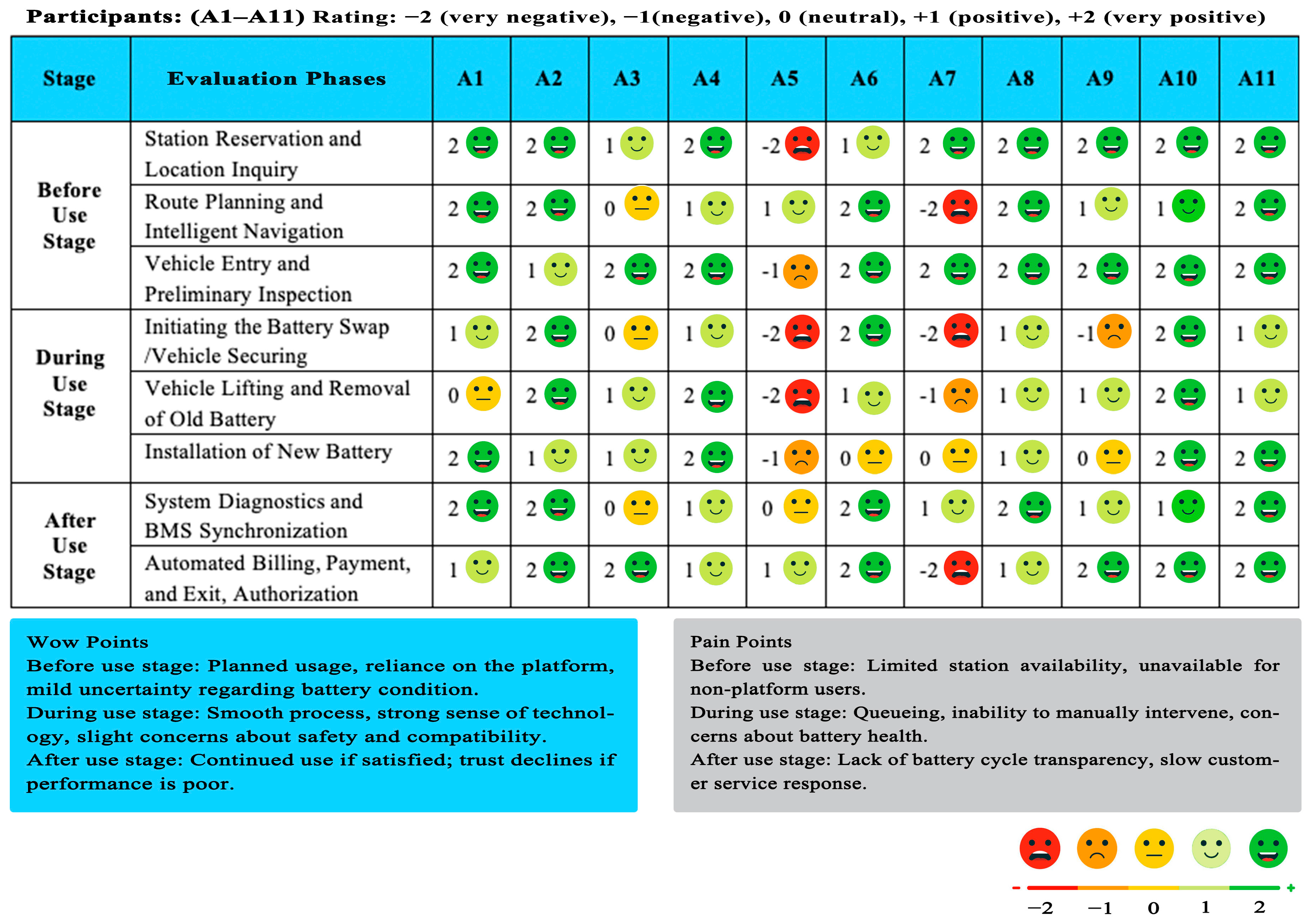
For this purpose, we recruited 11 end users with battery-swapping usage experience in the Beijing–Tianjin–Hebei region, primarily primary battery-swapping user drivers, including operational taxi drivers. The participants in this user-journey exercise are coded as A1–A11. These users were able to provide detailed feedback based on repeated use in real-world driving and operating contexts. Their reflections were used to identify key “pain points” and “pleasure points” during the swapping process (Figure 3).
To quantify participants’ evaluations of each stage of the battery-swapping service journey, this study adopted a structured rating scale ranging from −2 to +2, where +2 indicates a very positive experience, +1 a positive experience, 0 a neutral evaluation, −1 a negative experience, and −2 a very negative experience. This scoring scheme enabled us to visualize positive touchpoints and pain points across the battery-swapping process and provided a comparative basis for assessing how battery-swapping services shape user experience (Figure 3).
This study draws on users’ real battery-swapping experiences in the Beijing–Tianjin–Hebei region. To enhance contextual grounding, we conducted a brief on-site observation at a NIO swapping station during a non-peak period (Figure 4). The observation was used solely to corroborate the plausibility of key touchpoints and service sequence reflected in the journey map, and to provide supplementary context for subsequent qualitative analysis and questionnaire contextualization.

3.3. Phase 2: Model Construction

Phase 2 integrates the qualitative outputs from Phase 1 to construct the study’s core variable framework for battery-swapping adoption. Evidence was synthesized from the systematic literature review, expert interviews, and user journey mapping, and the convergent patterns across these sources were used to retain constructs that are theoretically grounded and consistent with real-world service experiences. This integrated framework then provided the basis for the subsequent quantitative model.

3.3.1. Findings from the Systematic Literature Review

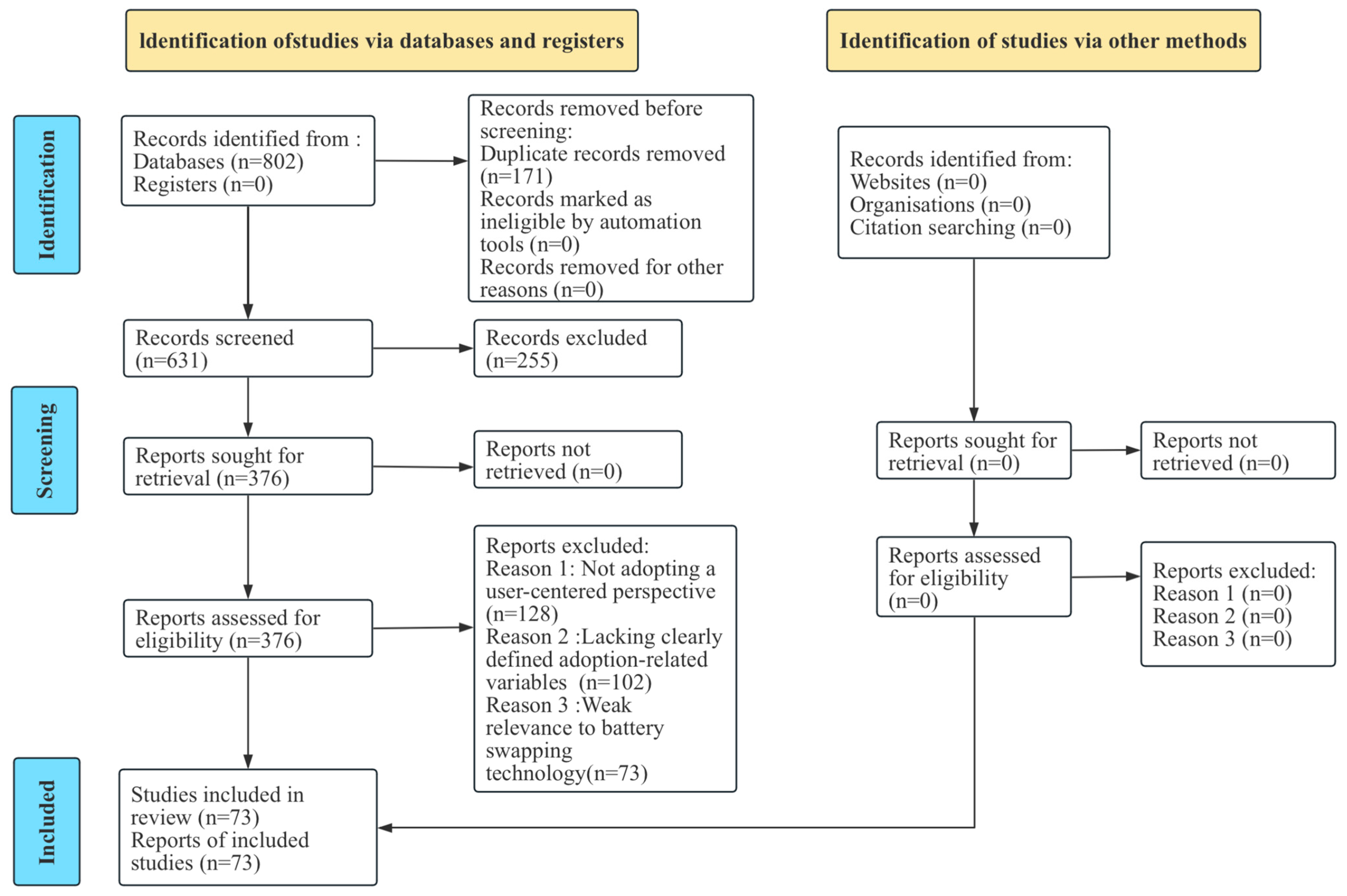
Following PRISMA-based screening, 376 records were retained after removing duplicates and excluding patents, conference abstracts without full texts, and studies unrelated to battery swapping or user adoption. Full-text screening further excluded studies that did not examine adoption/acceptance outcomes, did not operationalize adoption-related constructs, or were only marginally related to battery-swapping services. In total, 73 core studies met the inclusion criteria and were used for keyword analysis and variable identification [25] (Figure 5).
The research team reviewed each selected literature in detail, and identified the recurring semantic patterns through open coding and thematic analysis, so as to comprehensively summarize the key research dimensions. The analysis results show a set of frequently mentioned keywords: “time efficiency” (23 studies), “battery-swapping convenience” (35 studies), “battery safety” (29 studies), “platform lock-in” (36 studies), “green environmental concern” (47 studies) and “Social Influence” (58 studies). Although the specific expressions in each study are slightly different, the conceptual dimensions behind them are highly consistent. Through semantic integration and structured classification, these themes are refined into six representative factors: green environmental concern, social influence, platform lock-in, battery safety, time efficiency and battery-swapping convenience (Table 2). These six dimensions constitute the theoretical basis for concept development and provide support for subsequent scale design and empirical model construction.

3.3.2. Expert Interview Insights and Thematic Refinement

All interviews were conducted with participants’ informed consent and were audio-recorded and transcribed verbatim, yielding approximately 42,000 words of text. The research team segmented the transcripts into 72 meaning units and performed open coding in NVivo 12, generating 46 initial codes that were subsequently consolidated into six thematic categories—green environmental concern, platform lock-in, social influence, battery safety, time efficiency, and swapping convenience; this thematic structure was consistent with the variables identified in the literature review (Figure 6).
To ensure analytical rigor and objectivity, a double-coding procedure was applied: two researchers independently assigned the 72 meaning units to the six pre-defined thematic categories, with an observed agreement of 0.875 and an expected agreement of 0.171, yielding a Cohen’s Kappa of 0.849 (SE = 0.055, 95% CI = [0.741, 0.957]). This indicates near-perfect inter-coder reliability and supports the stability of the thematic structure [26]. In addition, thematic saturation was assessed during the coding process. As the analysis progressed, the later interviews did not yield substantively new first-order codes, and the coding increasingly converged on the existing thematic categories, suggesting that thematic saturation had been largely achieved. To enhance transparency, Appendix B documents the systematic progression from raw interview excerpts to the final research dimensions, providing a traceable chain of evidence linking meaning units, condensed meanings, codes, and thematic categories; the overall coding process is visually summarized in Figure 6.
Experts identified several critical factors influencing users’ adoption of battery-swapping services, and these factors are synthesized with the SLR results in Table 3. A recurring theme was platform lock-in coupled with compatibility constraints: in the absence of unified technical standards and interoperable data protocols, users may face friction when switching between platforms, which reinforces path dependency. Safety-related concerns and service responsiveness were also highlighted as major sources of sensitivity, particularly under high-temperature conditions, frequent swapping, or long-distance driving [27]; experts emphasized that transparent safety inspection and timely feedback mechanisms are important for trust building. In addition, time efficiency and swapping convenience were repeatedly described as decisive determinants of continued use, with waiting time, slow response, and remote station locations acting as key pain points [28]. Finally, experts noted that social influence and environmental value cues—including recommendations, online discussions, and green certification—can shape users’ initial trial decisions, especially among younger users [29].
Collectively, these insights validate the proposed construct dimensions and directly informed the refinement of construct definitions and questionnaire items (Appendix C).

3.3.3. User Journey Map Findings

The user journey map (Figure 3) visually presents the evaluation experience of battery-swapping users (A1–A11) in the three stages of the battery-swapping process—before use, during use and after use. Generally speaking, user feedback is mainly positive, but key pain points have been identified at all stages, providing direct and real-experience-based evidence for the construction of subsequent measurement indicators.
In the Before Use Stage, users generally have a positive attitude towards the reservation battery swapping and route planning functions, reflecting the trust in the planning and navigation capabilities of the platform. However, limited battery-swapping convenience and platform exclusivity are the main concerns, highlighting that the “Swapping Convenience” and “Platform Lock-in” variables began to affect user experience at an early stage.
In the During Use Stage, most users think that the battery-swapping process is smooth and technical, which constitutes an obvious “Wow Point”. But at the same time, problems such as waiting in line, lack of manual intervention options, and uncertainty about the health of the battery are frequently mentioned. These concerns are highly compatible with the “Time Efficiency” and “Battery Safety” variables, highlighting their impact on immediate satisfaction and perceived risks.
In the After Use Stage, the automated detection and payment process has been widely recognized by users, highlighting the advantages of automated services. However, the lack of transparent disclosure of battery life information and the delay in customer service response have become prominent pain points. These problems weaken the long-term trust of users and point to the important role of information transparency and after-sales support in maintaining continuous adoption intentions.
In summary, the Wow Points and pain points identified in the journey map provide process-level evidence that complements the SLR and interview findings and supports the refinement of constructs and measurement items.

3.4. Phase 3: Quantitative Research Design and Validation

3.4.1. Model Construction and Hypothesis Development

Social Drivers and Hypothesis Justification
Green Environmental Concern reflects the degree to which individuals prioritize carbon emissions, sustainability and air quality improvement in their travel choices. Under the framework of socio-technical systems (STS), social values are one of the important influencing factors of technology adoption [30]. When users think that battery-swapping technology is more environmentally friendly than traditional refueling methods and helps to reduce urban pollution, this positive perception will improve their overall trust in the whole system.
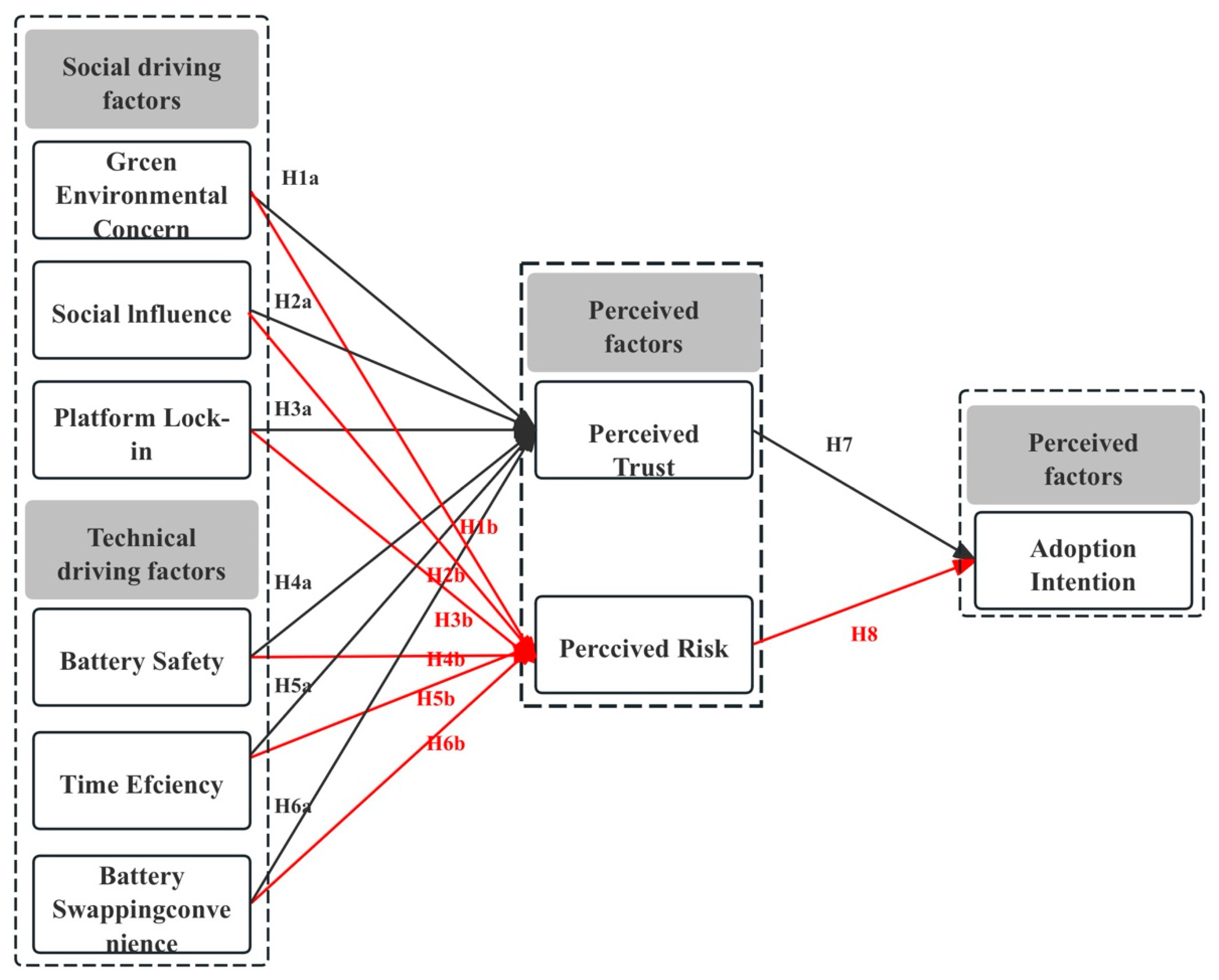
H1a: 
Green environmental concern has a significant positive effect on perceived trust.
Environmental motivation can also reduce perceived risks. Users who believe that battery-swapping technology can help improve air quality may ignore technical failures or service uncertainty to a certain extent. Social psychology research points out that behaviors consistent with individual values will produce a “value-congruent reasoning”, thus weakening their sensitivity to risk [31]. In this study, users driven by environmental motivation are more likely to dilute risk perception, thus showing a lower level of perceived risk.
H1b: 
Green environmental concern has a significant negative effect on perceived risk.
Social Influence refers to the extent to which users’ decision-making is influenced by peers, colleagues or experts. According to UTAUT and social cognitive theory, trust in emerging technologies often comes from the behavior of reference groups [32]. For example, the frequent use of other taxi drivers, or the endorsement of experts on social media, can improve users’ subjective feelings about the credibility and reliability of the platform.
H2a: 
Social influence has a significant positive effect on perceived trust.
In addition to trust, social influence also helps to reduce perceived risks. When users observe widespread adoption among their peers, they may experience greater reassurance through social proof, which reduces concerns about safety or technical failure [33]. As a social signal, recommendations from reliable sources can enhance familiarity and reduce uncertainty. In the context of platform services, when most users feedback that “there is no problem”, individuals tend to regard the relevant risks as low or controllable.
H2b: 
Social influence has a significant negative effect on perceived risk.
Platform lock-in refers to users’ dependence on a specific platform arising from its technical standards, device compatibility, pricing schemes, or subsidy policies, thereby generating high switching costs [34]. From a socio-technical systems (STS) perspective, this institutional path dependence illustrates how platform infrastructure and institutional arrangements constrain users’ technology choices [35]. As users continue to use the same battery-swapping platform, increased familiarity with the procedures and greater service predictability help reduce uncertainty and cognitive burden, thereby strengthening perceptions of platform reliability and fostering trust formation [36], In the battery-swapping context, once users become accustomed to a platform’s operating system, network coverage, and subsidy mechanisms, such structural stability reinforces perceived system reliability and is further translated into perceived trust.
H3a: 
Platform lock-in has a significant positive effect on perceived trust.
Although platform locking limits users’ cross-platform choices, it also improves the level of standardization, centralized maintenance ability and service predictability [37]. For many users, especially high-frequency users, this consistency helps to reduce their uncertainty about price, equipment compatibility and service reliability. In this sense, platform locking can alleviate perceived risks by providing a stable and unified user experience.
H3b: 
Platform lock-in has a significant negative effect on perceived risk.
Technical Drivers and Hypothesis Justification
Battery Safety is one of the key determinants of the success of the battery-swapping model, because the reliability of the battery will directly affect vehicle performance and user safety [38]. Under the framework of socio-technical systems (STS), technical reliability is the foundation of trust formation. When users believe that the platform can provide strictly tested and durable batteries, they tend to trust its technical capabilities and service guarantee more [39]. In high-frequency use situations such as taxis, the transparent disclosure of security data further enhances user trust by showing the system’s commitment to user protection.
H4a: 
Perceived battery safety has a significant positive effect on perceived trust.
In addition to trust, battery safety will also significantly affect perceived risks. If users believe that the safety management of the battery is in place and the whole life cycle of the battery is guaranteed, their risk perception will be substantially reduced [40]. On the contrary, insufficient safety standards or non-transparent information (such as health status, remaining life, etc.) will exacerbate users’ vulnerability and increase their psychological burden and perceived risks.
H4b: 
Perceived battery safety has a significant negative effect on perceived risk.
Time Efficiency refers to the perceived speed and reliability of the swapping process. According to innovation diffusion theory, technologies that save time and enhance efficiency are more readily adopted. In the situation of battery swapping, the fast transaction process and stable operation performance—especially during peak hours—will enhance users’ trust in the platform’s operational capabilities [41].
H5a: 
Time efficiency has a significant positive effect on perceived trust.
Time efficiency also helps to reduce perceived risks. If users believe that the platform can respond quickly to demand and minimize delays—especially during rush hours—they will not expect service failure or technical failure [42].
H5b: 
Time efficiency has a significant negative effect on perceived risk.
Battery-Swapping Convenience depicts the ease of users to obtain and complete the replacement process, including site accessibility, intuitive device design and platform response speed [43]. When the platform has a wide range of site coverage and provides a friendly system, users are more likely to trust its technology and service capabilities.
H6a: 
Perceived Battery-Swapping Convenience has a significant positive effect on perceived trust.
On the contrary, when power stations are scarce, equipment is difficult to operate or on-site assistance is limited, users’ risk perception will increase. The inconvenience in the process of service provision will cause users to worry about technical failure, service delay or insufficient support [44]. Existing research confirms that users’ acceptance of emerging technologies is highly related to their perceived convenience and accessibility.
H6b: 
Perceived Battery-Swapping Convenience has a significant negative effect on perceived risk.
Trust and Risk as Direct Predictors of Adoption Intention
In the battery-swapping context, perceived trust comes from a variety of factors—including battery safety, time efficiency, convenience, and social endorsement and consistency with environmental values. When users believe that a platform is technically reliable, easy to use, socially supported and has environmental value, its level of trust will continue to increase [45]. Such trust not only alleviates concerns but also increases confidence in the expected outcome.
H7: 
Perceived trust has a significant positive effect on adopåtion intention.
In contrast, perceived risks stem from many concerns, such as insufficient safety data, insufficient coverage density of power stations or slow response speed [18], and institutional problems such as subsidy “traps”. High risk perception often weakens users’ trust, undermines their positive attitude, and ultimately inhibits the intention to adopt. In the field of emerging energy, perceived risk is still one of the key obstacles to the wide application of technology [46].
H8: 
Perceived risk has a significant negative effect on adoption intention.
This section puts forward the conceptual model and corresponding hypothesis of the research, as shown in Figure 7.

3.4.2. Questionnaire Design

In order to empirically test the theoretical model constructed in the qualitative stage, this study designed a structured questionnaire to collect quantitative data of electric vehicle (EV) users. The questionnaire is compiled based on expert interviews, systematic literature reviews and research results of user journey maps, so as to ensure that it has a solid theoretical foundation and good situational adaptability.
The questionnaire is divided into four main parts. The first part introduces the purpose of the research, emphasizing that participation is completely voluntary, and all answers are only for academic research and will be strictly confidential. The second section collected demographic information such as gender, age, income level, and frequency of EV use to facilitate subsequent group comparisons. The third section included 36 measurement items corresponding to nine latent constructs: Green Environmental Concern (GEC), Social Influence (SI), Platform Lock-in (PL), Battery Safety (BS), Time Efficiency (TE), Battery-Swapping Convenience (BSC), Perceived Trust (PT), Perceived Risk (PR), and Adoption Intention (AI).
Each concept is measured by 4 questions, which are adapted from highly cited SCI literature and appropriately revised according to the battery-swapping situation of new energy vehicles. All items were rated on a 7-point Likert scale (1 = strongly disagree, 7 = strongly agree) to capture user attitudes accurately. To ensure content validity and linguistic clarity, the questionnaire has undergone expert review and multiple rounds of pre-testing before it is officially issued. See Appendix C for the summary of each concept, question and their source of literature.

3.4.3. Data Collection

This study collected data via China’s online survey platform Questionnaire Star (https://www.wjx.cn/) using non-probability convenience sampling. The survey targeted EV users with battery-swapping experience in the Beijing–Tianjin–Hebei (BTH) region, where battery-swapping infrastructure and related services are relatively mature, providing an appropriate setting for examining adoption mechanisms in a platform-based swapping service. To ensure that respondents had actual battery-swapping experience, an eligibility screening question was included at the beginning of the questionnaire, asking whether participants had previously used EV battery-swapping services. Only respondents reporting real usage experience were allowed to complete the survey and were retained for final analysis.
The research team distributed the questionnaire link and QR code through WeChat, QQ, and other mainstream social media platforms, and encouraged participants to forward them within their social networks to broaden the sample reach. To increase response rates, participants who completed the questionnaire were offered a small incentive (e.g., a RMB 9.9/8.8 WeChat red envelope or a personalized thank-you note). Data collection lasted for two weeks in July 2025. A total of 578 responses were received; after excluding 13 invalid submissions (e.g., incomplete or inconsistent responses), 565 valid questionnaires were retained for subsequent structural equation modeling (SEM) analysis.

4. Model Validation and Data Analysis

4.1. Demographic Characteristics of the Sample

As shown in Table 4, this study collected a total of 565 valid questionnaires. Table 4 summarizes the demographic profile of respondents across gender, age, education, income, usage purpose, and swapping frequency. Most respondents reported using EVs for commercial operation or commuting, and the frequency of battery-swapping service use varied across participants. Overall, respondents were primarily from urban areas, with representation from first-tier cities to rural locations.

4.2. Measurement Model Analysis

All variables were collected via the same questionnaire, so common method variance (CMV) was tested first. Harman’s one-factor test was conducted using IBM SPSS Statistics 27.0 on all items. Nine factors were extracted, with the first factor explaining 24.34% of variance, well below 50%. Thus, no significant CMV issue exists [47].
The Variance Inflation Factor (VIF) was examined as a diagnostic to assess potential common method bias (CMB) and multicollinearity. A VIF value below 3.0 indicates acceptable levels of multicollinearity. All VIF values ranged from 1.728 to 2.015, well below the threshold, indicating that multicollinearity is unlikely to bias the estimates [48].
The overall model fit was assessed using the standardized root mean square residual (SRMR) and the normed fit index (NFI), as presented in Table 5. The SRMR value (0.060) met the recommended threshold (<0.08), indicating acceptable residual discrepancy and model fit. The NFI value was 0.848, suggesting a satisfactory comparative fit of the structural model. Collectively, these indices support an adequate model fit [49].
The Cronbach’s alpha (CA), Composite Reliability (CR) and Average Variance Extracted (AVE) were used to evaluate the reliability and validity of the questionnaire, as shown in Table 6. All constructs reported Cronbach’s alpha values above 0.8, demonstrating high internal reliability. The AVE values were also above 0.50, indicating adequate convergent validity. Furthermore, all factor loads were greater than 0.7, which further supports the convergence of the measurement items. These results provide strong evidence that the scales are reliable and effective, and provide a solid basis for further analysis of structural models [50].
As shown in Table 7, the square roots of AVE for all constructs were greater than their inter-construct correlations, indicating satisfactory discriminant validity.
As shown in Table 8, to further validate the discriminant validity of the measurement model, this study adopted the heterotrait–monotrait ratio (HTMT) as a complementary assessment. An HTMT value below 0.85 typically indicates adequate discriminant validity between latent constructs [51].
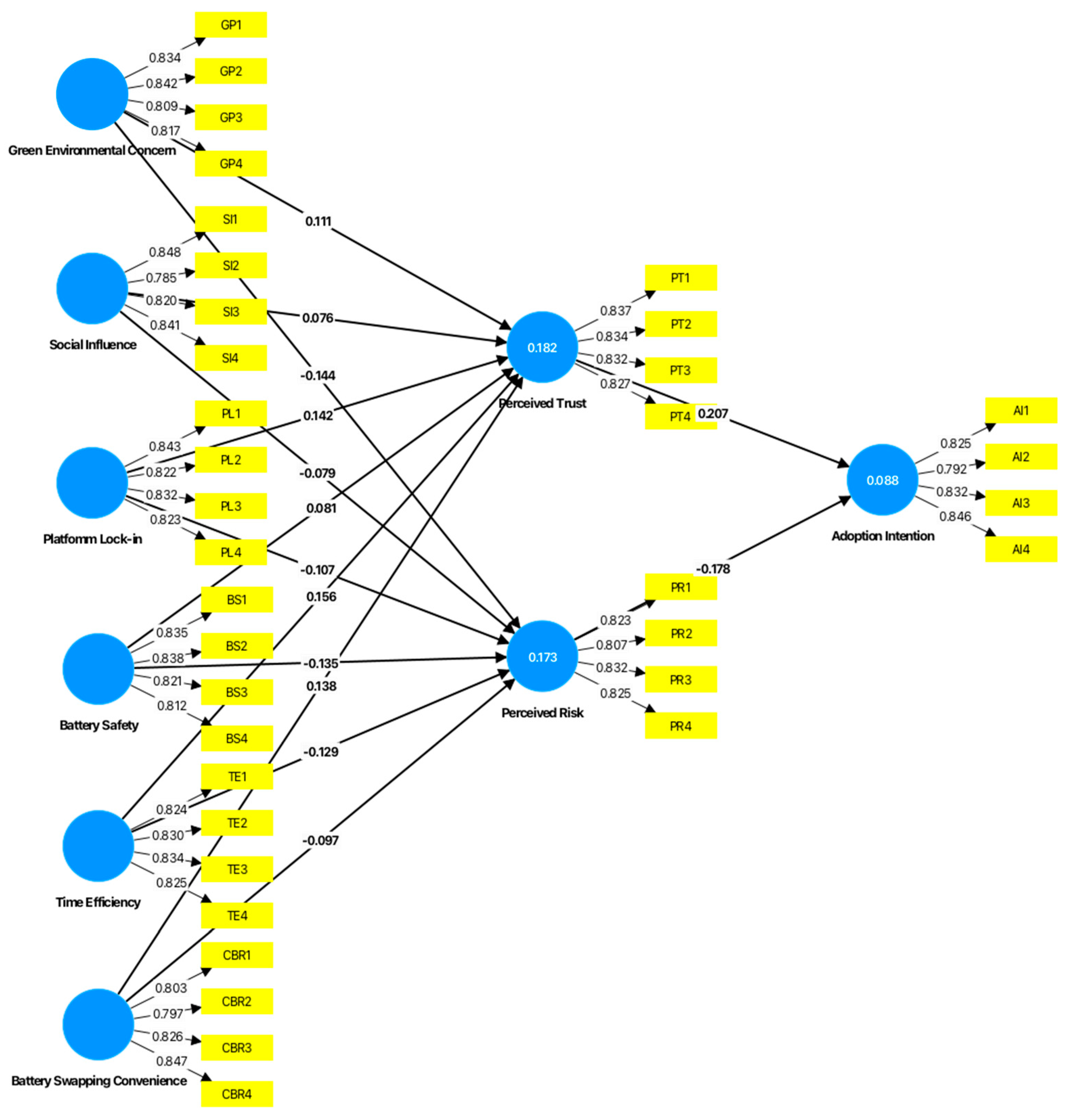
As shown in Table 9, The structural model explains 8.8% of the variance in Adoption Intention (AI), 17.3% in Perceived Risk (PR), and 18.2% in Perceived Trust (PT). Although these values indicate modest explanatory power, they are consistent with research in complex socio-technical contexts where behavioral intention is influenced by a diverse range of contextual and institutional factors beyond the measured constructs [52]. In such multi-factor decision environments, these R2 values should be interpreted as reflecting meaningful incremental explanatory contributions within a complex decision landscape.

4.3. Structural Model and Hypothesis Testing

Based on the sample of 565 respondents, path coefficients were estimated and their significance was assessed via bootstrapping. As shown in Table 10 and Figure 8, all hypothesized relationships were supported at the 0.05 significance level (p < 0.05).
Regarding social drivers, Green Environmental Concern (GEC) mitigated risk perception and fostered trust in the platform, highlighting the role of pro-environmental values in shaping user attitudes. Platform Lock-in (PL) reinforced trust while reducing perceived uncertainty, underscoring the influence of habitual usage and institutional dependence. Social Influence (SI) exerted a modest but steady effect, suggesting indirect contributions from social reference groups.
In terms of technical drivers, Battery Safety (BS) lowered risk perceptions and strengthened confidence in platform reliability, emphasizing the importance of stable battery performance. Time Efficiency (TE) similarly enhanced positive perceptions, illustrating the value of fast service in user cognition. Battery-Swapping Convenience (BSC) further bolstered trust and alleviated uncertainty, confirming the impact of accessible stations and user-friendly processes.
Although the observed f2 values for the paths range from 0.006 to 0.045, indicating small effects, this is consistent with findings in behavioral and socio-technical research, where small but incremental effects are expected in multi-predictor models. As Cohen [53] suggests, small effect sizes (f2 < 0.02) are common in complex socio-technical systems, where many predictors contribute to the outcome jointly rather than in isolation. Additionally, these small effects are meaningful, as they reflect the collective impact of multiple factors, which together shape users’ trust and adoption intention [54].

4.4. Mediation Analysis

To examine whether perceived trust (PT) and perceived risk (PR) transmit the effects of the six antecedents on adoption intention (AI), we estimated the specific indirect effects using bootstrapping with 5000 resamples in SmartPLS. Notably, our hypothesized framework focuses on the mediated mechanism via PT and PR; therefore, this section reports the bootstrapped indirect effects (with confidence intervals and significance) as the primary evidence, rather than classifying mediation as full versus partial based on direct-effect testing.
As shown in Table 11, all hypothesized indirect paths through PT and PR were statistically significant, indicating a consistent parallel mediation pattern. Specifically, both social antecedents (GEC, SI, PL) and technical antecedents (BS, TE, BSC) influenced AI through a trust-enhancing route through PT and a risk-attenuating route through PR. Among the indirect effects, time efficiency showed the strongest mediated effect on AI through PT (β = 0.032, p = 0.001), whereas green environmental concern showed a comparatively stronger mediated effect through PR (β = 0.026, p = 0.004), suggesting that different antecedents may exert their influence through distinct cognitive evaluations. Overall, these results support the STS-based mechanism in which socio-technical conditions shape adoption intention largely through users’ trust and risk evaluations.

4.5. Multi-Group Analysis (MGA)

To further explore the moderating effects of demographic variables on the behavioral mechanisms underlying the adoption of the EV battery-swapping model, this study employed the Multi-Group Analysis (MGA) approach. Path coefficient differences were examined across distinct subgroups based on four demographic dimensions: gender (male vs. female), age (<34 years vs. ≥34 years), income level (<RMB 5000 vs. ≥RMB 5000), and frequency of use (low-frequency vs. high-frequency users). Using the PLS-SEM structural framework, path coefficients were estimated separately for each subgroup, as summarized in Table 12.
Before comparing path coefficients across groups, the measurement invariance of the constructs was established using the three-step Measurement Invariance of Composite Models (MICOM) procedure. As shown in Appendix D, all constructs met the requirements for measurement invariance across the four subgroups, establishing a theoretical basis for subsequent path difference testing.
As shown in Table 13, in the gender-based analysis (male vs. female), SI → PT showed a significant difference (Δβ = 0.153, p < 0.05), indicating a stronger effect for men; men more readily internalize social proof/peer influence into competence-based trust in the platform.
In the age-based analysis (<34 years vs. ≥34 years), no path reached the one-tailed α = 0.05. Some Δβ values showed directionality but did not meet the statistical threshold; thus, we describe them without inference.
For the frequency-based analysis (low- vs. high-frequency users), BSC → PR showed a significant between-group difference (Δβ = 0.202, p < 0.05; High − Low > 0). Because this path is theoretically negative, low-frequency users obtain stronger risk reduction from convenience (more negative coefficient), whereas high-frequency users gain less risk relief from convenience alone, implying greater concern for safety and stability. PR → AI was also significant (Δβ = −0.124, p < 0.05), indicating stronger risk sensitivity among high-frequency users. Accordingly, platforms should tailor retention: improve convenience to reduce uncertainty for low-frequency users, and strengthen risk control and operational stability for high-frequency users.
In the income-based analysis (<RMB 5000 vs. ≥RMB 5000), BS → PT differed significantly (Δβ = +0.151, p < 0.05), indicating that battery-safety cues translate more strongly into platform trust among higher-income users; thus, platforms should emphasize safety assurance and governance transparency. SI → PR was also significant (Δβ = 0.190, p < 0.05), suggesting that authoritative endorsements and peer word-of-mouth reduce uncertainty more effectively for this group and can serve as credible social proof. PR → AI showed a significant difference (Δβ = −0.173, p < 0.05), implying greater risk sensitivity among higher-income users, which underscores the need for clearer service guarantees and risk-control measures. Finally, PL → PR was significant (Δβ = −0.141, p < 0.05), meaning platform lock-in translates into perceived risk differently across income groups; therefore, platforms should strengthen interoperability/compatibility communication and manage expectations about switching costs. Overall, the results show that higher-income users rely more on the “safety → trust” and “social cues → risk reduction” mechanisms, while perceived risk exerts a stronger inhibiting effect.

5. Discussion

5.1. Theoretical Implications

This study advances socio-technical system (STS) scholarship by contextualizing the framework within a digitally platform-enabled EV battery-swapping service—an emerging form of real-time coordinated mobility energy infrastructure. In this setting, adoption reflects users’ engagement with a platform-mediated service system and its governance arrangements rather than a one-off decision toward a single technological artefact. Through a mixed-methods design, the study specifies and operationalizes STS at the user level by identifying six salient antecedents—green environmental concern, social influence, platform lock-in, battery safety, time efficiency, and battery-swapping convenience. More importantly, the findings position perceived trust and perceived risk as the central psycho-cognitive hub that renders STS analytically predictive in adoption research: socio-technical conditions shape behavioral intention primarily through trust- and risk-based evaluations, rather than as additive parallel inputs [55].
The results further contribute by empirically validating a dual-mediation mechanism in which perceived trust and perceived risk jointly transmit the effects of both social and technical drivers. Social cues (green environmental concern, social influence, and platform lock-in) and technical cues (battery safety, time efficiency, and battery-swapping convenience) converge on these two proximal evaluations, supporting a risk–trust integration perspective in technology adoption. Conceptually, trust operates as a heuristic that reduces uncertainty and facilitates acceptance, whereas salient risk cues elevate negative expectations and suppress adoption intention. By showing how specific socio-technical stimuli are translated into trust and risk appraisals, this study deepens understanding of the trust–risk interplay in platform-based mobility services.
In addition, the multi-group analysis (MGA) reveals meaningful heterogeneity in users’ responses to socio-technical cues, indicating boundary conditions for the proposed mechanism. Gender moderates the relationship between social influence and perceived trust, with a stronger effect among male users [56]. Usage frequency also differentiates the mechanism: the negative association between swapping convenience and perceived risk is stronger for low-frequency users, whereas the inhibitory effect of perceived risk on adoption intention is stronger for high-frequency users. Income-based comparisons suggest stronger effects among high-income users on key paths such as battery safety → perceived trust and social influence → perceived risk, implying greater emphasis on safety-related cues and socially endorsed information when forming evaluations. By contrast, age-group comparisons did not yield statistically significant differences. Overall, these findings extend STS adoption research by incorporating user-segmentation insights and demonstrating that platform-based adoption mechanisms are contingent on users’ social positioning and usage context rather than operating uniformly across populations.
Although the empirical sample was drawn from the Beijing–Tianjin–Hebei region where battery swapping is relatively mature, the proposed STS mechanism is conceptually transferable because it explains how socio-technical cues are translated into adoption intention through trust and risk evaluations. However, the salience of specific antecedents may vary across regions with different infrastructure density, platform competition, regulatory arrangements, and user familiarity. For example, in less mature regions, accessibility and institutional assurance cues may become more prominent, whereas in more mature contexts, transparency, service stability, and service recovery may be more decisive for continued use. This implies that the overarching framework may remain stable, but construct operationalization and pathway strengths may require context-sensitive calibration in cross-regional applications.
In conclusion, this study clarifies the social–cognitive foundations of continued adoption in battery-swapping services and offers a more mechanism-based STS explanation for sustainable digital mobility transitions [57]. By identifying trust and risk as critical bridging evaluations between socio–technical service conditions and behavioral intention, the study refines STS-based theorizing in the mobility domain and provides a conceptual basis for future research on platformized energy and transportation services.

5.2. Practical and Policy Implications

This study offers several implications for platform operators, industry stakeholders, and policymakers seeking to enhance user adoption of battery-swapping services.
For platform operators, the findings underscore that technical factors—battery safety, time efficiency, and convenience—serve as foundational drivers of user trust and risk reduction. However, the mere presence of these technical attributes is insufficient; operators must translate them into perceptible evidence that users can verify. This suggests a strategic shift toward “trust-by-design”: embedding trust-building cues throughout the user journey. Prior to swapping, applications should provide visualized queue forecasts, transparent pricing, and station reliability indicators. During the process, real-time progress updates, anomaly alerts, and one-tap customer support can mitigate uncertainty. Post-swapping, detailed battery health summaries, digital receipts, and traceable service recovery workflows address users’ concerns about opaque information and delayed responses—key pain points identified in the user journey mapping. Meanwhile, improving time efficiency through intelligent scheduling and predictive maintenance can help reduce users’ anxiety and risk judgments caused by waiting and uncertainty [58].
From an industry collaboration perspective, automakers and battery suppliers should prioritize life-cycle management systems that publicly disclose verifiable safety data (e.g., health status, cycle count, fault records). Such transparency transforms “safety” from an abstract promise into tangible assurance. Furthermore, promoting unified interface and data standards across platforms can alleviate users’ dependence on single providers and reduce lock-in concerns, thereby facilitating cross-platform trust and system-wide adoption.
At the operational level, station managers should adopt data-driven approaches to enhance efficiency and predictability. Optimizing peak-hour resource allocation, strengthening equipment maintenance, and establishing clear emergency-response mechanisms (e.g., fault notifications, alternative station recommendations) can convert operational stability into directly perceptible trust experiences for users.
For policymakers, the dual mediation of trust and risk suggests that institutional credibility is as important as technological innovation. Establishing standardized safety and interoperability frameworks, introducing third-party auditing mechanisms, and mandating transparent procedures for anomaly reporting can serve as “external trust signals” that complement platform-level efforts [59]. These institutional constraints should be presented front-end in user-friendly formats—such as system status dashboards, outage notices, and compliance badges—to enhance their reassuring function.
Regional maturity also implies practical differentiation of platform strategies. In less mature regions, improving station availability and accessibility and providing stronger institutional assurance cues (e.g., transparent safety certification and clear incident-handling procedures) may be more critical for reducing perceived risk. In more mature contexts, transparency of battery status, service stability, and effective service recovery may play a greater role in sustaining continued use.
Finally, the multi-group analysis reveals that these strategies must account for user heterogeneity. For low-frequency users, lowering entry barriers through onboarding guidance and simplified operations is paramount. For high-frequency users, stability and predictability matter most, as risk perceptions more strongly inhibit their continued adoption. For high-income users, highlighting third-party certifications and professional endorsements along relevant touchpoints can further strengthen trust. Tailoring trust-building mechanisms to these distinct user segments will maximize the effectiveness of both platform strategies and policy interventions.

6. Conclusions and Future Research

6.1. Conclusions

This study draws on and extends socio-technical systems (STS) theory by developing and validating a contextualized framework for understanding the adoption of electric vehicle battery-swapping services. The framework identifies the key social and technological antecedents in a platform-mediated context and clarifies perceived trust and perceived risk as the core yet distinct psychological channels through which these antecedents shape adoption. Importantly, the multi-group analysis demonstrates that user characteristics moderate this process, thereby delineating the boundary conditions and applicability of STS theory in the domain of battery-swapping service platforms.
The multi-group analysis further indicates substantial heterogeneity across demographic segments. Differences by gender, usage frequency, and income imply that adoption is driven by diverse motivations and contextual conditions, challenging one-size-fits-all promotion strategies. These findings support the need for tailored policies and operational practices, and they contribute to the policy discourse on smart transportation safety by providing empirical evidence on how social and technological factors jointly shape trust, risk perceptions, and adoption outcomes.

6.2. Limitations

Although this study provides valuable insights into the underlying mechanisms of users’ adoption of the battery-swapping model for new energy vehicles, the generalizability of the findings may be limited. First, the sample was primarily drawn from the Beijing–Tianjin–Hebei region, where the battery-swapping model is relatively mature. Regional differences in battery/interface standardization, interoperability requirements, regulatory governance, and incident-handling practices may affect the applicability of the model relationships in other contexts. Secondly, this study adopts cross-sectional data, which only captures the attitude and intention of users at a single point in time. This design is difficult to track the dynamic evolution of users’ cognition and behavior at different stages of adoption, technical maturity levels or policy changes. Third, in order to maintain the simplicity and explanatory power of the model, the research focuses on the core concept within the STS framework. However, in real situations, user decision-making may also be significantly affected by situational variables such as pricing strategies, battery property rights models and local subsidy policies.

6.3. Future Research Directions

Based on the identified limitations, several avenues for future research are suggested. First, to address the geographic sampling bias and enhance the generalizability of the findings, future studies should expand the sampling scope beyond the Beijing–Tianjin–Hebei region. Adopting more representative sampling strategies, such as stratified random sampling, would allow researchers to test the robustness of the STS-based model across different city tiers with varying levels of infrastructure maturity and socio-cultural contexts.
Second, longitudinal designs are recommended. Collecting panel or repeated-measures data over multiple time points would enable researchers to examine how trust, perceived risk, and adoption intention evolve from initial exposure and trial to sustained use, and to capture potential changes in the effects of key determinants over time. Third, the model could be extended by incorporating additional moderators or mediators to refine the underlying mechanisms. For instance, pricing schemes and battery-rental options may moderate users’ perceived platform lock-in, and their direct and indirect effects could be examined within the trust–risk framework to build a more comprehensive model. Moreover, future research may draw on technology adoption theories to incorporate mechanism-oriented individual differences—such as user innovativeness and platform price sensitivity—to explain why the strengths of the proposed pathways vary across user groups. Finally, as this study focuses on the Chinese market, future research should conduct cross-cultural and cross-regulatory comparisons to determine how differences in battery standardization and interoperability across global markets influence the proposed adoption mechanisms.

Author Contributions

Conceptualization, M.L. and J.Y.; methodology, Z.G.; software, Z.G.; validation, M.L., J.Y. and Z.G.; formal analysis, M.L.; investigation, Z.G.; resources, Z.G.; data curation, J.Y.; writing—original draft preparation, M.L.; writing—review and editing, M.L.; visualization, M.L.; supervision, J.Y. All authors have read and agreed to the published version of the manuscript.

Funding

This research received no external funding.

Institutional Review Board Statement

All participants provided informed consent before participating in the study. This study did not require ethical approval and complied with the local regulations of the institution’s location (https://www.law.go.kr/LSW//lsLinkCommonInfo.do?lspttninfSeq=75929&chrClsCd=010202, accessed on 1 July 2025). Additionally, the study adhered to the local government requirements of the data collection site. According to Chapter III Ethical Review—Article 32 of the Implementation of Ethical Review Measures for Human-Related Life Science and Medical Research issued by the Chinese government, this study used anonymized information for research purposes, posed no harm to participants, and did not involve sensitive personal information or commercial interests; therefore, it was exempt from ethical review and approval (https://www.gov.cn/zhengce/zhengceku/2023-02/28/content_5743658.htm, accessed on 1 July 2025).

Informed Consent Statement

Informed consent was obtained from all participants involved in the study.

Data Availability Statement

All data generated or analyzed during this study are included in this article. The raw data are available from the corresponding authors upon reasonable request.

Acknowledgments

The authors thank all the participants in this study for their time and willingness to share their experiences and feelings.

Conflicts of Interest

The authors declare no conflicts of interest.

Abbreviations

The following abbreviations are used in this manuscript:
STSSocio-Technical Systems theory
GECGreen Environmental Concern
SISocial Influence
PLPlatform Lock-in
BSBattery Safety
TETime Efficiency
BSCBattery-Swapping Convenience
PTPerceived Trust
PRPerceived Risk
AIAdoption Intention
SEMStructural Equation Modeling
PLS-SEMPartial Least Squares Structural Equation Modeling
MGAMulti-Group Analysis
PRISMAPreferred Reporting Items for Systematic Reviews and Meta-Analyses

Appendix A. Interview Questions

Basic Information
  • Name (optional)
  • Position/Role
  • Years of Work Experience
  • Adoption and Selection Factors
Q1: In your opinion, what are the most critical factors influencing users’ decisions to adopt battery-swapping technology?
Q2: What are your primary concerns or perceived risks when using battery-swapping services?
Q3: Have you ever been limited by platform compatibility issues? How has platform lock-in affected your use of battery-swapping services?
Q4: Have your friends, family, or colleagues ever influenced your decision to use (or not use) battery-swapping technology?
2.
User Experience and Trust Building
Q5: What specific factors contribute to your trust in a battery-swapping platform?
Q6: When using battery-swapping services, which aspects of service efficiency matter most to you?
Q7: Does waiting time during the swapping process influence your intention to continue using the platform?
Q8: Do you have concerns about the safety of the batteries used in swapping services?
Q9: Have you ever encountered technical failures or equipment issues while using battery-swapping services?
3.
Environmental Value and Future Development
Q10: When choosing a battery-swapping platform, do you consider environmental sustainability and low-carbon mobility as one of your decision-making factors?
Q11: What do you think should guide the future development of battery-swapping technology?
Q12: In your opinion, what government policies would most effectively facilitate the widespread adoption of battery-swapping technology?

Appendix B. Some Results of the Qualitative Content Analysis

Meaning UnitsCondensed Meaning UnitsKeywords in LiteratureUnits CodeResearch Dimension Categories
“I tend to choose a battery swap platform that provides environmental certification.”“Users consider environmental certification when selecting a battery swap platform.”Environmental concern, Emissions, Carbon, Recycling, circular Green self-identity, Environmental awarenessEnvironmental awarenessGreen Environmental Concern
“The battery swap station meets the low-carbon emission standards, which is an important criterion in my platform choice.”“The battery swap station meets low carbon emission standards, which is a key factor in selecting a platform.”Low carbon emissionGreen Environmental Concern
“I hope the battery swap technology can help reduce carbon emissions and support sustainable development.”“Battery swap technology should support carbon reduction and sustainable development.”Low carbon emissionGreen Environmental Concern
“Choosing an environmentally certified battery swap platform is a crucial factor when selecting a platform.”“Environmental certification plays a major role in users’ platform choices.”Environmental awarenessGreen Environmental Concern
“The incompatibility between battery swapping platforms prevents me from switching freely between different platforms.”Platform incompatibility affects the freedom of switching.Switching costs, Network effects, Compatibility, Membership, Data lock-inPlatform CompatibilityPlatform Lock-in
“Each platform’s equipment and system are not compatible, which forces me to use a single platform.”The platform’s equipment and system incompatibility restricts user choice.Platform CompatibilityPlatform Lock-in
“The limited coverage of the swap stations restricts me to using specific platforms.”The limited coverage of swap stations intensifies platform lock-in.Platform Choice RestrictionPlatform Lock-in
“If I switch to another platform, I may face more operational issues.”Users may encounter more technical problems and inconveniences when switching platforms.Platform Choice RestrictionPlatform Lock-in
“The technical standards of the platforms vary, making it difficult to select the most suitable platform.”The lack of uniform technical standards across platforms makes selection more difficult.Platform CompatibilityPlatform Lock-in
“All my friends are using this platform, so I decided to try it too.”Social networks influence users’ platform choices.Social norms, Peer effects, Social proof, community, policy signals,
Peer influence
Social InteractionsSocial Influence
“If more people around me use battery swapping platforms, I am more willing to try.”Others’ usage habits influence the user’s decision.Social InteractionsSocial Influence
“There is a lot of discussion on social media about battery swapping technology, which piqued my interest.”Social media and network discussions deepen users’ interest in the technology.Social MediaSocial Influence
“Some friends recommended a platform, and I considered trying it because they said it was good.”Users are influenced by friends’ recommendations when selecting platforms.Friend RecommendationSocial Influence
“I am more concerned about the safety of the battery, especially when using it in high-temperature environments.”Users worry about battery safety, especially in extreme environments.Battery Management System, Battery reliability, Fire risk, Safety inspection, CertificationSafety InspectionBattery Safety
“I hope the platform provides detailed safety inspection reports for the batteries to increase trust.”Users want detailed battery safety inspection reports to ensure device safety.Safety InspectionBattery Safety
“The platform’s safety management and inspection measures give me more confidence in using battery swapping technology.”Safety management measures influence users’ trust and adoption of the platform.Battery ManagementBattery Safety
“The safety and stability of the battery are my biggest concerns during the battery swapping process.”Battery safety and stability are key concerns for users in the swapping process.Battery ManagementBattery Safety
“The waiting time at the swapping station is too long, so I choose other platforms.”Long waiting times affect users’ platform choices.Waiting time, Queuing, Service time, Turnaround, Schedule reliability, Service efficiencyWaiting TimeTime Efficiency
“I hope the swapping process is more efficient to reduce waiting and queuing time.”Users prefer efficient swapping services to reduce unnecessary waiting.Battery Swapping EfficiencyTime Efficiency
“The service efficiency of the swapping platform directly influences my intention to use it.”Service efficiency is closely related to platform selection.Service EfficiencyTime Efficiency
“The quick response of the swapping service makes me more willing to choose this platform again.”Fast response increases user satisfaction and platform choice.Service EfficiencyTime Efficiency
“The location of the battery swap station is inconvenient, I cannot waste time looking for a battery swap station.”“The location’s accessibility directly impacts users’ decisions.”Station availability, Coverage, accessibility, Uptime, process easeBattery swap locationBattery Swapping Convenience
“The battery swap equipment is well prepared, I can quickly complete the swap, it’s very convenient.”“The equipment’s availability and convenience increased users’ satisfaction with the platform.” Availability and convenienceBattery Swapping Convenience
“The simplicity of the battery swap service is the key factor for me in selecting a platform.”“The simplicity and convenience of the service influence users’ choices.” Service simplicityBattery Swapping Convenience
“I hope the battery swap platform can provide nationwide services, reducing waiting time and operational recovery.”“Users want more efficient services with reduced operation recovery time.” Service simplicityBattery Swapping Convenience

Appendix C. Construct Measurement Items and Source References

ConstructDefinitionMeasurement ItemsReference
Green Environmental Concern (GEC)The extent to which users value sustainability and view battery swapping as an eco-friendly choice.I believe adopting the battery-swapping model for new energy vehicles helps reduce transportation-related carbon emissions.[60]
I believe the promotion of battery-swapping technology contributes to improving urban air quality.[61]
From an environmental perspective, battery swapping is more sustainable than traditional fuel-based energy replenishment methods.
For environmental reasons, I prefer using new energy vehicles equipped with battery-swapping capabilities.
Social Influence (SI)The extent to which peers, experts, and word-of-mouth shape users’ battery-swapping adoption decisions.My colleagues encourage me to use the battery-swapping model for new energy vehicles.[62]
My friends generally approve of the battery-swapping model for new energy vehicles.
Industry experts on social media recommend using the battery-swapping model for new energy vehicles.
My family supports my decision to use the battery-swapping model for new energy vehicles.
Platform Lock-in (PL)Users’ perceived dependence on a specific swapping platform and the associated switching costs.I believe the battery-swapping technology provided by my current platform has increased my dependence on the battery-swapping model.[63]
I use my current battery-swapping platform because its service coverage is broader.[64]
The platform’s guidance mechanisms require me to use designated battery-swapping equipment.
The subsidy policies offered by the platform make me more inclined to choose its battery-swapping services.
Battery Safety (BS)Users’ perceived safety, reliability, and risk controllability of swapped batteries and related management.I believe the batteries provided by the platform have undergone thorough safety inspections.[65]
I think the battery-swapping platform effectively manages battery life cycles.[66]
I believe current battery-swapping technology is reliable in terms of battery safety.
The battery safety data disclosed by the platform are transparent and trustworthy.
Time Efficiency (TE)Users’ perceived efficiency of swapping in terms of speed, waiting time, and process stability.I believe the battery-swapping model significantly saves the time required for vehicle energy replenishment.[67]
During holidays or peak charging hours, battery swapping does not disrupt my travel plans.[68]
Compared with traditional charging methods, I find battery swapping faster and more efficient.
The battery-swapping model is highly time-efficient and meets my travel needs.
Battery Swapping Convenience (BSC)Users’ perceived ease of accessing stations and completing the swapping process.I can easily find battery-swapping stations in different areas of the city.[69]
The intelligent design of the battery-swapping equipment makes the process intuitive and easy to operate.[70]
When encountering problems during the swapping process, I can quickly receive assistance.
I think the current battery-swapping technology is convenient and efficient, allowing operations to be completed quickly.
Perceived Trust (PT)Users’ trust in the platform/service’s competence, reliability, and competence and service reliability.I believe the current battery-swapping platform has reliable technical capabilities to safely complete the battery replacement.[71]
I think the decisions made by the battery-swapping platform in battery management and service processes are trustworthy.[72]
I believe the platform can effectively ensure the safety of my vehicle and travels.
Overall, I feel confident in and trust the battery-swapping platform I currently use.
Perceived Risk (PR)Users’ perceived uncertainty and potential negative consequences of using battery swapping.I am concerned that the battery-swapping model may have performance instability during use.[73]
I am worried that the batteries provided by the platform may have quality issues.[74]
I am uncertain whether the swapping service can consistently remain efficient and reliable.
I am concerned that battery-swapping stations may fail to provide timely service during peak periods.
Adoption Intention (AI)Users’ intention to adopt battery-swapping services.I am willing to try using the battery-swapping method.[75]
I intend to continue using the battery-swapping model for new energy vehicles in the future.
I am willing to make battery swapping my primary method of energy replenishment for electric vehicles.
I would recommend the battery-swapping model for new energy vehicles to my friends.

Appendix D. Assessment of Measurement Invariance

GroupConf.Comp. Inv.PMI Est.Equal MeanEqual VarFMI Est.
Usage FrequencyCon.Inv.C = 1CI.Diff.CI.Diff.CI.
AIYes0.9980.994; 1.000Yes−0.027−0.175; 0.171−0.027−0.184; 0.213Yes
BSYes0.9950.997; 1.000Yes0.029−0.183; 0.1650.048−0.171; 0.202Yes
BSCYes0.9930.996; 1.000Yes−0.033−0.189; 0.1760.032−0.181; 0.204Yes
GECYes0.9940.997; 1.000Yes0.044−0.18; 0.177−0.084−0.178; 0.197Yes
PLYes10.997; 1.000Yes−0.082−0.179; 0.173−0.055−0.194; 0.192Yes
PRYes0.9960.998; 1.000Yes−0.015−0.175; 0.1730.021−0.171; 0.195Yes
PTYes0.9990.999; 1.000Yes−0.045−0.173; 0.176−0.027−0.168; 0.171Yes
SIYes0.9950.995; 1.000Yes0.089−0.195; 0.1840.055−0.2; 0.205Yes
TEYes0.9980.998; 1.000Yes0.08−0.183; 0.1730.104−0.17; 0.198Yes
IncomeAIYes10.996; 1.000Yes0.008−0.171; 0.168−0.024−0.185; 0.187Yes
BSYes0.9960.998; 1.000Yes0.106−0.175; 0.175−0.017−0.182; 0.177Yes
BSCYes10.997; 1.000Yes−0.05−0.175; 0.1650.085−0.192; 0.187Yes
GECYes10.998; 1.000Yes−0.098−0.166; 0.1590.001−0.17; 0.169Yes
PLYes0.9990.997Yes0.015−0.176; 0.174−0.007−0.176; 0.18Yes
PRYes0.9990.999; 1.000; 1.000Yes0.008−0.172; 0.171−0.007−0.179; 0.169Yes
PTYes0.9990.999Yes−0.105−0.164;
0.18
0.041−0.164; 0.172Yes
SIYes0.9960.995; 1.000Yes0.119−0.172; 0.172−0.01−0.177; 0.189Yes
TEYes10.998; 1.000Yes−0.057−0.165; 0.1620−0.174; 0.18Yes
GenderAIYes0.9960.996Yes0.013−0.164; 0.1550.092−0.188; 0.171Yes
BSYes0.9980.998Yes0.068−0.165; 0.161−0.008−0.184; 0.164Yes
BSCYes0.9990.997Yes−0.008−0.161; 0.1590.065−0.178; 0.183Yes
GECYes0.9980.998Yes0.089−0.174; 0.151−0.068−0.158; 0.18Yes
PLYes0.9990.997Yes0.081−0.162; 0.172−0.064−0.177; 0.169Yes
PRYes0.9980.999Yes0.039−0.17; 0.160.081−0.171; 0.173Yes
PTYes0.9980.999Yes0.05−0.167; 0.172−0.138−0.176; 0.17Yes
SIYes0.9970.995Yes−0.082−0.155; 0.156−0.005−0.194; 0.184Yes
TEYes10.998Yes−0.049−0.166; 0.163−0.041−0.169; 0.164Yes
AgeAIYes10.995−0.044−0.172; 0.1640.1640.011−0.178; 0.178Yes
BSYes10.9970.055−0.165; 0.1740.1740.045−0.169; 0.183Yes
BSCYes0.9960.997−0.086−0.17; 0.1690.1690.096−0.19; 0.197Yes
GECYes0.9990.998−0.143−0.178; 0.1760.176−0.077−0.179; 0.178Yes
PLYes0.9990.9970.001−0.168; 0.180.18−0.013−0.178; 0.186Yes
PRYes10.9990.067−0.182; 0.1720.1720.104−0.167; 0.179Yes
PTYes10.999−0.069−0.166; 0.1680.168−0.045−0.166; 0.165Yes
SIYes0.9990.9960.124−0.17; 0.1680.168−0.037−0.178; 0.203Yes
TEYes0.9990.998−0.116−0.183; 0.1680.168−0.086−0.185; 0.164Yes

References

  1. Pamidimukkala, A.; Kermanshachi, S.; Rosenberger, J.M.; Hladik, G. Barriers and Motivators to the Adoption of Electric Vehicles: A Global Review. Green. Energy Intell. Transp. 2024, 3, 100153. [Google Scholar] [CrossRef]
  2. Chakraborty, P.; Parker, R.; Hoque, T.; Cruz, J.; Du, L.; Wang, S.; Bhunia, S. Addressing the Range Anxiety of Battery Electric Vehicles with Charging En Route. Sci. Rep. 2022, 12, 5588. [Google Scholar] [CrossRef] [PubMed]
  3. Rainieri, G.; Buizza, C.; Ghilardi, A. The Psychological, Human Factors and Socio-Technical Contribution: A Systematic Review towards Range Anxiety of Battery Electric Vehicles’ Drivers. Transp. Res. Part F Psychol. Behav. 2023, 99, 52–70. [Google Scholar] [CrossRef]
  4. Waseem, M.; Sreeshobha, E.; Shashidhar Reddy, K.; Donateo, T. State-of-the-Art and Advancement of Charging Infrastructure in Electric Mobility: An Integrated Review. Energies 2024, 17, 6137. [Google Scholar] [CrossRef]
  5. Mao, R.; Xu, W.; Qian, Y.; Li, X.; Li, Y.; Li, G.; Zhang, H. Understanding the Determinants of Electric Vehicle Range: A Multi-Dimensional Survey. Sustainability 2025, 17, 4259. [Google Scholar] [CrossRef]
  6. Zhang, F.; Lv, H.; Kuai, C. Integrating User Preferences and Demand Uncertainty in Electric Micro-Mobility Battery-Swapping Station Planning: A Data-Driven Three-Stage Model. Appl. Energy 2025, 389, 125713. [Google Scholar] [CrossRef]
  7. Ajzen, I. The Theory of Planned Behavior. Organ. Behav. Hum. Decis. Process. 1991, 50, 179–211. [Google Scholar] [CrossRef]
  8. Gefen, D.; Karahanna, E.; Straub, D.W. Trust and TAM in Online Shopping: An Integrated Model. MIS Q. 2003, 27, 51–90. [Google Scholar] [CrossRef]
  9. Baxter, G.; Sommerville, I. Socio-Technical Systems: From Design Methods to Systems Engineering. Interact. Comput. 2011, 23, 4–17. [Google Scholar] [CrossRef]
  10. Davis, M.C.; Challenger, R.; Jayewardene, D.N.W.; Clegg, C.W. Advancing Socio-Technical Systems Thinking: A Call for Bravery. Appl. Ergon. 2014, 45, 171–180. [Google Scholar] [CrossRef] [PubMed]
  11. Song, M.; Stević, Ž.; Badi, I.; Marinković, D.; Lv, Y.; Zhong, K. Assessing Public Acceptance of Autonomous Vehicles Using a Novel IRN PIPRECIA-IRN AROMAN Model. Facta Univ. Ser. Mech. Eng. 2025, 23, 127–145. [Google Scholar] [CrossRef]
  12. Hao, H.; Cheng, X.; Liu, Z.; Zhao, F. Electric Vehicles for Greenhouse Gas Reduction in China: A Cost-Effectiveness Analysis. Transp. Res. Part D Transp. Environ. 2017, 56, 68–84. [Google Scholar] [CrossRef]
  13. Bian, H.; Ren, Q.; Guo, Z.; Zhou, C. Optimal Scheduling of Integrated Energy System Considering Electric Vehicle Battery Swapping Station and Multiple Uncertainties. World Electr. Veh. J. 2024, 15, 170. [Google Scholar] [CrossRef]
  14. Kandil, S.M.; Abdelfatah, A.; Azzouz, M.A. Operational and Planning Perspectives on Battery Swapping and Wireless Charging Technologies: A Multidisciplinary Review. IEEE Access 2025, 13, 52775–52806. [Google Scholar] [CrossRef]
  15. Geels, F.W. From Sectoral Systems of Innovation to Socio-Technical Systems: Insights about Dynamics and Change from Sociology and Institutional Theory. Res. Policy 2004, 33, 897–920. [Google Scholar] [CrossRef]
  16. Sovacool, B.K.; Hess, D.J. Ordering Theories: Typologies and Conceptual Frameworks for Sociotechnical Change. Soc. Stud. Sci. 2017, 47, 703–750. [Google Scholar] [CrossRef]
  17. Ahmad, F.; Saad Alam, M.; Saad Alsaidan, I.; Shariff, S.M. Battery Swapping Station for Electric Vehicles: Opportunities and Challenges. IET Smart Grid 2020, 3, 280–286. [Google Scholar] [CrossRef]
  18. Setiawan, A.D.; Zahari, T.N.; Anderson, K.; Moeis, A.O.; Hidayatno, A. Examining the Effectiveness of Policies for Developing Battery Swapping Service Industry. Energy Rep. 2023, 9, 4682–4700. [Google Scholar] [CrossRef]
  19. Wang, J.; Zhao, S.; Zhang, W.; Evans, R. Why People Adopt Smart Transportation Services: An Integrated Model of TAM, Trust and Perceived Risk. Transp. Plan. Technol. 2021, 44, 629–646. [Google Scholar] [CrossRef]
  20. Eccarius, T.; Chen, C.-F. Examining Trust as a Critical Factor for the Adoption of Electric Vehicle Sharing via Necessary Condition Analysis. Technol. Forecast. Soc. Change 2024, 208, 123681. [Google Scholar] [CrossRef]
  21. Zhang, F.; Lv, H.; Sun, N.; Ji, Y. Insights into User Acceptance of Battery Swapping Services for Sustainable Micromobility Using the Unified Theory of Acceptance and Use of Technology 2 Model. Transp. Res. Rec. 2025, 2679, 770–786. [Google Scholar] [CrossRef]
  22. Mesquita, A.R.; de Abreu, V.H.S.; Poyares, C.N.; Santos, A.S. Barriers to Electric Vehicle Adoption: A Framework to Accelerate the Transition to Sustainable Mobility. Sustainability 2025, 17, 8318. [Google Scholar] [CrossRef]
  23. Tranfield, D.; Denyer, D.; Smart, P. Towards a Methodology for Developing Evidence-Informed Management Knowledge by Means of Systematic Review. Br. J. Manag. 2003, 14, 207–222. [Google Scholar] [CrossRef]
  24. Rosenbaum, M.S.; Otalora, M.L.; Ramírez, G.C. How to Create a Realistic Customer Journey Map. Bus. Horiz. 2017, 60, 143–150. [Google Scholar] [CrossRef]
  25. Page, M.J.; McKenzie, J.E.; Bossuyt, P.M.; Boutron, I.; Hoffmann, T.C.; Mulrow, C.D.; Shamseer, L.; Tetzlaff, J.M.; Akl, E.A.; Brennan, S.E.; et al. The PRISMA 2020 statement: An updated guideline for reporting systematic reviews. BMJ 2021, 372, n71. [Google Scholar] [CrossRef] [PubMed]
  26. Landis, J.R.; Koch, G.G. The Measurement of Observer Agreement for Categorical Data. Biometrics 1977, 33, 159–174. [Google Scholar] [CrossRef]
  27. Zhang, W.; Wang, S.; Wan, L.; Zhang, Z.; Zhao, D. Information Perspective for Understanding Consumers’ Perceptions of Electric Vehicles and Adoption Intentions. Transp. Res. Part D Transp. Environ. 2022, 102, 103157. [Google Scholar] [CrossRef]
  28. Chung, H.-M.; Li, W.-T.; Yuen, C.; Wen, C.-K.; Crespi, N. Electric Vehicle Charge Scheduling Mechanism to Maximize Cost Efficiency and User Convenience. IEEE Trans. Smart Grid 2019, 10, 3020–3030. [Google Scholar] [CrossRef]
  29. Lazaric, N.; Le Guel, F.; Belin, J.; Oltra, V.; Lavaud, S.; Douai, A. Determinants of Sustainable Consumption in France: The Importance of Social Influence and Environmental Values. J. Evol. Econ. 2020, 30, 1337–1366. [Google Scholar] [CrossRef]
  30. Sovacool, B.K.; Brugger, H.; Brunzema, I.; Dańkowska, A.; Wemyss, D.; Vernay, A.-L.; Betz, R.; Avelino, F.; de Geus, T.; Dembek, A.; et al. Social innovation supports inclusive and accelerated energy transitions with appropriate governance. Commun. Earth Environ. 2023, 4, 289. [Google Scholar] [CrossRef]
  31. Chen, Y.-S.; Chang, C.-H. Greenwash and Green Trust: The Mediation Effects of Green Consumer Confusion and Green Perceived Risk. J. Bus. Ethics 2013, 114, 489–500. [Google Scholar] [CrossRef]
  32. Venkatesh, V.; Morris, M.G.; Davis, G.B.; Davis, F.D. User Acceptance of Information Technology: Toward a Unified View. MIS Q. 2003, 27, 425–478. [Google Scholar] [CrossRef]
  33. Zhang, H.; Wei, Y.; Chen, Y.; Cai, Y. The influence of anthropomorphism, interactivity, perceived green value, and social influence on pedestrian acceptance of fully autonomous vehicles: The mediating effect of perceived risk and perceived safety. Traffic Inj. Prev. 2025, 1–9. [Google Scholar] [CrossRef]
  34. Opara-Martins, J.; Sahandi, R.; Tian, F. Critical Analysis of Vendor Lock-in and Its Impact on Cloud Computing Migration: A Business Perspective. J. Cloud Comput. 2016, 5, 4. [Google Scholar] [CrossRef]
  35. Sony, M.; Naik, S. Industry 4.0 Integration with Socio-Technical Systems Theory: A Systematic Review and Proposed Theoretical Model. Technol. Soc. 2020, 61, 101248. [Google Scholar] [CrossRef]
  36. March, J.G. Continuity and Change in Theories of Organizational Action. Adm. Sci. Q. 1996, 41, 278–287. [Google Scholar] [CrossRef]
  37. Geels, F.W.; McMeekin, A.; Pfluger, B. Socio-Technical Scenarios as a Methodological Tool to Explore Social and Political Feasibility in Low-Carbon Transitions: Bridging Computer Models and the Multi-Level Perspective in UK Electricity Generation (2010–2050). Technol. Forecast. Soc. Change 2020, 151, 119258. [Google Scholar] [CrossRef]
  38. ELJarray, O.; Dai, H.; Chen, Z.; Raja, S.V.; Li, B.; Cao, S.; Sun, S.; Zhang, G. Ensuring battery safety in electric vehicles: Challenges, developments, and future perspectives. Small 2025, 22, 2503406. [Google Scholar] [CrossRef] [PubMed]
  39. Comanescu, C. Ensuring Safety and Reliability: An Overview of Lithium-Ion Battery Service Assessment. Batteries 2025, 11, 6. [Google Scholar] [CrossRef]
  40. Kenesei, Z.; Ásványi, K.; Kökény, L.; Jászberényi, M.; Miskolczi, M.; Gyulavári, T.; Syahrivar, J. Trust and Perceived Risk: How Different Manifestations Affect the Adoption of Autonomous Vehicles. Transp. Res. Part A Policy Pract. 2022, 164, 379–393. [Google Scholar] [CrossRef]
  41. Zhang, X.; Cao, Y.; Peng, L.; Ahmad, N.; Xu, L. Towards Efficient Battery Swapping Service Operation under Battery Heterogeneity. IEEE Trans. Veh. Technol. 2020, 69, 6107–6118. [Google Scholar] [CrossRef]
  42. Shen, C.-C.; Chiou, J.-S. The Impact of Perceived Ease of Use on Internet Service Adoption: The Moderating Effects of Temporal Distance and Perceived Risk. Comput. Hum. Behav. 2010, 26, 42–50. [Google Scholar] [CrossRef]
  43. Chen, Z.; Xia, S.; Shao, Z.; Gu, Z.; Wu, Z.; Wu, L.; Wang, X. Charging or Swapping? A Study on the Private Consumers’ Acceptance of the Electricity Replenishment Mode of New Energy Vehicles. Transp. Res. Part F Psychol. Behav. 2024, 107, 903–923. [Google Scholar] [CrossRef]
  44. Dutta, B.; Hwang, H.-G. Consumers Purchase Intentions of Green Electric Vehicles: The Influence of Consumers Technological and Environmental Considerations. Sustainability 2021, 13, 12025. [Google Scholar] [CrossRef]
  45. Wu, H. A Survey of Battery Swapping Stations for Electric Vehicles: Operation Modes and Decision Scenarios. IEEE Trans. Intell. Transp. Syst. 2022, 23, 10163–10185. [Google Scholar] [CrossRef]
  46. Li, C.; Li, Y. Factors Influencing Public Risk Perception of Emerging Technologies: A Meta-Analysis. Sustainability 2023, 15, 3939. [Google Scholar] [CrossRef]
  47. Podsakoff, P.M.; MacKenzie, S.B.; Lee, J.-Y.; Podsakoff, N.P. Common Method Biases in Behavioral Research: A Critical Review of the Literature and Recommended Remedies. J. Appl. Psychol. 2003, 88, 879–903. [Google Scholar] [CrossRef]
  48. Kim, J.H. Multicollinearity and Misleading Statistical Results. Korean J. Anesthesiol. 2019, 72, 558–569. [Google Scholar] [CrossRef] [PubMed]
  49. Hu, L.; Bentler, P.M. Cutoff Criteria for Fit Indexes in Covariance Structure Analysis: Conventional Criteria versus New Alternatives. Struct. Equ. Model. Multidiscip. J. 1999, 6, 1–55. [Google Scholar] [CrossRef]
  50. Fornell, C.; Larcker, D.F. Evaluating Structural Equation Models with Unobservable Variables and Measurement Error. J. Mark. Res. 1981, 18, 39–50. [Google Scholar] [CrossRef]
  51. Henseler, J.; Ringle, C.M.; Sarstedt, M. A New Criterion for Assessing Discriminant Validity in Variance-Based Structural Equation Modeling. J. Acad. Mark. Sci. 2015, 43, 115–135. [Google Scholar] [CrossRef]
  52. Hair, J.F.; Risher, J.J.; Sarstedt, M.; Ringle, C.M. When to Use and How to Report the Results of PLS-SEM. Eur. Bus. Rev. 2019, 31, 2–24. [Google Scholar] [CrossRef]
  53. Cohen, J. Statistical Power Analysis for the Behavioral Sciences, 2nd ed.; Lawrence Erlbaum Associates: Hillsdale, NJ, USA, 1988; ISBN 0-8058-0283-5. [Google Scholar]
  54. Funder, D.C.; Ozer, D.J. Evaluating effect size in psychological research: Sense and nonsense. Adv. Methods Pract. Psychol. Sci. 2019, 2, 156–168. [Google Scholar] [CrossRef]
  55. Kegel, J.; Wiesenthal, J.; Welling, M.; Kapse, A.; Hirschl, B.; Sauer, D.U. User Acceptance of Battery Swapping in Battery Electric Vehicles among Private Users in Germany. Npj Sustain. Mobil. Transp. 2025, 2, 27. [Google Scholar] [CrossRef]
  56. Zhang, T.; Tao, D.; Qu, X.; Zhang, X.; Lin, R.; Zhang, W. The Roles of Initial Trust and Perceived Risk in Public’s Acceptance of Automated Vehicles. Transp. Res. Part C Emerg. Technol. 2019, 98, 207–220. [Google Scholar] [CrossRef]
  57. Adu-Gyamfi, G.; Song, H.; Obuobi, B.; Nketiah, E.; Wang, H.; Cudjoe, D. Who Will Adopt? Investigating the Adoption Intention for Battery Swap Technology for Electric Vehicles. Renew. Sustain. Energy Rev. 2022, 156, 111979. [Google Scholar] [CrossRef]
  58. Alhazmi, Y.A. Electric vehicle battery swap stations: An overview and critical review. J. Umm Al-Qura Univ. Eng. Archit. 2025, 1–14. [Google Scholar] [CrossRef]
  59. Kenesei, Z.; Kökény, L.; Ásványi, K.; Jászberényi, M. The Central Role of Trust and Perceived Risk in the Acceptance of Autonomous Vehicles in an Integrated UTAUT Model. Eur. Transp. Res. Rev. 2025, 17, 8. [Google Scholar] [CrossRef]
  60. Higueras-Castillo, E.; Liébana-Cabanillas, F.; Santos, M.A.D.; Zulauf, K.; Wagner, R. Do You Believe It? Green Advertising Skepticism and Perceived Value in Buying Electric Vehicles. Sustain. Dev. 2024, 32, 4671–4685. [Google Scholar] [CrossRef]
  61. Zaino, R.; Ahmed, V.; Alhammadi, A.M.; Alghoush, M. Electric Vehicle Adoption: A Comprehensive Systematic Review of Technological, Environmental, Organizational and Policy Impacts. World Electr. Veh. J. 2024, 15, 375. [Google Scholar] [CrossRef]
  62. Singh, V.; Singh, V.; Vaibhav, S. A Review and Simple Meta-Analysis of Factors Influencing Adoption of Electric Vehicles. Transp. Res. Part D Transp. Environ. 2020, 86, 102436. [Google Scholar] [CrossRef]
  63. Farrell, J.; Klemperer, P. Chapter 31 Coordination and Lock-In: Competition with Switching Costs and Network Effects. In Handbook of Industrial Organization; Armstrong, M., Porter, R., Eds.; Elsevier: Amsterdam, The Netherlands, 2007; Volume 3, pp. 1967–2072. [Google Scholar]
  64. Cenamor, J.; Parida, V.; Wincent, J. How Entrepreneurial SMEs Compete through Digital Platforms: The Roles of Digital Platform Capability, Network Capability and Ambidexterity. J. Bus. Res. 2019, 100, 196–206. [Google Scholar] [CrossRef]
  65. Duan, J.; Tang, X.; Dai, H.; Yang, Y.; Wu, W.; Wei, X.; Huang, Y. Building Safe Lithium-Ion Batteries for Electric Vehicles: A Review. Electrochem. Energy Rev. 2020, 3, 1–42. [Google Scholar] [CrossRef]
  66. Conte, F.V. Battery and Battery Management for Hybrid Electric Vehicles: A Review. E Elektrotech. Inf. 2006, 123, 424–431. [Google Scholar] [CrossRef]
  67. Krishna, G. Understanding and Identifying Barriers to Electric Vehicle Adoption through Thematic Analysis. Transp. Res. Interdiscip. Perspect. 2021, 10, 100364. [Google Scholar] [CrossRef]
  68. Mulcahy, R.; Fleischman, D.; de Villiers Scheepers, M.J.; Reichenbach, N. Proud to Go Electric: Overcoming Perceived Functional Barriers to EV Adoption through Congruent Messaging Frames. Transp. Res. Part F Psychol. Behav. 2025, 114, 1–15. [Google Scholar] [CrossRef]
  69. White, L.V.; Carrel, A.L.; Shi, W.; Sintov, N.D. Why Are Charging Stations Associated with Electric Vehicle Adoption? Untangling Effects in Three United States Metropolitan Areas. Energy Res. Soc. Sci. 2022, 89, 102663. [Google Scholar] [CrossRef]
  70. Adu-Gyamfi, G.; Song, H.; Nketiah, E.; Obuobi, B.; Wu, Q.; Cudjoe, D. Refueling Convenience and Range Satisfaction in Electric Mobility: Investigating Consumer Willingness to Use Battery Swap Services for Electric Vehicles. J. Retail. Consum. Serv. 2024, 79, 103800. [Google Scholar] [CrossRef]
  71. Featherman, M.; Jia, S.; Califf, C.B.; Hajli, N. The Impact of New Technologies on Consumers Beliefs: Reducing the Perceived Risks of Electric Vehicle Adoption. Technol. Forecast. Soc. Change 2021, 169, 120847. [Google Scholar] [CrossRef]
  72. Kumar, S.; Abdin, S. Examining How Perceived Marketplace Influence and Psycho-Socio-Contextual Factors Influence User’s Intention to Accept Battery-Powered Cars. Energy Sources Part B 2025, 20, 2559939. [Google Scholar] [CrossRef]
  73. Choo, S.Y.; Vafaei-Zadeh, A.; Hanifah, H.; Thurasamy, R. Predicting Electric Vehicles Adoption: A Synthesis of Perceived Risk, Benefit and the NORM Activation Model. Res. Transp. Bus. Manag. 2024, 56, 101183. [Google Scholar] [CrossRef]
  74. Adu-Gyamfi, G.; Song, H.; Asamoah, A.N.; Li, L.; Nketiah, E.; Obuobi, B.; Adjei, M.; Cudjoe, D. Towards Sustainable Vehicular Transport: Empirical Assessment of Battery Swap Technology Adoption in China. Technol. Forecast. Soc. Change 2022, 184, 121995. [Google Scholar] [CrossRef]
  75. Higueras-Castillo, E.; Singh, V.; Singh, V.; Liébana-Cabanillas, F. Factors Affecting Adoption Intention of Electric Vehicle: A Cross-Cultural Study. Environ. Dev. Sustain. 2024, 26, 29293–29329. [Google Scholar] [CrossRef]
Figure 1. Battery swapping process for new energy electric vehicles.
Sustainability 18 02872 g001
Figure 2. Overall research design process of this study.
Sustainability 18 02872 g002
Figure 3. User journey map of the battery swapping process.
Sustainability 18 02872 g003
Figure 4. Offline experience of the battery replacement process of a NIO car in China.
Sustainability 18 02872 g004
Figure 5. PRISMA flow diagram for systematic literature review.
Sustainability 18 02872 g005
Figure 6. Coding process of expert interviews for variable extraction.
Sustainability 18 02872 g006
Figure 7. Proposed conceptual model. Red arrows denote perceived-risk-related paths, and shaded boxes denote construct groupings.
Sustainability 18 02872 g007
Figure 8. Results of PLS structural model.
Sustainability 18 02872 g008
Table 1. Basic information of interviewed experts.
IntervieweeGenderAgeAffiliationProfessional Role
A1Male34Battery-swap platform companyRegional Operations Manager
A2Male37Electric vehicle technology companyTechnical Advisor
A3Female32Electric vehicle R&D departmentUser Experience Researcher
A4Female41UniversitySchool of Mechanical Engineering and Vehicle Engineering
A5Male45UniversityProfessor of Electrical Engineering and Automation
A6Male29Electric vehicle swap stationSwap Station Service Personnel
A7Male40New energy electric vehicleSales Representative
A8Female35Intelligent Transportation Research InstituteEnergy Systems Researcher
A9Male42Ride-hailing platformHigh-Frequency Battery Swapping Driver Representative
A10Male35Battery-swap platformData Analyst
A11Male36Electric vehicle companyProduct Manager
Table 2. Adoption dimensions for battery swapping identified from the systematic literature review.
Research DimensionCore KeywordNumber of Articles
Green Environmental ConcernEnvironmental concern, Emissions, Carbon, Recycling, circular Green self-identity47
Social InfluenceSocial norms, Peer effects, Social proof, community, policy signals58
Platform Lock-inSwitching costs, Network effects, Compatibility, Membership, Data lock-in36
Battery SafetyBattery Management System, Battery reliability, Fire risk, Safety inspection, Certification29
Time EfficiencyWaiting time, Queuing, Service time, Turnaround, Schedule reliability23
Battery-Swapping ConvenienceStation availability, Coverage, accessibility, Uptime, process ease35
Table 3. Development of model constructs through literature review and expert interviews.
SLR-Identified Variables (Phase 1)Validation from Expert Interviews (Phase 2)Final Model Constructs
Green Environmental Concern Keywords: Environmental concern, Emissions, Carbon“Users’ environmental values significantly influence their trust and risk assessment of the platform.”Green Environmental Concern (GEC)
Social Influence Keywords: Social norms, Peer effects, Community“Recommendations from peers and friends are important external cues that influence a user’s initial trial.”Social Influence (SI)
Platform Lock-in Keywords: Switching costs, Network effects, Compatibility“Inconsistent technical standards among platforms prevent users from switching freely, leading to path dependency.”Platform Lock-in (PL)
Battery Safety Keywords: Battery reliability, Fire risk, Safety inspection“Users have significant concerns about battery stability; the platform’s safety inspection mechanism is key to trust.”Battery Safety (BS)
Time Efficiency Keywords: Waiting time, Queuing, Service time“Long waiting times and slow responses are major pain points that cause users to abandon the battery-swapping service.”Time Efficiency (TE)
Battery-Swapping Convenience Keywords: Station availability, Accessibility, Process ease“Platforms with quick responses, simple processes, and strong station accessibility are more likely to win user preference.”Battery-Swapping Convenience (BSC)
Table 4. The description of characteristics in the sample (n = 565).
DemographicFrequency%
Gender
Male25044.25%
Female31555.75%
Age (years)
18–247713.63%
25–3413223.36%
35–4421738.41%
45–5410718.94%
55 years and above325.66%
Education level
High school325.66%
Associate degree17530.97%
Bachelor’s degree32657.7%
Master’s degree or above325.66%
Income level
<300010017.7%
3001–500012421.96%
5001–10,00023942.3%
10,001–15,00010218.05%
Primary Purpose of Vehicle Usage
Commuting (e.g., daily travel to/from work or school)15126.73%
Commercial operation (e.g., taxi, ride-hailing, freight transport)25344.78%
Daily life use (e.g., shopping, socializing, family activities)11119.65%
Other purposes508.85%
Monthly frequency of battery-swapping service use
≤1 time14024.78%
2–3 times25044.25%
4 times13123.19%
≥5 times447.79%
City tier of current residence
First-tier city31355.4%
Second-tier city11019.47%
Third-tier or below10318.23%
Rural area396.9%
Total participants565100%
Table 5. Model fit.
Table 5. Model fit.
Fit IndexSaturated ModelEstimated Model
SRMR0.0410.060
NFI0.8560.848
Table 6. Measures of concept reliability and validity.
VariableFactor LoadingsCACR (rho_a)CR (rho_c)AVE
Green Environmental Concern (GEC)
(4 items)
GEC10.8340.8450.8500.8950.682
GEC20.842
GEC30.809
GEC40.817
Social Influence
(SI)
(4 items)
SI10.8480.8430.8520.8940.679
SI20.785
SI30.820
SI40.841
Platform Lock-in
(PL)
(4 items)
PL10.8430.8500.8550.8980.689
PL20.822
PL30.832
PL40.823
Battery Safety
(BS)
(4 items)
BS10.8350.8460.8490.8960.684
BS20.838
BS30.821
BS40.812
Time Efficiency
(TE)
(4 items)
TE10.8240.8480.8480.8970.686
TE20.830
TE30.834
TE40.825
Battery-Swapping Convenience
(BSC)
(4 items)
BSC10.8030.8360.8400.8900.670
BSC20.797
BSC30.826
BSC40.847
Perceived Trust
(PT)
(4 items)
PT10.8370.8530.8570.9000.693
PT20.834
PT30.832
PT40.827
Perceived Risk
(PR)
(4 items)
PR10.8230.8400.8420.8930.675
PR20.807
PR30.832
PR40.825
Adoption Intention
(AI)
(4 items)
AI10.8250.8430.8480.8940.679
AI20.792
AI30.832
AI40.846
Table 7. Distinguishing validity (Fornell–Larcker criterion).
AIBSBSCGECPLPRPTSITE
AI0.824
BS0.3200.827
BSC0.3170.2390.819
GEC0.2240.2160.2080.826
PL0.2350.1820.2250.2180.830
PR−0.217−0.263−0.236−0.272−0.2230.822
PT0.2400.2260.2730.2520.255−0.1860.832
SI0.2190.2270.2180.2400.197−0.2140.2140.824
TE0.2490.2860.2790.2890.177−0.2730.2920.2220.828
Table 8. Distinguishing validity (HTMT values).
AIBSBSCGECPLPRPTSITE
AI
BS0.378
BSC0.3730.282
GEC0.2690.2500.246
PL0.2800.2100.2620.254
PR0.2560.3110.2820.3190.264
PT0.2800.2640.3190.2910.2950.221
SI0.2580.2670.2580.2850.2340.2510.249
TE0.2990.3380.3310.3400.2080.3210.3400.261
Table 9. R2 and Adjusted R2 Values.
R-SquareR-Square Adjusted
AI0.0880.085
PR0.1730.164
PT0.1820.173
Table 10. Hypotheses test results.
PathβSDT Valuep ValuesResultsf2
BS → PR−0.1350.0413.2950.000Supported0.019
BS → PT0.0810.0431.9070.028Supported0.007
BSC → PR−0.0970.0432.2560.012Supported0.010
BSC → PT0.1380.0383.6180.000Supported0.020
GEC → PR−0.1440.0413.4720.000Supported0.021
GEC → PT0.1110.0402.7710.003Supported0.013
PL → PR−0.1070.0422.5280.006Supported0.012
PL → PT0.1420.0403.5450.000Supported0.022
PR → AI−0.1780.0404.4120.000Supported0.034
PT → AI0.2070.0405.1270.000Supported0.045
SI → PR−0.0790.0421.8690.031Supported0.007
SI → PT0.0760.0411.8310.034Supported0.006
TE → PR−0.1290.0433.0160.001Supported0.017
TE → PT0.1560.0413.7640.000Supported0.024
Table 11. Indirect and mediating effects.
PathβSDT5.0%95.0%pResults
SI → PT → AI0.0160.0082.0000.0030.0290.023Supported
SI → PR → AI0.0140.0072.0000.0020.0260.023Supported
TE → PT → AI0.0320.0113.0520.0170.0510.001Supported
TE → PR → AI0.0240.0102.3990.0100.0410.008Supported
BS → PT → AI0.0170.0091.8890.0020.0320.030Supported
BS → PR → AI0.0250.0102.4410.0100.0430.007Supported
BSC → PT → AI0.0290.0112.7080.0130.0480.003Supported
BSC → PR → AI0.0180.0091.8680.0040.0350.031Supported
GEC → PT → AI0.0230.0102.3340.0080.0410.010Supported
GEC → PR → AI0.0260.0102.6380.0120.0440.004Supported
PL → PT → AI0.0290.0112.7240.0140.0490.003Supported
PL → PR → AI0.0190.0092.0830.0060.0360.019Supported
Table 12. Assessment of measurement invariance.
GroupSubgroupGroup Size
GenderMale250
Female315
AgeYoung (age < 34)209
Old (age ≥ 34)356
IncomeLow (monthly income < 5000)224
High (monthly income ≥ 5000341
Usage FrequencyLow-frequency users390
High-frequency users175
Table 13. Multigroup analysis results.
Male vs. FemaleAge: <34 vs. ≥34
Pathβ0β1Δββ0β1Δβ
BS → PR−0.086−0.182 **0.096−0.139 **−0.144 **0.005
BS → PT0.1050.0740.0320.133 **0.0080.126
BSC → PR−0.108−0.095−0.013−0.107 *−0.082−0.026
BSC → PT0.127 *0.122 **0.0050.128 **0.148 *−0.02
GEC → PR−0.178 **−0.124 *−0.054−0.116 *−0.195 **0.079
GEC → PT0.076 *0.131 **−0.0560.135 **0.0540.081
PL → PR−0.107−0.097 *−0.01−0.115 **−0.051−0.064
PL → PT0.117 *0.185 ***−0.0690.124 **0.188 **−0.064
PR → AI−0.16 **−0.101 *−0.059−0.116 *−0.142 *0.026
PT → AI0.272 ***0.272 ***00.242 ***0.315 ***−0.073
SI → PR−0.107−0.062−0.045−0.043−0.159 *0.116
SI → PT0.172 **0.0190.153 *0.0430.149 *−0.105
TE → PR−0.139 *−0.128 *−0.010−0.129 **−0.15 *0.022
TE → PT0.090.201 ***−0.1110.106 *0.214 **−0.108
Usage Frequency: High vs. LowIncome <5000 vs. ≥5000
Pathβ0β1Δββ0β1Δβ
BS → PR−0.109−0.153 *0.044−0.139 **−0.144 **−0.005
BS → PT0.063 *0.099 *−0.036−0.0020.149 **0.151 *
BSC → PR0.043−0.159 **0.202 *−0.173 **−0.050.123
BSC → PT0.067 *0.151 ***−0.0850.118 *0.134 **0.016
GEC → PR−0.151 *−0.154 ***0.003−0.138 *−0.135 *0.003
GEC → PT0.0960.122 **−0.0250.1010.111 *0.011
PL → PR−0.121 **−0.085 *−0.036−0.009−0.15 **−0.141 *
PL → PT0.138 *0.15 ***−0.0120.138 *0.1570.019
PR → AI−0.216 ***−0.092 *−0.124 *−0.229 ***−0.056−0.173 *
PT → AI0.243 ***0.277 ***−0.0350.22 ***0.293 ***−0.073
SI → PR−0.13−0.069−0.061−0.201 **−0.0110.19 *
SI → PT0.12 *0.070.050.175 **0.037−0.138
TE → PR−0.234 ***−0.094 *−0.14−0.158 **−0.123 *0.036
TE → PT0.218 ***0.128 ***0.0910.21 ***0.102 *−0.108
Notes: * p < 0.05; ** p < 0.01; *** p < 0.001.
Disclaimer/Publisher’s Note: The statements, opinions and data contained in all publications are solely those of the individual author(s) and contributor(s) and not of MDPI and/or the editor(s). MDPI and/or the editor(s) disclaim responsibility for any injury to people or property resulting from any ideas, methods, instructions or products referred to in the content.