1. Introduction
Learning is widely recognized as the process of knowledge construction through lived experiences. According to Dunn and Dunn [
1], individuals develop idiosyncratic pathways for acquiring and retaining new information. Several scholars, including Kolb and Kolb [
2], Dunn and Griggs [
3], Fleming [
4], and Reichmann and Gracha [
5], have introduced learning style theories that empower educators to better understand the diverse profiles of their students. Fleming [
4] identifies four dominant learning modalities: Visual (V), Aural (A), Read/Write (R), and Kinesthetic (K). While visual learners gravitate toward diagrams and charts, and aural learners prefer auditory stimuli such as lectures or group discussions, kinesthetic learners thrive on physical experiences and hands-on, practical approaches. These individuals favor materials that offer concrete experiences to achieve meaningful learning. By engaging in tangible activities—such as drawing or clay modeling—kinesthetic learners can effectively transform short-term experiences into long-term memory, facilitating recall during assessments or practical applications.
Another pivotal framework highlighting individual differences is Gardner’s Theory of Multiple Intelligences [
6]. This educational paradigm aims to identify and cultivate an individual’s unique talents and latent powers by emphasizing that intelligence manifests in diverse domains. Central to this theory is the concept of Bodily Kinesthetic Intelligence, which characterizes individuals who possess superior control over their physical movements to achieve specific objectives. This intelligence encompasses coordination, limb dexterity, balance, flexibility, strength, and speed. It is most prominently observed in athletes, actors, dancers, and artisans who utilize the entire body or specific body parts to express ideas or accomplish complex tasks. In essence, kinesthetic intelligence utilizes the body as a primary tool for problem-solving and understanding.
It is important to acknowledge that the frameworks of Learning Styles and Multiple Intelligences have faced significant scrutiny in recent educational psychology literature. Critics argue that classifying students into rigid categories lacks neuroscientific evidence and may perpetuate ‘neuromyths’ [
7,
8]. However, this study utilizes these constructs not as fixed biological determinants, but as indicators of ‘learner preferences’ and ‘self-efficacy beliefs’. From an educational sustainability perspective, understanding these preferences remains valuable for diversifying pedagogical approaches and fostering student engagement, regardless of their underlying neurological validity.
Although Kinesthetic Intelligence (KI) and Kinesthetic Learning Style (KLS) share theoretical roots, they represent distinct psychological constructs. KI refers to the ‘potential or capacity’ to use one’s body skillfully [
6], whereas KLS refers to the ‘preferred process’ of acquiring information through movement and touch [
1]. A key gap in existing literature is the assumption that students with high kinesthetic capacity (KI) automatically prefer kinesthetic methods (KLS). Problematizing this distinction is crucial for educators; possessing the ability does not necessarily imply a preference for the method, and distinguishing between the two allows for more targeted curriculum interventions.
There is a compelling premise that individuals with dominant kinesthetic profiles—whether expressed as a learning style or an intelligence type—exhibit more positive attitudes toward sports and physical activity. Physical activity and sports are inherent components of human life, and contemporary global policies largely align in their promotion. Early engagement in play often serves as the precursor to formal sports participation, which later evolves into a stable attitude influenced by both hereditary factors and the environment. Attitude, defined as a socially acquired predisposition to behave in a certain way toward specific events or objects, determines the lifelong dimension of an individual’s relationship with sports.
From a theoretical standpoint, the relationship between kinesthetic profiles and sports participation can be contextualized within motivational frameworks such as Self-Determination Theory (SDT) and Achievement Goal Theory (AGT). While not directly measured in this study, these frameworks suggest that students who are physically active in their learning process (kinesthetic style) may experience greater feelings of competence and autonomy—key drivers of intrinsic motivation—thereby developing more positive attitudes toward sports [
9,
10].
In the context of contemporary pedagogical discourse, educational sustainability transcends the mere preservation of resources, focusing instead on the holistic development of learners to ensure long-term physical, cognitive, and psychological well-being. A sustainable educational model necessitates an inclusive curriculum that recognizes diverse learning modalities—particularly kinesthetic profiles—as essential drivers of student engagement and ‘Quality Education’ (UN Sustainable Development Goal 4). Within the discourse of educational sustainability, the integration of kinesthetic profiles goes beyond mere academic engagement. By aligning teaching methods with students’ kinesthetic needs, educators can foster ‘physical literacy’—the motivation and confidence to value physical activity for life. This creates a direct mechanism linking classroom pedagogy to SDG 3 (Good Health and Well-being). Educational sustainability, in this context, is defined not just by resource conservation, but by the system’s capacity to nurture students who are physically active and resilient, thereby reducing the long-term public health burden associated with sedentary lifestyles.
The rationale for focusing on adolescents in the Turkish context is twofold. First, the Turkish education system is highly centralized and examination-oriented, often prioritizing cognitive-abstract learning at the expense of physical-kinesthetic development. This creates a unique ‘pressure cooker’ environment to test whether kinesthetic profiles can predict academic success despite systemic barriers. Second, adolescence represents a critical developmental window where drop-out rates from physical activity peak globally. Understanding the interplay between kinesthetic profiles and sports attitudes in this specific sociocultural setting offers insights for developing economies striving to balance academic competitiveness with youth well-being.
Recent literature suggests that when educational environments fail to align with students’ sensory preferences, the resulting disengagement poses a threat to the sustainability of lifelong healthy habits. For instance, studies indexed in prestigious databases (SSCI/SCI) emphasize that fostering a synergy between physical literacy and academic resilience is critical for maintaining students’ motivation in the post-pandemic era. While prior correlational research has established links between multiple intelligences and academic performance, few studies have simultaneously modeled the predictive power of Kinesthetic Intelligence versus Kinesthetic Learning Style and examined kinesthetic intelligence and learning style as predictors of sports attitudes and academic achievement in adolescents within a sustainability framework. This study moves beyond simple association to offer a comparative analysis of these two constructs. It fills a documented gap by investigating how ‘style’ and ‘intelligence’ differentially predict both sports attitudes and academic success, providing empirical evidence to shift curriculum design from a ‘one-size-fits-all’ model to a sustainable, learner-centered paradigm. By investigating how kinesthetic intelligence and learning styles predict sports attitudes and academic achievement, this study contributes to the framework of educational sustainability by proposing a more resilient and movement-oriented approach to adolescent development.
Current Study and Hypotheses
Built upon identified gaps in the literature, this study aims to elucidate the interplay between kinesthetic intelligence, kinesthetic learning styles, and sports attitudes during adolescence. Given the multi-dimensional nature of sports attitudes, we investigate these connections through a comprehensive and integrative lens. Based on a rigorous review of the literature, the following hypotheses were formulated:
H.a: Significant positive correlations exist between kinesthetic learning and kinesthetic intelligence (H.a1.1), academic achievement (H.a1.2), physical activity duration (H.a1.3.1; H.a1.3.2), and the sub-dimensions of sports attitude (H.a1.4.1; H.a1.4.2; H.a1.4.3).
H.b: Significant differences will emerge in kinesthetic intelligence, learning styles, and sports attitudes based on gender (H.b1) and athletic license status (H.b2).
H.c: Dominant kinesthetic intelligence and learning styles in adolescents will significantly and positively predict attitudes toward sports.
2. Materials and Methods
2.1. Participants and Procedure
A cross-sectional design was utilized to examine the relationships between kinesthetic intelligence, kinesthetic learning styles, and attitudes toward sports among adolescents. Data collection took place during the first half of 2021, in the period following the peak of the pandemic. The study population consisted of 1217 adolescents attending high schools in a district with a population of approximately 40,000 in Koycegiz, Muğla, Türkiye. By considering variables such as gender, grade level, and school type, stratified convenience sampling method were employed to reach 840 potential participants. To ensure diverse representation of the adolescent population in the district, 3 schools were stratified by type (Science High Schools, Vocational High Schools, Anatolian High Schools). While participation was voluntary (convenience), this stratification aimed to capture students with varying academic backgrounds and vocational interests. The study was conducted in Koycegiz, Mugla, a region characterized by a mix of rural and urban dynamics. While drawn from a single district, the sample size (n = 695) provides sufficient statistical power for the proposed regression models, although we acknowledge the constraints on generalizing findings to the entire national population.
Based on rigorous inclusion and exclusion criteria, the sample was restricted to individuals aged 14–18 (excluding 42 participants aged 19 and above) and those who consented to participate (excluding 77 individuals whose parents did not provide formal consent). This resulted in a final sample of 771 participants; however, after data cleaning, 695 valid responses were retained for analysis. This sample size meets the requirements specified by Cohen et al. [
11].
Ethical approval was obtained from the Muğla Sıtkı Koçman University Health Sciences Ethics Committee (No: 210108). In accordance with the Declaration of Helsinki, no financial compensation was provided to the participants. Participants were invited via school administrations following research permission granted by the Republic of Turkey Ministry of National Education. Data were collected through printed forms following informational sessions conducted in face-to-face meetings scheduled with school administrations. In addition to parental consent, active student assent was obtained prior to data collection, ensuring that participation was entirely voluntary.
The sociodemographic variables examined included gender, grade level, school type, academic field, academic achievement, daily mandatory light physical activity duration, weekly voluntary vigorous physical activity duration, and participation in official sports competitions. Other core variables were kinesthetic intelligence, kinesthetic learning style, and attitudes toward sports, as detailed below. Data forms and sets were collected by the researchers at the end of the meetings. The collected data were anonymized immediately upon completion, preventing any further link to the participants; due to this anonymization process, data could not be withdrawn after submission.
It was assumed that the sample group was sufficient to represent the research population, that the information obtained from accessible sources reflected objectivity, and that the questionnaire forms were completed objectively by the participants.
2.2. Measures
2.2.1. Learning Styles Scale
In this study, the Learning Styles Scale, developed and validated for Turkish-speaking populations by Gökdağ Baltaoglu [
12], was utilized with the developer’s permission. The scale comprises three dimensions: auditory, visual, and kinesthetic. This research specifically focused on the kinesthetic learning dimension, which consists of 10 items (e.g., “I want to work with tools in the classroom,” “While solving a problem, I think by moving or moving objects”). For the purpose of this study, only the Kinesthetic Learning Style subscale was utilized. Since the primary research question investigates the relationship between bodily kinesthetic constructs and sports attitudes, other subscales (visual, auditory) were excluded to maintain theoretical focus and reduce participant fatigue. The scale employs a five-point Likert-type format ranging from 1 (Strongly Disagree) to 5 (Strongly Agree). In the current study, the Cronbach’s alpha coefficient was calculated as 0.802, demonstrating high internal consistency.
2.2.2. Attitude Toward Sports Scale
The “Attitude Toward Sports Scale,” developed by Şentürk [
13], was used to measure participants’ attitudes. This 25-item Likert-type scale yields a total score ranging from 25 to 125, where higher scores indicate a more positive attitude toward sports. All items are positively phrased; thus, no reverse scoring was required. The scale consists of three sub-dimensions: “Interest in Sports,” “Living with Sports,” and “Active Sports Participation”. Reliability analysis for the present study showed excellent internal consistency for the overall scale (α = 0.947) and its sub-dimensions: interest in sports (α = 0.904), living with sports (α = 0.818), and active sports participation (α = 0.803).
2.2.3. Multiple Intelligences Inventory
The inventory developed by Saban [
14] is a Likert-type instrument consisting of eight sections. For this research, the Bodily Kinesthetic Intelligence domain was examined. Items were rated on a five-point scale from 0 (Not at all suitable for me) to 4 (Completely suitable for me). Permission for the use of the data collection tool was obtained via individual email communication. The internal consistency of the data in this study was confirmed with a Cronbach’s alpha of 0.73.
2.2.4. Personal Information Form
A demographic form was developed by the researchers to record participants’ characteristics, including gender, academic achievement (grade point average), daily or weekly physical activity duration, and participation in official sports competitions. It should be noted that in Turkey, an athletic license is required to participate in official sports competitions. Additionally, students’ academic success is evaluated on a 100-point scale. Physical activity durations were determined through self-reported markings on a provided chart. Physical activity levels were assessed using self-reported measures focusing on weekly duration and determined through self-reported markings regarding the past 7 days. Participants indicated the frequency (days per week) and average duration (minutes per session) of their voluntary sports participation. To standardize this variable for regression analysis, a composite score of ‘Total Weekly Activity Minutes’ was calculated. While self-reported data carries a known risk of recall bias, this method is widely accepted and utilized in large-scale epidemiological surveillance—such as the validation studies for the International Physical Activity Questionnaire (IPAQ) and global surveillance reports—where objective measurement (e.g., accelerometry) is logistically and financially prohibitive [
15,
16,
17].
2.2.5. Data Analysis
All statistical analyses were conducted using IBM SPSS software version 27.0 (SPSS, Inc., Chicago, IL, USA). The sample size of 695 participants provided a robust basis for the assumption that the sample means of analyzed variables would follow a normal distribution [
18]. Furthermore, the literature suggests that parametric tests maintain robustness even when the normality assumption is not perfectly met [
19]. Descriptive statistics included frequencies and percentages for categorical variables, while means and standard deviations were used for continuous variables. Pearson correlation analyses were performed to examine the relationships between kinesthetic intelligence, kinesthetic learning style, and attitudes toward sports in adolescents. Finally, multiple linear regression analyses were conducted to identify unique predictors among these factors, with the significance level set at
p < 0.05.
Prior to hypothesis testing, assumptions for multiple linear regression were rigorously checked in accordance with standard multivariate analysis protocols [
20,
21]. Multicollinearity was assessed using Variance Inflation Factors (VIF); all values were found to be below 2.5, well within the conservative threshold of <5.0 recommended to rule out problematic overlap between predictors [
20,
22]. The normality of residuals was verified via skewness and kurtosis values, which fell within the acceptable range of ±1.5 [
23,
24], supported by visual inspection of Q-Q plots. Homoscedasticity was confirmed through scatterplots of standardized residuals showing a random distribution [
21]. Finally, the linearity of relationships between independent and dependent variables was established [
20]. Although item-level Likert data is ordinal, the summed subscale scores were treated as continuous (interval) data for parametric analysis. This approach is supported by methodological literature [
25,
26], which demonstrates that parametric tests are robust for summed Likert scales with adequate sample sizes. The primary focus of the analysis was the regression models. Group comparisons (
t-tests) were conducted for descriptive purposes to contextualize the sample. Due to the exploratory nature of these subgroup analyses, no Bonferroni corrections were applied to avoid increasing Type II error rates [
27].
Confirmatory factor analysis was performed on the scales used in the study based on the data obtained from the research, and it was determined that all fit indices of the scales were within the limits determined in the literature [
28].
4. Discussion
4.1. Relationships Between Variables
4.1.1. Kinesthetic Learning and Kinesthetic Intelligence (H.a1.1)
Wardoyo and Utanto [
29] examined how kinesthetic intelligence practices are integrated into educational settings by evaluating student engagement, learning effectiveness, and instructional implementation strategies. Their findings emphasize the potential of kinesthetic intelligence to foster inclusive and dynamic learning environments and recommend that educators incorporate movement-based strategies into instructional practices to better address diverse learning needs. The results showed that students with higher levels of bodily kinesthetic intelligence tend to participate more actively in kinesthetic learning activities, and that such learning environments significantly support both cognitive and psychomotor learning processes.
Similarly, Gunawan et al. [
30] investigated the implementation of a thematic learning model grounded in kinesthetic intelligence. The study focused on methodologies designed to positively influence students’ learning behaviors through movement-oriented strategies. The findings demonstrate that kinesthetic intelligence-based learning activities strengthen kinesthetic learning behaviors and contribute to increased active participation, learning retention, and motivation toward academic tasks.
Another study explored the relationship between multiple intelligence preferences and learning styles, with particular emphasis on bodily kinesthetic intelligence and specific dimensions of the kinesthetic learning style [
31]. The thesis findings revealed a statistically significant relationship between bodily kinesthetic intelligence and kinesthetic learning style, suggesting that these constructs function as complementary dimensions within individual learning preferences.
Denig [
32] examined the theoretical connections between Gardner’s conceptualization of bodily kinesthetic intelligence and learning styles, including kinesthetic learning. The study clarifies that although bodily kinesthetic intelligence and kinesthetic learning do not occupy the same conceptual domain, they represent interrelated constructs that complement one another within the learning process and should be jointly considered in pedagogical applications.
Bazan-Perkins and Santibanez-Salgado [
33] investigated the relationship between kinesthetic learning preferences and academic achievement and learning outcomes, highlighting the link between kinesthetic learning and cognitive processes within activity-based educational contexts. Their findings suggest that individuals with kinesthetic learning preferences are able to structure learning outcomes more effectively, potentially reflecting underlying bodily kinesthetic cognitive capacities.
Budin et al. [
34] statistically examined the relationship between kinesthetic intelligence levels and students’ learning styles—particularly kinesthetic learning style—in relation to academic performance. The results indicate that individuals with higher kinesthetic intelligence tend to prefer kinesthetic learning styles more strongly, demonstrating a meaningful overlap between intelligence profiles and learning approaches.
Şener and Çokçalışkan [
35] aimed to identify middle school students’ multiple intelligence profiles and learning styles, examine whether these structures differ by gender, and explain the relationships between learning styles and intelligence types. One of the key findings of the study revealed a positive and statistically significant relationship between kinesthetic learning style and kinesthetic intelligence.
In the present study, a positive and statistically significant relationship was identified between kinesthetic learning and kinesthetic intelligence, thereby confirming Hypothesis H.a1.1. The literature generally indicates a moderate yet meaningful association between bodily kinesthetic intelligence and kinesthetic learning preference, suggesting that kinesthetic intelligence functions as an individual characteristic that enhances the effectiveness of kinesthetic learning activities. However, given the differences in measurement instruments and theoretical foundations, these constructs should not be treated as directly equivalent but rather as distinct yet mutually supportive psycho-educational structures.
4.1.2. Kinesthetic Learning and Academic Achievement (H.a1.2)
Augustine et al. [
36] examined the relationships between various learning styles, including kinesthetic learning style, and academic achievement in mathematics and information technology courses. Their findings showed that both visual and kinesthetic learning styles were positively associated with academic achievement.
Abah et al. [
37] implemented kinesthetic learning methods in mathematics instruction and reported significant increases in both academic achievement and interest levels among students exposed to kinesthetic learning approaches.
JilardiDamavandi et al. [
38] investigated the relationship between middle school students’ learning styles—including auditory and kinesthetic—and academic achievement. The results demonstrated that kinesthetic learning style exhibited a strong positive association with academic achievement.
Vaishnav and Chirayu [
39] analyzed the relationship between visual, auditory, and kinesthetic learning styles and academic achievement among secondary school students, reporting a high positive correlation between kinesthetic learning style and academic achievement.
Similarly, Rani [
40] examined the relationship between students’ perceptual learning styles and academic achievement and found a high correlation between kinesthetic learning style and academic success.
In contrast, Liew et al. [
41] examined the relationship between medical students’ VARK learning styles and examination performance and reported that although kinesthetic learning style was prevalent among students, it did not significantly predict academic achievement. Almigbal [
42] likewise investigated VARK learning styles among medical students and found high rates of kinesthetic preference but no statistically significant relationship with academic achievement.
In the present study, a positive and statistically significant relationship was found between kinesthetic learning and academic achievement, thus confirming Hypothesis H.a1.2. While numerous studies associate kinesthetic learning style with academic achievement, others suggest that kinesthetic learning represents a preference rather than a direct determinant of academic success. Although the VARK learning style model remains widely used, it is important to acknowledge ongoing critiques within the scientific community regarding its predictive power for academic achievement. While the relationship between kinesthetic learning and academic achievement is statistically significant, the effect size is modest. This suggests that academic success is multifactorial, influenced by numerous variables beyond learning styles.
4.1.3. Kinesthetic Learning and Physical Activity (Attitudes Toward Sport) (H.a1.3; H.a1.4)
Varman et al. [
43] systematically reviewed the effectiveness of experiential learning interventions aimed at improving physical activity knowledge, attitudes, and behaviors among school-aged children. Meta-analytic findings showed that experiential learning interventions—such as game-based physical activities and goal-setting techniques—exerted moderate to high effects on children’s physical activity behaviors, knowledge levels, and attitudes.
Petrigna et al. [
44] conducted a systematic review evaluating the effects of movement-integrated academic lessons on learning outcomes, physical activity levels, and cognitive development in school-aged children. The findings demonstrated that movement-integrated academic instruction increased total physical activity duration and motor skills while also positively influencing learning performance and academic achievement.
Boyliyeva [
45] examined the classroom implementation of kinesthetic, movement-based learning activities in primary education and their contributions to students’ cognitive, emotional, and social development. The analyses revealed that participation in movement-oriented learning activities significantly enhanced learning-related attention, memory retention, and classroom interaction, positioning physical activity as an active component of learning processes.
Matsuura et al. [
46] compared kinesthetic experience-based learning methods with model-based instructional approaches in university physical education courses, focusing on balance ability and social relationships. The results showed that physical activities implemented through kinesthetic learning processes yielded greater improvements in balance ability and self-evaluation and social relationship scores, highlighting the enriching role of physical activity in learning experiences.
In the present study, a positive and statistically significant relationship was found between kinesthetic learning and physical activity, thereby confirming Hypotheses H.a1.3 and H.a1.4. The literature generally suggests that physical activity and kinesthetic learning strategies complement one another and that movement-based learning activities positively predict cognitive and psychomotor outcomes, particularly among school-aged children. Experiential learning and movement-based education not only enhance physical activity levels but also contribute to deeper learning processes.
4.1.4. Kinesthetic Intelligence and Academic Achievement (H.a2.1)
Baba and Güçlü [
47] examined the relationship between bodily kinesthetic intelligence and academic achievement among higher education students in physical education and sports programs. Correlation analyses revealed a positive and statistically significant relationship between bodily kinesthetic intelligence and academic achievement.
Budin et al. [
34] investigated mechanical engineering students and identified a significant relationship between kinesthetic intelligence and academic performance, with statistical associations observed between learning styles, kinesthetic intelligence levels, and academic outcomes.
Lozano-Blasco et al. [
48] conducted a meta-analysis reviewing studies on the relationships between intelligence types and academic achievement. While general intelligence types demonstrated moderate positive associations with academic achievement, the analysis also indirectly addressed multiple intelligence models, including bodily kinesthetic intelligence.
Ahvan and Pour [
49] examined the relationship between Gardner’s multiple intelligence profiles and academic achievement among high school students, reporting that bodily kinesthetic intelligence exhibited a statistically significant positive correlation with academic achievement.
Baba and Güçlü [
47] explored the relationship between bodily kinesthetic intelligence and academic achievement alongside psychological variables such as emotional intelligence and locus of control. Despite the multivariate structure of the study, a positive relationship between kinesthetic intelligence and academic achievement was identified.
In the present study, a positive and statistically significant relationship was found between kinesthetic intelligence and academic achievement, confirming Hypothesis H.a2.1. Although several studies report positive associations—particularly in sport- and physical education-related samples—there is no universally accepted scientific consensus that kinesthetic intelligence strongly predicts academic achievement in general educational contexts. The relationship is typically moderate and varies depending on sample characteristics. Moreover, kinesthetic intelligence is often conflated with learning styles; however, educational psychology research suggests that the prediction of learning styles on academic achievement remains limited.
The non-significant role of Kinesthetic Intelligence in predicting sports attitudes stands in contrast to the strong predictive power of Kinesthetic Learning Style. This null finding suggests a critical pedagogical distinction: Possessing the physical ‘capacity’ (Intelligence) does not guarantee a positive ‘attitude’ if the educational environment does not match the student’s preferred ‘method’ (Style). Furthermore, self-reported intelligence measures may capture ‘perceived competence’ rather than actual skill, which limits the interpretive scope of this variable compared to the behavioral preference measured by learning styles.
4.1.5. Kinesthetic Intelligence and Physical Activity (H.a2.2)
Ghorbani et al. [
50] examined the relationship between university students’ bodily kinesthetic intelligence levels and sedentary behaviors, assessing the mediating role of enjoyment derived from physical activity. The findings revealed significant positive relationships between bodily kinesthetic intelligence and enjoyment of physical activity, with enjoyment fully mediating the effect of kinesthetic intelligence on reducing sedentary behavior.
Koçak [
51] investigated the relationship between sports attitudes and bodily kinesthetic intelligence levels among sports science students, also examining the role of regular physical activity participation. The results showed a strong positive correlation between sport-related attitudes and bodily kinesthetic intelligence, with regularly active students exhibiting higher kinesthetic intelligence levels.
Gülünay and Savaş [
52] explored the relationship between physical activity participation levels and bodily kinesthetic intelligence among university preparatory students and examined the effects of these variables on foreign language learning achievement. The findings revealed a moderate positive relationship between physical activity participation and bodily kinesthetic intelligence, with physical activity significantly influencing language achievement and kinesthetic intelligence showing a weak but positive association with learning success.
Ubago-Jimenez et al. [
53] examined the relationships between physical activity engagement and multiple intelligence domains—particularly bodily kinesthetic intelligence—among university students. The results showed that students who regularly engaged in physical activity demonstrated higher bodily kinesthetic intelligence scores.
In the present study, a positive and statistically significant relationship was found between kinesthetic intelligence and physical activity, thereby confirming Hypothesis H.a2.2. The literature shows that bodily kinesthetic intelligence is positively associated with physical activity participation and sport-related attitudes. Enjoyment of physical activity and regular engagement appear to play key roles in reducing sedentary behaviors and supporting kinesthetic intelligence. Studies focusing on the educational and cognitive predicts of physical activity suggest that bodily kinesthetic intelligence interacts with physical activity behaviors within learning contexts.
4.1.6. Academic Achievement and Physical Activity (H.a3.1; H.a3.2)
Bilgin et al. [
54] examined the relationships among physical activity level, health-related physical fitness, academic achievement, and academic self-concept among eighth-grade students. The results revealed positive but weak correlations between physical activity and both academic achievement and academic self-concept, while health-related physical fitness was positively associated with academic achievement.
Garcia-Jimenez [
55] investigated the relationship between extracurricular physical activity habits and academic performance among elementary school students. The findings demonstrated that students who engaged in extracurricular physical activity exhibited significantly higher academic averages than their sedentary peers.
Alvarez-Bueno et al. [
56] conducted a meta-analysis evaluating the effects of physical activity interventions on academic achievement and classroom behaviors among school-aged children and adolescents. The results showed that physical activity programs improved classroom behavior and exerted positive effects on mathematics, reading, and overall academic achievement.
Barbosa et al. [
57] systematically reviewed randomized controlled studies published between 2010 and 2020 that examined the effects of physical activity on academic achievement. The review concluded that physical activity positively influences academic achievement and should be integrated into school curricula as an innovative educational approach.
Elish et al. [
58] conducted a longitudinal study examining the relationship between objectively measured school-day physical activity and academic achievement among elementary school students in the United States. Although the findings did not provide strong evidence for a direct relationship, the authors emphasized that longitudinal designs may reveal context-dependent effects over time.
Peng et al. [
59] argue that physical literacy is not limited to motor skills but is also a sustainable educational component that enhances adolescents’ academic resilience and self-efficacy. This study directly supports our finding of a “positive relationship between academic achievement and physical activity”.
Our findings regarding the synergy between physical activity and academic achievement are consistent with recent literature in the field of educational sustainability [
60,
61]. Moreover, the emphasis on student attitudes as a driver for sustainable engagement [
62] supports our model where kinesthetic learning style acts as a primary predictor of sports orientation.
In the present study, a positive and statistically significant relationship was found between academic achievement and physical activity/sport participation, confirming Hypotheses H.a3.1 and H.a3.2. The literature generally suggests that physical activity and sport exert either positive or neutral significantly predicts on academic achievement, with the magnitude and direction of predicts varying by age group, measurement methods, and activity type. Meta-analyses and systematic reviews largely support the association between physical activity and positive performance-related outcomes.
4.2. Differences Across Variables
4.2.1. Gender Differences
Şener and Çokçalışkan [
35] examined middle school students’ multiple intelligence profiles and learning styles, exploring gender differences and the relationships between these constructs. The analyses revealed moderate positive relationships between learning styles and intelligence types and identified statistically significant gender differences in certain learning styles and intelligence domains. Specifically, girls demonstrated higher mean scores than boys in kinesthetic learning style and kinesthetic intelligence.
In contrast, a study conducted in Iran by Sarabi-Asiabar et al. [
62] investigated the relationship between learning style preferences and gender among medical students and found that male students exhibited a higher tendency toward kinesthetic learning style than female students.
Meneviş and Özad [
63] examined whether multiple intelligence types differed by age and gender among high school students, reporting gender-based differences across several intelligence domains, including bodily kinesthetic intelligence, with girls generally exhibiting higher intelligence scores.
Karagülmez Sağlam and Doğan [
64] examined multiple intelligence profiles among physical education teacher candidates and found that certain intelligence types, including bodily kinesthetic intelligence, demonstrated higher mean scores among male students.
In the present study, no significant gender differences were observed in kinesthetic learning or kinesthetic intelligence among adolescents, leading to the rejection of Hypotheses H.b1.1 and H.b1.2. While the literature shows that kinesthetic learning and intelligence variables may vary by gender, findings remain inconsistent across educational levels and contexts. Moreover, studies specifically focusing on the intersection of kinesthetic learning, kinesthetic intelligence, and gender remain limited, highlighting the need for further quantitative research. The lack of significant gender differences in kinesthetic constructs contrasts with some prior literature. This may suggest that in the current educational developmental stage, school exposure tends to homogenize learning preferences regardless of gender.
The observed gender gap, with female students reporting lower sports attitudes, aligns with existing literature on adolescent physical activity in Turkiye [
65]. Rather than solely attributing this to biological differences, previous studies suggest that sociocultural barriers and limited access to sports facilities for girls in this region may contribute to this disparity.
4.2.2. Differences Based on Physical Activity and Sport Participation
Schnarr [
66] aimed to compare bodily kinesthetic intelligence attainment levels of fourth-grade primary school students according to sport participation status and gender. The findings, based on student, teacher, and parent perceptions, indicated no statistically significant differences in bodily kinesthetic intelligence attainment levels between students who participated in sports and those who did not.
Zayed et al. [
67] aimed to compare multiple intelligence profiles—particularly bodily kinesthetic intelligence—between individuals who regularly participated in sports and those who did not. The results demonstrated that sport participants exhibited higher mean scores in bodily kinesthetic, social, emotional, and naturalistic intelligence domains; however, statistically significant differences were observed only in bodily kinesthetic and emotional intelligence.
The quantitative study conducted by Gülünay and Savaş [
52] examined the relationship between physical activity participation levels and bodily kinesthetic intelligence among university preparatory class students. The findings revealed a moderate positive relationship between physical activity participation and bodily kinesthetic intelligence and indicated that students engaged in sports achieved higher mean scores in bodily kinesthetic intelligence.
In another study, Karagülmez Sağlam and Doğan [
64] reported that although intelligence profiles did not differ significantly according to sport type (individual versus team sports), individuals who participated in sports exhibited noticeable—albeit statistically small—positive tendencies in bodily kinesthetic intelligence scores.
In the present study, it was hypothesized that adolescents’ kinesthetic intelligence, kinesthetic learning style, and attitudes toward sports would differ according to possession of a sport license (H.b2). A review of the literature suggests that sport participation demonstrates positive tendencies in relation to bodily kinesthetic intelligence and kinesthetic learning-related intelligence profiles in some studies. In particular, differences have been observed when comparing bodily kinesthetic intelligence scores of athletes and non-athletes. However, not all studies reported statistically significant differences across all age groups or sample types; for example, in certain age groups or sample characteristics, no significant differences have been identified between sport participation status and kinesthetic intelligence scores. Consequently, although the relationship between sport participation and intelligence profiles is not universally established in the literature, positive tendencies in bodily kinesthetic intelligence have been reported in specific contexts, particularly among individuals engaged in regular sport practice.
4.3. Determinants of Attitudes Toward Sport
Gülünay and Savaş [
52] reported that physical activity participation levels were associated with higher bodily kinesthetic intelligence scores and that physical activity contributed positively to students’ mental–physical learning capacity and sport-related cognitive performance, although not directly to sportsmanship behaviors.
Although Schnarr [
66] did not identify statistically significant differences between sport participation and bodily kinesthetic intelligence, their findings support the hypothesis that sport practice provides a context that enriches kinesthetic awareness and motor skill experience.
Another study conducted by Yi et al. [
68] examined the relationship between sport participation status and multiple intelligence domains—including bodily kinesthetic intelligence—among secondary school students. The findings revealed that students who participated in sports demonstrated more favorable profiles in bodily kinesthetic intelligence and other intelligence domains (e.g., logical and visual intelligence) compared with non-participating peers, indicating that sport participation may support both cognitive and motor intelligence profiles.
Kim et al. [
61] emphasize that physical activity is a sustainable intervention tool for the mental well-being of adolescents in the post-pandemic period. This provides a critical basis for understanding the attitudes towards sports within the large sample examined in our study.
In the present study, kinesthetic learning style and kinesthetic intelligence together explained approximately 42% of the total variance in attitudes toward sport. Accordingly, it can be concluded that the predominance of kinesthetic intelligence and kinesthetic learning styles among adolescents positively predicts attitudes toward sport, thereby confirming Hypothesis H.c. Previous research has predominantly examined the relationship between sport participation and bodily kinesthetic intelligence and has reported positive tendencies regarding the role of sport in supporting kinesthetic intelligence and learning-related behaviors. Several studies have also identified positive associations between kinesthetic intelligence and constructs such as sport attitudes and sportsmanship, indicating that individuals who engage in sports exhibit more pronounced kinesthetic intelligence-related behavioral characteristics. Although not all findings directly support the conclusion that sport participation enhances kinesthetic intelligence, strong evidence suggests that engagement in sport supports kinesthetic awareness and motor learning processes.
4.4. Theoretical Integration
4.4.1. The Role of Self-Determination Theory (SDT)
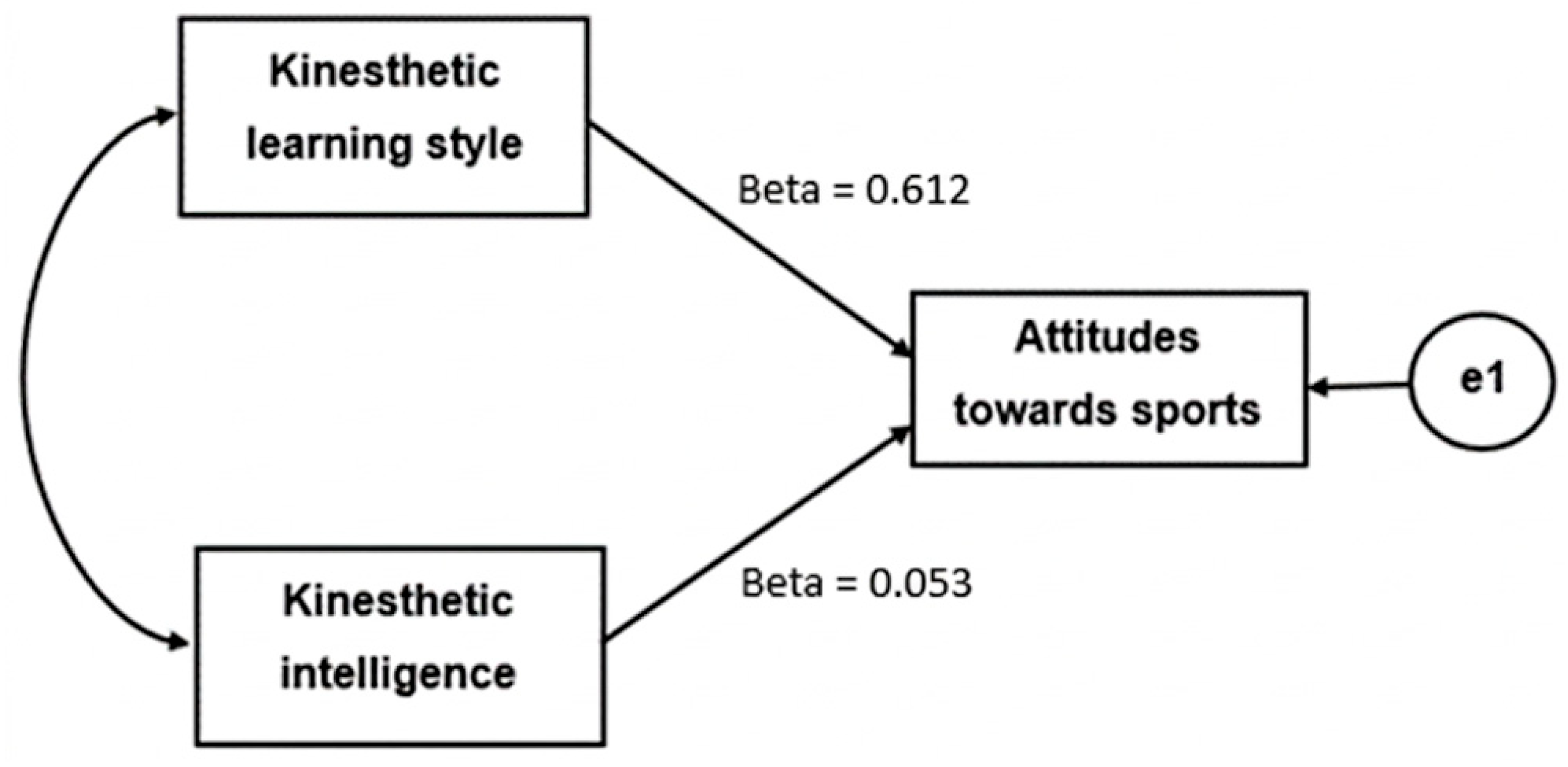
The findings of this study, particularly the potent predictive power of kinesthetic learning styles on sports attitudes (β = 0.612,
p < 0.001), can be profoundly elucidated through the lens of Self-Determination Theory (SDT). SDT posits that optimal development and well-being are contingent upon the satisfaction of three innate psychological needs: autonomy, competence, and relatedness. Our results suggest that adolescents who favor kinesthetic modalities—learning through movement and tangible interaction—experience a heightened sense of competence when engaged in physical activities. When the educational environment or sports setting aligns with their dominant kinesthetic profile, these individuals are more likely to internalize their motivation, transitioning from extrinsic pressures to intrinsic valuing of sports. The robust 42.3% variance explained in sports attitudes highlights that kinesthetic congruence acts as a catalyst for autonomous motivation. By fostering an environment that mirrors their preferred learning style, educators satisfy the need for competence, thereby cultivating a more enduring and positive attitude toward long-term physical engagement. Research by Sarabi-Asiabar et al. [
62] shows that developing a sustainable attitude in physical education is based on self-determined motivation, and the predictive power of kinesthetic preferences on attitude in our study is consistent with these findings. Kinesthetic-aligned education helps meet students’ basic psychological needs for autonomy (freedom of movement) and competence (physical success), which are central to the Self-Determination Theory.
4.4.2. Achievement Goal Theory (AGT) and Academic Synergy
Furthermore, the significant positive correlation between kinesthetic learning styles, physical activity, and academic achievement (α = 0.802 for style consistency) provides empirical support for Achievement Goal Theory (AGT). AGT distinguishes between task-involved (mastery) and ego-involved goals. Our data shows that kinesthetic learners, who thrive on hands-on experiences, may naturally lean toward mastery-oriented goals in physical domains. The synergy found between academic success and physical activity frequencies suggests that the self-regulatory skills acquired through movement-based mastery are transferable to broader cognitive tasks. This “cross-domain transfer” implies that a kinesthetic profile does not merely facilitate motor skill acquisition but also enhances the perceived competence and task persistence required for academic excellence. Unlike the non-significant independent prediction of kinesthetic intelligence (β = 0.053), the dominance of the kinesthetic style underscores that the process of learning through movement is more critical for shaping goal orientations and achievement outcomes than innate potential alone.
4.4.3. Intelligence as Potential vs. Style as Action
A noteworthy finding of this study is the disparity between the predictive powers of kinesthetic intelligence and kinesthetic learning style. While these two constructs are significantly correlated (r = 0.699), our regression model shows that only the kinesthetic learning style serves as a significant predictor of sports attitudes (β = 0.612, p < 0.001), whereas kinesthetic intelligence does not provide an independent contribution (β = 0.053, p = 0.189). This phenomenon can be explained by the conceptual distinction between innate potential and active preference. Kinesthetic intelligence represents a biological and cognitive capacity—a latent potential for movement and coordination. In contrast, a kinesthetic learning style reflects the individual’s internalized preference for processing information through physical engagement and ‘doing.’ Our results suggest that for adolescents, the mere possession of physical-cognitive potential (intelligence) is insufficient to shape psychological attitudes toward sports; rather, it is the deliberate choice and habit of engaging with the world through movement (style) that fosters a positive sports orientation. This distinction underscores the importance of pedagogical interventions: while intelligence may be relatively stable, learning styles are more malleable and can be nurtured through kinesthetic-rich educational environments to promote lifelong physical literacy.
4.4.4. Gender Disparity and Sustainable Sports Policies
Our findings highlight a critical gender paradox that warrants attention within the framework of social sustainability: while female adolescents demonstrated significantly higher academic achievement (M = 87.70) compared to their male counterparts (M = 85.97, p = 0.043), they exhibited lower scores across all sub-dimensions of sports attitude (p < 0.001). From a sustainable development perspective, this discrepancy suggests that current educational and athletic infrastructures may not be sufficiently tailored to sustain the physical engagement of high-achieving female students. To mitigate this gap and align with SDG 5 (Gender Equality), sustainable sports policies should move beyond ‘one-size-fits-all’ approaches and implement gender-specific strategies. Such interventions could include the integration of kinesthetic-rich curricula that validate diverse movement expressions and the creation of non-competitive, mastery-oriented sports environments that appeal to the psychological profiles of female adolescents. By fostering a synergy between their proven academic competence and physical literacy, educational systems can ensure that the health and well-being of female youth are sustained alongside their intellectual growth, thereby building a more equitable and resilient future generation.
4.5. Limitations and Future Directions: Addressing Causality
The reliance on self-reported measures for physical activity and kinesthetic profiles may introduce response and recall bias, as participants might overestimate their activity levels or provide socially desirable answers. Although validated scales were used to mitigate this issue, future studies could benefit from incorporating objective measures (e.g., accelerometers or observational data) to corroborate self-reported findings.
The generalizability of the findings is constrained by the geographically restricted sample drawn from a single region (Mugla, Turkiye). Socio-cultural and regional factors specific to this area may have influenced the participants’ sports attitudes and learning styles. Consequently, caution should be exercised when extrapolating these results to broader populations or different cultural contexts. Future research should aim to include multi-regional or cross-cultural samples to enhance external validity.
While the current study provides robust evidence for the predictive role of kinesthetic profiles on sports attitudes, its cross-sectional design warrants a nuanced interpretation regarding causality. A primary concern in such designs is the potential for bidirectional causality: while a dominant kinesthetic learning style may foster a more positive attitude toward sports, it is equally plausible that early and intense socialization into sports environments reinforces kinesthetic modalities as the primary pathway for learning.
To address this “chicken-and-egg” dilemma, we frame our findings within Bandura’s concept of Reciprocal Determinism [
69,
70]. This perspective suggests that the adolescent’s kinesthetic profile, their physical environment, and their sports-related behaviors operate as interacting determinants that predict each other bidirectionally. The substantial explanation of variance (R
2 = 0.423) observed in our model shows a powerful synergy between these factors rather than a unidirectional causal arrow.
Furthermore, the non-significant prediction of kinesthetic intelligence as an independent predictor (β = 0.053) compared to the dominance of kinesthetic style (β = 0.612) suggests that the process of engagement (style) is more critical for attitude formation than innate potential (intelligence). This distinction strengthens our argument that educational interventions focused on kinesthetic pedagogy can proactively shape sports attitudes, even before a stable “intelligence” trait is solidified. Future research employing longitudinal or cross-lagged panel designs is essential to untangle these developmental trajectories and confirm the temporal precedence of kinesthetic styles in cultivating lifelong physical literacy.
The cross-sectional design precludes definitive causal inferences. While regression models identify kinesthetic style as a predictor of sports attitudes, the relationship is likely bidirectional. This aligns with Bandura’s concept of Reciprocal Determinism, suggesting that while kinesthetic preferences may drive sports participation, active engagement in sports may simultaneously reinforce one’s kinesthetic learning style. Future research should employ longitudinal designs to untangle these directional effects over time. Finally, unmeasured confounding variables such as socioeconomic status (SES) and school climate may have influenced the results.
5. Conclusions
This study provides compelling empirical evidence that adolescents’ kinesthetic profiles—specifically their learning styles—are powerful predictors of their attitudes toward sports and physical engagement. Our findings reveal that kinesthetic learning styles alone explain a substantial 42.3% of the variance in sports attitudes, underscoring the necessity of movement-based pedagogical alignment in secondary education.
From the perspective of Educational Sustainability, these results advocate for a shift toward “Quality Education” (UN Sustainable Development Goal 4) and the findings offer a concrete pathway for SDG 4. By integrating movement-based (kinesthetic) pedagogies into the core curriculum, schools can support students who might otherwise disengage from traditional sedentary learning, thereby reducing dropout rates and fostering equitable academic success. By integrating kinesthetic modalities into the general curriculum, educational systems can foster a more inclusive and effective learning environment that transcends traditional sedentary models. Such an alignment not only enhances student engagement but also supports the Sustain-ability of Public Health (SDG 3) by cultivating lifelong positive attitudes toward physical activity during the critical developmental stage of adolescence.
Furthermore, the significant positive correlation between kinesthetic profiles and academic achievement (r = 0.126, p < 0.001) suggests that physical literacy is not a competitor to cognitive success but rather a fundamental pillar of it. This synergy is crucial for building sustainable school climates that prioritize the holistic well-being of the “post-pandemic generation”.
In conclusion, prioritizing kinesthetic pedagogy is a strategic investment in the sustainable development of youth. Policy-makers and educators should move beyond treating physical education as an isolated discipline and instead embed kinesthetic principles across the educational spectrum to ensure a healthier, more active, and academically successful future generation. Practically, rather than awaiting high-level policy reforms, teachers can implement ‘active breaks’ or ‘kinesthetic stations’ within existing classrooms. Our data suggests that allowing students to process information through movement could improve both their academic engagement and attitudes toward physical activity, offering a cost-effective strategy for immediate implementation. Ultimately, this study underscores that integrating kinesthetic learning styles—rather than merely relying on innate kinesthetic intelligence—into the curriculum is the key to fostering sustainable sports habits.