1. Introduction
Driven by the global energy transition and the need for environmental pollution mitigation, the penetration of Inverter-Interfaced Distributed Generation (IIDG), represented by photovoltaics (PV), continues to rise in distribution networks [
1]. However, due to the high integration of power electronics, the fault characteristics of IIDG differ significantly from those of traditional synchronous machines. These characteristics are primarily manifested as limited short-circuit currents, controlled fault responses, and sequence impedance coupling. Consequently, fault processes in distribution networks with high-penetration IIDG exhibit pronounced multi-state and non-linear behaviors. Such conditions pose severe challenges to traditional relay protection principles based on power frequency fault quantities [
2,
3,
4,
5]. In particular, the reliability of single-phase grounding fault line selection in neutral non-effectively grounded systems has long been under pressure [
6]. The integration of high-penetration IIDG further exacerbates the complexity of this task. The controlled-source characteristics of IIDG result in restricted fault current amplitudes and blurred fault features. The decentralized integration and stochastic operation of IIDG significantly alter the distribution patterns of zero-sequence currents. These factors reduce the adaptability of traditional line selection methods based on steady-state or transient power frequency quantities. Consequently, the risk of misjudgment increases significantly, leading to degraded protection performance or even occurrences of maloperation and refusal to operate [
7,
8,
9,
10].
To address the issues, an adaptive injection-based protection method for single-phase grounding fault in distribution networks is proposed, specifically considering the impact of high-penetration IIDG. The primary contributions are summarized as follows:
The low-impedance shunting effect of non-fundamental frequency signals in IIDGs is analyzed. The non-uniform distribution patterns of high-frequency characteristic currents (HFCC) in distribution networks under high penetration IIDG are revealed. The differences in HFCC amplitude and phase between faulty and healthy feeders are explicitly identified.
An HFCC injection control strategy that balances fault ride-through (FRT) and fault identification is proposed. This strategy dynamically adjusts the amplitude and frequency of the injected HFCC according to the voltage drop at the Point of Common Coupling (PCC) and the system equivalent impedance. Consequently, the conflict between environmental interference and equipment safety constraints is effectively resolved.
By quantitatively analyzing the contribution of injection frequency to the phase margin, a fault line selection method based on phase lag characteristics is developed. This method ensures sufficient identification sensitivity and line selection accuracy under conditions of high-resistance faults and varying quantities of integrated IIDGs.
This paper is organized as follows:
Section 2 reviews the current state of research on injection-based protection methods.
Section 3 analyzes the HFCC distribution characteristics in distribution networks with high penetration IIDG.
Section 4 derives and analyzes the HFCC amplitude and phase features for both faulty and healthy feeders.
Section 5 presents the IIDG-based HFCC injection control strategy considering both FRT and fault identification.
Section 6 establishes the protection criteria for fault line selection and proposes the adaptive injection-based protection method. Finally, the effectiveness of the proposed method is validated through simulations in
Section 7.
2. Current State of Research
Traditional protection mechanisms based on autonomous system responses of electrical equipment are facing severe challenges in modern distribution networks with high penetration rates of IIDG. Literature [
2] analyzed autonomous response-based protection mechanisms, highlighting that the grid connection of high-penetration IIDG blurs fault characteristics. The researchers further argued that the adaptability of traditional line selection methods relying on steady-state or transient power frequency quantities is significantly reduced in non-effectively grounded systems. Literature [
6] investigated the protection criteria and setting rules of distribution networks, revealing the limitations of traditional relay protection under multi-state and nonlinear fault behaviors. They concluded that dynamic changes in system topology pose a severe challenge to traditional phasor or overcurrent protection. To address the challenges, researchers have increasingly introduced emerging data-driven and intelligent algorithms. Literature [
11] evaluated modern distance protection technologies, identifying the limitations of traditional schemes under high renewable energy penetration, and subsequently introduced an enhanced artificial intelligence adaptive relay protection strategy. Literature [
12] comprehensively evaluated recent metaheuristic algorithms, detailing their core mechanisms in balancing exploration and exploitation to solve complex optimization problems, and provided a practical guide for algorithm selection and hybridization in engineering applications. Literature [
13] proposes a hybrid fault location model to accelerate the convergence of training errors. Literature [
14] proposes a data-driven framework for intelligent fault identification to adapt to dynamic topologies. Literature [
15] proposes a faulty feeder detection method based on line model recognition and correlation comparison. Although metaheuristic algorithms and artificial intelligence methods excel in complex optimization and implicit feature extraction, they often respectively require iterative search processes or large amounts of balanced training data and may lack the explicit physical interpretability that is crucial for power system protection.
To overcome the limitations of autonomous response-based protection and provide deterministic physical characteristics, characteristic signal injection-based protection technologies have become a focal point. Literature [
16] and Literature [
17] evaluated the use of voltage transformers to inject specific signals for fault line selection. These works noted the difficulty of effective detection in multi-branch lines and pointed out that equipment capacity constraints lead to insufficient signal strength. Literature [
18] explored generating disturbances by connecting a parallel resistance at the substation bus, acknowledging that while this improves detection capabilities, it has inherent drawbacks, including increased fault currents, arc extinction difficulties, and reliance on additional hardware. Literature [
19] and Literature [
20] clarify the role of detection signals in identifying single-pole grounding faults by proposing an active injection location method based on modular multilevel converters.
With technological development, injection-based protection utilizing renewable energy converters as controllable signal sources has become an important direction [
21]. Literature [
22] explained the mechanism of mitigating IIDG impacts on overcurrent protection by controlling the converters to inject high-frequency characteristic signals during faults, proposing a protection-control coordination method for flexible signal injection. Literature [
23] analyzed the fault characteristics generated by injecting zero-sequence non-power frequency components, designing a scheme to accurately identify and isolate various microgrid grounding faults. Literature [
24] proposes an injection protection method based on multi-source cooperation. Literature [
25] revealed that traditional harmonic injection protection suffers performance degradation due to the shunt effect between IIDGs and the grid when harmonic currents are injected. To address this, they developed an active protection and fault location approach that ensures harmonic currents flow primarily toward the fault point.
However, existing injection methods mostly adopt fixed amplitudes, and the frequency is selected primarily based on the detectability of the signal. Since IIDGs are typically equipped with filters, they present a low impedance to high-frequency signals, thereby altering the distribution of characteristic signals. Current research lacks a comprehensive analysis of the HFCC distribution in multi-IIDG systems, making it difficult for the injected signals to balance detection sensitivity and equipment safety requirements under various fault conditions. This may lead to issues such as insufficient identification of high-impedance faults, decreased sensitivity as IIDG penetration increases, and the inability of injection sources to achieve fault ride-through during severe faults.
3. HFCC Distribution Characteristics in Distribution Networks with High-Penetration IIDG
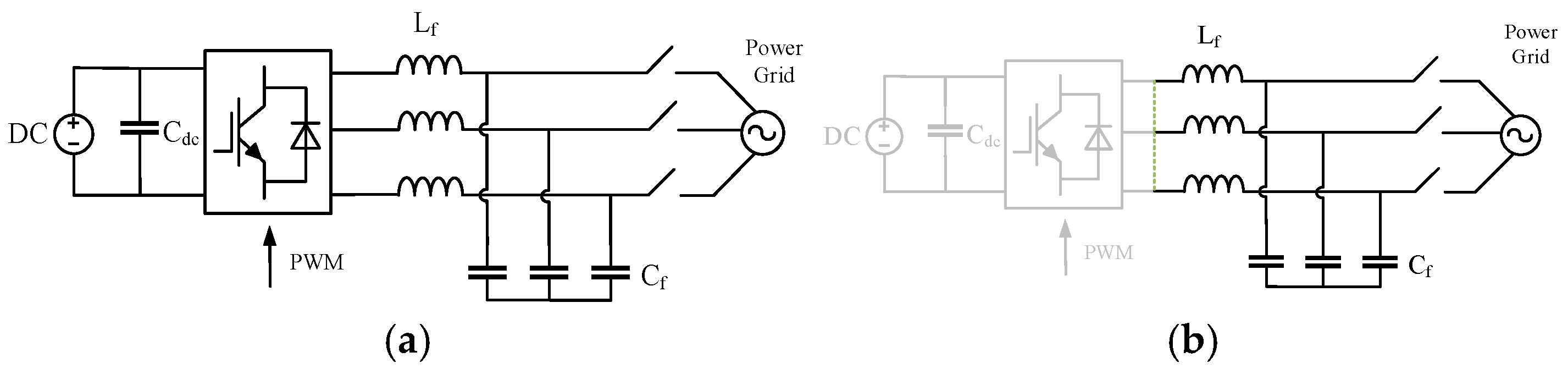
As illustrated in
Figure 1a, an IIDG consists of four primary components: a DC power source, a DC-link capacitor, a grid-connected converter, and a filter circuit. In this configuration,
represents the DC-link capacitor of the IIDG, while
and
denote the filter capacitor and the filter inductor, respectively.
Various control strategies are employed for IIDGs, including constant current control, constant active/reactive power (PQ) control, constant voltage/frequency (V/f) control, droop control, and virtual synchronous generator (VSG) control [
26,
27]. Despite the diversity of these high-level strategies, the low-level controllers of an IIDG are generally implemented using proportional-integral (PI) or proportional-resonant (PR) controllers. The transfer functions for PI, PR, and quasi-PR controllers can be expressed as:
where
and
are the proportional and integral gains of the PI controller, respectively.
is the resonant gain of the PR and quasi-PR controllers. represents the resonant angular frequency. denotes the cut-off frequency (or bandwidth) of the quasi-PR controller.
PI controllers exhibit high gain only for signals with frequencies close to DC. To achieve zero steady-state error control, PI-based IIDG control systems typically operate in the synchronous rotating reference frame. In this framework, sampled state variables are converted into DC signals via the abc-dq transformation. However, if the signal frequency is significantly higher or lower than 50 Hz, the frequency after the coordinate transformation will also remain significantly higher than zero. Consequently, PI controllers designed for the power frequency exhibit extremely low gain in the high-frequency band, making zero steady-state tracking impossible. Furthermore, PR and quasi-PR controllers similarly provide high gain only for signals near their specific operating frequencies. These controllers are thus unable to effectively regulate non-fundamental frequency signals. Therefore, when the injected signal frequency is much higher than the power frequency, the HFCC flows exclusively through the IIDG filter. Under these conditions, the IIDG can be modeled as an equivalent LC parallel resonant circuit, as illustrated in
Figure 1b. In this equivalent model,
and
represent the filter capacitor and the filter inductor of the IIDG, respectively. Although low-level control implementations, such as PR controller bandwidth and digital control delays, influence IIDG impedance characteristics, their impact is primarily significant within the control bandwidth. The validity of the simplified LC model employed in this study is grounded in the principle of frequency separation. Since the proposed protection method utilizes a characteristic injection frequency that is significantly higher than the fundamental frequency and well beyond the effective bandwidth of standard current control loops, the gain of the fundamental frequency controller attenuates to a negligible level. Furthermore, digital control delays introduce substantial phase lags in this high-frequency band, rendering the active control loop ineffective in regulating current components. Consequently, the IIDG output impedance is dominated by the physical passive filter components, making the simplified LC parallel equivalent model a sufficiently accurate representation for analyzing the HFCC distribution.
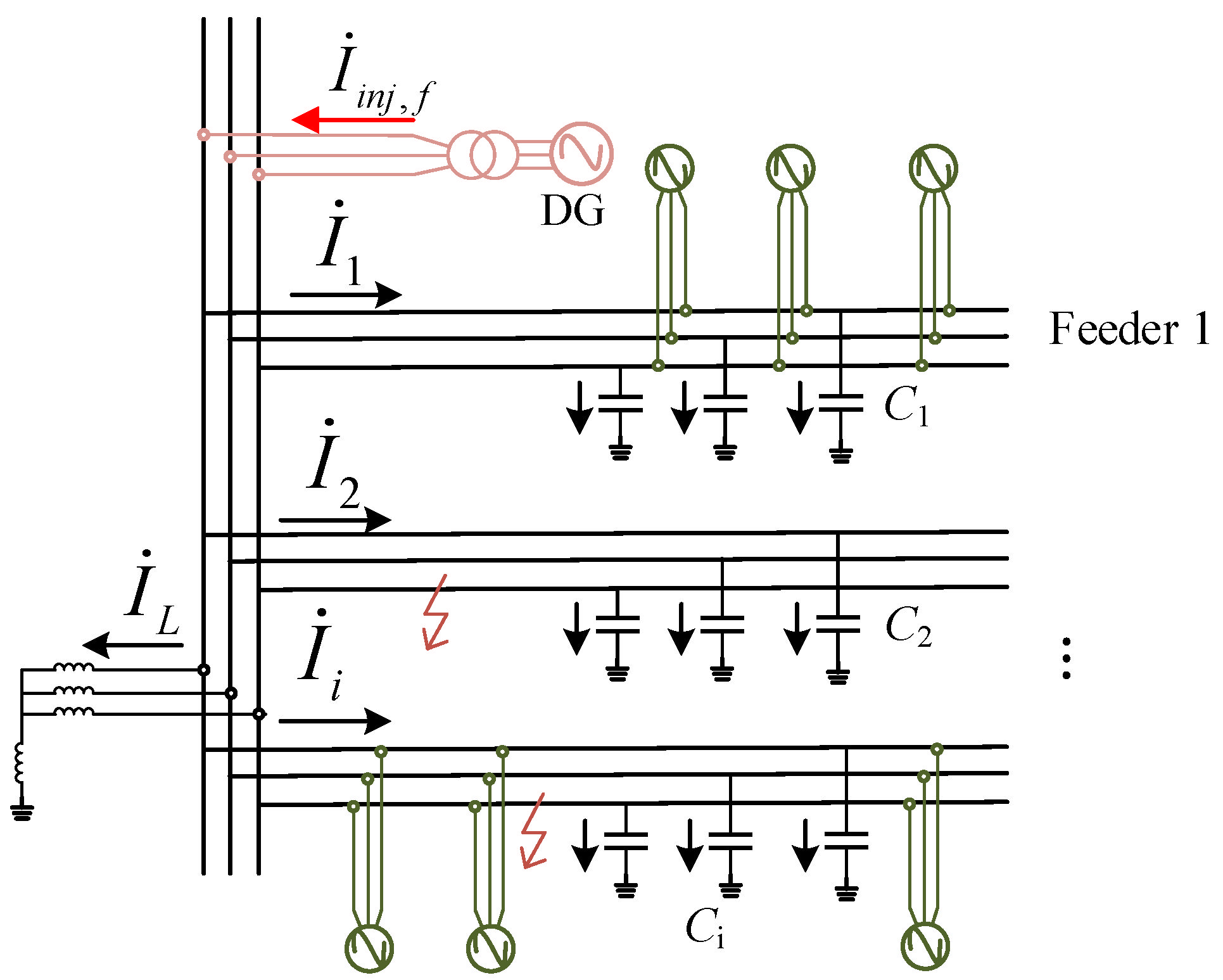
The HFCC is injected via the IIDG connected to the busbar, and the equivalent HFCC network of the distribution network is illustrated in
Figure 2. When a single-phase grounding fault occurs, a circulation path for the HFCC is established through the feeder-to-ground capacitance, the fault transition resistance, and the neutral grounding admittance. The distribution of the HFCC among the various branches depends on the fault location, line-to-ground parameters, the transition resistance value, and the integration positions of the IIDG units. Therefore, to quantitatively reveal the HFCC distribution, two typical operating scenarios are analyzed: the faulty feeder without IIDG integration and the faulty feeder with IIDG integration.
3.1. Faulty Feeder Without IIDG Integration
When a single-phase grounding fault occurs on a feeder without IIDG integration, the HFCC of the faulty feeder flows into the ground through the feeder-to-ground capacitance and the fault branch. Conversely, the HFCC of healthy feeders flows into the ground via the to-ground capacitance and the LC parallel resonant circuits of the IIDGs. Under these conditions, the HFCC for each feeder can be calculated using the equivalent circuit of the distribution network based on Kirchhoff’s Current Law (KCL). The injected HFCC can be expressed as follows [
28]:
where
denotes the total number of feeders.
represents the HFCC flowing through the faulty feeder that lacks IIDG integration.
refers to the HFCC of healthy feeders, which includes cases both with and without IIDG integration.
is the HFCC flowing through the neutral branch.
The variables
,
,
, and
are defined as the HFCC shunting coefficients for the faulty feeder without IIDG, the healthy feeder without IIDG, the neutral branch, and the healthy feeder with IIDG integration, respectively. The expressions for these shunting coefficients are given as follows:
where
is the transition resistance;
denotes the neutral grounding impedance;
represents the total feeder-to-ground capacitance; and
is the frequency of the HFCC. Additionally,
and
are the equivalent inductance and capacitance of the j-th IIDG on the yk feeder, respectively. The parameters
,
, and
denote the equivalent feeder-to-ground capacitances of the faulty feeder without IIDG integration, the healthy feeder without IIDG integration, and the faulty feeder with IIDG integration, respectively.
3.2. Faulty Feeder with IIDG Integration
When a single-phase grounding fault occurs on a feeder integrated with IIDG, the injected HFCC can be expressed as follows:
where
denotes the total number of feeders.
represents the HFCC of the faulty feeder with IIDG integration.
and
refer to the HFCC flowing through the healthy feeders and the neutral branch, respectively.
Furthermore,
,
,
, and
are defined as the HFCC shunting coefficients for the faulty feeder with IIDG integration, the healthy feeder without IIDG, the healthy feeder with IIDG integration, and the neutral branch, respectively. The expressions for these shunting coefficients are as follows:
where
and
represent the equivalent inductance and capacitance of the j-th IIDG on the fi-th feeder (i.e., the faulty feeder), respectively. Furthermore,
,
, and
denote the equivalent feeder-to-ground capacitances of the faulty feeder with IIDG integration, the healthy feeder without IIDG integration, and the healthy feeder with IIDG integration, respectively.
According to Equations (5) and (10) mentioned above, the HFCC exhibits a significantly non-uniform distribution in the distribution network during a single-phase grounding fault. This distribution mechanism is primarily governed by the fault location, transition resistance, and the integration positions and quantities of IIDGs. The relative position between the fault point and the IIDG integration points directly determines the intensity of current convergence. Specifically, the shunting proportion of the fault branch increases significantly when a fault occurs near an IIDG. Furthermore, the transition resistance influences the shunting ratio by altering the conduction characteristics of the fault path. In high-resistance fault scenarios, although the shunting proportion slightly decreases, it still maintains a relative advantage. Additionally, the IIDG reshapes the HFCC distribution by modifying the equivalent admittance of its branch through the LC parallel resonant circuit. Consequently, a distinct difference exists between the current shunting coefficients of faulty and healthy feeders, regardless of whether the faulty feeder is integrated with IIDGs. This distinction provides the theoretical foundation for fault line selection.
4. Amplitude and Phase Characteristics of HFCC in Distribution Networks with High-Penetration IIDG
The differences in HFCC amplitude and phase among various feeders provide the fundamental basis for distinguishing between faulty and healthy feeders. When the faulty feeder lacks IIDG integration, according to Equation (5), the amplitude ratio and phase difference in the HFCC flowing through the faulty feeder and healthy feeders without IIDG integration can be expressed as:
Similarly, the amplitude ratio and phase difference between the HFCC of the faulty feeder without IIDG integration and that of the healthy feeder with IIDG integration can be expressed as:
When the faulty feeder is integrated with IIDG, the amplitude ratio and phase difference between the HFCC of the faulty feeder and that of the healthy feeder without IIDG integration can be expressed as:
Under these circumstances, the amplitude ratio and phase difference in the HFCC between the faulty feeder with IIDG integration and the healthy feeder with IIDG integration can be expressed as:
In the event of a metallic fault, according to Equations (14), (16), (18) and (20), the characteristic frequency current flows almost entirely through the faulty feeder. Consequently, the current amplitude ratio is significantly greater than 1. In contrast, for non-metallic grounding faults, the ratio of HFCC amplitudes between the faulty and healthy feeders depends on both the signal frequency and the fault transition resistance.
Based on Equation (14), when neither the faulty nor the healthy feeders are integrated with IIDG, the specific transition resistance that results in a unity amplitude ratio between the faulty and healthy feeder currents can be derived as:
Based on Equation (16), the transition resistance that yields a unity amplitude ratio between the currents of the faulty and healthy feeders can be derived. This specifically applies to the scenario where the faulty feeder lacks IIDG integration while the healthy feeder is integrated with IIDG. The expression is given as:
Based on Equation (18), the transition resistance that results in a unity amplitude ratio between the currents of the faulty and healthy feeders can be derived. This applies to the scenario where the faulty feeder is integrated with IIDG, while the healthy feeder lacks IIDG integration. The expression is given as:
Based on Equation (20), the transition resistance that leads to a unity amplitude ratio between the faulty and healthy feeder currents can be derived. This derivation considers the scenario where both the faulty and healthy feeders are integrated with IIDG units. The expression is given by:
Regarding phase characteristics, Equation (15) indicates that the phase of the HFCC flowing through the faulty feeder always lags behind that of a healthy feeder without IIDG integration. This lag is attributed to the presence of transition resistance. According to Equation (17), the phase relationship between a faulty feeder without IIDG and a healthy feeder with IIDG depends on both the current frequency and the transition resistance. Consequently, the lead or lag relationship in this scenario is indeterminate.
Similarly, as demonstrated in Equations (19) and (21), no definitive lead or lag relationship exists between the HFCC phases of the faulty and healthy feeders when the faulty feeder is integrated with IIDG. However, these equations also reveal that the HFCC phases of both feeders are frequency-dependent. Therefore, through the appropriate selection of the HFCC frequency, the phase of the HFCC in the faulty feeder can be ensured to lag behind those of all healthy feeders.
The aforementioned analysis indicates that differences exist in both the amplitude and phase of the HFCC between faulty and healthy feeders. However, their applicability for fault detection differs significantly. The amplitude ratio is markedly influenced by the transition resistance, and a critical transition resistance exists. When the transition resistance exceeds this critical value, the HFCC amplitude of the faulty feeder may become smaller than or comparable to those of the healthy feeders, leading to the failure of the amplitude-based criterion. Specifically, in high-resistance fault scenarios, amplitude features no longer possess sufficient distinguishing capability. Conversely, through the appropriate selection of the injection frequency, the HFCC phase of the faulty feeder can be ensured to always lag behind those of all healthy feeders. This relationship remains independent of the transition resistance, thereby demonstrating superior adaptability. Consequently, phase characteristics possess greater practical value for the construction of protection criteria in actual power systems.
5. Adaptive Injection Control Method of HFCC
5.1. HFCC Injection Strategy
An IIDG characteristic frequency signal injection strategy is proposed to actively construct identifiable fault electrical features. This strategy provides reliable support for fault detection, direction identification, and protection coordination in distribution networks. The method is implemented by integrating an HFCC injection control loop into the existing fundamental frequency control framework of the converter. By injecting characteristic frequency current signals into the distribution network via IIDGs, fault features are significantly enhanced and rendered more detectable. To prevent the injected signals from interfering with normal grid operation, the HFCC injection control is activated only upon the detection of a fault. Subsequently, the injection process is terminated once the protection action has been successfully executed.
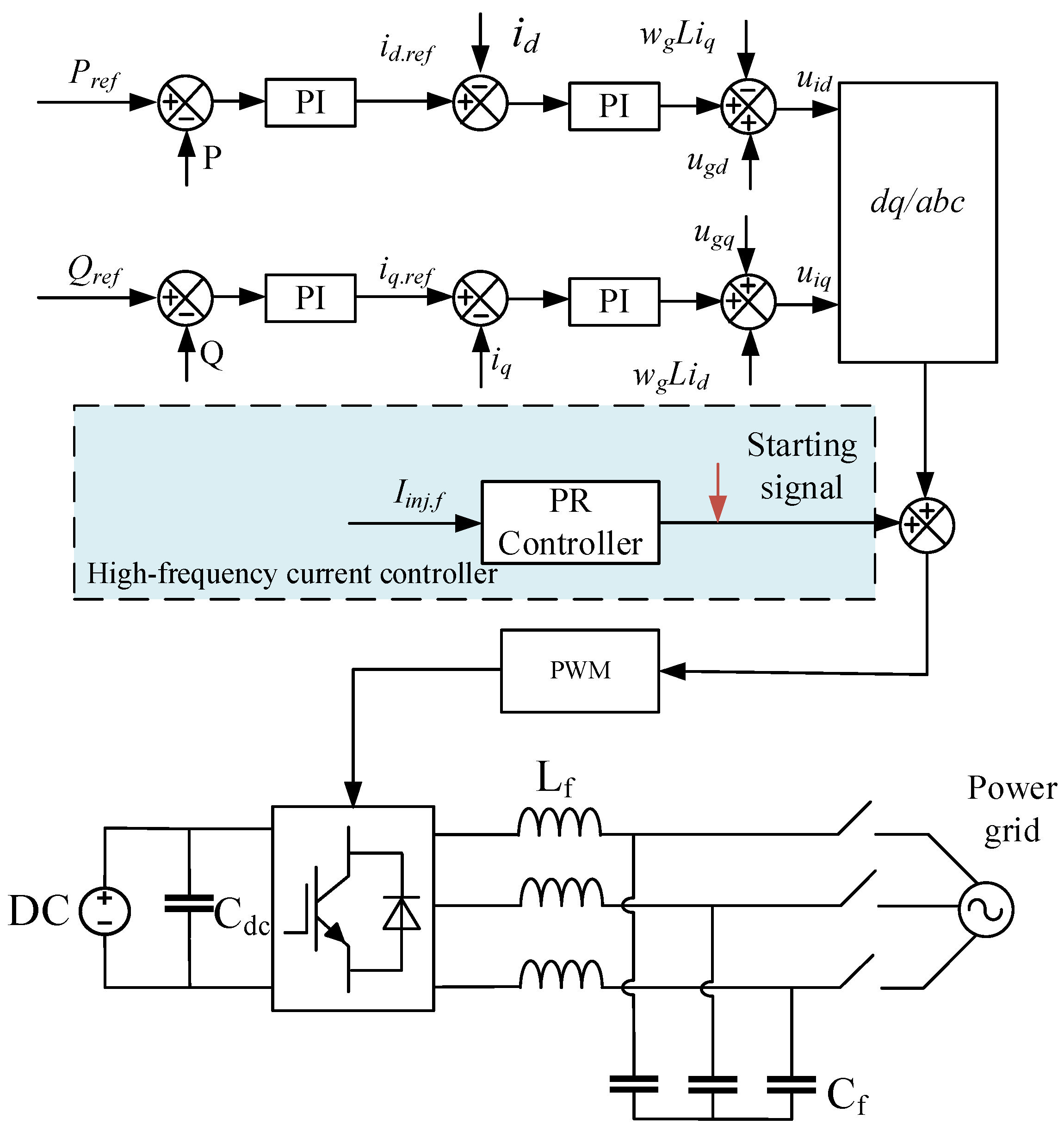
The control strategy for HFCC injection by the IIDG is illustrated in
Figure 3. It consists of two primary components: the fundamental frequency control loop and the characteristic frequency control loop. The fundamental frequency control loop is a dual-loop control system. Specifically, the outer voltage loop employs PI controllers to regulate the active and reactive power, ensuring they track their respective reference values. Simultaneously, the inner current loop regulates the d-axis and q-axis currents to follow the designated current references. The determination of the power and current references depends on the specific IIDG control strategy. Upon the occurrence of a fault in the distribution network, the IIDG performs low-voltage ride-through (LVRT) control in accordance with grid connection requirements. During this process, the HFCC is injected simultaneously. The characteristic frequency control loop utilizes a quasi-proportional resonant (quasi-PR) controller to implement the HFCC injection.
5.2. Selection of HFCC Magnitude
During normal operation, the IIDG outputs active power while the converter operates under zero reactive power control. Under distribution network fault conditions, IIDGs integrated into medium-and-low voltage networks are required to possess LVRT capability, in compliance with technical grid integration regulations. When the voltage at the PCC drops to between 0.2 and 0.9 times the rated voltage, the IIDG must remain grid-connected. In this state, reactive current is output to support the grid voltage, with the magnitude determined by the severity of the voltage dip. The active and reactive currents output by the IIDG following a distribution network fault can be expressed as follows [
28]:
where
denotes the active power reference value of the IIDG.
and
represent the rated voltage and rated current of the IIDG, respectively.
is the root-mean-square voltage at the PCC. Additionally,
is the support coefficient for the LVRT control strategy, which is generally required to be at least 1.5.
To prevent excessive output current from damaging power electronic devices, such as converters, current limiting blocks are typically configured within the IIDG control system. To ensure the safety of the equipment, the fundamental frequency current and the HFCC must satisfy the following constraint:
where
denotes the allowable upper limit of the HFCC. Meanwhile,
represents the maximum allowable AC current that satisfies the safety constraints of the converter.
The amplitude of the HFCC must account for detection precision constraints and its potential impact on grid electrical components. To distinguish the signal from background harmonics and satisfy measurement equipment requirements, the injected HFCC amplitude should not fall below a detectable threshold, typically defined as 4% of the rated current. Upon the occurrence of a fault, the active and reactive currents under LVRT control are calculated using Equation (26) based on the voltage dip at the PCC. Subsequently, Equation (27) is utilized to determine the maximum allowable HFCC amplitude considering the IIDG’s LVRT control. If the allowable upper limit exceeds the detectable threshold, the injected current amplitude is adaptively adjusted based on the fault location and severity. This approach prevents secondary shocks to equipment caused by excessive signal amplitudes while ensuring high detection sensitivity. For a fixed injection level, a fault located closer to the IIDG results in a smaller equivalent network impedance at the PCC, which leads to a larger HFCC in the feeder. Conversely, a larger equivalent impedance results in a smaller HFCC. Therefore, to enhance detection sensitivity, the HFCC magnitude is adaptively regulated according to the equivalent network impedance at the PCC. Specifically, the magnitude increases as the equivalent impedance increases. The expression for the injected HFCC amplitude is given as:
where
denotes the magnitude of the equivalent network impedance at the PCC when the distribution network operates under maximum load conditions.
represents the magnitude of the equivalent impedance at the PCC following the fault. This equivalent impedance can be determined based on Thevenin and Norton equivalent models. Furthermore,
is the minimum required amplitude of the HFCC, and
refers to the allowable upper limit of the HFCC amplitude.
According to Equations (26) and (27), the allowable upper limit of the HFCC decreases as the voltage at the IIDG PCC declines. When this allowable upper limit is less than or equal to the detectable threshold, the active current output of the IIDG is modified to ensure compliance with the LVRT requirements. In this scenario, the expressions for the injected HFCC and the active current are as follows:
where
denotes the detectable threshold of the HFCC.
5.3. Selection of HFCC Frequency
The injection frequency of the HFCC determines the phase difference between the faulty and healthy feeders. Consequently, by appropriately selecting the frequency of the characteristic current, the HFCC phase of the faulty feeder can be ensured to lag clearly behind those of all healthy feeders. This enhancement significantly improves the identification capability for single-phase grounding faults. To ensure universal applicability regardless of which feeder fails, the selected injection frequency must satisfy the phase lag requirement even under the most stringent operating conditions. Therefore, based on Equations (15), (17), (19) and (21), the injection frequency required to maintain this clear phase lag must satisfy the following criteria:
where
represents the frequency of the injected characteristic current. The parameters for the 1st feeder are defined as follows:
is the number of IIDGs;
and
denote the equivalent inductance and capacitance of the k-th IIDG unit on this feeder, respectively; and
represents the feeder-to-ground capacitance of the 1st feeder. Similarly, for the m-th feeder,
denotes the number of IIDGs integrated into the feeder.
and
are the equivalent inductance and capacitance of the k-th IIDG unit on the m-th feeder, respectively, and
refers to its feeder-to-ground capacitance.
6. Adaptive Injection-Based Protection Method for Distribution Networks
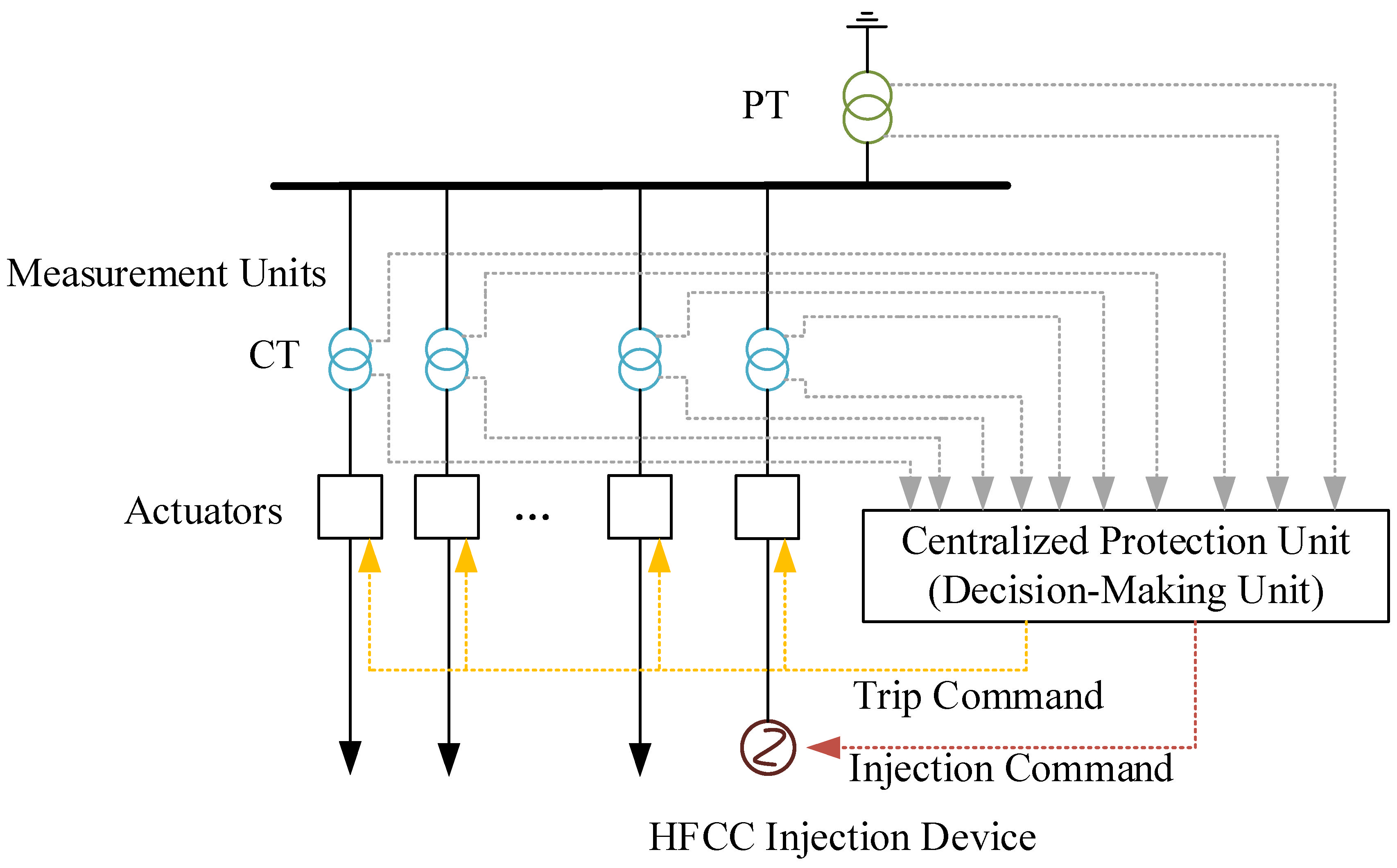
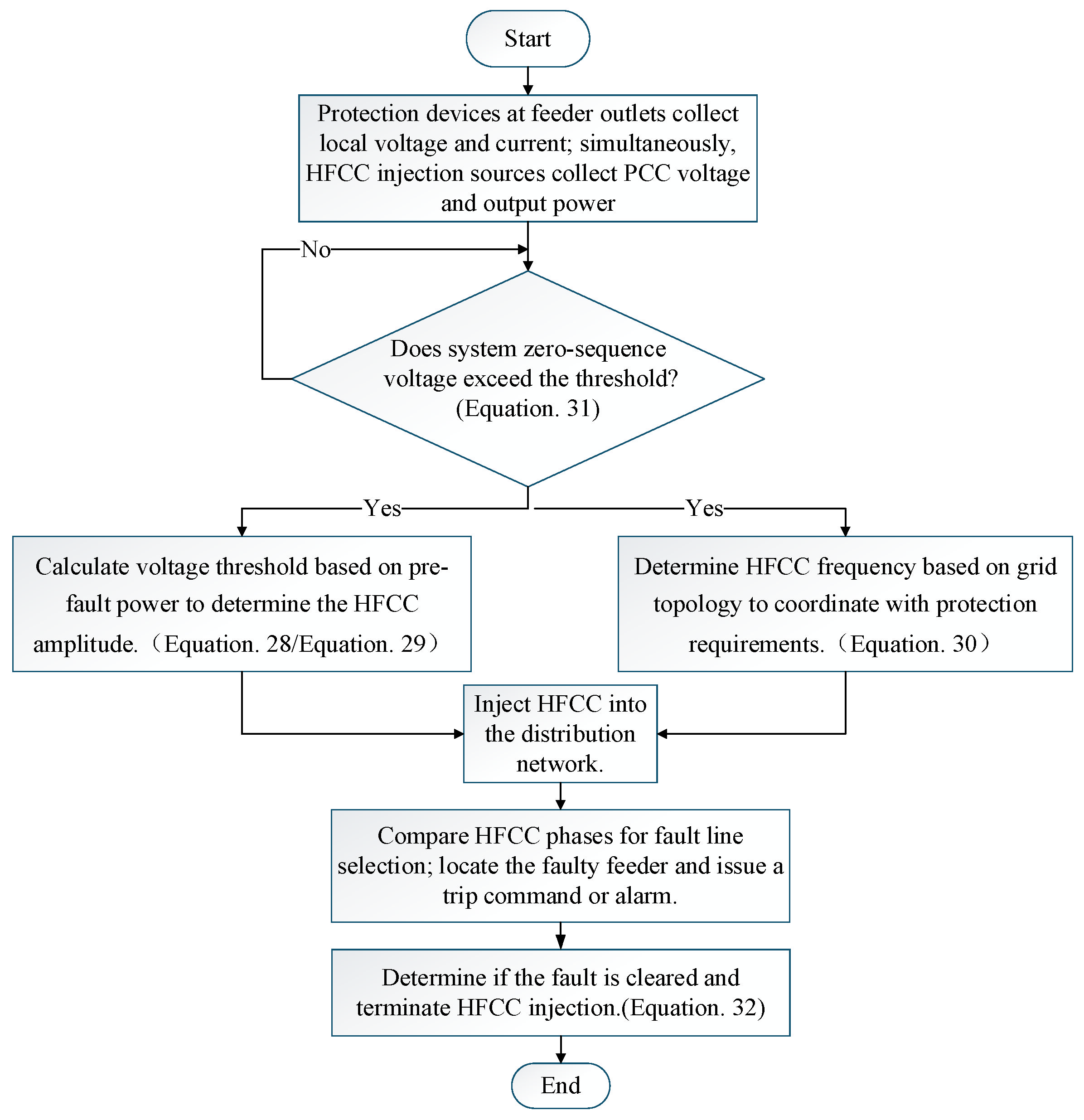
The overall implementation framework of the proposed protection scheme is illustrated in
Figure 4, which comprises four key subsystems coordinated to ensure reliable fault isolation. First, the HFCC Injection Device utilizes the grid-side converter of the IIDG to actively inject controllable high-frequency characteristic currents based on commands from the central controller. To capture the resulting system response, Measurement Units consisting of high-precision CTs and PTs are installed at the substation busbar and feeder outlets to acquire real-time electrical quantities. These signals are transmitted to the Decision-Making Unit, a centralized protection processor that executes the proposed adaptive control strategy: calculating the optimal reference values and performing the phase comparison logic. Finally, upon fault confirmation, circuit breakers installed at the head of each feeder serve as Actuators to execute trip commands and swiftly isolate the faulty section.
Under the IIDG HFCC injection strategy that balances both fault ride-through and fault identification, distinct phase differences exist between the HFCCs flowing through the faulty and healthy feeders. Consequently, these phase characteristics can be utilized to construct a reliable fault line selection criterion for single-phase grounding fault in distribution networks. The adaptive injection-based protection method, which accounts for the impact of high penetration IIDG, is illustrated in
Figure 5. The HFCC injection is initiated upon detecting that the zero-sequence voltage in the distribution network has exceeded the specified limit. According to Equations (26) and (27), the allowable upper limit of the HFCC decreases as the voltage at the IIDG PCC declines. This reduction may result in an HFCC amplitude that fails to meet the precision requirements of the measurement equipment. Therefore, the critical PCC voltage—defined as the voltage at which the allowable HFCC upper limit exactly equals the detectable threshold—is first calculated by solving the following equation:
Crucially, the specific ‘adaptive’ mechanism is physically realized in this parameter calculation stage prior to signal injection. Following a fault, the controller compares the real-time PCC voltage with the critical threshold
to switch between two adaptive modes: (1) Sensitivity-Adaptive Mode: If the PCC voltage is greater than
, indicating a sufficient safety margin, the HFCC reference is set according to Equation (28) to maximize detection sensitivity. (2) Safety-Adaptive Mode: Conversely, if the voltage drops to or below
, the controller prioritizes LVRT safety and restricts the reference value as determined by Equation (29). Subsequently, the frequency reference is independently tuned via Equation (30) to ensure selectivity. This logic ensures that the injection strategy automatically adapts to the fault severity before the protection criterion is applied. To account for the practical impacts of transformer phase angle errors and sampling synchronization errors, the fault line selection criterion is established as:
where
denotes the phase of the HFCC on the i-th feeder, and
represents the phase of the HFCC on the j-th feeder. Furthermore,
is the phase margin.
The adaptive injection-based protection method employs an injection strategy that balances IIDG LVRT requirements, equipment safety constraints, and detection sensitivity. This approach enables the dynamic adjustment of HFCC amplitude levels based on fault severity and the voltage at the PCC. Consequently, optimal fault identification performance is achieved while maintaining compliance with grid operation standards. Addressing the vulnerability of amplitude-based criteria to failure under high transition resistance, the injection frequency is optimized to ensure that the phase of the faulty feeder consistently lags behind those of the healthy feeders. This optimization allows the adaptive protection method to maintain superior line selection accuracy even under high-resistance fault conditions. Furthermore, the impact of IIDG filter branches on the characteristic signals is fully incorporated into the model. The proposed criterion effectively mitigates the influences of random IIDG locations and varying penetration levels. By overcoming the challenge of signal distribution distortion caused by low-impedance filter branches, the method demonstrates robust reliability across various fault locations and IIDG configurations.
Furthermore, the proposed method exhibits inherent robustness against parameter estimation errors and dynamic grid conditions. The estimation of equivalent system impedance primarily serves to determine the HFCC injection amplitude. Since the control loop incorporates a safety margin above the minimum detection threshold, moderate impedance estimation errors do not compromise signal detectability. Regarding frequency selection, the high-frequency impedance of an IIDG is dominated by its passive filter components, which remain constant regardless of the operating point. Although feeder switching may alter the grid topology, the calculated critical frequency serves as a lower bound rather than a singular operating point. The phase margin introduced in Equation (32) effectively accommodates frequency response deviations caused by topological uncertainties or data latency, ensuring that the fault identification criterion remains reliable.
7. Case Study
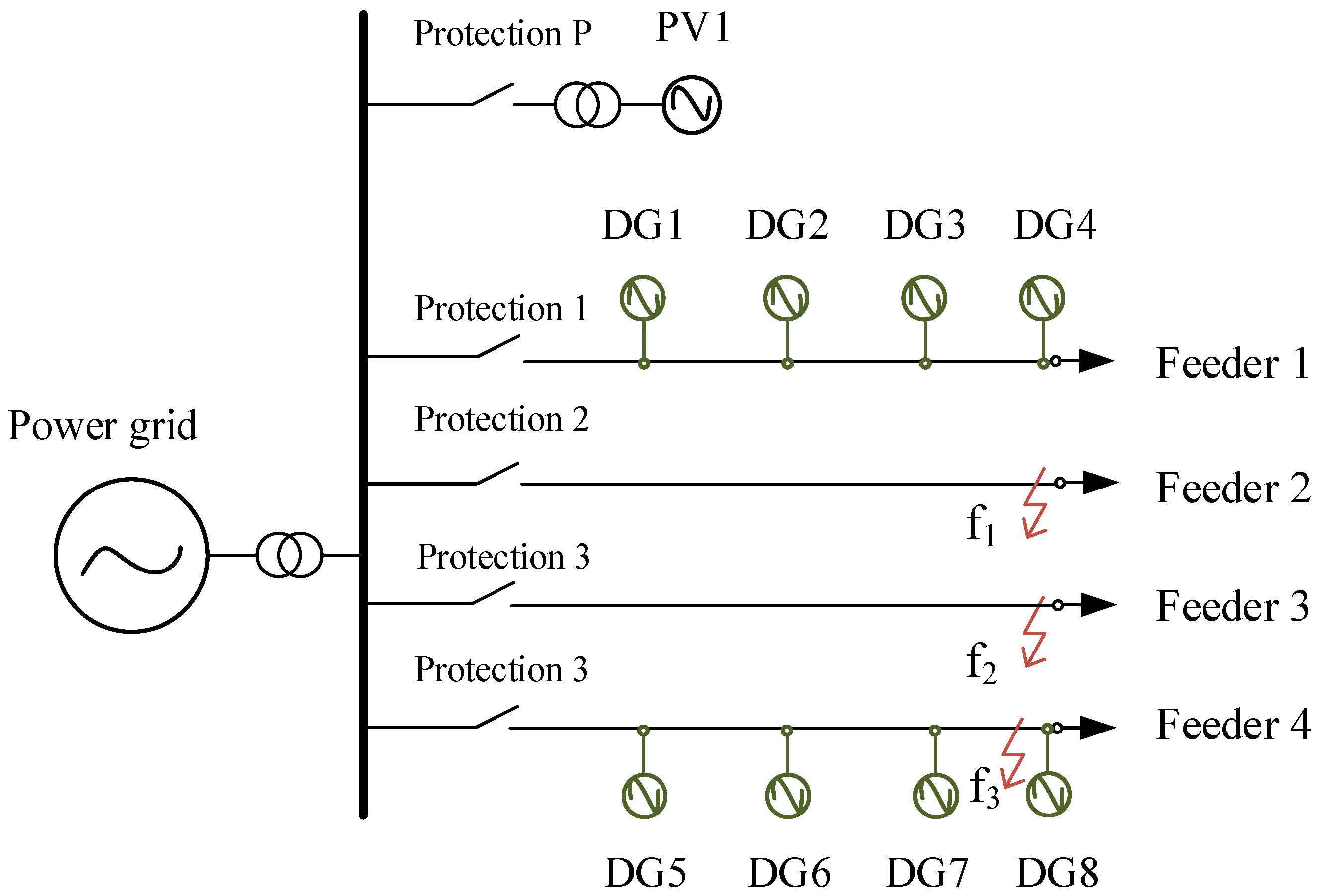
In this section, a typical 10-kV distribution network model integrated with IIDGs is constructed using MATLAB/Simulink R2024a. The correctness of the proposed method is verified by injecting HFCC into the 10-kV bus. The simulation system is illustrated in
Figure 6., which consists of four feeders with lengths of 40 km, 30 km, 20 km, and 10 km, respectively. To verify the method’s applicability across different topologies, Feeders 1 and 4 are configured with IIDG integration, while Feeders 2 and 3 are set as passive feeders without IIDG. This setup allows for performance verification under both scenarios: faults on lines with IIDGs and faults on lines without IIDGs.
The line parameters are as follows [
29,
30]: the positive- and negative-sequence impedances are
, and the positive-sequence capacitance is
. For the zero-sequence parameters, the impedance is
and the capacitance is
. Regarding the PV integration, unit PV1 is connected to the bus. On Feeder 1, 1-MW PV units are integrated at distances of 5 km, 10 km, 15 km, and 20 km from the bus. Similarly, Feeder 4 is integrated with 1-MW PV units at 2 km, 4 km, 6 km, and 8 km.
The injection source, PV1, has a capacity of 1 MW and a maximum allowable current of 70 A. Following a fault, the PV units inject reactive current into the network according to grid connection requirements, based on the degree of voltage dip at the PCC. The PV filter capacitance is 50 uF, and the filter inductance is 2 mH. The loads on the four feeders are configured as 10 MW, 8 MW, 6 MW, and 5 MW, respectively.
To verify the adaptability of the proposed method, three fault scenarios are established as shown in
Figure 6:
represents a single-phase grounding fault occurring 30 km from the bus on Feeder 2;
occurs 20 km from the bus on Feeder 3; and
is located 10 km from the bus on Feeder 4. Furthermore, various transition resistances and PV output levels are configured to evaluate the detection sensitivity and line selection accuracy of the method for single-phase faults.
7.1. Different Fault Locations
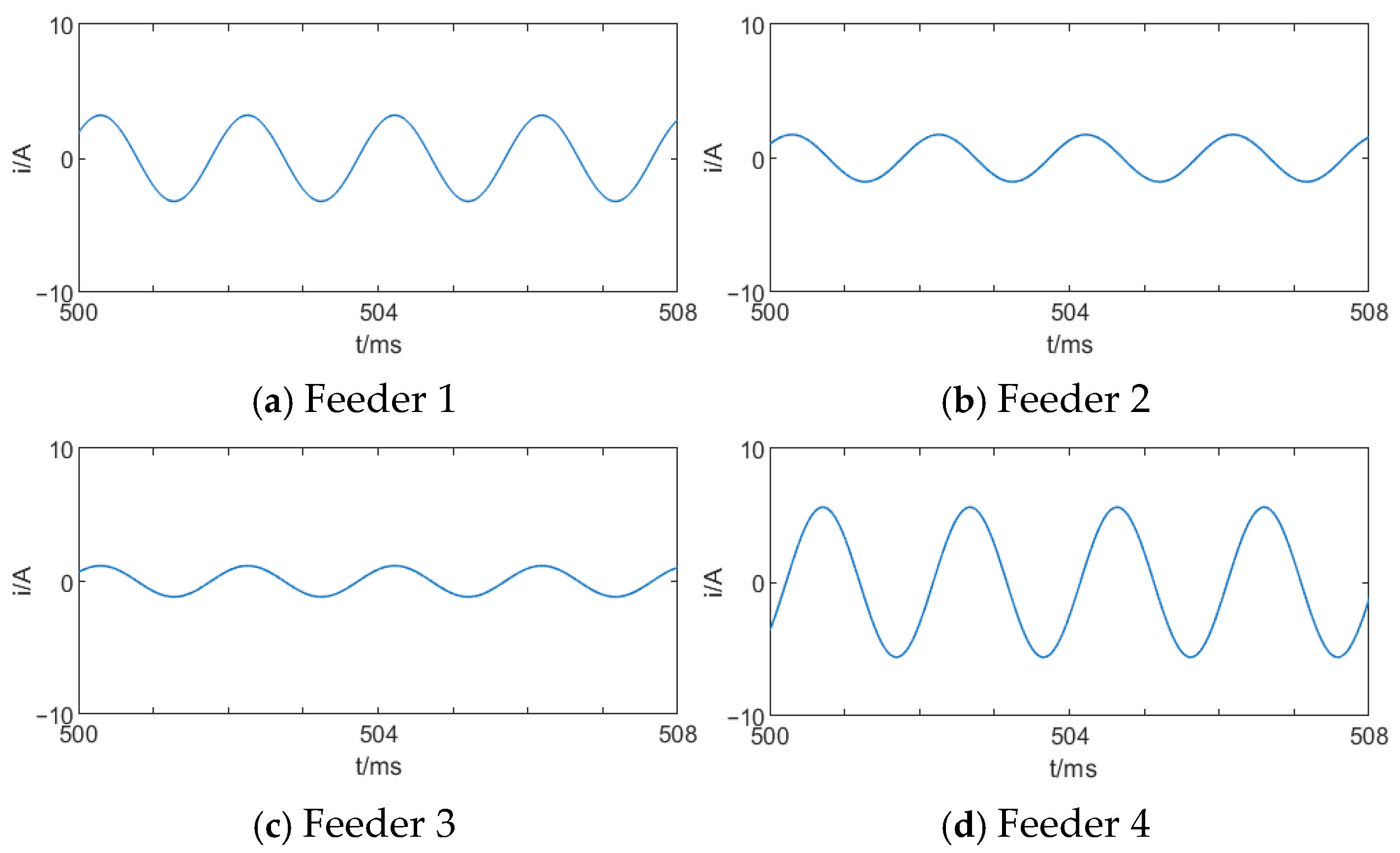
During normal operation, the PV power output for Feeders 1 and 4 is maintained at 80% of their respective rated capacities. At t = 0.5 s, a single-phase grounding fault with a transition resistance of 10 Ω is initiated at point
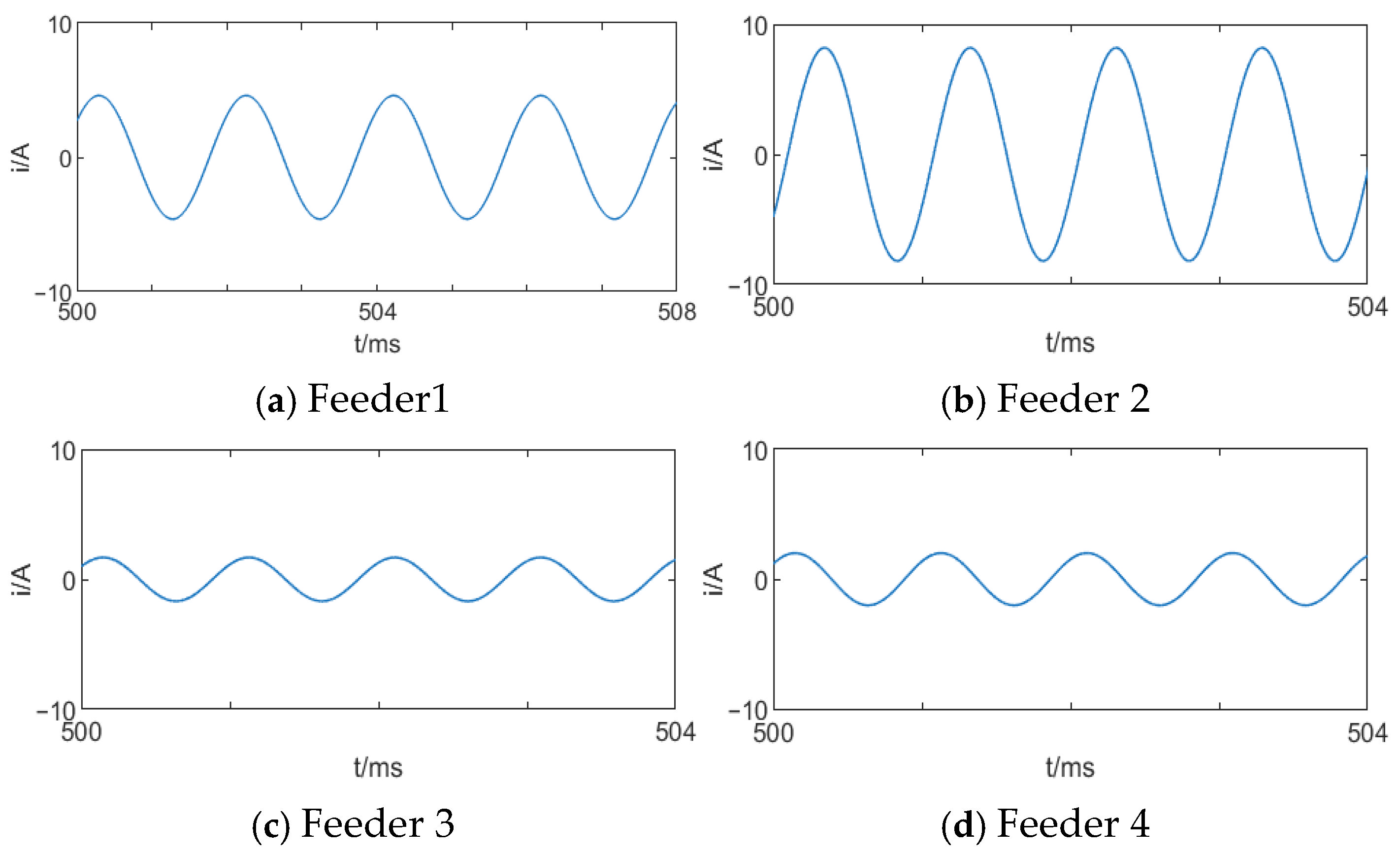
on Feeder 2. Based on Equation (30), the injection frequency of the HFCC is determined to be 3200 rad/s, with an injection amplitude of 13.3 A. The HFCC waveforms at the outlets of each feeder under various fault conditions are obtained through simulation, as illustrated in
Figure 7. During the fault at point
, the HFCC flows through all feeders. Notably, the HFCC amplitude of the faulty feeder (Feeder 2) is significantly larger than those of the healthy feeders. Furthermore, its phase clearly lags behind the phases of the healthy feeders. These observations indicate that the HFCC distribution is highly consistent with the theoretical analysis.
When single-phase grounding fault with a 10 Ω transition resistance occur at point
and point
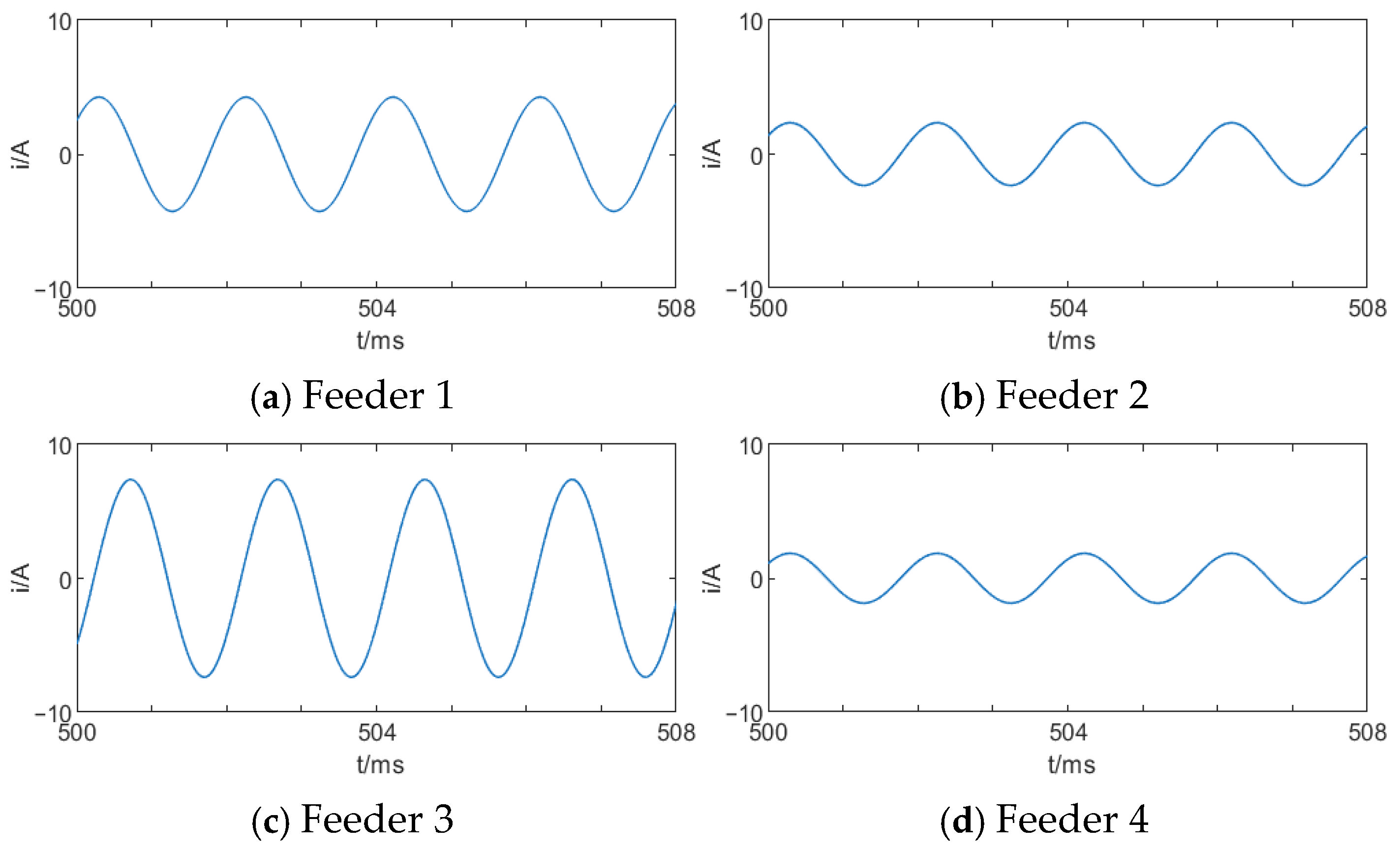
, the HFCC injection frequency remains 3200 rad/s according to Equation (30). The corresponding injection amplitudes are calculated as 9.25 A and 12.3 A, respectively. The simulated HFCC waveforms for each feeder under these two fault scenarios are illustrated in
Figure 8 and
Figure 9. In both fault scenarios, the HFCC flows through both the faulty and healthy feeders. However, distinct differences are observed in their amplitudes and phases. Specifically, the HFCC phase of the faulty feeder consistently lags behind those of the healthy feeders. Notably, during the fault at point
, the amplitude difference between the faulty Feeder 3 and the healthy feeders is relatively limited, as shown in
Figure 8. This phenomenon is primarily attributed to the influence of the IIDG filter branches.
The HFCC phase angles for various fault locations are summarized in
Table 1. For the fault at point
, the phase angle of the HFCC at the outlet of Feeder 2 is −36.12°, while the phase angles for Feeders 1, 3, and 4 are all 35.93°. This indicates that the HFCC phase of Feeder 2 significantly lags behind those of the other feeders. Under the fault condition at point
, the HFCC phase angle of Feeder 3 is −41.88°, whereas Feeders 1, 2, and 4 all exhibit phase angles of 35.93°. Similarly, for the fault at point
, the HFCC phase angle at the outlet of Feeder 4 is −39.6°, with Feeders 1, 2, and 3 each maintaining a phase angle of 35.93°. In this case, the current phase of Feeder 4 also exhibits a significant lag compared to the healthy feeders. These results demonstrate that the proposed method is capable of reliably identifying the faulty feeder across different fault locations.
7.2. Different Transition Resistances
During normal operation, the PV output remains constant. For the fault at point
, transition resistances of
,
,
and
are considered. Based on Equation (30), the HFCC injection frequency for all cases is 3200 rad/s, with corresponding amplitudes of 14.28 A, 13.3 A, 13 A and 12.99 A, respectively. The HFCC phase angles for each feeder under different transition resistances are summarized in
Table 2. Specifically, at
the phase angle of Feeder 2 is −6°, while the phase angles of Feeders 1, 3, and 4 are 82.14°. At
, the phase angle of Feeder 2 is −36.12°, compared to 35.93° for the healthy feeders. For the
and
, the phase angles of Feeder 2 are −13° and −6.7°, while those of the healthy feeders are 4.14° and 2.08°, respectively. Across all tested transition resistances, the HFCC phase of the faulty feeder consistently lags behind those of the other feeders, enabling the proposed method to correctly identify the faulty feeder.
Similarly, single-phase grounding fault are evaluated at point
with transition resistances of
,
,
and
. According to Equation (30), the injection frequency remains 3200 rad/s, and the amplitudes are determined as 11.2 A, 9.25 A, 8.95 A and 8.9 A, respectively. The simulated HFCC phase angles at the feeder outlets are provided in
Table 2. At
, the phase angle of Feeder 4 is −6.38°, while the healthy feeders exhibit 82.14°. At
, the phase angle of Feeder 4 is −39.6°, compared to 35.93° for the others. For
and
, the phase angles for Feeder 4 are −17.04° and −8.89°, with the healthy feeders maintaining 4.14° and 2.08°, respectively. For faults at
, the phase of the faulty feeder consistently lags behind those of the healthy feeders, confirming that the proposed method accurately identifies the faulty feeder.
7.3. Integration of Varying Numbers of IIDGs
To verify the effectiveness of the proposed method under various initial operating conditions, the number of integrated PV units is varied during a single-phase grounding fault at point
with a 10 Ω transition resistance. While all PV units on Feeder 1 remain connected, the PV units on Feeder 4 (denoted as DG5, DG6, and DG7) are integrated sequentially. Based on Equation (30), the HFCC injection frequencies are determined as follows: 3130 rad/s when DG5, DG6, and DG7 are all integrated; 3120 rad/s when only DG5 and DG6 are integrated; and 3070 rad/s when only DG5 is connected or when all PV units on Feeder 4 are disconnected. The HFCC phase angles for each feeder under these different configurations are summarized in
Table 3.
Specifically, with DG5, DG6, and DG7 connected, the HFCC phase angle of Feeder 2 is −39.72°, whereas the phase angles of the healthy feeders are 50.27°. When only DG5 and DG6 are integrated, the phase angle for Feeder 2 shifts to −21.1°, compared to 51.37° for the healthy feeders. With only DG5 connected, Feeder 2 exhibits a phase angle of 12.36°, while the others show 60.36°. In the case where no PV units are integrated into Feeder 4, the HFCC phase angle for Feeder 2 is −16.27°, and those for the remaining feeders are 56.46°. Across all scenarios with varying PV integration levels, the HFCC phase of Feeder 2 consistently lags behind the phases of the healthy feeders. Consequently, the faulty feeder can be accurately identified regardless of the IIDG integration status.
For a single-phase grounding fault at point
with a transition resistance of 10 Ω, all PV units on Feeder 1 are connected, while those on Feeder 4 are integrated sequentially. The HFCC phase angles for each feeder under varying numbers of integrated PV units are summarized in
Table 4.
Specifically, when DG5, DG6, and DG7 are all integrated, the HFCC phase angle for Feeder 4 is −39.24°, whereas the phase angles for the other feeders are 50.27°. When only DG5 and DG6 are connected, the phase angle for Feeder 4 is −37.46°, compared to 51.37° for the healthy feeders. With only DG5 integrated, the phase angle for Feeder 4 shifts to −53.49°, while the healthy feeders exhibit 60.36°. In the absence of PV units on Feeder 4, the phase angles for Feeder 4 and the other feeders are −48.13° and 56.46°, respectively.
Across all integration scenarios, the HFCC phase of Feeder 4 consistently lags behind those of the healthy feeders. These results demonstrate that the faulty feeder can be accurately identified regardless of the number of integrated IIDG units.
To further verify the performance of the proposed method, a comparative study was conducted using the constant-frequency characteristic signal injection method from Reference [
28]. A single-phase grounding fault
with a transition resistance of
was simulated. Unlike the proposed method, which adaptively calculates the optimal frequency based on real-time grid parameters, the method in Reference [
28] employs a predefined, fixed characteristic signal frequency. In this comparative simulation, the fixed injection frequency of the reference method is set to
.
As presented in
Table 5, under the proposed adaptive method, the HFCC phase angle of the actual faulty feeder is −13°, while the healthy feeders uniformly exhibit a phase angle of 4.14°. This distinct phase lag successfully and accurately identifies Feeder 2 as the faulty line. In contrast, under the constant-frequency method from Reference [
28], the phase angle for the faulty Feeder 2 is highly distorted to 152°, and a healthy feeder also exhibits an anomalous phase angle of 170°. Because the fixed injection frequency is not adaptively optimized for the specific fault impedance and IIDG integration conditions, it fails to induce the required identifiable phase lag on the actual faulty feeder. Instead, it results in a chaotic phase distribution across both faulty and healthy feeders. This severe phase distortion makes it impossible for the protection criterion to reliably isolate the faulty line, directly leading to protection failure. This comparison explicitly demonstrates the necessity and superiority of the proposed adaptive frequency strategy in ensuring reliable fault identification under complex grid conditions.
8. Conclusions
This paper proposes an adaptive active protection method for single-phase grounding fault line selection in distribution networks with high penetration of IIDGs. By establishing a high-frequency equivalent model and introducing an adaptive control strategy, the method effectively resolves the conflict between fault detection sensitivity and equipment safety during LVRT. Specifically, the proposed strategy dynamically optimizes the injection frequency based on real-time feeder impedance, ensuring a sufficient phase margin for reliable detection. Simultaneously, it incorporates an LVRT-constrained amplitude adjustment mechanism to prevent converter overcurrent during voltage dips, thereby guaranteeing continuous grid support. Theoretical analysis and simulation results demonstrate the method’s strong robustness against parameter uncertainties and its superior performance compared to traditional fixed-parameter schemes.
In terms of practical engineering application, the proposed centralized protection scheme is designed with a fail-safe mechanism: it automatically disables upon communication failure to prevent maloperation, reverting to a hierarchical fallback strategy that relies on local backup or upstream protection to ensure system safety. Future work will focus on expanding the coordinated injection mechanisms for multiple IIDGs and optimizing current distribution models to address the complex impedance characteristics of meshed or looped network topologies.
Author Contributions
Conceptualization, J.O., S.X., Y.D. and Z.L.; methodology, J.O., S.X. and Y.D.; software, Y.D. and Z.L.; validation, Y.D.; formal analysis, J.O. and S.X.; investigation, J.O. and S.X.; resources, J.O. and Y.D.; data curation, J.O. and S.X.; writing—original draft preparation, Y.D. and Z.L.; writing—review and editing, J.O., S.X., Y.D. and Z.L.; visualization, Y.D. and Z.L.; supervision, J.O. All authors have read and agreed to the published version of the manuscript.
Funding
This work was supported by the National Natural Science Foundation of China [Grant Numbers 5257071031].
Institutional Review Board Statement
Not applicable.
Informed Consent Statement
Not applicable.
Data Availability Statement
The data presented in this study are available on request from the corresponding author. The data are not publicly available due to restrictions related to the confidentiality agreements with the China State Grid Corporation, as the data contain sensitive operational and infrastructural information of the national power grid.
Conflicts of Interest
The authors declare no conflicts of interest.
References
- Li, Q.; Wang, C. Analysis on new energy development based on the 13th five-year electric power planning. Electr. Power 2017, 80, 30–36. [Google Scholar]
- Kong, X.; Zhang, Z.; Yin, X.; Wang, F.; He, M. Study on fault current characteristics and fault analysis method of power grid with inverter interfaced distributed generation. Proc. CSEE 2013, 33, 65–74. [Google Scholar]
- Pan, G.; Zeng, D.; Wang, G.; Zhu, G.; Li, H. Method of fault analysis on distribution network with inverter interfaced distributed generations based on PQ control strategy. Proc. CSEE 2014, 34, 555–561. [Google Scholar]
- Wu, Z.; Wang, G.; Li, H.; Pan, G.; Gao, X. Fault characteristics analysis of distribution networks considering control scheme of inverter interfaced distributed generation. Autom. Electr. Power Syst. 2012, 36, 92–96. [Google Scholar]
- Zhang, H.; Li, Y. Short-circuit current analysis and current protection setting scheme in distribution network with photovoltaic power. Power Syst. Techno Logy 2015, 39, 2327–2332. [Google Scholar]
- Chen, S.; Tai, N.; Fan, C.; Liu, J.; Hong, S. Impact analysis of inverter-interfaced power supply on phase selection elements. Autom. Electr. Power Syst. 2017, 41, 106–112+187. [Google Scholar]
- Fang, Y.; Jia, K.; Yang, Z.; Li, Y.; Bi, T. Impact of inverter interfaced renewable energy generators on distance protection. Power Syst. Prot. Control 2018, 46, 54–59. [Google Scholar]
- Liu, X.; Li, Y. Impact and allowable capacity analysis of inverter power supply T-connected to grid on differential protection. Power Syst. Technol. 2016, 40, 1595–1600. [Google Scholar]
- Wang, T.; Liu, Y.; Li, F.; Jia, Y.; He, S.; Li, Y. Research on current differential protection for photovoltaic T-connected high-voltage distribution network. Power Syst. Prot. Control 2015, 43, 60–65. [Google Scholar]
- Hooshyar, A.; Azzouz, M.A.; El-Saadany, E.F. Distance protection of lines emanating from full-scale converter-interfaced renewable energy power plants-part I: Problem statement. IEEE Trans. Power Deliv. 2015, 30, 1770–1780. [Google Scholar] [CrossRef]
- Pujari, R.; Alam, M.N. Distance Relaying for the Protection of Modern Power System Networks. IEEE Access 2025, 13, 28861–28893. [Google Scholar] [CrossRef]
- Shaikh, M.S.; Raj, S.; Zheng, G.; Xie, S.; Wang, C.; Dong, X.; Lin, Y.; Wang, C.; Junejo, N.U.R. Applications, classifications, and challenges: A comprehensive evaluation of recently developed metaheuristics for search and analysis. Artif. Intell. Rev. 2025, 58, 390. [Google Scholar] [CrossRef]
- Jia, T.; Yao, L.; Yang, G. A new fault location method for high-voltage transmission lines based on ICEEMDAN-MSA-ConvGRU model. IET Gener. Transm. Distrib. 2024, 18, 2650–2668. [Google Scholar] [CrossRef]
- Wang, J.; Mokhlis, H.; Mansor, N.N.; Illias, H.A.; Ramasamy, A.K.; Wu, X.; Wang, S. Smart Fault Detection, Classification, and Localization in Distribution Networks: AI-Driven Approaches and Emerging Technologies. IEEE Access 2025, 13, 141664–141693. [Google Scholar] [CrossRef]
- Yuan, J.; Feng, C.; Ji, Y.; Liu, X.; Dong, X.; Liu, J.; Jiao, Z. Faulty Feeder Detection for Successive Single Phase-to-Ground Faults Based on Line Model Recognition and Correlation Comparison. IEEE Trans. Power Deliv. 2025, 40, 750–763. [Google Scholar] [CrossRef]
- Pan, Z.; Zhang, H.; Zhang, F.; Sang, Z. Analysis and improvement of signal-injection-based earth fault line selection and location protection. Autom. Electr. Power Syst. 2007, 31, 71–75. [Google Scholar]
- Du, G.; Liu, X.; Su, G. Research on technology of grounding fault location combining FTU and “S” signal injecting method in distribution grid. Power Syst. Prot. Control 2010, 38, 73–76. [Google Scholar]
- Qi, Z.; Zhuang, S.; Liu, Z.; Yao, Z.; Zhang, Y. Analysis on distribution network fault location method based on parallel resistance disturbed signal injection. Autom. Electr. Power Syst. 2018, 42, 195–200. [Google Scholar]
- Zhu, R.; Jia, K.; Shi, Z. Incipient fault location for PV collection system based on active injection. Power Syst. Technol. 2021, 45, 67–74. [Google Scholar]
- Xu, R.; Chang, Z.; Song, G.; Hou, J.; Chang, N.; Chang, P. Grounding fault identification method for dc distribution network based on detection signal injection. Power Syst. Technol. 2021, 45, 4269–4277. [Google Scholar]
- Yuan, J.; Li, X.; Zhang, Z. Research on single- phase grounding fault selection technology for active distribution network based on injected signal. Electr. Meas. Instrum. 2020, 57, 44–49. [Google Scholar]
- Dai, Z.; Wu, T.; He, J.; Zhao, J. Active injection protection method for active distribution network based on protection-control coordination. Power Syst. Prot. Control 2024, 52, 94–103. [Google Scholar]
- Zhao, H.; Mu, L.; Fang, C. Zero-sequence non-power frequency component injection protection scheme for microgrid grounding fault. Electr. Power Autom. Equip. 2022, 42, 25–31. [Google Scholar]
- Fang, C.; Mu, L.; Ou, R.; Wang, Z. Research on injection protection method for microgrid based on protection-control coordination. Proc. CSEE 2023, 43, 3389–3402. [Google Scholar]
- Xue, L.; Mu, L.; Fang, C.; Zhu, J. Research on active protection method for microgrids based on harmonic injection. IEEE Trans. Smart Grid 2025, 16, 209–222. [Google Scholar] [CrossRef]
- Mi, Y.; Wang, P.; Deng, J.; Chen, B.; Wu, J.; Qi, F. Hierarchical coordinated control of islanded AC/DC hybrid microgrid cluster. Power Syst. Prot. Control 2021, 49, 1–8. [Google Scholar]
- Zhao, E.; Han, Y.; Zhou, S.; Liu, Y.; Yang, P. Review and prospect of inertia and damping emulation technology in microgrid. Proc. CSEE 2022, 42, 1413–1428. [Google Scholar]
- Xu, S.; Pan, X.; Li, S.; Ou, Y.; Zhang, L.; Ding, Z. Protection method for single-phase grounding fault in distribution network based on adaptive photovoltaic injection. Power Syst. Clean Energy 2023, 39, 140–150. [Google Scholar]
- Ye, Y.; Ma, X.; Lin, X.; Li, Z.; Xu, F.; Wang, C.; Ni, X.; Ding, C. Active fault locating method based on SOP for single phase grounding faults in the resonant grounding distribution network. Proc. CSEE 2020, 40, 1453–1465. [Google Scholar]
- Huang, F.; Xiao, Y.; Dai, J. Location method of asymmetric short- circuit fault for active distribution network based on positive sequence impedance ratio. Adv. Technol. Electr. Eng. Energy 2022, 41, 44–53. [Google Scholar]
| Disclaimer/Publisher’s Note: The statements, opinions and data contained in all publications are solely those of the individual author(s) and contributor(s) and not of MDPI and/or the editor(s). MDPI and/or the editor(s) disclaim responsibility for any injury to people or property resulting from any ideas, methods, instructions or products referred to in the content. |