Article

Designing Green Places for Well-Being: How Sustainable Wellness Hotel Servicescapes Foster Satisfaction, Revisit, and Recommendation

1
Department of Business Administration, Pusan National University, Busan 46241, Republic of Korea
2
Department of Hotel & Tourism, Youngsan University, Busan 48015, Republic of Korea
*
Author to whom correspondence should be addressed.
Sustainability 2026, 18(6), 2734; https://doi.org/10.3390/su18062734
Submission received: 19 December 2025 / Revised: 7 February 2026 / Accepted: 4 March 2026 / Published: 11 March 2026

Abstract

This study explores how the multifaceted servicescape of wellness hotels influences customers’ intentions to revisit and recommend, with customer satisfaction acting as a mediating mechanism. Drawing on the Stimulus–Organism–Response (S-O-R) model and experiential marketing theory, this study conceptualizes servicescape across four dimensions: sensory, social, wellness-related activities, and cultural experiences. Survey responses were gathered from 483 Korean adults who had visited a wellness hotel within the last six months. The data were processed using SPSS (version 27.0) and AMOS (version 23.0). Findings suggest that while sensory, social, and wellness activity experiences have a significant positive impact on satisfaction, cultural experience does not yield the same effect. Satisfaction mediates both revisit and recommendation intentions. Moreover, multi-group analysis confirmed that wellness interest moderates the influence of sensory and wellness activity experiences on satisfaction. Notably, individuals with a high interest in wellness report increased satisfaction through active participation in wellness programs, whereas those with low wellness interest show greater responsiveness to sensory aspects. Theoretically, this study contributes to the existing body of literature by embedding wellness psychology and sustainable development goals (SDGs 3 and 12) into servicescape research. In terms of managerial implications, this study emphasizes the need for wellness hotels to improve sensory-based designs and experiential service quality, while also segmenting their strategies based on customers’ wellness profiles. By presenting an integrated model that connects experiential value, satisfaction, and behavioral intention, this study provides deeper insights into sustainable wellness tourism from both academic and practical perspectives.

1. Introduction

Driven by a growing global emphasis on well-being and healthy living, the wellness tourism sector has expanded rapidly in recent years [1]. In particular, wellness hotels have transformed from basic accommodation providers into comprehensive spaces for physical renewal, mental well-being, and life enhancement. These hotels offer customers integrated service environments that combine sensory and physical stimuli, opportunities for social connections, participation in wellness programs, and cultural engagement. The complexity of such environments aligns with established theories, such as the servicescape model [2] and the experiential economy framework proposed by [3]. Servicescape includes both tangible and intangible aspects, ranging from lighting and cleanliness to spatial layout, social ambiance, and symbolic cues, which directly shape customer perceptions, emotions, and behaviors. In the context of wellness hotels, this framework can be divided into four key experiential domains: sensory, social, activity-based, and cultural. While the link between servicescape, customer satisfaction, and behavioral intentions such as return visits and recommendations has been substantiated in various settings [4,5,6], such relationships have not been extensively explored in the unique context of wellness hotels. Particularly lacking are studies that account for wellness servicescapes as multifaceted constructs and investigate how these elements drive satisfaction and long-term behavioral responses to them. Moreover, customer-specific factors, especially individual wellness interests, may play a critical role in shaping these dynamics. Wellness interest captures a person’s inclination toward health and self-care, which can significantly influence their interpretation and engagement with the service environment. Consequently, the same physical or experiential settings may lead to different satisfaction levels and behavioral responses, depending on one’s wellness orientation. From a broader sustainability standpoint, wellness hotels are well-positioned to contribute to key UN Sustainable Development Goals (SDGs) [7], particularly SDG 3 (“Good Health and Well-being”) and SDG 12 (“Responsible Consumption and Production”). Importantly, this contribution extends beyond physical design attributes to encompass experiential and behavioral mechanisms embedded within the servicescape. Specifically, wellness hotel servicescapes can promote SDG 3 by fostering psychological restoration, stress reduction, and health-oriented behaviors through sensory, social, activity-based and cultural experiences. Simultaneously, they can support SDG 12 by encouraging mindful consumption, environmentally responsible behaviors, and appreciation of local resources through culturally embedded practices and socially responsible service environments. By integrating eco-friendly materials, engaging local communities, and preserving traditional cultural elements within a holistic experiential framework, wellness hotels align guest well-being with sustainable consumption.
Accordingly, this study explicitly positions sustainability as a core component of the research problem and aims to empirically examine how the multidimensional servicescape of wellness hotels facilitates customer satisfaction and, in turn, influences behavioral intentions such as revisiting and recommending. Furthermore, it investigates whether individual wellness interest moderates these relationships, acknowledging that sustainability-oriented outcomes may vary depending on guests’ wellness orientations. The findings are expected to provide actionable insights for hospitality practitioners and advance the scholarly understanding of how wellness hotel servicescapes operationalize sustainability goals through experiential pathways.

2. Theoretical Background and Hypotheses Development

2.1. Conceptual Framework of Wellness Hotel Servicescape

The servicescape of wellness hotels is defined not simply as a lodging environment but as a holistic experiential space that facilitates physical recovery, emotional relaxation, and cognitive restoration [2]. While conventional service industries have emphasized the influence of the physical environment, wellness hotels have evolved into psychological and cultural healing environments that integrate the stimulation of the five senses, emotional responses, cognitive engagement, and social interaction. Based on this context, the present study conceptualizes the wellness hotel servicescape using four dimensions: sensory experience, social experience, wellness activity experience, and cultural experience. It is grounded in foundational servicescape and experiential research, with only the wellness activity experience being incorporated as a context-specific extension. In particular, sensory experience and social experience have long been recognized as core components of servicescapes, emphasizing physical stimuli and interpersonal interactions as primary environmental cues shaping affective and behavioral responses (Bitner, 1992 [2]; Rosenbaum & Massiah, 2011 [8]). Cultural experience has also been widely discussed in tourism and experiential literature as a fundamental dimension through which service environments are interpreted, as cultural cues such as sense of place, regional identity, and authenticity influence how consumers evaluate and emotionally respond to experiences (Richards, 2011 [9]; Pizam & Tasci, 2019 [10]). Moreover, wellness activity experience has been explicitly included as a baseline dimension in wellness tourism evaluation-scale development studies, further supporting its role as a foundational experiential component (Yoo & Lee, 2020 [11]).
In contrast, wellness activity experience was incorporated as an additional dimension to reflect the distinctive characteristics of wellness hotels that cannot be sufficiently explained by traditional servicescape frameworks alone. Unlike conventional hotels, wellness hotels actively promote guest participation in structured programs such as yoga, meditation, spa treatments, and therapeutic activities, which facilitate self-care, psychological restoration, and a sense of agency (Mueller & Kaufmann, 2001 [12]; Smith & Puczkó, 2014 [13]). Accordingly, the present study maintains the basic servicescape dimensions while selectively extending the framework by incorporating wellness activity experience as a theoretically necessary addition in the wellness hotel context.
These dimensions are supported by both theoretical rationale and empirical evidence and are consistently recognized as core categories in the fields of wellness tourism and experiential marketing. Sensory experience refers to stimuli perceived through the five senses—sight, sound, smell, touch, and taste—which serve as the starting point of emotional responses to the service environment [2]. Servicescape model and Schmitt’s [14] experiential marketing framework identify sensory stimuli as key triggers for customer immersion by mediating cognitive evaluations and emotional response. Spense [7] found that multi-sensory design enhances emotional stability and cognitive focus, while arguing that combinations of scent, lighting, and sound maximize psychological healing in wellness settings. Accordingly, sensory experiences are considered fundamental components of psychological restoration in wellness hotels. Social experience involves emotional and relational bonds formed through interactions with other guests, hotel staff, or companions. Dimitrovski et al. [15] showed that social engagement in spa hotels contributes to positive affect and a higher sense of well-being. Line and Hanks [16] further developed the concept of social servicescape, suggesting that the social atmosphere significantly impacts customer satisfaction. These insights align with the stimulus–organism–response (S-O-R) model, which posits that environmental stimuli influence emotional and behavioral outcomes. Thus, social experience is a key dimension in explaining how service quality in wellness hotels extends beyond physical attributes to include emotional empathy and relational satisfaction. Wellness activity experience refers to the self-care-centered experiences customers gain through active participation in programs such as yoga, meditation, spa treatments, trekking, or art therapy. Liu et al. [17] conceptualized this dynamic as a bottom-up spillover effect, whereby emotional satisfaction generated by experiential activities extends to life satisfaction and well-being. Unlike passive sensory input, these experiences involve active participation and contribute to greater self-efficacy and psychological agency, making them a key competitive advantage for wellness hotel. Cultural experience represents immersive engagement with the local culture through exposure to regional history, tradition, art, cuisine, and cultural resources. This aligns with the concept of place meaning in tourism psychology [18], which suggests that cultural symbols in the physical environment can significantly influence customer emotions and satisfaction [19]. In wellness hotels, cultural experiences extend beyond physical stimulation to support identity restoration and emotional healing, contributing to the realization of authenticity and locality—core values in sustainable wellness tourism. The rationale for categorizing the servicescape into these four dimensions is as follows:
  • These categories—sensory, social, wellness activity, and cultural experiences—are widely acknowledged in both servicescape and experiential marketing literature, satisfying theoretical inclusiveness and conceptual distinctiveness [2,14].
  • Each dimension serves as an independent stimulus within the Stimulus–Organism–Response model, eliciting cognitive, emotional, and behavioral reactions that collectively form a holistic wellness experience.
  • Prior studies targeting wellness hotels, spas, resorts, and therapy centers have repeatedly validated these elements, confirming their reliability and construct validity [20,21].
In sum, the servicescape of wellness hotels can be defined as an integrated experiential system in which sensory, social, activity-based, and cultural components interact to shape emotional satisfaction and behavioral intentions. This framework supports the understanding of wellness hotels as a healing-centered experiential industry rather than a mere accommodation provider.

2.2. Servicescape and Customer Satisfaction

The service environment encompasses all physical and social stimuli experienced by customers and is a core determinant of their evaluations and satisfaction levels [2]. Over time, the concept of servicescape has evolved beyond its focus on functional attributes to include visual, auditory, and social cues, as well as the quality of interpersonal interactions during the customer experience [22]. In experience-oriented services, these environmental factors notably influence satisfaction through customers’ cognitive and emotional evaluations [23]. In wellness hotels, where the core value lies in mind–body restoration, the role of the servicescape becomes even more direct and prominent. Schmitt’s [14] experiential marketing theory and Pine and Gilmore’s [3] experience economy framework emphasize the role of sensory, behavioral, and relational experiences in shaping customer satisfaction. Accordingly, the servicescape in wellness hotels is represented by the following four dimensions, each of which evokes cognitive and emotional responses that contribute to satisfaction:
  • Sensory experience refers to stimuli perceived directly through the five senses—sight, sound, smell, touch, and taste—and represents the most immediate and perceptual layer of servicescape. It is widely recognized as a foundational mechanism that triggers affective and cognitive responses in the service environment. Prior studies suggest that sensory stimuli play a mediating role in shaping cognitive evaluations and emotional reactions, thereby enhancing customer immersion and psychological engagement. In the context of wellness hotels, recent research highlights that carefully designed multisensory environments contribute to emotional stability, cognitive focus, and psychological restoration (Jobst & Boerner, 2015 [24]; Kuppelwieser et al., 2023 [25]). In particular, the orchestration of sensory inputs—such as appropriate lighting, ambient sound, and scent—can optimize therapeutic and restorative outcomes.
  • Social experience captures the interpersonal and atmospheric aspects of the servicescape, reflecting feelings of connection, warmth, and intimacy that arise from interactions with employees, companions, and other guests. Positive social encounters foster trust, emotional comfort, and perceived care, which enhance customer satisfaction and relational attachment to the service provider [15,16].
  • Wellness activity experience represents the participatory and process-oriented dimensions of the wellness hotel experience. Through structured programs such as yoga, meditation, trekking, or nature-based therapies, guests actively engage in self-care practices that promote physical recovery and mental balance. Unlike passive environmental exposure, this dimension emphasizes embodied participation and personal agency, reinforcing overall satisfaction through perceived self-improvement and well-being [26].
  • Cultural experience operates at a higher, meaning-oriented level and reflects guests’ interpretations of the symbolic, contextual, and place-based elements embedded in the wellness environment. It develops through engagement with local traditions, art, cuisine, natural landscapes, and narratives that convey authenticity and cultural identity. While cultural cues may be conveyed through sensory channels, cultural experience itself is defined not by sensory intensity but by the meanings and associations that guests cognitively and emotionally construct, thereby contributing to a sense of authenticity and meaningful engagement [18,19].
Taken together, this four-dimensional structure aligns with the logic of the stimulus–organism–response (S–O–R) model. The wellness hotel servicescape functions as a multidimensional stimulus that influences customers’ internal organism states, namely cognitive evaluations and emotional responses, which subsequently shape satisfaction as a behavioral response [2]. Accordingly, these four experiential dimensions are conceptualized as distinct yet complementary determinants of customer satisfaction in the context of wellness hotels.
H1-1. 
Sensory experiences positively influence customer satisfaction.
H1-2. 
Social experiences positively influence customer satisfaction.
H1-3. 
Wellness activity experience positively influences customer satisfaction.
H1-4. 
Cultural experience positively influences customer satisfaction.

2.3. Customer Satisfaction and Revisit Intention

Customer satisfaction is widely recognized as a critical predictor of revisit intention in hospitality and tourism research. When customers experience high levels of satisfaction during a hotel stay, it leads to trust formation, emotional attachment, and positive memories, all of which contribute to their intentions to revisit the same destination [27]. In particular, when satisfaction exceeds expectations regarding service quality, physical settings, or staff friendliness, customers perceive fewer alternatives and are more likely to return [28]. Additionally, satisfaction fosters perceived psychological safety and value consistency, and has spillover effects on word-of-mouth and brand loyalty [6]. Thus, the hypothesis proposed here is well supported by both theoretical and empirical foundations.
H2. 
Customer satisfaction positively influenced the intention to revisit.

2.4. Customer Satisfaction and Recommendation Intention

Customer satisfaction also plays a crucial role in shaping recommendation intention. Satisfied customers are more likely to share their experiences voluntarily, reinforcing their trust and emotional bonds with the brand or service provider [29]. Such satisfaction promotes word-of-mouth behaviors and encourages brand advocacy, ultimately contributing to the long-term competitiveness of the business [30]. Emotional satisfaction, in particular, drives intrinsic motivation to recommend services even in the absence of monetary incentives, a phenomenon especially relevant in experience-based settings such as wellness hotels [31]. Therefore, the following hypothesis is both theoretically and empirically supported:
H3. 
Customer satisfaction positively influences recommendation intention.

2.5. Customer Satisfaction as a Mediating Mechanism

Customer satisfaction serves as a key mediating variable in the relationship between wellness experiences and behavioral intentions. Sensory, emotional, and social experiences in wellness hotels often meet or exceed customer expectations, generating emotional satisfaction that leads to both revisits and recommendation behavior [3,26]. Satisfaction, arising from cognitive and emotional evaluations, strengthens trust and emotional attachment to the hotel or brand, thereby contributing to the formation of long-term behavioral intentions [27]. More importantly, customer satisfaction functions as a mediating mechanism through which wellness experiences are translated into subsequent behavioral outcomes, such as revisit and recommendation intentions [6]. Accordingly, customer satisfaction is expected to mediate the effects of wellness experiences on both revisit and recommendation intentions
H4-1. 
Satisfaction mediates the relationship between sensory experiences and revisit intentions.
H4-2. 
Satisfaction mediates the relationship between social experience and revisit intention.
H4-3. 
Satisfaction mediates the relationship between wellness activity experience and revisit intention.
H4-4. 
Satisfaction mediates the relationship between cultural experiences and revisit intentions.
H5-1. 
Satisfaction mediates the relationship between sensory experience and recommendation intention.
H5-2. 
Satisfaction mediates the relationship between social experience and recommendation intention.
H5-3. 
Satisfaction mediates the relationship between wellness activity experience and recommendation intention.
H5-4. 
Satisfaction mediates the relationship between cultural experience and recommendation intention.

2.6. Wellness Interest as a Moderating Mechanism

An individual’s wellness interest may function as a moderator that strengthens or weakens the relationship between the wellness hotel servicescape and customer satisfaction. Wellness interest, defined as the degree to which individuals value physical and mental health, relaxation, and self-care [12], shapes how customers perceive, evaluate, and engage with wellness services. According to Ajzen’s [32] Theory of Planned Behavior (TPB), behavioral intention is shaped by personal attitudes, subjective norms, and perceived behavioral control. In this view, wellness interest reflects a combination of beliefs about health and recovery, social perceptions, and confidence in one’s ability to act—factors that increase customer engagement and positive emotional responses in wellness environments. Voigt et al. found that customers with a high wellness interest respond more strongly to sensory and social stimuli and report higher satisfaction levels following wellness experiences. Similarly, Liu et al. [26] confirmed that the strength of the link between wellness experiences and satisfaction varies depending on an individual’s wellness orientation. Customers with a higher wellness interest derive greater psychological rewards from each experience dimension—sensory, social, activity, and cultural—whereas those with lower interest may not perceive the same value and therefore experience lower satisfaction. Thus, wellness interest is a theoretically and empirically valid psychological moderator that determines the intensity of customer responses to wellness services.
H6-1. 
Wellness interest moderates the relationship between sensory experiences and satisfaction.
H6-2. 
Wellness interest moderates the relationship between social experiences and satisfaction.
H6-3. 
Wellness interest moderates the relationship between wellness activity experience and overall satisfaction.
H6-4. 
Wellness interest moderates the relationship between cultural experiences and satisfaction.

2.7. Conceptual Framework

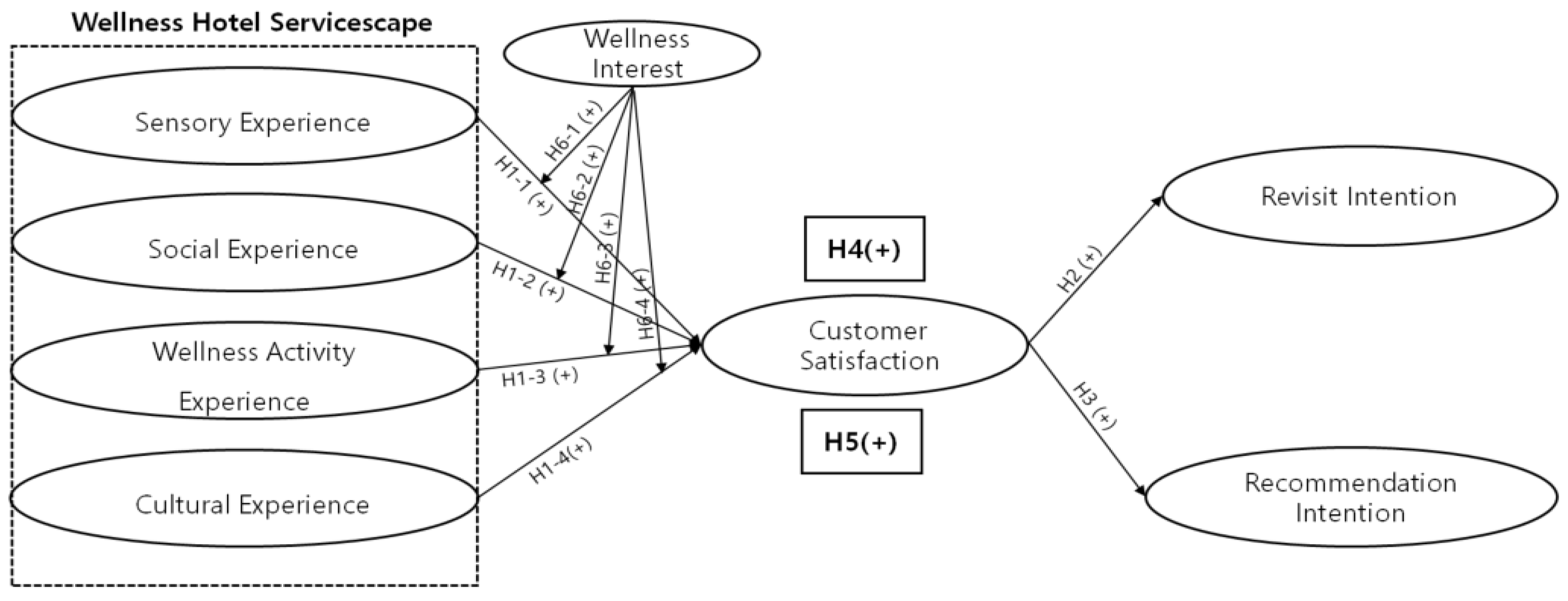
Based on the hypotheses discussed above, the research model for this study was designed as illustrated in Figure 1.

3. Methodology

3.1. Measurement of Variables

The variables used in this study were operationalized based on validated measurement scales from prior research, with necessary adjustments to fit the context of the present research. All items were measured using a 5-point Likert scale (1 = strongly disagree to 5 = strongly agree). The measurement items used in this study are presented in Appendix A, Table A1.
The servicescape variable was operationalized into four dimensions—sensory, social, wellness activity, and cultural experiences—following Bitner’s [2] conceptual framework. Sensory experience refers to the degree to which physical stimuli, such as hotel interior design, fragrance, lighting, and music, enhance customer comfort and psychological stability. This construct was measured using four items adapted from Lin [33] and Hultén [34]. Social experience reflects relational satisfaction formed through interactions with hotel staff, focusing on perceived friendliness, professionalism, and responsiveness. The scale was modified from instruments developed by Baker et al. [35] and Wu and Liang [36]. Wellness activity experience indicates the extent to which guests participate in wellness programs such as spa treatments, yoga, and meditation, leading to physical and psychological restoration. The items were developed based on the studies of Smith and Puczkó [13]. Cultural experience captures customers’ perceptions of regional identity and authenticity through exposure to local traditions, art, cuisine, and cultural elements reflected in the hotel’s service and atmosphere. This dimension was measured using items adapted from Richards [9]. Customer satisfaction was defined as an overall positive evaluation of the hotel experience, measured by four items derived from Oliver [4] and Han and Ryu [22]. Revisit intention refers to the likelihood or willingness of customers to return to the same hotel in the future, assessed using three items adapted from Zeithaml et al. [23] and Hellier et al. [37]. Recommendation intention describes the customer’s willingness to voluntarily recommend the hotel or share positive word-of-mouth based on their experience. This construct was measured using three items based on Zeithaml et al. [23] and Maxham and Netemeyer [38]. The moderating variable, wellness interest, was conceptualized as a psychological disposition that reflects individuals’ awareness of and willingness to engage in health, wellness, and self-care activities [12,39]. This variable included four items such as: “I am generally interested in health and wellness activities” and “I am willing to invest time and money in managing my health.” Wellness interest was incorporated to assess its moderating role in the relationship between the servicescape and customer satisfaction. However, in this study, wellness interest was not modeled as a latent construct within the measurement model. Instead, it was operationalized as a categorical grouping variable by dividing respondents into high and low wellness interest groups based on their overall scores. Accordingly, wellness interest was used exclusively for multi-group analysis to examine differences in structural relationships across groups, rather than as a continuous variable that forms interaction terms. Consequently, wellness interest was not subject to validity and reliability assessments such as factor loadings, Average Variance Extracted (AVE), or Composite Reliability (CR). All measurement items were adapted from validated scales in previous studies, with slight modifications to align with the current research settings. The reliability and validity of each construct were tested using Cronbach’s alpha, Composite Reliability (CR), and Average Variance Extracted (AVE) to assess internal consistency and convergent validity.

3.2. Data Analysis Method

The target population of this study comprised Korean adults who had stayed at a wellness hotel within the past year. Data were collected using an online survey method over a 16-day period, from 1 August to 16 August 2025. The survey link was distributed through recruitment posts in online travel communities, such as Naver café–based travel forums, which are widely used by individuals who actively share their hotel and travel experiences. Participation in the survey was voluntary. To ensure the relevance and validity of the sample, a two-step screening procedure was implemented at the beginning of the questionnaire. First, respondents were asked whether they had stayed at a wellness hotel within the past six months, defined as a hotel offering wellness-oriented programs such as spa services, yoga, or meditation. Only those who responded affirmatively were allowed to proceed. Second, respondents were asked to identify the wellness-related services provided by the hotel they had stayed at (e.g., spa or healing treatments, yoga or meditation programs, nature-based relaxation programs, or wellness-focused facilities). Participants who selected “none of the above” were excluded from further study. This two-stage screening process ensured that respondents not only self-identified as wellness hotel users but also confirmed the presence of core wellness services in their hotel experience. The final sample consisted of individuals with recent and verifiable wellness hotel experiences, thereby strengthening the operational validity of the wellness hotel construct used in this study.
A total of 512 responses were initially collected. After excluding incomplete and invalid responses, 483 valid questionnaires were included in the final analysis. Prior to participation, respondents were informed about the academic purpose of the study, assured of anonymity and confidentiality, and notified that their participation was entirely voluntary. Informed consent was obtained electronically, and no personally identifiable information was collected, ensuring compliance with the standard research ethics guidelines.
The collected data were analyzed using SPSS Statistics ver. 27.0 and AMOS ver. 23.0, employing the following analytical procedures: First, exploratory factor analysis (EFA) was conducted to assess the validity of the measurement instruments, and item-total correlations were examined to evaluate the internal consistency, McDonald’s omega. Second, normality tests were performed by analyzing the skewness and kurtosis of the major variables. Pearson’s correlation analysis was conducted to examine the relationships among the variables. Third, confirmatory factor analysis (CFA) was used to verify convergent and discriminant validity. Path analysis was performed to estimate the structural relationships among the constructs in the model. To test the moderating effect of wellness interest, a multi-group analysis was performed. The model fit was assessed using indices such as Incremental Fit Index (IFI), Tucker–Lewis Index (TLI), Comparative Fit Index (CFI), and Standardized Root Mean Square Residual (SRMR). A good model fit was determined based on the criteria that IFI, TLI, and CFI values exceeded 0.90 and SRMR was below 0.08 [40,41].

4. Results

4.1. Sample Characteristics

A survey was conducted with Korean adults who had stayed in a wellness hotel within the past six months. Data collection was conducted online over a 16-day period from 1 August to 16 August 2025. After excluding invalid responses, 483 valid responses were used for the final analysis.
The demographic characteristics and wellness-related behaviors of the respondents are shown in Table 1. Among the participants, 51.8% were female, and the largest age group was individuals in their 30s. The majority held a four-year college degree or higher, and 58.6% reported an average monthly income of over 8 million Korean Won (KRW). Regarding travel companions, 58.4% of the respondents traveled with family members (including children). In terms of wellness hotel usage, 37.1% had stayed at such hotels two to three times.
When asked about the primary purpose of their trip, relaxation and rest were the most commonly cited reasons. The most preferred wellness program was spa/massage, and the frequency of participation in wellness-related activities was highest in the 1–2 times per week range, reported by more than two-thirds of the respondents.

4.2. Measurement Validity and Reliability

To examine the validity of the measurement instruments, exploratory factor analysis (EFA) was conducted using Principal Component Analysis and Varimax rotation. Items with factor loadings below 0.40 were deemed unsuitable for explaining the corresponding factor [42]. Reliability was assessed using Cronbach’s alpha, with values of 0.60 or higher considered acceptable [43].
The results of the EFA and reliability analysis are presented in Table 2 and Table 3. The Kaiser–Meyer–Olkin (KMO) measure of sampling adequacy was 0.918, indicating that the data were well suited for factor analysis. Bartlett’s Test of Sphericity was statistically significant at the 5% level, confirming that the data were appropriate for structure detection.
Eight factors were extracted, with eigenvalues greater than 1.0. All items had factor loadings above 0.40, and the Cronbach’s alpha values for each construct were as follows: sensory experience (0.94), social experience (0.90), wellness activity experience (0.89), cultural experience (0.90), wellness interest (0.85), customer satisfaction (0.90), revisit intention (0.89), and recommendation intention (0.83). These results confirm that the measurement instruments exhibited strong validity and reliability. Meanwhile, in the exploratory factor analysis, the sensory experience factor showed the highest pre-rotation explained variance at 38.01%. In other words, since the variance explained by the factor with the highest explanatory power does not exceed 50%, it was determined that distortion due to common method bias is negligible (Podsakoff, Mackenzie, Lee, & Podsakoff, 2003 [44]).

4.3. Descriptive Statistics and Correlations Among Key Variables

To examine the overall tendencies and normality of the main variables—servicescape characteristics, wellness interest, customer satisfaction, revisit intention, and recommendation intention—a descriptive statistical analysis was conducted (see Table 4). The skewness of the variables ranged from −0.78 to −0.16, and the kurtosis ranged from −1.28 to −0.60. Since absolute skewness values were below 3 and kurtosis values were below 7, all variables were deemed to follow a normal distribution.
Next, a Pearson correlation analysis was performed to assess relationships between the variables. As shown in Table 5, all the variables were significantly and positively correlated. In addition, since the VIF ranged from 1.55 to 1.98, which is below 10, it was confirmed that there is no issue of multicollinearity.

4.4. Measurement Model Validation

The measurement model demonstrated a good fit to the data: χ2(278) = 706.66, p < 0.001; NFI = 0.926, IFI = 0.954, CFI = 0.954, SRMR = 0.036. Table 6 presents the standardized factor loadings, Average Variance Extracted (AVE), and Construct Reliability (CR) for each latent variable. Following the criteria of [45], convergent validity is supported if factor loadings and AVE are above 0.50 and CR is above 0.70. The standardized loadings ranged from 0.77 to 0.91, the AVE from 0.63 to 0.78, and the CR from 0.84 to 0.94, indicating adequate convergent validity.
To confirm discriminant validity, the square root of the AVE for each construct was compared to its inter-construct correlations. As shown in Table 7, all AVE square roots exceeded the corresponding inter-variable correlations (Fornell & Larcker, 1981 [46]), thus satisfying the discriminant validity criteria.

4.5. Structural Model and Hypothesis Testing

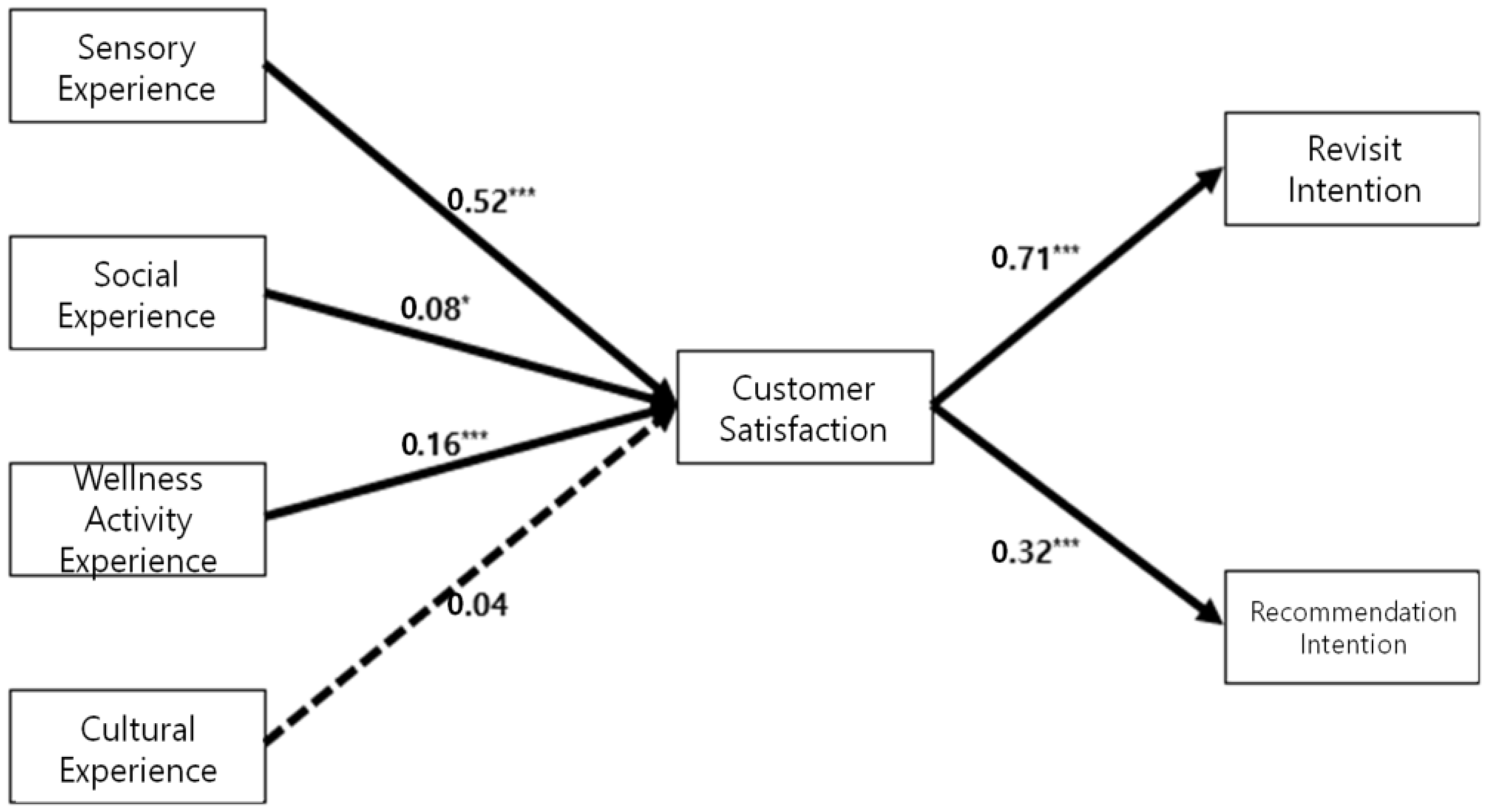
To examine the relationships among the variables in the proposed research model, a path analysis was conducted with all variables specified as observed variables, and the path coefficients of the research model were estimated (see Table 8 and Figure 2). The overall model demonstrated an acceptable fit to the data, with fit indices indicating good model adequacy (χ2(3) = 72.64, p < 0.001; NFI = 0.938; IFI = 0.940; CFI = 0.939; and SRMR = 0.075).
The results of the estimated path coefficients are presented in Table 9. The relatively low degrees of freedom in the research model reflect the use of path analysis rather than a full structural equation modeling approach, as the measurement model was fixed, and only the structural paths were estimated. The results revealed that sensory experience had a strong and significant positive effect on customer satisfaction (β = 0.52, p < 0.001). Social experience also had a positive and statistically significant influence on customer satisfaction, although the effect size was relatively modest (β = 0.08, p < 0.05). In addition, wellness activity experience was found to have a significant positive impact on customer satisfaction (β = 0.16, p < 0.001). In contrast, cultural experience did not have a statistically significant effect on customer satisfaction (β = 0.04, n.s.). Furthermore, customer satisfaction was found to significantly influence behavioral intentions. Specifically, customer satisfaction positively affected revisit intention (β = 0.71, p < 0.001) and recommendation intention (β = 0.32, p < 0.001). Based on these results, Hypotheses H1-1, H1-2, and H1-3, as well as Hypotheses H2 and H3, were supported, whereas Hypothesis H1-4 was not supported.

4.6. Mediating Role of Customer Satisfaction

To examine the mediating role of customer satisfaction in the relationship between servicescape dimensions and behavioral intentions, a bootstrapping analysis with 2000 resamples was conducted (Table 10). The results indicate that customer satisfaction is a significant mediator of several servicescape dimensions. Specifically, sensory experience exhibited significant indirect effects on both revisit intention (β = 0.37, p < 0.001) and recommendation intention (β = 0.16, p < 0.01) through customer satisfaction. In addition, both social and wellness activity experiences demonstrated significant indirect effects on revisit and recommendation intentions via customer satisfaction, indicating that these servicescape dimensions influence behavioral intentions primarily by enhancing customer satisfaction. In contrast, cultural experience did not show a statistically significant indirect effect on either behavioral outcome, suggesting that customer satisfaction did not mediate the relationship between cultural experience and behavioral intentions. Based on these findings, Hypotheses H4 and H5 were partially supported.

4.7. Moderating Effect of Wellness Interest

A multi-group analysis was conducted to examine whether wellness interest moderates the relationships between servicescape dimensions and customer satisfaction. Respondents were divided into high and low wellness interest groups based on the mean value of wellness interest. The results of the chi-square difference tests are presented in Table 11.
The findings indicate that the relationship between sensory experience and customer satisfaction differed significantly between the two groups (Δχ2(1) = 4.40, p < 0.05). Specifically, sensory experience exerted a stronger positive effect on customer satisfaction among customers with low wellness interest. In addition, a significant moderating effect was observed for the relationship between wellness activity experience and customer satisfaction (Δχ2(1) = 4.94, p < 0.05), with wellness activity experience having a stronger impact on satisfaction among customers with a high wellness interest.
In contrast, the moderating effects of wellness interest on the relationships between social experience and customer satisfaction, as well as between cultural experience and customer satisfaction, were not statistically significant.
Based on these results, Hypotheses H6-1 and H6-3 were supported, whereas Hypotheses H6-2 and H6-4 were not supported.

5. Research Findings

5.1. Implications of the Study

This study empirically examined the process through which the servicescape of wellness hotels leads to revisit and recommendation intentions via customer satisfaction, and further analyzed how this relationship varies according to individuals’ levels of wellness interest. The results indicate that sensory experience, social experience, and wellness activity experience have significant positive effects on customer satisfaction, whereas cultural experience does not exert a statistically significant influence. This finding suggests that not all experiential components contribute equally to satisfaction formation in the wellness hotel context and provides empirical evidence of the differentiated effects of experiential dimensions.In particular, the strong effect of sensory experience on customer satisfaction supports prior servicescape research emphasizing the critical role of physical environments and multisensory stimuli in shaping consumers’ emotional stability and evaluative judgments (Bitner, 1992 [2]; Spence, 2022 [7]). This result indicates that sensory design in wellness hotels functions not merely as atmospheric decoration but as a core determinant of satisfaction. In addition, the significant effect of wellness activity experience on satisfaction is consistent with previous studies suggesting that participatory activities such as yoga, meditation, and spa programs enhance consumers’ perceptions of self-care and psychological recovery, thereby increasing satisfaction (Liu et al., 2023 [26]; Smith & Puczkó, 2014 [13]).
By contrast, the non-significant effect of cultural experience on customer satisfaction suggests that cultural elements may not serve as a primary evaluative criterion for wellness hotel users. Given that wellness hotels are primarily perceived as spaces for rest and recovery, cultural experiences may function more as background or complementary elements rather than as distinctive drivers of satisfaction. Customer satisfaction was found to have significant positive effects on both revisit intention and recommendation intention. Mediation analysis further revealed that satisfaction significantly mediates the relationships between sensory experience, social experience, and wellness activity experience and behavioral intentions. These findings indicate that experiential elements in wellness hotels do not directly translate into behavioral intentions but instead operate indirectly through customers’ psychological evaluations of satisfaction. Moreover, the results of the multi-group analysis partially confirmed the moderating effect of wellness interest. Sensory experience exerted a stronger influence on satisfaction among customers with low wellness interest, whereas wellness activity experience had a stronger effect among those with high wellness interest. This pattern empirically demonstrates that even within the same service environment, the key determinants of satisfaction may differ depending on individuals’ wellness orientation. Overall, this study provides a more refined understanding of the experiential structure of wellness hotels by empirically validating the differentiated effects of servicescape dimensions, the mediating role of customer satisfaction, and the moderating effect of wellness interest.

5.2. Theoretical and Managerial Implications

This study extends the theoretical scope of experience-based service research by empirically validating a multidimensional conceptualization of the servicescape in the context of wellness hotels, encompassing sensory, social, wellness activity, and cultural experiences. By moving beyond traditional service quality–oriented approaches, this research provides a more nuanced understanding of how experiential environments shape customer responses in wellness-oriented hospitality settings. In particular, the integration of Bitner’s servicescape framework with Pine and Gilmore’s experience economy theory offers a novel analytical perspective that bridges environmental design and experiential value creation in hospitality research. Furthermore, by incorporating customer satisfaction as a mediating variable, this study empirically demonstrates the internal cognitive and affective mechanisms through which environmental stimuli are translated into behavioral intentions, in line with the theoretical logic of the Stimulus–Organism–Response (S–O–R) model.
In addition, the introduction of wellness interest as a moderating variable highlights the critical role of individual psychological predispositions in shaping the effectiveness of service experiences. Even when exposed to identical servicescapes, customers with higher wellness interest levels tend to perceive and respond to experiential stimuli more positively. By explicitly accounting for customer-level heterogeneity, this moderation model represents a meaningful theoretical advancement in wellness hospitality research and moves the literature beyond uniform main-effect models.
The empirical findings further reveal that sensory experience and wellness activity experience exert significant effects on customer satisfaction, whereas cultural experience does not show a statistically significant influence. This suggests that experiential dimensions do not exert homogeneous effects on satisfaction and underscores the importance of differentiating between experiential stimuli when explaining customer evaluations. These findings provide a valuable foundation for future theoretical development in experience economy research, environmental psychology, and spatial marketing, particularly with respect to the stimulus–affect–behavior sequence.
From a sustainability perspective, this study also contributes to the literature by linking wellness tourism research with the United Nations Sustainable Development Goals (SDGs), particularly SDG 3 (Good Health and Well-Being) and SDG 12 (Responsible Consumption and Production). By integrating environmental and social values into the discussion of servicescape design and operation, this study expands the conceptual boundaries of servicescape research beyond individual experience to collective well-being and sustainable hospitality management.
From a managerial standpoint, the strong influence of sensory experience on customer satisfaction and revisit intention underscores the strategic importance of refined multi-sensory design, including lighting, scent, acoustics, temperature, and cleanliness. These physical components should be deliberately curated not merely for aesthetic appeal, but also to promote psychological restoration and a therapeutic ambience that aligns with the core purpose of wellness hotels.
The significant role of wellness activity experience further emphasizes the importance of offering immersive and participatory wellness programs such as yoga, meditation, nature-based therapy, and art-based healing activities. Shifting from a product-centric service portfolio to an experience-driven approach may enhance customer engagement and foster long-term loyalty in wellness hospitality contexts.
In contrast, the nonsignificant effect of cultural experience on customer satisfaction warrants careful interpretation within the specific context of Korean wellness hotels and the characteristics of the study sample. The respondents primarily represent a high-income segment of wellness hotel users whose expectations differ from those of general leisure tourists. For these customers, wellness hotels are perceived primarily as spaces for psychological restoration, privacy, and personalized well-being rather than venues for explicit cultural exploration.
Consequently, cultural elements embedded in the servicescape—such as traditional motifs, local aesthetics, or heritage-inspired design—may be perceived as baseline expectations rather than as distinctive value drivers that directly enhance satisfaction. In luxury-oriented wellness contexts, cultural experiences are more likely to function as complementary or atmospheric components that support the overall ambience, rather than as central determinants of evaluative outcomes.
Moreover, Korean wellness hotels often integrate cultural elements in subtle and implicit ways, consistent with minimalist design philosophies and nature-oriented aesthetics. Such understated expressions of culture may not be consciously processed by guests as discrete “cultural experiences,” especially when compared to more tangible and goal-directed dimensions such as sensory comfort or participatory wellness activities. As a result, while cultural experience may indirectly contribute to perceived authenticity or place identity, it may not exert a direct influence on customer satisfaction among high-income wellness consumers.
From a managerial perspective, this finding suggests that cultural experience should not be abandoned, but rather strategically positioned as a supporting element that enhances coherence and authenticity within the servicescape. For high-end wellness hotels targeting affluent customers, prioritizing sensory quality and wellness programming while embedding cultural elements in a refined and non-intrusive manner may be more effective than emphasizing overt cultural themes.
Segmenting customers based on wellness interest also offers important strategic value for targeted marketing. Customers with high wellness orientation derive greater satisfaction from active participation in wellness activities, whereas those with lower wellness interest respond more strongly to ambient sensory stimuli. This finding highlights the need for differentiated communication and service strategies tailored to the wellness orientation of the target audience.
Furthermore, the mediating role of customer satisfaction in both revisit and recommendation intentions indicates that the performance of wellness hotels is more strongly associated with relational value creation than with short-term transactional outcomes. Satisfaction-driven loyalty can lead to organic electronic word-of-mouth (eWOM) and emotional brand attachment. Accordingly, wellness hotels are encouraged to develop loyalty programs grounded in emotional resonance rather than purely incentive-based mechanisms.
Finally, the findings suggest that wellness tourism has the potential to evolve into a sustainable co-creation model involving local communities and the natural environment. Sustainable servicescape strategies—such as eco-friendly interior design, local food sourcing, and the thoughtful integration of cultural heritage—can enhance customer satisfaction while simultaneously contributing to environmental stewardship and social responsibility. This underscores the potential role of wellness hotels as key actors in ESG-oriented management practices and future wellness tourism policy development.

5.3. Limitations and Future Research Directions

While this study provides both theoretical and managerial contributions by empirically examining the relationships between multidimensional servicescape elements, customer satisfaction, and behavioral intentions in the context of wellness hotels, it has several limitations.
First, the use of a cross-sectional survey design limits the ability to draw firm conclusions about causality. As wellness experiences, satisfaction, and behavioral intentions can evolve over time, future research could adopt a longitudinal approach to track how service encounters influence satisfaction and revisit behaviors over extended periods.
Second, demographic characteristics such as gender, age, and travel frequency were included in this study primarily to describe the profile of the respondents and were not incorporated as key variables in the empirical model. Consequently, differences in experiential evaluations across demographic groups were not explicitly examined in the present analysis. Future research could build upon the current findings by conducting subgroup or multi-group analyses to explore how wellness hotel experiences may vary across different demographic segments.
Third, in this study, the varimax rotation method was ultimately applied in the exploratory factor analysis to ensure item retention and the stability of the measurement model. Given that varimax rotation has been widely and conventionally used in social science research, this methodological choice is considered acceptable. Nevertheless, this approach may not have fully captured potential correlations among factors. Accordingly, future research is encouraged to apply oblique rotation methods, such as direct oblimin, at the exploratory factor analysis stage in order to examine a more realistic factor structure that accounts for inter-factor correlations.
Fourth, this study assessed discriminant validity in the confirmatory factor analysis using the Fornell–Larcker criterion, and the results are reported. However, recent research on structural equation modeling and measurement models has suggested the use of the heterotrait–monotrait ratio (HTMT) as a complementary and more stringent criterion to address the limitations of the Fornell–Larcker approach. The absence of HTMT analysis in the present study therefore represents a limitation, and future studies should incorporate HTMT-based discriminant validity assessment to provide a more rigorous evaluation of the measurement model.
Lastly, the limitation of this study concerns the income distribution of the sample, which was heavily skewed toward high-income consumers, with a substantial proportion earning more than 8 million KRW per month. Therefore, the findings should be interpreted with caution when generalizing to the broader population of hotel customers. However, this sample characteristic also reflects the reality of the Korean wellness hotel market, which predominantly targets affluent consumers seeking premium, personalized restorative experiences. Accordingly, this study should be understood as focusing on the luxury or premium segment of wellness tourism rather than on mass-market hospitality. Therefore, the results offer insights that are particularly relevant for high-end wellness hotels and may not directly translate to mid-range or budget-oriented accommodations. Future research could extend this framework by examining whether the relative importance of servicescape dimensions differs across income segments or hospitality tiers, thereby enhancing the proposed model’s external validity.
Despite these limitations, this study offers meaningful insights by empirically integrating the experiential and psychological elements of wellness hotel servicescapes. Follow-up studies are expected to build upon these findings, further deepening the theoretical and practical understanding of sustainable wellness tourism.

Author Contributions

Conceptualization, J.B.; Methodology, D.Y.Y.; Formal analysis, D.Y.Y.; Investigation, D.Y.Y.; Writing—original draft, J.B.; Project administration, J.B. All authors have read and agreed to the published version of the manuscript.

Funding

This research received no external funding.

Institutional Review Board Statement

The study was exempt from ethical approval, as confirmed by a signed declaration from a faculty advisor at Pusan National University, Busan, South Korea, stating that the data were collected in compliance with relevant institutional regulations and that the research procedures do not violate IRB regulations.

Informed Consent Statement

Informed consent was obtained from all subjects involved in the study.

Data Availability Statement

Data are contained within the article.

Conflicts of Interest

The authors declare no conflicts of interest.

Appendix A

Table A1. Measurement items used in this study.
ConstructMeasurement Item
Sensory ExperienceThe hotel’s design and interior are visually attractive.
Sensory elements such as scent and music provide comfort.
The lighting, temperature, and noise level of the hotel are comfortable.
The tableware, furniture, and decorative details appear luxurious.
Social ExperienceHotel staff are friendly and professional.
Hotel staff respond promptly to my requests.
Interacting with hotel staff was enjoyable.
Hotel staff understand and consider individual customer needs.
Wellness Activity ExperienceThe wellness programs (e.g., spa, yoga, meditation) offered by the hotel are diverse.
The wellness programs help improve my physical health.
The wellness programs provide mental and emotional stability.
Facilities and equipment for wellness activities are well prepared.
Cultural ExperienceI was able to experience programs or activities reflecting local culture at the hotel.
Local characteristics are well reflected in the hotel’s services or environment.
The hotel provides content through which cultural value can be experienced.
Local specialties are reflected in the food and beverages offered by the hotel.
Wellness InterestI am generally interested in health and wellness activities.
I actively seek information related to health and well-being.
I am willing to invest time in managing my health and wellness.
I am willing to spend money on products or services that improve my health and well-being.
Customer SatisfactionOverall, I am satisfied with my experience at this hotel.
Choosing this hotel was a good decision.
I expect my satisfaction with this hotel to continue in the future.
The service quality of this hotel met my expectations.
Revisit IntentionI intend to revisit this hotel in the future.
I would choose this hotel over other hotels.
If given the opportunity, I will revisit this hotel.
Recommendation IntentionI would recommend this hotel to others.
I would speak positively about this hotel.
I would encourage family or friends to visit this hotel.

References

  1. Global Wellness Institute. Global Wellness Economy Monitor. 2023. Available online: https://globalwellnessinstitute.org/wp-content/uploads/2023/11/GWI-WE-Monitor-2023_FINAL.pdf (accessed on 8 December 2025).
  2. Bitner, M.J. Servicescapes: The Impact of Physical Surroundings on Customers and Employees. J. Mark. 1992, 56, 57–71. [Google Scholar] [CrossRef]
  3. Pine, B.J.; Gilmore, J.H. The Experience Economy; Harvard Business School Press: Boston, MA, USA, 1999. [Google Scholar]
  4. Oliver, R.L. A Cognitive Model of the Antecedents and Consequences of Satisfaction Decisions. J. Mark. Res. 1980, 17, 460–469. [Google Scholar] [CrossRef]
  5. Parasuraman, A.; Zeithaml, V.A.; Berry, L.L. SERVQUAL: A Multiple-Item Scale for Measuring Consumer Perceptions of Service Quality. J. Retail. 1988, 64, 12–40. [Google Scholar]
  6. Yoon, Y.; Uysal, M. An Examination of the Effects of Motivation and Satisfaction on Destination Loyalty: A Structural Model. Tour. Manag. 2005, 26, 45–56. [Google Scholar] [CrossRef]
  7. Spence, C. Sensehacking the Guest’s Multisensory Hotel Experience. Front. Psychol. 2022, 13, 1014818. [Google Scholar] [CrossRef]
  8. Rosenbaum, M.S.; Massiah, C.A. An expanded servicescape perspective. J. Serv. Manag. 2011, 22, 471–490. [Google Scholar] [CrossRef]
  9. Richards, G. Creativity and Tourism: The State of the Art. Ann. Tour. Res. 2011, 38, 1225–1253. [Google Scholar] [CrossRef]
  10. Pizam, A.; Tasci, A.D.A. Experienscape: Expanding the concept of servicescape with a multi-stakeholder and multi-disciplinary approach. Int. J. Hosp. Manag. 2019, 76, 25–37. [Google Scholar] [CrossRef]
  11. Yu, S.H.; Lee, H. Development of Evaluation Scale for Wellness Tourism. J. Tour. Stud. 2020, 32, 25–56. [Google Scholar] [CrossRef]
  12. Mueller, H.; Kaufmann, E.L. Wellness Tourism: Market Analysis of a Special Health Tourism Segment and Its Implications for the Hotel Industry. J. Vacat. Mark. 2001, 7, 5–17. [Google Scholar] [CrossRef]
  13. Smith, M.; Puczko, L. Health, Tourism and Hospitality: Spas, Wellness and Medical Travel; Routledge: London, UK, 2014; Available online: https://www.routledge.com/Health-Tourism-and-Hospitality-Spas-Wellness-and-Medical-Travel/Smith-Puczko/p/book/9780415638654 (accessed on 8 December 2025).
  14. Schmitt, B. Experiential Marketing. J. Mark. Manag. 1999, 15, 53–67. [Google Scholar] [CrossRef]
  15. Dimitrovski, D.; Marinković, V.; Djordjevic, A.; Sthapit, E. Wellness Spa Hotel Experience: Evidence from Spa Hotel Guests in Serbia. Tour. Rev. 2025, 80, 1300–1319. [Google Scholar] [CrossRef]
  16. Line, N.D.; Hanks, L. The Social Servicescape: Understanding the Effects in the Full-Service Hotel Industry. Int. J. Contemp. Hosp. Manag. 2019, 31, 753–770. [Google Scholar] [CrossRef]
  17. Zhou, Y.; Liu, L.; Han, S.; Sun, X. Comparative Analysis of the Behavioral Intention of Potential Wellness Tourists in China and South Korea. Humanit. Soc. Sci. Commun. 2023, 10, 489. [Google Scholar] [CrossRef]
  18. Newman, A.; Dennis, C.; Zaman, S. Marketing Images and Consumers’ Experiences in Selling Environments; Routledge: London, UK, 2006. [Google Scholar]
  19. Quartier, K.; Christiaans, H.; Cleempoel, K.V. Retail Design: Lighting as an Atmospheric Tool Creating Experiences That Influence Consumers’ Mood and Behavior in Commercial Spaces. J. Des. Res. 2014, 12, 1–24. [Google Scholar]
  20. Artuğer, S. The Effect of Servicescape in Hotels on Customer Satisfaction: Evidence from Resort Hotels. Turizam 2020, 24, 1–15. [Google Scholar] [CrossRef]
  21. Fan, A.; Kline, S.F.; Liu, Y.; Byrd, K. Servicescape Effects on Hotel Guests’ Willingness to Pay Premiums at Different Stages of Pandemic: A Multi-Phase Study. Sustainability 2023, 15, 15252. [Google Scholar] [CrossRef]
  22. Han, H.; Ryu, K. The Roles of the Physical Environment, Price Perception, and Customer Satisfaction in Determining Customer Loyalty in the Restaurant Industry. J. Hosp. Tour. Res. 2009, 33, 487–510. [Google Scholar] [CrossRef]
  23. Zeithaml, V.A.; Berry, L.L.; Parasuraman, A. The Behavioral Consequences of Service Quality. J. Mark. 1996, 60, 31–46. [Google Scholar] [CrossRef]
  24. Jobst, J.; Boerner, S. The impact of primary service and servicescape on customer satisfaction in a leisure service setting: An empirical investigation among theatregoers. Int. J. Nonprofit Volunt. Sect. Mark. 2015, 20, 238–255. [Google Scholar] [CrossRef]
  25. Klaus, P.; Kuppelwieser, V.; Kristina, H. Quantifying the influence of customer experience on consumer share-of-category. J. Retail. Consum. Serv. 2023, 73, 103375. [Google Scholar] [CrossRef]
  26. Liu, L.; Zhou, Y.; Sun, X. The Impact of the Wellness Tourism Experience on Tourist Well-Being: The Mediating Role of Tourist Satisfaction. Sustainability 2023, 15, 1872. [Google Scholar] [CrossRef]
  27. Oliver, R.L. Whence Consumer Loyalty? J. Mark. 1999, 63, 33–44. [Google Scholar] [CrossRef]
  28. Cronin, J.J.; Taylor, S.A. Measuring Service Quality: A Reexamination and Extension. J. Mark. 1992, 56, 55–68. [Google Scholar] [CrossRef]
  29. Anderson, E.W. Customer Satisfaction and Word-of-Mouth. J. Serv. Res. 1998, 1, 5–17. [Google Scholar] [CrossRef]
  30. Reichheld, F.F. The One Number You Need to Grow. Harv. Bus. Rev. 2003, 81, 46–54. [Google Scholar]
  31. Wirtz, J.; Chew, P. The Effects of Incentives, Deal Proneness, Satisfaction, and Tie Strength on Word-of-Mouth Behavior. J. Serv. Manag. 2002, 13, 141–162. [Google Scholar] [CrossRef]
  32. Ajzen, I. Attitudes, Personality and Behavior; Open University Press: Milton Keynes, UK, 1988. [Google Scholar]
  33. Lin, I.Y. Evaluating a Servicescape: The Effect of Cognition and Emotion. Int. J. Hosp. Manag. 2004, 23, 163–178. [Google Scholar] [CrossRef]
  34. Hultén, B. Sensory Marketing: The Multi-Sensory Brand-Experience Concept. Eur. Bus. Rev. 2011, 23, 256–273. [Google Scholar] [CrossRef]
  35. Baker, J.; Parasuraman, A.; Grewal, D.; Voss, G.B. The Influence of Multiple Store Environment Cues on Perceived Merchandise Value and Patronage Intentions. J. Mark. 2002, 66, 120–141. [Google Scholar] [CrossRef]
  36. Wu, C.H.-J.; Liang, R.-D. Effect of Experiential Value on Customer Satisfaction with Service Encounters in Luxury Hotel Restaurants. Int. J. Hosp. Manag. 2009, 28, 586–593. [Google Scholar] [CrossRef]
  37. Hellier, P.K.; Geursen, G.; Carr, R.; Rickard, J.A. Customer repurchase intention: A general structural equation model. Eur. J. Mark. 2003, 37, 1762–1800. [Google Scholar] [CrossRef]
  38. Maxham III, J.G.; Netemeyer, R.G. A Longitudinal Study of Complaining Customers’ Evaluations of Multiple Service Failures and Recovery Efforts. J. Mark. 2002, 66, 57–71. [Google Scholar] [CrossRef]
  39. Voigt, C.; Brown, G.; Howat, G. Wellness Tourists: In Search of Transformation. Tour. Rev. 2011, 66, 16–30. [Google Scholar] [CrossRef]
  40. Bentler, P.M. Comparative Fit Indexes in the Structural Models. Psychol. Bull. 1990, 107, 238–246. [Google Scholar] [CrossRef]
  41. Hu, L.; Bentler, P.M. Cutoff Criteria for Fit Indices in Covariance Structure Analysis: Conventional Criteria versus New Alternatives. Struct. Equ. Model. Multidiscip. J. 1999, 6, 1–55. [Google Scholar] [CrossRef]
  42. Ford, J.K.; MacCallum, R.C.; Tait, M. The Application of Exploratory Factor Analysis in Applied Psychology: A Critical Review and Analysis. Pers. Psychol. 1986, 39, 291–314. [Google Scholar] [CrossRef]
  43. Nunnally, J.C. Psychometric Theory, 2nd ed.; McGraw-Hill: New York, NY, USA, 1978; Available online: https://www.scirp.org/reference/referencespapers?referenceid=453912 (accessed on 8 December 2025).
  44. Podsakoff, P.; MacKenzie, S.; Lee, J.-Y.; Podsakoff, N. Common Method Biases in Behavioral Research: A Critical Review of the Literature and Recommended Remedies. J. Appl. Psychol. 2003, 88, 879–903. [Google Scholar] [CrossRef]
  45. Anderson, J.C.; Gerbing, D.W. Structural Equation Modeling in Practice: A Review and Recommended Two-Step Approach. Psychol. Bull. 1988, 103, 411–423. [Google Scholar] [CrossRef]
  46. Fornell, C.; Larcker, D.F. Evaluating Structural Equation Models with Unobservable Variables and Measurement Errors. J. Mark. Res. 1981, 18, 39–50. [Google Scholar] [CrossRef]
Figure 1. Research Model.
Sustainability 18 02734 g001
Figure 2. Standardized Path Coefficients of the Research Mode. Note: * p < 0.05, *** p < 0.001.
Sustainability 18 02734 g002
Table 1. Demographic Characteristics and Wellness-Related Behaviors of the Sample (N = 483).
VariableN%
GenderMale23348.2
Female25051.8
AgeUnder 3014329.6
30s17836.9
40s10521.7
50 and above5711.8
EducationHigh school or below387.9
Junior college12626.1
Four-year college29460.9
Graduate school255.2
Monthly IncomeUnder 2 million KRW142.9
2–4 million KRW387.9
4–6 million KRW8417.4
6–8 million KRW6413.3
Over 8 million KRW28358.6
Travel Companion TypeSolo6212.8
Family (incl. children)28258.4
Spouse5912.2
Friends/acquaintances173.5
Partner5711.8
Group (club, work, etc.)61.2
Wellness Hotel Usage FrequencyOnce6112.6
2–3 times17937.1
4–5 times14229.4
6 times or more10120.9
Main Travel PurposeRelaxation/rest24951.6
Wellness/health10221.1
Cultural/sightseeing8116.8
Family gathering/event479.7
Other40.8
Preferred Wellness ProgramSpa/massage20943.3
Yoga/meditation367.5
Fitness/gym326.6
Healthy food/diet479.7
Culture/art programs14530.0
Other142.9
Wellness Activity FrequencyLess than once a month142.9
1–2 times per month7315.1
1–2 times per week32968.1
3 or more times per week6713.9
Table 2. Validity and Reliability of Measurement Instruments.
FactorItemFactor
Loading
EigenvalueVariance (%)Cronbach’s α
Sensory
Experience
Sensory Experience 40.8383.3911.300.94
Sensory Experience 10.836
Sensory Experience 20.809
Sensory Experience 30.796
Cultural
Experience
Cultural Experience 30.8293.3211.080.90
Cultural Experience 20.801
Cultural Experience 10.797
Cultural Experience 40.772
Wellness
Activity
Experience
Wellness Activity
Experience 3
0.8203.1610.550.89
Wellness Activity
Experience 1
0.816
Wellness Activity
Experience 4
0.809
Wellness Activity
Experience 2
0.793
Customer
Satisfaction
Customer Satisfaction 20.8083.1510.490.90
Customer Satisfaction 10.803
Customer Satisfaction 30.795
Customer Satisfaction 40.777
Social
Experience
Social Experience 40.8223.0810.260.90
Social Experience 10.818
Social Experience 20.805
Social Experience 30.742
Wellness
Interest
Wellness Interest 10.8182.698.970.85
Wellness Interest 30.808
Wellness Interest 20.771
Wellness Interest 40.444
Revisit
Intention
Revisit Intention 10.8212.538.440.89
Revisit Intention 30.791
Revisit Intention 20.786
Recommendation
Intention
Recommendation Intention 30.8102.066.860.83
Recommendation Intention 10.775
Recommendation Intention 20.603
Total variance explained 77.94%
KMO0.918
Bartlett’s Test of Sphericityχ2(435) = 10,764.36, p < 0.001
Table 3. Reliability of a Measurement Instrument.
FactorItemItem-Deleted
Alpha
CITCMcDonald’s
ω
Cronbach’s
α
Sensory
Experience
Sensory Experience 10.920.830.940.94
Sensory Experience 20.910.87
Sensory Experience 30.920.84
Sensory Experience 40.910.85
Social
Experience
Social Experience 10.860.800.900.90
Social Experience 20.870.78
Social Experience 30.880.72
Social Experience 40.860.78
Wellness
Activity
Experience
Wellness Activity Experience 10.860.770.890.89
Wellness Activity Experience 20.870.74
Wellness Activity Experience 30.850.79
Wellness Activity Experience 40.870.75
Cultural
Experience
Cultural Experience 10.870.790.900.90
Cultural Experience 20.870.78
Cultural Experience 30.880.75
Cultural Experience 40.860.81
Wellness
Interest
Wellness Interest10.790.720.850.85
Wellness Interest 30.780.73
Wellness Interest 20.770.77
Wellness Interest 40.870.52
Customer
Satisfaction
Customer Satisfaction 10.860.800.900.90
Customer Satisfaction 20.880.75
Customer Satisfaction 30.870.79
Customer Satisfaction 40.870.78
Revisit
Intention
Revisit Intention 10.860.780.890.89
Revisit Intention 20.830.81
Revisit Intention 30.850.79
Recommendation
Intention
Recommendation Intention 10.730.730.830.83
Recommendation Intention 20.820.64
Recommendation Intention 30.740.71
Table 4. Descriptive Statistics of Key Variables (N = 483).
VariableMSDSkewnessKurtosis
Sensory experience3.691.18−0.78−0.78
Social experience43.461.14−0.54−1.11
Wellness activity experience3.241.10−0.16−1.28
Cultural experience3.641.06−0.62−0.60
Wellness interest3.561.04−0.58−0.96
Customer satisfaction3.411.15−0.50−1.10
Revisit intention3.491.21−0.57−0.98
Recommendation intention3.611.11−0.50−1.24
Table 5. Correlations Among Key Variables (N = 483).
Variable1-11-21-31-4234
1-1. Sensory experience1
1-2 Social experience0.34 ***1
1-3. Wellness activity experience0.25 ***0.59 ***1
1-4. Cultural experience0.45 ***0.39 ***0.32 ***1
2. Wellness interest0.49 ***0.30 ***0.28 ***0.48 ***1
3. Customer satisfaction0.61 ***0.33 ***0.35 ***0.35 ***0.45 ***1
4. Revisit intention0.46 ***0.35 ***0.26 ***0.48 ***0.65 ***0.41 ***1
5 Recommendation intention0.46 ***0.43 ***0.42 ***0.59 ***0.51 ***0.43 ***0.45 ***
VIF1.881.701.611.551.981.75-
Note: *** p < 0.001.
Table 6. Standardized Loadings, AVE, and CR for the Measurement Model.
Latent VariableItemβAVECR
Sensory experienceItem 1–40.86–0.910.780.94
Social experienceItem 1–40.78–0.860.690.90
Wellness activity experienceItem 1–40.80–0.850.680.89
Cultural experienceItem 1–40.78–0.880.690.90
Customer satisfactionItem 1–40.79–0.860.690.90
Revisit intentionItem 1–30.83–0.890.740.90
Recommendation intentionItem 1–30.77–0.820.630.84
Table 7. Correlations and AVE Extracted Square Roots for Latent Constructs.
1234567
1. Sensory(0.88)
2. Social0.37(0.83)
3. Wellness activity0.280.65(0.82)
4. Cultural0.500.420.35(0.83)
5. Satisfaction0.660.370.390.39(0.83)
6. Revisit intention0.500.390.290.540.46(0.86)
7. Recommendation0.510.480.470.680.480.52(0.79)
Note: The diagonal values in parentheses represent the square root of the AVE.
Table 8. Goodness-of-fit indices.
X2df-No. of ParametersAICBICNFIIFICFISRMR
792.68 ***325122.64227.140.9380.9400.9390.062
Note: *** p < 0.001.
Table 9. Path Coefficients in the Structural Model.
PathBSEβt
Sensory → Satisfaction0.500.040.5213.89 ***
Social → Satisfaction0.080.040.082.05 *
Wellness activity → Satisfaction0.170.040.164.03 ***
Cultural → Satisfaction0.050.040.041.04
Satisfaction → Revisit intention0.740.070.7110.10 ***
Satisfaction → Recommendation0.300.040.328.10 ***
Note: * p < 0.05, *** p < 0.001.
Table 10. Mediation Effects via Customer Satisfaction.
PathBSEβ
Sensory → Satisfaction → Revisit0.370.040.37 ***
Social → Satisfaction → Revisit0.060.030.06 *
Wellness activity → Satisfaction → Revisit0.120.030.11 ***
Cultural → Satisfaction → Revisit0.030.030.03
Sensory → Satisfaction → Recommendation0.150.020.16 **
Social → Satisfaction → Recommendation0.030.010.03 *
Wellness activity → Satisfaction → Recommendation0.050.010.05 ***
Cultural → Satisfaction → Recommendation0.010.010.01
Note: * p < 0.05, ** p < 0.01, *** p < 0.001.
Table 11. Group Comparison of Path Coefficients.
PathLow Interest (n = 208)High Interest (n = 275)ΔdfΔχ2
Sensory → Satisfaction0.64 *** (0.05)0.28 *** (0.07)14.40 *
Social → Satisfaction0.07 (0.06)−0.03 (0.06)11.05
Wellness Activity → Satisfaction0.06 (0.07)0.28 *** (0.07)14.94 *
Cultural → Satisfaction−0.04 (0.06)0.03 (0.06)10.62
Note: * p < 0.05, *** p < 0.001.
Disclaimer/Publisher’s Note: The statements, opinions and data contained in all publications are solely those of the individual author(s) and contributor(s) and not of MDPI and/or the editor(s). MDPI and/or the editor(s) disclaim responsibility for any injury to people or property resulting from any ideas, methods, instructions or products referred to in the content.