Article

Mechanistic Insights into Travertine Deposition Mediated by Submerged Macrophytes: A Comparative Study of V. natans and C. demersum

1
College of Ecology and Environment, Chengdu University of Technology, Chengdu 610059, China
2
Department of Environmental Science and Engineering, Fudan University, Shanghai 200438, China
3
College of Water Conservancy and Civil Engineering, Inner Mongolia Agricultural University, Hohhot 010018, China
4
Sichuan Academy of Eco-Environmental Sciences, Chengdu 610041, China
5
Sichuan Jinshadao Biotechnology Co., Ltd., Chengdu 610059, China
*
Authors to whom correspondence should be addressed.
These authors contributed equally to this work.
Sustainability 2026, 18(6), 2748; https://doi.org/10.3390/su18062748
Submission received: 19 January 2026 / Revised: 11 February 2026 / Accepted: 19 February 2026 / Published: 11 March 2026

Abstract

The travertine formed through the precipitation of supersaturated calcium carbonate from geothermal or surface waters due to CO2 degassing, evaporation, and biological activities not only exhibits remarkable landscape value but also holds significant scientific importance in geological research. Current conservation efforts face critical challenges including travertine degradation, increased algal biomass accumulation, and progressive marshification processes. The study focused on how Vallisneria natans (V. natans) and Ceratophyllum demersum (C. demersum) affected travertine deposition. Analyzing the physical and chemical parameters, phase structure, crystal morphology, and microbial community in the aquatic environment, it was observed that under conditions of low c (Ca2+) concentration in solution (≤100 mg L−1), both species significantly increased the rate of travertine deposition. The effect of plant biomass was species-specific: V. natans showed the highest promotion at 70 g L−1, while C. demersum performed effectively at moderate biomass levels (140 and 280 g L−1). Specifically, C. demersum exhibited enhanced photosynthetic activity, elevated pH, increased dissolved oxygen (DO) content and more epibiotic microorganisms, with higher levels of Aeromonas compared to V. natans. Therefore, C. demersum demonstrated a greater capacity for travertine deposition. However, the culture environment with elevated c (Ca2+) ≥ 500 mg L−1 or higher biomass levels (420 g L−1) impeded the stable growth of submerged plants and exerted a stress effect on them, hindering travertine deposition. The morphology of travertine crystals promoted by the two submerged macrophytes was distinct. In the V. natans treatment, the crystals were square and elongated, whereas in the C. demersum treatment, they were spheraragonite, droplet-like, and petal-shaped. This study reveals the mechanisms by which submerged macrophytes promote travertine deposition and provides new insights for adopting nature-based ecological restoration strategies to sustainably maintain travertine landscapes. By leveraging the promoting effects of submerged macrophytes, travertine deposition and the aquatic environment were improved while reducing energy and chemical inputs. Such biological regulation approaches help synergistically achieve the dual objectives of geological heritage conservation and ecosystem health restoration.

1. Introduction

Travertine landscapes, from the precipitation of dissolved calcium ions (Ca2+) in water, are particularly pronounced in areas such as hot springs, springs, and flowing water bodies [1,2]. Beyond their visually captivating forms and textures, travertine deposits also play crucial ecological roles in the aquatic environment by regulating the concentration of calcium ions, maintaining chemical balance, and thereby promoting water quality stability [3].
The formation of travertine deposits is influenced by multiple factors, including climatic conditions, geomorphological features, physical and chemical water parameters, hydrodynamic effects, and biological activity [4]. Among these factors, biological function plays a pivotal role in the travertine deposition process. Different types of aquatic organisms exhibit varied effects on travertine deposition. Calcium carbonate is locally deposited on the surface of algae through direct assimilation, binding, secretion, and algal crust formation [5]. Aquatic plants primarily sequester CO2 through photosynthesis, leading to a reduction in partial pressure of CO2 (p (CO2)), an increase in pH, and the facilitation of travertine formation in water [6,7,8,9]. Biofilms formed on aquatic plant surfaces harbor diverse microbial communities, which play a crucial role in travertine formation [10]. Biogenically mediated travertine deposition often results in stratified architectures due to periodic microbial activity and mineral accretion [11]. Within the same biofilm, aragonite, calcite, and even amorphous calcium carbonate (ACC) may co-develop [12]. The biofilms are closely associated with submerged macrophytes.
As primary producers in aquatic ecosystems, these macrophytes regulate the function, structure, and stability of aquatic ecosystems by mediating nutrient cycles and releasing bioactive metabolites that both mitigate algal overgrowth and modulate hydrochemical conditions to promote travertine deposition [13,14,15]. Beyond these biogeochemical interactions, submerged macrophytes play a crucial role in ecosystem restoration and habitat engineering initiatives [16,17]. In the travertine-depositing aquatic environments of Jiuzhaigou and Huanglong, two UNESCO World Heritage Sites in southwestern China known for their extensive travertine landscapes, the dominance of Vallisneria natans and Ceratophyllum demersum reflects their ecological synergy with biofilms in sustaining travertine deposition and aquatic ecosystem functioning [18,19]. The leaves of C. demersum exhibited a whorled arrangement at the edges with scattered spines, potentially contributing to increased microenvironmental heterogeneity on the leaf surface. In contrast, the leaves of V. natans possessed a simple, basal structure, characterized by a linear or ribbon-like form [20,21]. Species-specific differences between submerged macrophytes significantly shape the structure and composition of microbial communities [22,23,24]. Moreover, variations in aqueous Ca2+ concentration may further influence how these submerged macrophytes mediate travertine deposition, yet the mechanisms underlying this modulation remain unclear.
This study employed two representative submerged macrophytes, Vallisneria natans (V. natans) and Ceratophyllum demersum (C. demersum), as experimental subjects. By independently manipulating aqueous Ca2+ concentrations (0, 100, 300, and 500 mg L−1) and plant biomass levels (70, 140, 280, and 420 g L−1), we systematically assessed the differential impacts of these species on travertine deposition rate, physicochemical parameters of water, microbial community composition, and morphology of precipitated calcium carbonate crystals. The aim is to elucidate the interactive mechanisms by which submerged macrophytes, abiotic factors, and microbial assemblages collectively drive travertine deposition, thereby providing a robust scientific basis and technical guidance for the sustainable conservation of travertine landscapes and the design of ecology-based restoration strategies that align with principles of environmental sustainability and long-term ecosystem resilience.

2. Materials and Methods

Detailed methods are provided in the online version of this paper and include the following.

2.1. Cultivation of Submerged Macrophytes

V. natans and C. demersum were purchased from Tuxin Landscaping Company (Jiangsu, China). To achieve the target initial biomass densities (70, 140, 280, and 420 g L−1) while maintaining a constant planting configuration (same number of plants per ring and same container geometry), we meticulously grouped plants based on their individual fresh weight prior to planting. This ensured that the total fresh weight in each 3.0 L container precisely matched the desired density gradient, even though each colonization ring consistently housed five plants. All plants were thoroughly rinsed with ultra-pure water before being planted in the experimental containers using plastic colonization rings. All plants were cultivated in 1/10 Hoagland solution under rigorously controlled environmental conditions to ensure experimental reproducibility. The incubations were conducted in a climate-controlled chamber maintaining a constant temperature of 25 ± 1 °C. A 12 h:12 h light:dark photoperiod was imposed using full-spectrum Light Emitting Diode (LED) lights, providing a photosynthetic photon flux density of 80 µmol m−2 s−1. This light intensity was selected to simulate a moderated yet photosynthetically active environment, representative of natural travertine-depositing water bodies, sufficient to drive photosynthesis while minimizing confounding factors like excessive algal growth. To maintain stable water chemistry and prevent nutrient depletion or metabolic waste accumulation, the entire culture medium (3.0 L) in each experimental container was completely replaced with fresh, correspondingly amended 1/10 Hoagland solution every 3 days throughout the 15-day experimental period.

2.2. Experimental Design

According to our previous study, the Ca2+ concentration of travertine-depositing aquatic environments in Huanglong water was 40–180 mg L−1 [25,26], and the source Ca2+ concentration of travertine in the Fairy Pool Scenic Area was 400 mg L−1. Accordingly, 100 mg L−1 was chosen to represent a moderate, naturally relevant concentration. The 300 mg L−1 treatment approximates the higher end of concentrations found in some source waters (~400 mg L−1 in the Fairy Pool Scenic Area), while 500 mg L−1 was included as an extreme high Ca2+ stress condition to delineate the upper functional threshold of the plant-mediated deposition process. A calcium-free control (0 mg L−1) was established to differentiate biotic from abiotic contributions. Similarly, the plant biomass levels (70, 140, 280, and 420 g L−1 fresh weight) were designed to span from low to high densities observed in natural stands. The highest level (420 g L−1) was included specifically to assess potential inhibitory effects due to high-density stress, such as intraspecific competition and limited light or gas exchange, which is critical for informing practical restoration planting densities. The experimental design is shown in Table 1. Each treatment had three replicates. The experiment employed a transparent cylindrical plastic bucket measuring 30 cm in height, 15 cm in diameter, and containing 3.0 L of medium (Table S1). The initial pH of the experiment was 7, c (HCO3) = 800 mg L−1, c (Mg2+) = 20 mg L−1, c (SO42−) = 100 mg L−1. The entire experiment spanned a duration of 15 days.

2.3. Determination of Water Physicochemical Parameters and Plant Growth Indicators

The dissolved oxygen (DO), electrical conductivity (EC), temperature, and pH were monitored every 2 days using a multiparameter analyzer (HL7 Hydrolab, HACH Company, Loveland, CO, USA). Simultaneously, Ca2+ concentration was determined every two days using an atomic absorption spectrometer in accordance with GB11905-89 [27] (Agilent 240Duo, Agilent Technologies, Santa Clara, CA, USA). Biomass change was quantified using two complementary metrics according to the experimental design.
In the planting density experiment (with fixed calcium concentration), where no zero-biomass control was included, biomass accumulation was expressed as the net change in fresh weight (ΔW) after blotting dry:
W = W 2 W 1
where W1 and W2 represent the fresh weight at the beginning and end of the experiment, respectively.
In the calcium concentration experiment (with fixed planting density), which included a control group (0 mg L−1 Ca2+), the growth response was evaluated as the relative growth rate (RGR, %) to enable a meaningful comparison between species:
R G R = Δ W t r e a t m e n t Δ W c o n t r o l Δ W t r e a t m e n t × 100 %
Here, ΔWtreatment denotes the fresh weight of the corresponding species in the control group at the end of the experiment. This approach accounts for intrinsic interspecific differences in baseline growth and allows for a standardized comparison of stress responses.
Submerged plant leaves (approximately 0.5 g) were excised every two days. Chlorophyll was then extracted by grinding the samples with 5 mL of 95% ethanol. Pigment extracts were centrifuged and their absorbance recorded at 649 nm and 665 nm using an ultraviolet spectrophotometer. The content of chlorophyll a (Chl-a), chlorophyll b (Chl-b) and total chlorophyll (TChl) was calculated according to Lichtenthaler and Wellburn [28].
C h l - a m g   g 1 F W = ( 13.95 × A 665   6.88 × A 649 ) × V ÷ 1000 ÷ W
C h l - b m g   g 1 F W = ( 24.96 × A 649   7.32 × A 665 ) × V ÷ 1000 ÷ W
T C h l m g   g 1 F W = C h l - a + C h l - b
V: extract volume (mL); W: plant fresh weight (g).
Referring to the research methods of previous studies [29], we applied an exponential decay equation to quantify the kinetic process of travertine deposition.
c ( C a 2 + ) = e k t + b
By taking the natural logarithm of both sides of this equation, a linear relationship is derived:
l n c ( C a 2 + ) = k t + b
Here, [Ca2+] represents calcium ion concentration, t denotes time, and k is the rate constant reflecting the deposition rate. The time-series data of calcium ion concentrations obtained from measurements across different treatment groups were all employed for the fitting of the aforementioned model. The specific variation data of calcium ion concentrations under different treatments and the kinetic fitting results (including the fitted equations, rate constant k, etc.) are presented in Tables S5 and S6.

2.4. Morphological and Phase-Structural Analysis of Travertine

Travertine deposits were harvested at the end of the experiment for morphological and phase-structural analysis. The morphology of travertine deposits was examined by scanning electron microscopy (S-3400 NII; Hitachi, High-Technologies Corporation, Tokyo, Japan), and crystalline phases were identified by X-ray diffraction (XRD) using a PANalytical X’Pert Pro X-ray diffractometer (Malvern Panalytical B.V., Almelo, The Netherlands). The XRD peak data for the travertine deposit powder samples were subsequently analyzed using MDI Jade 6.0 software (Materials Data Inc., Liverpool, CA, USA).

2.5. Analysis of Microbial Community

At the end of the experiment, water samples were collected from each treatment group and aseptically filtered; the resulting filter membranes were stored at −80 °C. All samples were then analyzed by Wekemo Tech Group Co., Ltd (Shenzhen, China). for high-throughput sequencing of the 16S rRNA gene (Shenzhen, China).

2.6. Statistical Analysis

Data visualization was conducted using Origin 2022 (Origin Lab, Northampton, MA, USA). Statistical preprocessing and analyses were carried out in SPSS 18.0 (SPSS, Inc., Chicago, IL, USA), and differences among treatments were evaluated by the Kruskal–Wallis test. When p < 0.05, it indicates that the analysis has statistical significance and differences.

3. Results

3.1. Effects of Submerged Macrophytes on Water Chemistry

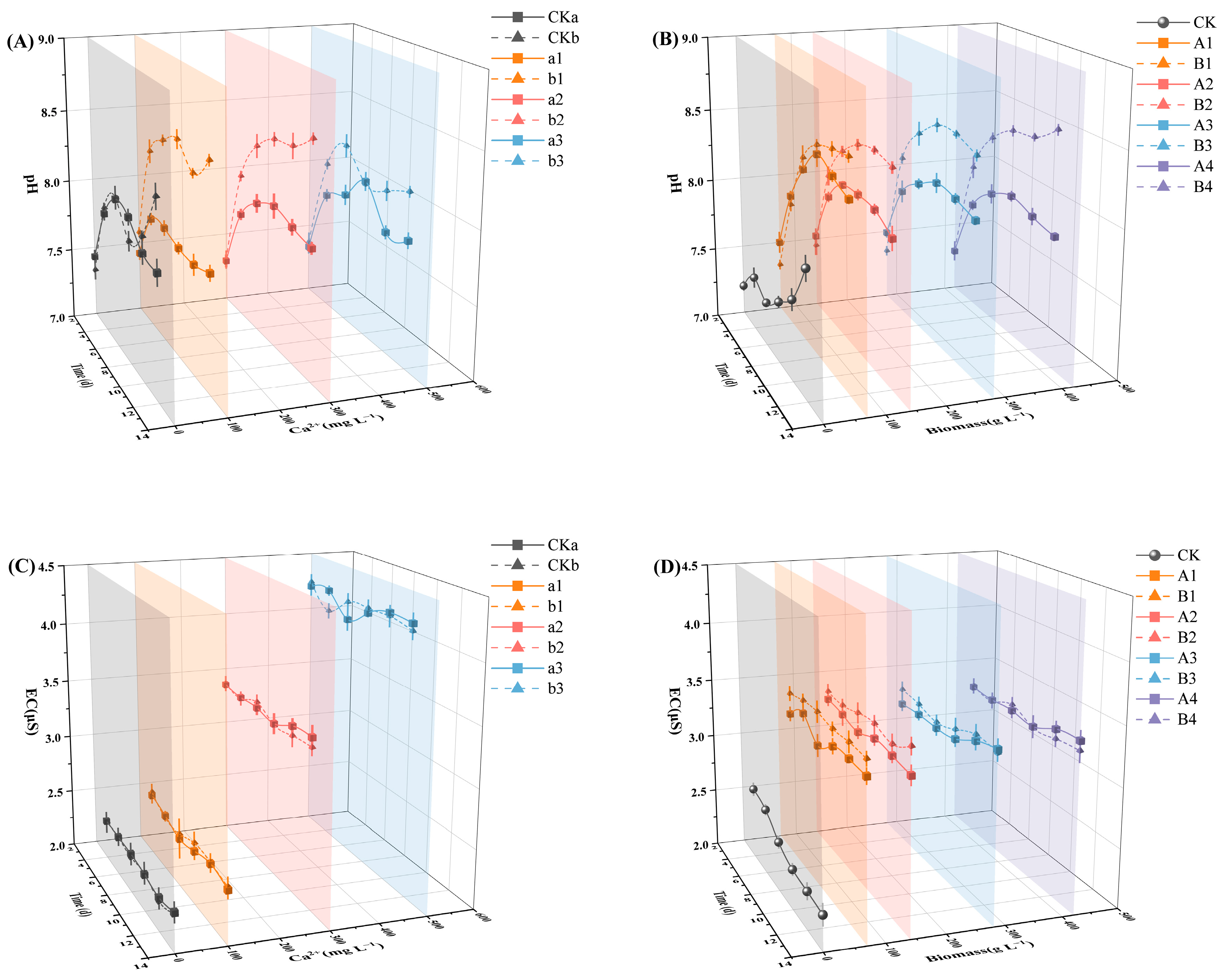
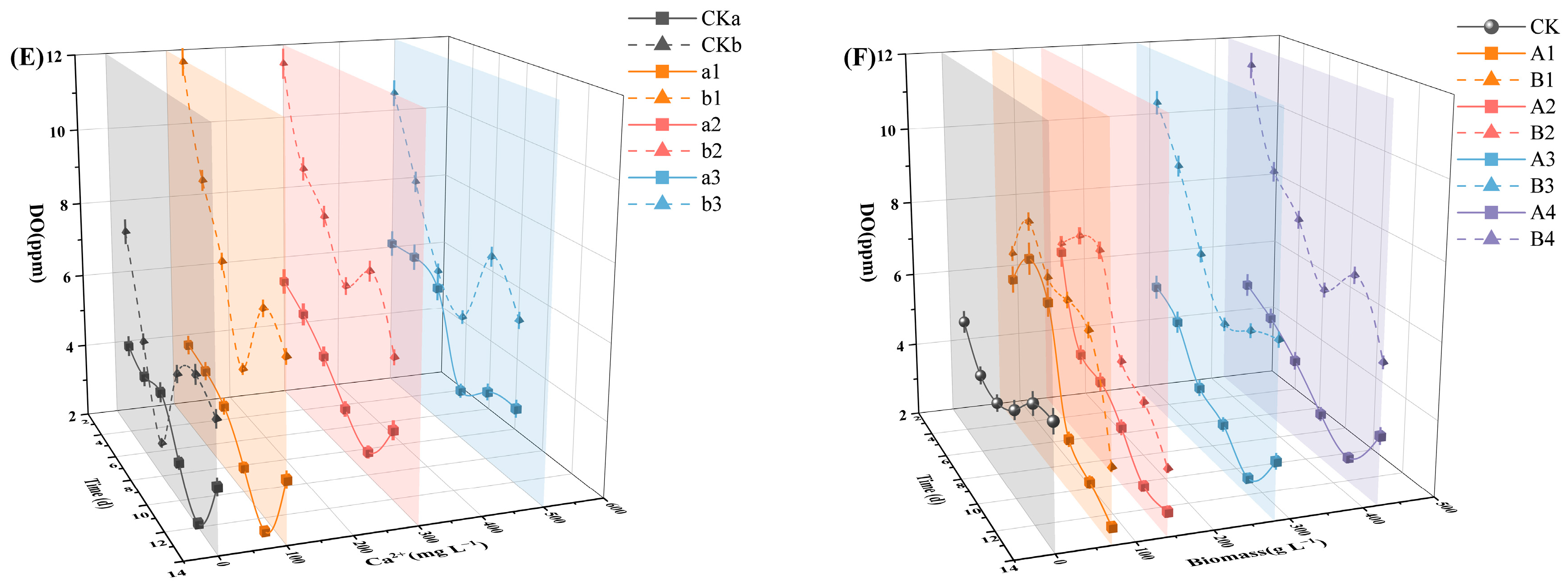
To evaluate the impact of submerged macrophytes (Vallisneria natans and Ceratophyllum demersum) on travertine deposition, we monitored key water physicochemical parameters and plant physiological responses under varying calcium concentrations and plant biomass levels. When the Ca2+ concentration was low to moderate (≤300 mg L−1), the C. demersum treatment exhibited significantly higher pH values compared to the control group (p < 0.05) (Figure 1A). Regardless of the calcification system concentration (100–500 mg L−1) or biomass level (70–420 g L−1), the overall pH in the C. demersum treatment was significantly higher than that in the V. natans treatment (p < 0.05) (Figure 1A,B). Compared to the CK treatment, the presence of V. natans and C. demersum significantly influenced the pH of the water body during travertine deposition (p < 0.05) (Figure 1B). With equivalent biomass, EC demonstrated a gradual increase with rising Ca2+ concentration (Figure 1C). The EC was notably higher in the experimental treatment compared to the control group (p < 0.05) (Figure 1C,D). The dissolved oxygen (DO) levels in the C. demersum treatments consistently surpassed those in the V. natans treatments (p < 0.05; Figure 1E,F). The sustained high DO levels are a direct indicator of intense photosynthetic activity, which consumes dissolved CO2 and thereby raises pH, creating conditions conducive to enhanced calcium carbonate saturation. Therefore, the species-specific capacity of C. demersum to modify the aquatic microenvironment, primarily through its vigorous photosynthesis, underpins its superior role in promoting the conditions for travertine deposition compared to V. natans.

3.2. Plant Growth Under Different Experimental Conditions

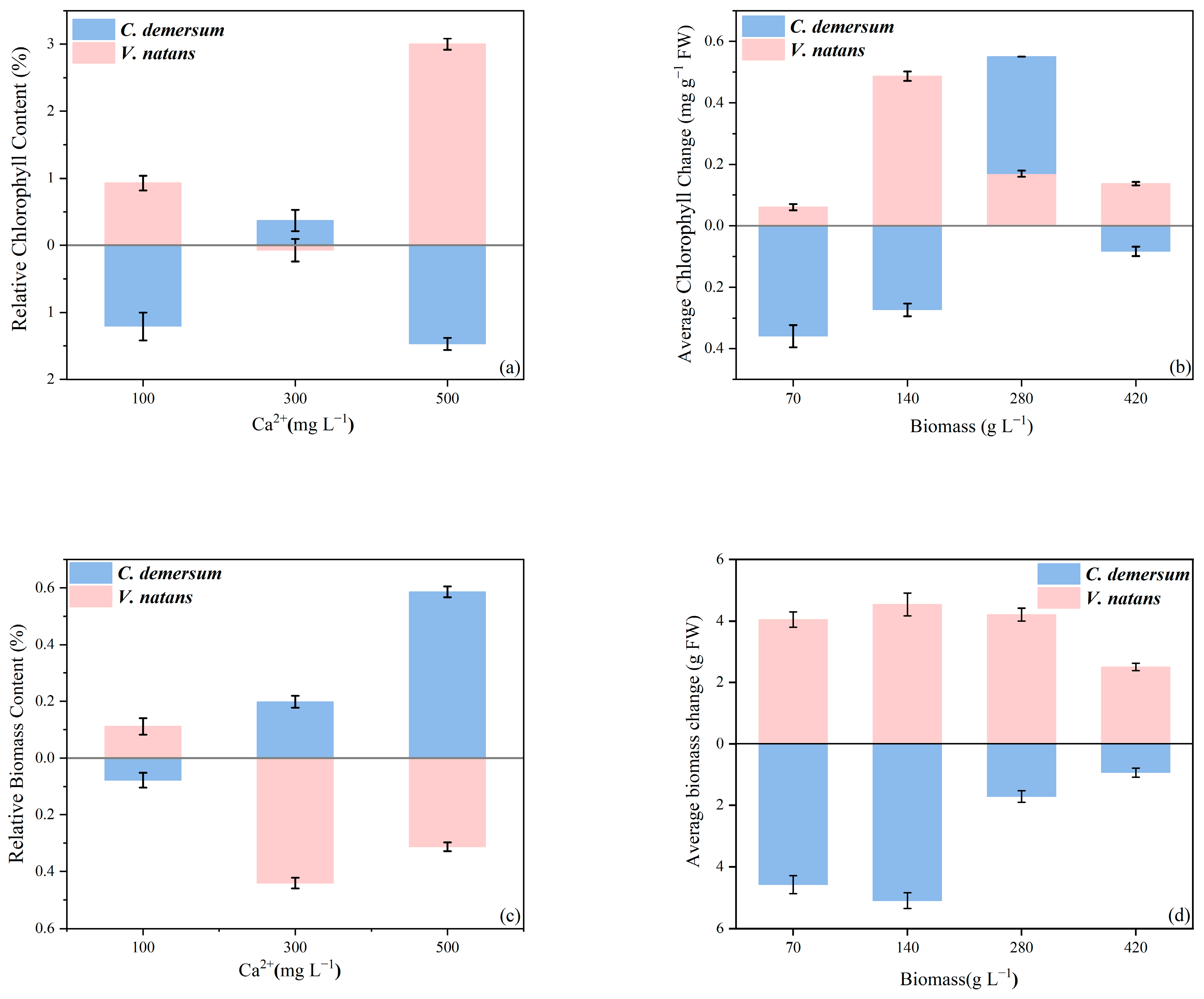
To assess the stress effects of elevated calcium concentrations and high planting densities on submerged macrophytes, plant growth performance was quantitatively evaluated. The effects of varying calcium concentrations (100, 300, and 500 mg L−1) were analyzed in terms of relative growth compared to the control, whereas under different biomass levels (70–420 g L−1), growth was assessed based on the net change between final and initial measurements of chlorophyll and biomass (Figure 2). The results demonstrated that calcium concentration significantly influenced plant growth. At 300 mg L−1, growth was markedly inhibited, with relative biomass showing negative values and relative chlorophyll content remaining very low (Figure 2a,c). In contrast, at 100 mg L−1, the relative growth was also comparatively low. Planting density likewise exerted a clear effect on growth. A biomass of 140 g L−1 promoted plant growth, whereas at 280 g L−1, the growth of C. demersum was suppressed, accompanied by negative relative chlorophyll values (Figure 2b,d). Consistent with the above trends, comparisons with the control group further illustrated these effects. For instance, under the designated experimental groupings, the biomass of group A1 increased by 0.5 g relative to the control, whereas groups A2 and A3 showed reductions of 1.97 g and 1.04 g, respectively. A similar pattern was observed in treatment B, where B1 exhibited a slight increase of 0.09 g, while B2 and B3 declined by 0.23 g and 0.68 g.

3.3. Travertine Deposition Rate Analysis

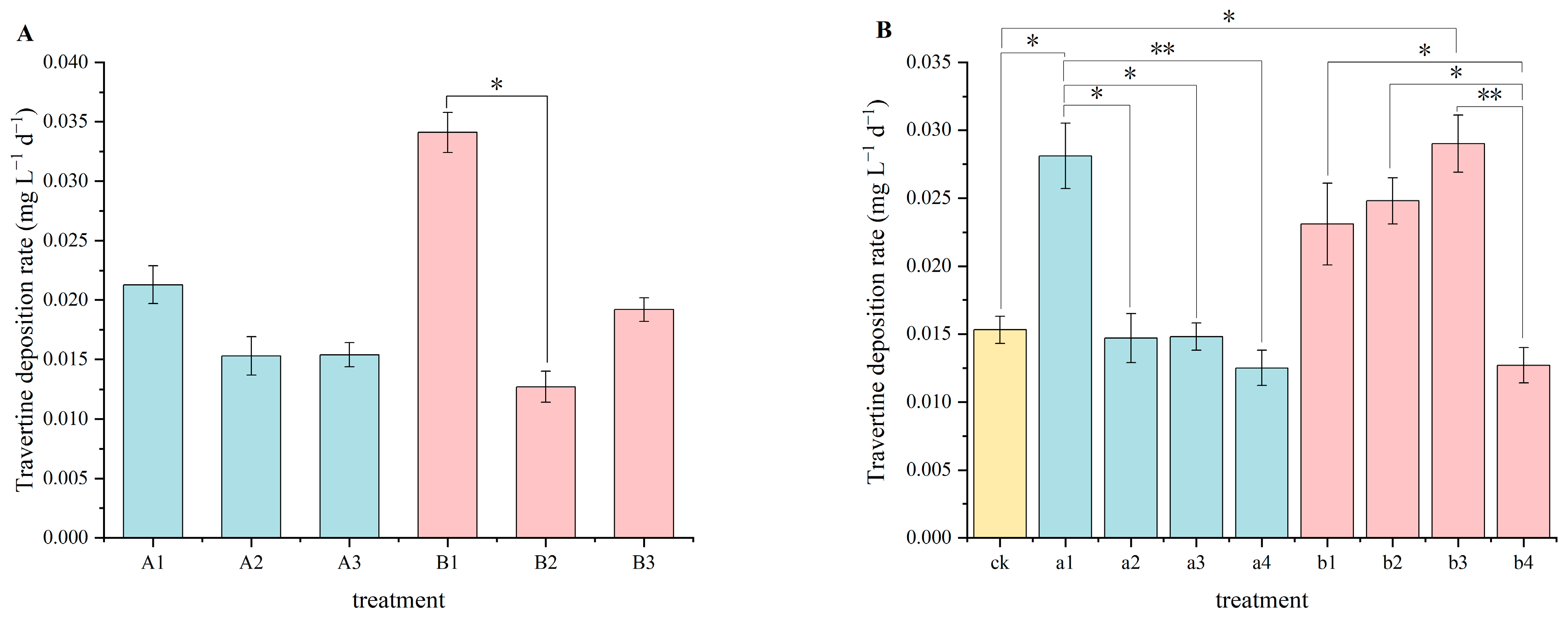
As the Ca2+ concentration increased, the travertine deposition rate gradually decreased. The presence of a higher Ca2+ concentration in the solution was found to suppress the deposition rate of travertine. Further insight was gained when examining the travertine rate at the Ca2+ concentration of 100 mg L−1, revealing that C. demersum exhibited a significantly higher travertine deposition rate compared to V. natans (Figure 3A). Notably, in the planting density experiment, the plant-free control (CK) group showed abiotic travertine deposition, which originated from spontaneous CO2 degassing and chemical precipitation of CaCO3. However, this abiotic deposition rate was significantly lower than that of all groups treated with submerged macrophytes (p < 0.05). For V. natans, treatment a1 (70 g L−1) exhibited the highest deposition rate. The travertine deposition rates in groups a2 and a3 (140 and 280 g L−1) did not significantly differ from the plant-free control (ck), indicating that these higher biomass levels did not enhance deposition beyond abiotic processes (Figure 3B).
In summary, submerged macrophytes played a significant role in enhancing the travertine deposition rate. The plant-free CK group in the planting density experiment further confirmed the synergistic effect of biotic-abiotic processes: the abiotic deposition rate (0.012 ± 0.002 mg L−1 d−1) was only 31.6–28.6% of the optimal plant-treated groups (V. natans a1 and C. demersum b2), indicating that submerged macrophytes amplify travertine deposition by 3.2–3.5 times through photosynthesis-driven pH elevation and microbial biofilm mediation. This aligns with previous findings that biological activities are key drivers of enhanced travertine formation in natural aquatic environments [5,9]. The concentration of the calcification system significantly influenced plant calcification reactions. A lower Ca2+ concentration (100 mg L−1) promoted plant calcification reactions, while a higher Ca2+ concentration (500 mg L−1) inhibited such reactions. Interestingly, when the Ca2+ concentration was lower (≤100 mg L−1), C. demersum was more effective in promoting travertine deposition. In contrast, at a moderate Ca2+ concentration (300 mg L−1), V. natans exhibited greater efficacy in facilitating travertine deposition. Furthermore, the presence of higher biomass (420 g L−1) proved to be unfavorable for travertine deposition. Specifically, V. natans demonstrated greater efficacy in travertine deposition at lower biomass levels (70 g L−1). For C. demersum, moderate biomass levels (140 and 280 g L−1) were both conducive to travertine deposition, yielding significantly higher rates compared to the lowest (70 g L−1) or highest (420 g L−1) biomass treatments.

3.4. Morphological and Phase-Structural Characteristics of Travertine Crystal

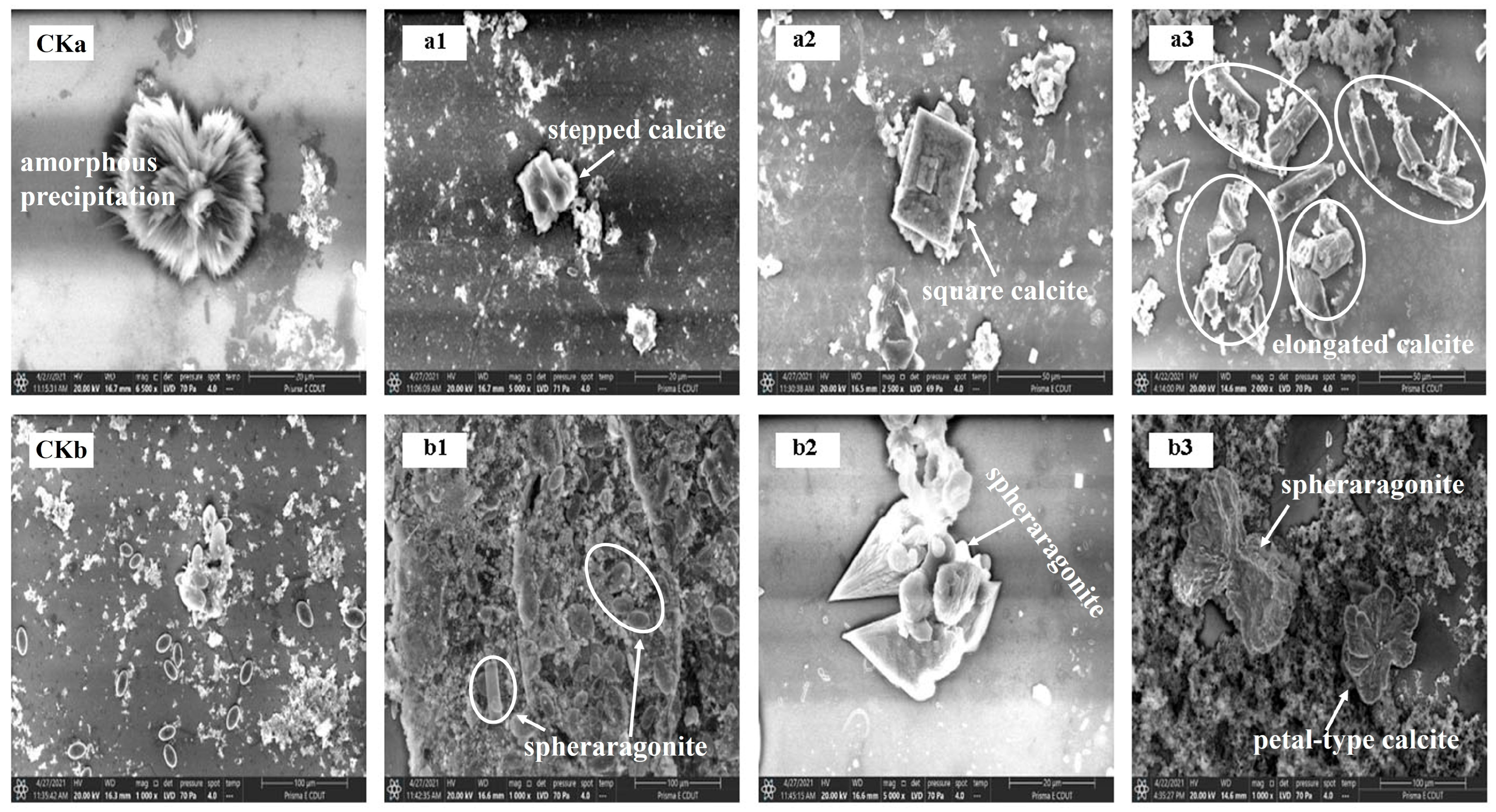
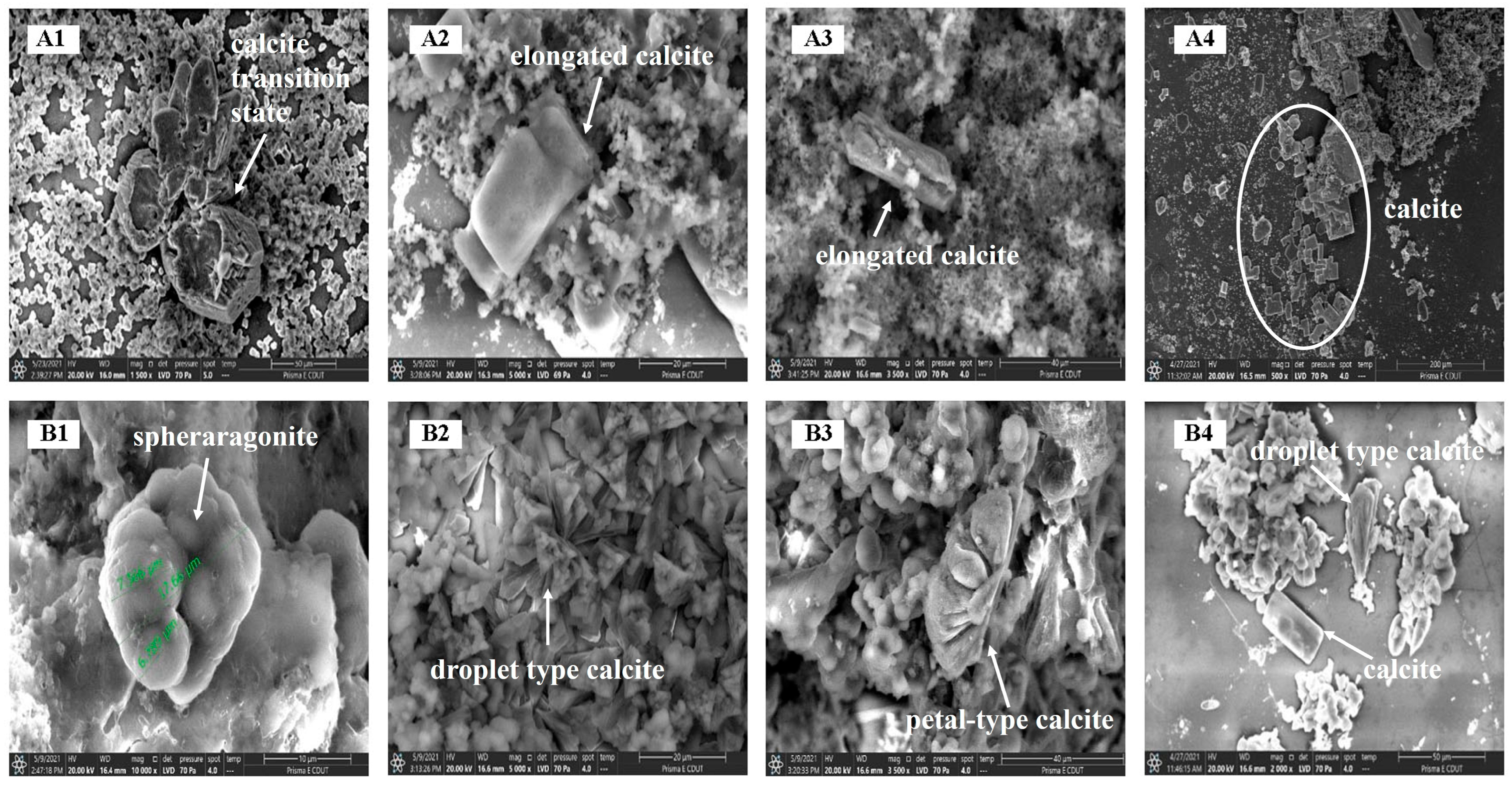
In the CKa treatment, only a small amount of amorphous precipitation was observed. Similarly, the CKb treatment also showed negligible amorphous precipitation without any crystalline calcium carbonate detected. These amorphous precipitates originate from endogenous Ca2+ released by submerged macrophytes through root exudation, leaf surface leaching, and minimal tissue decomposition during the experiment, as confirmed by Table S1, where no CaCl2 was added to CKa and CKb treatments, ruling out exogenous Ca2+ contamination. Consistent with the SEM images in Figure 4, the precipitates appear as irregular, unstructured aggregates lacking the typical crystalline facets observed in treatments with exogenous Ca2+. In treatment A1, the calcite crystals exhibited a stepped formation, while square-shaped travertine deposits were observed in treatment A2. Notably, treatment A3 displayed the fully developed crystals, characterized by the largest grain size and a plethora of elongated crystals on the surface with a layered structure. Contrastingly, the calcite crystals deposited in treatments B1 to B3 were predominantly spheraragonite with larger crystal diameters (Figure 4). The morphological characteristics of travertine crystal deposited with different biomass are shown in Figure 5. Notably, crystals in treatments a2 and a3 exhibited a slender morphology, with those in the a2 treatment being the most fully fledged. In treatments b3 and b4, the shapes of travertine crystals were relatively fully developed, predominantly displaying spheraragonite, droplet-like, and petal-type formations.
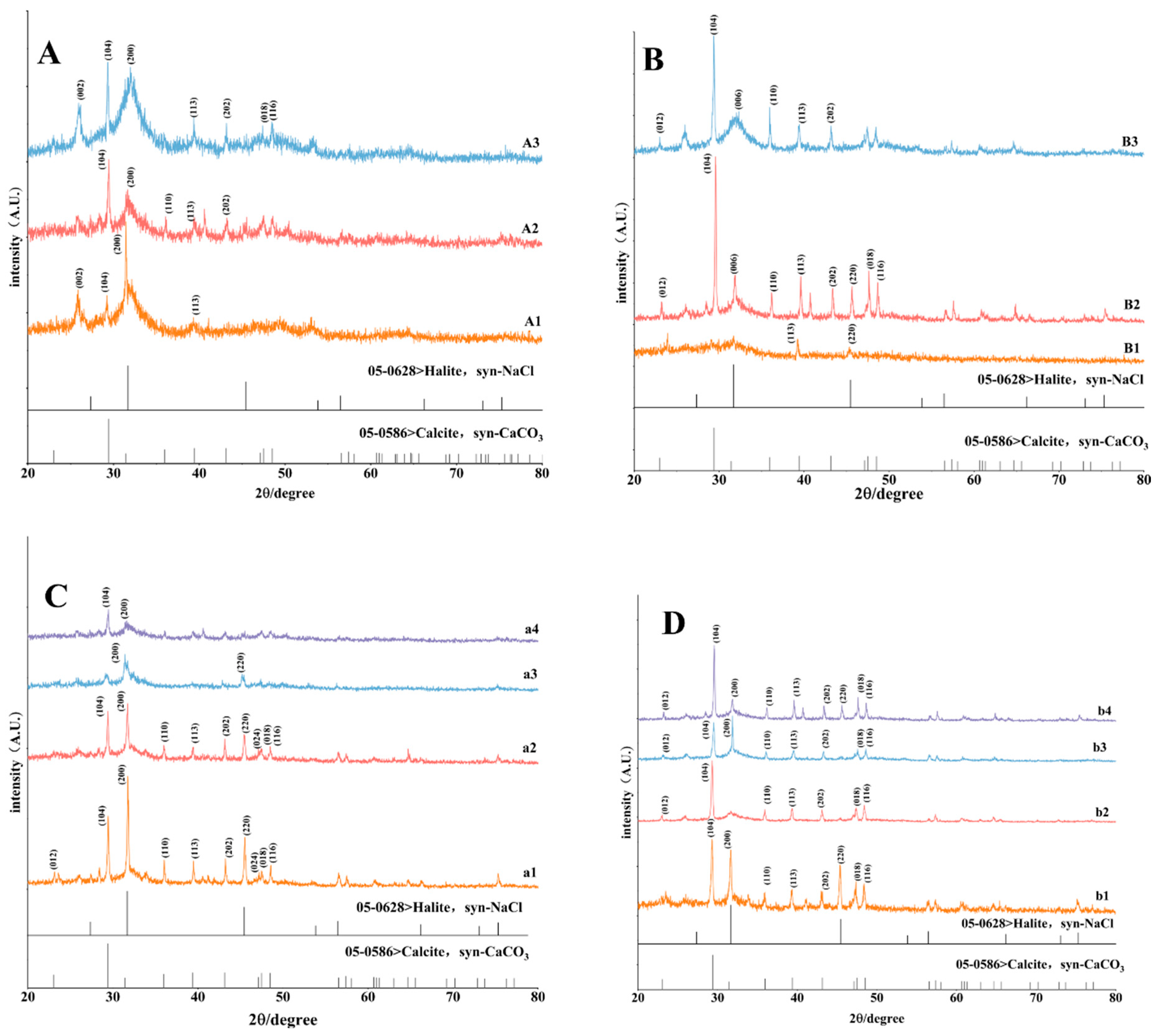
XRD results of travertine sediments in the experimental treatment with the same biomass (420 g L−1) and different Ca2+ concentrations (Figure 6A; Table S3). In both treatment A and experimental treatments B2 and B3, the sediments were predominantly composed of calcite. However, in the case of B1, the sediments were composed of NaCl with a spatial arrangement corresponding to Fm-3m (225). (Figure 6B). Figure 6C,D and Table S4 show the XRD analyses of travertine sediments across various biomass treatments. Specifically, travertine deposited by submerged plants was predominantly comprising calcite (CaCO3) with a spatial treatment of R-3C (167). Notably, the highest diffraction peak was observed at (104). In treatment a3, the crystals were primarily salt rock, characterized by the chemical formula NaCl and spatial treatment Fm-3m (225). The corresponding diffraction peaks for the principal crystal plane were (200) and (220) respectively (Figure 6C,D).

3.5. Microbial Diversity Analysis

With an increase in Ca2+ concentration, the experimental treatment exhibited a decline in Chao1, Shannon and Simpson indices, as detailed in Table S2. The Chao1 values of group A2 were significantly lower than those of group A1, and similarly, the Chao1 values of groups B2 and B3 were significantly lower than those of group B1 (p < 0.05). This indicates a decrease in species richness. Additionally, the Shannon and Simpson indices in group A2 were significantly lower than those in group A1, and likewise, these indices were significantly lower in groups B2 and B3 compared to group B1 (p < 0.05), suggesting a reduction in species diversity. The results demonstrated that the increase in calcium ion concentration significantly inhibited the richness and diversity of symbiotic microorganisms in submerged plants [30,31,32].
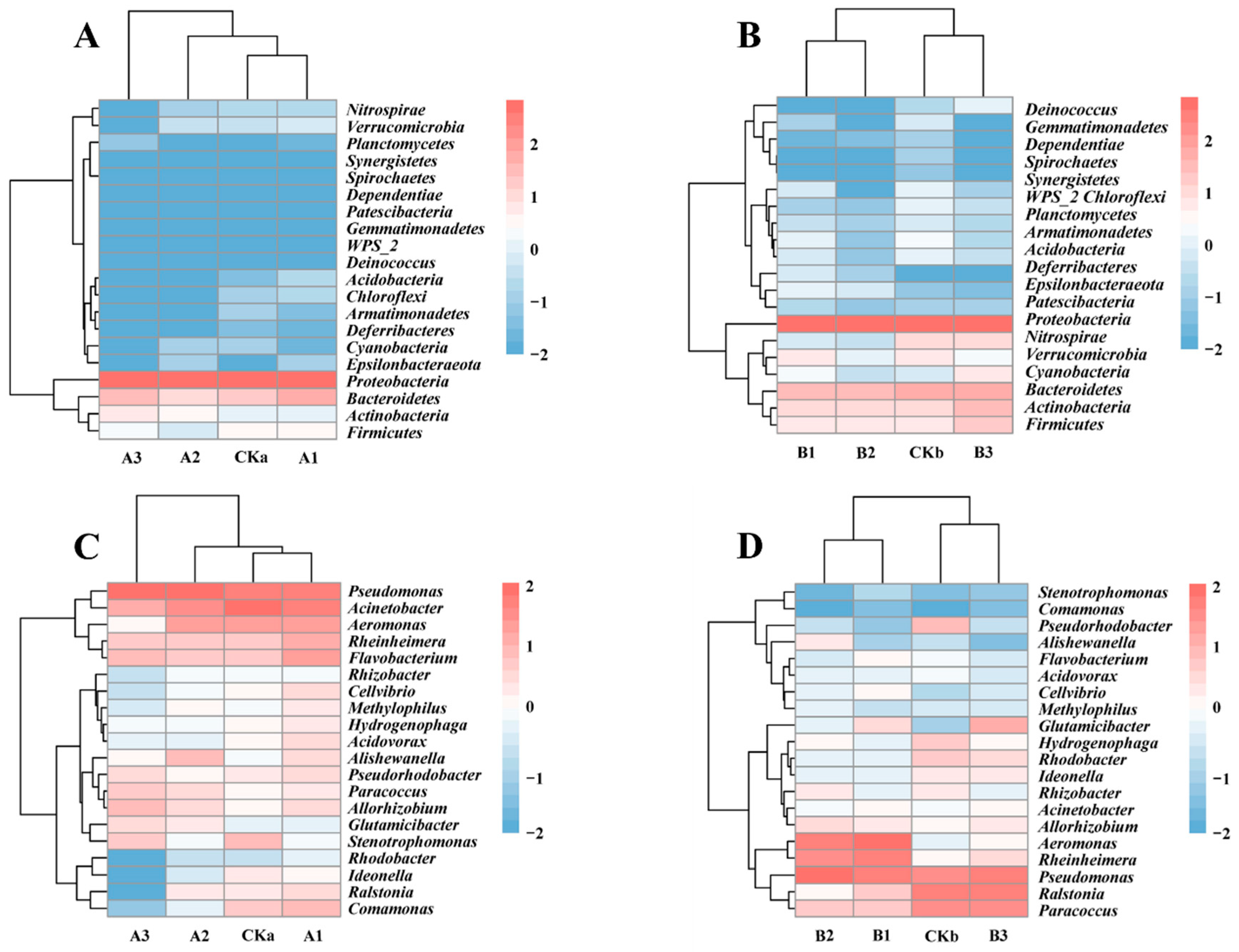
At the phylum level, the dominant abundance was observed in Proteobacteria (81.53–97.55%), followed by Bacteroidetes (1.71–8.53%), as illustrated in Figure 7A,B and Figure S1. The abundance of Pseudomonas significantly increased with the augmentation of Ca2+ concentration. The relative abundance of Pseudomonas in treatment groups A1, A2 and A3 was higher, while Aeromonas accounted for a relatively high proportion in treatment B1 and B2 (Figure 7C,D).

4. Discussion

The pH value of the results most accurately reflects the fluctuation patterns observed during travertine deposition. The greater the intensity of photosynthesis, the higher the pH level (Figure 1A,B). This results in a decrease in p (CO2) concentration and an increase in p (O2) concentration within the water. Equations (8)–(11) show the interrelationship between photosynthesis and the carbonate system. Consequently, a reduction in CO2 from water caused the precipitation of supersaturated CaCO3 in the solution, giving rise to the formation of travertine crystals.
Consequently, the reduction in CO2 drives the precipitation of supersaturated CaCO3, leading to the formation of travertine crystals.
Therefore, the higher the pH value in the experimental solution, the stronger the deposition capacity of travertine.
C O 2 + H 2 O P h o t o s y n t h e s i s C H 2 O + O 2
H C O 3 + H 2 O P h o t o s y n t h e s i s C H 2 O + O H + O 2
H C O 3 + O H C O 3 2 + H 2 O
C a 2 + + C O 3 2 C a C O 3 ( )
C. demersum exhibited the highest pH and the strongest travertine deposition activity under the Ca2+ concentration of 100 mg L−1 (Figure 1A). Moreover, the overall pH and DO of the C. demersum treatment were significantly higher than those in the V. natans treatment, indicative of stronger photosynthetic and travertine deposition activity in C. demersum (Figure 1A,B,E,F).
The decrease in biomass change values of both plants was observed with the increase in c (Ca2+) or planting biomass, as higher levels of Ca2+ concentration and biomass may impede the stable growth of submerged plants and exert a stress effect on them [33,34,35]. Remarkably, the biomass change in V. natans was much greater than that of C. demersum (Figure 2c). This discrepancy could indicate that V. natans possesses a stronger capacity to withstand the short-term interference of external environmental stressors, such as elevated Ca2+ levels [36,37]. According to the above analysis, C. demersum exhibited stronger photosynthetic activity but had lower biomass compared to V. natans. This may be attributed to the antagonistic environment, which prompted C. demersum to accelerate nighttime respiration as a mechanism to resist external stress, resulting in a lower biomass change relative to V. natans. The increase in Ca2+ concentration led to the inhibition of plant growth (Figure 2a), and a gradual decrease in the deposition rate of travertine was observed (Figure 3B) [38,39].
When the concentration of Ca2+ was lower (≤100 mg L−1), the C. demersum treatment group demonstrated a significantly enhanced effect on promoting travertine deposition. Regarding biomass effects at a moderate Ca2+ concentration (300 mg L−1, Figure 3B), moderate biomass levels (140 and 280 g L−1) of C. demersum were both conducive to travertine deposition, whereas the highest biomass (420 g L−1) exhibited reduced effectiveness. The travertine formed by V. natans and C. demersum exhibited distinct crystal morphologies, with the former predominantly showcasing square and slender crystals, while the latter featured spheraragonite, droplet-like, and petal-type crystals. These morphological differences were quantitatively supported by XRD analyses (Tables S3 and S4), revealing systematic variations in crystal size and crystallinity. Travertine from C. demersum treatments consistently exhibited larger average crystal sizes (92.7 nm in B2 and 99.2 nm in B3) and higher crystallinity compared to most V. natans treatments. This pattern suggests that C. demersum promotes a tightly regulated, biofilm-templated mineralization pathway. The Aeromonas-enriched biofilm likely provides an organic matrix that templates the nucleation of spherulitic aggregates and modulates growth into the observed complex droplet and petal-shaped crystals. In contrast, travertine from V. natans showed more variable crystal sizes (from 46.9 nm in A2 to 88.8 nm in A3) and a stronger correlation with aqueous Ca2+ concentration, supporting a scenario where crystal growth is less biologically constrained and more directly responsive to solution chemistry, favoring the simpler elongated and square habits. Thus, the distinct crystal forms are direct signatures of two divergent precipitation mechanisms: a robust, biologically templated process in C. demersum systems versus a more abiotic, chemistry-driven process in V. natans systems. Both calcite and aragonite are fundamental crystalline forms of travertine, which can be readily converted into calcite in nature due to the unstable nature of these minerals [9].
The increase in Ca2+ concentration was found to negatively impact the diversity and richness of microbial communities, as evidenced by the decrease in alpha-diversity indices with increasing c (Ca2+) (Table S2) [40]. In the experimental treatments, we identified two specific microorganisms, Pseudomonas and Aeromonas (Figure 7C,D), that produce carbonic anhydrase [41]. Carbonic anhydrase is an enzyme that catalyzes the hydration of CO2 and its reverse reaction (CO2 + H2O ⇋ H+ + HCO3) [42,43,44]. Beyond their enzymatic function, the ecological impact of these taxa on carbonate dynamics is context-dependent and mediated by their association with plant biofilms [10]. The higher in vitro CA activity of Pseudomonas (~70.6 U mg−1) [45] may favor carbonate dissolution under stress, aligning with its increased abundance at high Ca2+ concentrations. In contrast, the prevalence of Aeromonas in C. demersum biofilms, despite its lower CA activity (~0.0626 U mg−1), is pivotal for deposition. Aeromonas is frequently associated with microbially induced carbonate precipitation, not only through CA activity but also via the production of extracellular polymeric substances (EPS) that trap Ca2+ and provide organic templates for crystal nucleation [46]. This biofilm-mediated mineralization process is likely enhanced by the complex leaf surface morphology of C. demersum, which supports denser microbial assemblages. Consequently, the distinct crystal morphologies-spherulitic aragonite with C. demersum versus elongated calcite with V. natans can be attributed to these taxon-specific biofilm communities and their metabolic interactions with the plant’s photosynthesis-driven chemical microenvironment. Therefore, the superior travertine deposition by C. demersum is mechanistically explained by a synergy between its vigorous photosynthesis and the recruitment of an Aeromonas-enriched biofilm community functionally geared toward precipitation.

5. Conclusions

This study elucidated the influence mechanism of submerged macrophytes on travertine deposition. The main conclusions are as follows: (1) Both V. natans and C. demersum significantly enhance travertine deposition under conditions of low c (Ca2+) solution (≤100 mg L−1). Regarding biomass, the promoting effect was optimal at 70 g L−1 for V. natans and at moderate levels (140–280 g L−1) for C. demersum. (2) C. demersum demonstrated a more pronounced capacity for travertine deposition in comparison to V. natans, which can be attributed to the higher microbial diversity observed in C. demersum treatment and the presence of higher levels of Aeromonas. However, the condition characterized by higher biomass (420 g L−1) or elevated c (Ca2+) levels (≥500 mg L−1) was found to be detrimental to the growth of submerged macrophytes and impeded travertine deposition. (3) The two species induced distinct crystal morphologies: V. natans promoted smaller, elongated calcite crystals correlated with Ca2+ concentration, indicating chemically controlled growth, whereas C. demersum favored larger, spherulitic aragonite aggregates shaped by biofilm-mediated mineralization via its Aeromonas-enriched epiphytic community. These findings contribute both a mechanistic understanding and actionable guidance for aquatic vegetation in the sustainable management of the travertine landscape.

Supplementary Materials

The following supporting information can be downloaded at https://www.mdpi.com/article/10.3390/su18062748/s1, Table S1. Medium formula; Table S2. Mean and standard deviation of Microbial Alpha diversity; Table S3. XRD analysis results of travertine deposits in different c(Ca2+) test groups; Table S4. XRD analysis results of travertine deposits in different planting density test groups; Table S5. Fitting Results of the Exponential Decay Equation for the Calcification Kinetics of Different Calcium Ion Treatment Groups; Table S6. Fitting Results of the Exponential Decay Equation for the Calcification Kinetics of Different Plant Density Treatment Groups; Figure S1. Microbial community structure (A) phylum level; (B) genus level.

Author Contributions

Y.F.: formal analysis and writing—original draft. J.Z.: writing—original draft and methodology. Q.L.: software and investigation. Y.Y.: data curation and writing—review and editing. X.S.: conceptualization and methodology. W.N.: investigation and resources. N.L.: investigation and supervision. W.Z.: supervision, writing—review and editing, and funding acquisition. All authors have read and agreed to the published version of the manuscript.

Funding

This work was supported by Natural Science Foundation of Sichuan Province (2024NSFSC4146), Young Elite Scientists Sponsorship Program by CAST (2023QNRC001), Chengdu Key Research and Development Project (2024-RC02-00036-CG), Tianfu Emei Talent Program (No. 1943, No. 2452), “Chengdu Drifter” talent recruitment program (No. 1155), and “HR Enhancement Initiative for Employment and Education Integration Program” by the Ministry of Education (2024012513206).

Institutional Review Board Statement

Not applicable.

Informed Consent Statement

Not applicable.

Data Availability Statement

All relevant data are included in the paper or Supplementary Materials.

Conflicts of Interest

Author Weizhen Zhang was employed by the company Sichuan Jinshadao Biotechnology Co., Ltd. All authors declare that the research was conducted in the absence of any commercial or financial relationships that could be construed as a potential conflict of interest.

References

  1. Li, H.; Liao, C.; Jiang, D.; Jiang, G. The status quo and prospect of research on travertine precipitation mechanism. Carsologica Sin. 2006, 1, 57–62. [Google Scholar]
  2. Xue, Q.; Jie, D.; Stefano, L.; Jinhai, R.; Weiyang, X.; Pan, C.; Ya, T. Are climate warming and enhanced atmospheric deposition of sulfur and nitrogen threatening tufa landscapes in Jiuzhaigou National Nature Reserve, Sichuan, China? Sci. Total Environ. 2016, 562, 724–731. [Google Scholar]
  3. Çiltepe, F.; Uzun, A. An Investigation of Tufa Microbialites in the Terrestrial Ecosystem of Adilcevaz (Bitlis) According to the Conservation Approach. Geoheritage 2024, 16, 23. [Google Scholar] [CrossRef]
  4. Liu, Z.; Dreybrodt, W. The DBL model and prediction of calcite dissolution/precipitation rates. Carsologica Sin. 1998, 17, 3–9. [Google Scholar]
  5. Jones, B. Review of calcium carbonate polymorph precipitation in spring systems. Sediment. Geol. 2017, 353, 64–75. [Google Scholar] [CrossRef]
  6. Allan, P.; Pietro, C. The role of photosynthesis and CO2 evasion in travertine formation: A quantitative investigation at an important travertine-depositing hot spring, Le Zitelle, Lazio, Italy. J. Geol. Soc. 2007, 164, 843–853. [Google Scholar]
  7. Busch, F.A.; Sage, T.L.; Cousins, A.B.; Sage, R.F. C3 plants enhance rates of photosynthesis by reassimilating photorespired and respired CO2. Plant Cell Environ. 2013, 36, 200–212. [Google Scholar] [CrossRef]
  8. Clark, I.D.; Fontes, J.-C.; Fritz, P. Stable isotope disequilibria in travertine from high pH waters: Laboratory investigations and field observations from Oman. Geochim. Cosmochim. Acta 1992, 56, 2041–2050. [Google Scholar] [CrossRef]
  9. Fouke, B.W.; Farmer, J.D.; Marais, D.J.D.; Pratt, L.; Sturchio, N.C.; Burns, P.C.; Discipulo, M.K. Depositional facies and aqueous-solid geochemistry of travertine-depositing hot springs (Angel Terrace, Mammoth Hot Springs, Yellowstone National Park, U.S.A.). J. Sediment. Res. 2000, 70, 565–585. [Google Scholar] [CrossRef]
  10. Decho, A.W. Overview of biopolymer-induced mineralization: What goes on in biofilms? Ecol. Eng. 2010, 36, 137–144. [Google Scholar] [CrossRef]
  11. Sugihara, C.; Yanagawa, K.; Okumura, T.; Takashima, C.; Harijoko, A.; Kano, A. Transition of microbiological and sedimentological features associated with the geochemical gradient in a travertine mound in northern Sumatra, Indonesia. Sediment. Geol. 2016, 343, 85–98. [Google Scholar] [CrossRef]
  12. Peng, X.; Jones, B. Patterns of biomediated CaCO3 crystal bushes in hot spring deposits. Sediment. Geol. 2013, 294, 105–117. [Google Scholar] [CrossRef]
  13. Li, Q.; Gu, P.; Zhang, H.; Luo, X.; Zhang, J.; Zheng, Z. Response of submerged macrophytes and leaf biofilms to the decline phase of Microcystis aeruginosa: Antioxidant response, ultrastructure, microbial properties, and potential mechanism. Sci. Total. Environ. 2020, 699, 134325. [Google Scholar] [CrossRef]
  14. Motoyama, M.; Nakagawa, S.; Tanoue, R.; Sato, Y.; Nomiyama, K.; Shinohara, R. Residues of pharmaceutical products in recycled organic manure produced from sewage sludge and solid waste from livestock and relationship to their fermentation level. Chemosphere 2011, 84, 432–438. [Google Scholar] [CrossRef]
  15. He, F.; Wu, Z. Application of aquatic plants in sewage treatment and water quality improvement. Chin. Bull. Bot. 2003, 6, 641–647. [Google Scholar]
  16. Wang, L.Y. Research on the Water Purification Efficacy of Two Submerged Plants in Artificial Lakes. Water Resour. Manag. 2024, 10, 48–52. [Google Scholar]
  17. Zhang, H.; Chen, J.X.; Cai, F. Comparison of Purification Effect of Four Submerged Plants on Eutrophic Water. J. Wuhan Polytech. Univ. 2024, 43, 34–41. [Google Scholar]
  18. Cheng, Q.; Wang, H. Effect of calcium addition on phosphorus enrichment capacity of two submerged plants (Potamogeton crispus L. and Ceratophyllum demersum L.) in water bodies. J. Lake Sci. 2020, 32, 406–416. [Google Scholar] [CrossRef]
  19. Zhang, R.; Bo, X.; Yang, Z.; Zhang, Y.; Li, S.; Yang, P.; Liu, H. Research Advances and Application Situation of Vallisneria in Water Environmental Restoration. Chin. Agric. Sci. Bull. 2016, 32, 144–154. [Google Scholar]
  20. Adamec, L. Ecophysiological characteristics of turions of aquatic plants: A review. Aquat. Bot. 2018, 148, 64–77. [Google Scholar] [CrossRef]
  21. Lowden, R.M. An approach to the taxonomy of Vallisneria L. (Hydrocharitaceae). Aquat. Bot. 1982, 13, 269–298. [Google Scholar] [CrossRef]
  22. Hodson, S.; Croft, M.; Deery, E.; Smith, A.; Warren, M. Algae acquire Vitamin B12 through a symbiotic relationship with bacteria. Comp. Biochem. Physiol. Part A Mol. Integr. Physiol. 2007, 146, S222. [Google Scholar] [CrossRef]
  23. Dittami, S.; Duboscq-Bidot, L.; Perennou, M.; Gobet, A.; Corre, E.; Boyen, C.; Tonon, T. Host-microbe interactions as a driver of acclimation to salinity gradients in brown algal cultures. ISME J. 2016, 10, 51–63. [Google Scholar] [CrossRef]
  24. Weigel, B.L.; Miranda, K.K.; Fogarty, E.C.; Watson, A.R.; Pfister, C.A. Functional Insights into the Kelp Microbiome from Metagenome-Assembled Genomes. mSystems 2022, 7, e0142221. [Google Scholar] [CrossRef]
  25. Liu, X.; Sun, D.; Gao, W.; Wang, S.; Zhang, J.; Zeng, Y.; Zhao, S.; Zhang, W.; Tan, Y.; Jiang, H.; et al. Hydrochemical Characteristics and Driving Factors of Surface Water in Nenensangcuo, Eastern Margin of Qinghai–Tibet Plateau, China. J. Water Chem. Technol. 2023, 45, 503–513. [Google Scholar] [CrossRef]
  26. Gao, W.; Zhang, J.; Zhang, W.; Sun, D.; Guo, J.; Zhao, S.; Zeng, Y.; Liu, X. Hydrochemical characteristics and driving factors of travertine deposition in Huanglong, Sichuan, SW, China. Water Sci Technol. 2023, 87, 1232–1249. [Google Scholar] [PubMed]
  27. GB11905-89; Water Quality—Determination of Calcium and Magnesium—Atomic Absorption Spectrophotometry. Ministry of Water Resources: Beijing, China, 1989.
  28. Lichtenthaler, H.K.; Wellburn, A.R. Determinations of total carotenoids and chlorophylls a and b of leaf extracts in different solvents. Biochem. Soc. Trans. 1983, 11, 591–592. [Google Scholar] [CrossRef]
  29. Zhang, D.Y.; Pan, X.L.; Zhang, J.M. Influence of environmental factors on the calcification kinetics of Synechocystis sp. Bull. Mineral. Petrol. Geochem. 2008, 38, 7. [Google Scholar]
  30. Chao, A. Nonparametric Estimation of the Number of Classes in a Population. Scand. J. Stat. 1984, 11, 265–270. [Google Scholar]
  31. Shannon, C.E. A mathematical theory of communication. Bell Syst. Tech. J. 1948, 27, 379–656. [Google Scholar]
  32. Simpson, E.H. Measurement of Diversity. Nature 1949, 163, 688. [Google Scholar] [CrossRef]
  33. Cheng, H.; Han, C.; Lin, C.; Li, J. Effect of planting density on the growth and reproduction of two submerged plants. Jiangsu Jiangda Ecol. Technol. 2021, 49, 50–54. [Google Scholar]
  34. Liu, X.; Zhang, Y.; Li, Y.; Dong, Y.; Yi, M.; Wen, X. Effect of different salinity on physiological features of Vallisneria natans. Ecol. Sci. 2012, 6, 606–612. [Google Scholar]
  35. Zhao, F.; Wang, L.; Ji, G.; Li, W. Effects of Naacl stress on plant biology indicators and mda content of 3 submerged plants. Environ. Pollut. Control 2012, 34, 40–44. [Google Scholar]
  36. Song, Y.; Yang, M.; Qin, B. Physiological response of Vallisneria natans to nitrogen and phosphorus contents in eutrophic waterbody. Huan Jing Ke Xue 2011, 9, 2569–2575. [Google Scholar]
  37. Sun, L.; Sun, Y.; Zhou, C.; An, S. Effects of plant species combination and water body nutrient level on the biomass accumulation and allocation of three kinds functional plants. Chin. J. Appl. Ecol. 2009, 10, 2370–2376. [Google Scholar]
  38. Li, X.; Luo, K.; He, F.; Yang, Z.; Fan, W. Influence of calcium concentration on CO2 fixation with bio-calcification of microcystis flos-aquae. Chin. J. Environ. Eng. 2017, 12, 6327–6331. [Google Scholar]
  39. Liu, F. Effects of calcium concentration on biocalcification of synechococcus. Adv. Environ. Prot. 2013, 1, 59–62. [Google Scholar] [CrossRef]
  40. Chen, J.; Wang, G.; Cheng, S. Progress about catalase function in plant stress reactions. Acta Bot. Boreali-Occident. Sin. 2008, 28, 188–193. [Google Scholar]
  41. Hong, W.; Xie, X.; Yu, W.; Zhang, W.; Liu, J. Nitrogen and phosphorus removal characteristics and kinetics of Pseudomonas sp. strain p1-1. Environ Sci Technol. 2012, 35, 29–33. [Google Scholar]
  42. Meldrum, N.U.; Roughton, F.J.W. Carbonic anhydrase. Its preparation and properties. J. Physiol. 1933, 2, 113. [Google Scholar] [CrossRef] [PubMed]
  43. Smith, K.S.; Ferry, J.G. Prokaryotic carbonic anhydrases. FEMS Microbiol Rev. 2000, 4, 335–366. [Google Scholar] [CrossRef]
  44. Tripp, B.C.; Smith, K.; Ferry, J.G. Carbonic anhydrase: New insights for an ancient enzyme. J. Biol. Chem. 2001, 276, 48615–48618. [Google Scholar] [CrossRef] [PubMed]
  45. Sharma, A.; Bhattacharya, A.; Pujari, R.; Shrivastava, A. Characterization of carbonic anhydrase from diversified genus for biomimetic carbon-dioxide sequestration. Indian J. Microbiol. 2008, 48, 365–371. [Google Scholar] [CrossRef] [PubMed]
  46. Sharma, A.; Bhattacharya, A. Enhanced biomimetic sequestration of CO2 into CaCO3 using purified carbonic anhydrase from indigenous bacterial strains. J. Mol. Catal. B Enzym. 2010, 67, 122–128. [Google Scholar] [CrossRef]
Figure 1. Change in water physicochemical parameters. (A) pH, (C) EC and (E) DO in water under different Ca2+ concentration treatments (0, 100, 300, and 500 mg L−1). Changes in (B) pH, (D) EC, and (F) DO under different biological treatments (0, 70, 140, 280, 420 g L−1). The colored shaded areas in each panel visually separate the different treatment groups along the x-axis: in panels (A,C,E), the black, orange, red, and blue areas correspond to the control (0 mg L−1), 100 mg L−1, 300 mg L−1, and 500 mg L−1 Ca2+ treatments, respectively; in panels (B,D,F), the black, orange, red, purple, and blue areas correspond to the control (0 g L−1), 70 g L−1, 140 g L−1, 280 g L−1, and 420 g L−1 biological treatments, respectively. Error bars represent the standard deviation (SD) of three biological replicates (n = 3). Different lowercase letters indicate significant differences among treatments (p < 0.05, Kruskal–Wallis test).
Sustainability 18 02748 g001aSustainability 18 02748 g001b
Figure 2. (a,c): Relative content of total chlorophyll and biomass under different Ca2+ concentrations (100, 300, 500 mg L−1) at a fixed planting density; (b,d): Increment of total chlorophyll and biomass under different planting densities (70, 140, 280, 420 g L−1) at a fixed Ca2+ concentration of 300 mg L−1. Error bars represent the standard deviation (SD) of three biological replicates (n = 3). Different lowercase letters indicate significant differences among treatments (p < 0.05, Kruskal–Wallis test).
Sustainability 18 02748 g002
Figure 3. Change in the travertine deposition rate. (A) Deposition rates across different Ca2+ concentration treatments (100, 300, 500 mg L−1) at a fixed planting density of 420 g L−1. (B) Deposition rates across different planting density treatments (70, 140, 280, 420 g L−1) at a fixed Ca2+ concentration of 300 mg L−1. In panel A, the yellow bars represent the control groups (CKa, CKb) with no Ca2+ addition, while the light blue bars (A1, A2, A3) and pink bars (B1, B2, B3) represent the Ca2+ treatments at 100, 300, and 500 mg L−1, respectively. In panel B, the yellow bar represents the control group (ck) with no planting, while the light blue bars (a1–a4) and pink bars (b1–b4) represent the planting density treatments at 70, 140, 280, and 420 g L−1, respectively. The symbols * and ** indicate significant differences between the treatment and the corresponding control group at * p < 0.05 and ** p < 0.01, respectively. Error bars represent the standard deviation (SD) of three biological replicates (n = 3). Different lowercase letters indicate significant differences among treatments (p < 0.05, Kruskal–Wallis test).
Sustainability 18 02748 g003
Figure 4. SEM analysis of travertine crystals under different c (Ca2+) test treatments. Scanning electron microscopy images show travertine deposits formed in the presence of V. natans (upper row: CKa at 0 mg L−1, a1 at 100 mg L−1, a2 at 300 mg L−1, a3 at 500 mg L−1) and C. demersum (lower row: CKb at 0 mg L−1, b1 at 100 mg L−1, b2 at 300 mg L−1, b3 at 500 mg L−1). Distinct crystal morphologies were observed, evolving from amorphous precipitation (CKa) to stepped calcite (a1), square calcite (a2), and elongated calcite (a3) for V. natans, and to spherulitic aragonite across all Ca2+ concentrations (b1–b3) for C. demersum. Scale bars represent a consistent magnification across all panels.
Sustainability 18 02748 g004
Figure 5. SEM analysis of travertine crystals under different planting density test treatments. Scanning electron microscopy images show travertine deposits formed at a fixed Ca2+ concentration of 300 mg L−1. The upper row (A1–A4) represents V. natans at planting densities of 70, 140, 280, and 420 g L−1, respectively. The lower row (B1–B4) represents C. demersum at the corresponding density gradient. Scale bars represent a consistent magnification across all panels.
Sustainability 18 02748 g005
Figure 6. XRD spectrum of travertine crystals. (A,B) Crystalline phases identified under different planting density treatments (70, 140, 280, 420 g L−1) for V. natans and C. demersum, respectively, at a fixed Ca2+ concentration of 300 mg L−1. (C,D) Crystalline phases identified under different Ca2+ concentration treatments (0, 100, 300, 500 mg L−1) for V. natans and C. demersum, respectively, at a fixed planting density of 420 g L−1.
Sustainability 18 02748 g006
Figure 7. Microbial community composition at the end of the experiment. (A) Phylum-level composition in V. natans groups under different Ca2+ concentrations (CKa: 0 mg L−1, A1: 100 mg L−1, A2: 300 mg L−1, A3: 500 mg L−1). (B) Phylum-level composition in C. demersum groups under different Ca2+ concentrations (CKb: 0 mg L−1, B1: 100 mg L−1, B2: 300 mg L−1, B3: 500 mg L−1). (C) Genus-level composition in V. natans groups under different Ca2+ concentrations. (D) Genus-level composition in C. demersum groups under different Ca2+ concentrations. Microbial community analysis was performed by 16S rRNA gene high-throughput sequencing. The relative abundance of major phyla and genera is shown. All treatments were conducted at a fixed planting density of 420 g L−1.
Sustainability 18 02748 g007
Table 1. Experimental treatment.
ClassifyTreatmentMacrophytesc (Ca2+) (mg L−1)Biomass (g L−1)
Different c (Ca2+) test treatmentsCKaV. natans0420
A1100
A2300
A3500
CKbC. demersum0
B1100
B2300
B3500
Different planting density test treatmentsCK 3000
a1V. natans70
a2140
a3280
a4420
b1C. demersum70
b2140
b3280
b4420
Disclaimer/Publisher’s Note: The statements, opinions and data contained in all publications are solely those of the individual author(s) and contributor(s) and not of MDPI and/or the editor(s). MDPI and/or the editor(s) disclaim responsibility for any injury to people or property resulting from any ideas, methods, instructions or products referred to in the content.