1. Introduction
Road traffic crashes in Medellín, Colombia, represent a persistent public health crisis and a structural failure of urban resilience. As noted by the National Road Safety Agency [
1,
2], the city has maintained a mortality plateau, indicating sustained losses of human capital. The World Health Organization [
3] reports that road traffic injuries impose macroeconomic losses equivalent to 3–5% of GDP in middle-income countries, and local analyses estimate that pedestrian-related crashes in Medellín generated more than 2 trillion Colombian pesos in economic losses between 2008 and 2023 [
4]. However, monetary valuation alone cannot fully capture the irreversible loss of productive life years associated with premature mortality.
A conceptual shift is therefore required. [
5] emphasizes that the term “accident” implies randomness and inevitability, whereas scientific evidence demonstrates that road traffic crashes are causal, predictable, and preventable events—a position also supported by [
6]. This perspective aligns with the Sustainable Development Goals, particularly Targets 3.6 and 11.2 [
7], as well as with the Vision Zero and Safe System approaches adopted in Medellín [
8]. As argued by [
9], human fallibility is inherent, and responsibility must shift toward the design and systemic management of road environments. Nevertheless, local technical management still lacks comprehensive metrics capable of capturing the full social burden of traffic fatalities, often relying instead on simple victim counts or direct economic costs—approaches that fail to reflect the true loss of human capital across the life course [
10,
11].
Internationally, research on Years of Potential Life Lost (YPLL) has become central to understanding the public health burden of premature mortality. [
12] highlight that nearly 90% of global road traffic fatalities occur in low- and middle-income countries despite lower motorization rates, a pattern also documented by [
13]. Early studies [
14] focused primarily on descriptive mortality patterns, whereas more recent research incorporates advanced spatial and spatiotemporal techniques—including hotspot detection and cluster analysis—to identify high-risk areas and temporal trends [
15]. The economic and social consequences are substantial, with some LMICs experiencing losses equivalent to 8.2% of GDP and significant reductions in productive life years [
12]. These findings reinforce the need for spatially grounded, evidence-based interventions [
16,
17].
Despite these advances, important gaps persist—particularly in Latin American urban contexts—regarding the integration of YPLL metrics with spatiotemporal clustering methods. While several studies have documented mortality patterns among vulnerable road users such as pedestrians and motorcyclists [
16], relatively few have combined YPLL with spatial cluster detection to simultaneously capture both the magnitude and geographic concentration of social burden over time [
18,
19]. Furthermore, [
20] question the effectiveness of infrastructure interventions in dense urban settings, while [
21] emphasize the role of systemic failures and infrastructure vulnerabilities. Without comprehensive spatiotemporal assessment, road safety policies risk remaining imprecise and inequitable, thereby limiting the effectiveness of targeted road safety interventions [
22].
Conceptually, YPLL provides a robust measure of premature mortality by quantifying years lost relative to expected life expectancy [
23]. Spatiotemporal analytical tools—such as hotspot detection, spatial autocorrelation, and cluster identification—allow for the identification of high-risk zones and evolving fatality patterns [
12]. The interaction between urban mobility dynamics, infrastructure vulnerability, and systemic failures shapes the spatial distribution of fatalities [
24,
25].
Within this framework, the present study addresses the following research question: How can the integration of injury epidemiology (YPLL), social valuation of harm, and high-resolution spatiotemporal analysis identify systemic infrastructure failures and inform resilient, evidence-based urban mobility interventions? To answer this question, we conduct a comprehensive longitudinal analysis (2008–2025) of fatal road traffic incidents in Medellín, Colombia. By integrating epidemiological measurement, economic valuation, and high-resolution spatial clustering through the ICCE-T framework, this study provides a decision-oriented analytical approach capable of guiding strategic public investment toward the most critical nodes of the urban road system.
2. Social Burden, Safe System Principles, and Road User Anthropology
This section presents an integrated theoretical framework that brings together the principal conceptual pillars underpinning the analysis of fatal road traffic incidents as a multidimensional social problem. It traces the transition from traditional victim-counting approaches to comprehensive assessments of social burden, examines the Safe System principles and their connection to urban resilience, and incorporates insights from Road Anthropology to better understand systemic failures and adaptive human behaviors within the mobility ecosystem. Together, these perspectives provide the conceptual foundation for evaluating the socioeconomic impact of premature mortality through YPLL and for identifying the structural conditions shaping the spatial and temporal distribution of road traffic fatalities in Medellín, Colombia.
2.1. From Traditional Approaches to Social Burden
The road safety crisis in Latin America and the Caribbean represents a structural challenge for regional development and social well-being, as highlighted by [
26] and the World Health Organization [
3]. Road traffic crashes account for more than 1.35 million deaths annually [
3], and in cities such as Medellín, mortality rates have remained stable for more than 15 years, averaging between 10 and 11 deaths per 100,000 inhabitants [
1,
2]. Although mortality constitutes a critical public health concern, traditional approaches often focus exclusively on victim counts, overlooking the social, cultural, and systemic dimensions underlying the phenomenon [
27,
28].
Classical analytical frameworks rely primarily on absolute numbers and mortality rates [
29], yet they fail to capture the qualitative dimensions of traffic injury and the intersubjective dynamics of urban mobility [
30,
31]. To address these limitations, scholars advocate for more comprehensive methodologies incorporating cultural, anthropological, and systemic perspectives on mobility [
32]. In Colombia, this conceptual shift was institutionalized through Law 2251 of 2022, which formally adopts the Safe System Approach as the guiding framework for national road safety policy [
33]. This paradigm conceptualizes road safety as a complex sociotechnical system and emphasizes safe, sustainable, and inclusive mobility as a central component of urban planning [
34,
35].
2.2. The Safe System Approach and Urban Resilience
The Safe System Approach, introduced through pioneering initiatives such as Sweden’s Vision Zero and the Dutch Sustainable Safety model [
36], represents a fundamental shift in road safety thinking. The approach is grounded in the premise that transport systems must be designed to accommodate human error, recognizing that deaths and serious injuries are unacceptable and that responsibility is shared among system designers, operators, regulators, and users [
37,
38].
Historically, approximately 75% of road traffic incidents have been attributed to human error, reinforcing narratives of individual blame [
39]. However, scholars such as [
40] argue that human error often reflects latent systemic failures, including deficiencies in infrastructure design, governance, or operational management. The Safe System Approach therefore promotes layered protection mechanisms aimed at preventing crashes or mitigating their severity [
41].
This perspective aligns closely with the concept of urban resilience, defined as the capacity of a system to resist, absorb, adapt, and recover from disturbances [
42]. Infrastructure resilience is also central to sustainable development [
7]. By designing systems that tolerate predictable human error and reduce vulnerability, the Safe System Approach strengthens a city’s capacity to withstand the chronic societal impacts of road traffic mortality [
43].
2.3. The Socioeconomic Burden of Road Traffic Crashes: Cost Structure, Productivity Loss, and YPLL
The socioeconomic burden of road traffic crashes comprises four primary cost categories, with the human component representing the largest share due to productivity loss captured by YPLL [
44,
45]. Human costs include premature mortality, lost productivity, and valuation of pain and suffering. In high-income countries, these costs account for 65% to 85% of total crash-related expenditures. Property damage includes losses to public and private assets such as vehicles, infrastructure, and foregone income. Administrative costs encompass insurance processing, emergency response, police services, forensic procedures, and related institutional expenses. Medical costs include emergency care, hospitalization, and short-term treatment expenditures [
4].
Recent estimates for Medellín illustrate the magnitude of this burden. According to [
4], each road traffic fatality in 2023 generated an estimated cost of approximately COP 1.173 billion. Human costs alone accounted for COP 1.140 billion per fatality, indicating that lost productive potential is the primary driver of social burden. Property damage represented COP 24.2 million, administrative costs COP 6.9 million, and medical care COP 1.7 million per fatality. The first 100 deaths recorded in 2023 generated costs of COP 117.3 billion [
46], equivalent to approximately 35% of the additional transfers authorized by EPM for environmental and sanitation projects [
47].
Measuring road traffic mortality in socioeconomic terms makes the magnitude of the problem visible to decision-makers. YPLL provides a metric that moves beyond simple victim counts by quantifying the irreversible loss of productive life years [
48]. This approach underscores the long-term cost of inaction and supports prioritization of investments in systems capable of tolerating human error, consistent with Safe System principles [
49,
50].
2.4. Road Anthropology, Systemic Failure, and the Redesign of the Urban Mobility Ecosystem
Road Anthropology places the human being at the center of road safety analysis, emphasizing that mobility is a cultural field shaped by symbols, practices, and adaptive behaviors [
31]. As [
32] argues, this perspective moves beyond the classical focus on “human error” to examine how individuals navigate environments that may be structurally unsafe or poorly designed. Behaviors frequently labeled as “reckless” can represent adaptive responses to systemic deficiencies [
51]. From a systems perspective, human error often reflects latent conditions embedded within the mobility ecosystem [
52].
A clear example of systemic failure is the mismatch between user behavior and urban design. Unsafe crossings or malfunctioning pedestrian signals may lead individuals to adopt risk-compensating behaviors that reduce immediate exposure but constrain equitable access to public space [
53]. Likewise, road designs that prioritize vehicular throughput may overlook pedestrian and cyclist vulnerability. The probability of fatal injury increases sharply above 30 km/h, rising substantially between 30 and 50 km/h [
54,
55]. When traffic engineering prioritizes vehicular efficiency over safety integration, it reinforces systemic vulnerability.
Even behaviors perceived as imprudent—such as risky riding by delivery workers—may be shaped by structural pressures, including time constraints imposed by digital platform economies [
56]. Understanding these contextual drivers is essential for designing environments that tolerate predictable human error. This requires examining the broader mobility ecosystem—planning, infrastructure, regulation, and governance—to develop resilient and sustainable road systems [
57,
58].
This conceptual shift can be framed within a systemic perspective: counting road traffic fatalities identifies observable outcomes but does not fully capture the structural conditions that generate recurrent risk. Metrics such as YPLL enable a more comprehensive assessment by quantifying the cumulative social and economic impact of premature mortality [
59,
60]. From a systems-oriented standpoint, reducing road traffic mortality requires addressing the underlying properties of the mobility environment rather than attributing responsibility solely to individual behavior [
61].
3. Methodology
This study employs a quantitative longitudinal design 2008–2025 based exclusively on open official data from Medellín, Colombia, to quantify the social burden of fatal road traffic incidents and identify systemic infrastructure failures in alignment with epidemiological standards [
1,
4,
62]. The dataset comprises three components: (i) the official consolidated registry of 2762 fatal road traffic incidents recorded between 2008 and 2025; (ii) the percentage distribution of road deaths by age group from the 2023 Antioquia Road Crash Yearbook, used as a proxy to assign age ranges under an assumption of stable demographic patterns; and (iii) georeferenced incident information, including latitude, longitude, district name, incident date, and incident time.
Data were extracted from the official database in August 2025. At the time of extraction, records for 2008–2024 were fully consolidated, whereas 2025 included partial data available up to August 2025. Accordingly, 2025 is treated as a partial-year dataset in descriptive analyses and excluded from temporal robustness testing. Of the 2762 cases, 2507 (90.8%) contained valid geographic coordinates and were included in spatial analyses. The remaining 255 cases (9.2%) lacked coordinate information and were excluded from geostatistical procedures but retained for aggregate burden estimation. Spatial validation procedures were applied using the official municipal boundary shapefile to verify positional consistency. Records with coordinates falling outside the administrative limits of Medellín or presenting implausible latitude–longitude combinations were flagged for verification and excluded from spatial modeling. No spatial imputation or smoothing procedures were applied to avoid introducing artificial bias. Positional accuracy reflects the precision of the institutional geocoding system used by the Medellín Mobility Observatory.
Preprocessing included data cleaning, coordinate validation, and temporal normalization to support annual and hour-of-day analyses. No statistical trimming, smoothing, or imputation procedures were applied. Coordinates falling outside the official municipal boundaries of Medellín or presenting implausible latitude–longitude combinations were flagged for verification using the official municipal shapefile. Records confirmed as geospatially inconsistent were excluded from spatial analyses but retained in aggregate calculations when demographic information remained valid. No statistical trimming or smoothing procedures were applied.
Throughout the study period (2008–2025), fatal road traffic incidents were classified according to official reporting standards established by the Colombian National Road Safety Agency and national traffic legislation. No structural modifications in classification criteria were identified that would compromise longitudinal comparability. Administrative boundaries of Medellín’s comunas remained stable, and no territorial redefinitions affecting district-level aggregation were recorded. These conditions ensure temporal and spatial consistency and minimize the risk of boundary- or reporting-induced bias.
The analytical framework comprises two phases. Phase I quantifies social downtime through YPLL and historical economic costs. In this study, the term social downtime is used as an operational expression referring to the cumulative loss of productive life years captured by YPLL, rather than as an established technical construct in the literature. Phase II applies a spatiotemporal geostatistical framework (ICCE-T) to detect critical concentration clusters. Data processing was conducted using Microsoft Excel, R software (version 4.5.2), utilizing specialized spatial statistical packages [
63], and GIS software (ArcGIS/QGIS, version 3.44.7) [
64].
3.1. Phase I: Quantification of Years of Potential Life Lost
A standardized age-group proportional allocation method was applied [
44]. The 2762 fatal road traffic incidents were distributed across 20 age groups using percentages from the 2023 Yearbook [
1], yielding estimated fatalities per group (
) and midpoint age for each group (
). Years of Potential Life Lost (YPLL) were calculated using a reference life expectancy of
77 years [
65]:
where
denotes the estimated number of fatalities in age group
i (persons),
represents the midpoint age of group
i (years), and
L corresponds to the reference life expectancy (77 years). The resulting YPLL is expressed in years.
For age groups in which the midpoint age exceeded the reference life expectancy, values were truncated at zero, consistent with standard YPLL methodology. Negative values were not permitted, as YPLL quantifies premature mortality relative to a fixed life-expectancy threshold. Although age-specific life expectancy could provide additional refinement, the use of a single scalar reference enhances comparability with established public health reporting frameworks.
Because individual age-at-death records were not available for the complete 2008–2025 historical series, a structural proxy based on the 2023 official age distribution was implemented. To assess potential bias associated with this assumption, proportional sensitivity analyses were conducted using alternative age-distribution scenarios ( and relative variation from the baseline distribution). These scenarios yielded total YPLL estimates ranging from 90,766 to 110,937 years, compared to the baseline estimate of 100,851 years, indicating bounded variation under plausible demographic assumptions.
For sensitivity testing, proportional perturbations were applied simultaneously to all age-group shares relative to the baseline 2023 distribution. Specifically, each age-group proportion was multiplied by factors of 0.95, 1.05, 0.90, and 1.10. After perturbation, the adjusted age-group shares were re-normalized to ensure that the total distribution summed to 100% before recomputing YPLL. The reported YPLL range reflects the extreme values obtained across all tested perturbation scenarios.
Overall, YPLL provides a structured measure of premature mortality and supports prioritization of high-impact age groups. The complete estimation workflow—including proportional age-distribution allocation tables and integration of proxy data from the National Road Safety Agency [
1]—is publicly available in the Mendeley Data repository [
66].
To complement YPLL, historical economic costs were estimated using the Human Capital Method and official valuations from the Medellín Mobility Observatory [
1,
4].
The year 2023 served as the reference year (cost per fatality: COP 1,173,768,000; minimum wage (MW): COP 1,160,000), establishing a ratio of 1011.77 minimum wages per life lost. This ratio was applied to historical annual minimum wages [
4] to derive nominal costs per fatality, which were subsequently multiplied by the annual number of fatal road traffic incidents (
).
All economic values are expressed in nominal Colombian pesos (COP) corresponding to the official minimum wage in effect for each respective year. No inflation adjustment or deflation to constant-price terms was applied. The term “current pesos” refers to nominal year-specific values rather than inflation-adjusted real prices. This indexing approach follows institutional valuation practices and reflects productivity loss relative to the wage structure prevailing in each year. However, interannual comparisons should be interpreted as nominal estimates rather than constant purchasing-power equivalents.
3.2. Phase II: Spatiotemporal Analysis of Functional Failure (ICCE-T)
Phase II builds upon prior spatial analyses of urban traffic risk in Latin American contexts [
67] and integrates established spatial statistical methods for cluster detection. Specifically, the framework incorporates global and local indicators of spatial association, as described by [
68], which provide the statistical basis for identifying non-random spatial concentration patterns. The objective is to detect spatial and temporal concentrations of social burden associated with fatal road traffic incidents.
3.2.1. Spatial Analysis (Hotspots)
Spatial concentration was evaluated using Kernel Density Estimation (KDE) [
69]. The spatial intensity function is defined as:
where
n represents the total number of georeferenced fatal events,
denotes the spatial location of event
i,
is the Euclidean distance between location
x and event
i,
h is the spatial bandwidth parameter (300 m), and
corresponds to a Gaussian kernel function. The resulting intensity
is expressed in events per km
2.
Spatial coordinates were projected using UTM Zone 18N (WGS84) to ensure metric consistency in distance calculations. Edge correction procedures were applied to reduce boundary bias in density estimation. The KDE surface represents the spatial concentration of fatal events, while interpretation of density patterns is contextualized using the age distribution of YPLL.
3.2.2. Spatiotemporal Framework (ICCE-T)
The Index of Critical Concentration of Events–Time (ICCE-T) is conceptualized as a spatiotemporal analytical framework integrating spatial density patterns with temporal recurrence dynamics. Rather than representing a static hotspot model, ICCE-T combines:
Longitudinal annual fatality trends,
Circadian temporal segmentation (hour-of-day analysis), and
Spatial clustering persistence across subperiods.
Temporal dynamics were evaluated using annual trend analysis and hourly segmentation. Spatial clustering significance was tested using global and local spatial autocorrelation statistics, including Moran’s
I [
68] and Getis–Ord
[
19], with statistical significance assessed at
. Together, these components enable identification of infrastructure failure nodes characterized by spatial density, temporal persistence, and recurrent exposure conditions.
Operational Definition of ICCE-T Critical Nodes: Under the ICCE-T framework, a spatial cell is classified as a critical concentration node when the following conditions are met:
The cell is identified as a statistically significant hotspot using the Getis–Ord statistic at
The cell exhibits persistent clustering across both temporal subperiods (2008–2015 and 2016–2024) as confirmed by repeated spatial autocorrelation testing
The cell falls within the upper 5% of KDE intensity values under the baseline bandwidth specification (h = 300 m), with structural stability confirmed through bandwidth sensitivity testing
The location demonstrates temporal recurrence within identified high-risk time windows (00:00–06:00 or 17:00–19:00), consistent with the circadian segmentation analysis
Locations meeting these joint criteria are defined as ICCE-T critical nodes, representing stable spatiotemporal configurations of elevated social burden and infrastructure performance failure.
To assess the robustness of the ICCE-T framework, complementary validation procedures were implemented. Global spatial autocorrelation was examined using Moran’s
I, computed on a 500 m regular grid of fatality counts with queen contiguity spatial weights [
68]. Statistical significance was evaluated through Monte Carlo permutation testing (499 simulations).
Local spatial concentration was assessed using the Getis–Ord
statistic [
19] to identify statistically significant hotspots (
). Sensitivity analysis of KDE was conducted by varying the bandwidth parameter (
around 300 m). Stability was evaluated using spatial overlap (Jaccard similarity) and rank correlation (Spearman coefficient).
Temporal robustness was examined by dividing the dataset into two subperiods (2008–2015 and 2016–2024) and repeating the spatial autocorrelation analysis. The year 2025 was excluded due to partial data availability. These procedures confirm that identified clustering patterns reflect structural conditions rather than methodological artifacts.
4. Results
The results quantify the erosion of Medellín’s social and economic capital associated with fatal road traffic incidents, interpreted here as systemic failures of urban resilience. The analysis progresses from macro-level quantification of life-years lost to micro-level identification of spatial and temporal nodes where the built environment provides persistently insufficient protection for road users. Through this two-phase application, the study reveals both the magnitude and persistence of the social and economic burden generated by fatal road traffic incidents (Phase I) and the precise spatial locations where this burden concentrates due to recurrent infrastructure-related vulnerabilities (Phase II), thereby exposing structural patterns that persist over time and highlighting critical weaknesses in the city’s mobility system.
4.1. Phase I: Quantification of Social and Economic Burden
The longitudinal analysis of 2762 fatal road traffic incidents recorded between 2008 and 2025 enabled estimation of the cumulative social burden through YPLL. Applying the age-group proportional allocation method with a reference life expectancy of 77 years resulted in a total burden of 100,851 years of potential life lost, underscoring the substantial and sustained societal impact of road traffic mortality.
A key finding is that the burden falls disproportionately on the young. While they are not the majority of fatalities, people aged 15–35 account for 64.7% of total YPLL, as deaths occurring at younger ages generate a greater loss of productive life years. The 20–25 age group exhibits the highest impact, contributing 21.5% of the total burden (
Table 1). This pattern indicates that road traffic fatalities disproportionately affect individuals in their most economically productive life stages, amplifying broader socioeconomic consequences.
Economic valuation using the Human Capital Method, indexed to the annual minimum wage, yielded a cumulative cost of COP 2.19 trillion associated with the 2762 fatal road traffic incidents. Annual trends reflect a progressive increase driven by wage growth and fluctuations in fatality counts.
Table 2 shows that 2022 recorded the highest economic impact, exceeding COP 228 billion, coinciding with the post-pandemic surge in fatal road traffic incidents (226 deaths). It is important to note that the 2025 values correspond to partial-year data (January–August 2025) and should therefore be interpreted descriptively rather than as full-year totals. This result demonstrates that peaks in road traffic mortality translate into immediate and substantial economic losses, reinforcing the need for sustained preventive interventions.
While Phase I quantifies the magnitude and persistence of the crisis, these aggregate figures do not reveal its territorial structure. Phase II therefore geolocates social and economic losses to identify the spatial and temporal conditions under which the safety performance threshold of the urban mobility network is exceeded.
4.2. Phase II: Functional Failure Analysis (The “Where” and “When”)
Phase II georeferenced the social burden (100,851 YPLL) and economic burden (COP 2.19 trillion) derived from the 2762 fatal road traffic incidents using the spatial database covering the 2008–2025 period. The analysis was structured into two components: spatial concentration (hotspots) and spatiotemporal pattern detection (ICCE-T).
4.2.1. Spatial Distribution and Hotspot Identification
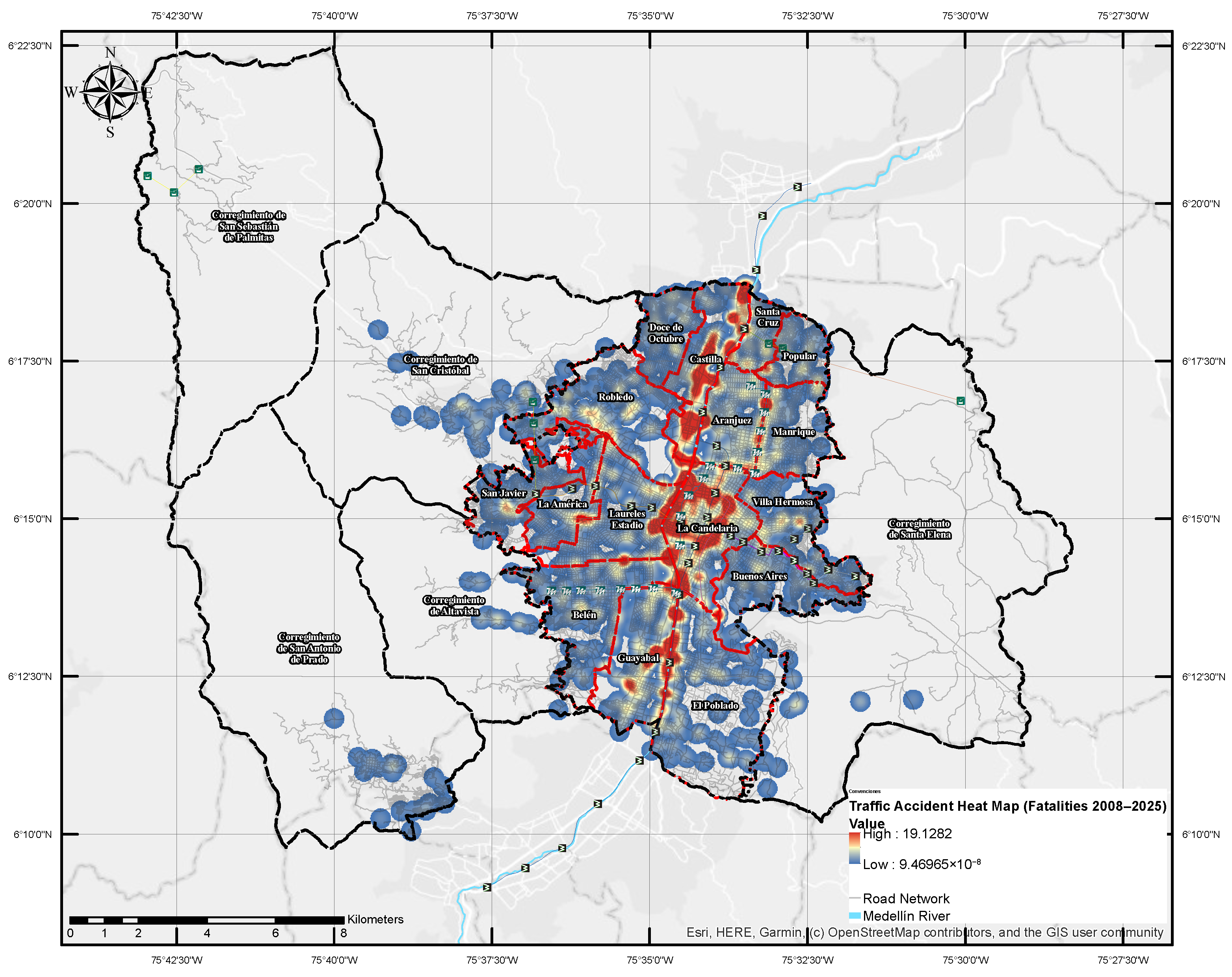
The spatial distribution of the 2507 georeferenced fatal incidents indicates that road traffic mortality is not spatially random but reflects systemic vulnerabilities (
Figure 1). Kernel Density Estimation (KDE) reveals a highly concentrated pattern in Comuna 10—La Candelaria, the city’s historical and administrative core. This area emerges as the most persistent and intense concentration of fatal incidents, where modal complexity exceeds the safety performance threshold of the current urban design.
Building on this central hotspot, the spatial distribution highlights several major corridors—such as Avenida Oriental, Avenida San Juan, Avenida Ferrocarril, and the surroundings of Plaza Minorista—as primary locations where fatal incidents cluster. These corridors are characterized by high pedestrian activity combined with intense interaction among public transport, motorcycles, and private vehicles, creating conditions of elevated conflict risk. Secondary concentrations extend toward Laureles, Belén, and the Río Medellín corridor, although with lower intensity than the central hotspot.
The observed pattern indicates that road traffic mortality is not randomly distributed but reflects structural conditions associated with urban design, public-space configuration, and exposure dynamics. The persistence of the central hotspot over the 17-year period is consistent with the ICCE-T operational classification framework (see
Section 3), where critical nodes are identified by combining four criteria: significant hotspots, temporal persistence, high KDE intensity, and recurrence during high-risk hours.
4.2.2. Spatiotemporal Analysis (ICCE-T)
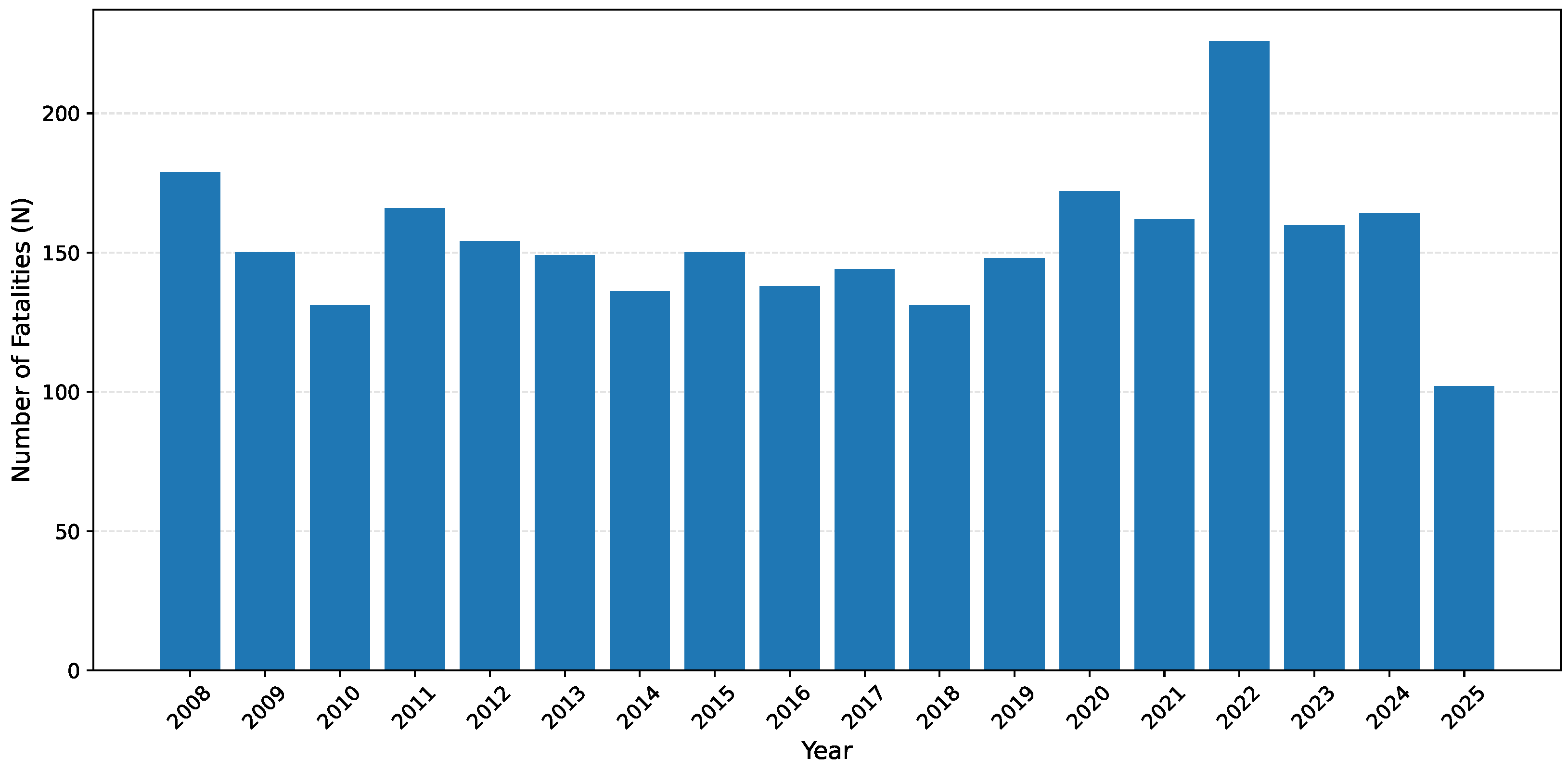
Figure 2 illustrates the annual evolution of road traffic fatalities in Medellín from 2008 to 2025, revealing a fluctuating yet consistently elevated burden throughout the study period. Between 2008 and 2011, fatalities remained relatively stable, ranging from 150 to 180 deaths per year. From 2012 onward, the trend shows moderate oscillations, with annual counts generally between 130 and 170 deaths, indicating that despite year-to-year variation, overall road traffic mortality has not decreased in a sustained manner.
The most notable increase occurred in 2022, when road traffic fatalities peaked at 226 deaths—the highest value in the series—following post-pandemic recovery in mobility and economic activity. In contrast, the 2025 value (102 deaths) reflects partial-year data available at the time of extraction.
Overall, the long-term trend indicates that Medellín has maintained elevated levels of road traffic mortality for more than a decade, without evidence of sustained structural reduction. Despite annual fluctuations and the partial nature of 2025 data, the pattern reveals persistent systemic vulnerabilities within the mobility system, aligning with the identification of critical infrastructure nodes where exposure and design deficiencies converge.
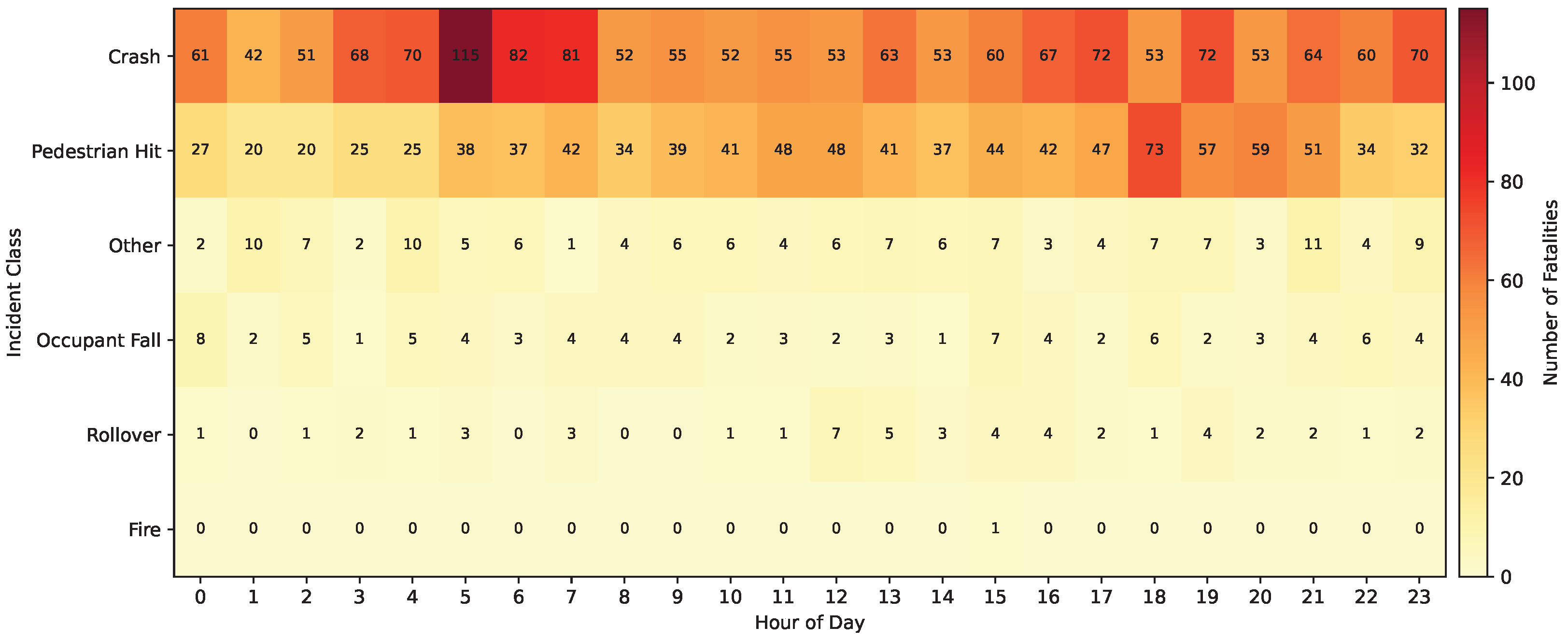
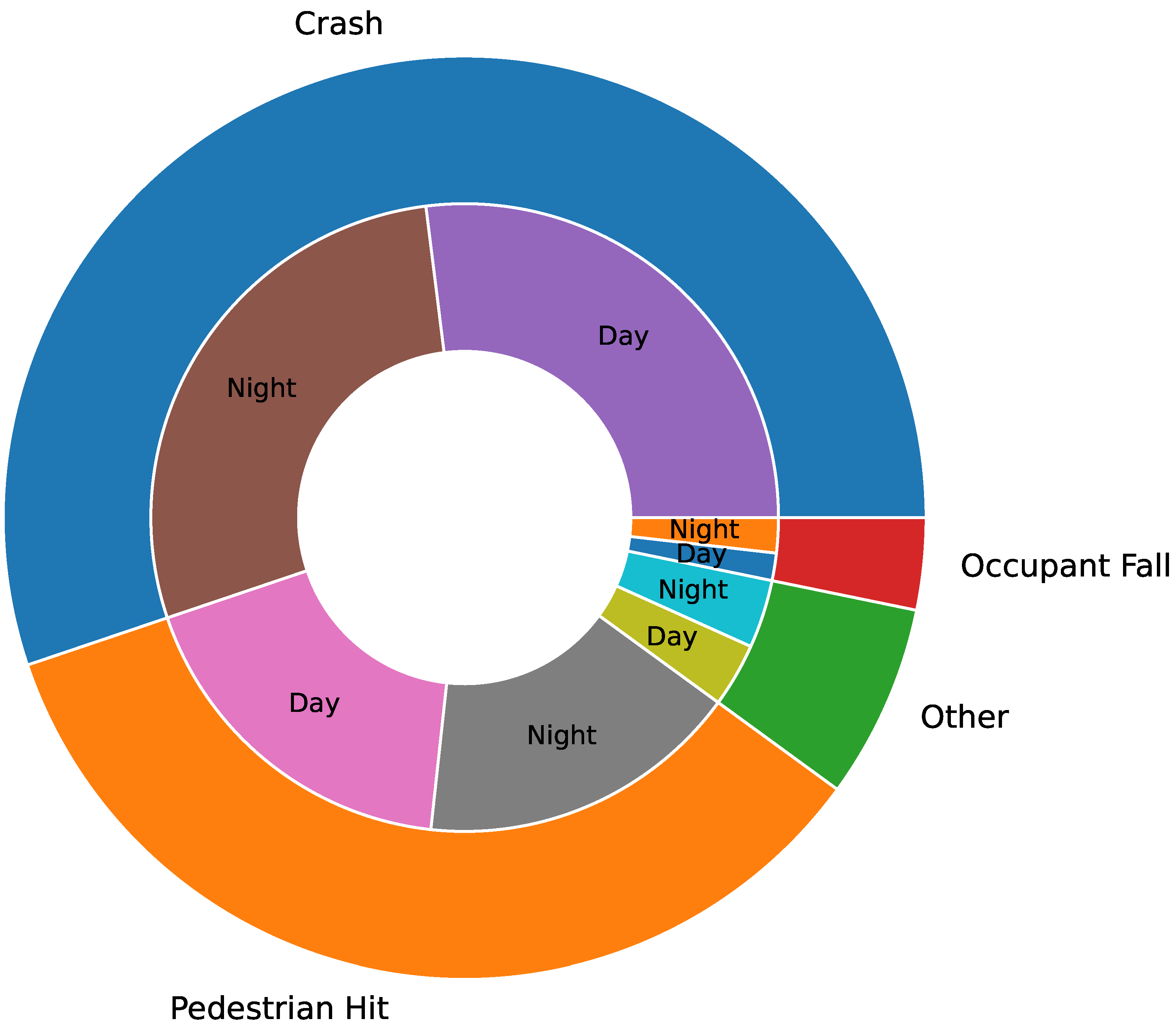
The interaction between incident classes and temporal cycles reveals a dual circadian pattern of systemic vulnerability (
Figure 3 and
Figure 4). On one hand, a nocturnal speed-related risk pattern is observed, with crashes peaking at 05:00 (115 deaths). Summing crash-related fatalities between 00:00 and 06:00 (inclusive) yields 489 of 1524 total crash fatalities (approximately 32%), indicating a substantial nocturnal component within the 24-h distribution. This pattern is consistent with elevated crash severity under low-traffic nighttime conditions and may reflect limitations in speed management or enforcement mechanisms during periods of reduced congestion.
A refined temporal segmentation further highlights differentiated risk mechanisms across peak periods. During early-morning hours (00:00–06:00), crash-related fatalities show a relative concentration consistent with speed-related dynamics under low traffic density conditions. In contrast, evening peaks (17:00–19:00) reflect heightened exposure combined with congestion and transitional lighting conditions. These findings suggest that distinct systemic vulnerabilities operate across temporal windows and require differentiated intervention strategies.
On the other hand, a diurnal exposure-related risk pattern emerges in pedestrian-hit incidents, which reach their highest concentration at 18:00 (73 deaths). This peak coincides with the evening rush hour and the transition from natural to artificial lighting, marking a critical window in which elevated pedestrian activity and reduced visibility increase conflict risk. Although secondary incident classes such as Occupant Falls display more dispersed patterns, the clear temporal differentiation between crashes and pedestrian-hit incidents indicates that road traffic mortality in Medellín follows a structured pattern requiring differentiated intervention strategies within a Safe System framework.
This temporal duality—defined by nocturnal speed-related risk and diurnal exposure-related vulnerability—is embedded in the city’s territorial morphology. The following geographic segmentation by incident class (
Figure 5) identifies the physical environments where these functional failures occur.
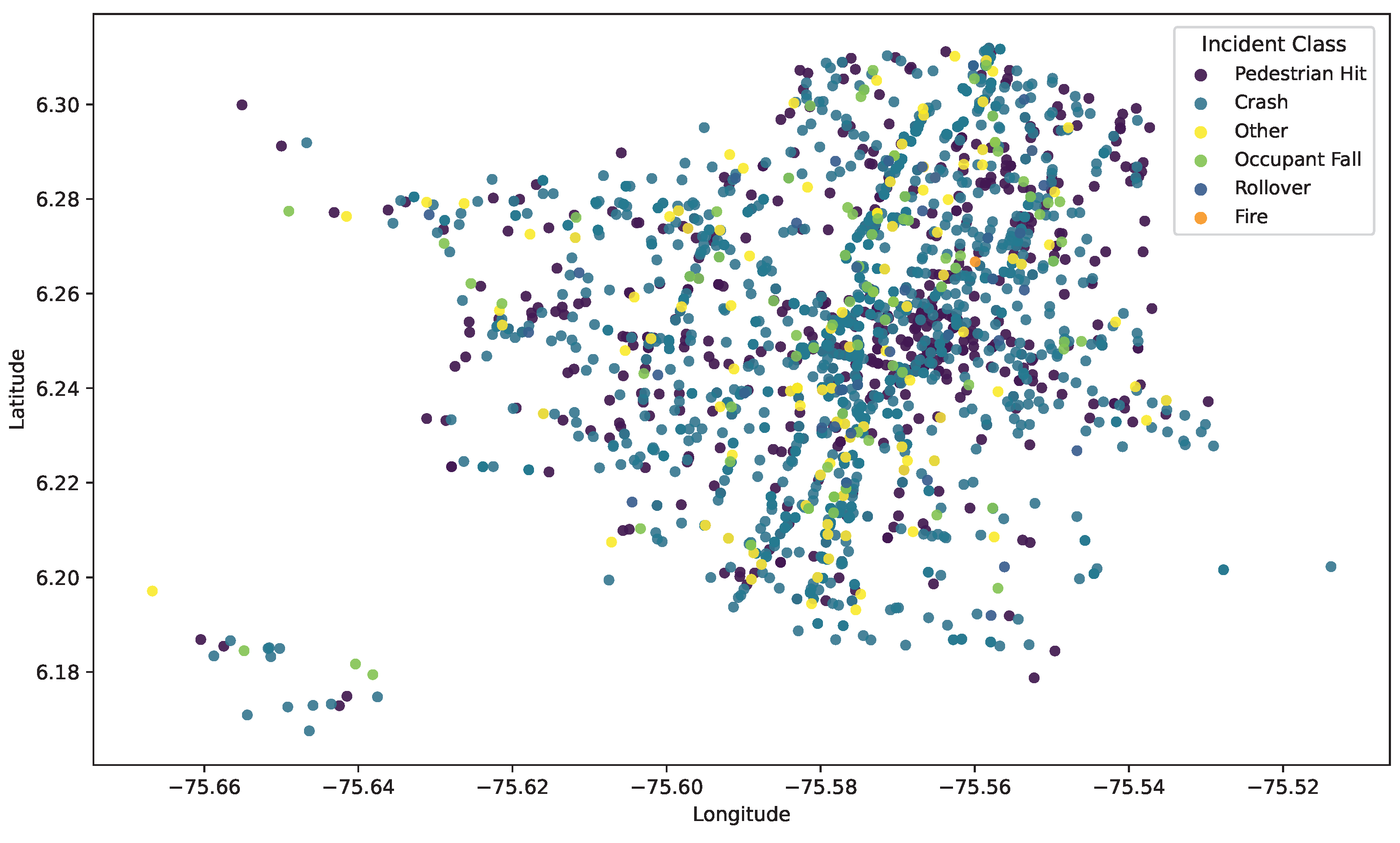
Figure 5 displays the geographic distribution of 2507 fatal road traffic incidents recorded in Medellín between 2008 and 2025, categorized by type: Crash, Pedestrian Hit, Occupant Fall, and Other. Each point represents an individual fatal incident, georeferenced by latitude and longitude coordinates and color-coded by incident class. The spatial pattern reveals a high concentration of pedestrian-hit incidents in the city center, particularly in Comuna 10—La Candelaria and along the Río Medellín corridor, where pedestrian activity and public transport interaction are most intense. These areas coincide with dense urban zones, informal commerce, and constrained pedestrian infrastructure, reinforcing their status as persistent vulnerability hotspots.
In contrast, crashes are more widely dispersed along high-speed arterial roads such as Autopista Norte, Avenida Regional, Calle 80, and Las Palmas, extending toward peripheral zones characterized by higher travel speeds. This dispersion suggests that fatal crashes are associated with environments prioritizing vehicular throughput over safety. The Occupant Fall and Other categories appear less frequently and show more diffuse spatial patterns, although some clustering is visible in commercial and logistical corridors.
Overall, these findings indicate that road traffic mortality in Medellín follows a differentiated territorial logic by incident type. While pedestrian-hit incidents concentrate in areas of high interaction density, crashes cluster along high-velocity corridors, supporting a functionally segmented approach to targeted intervention based on urban context.
4.2.3. Robustness Assessment of Spatial Clustering
To evaluate the stability of the identified spatial patterns, additional robustness tests were conducted. Global spatial autocorrelation analysis confirmed strong and statistically significant clustering (Moran’s ; permutation ), indicating that the distribution of fatal road traffic incidents is structurally non-random. The observed Moran’s I substantially exceeded the upper 97.5th percentile of the permutation distribution (0.039), whose empirical 95% bounds ranged from −0.030 to 0.039. This confirms that the spatial clustering observed is significantly stronger than expected under spatial randomness.
Local Getis–Ord analysis identified 129 statistically significant hotspot cells and no statistically significant coldspots, reinforcing the asymmetric concentration of risk within specific urban corridors. Sensitivity testing of the Kernel Density Estimation (KDE) bandwidth parameter ( variation around 300 m) demonstrated high structural stability in hotspot identification (Jaccard similarity = 0.885 and 0.903; Spearman = 0.969–0.987), indicating limited parameter dependence.
Temporal subsample analyses (2008–2015 and 2016–2024) yielded consistent and statistically significant clustering (Moran’s and 0.476, respectively; permutation ), confirming structural persistence over time. The year 2025 was excluded from robustness testing due to partial data availability.
Taken together, these results support the structural interpretation of ICCE-T critical concentration nodes as locations where statistical hotspot significance, temporal persistence, and elevated density patterns converge. Cross-referencing social burden density (
Figure 1) with incident typology (
Figure 5) reveals a clear territorial segmentation of systemic risk. The city center acts as a friction node with intense modal interaction and high pedestrian vulnerability. In contrast, peripheral corridors show patterns of high-velocity crashes. This differentiation supports consideration of a multi-scalar resilience strategy combining strengthened pedestrian protection in central zones with systematic speed management along high-velocity corridors.
5. Discussion
The integration of epidemiological metrics (YPLL), economic valuation, and spatiotemporal analysis (ICCE-T) indicates that fatal road traffic incidents in Medellín are non-randomly distributed. The findings instead reveal structural vulnerabilities within the urban mobility system, reflected in recurring spatial and temporal patterns where infrastructure approaches or exceeds its defined safety performance threshold [
3]. In this study, safety performance threshold refers to the level of operational and environmental conditions beyond which the mobility system can no longer maintain an acceptable level of fatality risk.
5.1. The Erosion of Productive Human Capital
The most consequential finding of this study is not merely the absolute number of fatalities but the magnitude of cumulative social loss—100,851 YPLL. As [
13] notes in the context of Colombian social determinants, traffic violence constitutes a structural burden that disproportionately affects the productive segment of the population. Unlike many chronic diseases that predominantly impact older cohorts, fatal road traffic incidents in Medellín significantly affect economically active age groups.
The finding that 64.7% of total YPLL is concentrated within the 15–35 age group reflects sustained erosion of the city’s demographic dividend. [
70] argue that premature mortality of this scale amplifies social disparities by eliminating decades of potential economic and social contribution. The implications extend beyond public health, representing a structural constraint on long-term regional resilience and competitiveness [
7,
71].
5.2. The Duality of Functional Vulnerability: Friction vs. Speed
The spatiotemporal analysis reveals a dual pattern in the infrastructure’s capacity to absorb risk, linking temporal and territorial dimensions of systemic vulnerability (
Figure 3,
Figure 4 and
Figure 5). For analytical clarity, these recurring temporal configurations are described as “Nocturnal Speed-Related Risk Pattern” and “Diurnal Exposure-Related Risk Pattern.” These terms are used as interpretative descriptors derived from observed clustering patterns and do not represent direct measurements of speed, lighting conditions, pedestrian volumes, or enforcement intensity.
Diurnal Exposure-Related Risk Pattern (Friction Nodes): Pedestrian incidents peak at 18:00 in Comuna 10—La Candelaria, reflecting areas with high activity and limited pedestrian space. Persistent clustering in these areas suggests sustained infrastructural stress under conditions of dense activity [
54,
69].
Nocturnal Speed-Related Risk Pattern (High-Velocity Corridors): Conversely, the peak in fatal crashes at 05:00 along arterial corridors is consistent with elevated vulnerability under low-traffic, potentially higher-speed conditions. Infrastructure primarily optimized for daytime throughput may be less effective in mitigating risk during fluid nighttime periods [
42]. This pattern highlights the relevance of passive speed management measures aligned with Vision Zero principles [
8].
5.3. The Cost of Non-Prevention
The cumulative economic burden of COP 2.19 trillion (2008–2025) challenges the assumption that financial constraints preclude implementation of safer infrastructure. Consistent with regional evidence [
72], the long-term cost of inaction substantially exceeds the investment required for preventive measures.
The peak economic loss observed in 2022 (COP 228 billion) coincided with the post-pandemic rebound in mobility, reflecting increased exposure without corresponding systemic safety adaptations. This dynamic aligns with global evidence showing that abrupt mobility increases in the absence of structural safeguards lead to immediate rises in fatalities and associated costs [
70,
73].
5.4. Territorial Logic of Risk: Friction Nodes and High-Velocity Corridors
Cross-referencing social burden density (
Figure 1) with incident typology (
Figure 5) reveals a territorial segmentation of systemic risk consistent with findings in São Paulo [
74], Ghana [
12], and Iran [
75].
Urban Core (Comuna 10): Pedestrian-hit incidents cluster in the historical and administrative center, where modal complexity, commercial density, and constrained pedestrian infrastructure converge. Similar patterns have been observed in Belgrade [
76] and Toluca [
77].
Peripheral Arterials: High-velocity crash patterns dominate along Autopista Norte, Avenida Regional, Calle 80, and Las Palmas—corridors characterized by elevated design speeds and limited oversight. Comparable velocity-driven risk corridors have been documented in Thailand [
78] and Addis Ababa [
79].
This segmentation supports a multi-scalar resilience strategy combining strengthened pedestrian protection in dense urban cores with systematic speed management along high-velocity corridors.
5.5. Implications for Policy and Urban Resilience
The findings identify strategic priorities for strengthening Medellín’s urban resilience and aligning mobility policy with Safe System principles. As [
19,
80] emphasize, standardizing premature mortality metrics such as YPLL enhances comparability and supports evidence-based intervention design. Likewise, integrating spatiotemporal analytics into policy development may improve precision in identifying high-risk locations and temporal windows [
12,
76].
Consistent with [
3] and regional analyses [
81], prioritizing vulnerable road users in dense urban cores and implementing robust speed management along high-velocity corridors are essential components of systemic risk reduction. Economic evidence further demonstrates that investments in safer infrastructure are not only a public health imperative but also financially rational, as the long-term costs of inaction exceed the resources required for Safe System-aligned transformation [
4,
82].
5.6. Limitations and Sources of Uncertainty
Several methodological limitations warrant consideration. First, the estimation of YPLL relied on a structural age-distribution proxy based on the 2023 official profile, due to the unavailability of individual age-at-death records for the full 2008–2025 historical series. Although proportional sensitivity analyses ( and ) indicate bounded variation in total YPLL estimates, this approach does not capture potential year-to-year demographic shifts. Second, official fatality records may be subject to underreporting or classification inconsistencies, particularly in complex multi-vehicle or pedestrian-involved incidents. While the dataset derives from official institutional sources, residual reporting bias cannot be entirely excluded.
Third, geospatial analyses depend on coordinate accuracy and completeness. Although spatial validation procedures were applied and geocoding outliers were excluded, minor positional inaccuracies may influence local clustering intensity. Additionally, the analysis does not incorporate dynamic exposure denominators (e.g., pedestrian volumes or vehicle kilometers traveled), limiting the ability to estimate exposure-adjusted risk. Fourth, the study employs ecological and spatial statistical methods; therefore, findings identify structural patterns and associations rather than causal mechanisms. Interpretations of systemic failure should be understood as structural inference grounded in recurring spatial and temporal clustering, not as direct causal attribution.
Finally, although robustness checks were conducted—including Moran’s I permutation testing, Getis–Ord significance assessment, bandwidth sensitivity analysis for KDE, and temporal subsample stability testing—alternative spatiotemporal modeling approaches (e.g., space–time scan statistics or Bayesian hierarchical models) may yield complementary insights. Future research incorporating additional modeling frameworks and exposure-adjusted metrics would further enhance inferential precision.
6. Conclusions
The findings demonstrate that fatal road traffic incidents in Medellín between 2008 and 2025 do not represent isolated events but rather a systemic public health and urban resilience challenge that steadily erodes the city’s human capital. The cumulative loss of 100,851 YPLL highlights a burden concentrated among young individuals, with the 20–25 age group bearing the highest impact. This sustained loss generates significant social downtime, weakening the city’s demographic dividend and long-term regional competitiveness. The current mobility system therefore appears insufficiently equipped to protect its economically productive population during critical life stages.
From a territorial perspective, application of the ICCE-T framework (as operationally defined in
Section 3) reveals that this systemic vulnerability exhibits a persistent geographic signature. Comuna 10—La Candelaria emerges as the city’s most intense node of road-user vulnerability, where modal complexity and commercial density consistently exceed the safety performance threshold of existing urban design. The economic dimension—quantified at COP 2.19 trillion—demonstrates that fatal road traffic incidents impose a substantial structural cost. The financial burden of non-prevention exceeds the investment required to align infrastructure with international Safe System standards.
Based on this evidence, Medellín’s mobility policy should transition toward a multi-scalar resilience strategy. At the municipal level, central urban areas require transformation through a complete streets model prioritizing pedestrian protection during high-risk evening windows. Peripheral arterial corridors require strengthened automated speed management to mitigate elevated nocturnal risk under low-traffic conditions. In operational terms, nocturnal risk patterns justify enhanced speed enforcement, traffic-calming infrastructure, and improved nighttime visibility, while evening peaks require prioritizing pedestrians through adjusted signal timing, protected crossings, better lighting, and congestion management. Aligning interventions with distinct temporal risk patterns enhances the effectiveness of Safe System implementation. Furthermore, institutional adoption of YPLL as a formal performance metric would enable municipal authorities to prioritize investments based not only on incident frequency but also on preventable human and social loss.
Although the empirical analysis focuses on Medellín, the integrated framework combining YPLL and spatiotemporal clustering is transferable to other Latin American cities, provided that consistent crash reporting systems, stable administrative boundaries, and georeferenced incident data are available. Adaptation to local urban morphology and mobility patterns remains essential. Future research should further integrate spatiotemporal analytics with behavioral, socioeconomic, and land-use variables to better understand mechanisms driving risk concentration across urban environments. Expanding the ICCE-T framework to incorporate predictive modeling, machine learning, and network-based risk assessment may enhance the ability to anticipate emerging hotspots and evaluate intervention effectiveness over time. Advancing this line of inquiry will contribute to more equitable, data-driven, and resilient mobility systems capable of reducing premature mortality and safeguarding the productive potential of urban populations.
Author Contributions
Conceptualization, J.S.C., M.L.A.U. and C.D.C.Á.; methodology, M.L.A.U.; formal analysis, J.S.C. and C.D.C.Á.; data curation, J.S.C.; writing—original draft preparation, J.S.C. and M.L.A.U.; writing—review and editing, C.D.C.Á.; visualization, M.L.A.U. and C.D.C.Á.; supervision, J.S.C. and C.D.C.Á. All authors have read and agreed to the published version of the manuscript.
Funding
This research received no external funding. The APC was not funded by any organization.
Institutional Review Board Statement
Not Applicable.
Informed Consent Statement
Not Applicable.
Data Availability Statement
The raw microdata, proportional age-distribution allocation matrices, and full YPLL estimation procedures are openly available in Mendeley Data at
https://doi.org/10.17632/mr9ddnw966.2, accessed on 28 January 2026. The complete reproducible R script implementing the ICCE-T framework—including KDE estimation, Moran’s
I, Getis–Ord
, bandwidth sensitivity analysis, and temporal robustness testing—is provided in the same repository.
Acknowledgments
During the preparation of this manuscript, the authors used Microsoft Copilot (2026 version) for limited stylistic editing and language refinement. No generative AI tools were used for study design, data collection, data analysis, or interpretation of results. The authors have carefully reviewed and edited all AI-assisted outputs and take full responsibility for the content and conclusions of this publication.
Conflicts of Interest
The authors declare no conflicts of interest.
References
- Agencia Nacional de Seguridad Vial. Histórico víctimas. 2024. Available online: https://www.ansv.gov.co/es/observatorio/estad%C3%ADsticas/historico-victimas (accessed on 18 December 2025).
- Ministerio de Transporte. ANSV presenta balance oficial de siniestralidad vial 2021. 2022. Available online: https://mintransporte.gov.co/publicaciones/10578/ansv-presenta-balance-oficial-de-siniestralidad-vial-2021/ (accessed on 18 December 2025).
- Organización Mundial de la Salud. Séptima Semana Mundial de las Naciones Unidas para la Seguridad Vial. 2023. Available online: https://www.who.int/es/campaigns/un-global-road-safety-week/2023 (accessed on 18 December 2025).
- Alcaldía de Medellín. Costos económicos de las 100 primeras vidas pérdidas en incidentes viales mortales durante el año 2023 en el Distrito de Medellín. 2023. Available online: https://www.medellin.gov.co/es/wp-content/uploads/2023/10/Costos-IV-2023.pdf (accessed on 18 December 2025).
- Fernández, C. La empresa frente a la accidentalidad laboral de tráfico: Fundamentación de Planes de Movilidad y Seguridad Vial como estrategia clave de Prevención. Ph.D. Thesis, Universidad de Valéncia, Valencia, Spain, 2024. Available online: https://dialnet.unirioja.es/servlet/tesis?codigo=383782 (accessed on 18 December 2025).
- Salazar, E.A. ¿Por qué incidente y no accidente o siniestro en el ámbito de la salud pública y la seguridad vial de Colombia? Rev. Médica Risaralda 2024, 30, 143–148. [Google Scholar] [CrossRef]
- United Nations. Transforming Our World: The 2030 Agenda for Sustainable Development. Resolution Adopted by the General Assembly on 25 September 2015 (A/RES/70/1). 2015. Available online: https://unctad.org/system/files/official-document/ares70d1_es.pdf (accessed on 18 December 2025).
- Alcaldía de Medellín. A través de la estrategia Visión Cero en Medellín se sigue trabajando para disminuir las cifras de muertes en la vía. 2022. Available online: https://www.medellin.gov.co/es/sala-de-prensa/noticias/a-traves-de-la-estrategia-vision-cero-en-medellin-se-sigue-trabajando-para-disminuir-las-cifras-de-muertes-en-la-via/ (accessed on 18 December 2025).
- Tanwar, R.; Agarwal, P.K. Multimodal integration in India: Opportunities, challenges, and strategies for sustainable urban mobility. Multimodal Transp. 2025, 4, 100210. [Google Scholar] [CrossRef]
- Clark, S.S.; Peterson, S.K.E.; Shelly, M.A.; Jeffers, R.F. Developing an equity-focused metric for quantifying the social burden of infrastructure disruptions. Sustain. Resilient Infrastruct. 2023, 8, 356–369. [Google Scholar] [CrossRef]
- Hart, O.E.; Wachtel, A.; Jones, K.; Jimenez, T.; Gregory, P.; Tam, D. Beyond money: A social burden framework to enhance resilience valuation for tribal communities in the United States. Energy Res. Soc. Sci. 2025, 120, 103934. [Google Scholar] [CrossRef]
- Mesic, A.; Damsere-Derry, J.; Feldacker, C.; Mooney, S.J.; Gyedu, A.; Mock, C.; Kitali, A.E.; Wagenaar, B.H.; Wuaku, D.H.; Afram, M.O.; et al. Identifying emerging hot spots of road traffic injury severity using spatiotemporal methods: Longitudinal analyses on major roads in Ghana from 2005 to 2020. BMC Public Health 2024, 24, 1609. [Google Scholar] [CrossRef]
- Rodriguez-Hernandez, J.M.; Camelo-Tovar, F.; Albavera-Hernandez, C.; Campuzano-Rincon, J.C. Motorcyclists’ mortality pattern in Colombia from 2000 to 2013: A longitudinal study. Arch. Med. 2017, 9, 1–9. [Google Scholar] [CrossRef]
- Porras, S.; Grisales, H. Años potenciales de vida perdidos por incidentes viales de motociclistas, Medellín, 2009–2012: Un análisis espacial por sitio de la ocurrencia. Rev. Médica Risaralda 2017, 23, 30–33. [Google Scholar] [CrossRef]
- Al-Aamri, A.K.; Hornby, G.; Zhang, L.-C.; Al-Maniri, A.; Padmadas, S.S. Mapping road traffic crash hotspots using GIS-based methods: A case study of Muscat Governorate in the Sultanate of Oman. Spat. Stat. 2021, 42, 100458. [Google Scholar] [CrossRef]
- Salazar, E.A.; Cabrera, G.A. Años de vida perdidos y distribución espacial de la mortalidad por incidente vial en Medellín, 2010–2020. Rev. Fac. Nac. Salud Pública 2023, 41, e347846. [Google Scholar] [CrossRef]
- Batomen, B.; Irving, H.; Carabali, M.; Carvalho, M.S.; Ruggiero, E.D.; Brown, P. Vulnerable road-user deaths in Brazil: A Bayesian hierarchical model for spatial-temporal analysis. Int. J. Inj. Control Saf. Promot. 2020, 27, 528–536. [Google Scholar] [CrossRef]
- Bombom, L.S.; Saidu, B.; Akintunde, E.A.; Nyango, K.C. Explorative geospatial analysis of road traffic fatalities in Nigeria for the period 2005–2018. Fudma J. Sci. 2022, 6, 167–176. [Google Scholar] [CrossRef]
- Mahato, R.K.; Htike, K.M.; Kafle, A.; Gewali, V.; Kafle, A.; Sharma, V. Spatial distribution and cluster analysis of road traffic accidents in Nepal. PLoS ONE 2025, 20, e0331333. [Google Scholar] [CrossRef]
- Jaramillo, C.; Fandiño-Losada, A.; Gutiérrez-Martínez, M.I. Traffic fatalities and urban infrastructure: A spatial variability study using geographically weighted Poisson regression applied in Cali (Colombia). Safety 2023, 9, 34. [Google Scholar] [CrossRef]
- Pescaroli, G.; Suppasri, A.; Galbusera, L. Progressing the research on systemic risk, cascading disasters, and compound events. Prog. Disaster Sci. 2024, 22, 100319. [Google Scholar] [CrossRef]
- Uribe, M.L.A.; Corredor, J.S.; Correa-Álvarez, C.D. Social impacts and road safety in intermodality: Case study of the Ayacucho Tram in Medellín-Colombia. J. Urban Mobil 2025, 8, 100154. [Google Scholar] [CrossRef]
- Ladoy, A.; Vallarta-Robledo, J.R.; De Ridder, D.; Sandoval, J.L.; Stringhini, S.; Da Costa, H.; Guessous, I.; Joost, S. Geographic footprints of life expectancy inequalities in the state of Geneva, Switzerland. Sci. Rep. 2021, 11, 23326. [Google Scholar] [CrossRef] [PubMed]
- Pahomii, I. Assessing premature mortality: An indicator selection analysis using data from Republic of Moldova, Czechia, and Switzerland. Econ. Sociol. 2023, 1, 43–52. [Google Scholar] [CrossRef]
- Foreman, T.; Lin, M.; Tu, W.; Yarbrough, R. Impact of urban form and street infrastructure on pedestrian–motorist collisions. Int. J. Inj. Control Saf. Promot. 2024, 31, 521–533. [Google Scholar] [CrossRef]
- Velasco, A.; Nazif, J.I.; Rojas, D.; Sánchez, R. Instrumentos para la toma de decisiones en políticas de seguridad vial en América Latina: El índice de seguridad de tránsito (INSETRA). 2006. Available online: https://hdl.handle.net/11362/6311 (accessed on 18 December 2025).
- Chankseliani, M.; Kwak, J.; Akkad, A.; Bandeira Melo, G.; Crisostomo, M.; Hanley, N.; Wang, Z. International Mobility and World Development: Estimating the System-Level Impact of ECA and International Exchanges. 2025. Available online: https://ora.ox.ac.uk/objects/uuid:9d767f5a-b819-4993-bb65-ed39f6076994 (accessed on 18 December 2025).
- Christie, N.; Jones, S.; O’Toole, S.E. Systemic inequalities in road safety outcomes across high income countries and lessons from intervention approaches. J. Transp. Health 2025, 41, 102006. [Google Scholar] [CrossRef]
- Alvia, A.E.; Linares, S. Accidentes de tránsito, un problema de salud pública: Revisión sistemática. Rev. Científica Arbitr. Multidiscip. PENTACIENCIAS 2024, 6, 313–332. [Google Scholar] [CrossRef]
- Martínez, G.M.; Arias-Castro, C.E.; Sánchez, D.C.S.; Cardona-Arango, D.; Segura-Cardona, Á.; Muñoz-Rodríguez, D.I.; Ossa, J.G.; Villegas, S.H. Desigualdades sociales relacionadas con la mortalidad por accidentes de tráfico. Gac. Sanit. 2023, 37, 102313. [Google Scholar] [CrossRef]
- Cienfuegos, M.M. Las mototaxis en Nagarote: Aportes para una antropología vial. Raíces Rev. Cienc. Soc. Políticas 2025, 8, 14–33. [Google Scholar] [CrossRef]
- Wright, P. Para una antropología de los imaginarios viales: Entre el Estado, la historia y la cultura. Studi Ric. 2025, 42, 215–229. [Google Scholar] [CrossRef]
- Congreso de Colombia. Ley 2251 de 2022. Por la cual se dictan normas para el diseño e implementación de la política de seguridad vial con enfoque de sistema seguro y se dictan otras disposiciones—Ley Julián Esteban. Congreso de Colombia. 2022. Available online: https://www.funcionpublica.gov.co/eva/gestornormativo/norma.php?i=189806 (accessed on 18 December 2025).
- Área Metropolitana del Valle de Aburrá. Planes de Movilidad Empresarial Sostenible (PMES). Área Metropolitana del Valle de Aburrá. 2023. Available online: https://masverde.com.co/2023/05/25/planes-de-movilidad-empresarial-sostenible/ (accessed on 18 December 2025).
- Muehlhaus, S.L.; Eghtebas, C.; Seifert, N.; Schubert, G.; Petzold, F.; Klinker, G. Game.UP: Gamified urban planning participation enhancing exploration, motivation, and interactions. Int. J. Human–Comput. Interact. 2022, 39, 331–347. [Google Scholar] [CrossRef]
- Mendoza, A.E.; Wybourn, C.A.; Mendoza, M.A.; Cruz, M.J.; Juillard, C.J.; Dicker, R.A. The worldwide approach to Vision Zero: Implementing road safety strategies to eliminate traffic-related fatalities. Curr. Trauma Rep. 2017, 3, 104–110. [Google Scholar] [CrossRef]
- Correa-Álvarez, C.D.; Sánchez-Corredor, J.; Arango-Uribe, M.L. Analysis of sustainable urban mobility in the Medellin-Colombia Ayacucho Tram-Road Corridor. Rev. EIA 2025, 22, 1–30. [Google Scholar] [CrossRef]
- Job, R.F.S.; Truong, J.; Sakashita, C. The ultimate safe system: Redefining the safe system approach for road safety. Sustainability 2022, 14, 2978. [Google Scholar] [CrossRef]
- Ceder, A. Urban mobility and public transport: Future perspectives and review. Int. J. Urban Sci. 2020, 25, 455–479. [Google Scholar] [CrossRef]
- Zhang, Y.; Zhao, Z. Optimal dynamic pricing for public transportation considering consumer social learning. PLoS ONE 2024, 19, e0296263. [Google Scholar] [CrossRef]
- Mooren, L.; Shuey, R. Systems thinking in road safety management. J. Road Saf. 2024, 35, 63–73. [Google Scholar] [CrossRef]
- Olguín-Ferruzca, P. Infraestructura urbana y seguridad vial en Querétaro. Rev. Científica FINIBUS—Ing. Ind. Arquit. 2025, 8, 47–52. [Google Scholar] [CrossRef]
- Avalos, E.; Palomino, P.; Muñoz, D. Incorporación de medidas de prevención de accidentes en el diseño de infraestructura vial: Una revisión sistemática. Rev. Espac. 2025, 46, 194–206. [Google Scholar] [CrossRef]
- Vélez, C.A.; De la Luz, C.D.L.; Gómez, D. Estimación económica de los años perdidos de vida productiva potencial por muertes violentas en México, 2000–2018. Estud. Demográficos Urbanos 2024, 39, e2125. [Google Scholar] [CrossRef]
- Bougna, T.; Hundal, G.; Taniform, P. Quantitative analysis of the social costs of road traffic crashes literature. Accid. Anal. Prev. 2022, 165, 106282. [Google Scholar] [CrossRef] [PubMed]
- Alcaldía de Medellín. Observatorio de Movilidad de la Secretaría de Movilidad de Medellín: Caracterización de incidentes viales en Medellín. 2023. Available online: https://www.medellin.gov.co/es/wp-content/uploads/2023/10/Caracterizacion-IV-Medellin-2023-08.pdf (accessed on 18 December 2025).
- Alcaldía de Medellín. Plan de Desarrollo Distrital 2024–2027 “Medellín Te Quiere”. Acuerdo 03 de 2024 (Gaceta Oficial Nº 5387). Alcaldía de Medellín. 2024. Available online: https://www.medellin.gov.co/es/plan-de-desarrollo/ (accessed on 18 December 2025).
- Hoyos-Rincón, L.A.; Jaramillo-Acero, M.; Ochoa-Duque, J.J.; Zuleta-Ruíz, F.B.; Álvarez-Argaez, S.M.; Hoyos, I.; Rodríguez, B.A. Describing Medellín as a complex tropical high Andean urban system. PLoS Complex Syst. 2025, 2, e0000045. [Google Scholar] [CrossRef]
- Ley 769 de 2002. Código Nacional de Tránsito Terrestre. Rama legislativa. 2002. Available online: http://www.secretariasenado.gov.co/senado/basedoc/ley_0769_2002.html (accessed on 18 December 2025).
- Nankunda, C.; Evdorides, H. A systematic review of the application of road safety valuation methods in assessing the economic impact of road traffic injuries. Future Transp. 2023, 3, 1253–1271. [Google Scholar] [CrossRef]
- Madsen, J.K.; de-Wit, L.; Ayton, P.; Brick, C.; de-Moliere, L.; Groom, C.J. Behavioral science should start by assuming people are reasonable. Trends Cogn. Sci. 2024, 28, 583–585. [Google Scholar] [CrossRef]
- Read, G.J.M.; O’Brien, A.; Stanton, N.A.; Salmon, P.M. Learning lessons for automated vehicle design: Using systems thinking to analyse and compare automation-related accidents across transport domains. Saf. Sci. 2022, 153, 105822. [Google Scholar] [CrossRef]
- Stiles, J.; Miller, H. The built environment and the determination of fault in urban pedestrian crashes: Toward a systems-oriented crash investigation. J. Transp. Land Use 2024, 17, 97–113. [Google Scholar] [CrossRef]
- Osorio-García, D.; Escobar, D.A.; Hernández-Pulgarín, G. Variables de comportamiento peatonal para la priorización de puntos críticos evaluados a partir de auditorías en seguridad vial. Inf. Tecnológica 2022, 33, 145–158. [Google Scholar] [CrossRef]
- Corben, B. Urban road design and keeping down speed. In The Vision Zero Handbook; Edvardsson Björnberg, K., Belin, M.Å., Hansson, S.O., Tingvall, C., Eds.; Springer: Cham, Switzerland, 2022. [Google Scholar] [CrossRef]
- Izurieta, P.; Vega, S.; Maldonado, S.; Delgado, M. Análisis de intervenciones de seguridad vial para reducir accidentes de tránsito en Ecuador. Rev. Tecnológica—ESPOL 2024, 36, 112–134. [Google Scholar] [CrossRef]
- Fisher, C.R.; Morris, M.B.; Stevens, C.A.; Swan, G. The role of individual differences in human-automated vehicle interaction. Int. J. Hum.-Comput. Stud. 2024, 185, 103225. [Google Scholar] [CrossRef]
- Barragán-Salazar, J.E.; Aguirre-Castillo, L.H.; Castillo-Quinzo, M.A.; Pillajo-Carrillo, S.P. Panorama de la siniestralidad vial en la subzona Chimborazo durante el año 2024: Un análisis exhaustivo de causas, consecuencias y estrategias de prevención. Procesos 2024, 10, 182–195. Available online: https://polodelconocimiento.com/ojs/index.php/es/article/view/9884 (accessed on 21 January 2026).
- Saxena, N.; Sethia, D. Decomposition of years of life lost due to premature death (YLL): A method for spatial and temporal comparative assessment. Arch. Public Health 2020, 78, 91. [Google Scholar] [CrossRef]
- Martinez, R.; Soliz, P.; Caixeta, R.; Ordunez, P. Reflection on modern methods: Years of life lost due to premature mortality—A versatile and comprehensive measure for monitoring non-communicable disease mortality. Int. J. Epidemiol. 2019, 48, 1367–1376. [Google Scholar] [CrossRef] [PubMed]
- McIlroy, R.C.; Banks, V.A.; Parnell, K.J. 25 years of road safety: The journey from thinking humans to systems-thinking. Appl. Ergon. 2022, 98, 103592. [Google Scholar] [CrossRef] [PubMed]
- Alcaldía de Medellín. Portal de Datos Abiertos del Área Metropolitana del Valle de Aburrá. 2025. Available online: https://datosabiertos.metropol.gov.co/ (accessed on 18 December 2025).
- R Core Team. R: A Language and Environment for Statistical Computing; R Foundation for Statistical Computing: Vienna, Austria, 2025; Available online: https://www.R-project.org/ (accessed on 21 January 2026).
- Mapa interactivo de Medellín. Alcaldía de Medellín. 2025. Available online: https://www.medellin.gov.co/mapgis9/mapa.jsp?aplicacion=1&css=css/app_mapas_medellin.css (accessed on 21 January 2026).
- Departamento Administrativo Nacional de Estadística. Dirección de Censos y Demografía: Proyecciones de población. 2025. Available online: https://www.dane.gov.co/files/censo2018/proyecciones-de-poblacion/Nacional/NotaTecnica-PPED-jul2025.pdf (accessed on 21 January 2026).
- Correa, C. Road Traffic Mortality, YPLL, and Spatiotemporal Analysis—Medellín (2008–2025) [Dataset]. Mendeley Data, V2. 2026. Available online: https://data.mendeley.com/datasets/mr9ddnw966/2 (accessed on 24 February 2026). [CrossRef]
- Barrera-Jiménez, H. Urban Form, Mobility and Sustainability: A Macroscopic Prospective Spatial Analysis for Road Traffic Safety Planning in Medellín, Colombia. 2019. Available online: https://repositorio.unal.edu.co/handle/unal/77456 (accessed on 21 January 2026).
- Bivand, R.S.; Wong, D.W.S. Comparing implementations of global and local indicators of spatial association. TEST 2018, 27, 716–748. [Google Scholar] [CrossRef]
- Tola, A.M.; Demissie, T.A.; Saathoff, F.; Gebissa, A. Severity, spatial pattern and statistical analysis of road traffic crash hot spots in Ethiopia. Appl. Sci. 2021, 11, 8828. [Google Scholar] [CrossRef]
- Supramaniam, P.; Junus, S.; Hashim, L.; Chiew, S.C.; Rajan, P. Lost years, mortality burden: The impact of COVID-19 pandemic on premature death due to road traffic accidents in a northern state in Malaysia. BMC Public Health 2024, 24, 1520. [Google Scholar] [CrossRef]
- Cardona-Arango, D.; Gutiérrez-Ossa, J.A.; Montenegro-Martínez, G.; Segura-Cardona, Á.M.; Muñoz-Rodríguez, D.I.; Giraldo-Rodríguez, L.; Agudelo-Botero, M. Measurement of the burden of road injuries in Colombia, 1990–2021. Int. J. Environ. Res. Public Health 2025, 22, 1201. [Google Scholar] [CrossRef]
- Pacheco, L.A.R.; Méndez, A.R.; Treviño, J.I. Análisis de la movilidad urbana sostenible mediante herramientas de ciencia de datos y participación ciudadana en ciudades intermedias de América Latina. Ibero Cienc. Rev. Cient. Acad. 2025, 4, 1–24. [Google Scholar] [CrossRef]
- Wang, X.; Kim, S.H.; Mokhtarian, P.L. Identifying teleworking-related motives and comparing telework frequency expectations in the post-pandemic world: A latent class choice modeling approach. Transp. Res. Part A Policy Pract. 2024, 186, 104070. [Google Scholar] [CrossRef]
- Pavanitto, D.R.; Menezes, R.A.D.M.; Nascimento, L.F.C. Accidents involving motorcycles and potential years of life lost: An ecological and exploratory study [Dataset]. SciELO J. 2018, 136, 4–9. [Google Scholar] [CrossRef]
- Aghajani, M.A.; Dezfoulian, R.S.; Arjroody, A.R.; Rezaei, M. Applying GIS to identify the spatial and temporal patterns of road accidents using spatial statistics (Case study: Ilam Province, Iran). Transp. Res. Procedia 2017, 25, 2126–2138. [Google Scholar] [CrossRef]
- Lović-Obradović, S.; Rabiei-Dastjerdi, H.; Matović, S. Identifying spatiotemporal variability of traffic accident mortality employing a geospatial approach aiming at sustainable urban traffic management. Cent. Eur. J. Geogr. Sustain. Dev. 2022, 4, 78–93. [Google Scholar] [CrossRef]
- Reyes, R.H.; Sanchez, G.V.; Alanís, J.C. Población en riesgo: Análisis espacio–temporal de accidentes viales mediante el uso de herramientas SIG en el municipio de Toluca, Estado de México, 2000–2005. Geofocus 2019, 23, 49–69. [Google Scholar] [CrossRef]
- Suphanchaimat, R.; Sornsrivichai, V.; Limwattananon, S.; Limwattananon, S.; Thammawijaya, P. Economic development and road traffic injuries and fatalities in Thailand: An application of spatial panel data analysis, 2012–2016. BMC Public Health 2019, 19, 1449. [Google Scholar] [CrossRef] [PubMed]
- Abebe, Y.T.; Seid, A.M.; Roininen, L. Log-Gaussian Cox processes for spatiotemporal traffic fatality estimation in Addis Ababa. arXiv 2024, arXiv:2408.02612. [Google Scholar] [CrossRef]
- Guimarães, B.A.; Loureiro, L.d.S.; Maciel, J.S.C. Spatial and temporal patterns of fatal motorcycle accidents in Manaus (2020–2024). Encontro Sustentabilidade Proj. 2025, 13, 1190–1203. [Google Scholar] [CrossRef]
- Murillo-Hoyos, J.; García-Moreno, L.M.; Tinjacá, N.; Jaramillo, C. Deaths from traffic injuries and social inequality in Colombia, 2019/Mortalidade por acidentes de trânsito e desigualdades sociais na Colômbia, 2019. Rev. Panam. Salud Pública Pan Am. J. Public Health 2023, 47, e121. [Google Scholar] [CrossRef]
- Bazargan-Hejazi, S.; Ahmadi, A.; Shirazi, S.; Ainy, E.; Djalalinia, S.; Fereshtehnejad, S.-M.; Jahanmehr, N.; Kiadaliri, A.; Moradi-Lakeh, M.; Parsaeian, M.; et al. The burden of road traffic injuries in Iran and 15 surrounding countries: 1990–2016. Arch. Iran. Med. 2018, 21, 556–565. Available online: https://ora.ox.ac.uk/objects/uuid:2b064b7f-c08b-444e-85c8-21d3964b2f31/files/sgx41mh98k (accessed on 18 December 2025).
| Disclaimer/Publisher’s Note: The statements, opinions and data contained in all publications are solely those of the individual author(s) and contributor(s) and not of MDPI and/or the editor(s). MDPI and/or the editor(s) disclaim responsibility for any injury to people or property resulting from any ideas, methods, instructions or products referred to in the content. |