Systematic Review

A Systematic Literature Review of Electric Arc Furnace and Ladle Furnace Slag for Pavement Applications


by
Taísa Menezes Medina
*,
Jamilla Emi Sudo Lutif Teixeira
* and
Isabella Madeira Bueno
Department of Civil and Environmental Engineering, University of Nebraska-Lincoln, Lincoln, NE 68508, USA
*
Authors to whom correspondence should be addressed.
Sustainability 2026, 18(5), 2627; https://doi.org/10.3390/su18052627
Submission received: 21 January 2026 / Revised: 14 February 2026 / Accepted: 6 March 2026 / Published: 8 March 2026
(This article belongs to the Special Issue Strategies for Improving the Sustainability of Asphalt Pavements)

Abstract

This study aims to systematically synthesize and critically evaluate the characteristics of electric arc furnace slag (EAFS) and ladle furnace slag (LFS) when applied as an alternative paving material. A systematic literature review was conducted following the PRISMA methodology, with research published between 2000 and 2024. Three major databases were searched, considering only Q1–Q2 and English articles. After independent, blinded screening by two reviewers, a total of 177 papers met the selection criteria. The results were qualitatively synthesized through bibliometric analysis, slag characteristics, and application type. Results show that asphalt concrete (AC) is the most common application of EAFS, representing 61% of studies, with many studies exploring 100% substitution of natural aggregates. Overall, EAFS and LFS demonstrate favorable mechanical properties, including high toughness, hardness, and adequate soundness, largely attributed to their iron-rich composition, supporting their use in base layers, AC, and Portland cement concrete (PCC). However, significant chemical and mineralogical variability influences swelling potential and reactivity, highlighting the need for case-specific characterization. While swelling concerns limit its use as an unbound base material, these issues are reduced when EAFS and LFS are used as a soil binder or encapsulated within AC or PCC matrices. Environmental assessments show that most EAFS and LFS samples meet the regulatory thresholds for their respective local leaching limits, though behavior varies with steel type (low-alloy vs. stainless), particle size and pH. Significant gaps remain in long-term performance and testing standards. This review proposes guidelines for selecting appropriate tests according to the intended pavement application, aiming to facilitate the safe and effective use of EAFS and LFS in road infrastructure.

1. Introduction

Steel production is among the most resource- and energy-intensive industrial processes worldwide, generating not only large quantities of steel but also significant amounts of co-products, primarily slags. These slags, formed during different stages of steelmaking and refining, play an essential role in maintaining process efficiency and steel quality, yet they also present considerable challenges for waste management and environmental sustainability [1]. In recent decades, increasing attention has been directed toward the valorization of steel slags as secondary raw materials, especially in construction applications [2].
From a sustainability and regulatory perspective, the utilization of steel slag in pavement construction is strongly influenced by its technical performance and legal requirements. In the United States, steel slag is increasingly recognized as a co-product rather than a waste material, due to its material value [3]. Nevertheless, regulatory frameworks and management practices vary considerably among jurisdictions, affecting allowable applications. Sixteen states and the District of Columbia have reported the use as aggregate in highway applications, with acceptance criteria defined in their respective technical specifications [4]. However, in some countries, including Indonesia and India, slag is still classified as waste material due to high production volumes and is therefore subject to stricter regulations regarding use and disposal [5,6]. Similarly, while many European countries utilize steel slag, more than one million tons per year in Italy are classified as special waste requiring landfilling [7,8]. Regardless of regulatory classification, potential risks associated with heavy metal leaching play a critical role in design and approval decisions, particularly for unbound applications. When appropriately characterized and managed, the use of steel slag supports circular economy objectives by conserving natural aggregates, reducing landfill disposal, and promoting the reuse of locally available industrial co-products.
Among the various types of slags produced, electric arc furnace slag (EAFS) and ladle furnace slag (LFS) are of particular interest for pavement engineering, where their mineralogical composition, mechanical performance, and environmental behavior are critical factors in determining their suitability [9].
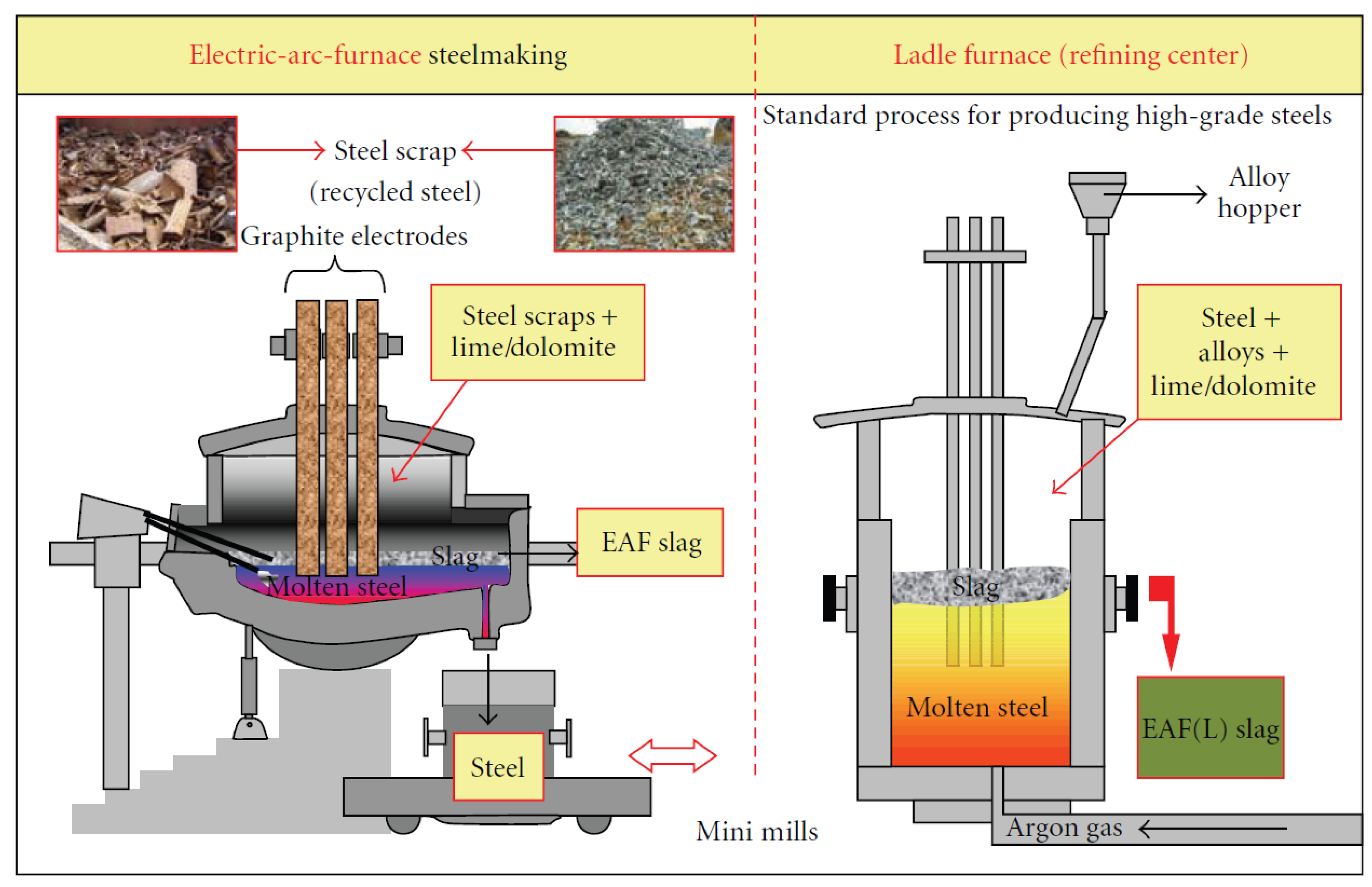
EAFS is one of the primary co-products generated during steelmaking in electric arc furnaces, a process widely used for recycling scrap steel into new products. Unlike basic oxygen furnaces (BOFs), which primarily use iron ore, the electric arc furnace relies largely on steel scrap, melted by means of high-temperature electric arcs formed between graphite electrodes and the metal charge [9]. During the melting process, fluxes such as lime (CaO) and dolomite [CaMg(CO3)2] are added to the furnace to facilitate the removal of impurities, including phosphorus, sulfur, and siliceous compounds, from the molten steel [10]. These fluxes combine with the oxidized impurities to form slag, which floats above the liquid steel due to density differences. The composition and properties of EAFS are strongly influenced by the type of scrap used, the addition of fluxes, the type of steel produced, and the operating conditions of the furnace. Furthermore, depending on cooling rates after the steelmaking process, EAFS may exhibit a wide variety of crystalline phases, giving rise to different mechanical and chemical behaviors [10].
From a practical standpoint, the generation of EAFS represents both a challenge and an opportunity. On one hand, its variable chemical and mineralogical composition requires careful characterization before use in civil engineering applications, particularly in pavements [2,11,12]. On the other hand, its abundance and favorable physical properties, such as high angularity, rough surface texture, and good mechanical strength, make it a promising substitute for natural aggregates [13,14]. In recent decades, considerable research has focused on assessing the feasibility of using EAFS in pavement layers, not only as a means of recycling an industrial co-product but also as a contribution toward sustainable construction practices.
In addition to EAFS, LFS is a secondary by-product of steel refining, generated during the ladle furnace process, a step aimed at enhancing the quality of molten steel. This process is commonly employed in the production of high-grade steels with rigorous compositional requirements [9]. After initial steel production in an electric arc furnace or BOF, the molten metal undergoes further refining in a ladle furnace, where elements such as oxygen, nitrogen, hydrogen, sulfur, and other impurities are removed [15]. Additionally, for low-carbon steels, a final decarburization step can be performed. During deoxidation, silicon and aluminum are added, forming silica (SiO2) and alumina (Al2O3), which are subsequently absorbed by the slag [9]. For desulfurization, sulfur concentrations are reduced to extremely low levels through the injection of desulfurizing agents such as calcium, magnesium, and calcium carbide [15]. As a by-product, LFS differs from primary slag in its composition and potential applications, often requiring further processing before being utilized in secondary uses, such as construction materials [16].
Despite the growing number of studies investigating the use of EAFS and LFS in pavement applications, the existing body of literature remains highly fragmented. Reported studies employ a wide range of testing methodologies, performance indicators, and evaluation frameworks, which make direct comparison of results challenging. Moreover, most investigations focus on isolated material properties or specific applications, without clearly linking the physical–chemical characteristics of the slags, processing conditions, and performance across different pavement layers and service conditions. In addition, there is a lack of standardized procedures for slag characterization prior to use, with each study adopting its own evaluation approach depending on the intended application. As a result, the available evidence has not yet been sufficiently synthesized to support consistent material selection, mix design guidance, and broader implementation in practice.
Several previous reviews have addressed EAFS utilization in construction [17,18,19,20,21]. However, these studies typically focus on specific applications, individual performance aspects, or single slag types, and often lack a systematic synthesis of environmental performance and long-term behavior across pavement layers [22,23]. Furthermore, limited attention has been given to comparing available tests, identifying methodological inconsistencies, or translating research findings into practical testing and acceptance guidance.
In this context, this paper aims to (i) conduct a systematic literature review of EAFS and LFS applications in pavements, (ii) consolidate current knowledge, identify key performance trends, and highlight critical research gaps that must be addressed to advance the reliable and sustainable use of steel slags in pavement engineering, and (iii) propose practical guidelines to assist new users in the appropriate application of these materials.
In this paper, the term “steel slag” is used as a general term encompassing all types of slag, including EAFS, LFS, and other variants, unless otherwise specified. Specific slag types are explicitly identified by their steelmaking process (e.g., BOF, BF) when relevant.

2. Systematic Reviews and Meta-Analyses Framework

This study follows a systematic review methodology to ensure reproducibility, rigor, and transparency, and to minimize bias through structured literature searches [24]. Therefore, the review framework adopted herein is the Preferred Reporting Items for Systematic Reviews and Meta-Analyses (PRISMA). This method establishes specific guidelines designed to improve the reporting of systematic reviews and meta-analyses, ensuring transparency and completeness in reporting, making it easier for readers to assess the validity and applicability of the findings [25]. The Supplementary Materials include the PRISMA 2020 checklists for the abstract and the manuscript. The review protocol was not registered in a public database. Although protocol registration is uncommon in materials engineering reviews, eligibility criteria and methods were defined a priori and applied consistently throughout the study.

2.1. Data Collection and Screening Process

Only peer-reviewed journal articles published in the English language between 1 January 2000 and 31 December 2024 were considered in this study. The papers were retrieved from three major scientific databases, i.e., Scopus, Web of Science, and ScienceDirect. ScienceDirect was queried as a publisher platform (Elsevier) using the same search strings and restricted to journal articles as well. As part of the initial screening process, only articles published in journals ranked in the first or second quartile (Q1 or Q2) according to the Scientific Journal Rankings (SJR) metrics were included to ensure the quality and relevance of the selected studies. The study focused on the application of EAFS and LFS in pavement construction. Therefore, the keyword combinations used in the search were as follows: (“electric arc furnace slag” OR “EAF” OR “ladle slag”) AND (“pavement” OR “road” OR “soil” OR “asphalt”). The search strings for all databases were the same, and only papers were considered if these keywords appeared in the title, abstract, or keywords. The search was done on 24 July 2025. The term “steel slag” was not included in the search strings to minimize the screening burden, as its inclusion would substantially increase the number of papers without guaranteeing the inclusion of studies focused on EAFS or LFS for pavement applications. Nevertheless, the number of studies considered in this review is statistically significant and does not compromise the analysis and conclusions presented herein. A sensitivity analysis using a statistical method [26], along with limitations related to the exclusion of this term, is presented in the Supplementary Materials.
After compiling all manuscripts, a second screening process was conducted, beginning with the evaluation of titles and followed by a detailed review of abstracts to refine the selection. The screening was performed using the Rayyan platform [27], applying a peer-review validation process. The platform was also employed to support duplicate removal across sources by matching records and retaining the most complete entry. This peer-review was conducted by two reviewers through an independent and blind review. Sixty-seven conflicts were resolved through direct discussion until agreement was reached by both parties, helping to minimize selection bias. No additional risk-of-bias or quality assessment was conducted, and the limitations of this approach are discussed in Section 4. Then, a data management spreadsheet was created to systematically compile key information from the selected studies, enabling bibliometric analysis and the quantitative classification of papers according to the established criteria. Bibliographic fields exported directly from the databases included title, first author, institution, publication year, abstract and journal. Additional information obtained during full-text screening comprised the country of the first author, study type, study objective, pavement layer application, type of co-product used, material form (mixture-based or standalone), substitution level, tests performed, key results, and intended application of the co-product. Data extraction was conducted by a single reviewer, and no independent secondary verification was performed.
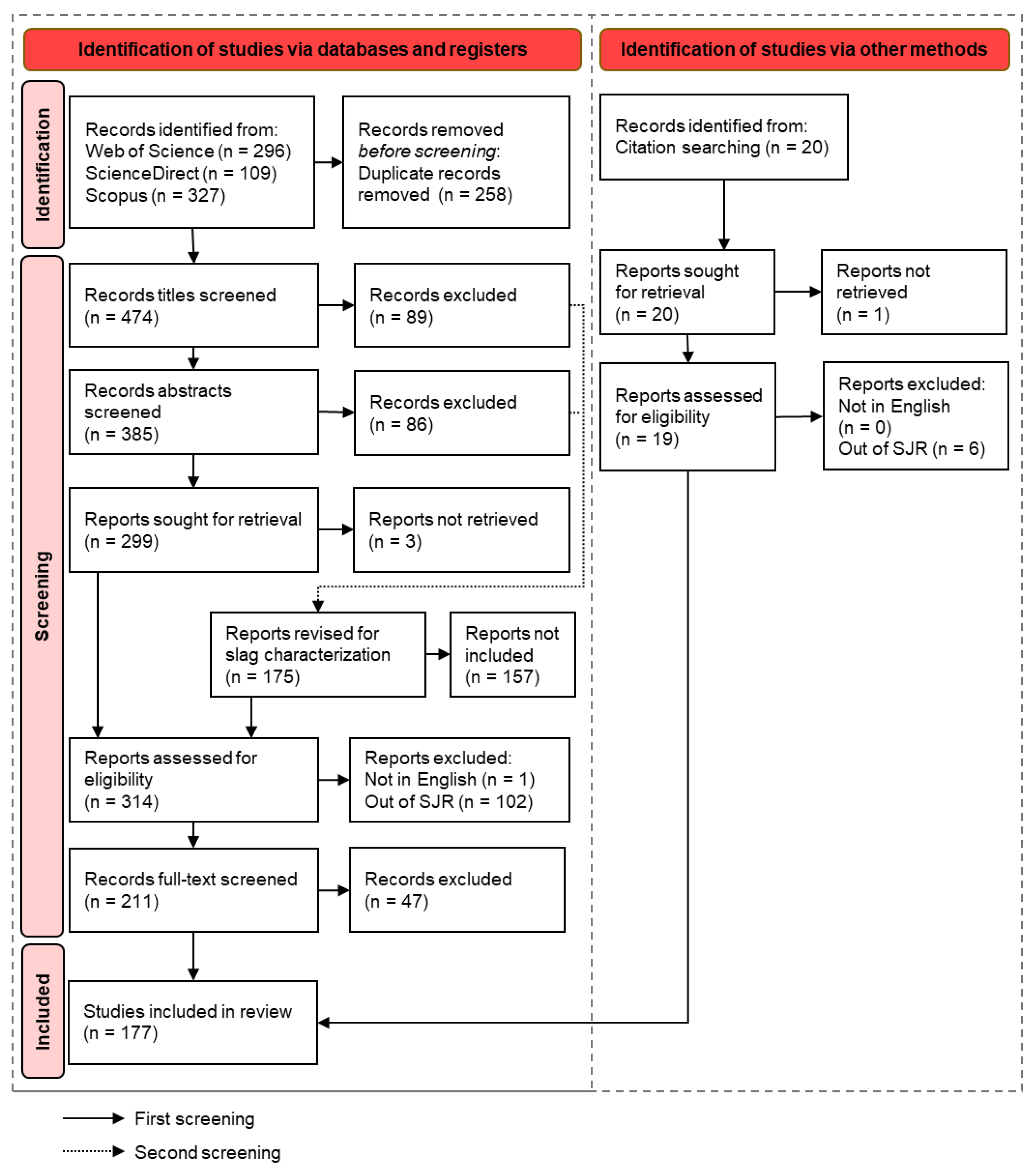
Thus, 732 papers were initially identified, of which 258 were duplicates, corresponding to 35% of the total and indicating a substantial overlap among the three databases. Therefore, 474 papers were initially selected for review. Then, after the evaluation of the titles, 89 papers were excluded, and 385 were retained. From those, the review of the abstracts was conducted, leading to the selection of 299 papers, of which 3 were not available. Additionally, 18 papers that were initially excluded from the first screening process were reconsidered due to their comprehensive slag characterization data. Thus, 314 papers were assessed for eligibility. Subsequently, based on SJR recognition and English-language restriction, 211 papers were retained for full-text review. After full-text assessment, 164 papers were included in the final analysis.
An additional 20 papers were identified through citation searching of the reviewed papers. The same eligibility criteria were applied, and 13 papers were further considered for full-text review. These studies were included exclusively to support the discussion and synthesis of material properties and mechanisms.
At the end, 177 studies were reviewed, including 163 original research articles and 14 literature reviews. Figure 1 illustrates the result from each step of the systematic methodology based on the PRISMA 2020 flow diagram. The table listing the papers included in this study is provided in the Supplementary Materials.

2.2. Social Network Analysis, Initial Bibliometric Analysis, and In-Depth Content Analysis

The bibliometric and social network analysis was conducted following common practices in the literature reviews [28,29]. After collecting all relevant papers, the files from the databases were saved in CSV format to facilitate analysis using appropriate tools. The software VOSViewer (version 1.6.20; Centre for Science and Technology Studies, Leiden University, Leiden, The Netherlands) was used, along with the compiled spreadsheet, to analyze various aspects of the literature, including geographic distribution, keyword connections, co-authorship networks, publication trends over the years, and the most relevant journals. This analysis provided a comprehensive overview of the research landscape related to the application of electric arc furnace slag in pavement construction.
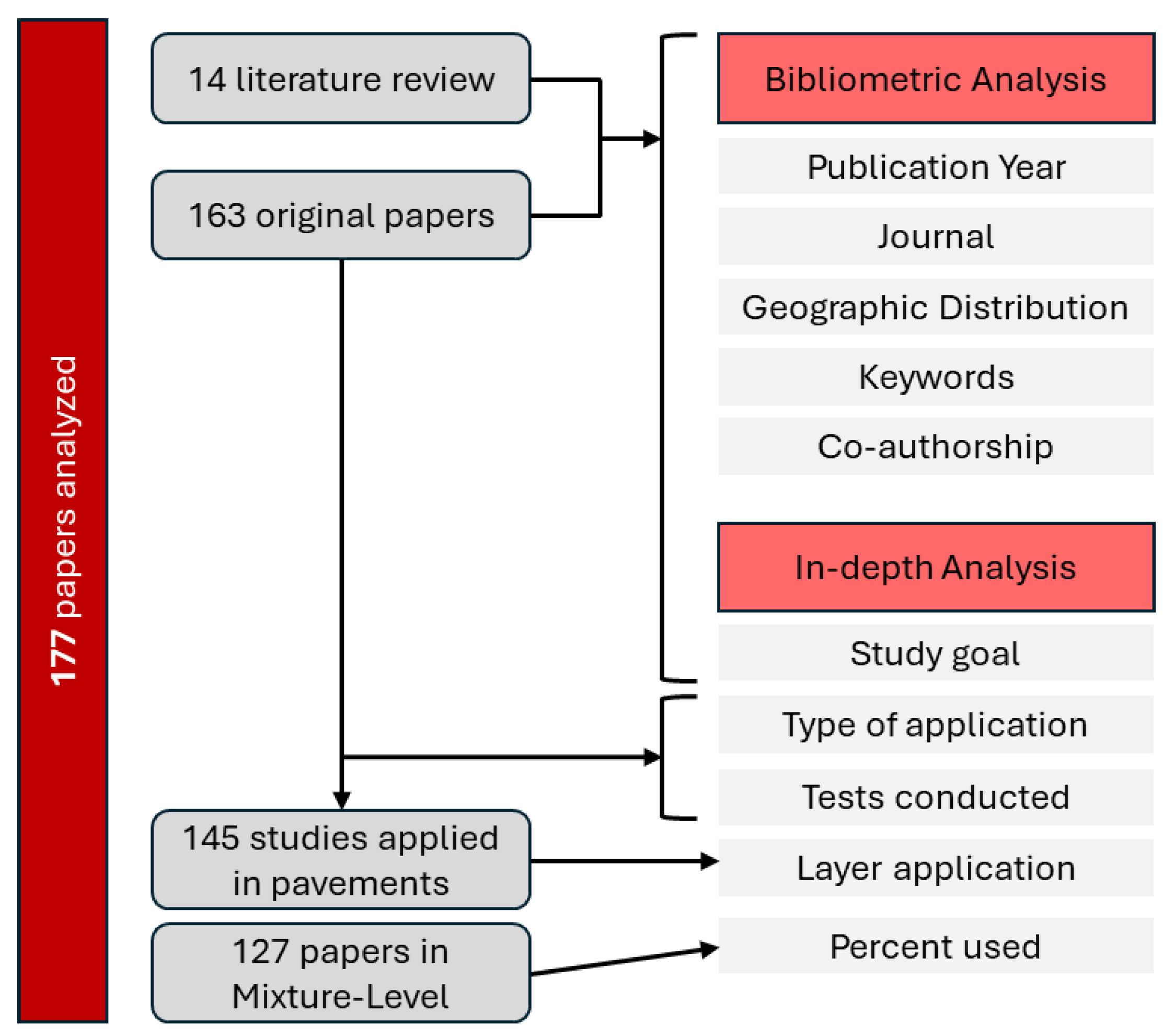
For the in-depth content analysis, the selected papers were evaluated based on the study objective, the intended pavement layer for slag application, the application method, the slag content, the tests performed, and the reported results. This analysis aimed to provide a comprehensive overview of how electric arc furnace slag has been used in pavement construction. Figure 2 presents a flowchart illustrating the study procedure. For the bibliometric analysis and overall study objective, all papers were included (177). For the analysis of application types and testing methods, review papers were excluded. For layer application, studies that evaluated slag only as a material and did not apply it within a pavement layer were excluded. For the analysis of slag content, only studies that incorporated EAFS and LFS in mixtures were considered, while studies using the materials in pure form or as unbound layers were excluded.
The results conclude with a comparative discussion highlighting common practices, performance outcomes, and limitations. Based on this synthesis, practical guidelines are proposed to support future research and engineering practice, particularly for selecting appropriate tests and using EAFS and LFS in pavement applications.
Due to high heterogeneity in study design, slag type, mixture composition, and test protocols, a quantitative meta-analysis was not feasible. Instead, a qualitative synthesis was performed, summarizing results in tables and matrices organized by pavement application, slag type, and test category. This approach allows for comparison of trends while accounting for methodological differences across studies.
To enhance the methodological robustness of the reviewed paper, the literature selection was restricted to articles published in Q1 and Q2 journals. This approach supports a more robust synthesis of performance trends and comparative analyses across studies. While this criterion may exclude some technically relevant contributions published in lower-ranked journals or conference proceedings, it allows the findings of this review to be interpreted within a well-defined and quality-controlled evidence base. Consequently, the trends and research gaps identified herein should be understood as representative of the most rigorously documented scientific evidence. Accordingly, the results and research gaps identified in this review should be interpreted within the defined scope of the selected evidence base, particularly regarding regional applications and emerging practices that may be underrepresented due to publication or language constraints.

3. Results and Discussion

3.1. Bibliometric Analysis

3.1.1. Year of Publication and Geographic Distribution

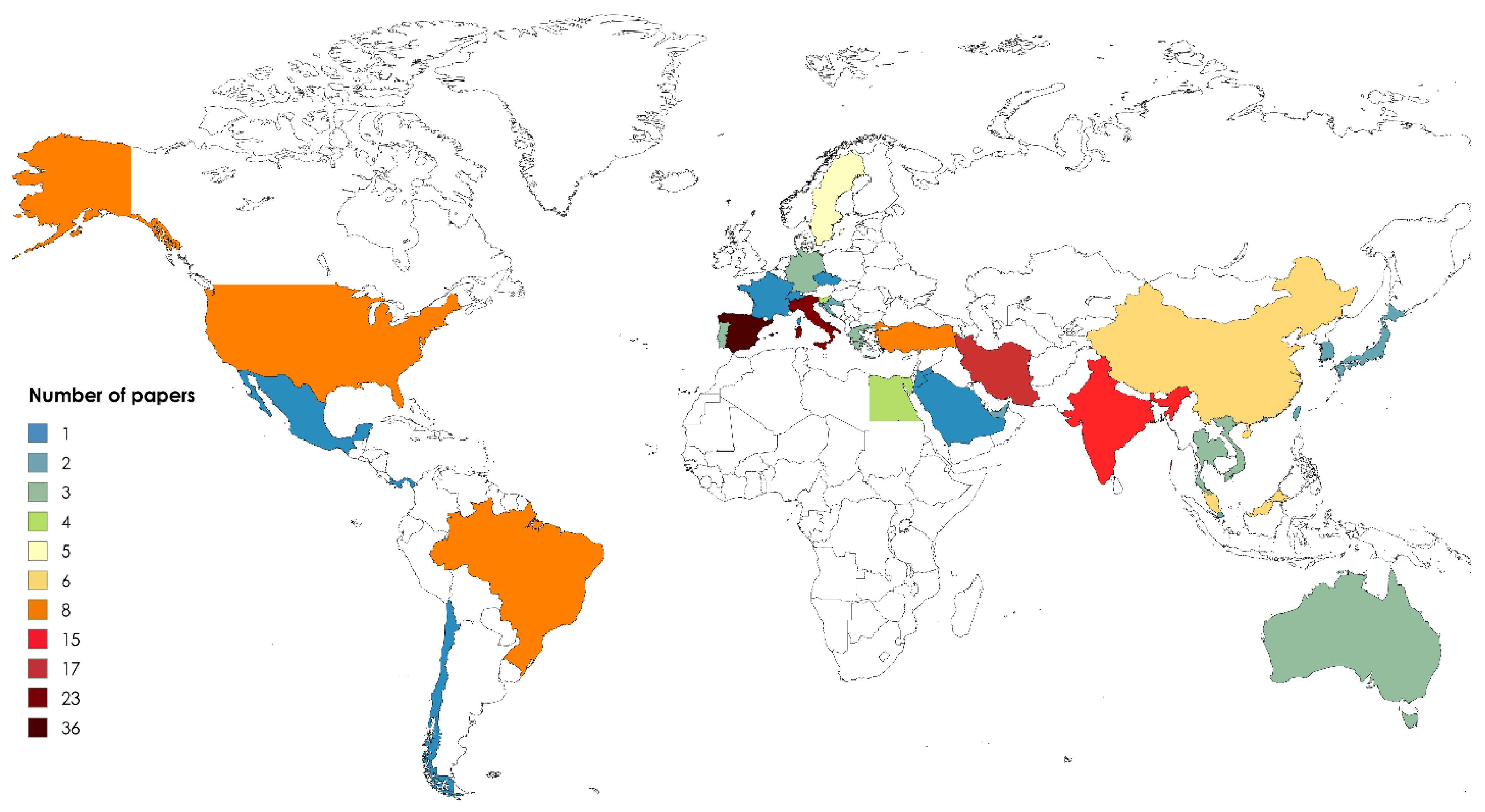
Regarding geographic distribution, authors from a total of 31 countries were identified in the collected papers. The distribution of authors by country of study origin is shown in Figure 3. The seven most representative countries, in terms of the number of published papers, are Spain (36), Italy (23), Iran (17), India (15), and the United States/Brazil/Turkey (8). It is evident that the topic is predominantly discussed in Asia and Europe. Considering that the world’s largest producers of steel from electric arc furnaces are China, India, the United States, Iran, and Turkey [30], the number of publications in these countries aligns closely with their steel production. However, there remains significant potential for expanding research on the application of slag in pavement construction, particularly in countries like China, where studies are still limited despite its high steel production. The university with the most publications was the Universidad Politécnica de Madrid, with nine articles on this subject.
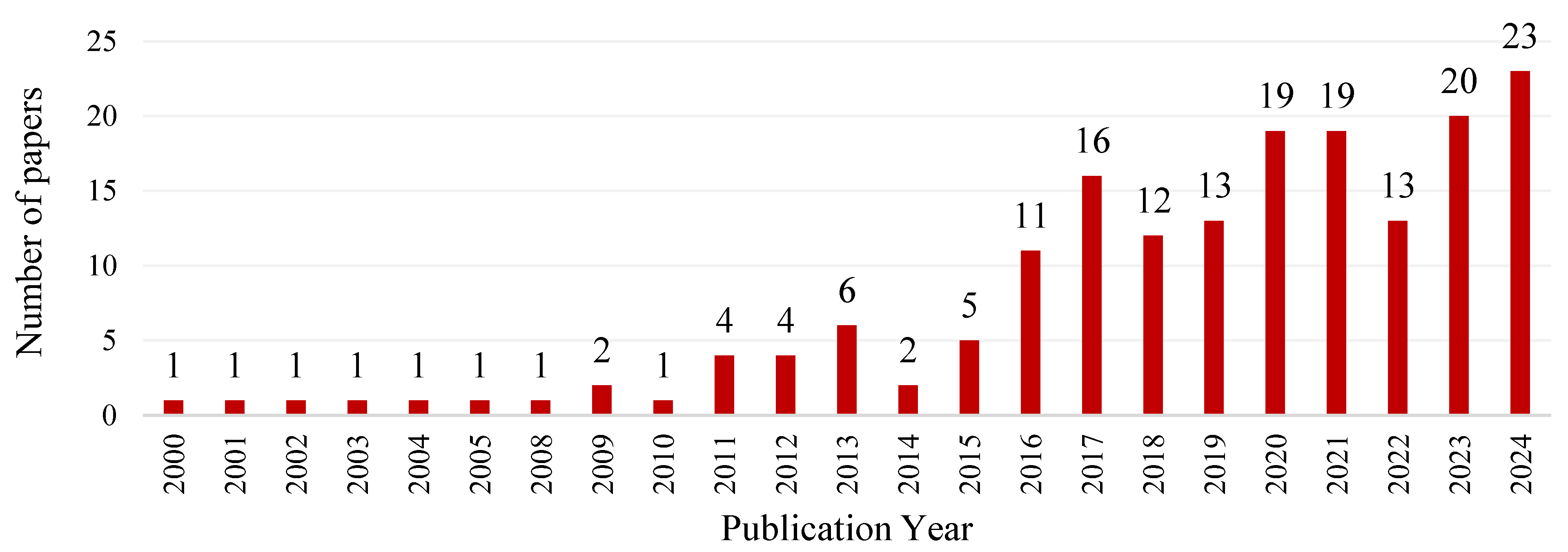
Regarding the number of articles published per year, it is possible to observe in Figure 4 an increase in the number of articles published since 2016, showing that the topic is currently relevant and has been growing over the last 10 years.

3.1.2. Number of Articles Published by Scientific Journals

In total, papers related to the use of EAFS and LFS in pavements were published across 68 different scientific journals. The journal with the highest number of publications was Construction and Building Materials (an impact factor of 8.0 in the 2025 JCR year), with 41 papers, representing 23.2% of the total. Following this, the Journal of Cleaner Production and the Journal of Materials in Civil Engineering published 10 papers. It is notable that the number of publications in the leading journal significantly surpasses that of the others, suggesting a preference among authors to publish research on this topic in Construction and Building Materials.
Although most of the papers are directly related to pavement construction and design, the two journals with the highest number of publications have a broader scope, covering topics related to engineering, materials science, and construction in general. This may indicate that research on the application of EAFS in pavements is still finding space in specialized pavement journals. Table 1 presents the eight scientific journals with the highest number of published articles on the use of EAFS in pavements, along with the total number of citations, impact factor (IF), and quartile rank (QR). Collectively, these 8 journals accounted for 92 research papers, representing 52% of the total publications in this research.

3.1.3. Keywords Cluster Analysis

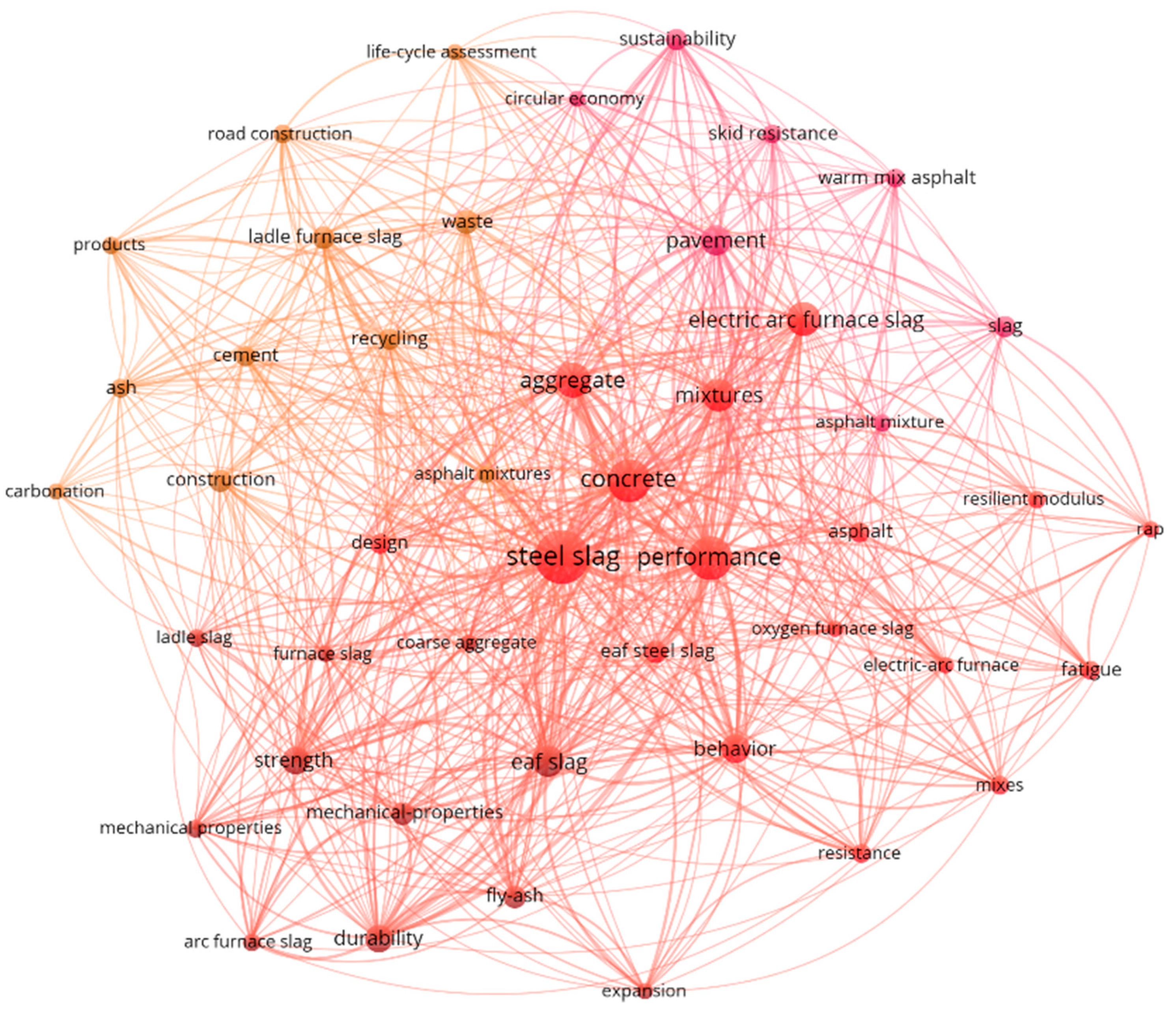
The references were imported into the VOSViewer software, and a network map of keyword co-occurrence was generated. Figure 5 presents the map, which includes keywords that appeared at least eight times across all publications, resulting in a total of 37 keywords. The size of each node represents the frequency of the keyword’s occurrence in the analyzed papers. The links between nodes indicate connections between keywords that appear together in the same publication. Additionally, the proximity of nodes reflects the strength of their association, with closely positioned keywords frequently occurring together.
The most used keyword was “steel slag”, with variations including “EAF slag”, “electric arc furnace slag”, “EAF steel slag”, and “ladle furnace slag”. The application of slag was also a prevalent topic, with “concrete” being the second most frequently mentioned keyword, followed by “aggregate”. Additionally, terms related to the performance of slag, such as “strength”, “performance”, “durability”, “mechanical properties”, and “behavior”, appeared frequently. Other materials associated with these studies, including “fly ash”, “cement”, and “asphalt”, were also identified. Finally, keywords related to sustainability were present, highlighting the environmental focus of the research.

3.1.4. Co-Authorship Cluster Analysis

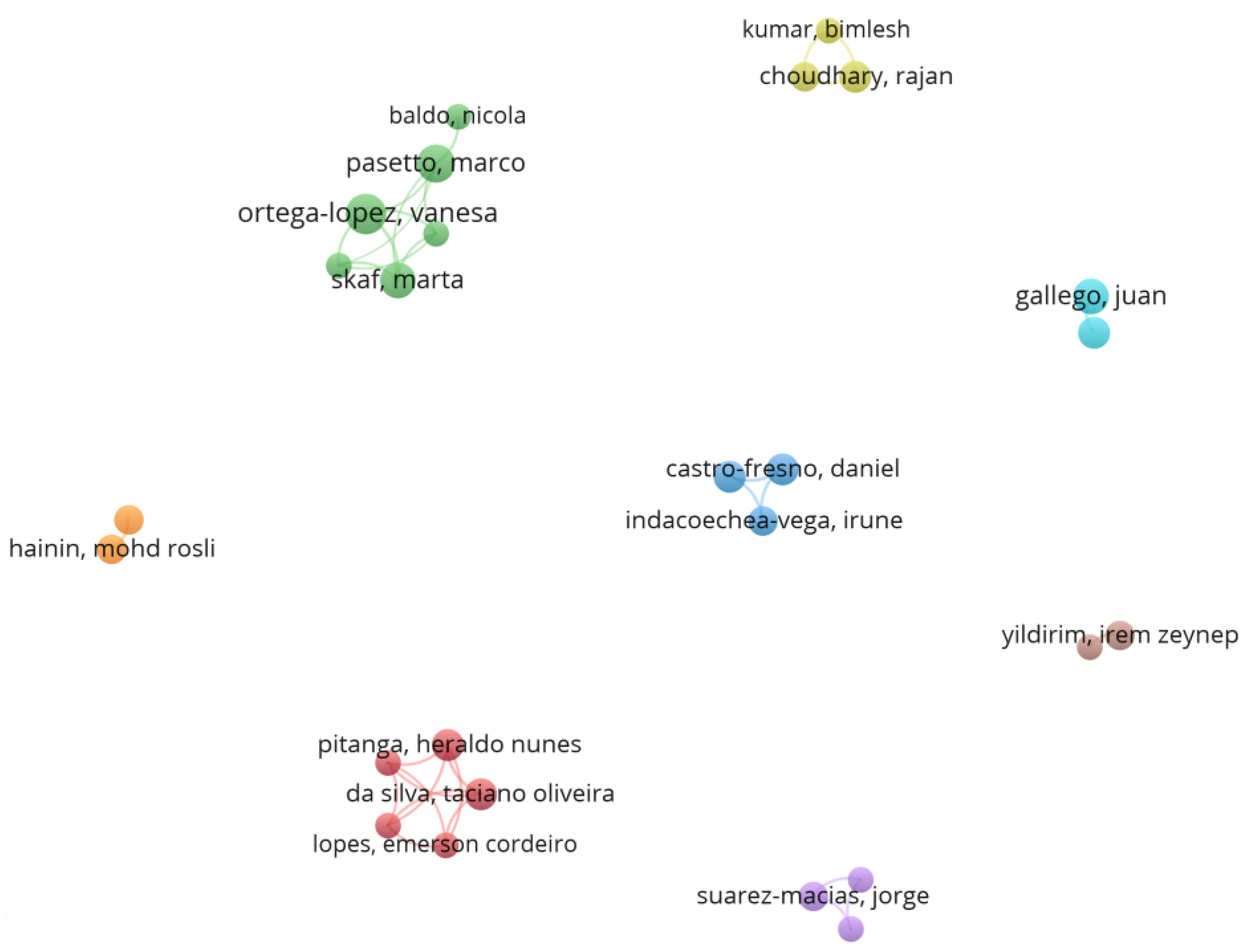
The software enables the creation of a co-authorship connection map, illustrating the relationships among the authors of the collected papers. Figure 6 presents the results of this analysis, which includes only authors with a minimum of four publications. In the figure, the nodes represent individual authors, while the lines indicate co-authored publications. The colors distinguish clusters of authors who have collaborated on at least one paper. A total of 26 authors met the criteria, forming eight distinct clusters.
The clustering pattern reveals that authors within the same group predominantly originate from the same country, with two exceptions: the green and brown clusters. In the green cluster, a partnership between the University of Burgos and the University of Padua is observed. In the brown cluster, collaboration occurred between researchers from Turkey and the United States. However, it is important to note that cross-institutional and cross-national partnerships in the study of EAFS and LFS applications in pavements remain relatively uncommon.
The predominance of Spanish universities in the analyzed studies is not unexpected. Spain has a strong research tradition in the utilization of steel slags, particularly regarding their mechanical performance and environmental benefits. This is partly explained by the availability of steelmaking by-products in specific industrial regions and by national and European research policies that promote sustainable and circular construction materials [31,32]. Furthermore, northern Italy is one of the most important steel-producing areas in Europe, with a high concentration of EAF plants. This local availability strongly encourages collaboration between universities, steel producers, and infrastructure agencies. Similarly, Brazil is a significant steel producer, with electric arc furnace and other steelmaking processes generating substantial quantities of slag [33]. In this context, the Federal University of Viçosa has developed relevant research on sustainable construction materials and geomaterials (e.g., soils and aggregates), with a focus on the use of local industrial by-products [34,35,36]. India also produces large volumes of EAFS [33]. The high demand for road infrastructure and the associated consumption of natural aggregates further intensify research efforts aimed at developing and validating alternative materials for pavement applications.
Regarding the authorship, the author with the highest number of publications, considering the selected studies evaluated herein, was Vanesa Ortega-Lopez, with more than 500 citations. The second-highest number of publications was shared by three authors, each with seven papers: Marco Pasetto and Marta Skaf, who belong to the same cluster, and Juan Gallego, who is part of a different cluster. In terms of citations, the most cited author was Irem Yildirim, with a total of 675 citations across five publications. Table 2 lists the four most productive authors on this topic, along with their main co-authors. Additionally, the table includes the author with the highest number of citations. Spain is emerging as a key research hub for the use of steel slag in paving applications.
As expected, given its leading number of publications, Spain stands out despite not being among the top five global producers of this type of slag. The same applies to Italy, which ranks second in publications. This trend highlights a significant opportunity for major steel-producing countries such as China, India, the United States, and Iran to establish stronger collaborations with universities actively researching this topic, fostering further advancements in the field.

3.1.5. Type of Study and Pavement Layer Application

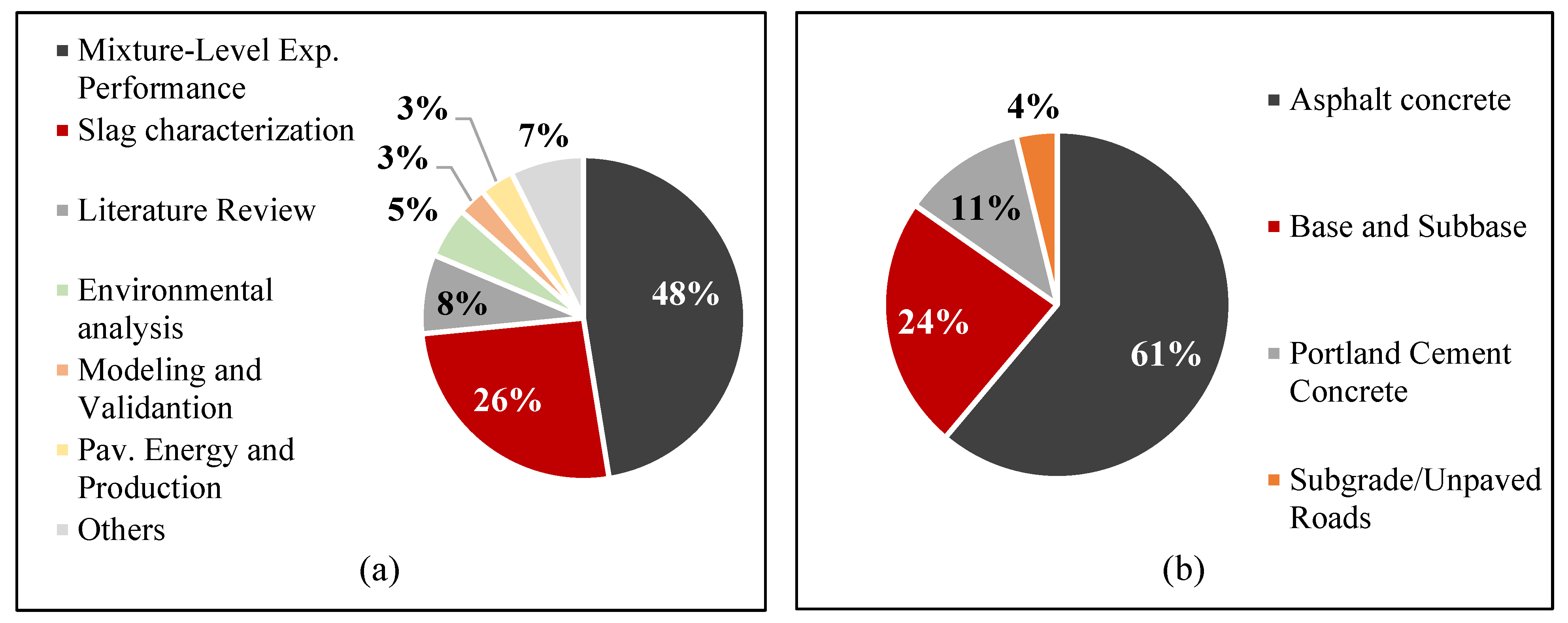
The collected papers were divided into seven categories based on their focus of study, and Figure 7a presents the distribution of papers across these categories:
-
Literature Review: Includes all studies that performed a literature review without conducting experimental tests on the materials.
-
Slag Characterization: Consists of studies that analyzed the slag properties and improvements in the raw materials through laboratory experimental tests.
-
Mixture-Level Experimental Performance: Includes research focusing on the performance evaluation when slag is incorporated in different media, such as asphalt concrete, Portland cement concrete, or soil mixtures.
-
Environmental Analysis: Comprises studies that conducted life-cycle assessments (LCA) on different slag applications.
-
Modeling and Validation: Focus on modeling analyses or the validation of alternative testing methods.
-
Pavement Energy and Production: Include studies analyzing aspects such as energy consumption reduction in production [37], pavement behavior on construction sites [38], self-healing properties [39,40,41], or piezoresistivity improvements [42].
-
Others: Include papers that conducted more than one type of analysis mentioned above.
From Figure 7a, it can be observed that 48% of the papers fall within the category Mixture-Level Experimental Performance. Also, a significant number of studies (26%) investigate the properties of slag before its application in construction. This trend confirms the expectation, since the slag research is gaining attention in the past 10 years (Figure 5), and, as a non-conventional material and/or even considered as a by-product or residue in many locations, researchers and organizations are particularly concerned about learning the slag’s characteristics. It can be seen less studies focused on modeling, environmental assessment, and field applications.
From Figure 7b, most of the studies (61%) investigated the potential of using slag for asphalt concrete fabrication. Among these, 83% employed slag as an aggregate (fine or coarse), 11% as a filler, and 6% as an additive. Studies with a focus on the use of slag for base or subbase layers accounted for 24% of the studies. Nearly 57.57% of these studies used slag as a granular material, while the remaining studies incorporated it in soil mixtures. For Portland cement concrete applications, out of 18 papers, only one used slag as a filler, while the others used it as an aggregate. Lastly, studies that explored the use of slag in subgrade or unpaved roads, as a primary surface material, showed a balanced distribution. Half of the papers applied slag, considering a full gradation ranging from coarse to fine aggregate sizes, while the other half investigated the use of slag fine fraction as an additive.

3.1.6. Slag’s Physical–Chemical, Morphological, Mineralogical Characterization and Environmental Assessment

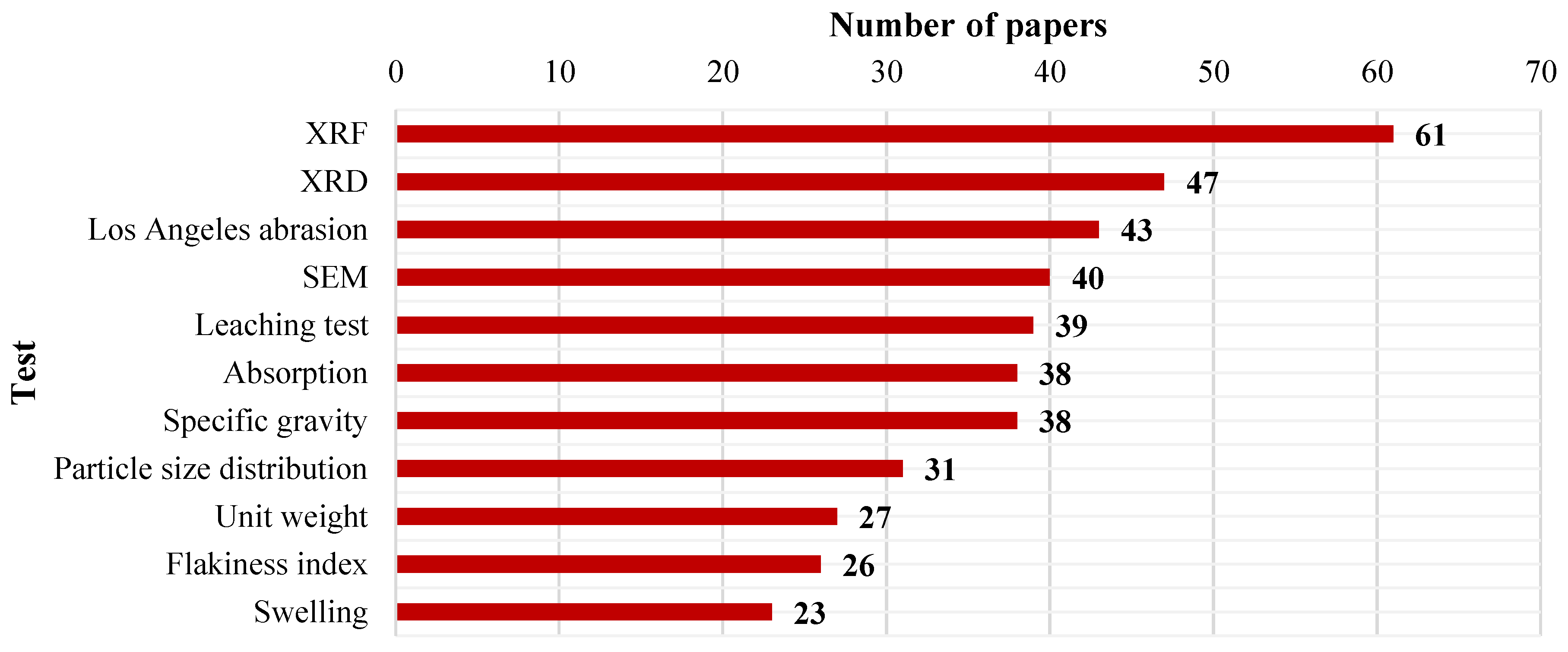
The reviewed studies present a wide range of tests to assess the performance of EAFS and LFS. Figure 8 presents the most frequently performed tests across the reviewed studies, along with the number of papers in which each test was reported. The review papers were excluded from this analysis.
Overall, a total of 76 distinct tests were identified across the reviewed studies, highlighting the diversity of experimental approaches adopted in the literature. The use of X-ray fluorescence (XRF) was reported in 61 papers, while the use of X-ray diffraction (XRD) was reported in 47 papers, reflecting the strong emphasis on slag’s chemical and mineralogical characterization. These methods are essential for understanding slag elemental and mineralogical composition and potential reactivity. In contrast, several other commonly reported tests are primarily related to the performance of slag as an aggregate, including Los Angeles (LA) abrasion loss, water absorption, unit weight, and flakiness index.
Notably, tests addressing key durability and environmental concerns were conducted less frequently. Leaching behavior was evaluated in only 22% of the reviewed papers, while swelling was assessed in 15% of the studies. For leaching assessment, multiple testing protocols were employed, with the Toxicity Characteristic Leaching Procedure (TCLP) being the most common method (46%), followed by EN 12457 (35%). Other methods were used less frequently, including water leach tests (3%), EPA Methods 1312 and 1313 (3% each), Danish Standard methods (3%), Australian Standard methods (3%), CEN/TS 14405 (3%), and single-stage leaching tests (3%).
Similarly, a variety of experimental procedures were adopted to evaluate swelling behavior by linear expansion. The most used method was the water bath test (44%), followed by California Bearing Ratio (CBR) tests (17%), autoclave expansion tests (14%), steam tests (7%), EN 1744 procedures (7%), boiling tests (6%), and oedometer tests (4%). These findings indicate a lack of standardization in both leaching and swelling evaluation, underscoring the need for more consistent testing protocols aligned with specific pavement applications.

3.1.7. Slag Replacement Levels in the Reviewed Studies

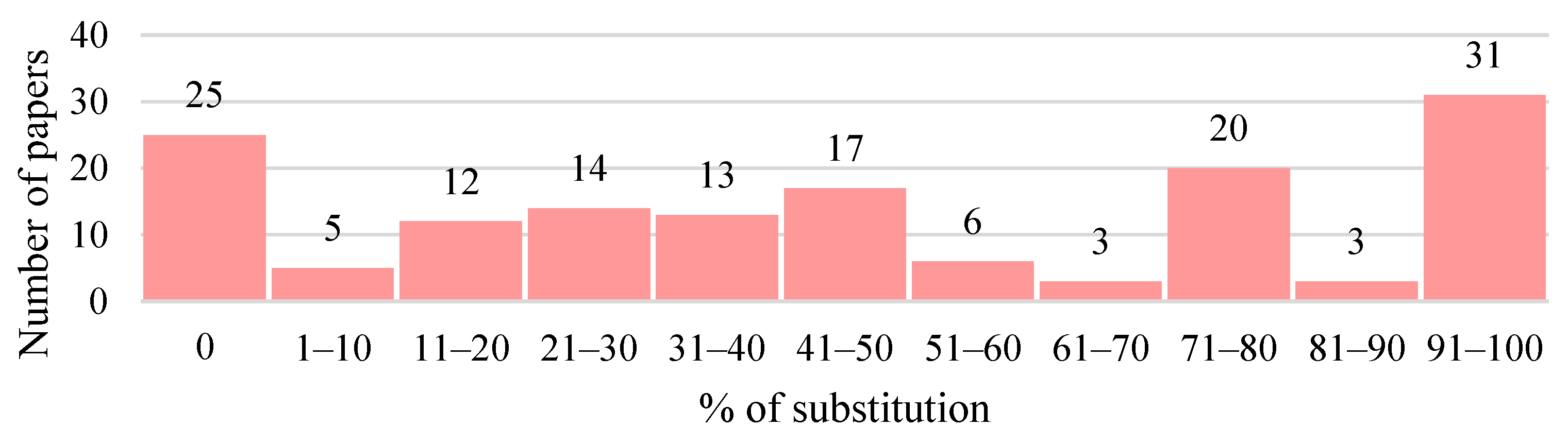
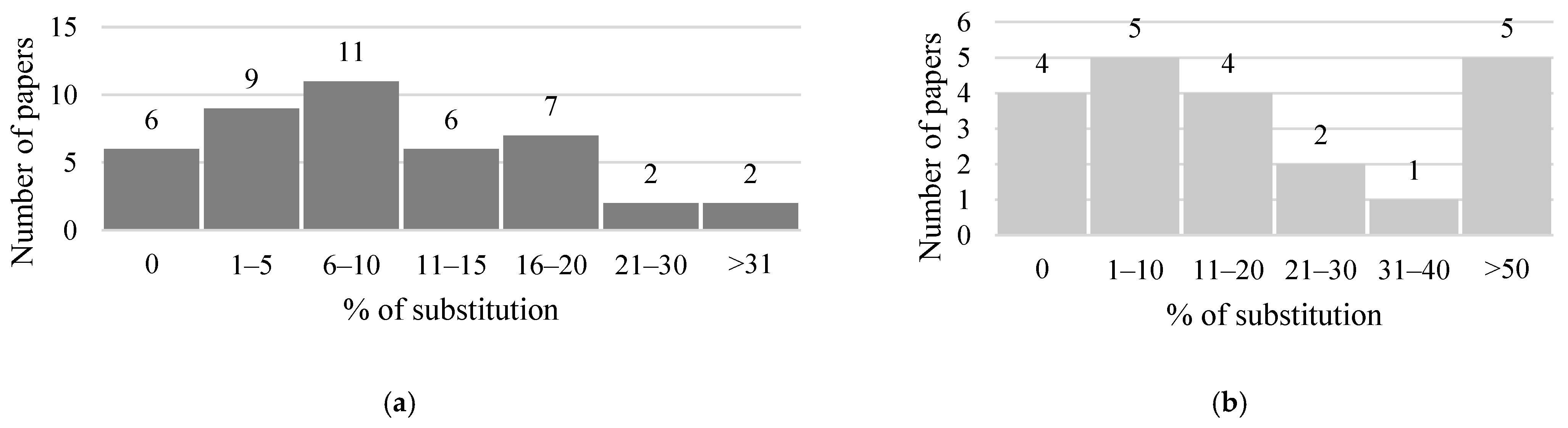
In this section, only papers that applied slag in mixtures were analyzed (127 papers). The slag can be used for a variety of applications in construction, and depending on the specific application, the percentage of natural material replacement can be as large as 100% or as low as 1%. For instance, when used as an aggregate, slag can fully or partially replace coarse and fine aggregates. In contrast, when applied as an additive in soil stabilization, the replacement percentage is typically lower. To better categorize these variations, the results were classified into three main application types: as an aggregate in 102 papers (reported in Figure 9), or as a filler or admixture in 34 papers (reported in Figure 10). The overlapping numbers are due to 10 papers that used slag as both aggregate and filler.
From these papers, it was analyzed whether the authors reported EAFS or LFS substitution in terms of weight or volume, since the high density of these materials can significantly affect proportional parameters when replacing natural aggregates at high contents. Among the 127 papers reviewed, 60.6% reported substitutions by weight, 25.2% by volume, 13.4% did not specify the basis of substitution, and 1 study used volume for aggregate replacement and weight for filler replacement.
To ensure consistency and comparability among studies, Figure 9 and Figure 10 present only studies that reported substitutions by weight. This approach introduces some bias, as part of the literature is excluded; however, it avoids misleading comparisons arising from inconsistent reporting methods.
From Figure 9, it can be observed that many studies applied EAFS as a full replacement (100%) of natural aggregate, suggesting its potential for use as a standalone material. The peaks observed at 25%, 50%, and 75% substitution are attributed to the common research approach of evaluating a broad range of replacement levels, from partial to complete substitution.
Figure 10 presents the graphs depicting the substitution of slag as (a) a mineral admixture and (b) a filler. In the first application, the percentage of substitution is calculated based on the total weight of the mixture, rather than replacing any raw material. Compared to the use of slag as aggregate, some studies included a reference mixture without slag. A clear trend emerges, indicating that slag is predominantly utilized in substitution levels ranging from 1% to 10%, suggesting that even a low percentage is sufficient to achieve the desired effects in these applications. For its use as a filler, the substitution rates also tend to remain low, with most studies applying slag within the 1% to 20% range of the total aggregate mixture weight. Studies that included more than 50% substitution were primarily related to the improvement of asphalt mastics.

3.2. In-Depth Content Analysis—Part 1: Slag Characteristics and Environmental Assessment

3.2.1. Chemical Characteristics

Both EAFS and LFS are byproducts of different steelmaking operations, as previously discussed. Consequently, their chemical and mineralogical compositions are generally similar, though they differ in specific concentrations of constituents. The type and amount of alloys and additives introduced during steel production directly influence the final composition of the slags. Figure 11 illustrates the material flow and resulting products of EAFS and LFS.
The EAF steelmaking process primarily involves recycling steel scrap, making the chemical composition of EAFS highly dependent on the characteristics of the input materials [43]. Engström et al. [43] analyzed the chemical composition of three different EAFS samples derived from various steel types and observed significant variations in oxide concentrations. Slag from low-alloyed steel contained higher Fe2O3, while EAFS from stainless steel exhibited a greater CaO content. In contrast, slag from high-alloyed steel had an elevated SiO2 concentration. The production of high-quality steel requires minimal P and S content, necessitating a high CaO content to maintain slag reactivity. Additionally, due to the heterogeneous nature of the scrap feedstock, high oxygen flow is required during steel production to remove contaminants [44].
For ladle slag, the refining process involves introducing different alloying elements, lime and dolomite into the ladle furnace to achieve the desired steel grade [9]. As a result, the chemical composition of LFS is more variable compared to EAFS. Generally, LFS contains a significantly lower FeO content (<10%) than EAFS but exhibits higher concentrations of Al2O3 and CaO.
The chemical composition results of EAFS and LFS, compiled from various studies, are presented in Table 3. These results were obtained through X-ray fluorescence (XRF) analysis. The primary oxides identified in both slags include CaO, SiO2, and Fe2O3, collectively exceeding 70% of the total composition for the EAFS, followed by MgO and Al2O3. Additionally, slags produced by the electric arc furnace system contain lower FeO concentrations than steel slags generated from the basic oxygen furnace (BOF) process [10].
As shown in Table 3, the chemical composition of slag varies considerably among studies. The high coefficients of variation observed are expected, as several factors (such as steel grade, raw materials, steelmaking process, and additives) influence the final elemental composition. This variability affects the performance of slag, particularly when used as a binding material, as well as its volumetric stability. These aspects are discussed in greater detail in the following section.
Effects of Chemical Composition on Swelling Potential and Treatment Alternatives
In addition to the high CaO and MgO content in both EAFS and LFS, many researchers have expressed concerns regarding the free lime (f-CaO) content and its potential impact on the swelling behavior of these slags. The swelling of steel slags refers to the volume expansion that occurs when the solidified steel slag reacts with water and moisture over time [59]. The swelling can occur due to three primary mechanisms: (i) hydration of f-CaO and free periclase (f-MgO), (ii) carbonation of CaO and MgO, and (iii) phase transformation of dicalcium silicate (from β-C2S to α-C2S).
Regarding hydration, upon contact with water, the free mineral phases undergo chemical reactions leading to the formation of hydroxides, as illustrated in Equations (1) and (2). The f-CaO has a specific gravity of 3.34, whereas calcium hydroxide has a lower specific gravity of 2.23, resulting in an increase in volume [60]. This mechanism is mainly responsible for the swelling of those slags. These compounds absorb the required water from various sources, including atmospheric water vapor, leading to volumetric expansion.
C a O + H 2 O     C a ( O H ) 2
M g O + H 2 O     M g ( O H ) 2
Additionally, in the second case, calcium and magnesium hydroxides can undergo carbonation by absorbing carbon dioxide from the atmosphere, leading to the formation of carbonates. This process can further contribute to volumetric expansion over time, potentially affecting the long-term stability of the material [61]. The reactions are illustrated by Equations (3) and (4).
C a ( O H ) 2 + C O 2   C a C O 3 + H 2 O
M g ( O H ) 2 + C O 2     M g C O 3 + H 2 O
This volume expansion also occurs due to the increase in the volume of voids within the material. Wang et al. [60] explain that during hydration, the void volume increases in conjunction with the solid phase expansion, causing the particles to separate, thus creating larger gaps between them. While the ratio of solid to void content remains constant and is not directly related to the size of the particles, the absolute void volume is inconstant, depending on the changes in the particles.
Other studies have identified two distinct morphologies of f-CaO, referred to as primary and secondary [61,62]. Primary f-CaO consists of undissolved lime, typically appearing as a granular or spongy solid phase. The secondary form originates from the decomposition of tricalcium silicate into dicalcium silicate during the cooling process of the slag. It remains restrained within the dicalcium silicate particles, making it less accessible to reactions in the external part. Compared to primary f-CaO, the secondary form interacts more slowly with environmental conditions and is generally present in smaller quantities [61].
The expansion of f-CaO after hydration occurs faster than that of f-MgO [61], which may require several years to complete its volumetric change. Because of that, it is hard to identify the swelling potential in the short term by the common tests as previewed by ASTM D1883 [63]. Even though it is expected to have high swelling potential for different granulometry, some studies have shown that the particle size does not affect the percentage of expansion in those types of slag [64].
At present, there is no fixed method to predict the volumetric expansion of the EAFS, due to the high number of variables that influence this phenomenon. The most used swelling evaluation methods assess expansion through linear expansion measurements. One method that has been recommended and is required for some departments of transportation in the United States is the heated water bath swelling test, standardized by the ASTM D4792 [65]. Besides that, two other common tests are being conducted as the oedometer test (ASTM D4546 [66]) and the CBR swelling (ASTM D1883 [63]). However, because of the complexity of the reactions between the compounds and water, those reactions could take a long time to happen, leading to a continued expansion even after more than 16 months of monitoring [67].
Also, it is hard to estimate the amount of free MgO compared with diverse methods to estimate the f-CaO [68], so new research is being developed to obtain the f-MgO, and be possible to estimate the swelling potential of the steel slags. However, even the methods for free-CaO are estimates. The diversity of possible chemical reactions between these oxides and the environmental agents is very high. When free MgO is present as a major phase, a longer aging period is required. Nonetheless, it can be difficult to ensure complete suppression of volumetric instability even after years of aging [67].
When the thresholds established by regulatory organizations are met, several treatment strategies can be applied to stabilize steel slag prior to its use in pavement applications. One of the most widely recognized approaches is natural aging, which consists of stacking the slag and exposing it to atmospheric conditions for a defined period. During this time, the active components gradually hydrate, which mitigates the presence of expansive compounds such as free lime (f-CaO) and periclase (f-MgO), thereby improving the volume stability of the material before recycling [69].
To accelerate this process, different treatments have been investigated. Hydrothermal aging involves soaking the slag in warm water for a specified duration. Although this method reduces the time needed compared to natural aging, it still requires relatively long exposure [70]. To shorten the stabilization period further, steam aging techniques were developed. In this approach, slag is placed in steam conditioning equipment and exposed to saturated steam. Building on this concept, the steam pressure aging method, proposed by Sumitomo Metal Company in Japan, subjects slag to high-temperature and high-pressure steam inside a closed vessel. This technique significantly reduces aging time by enhancing the rate of hydration reactions. However, while steam and autoclave-based treatments are effective, their reliance on specialized equipment and complex operational procedures increases costs, limiting large-scale adoption in road construction.
Another promising approach is accelerated carbonation, which markedly reduces swelling potential by converting expansive oxides into stable carbonates. This process involves the reaction of CO2 with f-CaO and f-MgO, forming CaCO3/MgCO3, under a controlled environment and CO2 concentration [71]. Studies report that accelerated carbonation can reduce the linear expansion rate by more than 70% [71,72]. For example, Bodor et al. [73] evaluated the use of carbonated BOF slag aggregates in cement mortars. Their results showed improvements in dimensional stability, soundness, and lower leaching tendencies, highlighting the dual benefits of stabilization and enhanced environmental performance. However, accelerated carbonation requires complex, multi-stage operations, making cost control a key challenge for its large-scale implementation [69].
Another strategy to mitigate swelling involves the incorporation of additives that enhance pozzolanic reactions or promote particle nucleation, thereby improving the dimensional stability of slag mixtures. Inorganic additives can enhance volume stability by filling surface pores or inhibiting the expansion of free oxides, which reduces the ingress of water and air. Among the most studied materials are fly ash and silica fume. Yildirim et al. [74] reported that incorporating 10–20% Class C fly ash into steel slag mixtures effectively reduced swelling strains to negligible levels (≤0.1%) while simultaneously improving strength, owing to the pozzolanic interactions between slag and fly ash. Similarly, Liu et al. [75] observed that adding 6% silica fume significantly decreased linear expansion compared to mixtures without it. However, when the silica fume content was increased to 9%, expansion increased a lot. Based on these findings, the authors recommended a 3% addition as sufficient to decrease swelling potential while maintaining cost efficiency.
The stabilization of slag’s volume is particularly important for its use as aggregate in concrete, asphalt concrete, and pavement base layers. Nevertheless, treatments that remove or neutralize free lime can also reduce the reactivity of slag, which may limit its effectiveness when used in soil stabilization applications. Despite this drawback, some studies have demonstrated that untreated or minimally treated EAFS can be effective in reducing the swelling potential of expansive clays, producing mixtures that are more stable than either untreated soil or slag alone.

3.2.2. Mineralogical Composition

The mineralogical composition of EAFS and LFS is highly complex and can vary significantly from one sample to another. The formation of crystalline phases within the slag structure is influenced by both the chemical composition of the molten co-product and the cooling rate during solidification. [9]. Furthermore, the chemical reactions between these slags and water are diverse and dynamic, which can complicate the reliability of mineralogical assessments [61]. This challenge is further intensified by the fact that slags are often stored in outdoor stockpiles for certain periods, where exposure to environmental conditions can alter their mineralogy [76].
The primary technique employed by the authors to determine the crystallographic characteristics of slag samples is X-ray diffraction (XRD). The results indicated that slags possess a highly crystalline nature, with multiple phases being identified for the same oxides. In the case of EAFS, which generally contains high amounts of iron oxides, solid solutions of FeO were frequently reported as one of the dominant mineral phases [9]. In total, 29 studies applying XRD to EAFS and 11 to LFS were reviewed. Across 30 studies for EAFS and 12 for LFS, 51 distinct mineral phases were identified, with the 10 most reported phases summarized in Table 4. Notably, the predominant phases varied between slag types, although some, such as calcite, larnite, gehlenite, periclase, and calcio-olivine, were consistently observed in both.
The presence and relative abundance of specific mineral phases play a critical role in governing the chemical reactivity, mechanical performance, and environmental behavior of steel slags when incorporated into pavement-related applications. Depending on the mineralogical composition, slags can exhibit both reactive phases, which promote binding and stabilization, and inert phases, which contribute to volumetric stability and long-term durability [77,78,79]. This balance directly influences the suitability of slags for applications ranging from aggregates in asphalt and concrete to additives in cementitious systems and soil stabilizers in subbase and base layers.
In the case of EAFS, tends to be dominated by mineral phases such as wüstite, calcite and larnite, along with inert constituents such as magnetite and quartz. Larnite, a calcium silicate phase, contributes to hydraulic reactivity and can promote strength development under appropriate curing conditions. Similarly, brownmillerite and lime provide additional reactivity, though the free lime content must be controlled to minimize risks of volumetric instability. By contrast, inert phases such as magnetite and quartz improve the structural integrity of the slag by providing resistance against excessive reactivity, thereby enhancing its long-term durability when used as aggregate.
The LFS, on the other hand, the occurrence of mayenite is particularly noteworthy. Mayenite is a highly reactive calcium aluminate phase commonly associated with rapid hydration kinetics [80]. Its presence promotes early strength development, which is a desirable feature when slags are used for soil stabilization or as a supplementary additive in cementitious mixtures [81,82]. In addition, mayenite and gehlenite are recognized for their capacity to immobilize heavy metals, reducing leaching potential and contributing to the environmental safety of slag-based materials [83]. This characteristic enhances the suitability of LFS in geotechnical applications where environmental compatibility is a primary concern. Other phases, such as portlandite and brucite, are associated with hydration and the potential formation of expansive products. While these phases can provide short-term reactivity and alkalinity beneficial for stabilization, their long-term stability must be carefully managed to avoid durability concerns.
When comparing both slag types, LFS exhibits a higher abundance of reactive aluminates and hydroxides, which favor rapid hydration and metal immobilization but require attention to possible expansive reactions. Equally, EAFS displays a balance between reactive silicates and aluminates and more inert phases, which contributes to more moderate hydration behavior and mechanical performance. This mineralogical profile makes EAFS more suitable as aggregate in asphalt or concrete, where volumetric stability and durability are crucial, while LFS may provide greater advantages in soil stabilization due to its reactivity and capacity to improve early strength.
It is also important to highlight that the mineralogy reported by the different authors showed a considerable degree of variability, even for the same type of slag. Such variability is primarily associated with differences in steel production processes, cooling methods, and post-treatment practices, all of which directly affect the crystalline behavior of the slag. As a result, the potential of these materials for pavement applications cannot be generalized solely based on their classification as EAFS or LFS but must be correlated with the specific mineralogical characteristics of each local sample. This emphasizes the importance of thorough characterization prior to use, since the presence or absence of certain reactive or expansive phases can decisively influence the material’s mechanical behavior, durability, and environmental performance in pavements.

3.2.3. Physical and Mechanical Parameters

The physical characteristics of steel slag are generally comparable to those of natural aggregates, making it a potential alternative material for pavement and construction applications. However, several notable differences have been reported in the literature. One of the most significant is the higher specific gravity of steel slag, primarily attributed to its elevated content of iron-bearing compounds. Usually, the specific gravity of steel slag can be 20–27% higher than that of natural aggregates [13,84]. While this property can contribute to improved mechanical performance, it also presents logistical challenges. The increased density of steel slag can lead to higher transportation costs when materials are procured or distributed based on volume rather than weight, as the hauling capacity of trucks is limited by mass [14]. However, the environmental and economic gains of using a co-product are compensated by the cost of using natural resources.
Another factor to be evaluated when slag is applied in roadway construction is its durability, which is influenced by properties such as absorption, toughness, and soundness. The absorption capacity is particularly important, and its acceptable threshold depends on the intended application. For instance, when used as an aggregate in asphalt concrete, low absorption values are desirable to prevent excessive binder uptake, which would reduce the amount of binder available to the mix [85]. In contrast, for use in Portland cement concrete, a moderate absorption capacity may be beneficial in projects that require internal curing, as the aggregate can serve as a source of water to promote hydration. Due to the air-cooling process, steel slag often develops a vesicular and porous surface structure, which increases its overall porosity and water absorption rate. The absorption values vary depending on the type of slag. For example, EAFS typically presents absorption values in the range of 1–4%, which are generally higher than those of limestone (0–2.4%) [86] and basalt (0.4–0.7%) [14]. Some reference values for the EAFS and LFS are presented in Table 5.
The toughness property of aggregates is usually evaluated through abrasion tests, such as the Los Angeles (LA) abrasion test. Due to its composition, which contains a high concentration of iron compounds, EAFS generally exhibits greater toughness and hardness [87,88], making it a desirable material for use as an aggregate in Portland cement concrete or asphalt concrete mixtures. For comparison, limestone typically presents LA abrasion values ranging from 18% to 40% [14], with several Departments of Transportation (DOTs) in the United States establishing a maximum limit of 40%. Other natural aggregates may exhibit higher abrasion losses than steel slag; for example, granite generally ranges from 10% to 25%, and basalt from 15% to 20% [14]. Between the two slags discussed, EAFS tends to be more resistant to abrasion than LS, which can be attributed to the different oxide compositions of each material, with EAFS containing higher iron content. The soundness property refers to the resistance of the aggregate to weathering and disintegration caused mainly by freeze–thaw cycles, wetting and drying, and thermal variations. Only a few studies have evaluated this parameter for EAFS, and the reported values are very low compared to those of natural aggregates. For reference, granite typically exhibits soundness losses between 3.5% and 5.6%, while limestone ranges from 0.1% to 4.5% [14]. Some reference values for EAFS and LFS are presented in Table 5.
Table 5. Abrasion, specific gravity, absorption and soundness results for EAFS and LFS.
Physical PropertyType of SlagResult RangeReference
Abrasion (%)EAFS14.1–24.0[51,89,90,91]
LFS2.0–50.0[16,84,92,93]
Specific gravityEAFS3.2–3.9[45,51,90,91]
LFS2.2–3.4[45,84,92,93,94,95]
Water absorption (%)EAFS0.8–4.7[51,89,91]
LFS0.4–4.7[16,84,93]
Soundness (%)EAFS0.1[96]
Overall, the physical properties of EAFS and LFS indicate that it is a technically viable substitutes for natural aggregates in pavement and construction applications. Its high resistance to abrasion and hardness can contribute to superior mechanical performance and long-term durability of the layers where it is applied. The higher absorption rates associated with the porous surface of air-cooled slags should also be evaluated according to the intended use, as they can reduce binder efficiency in asphalt mixtures. Despite the limited number of studies on soundness, available results suggest that EAFS exhibits satisfactory resistance to weathering compared to natural aggregates. In general, when properly processed and selected based on their physical characteristics, the slags demonstrate great potential as a sustainable aggregate option.

3.2.4. Environmental Assessment

Environmental performance is a major concern regarding the use of steel slag in construction applications, due to the potential leaching of heavy metals [97]. In this review, environmental performance is defined as the leaching behavior of potentially hazardous elements from EAFS and LFS. The main issues include heavy metal mobility, variations in pH, and the overall life-cycle impact of the material. The EAFS originates from processes that use scrap metal, leading to considerable variability in its chemical composition and leaching behavior among different production sites. Proctor et al. [98] conducted a comprehensive study analyzing slags from 58 active steel mills in the United States, representing approximately 43% of national production. Among 45 EAFS samples collected from different states, none exceeded the limits established by the Toxicity Characteristic Leaching Procedure (TCLP) requirements. However, the concentrations of certain elements, such as barium, showed substantial variation, ranging from 0.34 to 7.9 mg/L, highlighting the importance of site-specific characterization before reuse.
Studies conducted in other countries also evaluated the leaching behavior of EAFS and LFS, comparing their findings with the regulatory limits established by each respective government [99,100,101]. However, several factors must be considered when analyzing leaching results and assessing the environmental performance of steel slag in different applications. One key factor is the particle size distribution of the material [102]. Finer particles tend to increase the leaching rates of various elements, such as barium and vanadium, except for chromium [103]. Another critical factor is the pH of the leaching solution. The most used procedure, EPA Method 1311 (TCLP), evaluates leaching behavior under a single pH condition, which may not accurately represent the actual conditions encountered in pavement environments. In contrast, EPA Method 1313 examines the material’s response across a wide pH range (from 2 to 13), allowing for a more comprehensive understanding of how constituents partition between solid and liquid phases. Due to variability in experimental procedures between the papers, quantitative comparisons were limited to studies employing the same testing protocol, specifically the TCLP. The summarized results are presented in Table 6.
EAFS are generally characterized by their high alkalinity, which can significantly increase the pH of the surrounding matrix once incorporated into pavement structures [104]. The solubility and mobility of certain elements are highly pH-dependent [105]; for example, barium tends to leach at pH levels below 10.5, while vanadium is more soluble between pH 11 and 11.5 [84]. Although testing under various pH conditions can be conservative, as some environments may never reach extreme pH values, it remains essential to consider these potential scenarios to ensure safe and responsible use of steel slags in construction applications.
The elemental composition of the slag also plays a significant role in determining its leaching behavior. Certain elements are more susceptible to leaching depending on the concentration and type of oxides present [44,103]. For example, the leaching of barium has been shown to increase with higher contents of MgO and CaO, while vanadium leaching tends to decrease as the proportions of CaO, SiO2, and MgO rise. No clear correlation has been identified for chromium leaching. Therefore, the oxide composition of the slag directly influences its environmental performance, as the presence and proportion of specific oxides can either promote or inhibit the release of heavy metals under leaching conditions.
Another important factor influencing leaching behavior is the type of steel produced. The chemical composition of the slag varies according to the steelmaking process and the alloying elements used, which directly affects the concentration and mobility of heavy metals [106,107]. Engström et al. [43] investigated EAFS derived from three different steel types: low-alloyed, stainless, and high-alloyed. The study found that, although all samples exhibited similar pH values, their elemental compositions and leaching behavior differed considerably. For instance, stainless EAFS showed higher chromium leaching, while the high-alloyed slag presented greater molybdenum release. These findings highlight that the leaching potential of EAFS cannot be generalized but must instead be assessed based on the specific steel production process and chemical composition of each slag source.
Table 6. Leaching test results from different studies.
References
Parameter[89][108][84][109][110][111][112][113]Unit
Aluminum (Al) 0.015 mg/L
Arsenic (As)<5 0.06 0.0044 <0.005<0.01mg/L
Barium (Ba) 0.02 0.43mg/L
Beryllium (Be)<1.0 <0.0001 mg/L
Cadmium (Cd)<1.0ND<0.010.3650.00120.001<0.1<3mg/L
Chlorides (Cl) 3 2.23mg/L
Chromium (Cr)34.80.040.120.0240.00580.0090.00970.03mg/L
Copper (Cu)<0.010.250.010.0950.00120.0820.0120.01mg/L
Cyanide (Cn)<10 <0.2 mg/L
Fluorides0.3 1mg/L
Lead (Pb)<5.01.69<0.0053.4760.01170.0080.022 mg/L
Manganese (Mn) 0.207 mg/L
Mercury (Hg)<1.0 <0.01 0.0005 <0.00020.0009mg/L
Nitrates1.1 5.1mg/L
Selenium (Se) 0.0089 0.005mg/L
Sulfate3.2 512mg/L
Zinc (Zn)<0.01 <0.01 0.00010.1680.030.07mg/L
Another important factor influencing leaching behavior is the aging or weathering of slag [114,115]. Suer et al. [116] compared freshly produced slag with samples aged for seven months under outdoor conditions. The results showed that while some elements, such as Na, K, S, and Se, were not significantly affected by weather, most elements (Cr, Ca, Fe, Mn, Pb, and Ba) exhibited reduced leaching concentrations over time. In contrast, elements such as V, Si, and Al showed increased leaching after weathering. These changes are primarily attributed to mineralogical transformations and surface carbonation processes that occur during exposure to atmospheric conditions. However, it is crucial to note that the weathering process must be carefully managed, as uncontrolled storage conditions can lead to uncontrolled leaching and potential contamination during the aging period itself.
The specific application of steel slag in pavement structures also significantly influences its leaching potential. When the material is encapsulated, such as in asphalt concrete or Portland cement concrete, the likelihood of direct contact with water is reduced, thereby reducing the risk of leaching [57,92,95,117,118]. Conversely, when used in unbound layers such as base or subbase courses, the slag remains more exposed to environmental conditions, increasing the potential for leachate generation. Two studies [116,119] investigated slag samples collected from different locations of a subbase layer, at the road center and pavement edge. The slag used as a granular material showed notable spatial variability in leaching behavior. Samples from the road center exhibited leaching characteristics like those of fresh slag, while those from the pavement edge showed reduced element concentrations, indicating that greater exposure to surface water and runoff led to more extensive leaching. These findings highlight the importance of considering both the type of application and the location within the pavement structure when assessing the environmental performance.
Overall, the leaching behavior of EAFS and LFS is influenced by multiple interrelated factors, including the type of steel produced, the chemical and mineralogical composition, particle size, pH conditions, and field exposure. These variables make it essential to evaluate slag performance on a case-by-case basis, particularly considering local production and application conditions [120,121]. Several approaches have been proposed to mitigate leaching and enhance the environmental stability of slags. Some studies recommended natural aging for a minimum of six months, which promotes hydration and carbonation reactions, thereby reducing the release of heavy metals [43,122]. Primavera et al. [123] demonstrated that applying stabilizing agents during the deslagging process can substantially lower the free lime content by up to 75% in pilot-scale trials, thus improving both chemical and volumetric stability. Additionally, Yang et al. [122] suggested incorporating phosphorus-based stabilizers, such as P2O5, at concentrations between 0.39% and 0.7%, during the cooling stage to effectively immobilize heavy metals within the slag matrix. Together, these strategies indicate that a combination of controlled production, post-treatment, and chemical stabilization can significantly minimize leaching potential, ensuring safer and more sustainable use of EAFS and LFS in pavement and geotechnical applications.
Only a few studies have evaluated the life-cycle assessment of slag applications in pavements, and most of them have shown advantages in terms of reduced environmental impacts [124,125,126,127]. These findings indicate that the use of EAFS and LFS can contribute to more sustainable pavement materials.

3.3. In-Depth Content Analysis—Part 2: Use of Slag for Pavement Applications

3.3.1. Effects of Slag in Asphalt Concrete (AC)

As shown in Figure 7, AC represents the most extensively studied application, with investigations exploring its use as an aggregate, filler, or mineral admixture. The most common approach involves partial or total replacement of the coarse aggregate. As previously discussed, the mechanical properties of this material, such as surface roughness, angularity, hardness, and abrasive resistance, make it especially suitable for AC applications.
Table 7 summarizes the main studies that investigated the use of EAFS and LFS, either in combination or with LFS alone, in AC mixtures. LFS is most used as a filler, as it is typically obtained from industrial processes in fine particle sizes. As the findings reported for EAFS in the next table show, mixtures containing both slags exhibited comparable performance trends. The study that evaluated LFS as the sole slag component reported that its incorporation increased the elasticity of the asphalt binder but reduced fatigue resistance [94].
Table 8 presents a summary of the main studies that investigated the use of EAFS as an inert material in asphalt mixtures, covering applications from larger particle sizes (coarse aggregate) to finer fractions (filler). Some studies did not report the particle size of the slag used in the mixtures and, therefore, were not included in this comparison.
The findings reported in the literature support the suitability of EAFS for asphalt pavement applications. The most consistently reported improvements associated with the incorporation of EAFS include enhanced skid resistance, increased Marshall stability, and higher indirect tensile strength (ITS) [129,130,131]. With respect to rutting resistance, most studies reported favorable performance [131,132,133], although a few exceptions were noted. In contrast, fatigue performance exhibited more variable behavior. Several studies indicated that the inclusion of EAFS may reduce mixture workability and increase stiffness, which could potentially compromise long-term fatigue resistance and promote earlier crack initiation and propagation. Other studies not listed in Table 8 have used computational modeling to predict the performance of asphalt pavement mixtures incorporating EAFS [134,135].
Overall, these results indicate that EAFS and LFS can enhance several performance-related properties of AC mixtures. However, further evaluation of long-term behavior is necessary to ensure that mixtures containing EAFS and LFS meet all mix design and performance requirements.
Table 8. Summary on asphalt concrete performance with EAFS.
UsePercentageGeneral Results
Only coarse agg.15–100%Strength/Stiffness: Increased ITS, Marshall stability, and resilient modulus. Higher stiffness at low frequencies and elevated temperatures [131,136,137,138,139,140,141,142,143,144,145].
Rutting: Improved resistance in static/dynamic creep and Hamburg tests; up to 343% improvement reported [111,131,146,147,148,149].
Fatigue: Generally improved resistance or comparable to NA mixtures [141,150,151,152,153].
Moisture Resistance: Reduced water sensitivity and improved durability [133,140].
Skid/Surface: Higher friction and polishing resistance; improved skid performance [131,147,154,155].
Permeability/Abrasion (OGFC): Meets permeability requirements and lower abrasion loss [156,157,158].
Adhesion: High aggregate–bitumen affinity related to roughness and mineralogy; enhanced by surface treatment [133,140,150].
Aging/Thermal Sensitivity: Lower aging susceptibility and reduced thermal sensitivity [137,141,159].
Coarse and fines agg.20–100%Strength/Stiffness: Increased Marshall stability; improved resilient modulus and compressive resistance, increased stiffness [110,130,160,161,162,163,164].
Rutting: Enhanced resistance to rutting and permanent deformation in both aged and unaged conditions; lower susceptibility to excessive deformation [51,110,117,132,165,166,167,168,169].
Fatigue Performance: Some studies showed comparable to reference mixtures; others presented reduced fatigue due to increased stiffness [130,132,160,161,170,171].
Moisture: Improved moisture damage resistance and higher TSR/ITSR values [51,129,172,173,174,175].
Thermal Sensitivity: Increased temperature sensitivity with higher slag content; reduced low-temperature sensitivity in WMA with Sasobit [161,176].
Only fine agg.30–100%Rutting/Abrasion Resistance: Improved rutting and abrasion resistance, with reported gains up to 72.8% and 18.2%, respectively [90,177].
Surface/Wear Properties: Enhanced roughness and wear resistance, with good shear strength [178].
Adhesion/Heating: Improved adhesion, heating efficiency [179] and reduced bleeding [177].
Filler50–100%Rheological and Fatigue Performance: Improved fatigue resistance, dielectric response and energy-related properties, with higher Nf and yield energy in LAS and Binder Yield Energy tests [46,180,181,182,183].
Rutting and Deformation Resistance: Superior rutting performance in mastics and mortars; improved microsurfacing resistance to abrasion, bleeding, and vertical displacement [184,185].
Physical Properties: Improvement in rheological properties; reduction in heating energy; compaction, volumetric, and mechanical properties similar to or better than conventional fillers [46,186,187].
Notes: ITS—indirect tensile strength test, NA—natural aggregates, TSR—tensile strength ratio.

3.3.2. Effects of Slag in Portland Cement Concrete (PCC)

The use of the slag in PCC can be done as an aggregate or as a filler. When employed as an aggregate, this material plays a fundamental role in the performance of concrete. Concrete consists of a composite system in which mineral aggregates are bonded by a cement-based paste [188]. The substitution of the natural aggregate by EAFS can bring some advantages and disadvantages. Owing to its relatively high density, EAFS is particularly suitable for applications that require increased structural mass. In such cases, including bases, retaining walls, bulwark blocks, sound barriers, and radiation-shielding elements [189], the self-weight of the structure represents an important technical and safety-related design factor.
Regarding pavement applications, one study reported that increasing the proportion of EAFS used as fine aggregate resulted in a reduction in mechanical performance [49]. In contrast, the use of EAFS in the coarse aggregate fraction enhanced aggregate interlock, primarily due to its high angularity and surface roughness, which contributed to improved mechanical performance [190,191,192,193]. However, the increased particle angularity may reduce workability while simultaneously leading to higher indirect tensile strength [89]. Overall, the incorporation of slag led to improved mechanical performance [194,195], with an optimal replacement level of approximately 50% [196].
Also, when compared with quartz, the EAFS coating on the concrete with fibers matrix had better behavior [197,198]. In contrast, one study reported a slight reduction in compressive and flexural strength with the incorporation of EAFS. The surface roughness of EAFS was found to provide only limited improvement at low water-to-binder ratios, resulting in a relatively weak interfacial transition zone between the slag aggregate and the binder matrix [199].
Only a limited number of studies have examined the long-term performance of slag in concrete pavement applications. One such investigation reported that pavement slabs incorporating EAFS did not exhibit significant deterioration after five years of exposure to outdoor conditions, indicating that both strength development and surface skid resistance remained within acceptable limits for high-speed roadway use [200]. Only one study focused on modeling related to PCC applications [201].
One of the primary concerns associated with the use of slag in PCC is its potential for volumetric expansion, which may lead to cracking. Remarkably, some studies have reported that the slag could also be beneficial by delaying crack formation in cementitious mixtures, as its expansion partially compensates for concrete shrinkage [75]. This study suggests that increasing slag content may reduce drying shrinkage. Nevertheless, such expansion must remain within acceptable limits to avoid structural damage.
With respect to environmental considerations, the leaching of heavy metals is generally mitigated in PCC applications because the slag particles are encapsulated within the cementitious matrix, thereby limiting direct exposure to water [202]. However, another relevant parameter is water absorption. Excessively high absorption of slag aggregates can increase the water demand of the mixture, potentially affect workability and lead to higher material consumption and overall concrete costs.

3.3.3. Effects of Slag in Pavement Base and Subbase Layers, and Subgrade Applications

The application of EAFS in pavement base and subbase layers can occur in several forms, including use as a granular material [203,204], as a granular stabilizing agent, or as a chemical stabilizer for soils [34,205]. When employed as a granular material, the use of slag is advantageous due to its high load-bearing capacity, toughness, and resistance to abrasion [67,206]. In addition, EAFS exhibits good water permeability, allowing it to function as an effective drainage layer that facilitates the removal of infiltrated water and reduces the potential for moisture-related damage to the underlying subgrade. Compared with conventional granular materials, EAFS has been reported to achieve higher CBR values and improved resistance to freeze–thaw cycles [96,207]. It also improves the shear strength of the layer [53] and can also be used as a blend with other aggregate types [206].
When used as a filler or stabilizing material in subbase or subgrade soils, EAFS provides several additional benefits. Most notably, it enhances the bearing capacity of the treated soil, thereby reducing the potential for differential settlement [2]. Furthermore, the high angularity of EAFS particles promotes the development of substantial internal friction after compaction, which improves the shear resistance of the mixture [208]. As a result, the resilient modulus of EAFS and LFS stabilized soils is generally higher than that of untreated soils.
Recent studies have shown that EAFS and LFS exhibit cementitious properties that enable chemical reactions between slag constituents and soil particles [209,210,211,212]. When used as a chemical stabilizer, slag can partially or fully replace traditional binders such as lime or cement, depending on the soil type and the fineness of the slag. However, some studies have reported limited reactivity of EAFS, primarily due to its low tricalcium silicate (C3S) content, which can compromise the reactivity of the matrix [213].
To address this limitation, researchers have explored several approaches to improve the performance of slag-treated subgrades. These methods commonly involve combining EAFS with supplementary binders, such as cement or fly ash [47,214], or introducing chemical activators to stimulate the formation of hydration products, including C–S–H, C–A–H, and C–A–S–H [215,216]. The choice of stabilization technique generally depends on both the chemical characteristics of the slag and the availability of suitable additives at the project location.
Table 9 summarizes studies that have investigated the use of EAFS and LFS for soil stabilization.
The primary factors influencing their effectiveness include the soil type, the particle size of the slag, and the percentage of slag used as a substitute or additive [217,218]. The results presented in the table correspond to the optimum slag–soil mixtures reported in each study. Mechanical performance is most evaluated using UCS, RM, and CBR tests.
Several studies evaluated both the individual use of slag and combined EAFS–LFS mixtures. The reported UCS values at 7 days varied depending on soil type. For soils with a plasticity index (PI) lower than 20, the highest UCS values were achieved using mixtures containing 10% LFS + 5% EAFS or 15% LFS, particularly when the slag particle size passed the No. 100 sieve. In addition, a mixture consisting of 30% EAFS and 2% cement resulted in a 697% increase in UCS. For more plastic soils, the mixture yielding the highest 7-day UCS was also 10% LFS + 5% EAFS, producing an increase of approximately 294%. Nevertheless, despite the relative improvement, the absolute UCS values obtained for A-7-5 soils remained significantly lower than those reported for A-2 soils.
When applied in base, subbase, or subgrade layers, the slag is exposed to environmental weathering due to its placement within the pavement structure. As a result, it is essential to evaluate their volumetric stability, particularly swelling potential, to prevent the development of cracks in the surface layer or in adjacent layers in direct contact with the slag. In addition, when used as a granular material, slag may encounter infiltrating water and, if heavy metals are present, there is a potential risk of leaching and subsequent transport to groundwater. Therefore, leaching behavior should be assessed prior to the use of slag in pavement applications to ensure environmental safety.
The studies have demonstrated the feasibility of using EAFS and LFS in base and subbase layers. However, the long-term performance of these materials remains insufficiently investigated. To provide more reliable and comprehensive assessments, additional durability evaluations are recommended, including freeze–thaw cycling, wet–dry cycling, and thermal shock tests, as well as region-specific tests that reflect local environmental and service conditions.
For encapsulated applications, such as AC and PCC, the reviewed studies consistently indicate low environmental risk associated with leaching. In these applications, the slag is primarily used as an inert material, functioning as aggregate or filler, and the particles are effectively coated by the binder. As a result, direct contact between the slag and infiltrating water is minimal, significantly reducing the potential for contaminant release. Under these conditions, the chemical composition of the slag is generally not the primary controlling factor for performance, provided regulatory leaching thresholds are satisfied. Instead, the mechanical and volumetric stability of the material could be a concern. From a durability perspective, volumetric instability can be an issue for encapsulated applications, even more so for PCC, as the slag will have contact with water prior to use. The presence of expansive phases, such as free CaO and MgO, may lead to delayed swelling, which can induce microcracking in the asphalt or cementitious matrix and compromise long-term performance. To mitigate this risk, slag intended for AC and PCC applications should be evaluated for swelling potential using accelerated test methods to simulate long-term behavior in the short term, such as ASTM D4792 [65], which promotes rapid hydration of expansive phases. Accelerated tests can help practitioners obtain results more quickly, as EAFS and LFS may reach similar expansion values only after long periods under natural conditions. For example, LFS can reach more than 0.7% linear expansion only after one year when evaluated using the CBR procedure [67]. Several U.S. DOTs, including those in Ohio, West Virginia, and New Jersey, recommend using ASTM D4792, with maximum allowable expansion thresholds of 1.5% (Ohio) and 0.5% (New Jersey and West Virginia) after 7 days for any application [219,220,221]. In addition, quantification of free lime content can provide an early indication of the likelihood of volumetric expansion and support informed material selection prior to construction.
For AC applications, the performance of slag-containing mixtures is highly dependent on the mix design. Nevertheless, researchers must pay particular attention to the long-term behavior of these materials, as several studies have reported potential reductions in fatigue performance. For PCC applications, the selection of laboratory tests should be tailored to the intended use of concrete, with emphasis on the mechanical properties most relevant to the application. As previously noted, the expansion behavior of slag may also be beneficial by partially mitigating concrete shrinkage, in compliance with the threshold limits for this parameter.
For applications in which the slag is not encapsulated, such as aggregate base layers or soil stabilization, potential heavy metal leaching must be carefully addressed. TCLP (EPA Method 1311) is the most used test for leaching assessment. However, because slag leaching behavior is strongly influenced by pH, it is recommended to also apply EPA Method 1313 to account for a wider range of environmental conditions. To better represent field conditions in soil applications, column leaching tests may be conducted to evaluate the percolation and transport of heavy metals through pavement layers.
In addition, the swelling potential of the slag should be assessed to prevent excessive expansion that could lead to cracking or damage of overlying layers. For chemical stabilization applications, it is essential to verify the reactivity of the slag, as variations in its chemical composition directly influence its stabilization effectiveness.
Table 10 summarizes the discussion above. It should be noted that the recommended tests must be selected according to local standards and anticipated environmental conditions. In addition, swelling and leaching thresholds should be interpreted within the context of the relevant regulatory framework for the region of application.
Moreover, since EAFS is not yet widely adopted in pavement practice, long-term performance evaluation is strongly recommended for all applications. The current literature reveals a limited number of studies addressing the durability of slag-based materials in pavement systems. Consequently, application-specific durability tests should be considered. For AC, recommended evaluations include fatigue and rutting performance under cyclic loading, and low-temperature cracking susceptibility. For PCC, durability assessment should focus on volume stability and cracking potential through drying shrinkage and freeze–thaw resistance tests, as well as abrasion resistance and permeability. For slag-stabilized soils and unbound layers, long-term performance should be evaluated using wet–dry and freeze–thaw cycling, strength retention after environmental conditioning, and leaching tests to assess potential environmental impacts.

4. Conclusions

This systematic literature review provides a comprehensive synthesis of research on the use of EAFS and LFS in pavement applications. The main findings are summarized below:
-
Regarding the slag’s physical and mechanical characteristics, the studies show that both slags exhibit properties comparable to those of conventional natural aggregates, particularly in terms of abrasion resistance, hardness, and mechanical stability. These characteristics explain the predominant use of EAFS as an aggregate.
-
About slag chemical composition, high variability in elemental composition was observed. This variability affects the effectiveness of slag, particularly when used as a binding material, as well as its volumetric stability. As a result, the applicability of EAFS and LFS in pavement layers cannot be generalized, and project-specific characterization remains essential.
-
Regarding mineralogical composition, there is no consensus on the dominant mineral phases present in slags. Most studies lack a detailed characterization of free lime and magnesium oxides, which directly affect volumetric stability. Swelling represents a key limitation for unbound applications, whereas its impact is significantly reduced when the material is encapsulated in asphalt or cementitious matrices or employed as a chemical stabilizer.
-
From an environmental perspective, the reviewed studies generally report compliance with regulatory leaching limits when EAFS is evaluated as a standalone material. Nevertheless, leaching behavior is strongly affected by particle size distribution, pH conditions, aging, and the type of steel produced, underscoring the importance of considering both laboratory testing protocols and in-service exposure conditions. The wide range of leaching and swelling tests identified in the literature further reveals a lack of methodological standardization, which complicates direct comparison between studies and limits the transferability of results to field practice.
-
In terms of the main applications of EAFS and LFS in pavement systems, most studies have focused on AC. In these applications, EAFS is primarily used as an aggregate, while LFS has been investigated as either an aggregate or mineral filler. Overall, the results indicate enhanced skid and abrasion resistance and increased AC stiffness, leading to improved rutting resistance. Additional benefits include improved adhesion and moisture resistance. However, some studies have reported potential reductions in fatigue performance, highlighting the need for careful mix design and long-term evaluation. In PCC applications, the most significant mechanical improvements were observed when EAFS was used as a coarse aggregate. For base and subbase layers, both EAFS and LFS demonstrated good performance as mechanical stabilizers due to their favorable physical and mechanical properties. When used as chemical stabilizers, more pronounced improvements were observed in soils with lower plasticity.
Overall, this review demonstrates that EAFS represents a technically viable and environmentally promising material for pavement construction when its use is guided by application-specific testing and appropriate treatment strategies. The analysis also reveals some research gaps, particularly regarding long-term field performance, durability under realistic environmental conditions, and the standardization of testing methods.
Nevertheless, several limitations affect the generalization of the findings in a more quantitative measure. Variability in steelmaking practices, raw materials, and slag processing can lead to significant differences in the chemical and mineralogical composition of EAFS and LFS, influencing their mechanical and environmental performance. In addition, data extraction was conducted by a single reviewer without independent verification, which may introduce unintentional bias. Furthermore, this review did not perform sensitivity analyses to test the robustness of the synthesized results, nor did it formally assess the certainty or confidence for each outcome, since not only do the slag characteristics vary, but also each study has materials combinations and testing conditions that will further affect the results. These gaps should be considered when interpreting trends and drawing conclusions, highlighting the need for standardized testing, long-term monitoring, and cautious extrapolation to diverse field conditions.
Future studies should focus on long-term field validation under diverse climatic and traffic conditions, the development of standardized testing protocols, and the influence of slag variability on performance. Life-cycle assessment could improve understanding of durability and environmental impacts. Investigating treatment strategies to mitigate expansion and optimize fatigue resistance would further support safe and effective implementation of EAFS and LFS in pavement systems.
Addressing these gaps is essential to support the broader adoption of EAFS and to facilitate its integration into design standards and specifications for sustainable road infrastructure.

Supplementary Materials

The following supporting information can be downloaded at: https://www.mdpi.com/article/10.3390/su18052627/s1, Table S1: Number of studies by country and pavement application layer; Table S2: Complete listing of number of papers per country; Table S3: Studies included in the systematic review; Table S4: PRISMA 2020 Checklist; Table S5: PRISMA 2020 Abstract checklist.

Funding

The authors disclosed receipt of the following financial support for the research, authorship, and/or publication of this article: this research was supported by the Nebraska Department of Transportation (grant no. 01071A SPR-FY25(038)).

Institutional Review Board Statement

Not applicable.

Informed Consent Statement

Not applicable.

Data Availability Statement

Data are contained within the article and Supplementary Material.

Conflicts of Interest

The authors declare no conflict of interest.

References

  1. Walek, J.; Odehnalová, A.; Kocich, R. Analysis of Thermophysical Properties of Electro Slag Remelting and Evaluation of Metallographic Cleanliness of Steel. Materials 2024, 17, 4613. [Google Scholar] [CrossRef] [Scilit]
  2. Liu, J.; Xu, J.; Liu, Q.; Wang, S.; Yu, B. Steel Slag for Roadway Construction: A Review of Material Characteristics and Application Mechanisms. J. Mater. Civ. Eng. 2022, 34, 03122001. [Google Scholar] [CrossRef] [Scilit]
  3. Federal Highway Administration Research and Technology. User Guidelines for Waste and Byproduct Materials in Pavement Construction; Federal Highway Administration Research and Technology: Washington, DC, USA, 2016.
  4. Washington State DOT. WSDOT Strategies Regarding Use of Steel Slag Aggregates in Pavements. A Report to the State Legislature in Response to 2ESHB 1299; Washington State DOT: Olympia, WA, USA, 2015.
  5. Zulhan, Z. Iron and Steelmaking Slags: Are They Hazardous Waste. In Proceedings of the Department of Metallurgical Engineering Institut Teknologi Bandung (ITB); LPPM ITB: Jakarta, Indonesia, 2013. [Google Scholar]
  6. Biswal, T.; Swain, K.P. Assessment, Characterization and Eco-Utilization Study of Solid Waste Generated from Steel Industries, India—An Overview. Int. J. Green Herb. Chem. 2019, 8, 301–316. [Google Scholar] [CrossRef] [Scilit]
  7. Piemonti, A.; Conforti, A.; Cominoli, L.; Luciano, A.; Plizzari, G.; Sorlini, S. Evaluations through Mass Flow Analysis of the Production and Management of Steel Slags in the Province of Brescia (Italy). In Proceedings of the 8th International Conference on Sustainable Solid Waste Management, Thessaloniki, Greece, 23–26 June 2021. [Google Scholar]
  8. Piemonti, A.; Conforti, A.; Cominoli, L.; Luciano, A.; Plizzari, G.; Sorlini, S. Exploring the Potential for Steel Slags Valorisation in an Industrial Symbiosis Perspective at Meso-Scale Level. Waste Biomass Valorization 2023, 14, 3355–3375. [Google Scholar] [CrossRef] [Scilit]
  9. Yildirim, I.Z.; Prezzi, M. Chemical, Mineralogical, and Morphological Properties of Steel Slag. Adv. Civ. Eng. 2011, 2011, 463638. [Google Scholar] [CrossRef] [Scilit]
  10. Shi, C. Steel Slag—Its Production, Processing, Characteristics, and Cementitious Properties. J. Mater. Civ. Eng. 2004, 16, 230–236. [Google Scholar] [CrossRef] [Scilit]
  11. Maghool, F.; Arulrajah, A.; Horpibulsuk, S.; Du, Y.-J. Laboratory Evaluation of Ladle Furnace Slag in Unbound Pavement-Base/Subbase Applications. J. Mater. Civ. Eng. 2017, 29, 04016197. [Google Scholar] [CrossRef] [Scilit]
  12. Pisciotta, M. The Volume Expansion of Artificial Road Aggregates Derived from Steelmaking Slags. Eur. Transp. 2020, 75, 1–5. [Google Scholar]
  13. Li, Z.; Shen, A.; Yang, X.; Guo, Y.; Liu, Y. A Review of Steel Slag as a Substitute for Natural Aggregate Applied to cement Concrete. Road Mater. Pavement Des. 2023, 24, 537–559. [Google Scholar] [CrossRef] [Scilit]
  14. Kumar, H.; Varma, S. A Review on Utilization of Steel Slag in Hot Mix Asphalt. Int. J. Pavement Res. Technol. 2021, 14, 232–242. [Google Scholar] [CrossRef] [Scilit]
  15. Jacob, L. Ladle Furnace Slag: Synthesis, Properties, and Applications. ChemBioEng Rev. 2024, 11, 60–78. [Google Scholar] [CrossRef] [Scilit]
  16. Manso, J.M.; Losañez, M.; Polanco, J.A.; Gonzalez, J.J. Ladle Furnace Slag in Construction. J. Mater. Civ. Eng. 2005, 17, 513–518. [Google Scholar] [CrossRef] [Scilit]
  17. Najm, O.; El-Hassan, H.; El-Dieb, A. Ladle Slag Characteristics and Use in Mortar and Concrete: A Comprehensive Review. J. Clean. Prod. 2021, 288, 125584. [Google Scholar] [CrossRef] [Scilit]
  18. Pasetto, M.; Baliello, A.; Giacomello, G.; Pasquini, E. The Use of Steel Slags in Asphalt Pavements: A State-of-the-Art Review. Sustainability 2023, 15, 8817. [Google Scholar] [CrossRef] [Scilit]
  19. Selvam, M.; Debbarma, S.; Singh, S.; Shi, X. Utilization of Alternative Aggregates for Roller Compacted Concrete Pavements—A State-of-the-Art Review. Constr. Build. Mater. 2022, 317, 125838. [Google Scholar] [CrossRef] [Scilit]
  20. Ram Kumar, B.A.V.; Ramakrishna, G. Performance Evaluation of Sustainable Materials in Roller Compacted Concrete Pavements: A State of Art Review. J. Build. Pathol. Rehabil. 2022, 7, 78. [Google Scholar] [CrossRef] [Scilit]
  21. Brand, A.S.; Fanijo, E.O. A Review of the Influence of Steel Furnace Slag Type on the Properties of Cementitious Composites. Appl. Sci. 2020, 10, 8210. [Google Scholar] [CrossRef] [Scilit]
  22. Skaf, M.; Manso, J.M.; Aragón, Á.; Fuente-Alonso, J.A.; Ortega-López, V. EAF Slag in Asphalt Mixes: A Brief Review of Its Possible Re-Use. Resour. Conserv. Recycl. 2017, 120, 176–185. [Google Scholar] [CrossRef] [Scilit]
  23. Branca, T.A.; Colla, V.; Algermissen, D.; Granbom, H.; Martini, U.; Morillon, A.; Pietruck, R.; Rosendahl, S. Reuse and Recycling of By-Products in the Steel Sector: Recent Achievements Paving the Way to Circular Economy and Industrial Symbiosis in Europe. Metals 2020, 10, 345. [Google Scholar] [CrossRef] [Scilit]
  24. Tranfield, D.; Denyer, D.; Smart, P. Towards a Methodology for Developing Evidence-Informed Management Knowledge by Means of Systematic Review. Br. J. Manag. 2003, 14, 207–222. [Google Scholar] [CrossRef] [Scilit]
  25. Page, M.J.; McKenzie, J.E.; Bossuyt, P.M.; Boutron, I.; Hoffmann, T.C.; Mulrow, C.D.; Shamseer, L.; Tetzlaff, J.M.; Akl, E.A.; Brennan, S.E.; et al. The PRISMA 2020 Statement: An Updated Guideline for Reporting Systematic Reviews. Syst. Rev. 2021, 10, 89. [Google Scholar] [CrossRef] [Scilit] [PubMed]
  26. Lohr, S.L. Sampling; Chapman and Hall/CRC: Boca Raton, FL, USA, 2021. [Google Scholar]
  27. Johnson, N.; Phillips, M. Rayyan for Systematic Reviews. J. Electron. Resour. Librariansh. 2018, 30, 46–48. [Google Scholar] [CrossRef] [Scilit]
  28. Marathe, S.; Sadowski, Ł.; Shree, N. Geopolymer and Alkali-Activated Permeable Concrete Pavements: Bibliometrics and Systematic Current State of the Art Review, Applications, and Perspectives. Constr. Build. Mater. 2024, 421, 135586. [Google Scholar] [CrossRef] [Scilit]
  29. Bueno, I.M.; Teixeira, J.E.S.L. Waste Plastic in Asphalt Mixtures via the Dry Method: A Bibliometric Analysis. Sustainability 2024, 16, 4675. [Google Scholar] [CrossRef] [Scilit]
  30. World Steel Association. Steel Statistical Yearbook; World Steel Association: Brussels, Belgium, 2024. [Google Scholar]
  31. Skaf, M.; Ortega-Lopez, V.; Fuente-Alonso, J.A.; Santamaria, A.; Manso, J.M. Ladle Furnace Slag in Asphalt Mixes. Constr. Build. Mater. 2016, 122, 488–495. [Google Scholar] [CrossRef] [Scilit]
  32. Espinosa, A.B.; Revilla-Cuesta, V.; Skaf, M.; Serrano-López, R.; Ortega-López, V. Strength Performance of Low-Bearing-Capacity Clayey Soils Stabilized with Ladle Furnace Slag. Environ. Sci. Pollut. Res. 2023, 30, 101317–101342. [Google Scholar] [CrossRef] [Scilit]
  33. World Steel Association. World Steel in Figures; World Steel Association: Brussels, Belgium, 2025. [Google Scholar]
  34. de Paula Rodrigues, K.H.; da Silva, T.O.; Pitanga, H.N.; Pedroti, L.G.; Rodrigues, M.H.R. Experimental Study of Mixtures Soil-Industrial Waste Using Simplex Design for Application in Paving. J. Build. Eng. 2023, 78, 107761. [Google Scholar] [CrossRef] [Scilit]
  35. Galindo, J.R.F.; Pitanga, H.N.; Pedroti, L.G.; da Silva, T.O.; Nalon, G.H.; de Lima, G.E.S.; Mendes, B.C. Optimization of Mixtures of Soil, Construction and Demolition Waste, and Steel Slag Using the Simplex-Extreme Vertices Method. Transp. Geotech. 2024, 48, 101361. [Google Scholar] [CrossRef] [Scilit]
  36. Rodrigues, K.H.D.P.; Silva, T.O.D.; Pitanga, H.N.; Almeida, M.S.D.S.; Pedroti, L.G.; Rodrigues, M.H.R.; Lopes, E.C. Effect of Carbonation of Soil-Slag Mixtures on the Resilient Behaviour and Structural Response of an Asphalt Pavement. Road Mater. Pavement Des. 2024, 25, 2101–2120. [Google Scholar] [CrossRef] [Scilit]
  37. Zeinoddin, H.S.; Abtahi, S.M.; Hejazi, S.M.; Babamohammadi, S.; Goli, A.; Amuchi, M. Design and Production of Steel Slag Warm Mix Asphalt (SSWMA) Using an Amino-Based Resin. Transp. Infrastruct. Geotechnol. 2016, 3, 91–108. [Google Scholar] [CrossRef] [Scilit]
  38. Kuttah, D.; Porot, L. Performance Assessment of Hot-Asphalt Mixtures Produced with By-Product Aggregates under Repetitive Heavy Traffic Loading. J. Mater. Civ. Eng. 2019, 31, 04019088. [Google Scholar] [CrossRef] [Scilit]
  39. Gulisano, F.; Flores, G.; Gallego, J. Healing Response of Cold Recycled Asphalt Mixtures with Electric Arc Furnace Slag under Microwave Heating and Re-Compaction. Mater. Struct. 2024, 57, 58. [Google Scholar] [CrossRef] [Scilit]
  40. Gulisano, F.; Crucho, J.; Gallego, J.; Picado-Santos, L. Microwave Healing Performance of Asphalt Mixture Containing Electric Arc Furnace (EAF) Slag and Graphene Nanoplatelets (GNPs). Appl. Sci. 2020, 10, 1428. [Google Scholar] [CrossRef] [Scilit]
  41. Lizárraga, J.M.; Gallego, J. Self-Healing Analysis of Half-Warm Asphalt Mixes Containing Electric Arc Furnace (EAF) Slag and Reclaimed Asphalt Pavement (RAP) Using a Novel Thermomechanical Healing Treatment. Materials 2020, 13, 2502. [Google Scholar] [CrossRef] [Scilit]
  42. Gulisano, F.; Buasiri, T.; Apaza, F.R.A.; Cwirzen, A.; Gallego, J. Piezoresistive Behavior of Electric Arc Furnace Slag and Graphene Nanoplatelets Asphalt Mixtures for Self-Sensing Pavements. Autom. Constr. 2022, 142, 104534. [Google Scholar] [CrossRef] [Scilit]
  43. Engstrom, F.; Larsson, M.L.; Samuelsson, C.; Sandstrom, A.; Robinson, R.; Bjorkman, B. Leaching Behavior of Aged Steel Slags. Steel Res. Int. 2014, 85, 607–615. [Google Scholar] [CrossRef] [Scilit]
  44. Mombelli, D.; Mapelli, C.; Barella, S.; Di Cecca, C.; Le Saout, G.; Garcia-Diaz, E. The Effect of Chemical Composition on the Leaching Behaviour of Electric Furnace (EAF) Carbon Steel Slag during a Standard Leaching Test. J. Environ. Chem. Eng. 2016, 4, 1050–1060. [Google Scholar] [CrossRef] [Scilit]
  45. Lopes, E.C.; da Silva, T.O.; Pitanga, H.N.; Pedroti, L.G.; de Carvalho, J.M.F.; Nalon, G.H.; de Araujo, E.N.D.; Rodrigues, K.H.d.P. Chemical, Mineralogical, Microstructural and Engineering Properties of Tropical Soils Stabilised with the Combined and Individual Use of Different Types of Steel Slag. Road Mater. Pavement Des. 2024, 25, 1507–1527. [Google Scholar] [CrossRef] [Scilit]
  46. Hernandez-Fernandez, N.; García-Mejía, T.A.; Ramírez-Zamora, R.M.; Ochoa-Diaz, R.; Ossa-Lopez, A. Effect of Application of Metallurgical Slag Powders on Physical and Rheological Properties of Asphalt. Constr. Build. Mater. 2021, 292, 123432. [Google Scholar] [CrossRef] [Scilit]
  47. Parsaei, M.; Vakili, A.H.; Salimi, M.; Farhadi, M.S.; Falamaki, A. Effect of Electric Arc and Ladle Furnace Slags on the Strength and swelling Behavior of Cement-Stabilized Expansive Clay. Bull. Eng. Geol. Environ. 2021, 80, 6303–6320. [Google Scholar] [CrossRef] [Scilit]
  48. Shahsavani, S.; Vakili, A.H.; Mokhberi, M. Effects of Freeze-Thaw Cycles on the Characteristics of the Expansive Soils Treated by Nanosilica and Electric Arc Furnace (EAF) Slag. Cold Reg. Sci. Technol. 2021, 182, 103216. [Google Scholar] [CrossRef] [Scilit]
  49. Rooholamini, H.; Sedghi, R.; Ghobadipour, B.; Adresi, M. Effect of Electric Arc Furnace Steel Slag on the Mechanical and Fracture of Roller-Compacted Concrete. Constr. Build. Mater. 2019, 211, 88–98. [Google Scholar] [CrossRef] [Scilit]
  50. Pathak, S.; Choudhary, R.; Kumar, A.; Pattanaik, M.L. Friction Characteristics of Open Graded Asphalt Friction Courses with BOF and EAF Steel Slag Aggregates. J. Mater. Civ. Eng. 2022, 34, 04022087. [Google Scholar] [CrossRef] [Scilit]
  51. Pasetto, M.; Baldo, N. Experimental Evaluation of High Performance Base Course and Road Base Concrete with Electric Arc Furnace Steel Slags. J. Hazard. Mater. 2010, 181, 938–948. [Google Scholar] [CrossRef] [Scilit]
  52. Sobhani, J.; Komijani, S.; Shekarchi, M.; Ghazban, F. Durability of Concrete Mixtures Containing Iranian Electric Arc Furnace Slag (EAFS) Aggregates and Lightweight Expanded Clay Aggregates (LECA). Constr. Build. Mater. 2023, 400, 132597. [Google Scholar] [CrossRef] [Scilit]
  53. Maghool, F.; Arulrajah, A.; Mirzababaei, M.; Suksiripattanapong, C.; Horpibulsuk, S. Interface Shear Strength Properties of Geogrid-Reinforced Steel Slags Using a Large-Scale Direct Shear Testing Apparatus. Geotext. Geomembr. 2020, 48, 625–633. [Google Scholar] [CrossRef] [Scilit]
  54. Mica, N.G.; Rios, S.; da Fonseca, A.V.; Fortunato, E. Experimental Investigation to Analyze the Effect of Cementation on the Geomechanical Behavior of Steel Slag Mixtures. Geotech. Test. J. 2024, 47, 123–139. [Google Scholar] [CrossRef] [Scilit]
  55. Setién, J.; Hernández, D.; González, J.J. Characterization of Ladle Furnace Basic Slag for Use as a Construction Material. Constr. Build. Mater. 2009, 23, 1788–1794. [Google Scholar] [CrossRef] [Scilit]
  56. Xu, B.; Yi, Y. Soft Clay Stabilization Using Ladle Slag-Ground Granulated Blastfurnace Slag Blend. Appl. Clay Sci. 2019, 178, 105136. [Google Scholar] [CrossRef] [Scilit]
  57. Terrones-Saeta, J.M.; Suarez-Macias, J.; Moreno-Lopez, E.R.; Corpas-Iglesias, F.A. Determination of the Chemical, Physical and Mechanical Characteristics of Electric Arc Furnace Slags and Environmental Evaluation of the Process for Their Utilization as an Aggregate in Bituminous Mixtures. Materials 2021, 14, 782. [Google Scholar] [CrossRef] [Scilit]
  58. Pinheiro, C.; Rios, S.; Viana da Fonseca, A.; Fernández-Jiménez, A.; Cristelo, N. Application of the Response Surface Method to Optimize Alkali Activated Cements Based on Low-Reactivity Ladle Furnace Slag. Constr. Build. Mater. 2020, 264, 120271. [Google Scholar] [CrossRef] [Scilit]
  59. Motz, H.; Geiseler, J. Products of Steel Slags an Opportunity to Save Natural Resources. Waste Manag. 2001, 21, 285–293. [Google Scholar] [CrossRef] [Scilit]
  60. Wang, G.; Wang, Y.; Gao, Z. Use of Steel Slag as a Granular Material: Volume Expansion Prediction and Usability Criteria. J. Hazard. Mater. 2010, 184, 555–560. [Google Scholar] [CrossRef] [Scilit]
  61. Ortega-López, V.; Manso, J.M.; Cuesta, I.I.; González, J.J. The Long-Term Accelerated Expansion of Various Ladle-Furnace Basic Slags and Their Soil-Stabilization Applications. Constr. Build. Mater. 2014, 68, 455–464. [Google Scholar] [CrossRef] [Scilit]
  62. Santamaria, A.; Faleschini, F.; Giacomello, G.; Brunelli, K.; San Jose, J.-T.; Pellegrino, C.; Pasetto, M. Dimensional Stability of Electric Arc Furnace Slag in Civil Engineering. J. Clean. Prod. 2018, 205, 599–609. [Google Scholar] [CrossRef] [Scilit]
  63. ASTM International. Test Method for California Bearing Ratio (CBR) of Laboratory-Compacted Soils; ASTM International: Conshohocken, PA, USA, 2021. [Google Scholar]
  64. Frías Rojas, M.; Sánchez de Rojas, M.I. Chemical Assessment of the Electric Arc Furnace Slag as Construction Material: Expansive Compounds. Cem. Concr. Res. 2004, 34, 1881–1888. [Google Scholar] [CrossRef] [Scilit]
  65. ASTM International. Test Method for Potential Expansion of Aggregates from Hydration Reactions; ASTM International: Conshohocken, PA, USA, 2019. [Google Scholar]
  66. ASTM International. Test Methods for One-Dimensional Swell or Collapse of Soils; ASTM International: Conshohocken, PA, USA, 2021. [Google Scholar]
  67. Yildirim, I.Z.; Prezzi, M. Experimental Evaluation of EAF Ladle Steel Slag as a Geo-Fill Material: Mineralogical, Physical & Mechanical Properties. Constr. Build. Mater. 2017, 154, 23–33. [Google Scholar] [CrossRef] [Scilit]
  68. Kato, M.; Tsukagoshi, K.; Aimoto, M.; Saito, S.; Shibukawa, M. Determination of Free Magnesium Oxide in Steelmaking Slags by Microwave-Assisted-Hydration/Thermogravimetry. ISIJ Int. 2018, 58, 1834–1839. [Google Scholar] [CrossRef] [Scilit]
  69. Chen, Y.; Chen, Z.; Wang, S.; Chen, Y.; Chen, G. Application of Steel Slag in Road Semi-Rigid Subgrade and Its Volume Stability Modification Progress Study. JOM 2024, 77, 400–414. [Google Scholar] [CrossRef] [Scilit]
  70. Liu, L.; Liu, L.; Liu, Z.; Yang, C.; Li, X.; Huang, Y. Effects of the Aging Treatment Process on the Properties of Steel Slag. J. Mater. Civ. Eng. 2024, 36, 04024019. [Google Scholar] [CrossRef] [Scilit]
  71. Wang, S.; Wang, M.; Liu, F.; Song, Q.; Deng, Y.; Ye, W.; Ni, J.; Si, X.; Wang, C. A Review on the Carbonation of Steel Slag: Properties, Mechanism, and Application. Materials 2024, 17, 2066. [Google Scholar] [CrossRef] [Scilit]
  72. Ma, J.; Dai, G.; Jiang, F.; Wang, N.; Zhao, Y.; Wang, X. Effect of Carbonation Treatment on the Properties of Steel Slag Aggregate. Materials 2023, 16, 5768. [Google Scholar] [CrossRef] [Scilit]
  73. Bodor, M.; Santos, R.M.; Cristea, G.; Salman, M.; Cizer, Ö.; Iacobescu, R.I.; Chiang, Y.W.; van Balen, K.; Vlad, M.; van Gerven, T. Laboratory Investigation of Carbonated BOF Slag Used as Partial Replacement of Natural Aggregate in Cement Mortars. Cem. Concr. Compos. 2016, 65, 55–66. [Google Scholar] [CrossRef] [Scilit]
  74. Yildirim, I.Z.; Balunaini, U.; Prezzi, M. Strength-Gain Characteristics and Swelling Response of Steel Slag and Steel Slag-Fly Ash Mixtures. J. Mater. Civ. Eng. 2023, 35, 04023223. [Google Scholar] [CrossRef] [Scilit]
  75. Liu, J.; Yu, B.; Wang, Q. Application of Steel Slag in Cement Treated Aggregate Base Course. J. Clean. Prod. 2020, 269, 121733. [Google Scholar] [CrossRef] [Scilit]
  76. Yildirim, I.Z. Long-Term and Accelerated Swelling of Steel Slag-Glass Powder and Steel Slag-Fly Ash Mixtures as Sustainable Geo-Materials. J. Clean. Prod. 2024, 467, 142768. [Google Scholar] [CrossRef] [Scilit]
  77. Herbelin, M.; Bascou, J.; Lavastre, V.; Guillaume, D.; Benbakkar, M.; Peuble, S.; Baron, J.-P. Steel Slag Characterisation-Benefit of Coupling Chemical, Mineralogical and Magnetic Techniques. Minerals 2020, 10, 705. [Google Scholar] [CrossRef] [Scilit]
  78. Borges Marinho, A.L.; Mol Santos, C.M.; de Carvalho, J.M.F.D.; Mendes, J.C.; Brigolini, G.J.; André Fiorotti Peixoto, R. Ladle Furnace Slag as Binder for Cement-Based Composites. J. Mater. Civ. Eng. 2017, 29, 04017207. [Google Scholar] [CrossRef] [Scilit]
  79. Andersson, A.; Isaksson, J.; Lennartsson, A.; Engström, F. Insights into the Valorization of Electric Arc Furnace Slags as Supplementary Cementitious Materials. J. Sustain. Metall. 2024, 10, 96–109. [Google Scholar] [CrossRef] [Scilit]
  80. Lopes, E.C.; da Silva, T.O.; Pitanga, H.N.; Pedroti, L.G.; Franco de Carvalho, J.M.; Nalon, G.H.; de Lima, G.E.S.; de Araújo, E.N.D. Stabilisation of Clayey and Sandy Soils with Ladle Furnace Slag Fines for Road Construction. Road Mater. Pavement Des. 2023, 24, 247–266. [Google Scholar] [CrossRef] [Scilit]
  81. Václavík, V.; Eštoková, A.; Papesch, R.; Dvorský, T.; Fabianová, M.; Halík, M.; Hološová, M. Investigation of the Engineering and Environmental Properties of Cement Mortars Incorporating Ladle Furnace Steel Slag. Case Stud. Constr. Mater. 2024, 20, e02876. [Google Scholar] [CrossRef] [Scilit]
  82. Serjun, V.Z.; Mladenovič, A.; Mirtič, B.; Meden, A.; Ščančar, J.; Milačič, R. Recycling of Ladle Slag in Cement Composites: Environmental Impacts. Waste Manag. 2015, 43, 376–385. [Google Scholar] [CrossRef] [Scilit]
  83. Piekkari, K.; Isteri, V.; Ohenoja, K.; Illikainen, M. Hazardous Industrial Filter Sludge Immobilization with Mayenite and Gypsum. J. Clean. Prod. 2023, 387, 135873. [Google Scholar] [CrossRef] [Scilit]
  84. Maghool, F.; Arulrajah, A.; Du, Y.-J.; Horpibulsuk, S.; Chinkulkijniwat, A. Environmental Impacts of Utilizing Waste Steel Slag Aggregates as Recycled Road Construction Materials. Clean Technol. Environ. Policy 2017, 19, 949–958. [Google Scholar] [CrossRef] [Scilit]
  85. Mikhailenko, P.; Piao, Z.; Poulikakos, L.D. Electric Arc Furnace Slag as Aggregates in Semi-Dense Asphalt. Case Stud. Constr. Mater. 2023, 18, e02049. [Google Scholar] [CrossRef] [Scilit]
  86. Ye, L.; Fang, M.; Pan, Q.; Xu, X.; Wu, X.; Yuan, S. Evaluation on Weathering Degree of Limestone Artifacts Considering Water Absorption Characteristics. J. Eng. Sci. Technol. Rev. 2022, 15, 1–8. [Google Scholar] [CrossRef] [Scilit]
  87. Gökalp, İ.; Uz, V.E.; Saltan, M. Testing the Abrasion Resistance of Aggregates Including By-Products by Using Micro Deval Apparatus with Different Standard Test Methods. Constr. Build. Mater. 2016, 123, 1–7. [Google Scholar] [CrossRef] [Scilit]
  88. Vaiana, R.; Balzano, F.; Iuele, T.; Gallelli, V. Microtexture Performance of EAF Slags Used as Aggregate in Asphalt Mixes: A Comparative Study with Surface Properties of Natural Stones. Appl. Sci. 2019, 9, 3197. [Google Scholar] [CrossRef] [Scilit]
  89. Autelitano, F.; Giuliani, F. Electric Arc Furnace Slags in Cement-Treated Materials for Road: Mechanical and Durability Properties. Constr. Build. Mater. 2016, 113, 280–289. [Google Scholar] [CrossRef] [Scilit]
  90. Rachman, A.; Yang, S.-H. A Cleaner Pavement Preventive Maintenance Approach: Performance and Emission Impact Analysis of Slurry Surfacing Containing Electric Arc Slag. Constr. Build. Mater. 2023, 402, 133056. [Google Scholar] [CrossRef] [Scilit]
  91. Sumayya, M.; Romeela, M.; Prakash, K. Characterisation of Electric Arc Furnace Slags as Concrete Aggregate in a Small Island Developing State: A Preliminary Study. Constr. Build. Mater. 2016, 105, 459–464. [Google Scholar] [CrossRef] [Scilit]
  92. Baldo, N.; Rondinella, F.; Daneluz, F.; Pasetto, M. Foamed Bitumen Mixtures for Road Construction Made with 100% Waste Materials: A Laboratory Study. Sustainability 2022, 14, 6056. [Google Scholar] [CrossRef] [Scilit]
  93. Skaf, M.; Pasquini, E.; Revilla-Cuesta, V.; Ortega-Lopez, V. Performance and Durability of Porous Asphalt Mixtures Manufactured with Electric Steel Slags. Materials 2019, 12, 3306. [Google Scholar] [CrossRef] [Scilit]
  94. Pasetto, M.; Baliello, A.; Pasquini, E.; Skaf, M.; Ortega-Lopez, V. Performance-Based Characterization of Bituminous Mortars Prepared With Ladle Furnace Steel Slag. Sustainability 2020, 12, 1777. [Google Scholar] [CrossRef] [Scilit]
  95. Terrones-Saeta, J.M.; Suárez-Macías, J.; Iglesias-Godino, F.J.; Corpas-Iglesias, F.A. Development of High Resistance Hot Mix Asphalt with Electric Arc Furnace Slag, Ladle Furnace Slag, and Cellulose Fibers from the Papermaking Industry. Appl. Sci. 2021, 11, 399. [Google Scholar] [CrossRef] [Scilit]
  96. Rohde, L.; Núñez, W.P.; Ceratti, J.A.P. Electric Arc Furnace Steel Slag: Base Material for Low-Volume Roads. Transp. Res. Rec. 2003, 1819, 201–207. [Google Scholar] [CrossRef] [Scilit]
  97. Ferreira, V.J.; Sáez-De-Guinoa Vilaplana, A.; García-Armingol, T.; Aranda-Usón, A.; Lausín-González, C.; López-Sabirón, A.M.; Ferreira, G. Evaluation of the Steel Slag Incorporation as Coarse Aggregate for Road Construction: Technical Requirements and Environmental Impact Assessment. J. Clean. Prod. 2016, 130, 175–186. [Google Scholar] [CrossRef] [Scilit]
  98. Proctor, D.M.; Fehling, K.A.; Shay, E.C.; Wittenborn, J.L.; Green, J.J.; Avent, C.; Bigham, R.D.; Connolly, M.; Lee, B.; Shepker, T.O.; et al. Physical and Chemical Characteristics of Blast Furnace, Basic Oxygen Furnace, and Electric Arc Furnace Steel Industry Slags. Environ. Sci. Technol. 2000, 34, 1576–1582. [Google Scholar] [CrossRef] [Scilit]
  99. Gokalp, I.; Uz, V.E.; Saltan, M.; Tutumluer, E. Technical and Environmental Evaluation of Metallurgical Slags as aggregate for Sustainable Pavement Layer Applications. Transp. Geotech. 2018, 14, 61–69. [Google Scholar] [CrossRef] [Scilit]
  100. Sukmak, P.; Sukmak, G.; De Silva, P.; Horpibulsuk, S.; Kassawat, S.; Suddeepong, A. The Potential of Industrial Waste: Electric Arc Furnace Slag (EAF) as Recycled Road Construction Materials. Constr. Build. Mater. 2023, 368, 130393. [Google Scholar] [CrossRef] [Scilit]
  101. Rađenović, A.; Malina, J.; Sofilić, T. Characterization of Ladle Furnace Slag from Carbon Steel Production as a Potential Adsorbent. Adv. Mater. Sci. Eng. 2013, 2013, 198240. [Google Scholar] [CrossRef] [Scilit]
  102. Kacer, J.; Altmaier, R.; Latta, D.; O’Shaughnessy, P.T.; Cwiertny, D.M. Evaluation of Airborne Particulates and Associated Metals Originating from Steel Slag Applied to Rural Unpaved Roads. Environ. Sci. Atmos. 2023, 3, 238–246. [Google Scholar] [CrossRef] [Scilit]
  103. Mombelli, D.; Mapelli, C.; Di Cecca, C.; Barella, S.; Gruttadauria, A. Electric arc furnace slag: Study on leaching mechanisms and stabilization treatments. Metall. Ital. 2016, 108, 5–17. [Google Scholar]
  104. Wang, Y.-J.; Tao, M.-J.; Li, J.-G.; Zeng, Y.-N.; Qin, S.; Liu, S.-H. Carbonation of EAF Stainless Steel Slag and Its Effect on Chromium Leaching Characteristics. Crystals 2021, 11, 1498. [Google Scholar] [CrossRef] [Scilit]
  105. Korkmaz, B.; Dayioglu, A.Y. Utilization of Natural Soils as a Remediation Method for Electric Arc and Ladle Slags. Sustainability 2024, 16, 5244. [Google Scholar] [CrossRef] [Scilit]
  106. Mombelli, D.; Mapelli, C.; Gruttadauria, A.; Baldizzone, C.; Magni, F.; Levrangi, P.L.; Simone, P. Analisys of Electric Arc Furnace Slag. Steel Res. Int. 2012, 83, 1012–1019. [Google Scholar] [CrossRef] [Scilit]
  107. Loncnar, M.; van der Sloot, H.A.; Mladenovič, A.; Zupančič, M.; Kobal, L.; Bukovec, P. Study of the Leaching Behaviour of Ladle Slags by Means of Leaching Tests Combined with Geochemical Modelling and Mineralogical Investigations. J. Hazard. Mater. 2016, 317, 147–157. [Google Scholar] [CrossRef] [Scilit]
  108. Chang, J.-R.; Chien, H.-T. Evaluation of Asphalt Film Thickness and Heavy Metal Leaching of Oxidizing Slag Used as an Aggregate Material in Dense-Graded Asphalt Concrete. Environ. Sci. Pollut. Res. 2024, 31, 35619–35630. [Google Scholar] [CrossRef] [Scilit] [PubMed]
  109. Oluwasola, E.A.; Hainin, M.R.; Aziz, M.M.A.; Warid, M.N.M. Volumetric Properties and Leaching Effect of Asphalt Mixes with Electric Arc Furnace Steel Slag and Copper Mine Tailings. Sains Malays. 2016, 45, 279–287. [Google Scholar]
  110. Pasetto, M.; Baldo, N. Performance Comparative Analysis of Stone Mastic Asphalts with Electric Arc Furnace Steel Slag: A Laboratory Evaluation. Mater. Struct. 2012, 45, 411–424. [Google Scholar] [CrossRef] [Scilit]
  111. Pattanaik, M.L.; Choudhary, R.; Kumar, B.; Kumar, A. Mechanical Properties of Open Graded Friction Course Mixtures with different Contents of Electric Arc Furnace Steel Slag as an Alternative from Steel Industries. Road Mater. Pavement Des. 2021, 22, 268–292. [Google Scholar] [CrossRef] [Scilit]
  112. Schneider, P.; Ahmed, N.; Mihai, F.-C.; Belousova, A.; Kucera, R.; Oswald, K.-D.; Lange, T.; Le Hung, A. Life Cycle Assessment for Substitutive Building Materials Using the Example of the Vietnamese Road Sector. Appl. Sci. 2023, 13, 6264. [Google Scholar] [CrossRef] [Scilit]
  113. Sorlini, S.; Sanzeni, A.; Rondi, L. Reuse of Steel Slag in Bituminous Paving Mixtures. J. Hazard. Mater. 2012, 209, 84–91. [Google Scholar] [CrossRef] [Scilit]
  114. Gurtubay, L.; Gallastegui, G.; Elias, A.; Rojo, N.; Barona, A. Accelerated Ageing of an EAF Black Slag by Carbonation and percolation for Long-Term Behaviour Assessment. J. Environ. Manag. 2014, 140, 45–50. [Google Scholar] [CrossRef] [Scilit]
  115. Yu, S.; Garrabrants, A.C.; DeLapp, R.C.; Hubner, T.; Thorneloe, S.A.; Kosson, D.S. From Leaching Data to Release Estimates: Screening and Scenario Assessments of Electric Arc Furnace (EAF) Slag under Unencapsulated Use. J. Hazard. Mater. 2024, 479, 135522. [Google Scholar] [CrossRef] [Scilit]
  116. Suer, P.; Lindqvist, J.-E.; Arm, M.; Frogner-Kockum, P. Reproducing Ten Years of Road Ageing—Accelerated Carbonation and leaching of EAF Steel Slag. Sci. Total Environ. 2009, 407, 5110–5118. [Google Scholar] [CrossRef] [Scilit] [PubMed]
  117. Oluwasola, E.A.; Hainin, M.R.; Aziz, M.d.M.A. Comparative Evaluation of Dense-Graded and Gap-Graded Asphalt Mix Electric Arc Furnace Steel Slag and Copper Mine Tailings. J. Clean. Prod. 2016, 122, 315–325. [Google Scholar] [CrossRef] [Scilit]
  118. Milačič, R.; Zuliani, T.; Oblak, T.; Mladenovič, A.; Ščančar, J. Environmental Impacts of Asphalt Mixes with Electric Arc Furnace Steel Slag. J. Environ. Qual. 2011, 40, 1153–1161. [Google Scholar] [CrossRef] [Scilit] [PubMed]
  119. Arm, M.; Suer, P.; Arvidsson, H.; Lindqvist, J.-E. Technical and Environmental Long-Term Properties of Industrial Residues—Summary of Field and Laboratory Investigations. Waste Manag. 2011, 31, 101–107. [Google Scholar] [CrossRef] [Scilit] [PubMed]
  120. Mittal, L.; Perry, C.S.; Blanchette, A.D.; Proctor, D.M. Probabilistic Risk Assessment of Residential Exposure to Electric Arc Steel Slag Using Bayesian Model of Relative Bioavailability and PBPK Modeling of Manganese. Risk Anal. 2024, 44, 2169–2186. [Google Scholar] [CrossRef] [Scilit]
  121. Proctor, D.M.; Shay, E.C.; Fehling, K.A.; Finley, B.L. Assessment of Human Health and Ecological Risks Posed by the Uses of Steel-Industry Slags in the Environment. Hum. Ecol. Risk Assess. 2002, 8, 681–711. [Google Scholar] [CrossRef]
  122. Yang, Q.X.; Haase, B.; Han, F.L.; Engström, F.; Li, J.L.; Xu, A.J.; Björkman, B. Laboratory Treatments of EAF Slag for Its Use in Construction. Adv. Mat. Res. 2013, 726–731, 2921–2930. [Google Scholar] [CrossRef] [Scilit]
  123. Primavera, A.; Pontoni, L.; Mombelli, D.; Barella, S.; Mapelli, C. EAF Slag Treatment for Inert Materials’ Production. J. Sustain. Metall. 2016, 2, 3–12. [Google Scholar] [CrossRef] [Scilit]
  124. Mladenovic, A.; Turk, J.; Kovac, J.; Mauko, A.; Cotic, Z.; Mladenovič, A.; Turk, J.; Kovač, J.; Mauko, A.; Cotič, Z.; et al. Environmental Evaluation of Two Scenarios for the Selection of Materials for Asphalt Wearing Courses. J. Clean. Prod. 2015, 87, 683–691. [Google Scholar] [CrossRef] [Scilit]
  125. Lizasoain-Arteaga, A.E.; Lastra-González, G.P.; Indacoechea-Vega, V.I.; Flintsch, G. Comprehensive Analysis of the Environmental Impact of Electric Arc Furnace Steel Slag on Asphalt Mixtures. J. Clean. Prod. 2020, 275, 123121. [Google Scholar] [CrossRef] [Scilit]
  126. Rodríguez-Fernández, I.; Lizasoain-Arteaga, E.; Lastra-González, P.; Castro-Fresno, D. Mechanical, Environmental and Economic Feasibility of Highly Sustainable Porous Asphalt Mixtures. Constr. Build. Mater. 2020, 251, 118982. [Google Scholar] [CrossRef] [Scilit]
  127. Georgiou, P.; Loizos, A. Environmental Assessment of Warm Mix Asphalt Incorporating Steel slag and High Reclaimed Asphalt for Wearing Courses: A Case Study. Road Mater. Pavement Des. 2021, 22, S662–S671. [Google Scholar] [CrossRef] [Scilit]
  128. Terrones-Saeta, J.M.; Suárez-Macías, J.; Iglesias-Godino, F.J.; Corpas-Iglesias, F.A. Evaluation of the Use of Electric Arc Furnace Slag and Ladle Furnace Slag in Stone Mastic Asphalt Mixes with Discarded Cellulose Fibers from the Papermaking Industry. Metals 2020, 10, 1548. [Google Scholar] [CrossRef] [Scilit]
  129. Shiha, M.; El-Badawy, S.; Gabr, A. Modeling and Performance Evaluation of Asphalt Mixtures and Aggregate Bases Containing Steel Slag. Constr. Build. Mater. 2020, 248, 118710. [Google Scholar] [CrossRef] [Scilit]
  130. Martinho, F.C.G.; Picado-Santos, L.G.; Capitão, S.D. Influence of Recycled Concrete and Steel Slag Aggregates on Warm-Mix Asphalt Properties. Constr. Build. Mater. 2018, 185, 684–696. [Google Scholar] [CrossRef] [Scilit]
  131. Raschia, S.; Tattolo, S.; Rilievi, A. Evaluation of High Percentage of Alternative Aggregates for the Production of Hot Mix Asphalt Surface Layers. Road Mater. Pavement Des. 2024, 25, 56–71. [Google Scholar] [CrossRef] [Scilit]
  132. Gowda, K.N.C.; Naveen, G.M. Laboratory Performance of Asphalt Mixtures Incorporating Electric Arc Furnace Slag and Basic Oxygen Furnace Slag as Partial Replacement for Conventional Aggregates. Energy Ecol. Environ. 2023, 8, 586–595. [Google Scholar] [CrossRef] [Scilit]
  133. Niu, D.; Zhang, Z.; Meng, J.; Yang, Z.; Jing, R.; Liu, X.; Lin, P.; Sheng, Y. Surface Modification of Steel Slag Aggregate for Engineering Application in Asphalt Mixture. Buildings 2023, 13, 16. [Google Scholar] [CrossRef] [Scilit]
  134. Motevalizadeh, S.M.; Rooholamini, H. Cohesive Zone Modeling of EAF Slag-Included Asphalt Mixtures in Fracture Modes I and II. Theor. Appl. Fract. Mech. 2021, 112, 102918. [Google Scholar] [CrossRef] [Scilit]
  135. Pattanaik, M.; Kumar, S.; Choudhary, R.; Agarwal, M.; Kumar, B. Predicting the Abrasion Loss of Open-Graded Friction Course Mixes with EAF Steel Slag Aggregates Using Machine Learning Algorithms. Constr. Build. Mater. 2022, 321, 126408. [Google Scholar] [CrossRef] [Scilit]
  136. Bonoli, A.; Degli Esposti, A.; Magrini, C. A Case Study of Industrial Symbiosis to Reduce GHG Emissions: Performance Analysis and LCA of Asphalt Concretes Made with RAP Aggregates and Steel Slags. Front. Mater. 2020, 7, 572955. [Google Scholar] [CrossRef] [Scilit]
  137. Masoudi, S.; Abtahi, S.M.; Goli, A. Evaluation of Electric Arc Furnace Steel Slag Coarse Aggregate in Warm Mix Asphalt Subjected to Long-Term Aging. Constr. Build. Mater. 2017, 135, 260–266. [Google Scholar] [CrossRef] [Scilit]
  138. Plati, C.; Tsakoumaki, M.; Loizos, A. Quality Assurance of Steel Slag Asphalt Mixtures for Sustainable Pavement Surface Courses. Recycling 2024, 9, 91. [Google Scholar] [CrossRef] [Scilit]
  139. Maharaj, C.; White, D.; Maharaj, R.; Morin, C. Re-Use of Steel Slag as an Aggregate to Asphaltic Road Pavement Surface. Cogent Eng. 2017, 4, 1416889. [Google Scholar] [CrossRef] [Scilit]
  140. Benavides, D.; Barra Bizinotto, M.; López, T.; Aponte, D. Study of Adhesion between Steel Slag Aggregates and Bitumen Taking into Consideration Internal Factors Influencing Moisture Damage. Constr. Build. Mater. 2023, 367, 130369. [Google Scholar] [CrossRef] [Scilit]
  141. Fakhri, M.; Ahmadi, A. Recycling of RAP and Steel Slag Aggregates into the Warm Mix Asphalt: A Evaluation. Constr. Build. Mater. 2017, 147, 630–638. [Google Scholar] [CrossRef] [Scilit]
  142. Pattanaik, M.L.; Choudhary, R.; Kumar, B. Moisture Susceptibility of Open-Graded Friction Course Mixes with EAF Slag and Modified Binders. Adv. Civ. Eng. Mater. 2019, 8, 248–266. [Google Scholar] [CrossRef] [Scilit]
  143. Lastra-González, P.; Calzada-Pérez, M.A.; Castro-Fresno, D.; Indacoechea-Vega, I. Asphalt Mixtures with High Rates of Recycled Aggregates and Modified Bitumen with Rubber at Reduced Temperature. Road Mater. Pavement Des. 2018, 19, 1489–1498. [Google Scholar] [CrossRef] [Scilit]
  144. Ziaee, S.A.; Moghadas Nejad, F.; Dareyni, M.; Fakhri, M. Evaluation of Rheological and Mechanical Properties of Hot and Warm Mix Asphalt Mixtures Containing Electric Arc Furnace Slag Using Gyratory Compactor. Constr. Build. Mater. 2023, 378, 131042. [Google Scholar] [CrossRef] [Scilit]
  145. Casado-Barrasa, R.; Lastra-González, P.; Indacoechea-Vega, I.; Castro-Fresno, D. Assessment of Carbon Black Modified Binder in a Sustainable Asphalt Concrete Mixture. Constr. Build. Mater. 2019, 211, 363–370. [Google Scholar] [CrossRef] [Scilit]
  146. Ziaee, S.A.; Behnia, K. Evaluating the Effect of Electric Arc Furnace Steel Slag on Dynamic and Static Mechanical Behavior of Warm Mix Asphalt Mixtures. J. Clean. Prod. 2020, 274, 123092. [Google Scholar] [CrossRef] [Scilit]
  147. Rodriguez-Fernandez, I.; Lastra-Gonzalez, P.; Indacoechea-Vega, I.; Castro-Fresno, D. Recyclability Potential of Asphalt Mixes Containing Reclaimed Asphalt and Industrial By-Products. Constr. Build. Mater. 2019, 195, 148–155. [Google Scholar] [CrossRef] [Scilit]
  148. Lee, E.J.; Park, H.M.; Suh, Y.C.; Lee, J.-S. Performance Evaluation of Asphalt Mixtures with 100% EAF and BOF Steel Slag Aggregates Using Laboratory Tests and Mechanistic Analyses. KSCE J. Civ. Eng. 2022, 26, 4542–4551. [Google Scholar] [CrossRef] [Scilit]
  149. De Pascale, B.; Tataranni, P.; Lantieri, C.; Bonoli, A.; Vignali, V. Mechanical Performance and Environmental Assessment of Porous Asphalt Mixtures Produced with EAF Steel Slags and RAP Aggregates. Constr. Build. Mater. 2023, 400, 132889. [Google Scholar] [CrossRef] [Scilit]
  150. Qazizadeh, M.J.; Farhad, H.; Kavussi, A.; Sadeghi, A. Evaluating the Fatigue Behavior of Asphalt Mixtures Containing Electric Arc Furnace and Basic Oxygen Furnace Slags Using Surface Free Energy Estimation. J. Clean. Prod. 2018, 188, 355–361. [Google Scholar] [CrossRef] [Scilit]
  151. Kavussi, A.; Qazizadeh, M.J. Fatigue Characterization of Asphalt Mixes Containing Electric Arc Furnace (EAF) Steel Slag Subjected to Long Term Aging. Constr. Build. Mater. 2014, 72, 158–166. [Google Scholar] [CrossRef] [Scilit]
  152. Alinezhad, M.; Sahaf, A. Investigation of the Fatigue Characteristics of Warm Stone Matrix Asphalt (WSMA) Containing Electric Arc Furnace (EAF) Steel Slag as Coarse Aggregate and Sasobit as Warm Mix Additive. Case Stud. Constr. Mater. 2019, 11, e00265. [Google Scholar] [CrossRef] [Scilit]
  153. Pasetto, M.; Baldo, N. Dissipated Energy Analysis of Four-Point Bending Test on Asphalt Concretes Made with Steel Slag and RAP. Int. J. Pavement Res. Technol. 2017, 10, 446–453. [Google Scholar] [CrossRef] [Scilit]
  154. Uz, V.E.; Gökalp, İ. The Effect of Aggregate Type, Size and Polishing Levels to Skid Resistance of Chip Seals. Mater. Struct. 2017, 50, 126. [Google Scholar] [CrossRef] [Scilit]
  155. Terrones-saeta, J.M.; Suárez-macías, J.; Iglesias-godino, F.J.; Corpas-iglesias, F.A. Development of Slurry Surfacing with Electric Arc Furnace Slag for Pavements with Friction Problems. Minerals 2020, 10, 878. [Google Scholar] [CrossRef] [Scilit]
  156. Pattanaik, M.L.; Choudhary, R.; Kumar, B. Laboratory Evaluation of Mix Design Parameters of Open-Graded Friction Mixes with Electric Arc Furnace Steel Slag. Adv. Civ. Eng. Mater. 2018, 7, 616–632. [Google Scholar] [CrossRef] [Scilit]
  157. Pattanaik, M.L.; Choudhary, R.; Kumar, B. Clogging Evaluation of Open Graded Friction Course Mixes with EAF Steel and Modified Binders. Constr. Build. Mater. 2018, 159, 220–233. [Google Scholar] [CrossRef] [Scilit]
  158. Lastra-González, P.; Calzada-Pérez, M.Á.; Castro-Fresno, D.; Vega-Zamanillo, Á.; Indacoechea-Vega, I. Porous Asphalt Mixture with Alternative Aggregates and Crumb-Rubber Modified Binder at Reduced Temperature. Constr. Build. Mater. 2017, 150, 260–267. [Google Scholar] [CrossRef] [Scilit]
  159. De Pascale, B.; Tataranni, P.; Indacoechea-Vega, I.; Rodriguez-Hernandez, J.; Lantieri, C.; Bonoli, A. Enhancing Road Performance and Sustainability: A Study on Recycled Porous Warm Mix Asphalt. Sci. Total Environ. 2025, 960, 178370. [Google Scholar] [CrossRef] [Scilit]
  160. Benavides, D.; López-Montero, T.; Barra Bizinotto, M.; Aponte, D. Experimental Study of Asphalt Mixtures with Recycled Resources: Influence of Electric Arc Furnace Slag Aggregate Roughness and Bitumen Film Thickness on Fatigue Performance. Clean. Mater. 2024, 14, 100282. [Google Scholar] [CrossRef] [Scilit]
  161. Pasetto, M.; Baliello, A.; Giacomello, G.; Pasquini, E. Sustainable Solutions for Road Pavements: A Multi-Scale Characterization of Warm Mix Asphalts Containing Steel Slags. J. Clean. Prod. 2017, 166, 835–843. [Google Scholar] [CrossRef] [Scilit]
  162. Jakati, S.S.; Kumar, G.S. Novel Cold Pothole Patching Mixtures Utilizing EAF Steel Slag and Pyro-Oil from Municipal Plastic Solid Waste. Innov. Infrastruct. Solut. 2024, 9, 55. [Google Scholar] [CrossRef] [Scilit]
  163. Pasetto, M.; Baldo, N. Mix Design and Performance Analysis of Asphalt Concretes with Electric Arc Furnace Slag. Constr. Build. Mater. 2011, 25, 3458–3468. [Google Scholar] [CrossRef] [Scilit]
  164. Terrones-Saeta, J.M.; Suarez-Macias, J.; Iglesias-Godino, F.J.; Corpas-Iglesias, F.A. Development of Porous Asphalt with Bitumen Emulsion, Electric Arc Furnace Slag and Cellulose Fibers for Medium Traffic Roads. Minerals 2020, 10, 872. [Google Scholar] [CrossRef] [Scilit]
  165. Oluwasola, E.A.; Hainin, M.R.; Aziz, M.M.A. Evaluation of Asphalt Mixtures Incorporating Electric Arc Furnace Steel Slag and Copper Mine Tailings for Road Construction. Transp. Geotech. 2015, 2, 47–55. [Google Scholar] [CrossRef] [Scilit]
  166. Kehagia, F. Skid Resistance Performance of Asphalt Wearing Courses with Electric Arc Slag Aggregates. Waste Manag. Res. 2009, 27, 288–294. [Google Scholar] [CrossRef] [Scilit]
  167. Ameri, M.; Hesami, S.; Goli, H. Laboratory Evaluation of Warm Mix Asphalt Mixtures Containing Electric Arc Furnace (EAF) Steel Slag. Constr. Build. Mater. 2013, 49, 611–617. [Google Scholar] [CrossRef] [Scilit]
  168. Oluwasola, E.A.; Hainin, M.R.; Aziz, M.M.A. Evaluation of Rutting Potential and Skid Resistance of Hot Mix Asphalt Incorporating Electric Arc Furnace Steel Slag and Copper Mine Tailing. Indian J. Eng. Mater. Sci. 2015, 22, 550–558. [Google Scholar]
  169. Oluwasola, E.A.; Hainin, M.R. Evaluation of Performance Characteristics of Stone Mastic Asphalt Incorporating Industrial Waste. J. Mater. Civ. Eng. 2016, 28, 06016016. [Google Scholar] [CrossRef] [Scilit]
  170. Mohammed Alnadish, A.; Yusri Aman, M.; Yati Binti Katman, H.; Rasdan Ibrahim, M. Laboratory Evaluation of Fiber-Modified Asphalt Mixtures Incorporating Steel Slag Aggregates. Comput. Mater. Contin. 2022, 70, 5967–5990. [Google Scholar] [CrossRef] [Scilit]
  171. Marco, P.; Nicola, B. Fatigue Performance of Asphalt Concretes Made with Steel Slags and Modified Bituminous Binders. Int. J. Pavement Res. Technol. 2013, 6, 294–303. [Google Scholar] [CrossRef]
  172. Kumar, G.S.; Rahul, M.S.; Jakati, S.S.; Karthik, M.; Ramaraju, H.K. Eco-Friendly Warm Mix Asphalt Mixtures Incorporating Electric Arc Steel Slag as Substitute to Conventional Aggregates. Innov. Infrastruct. Solut. 2023, 8, 233. [Google Scholar] [CrossRef] [Scilit]
  173. Paramitha, P.A.; Chen, S.-H.; Adly, E.; Prasetyo, H.; Tsai, W.-L. Assessment of Slag Incorporation in Cold Recycled Mixtures Emulsified Asphalt: Mechanical Performance and Environmental Impact. Case Stud. Constr. Mater. 2025, 22, e04295. [Google Scholar] [CrossRef] [Scilit]
  174. Rodríguez-Fernández, I.; Lastra-González, P.; Indacoechea-Vega, I.; Castro-Fresno, D. Technical Feasibility for the Replacement of High Rates of Natural Aggregates in Asphalt Mixtures. Int. J. Pavement Eng. 2021, 22, 940–949. [Google Scholar] [CrossRef] [Scilit]
  175. Goli, H.; Hesami, S.; Ameri, M. Laboratory Evaluation of Damage Behavior of Warm Mix Asphalt Containing Steel Slag Aggregates. J. Mater. Civ. Eng. 2017, 29, 04017009. [Google Scholar] [CrossRef] [Scilit]
  176. Motevalizadeh, S.M.; Sedghi, R.; Rooholamini, H. Fracture Properties of Asphalt Mixtures Containing Electric Arc Furnace Slag at Low and Intermediate Temperatures. Constr. Build. Mater. 2020, 240, 117965. [Google Scholar] [CrossRef] [Scilit]
  177. Ziari, H.; Zalnezhad, M.; Ziari, M.A.; Zalnezhad, H. Performance Analysis of Coloured Microsurfacing with Electric Arc Furnace Steel Slag as an Aggregate Replacement: A Laboratory Evaluation. Int. J. Pavement Eng. 2023, 24, 2276173. [Google Scholar] [CrossRef] [Scilit]
  178. Luo, H.; Chen, S.; Zheng, Y.; Wu, X.; Chen, C.; Huang, X. Improving Skid-Resistance Durability of Ultra-Thin Friction Course in Asphalt Pavements through Recycled Steel Slags as Basalt Replacements. Constr. Build. Mater. 2024, 426, 136138. [Google Scholar] [CrossRef] [Scilit]
  179. Gallego, J.; Gulisano, F.; Contreras, V.; Páez, A. Optimising Heat and Re-Compaction Energy in the Thermomechanical Treatment for the Assisted Healing of Asphalt Mixtures. Constr. Build. Mater. 2021, 292, 123431. [Google Scholar] [CrossRef] [Scilit]
  180. Dash, S.B.; Choudhary, R.; Kumar, A.; Sharma, A. Characterization of Asphalt Filler Mastics with Industrial By-Products as Fillers under the Coupled Effect of Aging and Moisture. Transp. Res. Rec. 2024, 2678, 187–202. [Google Scholar] [CrossRef] [Scilit]
  181. Alsheyab, M.A.T.; Khedaywi, T.S. Effect of Electric Arc Furnace Dust (EAFD) on Properties of Asphalt Cement Mixture. Resour. Conserv. Recycl. 2013, 70, 38–43. [Google Scholar] [CrossRef] [Scilit]
  182. Gulisano, F.; Gallego, J.; Trigos, L.; Apaza Apaza, F.R. Dielectric Characterisation of Asphalt Mortars for Microwave Heating Applications. Constr. Build. Mater. 2021, 308, 125048. [Google Scholar] [CrossRef] [Scilit]
  183. Moon, K.H.; Falchetto, A.C.; Wang, D.; Riccardi, C.; Wistuba, M.P. Mechanical Performance of Asphalt Mortar Containing Hydrated Lime and EAFSS at Low and High Temperatures. Materials 2017, 10, 743. [Google Scholar] [CrossRef] [Scilit] [PubMed]
  184. Keymanesh, M.R.; Ziari, H.; Zalnezhad, H.; Zalnezhad, M. Mix Design and Performance Evaluation of Microsurfacing Containing Electric Arc Furnace (EAF) Steel Slag Filler. Constr. Build. Mater. 2021, 269, 121336. [Google Scholar] [CrossRef] [Scilit]
  185. Pasetto, M.; Baliello, A.; Giacomello, G.; Pasquini, E. Rheological Characterization of Warm-Modified Asphalt Mastics Containing Electric Arc Furnace Steel Slags. Adv. Mater. Sci. Eng. 2016, 2016, 9535940. [Google Scholar] [CrossRef] [Scilit]
  186. Topini, D.; Toraldo, E.; Andena, L.; Mariani, E. Use of Recycled Fillers in Bituminous Mixtures for Road Pavements. Constr. Build. Mater. 2018, 159, 189–197. [Google Scholar] [CrossRef] [Scilit]
  187. Gallego, J.; Gulisano, F.; Contreras, V.; Páez, A. The Crucial Effect of Re-Compaction Energy on the Healing Response of Hot Asphalt Mortars Heated by Microwaves. Constr. Build. Mater. 2021, 285, 122861. [Google Scholar] [CrossRef] [Scilit]
  188. Maslehuddin, M.; Sharif, A.M.; Shameem, M.; Ibrahim, M.; Barry, M.S. Comparison of Properties of Steel Slag and Crushed Limestone Aggregate Concretes. Constr. Build. Mater. 2003, 17, 105–112. [Google Scholar] [CrossRef] [Scilit]
  189. Gencel, O.; Karadag, O.; Oren, O.H.; Bilir, T. Steel Slag and Its Applications in Cement and Concrete Technology: A Review. Constr. Build. Mater. 2021, 283, 122783. [Google Scholar] [CrossRef] [Scilit]
  190. Lam, M.N.-T.; Jaritngam, S.; Le, D.-H. EAF Slag Aggregate in Roller-Compacted Concrete Pavement: Effects of Delay in Compaction. Sustainability 2018, 10, 1122. [Google Scholar] [CrossRef] [Scilit]
  191. Lam, M.N.-T.; Le, D.-H.; Jaritngam, S. Compressive Strength and Durability Properties of Roller-Compacted Pavement Containing Electric Arc Furnace Slag Aggregate and Fly. Constr. Build. Mater. 2018, 191, 912–922. [Google Scholar] [CrossRef] [Scilit]
  192. Roy, S.; Miura, T.; Nakamura, H.; Yamamoto, Y. Investigation on Applicability of Spherical Shaped EAF Slag Fine Aggregate in Pavement Concrete—Fundamental and Durability Properties. Constr. Build. Mater. 2018, 192, 555–568. [Google Scholar] [CrossRef] [Scilit]
  193. Roy, S.; Miura, T.; Nakamura, H.; Yamamoto, Y. Investigation on Material Stability of Spherical Shaped EAF Slag Fine Aggregate Concrete for Pavement during Thermal Change. Constr. Build. Mater. 2019, 215, 862–874. [Google Scholar] [CrossRef] [Scilit]
  194. Ortega-Lopez, V.; Fuente-Alonso, J.A.; Santamaria Amaia San Jose, J.T.; Aragon, A. Durability Studies on Fiber-Reinforced EAF Slag Concrete for Pavements. Constr. Build. Mater. 2018, 163, 471–481. [Google Scholar] [CrossRef] [Scilit]
  195. Lam, M.N.-T.; Jaritngam, S.; Le, D.-H. Roller-Compacted Concrete Pavement Made of Electric Arc Furnace Slag Aggregate: Mix Design and Mechanical Properties. Constr. Build. Mater. 2017, 154, 482–495. [Google Scholar] [CrossRef] [Scilit]
  196. Abd El-Hakim, R.T.; Elgendy, G.M.; El-Badawy, S.M.; Amin, M. Performance Evaluation of Steel Slag High Performance Concrete for Sustainable Pavements. Int. J. Pavement Eng. 2022, 23, 3819–3837. [Google Scholar] [CrossRef] [Scilit]
  197. Santamaria, A.; Ortega-Lopez, V.; Skaf, M.; Revilla-Cuesta, V.; Manso, J.M. Electric Arc Furnace Slag in Substitution of Quartz for Surface of Concrete Paving Slabs. J. Build. Eng. 2024, 82, 108367. [Google Scholar] [CrossRef] [Scilit]
  198. Fuente-Alonso, J.A.; Ortega-Lopez, V.; Skaf, M.; Aragon, A.; San-Jose, J.T. Performance of Fiber-Reinforced EAF Slag Concrete for Use in Pavements. Constr. Build. Mater. 2017, 149, 629–638. [Google Scholar] [CrossRef] [Scilit]
  199. Tran, H.-B. Mechanical Properties of Coarse Aggregate Electric Arc Furnace Slag in Cement Concrete. Civ. Eng. J. 2021, 7, 1716–1730. [Google Scholar] [CrossRef] [Scilit]
  200. Revilla-Cuesta, V.; Ortega-López, V.; Skaf, M.; Pasquini, E.; Pasetto, M. Preliminary Validation of Steel Slag-Aggregate Concrete for Rigid Pavements: A Full-Scale Study. Infrastructures 2021, 6, 64. [Google Scholar] [CrossRef] [Scilit]
  201. Lam, N.-T.-M.; Nguyen, D.-L.; Le, D.-H. Predicting Compressive Strength of Roller-Compacted Concrete Pavement Steel Slag Aggregate and Fly Ash. Int. J. Pavement Eng. 2022, 23, 731–744. [Google Scholar] [CrossRef] [Scilit]
  202. Autelitano, F.; Giuliani, F. Swelling Behavior of Electric Arc Furnace Aggregates for Unbound Granular Mixtures in Road Construction. Int. J. Pavement Res. Technol. 2015, 8, 103–111. [Google Scholar] [CrossRef]
  203. Ciampa, D.; Cioffi, R.; Colangelo, F.; Diomedi, M.; Farina, I.; Olita, S. Use of Unbound Materials for Sustainable Road Infrastructures. Appl. Sci. 2020, 10, 3465. [Google Scholar] [CrossRef] [Scilit]
  204. Gonawala, R.J.; Khapre, S.; Kumar, R.; Chauhan, K.A. Suitability of EAF Slag and GGBFS Mix as Cementitious Base/Subbase Layer for Low Volume Road Construction. Int. J. Geotech. Eng. 2021, 15, 252–258. [Google Scholar] [CrossRef] [Scilit]
  205. Pinheiro, C.; Rios, S.; Viana da Fonseca, A.; Cristelo, N. Stabilisation of Estuarine Sediments with an Alkali-Activated Cement for Deep Soil Mixing Applications. J. Rock Mech. Geotech. Eng. 2024, 16, 1398–1410. [Google Scholar] [CrossRef] [Scilit]
  206. Behiry, A.E.A.E.-M. Evaluation of Steel Slag and Crushed Limestone Mixtures as Subbase Material in Flexible Pavement. Ain Shams Eng. J. 2013, 4, 43–53. [Google Scholar] [CrossRef] [Scilit]
  207. Barisic, I.; Markovic, B.; Zagvozda, M. Freeze-Thaw Resistance Assessment of Cement-Bound Steel Slag aggregate for Pavement Structures. Int. J. Pavement Eng. 2019, 20, 448–457. [Google Scholar] [CrossRef] [Scilit]
  208. Del Angel, G.G.; Aghajanian, A.; Tamayo, P.; Rico, J.; Thomas, C. Siderurgical Aggregate Cement-Treated Bases and Concrete Using Foundry. Appl. Sci. 2021, 11, 435. [Google Scholar] [CrossRef] [Scilit]
  209. Lopes, E.C.; da Silva, T.O.; Pitanga, H.N.; Pedroti, L.G.; Franco de Carvalho, J.M.; Nalon, G.H.; Lima, G.E.S.D.; Rodrigues, M.H.R. Application of Electric Arc Furnace Slag for Stabilisation of Different Tropical Soils. Int. J. Pavement Eng. 2022, 23, 5003–5014. [Google Scholar] [CrossRef] [Scilit]
  210. Montenegro-Cooper, J.M.; Celemin-Matachana, M.; Canizal, J.; Gonzalez, J.J. Study of the Expansive Behavior of Ladle Furnace Slag and Its mixture with Low Quality Natural Soils. Constr. Build. Mater. 2019, 203, 201–209. [Google Scholar] [CrossRef] [Scilit]
  211. Ismail, A.I.M.; Awad, S.A.; Mwafy, M.A.G. The Utilization of Electric Arc Furance Slag in Soil Improvement. Geotech. Geol. Eng. 2019, 37, 401–411. [Google Scholar] [CrossRef] [Scilit]
  212. Brand, A.S.; Singhvi, P.; Fanijo, E.O.; Tutumluer, E. Stabilization of a Clayey Soil with Ladle Metallurgy Furnace Slag Fines. Materials 2020, 13, 4251. [Google Scholar] [CrossRef] [Scilit] [PubMed]
  213. Meshram, S.; Raut, S.P.; Ansari, K.; Madurwar, M.; Daniyal, M.; Khan, M.A.; Katare, V.; Khan, A.H.; Khan, N.A.; Hasan, M.A. Waste Slags as Sustainable Construction Materials: A Compressive Review on Physico Mechanical Properties. J. Mater. Res. Technol. 2023, 23, 5821–5845. [Google Scholar] [CrossRef] [Scilit]
  214. Yildirim, I.Z.; Prezzi, M. Subgrade Stabilisation Mixtures with EAF Steel Slag: An Experimental Study Followed by Field Implementation. Int. J. Pavement Eng. 2022, 23, 1754–1767. [Google Scholar] [CrossRef] [Scilit]
  215. Ozturk, M.; Bankir, M.B.; Bolukbasi, O.S.; Sevim, U.K. Alkali Activation of Electric Arc Furnace Slag: Mechanical Properties and Micro Analyzes. J. Build. Eng. 2019, 21, 97–105. [Google Scholar] [CrossRef] [Scilit]
  216. Kassim, D.; Lamaa, G.; Silva, R.V.; de Brito, J. Performance Enhancement of Alkali-Activated Electric Arc Furnace Slag Mortars through an Accelerated CO2 Curing Process. Appl. Sci. 2022, 12, 1662. [Google Scholar] [CrossRef] [Scilit]
  217. Manso, J.M.; Ortega-López, V.; Polanco, J.A.; Setién, J. The Use of Ladle Furnace Slag in Soil Stabilization. Constr. Build. Mater. 2013, 40, 126–134. [Google Scholar] [CrossRef] [Scilit]
  218. Xu, B.; Yi, Y. Soft Clay Stabilization Using Three Industry Byproducts. J. Mater. Civ. Eng. 2021, 33, 06021002. [Google Scholar] [CrossRef] [Scilit]
  219. Ohio Department of Transportation. Construction and Materials Specification; Ohio Department of Transportation: Columbus, OH, USA, 2024.
  220. West Virginia Department of Transportation. Standard Specifications Roads and Bridges; West Virginia Department of Transportation: Charleston, WV, USA, 2023.
  221. New Jersey Department of Transportation. Standard Specifications for Road and Bridge Construction; New Jersey Department of Transportation: Ewing Township, NJ, USA, 2019.
Figure 1. Systematic methodology for selection of papers.
Sustainability 18 02627 g001
Figure 2. Bibliometric and in-depth analysis criteria.
Sustainability 18 02627 g002
Figure 3. Number of papers per country.
Sustainability 18 02627 g003
Figure 4. Number of papers per year.
Sustainability 18 02627 g004
Figure 5. Keyword connection map showing the most frequently used keywords. Notes: co-occurrence counting method for all keywords was used, with full counting, a minimum of 7 occurrences, 46 keywords selected, and weighting by occurrence.
Sustainability 18 02627 g005
Figure 6. Co-authorship connection map illustrating the network of authors grouped by colored clusters. Notes: full counting, a minimum of 4 papers by the author, 25 authors selected, and weighting by documents.
Sustainability 18 02627 g006
Figure 7. Number of papers (a) per category and (b) per pavement layer application.
Sustainability 18 02627 g007
Figure 8. Frequency of tests conducted across the reviewed studies.
Sustainability 18 02627 g008
Figure 9. Number of papers based on the percentage of slag substitution by weight as aggregate in pavement applications.
Sustainability 18 02627 g009
Figure 10. Number of papers by the percentage of substitution by weight (a) as a mineral admixture and (b) as a filler.
Sustainability 18 02627 g010
Figure 11. Production of electric arc furnace slag and ladle furnace slag [9].
Sustainability 18 02627 g011
Table 1. Top journals publishing on the topic, including citations, impact factors in JCR 2025, and quartile ranking.
JournalNumber of PublicationsCitationsIF/QR (JCR 2025)
Construction and Building Materials4119908.0/Q1
Journal of Cleaner Production1075010.0/Q1
Journal of Materials in Civil Engineering103713.0/Q1
Road Materials and Pavement Design81583.0/Q1
International Journal of Pavement Engineering71223.3/Q1
Applied Sciences (Switzerland)71962.5/Q2
Materials51453.2/Q2
Sustainability51073.3/Q2
Table 2. Most productive authors in the topic and co-authorship relations.
ClusterAuthorPapersCitationsCountryUniversity
GreenVanesa Ortega-Lopez9507SpainUniversity of Burgos
Marta Skaf7312
Víctor Revilla-Cuesta484
Marco Pasetto8504ItalyUniversity of Padua
Nicola Baldo4365
Emiliano Pasquini 4128
Light BlueJuan Gallego7174SpainPolytechnic University of Madrid
Federico Gulisano6155
BrownIrem Yildirim5675TurkeyBogazici University
Monica Prezzi4667United StatesPurdue University
Table 3. Chemical compositions of EAFS and LFS.
Oxide Composition (%)
ReferenceSlag TypeCaOSiO2Al2O3MgOFeOSO3MnOTiO2Cr2O3
Lopes et al. [45]EAFS40.6211.763.662.7632.170.216.250.581.57
Hernandez-Fernandez et al. [46]EAFS38.1417.096.086.5123.64-6.460.65-
Parsaei et al. [47]EAFS34.0023.004.5012.4016.50----
Shahsavani, Vakili, Mokhberi [48]EAFS34.0023.004.5012.4016.50----
Rooholamini et al. [49]EAFS33.2719.504.884.2525.932.25-1.11-
Rodrigues et al. [34]EAFS33.1521.355.171.0124.500.18-0.64-
Pathak et al. [50]EAFS30.7012.7712.007.7231.05-0.48--
Pasetto, Baldo [51]EAFS29.6013.029.303.6532.84-5.090.354.03
Sobhani et al. [52]EAFS25.3015.202.705.5346.140.130.281.20-
Maghool et al. [53]EAFS24.7319.909.554.0635.230.534.940.440.92
Mica et al. [54]EAFS24.1319.5510.468.2124.54-5.32-3.45
Average valuesEAFS31.6017.836.626.2328.090.664.120.712.49
Coefficient of variationEAFS16%22%45%57%29%122%59%42%51%
Setién, Hernandez, Gonzalez [55]LFS50.5–57.512.6–19.84.3–18.67.5–11.91.6–3.3-0.36–0.520.18–0.890.01–0.1
Yildirim, Prezzi [9]LFS30.83–47.524.64–12.0712.17–22.597.35–9.17-0.75–2.281–3.170.33–0.510.37–0.6
Espinosa et al. [32]LFS56.7017.706.609.602.200.92-0.34-
Parsaei et al. [47]LFS51.0021.7011.187.302.00----
Lopes et al. [45]LFS50.2414.8616.263.586.841.223.580.870.27
Mica et al. [54]LFS48.5924.208.719.88--2.28-0.25
Manso et al. [16]LFS48.3715.0014.3015.25---0.200.92
Xu, Yi [56]LFS40.2018.744.9414.813.641.060.660.430.06
Terrones-Saeta et al. [57]LFS40.1912.497.2919.382.38-0.940.490.11
Maghool et al. [53]LFS24.9022.93-8.6335.230.50 0.500.95
Pinheiro et al. [58]LFS24.1019.6010.508.20--5.30 3.40
Average valuesLFS43.9016.6411.4510.207.151.121.980.470.64
Coefficient of variationLFS25%22%32%45%167%24%87%43%171%
Table 4. Main mineral phases reported by other studies for EAFS and LFS.
Electric Arc Furnace SlagLadle Slag
Mineral PhaseFormulaNumber of Papers Mineral PhaseFormulaNumber of Papers
Wüstite or wuestiteFeO16PericlaseMgO9
CalciteCaCO313MayeniteCaO7Al2O38
Larniteβ-2CaO⋅SiO2,
β-Ca2SiO4
13PortlanditeCa(OH)26
MagnetiteFe3O413CalciteCaCO36
QuartzSiO212Calcio-olivineCa2(Al, Mg)4[(Al,Si) SiO7]6
Gehlenite2CaO⋅Al2O3⋅SiO29Larniteβ-2CaO⋅SiO2,
β-Ca2SiO4
5
PericlaseMgO7FluoriteCaF24
Calcio-olivineCa2(Al, Mg)4[(Al,Si) SiO7]6JasmunditeCa11(SiO4)4O2S4
BrownmilleriteCa2(Al,Fe)2O56Gehlenite2CaO⋅Al2O3⋅SiO23
LimeCaO6BruciteMg(OH)23
Table 7. Summary on asphalt concrete performance with EAFS and LFS.
Slag TypeSlag SizeOptimum MixtureGeneral ResultsReference
EAFS and LFS<30 mm20%EAFS + 10%LFS + 20%MSWI + 10%CF + 20%GW + 20%RAPEAFS mix achieved better results than NA mix, with ITS dry value of 0.62 MPa. Fatigue performance demonstrated variation between mixtures, needs further investigation.[92]
EAFS and LFS<22 mm100%EAFS (aggregate) + 100%LFS (filler)EAFS provided higher Marshall stability with comparable deformation values. Its incorporation enabled greater bitumen absorption and improved mechanical properties while maintaining similar deformation.[128]
EAFS and LFS<16 mm89.7%EAFS + 10.3LFSSlag mix performed similarly to NA mix. Higher voids and compaction difficulties slightly reduced raveling resistance, but permeability and skid resistance were improved, making them suitable for permeable pavements.[93]
EAFS and LFS<14 mmNIThe mix of EAFS aggregate with the LFS filler presented greater Marshall stability and greater durability in the wheel-tracking test.[95]
LFS<0.125 mm100%LFSLFS reduced the linear viscoelastic limits and increased elasticity in both mastics and mortars. Fatigue resistance slightly decreased, likely due to the higher stiffness of LFS blends.[94]
Notes: CF—coal fly, GW—glass waste, NA—natural aggregates, NI—not informed and MSWI—bottom ash from municipal solid waste incineration.
Table 9. Summary of studies that applied the slag as chemical stabilizer of soils.
Slag TypeSlag Size% UsedOptimum MixtureType of SoilPISoilMix Soil–SlagReference
UCSUCS 7d (psi)UCS 28d (psi)RM (psi)CBR 7d (%)
EAFS#1000–15%15% EAFA-2-71523.3553.3755.5551,05343[209]
EAFS#1000–15%15% EAFA-7-52818.4235.2443.0746,41226[141]
EAFS/LFS#1000–15%10% LFS + 5% EAFSA-2-71523.35107.32150.1190,35865[45]
EAFS/LFS#1000–15%10% LFS + 5% EAFSA-7-52818.4272.5176.1463,81627[45]
EAFS/LFS#2000–20%15% EAFS + 5% PCA-7-57455.11137.78145.00--[47]
EAFS#1000–20%0.5% Nanosilica + 15% EAFSA-7-517026.8350.7668.89 --[48]
EAFS#300–20%20% EAFSA-2-61818.1329.00-551114[34]
EAFS#300–20%20% EAFSA-7-53541.3354.38-12,32825[34]
EAFS#1000–20%20% EAFSA-2-71427.7121.11--101[35]
EAFS#107%7% EAFS + 3% FAA-61341.04130.00152.28--[214]
LFS#500–10%15% LFS + 15% GGBSA-7-535--290.07--[56]
LFS#1000–15%15% LFSA-2-71523.35105.44148.2280,64185[80]
LFS#1000–15%15% LFSA-7-52818.4265.7068.6075,85442[80]
LFS#1000–15%15% LFSA-2-614158.23-355.34--[212]
LFSNI0–5%5% LFSA-61598.62126.00130.53-31.3[32]
LFSNI0–5%5% LFSA-4568.16126.00142.13-51.5[32]
LFSNI0–5%5% LFSA-7-523.173.96145.00159.54-74[32]
Notes: cells with “-” indicate studies that did not conduct the respective test; NI—not informed.
Table 10. Summary of the guidelines for slag in pavement applications.
ApplicationKey ConcernsRecommended TestsAcceptance Considerations
ACFatigue reduction, rutting, low-temperature cracking and volumetric instability.Fatigue tests, rutting tests (wheel tracking), low-temperature cracking and swelling potential (ASTM D4792).Ensure mechanical performance meets design criteria; swelling below threshold; binder coverage adequate to minimize leaching.
PCCSwelling/microcracking, permeability and durability.Drying shrinkage, freeze–thaw cycles, permeability and swelling potential (ASTM D4792).Expansion within acceptable limits; mechanical properties match intended structural requirements.
Unbound Base/Subbase (aggregate)Leaching, swelling and strength loss.Leaching (TCLP/EPA 1313), swelling potential (ASTM D4792), wet–dry and freeze–thaw cycles and resilient modulus.Leaching within regulatory limits; swelling limited to avoid layer damage; strength sufficient for design loads.
Chemical StabilizationReactivity variability, strength loss, leaching, volumetric instability.Strength (UCS, RM, CBR) after environmental conditioning, wet–dry and freeze–thaw cycles, leaching (TCLP/EPA 1313) and chemical characterization (reactivity, CaO/MgO content).Slag reactivity sufficient to achieve target stabilization; leaching below regulatory thresholds.
Disclaimer/Publisher’s Note: The statements, opinions and data contained in all publications are solely those of the individual author(s) and contributor(s) and not of MDPI and/or the editor(s). MDPI and/or the editor(s) disclaim responsibility for any injury to people or property resulting from any ideas, methods, instructions or products referred to in the content.