Article

Intensity Comparison Map for Analyzing Land Use Change Characteristics and Sustainable Land Management Along High-Speed Railways in the Guangdong–Hong Kong–Macao Greater Bay Area, China


1
College of Geography and Tourism, Hengyang Normal University, Hengyang 421002, China
2
Hengyang Base of International Centre on Space Technologies for Natural and Cultural Heritage Under the Auspices of UNESCO, Hengyang 421002, China
*
Author to whom correspondence should be addressed.
Sustainability 2026, 18(5), 2556; https://doi.org/10.3390/su18052556
Submission received: 18 January 2026 / Revised: 27 February 2026 / Accepted: 2 March 2026 / Published: 5 March 2026

Abstract

The construction of high-speed railways (HSRs) is the core engine for promoting the economic integration and spatial structure optimization of the Guangdong–Hong Kong–Macao Greater Bay Area (GBA). Changes in land use along HSR corridors are inextricably linked to the efficacy of regional coordinated development and ecological protection initiatives, as well as the realization of regional sustainable development. Nevertheless, past relevant studies exhibit prominent limitations. First, the lack of effective methodologies for the intuitive comparison of multiple research subjects makes it difficult to accurately portray the differential characteristics of land use across various HSR routes. Second, the insufficient comprehensive analysis of the dynamic evolution of landscape patterns along routes, coupled with the absence of intuitive spatial visualization expressions, fails to explicitly reveal the spatiotemporal differentiation of landscape fragmentation, which hinders sustainable land resource utilization and ecological protection. To address these gaps, this study introduces the intensity comparison map and the comprehensive index map of landscape fragmentation and takes six typical HSRs in the GBA to conduct an intuitive comparative analysis of land use changes along multiple routes. Results show that land use evolution along HSRs presents distinct phased characteristics, with construction land acting as the core driving factor. Its proportion increases continuously, while the proportions of cultivated land and water bodies decline dramatically. Significant disparities exist in land use evolution across different HSR routes, which are closely associated with the natural and economic conditions of the traversed regions, reflecting the heterogeneous adaptability between individual routes and regional development dynamics. High landscape fragmentation areas are predominantly distributed in the transition zones between construction land and natural landscapes; fragmentation intensifies during the planning and construction phases and stabilizes or even diminishes along certain routes during the operation phase, with human activities identified as the pivotal influencing factor. This research deepens the understanding of the interaction mechanism between transportation infrastructure and land use changes in the GBA and provides a scientific basis for sustainable HSR construction planning, the rational utilization of land resources, and the coordinated advancement of ecological protection in the GBA and other similar regions worldwide, thus facilitating the sustainable development of high-density urban agglomerations globally.

1. Introduction

As a green and efficient transportation mode, high-speed railways (HSRs) drive regional integration and urban-rural interconnection globally, boosting the prosperity of commerce, tourism and related industries by shortening urban time–space distances [1,2]. China’s “Eight Vertical and Eight Horizontal” HSR network has upgraded regional accessibility, yet HSR construction and operation exert multi-dimensional ecological impacts on passing areas involving natural ecology and human settlements [3]. Land use and land cover (LULC) change is the direct spatial manifestation of such impacts, making the accurate measurement of LULC evolution, identification of change characteristics and exploration of impact mitigation paths urgent for regional sustainable land development and the overall sustainability of the GBA’s ecological and economic system [4,5].
Global research on HSRs and regional development has yielded fruitful results, with scholars focusing on HSR networks’ multi-scale effects on land use evolution. Sresakoolchai and Rungskunroch revealed the heterogeneous impact of Thailand’s HSR on urban land expansion and industrial layout, identifying HSR accessibility as a key factor of land use efficiency differentiation [6]. Alawad explored the coupling between the Middle East’s multi-layer railway networks and urban land optimization, noting hierarchical transportation layout as critical for rational land allocation [7]. Osman found Malaysia’s HSR construction agglomerated residential and commercial land but caused agricultural land fragmentation [8]. Dindar pointed out that unbalanced European HSR layout exacerbates land use benefit differentiation and regional development gaps, from the perspective of megaregion equitable development [9]. Chinese scholars have also studied LULC change along China’s HSR routes [10,11], but most focus on single lines or macro network analysis, lacking comparative research on LULC change in multiple HSR routes [12,13].
The Guangdong–Hong Kong–Macao Greater Bay Area (GBA), a core open megaregion in China, is vigorously becoming a cross-border HSR network to shorten the time–space distance between Hong Kong, Macao and the Pearl River Delta’s nine cities, which accelerates an integrated development and fosters a HSR economic circle [14,15]. This construction triggers profound changes in regional LULC and landscape ecological structures [16]. Since the GBA strategy was proposed in 2016, scholars have studied regional land use change from the perspectives of ecosystem service value, air pollution, urban expansion and land conflict coordination, etc. [17,18,19,20,21]. Research on GBA transportation infrastructure mainly focuses on development pattern optimization and accessibility evaluation [22,23,24], while studies integrating HSR construction and LULC dynamic evolution are scarce. Research on HSRs and land use in other Chinese regions [25,26,27] is also difficult to apply directly to the GBA due to its unique cross-border and high-density urban agglomeration characteristics. The literature has been dominated by analysis of the single HSR line’s broad effects on urban space, but few studies have attempted to comparatively explore LULC change and its effects along multiple HSR routes [1,28,29].
LULC change research has been a global hot-point for last 30 years, and methodological innovation provides technical support for accurate analysis [30,31]. Traditional studies only focus on land type area conversion, which fails to reflect the connection between land area change and its ecological and economic value [32,33]. In recent years, the intensity analysis based on quantitative mathematical frameworks and land use transfer matrices has been widely used to explain land use change processes and identify change intensity of different types [34], achieving good results in urban agglomeration and ecological protection zone research [35,36]. However, this method is mostly designed for single-region research, making it hard to visualize multi-region land use conversion intensity and stability, and lacking intuitiveness in comparative analysis. Although some scholars improved visualization via conversion maps [37,38], they ignored the importance of change area proportion in multi-region comparison, hindering quantitative cross-unit analysis. And, HSR construction also drives landscape pattern evolution along routes, with existing studies finding increased landscape diversity, rising cultivated land fragmentation and decreased aggregation degree in surrounding areas [39,40,41]. Yet most studies only conduct single-index or macro-scale evaluation, lacking comprehensive analysis of landscape pattern changes and ignoring spatial heterogeneity in different HSR sections. The lack of effective comparative spatial visualization also restricts in-depth understanding of HSR’s ecological impacts [42,43].
In this context, this study takes the adjacent areas of multiple typical GBA HSRs as the study area and buffer, focusing on two core questions: (1) What are the characteristics and spatial disparities of LULC evolution along different GBA HSRs? (2) What are the spatiotemporal characteristics and spatial differentiation rules of landscape pattern changes along these routes? By analyzing LULC change processes, comparing land use dynamics differences and summarizing landscape pattern evolution, this study aims to provide scientific support for the sustainable coordinated development of GBA transportation infrastructure, sustainable land resource utilization and ecological protection.

2. Materials and Methods

2.1. Study Area

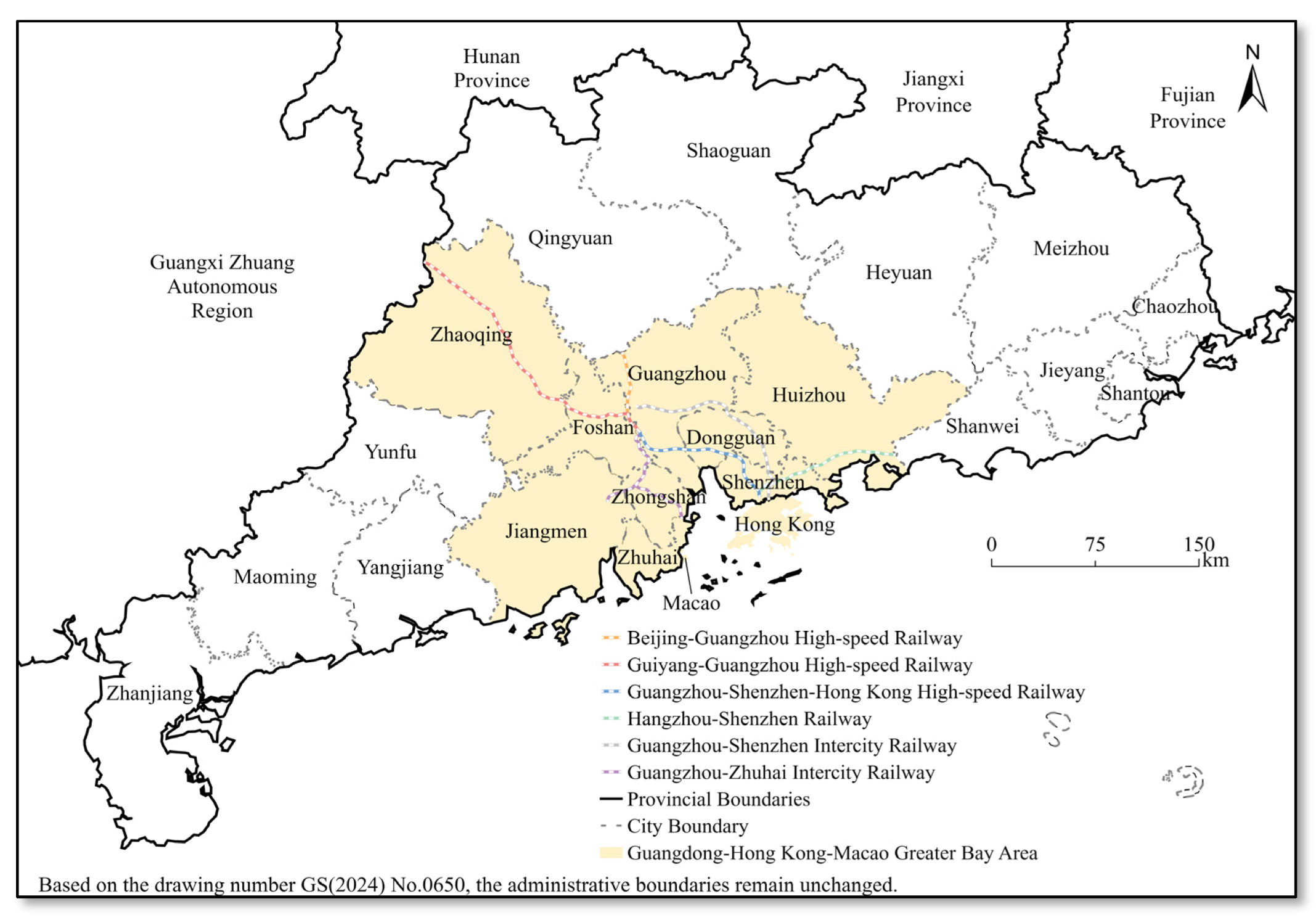
This study takes the sections of six railway lines within the GBA as the research objects, including the Beijing–Guangzhou high-speed railway, Guiyang–Guangzhou high-speed railway, Guangzhou–Shenzhen–Hong Kong high-speed railway, Xiamen–Shenzhen Section of the Hangzhou–Shenzhen Railway (referred to as the Hangzhou–Shenzhen Railway in this paper), Guangzhou–Shenzhen intercity railway, and Guangzhou–Zhuhai intercity railway. The location of the study area is shown in Figure 1. As one of the earliest constructed railways in Guangdong Province, the Guangzhou–Shenzhen intercity railway can serve as a control group for other lines, and the remaining lines are all part of China’s “Eight Vertical and Eight Horizontal” HSR network. Analysis based on land cover data and HSR station density shows that the effective service radius of HSR stations is about 10 km, i.e., the concentrated distribution area of urban construction land. The straight-line distance between stations is usually controlled at about 20 km, i.e., twice the service radius to ensure that the service scope is neither overlapping nor redundant, and there are no blind spots in coverage. Therefore, the study area establishes a buffer zone with the HSR line as the center and a radius of 10 km.

2.2. Data Sources

The annual land use data used in the present article stems from the China Annual Land Cover Dataset (https://doi.org/10.5281/zenodo.12779975, accessed on 20 April 2025), with a spatial resolution of 30 m and an overall accuracy rate of 79.31% [44]. The data was classified and integrated using ArcGIS Pro software 3.0.0, resulting in six primary land types: cultivated land, forest land, grassland, water bodies, idle land, and construction land. The HSR data mainly utilized OpenStreetMap platform data and was supplemented with Baidu Maps for accuracy correction. Administrative division data was downloaded from the official website of the China National Surveying and Mapping Center (http://www.webmap.cn/).
To study the changes in land use along the routes during the construction period and after the operation of HSRs, this study divides the research route into three stages based on the construction periods of each railway: planning period, construction period, and operation period. The time periods are shown in Table 1. It monitors the land use data along each HSR and analyzes the LULC changes in the areas along the HSRs in the GBA.

2.3. Research Methods

2.3.1. Intensity Analysis

The intensity analysis method based on the transfer matrix can monitor and compare the overall and individual change intensities of various land types in the study area in the temporal and spatial dimensions [34]. This method is divided into three levels from top to bottom: interval layer, category layer, and transition layer. The interval layer is used to analyze the relationship between each interval layer and the entire study period; the category layer compares the inflows and outflows of various land types and the average transfer intensity within specific periods to analyze their dynamic transfer characteristics; the transition layer focuses on studying the trend evolution of the transfer of other land types to specific types.
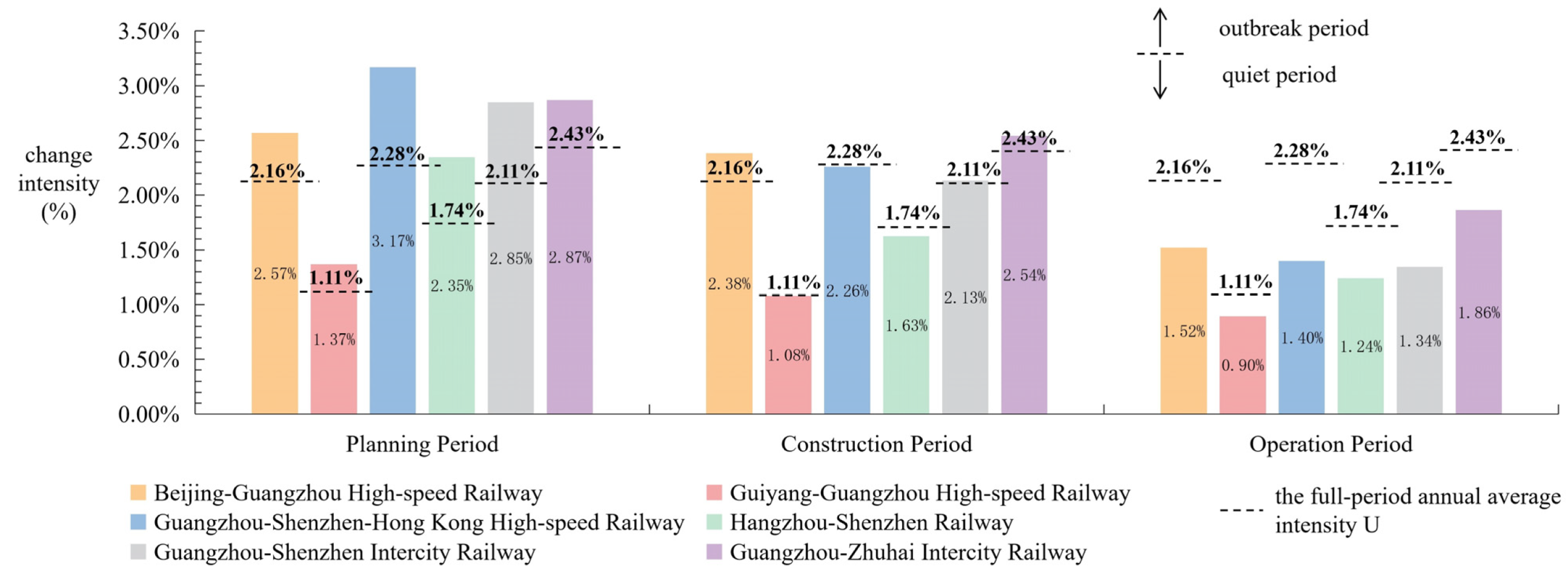
The interval level can reflect whether a certain period is in a quiet period or an outbreak period, with the calculation formulas as shown in Formulas (1) and (2) below. By comparing the magnitudes of U and St: when U > St, the period is proven to be a quiet period of change; when St > U, the period is proven to be an outbreak period of change.
S t = j = 1 J [ ( i = 1 J C t i j ) C t i j ] i = 1 J ( j = 1 J C t i j ) × 1 t × 100 %
U = Sum ( S t ) T × 100 %
In the above formula: St represents the overall intensity of land use change in period t; U represents the average intensity of land use change throughout the entire study period; t represents the duration of each study period; T represents the number of intervals in the study period; i and j represent the sample categories, and the total number of categories is J (in this study, J = 6); Ctij represents the area of land type i converting to land type j within period t.
The category-level analysis examines the activity levels of land type transitions in and out. The calculation formula is as shown in Equation (3). If Gtj < St, the land type transition activities during this period are determined to be inactive; when Gtj > St, they are determined to be active [35].
G t j = ( i = 1 J C t i j ) C t i j i = 1 J C t i j × 1 t × 100 %
In the formula above: Gtj denotes the average transfer-out/transfer-in intensity of land type j during period t.
The transitional level examines the intensity of the transition from other land types to a specific land type and explores the transfer trends (transfer tendencies or transfer avoidance) among different land types. Its calculation formula is as shown in the following Formulas (4) and (5). When Rtin > Wtn, land type i is proven to tend to be converted to land type n; when Rtin < Wtn, land type i is proven to avoid being converted to land type n. This study mainly focuses on changes in urban land, so land type n is selected as construction land.
R t i n = C t i n j = 1 J C t i j × 1 t × 100 %
W t n = ( i = 1 J C t i n ) C t n n j = 1 J [ ( i = 1 J C t i n ) C t n j ] × 1 t × 100 %
In the formulas above: Rtin represents the transfer intensity of land type i to land type n during period t; Wtn represents the average transfer intensity of other land types to land type n during period t; Ctin denotes the area of land type i converted to land type n during period t.

2.3.2. LULC Change Intensity Comparison Map

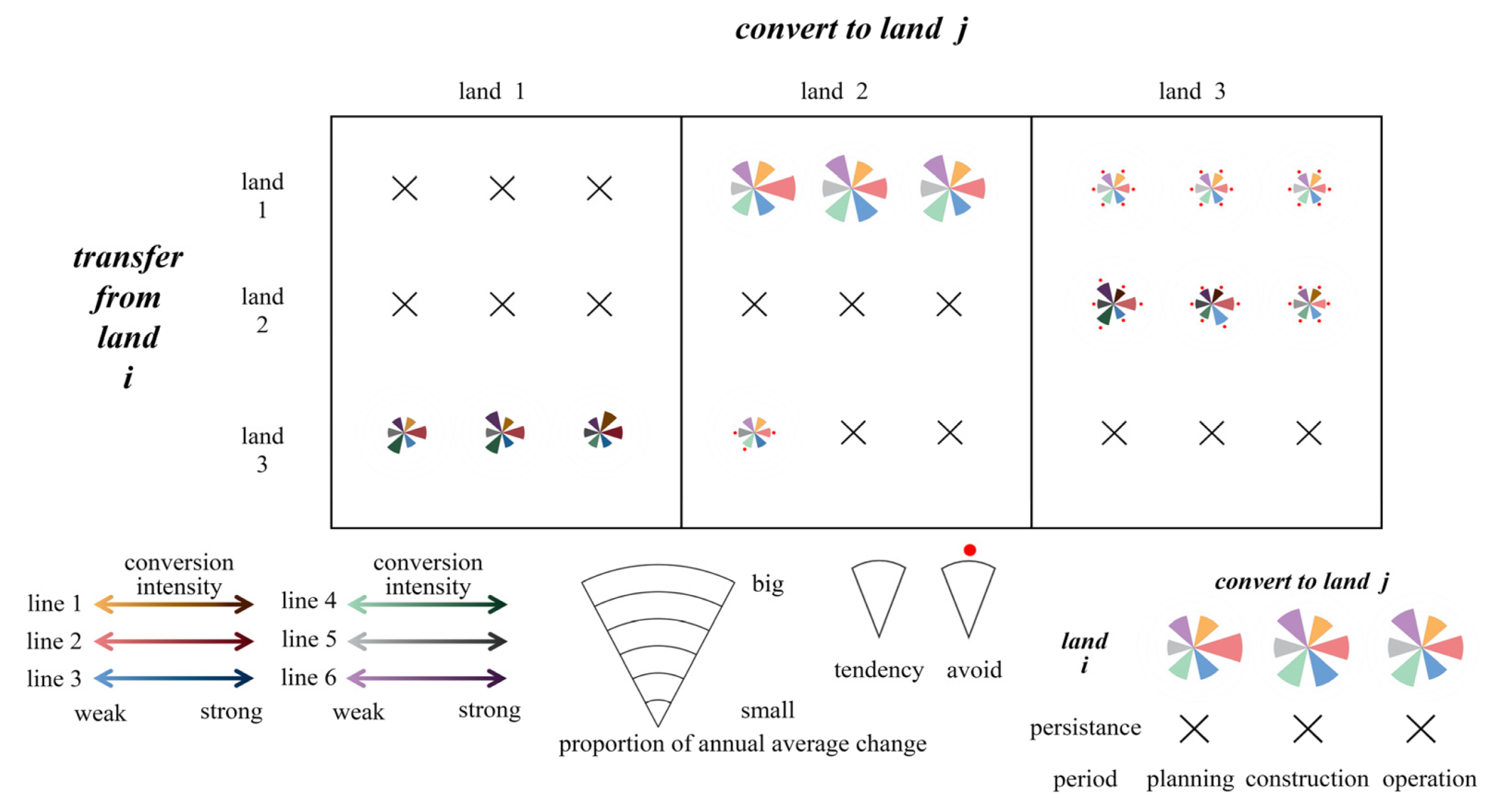
In the comparative analysis of multiple regions, the traditional visualization methods of land type transfer processes have obvious drawbacks and are extremely cumbersome and complex. Researchers need to compare one by one among numerous charts to identify the differences between regions and then judge the development trend of each land type transfer process. To realize the intuition and efficiency of differential comparison among multiple regions, and accurately identify the size, trend, and characteristics of different land categories conversion, we improve the LULC comparison and transfer map [38]. Figure 2 is a schematic diagram of the change intensity comparison map. Land use changes are represented by rows and columns in Figure 2.
In Figure 2, wind rose diagrams are used to compare and distinguish multiple regions: a single arm of the wind rose corresponds to one study area, and the length of the arm represents the size of land use conversion—the longer the arm, the larger the area of the corresponding land type change in the region during the period. A comparison of individual wind rose diagrams enables an understanding of land use changes across different regions over the same period. The presence or absence of marked points on each arm indicates whether the change is a conversion tendency or avoidance: an arm with no marked points denotes a tendency for such a conversion, while one with marked points signifies an avoidance of the conversion. The filled color corresponds to the difference between the conversion intensity of the land category and the associated average intensity—the darker the color, the stronger the tendency or avoidance of the conversion intensity. A horizontal comparison of the size and color of the wind rose arms allows for the determination of land use conversion dynamics over the entire study period.

2.3.3. Comprehensive Index of Landscape Fragmentation

The comprehensive index of landscape fragmentation determines the appropriate analysis extent and grain size through the moving window method [45]. Principal component analysis is applied to multi-period data, and the first two principal components with a cumulative contribution rate exceeding 90% are extracted through KMO statistic screening. After standardizing the landscape indices, they are synthesized according to the principal component weights [45,46], which can effectively integrate multiple variables, remove redundant information, and accurately measure the degree of landscape fragmentation in different periods [47]. Combined with the actual situation of the research area and previous achievements, the eight landscape indices including patch density (PD) and edge density (ED) are selected for analysis from four dimensions (Table 2): patch characteristics, shape indicators, aggregation degree, and diversity [48]. Principal component analysis is performed on the landscape indices of each region in different years (Table 3). The KMO value is 0.853, indicating high rationality. Weighted recombination is carried out to construct comprehensive variables to characterize the degree of landscape fragmentation.

3. Results

3.1. Analysis of Land Use Composition

The classification results of the land use structure in the study area indicate significant differences in the proportion of land use along each HSR line. Specifically, the proportion of cultivated land and construction land along the Beijing–Guangzhou high-speed railway and Guangzhou–Shenzhen intercity railway exceeds 70%. The proportion of cultivated land and forest land along the Guiyang–Guangzhou high-speed railway and Hangzhou–Shenzhen Railway is close to 80%; and the proportion of water bodies along the Guangzhou–Shenzhen–Hong Kong high-speed railway and Guangzhou–Zhuhai intercity railway is relatively higher.
During the study period, the proportion of construction land along all lines showed an upward trend. The Guangzhou–Shenzhen–Hong Kong high-speed railway had the largest increase of 557,701 hm2, with a growth rate of 20.23%. The Guiyang–Guangzhou high-speed railway had the smallest increase of 334,208 hm2, with a growth rate of 7.11%. The proportions of cultivated land and water areas showed a downward trend, and cultivated land decreased most significantly. The Guangzhou–Shenzhen–Hong Kong high-speed railway witnessed the largest reduction of 465,571 hm2, with a decrease rate of 16.89%. The Guiyang–Guangzhou high-speed railway had the smallest reduction of 222,864 hm2, with a decrease rate of 4.73%. Changes in forest land, grassland and unused land remained within a reasonable fluctuation range.
From the perspective of spatial distribution, land use also differs between areas along the lines and around the stations. HSR stations are mainly located at the edges of towns. Over time, most towns have gradually expanded toward the HSR stations. This phased evolution of land use structure along HSRs highlights the urgent need for sustainable land use regulation to balance urban construction and agricultural protection in the GBA.

3.2. Analysis of Land Use Intensity

3.2.1. Interval Level

Figure 3 presents the comparative results of the annual average change intensity St and the annual average intensity U of land use along the high-speed rail line over the entire period: when St is higher than U, it is an explosive period, and vice versa, it is a silent period. Overall, the change intensity of land use along the line shows a downward trend, with the most significant change occurring during the operation period. Specifically, during the planning period, all lines were in an explosive period, with intense land use changes; during the operation period, the entire line was in a silent period, with relatively mild changes; while the Beijing–Guangzhou line, Guangzhou–Shenzhen line, and Guangzhou–Zhuhai line remained in an explosive period during the construction period. The change in construction land is the main factor affecting the change intensity of land use during this period.

3.2.2. Category Level

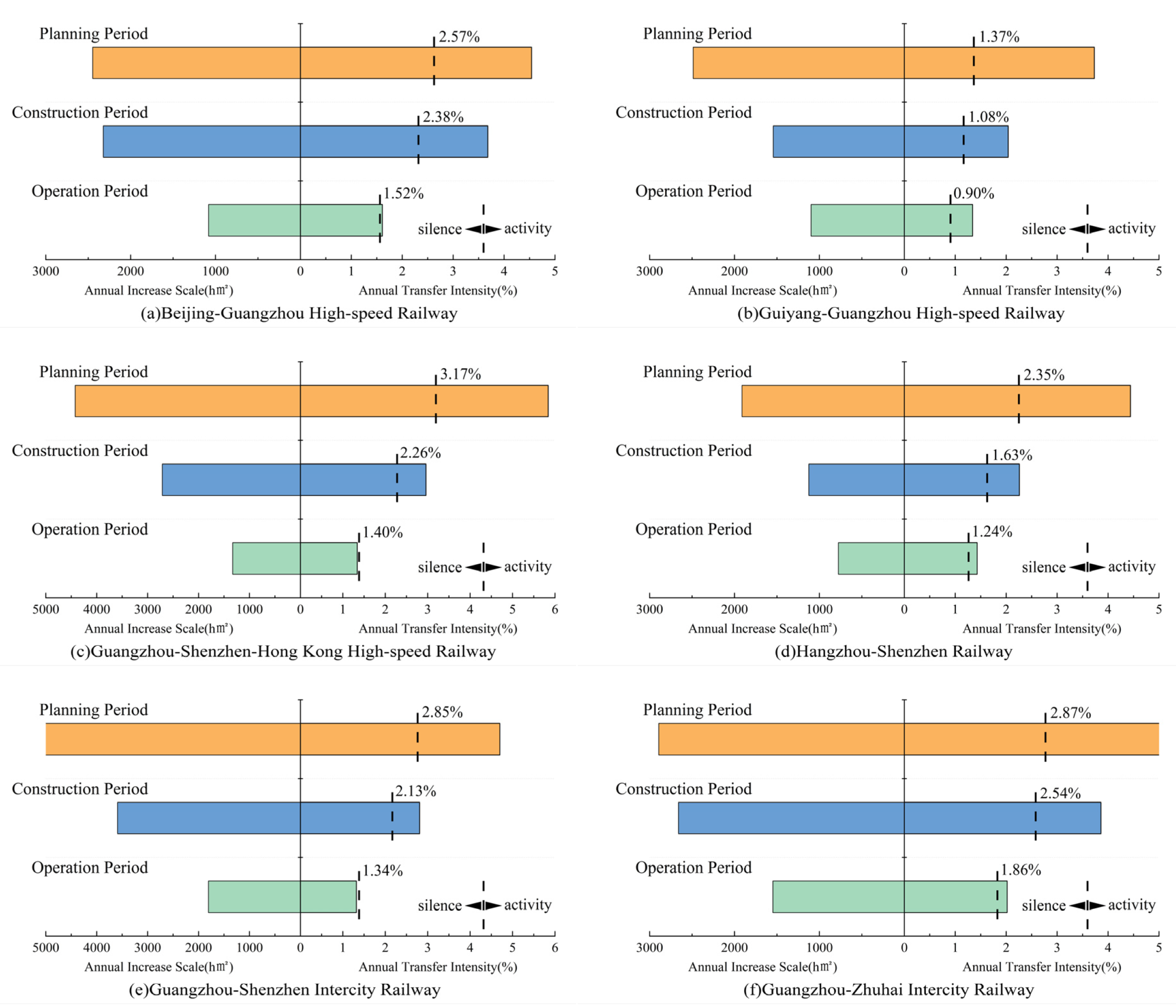
A hierarchical analysis of the types of construction land was conducted. Figure 4 shows the expansion situation of construction land along each HSR line. In general, the size of construction land along the lines has continued to expand in each stage. Among them, the size in the planning period increased the most, followed by the construction period, and the size in the operation period was the smallest; the planning period and the construction period were in an active state, while that in the operation period showed some differences.
The planning period takes advantage of reform and opening-up dividends [49], with rapid development of population, foreign trade, and real estate, and in this term it drives a substantial increase in construction land. While during the construction period, Guangdong focused on the development and transformation and upgrading of modern service industries, advanced manufacturing industries, etc. [50]. With a large number of manufacturing bases settled, coupled with urbanization policies practiced such as the abolition of counties and establishment of districts [51], construction land remained active. During the operation period, the growth of construction land mainly relied on infrastructure construction, urbanization development, “three old” revilement (reconstruction of old urban areas, old factories, and old villages) [52], and affordable housing construction.
The annual average land conversion intensity for each line has been yearly decreasing: 3.73–5.84% during the planning period, 2.04–3.86% during the construction period, and 1.32–2.02% during the operation period. Among them, the operation period conversion intensity of the Guangzhou–Shenzhen–Hong Kong high-speed railway and the Guangzhou–Shenzhen intercity railway is lower than the average level. This is mainly due to the fact that they pass through highly urbanized areas such as Guangzhou, Dongguan, and Shenzhen, and the proportion of construction land has decreased. The two lines have the largest reduction for cultivated land during operation (16.89% and 14.22% respectively), and the largest increase for construction land (20.23% and 16.33% respectively), which are located in regions with a relatively earlier urbanization process.

3.2.3. Transition Level

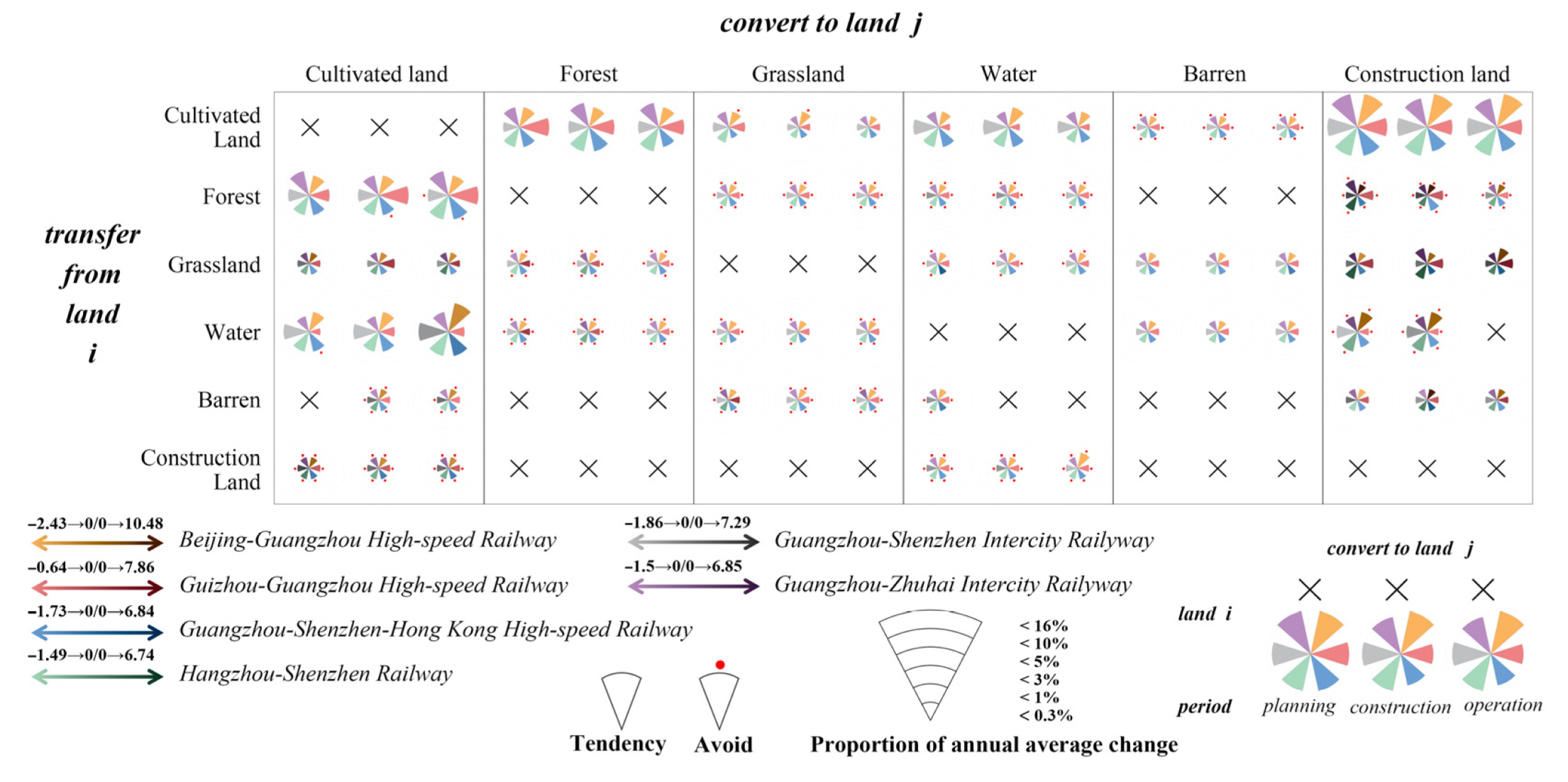
Figure 5 shows the statistical changes in the intensity of land use changes along each railway line during the study period. Compared with the land use change comparison map and transfer map, the land use change intensity comparison map pays more attention to the proportion of each land category in the changes, and it can more clearly present the change details among various land categories.
Overall, although the construction periods of high-speed railways vary in different regions, the land use transformation patterns in different periods are basically consistent. The main sources of output from land use transformation are concentrated in cultivated land, forest land, and waterbodies. These areas are mainly converted into cultivated land, forest land, and construction land. Among all lines and periods, the conversion of cultivated land to construction land is the most prominent, with an annual average conversion rate exceeding 4%. By comparing different lines, it was found that the trends of various land use changes along the high-speed railway lines are generally the same. Among them, the railway line from Guangzhou to Shenzhen was laid out as early as the last century, which can be used as a control group to reduce the influence of changes in the era on land use changes. The following figure shows that there are differences in the degree of change in land use types along each railway line; for example, in the conversion from forest land to cultivated land, the annual average change in the Guiyang–Guangzhou high-speed railway exceeded 5% during both the construction and operation periods, indicating relatively dramatic changes. In the conversion from water bodies to cultivated land, the annual average change in the Guiyang–Guangzhou high-speed railway was less than 1% in all periods. The Guangzhou–Zhuhai intercity railway also was less than 1% during the planning and construction periods, but reached 1.92% during the operation period. The annual average changes in other railways all exceeded 1.15%, which reflects the differences in the changes in land use patterns along different railways.
In terms of land transformation, a certain proportion of all types of land is converted into construction land, which indicates that the construction of transportation routes often drives the expansion of construction land along the routes. In the meantime, construction land is rarely converted into other land use, with an annual average conversion rate of below 0.35%. Among them, the area of cultivated land converted into construction land is the largest, but the conversion intensity of each period and each route is relatively low. The conversion intensity of land use changes along the routes is most significant when forest land is converted into construction land and grassland is converted into construction land, which is possibly related to the natural land conditions and economic development levels of different railway lines.

3.3. Analysis of the Comprehensive Index of Landscape Fragmentation

3.3.1. Calculation of the Comprehensive Index of Landscape Fragmentation

As an important method for studying the spatial dynamic changes in landscape pattern indices, the moving window method has gained wide recognition in the academic community due to its effectiveness [53]. The difference in landscape granularity and analysis range often significantly affects the calculation results of landscape indices. Based on the research findings of many scholars and the comprehensive consideration of the study area [54,55], choosing an analysis range of 420 m can more accurately reflect the landscape fragmentation characteristics of the study area. Therefore, we adopt a landscape granularity of 30 m and an appropriate analysis range of 420 m to conduct a landscape pattern analysis of the area along the high-speed railway, and use the moving window method to obtain the spatial distribution maps of various landscape indices in the study area at different times.

3.3.2. Spatial Distribution Characteristics of the Comprehensive Index of Landscape Fragmentation

Through principal component analysis, the comprehensive index of landscape fragmentation along the HSRs and their spatiotemporal distribution are obtained. The natural breaks method is used to divide the landscape patches into five levels of fragmentation areas. Low fragmentation areas are mostly undisturbed natural landscapes such as contiguous forest land, wide rivers, or concentrated artificial landscapes such as large-area construction land; the former remains intact, while the latter has concentrated types and similar landscapes; high fragmentation areas are mostly affected by human activities, such as the proximity of construction land to natural landscapes and the interlacing of different land use types, highlighting that human activities are the core influencing factor.
In terms of differences, the distribution of high fragmentation areas of each line is different: the Hangzhou–Shenzhen Railway is concentrated in river estuaries, small reservoirs, and grassland and paddy fields near construction land; the high fragmentation areas of the Guangzhou–Shenzhen intercity railway are scattered, with river estuaries as the main areas; due to the dense water network, the medium and high fragmentation areas of the Guangzhou–Zhuhai intercity railway are construction land and cultivated land interspersed with water networks; affected by terrain, the medium and high fragmentation areas of the Guiyang–Guangzhou high-speed railway are concentrated in plains and hilly settlements, with few high fragmentation areas; the medium and high fragmentation areas of the Guangzhou–Shenzhen–Hong Kong high-speed railway are at the edge of forest land and the junction of construction land and grassland. Natural geographical conditions such as adjacent to the sea, water networks, and terrain determine the basic pattern of fragmentation, while human activities such as urbanization and industrial layout dominate dynamic changes. The spatial differentiation characteristics of landscape fragmentation provide a scientific basis for sustainable landscape optimization and targeted ecological restoration in HSR-affected areas.

3.3.3. Spatial Evolution Characteristics of the Comprehensive Index of Landscape Fragmentation

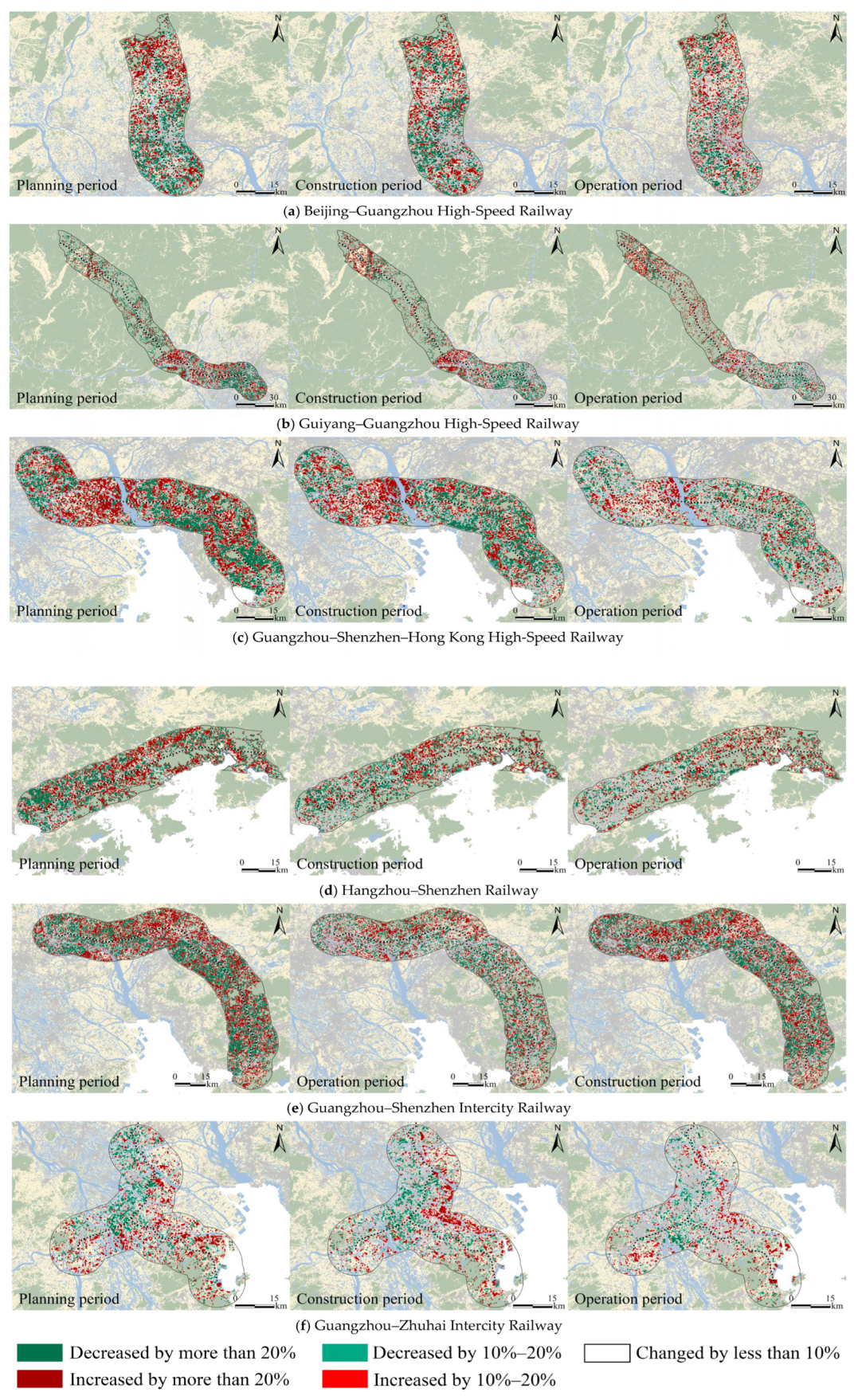
The temporal variation in the comprehensive landscape fragmentation index was obtained by calculating the changes between adjacent years using ArcGIS Pro (Figure 6). Combined with historical background and land-use change analysis, the spatial characteristics of fragmentation along high-speed railways reflect the complex interaction of multiple factors in the human-environment relationship.
Taking the Guangzhou–Shenzhen–Hong Kong high-speed railway as an example, the line passes through highly urbanized areas and is classified as a land-use sensitive zone. During the planning period, urban development clusters exerted agglomeration advantages, and most areas along the line served as urban expansion zones. A large area increase in fragmentation appeared on the west side of the river, reflecting the expansion of construction land. During the construction period, development continued, and the center of gravity of areas with increased fragmentation shifted northward, while regions with elevated fragmentation in the previous stage showed a slowing trend. During the operation period, urban expansion was basically completed, and the changes in fragmentation mainly stemmed from newly increased construction land and the improvement of the human settlement environment.
The area along the Guiyang–Guangzhou high-speed railway is dominated by ecologically constrained areas, with ecological protection as the primary goal. Afforestation was continuously implemented during the planning period, reducing the fragmentation of contiguous forest land. Throughout the study period, changes happened mainly around towns and slowly expanded outward without causing ecological damage.
Guangzhou and Shenzhen, as the core engine cities of the Guangdong–Hong Kong–Macao Greater Bay Area, have developed outward, while surrounding cities have tended to approach the core. For instance, in Huiyang District, Huizhou City, along the Hangzhou–Shenzhen Railway, although Huiyang Station is located in the east, the urban area has generally developed to the west of Huiyang Station under the comprehensive consideration of economic and environmental factors, showing no tendency to cluster toward the high-speed rail station. Meanwhile, the main areas with increased fragmentation in this region have always been located south of the high-speed railway.
Changes along the Guangzhou–Zhuhai Intercity Railway are still mainly caused by construction land. The fragmented water network makes it difficult to form large-scale agricultural agglomeration areas in this region. The interlaced distribution of small-scale villages and cultivated land leads to frequent landscape changes but rarely results in dramatic changes in fragmentation. The increased fragmentation on the east side of the line is mainly attributed to newly added construction land.
The spatial differences in landscape fragmentation along high-speed railways in the Guangdong–Hong Kong–Macao Greater Bay Area are the combined result of land-use transformation, economic siphon effect, policies and markets, reflecting the practice of balancing economic development and human settlements.

4. Discussion

4.1. Comparison and Summary of Each Line

We selected five newly built railways as the research objects, and used one completed railway as the control group to compare and analyze the differences in land use changes. From the regional perspective, the land use change intensity of the Guangzhou–Zhuhai intercity railway was the highest, followed by the Guangzhou–Shenzhen–Hong Kong high-speed railway, Beijing–Guangzhou high-speed railway, Guangdong-Shenzhen intercity railway, and Hangzhou–Shenzhen railway. While the Guizhou-Guangdong high-speed railway had the least change. Urban development is the main driving force for land use changes. As the core of the GBA urban cluster, Guangzhou and Shenzhen have significant influences on the surrounding areas and cities. High-speed rail construction not only improves the accessibility of surrounding cities, but also greatly promotes the development of tourism, commerce and other fields [56].
Although the six railways are all located in the GBA, they show different land use changes. Through spatial analysis, we believe that they cannot be classified by lines, but the areas along the routes should be selected for classification. Here, it is refined into three development categories: the first is the active development type. This type is subject to active and direct land use changes by HSRs, such as the coastal areas of Huizhou City and parts of the Nansha District of Guangzhou City [57], where tourism resources are developed for tourism development. The tourism resources in these places mainly relied on natural resources. In the past, the source of tourists was mainly from surrounding areas, and the number of tourists was controllable. Therefore, local residents mainly relied on agriculture, and there were many cultivated lands around the tourism resources. After the development of tourism, some local residents turned to the tertiary industry such as tourism and accommodation, which brings about changes in land use [58]. At the same time, government departments have increased the renovation and construction of transportation in this area to develop tourism, which has an inevitable impact on the land use in this area. The second is the passive trigger type. As for this, HSRs bring passive and unconscious changes, which indirectly affect land use changes, such as the areas around HSR stations and villages near railways. These areas will bring opportunities due to the construction of HSRs and new facilities possibly arranged in these areas. For example, before the building of Guangzhou South Railway Station, it was a rural area, and it mainly was composed of cultivated land and fish ponds. However, when it was completed, it launched the integrated development of station and city, and then it changed from a single agricultural and scattered residential function to be a complex layout integrating transportation, commerce, industry, and residence. Due to its transportation advantages, it has driven the development of cultural tourism around it, promoted leisure consumption, and enabled the agglomeration development of modern service industries and emerging industries such as business exhibitions, cultural tourism and catering, low-altitude economy, digital intelligence, rail transit, and fashion e-commerce. Finally it promotes the transformation of the region from a traditional village to a gateway hub economic zone in the GBA. Thirdly, it is for the ecologically sensitive type. This type is not affected or only slightly affected by HSRs. It is mainly affected by policies, ethics and other factors, such as forest land and water bodies, for which people are prohibited by law or unwilling to damage. For example, the area along the Guiyang–Guangzhou high-speed railway in Zhaoqing City passes through a large area of forest land, but the land use change along the route is minimal. Except for necessary track laying and inspection points, no more ecological damage happened.
We believe that the regional research on HSRs should break through the logic of line integration and establish a differentiated research framework based on regional development type orientation. This thinking emphasizes taking advantage of the resource endowment, ecological background characteristics, and industrial development foundation of the areas along the routes as the core analysis dimensions, and accurately dividing the HSR-affected areas into three functional zones: active development type, passive radiation type, and ecologically sensitive type. It replaces the overall analysis with classified policies, avoids research deviations and planning inaccuracies caused by regional heterogeneity, and realizes the accurate identification of regional development potential and constraints. This differentiated research framework is designed to promote sustainable regional development by matching HSR development with regional resource endowments and ecological constraints, and to avoid unsustainable land use caused by blind development along HSR routes.
This thinking has direct guiding significance for the planning of HSRs in other regions. Other regions can learn from this classification method to set differentiated development goals and paths for different types of areas along the routes. For active development type areas, the core development goal is the coordination of resource activation and industrial transformation. Planners take the opportunity of improved accessibility brought by HSRs to convert regional resource advantages into economic development advantages. In terms of development ideas, they could focus on core endowments such as tourism resources and characteristic agriculture, reserve land for tourism supporting facilities and transportation connections through forward-looking guidance of land use planning, and promote the orderly transformation of agricultural land to tertiary industry land such as tourism services and cultural experiences. At the same time, they also establish a collaborative mechanism led by the government [59], participated by the market, and co-constructed by the community to improve the supply of tourism infrastructure and public services, and guide the local residents’ employment structure to smoothly transition to tourism services, accommodation and catering, and other formats, so as to realize a virtuous cycle of resource development, industrial upgrading, and improvement of people’s livelihoods. For passive radiation type areas, the core development goal is the integration of functional agglomeration and spatial optimization, focusing on solving the problems of spatial disorder and functional imbalance caused by spontaneous development driven by HSRs [60]. In terms of development ideas, it is necessary to strengthen the forward-looking planning of integrated station–city development [61], take HSR stations as the core, scientifically delimit development boundaries and mixed functional areas, and clarify the proportion and spatial layout of land for transportation hubs, commercial services, high-end industries, residential supporting facilities, etc. Through the control of land use intensity and the guidance of industrial access, governments directionally attract the agglomeration of high-benefit industries such as modern service industries, digital intelligence, and business exhibitions, and promote the transformation of the region from traditional agricultural or scattered residential functions to a hub economic zone integrating “transportation-industry-residence-service”, so as to improve land use efficiency and comprehensive spatial value, and realize the transformation from passive acceptance of radiation to active agglomeration development. For ecologically sensitive type areas, the core development goal is the compatibility of ecological protection and transportation construction, and its importance is in adhering to the bottom line of ecological security while ensuring the realization of HSR functions. In terms of development ideas, it is necessary to strictly follow the principle of minimal intervention, taking the ecological protection red line as a rigid constraint on land use. It is also important to clarify that the land use boundary of HSR construction is only limited to track laying, necessary inspection points, and ecologically friendly auxiliary facilities. Governments must strictly prohibit any development activities beyond the core functional needs and carry out a systematic ecological impact assessment during the planning stage, optimize the route selection to avoid the core ecological areas, and adopt ecologically friendly construction technologies to reduce the disturbance to ecological spaces such as forest land and water areas; at the same time, they must establish a long-term supervision mechanism for ecological protection, and strictly limit regional development within the scope of ecological carrying capacity, so as to realize the coordinated promotion of HSR construction and the protection of ecosystem integrity.

4.2. Improvements in Research Methods

4.2.1. Map Improvement

The LULC change intensity comparison map method proposed in this study is based on the dual theoretical foundations of the land use conversion matrix and the intensity analysis theory. It aims to address the technical limitations existing in the traditional LULC change comparison map analysis. Through technological innovation, people could realize the accurate quantification and visualization of land type transfer processes. First, we introduced the wind rose diagram as the core visualization carrier. Through the mapping of direction and length under polar coordinates, multiple regions can be added for unified analysis, which can intuitively present the direction and relative scale of land type transfer of different research lines, overcoming the defect of traditional two-dimensional tables or bar charts, which have difficulty intuitively showing multiple data [62]. Second, we established a coupled analysis framework of transition intensity and land category benchmark proportion, through double normalization of the annual average transfer area with the total land area of the study area and the initial area of the corresponding land type, realizing the horizontal and vertical quantitative comparison of land type change intensity in multiple regions and periods, and fundamentally solving the problem that the absolute area value masks the relative change trend in traditional methods.
To verify the scientific nature and practicality of this method, an empirical analysis is carried out by taking the LULC change monitoring along the Guiyang–Guangzhou high-speed railway as an example. In the traditional analysis method, because the absolute transfer area of water area to cultivated land is significantly larger than that of other land type transfer types, it is easy for researchers to overestimate the actual intensity and impact range of this type of transfer; while using the LULC change intensity comparison map method proposed in this study for calculation, it is found that the annual average transfer intensity proportion (based on the total land area of the study area) does not exceed 1%, and is significantly lower than the similar land type transition intensity of other transportation lines in the same period. This result is highly consistent with the actual land use control policies, topographic and geomorphic constraints, and the distribution of human activity intensity in the study area, which fully proves the objectivity and accuracy of the method. In turn, this improved method provides a reliable technical tool for sustainable land use decision-making and sustainable transportation planning in densely urbanized agglomerations such as the GBA.

4.2.2. Application of Landscape Pattern Visualization

In the dimension of landscape pattern research, we construct an analysis framework combining multi-index integration and spatial visualization, aiming to accurately identify the spatial differentiation characteristics and driving mechanisms of landscape fragmentation along railways, and provide a scientific basis for ecological protection and landscape optimization. We select eight core landscape indices, covering four dimensions: landscape fragmentation, diversity, aggregation degree, and connectivity. Through principal component analysis, data dimensionality reduction and information integration are performed for the indices. On the basis of retaining the systematisms of the multi-dimensional evaluation framework, the information overlap and multicollinearity between indices are effectively eliminated. Compared with the limitation of a single index analysis, which can only reflect local characteristics [63], this method significantly improves the comprehensiveness and reliability of the evaluation results [64]. At the same time, through spatial analysis tools, this study couples the integrated landscape pattern characteristic values with spatial coordinates to generate a spatial visualization map of landscape fragmentation. This breaks the limitation of previous studies that only present the overall situation through data while ignoring the differences among various sections, thus enabling the quantitative positioning and intuitive presentation of landscape fragmentation change areas in different sections [65,66].
Taking the Hangzhou–Shenzhen Railway as an example, its high fragmentation areas are mainly concentrated on two typical sections: one is the wetland ecological area at the river estuary, where wetland and tidal flat landscapes are divided into scattered patches due to the interaction of land and sea and human reclamation activities; the other is the grassland and paddy field distribution area near construction land, where natural and semi-natural landscapes are interspersed and divided by artificial landscapes due to urban–rural expansion and intensive agricultural management, forming a high fragmentation pattern. The spatial visualization results not only accurately identify the spatial heterogeneity characteristics of landscape fragmentation but also provide targeted and precise policy-making ideas for subsequent ecological protection, restoration, and landscape pattern optimization through the three-dimensional correlation of “quantitative indicators-spatial location-landscape type”.
It is worth noting that the change in landscape fragmentation along railways is not the result of a single driving factor, instead of it is a complex manifestation of the synergistic effect of multiple factors such as natural geographical background, human activity intensity, and policy regulation orientation, and the dominant driving mechanisms vary significantly in different regions [67]. Taking the Guangzhou–Zhuhai intercity railway as an example, the increase in landscape fragmentation along the route is not a simple ecological disturbance effect, but an objective reflection of the coordinated optimization layout of natural water networks and artificial landscapes. This line passes through cities with dense water networks in the Pearl River Delta such as Zhuhai and Zhongshan. The high fragmentation areas mostly present a complex landscape pattern of “water system-green space-residential community” interlacing. In this the vertical and horizontal division of natural water networks not only effectively reduces the building density and avoids excessive agglomeration of urban landscapes; the construction of artificial landscapes takes the water system as the ecological corridor, and simultaneously arranges greenways, urban parks, and waterfront leisure spaces, transforming the originally scattered and fragmented space into a composite landscape with both ecological functions and livable functions, so it can realize the improvement of the ecological value and use value of fragmented space.
In sharp contrast, in the coastal areas of Huizhou and Shanwei along the Hangzhou–Shenzhen Railway, the landscape fragmentation shows a significant downward trend, but the driving mechanism and ecological effect behind it are completely different. Before the opening of the HSR, to develop coastal tourism, this area scattered a large number of tourism supporting facilities, resulting in the division of natural vegetation and tidal flat landscapes, forming a high fragmentation pattern Then after the opening of the HSR, the regional accessibility was significantly improved, and local governments increased investment in a large-scale centralized development model, and practicing the contiguous integration of construction land by expanding large-scale resorts, chain hotels, and through-type tourist highways. However, there are obvious ecological costs in this process. Large-scale centralized development leads to the removal of a large number of native vegetation and the occupation of natural tidal flats, damaging the integrity and continuity of ecological landscapes, thus the contiguous layout of construction land objectively reduces the landscape fragmentation value.
Therefore, the case above demonstrates that the change in the degree of landscape fragmentation cannot be directly used as the sole criterion for judging the ecological environment quality. The ecological effects need to be comprehensively evaluated by taking into account the specific regional natural background, development model and functional positioning. However, it is undeniable that the spatial change characteristics of landscape fragmentation can objectively reflect the spatial aggregation state and change direction of land use types, providing an important quantitative basis for accurately identifying key areas of land use changes and analyzing the interaction between human activities and natural landscapes. This, in turn, provides scientific support for formulating differentiated landscape optimization strategies.

4.3. Rationality of Phased Division

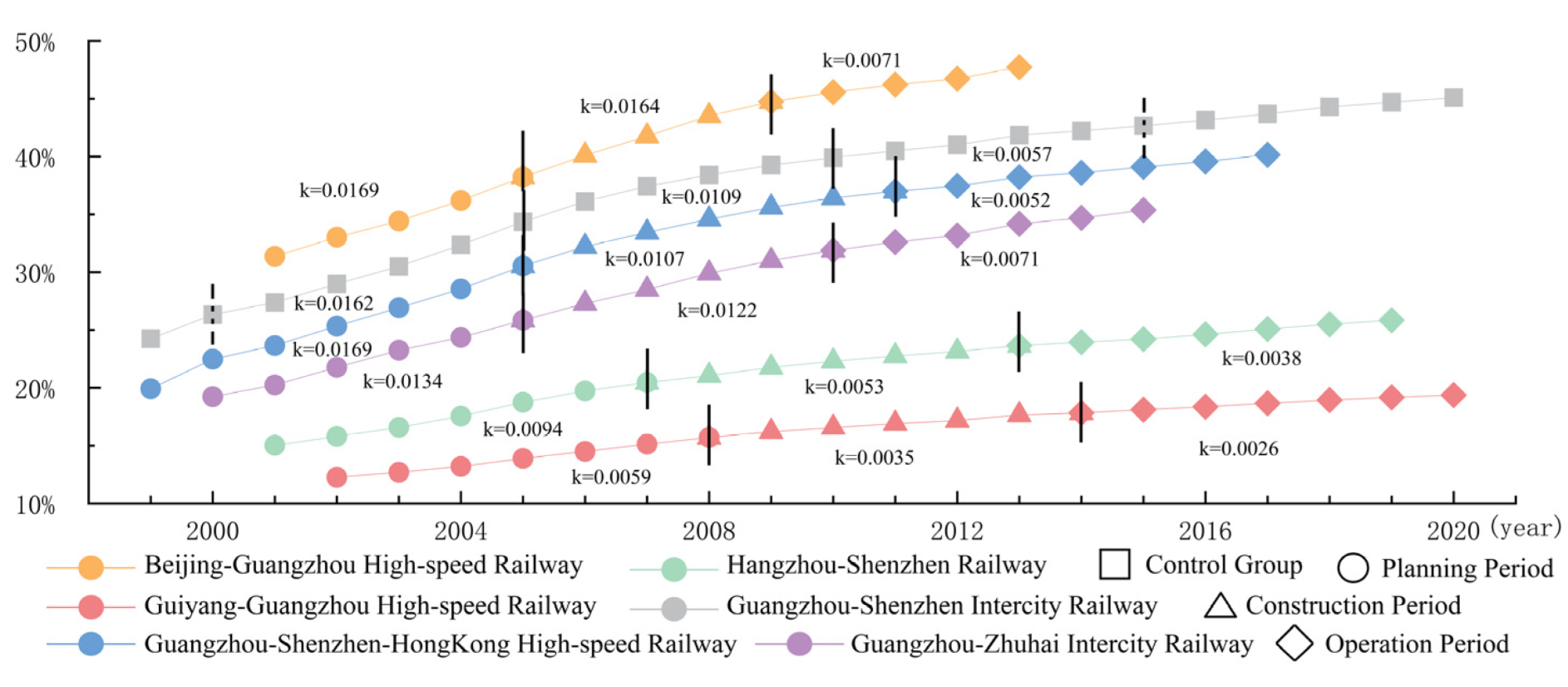
Different from most studies focusing on a single-stage or macro region [10,68], this study divides three periods (Figure 7): planning, construction, and operation, rather than fixed time intervals. The study reveals the evolution of land use change characteristics of different lines and shows spatial heterogeneity. Although the planning period is named as the planning period, it does not mean that the time limit used in the study is the actual planning period. According to the data, except for the control group, the planning motivations of the other five railways are mainly divided into two categories: one is to serve the national strategic layout, aiming to build the national “Four Vertical and Four Horizontal” HSR framework, connecting the north–south artery and the southeast coastal economic belt respectively, strengthening the regional connection and transportation network support at the national level. The other is to focus on regional economic integration and transportation facilitation [69,70], planning and constructing to open up the sea passage in the southwest region, promoting the in-depth integration of the GBA, and meeting the commuting needs within the Pearl River Delta, so as to improve the efficiency of personnel flow and economic coordinated development within the region. The relevant planning proposals were concentrated in 2004–2006, representing the national attention to HSR construction. Therefore, the land use changes during this short period cannot represent the land use changes caused by planning. The “planning period” more specifically refers to the land use changes before the construction of HSRs.
Logically, these three stages comprehensively cover the entire process of the impact of high-speed railways on land use. The planning period reflects the changes in land use before construction, the construction period demonstrates the land disturbance directly caused by the construction project, and the operation period shows the long-term evolution of land use after the release of transportation efficiency. This evolution continuously promotes the gradual adjustment of the land use pattern. In terms of research value, this division breaks through the limitation of most studies that ignore the phased characteristics [71] by analyzing the differentiated performance of the proportion of construction land in each stage of different lines. For example, the Beijing–Guangzhou high-speed railway, due to its short construction period and large engineering scale, shows a rapid growth in the construction period; the Guiyang–Guangzhou high-speed railway, due to crossing a karst-sensitive area, has maintained a low proportion for a long time; the Guangzhou–Shenzhen–Hong Kong high-speed railway, due to passing through a highly urbanized area, which shows a slower growth rate of construction land in the operation period compared to other lines in the same area. As shown in Figure 7, the slope k of construction land change at each stage may differ very slightly. For example, the change rates of the Beijing–Guangzhou high-speed railway during the planning and construction periods differ by only 0.0005. If a comparative study is conducted using fixed time intervals, the subtle changes in each stage of HSR development will be overlooked, which may lead to misjudgment. This study accurately reveals the spatial heterogeneity caused by different functions and geographical conditions of different lines, laying a foundation for analyzing the evolution laws of land use along the GBA’s multiple HSR lines, exploring the driving mechanisms, and formulating differentiated strategies.

4.4. Limitations and Possible Improvements

Our research still has certain limitations, which we will continue to improve in future research. First, in terms of the visualization expression of the LULC change intensity comparison map, although the quantitative comparison function of land type transfer intensity in multiple regions has been realized, there is still room for optimization in intuitiveness and interpretation accuracy. On the one hand, the fan-shaped modules corresponding to different regions in the map are prone to reduced regional recognition due to compact layout, which may lead to misinterpretation of multi-region comparison results by users. On the other hand, the size of the fan shape can only reflect the relative difference in transfer intensity between regions, and cannot directly correspond to the six annual average change area gradient intervals set earlier, resulting in the need for additional data calculations to confirm the intensity level of a single region, reducing the independent interpretation efficiency of the map. Future research will focus on optimizing the visualization design of the map. On the basis of retaining the quantitative comparison function, the visual esthetics and intuitive interpretation of the map will be improved by adjusting the layout of fan-shaped partitions, adding color identification of gradient intervals, and optimizing the legend explanation.
Second, in terms of the law refinement of land type transfer types, this study divides the LULC changes along railways into three types—active development type, passive radiation type, and ecologically sensitive type based on empirical analysis—but has not deeply revealed the spatial distribution law of different types and their coupling relationship with factors such as regional natural geographical conditions, socio-economic development level, and policy regulation orientation. The lack of such spatial distribution laws makes it difficult for the research results to directly provide targeted land use regulation and ecological protection policy guidance for cities with new HSR construction, limiting the practical application value of the research. In the future, we will systematically analyze the spatial differentiation mechanism of the three types of land type transfer by introducing methods such as geographical detector and spatial autocorrelation analysis, and construct a policy guidance framework for HSR construction planning to enhance the practical empowerment ability of the research.
Third, in terms of the selection of the research area, the empirical objects of this study mainly focus on GBA. Due to the limitation of the regional spatial scope, the station layouts of multiple railway lines have spatial overlaps. The land use changes in such overlapping areas may be influenced by the combined effects of multiple lines. However, this study has not yet separated and quantified the intensity, size and mechanism of such combined effects, which may lead to deviations in the attribution analysis of the driving factors of LULC changes in certain sections. In the future, we will further expand the research scope to include typical railway lines outside GBA for comparative analysis, and construct a separation model for the influence of overlapping stations, to systematically explore the combined effect of multiple lines’ overlapping stations on land use changes. We will also explore the sustainability assessment system of land use change along HSRs, and build a comprehensive evaluation model integrating economic, social and ecological benefits to provide more detailed technical support for the sustainable development of global HSR economic circles.

5. Conclusions

This study adopted the LULC change intensity comparison map and the visualization technology of the comprehensive index of landscape fragmentation, and systematically analyzed the dynamic evolution of land use and landscape patterns along six typical HSRs in the GBA across the planning, construction and operation phases, with the ultimate goal of promoting sustainable land use and ecological sustainability in HSR-affected areas. Three unique findings of this research are as follows: First, land use in HSR-affected areas of the GBA exhibits distinct phased evolution characteristics, with construction land as the core driving type showing a continuous increase in proportion, while cultivated land and water bodies experience a significant decline. Second, land use evolution along different HSR routes presents notable spatial heterogeneity, which is closely correlated with the natural and economic conditions of the traversed regions. Third, high landscape fragmentation areas in the study area are concentrated in the transition zones between construction land and natural landscapes, with fragmentation intensifying in the planning and construction phases and stabilizing or declining in the operation phase for partial routes, and human activities being identified as the pivotal driving factor.
Breaking the traditional line-integrated analysis logic for HSR research, this study innovatively divides HSR-affected areas in the GBA into three functional zones: active development type, passive radiation type, ecologically sensitive type, based on the resource endowment, ecological background and development foundation of the areas along the routes, and clarifies the differentiated response modes of various zones to HSR construction for sustainable regional development. Methodologically, the LULC change intensity comparison map developed in this study realizes intuitive and quantitative comparison of land use changes across multiple HSR routes and periods, making up for the deficiency of traditional methods in multi-region comparative visualization. The integrated application of landscape fragmentation comprehensive index and spatial visualization technology also achieves accurate quantification and spatial mapping of landscape pattern spatiotemporal differentiation along HSRs, filling the gap of insufficient comprehensive analysis of landscape changes along HSR corridors in the GBA, and providing a technical basis for sustainable ecological protection in the region.
The research framework and methodological system proposed provide targeted scientific support for sustainable HSR construction planning and sustainable land resource management in the GBA and similar urban agglomerations. For different functional zones along HSRs, differentiated land use planning and ecological protection strategies can be formulated to realize the coordinated development of HSR construction, intensive land use and ecological security, which is the core of sustainable regional development in high-density urban agglomerations. The research results also deepen the understanding of the interaction mechanism between transportation infrastructure and regional land use change in densely urbanized areas and provide a new empirical reference for the sustainable development of HSR economic circles globally.

Author Contributions

Conceptualization, B.Q. and K.L.; methodology, Z.Y.; software, Z.Y.; validation, B.Q., K.L. and Z.Y.; formal analysis, Z.Y.; investigation, Z.Y.; resources, B.Q. and K.L.; data curation, Z.Y.; writing—original draft preparation, Z.Y.; writing—review and editing, B.Q., K.L. and Z.Y.; visualization, Z.Y.; supervision, B.Q. and K.L.; project administration, B.Q. and K.L.; funding acquisition, B.Q. and K.L. All authors have read and agreed to the published version of the manuscript.

Funding

This research was funded by the Natural Science Foundation of Hunan Province of China [grant numbers 2024JJ6101] and the Excellent Youth Project of the Education Department of Hunan Province [grant number 24B0651].

Institutional Review Board Statement

Not applicable.

Informed Consent Statement

Not applicable.

Data Availability Statement

Data are contained within the article.

Acknowledgments

The authors express their gratitude to the research team of Yang Jie and Huang Xin from Wuhan University for the support rendered by providing the land-use data.

Conflicts of Interest

The authors declare no conflicts of interest.

References

  1. Fang, C.; Yu, D. Urban agglomeration development in China: Past, present and future. Land Use Policy 2017, 69, 379–390. [Google Scholar] [CrossRef]
  2. Zhang, J.; Liu, Y. Impacts of high-speed rail on urban tourism development in China: A panel data approach. Tour. Manag. 2019, 70, 112–123. [Google Scholar] [CrossRef]
  3. Liu, G.; Li, Y. Ecological impact assessment of high-speed railway construction on urban agglomerations in the Yangtze River Delta. J. Environ. Manag. 2021, 295, 113089. [Google Scholar] [CrossRef]
  4. Tian, Y.; Liu, Y. Land use and land cover change along high-speed rail corridors in China: A meta-analysis. Catena 2022, 214, 106264. [Google Scholar] [CrossRef]
  5. Yan, X.; Zhao, Z.; Fu, Y.; Ding, Q.; Ling, B.; Huang, G.; Wu, X. Predicting land use changes in the Guangdong-Hong Kong-Macao greater bay area under alternative scenarios using the PLUS model. J. Guangdong Univ. Technol. 2025, 43, 1–11. [Google Scholar] [CrossRef]
  6. Sresakoolchai, J.; Rungskunroch, P. Impacts of high-speed rail construction on urban land use expansion in Thailand: A case study of the Bangkok-Chiang Mai HSR line. Land Use Policy 2022, 114, 105998. [Google Scholar] [CrossRef]
  7. Alawad, H. Multi-layer regional railway network and urban land use optimization in the Middle East: A case study of the Arabian Gulf megaregion. J. Transp. Geogr. 2023, 109, 103567. [Google Scholar] [CrossRef]
  8. Osman, M.H.; Ahmad, N.; Yusoff, M.K. Dynamic evolution of land use along high-speed rail routes in Malaysia: Implications for sustainable regional development. Sustainability 2024, 16, 1289. [Google Scholar] [CrossRef]
  9. Dindar, S. High-speed rail network and equitable development of European megaregions: A land use perspective. Cities 2023, 139, 104435. [Google Scholar] [CrossRef]
  10. Su, B.; Wu, M.; Niu, Z.; Chen, F.; Huang, W. Analyzing impact of the Beijing-Guangzhou high-speed railway on cities along the Hebei section based on remote sensing monitoring. Remote Sens. Nat. Resour. 2025, 37, 194–203. [Google Scholar] [CrossRef]
  11. Li, X.; Wang, Y. Ecological effects of land use change along high-speed rail routes in the Yangtze River Economic Belt. Ecol. Indic. 2021, 128, 107853. [Google Scholar] [CrossRef]
  12. Zhang, Z.; Deng, Z.; Cao, J.; Zhang, K.; Liang, S.; Cao, W. Spatial Effects of Urban Expansion and High-Speed Rail Network on Urban Green Land Use Efficiency: Theoretical Analysis and Empirical Evidence. Geogr. Res. 2024, 43, 2523–2540. [Google Scholar] [CrossRef]
  13. Zhang, H.; Liu, X. Landscape pattern evolution along high-speed rail routes in the Chengdu-Chongqing urban agglomeration. Landsc. Urban Plan. 2023, 232, 104756. [Google Scholar] [CrossRef]
  14. Zhan, S.; Zheng, Q. Cluster Layout Characteristics of High-Speed Rail Hub in Guangdong-Hong Kong-Macao Greater Bay Area under the Concept of Collective City. Urban. Archit. 2022, 19, 52–56. [Google Scholar] [CrossRef]
  15. Wang, F.; Li, X. Spatial Structure Evolution Mechanism and Collaborative Development of Urban Agglomerations in the Guangdong-Hong Kong-Macao Greater Bay Area: Based on High-Speed Rail Network Data. Urban Probl. 2020, 1, 43–52. [Google Scholar] [CrossRef]
  16. Wang, Y.; Zhang, L. Ecosystem service value changes in response to land use change in the GBA. Ecol. Econ. 2020, 176, 106789. [Google Scholar] [CrossRef]
  17. Li, M.; Liu, H. Coupling relationship between air pollution and land use in the GBA. Sci. Total Environ. 2021, 778, 146254. [Google Scholar] [CrossRef]
  18. Wang, Z.; Liang, C.; Song, X.; Yang, C.; Xie, M. Coastal Ecosystem Services in Urbanizing Deltas: Spatial Heteroge-neity, Interactions and Driving Mechanism for China’s Greater Bay Area. Water 2025, 17, 3566. [Google Scholar] [CrossRef]
  19. Xu, C.; Lei, Y.; Liu, X.; Wang, Y.; Xiao, J. Temporo-Spatial Relationship Between Energy Consumption, Air Pollution and Carbon Emissions in the Guangdong–Hong Kong–Macao Greater Bay Area, China. Sustainability 2025, 17, 11175. [Google Scholar] [CrossRef]
  20. Liu, C.; Zhang, D. Coordination of land development conflicts in the GBA under the background of integrated development. Land Use Policy 2022, 115, 106052. [Google Scholar] [CrossRef]
  21. Tang, X.; Xu, J.; Wang, R.; Li, J.V.; Jiang, L.; Li, C.Z. Drivers of Cross-Boundary Land Use and Cover Change in a Megacity Region: Evidence from the Guangdong–Hong Kong–Macao Greater Bay Area. Sustainability 2026, 18, 470. [Google Scholar] [CrossRef]
  22. Cheng, Z.; Yang, J.; Xue, D. Conflicts at the Crossroads: Unpacking Land-Use Challenges in the Greater Bay Area with the “Production–Living–Ecological” Perspective. Land 2025, 14, 249. [Google Scholar] [CrossRef]
  23. Li, Y.; Zhang, H. Regional accessibility evaluation of the GBA based on the HSR network. Transp. Res. Part A Policy Pract. 2021, 152, 183–200. [Google Scholar] [CrossRef]
  24. Chen, L.; Liu, Y. Analysis of transportation economic linkage in the GBA under the background of HSR network construction. Econ. Geogr. 2022, 42, 61–69. [Google Scholar] [CrossRef]
  25. Deng, L.; Yang, J.; Yin, X.; Jia, K.; Sun, J.; Shu, S.; Huang, A. Suply and demand of ecosystem services and its multispatal scale response to urbanization in Guangdong-Hong Kong-Macao Greater Bay Area. Acta Ecol. Sin. 2024, 44, 9094–9107. [Google Scholar] [CrossRef]
  26. Wang, H.; Zhang, Y. Urban dynamic evolution driven by high-speed rail construction in China. Cities 2021, 116, 103298. [Google Scholar] [CrossRef]
  27. Wen, H.; Jiang, L. Identification of Urban Hinterland Based on Traffic Accessibility: A Case Study of Guang-dong-Hong Kong-Macao Greater Bay Area. J. South China Univ. Technol. (Nat. Sci. Ed.) 2021, 49, 79–88. [Google Scholar] [CrossRef]
  28. He, D.; Zhou, J.; Cai, J.; Chen, Z. Analysis of land use and landscape pattern changes on the areas along the high-speed railway in China. Ecol. Sci. 2021, 40, 184–194. [Google Scholar] [CrossRef]
  29. Huang, L.; Chen, G. Research on land use change along the Zhuhai-Zhongshan-Jiangmen HSR line in the GBA. Trop. Geogr. 2022, 42, 623–635. [Google Scholar] [CrossRef]
  30. Lambin, E.F.; Geist, H.J. Land-use and land-cover change: Local processes and global impacts. Glob. Change Biol. 2006, 12, 26–39. [Google Scholar] [CrossRef]
  31. Turner, B.L., II; Lambin, E.F.; Reenberg, A. The emergence of land change science for global environmental change and sustainability. Proc. Natl. Acad. Sci. USA 2007, 104, 20666–20671. [Google Scholar] [CrossRef] [PubMed]
  32. Verburg, P.H.; Overmars, K.P. Combining top-down and bottom-up dynamics in land use modeling: Exploring abandoned farmlands in Europe with CLU Mondo. Landsc. Ecol. 2009, 24, 1167–1181. [Google Scholar] [CrossRef]
  33. Wang, Y.; Xiao, C.; Feng, Z.; Yue, Z.; Chen, S.; Zhai, M. Geopolitical and Economic Impacts of Land Use Change in the China-Vietnam, China-Laos and China-Myanmar Border Regions. Acta Geogr. Sin. 2025, 80, 2300–2320. [Google Scholar] [CrossRef]
  34. Aldwick, S.Z.; Pontius, R.G., Jr. Intensity analysis to unify the measurement of size and speed of land changes by interval, category, and transition. Landsc Urban Plan 2012, 106, 103–114. [Google Scholar] [CrossRef]
  35. Pontius, R.G., Jr.; Santacruz, A. Intensity analysis of land change patterns in a mining region of Bolivia. Appl. Geogr. 2014, 46, 105–116. [Google Scholar] [CrossRef]
  36. Li, J.; Wang, K. Application of intensity analysis method in land use change research of Taihu Lake Basin. J. Lake Sci. 2021, 33, 409–420. [Google Scholar] [CrossRef]
  37. Deng, Z.; Quan, B. Intensity Characteristics and Multi-Scenario Projection of Land Use and Land Cover Change in Hengyang, China. Int. J. Environ. Res. Public Health 2022, 19, 8491. [Google Scholar] [CrossRef]
  38. Peng, S.; Quan, B. Characteristics of Urban Expansion and Regional Comparison of the “Mid-spine Belt of Beautiful China”. China Land Sci. 2024, 38, 109–121. [Google Scholar] [CrossRef]
  39. Forman, R.T.T. Land Mosaics: The Ecology of Landscapes and Regions; Cambridge University Press: Cambridge, UK, 1995. [Google Scholar]
  40. Dai, Y.; Zhang, C.; Fan, B. Study on the Landscape Planning Framework of High-speed Rail Green Corridor from the Perspective of Landscape Pattern Optimization: Taking the Anji Section of the Shangqiu-Hefei-Hangzhou High-speed Railway Line as an Example. Chin. Landsc. Archit. 2025, 41, 123–130. [Google Scholar] [CrossRef]
  41. Zhang, D.; Wang, Y. Response of cultivated land landscape pattern to high-speed rail construction in the Huang-Huai-Hai Plain. Catena 2022, 211, 106102. [Google Scholar] [CrossRef]
  42. Mcgarigal, K.; Cushman, S.A.; Ene, E. FRAGSTATS V4: Spatial Pattern Analysis Program for Categorical and Continuous Maps; Oregon State University: Corvallis, OR, USA, 2012. [Google Scholar]
  43. Li, T.; Gao, Y.; Wang, J. Gradient effect of changes in land use and landscape patterns along the of Shaanxi segment Xi‘an-Chengdu high-sped railway line. Acta Ecol. Sin. 2025, 45, 1629–1645. [Google Scholar] [CrossRef]
  44. Yang, J.; Huang, X. The 30m annual land cover datasets and its dynamics in China from 1985 to 2023 [Data set]. Earth Syst. Sci. Data 2024, 13, 3907–3925. [Google Scholar] [CrossRef]
  45. Ai, J.W.; Yu, K.Y.; Zeng, Z.; Yang, L.; Liu, Y.; Liu, J. Assessing the dynamic landscape ecological risk and its driving forces in an island city based on optimal spatial scales: Haitan Island, China. Ecol. Indic. 2022, 137, 108771. [Google Scholar] [CrossRef]
  46. Zhang, R.F.; Xiao, M.; Liu, Z.C. Spartoi-temporal heterogeneity and driving factors of landscape fragmentation in Beijing-Tianjin-Hebei Region. Ecol. Environ. Sci. 2025, 34, 461–473. (In Chinese) [Google Scholar]
  47. Liang, J.L.; Chen, W.X.; Li, J.F.; Dong, M.J.; Zhou, T.; Pan, S.P. Spatiotemporal patterns of landscape fragmentation and causes in the Yellow River Basin. Acta Ecol. Sin. 2022, 42, 1993–2009. (In Chinese) [Google Scholar]
  48. Li, D.; Tang, J.; Hu, Q.; Dong, M.; Chithpanya, S. Spatiotemporal Urban Evolution Along the China–Laos Railway in Laos Determined Using Multiple Sources of Remote-Sensed Landscape Indicators and Interpretable Machine Learning. Land 2024, 13, 2094. [Google Scholar] [CrossRef]
  49. Xu, X. Study on the Evolution Characteristics and Interaction Efficiency of Industrial Structure and Employment Structure in Guangdong Province. Acad. Res. 2009, 90–96. (In Chinese) [Google Scholar]
  50. Zhou, X.S.; Chen, Y.; Zhao, J.; Ren, Q.C. The Study of The Different Path on Urbanization Development: Case of Guangdong Province. Urban Dev. Stud. 2012, 19, 3–8. (In Chinese) [Google Scholar]
  51. Wang, J.; Li, G.; Wang, C. Dynamic Mechanism of Administrative Division Adjustment Umber the Context of Scale Rescaling: The Case of Guangdong Province. Hum. Geogr. 2016, 31, 74–82. [Google Scholar] [CrossRef]
  52. Shouhua, L.; Jun, W. Speed and Benefit: Guangzhou “Sanjiu” Redevelopment Strategies for New Urbanization. Planners 2013, 29, 36–41. (In Chinese) [Google Scholar]
  53. Maidina, A.; Alimujiang, K. Characteristics of Landscape Pattern of Land Use in Korla City Based on Moving Window Method. J. Northwest For. Univ. 2024, 39, 247–255. (In Chinese) [Google Scholar]
  54. Wu, Z.J.; Li, Z.J.; Zeng, H. A gradient analysis of urban landscape pattern in Huizhou. Chin. J. Ecol. 2021, 40, 490–500. [Google Scholar] [CrossRef]
  55. Zhao, L.; Wei, X.J.; Chen, P.G.; Xie, M.R.; Wang, H.M. Analysis of landscape fragmentation and driving factors in greater Nanchang metropolitan area. Sci. Surv. Mapp. 2022, 47, 181–191+223. [Google Scholar] [CrossRef]
  56. Ye, C.; Zheng, Y.; Lin, S.; Zhao, Z. The Impact of High-Speed Railway Opening on Regional Economic Growth: The Case of the Wuhan–Guangzhou High-Speed Railway Line. Sustainability 2022, 14, 11390. [Google Scholar] [CrossRef]
  57. Tang, X.L. A Study on the Problems and Paths of Guangdong’s Coastal Tourism Development. Pract. Theory SEZS 2022, 97–102. (In Chinese) [Google Scholar]
  58. Wang, Q.; Chen, H.Y. The Research on the Spatiotemporal Dynamic Characteristics of Coastal Tourism Niche in Guangdong Coastal Economic Belt. J. Ocean. Univ. China (Soc. Sci.) 2022, 54–68. [Google Scholar] [CrossRef]
  59. Zhou, B.; Hu, X.; Xiong, C. Differential Influences of High-Speed Railway Stations on the Surrounding Construction Land Expansion and Institutional Analysis: The Case of Taiwan and Hainan. Land 2024, 13, 10. [Google Scholar] [CrossRef]
  60. Wang, B.; de Jong, M.; van Bueren, E.; Ersoy, A.; Meng, Y. Transit-Oriented Development in China: A Comparative Content Analysis of the Spatial Plans of High-Speed Railway Station Areas. Land 2023, 12, 1818. [Google Scholar] [CrossRef]
  61. Wang, X.; Liu, J.; Zhang, W. How Does the Spatial Structure of High-Speed Rail Station Areas Evolve? A Case Study of Zhengzhou East Railway Station, China. Appl. Sci. 2021, 11, 11132. [Google Scholar] [CrossRef]
  62. Tong, S.; Bao, G.; Rong, A.; Huang, X.; Bao, Y.; Bao, Y. Comparison of the Spatiotemporal Dynamics of Land Use Changes in Four Municipalities of China Based on Intensity Analysis. Sustainability 2020, 12, 3687. [Google Scholar] [CrossRef]
  63. Chang, X.; Huang, X.; Jiang, X.; Xiao, R. Impacts of Transportation Networks on the Landscape Patterns—A Case Study of Shanghai. Remote Sens. 2022, 14, 4060. [Google Scholar] [CrossRef]
  64. Zhang, L.; Miao, Y.; Wei, H.; Dai, T. Ecological Impacts Associated with the Qinghai–Tibet Railway and Its Influencing Factors: A Comparison Study on Diversified Research Units. Int. J. Environ. Res. Public Health 2023, 20, 4154. [Google Scholar] [CrossRef]
  65. Tang, H.; Yan, X.; Liu, T.; Zheng, J. Spartoi-Temporal Evolution of Urban Expansion along Suburban Railway Lines in Megacities Based on Multi-Source Data: A Case Study of Beijing, China. Remote Sens. 2023, 15, 4684. [Google Scholar] [CrossRef]
  66. Zhang, X.R.; Zhou, Y.; Shao, W. Pattern and Spatial Division of County Cultivated Land Based on Fragmentation Analysis—The Case of Lingbi County in Anhui Province. J. Shenyang Agric. Univ. 2023, 54, 748–758. (In Chinese) [Google Scholar]
  67. Chen, W.Y.; Li, T.; Sun, J.Y.; Huang, J.; Xian, Z.; Li, Z. The spatial-temporal changes of cropland fragmentation and its driving mechanisms in Guangdong Province from 1990 to 2020. Chin. J. Eco-Agric. 2025, 33, 1480–1491. (In Chinese) [Google Scholar]
  68. Xu, Y.P.; Hu, Y.W.; Mei, Z.Y.; Dong, X.M.; Huang, Z.Y. Research on Development Environment Ranking of TOD Projects for High-Speed Railways Based on “Node-Place-City” Model. Railw. Transp. Econ. 2024, 46, 199–208. [Google Scholar] [CrossRef]
  69. Han, W.C.; Peng, Y.Q.; Zhu, H.; Xu, Y.C. Guangzhou Metropolitan Area Planning in the Context of the Integrated Development of Guangdong-Hong Kong-Macao Greater Bay Area. Planners 2023, 39, 86–92. (In Chinese) [Google Scholar]
  70. Wang, W.B.; Liao, H. How Will the New Infrastructure Affect the Economic Integration of the Guangdong-Hong Kong-Macao Greater Bay Area—From the Perspective of Spatial Spillover Effect. Financ. Econ. 2022, 93–105. (In Chinese) [Google Scholar]
  71. Sang, C.C.; Olago, D.O.; Nyumba, T.O.; Marchant, R.; Thorn, J.P.R. Assessing the Underlying Drivers of Change over Two Decades of Land Use and Land Cover Dynamics along the Standard Gauge Railway Corridor, Kenya. Sustainability 2022, 14, 6158. [Google Scholar] [CrossRef]
Figure 1. Schematic diagram of the study region location.
Sustainability 18 02556 g001
Figure 2. Schematic diagram of the LULC change intensity comparison map.
Sustainability 18 02556 g002
Figure 3. Annual average change intensity of land use at the interval level in the study area.
Sustainability 18 02556 g003
Figure 4. Expansion scale and intensity of construction land in the study area.
Sustainability 18 02556 g004
Figure 5. LULC change intensity comparison map along the six HSRs.
Sustainability 18 02556 g005
Figure 6. Changes in the comprehensive index of landscape fragmentation along each HSR line.
Sustainability 18 02556 g006
Figure 7. Proportion of construction land along each line over the years.
Sustainability 18 02556 g007
Table 1. Timeline of each research stage in the study area.
Railway LinePlanning PeriodConstruction PeriodOperation Period
Beijing–Guangzhou High-Speed Railway2001–20052005–20092009–2013
Guiyang–Guangzhou High-Speed Railway2002–20082008–20142014–2020
Guangzhou–Shenzhen–Hong Kong High-Speed Railway1999–20052005–20112011–2017
Hangzhou–Shenzhen Railway2001–20072007–20132013–2019
Guangzhou–Shenzhen Intercity Railway (control group)2000–20052005–20102010–2015
Guangzhou–Zhuhai Intercity Railway2000–20052005–20102010–2015
Table 2. Meanings of landscape pattern indexes.
Index TypeIndex NameIndex Description
Patch
characteristics
PD
(Patch Density)
A higher value indicates more patches per unit area and finer fragmentation.
ED
(Edge Density)
A higher value indicates longer total edge length per unit area, higher heterogeneity, and greater fragmentation.
Shape
indicators
LSI
(Landscape Shape Index)
A higher value indicates more complex and irregular patch boundaries, reflecting greater human disturbance.
AREA MN
(Mean Patch Area)
A smaller value indicates smaller average patch size and greater fragmentation.
Aggregation degreeCONTAG
(Contagion Index)
A higher value indicates higher aggregation of dominant patches, better overall connectivity, and lower fragmentation.
DIVISION
(Landscape Division Index)
A higher value indicates a higher probability of landscape division, poorer connectivity, and severe fragmentation.
DiversitySHDI
(Shannon’s Diversity Index)
A higher value indicates richer patch types and more uniform distribution, reflecting higher landscape heterogeneity.
SHEI
(Shannon’s Evenness Index)
A higher value indicates a more even distribution of landscape types, weaker dominance of the dominant patch, and more obvious fragmentation characteristics.
Table 3. Principal component analysis of landscape indices along HSRs.
Landscape IndexCommunalityComponent Loading MatrixComponentInitial Eigenvalue
InitialExtracted12TotalVariance (%)Cumulative (%)
PD (Patch Density)10.9880.928−0.35516.57782.21582.215
ED (Edge Density)10.9830.901−0.41421.00612.56994.784
LSI (Landscape Shape Index)10.8820.7860.51430.2352.94197.725
AREA MN (Mean Patch Area)10.983−0.8830.45140.1491.86399.588
CONTAG (Contagion Index)10.988−0.9920.06550.0220.27099.858
DIVISION (Landscape Division Index)10.870.8730.32760.0110.13299.989
SHDI (Shannon’s Diversity Index)10.9450.9380.25480.0010.011100.000
SHEI (Shannon’s Evenness Index)10.9450.9380.25490.0000.000100.000
Disclaimer/Publisher’s Note: The statements, opinions and data contained in all publications are solely those of the individual author(s) and contributor(s) and not of MDPI and/or the editor(s). MDPI and/or the editor(s) disclaim responsibility for any injury to people or property resulting from any ideas, methods, instructions or products referred to in the content.