Interpreting Spatial Structure, Visual Axes and Borrowed Scenery of Sui–Tang Luoyang Within the Historic Urban Landscape Framework



Abstract
1. Introduction
2. Materials and Methods
2.1. Theoretical Framework: Operationalizing the HUL Approach
2.2. Operational Definitions and Parameters
2.3. Data Sources and Processing
2.3.1. Textual and Cartographic Sources
2.3.2. Digital Topographic and GIS Data
2.3.3. Data Preparation and Georeferencing
2.3.4. Integration for Analysis Inputs
2.4. Research Methods
2.4.1. Workflow Overview
2.4.2. Reconstruction of Geometric Order (Axes)
2.4.3. Viewshed Modeling and Parametric Setup
2.4.4. Quantitative Metrics for Landscape Perception
2.4.5. Multi-Criteria Identification of Landscape Catalysts
2.4.6. Sensitivity Analysis and Model Validation
3. Results
3.1. Urban Structure and Symbolic System
3.2. Visual Axis Analysis
3.3. Borrowed Scenery Analysis
4. Discussion
4.1. Comparative Positioning
4.2. Methodological Contributions
4.3. A Technical Toolkit for Heritage-Sensitive Planning and Governance
4.4. Limitations and Future Work
5. Conclusions
Author Contributions
Funding
Institutional Review Board Statement
Informed Consent Statement
Data Availability Statement
Acknowledgments
Conflicts of Interest
References
- Xiong, V. Capital Cities and Urban Form in Pre-Modern China: Luoyang, 1038 BCE to 938 CE; Routledge: London, UK, 2016; ISBN 978-1-315-62661-1. [Google Scholar]
- Zhang, X. A Study on the Changes of Ancient Capitals in Central Plains Under the Influence of Geographical Environment. Ph.D. Thesis, Nanjing Normal University, Nanjing, China, 2022. [Google Scholar]
- UNESCO. Recommendation on the Historic Urban Landscape. In Proceedings of the UNESCO General Conference, 36th Session, Paris, France, 25 October–10 November 2011. [Google Scholar]
- Zhao, L.; Li, Y.; Zhang, N.; Zhang, Z. Public Policies and Conservation Plans of Historic Urban Landscapes under the Sustainable Heritage Tourism Milieu: Discussions on the Equilibrium Model on Kulangsu Island, UNESCO World Heritage Site. Built Herit. 2023, 7, 6. [Google Scholar] [CrossRef] [PubMed]
- Pereira Roders, A.; Bandarin, F. Reshaping Urban Conservation: The Historic Urban Landscape Approach in Action; Creativity, Heritage and the City; Springer Nature: Singapore, 2019; Volume 2, ISBN 978-981-10-8886-5. [Google Scholar]
- Taylor, K. The Historic Urban Landscape Paradigm and Cities as Cultural Landscapes. Challenging Orthodoxy in Urban Conservation. Landsc. Res. 2016, 41, 471–480. [Google Scholar] [CrossRef]
- Rey-Perez, J.; Siguencia Ávila, M.E. Historic Urban Landscape: An Approach for Sustainable Management in Cuenca (Ecuador). J. Cult. Herit. Manag. Sustain. Dev. 2017, 7, 308–327. [Google Scholar] [CrossRef]
- Bandarin, F.; van Oers, R. The Historic Urban Landscape: Managing Heritage in an Urban Century; John Wiley & Sons: Hoboken, NJ, USA, 2012; ISBN 978-0-470-65574-0. [Google Scholar]
- Bandarin, F.; Hosagrahar, J.; Sailer Albernaz, F. Why Development Needs Culture. J. Cult. Herit. Manag. Sustain. Dev. 2011, 1, 15–25. [Google Scholar] [CrossRef]
- Veldpaus, L.; Pereira Roders, A.R.; Colenbrander, B.J.F. Urban Heritage: Putting the Past into the Future. Hist. Environ. Policy Pract. 2013, 4, 3–18. [Google Scholar] [CrossRef]
- Li, X.; Hou, W.; Liu, M.; Yu, Z. Traditional Thoughts and Modern Development of the Historical Urban Landscape in China: Lessons Learned from the Example of Pingyao Historical City. Land 2022, 11, 247. [Google Scholar] [CrossRef]
- Dong, S.; Shen, D. A Study of Historical Urban Landscape Layering in Luoyang Based on Historical Map Translation. Land 2023, 12, 663. [Google Scholar] [CrossRef]
- Chen, S.; Xu, X.; Sun, K.; Dong, Y.; Yu, M.; Hu, Q.; Gong, J. New Archaeological Discoveries Based on Spatial Information Technology and Cultural Analysis: Taking the Study of the Spatial Relationship between Ancient Chinese Capitals and the Natural Environment as an Example. Remote Sens. 2022, 14, 3298. [Google Scholar] [CrossRef]
- Huang, L.-L. Interpersonal Harmony and Conflict for Chinese People: A Yin–Yang Perspective. Front. Psychol. 2016, 7, 847. [Google Scholar] [CrossRef]
- Yan, W. Investigation report on the sites of Han, Wei, Sui, and Tang dynasties’ capitals in Luoyang. Acta Archaeol. Sin. 1955, 117–136, 261–264. [Google Scholar]
- Zhang, X.; Ren, Y.; Lv, J.; Geng, Y.; Su, C.; Ma, R. Morphological Evolution and Socio-Cultural Transformation in Historic Urban Areas: A Historic Urban Landscape Approach from Luoyang, China. Buildings 2025, 15, 1373. [Google Scholar] [CrossRef]
- Wang, X.; Lin, J. The traditional Chinese mountain–water–field–city system from the perspective of territorial landscape. Landsc. Archit. 2018, 25, 10–20. [Google Scholar]
- El Faouri, B.F.; Sibley, M. Balancing Social and Cultural Priorities in the UN 2030 Sustainable Development Goals (SDGs) for UNESCO World Heritage Cities. Sustainability 2024, 16, 5833. [Google Scholar] [CrossRef]
- Lei, H.; Zhou, Y. Conducting Heritage Tourism-Led Urban Renewal in Chinese Historical and Cultural Urban Spaces: A Case Study of Datong. Land 2022, 11, 2122. [Google Scholar] [CrossRef]
- Niu, Y.; Dong, W. Deriving the construction principles of landscape cities through historical information translation: A case study of Sui–Tang Luoyang city. In New Normal: Inheritance and Change—Proceedings of the 2015 China Annual National Planning Conference, Guiyang, China, 19–21 September 2015; Volume 03: History and theory of urban planning; China Association of City Planning: Beijing, China, 2015; pp. 274–283. [Google Scholar]
- UNESCO. The HUL Guidebook: Managing Heritage in Dynamic and Constantly Changing Urban Environments—A Practical Guide to UNESCO’s Recommendation on the Historic Urban Landscape; UNESCO World Heritage Centre & WHITRAP: Paris, France, 2016. [Google Scholar]
- Wang, S.; Gu, K. Pingyao: The Historic Urban Landscape and Planning for Heritage-Led Urban Changes. Cities 2020, 97, 102489. [Google Scholar] [CrossRef]
- Sukwai, J.; Mishima, N.; Srinurak, N. Balancing Cultural Heritage Conservation: Visual Integrity Assessment to Support Change Management in the Buffer Zone of Chiang Mai Historic City Using GIS and Computer-Generated 3D Modeling. Land 2022, 11, 666. [Google Scholar] [CrossRef]
- Caballero, G.V.A. The Role of Natural Resources in the Historic Urban Landscape Approach. J. Cult. Herit. Manag. Sustain. Dev. 2016, 6, 2–13. [Google Scholar] [CrossRef]
- Ginzarly, M.; Pereira Roders, A.; Teller, J. Mapping Historic Urban Landscape Values through Social Media. J. Cult. Herit. 2019, 36, 1–11. [Google Scholar] [CrossRef]
- Guzman, P. Assessing the Sustainable Development of the Historic Urban Landscape through Local Indicators. Lessons from a Mexican World Heritage City. J. Cult. Herit. 2020, 46, 320–327. [Google Scholar] [CrossRef]
- Feng, B.; Li, W. Study on Historic Urban Landscape Corridor Identification and an Evaluation of Their Centrality: The Case of the Dunhuang Oasis Area in China. Land 2025, 14, 585. [Google Scholar] [CrossRef]
- Chen, J.; Zhao, X.; Wang, H.; Yan, J.; Yang, D.; Xie, K. Portraying Heritage Corridor Dynamics and Cultivating Conservation Strategies Based on Environment Spatial Model: An Integration of Multi-Source Data and Image Semantic Segmentation. Herit. Sci. 2024, 12, 419. [Google Scholar] [CrossRef]
- Cunha Ferreira, T.; Rey-Pérez, J.; Pereira Roders, A.; Tarrafa Silva, A.; Coimbra, I.; Breda Vazquez, I. The Historic Urban Landscape Approach and the Governance of World Heritage in Urban Contexts: Reflections from Three European Cities. Land 2023, 12, 1020. [Google Scholar] [CrossRef]
- Savoie, É.; Sapinski, J.P.; Laroche, A.-M. Key Factors for Revitalising Heritage Buildings through Adaptive Reuse|Buildings & Cities. Build. Cities 2025, 6, 103–120. [Google Scholar] [CrossRef]
- Liu, Y.; Huang, C.; Li, X. Exploring methods for analyzing internal structural changes of ancient cities based on historical information translation: A case study of Dingxing ancient city. Landsc. Archit. 2017, 6, 49–58. [Google Scholar] [CrossRef]
- Wu, Z.; Wang, Y.; Gan, W.; Zou, Y.; Dong, W.; Zhou, S.; Wang, M. A Survey of the Landscape Visibility Analysis Tools and Technical Improvements. Int. J. Environ. Res. Public Health 2023, 20, 1788. [Google Scholar] [CrossRef]
- Lin, T.P.; Lin, H.; Hu, M.Y. 3D Visibility Analysis in Urban Environment—Cognition Research Based on VGE. ISPRS Ann. Photogramm. Remote Sens. Spat. Inf. Sci. 2013, II-2-W1, 227–236. [Google Scholar] [CrossRef]
- Kuitert, W. Borrowing Scenery and the Landscape That Lends—The Final Chapter of Yuanye. J. Landsc. Archit. 2015, 10, 32–43. [Google Scholar] [CrossRef]
- Tapete, D.; Traviglia, A.; Delpozzo, E.; Cigna, F. Regional-Scale Systematic Mapping of Archaeological Mounds and Detection of Looting Using COSMO-SkyMed High Resolution DEM and Satellite Imagery. Remote Sens. 2021, 13, 3106. [Google Scholar] [CrossRef]
- Zhang, J. Application of GIS technology in settlement archaeology. J. Zhengzhou Univ. (Philos. Soc. Sci.) 2016, 4, 113–115. [Google Scholar]
- Kersten, T.; Stößel, L.; Lindstaedt, M. Digitisation and Georeferencing of an Oversized Historical Map of the Bailiwick of Neuland (Winsen/Luhe) Using Structure-from-Motion (SFM) Photogrammetry. KN J. Cartogr. Geogr. Inf. 2024, 74, 53–69. [Google Scholar] [CrossRef]
- Kalloniatis, M.; Luu, C. Visual Acuity. In Webvision: The Organization of the Retina and Visual System; Kolb, H., Fernandez, E., Jones, B., Nelson, R., Eds.; University of Utah Health Sciences Center: Salt Lake City, UT, USA, 1995. [Google Scholar]
- Li, J.; Wang, J.; Li, X. Heritage Value Assessment and Landscape Preservation of Traditional Chinese Villages Based on the Daily Lives of Local Residents: A Study of Tangfang Village in China and the UNESCO HUL Approach. Land 2024, 13, 1535. [Google Scholar] [CrossRef]
- Rong, W. Research Hotspots and Trends in the Historic Urban Landscape: A Bibliometric Perspective. J. Asian Archit. Build. Eng. 2025, 1–21. [Google Scholar] [CrossRef]
- Huo, H. Sui–Tang Dongdu Cheng Kongjian Buju Zhi Shanbian [The Evolution of Spatial Layout of the Sui–Tang Eastern Capital City]. Ph.D. Thesis, Sichuan University, Chengdu, China, 2009. [Google Scholar]
- Zhang, S.; Sun, H.; Jiang, M.; Zhao, J. An HUL Assessment for Small Cultural Heritage Sites in Urban Areas: Framework, Methodology, and Empirical Research. Land 2025, 14, 1513. [Google Scholar] [CrossRef]
- Ren, P.; Li, Z.; Cai, W.; Ran, L.; Gan, L. Heterogeneity Analysis of Urban Rail Transit on Housing with Different Price Levels: A Case Study of Chengdu, China. Land 2021, 10, 1330. [Google Scholar] [CrossRef]
- Fan, J.; Gu, T. Comparative Analysis of Spatial Patterns and Driving Factors of Historic Districts in the Chinese Four Ancient Capitals. npj Herit. Sci. 2025, 13, 245. [Google Scholar] [CrossRef]
- Li, J. A Study on the Spatial Evolution of Ancient Luoyang Capitals. Ph.D. Thesis, Shanxi Normal University, Xi’an, China, 2005. [Google Scholar]
- Zhao, T. A Study on Legal Documents of the Tang Dynasty. Master’s Thesis, Nanjing Normal University, Nanjing, China, 2020. [Google Scholar]
- Peng, Y.; Nijhuis, S.; Geng, M.; Yu, Y. Enhancing Visual Attribute Comprehension of Urban Heritage Landscapes Using Combined GIS-Based Visual Analysis Methods: West Lake as a Case Study. Environ. Impact Assess. Rev. 2025, 115, 108032. [Google Scholar] [CrossRef]
- Yan, Q.; Qiu, X. Selected Poems of Liu Yuxi; People’s Literature Publishing House: Beijing, China, 2023; ISBN 978-7-02-018047-9. [Google Scholar]
- He, T.; Laoakka, S. The Tang Dynasty Palace Dance in Luoyang: Inheritance Value, Conservation and Development. J. Mod. Learn. Dev. 2024, 9, 499–511. [Google Scholar]
- Hu, F. A Study on the Regional Space Between Chang’an and Luoyang During the Han and Tang Dynasties. Ph.D. Thesis, Shanxi Normal University, Xi’an, China, 2012. [Google Scholar]
- Fowler, M. Hearing a Shakkei: The Semiotics of the Audible in a Japanese Stroll Garden. Semiotica 2013, 2013, 101–117. [Google Scholar] [CrossRef][Green Version]
- Capuano, A. Living Amidst the Ruins in Rome: Archaeological Sites as Hubs for Sustainable Development. Sustainability 2022, 14, 3180. [Google Scholar] [CrossRef]
- Budiman, H.; Jutta, M.; Yuli, N.G. The Visual Integrity Approach in Historical City Development: A Comparative Study between Istanbul, Vienna, Kyoto and Yogyakarta. JARS 2023, 7, 106–117. [Google Scholar] [CrossRef]
- Ren, H.; Wang, Y. Integration and practice of large-site conservation and “landscape city” construction in Luoyang. Ind. Constr. 2017, 47, 52–56. [Google Scholar] [CrossRef]
- Xu, J. An analysis of the relationship between natural landscape environment and ancient urban planning and construction: A case study of the Sui–Tang Luoyang city. Beauty Times 2015, 6, 53–54. [Google Scholar]
- Knowles, A. The Contested Nature of Historical GIS. Int. J. Geogr. Inf. Sci. 2014, 28, 206–211. [Google Scholar] [CrossRef]
- Boussaa, D. Urban Regeneration and the Search for Identity in Historic Cities. Sustainability 2018, 10, 48. [Google Scholar] [CrossRef]
- Yano, K.; Nakaya, T.; Isoda, Y.; Takase, Y. Virtual Kyoto: Restoring Historical Urban Landscapes Using VR Technologies. In Proceedings of the Nara Symposium for Digital Silk Roads, Nara, Japan, 10–12 December 2003. [Google Scholar]
- Sukwai, J.; Mishima, N.; Srinurak, N. Identifying Visual Sensitive Areas: An Evaluation of View Corridors to Support Nature-Culture Heritage Conservation in Chiang Mai Historic City. Built Herit. 2022, 6, 23. [Google Scholar] [CrossRef]



| Analytical Dimensions | Theoretical Rationale | Operational Proxy |
|---|---|---|
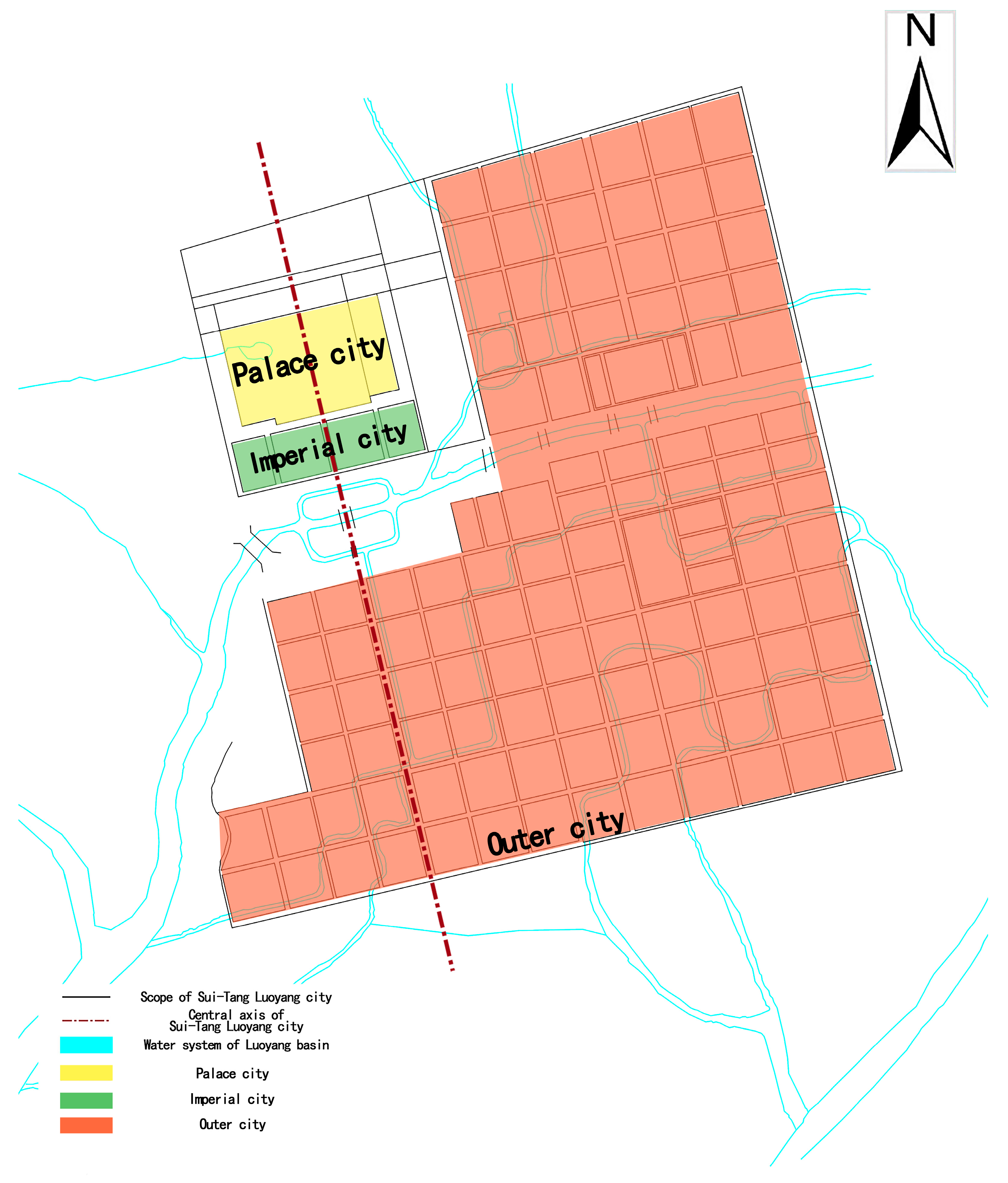
| Spatial Structure | Urban form as historically layered organization (HUL: layering and institutional order); city tiers encode ritual and functional hierarchy [22]. | Digitized palace, imperial, outer-city polygons, and ward grid; morphometrics (area, standard compactness index) and adjacency-based connectivity indices used as the spatial skeleton for analysis. |
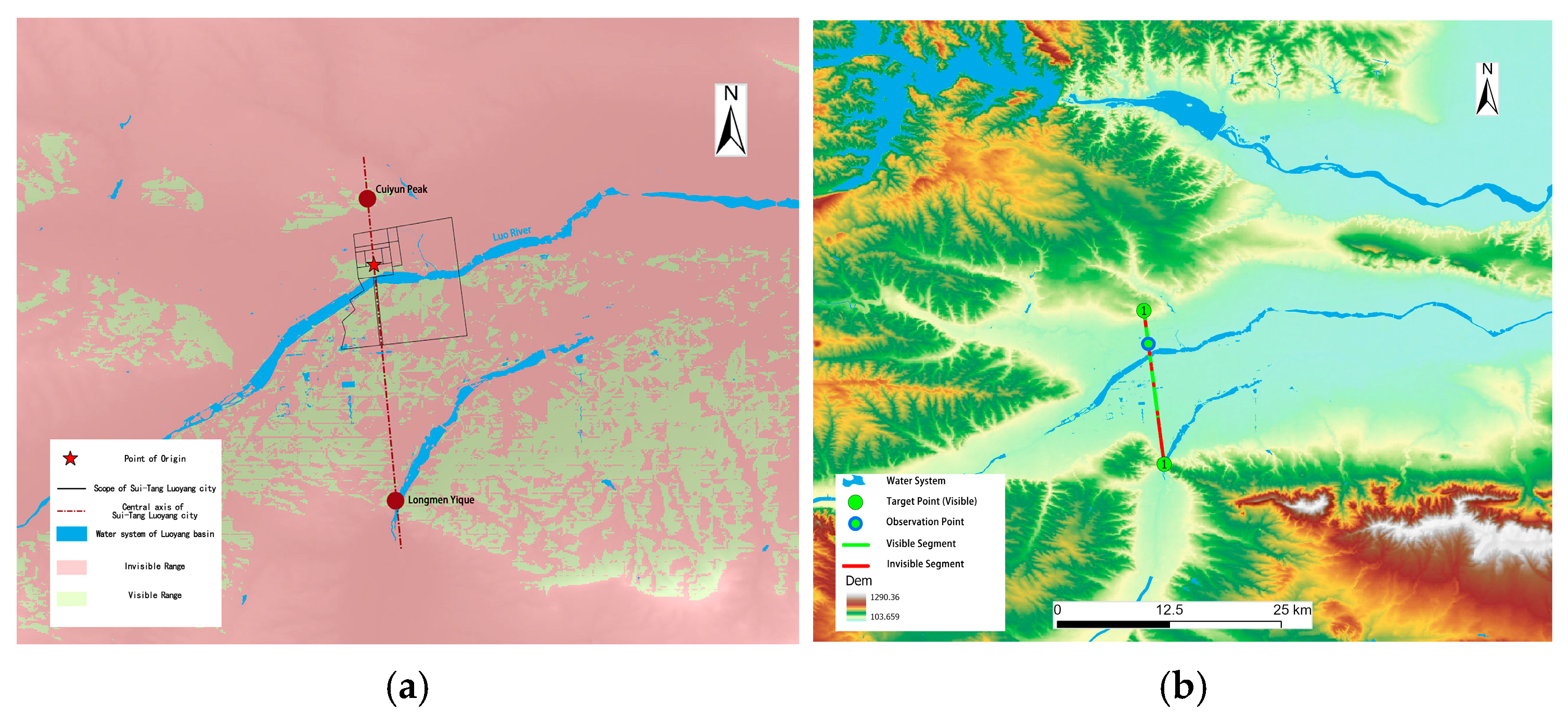
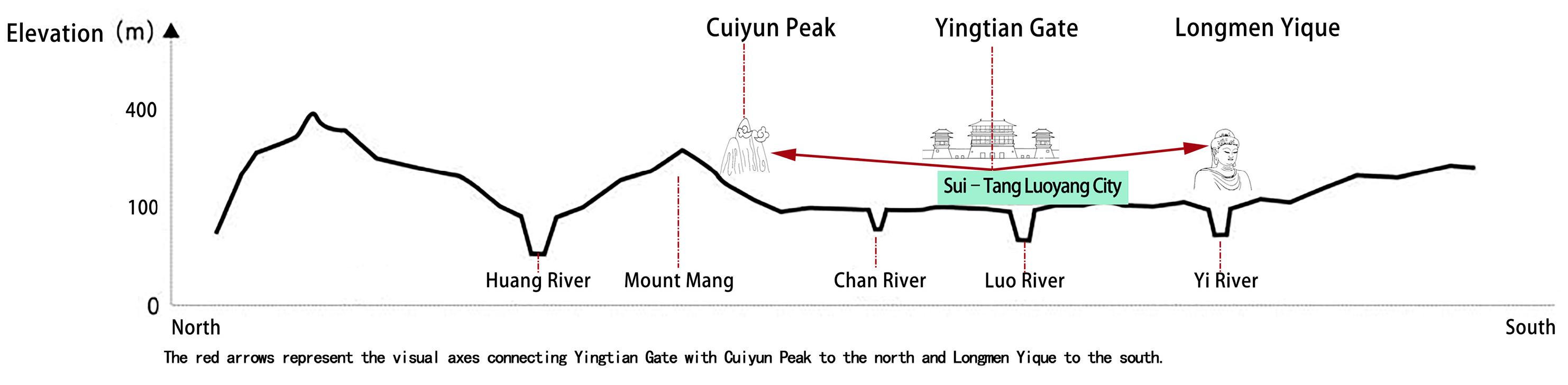
| Visual Axes | Axes and framed termini translate ritual and cosmological logics into perceivable alignments; visual relations act as legible carriers of intangible value [23]. | True-north azimuths (°) between key nodes; corridor polygons generated by intersecting viewsheds along the axis bearing with an ±θ angular tolerance (specified in Section 2.4); terminal-landmark intervisibility (binary) and skyline continuity ratio (%) computed along equal-angle bins as a legibility indicator. |
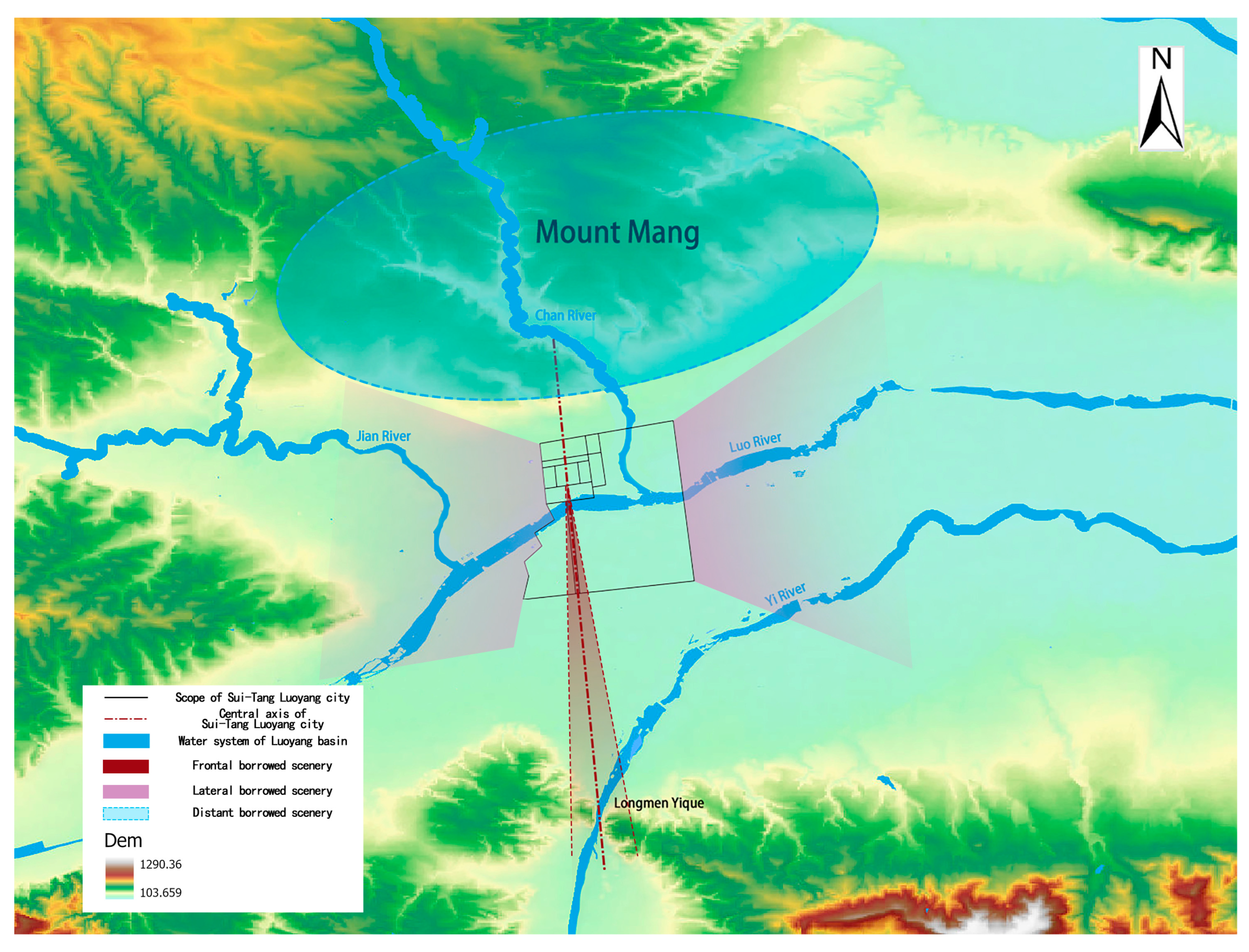
| Borrowed Scenery | Cultural–landscape view: mountains and rivers are co-constitutive heritage elements shaping orientation and meaning rather than mere backdrops [24]. | Georeferenced peaks and rivers; counts of intervisibility between urban nodes and natural features; subtended angular extent (°) to approximate perceived salience along corridors; corridor–feature overlap statistics. |
| Parameter | Value | Description |
|---|---|---|
| Software Version | ArcGIS Pro 3.3.3 | Core computational platform for geospatial analysis |
| Observer Height | 15 m | Based on archaeological heights of Tang gate platforms [37] |
| Target Height | 0 m | Bare-earth baseline to evaluate terrain-level visibility |
| Analysis Radius | 25 km | Defined extent covering the Palace City to terminal landmarks |
| Refraction Coeff. | 0.13 | Standard atmospheric correction for curvature-adjusted LOS |
| Curvature Correction | Enabled | Compensation for Earth’s curvature in long-distance views |
| DEM Resolution | 30 m | Derived from SRTM 1 Arc-Second (Version 3) input |
| Azimuth (Measured) | 173.82° | Quantified alignment from Yingtian Gate to Longmen Yique |
| Parameter Scenario | Visible Terminals | Visible Area | Skyline Continuity (SCR) | Axis Azimuth | Stability Assessment |
|---|---|---|---|---|---|
| Baseline (H = 15 m; R = 25 km; k = 0.13) | Reference Set | Reference Baseline | Reference Baseline | Reference Baseline | Standard parameters for clear-day analysis. |
| Obs. Height: 10 m | Stable (Count unchanged) | Marginal Decrease (<3%) | Stable (Deviation < 1%) | Invariant | Lower height affects foreground occlusion but preserves major landmarks. |
| Obs. Height: 20 m | Stable (Count unchanged) | Marginal Increase (<3%) | Stable (Deviation < 1%) | Invariant | Higher vantage expands ground visibility; axial geometry remains fixed. |
| Radius: 20 km | Reduced (Terminals lost) | Reduced (Area truncated) | Reduced (Distal segments cut) | Invariant | Truncation excludes key terminals, validating the need for ≥25 km. |
| Radius: 30 km | Stable (No new nodes) | Increased (Noise added) | Stable (Saturation reached) | Invariant | Extending beyond 25 km adds terrain noise but no new structural nodes. |
| Refraction: k = 0.00 | Stable | Negligible Shift (<1%) | Stable | Invariant | Atmospheric variation has minimal impact on macro-scale visibility. |
| Refraction: k = 0.20 | Stable | Negligible Shift (<1%) | Stable | Invariant | Curvature effects are negligible for established linear alignments. |
| Toponym | Textual Source | Archaeological/Geo Evidence | Validation Criterion | Spatial Function |
|---|---|---|---|---|
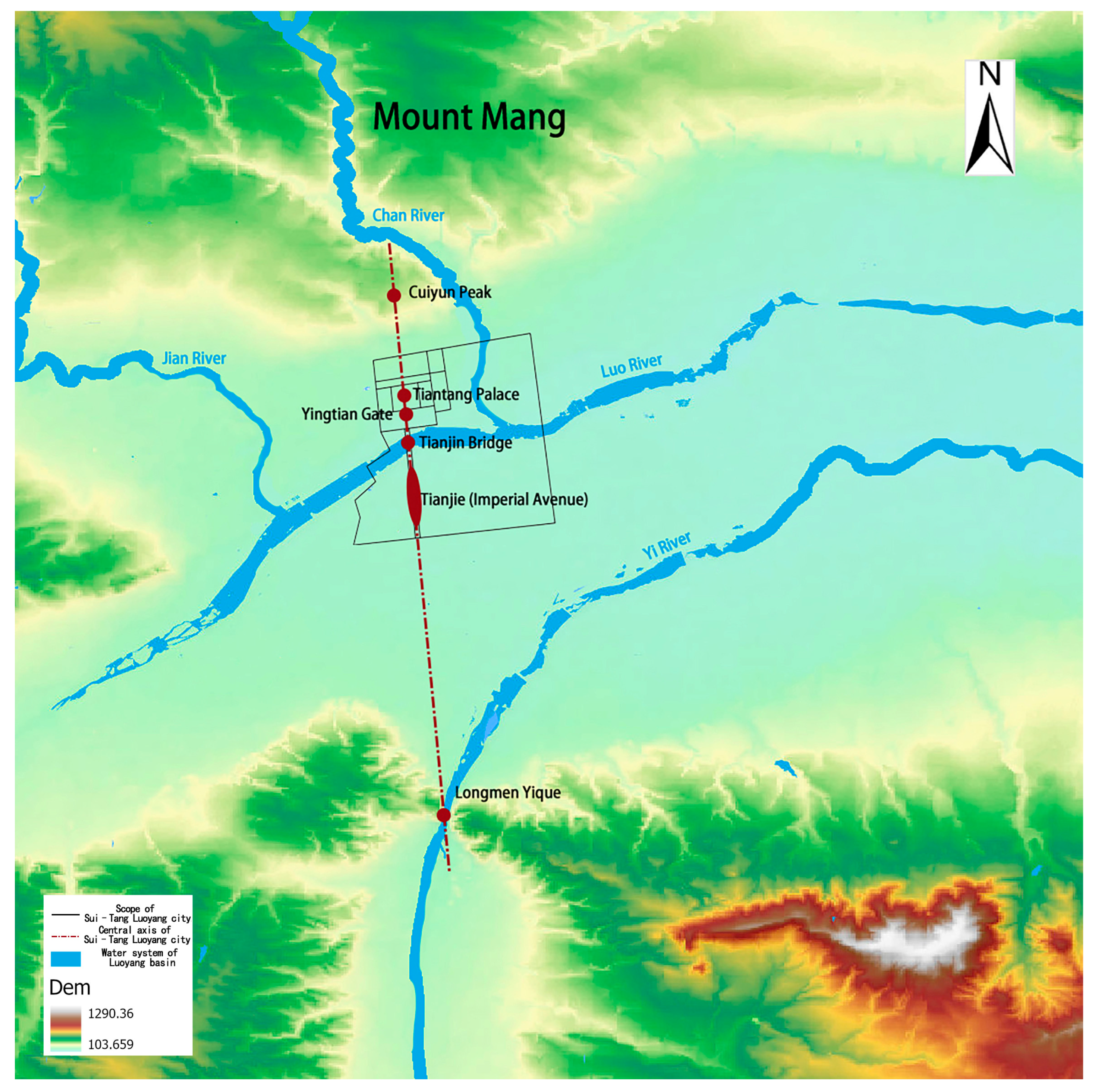
| Yingtian Gate | Book of Sui (Suishu): South gate of the Palace City, with paired towers. | Excavated remains (MT-1); 1:2000 survey maps. | Site-specific coordinates. | Point-of-Origin |
| Cuiyun Peak | Record of Buddhist Monasteries (Luoyang Qielan Ji): Northern vista toward Mangshan. | Mangshan peak elevation data; historical records. | Subtended visual angle ≈ 0.56° (>0.5°). | North Terminal Peak |
| Longmen Yique | Yuanhe Maps and Records (Yuanhe Junxian Tuzhi): Two facing peaks with the Luo River flowing between. | DEM-extracted gap; historical field photography. | Subtended visual angle ≈ 0.85° (>0.5°). | South Terminal Peak |
Disclaimer/Publisher’s Note: The statements, opinions and data contained in all publications are solely those of the individual author(s) and contributor(s) and not of MDPI and/or the editor(s). MDPI and/or the editor(s) disclaim responsibility for any injury to people or property resulting from any ideas, methods, instructions or products referred to in the content. |
© 2026 by the authors. Licensee MDPI, Basel, Switzerland. This article is an open access article distributed under the terms and conditions of the Creative Commons Attribution (CC BY) license.
Share and Cite
Li, X.; Harumain, Y.A.S.; Ahmad Saleh, A.F. Interpreting Spatial Structure, Visual Axes and Borrowed Scenery of Sui–Tang Luoyang Within the Historic Urban Landscape Framework. Sustainability 2026, 18, 2547. https://doi.org/10.3390/su18052547
Li X, Harumain YAS, Ahmad Saleh AF. Interpreting Spatial Structure, Visual Axes and Borrowed Scenery of Sui–Tang Luoyang Within the Historic Urban Landscape Framework. Sustainability. 2026; 18(5):2547. https://doi.org/10.3390/su18052547
Chicago/Turabian StyleLi, Xiaohan, Yong Adilah Shamsul Harumain, and Ahmad Fawwaz Ahmad Saleh. 2026. "Interpreting Spatial Structure, Visual Axes and Borrowed Scenery of Sui–Tang Luoyang Within the Historic Urban Landscape Framework" Sustainability 18, no. 5: 2547. https://doi.org/10.3390/su18052547
APA StyleLi, X., Harumain, Y. A. S., & Ahmad Saleh, A. F. (2026). Interpreting Spatial Structure, Visual Axes and Borrowed Scenery of Sui–Tang Luoyang Within the Historic Urban Landscape Framework. Sustainability, 18(5), 2547. https://doi.org/10.3390/su18052547