3.1. Patterns of Public Transport Use
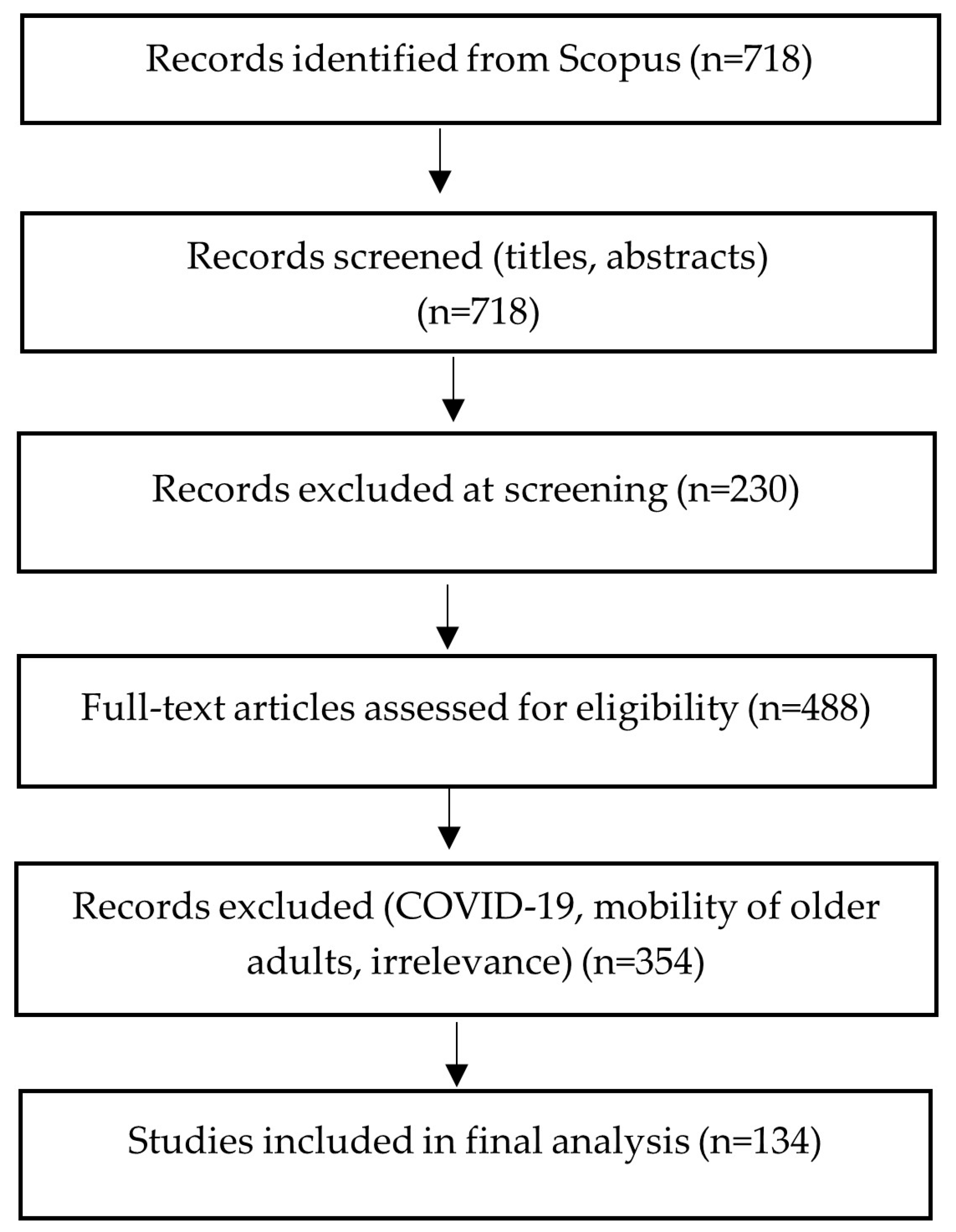
In the study sample of 406 respondents from the Łódź metropolitan area, 362 had used public transport in Łódź over the past three years, of whom 192 individuals (53%) traveled using both buses and trams (
Table 3).
The chi-square test indicated a statistically significant association between gender and public transport use (
p = 0.044); however, the effect size was small (Cramer’s V = 0.10). Men were more likely than women to report not using public transport in the past three years (59.1% vs. 40.9%), whereas women predominated among public transport users (56.9% vs. 43.1%) (
Table 4). These findings suggest that women use public transport more frequently than men, although the strength of this association is weak.
To examine the relationship between public transport use and education level, Fisher’s exact test was applied due to small expected cell counts. A statistically significant association was observed (
p = 0.018). A significant difference was found between respondents with vocational and secondary education (OR = 0.19,
p = 0.01), indicating that individuals with vocational education were significantly less likely to use public transport than those with secondary education. No statistically significant differences were found between the remaining educational categories. Among respondents who had not used public transport in the past three years, the majority held a driver’s license (84.1%), whereas this proportion was somewhat lower among public transport users (70.7%) (
Table 4). However, the chi-square test did not reveal a statistically significant association between holding a driver’s license and public transport use (
p = 0.062). Therefore, not holding a driver’s license cannot be considered a statistically significant determinant of public transport use in this sample. This result suggests that other factors may play a more substantial role in influencing public transport use among residents of Łódź.
Respondents most frequently use public transport for commuting to schools and workplaces, with these trips being regular and occurring several times a week or daily (68.3%) (
Table 5). Another important travel purpose was attending social gatherings, typically a few times per month. Similarly, trips to shops and supermarkets were commonly made using public transport several times a month (47.2% of respondents). Less frequent visits to public administration offices or medical facilities were reflected in the lower frequency of public transport use for these purposes. Individuals who frequently used public transport for one purpose tended to do so for other purposes as well. Spearman’s rank correlation coefficients indicated positive, moderately strong, and statistically significant associations between the frequency of trips to entertainment/cultural venues and social gatherings (rho = 0.638,
p < 0.001), recreational sites and entertainment venues (rho = 0.664,
p < 0.001), shops and entertainment venues (rho = 0.580,
p < 0.001), and medical facilities and administrative offices (rho = 0.619,
p < 0.001). Two distinct activity clusters emerged: leisure mobility, encompassing social gatherings, recreation, culture, and entertainment, and service mobility, comprising administrative offices, medical services, and shopping.
The analysis of the relationship between gender and the frequency of trips for different purposes revealed a statistically significant difference only for travel to medical facilities (Fisher’s exact test, p = 0.003). Women were more likely than men to report making no trips for this purpose, whereas men more frequently reported infrequent trips (“a few times a year”). Spearman’s rank correlation analysis indicated a statistically significant but weak association between education level and the frequency of public transport use only for trips to workplaces and educational institutions (rho = −0.110, p = 0.037). The negative coefficient suggests that individuals with higher education levels used public transport slightly less often for this purpose than those with lower education levels, although the strength of this association remained small. The analysis of differences between individuals with and without a driver’s license revealed statistically significant associations with travel frequency across all purposes analyzed. Respondents holding a driver’s license use public transport significantly less frequently than those without a license; this effect was strongest for daily trips (work/study, shopping) and weaker for leisure and cultural activities.
3.2. Reasons for Use and Intentions for Continued Use of Public Transport
The most frequently reported reasons for using public transport were economic factors related to the high cost of car ownership (38.4%) (AaV), lack of a personal vehicle (32.9%) (SE), difficulties with parking (31.8%) (BE), and the absence of a driver’s license (27.9%) (SE) (
Table 6). These findings suggest that, for most respondents, public transport represents a practical and cost-effective travel option driven primarily by resource constraints and urban environment characteristics rather than by individual preferences. Contextual factors such as traffic congestion (22.9%), planned alcohol consumption (22.9%), or the temporary breakdown or unavailability of a personal car (14.4%) were reported less frequently, though they remain noteworthy. These motivations are situational in nature, dependent on specific circumstances, and do not constitute the basis of everyday transport decisions. Among service quality criteria, travel time (15.2%) was rated as more important than travel comfort (4.42%), suggesting that improvements in efficiency and reliability of public transport may have greater potential to encourage its wider use in Łódź. The least frequently indicated reasons included noise reduction (3.04%) and air pollution reduction (9.7%) (AaV), as well as other unspecified reasons (3.04%). Noise reduction appeared to be a marginal motivator of transport behavior, whereas the slightly greater importance of air pollution may reflect increasing awareness of its health risks. Overall, public transport use in the studied population appears to be primarily utilitarian, driven by economic, social, and infrastructural constraints. Environmental motivations and those related to perceived service quality play a relatively minor role, with environmental motives being the least influential.
The analysis of gender differences using the chi-square test revealed several statistically significant associations, although most exhibited weak effect sizes (V < 0.131) (
Table 6). Women more often than men indicated the lack of a driver’s license (30.4% vs. 18.1%,
p = 0.013, V = 0.131) and the lack of a personal vehicle (34.8% vs. 22.5%,
p = 0.020, V = 0.122) as reasons for using public transport. In contrast, men more frequently reported the temporary unavailability of a personal car (16.1% vs. 9.8%,
p = 0.022, V = 0.121) and planned alcohol consumption as reasons for using public transport (30.8% vs. 12.1%,
p < 0.001, V = 0.268), the latter representing the strongest and only moderate association observed in the analysis.
Correlation analyses between reasons for using public transport and respondents’ education levels revealed only two statistically significant associations. As education level increased, the likelihood of citing the lack of a driver’s license as a reason decreased (rho = −0.187, p < 0.001), indicating a weak but statistically significant negative association. This finding was also confirmed by the chi-square test of independence. Conversely, respondents with higher education levels more frequently reported using public transport due to the temporary unavailability of a personal car (rho = 0.167, p = 0.001), reflecting a weak but statistically significant positive association, also confirmed by the chi-square test.
The analysis of differences between respondents with and without a driver’s license revealed several statistically significant associations. Individuals holding a driver’s license more frequently indicated reasons such as economic factors (43.8% vs. 25.5%, p = 0.001, V = 0.171), the temporary unavailability of their car (19.9% vs. 0.9%, p < 0.001, V = 0.246), difficulties finding a parking space (43.4% vs. 3.8%, p < 0.001, V = 0.387), high parking fees (21.1% vs. 2.8%, p < 0.001, V = 0.228), anticipated traffic restrictions in the city (7.4% vs. 0.9%, p = 0.011, V = 0.129), traffic congestion (29.7% vs. 6.6%, p < 0.001, V = 0.250), and planned alcohol consumption (28.5% vs. 9.4%, p < 0.001, V = 0.207). These associations ranged from weak to moderate in strength, with the strongest effects observed for parking-related issues.
Respondents without a driver’s license more often cited the lack of a driver’s license (91.5% vs. 1.6%, p < 0.001, V = 0.913) and the lack of a personal vehicle (61.3% vs. 21.1%, p < 0.001, V = 0.390) as obvious reasons for using public transport. Notably, the effect size for the former was very strong, indicating a clear and expected association between driver’s license ownership and reported motivations for using public transport.
Reasons related to service quality played a minor role in respondents’ decisions to use public transport. This aspect was examined in more detail through questions assessing satisfaction with public transport services in Łódź, using a Likert scale from 1—“strongly disagree” to 5—“strongly agree.” The results are summarized in
Table 7. Mean ratings were moderate, not exceeding a value of 3.0. Respondents were least likely to agree with the statement that public transport in Łódź adequately meets residents’ needs: 40% rated this aspect negatively (1 or 2), whereas only approximately 26% provided positive ratings (4 or 5). The remaining two statements received similarly moderate evaluations, with neutral (3) and moderately positive (4) responses predominating. In both cases, only about 5% of respondents expressed strong satisfaction, while over 30% (1 or 2) reported dissatisfaction. Gender, education level, and driver’s license ownership did not significantly influence respondents’ ratings (chi-square tests showed no statistically significant associations). The only exception was the statement “Overall, I am satisfied with public transport services in Łódź,” for which women’s ratings were statistically significantly lower than men’s (ρ = −0.108,
p = 0.041), although this association was very weak.
Based on the mean ratings of the three questions assessing public transport services, a satisfaction index was constructed. Descriptive statistics for the index are presented in
Table 8. The average level of satisfaction with public transport in Łódź among the surveyed group was 2.89 (
Table 9), which can be interpreted as moderate. The index showed no significant or strong associations with education level, gender, or driver’s license ownership.
Relatively low levels of satisfaction with public transport services were reflected in a moderate intention to use them in the future (
Table 10). Respondents evaluated their future use of public transport on a Likert scale ranging from 1 (“strongly disagree”) to 5 (“strongly agree”). The highest mean score was observed for the intention to continue using public transport at the current level (M = 3.51, Me = 4).
With regard to intentions to increase usage, 167 respondents (46.1%) indicated that they “probably will not” use public transport more frequently in the future, and 191 (52.8%) stated that they “certainly will not.” Furthermore, 221 respondents (61%) declared that they would not recommend public transport to friends or family.
Overall, respondents demonstrated a rather passive stance: they did not intend to increase their use of public transport nor to actively promote it. Gender, education level, and driver’s license ownership did not significantly differentiate these intentions, as no statistically significant associations with the control variables identified.
3.3. Factors Motivating Non-Users to Use Public Transport in the Future
Non-users of public transport evaluated 17 factors in terms of their potential to motivate future use, employing a Likert scale ranging from 1 (“definitely does not motivate”) to 5 (“definitely motivates”). The highest-rated factors were free public transport (M = 4.66), lower ticket prices (M = 4.16), higher travel comfort (M = 4.07), reliability of connections (M = 4.00), and shorter travel time (M = 3.82) (
Table 11). These findings indicate that economic incentives exert the strongest motivational effect, confirming that financial considerations remain a key determinant of the willingness to shift from car use. Service quality attributes were also rated highly, suggesting that for this group, the primary barrier is not public transport per se, but rather the manner in which the service operates—particularly its reliability, convenience, and travel time.
Built environment factors also played a meaningful, though moderate, role. Walkable access to stops (M = 3.66) and smooth transfers (M = 3.64) were assessed as important, underscoring the relevance of spatial accessibility and transport integration in shaping travel decisions. Technological tools supporting travel, such as advanced apps for trip planning and ticket payment (M ≈ 3.4–3.5), received slightly lower evaluations, indicating that technological facilitation is secondary to core service attributes for this group. The lowest ratings were assigned to park-and-ride facilities located on the outskirts of Łódź (M = 3.07), restrictions or charges for car entry into the city center (M = 3.11), difficulties in finding parking (M = 3.25), and higher parking fees (M = 3.27). Regulatory measures aimed at limiting car access to urban space thus demonstrated the weakest motivational potential. Overall, these results suggest that strategies based on restrictions for car users may encounter lower acceptance and prove less effective in influencing travel behavior than measures focused on enhancing the attractiveness of public transport.
Gender and education level did not significantly differentiate the perceived importance of individual motivational factors. In contrast, holding a driver’s license was statistically significantly associated with several factors: shorter travel time (rho = −0.301, p = 0.047), access to apps for planning and paying for public transport trips (rho = −0.360, p = 0.016), and the option to pay for a monthly transport package with unlimited access to public transport (rho = −0.306, p = 0.044). Respondents without a driver’s license rated these factors as significantly more motivating than those holding a license, with associations of moderate strength. This suggests that digital services and flexible payment models constitute relatively stronger incentives for individuals without a driver’s license, although they remain less influential than core determinants such as cost, comfort, and reliability.