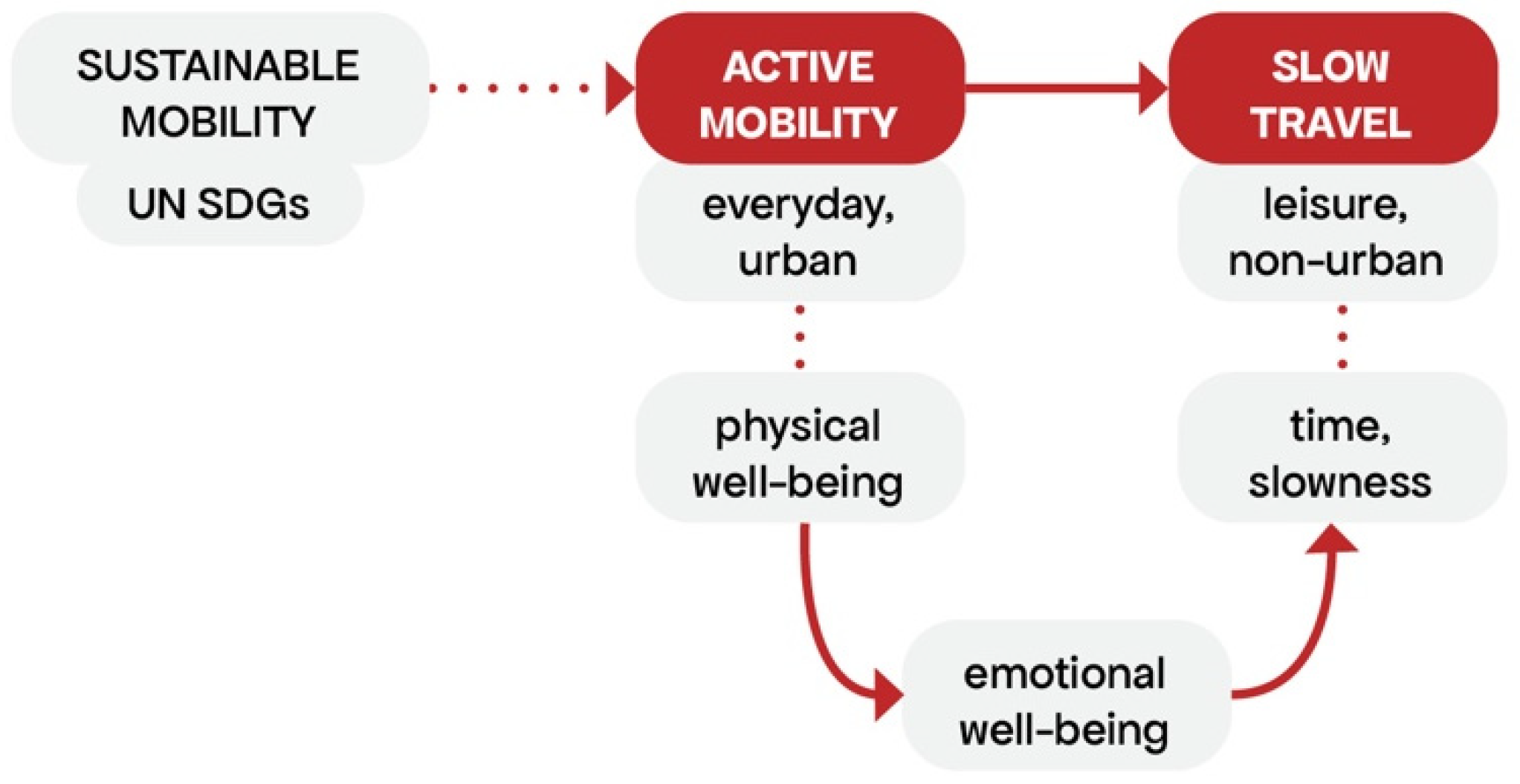
Emotional Well-Being and Environmental Restorativeness in Slow Travel: Experiential Qualities and Motivational Possibilities


Abstract
1. Introduction
Slowness and Slow Travel
2. Theoretical Background
2.1. Emotional Well-Being
- Eudaimonic well-being refers to “maximising one’s virtue and realising one’s potential” [15] (p. 103) and is related to positive affective states of autonomy, freedom, control, and mastery in managing one’s surroundings.
- Hedonic well-being refers to the degree of pleasure and interest, and is related to positive affective states of pleasantness, satisfaction, and arousal generated by a particular activity.
2.2. Environmental Restorativeness
- There is a dominance of the natural. There are relatively few human and human-constructed elements with which to contend.
- There is a relative absence of civilized resources for coping with nature. Nature must be dealt with on what one might be tempted to characterize as “its own terms.”
- There is a relative absence of demands on one’s behaviour that are artificially generated or human imposed. A primary activity is the meeting of one’s vital needs.
3. Materials and Methods
3.1. Research Design
3.2. Study Settings
3.3. Data Collection
3.4. Data Analysis
4. Findings and Discussion
4.1. Emotional Well-Being
4.2. Environmental Restorativeness
4.3. Physical Features of the Environment in Relation to Emotional Well-Being and Environmental Restorativeness
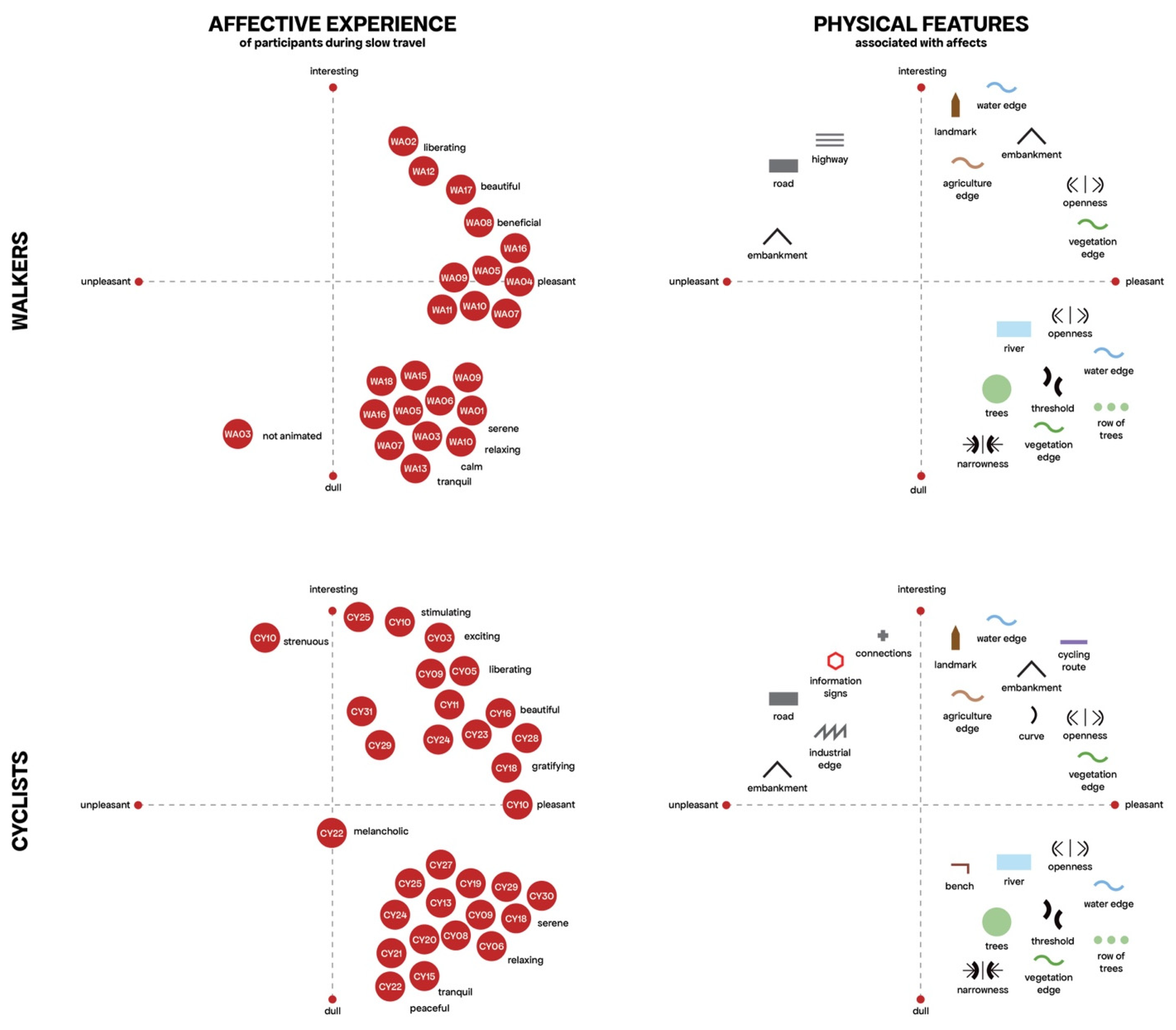
- Vegetation edges;
- Water edges, adjacent to the route;
- Openness, through open, unobstructed views or elevation (e.g., embankment);
- Narrowness and threshold as a product of vegetation;
- Visual alternation between openness and narrowness;
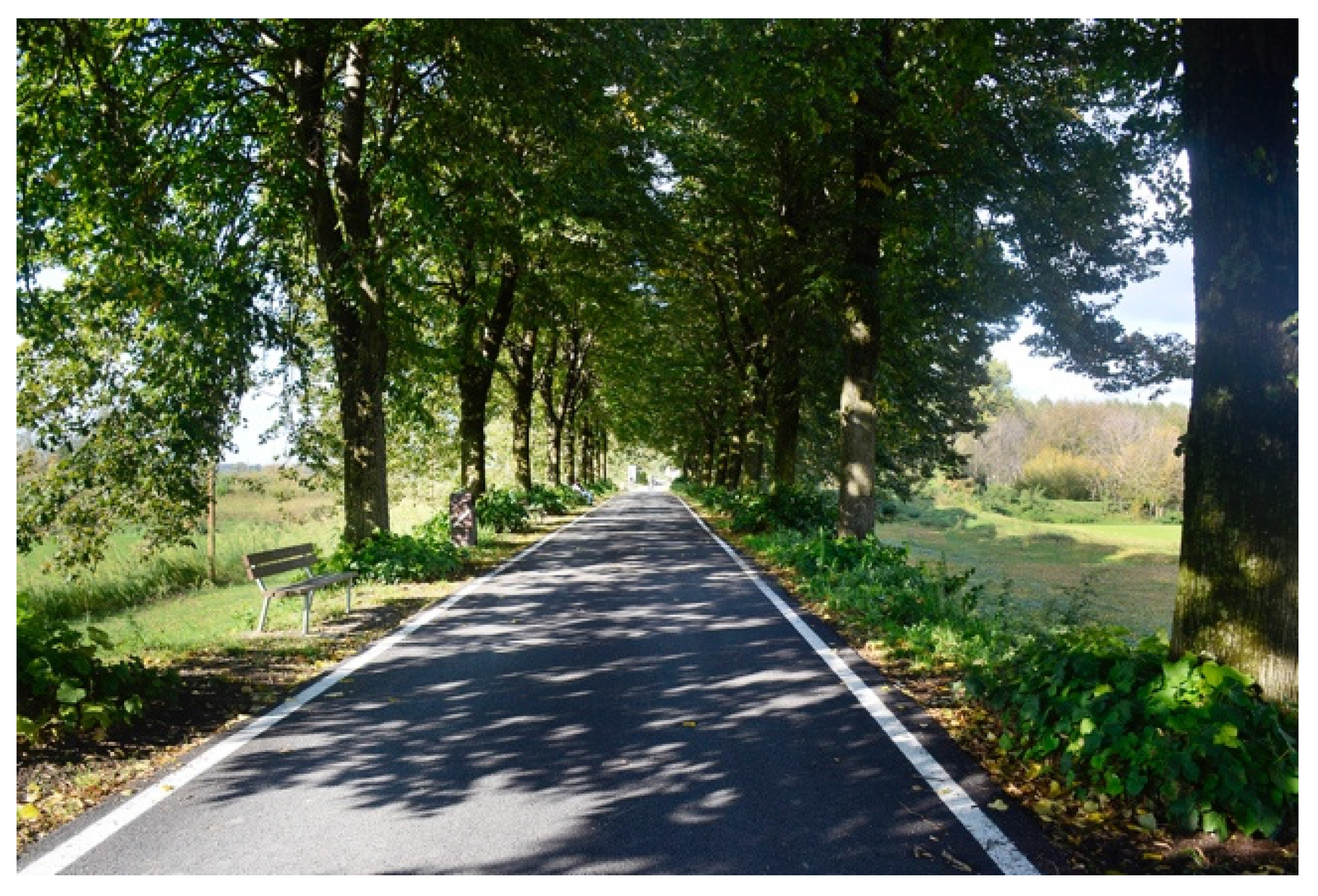
- Sequence as a product of vegetation (e.g., row of trees);
- Visual and kinaesthetic alternation between linearity and curves;
- Urban furniture, to accommodate pauses (e.g., bench).
4.4. Experiential Qualities of Slow Travel: Motivational Possibilities
5. Conclusions and Future Directions
Limitations and Future Research
Author Contributions
Funding
Institutional Review Board Statement
Informed Consent Statement
Data Availability Statement
Conflicts of Interest
References
- Metz, D. The Limits to Travel: How Far Will You Go? Earthscan: London, UK, 2008. [Google Scholar]
- Germann Molz, J. Representing Pace in Tourism Mobilities: Staycations, Slow Travel and the Amazing Race. J. Tour. Cult. Change 2009, 7, 270–286. [Google Scholar] [CrossRef] [Scilit]
- Smithson, A. AS in DS: An Eye on the Road; Lars Müller Publishers: Baden, Switzerland, 2001. [Google Scholar]
- Clancy, M. Slow Tourism, Food and Cities: Pace and the Search for the “Good Life”; Routledge: London, UK, 2018. [Google Scholar]
- Schivelbusch, W. Storia Dei Viaggi in Ferrovia; Einaudi: Turin, Italy, 1988. [Google Scholar]
- Bissell, D. Visualising Everyday Geographies: Practices of Vision through Travel-Time. Trans. Inst. Br. Geogr. 2009, 34, 42–60. [Google Scholar] [CrossRef] [Scilit]
- Larsen, J. Tourism Mobilities and the Travel Glance: Experiences of Being on the Move. Scand. J. Hosp. Tour. 2001, 1, 80–98. [Google Scholar] [CrossRef] [Scilit]
- Ryghaug, M.; Subotički, I.; Smeds, E.; von Wirth, T.; Scherrer, A.; Foulds, C.; Robison, R.; Bertolini, L.; Beyazit İnce, E.; Brand, R.; et al. A Social Sciences and Humanities Research Agenda for Transport and Mobility in Europe: Key Themes and 100 Research Questions. Transp. Rev. 2023, 43, 755–779. [Google Scholar] [CrossRef] [Scilit]
- Hall, C.M.; Scott, D.; Gössling, S. Pandemics, Transformations and Tourism: Be Careful What You Wish For. Tour. Geogr. 2020, 22, 577–598. [Google Scholar] [CrossRef] [Scilit]
- World Health Organization. One Health. Available online: https://www.who.int/health-topics/one-health (accessed on 4 February 2025).
- Bianchi, F.; Riga, D.; Moscarelli, R.; Pileri, P. Designing Urban Spaces to Enhance Active and Sustainable Mobility: An Analysis of Physical and Symbolic Affordances in School Squares in the Metropolitan Area of Milan, Italy. Sustainability 2023, 15, 11328. [Google Scholar] [CrossRef] [Scilit]
- European Commission. Sustainable and Smart Mobility Strategy: Putting European Transport on Track for the Future; European Commission: Brussels, Belgium, 2021. [Google Scholar]
- Biggar, M. Non-Motorized Transport: Walking and Cycling. In Sustainable Cities and Communities; Filho, W.L., Azul, A.M., Brandli, L., Özuyar, P.G., Wall, T., Eds.; Springer: Cham, Switzerland, 2020; pp. 428–437. [Google Scholar]
- Anable, J.; Gatersleben, B. All Work and No Play? The Role of Instrumental and Affective Factors in Work and Leisure Journeys by Different Travel Modes. Transp. Res. Part A Policy Pract. 2005, 39, 163–181. [Google Scholar] [CrossRef] [Scilit]
- Ettema, D.; Smajic, I. Walking, Places and Wellbeing. Geogr. J. 2015, 181, 102–109. [Google Scholar] [CrossRef] [Scilit]
- Ferdman, A. Well-Being and Mobility: A New Perspective. Transp. Res. Part A Policy Pract. 2021, 146, 44–55. [Google Scholar] [CrossRef] [Scilit]
- Gatersleben, B.; Uzzell, D. Affective Appraisals of the Daily Commute: Comparing Perceptions of Drivers, Cyclists, Walkers, and Users of Public Transport. Environ. Behav. 2007, 39, 416–431. [Google Scholar] [CrossRef] [Scilit]
- Gnoth, J.; Zins, A.H.; Lengmueller, R.; Boshoff, C. Emotions, Mood, Flow and Motivations to Travel. J. Travel Tour. Mark. 2000, 9, 23–34. [Google Scholar] [CrossRef] [Scilit]
- Mokhtarian, P.L. Subjective Well-Being and Travel: Retrospect and Prospect. Transportation 2019, 46, 493–513. [Google Scholar] [CrossRef] [Scilit]
- Sheller, M. Automotive Emotions: Feeling the Car. Theory Cult. Soc. 2004, 21, 221–242. [Google Scholar] [CrossRef] [Scilit]
- Steg, L. Car Use: Lust and Must. Instrumental, Symbolic and Affective Motives for Car Use. Transp. Res. Part A Policy Pract. 2005, 39, 147–162. [Google Scholar] [CrossRef] [Scilit]
- Steg, L.; Vlek, C.; Slotegraaf, G. Instrumental-Reasoned and Symbolic-Affective Motives for Using a Motor Car. Transp. Res. Part F 2001, 4, 151–169. [Google Scholar] [CrossRef] [Scilit]
- Pileri, P. Progettare La Lentezza; People: Milan, Italy, 2020. [Google Scholar]
- Campisi, J.; Ulary, G. Travelling, Fast and Slow. In Tourism and Culture in Philosophical Perspective; Zovko, M.É., Dillon, J., Eds.; Springer: Berlin/Heidelberg, Germany, 2023; pp. 189–200. [Google Scholar]
- Dickinson, J.E.; Robbins, D.; Lumsdon, L. Holiday Travel Discourses and Climate Change. J. Transp. Geogr. 2010, 18, 482–489. [Google Scholar] [CrossRef] [Scilit]
- Dickinson, J.E.; Lumsdon, L.M.; Robbins, D. Slow Travel: Issues for Tourism and Climate Change. J. Sustain. Tour. 2011, 19, 281–300. [Google Scholar] [CrossRef] [Scilit]
- Germann Molz, J. “Travel Too Fast and You Miss All You Travel for”: Slow Mobilities and the Politics of Pace. In Slow Tourism, Food and Cities: Pace and the Search for the “Good Life”; Clancy, M., Ed.; Routledge: London, UK, 2018; pp. 24–32. [Google Scholar]
- Lumsdon, L.M.; McGrath, P. Developing A Conceptual Framework for Slow Travel: A Grounded Theory Approach. J. Sustain. Tour. 2011, 19, 265–279. [Google Scholar] [CrossRef] [Scilit]
- McGrath, P.; Sharpley, R. Slow Travel and Tourism. New Concept or New Label? In Slow Tourism, Food and Cities: Pace and the Search for the “Good Life”; Clancy, M., Ed.; Routledge: London, UK, 2018; pp. 49–62. [Google Scholar]
- Pileri, P.; Moscarelli, R. From Slow Tourism to Slow Travel: An Idea for Marginal Regions. In Cycling & Walking for Regional Development; Pileri, P., Moscarelli, R., Eds.; Springer: Cham, Switzerland, 2021; pp. 3–16. [Google Scholar]
- Vannini, P. Slowness and Deceleration. In The Routledge Handbook of Mobilities; Adey, P., Bissell, D., Hannam, K., Merriman, P., Sheller, M., Eds.; Routledge: London, UK, 2014; pp. 116–124. [Google Scholar]
- Caffyn, A. Advocating and Implementing Slow Tourism. Tour. Recreat. Res. 2012, 37, 77–80. [Google Scholar] [CrossRef] [Scilit]
- Fullagar, S.; Markwell, K.; Wilson, E. Starting Slow: Thinking through Slow Mobilities and Experiences. In Slow Tourism. Experiences and Mobilities; Fullagar, S., Markwell, K., Wilson, E., Eds.; Channel View Publications: Bristol, UK, 2012; pp. 1–10. [Google Scholar]
- Oh, H.; Assaf, A.G.; Baloglu, S. Motivations and Goals of Slow Tourism. J. Travel Res. 2016, 55, 205–219. [Google Scholar] [CrossRef] [Scilit]
- Gardner, N. A Manifesto for Slow Travel. Hidden Europe, 3 May 2009; pp. 10–14.
- Scuttari, A. Tourism Experiences in Motion. Mobile, Visual and Psychophysiological Methods to Capture Tourists “on the Move”. Tour. Manag. Perspect. 2021, 38, 100825. [Google Scholar] [CrossRef] [Scilit]
- Olafsdottir, G. “… Sometimes You’ve Just Got to Get Away”: On Trekking Holidays and Their Therapeutic Effect. Tour. Stud. 2013, 13, 209–231. [Google Scholar] [CrossRef] [Scilit]
- Rabbiosi, C. Performing a Walking Holiday: Routing, Immersing and Co-Dwelling. Tour. Stud. 2021, 21, 367–386. [Google Scholar] [CrossRef] [Scilit]
- Pileri, P. Slow Travel Projects for Enhancing Territories: Motivations and Directions. In Cycling & Walking for Regional Development; Pileri, P., Moscarelli, R., Eds.; Springer: Cham, Switzerland, 2021; pp. 129–140. [Google Scholar]
- Pileri, P. Un Piano Nazionale per La Lentezza Rigenerativa. Available online: https://altreconomia.it/un-piano-nazionale-per-la-lentezza-rigenerativa/ (accessed on 17 December 2025).
- Pileri, P. Ciclabilità e Lentezza: La “Mobilità Sostenibile” è Ormai Un Vestito Troppo Stretto. Available online: https://altreconomia.it/ciclabilita-e-lentezza-la-mobilita-sostenibile-e-ormai-un-vestito-troppo-stretto/ (accessed on 17 December 2025).
- Pileri, P.; Giacomel, A.; Giudici, D.; Munno, C.; Moscarelli, R.; Bianchi, F. Ciclabili e Cammini per Narrare Territori; Ediciclo Editore: Verona, Italy, 2018. [Google Scholar]
- Hannam, K.; Butler, G.; Witte, A.; Zuev, D. Tourist’s Mobilities: Walking, Cycling, Driving and Waiting. Tour. Stud. 2021, 21, 57–69. [Google Scholar] [CrossRef] [Scilit]
- Ramadier, T. Transdisciplinarity and Its Challenges: The Case of Urban Studies. Futures 2004, 36, 423–439. [Google Scholar] [CrossRef] [Scilit]
- Ewing, R.; Handy, S. Measuring the Unmeasurable: Urban Design Qualities Related to Walkability. J. Urban Des. 2009, 14, 65–84. [Google Scholar] [CrossRef] [Scilit]
- Rapoport, A. Human Aspects of Urban Form; Pergamon Press: Oxford, UK, 1977. [Google Scholar]
- Ulrich, R.S. Aesthetic and Affective Response to Natural Environment. In Behavior and the Natural Environment; Altman, I., Wohlwill, J., Eds.; Plenum Press: New York, NY, USA, 1983; pp. 85–125. [Google Scholar]
- Te Brömmelstroet, M.; Nikolaeva, A.; Cadima, C.; Verlinghieri, E.; Ferreira, A.; Mladenović, M.; Milakis, D.; de Abreu e Silva, J.; Papa, E. Have a Good Trip! Expanding Our Concepts of the Quality of Everyday Travelling With Flow Theory. Appl. Mobilities 2021, 7, 352–373. [Google Scholar] [CrossRef] [Scilit]
- Wunderlich, F.M. The Aesthetics of Place-Temporality in Everyday Urban Space: The Case of Fitzroy Square. In Geographies of Rhythm: Nature, Place, Mobilities and Bodies; Edensor, T., Ed.; Ashgate: London, UK, 2010; pp. 45–56. [Google Scholar]
- Csikszentmihalyi, M. Flow and the Foundations of Positive Psychology; Springer: Berlin/Heidelberg, Germany, 2014. [Google Scholar]
- De Vos, J.; Singleton, P.A.; Gärling, T. From Attitude to Satisfaction: Introducing the Travel Mode Choice Cycle. Transp. Rev. 2021, 42, 204–221. [Google Scholar] [CrossRef] [Scilit]
- Dunlap, R.; Rose, J.; Standridge, S.H.; Pruitt, C.L. Experiences of Urban Cycling: Emotional Geographies of People and Place. Leis. Stud. 2021, 40, 82–95. [Google Scholar] [CrossRef] [Scilit]
- Mouratidis, K. Urban Planning and Quality of Life: A Review of Pathways Linking the Built Environment to Subjective Well-Being. Cities 2021, 115, 103229. [Google Scholar] [CrossRef] [Scilit]
- Fernández-Heredia, Á.; Monzón, A.; Jara-Díaz, S. Understanding Cyclists’ Perceptions, Keys for a Successful Bicycle Promotion. Transp. Res. Part A Policy Pract. 2014, 63, 1–11. [Google Scholar] [CrossRef] [Scilit]
- Wang, Y.; Chau, C.K.; Ng, W.Y.; Leung, T.M. A Review on the Effects of Physical Built Environment Attributes on Enhancing Walking and Cycling Activity Levels within Residential Neighborhoods. Cities 2016, 50, 1–15. [Google Scholar] [CrossRef] [Scilit]
- Russell, J.A. Affective Appraisals of Environments. In Environmental Aesthetics: Theory, Research, and Applications; Nasar, J.L., Ed.; Cambridge University Press: Cambridge, UK, 1988; pp. 120–129. [Google Scholar]
- Kaplan, S. Where Cognition and Affect Meet: A Theoretical Analysis of Preference. In Environmental Aesthetics: Theory, Research, and Applications; Nasar, J.L., Ed.; Cambridge University Press: Cambridge, UK, 1988; pp. 56–63. [Google Scholar]
- Kaplan, S.; Kaplan, R. The Experience of Nature: A Psychological Perspective; Ulrich’s: New Providence, NJ, USA, 1995. [Google Scholar]
- Nasar, J.L. The Evaluative Image of the City; Sage Publications: Thousand Oaks, CA, USA, 1998. [Google Scholar]
- Russell, J.A.; Pratt, G. A Description of the Affective Quality Attributed to Environments. J. Pers. Soc. Psychol. 1980, 38, 311–322. [Google Scholar] [CrossRef]
- Kaplan, S. The Restorative Benefits of Nature: Toward an Integrative Framework. J. Environ. Psychol. 1995, 15, 169–182. [Google Scholar] [CrossRef] [Scilit]
- Kaplan, S.; Frey Talbot, J. Psychological Benefits of a Wilderness Experience. In Behavior and the Natural Environment; Altman, I., Wohlwill, J.F., Eds.; Plenum Press: New York, NY, USA, 1983; pp. 163–204. [Google Scholar]
- Petino, G.; Reina, G.; Privitera, D. Cycling Tourism and Revitalization in the Sicilian Hinterland: A Case Study in the Taormina–Etna District. Sustainability 2021, 13, 10022. [Google Scholar] [CrossRef] [Scilit]
- Biassoni, F.; Gandola, M.; Gnerre, M. Grounding the Restorative Effect of the Environment in Tertiary Qualities: An Integration of Embodied and Phenomenological Perspectives. J. Intell. 2023, 11, 208. [Google Scholar] [CrossRef] [Scilit]
- Ohly, H.; White, M.P.; Wheeler, B.W.; Bethel, A.; Ukoumunne, O.C.; Nikolaou, V.; Garside, R. Attention Restoration Theory: A Systematic Review of the Attention Restoration Potential of Exposure to Natural Environments. J. Toxicol. Environ. Health B Crit. Rev. 2016, 19, 305–343. [Google Scholar] [CrossRef] [Scilit]
- Kaplan, R.; Kaplan, S.; Ryan, R. With People in Mind: Design and Management of Everyday Nature; Island Press: Washington, DC, USA, 1998. [Google Scholar]
- Creswell, J.W. Research Design: Qualitative, Quantitative, and Mixed Methods Approaches, 3rd ed.; Sage: Thousand Oaks, CA, USA, 2009. [Google Scholar]
- Headley, M.G.; Plano Clark, V.L. Multilevel Mixed Methods Research Designs: Advancing a Refined Definition. J. Mix. Methods Res. 2020, 14, 145–163. [Google Scholar] [CrossRef] [Scilit]
- Rucks-Ahidiana, Z.; Bierbaum, A.H. Qualitative spaces: Integrating spatial analysis for a mixed methods approach. Int. J. Qual. Methods 2015, 14, 92–103. [Google Scholar] [CrossRef] [Scilit]
- Hoffmann, E.M.; Schareika, N.; Dittrich, C.; Schlecht, E.; Sauer, D.; Buerkert, A. Rurbanity: A Concept for the Interdisciplinary Study of Rural–Urban Transformation. Sustain. Sci. 2023, 18, 1739–1753. [Google Scholar] [CrossRef] [Scilit] [PubMed]
- Wolman, H.; Barnes, W.; Clark, J.; Friedman, S.; Harris, R.; Lin, J.; Ogorzalek, T. The State of Urban Research: Views across the Disciplines. J. Urban Aff. 2024, 46, 425–462. [Google Scholar] [CrossRef] [Scilit]
- ISTAT. Popolazione Residente. Available online: https://demo.istat.it/app/?i=POS&l=it (accessed on 1 October 2024).
- bicitalia.org BI2—Ciclovia Del Po. Available online: https://www.bicitalia.org/it/bicitalia/gli-itinerari-bicitalia/61-bi2-ciclovia-del-po (accessed on 1 October 2024).
- Flint, C.G.; Mascher, C.; Oldroyd, Z.; Andre Valle, P.; Wynn, E.; Cannon, Q.; Valle, P.; Brown, A.; Unger, B. Public Intercept Interviews and Surveys for Gathering Place-Based Perceptions: Observations from Community Water Research in Utah. J. Rural. Soc. Sci. 2016, 31, 105–125. [Google Scholar]
- Schneider, R.J. Measuring Transportation at a Human Scale: An Intercept Survey Approach to Capture Pedestrian Activity. J. Transp. Land. Use 2013, 6, 43–59. [Google Scholar] [CrossRef] [Scilit]
- Nyimbili, F.; Nyimbili, L. Types of Purposive Sampling Techniques with Their Examples and Application in Qualitative Research Studies. Br. J. Multidiscip. Adv. Stud. 2024, 5, 90–99. [Google Scholar] [CrossRef] [Scilit]
- Spinney, J. Close Encounters? Mobile Methods, (Post)Phenomenology and Affect. Cult. Geogr. 2015, 22, 231–246. [Google Scholar] [CrossRef] [Scilit]
- Braun, V.; Clarke, V. Using Thematic Analysis in Psychology. Qual. Res. Psychol. 2006, 3, 77–101. [Google Scholar] [CrossRef] [Scilit]
- Stefansdottir, H. Urban Routes and Commuting Bicyclist’s Aesthetic Experience. FORMakademisk 2014, 7, 1–21. [Google Scholar] [CrossRef] [Scilit]
- Vaismoradi, M.; Jones, J.; Turunen, H.; Snelgrove, S. Theme Development in Qualitative Content Analysis and Thematic Analysis. J. Nurs. Educ. Pract. 2016, 6, 100–111. [Google Scholar] [CrossRef] [Scilit]
- Appleyard, D.; Lynch, K.; Myer, J.R. The View from the Road; The MIT Press: Cambridge, MA, USA, 1964. [Google Scholar]
- Spinney, J. Improvising Rhythms: Re-Reading Urban Time and Space through Everyday Practices of Cycling. In Geographies of Rhythm: Nature, Place, Mobilities and Bodies; Edensor, T., Ed.; Ashgate: Surrey, UK, 2010; pp. 113–127. [Google Scholar]
- Luiselli, V. Carte False; La Nuova Frontiera: Roma, Italy, 2010. [Google Scholar]
- Edensor, T. Rhythm and Arrhythmia. In The Routledge Handbook of Mobilities; Adey, P., Bissell, D., Hannam, K., Merriman, P., Sheller, M., Eds.; Routledge: London, UK, 2014; pp. 163–171. [Google Scholar]
- Bell, S. Landscape: Pattern, Perception and Process; Routledge: London, UK, 1999. [Google Scholar]
- Stefansdottir, H. A Theoretical Perspective on How Bicycle Commuters Might Experience Aesthetic Features of Urban Space. J. Urban Des. 2014, 19, 496–510. [Google Scholar] [CrossRef] [Scilit]
- Hägerhäll, C.M.; Sang, Å.O.; Englund, J.E.; Ahlner, F.; Rybka, K.; Huber, J.; Burenhult, N. Do Humans Really Prefer Semi-Open Natural Landscapes? A Cross-Cultural Reappraisal. Front. Psychol. 2018, 9, 822. [Google Scholar] [CrossRef] [Scilit]
- Thwaites, K.; Simkins, I. Experiential Landscape: An Approach to People, Place and Space; Routledge: London, UK, 2007. [Google Scholar]
- Ingold, T. The Perception of the Environment: Essays on Livelihood, Dwelling and Skill; Routledge: London, UK, 2022. [Google Scholar]
- Kaplan, S. Perception and Landscape: Conceptions and Misconceptions. In Environmental Aesthetics: Theory, Research, and Applications; Nasar, J.L., Ed.; Cambridge University Press: Cambridge, UK, 1988; pp. 45–55. [Google Scholar]
- Heath, T.F. Behavioral and Perceptual Aspects of the Aesthetics of Urban Environments. In Environmental Aesthetics: Theory, Research, and Applications; Nasar, J.L., Ed.; Cambridge University Press: Cambridge, UK, 1988; pp. 6–10. [Google Scholar]
- Biassoni, F.; Lo Carmine, C.; Perego, P.; Gnerre, M. Choosing the Bicycle as a Mode of Transportation, the Influence of Infrastructure Perception, Travel Satisfaction and Pro-Environmental Attitude, the Case of Milan. Sustainability 2023, 15, 12117. [Google Scholar] [CrossRef] [Scilit]
- Riga, D.; Bianchi, F. Assessing Children’s Affective Perception of School Squares in Lombardy, Italy. J. Urban Des. 2024, 29, 669–689. [Google Scholar] [CrossRef] [Scilit]
- Popan, C. Beyond Utilitarian Mobilities: Cycling Senses and the Subversion of the Car System. Appl. Mobilities 2020, 5, 289–305. [Google Scholar] [CrossRef] [Scilit]
- Rosa, H. Accelerazione e Alienazione; Einaudi: Turin, Italy, 2015. [Google Scholar]



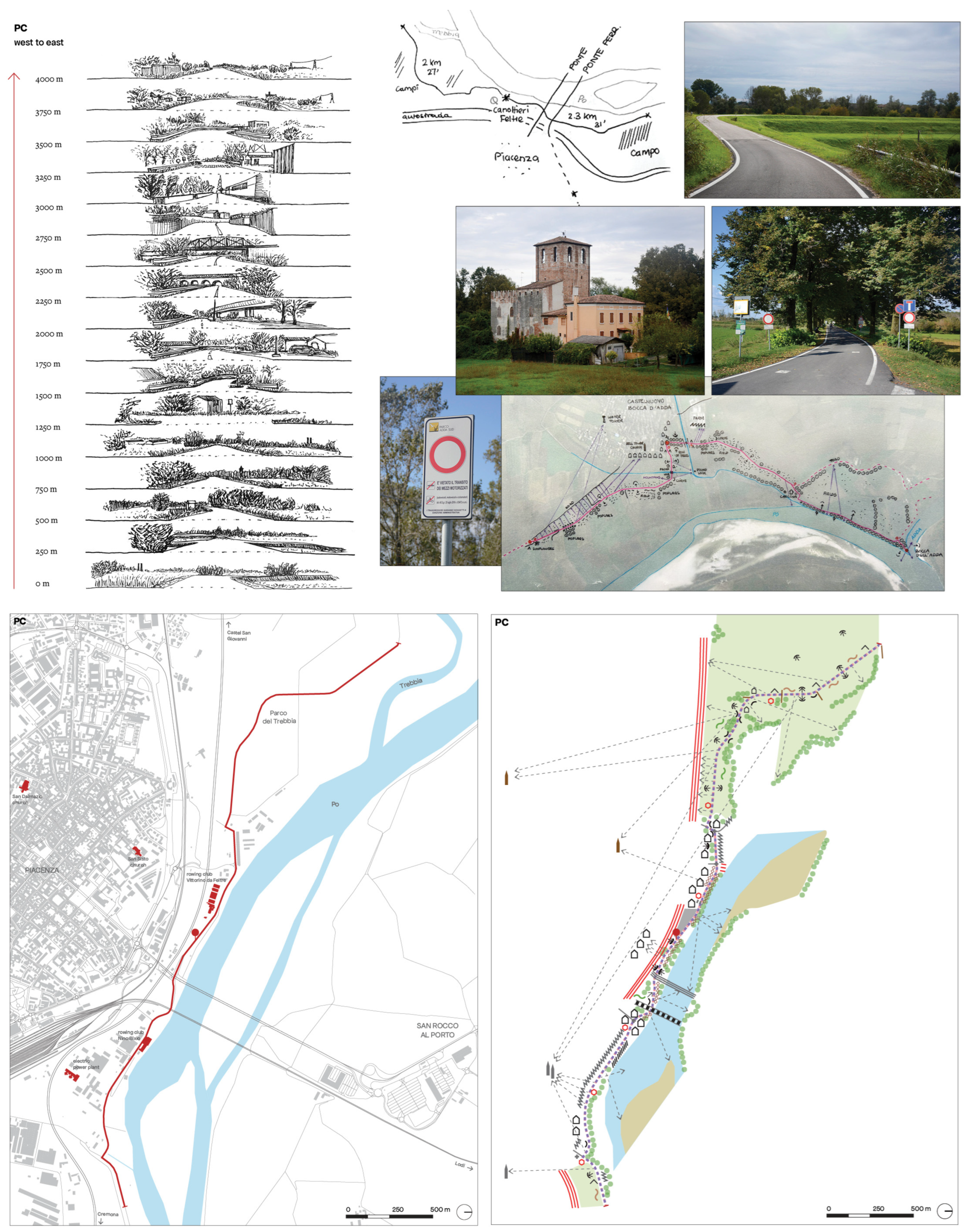



| Castelnuovo Bocca d’Adda | Governolo | Piacenza | |
|---|---|---|---|
| Province | Lodi | Mantua | Piacenza |
| Municipality (comune) | Castelnuovo Bocca d’Adda | Roncoferraro | Piacenza |
| Population/municipality | 1.534 | 6.899 | 103.121 |
| Distance from closest urban area | 200 m from Castelnuovo Bocca d’Adda | 500 m from Governolo | 2 km from Piacenza |
| Embankment | Po River (in proximity) | Mincio River (adjacent) | Po River (adjacent) |
| International cycling routes | EuroVelo 8 (part of) | EuroVelo 7 (part of) EuroVelo 8 (in proximity) | EuroVelo 5 (part of) EuroVelo 8 (part of) |
| National cycling routes | Bicitalia 2 (part of) VENTO (part of) | Bicitalia 1 (in proximity) Bicitalia 2 (part of) VENTO (in proximity) | Bicitalia 2 (part of) VENTO (part of) |
| Vehicular access | Restricted: permit only | Restricted: residents only—priority to cyclists (west)/Restricted on weekends: residents only (east) | Restricted: permit only (west)/Restricted on weekends: permit only (east) |
| Vehicular traffic | Very low, <50 vehicles/day | Low, <500 vehicles/day | Low, <500 vehicles/day |
| Speed limit (km/h) | 10 | 30 (west)/50 (east) | 30 |
| Road width (m) | 4.5 | 5.5 | 6.5 |
| Question | Type | Options | Branching |
|---|---|---|---|
| Closed | Leisure Physical exercise Transport | - |
| Closed | <30 min 30 min–1 h 1 h–2 h Half day The whole day More than one day | - |
| Closed | Yes No | - |
| Closed | Yes [>4B.] No | 4B. Why? |
| Closed | Yes, speed up [>5B.] Yes, slow down [>5B.] No | 5B. Why? |
| Open-ended | - | - |
| Open-ended | - | - |
| Open-ended | - | - |
| Closed | Yes [>9B.] No | 9B. What? |
| Multiple choice | Walking Bicycle Car Bus Metro Train | - |
| Closed | <17 18–24 25–34 35–44 45–54 55–64 65–74 75+ | - |
| Closed | Primary school Middle school High school Bachelor’s degree Master’s degree Ph.D. | - |
| Open-ended | - | - |
| Code | Definition | Visual Code |
| Agriculture | Refers to physical features that denote the agricultural dimension and activity of the setting (e.g., fields, plantations, farmsteads). |  |
| Auditory | Participants’ references to sounds (e.g., birds chirping). | |
| Body | Participants’ references to their own body and/or their corporeal needs (e.g., to rest). | |
| Built environment | Refers to visually perceived physical features of the built environment (e.g., house, industrial edge, bridge). |  |
| Distressing | See Table 4 below. | |
| Dull | See Table 4 below. | |
| Elevation | Participants’ references to the topography of the environment (e.g., flatness) or the embankment itself. |  |
| Exciting | See Table 4 below. | |
| Gloomy | See Table 4 below. | |
| Ground | Refers to physical features related to the ground surface, such as slopes of ground materials. |  |
| Interesting | See Table 4 below. | |
| Instrumental | Participants’ references to their own instrumental purposes. | |
| Landmark | Refers to specific elements of the built environment that act as landmarks either because of their cultural value or because of their salience in the visual field (e.g., bell tower). |  |
| Landscape | Participants’ explicit use of the word landscape (in vivo). | |
| Olfactory | Participants’ references to smells (e.g., manure). | |
| Pace | Participants’ explicit references to their own pace and/or rhythm of movement, or to the concept of speed. | |
| Panorama | Participants’ references to an open visual field, to the horizon, and/or to panoramic views. |  |
| Pleasant | See Table 4 below. | |
| Relaxing | See Table 4 below. | |
| Slow line | Refers to the kinaesthetic feature of the route, when used for slow mobility (i.e., walking and/or cycling). | |
| Unpleasant | See Table 4 below. | |
| Vegetation | Participants’ references to vegetation, covering all scales (i.e., flower, tree, wood) and levels of verbal complexity (i.e., from naming a species to “greenery”). |  |
| Visual | Participants’ direct references to visual perception, through accounts on what they “see”. | |
| Water | Refers to the presence of water in the contexts (e.g., river, riverfront, riverbanks). |  |
| Weather | Participants’ references to weather conditions (e.g., sun, warmth, fog). |
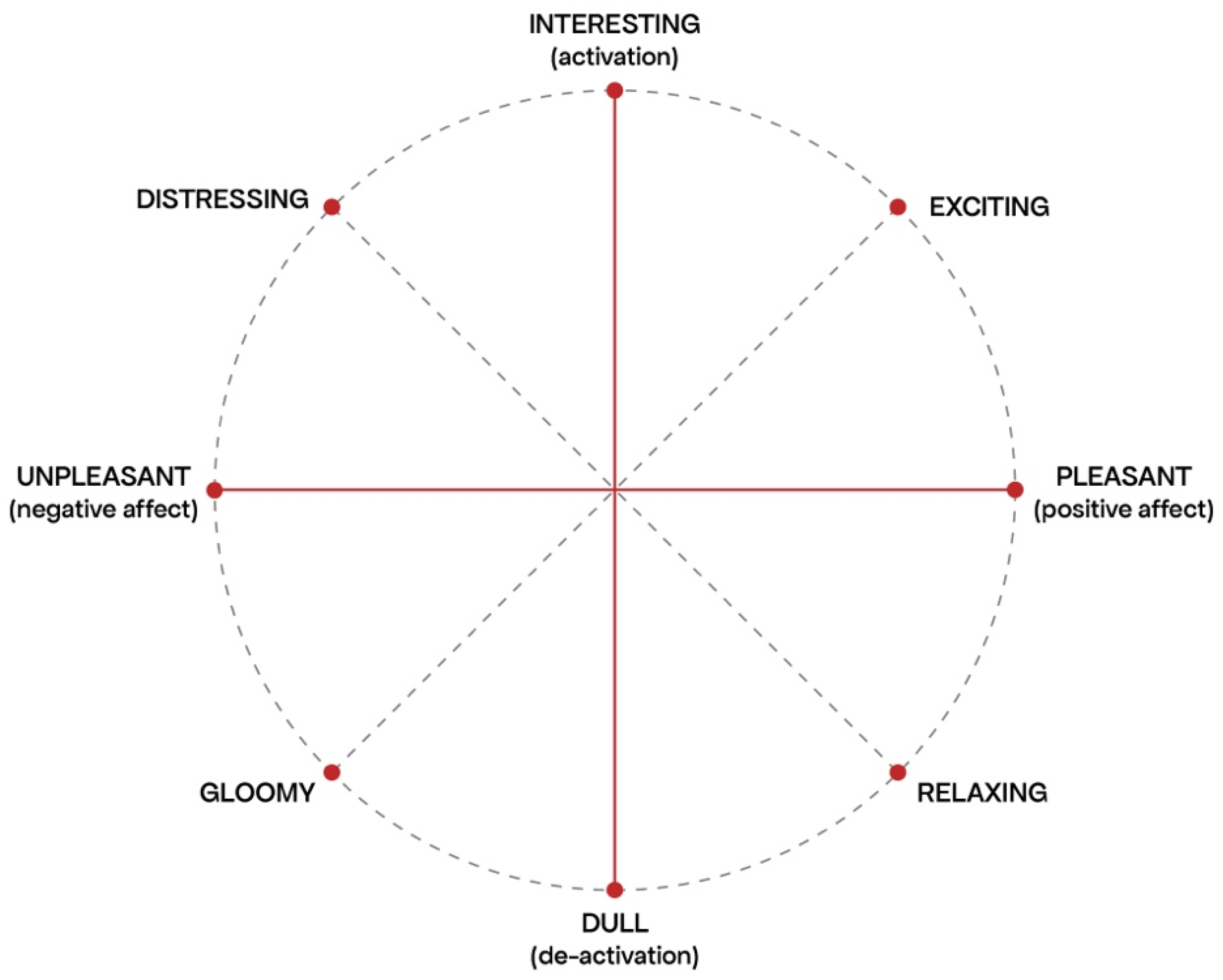
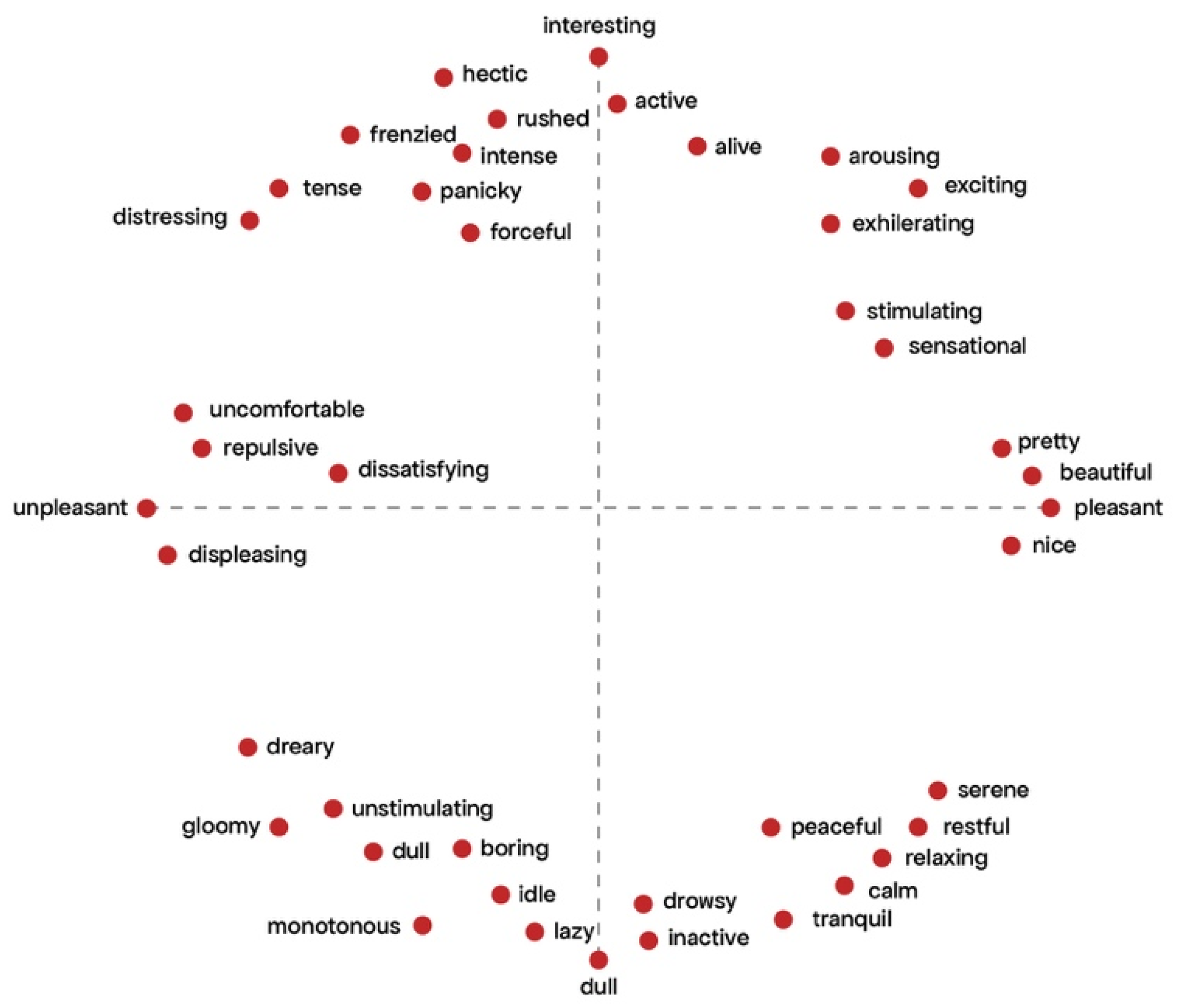
| Codes Describing Positive Affective Quality | Adjectives | Codes Describing Negative Affective Quality | Adjectives |
|---|---|---|---|
| Interesting | Intense | Dull | Inactive |
| Arousing | Drowsy | ||
| Active | Idle | ||
| Alive | Lazy | ||
| Forceful | Slow | ||
| Exciting | Exhilarating | Gloomy | Dreary |
| Sensational | Dull | ||
| Stimulating | Unstimulating | ||
| Exciting | Monotonous | ||
| Interesting | Boring | ||
| Pleasant | Pleasant | Unpleasant | Dissatisfying |
| Nice | Displeasing | ||
| Pleasing | Repulsive | ||
| Pretty | Unpleasant | ||
| Beautiful | Uncomfortable | ||
| Relaxing | Tranquil | Distressing | Frenzied |
| Serene | Tense | ||
| Peaceful | Hectic | ||
| Restful | Panicky | ||
| Calm | Rushed |
| Theme | Sub-Themes | Codes |
|---|---|---|
| Affective experience | Emotional well-being (eudaimonic and hedonic) | Exciting Body Olfactory Pace Pleasant Visual Weather |
| Environmental restorativeness | Auditory Olfactory Relaxing Vegetation Water |
| Experiential Qualities | Affects | Environment | Visual Code | Physical Feature | |
|---|---|---|---|---|---|
| Walkers | Relaxation Pleasure | Freedom | Openness |  | Embankment Slow line |
| Restoration | Water edge |  | Embankment Slow line | ||
| Restoration Interest | Sequence |  | Row of trees | ||
| Restoration Immersion Participation Involvement | Vegetation edge Narrowness Threshold |  | Parco del Trebbia (PC setting) | ||
| Cyclists | Relaxation Pleasure Arousal Excitement | Freedom | Openness |  | Embankment Slow line |
| Excitement Anticipation Participation | Linearity |  | Curves | ||
| Interest Anticipation Immersion | Vegetation edge Water edge (Landmark) |  | Bocca dell’Adda (CBA setting) |
Disclaimer/Publisher’s Note: The statements, opinions and data contained in all publications are solely those of the individual author(s) and contributor(s) and not of MDPI and/or the editor(s). MDPI and/or the editor(s) disclaim responsibility for any injury to people or property resulting from any ideas, methods, instructions or products referred to in the content. |
© 2026 by the authors. Licensee MDPI, Basel, Switzerland. This article is an open access article distributed under the terms and conditions of the Creative Commons Attribution (CC BY) license.
Share and Cite
Riga, D.; Pileri, P. Emotional Well-Being and Environmental Restorativeness in Slow Travel: Experiential Qualities and Motivational Possibilities. Sustainability 2026, 18, 3895. https://doi.org/10.3390/su18083895
Riga D, Pileri P. Emotional Well-Being and Environmental Restorativeness in Slow Travel: Experiential Qualities and Motivational Possibilities. Sustainability. 2026; 18(8):3895. https://doi.org/10.3390/su18083895
Chicago/Turabian StyleRiga, Dafni, and Paolo Pileri. 2026. "Emotional Well-Being and Environmental Restorativeness in Slow Travel: Experiential Qualities and Motivational Possibilities" Sustainability 18, no. 8: 3895. https://doi.org/10.3390/su18083895
APA StyleRiga, D., & Pileri, P. (2026). Emotional Well-Being and Environmental Restorativeness in Slow Travel: Experiential Qualities and Motivational Possibilities. Sustainability, 18(8), 3895. https://doi.org/10.3390/su18083895