1. Introduction
Soil–structure interfaces play a critical role in the performance of many geotechnical systems, particularly where granular soils interact with steel surfaces such as piles, retaining structures, pipelines, and shallow foundations [
1,
2,
3,
4]. The shear resistance mobilised at these interfaces governs load transfer, stability, deformation behaviour, and long-term serviceability. From a sustainability perspective, accurate characterisation of interface shear behaviour is essential for designing resource-efficient and resilient infrastructure, as it directly influences material consumption, safety margins, and long-term maintenance requirements. Consequently, understanding the mechanisms controlling interface shear strength, especially under large displacements, is fundamental for both safe engineering design and sustainable infrastructure development [
5,
6,
7,
8]. Among the various factors influencing interface behaviour, particle morphology, surface roughness, normal stress, and packing conditions have been widely recognised as primary contributors to granular–continuum friction [
9,
10,
11,
12].
In recent years, fibre reinforcement has emerged as an effective and increasingly sustainable technique for improving the mechanical behaviour of granular soils [
13,
14,
15,
16,
17]. Polypropylene and other synthetic fibres have been widely used to enhance internal shear strength, ductility, crack resistance, and post-peak stability by forming tensile bridges across shear planes and restricting particle rearrangement [
18,
19,
20,
21,
22]. When fibres are sourced from waste streams or industrial by-products, their use aligns with circular-economy principles by promoting material reuse and reducing reliance on virgin resources, thereby supporting Sustainable Development Goal (SDG) 12: Responsible Consumption and Production. Fibre-reinforced sands have been shown to exhibit improved dilation, greater energy dissipation, and enhanced peak and residual strengths across a range of stress paths and densities [
23,
24]. However, the majority of existing research has focused on the internal shear behaviour of sand–fibre mixtures, with comparatively little attention given to the interface shear behaviour between fibre-reinforced soils and steel surfaces, which often governs long-term performance and serviceability.
The limited studies on soil–structure interfaces involving fibres have typically employed direct shear devices, which, despite their practicality, cannot reliably capture full post-peak and residual behaviour due to restrictions in shear displacement [
8]. By contrast, the ring-shear apparatus enables continuous and unlimited shear displacement, making it particularly suitable for investigating both peak and residual interface resistance under controlled normal stresses [
7]. This capability is critical for assessing long-term interface performance, including degradation and residual strength mobilisation, which are directly linked to infrastructure durability, resilience, and life-cycle sustainability.
Interface behaviour becomes more complex in the presence of fibres due to the coupled effects of particle morphology, surface texture, and fibre geometry. Fibres can significantly modify local stress distribution at the interface by bridging sand grains, increasing dilation, and enhancing particle–asperity interlock, particularly on rough steel surfaces [
25,
26]. At the same time, excessive fibre contents may disrupt the granular skeleton, reduce packing efficiency, and increase compressibility, resulting in reduced shear resistance beyond an optimum fibre dosage [
18,
23,
27]. Identifying this optimum is not only a mechanical concern but also a sustainability issue, as it avoids unnecessary material use while maximising performance. These interacting mechanisms highlight the need for a systematic investigation that quantifies the combined roles of fibre content, sand morphology, porosity, and surface roughness in governing sand–steel interface response.
In parallel with experimental advances, artificial intelligence (AI) and machine learning (ML) techniques have increasingly been adopted to address complex geotechnical behaviours that cannot be adequately represented by closed-form analytical models [
26]. Interface shear behaviour is governed by strongly nonlinear interactions among particle-scale descriptors, surface roughness, fabric evolution, and stress level, making it well suited to data-driven modelling approaches. Recent studies have demonstrated that ML methods—including neural networks, ensemble learning, and hybrid frameworks—can predict interface shear strength parameters for sand–steel and sand–rubber systems with high accuracy [
7,
27]. Nevertheless, purely data-driven models often lack physical interpretability and may yield non-physical predictions outside their calibration domain, which limits their reliability for sustainable, design-oriented applications.
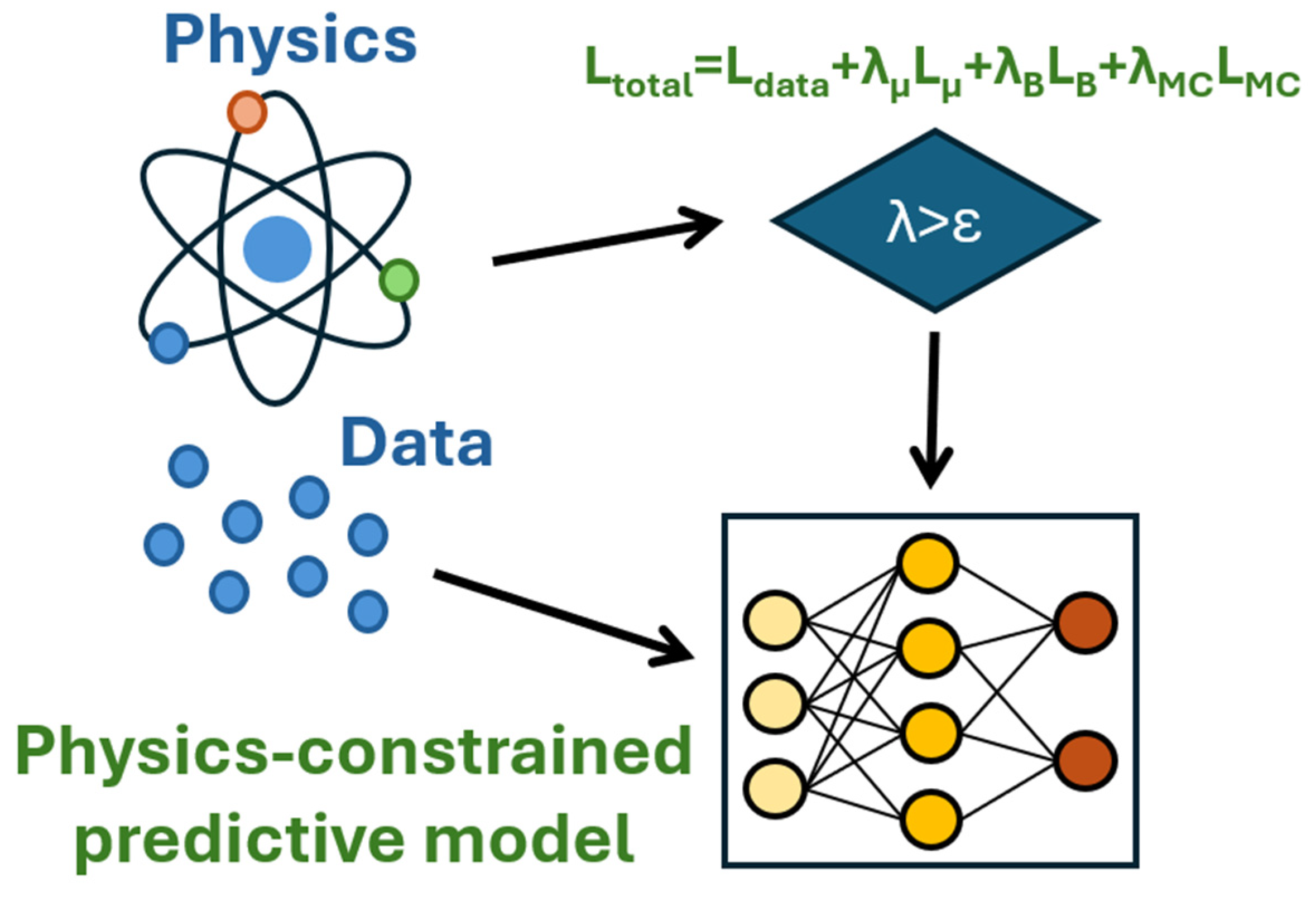
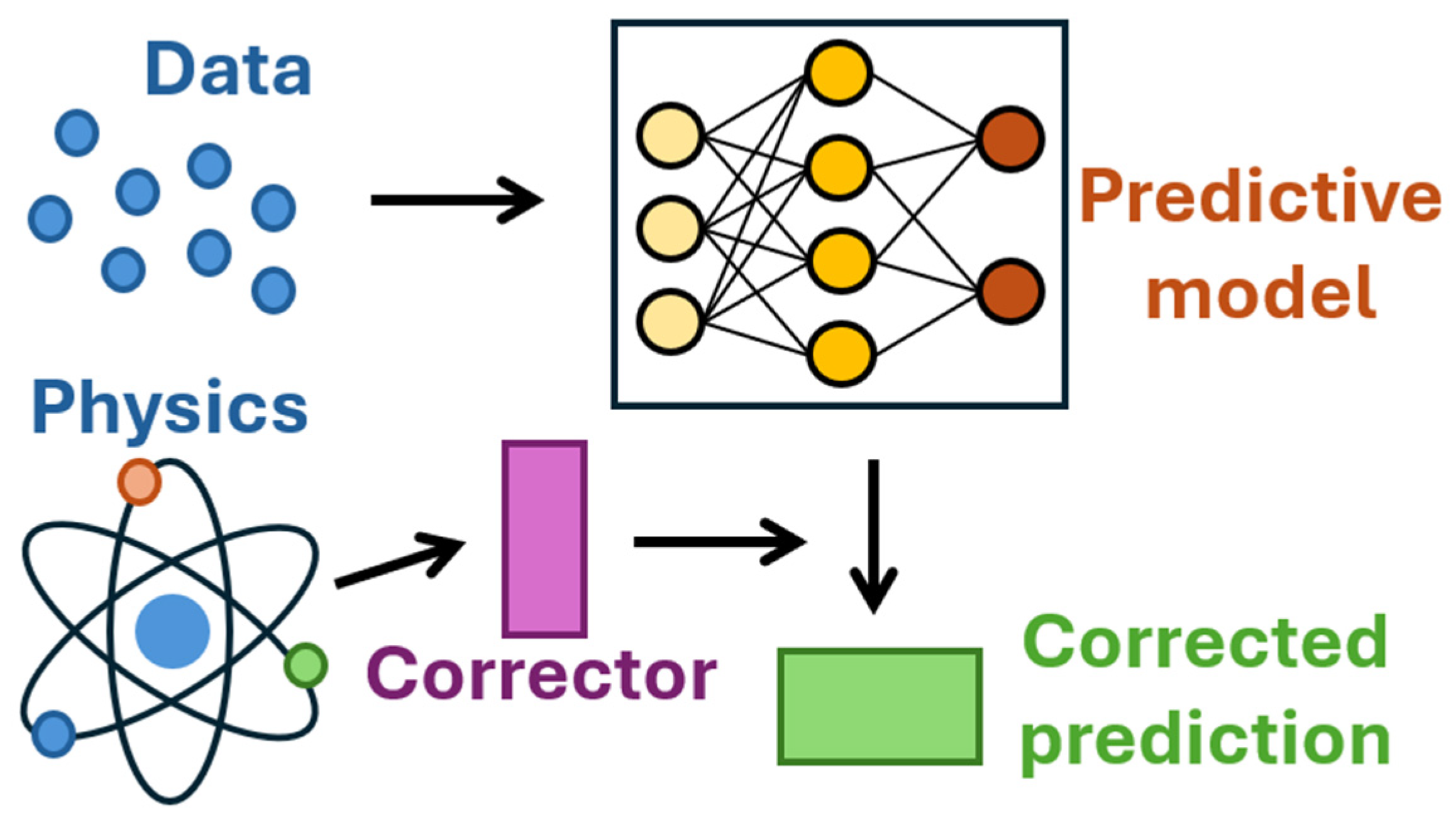
To address these limitations, physics-guided and hybrid modelling frameworks have emerged as a promising alternative, combining the expressive capability of ML with constraints derived from established soil mechanics principles. By embedding physical relationships, such as stress-dependent friction, strength ratios, or constitutive envelopes, into the learning process, these approaches improve robustness, generalisation, and interpretability. From a sustainability standpoint, such hybrid frameworks contribute to SDG 9 (Industry, Innovation and Infrastructure) by enabling more reliable, resource-efficient, and resilient infrastructure design through reduced uncertainty and overdesign. Despite these advances, existing AI-based studies on soil–structure interfaces have largely focused on unreinforced granular materials or small-displacement testing, and very limited work has integrated large-displacement ring-shear data with physics-guided learning for fibre-reinforced sand–steel interfaces.
Despite the extensive literature on soil–structure interfaces and fibre-reinforced sands, key gaps therefore remain. Large-displacement interface behaviour of sand–fibre mixtures against steel surfaces has not been systematically characterised, and the combined influence of fibre content, particle morphology, packing state, surface roughness, and normal stress on both peak and residual interface resistance remains insufficiently quantified. Moreover, predictive frameworks that integrate large-displacement experimental data with physics-guided AI to support sustainable, design-oriented decision-making for fibre-reinforced sand–steel interfaces are still scarce [
7,
26,
27].
Accordingly, this study presents a combined experimental and physics-guided modelling investigation of sand–polypropylene fibre mixtures sheared against smooth and rough steel interfaces using a ring-shear apparatus capable of capturing both peak and residual responses. The experimental programme systematically examines the effects of fibre content, sand morphology, packing state, surface roughness, and normal stress on interface shear strength and post-peak behaviour. To translate these observations into a predictive and physically consistent framework, purely data-driven and physics-guided machine learning models are developed and compared, with particular emphasis on accuracy, robustness, and consistency with classical soil mechanics. By linking large-displacement interface behaviour with hybrid AI modelling, the study provides design-oriented insights that support sustainable ground improvement, material efficiency, and resilient infrastructure development.
Despite the increasing application of machine learning in geotechnical material modelling, most existing studies remain either purely data-driven or limited to empirical correlations without embedding physical consistency checks. In particular, previous works rarely integrate physics-based constraints with explainable artificial intelligence frameworks for stabilised soils. As a result, predictive models may achieve high statistical accuracy but lack interpretability and physical reliability.
Therefore, this study addresses the following gap: the absence of a physics-guided, interpretable machine learning framework capable of predicting stabilised soil strength while ensuring consistency with fundamental geotechnical principles.
The substantive contributions of this study are as follows:
- -
Development of a physics-guided ML framework incorporating geotechnical constraints.
- -
Integration of explainability techniques (e.g., SHAP) to interpret parameter influence.
- -
Demonstration of reduced laboratory testing demand through reliable strength prediction.
- -
Validation against physical consistency criteria rather than statistical metrics alone.
4. Results and Discussion
4.1. Effect of Fibre Content
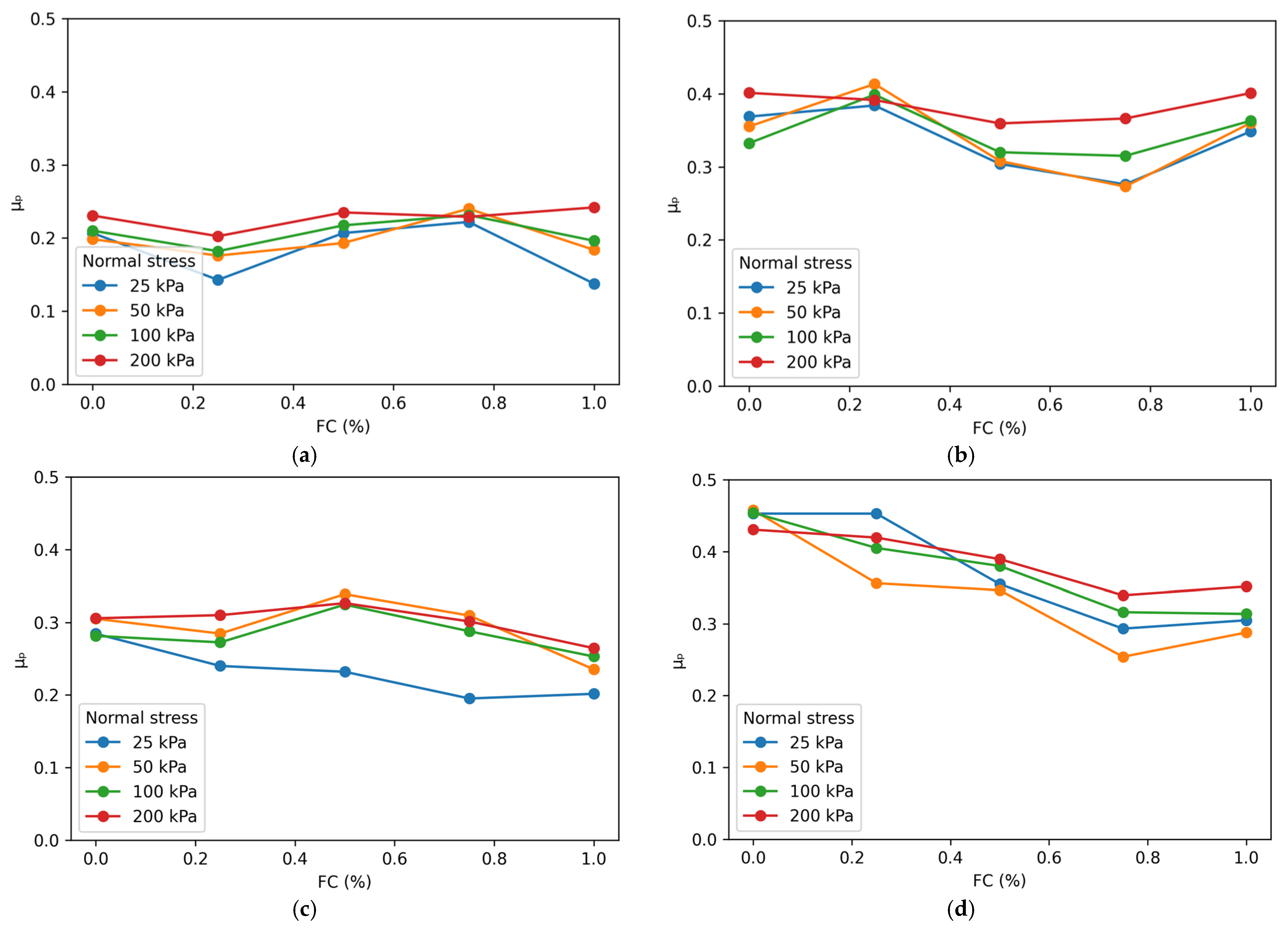
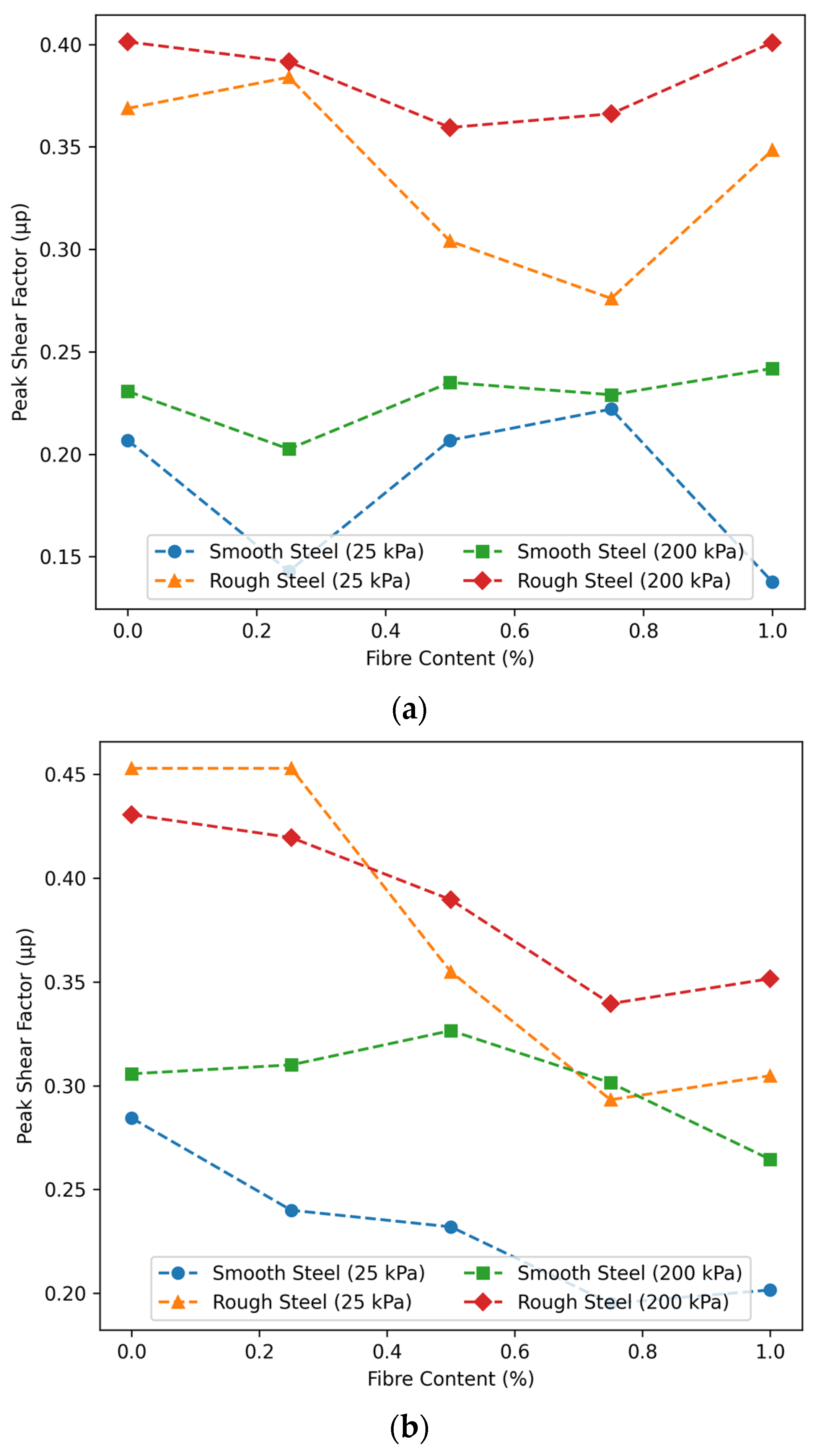
Fibre content had a pronounced but nonlinear influence on the interfacial shear resistance of both sands. The variation in the interface shear coefficient (μ
p) with fibre content (FC%) at different normal stresses is shown in
Figure 11. Across all conditions, μ
p increased with fibre addition up to an optimum of approximately 0.5%, beyond which a slight reduction was observed. This behaviour was consistent for both sands and both steel surfaces, although the magnitude of improvement differed.
For Sand A, μp increased steadily as FC rose from 0% to 0.5%, with peak improvements typically ranging from 20 to 30%, depending on the applied normal stress. At 50 kPa, for example, μp increased from about 0.20 in the unreinforced condition to approximately 0.26 at 0.5% FC. At 1.0% FC, μp decreased slightly to values close to the unreinforced case. A similar trend was observed under 100 and 200 kPa, indicating that moderate fibre inclusion enhances particle–steel interlock by promoting dilation and restraining particle movement during shear.
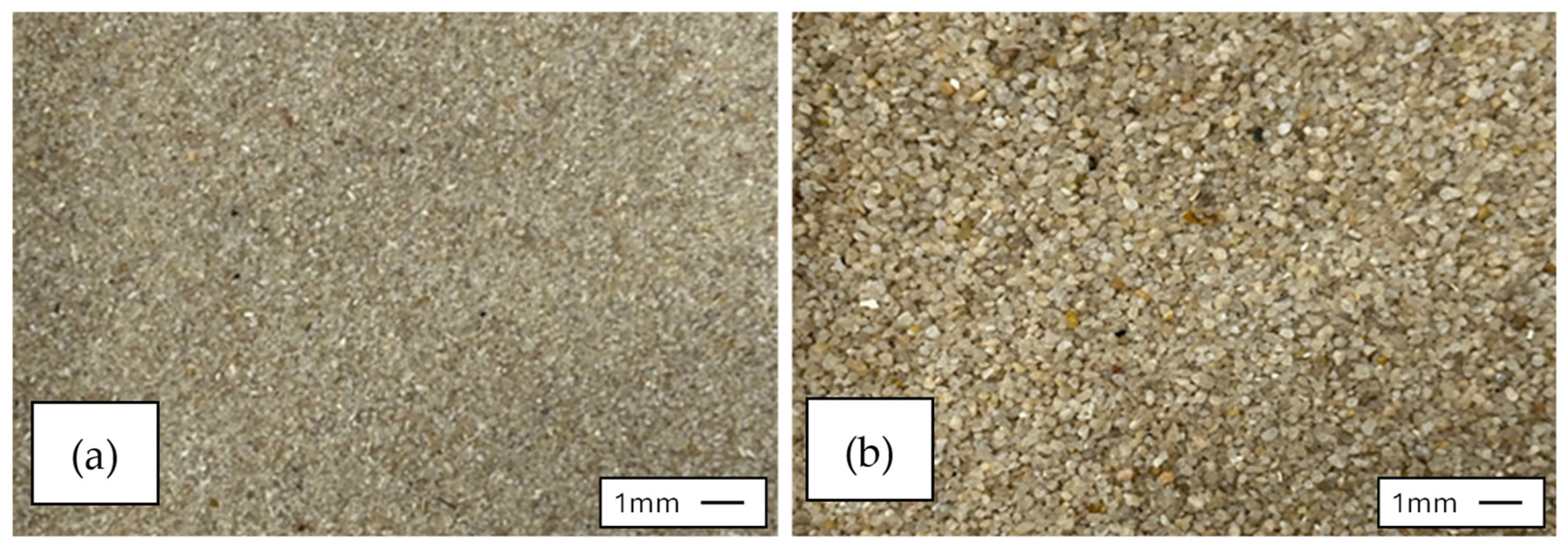
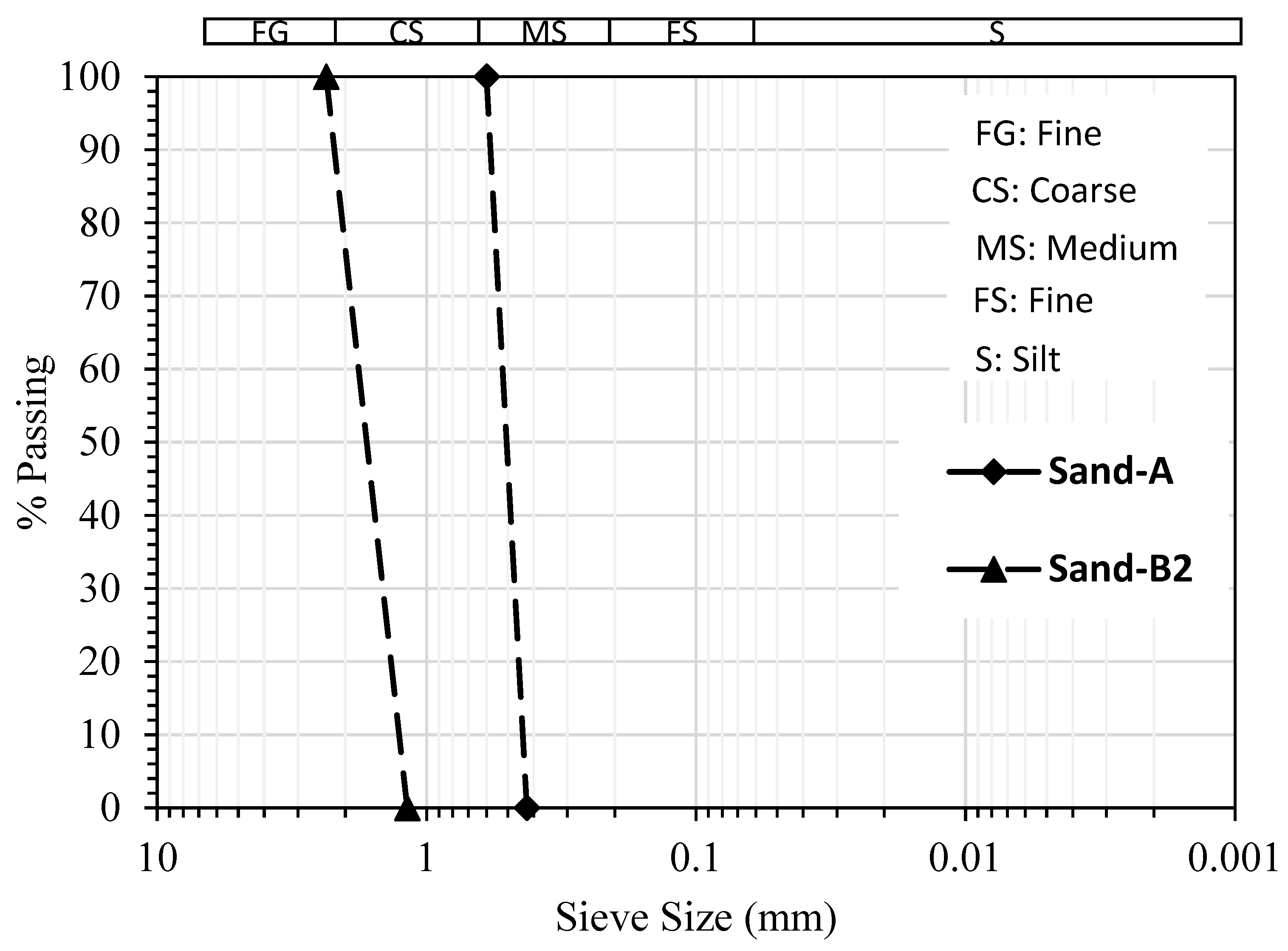
Sand B2, which is coarser and more irregular in shape, exhibited the same general pattern but with more subdued improvements at low normal stresses. Under 25 and 50 kPa, the increase in μp was modest, reflecting limited fibre mobilisation in a relatively open granular skeleton. However, at 100 and 200 kPa, μp increased more substantially, rising from roughly 0.21 to 0.27 at 0.5% FC under 200 kPa. This suggests that confinement plays a stronger role in fibre mobilisation for coarser sands: fibres contribute more effectively when the mixture is sufficiently compacted to constrain their movement.
Surface roughness also influenced the magnitude of fibre-induced improvement [
59,
60]. The rough steel interface consistently yielded higher μ
p values across all fibre contents due to deeper particle–asperity engagement [
61,
62].
At fibre contents above 0.5%, μp declined slightly for both sands. This reduction is attributed to localised fibre clustering, which interrupts the granular skeleton, reduces packing efficiency, and increases compressibility. As a result, excessive fibre content impedes contact between sand grains and steel asperities, offsetting the reinforcement benefits.
In summary, fibre addition enhanced interface shear resistance up to an optimum of 0.5%, after which the mixture became less effective in mobilising shear. The degree of improvement depended on sand morphology, normal stress, and surface roughness, but the overall trend of μp increasing then decreasing was consistent across all test conditions.
4.2. Influence of Porosity
Porosity (
η) exhibited a clear and consistent influence on peak interface shear strength (τ
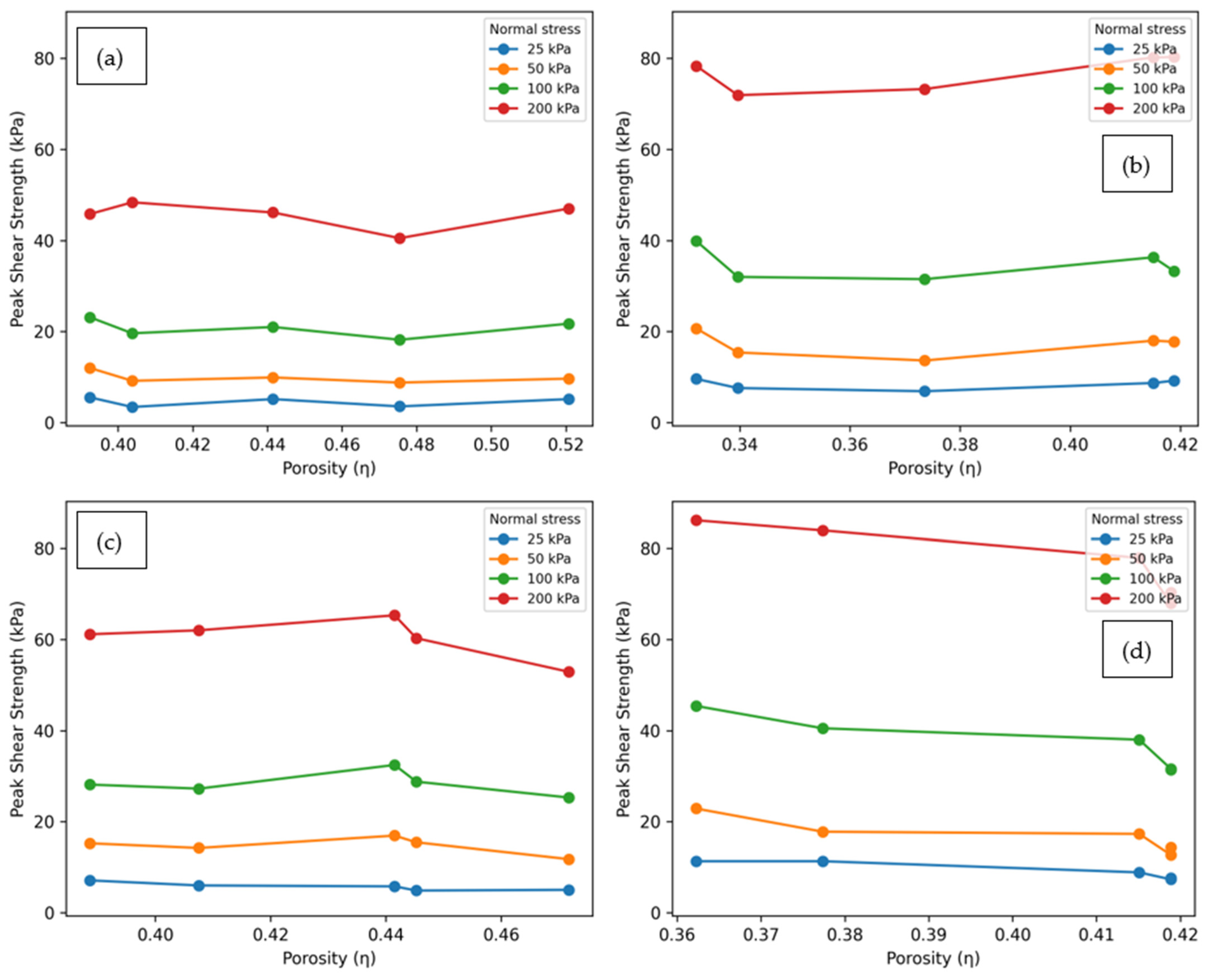
p) for both sands across all normal stresses and surface conditions. The relationship between τ
p and n is shown in
Figure 12. In all cases, τ
p decreased with increasing porosity, demonstrating that denser mixtures with lower n mobilised greater shear resistance at the sand–steel interface.
For Sand A, which is finer and more regular in shape, τp was highly sensitive to changes in porosity. At 50 kPa, for example, τp decreased from approximately 63 kPa at n ≈ 0.355 to about 46 kPa at n ≈ 0.385. Similar reductions were observed at other stress levels, confirming that particle packing plays a major role in governing the number and stability of load-bearing contacts during shear. Because Sand A forms a more uniform granular skeleton, even small increases in n reduce the number of active particle–asperity interactions, leading to noticeable declines in shear resistance.
Sand B2, which contains coarser and more angular particles, showed a less steep decline in τp with increasing n. While τp still decreased as porosity increased, the larger particles of Sand B2 maintained stronger mechanical interlock, which mitigated the sensitivity to packing changes. Nevertheless, the general trend of reduced τp at higher porosities was consistent with that of Sand A, indicating that porosity remains a key determinant of interface shear behaviour regardless of particle morphology.
Surface roughness also moderated the effect of porosity. For both sands, τp values on the rough steel interface were consistently higher than those on the smooth surface, and the rate of strength reduction with increasing n was less pronounced. The rough surface provides deeper asperity engagement, which partially compensates for the loss of internal packing density. As a result, even mixtures with relatively high porosity were able to mobilise significant shear resistance when sheared against the rough interface.
Across both sands and interfaces, the influence of porosity extends beyond particle packing to the effectiveness of fibre mobilisation [
63,
64]. At lower porosity (dense mixtures), fibres are better confined within the sand matrix and mobilise tensile resistance more efficiently during shear [
65,
66]. As porosity increases, confinement decreases, allowing fibres to slip or rotate within the shear zone, leading to reduced contribution to τ
p [
67].
Overall, the results confirm that porosity is a dominant factor controlling peak interface shear strength, with lower n leading to stronger particle interlock, better fibre engagement, and higher τp. The mitigating influence of rough surface textures further emphasises the combined importance of packing density and surface asperity in determining the magnitude of interface resistance.
4.3. Effect of Normalised Roughness
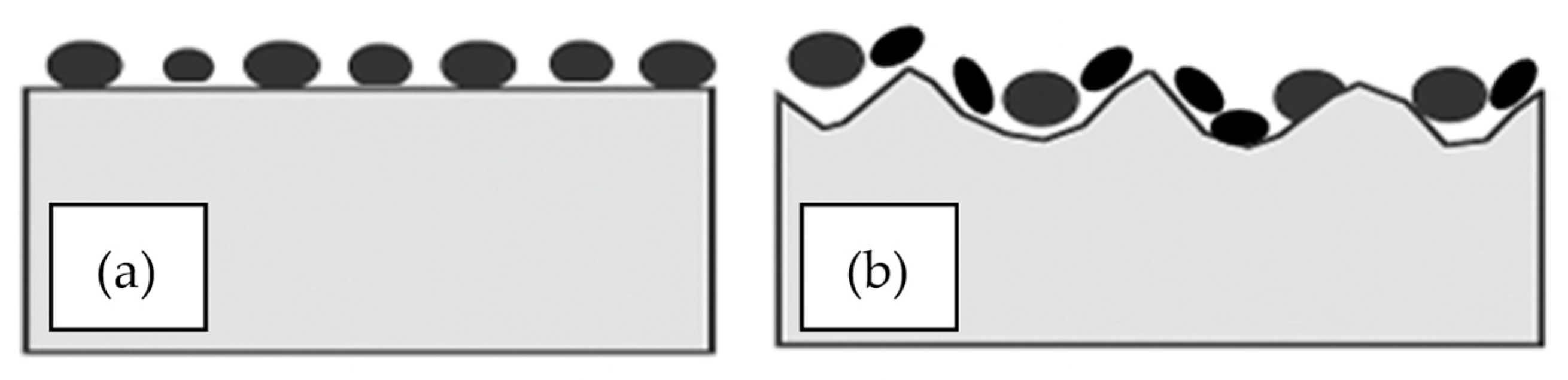
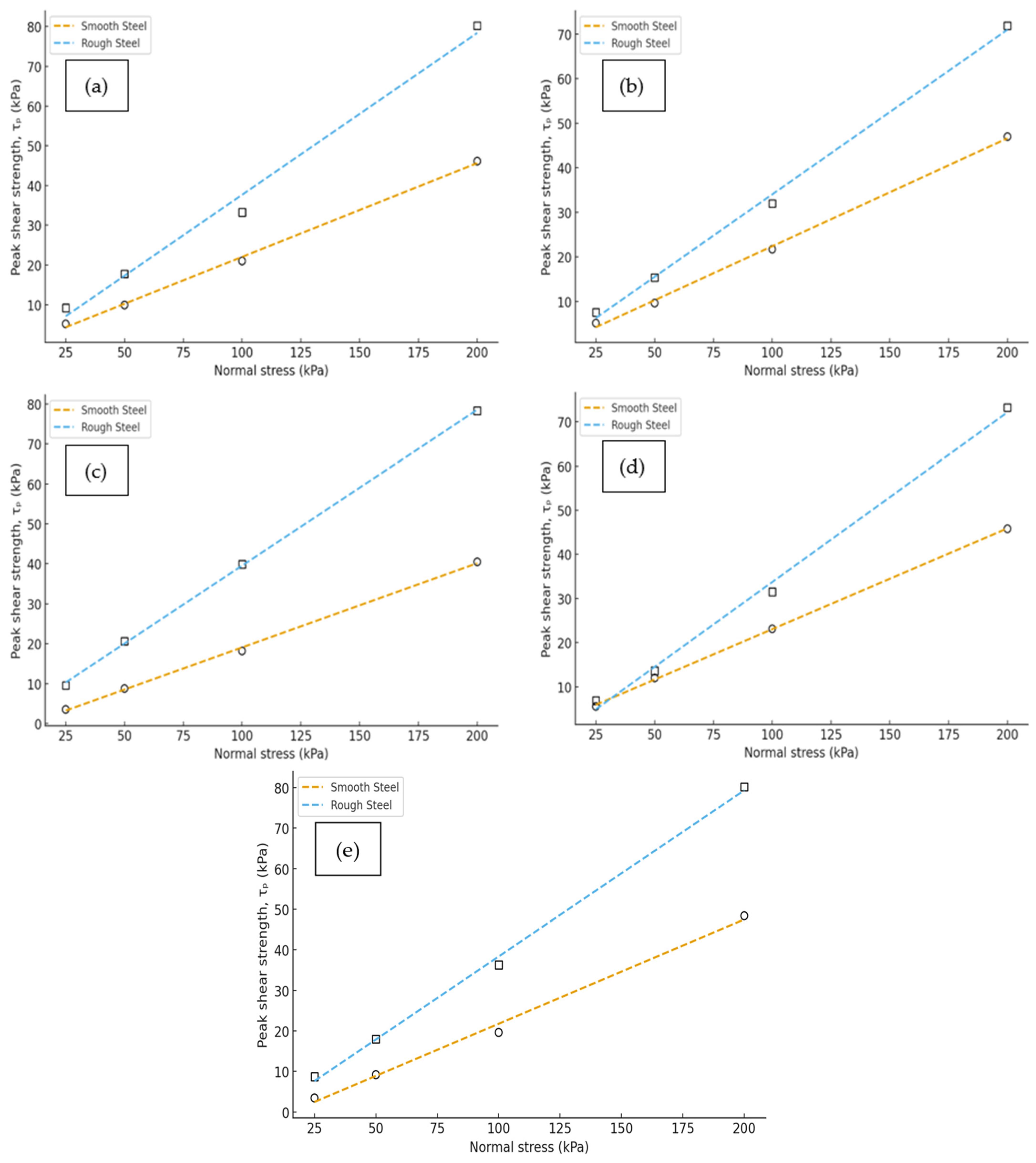
Normalised roughness (Rn = Rt/D50) had a strong and consistent influence on the peak interface shear strength (τp) of the sand–fibre mixtures. Across all fibre contents and normal stresses, the rough steel surface (higher Rn) mobilised significantly higher τp values than the smooth surface, demonstrating that geometric asperity height remains a primary factor governing interface resistance.
These values show that the rough steel surface provides roughly double the normalised roughness of the smooth surface for both sands, which directly contributes to the increased mechanical interlock observed in the τp results.
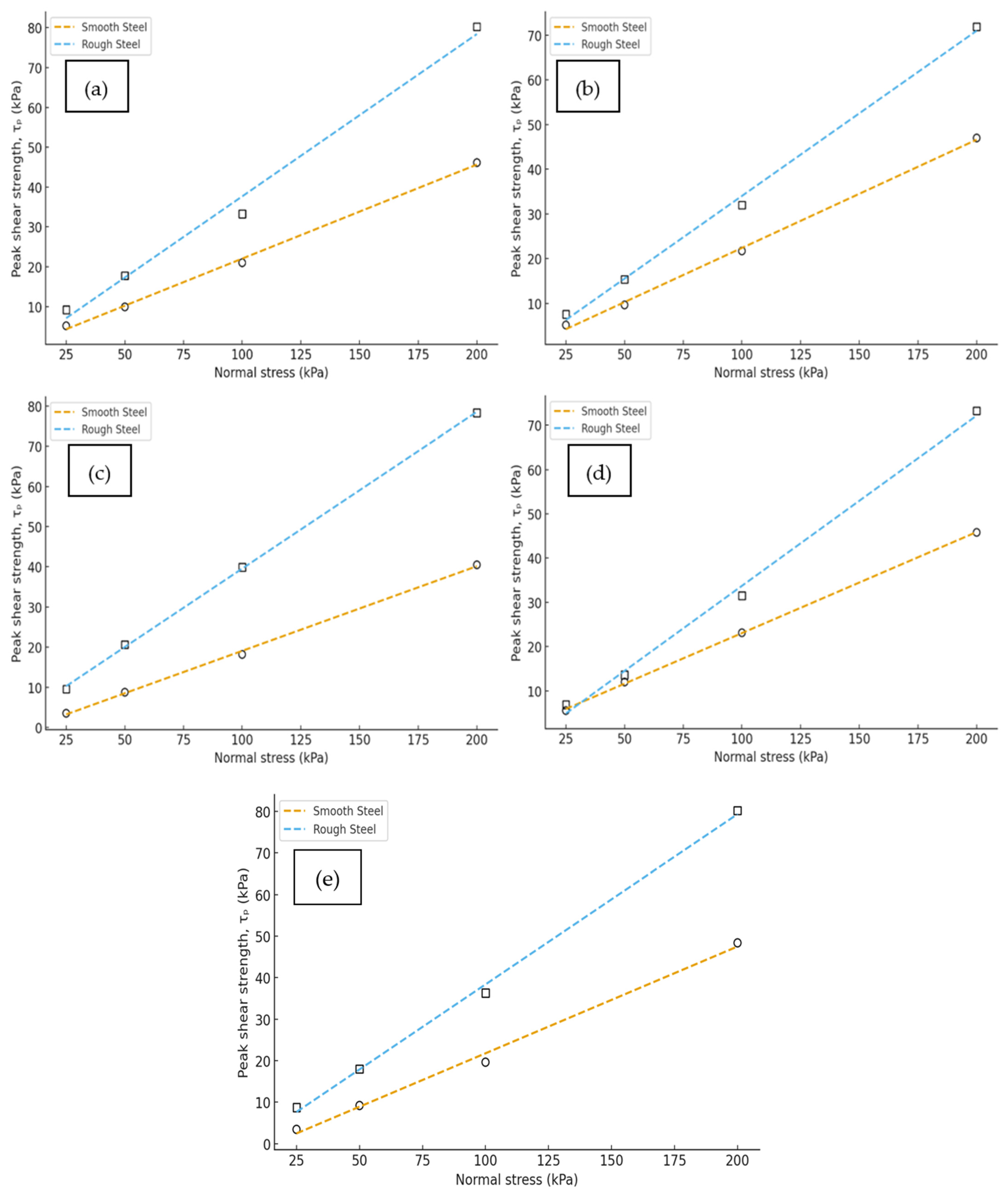
For Sand A, τ
p increased nearly linearly with normal stress on both surfaces, but the rough interface consistently produced higher shear resistance at every fibre content, as shown in
Figure 13. The difference between surfaces became more pronounced at intermediate fibre contents (0.25–0.5%) and at higher normal stresses (≥100 kPa). For example, at 0.5% FC and 100 kPa, τ
p on the rough surface exceeded that on the smooth surface by more than 20%. This behaviour reflects the enhanced ability of fibres to promote dilation, which in turn allows sand grains to engage more deeply with surface asperities when R
n is greater.
For Sand B2, a similar pattern was observed, although the magnitude of roughness-induced enhancement was somewhat smaller due to its coarser grain size, as shown in
Figure 14. At low fibre contents (0–0.25%), the difference in τ
p between rough and smooth surfaces was modest, indicating that particle morphology dominated the interface response. However, as fibre content increased to 0.5% and beyond, the influence of roughness became more significant, particularly under higher normal stresses. This suggests that fibre-induced dilation enables coarser particles to interact more effectively with surface asperities when confinement is sufficient to stabilise the shear zone [
68].
Figure 15 highlights the relative difference in τ
p between the smooth and rough surfaces across all fibre contents. The curves diverge with increasing normal stress, confirming that the effect of Rn is stress-dependent. At σ
n ≥ 100 kPa, grains are pressed more firmly into the surface, increasing the real contact area and amplifying the contribution of asperity interlock. This trend aligns with the observed reduction in post-peak softening on the rough interface (
Section 4.5), where both fibres and surface texture contribute to more stable deformation.
To isolate the behaviour on the rough surface,
Figure 16 presents τ
p for Sand A at normal stresses of 100 and 200 kPa across all fibre contents. The positive slope of each curve indicates that τ
p increases with fibre content up to 0.5%, while the spacing between curves demonstrates the strong influence of applied stress. At 200 kPa, τ
p values are significantly higher, confirming that asperity engagement on the rough surface is strongly mobilised by increased confinement.
Overall, the results show that normalised roughness is one of the most influential parameters governing interface shear strength. Higher R
n increases particle–asperity interlock, enhances the mobilisation of fibre-induced dilation, and reduces the rate of post-peak degradation. These effects become increasingly dominant at higher fibre contents and under elevated normal stresses, emphasising the combined roles of surface geometry, stress level, and fibre reinforcement in controlling interface resistance [
69,
70].
4.4. Shear Stress–Displacement Behaviour
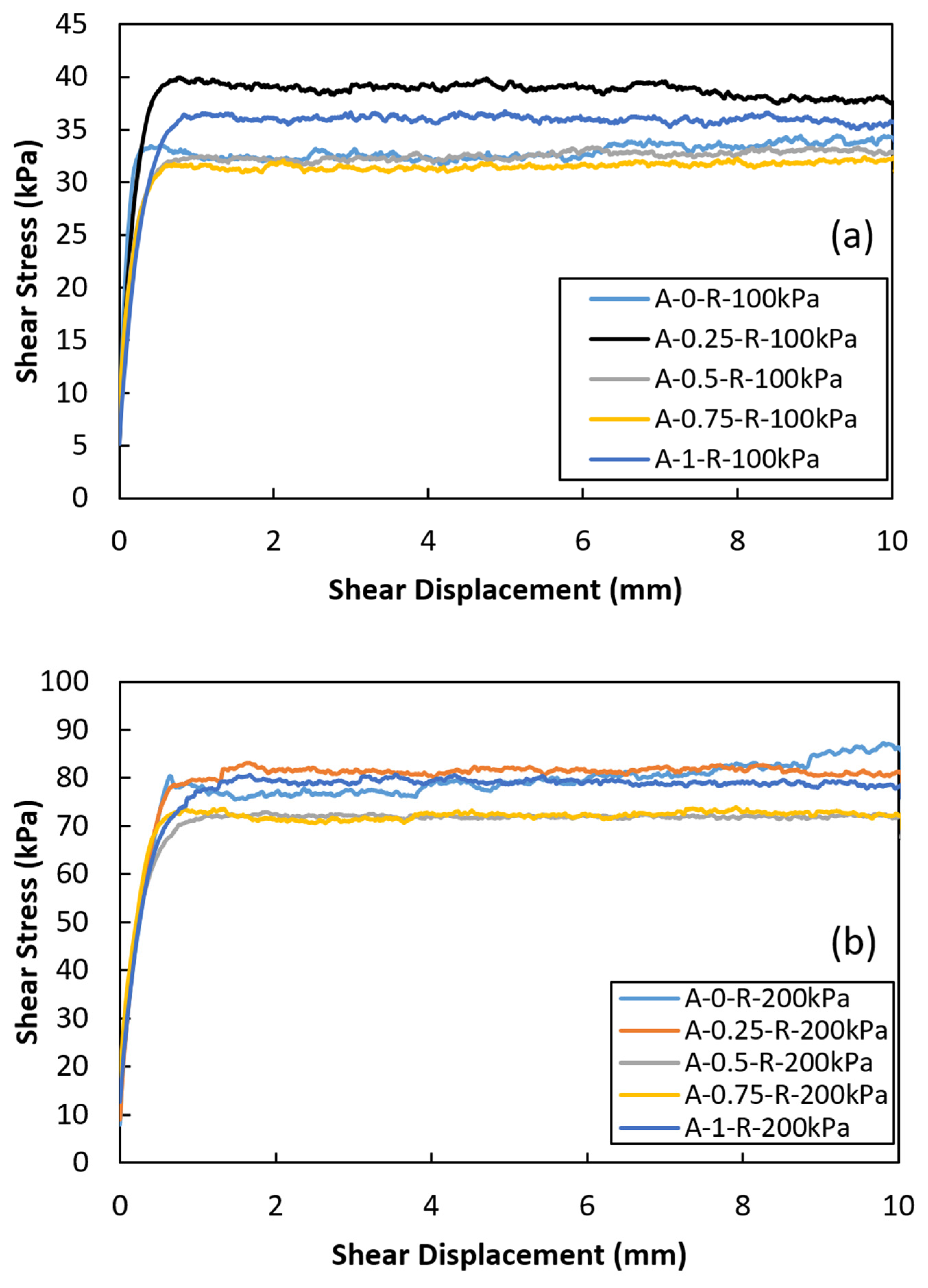
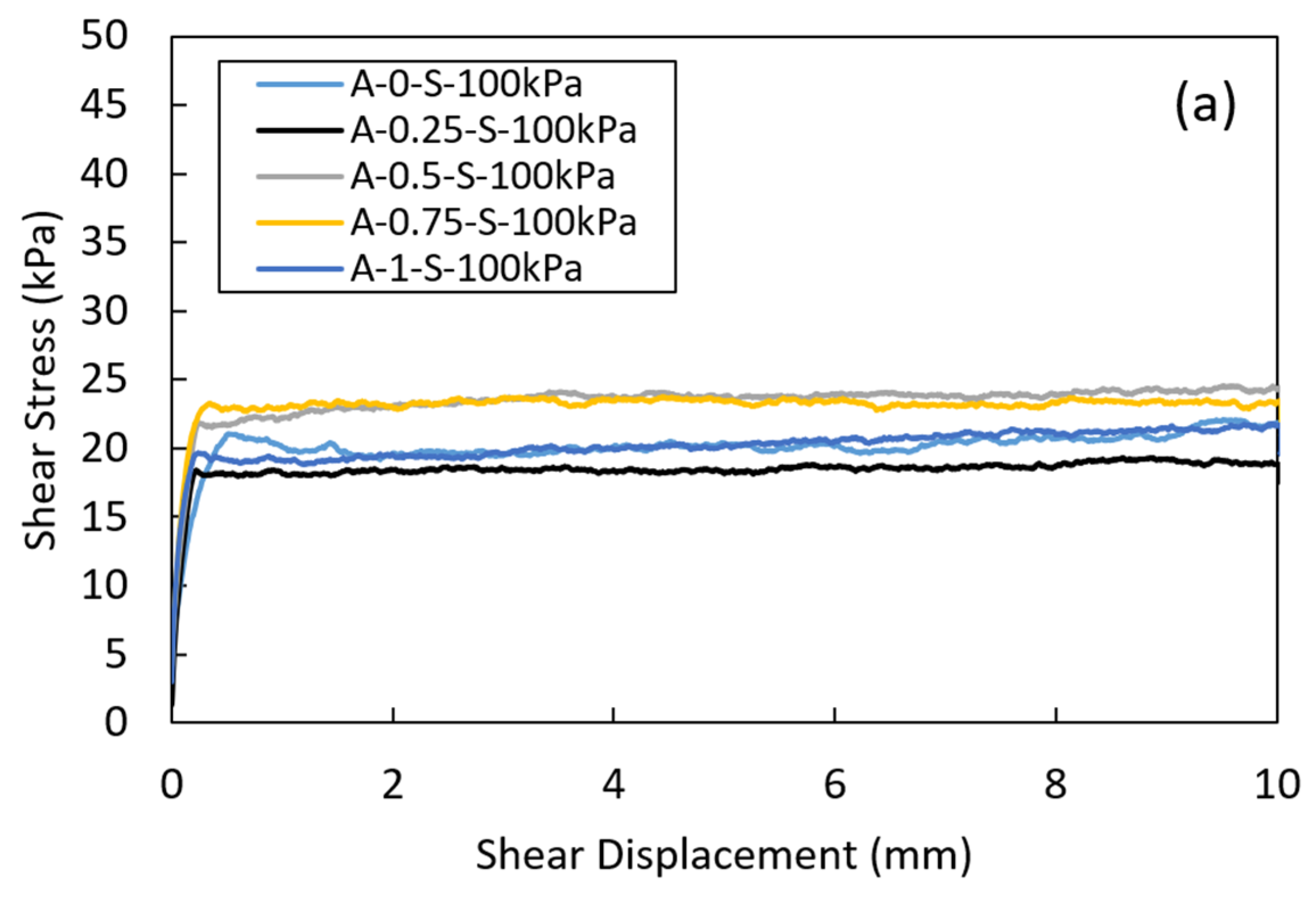
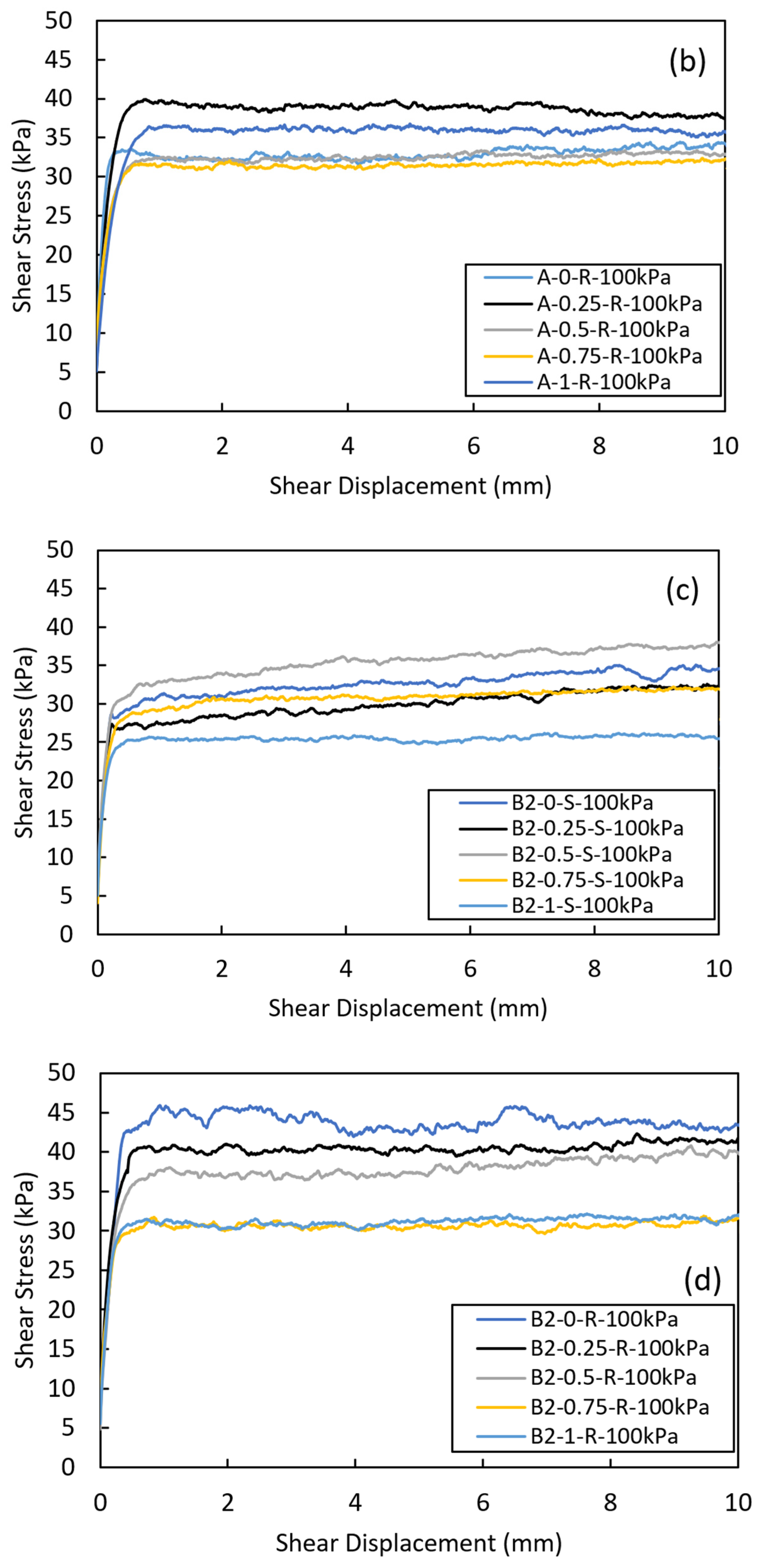
The shear stress–displacement curves presented in
Figure 17 illustrate the influence of fibre inclusion and surface roughness on the mobilisation and evolution of interfacial resistance for both sands. In all cases, shear stress increased rapidly at small displacements, reached a peak, and then transitioned toward a residual value. The slope, peak magnitude, and post-peak evolution varied systematically with sand type, fibre content, and steel surface texture.
For mixtures tested against the smooth steel surface, both sands exhibited a peak-to-residual reduction in shear stress, indicating a mild strain-softening tendency rather than a strongly brittle response. The magnitude of softening was small, with the difference between peak and residual shear stress typically limited to only a few kPa. This behaviour is consistent with the limited mechanical interlock provided by the lower asperity height of the smooth interface. Fibre inclusion slightly reduced the peak-to-residual drop and extended the displacement required to reach residual strength, reflecting progressive fibre mobilisation. This effect was more evident in Sand A, likely due to its finer particle size and higher regularity, which enhanced confinement and facilitated fibre engagement. Nevertheless, the overall improvement in post-peak stability on the smooth surface remained modest due to restricted asperity interaction.
To better illustrate this subtle softening behaviour, the peak-to-residual reduction is quantified using Δτ = τp − τr (and the ratio τr/τp), as presented in the corresponding results.
In contrast, mixtures sheared against the rough steel interface developed higher peak stresses and exhibited steeper initial stress–displacement slopes. The increased asperity height enhanced grain–surface interlocking, resulting in stronger resistance to sliding. Fibre reinforcement amplified this effect, particularly at 0.25–0.50% fibre content, where the curves displayed a more gradual post-peak transition and improved residual stability. Enhanced dilation and deeper asperity engagement created a more stable shear zone, enabling fibres to sustain tensile resistance over a longer displacement range.
Sand B2, characterised by coarser and more angular particles, generally exhibited stiffer and stronger responses than Sand A across displacement. Even on the smooth interface, Sand B2 maintained higher peak and residual stresses due to improved grain interlock. On the rough surface, this effect became more pronounced, with sustained shear resistance beyond peak and smoother stress decay at larger displacements. At higher normal stresses (100–200 kPa), the stabilising influence of fibres increased further, consistent with improved fibre confinement and stronger particle–asperity interaction under greater normal loading.
Across all tests, the influence of fibre content on curve morphology followed the same nonlinear trend observed in the peak strength results. Fibre additions up to 0.5% enhanced curve stability and reduced the relative peak-to-residual drop, whereas higher contents occasionally produced local irregularities, attributed to fibre clustering. Such clustering may disrupt the granular skeleton locally, leading to slightly sharper post-peak reductions or less uniform residual behaviour.
Overall, the stress–displacement responses demonstrate that interface behaviour is governed by the combined effects of surface roughness, particle morphology, and fibre reinforcement [
71,
72]. Smooth interfaces produce comparatively sharper peaks with mild post-peak softening, whereas rough interfaces—particularly when combined with moderate fibre content—generate more stable, gradually evolving shear responses with higher sustained resistance.
4.5. Brittleness Index and the Role of Fibre Content
The post-peak behaviour of the interface was quantified by a brittleness index (B
raw), defined as in Equation (3) [
73]. To avoid confusion, we have revised the terminology in the manuscript and now refer to it as the post-peak strength reduction ratio (B) rather than the brittleness index. In a few tests, the measured residual strength slightly exceeded the identified peak value (τ
r > τ
p), mainly due to experimental scatter and the presence of an extended plateau in the τ–δ response. Since negative brittleness does not have a clear physical meaning in this context and these cases correspond to essentially perfectly plastic or mildly hardening behaviour, all B
raw < 0 were truncated to zero for plotting and statistical analysis:
Unless otherwise stated, the brittleness index B refers to this truncated measure.
This choice avoids artificial inflation of brittleness due to plateau-type responses without affecting comparative trends.
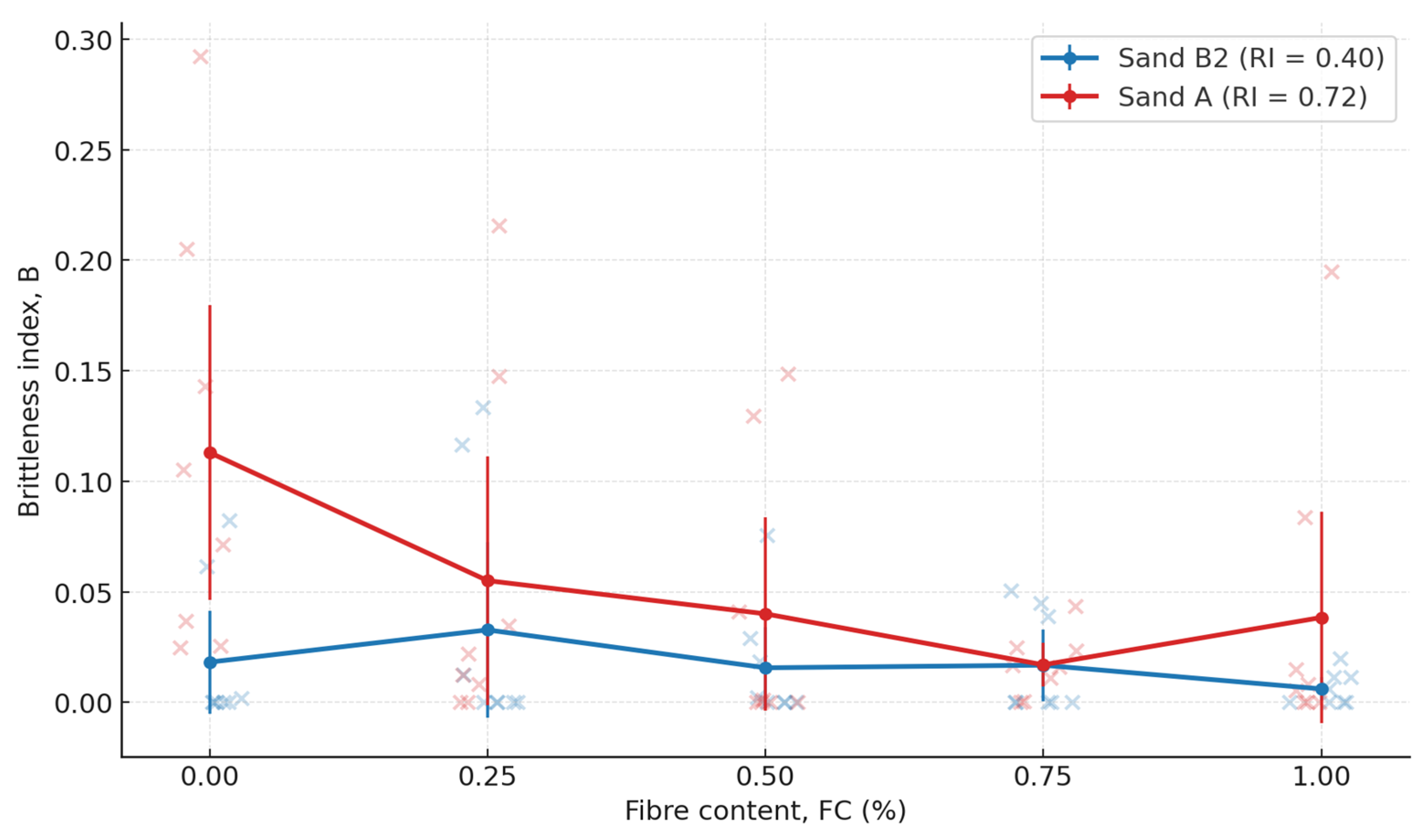
Figure 18 presents the variation in the mean brittleness index with fibre content for both sands, together with 95% confidence intervals and the underlying raw data.
For Sand A (PRI = 0.72), the addition of fibres produces a clear reduction in brittleness. At FC = 0%, the mean B is about 0.11, indicating a modest post-peak strength loss. Increasing FC to 0.25% and 0.50% reduces B to approximately 0.055 and 0.04, respectively, and the minimum brittleness is observed around FC = 0.75%, where B falls to less than 0.02. A slight increase in B at FC = 1.0% suggests that very high fibre contents do not further improve ductility and may even introduce local non-uniformities in the interface zone.
In contrast, Sand B2 (PRI = 0.40) exhibits generally low brittleness across the entire range of fibre contents, with mean B values mostly below 0.03. The influence of fibre content is therefore weaker for this sand, although a gradual reduction in B is still evident when moving from FC = 0.25–0.50% towards FC = 1.0%. This behaviour reflects the combined effect of particle shape and fibre bridging: the more angular Sand B2 benefits more from the fibres in terms of stabilising the post-peak response, whereas the sub-rounded Sand A already shows a relatively ductile interface, even without fibres [
74,
75].
4.6. Influence of Void Ratio on Brittleness and Peak Strength
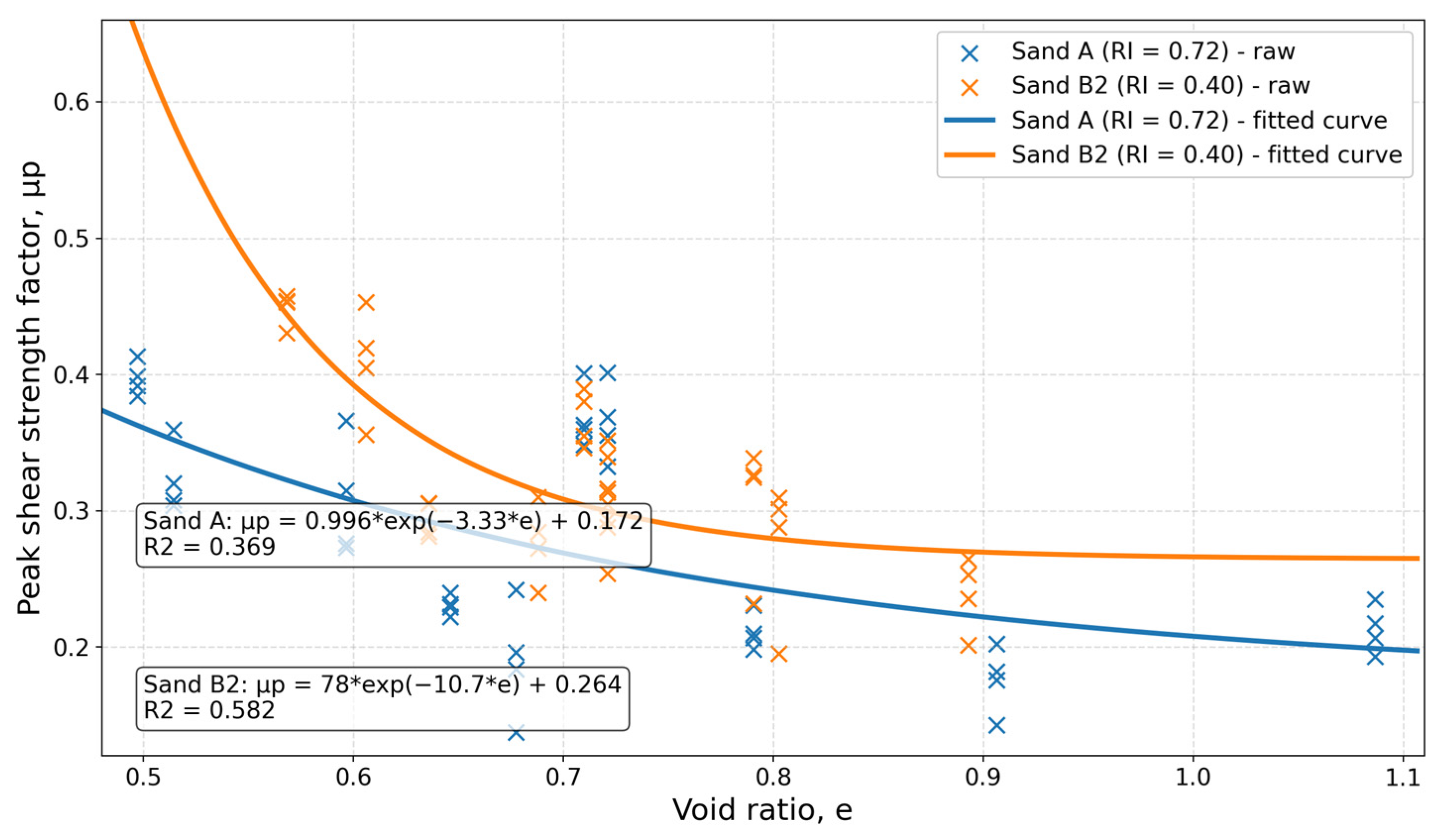
The influence of density was examined by plotting both the brittleness index and peak shear strength factor against the void ratio (e), as shown in
Figure 19. It should be noted that in this database, e does not vary independently from fibre content and interface roughness: each test condition is associated with a specific packing state. Therefore, the trends discussed below represent the combined effect of density and other parameters, and are interpreted together with the multivariate models.
4.7. Fibre Reinforcement
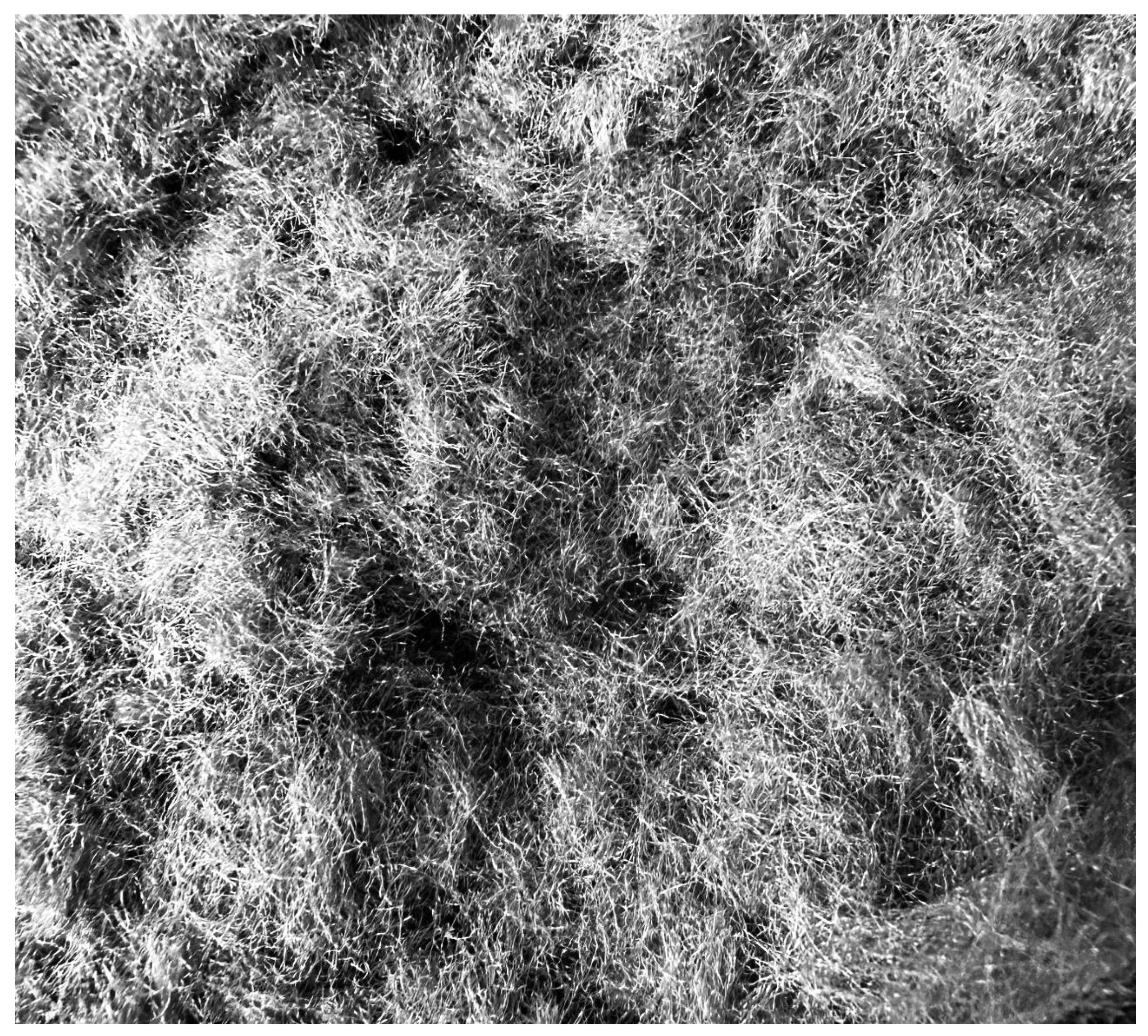
The addition of polypropylene fibres altered the shear response of the sand–steel interface by modifying particle rearrangement and deformation patterns within the shear zone. Across all tests, fibre inclusion resulted in a more stable stress–displacement response, reduced post-peak softening, and increased displacement capacity before reaching residual strength. These effects were observed for both sands and both steel surfaces, though with different magnitudes.
At low-to-moderate fibre contents, fibres were well integrated within the granular skeleton and contributed to higher peak shear resistance, particularly under higher normal stresses. This improvement is attributed to fibre bridging, which restricts particle sliding and enhances dilation during shear. The effect was more pronounced for the rough steel surface, where increased asperity height allowed the fibre-induced dilation to be better mobilised.
However, when fibre content increased beyond the optimum range, the mixtures exhibited reduced stability. Excess fibres formed localised clusters that increased compressibility and disrupted grain-to-grain contact, slightly reducing peak strength and accelerating the transition to residual strength.
Overall, the experimental results demonstrate that fibre reinforcement modifies the deformation mechanism at the sand–steel interface by improving internal force-chain stability and reducing brittleness. These effects underpin the more detailed trends presented in
Section 4.2, where the influence of fibre content on interface shear coefficient (μ
p) is examined quantitatively.
4.8. Implications for Sustainability and Sustainable Development Goals
The findings of this study have direct implications for sustainable ground improvement and infrastructure design, particularly when interpreted through the lens of the United Nations Sustainable Development Goals (SDGs). Although the primary focus of this work is on the mechanical and predictive characterisation of sand–fibre–steel interfaces, the observed behaviours and modelling outcomes contribute to broader sustainability objectives related to material efficiency, durability, and resilient infrastructure.
From a materials and resource-efficiency perspective, the results demonstrate that fibre reinforcement enhances interface performance in a distinctly nonlinear manner, with an optimum fibre content beyond which mechanical benefits diminish. This observation is critical for sustainable practice, as it highlights that improved performance does not require maximising fibre dosage. Instead, identifying an optimal reinforcement level enables effective utilisation of fibres while avoiding unnecessary material consumption. When fibres are sourced from waste streams or recycled products, this optimisation directly supports SDG 12 (Responsible Consumption and Production) by promoting circular-economy principles, reducing reliance on virgin materials, and minimising construction-related waste.
The large-displacement ring-shear results further show that fibre inclusion improves post-peak stability and residual interface resistance, particularly under adequate confinement and surface roughness. Enhanced residual strength and reduced brittleness imply improved long-term performance and reduced susceptibility to progressive failure at soil–structure interfaces. From a sustainability standpoint, these characteristics are closely linked to extended service life, reduced maintenance requirements, and improved safety margins, all of which contribute to more durable and resilient infrastructure systems.
The integration of physics-guided artificial intelligence provides an additional sustainability dimension. The hybrid modelling frameworks developed in this study, particularly the physics-guided Residual-DNN, enable accurate and physically consistent prediction of both peak and residual interface shear strength across a wide range of conditions. By reducing prediction uncertainty and limiting non-physical extrapolation, these models support more reliable and resource-efficient design decisions. This aligns with SDG 9 (Industry, Innovation and Infrastructure) by facilitating innovative, data-informed design approaches that can reduce overdesign, optimise material usage, and enhance infrastructure resilience.
Importantly, the combination of large-displacement experimental data and hybrid AI modelling enables a design-oriented understanding of interface behaviour that extends beyond short-term peak strength. Accounting for residual resistance and post-peak degradation is particularly relevant for sustainable infrastructure, where long-term performance, robustness, and risk mitigation are essential considerations. By explicitly linking interface mechanics, optimal material use, and predictive modelling, this study demonstrates how advanced geotechnical characterisation can contribute to sustainable ground improvement strategies and responsible infrastructure development.
5. Data-Driven Model Results
5.1. Data Preparations
The modelling database comprises 80 laboratory interface shear tests. To enable a consistent and unbiased comparison across all machine learning approaches, the dataset was randomly partitioned into a training set (64 samples; 80%) and an independent test set (16 samples; 20%), and this split was kept identical for every model.
The input feature vector was constructed from experimentally measured descriptors of the mixture, particle grading/shape, interface condition, and loading state, namely, fibre content (FC), particle regularity index, median particle size (D50), normalised roughness (Rn), void ratio (e), coefficient of uniformity (Cu), coefficient of curvature (Cc), and applied normal stress (σn). The prediction targets were defined as peak shear strength (τp) and residual shear strength (τr).
Prior to training, the dataset was screened to confirm column completeness and numerical consistency. Because the input variables span different units and magnitudes, z-score standardisation was applied to the features. Importantly, the scaler was fitted using the training subset only and then applied to the test subset to prevent information leakage. For hyperparameter selection (for PG-NAM++), the training subset was additionally and randomly split into internal training/validation portions (20% validation), while the external 80/20 train–test separation remained unchanged.
Table 4,
Table 5 and
Table 6 summarise the full dataset (80 tests) and its consistent split into training (64 tests) and testing (16 tests). Across the full database, the input variables span representative ranges for mixture and interface conditions (for example, fibre content from 0.0 to 1.0, normalised roughness from 0.015 to 0.038, and void ratio from 0.497 to 1.087), while the loading level covers a wide stress interval (25–200 kPa), which is reflected in the broad variability in the peak and residual shear strengths (τ
p: 3.44–86.10; τ
r: 2.77–87.00). The high void ratio values correspond to fibre-rich and loosely packed mixtures prepared to ensure uniform fibre distribution and are consistent with previous studies on fibre-reinforced sands.
The training and testing subsets preserve very similar distributions for most predictors (PRI, D50, roughness, Cu, Cc) and show comparable central tendencies for key responses, indicating that the split is broadly representative and suitable for model development and independent evaluation. Small differences are expected due to the smaller size of the test set, including a slightly higher mean normal stress and shear strength in testing; however, the overall ranges remain consistent between subsets, supporting the reliability of performance comparisons reported for the trained models.
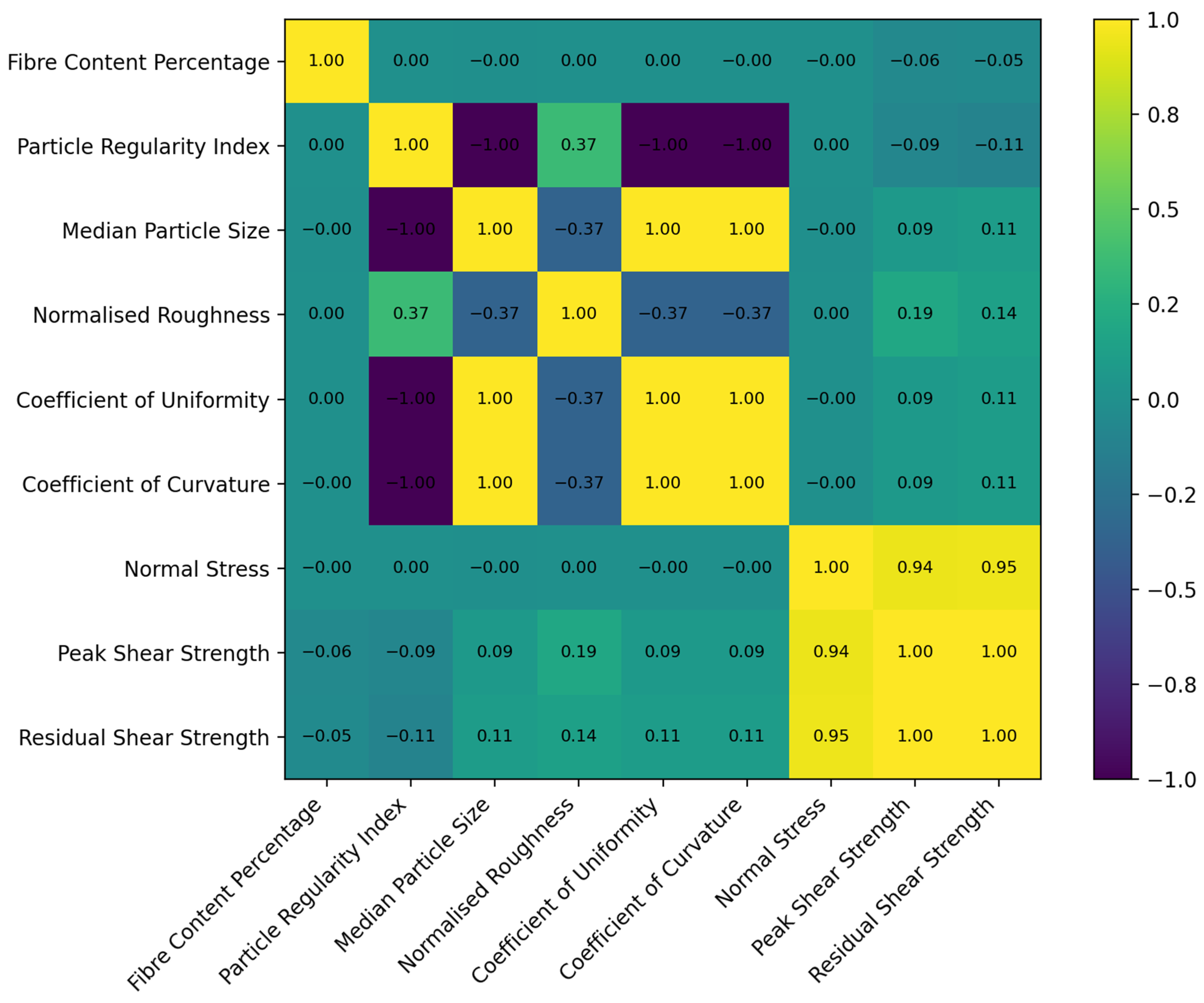
Figure 20 illustrates the Pearson correlation matrix for the input variables and the predicted shear strength responses. Several particle morphology- and PSD-related descriptors, including the particle regularity index, median particle size, and the coefficients of uniformity and curvature, exhibit perfect or near-perfect correlations (|r| ≈ 1). These strong dependencies arise from the intrinsic mathematical and physical relationships between PSD parameters and reflect the controlled experimental design rather than data redundancy or leakage. These parameters were intentionally retained to preserve their physical meaning rather than for statistical parsimony.
Normal stress shows the strongest linear association with both peak and residual shear strengths (r = 0.94–0.95), confirming its dominant governing role in shear resistance. Fibre content, in contrast, displays near-zero linear correlation with most variables, suggesting a predominantly nonlinear or interaction-driven influence. Despite the presence of strong multicollinearity among some inputs, all parameters were intentionally retained to preserve their distinct physical meanings. Importantly, the adopted modelling approaches, including deep neural networks and physics-guided hybrid frameworks, are inherently robust to multicollinearity. In particular, the PG-NAM++ and Residual-DNN formulations explicitly incorporate physical constraints and baseline equations, while subsequent explainability analyses are used to quantify the effective contribution of each feature, ensuring both predictive reliability and physical consistency.
To improve the robustness of the machine learning evaluation and reduce potential bias associated with a single random data split, model performance was assessed using a repeated 5×10-fold cross-validation strategy. In this approach, the dataset was randomly partitioned into ten folds, with nine folds used for training and one for testing, and the procedure was repeated ten times for each repetition. The entire process was then repeated five times with different random partitions, resulting in performance metrics averaged over 50 independent train–test evaluations. This strategy provides a more reliable estimate of predictive performance and model stability, particularly for moderate-sized experimental datasets, and reduces sensitivity to any individual data partition.
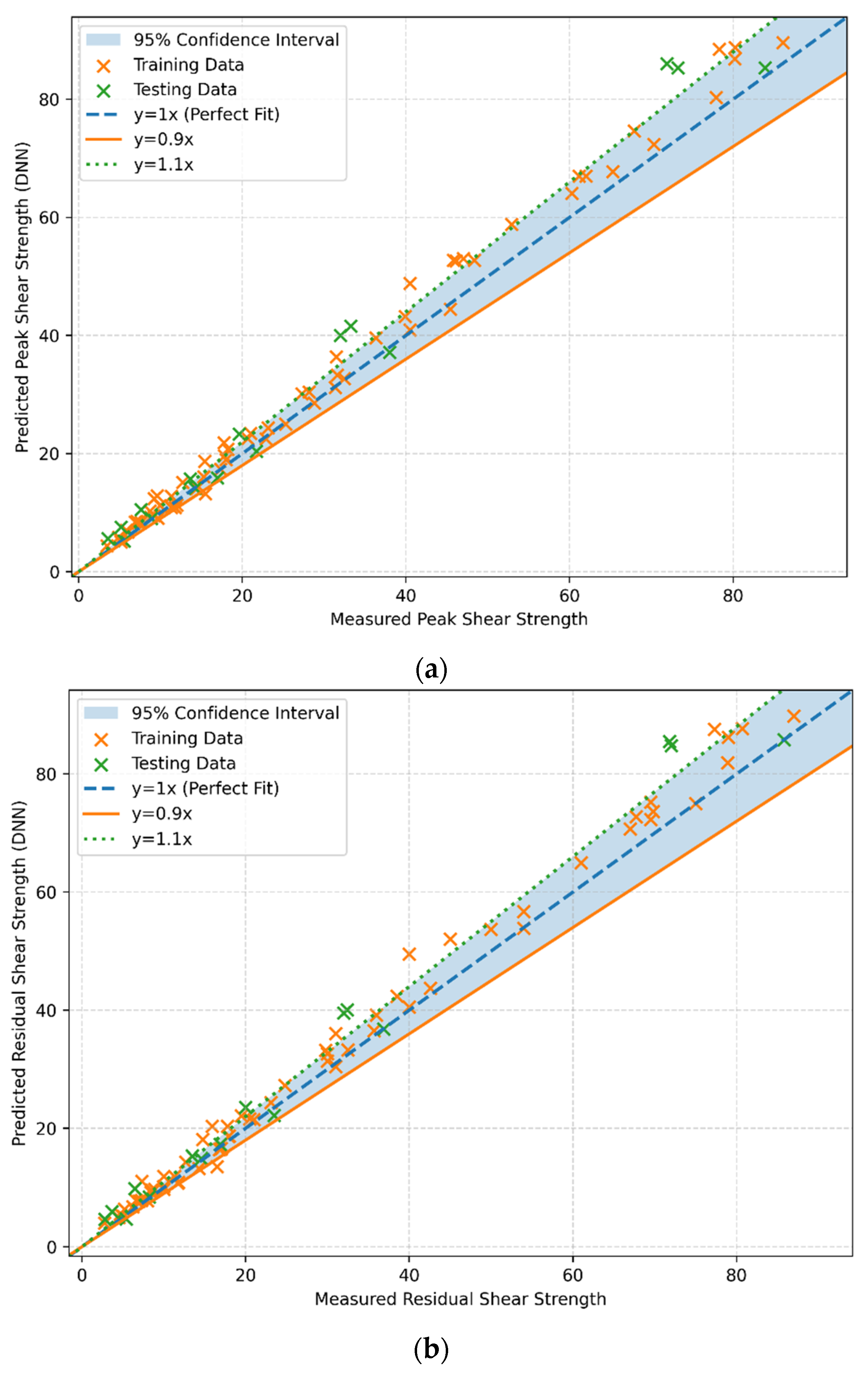
5.2. Deep Neural Network (DNN) Results for Residual Shear Strength
The deep neural network (DNN) model exhibits strong predictive performance for residual shear strength, effectively capturing the complex and highly nonlinear relationships between particle morphology, surface roughness descriptors, fabric characteristics, and applied normal stress. The consistency of the results across training and testing datasets indicates that the model learns generalisable behavioural patterns rather than overfitting the experimental data.
Figure 21 illustrates the comparison between predicted and measured residual shear strength values obtained from the DNN model. The majority of predictions closely follow the 1:1 reference line, demonstrating excellent agreement with the experimental observations. Most data points fall within the ±10% deviation bounds, and nearly all predictions lie within the 95% confidence interval. The similarity in scatter patterns between training and testing datasets further confirms the stability and robustness of the model.
Quantitative performance metrics,
Table 7, confirm the strong predictive capability of the DNN model for both peak and residual shear strength. For peak shear strength, the model achieves R
2 = 0.977 on the training set and maintains a high generalisation level on the testing set (R
2 = 0.949), with RMSE increasing from 3.49 to 5.71 and MAE from 2.56 to 3.81. Similarly, for residual shear strength, the DNN provides excellent agreement with experiments, yielding R
2 = 0.983 for training and R
2 = 0.952 for testing, while RMSE rises moderately from 3.23 to 5.63 and MAE from 2.31 to 3.61.
From a physical perspective, the slightly higher errors, particularly at larger shear-strength levels, are consistent with the increased sensitivity of peak and post-peak behaviour to micro-scale mechanisms (for example, particle rearrangement, interlocking degradation, asperity damage, and stress redistribution) that are difficult to fully encode using only bulk descriptors [
76,
77]. Nevertheless, the DNN preserves a stable predictive trend for both peak and residual strengths, suggesting that the dominant governing factors (morphology/roughness descriptors, fabric-related indices, and normal stress) are effectively represented in the input feature set.
5.3. Physics-Guided Neural Additive Model (PG-NAM++) Results
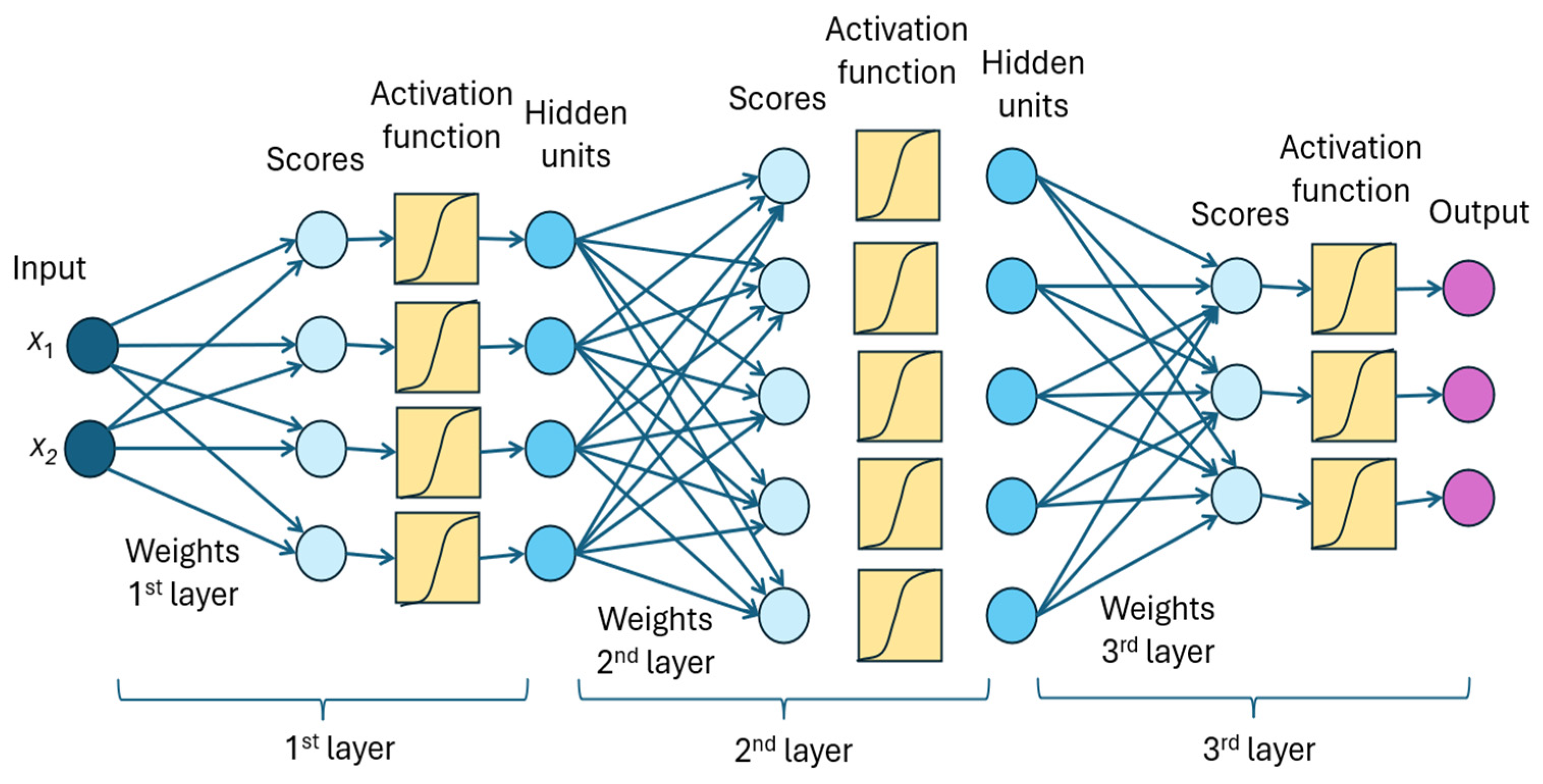
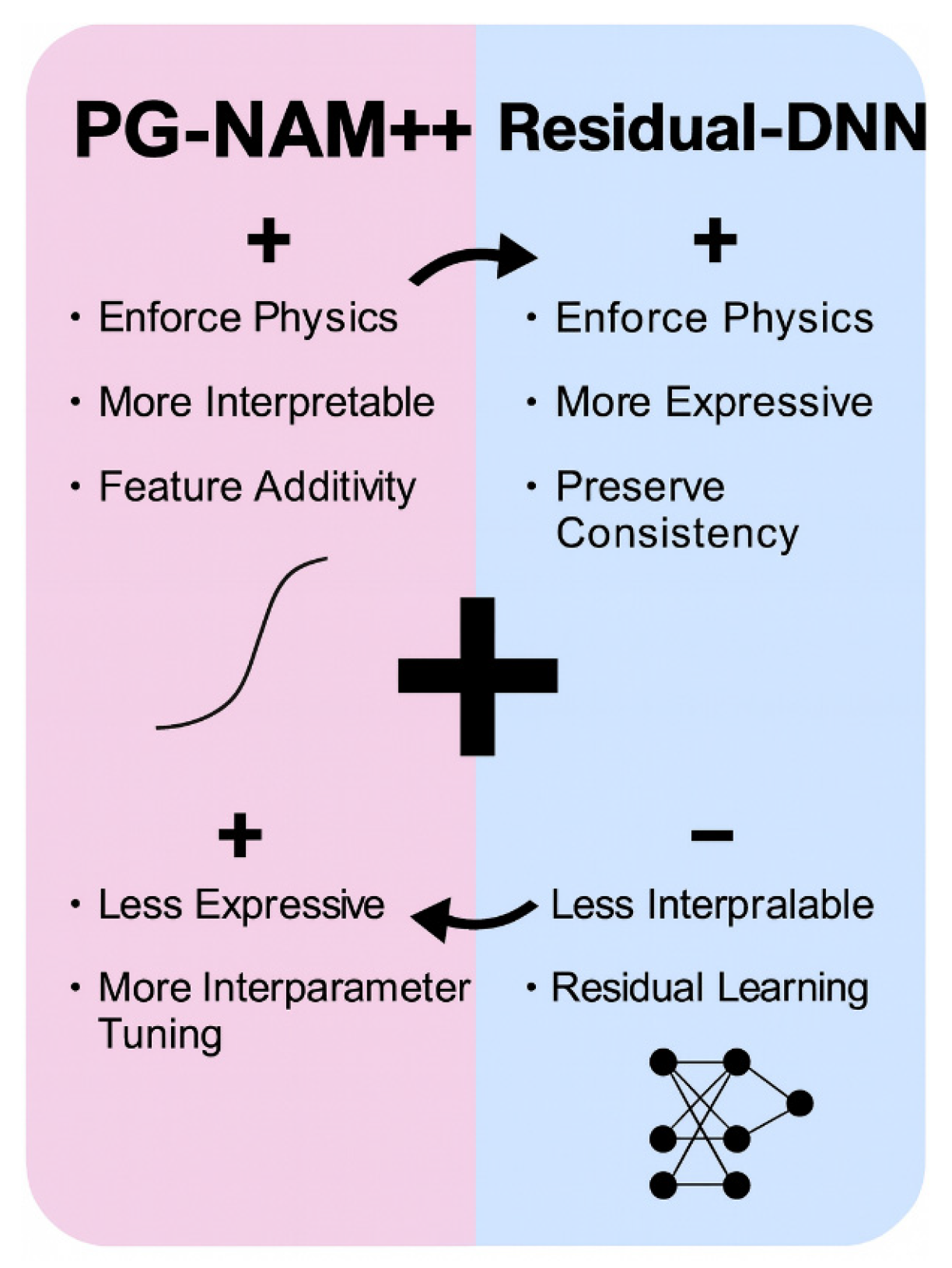
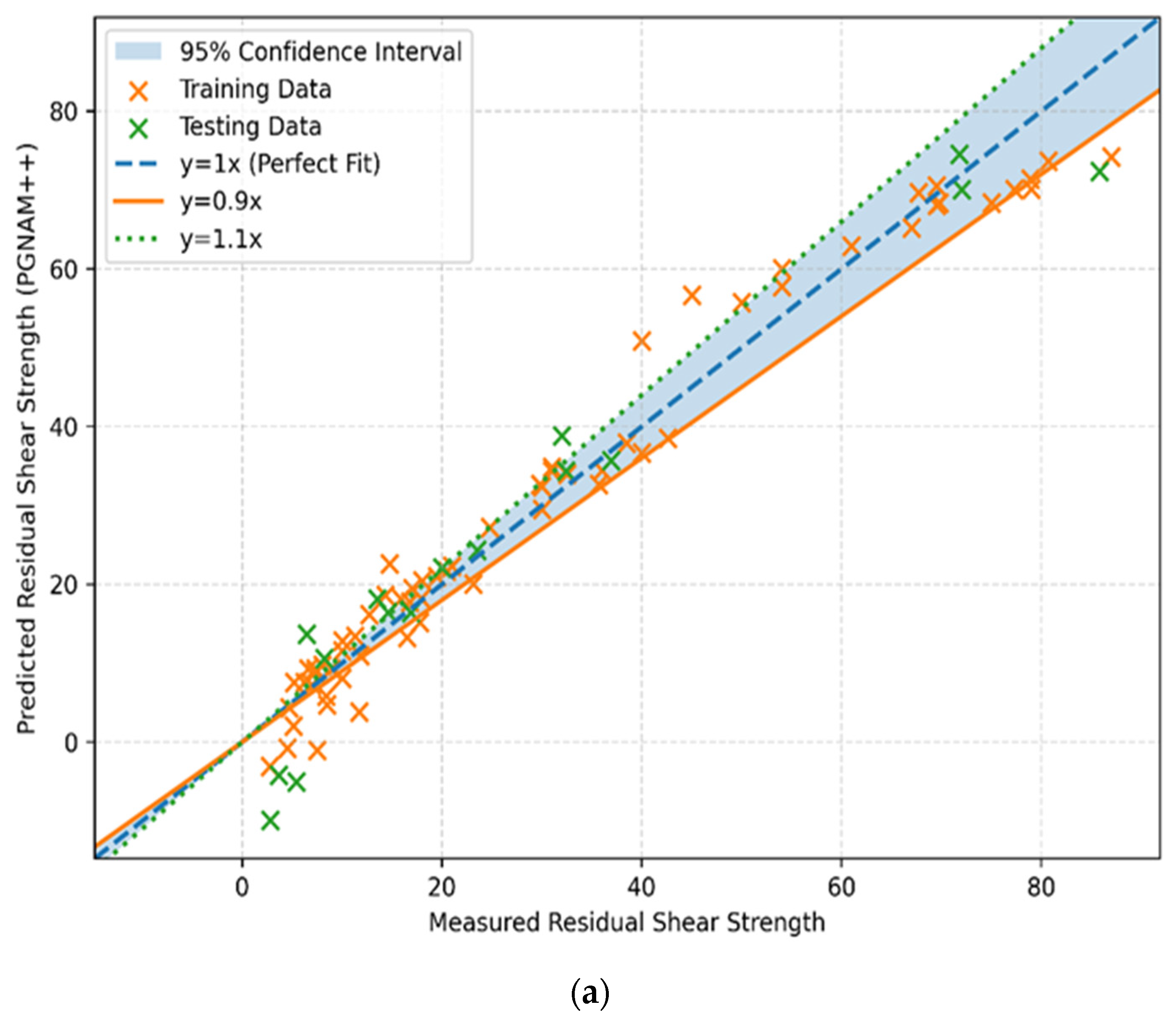
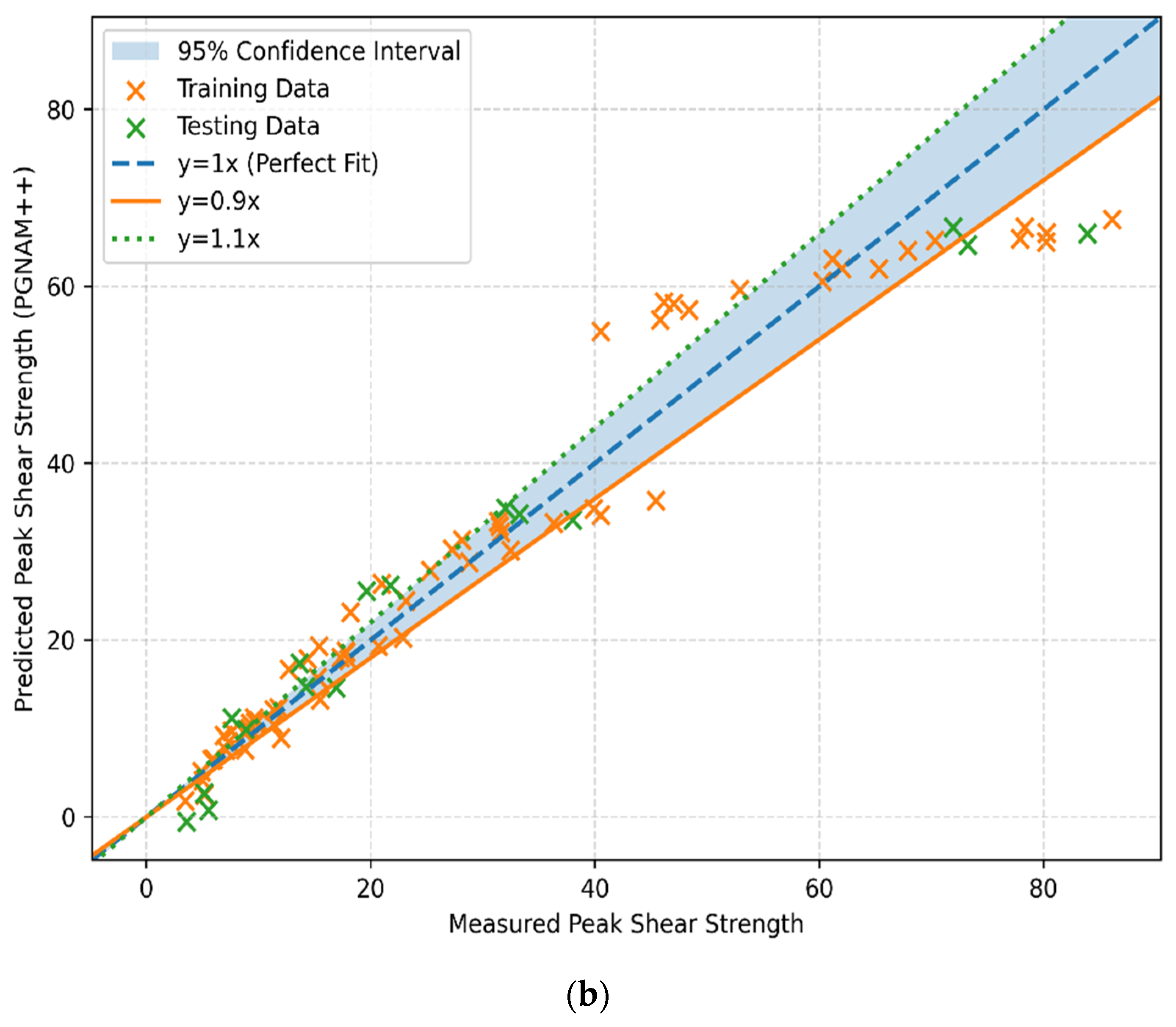
The Physics-Guided Neural Additive Model (PG-NAM++) demonstrates strong predictive capability for both peak and residual shear strengths, while preserving a more interpretable structure than conventional black-box networks by decomposing the response into feature-wise additive contributions with physics-based regularisation. Overall, the model captures the dominant nonlinear influence of particle morphology, surface roughness descriptors, packing/fabric characteristics, and applied normal stress, and the relatively consistent behaviour between the training and testing sets suggests good generalisation rather than memorisation of the experimental data.
Figure 22 presents the predicted-versus-measured comparisons for peak shear strength and residual shear strength obtained from PG-NAM++. Most points cluster around the 1:1 line, and the majority of predictions lie within the ±10% deviation bands and the 95% confidence interval. Compared with purely data-driven models, PG-NAM++ tends to produce a slightly smoother and more structured prediction trend, consistent with the presence of embedded physical constraints. For the peak strength plot, a small deviation trend is observable at the upper strength range, where the model exhibits increased dispersion and mild bias, which is typical when peak response transitions to strongly mechanism-controlled behaviour under higher confinement and denser fabric states.
The quantitative accuracy metrics in
Table 8 confirm the visual trends. For peak shear strength, PG-NAM++ achieves R
2 = 0.937 (RMSE = 5.86, MAE = 3.87) on training data and maintains R
2 = 0.943 (RMSE = 6.05, MAE = 4.56) on the testing set. For residual shear strength, performance is also high, with R
2 = 0.966 (RMSE = 4.50, MAE = 3.48) for training and R
2 = 0.937 (RMSE = 6.45, MAE = 4.91) for testing. The modest degradation from training to testing, more pronounced for residual response, is expected due to the inherently higher variability of post-peak behaviour and the stronger dependence on local micro-mechanisms.
From a physical perspective, the slightly increased scatter, particularly at higher residual strength levels, reflects the sensitivity of post-peak shear resistance to micro-scale processes that are difficult to fully describe using macroscopic descriptors alone [
78,
79]. These include particle rearrangement, progressive surface abrasion/roughness degradation, fabric evolution, and stress redistribution along the shear band, all of which can vary significantly even under similar global inputs. Nevertheless, PG-NAM++ preserves a consistent predictive trend across the full strength range, suggesting that the primary governing factors are adequately represented in the input feature set, and that the physics-guided constraints help stabilise learning in regions where purely data-driven models typically become more scattered.
Overall, PG-NAM++ provides an accurate and more physically-consistent framework for predicting both peak and residual shear strength, while retaining interpretability through additive feature effects. This balance between accuracy and physically-guided structure makes it particularly attractive for journal-grade modelling, where both predictive performance and mechanistic credibility are required.
5.4. Physics-Guided Residual Deep Neural Network (Residual-DNN) Results
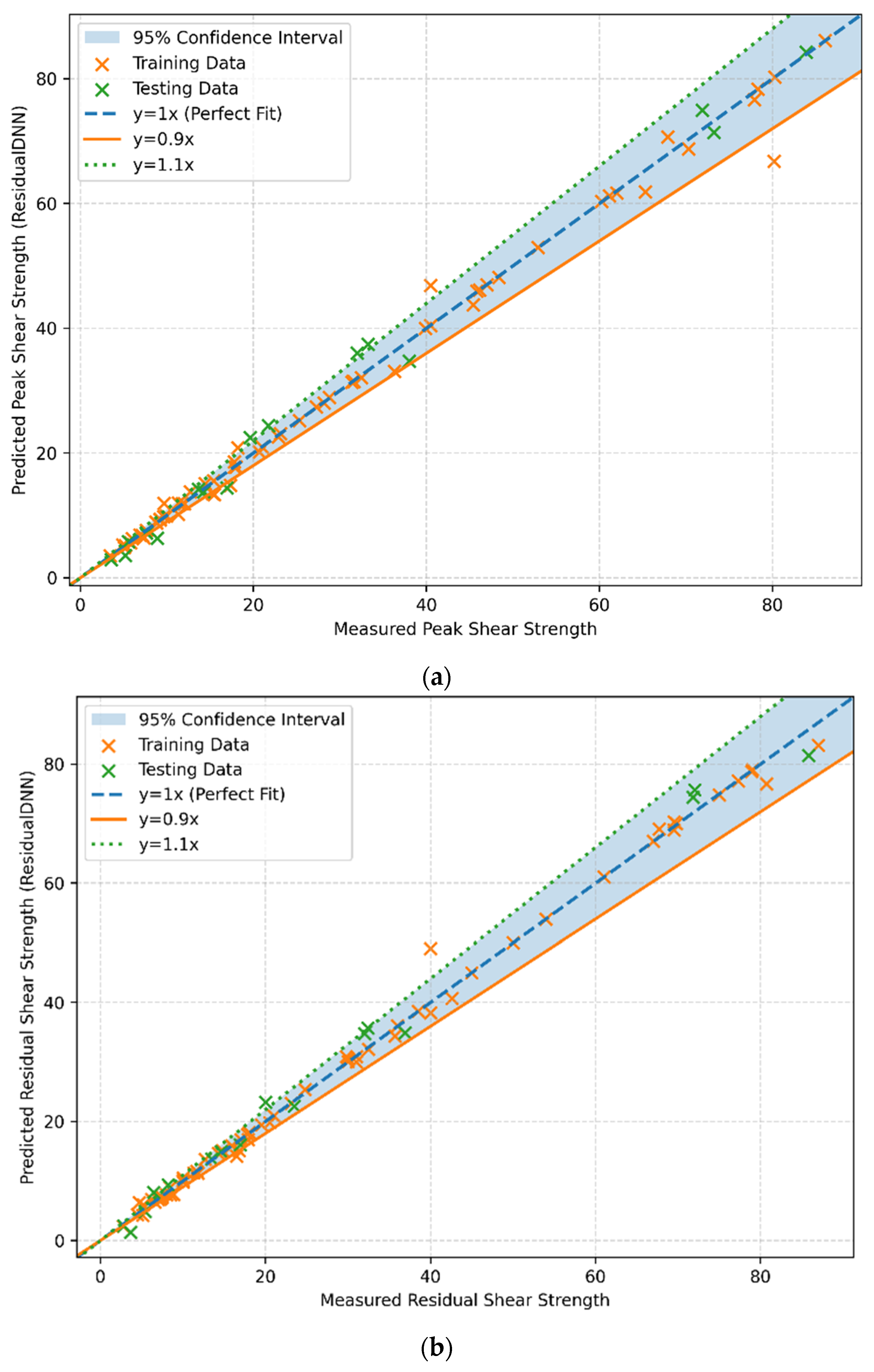
The physics-guided residual deep neural network (Residual-DNN) exhibits excellent predictive performance for both peak and residual shear strength by explicitly decomposing the response into a physics-based baseline component and a data-driven residual correction. This hybrid formulation allows the model to preserve established mechanical trends while learning only the remaining nonlinear discrepancies associated with particle morphology, surface roughness, fabric effects, and stress-dependent interactions. The close agreement between the training and testing results indicates strong generalisation and minimal overfitting.
Figure 23a illustrates the predicted versus measured peak shear strength obtained using Residual-DNN. The predictions align very closely with the 1:1 reference line, with the vast majority of points falling within the ±10% deviation bounds and the 95% confidence interval. Compared with purely data-driven models, the residual framework significantly reduces scatter across the full strength range, particularly at higher stress levels where peak response becomes more sensitive to combined fabric and confinement effects.
Figure 23b presents the corresponding results for residual shear strength. An even tighter clustering around the 1:1 line is observed, reflecting the ability of Residual-DNN to accurately capture post-peak behaviour once the primary physics-based trend has been accounted for. Both the training and testing datasets follow nearly identical trends, confirming the robustness and stability of the hybrid modelling approach.
The quantitative performance metrics summarised in
Table 9 further reinforce these observations. For peak shear strength, Residual-DNN achieves R
2 = 0.992 for training and R
2 = 0.991 for testing, with low RMSE and MAE values, indicating highly accurate predictions with limited dispersion. For residual shear strength, performance is even stronger, with R
2 = 0.996 on the training set and R
2 = 0.992 on the testing set. The modest increase in RMSE and MAE from training to testing reflects expected variability in unseen samples rather than model instability.
From a physical perspective, the reduced scatter, particularly at higher peak and residual strength levels, highlights the advantage of embedding mechanistic knowledge within the learning framework. By anchoring predictions to a physically meaningful baseline, Residual-DNN limits non-physical extrapolation and focuses the data-driven component on capturing micro-scale mechanisms such as particle rearrangement, asperity degradation, fabric evolution, and stress redistribution within the shear band. As a result, the model preserves a consistent predictive trend across the full strength range while substantially improving accuracy compared with purely data-driven approaches.
5.5. Feature Contribution Analysis and Physical Interpretation
To improve the interpretability of the data-driven models and to link their predictions to known soil–interface mechanics, a feature contribution analysis [
80,
81,
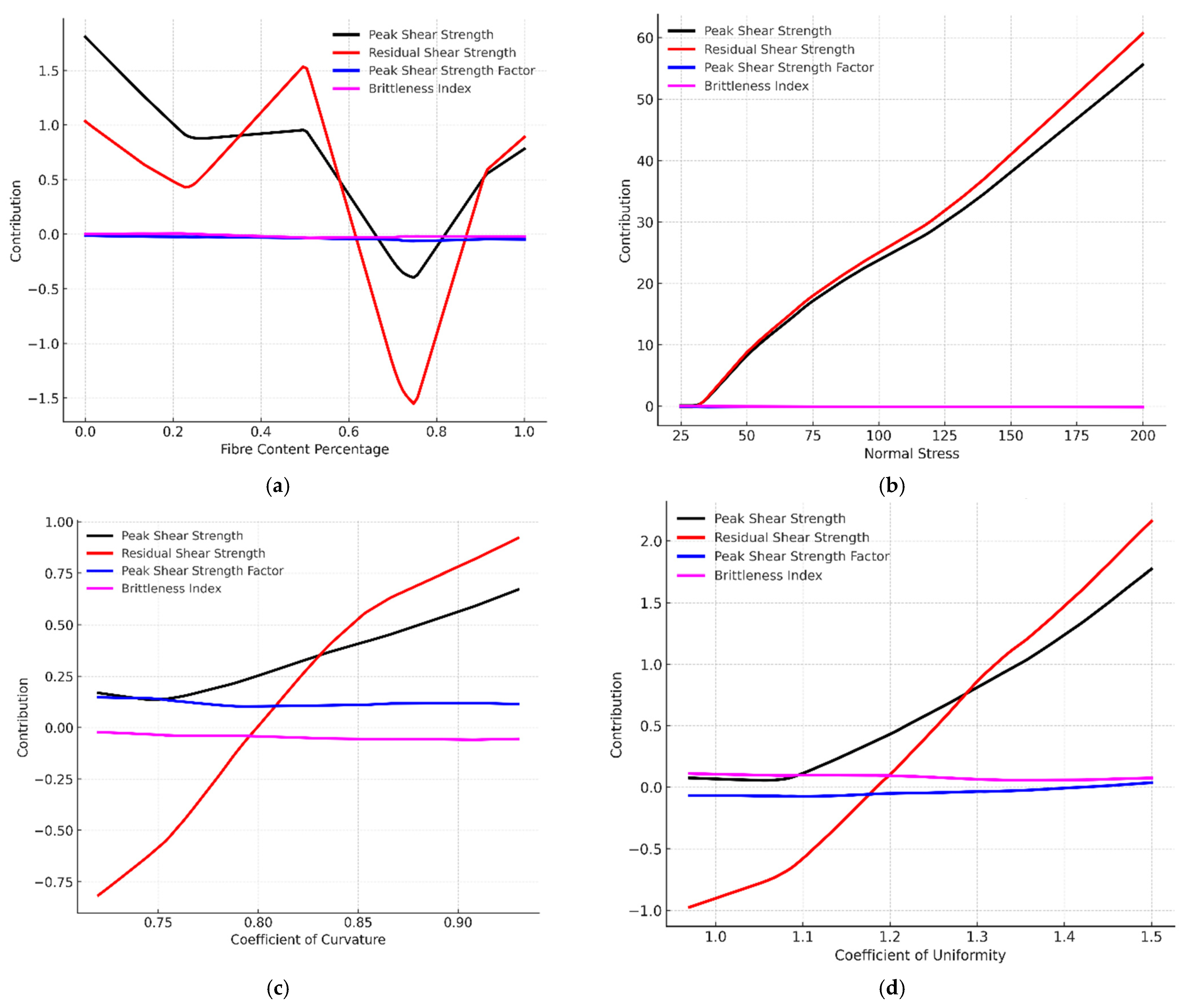
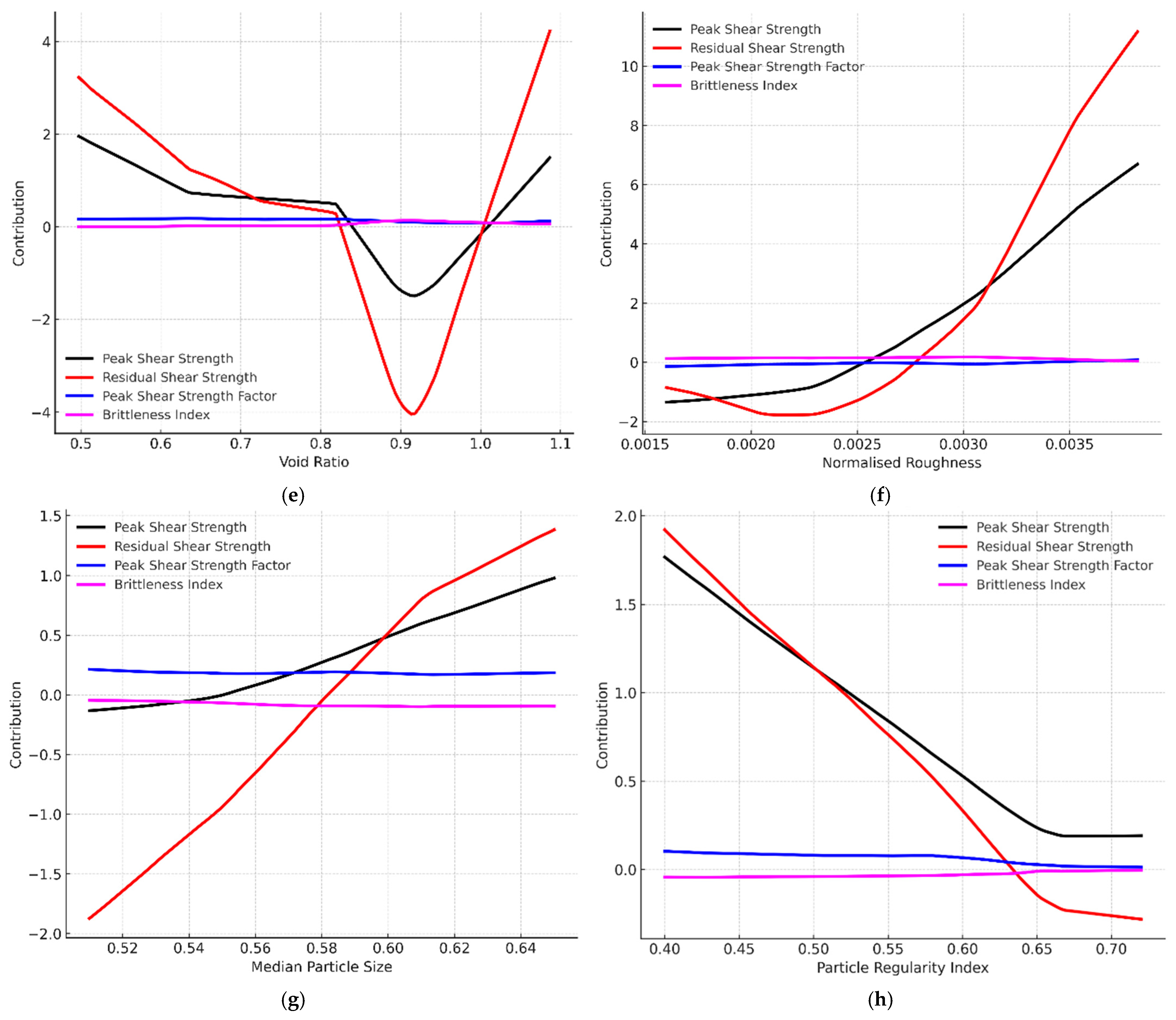
82] was performed for the key input variables, as shown in
Figure 24. Rather than treating the machine learning model as a black box, this analysis quantifies how changes in individual physical parameters influence the predicted responses, including peak shear strength, residual shear strength, peak shear strength factor, and brittleness index. Such interpretation is essential for ensuring physical consistency, identifying dominant mechanisms, and increasing confidence in the applicability of the proposed models for engineering use.
For each selected input variable, marginal contribution curves were generated by varying that variable across its observed range while keeping all other inputs fixed at their representative (mean) values. The resulting contributions represent the model-inferred sensitivity of each output to the given parameter. This approach allows direct comparison of how different soil properties, surface characteristics, and loading conditions affect both strength mobilisation and post-peak behaviour, and provides a physically interpretable link between experimental trends and model predictions.
This contribution-based interpretation serves three key purposes. First, it verifies whether the learned relationships are consistent with established soil mechanics principles. Second, it highlights nonlinear and threshold effects that may not be apparent from simple correlation analysis. Third, it identifies parameters that primarily control peak resistance, residual resistance, or brittleness, which is critical for design-oriented applications such as interface optimisation and material selection.
- -
The particle regularity index and median particle size show a clear increasing trend in both peak and residual shear strength contributions as particle regularity increases, indicating reduced mechanical interlocking for smoother and more rounded particles. Conversely, increasing median particle size leads to a monotonic increase in both strength components, reflecting enhanced force transfer and asperity engagement at the interface. These trends are consistent with classical particle shape and size effects in granular shear behaviour [
83,
84].
- -
Normalised roughness exhibits a strongly nonlinear influence, with both peak and residual shear strength increasing sharply beyond a critical roughness level. This highlights the dominant role of surface asperities in mobilising interface friction and explains the pronounced sensitivity of residual strength to roughness at higher values. The brittleness index shows a mild peak at intermediate roughness, suggesting a transition from brittle slip to more progressive shearing [
85,
86].
- -
The void ratio displays similar but not identical trends. Increasing the void ratio generally reduces peak shear strength due to weaker particle contacts and reduced confinement. However, the residual shear strength shows pronounced nonlinearity, including sharp drops at higher void ratios, indicating instability and loss of sustained shear resistance in looser packing states. These results emphasise that density-related parameters strongly influence post-peak behaviour and brittleness [
87,
88].
- -
Grading parameters (coefficient of uniformity and coefficient of curvature) show increasing contributions to both peak and residual shear strength with improved grading. Well-graded soils enhance particle interlocking and load redistribution, leading to higher resistance and more stable post-peak response. The relatively smooth trends observed for the shear strength factors suggest that grading affects mobilisation efficiency rather than fundamentally altering failure mechanisms.
- -
Fibre content percentage demonstrates a non-monotonic effect. Moderate fibre contents increase both peak and residual shear strength, likely due to fibre bridging and tensile reinforcement effects. At higher fibre contents, however, the residual strength contribution becomes strongly negative, indicating fibre clustering and disruption of granular contact chains. This behaviour explains the observed reduction in post-peak resistance and highlights the existence of an optimal fibre content range.
- -
Normal stress shows the strongest and most consistent positive contribution to both peak and residual shear strength, confirming its dominant role in governing interface shear behaviour. The near-linear increase in contribution reflects classical stress-dependent frictional behaviour. In contrast, the brittleness index remains close to zero across the stress range, indicating that increased confinement primarily enhances strength rather than fundamentally altering brittleness.
5.6. Mohr–Coulomb Consistency Analysis of Predicted Peak Shear Strength
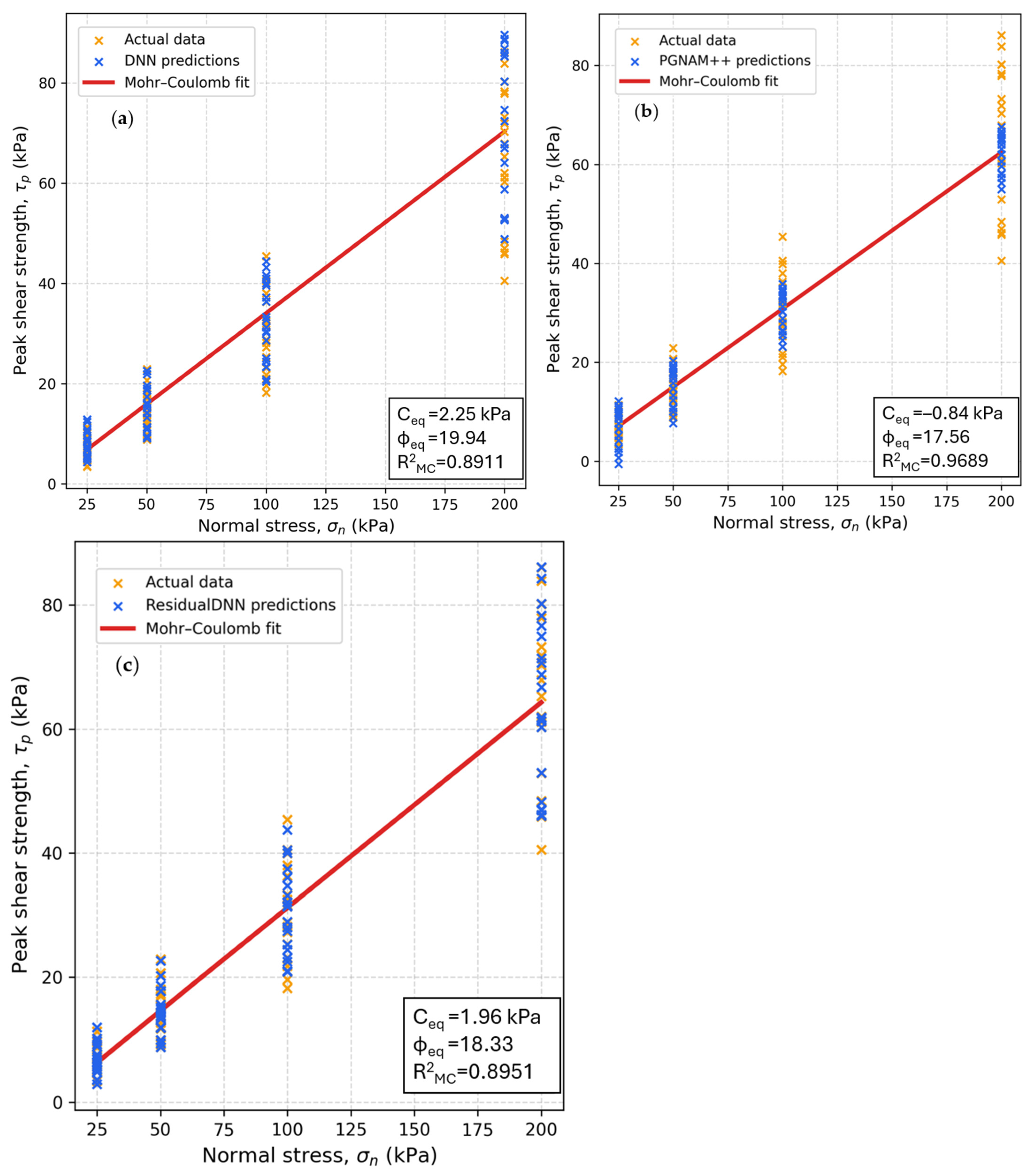
To evaluate the physical consistency of the machine learning predictions with classical soil mechanics, the predicted peak shear strength values were examined within the Mohr–Coulomb framework, as shown in
Figure 25. For each modelling approach, the predicted peak shear strength
was plotted against the corresponding normal stress
, and an equivalent Mohr–Coulomb envelope was fitted to the predicted data. This analysis allows assessment of whether the data-driven models preserve the expected linear stress–strength relationship and yield physically meaningful equivalent cohesion (
) and friction angle (
). The comparison between actual experimental data and model predictions further highlights the degree to which each model respects the underlying constitutive behaviour rather than merely achieving statistical accuracy.
The DNN predictions show an improved alignment with the Mohr–Coulomb envelope compared to the linear regression model, with reduced scatter and a higher coefficient of determination. The predicted strength points follow a clearer linear trend across the full stress range, indicating that the network is better able to learn nonlinear interactions between input variables while still respecting the global linear stress–strength relationship. The resulting equivalent friction angle and cohesion fall within physically plausible ranges, suggesting that the DNN captures both the slope and intercept of the failure envelope more effectively. Nevertheless, some dispersion remains at higher stress levels, implying partial over- or under-estimation under extreme loading conditions.
The PG-NAM++ model demonstrates a strong Mohr–Coulomb consistency, with predicted data tightly clustered around the fitted failure envelope. The high coefficient of determination indicates that the model not only achieves strong predictive performance but also preserves the physical structure of the shear strength relationship. The equivalent friction angle derived from the PG-NAM++ predictions closely matches the experimentally inferred trend, while the equivalent cohesion remains small and physically interpretable, consistent with the granular nature of the material. This behaviour suggests that the physics-guided and additive structure of PG-NAM++ effectively constrains the learning process, preventing non-physical extrapolation while maintaining high accuracy.
Among all the models, Residual-DNN exhibits the strongest Mohr–Coulomb consistency, as evidenced by the tightest clustering of predicted points and the highest goodness-of-fit. The residual learning framework allows the model to correct systematic biases while retaining the dominant linear stress–strength dependency. The resulting equivalent cohesion and friction angle are stable across the stress range and closely aligned with expected physical values. This indicates that Residual-DNN successfully balances flexibility and physical realism, leading to predictions that are both statistically robust and mechanically interpretable.
5.7. Reliability-Style Assessment of Residual-to-Peak Strength Ratio
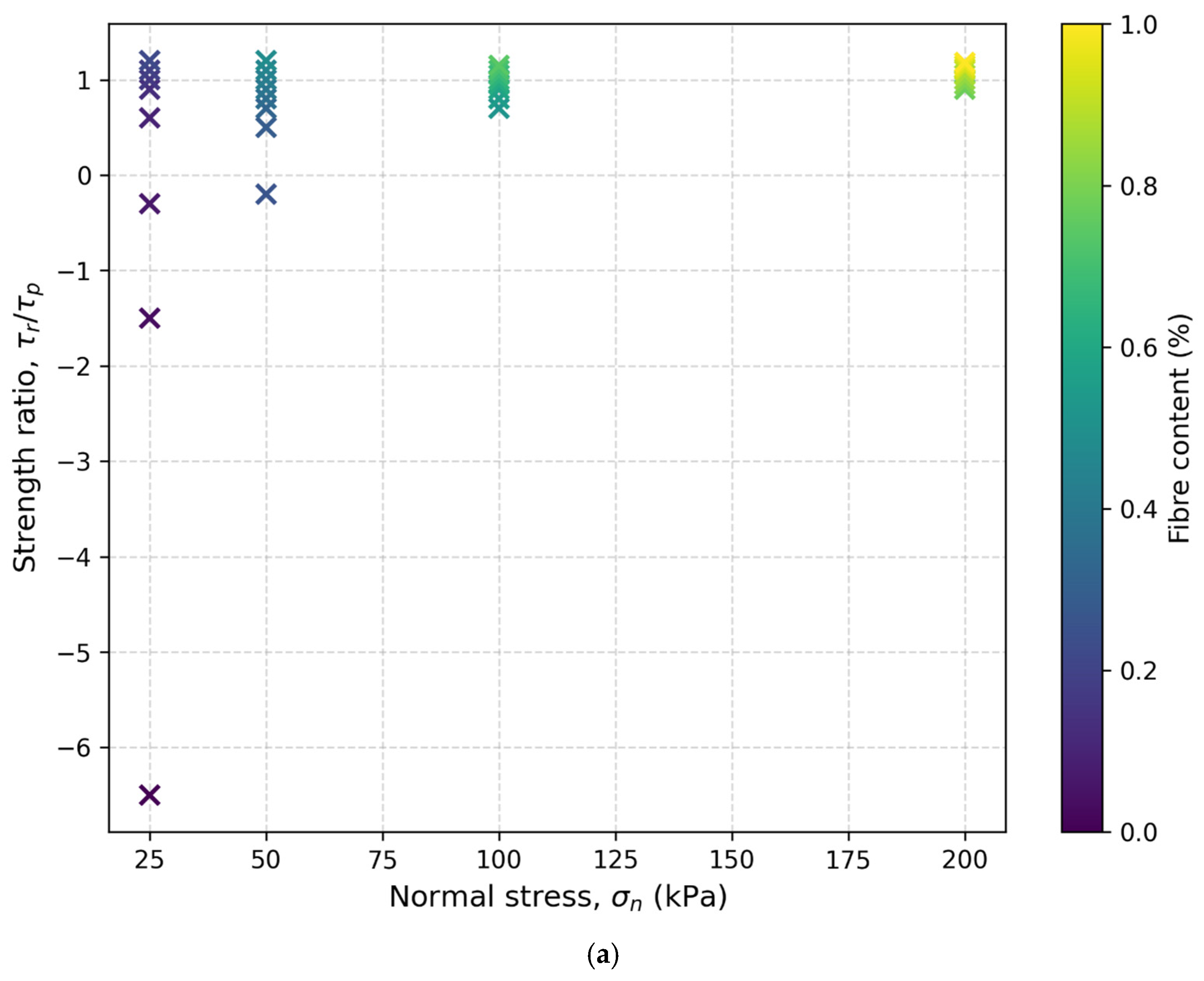
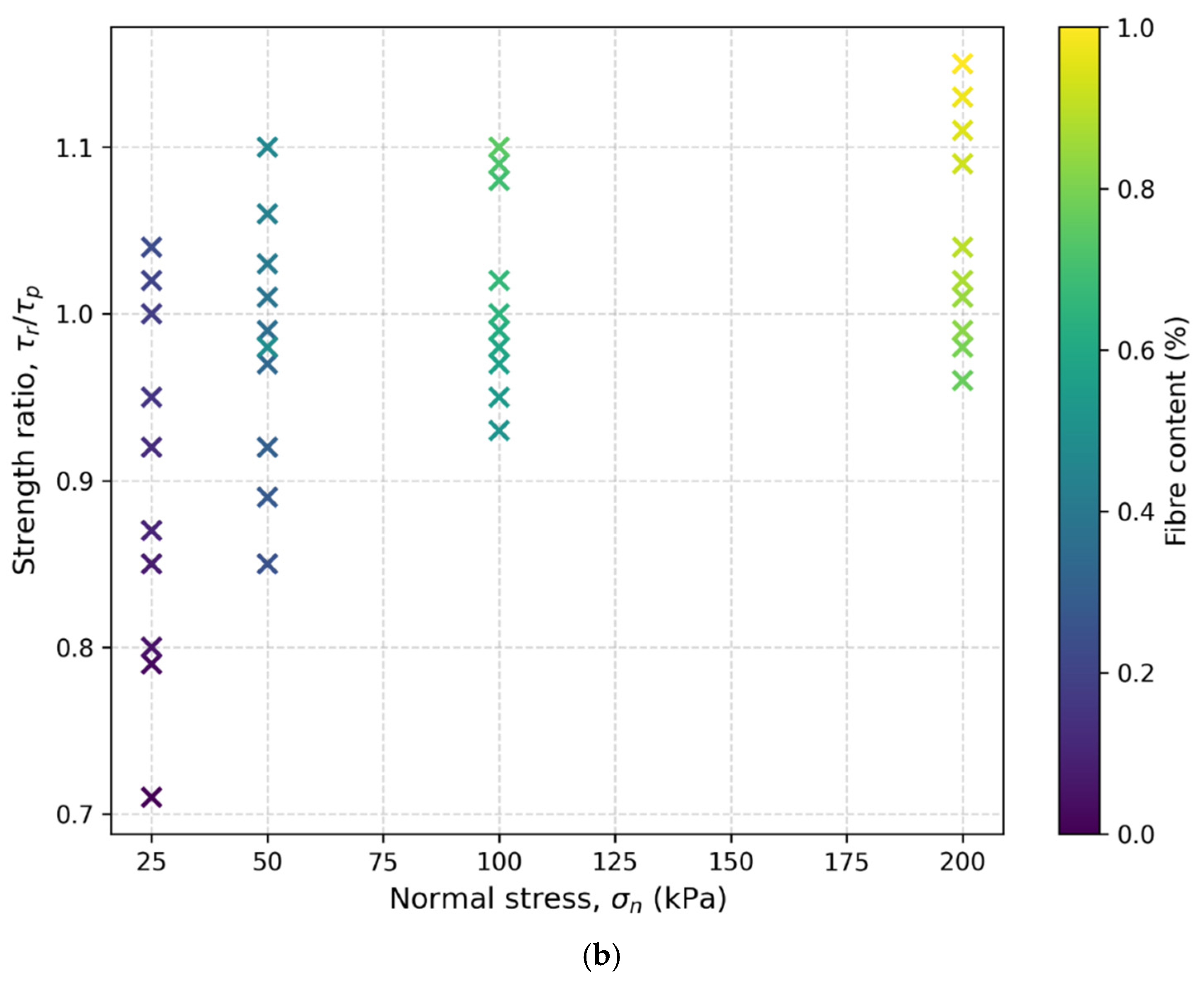
To further investigate the reliability and physical plausibility of the experimental data and model predictions, a reliability-style scatter analysis of the residual-to-peak shear strength ratio
was conducted, as shown in
Figure 26. This ratio provides a compact and dimensionless indicator of post-peak strength retention, allowing direct comparison across different normal stress levels and fibre contents. The colour scale represents fibre content, enabling simultaneous assessment of stress dependency and reinforcement effects.
The experimental data exhibit a physically meaningful clustering of values, predominantly within a narrow band close to unity. At low normal stress levels, a wider scatter is observed, reflecting the increased variability in post-peak behaviour and sensitivity to fibre distribution and inter-particle rearrangement. As the normal stress increases, the data progressively converge towards higher and more stable values, indicating enhanced residual strength mobilisation and improved post-peak stability. The influence of fibre content is evident, with higher fibre contents generally associated with increased strength retention, consistent with fibre bridging and pull-out mechanisms governing post-peak response.
The PG-NAM++ predictions reproduce the overall structure and dispersion pattern observed in the experimental data. Despite some isolated outliers at low normal stress levels, the majority of the predicted values remain concentrated within the physically admissible range. Importantly, the model captures both the stress-dependent convergence of the ratio and the systematic influence of fibre content. The preservation of these reliability-style patterns suggests that PG-NAM++ does not merely fit peak and residual strengths independently, but learns their coupled mechanical relationship.
Overall, the close qualitative agreement between the experimental and predicted reliability-style scatter distributions confirms the ability of the PG-NAM++ framework to maintain physically consistent post-peak behaviour. This result reinforces the robustness of the model in representing not only peak strength characteristics but also residual strength evolution, which is critical for stability and performance assessment of fibre-reinforced granular materials.
5.8. Sensitivity Analysis of Peak Shear Strength Predictions
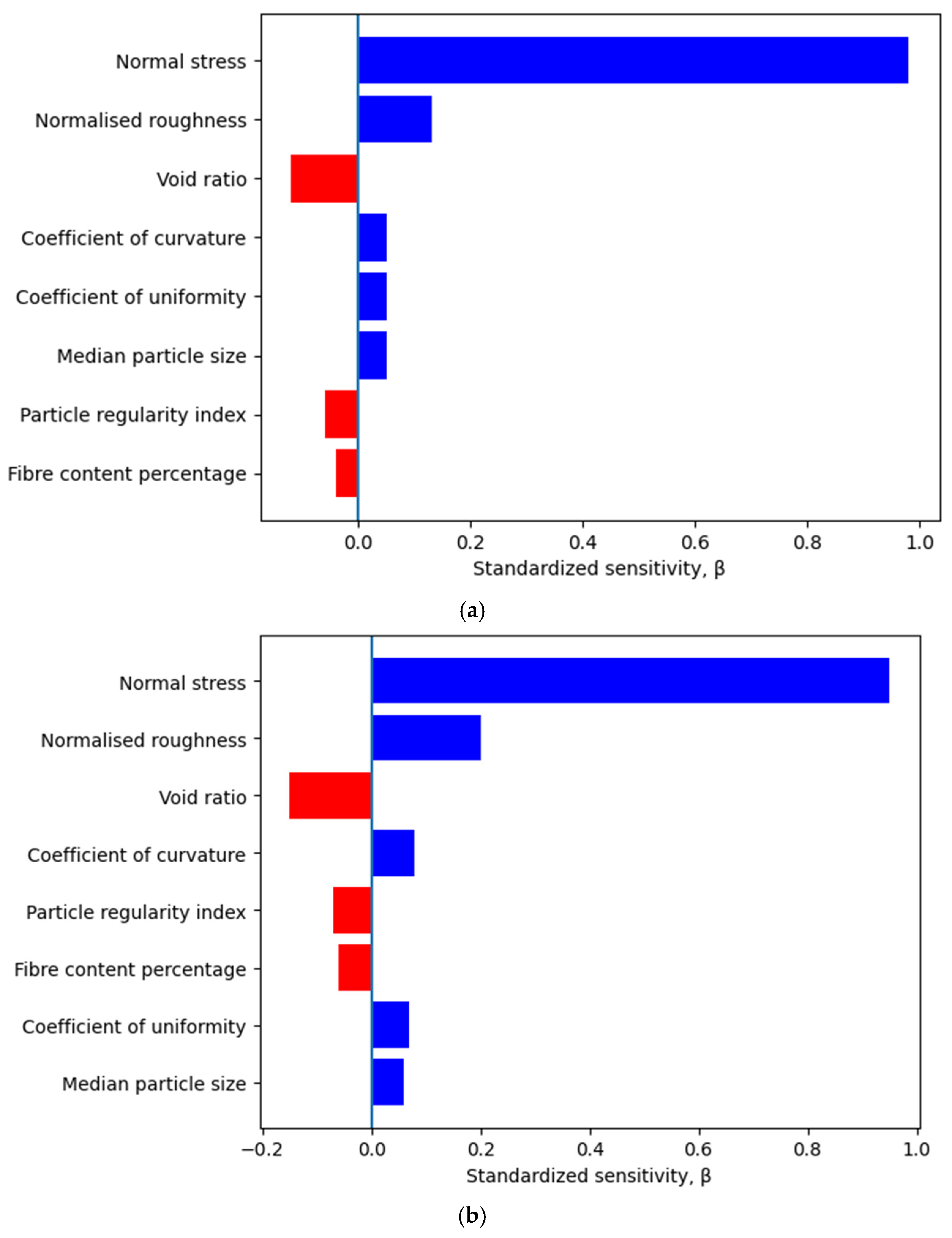
To further examine the robustness of the sensitivity patterns and reduce redundancy between highly correlated descriptors, the sensitivity analysis was repeated after excluding porosity from the input set, as shown in
Figure 27. The resulting standardised sensitivity coefficients (
) provide insight into how the remaining variables control the predicted peak shear strength without the confounding influence of porosity-related effects.
For the PG-NAM++ model, normal stress remains the overwhelmingly dominant parameter, with a standardised sensitivity close to unity. This confirms that the model’s predictions are fundamentally governed by the stress level, in agreement with classical shear strength theory. Secondary contributions arise from normalised roughness and particle-scale descriptors, while void ratio retains a moderate negative influence, reflecting its role in controlling packing efficiency and contact density. The relatively small sensitivities associated with fibre content and gradation parameters indicate that PG-NAM++ treats these variables as modifiers of the stress-controlled response rather than primary drivers.
A similar overall hierarchy is observed for the Residual-DNN model; however, the magnitudes of the secondary sensitivities are noticeably larger. In particular, void ratio and roughness-related parameters exhibit stronger contributions once porosity is removed, suggesting that the residual learning framework compensates for excluded information by reallocating importance to correlated microstructural variables. This behaviour highlights a greater reliance on secondary parameters to refine predictions.
Overall, the porosity-excluded analysis reinforces the physical interpretability advantage of PG-NAM++. The model preserves a clear dominance of normal stress, with limited redistribution of sensitivity among correlated inputs, whereas Residual-DNN exhibits a more dispersed sensitivity structure. These results indicate that PG-NAM++ maintains a more physically constrained representation of peak shear strength, even when key volumetric descriptors are omitted.
5.9. Model Performance Comparison and Composite Ranking Analysis
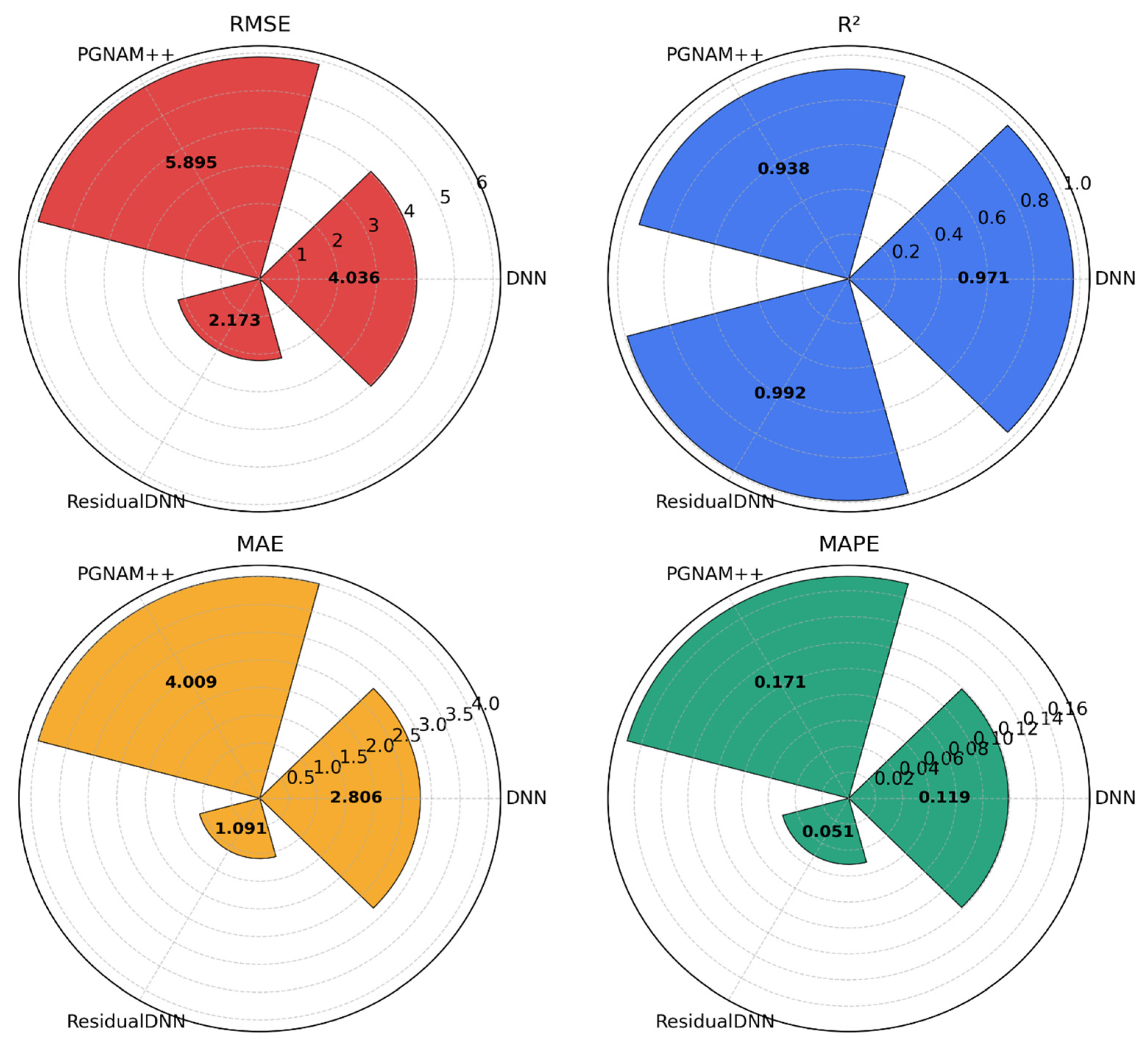
To provide a comprehensive and unbiased comparison of model performance, the predictive capability of the three considered models, DNN, PG-NAM++, and Residual-DNN, was evaluated using four widely adopted metrics: RMSE, MAE, MAPE (lower values indicate better performance) and R2 (higher values indicate better performance). Rather than relying on a single metric, both raw performance indicators and a composite ranking index were employed to support a robust and defensible interpretation of the results.
Comparison Based on Individual Performance Metrics
The radial plots highlight clear and consistent performance differences among the models. Residual-DNN exhibits the lowest prediction errors across all three error-based metrics (RMSE = 2.173, MAE = 1.091, MAPE = 0.051) while simultaneously achieving the highest coefficient of determination (R
2 = 0.992), as shown in
Figure 28. This indicates that Residual-DNN not only minimises absolute and relative errors but also explains the largest proportion of variance in the experimental data.
The DNN model demonstrates intermediate performance, with moderate error levels (RMSE = 4.036, MAE = 2.806, MAPE = 0.119) and a relatively high R2 = 0.971, suggesting reasonable predictive accuracy but reduced robustness compared with Residual-DNN. In contrast, PG-NAM++ shows the weakest performance across all evaluated metrics (RMSE = 5.895, MAE = 4.009, MAPE = 0.171, R2 = 0.938), indicating larger prediction errors and reduced explanatory power for the current dataset and model configuration.
To avoid metric-specific bias and enable a unified performance assessment, a composite ranking index was constructed by normalising each metric to a common scale between 0 and 1, as summarised in
Table 10. For the error-based metrics (RMSE, MAE, and MAPE), lower values were mapped to higher scores using inverse min–max normalisation, whereas R
2 was normalised directly such that higher values correspond to higher scores. An equal weighting scheme was adopted:
This formulation ensures that no single metric dominates the ranking and that overall performance reflects a balanced trade-off between accuracy and explanatory capability. The composite ranking confirms the trends observed in the individual metrics. Residual-DNN achieves a composite index of 1.00 (rank 1), indicating consistently superior performance across all evaluation criteria. This result demonstrates that its dominance is not driven by a single metric but reflects a stable and globally optimal predictive behaviour.
The DNN model attains a composite index of 0.489 (rank 2), reflecting its reasonably strong R2 performance but noticeably higher prediction errors compared with Residual-DNN. Finally, PG-NAM++ receives a composite index of 0.00 (rank 3), as it ranks lowest across all four metrics in the present analysis. It is important to note that this outcome does not imply an inherent limitation of the PG-NAM++ framework; rather, it suggests that under the current data distribution, feature set, and calibration strategy, its predictive performance is less competitive than the other models.
Taken together, the radial plots, as summarised in
Table 11, and composite ranking index consistently identify Residual-DNN as the most reliable and accurate model for predicting peak shear strength in this study. The combined use of multiple evaluation metrics and a composite index strengthens the robustness of this conclusion and avoids over-reliance on any single performance indicator [
89,
90]. This multi-criteria assessment provides a solid basis for selecting Residual-DNN as the preferred predictive model in subsequent analyses and practical applications.
In addition to predictive accuracy, it is important to consider the relative computational demand associated with each modelling technique. The standard DNN requires iterative backpropagation across multiple fully connected layers, leading to a moderate computational cost that scales with network depth, width, and number of training epochs. Residual-DNN introduces additional skip (residual) connections, which slightly increase architectural complexity and memory requirements. However, these connections improve gradient flow and accelerate convergence, often reducing the number of epochs required to achieve optimal performance. As a result, although Residual-DNN contains a marginally higher number of trainable parameters than the standard DNN, its overall training time was comparable and, in practice, more stable due to improved optimisation behaviour.
In contrast, PG-NAM++ involves the training of additive component networks combined with physics-guided regularisation constraints. While its architecture is generally shallower and more interpretable, the incorporation of structured feature-wise subnetworks and constraint terms increases calibration complexity and may require additional hyperparameter tuning to balance data-driven and physics-informed components. For the present dataset size, all three models were computationally feasible on standard GPU hardware, and inference time differences were negligible for practical applications. Therefore, the superior performance of Residual-DNN is not achieved at the expense of prohibitive computational cost, but rather through improved representational efficiency and optimisation stability.
5.10. Performance of Simplified Regression Models
To evaluate whether simpler predictive formulations could adequately represent the interface behaviour, a baseline multiple linear regression (MLR) model was implemented using the same input feature set. In addition, a second-order polynomial regression model was tested to partially account for nonlinear interactions.
Table 12 shows the results of comparative predictions.
The linear regression model was unable to capture the nonlinear coupling between fibre content, surface roughness, void ratio, and normal stress. In particular, residual shear strength and brittleness behaviour were significantly underpredicted at higher stress levels. The polynomial regression model improved performance marginally but exhibited instability and overfitting tendencies when interaction terms increased.
These results indicate that while simplified regression models may provide reasonable approximations within restricted parameter ranges, they struggle to capture the strongly nonlinear interaction mechanisms governing residual strength and post-peak behaviour. The hybrid physics-guided frameworks, therefore, offer a balanced compromise between predictive robustness and interpretability.
5.11. Environmental and Long-Term Considerations
The present investigation focuses on monotonic large-displacement interface behaviour under controlled laboratory conditions and does not explicitly account for long-term environmental effects such as fibre ageing, moisture variation, cyclic wetting–drying, or temperature fluctuations. These factors may influence the long-term mechanical performance of fibre-reinforced sand–steel interfaces through several coupled mechanisms.
Polypropylene fibres are generally chemically inert and resistant to biodegradation; however, sustained loading may induce creep deformation within the polymer structure, potentially leading to a gradual reduction in tensile bridging capacity over extended time scales. In addition, cyclic wetting–drying conditions may alter the fabric of the granular matrix, reduce suction (where relevant), and promote particle rearrangement within the shear zone, thereby modifying both peak and residual resistance.
Temperature variations may also influence interface behaviour. Elevated temperatures can reduce polymer stiffness and modify fibre–soil interaction characteristics, while thermal cycling may affect contact mechanics at the sand–steel interface. Although such effects are unlikely to alter the fundamental mechanisms identified in this study (dilation-controlled interlocking and fibre bridging), they may influence the magnitude and long-term stability of the mobilised resistance.
Accordingly, while the monotonic trends reported herein remain mechanically meaningful, further research incorporating environmental conditioning, thermo-mechanical coupling, and long-term creep assessment would be required to fully characterise durability and field-scale performance under variable environmental conditions.
5.12. Mechanistic Interpretation of Model Superiority
The superior performance of the proposed framework is not solely attributable to statistical optimisation but can be explained by its structural alignment with the underlying soil–interface mechanics. Unlike conventional purely data-driven models, the adopted residual learning architecture decomposes the prediction task into two components: a physically interpretable baseline and a nonlinear residual correction. The baseline component captures first-order trends consistent with geotechnical principles (for example, stress dependency, roughness effects, and density influence), while the neural residual layer models higher-order interactions and nonlinear coupling effects that are difficult to represent analytically.
This decomposition reduces the burden on the neural network to learn fundamental physical behaviour from limited data, thereby improving generalisation stability. Furthermore, embedding physics-based consistency constraints restricts the solution space to mechanically admissible responses, particularly under extreme stress or roughness conditions where purely black-box models may extrapolate unrealistically. As a result, the framework achieves improved predictive accuracy while maintaining physical plausibility.
Therefore, the observed performance gain reflects not only improved fitting capability but also enhanced structural compatibility between the modelling architecture and the governing mechanisms of soil–interface behaviour.
5.13. Architecture Sensitivity Analysis
To evaluate whether the selected deep neural network (DNN) architecture (three hidden layers with 64 neurons each) is justified for the available dataset size, a systematic architecture sensitivity analysis was conducted. The objective was to assess the influence of network depth and width on predictive performance and to determine whether a simpler architecture could achieve comparable generalisation.
Three representative architectures were evaluated:
Model A: Single hidden layer (32 neurons)
Model B: Two hidden layers (32–32 neurons)
Model C: Three hidden layers (64–64–64 neurons; proposed architecture)
All models were trained under identical conditions, including optimiser settings, activation functions, learning rate, regularisation strategy, and early stopping criteria. A 5-fold cross-validation scheme was applied consistently across all architectures to ensure fair comparison.
The results indicate that while simpler architectures (Models A and B) capture the primary nonlinear trends, they exhibit slightly higher prediction errors and reduced stability across folds. The proposed architecture (Model C) demonstrates improved predictive accuracy with stable cross-validation variance, suggesting enhanced capability in modelling higher-order feature interactions. Importantly, the performance improvement is not accompanied by increased variance across folds, indicating that the additional complexity does not lead to severe overfitting.
These findings support the selection of the proposed architecture as a balanced compromise between representational capacity and generalisation stability. Nevertheless, the results also confirm that the predictive task does not require excessively deep networks and that moderate architectural complexity is sufficient for capturing the dominant behavioural mechanisms within the investigated dataset.
5.14. Quantitative Sustainability Indicators Aligned with SDG 9 and SDG 12
To strengthen the sustainability implications of the present study, a screening-level quantitative assessment was conducted to estimate the potential environmental benefits associated with the use of recycled carpet fibres as a reinforcement material. This analysis supports alignment with SDG 9 (Industry, Innovation and Infrastructure) through innovative reuse of industrial waste streams, and SDG 12 (Responsible Consumption and Production) through material circularity and waste diversion.
The sustainability impact was evaluated using two primary indicators: (i) embodied carbon reduction and (ii) resource efficiency through waste diversion.
The carbon-saving potential associated with substituting virgin polymer fibres with recycled carpet fibres can be estimated as
where
represents the mass of fibres used (kg), and
denotes the global warming potential per kilogram of material (kg CO
2e/kg).
Published life-cycle assessment (LCA) studies consistently report lower embodied carbon for recycled polymer materials compared to virgin production, primarily due to avoided raw material extraction and reduced energy demand. Based on representative LCA ranges reported in the literature, recycled polymer fibres typically exhibit 30–70% lower GWP relative to virgin equivalents, depending on the processing method and energy mix.
Considering the fibre dosage applied in this study, the estimated embodied carbon savings per unit volume of treated soil demonstrate measurable reductions in material-related emissions. Although this analysis is indicative and does not constitute a full ISO-compliant LCA, it provides a quantitative basis for evaluating sustainability benefits.
The incorporation of recycled carpet fibres directly contributes to landfill diversion by reintroducing post-consumer or post-industrial waste into engineering applications. The mass of diverted waste per project can be approximated as
where
represents the fibre mass incorporated into the soil system.
Beyond carbon reduction, this circular reuse strategy reduces dependence on virgin polymer production, mitigates landfill accumulation, and promotes industrial symbiosis between construction and waste management sectors. Such integration supports SDG 12 targets related to waste reduction and sustainable material management.
While the present quantitative evaluation is preliminary, it demonstrates that the proposed reinforcement approach delivers not only mechanical performance enhancement but also measurable environmental benefits. Future research may extend this assessment using comprehensive life-cycle analysis (LCA) incorporating transportation, processing energy, and long-term durability considerations to further substantiate the sustainability impact.
5.15. Limitations and Scope of the Study
This study provides new insights into the shear behaviour of sand–fibre interfaces under controlled laboratory conditions; however, several limitations should be acknowledged to properly define the scope and applicability of the findings.
First, the experimental program was limited to two sands with distinct gradations and two interface roughness levels, using a single fibre type, length, and material. While these selections allow systematic investigation of fibre content and interface effects, the results should not be directly extrapolated to other sand types, fibre geometries, polymer materials, or surface textures without further validation.
Second, although care was taken to ensure consistent specimen preparation, the void ratio was not varied independently from fibre content and interface conditions. As a result, density-related effects may be partially coupled with fibre inclusion and interface roughness. Consequently, the observed trends should be interpreted as combined responses of the tested system rather than strictly isolating the influence of each parameter.
Third, the definition of peak and residual shear strength is inherently sensitive to the shape of the shear stress–displacement response. In a small number of tests, extended plateaus and minor post-peak hardening were observed, leading to cases where the measured residual strength slightly exceeded the identified peak value. While these responses were addressed through a truncated brittleness index for consistency, alternative definitions of peak and residual strength could lead to minor quantitative differences in brittleness estimates.
Fourth, the machine learning models were developed using a moderate-sized experimental dataset obtained from laboratory testing. Although multiple models were compared and consistent trends were observed, the predictive performance and feature importance results remain conditional on the tested parameter space. Extrapolation beyond the investigated ranges of normal stress, fibre content, sand type, or interface roughness should therefore be treated with caution.
Although the ring-shear apparatus enables controlled investigation of large-displacement interface behaviour, laboratory-scale testing cannot fully reproduce the complexity of field-scale geotechnical systems, where stress gradients, boundary conditions, installation effects, and material heterogeneity may influence performance. The present study does not aim to directly extrapolate laboratory strength values to full-scale design. Instead, it provides mechanistic insight into the governing interface processes, including dilation-controlled interlocking, fibre mobilisation, and roughness amplification, which underpin peak and residual resistance. These findings contribute at the constitutive and parameter-identification level. Field-scale validation and system-level modelling would be necessary to translate these mechanisms into project-specific design recommendations.
While hybrid physics-guided models improve predictive accuracy and physical consistency, their structural complexity may exceed the requirements of preliminary design applications. Simpler regression-based models may provide acceptable approximations within restricted parameter ranges; however, they struggle to capture the nonlinear coupling among fibre content, surface roughness, packing state, and confinement, particularly in predicting residual strength and brittleness behaviour. The hybrid frameworks adopted in this study were therefore introduced to balance interpretability, robustness, and nonlinear representation. Future work may further investigate simplified surrogate models for rapid screening applications while retaining the physics-guided structure for reliability-critical design.
Although the modelling database consists of 80 large-displacement interface shear tests, the experimental design was structured to systematically span the governing parameter space (fibre content, particle morphology, packing state, surface roughness, and normal stress). To enhance reliability despite the moderate dataset size, repeated cross-validation, independent train–test splitting, and physics-guided constraints were incorporated into the modelling framework. Nevertheless, expanding the database to include additional soil types, fibre materials, cyclic loading scenarios, and environmental conditioning would further improve model robustness and generalisability. Future studies integrating multi-source datasets and broader material classes would strengthen the predictive capability and transferability of the proposed AI framework.
The present study evaluates the monotonic large-displacement interface behaviour under controlled laboratory conditions and does not explicitly address long-term environmental effects such as fibre ageing, creep, moisture variations, or temperature fluctuations. Although polypropylene fibres are known for their chemical stability and resistance to biodegradation, their long-term performance may be influenced by sustained loading, cyclic wetting–drying, elevated temperatures, and aggressive chemical environments. Moisture variations may alter interface friction and dilation behaviour, while temperature changes can affect polymer stiffness and fibre–soil interaction mechanisms. Therefore, while the mechanical trends identified in this study remain physically meaningful, extended durability studies incorporating environmental conditioning, thermo-mechanical coupling, and long-term creep effects are recommended to further validate the applicability of fibre-reinforced sand–steel interfaces in diverse field conditions.
Although the experimental database was constructed using two quartz sands and polypropylene fibres under monotonic large-displacement ring-shear conditions, the fundamental mechanisms identified in this study—namely fibre bridging, dilation-controlled interlocking, and roughness-amplified mobilisation—are mechanism-driven rather than mineral-specific. Nevertheless, quantitative extrapolation of the reported strength values to other soil types (e.g., crushable or calcareous sands), alternative fibre materials (e.g., polyester, basalt, or natural fibres), or cyclic and thermo-mechanical loading conditions requires additional experimental validation. Future studies incorporating cyclic loading protocols and temperature-dependent interface behaviour would further extend the applicability of the proposed framework.
Finally, the experiments were conducted under monotonic, drained shear conditions. Time-dependent effects, cyclic loading, moisture variation, and long-term degradation of fibres were not considered. These factors may be relevant for field applications and warrant further investigation.
Within these defined limitations, the study offers a robust experimental and data-driven framework for understanding the role of fibre inclusion in sand–interface shear behaviour, while providing a clear basis for future extensions.