Review

Aqueous Phase Recycling in Hydrothermal Liquefaction: Mechanisms, Feedstock Interactions, and Sustainable Biorefinery Integration

1
Department of Energy & Environment Engineering, Dawood University of Engineering & Technology, Karachi 74800, Sindh, Pakistan
2
Department of Environmental Sciences, Aror University of Art, Architecture, Design and Heritage, Sukkur 65170, Sindh, Pakistan
3
Thin Film Laboratory, Department of Metallurgical Engineering, NED University of Engineering & Technology, Karachi 75270, Sindh, Pakistan
4
Department of Basic Science and Humanities, Dawood University of Engineering & Technology, Karachi 74800, Sindh, Pakistan
5
Department of Metallurgy and Materials Engineering, Dawood University of Engineering & Technology, Karachi 74800, Sindh, Pakistan
6
Department of Technology, Faculty of Engineering Science and Technology, Hamdard University, Karachi 75210, Sindh, Pakistan
7
Department of Chemical Engineering, Dawood University of Engineering & Technology, Karachi 74800, Sindh, Pakistan
8
Department of Chemical Engineering, College of Engineering, King Khalid University, Abha 61413, Saudi Arabia
*
Author to whom correspondence should be addressed.
Sustainability 2026, 18(5), 2370; https://doi.org/10.3390/su18052370
Submission received: 16 January 2026 / Revised: 16 February 2026 / Accepted: 24 February 2026 / Published: 28 February 2026
(This article belongs to the Section Waste and Recycling)

Abstract

The aqueous phase (AP) produced during hydrothermal liquefaction (HTL) contains high organic loads and a chemically complex mixture of dissolved intermediates, posing significant environmental management challenges. Aqueous phase recycling (APR) has emerged as a strategy to enhance bio-crude yield, improve energy recovery, and reduce freshwater consumption by reintroducing reactive water-soluble species into subsequent cycles. However, repeated recycling can lead to the accumulation of N-containing compounds and phenolics, potentially diminishing bio-crude quality and heating value through secondary polymerization and condensation reactions. Simultaneously, the carbon and nutrient-rich character of AP presents opportunities for valorization via anaerobic digestion, microalgae cultivation, and supercritical water gasification. Despite growing interest, APR-HTL research remains feedstock-specific, and a systematic understanding of AP compositional evolution across multiple recycling cycles is limited. This review synthesizes recent progress, highlighting mechanistic linkages between AP composition, bio-crude performance, and integrated biorefinery strategies.

1. Introduction

Renewable energy sources, especially biomass, have gained increasing attention in recent decades as sustainable alternatives to conventional fuels, which aggravate environmental degradation and contribute to global warming [1,2]. Among thermochemical conversion methods, hydrothermal liquefaction (HTL) stands out as a promising approach for transforming both wet and dry biomass into energy-dense bio-crude at moderate temperatures (270–400 °C) and high pressures (10–35 MPa) [3,4]. During HTL, studies report that approximately 10–35% of biomass carbon is transferred to the aqueous phase (AP) [5,6]. This resultant AP requires additional energy- and cost-intensive treatment before safe disposal [7,8]. A techno-economic analysis by Zhu et al. [9] indicates that over 90% of waste disposal costs are attributed to AP treatment, positioning AP as the primary cost driver and underscoring the importance of minimizing organic losses to reduce costs effectively [10].
In the past decade, researchers have explored reusing AP by recirculating it within the HTL system as a water substitute, noting beneficial effects on bio-crude yield and energy recovery. This approach is known as AP recirculation (APR) [11,12,13,14,15,16]. The first documented APR-HTL experiment was carried out in 2014 at the Pacific Northwest National Laboratory (PNNL) using a continuous bench-scale reactor [17]. This study reported improvements in higher heating value (HHV) and carbon yield, along with reduced freshwater consumption [17]. Furthermore, the expense of heating the batch slurry can be diminished by employing a hot stream of recycled AP [18,19]. Over the years, APR has been tested with a wide range of feedstocks, including lignocellulosic biomass (e.g., barley straw, rice straw, wheat straw, corn stalk, desert shrubs, and aspen wood) [11,14,16,20,21,22], It has also been applied to protein-rich feedstocks (e.g., Chlorella vulgaris, Spirulina, and DDGS) [13,15,23,24,25,26,27], and even to petroleum-derived plastics such as polyethylene terephthalate (PET) [28]. While most APR studies have been conducted at the laboratory scale, exceptions include the work of Pedersen et al. [16], Biller et al. [13], and Klemmer et al. [29], who carried out their experiments on continuous-HTL setups. Irrespective of process mode, all investigations indicated increased bio-crude yields and energy recovery with APR, although no consistent findings were observed in the variation of HHV.
Though APR can maximize bio-crude yield, it may also lead to the accumulation of inhibitory compounds (e.g., N-containing species and phenolics), which could reduce bio-crude yield and HHV through polymerization reactions [30]. Depending on AP composition, these organics can be valorized through alternative routes via anaerobic digestion (biogas production) [30,31,32,33,34,35], biomass cultivation (particularly microalgae) [36,37,38,39,40,41,42], and supercritical water gasification (SCWG) [43,44,45,46]. Previous review papers, such as Watson et al. [8], reviewed APR in HTL using a relatively narrow range of feedstocks, since many potential feedstocks had not yet been evaluated for APR at the time. Leng et al. [47] published a study on APR in hydrothermal carbonization and HTL, but predominantly inclined towards carbonization. SundarRajan et al. [5] summarized the potential applications of AP HTL and briefly discussed its composition.
In the existing reviews, the APR-HTL strategy is generally regarded as a secondary operational route rather than as an integral or preferred process configuration. Moreover, prior reviews have concentrated on a limited spectrum of feedstocks and have predominantly emphasized application-oriented pathways, without adequately addressing the fundamental reaction mechanisms governing HTL system behavior. Consequently, the evolution of AP composition during multicycle recycling, especially the formation and transformation of reactive intermediates and recalcitrant compounds, and its effects on the stabilization or decline of bio-crude yield have rarely been interpreted mechanistically.
Addressing these gaps, this review aims to provide a comprehensive and critical synthesis of APR-HTL, positioning APR as a key determinant of process sustainability rather than a peripheral practice. Specifically, the review aims to (i) examine the compositional evolution of the AP across diverse lignocellulosic and protein-rich feedstocks during repeated recycling cycles; (ii) elucidate the mechanistic roles of major aqueous constituents, identifying beneficial and recalcitrant compounds in governing bio-crude yield, quality, and energy recovery; (iii) evaluate the integration of APR with downstream valorization pathways. This review integrates experimental and system-level insights to clarify the role of APR-enabled HTL within sustainable biorefinery frameworks, supporting resource-efficient, circular, and environmentally sustainable biomass conversion.

2. Characteristics of AP-HTL

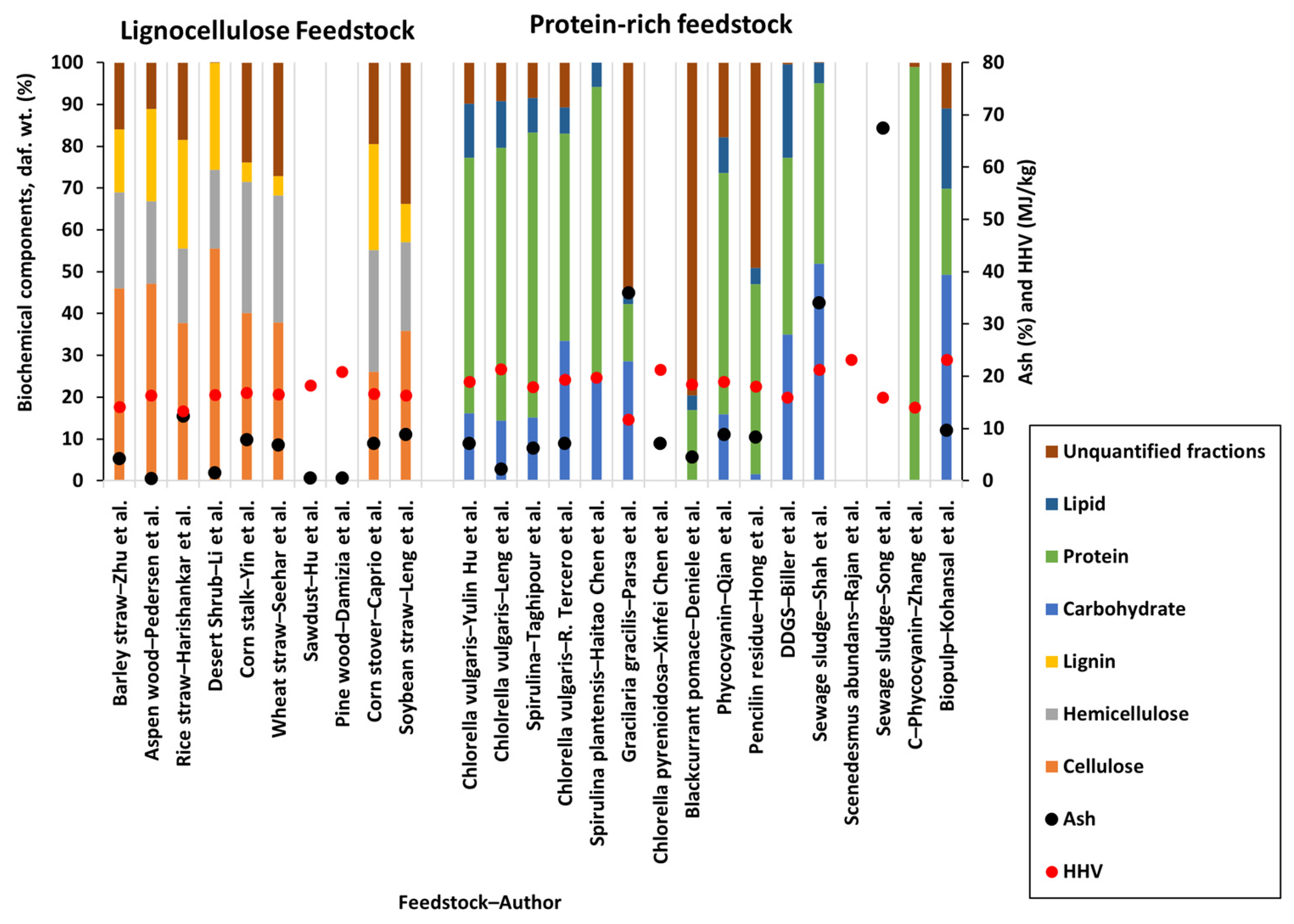
During HTL, a variety of organic compounds are produced through different reactions such as hydrolysis, decarboxylation, dehydration, deamination, polymerization, and the Maillard reaction. The term “hydrothermal” refers to the conversion of biomass in the presence of a water medium. Initially, the biomass is converted into water organics, and those compounds can later be transformed into the bio-crude phase. Among biomass components, bio-crude formation is predominantly governed by lipids and proteins, while carbohydrates contribute to a lesser extent. In contrast, lignin markedly promotes char formation. Additionally, ash and high-molecular-weight cyclic compounds, particularly those derived from biomass with high inorganic content, such as sewage sludge, tend to increase solid residue formation [48]. The distribution of chemical components of different feedstocks used in APR-HTL is illustrated in Figure 1. Studies indicate that carbohydrates and proteins are readily liquefied, converting into organic acids, N-heterocyclic compounds, and amines, which are predominant among other organic compounds [49].
An extensive overview of the characteristics of the AP generated from diverse feedstocks in HTL-APR studies is presented in Table S1 (Supplementary Materials). Research reports that lower temperatures and shorter reaction times (RTs) typically lead to higher total organic carbon (TOC) due to partial depolymerization, thereby shifting more organic material into the AP, which consequently reduces bio-crude yield [1,6]. However, oxygenates like phenols, furfurals, and N-containing compounds, including fatty acid amides, can be partitioned into the bio-crude phase at elevated temperatures [50]. Reddy et al. [51] concluded that water-soluble compounds can be repolymerized at high temperatures and become part of the bio-crude. Apart from low-molecular-weight acids, a wide range of phenolics were also detected in AP-HTL, particularly from lignocellulosic and food waste biomasses [11], yielding a higher proportion of organics in AP. Conversely, algal biomass contained lower phenols. Madsen et al. characterized AP derived from different model compounds and reported a TOC trend (highest to lowest) of protein > carbohydrate > lipid [52].
The nitrogen in the AP-HTL originates from cleavage of peptides in protein-rich substances like microalgae; on the other hand, carbohydrates and lignin are mostly dominated by compounds derived from C, H, and O [19]. Similarly, various inorganic species, including phosphate, ammonia, sodium, potassium, calcium, aluminum, and iron, have been reported, particularly in high ash-containing biomass such as sewage sludge [12]. The existence of these compounds depends on the biochemical composition of the feedstock, the conditions under which it is grown, and the process parameters [53]. A study reported that AP-HTL of algae cultivated under saline conditions contained higher concentrations of Mg, Ca, Na, and K compared to that derived from algae grown in freshwater [54]. Zinc is commonly detected in manure-derived AP-HTL streams because it is routinely added to animal feed as a growth supplement and is subsequently excreted in dung and urine. Cang et al. [55] examined the feed and dung of thirty-one farms and noticed higher concentrations of Zn, Cu, Cd, Pb, and Cr in manures. Moreover, Conti et al. [29] have indicated that the AP-HTL of lignocellulosic biomass cultivated with untreated wastewater and domestic sewage includes 3 mg/L of Zn, attributable to the growth substrate. The key point is that the measured biomass composition rarely sums to exactly 100% because certain extractives (e.g., soluble sugars, organic acids, and other minor organics) were excluded from the analysis. As these constituents are solubilized during use of the Van Soest Detergent Fiber Method, these constituents cannot be captured, and they are designated as unquantified fractions, as illustrated in Figure 1.
Figure 1. Chemical composition of feedstocks used for APR in HTL. Data extracted from Zhu et al. [11], Pedersen et al. [16], Harishankar et al. [21], Li et al. [14], Yin et al. [22], Seehar et al. [20], Yulin Hu et al. [56], Damizia et al. [57], Caprio et al. [58], Leng et al. [59], Yulin Hu et al. [23], Taghipour et al. [60], R. Tercero et al. [15], Haitao Chen et al. [24], Parsa et al. [61], Xinfei Chen et al. [62], Deniele et al. [25], Qian et al. [26], Hong et al. [63], Biller et al. [13], Shah et al. [12], Rajan et al. [64], Song et al. [65], Zhang et al. [66], and Kohansal et al. [27].
Sustainability 18 02370 g001

3. APR in Hydrothermal Liquefaction

3.1. Effect of APR on HTL of Lignocellulose Feedstocks

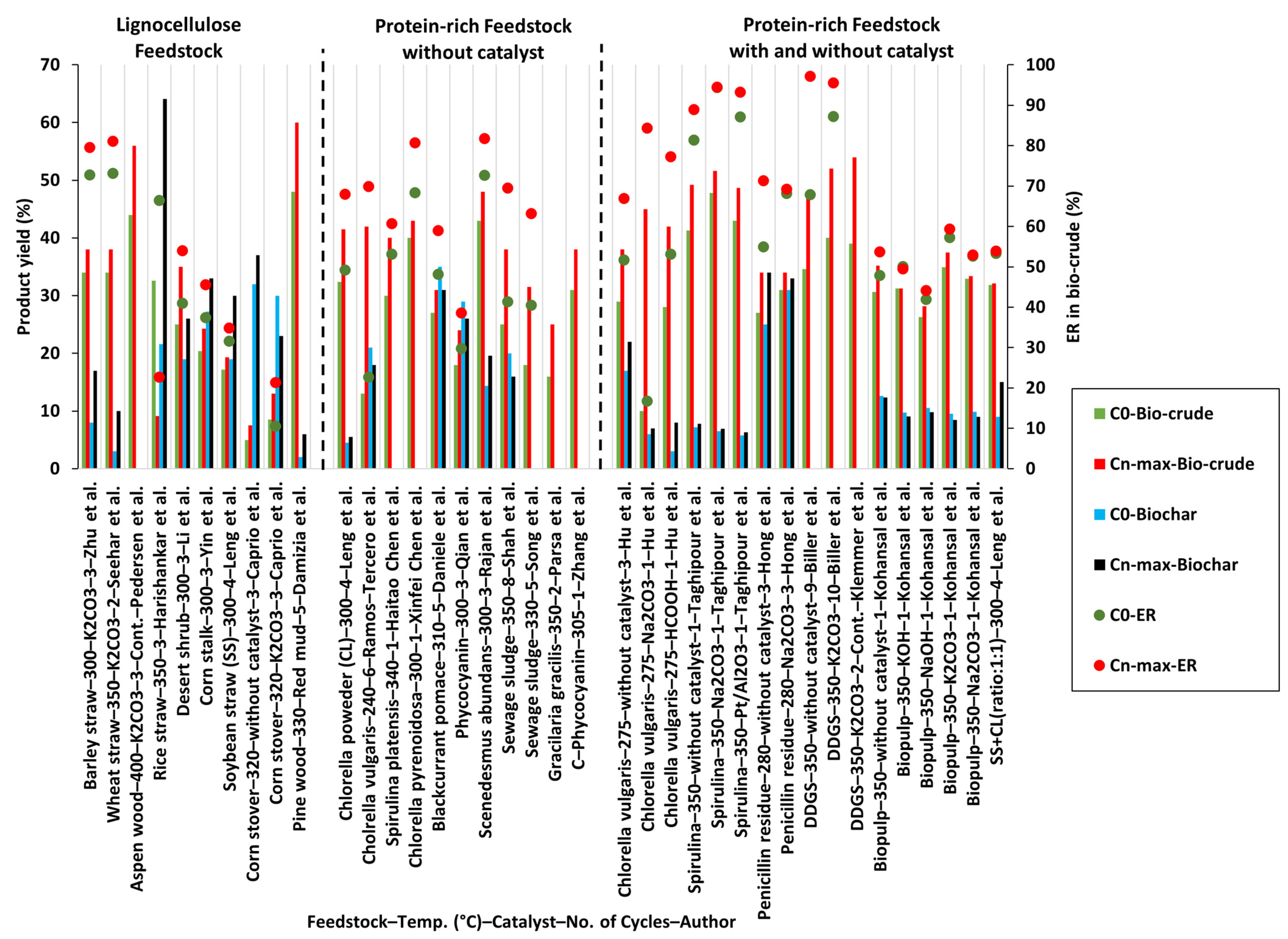
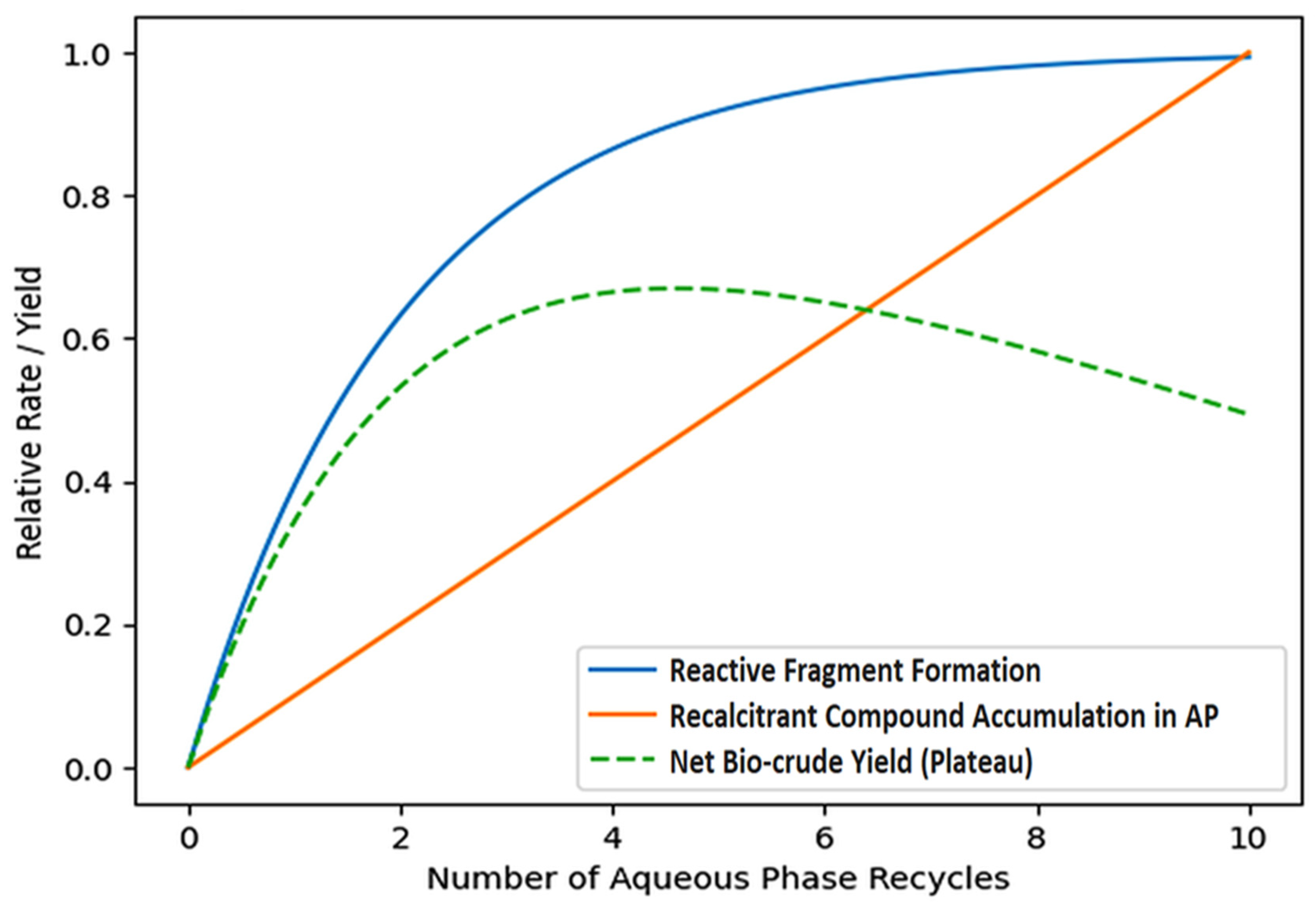
All lignocellulose feedstocks, except for rice straw, exhibited an increase in yield through APR (Figure 2). Most of the improvement in bio-crude was observed during the initial cycles, after which the enhancement declined [12,13,15,24]. As APR is predominantly governed by reaction kinetics rather than thermodynamic limitations. Initially, recirculation enriches the system with reactive intermediates that facilitate secondary reactions, thereby enhancing bio-crude yield. However, prolonged APR promotes the transformation of these intermediates into recalcitrant compounds (Table 1), diminishing overall reactivity and slowing bio-crude formation. Ultimately, a yield plateau is established when bio-crude production equilibrates with carbon retention in unreactive forms, reflecting a kinetically constrained maximum conversion (Figure 3). However, Jensen et al. [18] recommended four to five rounds of APR to achieve a steady state. Here, C0 is the bio-crude yield of the baseline experiment, while Cn-max is the maximum bio-crude yield obtained at the nth cycle (Cn). The primary catalyst (K2CO3) was employed, which is effective in promoting the hydrolysis of cellulose and hemicellulose while simultaneously inhibiting char formation [67]. Similar results were previously documented by Chen et al. [24] utilizing three biomass types, α-cellulose, lignin, and Spirulina, observing a contrary trend with lignin, leading to a 6% reduction in bio-crude yield over APR.
Figure 2. Effect of APR on lignocellulose feedstocks. Data extracted from Zhu et al. [11], Pedersen et al. [16], Harishankar et al. [21], Li et al. [14], Yin et al. [22], Seehar et al. [20], Damizia et al. [57], Caprio et al. [58], Leng et al. [59], R. Tercero et al. [15], Haitao Chen et al. [24], Xinfei Chen et al. [62], Deniele et al. [25], Qian et al. [26], Rajan et al. [64], Shah et al. [12], Song et al. [65], Parsa et al. [61], Zhang et al. [66], Yulin Hu et al. [23], Taghipour et al. [60], Hong et al. [63], Biller et al. [13], Klemmer et al. [29], and Kohansal et al. [27].
Sustainability 18 02370 g002
There may be additional potential factors contributing to the lower yield from rice straw: (1) Reaction without alkali catalyst, as pH dropped from 3.9 to 1.3 from baseline to third cycle, which might be due to the polymerization of 5-hydroxymethyl furfural under acidic conditions (forming biochar) [68]. (2) Notably, rice straw and corn stover contain comparable lignin contents (~25%) and were liquefied under non-catalytic conditions, yet they exhibited contrasting product distributions. This divergence indicates that different structural features of lignin could play a key role in governing HTL reaction pathways. Rice straw lignin is often guaiacyl-rich, resulting in a higher fraction of condensation-prone aromatic sites and a greater prevalence of C–C linkages (and fewer readily cleavable β-aryl ether linkages) compared to hardwood lignin. Consequently, HTL tends to favor repolymerization and char formation rather than the production of stable bio-crude [69]. (3) Moreover, rice straw is typically enriched in ash-forming inorganics (e.g., K/Cl/Si species), which can further promote phenolic condensation reactions [70]. This can be supported by the higher presence of K+ and CL in AP of rice straw as detected by Harishankar et al. [21], with both increasing from a few hundred mg/L to 2800 mg/L and 25,000 mg/L, respectively, after three rounds of APR. Aspen wood showed a higher yield with APR at elevated temperatures, whereas the positive impact of reduced red mud was observed [16]. Earlier, Motavaf et al. [71] investigated CaO, Al2O3, and SiO2 catalysts for food waste HTL and reported that SiO2 yielded higher bio-crude yield and HHV than the non-catalytic run.
Figure 3. Conceptual relationship shows how APR influences reactive fragment formation, recalcitrant accumulation, and the resulting plateau in net bio-crude yield.
Sustainability 18 02370 g003
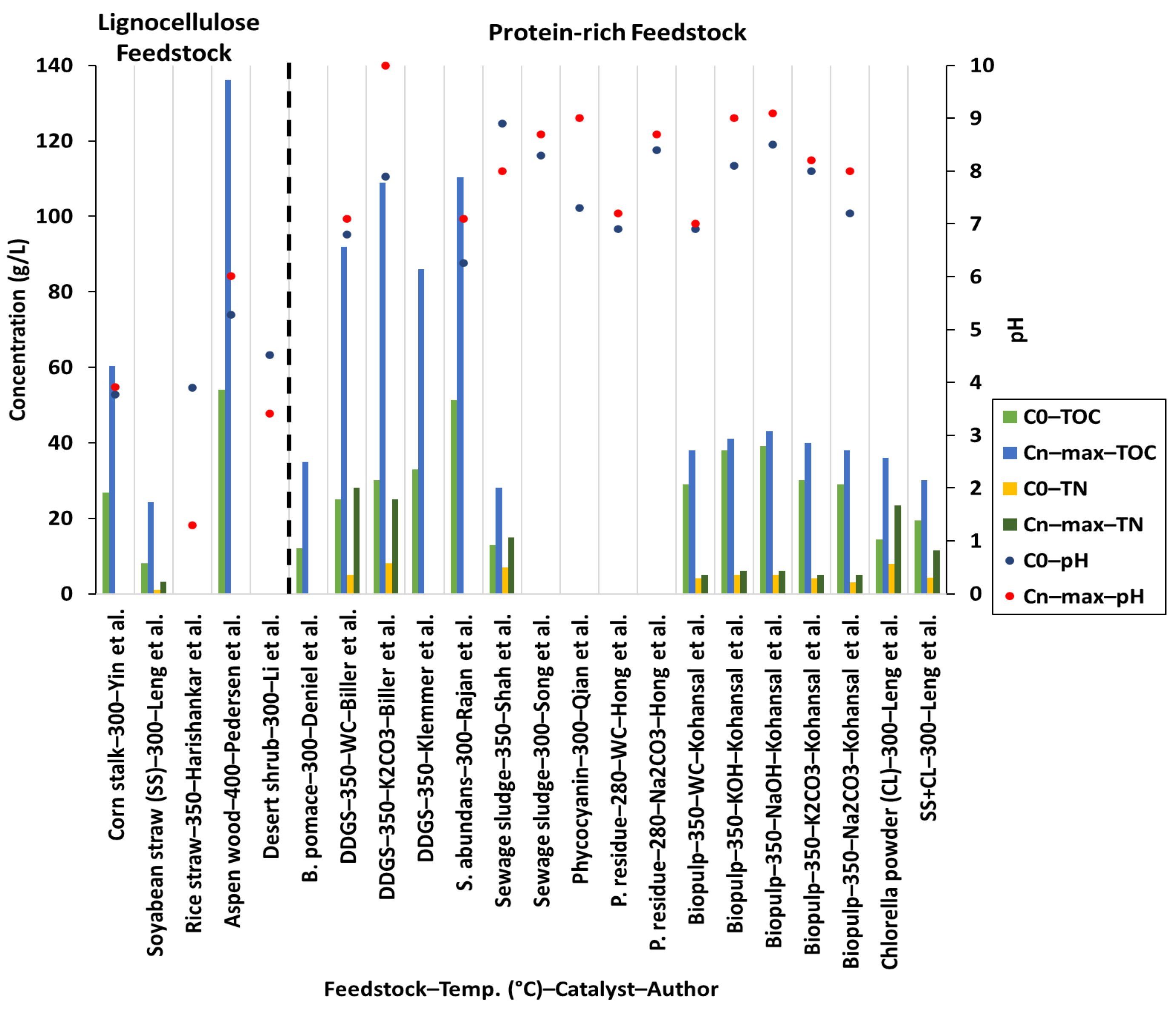
Since variation in bio-crude yield during APR is closely linked to the organic composition of the AP, it is therefore crucial to study AP compositional changes throughout the APR. Regardless of biomass composition, TOC showed a sharp rise during APR and then stabilized after a few cycles, following the same trend as observed in bio-crude yield (Figure 4). This implies that TOC is a precursor and primary contributor to the increase in bio-crude productivity. TN exhibited a similar increasing pattern due to the accumulation of ammonia/ammonium-nitrogen (NH3/NH4+) [12,27,54,60]. It was observed that higher temperatures (400 °C) shifted a higher amount of carbon to AP, which can be transferred to the system via APR, resulting in a substantial increase of (+12%) in bio-crude from aspen wood without disturbing/reducing HHV at continuous pilot-scale HTL [16]. Jensen et al. further promoted the concept of supercritical HTL and termed this phenomenon “Hydrofaction” [18].
Most studies used GC-MS at 250–350 °C to qualitatively identify the compounds. AP of lignocellulosic biomass yielded mainly acids regardless of reaction conditions. The dominant compounds detected in AP during APR are listed in Table S1. Acetic acid was the predominant compound in the AP, formed primarily through the decarboxylation of polysaccharides and the deamination of amino acids. During APR, acids decompose cellulose and hemicellulose, yielding intermediates that dehydrate to create bio-crude. It has been experimentally proven that model components (glucose and fructose) were enhanced under an acidic atmosphere [72]. The compound composition of AP before and after the recirculation from corn stalk (4.74% lignin) was evaluated by Yin et al. [22], who found that the increasing trend of acids, N-containing compounds, esters, and alcohols, while phenols and ketones decreased drastically after three rounds of APR (Table S1), indicating that bio-crude was formed by the conversion of phenols and ketones from AP to bio-crude. Qualitative analysis is adequate for chemical identification; however, quantitative analysis substantiates the actual concentrations of the detected compounds. Biller et al. studied DDGS and observed an increasing tendency with APR in acids (~1700–7250 µg/mL) and N-heterocyclic compounds (Pyrazine–methyl ~1850–3250 µg/mL). Chen et al. [24] also found larger peaks of 2-Pyrrolidinone (0.05–4.04%) and Benzeneethanamine (4.27–8.53%) in Spirulina platensis, indicating the enrichment of N-containing compounds. Rice straw produced a higher biochar yield (64%) under APR conditions. The major compounds identified in the rice straw-derived bio-crude were dimethyl phenols (~11%), p-cresol (~10%), and guaiacol (~11%) [21]. These compounds form through dealkylation of lignin-derived guaiacol to catechol intermediates, which further hydrolyze into phenolics retained in the biochar phase [73,74].
Figure 4. Effect of APR on AP characteristics. Data extracted from Pedersen et al. [16], Harishankar et al. [21], Li et al. [14], Yin et al. [22], Leng et al. [59], Deniele et al. [25], Qian et al. [26], Rajan et al. [64], Shah et al. [12], Song et al. [65], Hong et al. [63], Biller et al. [13], Klemmer et al. [29], and Kohansal et al. [27].
Sustainability 18 02370 g004
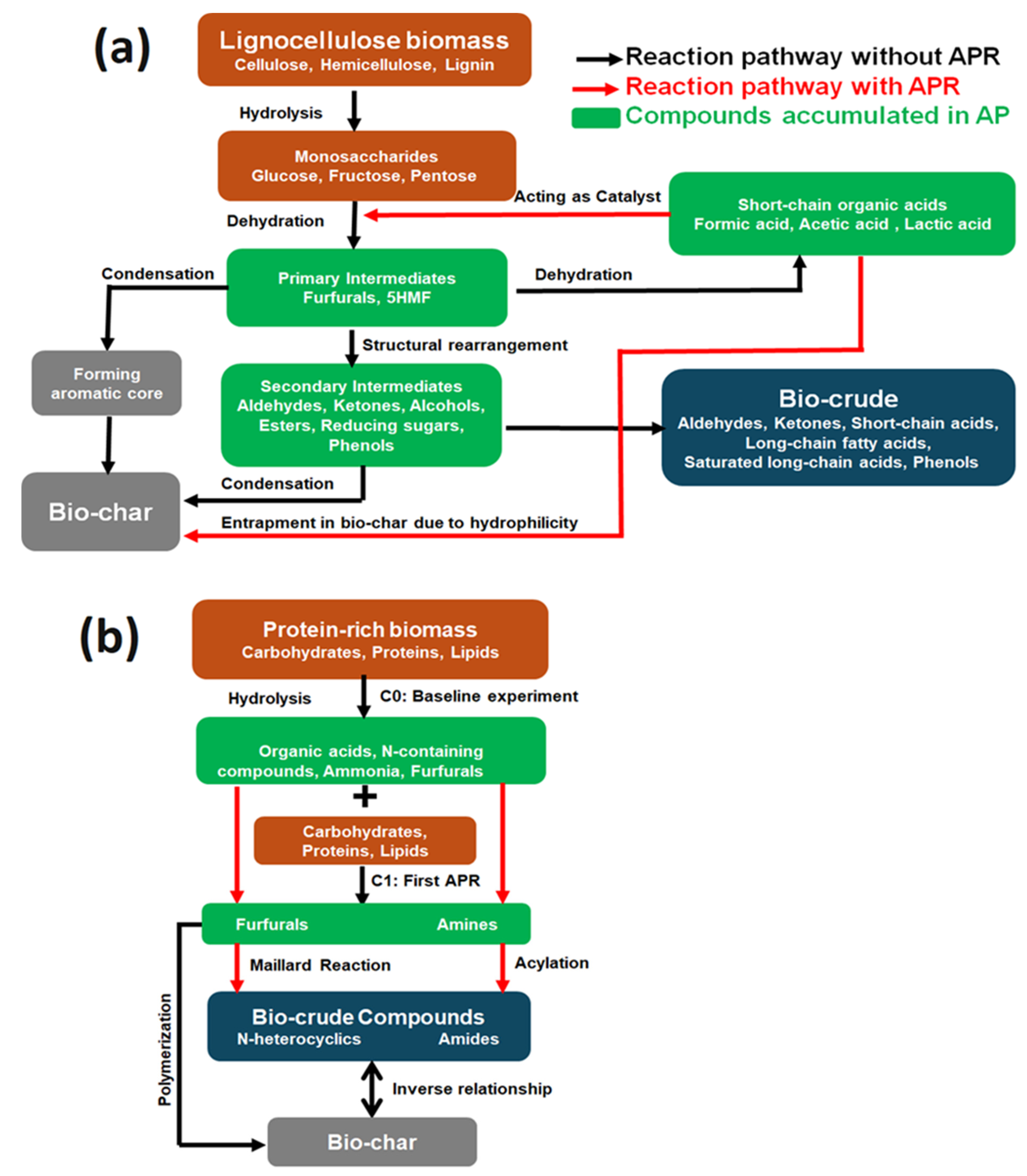
Collectively, APR in lignocellulosic feedstocks affects both bio-crude yield and char formation; however, excessive char accumulation may offset the benefits of APR. GC-MS analysis indicated that the organic acids facilitate breakdown by stimulating hydrolysis reactions, hence enhancing the conversion of feedstock into the bio-crude phase [14,75,76]. Yet a significant portion of the cellulose and lignin may persist in the biochar phase even after HTL. Thus, the synergistic effect of APR is evident in lignocellulose feedstocks in terms of bio-crude and biochar yield. The schematic diagram of reaction mechanisms of APR with lignocellulose feedstock is illustrated in Figure 5a, summarized from [11,47,68,77]. This can be confirmed by Müller and Vogel [78], who liquefied glucose with high feed concentration, yielding higher bio-crude and biochar simultaneously.
To unlock the mystery of acetic acid, researchers [12,14,15,23,24] tried to test the effect of acetic acid on bio-crude properties by varying the concentration of acetic acid and comparing the results with baseline (water) and APR experiments (Table 2). The results showed that acetic acid increased the bio-crude yield but at the expense of HHV, as it promotes cracking and decarboxylation, leading to higher oxygenated products and reduced carbon retention compared to a water medium.
Table 1. Recalcitrant compounds that could suppress the bio-crude yield via APR.
Compounds Type/
Examples Reported or Implied in HTL Chemistry
Suppressing Bio-Crude Yield
(HTL Mechanism)
Carbon Ends Up in the ProductRef.
Phenolic monomers/oligomers (e.g., phenol/cresols/guaiacol-type derivatives), lignin-derived aromatic fragmentsSecondary recombination/repolymerization of unstable fragments forms solid residue/biochar-like material, reducing bio-crude recoverySolid residue/
biochar
[11,21,57,79,80]
Maillard-derived Heterocyclic/aromatic N products (Maillard pathway products; stable N-containing structures)Maillard chemistry forms stable N-heteroaromatic structures (thermally persistent), which limit clean bio-crude formation and can shift products toward heavier/recalcitrant fractionsHeavier bio-crude fraction and/or solids; also, AP organics[12,15,81,82,83]
Water-soluble low-molecular-weight oxygenates (small acids/oxygenated organics captured in the AP analyses; exact composition varies with feed)These compounds are highly water-soluble under HTL conditions and represent direct carbon loss to the AP (recalcitrant-to-bio-crude partitioning)AP[11,13,24,57]
Nitrogenous organic compounds (NOCs): Pyridine-like species, indole-like species, other NOCsMany NOCs are thermally stable and/or remain water-soluble, so nitrogen and carbon remain in non-bio-crude phases; these are recalcitrant in the sense that they persist rather than converting cleanly into bio-crudeAP (major), sometimes heavy bio-crude[54,84]
High-ash/alkali or alkaline carbonates/mineral matter/metal chlorides for protein-rich biomass, as well as ligninHigh ash retards bio-crude formation and worsens bio-crude quality, i.e., it shifts reaction pathways away from bio-crude formationFor protein-rich feedstock: Less bio-crude; more non-bio-crude products

For lignin: More solid residue; less bio-crude
[18,22,27,85,86]
Protein-AP + (α-cellulose/lignin)
Antagonistic mechanism
Antagonistic mechanism: APR causes inhibition in a mixed-model-component systemAPR inhibited bio-crude generation, indicating antagonistic chemistry[24]

3.2. Effect of APR on HTL of Protein-Rich Feedstocks

Protein-rich feedstocks exhibited a greater increase in bio-crude yield under APR compared to lignocellulosic feedstocks. This enhancement is attributed to their higher protein and lipid contents. HTL of individual model components further demonstrated that bio-crude production follows the hierarchy: lipids > proteins > carbohydrates [87,88,89]. In most cases, protein-rich feedstocks have been processed without adding a catalyst, as alkaline catalysts are detrimental to yield, while acids reduce the HHV [89]. The enhanced bio-crude yield from protein-rich biomass is attributed to two key reaction pathways: (1) the Maillard reaction, which occurs between amino acids and polysaccharides; and (2) acylation–condensation reactions, involving amino acids and amines reacting with fatty acids and esters [47]. Recently, Shah et al. explored the detailed reaction pathways of APR with lignocellulose and protein-rich feedstocks [53]. The intermediates derived from Maillard and acylation reactions, especially N-heterocyclic compounds and amides, favor distribution into the bio-crude phase over the AP [90], resulting in higher enrichment of nitrogen in the bio-crude [82]. The increasing trend in the peak area of N-heterocyclic compounds in bio-crude was detected via APR. For instance, Pyridine (0.08–0.21%), methyl Pyrazine (0.56–1.02%), and 1-acetyl-Pyrrolidine (~1.40–2.40%) were detected in Chlorella vulgaris [23]. Shah et al. reported the presence of 4-Piperidinone, 2,2,6,6-tetramethyl (4–18%) in the bio-crude derived from sewage sludge [12]. Biller et al. quantitatively verified increasing concentrations of Pyrazine 2,5-dimethyl and 2-Pyrrolidone at ~1000–4000 µg/mL and ~1950–11,000 µg/mL, respectively [13]. Shah et al. [12] also observed higher lipophilic amides, specifically long-chain amides, including 9-Octadecenamide-Z (~9.70–17.0%), and Dodecanamide (~5.0–8.0%). Since protein-rich biomass contains a moderate quantity of carbohydrates that generate aldehydes (essential for hydro-char or biochar). Numerous studies revealed that adding N-containing compounds to cellulose biomass shifts organics toward bio-crude via condensation [24,47,91]. Chen et al. further confirmed this by performing APR of cellulose with AP derived from Spirulina platensis, reporting an enhanced bio-crude yield and lower solids due to the incorporation of N-containing compounds during APR [24]. While lignocellulosic APR shows a synergistic effect, protein-rich biomass APR exhibits an inverse relationship between bio-crude and biochar formation (Figure 2). The schematic diagram of reaction pathways is presented in Figure 5b, summarized from [24,47,91,92].

3.3. Effect of Catalyst on Protein-Rich Feedstock via APR

Several investigations have documented the APR of protein-rich biomass both with and without a catalyst [13,23,27,60,63]. Hu et al. [23] observed that Na2CO3 and HCOOH diminished bio-crude production in baseline tests; however, both catalysts enhanced bio-crude yield when used in APR by +35% and +14%, respectively, which is far higher than without catalytic APR (+9%). The enhancement in yield with Na2CO3 is associated with saturated molecules like Phytol (28%, Table S1), which can generate bio-crude products (isophytol, phytene, phytane) [93]. Formic acid improves yield through Maillard reactions by serving as a hydrogen donor and converting N-heterocyclic compounds into bio-crude [94]. Nitrogen intermediates under acidic circumstances enhance Maillard and acylation reactions, increasing bio-crude yield and energy recovery [12]. Klemmer and Biller [13,29] investigated DDGS with K2CO3 in a continuous HTL system, attaining a yield of 53–55%, the highest among all proteinaceous biomasses. Kohansal et al. [27] evaluated alkali catalysts using Biopulp at 350 °C, ranking them as follows: K2CO3 > Na2CO3 > KOH > NaOH. Taghipour et al. [60] investigated Spirulina utilizing Na2CO3 and Pt/Al2O3, including APR. Both catalysts enhanced bio-crude yield, with Na2CO3 producing sodium formate [95] and Pt/Al2O3 facilitating decarboxylation [96,97]. APR significantly enhanced yields, particularly in non-catalytic processes (+7.9%). Hong et al. [63] observed minimal APR increase with Na2CO3 on Penicillin residue attributable to the exceedingly low carbohydrate content (1.66%). Among all biomasses, DDGS-K2CO3 attained a 13% yield enhancement, approximately 1.3 times the baseline yield [13]. On the other hand, non-catalytic APR augmented Ch. vulgaris bio-crude by 29%, almost double the reference yield (13%) [15]. Scenedesmus abundans [64] and sewage sludge [12] showed increases of +5% and +13% in yield, respectively, demonstrating the effectiveness of APR for proteinaceous biomass.
Table 2. Effect of acetic acid on bio-crude yield and HHV.
FeedstockConcentration of
Acetic Acid (ACA)
Yield with
ACA (%)
Yield with
Water (%)
Yield with
APR (%)
HHV–ACA
(MJ/kg)
HHV–Water
(MJ/kg)
HH–APR (MJ/kg)Ref.
Desert shrubpH: 2.727.00253026.527.125.4[14]
Sewage sludge2.5% of total slurry26.85253834.4835.2233.82[12]
Ch. vulgaris6 g/L15.5114.342.333.634.832.3[15]
Ch. vulgaris3% of total slurry31.4529.3938NA33.8731.37[23]
Ch. vulgaris5% of total slurry41.0029.393832.6933.8731.37[23]
Sp. plantensis5% of total slurry35.5130.0740NA34.6730.15[24]
NA: Not available.

3.4. Effect of APR on Bio-Crude Quality

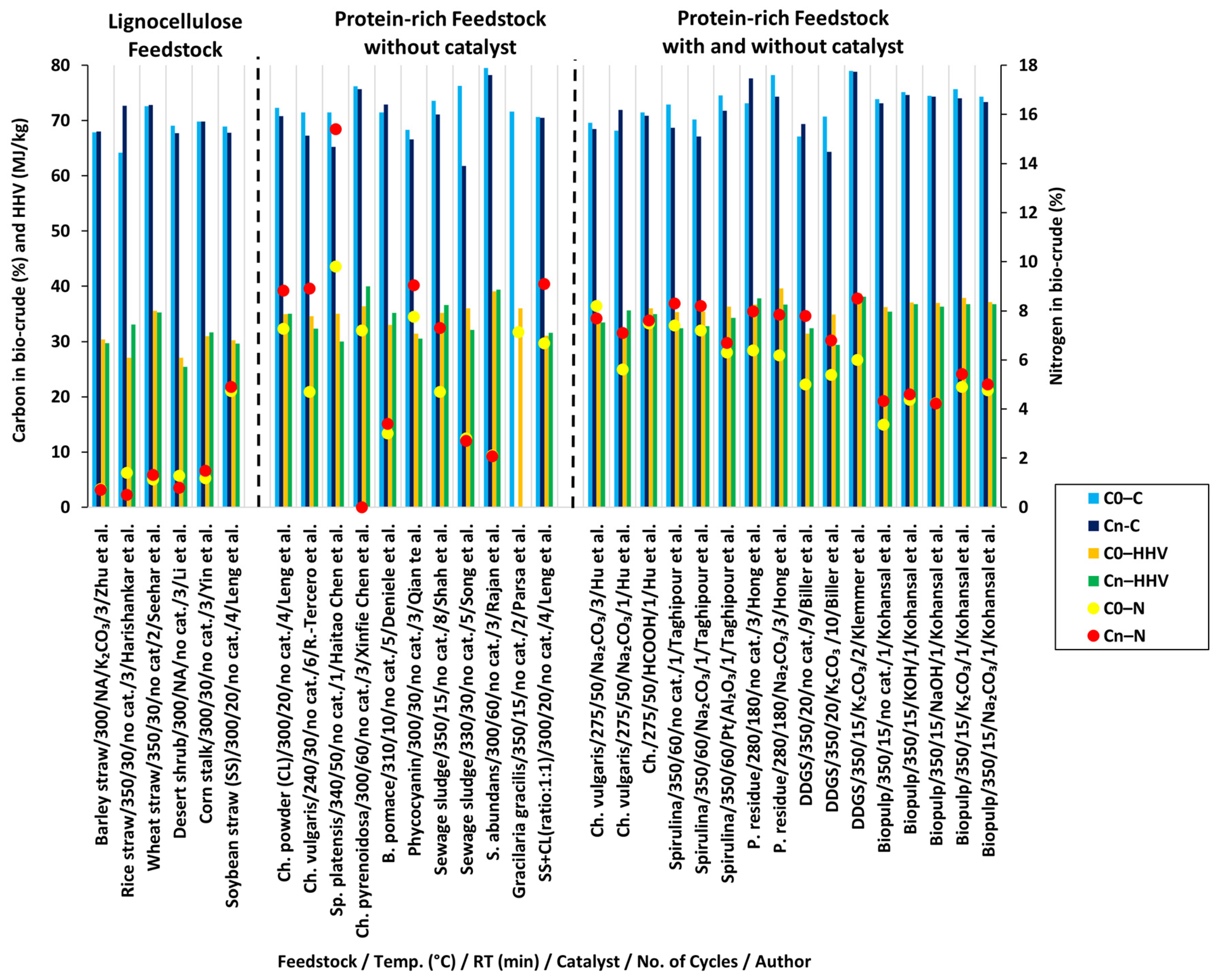
It has been demonstrated that APR affects not only the productivity of bio-crude but also its quality. The majority of studies [12,14,15,23,26,59,60] showed a declining trend in carbon content and HHV, correlating with higher levels of nitrogenated and oxygenated compounds, as depicted in Figure 6. The reduced carbon may also result from increased gas formation via decarboxylation, converting a significant portion of carbon into gases and light hydrocarbons [15].
On the other hand, Hu et al. found that changing feedstock solid content resulted in a significantly lower O content (15.5%) than a water mixture (22.1%) [56]. The same pattern was detected in blackcurrant, DDGS, sewage sludge, and penicillin residue, as listed in Table 3. The upward trend of nitrogen with APR is unavoidable due to consecutive APR, particularly with increased nitrogen enrichment through the intake of proteinaceous biomass [12,13,63]. Under non-catalyst conditions, in Ch. vulgaris, N increased by approximately two times, from 4.7 to 8.9% (+4.2%), as observed by Ramos–Tercero et al. [15]. For Sp. platensis, N increased from 9.8 to 15.4% (+5.6%) [24]. Other studies reported the same findings for penicillin residue [63], sewage sludge [12], and Biopulp [27]. To maintain APR sustainability, particularly for protein-rich feedstocks, it is essential to minimize nitrogen transfer into bio-crude via AP pre-treatment. Kohansal et al. [98] reduced AP nitrogen by evaporating light organics at ~70–80 °C before APR of the remaining AP concentrate, but this also resulted in simultaneous losses of TOC along with TN. Hence, nitrogen control is challenging and may be approached via feedstock composition management, biomass pre-treatment (N/ash removal) before HTL, use of suitable reaction solvents, and development or tailored modification of catalysts matched to the biomass and operating conditions; otherwise, downstream hydrotreatment is required to remove heteroatoms (N/O), adding cost and introducing risks such as catalyst poisoning and deactivation.
Figure 6. Effect of APR on carbon, nitrogen, and HHV of bio-crude. Data extracted from Barly straw [11], Rice straw [21], Wheat straw [20], Desert shrub [14], Corn stalk [22], Soybean straw (SS) [59], Chlorella powder (CL) [59], Chlorella vulgaris—Hu et al. [23], Spirulina [60], Chlorella vulgaris—R. Tercero et al. [15], Spirulina platensis [24], Chlorella pyrenoidosa [62], Blackcurrant pomace [25], Phycocyanin [26], Penicillin residue [63], DDGS—Biller et al. [13], Sewage sludge—Shah et al. [12], Scenedesmus abundans [64], Sewage sludge—Song et al. [65], Gracilaria gracilis [29], DDGS—Klemmer et al. [29], Biopulp [27], and SS + CL (ratio:1:1) [59].
Sustainability 18 02370 g006
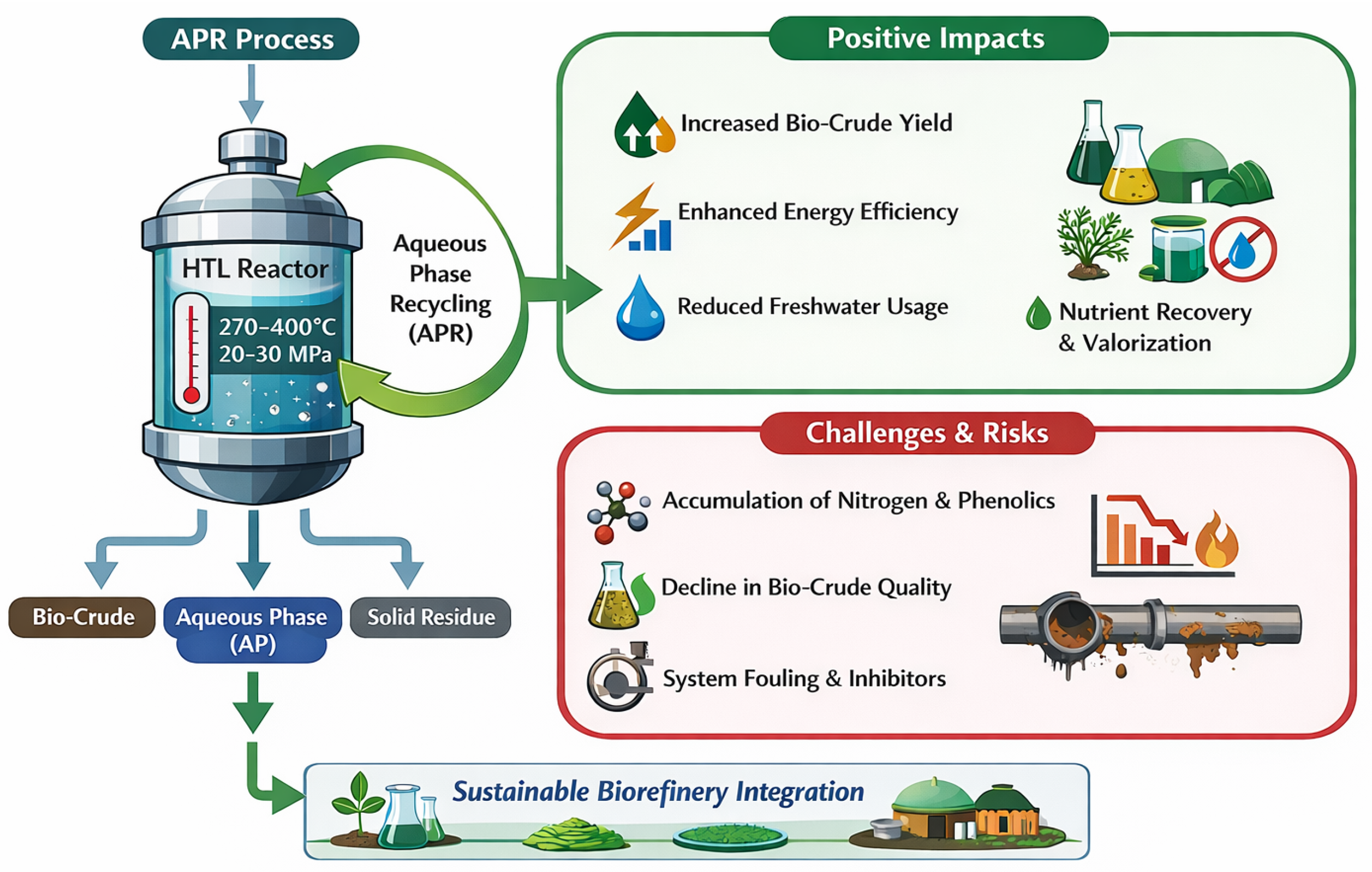
Despite the trade-offs in bio-crude quality, it has been demonstrated that APR improves the energy recovery (ER) of the HTL process. Across all biomasses, ER generally increased by 3–68%, except rice straw, which showed a decrease in ER: minus (−43%). The highest ER values, 82% and 98%, were observed for wheat straw and DDGS, respectively. In addition, Chlorella vulgaris–Na2CO3 exhibited a significant increase (change in ER) by 62%. The schematic diagram of the effect of APR in HTL is illustrated in Figure 7.
Catalyst can potentially affect the quality of bio-crude. Overall, catalyst K2CO3 demonstrated no substantial enhancements in HHV, which is instead decreased by reducing carbon content for both feedstock types except corn stover (+14.35 MJ/kg). Biller et al. [13] observed a lower concentration of DDGS-K2CO3 as compared to the non-catalytic run. However, oxygen concentration increased from 14% to 27%, resulting in a lower HHV. The alkali catalyst diminished the nitrogen content in bio-crude by APR, in contrast to non-catalytic bio-crude. K2CO3 enhances the conversion of N-organic compounds into ammonium via deamination, while suppressing Maillard reactions that would otherwise form N-heterocyclic compounds in the bio-crude [99]. Klemmer et al. [29] supported the outcomes of Biller et al., observing a reduction in HHV. Formic acid increased N content in bio-crude derived from Chlorella vulgaris [23], directing a greater proportion of N-heterocyclic compounds into the bio-crude phase instead of AP [23]. In biopulp [27], an alkali catalyst promoted the formation of more deoxygenated hydrocarbons, resulting in higher HHV. The Pt/Al2O3 demonstrated reduced nitrogen in both runs (baseline and APR) compared to APR without a catalyst [60]. This shows that denitrogenation of nitrogen compounds occurs efficiently via adsorption on heterogeneous catalyst sites.

4. Integrated Routes for Recycling of AP-HTL

4.1. AP-HTL Recycling in Anaerobic Digestion

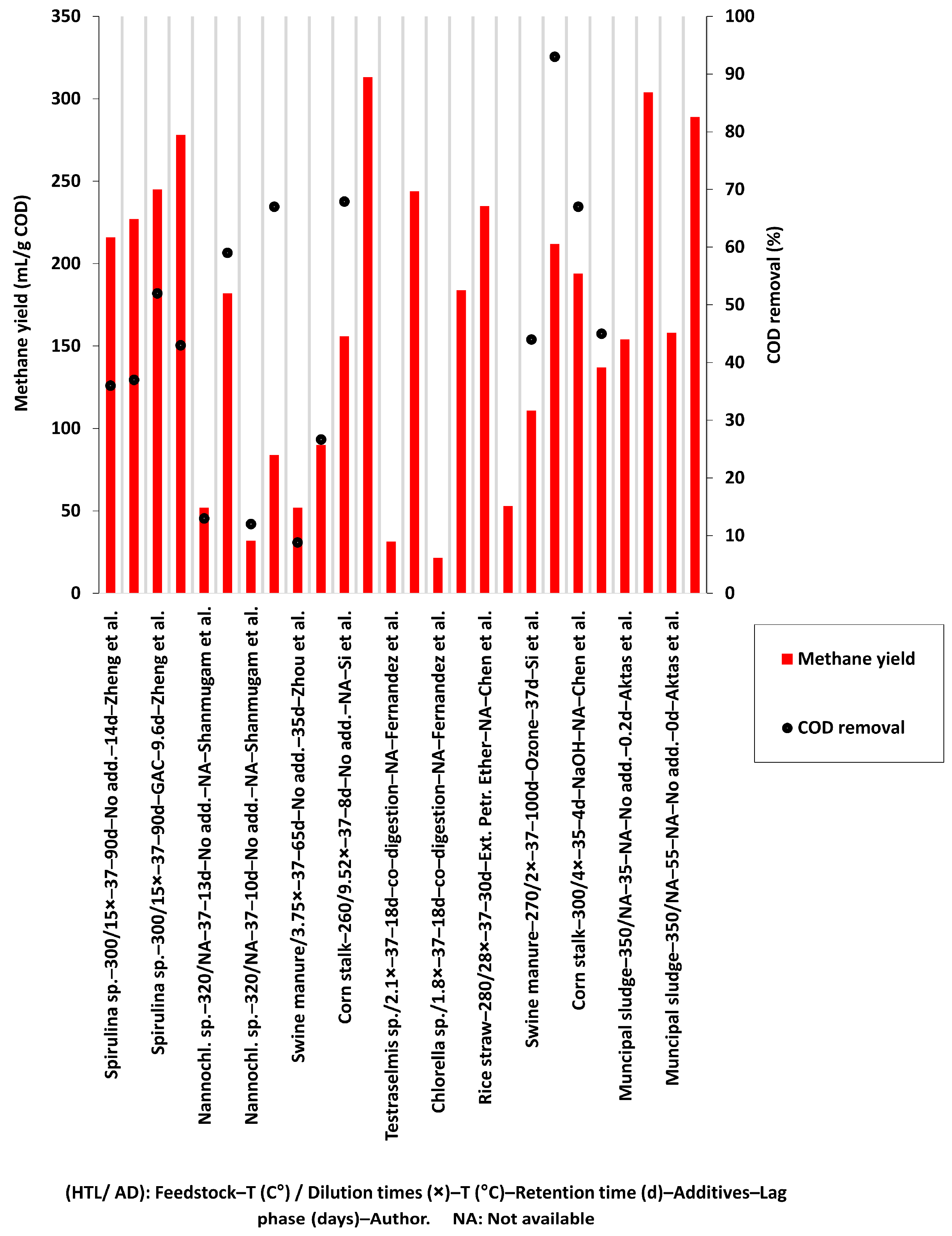
Anaerobic digestion (AD) is a cost-effective technology. The anaerobic microorganisms are known to be more resistive towards organic compounds present in AP-HTL [100]. Zhu et al. [101] concluded through techno-economic analysis that AD requires lower cost and energy for AP-HTL compared to catalytic hydrothermal gasification. Figure 8 shows the overall methane range from 21 to 313 mL/g COD; however, the increase in methane yield is directly linked to the removal performance of COD. Posmanik et al. [39] found that increasing the concentration of NaCl (higher than 10 g/L) inhibits microbial activity in AD. In some scenarios, the degradation rate is also becoming slower due to the synergistic effect of various inhibitors. This can be confirmed by the study of Pham et al. [84], who performed HTL of Spirulina and used AP for AD, finding that nine major organic compounds were less cytotoxic than their synergistic effect (used in mixed form). The organic compounds exhibited the cytotoxicity in descending order as follows: 3-dimethylaminophenol > 2,2,6,6-tetramethyl-4-piperidone > 2,6-dimethyl-3-pyridinol > 2-picoline > pyridine > 1-methyl-2-pyrrolidinone > D-valerolactam > 2-pyrrolidinone > E-caprolactam. The synergistic effect of pyridine and phenol was reported in another study [78] as the pyridine degradation rate declined with increasing phenol concentrations, beyond 400 mg/L [102].
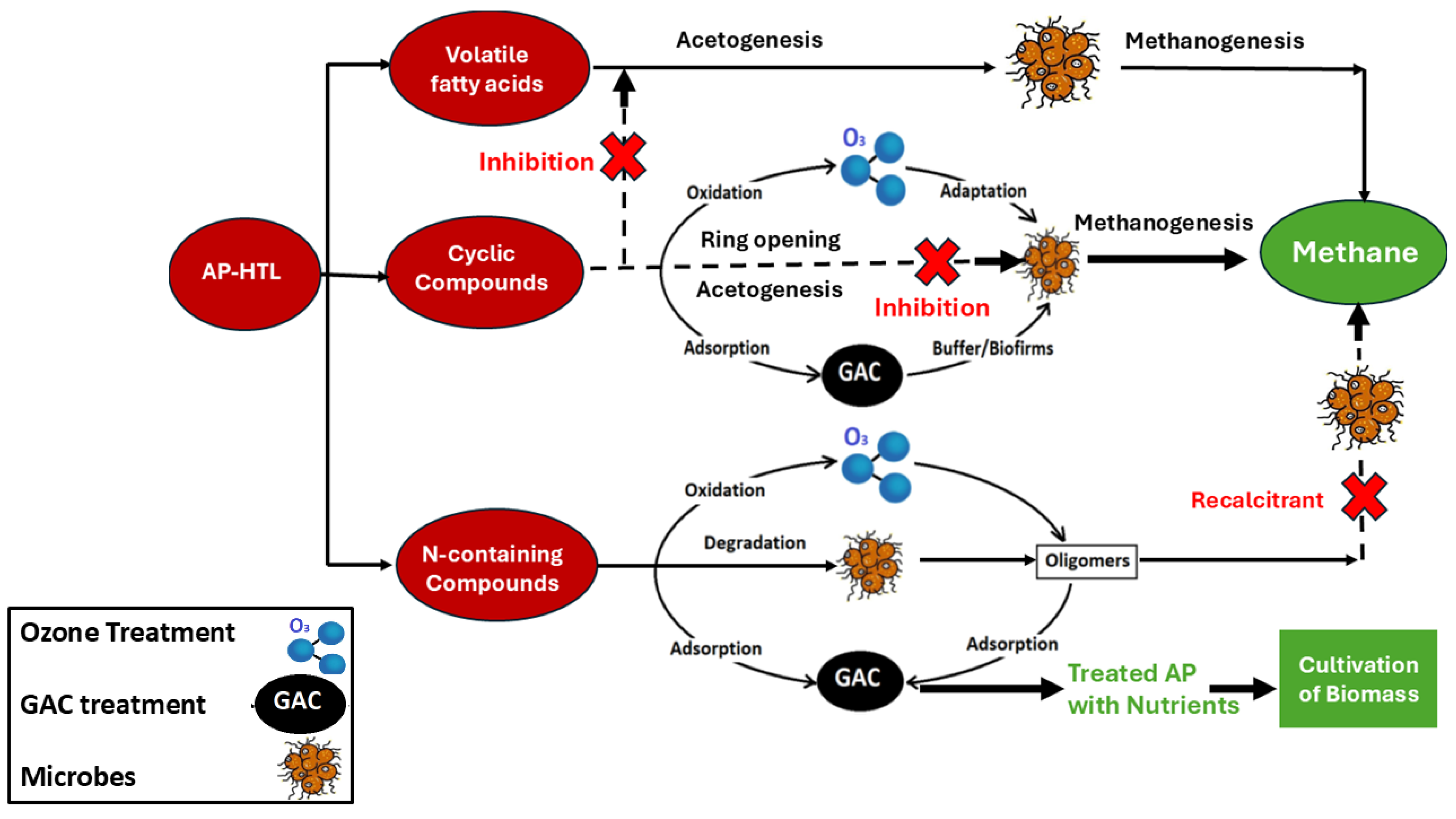
Kim et al. also reported the suppressive effect of phenol on pyridine degradation [103]. Earlier, Si et al. [34] presented the fate and distribution of organics, including volatile fatty acids, N-containing compounds, and cyclic compounds, during AD using AP-HTL, as illustrated in Figure 9. This shows that the volatile fatty acids can readily be digested via routes of methanogenesis and acetogenesis. Conversely, in the case of N-containing and cyclic compounds, acetogenesis is hindered by toxicity and high molecular mass of associated compounds [31]. The change in volatile fatty acids during pre- and post-AD treatment is provided in Table 4.
It was observed that granular-activated carbon (GAC) increased methane output by 13.4–300% and decreased the lag phase by 30.4–46.8%. Additives include struvite, polyurethane matrices (PM), and zeolite, which enhanced methane output up to 250%, 28.7%, and 5.1%, respectively, compared to the controlled media. Ozone pre-treatment enhanced methane output by 109.4%, while it marginally extended the lag period, indicating that macromolecules were transformed into low-molecular-weight chemicals that microorganisms cannot efficiently consume [34].
Figure 8. Effect of AP-HTL recycling on methane yield through AD. Data extracted from Zheng et al. [31], Shanmugam et al. [32], Zhou et al. [104], Si et al. [105], Fernandez et al. [33], Chen et al. [106], Si et al. [34], Chen et al. [107], and Aktas et al. [108].
Sustainability 18 02370 g008
Table 4. Organic acids before and after AD treatment.
Concentration (mg/L)Formic Acid ↓Acetic
Acid ↓
Propanoic
Acid ↓
Butyric
Acid ↓
Valeric Acid ↓Lactic
Acid ↓
Ref.
AP–HTLNA3696131346NDNA[31]
AD effluent (Zeolite)NA55.84967481188NA[31]
AD effluent (GAC)NA68.84234184085NA[31]
AD effluent (PM)NA1494906881261NA[31]
AP–HTL8302350960170NA121[107]
AD effluent (Mesophilic)ND80NDNDNAND[107]
AD effluent (Thermophilic430240NDNDNA560[107]
ND: Not detected. NA: Not available.
Nowadays, hythane (a mixture of hydrogen and methane) production has received considerable attention due to its characteristics as a cleaner fuel, which is produced through a two-stage dark fermentation process. For fermentation, monosaccharides from carbohydrates of AP-HTL are considered the main substrate for hydrogen production. Once hydrogen is produced, the resultant alcohols and volatile fatty acids could be used as feed for methane formation [8]. In contrast with the single-stage fermentation of AD, the two-stage dark fermentation technique enhanced the theoretical energy recovery by 10 to 12%. In the first stage of two-stage dark fermentation, along with hydrogen production, microbes break down inhibitors, which decrease the lag time for the second stage (process for methane formation). This has been validated by Liu et al. [82], who found that detoxification of furfural and 5-HMF is achieved along with hydrogen production well before the step of methane production.
Si et al. [109] performed a study on two-stage fermentation by converting AP-HTL of human feces into methane and hydrogen, at 254 mL/g COD and 29 mL/g COD, respectively. The lower magnitude of hydrogen was primarily due to the existence of phenols and furfurals (inhibitors). Almost one-third of hythane production was carried out in bench mode, which might be due to complexities in reactor integration, which requires further investigation. Azarmania et al. [35] carried out AD with co-digestion involving municipal sludge and dewatering concentrate for a prolonged period of 420 days; the digesters were fed with variable concentrations of COD in AP-HTL from 0.0% to 43.3%. Results revealed that co-digestors with AP-HTL having COD of 12, 23.1, and 43.3% were inhibited after 42, 29, and 15 days, respectively. The co-digestion with lower concentrations of COD, at 1.21% and 2.74%, displayed inhibition for 180 days. The best conditions identified were HTL with 4.89% COD, which provided the highest methane (about 300 mL CH4/g VS feed) and maximum daily biogas production (approximately 330 mL/day) before inhibition commenced at around day 95. The COD removal efficiency was approximately 62% before inhibition and around 57% following recovery, suggesting partial adaptation of thermophilic cultures. This suggests that thermophilic cultures can adapt to inhibitors in AP-HTL to a limited degree. Higher concentrations of N-heterocyclic compounds (2-ethylpyrazine, 2-ethyl-6-methylpyrazine, etc.) in AP-HTL were identified as the cause of inhibition in co-digesters supplied, along with a greater AP-HTL contribution to the overall COD load.
Li et al. [110] evaluated continuous AD of AP HTL from Chlorella in up-flow bed reactors. Raw AP HTL caused methane inhibition at 20%, whereas zeolite pre-treatment significantly improved performance, achieving stable digestion at 60%. Methane accounted for 17.3% of the total carbon, and the abundance of functional genes aligned with digester performance. Macedo et al. [111] studied co-digestion of manure with AP HTL from wheat straw manure and sewage sludge. Straw manure AP HTL yielded 43 to 49% COD conversion to methane (17.8 g per COD), while sewage sludge AP HTL achieved 43% (12.8 g per COD) but showed complete inhibition at 17 g per COD due to nitrogen-containing heterocyclic compounds. Although hydrolytic bacteria remained resilient, methanogens were suppressed, indicating that sludge-derived AP HTL requires further treatment to mitigate inhibition.
As discussed, N-heterocyclic, ammonia, and phenols were found to be toxic for AD and responsible for inhibition. Wang et al. [112] treated municipal sludge–derived AP–HTL was processed by removing phenols (biochar detoxification) and ammonia (struvite precipitation), achieving a methane yield of 225 mL per g COD. The highest yield occurred at pH 7 with the removal of both inhibitors, exceeding ammonia-only treatment by 90% and phenols-only treatment by sevenfold, while also increasing methanogen abundance. Zhu et al. [113] evaluated conductive additives during AD of microalgae-derived AP HTL. Magnetite increased methane production by 77%, biochar enhanced degradation of nitrogen-containing organics by over 80%, and granular activated carbon effectively removed inhibitory compounds, highlighting the potential of conductive materials for improved long-term AD performance. Kulikova et al. [114] examined the composition and toxicity of AP HTL from primary and secondary sludges, reporting TOC of 4.2 to 9.6 g/L, COD of 7.9 to 14.0 g/L, and BOD5 of 6.0 to 8.1 g/L. Noticeable toxicity was observed, with DR50 values of 64.7 to 142.2 for Artemia salina and 44.9 to 81.7 for Paramecium caudatum. However, aerobic treatment using industrial sludge (2.7 g/L biomass, 1:10 dilution) achieved 67 to 95% COD removal within 18 h, indicating good biodegradability.
Figure 9. Fate of organics during AP-recycling via AD.
Sustainability 18 02370 g009

4.2. Bioelectrochemical Systems

Bioelectrochemical methods are favorable for oxidizing organics into electrons via microorganisms, and those electrons can be used to produce energy and other valuable products. The oxidation of organic compounds is carried out through two types of cells: (1) microbial electrolysis cells and (2) microbial fuel cells.
A microbial electrolysis cell (MEC) is a system in which electrons are produced by anaerobic bacterial consortia through the degradation of waste. These electrons are shifted to the cathode for proton reduction to produce H2. MECs are favorable due to lower energy consumption and are highly recommended for wastewater treatment containing a higher concentration of heavy metals [115,116]. Shen et al. [117] found that recalcitrant compounds (diethyl phthalate and dimethyl phthalate) in AP-HTL derived from corn stalk were removed with ~79% and 95% efficiency, respectively, by MEC, on account of producing hydrogen at a rate of 3.92 mL/L/day. In another study, the same author in [118] employed MEC using AP-HTL of swine manure, showing a H2 production rate of 168 mL/L/day, higher than the previous study.
A microbial fuel cell (MFC) is a bioelectrochemical process in which organic matter is exploited for the generation of an electric current using metabolic activities. MFCs require less energy and do not demand a controlled distribution system, treat wastewater containing volatile substances (organic), and generate solids in minimal quantities [119,120]. Liu et al. [121] synthesized a carbon-based nanotube fixed-bed microbial cell to treat AP-HTL of corn stalk. The removal rate of 80% of organics was achieved with 2.41 g/L/day. Some disadvantages of bioelectrochemical systems, including longer start-up times, scale-up challenges, and the need for low-cost electrodes, still require attention [119,122].

4.3. AP-HTL Recycling in Microalgae Cultivation

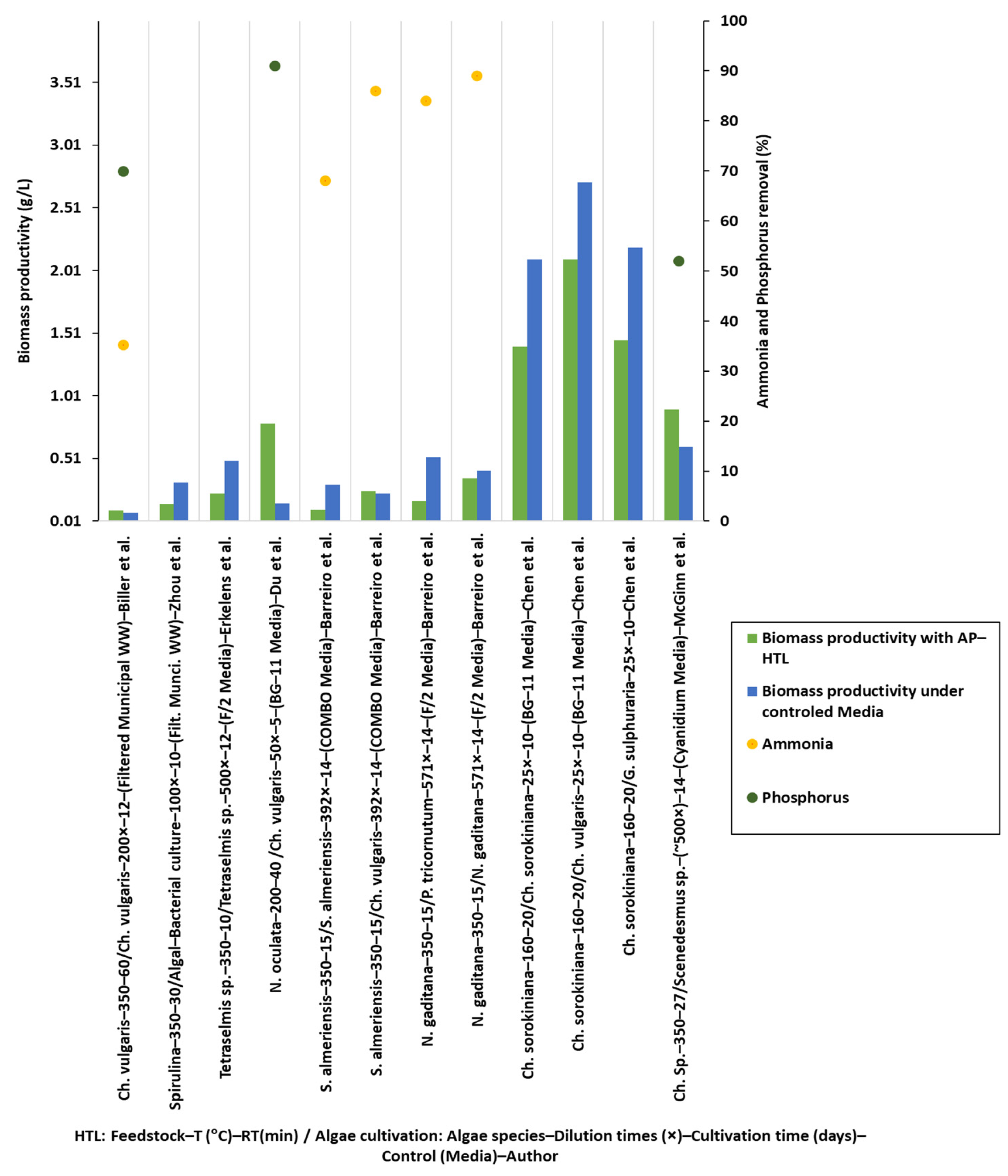
Currently, microalgae species are considered to be the ideal source for the production of biofuel, as they grow in marshlands and cannot be compared with feed crops or other foods. Thus, the production of microalgae is at higher levels, and they require expensive nutrients (N, P, K) [123]. Thus, the generation of microalgae from nutrient-rich wastewater has received great attention over the last decade. In this context, various researchers performed experiments to investigate the factors enhancing the algal growth from wastewater generated from different sources, such as glycerol waste [124], biomass hydrolysate (lipid-free) [125], seaweed residues (agar-free) [126], wastewater from the oil industry [127], wastewater containing petroleum and diesel contaminants [128], etc. The very first nutrient recycling from HTL for algae cultivation was carried out by Jena et al. [40], providing the first demonstration of nutrient recycling from HTL for microalgae cultivation, reporting ~51% biomass productivity, which exceeded that obtained with a synthetic medium. Recent studies on AP-HTL–based microalgae cultivation are summarized in Figure 10, indicating that biomass production is largely governed by operating conditions. These conditions encompass HTL process parameters as well as the cultivation strategies and protocols employed for microalgae growth. The studies from Du et al. and McGinn et al. [129,130] highlighted that the yield from AP-HTL was higher than that of the conventional or synthetic media.
During the cultivation, the inorganic nitrogen in the form of ammonia was absorbed by microalgae, because algal cells favorably utilize NH4+–N. Ammonia-nitrogen can be simply converted to amino acids more easily than nitrate [131]. Similarly, microalgae consume phosphorus (orthophosphates), as they enhance the growth of DNA, RNA, phospholipids, and ATP [132]. Like nitrogen, the extensive removal of phosphorus was observed, which is related to the N/P ratio of the AP. Because the considerable range for the N/P ratio for algal cultivation is from 5:1 to 12:1, if the ratio exceeds the mentioned limit, it could result in phosphorus starvation [130]. Metals such as Ca, Mg, Cu, Cd, and Zn are commonly present in sewage sludge and manure. These metals may lead to the formation of insoluble precipitates. In some cases, phosphorus is adsorbed onto hydroxides of Fe and Al and contributes to the solid phase, which can subsequently be recovered for use in fertilizers. Most of the nitrogen in AP is derived from N-containing compounds and ammonia. Though N and P are essential nutrients, there are some studies, such as Alba et al., reported that some essential nutrients other than N, P, and C inhibited the growth during the cultivation of microalgae using AP [133].
This observation is supported by Edmundson et al. [134], who experienced the enhanced growth rate (79 to 91%) of Chlorella sorokiniana. During HTL, macro- or micronutrients are being lost, so it is very important to ensure that AP-HTL contains sufficient macro (sodium, potassium, calcium, magnesium, chlorine, and sulfur, etc.) and micro (Cu, Fe, Co, and Mo). For example, Co supports vitamin B12 synthesis, while Mg promotes photosynthesis and chlorophyll formation [135]. Across different microalgae species, Chlorella species were widely investigated using AP-HTL, because these species possess a mixotrophic nature, which could assimilate a variety of organic compounds from AP, depending upon the degree of dilution and their tolerance [8]. Biller et al. [41], conducted growth trials using different microalgae species, such as Chlorella vulgaris, Scenedesmus dimorphus, and Chlorogloeopsis fritschii, and observed that Chlorella was stable towards inhibitory compounds and provided higher biomass growth at lower dilutions (200–400×), which is favored by Chen et al. [57]. Godwin et al. [136] also appreciated the findings and stated that Chlorella sorokiniana showed better tolerance towards recycled AP-HTL (concentration: 2%), while biomass from other species had a limited effect compared to its own. However, when polycultures of two to six species were used with recycled AP-HTL (<10%), they demonstrated resilience and significantly higher yields than monocultures. The same author, Godwin et al., in another study [137] recommended that it is obligatory to adjust polyculture combinations for balancing nutrient (N and P) utilization for enhanced bio-crude production over other monocultures.
Zhou [138] indicated that diverse HTL conditions resulted in the generation of several types of inhibitors (heterocyclic compounds). Conversely, Tommaso et al. [139] found that elevating the temperature from 260 to 320 °C resulted in an increase in phenol concentration (0.21–8.44%), which is recognized for its toxicity to microalgae. The results demonstrate that different HTL process variables significantly affect the efficacy of algal biomass output cultured with AP-HTL. Moreover, diluting AP-HTL to reduce inhibition from recalcitrant chemicals remains a major challenge, as it requires freshwater, making it economically unfeasible.
Consequently, the concept of utilizing low-strength wastewater has arisen as an alternative to freshwater dilution [140]. The variations in chemical characteristics of low-strength wastewater due to its inherent circumstances provide a challenge. The integration of adsorbents such as activated carbon (AC) [141] and zeolite [142] as a pre-treatment step has emerged as a promising method to mitigate the adverse effects of growth inhibitors on microalgae. However, these costly adsorbers are impractical for commercial use and clearly necessitate a replacement to address these challenges. The biochar derived from HTL biomass can serve as an economical adsorbent; however, it requires additional research and cost assessment.

Other Microbes Cultivation

Microbes can detoxify AP-HTL during the heterotrophic mode. Earlier, Nelson [68,143] has reported the growth of multiple types of microbes, such as Pseudomonas putida (P. putida), Escherichia coli (E. coli) (both are bacteria), and Saccharomyces cerevisiae (fungus) on AP-HTL derived from Nannochloropsis oculata. Results showed that P. putida and E. coli exhibited substantial growth at 20% v/v AP-HTL but ceased growth at 50%, indicating that bacterial tolerance to AP-HTL is considerably higher than that reported for microalgal cultivation. Conversely, Rhodococci have been documented to associate aromatic catabolism with lipid anabolism [144]. This route has been proven viable by He et al. [145] utilizing R. opacus, R. jostii, VanA, and their co-culture to transform algal and woody APs into lipids. Their findings indicated that the Rhodococci co-culture could detoxify approximately one-third of the organic chemicals in AP by-products while enhancing lipid accumulation in cellular biomass.
In recent years, Romero et al. [42] performed a study on Chlorella vulgaris NIES 227 batch transfers and turbidostat mode; both approaches offset the toxicity and restore the health of microalgae. In adaptation, a higher addition of AP-HTL was observed from 1/600 to 1/200 without inhibition. Leme et al. [146] studied mycoremediation (bioremediation that uses fungi to clean up or detoxify contaminants) of AP-HTL with white-rot fungus T. versicolor to improve the availability of inorganic nitrogen (NO3-N and NH3/NH4+-N) for prospective use in hydroponic systems. The AP-HTL with 5% dilution did not show visible fungal growth. However, laccase activity validated fungal appearance, resulting in a significant rise in NO3-N and NH3/NH4+-N 17-fold and 18-fold, respectively, after passage of three days, which was noted as the optimal duration for treatment. Incorporation of nitrifying bacteria doubled NO3-N; whereas COD was reduced by 51.33% after 24 h, before rising due to the emergence of fungal by-products. Cantero et al. [147] reviewed nutrient recovery from AP-HTL, emphasizing that two-step chemical–biological processes and protein-rich feedstocks improve nitrogen bioavailability. However, further optimization of treatment scale, duration, and economic feasibility is essential for practical valorization.
Figure 10. Effect of AP-HTL recycling on algae cultivation. Data extracted from Jena et al. [40], Biller et al. [41], Zhou et al. [140], Hognon et al. [148], Erkelens et al. [141], Du et al. [130], Velasquez et al. [149], Barreiro et al. [37], Chen et al. [150], and McGinn et al. [129].
Sustainability 18 02370 g010

4.4. AP-HTL Recycling in Gasification

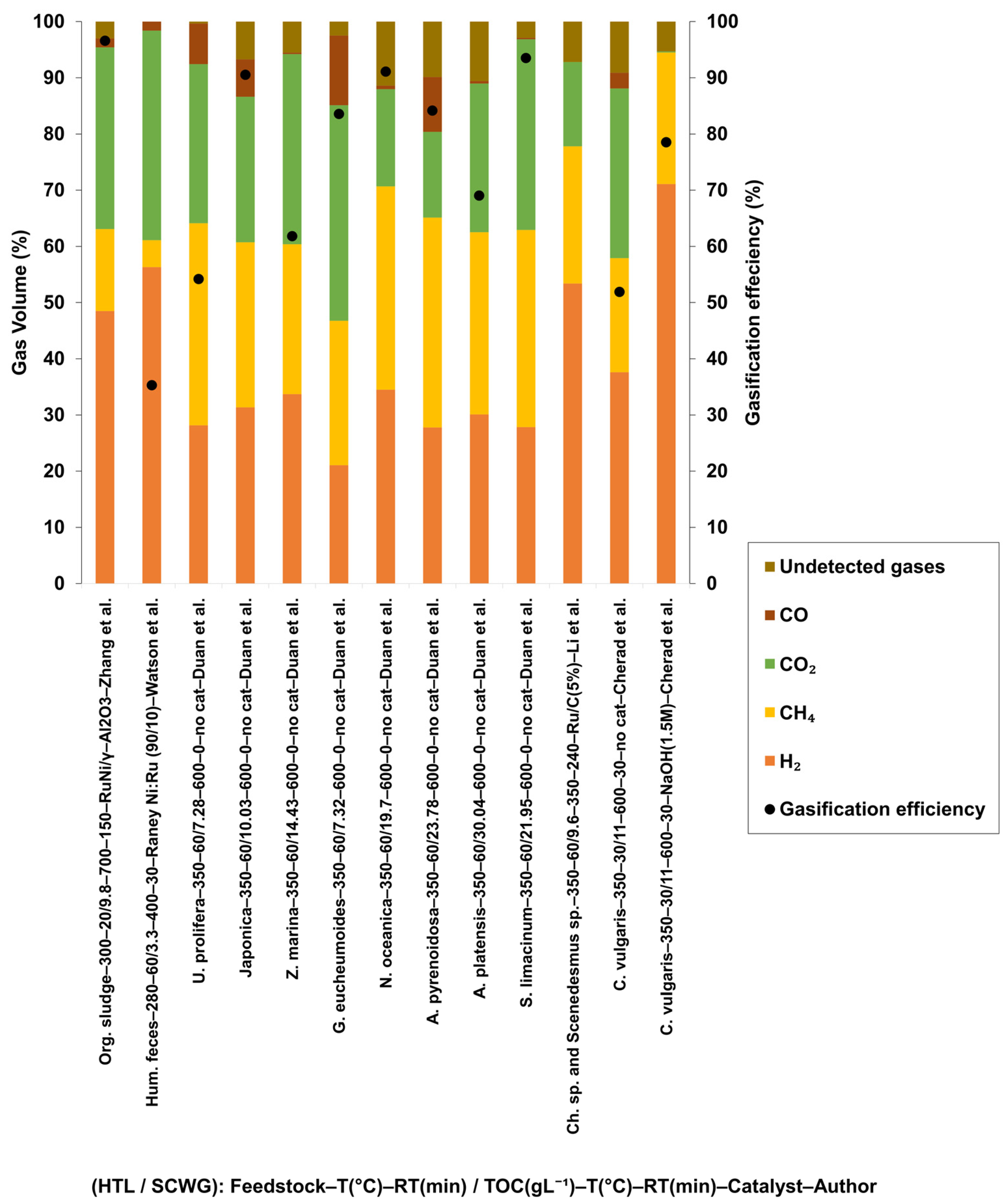
Hydrothermal gasification is also a considerable route for the valorization of AP-HTL. It exploits the supercritical conditions (above 374 °C) for converting the biomass into hydrogen and other gases on account of the degradation of TOC, COD, and other various pollutants [8]. Researchers mostly prefer catalytic hydrothermal gasification (CHG) when complete degradation of biomass is required. Since AP-HTL possesses lower solids, most of the studies reported higher production of hydrogen in the absence of a catalyst, as depicted in Figure 11. However, the addition of a catalyst improved process efficiency and hydrogen yield with a CO2 reduction. The low organic load (TOC: 3.3 g/L) demonstrated process efficiency of 35%; this could be associated with higher accumulation of oxygen and N-containing compounds or a lower concentration of acids and amides in AP-HTL [44].
Cherad et al. [45] used different organic loads of AP derived from HTL of Chlorella for gasification, and revealed that with the lowering of the concentration of AP-HTL from 11 to 2 g/L, exhibited higher yields (7-fold) of higher concentration of hydrogen. The results show that substantial hydrogen production requires reducing the organic load unless a catalyst is used. It also demonstrated that elevated temperature promotes the production of H2 and CH4 by reducing CO and CO2, which could be correlated to the conversion of CO and CO2 into methane at higher temperatures. These findings are in compliance with observations noticed by Watson et al. [151] and Duan et al. [44]. Both studies stated the significant change in the values of ammonia, TOC, and CH3COO owing to the different biochemical composition of various macro/microalgae.
It can be concluded that microalgae-based AP-HTL with a higher value of TOC around 24 g/L led to lower H2 than macroalgae-based AP-HTL containing TOC of 9.8 g/L. Apart from this, feedstocks containing higher acetate concentration produce more methane compared to hydrogen, which can be linked to decarboxylation of acetic acid and hydrogenation of CO2/CO at higher temperatures, whereas adding a catalyst can increase the H2 production but contribute to extra cost. The report of the U.S. Department of Energy stated that the catalyst-based gasification makes up 44% of the total cost, excluding feedstock [34]. Watson et al. [151], adding Raney-Ni and NaOH during gasification of human feces-based AP-HTL produced hydrogen yields of 41% and 47%, respectively, which are both higher than the control.
This is also confirmed by Cherad et al. [45], where a catalyst was employed with an organic load of AP-HTL at 11 g/L, resulting in ~2.3-fold higher hydrogen than gasification without a catalyst. The integration of HTL with gasification effectively diminished or eradicated toxic contaminants while enhancing energy yield from AP-HTL. It has been proposed that the hydrogen generated from gasification can be utilized for the hydrotreatment of the bio-crude. So far, only reductions in acetate and TOC have been observed during gasification of the AP-HTL, while ammonium, nitrate, and potassium remained largely unchanged. These nutrients are retained in the post-gasification wastewater, making it suitable for further use in algal cultivation [45].
Barreiro et al. [37] utilized AP obtained from Scenedesmus almeriensis and Nannochloropsis for SCWG and found a reduction in the load of TOC, while increasing the amount of nitrogen available as ammonium. Additionally, nitrogen-containing organic compounds from HTL-AP were degraded to ammonium during SCWG, resulting in a higher fraction of total nitrogen in the form of ammonium in AP-SCWG compared to AP-HTL-. However, the TN value showed a slight reduction in the nitrogen content of AP-SCWG. This nitrogen might be in the small amounts of bio-crude formed. The same trend was observed by Li et al. [152] and Duan et al. [44] (Table 5). Barreiro et al. [37] also evaluated the changes in organic compounds and minerals, who noticed increased concentrations of acetic acid and phenols in the SCWG, indicating that SCWG partially degrades organic molecules, releasing simpler compounds that were previously bound in HTL-AP. Glycerol decreased during SCWG due to its degradation under high temperature and pressure, resulting in the formation of simpler compounds (Table 6). As for minerals, SCWG showed high recovery of K and Na, which are valuable for algae cultivation. However, Ca and Mg exhibited slightly low recovery. This highlights the efficiency of SCWG in preserving certain nutrients while altering the organic composition of the by-products. The comprehensive chemical composition of AP–HTL feedstock is summarized in Tables S1–S4 (Supplementary Materials) for HTL, AD, microalgae cultivation, and SCWG, respectively.

4.5. Aqueous Phase Reforming

Aqueous phase reforming (AP-Reforming) is also another route for producing hydrogen at low temperatures, which facilitates the conversion of organics, particularly short-chain acids, alcohols, and sugars into hydrogen-rich gas at moderate temperature and pressures (lower than gasification) using a variety of catalysts. Recently, many researchers have tried to exploit the organic potential of AP-HTL using AP-reforming. For instance, Arlt et al. [153] utilized multiple components with a significant amount of lignin-containing AP-HTL and liquefied them into two different facilities lab scale (30 to 60 mL/h) and a pilot scale (44 L/h) to optimize the reaction conditions. Response surface methodology revealed that temperature was the most dominant variable to model the conversion of reactants. The stable conditions were achieved after running continuous experiments for 100 h. The highest hydrogen yield of 58% and carbon conversion of 54% were recorded at 273 °C. Fraia et al. [154] used lignin-rich stream after ethanol production from lignocellulosics into bio-crude production in continuous HTL, and they produced H2 by AP-reforming. The catalysts (Na2CO3 and NaOH) were also added in HTL runs. NaOH produced a higher bio-crude yield 27%; however, AP-HTL with a higher concentration of phenolics was obtained, which were removed by liquid–liquid extraction using butyl acetate, preserving the AP-reforming catalyst stability. The hydrogen produced up to 146 mmol/L-AP. The mass balance revealed that AP-reforming could fulfill 46% of H2 requirements for the hydrotreatment of bio-crude, thus significantly improving the suitability of the process. Tito et al. [155] performed a techno-economic analysis of combined HTL and AP-reforming, using corn stover and a lignin-rich stream post-ethanol production (CS). They concluded that the minimal fuel selling prices (MFSP) for the bio-crude, at a 0% internal rate of return, were €1.23 per kg for the lignin-rich stream and €1.27 per kg for corn stover. The heat exchangers constituted most of the fixed capital investment, although power and feedstock significantly influenced the operational expenses. The execution of AP-reforming was especially advantageous with CS, yielding 107% of the hydrogen necessary for bio-crude enhancement. In this instance, AP-reforming successfully diminished the hydrogen production cost to 1.5 €/kg, rendering it a competitive technique relative to traditional electrolysis.

5. Challenges and Recommendations for the Integrated AP-HTL Biorefinery Approach

Recycling of AP-HTL has demonstrated positive correlations with bio-crude yield and energy recovery. However, recycling leads to a significant increase in the COD and TN of AP-HTL. This may present serious challenges for subsequent disposal, reduce its effectiveness for algal cultivation, contribute to environmental pollution if discharged, and negatively affect the long-term storage stability of this wastewater. Consequently, while the recycling of AP-HTL is straightforward, economical, and easily scalable, it intensifies the issues related to the toxicity of AP-HTL. Anaerobic fermentation of AP-HTL holds significant potential for commercial application, being considered a well-established technology. The inadequate conversion of nitrogen-containing organics indicates that the remaining effluent requires further post-treatment through alternative valorization methods. Moreover, the pre-treatment of AP-HTL, the enrichment of functional microbes, and bio-augmentation must be prioritized to improve the anaerobic fermentation of AP-HTL. The cultivation of biomass utilizing AP-HTL as a culture-medium results in substantial nutrient recovery and represents a cost-effective method for fertilizer production. The inhibition and low efficiency of organic utilization restrict the use of AP-HTL with a high concentration of organics as a culture medium. Furthermore, the commercial utilization of the generated biomass encounters obstacles due to the environmental hazards associated with heavy metal accumulation and the extensive land area needed. Gasification is characterized by significant energy requirements and entails substantial capital and operational expenses related to catalyst integration and rigorous reactor parameters. Gasification must address challenges related to low efficiency, inadequate yields, catalyst deactivation, and gas separation/purification before it can be considered a mainstream treatment technique for AP-HTL. For better understanding, Table 7 outlines the advantages, challenges, and operational issues associated with these technologies.
Bioelectrochemical systems have proven effective at converting recalcitrant compounds such as phenols, furan derivatives, and N-heterocycles. In addition, these systems can generate useful outputs, including energy carriers, gases, and electricity. Future research should focus on enabling commercial-scale deployment by improving process efficiency and reducing overall costs.
The separation of value-added compounds from AP-HTL represents a promising strategy to improve the economic feasibility of HTL. Enhanced optimization of this method demonstrates possibilities for establishing mass market sales channels for solvents, acids, and other chemical precursors. Current research, however, is limited to AP-HTL with a less heterogeneous composition, such as the extraction of phenols and organic acids from AP-HTL generated from lignocellulose. The complex composition of AP-HTL has yet to be examined. Jensen et al. [18] demonstrated that approximately 5–15% of the AP should be removed before recirculation to prevent chloride buildup, which increased by more than 100% after six recirculation cycles when woody biomass was used as the feedstock. Therefore, although AP-HTL recirculation cannot completely eliminate the need for downstream wastewater treatment technologies (e.g., AD or gasification), it can substantially reduce the volume of wastewater requiring treatment.
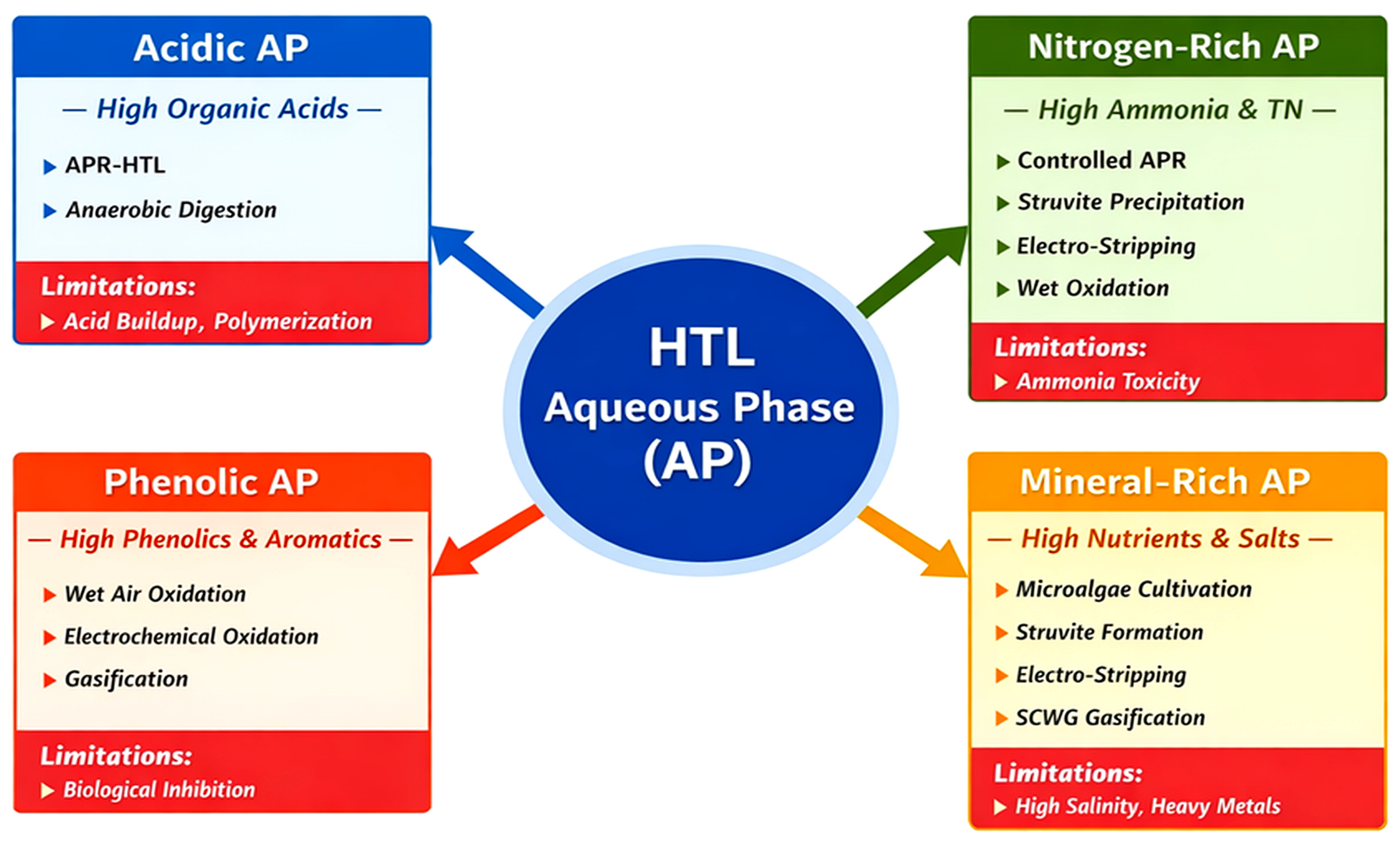
Given these challenges, no single strategy is universally suitable for AP HTL recycling. Rather than prioritizing APR within the HTL framework, process selection should be guided by the chemical composition of the obtained AP, as illustrated in Figure 12. Acid-enriched AP, particularly rich in short-chain organic acids derived from carbohydrate hydrolysis, can be recycled to the HTL reactor to enhance secondary oil formation or directed to AD for methane production. However, repeated recycling poses risks of acid accumulation, reactor corrosion, char formation, and methanogen inhibition, requiring strict control of recycle ratios, pH buffering, and residence times. Additionally, AP contains high levels of total ammonia-nitrogen, occasionally exceeding the anaerobic consortia’s inhibitory threshold of 3000 mg/L, which can cause free ammonia toxicity and accumulation of fatty acids [114,156]. Nitrogen-rich AP, dominated by ammonia and soluble nitrogenous compounds from protein decomposition, offers potential for nutrient recovery via struvite precipitation, electrostripping, or wet oxidation. Challenges include ammonia toxicity, inhibition of downstream biological systems, and deterioration of bio-crude quality during recycling; thus, nitrogen-selective recovery is recommended over bulk reuse. Phenolic AP, containing lignin-derived aromatics, is resistant to biodegradation and toxic to microbes. Thermochemical or electrochemical treatments, such as wet air oxidation, electrochemical oxidation, or gasification, are necessary to degrade phenolics and recover energy, while conventional biological recycling is impractical [157]. Mineral-rich AP, high in salts, phosphates, and trace metals, can support microalgae cultivation and nutrient recovery, but high salinity and heavy metal accumulation pose microbial inhibition and environmental risks, making controlled nutrient extraction or high-severity thermochemical treatment preferable.
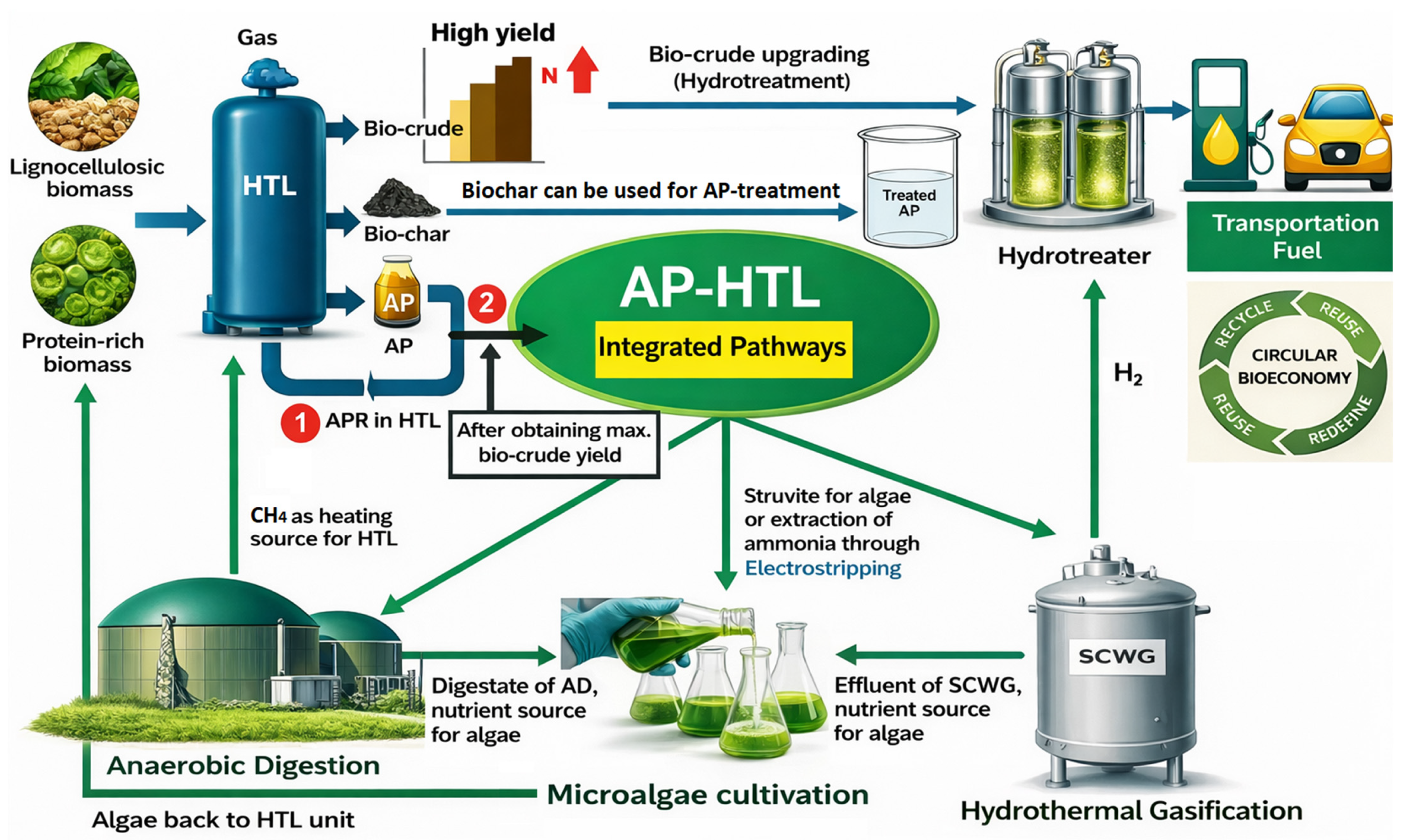
Across all categories, integrating AP-HTL recycling into a circular framework that links AD, algae cultivation, HTL, gasification, and hydrogen-assisted bio-crude upgrading can maximize resource recovery, reduce toxicity, and enhance process sustainability. Overall, a categorization-based approach enables targeted process design, balancing resource valorization with operational stability and environmental compliance. Building on this concept, optimizing HTL performance through the valorization of AP enables the linkage of plausible pathways with commercially available technologies, thereby establishing the paradigm of a sustainable biorefinery. As illustrated in Figure 13, the most preferred option is recirculation to the HTL unit through route 1. Once the maximum bio-crude yield has been achieved, AP-HTL can either be recycled through an alternative pathway or integrated through route 2 and directed to anaerobic digestion or gasification. Both processes generate valuable energy carriers, methane from anaerobic digestion and hydrogen-rich gas from gasification, while their by-products, digestate and effluent, can serve as nutrient sources for algae cultivation. AP-HTL can also be directly used for algae cultivation after nutrient recovery, such as struvite or ammonia extraction through electrostripping. The cultivated algae can subsequently be reused as a feedstock for HTL, thereby creating a closed-loop system. Furthermore, methane produced from anaerobic digestion can supply heat for the HTL process, while hydrogen-rich gas can meet the hydrogen requirement for hydrotreating.
Earlier, Shanmugam et al. [158] investigated adsorption dynamics of pyrolysis-derived biochar with AP–HTL, and they found comparable characteristics to granular activated carbon (GAC); hence, biochar may function as a viable alternative to GAC. Elliot et al. [159] suggested that the AP obtained from the gasification of AP–HTL can serve as a medium for algal cultivation. Whereas Jones et al. [160] asserted that H2 from gasification can be supplied for the upgrading of bio-crude.
Some life cycle assessment (LCA) and techno-economic analysis (TEA) studies substantiated the value of AP-recycling [9,101,161], reporting that the direct AP-recycling within the HTL unit often decreases the capital expenditure and the MFSP [101]. Conversely, it increases natural gas consumption and poses risks of heteroatom and salt formation, hence elevating upgrading difficulties. Karka et al. [161] calculated CO2-equivalent emissions of around 0.3 to 2.5 kg/kg of fuel mixture through LCA, indicating that AD management and its integration with other technologies can modify global warming potential (GWP) by a factor of two to four. As per Moser et al. [162], the GWP of manure-derived fuel is 1.18 kg CO2 equivalent per kilogram, indicating approximately a 70 percent reduction in greenhouse gas emissions compared to conventional jet fuel. Snowden-Swan et al. [155] at PNNL estimated the minimum fuel selling price to be as low as 3.46 USD per gasoline gallon equivalent under optimal conditions. Furthermore, Zhu et al. [101], Alamo et al. [163], and Zoppi et al. [164] conducted LCA and TEA and promoted the integrated approach of AP-HTL.
Future HTL research should move from yield-focused optimization to a mechanism-driven, system-level approach that explicitly links AP evolution with bio-crude yield, quality, and process stability. Standardized APR protocols and feedstock-specific recycling strategies are required to improve reproducibility and enable meaningful comparison across studies. Nitrogen accumulation and recalcitrant AP compounds should be treated as design variables through selective mitigation, staged recycling, or catalytic control. Integrated valorization pathways should be co-designed with HTL operating conditions and supported by long-term continuous studies together with integrated TEA and LCA to enable translation from laboratory research to industrially viable and sustainable biorefinery systems.

Supplementary Materials

The following supporting information can be downloaded at: https://www.mdpi.com/article/10.3390/su18052370/s1, Table S1. Chemical composition of AP recirculated in HTL. Table S2. The chemical composition of AP-HTL recycled in AD. Table S3. The chemical composition of AP-HTL used for microalgae cultivation. Table S4. The chemical composition of AP–HTL used for gasification.

Author Contributions

A.A.S.: Conceptualization, Methodology, Data curation, Investigation, Validation, Writing—review and editing. A.A.N.: Writing—review and editing, Writing—original draft, Validation, Methodology. I.A.C.: Writing—review and editing, Writing—original draft, Validation, Methodology, Funding acquisition. M.A.: Writing—review and editing, Investigation. A.R.: Writing—review and editing, Investigation. A.S.: Writing—review and editing, Investigation. N.B.M.: Writing—review and editing, Investigation. M.A.U.: Writing—review and editing. M.I.K.: Writing—review and editing, Investigation, Funding acquisition. All authors have read and agreed to the published version of the manuscript.

Funding

The authors extend their appreciation to the Deanship of Research and Graduate Studies at King Khalid University for funding this work through the Small Research Project under grant number RGP1/70/46.

Institutional Review Board Statement

Not applicable.

Informed Consent Statement

Not applicable.

Data Availability Statement

No new data were created or analyzed in this study. Data sharing is not applicable to this article.

Acknowledgments

The authors gratefully acknowledge the support and facilities provided by Dawood University of Engineering & Technology, Karachi, Pakistan, and NED University of Engineering & Technology, Karachi, Sindh, Pakistan, in completing this study.

Conflicts of Interest

The authors declare no conflict of interest.

References

  1. Gollakota, A.R.K.; Kishore, N.; Gu, S. A review on hydrothermal liquefaction of biomass. Renew. Sustain. Energy Rev. 2018, 81, 1378–1392. [Google Scholar] [CrossRef]
  2. Dimitriadis, A.; Bezergianni, S. Hydrothermal liquefaction of various biomass and waste feedstocks for biocrude production: A state of the art review. Renew. Sustain. Energy Rev. 2017, 68, 113–125. [Google Scholar] [CrossRef]
  3. Castello, D.; Pedersen, T.H.; Rosendahl, L.A. Continuous hydrothermal liquefaction of biomass: A critical review. Energies 2018, 11, 3165. [Google Scholar] [CrossRef]
  4. Ravichandran, S.R.; Venkatachalam, C.D.; Sengottian, M.; Sekar, S.; Kandasamy, S.; Ramasamy Subramanian, K.P.; Purushothaman, K.; Lavanya Chandrasekaran, A.; Narayanan, M. A review on hydrothermal liquefaction of algal biomass on process parameters, purification and applications. Fuel 2022, 313, 122679. [Google Scholar] [CrossRef]
  5. Sundarrajan, P.; Gopinath, K.P.; Arun, J.; Gracepavithra, K.; Joseph, A.A.; Manasa, S. Insights into valuing the aqueous phase derived from hydrothermal liquefaction. Renew. Sustain. Energy Rev. 2021, 144, 111019. [Google Scholar] [CrossRef]
  6. Jatoi, A.S.; Shah, A.A.; Ahmed, J.; Rehman, S.; Sultan, S.H.; Shah, A.K.; Raza, A.; Mubarak, N.M.; Hashmi, Z.; Usto, M.A.; et al. Hydrothermal Liquefaction of Lignocellulosic and Protein-Containing Biomass: A Comprehensive Review. Catalysts 2022, 12, 1621. [Google Scholar] [CrossRef]
  7. Biller, P.; Riley, R.; Ross, A.B. Catalytic hydrothermal processing of microalgae: Decomposition and upgrading of lipids. Bioresour. Technol. 2011, 102, 4841–4848. [Google Scholar] [CrossRef]
  8. Watson, J.; Wang, T.; Si, B.; Chen, W.T.; Aierzhati, A.; Zhang, Y. Valorization of hydrothermal liquefaction aqueous phase: Pathways towards commercial viability. Prog. Energy Combust. Sci. 2020, 77, 100819. [Google Scholar] [CrossRef]
  9. Zhu, Y.; Biddy, M.J.; Jones, S.B.; Elliott, D.C.; Schmidt, A.J. Techno-economic analysis of liquid fuel production from woody biomass via hydrothermal liquefaction (HTL) and upgrading. Appl. Energy 2014, 129, 384–394. [Google Scholar] [CrossRef]
  10. Ranganathan, P.; Savithri, S. Techno-economic analysis of microalgae-based liquid fuels production from wastewater via hydrothermal liquefaction and hydroprocessing. Bioresour. Technol. 2019, 284, 256–265. [Google Scholar] [CrossRef]
  11. Zhu, Z.; Rosendahl, L.; Toor, S.S.; Yu, D.; Chen, G. Hydrothermal liquefaction of barley straw to bio-crude oil: Effects of reaction temperature and aqueous phase recirculation. Appl. Energy 2015, 137, 183–192. [Google Scholar] [CrossRef]
  12. Shah, A.A.; Toor, S.S.; Seehar, T.H.; Nielsen, R.S.; Nielsen, A.H.; Pedersen, T.H.; Rosendahl, L.A. Bio-crude production through aqueous phase recycling of hydrothermal liquefaction of sewage sludge. Energies 2020, 13, 493. [Google Scholar] [CrossRef]
  13. Biller, P.; Madsen, R.B.; Klemmer, M.; Becker, J.; Iversen, B.B.; Glasius, M. Effect of hydrothermal liquefaction aqueous phase recycling on bio-crude yields and composition. Bioresour. Technol. 2016, 220, 190–199. [Google Scholar] [CrossRef]
  14. Li, C.; Yang, X.; Zhang, Z.; Zhou, D.; Zhang, L.; Zhang, S.; Chen, J. Hydrothermal liquefaction of desert shrub salix psammophila to high value-added chemicals and hydrochar with recycled processing water. BioResources 2013, 8, 2981–2997. [Google Scholar] [CrossRef]
  15. Ramos-Tercero, E.A.; Bertucco, A.; Brilman, D.W.F. Process water recycle in hydrothermal liquefaction of microalgae to enhance bio-oil yield. Energy Fuels 2015, 29, 2422–2430. [Google Scholar] [CrossRef]
  16. Pedersen, T.H.; Grigoras, I.F.; Hoffmann, J.; Toor, S.S.; Daraban, I.M.; Jensen, C.U.; Iversen, S.B.; Madsen, R.B.; Glasius, M.; Arturi, K.R.; et al. Continuous hydrothermal co-liquefaction of aspen wood and glycerol with water phase recirculation. Appl. Energy 2016, 162, 1034–1041. [Google Scholar] [CrossRef]
  17. Elliott, D.C.; Biller, P.; Ross, A.B.; Schmidt, A.J.; Jones, S.B. Hydrothermal liquefaction of biomass: Developments from batch to continuous process. Bioresour. Technol. 2015, 178, 147–156. [Google Scholar] [CrossRef]
  18. Jensen, C.U.; Rodriguez Guerrero, J.K.; Karatzos, S.; Olofsson, G.; Iversen, S.B. Fundamentals of HydrofactionTM: Renewable crude oil from woody biomass. Biomass Convers. Biorefinery 2017, 7, 495–509. [Google Scholar] [CrossRef]
  19. Leng, L.; Zhou, W. Chemical compositions and wastewater properties of aqueous phase (wastewater) produced from the hydrothermal treatment of wet biomass: A review. Energy Sources Part A Recover. Util. Environ. Eff. 2018, 40, 2648–2659. [Google Scholar] [CrossRef]
  20. Seehar, T.H.; Toor, S.S.; Shah, A.A.; Pedersen, T.H.; Rosendahl, L.A. Biocrude Production from Wheat Straw at Sub and Supercritical Hydrothermal Liquefaction. Energies 2020, 13, 3114. [Google Scholar] [CrossRef]
  21. Harisankar, S.; Francis Prashanth, P.; Nallasivam, J.; Vishnu Mohan, R.; Vinu, R. Effects of aqueous phase recirculation on product yields and quality from hydrothermal liquefaction of rice straw. Bioresour. Technol. 2021, 342, 125951. [Google Scholar] [CrossRef] [PubMed]
  22. Yin, S.; Zhang, N.; Tian, C.; Yi, W.; Yuan, Q.; Fu, P.; Zhang, Y.; Li, Z. Effect of accumulative recycling of aqueous phase on the properties of hydrothermal degradation of dry biomass and bio-crude oil formation. Energies 2021, 14, 285. [Google Scholar] [CrossRef]
  23. Hu, Y.; Feng, S.; Yuan, Z.; Xu, C.C.; Bassi, A. Investigation of aqueous phase recycling for improving bio-crude oil yield in hydrothermal liquefaction of algae. Bioresour. Technol. 2017, 239, 151–159. [Google Scholar] [CrossRef] [PubMed]
  24. Chen, H.; He, Z.; Zhang, B.; Feng, H.; Kandasamy, S.; Wang, B. Effects of the aqueous phase recycling on bio-oil yield in hydrothermal liquefaction of Spirulina Platensis, A-cellulose, and lignin. Energy 2019, 179, 1103–1113. [Google Scholar] [CrossRef]
  25. Déniel, M.; Haarlemmer, G.; Roubaud, A.; Weiss-Hortala, E.; Fages, J. Bio-oil Production from Food Processing Residues: Improving the Bio-oil Yield and Quality by Aqueous Phase Recycle in Hydrothermal Liquefaction of Blackcurrant (Ribes nigrum L.) Pomace. Energy Fuels 2016, 30, 4895–4904. [Google Scholar] [CrossRef]
  26. Qian, L.; Ni, J.; Xu, W.; Yuan, C.; Wang, S.; Hu, Y.; Gu, H. Phycocyanin to biocrude via the integration of isothermal/fast hydrothermal liquefaction and aqueous phase recirculation: Reaction products and process analyses. Fuel 2023, 332, 126226. [Google Scholar] [CrossRef]
  27. Kohansal, K.; Sharma, K.; Toor, S.S.; Sanchez, E.L.; Zimmermann, J.; Rosendahl, L.A.; Pedersen, T.H. Bio-crude production improvement during hydrothermal liquefaction of biopulp by simultaneous application of alkali catalysts and aqueous phase recirculation. Energies 2021, 14, 4492. [Google Scholar] [CrossRef]
  28. Shabbir, A.; Sharma, K.; Wimmer, R.; Pedersen, T.H.; Castello, D.; Azuara, A.J. Aqueous phase recirculation as a water management strategy and its effect on the depolymerization of Polyethylene Terephthalate (PET) by neutral hydrothermal processing. Waste Manag. 2026, 210, 115254. [Google Scholar] [CrossRef]
  29. Klemmer, M.; Madsen, R.B.; Houlberg, K.; Mørup, A.J.; Christensen, P.S.; Becker, J.; Glasius, M.; Iversen, B.B. Effect of aqueous phase recycling in continuous hydrothermal liquefaction. Ind. Eng. Chem. Res. 2016, 55, 12317–12325. [Google Scholar] [CrossRef]
  30. Zhou, M.; Taiwo, K.; Wang, H.; Ntihuga, J.N.; Angenent, L.T.; Usack, J.G. Anaerobic digestion of process water from hydrothermal treatment processes: A review of inhibitors and detoxification approaches. Bioresour. Bioprocess. 2024, 11, 47. [Google Scholar] [CrossRef]
  31. Zheng, M.; Schideman, L.C.; Tommaso, G.; Chen, W.T.; Zhou, Y.; Nair, K.; Qian, W.; Zhang, Y.; Wang, K. Anaerobic digestion of wastewater generated from the hydrothermal liquefaction of Spirulina: Toxicity assessment and minimization. Energy Convers. Manag. 2017, 141, 420–428. [Google Scholar] [CrossRef]
  32. Shanmugam, S.R.; Adhikari, S.; Shakya, R. Nutrient removal and energy production from aqueous phase of bio-oil generated via hydrothermal liquefaction of algae. Bioresour. Technol. 2017, 230, 43–48. [Google Scholar] [CrossRef] [PubMed]
  33. Fernandez, S.; Srinivas, K.; Schmidt, A.J.; Swita, M.S. Anaerobic digestion of organic fraction from hydrothermal liquefied algae wastewater byproduct. Bioresour. Technol. 2018, 247, 250–258. [Google Scholar] [CrossRef] [PubMed]
  34. Si, B.; Yang, L.; Zhou, X.; Watson, J.; Tommaso, G.; Chen, W.T.; Liao, Q.; Duan, N.; Liu, Z.; Zhang, Y. Anaerobic conversion of the hydrothermal liquefaction aqueous phase: Fate of organics and intensification with granule activated carbon/ozone pretreatment. Green Chem. 2019, 21, 1305–1318. [Google Scholar] [CrossRef]
  35. Azarmina, N.; Eskicioglu, C. Anaerobic co-digestion of hydrothermal liquefaction of aqueous phase with municipal sludge and dewatering centrate. J. Environ. Manag. 2025, 375, 124254. [Google Scholar] [CrossRef]
  36. Adedeji, O.M.; Bauer, S.K.; Jahan, K. Anaerobic digestion of aqueous product of co-hydrothermal liquefaction of beverage waste and sewage sludge: Reduction of toxicity and energy assessment. Energy Convers. Manag. 2023, 290, 117228. [Google Scholar] [CrossRef]
  37. López, D.; Bauer, M.; Hornung, U.; Posten, C.; Kruse, A.; Prins, W. Cultivation of microalgae with recovered nutrients after hydrothermal liquefaction. Algal Res. 2015, 9, 99–106. [Google Scholar] [CrossRef]
  38. Tatla, H.K.; Ismail, S.; Khan, M.A.; Dhar, B.R.; Gupta, R. Coupling hydrothermal liquefaction and anaerobic digestion for waste biomass valorization: A review in context of circular economy. Chemosphere 2024, 361, 142419. [Google Scholar] [CrossRef]
  39. Posmanik, R.; Labatut, R.A.; Kim, A.H.; Usack, J.G.; Tester, J.W.; Angenent, L.T. Coupling hydrothermal liquefaction and anaerobic digestion for energy valorization from model biomass feedstocks. Bioresour. Technol. 2017, 233, 134–143. [Google Scholar] [CrossRef]
  40. Jena, U.; Vaidyanathan, N.; Chinnasamy, S.; Das, K.C. Evaluation of microalgae cultivation using recovered aqueous co-product from thermochemical liquefaction of algal biomass. Bioresour. Technol. 2011, 102, 3380–3387. [Google Scholar] [CrossRef]
  41. Biller, P.; Ross, A.B.; Skill, S.C.; Lea-langton, A.; Balasundaram, B.; Hall, C.; Riley, R.; Llewellyn, C.A. Nutrient recycling of aqueous phase for microalgae cultivation from the hydrothermal liquefaction process. Algal Res. 2012, 1, 70–76. [Google Scholar] [CrossRef]
  42. Ramírez-Romero, A.; Martin, M.; Boyer, A.; Bolzoni, R.; Matricon, L.; Sassi, J.F.; Steyer, J.P.; Delrue, F. Microalgae adaptation as a strategy to recycle the aqueous phase from hydrothermal liquefaction. Bioresour. Technol. 2023, 371, 128631. [Google Scholar] [CrossRef]
  43. Xu, D.; Liu, L.; Wei, N.; Guo, Y.; Wang, S.; Wu, Z.; Duan, P. Catalytic supercritical water gasification of aqueous phase directly derived from microalgae hydrothermal liquefaction. Int. J. Hydrogen Energy 2019, 44, 26181–26192. [Google Scholar] [CrossRef]
  44. Duan, P.G.; Yang, S.K.; Xu, Y.P.; Wang, F.; Zhao, D.; Weng, Y.J.; Shi, X.L. Integration of hydrothermal liquefaction and supercritical water gasification for improvement of energy recovery from algal biomass. Energy 2018, 155, 734–745. [Google Scholar] [CrossRef]
  45. Cherad, R.; Onwudili, J.A.; Biller, P.; Williams, P.T.; Ross, A.B. Hydrogen production from the catalytic supercritical water gasification of process water generated from hydrothermal liquefaction of microalgae. Fuel 2016, 166, 24–28. [Google Scholar] [CrossRef]
  46. Zhang, L.; Champagne, P.; Charles, C. Supercritical water gasification of an aqueous by-product from biomass hydrothermal liquefaction with novel Ru modified Ni catalysts. Bioresour. Technol. 2011, 102, 8279–8287. [Google Scholar] [CrossRef]
  47. Leng, S.; Leng, L.; Chen, L.; Chen, J.; Chen, J.; Zhou, W. The effect of aqueous phase recirculation on hydrothermal liquefaction/carbonization of biomass: A review. Bioresour. Technol. 2020, 318, 124081. [Google Scholar] [CrossRef]
  48. Shah, A.A.; Toor, S.S.; Conti, F.; Nielsen, H.; Rosendahl, L.A. Hydrothermal liquefaction of high ash containing sewage sludge at sub and supercritical conditions. Biomass Bioenergy 2020, 135, 105504. [Google Scholar] [CrossRef]
  49. Gai, C.; Zhang, Y.; Chen, W.; Dong, Y. Energy and nutrient recovery efficiencies in biocrude oil produced via hydrothermal liquefaction of Chlorella pyrenoidosa. RSC Adv. 2014, 4, 16958–16967. [Google Scholar] [CrossRef]
  50. Valdez, P.J.; Nelson, M.C.; Wang, H.Y.; Lin, X.N.; Savage, P.E. Hydrothermal liquefaction of Nannochloropsis sp.: Systematic study of process variables and analysis of the product fractions. Biomass Bioenergy 2012, 46, 317–331. [Google Scholar] [CrossRef]
  51. Kumar, H.; Muppaneni, T.; Ponnusamy, S.; Sudasinghe, N.; Pegallapati, A.; Selvaratnam, T.; Seger, M.; Dungan, B.; Nirmalakhandan, N.; Schaub, T.; et al. Temperature effect on hydrothermal liquefaction of Nannochloropsis gaditana and Chlorella sp. Appl. Energy 2016, 165, 943–951. [Google Scholar] [CrossRef]
  52. Madsen, R.B.; Biller, P.; Jensen, M.M.; Becker, J.; Iversen, B.B.; Glasius, M. Predicting the Chemical Composition of Aqueous Phase from Hydrothermal Liquefaction of Model Compounds and Biomasses. Energy Fuels 2016, 30, 10470–10483. [Google Scholar] [CrossRef]
  53. Ali, A.; Ilyas, M.; Alam, A.; Sattar, A. Aqueous phase recirculation in hydrothermal liquefaction: A critical review. Biomass Bioenergy 2026, 207, 108612. [Google Scholar] [CrossRef]
  54. Maddi, B.; Panisko, E.; Albrecht, K.; Howe, D. Qualitative Characterization of the Aqueous Fraction from Hydrothermal Liquefaction of Algae Using 2D Gas Chromatography with Time-of-flight Mass Spectrometry. J. Vis. Exp. 2016, 109, 53634. [Google Scholar] [CrossRef]
  55. Cang, L.; Wang, Y.J.; Zhou, D.M.; Dong, Y.H. Heavy metals pollution in poultry and livestock feeds and manures under intensive farming in Jiangsu Province, China. J. Environ. Sci. 2004, 16, 371–374. [Google Scholar]
  56. Hu, Y.; Feng, S.; Bassi, A.; Xu, C.C. Improvement in bio-crude yield and quality through co-liquefaction of algal biomass and sawdust in ethanol-water mixed solvent and recycling of the aqueous by-product as a reaction medium. Energy Convers. Manag. 2018, 171, 618–625. [Google Scholar] [CrossRef]
  57. Damizia, M.; Bracciale, M.P.; Mousavi, S.; Tai, L.; De Filippis, P.; de Caprariis, B. Red mud as hydrogen producer in hydrothermal liquefaction of pinewood: Minimization of process wastes by recycling the water and hydrochar phases. Renew. Energy 2024, 232, 121139. [Google Scholar] [CrossRef]
  58. Carpio, R.B.; Avendaño, C.I.L.; Basbas, C.A.; Habulan, A.A.; Guerrero, G.A.M.; Maguyon-Detras, M.C.; Bambase, M.E. Assessing the effect of K2CO3 and aqueous phase recycling on hydrothermal liquefaction of corn stover. Bioresour. Technol. Rep. 2022, 18, 101093. [Google Scholar] [CrossRef]
  59. Leng, S.; Jiao, H.; Liu, T.; Pan, W.; Chen, J.; Chen, J.; Huang, H.; Peng, H.; Wu, Z.; Leng, L.; et al. Co-liquefaction of Chlorella and soybean straw for production of bio-crude: Effects of reusing aqueous phase as the reaction medium. Sci. Total Environ. 2022, 820, 153348. [Google Scholar] [CrossRef]
  60. Taghipour, A.; Hornung, U.; Ramirez, J.A.; Brown, R.J.; Rainey, T.J. Aqueous phase recycling in catalytic hydrothermal liquefaction for algal biomass and the effect on elemental accumulation and energy efficiency. J. Clean. Prod. 2021, 289, 125582. [Google Scholar] [CrossRef]
  61. Parsa, M.; Jalilzadeh, H.; Pazoki, M.; Ghasemzadeh, R.; Abduli, M.A. Hydrothermal liquefaction of Gracilaria gracilis and Cladophora glomerata macro-algae for biocrude production. Bioresour. Technol. 2018, 250, 26–34. [Google Scholar] [CrossRef]
  62. Chen, X.; Ma, X.; Zeng, X.; Zheng, C.; Lu, X. Ethanol addition during aqueous phase recirculation for further improving bio-oil yield and quality. Appl. Energy 2020, 262, 114550. [Google Scholar] [CrossRef]
  63. Hong, C.; Wang, Z.; Si, Y.; Li, Z.; Xing, Y.; Hu, J.; Li, Y. Effects of aqueous phase circulation and catalysts on hydrothermal liquefaction (HTL) of penicillin residue (PR): Characteristics of the aqueous phase, solid residue and bio oil. Sci. Total Environ. 2021, 776, 145596. [Google Scholar] [CrossRef]
  64. Sundar Rajan, P.; Gopinath, K.P.; Arun, J.; Grace Pavithra, K. Hydrothermal liquefaction of Scenedesmus abundans biomass spent for sorption of petroleum residues from wastewater and studies on recycling of post hydrothermal liquefaction wastewater. Bioresour. Technol. 2019, 283, 36–44. [Google Scholar] [CrossRef] [PubMed]
  65. Song, H.; Yang, T.; Li, B.; Tong, Y.; Li, R. Hydrothermal liquefaction of sewage sludge into biocrude: Effect of aqueous phase recycling on energy recovery and pollution mitigation. Water Res. 2022, 226, 119278. [Google Scholar] [CrossRef] [PubMed]
  66. Zhang, B.; He, Z.; Xu, Z. Effect of organic aqueous phase recycling on hydrothermal liquefaction of C-Phycocyanin. Biomass Bioenergy 2022, 165, 106573. [Google Scholar] [CrossRef]
  67. Zhu, Z.; Toor, S.S.; Rosendahl, L.; Yu, D.; Chen, G. Influence of alkali catalyst on product yield and properties via hydrothermal liquefaction of barley straw. Energy 2015, 80, 284–292. [Google Scholar] [CrossRef]
  68. Yin, S.; Tan, Z. Hydrothermal liquefaction of cellulose to bio-oil under acidic, neutral and alkaline conditions. Appl. Energy 2012, 92, 234–239. [Google Scholar] [CrossRef]
  69. Rosado, M.J.; Rencoret, J.; Marques, G.; Gutiérrez, A.; del Río, J.C. Structural Characteristics of the Guaiacyl-Rich Lignins From Rice (Oryza sativa L.) Husks and Straw. Front. Plant Sci. 2021, 12, 640475. [Google Scholar] [CrossRef]
  70. Yang, J.; Chen, H.; Liu, Q.; Zhou, N.; Wu, Y.; He, Q.S. Is it feasible to replace freshwater by seawater in hydrothermal liquefaction of biomass for biocrude production? Fuel 2020, 282, 118870. [Google Scholar] [CrossRef]
  71. Motavaf, B.; Capece, S.H.; Savage, P.E. Screening Potential Catalysts for the Hydrothermal Liquefaction of Food Waste. Energy Fuels 2021, 35, 9437–9449. [Google Scholar] [CrossRef]
  72. Li, Y.; Lu, X.; Yuan, L.; Liu, X. Fructose decomposition kinetics in organic acids-enriched high temperature liquid water. Biomass Bioenergy 2009, 33, 1182–1187. [Google Scholar] [CrossRef]
  73. Wahyudiono; Sasaki, M.; Goto, M. Recovery of phenolic compounds through the decomposition of lignin in near and supercritical water. Chem. Eng. Process. Process Intensif. 2008, 47, 1609–1619. [Google Scholar] [CrossRef]
  74. Shah, A.A.; Sharma, K.; Seehar, T.H.; Toor, S.S.; Sandquist, J.; Saanum, I.; Pedersen, T.H. Sub-Supercritical Hydrothermal Liquefaction of Lignocellulose and Protein-Containing Biomass. Fuels 2024, 5, 75–89. [Google Scholar] [CrossRef]
  75. Lynam, J.G.; Coronella, C.J.; Yan, W.; Reza, M.T.; Vasquez, V.R. Acetic acid and lithium chloride effects on hydrothermal carbonization of lignocellulosic biomass. Bioresour. Technol. 2011, 102, 6192–6199. [Google Scholar] [CrossRef]
  76. Xu, J.; Thomsen, M.H.; Thomsen, A.B. Recovery of arabinan in acetic acid-catalyzed hydrothermal pretreatment on corn stover. Biomass Bioenergy 2009, 33, 1660–1663. [Google Scholar] [CrossRef]
  77. Usman, M.; Chen, H.; Chen, K.; Ren, S.; Clark, J.H.; Fan, J.; Luo, G.; Zhang, S. Characterization and utilization of aqueous products from hydrothermal conversion of biomass for bio-oil and hydro-char production: A review. Green Chem. 2019, 21, 1553–1572. [Google Scholar] [CrossRef]
  78. Müller, J.B.; Vogel, F. Tar and coke formation during hydrothermal processing of glycerol and glucose. Influence of temperature, residence time and feed concentration. J. Supercrit. Fluids 2012, 70, 126–136. [Google Scholar] [CrossRef]
  79. Yang, C.; Wang, S.; Yang, J.; Xu, D.; Li, Y.; Li, J.; Zhang, Y. Hydrothermal liquefaction and gasification of biomass and model compounds: A review. Green Chem. 2020, 22, 8210–8232. [Google Scholar] [CrossRef]
  80. Yiin, C.L.; Bin Odita, E.; Mun Lock, S.S.; Cheah, K.W.; Chan, Y.H.; Wong, M.K.; Chin, B.L.F.; Quitain, A.T.; Loh, S.K.; Yusup, S. A review on potential of green solvents in hydrothermal liquefaction (HTL) of lignin. Bioresour. Technol. 2022, 364, 128075. [Google Scholar] [CrossRef]
  81. Chacon-Parra, A.D.; Hall, P.A.; Lewis, D.M.; Glasius, M.; Van Eyk, P.J. Elucidating the Maillard Reaction Mechanism in the Hydrothermal Liquefaction of Binary Model Compound Mixtures and Spirulina. ACS Sustain. Chem. Eng. 2022, 10, 10989–11003. [Google Scholar] [CrossRef]
  82. Leng, L.; Zhang, W.; Peng, H.; Li, H.; Jiang, S.; Huang, H. Nitrogen in bio-oil produced from hydrothermal liquefaction of biomass: A review. Chem. Eng. J. 2020, 401, 126030. [Google Scholar] [CrossRef]
  83. Ducey, T.F.; Savage, P.E.; Hsieh, C.; Gearheart, J.; Edmondson, E.; Cooke, M.; Gunderson, K.; Davis, R.; Kinchin, C. Nitrogen Migration and Transformation during Hydrothermal Liquefaction of Livestock Manures. ACS Sustain. Chem. Eng. 2018, 6, 13570–13578. [Google Scholar] [CrossRef]
  84. Pham, M.; Schideman, L.; Scott, J.; Rajagopalan, N.; Plewa, M.J. Chemical and biological characterization of wastewater generated from hydrothermal liquefaction of Spirulina. Environ. Sci. Technol. 2013, 47, 2131–2138. [Google Scholar] [CrossRef]
  85. Chen, W.T.; Qian, W.; Zhang, Y.; Mazur, Z.; Kuo, C.T.; Scheppe, K.; Schideman, L.C.; Sharma, B.K. Effect of ash on hydrothermal liquefaction of high-ash content algal biomass. Algal Res. 2017, 25, 297–306. [Google Scholar] [CrossRef]
  86. Yang, T.; Du, C.; Li, B.; Liu, Z.; Kai, X. Influence of alkali and alkaline earth metals on the hydrothermal liquefaction of lignocellulosic model compounds. Renew. Energy 2022, 188, 1038–1048. [Google Scholar] [CrossRef]
  87. Yang, J.; He, Q.S.; Niu, H.; Corscadden, K.; Astatkie, T. Hydrothermal liquefaction of biomass model components for product yield prediction and reaction pathways exploration. Appl. Energy 2018, 228, 1618–1628. [Google Scholar] [CrossRef]
  88. Klingler, D.; Berg, J.; Vogel, H. Hydrothermal reactions of alanine and glycine in sub- and supercritical water. J. Supercrit. Fluids 2007, 43, 112–119. [Google Scholar] [CrossRef]
  89. Biller, P.; Ross, A.B. Potential yields and properties of oil from the hydrothermal liquefaction of microalgae with different biochemical content. Bioresour. Technol. 2011, 102, 215–225. [Google Scholar] [CrossRef]
  90. Zhuang, X.; Huang, Y.; Song, Y.; Zhan, H.; Yin, X.; Wu, C. The transformation pathways of nitrogen in sewage sludge during hydrothermal treatment. Bioresour. Technol. 2017, 245, 463–470. [Google Scholar] [CrossRef]
  91. Matayeva, A.; Bianchi, D.; Chiaberge, S.; Cavani, F.; Basile, F. Elucidation of reaction pathways of nitrogenous species by hydrothermal liquefaction process of model compounds. Fuel 2019, 240, 169–178. [Google Scholar] [CrossRef]
  92. Xu, Z.X.; Cheng, J.H.; He, Z.X.; Wang, Q.; Shao, Y.W.; Hu, X. Hydrothermal liquefaction of cellulose in ammonia/water. Bioresour. Technol. 2019, 278, 311–317. [Google Scholar] [CrossRef] [PubMed]
  93. Changi, S.; Brown, T.M.; Savage, P.E. Reaction kinetics and pathways for phytol in high-temperature water. Chem. Eng. J. 2012, 189, 336–345. [Google Scholar] [CrossRef]
  94. Ross, A.B.; Biller, P.; Kubacki, M.L.; Li, H.; Lea-Langton, A.; Jones, J.M. Hydrothermal processing of microalgae using alkali and organic acids. Fuel 2010, 89, 2234–2243. [Google Scholar] [CrossRef]
  95. Jena, U.; Das, K.C.; Kastner, J.R. Comparison of the effects of Na2CO3, Ca3(PO4)2, and NiO catalysts on the thermochemical liquefaction of microalga Spirulina platensis. Appl. Energy 2012, 98, 368–375. [Google Scholar] [CrossRef]
  96. Scarsella, M.; de Caprariis, B.; Damizia, M.; De Filippis, P. Heterogeneous catalysts for hydrothermal liquefaction of lignocellulosic biomass: A review. Biomass Bioenergy 2020, 140, 105662. [Google Scholar] [CrossRef]
  97. Elliott, D.C.; Hart, T.R.; Neuenschwander, G.G. Chemical processing in high-pressure aqueous environments. 8. Improved catalysts for hydrothermal gasification. Ind. Eng. Chem. Res. 2006, 45, 3776–3781. [Google Scholar] [CrossRef]
  98. Kohansal, K.; Toor, S.; Sharma, K.; Chand, R.; Rosendahl, L.; Pedersen, T.H. Hydrothermal liquefaction of pre-treated municipal solid waste (biopulp) with recirculation of concentrated aqueous phase. Biomass Bioenergy 2021, 148, 106032. [Google Scholar] [CrossRef]
  99. Shah, A.A.; Sharma, K.; Haider, M.S.; Toor, S.S.; Rosendahl, L.A.; Pedersen, T.H.; Castello, D. The Role of Catalysts in Biomass Hydrothermal Liquefaction and Biocrude Upgrading. Processes 2022, 10, 207. [Google Scholar] [CrossRef]
  100. Yang, L.; Si, B.; Tan, X.; Chu, H.; Zhou, X.; Zhang, Y.; Zhang, Y.; Zhao, F. Integrated anaerobic digestion and algae cultivation for energy recovery and nutrient supply from post-hydrothermal liquefaction wastewater. Bioresour. Technol. 2018, 266, 349–356. [Google Scholar] [CrossRef]
  101. Zhu, Y.; Jones, S.B.; Schmidt, A.J.; Albrecht, K.O.; Edmundson, S.J.; Anderson, D.B. Techno-economic analysis of alternative aqueous phase treatment methods for microalgae hydrothermal liquefaction and biocrude upgrading system. Algal Res. 2019, 39, 101467. [Google Scholar] [CrossRef]
  102. Sun, J.; Xu, L.; Tang, Y.; Chen, F.; Liu, W.; Wu, X. Degradation of pyridine by one Rhodococcus strain in the presence of chromium (VI) or phenol. J. Hazard. Mater. 2011, 191, 62–68. [Google Scholar] [CrossRef]
  103. Kim, M.K.; Singleton, I.; Yin, C.; Quan, Z.; Lee, M.; Lee, S. Influence of phenol on the biodegradation of pyridine by freely suspended and immobilized Pseudomonas putida. Lett. Appl. Microbiol. 2006, 42, 495–500. [Google Scholar] [CrossRef]
  104. Zhou, Y.; Schideman, L.; Zheng, M.; Martin-Ryals, A.; Li, P.; Tommaso, G.; Zhang, Y. Anaerobic digestion of post-hydrothermal liquefaction wastewater for improved energy efficiency of hydrothermal bioenergy processes. Water Sci. Technol. 2015, 72, 2139–2147. [Google Scholar] [CrossRef] [PubMed]
  105. Si, B.; Li, J.; Zhu, Z.; Shen, M.; Lu, J.; Duan, N.; Zhang, Y.; Liao, Q.; Huang, Y.; Liu, Z. Inhibitors degradation and microbial response during continuous anaerobic conversion of hydrothermal liquefaction wastewater. Sci. Total Environ. 2018, 630, 1124–1132. [Google Scholar] [CrossRef] [PubMed]
  106. Chen, H.; Wan, J.; Chen, K.; Luo, G.; Fan, J.; Clark, J.; Zhang, S. Biogas production from hydrothermal liquefaction wastewater (HTLWW): Focusing on the microbial communities as revealed by high-throughput sequencing of full-length 16S rRNA genes. Water Res. 2016, 106, 98–107. [Google Scholar] [CrossRef] [PubMed]
  107. Chen, H.; Hao, S.; Chen, Z.; O-Thong, S.; Fan, J.; Clark, J.; Luo, G.; Zhang, S. Mesophilic and thermophilic anaerobic digestion of aqueous phase generated from hydrothermal liquefaction of cornstalk: Molecular and metabolic insights. Water Res. 2020, 168, 115199. [Google Scholar] [CrossRef]
  108. Aktas, K.; Liu, H.; Basar, I.A.; Eskicioglu, C. Adsorption enhanced biological treatment of hydrothermal liquefaction aqueous phase derived from municipal sludge. Bioresour. Technol. 2024, 407, 131093. [Google Scholar] [CrossRef]
  109. Si, B.; Watson, J.; Aierzhati, A.; Yang, L.; Liu, Z.; Zhang, Y. Biohythane production of post-hydrothermal liquefaction wastewater: A comparison of two-stage fermentation and catalytic hydrothermal gasification. Bioresour. Technol. 2019, 274, 335–342. [Google Scholar] [CrossRef]
  110. Li, R.; Liu, D.; Zhang, Y.; Tommaso, G.; Si, B.; Liu, Z.; Duan, N. Enhanced anaerobic digestion of post-hydrothermal liquefaction wastewater: Bio-methane production, carbon distribution and microbial metabolism. Sci. Total Environ. 2022, 837, 155659. [Google Scholar] [CrossRef]
  111. Macêdo, W.V.; Harpøth, R.D.; Poulsen, J.S.; de Jonge, N.; Fischer, C.H.; Agneessens, L.M.; Nielsen, J.L.; Biller, P.; Rickers, C.K.; Vergeynst, L. Anaerobic digestion of wastewater from hydrothermal liquefaction of sewage sludge and combined wheat straw-manure. Bioresour. Technol. 2024, 399, 130559. [Google Scholar] [CrossRef] [PubMed]
  112. Wang, P.; Sakhno, Y.; Adhikari, S.; Peng, H.; Jaisi, D.; Soneye, T.; Higgins, B.; Wang, Q. Effect of ammonia removal and biochar detoxification on anaerobic digestion of aqueous phase from municipal sludge hydrothermal liquefaction. Bioresour. Technol. 2021, 326, 124730. [Google Scholar] [CrossRef] [PubMed]
  113. Zhu, D.; Wang, Z.; Liu, K.; Si, B.; Yang, G.; Tian, C.; Zhang, Y. Multi-cycle anaerobic digestion of hydrothermal liquefaction aqueous phase: Role of carbon and iron based conductive materials in inhibitory compounds degradation, microbial structure shaping, and interspecies electron transfer regulation. Chem. Eng. J. 2023, 454, 140019. [Google Scholar] [CrossRef]
  114. Kulikova, Y.; Klementev, S.; Sirotkin, A.; Mokrushin, I.; Bassyouni, M.; Elhenawy, Y.; El-Hadek, M.A.; Babich, O. Aqueous Phase from Hydrothermal Liquefaction: Composition and Toxicity Assessment. Water 2023, 15, 1681. [Google Scholar] [CrossRef]
  115. Lu, L.; Ren, Z.J. Microbial electrolysis cells for waste biorefinery: A state of the art review. Bioresour. Technol. 2016, 215, 254–264. [Google Scholar] [CrossRef]
  116. Zhang, Y.; Angelidaki, I. Microbial electrolysis cells turning to be versatile technology: Recent advances and future challenges. Water Res. 2014, 56, 11–25. [Google Scholar] [CrossRef]
  117. Shen, R.; Liu, Z.; He, Y.; Zhang, Y. Microbial electrolysis cell to treat hydrothermal liquefied wastewater from cornstalk and recover hydrogen: Degradation of organic compounds and characterization of microbial community. Int. J. Hydrogen Energy 2016, 41, 4132–4142. [Google Scholar] [CrossRef]
  118. Shen, R.; Jiang, Y.; Ge, Z.; Lu, J.; Zhang, Y.; Liu, Z.; Jason, Z. Microbial electrolysis treatment of post-hydrothermal liquefaction wastewater with hydrogen generation. Appl. Energy 2018, 212, 509–515. [Google Scholar] [CrossRef]
  119. Wang, H.; Ren, Z.J. A comprehensive review of microbial electrochemical systems as a platform technology. Biotechnol. Adv. 2013, 31, 1796–1807. [Google Scholar] [CrossRef]
  120. Mathuriya, A.S.; Yakhmi, J.V. Microbial fuel cells—Applications for generation of electrical power and beyond and beyond. Crit. Rev. Microbiol. 2016, 42, 127–143. [Google Scholar] [CrossRef]
  121. Liu, Z.; He, Y.; Shen, R.; Zhu, Z.; Xing, X.; Li, B.; Zhang, Y. Performance and microbial community of carbon nanotube fixed-bed microbial fuel cell continuously fed with hydrothermal liquefied cornstalk biomass. Bioresour. Technol. 2015, 185, 294–301. [Google Scholar] [CrossRef]
  122. Zhen, G.; Lu, X.; Kumar, G.; Bakonyi, P.; Xu, K.; Zhao, Y. Microbial electrolysis cell platform for simultaneous waste biorefinery and clean electrofuels generation: Current situation, challenges and future perspectives. Prog. Energy Combust. Sci. 2017, 63, 119–145. [Google Scholar] [CrossRef]
  123. Georgianna, D.R.; Stephen, P. Exploiting diversity and synthetic biology for the production of algal biofuels. Nature 2012, 488, 329–335. [Google Scholar] [CrossRef] [PubMed]
  124. Xu, S.; Elsayed, M.; Ismail, G.A.; Li, C.; Wang, S. Evaluation of bioethanol and biodiesel production from Scenedesmus obliquus grown in biodiesel waste glycerol: A sequential integrated route for enhanced energy recovery. Energy Convers. Manag. 2019, 197, 111907. [Google Scholar] [CrossRef]
  125. Abomohra, A.E.; Eladel, H.; El-esawi, M.; Wang, S.; Wang, Q.; He, Z.; Feng, Y.; Shang, H.; Hanelt, D. Effect of lipid-free microalgal biomass and waste glycerol on growth and lipid production of Scenedesmus obliquus: Innovative waste recycling for extraordinary lipid production. Bioresour. Technol. 2018, 249, 992–999. [Google Scholar] [CrossRef]
  126. Aierzhati, A.; Stablein, M.J.; Wu, N.E.; Kuo, C.; Si, B.; Kang, X. Experimental and model enhancement of food waste hydrothermal liquefaction with combined effects of biochemical composition and reaction conditions. Bioresour. Technol. 2019, 284, 139–147. [Google Scholar] [CrossRef]
  127. Mar, C.C.; Fan, Y.; Li, F.; Hu, G. Bioremediation of wastewater from edible oil refinery factory using oleaginous microalga Desmodesmus sp. S1. Int. J. Phytoreme. 2016, 18, 1195–1201. [Google Scholar] [CrossRef]
  128. Romero-lopez, J.; Lopez-rodas, V.; Costas, E. Estimating the capability of microalgae to physiological acclimatization and genetic adaptation to petroleum and diesel oil contamination. Aquat. Toxicol. 2012, 124, 227–237. [Google Scholar] [CrossRef]
  129. Mcginn, P.J.; Park, K.C.; Robertson, G.; Scoles, L.; Ma, W. Strategies for recovery and recycling of nutrients from municipal sewage treatment effluent and hydrothermal liquefaction wastewaters for the growth of the microalga Scenedesmus sp. AMDD. Algal Res. 2019, 38, 101418. [Google Scholar] [CrossRef]
  130. Du, Z.; Hu, B.; Shi, A.; Ma, X.; Cheng, Y.; Chen, P.; Liu, Y.; Lin, X.; Ruan, R. Cultivation of a microalga Chlorella vulgaris using recycled aqueous phase nutrients from hydrothermal carbonization process. Bioresour. Technol. 2012, 126, 354–357. [Google Scholar] [CrossRef]
  131. Huang, C.; Hung, J.; Peng, S.; Chen, C.N. Cultivation of a thermo-tolerant microalga in an outdoor photobioreactor: Influences of CO2 and nitrogen sources on the accelerated growth. Bioresour. Technol. 2012, 112, 228–233. [Google Scholar] [CrossRef]
  132. Leng, L.; Li, J.; Wen, Z.; Zhou, W. Use of microalgae to recycle nutrients in aqueous phase derived from hydrothermal liquefaction process Mixed algae. Bioresour. Technol. 2018, 256, 529–542. [Google Scholar] [CrossRef]
  133. Garcia, L.; Torri, C.; Fabbri, D.; Kersten, S.R.A.; Wim, D.W.F. Microalgae growth on the aqueous phase from Hydrothermal Liquefaction of the same microalgae. Chem. Eng. J. 2013, 228, 214–223. [Google Scholar] [CrossRef]
  134. Edmundson, S.; Huesemann, M.; Kruk, R.; Lemmon, T.; Billing, J.; Schmidt, A.; Anderson, D. Phosphorus and nitrogen recycle following algal bio-crude production via continuous hydrothermal liquefaction. Algal Res. 2017, 26, 415–421. [Google Scholar] [CrossRef]
  135. Gu, Y.; Zhang, X.; Deal, B.; Han, L. Biological systems for treatment and valorization of wastewater generated from hydrothermal liquefaction of biomass and systems thinking: A review. Bioresour. Technol. 2019, 278, 329–345. [Google Scholar] [CrossRef]
  136. Godwin, C.M.; Hietala, D.C.; Lashaway, A.R.; Narwani, A.; Savage, P.E.; Cardinale, B.J. Algal polycultures enhance coproduct recycling from hydrothermal liquefaction. Bioresour. Technol. 2017, 224, 630–638. [Google Scholar] [CrossRef] [PubMed]
  137. Godwin, C.M.; Hietala, D.; Lashaway, A.; Narwani, A.; Savage, P.E.; Cardinale, B.J. Ecological stoichiometry meets ecological engineering: Using polycultures to enhance the multifunctionality of algal biocrude systems. Environ. Sci. Technol. 2017, 51, 11450–11458. [Google Scholar] [CrossRef] [PubMed]
  138. Zhou, Y. Improving Integrated Systems for Algal Biofuels and Wastewater Treatment. Ph.D. Thesis, University of Illinois at Urbana-Champaign, Urbana, IL, USA, 2015. [Google Scholar]
  139. Tommaso, G.; Chen, W.; Li, P.; Schideman, L.; Zhang, Y. Chemical characterization and anaerobic biodegradability of hydrothermal liquefaction aqueous products from mixed-culture wastewater algae. Bioresour. Technol. 2015, 178, 139–146. [Google Scholar] [CrossRef] [PubMed]
  140. Zhou, Y.; Schideman, L.; Yu, G.; Zhang, Y. A synergistic combination of algal wastewater treatment and hydrothermal biofuel production maximized by nutrient and carbon recycling. Energy Environ. Sci. 2013, 6, 3765–3779. [Google Scholar] [CrossRef]
  141. Erkelens, M.; Ball, A.S.; Lewis, D.M. The application of activated carbon for the treatment and reuse of the aqueous phase derived from the hydrothermal liquefaction of a halophytic Tetraselmis sp. Bioresour. Technol. 2015, 182, 378–382. [Google Scholar] [CrossRef]
  142. Wang, M.; Schideman, L.; Lu, H.; Zhang, Y.; Li, B.; Cao, W. Zeolite-amended microalgal-bacterial system in a membrane photobioreactor for promoting system stability, biomass production, and wastewater treatment efficiency to realize Environmental-Enhancing Energy paradigm. J. Appl. Phycol. 2019, 31, 335–344. [Google Scholar] [CrossRef]
  143. Nelson, M.; Zhu, L.; Thiel, A.; Wu, Y.; Guan, M.; Minty, J.; Wang, H.Y.; Nina, X. Microbial utilization of aqueous co-products from hydrothermal liquefaction of microalgae Nannochloropsis oculata. Bioresour. Technol. 2013, 136, 522–528. [Google Scholar] [CrossRef] [PubMed]
  144. Kosa, M.; Ragauskas, A.J. Lignin to lipid bioconversion by oleaginous. Green Chem. 2013, 15, 2070–2074. [Google Scholar] [CrossRef]
  145. He, Y.; Li, X.; Xue, X.; Swita, M.S.; Schmidt, A.J.; Yang, B.; Wood, P. Biological conversion of the aqueous wastes from hydrothermal liquefaction of algae and pine wood by Rhodococci. Bioresour. Technol. 2017, 224, 457–464. [Google Scholar] [CrossRef] [PubMed]
  146. Leme, V.F.C.; Lopez, K.; Costa, T.; Conerty, B.; Leonelli, L.B.; Zhang, Y.; Davidson, P.C. Hydrothermal liquefaction aqueous phase mycoremediation to increase inorganic nitrogen availability. Heliyon 2024, 10, e31992. [Google Scholar] [CrossRef]
  147. Bogarin Cantero, B.C.; Li, Y.; Kalita, P.; Zhang, Y.; Davidson, P. Recovery of Nutrients from the Aqueous Phase of Hydrothermal Liquefaction—A Review. Water 2025, 17, 2099. [Google Scholar] [CrossRef]
  148. Hognon, C.; Delrue, F.; Texier, J. Comparison of pyrolysis and hydrothermal liquefaction of Chlamydomonas reinhardtii. Growth studies on the recovered hydrothermal aqueous phase. Biomass Bioenergy 2015, 73, 23–31. [Google Scholar] [CrossRef]
  149. Bagnoud-velásquez, M.; Schmid-staiger, U.; Peng, G.; Vogel, F.; Ludwig, C. First developments towards closing the nutrient cycle in a biofuel production process. Algal Res. 2015, 8, 76–82. [Google Scholar] [CrossRef]
  150. Chen, L.; Zhu, T.; Salomon, J.; Fernandez, M.; Chen, S.; Li, D. Recycling nutrients from a sequential hydrothermal liquefaction process for microalgae culture. Algal Res. 2017, 27, 311–317. [Google Scholar] [CrossRef]
  151. Watson, J.; Si, B.; Li, H.; Liu, Z.; Zhang, Y. Influence of catalysts on hydrogen production from wastewater generated from the HTL of human feces via catalytic hydrothermal gasification. Int. J. Hydrogen Energy 2017, 42, 20503–20511. [Google Scholar] [CrossRef]
  152. Li, Y.; Tarpeh, W.A.; Nelson, K.L.; Strathmann, T.J. Quantitative Evaluation of an Integrated System for Valorization of Wastewater Algae as Bio-oil, Fuel Gas, and Fertilizer Products. Environ. Sci. Technol. 2018, 52, 12717–12727. [Google Scholar] [CrossRef] [PubMed]
  153. Arlt, S.; Zoppi, G.; Hochgerner, S.; Weber, G.; Pipitone, G.; Pirone, R.; Bensaid, S. Renewable hydrogen production from hydrothermal liquefaction wastewater via aqueous phase reforming: From laboratory to pilot scale. Int. J. Hydrogen Energy 2025, 103, 213–223. [Google Scholar] [CrossRef]
  154. Di Fraia, A.; Miliotti, E.; Rizzo, A.M.; Zoppi, G.; Pipitone, G.; Pirone, R.; Rosi, L.; Chiaramonti, D.; Bensaid, S. Coupling hydrothermal liquefaction and aqueous phase reforming for integrated production of biocrude and renewable H2. AIChE J. 2023, 69, e17652. [Google Scholar] [CrossRef]
  155. Tito, E.; Zoppi, G.; Pipitone, G.; Miliotti, E.; Di Fraia, A.; Rizzo, A.M.; Pirone, R.; Chiaramonti, D.; Bensaid, S. Conceptual design and techno-economic assessment of coupled hydrothermal liquefaction and aqueous phase reforming of lignocellulosic residues. J. Environ. Chem. Eng. 2023, 11, 109076. [Google Scholar] [CrossRef]
  156. Jiang, Y.; McAdam, E.; Zhang, Y.; Heaven, S.; Banks, C.; Longhurst, P. Ammonia inhibition and toxicity in anaerobic digestion: A critical review. J. Water Process Eng. 2019, 32, 100899. [Google Scholar] [CrossRef]
  157. Rout, P.R.; Goel, M.; Mohanty, A.; Pandey, D.S.; Halder, N.; Mukherjee, S.; Bhatia, S.K.; Sahoo, N.K.; Varjani, S. Recent Advancements in Microalgal Mediated Valorisation of Wastewater from Hydrothermal Liquefaction of Biomass. Bioenergy Res. 2023, 16, 45–60. [Google Scholar] [CrossRef]
  158. Shanmugam, S.R.; Adhikari, S.; Nam, H.; Kar Sajib, S. Effect of bio-char on methane generation from glucose and aqueous phase of algae liquefaction using mixed anaerobic cultures. Biomass Bioenergy 2018, 108, 479–486. [Google Scholar] [CrossRef]
  159. Elliott, D.C.; Hart, T.R.; Schmidt, A.J.; Neuenschwander, G.G.; Rotness, L.J.; Olarte, M.V.; Zacher, A.H.; Albrecht, K.O.; Hallen, R.T.; Holladay, J.E. Process development for hydrothermal liquefaction of algae feedstocks in a continuous-flow reactor. Algal Res. 2013, 2, 445–454. [Google Scholar] [CrossRef]
  160. Jones, S.; Zhu, Y.; Anderson, D.; Hallen, R.T.; Elliott, D.C. Process Design and Economics for the Conversion of Algal Biomass to Hydrocarbons: Whole Algae Hydrothermal Liquefaction and Upgrading; Pacific Northwest National Laboratory: Richland, WA, USA, 2014; pp. 1–69. [Google Scholar]
  161. Karka, P.; Johannsen, I.; Papadokonstantakis, S. Hydrothermal liquefaction integrated with wastewater treatment plants—Life cycle assessment and technoeconomic analysis of process system options. Sustain. Energy Fuels 2024, 8, 3438–3451. [Google Scholar] [CrossRef]
  162. Moser, L.; Portner, B.W.; Penke, C.; Ebner, K.; Batteiger, V. Life-cycle assessment of renewable fuel production via hydrothermal liquefaction of manure in Germany. Sustain. Energy Fuels 2023, 7, 4898–4913. [Google Scholar] [CrossRef]
  163. Del Alamo, G.; Bugge, M.; Pedersen, T.H.; Rosendahl, L. Techno-Economic Analysis of the Production of Liquid Biofuels from Sewage Sludge via Hydrothermal Liquefaction. Energy Fuels 2023, 37, 1131–1150. [Google Scholar] [CrossRef]
  164. Zoppi, G.; Tito, E.; Bianco, I.; Pipitone, G.; Pirone, R.; Bensaid, S. Life cycle assessment of the biofuel production from lignocellulosic biomass in a hydrothermal liquefaction—Aqueous phase reforming integrated biorefinery. Renew. Energy 2023, 206, 375–385. [Google Scholar] [CrossRef]
Figure 5. Possible reaction pathways for APR: (a) lignocellulose feedstock and (b) protein-rich feedstock.
Sustainability 18 02370 g005
Figure 7. Schematic diagram of APR in HTL processing.
Sustainability 18 02370 g007
Figure 11. Effect of AP-HTL recycling on gasification. Data extracted from Zhang et al. [46], Watson et al. [151], Duan et al. [44], Li et al. [152], and Cherad et al. [45].
Sustainability 18 02370 g011
Figure 12. Sustainable recycling pathways for AP-HTL based on composition.
Sustainability 18 02370 g012
Figure 13. Integrated biorefinery approach using AP HTL.
Sustainability 18 02370 g013
Table 3. Change in nitrogen and oxygen contents in bio-crude via APR.
FeedstockTemp. (°C)/RT (min)/Catalyst/CyclesN in C0
by Value (%)
Increase in N
by (%)
O in C0
by Value (%)
Decrease in O by (%)Ref.
Blackcurrant pomace310/10/no cat./53.0013.3315.60−12.82[25]
DDGS350/20/no cat./96.4029.6912.90−31.78[13]
Sewage sludge350/15/no cat./84.6717.7711.40−13.86[12]
Biopulp350/15/K2CO3/43.8226.708.39−26.10[98]
Penicillin residue280/180/no cat./36.3924.8810.01−48.95[63]
Table 5. Change in characteristics of AP-HTL after SCWG or CHG.
Feedstock–SCWG–Temp. (°C)–AuthorTOC
(g/L)
ΔTOC ↓
(g/L)
TN
(g/L)
ΔTN ↓
(g/L)
NH4+-N
(g/L)
ΔNH4+-N ↑
(g/L)
PO43−-P
(g/L)
ΔPO43−-P ↓↑
(g/L)
Ref.
S. almeriensis–SCWG–450–Barreiro et al.12.57−3.385.30-0.853.510.720.110.07[37]
Nannochloropsis–SCWG–450–Barreiro et al.13.26−5.594.90−0.404.510.733.39−0.95[37]
Chlorella sp. and Scenedesmus sp.–-CHG–350–Ru/C–Li et al.10.00−9.759.60−1.607.520.350.75−0.41[152]
A. pyrenoidosa-SCWG–600–Duan et al.23.78−20.06NA[44]
A. platensis-SCWG–600–Duan et al.30.04−21.21NA[44]
S. limacinum-SCWG–600–Duan et al.21.95−20.72NA[44]
N. occeanica–SCWG–600–Duan et al.19.70−18.25NA[44]
NA: Not available. CHG: Catalytic hydrothermal gasification. Δ = AP values obtained after (SCWG/CHG) minus the AP values of HTL.
Table 6. Change in compound composition and minerals of AP-HTL after SCWG, Barreiro et al. Ref. [37].
Compounds and Minerals (mg/L)S. almeriensis–SCWG–450Nannochloropsis–SCWG–450
Acetic acid ↑1254 (+798)742 (+542)
Glycerol1755 (−1070)2784 (change: NA)
Phenols ↑8 (+15)36.2 (+14)
K ↑1276 (+15) Rec. (101%)1428 (+137) Rec. (109%)
Na ↓↑450 (−35) Rec. (92%)3050 (+337) Rec. (111%)
Ca ↓5.3 (−0.2) Rec. (96%)4.8 (−2.6) Rec. (46%)
Mg ↓6.3 (−3.9) Rec. (38%)0.4 (−0.1) Rec. (75%)
NA: Not available. Rec.: Recovery.
Table 7. The advantages, challenges, and operational issues of existing AP-HTL recycling systems.
Approach and
Product
Advantages Major Challenges Operational Issues
HTL
(Bio-crude)
  • Higher carbon recovery
  • Promotes secondary oil-forming reactions
  • Reduces freshwater demand
  • Improves process efficiency
  • Improves slurry pumpability
  • Recalcitrant compound
  • accumulation
  • Ammonia buildup
  • Increasing molecular complexity
  • Yield plateau after repeated cycles
  • Recirculation ratio control
  • Salt and inorganic concentration
  • Reactor fouling risk
  • Increased heat duty
Anaerobic Digestion
(Methane)
  • Commercially mature
  • Net energy recovery
  • Reduces wastewater burden
  • Integrates with existing digesters
  • Phenolic inhibition
  • Free ammonia toxicity
  • Limited biodegradability of
  • refractory organics
  • Organic loading sensitivity
  • Volatile fatty acid accumulation
  • Requires dilution or co-digestion
  • Slow microbial acclimation
Biomass
Cultivation
(Algae/Biomass)
  • Enables nitrogen and phosphorus
  • recycling
  • Reduces fertilizer demand
  • Supports circular fuel systems
  • Potential carbon dioxide coupling
  • Toxic organics suppress growth
  • Light attenuation from dark AP
  • Composition variability
  • Dilution management
  • Culture instability risk
  • Nitrogen speciation control
  • Contamination prevention
Supercritical Water
Gasification
(Syngas/H2-rich gas)
  • Converts recalcitrant organics
  • Very high carbon conversion
  • Maximizes energy recovery
  • Compatible with thermochemical platforms
  • High capital intensity
  • Severe conditions
  • Corrosion and salt precipitation
  • Catalyst deactivation
  • Reactor plugging risk
  • Requires corrosion-resistant alloys
  • Strong heat integration
  • Feed filtration often necessary
Bioelectrochemical Systems
(H2/Electricity)
  • Treats inhibitory wastewater
  • Low sludge production
  • High theoretical efficiency
  • Effective polishing stage
  • Expensive electrode materials
  • Membrane fouling
  • Sensitive electroactive biofilms
  • Conductivity control
  • Hydraulic retention time optimization
  • Internal resistance management
  • Electrode maintenance
Wet Air Oxidation
(Short-chain acids, N, NH4+, etc.)
  • Effective destruction of toxic organics
  • Major chemical oxygen demand
  • reduction
  • Improves downstream biodegradability
  • More energy-efficient than full incineration
  • High temperature and pressure requirements
  • Corrosion concerns
  • Possible formation of refractory oxidation by-products
  • Oxygen transfer efficiency
  • Materials selection critical
  • Slurry handling challenges
  • Heat recovery needed for economic viability
Chemical Separation
(Values added chemicals)
  • Generates additional revenue streams
  • Reduces downstream toxicity
  • Improves biorefinery economics
  • Enables cascade utilization
  • Complex multicomponent chemistry
  • Selectivity limitations
  • Solvent or membrane cost
  • Additional processing steps
  • Solvent regeneration energy demand
  • Membrane fouling
  • Adsorbent saturation
  • Emulsion handling
Disclaimer/Publisher’s Note: The statements, opinions and data contained in all publications are solely those of the individual author(s) and contributor(s) and not of MDPI and/or the editor(s). MDPI and/or the editor(s) disclaim responsibility for any injury to people or property resulting from any ideas, methods, instructions or products referred to in the content.