Can Digital Twin Technology Enhance Supply-Chain Resilience? A Systematic Literature Review


Abstract
1. Introduction
2. Concept Development
2.1. Digital Twin Technology
- Data acquisition and transmission: Typically, Internet of things (IoT) devices or sensors are embedded in the physical object or system to capture real-time data. Such data typically are transmitted via wireless network to a digital infrastructure such as cloud computing [12].
- Data storage and processing: Cloud and edge computing are common approaches for storing, managing and processing data generated by IoT devices or sensors. Big data analytics can be utilised to extract useful insights from the data.
- Modelling and simulation: A range of tools such as 3D modelling and simulation can be deployed to simulate the physical behaviour of the target object or system and enable what-if scenario analysis [16,17]. More recently, the use of machine learning and AI is increasingly utilised to predict the future behaviour of the target systems.
- Visualisation and Interaction: To allow users to interact and interrogate with the digital twin system, tools such as dashboards and augmented reality are typically utilised to provide intuitive interfaces for visualising data and monitoring system performance.
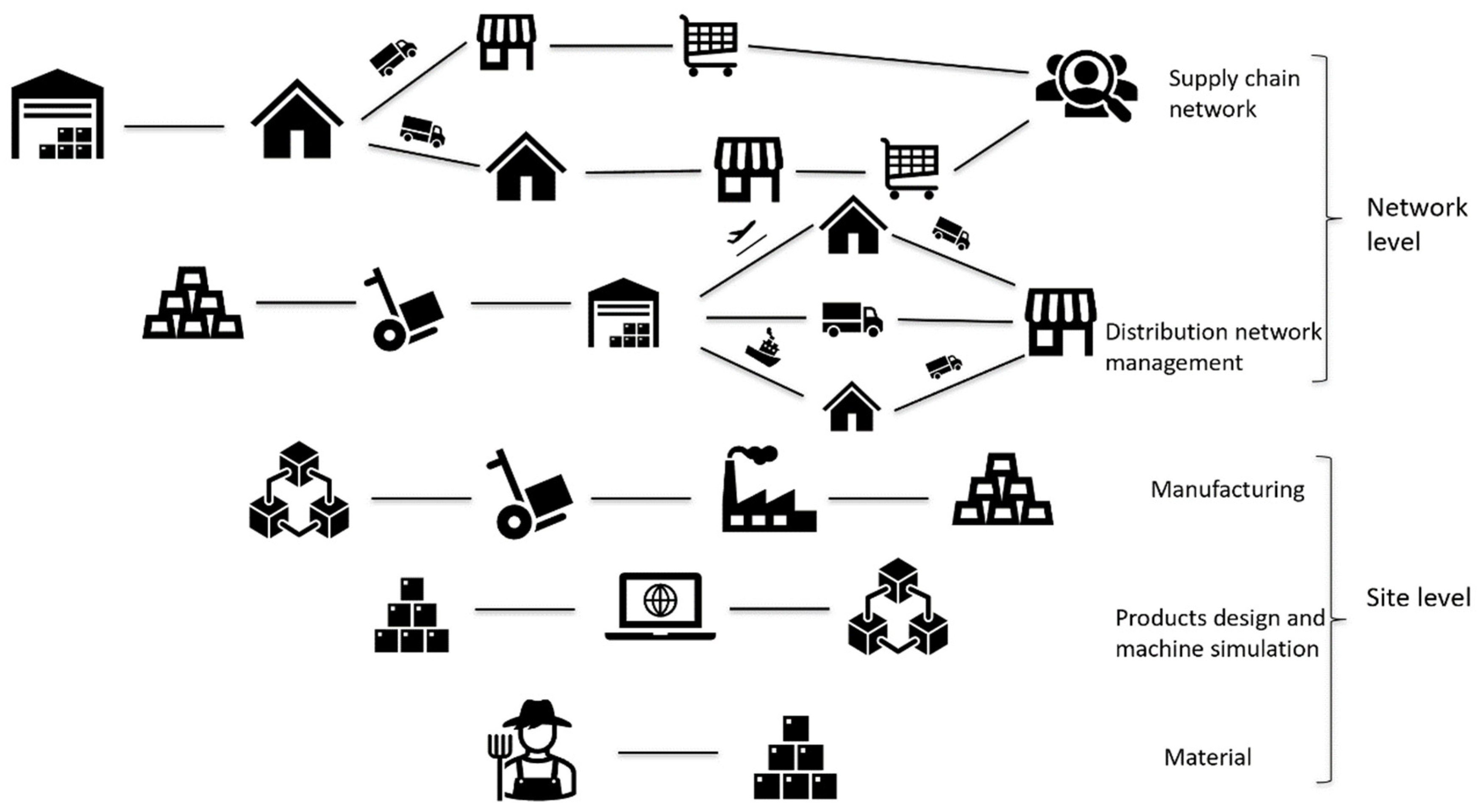
2.2. Hierarchical Structure of DTT in Supply Chains
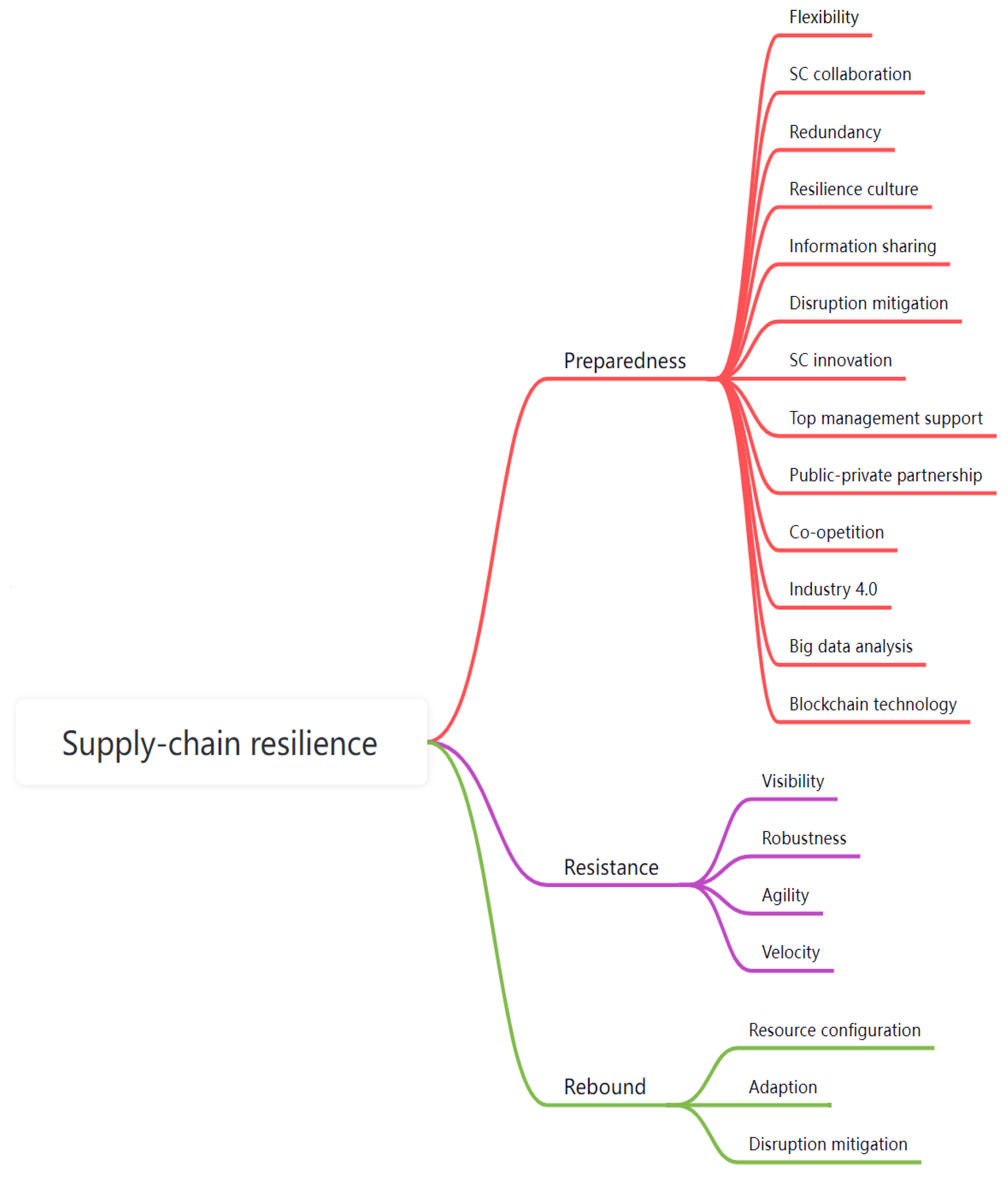
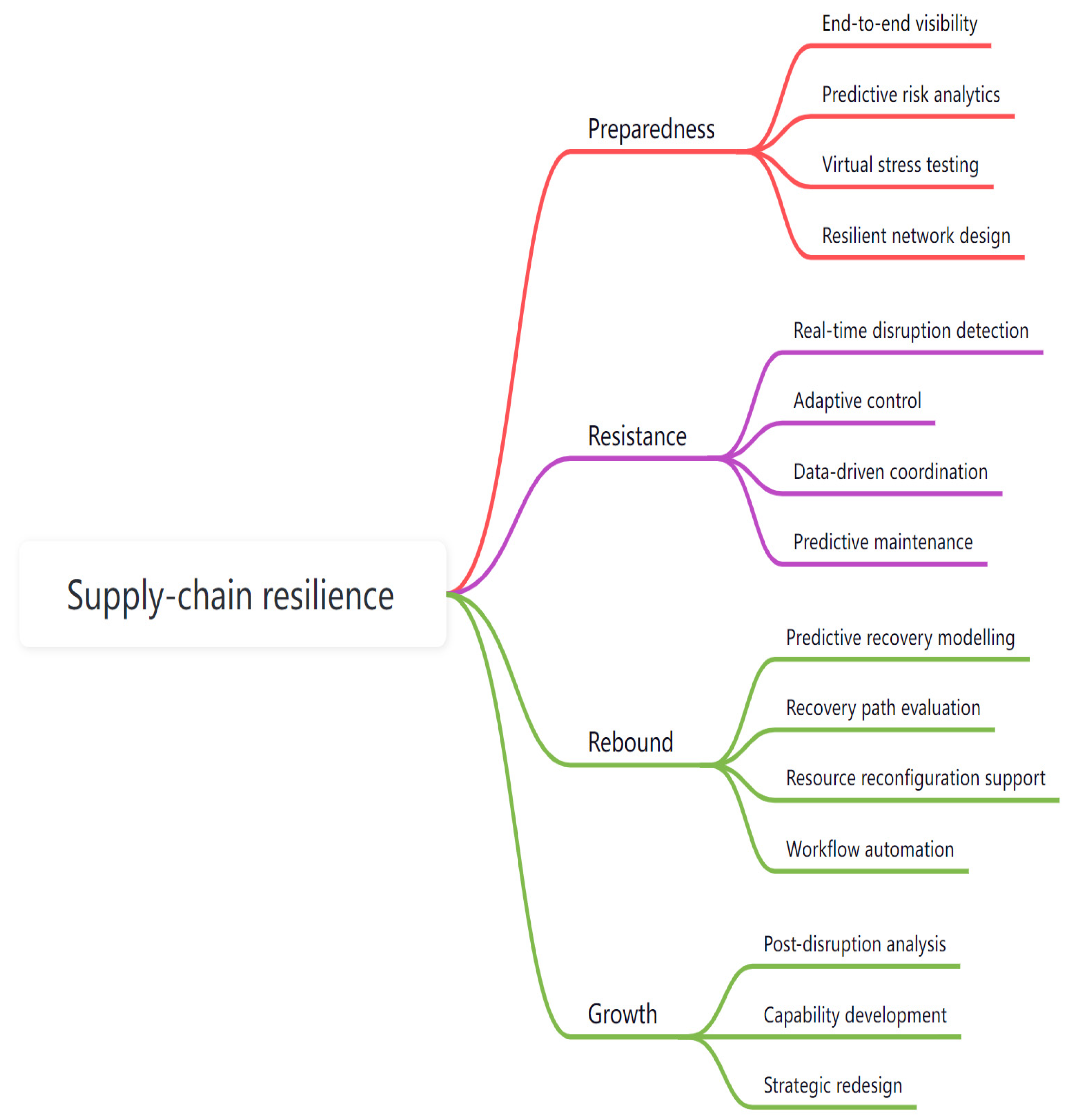
2.3. Supply-Chain Resilience (SCR)
2.3.1. Preparedness Stage
2.3.2. Resistance Stage
2.3.3. Rebound Stage
2.3.4. Growth Stage
2.4. Digital Twins Capabilities Across Supply-Chain Resilience
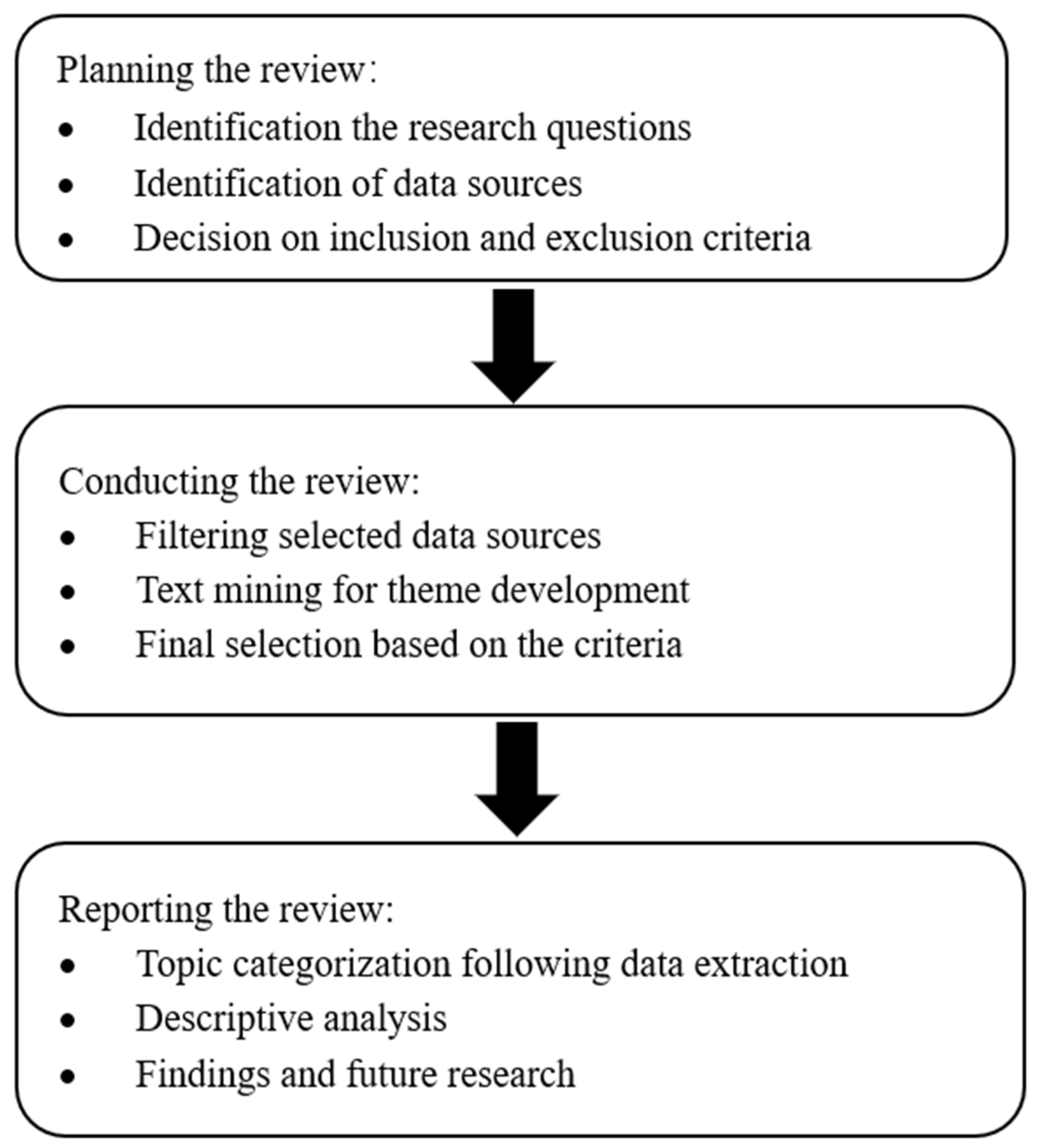
3. Methodology
3.1. Planning the Review
3.2. Conducting the Review
- -
- DTT-related keywords group: “digital twin” OR “digital shadow” OR “virtual twin”
- -
- SCR-related keywords group: “supply chain resilience” OR “supply chain uncertainty” OR “supply chain disruption” OR “robust supply chain”.
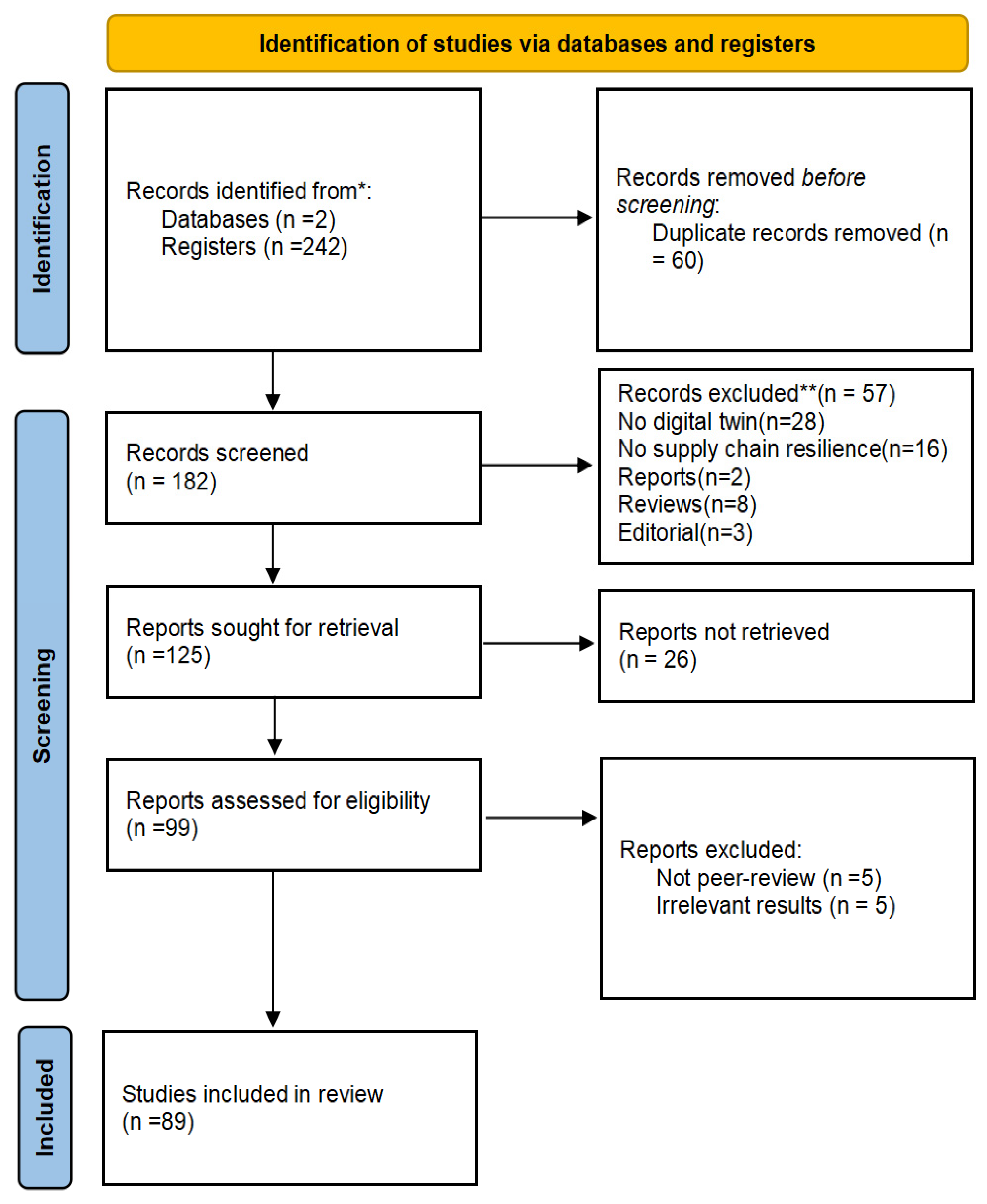
3.3. Results of Included Studies
4. Research Findings
4.1. Descriptive Analysis
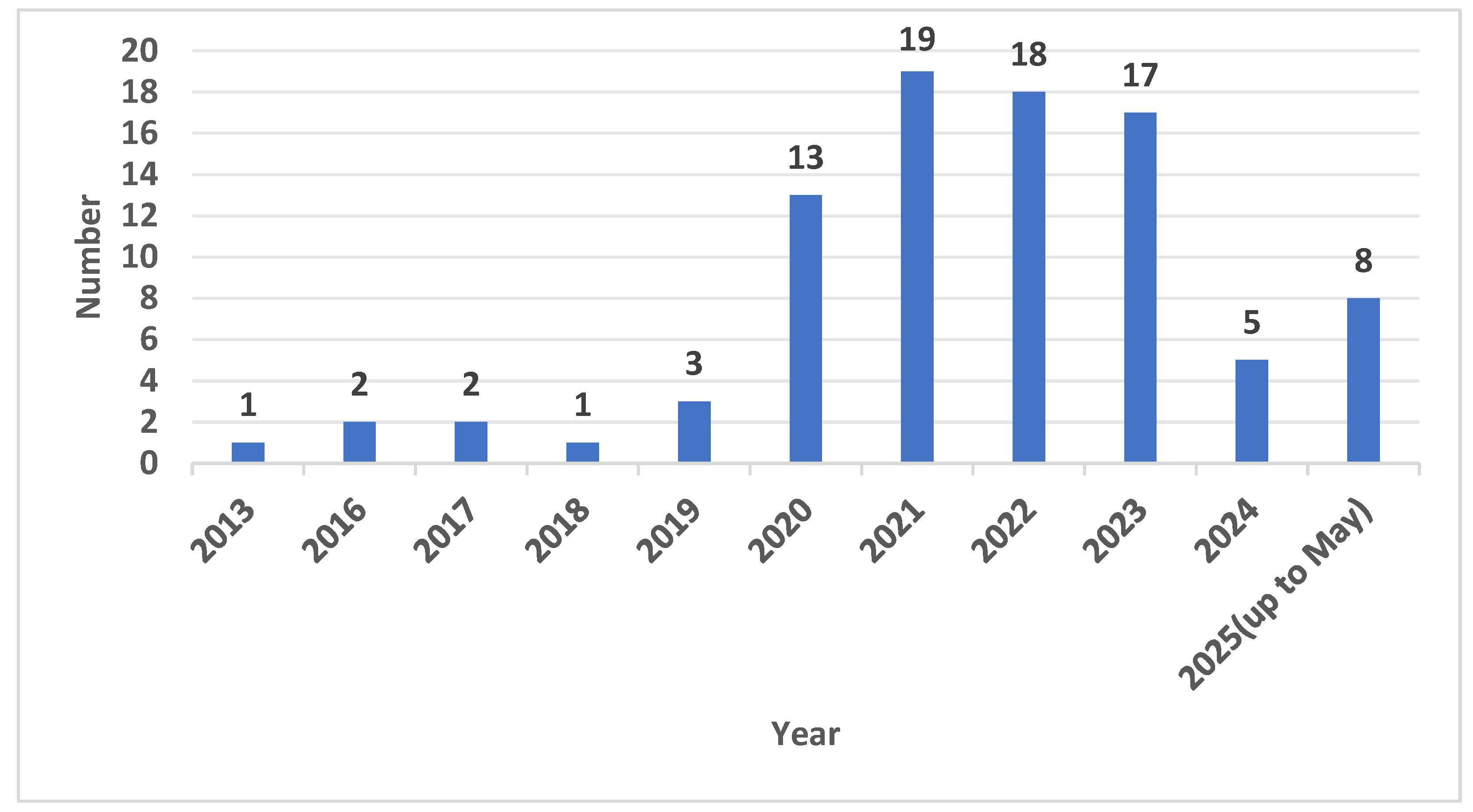
4.1.1. Publication Trend
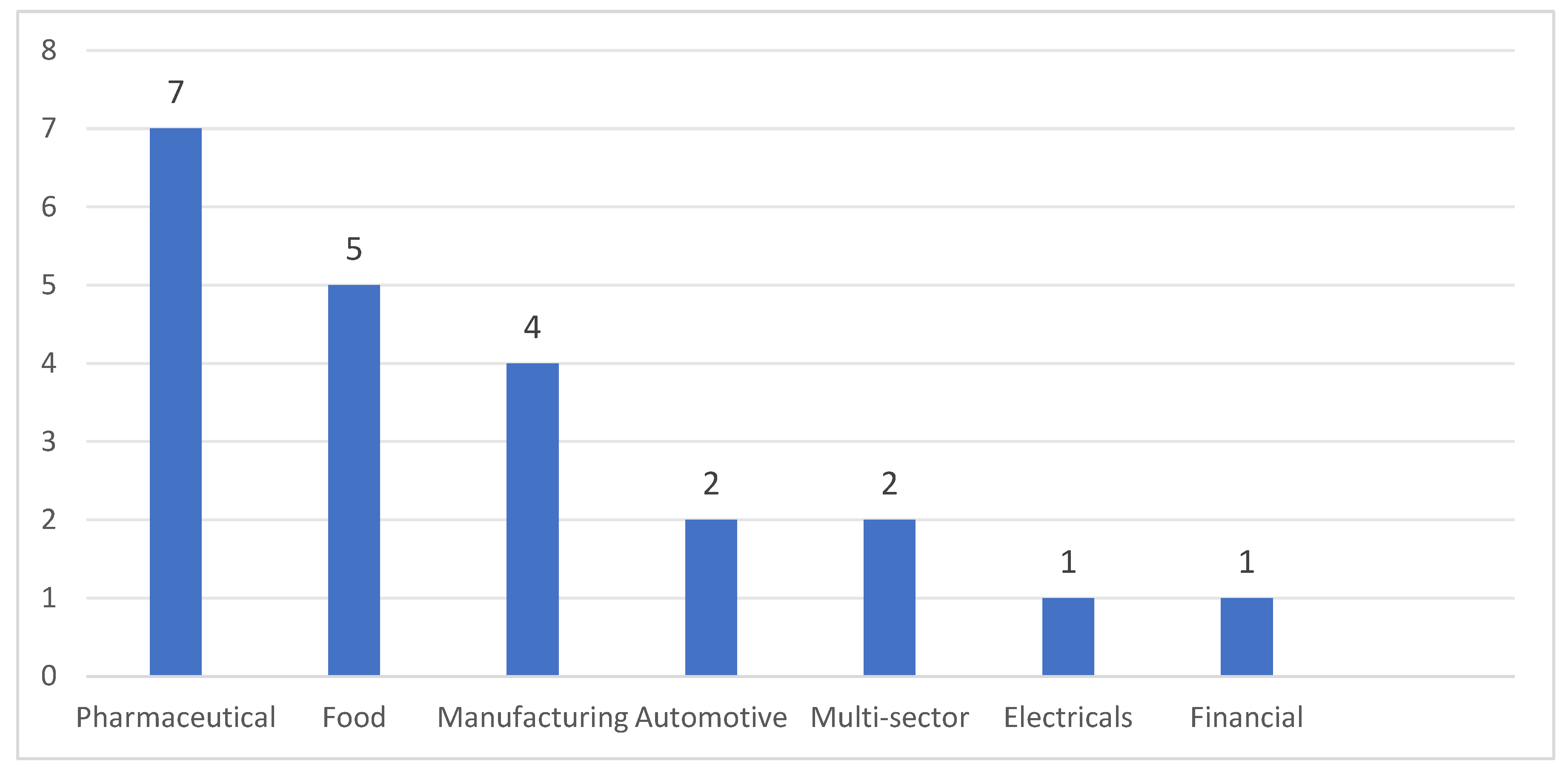
4.1.2. Research Areas Distribution
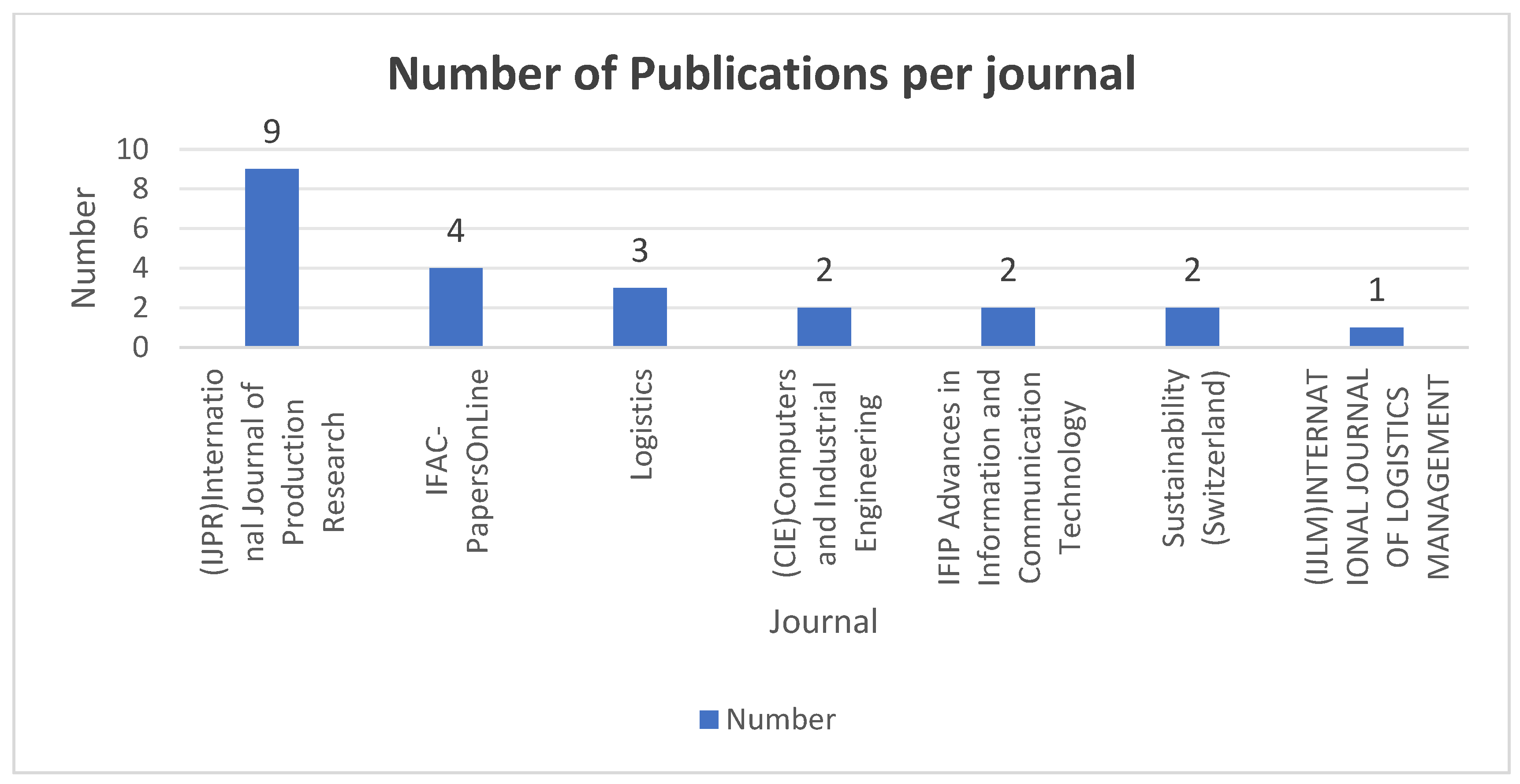
4.1.3. Distribution of Journals
4.1.4. Research Methods and Data Analysis Techniques
4.2. Content Analysis—Digital Twin Applications in Supply-Chain Resilience
4.2.1. Preparedness Stage
4.2.2. Resistance Stage
4.2.3. Rebound Stage
4.2.4. Growth Stage
4.3. Additional Digital Twin Application Benefits
4.3.1. Real-Time Monitoring
4.3.2. Decision-Making Improvement
4.3.3. Predictive Maintenance
4.3.4. Risk Reduction
4.3.5. Time and Cost Savings
4.3.6. Supply-Chain Collaboration
4.4. Digital Twin Application Challenges
4.4.1. Data Interoperability
4.4.2. Data Accuracy and Reliability
4.4.3. Cost
4.4.4. Data Security and Privacy
4.4.5. Model Complexity
4.4.6. Connectivity
4.4.7. System Compatibility
5. Discussion
5.1. Answers RQ1: What Are the Main DTT Capabilities Associated with Enhanced SupplyChain Resilience? Do These Vary Across Different Resilience Stages?
5.2. RQ2: What Are the Additional Benefits Achieved Through DTT Adoption?
5.3. Answers to RQ3: What Are the Challenges/Barriers When Adopting DTT for Enhanced Resilience?
5.4. Conflicting Evidence and Boundary Conditions
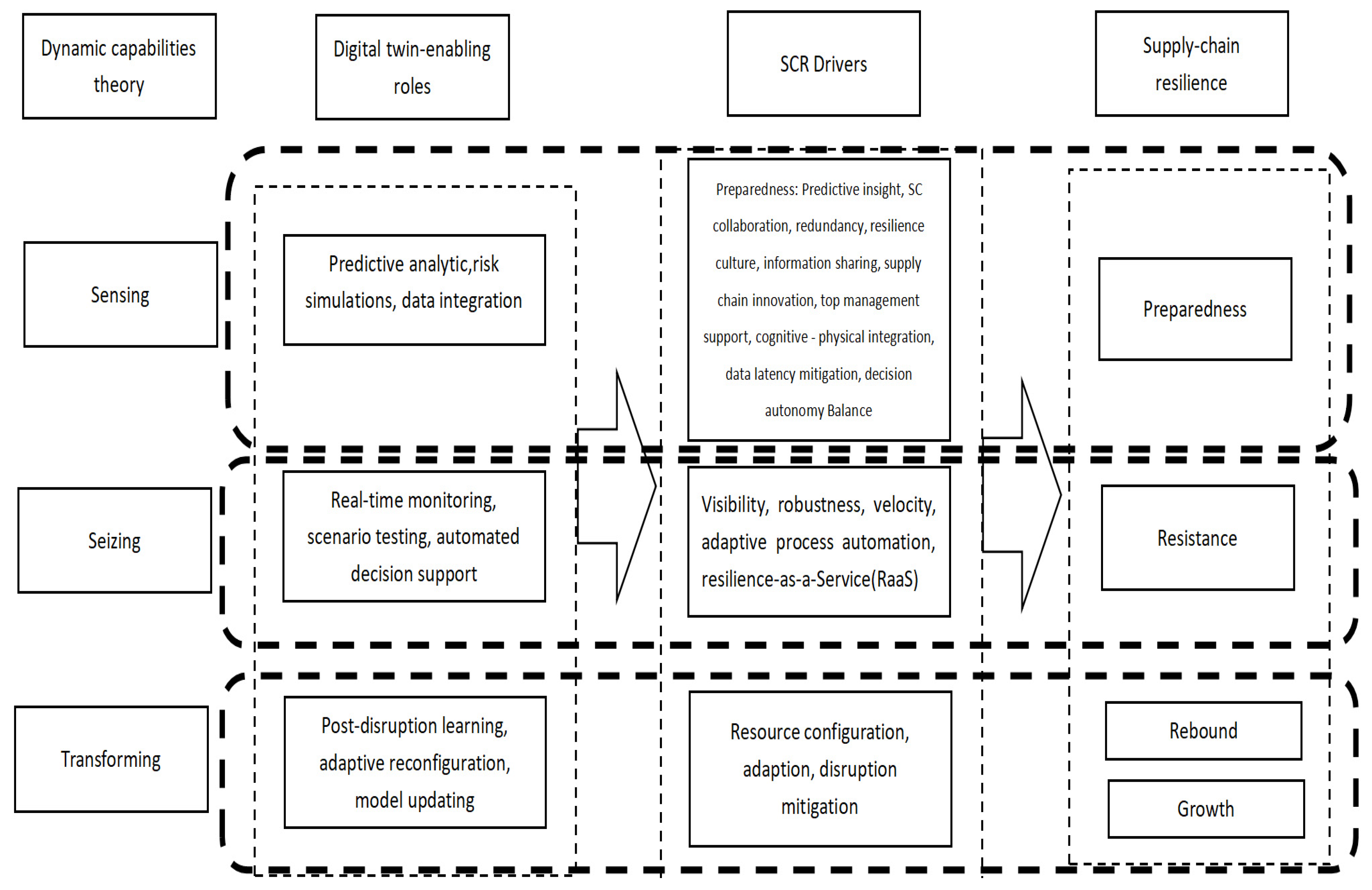
5.5. Dynamic Capability Explanation of Stage-Specific DTT-Enabled Resilience
6. Future Research Opportunities
6.1. DTT and Resilience
6.2. Human–Machine Collaboration
6.3. Ethical Implications of DTT
6.4. Cybersecurity and Interoperability
6.5. DTT and Supply-Chain Sustainability
6.6. Integration of DTT with Other Technologies
7. Conclusions
7.1. Theoretical Contributions
7.2. Practical Implications and Limitations
Supplementary Materials
Author Contributions
Funding
Institutional Review Board Statement
Informed Consent Statement
Data Availability Statement
Conflicts of Interest
References
- Liu, M.; Fang, S.; Dong, H.; Xu, C. Review of Digital Twin about Concepts, Technologies, and Industrial Applications. J. Manuf. Syst. 2021, 58, 346–361. [Google Scholar] [CrossRef]
- Uhlemann, T.H.J.; Lehmann, C.; Steinhilper, R. The Digital Twin: Realizing the Cyber-Physical Production System for Industry 4.0. Procedia CIRP 2017, 61, 335–340. [Google Scholar] [CrossRef]
- Hong Lim, K.Y.; Seif, A.; Agarwal, N.; Le, N.T. Digital Twin-Enhanced Approach for Supply Chain Disruption Management in Manufacturing Shop Floors. In Proceedings of the 2021 IEEE International Conference on Industrial Engineering and Engineering Management (IEEM), Singapore, 13–16 December 2021; IEEE: New York, NY, USA, 2022; pp. 848–852. [Google Scholar] [CrossRef]
- Boschert, S.; Rosen, R. Digital Twin-the Simulation Aspect. In Mechatronic Futures: Challenges and Solutions for Mechatronic Systems and Their Designers; Springer: Cham, Switzerland, 2016; pp. 59–74. [Google Scholar] [CrossRef]
- Grieves, M.; Vickers, J. Digital Twin: Mitigating Unpredictable, Undesirable Emergent Behavior in Complex Systems. In Transdisciplinary Perspectives on Complex Systems: New Findings and Approaches; Springer: Cham, Switzerland, 2016; pp. 85–113. [Google Scholar] [CrossRef]
- Ivanov, D.; Tang, C.S.; Dolgui, A.; Battini, D.; Das, A. Researchers’ Perspectives on Industry 4.0: Multi-Disciplinary Analysis and Opportunities for Operations Management. Int. J. Prod. Res. 2021, 59, 2055–2078. [Google Scholar] [CrossRef]
- Gebreab, S.A.; Hasan, H.R.; Salah, K.; Jayaraman, R. NFT-Based Traceability and Ownership Management of Medical Devices. IEEE Access 2022, 10, 126394–126411. [Google Scholar] [CrossRef]
- Defraeye, T.; Shrivastava, C.; Berry, T.; Verboven, P.; Onwude, D.; Schudel, S.; Bühlmann, A.; Cronje, P.; Rossi, R.M. Digital Twins Are Coming: Will We Need Them in Supply Chains of Fresh Horticultural Produce? Trends Food Sci. Technol. 2021, 109, 245–258. [Google Scholar] [CrossRef]
- Attaran, M.; Celik, B.G. Digital Twin: Benefits, Use Cases, Challenges, and Opportunities. Decis. Anal. J. 2023, 6, 100165. [Google Scholar] [CrossRef]
- Negri, E.; Berardi, S.; Fumagalli, L.; Macchi, M. MES-Integrated Digital Twin Frameworks. J. Manuf. Syst. 2020, 56, 58–71. [Google Scholar] [CrossRef]
- Schleich, B.; Anwer, N.; Mathieu, L.; Wartzack, S. Shaping the Digital Twin for Design and Production Engineering. CIRP Ann. Manuf. Technol. 2017, 66, 141–144. [Google Scholar] [CrossRef]
- Sacks, R.; Brilakis, I.; Pikas, E.; Xie, H.S.; Girolami, M. Construction with Digital Twin Information Systems. Data Centric Eng. 2020, 1, e14. [Google Scholar] [CrossRef]
- Büyüközkan, G.; Göçer, F. Digital Supply Chain: Literature Review and a Proposed Framework for Future Research. Comput. Ind. 2018, 97, 157–177. [Google Scholar] [CrossRef]
- Bhandal, R.; Meriton, R.; Kavanagh, R.E.; Brown, A. The Application of Digital Twin Technology in Operations and Supply Chain Management: A Bibliometric Review. Supply Chain. Manag. Int. J. 2022, 27, 182–206. [Google Scholar] [CrossRef]
- Kalaboukas, K.; Kiritsis, D.; Arampatzis, G. Governance Framework for Autonomous and Cognitive Digital Twins in Agile Supply Chains. Comput. Ind. 2023, 146, 103857. [Google Scholar] [CrossRef]
- Shen, W.; Yang, C.; Gao, L. Address Business Crisis Caused by COVID-19 with Collaborative Intelligent Manufacturing Technologies. IET Collab. Intell. Manuf. 2020, 2, 96–99. [Google Scholar] [CrossRef]
- Ghadge, A.; Dani, S.; Kalawsky, R. Supply Chain Risk Management: Present and Future Scope. Int. J. Logist. Manag. 2012, 23, 313–339. [Google Scholar] [CrossRef]
- Deiva Ganesh, A.; Kalpana, P. Supply Chain Risk Identification: A Real-Time Data-Mining Approach. Ind. Manag. Data Syst. 2022, 122, 1333–1354. [Google Scholar] [CrossRef]
- Gerlach, B.; Zarnitz, S.; Nitsche, B.; Straube, F. Digital Supply Chain Twins—Conceptual Clarification, Use Cases and Benefits. Logistics 2021, 5, 86. [Google Scholar] [CrossRef]
- Ponomarov, S.Y.; Holcomb, M.C. Understanding the Concept of Supply Chain Resilience. Int. J. Logist. Manag. 2009, 20, 124–143. [Google Scholar] [CrossRef]
- Christopher, M.; Peck, H. Building the Resilient Supply Chain. Int. J. Logist. Manag. 2004, 15, 1–14. [Google Scholar] [CrossRef]
- Ali, I.; Gölgeci, I. Where Is Supply Chain Resilience Research Heading? A Systematic and Co-Occurrence Analysis. Int. J. Phys. Distrib. Logist. Manag. 2019, 49, 793–815. [Google Scholar] [CrossRef]
- Hohenstein, N.O.; Feise, E.; Hartmann, E.; Giunipero, L. Research on the Phenomenon of Supply Chain Resilience: A Systematic Review and Paths for Further Investigation. Int. J. Phys. Distrib. Logist. Manag. 2015, 45, 90–117. [Google Scholar] [CrossRef]
- Aryatwijuka, W.; Prof, A.; Mutebi, H.; Nagawa, P.; Tukamuhabwa, B.; Ssekajja, S.M.; Diana, K.; Akashabaluhanga, A. Artificial Intelligence and Humanitarian Supply Chain Resilience: Mediating Effect of Localized Logistics Capacity. Eur. J. Technol. 2024, 8, 1–20. [Google Scholar] [CrossRef]
- Kamalahmadi, M.; Parast, M.M. A Review of the Literature on the Principles of Enterprise and Supply Chain Resilience: Major Findings and Directions for Future Research. Int. J. Prod. Econ. 2016, 171, 116–133. [Google Scholar] [CrossRef]
- Rahmanzadeh, S.; Pishvaee, M.S.; Govindan, K. Emergence of Open Supply Chain Management: The Role of Open Innovation in the Future Smart Industry Using Digital Twin Network. Ann. Oper. Res. 2022, 329, 979–1007. [Google Scholar] [CrossRef]
- Iftikhar, A.; Ali, I.; Arslan, A.; Tarba, S. Digital Innovation, Data Analytics, and Supply Chain Resiliency: A Bibliometric-Based Systematic Literature Review. Ann. Oper. Res. 2024, 333, 825–848. [Google Scholar] [CrossRef]
- Using Digital Twins to Unlock Supply Chain Growth|McKinsey. Available online: https://www.mckinsey.com/capabilities/quantumblack/our-insights/digital-twins-the-key-to-unlocking-end-to-end-supply-chain-growth (accessed on 14 February 2025).
- Wieland, A.; Marcus Wallenburg, C. Dealing with Supply Chain RisksLinking Risk Management Practices and Strategies to Performance. Int. J. Phys. Distrib. Logist. Manag. 2012, 42, 887–905. [Google Scholar] [CrossRef]
- Pettit, T.J.; Fiksel, J.; Croxton, K.L. Ensuring Supply Chain Resilience: Development of a Conceptual Framework. J. Bus. Logist. 2010, 31, 1–21. [Google Scholar] [CrossRef]
- Chowdhury, M.M.H.; Quaddus, M. Supply Chain Resilience: Conceptualization and Scale Development Using Dynamic Capability Theory. Int. J. Prod. Econ. 2017, 188, 185–204. [Google Scholar] [CrossRef]
- Ivanov, D.; Dolgui, A. A Digital Supply Chain Twin for Managing the Disruption Risks and Resilience in the Era of Industry 4.0. Prod. Plan. Control 2021, 32, 775–788. [Google Scholar] [CrossRef]
- Singh, G.; Rajesh, R.; Daultani, Y.; Misra, S.C. Resilience and Sustainability Enhancements in Food Supply Chains Using Digital Twin Technology: A Grey Causal Modelling (GCM) Approach. Comput. Ind. Eng. 2023, 179, 109172. [Google Scholar] [CrossRef]
- Adobor, H.; McMullen, R.S. Supply Chain Resilience: A Dynamic and Multidimensional Approach. Int. J. Logist. Manag. 2018, 29, 1451–1471. [Google Scholar] [CrossRef]
- Rother, E.T. Systematic Literature Review X Narrative Review. Acta Paul. Enferm. 2007, 20, v–vi. [Google Scholar] [CrossRef]
- Fink, A. Conducting Research Literature Reviews: From the Internet to Paper; University of California: Los Angeles, CA, USA, 2019. [Google Scholar]
- Denyer, D.; Tranfield, D. Producing a Systematic Review. In The Sage Handbook of Organizational Research Methods; Sage Publications Ltd.: Thousand Oaks, CA, USA, 2009; pp. 671–689. ISBN 978-1-4129-3118-2. [Google Scholar]
- Tranfield, D.; Denyer, D.; Smart, P. Towards a Methodology for Developing Evidence-Informed Management Knowledge by Means of Systematic Review. Br. J. Manag. 2003, 14, 207–222. [Google Scholar] [CrossRef]
- Burnham, J.F. Scopus Database: A Review. Biomed. Digit. Libr. 2006, 3, 1. [Google Scholar] [CrossRef]
- Kamble, S.S.; Gunasekaran, A.; Parekh, H.; Mani, V.; Belhadi, A.; Sharma, R. Digital twin for sustainable manufacturing supply chains: Current trends, future perspectives, and an implementation framework. Technol. Forecast. Soc. Change 2022, 176, 121448. [Google Scholar] [CrossRef]
- Rajamurugu, N.; Karthik, M.K. Introduction, History, and Concept of Digital Twin. In Digital Twin Technology: Fundamentals and Applications; Scrivener Publishing LLC: Beverly, MA, USA, 2022; pp. 19–32. [Google Scholar] [CrossRef]
- Elayan, H.; Aloqaily, M.; Guizani, M. Digital Twin for Intelligent Context-Aware IoT Healthcare Systems. IEEE Internet Things J. 2021, 8, 16749–16757. [Google Scholar] [CrossRef]
- Ivanov, D.; Dolgui, A. New Disruption Risk Management Perspectives in Supply Chains: Digital Twins, the Ripple Effect, and Resileanness. IFAC PapersOnLine 2019, 52, 337–342. [Google Scholar] [CrossRef]
- Wieland, A.; Wallenburg, C.M. The Influence of Relational Competencies on Supply Chain Resilience: A Relational View. Int. J. Phys. Distrib. Logist. Manag. 2013, 43, 300–320. [Google Scholar] [CrossRef]
- Burgos, D.; Ivanov, D. Food Retail Supply Chain Resilience and the COVID-19 Pandemic: A Digital Twin-Based Impact Analysis and Improvement Directions. Transp. Res. E Logist. Transp. Rev. 2021, 152, 102412. [Google Scholar] [CrossRef]
- Ivanov, D.; Dolgui, A.; Das, A.; Sokolov, B. Digital Supply Chain Twins: Managing the Ripple Effect, Resilience, and Disruption Risks by Data-Driven Optimization, Simulation, and Visibility. In Handbook of Ripple Effects in the Supply Chain; International Series in Operations Research & Management Science; Springer: Cham, Switzerland, 2019; Volume 276, pp. 309–332. [Google Scholar] [CrossRef]
- Spieske, A.; Birkel, H. Improving Supply Chain Resilience through Industry 4.0: A Systematic Literature Review under the Impressions of the COVID-19 Pandemic. Comput. Ind. Eng. 2021, 158, 107452. [Google Scholar] [CrossRef]
- dos Santos Alvim, S.L.; de Farias, I.V.; Frazzon, E.M.; de Simas, D. Supply Chain Resilience in Turbulent Times: Conceptual Model and Real-World Use Case*. IFAC PapersOnLine 2022, 55, 85–90. [Google Scholar] [CrossRef]
- MacCarthy, B.L.; Ahmed, W.A.H.; Demirel, G. Mapping the Supply Chain: Why, What and How? Int. J. Prod. Econ. 2022, 250, 108688. [Google Scholar] [CrossRef]
- Roman, E.-A.; Stere, A.-S.; Ros, E.; Radu, A.-V.; Codroiu, D.; Roman, E.-A.; Stere, A.-S.; Ros, E.; Radu, A.-V.; Codroiu, D.; et al. State of the Art of Digital Twins in Improving Supply Chain Resilience. Logistics 2025, 9, 22. [Google Scholar] [CrossRef]
- Zheng, Z.; Lin, Y.; Li, L.; Lu, L.; Pan, Y. The Application of Data-Driven Technologies to Enhance Supply Chain Resilience in the Context of COVID-19. In Proceedings of the Advances in Artificial Systems for Logistics Engineering; Hu, Z., Zhang, Q., Petoukhov, S., He, M., Eds.; Springer International Publishing: Cham, Switzerland, 2021; pp. 238–253. [Google Scholar]
- Ivanov, D. Intelligent Digital Twin (IDT) for Supply Chain Stress-Testing, Resilience, and Viability. Int. J. Prod. Econ. 2023, 263, 108938. [Google Scholar] [CrossRef]
- Nguyen, P.; Ivanov, D.; Sgarbossa, F. A Digital Twin–Based Approach to Reinforce Supply Chain Resilience: Simulation of Semiconductor Shortages. In IFIP Advances in Information and Communication Technology; AICT; Springer: Cham, Switzerland, 2023; Volume 692, pp. 563–576. [Google Scholar] [CrossRef]
- Patidar, A.; Sharma, M.; Agrawal, R.; Sangwan, K.S.; Sarkar, P. Building Supply Chain Resilience in Developing Economies: A Weighted Ishikawa Diagram Approach. Oper. Manag. Res. 2023, 17, 363–386. [Google Scholar] [CrossRef]
- Ivanov, D. Blackout and Supply Chains: Cross-Structural Ripple Effect, Performance, Resilience and Viability Impact Analysis. Ann. Oper. Res. 2025, 348, 1127–1143. [Google Scholar] [CrossRef]
- Ashraf, M.; Eltawil, A.; Ali, I. Disruption Detection for a Cognitive Digital Supply Chain Twin Using Hybrid Deep Learning. Oper. Res. 2024, 24, 23. [Google Scholar] [CrossRef]
- Ashraf, M.; Eltawil, A.; Ali, I. Time-To-Recovery Prediction in a Disrupted Three-Echelon Supply Chain Using LSTM. IFAC PapersOnLine 2022, 55, 1319–1324. [Google Scholar] [CrossRef]
- Zhang, D.; Pei, Y.; Liu, Q. Vulnerability Evaluation for a Smartphone Digital Twin Workshop under Temporal and Spatial Disruptions. Machines 2022, 10, 752. [Google Scholar] [CrossRef]
- Hanumanthaiah, K. Simulation-Based Optimization for a Responsive, Resilient Supply Chain Using Digital Twin and Usability Enhancement Using NO-UI. In Proceedings of the 2023 International Conference for Advancement in Technology, ICONAT, Goa, India, 24–26 January 2023; IEEE: New York, NY, USA, 2023. [Google Scholar] [CrossRef]
- Zhu, X.; Liao, B.; Shen, Y.; Kong, M. Towards Industry 5.0: Digital Twin-Enhanced Approach for Dynamic Supply Chain Rescheduling with Real-Time Order Arrival and Acceptance. Int. J. Prod. Res. 2025, 1–23. [Google Scholar] [CrossRef]
- Ogunsoto, O.V.; Olivares-Aguila, J.; El Maraghy, W. A Conceptual Digital Twin Framework for Supply Chain Recovery and Resilience. Supply Chain. Anal. 2025, 9, 100091. [Google Scholar] [CrossRef]
- Ivanov, D. Design and Deployment of Sustainable Recovery Strategies in the Supply Chain. Comput. Ind. Eng. 2023, 183, 109444. [Google Scholar] [CrossRef]
- Sardesai, S.; Klingebiel, K. Maintaining Viability by Rapid Supply Chain Adaptation Using a Process Capability Index. Omega 2023, 115, 102778. [Google Scholar] [CrossRef]
- Rinaldi, M.; Caterino, M.; Riemma, S.; Macchiaroli, R.; Fera, M. Emergency Supply Chain Resilience Enhanced Through Blockchain and Digital Twin Technology. Logistics 2025, 9, 43. [Google Scholar] [CrossRef]
- Singh, R.K. Transforming Humanitarian Supply Chains with Digital Twin Technology: A Study on Resilience and Agility. Int. J. Logist. Manag. 2025, 36, 1119–1135. [Google Scholar] [CrossRef]
- Srivastava, G.; Bag, S. Harnessing Digital Twin Technology to Enhance Resilience in Humanitarian Supply Chains: An Empirical Study. Benchmarking, 2025; ahead-of-print. [Google Scholar] [CrossRef]
- Guo, D.; Mantravadi, S. The Role of Digital Twins in Lean Supply Chain Management: Review and Research Directions. Int. J. Prod. Res. 2025, 63, 1851–1872. [Google Scholar] [CrossRef]
- Pan, C.L.; Liao, H.T.; Zhang, Y. Knowledge Mapping of Resilience and Human Rights in Supply Chains: A Roadmapping Taxonomy for Twin Green and Digital Transition Design. Front. Environ. Sci. 2023, 11, 1152345. [Google Scholar] [CrossRef]
- Dolgui, A.; Ivanov, D. Internet of Behaviors: Conceptual Model, Practical and Theoretical Implications for Supply Chain and Operations Management. Int. J. Prod. Res. 2025, 63, 1–8. [Google Scholar] [CrossRef]
- Marinagi, C.; Reklitis, P.; Trivellas, P.; Sakas, D. The Impact of Industry 4.0 Technologies on Key Performance Indicators for a Resilient Supply Chain 4.0. Sustainability 2023, 15, 5185. [Google Scholar] [CrossRef]
- Mylrea, M.; Fracchia, C.; Grimes, H.; Austad, W.; Shannon, G.; Reid, B.; Case, N. BioSecure Digital Twin: Manufacturing Innovation and Cybersecurity Resilience. In Engineering Artificially Intelligent Systems; Lecture Notes in Computer Science (including subseries Lecture Notes in Artificial Intelligence and Lecture Notes in Bioinformatics); LNCS; Springer: Cham, Switzerland, 2021; Volume 13000, pp. 53–72. [Google Scholar] [CrossRef]
- Klöckner, M.; Schmidt, C.G.; Wagner, S.M. Building Resilient Post-Pandemic Supply Chains Through Digital Transformation. In Supply Chain Resilience; Springer Series in Supply Chain Management; Springer: Cham, Switzerland, 2023; Volume 21, pp. 211–223. [Google Scholar] [CrossRef]
- de Farias, I.V.; dos Santos Alvim, S.L.; de Simas, D.; Frazzon, E.M. Visibility Model for Enhancing Supply Chains Resilience. IFAC PapersOnLine 2022, 55, 2521–2525. [Google Scholar] [CrossRef]
- Singh, G.; Singh, S.; Daultani, Y.; Chouhan, M. Measuring the Influence of Digital Twins on the Sustainability of Manufacturing Supply Chain: A Mediating Role of Supply Chain Resilience and Performance. Comput. Ind. Eng. 2023, 186, 109711. [Google Scholar] [CrossRef]
- Zhang, M.; Pierli, G.; Musso, F.; Murmura, F.; Bravi, L. Exploring Italian Wine Companies: A Study of Supply Chain Dynamics, Quality, and Promotion Strategies through Semi-Structured Interviews. Foods 2023, 12, 4429. [Google Scholar] [CrossRef]
- Singh, D.; Sharma, A.; Rana, P.S. Machine Learning and Digital Twins-Enabled Supply Chain Resilience: A Framework for the Indian FMCG Sector. Glob. Bus. Rev. 2024, 27, 09721509241275751. [Google Scholar] [CrossRef]
- Ivanov, D. Predicting the Impacts of Epidemic Outbreaks on Global Supply Chains: A Simulation-Based Analysis on the Coronavirus Outbreak (COVID-19/SARS-CoV-2) Case. Transp. Res. E Logist. Transp. Rev. 2020, 136, 101922. [Google Scholar] [CrossRef]
- Kenett, R.S.; Bortman, J. The Digital Twin in Industry 4.0: A Wide-Angle Perspective. Qual. Reliab. Eng. Int. 2022, 38, 1357–1366. [Google Scholar] [CrossRef]
- Leung, E.K.H.; Lee, C.K.H.; Ouyang, Z. From Traditional Warehouses to Physical Internet Hubs: A Digital Twin-Based Inbound Synchronization Framework for PI-Order Management. Int. J. Prod. Econ. 2022, 244, 108353. [Google Scholar] [CrossRef]
- Baruffaldi, G.; Accorsi, R.; Manzini, R. Warehouse Management System Customization and Information Availability in 3pl Companies: A Decision-Support Tool. Ind. Manag. Data Syst. 2019, 119, 251–273. [Google Scholar] [CrossRef]
- Ivanov, D.; Dolgui, A. Stress Testing Supply Chains and Creating Viable Ecosystems. Oper. Manag. Res. 2022, 15, 475–486. [Google Scholar] [CrossRef]
- Sundarakani, B.; Pereira, V.; Ishizaka, A. Robust Facility Location Decisions for Resilient Sustainable Supply Chain Performance in the Face of Disruptions. Int. J. Logist. Manag. 2020, 32, 357–385. [Google Scholar] [CrossRef]
- Gutierrez-Franco, E.; Mejia-Argueta, C.; Rabelo, L. Data-Driven Methodology to Support Long-Lasting Logistics and Decision Making for Urban Last-Mile Operations. Sustainability 2021, 13, 6230. [Google Scholar] [CrossRef]
- Lv, Z.; Qiao, L.; Mardani, A.; Lv, H. Digital Twins on the Resilience of Supply Chain Under COVID-19 Pandemic. IEEE Trans. Eng. Manag. 2022, 71, 10522–10533. [Google Scholar] [CrossRef]
- Dąbrowska, A.; Giel, R.; Winiarska, K. Sequencing and Planning of Packaging Lines with Reliability and Digital Twin Concept Considerations-a Case Study of a Sugar Production Plant. LogForum 2022, 18, 321–334. [Google Scholar] [CrossRef]
- Abideen, A.Z.; Sundram, V.P.K.; Pyeman, J.; Othman, A.K.; Sorooshian, S. Digital Twin Integrated Reinforced Learning in Supply Chain and Logistics. Logistics 2021, 5, 84. [Google Scholar] [CrossRef]
- Greis, N.P.; Nogueira, M.L.; Rohde, W. Digital Twin Framework for Machine Learning-Enabled Integrated Production and Logistics Processes. In IFIP Advances in Information and Communication Technology; Springer: Cham, Switzerland, 2021; Volume 630, pp. 218–227. [Google Scholar] [CrossRef]
- Wang, L.; Deng, T.; Shen, Z.J.M.; Hu, H.; Qi, Y. Digital Twin-Driven Smart Supply Chain. Front. Eng. Manag. 2022, 9, 56–70. [Google Scholar] [CrossRef]
- Zdolsek Draksler, T.; Cimperman, M.; Obrecht, M. Data-Driven Supply Chain Operations—The Pilot Case of Postal Logistics and the Cross-Border Optimization Potential. Sensors 2023, 23, 1624. [Google Scholar] [CrossRef]
- Dolgui, A.; Ivanov, D.; Rozhkov, M. Does the Ripple Effect Influence the Bullwhip Effect? An Integrated Analysis of Structural and Operational Dynamics in the Supply Chain. Int. J. Prod. Res. 2020, 58, 1285–1301. [Google Scholar] [CrossRef]
- Kalaboukas, K.; Rožanec, J.; Košmerlj, A.; Kiritsis, D.; Arampatzis, G. Implementation of Cognitive Digital Twins in Connected and Agile Supply Networks-an Operational Model. Appl. Sci. 2021, 11, 4103. [Google Scholar] [CrossRef]
- Tebaldi, L.; Vignali, G.; Bottani, E. Digital Twin in the Agri-Food Supply Chain: A Literature Review. In IFIP Advances in Information and Communication Technology; Springer: Cham, Switzerland, 2021; Volume 633, pp. 276–283. [Google Scholar] [CrossRef]
- Badakhshan, E.; Ball, P. Applying Digital Twins for Inventory and Cash Management in Supply Chains under Physical and Financial Disruptions. Int. J. Prod. Res. 2022, 61, 5094–5116. [Google Scholar] [CrossRef]
- Sharma, A.; Zanotti, P.; Musunur, L.P. Drive Through Robotics: Robotic Automation for Last Mile Distribution of Food and Essentials During Pandemics. IEEE Access 2020, 8, 127190. [Google Scholar] [CrossRef]
- Chen, Z.; Huang, L. Digital Twins for Information-Sharing in Remanufacturing Supply Chain: A Review. Energy 2021, 220, 119712. [Google Scholar] [CrossRef]
- Marmolejo-Saucedo, J.A. Design and Development of Digital Twins: A Case Study in Supply Chains. Mob. Netw. Appl. 2020, 25, 2141–2160. [Google Scholar] [CrossRef]
- Nguyen, T.; Duong, Q.H.; Van Nguyen, T.; Zhu, Y.; Zhou, L. Knowledge Mapping of Digital Twin and Physical Internet in Supply Chain Management: A Systematic Literature Review. Int. J. Prod. Econ. 2022, 244, 108381. [Google Scholar] [CrossRef]
- Simchenko, N.A.; Tsohla, S.Y.; Chuvatkin, P.P. Effects of Supply Chain Digital Twins in the Development of Digital Industry. Int. J. Sup. Chain. Manag. 2020, 9, 799–805. [Google Scholar]
- Resman, M.; Protner, J.; Simic, M.; Herakovic, N. A Five-Step Approach to Planning Data-Driven Digital Twins for Discrete Manufacturing Systems. Appl. Sci. 2021, 11, 3639. [Google Scholar] [CrossRef]
- Frankó, A.; Vida, G.; Varga, P. Reliable Identification Schemes for Asset and Production Tracking in Industry 4.0. Sensors 2020, 20, 3709. [Google Scholar] [CrossRef]
- Kajba, M.; Jereb, B.; Obrecht, M. Considering IT Trends for Modelling Investments in Supply Chains by Prioritising Digital Twins. Processes 2023, 11, 262. [Google Scholar] [CrossRef]
- Lugaresi, G.; Matta, A. Automated Manufacturing System Discovery and Digital Twin Generation. J. Manuf. Syst. 2021, 59, 51–66. [Google Scholar] [CrossRef]
- Golan, M.S.; Trump, B.D.; Cegan, J.C.; Linkov, I. Supply Chain Resilience for Vaccines: Review of Modeling Approaches in the Context of the COVID-19 Pandemic. Ind. Manag. Data Syst. 2021, 121, 1723–1748. [Google Scholar] [CrossRef]
- Dy, K.J.; Olivares-Aguila, J.; Vital-Soto, A. A Survey of Digital Supply Chain Twins’ Implementations. In IFIP Advances in Information and Communication Technology; Springer: Cham, Switzerland, 2022; Volume 663, pp. 502–509. [Google Scholar] [CrossRef]
- Park, K.T.; Son, Y.H.; Noh, S.D. The Architectural Framework of a Cyber Physical Logistics System for Digital-Twin-Based Supply Chain Control. Int. J. Prod. Res. 2021, 59, 5721–5742. [Google Scholar] [CrossRef]
- Wacker, J.G. A Definition of Theory: Research Guidelines for Different Theory-Building Research Methods in Operations Management. J. Oper. Manag. 1998, 16, 361–385. [Google Scholar] [CrossRef]
- Burgess, K.; Singh, P.J.; Koroglu, R. Supply Chain Management: A Structured Literature Review and Implications for Future Research. Int. J. Oper. Prod. Manag. 2006, 26, 703–729. [Google Scholar] [CrossRef]
- Woo, S.H.; Pettit, S.J.; Kwak, D.W.; Beresford, A.K.C. Seaport Research: A Structured Literature Review on Methodological Issues since the 1980s. Transp. Res. Part A Policy Pract. 2011, 45, 667–685. [Google Scholar] [CrossRef]
- Hype Cycle for Enterprise Architecture. 2023. Available online: https://www.gartner.com/document/4400299?ref=solrAll&refval=413615941&toggle=1&viewType=Full (accessed on 27 May 2024).
- Page, M.J.; McKenzie, J.E.; Bossuyt, P.M.; Boutron, I.; Hoffmann, T.C.; Mulrow, C.D.; Shamseer, L.; Tetzlaff, J.M.; Akl, E.A.; Brennan, S.E. The PRISMA 2020 statement: An updated guideline for reporting systematic reviews. BMJ 2021, 372, n71. [Google Scholar] [CrossRef] [PubMed]



| Year. | Definition of Digital Twin | Key Points |
|---|---|---|
| 2010 | Digital twin is a digital item used to generate a characterised twin for every user based on preset configuration and “pasting” dimensional picture. | Virtual replica |
| 2013 | Digital twin is an ambitious vision to emulate the actual structure of an aircraft subject to the for near real-time prediction of structural health, maintenance planning, etc., based on high-fidelity characteristics. | High-fidelity |
| 2016 | The digital twin is a set of virtual information constructs that fully describes a potential or actual physical manufactured product from the micro atomic level to the macro geometrical level. At its optimum, any information that could be obtained from inspecting a physical manufactured product can be obtained from its digital twin. | Virtual information description |
| 2017 | A digital twin is a virtual model that represents a physical object, process, or system. It can be used to simulate and optimise designs, as well as monitor and improve the performance of products and production processes. | Virtual model |
| 2018 | Digital twin technology can support smart manufacturing by providing a virtual representation of the physical manufacturing environment, including machines, equipment, and production processes. | Virtual representation |
| 2019 | Digital twins can be used to create a virtual representation of a physical system or service, allowing for real-time monitoring, analysis, and optimisation. | Real-time monitoring |
| 2020 | The digital twin is a dynamic virtual replica of a physical object or system that can be used for various purposes such as simulation, optimisation, and monitoring. | Dynamic virtual replica |
| 2022 | A digital twin develops an innovation management model based on the Viable System Model to cope with any potential future environment based on internal organisational capabilities. | Dynamic virtual system |
| Criterion | Description |
|---|---|
| Database | Web of Science and Scopus |
| Topics | WoS (TS): TS = (“digital twin” OR “digital shadow” OR “virtual twin”) AND TS = (“supply chain resilience” OR “supply chain uncertainty” OR “supply chain disruption” OR “robust supply chain”) |
| Scopus (TITLE-ABS-KEY): TITLE-ABS-KEY (“digital twin” OR “digital shadow” OR “virtual twin”) AND TITLE-ABS-KEY(“supply chain resilience” OR “supply chain uncertainty” OR “supply chain disruption” OR “robust supply chain”) | |
| Inclusion | (1) peer-reviewed and in English; (2) substantively addressed DTT in a supply-chain context; and (3) explicitly examined SCR/disruption/risk issues or provided extractable relevant resilience implications. |
| Exclusion | (1) grey literature (theses/dissertations, reports, policy/government documents, white papers); (2) were non-English; (3) had no accessible full text; (4) were conference reviews/editorials; and (5) mentioned DTT or SCR only in passing without substantive focus. |
| Search date | 31 May 2025 |
| Ref. No. | Author (s), Year | Pub. Type | Research Design | Stage-Coded? (Y/N) | Primary Stage (If Y) | Key DT Characteristics (1–3 Tags) | Notes |
|---|---|---|---|---|---|---|---|
| [1] | Liu, M (2021) | Journal article | Empirical research—Statistical (empirical) | N | DT applications | ||
| [2] | Uhlemann, T (2017) | Journal article | Empirical research—Statistical (empirical) | N | DT applications | ||
| [3] | Hong Lim, K (2021) | Conference paper | Analytical research—Statistical (analytical) | N | DT architecture/deployment | ||
| [4] | Boschert, S (2016) | Book/Book chapter | Empirical research—Case study | N | simulation/what-if | ||
| [5] | Grieves, M (2016) | Book/Book chapter | Analytical research—Statistical (analytical) | N | AI/predictive analytics, DT architecture/deployment | ||
| [6] | Ivanov, D (2020) | Journal article | Analytical research—Statistical (analytical) | N | DT applications | ||
| [7] | Gebreab, S (2022) | Journal article | Analytical research—Statistical (analytical) | N | real-time visibility, traceability & trust | ||
| [8] | Defraeye, T (2021) | Journal article | Analytical research—Statistical (analytical) | N | DT applications | ||
| [9] | Attaran, M (2023) | Journal article | Empirical research—Case study | N | DT applications | ||
| [10] | Negri, E (2020) | Journal article | Empirical research—Case study | N | DT architecture/deployment | ||
| [11] | Schleich, B (2017) | Journal article | Analytical research—Statistical (analytical) | N | DT applications | ||
| [12] | Sacks, R (2020) | Journal article | Analytical research—Statistical (analytical) | N | DT applications | ||
| [13] | Büyüközkan, G (2018) | Journal article | Empirical research—Case study | N | DT architecture/deployment | ||
| [14] | Bhandal, R (2022) | Journal article | Analytical research—Statistical (analytical) | Y | Preparedness | DT applications | |
| [15] | Kalaboukas, K (2023) | Journal article | Empirical research—Case study | Y | DT architecture/deployment | ||
| [16] | Shen, W (2020) | Journal article | Analytical research—Statistical (analytical) | N | DT applications | ||
| [18] | Deiva Ganesh, A (2022) | Journal article | Analytical research—Statistical (analytical) | N | real-time visibility, AI/predictive analytics, DT architecture/deployment | ||
| [19] | Gerlach, B (2021) | Journal article | Empirical research—Case study | N | DT applications | ||
| [24] | Aryatwijuka, W (2024) | Journal article | Empirical research—Statistical (empirical) | N | AI/predictive analytics | ||
| [26] | Rahmanzadeh, S (2022) | Journal article | Analytical research—Statistical (analytical) | N | DT applications | ||
| [27] | Iftikhar, A (2024) | Journal article | Analytical research—Statistical (analytical) | N | DT applications | ||
| [32] | Ivanov, D (2021) | Journal article | Analytical research—Mathematical | Y | Preparedness | optimization/planning | |
| [33] | Singh, G (2023) | Journal article | Empirical research—Case study | Y | Preparedness | DT architecture/deployment | Also related to: Growth |
| [41] | Rajamurugu, N (2022) | Journal article | Analytical research—Mathematical | N | DT applications | ||
| [42] | Elayan, H (2021) | Journal article | Analytical research—Statistical (analytical) | N | DT applications | ||
| [43] | Ivanov, D (2019) | Journal article | Analytical research—Statistical (analytical) | Y | Preparedness | DT applications | |
| [44] | Wieland, A. (2013) | Journal article | Analytical research—Mathematical | Y | Growth | DT applications | |
| [45] | Burgos, D (2021) | Journal article | Analytical research—Mathematical | Y | Growth | simulation/what-if | |
| [46] | Ivanov, D (2019) | Journal article | Empirical research—Case study | Y | Preparedness | real-time visibility, simulation/what-if, optimization/planning | |
| [47] | Spieske, A (2021) | Journal article | Analytical research—Mathematical | N | DT applications | ||
| [48] | dos Santos Alvim, S (2022) | Journal article | Empirical research—Case study | Y | Preparedness | DT applications | |
| [49] | MacCarthy, B (2022) | Journal article | Analytical research—Mathematical | N | DT applications | ||
| [50] | Roman, E (2025) | Journal article | Analytical research—Mathematical | Y | Preparedness | DT applications | Also related to: Rebound |
| [51] | Zheng, Z (2021) | Conference paper | Analytical research—Mathematical | Y | Preparedness | DT applications | Also related to: Rebound |
| [52] | Ivanov, D (2023) | Journal article | Conceptual research | Y | Preparedness | simulation/what-if | |
| [53] | Nguyen, P (2023) | Conference paper | Empirical research—Case study | Y | Resistance | simulation/what-if, DT architecture/deployment | Also related to: Preparedness |
| [54] | Patidar, A | Journal article | Analytical research—Statistical (analytical) | Y | Resistance | DT architecture/deployment | Also related to: Preparedness, Rebound |
| [55] | Ivanov, D (2025) | Journal article | Conceptual research | Y | Preparedness | DT applications | Also related to: Rebound |
| [56] | Ashraf, M (2024) | Journal article | Analytical research—Statistical (analytical) | Y | Preparedness | AI/predictive analytics | |
| [57] | Ashraf, M (2022) | Journal article | Analytical research—Statistical (analytical) | Y | Resistance | AI/predictive analytics, recovery support | |
| [58] | Zhang, D (2022) | Journal article | Conceptual research | Y | Resistance | DT applications | |
| [59] | Hanumanthaiah, K (2023) | Conference paper | Empirical research—Case study | Y | Rebound | simulation/what-if, optimization/planning | |
| [60] | Zhu, X (2025) | Journal article | Analytical research—Mathematical | Y | Rebound | real-time visibility, optimization/planning, DT architecture/deployment | |
| [61] | Ogunsoto, O (2025) | Journal article | Empirical research—Case study | Y | Rebound | DT architecture/deployment, recovery support | |
| [62] | Ivanov, D (2023) | Journal article | Conceptual research | Y | Resistance | recovery support | |
| [63] | Sardesai, S (2023) | Journal article | Analytical research—Statistical (analytical) | Y | Resistance | DT applications | |
| [64] | Rinaldi, M (2025) | Journal article | Conceptual research | Y | Resistance | traceability & trust | |
| [65] | Singh, R (2025) | Journal article | Conceptual research | Y | Growth | DT applications | |
| [66] | Srivastava, G (2025) | Journal article | Empirical research—Case study | Y | Growth | DT applications | |
| [67] | Guo, D (2025) | Journal article | Conceptual research | N | DT applications | ||
| [68] | Pan, C (2023) | Journal article | Conceptual research | Y | Growth | DT applications | |
| [69] | Dolgui, A (2025) | Journal article | Empirical research—Case study | Y | Growth | DT applications | |
| [70] | Marinagi, C (2023) | Journal article | Conceptual research | Y | Growth | DT applications | |
| [71] | Mylrea, M (2021) | Conference paper | Conceptual research | Y | Growth | AI/predictive analytics, cybersecurity | |
| [72] | Klöckner, M (2023) | Book/Book chapter | Conceptual research | Y | Growth | DT applications | |
| [73] | de Farias, I (2022) | Journal article | Empirical research—Statistical (empirical) | Y | Growth | real-time visibility | |
| [74] | Singh, G (2023) | Journal article | Empirical research—Statistical (empirical) | Y | Preparedness | DT applications | Also related to: Rebound |
| [75] | Zhang, M (2023) | Journal article | Empirical research—Case study | Y | Resistance | DT applications | Also related to: Rebound |
| [76] | Singh, D (2024) | Journal article | Empirical research—Statistical (empirical) | Y | Growth | AI/predictive analytics, DT architecture/deployment | |
| [77] | Ivanov, D (2020) | Journal article | Empirical research—Statistical (empirical) | N | simulation/what-if, AI/predictive analytics | ||
| [78] | Kenett, R (2022) | Journal article | Conceptual research | N | DT applications | ||
| [79] | Leung, E (2022) | Journal article | Empirical research—Statistical (empirical) | N | DT architecture/deployment | ||
| [80] | Baruffaldi, G (2019) | Journal article | Conceptual research | N | DT applications | ||
| [81] | Ivanov, D (2022) | Journal article | Empirical research—Statistical (empirical) | N | simulation/what-if, AI/predictive analytics | ||
| [82] | Sundarakani, B (2020) | Journal article | Analytical research—Mathematical | N | optimization/planning | ||
| [83] | Gutierrez -Franco, E (2021) | Journal article | Conceptual research | N | DT applications | ||
| [84] | Lv, Z (2022) | Journal article | Conceptual research | N | DT applications | ||
| [85] | Dąbrowska, A (2021) | Journal article | Empirical research—Case study | N | optimization/planning | ||
| [86] | Abideen, A (2021) | Journal article | Conceptual research | N | DT applications | ||
| [87] | Greis, N (2021) | Conference paper | Empirical research—Statistical (empirical) | N | AI/predictive analytics, DT architecture/deployment | ||
| [88] | Wang, L (2022) | Journal article | Conceptual research | N | DT applications | ||
| [89] | Zdolsek Draksler, T (2023) | Journal article | Empirical research—Case study | N | optimization/planning | ||
| [90] | Dolgui, A (2020) | Journal article | Conceptual research | N | DT applications | ||
| [91] | Kalaboukas, K (2021) | Journal article | Empirical research—Statistical (empirical) | N | DT architecture/deployment | ||
| [92] | Tebaldi, L (2021) | Conference paper | Conceptual research | N | DT applications | ||
| [93] | Badakhshan, E (2022) | Journal article | Conceptual research | N | DT applications | ||
| [94] | Sharma, A (2020) | Journal article | Empirical research—Experimental | N | DT applications | ||
| [95] | Chen, Z (2021) | Journal article | Conceptual research | N | real-time visibility | ||
| [96] | Marmolejo -Saucedo, J (2020) | Journal article | Empirical research—Case study | N | DT applications | ||
| [97] | Nguyen, T (2022) | Journal article | Conceptual research | N | DT applications | ||
| [98] | Simchenko NA; Tsohla SY;(2020) | Journal article | Conceptual research | N | DT applications | ||
| [99] | Resman, M (2021) | Journal article | Analytical research—Mathematical | N | optimization/planning, DT architecture/deployment | ||
| [40] | Kamble, S (2022) | Journal article | Empirical research—Statistical (empirical) | N | DT architecture/deployment | ||
| [100] | Frankó, A (2020) | Journal article | Conceptual research | N | real-time visibility | ||
| [101] | Kajba, M (2023) | Journal article | Empirical research—Statistical (empirical) | N | DT applications | ||
| [102] | Lugaresi, G. (2021) | Journal article | Empirical research—Case study | N | optimization/planning | ||
| [103] | Golan, M (2021) | Journal article | Empirical research—Statistical (empirical) | N | DT architecture/deployment | ||
| [104] | Dy, K (2022) | Conference paper | Empirical research—Case study | N | DT architecture/deployment | ||
| [105] | Park, K.T (2021) | Journal article | Empirical research—Case study | N | DT deployment |
| Type of Research | Subcategory | Number of Papers |
|---|---|---|
| Conceptual research | Conceptual research | 24 |
| Analytical research | Mathematical research | 11 |
| Statistical research (analytical) | 18 | |
| Empirical research | Experimental research | 1 |
| Statistical research (empirical) | 14 | |
| Case study | 21 | |
| Total | 89 |
| Supply-Chain Resilience Stage | Related References (Author and Year) | Number of Articles |
|---|---|---|
| Preparedness | [14,32,33,43,46,48,50,51,52,53,54,55,56,74] | 14 |
| Resistance | [53,54,57,58,62,63,64,75] | 7 |
| Rebound | [50,51,54,55,59,61,74,75] | 8 |
| Growth | [33,44,65,66,68,69,70,71,72,73,76] | 11 |
| Digital Twin Application Benefits | Related References (Author and Year) | Number of Articles |
|---|---|---|
| Real-time monitoring | [6,19,40,45,78,79,84,88,89,93,100,101,102,103,104] | 15 |
| Improve decision-making | [7,13,15,27,30,47,48,51,52,74,75,77,79,82,83,84,88,90,91,101,108] | 21 |
| Predictive maintenance | [77,82,83,84,86,87,102] | 8 |
| Risk reduction | [9,15,17,18,33,75,79,86,87,89,90,92,108,109] | 15 |
| Time and cost saving | [46,48,50,55,57,62,80,91,92,93] | 10 |
| Improved efficiency | [1,7,8,14,16,45,53,76,77,84,85,94,96,97,109] | 15 |
| Supply-chain collaboration | [7,47,57,77,86,94,95,108] | 8 |
| Digital Twin Application Challenges | Related References (Author and Year) | Number of Articles |
|---|---|---|
| Data interoperability | [6,8,17,93,96] | 5 |
| Data accuracy and reliability | [7,11,27,87] | 4 |
| Cost | [10,27,30] | 3 |
| Data security and privacy | [8,20,57,86,93] | 5 |
| Model complexity | [27,32,36] | 3 |
| Connectivity | [50,94] | 2 |
| System compatibility | [2,7,94,96] | 4 |
Disclaimer/Publisher’s Note: The statements, opinions and data contained in all publications are solely those of the individual author(s) and contributor(s) and not of MDPI and/or the editor(s). MDPI and/or the editor(s) disclaim responsibility for any injury to people or property resulting from any ideas, methods, instructions or products referred to in the content. |
© 2026 by the authors. Licensee MDPI, Basel, Switzerland. This article is an open access article distributed under the terms and conditions of the Creative Commons Attribution (CC BY) license.
Share and Cite
Liu, C.; Wang, Y.; Purvis, L.; Potter, A. Can Digital Twin Technology Enhance Supply-Chain Resilience? A Systematic Literature Review. Sustainability 2026, 18, 2361. https://doi.org/10.3390/su18052361
Liu C, Wang Y, Purvis L, Potter A. Can Digital Twin Technology Enhance Supply-Chain Resilience? A Systematic Literature Review. Sustainability. 2026; 18(5):2361. https://doi.org/10.3390/su18052361
Chicago/Turabian StyleLiu, Congyang, Yingli Wang, Laura Purvis, and Andrew Potter. 2026. "Can Digital Twin Technology Enhance Supply-Chain Resilience? A Systematic Literature Review" Sustainability 18, no. 5: 2361. https://doi.org/10.3390/su18052361
APA StyleLiu, C., Wang, Y., Purvis, L., & Potter, A. (2026). Can Digital Twin Technology Enhance Supply-Chain Resilience? A Systematic Literature Review. Sustainability, 18(5), 2361. https://doi.org/10.3390/su18052361