Article

Social Capital, Perception of Environmental Quality, and Public Environmental Coproduction Behavior: Evidence from China

School of Government, Nanjing University, Nanjing 210023, China
*
Author to whom correspondence should be addressed.
Sustainability 2026, 18(6), 3053; https://doi.org/10.3390/su18063053
Submission received: 31 January 2026 / Revised: 8 March 2026 / Accepted: 18 March 2026 / Published: 20 March 2026
(This article belongs to the Special Issue Sustainability Management Strategies and Practices—2nd Edition)

Abstract

In the field of environmental governance, where responsibility boundaries and governance effectiveness are relatively ambiguous, a clear and systematic theoretical explanation and an empirical test on the internal transmission mechanism of social capital transforming into public environmental cooperation production behavior have not yet been formed. This study introduces perception of environmental quality as a mediating variable to explore the cognitive path through which social capital influences the public’s environmental cooperation production behavior. An empirical test is conducted based on questionnaire survey data collected from Pei County in China. The results show that social capital exerts a significant positive effect on public environmental coproduction behavior, among which social networks have the strongest impact, followed by social participation, while social trust has the weakest effect. In addition, perception of environmental quality plays a positive mediating role in the relationship between social capital and public environmental coproduction behavior. The study not only provides a new explanatory path for understanding the micro-drivers of environmental cooperative production but also offers practical implications for local governments to promote environmental participation by fostering social capital and enhancing the public’s sense of environmental gain.

1. Introduction

Ecological and environmental issues are highly complex and intractable, and thus have long posed governance challenges for local governments. As the ecological environment is a typical public good, both its pollution and governance have strong externalities. This causes enterprises and the public to often overlook the social damages caused by their polluting behaviors, while lacking the motivation to take the initiative in environmental governance actions. Against this backdrop, integrating the public, who are both beneficiaries and potential polluters of the ecological environment, into the ranks of governance actors and building an environmental protection responsibility community through coproduction have become potential solutions to break through the collective action dilemma and improve the effectiveness of environmental governance. In the field of public administration, coproduction refers to the process where individual citizens or groups work alongside professional service providers to play a role in the design, management, delivery or evaluation of public services [1]. Compared with the traditional government-led model, coproduction can not only fully mobilize idle community resources, reduce service costs and improve the efficiency of resource utilization [2], but it can also create extensive social, political, environmental and other values while satisfying user demands [3]. Therefore, exploring which members of the public are more willing to participate in environmental protection coproduction and the behavioral logic behind it is of great significance for enhancing public participation in environmental governance and improving governance effectiveness.
Among the many factors influencing public coproduction behavior, social capital has received extensive attention due to its supportive role in collective action. Social capital refers to the ability of actors to derive benefits through social networks or social structures [4]. It improves the efficiency of resource allocation and advances the realization of common interests by facilitating coordination and cooperation between individuals and groups [5,6]. In recent years, the academic community has accumulated abundant findings on the relationship between social capital and citizen participation. Some studies have focused on the direct impact of social capital on the public’s willingness to participate in environmental governance [7,8,9]. Other studies have explored the differentiated effects of different dimensions of social capital—such as participant networks [10], trust in government [11], and social participation [12]—on coproduction behavior. Cutting-edge research in recent years has further deepened understanding in this field: Durante et al. [13] conducted a multidimensional deconstruction of social capital and revealed the heterogeneous effects of its different dimensions in promoting collective action; Wu et al. [14] identified the interactive influence of citizen satisfaction and community attachment on coproduction behavior; and Wang and Li [15] examined the motivational map of public participation in coproduction from the perspective of value co-creation. These studies have laid a solid foundation for understanding the relationship between social capital and citizen participation.
However, most existing studies treat social capital as a direct predictor of coproduction behavior. The internal mechanism through which social capital translates into coproduction behavior remains undertheorized and under-examined empirically, especially in fragmented governance contexts where public perceptions of governance responsibility and effectiveness are ambiguous. Members of the public are embedded in complex social networks, yet the mere possession of social capital does not automatically lead to coproduction. A cognitive evaluation process bridges the gap between “having resources” and “taking action.” Individuals assess whether the current environmental situation warrants their engagement, whether their participation will be effective, and whether governmental governance efforts deserve trust and cooperation. These cognitive judgments form a critical intermediate link through which social capital shapes behavioral decisions. Perception of environmental quality provides a suitable theoretical entry point. It refers to the public’s subjective attitudes and affective orientations toward the local ecological, natural, and living environments, encompassing comprehensive assessments of air, water, greenery, sanitation, and other dimensions [16]. Perception of environmental quality is not only a cognitive reflection of objective environmental conditions but also a subjective evaluation of governmental environmental governance performance. From a cognitive psychological perspective, perception of environmental quality acts as a cognitive evaluative mechanism: it integrates fragmented environmental information and complex institutional contexts into individual judgments about whether participation is worthwhile, effective, and necessary. When social capital provides information channels, interactive platforms, and a foundation of trust, the public forms a holistic perception of environmental quality through social interaction and then decides whether to engage in coproduction based on this perception. In other words, social capital indirectly influences coproduction behavior by shaping the public’s environmental perceptions.
Based on the above analysis, this study proposes the following core research question: How does social capital influence public environmental coproduction behavior by shaping their perception of environmental quality? Centered on this core question, the paper further investigates three sub-questions: First, do different dimensions of social capital (social networks, social participation, and social trust) exert heterogeneous effects on public environmental coproduction behavior? Second, does perception of environmental quality play a mediating role between social capital and environmental coproduction behavior? Third, is there heterogeneity in the mediating effect of perception of environmental quality across different dimensions of social capital? Accordingly, this study employs questionnaire survey data from 761 residents in Pei County, Jiangsu Province, China, in 2025 to conduct an empirical analysis focusing on municipal solid waste classification, a typical environmental coproduction initiative. As a pilot area for waste classification in Jiangsu Province, Pei County faces a typical context of coexisting industrial restructuring and environmental pressures, making it highly valuable for a case study. The findings will provide a scientific basis for local governments to promote public environmental participation by fostering social capital and enhancing public environmental satisfaction, and also contribute new theoretical insights to the research on public behavior in environmental governance.

2. Theoretical Analysis and Research Hypotheses

2.1. Public Environmental Coproduction Behavior and Social Capital

2.1.1. Public Environmental Coproduction Behavior

Coproduction is a broad and complex concept that encompasses users’ participation in any links of public service design, management, delivery, and evaluation [17]. Based on the differences in the depth and complexity of public participation, their coproduction behaviors are manifested in various forms, including symbolic participation, consultation acceptance, decision-making participation, co-decision-making, and leading public service projects [18]. In terms of the strength of the altruistic attribute, public coproduction behaviors can be further divided into two categories: in-role coproduction behaviors, which feature weak altruistic and interpersonal interaction attributes, and extra-role coproduction behaviors, which possess strong altruistic and social cooperation attributes and can generate positive external benefits for society [19]. In the field of environmental governance, the public can engage in diverse forms of environmental coproduction practices—such as co-commissioning, co-design, co-delivery, and co-evaluation—through activities including attending public hearings, offering suggestions, sorting household waste, and filling out questionnaires [20].
Drawing on existing research, this paper argues that public environmental coproduction behavior mainly includes two forms: (1) Private-sphere environmental coproduction refers to the public’s initiative to invest resources such as knowledge, money, and time as individuals or families to cooperate with government-led environmental governance initiatives. This type of behavior mainly takes place in the implementation stage of environmental governance, where there is no close interaction or cooperation between the public and other stakeholders. (2) Public-sphere environmental coproduction refers to the public’s voluntary act of putting forward suggestions or advocating and encouraging other residents to participate in environmental governance out of a sense of belonging and care for their community or village. This form of behavior occurs not only in the policy implementation stage but also involves the public in the joint planning and decision-making of environmental governance, thus exhibiting strong interactivity and positive externality.

2.1.2. Social Capital

Social capital theory originated in the 1970s and is mainly used to explain how social relations are converted into utilizable resources, thereby influencing individual opportunities, group cooperation, and the stability of social structures. Social capital is a social relational structure derived from family ties and community social organizations [21]. Similar to economic capital and cultural capital, the essence of social capital is a kind of resource, which is closely associated with the enduring social networks possessed by individuals and formed by mutual recognition and acknowledgment [22]. Studies have noted that social capital can provide a foundation of trust, resource channels, and external connection pathways for collective action, serving as a core support for shaping collective identity and influencing collective action [23]. The ecological environment itself possesses the attributes of a non-excludable and non-rivalrous public good. Coupled with factors such as divergent interests, information barriers, and a lack of trust among governance actors, it is difficult for multiple actors to form coordinated governance actions. Therefore, social capital theory is naturally compatible with multi-actor collaborative governance in the ecological environment in terms of underlying logic, goal setting, and functional orientation [24]. Empirical evidence shows that when ecological and environmental problems threaten farmers’ production and livelihoods, social capital can significantly promote farmers’ participation in environmental governance [25]. Thus, social capital can act as an informal supplement to formal institutions in environmental governance [26], providing solutions to promote coordination and cooperation between individuals and groups, and to resolve the collective action dilemma in environmental governance.
From the perspective of empirical measurement, a general consensus has been reached in academia that social capital is not a single-dimensional construct, but an umbrella concept encompassing multiple interrelated core dimensions with heterogeneous functional logics. Some scholars categorize social capital into structural social capital and cognitive social capital from two dimensions: individuals’ objective participation in external social relational networks and their subjective perceptions [27]. Other scholars argue that social capital encompasses four dimensions: social participation, political participation, generalized trust, and social trust [13]. It is evident from the above that trust and interaction among multiple subjects are two indispensable prerequisites for the accumulation of social capital. Scott [28] pointed out that social capital originates from sustained social interactions, yet communities dedicated to nurturing social capital should not merely remain at the level of simple interactions. Instead, they need to construct networks characterized by trust, support, and mutual assistance to counteract the attenuating impacts brought about by conflicts.
Thus, social capital simultaneously encompasses structural, behavioral, and cognitive dimensions, corresponding to social networks, social participation, and social trust, respectively. These three dimensions reinforce and interconnect with one another, generating a synergistic and interactive effect within the environmental governance system [29], while each maintains an independent theoretical logic and distinct mechanism of behavioral influence. To compare the similarities and differences in the effects and pathways of the various dimensions, this study operationalizes social capital into three mutually independent first-order predictive variables: social networks, social participation, and social trust. (1) Social networks refer to deliberative activities initiated and led by public institutions that invite public participation, aiming to form relatively formalized and structured interactive relationships; (2) social participation denotes the behavior of the public voluntarily initiating or participating in the discussion and decision-making processes of public affairs through formal or informal means; and (3) social trust represents the confidence and expectations formed by the public in social interactions that all parties will engage in mutual assistance and reciprocity, fulfill their responsibilities and obligations, and safeguard common interests.

2.2. The Impact of Social Capital on Public Environmental Coproduction Behavior

There is a partial overlap in the connotations of social capital and coproduction, as the core feature of both concepts lies in the mutually beneficial relationships among multiple stakeholders. The difference is that social capital is regarded as a capability or resource gradually accumulated through the construction of network ties and the cultivation of trust relationships. Therefore, the improvement of social capital levels can bring extensive social benefits, such as reducing cooperation costs and resolving the failure of community cooperation [30]. In contrast, coproduction places greater emphasis on the interactive process of multiple subjects, focusing on how governments, enterprises, social organizations, the public, and other stakeholders can improve the supply level of public services and public satisfaction through collaboration. Thus, there exists a highly interdependent relationship between social capital and coproduction. On the one hand, social capital provides fundamental support for the effective implementation of coproduction. Public coproduction behavior requires individuals to take the initiative to invest time, energy, and share resources. High-level social capital means that all parties already have relatively successful cooperation experience and a higher degree of mutual trust, which will inevitably strengthen the public’s willingness to participate in coproduction. On the other hand, coproduction is a practical practice through which social capital drives public service innovation. Social capital is an intangible resource accumulation formed by multiple subjects through long-term interactions. This means that when all parties can overcome mutual suspicion, contradictions and conflicts, as well as establish a high level of trust relationships and norms of mutual benefit, they can launch joint actions based on the pursuit of common interests, and realize the innovation of governance models and the creation of public value on the basis of resource integration and service exchange.
Based on the above analysis, the following hypothesis is proposed:
H1. 
Social capital has a positive impact on the public’s environmental coproduction behavior.
It should be noted that H1 aims to establish the overall theoretical relationship between social capital and the public’s environmental coproduction behavior, laying a foundation for subsequent analysis. However, in the specific hypothesis testing, this study puts forward separate hypotheses (H1a, H1b, and H1c) for the three dimensions of social capital—social network, social participation, and social trust—as parallel independent predictive variables, so as to examine the differentiated impacts of each dimension on the public’s environmental coproduction behavior.

2.2.1. The Impact of Social Networks on the Public’s Environmental Coproduction Behavior

Social networks provide structural conditions and driving forces for the public’s coproduction behaviors. A social network is a relational web constructed by multiple actors based on shared interests; it emerges from the interactive relationships among diverse subjects and also serves as a carrier for all parties to achieve more effective communication, exchange, and resource allocation. Social interaction is the practical manifestation of social networks. Multilateral interactions across actors and sectors can enhance the connectivity among participating entities, facilitate resource sharing and exchange, and are therefore crucial for building stable and collaborative relationships between multiple subjects [31]. In the field of public governance, social networks are reflected in public institutions and their staff, inviting the public, enterprises, social organizations, and other stakeholders to participate in the planning, formulation, and implementation of public policies through formal or informal channels. These networks encompass multidimensional relationships between governments and the public, among members of the public, and between the public and external organizations.
For environmental coproduction initiatives, social networks play a dual role. On the one hand, they reduce the information costs incurred during public participation. Activities such as lectures and seminars on environmental governance hosted by public institutions strengthen information dissemination and sharing, enabling the public to gain more knowledge about local environmental pollution issues, environmental governance goals, and effective environmental protection measures. This improves the overall participation capacity of the public to a certain extent, thereby helping to enhance their willingness to engage in coproduction. On the other hand, social networks help build an open, inclusive, and reciprocal collaborative atmosphere. Sustained and stable social interactions subtly strengthen the sense of identity and belonging among network members [32] and promote the formation of moral norms centered on mutual trust, mutual understanding, and mutual benefit. Such moral norms implicitly form social supervision over the public, thereby constraining individuals’ opportunistic behaviors [33] and fostering reciprocal and mutually supportive collaborative actions.
H1a. 
Social networks have a positive impact on the public’s environmental coproduction behavior.

2.2.2. The Impact of Social Participation on the Public’s Environmental Coproduction Behavior

Social participation refers to the process in which individuals take the initiative to engage in social affairs, interact with others, and obtain emotional and social support [7]. It not only provides a platform for multiple stakeholders to directly participate in decision-making and policy implementation [12] but also serves as an important means to prevent vulnerable groups from losing their voice due to the imbalance of power and resources.
On the one hand, social participation can strengthen the motivation for public coproduction behavior by fostering the public’s prosocial value orientation. Environmental governance behaviors have significant external benefits, so the motivation behind the public’s participation in environmental coproduction cannot be simply explained from a cost–benefit perspective. In the process of social participation, collectives can provide the public with necessary emotional support, cultivate their public responsibility and sense of community featuring mutual respect and social benefit, and strengthen their prosocial tendencies through the guidance of normative values such as public spirit and civic responsibility [15]. This enables the public to recognize that the realization of public interests requires the participation and dedication of every community member, and that the reproduction of publicity is closely related to everyone [34,35], thereby stimulating their initiative in environmental governance.
On the other hand, social participation helps to improve the public’s self-efficacy in environmental governance initiatives. Self-efficacy refers to an individual’s judgment of their own ability to accomplish specific behaviors. The stronger the self-efficacy, the higher the likelihood of an individual participating in an activity, and the more sustained and strenuous their efforts will be [36]. Existing studies have confirmed that self-efficacy is positively correlated with the level of citizens’ coproduction [37]. This means that when the public successfully addresses community public issues through participating in residents’ meetings or gains recognition and praise from service recipients by engaging in volunteer services, these past social participation experiences will provide them with positive feedback. This, in turn, makes them believe that they are capable of participating in environmental governance and can significantly improve the ecological environment of their community.
H1b. 
Social participation has a positive impact on the public’s environmental coproduction behavior.

2.2.3. The Impact of Social Trust on the Public’s Environmental Coproduction Behavior

Trust is one party’s recognition of another’s integrity, honesty, and confidence in its reliability [38]. Social trust not only includes trust between individuals but also involves individuals’ trust in organizations; its formation is based on the belief that others’ behaviors or social orders conform to personal expectations.
Coproduction is a consensus-oriented behavioral process that requires two-way communication and multilateral deliberation among multiple subjects, including the public, government, society, and market. Through continuous dialogue, a shared understanding of the concept of public service provision is formed, thereby establishing long-term and stable cooperative relationships. However, the diversification of participants also means that there may be differences or even conflicts in the goals, perspectives, cultures, and behavioral patterns of different subjects. This diversity greatly increases the difficulty of coordinating the interests of all parties and then reaching a consensus [39]. This dilemma reflects the tension between individual rational choice and collective interests. That is, the reason why the public is unwilling to participate in cooperation is that, driven by individual interests, they hope to gain benefits without effort, or worry that others will engage in “free-riding” behaviors, which in turn plunges coproduction into a collective action dilemma.
Social trust is a key variable in resolving the collective action dilemma. The reason why trust can promote voluntary cooperation is that it can shape and strengthen expectations regarding others’ participation in cooperation: individuals with a high level of trust in others, guided by the heuristics of social exchange, are more inclined to believe that others will participate in cooperation, and thus tend to engage in cooperative behaviors themselves [40]; in contrast, individuals with low trust levels will refuse to cooperate due to the expectation of others’ betrayal. Therefore, although building trust requires time and energy, a high level of social trust can significantly reduce governance complexity and transaction costs, and also means that both parties in cooperation are more willing to participate in collective interactions oriented toward common goals [41]. In other words, social trust will encourage the public to engage in coproduction behaviors.
H1c. 
Social trust has a positive impact on the public’s environmental coproduction behavior.

2.3. The Mediating Effect of Perception of Environmental Quality

2.3.1. The Impact of Social Capital on Perception of Environmental Quality

Social cognitive theory indicates that the social environment in which an individual lives exerts a significant impact on their cognition, willingness, and behaviors [42]. First, social networks provide spaces and opportunities for social interaction between the public and other actors, and such structured and sustained interactions influence the public’s perception of environmental quality mainly through the following pathways: First, through the information expansion pathway, social networks help broaden the public’s information channels and reduce information asymmetry [43]. Through daily communication, collaboration, and supervision with multiple actors such as village/neighborhood committees, environmental organizations, and neighbors, the public can transcend the limitations of individual perception and form a more comprehensive and accurate understanding of local environmental conditions. Second, through the social reference pathway, the opinions and evaluations of others in the social network constitute an important frame of reference for the public’s environmental perception. When most members in the network hold positive assessments of environmental quality, individuals are more likely to develop similar positive perceptions, and vice versa. This social reference effect is particularly prominent in communities with high network density [29].
Second, social participation influences the public’s perception of environmental quality through a dual mechanism: the learning reinforcement pathway and the efficacy feedback pathway. In terms of learning reinforcement, by participating in social activities such as community meetings, volunteer services, and policy consultation, the public directly engages in the concrete practices of environmental governance—for example, learning about technical measures for pollution control, witnessing the actual implementation of policies, and observing the progressive effects of environmental improvement. Such participatory learning deepens public understanding of the complexity and long-term nature of environmental governance, enabling them to form more prudent and contextually adaptive judgments of environmental quality [44]. In terms of efficacy feedback, when the public successfully contributes to solving environmental problems through participation or witnesses environmental improvements resulting from their involvement, this positive experience of efficacy strengthens their recognition of the effectiveness of environmental governance [37]. It fosters more positive expectations about future governance outcomes, thereby leading to a higher level of perceived environmental quality.
Finally, social trust influences the public’s perception of environmental quality mainly through the identity reinforcement pathway. Social trust reflects the public’s confidence that members of the community will assist each other, reciprocate, and fulfill their responsibilities and obligations, while long-term social interaction helps deepen the level of trust between the public and other stakeholders. Studies have shown that long-term residence in a geographical environment characterized by trust contributes to improving the life satisfaction of community elderly [45]. In the process of environmental governance, an increase in the level of social trust will strengthen the social bonds between the government and the public as well as among members of the public themselves, thereby building high-quality government–citizen relationships. This, in turn, encourages residents to understand, accept, and support the government’s environmental policies and initiatives [46], thus enhancing their satisfaction with the ecological environment.
Based on the above analysis, the following hypothesis is proposed:
H2. 
Social capital has a significant positive impact on the perception of environmental quality.
When further subdivided according to the three dimensions of social capital, the sub-hypotheses are as follows:
H2a. 
Social networks have a significant positive impact on the perception of environmental quality.
H2b. 
Social participation has a significant positive impact on the perception of environmental quality.
H2c. 
Social trust has a significant positive impact on the perception of environmental quality.

2.3.2. The Impact of Perception of Environmental Quality on the Public’s Environmental Coproduction Behavior

From the theoretical perspective of behavioral economics, public environmental coproduction, as a behavioral decision-making process at the individual level, is inevitably influenced by subjective cognitive factors. As direct experiencers and beneficiaries of the ecological environment, the public’s perceptions of local environmental quality not only encompass their attitudes toward the endowment, current status, and changes in the local natural environment, but also reflect their evaluations of the government’s environmental governance performance [47]. Notably, the public’s evaluations of government performance are often closely related to their political and social participation behaviors. In the field of political participation, members of the public dissatisfied with government performance may adopt various forms of participation—such as voting against incumbents, protesting, and filing complaints [48]—to express their dissatisfaction with sitting political officials. In the realm of social participation, some studies have found that under certain conditions, public dissatisfaction with existing policies may facilitate the coproduction of public goods and services [49]. Conversely, other research has indicated that the public’s positive perceptions of water services exert a negative impact on their willingness to participate in water governance [50]. In this regard, prospect theory provides an explanatory path of “psychological expectation–behavioral decision-making”; that is, the public’s satisfaction with public services affects their coproduction behavior mainly through the mechanism of value identification and the mechanism of reciprocity expectation.
First is the mechanism of value identification. Prospect theory proposes the analytical perspective of “loss aversion”, which holds that people are more sensitive to losses than to equivalent gains. Therefore, the public tends to strive to maintain the current state of public services they enjoy and attempt to avoid potential losses [14]. This means that when the public has a high level of satisfaction with the ecological environment, they are more likely to recognize the benefits and values brought by environmental governance practices. To sustain this state and prevent ecological degradation, the public will tend to take more proactive measures, thus strengthening their motivation to participate in environmental protection initiatives. Second is the mechanism of reciprocity expectation. Prospect theory argues that individuals’ behavioral decisions are based on potential gains or losses relative to the default state, rather than the absolute level of final outcomes [51]. It can be inferred that when the public is highly satisfied with the current quality of the ecological environment, it indicates that the series of environmental governance measures adopted by the government in the past have been effective. This implies that sustained cooperation between the public and the government may lead to greater environmental improvements. Therefore, the expectation of future gains will enhance the public’s enthusiasm for participating in environmental protection activities.
Relevant academic studies have also shown that residents who are satisfied with their community environment are more inclined to develop a sense of pride in the community, enhance trust in public service providers, and thus become more willing to engage in coproduction behaviors to maintain community environmental quality [52,53]. Based on the above arguments, we can draw a further conclusion: an increase in the level of social capital will exert a positive impact on the public’s perception of environmental quality, and the improvement of perception of environmental quality will prompt the public to take the initiative in environmental coproduction behaviors. Accordingly, the following hypotheses are proposed:
H3. 
Perception of environmental quality has a significant positive impact on the public’s environmental coproduction behavior.
H4. 
Perception of environmental quality plays a mediating role in the impact of social capital on the public’s environmental coproduction behavior.
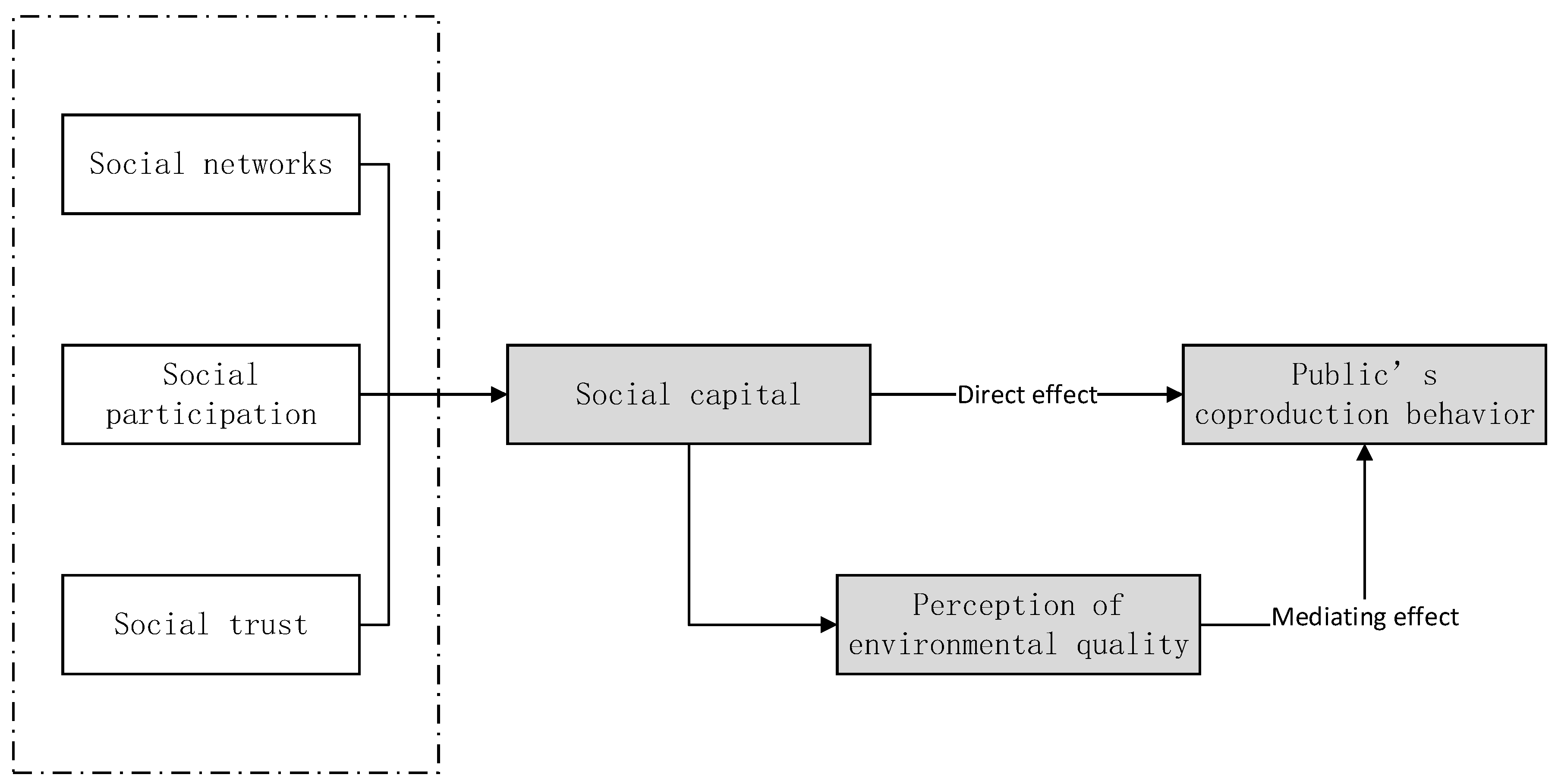
Based on the above theoretical analysis, this study constructs an integrated analytical framework to clarify how social capital influences public environmental coproduction behavior. The framework posits that the impact of social capital on environmental coproduction is transmitted through the mediating role of perception of environmental quality. Specifically, social capital—encompassing social networks, social participation and social trust—shapes individuals’ cognitive evaluation of environmental conditions, which in turn motivates their engagement in coproduction behavior. Figure 1 presents the overarching theoretical model integrating social capital, perception of environmental quality and public environmental coproduction behavior.

3. Research Methods

3.1. Data Sources

Following the principles of heuristic theoretical sampling and typicality of cases, this study selects the household waste sorting initiative in Pei County, Jiangsu Province, China, as the research object. From the perspective of industrial distribution, coal mining, plastic weaving, foundry, textile and other industries have long been the pillar industries of the county; in terms of physical geographical factors, Pei County has a dense river network and numerous water systems, and is located at the junction of four provinces. Therefore, on the one hand, the industrial layout dominated by mining and chemical industries has imposed enormous pressure on water and air governance in Pei County; on the other hand, due to its location at the junction of four provinces, the local government also faces such predicaments in environmental governance as fragmented governance caused by administrative division and difficulties in identifying pollution sources. Against this backdrop, Jiangsu Province designated the county as a pilot area for waste sorting in 2017. Since then, the Pei County government has, on the one hand, collaborated with third-party companies to promote the classified collection, transportation, disposal and resource recycling of household waste; on the other hand, on the basis of removing trash cans and setting up waste recycling stations instead, it has mobilized residents to actively participate in the waste sorting and disposal initiative. Therefore, selecting the waste sorting initiative in Pei County as a research case of grassroots environmental protection coproduction is of high typicality.
Based on the above background, the research team conducted field investigations in the county in January and June 2025, respectively, collecting data through observation and interviews to understand the predicaments faced by the local environmental protection department in governance and the measures adopted. Then, in August, the team distributed questionnaires together with a cover letter explaining the nature of the study to local residents by means of random sampling, with a total of 1067 questionnaires retrieved. After excluding all questionnaires with missing values, 761 questionnaires with complete and valid data on both predictor variables and outcome variables were retained, resulting in an effective recovery rate of 71.32%.

3.2. Variable Selection and Descriptive Statistics

This study uses the mean aggregation method to handle multi-item variables: the composite score of each dimension is obtained by summing the scores of the items under that dimension and dividing by the number of items. This approach is based on two considerations: first, exploratory factor analysis shows that each variable has a unidimensional structure, and mean aggregation can adequately reflect the overall level of the construct; second, mean aggregation is a common practice for handling Likert scales in social science research, with results that are intuitively interpretable. It should be noted that although Likert scales are strictly ordinal categorical variables, they are commonly treated as continuous variables in academia [54], and the sample size of this study (N = 761) is sufficient to support the robustness of this treatment.

3.2.1. Dependent Variable: Public Environmental Coproduction Behavior

The core dependent variable of this study is the public’s environmental coproduction behavior, which consists of 5 items in total. This study selects five dimensions—knowledge resource input, economic resource input, time resource input, publicity and mobilization, and supervision and complaint—to measure the public’s environmental coproduction behavior. All indicators are measured using a 5-point Likert scale, with response options including strongly disagree, disagree, neutral, agree, and strongly agree, assigned scores from 1 to 5, respectively. Cronbach’s α coefficient of the scale is 0.88 (>0.7), indicating that the questionnaire data meet the model requirements and the reliability test result is satisfactory. On this basis, the average score of the 5 items is used to represent the level of the public’s environmental coproduction behavior, with a higher score indicating a higher degree of public participation in environmental protection activities.

3.2.2. Independent Variable: Level of Social Capital

This study sets three independent variables respectively from the three dimensions of social networks, social trust, and social participation for measurement, so as to reveal the specific impact paths of social capital on the public’s environmental coproduction behavior. All indicators are measured using a 5-point Likert scale, with response options including strongly disagree, disagree, neutral, agree, and strongly agree, assigned scores from 1 to 5, respectively.
(1)
Social Networks (SN)
Two-way interaction among multiple actors is an important form of social networks. Key determinants of effective social interaction include the closeness of the cooperating parties, frequency of contact, and quality of communication [55]. This study designs 4 questionnaire items from four dimensions—joint decision-making, meeting discussions, daily communication, and collaborative supervision—as measurement indicators reflecting social networks. Cronbach’s α coefficient of the scale is 0.94 (>0.7), indicating that the questionnaire data meet the model requirements and the reliability test result is excellent. On this basis, the average score of the 4 items is used to represent the intensity of social networks, with a higher score corresponding to a stronger level of social networks.
(2)
Social Participation (SP)
Residents’ community participation behaviors can be divided into shallow participation and deep participation. The former is reflected in residents’ participation in voluntary services, public cultural activities, etc., while the latter requires residents to actively engage in the negotiation and decision-making processes of community public affairs such as elections and rule formulation [56]. Therefore, this study designs 3 questionnaire items from three aspects—participation in residents’ meetings, participation in voluntary services, and participation in providing suggestions—as the observed indicators reflecting social participation. Cronbach’s α coefficient of the scale is 0.847 (>0.7), indicating that the questionnaire data meet the model requirements and the reliability test result is satisfactory. On this basis, the average score of the 3 items is used to represent the level of social participation, with a higher score corresponding to a higher level of public social participation.
(3)
Social Trust (ST)
Social trust is a relatively complex and abstract concept. Some scholars measure social trust from two dimensions: reciprocity and generalized trust, and community trust [57]. The former focuses on residents’ perception of the willingness to reciprocate among out-group members outside the community, while the latter emphasizes the degree of trust that community residents place in quasi-administrative organizations such as neighborhood committees within the community as well as in their neighbors. It is evident that social trust involves residents’ subjective perceptions of different groups, such as strangers, relatives and friends. This study designs 2 questionnaire items from two aspects—neighborhood trust and acquaintance trust—as the observed indicators reflecting social trust. A correlation analysis was conducted on the data of the two items, and the Pearson correlation coefficient was 0.59, indicating that the two items are consistent in measuring this construct. On this basis, the average score of the two items is used to represent the level of social trust, with a higher score corresponding to a higher level of social trust.

3.2.3. Mediating Variable: Perception of Environmental Quality

The concept of “satisfaction” is mainly used to quantitatively analyze the discrepancy between individuals’ actual gains from a policy and their expectations, providing an important reference for the formulation and evaluation of public policies [58]. Public perception of environmental quality includes not only the perception of living environments such as housing conditions, public facilities, and environmental sanitation, but also the perception of natural environments such as local air quality, water bodies, and greening. Therefore, this study designs 2 questionnaire items from two dimensions—living environment satisfaction and ecological environment satisfaction—as the measurement indicators for the variable environmental quality perception. A correlation analysis was conducted on the data of the two items, and the Pearson correlation coefficient was 0.804, indicating that the two items are significantly correlated in measuring this construct. On this basis, the average score of the two items is used to represent the level of environmental quality perception, with a higher score corresponding to a higher level of public environmental quality perception.

3.2.4. Control Variables

This study selects six variables—gender, age, education level, household registration status, occupation type, and frequency of interacting with government agencies—as control variables and incorporates them into the model to reduce the interference of confounding factors on model estimation. The measurement items for all variables are summarized in Table 1.
The definitions and descriptive statistical results of each variable are presented in Table 2.

3.3. Model Specification

3.3.1. The Model of the Impact of Social Capital on Public Environmental Coproduction Behavior

The explained variable in this study, public environmental coproduction behavior, was measured using a five-point Likert scale. Although scale data are categorized as ordinal variables, this study follows the common practice in the social sciences of treating them as continuous variables. Therefore, ordinary least squares estimation (OLSE) was adopted to conduct multiple linear regression analysis, and the model is constructed as follows:
P E B = β 0 + β 1 S N + β 2 S P + β 3 S T + γ 1 C o n t r o l + ε 1  
In Equation (1), PECB denotes the explained variable, public environmental coproduction behavior; SN represents social networks; SP stands for social participation; ST signifies social trust; C o n t r o l refers to all the control variables included in this study; β 0 is the regression constant; β 1 , β 2 ,     β 3 and γ 1 are the partial regression coefficients; and ε 1 is the random error term.

3.3.2. The Mediating Effect Model of Perception of Environmental Quality

To test the mediating role of public perception of environmental quality in the impact of social capital on public environmental coproduction behavior, the following mediating effect model is constructed:
P E Q = β 0 + α 1 S N + α 2 S P + α 3 S T + γ 2 C o n t r o l + ε 2  
P E C B = β 0 + β 4 S N + β 5 S P + β 6 S T + β 7 E Q P + γ 3 C o n t r o l + ε 3  
Equations (2) and (3) are models established on the basis of Equation (1) for further mediating effect tests. If the partial regression coefficients β 1 ,   β 2 ,   β 3 ,   α 1 ,   α 2 ,   α 3 of the explanatory variables in Equations (1) and (2) are all significant, and the partial regression coefficient β 7 of the mediating variable is also significant, this indicates that public perception of environmental quality exerts a significant mediating effect in the impacts of social networks, social participation, and social trust on public environmental coproduction behavior. On this basis, if β 4 ,     β 5 , or β 6 is insignificant, this means that the corresponding explanatory path presents a full mediating effect; if β 4 ,   β 5 , or β 6 is significant, and the products α 1 × β 7 , α 2 × β 7 , α 3 × β 7 have the same sign as the corresponding coefficients, this indicates that the relevant explanatory path has a partial mediating effect; and if the signs are opposite, this suggests the existence of a suppression effect.

3.4. Data Screening and Diagnostic Testing

3.4.1. Missing Value Handling

A total of 1067 questionnaires were collected in this study. During the data cleaning stage, we first examined the completeness of the questionnaire responses. Since the core variables involved in this study are all measured by composite scores across multiple items, missing data on any single item would make it impossible to calculate the construct score for that observation. Therefore, we adopted a complete-case analysis strategy and excluded all samples with missing values, finally obtaining 761 valid samples, with a valid response rate of 71.32%. To test for sample selection bias, we compared the valid samples and the excluded samples across demographic variables (gender, age, and education level). The results of the independent-samples t-test showed no significant differences between the two groups (p > 0.05), indicating that the complete sample could still adequately represent the population.

3.4.2. Diagnosis of Outliers and Influential Cases

To eliminate the potential interference of extreme values on regression estimation, we calculated the standardized Z-scores for each variable and identified cases with an absolute Z-score greater than 3 as univariate outliers. After inspection, no univariate outliers were found in the sample of this study. Furthermore, we used Cook’s D distance to diagnose multivariate influential cases. A Cook D value greater than 1 is generally regarded as an influential point requiring attention. The diagnostic results showed that the maximum Cook D value for all samples was less than 0.2, indicating that there were no influential cases that significantly affected the estimation of regression parameters.

3.4.3. Common Method Bias Test

Since the data for both the independent and dependent variables in this study were obtained from self-reported questionnaires completed by the same set of respondents, there may be a risk of common method bias. To examine this potential issue, we conducted an unrotated exploratory factor analysis on all items of the core variables involved in the study using Harman’s single-factor test. The results showed that the first factor accounted for 33.92% of the variance, which was below the 40% threshold. This indicates that common method bias in this study is not severe and does not pose a substantial threat to the research conclusions.

3.4.4. Multicollinearity Test

Although the core explanatory variables of this study are theoretically interrelated, excessively high correlations may inflate the variance of parameter estimates and undermine the stability of the results. Accordingly, we used the variance inflation factor (VIF) to diagnose multicollinearity in the regression model. The results showed that in the baseline regression model (Table 3), the VIF values for all explanatory variables were well below the critical threshold of 10. This indicates that no severe multicollinearity exists in this study, and the independent effects of each explanatory variable can be effectively distinguished.

3.4.5. Heteroscedasticity Test

The heteroscedasticity test is used to determine whether the variance of the random error term in the regression model varies with the explanatory variables. We employed the White test to examine the residual variance of the regression model, and the results indicated the presence of heteroscedasticity (p < 0.05). Therefore, in the subsequent tests of main effects and mediating effects, we used robust standard errors for parameter estimation to correct for the potential impact of heteroscedasticity on standard error estimation.

4. Empirical Analysis

4.1. Main Effect Test

Based on the above theoretical analysis, data collection and model specification, SPSS 27 software was used to conduct parameter estimation for multiple linear regression. The results of the benchmark regression are presented in Table 3. The findings indicate that social capital exerts a significant positive impact on public environmental coproduction behavior. In terms of the magnitude of impacts, the different dimensions of social capital affect public coproduction behavior in the following descending order: social networks (0.601) > social participation (0.148) > social trust (0.062). Thus, Hypothesis 1 (H1) is verified.
Among the control variables, gender has a significant negative impact on public environmental coproduction behavior, suggesting that compared with females, males are more willing to participate in environmental protection activities. The frequency of visiting government agencies for services also has a significant impact on public environmental coproduction behavior, which indicates that the more frequently the public goes to government institutions such as sub-district offices or convenience service centers for services, the more inclined they are to participate in environmental governance.

4.2. Mediating Effect Test

Based on the benchmark regression analysis, multiple linear regression models were employed to estimate the impact of social capital on public perception of environmental quality, as well as the combined impacts of social capital and perception of environmental quality on public environmental coproduction behavior, so as to test the mediating effect of public perception of environmental quality. The results are presented in Table 4. According to Model b, the impacts of social networks, social participation and social trust on public perception of environmental quality are all significant at the 1% level. Thus, Hypothesis 2 (H2) is verified, which confirms that social capital exerts a significant positive impact on public perception of environmental quality. As can be seen from the parameter estimation results of Model c, the positive impact of perception of environmental quality on public environmental coproduction behavior is also significant at the 1% level, indicating that perception of environmental quality plays a mediating role in the impact of social capital on public environmental coproduction behavior. Therefore, Hypothesis 4 (H4) is verified as well. Specifically, in Model c, both social networks and social participation have significant positive impacts on public environmental coproduction behavior, which suggests that perception of environmental quality exerts a partial mediating effect in these two influence paths. In contrast, the impact of social trust in Model c is insignificant, which indicates that perception of environmental quality exerts a full mediating effect in the influence path from social trust to public environmental coproduction behavior. The effect size of the mediating effect is shown in Table 5.

4.3. Robustness Test

In the benchmark regression, the levels of social capital, perception of public environmental quality, and public environmental coproduction behavior were directly measured by calculating the mean values. Herein, principal component analysis (PCA) was adopted to compute comprehensive scores for reassigning values to each variable, followed by a re-conducted multiple linear regression analysis. First, the Kaiser–Meyer–Olkin (KMO) test and Bartlett’s test of sphericity were performed. The results showed that the KMO values of variables including social networks (KMO = 0.856), social participation (KMO = 0.714), and public environmental coproduction behavior (KMO = 0.816) were all greater than 0.7, and the significance levels of Bartlett’s test were all less than 0.001, indicating that the data were suitable for principal component analysis. Second, principal components were extracted based on the criterion of eigenvalues greater than 1, and the results revealed that one principal component was extracted for each variable. Subsequently, coefficients were calculated by dividing the factor loadings corresponding to each principal component by the square root of the eigenvalues, thereby generating the comprehensive principal component scores of each sample across different variables. Finally, multiple linear regression analysis was re-run to verify whether the main effects and mediating effects remained significant when the variable measurement methods were altered. The analysis results (as shown in Table 6) were consistent with those presented earlier, further confirming that the research conclusions—social capital significantly promotes public environmental coproduction behavior, and public perception of environmental quality plays a mediating role therein—are robust.

5. Conclusions and Discussion

Accurately identifying the impact and mechanism of social capital on public environmental coproduction behavior carries important theoretical and practical significance. It not only helps stimulate the endogenous motivation of public participation in environmental affairs but also provides a scientific basis for innovating grassroots governance models and improving environmental performance. Based on the questionnaire survey data of 761 residents in Pei County, Jiangsu Province, China in 2025, this paper empirically analyzes the impact of social capital on public environmental coproduction behavior and explores its internal mechanism of action. The research findings are as follows: First, social capital exerts a significant positive impact on public environmental coproduction behavior. Among the different dimensions of social capital, social networks have the strongest impact, followed by social participation and social trust. This conclusion remains valid after the robustness test using an alternative variable measurement method. Second, public perception of environmental quality plays a mediating role in the impact of social capital on public environmental coproduction behavior. Specifically, it exerts a partial mediating effect in the influence paths of social networks and social participation on public environmental coproduction behavior, while it plays a full mediating effect in the influence path of social trust. These findings provide new theoretical insights into understanding the micro-level dynamic mechanisms of environmental coproduction. The primary theoretical contributions of this study are elaborated from three perspectives below.
First, this study opens the “black box” of the cognitive transmission mechanism through which social capital influences environmental coproduction. Most existing studies treat social capital as a direct predictor of public coproduction behavior, yet the internal mechanism by which social embeddedness translates into concrete action remains undertheorized—especially in fragmented governance contexts where responsibilities and outcomes are ambiguous to the public. This study finds that perception of environmental quality plays a key mediating role between social capital and environmental coproduction behavior. This finding is consistent with and extends several recent studies. Ma et al. [59], using a sample of rural residents in China, found that policy perception partially mediates the relationship between livelihood capital and residents’ environmental participation. Zhang et al. [25], studying households in the ecologically fragile area around the Tarim Basin, confirmed that environmental cognition mediates the effect of social capital on environmental governance participation. Together with the present study, these two studies point to a robust theoretical proposition: in the context of China’s grassroots governance, the framework of “capital → cognition → behavior” possesses strong explanatory power. Compared with the above studies, the theoretical contributions of this study are twofold: First, it specifies “cognition” as “perception of environmental quality” and assigns it the theoretical role of a “cognitive evaluation mechanism”, revealing the internal process through which the public interprets the governance context and forms behavioral decisions via environmental perception. Second, by testing the three dimensions of social capital separately, this study reveals that the cognitive mediation mechanism follows heterogeneous patterns across dimensions—a finding that has not received sufficient attention in existing research.
Second, this study clarifies the differentiated roles of various components of social capital in promoting environmental coproduction. The dominant effect of social networks indicates that relatively formal and steadily sustained interactive relations can effectively reduce the information and coordination costs of public participation, thereby translating into actual coproduction behaviors. The second-strongest effect of social participation suggests that participation experience itself has a self-reinforcing function. Through participating in community meetings, voluntary services, policy advice and other social activities, the public can form positive perceptions of their own participation efficacy. Such enhanced self-efficacy makes the public more inclined to believe that their inputs can bring about environmental improvements, thus strengthening their willingness to engage in coproduction. The relatively weak effect of social trust shows that, in the specific context of environmental coproduction, generalized social trust needs to be transformed into concrete perceptions of governance effectiveness to effectively stimulate public participation. Through a comparative analysis of the three dimensions, this study advances the academic understanding of the functional differences among the components of social capital. The findings demonstrate that in mobilizing the public to participate in environmental coproduction, action-oriented participation may depend more on the accessibility of relational networks and the availability of participation opportunities, rather than merely on the level of generalized trust.
Third, this study reveals the “cognitive signaling function” of perception of environmental quality in fragmented governance. We find that perception of environmental quality serves as a critical signaling mechanism in environmental governance. Through social interaction, the public acquires environmental information and forms a comprehensive assessment of local environmental conditions. This assessment—namely, the level of perception of environmental quality—effectively conveys an implicit signal to the public about “whether governance is effective”. When the public perceives higher environmental quality, they receive a positive signal indicating that governmental governance efforts are effective, environmental conditions are manageable, and it is worthwhile to invest time and energy in environmental protection. The theoretical proposition of this study regarding the “cognitive signaling function” of perception of environmental quality can engage in dialogue with existing research on fragmented governance. In public administration, fragmented governance research has long focused on structural solutions such as institutional design, coordination mechanisms, and cross-jurisdictional cooperation [39], yet insufficient attention has been paid to the micro-psychological processes through which the public forms governance perceptions and makes participation decisions in fragmented contexts. This finding enriches fragmented governance research with a micro-level perspective: while institutional coordination is essential, the public’s interpretation of cognitive signals about governance performance also represents a key link in overcoming coordination failure.
These theoretical findings carry important implications for grassroots environmental governance practice. First, the government should focus on expanding the coverage and depth of social networks. The strong effect of social networks suggests that establishing institutionalized government–public interaction platforms—such as environmental councils, community environmental hearings, and resident environmental supervision groups—can effectively reduce the information costs of public participation and strengthen their willingness toward collaborative production. Second, the forms and channels of social participation should be diversified. In addition to traditional offline participation, digital technologies can be used to develop online participation platforms, enabling the public to engage in environmental discussions and decision-making in a more flexible and low-cost manner, thereby enhancing their sense of participation efficacy. Finally, attention should be paid to the cognitive-shaping function of environmental publicity and education. As a key mediating variable, perception of environmental quality indicates that it is necessary not only to improve objective environmental quality, but also to enhance the public’s subjective perception of environmental governance effectiveness through information disclosure, achievement demonstration, and publicity of advanced models, so that social trust can be genuinely transformed into motivation for participation.
This study also has certain limitations. First, limited by the objective conditions of questionnaire design, the two variables of social trust and perception of environmental quality can only be measured with two items. Future research may adopt multi-item scales to further improve the accuracy and stability of measurement. Second, this study uses cross-sectional data, which makes it difficult to completely rule out the possibility of reverse causality; environmental coproduction behavior may in turn strengthen social capital and perception of environmental quality. Future research can further verify the causal direction among variables through longitudinal data or experimental designs. Finally, the research sample is limited to Pei County, Jiangsu Province, and the external validity of the conclusions needs to be tested by empirical studies in more regions. In the future, the sample scope can be expanded to compare the similarities and differences in the role of social capital in regions with different institutional environments and economic development levels, so as to deepen the understanding of the dynamic mechanism of environmental coproduction.

Author Contributions

Conceptualization, Z.Y.; Methodology, Z.Y.; Software, Z.Y.; Validation, Z.Y.; Formal analysis, Z.Y.; Investigation, Z.C.; Resources, Z.C.; Data curation, Z.Y.; Writing—original draft, Z.Y.; Writing—review & editing, Z.Y. and Z.C.; Visualization, Z.Y.; Supervision, Z.C.; Project administration, Z.C.; Funding acquisition, Z.C. All authors have read and agreed to the published version of the manuscript.

Funding

This research received no external funding.

Institutional Review Board Statement

This study is waived for ethical review as “this study involves human subjects research but carries minimal risk, with no medical interventions or collection of sensitive personal information” by the Academic Committee of the School of Government, Nanjing University.

Informed Consent Statement

Informed consent for participation was obtained from all subjects involved in the study.

Data Availability Statement

The data presented in this study are available on request from the corresponding author.

Conflicts of Interest

The authors declare no conflict of interest.

References

  1. Alam, S.L. Many hands make light work: Towards a framework of digital co-production to co-creation on social platforms. Inf. Technol. People 2021, 34, 1087–1118. [Google Scholar] [CrossRef]
  2. Bovaird, T. Beyond engagement and participation: User and community coproduction of public services. Public Adm. Rev. 2007, 67, 846–860. [Google Scholar] [CrossRef]
  3. Bovaird, T.; Loeffler, E. From engagement to co-production: The contribution of users and communities to outcomes and public value. Volunt. Int. J. Volunt. Nonprofit Organ. 2012, 23, 1119–1138. [Google Scholar] [CrossRef]
  4. Portes, A. Social Capital: Its Origins and Applications in Modern Sociology. Annu. Rev. Sociol. 1998, 24, 1–24. [Google Scholar] [CrossRef]
  5. Putnam, R.D. The prosperous community. Am. Prospect 1993, 4, 35–42. [Google Scholar]
  6. Putnam, R.D. Bowling Alone: The Collapse and Revival of American Community; Simon and Schuster: New York, NY, USA, 2000. [Google Scholar]
  7. Du, W.C.; Wan, Q.Y. The impact of social capital on public pro-environmental behavior: Empirical evidence from CGSS 2013. Soft Sci. 2022, 36, 59–64+80. [Google Scholar]
  8. Duan, C.R.; Ding, M.; Wang, H.; Wu, Z.L. Social Capital, Government Satisfaction and Residents’ Willingness to Pay for Atmospheric Environment: Based on Survey Data from Shijiazhuang City. J. Arid Land Resour. Environ. 2022, 36, 15–23. [Google Scholar]
  9. Wu, Z.L.; Ding, M.; Zhou, X.X.; Duan, C.R. The Impact Mechanism of Social Capital and Public Participation on Public Evaluation of Government Environmental Governance: A Case Study of Atmospheric Environmental Governance. J. Arid Land Resour. Environ. 2022, 36, 1–10. [Google Scholar]
  10. Verschuere, B.; Brandsen, T.; Pestoff, V. Co-production: The state of the art in research and the future agenda. Volunt. Int. J. Volunt. Nonprofit Organ. 2012, 23, 1083–1101. [Google Scholar] [CrossRef]
  11. Liu, B.; Lin, S.; He, S.; Zhang, J. Encourage or impede? The relationship between trust in government and coproduction. Public Manag. Rev. 2024, 26, 3501–3528. [Google Scholar] [CrossRef]
  12. Yi, H.C.; Pan, H.X. Social Capital, Policy Satisfaction and Farmers’ Contract-Signing Behavior in ‘Village-to-Community’ Conversion. J. Beijing For. Univ. (Soc. Sci. Ed.) 2025, 24, 58–67. [Google Scholar]
  13. Durante, R.; Mastrorocco, N.; Minale, L.; Snyder, J.M. Unpacking social capital. Econ. J. 2025, 135, 773–807. [Google Scholar] [CrossRef]
  14. Wu, X.; Gong, Y.; Li, Y. Citizen Satisfaction, Community Attachment, and their Engagement in Coproduction: A Survey Study in China. Public Perform. Manag. Rev. 2025, 49, 32–56. [Google Scholar] [CrossRef]
  15. Wang, X.J.; Li, H.Y. The Motivational Spectrum and Its Impacts of Public Participation in Collaborative Production: A Mixed-Methods Study from the Perspective of Value Co-creation. J. Public Adm. Rev. 2023, 16, 4–24+196. [Google Scholar]
  16. Ballas, D.; Tranmer, M. Happy people or happy places? A multilevel modeling approach to the analysis of happiness and well-being. Int. Reg. Sci. Rev. 2012, 35, 70–102. [Google Scholar] [CrossRef]
  17. Osborne, S.P.; Radnor, Z.; Strokosch, K. Co-production and the co-creation of value in public services: A suitable case for treatment? Public Manag. Rev. 2016, 18, 639–653. [Google Scholar] [CrossRef]
  18. Júnior, A.G.; Bezerra, J.C.V.; Cavalcante, C.E. Typologies of co-production of public services: A scale proposal. Context.–Rev. Contemp. Econ. Gest. 2023, 21, e82156. [Google Scholar]
  19. Wu, J.P.; Xiong, J.; Liu, X. Structure and measurement of urban residents’ coproduction behavior: A study based on community micro-renewal. Urban Dev. Stud. 2022, 29, 57–64. [Google Scholar]
  20. Mu, R.; Lang, M. Evaluation of Municipal Solid Waste Classification Effect and Policy-driven Paths from the Perspective of Coproduction: A Fuzzy-set Qualitative Comparative Analysis Based on 19 Cities in Central and Eastern China. China Popul. Resour. Environ. 2023, 33, 182–191. [Google Scholar]
  21. Harriss, J.; De Renzio, P. POLICY ARENA: ‘Missing link’ or analytically missing?: The concept of social capital. Edited by John Harriss. An introductory bibliographic essay. J. Int. Dev. J. Dev. Stud. Assoc. 1997, 9, 919–937. [Google Scholar] [CrossRef]
  22. Bourdieu, P. 1. Le capital social. Notes provisoires. In Le Capital Social: Performance, Équité et Réciprocité; La Découverte: Paris, France, 2006; pp. 29–34. [Google Scholar]
  23. Zhang, J.; Busck, A.G.; Kristensen, S.B.P. Rethinking the role of social capital in collective action: Facilitating or impeding inclusive rural transformation? Habitat Int. 2026, 170, 103734. [Google Scholar] [CrossRef]
  24. Jia, W.L. Practical logic and optimization path of social capital embedded in multi-agent cooperative governance of rural living environment. Rural. Econ. 2024, 11, 124–132. [Google Scholar]
  25. Zhang, J.; Wei, H.R.; Yuan, K.R. Social capital, environmental cognitive level, and farmers’ participation in environmental governance: Based on survey data of 881 rural households in the eco-fragile area around the Tarim Basin. J. Arid Land Resour. Environ. 2024, 38, 88–98. [Google Scholar]
  26. Guo, J.B. Research on the regulatory effect and mechanism improvement of social capital on the collaborative governance of carbon reduction and pollution reduction: Based on the perspective of carbon emission trading and pollution emission trading in key urban agglomerations. J. Jiangxi Univ. Financ. Econ. 2025, 4, 36–47. [Google Scholar]
  27. Uphoff, N.; Wijayaratna, C.M. Demonstrated benefits from social capital: The productivity of farmer organizations in Gal Oya, Sri Lanka. World Dev. 2000, 28, 1875–1890. [Google Scholar] [CrossRef]
  28. Scott, J.D. Assessing the relationship between police-community coproduction and neighborhood-level social capital. J. Contemp. Crim. Justice 2002, 18, 147–166. [Google Scholar] [CrossRef]
  29. Zhou, X.; Han, M.; Wang, Y. The impact of social capital and government support on farmers’ willingness to pay for road governance: A case study of rural road governance in China. Front. Environ. Sci. 2025, 13, 1514402. [Google Scholar] [CrossRef]
  30. Zhang, K.; Xu, Y.L.; Yang, Q. A study on the social process of urban planning from the perspective of social capital. Urban Plan. Rev. 2017, 41, 23–30. [Google Scholar]
  31. Wagner, S.M.; Buko, C. An empirical investigation of knowledge-sharing in networks. J. Supply Chain Manag. 2005, 41, 17–31. [Google Scholar] [CrossRef]
  32. Zhang, Y.; Liu, X.; Vedlitz, A. How social capital shapes citizen willingness to co-invest in public service: The case of flood control. Public Adm. 2020, 98, 696–712. [Google Scholar] [CrossRef]
  33. Hu, D.F.; Chen, S.Y. An Analysis of Influencing Factors of Individual Charitable Behavior Based on Social Capital Theory: An Empirical Study Using Hierarchical Linear Modeling. J. Beijing Jiaotong Univ. (Soc. Sci. Ed.) 2019, 18, 101–109. [Google Scholar]
  34. Yang, T. An analysis of influencing factors of public participation from the perspective of ‘cost-benefit’. J. Nanjing Univ. Posts Telecommun. (Soc. Sci. Ed.) 2012, 14, 56–60+82. [Google Scholar]
  35. Wu, J.B.; Fu, Y.H.; Yao, J.T. A study on the influencing factors of digital coproduction in the community context: An empirical analysis from the perspective of social capital. J. Gansu Inst. Public Adm. 2024, 6, 14–26+124–125. [Google Scholar]
  36. Bandura, A. Guide for constructing self-efficacy scales. In Self-Efficacy Beliefs of Adolescents; Emerald Publishing: Leeds, UK, 2006; Volume 5, pp. 307–337. [Google Scholar]
  37. Thomsen, M.K. Citizen coproduction: The influence of self-efficacy perception and knowledge of how to coproduce. Am. Rev. Public Adm. 2017, 47, 340–353. [Google Scholar] [CrossRef]
  38. Morgan, R.M.; Hunt, S.D. The commitment-trust theory of relationship marketing. J. Mark. 1994, 58, 20–38. [Google Scholar] [CrossRef]
  39. Qi, H.; Ran, B. Paradoxes in collaborative governance. Public Manag. Rev. 2024, 26, 2728–2753. [Google Scholar] [CrossRef]
  40. Sønderskov, K.M. Making Cooperation Work: Generalized Social Trust and Large-N Collective Action; Forlaget Politica: Aarhus, Denmark, 2008. [Google Scholar]
  41. Leana, C.R., III; Van Buren, H.J. Organizational social capital and employment practices. Acad. Manag. Rev. 1999, 24, 538–555. [Google Scholar] [CrossRef]
  42. Bandura, A. Social cognitive theory: An agentic perspective. Annu. Rev. Psychol. 2001, 52, 1–26. [Google Scholar] [CrossRef]
  43. Yan, F.X.; Zhang, Q. The impact of social capital on farmers’ willingness to pay for agricultural disaster reduction public goods: An empirical study based on three counties in Hubei Province. Issues Agric. Econ. 2017, 38, 56–63+2. [Google Scholar]
  44. Shi, H.T.; Sui, D.C.; Wu, H.X.; Zhao, M.J. The Impact of Social Capital on Farmers’ Participation in Watershed Ecological Governance: A Case Study of the Heihe River Basin. Chin. Rural. Econ. 2018, 1, 34–45. [Google Scholar]
  45. Zhou, K.; Tan, J.; Watanabe, K. How does perceived residential environment quality influence life satisfaction? Evidence from urban China. J. Community Psychol. 2021, 49, 2454–2471. [Google Scholar] [CrossRef]
  46. Ma, L.; Yang, Y. How does public participation affect public satisfaction? An empirical study on performance evaluation of prefecture-level city governments in China. Adm. Trib. 2019, 26, 86–94. [Google Scholar]
  47. Wu, Z.L.; Cao, H. The Impact and Mechanism of Village-Level Social Capital on Rural Residents’ Satisfaction with Environmental Governance: An Empirical Analysis Based on 726 Questionnaires. J. China Agric. Resour. Reg. Plan. Available online: https://link.cnki.net/urlid/11.3513.S.20250908.1849.039 (accessed on 19 December 2025).
  48. Boyne, G.A.; James, O.; John, P.; Petrovsky, N. Democracy and government performance: Holding incumbents accountable in English local governments. J. Politics 2009, 71, 1273–1284. [Google Scholar] [CrossRef]
  49. Golan-Nadir, N.; Christensen, T. Collective action and co-production of public services as alternative politics: The case of public transportation in Israel. Aust. J. Public Adm. 2023, 82, 96–115. [Google Scholar] [CrossRef]
  50. Ati, S.; Satpathy, S.; Saxena, S. Perceived public service performance, trust in the government, and citizens’ willingness to participate: Evidence from water governance in Visakhapatnam, India. Water Policy 2024, 26, 618–634. [Google Scholar] [CrossRef]
  51. Mok, J.Y. Proposed non-linear relation between satisfaction with government performance and co-production: An initial empirical test. Public Manag. Rev. 2020, 22, 432–451. [Google Scholar] [CrossRef]
  52. Grillo, M.C.; Teixeira, M.A.; Wilson, D.C. Residential satisfaction and civic engagement: Understanding the causes of community participation. Soc. Indic. Res. 2010, 97, 451–466. [Google Scholar] [CrossRef]
  53. Alonso, J.M.; Andrews, R.; Clifton, J.; Diaz-Fuentes, D. Factors influencing citizens’ co-production of environmental outcomes: A multi-level analysis. Public Manag. Rev. 2019, 21, 1620–1645. [Google Scholar] [CrossRef]
  54. Norman, G. Likert scales, levels of measurement and the ‘laws’ of statistics. Adv. Health Sci. Educ. 2010, 15, 625–632. [Google Scholar] [CrossRef]
  55. Becerra, M.; Gupta, A.K. Perceived trustworthiness within the organization: The moderating impact of communication frequency on trustor and trustee effects. Organ. Sci. 2003, 14, 32–44. [Google Scholar] [CrossRef]
  56. Pan, Z.Q.; Ouyang, X.J. Levels and Transformation Mechanism of Community Participation from the Perspective of Community Governance Community. J. Guizhou Norm. Univ. (Soc. Sci. Ed.) 2022, 6, 25–35. [Google Scholar]
  57. Gui, Y.; Huang, R.G. Measuring community social capital: An empirical study based on empirical data. Sociol. Stud. 2008, 3, 122–142+244–245. [Google Scholar]
  58. Fornell, C.; Johnson, M.D.; Anderson, E.W.; Cha, J.; Bryant, B.E. The American customer satisfaction index: Nature, purpose, and findings. J. Mark. 1996, 60, 7–18. [Google Scholar] [CrossRef]
  59. Ma, Z.; Ruan, H.; Yang, J. The Effect of Livelihood Capital on Rural Resident Participation in Human Settlement Environmental Governance: The Mediating Role of Policy Perception. Sage Open 2025, 15, 21582440251397879. [Google Scholar] [CrossRef]
Figure 1. The influence mechanism of social capital, perception of environmental quality and the public’s environmental coproduction behavior (source: compiled by the authors).
Sustainability 18 03053 g001
Table 1. Measurement items of social capital, perception of environmental quality and public environmental coproduction behavior.
VariableDimensionMeasurement Item
Public Environmental Coproduction Behavior
(PECB)
PECB1 Knowledge resource inputI have contributed professional knowledge and experience to the waste sorting work in my village/community.
PECB2 Economic resource inputI have spent money to support the waste sorting work in my village/community.
PECB3 Time resource inputI have invested time in assisting the waste sorting work in my village/community.
PECB4 Publicity and mobilizationI will help my village/community promote waste sorting and mobilize others to participate.
PECB5 Supervision and complaintI will supervise and file complaints to the village/community committee about problems identified in the waste sorting process.
Social Networks
(SN)
SN1 Joint decision-makingThe village/community committee invites residents to jointly determine priorities for waste sorting work.
SN2 Meeting discussionsThe village/community committee holds meetings with residents to discuss matters related to waste sorting work.
SN3 Daily communicationThe village/community committee maintains regular communication with residents to advance waste sorting work.
SN4 Collaborative supervisionThe village/community committee conducts joint supervision with residents and improves waste sorting work.
Social Participation
(SP)
SP1 Participation in residents’ meetingsHow often do you participate in village/community residents’ meetings?
SP2 Participation in voluntary servicesHow often have you participated in voluntary services in the past year?
SP3 Participation in providing suggestionsIn the past year, have you ever put forward suggestions or expressed opinions to the government/community/village officials through various channels?
Social Trust
(ST)
ST1 Neighborhood trustDo you think your neighbors, fellow villagers or community residents are trustworthy?
ST2 Acquaintance trustDo you think your ordinary friends or acquaintances are trustworthy?
Perception of Environmental Quality
(PEQ)
PEQ1 Living environment satisfactionHow satisfied are you with the local living environment (e.g., village/community environment)?
PEQ2 Ecological environment satisfactionHow satisfied are you with the overall local environmental conditions (e.g., air quality, rivers, etc.)?
Table 2. Variable definitions and descriptive statistics.
Variable NameVariable Definition and DescriptionMeanStandard Deviation
Dependent Variable
Public Environmental Coproduction Behavior
1 = strongly disagree, 2 = disagree, 3 = neutral,
4 = agree, 5 = strongly agree
3.730.878
Independent Variables
Social Networks
40.975
Social Participation1 = never, 2 = rarely, 3 = sometimes, 4 = often,
5 = always
2.8970.95
Social Trust1 = the vast majority are untrustworthy,
2 = most are untrustworthy, 3 = half trustworthy and half untrustworthy, 4 = most are trustworthy, 5 = the vast majority are trustworthy
3.9250.767
Mediating Variable
Perception of Environmental Quality
Scored from 1 to 10, with higher scores indicating higher satisfaction8.2191.732
Control Variables
Gender
0 = male, 1 = female0.390.488
Age1 = 25 years old or younger, 2 = 26–40 years old,
3 = 41–60 years old, 4 = over 60 years old
2.5110.667
Education Level1 = junior high school or below, 2 = senior high school or technical secondary school,
3 = junior college, 4 = bachelor’s degree,
5 = master’s degree or above
2.991.013
Household Registration Status1 = agricultural household registration,
2 = non-agricultural household registration
1.580.494
Occupation Type1 = civil servant or public institution employee,
2 = private sector employee, self-employed or farmer, 3 = unemployed
1.60.645
Frequency of Interacting with Government Agencies1 = seldom go, 2 = occasionally go, 3 = often go1.7540.723
Table 3. Benchmark regression results of social capital and public environmental coproduction behavior.
Explanatory VariablesβVIF
Social Networks0.601 ***1.243
Social Participation0.148 ***1.427
Social Trust0.062 **1.217
Gender−0.067 **1.056
Age
≤25 years old
26–40 years old0.0325.373
41–60 years old0.0525.738
≥61 years old0.0222.04
Education Level
Junior high school or below
Senior high school or technical secondary school0.0172.409
Junior college0.0023.545
Bachelor’s degree−0.0614.097
Master’s degree and above−0.021.185
Household Registration Type
Agricultural household registration
Non-agricultural household registration−0.0211.209
Employment Type
Private sector, self-employed, farming, etc.
Civil servant, public institution staff−0.0081.367
Unemployed−0.011.181
Frequency of Visiting Government Agencies0.047 ***1.244
Sample Size (N)761
R20.525
Note: ** and *** indicate significance at the 5%, and 1% statistical levels, respectively.
Table 4. Estimation results of the mediating effect of public perception of environmental quality.
Public Environmental Coproduction Behavior Model aPerception of Environmental Quality Model bPublic Environmental Coproduction Behavior Model c
Social Networks0.601 ***0.274 ***0.579 ***
Social Participation0.148 ***0.212 ***0.131 ***
Social Trust0.062 **0.263 ***0.04
Perception of Environmental Quality 0.083 **
Control VariablesControlledControlledControlled
Sample Size (N)761761761
R20.5250.3610.53
Note: ** and *** indicate significance at the 5%, and 1% statistical levels, respectively.
Table 5. Summary of mediating effect size results.
Testing ConclusionTotal EffectMediating EffectDirect EffectEffect Ratio
Social Networks → Perception of Environmental Quality → Public Environmental Coproduction BehaviorPartial Mediation0.5420.020.5213.767%
Social Participation → Perception of Environmental Quality → Public Environmental Coproduction BehaviorPartial Mediation0.1370.0160.12111.815%
Social Trust → Perception of Environmental Quality → Public Environmental Coproduction BehaviorFull Mediation0.0710.0250.046100%
Note: “→” indicates the path of influence.
Table 6. Regression results based on comprehensive principal component scores.
Public Environmental Coproduction Behavior Model dPerception of Environmental Quality Model ePublic Environmental Coproduction Behavior Model f
Social Networks0.61 ***0.275 ***0.586 ***
Social Participation0.145 ***0.21 ***0.127 ***
Social Trust0.063 **0.264 ***0.04
Perception of Environmental Quality 0.087 **
Control VariablesControlledControlledControlled
Sample Size (N)761761761
R20.5360.3610.541
Note: ** and *** indicate significance at the 5%, and 1% statistical levels, respectively.
Disclaimer/Publisher’s Note: The statements, opinions and data contained in all publications are solely those of the individual author(s) and contributor(s) and not of MDPI and/or the editor(s). MDPI and/or the editor(s) disclaim responsibility for any injury to people or property resulting from any ideas, methods, instructions or products referred to in the content.