Article

How Environmental Management Systems Enable Sustainability Transition: The Roles of Green Transition and Policy Support in Driving Circular Product Innovation


by
Nabila Albannai
*,
Ahmad Bassam Alzubi
and
Hasan Yousef Aljuhmani
Department of Business Administration, Institute of Graduate Research and Studies, University of Mediterranean Karpasia, 33010 Mersin, Turkey
*
Author to whom correspondence should be addressed.
Sustainability 2026, 18(4), 2060; https://doi.org/10.3390/su18042060
Submission received: 24 December 2025 / Revised: 20 January 2026 / Accepted: 22 January 2026 / Published: 18 February 2026

Abstract

This study examines how environmental management systems (EMSs) function as information-based organizational capabilities that drive circular product innovation in manufacturing SMEs operating in an emerging economy. Grounded in the resource-based view (RBV) and institutional theory, the study develops and empirically tests a model linking EMSs to circular-oriented product innovation through the mediating role of green transition, while assessing the moderating influence of policy support. Data were collected through a cross-sectional survey administered in two temporally separated phases to mitigate common method bias, targeting senior managers of ISO 14001-certified manufacturing SMEs registered in the Turkish Trade Register Gazette. A total of 511 valid responses were analyzed. Measurement reliability and validity were established using confirmatory factor analysis, and hypotheses were tested via Hayes’ PROCESS macro. The results indicate that an EMS significantly enhances circular product innovation both directly and indirectly. Green transition emerges as a strong partial mediator, explaining a substantial share of the total effect, highlighting its critical role in translating environmental information, routines, and capabilities into product-level circular outcomes. While organizational sustainability policy does not moderate the EMS–green transition relationship, policy support significantly strengthens the impact of green transition on circular product innovation. Firms operating within more supportive policy environments achieve substantially higher levels of circular innovation. Overall, the study advances the understanding of how information system-enabled capabilities and supportive institutional conditions jointly shape sustainability transitions, offering insights for managers and policymakers seeking to foster circular innovation in manufacturing SMEs.

1. Introduction

Manufacturing industries worldwide are undergoing a profound transformation driven by escalating environmental concerns, resource depletion, and global commitments to sustainability [1]. Circular economy (CE) principles have emerged as a cornerstone of this transition, encouraging firms to decouple growth from resource consumption through sustainable design, waste minimization, and product circularity. For emerging economies, the shift toward circular production is particularly critical due to heightened pressures from environmental degradation, increasing sustainability expectations, and intensifying global competition [2,3,4]. Turkey’s manufacturing sector, dominated by small- and medium-sized enterprises (SMEs), represents a strategic context for examining how firms mobilize internal and external enablers to pursue circular product innovation [5,6]. As SMEs contribute significantly to national economic output yet remain disproportionately linked to environmental burdens, understanding the drivers of circular innovation within this sector is both timely and essential [7,8].
Despite increasing global attention on CE, manufacturing SMEs continue to face challenges in embedding circular principles into product design and production processes. These challenges arise from limited resources, technological constraints, weak environmental practices, and uneven access to supportive institutional mechanisms [9,10,11]. In emerging markets, where institutional structures are still evolving, firms must rely on both internal capabilities and external policy support mechanisms to advance circular innovation [12]. This creates a pressing need to examine how environmental management systems (EMSs), organizational sustainability policies, green transition practices, and policy support—rather than regulatory enforcement—interact to shape circular product innovation outcomes [13].
A review of the literature highlights several important gaps. First, although an EMS has been linked to improved sustainability performance, scholars have paid insufficient attention to how an EMS enables product-level circular innovation, particularly in resource-constrained SMEs [14]. Second, the role of green transition as a mediating capability linking EMSs to circular innovation remains underexplored, despite its conceptual relevance as a process that integrates environmental technologies and sustainable practices across operations [15]. Third, limited empirical evidence exists regarding how organizational sustainability policies influence capability-building processes, especially in emerging economies where such policies are still evolving [16]. Fourth, while institutional theory emphasizes the role of external institutional environments in shaping innovation, the moderating role of supportive policy instruments in conditioning circular product innovation has received limited empirical validation, with recent studies calling for stronger integration of internal and external determinants [17,18,19].
Grounded in the Resource-Based View (RBV) and a selective application of Institutional Theory, this study addresses these gaps by developing and evaluating a model that links EMSs to circular product innovation through green transition, while evaluating the moderating effects of organizational sustainability policy and policy support as an enabling institutional mechanism. The RBV provides a foundation for conceptualizing EMSs and green transition as strategic capabilities that enable firms to redesign products for circularity [20]. Meanwhile, Institutional Theory is employed in this study exclusively to explain how supportive policy environments strengthen the relationship between internal environmental capabilities and circular innovation outcomes [21]. This study does not examine coercive or regulatory institutional pressures. This theoretical integration is particularly relevant for Turkey, where manufacturing SMEs operate under rising environmental expectations and increasing government initiatives aimed at supporting, rather than imposing, circular economy adoption.
Based on these gaps and theoretical foundations, this study is guided by the following research questions:
Q1: To what extent does the environmental management system enhance circular product innovation in manufacturing SMEs?
Q2: How does green transition mediate the relationship between the environmental management system and circular product innovation?
Q3: To what extent do organizational sustainability policy and policy support as enabling institutional mechanisms condition or strengthen the pathways leading to circular product innovation?
Addressing these research questions enables a more comprehensive understanding of how capability-based mechanisms and supportive institutional enablers shape circular innovation within resource-constrained SMEs [22]. By examining these relationships simultaneously, the study advances the CE literature beyond isolated analyses of environmental practices and contributes nuanced empirical insights into how internal environmental capabilities and policy-enabled institutional contexts jointly influence the sustainability transition of manufacturing SMEs. The study makes several contributions. Theoretically, it enriches CE and sustainability management literature by integrating capability-based and institutional perspectives while explicitly delimiting the institutional scope to enabling policy support mechanisms. Empirically, it provides large-scale evidence from 511 ISO 14001–certified Turkish SMEs [23], addressing the scarcity of quantitative studies on CE practices in emerging economies. Practically, the findings offer insights for managers on strengthening internal environmental capabilities and for policymakers on designing targeted, support-oriented institutional instruments that amplify firms’ circular innovation potential.
The remainder of the paper is organized as follows. Section 2 develops the theoretical framework and hypotheses, drawing on the Resource-Based View and Institutional Theory. Section 3 details the research methodology, including the sampling strategy, data collection procedures, and analytical techniques. Section 4 presents empirical results. Section 5 discusses the theoretical and practical implications of the findings and concludes the study by outlining its limitations and offering directions for future research.

2. Theoretical Framework and Hypotheses Development

2.1. Resource-Based View and Institutional Theory

The RBV posits that organizations achieve superior and sustained performance by developing and deploying valuable, rare, inimitable, and non-substitutable internal resources and capabilities [24,25]. Contemporary extensions of the RBV emphasize dynamic and sustainability-oriented capabilities that enable firms to adapt operations, innovate processes, and incorporate environmental considerations into strategic decision-making [26]. Within the context of CE adoption, EMSs, sustainability-driven routines, and green transition practices are viewed as critical internal capabilities that strengthen firms’ capacity to design eco-efficient products and minimize resource waste [14,20]. From this perspective, EMSs and green transition practices represent organizational capabilities that support the development of circular product innovation by embedding environmental stewardship into operational and design processes. The RBV therefore provides a logical foundation for conceptualizing how internal strategic resources enable SMEs to reconfigure product development processes towards circularity [27,28].
Institutional theory complements this internal resource perspective by emphasizing how external institutional environments shape organizational behavior through regulatory, normative, and cognitive pressures [29,30]. However, rather than adopting the full spectrum of institutional pressures, the present study draws selectively on institutional theory to focus specifically on supportive and enabling institutional mechanisms [31]. In emerging economies, institutional forces play a significant role in shaping sustainability-related practices because external structures often compensate for limited internal capabilities. In this study, the institutional environment is operationalized exclusively through policy support mechanisms, such as governmental incentives, subsidies, tax benefits, incubator programs, and direct institutional assistance, which are designed to facilitate firms’ sustainability-oriented innovation activities rather than impose coercive compliance requirements [21].
Accordingly, this study does not empirically examine coercive or regulatory pressures, nor does it assess firms’ responses to mandatory compliance regimes. Instead, policy support is conceptualized as an enabling institutional mechanism that strengthens the effect of firms’ internal environmental capabilities on circular innovation outcomes. Recent studies show that such supportive institutional arrangements amplify firms’ sustainable innovation activities, especially when combined with internal environmental routines [17].
Integrating the RBV and institutional theory in this selective manner offers a robust and theoretically coherent conceptual lens for the present study. While the RBV captures how EMSs and green transition serve as strategic internal capabilities that enhance firms’ circular product innovation, institutional theory is applied to explain how supportive policy environments condition and reinforce the effectiveness of these capabilities, rather than how regulatory mandates impose sustainability behavior [32,33]. This integrative approach is particularly relevant for manufacturing SMEs in Türkiye, which often operate under resource constraints and rely on institutional support mechanisms to pursue sustainability transformation [34]. Accordingly, EMSs and green transition represent internal capability-building mechanisms, organizational sustainability policy represents internal governance alignment, and policy support reflects the external enabling institutional environment facilitating circular innovation [35]. Collectively, these theories provide a comprehensive foundation for developing the study’s hypotheses, explaining both the internal capability-driven pathways and the externally conditioned—but supportive—mechanisms that shape circular product innovation.

2.2. Environmental Management System and Circular Product Innovation

An EMS represents a structured set of processes, procedures, and organizational routines designed to minimize environmental impacts while enhancing regulatory compliance and resource efficiency [14]. An EMS typically includes environmental planning, risk assessment, supplier requirements, monitoring mechanisms, and continuous improvement tools that guide firms toward systematic environmental performance enhancement. For manufacturing SMEs, an EMS serves as a foundational capability that brings discipline, structure, and strategic direction to environmental operations, compensating for resource limitations that often constrain sustainability adoption [2]. Through the RBV lens, an EMS is conceptualized as a strategic capability that embodies valuable and firm-specific environmental knowledge, routines, and operational processes [20]. These capabilities are essential for enabling firms to redesign or reconfigure product development pathways in pursuit of circularity. An EMS also facilitates organizational learning by creating the internal conditions necessary for environmental experimentation, pollution reduction, and resource optimization. Prior studies confirm that firms with strong EMSs are more inclined to pursue eco-design and life cycle–oriented product decisions, ultimately enhancing sustainable product innovation [36]. Because an EMS enhances the firm’s ability to systematically monitor inputs, measure impacts, and improve environmental performance, it directly supports the transition from linear product development to circular product innovation, such as designing products for recyclability, modularity, reuse, or biodegradability [14]. In this sense, an EMS provides the structural backbone through which sustainability ambitions are operationalized, enabling SMEs to embed circularity at the product-design stage. Accordingly, an EMS is expected to serve as a major internal driver of circular product innovation within resource-constrained manufacturing SMEs [37]. Therefore, the following hypothesis is proposed:
H1: 
Environmental management systems have a positive effect on circular product innovation.

2.3. Environmental Management System and Green Transition

Green transition refers to the organizational shift toward environmentally responsible technologies, production processes, and operational routines [15]. It reflects a dynamic capability through which firms adopt eco-friendly technologies, embed green practices in daily operations, and integrate sustainability principles across their value chains. Unlike an EMS, which establishes environmental management structures, green transition represents the actual behavioral and technological transformation that brings environmental strategies to life [38]. The RBV positions green transition as a capability that enhances firms’ adaptive capacity, allowing them to continuously reconfigure resources and develop new methods of sustainable production [34]. Without strong environmental capabilities, green transition initiatives may lack direction or coherence. An EMS therefore acts as a precursor to green transition by generating the environmental intelligence, resource allocation, and strategic support required for firms to adopt green technologies and implement sustainability-oriented processes [39]. Existing studies show that an EMS facilitates operational greening by promoting resource conservation, environmental monitoring, and systematic adoption of eco-friendly technologies [14]. Within SMEs, an EMS also encourages a culture of environmental responsibility, leading to higher employee engagement in sustainable practices and supporting long-term green transition efforts [17]. Through standardized procedures, an EMS reduces uncertainty associated with environmental investments and increases organizational readiness for technological transitions. Thus, an EMS provides the structural, informational, and cultural foundation necessary for green transition to emerge. As firms formalize their environmental strategies through EMSs, they become better positioned to adopt advanced environmental technologies, redesign production systems, and integrate sustainability into daily operations [40]. Accordingly, the following hypothesis is proposed:
H2: 
Environmental management systems have a positive effect on green transition.

2.4. Green Transition and Circular Product Innovation

Circular product innovation encompasses design and development practices that minimize environmental impact by maximizing product longevity, modularity, recyclability, biodegradability, and material efficiency [20]. As firms transition toward sustainable production systems, green transition becomes a critical enabler of such innovation because it equips firms with the technologies, resources, and environmental capabilities required to pursue circularity at the product-design stage. Green transition enhances circular innovation by embedding eco-efficient technologies, renewable resource strategies, and waste-minimization practices throughout the production cycle [15]. These capabilities support the redesign of products in ways that align with CE principles, such as using recyclable materials, designing for disassembly, or implementing modular structures. Prior research highlights that firms undergoing green transformation display greater innovativeness, heightened environmental sensitivity, and improved capabilities for sustainable product development [34]. Through the RBV, green transition is conceptualized as a dynamic capability that continuously enhances firms’ capacity to innovate responsibly by integrating sustainability into strategic and operational decisions [41]. As firms adopt eco-friendly technologies and practices, they acquire new knowledge and resources enabling them to generate environmentally responsible product innovations [42]. This process strengthens circular product innovation by embedding sustainability into early stages of product development. Moreover, green transition serves as a bridge between EMSs and circular product innovation. While an EMS provides environmental structure and routines, green transition transforms these structures into tangible product-level outcomes. Thus, green transition captures the operational transformation required to translate environmental management principles into circular product innovations. Accordingly, the following hypotheses are proposed:
H3: 
Green transition has a positive effect on circular product innovation.
H4: 
Green transition mediates the relationship between environmental management systems and circular product innovation.

2.5. The Moderation Effect of Organizational Sustainability Policy on the EMS–Green Transition

Organizational sustainability policy represents a formal internal governance mechanism that articulates a firm’s commitment to sustainability principles, outlines responsibilities, and embeds environmental expectations into daily operations [16]. Such policies ensure that sustainability becomes strategically integrated across departments and aligned with organizational priorities. They also establish internal accountability structures that reinforce sustainability practices and legitimate environmental investments [43].
From RBV and institutional perspectives, organizational sustainability policy strengthens EMS effectiveness by providing internal legitimacy, strategic prioritization, and clear behavioral guidelines [41]. When sustainability policies are strong, employees are more likely to engage with environmental systems, managers allocate more resources for green transformation, and environmental initiatives receive greater internal support. Within SMEs, sustainability policy creates a cultural and strategic climate that enhances the likelihood of transitioning to green technologies and practices [44]. Prior research demonstrates that formal sustainability policies strengthen the implementation of environmental strategies by aligning staff behaviors, coordinating cross-departmental actions, and reinforcing environmental norms [17]. Thus, organizational sustainability policies amplify the effect of EMSs on green transition. When sustainability is formalized and embedded within governance frameworks, the environmental routines created by EMSs are more effectively operationalized, resulting in stronger and more comprehensive green transition outcomes. Thus, the following hypothesis is proposed:
H5: 
Organizational sustainability policy positively moderates the relationship between environmental management systems and green transition, such that the relationship is stronger when organizational sustainability policy is high.

2.6. The Moderation Effect of Policy Support on the Green Transition and Circular Product Innovation

Policy support refers to government-provided incentives, financial instruments, institutional assistance, and development programs designed to support firms’ adoption of circular economy practices [21]. Drawing selectively on institutional theory, this study conceptualizes policy support as a supportive and enabling institutional mechanism rather than a coercive or compliance-based force. For manufacturing SMEs, policy support reduces financial barriers, enhances access to green technologies, and provides specialized knowledge needed for circular innovation. National CE strategies, tax incentives, incubator programs, and direct government assistance all serve to strengthen firms’ ability to transform green capabilities into circular product outcomes [18].
Although institutional theory broadly distinguishes between coercive, normative, and cognitive pressures, the present study does not examine coercive or regulatory institutional pressures. Instead, the institutional environment is operationalized exclusively through supportive policy instruments that facilitate firms’ voluntary engagement in green transition and circular innovation activities. Empirical findings consistently show that such supportive institutional arrangements magnify the effect of internal sustainability capabilities on innovation by enhancing resource availability, lowering risk, and improving organizational legitimacy.
As green transition is often resource-intensive, supportive policy mechanisms can accelerate firms’ ability to redesign products using eco-friendly materials, circular design principles, and waste-minimization strategies. Therefore, the positive influence of green transition on circular product innovation is expected to be significantly stronger when firms operate in environments characterized by high levels of policy support, rather than regulatory compulsion [45]. Accordingly, the following hypothesis is proposed:
H6: 
Policy support positively moderates the relationship between green transition and circular product innovation, such that the relationship is stronger when policy support is high.

2.7. Organizational Characteristics: Firm Age and Firm Size

Firm-level characteristics such as age and size can meaningfully influence the development of environmental capabilities and innovation outcomes; therefore, they are incorporated into the model as covariates. Firm age reflects the degree of accumulated experience, organizational learning, and process maturity that may shape how effectively firms implement environmental management systems or engage in green transition efforts [17]. Older firms may benefit from established operational routines and greater institutional knowledge, while younger firms may exhibit greater adaptability and openness to sustainability-driven transformation.
Similarly, firm size is often linked to variations in resource availability, managerial capacity, and structural complexity, factors that can impact both sustainability adoption and product innovation. Larger SMEs typically possess more financial and human resources to invest in EMS implementation, green technologies, and circular-oriented product development. Including firm age and firm size in the analysis ensures that observed relationships among the core variables are not confounded by these underlying structural differences.

2.8. Conceptual Framework

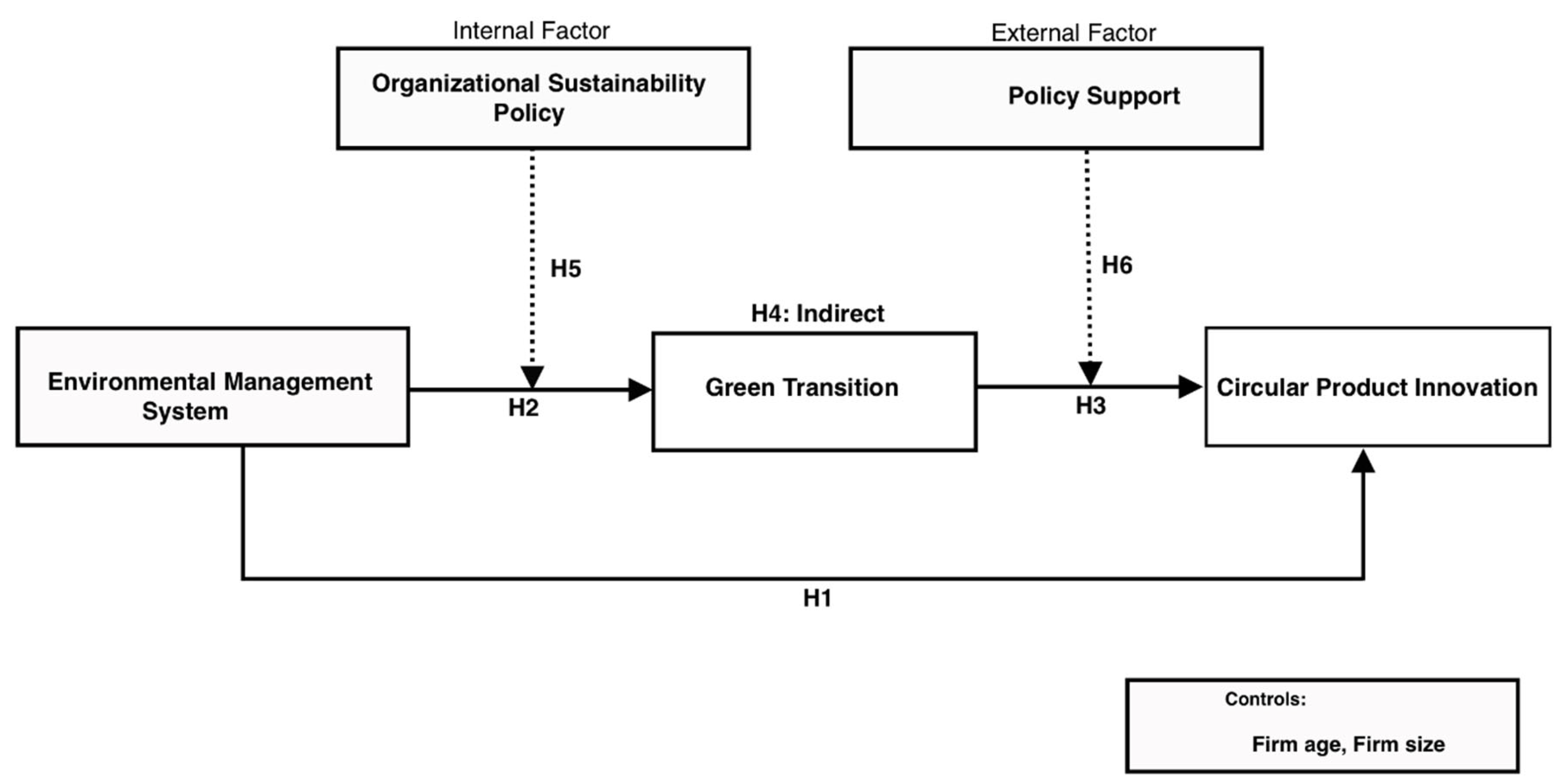
As illustrated in Figure 1, the conceptual framework integrates the RBV and a selective application of Institutional Theory to explain how internal environmental capabilities and supportive external institutional mechanisms drive circular product innovation in manufacturing SMEs. The RBV positions the EMS as a core capability that enhances firms’ environmental routines, knowledge structures, and sustainability practices, enabling them to redesign products for reuse, recyclability, and reduced environmental impact [14,20]. The model proposes that an EMS not only exerts a direct effect on circular product innovation but also influences it indirectly through green transition. Green transition captures firms’ implementation of sustainable technologies and environmentally responsible operations, serving as a dynamic capability through which EMS-driven processes translate into product-level circular outcomes [2,15].
Two moderating variables refine these relationships. Organizational sustainability policy strengthens internal governance alignment and commitment to environmental priorities, increasing the likelihood that EMS practices evolve into concrete green transition initiatives [41]. Externally, policy support reflects supportive and enabling institutional instruments, such as incentives, development programs, and institutional assistance, rather than coercive or regulatory pressures. Consistent with the study’s empirical scope, Institutional Theory is applied here to explain how supportive policy environments condition and amplify the effectiveness of green transition in generating circular product innovation, rather than how regulatory mandates impose sustainability behavior [18,21].
Collectively, the model presents an integrated capability–institutional perspective in which an EMS drives circular product innovation directly and via green transition, conditioned by internal governance mechanisms and external supportive institutional conditions. Importantly, the framework does not incorporate coercive or regulatory institutional pressures, focusing instead on how enabling policy support complements firm-level capabilities to facilitate sustainability transition in manufacturing SMEs.

3. Methods

3.1. Sample and Data Collection

The target population of this study comprises Turkish manufacturing SMEs. SMEs were selected due to their central role in job creation and national and global economic development [46]. At the same time, manufacturing SMEs are associated with substantial environmental impacts, contributing significantly to environmental degradation. Accordingly, the transition from traditional production systems to circular economy practices is considered critical for mitigating these challenges [8,47]. In this context, generating scientific knowledge on EMSs and identifying practical mechanisms for achieving circular product innovation are essential for addressing contemporary environmental and societal concerns.
This study employed a cross-sectional research design and collected data from senior-level managers working in Turkish manufacturing SMEs. A cross-sectional design was deemed appropriate because the study aimed to capture empirical evidence on the relationships among the variables at a specific point in time. Data were collected from major industrial cities in Türkiye, including Istanbul, Izmir, Bursa, and Konya. These locations were purposively selected as they represent the core hubs of manufacturing activity in the country. Manufacturing SMEs were identified through the Turkish Trade Register Gazette, and the purpose of the study was clearly communicated to potential participants. Participation was strictly voluntary.
Only manufacturing SMEs compliant with the ISO 14001 environmental management standard were included in the study to ensure consistency in environmental management practices across firms [48]. In line with the study criteria, firms employing between 50 and 249 employees were considered eligible for inclusion [49].
To mitigate potential common method bias (CMB), data collection was temporally separated following the recommendations of Podsakoff et al. [50]. Temporal separation reduces respondents’ tendency to rely on previous responses when answering subsequent questions [51]. Accordingly, at Time 1 (T1), measures related to environmental management systems, organizational sustainability policy, and green transition were collected. At Time 2 (T2), one month later, data on policy support and circular product innovation were obtained. Responses from T1 and T2 were matched using a unique identifier code. Data collection was conducted between February and March 2025. Only respondents who completed the T1 questionnaire were invited to participate at T2.
In total, 990 questionnaires were distributed across both waves using a combination of paper-based and electronic surveys. Of these, 567 responses were received. After excluding 56 incomplete questionnaires, 511 valid responses remained for analysis, yielding an effective response rate of 51.62%, which is comparable to and exceeds response rates reported in similar studies [52].
Sample characteristics are presented in Table 1. In terms of industry distribution, food processing and beverages accounted for 127 firms (24.85%), textile and apparel for 109 firms (21.33%), furniture, paper, and printing for 41 firms (8.03%), plastics and chemicals for 18 firms (3.52%), construction and building-related manufacturing for 44 firms (8.61%), IT and digital services for 18 firms (3.52%), electrical and electronic assembly for 53 firms (10.37%), and other manufacturing activities for 81 firms (15.85%). Regarding firm size, 10 firms (1.95%) employed fewer than 50 employees, 309 firms (60.00%) employed between 50 and 150 employees, and 196 firms (38.05%) employed between 151 and 249 employees. With respect to firm age, the majority of the sampled firms (394 firms; 77.10%) had been operating for more than ten years.

3.2. Measures

All measurement items were adopted from previously validated scales to ensure content validity and comparability with prior research. The questionnaire was originally developed in English and translated into Turkish following a back-translation procedure to ensure semantic equivalence [53]. A pilot test with a small group of manufacturing SME managers was conducted to assess item clarity and wording, resulting in minor refinements. All construct items were measured using a five-point Likert scale ranging from 1 (“strongly disagree”) to 5 (“strongly agree”).
Environmental management system (EMS) was measured using four items adapted from Jain et al. [14], capturing the extent to which firms implement formalized environmental procedures and supplier-related environmental requirements.
Green transition was measured with four items adopted from Kekkonen et al. [15], reflecting firms’ adoption of environmentally friendly technologies and the integration of sustainability practices into daily operations.
Organizational sustainability policy was measured using five items from Tang et al. [16], assessing the formalization, communication, and enforcement of sustainability-related policies within the organization.
Policy support was measured with five items adapted from Ilyas et al. [21], capturing firms’ access to government incentives, incubator programs, and institutional assistance supporting circular economy adoption.
Circular product innovation was measured using five items from De Arroyabe et al. [20], reflecting product design practices aimed at recyclability, reusability, modularity, and the use of nonpolluting materials.
Firm size and firm age were included as control variables to account for potential structural differences across firms. Firm size was operationalized based on the number of employees, categorized as 50–150, 151–249, and above 249 employees, consistent with SME classifications in prior studies [6,12,54]. Firm age was measured using categorical ranges of years since establishment. These controls were incorporated to isolate the net effects of environmental management systems, green transition, and policy support on circular product innovation.

3.3. Analytical Methods

The measurement scales adopted in this study were sourced from well-established instruments in the literature. However, to establish the reliability and the adopted scales, confirmatory factor analysis (CFA) was used to assess the reliability and validity of the measurement items. Following the establishment of the reliability and validity of the measurement item, the proposed hypotheses, as demonstrated in the research model, were tested using Model 4 (direct and mediation analysis) and Model 21 (conditional direct effects), as recommended by Hayes [55]. The tool is being widely used in social science studies because it facilitates the testing of direct and indirect relationships, while also accommodating moderation, moderated mediation, and covariate paths [17,56]. Moreover, the PROCESS macro is a robust tool for conducting regression analysis on mediation and moderation, and it also provides an index of moderated mediation [55]. A significant effect is determined when zero is not contained between the lower level and upper level of the confidence interval.

3.4. Non-Response Bias and Common Method Bias (CMB)

In this study, non-response bias was examined by comparing early and late responses based on key sample characteristics (i.e., firm size and nature of business). No statistically significant differences were observed between the early and late respondents, indicating non-response bias is not a major problem in this study [57].
Following recent studies [56] and recommendations [50], procedural remedies were integrated into the research design and data collection. Specifically, to mitigate socially acceptable responses and minimize anxiety, the survey was anonymized, and respondents were assured that the data collection would be used for academic purposes only. Furthermore, Harman’s single-factor test was used for statistical control, and the results indicate that the first factor accounted for 20.19% of the total variation. This is less than 50% cut-off, which suggests that CMB is not a serious problem in this study [50]. Additionally, the variance inflation factor (VIF) test was conducted, and the results indicate that the VIF values for all observed variables were below the 3.3 cut-off. The results indicate that multicollinearity issues do not affect the results.
Finally, the marker variable technique, suggested by Lindell and Whitney [58], was employed by including a theoretically unrelated variable in the study. The results showed that the highest correlations between the marker variable and the main constructs of the study were 0.03. The results further confirm that CMB is not a serious problem in this study. Taken together, the procedural and statistical measures reinforce the conclusions drawn from this research.

4. Analysis and Results

4.1. Measurement Model Evaluation

In this study, convergent validity and discriminant validity were assessed to evaluate the reliability and validity of the measurement model. Specifically, standardized factor loadings and average variance extracted (AVE) were examined. The results presented in Table 2 indicate that the standardized factor loadings of the measurement items ranged from 0.647 to 0.905, exceeding the recommended minimum threshold of 0.60 [59]. In line with convergent validity requirements, the AVE values for all constructs exceeded 0.50, ranging from 0.514 to 0.889 [60].
Internal consistency reliability was assessed using Cronbach’s alpha and composite reliability (CR). As shown in Table 2, Cronbach’s alpha values ranged from 0.805 to 0.903, while CR values ranged from 0.808 to 0.911, both exceeding the recommended threshold of 0.70 [61]. These results confirm the reliability, internal consistency, and convergent validity of all measurement scales.
Furthermore, discriminant validity was assessed using the Fornell–Larcker criterion. As reported in Table 3, the square root of the AVE for each construct was greater than its corresponding inter-construct correlation coefficients, indicating satisfactory discriminant validity [60].
Finally, confirmatory factor analysis (CFA) results indicate that the measurement model demonstrates an acceptable fit to the data. All goodness-of-fit indices exceeded recommended thresholds [62,63]: χ2/df = 2.548, comparative fit index (CFI) = 0.944, root mean square error of approximation (RMSEA) = 0.059, Tucker–Lewis index (TLI) = 0.935, normed fit index (NFI) = 0.911, and incremental fit index (IFI) = 0.944.

4.2. Hypothesis Test: Direct and Mediation

The PROCESS macro (Model 4) was employed to test the proposed direct and indirect relationships. In line with the procedures recommended by Hayes and Preacher [64], 5000 bootstrap samples were used to generate 95% bias-corrected confidence intervals. Table 4 presents the results of the regression and mediation analyses.
The results indicate that the EMS has a significant positive effect on circular product innovation (β = 0.197, t = 2.603, p < 0.01), supporting Hypothesis 1. The EMS also exhibits a strong positive effect on green transition (β = 0.899, t = 11.207, p < 0.001), supporting Hypothesis 2. In addition, green transition has a significant positive effect on circular product innovation (β = 0.495, t = 11.711, p < 0.001), supporting Hypothesis 3.
To assess mediation, this study followed the bootstrap-based mediation procedure recommended by Hayes [55], rather than relying solely on causal-step approaches. As shown in Table 4, when green transition is included as a mediator, the direct relationship between EMSs and circular product innovation remains significant (β = 0.445, 95% CI [0.342, 0.557]), indicating partial mediation and supporting Hypothesis 4.
The magnitude of the mediation effect was assessed by calculating the ratio of the indirect effect to the total effect. Specifically, the indirect effect (EMS → green transition → circular product innovation) was divided by the total effect of EMSs on circular product innovation, indicating that approximately 69.31% of the total effect operates through green transition [65]. This proportion was derived from the bootstrapped mediation estimates produced by the PROCESS macro. Consistent with prior mediation research, partial mediation is observed when both direct and indirect effects remain significant [66].

4.3. Hypothesis Test: Moderation Analysis

The moderation analysis was conducted using Model 21 of Hayes’ PROCESS macro [55]. Firm age and firm size were included as covariates, and all predictor variables were mean-centered prior to analysis to minimize multicollinearity concerns. Two regression models were estimated based on the hypothesized moderation paths. As shown in Table 5, the covariates (firm age and firm size) exhibited non-significant and weak effects on both green transition and circular product innovation.
In Model 1 of Table 5, the environmental management system has a positive impact on green transition (β = 0.592, t = 7.473, p < 0.001, 95% CI [0.436, 0.748]). However, the interaction between environmental management system and organizational sustainability policy does not significantly moderate this relationship (β = 0.107, t = 1.523, p > 0.05, 95% CI [−0.030, 0.244]). Therefore, Hypothesis 5 is not supported.
In Model 2 of Table 5, green transition has a positive effect on circular product innovation (β = 0.239, t = 5.546, p < 0.001, 95% CI [0.154, 0.324]). Importantly, the interaction between green transition and policy support is significant (β = 0.095, t = 2.096, p < 0.05, 95% CI [0.006, 0.183]), indicating a moderation effect and supporting Hypothesis 6.
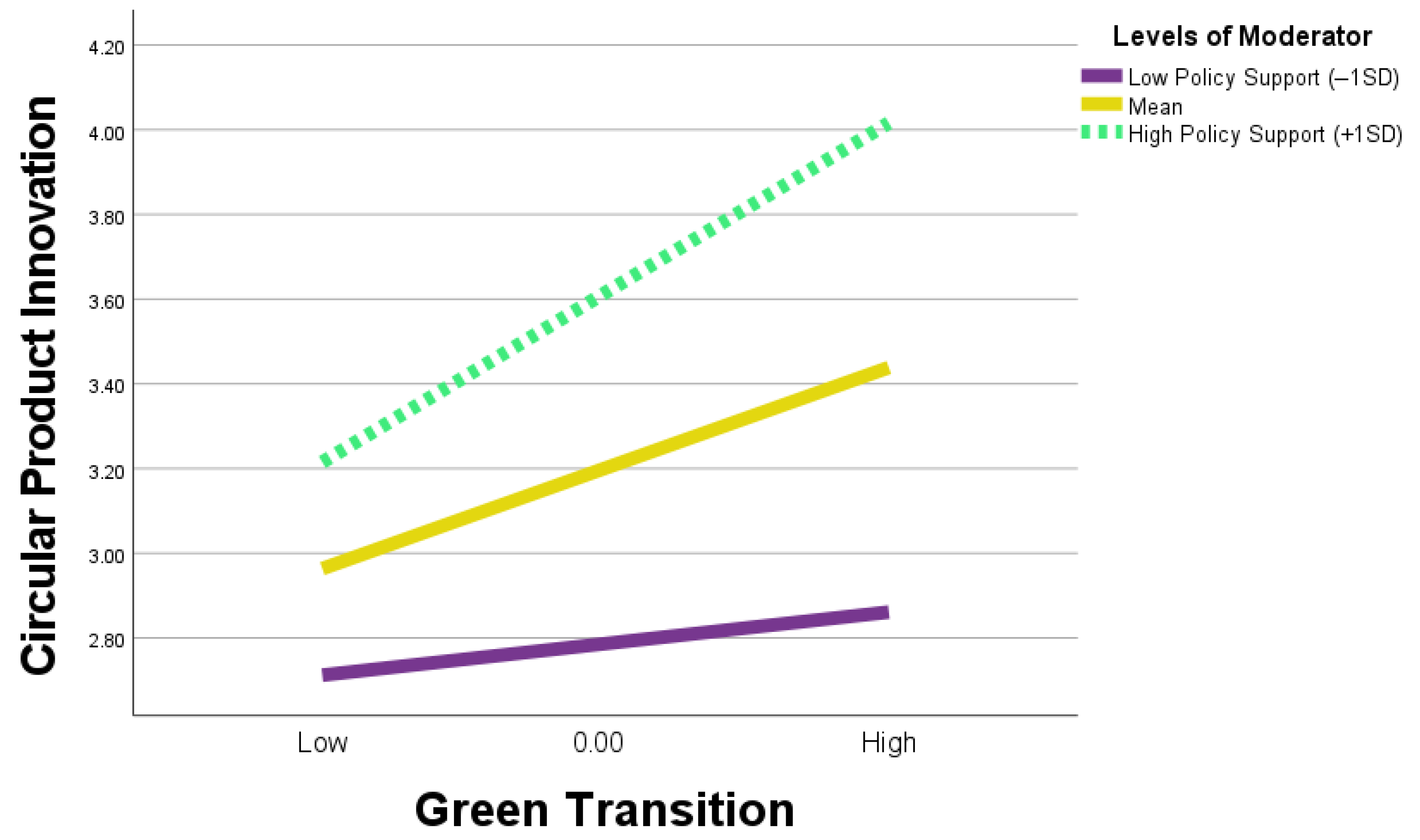
Consistent with established moderation analysis practices, a simple slope analysis was conducted to further interpret the interaction effect. Figure 2 illustrates the conditional effect of green transition on circular product innovation at three levels of policy support, defined as low (−1 standard deviation below the mean), medium (mean), and high (+1 standard deviation above the mean). This approach follows standard conventions in PROCESS-based moderation analysis.
The results show that at low levels of policy support, the effect of green transition on circular product innovation is not significant (β = 0.074, t = 1.403, p > 0.05, 95% CI [−0.029, 0.179]). At mean levels of policy support, the relationship becomes positive and significant (β = 0.238, t = 5.511, p < 0.001, 95% CI [0.153, 0.322]), while at high levels of policy support, the effect is strongest and highly significant (β = 0.401, t = 7.533, p < 0.001, 95% CI [0.296, 0.505]). These findings indicate that supportive policy environments strengthen the positive impact of green transition on circular product innovation, thereby validating Hypothesis 6.

5. Discussions and Implications

5.1. Discussion of Findings

This study provides robust empirical evidence that EMSs constitute a pivotal internal capability for advancing circular product innovation in manufacturing SMEs within an emerging economy, thereby reinforcing and extending prior sustainability and circular economy research. Consistent with the RBV, the significant direct effect of EMSs on circular product innovation confirms that structured environmental routines, standardized procedures, and continuous improvement mechanisms embedded in EMSs enable firms to redesign products in line with circular principles [20,24]. These findings align with earlier studies suggesting that an EMS enhances firms’ ability to integrate eco-design, life-cycle thinking, and material efficiency into product development processes [14,36]. Within the Turkish SME context—characterized by resource constraints and operational volatility—the EMS appears to function not merely as a compliance-oriented system, but as a knowledge-based infrastructure that supports sustainability-oriented innovation. This insight is particularly relevant to the Special Issue’s focus on information systems and knowledge transfer, as the EMS formalizes environmental information flows, monitoring systems, and feedback mechanisms that facilitate learning and innovation across organizational units.
Beyond this direct relationship, the results demonstrate that green transition plays a central mediating role in translating EMSs into circular product innovation, offering deeper insight into the dynamic capability mechanisms underpinning sustainability transitions. The partial mediation effect indicates that while an EMS establishes the structural and informational foundations for environmental management, circular innovation is realized primarily when firms actively engage in green transition practices, such as adopting environmentally friendly technologies, reconfiguring production processes, and embedding sustainability into daily operations [15,34]. From an RBV perspective, green transition represents a dynamic capability that enables firms to recombine environmental knowledge, technological resources, and operational routines into innovative circular product outcomes [41]. This finding advances the circular economy literature by empirically validating green transition as a critical mechanism linking environmental management systems to product-level innovation—an area that has remained largely conceptual in prior research [2]. Importantly, the magnitude of the indirect effect underscores that sustainability transitions are not instantaneous outcomes of formal systems, but rather cumulative processes of organizational transformation and learning [42].
The moderation results further enrich this capability-based explanation by revealing distinct and asymmetric roles for internal governance and external institutional support. Contrary to expectations, organizational sustainability policy did not significantly strengthen the relationship between EMSs and green transition. This finding suggests that in ISO 14001–certified SMEs, EMSs may already internalize environmental priorities and provide sufficient procedural guidance, thereby diminishing the marginal influence of additional policy formalization [12,16]. In emerging economy contexts, sustainability policies may remain symbolic or weakly enforced, limiting their ability to meaningfully enhance capability development beyond what is already embedded within EMS routines [43,44]. This result contributes to the sustainability governance literature by highlighting that internal policies alone may be insufficient to accelerate green transformation unless accompanied by tangible resources, managerial commitment, and operational integration.
In contrast, policy support emerged as a critical institutional catalyst that significantly amplifies the impact of green transition on circular product innovation, aligning with Institutional Theory as applied in this study. The findings demonstrate that supportive policy instruments—such as financial incentives, development programs, and governmental assistance—enhance firms’ ability to convert green transition efforts into tangible circular innovation outcomes by reducing financial risk, improving access to green technologies, and strengthening organizational legitimacy [18,21]. Importantly, this study conceptualizes institutional influence exclusively through enabling and supportive mechanisms rather than coercive or regulatory pressures.
The conditional effects analysis further reveals that green transition yields meaningful innovation benefits primarily under moderate to high levels of policy support, underscoring the importance of external enabling environments for SMEs operating under resource and capability constraints [17]. These findings indicate that sustainability transitions in emerging economies are neither purely firm-driven nor institutionally imposed, but rather depend on the interaction between internal dynamic capabilities and supportive policy environments that facilitate voluntary engagement in circular innovation.
Additionally, the non-significant effects of firm age and firm size suggest that circular product innovation in manufacturing SMEs is not primarily driven by structural characteristics, but rather by the presence of environmental management capabilities and supportive institutional conditions. This finding aligns with prior studies indicating that sustainability-oriented innovation depends more on dynamic capabilities and enabling policy environments than on firm demographics, particularly in resource-constrained and emerging economy contexts [67,68,69,70].
Taken together, these findings make a significant contribution to the Special Issue’s focus on information systems, dynamic capabilities, and sustainability transition. The study demonstrates that the EMS functions as an information-intensive system that structures environmental knowledge and decision-making, green transition acts as a dynamic capability that operationalizes this knowledge, and policy support provides the institutional conditions necessary to scale circular product innovation. By integrating the RBV and Institutional Theory, the study advances a nuanced understanding of how internal information-based capabilities and external policy mechanisms jointly shape sustainability-oriented innovation in manufacturing SMEs. In doing so, it moves the circular economy literature beyond isolated analyses of environmental practices and offers a capability–institutional framework that is particularly salient for emerging economies pursuing sustainable industrial transformation.

5.2. Theoretical Contributions

This study makes several important theoretical contributions to the CE, sustainability management, and information systems literature by advancing a capability–institutional perspective on circular product innovation in emerging economies. First, the study extends the RBV by empirically demonstrating that EMSs function as information-intensive strategic capabilities, rather than merely compliance-oriented tools. While prior studies have acknowledged the role of EMSs in improving environmental performance, this study advances theory by showing that an EMS directly supports product-level circular innovation and indirectly does so through green transition. In doing so, the findings respond to calls for a deeper understanding of how sustainability-related capabilities enable innovation under resource constraints [14,20]. By positioning EMSs as a structured mechanism for environmental knowledge generation, coordination, and learning, the study aligns the RBV with the growing emphasis on information systems as enablers of sustainability-oriented innovation, thereby enriching the theoretical foundations of CE research.
Second, the study contributes to the dynamic capability literature by empirically validating green transition as a mediating capability that operationalizes EMSs into circular product innovation. While green transition has often been discussed conceptually, empirical evidence explaining how it functions as a transformational mechanism has remained limited, particularly in SME contexts [2,15]. The partial mediation effect observed in this study confirms that formal environmental systems alone are insufficient to generate circular outcomes unless firms actively reconfigure technologies, processes, and routines toward greener operations. This insight advances the RBV by illustrating how static environmental capabilities (EMS) evolve into dynamic, innovation-generating capabilities through green transition [41]. As such, the study contributes to the Special Issue theme by clarifying how sustainability-oriented information and routines are transformed into innovation through organizational capability reconfiguration.
Third, the study refines sustainability governance theory by revealing boundary conditions in the effectiveness of internal sustainability policies. Contrary to prevailing assumptions, organizational sustainability policy did not moderate the EMS–green transition relationship. This finding challenges the dominant view that formal internal policies automatically strengthen sustainability capability development [16] and suggests that, in emerging economy SMEs, EMSs may already embody sufficient governance and informational guidance to drive green transition. Theoretically, this result nuances the RBV and sustainability governance literature by highlighting that policy formalization without substantive resource integration may yield diminishing returns, particularly in contexts where environmental systems are already institutionalized [43,44]. This contributes a more critical and context-sensitive understanding of internal sustainability governance mechanisms.
Fourth, drawing selectively on Institutional Theory, the study provides strong empirical evidence that policy support acts as a catalytic supportive institutional enabler that amplifies the innovation outcomes of green transition. The significant moderating effect of policy support confirms that external enabling mechanisms—such as financial incentives, development programs, and governmental assistance—play a decisive role in converting internal green capabilities into circular product innovation [18,21]. This finding advances institutional theory by moving beyond compliance-based explanations and demonstrating how supportive policy environments, rather than regulatory or coercive pressures, actively enhance firms’ innovation returns from sustainability investments. Importantly, the conditional effects reveal that green transition yields substantial innovation benefits only under moderate to high levels of policy support, underscoring the co-evolution of internal capabilities and enabling institutional contexts in sustainability transitions.
Finally, by integrating the RBV and Institutional Theory within a single empirical framework, this study advances circular economy theory by offering a multilevel explanation of circular product innovation that bridges internal capability development and supportive institutional conditions. The findings demonstrate that circular innovation in emerging economies is neither purely firm-driven nor unsupported by institutional enabling mechanisms but rather emerges from the interaction between information-based environmental systems (EMS), dynamic transformation processes (green transition), and policy-based support environments. This integrated perspective contributes to CE scholarship by addressing long-standing calls for more holistic, theory-driven models that explain sustainability transitions in resource-constrained contexts [17,71]. Collectively, these contributions position the study as a meaningful advancement in understanding how information systems, dynamic capabilities, and support-oriented institutional forces jointly shape circular innovation in emerging-market SMEs.

5.3. Practical Implications

The findings of this study offer several actionable implications for managers, policymakers, and sustainability practitioners, particularly within manufacturing SMEs operating in emerging economies. First, the strong direct and indirect effects of EMSs on circular product innovation underscore the importance of viewing EMSs not merely as a certification or compliance mechanism, but as a strategic information system that supports innovation and sustainability transition. Managers should leverage EMSs as a structured platform for collecting, analyzing, and disseminating environmental data across departments, enabling informed decision-making in product design, material selection, and process optimization. By embedding EMS outputs into R&D and product development routines, firms can transform environmental information into actionable knowledge that supports circular product innovation, such as design-for-reuse, recyclability, and modularity.
Second, the central mediating role of green transition highlights the need for managers to move beyond formal environmental structures toward active operational and technological transformation. While an EMS provides the foundation, circular product innovation materializes only when firms invest in green technologies, reconfigure production processes, and integrate sustainability principles into daily operations. SME managers should therefore prioritize capability-building initiatives that support green transition, including employee training, cross-functional sustainability teams, and incremental investments in eco-efficient technologies. These actions facilitate organizational learning and knowledge transfer, enabling firms to convert environmental management routines into tangible innovation outcomes. This implication aligns closely with the Special Issue’s emphasis on dynamic capability development and sustainability-oriented transformation.
Third, the non-significant moderating role of organizational sustainability policy suggests that internal policies alone may be insufficient to accelerate green transition if they remain symbolic or disconnected from operational realities. For practitioners, this implies that sustainability policies must be closely aligned with EMS practices, resource allocation, and managerial incentives to be effective. Rather than expanding policy documents, firms should focus on translating sustainability commitments into clear responsibilities, performance indicators, and accountability mechanisms that reinforce day-to-day environmental practices. In resource-constrained SMEs, streamlined and operationally embedded policies may be more impactful than comprehensive but weakly enforced sustainability statements.
From a policy perspective, the findings provide compelling evidence that policy support is a critical external catalyst for converting green transition efforts into circular product innovation. Government agencies and regulatory bodies in emerging economies should design targeted and accessible policy instruments, such as financial incentives, tax relief, technical assistance programs, and innovation grants, to reduce the risks and costs associated with circular product development. The conditional effects observed in this study indicate that without sufficient policy support, the innovation potential of green transition remains underexploited. Policymakers should therefore ensure that sustainability policies are not only coercive but also enabling, fostering experimentation, learning, and innovation among SMEs.
Finally, the combined implications of EMSs, green transition, and policy support point to the need for strong coordination between firms and public institutions. Industry associations, development agencies, and sustainability networks can play a bridging role by facilitating knowledge exchange, disseminating best practices, and aligning firm-level capabilities with national circular economy strategies. For emerging economies pursuing sustainability transitions, such coordinated efforts can accelerate the diffusion of circular product innovation and enhance the long-term competitiveness of manufacturing SMEs. Collectively, these practical insights emphasize that achieving circular innovation requires an integrated approach that aligns internal information systems and dynamic capabilities with supportive institutional environments.

5.4. Limitations and Future Research Directions

Despite its contributions, this study is subject to several limitations that open avenues for future research. First, the use of a cross-sectional research design restricts causal inference; therefore, future studies could adopt longitudinal or multi-wave designs to better capture the dynamic evolution of environmental management systems, green transition, and circular product innovation over time. Second, the empirical context is limited to ISO 14001-certified manufacturing SMEs in Türkiye, which may constrain the generalizability of the findings to non-certified firms, large enterprises, or other emerging and developed economies; comparative cross-country studies or multi-sector analyses would enhance external validity. Third, the study relies on perceptual, self-reported measures, which may introduce common method bias despite the application of established statistical remedies; future research could integrate objective indicators, archival data, or multi-source responses to strengthen measurement robustness. Fourth, while organizational sustainability policy and policy support were examined as moderators, additional boundary conditions—such as digital maturity, green human resource practices, supply chain integration, or environmental leadership—could further refine our understanding of how internal and external mechanisms interact to shape circular innovation [72]. Finally, future research could extend the theoretical framework by explicitly incorporating information system capabilities, such as big data analytics or digital platforms, to examine how digital infrastructures enhance knowledge transfer and accelerate sustainability transitions. Addressing these limitations would deepen insight into the complex, multilevel processes through which firms in emerging economies achieve circular product innovation.

Author Contributions

Conceptualization, N.A.; supervision, A.B.A.; project administration, H.Y.A. and A.B.A.; Validation, A.B.A. and N.A.; Writing—original draft, N.A.; Writing—review and editing, H.Y.A. and N.A. All authors have read and agreed to the published version of the manuscript.

Funding

This research received no external funding.

Institutional Review Board Statement

This study was conducted in accordance with the Declaration of Helsinki and received ethical approval from the University of Mediterranean Karpasia’s Institutional Review Board (protocol code AKUN-ETK-17/25 and date of approval: 6 January 2025).

Informed Consent Statement

All participants in this study provided their informed consent.

Data Availability Statement

The data from this study can be requested from the corresponding author, Nabila Albannai.

Conflicts of Interest

The authors report no conflicts of interest.

References

  1. Abdulsalam, T.A.; Tajudeen, R.B.; Subair, M.L.; Ogherohwo, T.F.; Raji, Y.M. Global Environmental Challenges in the Current Business Scenario: A Roadblock for Sustainable Development. In Green Economy and Sustainable Development; Gupta, V.P., Haghi, A.K., Sharief, S., Eds.; Springer Nature Switzerland: Cham, Switzerland, 2025; pp. 253–282. ISBN 978-3-031-92636-5. [Google Scholar]
  2. Dey, P.K.; Malesios, C.; De, D.; Budhwar, P.; Chowdhury, S.; Cheffi, W. Circular Economy to Enhance Sustainability of Small and Medium Sized Enterprises. In Supply Chain Sustainability in Small and Medium Sized Enterprises; Routledge: Oxford, UK, 2022. [Google Scholar]
  3. Cezarino, L.O.; Liboni, L.B.; Oliveira Stefanelli, N.; Oliveira, B.G.; Stocco, L.C. Diving into Emerging Economies Bottleneck: Industry 4.0 and Implications for Circular Economy. Manag. Decis. 2019, 59, 1841–1862. [Google Scholar] [CrossRef] [Scilit]
  4. Patwa, N.; Sivarajah, U.; Seetharaman, A.; Sarkar, S.; Maiti, K.; Hingorani, K. Towards a Circular Economy: An Emerging Economies Context. J. Bus. Res. 2021, 122, 725–735. [Google Scholar] [CrossRef] [Scilit]
  5. Austin, A.; Alataş, S.; Agbonifi, D. Financing Eco-Innovation in an Emerging Economy: The Role of Internal Resources, External Support and Government in Turkish SMEs. Sustain. Dev. 2025. [Google Scholar] [CrossRef] [Scilit]
  6. Elfghi, O.; Iyiola, K.; Alzubi, A.B.; Aljuhmani, H.Y. Improvisation and New Venture Performance: Unpacking the Roles of Entrepreneurial Self-Efficacy and Learning Orientation. Sustainability 2026, 18, 975. [Google Scholar] [CrossRef] [Scilit]
  7. Awad, I.M.; Nuseibeh, H.; Amro, A.A. Competitiveness in the Era of Circular Economy and Digital Innovations: An Integrative Literature Review. Sustainability 2025, 17, 4599. [Google Scholar] [CrossRef] [Scilit]
  8. Takacs, F.; Brunner, D.; Frankenberger, K. Barriers to a Circular Economy in Small- and Medium-Sized Enterprises and Their Integration in a Sustainable Strategic Management Framework. J. Clean. Prod. 2022, 362, 132227. [Google Scholar] [CrossRef] [Scilit]
  9. Zighan, S.; Alkalha, Z.; Jum’a, L. Barriers to Circular Economy Transitions in Emerging Markets: Insights From the GCC and Implications for Sustainable Development. Sustain. Dev. 2026, 34, 210–225. [Google Scholar] [CrossRef] [Scilit]
  10. Koirala, S. SMEs: Key Drivers of Green and Inclusive Growth; OECD Green Growth Papers; OECD: Paris, France, 2019. [Google Scholar]
  11. Mehmood, A.; Ahmed, S.; Viza, E.; Bogush, A.; Ayyub, R.M. Drivers and Barriers towards Circular Economy in Agri-Food Supply Chain. Bus. Strategy Dev. 2021, 4, 465–481. [Google Scholar] [CrossRef] [Scilit]
  12. Mamash, A.; Iyiola, K.; Aljuhmani, H.Y. The Role of Circular Economy Entrepreneurship, Cleaner Production, and Green Government Subsidy for Achieving Sustainability Goals in Business Performance. Sustainability 2025, 17, 3990. [Google Scholar] [CrossRef] [Scilit]
  13. Yasmeen, H.; Longsheng, C. Advancing Circular Economy in the Equipment Manufacturing Sector: The Role of Environmental Management Systems, Innovation and Policy Support. J. Environ. Manag. 2025, 380, 124967. [Google Scholar] [CrossRef] [Scilit]
  14. Jain, N.K.; Panda, A.; Choudhary, P. Institutional Pressures and Circular Economy Performance: The Role of Environmental Management System and Organizational Flexibility in Oil and Gas Sector. Bus. Strategy Environ. 2020, 29, 3509–3525. [Google Scholar] [CrossRef] [Scilit]
  15. Kekkonen, A.; Pesor, R.; Täks, M. Stepping towards the Green Transition. Sustainability 2023, 15, 4172. [Google Scholar] [CrossRef] [Scilit]
  16. Tang, K.; MacDermid, J.C.; Amick, B.C.; Beaton, D.E. The 11-Item Workplace Organizational Policies and Practices Questionnaire. Am. J. Ind. Med. 2011, 54, 834–846. [Google Scholar] [CrossRef] [Scilit] [PubMed]
  17. Israel, B.; Siwandeti, M. Agri-Food Supply Chain Capabilities and Smallholders’ on-Farm Economic Viability. Cogent Food Agric. 2024, 10, 2391565. [Google Scholar] [CrossRef] [Scilit]
  18. Le, T.T.; Tuyết, N.B.T.; Anh, T.L. Drive Sustainable Business Performance with Humane Entrepreneurship, Knowledge Management: The Mediation of Sustainable Business Advantage and Sustainable Business Model Innovation. Eur. J. Innov. Manag. 2024; ahead of print. [CrossRef] [Scilit]
  19. Ren, Q.; Albrecht, J. Toward Circular Economy: The Impact of Policy Instruments on Circular Economy Innovation for European Small Medium Enterprises. Ecol. Econ. 2023, 207, 107761. [Google Scholar] [CrossRef] [Scilit]
  20. De Arroyabe, J.F.; Arranz, N.; Schumann, M.; Arroyabe, M.F. The Development of CE Business Models in Firms. Technovation 2021, 106, 102292. [Google Scholar] [CrossRef] [Scilit]
  21. Ilyas, S.; Hu, Z.; Wiwattanakornwong, K. Unleashing the Role of Top Management and Government Support in Green Supply Chain Management. Environ. Sci. Pollut. Res. 2020, 27, 8210–8223. [Google Scholar] [CrossRef] [Scilit]
  22. Durman, S.; Iyiola, K.; Alzubi, A.B.; Aljuhmani, H.Y. Dynamic Capabilities in Action: Digital Capability, Business Model Innovation and Absorptive Capacity. Manag. Decis. 2025, 1–36. [Google Scholar] [CrossRef] [Scilit]
  23. ISO 14001; Environmental Management Systems-Requirements with Guidance for Use. ISO: Geneva, Switzerland, 2015.
  24. Barney, J. Firm Resources and Sustained Competitive Advantage. J. Manag. 1991, 17, 99–120. [Google Scholar] [CrossRef] [Scilit]
  25. Alsafadi, Y.; Aljuhmani, H.Y. The Influence of Entrepreneurial Innovations in Building Competitive Advantage: The Mediating Role of Entrepreneurial Thinking. Kybernetes 2023, 53, 4051–4073. [Google Scholar] [CrossRef] [Scilit]
  26. Mishra, R.; Kiran, K.B. Is Sustainable Performance in MSMEs Driven by Entrepreneurial Orientation through Knowledge Management and Dynamic Capabilities? J. Knowl. Manag. 2025, 30, 231–262. [Google Scholar] [CrossRef] [Scilit]
  27. Neiroukh, S.; Emeagwali, O.L.; Aljuhmani, H.Y. Artificial Intelligence Capability and Organizational Performance: Unraveling the Mediating Mechanisms of Decision-Making Processes. Manag. Decis. 2025, 63, 3501–3532. [Google Scholar] [CrossRef] [Scilit]
  28. AlAjlouni, A.O.; Aljuhmani, H.Y. Leveraging Business Intelligence for Enhanced Financial Performance: The Mediating Effect of Supply Chain Integration. In Achieving Sustainable Business Through AI, Technology Education and Computer Science: Volume 3: Business Sustainability and Artificial Intelligence Applications; Hamdan, A., Ed.; Springer Nature: Cham, Switzerland, 2024; pp. 79–89. ISBN 978-3-031-73632-2. [Google Scholar]
  29. Dimaggio, P.J.; Powell, W.W. The iron cage revisited: Institutional isomorphism and collective rationality in organizational fields. In Chapter 4 the Iron Cage Revisited: Institutional Isomorphism and Collective Rationality in Organizational Fields; Princeton University Press: Princeton, NJ, USA, 2021; pp. 111–134. ISBN 978-0-691-22927-0. [Google Scholar]
  30. Emeagwali, O.L.; Aljuhamni, H.Y. Introductory Chapter: Strategic Management—A Dynamic Approach. In Strategic Management—A Dynamic View; IntechOpen: London, UK, 2019; ISBN 978-1-83962-505-3. [Google Scholar]
  31. Arsawan, I.W.E.; Kartikasari, A.; Suhartanto, D.; Choirisa, S.F. Transitioning Towards Circular Economy Practices: The Role of Organizational Capabilities and Environmental Dynamism—Evidence From Indonesia. Bus. Strategy Environ. 2026, 35, 18–35. [Google Scholar] [CrossRef] [Scilit]
  32. Shibin, K.T.; Dubey, R.; Gunasekaran, A.; Hazen, B.; Roubaud, D.; Gupta, S.; Foropon, C. Examining Sustainable Supply Chain Management of SMEs Using Resource Based View and Institutional Theory. Ann. Oper. Res. 2020, 290, 301–326. [Google Scholar] [CrossRef] [Scilit]
  33. Oliver, C. Sustainable Competitive Advantage: Combining Institutional and Resource-Based Views. Strateg. Manag. J. 1997, 18, 697–713. [Google Scholar] [CrossRef] [Scilit]
  34. Aboalhool, T.; Alzubi, A.; Iyiola, K. Humane Entrepreneurship in the Circular Economy: The Role of Green Market Orientation and Green Technology Turbulence for Sustainable Corporate Performance. Sustainability 2024, 16, 2517. [Google Scholar] [CrossRef] [Scilit]
  35. Procacci, V.; Manzo, M.; Beck, T.; Manca, F. Sustainability Certifications as Enablers of Intellectual Capital and Digital Transformation in SMEs. VINE J. Inf. Knowl. Manag. Syst. 2025, 1–21. [Google Scholar] [CrossRef] [Scilit]
  36. Indiran, L.; Fu, C.; Fahim, N.A.; Ishak, M.K.; Aslan, M. Eco-Innovation Methodologies: A Literature Review. Discov. Sustain. 2025, 6, 1143. [Google Scholar] [CrossRef] [Scilit]
  37. Ricciardi, I.; Percuoco, M.; Prisco, A.; Galmarini, E. Innovative and Sustainable Product Development: A Comparative Study of Influencing Factors in Large Enterprises vs SMEs. J. Prod. Brand Manag. 2025, pp. 1–20. Available online: https://www.emerald.com/jpbm/article/doi/10.1108/JPBM-10-2024-5571/1306796 (accessed on 20 January 2026).
  38. Yuning, M.; Taozhen, H.; Saleem, N.; Hassan, A.H. Institutional Pressure and Low Carbon Innovation Policy: The Role of EMS, Environmental Interpretations and Governance Heterogeneity. Front. Environ. Sci. 2024, 12, 1385062. [Google Scholar] [CrossRef] [Scilit]
  39. Adiguzel, Z.; Sonmez Cakir, F. Empowering Sustainability: Green Entrepreneurial Orientation, Innovative Strategies, Culture and Operational Performance. Manag. Decis. 2025, 63, 3934–3966. [Google Scholar] [CrossRef] [Scilit]
  40. Llach, J.; León-Mateos, F.J.; Depino-Besada, N.; Sartal, A. Do Green Practices and Technologies Mediate Lean Manufacturing’s Impact on Industrial Performance? Evidence from the European Manufacturing Survey. Int. J. Lean Six Sigma 2024, 16, 723–751. [Google Scholar] [CrossRef] [Scilit]
  41. He, Q. The Influence of Organizational Policies on Firm Environmental Performance through Sustainable Technologies and Innovation and Stakeholder Concerns. Sci. Rep. 2025, 15, 10019. [Google Scholar] [CrossRef] [Scilit]
  42. Munir, T.; Watts, S. Exploring Eco-Friendly Business Practices and Corporate Innovation in Pakistan. Int. J. Innov. Sci. 2024, 17, 786–802. [Google Scholar] [CrossRef] [Scilit]
  43. Carreno, A. Strategic Alignment in Program Management: A Framework for Sustainable Business Transformation; Institute for Change Leadership and Business Transformation: Sydney, Australia, 2024. [Google Scholar]
  44. Zhang, Y.; Lim, W. Sustainable Strategy: Encouraging Implementation in Small Enterprises. Manag. Decis. 2024, 63, 2202–2222. [Google Scholar] [CrossRef] [Scilit]
  45. Li, C.; Sampene, A.; Khan, A.; Wiredu, J. Environmental Orientations to Innovation Ecosystem: The Role of Green Transition, Perceived Environmental Uncertainty and Green Transformational Leadership. Oper. Manag. Res. 2024, 18, 48–71. [Google Scholar] [CrossRef] [Scilit]
  46. Abuseta, H.; Iyiola, K.; Aljuhmani, H.Y. Digital Technologies and Business Model Innovation in Turbulent Markets: Unlocking the Power of Agility and Absorptive Capacity. Sustainability 2025, 17, 5296. [Google Scholar] [CrossRef] [Scilit]
  47. Besiktepe, D.; Gurgun, A.P. Regulatory Barriers of Circular Economy Adoption in Construction Industry: A Perspective from Türkiye. Smart Sustain. Built Environ. 2025, 4, 1–24. [Google Scholar] [CrossRef] [Scilit]
  48. Johnstone, L. The Construction of Environmental Performance in ISO 14001-Certified SMEs. J. Clean. Prod. 2020, 263, 121559. [Google Scholar] [CrossRef] [Scilit]
  49. Başçı, S.; Durucan, A. A Review of Small and Medium Sized Enterprises (SMEs) in Turkey. YSSR 2017, 3, 59–79. [Google Scholar]
  50. Podsakoff, P.M.; MacKenzie, S.B.; Lee, J.-Y.; Podsakoff, N.P. Common Method Biases in Behavioral Research: A Critical Review of the Literature and Recommended Remedies. J. Appl. Psychol. 2003, 88, 879–903. [Google Scholar] [CrossRef] [Scilit]
  51. Rajhi, M.; Aljuhmani, H.Y. Fostering Sustainable Innovation Through Communication Quality: The Sequential Role of Trust in Leadership and Organizational Commitment in Team-Based Enterprises. Sustainability 2026, 18, 554. [Google Scholar] [CrossRef] [Scilit]
  52. Le, T.T.; Behl, A.; Pereira, V. Establishing Linkages between Circular Economy Practices and Sustainable Performance: The Moderating Role of Circular Economy Entrepreneurship. Manag. Decis. 2022, 62, 2340–2363. [Google Scholar] [CrossRef] [Scilit]
  53. Brislin, R.W. The Wording and Translation of Research Instruments. In Field Methods in Cross-Cultural Research; Cross-Cultural Research and Methodology Series; Sage Publications, Inc.: Thousand Oaks, CA, USA, 1986; Volume 8, pp. 137–164. ISBN 978-0-8039-2549-6. [Google Scholar]
  54. Bouguerra, A.; Hughes, M.; Rodgers, P.; Stokes, P.; Tatoglu, E. Confronting the Grand Challenge of Environmental Sustainability within Supply Chains: How Can Organizational Strategic Agility Drive Environmental Innovation? J. Product Innov. Manag. 2024, 41, 323–346. [Google Scholar] [CrossRef] [Scilit]
  55. Hayes, A.F. Introduction to Mediation, Moderation, and Conditional Process Analysis; Guilford Press: New York, NY, USA, 2022. [Google Scholar]
  56. Iyiola, K.; Alzubi, A.; Dappa, K. The Influence of Learning Orientation on Entrepreneurial Performance: The Role of Business Model Innovation and Risk-Taking Propensity. J. Open Innov. Technol. Mark. Complex. 2023, 9, 100133. [Google Scholar] [CrossRef] [Scilit]
  57. Centobelli, P.; Cerchione, R.; Singh, R. The Impact of Leanness and Innovativeness on Environmental and Financial Performance. Int. J. Prod. Econ. 2019, 212, 111–124. [Google Scholar] [CrossRef] [Scilit]
  58. Lindell, M.K.; Whitney, D.J. Accounting for Common Method Variance in Cross-Sectional Research Designs. J. Appl. Psychol. 2001, 86, 114–121. [Google Scholar] [CrossRef] [Scilit]
  59. Hair, J.F.; Anderson, R.E.; Tatham, R.L.; Black, W.C. Multivariate Data Analysis with Readings; Prentice-Hall: Upper Saddle River, NJ, USA, 1998. [Google Scholar]
  60. Fornell, C.; Larcker, D.F. Evaluating Structural Equation Models with Unobservable Variables and Measurement Error. J. Mark. Res. 1981, 18, 39–50. [Google Scholar] [CrossRef] [Scilit]
  61. Hair, J.F.; Risher, J.J.; Sarstedt, M.; Ringle, C.M. When to Use and How to Report the Results of PLS-SEM. Eur. Bus. Rev. 2019, 31, 2–24. [Google Scholar] [CrossRef] [Scilit]
  62. Hu, L.; Bentler, P.M. Cutoff Criteria for Fit Indexes in Covariance Structure Analysis: Conventional Criteria versus New Alternatives. Struct. Equ. Model. Multidiscip. J. 1999, 6, 1–55. [Google Scholar] [CrossRef] [Scilit]
  63. Aljuhmani, H.Y.; Emeagwali, O.L.; Ababneh, B. The Relationships between CEOs’ Psychological Attributes, Top Management Team Behavioral Integration and Firm Performance. Int. J. Organ. Theory Behav. 2021, 24, 126–145. [Google Scholar] [CrossRef] [Scilit]
  64. Preacher, K.J.; Hayes, A.F. Asymptotic and Resampling Strategies for Assessing Indirect Effects. Behav. Res. Methods 2008, 40, 879–891. [Google Scholar] [CrossRef] [Scilit]
  65. Preacher, K.J.; Hayes, A.F. SPSS and SAS Procedures for Estimating Indirect Effects in Simple Mediation Models. Behav. Res. Methods Instrum. Comput. 2004, 36, 717–731. [Google Scholar] [CrossRef] [Scilit]
  66. Ageli, R.; Alzubi, A.B.; Aljuhmani, H.Y.; Iyiola, K. How and When Entrepreneurial Leadership Drives Sustainable Bank Performance: Unpacking the Roles of Employee Creativity and Innovation-Oriented Climate. Sustainability 2025, 17, 9259. [Google Scholar] [CrossRef] [Scilit]
  67. Saygili, E.; Uye Akcan, E.; Ozturkoglu, Y. An Exploratory Analysis of Sustainability Indicators in Turkish Small- and Medium-Sized Industrial Enterprises. Sustainability 2023, 15, 2063. [Google Scholar] [CrossRef] [Scilit]
  68. Rizos, V.; Behrens, A.; Van der Gaast, W.; Hofman, E.; Ioannou, A.; Kafyeke, T.; Flamos, A.; Rinaldi, R.; Papadelis, S.; Hirschnitz-Garbers, M.; et al. Implementation of Circular Economy Business Models by Small and Medium-Sized Enterprises (SMEs): Barriers and Enablers. Sustainability 2016, 8, 1212. [Google Scholar] [CrossRef] [Scilit]
  69. García-Quevedo, J.; Jové-Llopis, E.; Martínez-Ros, E. Barriers to the Circular Economy in European Small and Medium-sized Firms. Bus. Strat. Environ. 2020, 29, 2450–2464. [Google Scholar] [CrossRef] [Scilit]
  70. Ortiz, E.; Marín, S.; Thompson, P. The Role of Small- and Medium-Sized Practices in the Sustainable Transition of SMEs. Environ. Dev. Sustain. 2024, 26, 19299–19323. [Google Scholar] [CrossRef] [Scilit]
  71. Kalantzis, C.; Nikoloudis, C.; Aravossis, K. A Literature Review on Implementing Circular Economy Models through Open Innovation. Discov. Sustain. 2025, 6, 1429. [Google Scholar] [CrossRef] [Scilit]
  72. Kristensen, H.S.; Mosgaard, M.A.; Remmen, A. Integrating Circular Principles in Environmental Management Systems. J. Clean. Prod. 2021, 286, 125485. [Google Scholar] [CrossRef] [Scilit]
Figure 1. Conceptual research model.
Sustainability 18 02060 g001
Figure 2. The Conditional Direct Effect of the Focal Predictor (Green Transition) At Different Values of Policy Support on Circular Product Innovation.
Sustainability 18 02060 g002
Table 1. Sample Information.
n = 511CategoryFrequency%
Nature of business Food processing and beverages12724.85
Textile and apparel 10921.33
Furniture, paper and printing418.03
Plastics/Chemicals387.44
General construction/building construction448.61
IT and digital services183.52
Electrical and electronics assembly5310.37
Others8115.85
Firm size (number of employees)>50101.95
50–15030960
Between 151 and 24919638.05
Firm age (years)3–5173.30
6–1010420.19
11–158416.31
16–2019938.65
Above 2011121.55
Table 2. Measurement Model.
VariablesCodesStandardized Factor LoadingsAVECRα
Environmental Management System0.5140.8080.805
EMS10.684
EMS20.729
EMS30.754
EMS40.698
Green Transition0.6490.8800.876
GT10.826
GT20.883
GT30.847
GT40.647
Organizational Sustainability Policy0.5220.8450.845
OSP10.710
OSP20.755
OSP30.758
OSP40.680
OSP50.704
Policy Support0.6770.9110.903
PS10.899
PS20.905
PS30.881
PS40.788
PS50.600
Circular Product Innovation0.6180.8890.886
CPI10.810
CPI20.861
CPI30.820
CPI40.768
CPI50.656
Goodness of model fit metrics: X2/df = 2.548; CFI = 0.944, RMSEA = 0.059; TLI = 0.935; NFI = 0.911, IFI = 0.944
Note: EMS = environmental management system, GT = green transition, OSP = organizational sustainability policy (OSP), PS = policy support, CPI = circular product innovation.
Table 3. Discriminant Validity.
ConstructMeanStd.EMSGTNOSPPSCPIFirm AgeFirm Size
EMS4.0600.786(0.717)
GTN3.8770.9460.643 **(0.806)
OSP3.8830.8320.423 **0.616 **(0.722)
PS3.7820.9380.485 **0.481 **0.352 **(0.823)
CPI3.8050.8370.643 **0.571 **0.535 **0.535 **(0.786)
Firm age--0.0290.0300.0170.0090.007-
Firm size--0.0180.0220.0110.0140.0130.024-
Note: EMS = environmental management system; GTN = green transition; OSP = organizational sustainability policy; PS = policy support; CPI = circular product innovation. Numbers in bold represent the square root of AVEs; Std. = standard deviation; ** = significant at the level of p < 0.01.
Table 4. Direct and Mediation Results.
HypothesisRelationshipsβS.E.T-ValuesLLULR2
H1EMS → CPI0.1970.0762.603 **0.0480.3470.632
H2EMS → GTN0.8990.08011.207 ***0.7410.992
H3GTN → CPI0.4950.04211.711 ***0.4110.578
H4EMS → GTN → CPI0.4450.055 0.3420.557
Note: EMS = environmental management system; GTN = green transition; CPI = circular product innovation. ** significant at the level of p < 0.01; *** = significant at the level of p < 0.001.
Table 5. Moderation Results.
Hypothesized PathsEffectS.E.T-Values95% CI
LLUL
Model 1: Green Transition
Co: Firm age → GT0.0100.0160.029 (ns)−0.0990.047
Co: Firm size → GT0.0150.0100.055 (ns)−0.0710.025
EMS → GT0.5920.0797.473 ***0.4360.748
OSP → GT 0.3720.0419.131 ***0.2920.452
H5: EMS × OSP → GT 0.1070.0701.523 (ns)−0.0300.244
R2 = 0.395
Model 2: Circular Product Innovation
Co: Firm age → CPI0.0080.0130.023 (ns)−0.0770.111
Co: Firm size → CPI0.0090.0170.30 (ns)−0.0730.083
EMS → CPI0.4880.0499.953 ***0.3920.585
GT → CPI0.2390.0435.546 ***0.1540.324
PS → CPI0.0640.0660.975(ns)−0.0650.193
H6: GT × PS → CPI0.0950.0482.096 *0.0060.183
R2 = 0.555
The specific conditional values of PS on GT-CPI
−1SD (below the mean)0.0740.0531.403 (ns)−0.0290.179
Mean0.2380.0435.511 ***0.1530.322
+1SD (above the mean)0.4010.0537.533 ***0.2960.505
Index of moderated mediation by PS
EMS → GT → CPI0.0210.014-−0.0430.049
Note: EMS = environmental management system; GT = green transition; OSP = organizational sustainability policy; PS = policy support; CPI = circular product innovation. * = significant at the level of p < 0.05; *** = significant at the level of p < 0.001; ns = non-significant.
Disclaimer/Publisher’s Note: The statements, opinions and data contained in all publications are solely those of the individual author(s) and contributor(s) and not of MDPI and/or the editor(s). MDPI and/or the editor(s) disclaim responsibility for any injury to people or property resulting from any ideas, methods, instructions or products referred to in the content.