Towards Net-Zero Settlements: Barriers, Enablers and Case Studies’ Lessons Learnt from the Annex 83

 ,
,  , , , , ,
  ,
,  and
and 
Abstract
1. Introduction
Research Motivation
- Which are the most frequently reported technologies applied in energy transition in urban areas for district-based approaches?
- What are the most frequently reported barriers and enablers in the urban environment hindering or supporting this transition?
2. Materials and Methods
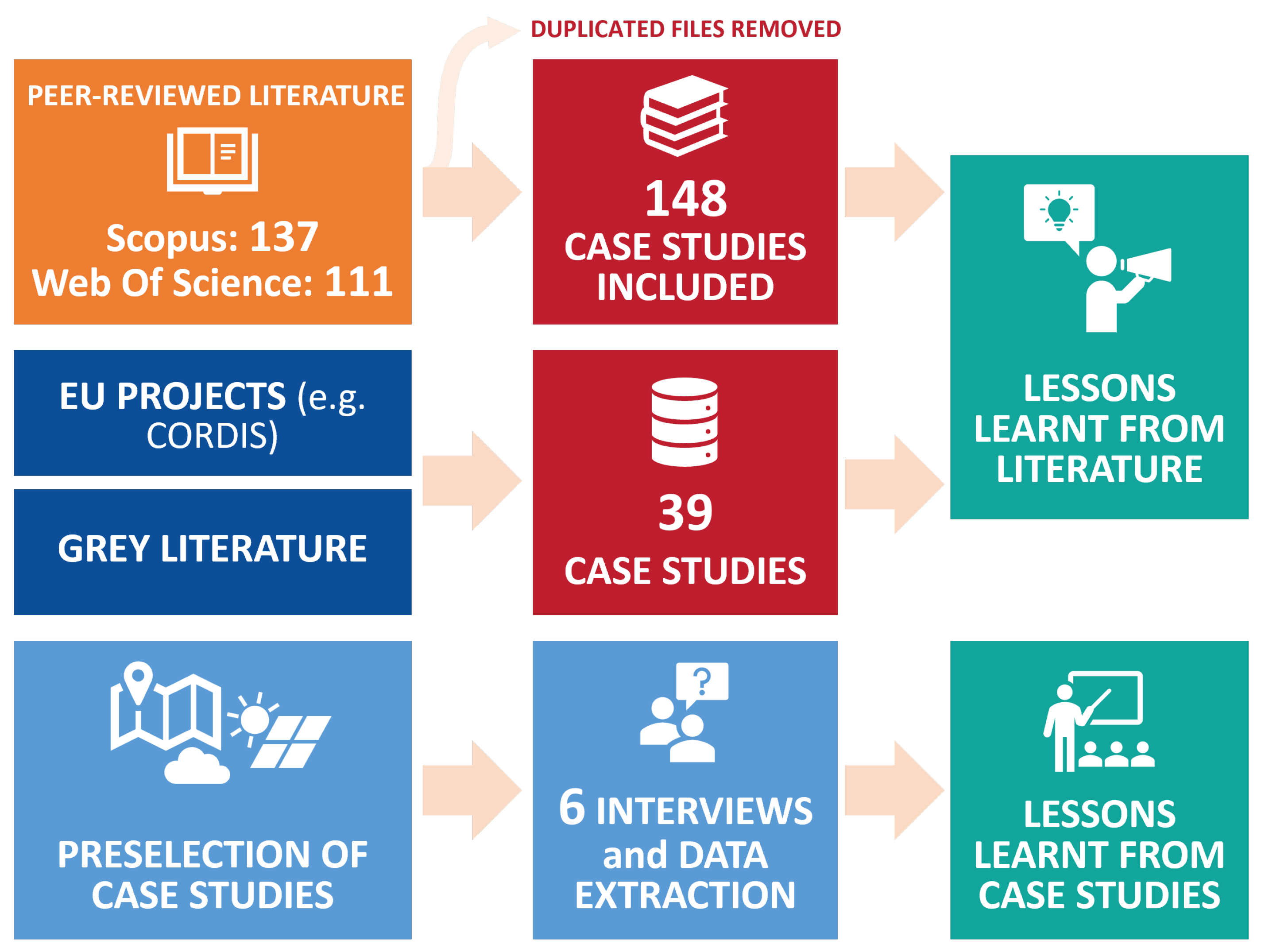
- Scopus: TITLE (positive PRE/2 energy PRE/2 (district OR neighborhood OR block OR precinct OR settlement OR community OR building))
- Web of Science: TI = (positive NEAR/2 energy NEAR/2 (district OR neighborhood OR block OR precinct OR settlement OR community OR building))
- Case 1 (C1): Åland Smart Energy Islands, Finland. A public–private partnership in the Finnish archipelago, conceived as a living laboratory to test innovative technologies and progress toward 100% RES.
- Case 2 (C2): Trondheim, Norway. The ZEB Laboratory at the Norwegian University of Science and Technology (NTNU), designed as a zero emission building (ZEB).
- Case 3 (C3): Okotoks, Canada. The Drake Landing Solar Community, designed to achieve a high solar fraction using seasonal thermal energy storage.
- Case 4 (C4): Singapore. The School of Design and Environment (SDE4) at the National University of Singapore, designed as a net-zero energy building and reported to achieve net-positive performance through hybrid cooling design and adaptative comfort control [29].
- Case 5 (C5): Amsterdam, The Netherlands. A district comprising two building blocks in the Buiksloterham area (former harbour/industrial zone), developed as a positive energy district (PED).
- Case 6 (C6): Évora, Portugal. A district comprising three demonstration areas, developed as positive energy districts (PEDs).
3. Results
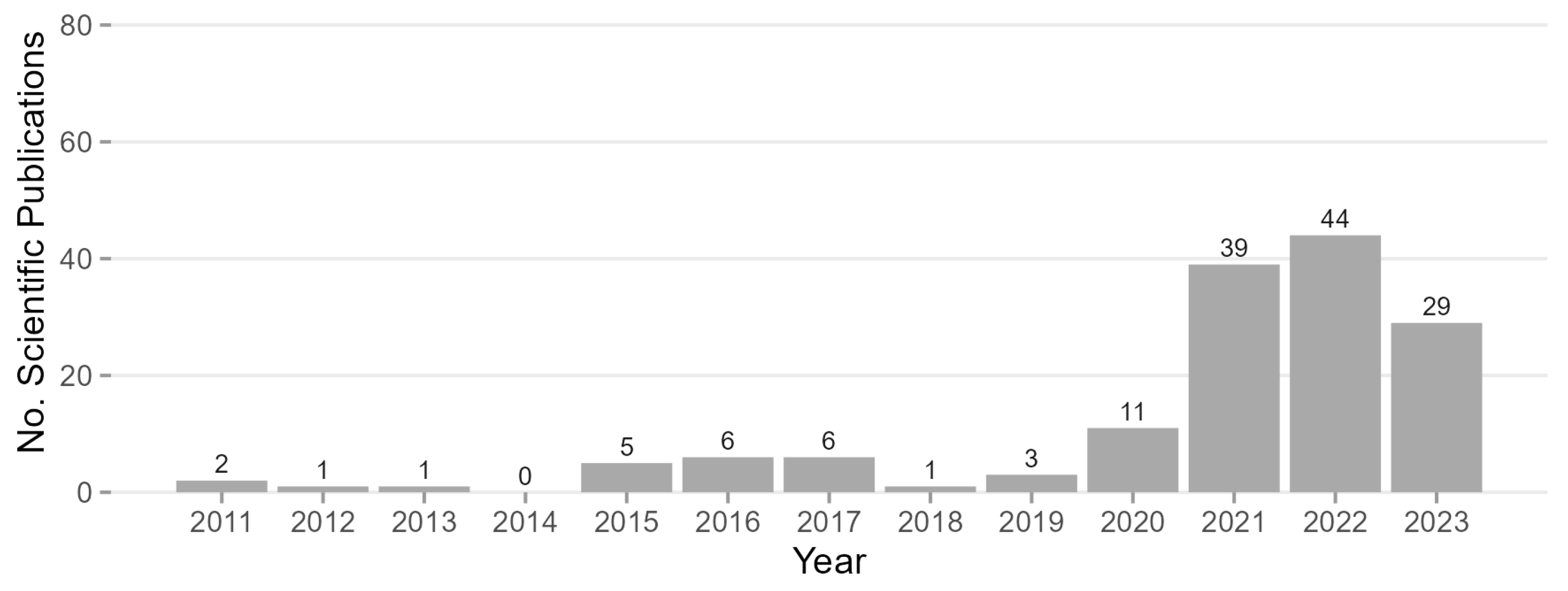
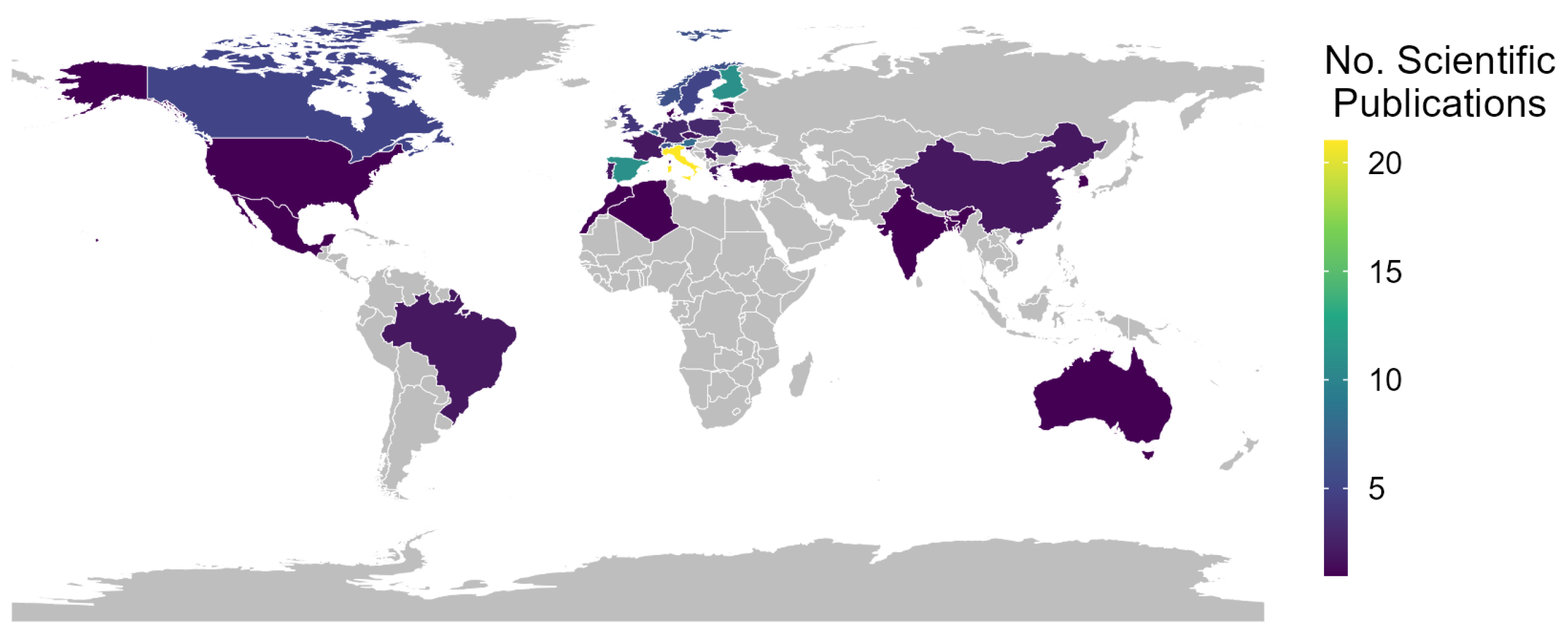
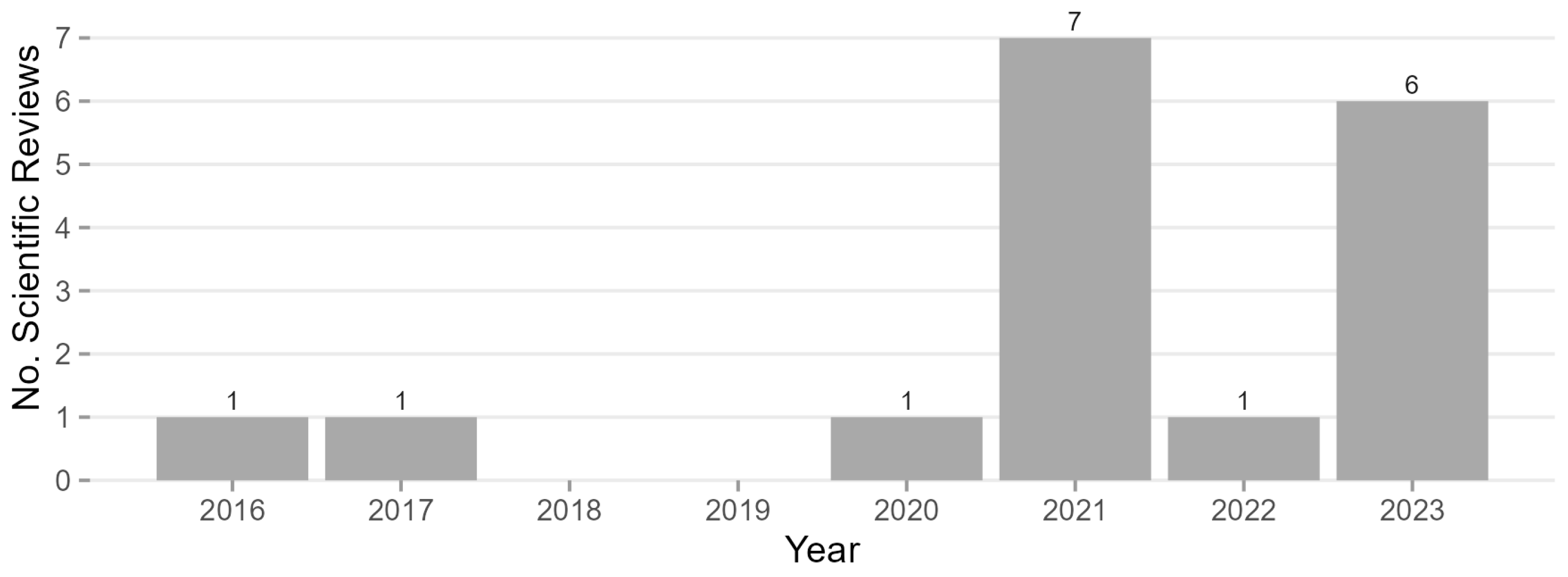
3.1. Literature Review of Scientific Literature
3.2. Grey Literature Results (39 Case Studies)
3.3. Interview Results (6 Case Studies) and Literature
4. Discussion
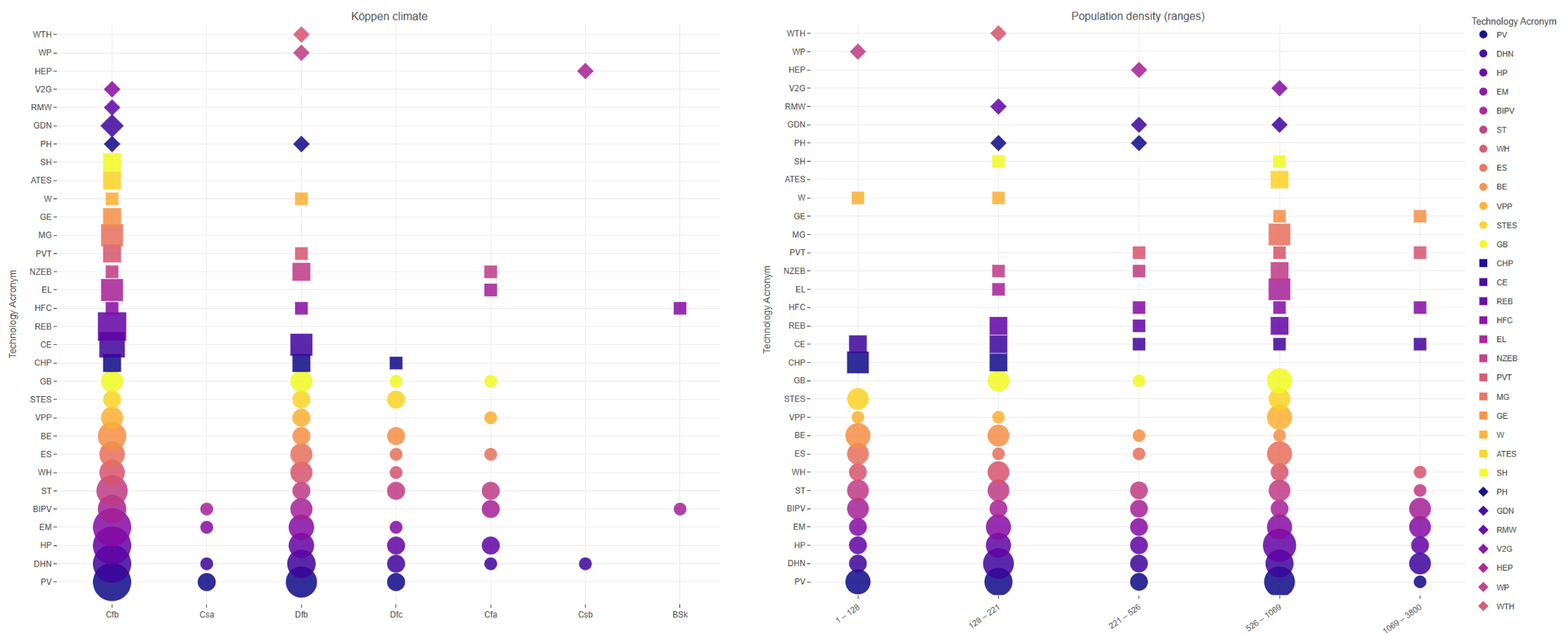
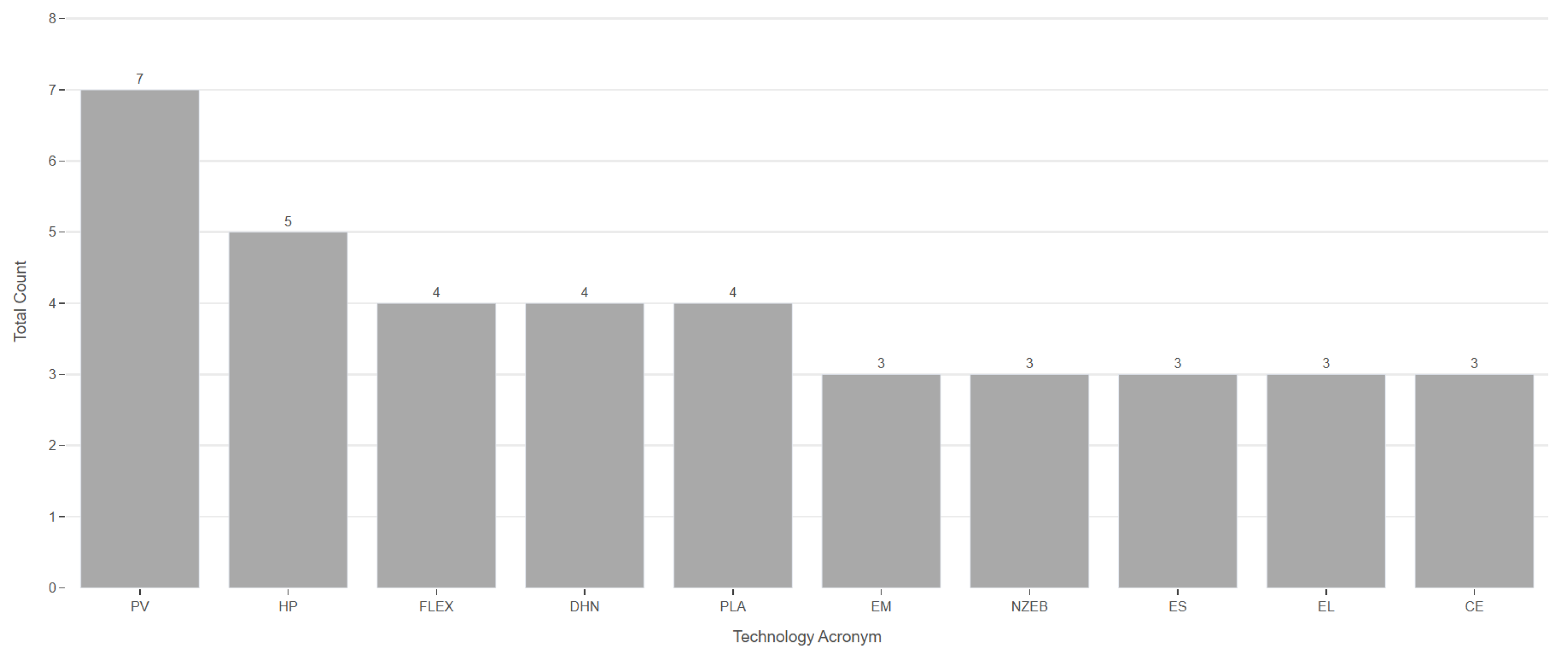
4.1. Which Are the Most Frequently Reported Technologies Applied in Energy Transition in Urban Areas for District-Based Approaches?
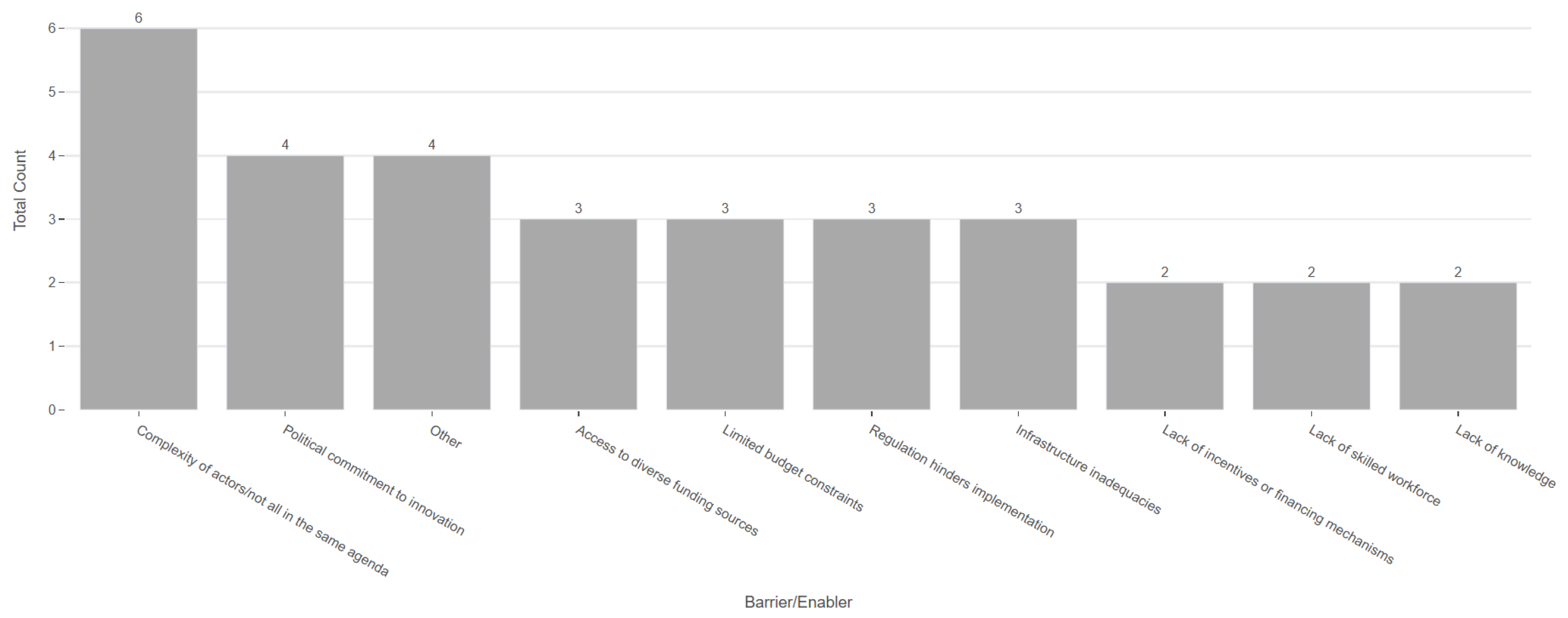
4.2. What Are the Most Frequently Reported Barriers and Enablers in the Urban Environment Supporting or Hindering This Transition?
4.3. Limitations and Further Work
5. Conclusions
- PV and HPs, followed by DHNs, were most frequently reported as enabling technologies across the analysed cases (grey-literature corpus and interviews). Storage becomes a dominant solution when grid capacity constraints and/or seasonal winter–summer imbalances limit direct renewable integration, increasing the relevance of both thermal and electrical storage. Observed climate- and density-related patterns should be interpreted as indicative only, given the uneven distribution of cases and the heterogeneity of system boundaries.
- Interview cases showed that political commitment, access to funding and stakeholder coordination are associated with progress on project implementation, whereas regulatory uncertainty and fragmented actor agendas delay the progress of the projects. Long-term lifecycle of innovative projects and risks should also be accounted for when designing such innovative projects, to ensure long-term reliability and financing. Bankable business models and supportive regulatory conditions are therefore central to long-term delivery.
- Across the interview cases, contextual modifiers such as climate, urban density, grid constraints, and planning restrictions influence which technical options are feasible and which barriers become dominant. The most recurrent necessary conditions included substantial funding availability (often linked to R&D programmes), strong stakeholder coordination, and political commitment.
- Practical implication: Cities seeking replication should prioritise governance alignment and bankable business models early, then tailor technology choices to local climate, density and grid conditions.Social acceptance and potential social risks, including housing affordability considerations, should be incorporated as part of the broader assessment of implementation conditions.
- Limitations and future work: A unified performance comparison (e.g., Life Cycle Cost of Energy -LCOE, payback, per investment) was not feasible due to inconsistent cost data; future Annex 83 updates would benefit from standardised reporting templates that support improved comparability (including normalisation) and include social and affordability indicators as optional add-ons.
Author Contributions
Funding
Institutional Review Board Statement
Informed Consent Statement
Data Availability Statement
Acknowledgments
Conflicts of Interest
Abbreviations
| RES | Renewable energy source |
| ZEB | Zero emission building |
| NZEB | Nearly zero-energy building |
| PH | Passive house |
| CE | Circular economy |
| PV | Photovoltaic |
| BIPV | Building-integrated photovoltaic |
| ST | Solar thermal |
| W | Wind |
| BE | Bioenergy (fuels from biomass) |
| GE | Geothermal energy |
| DHN | District heating network |
| ES | Electrical energy storage (battery) |
| HFC | Hydrogen fuel cell |
| PCM | Phase-change material |
| STES | Seasonal thermal energy storage |
| ATES | Aquifer thermal energy storage |
| CHP | Combined heat and power |
| EL | Efficient external lighting |
| HP | Heat pump |
| GB | Geothermal borehole |
| EM | Electric mobility |
| V2G | Vehicle-to-grid |
| FLEX | Flexibility to grids (demand response, etc.) |
| PLA | Information and Communication Technology (ICT) platform |
Appendix A

| Category | Acronym | Description |
|---|---|---|
| Energy Infrastructure | DHN | District Heating Network |
| Energy System Components | HP | Heat Pump |
| Energy System Components | CHP | Combined Heat and Power |
| Energy System Components | EL | Efficient External Lighting |
| Renewable Energy Devices | ST | Solar Thermal Collectors |
| Renewable Energy Devices | PV | Photovoltaic Module (private building) |
| Renewable Energy Devices | PVI | Photovoltaic Module (community infrastructures) |
| Renewable Energy Devices | PVT | Hybrid Collectors |
| Renewable Energy Devices | BIPV | Building Integrated Photovoltaic |
| Renewable Energy Devices | W | Wind Power (>30 kW) |
| Renewable Energy Devices | MW | Micro Wind Power (<30 kW) |
| Renewable Energy Devices | BE | Bioenergy (fuels from biomass); includes solid biofuels, biogas and liquid biofuels |
| Renewable Energy Devices | WP | Tide, Wave, Ocean Power |
| Renewable Energy Devices | MHEP | Micro Hydroelectric Power |
| Renewable Energy Devices | HEP | Hydroelectric Power |
| Renewable Energy Devices | RMW | Renewable Municipal Waste |
| Renewable Energy Devices | WH | Waste Heat |
| Renewable Energy Devices | GDN | Geothermal District Network |
| Renewable Energy Devices | GB | Geothermal Borehole |
| Renewable Energy Devices | GE | Geothermal Energy |
| Renewable Energy Devices | ATES | Aquifer Thermal Energy Storage |
| Smart Technology Components | MG | Microgrid |
| Smart Technology Components | VPP | Virtual Power Plant |
| Smart Technology Components | PA | Phone App for citizens |
| Smart Technology Components | PLA | ICT platforms |
| Smart Technology Components | FLEX | Flexibility to grids (demand response, etc.) |
| Energy Storage | ES | Electric Storage |
| Energy Storage | STES | Seasonal Thermal Energy Storage |
| Energy Storage | HFC | Hydrogen Fuel Cell |
| Energy Storage | TSG | Other thermal storage: water tank, PCM |
| Mobility | EM | Electric Mobility |
| Mobility | V2G | Vehicle to Grid |
| Other Components | WTH | Water Harvesting |
| Design Parameters | CE | Circular Economy Perspective |
| Design Parameters | SH | Social Housing |
| Design Parameters | ZEB | Zero Emission Building |
| Design Parameters | PH | Passive House |
| Design Parameters | NZEB | Net Zero Energy Building |
| Design Parameters | REB | Retrofit Efficient Buildings |
| Fossil Fuels | O | Oil |
| Fossil Fuels | NG | Natural Gas |
| Fossil Fuels | C | Carbon |
| Co-Benefits |
|---|
| Climate adaptation |
| Climate mitigation |
| Local economy enhancement |
| Financial savings for citizens |
| Increase employment rate and jobs |
| Decrease future maintenance costs |
| Social cohesion (gender, minority groups) |
| Enhance citizen participation, connectivity and community |
| Improve access to information and social capacity building |
| Raise awareness and behavioural change |
| Improve air quality |
| Reduce noise pollution |
| Reduce hot spots and urban heat islands |
| Enhance attractiveness of the city |
| Promote healthier and more attractive lifestyles |
| Reduce ecological footprint |
| Greater biodiversity |
| Waste efficiency |
| Water efficiency |
| Food efficiency |
| Sustainable land use |
| Barrier/Enabler | Type | Subtype |
|---|---|---|
| Technological advancements | Technical enabler | Enabler |
| Skill development programmes | Technical enabler | Enabler |
| Robust infrastructure development | Technical enabler | Enabler |
| Technological limitations | Technical barrier | Barrier |
| Lack of skilled workforce | Technical barrier | Barrier |
| Infrastructure inadequacies | Technical barrier | Barrier |
| Standards and interoperability frameworks in place | Technical barrier | Barrier |
| Effective community engagement | Social enabler | Enabler |
| Building strong stakeholder relationships | Social enabler | Enabler |
| Transparent and inclusive decision-making | Social enabler | Enabler |
| Community opposition or scepticism | Social barrier | Barrier |
| Complexity of actors/misaligned agendas | Social barrier | Barrier |
| Stakeholder conflicts of interest | Social barrier | Barrier |
| Poor communication between stakeholders | Social barrier | Barrier |
| Lack of acceptance | Social barrier | Barrier |
| Lack of knowledge | Social barrier | Barrier |
| Supportive policy frameworks | Regulatory enabler | Enabler |
| Flexible regulations for innovation | Regulatory enabler | Enabler |
| Incentives for sustainable practices | Regulatory enabler | Enabler |
| Regulation hinders implementation | Regulatory barrier | Barrier |
| Complex permitting processes | Regulatory barrier | Barrier |
| Lack of flexibility in existing laws (e.g., procurement, self-consumption regulation) | Regulatory barrier | Barrier |
| Political commitment to innovation | Political enabler | Enabler |
| Strong advocacy for change | Political enabler | Enabler |
| Consistent political leadership | Political enabler | Enabler |
| Lack of political or city governance | Political barrier | Barrier |
| Political resistance to change | Political barrier | Barrier |
| Lack of political will or support | Political barrier | Barrier |
| Changes in leadership affecting continuity | Political barrier | Barrier |
| Streamlined decision-making processes | Organisational enabler | Enabler |
| Internal support and alignment | Organisational enabler | Enabler |
| Collaborative organisational culture | Organisational enabler | Enabler |
| Resistance from within existing organisations | Organisational barrier | Barrier |
| Lack of coordination among departments | Organisational barrier | Barrier |
| Access to diverse funding sources | Financing enabler | Enabler |
| Innovative financing models | Financing enabler | Enabler |
| Public–private partnerships | Financing enabler | Enabler |
| Limited budget constraints | Financial barrier | Barrier |
| Uncertain return on investment | Financial barrier | Barrier |
| Inadequate funding mechanisms | Financial barrier | Barrier |
| High risks | Financial barrier | Barrier |
| Lack of incentives or financing mechanisms | Financial barrier | Barrier |
| Other | Barrier |
References
- Lopez, N. Copernicus: 2023 Is the Hottest Year on Record, with Global Temperatures Close to the 1.5 °C Limit; Copernicus: Bonn, Germany, 2024; Available online: https://climate.copernicus.eu/copernicus-2023-hottest-year-record#:~:text=Credit%3A%20C3S%2FECMWF.,-ACCESS%20TO%20DATA&text=Global%20surface%20air%20temperature%20highlights,highest%20annual%20value%20in%202016 (accessed on 21 November 2023).
- International Energy Agency. World Energy Outlook 2023. 2023. Available online: https://www.iea.org/reports/world-energy-outlook-2023 (accessed on 21 November 2023).
- Empowering Cities for a Net Zero Future: Unlocking Resilient, Smart, Sustainable Urban Energy Systems; Technical Report; OECD Publishing: Paris, France, 2021; Available online: https://iea.blob.core.windows.net/assets/4d5c939d-9c37-490b-bb53-2c0d23f2cf3d/G20EmpoweringCitiesforaNetZeroFuture.pdf (accessed on 21 November 2023).
- European Commission. EU Mission: Climate-Neutral and Smart Cities; European Commission: Brussels, Belgium, 2021; Available online: https://research-and-innovation.ec.europa.eu/funding/funding-opportunities/funding-programmes-and-open-calls/horizon-europe/eu-missions-horizon-europe/climate-neutral-and-smart-cities_en#:~:text=EU%20missions%20are%20commitments%20to,ensuring%20soil%20health%20and%20food (accessed on 21 November 2023).
- Herbert, Y.; Dale, A.; Stashok, C. Canadian cities: Climate change action and plans. Build. Cities 2022, 3, 854–873. [Google Scholar] [CrossRef]
- City of Amsterdam. Amsterdam Climate City Contract: Action Plan. 2025. Available online: https://netzerocities.app/resource-4917 (accessed on 3 January 2026).
- Municipality of Évora. Plano de Ação para a Energia Sustentável. Évora Carbono Zero. 2012. Available online: https://www.cm-evora.pt/wp-content/uploads/2020/06/PAES_Evora2012.pdf (accessed on 3 January 2026).
- Ajuntament de València. Valencia Climate City Contract. 2024. Available online: https://netzerocities.app/resource-4065 (accessed on 3 January 2026).
- Ayuntamiento de Valladolid. Valladolid Climate City Contract. 2024. Available online: https://netzerocities.app/resource-4066 (accessed on 3 January 2026).
- Stockholms Stad. Stockholm Climate City Contract. 2025. Available online: https://netzerocities.app/resource-4060 (accessed on 3 January 2026).
- City of Trondheim. Trondheim Climate and Energy Action Plan. 2025. Available online: https://www.trondheim.kommune.no/contentassets/13637b4f5e2b4f5aa34fcfc80d3ccd22/trondheim-ccc-02-action-plan.pdf (accessed on 3 January 2026).
- Qonita, M.; Rachmawati, R.; Rijanta, R. Assessing Amsterdam’s urban mobility through the lens of smart mobility goals. Case Stud. Transp. Policy 2025, 20, 101443. [Google Scholar] [CrossRef]
- NetZeroCities Consortium. NetZeroCities Barometer: Sectoral Reduction Strategies. 2024. Available online: https://netzerocities.app/barometer (accessed on 3 January 2026).
- Government of Singapore. Singapore Green Plan 2030: Supporting the Paris Agreement. 2022. Available online: https://www.greenplan.gov.sg/globalcommitment/ (accessed on 3 January 2026).
- Bruckner, H.; Alyokhina, S.; Schneider, S.; Binder, M.; Abdin, Z.U.; Santbergen, R.; Verkou, M.; Zeman, M.; Isabella, O.; Pagliarini, M.; et al. Lessons Learned from Four Real-Life Case Studies: Energy Balance Calculations for Implementing Positive Energy Districts. Energies 2025, 18, 560. [Google Scholar] [CrossRef]
- Sougkakis, V.; Lymperopoulos, K.; Nikolopoulos, N.; Margaritis, N.; Giourka, P.; Angelakoglou, K. An Investigation on the Feasibility of Near-Zero and Positive Energy Communities in the Greek Context. Smart Cities 2020, 3, 362–384. [Google Scholar] [CrossRef]
- Siakas, D.; Rahanu, H.; Georgiadou, E.; Siakas, K.; Lampropoulos, G. Positive Energy Districts Enabling Smart Energy Communities. Energies 2025, 18, 3131. [Google Scholar] [CrossRef]
- Kozlowska, A.; Guarino, F.; Volpe, R.; Bisello, A.; Gabaldòn, A.; Rezaei, A.; Albert-Seifried, V.; Alpagut, B.; Vandevyvere, H.; Reda, F.; et al. Positive Energy Districts: Fundamentals, Assessment Methodologies, Modeling and Research Gaps. Energies 2024, 17, 4425. [Google Scholar] [CrossRef]
- Zhang, X.; Penaka, S.; Giriraj, S.; Sánchez, M.; Civiero, P.; Vandevyvere, H. Characterizing Positive Energy District (PED) through a Preliminary Review of 60 Existing Projects in Europe. Buildings 2021, 11, 318. [Google Scholar] [CrossRef]
- Ntafalias, A.; Papadopoulos, P.; van Wees, M.; Šijačić, D.; Shafqat, O.; Hukkalainen, M.; Kantorovitch, J.; Lage, M. The Benefits of Positive Energy Districts: Introducing Additionality Assessment in Évora, Amsterdam and Espoo. Designs 2024, 8, 94. [Google Scholar] [CrossRef]
- Town of Okotoks. Okotoks Climate Action Plan. 2021. Available online: https://mccac.ca/mcap/resilient-okotoks-climate-action-plan-2021-2033/ (accessed on 3 January 2026).
- Ministry for Foreign Affairs of Finland. The Special Status of the Åland Islands. 2021. Available online: https://um.fi/the-special-status-of-the-aland-islands (accessed on 21 November 2023).
- Hedman, Å.; Rehman, H.; Gabaldón, A.; Bisello, A.; Albert-Seifried, V.; Zhang, X.; Guarino, F.; Grynning, S.; Eicker, U.; Neumann, H.M.; et al. IEA EBC Annex83 positive energy districts. Buildings 2021, 11, 130. [Google Scholar] [CrossRef]
- Elsevier, B.V. Scopus. 2025. Available online: https://www.scopus.com/home.uri (accessed on 21 November 2023).
- Clarivate. Web of Science. 2025. Available online: http://webofscience.com/ (accessed on 21 November 2023).
- Brozovsky, J.; Gustavsen, A.; Gaitani, N. Zero emission neighbourhoods and positive energy districts—A state-of-the-art review. Sustain. Cities Soc. 2021, 72, 103013. [Google Scholar] [CrossRef]
- Bjelland, D.; Brozovsky, J.; Hrynyszyn, B.D. Systematic review: Upscaling energy retrofitting to the multi-building level. Renew. Sustain. Energy Rev. 2024, 198, 114402. [Google Scholar] [CrossRef]
- Kottek, M.; Grieser, J.; Beck, C.; Rudolf, B.; Rubel, F. World map of the Köppen-Geiger climate classification updated. Meteorol. Z. 2006, 15, 259–263. [Google Scholar] [CrossRef] [PubMed]
- Lasternas, B. Hybrid System School of Design and Environment SDE 4. 2019. Available online: https://sleb.sg/UserFiles/Resource/Slides%20Library/Super%20Low%20Energy%20Training%20Workshop/NZEB@SDE-%20Hybrid%20System%20Shared.pdf (accessed on 30 January 2026).
- OECD. GDP per Capita: US Dollars, Current Prices and PPPs. 2016. Available online: https://www.oecd.org/en/publications/oecd-factbook-2015-2016_factbook-2015-en.html (accessed on 21 November 2023).
- OECD. OECD Regions and Cities Database. 2021. Available online: https://www.oecd.org/en/data/tools/oecd-regions-and-cities-atlas.html (accessed on 21 November 2023).
- JRC European Comission. Photovoltaic Geographical Information System (PVGIS). 2017. Available online: https://re.jrc.ec.europa.eu/pvg_tools/en/ (accessed on 21 November 2023).
- Hachem-Vermette, C.; Cubi, E.; Bergerson, J. Energy performance of a solar mixed-use community. Sustain. Cities Soc. 2016, 27, 145–151. [Google Scholar] [CrossRef]
- Guarino, F.; Rincione, R.; Mateu, C.; Teixidó, M.; Cabeza, L.F.; Cellura, M. Renovation assessment of building districts: Case studies and implications to the positive energy districts definition. Energy Build. 2023, 296, 113414. [Google Scholar] [CrossRef]
- Derkenbaeva, E.; Vega, S.H.; Hofstede, G.J.; van Leeuwen, E. Positive energy districts: Mainstreaming energy transition in urban areas. Renew. Sustain. Energy Rev. 2022, 153, 111782. [Google Scholar] [CrossRef]
- Sassenou, L.N.; Olivieri, L.; Olivieri, F. Challenges for positive energy districts deployment: A systematic review. Renew. Sustain. Energy Rev. 2024, 191, 114152. [Google Scholar] [CrossRef]
- Bruck, A.; Casamassima, L.; Akhatova, A.; Kranzl, L.; Galanakis, K. Creating Comparability among European Neighbourhoods to Enable the Transition of District Energy Infrastructures towards Positive Energy Districts. Energies 2022, 15, 4720. [Google Scholar] [CrossRef]
- Erba, S.; Pagliano, L. Combining Sufficiency, Efficiency and Flexibility to Achieve Positive Energy Districts Targets. Energies 2021, 14, 4697. [Google Scholar] [CrossRef]
- Salom, J.; Tamm, M.; Andresen, I.; Cali, D.; Magyari, Á.; Bukovszki, V.; Balázs, R.; Dorizas, P.; Toth, Z.; Zuhaib, S.; et al. An Evaluation Framework for Sustainable Plus Energy Neighbourhoods: Moving Beyond the Traditional Building Energy Assessment. Energies 2021, 14, 4314. [Google Scholar] [CrossRef]
- Ceglia, F.; Marrasso, E.; Martone, C.; Pallotta, G.; Roselli, C.; Sasso, M. Towards the Decarbonization of Industrial Districts through Renewable Energy Communities: Techno-Economic Feasibility of an Italian Case Study. Energies 2023, 16, 2722. [Google Scholar] [CrossRef]
- Chitrakar, R.M.; Baker, D.C.; Guaralda, M. How accessible are neighbourhood open spaces? Control of public space and its management in contemporary cities. Cities 2022, 131, 103948. [Google Scholar] [CrossRef]
- Laitinen, A.; Lindholm, O.; Hasan, A.; Reda, F.; Hedman, Åsa. A techno-economic analysis of an optimal self-sufficient district. Energy Convers. Manag. 2021, 236, 114041. [Google Scholar] [CrossRef]
- Samadzadegan, B.; Abolhassani, S.S.; Dabirian, S.; Ranjbar, S.; Rasoulian, H.; Sanei, A.; Eicker, U. Novel Energy System Design Workflow for Zero-Carbon Energy District Development. Front. Sustain. Cities 2021, 3, 662822. [Google Scholar] [CrossRef]
- Ala-Juusela, M.; Crosbie, T.; Hukkalainen, M. Defining and operationalising the concept of an energy positive neighbourhood. Energy Convers. Manag. 2016, 125, 133–140. [Google Scholar] [CrossRef]
- Marrasso, E.; Martone, C.; Pallotta, G.; Roselli, C.; Sasso, M. Towards the implementation of Positive Energy Districts in industrial districts: An Italian case study. J. Phys. Conf. Ser. 2023, 2600, 082039. [Google Scholar] [CrossRef]
- Kim, M.H.; Kim, D.; Heo, J.; Lee, D.W. Techno-economic analysis of hybrid renewable energy system with solar district heating for net zero energy community. Energy 2019, 187, 115916. [Google Scholar] [CrossRef]
- Andresen, I.; Trulsrud, T.H.; Finocchiaro, L.; Nocente, A.; Tamm, M.; Ortiz, J.; Salom, J.; Magyari, A.; van Oeffelen, L.H.; Borsboom, W.; et al. Design and performance predictions of plus energy neighbourhoods – Case studies of demonstration projects in four different European climates. Energy Build. 2022, 274, 112447. [Google Scholar] [CrossRef]
- Erdinç, F.G. Rolling horizon optimization based real-time energy management of a residential neighborhood considering PV and ESS usage fairness. Appl. Energy 2023, 344, 121275. [Google Scholar] [CrossRef]
- Drake Landing Company Board of Directors. Drake Landing Solar Community. 2024. Available online: https://www.okotoks.ca/sites/default/files/2024-10/Drake%20Landing%20Solar%20Community%20Background.pdf (accessed on 30 January 2026).
- Natural Resources Canada. Community Energy Case Studies: Drake Landing Solar Community. 2009. Available online: https://natural-resources.canada.ca/sites/www.nrcan.gc.ca/files/canmetenergy/files/pubs/DrakesLanding(ENG).pdf (accessed on 30 January 2026).
- Wamboldt, J. Central Solar Heating Plants with Seasonal Storage for Residential Applications in Canada: A Case Study of the Drake Landing Solar Community; Technical Report; Queen’s University: Kingston, ON, Canada, 2009; Available online: https://www.collectionscanada.gc.ca/obj/thesescanada/vol2/002/MR48204.PDF?oclc_number=704029413 (accessed on 30 January 2026).
- Kiviranta, K. Vision for 100% Renewable Åland Islands; Technical Report; University of Oulu, Faculty of Technology for Environmental Engineering: Oulu, Finland, 2019. [Google Scholar]
- Pastore, L.M. Sector Coupling and Flexibility Measures in Distributed Renewable Energy Systems: A Comprehensive Review. Sustainability 2026, 18, 437. [Google Scholar] [CrossRef]
- Rask, U. Östra Finlands Största Vindpark Blev klar—OX2 överlät Niinimäki Vindpark till Helen och Ålandsbanken. 2025. Available online: https://www.ox2.com/sv/finland/aktuellt/pressmeddelanden-och-nyheter/ostra-finlands-storsta-vindpark-blev-klar-ox2-overlat-niinimaki-vindpark-till-helen-och-alandsbanken/ (accessed on 30 January 2026).
- Wojtaszek, H. Renewable Energy in Policy Frameworks: A Comparative Analysis of EU and Global Strategies for Sustainable Development. Sustainability 2025, 17, 10567. [Google Scholar] [CrossRef]
- Oscilowicz, E.; Anguelovski, I.; García-Lamarca, M.; Cole, H.V.S.; Shokry, G.; del Pulgar, C.P.; Argüelles, L.; Connolly, J.J.T. Grassroots mobilization for a just, green urban future: Building community infrastructure against green gentrification and displacement. J. Urban Aff. 2025, 47, 347–380. [Google Scholar] [CrossRef]
- Govindan, K.; Kannan, D.; Jørgensen, T.B.; Nielsen, T.S. Supply Chain 4.0 performance measurement: A systematic literature review, framework development, and empirical evidence. Transp. Res. Part E Logist. Transp. Rev. 2022, 164, 102725. [Google Scholar] [CrossRef]
- Dua, R.; Almutairi, S. A perspective on emerging policy and economics research priorities for enabling low-carbon trucking. Energy Res. Soc. Sci. 2025, 124, 104025. [Google Scholar] [CrossRef]
- Civiero, P.; Turci, G.; Alpagut, B.; Kuzmic, M.; Soutullo, S.; Sánchez, M.N.; Seco, O.; Bossi, S.; Haase, M.; Massa, G.; et al. Operational Insights and Future Potential of the Database for Positive Energy Districts. Energies 2024, 17, 899. [Google Scholar] [CrossRef]


| City/Region | Climate Target | Source |
|---|---|---|
| Okotoks | Achieving carbon neutrality by 2050, while increasing community resilience and quality of life | [21] |
| Åland Islands | Climate neutral by 2035, with 100% of electricity consumption from fossil-free energy sources | [22] |
| Singapore | Reduce emissions to around 60 MtCO2e by 2030 after peaking earlier and achieve net-zero emissions by 2050 | [14] |
| Amsterdam | 100% climate-neutral, circular and climate-adaptive city by 2050, with an intermediate 60% CO2 reduction by 2030 compared to 1990 | [6] |
| Évora | Reduce municipal GHG emissions by 20% per capita by 2020, relative to 2009 levels | [7] |
| Trondheim | Reduce GHG emissions by 80% by 2030 and transition towards a greener and more circular city | [11] |
| Case | C1-Åland | C2-Trondheim | C3-Okotoks | C4-Singapore | C5-Amsterdam | C6-Évora |
|---|---|---|---|---|---|---|
| Objective | PED | ZEB | High solar fraction | Net zero | PED | PED |
| Objective achieved? | Not yet | Yes | Yes | Yes | Not yet | Not yet |
| Irradiation | 1078.1 | 849.35 | 1428.0 | 1810.1 | 1785.1 | 1778.6 |
| Building typologies | Mix-use | Office University lab | Residential | University | Mix-use | Mix-use |
| Heating needs (MWh/yr) | NA | 54.0 | 760.0 | NA | 537.0 | NA |
| Electricity needs (MWh/yr) | 328,600.0 | 40.97 | 21.0 | 470.7 | 565.0 | 5035.0 |
| Wind energy (MWh/yr) | 56,200.0 | NA | NA | NA | NA | NA |
| PV energy (MWh/yr) | 1000.0 | 102.0 | NA | 619.3 | 165.0 | NA |
| Other energy carriers (MWh/yr) | NA | NA | ST: 706.0 | NA | NA | NA |
| Reference | Main Topic |
|---|---|
| Laitinen et al. (2021) [42] | Analysis of techno-economic factors affecting the achievement of energy self-sufficiency in districts and communities. |
| Samadzadegan et al. (2021) [43] | Proposal of a framework for the design of carbon-neutral districts. |
| Ala-Juusela, Crosbie, and Hukkalainen (2016) [44] | Development of metrics and a tool, including an “energy positivity label,” to assess the extent to which candidate areas meet the PED target. |
| Marrasso et al. (2023) [45] | Analysis of a PED in an industrial area in southern Italy, using simulated and measured energy-consumption data. |
| Kim et al. (2019) [46] | Performance assessment of an eco-friendly town in South Korea. |
| Andresen et al. (2022) [47] | Assessment of energy-refurbishment measures and renewable-based plant deployment to achieve a positive energy balance in existing districts. |
| Erdinç (2023) [48] | Analysis of residential communities supplied by multiple renewable-based energy plants. |
| Type | Name | Temperature (W/S) | Precipitation |
|---|---|---|---|
| Dfb | Humid Continental | Cold/warm | No dry season |
| Cfb | Temperate Oceanic | Mild/warm | No dry season |
| Csa | Mediterranean | Mild/hot and dry | Summer drought, rainy winter |
| BSk | Cold Semi-arid | Cold/warm (dry) | Semi-arid steppe |
| Information | C1—Åland | C2—Trondheim | C3—Okotoks | C4—Singapore | C5—Amsterdam | C6—Évora |
|---|---|---|---|---|---|---|
| Climate | Dfb | Dfc | Dfb | Af | Cfb | Csa |
| GDP | 1389 | 14,395 | 60,747 | 349,820 | 209,154 | 33,308 |
| Pop. density | 18.3 | 44.0 | 1753.3 | 7 | 864 | 43 |
| Energy efficiency | – | ZEB | – | CE | NZEB | CE, NZEB |
| RES | BE, GE, PV, ST, W | PV | ST, PV * | PV | PV | BIPV, PV |
| Energy infrastructure | DHN | – | DHN | – | DHN | – |
| Energy storage | ES, HFC * | PCM | STES | – | ES, ATES | ES |
| Energy System components | CHP, EL, HP | HP | GB, HP * | HP, EL | HP | EL |
| Mobility | EM *, V2G * | – | – | – | – | EM |
| Smart technology components | FLEX * | – | – | – | FLEX | FLEX, PLA |
Disclaimer/Publisher’s Note: The statements, opinions and data contained in all publications are solely those of the individual author(s) and contributor(s) and not of MDPI and/or the editor(s). MDPI and/or the editor(s) disclaim responsibility for any injury to people or property resulting from any ideas, methods, instructions or products referred to in the content. |
© 2026 by the authors. Licensee MDPI, Basel, Switzerland. This article is an open access article distributed under the terms and conditions of the Creative Commons Attribution (CC BY) license.
Share and Cite
Gabaldon-Moreno, A.; Bjelland, D.; Pallotta, G.; Belda-González, A.; Šijačić, D.; Soutullo, S.; Giancola, E.; Ranjbar, S.; Alpagut, B.; Eicker, U. Towards Net-Zero Settlements: Barriers, Enablers and Case Studies’ Lessons Learnt from the Annex 83. Sustainability 2026, 18, 2050. https://doi.org/10.3390/su18042050
Gabaldon-Moreno A, Bjelland D, Pallotta G, Belda-González A, Šijačić D, Soutullo S, Giancola E, Ranjbar S, Alpagut B, Eicker U. Towards Net-Zero Settlements: Barriers, Enablers and Case Studies’ Lessons Learnt from the Annex 83. Sustainability. 2026; 18(4):2050. https://doi.org/10.3390/su18042050
Chicago/Turabian StyleGabaldon-Moreno, Andrea, David Bjelland, Giovanna Pallotta, Alberto Belda-González, Danijela Šijačić, Silvia Soutullo, Emanuela Giancola, Saeed Ranjbar, Beril Alpagut, and Ursula Eicker. 2026. "Towards Net-Zero Settlements: Barriers, Enablers and Case Studies’ Lessons Learnt from the Annex 83" Sustainability 18, no. 4: 2050. https://doi.org/10.3390/su18042050
APA StyleGabaldon-Moreno, A., Bjelland, D., Pallotta, G., Belda-González, A., Šijačić, D., Soutullo, S., Giancola, E., Ranjbar, S., Alpagut, B., & Eicker, U. (2026). Towards Net-Zero Settlements: Barriers, Enablers and Case Studies’ Lessons Learnt from the Annex 83. Sustainability, 18(4), 2050. https://doi.org/10.3390/su18042050