Article

Assessing the Economic Impacts of Spot Market Electricity and Cost Factors on Financial Feasibility of Electric Heat Storage for Process Steam


by
Carlota von Thadden del Valle
1,*,
Jonas Schiller
2 and
Mathias van Beek
1
1
Fraunhofer-Institut für Umwelt-, Sicherheits- und Energietechnik UMSICHT, Osterfelder Str. 3, 46047 Oberhausen, Germany
2
Laboratory for Modeling and Simulation, Universität Würzburg, Sanderring 2, 97070 Würzburg, Germany
*
Author to whom correspondence should be addressed.
Sustainability 2026, 18(4), 1802; https://doi.org/10.3390/su18041802
Submission received: 23 December 2025 / Revised: 20 January 2026 / Accepted: 5 February 2026 / Published: 10 February 2026

Abstract

To match the fluctuating renewable energy generation with varying industrial process steam demand, electric heat storage is a viable solution for energy transformation. However, the adoption of this technology by companies hinges on its economic feasibility. Proponents often argue that leveraging spot market electricity prices provides a competitive edge over conventional energy systems without storage. However, additional factors, such as grid fees, levies and taxes can substantially inflate storage charging costs. This study investigates the integration of an electric latent heat storage for process steam within a conventional natural gas boiler system in a paper manufacturing case study under German industrial electricity price regulation to evaluate the effects of electricity prices alongside various operational energy cost factors and rebates through a mixed-integer linear program. Three storage sizes (1 MWh, 100 MWh, 100 GWh) and four electricity procurement configurations (status quo, optimized fixed-price contract, day-ahead only, and a mixed fixed/day-ahead strategy) are analysed. For 100 MWh, the mixed strategy cuts energy costs by about 10% versus day-ahead pricing and around 13.5% versus the status quo contract, lowering the specific electricity price from 6.2 to 5.3 ct/kWh, while emissions range from the slight increases to 23% reductions when grid fees are removed.

1. Introduction

Various industries use steam as a heat transfer medium to supply heat to their processes. Examples of this are the drying process in the paper industry, the brewing process or various processes in the chemical and pharmaceutical sector. Currently, process steam in Germany is mostly generated using fossil fuels [1]. The transition to renewable energy sources is challenged by their fluctuating nature and the high and often inflexible steam demand in industry. Many sectors are hence analyzing the integration of a thermal energy storage. Whilst many storage solutions exist, an option, where the economic potential is often discussed, is the use of an electric heat storage. This would function as both a storage as well as a Power-to-Heat (PtH) technology, hence charge using electricity and discharge process heat in the form of steam. The typical discussion claims that using low spot market electricity prices for charging the storage would make it economically viable. However, different regulations and cost factors that affect the industry’s end-use electricity price as opposed to solely the Day-Ahead energy procurement price, can make this solution uneconomical. Many techno-economic studies ignore non-energy price components such as grid fees, taxes and levies, leading to biased business cases.
Focusing on the German regulatory context and a paper manufacturing case study, the objective of this paper is to quantify how electricity market prices and additional operational energy cost factors affect the usage of electric thermal energy storage for process steam production. Using the Open Energy Modeling Framework (oemof.solph) in Python 3.13.3 an energy system is modeled and then optimized to minimize total energy costs which include the further cost components, such as grid fees, taxes, levies and fees. These are modeled according to German regulations and include average prices of 2024; nevertheless, transferable insights of the cost components are compared to other European countries. The assumption is that the economic feasibility of the storage is highly sensitive particularly to the German peak-based grid fees and exemptions. The energy system includes a thermal and electrical energy demand from a paper manufacturing company which are supplied by a gas boiler and a fixed priced electricity contract. To this system the electric thermal energy storage is added as well as the ability to trade at the EPEX Day-Ahead spot market. Four configurations of this energy system are explored and through sensitivity analysis of storage sizing and inclusion of the individual electricity cost components, this paper identifies the predominant factors for an energy cost competitive storage integration.
This paper continues with a literature review and background on the German electricity market regulations. The method is then outlined with the modeling approach, a case study and the electricity cost function. Results on the different configurations and sensitivity analyses are provided alongside discussion on the implications for industry and policy recommendations.

1.1. Literature Review

Many techno-economic studies of integrating energy storage into industry have found that it becomes economically attractive when companies can exploit periods of very low or even negative Day-Ahead electricity prices [2]. However, a frequent shortcoming of these studies is the neglection of non-energy procurement cost factors such as grid fees, taxes, levies and exemptions, and applying oversimplified, purely energy-based costs. This can overstate arbitrage value and understate demand-charge exposure. This exposure can be understood through a study by Fraunhofer Institute ISI and ECOFYS which analyzed the industrial competitiveness of Germany through analysis of electricity price cost components and comparing this to ten other countries. This comparative study calculated the expected electricity prices per industrial sector in contrast to products, sales and macro-economic perspectives [3].
Carpinelli et al. investigated the optimal operation for battery energy storage systems for industrial applications by integrating both an energy charge as well as a peak demand charge imposed by power companies combined with day-ahead load forecasts. They focused on the cost-minimization optimization whilst performing peak shaving and load-time shifting [4]. Other papers optimize the integration of electric storage systems combined with other components. Schischke and Grimpe include a power purchase agreement (PPA), specifically a wind farm supplying electricity to an industrial water treatment plant and a compressed air energy storage (CAES) system in Germany. They include a capacity cost component depending on the peak load, similar to the grid fee power component applied in this paper. The focus is, however, on the PPA and analyzing the optimal operation as well as dimensions of the CAES [5]. A paper in an SDEWES special issue investigates concrete thermal energy storage integration into the food industry combined with Fresnel linear solar collectors. Their study investigates the optimal design with respect to dimensioning using a TRNSYS model [6].
In comparison, this paper investigates the integration of an electric thermal energy storage for process heat, combining different electricity price contracts and including non-energy procurement cost components to analyze realistic integration circumstances. This paper includes German peak-based grid fees, individual grid fee reduction rebates, as well as levies and respective reductions to assess the economic feasibility of the industrial integration of electric heat storage. The German tariff design is included in the cost function of the optimization model, but interpretations are made to compare to other European tariff designs.

1.2. Regulatory, Market, and Economic Frameworks

1.2.1. Regulations

Focusing on the German regulatory market, the key components include grid fees with peak demand (€/kW) and energy (€/kWh) components which are charged annually or monthly based on the highest 15-min demand. §19 StromNEV allows reduced or individual grid fees, reducing these grid fee to 20–10% for energy-intensive users or atypical grid use (demand shifted from defined system peak by the distribution system operator). Currently, heat storages are not exempt from grid fees in comparison to batteries, when used solely for grid-serving purposes and no own consumption [7]. Other cost components include an electricity tax with a reduced rate for the manufacturing sector to the minimum European tax rate, a Combined Heat and Power (CHP) levy, and Offshore grid levy and the §19 surcharge, all with reduced rates for energy-intensive industries. Furthermore, the EU Emission Trading System (ETS) affects competing fossil fuels and the national ETS (nEHS) adds a CO 2 cost to natural gas influencing the fuel-vs.-electric switch boundary [8].

1.2.2. Impact on Heat Storage Economics

To electrify industries which typically used natural gas, these cost components can further influence the switch boundary between the two energy sources. In this case-study setup, a company with solely a natural gas boiler providing process heat and electricity being used only for the base load (e.g., mechanical energy processes), electrification could impact energy operating costs. The electric latent heat storage would increase electricity demand, which might require a higher power infrastructure. It could also increase peak load, influencing the peak demand-dependent cost components. Eligibility for exemptions might influence storage operation, such as qualifying for individual grid fees. Furthermore, benefits in form of other subsidies or funding for renewables or storage installation could alleviate the capital expenditures (CAPEX) for electrification.

2. Materials and Methods

2.1. Modeling Approach

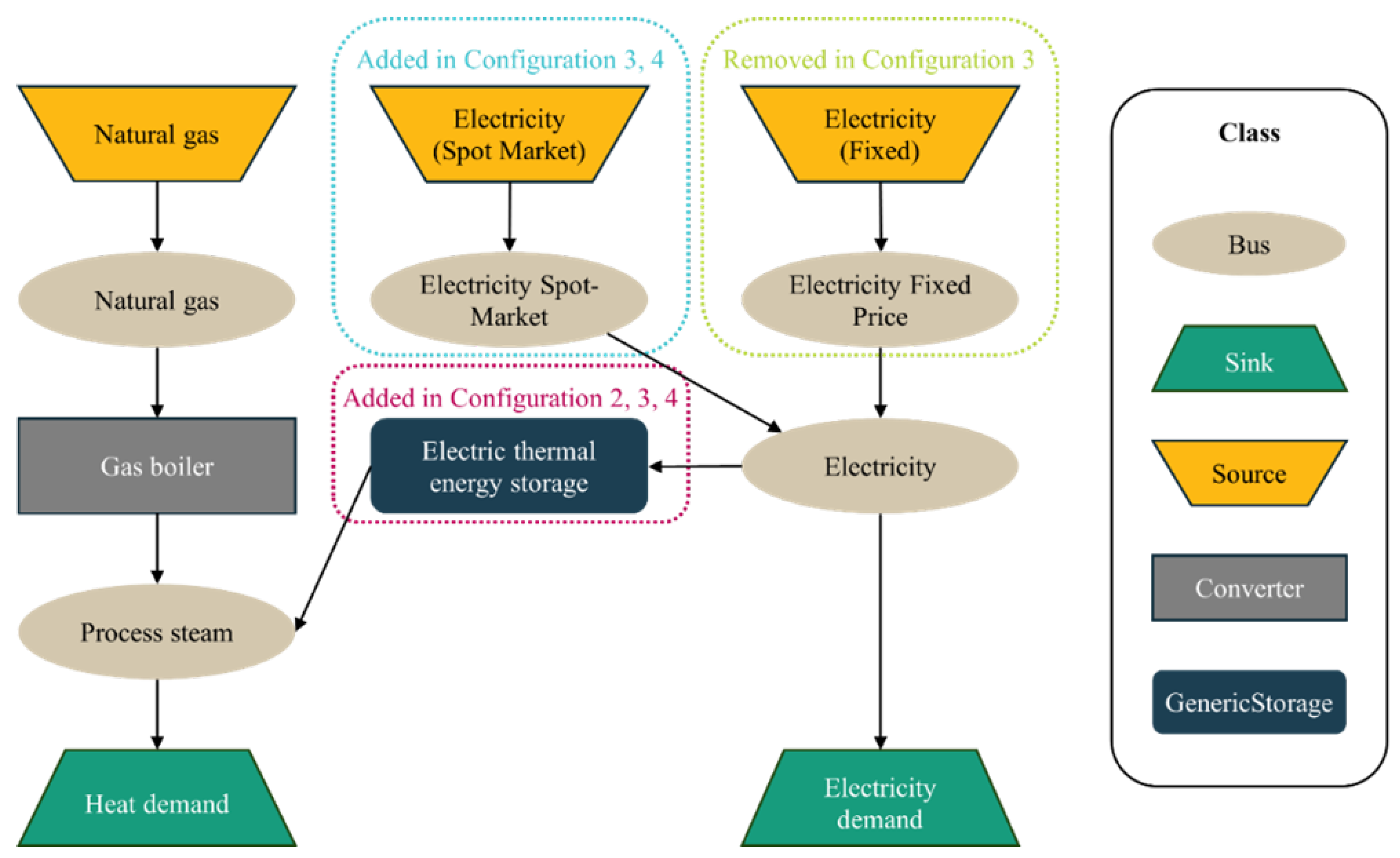
This study formulates a mixed-integer linear cost-minimization model of an industrial process steam system containing a conventional gas boiler and an electric thermal energy storage. The heat storage has the option to charge using electricity with either a fixed contract or Day-Ahead Prices. A cost function is modeled that adds further cost components to the electricity procurement costs which represent realistic end-user costs for industrial clients. This includes network costs in form of grid fees, as well as taxes, fees and levies. Furthermore, rules are modeled to include reductions of these cost components according to relevant regulations. The objective minimizes total operating (energy) cost over a year at a resolution of 15 min. The system is built in Python using oemof.solph (Figure 1) and solved using Gurobi.
The following assumptions are made in the model: There is assumed to be perfect forecast of quarter-hourly steam demand, baseline electricity demand, and Day-Ahead electricity prices over the full year, with flows held constant within each 15-min interval. The components are idealized and linear with fixed, homogeneous efficiencies. Conversion losses and self-discharge are represented, while degradation and maintenance outages are ignored. The storage efficiencies are considered independent of state of charge (SOC), power level and temperature. The initial SOC is set to zero. Simultaneous charging and discharging is allowed. Capacities may be sized endogenously; however, CAPEX, non-energy OPEX and space constraints are neglected.
The perfect-forecast assumption does not aim to represent real industrial operation, but is a standard simplification in long-term techno-economic planning studies. It allows us to cleanly separate the influence of tariff design, storage sizing and non-energy price components on system operation and costs, without conflating these effects with short-term forecast errors. In practice, operators would rely on imperfect day-ahead and intra-day forecasts for prices and demands, which could reduce achievable arbitrage profits, affect peak load management and hence slightly lower the effective value of storage. As a robustness check, we added zero-mean normal distribution noise and standard deviation σ = 0.0875 [9] to the day-ahead electricity price series for the 100 MWh storage system in Configuration 4. The results are shown in Section 4.2.
The case study consists of an illustrative paper manufacturing company with synthetic timeseries. Steam is delivered at a single quality and condensate return constraints are disregarded. Market conditions in the time frame remain constant and are based on historical German data of 2024. The grid connection is assumed sufficient for any modeled charging power.
Input data include historical EPEX spot Day-ahead Prices for bidding zone DE-LU for the year 2024 as well as carbon intensity corresponding to the energy mix of the day-ahead time series [10]. The latter is calculated by exporting the ENTSO-E quarterly production of each generation type. Based on the specific shares for each generation type g α , t per country and the corresponding carbon intensity factors e α [11], the carbon intensity c i , t in gCO2/kWh of the electricity grid at timestep t can be derived [12]:
c i , t = α A e α · g α , t α A g α , t t T
The price for industrial natural gas was set to c g a s = 7 ct/kWh, assuming the base price for gas is negligible in contrast to the work price [13]. The gas boiler was modeled with a conversion factor of 0.9 [14]. For the industrial fixed electricity costs the base price was set to c f i x b a s e = 3000 €/a and the work price to c f i x w o r k = 7 ct/kWh [15]. For the additional grid fees prices were chosen from the city Oberhausen in North Rhine-Westphalia (Germany) for the year 2024 for >2500 h/a and high-voltage grid including transformer, being a power price of c g r i d p o w e r = 83.06 €/kW and a work price of c g r i d w o r k = 0.46 ct/kWh [16]. Supplier margin was disregarded, and prices exclude value-added tax (VAT).
The model compares four configurations of the energy system as well sensitivity analysis of storage sizing and input cost components within these configurations. In the first configuration the energy system represents the status quo with a gas boiler delivering steam to the system, whilst electricity with a fixed price is used for the base electricity demand. In Configuration 2 an electric thermal energy storage is added to the status quo energy system, which charges using electricity procured at a fixed electricity price. In Configuration 3 electricity is obtained at the Day-Ahead spot market instead of through a fixed-priced contract. In the fourth configuration the optimization can switch between or combine fixed or spot market Day-ahead prices for electric charging. In all four configurations the model has three sizing options for the storage (1 MWh–100 MWh–100 GWh). While 1 MWh corresponds to the test bench storage system, 100 MWh showcases a realistic industrial storage capacity and 100 GWh only a hypothetical storage to appreciate the effects of close to no capacity limitations. Furthermore, individual cost components will be removed to assess the impact on the selection of technology to provide the steam for process heat.
Because real plant data and billing information for the case-study company are not available, model validation focuses on structural consistency, reproduction of known cost components, and plausibility checks under extreme assumptions. First, all technical parameters (e.g., boiler efficiency, storage losses, charging/discharging efficiencies) and economic parameters (grid fees, levies, fees and taxes) are taken from manufacturer data sheets, previous literature and official documents (see Table A1). The modeled components therefore reproduce these reference values by construction.
Second, for Configuration 1 (status quo without storage) we cross-check the optimization results against an independent spreadsheet calculation of annual electricity and gas costs using the same synthetic demand time series and German industrial tariffs. Total annual costs and the breakdown into energy, grid fees, electricity tax and levies and taxes match up to rounding errors, which confirms the correct implementation of the cost function and tariff logic in the optimization model.
Third, internal consistency is verified by checking that all energy balances hold in every timestep (process heat demand is always met by the gas boiler and/or storage discharge; electricity demand equals fixed-contract and spot-market imports plus storage charging). We additionally perform plausibility tests under extreme parameter assumptions: (i) with zero storage capacity the model reproduces the status quo solution; (ii) when electricity prices are exogenously lowered far below gas prices, the optimization fully electrifies steam production subject to technical constraints; and (iii) when grid fees prices are set to zero, the model increases charging in low-price hours and reduces total costs and emissions, in line with economic intuition and the sensitivity analysis in Section 3.2. These checks provide confidence that the optimization model yields reliable and reproducible results for the specified case-study assumptions.

2.2. Case Study Description

2.2.1. Industry Context

The case study examined in this paper consists of an electrical and thermal energy demand from a synthesized time series of a paper manufacturing company developed by Sandhaas et al. [17]. The energy demand of the paper industry is among the largest industrial consumers in Germany [18]. This energy is mostly used in the form of process heat, such as in the paper drying process, which is predominantly done with process steam that heats cylinders [19]. To scale the synthesized timeseries, a medium-sized packaging manufacturing company was chosen, as packaging represents the largest share of paper types manufactured in Germany [20]. For this case study, the medium-sized company is assumed to have an output of 100,000 t/year of packaging [21]. With an average electricity intensity of 530 kWh/t and fuel demand (which is assumed as heat demand) of 1528 kWh/t [20], the model paper manufacturing company has an electricity demand of E e l = 53 GWh/a and thermal energy demand of E t h = 152.8 GWh/a.
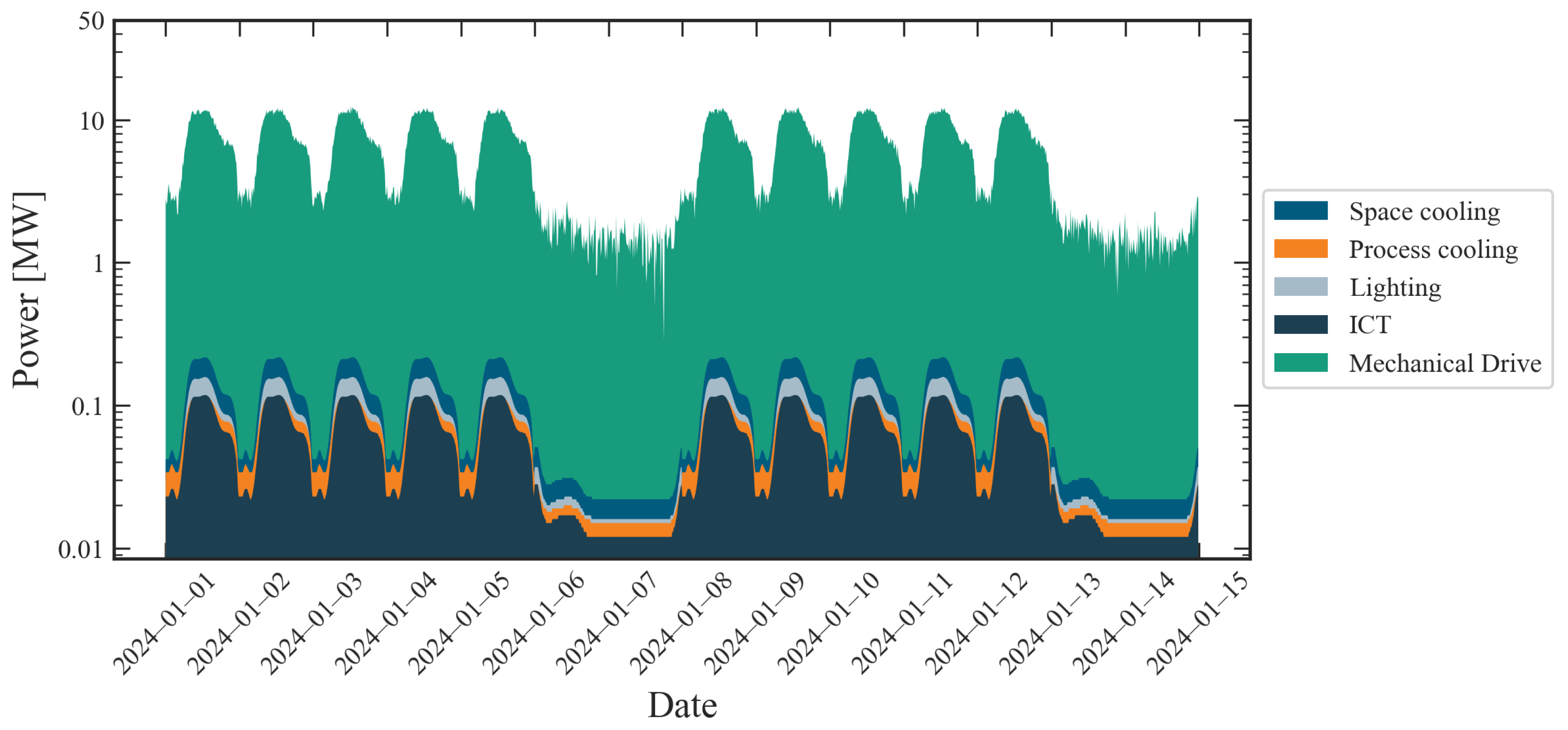
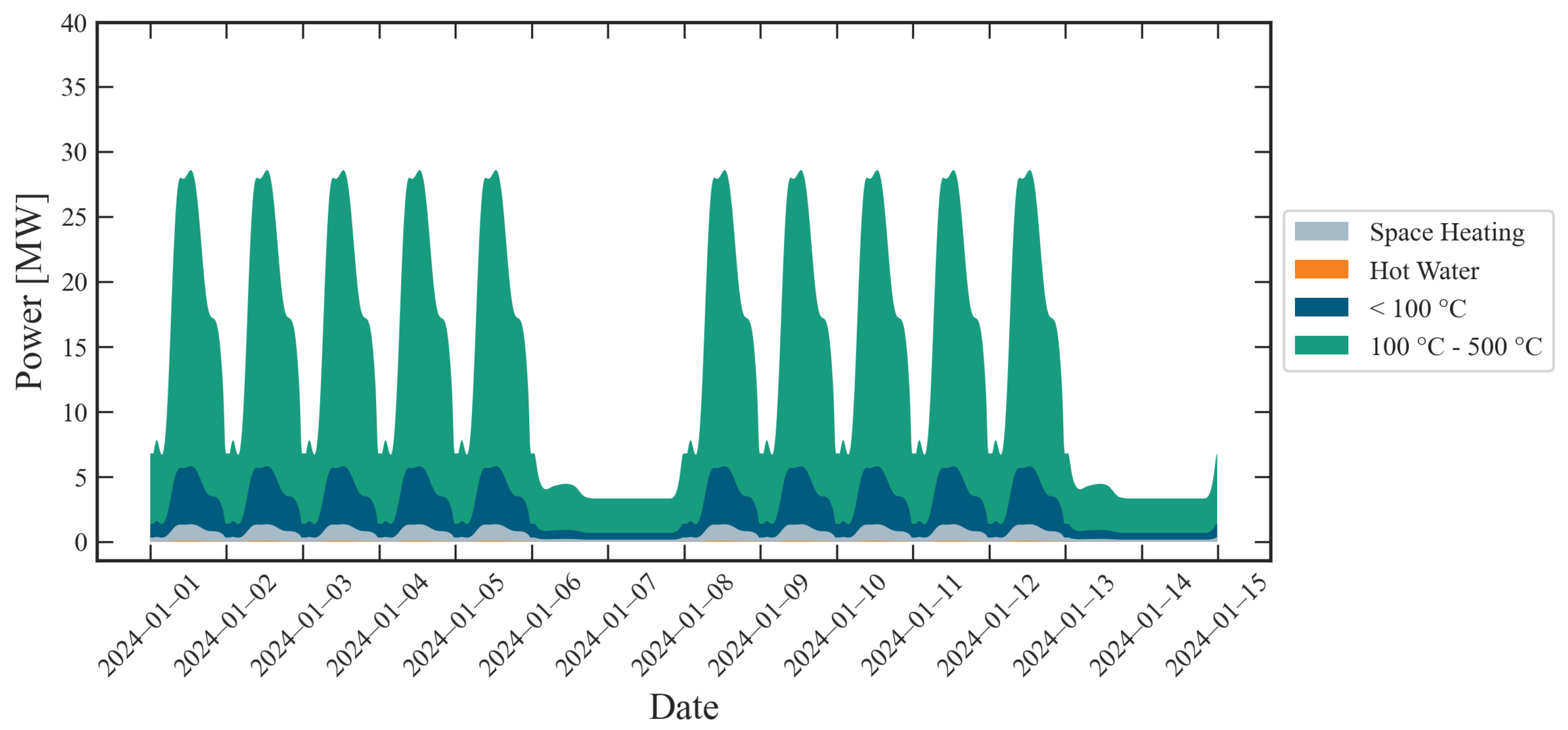
By using the load generator tool for electricity and heat demand [17] and scaling it to the model company, a timeseries in 15 min-intervals for the year 2024 was obtained. This load generator tool consists of a scalable timeseries for different industry types with four modules distinguishing weekdays, Saturdays, Sundays and holidays. The heat demand is further divided into applications, space heating and hot water, as well as process heat temperature ranges. The demand for the first two weeks for electricity and heat is depicted respectively in Figure A1 and Figure A2 in the Appendix A. It can be noted that no electricity is being used to provide process heat, hence it is assumed that the gas boiler provides the entire process steam. The base electricity peak power is 13,248 kW and average power 6033 kW. The process heat demand contains the temperature levels < 100 °C and 100 °C–500 °C with a total demand of 149.3 GWh.

2.2.2. Fraunhofer UMSICHT Storage System

In this case study, an electric thermal energy storage system is modeled. This model is abstracted from the Fraunhofer Institute UMSICHT ISSDemo project in Germany. This project is co-funded by the European Union through the Clean Energy Transition Partnership (CETPartnership) and includes partners in Poland and Spain. The ISSDemo project consists of the demonstration of a high-temperature (250–500 °C) latent heat storage based on molten metal. Current testing is done using the material ZnAl6 with a phase change temperature of 381 °C [22]. Charging for this storage draws electricity through resistance heat bands wrapped around the storage container and discharging supplies steam which can be done simultaneously; the thermal storage hence includes a Power-to-Heat (PtH) ability. The aim of the project is therefore also to enable a flexible partial electrification and increase the share of renewable energies for industrial consumers. As this storage is still at test bench phase, this simulation adopts simplified parameters and workings of the storage yet does not integrate its precise operation. Parameters used in this study are compared to commercially available electric latent heat storage technologies (e.g., MGA Thermal), such as inflow and outflow efficiencies of 99% and 90% respectively, as well as losses of 0.025% per 15-min timestep [23]. The storage charging and discharging power is modeled in dependence of its capacity, assuming a modular setup of the storage. Furthermore, the storage is modeled as unbalanced, meaning the initial and end charging state do not have to correspond.

2.3. Integration of Cost Factors

2.3.1. Electricity Cost

The electricity cost C e l modeled in this study includes the cost components of electricity procurement ( C f i x and C s p o t ), grid fees ( C g r i d ), levies and charges ( C l e v i e s ), electricity tax ( C t a x ), as well as reductions for grid fees as for levies and charges ( r 19 and r l e v i e s ) of these costs corresponding to realistic shares for the industrial consumer modeled in the case study. Electricity procurement cost is priced either at a fixed rate c f i x or through Day-Ahead spot market costs c s p o t or a mix of both with the different shares q f i x and q s p o t . Equation (2) shows the composition of the total electricity cost c s p o t for a year E y e a r :
C e l = q f i x · C f i x + q s p o t · C s p o t + C g r i d · r 19 + C l e v i e s · r l e v i e s + C t a x

2.3.2. Electricity Procurement Cost

The electricity procurement cost can either be priced at a fixed rate with a base electricity cost per year C f i x b a s e as well as a consumption-based (power P e l f i x , t ) per timestep Δ t ) work price c f i x w o r k or through Day-Ahead pricing by multiplying the 15-min spot prices c s p o t with the corresponding power P e l s p o t , t and timestep Δ t :
C f i x = C f i x b a s e + C f i x w o r k = C f i x b a s e + c f i x w o r k · P e l f i x , t · Δ t
C s p o t = t T c s p o t · P e l s p o t , t · Δ t

2.3.3. Grid Fees

Grid fees are composed of a work price which is energy-consumption based c g r i d w o r k and a peak-load-dependant power price c g r i d p o w e r :
C g r i d = C g r i d p o w e r + C g r i d w o r k = c g r i d p o w e r · max t T P e l , t + c g r i d w o r k · E a
According to § Section 19 (2) sentence 2 StromNEV, electricity-intensive end consumers are entitled to an individual grid charge if their annual consumption exceeds 10 GWh and the full-load hours (FLH) are at or surpass 7000 h. The share of grid fees reduces to 20–15–10% corresponding to 7000 h ≤ F L H < 7500 h–7500 h ≤ F L H < 8000 h– F L H 8000 h.

2.3.4. Levies and Fees

In Germany in 2024 the electricity cost included a concession fee with a reduced rate for industrial consumers c f e e c o n and three levies C l e v i e s : The surcharge for special grid utilization c l e v y 19 , the CHP levy c l e v y C H P and the offshore grid levy c l e v y o f f s h o r e . These levies and the concession fee are charged per yearly electricity consumption at fixed rates. For consumption over 1 GWh the levies are charged at a reduced rate, corresponding to c l e v y 19 r or 15% of the standard rate. The individual specific prices used in the model are listed in Table A1 in the Appendix A.
C f e e c o n = c f e e c o n · E a
C l e v i e s = C l e v y 19 + C l e v y C H P + C l e v y o f f s h o r e
C l e v y 19 = c l e v y 19 · 1   [ GWh ] + c l e v y 19 r · ( E a 1   [ GWh ] )
C l e v y C H P = c l e v y C H P · 1   [ GWh ] + c l e v y C H P · 15 % · ( E a 1   [ GWh ] )
C l e v y o f f s h o r e = c l e v y o f f s h o r e · 1   [ GWh ] + c l e v y o f f s h o r e · 15 % · ( E a 1   [ GWh ] )

2.3.5. Electricity Tax

Electricity taxes in Germany are calculated through a linearly applied factor c t a x to the yearly electricity demand. For the manufacturing sector the tax rate of c t a x = 2.05 ct/kWh in 2024 was reduced to the EU minimum tax rate of c t a x = 0.05 ct/kWh to enable more competitive industrial electricity prices.
C t a x = c t a x · E a

2.4. Sensitivity Analysis

In the sensitivity analysis sizing of the storage (1 MWh–100 MWh–100 GWh) and inclusion of individual cost components (grid fees—levies and charges—electricity tax) are varied and analyzed in respect to the four configurations. Configuration 1 is used as a status quo comparison and will not have further variations since no storage and only a fixed electricity cost is included in that model. Variations are done manually and then plotted in a bar graph in comparison to the respective status quo costs.

3. Results

The optimizations are executed on a laptop equipped with an Intel I7-1355U processor and 32 GB of RAM and commercial solver GUROBI. Execution times range between 2 s and 12.5 min depending on the configuration.

3.1. Optimization Results

3.1.1. Total Energy Cost

Table 1 includes the optimization results for all three storage sizes (small: 1 MWh—large: 100 MWh—hypothetical: 100 GWh) as well as the four different configurations. All storage sizing options show a reduction of total energy costs from the status quo to Configuration 4. However, there are differences in the cost behavior in Configuration 3. Both the small (1 MWh) and large (100 MWh) storage show an increase in costs when compared to fixed pricing (Configuration 2). High Day-Ahead prices increase costs for the 1 MWh storage system to supply the base electricity demand. For the heat demand only the PtH option is used very rarely in times of low or negative electricity prices. This is indicated by the small decrease in gas consumption from Configuration 2 to 3. The case study heat demand is always larger (minimum of 4000 kW) than the amount of heat the small storage is able to store.
For a larger storage system this changes as the 100 MWh storage is able to store heat during times of low or negative prices. However, the existing base electricity demand leads to consumption even during times of high Day-Ahead prices as no battery is installed in the system, offsetting the savings through the larger heat storage and leading to slightly higher overall costs. Both the small and the large storage system have a peak electricity demand of 13,247 kW, corresponding to the maximum demand of the base electricity profile of the paper manufacturing company. Only the large storage, however, fulfills the 7000 h required to qualify for the individual grid fees rebate of 20%. A maximum charge amount of 0 in Configuration 2 indicates that the storage is used purely as PtH technology.
In all configurations for the large and hypothetical (100 GWh) storage the electricity usage increases dramatically. In Configuration 4, using a fixed-priced electricity contract for base electricity demand and utilizing the spot market predominantly to charge the storage during low price hours enables the system to operate much more profitably, with roughly 10% savings in operation costs for the large (100 MWh) storage system.
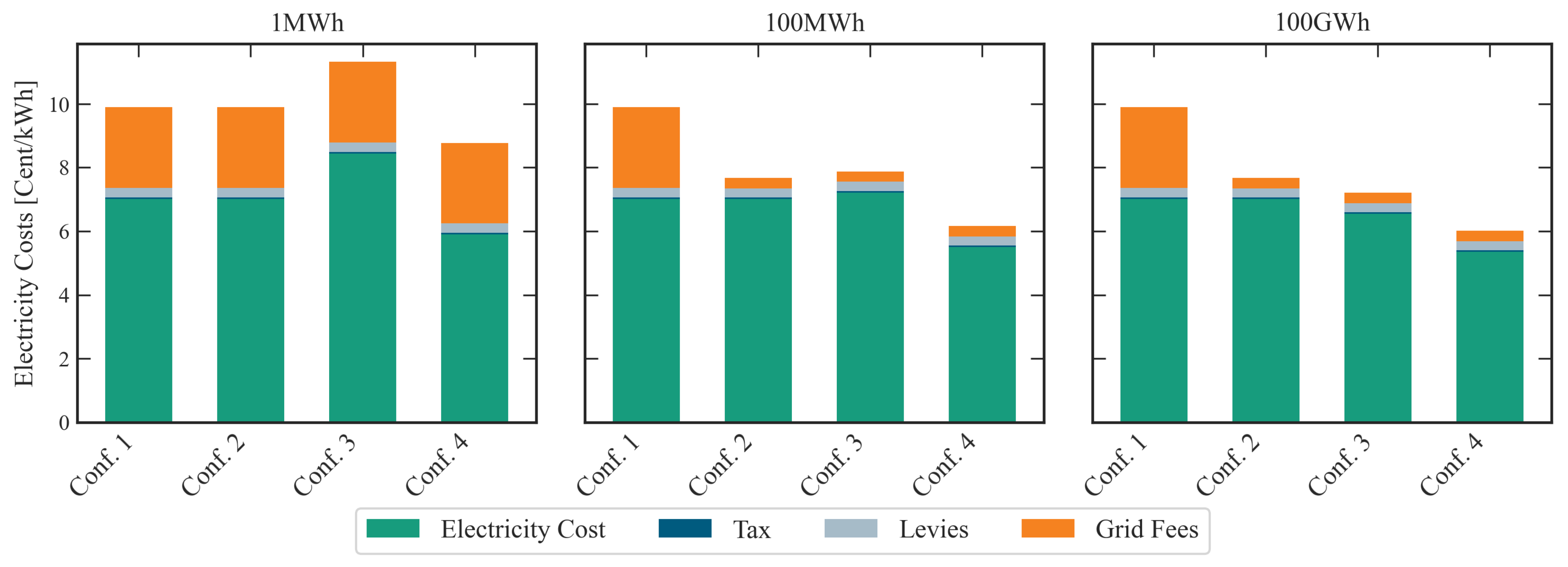
Figure 2 shows the specific average electricity price for the three storage sizes and for the four configurations, where Configuration 1 always has the status quo electricity fixed price of 7 ct/kWh plus the additional cost factors, amounting to a total average fixed price of 9.9 ct/kWh. When investigating the cost components, the most noticeable change for the large and hypothetical storages is the drop in grid fees, where the individual grid fees apply due to a minimum of 7000 FLH. Due to the already large reductions on the taxes, levies and charges for large manufacturing industries these cost components don’t contribute as much to the specific electricity price. The lowest prices are achieved in the mixed-pricing Configuration 4 for the hypothetical storage with 6 ct/kWh and for the large storage with 6.2 ct/kWh.

3.1.2. Emissions

Emission outcomes in the scenarios are driven by two opposing effects: reduced natural gas use for steam generation through electrification, and increased electricity consumption whose carbon intensity varies strongly over time. In our model, both fixed-price and day-ahead electricity are assigned the quarter-hourly carbon intensity of the German grid mix. As a result, the cost-minimizing dispatch does not necessarily align with low-carbon hours.
For the small 1 MWh storage system, operation is primarily constrained by its limited capacity and charging power and it mostly behaves like a PtH unit. Gas consumption decreases only marginally, and emissions remain close to the status quo because the storage cannot significantly shift demand in time. For the larger 100 MWh and especially the hypothetical 100 GWh storage, electricity use increases substantially and the model tends to charge in the cheapest hours. Due to the merit-order effect, these low-price hours often coincide either with high renewable output (low carbon intensity) or with low night-time demand covered by coal and gas (high carbon intensity). In the latter case, cost-optimal arbitrage can increase total emissions even though less gas is burned on-site.
This pattern is visible in the 100 GWh case, where emissions rise from about 49.4 million kgCO2 in the status quo (Configuration 1) to around 64.2 million kgCO2 in Configuration 4 despite substantial fuel switching. Emissions in Configuration 4 might still be relatively high due to the demand-based grid fees, which limit adding new peaks at lower cost and emissions. The sensitivity analysis further proves this as by removing grid fees the temporal charging pattern is changed, enabling more charging during hours with both low prices and low carbon intensity.
Overall, the results indicate that electrification via electric thermal storage does not automatically guarantee emission reductions. Under a purely cost-minimizing, carbon-unaware dispatch, the storage will exploit low-price hours even when these are associated with high grid carbon intensity. A carbon-aware dispatch formulation, for instance by adding CO2 costs or emission constraints to the optimization, would shift operation towards low-carbon hours and avoid arbitrage in high-emission periods at the expense of some additional operating cost.

3.1.3. Operation

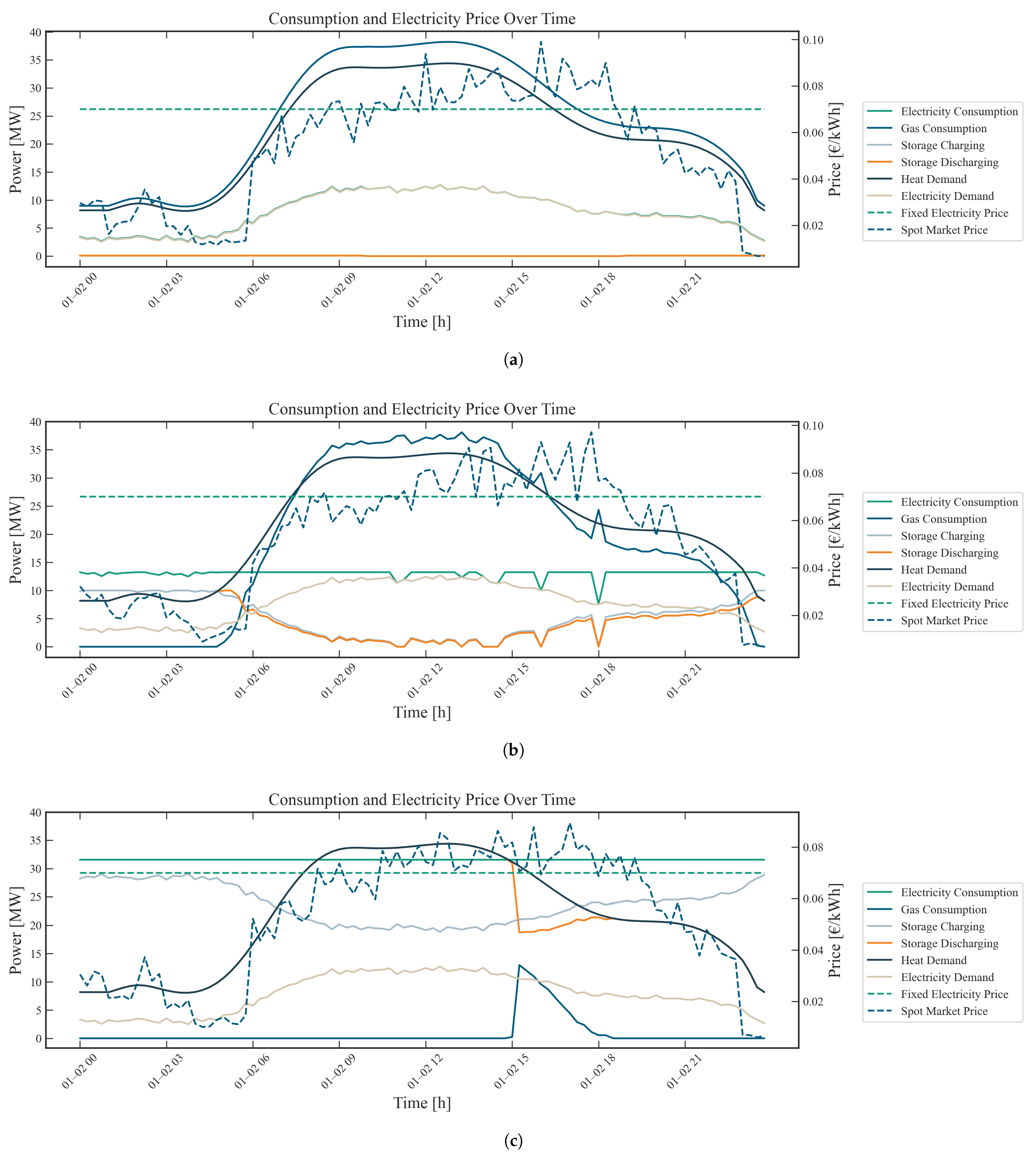
To showcase the charging and discharging operation of the storage, the three storage sizes were plotted in the mixed-pricing Configuration 4 for one day. The small 1 MWh storage operation is shown in Figure 3a, where the storage charging and discharging line as well as the electricity demand and electricity consumption line mostly overlay since electricity is generally used to provide the base electricity demand and charging and discharging are limited to a maximum of 100 kW due to the modular setup. The plots in Figure 3b,c showing the daily operation of the two larger storage sizes firstly show the tendency to charge during low electricity prices and discharge during higher electricity prices. Furthermore, they indicate that obtaining the individual 20% grid fee leads to significant cost savings which is why electricity is used to produce heat even during times when gas is slightly cheaper, as the system tries to optimize to achieve the 7000 FLH by slight margin. The large 100 MWh storage plot (Figure 3b) shows the use of the PtH option of the storage through simultaneous charging and discharging. A high gas consumption remains due to the limited storage capacity.

3.2. Sensitivity Analysis

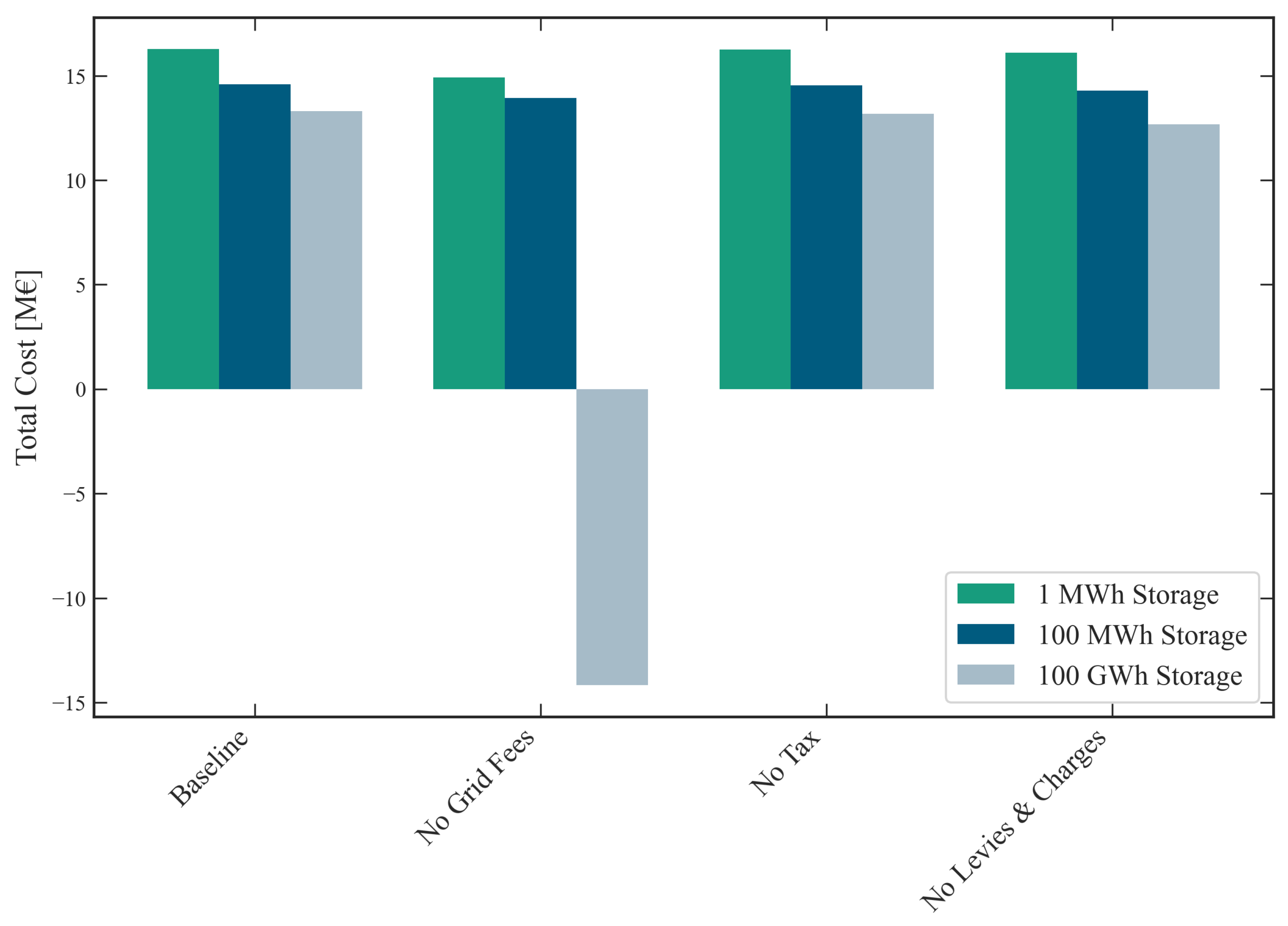
Figure 4 shows the sensitivity analysis results for total energy costs for the three storage sizes in Configuration 4 when removing individual cost components and comparing it to the baseline. The reduction of taxes, levies and charges brought a slight linear reduction in costs for all storage sizes, as these were consumption-dependent and already at a largely reduced rate for industrial consumers. For the 100 MWh storage, tax-exemption reduced the total energy costs by 0.8% and levies and charges by 4.7%. However, for the 1 MWh and 100 MWh storage, exemption of these cost components brought close to no change in operation. Only in very few moments when this slight decrease in costs resulted in lower electricity prices compared to gas prices, and under the condition of not surpassing peak power, the storage would charge more.
However, excluding grid fees completely changes behavior. It also led to negative energy costs for the hypothetical 100 GWh but as this required charging peaks of 10 GW these results can merely be seen as an indication of increased storage sizing behavior. For more realistic assumptions, the 100 MWh storage was compared showing higher peak power at 23.2 MW, an 11% decrease in electricity consumption and an overall 4.4% reduction in total energy costs. The relatively low reduction in energy costs stemming from exemption of grid fees is due to the already integrated 20% individual grid fee. The 1 MWh storage showed an 8% reduction in total energy costs. This reduction is higher since the 1 MWh storage system does not contain individual grid fee rebates, yet generally lower electricity usage.
When comparing the specific electricity prices, a huge reduction can be observed for the case of excluding grid fees. End-user price becomes 6.2 ct/kWh (from 8.8 ct/kWh), 5.3 ct/kWh (from 6.2 ct/kWh) and −3.7 ct/kWh (from 6 ct/kWh) for the storages of 1 MWh, 100 MWh and 100 GWh respectively. In the same order the procurement cost is reduced to 5.9 ct/kWh (from 5.9 ct/kWh), 4.9 ct/kWh (from 5.5 ct/kWh) and −4.1 ct/kWh (from 5.4 ct/kWh).
As for emissions, only in the 1 MWh storage system, the exemption of grid fees does not bring a reduction in emissions. This is since the storage utilizes slightly cheaper nighttime Day-Ahead prices which generally have higher emissions than daytime charging, particularly when there is low wind generation. For both the large 100 MWh and the hypothetical 100 GWh storage system, removing grid fees from the cost equations reduces emissions by 3.9 million and 14.9 million kgCO2 and 7.3% and 23.3% respectively as these are tied to the cheaper and lower carbon intensive renewable energy sources.

4. Discussion

4.1. Industry Implications and Policy Recommendations

4.1.1. Identification of Profitable Scenarios

A mixed procurement pricing strategy outperforms pure Day-Ahead and fixed pricing. When using a fixed-price contract for base electricity and Day-Ahead prices for storage charging, electricity cost reductions can be achieved. For the 100 MWh storage system, 10% of total energy costs can be saved in comparison to purely Day-Ahead pricing. Furthermore, increasing gas prices, e.g., through stronger carbon pricing, can improve the competitiveness of the electric heat storage. A carbon-intensity aware dispatch or optimization could improve both costs and emissions.
Storage sizing shows another relevant parameter in this analysis since if the storage is too small, as in the case of the 1 MWh storage, only the PtH option is used and this captures little arbitrage. Benefits are marginal unless grid fees are waived. When the storage is sufficiently large (scale up order tens of MWh) it can exploit low and negative Day-Ahead hours and approach the individual grid fee criterium, unlocking lower grid fees. The company should check if their heat demand is high enough to usefully integrate a storage of this order of magnitude. Control of the storage should include peak-aware dispatch through a charging cap as the business case is highly sensitive to peak-based grid charges.

4.1.2. Policy Recommendations

The emission results underline that cost-optimal electrification is not automatically climate-optimal. In our model, the storage dispatch is driven by minimizing total energy costs under given tariffs, without an explicit penalty on CO2 emissions. Consequently, the storage may shift load into low-price hours that are not necessarily low-carbon, especially night-time periods dominated by coal and gas generation. This explains why large storage sizes in some configurations increase emissions relative to the status quo, despite reducing on-site gas use.
A carbon-aware dispatch could be implemented in several ways. First, the optimization objective could internalize emissions by adding time-varying CO2 costs based on hourly grid carbon intensity or by applying an internal carbon price on both gas and electricity. Second, annual or monthly emission caps could be added as constraints, forcing the model to prioritize low-carbon hours even when they are not strictly cost-minimizing. Third, multi-objective formulations could explicitly trade off cost and emissions, yielding Pareto-optimal operating strategies for different carbon price levels.
Policy mechanisms can support such carbon-aware operation. Higher and more predictable CO2 prices in the EU ETS and national ETS (nEHS) strengthen the economic case for switching from gas to electricity and for operating storage in low-carbon hours. Dynamic, or at least flexibility-friendly grid fees, would lower electricity prices and reduce emissions. Otherwise, separate metering and settlement for PtH and electric heat storage could balance electric power usage and reduce costs when storage is charged in cheap atypical time frames and excluded from grid fees, as is the case with grid-serving batteries.
To incentivize electrification, rebates on cost components such as taxes, levies and charges could be coupled to verified CO2 reduction when energy for electric heat storage or other PtH options is metered separately to technologies powered through fossil fuel. Furthermore, investment support in the form of CAPEX (e.g., through grants could accelerate the implementation of more electric thermal storage systems). Additionally, enabling participation in demand response markets could create additional revenue streams without adding peaks.

4.1.3. International Comparison

Comparing the individual cost components to other European countries can give an indication of the profitability of this storage energy system setup internationally. Electricity procurement price is typically lower in solar-heavy periods in Spain [24], as well as in France for strong nuclear hours in combination with renewable energy sources [3] and in Sweden due to significant hydro and nuclear resources [25]. Poland still heavily relies on coal which would highly influence grid emissions in this analysis, however a transition to renewables can be observed [26].
The numerical results presented in this paper are calibrated to the German regulatory framework and industrial price components in 2024. Some findings are therefore tightly linked to German specifics. These include: (i) the high share of peak-based grid fees in the end-user price and their dominant role in the business case for electric storage; (ii) the structure of individual grid fee reductions under §19 StromNEV, with sharp eligibility thresholds at 7000 full-load hours and a 20% rebate in the examined case; and (iii) the fact that levies and the electricity tax are already strongly reduced for energy-intensive industries, which explains why further exemptions change total energy costs by no more than about 5%. The absolute magnitudes of cost savings, peak powers and emission changes are therefore specific to Germany.
At the same time, several insights are transferable to other European contexts with similar tariff structures. Many countries apply network tariffs (grid fees) with both energy- and power-based components and offer reduced charges for energy-intensive or atypical grid users, even if the exact design differs. In some countries, such as Poland, industries typically agree to a specific peak demand per year and are penalized when surpassing this peak power through higher surplus tariffs. In other countries, like Spain and France, banded time-of-use tariffs are implemented with higher charges during defined peak hours. Sweden usually includes a consumption and peak demand based grid fee design yet some dynamic or time-of-use designs exist [27]. Poland also has a capacity-market levy as well as significant network components for industrial tariffs [26]. In such settings, we expect the qualitative mechanisms found here to hold: mixed procurement strategies that combine fixed-price baseload with day-ahead charging of storage can outperform pure day-ahead or pure fixed contracts; very small storages mostly act as power-to-heat devices and capture little arbitrage; and the value of storage is highly sensitive to peak-based grid fees and their exemptions, while additional levies and taxes play a secondary role once reduced. Likewise, the ambiguous emission effects of cost-driven electrification and the potential benefits of carbon-aware dispatch are not unique to Germany, but relevant wherever low-price hours are not systematically aligned with low grid carbon intensity. The grid fee designs in the different countries can alter operation and impact profitability of the storage. Future work will involve a close inspection of the different national regulations to determine the most lucrative scenarios in each country.

4.2. Limitations and Uncertainties

Under the assumption of imperfect price foresight, electricity prices are predicted using additive noise drawn from a normal distribution with mean μ = 0 and standard deviation σ = 0.0875 , truncated to the interval [ 0.2 ,   0.2 ] . Solving the optimization problem for Configuration 4 under this noisy price signal results in total system costs that are approximately 45,800 € higher than in the case of perfect foresight, corresponding to an increase of about 0.2%. This indicates that while the assumption of perfect foresight leads to a slightly optimistic assessment, it nevertheless provides a robust first-order estimate of the economic potential and profitability of the thermal storage solution under dynamic electricity pricing.
This paper uses synthesized energy time series for one industrial sector due to unavailability of real profiles as these are not disclosed by the companies. Furthermore, the model contains idealized components as the ISSDemo heat storage is still under development and the current costs and parameters from the demonstration unit might differ from commercially available storage. This also includes the uncertainty of CAPEX regarding the storage, which is therefore excluded from this analysis, as well as other non-energy operating costs such as maintenance and repair.
For the 100 MWh storage and Configuration 4, annual energy cost savings of 2,276,196 € relative to a system without storage were obtained. To assess the economic viability of the storage system, a break-even investment analysis is conducted using the annuity method. Annual energy capacity costs are calculated as the sum of annualized CAPEX and OPEX:
Annual   energy   capacity   costs = C A P E X · C R F + O P E X
The capital recovery factor (CRF) is computed as in Equation (13) assuming a weighted average cost of capital (WACC) of r = 8 % and a lifetime n of 20 years [28], resulting in C R F 0.102 [29]. Annual OPEX are assumed to amount to 1% of CAPEX.
C R F = r ( 1 + r ) n ( 1 + r ) n 1
The break-even capital expenditure is obtained by equation annual savings with annualized costs. This yields a maximum admissible total investment cost of approximately 20.35 million € for the storage system, corresponding to a break-even specific investment cost of about 203.5 €/kWh of installed energy capacity. These results indicate that, under perfect price foresight, the investigated thermal storage system exhibits substantial economic margin relative to cost assumptions from the IEA for high-temperature latent heat storages of roughly 40–80 €/kWh [30].
Other prices set in this study, such as gas price and fixed electricity price, are based on assumptions of average industrial pricing contracts. This information is also highly sensitive and therefore not as easily available. As some information on electricity pricing regulation is only accessible in the national language, the focus of this study was on German regulation.
Another simplification is that the model allows the storage to charge and discharge within the same timestep. If this simultaneous operation were prohibited, the storage would operate less flexibly, reducing arbitrage opportunities and making it slightly harder to reach the 7000 full-load-hour threshold for individual grid fee reductions; annual cost savings would therefore be somewhat lower. However, we do not expect this to alter the qualitative conclusions regarding the dominant impact of peak-based grid fees, the comparatively small incremental effect of levies and taxes, or the limited arbitrage potential of very small storages.

5. Conclusions

This paper examined the economic and operational value of integrating an electric thermal energy storage for process steam into an industrial site with significant steam and base electricity demand. The study is based on German electricity price regulation and considers non-energy price components such as grid fees, levies and electricity tax with transferable qualitative insights into other European countries. A mixed-integer linear optimization model was applied to four configurations and three storage sizes (1 MWh, 100 MWh, 100 GWh). For a realistic 100 MWh storage system, the mixed procurement strategy (fixed-price plus day-ahead contract) reduces annual total energy costs by about 10% compared to pure day-ahead pricing and by around 13.5% relative to the status quo contract. In terms of specific electricity costs, the 100 MWh system achieves 6.2 ct/kWh under current grid fees in the mixed configuration, which can be further reduced to 5.3 ct/kWh when grid fees are removed in a sensitivity case.
The optimization deliberately focuses on operating energy costs; CAPEX and non-energy OPEX are excluded because the storage technology is still under development and to isolate the effects of the electricity price components. As an investment benchmark, a break-even analysis for the 100 MWh storage in the mixed procurement case was conducted which determined a maximum admissible CAPEX of about ∼203.5 €/kWh, well above current cost estimates of 40–80 €/kWh. The use of perfect foresight for prices and demand represents an upper bound on arbitrage value, but a robustness test with noisy day-ahead prices increased total costs by only ∼0.2%, indicating that the main qualitative findings are robust to moderate forecast errors.
The key finding is that arbitrage on Day-Ahead markets alone is not sufficient; the end-user electricity price, dominated by peak-based grid fees and eligibility for exemptions, determines operational energy competitiveness. One of the main insights is that a mixed procurement strategy in form of fixed and Day-Ahead electricity pricing has the largest total energy cost reduction effect. Also, grid fees dominate the business case, since in most configurations and for most storage sizes achieving individual grid fee reductions is a pivotal profitability lever, which is confirmed by sensitivity analysis. Taxes, levies and charges which are already reduced for energy-intensive industries, have a comparatively minor incremental impact. Storage size matters as very small storages (1 MWh) captures little arbitrage and tends to operate as PtH technology. Larger storage (tens of MWh) can exploit low/negative Day-Ahead prices, but only if charging is managed to avoid new site peaks.
Emission outcomes are mixed without CO2-aware control. Electrification and the use of dynamic electricity pricing does not automatically guarantee emission reductions because the cost-minimizing dispatch responds to prices, not to carbon intensity. In several configurations, especially for the hypothetical 100 GWh storage, increased electricity use in cheap but high-carbon hours (e.g., night-time coal and gas) leads to higher total CO2 emissions despite reduced on-site gas consumption. In contrast, the sensitivity without grid fees changes the temporal charging pattern and enables more charging during hours that are both low-price and low-carbon. For the 100 MWh and 100 GWh storage systems, removing grid fees reduces emissions by 7.3% and 23.3%, respectively. These findings highlight that tariff design can either dampen or misdirect flexibility, and that carbon-aware dispatch formulations (e.g., internal CO2 pricing, emission caps or multi-objective optimization) are needed to align economic flexibility with defossilization objectives.
Overall, electric thermal energy storage for process steam can be economically compelling when paired with the right tariff structure and control strategy. The fastest route to scale under German regulation with demand-based grid fees is not purely cheaper wholesale energy, but regulation and contracting that reward flexible, peak-aware electrification.
From a sustainability perspective, this work contributes to understanding how industrial electrification strategies can effectively support climate and energy goals rather than unintentionally undermining them. By embedding real-world German tariff structures, peak-based grid fees, and reductions into the optimization, the analysis shows that the same electric thermal storage technology can either increase or decrease emissions depending on pricing design and dispatch logic. This highlights that sustainable development in energy-intensive industries requires not only efficient hardware, but also carbon-aware and peak-constrained control strategies and regulatory frameworks that reward flexible, low-carbon operation.
Further research is planned in the direction of including other national regulations as well as generalized electricity cost component pricing designs. CAPEX, lifetime and maintenance of storage will be included to provide a full techno-economic analysis alongside co-optimized portfolios, such as more detailed model of the storage, inclusion of batteries, CHP, as well as on-site PV and wind electricity generation with PPAs to warrant the study. Furthermore, participation in demand response markets to incentivize grid-serving operation will be included.

Author Contributions

Conceptualization, C.v.T.d.V.; methodology, C.v.T.d.V. and J.S.; software, C.v.T.d.V. and J.S.; validation, C.v.T.d.V. and J.S.; formal analysis, C.v.T.d.V. and J.S.; investigation, C.v.T.d.V.; resources, C.v.T.d.V. and J.S.; data curation, C.v.T.d.V. and J.S.; writing—original draft preparation, C.v.T.d.V.; writing—review and editing, C.v.T.d.V. and J.S.; visualization, C.v.T.d.V. and J.S.; supervision, M.v.B.; project administration, C.v.T.d.V. and M.v.B.; funding acquisition, M.v.B. All authors have read and agreed to the published version of the manuscript.

Funding

This research was funded by CETPartnership, the Clean Energy Transition Partnership under the 2023 joint call for research proposals, co-funded by the European Commission (GA N°101069750) and with the funding organizations detailed on https://cetpartnership.eu/funding-agencies-and-call-modules (accessed on 17 December 2025). This publication was produced as part of the research project funded by the German Federal Ministry for Economic Affairs and Energy (BmWE) under grant number 03EN4071.

Institutional Review Board Statement

Not applicable.

Informed Consent Statement

Not applicable.

Data Availability Statement

Further inquiries can be directed to the corresponding author.

Conflicts of Interest

The authors declare no conflict of interest. The funders had no role in the design of the study; in the collection, analyses, or interpretation of data; in the writing of the manuscript; or in the decision to publish the results.

Abbreviations

The following abbreviations are used in this manuscript:
oemof.solphOpen Energy Modelling Framework
PtHPower to Heat
CHPCombined Heat and Power
HTHPHigh-Temperature Heat Pump
COPCoefficient of Performance
MVRMechanical Vapor Recompression
PCMPhase Change Materials
CAESCompressed Air Energy Storage
ETSEmission Trading System
nEHSGerman national ETS
CAPEXCapital Expenditures
OPEXOperational Expenditures
EPEX SPOTEuropean Power Exchange
EEXEuropean Energy Exchange
PPAPower Purchase Agreement
DE-LUBidding Zone Germany-Luxemburg
CETPartnershipClean Energy Transition Partnership
SDEWESConference on Sustainable Development of Energy, Water and Environment Systems

Appendix A

Figure A1. Electrical energy load of case study paper company for first two weeks of 2024 [17].
Sustainability 18 01802 g0a1
Figure A2. Thermal energy load of case study paper company for first two weeks of 2024 [17].
Sustainability 18 01802 g0a2
Table A1. Key technical and economic assumptions used in the case study and optimisation model.
TopicParameter/AssumptionValue/OptionsUnitDescription/Source
Modeling assumptionsForecastsPerfect foresightSteam demand, base electricity demand and day-ahead prices
Component representationLinear, idealizedFixed efficiencies, no SOC dependence
Degradation & outagesNot modeled
Simultaneous charge/dischargeAllowed
CAPEX & non-energy O&MExcluded from objectiveOnly operating (energy) costs considered in optimization
Case study demandProduct output100,000t/aMedium-sized packaging paper mill [21]
Electricity intensity530kWh/t[20]
Fuel/heat intensity1528kWh/t[20]
Annual electricity demand53GWh/aBase electricity demand
Annual thermal demand (process)149.3GWh/aProcess heat < 100 °C and 100–500 °C [17]
Gas boilerGas price7ct/kWhIndustrial gas price assumption [13]
Boiler efficiency0.9Typical industrial gas boiler [14]
Storage technologyTechnology conceptElectric latent heat storageHigh-temperature (250–500 °C) ETES
Storage capacities1; 100; 100,000MWh
Charging efficiency99%Electricity→stored heat [23]
Discharging efficiency90%Stored heat→steam [23]
Standing losses0.025%/15 minFraction of state of charge per timestep [23]
Initial/final SOC0/unconstrained%Unbalanced storage; final SOC is free
Electricity tariffsFixed price base charge3000€/aIndustrial contract [15]
Fixed price work charge7ct/kWhEnergy component of fixed contract [15]
Grid fee power price83.06€/kW·aAnnual charge based on peak 15-min load [16]
Grid fee work price0.46ct/kWhHigh-voltage grid incl. transformer [16]
Electricity tax0.05ct/kWhReduced to EU min. for manufacturing [31]
Concession fee0.11ct/kWhFor industry [31]
Levy §190.643ct/kWhElectricity Grid Charges Ordinance levy; Reduced value: 0.025 ct/kWh [31]
Levy CHP0.275ct/kWhCHP levy cost [31]
Levy offshore0.656ct/kWhOffshore grid levy [31]
Grid fee rebatesFull-load hour (FLH) threshold≥7000h/aFLH for individual grid fees
Reduction level20–10%20–15–10% depending on FLH band

References

  1. IN4climate.NRW. Prozesswärme für Eine Klimaneutrale Industrie: Impulspapier der Initiative; IN4climate.NRW: Düsseldorf, Germany, 2022. [Google Scholar]
  2. Al-Jaliel, A. Integration of a Power to Heat Storage System in a Dynamic Electricity Market: Applying the Day-Ahead Electricity Market to a Flexible Power to Heat System in Combination with Aquifer Thermal Energy Storage. Master’s Thesis, Technical University of Eindhoven, Eindhoven, The Netherlands, 2023. [Google Scholar]
  3. Grave, K.; Hazrat, M.; Boeve, S.; von Blücher, F.; Bourgault, C.; Breitschopf, B.; Friedrichsen, N.; Arens, M.; Aydemir, A.; Pudlik, M.; et al. Stromkosten der Energieintensiven Industrie: Ein Internationaler Vergleich; ECOFYS Germany GmbH: Berlin, Germany, 2015. [Google Scholar]
  4. Carpinelli, G.; Khormali, S.; Mottola, F.; Proto, D. Optimal operation of electrical energy storage systems for industrial applications. In Proceedings of the 2013 IEEE Power & Energy Society General Meeting, Vancouver, BC, Canada, 21–25 July 2013; pp. 1–5. [Google Scholar] [CrossRef]
  5. Schischke, E.; Grimpe, C. Optimal dispatch of electricity storage supporting the direct supply of industrial consumers by wind generation. E3S Web Conf. 2021, 238, 10001. [Google Scholar] [CrossRef]
  6. Buscemi, A.; Panno, D.; Ciulla, G.; Beccali, M.; Lo Brano, V. Concrete thermal energy storage for linear Fresnel collectors: Exploiting the South Mediterranean’s solar potential for agri-food processes. Energy Convers. Manag. 2018, 166, 719–734. [Google Scholar] [CrossRef]
  7. Kachel, M. Regulatorischer Rahmen für Flexibilitätsoptionen: Regulierungsrechtliche Grundlage für Batteriespeicher. Presented at the CDI Lausitzer Fachkonferenz 2024, Cottbus, Germany, 7 November 2024; Available online: https://www.cluster-dekarbonisierung.de/de/newsroom/details/lausitzer-fachkonferenz-2024-speichertechnologien-als-schl%C3%BCssel-zur-co%E2%82%82-neutralen-industrie.html (accessed on 16 September 2025).
  8. Umweltbundesamt. Nationalen Emissionshandel Verstehen. Umweltbundesamt, Dessau-Roßlau, Germany. 24 March 2025. Available online: https://www.dehst.de/DE/Themen/nEHS/nEHS-verstehen/nehs-verstehen_node.html#doc284546bodyText2 (accessed on 16 September 2025).
  9. Jan, F.; Iftikhar, H.; Tahir, M.; Khan, M. Forecasting day-ahead electric power prices with functional data analysis. Front. Energy Res. 2025, 13, 1477248. [Google Scholar] [CrossRef]
  10. ENTSO-E. ENTSO-E Transparency Platform: Energy Prices. European Network of Transmission System Operators for Electricity (ENTSO-E), Brussels, Belgium. 2024. Available online: https://newtransparency.entsoe.eu/market/energyPrices (accessed on 16 September 2025).
  11. Electricitymaps. Default Emission Factors. In Electricitymaps/Electricitymaps-Contrib. GitHub Repository. 2025. Available online: https://github.com/electricitymaps/electricitymaps-contrib (accessed on 16 September 2025).
  12. Schiller, J.; Pruckner, M. Sustainable, Situation-Aware Multi Objective Spatial Load Scheduling for Data Centers. In Proceedings of the 16th ACM International Conference on Future and Sustainable Energy Systems, Erscheinungsort Nicht Ermittelbar, Rotterdam, The Netherlands, 17–20 June 2025; ACM Digital Library: New York, NY, USA, 2025; pp. 874–881. [Google Scholar] [CrossRef]
  13. Eurostat. Gas Prices for Non-Household Consumers—Bi-Annual Data (From 2007 Onwards). Available online: https://ec.europa.eu/eurostat/databrowser/product/page/NRG_PC_203 (accessed on 15 September 2025).
  14. Sattler, G.; Schibel, T. Planungshandbuch Dampfkessel; Viessmann Werke GmbH & Co. KG: Allendorf (Eder), Germany, 2011; Available online: https://www.viessmann.de/content/dam/public-brands/master/knowledge/technology-and-systems/industrial-boilers/ph-dampfkessel.pdf (accessed on 16 September 2025).
  15. Eurostat. Electricity Prices Components for Non-Household Consumers—Annual Data (From 2007 Onwards). Available online: https://ec.europa.eu/eurostat/databrowser/product/page/NRG_PC_205 (accessed on 15 September 2025).
  16. Oberhausener Netzgesellschaft mbH (Ed.) NNE Strom: Voraussichtliche Preisblätter (Preisstand: 01.01.2024): Gem. § 20 Abs. 1 Satz 2 EnWG; Oberhausener Netzgesellschaft mbH: Oberhausen, Germany, 2024. [Google Scholar]
  17. Sandhaas, A.; Kim, H.; Hartmann, N. Methodology for Generating Synthetic Load Profiles for Different Industry Types. Energies 2022, 15, 3683. [Google Scholar] [CrossRef]
  18. von Thadden del Valle, C.; Frey, G.; van Beek, M.; Budt, M. Technologies for defossilisation of process heat: An analysis and overview of industrial processes and temperature requirements. In Proceedings of the 37th International Conference on Efficiency, Cost, Optimization, Simulation and Environmental Impact of Energy Systems (ECOS 2024); Karellas, S., Kalogirou, S., Kakaras, E., Tsatsaronis, G., Blanco Marigorta, A.M., Zoughaib, A., Eds.; Curran Associates, Inc.: Red Hook, NY, USA, 2024; pp. 311–322. [Google Scholar] [CrossRef]
  19. Klute, S. Identifizierung und Bewertung von Verfahrensrouten für die Industrielle Prozessdampferzeugung aus Tiefengeothermie; Verlag Karl Maria Laufen: Oberhausen, Germany, 2024. [Google Scholar]
  20. Godin, H. Energiewende in der Industrie: Potenziale und Wechselwirkungen mit dem Energiesektor: Branchensteckbrief der Papierindustrie; Navigant Energy Germany GmbH: Cologne, Germany, 2019. [Google Scholar]
  21. Zumdick, C. Die Deutsche Papierindustrie: Fakten, Entwicklungen und Trends. 16 September 2025. Available online: https://www.labelprint24.com/de/magazine/im-fokus-die-deutsche-papierindustrie-1109 (accessed on 16 September 2025).
  22. Komogowski, L.; Wolf, G.; Daschner, R. Verbundvorhaben TheMatIK: “Thermische Speichermaterialien zur Flexibilisierung Industrieller Kraftwerke”: Abschlussbericht: Teilvorhaben Fraunhofer UMSICHT: Laufzeit: 1 October 2016–31 December 2019; Technische Informationsbibliothek (TIB): Hannover, Germany, 2020. [Google Scholar] [CrossRef]
  23. MGA Thermal. How Do MGA Blocks Work? Large-Scale Energy Storage. Available online: https://www.mgathermal.com/energystorage (accessed on 16 September 2025).
  24. Serrano González, J.; Álvarez Alonso, C. Industrial electricity prices in Spain: A discussion in the context of the European internal energy market. Energy Policy 2021, 148, 111930. [Google Scholar] [CrossRef]
  25. Wang, Y. Renewable electricity in Sweden: An analysis of policy and regulations. Energy Policy 2006, 34, 1209–1220. [Google Scholar] [CrossRef]
  26. Tucki, K.; Orynycz, O.; Wasiak, A.; Świć, A.; Dybaś, W. Capacity Market Implementation in Poland: Analysis of a Survey on Consequences for the Electricity Market and for Energy Management. Energies 2019, 12, 839. [Google Scholar] [CrossRef]
  27. ACER. Getting the Signals Right: Electricity Network Tariff Methodologies in Europe: ACER Report on Network Tariff Practices; ACER: Ljubljana, Slovenia, 2025. [Google Scholar]
  28. Tschöpel, A. Cost of Capital Study; KPMG: Berlin, Germany, 2025. [Google Scholar]
  29. Hastings, N.A.J. (Ed.) Financial Methods. In Physical Asset Management; Springer International Publishing and Imprint Springer: Cham, Switzerland, 2021; pp. 101–122. [Google Scholar] [CrossRef]
  30. Technology: High-Temperature Latent Heat Storage. Available online: https://iea-es.org/wp-content/uploads/public/FactSheet_Thermal_Latent_HT.pdf (accessed on 16 September 2025).
  31. evm. Netzentgeltbasierte Stromumlagen für das Jahr 2024. evm Blog. 9 July 2025. Available online: https://www.evm.de/geschaeftskunden/blog-fuer-geschaeftskunden/netzentgeltbasierte-stromumlagen-fuer-das-jahr-2024/ (accessed on 20 January 2026).
Figure 1. Schematic illustration of the energy system in oemof.solph.
Sustainability 18 01802 g001
Figure 2. Specific average electricity price for the three storage sizes and per configuration.
Sustainability 18 01802 g002
Figure 3. Storage operation (charging and discharging) plot of electricity and gas consumption compared to process heat and electricity demand with fixed and Day-Ahead prices in Configuration 4 for one day: (a) for the small 1 MWh storage. (b) for the large 100 MWh storage. (c) for the hypothetical 100 GWh storage.
Sustainability 18 01802 g003
Figure 4. Sensitivity analysis showing total energy cost for the three storage sizes for Configuration 4 and removing individual cost components in comparison to the baseline.
Sustainability 18 01802 g004
Table 1. Results overview for storage with S—1 MWh, L—100 MWh and H—100 GWh capacity for the configurations (config.) 1–4.
ElementUnitConfig. 1Config. 2Config. 3Config. 4
Total CostS16,854,82116,854,82117,620,14116,266,627
L16,854,82115,972,93816,166,52814,578,625
H16,854,82115,972,93815,832,04613,297,261
Electricity ConsumptionkWhS52,993,87452,993,87453,257,44053,257,440
L52,993,87492,729,00092,729,00092,729,000
H52,993,87492,729,000178,080,244220,988,226
Gas ConsumptionkWhS165,886,342165,886,342165,625,412165,625,412
L165,886,342126,548,567126,584,936126,572,631
H165,886,342126,548,56742,651,659121,817
EmissionskgCO2S49,421,68149,421,68149,414,28049,414,280
L49,421,68154,063,79452,366,54652,894,517
H49,421,68154,290,35457,736,11864,182,311
Max Charge Amount StoragekWhS0000
L00100,000100,000
H00957,9891,290,709
Peak Demand ElectricitykWS13,24713,24713,24713,247
L13,24713,24713,24713,247
H13,24713,24725,44031,570
Grid fee rebate%SNoNoNoNo
LNo202020
HNo202020
Disclaimer/Publisher’s Note: The statements, opinions and data contained in all publications are solely those of the individual author(s) and contributor(s) and not of MDPI and/or the editor(s). MDPI and/or the editor(s) disclaim responsibility for any injury to people or property resulting from any ideas, methods, instructions or products referred to in the content.