1. Introduction
Sustainable development agendas increasingly reshape global trade governance, requiring export systems to demonstrate not only efficiency but also environmental responsibility, regulatory coherence, and social legitimacy. These pressures are particularly acute for agri-food commodities embedded in ecological systems and rural livelihoods while simultaneously subject to stringent international scrutiny. Recent scholarship highlights that sustainability outcomes depend less on the existence of regulations and more on the strength of institutional coordination across agencies and governance scales [
1,
2,
3]. In practice, regulatory expansion has not automatically improved governance coherence; instead, fragmented mandates and overlapping authorities often generate procedural ambiguity and inconsistent implementation.
In developing economies, the coordination burden is even more pronounced. Governments must simultaneously meet international standards related to sanitary controls, traceability, and environmental safeguards while pursuing domestic goals of economic growth, rural development, and employment generation [
4]. These objectives frequently diverge: trade facilitation bodies emphasize efficiency, environmental regulators prioritize precaution, and subnational governments focus on maximizing local benefits. Without strong coordination mechanisms, this divergence produces “governance overload,” in which actors face high transaction costs, duplicated procedures, and unclear compliance pathways [
5,
6].
The governance of Indonesia’s swallow bird’s nest (SBW) exports illustrates these tensions. Indonesia is the world’s largest SBW producer, connecting rural harvesters, processing facilities, and exporters to high-value markets, particularly in China and Hong Kong. Importing countries have tightened regulatory requirements over the past decade—especially regarding sanitation, traceability, and disease-risk management—resulting in expanding layers of oversight from Indonesian agencies [
7]. Yet the national export system remains characterized by overlapping authorities in quarantine, livestock health, environment, trade licensing, and local government jurisdictions. Although intended to safeguard product quality and biosecurity, this regulatory density often produces bottlenecks and inconsistent enforcement.
Empirical studies across Asia (2022–2024) show similar patterns: SPS governance struggles when documentation cycles are fragmented, verification procedures lack interoperability, and coordination among inspection and licensing authorities is weak [
8,
9,
10]. In the SBW sector, these frictions limit the integration of environmental protection and community welfare into export strategies because institutional attention becomes absorbed by procedural compliance rather than long-term sustainability.
At the subnational level, provinces such as East Java play a central role as export hubs, concentrating processing centers, laboratories, licensing bodies, and exporters. Spatial proximity increases opportunities for rapid coordination but simultaneously magnifies institutional fragmentation when jurisdictions overlap or enforcement authority is unclear. Recent analyses of regional governance structures (2021–2024) demonstrate that these hubs are sites where governance tensions become most visible—yet this level remains understudied [
11]. This lack of attention constitutes a major gap, given that coordination failures frequently emerge where national regulations intersect with local implementation realities.
Despite the strategic importance of SBW exports, scholarly work has focused mainly on ecological determinants, production practices, and market dynamics [
12,
13,
14]. These studies treat governance arrangements as static background conditions rather than dynamic systems shaped by actor configurations, power relations, and institutional interdependencies. As a result, the political and institutional dimensions of SBW export governance remain insufficiently theorized.
A second gap concerns the operationalization of multi-stakeholder governance. Although sustainability scholarship calls for greater inclusion of diverse actors, empirical work rarely maps how different stakeholders influence governance processes, how asymmetries shape coordination capacity, or why certain objectives dominate decision-making [
15]. Export governance, where regulators, technical agencies, exporters, producer groups, and foreign market actors interact, requires a systematic actor-centered framework capable of analyzing these complexities.
A third gap lies in the temporal orientation of existing studies. Much of the literature evaluates governance retrospectively, assessing past compliance performance while overlooking emerging risks shaped by evolving global standards, shifting market preferences, and the tightening of SPS requirements (2022–2024). As demonstrated in anticipatory governance scholarship, retrospective analysis is limited in contexts where uncertainty and regulatory volatility are defining features [
16,
17,
18].
To address these gaps, this study frames SBW export governance as a sustainability coordination problem, shaped not by rules alone but by actor configurations, influence–dependence patterns, and the degree of strategic alignment. It adopts a foresight-based stakeholder analysis using the MACTOR (
Méthode Acteurs, Objectifs, Rapports de Force) method, which systematically maps power relations, actor influence, dependence, convergence, and divergence across governance systems [
5,
19].
Applying MACTOR to SBW export governance in East Java shifts analytical focus from compliance outputs to relational dynamics. The approach identifies which actors possess strategic leverage, where coordination breakdowns emerge, how sustainability objectives are prioritized, and which actor coalitions are structurally feasible. This framework contributes to sustainability research by: (1) theorizing export governance as an actor-centered coordination challenge; (2) demonstrating the relevance of foresight tools for diagnosing sustainability governance in agri-export systems; and (3) identifying leverage points for improving institutional coherence and resilience.
Accordingly, this study addresses three research questions: (RQ1): How are influence and dependence distributed among key stakeholders in SBW export governance in East Java? (RQ2) To what extent do stakeholders converge or diverge in their strategic objectives related to export compliance, ecosystem sustainability, and community welfare? (RQ3) How can foresight-based stakeholder analysis inform the design of more adaptive and sustainable SBW export governance arrangements?
3. Materials and Methods
3.1. Research Design and Analytical Orientation
This study adopts a qualitative–quantitative mixed design grounded in foresight-oriented governance analysis. The overarching objective is not to predict export outcomes, but to diagnose coordination dynamics within a complex export governance system by examining actor configurations, power relations, and strategic objective alignment. Such an approach is consistent with contemporary sustainability research that emphasizes relational governance, anticipatory capacity, and institutional adaptability rather than static evaluations of policy effectiveness [
38,
39,
40].
Methodologically, the study integrates prospective analysis with structured stakeholder assessment to capture both the distribution of influence among actors and the alignment of their strategic objectives. This integration is particularly relevant for export governance contexts characterized by regulatory density, institutional fragmentation, and strong external market pressures. By combining foresight principles with systematic actor mapping, the research design enables an assessment of how governance systems function under conditions of uncertainty and interdependence [
41,
42].
The analytical framework is operationalized using the MACTOR (
Méthode Acteurs, Objectifs, Rapports de Force) method, which allows for the structured analysis of actor influence, dependence, convergence, and divergence. MACTOR is employed here as a diagnostic tool rather than as a predictive model, aligning with sustainability governance perspectives that prioritize learning and coordination over optimization [
30,
43].
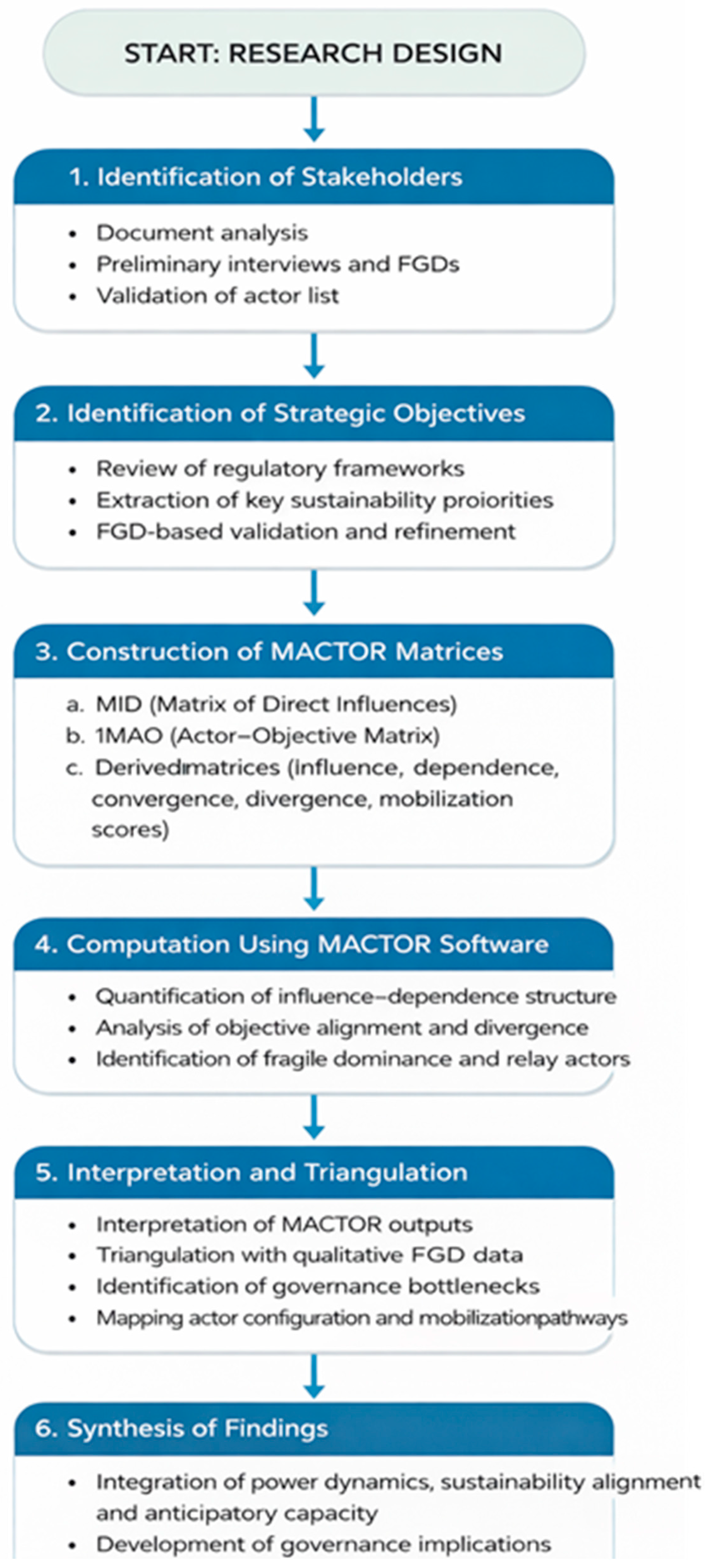
Figure 1 presents the overall research method flowchart, summarizing the sequence of analytical procedures used in this study. The flowchart outlines six stages: (1) stakeholder identification through document analysis and FGDs; (2) identification of strategic sustainability objectives; (3) construction of key MACTOR matrices including MID and 1MAO; (4) computation and derivation of influence–dependence, convergence, divergence, and mobilization indicators using MACTOR software version 5.3.0; (5) interpretation and triangulation of quantitative outputs with qualitative insights; and (6) synthesis of findings to integrate power dynamics, sustainability alignment, and anticipatory governance implications. This schematic provides a concise visualization of how the foresight-based MACTOR framework was operationalized throughout the study.
3.2. Study Area and Case Selection
East Java Province was selected as the empirical case due to its strategic role in Indonesia’s swallow bird’s nest (SBW) export system. The province functions as a major hub for processing, certification, and export logistics, hosting a concentration of regulatory agencies, technical institutions, private exporters, and producer associations. This concentration provides a rich empirical setting for examining governance interactions across institutional domains.
From a sustainability governance perspective, the provincial scale offers important analytical leverage. While national regulations define overarching export requirements, subnational institutions are responsible for interpretation, coordination, and implementation. Previous studies have shown that sustainability outcomes are often determined at this intermediate level, where formal rules encounter local administrative capacities and stakeholder interests [
26,
44]. Focusing on East Java therefore allows the analysis to capture how export governance operates in practice, rather than merely in formal regulatory design.
Recent export statistics further confirm the representativeness of East Java within Indonesia’s SBW sector. According to official data from BPS, Kemendag, and FAOSTAT, East Java accounted for approximately 27–31% of Indonesia’s total processed SBW export volume during 2021–2024, with annual shipments ranging between 280 and 340 tons, valued at USD 320–410 million. The province consistently ranks as one of the top two national export hubs, driven by its concentration of processing facilities, certified cleaning houses, and logistics infrastructure connected to the Port of Surabaya. This contribution reinforces East Java’s strategic relevance for analyzing governance dynamics, as its export performance substantially shapes national compliance credibility and market positioning.
The case selection follows a purposive logic aimed at maximizing analytical relevance rather than statistical representativeness. SBW exports in East Java exemplify broader challenges faced by export-oriented agri-food systems in developing economies, particularly those involving high-value commodities subject to stringent international standards [
2,
21].
3.3. Data Collection and Stakeholder Identification
Data collection combined primary qualitative inputs with structured expert assessment to capture the complexity of SBW export governance in East Java. Primary data were obtained through a series of focus group discussions (FGDs), semi-structured interviews, and expert consultations involving stakeholders directly participating in regulatory, technical, and commercial activities. Participants included representatives from provincial and national regulatory agencies, quarantine and laboratory institutions, export-oriented business associations, private exporters, academic specialists, and civil society organizations engaged in environmental oversight or community advocacy. This multi-actor engagement aligns with established methodological recommendations for sustainability governance research, which emphasize triangulation across administrative, technical, and market actors [
12].
Stakeholder identification followed an iterative and criteria-driven process. An initial long list of actors was developed through document analysis of regulatory frameworks, institutional mandates, and previous studies on the SBW sector. This preliminary mapping was then refined through expert validation during FGDs, allowing stakeholders to confirm actor relevance, clarify institutional roles, and identify overlooked actors who exert indirect but significant influence on governance outcomes. Such iterative refinement is widely recommended in multi-actor governance research to reduce both over-inclusion and the omission of strategically relevant actors [
27].
To strengthen the reliability of stakeholder mapping, the study engaged eight domain experts with extensive professional experience in SBW governance and agri-food regulation. Expert selection was based on four criteria:
Minimum of seven years of professional involvement in SBW export governance or sanitary–phytosanitary (SPS) regulation;
Demonstrated technical competence in certification, quarantine procedures, or export documentation;
Institutional affiliation ensuring representation from regulatory, technical, academic, and industry perspectives; and
Active engagement in policy implementation or industry coordination at the provincial or national level.
Including experts with diverse institutional backgrounds is consistent with best practices in foresight-based governance assessments, which require multi-perspective evaluation to avoid institutional blind spots and ensure a balanced representation of power and interests [
45].
The eight experts consisted of: two senior officials from the provincial livestock and animal health authority; one representative from the national quarantine agency with specialization in SPS compliance; two laboratory specialists involved in SBW hygiene and traceability verification; one senior representative from the Indonesian SBW Exporters Association; one academic expert specializing in export governance and value-chain sustainability; and one civil society practitioner focusing on environmental and community impacts of agri-export industries. Their combined experience—ranging between 7 and 22 years—ensured that the assessment integrated frontline operational knowledge with policy-level perspectives, a methodological approach recommended in recent sustainability governance studies [
25].
In total, twelve key stakeholders were formally identified as relevant to the governance of SBW exports in East Java. These stakeholders represent a cross-section of regulatory, technical, economic, and societal interests, reflecting the multidimensional nature of export governance. The identification process prioritized functional relevance over formal authority, ensuring that actors were included based on their actual influence on governance outcomes and their degree of strategic dependence within the export system. This actor-centered approach enables a more accurate representation of governance dynamics in sectors where regulatory fragmentation and interdependence shape institutional performance [
27,
45].
To enhance methodological transparency, the characteristics of the experts engaged in the assessment are summarized in
Table 1, this table highlights institutional representation, core expertise, and experience profiles essential for ensuring balanced and credible stakeholder evaluation.
The expert panel thus ensured balanced representation across regulatory, technical, industry, and societal domains. This diversity strengthened the robustness of the MACTOR inputs by integrating perspectives from actors directly involved in operational implementation as well as those evaluating ecological and social implications of SBW export governance.
3.4. Identification of Strategic Objectives
In parallel with stakeholder identification, the study identified a set of strategic objectives that structure SBW export governance. Objectives were derived through a combination of policy document analysis and stakeholder deliberation during the FGDs. This dual approach ensured that the objectives reflected both formal policy priorities and the practical concerns of actors involved in implementation.
Three strategic objectives were ultimately selected: (1) improving compliance with export protocols and certification requirements; (2) strengthening ecosystem resilience and environmental sustainability of swallow house systems; and (3) increasing local value added and community welfare. These objectives correspond to the economic, environmental, and social dimensions of sustainability, respectively, and are consistent with contemporary sustainability frameworks applied to agri-export systems [
1,
37].
The selection of a limited number of objectives was deliberate. MACTOR analysis requires a manageable set of objectives to ensure analytical clarity and to avoid diluting interpretive power. The three objectives chosen capture the principal trade-offs and alignment challenges within SBW export governance without oversimplifying the system.
3.5. Foresight-Based Analytical Framework
The study adopts a foresight-based analytical orientation to account for uncertainty and dynamic change in export governance. Foresight, as applied here, is understood as a structured process for exploring plausible futures and identifying strategic choices, rather than as an attempt to forecast specific outcomes [
13,
20]. This orientation is particularly relevant for SBW exports, which are sensitive to evolving market standards, regulatory regimes, and ecological conditions.
Within this framework, MACTOR serves as the primary analytical tool for mapping actor configurations. The method enables the examination of both current governance dynamics and their potential evolution under different alignment scenarios. By focusing on influence and dependence relationships, MACTOR provides insights into which actors hold strategic leverage, which operate under constraints, and where coordination bottlenecks are likely to emerge [
30,
43].
3.6. Operationalization of the MACTOR Method
The MACTOR analysis was conducted in several sequential steps, following established foresight protocols while adapting them to the context of export governance. First, an actor–actor influence matrix (MID) was constructed to capture direct influence relationships among stakeholders. Influence scores were assigned based on expert judgment, reflecting the capacity of one actor to affect the decisions or actions of another. Scores were validated through group deliberation to minimize individual bias.
Second, an actor–objective matrix (1MAO) was developed to assess the position of each stakeholder with respect to the identified strategic objectives. Actors indicated the degree of support or opposition toward each objective, using a standardized scale. This step allowed for the systematic mapping of objective alignment and divergence across the stakeholder system.
Third, the MACTOR software was used to compute derived matrices, including measures of indirect influence, dependence, convergence, and divergence. These computations generated quantitative indicators of actor positioning within the governance system, such as influence–dependence ratios and mobilization coefficients. While the calculations are quantitative, their interpretation remains qualitative and contextual, consistent with the diagnostic purpose of the method [
16].
3.7. Interpretation and Analytical Strategy
The interpretation of MACTOR outputs followed an iterative and reflexive analytical strategy. Rather than treating numerical scores as definitive indicators, the analysis contextualized results within the institutional and policy environment of SBW export governance. This approach aligns with sustainability governance scholarship that cautions against decontextualized quantification of complex social systems [
33,
39].
Key analytical outputs included influence–dependence maps, convergence and divergence matrices, and mobilization scores. These outputs were interpreted to identify dominant actors, dependent actors, and intermediary or relay actors. Particular attention was given to configurations indicative of fragile dominance, where high influence is combined with significant dependence on other stakeholders for implementation.
3.8. Validity, Reliability, and Robustness
Several measures were taken to enhance the validity and reliability of the analysis. First, stakeholder identification and scoring were conducted through collective deliberation rather than individual assessment, reducing subjective bias. Second, consistency checks were performed by comparing influence assessments across different respondent groups. Third, analytical interpretations were cross-validated with qualitative insights from the FGDs to ensure coherence between quantitative outputs and empirical realities.
In foresight-based research, robustness is achieved not through replication in the statistical sense, but through transparency and reflexivity [
41]. Accordingly, all analytical steps are documented clearly, enabling other researchers to adapt the framework to comparable export governance contexts.
3.9. Ethical Considerations
The study did not involve human subject research in the biomedical or clinical sense. Participation in FGDs and expert consultations was voluntary, and data were analysed in aggregate form without attributing statements to identifiable individuals. The research design adheres to ethical standards for social science research, emphasizing informed participation, confidentiality, and responsible data use.
3.10. Methodological Limitations
As with all qualitative–quantitative governance analyses, this study has limitations. The MACTOR method relies on expert judgment, which may reflect prevailing institutional perspectives. While validation procedures mitigate this risk, the results should be interpreted as indicative rather than exhaustive. Additionally, the focus on a single provincial case limits direct generalization, although the analytical framework is transferable to other export governance contexts
4. Result
4.1. Overall Actor Configuration in Swallow Bird’s Nest Export Governance
The MACTOR analysis reveals a highly stratified configuration of actors within the swallow bird’s nest (SBW) export governance system in East Java. Rather than forming a horizontally coordinated network, the system is structured around differentiated positions of influence and dependence, resulting in a governance architecture marked by asymmetrical authority and uneven operational autonomy. Such stratified configurations have been widely observed in sustainability-oriented export systems, particularly those embedded in global value chains characterized by high regulatory intensity and market scrutiny [
3,
4].
At the system level, actors are distributed across four functional groupings: dominant regulatory actors, relay or intermediary institutions, dependent economic actors, and peripheral or autonomous stakeholders. These groupings emerge consistently across multiple MACTOR outputs, including influence–dependence mapping, mobilization coefficients, and convergence matrices, indicating a stable structural pattern rather than a contingent outcome of specific assumptions. Similar functional differentiation has been identified in recent governance studies as a common feature of complex sustainability regimes, where coordination relies on role specialization rather than horizontal collaboration [
5,
26].
Dominant regulatory actors occupy the core of the governance configuration. These actors—primarily governmental institutions with rule-making and enforcement authority—exhibit high influence scores combined with relatively low dependence on other stakeholders. Their positioning reflects their capacity to define compliance requirements, authorize certification processes, and signal regulatory credibility to international markets. This pattern corresponds with findings in the global sustainability governance literature, which show that regulatory dominance remains central in export systems where market access depends on state-backed certification and compliance regimes [
1,
2].
However, the configuration also shows that dominance is not synonymous with unilateral control. While dominant actors exert substantial influence, their operational effectiveness is mediated through a set of relay institutions that translate regulatory intent into practice. These relay actors include technical agencies responsible for quarantine, certification, and quality assurance, as well as sectoral associations that interface between regulators and producers. In the MACTOR mapping, relay actors display moderate-to-high influence coupled with moderate dependence, positioning them as critical transmission nodes within the governance system. Comparable intermediary dynamics have been highlighted in recent sustainability studies emphasizing the operational centrality of technical and boundary organizations [
12,
33].
The presence of strong relay actors introduces a layered structure to SBW export governance. Rather than a direct regulator–producer relationship, governance operates through mediated interactions in which relay institutions interpret, sequence, and operationalize regulatory demands. This mediation is reflected in convergence patterns, where relay actors show alignment with dominant regulatory objectives while simultaneously maintaining functional proximity to dependent economic actors. Such layered mediation has been identified as a defining feature of sustainability governance systems that balance enforcement with implementation feasibility [
14,
24].
Dependent economic actors—comprising exporters, processing firms, and producer groups—occupy positions characterized by high dependence and comparatively low influence. Their dependence stems from multiple sources: regulatory authorization, technical certification, and market access conditioned by compliance outcomes. MACTOR results indicate that while these actors are essential for the material functioning of the export system, their capacity to shape governance priorities is structurally constrained. This asymmetry mirrors patterns observed in agri-export governance more broadly, where producers and exporters carry compliance burdens without commensurate agenda-setting power [
4,
37].
This asymmetry between influence and functional importance creates a distinctive governance tension. Economic actors bear the operational burden of compliance and sustainability implementation, yet possess limited leverage to adjust procedural requirements or sequencing. The MACTOR configuration captures this tension through high dependence scores combined with low mobilization capacity for these actors. Similar tensions have been documented in recent sustainability governance research as a source of implementation bottlenecks and uneven policy outcomes [
3,
26].
Beyond the core governance triangle of dominant, relay, and dependent actors, the configuration includes a set of peripheral or autonomous stakeholders. These actors—such as academic institutions, environmental organizations, and external market actors—exhibit relatively low influence and low dependence within the formal governance structure. Their positioning indicates that they are not embedded in day-to-day regulatory processes, yet they retain discursive or contextual relevance. Recent studies note that such peripheral actors often shape sustainability governance indirectly through knowledge production, norm diffusion, and episodic intervention rather than continuous engagement [
5,
13].
Taken together, the overall actor configuration demonstrates that SBW export governance in East Java is neither fully centralized nor genuinely collaborative. Instead, it operates as a segmented system in which authority, mediation, and implementation are distributed unevenly across actor groups. The dominance of regulatory actors provides formal coherence, while relay institutions supply operational continuity. Dependent actors ensure material execution, and peripheral stakeholders contribute contextual signals. Similar segmented configurations have been identified as characteristic of sustainability governance systems operating under high regulatory and market pressure [
5,
33].
Importantly, the MACTOR results indicate that this configuration is internally coherent but potentially fragile. The concentration of coordination functions within relay actors creates points of systemic vulnerability, particularly when procedural complexity increases or when external pressures intensify. This pattern is consistent with recent analyses of governance fragility in sustainability transitions, which highlight the risks associated with over-reliance on intermediary institutions for coordination [
14,
24]. The configuration established here thus provides a critical structural baseline for interpreting influence–dependence asymmetries, objective alignment, and mobilization patterns examined in subsequent subsections.
Table 2 below is MID Matrix: Direct Influence Scores Among SBW Stakeholders. Summarizing the strength of direct influence exerted by each actor on others within the SBW export governance system. The matrix forms the quantitative basis for identifying dominant, relay, and dependent stakeholders.
Table 2 presents the Direct Influence Matrix (MID), which quantifies how strongly each actor affects others within the export governance system. Higher MID scores indicate that an actor can directly shape decisions, procedures, or outcomes for other stakeholders. Regulatory agencies (A1–A2) consistently display high outbound influence scores, confirming their dominant position in agenda-setting and rule enforcement. Relay actors (A3–A6) show moderate influence over both regulators and economic actors, reflecting their role in translating policy into operational procedures. Economic actors (A7–A9) register high dependence but low outbound influence, indicating their structurally constrained capacity to shape governance decisions. Peripheral actors (A10–A12) remain weakly connected, with minimal direct influence on core governance processes. Overall,
Table 1 provides the quantitative foundation for understanding the stratified power configuration in
Section 4.1.
Table 3 provides the Influence–Dependence Ratio (IDR), offering a concise measure of each actor’s relative power and vulnerability within the SBW export governance network.
Table 3 presents the Influence–Dependence (I–D) scores that classify stakeholders based on their structural position within the SBW export governance system. The I–D analysis highlights the balance between an actor’s capacity to influence others and its dependence on external actors to operate effectively.
Regulators occupy the dominant position, with the highest influence and the lowest dependence, indicating strong agenda-setting authority; Exporters and Associations fall into intermediary or relay positions, showing moderate influence but also considerable dependence on regulatory clarity and supply stability; Producers and Cleaners show high dependence and low influence, confirming their vulnerable structural placement within the governance system.
This matrix provides the foundation for identifying governance bottlenecks and designing mechanisms for strengthening coordination across actors.
4.2. Influence–Dependence Dynamics and Institutional Asymmetry (Revised with Citations)
The influence–dependence analysis generated by the MACTOR framework reveals pronounced institutional asymmetries within the SBW export governance system in East Java. These asymmetries extend beyond differences in formal authority and instead reflect structural imbalances between actors’ capacity to shape decisions and their reliance on others for implementation. Similar asymmetries have been identified in sustainability-oriented export systems where regulatory density and global market exposure concentrate decision-making power while dispersing implementation responsibility [
3,
4].
At the upper end of the influence spectrum, governmental actors exhibit the highest aggregate influence scores combined with comparatively low dependence values. This positioning indicates that these institutions possess the capacity to affect the strategic orientation of the system without being strongly constrained by the actions of other stakeholders. Their influence is exercised through multiple governance channels, including export authorization, compliance rule-setting, and certification validation. Such dominance of regulatory actors is consistent with findings in global value chain governance, where state institutions act as gatekeepers to market access in high-standard export sectors [
1,
2].
However, the analysis also demonstrates that regulatory dominance is functionally conditional rather than absolute. Although dependence scores for regulatory actors are lower than those of other stakeholders, they are not negligible. Regulatory institutions depend indirectly on technical agencies to operationalize standards and on economic actors to translate compliance into actual export flows. This indirect dependence is captured in MACTOR through secondary influence pathways, reflecting relational rather than bilateral dependence. Comparable patterns have been observed in sustainability governance systems where authority is centralized but implementation is distributed [
5,
26].
Technical and implementing institutions occupy an intermediate position within the influence–dependence space. These actors demonstrate moderate-to-high influence alongside moderate dependence, reflecting their dual role as intermediaries and implementers. Their influence derives from control over procedural bottlenecks such as inspection scheduling, documentation verification, and certification sequencing, which directly condition export readiness. At the same time, their dependence arises from regulatory mandates that delimit their strategic autonomy. This intermediary positioning aligns with recent sustainability research highlighting the central yet constrained role of technical agencies in translating regulatory intent into practice [
12,
33].
This intermediate positioning produces a distinctive form of institutional asymmetry. Technical agencies are influential in operational terms but constrained in strategic terms. They can shape the timing and feasibility of compliance, yet lack authority to redefine regulatory objectives or procedural design. MACTOR outputs show that these actors frequently function as amplifiers of regulatory intent, converting abstract requirements into concrete operational constraints for exporters and producers. Such amplification dynamics have been documented as a key source of implementation pressure in sustainability governance regimes [
14].
Economic actors—including exporters, processors, and producer groups—are positioned at the opposite end of the influence–dependence spectrum. These actors consistently exhibit high dependence and low influence, indicating a structurally subordinate role in governance decision-making. Their dependence is multidimensional, encompassing regulatory authorization, technical certification, and market access conditions. Weak influence pathways toward regulators reflect the limited institutionalization of upward feedback mechanisms, a pattern commonly observed in export-oriented agri-food systems [
4,
37].
The influence–dependence structure also highlights the uneven distribution of adjustment burdens within the governance system. When regulatory requirements change or procedural complexity increases, dependent actors absorb a disproportionate share of the resulting costs. MACTOR indirect influence calculations show that regulatory changes propagate through relay institutions before reaching economic actors, amplifying dependence at the operational level. Similar burden-shifting dynamics have been identified as a structural feature of sustainability transitions governed through compliance-oriented mechanisms [
3,
26].
Peripheral stakeholders—such as academic institutions, environmental organizations, and external market actors—occupy positions characterized by low influence and low dependence within the formal governance structure. Their marginal positioning indicates limited involvement in routine governance processes, yet their episodic relevance remains visible in contexts of policy review, public scrutiny, or shifts in market demand. Sustainability governance research increasingly recognizes the indirect but consequential role of such actors in shaping norms and expectations beyond formal institutional channels [
5,
13].
Overall, the influence–dependence configuration reveals a governance system in which authority and responsibility are unevenly aligned. High-influence actors are relatively insulated from implementation constraints, while high-dependence actors bear the operational consequences of governance decisions. Intermediate actors mediate this imbalance but also become sites of accumulated coordination pressure. The consistency of these patterns across MACTOR outputs indicates that institutional asymmetry is a stable feature of SBW export governance rather than a transient anomaly, providing a critical foundation for interpreting objective alignment and mobilization dynamics in subsequent sections [
5,
14].
Next,
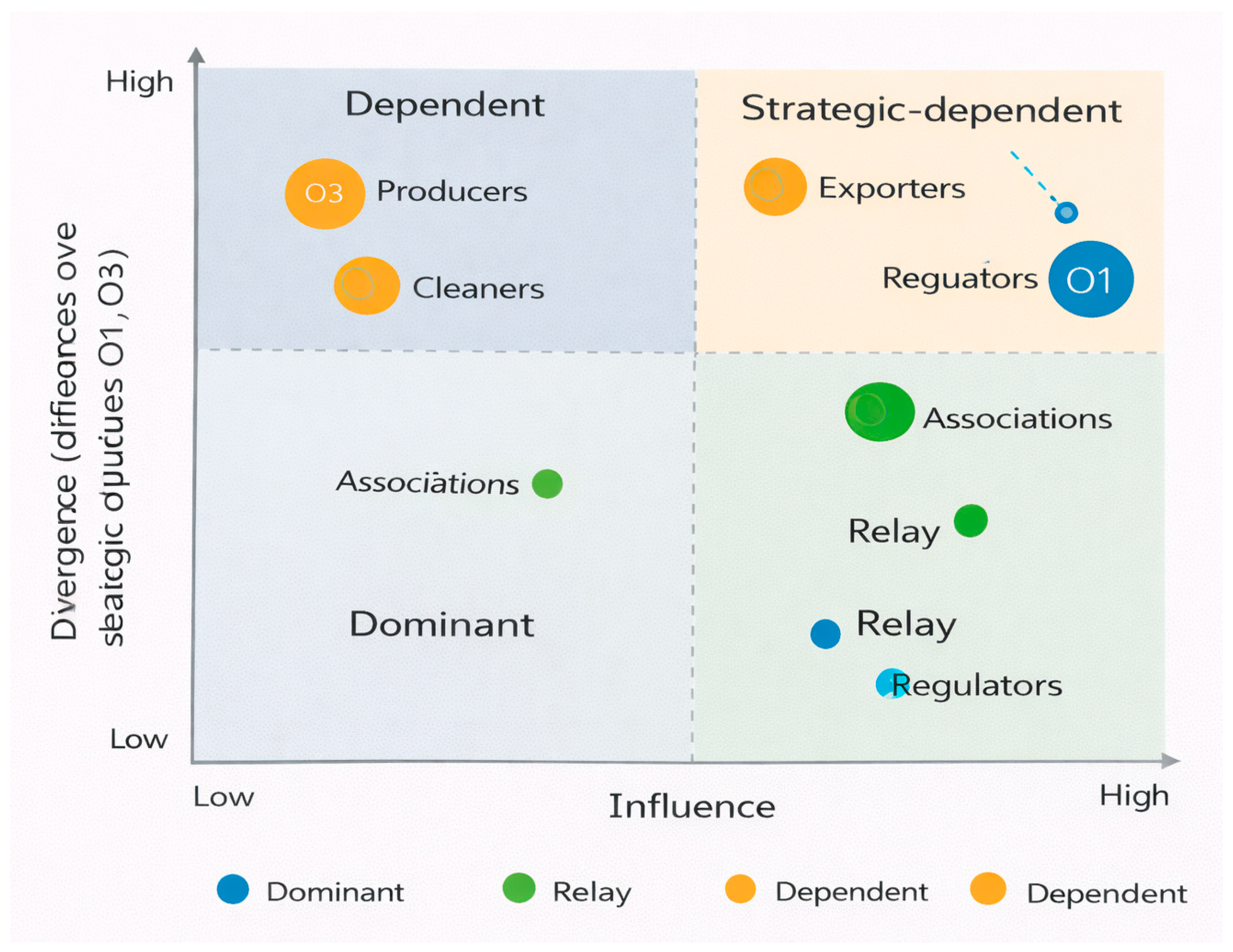
Figure 2 provides a two-dimensional visualization of actors’ relative influence and dependence within the SBW export governance system, highlighting the structural positioning of dominant, relay, dependent, and peripheral stakeholders.
Figure 2 illustrates the structural positioning of stakeholders within the SBW export governance system based on their influence (ability to shape decisions) and dependence (reliance on others for implementation). Actors in the upper-left quadrant (high influence, low dependence)—such as regulatory agencies—function as dominant actors with strong agenda-setting power. Technical and certification bodies fall in the upper-right quadrant (high influence, high dependence), indicating their role as relay actors that mediate implementation but rely heavily on regulatory guidance.
Exporters, cleaning facilities, and producer groups cluster in the lower-right quadrant (low influence, high dependence), reflecting their status as operationally essential but institutionally constrained actors. Organizations such as academic and civil society groups occupy the lower-left quadrant (low influence, low dependence), indicating peripheral yet contextually relevant roles.
4.3. Objective Alignment, Divergence, and Sustainability Trade-Offs
The MACTOR analysis of actor–objective relationships reveals a differentiated pattern of alignment and divergence across the three strategic objectives underpinning SBW export governance: export compliance, ecosystem sustainability, and local value creation. Rather than converging uniformly around a single priority, stakeholders exhibit selective alignment shaped by institutional mandates, operational constraints, and exposure to regulatory and market pressures. Such differentiated alignment has been identified in recent sustainability governance research as a characteristic feature of multi-objective systems operating under regulatory and market asymmetries [
4,
5].
Next,
Table 4 presents Convergence–Divergence Index (CDI) Across Strategic Objectives, and summarizes actor convergence and divergence (CDI) toward key sustainability objectives in the SBW export governance system.
This table displays the Convergence–Divergence Index (CDI), showing how strongly each stakeholder aligns with the three sustainability-related objectives identified in the study; Regulators and Exporters demonstrate strong alignment with O1 (Compliance & Quality Assurance), confirming that export legitimacy remains the dominant shared priority; Associations hold a moderate and bridging alignment, suggesting they can function as mediators across objectives; Producers and Cleaners show higher convergence with O3 (Local Value Creation) and meaningful interest in O2 (Ecosystem Sustainability), indicating bottom-up sustainability priorities that differ from dominant actors.
Overall, CDI results reveal objective hierarchy and embedded trade-offs, where compliance objectives are strongly institutionalized, while environmental and local welfare objectives show weaker alignment across the system.
The first objective—improving compliance with export protocols and certification requirements—shows the highest degree of convergence among dominant regulatory and technical actors. Government institutions and implementing agencies consistently register strong positive positioning toward this objective, reflecting their responsibility to safeguard regulatory credibility and secure market access. The convergence matrix indicates that compliance functions as a stabilizing anchor within the governance system, generating predictable alignment among actors with formal authority. Similar compliance-centered convergence has been observed in high-standard agri-export systems where certification is a prerequisite for participation in global value chains [
1,
2].
Economic actors also display alignment with the compliance objective, though their positioning is more conditional. MACTOR scores indicate support rather than strong advocacy, suggesting that compliance is perceived primarily as an obligation rather than a strategic preference. This distinction is empirically significant, as it indicates that alignment is driven by dependence rather than influence. Comparable patterns have been documented in sustainability governance studies where compliance masks underlying asymmetries in cost distribution and decision-making power [
3,
37].
The second objective—strengthening ecosystem resilience and environmental sustainability—exhibits a more heterogeneous alignment pattern. Environmental agencies, academic actors, and regulatory institutions with ecological mandates show strong convergence around this objective, reflecting a shared recognition of environmental degradation as a long-term risk to export viability. In contrast, economic actors demonstrate moderate or neutral alignment, indicating neither opposition nor strong commitment. This differentiated salience mirrors findings in sustainability literature that highlight uneven prioritization of environmental objectives across actor groups in export-oriented systems [
13,
26].
Notably, divergence around the sustainability objective is not characterized by direct conflict but by variations in intensity. MACTOR outputs show that divergence scores arise primarily from differences in urgency rather than polarity. Actors do not reject environmental objectives; instead, they rank them lower relative to compliance imperatives. This pattern reflects a structural trade-off commonly identified in sustainability governance, where ecological considerations compete with regulatory and economic priorities for institutional attention [
5,
24].
The third objective—increasing local value added and community welfare—reveals the most pronounced divergence among actors. Producer groups, local associations, and certain civil society actors exhibit strong alignment with this objective, reflecting their direct exposure to livelihood outcomes. In contrast, dominant regulatory actors and technical agencies display weaker alignment, indicating that community welfare remains secondary to compliance and system integrity within formal governance priorities. Exporters and processors occupy an intermediate position, showing conditional support linked to market incentives rather than intrinsic commitment. Similar distributive divergences have been widely reported in agri-export governance studies, particularly where value capture is uneven along the supply chain [
4,
37].
Across all three objectives, the MACTOR convergence–divergence matrices demonstrate that alignment is strongest where objectives are tightly coupled to regulatory authority and weakest where objectives depend on distributive outcomes. This pattern underscores a key empirical insight: sustainability trade-offs in SBW export governance are not driven by overt opposition, but by hierarchical prioritization embedded in actor roles and dependencies. The absence of extreme divergence suggests latent integrative potential, yet the layered objective hierarchy conditions how and where coordination can realistically emerge [
3,
14].
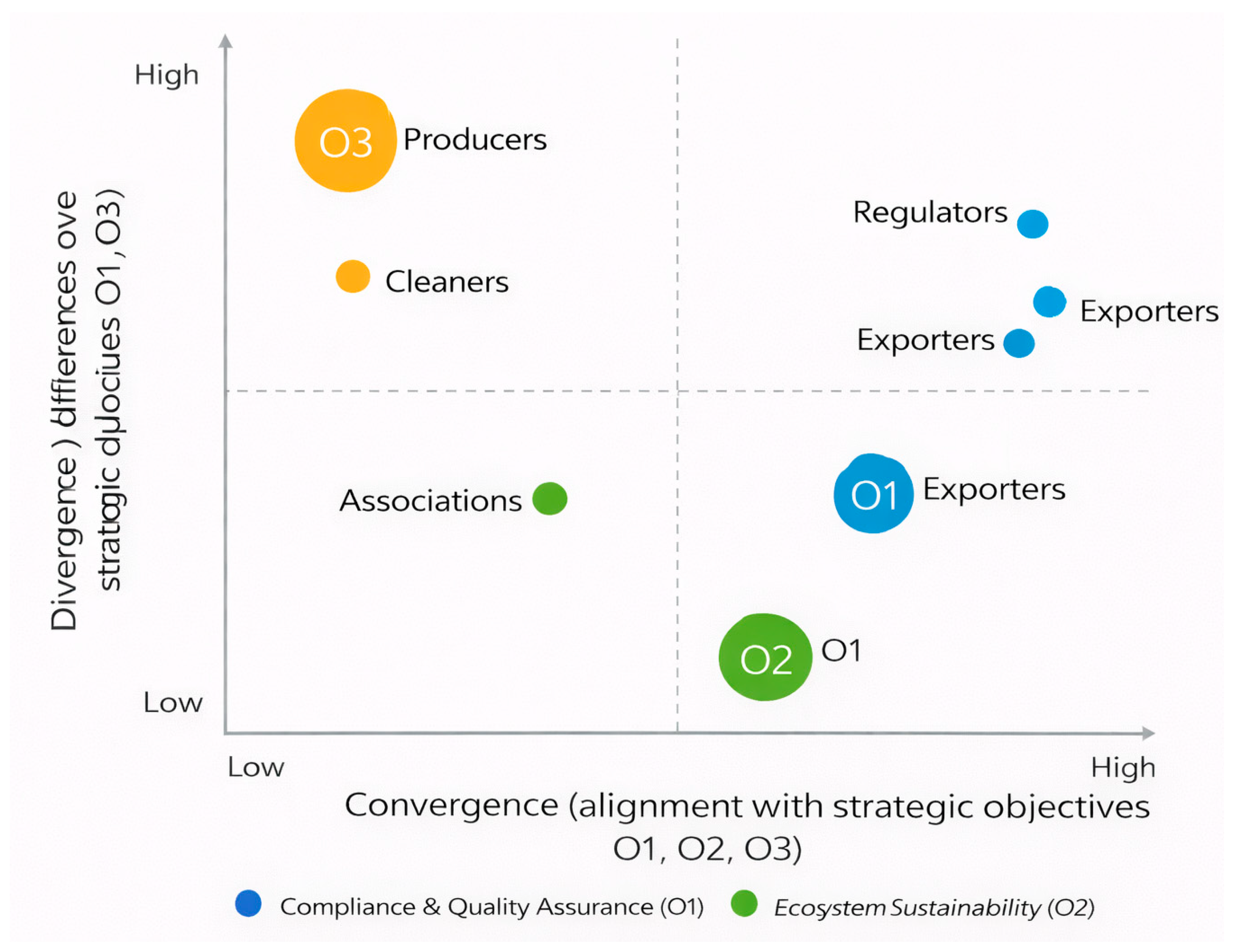
Figure 3 illustrates how SBW stakeholders differ in their alignment with the three strategic objectives. Regulatory and technical agencies cluster in the high-convergence/low-divergence quadrant, indicating strong agreement on export compliance, while producers, processors, and exporters show higher divergence due to differing priorities regarding environmental sustainability and local value creation.
4.4. Mobilization Dynamics and Coalition Potential
The MACTOR-based mobilization analysis reveals differentiated capacities among actors to initiate, sustain, and coordinate collective action across the SBW export governance system, consistent with the literature on relational power and coordination in global value chains [
5,
12,
44]. The Mobilization Coefficients (MC) show that regulatory agencies possess the strongest unilateral mobilization capacity, reflecting their formal authority and central position in enforcing compliance—a pattern commonly observed in high-standard export regimes [
1,
19,
25]. However, their coalition potential remains moderate due to limited horizontal linkages with economic actors and local communities, mirroring governance systems where strong state dominance coexists with weak cross-actor coordination [
9,
24,
26].
Technical and relay institutions exhibit a more balanced mobilization profile, combining medium-level unilateral mobilization with high coalition potential. This reinforces findings in governance scholarship indicating that intermediary actors play a bridging role in translating sustainability standards into operational practice [
12,
16,
33]. Their connectivity to both regulators and dependent actors positions them as structural nodes that facilitate cross-sectoral coordination [
27,
45].
Exporters, processors, and producer groups demonstrate low unilateral mobilization yet moderate coalition potential, reflecting their structural dependence but also their latent ability to collaborate when adequate facilitation mechanisms are present [
37,
46]. This pattern aligns with the broader literature on power asymmetries in agri-food value chains, wherein downstream actors typically shoulder heavier compliance burdens while possessing weaker influence over governance arrangements [
3,
11,
41].
Peripheral actors—such as universities, environmental organizations, and external market intermediaries—register low MC scores across all dimensions. Their marginal positioning is consistent with the characteristics of epistemic and advocacy actors, whose influence is largely discursive rather than operationally embedded [
38,
39,
40].
Overall, the mobilization results indicate that coordinated sustainability initiatives will depend heavily on strengthening intermediary institutions that can build multi-actor coalitions and facilitate systemic learning [
20,
30,
36]. These findings underscore that the success of sustainability-oriented governance is not determined solely by regulatory enforcement capacity, but by the system’s ability to translate objective alignment into collective, coordinated action [
29,
31,
35].
Table 5 below, displays the Mobilization Coefficients (MC) for all stakeholders, detailing their relative strengths in unilateral mobilization and coalition building. This matrix clarifies the mobilization landscape shaping governance outcomes.
Table 5 presents the Mobilization Coefficients (MC), which measure how capable each stakeholder is—both individually and collectively—to take action toward each strategic objective; Regulators show the highest MC for O1, indicating strong authority and organizational capacity to mobilize actors toward compliance and export credibility; Exporters similarly demonstrate high mobilization capacity for O1 but remain significantly less active on environmental and welfare-oriented goals.; Associations hold moderate and distributed mobilization, reflecting their role as potential coalition convenors.; Producers and Cleaners have lower overall MC, but display their strongest mobilization toward O3 (Local Value Creation), signalling grassroots potential for inclusive sustainability initiatives.
Overall, the MC results illustrate a governance system skewed toward rule-enforcement mobilization, with weaker collective action around environmental integrity and local welfare—reinforcing the study’s finding of fragile dominance and limited cross-objective coalition capacity.
5. Discussion
This study set out to examine sustainable export governance not as a problem of regulatory absence or technical insufficiency, but as an actor-centered coordination challenge shaped by power asymmetries, strategic dependence, and differentiated objective alignment. The MACTOR-based analysis of swallow bird’s nest (SBW) export governance in East Java provides empirical support for this framing, revealing how sustainability outcomes emerge from relational configurations rather than from formal policy design alone.
5.1. Segmented Governance and the Limits of Compliance-Centered Sustainability
The results demonstrate that SBW export governance operates through a segmented configuration in which authority, mediation, and implementation are unevenly distributed among actor groups. Dominant regulatory actors retain agenda-setting power and control over certification pathways, while dependent economic actors bear the operational burden of compliance with limited influence over governance priorities. This configuration aligns with broader findings in sustainability-oriented export systems, where compliance imperatives tend to crowd out deliberation on distributive and ecological objectives [
3,
4,
5].
Rather than indicating governance failure, this segmentation reflects a structural adaptation to global market pressure. In high-standard export sectors, regulatory dominance serves to signal credibility and reduce market risk. However, as the results indicate, such dominance also produces fragility when coordination relies heavily on intermediary institutions. Sustainability governance, in this context, becomes effective but brittle—capable of delivering compliance under stable conditions, yet vulnerable to disruption when regulatory demands intensify or market conditions shift [
14,
24].
5.2. Institutional Asymmetry as a Structural Condition, Not a Transitional Problem
The influence–dependence patterns identified in
Section 4.2 suggest that institutional asymmetry is not a transitional feature of SBW export governance but a stable structural condition. Regulatory actors are insulated from implementation constraints, while economic actors absorb adjustment costs associated with regulatory change. Intermediary institutions mediate this imbalance but simultaneously accumulate coordination pressure.
This finding contributes to sustainability governance debates by challenging the assumption that improved coordination necessarily requires greater centralization or tighter control. On the contrary, the results support arguments that excessive reliance on centralized authority can exacerbate governance fragility when strategic dependence is insufficiently acknowledged [
24,
26]. Effective sustainability governance thus requires not the elimination of asymmetry, but its strategic management through institutional arrangements that recognize interdependence and distribute coordination capacity more evenly.
5.3. Objective Hierarchies and the Politics of Sustainability Trade-Offs
The analysis of actor–objective alignment reveals that sustainability trade-offs in SBW export governance are structured through hierarchical prioritization rather than overt conflict. Export compliance functions as a non-negotiable anchor objective, generating strong convergence among actors with formal authority. In contrast, ecosystem sustainability and local value creation exhibit weaker and more differentiated alignment, reflecting variations in salience rather than opposition.
This pattern resonates with recent sustainability scholarship emphasizing that trade-offs often emerge through institutionalized ranking of objectives rather than through explicit contestation [
5,
24]. Actors do not reject environmental protection or community welfare; instead, these objectives are subordinated to compliance imperatives embedded in global value chain governance. Such hierarchy constrains the scope for integrative sustainability strategies unless mechanisms are introduced to elevate the institutional standing of non-compliance objectives.
5.4. The Strategic Role—and Vulnerability—of Intermediary Institutions
One of the most significant insights from this study concerns the role of relay or intermediary actors. These institutions occupy structurally central positions, translating regulatory intent into operational practice while maintaining proximity to dependent economic actors. Their positioning enables system stability under normal conditions, yet also constitutes a point of vulnerability when coordination demands increase.
This dual role underscores the importance of intermediary institutions as leverage points for governance reform. Strengthening their capacity, discretion, and feedback channels may yield greater sustainability gains than expanding regulatory oversight. At the same time, overburdening these actors without commensurate authority risks amplifying governance fragility—a pattern widely observed in sustainability transitions governed through layered compliance regimes [
14,
33].
5.5. Implications for Foresight-Based and Adaptive Export Governance
By applying MACTOR as a foresight-based diagnostic tool, this study demonstrates the value of anticipatory analysis for sustainability governance. Rather than evaluating governance effectiveness retrospectively, the approach identifies coordination risks, dominance fragilities, and alignment gaps that may constrain future sustainability outcomes.
The findings suggest that adaptive export governance requires more than policy refinement. It demands institutional learning mechanisms capable of responding to feedback from dependent actors and intermediary institutions. Embedding such mechanisms—through structured dialogue, iterative adjustment, and anticipatory assessment—can enhance governance resilience without undermining regulatory credibility [
13,
29].
5.6. Contributions and Transferability
This study contributes to sustainability research in three respects. Empirically, it provides one of the few actor-centered analyses of SBW export governance, a strategically important yet under-theorized sector. Analytically, it demonstrates the relevance of foresight-based stakeholder analysis for diagnosing sustainability coordination problems in export systems. Conceptually, it advances an understanding of sustainable export governance as a relational and anticipatory process rather than a compliance checklist.
While grounded in the East Java context, the analytical insights are transferable to other high-value agri-export systems facing similar pressures. Segmented governance, institutional asymmetry, and objective hierarchy are not idiosyncratic features but recurring patterns in sustainability-oriented global trade. Recognizing and addressing these patterns is therefore essential for designing export governance arrangements that are not only compliant, but resilient and substantively sustainable.
5.7. Policy Implications for Sustainable SBW Export Governance
The MACTOR results point to several concrete reforms needed to address segmented governance, institutional asymmetry, and fragile dominance in the SBW export system. These recommendations are directed at regulatory agencies, intermediary institutions, and economic actors, with a focus on coordination capacity and long-term sustainability.
Regulatory agencies: from fragmented control to coordinated governance
Integrate export procedures by developing a single digital window that connects quarantine, veterinary, licensing, and certification processes, with standardized timelines and transparent tracking of applications.
Institutionalize joint coordination forums (e.g., quarterly inter-agency meetings at provincial level) where regulators, technical agencies, and industry representatives review bottlenecks, align interpretations of standards, and agree on procedural adjustments.
Adopt risk-based inspection protocols that prioritize high-risk facilities and shipments, reducing unnecessary delays for compliant exporters while maintaining biosecurity and food safety.
Intermediary and technical institutions: consolidating relay capacity
Strengthen mandates and resources of technical and quarantine agencies so they can act as effective relay institutions—issuing binding technical guidelines, sequencing inspections, and providing early warning about emerging coordination problems.
Develop standard operating procedures (SOPs) that translate national regulations into step-by-step operational guidance for SBW producers, cleaning facilities, and exporters, including clear documentation requirements and timelines.
Create formal feedback channels (e.g., structured reporting templates and periodic technical clinics) through which intermediaries can escalate recurrent implementation issues to higher-level regulators.
Exporters and producer groups: reducing vulnerability and enhancing local value
Promote collective compliance mechanisms, such as group certification, shared laboratory facilities, or jointly managed traceability systems, to reduce per-unit compliance costs for small and medium producers.
Encourage upstream upgrading by supporting investment in cleaning, grading, and quality assurance infrastructure within East Java, linking compliance improvements with higher local value capture.
Establish representative platforms (e.g., provincial SBW exporter–producer fora) that can articulate implementation challenges, negotiate realistic transition periods for new regulations, and co-design support programs with public agencies.
Cross-sectoral and anticipatory mechanisms: building long-term resilience
Set up a provincial multi-stakeholder platform dedicated to SBW sustainability, bringing together regulators, intermediaries, exporters, producer groups, and knowledge institutions to deliberate on ecological impacts, community welfare, and market trends.
Embed foresight and scenario analysis within provincial planning units to anticipate changes in import regulations, consumer preferences, and ecological risks, and to test the robustness of existing governance arrangements against plausible futures.
Develop monitoring and learning systems that track not only export volumes and rejection rates, but also coordination performance (e.g., processing times, frequency of procedural conflicts) and distributional impacts on producers and local communities.
Taken together, these recommendations translate the actor-centered diagnosis into actionable entry points for reform. They are designed to shift SBW export governance from a predominantly compliance-driven system toward a more coordinated, anticipatory, and inclusive sustainability regime, without undermining the regulatory credibility required in high-standard international markets.
6. Conclusions
This study set out to examine swallow bird’s nest (SBW) export governance not as a technical compliance apparatus, but as a sustainability coordination system shaped by actor configurations, power asymmetries, and anticipatory capacity. Using a foresight-based stakeholder analysis through the MACTOR method, the research provides a systematic diagnosis of how influence, dependence, objective alignment, and mobilization interact within a complex export governance environment. The findings show that sustainability outcomes in export systems depend not only on regulatory stringency, but on the relational architecture through which governance is enacted.
The empirical results reveal a stratified governance structure characterized by dominant regulatory actors, intermediary relay institutions, dependent economic stakeholders, and peripheral actors with contextual influence. This constellation produces a system that is formally coherent yet operationally uneven. Regulatory dominance ensures compliance credibility and access to international markets, but it does not automatically generate coordinated action across environmental and social dimensions. Governance effectiveness ultimately hinges on the ability of intermediary institutions to mediate, translate, and mobilize actors across institutional boundaries. When such mediation is limited, sustainability objectives beyond compliance tend to remain weakly operationalized.
A key contribution of this study lies in demonstrating the condition of fragile dominance in export governance. Dominant actors hold high formal authority, yet their effectiveness depends structurally on other stakeholders for implementation. This dependence creates vulnerabilities that cannot be resolved solely through additional regulation. Fragile dominance thus describes a situation in which control is centralized while adaptive capacity is distributed and unevenly supported. Understanding this condition helps explain why sustainability initiatives often excel in enforcing standards but struggle to integrate ecological resilience and local welfare into export strategies.
The analysis of objective alignment and divergence further illustrates the presence of embedded sustainability trade-offs. Export compliance emerges as the most strongly institutionalized and widely shared priority, generating substantial convergence among regulatory and technical actors. By contrast, ecosystem sustainability and local value creation show weaker alignment and lower mobilization potential. These trade-offs are not the result of overt conflict, but of hierarchical prioritization shaped by institutional mandates and actor roles. This highlights that sustainability challenges often arise not from lack of commitment, but from structural conditions that elevate certain objectives over others.
Mobilization and coalition patterns provide another important insight: enforcement capacity does not equate to collaborative capacity. Regulatory actors demonstrate strong unilateral mobilization around compliance-related goals, but coalition potential declines sharply for objectives requiring negotiation, learning, and cross-sectoral coordination. Intermediary institutions hold the latent potential to bridge these gaps, yet their limited strategic autonomy constrains their ability to convene sustained collaboration. Consequently, sustainability governance remains oriented toward rule enforcement rather than collective problem-solving.
Methodologically, this study demonstrates the value of MACTOR as a foresight-based diagnostic tool. The approach enables simultaneous examination of power relations, objective alignment, and mobilization capacity, providing a more comprehensive understanding of governance dynamics than descriptive or compliance-based frameworks. Applied to an export governance context, this method shows strong potential for anticipating coordination challenges and identifying institutional vulnerabilities before they become binding constraints.
The findings also reinforce the importance of relational and anticipatory perspectives in sustainability governance. Effective governance should not be viewed as the execution of a fixed institutional blueprint, but as an evolving coordination process shaped by actor interactions, feedback loops, and adaptive capacity. Export systems operate under high uncertainty and external pressure, making learning-oriented and anticipatory mechanisms essential. Without institutional pathways that convert alignment into mobilization, sustainability objectives risk remaining aspirational rather than actionable.
Several limitations should be acknowledged. This study focuses on a single provincial case, limiting direct generalization. Nonetheless, the analytical framework is designed to be transferable to other export-oriented agri-food systems facing similar governance challenges. MACTOR also relies on expert judgment, which may reflect prevailing institutional perspectives despite validation measures. Future research could incorporate longitudinal designs or comparative case studies to examine how actor configurations and mobilization patterns evolve across time or regulatory contexts.
Building on these insights, future work could explore how strengthening intermediary institutions affects sustainability outcomes in export systems. Comparative studies across commodities or regions could illuminate how different governance architectures condition coordination capacity. Integrating foresight-based analysis with quantitative performance metrics would also deepen understanding of how governance dynamics translate into measurable sustainability impacts.
In conclusion, this study shows that sustainable export governance cannot be reduced to compliance mechanisms or regulatory capacity alone. It is fundamentally a coordination challenge shaped by power relations, objective hierarchies, and mobilization pathways. A foresight-based approach enables a deeper understanding of these dynamics and provides a foundation for more resilient and substantively sustainable export governance. Moving forward, strengthening relational coherence among regulatory, intermediary, and economic actors will be essential for aligning short-term compliance requirements with long-term sustainability objectives.
Integrated Limitations
While this study provides a structured analysis of stakeholder configurations and coordination challenges within Indonesia’s SBW export governance, several limitations should be acknowledged to contextualize its findings. First, the analysis relies on a purposively selected group of experts and stakeholders, which, although diverse and institutionally representative, may not capture the full range of perspectives across Indonesia’s broader SBW value chain. Second, the MACTOR method—while powerful in mapping influence, dependence, and objective alignment—relies on perception-based scoring that is sensitive to the judgments and experience of participating experts; thus, results should be interpreted as a structured diagnostic rather than a definitive measurement of power relations. Third, the study focuses on a single provincial hub (East Java), which limits the generalizability of findings to other regions where regulatory capacities, market structures, and ecological conditions differ. Future research would benefit from expanding comparative provincial analyses, increasing the number of expert respondents, and integrating quantitative performance indicators to complement actor-based foresight diagnostics.