Towards an Ethical Consensus for Sustainable Development: An Integrative Review on the Role of Values, Morals, and Norms in Shaping Pro-Environmental Behaviour




Abstract
1. Introduction
- RQ1:
- How do weak and strong sustainability paradigms conceptualise the substitutability of natural capital, and how do these differences influence approaches to non-market environmental valuation?
- RQ2:
- How do psychological and behavioural factors (e.g., values, norms, perceptions, and emotions) shape pro-environmental behaviour within the scope of environmental valuation?
- RQ3:
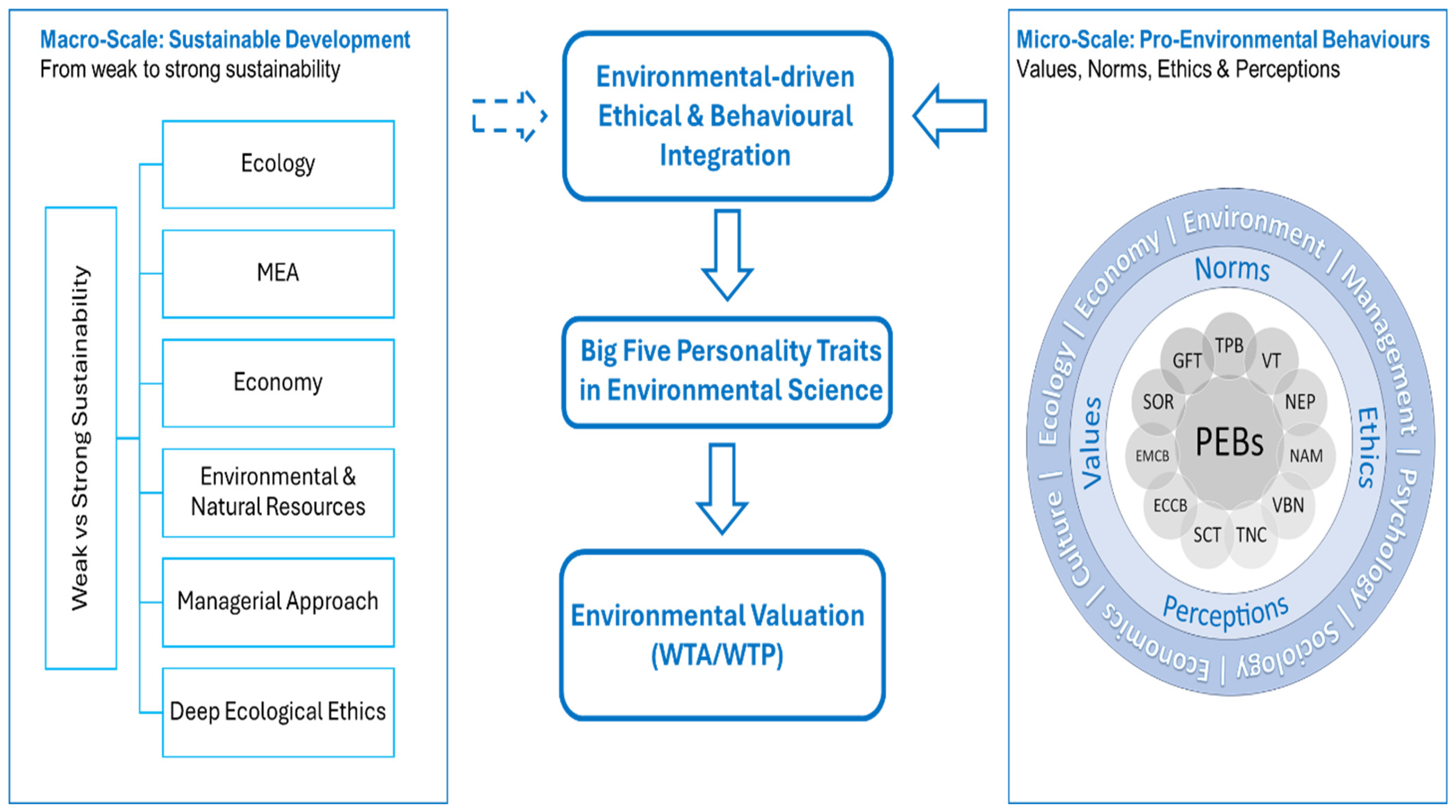
- How can the integration of macro-scale sustainability frameworks with micro-scale psychological and behavioural dimensions support the development of an ethical consensus for sustainable development and more robust environmental valuation practices?
2. Materials and Methods
2.1. Literature Search Strategy
2.2. Eligibility Criteria
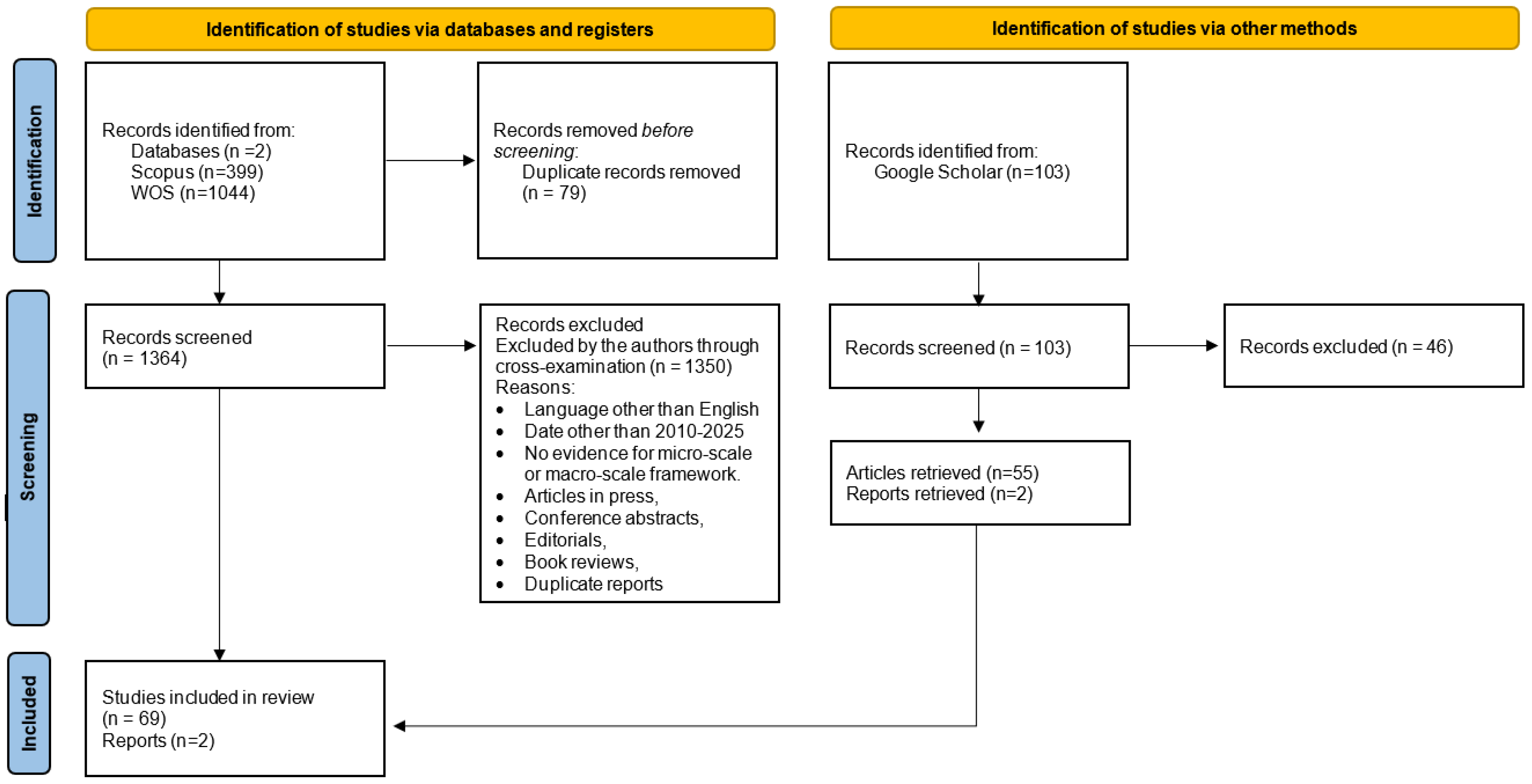
2.3. Study Selection and Screening Process
2.4. Methodological Considerations and Limitations
3. The Macro-Scale Perspective: From Weak to Strong Sustainability
3.1. Ecological Aspects
3.2. The Four MEA Scenarios
3.3. The Transition from Linear to Circular Economy
3.4. Environmental Economics and Managerial Decision-Making
3.5. Ethical and Psychological Aspects
4. The Micro-Scale Perspective: Values, Norms, Ethics, and Perceptions
5. The Aspects of Big Five Personality Traits in Environmental Science
6. Monitoring the Structure of Psychological-Oriented Frameworks: Three Cases
7. Limitations and Future Research
8. Conclusions and Policy Implications
Supplementary Materials
Author Contributions
Funding
Data Availability Statement
Acknowledgments
Conflicts of Interest
Abbreviations
| 3M Model | Meta-theoretic Model of Motivation |
| BFPTs | Big Five Personality Traits |
| CCAS | Climate Change Anxiety Scale |
| CSR | Corporate Social Responsibility |
| ECCB | Ecologically Conscious Consumer Behaviour |
| EMCB | Ethically Minded Consumer Behaviour |
| ESG | Environmental and Social Governance |
| FFM | Five Factor Model |
| FFMQ | Five Facet Mindfulness Questionnaire |
| GAD-7 | Generalised Anxiety Disorder |
| GFT | Goal-Framing |
| HEXACO | Honesty-Humility, Emotionality, Extraversion, Agreeableness (versus anger), Conscientiousness, Openness to experience |
| LNOB | Leaving-No-One-Behind |
| NAM | Norm-Activation Model |
| NEP | New Environmental Paradigm |
| NR | Nature relatedness |
| OCEAN | Openness to Experience, Conscientiousness, Extraversion, Agreeableness, Neuroticism |
| PEB | Pro-Environmental Behaviour |
| SCT | Social Cognitive Theory |
| SDGs | Sustainable Development Goals |
| SHIFT | Social, Habit, Individual self, Feelings and cognition, and Tangibility |
| SOR | Stimulus-Organism-Response |
| TNC | Theory of Normative Conduct |
| TPB | Theory of Planned Behaviour |
| UN | United Nations |
| VBN | Value-Belief-Norm |
| VEB | Voluntary Environmental Behaviour |
| VT | Value Theory |
| WCED | World Commission on Environment and Development |
Appendix A

| Thematic: Weak vs. Strong Sustainability | |||
|---|---|---|---|
| Database | Boolean Search | Doc. | Research Fields |
| Scopus | ALL (capital substitutability) AND (Techno-optimism) OR (Ecological limits) OR (Critical natural capital recognised) OR (Ecological thresholds respected) OR (No capital substitutability) OR (Intrinsic ecological value) AND (Ethical ecology) AND (Economic growth) | 51 |
|
| WOS | (Full OR high capital substitutability) AND (Techno-optimism) AND (Economic growth priority) AND (Ecological limits weak OR ignored) OR (Restricted capital substitutability) AND (Critical natural capital recognised) AND (Ecological thresholds respected) OR (No capital substitutability) AND (Intrinsic ecological value) AND (Ethical ecology) AND (Economic growth) | 23 |
|
| Thematic: Environmental Psychology | |||
|---|---|---|---|
| Database | Boolean Search | Doc. | Research Fields |
| Scopus | TITLE-ABS-KEY (“pro-environmental behavior” OR “pro-environmental behaviour” OR PEB) AND (“theory of planned behavior” OR TPB OR “value-belief-norm” OR VBN OR “norm activa-tion model” OR NAM OR “new environmental paradigm” OR NEP OR “theory of normative conduct” OR TNC OR “social cognitive theory” OR SCT) OR (“ethically minded consumer behaviour” OR EMCB OR “ecologically conscious consumer behaviour” OR ECCB OR “voluntary environmental behaviour” OR VEB) AND (ethics OR morality OR values OR norms) OR (“climate anxiety” OR eco-anxiety OR psy-chological wellbeing) AND (pro-environmental behavior OR climate action OR environmental engagement) OR (“corporate social respon-sibility” OR CSR OR “environmental social governance” OR ESG) AND (“voluntary environmental behavior” OR employee pro-environmental behavior) AND PUBYEAR > 2009 AND PUBYEAR < 2026 AND PUBYEAR > 2009 AND PUBYEAR < 2026 AND (LIMIT-TO (SRCTYPE, “j”)) AND (LIMIT-TO (PUBSTAGE, “final”)) AND (LIMIT-TO (SUBJAREA, “SOCI”) OR LIMIT-TO (SUBJAREA, “ENVI”) OR LIMIT-TO (SUBJAREA, “ECON”) OR LIMIT-TO (SUBJAREA, “PSYC”) OR LIMIT-TO (SUBJAREA, “EART”) OR LIMIT-TO (SUBJAREA, “AGRI”) OR LIMIT-TO (SUBJAREA, “BUSI”)) AND (LIMIT-TO (LANGUAGE, “English”)) AND (LIMIT-TO (EXACTKEYWORD, “Pro-environmental Behavior”) OR LIMIT-TO (EXACTKEYWORD, “Sustainable Development”) OR LIMIT-TO (EXACTKEYWORD, “Pro-environmental Behaviors”) OR LIMIT-TO (EXACTKEYWORD, “Article”) OR LIMIT-TO (EXACTKEYWORD, “Climate Change”) OR LIMIT-TO (EXACTKEYWORD, “Environmental Values”)) | 348 |
|
| WOS | (“pro-environmental behavior” OR “pro-environmental behaviour” OR PEB) AND (“theory of planned behavior” OR TPB OR “value-belief-norm” OR VBN OR “norm activation model” OR NAM OR “new environmental paradigm” OR NEP OR “theory of normative conduct” OR TNC OR “social cognitive theory” OR SCT) OR (“ethically minded consumer behaviour” OR EMCB OR “ecologically conscious consumer behaviour” OR ECCB OR “voluntary environmental behaviour” OR VEB) AND (ethics OR morality OR values OR norms) OR (“climate anxiety” OR eco-anxiety OR psychological wellbeing) AND (pro-environmental behavior OR climate action OR environmental engagement) OR (“corporate social responsibility” OR CSR OR “environmental social governance” OR ESG) AND (“voluntary environmental behavior” OR employee pro-environmental behavior) | 1021 |
|
References
- Sachs, J.D.; Flanagan, O. Introduction. In Ethics in Action for Sustainable Development; Sachs, J.D., Sorondo, M.S., Flanagan, O., Vendley, W., Annett, A., Thorson, J., Eds.; Columbia University Press: New York, NY, USA, 2022. [Google Scholar]
- Gkargkavouzi, A.; Halkos, G. The Psychology of Non-Market Environmental Valuation: An Integrative Review of Research Evidence, Theoretical Insights, and Policy Considerations. J. Environ. Psychol. 2025, 101, 102510. [Google Scholar] [CrossRef] [Scilit]
- Halkos, G.E.; Aslanidis, P.C. The Socio-Cultural and Spiritual Dimensions on Non-Marketed Environmental Valuation. Sustain. Dev. 2025, 34, 407–426. [Google Scholar] [CrossRef] [Scilit]
- Wamsler, C.; Osberg, G.; Osika, W.; Herndersson, H.; Mundaca, L. Linking Internal and External Transformation for Sustainability and Climate Action: Towards a New Research and Policy Agenda. Glob. Environ. Change 2021, 71, 102373. [Google Scholar] [CrossRef] [Scilit]
- Wamsler, C.; Schäpke, N.; Fraude, C.; Stasiak, D.; Bruhn, T.; Lawrence, M.; Schroeder, H.; Mundaca, L. Enabling New Mindsets and Transformative Skills for Negotiating and Activating Climate Action: Lessons from UNFCCC Conferences of the Parties. Environ. Sci. Policy 2020, 112, 227–235. [Google Scholar] [CrossRef] [Scilit]
- Dasgupta, P. The Economics of Biodiversity: The Dasgupta Review. Available online: https://assets.publishing.service.gov.uk/media/602e92b2e90e07660f807b47/The_Economics_of_Biodiversity_The_Dasgupta_Review_Full_Report.pdf (accessed on 15 October 2023).
- Halkos, G.E.; Aslanidis, P.-S.C. How Waste Crisis Altered the Common Understanding: From Fordism to Circular Economy and Sustainable Development. Circ. Econ. Sustain. 2024, 4, 1513–1537. [Google Scholar] [CrossRef] [Scilit]
- Geissdoerfer, M.; Savaget, P.; Bocken, N.M.P.; Hultink, E.J. The Circular Economy—A New Sustainability Paradigm? J. Clean. Prod. 2017, 143, 757–768. [Google Scholar] [CrossRef] [Scilit]
- Halkos, G.E. Sulphur Abatement Policy. Energy Policy 1993, 21, 1035–1043. [Google Scholar] [CrossRef] [Scilit]
- Halkos, G.E.; Matsiori, S. Gathering Society’s Opinion of the Sustainable Management and Economic Value of the Coastal Zone. Sustain. Dev. 2018, 26, 701–712. [Google Scholar] [CrossRef] [Scilit]
- Benyus, J.M. Biomimicry: Innovation Inspired by Nature; HarperCollins E-Books: New York, NY, USA, 2002. [Google Scholar]
- McDonough, W.; Braungart, M. Cradle to Cradle: Remaking the Way We Make Things; North Point Press: New York, NY, USA, 2002; ISBN 978-0-86547-587-8. [Google Scholar]
- Braungart, M.; McDonough, W.; Bollinger, A. Cradle-to-Cradle Design: Creating Healthy Emissions—A Strategy for Eco-Effective Product and System Design. J. Clean. Prod. 2007, 15, 1337–1348. [Google Scholar] [CrossRef] [Scilit]
- White, K.; Habib, R.; Hardisty, D.J. How to SHIFT Consumer Behaviors to Be More Sustainable: A Literature Review and Guiding Framework. J. Mark. 2019, 83, 22–49. [Google Scholar] [CrossRef] [Scilit]
- Whitmarsh, L.; Player, L.; Jiongco, A.; James, M.; Williams, M.; Marks, E.; Kennedy-Williams, P. Climate Anxiety: What Predicts It and How is It Related to Climate Action? J. Environ. Psychol. 2022, 83, 101866. [Google Scholar] [CrossRef] [Scilit]
- Wamsler, C.; Bristow, J. At the Intersection of Mind and Climate Change: Integrating Inner Dimensions of Climate Change into Policymaking and Practice. Clim. Change 2022, 173, 7. [Google Scholar] [CrossRef] [Scilit] [PubMed]
- Ecer, K.; Çetin, M.; Ülker, S.V. The Climate Crisis and Consumer Behavior: The Relationship between Climate Change Anxiety and Sustainable Consumption. Kahramanmaraş Sütçü İmam Üniversitesi Sos. Bilim. Derg. 2023, 20, 520–536. [Google Scholar] [CrossRef] [Scilit]
- Azam, H.; Muhamad, N.; Syazwan Ab Talib, M. A Review of Psychological Resilience: Paving the Path for Sustainable Consumption. Cogent Bus. Manag. 2024, 11, 2408436. [Google Scholar] [CrossRef] [Scilit]
- WCED. The Brundtland Report: “Our Common Future”. In Report of the World Commission on Environment and Development; WCED: Cape Town, South Africa, 1987. [Google Scholar]
- Moher, D.; Shamseer, L.; Clarke, M.; Ghersi, D.; Liberati, A.; Petticrew, M.; Shekelle, P.; Stewart, L.A. Preferred Reporting Items for Systematic Review and Meta-Analysis Protocols (PRISMA-P) 2015 Statement. Syst. Rev. 2015, 4, 1. [Google Scholar] [CrossRef]
- Shamseer, L.; Moher, D.; Clarke, M.; Ghersi, D.; Liberati, A.; Petticrew, M.; Shekelle, P.; Stewart, L.A. Preferred Reporting Items for Systematic Review and Meta-Analysis Protocols (PRISMA-P) 2015: Elaboration and Explanation. BMJ 2015, 349, g7647. [Google Scholar] [CrossRef] [Scilit]
- Page, M.J.; McKenzie, J.E.; Bossuyt, P.M.; Boutron, I.; Hoffmann, T.C.; Mulrow, C.D.; Shamseer, L.; Tetzlaff, J.M.; Akl, E.A.; Brennan, S.E.; et al. The PRISMA 2020 Statement: An Updated Guideline for Reporting Systematic Reviews. BMJ 2021, 372, n71. [Google Scholar] [CrossRef] [Scilit]
- UN Report of the United Nations Conference on the Human Development: Stockholm 5–16 June 1972. Available online: https://documents-dds-ny.un.org/doc/UNDOC/GEN/NL7/300/05/PDF/NL730005.pdf?OpenElement (accessed on 20 October 2025).
- Rawls, J. A Theory of Justice; Revised; The Belknap Press of Harvard University Press: Cambridge, MA, USA, 1971; ISBN 9772081415. [Google Scholar]
- UNSDG. Operationalizing Leaving No One Behind; UNSDG: New York, NY, USA, 2022. [Google Scholar] [CrossRef] [Scilit]
- Soto, M.V. General Principles Of International Environmental Law. J. Int. Comp. Law 1996, 3, 193. [Google Scholar]
- Halkos, G.E. Allocating Sulfur Abatement Costs in Europe. Energy Sources 1996, 18, 215–227. [Google Scholar] [CrossRef] [Scilit]
- Mancebo, F. The Pitfalls of Sustainability Policies: Insights into Plural Sustainabilities. Chall. Sustain. 2013, 1, 29–40. [Google Scholar] [CrossRef] [Scilit]
- Neumayer, E. Weak Versus Strong Sustainability: Exploring the Limits of Two Opposing Paradigms, 4th ed.; Edward Elgar Publishing Limited: Chaltenham, UK; Northampton, MA, USA, 2013; ISBN 978 1 781007082. [Google Scholar]
- Victor, P.; Hanna, S.; Kubursi, A. How Strong Is Weak Sustainability? Springer: Dordrecht, The Netherlands, 1994; pp. 195–210. [Google Scholar] [CrossRef] [Scilit]
- Cabeza Gutés, M. The Concept of Weak Sustainability. Ecol. Econ. 1996, 17, 147–156. [Google Scholar] [CrossRef] [Scilit]
- Ott, K.; Thapa, P.P. Greifswald’s Environmental Ethics: From the Work of the Michael Otto Professorship at Ernst Moritz Arndt University, 1997–2002; Ott, K., Thapa, P.P., Eds.; University of Greifswald: Greifswald, Germany, 2003; ISBN 3931483320. [Google Scholar]
- Andersen, M.S. An Introductory Note on the Environmental Economics of the Circular Economy. Sustain. Sci. 2006, 2, 133–140. [Google Scholar] [CrossRef] [Scilit]
- Dasgupta, P. Nature in Economics. Environ. Resour. Econ. 2008, 39, 1–7. [Google Scholar] [CrossRef] [Scilit]
- Payeur-Poirier, J.L.; Nguyen, T.T. The Inclusion of Forest Hydrological Services in the Sustainable Development Strategy of South Korea. Sustainability 2017, 9, 1470. [Google Scholar] [CrossRef] [Scilit]
- Jonsson, F.A. The Origins of Cornucopianism: A Preliminary Genealogy. Crit. Hist. Stud. 2014, 1, 151–168. [Google Scholar] [CrossRef] [Scilit]
- Naess, A. The Shallow and the Deep, Long-range Ecology Movement. A Summary. Inq. Interdiscip. J. Philos. 1973, 16, 95–100. [Google Scholar] [CrossRef] [Scilit]
- Spash, C.L. The Shallow or the Deep Ecological Economics Movement? Ecol. Econ. 2013, 93, 351–362. [Google Scholar] [CrossRef] [Scilit]
- Grunwald, A. Diverging Pathways to Overcoming the Environmental Crisis: A Critique of Eco-Modernism from a Technology Assessment Perspective. J. Clean. Prod. 2018, 197, 1854–1862. [Google Scholar] [CrossRef] [Scilit]
- Genovese, A.; Pansera, M. The Circular Economy at a Crossroads: Technocratic Eco-Modernism or Convivial Technology for Social Revolution? Capital. Nat. Social. 2021, 32, 95–113. [Google Scholar] [CrossRef] [Scilit]
- MEA. Ecosystems and Human Well-Being: Synthesis; Island Press: Washington, DC, USA, 2005. [Google Scholar]
- Stahel, W.R. The Circular Economy. Nature 2016, 531, 435–438. [Google Scholar] [CrossRef] [Scilit]
- Pearse, D. Green Economics. Environ. Values 1992, 1, 3–13. [Google Scholar] [CrossRef] [Scilit]
- Pearce, D.W.; Atkinson, G.D. Capital Theory and the Measurement of Sustainable Development: An Indicator of “Weak” Sustainability. Ecol. Econ. 1993, 8, 103–108. [Google Scholar] [CrossRef] [Scilit]
- Barbier, E. The Policy Challenges for Green Economy and Sustainable Economic Development. Nat. Resour. Forum 2011, 35, 233–245. [Google Scholar] [CrossRef] [Scilit]
- Loiseau, E.; Saikku, L.; Antikainen, R.; Droste, N.; Hansjürgens, B.; Pitkänen, K.; Leskinen, P.; Kuikman, P.; Thomsen, M. Green Economy and Related Concepts: An Overview. J. Clean. Prod. 2016, 139, 361–371. [Google Scholar] [CrossRef] [Scilit]
- Murray, A.; Skene, K.; Haynes, K. The Circular Economy: An Interdisciplinary Exploration of the Concept and Application in a Global Context. J. Bus. Ethics 2017, 140, 369–380. [Google Scholar] [CrossRef] [Scilit]
- Gowdy, J.; O’Hara, S. Weak Sustainability and Viable Technologies. Ecol. Econ. 1997, 22, 239–247. [Google Scholar] [CrossRef] [Scilit]
- Danaher, J. Techno-Optimism: An Analysis, an Evaluation and a Modest Defence. Philos. Technol. 2022, 35, 54. [Google Scholar] [CrossRef] [Scilit]
- Huesemann, M.; Huesemann, J. TECHNO-FIX: Why Technology Won’t Save Us or the Environment; New Society Publishers: Gabriola Island, BC, Canada, 2011. [Google Scholar]
- McKeown, J. A Corpus-Based Investigation of Techno-Optimism and Propositional Certainty in the National Intelligence Council’s ‘Future Global Trends Reports’ (2010–2035). Discourse Commun. 2018, 12, 39–57. [Google Scholar] [CrossRef] [Scilit]
- Rockström, J.; Steffen, W.; Noone, K.; Persson, Å.; Chapin, F.S.; Lambin, E.F.; Lenton, T.M.; Scheffer, M.; Folke, C.; Schellnhuber, H.J.; et al. A Safe Operating Space for Humanity. Nature 2009, 461, 472–475. [Google Scholar] [CrossRef] [Scilit]
- Richardson, K.; Steffen, W.; Lucht, W.; Bendtsen, J.; Cornell, S.E.; Donges, J.F.; Drüke, M.; Fetzer, I.; Bala, G.; von Bloh, W.; et al. Earth beyond Six of Nine Planetary Boundaries. Sci. Adv. 2023, 9, eadh2458. [Google Scholar] [CrossRef] [Scilit]
- Trisos, C.H.; Auerbach, J.; Katti, M. Decoloniality and Anti-Oppressive Practices for a More Ethical Ecology. Nat. Ecol. Evol. 2021, 5, 1205–1212. [Google Scholar] [CrossRef] [Scilit] [PubMed]
- Gleditsch, N.P. Environmental Conflict: Neomalthusians vs. Cornucopians. In Security and Environment in the Mediterranean. Hexagon Series on Human and Environmental Security and Peace; Brauch, H.G., Liotta, P.H., Marquina, A., Rogers, P.F., Selim, M.E., Eds.; Springer: Berlin/Heidelberg, Germany, 2003; pp. 477–485. [Google Scholar]
- Naudé, W. The Malthusians and the Cornucopians. In Economic Growth and Societal Collapse; Springer Nature: Cham, Switzerland, 2023; pp. 23–37. [Google Scholar]
- Parrique, T.; Barth, J.; Briens, F.; Kerschner, C.; Kraus-Polk, A.; Kuokkanen, A.; Spangenberg, J.H. Decoupling Debunked: Evidence and Arguments Against Green Growth as a Sole Strategy for Sustainability; European Environmental Bureau: Brussels, Belgium, 2019. [Google Scholar]
- Dunlap, R.E. Climate Change Skepticism and Denial. Am. Behav. Sci. 2013, 57, 691–698. [Google Scholar] [CrossRef] [Scilit]
- Weart, S. Global Warming: How Skepticism Became Denial. Bull. At. Sci. 2011, 67, 41–50. [Google Scholar] [CrossRef] [Scilit]
- Haltinner, K.; Sarathchandra, D. Climate Change Skepticism as a Psychological Coping Strategy. Sociol. Compass 2018, 12, e12586. [Google Scholar] [CrossRef] [Scilit]
- Ajzen, I. The Theory of Planned Behavior. Organ. Behav. Hum. Decis. Process. 1991, 50, 179–211. [Google Scholar] [CrossRef] [Scilit]
- Schwartz, S.H. Universals in the Content and Structure of Values: Theoretical Advances and Empirical Tests in 20 Countries. In Advances in Experimental Social Psychology; Zanna, M.P., Ed.; Academic Press: Oakville, ON, Canada, 1992; Volume 25, pp. 1–65. [Google Scholar]
- Stern, P.C.; Kalof, L.; Dietz, T.; Guagnano, G.A. Values, Beliefs, and Proenvironmental Action: Attitude Formation Toward Emergent Attitude Objects 1. J. Appl. Soc. Psychol. 1995, 25, 1611–1636. [Google Scholar] [CrossRef] [Scilit]
- Dunlap, R.E.; Van Liere, K.D. The “New Environmental Paradigm”: A Proposed Measuring Instrument and Preliminary Results. J. Environ. Educ. 1978, 9, 10–19. [Google Scholar] [CrossRef] [Scilit]
- Dunlap, R.E.; Van Liere, K.D.; Mertig, A.G.; Jones, R.E. New Trends in Measuring Environmental Attitudes: Measuring Endorsement of the New Ecological Paradigm: A Revised NEP Scale. J. Soc. Issues 2000, 56, 425–442. [Google Scholar] [CrossRef] [Scilit]
- Dolnicar, S.; Grün, B.; MacInnes, S. An Efficient Five-Item New Environmental Paradigm. Ann. Tour. Res. Empir. Insights 2025, 6, 100196. [Google Scholar] [CrossRef] [Scilit]
- Schwartz, S.H. Normative Influences on Altruism. In Advances in Experimental Social Psychology; Academic Press: Cambridge, MA, USA, 1977; pp. 221–279. [Google Scholar]
- Schwartz, S.H.; Howard, J.A. A Normative Decision-Making Model of Altruism. In Altruism and Helping Behavior: Social, Personality, and Developmental Perspectives; Rushton, P.J., Sorrentino, R.M., Eds.; Lawrence Erlbaum: Hillsdale, NJ, USA, 1981; pp. 189–211. [Google Scholar]
- Stern, P.C. Information, Incentives, and Proenvironmental Consumer Behavior. J. Consum. Policy 1999, 22, 461–478. [Google Scholar] [CrossRef] [Scilit]
- Stern, P.C.; Dietz, T.; Abel, T.; Guagnano, G.A.; Kalof, L. A Value-Belief-Norm Theory of Support for Social Movements: The Case of Environmentalism. Res. Hum. Ecol. 1999, 6, 81–97. [Google Scholar]
- Stern, P.C. New Environmental Theories: Toward a Coherent Theory of Environmentally Significant Behavior. J. Soc. Issues 2000, 56, 407–424. [Google Scholar] [CrossRef] [Scilit]
- Cialdini, R.B.; Kallgren, C.A.; Reno, R.R. A Focus Theory of Normative Conduct: A Theoretical Refinement and Reevaluation of the Role of Norms in Human Behavior. Adv. Exp. Soc. Psychol. 1991, 24, 201–234. [Google Scholar]
- Cialdini, R.B.; Reno, R.R.; Kallgren, C.A. A Focus Theory of Normative Conduct: Recycling the Concept of Norms to Reduce Littering in Public Places. J. Personal. Soc. Psychol. 1990, 58, 1015–1026. [Google Scholar] [CrossRef]
- Bandura, A. Self-Efficacy: Toward a Unifying Theory of Behavioral Change. Psychol. Rev. 1977, 84, 191–215. [Google Scholar] [CrossRef]
- Bandura, A. Social Foundations of Thought and Action: A Social Cognitive Theory; Prentice Hall: Englewood Cliffs, NJ, USA, 1986. [Google Scholar]
- Gkargkavouzi, A.; Halkos, G.; Matsiori, S. Environmental Behavior in a Private-Sphere Context: Integrating Theories of Planned Behavior and Value Belief Norm, Self-Identity and Habit. Resour. Conserv. Recycl. 2019, 148, 145–156. [Google Scholar] [CrossRef] [Scilit]
- Le, T.D.; Kieu, T.A. Ethically Minded Consumer Behaviour in Vietnam: An Analysis of Cultural Values, Personal Values, Attitudinal Factors and Demographics. Asia Pac. J. Mark. Logist. 2019, 31, 609–626. [Google Scholar] [CrossRef] [Scilit]
- Chen, L.; Wu, Q.; Jiang, L. Impact of Environmental Concern on Ecological Purchasing Behavior: The Moderating Effect of Prosociality. Sustainability 2022, 14, 3004. [Google Scholar] [CrossRef] [Scilit]
- Ishaq, M.I.; Baloch, R.; Raza, A.; Talpur, Q.-U.; Ahmad, R. Ecological Consciousness, Moral Self-Identity and Green Conspicuous Behavior: Moderating Role of Religiosity. J. Retail. Consum. Serv. 2025, 82, 104082. [Google Scholar] [CrossRef] [Scilit]
- Zollo, L.; Yoon, S.; Rialti, R.; Ciappei, C. Ethical Consumption and Consumers’ Decision Making: The Role of Moral Intuition. Manag. Decis. 2018, 56, 692–710. [Google Scholar] [CrossRef] [Scilit]
- Biswas, S.R.; Uddin, M.A.; Bhattacharjee, S.; Dey, M.; Rana, T. Ecocentric Leadership and Voluntary Environmental Behavior for Promoting Sustainability Strategy: The Role of Psychological Green Climate. Bus. Strategy Environ. 2022, 31, 1705–1718. [Google Scholar] [CrossRef] [Scilit]
- Mehmood, K.; Iftikhar, Y.; Jabeen, F.; Khan, A.N.; Rehman, H. Energizing Ethical Recycling Intention Through Information Publicity: Insights from an Emerging Market Economy. J. Bus. Ethics 2024, 191, 837–863. [Google Scholar] [CrossRef] [Scilit]
- Wei, S.; Wang, L.; Jiang, W.; Feng, T. Transforming Digital Technology Stimuli into Willingness of Green Travel: The Roles of Environmental Concerns and Online Green Motivation. Curr. Psychol. 2024, 43, 24497–24517. [Google Scholar] [CrossRef] [Scilit]
- Fiske, D.W. Consistency of the Factorial Structures of Personality Ratings from Different Sources. J. Abnorm. Soc. Psychol. 1949, 44, 329–344. [Google Scholar] [CrossRef] [Scilit] [PubMed]
- Digman, J.M.; Takemoto-Chock, N.K. Factors in the Natural Language of Personality: Re-Analysis, Comparison, and Interpretation of Six Major Studies. Multivar. Behav. Res. 1981, 16, 149–170. [Google Scholar] [CrossRef] [Scilit] [PubMed]
- Digman, J.M. Personality Structure: Emergence of the Five-Factor Model. Annu. Rev. Psychol. 1990, 41, 417–440. [Google Scholar] [CrossRef]
- John, O.P.; Srivastava, S. The Big Five Trait Taxonomy: History, Measurement, and Theoretical Perspectives. In Handbook of Personality: Theory and Research, 2nd ed.; Pervin, L.A., John, O.P., Eds.; Guilford Press: New York, NY, USA, 1999; pp. 102–138. [Google Scholar]
- Gosling, S.D.; Rentfrow, P.J.; Swann, W.B. A Very Brief Measure of the Big-Five Personality Domains. J. Res. Pers. 2003, 37, 504–528. [Google Scholar] [CrossRef] [Scilit]
- Costa, P.T.; McCrae, R.R. The Revised NEO Personality Inventory (NEO-PI-R). In The SAGE Handbook of Personality Theory and Assessment: Volume 2—Personality Measurement and Testing; SAGE Publications Ltd.: London, UK, 2008; pp. 179–198. [Google Scholar]
- Soutter, A.R.B.; Bates, T.C.; Mõttus, R. Big Five and HEXACO Personality Traits, Proenvironmental Attitudes, and Behaviors: A Meta-Analysis. Perspect. Psychol. Sci. 2020, 15, 913–941. [Google Scholar] [CrossRef] [Scilit]
- Tupes, E.C.; Christal, R.E. Recurrent Personality Factors Based on Trait Ratings. J. Personal. 1992, 60, 225–251. [Google Scholar] [CrossRef] [Scilit]
- Norman, W.T. Toward an Adequate Taxonomy of Personality Attributes: Replicated Factor Structure in Peer Nomination Personality Ratings. J. Abnorm. Soc. Psychol. 1963, 66, 574–583. [Google Scholar] [CrossRef] [Scilit]
- McCrae, R.R.; Costa, P.T. Updating Norman’s “Adequacy Taxonomy”: Intelligence and Personality Dimensions in Natural Language and in Questionnaires. J. Personal. Soc. Psychol. 1985, 49, 710–721. [Google Scholar] [CrossRef]
- McCrae, R.R.; Costa, P.T. Comparison of EPI and Psychoticism Scales with Measures of the Five-Factor Model of Personality. Personal. Individ. Differ. 1985, 6, 587–597. [Google Scholar] [CrossRef] [Scilit]
- Eysenck, H.J. The Structure of Human Abilities, 3rd ed.; Routledge: London, UK, 1970. [Google Scholar]
- Abdollahi, A.; Hosseinian, S.; Karbalaei, S.; Beh-Pajooh, A.; Kesh, Y.; Najafi, M. The Big Five Personality Traits and Environmental Concern: The Moderating Roles of Individualism/Collectivism and Gender. Rom. J. Appl. Psychol. 2017, 19, 1–9. [Google Scholar] [CrossRef] [Scilit]
- Hirsh, J.B.; Dolderman, D. Personality Predictors of Consumerism and Environmentalism: A Preliminary Study. Personal. Individ. Differ. 2007, 43, 1583–1593. [Google Scholar] [CrossRef] [Scilit]
- Milfont, T.L.; Sibley, C.G. The Big Five Personality Traits and Environmental Engagement: Associations at the Individual and Societal Level. J. Environ. Psychol. 2012, 32, 187–195. [Google Scholar] [CrossRef] [Scilit]
- Liu, X.; Wang, Q.C.; Jian, I.Y.; Chi, H.L.; Yang, D.; Chan, E.H.W. Are You an Energy Saver at Home? The Personality Insights of Household Energy Conservation Behaviors Based on Theory of Planned Behavior. Resour. Conserv. Recycl. 2021, 174, 105823. [Google Scholar] [CrossRef] [Scilit]
- Liu, X.; Wang, Q.; Wei, H.H.; Chi, H.L.; Ma, Y.; Jian, I.Y. Psychological and Demographic Factors Affecting Household Energy-Saving Intentions: A TPB-Based Study in Northwest China. Sustainability 2020, 12, 836. [Google Scholar] [CrossRef] [Scilit]
- Wang, Q.C.; Chang, R.; Xu, Q.; Liu, X.; Jian, I.Y.; Ma, Y.T.; Wang, Y.X. The Impact of Personality Traits on Household Energy Conservation Behavioral Intentions—An Empirical Study Based on Theory of Planned Behavior in Xi’an. Sustain. Energy Technol. Assess. 2021, 43, 100949. [Google Scholar] [CrossRef] [Scilit]
- Brick, C.; Lewis, G.J. Unearthing the “Green” Personality. Environ. Behav. 2016, 48, 635–658. [Google Scholar] [CrossRef] [Scilit]
- Sun, Y.; Wang, S.; Gao, L.; Li, J. Unearthing the Effects of Personality Traits on Consumer’s Attitude and Intention to Buy Green Products. Nat. Hazards 2018, 93, 299–314. [Google Scholar] [CrossRef] [Scilit]
- Boyce, C.; Czajkowski, M.; Hanley, N. Personality and Economic Choices. J. Environ. Econ. Manag. 2019, 94, 82–100. [Google Scholar] [CrossRef] [Scilit]
- Akhtar, F. Big-Five Personality Traits and Pro-Environmental Investment Specifics from an Emerging Economy. Glob. Bus. Rev. 2022, 23, 354–371. [Google Scholar] [CrossRef] [Scilit]
- Gomes, S. Personality Traits and Circular Business Models: Fostering Consumer Engagement with Circular Economy. Bus. Strategy Environ. 2025, 34, 1383–1398. [Google Scholar] [CrossRef] [Scilit]
- Jani, D.; Han, H. Influence of Environmental Stimuli on Hotel Customer Emotional Loyalty Response: Testing the Moderating Effect of the Big Five Personality Factors. Int. J. Hosp. Manag. 2015, 44, 48–57. [Google Scholar] [CrossRef] [Scilit]
- Kvasova, O. The Big Five Personality Traits as Antecedents of Eco-Friendly Tourist Behavior. Personal. Individ. Differ. 2015, 83, 111–116. [Google Scholar] [CrossRef] [Scilit]
- Izzo, F.; Picone, Q. Defining an Integrated and Computed Methodology Approach for Sentiment and Psychographic Analysis in Tourism Research. J. Tour. Serv. 2022, 13, 1–21. [Google Scholar] [CrossRef] [Scilit]
- Komarraju, M.; Karau, S.J.; Schmeck, R.R.; Avdic, A. The Big Five Personality Traits, Learning Styles, and Academic Achievement. Pers. Individ. Dif. 2011, 51, 472–477. [Google Scholar] [CrossRef] [Scilit]
- Gerber, A.S.; Huber, G.A.; Doherty, D.; Dowling, C.M. The Big Five Personality Traits in the Political Arena. Annu. Rev. Polit. Sci. 2011, 14, 265–287. [Google Scholar] [CrossRef] [Scilit]
- Nguyen, T.P.L. Big Five Personality Traits and Food Waste Reduction Behaviors: The Mediating Roles of Environmental Concern and Knowledge. Manag. Environ. Qual. An Int. J. 2025, 36, 1565–1586. [Google Scholar] [CrossRef] [Scilit]
- Stahel, W.R. The Circular Economy: A User’s Guide; Routledge: London, UK, 2019; ISBN 978-0-429-25920-3. [Google Scholar]
- Mowen, J.C. The 3M Model of Motivation and Personality: Theory and Empirical Applications to Consumer Behavior; Springer Science + Business Media: New York, NY, USA, 2000. [Google Scholar]
- Han, T.-I.; Stoel, L. Explaining Socially Responsible Consumer Behavior: A Meta-Analytic Review of Theory of Planned Behavior. J. Int. Consum. Mark. 2017, 29, 91–103. [Google Scholar] [CrossRef] [Scilit]
- Nolan, J.M.; Schultz, P.W.; Cialdini, R.B.; Goldstein, N.J.; Griskevicius, V. Normative Social Influence is Underdetected. Personal. Soc. Psychol. Bull. 2008, 34, 913–923. [Google Scholar] [CrossRef] [Scilit] [PubMed]
- White, K.; Simpson, B. When Do (and Don’t) Normative Appeals Influence Sustainable Consumer Behaviors? J. Mark. 2013, 77, 78–95. [Google Scholar] [CrossRef] [Scilit]
- Reno, R.R.; Cialdini, R.B.; Kallgren, C.A. The Transsituational Influence of Social Norms. J. Pers. Soc. Psychol. 1993, 64, 104–112. [Google Scholar] [CrossRef]
- Walker, I.; Thomas, G.O.; Verplanken, B. Old Habits Die Hard: Travel Habit Formation and Decay During an Office Relocation. Environ. Behav. 2015, 47, 1089–1106. [Google Scholar] [CrossRef] [Scilit]
- Donald, I.J.; Cooper, S.R.; Conchie, S.M. An Extended Theory of Planned Behaviour Model of the Psychological Factors Affecting Commuters’ Transport Mode Use. J. Environ. Psychol. 2014, 40, 39–48. [Google Scholar] [CrossRef] [Scilit]
- Pichert, D.; Katsikopoulos, K.V. Green Defaults: Information Presentation and pro-Environmental Behaviour. J. Environ. Psychol. 2008, 28, 63–73. [Google Scholar] [CrossRef] [Scilit]
- Steg, L.; Vlek, C. Encouraging Pro-Environmental Behaviour: An Integrative Review and Research Agenda. J. Environ. Psychol. 2009, 29, 309–317. [Google Scholar] [CrossRef] [Scilit]
- Cairns, S.; Newson, C.; Davis, A. Understanding Successful Workplace Travel Initiatives in the UK. Transp. Res. Part A Policy Pract. 2010, 44, 473–494. [Google Scholar] [CrossRef] [Scilit]
- Griskevicius, V.; Cantú, S.M.; van Vugt, M. The Evolutionary Bases for Sustainable Behavior: Implications for Marketing, Policy, and Social Entrepreneurship. J. Public Policy Mark. 2012, 31, 115–128. [Google Scholar] [CrossRef] [Scilit]
- Schuitema, G.; de Groot, J.I.M. Green Consumerism: The Influence of Product Attributes and Values on Purchasing Intentions. J. Consum. Behav. 2015, 14, 57–69. [Google Scholar] [CrossRef] [Scilit]
- White, K.; Macdonnell, R.; Dahl, D.W. It’s the Mind-Set That Matters: The Role of Construal Level and Message Framing in Influencing Consumer Efficacy and Conservation Behaviors. J. Mark. Res. 2011, 48, 472–485. [Google Scholar] [CrossRef] [Scilit]
- Paul, J.; Modi, A.; Patel, J. Predicting Green Product Consumption Using Theory of Planned Behavior and Reasoned Action. J. Retail. Consum. Serv. 2016, 29, 123–134. [Google Scholar] [CrossRef] [Scilit]
- Steg, L.; Bolderdijk, J.W.; Keizer, K.; Perlaviciute, G. An Integrated Framework for Encouraging Pro-Environmental Behaviour: The Role of Values, Situational Factors and Goals. J. Environ. Psychol. 2014, 38, 104–115. [Google Scholar] [CrossRef] [Scilit]
- Luchs, M.G.; Mooradian, T.A. Sex, Personality, and Sustainable Consumer Behaviour: Elucidating the Gender Effect. J. Consum. Policy 2012, 35, 127–144. [Google Scholar] [CrossRef] [Scilit]
- Semenza, J.C.; Hall, D.E.; Wilson, D.J.; Bontempo, B.D.; Sailor, D.J.; George, L.A. Public Perception of Climate Change. Am. J. Prev. Med. 2008, 35, 479–487. [Google Scholar] [CrossRef] [Scilit]
- Ferguson, M.A.; Branscombe, N.R.; Reynolds, K.J. The Effect of Intergroup Comparison on Willingness to Perform Sustainable Behavior. J. Environ. Psychol. 2011, 31, 275–281. [Google Scholar] [CrossRef] [Scilit]
- Giebelhausen, M.; Chun, H.H.; Cronin, J.J.; Hult, G.T.M. Adjusting the Warm-Glow Thermostat: How Incentivizing Participation in Voluntary Green Programs Moderates Their Impact on Service Satisfaction. J. Mark. 2016, 80, 56–71. [Google Scholar] [CrossRef] [Scilit]
- Bissing-Olson, M.J.; Fielding, K.S.; Iyer, A. Experiences of Pride, Not Guilt, Predict pro-Environmental Behavior When pro-Environmental Descriptive Norms Are More Positive. J. Environ. Psychol. 2016, 45, 145–153. [Google Scholar] [CrossRef] [Scilit]
- Arnocky, S.; Milfont, T.L.; Nicol, J.R. Time Perspective and Sustainable Behavior. Environ. Behav. 2014, 46, 556–582. [Google Scholar] [CrossRef] [Scilit]
- Marx, S.M.; Weber, E.U.; Orlove, B.S.; Leiserowitz, A.; Krantz, D.H.; Roncoli, C.; Phillips, J. Communication and Mental Processes: Experiential and Analytic Processing of Uncertain Climate Information. Glob. Environ. Change 2007, 17, 47–58. [Google Scholar] [CrossRef] [Scilit]
- Reczek, R.W.; Trudel, R.; White, K. Focusing on the Forest or the Trees: How Abstract versus Concrete Construal Level Predicts Responses to Eco-Friendly Products. J. Environ. Psychol. 2018, 57, 87–98. [Google Scholar] [CrossRef] [Scilit]
- Poortinga, W.; Fisher, S.; Bohm, G.; Steg, L.; Whitmarsh, L.; Ogunbode, C. European Attitudes to Climate Change and Energy: Topline Results from Round 8 of the European Social Survey, 27th November. Available online: https://www.europeansocialsurvey.org/sites/default/files/2023-06/TL9_Climate-Change-English.pdf (accessed on 1 March 2025).
- Clayton, S.; Karazsia, B.T. Development and Validation of a Measure of Climate Change Anxiety. J. Environ. Psychol. 2020, 69, 101434. [Google Scholar] [CrossRef] [Scilit]
- Spitzer, R.L.; Kroenke, K.; Williams, J.B.W.; Löwe, B. A Brief Measure for Assessing Generalized Anxiety Disorder. Arch. Intern. Med. 2006, 166, 1092. [Google Scholar] [CrossRef] [Scilit]
- Medvedev, O.N.; Titkova, E.A.; Siegert, R.J.; Hwang, Y.-S.; Krägeloh, C.U. Evaluating Short Versions of the Five Facet Mindfulness Questionnaire Using Rasch Analysis. Mindfulness 2018, 9, 1411–1422. [Google Scholar] [CrossRef] [Scilit]
- Nisbet, E.K.; Zelenski, J.M. The NR-6: A New Brief Measure of Nature Relatedness. Front. Psychol. 2013, 4, 813. [Google Scholar] [CrossRef] [Scilit]
- Ivanova, D.; Barrett, J.; Wiedenhofer, D.; Macura, B.; Callaghan, M.; Creutzig, F. Quantifying the Potential for Climate Change Mitigation of Consumption Options. Environ. Res. Lett. 2020, 15, 093001. [Google Scholar] [CrossRef] [Scilit]


| Dimension | Very Weak Sustainability | Weak Sustainability | Strong Sustainability | Very Strong Sustainability | References |
|---|---|---|---|---|---|
| Ecology | Abundance (Cornucopian) | Shallow Ecology | Eco-Modernism | Deep Ecology | [36,37,38,39,40] |
| MEA Scenarios | Order from Strength | Global Orchestration | Adapting Mosaic | Technogarden | [41] |
| Economy | Linear Economy (Fordism) | Follows Reluctantly Circular Economy | Follows Circular Economy | Circular & Green Economy | [7,8,42,43] |
| Environment & Natural Resources | Over-exploitation | Stewardship | Conservation | Preservation | [31,33,44,45,46,47,48] |
| Managerial Approach | Obstinate Technocratic | Flexible Econocentric | Decoupling | Ecocentric | |
| Ethics | Techno-optimism (Environmental & Social) | Ecological Thresholds | Deep Ecological Ethics | [38,49,50,51,52,53,54] | |
| Conclusion | Full Substitutability | Substitutability is allowed | Substitutability is restricted | Substitutability is forbidden | |
| Model/Theory | Aim | References |
|---|---|---|
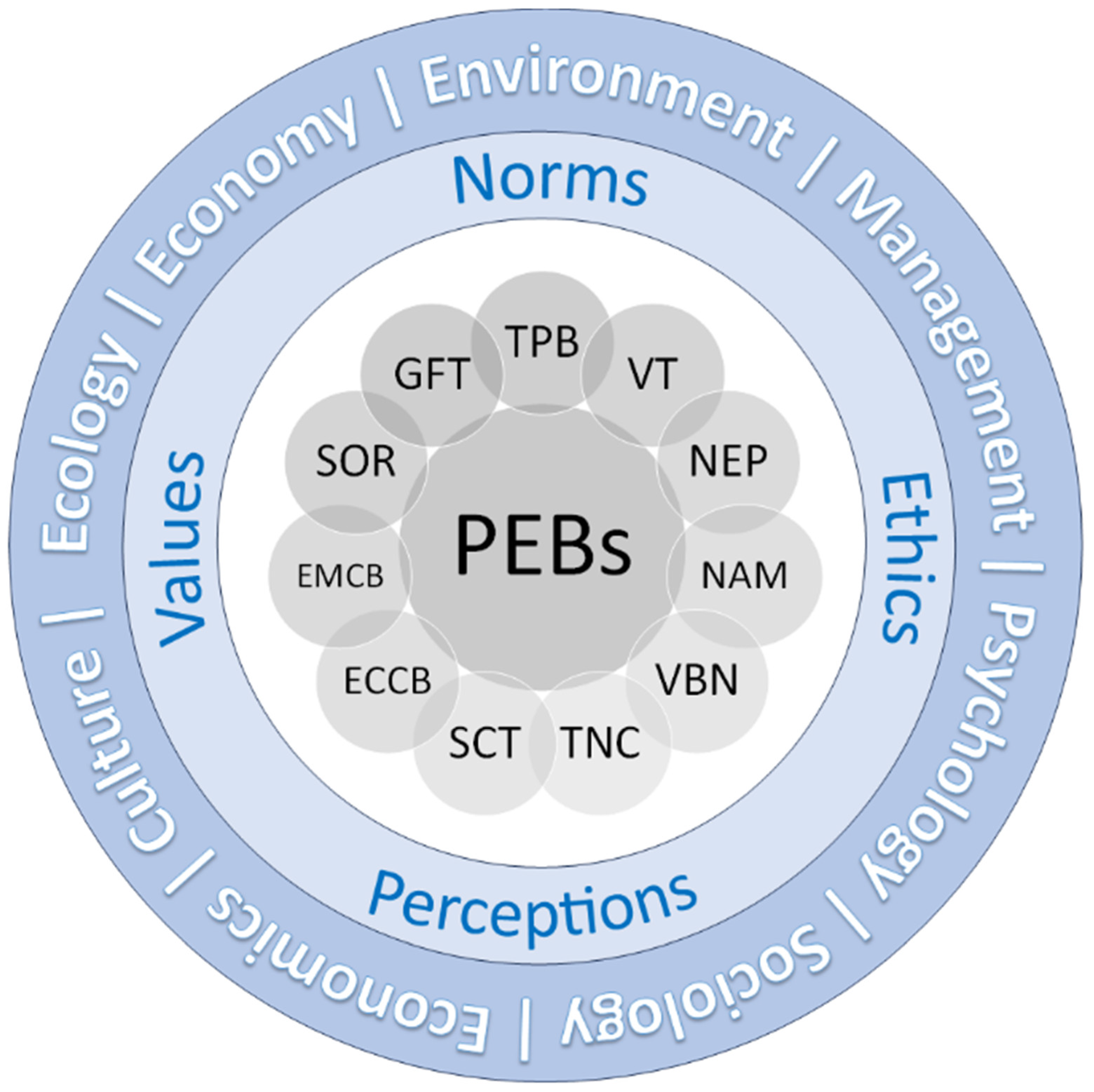
| Theory of Planned Behaviour (TPB) | TPB explains behaviour through behavioural intention, which is shaped by attitudes, subjective norms, and perceived behavioural control. | [61] |
| Value Theory (VT) | The “value theory” shows that the PEB is highly linked to individuals who focus on more intellectual aspects (e.g., altruism, pro-social behaviour, and nature-related values as biospheric values). | [62,63] |
| New Environmental Paradigm (NEP) | NEP is utilised as “a gold standard measure” of environmental beliefs and to affirm other related aspects such as ecological identity. | [64,65,66] |
| Norm-Activation Model (NAM) | The NAM showcases the importance of moral obligations in underpinning environmental action. | [67,68] |
| Value-Belief-Norm (VBN) | The VBN explains how people’s (e.g., altruistic, biospheric, and egoistic) values influence their beliefs, which in turn shape their personal norms and ultimately drive their PEB. | [69,70,71] |
| Theory of Normative Conduct (TNC) | The TNC incorporates the injunctive and descriptive norms; the former is focused on how behaviours are acceptable or non-tolerated, while the latter refers to the commonness of a norm in comparison with others. | [72,73] |
| Social Cognitive Theory (SCT) | The SCT is based on the “self-efficacy” concept that reflects an individual’s belief in their capability to act pro-socially and, in extension, pro-environmentally. | [74,75] |
| Model/Theory | Cognitive & Motivational Issues | Normative Components | Behavioural Outcomes |
|---|---|---|---|
| TPB | Beliefs, behavioural intentions & attitudes | Subjective norms | Intentional behaviour (e.g., PEB, EMCB, ECCB) |
| Value Theory | Values influence how people interpret environmental issues (e.g., seeing climate change as a moral concern) | Value orientations (e.g., altruistic/biospheric/egoistic) shape moral concern and behavioural priorities | Personal guide of behaviour across life, including PEBs (e.g., environmental activism and ethical consumption, etc.) |
| NEP | General pro-environmental worldview and moral concern | Supports and also feeds into personal norms (via VBN/NAM pathways) | Belief foundation (input to VBN/NAM) |
| NAM | Awareness of consequences (e.g., personal responsibility) | Personal moral obligation | Norm-driven pro-environmental and altruistic/pro-social behaviour |
| VBN | Environmental beliefs (via NEP) | Personal moral norms | Norm-based PEB |
| TNC | Conformism to social expectations driven by the need for social acceptance or moral alignment | Descriptive norms (what is done) and injunctive norms (what ought to be done) may conflict or reinforce each other | Behaviour aligned with an individual’s norms, either positive (e.g., recycling) or negative (e.g., littering) |
| SCT | External learning (mimicking others’ behaviour) and internal learning (e.g., self-efficacy, capability to perform a PEB) | Social influence via modelling, social reinforcement, and norms may be internalised indirectly | Behavioural change through learning (e.g., environmental and ethical actions) |
| Notion | References |
|---|---|
| Climate change concern, energy reliability, and energy affordability (% very/extremely worried). Moreover, other issues covered in the specific references also included personal norms, self-efficacy, and outcome expectancy. | [137] |
| Thirteen items constituted the climate change anxiety scale (CCAS) (8 items represented cognitive-emotional impairment, while 5 measured functional impairment), 3 items measured experience of climate change, and 6 items measured behavioural engagement. | [138] |
| The Generalised Anxiety Disorder-7 (GAD-7) is a valid and efficient tool for screening GAD and assessing its severity in clinical practice and research based on the 7-item anxiety scale. | [139] |
| The Five Facet Mindfulness Questionnaire (FFMQ) is a widely used mindfulness measure that includes five subscales: Act with Awareness, Describe, Nonjudge, Nonreact, and Observe. | [140] |
| Environmental values were measured with a short version of the New Environmental Paradigm (NEP) scale. | [65] |
| Nature relatedness was measured using the NR-6. | [141] |
| Pro-environmental behaviour (PEB) was measured by summing the frequency of eight pro-environmental actions and one more high-impact environmental action regarding red meat consumption. | Authors’ input [15] and only for red meat consumption: [142] |
| Generic questions regarding (1) visit to green space, (2) experience of climate impacts, (3) information exposure, and (4) information seeking. | Authors’ input [15] |
Disclaimer/Publisher’s Note: The statements, opinions and data contained in all publications are solely those of the individual author(s) and contributor(s) and not of MDPI and/or the editor(s). MDPI and/or the editor(s) disclaim responsibility for any injury to people or property resulting from any ideas, methods, instructions or products referred to in the content. |
© 2026 by the authors. Licensee MDPI, Basel, Switzerland. This article is an open access article distributed under the terms and conditions of the Creative Commons Attribution (CC BY) license.
Share and Cite
Aslanidis, P.-S.C.; Halkou, P.G.; Halkos, G.E. Towards an Ethical Consensus for Sustainable Development: An Integrative Review on the Role of Values, Morals, and Norms in Shaping Pro-Environmental Behaviour. Sustainability 2026, 18, 2042. https://doi.org/10.3390/su18042042
Aslanidis P-SC, Halkou PG, Halkos GE. Towards an Ethical Consensus for Sustainable Development: An Integrative Review on the Role of Values, Morals, and Norms in Shaping Pro-Environmental Behaviour. Sustainability. 2026; 18(4):2042. https://doi.org/10.3390/su18042042
Chicago/Turabian StyleAslanidis, Panagiotis-Stavros C., Panagiota G. Halkou, and George E. Halkos. 2026. "Towards an Ethical Consensus for Sustainable Development: An Integrative Review on the Role of Values, Morals, and Norms in Shaping Pro-Environmental Behaviour" Sustainability 18, no. 4: 2042. https://doi.org/10.3390/su18042042
APA StyleAslanidis, P.-S. C., Halkou, P. G., & Halkos, G. E. (2026). Towards an Ethical Consensus for Sustainable Development: An Integrative Review on the Role of Values, Morals, and Norms in Shaping Pro-Environmental Behaviour. Sustainability, 18(4), 2042. https://doi.org/10.3390/su18042042